
Rosemead City Zoning Code
ARTICLE 1
- PURPOSE AND APPLICABILITY OF ZONING CODE
17.04.010 - Purpose.
This Title, cited as the Rosemead Zoning Code, Title 17 of the Rosemead Municipal Code, carries out the policies of the Rosemead General Plan by classifying and regulating uses of land and structures within the City. This Title is adopted to protect and promote the public health, safety, and general welfare of residents and businesses in the City. More specifically, it is the purpose of this Title to:
A.
Provide standards that will guide orderly growth and development of the City;
B.
Preserve and protect the integrity and character of the City's residential neighborhoods;
C.
Maintain vital areas for business activities that serve the community and protect the quality of life;
D.
Require thoughtful planning and design that enhances the visual character of the City and avoids conflict between land uses;
E.
Create a comprehensive and stable pattern of land uses for which public services and infrastructure can be efficiently and adequately planned; and
F.
Ensure that property within the City is well maintained by requiring each owner, occupant, or other person in charge of any property to keep it in good repair and in compliance with the provisions of this Title.
(Ord. No. 931, § 5(Exh. A), 10-22-13)
17.04.020 - Authority, relationship to general plan, and adopted specific plans.
A.
Authority. This Title is adopted pursuant to Article XI, of the Constitution of the State and in compliance with the requirements of Government Code Title 7, Planning and Zoning Law.
B.
General Plan Consistency. The City's General Plan is the document that establishes the broad goals and policies for all future development. This Title is one of the primary tools used to implement the goals, objectives, and policies of the General Plan. The City Council intends, and State law requires, that this Title be consistent with the General Plan, and that any use or development approved in compliance with this Title will also be consistent with the General Plan.
C.
Specific Plan Consistency. The development standards and guidelines contained in an adopted Specific Plan provide for land development and use within the Specific Plan area. The Specific Plan supersedes the otherwise applicable City of Rosemead development standards and regulations unless stated otherwise in the Specific Plan document. Whenever the provisions and development standards contained in this Title conflict with those contained in the Specific Plan, the provisions of the Specific Plan shall take precedence. Where the Specific Plan is silent, the City of Rosemead Municipal Code shall apply.
(Ord. No. 931, § 5(Exh. A), 10-22-13; Ord. No. 978, § 5(Exh. A), 2-27-18)
17.04.030 - Applicability of zoning code provisions.
This Title applies to all land uses, structures, and development within the City as follows:
A.
New Land Uses or Structures. It shall be unlawful and a violation of this Title for any person to establish any land use or construct any structure except in compliance with the requirements of this Title.
B.
Existing Land Uses or Structures. The requirements of this Title are not retroactive in their effect on land uses or structures, lawfully established before the effective date of this Title or any applicable amendment. Existing land uses or structures are lawful and not in violation of the Rosemead Municipal Code only when operated and maintained in compliance with all applicable provisions of this Title.
C.
Other Permits and Requirements. Nothing in this Title eliminates the need for obtaining any other permits required by the City, or any permit approval required by other provisions of the Municipal Code or the laws or regulations of any County, Regional, State, or Federal agency.
D.
Government Projects. The provisions of this Zoning Code shall apply to any County, special district, and State or Federal government or agency to the maximum extent allowed by law. The provisions of this Zoning Code shall not apply to any public project of the City except to the minimum extent required by law.
(Ord. No. 931, § 5(Exh. A), 10-22-13)
17.04.040 - Interpretation of provisions.
A.
Authority to Interpret. The Community Development Director shall have the responsibility and authority to interpret the requirements and intent of this Title, and as permitted by the Garvey Avenue Specific Plan subject to the Specific Plan's provisions.
B.
Interpretations Implemented as Policy. The Community Development Director may from time to time establish an interpretation as a matter of policy in order to ensure consistent and fair application of the Code. After ascertaining all pertinent facts regarding an interpretation, the Community Development Director shall set forth the findings of the interpretation in writing as provided in subsection B.1. and made available to the public together with the Zoning Code. Unless such finding and interpretation is appealed to the Planning Commission, the Community Development Director's interpretation shall thereafter govern.
1.
Procedure for Interpretation. At the written request of any person, or at the Community Development Director's discretion, the Community Development Director may determine the meaning or applicability of any requirement of this Title and may issue an official interpretation.
a.
Requests for interpretation shall be in writing and specifically state the provision(s) in question and provide any information to assist in the review.
b.
The Community Development Director's official interpretation shall be recorded in writing and shall quote the provision(s) being interpreted, and explain their meaning or applicability in the particular or general circumstances that caused the need for interpretation.
c.
The Community Development Director's official interpretations shall be distributed to the City Council, Planning Commission, City Attorney, City Clerk, and all affected staff.
d.
Any interpretation of this Title by the Community Development Director may be appealed to the Planning Commission, whose decision regarding the interpretation shall be final. The Community Development Director may also refer any interpretation to the Planning Commission for a determination.
2.
Allowable Uses of Land. The Community Development Director may determine that a proposed use not listed in Article 2, Chapter 17.12 (Residential Zoning Districts), Chapter 17.16 (Commercial Zoning Districts), Chapter 17.20 (Commercial and Industrial Zoning Districts), Chapter 17.24 (Special Purpose Zoning Districts), and 17.28 (Overlay Zones) is allowable if the use is substantially similar to a use permitted in Article 2, Chapter 17.12 (Residential Zoning Districts), Chapter 17.16 (Commercial Zoning Districts), Chapter 17.20 (Commercial and Industrial Zoning Districts), Chapter 17.21 (Garvey Avenue Specific Plan), Chapter 17.24 (Special Purpose Zoning Districts), and 17.28 (Overlay Zones) and all of the following findings are made:
a.
The proposed use will be consistent with the goals, objectives, and policies of the General Plan;
b.
The characteristics of, and activities associated with, the proposed use are equivalent to those of one or more of the uses listed in the zoning districts as allowable, and are no more detrimental or intensive than the uses listed in the district for which the proposed use is determined to be consistent with; and
c.
The proposed use will meet the purpose and intent of the zoning district that is applied to the site where the proposed use is to be located.
3.
Zone district boundaries. The Community Development Director may determine the exact location of any zone district boundary. Any such determination shall be documented in writing and shown clearly on a map, and may be appealed to the Planning Commission.
C.
Interpretation as Minimum Requirements. When any regulation or standard of this Title is being interpreted and applied all provisions shall be considered to be minimum requirements unless stated otherwise (such as height limits and lot coverage for structures).
D.
Calculations - Rounding. Where provisions of this Zoning Code require calculations to determine applicable requirements any fractional/decimal results of the calculations shall be rounded as provided by this subsection.
1.
Residential Density, Minimum Lot Area, and Number of Lots. The fractional/decimal results of calculations of the number of dwelling units allowed on a parcel based on maximum density requirements, and the number of parcels allowed through subdivision based on a minimum lot area requirement shall be rounded down to the next lowest whole number, except when calculating a density bonus in compliance with Chapter 17.84 (Density Bonus). In the case of a density bonus, the fractional/decimal results of a calculation of the number of dwelling units allowed shall be rounded up to the next whole number.
2.
All Other Calculations. For all calculations required by this Zoning Code other than those described in Subsection D.1 above, the fractional/decimal results of calculations shall be rounded to the next highest whole number when the fraction/decimal is 0.5 or more, and to the next lowest whole number when the fraction is less than 0.5.
(Ord. No. 931, § 5(Exh. A), 10-22-13; Ord. No. 978, § 5(Exh. A), 2-27-18)
17.04.050 - Definitions—General.
For use in this Title certain terms are hereby defined. Words used in the present tense shall include the past and future tense and vise versa. Words in the singular form shall include the plural form and vice versa. The words "shall" and "will" are mandatory and the words "should" and "may" are permissive.
Words and phrases used in the Zoning Code and not specifically defined shall be construed according to the context and common usage of the language and as ultimately determined by the Community Development Director. Application of definitions within the Garvey Avenue Specific Plan shall be consistent with the Specific Plan goals, objectives, and the purpose and character of each land use district.
For the purpose of carrying out the intent of this Title, certain terms, words, and phrases are defined and shall be deemed to have the meaning ascribed to them as follows:
"Accessory Structure."
"Nonresidential Accessory Structure" means an attached or detached structure that is a part of, and clearly incidental and secondary to, a nonresidential structure and that does not change the character of the nonresidential structure. Illustrative examples of these structures include:
•
Decks.
•
Fences.
•
Garages.
•
Gazebos.
•
Kiosks and carts for selling beverages, food, clothing, phones, toys, etc.
•
Outdoor fireplaces.
•
Outdoor kitchens.
•
Outdoor play equipment.
•
Patios.
•
Platforms.
•
Porches.
•
Refuse collection structures/trash enclosures.
•
Spas and hot tubs.
•
Storage or work sheds.
•
Swimming pools.
•
Tennis and other on-site sport courts.
•
Terraces.
•
Walls.
•
Workshops.
"Residential Accessory Structure" means an attached or detached structure that is a part of, and clearly incidental and secondary to, a residence and that does not change the character of the residential structure. Does not include second dwelling units. Illustrative examples of these structures include:
•
Decks.
•
Fences.
•
Garages.
•
Gazebos.
•
Greenhouses (noncommercial).
•
Outdoor play equipment.
•
Patios.
•
Platforms.
•
Porches.
•
Spas and hot tubs.
•
Storage or work sheds.
•
Swimming pools.
•
Tennis and other on-site sport courts.
•
Terraces.
•
Walls.
•
Workshops.
"Accessory Use" means an activity on a property that is incidental and subordinate to the main use of the site.
"Acupuncture" means a form of medical treatment involving the use of pressure, needles, or similar applications.
"Adult Business" means any business establishment or concern that, as a regular and substantial course of conduct, performs or operates as an adult arcade, adult cabaret, adult model studio, adult store or adult theater, or any combination thereof. It also means any business establishment or concern that, as a regular and substantial course of conduct, sells or distributes sexually oriented merchandise or sexually oriented material; or any other business establishment or concern that, as a regular and substantial course of conduct, offers to its patrons products, merchandise, services or entertainment characterized by an emphasis on matters depicting, describing, or relating to specified sexual activities or specified anatomical areas. Adult business does not include those uses or activities, the regulation of which is preempted by state law. (See Chapter 17.30, Section 17.30.030 (Standards for Specific Land Uses) and Chapter 5.08, pertaining to the licensing and regulation of Adult Businesses.)
"Alcohol Beverage Sales:"
"Alcohol Sales, Off-Sale" means any establishment in which alcoholic beverages are sold, served, or given away for consumption off the premises. References to the establishment shall include any immediately adjacent area that is owned, leased, rented, or controlled by the licensee.
"Alcohol Sales, On-Sale" means any establishment in which alcoholic beverages are sold, served, or given away for consumption on the premises and where the owner is applying for or has obtained any ABC Licenses for on-site consumption. References to the establishment shall include any immediately adjacent area that is owned, leased, rented, or controlled by the licensee. (See Article 3, Chapter 17.30 (Standards for Specific Land Uses), Section 17.30.040 for Alcohol Beverage Sales regulations.)
"Alley" means a public way, other than a street, permanently reserved as a secondary means of vehicular access to abutting property.
"Ambulance Fleet Services" means a base facility where ambulances and similar vehicles are parked and from which they are dispatched, and/or where ambulance vehicles and crews are not based at a hospital or fire department stand by for emergency calls.
"Animal Hospital/Clinic:" See "Veterinary Services."
"Animal Sales and Services:"
"Animal Boarding/Kennels" means the commercial provision of shelter and care for dogs, cats, other household animals, and horses (where allowed), including activities associated with such shelter and care (i.e., feeding, exercising, grooming, and incidental medical care).
"Animal Grooming" means the commercial provision of bathing and trimming services for dogs, cats, and other household animals permitted by this Development Code. Overnight boarding is not allowed.
"Animal Retail Sales" means the retail sales of household animals within an entirely enclosed building. This use includes grooming, if incidental to the retail use, but specifically excludes boarding of animals other than those for sale.
"Antique" means any article which because of age, rarity, or historical significance has a monetary value greater than the original value, or which has an age recognized by the United States Government as entitling the article to an import duty less than that prescribed for contemporary merchandise.
"Apartment" means a room or a suite of two or more rooms in a multiple dwelling, occupied or suitable for occupancy as a residence for one family.
"Apartment House" means a building containing three or more apartments each of which is designed for occupancy or occupied by a person or family living independently of the other apartments or units in the building.
"Apartment Studio" means a small apartment usually consisting of one main living space, a small kitchen, and a bathroom.
"Arcade" means an establishment that provides four or more amusement devices, whether or not the devices constitute the primary use or an accessory or incidental use of the premises. Amusement devices means electronic or mechanical equipment, game, or machine that is played or used for amusement, which when so played or used involves skill and which is activated by coin, key, or token, or for which the player or user pays money for the privilege of playing or using. See also "Internet/Cyber Café".
"Architectural Feature" means any part of the structure that is part of the design and creates the style of the building or structure such as windows, eaves, trim, porches, etc.
"Artist Studio" means a space used to produce paintings, drawings, pottery, sculpture, ceramics, home crafts, creative writing, dance (individual or one on one instruction), or music (individual or one on one instruction). Offensive noise, vibration, dust, etc., are prohibited. Most goods are sold primarily at a different location, such as farmer markets or festivals.
"Assembly/Meeting Facilities, Public or Private" means a facility for public or private assembly and meetings. Illustrative examples of these uses include:
• Banquet rooms.
• Civic and private auditoriums.
• Community centers.
• Conference/convention facilities.
• Meeting halls for clubs and other membership organizations.
• Places of Religious Assembly, including limited associated accessory uses (i.e., religious school activities that are not full-time, residence for clergy, and office space, and excluding schools with regular daily sessions.)
• Sports stadiums and arenas.
• Also includes functionally related internal facilities (i.e., kitchens, multi-purpose rooms, storage, etc.), and functionally associated accessory uses (e.g. temporary aid shelters to provide humanitarian assistance). Does not include conference and meeting rooms that are accessory and incidental to another principal use and typically used only by on-site employees and clients, and that occupy less floor area on the site than the principal use they support. Does not include sports or other commercial entertainment facilities (see "Commercial Recreation and Entertainment"). Does not include funeral homes and mortuaries (see "Funerals Homes and Mortuaries"). Related on-site facilities including day care centers and schools are separately defined (see "Educational Institute").
"ATM (Automated Teller Machine)" means an automated device used by the public to conduct banking and financial transactions electronically (i.e. withdrawing cash from, or depositing cash or checks into, a bank, savings and loan, credit union, credit card or similar account). This does not apply to retail point-of-sale transactions within a fully enclosed location. This also refers to machines located on properties separate from financial institutions.
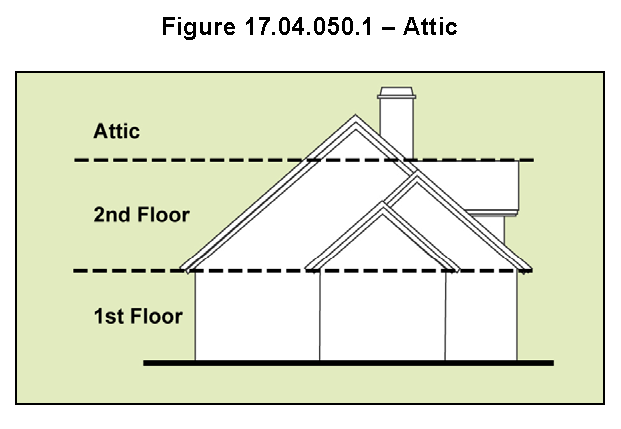
"Attic" means the area located between the top plate and the roof or ridge of a building, as further defined in the Building Code (see Figure 17.04.050.1).
"Automobile Car Wash" means establishments engaged in the washing, waxing, or cleaning of automobiles or similar light vehicles.
"Full Service" means a car wash establishment where operating functions are performed entirely by an operator/owner with the use of washing, waxing, and drying equipment.
"Self-Service or Accessory" means an establishment where washing, drying, polishing, or vacuuming of an automobile is done by the car driver or occupant.
"Automobile Lube and Tune Facility" means an establishment that provides minor maintenance services for automobile engines and brake systems. Such businesses are characterized by short service visits. Overnight outdoor parking or storage of automobiles being serviced is prohibited.
"Automobile Parts and Accessory Store" means a retail place of business selling or furnishing automobile supplies and parts. No repair work of any kind may be conducted in conjunction with such use.
"Automobile Rental or Leasing" means a place of business used for the storage and display of complete and operative automobiles for the purpose of renting or leasing said vehicles on a short or long term basis.
"Automobile Repair Garage" means a business conducted within a fully enclosed building which services and repairs motor vehicles, but exclusive of all body and fender repair or painting, steam cleaning, mechanical and non-mechanical car washing, recapping of tires, engine or transmission overhauling or replacement and other major repairs.
"Automobile Service Station" means a retail business establishment limited to the sale of motor fuels and supplying goods and services generally required in the operation and maintenance of automotive vehicles and the fulfilling of motorists' needs. These may include sale of petroleum products; sale and servicing of tires, batteries, automotive accessories and replacement items; washing and lubrication services; the performance of minor automotive maintenance and repair; and the supplying of other incidental customer services and products. Major automotive repairs, painting and body fender work are excluded except where such uses are otherwise permitted. "Service station" as used herein does not include chain, automatic or coin-operated wash racks.
"Bachelor Apartment" means a studio unit, an apartment, or dwelling unit in a multiple dwelling or apartment house, occupied or suitable for occupancy as a residence for one person. A bachelor apartment contains bath and cooking facilities and one room used for living room and sleeping with no separate bedroom.
"Bar/Cocktail Lounge" means a saloon, bar, pub, tavern, or similar place used primarily for drinking alcohol and designed for social interaction and/or entertainment.
"Basement" means an area of a building or structure that is partially above ground and having no more than fifty (50) percent of its height, at any point, above finish grade on each and every side. A basement is not considered a floor or story unless more than fifty (50) percent of its height is above finished grade.
"Beauty shop" means a commercial establishment that sells beauty and health products and/or provides personal care and grooming services such as hair cutting and styling, nail care, facial hair removal, and non-permanent make-up application to the face. A "Beauty Shop" does not include electrolysis, facials, skin care and skin treatment services, massage, reflexology, tanning, body wrapping or weight management.
"Beauty/Health Spa" means a commercial establishment, such as a (nonmedical) health spa or day spa, providing a comprehensive range of beauty, health, relaxation, and personal care and grooming services including, but not limited to, hair cutting and styling, facials and skin care, skin treatments, aesthetician services, nail care, hair removal, electrolysis, cosmetics, tanning, body wrapping, weight management, and massage.
"Bedroom" means an enclosed space within a dwelling unit that is designed for sleeping has a permanent door permitting closure and separation from all kitchen, living room, and hallway areas and complies with the Uniform Building Code requirements for a bedroom.
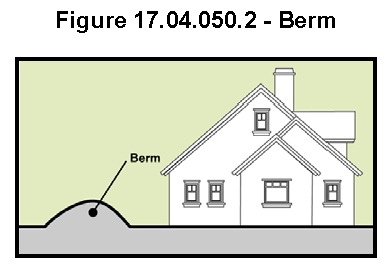
"Berm" means a raised earthen area (see Figure 17.04.050.2).
"Boarding House or Rooming House" means a dwelling unit, where sleeping or non-sleeping rooms are rented for lodging purposes to individuals, with rental agreements, leases, or subleases, either written or oral or implied, whether or not an owner, agent, or rental manager is in residence. Meals may be provided to boarders in connection with the renting of sleeping rooms or common kitchen facilities may be provided. This definition does not include household; convalescent facility; residential care facility; group home; emergency shelter; supportive housing; transitional housing; hotel; motel; or other extended lodging facility as these terms are defined in this Code.
"Body Art" means art made on, with, or consisting of, the human body. The most common forms of body art are tattoos and body piercing.
"Body Art Establishment" means a single business location, which is engaged in the creation of body art, such as tattoo parlors. Body Art Establishments shall not include beauty salons, and/or similar establishments, that provide permanent cosmetics to the human face as a means of producing designs that resemble makeup to the skin of the face, including, but not limited to, the permanent coloring of the eyebrows, lip line, eye line, and/or eyelashes. Such beauty salons, and/or similar establishments shall operate pursuant to a valid cosmetology license and in accordance with any and all state, county, and city regulations.
"Body Branding" means impressing or burning a mark or figure on the skin of a person with a hot object or flame.
"Body Scarring" means any method by which a scar is applied to or left upon a body.
"Breezeway" means a structure with a roof and open sides that connects two buildings.
"Building" means a permanently located structure having a roof supported by columns or walls for the shelter, housing or enclosure of persons, animals, personal property of any kind.
"Building Height" means the vertical distance from the average finished ground level of the site to the highest point of the roof. In cases of ambiguity and for unique architectural elements, the determination of building height will be determined by the Community Development Director.
"Building Site" means the ground area of a building or group of buildings together with all open spaces as required by this Zoning Code.
"Business and Business Activity" means any sole proprietorship, partnership, joint venture, corporation, or other business entity formed for profit-making purposes.
"California Licensed Medical Professional" means a physician, surgeon, chiropractor, acupuncturist, osteopath, nurse, psychiatrist, physical therapist who is duly licensed to practice his or her respective profession in the state of California and who performs activities encompassed by such professional license.
"Carport" means a permanent roofed structure with not more than two enclosed sides used or intended to be used for automobile shelter and storage. Carports cannot be used to satisfy the off-street parking requirements of this Title.
"Catering Service" means a business which primary function is to prepare food for distribution off the premises. It shall not include a business which primary function is the sale of individual meals or portions thereof on the premises.
"Church:" See "Places of Religious Assembly."
"Club" means any building or premises used by an association of persons, whether incorporated or unincorporated, for some common nonprofit purpose, but not including groups organized primarily to render a service carried on as a business.
"Commercial Recreation and Entertainment" means establishments providing participant or spectator recreation or entertainment, either indoors or outdoors, for a fee or admission charge. Illustrative examples of these uses include:
• Arcades or electronic games (see "Arcade")
• Batting cages
• Country clubs
• Family fun centers
• Golf courses
• Internet/cyber cafés (see "Internet/Cyber Café")
"Community Development Director" means the Director of the city of Rosemead Community Development Department or his or her designee.
"Conditional Use Permit" means a discretionary permit required for certain uses specified in this Code to provide for the thorough review of such proposed uses and their associated structures and other improvements, with the intent of ensuring that if approved, such use can be operated in a manner compatible with surrounding uses. See Article 5, Chapter 17.132 (Conditional Use Permits).
"Convalescent Facility:" See "Residential Care Facility."
"Convenience Store" means easy access retail stores selling a combination of alcohol, gasoline, or a range of merchandise to provide a variety of items primarily for the motoring public.
"Corner Cutoff Area" means a portion of a corner lot or parcel of land which is maintained in a manner to provide adequate and safe visibility for vehicular and pedestrian traffic wherever streets and alleys converge.
"Cottage Food Operation" means an enterprise within the registered or permitted area of a dwelling unit where the cottage food operator, as defined by California Health and Safety Code 113758, resides and where cottage food products pursuant to California Health and Safety Code 113758 are prepared or packaged for direct, indirect, or direct and indirect sale to consumers.
"Cultural Institution" means any facility such as a museum or library that displays or preserves objects of community or cultural interest relating to one or more of the arts or sciences. This use includes libraries, museums, and art galleries.
"Day Care, General" are establishments that provide nonmedical care for fifteen (15) or more persons on a less than a 24-hour basis, including nursery schools, preschools, and day care centers for children or adults. Such use must comply with all applicable State regulations, and specifically those set forth in the California Health and Safety Code commencing with Section 1596.70, to be considered a General Day Care facility. General Day Care establishments may be accessory to an industrial, commercial or institutional use, as may be allowed by Article 2 of this Zoning Code.
"Day Care, Limited" means nonresidential, nonmedical care and supervision of fourteen (14) or fewer persons on a less than 24-hour basis.
Child Day Care:
"Child Care Home, Small Family (eight or fewer children)" means day care facilities located in single-family dwellings where an occupant of the dwelling provides care and supervision for eight or fewer children. Children under the age of ten (10) years who reside in the dwelling count as children served by the day care facility. Such use must comply with all applicable State regulations, and specifically those set forth in the California Health and Safety Code commencing with Section 1596.70, to be considered a small family child care home.
"Child Care Home, Large Family (nine to fourteen (14) children)" means day care facilities located in single-family dwellings where an occupant of the dwelling provides care and supervision for nine to fourteen (14) children. Children under the age of ten (10) years who reside in the dwelling count as children served by the day care facility. Such use must comply with all applicable State regulations, and specifically those set forth in the California Health and Safety Code commencing with Section 1596.70, to be considered a large family child care home. See "Day Care, General" for facilities serving fifteen (15) or more children.
"Adult Day Care:" See "Day Care, General."
"Developed Living Area" means the sum of the areas of all floors of a building approved for residential use as measured from the interior faces of exterior walls.
"Disability" means a physical or mental impairment that limits or substantially limits one or more major life activities. A person with a disability is anyone who is regarded as having such impairment or anyone who has a record of such impairment.
"Discretionary Permit" means a permit that is subject to the evaluation, judgment, and approval or denial by the Rosemead Planning Commission and/or the Rosemead City Council.
"Donation Box" means a bin, storage shed, or similar facility measuring no more than eight feet wide by eight feet long and eight feet high, and established as an accessory use to a primary use for the purpose of providing a collection location for donated clothes, shoes, and small household items. Such facilities generally are established by a charitable or non-profit organization.
"Drive-Through or Drive-Up Facilities" means an establishment that sells products or provides services to occupants in vehicles, including drive-in or drive-up windows and drive-through services. Examples include fast food restaurants, banks, and pharmacies.
"Driveway" means a paved access from a street or alley to a garage or other parking area; a driveway may include the space required to turn or maneuver a motor vehicle into and out of such parking area.
"Dwelling" means a structure or portion thereof designed exclusively for permanent residential purposes, but not including hotels, motels, emergency shelters, or extended stay locations.
"Accessory Dwelling Unit" means an attached or a detached residential dwelling unit that provides complete independent living facilities for one or more persons and is located on a lot with a proposed or existing primary residence. It shall include permanent provisions for living, sleeping, eating, cooking, and sanitation on the same parcel as the single-family or multifamily dwelling is or will be situated. An accessory dwelling unit also includes the following:
1.
An efficiency unit as defined in Section 17958.1 of the Health and Safety Code.
2.
A manufactured home, as defined in Section 18007 of the Health and Safety Code.
"Dwelling Unit" means any structure or portion thereof designed for living and sleeping purposes that contains independent cooking and sanitation facilities.
"Junior Accessory Dwelling Unit" means a unit that is no more than five hundred (500) square feet in size and contained entirely within a single-family residence. A junior accessory dwelling unit may include separate sanitation facilities, or may share sanitation facilities with the existing structure.
"Multi-Family Dwelling Unit" means a structure or portion thereof containing three or more dwelling units designed for the independent occupancy of three or more households.
"Primary Dwelling Unit" means an existing single-unit residential structure on a single lot with provisions for living, sleeping, eating, a single kitchen for cooking, and sanitation facilities, and occupied by one household.
"Single-Family Dwelling Unit" means a detached structure containing no more than one dwelling unit which, regardless of form of ownership, is designed and/or used to house not more than one household, including all domestic employees for such household.
"Two-Family Dwelling (Duplex) Unit" means a building containing two complete dwelling units designed for the independent occupancy of two households.
"Urban Dwelling" means an attached or detached residential dwelling unit that complies with Section 65852.21 of the Government Code as amended in Section 17.30.210 of the Rosemead Municipal Code.
See also "Manufactured Housing" and "Mobile Housing Unit."
"Easement" means a recorded right or interest in the land of another, which entitles the holder thereof to some use, privilege or benefit out of or over the real property without possessing it. An access easement is a right granted by a landowner to certain other property owners, or the general public, to travel across the landowner's property for access.
"Eating and Drinking Establishments:"
"Accessory Food Service" means an establishment that sells food and/or beverages as an accessory use in a retail, office, or institutional structure and that does not change the character of the primary use.
"Bar, Lounges, Nightclubs, Taverns (includes independent or accessory establishments)" means any establishment that sells or serves alcoholic beverages for consumption on the premises and is holding or applying for a public premise license from ABC and in which persons under twenty-one (21) years of age are restricted from the premises. References to the establishment shall include any immediately adjacent area that is owned, leased, rented, or controlled by the licensee.
"Fast Food" means a restaurant which supplies food and beverages primarily in disposable containers and which is characterized by high automobile accessibility, self-service, and short stays by customers.
"Outdoor Dining" means a dining area with seats and/or tables located outdoors of a sit-down restaurant, fast food, or other food service establishment. Outdoor dining is located entirely outside the walls of the contiguous structure or enclosed on one or two sides by the walls of the structure with or without a solid roof cover.
"Restaurant, Sit-down" means an establishment engaged in the business of selling food and beverages, including alcoholic beverages, prepared on site for primarily on-site consumption. Food and beverages are served to the customer at a fixed location (i.e., booth, counter, or table). Food and beverages are ordered from a menu. Customers typically pay for food and beverages after service and/or consumption. The sale or service of sandwiches, whether prepared in the kitchen or made elsewhere and heated on the premises, or snack foods, shall not constitute a sit-down restaurant.
"Take-Out Service" means an establishment that offers a limited variety of food or beverages. Transactions are sales for off-site consumption. Customers are served either at a counter or service window. Incidental seating (less than two hundred fifty (250) square feet of seating area) may be provided for limited on-site consumption of food or beverages. Typical uses include bakeries, coffee stores, ice cream and frozen dessert stores, delivery-only pizza establishments, small delicatessens, and similar establishments.
"Eave" means the part of a roof that overhangs an exterior wall.
"Educational Institute" means any public, private, or parochial elementary, junior high, high school, university, or other school giving general academic instruction in the several branches of academic learning, which has five or more students. Educational Institutes do not include trade schools, which are defined separately herein.
"Electronic Game Center:" See "Arcade."
"Emergency Health Facility" means establishments that provide emergency medical service (i.e., outside normal physician office hours or before a physician appointment is available) with no provision for overnight or continuing care on an inpatient basis. Also includes "urgent care" facilities and walk-in clinics. Does not include hospitals (see "Hospital").
"Emergency Shelter:"
"Emergency Shelter" shall mean any establishment operated by an Emergency Shelter Provider that provides homeless people with immediate, short-term housing for no more than six months in a 12-month period, where no person is denied occupancy because of inability to pay. Emergency Shelters may also provide shelter residents with additional supportive services such as food, counseling, laundry, and access to other social programs. Emergency Shelters may have individual rooms and common areas for residents of the facility, but may not be developed with individual dwelling units, with the exception of a manager's unit
"Emergency Shelter Provider" shall mean a government agency or non-profit organization that provides emergency or temporary shelter, and which may also provide meals, counseling, and access to other social programs. This definition does not include such emergency shelters as may be provided for relief following a natural disaster or during a state of emergency or those provided at a place of religious assembly for less than five days in any 30-day period.
"Temporary Aid Center" shall mean any establishment that provides homeless and low-income people with short-term services, where no person is denied assistance because of inability to pay. Temporary aid centers provide supportive services such as food, clothing, counseling, laundry, and access to other social programs, but do not provide overnight shelter. This use does not include establishments that function as medical or professional offices and provide social services.
"Equipment Rental Yard" means service establishments primarily engaged in the outdoor storage and rental of construction equipment, materials or supplies, machinery or industrial supplies.
"Establishment:" See "Business and Business Activity."
"Façade" means one side of the exterior of a building, generally the front, but also may include the sides and rear. In architecture, the façade of a building is often the most important from a design standpoint, as it sets the tone for the rest of the building.
"Family" means any group of individuals living together as the functional equivalent of a family where the residents may share living expenses, chores, eat meals together and are a close group with social, economic, and psychological commitments to each other. A family includes, for example, the residents of residential care facilities and group homes for people with disabilities. A family does not include larger institutional group living situations such as dormitories, fraternities, sororities, monasteries, nunneries, or boarding houses.
"Farmers' Market" means an outdoor market certified for direct retail sales by farms to the public by the State or County Agricultural Commission under California Code of Regulations Title 3, Chapter 3, Article 6.5. Farmers' Markets can also include limited sales of crafts and goods.
"Financial Service or Institution" means a company specializing in consumer loans and lines of credit and other financial services such as a bank, savings and loan, credit union, mortgage office, or automated teller machine (ATM). This does not include check cashing, payday loan, or any similar establishment.
"Fence" means a freestanding structure designed to restrict or prevent movement across a boundary or to mark the boundary of an area.
"Floor" means a unit of building height to be used as an alternative term to story.
"Floor Area" means the total floor space in terms of square footage occupied by an owner, lessee, or renter in a building except:
1.
Elevator shafts;
2.
Stairwells;
3.
Courts or atriums uncovered and open to the sky;
4.
Rooms exclusively housing building operating equipment; and
5.
Parking areas.
"Floor Area Ratio (FAR)" means the total square-footage of floor area on a lot divided by the gross area of the lot. Such calculation shall include only those structures intended for permanent habitation. For all subdivisions and unimproved vacant lots FAR calculations shall use the net area of the proposed lot.
"Fortunetelling" means a business that professes to foretell future events. No such business shall be conducted in a structure utilized for residential purposes. No such business qualifies as a home occupation.
"Frontage" is the face of a building or length of a lot that is parallel to, or is at a near parallel angle to a public street or public parking area.
"Funeral Homes and Mortuaries" means establishments engaged in the provision of services involving the care, preparation, or disposition of human remains other than in cemeteries. May or may not include crematories and/or mortuaries. No internment is provided on site. May include areas for assembly services and living quarters for funeral home/mortuary manager.
"Garage" means an accessory structure or portion of the main building permanently roofed and enclosed on all sides, which is designed or used for the shelter of motor vehicles.
"General Plan" means the General Plan for the development of the City adopted by the City Council.
"Glare" means the shining of bright or intense light on a property.
"Government Facilities" means a building or structure owned, operated, or occupied by a governmental agency to provide a governmental service to the public.
"Grade, Existing" means the surface of the ground or pavement at a stated location as it exists before disturbance in preparation for a project regulated by this Zoning Code.
"Grade, Finished" means the elevation of the surface of the ground adjoining the building at the completion of a project regulated by this Zoning Code.
"Grade (ground level)" is the average of the finished ground level at the center of all walls of a building, except in cases where walls are parallel to and within five feet of a sidewalk, ground level shall be measured at the sidewalk.
"Group Home" means any residential care facility licensed by the State of California for occupation by six or fewer persons. See definition under Title 22 (Social Security) in the California Code of Regulations (Section 80001[g]).
"Hardscape" means areas such as patios, decks, driveways, paths, and sidewalks that do not require irrigation.
"Health/Fitness Facilities:"
"Health/Fitness Facilities (Small)" means an indoor facility of two thousand (2,000) square feet or less in size where passive or active exercises and related activities are performed using minimal muscle-building equipment or apparatus for the purpose of physical fitness, improved circulation or flexibility, and/or weight control. Examples of uses include Pilates, personal training, yoga, and martial arts studios.
"Health/Fitness Facilities (Large)" means a full-service fitness center, gymnasium, or health and athletic club which is over two thousand (2,000) square feet in size and may include any of the following: sauna, spa or hot tub facilities; weight rooms; indoor tennis, handball, or racquetball courts; aerobic classes and other indoor sports activities; locker rooms and showers.
"Hedge" means a line of closely spaced shrubs and tree species, planted and trained in such a way as to form a barrier or to mark the boundary of an area.
"Heliport" means an area used for the landing, parking, or takeoff of helicopters including operations facilities (i.e. fueling, loading and unloading, maintenance, storage, terminal facilities, etc.).
"Helistop" means a single pad used for the landing, parking, or takeoff of one helicopter and other facilities as may be required by Federal and State regulations, but not including operations facilities (i.e. fueling, loading and unloading, maintenance, storage, terminal facilities, etc.).
"Homeowners' Association" means an organization of homeowners whose major purpose is to maintain and provide community facilities and services for the common benefit of the residents.
"Home Occupation" means a business, occupation, or activity conducted as an accessory use within a dwelling unit incidental to the residential use of the property and in which there is no display, no stock or trade commodity sold on the premises, and which the appearance gives no indication of any use other than residential.
"Horticulture" means the study and practice of cultivating plants, such as growing fruit, flowers, ornamental plants, and vegetables in small gardens. Horticulture usually refers to gardening on a smaller scale, while agriculture refers to the large-scale cultivation of crops.
"Horticulture, Commercial" means the cultivation of agricultural products for retail or wholesale sales. Includes plant nurseries.
"Horticulture, Private" means the cultivation (but not sale) of agricultural products for use or consumption only by the property owner or tenant.
"Hospital" means a facility providing medical, surgical, psychiatric, or emergency medical services to sick or injured persons, primarily on an inpatient basis. This use includes incidental facilities for outpatient treatment, as well as training, research, and administrative services for patients and employees. This excludes sanitariums and residential care facilities.
"Hotel" means a building or a portion of a building containing guest rooms intended or designed to be used or which are used, rented, or hired out to be occupied or which are occupied for temporary or overnight accommodations, but not used as the legal residence or principal dwelling place of the occupant(s). Entrance to all guest rooms must be from completely enclosed interior halls.
"Industry" means establishments engaged in the manufacturing of finished parts or products, either from raw materials or previously prepared materials, within an enclosed structure. This includes processing, fabrication, assembly, treatment, testing (i.e., laboratories), packaging, incidental office storage, sales, and distribution of the parts or products; and laundry and dry cleaning plants.
"Industry, Light" means the manufacture and/or processing of consumer-oriented goods in a manner that does not produce noticeable odors, air emissions, or other environmental effects, and that has limited associated trucking activity. Light industries generally require limited amounts of raw materials to produce goods. Examples of light industries include, but are not limited to, the manufacture of clothes, shoes, furniture, consumer electronics, and household items.
"Industry, Heavy" means the manufacture and/or processing of materials and goods utilizing large quantities of raw materials, and generally requiring high capitalization and production of large quantities of output. Heavy industry often sells output to other business users rather than consumers. Characteristics of heavy industry include, but are not limited to, heavy trucking activity, noise, emissions requiring federal or state environmental permits, use of large quantities of hazardous materials as defined the U.S. Environmental Protection Agency, and requirement for specialized permits from federal and state occupational health and safety agencies.
"Internet Café and Game Arcade" means an establishment that provides more than three computers and/or other electronic devices to the public for compensation and/or for public access to that system commonly referred to as the "Internet" for the purpose of e-mail, playing video games over the Internet or other network system, and/or access to other computer software programs. Internet cafe is also synonymous with PC café, cyber café, internet gaming center, computer/internet rental and cyber centers. See "Commercial Recreation and Entertainment".
"Karaoke Entertainment" means an accessory entertainment use consisting of a musical rendition in which participant(s) sing words accompanied by popular recordings from which the vocals have been removed and the results of which are professionally mixed and amplified for play-back entertainment of other patrons.
"Karaoke TV (KTV) Studio" means an establishment offering participatory Karaoke entertainment as a primary use, where patrons perform semi-privately in booths or rooms reserved for such purpose.
"Kennel:" See "Animal Sales and Services, Animal Boarding/Kennels".
"Kitchen" means any room all or part of which is designed and/or used for the cooking and other preparation of food.
"Landscaping" means any combination of native or exotic plants, lawn, groundcover, trees, shrubs, and other plant materials, plus decorative outdoor and complementary elements such as pools, fountains, water features, paved or decorative walkways or surfaces of rock, stone, brick, block, or similar material (excluding driveways, parking, loading, or storage areas), and sculptural elements. Plants on rooftops or porches or in boxes attached to structures typically are not considered landscaping.
"Large Collection Facility" means a center for the acceptance by donation, redemption or purchase of recyclable materials from the public. Such a facility does not use power-driven processing equipment and is two hundred (200) square feet or greater in floor space and is located on the same parcel as the principal use.
"Laundry and Dry Cleaning Services:"
"Laundry/Dry Cleaning Services - Off-Site" means establishments that serve as pick-up and drop-off locations for dry cleaning only, with no cleaning equipment located onsite. This use does not include a self-service laundry establishment, which is classified separately.
"Laundry/Dry Cleaning Services - On-Site" means establishments that provide laundering and dry cleaning services on-site. The establishment may include related services such as tailoring.
"Laundry/Self-Service" means any establishment for laundering where there is no pickup or delivery service and no steam or hand laundry of any type, and where there is no intermingling of customers' laundry.
"Live Entertainment" means music, comedy, readings, dancing, acting, or other entertainment performed on a site. This includes dancing by patrons to live or recorded music. Live Entertainment may only occur on a site upon approval of a city of Rosemead Business License.
"Live/Work" (includes "Artist Live/Work") means a unit that is designed or structurally modified to combine residential occupancy and commercial activity such as artist studios, professional offices, software/media offices, or small-scale retail sales of art and crafts.
"Lot" means a parcel of real property shown as a delineated parcel with a number or other separate designation on a plat recorded in the office of the County Recorder, or a parcel the dimensions or boundaries of which are defined by a record of survey recorded pursuant to the provisions of the Subdivision Map Act of the state, in the office of such recorder, or a parcel the dimensions and boundary of which are shown on a plot plan or map filed, finally approved and in effect pursuant to Title 16 of this Code, or a parcel containing not less than the minimum square footage required in the zone in or a parcel held under separate ownership and lawfully separated in ownership prior to the effective date of this chapter and all applicable predecessor ordinances, and abutting upon a street or private easement.
"Lot, Corner" means a lot situated at the intersection of two or more streets. (See Figure 17.04.050.3)
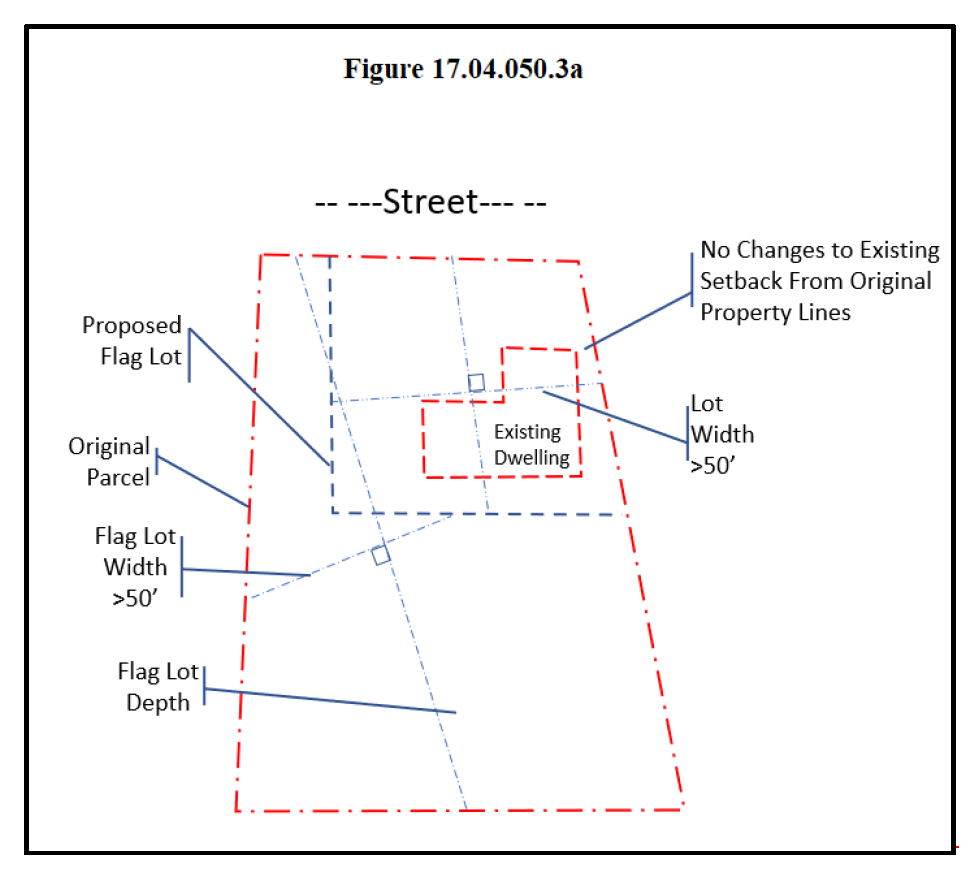
"Lot, Flag" means a lot whose shape or property line configuration is created in a manner which utilizes an extension of property for the exclusive purpose of obtaining vehicular and pedestrian access to a public street. New flag lot subdivision is prohibited in the City of Rosemead with the exception of flag lot subdivisions created by Senate Bill 9 (Government Code sec. 66411.7). Refer to 17.30.220 Urban Lot Splits for flag lot subdivision standards.
"Lot, Interior" means a lot other than a corner lot. (See Figure 17.04.050.3)
"Lot, Reversed Corner" means a corner lot the side street line of which is substantially a continuation of the front lot line on the first lot to its rear. (See Figure 17.04.050.3)
"Lot, Through" means a lot having frontage on two parallel or approximately parallel streets. (See Figure 17.04.050.3)
"Lot, Urban Lot Split" means lots created pursuant to Section 66411.7 of the Government Code as amended in Section 17.30.220 of the Rosemead Municipal Code.
"Lot Area" means the total area within the boundary lines of a lot or parcel.
"Lot Coverage" means the area of the site covered by buildings or roofed areas, excluding allowed projecting eaves, balconies, porte-cocheres, and similar architectural features. Lot coverage does not include pools, hot tubs, or similar features.
"Lot Depth" means the length of a straight line drawn from the midpoint of the front lot line to the midpoint of the rear lot line. (See figure 17.04.050.3a.)
"Lot Line, Front" means:
1.
For an interior lot, the line separating the lot from a street or highway;
2.
For a corner lot, the line separating the narrower street frontage from a street or highway, unless otherwise specified by deed restriction;
3.
In the case of lots set back from the street, with long narrow portions for access (flag lot), the line, or series of lines, delimiting the front of the buildable portion of the lot shall be established as the front lot line;
4.
For a through lot, the lot line abutting the street providing the primary access to the lot. (See Figure 17.04.050.3)
"Lot Line, Interior" means any lot line not abutting a street.
"Lot Line, Rear" means a lot line, not intersecting a front lot line, which is most closely parallel to the front lot line. In the case of an irregularly shaped lot or a lot bounded by only three lot lines, rear lot line shall mean an imaginary line within the lot having a length of ten (10) feet, parallel to and most distant from the front lot line, which shall be interpreted as the rear lot line for the purpose of determining required yards, setbacks, and other provisions of this Land Use Code. (See Figure 17.04.050.3)
"Lot Line, Side" means any lot boundary line that is not a front lot line or a rear lot line. On a corner lot, the street right-of-way line with the greatest amount of street frontage shall be the side lot line, unless otherwise specified by deed restriction. (See Figure 17.04.050.3)
"Lot Width" means the minimum horizontal distance between the side lot lines measured at right angles from the midpoint of lot depth (See Figure 17.04.050.3a).
"Lot, Small" means a parcel of land created through a small lot subdivision for the purpose of developing it with a fee-simple single-family residence parcel.
For the purpose of determining area in the case of an irregular, triangular, or gore-shape lot, a line ten (10) feet in length within the lot and furthest removed from the front lot line and at right angles to the line representing the lot depth of such lot shall be used at the rear lot line.
For the purpose of density calculation of a small lot subdivision project, the lot area shall be the total/cumulative project parcel area(s) except as excluded above.
"Lot Width, Average" shall be the average of the front and rear lot lines. In computing lot width or average width, the following shall be excluded:
1.
Any portion of the width that serves as an access easement to any other lot or building site;
2.
Any portion of the width that serves as an improved surface flood control project under the jurisdiction of any public agency.
Figure 17.04.050.3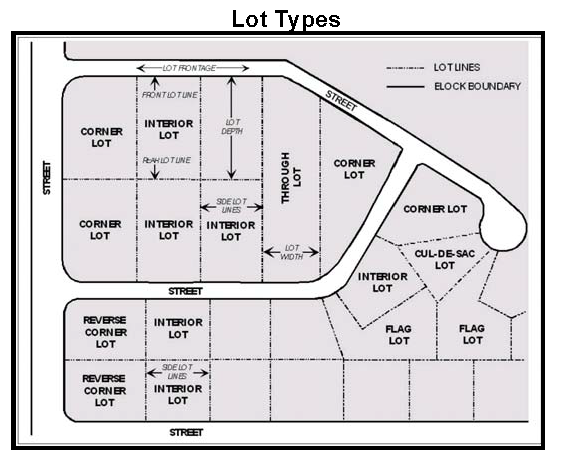
"Manufactured Housing Unit" means a dwelling unit which is either wholly or mainly manufactured at an off-site location and is assembled on site on a permanent foundation with permanent service connections. The definition does not include a mobile home, mobile accessory structure, or an automobile trailer or recreational vehicle.
"Massage" or "Massage Therapy" means any method of treating the external parts of the body for remedial, hygienic, relaxation or any other similar purpose, whether by means of pressure on, friction against or stroking, kneading, tapping, pounding, vibrating, rubbing or other manner of touching external parts of the body with the hands, or with the aid of any mechanical or electrical apparatus or appliance with or without supplementary aids such as rubbing alcohol, liniment, antiseptic, oil, powder, cream, ointment or other similar preparations commonly used in this practice and shall include herbal body wraps. For the purposes of this chapter, "massage" or "massage therapy" includes the techniques of acupressure and reflexology.
"Massage Business or Establishment" means any business or establishment, including a sole proprietor or independent contractor, conducted within the City where any person engages in, conducts, carries on or permits to be engaged in, conducted or carried on, for money or any other consideration, the administration to another person of a massage, and also includes all businesses or establishments where massage therapy is provided as an ancillary service such as clubs, gyms, day spas and professional offices where such massage therapy is not otherwise exempt under this chapter.
"Medical Clinic" means any building or portion thereof used to provide medical, surgical or psychiatric care to persons and which as a principal function provides such care on an outpatient basis.
"Mezzanine" means an intermediate floor between the main floors of a building, and therefore may not be counted among the overall floors of a building. Often a mezzanine has a low-ceiling and projects outward in the form of a loft or balcony.
"Medical Use" means any use involving the care of persons' general health by licensed practitioners. This includes hospitals, urgent care clinics, out-patient facilities, doctor and dental offices, chiropractic and podiatric facilities, and similar practices of the medical field and directly related laboratory services.
"Ministerial" means a government decision involving little or no personal judgment by the public official as to the wisdom or manner of carrying out the action, including the issuance of a permit.
"Mixed-Use Development (Mixed-Use Project)" is an approach to land use development that involves integrating two or more different but highly compatible types of uses on the same property as part of a unified development. Generally, a Mixed-Use Development consists of commercial and residential uses integrated either vertically in the same structure or group of structures, or horizontally on the same development site where parking, open spaces, and other development features are shared. In a Mixed-Use Development, both uses are considered primary uses of the land.
"Mobile Housing Unit (Mobile Home)" means a trailer, transportable in one or more sections; that is certified under the National Manufactured Housing Construction and Safety Standards Act of 1974; that is over eight feet in width and forty (40) feet in length, with or without a permanent foundation and not including recreational vehicle, commercial coach or factory-built housing. A mobile home on a permanent foundation is included under the definition of "Single-unit dwelling."
"Mobile Home Park" means a type of residential development, established either as a legal subdivision of land with individual mobile home pads and common areas or as a development where pads are leased or rented, for the purpose of accommodating mobile home units on individual pads as part of a coordinated development. A mobile home park may include common areas and facilities for the use of all park residents.
"Modular Home:" See "Manufactured Housing Unit."
"Motel" means one or more buildings containing guest rooms without kitchen facilities, some or all of which have a separate entrance leading directly from the outside of the building designed and used as rental for temporary or overnight accommodations for guests and are offered primarily to automobile tourists or transients, with garages or parking spaces conveniently located to each room or unit.
"Motor Home:" See "Recreational Vehicle."
"Multifamily Dwelling:" See "Dwelling, Multifamily."
"Museum:" See "Cultural Institution."
"Nonconforming Building or Structure" means a building or structure or portion thereof which was lawful when constructed but does not conform to Zoning Ordinance requirements subsequently established.
"Nonconforming Use" means the use of land/or building or structure, which was lawful when established including compliance with property development requirements but which does not conform to Zoning Code use and property development requirements subsequently established.
"Nursery:" See "Horticulture."
"Nursery School:" See "Child Day Care Facility."
"Office:"
"Accessory:" See "Accessory Use".
"Administrative Business Professional, Corporate" means an establishment providing direct, "over-the-counter" services to consumers (such as, insurance agencies, real estate offices, travel agencies, utility company offices, etc.) and office-type facilities occupied by businesses providing professional services and/or engaged in the production of intellectual property.
"Government" means an administrative, clerical, or public contact office of a government agency, including postal facilities, together with the incidental storage and maintenance of vehicles.
"Medical and Dental" means an office or health facility providing health services including, without limitation; preventative and rehabilitation treatment, diagnostic services, testing and analysis. This use includes offices providing medical, dental, surgical, rehabilitation, podiatric, optometric, chiropractic and psychiatric services, and medical or dental laboratories incidental to these offices, but exclude inpatient services and overnight accommodation.
"Open Space:"
"Open Space, Common" means the total land area within a residential development that is not individually owned nor dedicated for public use, and that is designed, intended, and reserved exclusively for the shared use of all the residents of the development and their guests. Examples include barbecue and picnicking areas, play areas, swimming pools, tennis courts, turf areas, and other recreational or leisure features and facilities. Common Open Space does not typically include enclosed spaces/facilities such as a community center, meeting rooms, etc.
"Open Space, Private" means a usable open space adjoining and directly accessible to a dwelling unit, reserved for the exclusive use of residents of the dwelling unit and their guests.
"Open Space, Usable or Improved" means outdoor space that serves a recreational function or provides visual relief from the building mass.
"Open Space, Unimproved" means any open space that has not been landscaped or otherwise provided with amenities, and is generally kept in a natural state.
"Outdoor Charitable Donation Boxes:" See "Donation Boxes."
"Outdoor Dining:" See "Eating Establishments."
"Outdoor Storage" means the storage of any materials outside of a structure, either as an accessory or primary use.
"Outdoor Use and Display" means any condition other than storage whereby activities are conducted and/or merchandise is placed and advertised for sale outside of a structure, either as an accessory or primary use.
"Outpatient Surgery Facility" means a medical facility where surgery is performed that does not require an overnight hospital stay. Patients may go home after being released following surgery and time spent in the recovery room. (Also referred to as ambulatory surgery facility.)
"Overhang" means a protruding structure which may provide protection for lower levels.
"Pad, Building" means the land area needed to support the building, landscaping and utilities of a structure.
"Parapet" means a wall-like barrier at the edge of a roof, terrace, balcony, or other structure. Where extending above a roof, it may simply be the portion of an exterior wall that continues above the line of the roof surface, or it may be a continuation of a vertical feature beneath the roof such as a fire wall or party wall.
"Parking, Joint Use" means the use of a single parking facility by several related uses occupying the same or adjacent parcels. For example, the use of a single parking facility by tenants of a shopping center.
"Parking, Shared" means the use of a single parking facility by two distinctly different uses with distinctly different hours of operation such that the shared use of the facility can be accomplished without limiting the ability of one use to occupy the facility to the detriment of the other. For example; distinctly different uses could be a place of religious assembly which generally has weekend parking demands and an office development, which typically uses the parking facility during the week.
"Parking Space" means an unobstructed space or area other than a street or alley that is permanently reserved, maintained, and accessible for the parking of one motor vehicle.
"Garage Parking Space" means a parking space provided within an enclosed structure, with a closing and locking door, whose primary use is the storage of vehicles.
"Off-Street Parking Space" means a permanent parking space for a vehicle which is designed to City standards and not located on a dedicated street right-of-way.
"On-Street Parking Space" means parking space for a vehicle which is designed to City standards and located on a dedicated street right-of-way.
"Parking Structure" means a structure that is designed specifically for automobile parking and where there are a number of floors or levels on which automobiles park.
"Parks and Recreation Facilities" means public parks, play lots, playgrounds, and athletic fields for noncommercial neighborhood or community use including sports courts. These may include passive outdoor recreation areas that also may be located in conservation areas and/or qualify as "open space." These do not include facilities that are privately owned or commercial facilities ("Commercial Recreation and Entertainment").
"Parkway" is the portion of the public right-of-way between the curb and the sidewalk or, where no sidewalk is provided between the curb and adjacent private property line. A parkway generally includes landscape improvements.
"Patio" means a paved unenclosed outdoor area that is used for lounging, dining, etc.
"Patio Cover" is a solid or open roof structure that covers a patio, platform, or deck area, and that is either detached from or attached to another structure.
"Personal Services Business" is any business or enterprise that provides individual care to persons involving their personal health, fitness, grooming, or appearance.
"Personal Services, General" [means] establishments that provide recurring needed services of a personal nature. Examples of these uses include:
•
Acupuncture and acupressure
•
Barber and beauty shops (without massage services)
•
Clothing rental shops
•
Day spas
•
Dry cleaning pick up stores with limited on-site cleaning equipment
•
Laundromats (self-service laundries)
•
Locksmiths
•
Nail salon
•
Shoe repair shops
•
Tailors and seamstresses
"Personal Services, Restricted" [means] personal services with characteristics that have the potential to adversely impact surrounding areas and which may need to be dispersed to minimize their adverse impacts. Examples of these uses include:
•
Check cashing
•
Fortune-telling and psychic services
•
Game arcades
•
Internet cafés
•
Massage establishments with licensed massage technicians
•
Palm and card readers
•
Tanning salons
•
Tattoo and body piercing services
"Personal Storage (Mini-Storage or Self-Storage, Indoor Only)" means a structure containing separate storage space that is designed to be leased or rented individually. Indoor storage shall mean that access to all storage spaces shall be from common interior corridors, and the facility has only shared loading areas. This use does not include outdoor storage of any kind. Further, such storage does not involve any manufacturing, retail or wholesale selling, office or business services, or human habitation in any storage space or anywhere on site.
"Pharmacy, Medical Supplies" means an establishment that dispenses prescription drugs and sells medical equipment and supplies for home health care (e.g., scales, walking aids, bathroom safety aids; skin and personal care products; braces, supports, and splints; bandages and tape; etc.).
"Places of Assembly:" See "Assembly/Meeting Facilities, Public or Private."
"Places of Religious Assembly" means any facility specifically designed and used to accommodate the gathering of persons for the purposes of fellowship, worship, or similar conduct of religious practices and activities. Places of Religious Assembly includes limited associated accessory uses (i.e., religious school activities that are not full-time, residence for clergy, and office space, and excluding schools with regular daily sessions.) Also includes functionally related internal facilities (i.e., kitchens, multi-purpose rooms, storage, etc.), and functionally associated accessory uses (e.g. temporary aid shelters to provide humanitarian assistance).
"Planning Commission or Commission" means the Planning Commission of the city of Rosemead.
"Pool and Billiard Hall" means an establishment providing access to pool tables and billiard games.
"Porte-Cochere" means a canopy attached to a residence, which is open on all sides, except where attached to a residence and which extends over a driveway used for the loading and unloading of vehicles, but which cannot be used to satisfy the off-street parking requirements of this Title.
"Principal Use:" See "Use."
"Postal Services" means establishments that provide commercial retail postal services directly to the customer, including letter and parcel mailing, post office box rental, and related services.
"Printing and Duplicating Services" means an establishment providing printing, blueprinting, photocopying, engraving, binding, and related services.
"Public Assembly, Place(s) of" see "Assembly/Meeting Facilities, Public or Private."
"Public Facility" means a site or structure owned and operated by the city of Rosemead, or other public agency, for the purpose of providing one or more services to residents of the City, and/or to support other City functions.
"Queuing Space" means a temporary waiting area for motor vehicles or persons obtaining a service or other activity.
"Radio/TV Broadcast Studios/Recording Studios, Film TV Studios" Commercial and public communications facilities including radio and television broadcasting and receiving stations and studios, with facilities contained entirely within structures. Does not include transmission and receiving apparatuses including antennas and towers.
"Reasonable Accommodation Request" means a request that may include a modification or exception to the rules, standards, and practices for the site, development, and use of housing-related facilities that would eliminate regulatory barriers and would provide a person with a disability an equal opportunity to housing of their choice.
"Recharging Station" means a place that supplies electricity for the recharging of electric vehicles (including plug-in hybrids).
"Recreational Vehicle (RV)" means motorhome, travel trailer, truck camper, or camping trailer, with or without motive power, designed for human habitation for recreational or emergency occupancy, with a living area less than four hundred (400) square feet, excluding built-in equipment such as wardrobes, closets, cabinets, kitchen units or fixtures, bath and toilet rooms.
"Recycling Facility" means a land use type that includes a variety of facilities involved with the collection of recyclable materials. A "certified" recycling or processing facility is certified by the California Department of Conservation as meeting the requirements of the California Beverage Container Recycling and Litter Reduction Act of 1986 (Public Resources Code, Division 12.1). Recyclable material includes reusable domestic containers and other material that can be reconstituted, remanufactured, or reused in an altered form including glass, metals, paper, and plastic. Recyclable material does not include refuse or hazardous materials. This land use does not include storage containers located on a residentially, commercially, or industrially designated site that is used solely for the recycling of material generated on the site.
"Collection Facility (Small)" means a facility that occupies an area of three hundred fifty (350) square feet or less where the public may donate, redeem, or sell recyclable materials and may include:
1. A mobile unit;
2. Bulk reverse vending machines or a grouping of reverse vending machines occupying more than fifty (50) square feet. A bulk reverse vending machine is a reverse vending machine that is larger than fifty (50) square feet, is designed to accept more than one container at a time, and issues a cash refund or redeemable credit slip based on total weight instead of by container count.
3. Kiosk-type units that may include permanent structures.
"Collection Facility (Large)" means a facility that occupies an area of more than three hundred fifty (350) square feet and/or includes permanent structures where the public may donate, redeem, or sell recyclable materials.
"Reverse Vending Machine" means an automated mechanical device which accepts at least one or more types of empty beverage containers and issues a cash refund or a redeemable credit slip with a value not less than the container's redemption value, as determined by State law. These vending machines may accept aluminum cans, glass and plastic bottles, and other containers. The vending machines typically occupy an area of less than fifty (50) square feet.
"Processing Facility" means a structure or enclosed space used for the collection and processing of recyclable materials. Processing means the preparation of material for efficient shipment, or to an end-user's specifications, by such means as bailing, briquetting, compacting, flattening, grinding, crushing, mechanical sorting, shredding, cleaning, and remanufacturing. Processing facilities are not allowed in the city of Rosemead.
"Research and Development" means facilities for scientific research and design, development, and testing of biological, chemical, electrical, pharmaceutical, telecommunications, or other components in advance of product manufacturing. Typical uses include experimental laboratories, pharmaceutical laboratories, and testing laboratories.
"Residence" means the same as "Dwelling."
"Residential Care Facility" means a family home, group care facility, residential care facility for the elderly, foster home, alcohol and/or drug recovery facility, intermediate care facility or similar facility, for 24-hour non-medical care of persons in need of personal services, supervision, or assistance essential for sustaining the activities of daily living or for the protection of the individual. In the event the provisions of state law are updated, this section shall be interpreted and applied in conformity with State law.
"Residential Use" means the occupation of a structure that provides permanent housing for one or more households.
"Restaurant:" See "Eating and Drinking Establishments."
"Retail Store" means an establishment which offers goods (such as books, gifts and clothing) to the general public. This does not include swap meet, pawn shop, or thrift sales.
"School, Public and Private:" See "Education Institute."
"School, Business or Trade" means a public or private school offering instruction in the technical, commercial, and/or trade skills such as real estate, business and secretarial, electronics, automotive and air craft, medical and dental, and similar commercial establishments.
"Screened" means the use of a wall or growth or stand of trees, shrubs, or plants to shelter, protect, or hide an area from view.
"Secondary Use:" See "Use."
"Secondhand Store" means a retail establishment where the majority of the merchandise for sale is secondhand or used. This includes thrift stores but does not include pawn shops or antique/collectibles shops.
"Sensitive Use:" See "Use."
"Setback" means the distance from which a structure, parking area, or other development feature must be separated from a prescribed lot line, easement, or other structure or development feature (see Figure 17.04.050.4).
"Front Yard Setback" means the minimum distance required between a structure and the front property line (see Figure 17.04.050.4).
"Primary Building Line" means that portion of the front yard area defined by the space between the front property line and the entire building frontage of the primary structure, whether or not all façade portions of the primary structure coincide with the front setback line (see Figure 17.04.050.4).
"Side Yard Setback" means the minimum distance required between a structure and a side property line (see Figure 17.04.050.4).
"Rear Yard Setback" means the minimum distance required between a structure and the rear property line (see Figure 17.04.050.4).
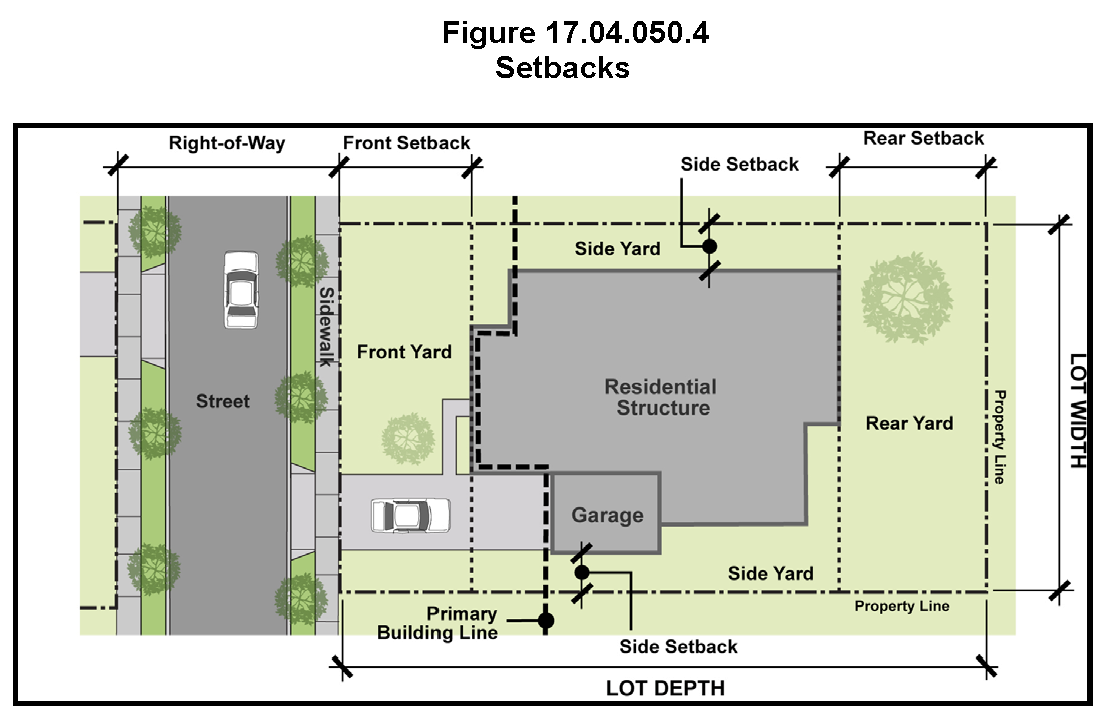
"Shopping Center" means a commercial site with two or more separate businesses managed as a total entity, sharing common access, circulation, signage and pedestrian and parking areas so that a public right-of-way does not need to be used to get from one business to another in the C-1, C-3, and CBD zones.
"Short-Term Rental" means any dwelling unit that is occupied or intended or designed to be occupied on a short-term basis for occupancy duration of thirty (30) calendar days or less.
"Single-family Dwelling:" See "Dwelling, Single-family."
"Single Room Occupancy (SRO)" development is a structure with six or more guest rooms in which thirty (30) percent or more of the units do not have a private bath and toilet within the unit. SRO units are multifamily dwellings that are used as an occupant's primary place of residence. SROs are not considered hotels or motels as defined by the Municipal Code, nor are they considered extended-stay hotel/motel rooms. Therefore, SRO units are not subject to the Transient Occupancy Tax, and SRO operators shall not be liable for the extended-stay hotel/motel room in-lieu fee if they elect to rent out their rooms on a single-room occupancy basis.
"Specialty Retail (C-4 zone)" means a retail store concentrating on selling one merchandise line of goods for a particular and usually selective clientele. Examples are stores selling DVDs, bagels, leather goods, and imported dishware. Specialty retailers have a narrow but deep selection in their specialty of items for sale.
"Specific Plan" means, under Article 8 of the Government Code (Section 65450 et seq.), a legal tool for a detailed design and implementation of a defined portion of the area covered by a General Plan. A specific plan may include all detailed regulations, conditions, programs, and/or proposed legislation which may be necessary or convenient for the systematic implementation of any General Plan element(s).
"Storage:"
"Storage - Accessory" means the indoor storage of materials accessory and incidental to the primary use is not considered a land use separate from the primary use.
"Storage - Outdoor" means the storage of various materials outside of a structure other than fencing, either as an accessory or primary use.
"Storage - Personal Storage Facility" see "Personal Storage."
"Story" means that portion of a building included between the surface of any floor and the surface of the floor above it, or if there is no floor above it then the space between such floor and the ceiling above it.
"Street" means a public thoroughfare which affords the principal means of access to abutting property.
"Structurally Altered" means to have had an alteration of any structural element, floor, frame, wall, roof, or any other stress bearing portion of a building and excludes alterations to, or additions of, interior nonbearing partitions and interior remodeling which does not affect the structural system.
"Structure" means anything constructed or erected, which requires a fixed location on the ground, or is attached to something having a fixed location on the ground but not including fences or walls used as fences, less than six feet in height. (See Figure 17.04.050.5 - Structure Types)
"Accessory Structure:" See "Accessory Structure."
"Attached Structure" means any structure that has a wall or roof in common with another structure.
"Primary Structure" means a structure that is conducted as the primary or predominant use of the lot and/or building site.
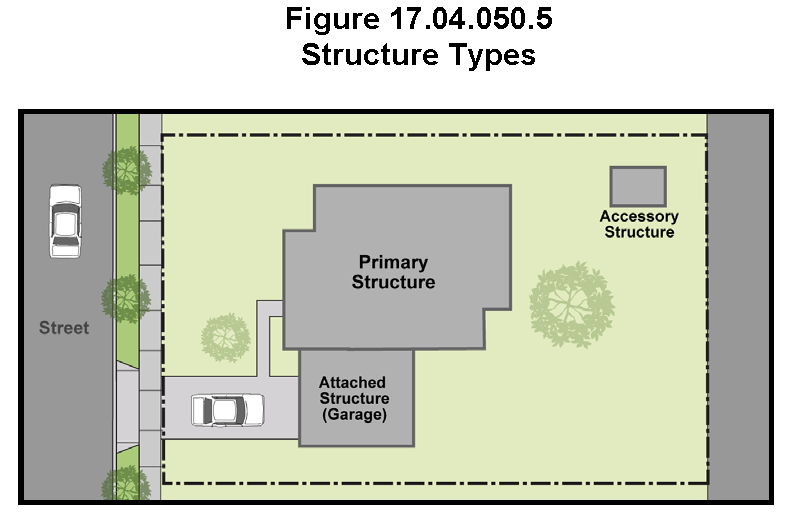
"Studio - Art, Dance, Martial Arts, Music" means small-scale instructional facilities, typically accommodating one group of students at a time, in no more than one instructional space. Examples include: individual and group instruction and training in the arts, production rehearsal, photography and the processing of photographs produced only by users of the studio facilities, martial arts training studios, and gymnastics instruction. This also includes production studios for individual filmmakers, musicians, painters, sculptors, photographers, and other artists. These uses may also include accessory retail sales of products related to the services provided.
"Supermarket" means a self-service grocery and associated consumer goods store divided into departments and may also offer prepared foods and food service. This may include secondary uses within the store for visitor convenience, such as banking services, retail sales of non-food items, a pharmacy, etc.
"Supportive Housing" means housing with no limits on the length of stay that is occupied primarily by persons with disabilities and individuals or families that are homeless at the time approved for occupancy, and that is linked to onsite or offsite services that assist the supportive housing resident in retaining the housing, thereby improving the resident's health status, and maximizing his or her ability to live and, when possible and applicable, work in the community. Supportive housing that is provided in single-family, two-family, or multifamily dwelling units will be permitted, conditionally permitted, or prohibited in the same manner as other single-family, two-family, or multifamily dwelling units under this Code.
"Swimming Pool" means an artificial body of water containing or normally capable of containing water to a depth of eighteen (18) inches or more at any point which is designed, constructed and used for swimming, dipping, or immersion purposes. This includes, but is not limited to, in-ground, above-ground, and on-ground pools, hot tubs, portable and non-portable spas, and fixed in-place wading pools.
"Tandem Parking Stall" means a parking stall design where one vehicle is parked behind another.
"Telework/Telecommuting" means a flexible work arrangement in which a person performs the normal duties and responsibilities of their positions from home and where the use of computer and telecommunications technology is often used, while not always necessary.
"Tot Lot" means a playground specifically designed for young children.
"Transitional Housing" and "Transitional Housing Development" means buildings configured as rental housing developments, but operated under program requirements that call for the termination of assistance and recirculation of the assisted unit to another eligible program recipient at some predetermined future point in time, which shall be no less than six months.
"Tutoring Services (Large)" means one-on-one educational instruction in general or specific academic subjects to children for the purpose of supplementing regular school instruction. Services are intended to be in addition to normal school teachings and shall not be provided as a replacement or substitute for public or private school. A large tutoring service establishment provides services to more than five students at any given time.
"Tutoring Services (Small)" means one-on-one educational instruction in general or specific academic subjects to children for the purpose of supplementing regular school instruction. Services are intended to be in addition to normal school teachings and shall not be provided as a replacement or substitute for public or private school. A small tutoring service establishment provides services to not more than five students at any given time.
"Urgent Care Facility" means a public or private hospital-based or free-standing facility, which includes x-ray and laboratory equipment and a life support system, licensed or legally operating as an urgent care facility, primarily providing minor emergency and episodic medical care with one or more physicians, nurses, and x-ray technicians in attendance at all times when the facility is open.
"Use" means the purpose for which land or a building is designed, arranged, or intended, or for which either is or may be occupied or maintained.
"Accessory Use:" See "Accessory Use."
"Allowed Use, Permitted Use" means a use of land identified by Article 2 (Zoning Districts, Allowable Land Uses, and Zone Specific Standards) as allowed or conditionally allowed that may be established with a permit or license, subject to compliance with all applicable provisions of Article 2.
"Compatible Use" means a use that by its manner of operation is suitable in the district in which it may generally be considered as a primary use or is reasonable given its proximity to residential or other known sensitive uses. Said use of land and/or buildings shall be in harmony with the uses on the property as well as abutting properties.
"Conditional Use" means a use permitted on a particular lot and within a zone only upon a finding that such use in a specified location will comply with all the conditions and standards for the location or operation of such use as specified in the Zoning Code, and requires authorization by either the Planning Commission or City Council, and the granting of a valid permit.
"Conforming Use" means a lawfully established use of property that operates in compliance with all applicable provisions of this Zoning Code.
"Primary Use" means the principal or predominant use of any lot, building, or structure.
"Secondary Use" means any use that is specifically allowed in the zone in which it is located but is subordinate to the primary use in terms of occupied structure area or lot area.
"Sensitive Use" means any kindergarten, elementary school, middle school, high school, public library, public park, religious institution, or youth-oriented establishment characterized by either or both of the following:
(1)
The establishment advertises in a manner that identifies the establishment as catering to or providing services primarily intended for minors; or
(2)
The individuals who regularly patronize, congregate, or assemble at the establishment are predominantly minors.
"Temporary Use" means a use of land that is designed, operated, and occupies a site for a limited period of time.
"Usable Open Space:" See "Open Space."
"Utilities" means all lines and facilities owned and/or operated by a licensed provider and related to the provision, distribution, collection, transmission, or disposal of water, storm drainage, sanitary sewage, oil, gas, electricity, information, telecommunications, telephone cable, and similar services. This includes facilities for the generation of electricity. This does not include "Wireless Telecommunications Facilities."
"Vending Machine" [means] any unattended self-service device that, upon insertion of a coin, coins, or token, dispenses anything of value including food, water, beverages, goods, wares, merchandise or services. This does not include newspaper racks, automatic teller machines (ATMs), or public telephones.
"Veterinary Services (Animal Hospital/Clinic)" means an establishment where household animals receive medical and surgical treatment and may be temporarily boarded (more than one night stay) in association with such medical or surgical treatment. Short-term animal boarding may be provided as an accessory use.
"Wall" means a physical barrier constructed largely of masonry, brick, concrete, stucco, concrete block, or any combination thereof and intended to mark a boundary.
"Warehouse Retail Store" means a store that emphasizes the packaging and sale of products in large quantities or volumes, some at discounted prices. Sites and buildings are usually large in character. Patrons may be required to pay membership fees.
"Warehousing" means the storage of material goods including the performance of administrative and physical functions associated with storage of goods and materials. These functions include receipt, identification, inspection, verification, putting away, storage, retrieval for issue, etc.
"Wholesaling" means the sale of commercial goods at or near production cost.
"Wireless Communications Facilities (WCF):" See Article 3, Chapter 17.54.
"Yard" means an open space on a lot, other than a court, unoccupied or unobstructed from the ground upward.
"Yard Area" means the horizontal area between a property line and a parallel line along the nearest structure located outside of the required setback area.
"Yard Area, Required" means the open space between a lot line and the building area within which no structure is permitted to be located.
(Ord. No. 931, § 5(Exh. A), 10-22-13; Ord. No. 978, § 5(Exh. A), 2-27-18; Ord. No. 979, § 3(Exh. A) 6-12-18; Ord. No. 980, §§ 2.A, 2.B., 7-10-18; Ord. No. 995, § 3, 9-8-20; Ord. No. 998, § 2, 4-27-21; Ord. No. 1000, § 2, 9-28-21; Ord. 1005, § 3, 1-25-22)

