
Rosemead City Zoning Code
ARTICLE 3
- REGULATIONS FOR SPECIAL USES AND STRUCTURES
Chapter 17.40 - CANNABIS FACILITIES, CULTIVATION, AND DELIVERIES[4]
Editor's note— Ord. No. 1018, §§ 3—10, adopted November 14, 2023, amended Chapter 17.40, §§ 17.40.010—178.40.050 in its entirety to read as herein set out. The former Chapter 17.40 pertained to similar subject matter and derived from Ord. No. 983, § 7, adopted November 13, 2018.
Chapter 17.42 - MOBILE HOMES AND MANUFACTURED HOUSING
Section:
Chapter 17.54 - WIRELESS TELECOMMUNICATION FACILITIES[5]
Editor's note—Ord. No. 1032, § 3, adopted May 12, 2026, amended Ch. 17.54 in its entirety to read as herein set out. Former Ch. 17.54, §§ 17.54.010—17.54.260, pertained to similar subject matter, and derived from Ord. No. 944, § 3, adopted Jan. 13, 2015; and Ord. No. 931, § 5(Exh. A), adopted Oct. 22, 2013.
17.30.010 - Purpose.
This chapter provides site planning, development, and/or operating standards for certain land uses that are allowed by Article 2 (Zoning Districts, Allowable Land Uses, and Zone Specific Standards) within one or more zoning districts but that require special standards to mitigate their potential adverse impacts.
(Ord. No. 931, § 5(Exh. A), 10-22-13)
17.30.020 - Applicability.
The land uses and activities covered by this chapter shall comply with the provisions of the Sections applicable to the specific use, in addition to all other applicable provisions of this Zoning Code.
A.
Where Allowed. The uses that are subject to the standards in this Article shall be located in compliance with the requirements of Article 2 (Zoning Districts, Allowable Land Uses, and Zone Specific Standards).
B.
Land Use Permit Requirements. The uses that are subject to the standards in this Article shall be authorized by the land use permit required by Article 2, except where a land use permit requirement is established by this Article for a specific use.
C.
Development Standards. The standards for specific uses in this chapter supplement and are required in addition to those in Article 2 (Zoning Districts, Allowable Land Uses, and Zone Specific Standards) and the City Code. In the event of any conflict between the requirements of this chapter and those of Article 2, the requirements of this chapter shall control.
(Ord. No. 931, § 5(Exh. A), 10-22-13)
17.30.030 - Adult businesses.
A.
Purpose. The purpose of this chapter is to establish a comprehensive set of regulations applicable to the location of adult businesses within the City. The words and phrases used in this section are governed by the definitions contained in Chapters 5.08 and 5.10 of this Code. (Ord. No. 903, § 9, 4-12-11)
B.
Locational Requirements.
1.
Permitted Districts. Adult businesses are permitted in the M-1 Zone.
2.
Locational Standards. Adult businesses may not be located:
a.
Within five hundred (500) feet of any property zoned R-1, R-2, R-3, or any lot where there is an actual residential use within the City limits;
b.
Within five hundred (500) feet of any churches or other places used exclusively for religious worship, whether inside or outside of the City limits;
c.
Within five hundred (500) feet of any public or private school (grades K—12) or child care establishment, whether inside or outside the City limits;
d.
Within five hundred (500) feet of any public park or playground, or any city facility, including, but not limited to, city hall, the city library, and any police or fire station;
e.
Within five hundred (500) feet of any property upon which is located a business with a Type 40, 42, 48 or 61 on-site alcoholic beverage license;
f.
Within one thousand (1,000) feet of any other adult business, whether inside or outside the City limits;
g.
Within one thousand (1,000) feet of any massage establishment, whether inside or outside the City limits.
3.
The distances specified in this division section will be measured in a straight line, without regard to intervening structures, from the nearest property line of the premises in which the proposed adult business is to be established to the nearest property line of a use or zoning classification listed above.
C.
Adult Business License Required. Adult businesses must obtain and maintain an adult business license in compliance with all applicable requirements of Chapter 5.08 of this Code. Adult business performers must obtain and maintain an adult business performer license in compliance with all applicable requirements of Chapter 5.10 of this Code.
(Ord. No. 931, § 5(Exh. A), 10-22-13)
17.30.040 - Alcohol beverage sales.
A.
Purpose. The purpose of this section is to preserve a healthy and safe environment for residents and businesses by establishing a set of consistent standards for the safe operation of retail alcohol sales establishments. It is recognized that hospitality, entertainment, recreation and related businesses are a significant part of the City's economy, and that alcoholic beverage sales are important to the operation of these businesses. It is also recognized that alcohol abuse can create environments that jeopardize the continued success of these businesses and seriously affect the health, safety, and general welfare in surrounding areas, particularly residential neighborhoods.
This section provides regulations to reduce the costly and harmful effects of irresponsible alcohol sales and consumption on the City, neighborhoods, local businesses, residents, law enforcement, medical care, and educational, preventive, treatment and rehabilitation resources.
B.
Applicability. The provisions in this Section shall apply to the sale of alcoholic beverages where allowed in compliance with Article 2 (Zoning Districts, Allowable Land Uses and Zone Specific Standards) and the following standards.
C.
Operating Standards. This Section establishes operational standards for defined establishments involved in the sale of alcoholic beverages.
1.
Alcohol Consumption on Premises Prohibited. Consumption of alcoholic beverages inside a retail alcohol sales establishment, outside the building, or elsewhere outside on the premises shall be prohibited.
2.
Sales Activities. Alcoholic beverages shall not be sold:
a.
Outside the exterior walls of the alcohol sales establishment; or
b.
From drive-up or walk-up service windows;
3.
Litter and Graffiti. The owner/operator shall:
a.
Maintain the exterior of the premises, including signs and accessory structures, free of litter and graffiti at all times;
b.
Provide for daily removal of trash from the premises and abutting sidewalks or alleys within twenty (20) feet of the premises; and
4.
Security. The Planning Commission may require on-site security (for example security personnel, security programs, and/or surveillance devices), both inside and outside the building, to satisfy concerns raised by the Chief of Police.
5.
Sales Training.
a.
Personnel. Owners, operators, and managers of establishments selling alcoholic beverages shall complete a Licensee Education on Alcohol and Drugs (LEAD) program sponsored by the Department of Alcoholic Beverage Control.
b.
Records. Records of each owner's and operator's successful completion of the LEAD training program shall be maintained on the premises and shall be presented to a representative of the City upon request.
6.
Conditions of Approval. The owner/operator shall maintain a copy of the most recent City permit, conditions of approval, and operating standards on the premises and shall post a notice that these are available for review on the premises. The posted copy shall be signed by the permittee.
7.
Public Telephones. Upon request of the Chief of Police or as required by the ABC, a public telephone located on the premises or in an adjacent area under the control of the owner/operator shall be equipped with devices or mechanisms that prevent persons from calling in to that public telephone.
D.
Signs. Signs shall comply with Chapter 17.116 (Signs). In addition, the following shall apply:
1.
Window signs shall not obstruct the view of the interior of the premises (e.g., sales counter, cash register, employees, customers, etc.) from the exterior.
2.
Loitering, open container, and other signs specified by the Alcoholic Beverage Control Act shall be posted as required by the ABC.
E.
Permit Requirements.
1.
New Permits.
a.
A conditional use permit, obtained pursuant to the provisions of Chapter 17.132 (Conditional Use Permits), shall be required for any business (other than sit-down restaurants with one thousand (1,000) square feet of floor area or larger) that sells alcoholic beverages for on-site or off-site consumption. This requirement shall apply to any new business proposed to locate within the City, as well as to existing businesses applying for a new state permit to sell alcoholic beverages. All required permits and licenses shall be obtained prior to commencement of the use.
b.
An administrative use permit, obtained pursuant to the provisions of Chapter 17.128 (Administrative Use Permits), shall be required for sit-down restaurants with one thousand (1,000) square feet of floor area or larger that sells beer/wine for on-site consumption. This requirement shall apply to any new business proposed to locate within the City, as well as to existing businesses applying for a new state permit to sell alcoholic beverages. All required permits and licenses shall be obtained prior to commencement of the use.
2.
Required Findings. Prior to approval of a new or modified permit for an alcohol sales establishment, the Review Authority, as set forth under Table 17.120.020.1, shall find that the use is consistent with the purpose and intent of this section. This finding shall be in addition to the findings required by Chapters 17.128 (Administrative Use Permits) or 17.132 (Conditional Use Permits). In making the required finding, the Review Authority shall consider the following:
a.
The crime rate in the reporting district and adjacent reporting districts as compared to other areas in the City.
b.
The numbers of alcohol-related calls for service, crimes, or arrests in the reporting district and in adjacent reporting districts.
c.
The proximity of the establishment to residential zoning districts, day care centers, hospitals, park and recreation facilities, places of worship, schools, other similar uses, and any uses that attract minors.
d.
Whether or not the proposed modification will resolve any current objectionable conditions.
3.
The burden of proving that the proposed use will not adversely affect the welfare of nearby residents or detrimentally affect nearby residentially zoned communities, day care centers, hospitals, park and recreation facilities, places of worship, schools, other similar uses, and any uses that attract minors shall be the applicant's.
(Ord. No. 931, § 5(Exh. A), 10-22-13; Ord. 1009 , § 3, 4-12-22)
17.30.050 - Automated teller machines (ATMs) and walk-up bank services.
A.
Purpose. This Section provides the development standards for Automated Teller Machines (ATMs) and walk-up bank services.
B.
Applicability. The provisions in this Section shall apply to ATMs and walk-up bank services as defined in Article 1, Section 17.04.050 (Definitions) and where allowed in compliance with Article 2 (Zoning Districts, Allowable Land Uses and Zone Specific Standards).
C.
Development Standards.
1.
The ATM should be set back three feet into an alcove adjacent to the public sidewalk to provide a privacy area.
2.
Adequate lighting for the ATM shall be provided.
3.
The ATM shall provide rear-view mirrors and cameras that can record activity and have quality color video capabilities for surveillance purposes.
4.
The ATM shall comply with ADA accessibility standards.
5.
A trash receptacle shall be immediately accessible to the ATM.
6.
ATMs and walk-up bank services are subject to the approval of the Planning Division.
7.
When the ATM is removed, the structure's facade shall have a finished appearance consistent with the existing structure, and be subject to the approval of the Planning Division.
(Ord. No. 931, § 5(Exh. A), 10-22-13)
17.30.060 - Automobile car wash (full service and self-service).
A.
Purpose. This Section provides standards for the establishment and operation of new automobile car wash facilities and for the modification or expansion of existing facilities.
B.
Applicability. The provisions in this Section shall apply to automobile car wash facilities as defined in Article 1, Section 17.04.050 (Definitions) and where allowed in compliance with Article 2 (Zoning Districts, Allowable Land Uses and Zone Specific Standards) and the following standards.
C.
Development Standards.
1.
The architecture of the development shall reflect a sensitivity to the character of the surrounding neighborhood and attempt, where feasible, to be consistent with, or complementary to, neighborhood character.
2.
All setback areas, except where used as walkways or drive aisles for vehicles, shall be suitably landscaped and provided with an automatic sprinkler system and moisture-sensing devices.
3.
Access and driveways. No site shall have more than two access ways to any one street, and no driveway shall be allowed within twenty (20) feet of a street corner. However, the City Engineer shall have the authority to place additional restrictions on driveways and access as necessary to enhance vehicular and pedestrian safety in the immediate vicinity of the site.
4.
Retail sales. The retail sale of goods is permitted, provided parking is provided as required for retail business.
5.
Parking. No vehicle shall be parked on the site other than those belonging to customers and employees. Adequate parking shall be provided for customers and employees. Storage of vehicles is prohibited. See Chapter 17.112 (Off-Street Parking and Loading) for additional parking requirements.
6.
Lighting. All outside lighting shall be oriented and shielded to prevent glare, reflection, or any nuisance or hazardous interference with adjacent uses or streets.
7.
Water conservation and anti-spillage plans shall be submitted and approved by the Community Development Director.
8.
Utilities. All utility services extended to the building shall be installed underground.
9.
Restrooms. All restroom entrances facing or visible from a public right-of-way shall be screened by solid decorative screening six feet high.
10.
Vehicles to be serviced shall be parked in designated areas only. Such vehicles may not be located in the required off-street parking or landscape areas nor on any public sidewalk, parkway, street or alley.
11.
No portion of the lot, outside of the building, shall be used for storage of any type, unless designated and approved by the Community Development Director.
12.
All waste materials shall be handled and disposed of in accordance with local, State, and Federal laws and policies. No waste material shall be washed or poured into any public alley, street, storm drain or sewer.
(Ord. No. 931, § 5(Exh. A), 10-22-13)
17.30.070 - Automotive lube and tune facility.
A.
Purpose. This Section provides standards for the establishment and operation of new automotive lube and tune facilities and for the modification or expansion of existing facilities.
B.
Applicability. The provisions in this Section shall apply to automotive lube and tune facilities as defined in Article 1, Section 17.04.050 (Definitions) and where allowed in compliance with Article 2 (Zoning Districts, Allowable Land Uses and Zone Specific Standards) and the following standards.
C.
Development and Operating Standards.
1.
Retail Sales. The retail sale of goods is permitted, provided parking is provided as required for retail business.
2.
Parking. No vehicle shall be parked on the site other than those belonging to customers and employees. Adequate parking shall be provided for customers and employees. Storage of vehicles is prohibited. See Chapter 17.112 (Off-Street Parking and Loading) for additional parking requirements.
3.
Access and Driveways. No site shall have more than two access ways to any one street, and no driveway shall be allowed within twenty (20) feet of a street corner. However, the City Engineer shall have the authority to place additional restrictions on driveways and access as necessary to enhance vehicular and pedestrian safety in the immediate vicinity of the site.
4.
Utilities. All utility services extended to the building shall be installed underground.
5.
Restrooms. All restroom entrances facing or visible from a public right-of-way shall be screened by solid decorative screening six feet high.
6.
[Parking of Vehicles.] Vehicles to be serviced shall be parked in designated areas only. Such vehicles may not be located in the required off-street parking or landscaped areas nor on any public sidewalk, parkway, street or alley.
7.
[Outdoor Storage Prohibited.] No portion of the lot, outside of the building, shall be used for storage of any type, unless designated and approved by the Community Development Director.
8.
Drainage and Pollution Control. Drainage shall be by underground structures to avoid drainage across sidewalks or drive aprons. In addition, a lube and tune facility shall incorporate pollution control best management practices (BMPs) designed to prevent or minimize runoff of oil and grease, solvents, car battery acid, coolant, gasoline, and other pollutants into the stormwater system. The Public Works Director shall approve drainage and pollution control methods, if appropriate. All hazardous waste must be stored within an enclosed building or underground tank. All waste materials shall be handled and disposed of in accordance with local, state and federal laws and policies. No waste material shall be washed or poured into any public alley, street, storm drain or sewer.
(Ord. No. 931, § 5(Exh. A), 10-22-13)
17.30.080 - Automotive service station.
A.
Purpose. This Section provides standards for the establishment and operation of new automotive service station and for the modification or expansion of existing facilities.
B.
Applicability. The provisions in this Section shall apply to automotive service stations as defined in Article 1, Section 17.04.050 (Definitions) and where allowed in compliance with Article 2 (Zoning Districts, Allowable Land Uses and Zone Specific Standards) and the following standards.
C.
Physical Site Controls.
1.
Street Frontage. The minimum street frontage of a service station site shall be not less than one hundred twenty (120) feet on any street.
2.
Lot Area. Minimum area required shall be not less than fourteen thousand (14,000) square feet.
3.
Setbacks.
a.
Minimum setbacks for any building shall be not less than ten (10) feet from any property line, and not less than twenty-five (25) feet from any property line which adjoins a dedicated street, except that on any property abutting an alley, buildings may be established on the property line abutting the alley. Overhead canopies not less than ten (10) feet high may extend to not less than two feet of any property line.
b.
Gasoline pumps, or other facilities for providing automobiles with gasoline, and pump islands on which they are placed, shall be set back not less than fifteen (15) feet from any adjoining property line.
c.
Additional setbacks may be established by the Planning Commission if deemed necessary to provide for the protection of the safety, health or welfare of the adjacent property owners.
4.
Site Development Standards.
a.
Perimeter Property Line Walls. Where a service station adjoins property in a residential zone a six-foot high solid masonry wall shall be constructed adjacent to contiguous side or rear property lines, except that within twenty (20) feet of any street front property line, walls shall not exceed three feet in height.
b.
Screening.
1)
Outside entrances to restrooms shall be screened from view of adjacent properties or street rights-of-way by decorative screening not less than six feet high. The bottom of the screen shall be open twelve (12) inches to eighteen (18) inches above grade for light access and ventilation.
2)
Trash Areas. The development shall be improved with solid waste and recyclable material collection in accordance with Chapter 17.32 (Accessory Structures).
c.
Landscaping.
1)
Planters, not less than five feet wide, shall be located and maintained adjacent to every street frontage, unless modification of this requirement is obtained from the Planning Commission.
2)
No less than one hundred (100) square feet of planting area shall be located and maintained at the intersection of two property lines at a street corner.
3)
Unless otherwise approved, raised planters, not less than three feet wide and of appropriate length, shall be located and maintained along the building facades facing any street.
4)
All planting areas shall be separated from adjacent paving by a minimum six-inch high curb, or a low planter wall not to exceed three feet in height.
5)
All planting, other than trees, shall be of a variety that will not achieve a height greater than thirty (30) inches or that can be maintained at said height. Plantings shall not be thorny or spiked, and shall not extend over any abutting sidewalk.
6)
All landscaped areas shall have permanent irrigation systems, and such areas shall be kept planted and maintained.
7)
Unless otherwise approved or indicated, planters not less than three feet wide and not less than twenty-five (25) feet in length shall be located and maintained along interior property lines; trees to be planted and maintained not more than thirty (30) feet apart, in said planters.
8)
Not less than five percent of the gross service station site shall be landscaped.
d.
Drainage and Pollution Control. Drainage shall be by underground structures to avoid drainage across sidewalks or drive aprons. In addition, a service station shall incorporate pollution control best management practices (BMPs) designed to prevent or minimize runoff of oil and grease, solvents, car battery acid, coolant, gasoline, and other pollutants into the stormwater system. The Public Works Director shall approve drainage and pollution control methods, if appropriate. All hazardous waste must be stored within an enclosed building or underground tank. All waste materials shall be handled and disposed of in accordance with local, state and federal laws and policies. No waste material shall be washed or poured into any public alley, street, storm drain or sewer.
e.
Permitted and Prohibited Activities.
1)
Sale, Lease or Rental Items.
a)
There shall be no sale or distribution of carbonated drinks, candy, coffee, cigarettes, or other similar items, except from dispensers within or abutting the building.
b)
There shall be no sale or distribution of peat moss, fertilizer, toys or other promotional items except from stock piles located within or to the rear of the building.
c)
No commercial vehicles over seven thousand five hundred (7,500) pounds (gross weight), except vehicles operated by the permittee as a normal incidental service station use, shall be permitted to be stored on the site between ten p.m. and six a.m.
2)
General Operation Standards.
a)
All repair work shall be conducted within the enclosed building.
b)
Parking areas and drive aisles shall remain unobstructed in a manner to provide for vehicular maneuvering.
c)
Vehicles to be repaired shall be stored or parked in designated areas only. Such vehicles may not be located in the required off-street parking or landscape areas nor on any public sidewalk, parkway, street or alley.
d)
No portion of the lot, outside of the building, shall be used for storage of any type, unless designated and approved by the Community Development Director. All trash and debris shall be contained within approved trash enclosure(s).
f.
Access, Parking and Circulation Requirements.
1)
Access Ways—Driveways.
a)
Each developed site shall not have more than two access ways (driveways) to any one street unless specifically approved by the Planning Commission.
b)
Access ways shall not be located within five feet of any adjoining residential side property lines.
g.
Parking.
1)
Two parking spaces shall be provided for each working bay in the building and one for each employee on the largest shift.
2)
No vehicles may be parked on sidewalks, parkways, driveways, alleys or planting areas.
h.
Miscellaneous Provisions.
1)
Signs as permitted by this Code, except when otherwise approved by the Planning Commission:
a)
There shall be no more than two freestanding name signs, and no portable price or promotional signs.
b)
There shall be no signs in excess of thirty-five (35) feet in height unless otherwise specifically approved by the Planning Commission.
c)
Price or promotional signs shall not exceed twelve (12) square feet in face area. Not more than two permanent and internally lighted double-faced signs may be erected on fixed pipe supports, the overall height not to exceed seven feet, or in lieu thereof one sign may be suspended from the station sign or column supporting such sign, with at least seven feet of clearance from the ground level. Location of such signs shall be first obtained from the Community Development Director.
d)
Signs shall be placed to eliminate or minimize any glare, reflection or light on adjoining property or buildings, or interference with vision of pedestrian or vehicular traffic.
e)
No blinking, flashing animated or giant statuary signs are permitted.
i.
Hours of Operation.
1)
Unlimited, except as otherwise provided by the Planning Commission.
5.
Automotive-Related Uses (General Standards and Conditions of Approval).
a.
Parking areas and drive aisles shall remain unobstructed in a manner to provide for vehicular maneuvering.
b.
Vehicles to be repaired shall be stored or parked in designated areas only. Such vehicles may not be located in the required off-street parking or landscape areas nor on any public sidewalk, parkway, street or alley.
c.
All trash and debris shall be contained within approved trash enclosure(s).
(Ord. No. 931, § 5(Exh. A), 10-22-13)
17.30.090 - Body art.
A.
Applicability. This section shall apply to Body Art Establishments where tattooing and body piercing are conducted, with the exception of tattoos, piercings or removal of tattoos performed by board-certified medical or dental personnel within an office as part of a medical or dental procedure. Also, piercings involving only the outer perimeter or lobe of the ear using a pre-sterilized single use stud and clasp ear-piercing system performed as an ancillary use in conjunction with a permitted primary use are exempt from the following requirements.
B.
Development Standards. Body Art Establishments shall comply with the following requirements:
1.
There shall be a minimum of forty-five (45) square feet of floor space for each procedure area. The procedure area(s) must be separated from other functions including bathrooms and retail sales areas, or any other area that may cause potential contamination of work surfaces.
2.
Each Body Art Establishment shall have a readily accessible sink that is not in a public restroom and is equipped with hot and cold running water, no-touch faucet controls, liquid hand soap, single-use paper towels and a garbage can.
3.
No person shall conduct branding, cutting, implantation, suspension, or scarification; pierce or tattoo genitalia or female nipples; nor perform tattooing or piercing while under the influence of alcohol or controlled substances.
4.
At no time shall alcoholic beverages be sold, dispensed, possessed, brought or allowed on the premises of any body art establishment.
5.
Tattooing or piercing of persons under the age of eighteen (18) shall not be permitted except if accompanied by a parent. Technicians shall request proof of age prior to performing procedures.
6.
All surfaces within procedure areas shall be smooth, nonabsorbent and easily cleanable. Procedure surfaces shall be cleaned and sanitized after each client. All facilities shall be maintained in a clean and sanitary condition.
7.
Only service animals may be allowed in the establishment. No animals shall be allowed in the procedure area(s).
8.
Effective measures shall be taken by the operator to prevent entrance, breeding, and harborage of insects, vermin, and rodents in the establishment.
9.
Body Art Establishments shall operate only between the hours of nine a.m. and nine p.m.
17.30.100 - Donation boxes - outdoor.
A.
Purpose. The purpose of this Section is to regulate the placement of unattended donation boxes within the city. The procedures and requirements of this chapter are enacted to:
1.
Promote the community's health, safety, and welfare by regulating unattended donation boxes for clothing or other salvageable personal property within the City;
2.
Promote that unattended donation boxes do not pose a hazard to pedestrian and vehicular traffic;
3.
Promote that material is not allowed to accumulate outside of the unattended donation boxes where it can be scattered by adverse weather conditions, animal contacts or human activities; and
B.
Applicability. The provisions in this Section shall apply to unattended donation boxes as defined in Article 1, Section 17.04.050 (Definitions) and where allowed in compliance with Article 2 (Zoning Districts, Allowable Land Uses and Zone Specific Standards) and the following standards.
C.
City Standards. Outdoor charitable donation boxes shall comply with all of the following location, development, and operational standards.
1.
No more than one donation box shall be allowed on a single site or shopping center.
2.
No unattended donation box shall be placed within four hundred (400) feet from another unattended donation box.
3.
The donation box shall be secured against theft or unauthorized removal.
4.
The party responsible for the donation box shall ensure that the box and surrounding site are properly maintained and that donated materials do not fall, spill, or accumulate outside of the box. If the party responsible for the donation box fails to provide the required maintenance, the property owner shall be responsible for all of the maintenance specified in this Subparagraph.
5.
The party responsible for the donation box shall ensure that the box is removed and the site is cleared of any evidence of its previous setup when the box is no longer needed or has been inactive for sixty (60) days. If the party responsible for the donation box fails to provide the required removal and clean-up, the property owner shall be responsible for the removal and clean-up specified in this Subparagraph.
D.
Application Procedure. The approval of an administrative Site Plan and Design Review by the Planning Division shall be required prior to the placement of any outdoor donation box.
(Ord. No. 931, § 5(Exh. A), 10-22-13)
17.30.110 - Drive-through or drive-up facilities.
A.
Purpose. The purpose of the following provisions is to provide location and operational standards for retail trade or service uses providing drive-through and drive-up facilities to ensure that the facilities are designed and operated to effectively mitigate problems of congestion, excessive pavement, litter, noise, pedestrian safety, traffic, and unsightliness. (See Figure 17.30.100.1, Drive-Though Site Planning.)
B.
Applicability. The provisions in this Section shall apply to drive-through facilities as defined in Article 1, Section 17.04.050 (Definitions) and where allowed in compliance with Article 2 (Zoning Districts, Allowable Land Uses and Zone Specific Standards) and the following City standards.
C.
City Standards. The Traffic Engineer may modify the following standards to accommodate specific site conditions.
1.
Drive-through aisles should be inwardly focused within the site and located away from adjoining streets and adjoining properties, wherever feasible.
2.
Pedestrian walkways (including ADA access areas) should not intersect the drive-through access aisles, but where they do, they shall have clear visibility and be emphasized by enhanced paving or markings.
3.
The provision of drive-through and drive-up service facilities shall not justify a reduction in the number of required off-street parking spaces.
4.
Drive-through access aisles should provide sufficient space before the menu board to accommodate at least five waiting vehicles and at least five waiting vehicles between the menu board and the drive-up service window. Drive-through access aisles shall be for vehicle stacking only. Drive-through access aisles shall provide adequate queuing space before a menu board or a pick-up/service window for an ATM, pharmacy, or similar use. Drive-through access aisles shall have a minimum 10-foot interior radius at curves and a minimum 12-foot width;
5.
Drive-through access aisles shall be separated by curbing and landscaping from the circulation routes necessary for ingress to or egress from the property or access to a parking space. Drive-through lanes shall be designed separately from drive-through access aisles and shall avoid the blocking of parking stalls or pedestrian access.
6.
As practical, visibility of outdoor menu and preview boards should be minimized from any adjoining street(s). Additional landscape areas or shrub plantings may be required to provide proper screening. Any proposed carhop and/or walk-up menu boards shall not exceed four square feet in area.
7.
Amplification equipment (e.g., speakers at menu boards) shall be located so as not to adversely impact adjoining uses and shall be operated in compliance with Title 8, Chapter 8.36 (Noise Control). Outdoor piped music shall be prohibited.
8.
Each drive-through aisle should be appropriately screened with a combination of landscaping, low walls, and/or berms maintained at a minimum height of three feet to prevent headlight glare from impacting adjacent streets, adjoining properties, and parking lots.
9.
A minimum six-foot high solid decorative masonry wall shall be constructed on each property line that adjoins a parcel zoned for and/or developed with a residential use. A minimum five-foot deep landscaping strip shall be provided between the wall and any driveway.
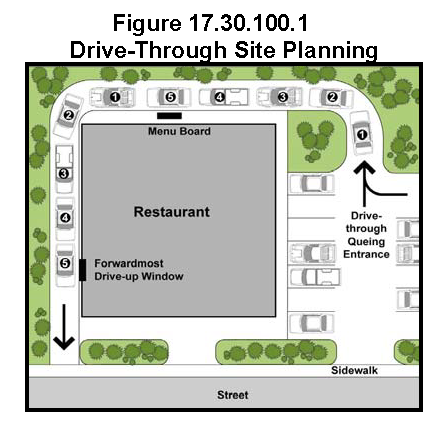
(Ord. No. 931, § 5(Exh. A), 10-22-13)
17.30.120 - Emergency shelters and temporary aid centers.
A.
Applicability. The requirements of this section apply to all emergency shelters and temporary aid shelters as defined in Article 1, Section 17.04.050 (Definitions) and where allowed in compliance with Article 2 (Zoning Districts, Allowable Land Uses and Zone Specific Standards). Upon providing documentation sufficient to allow the Community Development Director to determine that the following operational standards will be met, an emergency shelter or temporary aid center may begin operation.
B.
Emergency Shelters.
1.
Location. An emergency shelter may be on any parcel in M-1 (Light Manufacturing and Industrial) by-right.
2.
Capacity. Emergency shelters may provide a maximum of thirty (30) beds per establishment.
3.
Maximum Length of Stay. The maximum length of stay of any person shall be six months.
4.
Intake/Waiting Areas. On-site intake areas shall be enclosed or screened from the public right-of-way and adjacent properties. Queuing within the public right-of-way or any parking area is not permitted.
5.
Lighting. Lighting shall be stationary, directed away from adjacent properties and public rights-of-way, and of an intensity that is consistent with existing lighting in the neighborhood.
6.
Noise. For the purposes of noise abatement, organized outdoor activities and intake of residents in non-enclosed areas may only be conducted between the hours of seven a.m. and ten p.m.
7.
On-Site Management. The shelter shall have full-time on-site management. Emergency shelter providers must submit a written management plan prior to beginning operation, including provisions for staff training, and counseling, treatment, and training programs for residents. The management plan shall be subject to approval by the Community Development Director.
8.
Parking. Emergency shelters must provide one parking space per staff member to meet the needs of the shelter's on-site management. Nonoperational and unregistered vehicles shall not be kept on site. Towing shall be the responsibility of the shelter operator.
9.
Security. Emergency shelter providers must submit a written security plan prior to beginning operation that includes the following:
a.
Hours of operation.
b.
Intake/discharge procedures.
c.
Screening of Clients Prior to Admission to the Shelter. The emergency shelter operator must restrict client intake in accordance with state and local registered sex offender residency restrictions. Additional security measures shall be included if children are present.
d.
Provisions for on-site security guards, if any.
e.
A site plan shall also be provided which clearly indicates parking areas, lighting, and the location of on-site walk-in and client intake areas.
f.
The security plan shall be subject to approval by the Chief of Police.
10.
Separation from Other Shelters. No emergency shelter shall be located within a radius of three hundred (300) feet from the nearest shelter, as measured from property line to property line. This requirement does not apply to temporary aid centers.
11.
Storage. For emergency shelters that accept walk-in clients, an enclosed area must be provided for residents to store their belongings, such as bicycles, shopping carts, and other possessions. Off-street parking for clients with vehicles are highly encouraged, but not required.
C.
Temporary Aid Centers.
1.
Intake/Waiting Areas. On-site intake areas shall be enclosed or screened from the public right-of-way and adjacent properties. Queuing within the public right-of-way or any parking area is not permitted.
2.
Lighting. Lighting shall be stationary, directed away from adjacent properties and public rights-of-way, and of an intensity that is consistent with existing lighting in the neighborhood.
3.
Noise. For the purposes of noise abatement, organized outdoor activities and intake of residents in non-enclosed areas may only be conducted between the hours of seven a.m. and ten p.m.
4.
On-Site Management. Temporary aid centers must submit a written management plan prior to beginning operation, including provisions for staff training and counseling, training, treatment and programs for clients. The management plan shall be subject to approval by the Community Development Director.
5.
Security. Temporary aid centers must submit a written security plan prior to beginning operation including, as applicable, the hours of operation, intake/discharge procedures, screening of clients prior to admission to the temporary aid center, and provisions for on-site security guards, if any. A site plan shall also be provided which clearly indicates parking areas, lighting, and the location of on-site walk-in and client intake areas. The security plan shall be subject to approval by the Chief of Police.
6.
No Overnight Stays Provided. Temporary aid centers will not provide facilities for overnight stays.
(Ord. No. 931, § 5(Exh. A), 10-22-13; Ord. No. 1002, § 2, 6-14-22)
17.30.130 - Hotels and motels.
A.
Purpose. The purpose of the following provisions is to provide development, location, and operating standards for hotel and motel projects in the city of Rosemead.
B.
Applicability. The provisions in this Section shall apply to hotel and motel uses as defined in Article 1, Section 17.04.050 (Definitions) and where allowed in compliance with Article 2 (Zoning Districts, Allowable Land Uses and Zone Specific Standards) and the following City standards.
C.
City Standards. Hotels in the C-3, C-4, and CBD zones and motels in the C-3, and CBD zones shall be subject to the following conditions:
1.
Lot Area. The minimum area of the parcel or lot shall not be less than thirty-nine thousand (39,000) square feet.
2.
Lot Width. Each lot shall have a minimum frontage of not less than one hundred (100) feet on a major street as depicted on the circulation element of the general plan.
3.
Maximum Coverage. The maximum lot coverage of all structures shall not exceed forty (40) percent of the total lot area.
4.
Floor Area Ratio (FAR):
a.
The FAR of a hotel or motel development must be consistent with the land use designation in the General Plan. The General Plan permits additional FAR in the Commercial and High Intensity Commercial land use designations for hotels only.
b.
Hotels only in the Commercial or High Intensity Commercial land use designation in the General Plan may be developed up to a maximum permitted FAR of 1.0:1 if the projects meet the required development standards identified in the table below.
1)
If a project in one of these land use designations does not meet all of the required amenity standards described in the table below, a maximum FAR of 0.35:1 shall be allowed.
2)
A hotel project may substitute two additional amenities from the table below for each required amenity.
Table 17.30.110.2
HOTEL AMENITY STANDARDS
* Business Center Service includes guest access to centrally located computer, fax, and copy machine.
5.
Number of Rooms.
a.
Hotels: Minimum fifty (50) rooms.
b.
Motels: Minimum fifty (50) rooms.
6.
Floor Area Per Guest Room:
a.
Hotels: Minimum four hundred (400) square feet.
b.
Motels: Minimum three hundred (300) square feet.
c.
For the purposes of this section the floor area per guest room shall be calculated by dividing the total gross floor area of the project by the total number of rooms.
7.
Interior/Exterior Corridors:
a.
Hotels: Interior corridors only.
b.
Motels: Exterior corridors permitted.
8.
Landscaping. A minimum of ten (10) percent of the total lot area is to be landscaped.
9.
Yards. Side and rear yards, when abutting residentially zoned or used property, shall be not less than ten (10) feet from property line.
10.
If requested by a motel/hotel operator/owner in applying for a conditional use permit, notwithstanding Section 5.42.030 of this Code, the owner/operator may rent rooms for extended periods exceeding thirty (30) consecutive days or thirty (30) days in any sixty (60) consecutive day period, as authorized by the conditional use permit. The right to rent rooms for extended periods as authorized by the conditional use permit shall be conditioned upon the owner/operator agreeing to pay and paying to the city at the time set forth in Section 3.16.070 for remission of transient occupancy tax payments, a payment in lieu of taxes in an amount equal to the transient occupancy tax that would otherwise be payable were the units occupied for less than thirty (30) days. In determining the number of units in a motel/hotel complex that may be so occupied, the Planning Commission shall consider the following criteria:
a.
Whether or not the overall site design and the floor plans of individual rooms proposed are conducive to extended occupancy.
b.
Whether or not adequate parking and other amenities are provided to support extended occupancy.
c.
Whether or not the renting of rooms for more than thirty (30) consecutive days is likely to lead to or, in the case of existing motels/hotels, has lead to, police problems due to the design of the motel/hotel and/or the nature of the surrounding area. In applying for the conditional use permit, the owner/operator shall determine the number and/or percentage of rooms to be offered for extended occupancy. The Planning Commission may approve the request as submitted or may establish an alternate number and/or percentage based upon the review of the above criteria, provided, however, that the number shall not be less than twenty (20) percent of the total number of rooms in the hotel or motel nor more than thirty (30) percent of the total number of rooms.
11.
The owner and/or operator of any such hotel or motel shall have and maintain only one meter for each utility service to the entire use.
12.
A hotel or motel may provide manager's quarters not to exceed one dwelling unit, which complies with the minimum multifamily (R-3) standards as set forth in this Zoning Code.
13.
Every hotel and motel shall have a security system designed to the satisfaction of the Chief of Police which shall include surveillance of arrivals, departures, and parking areas from the office and security hardware, cameras, alarms and lighting.
14.
Every hotel and motel shall have an office with a registration desk, and the office shall be located in close proximity to the entry driveway to the street front.
15.
Vehicles exceeding eighty (80) inches in width shall not be permitted to park in any parking space required for motel customers. In addition to the parking spaces required for each guest room, every motel shall provide at least one designated recreational vehicle parking space, which is a minimum of ten (10) feet by thirty (30) feet, for each twenty-five (25) rooms in the motel complex.
16.
Vehicles exceeding eighty (80) inches in width shall not be permitted to park in any required parking lot used exclusively for hotel customers. (Noncommercial) recreational vehicles or motor homes shall be permitted to park in such lots, if at least one designated recreational vehicle parking space, which is a minimum of ten (10) feet by thirty (30) feet, is provided for each twenty-five (25) rooms in the hotel complex.
17.
Every hotel and motel shall be operated in compliance with the operational standards of Chapter 5.42 of this Municipal Code.
18.
An economic feasibility study shall be submitted to the Planning Department for review and approval. The economic feasibility study shall be prepared by a professional who is familiar with preparation of such documents. The study shall include data to support a finding that there is a demonstrated need for the project and that the project will economically benefit the community as a whole. This section shall not apply to hotels and motels in existence on April 28, 1987 or to expansions allowed pursuant to Section 17.30.130.C.20 of this Title.
19.
Conditional use permits granted for hotels and motels that were in operation on April 28, 1987, shall require compliance with subsections 1, 2, 3, 8, 9, 11 and 14 only to the extent that said requirements can be imposed without requiring significant and unduly expensive physical modifications to the property or structures of the motel or hotel complex.
20.
The floor area of an existing motel or hotel which has a valid conditional use permit may be increased one time up to twenty-five (25) percent or seven thousand five hundred (7,500) square feet, whichever is less. The expansion itself must meet the requirements of this Title related to setbacks, lot coverage, FAR, height, parking, security system requirements, and operational standards in accordance with Chapter 5.42 of this Municipal Code, but is not required to compensate for any deficiency or nonconformity in the original building or use. Expansions allowed by this section are allowed by right with no discretionary approvals, including but not limited to a Conditional Use Permit or Design Review, required.
(Ord. No. 931, § 5(Exh. A), 10-22-13)
17.30.140 - Internet cafés and game arcades.
A.
Purpose. This Section provides location, development, and operating standards for Internet cafés and game arcades.
B.
Applicability. The provisions in this section shall apply to Internet café and game arcades as defined in Article 1, Section 17.04.050 (Definitions) and where allowed in compliance with Article 2 (Zoning Districts, Allowable Land Uses and Zone Specific Standards) and the following city standards.
C.
City Standards. The following provisions shall apply to Internet and cyber cafés and Game Arcades as defined in Article 1 and where allowed in compliance with this chapter.
1.
No Internet or cyber cafés or game arcade use shall be established or maintained within a 500-foot radius, as measured from the property line, of any park, school, other Internet café/arcade, or a public playground.
2.
Adult-oriented business activities and/or uses are prohibited, unless specifically approved in compliance with the requirements of Chapter 5.08 and Section 17.30.030 (Adult Businesses).
3.
Internet site blocking, for the purposes of restricting adult sites, shall be required.
4.
Internet and cyber cafés and game arcades shall provide full-time adult attendants or supervisors, twenty-one (21) years of age or older, at a ratio of at least one attendant/supervisor for each ten (10) machines, plus one security guard for each twenty (20) machines or fraction thereof or as otherwise directed by the Community Development Director.
5.
Hours of operation shall be limited to eight a.m. to ten p.m., Sunday through Thursday, and eight a.m. to twelve a.m. midnight, Friday and Saturday, unless alternative hours are specifically approved through the Conditional Use Permit process. These hours of operation shall be posted in a conspicuous place to the satisfaction of the Community Development Director.
6.
A person shall not enter, be, or remain in any part of an Internet and Cyber Café or Game Arcade while in the possession of, consuming, using, or under the influence of any alcoholic beverage or drug.
a.
No licensee or manager shall permit any person in possession of, consuming, using, or under the influence of any alcoholic beverage or drug to enter or remain on the premises.
b.
Signs shall be posted stating this condition to the satisfaction of the Community Development Director.
7.
Minors shall be accompanied by a parent or legal guardian after ten p.m. and may not enter the facility during those times when any public school within the City is conducting its regular education program. Patrons who appear under the age of twenty-five (25) shall present proper identification to verify their age before using the facility. Notice of these prohibitions shall be posted at the entrance to the satisfaction of the Community Development Director.
8.
Adequate lighting shall be maintained inside the business and parking areas. An interior and exterior lighting plan shall be reviewed and approved by the Community Development Director before occupancy.
9.
No window(s) shall be obstructed, tinted, or otherwise covered during business hours.
10.
Establishments with internet access consisting of twenty-five (25) percent or more of the gross floor area shall provide a waiting area with seating equal to one seat for every four computer stations.
a.
No waiting list may be maintained beyond the seating capacity of the waiting area.
b.
No outside waiting (loitering) or seating area shall be allowed and signs shall be posted stating this prohibition to the satisfaction of the Community Development Director.
11.
The applicant shall submit and receive an approved plan from the Los Angeles County Fire Department.
a.
The plan shall address all exiting requirements of the Uniform Building and Fire Codes.
b.
This includes, but is not limited to, aisle locations and dimensions, equipment location, exiting, and panic hardware.
12.
A security plan shall be subject to the review and approval of the Chief of Police.
a.
Security measures may include, but are not limited to additional security guards, background investigations of the business applicants, and surveillance video equipment.
13.
To minimize noise issues, all computers shall utilize headphones with no external speakers allowed.
(Ord. No. 931, § 5(Exh. A), 10-22-13)
17.30.150 - Karaoke KTV studios.
A.
Purpose. This Section provides development and operating standards for Karaoke KTV studios.
B.
Applicability. The provisions in this Section shall apply to Karaoke KTV Studio uses as defined in Article 1, Section 17.04.050 (Definitions) and where allowed in compliance with Article 2 (Zoning Districts, Allowable Land Uses and Zone Specific Standards) and the following City standards.
C.
City Standards. Karaoke Studios are subject to the following conditions:
1.
No alcoholic beverages to be served or allowed on the premises at any time. A sign reading "No Alcoholic Beverages Permitted" in lettering no less than four inches in height and printed in English, Chinese, Cantonese or Mandarin, Vietnamese and Spanish shall be conspicuously posted at no less than two locations inside the business. One such sign shall be posted at the registration/reservation area. In addition, no less than two international symbol "No Drinking" signs shall be conspicuously posted at different locations inside the business establishment.
2.
No person, other than bona fide employees, may occupy premises between two a.m. and eight a.m.
3.
All doors to Karaoke rooms shall remain unlocked and be incapable of being locked. The doors will have a minimum 24-inch wide by 36-inch high window in the upper half of the door. Each individual Karaoke room shall contain at least one other window as well. Full and unobstructed viewing into the room shall be maintained at all times.
4.
The exterior door to each individual Karaoke room shall contain a conspicuously posted sign indicating the rated occupancy of the room pursuant to the Fire Code.
5.
No persons under eighteen (18) years of age shall be allowed on the premises after ten p.m., unless accompanied by a parent or legal guardian.
6.
The owner is responsible for maintaining a permanent register of all patrons by having each patron sign the register before allowing the use of a Karaoke room. The owner or his or her employee shall verify the identity of the patron by checking the patron's identification and legibly listing the full name of the patron in the register.
7.
The owner of the establishment shall be strictly accountable for compliance with each condition imposed, whether or not the owner is personally present at the studio.
8.
The studio shall adhere to the City's noise ordinance provisions as set forth in Title 8, Chapter 8.36 of this Municipal Code.
9.
Nonconforming properties shall achieve conforming status before becoming eligible for KTV Studio use.
10.
Off-street parking shall be provided as set forth in Chapter 17.112 of this Zoning Code.
(Ord. No. 931, § 5(Exh. A), 10-22-13)
17.30.160 - Large and small family day care facilities.
A.
Purpose. This Section provides standards for the location, development, and operation of both large and small family child day care homes in compliance with State law.
B.
Child Day Care—Large Family.
1.
Purpose. This Subsection provides standards for the location, development, and operation of large family child day care homes for nine to fourteen (14) children in compliance with State law.
2.
Applicability. The provisions in this Subsection shall apply to large family child day care homes, as defined by current State law, which shall be allowed in all residential zones in compliance with Article 2 (Zoning Districts, Allowable Land Uses, and Zone Specific Standards) and the following standards.
3.
State and Other Regulatory Requirements. These standards shall apply in addition to requirements imposed by the California Department of Social Services and other regulatory agencies (e.g., Los Angeles County Fire Department).
4.
City Standards. All large family child day care homes shall comply with all of the following City standards:
a.
Licensing. The operator of a large family child day care home shall obtain and maintain a valid license from the California Department of Social Services in compliance with California Code of Regulations, Title 22, Division 12 (Child Care Facility Licensing Regulations).
b.
Large family child day care home permit required.
1)
Review of Permit - Community Development Director. An Administrative Use Permit shall be reviewed and either approved or denied by the Community Development Director in compliance with the provisions of Health and Safety Code Section 1597.46(a)(3), this Section, and Chapter 17.128.
2)
Approval of Permit. The permit may be approved only if the large family child day care home complies with Health and Safety Code Section 1597.46(d), this Section, all applicable City ordinances, and any regulations adopted by the State Fire Marshal.
c.
Care Provider's Residence. The large family child day care home shall be the primary residence of the care provider, and the use shall be clearly residential in character and shall be incidental and accessory to the use of the property as a residence.
d.
Fences or Walls Required.
1)
A six-foot high solid decorative fence or masonry wall shall be constructed and properly maintained along all property lines or around the area where outdoor care is provided (as deemed appropriate by the Community Development Director), except in the front setback area, in compliance with the requirements of Chapter 17.68 (Fences, Walls, and Landscape Screening).
2)
Fences or walls shall provide for safety with controlled points of entry.
e.
Play Area and Equipment. Outdoor play area(s), including all stationary play equipment, shall be located in the rear area of the parcel.
f.
Separation.
1)
A large family child day care home proposed within a residential zone shall not be located within a 300-foot radius of another large family child day care home, other day care facility, or group home facility, disregarding the corporate boundary of the City.
2)
The Community Development Director may allow more than one large family child day care home within three hundred (300) feet of any another similar facility specified in Subparagraph (a), above, if the applicant first demonstrates one of the following to the satisfaction of the Community Development Director:
a)
Any existing large family child day care home located within three hundred (300) feet is at capacity; or
b)
The need exists for a particular or unique service not provided by an existing facility specified in Subparagraph (a), above, located within three hundred (300) feet of a proposed large family child day care home.
g.
Drop-Off/Pick-Up Areas, and Use of Garages.
1)
A minimum of two off-street parking spaces shall be provided as a drop-off and pick-up area. The spaces shall be in addition to those required for the dwelling unit in compliance with Chapter 17.112 (Off-Street Parking and Loading). A driveway may be used to provide the spaces; provided, the City Engineer approves the arrangement based on traffic and pedestrian safety considerations.
2)
A passenger loading plan shall be required to minimize noise and parking issues to the maximum extent possible.
3)
A facility located on a through street classified as a collector or arterial street shall provide a drop-off and pick-up area that does not require backing into the street.
4)
Garages shall not be used as a family child day care play area unless alternative on-site covered parking is available to meet minimum residential parking requirements. If alternative onsite parking is provided within a new enclosed garage, the existing garage shall be improved to meet Building and Fire Code regulations as a habitable space.
h.
Noise. In order to protect adjacent residential dwellings from noise impacts, a large family child day care home located within a residential zone may only operate a maximum of seventeen (17) hours each day between the hours of six a.m. and eleven p.m. and may only conduct outdoor activities between the hours of seven a.m. and nine p.m.
i.
No Exterior Evidence. There shall be no exterior evidence, advertising, or signage identifying the large family child day care home.
j.
Inspection required.
1)
Before commencing operation of a large family child day care home, the City Building Inspector shall conduct an inspection of the premises on which the large family child day care home is to be operated to ensure that there is no unpermitted building, electrical, and/or mechanical improvements to the property.
2)
The property owner shall obtain and finalize all required building permits for all unpermitted construction on the premises before commencing the onsite operation of a large family day care home.
k.
Issuance of Large Family Day Care Home Administrative Use Permit. The Community Development Director shall issue the Large Family Day Care Home Administrative Use Permit before the operation of the large family child day care home begins, once the operator has demonstrated compliance with Health and Safety Code Section 1597.46(d), this Section, all applicable City ordinances, and any regulations adopted by the State Fire Marshal.
C.
Child Day Care Home - Small Family.
1.
Purpose. This Subsection provides provisions for the location and operation of small family child day care homes for eight or fewer children in compliance with State law.
2.
Applicability. The provisions in this Subsection shall apply to small family child day care homes, as defined by current State law, where allowed in compliance with Article 2 (Zoning Districts, Allowable Land Uses, and Zone Specific Standards) and the following standards.
3.
State Requirements.
a.
These provisions shall apply in addition to requirements imposed by the California Department of Social Services.
b.
The operator of a small family child day care home shall obtain and maintain a valid license from the California Department of Social Services in compliance with California Code of Regulations, Title 22, Division 12 (Child Care Facility Licensing Regulations).
4.
Permitted by Right. As required by State law (Health and Safety Code Section 1597.30 et seq. Small family child day care homes (eight or fewer children) shall be considered a residential use of property and shall be an allowed use, permitted by right, within a residence located in a residential zone with no City land use permits required.
(Ord. No. 931, § 5(Exh. A), 10-22-13)
17.30.170 - Outdoor dining.
A.
Purpose. This Section provides locational, developmental, and operational standards for outdoor dining area(s) located on private property as an accessory use to a legally established restaurant.
B.
Applicability. The provisions in this Section shall apply to outdoor dining area(s) as defined in Article 1, Section 17.04.050 (Definitions) and where allowed in compliance with Article 2 (Zoning Districts, Allowable Land Uses and Zone Specific Standards). Chapter 17.21 governs the regulations for Sidewalk Dining within the Garvey Avenue Specific Plan. Section 17.28.040 governs Outdoor/Sidewalk Dining within the Freeway Corridor Mixed-Use Overlay.
C.
City Standards.
1.
No permanent seats or structures shall be placed in the public right-of-way without the review and approval of the City Engineer.
2.
Outdoor seating furniture shall be a minimum of ten (10) feet from the nearest transit stop.
3.
Any outdoor dining area may be separated from the sidewalk only with planters, shrubs, or fencing with a maximum height of forty-two (42) inches.
4.
When alcoholic beverages are permitted in outdoor seating areas that are immediately adjacent to a public pedestrian way, the landscape separation physical design and plant material shall compliment the design of the building and prevent passing or carrying alcoholic beverages outside the restaurant seating area and a sign shall be posted.
(Ord. No. 931, § 5(Exh. A), 10-22-13; Ord. No. 978, § 5(Exh. A), 2-27-18; Ord. No. 1001, § 8, 9-28-21)
17.30.180 - Recycling facilities.
A.
Intent and Purpose. It is the intent and purpose of this section to encourage the recycling of reusable materials and provide convenient service locations for the citizens of the community as mandated by State law. It is also the intent of this section to establish minimum standards of development in order to insure compatibility of recycling facilities with the surrounding land uses to protect surrounding property values, and to maintain the health, safety and general welfare of the community. This Section provides location, development, and operation standards for various types of recycling facilities (e.g., reverse vending machine(s) and small collection facilities).
B.
Permit Required. No firm, person, or corporation shall permit the placement or installation of any recycling facility without first obtaining either an Administrative Use Permit or Conditional Use Permit from the City pursuant to the provisions set forth in this Section.
C.
Applicability. The provisions of this Section shall apply to recycling facilities as defined in Article 1 (Purpose and Applicability of Zoning Code) and where allowed in compliance with Article 2 (Zoning Districts, Allowable Land Uses and Zone Specific Standards) and the following standards.
D.
Location, Development and Operation Standards. Recycling facilities shall comply with the following requirements:
1.
Reverse Vending Machines. Reverse vending machine(s) intended solely for recycling purposes shall be allowed in compliance with all of the following standards:
a.
Reverse vending machines shall be installed as an accessory use in conjunction with a principal commercial use or community service facility which is in compliance with the zoning, building, and fire codes of the City.
b.
If located inside a primary structure, the machines shall be within thirty (30) feet of the entrance and shall not obstruct pedestrian circulation.
c.
If located outside the primary structure, the number of machines shall be limited to a maximum of two. The machines shall not occupy required parking spaces, shall be constructed of durable waterproof and rustproof materials(s), and shall be placed in a manner that is properly designed and constructed in terms of architectural treatment and security from vandalism, subject to the approval of the Community Development Director.
d.
Reverse vending machines shall not occupy parking spaces required by the primary use.
e.
Reverse vending machines shall occupy no more than fifty (50) square feet of floor space per installation, including any protective enclosure, and shall be no more than eight feet in height.
f.
The area in front of the machines shall be illuminated to ensure comfortable and safe operation, if operating hours are between dusk and dawn.
g.
The machines shall have operating hours which are consistent with the operating hours of the principal use.
h.
Reverse vending machines shall be clearly marked to identify the type of material to be deposited, operating instructions, and the identity and phone number of the operator or responsible person to call if the machine is inoperable.
i.
The facility shall have a sign area of a maximum of four square feet per machine, exclusive of operating instructions.
j.
The area surrounding the reverse vending machines shall be maintained in a clean, litter-free condition on a daily basis. A trash container shall be located near the machine to prevent littering.
2.
Small Collection Facilities. The following standards shall be applicable to small collection facilities.
a.
Small collection facilities shall be established in conjunction with an existing commercial use or community service facility which is in compliance with the zoning, building, and fire codes of the City.
b.
Small collection facilities shall not exceed two hundred (200) square feet in area, not including space periodically used for removal of materials or exchange of containers.
c.
Small collection facilities shall be set back at least ten (10) feet from any public right-of-way and shall not obstruct pedestrian or vehicular circulation.
d.
The facility shall not be located within one hundred (100) feet of any parcel zoned or occupied for residential use.
e.
Small collection facilities shall accept only glass, metals, plastic containers, which have a CRV value, and other household beverage containers (i.e., plastic milk containers, wine bottles, etc.).
f.
Small collection facilities shall not use power-driven processing equipment except for reverse vending machines.
g.
Small collection facilities shall use containers that are constructed and maintained with durable waterproof and rustproof material. All recycled items shall be stored within a fully enclosed structure which is designed and constructed to ensure against unauthorized removal of items or in the mobile unit. The containers within the structure or mobile unit shall be of a capacity sufficient to accommodate the items collected and the collection schedule. Outdoor storage of recycled items shall be prohibited.
h.
The fully enclosed structure, the containers, and any site fencing shall be of a color and design that would be compatible and harmonious with the character of their location, subject to the review of the Community Development Director. Landscaping and other appropriate screening may be required on a case-by-case basis as a condition of the permit.
i.
Containers shall be clearly marked to identify the type of material which may be deposited. The facility shall be clearly marked to identify the name and telephone number of the facility operator and the hours of operation. A notice shall also be displayed stating that no material shall be left outside the recycling enclosure or containers.
j.
Signs may only be provided as follows:
1)
Recycling facilities may have identification signs with a maximum area of fifteen (15) percent for each side of the structure or twelve (12) square feet, whichever is greater.
2)
Signs must be consistent with the character of the location.
3)
Directional signs that contain no advertising message may be installed with the approval of the Planning Division if necessary to facilitate traffic circulation, or if the facility is not visible from the public right of-way.
k.
Mobile recycling units shall have an area clearly marked to prohibit other vehicular parking during hours when the mobile unit is scheduled to be present. The mobile recycling units shall only be parked within the marked area.
l.
Small collection facilities shall be maintained free of litter and any other undesirable materials. The area used for mobile facilities shall be swept at the end of each collection day.
m.
Noise levels shall comply with the noise standards of this Code.
n.
The facility shall not impinge upon or disturb the required landscaping for the principal use on the property.
o.
If the facility has an attendant, one parking space will be required in addition to the required parking for the principal use. No additional customer parking spaces will be required.
p.
Small collection facilities and any required attendant parking may occupy required parking spaces associated with the principal use on the site only if the following conditions are met. The maximum number of spaces, if such a reduction in required parking is allowed, is indicated in Table 17.30.190.1 (Reduction of Available Parking Spaces).
1)
The facility is located in a convenience zone or a potential convenience zone as designated by the California Department of Conservation.
2)
A parking study shows that existing parking capacity is not already fully utilized during the time the recycling facility will be on the site.
3)
The permit for the recycling facility will be reconsidered at the end of six months.
q.
If the permit expires without renewal, the collection facility shall be removed from the site on the day following permit expiration.
Table 17.30.180.1
REDUCTION OF AVAILABLE
PARKING SPACES
3.
Large Collection Facilities. Large collection facilities shall meet the following standards:
a.
Shall be at least one hundred (100) feet away from any property zoned or occupied for residential use.
b.
Large collection facilities shall be screened from the public right-of-way by operating within an enclosed building or within an area enclosed by a solid, decorative, block wall at least six feet in height. All applicable noise standards stipulated in this Code shall be met. If a block wall enclosure is used, it shall be set back at least ten (10) feet from property line and the setback area shall be permanently landscaped and maintained.
c.
All exterior storage of material shall be in either baled or palletized form, or in sturdy containers which are covered, secured and maintained in good condition. Storage containers for flammable material shall be constructed of nonflammable material. No storage, excluding truck trailers or overseas containers, may be visible over the height of the block wall.
d.
The site shall be maintained free of litter and any other undesirable materials, and shall be cleaned of loose debris on a daily basis. A trash container shall be located near the facility to prevent littering.
e.
Parking and turn-around space shall be provided on-site in an amount adequate to serve the anticipated peak customer load or five vehicles, whichever is higher, to circulate and to deposit recyclable material.
f.
One parking space for each employee and each vehicle operated by the recycling facility shall be provided on-site. The parking area thus created shall be exclusive of the circulation/drop-off area.
g.
Noise levels shall comply with the noise standards of this Code.
h.
If the facility is located within five hundred (500) feet of property zoned or planned for residential use, it shall not be in operation between the hours of seven p.m. and seven a.m.
i.
Any containers provided for after-hours donation of recyclable materials shall be at least one hundred (100) feet from any property zoned or occupied for residential use. The containers shall be of sturdy, rustproof construction, shall be of sufficient capacity to accommodate materials collected, and shall be secure from unauthorized entry or removal of materials.
j.
Donation areas shall be kept free of litter and any other undesirable material, and the container shall be clearly marked to identify the type of material that may be deposited. The facility shall display a notice stating that no material shall be left outside the recycling containers.
k.
The facility shall be clearly marked with the name and phone number of the facility operator and the hours of operation. Identification and informational signs shall meet the standards of the zone, and directional signs, bearing no advertising message, may be installed with the approval of the Community Development Director, if necessary to facilitate traffic circulation, or if the facility is not visible from the public right-of-way.
(Ord. No. 931, § 5(Exh. A), 10-22-13)
17.30.190 - Accessory dwelling units.
A.
Purpose. The purpose of this section is to implement Government Code Section 65852.2, which allows the City to adopt an ADU ordinance in lieu of being subjected to the State requirements for such units. Notwithstanding any other provision of this Zoning Code to the contrary, the provisions in this section shall govern the development of ADUs in the City of Rosemead.
B.
Applicability. The provisions in this section shall apply to ADUs, as defined in Article 1, Section 17.04.050 (Definitions), and where allowed in compliance with Article 2 (Zoning Districts, Allowable Land Uses and Zone-Specific Standards) and the following City standards.
C.
ADUs. The following provisions shall apply to ADUs:
1.
In the R-1, R-2, R-3 zone or all other areas zoned to allow single-family or multifamily dwelling residential use, an attached or detached ADU shall be permitted by the Community Development Director or the Community Development Director's designee, subject to an administrative site plan and design review approval, if the application satisfies all of the provisions set forth in this section. Except as provided for in this section, all other applicable regulations of the underlying zone shall apply.
2.
An ADU shall be deemed an accessory use. ADUs do not exceed the allowable density for the lot upon which they are located.
3.
On a lot with a proposed or existing single-family dwelling, the number of permitted ADUs are:
a.
One attached ADU within the existing or proposed single-family dwelling or within an existing accessory structure; or
b.
One detached new construction ADU and one JADU.
4.
On a lot with existing detached single-family dwellings, the number of permitted ADUs are:
a.
ADUs shall conform to the standards in Table 17.30.190.1.
b.
One proposed ADU within an existing accessory structure.
5.
On a lot with an existing multifamily dwelling unit or two-family dwelling (duplex) unit, the number of permitted ADUs are:
a.
Not more than two detached ADU on a lot with one existing multifamily dwelling unit or two family-dwelling (attached duplex) unit.
b.
At least one attached ADU is permitted within the existing multifamily dwelling unit or existing two-family (duplex) unit and up to twenty-five (25) percent of the existing dwelling units are permitted within the portions of the existing structure that are not used as livable space, including, but not limited to, storage rooms, boiler rooms, passageways, attics, basements, or garages, if each unit complies with state building standards for dwellings.
6.
The ADU(s) must be served by the same driveway access to the street as the existing primary dwelling unit, unless the ADU(s) have access from a public alley contiguous to the lot.
7.
No ADUs shall be used as a short-term rental.
8.
To the extent possible, the creation of an ADU shall not alter the primary dwelling appearance of the lot. The following shall apply:
a.
For the construction of a new ADU, the ADU shall match or complement the primary residence in architectural design, color, and materials.
b.
For the conversion of an existing accessory structure into an ADU, the ADU shall be permitted to remain as is. However, if an existing garage use is being converted into an ADU, all garage doors shall be removed.
c.
An ADU shall have independent exterior access, and shall not have interior access from the primary residence.
9.
The ADU may not be sold separate from the primary residence.
10.
An owner-occupancy requirement for an ADU permitted between January 1, 2020 to January 1, 2025 shall not be required. However, the City may impose an owner-occupancy requirement after January 1, 2025.
11.
The ADU shall comply with all Building Code and Fire Code requirements.
12.
New ADUs or modifications of existing ADUs shall conform to the standards in Table 17.30.190.1 (ADU Development Standards).
Table 17.30.190.1:
ADU DEVELOPMENT STANDARDS
D.
JADUs. The following provisions shall apply to JADUs:
1.
The JADU shall comply with the requirements of Government Code Section 65852.22.
2.
A maximum of one JADU shall be permitted on a residential lot zoned for single-family residences with a single-family dwelling built, or proposed to be built, on the lot. If an ADU is proposed in addition with a JADU, then the ADU shall be limited to a maximum of eight hundred (800) square feet.
3.
The maximum size for a JADU is five hundred (500) square feet.
4.
The legal property owner shall occupy, on a full-time basis, either the primary dwelling unit, JADU, or ADU (if applicable) as permanent residency. Owner-occupancy shall not be required if the owner is another governmental agency, land trust, or housing organization.
5.
An owner-occupancy covenant shall be recorded, and a copy shall be submitted to the Planning Division prior to issuance of any building permit for the JADU. The said owner-occupancy covenant shall remain in perpetuity and shall not be released. The owner-occupancy covenant shall include the following language:
a.
A prohibition on the sale of the JADU unit separate from the sale of the single-family dwelling, including a statement that the deed restriction may be enforced against future purchasers.
b.
A restriction on the size and attributes of the JADU that conforms with Government Code Section 65852.22.
6.
The permitted JADU shall be constructed within the walls of the proposed or existing single-family residence.
7.
The permitted JADU shall include a separate entrance from the main entrance to the proposed or existing single-family residence.
8.
The permitted JADU shall include an efficiency kitchen, which shall include all of the following:
a.
A cooking facility with appliances.
b.
A food preparation counter and storage cabinets that are of reasonable size in relation to the size of the JADU.
E.
Revocation. The Community Development Director shall have the authority to revoke an ADU and/or a JADU permit if one or more of the requirements of this chapter are no longer met. The decision of either the Community Development Director may be appealed to the Planning Commission in accordance with the procedures set forth in this Code.
F.
Existing ADUs. ADUs which have been previously approved shall be allowed to remain in existence as a legally established nonconforming use. This section shall in no way validate any existing illegal ADUs.
(Ord. No. 931, § 5(Exh. A), 10-22-13; Ord. No. 979, § 3(Exh. A), 6-12-18; Ord. No. 995, § 4, 9-8-20)
17.30.200 - Single room occupancy (SRO).
A.
Purpose. This Section provides development and operating standards for Single Room Occupancy (SRO) developments.
B.
Applicability. The provisions in this Section shall apply to SRO developments as defined in Article 1, Section 17.04.050 (Definitions) and where allowed in compliance with Article 2 (Zoning Districts, Allowable Land Uses and Zone Specific Standards) and the following City standards.
C.
City Standards. All SRO developments shall meet the following location and operational standards.
1.
SRO developments may be permitted in the C-3 (Medium Commercial) zone, CBD (Central Business District), and M-1 (Light Manufacturing and Industrial) zone upon the approval of a Conditional Use Permit, except that no SRO development will be permitted on any lot that abuts the R-1 (Single-Family Residential) zone.
2.
SRO developments shall be located no closer than three hundred (300) feet to another single room occupancy development.
3.
SRO units shall be efficiency units that may include a complete private bath and kitchen but do not have a separate bedroom. The maximum size for an SRO unit shall be five hundred (500) square feet.
4.
A minimum lot size of eighteen thousand (18,000) square feet and a minimum street frontage of ninety (90) feet is required for the development of any new SRO development.
5.
Single room occupancy developments shall not exceed a density of one thousand seven hundred fifty (1,750) square feet of net lot area for each unit.
6.
At least one common bathroom shall be provided for every six units, unless private bathrooms are provided for some or all units. Any unit with a private bathroom shall not be counted toward the six units for which a common bathroom is required.
7.
Each SRO development shall have a common open space area totaling a minimum of one hundred (100) square feet per unit.
8.
Each SRO development shall have a front yard of not less than fifteen (15) feet.
9.
Each SRO development shall have a side yard of not less than ten (10) feet. On corner lots the side yard of the side street shall be not less than ten (10) feet.
10.
Each SRO development shall have a rear yard of not less than twenty (20) feet.
11.
Garbage and rubbish collection areas shall be provided in accordance with Chapter 17.32 (Accessory Structures).
12.
Adequate laundry facilities shall be available on the premises, with not less than one washer/dryer per six units.
13.
Average income of residents in the development shall be no more than forty (40) percent of the area median income.
14.
The development shall be subject to a covenant recorded with the County Assessor's Office stating that the units shall be subject to these income restrictions for a minimum period of fifty-five (55) years.
15.
New construction projects for seniors shall not qualify as SRO housing.
16.
Off-street parking shall be provided at the rate of 0.5 parking space per unit, plus one parking space for on-site management.
17.
SRO developments shall have full-time on-site management.
(Ord. No. 931, § 5(Exh. A), 10-22-13)
17.30.210 - Live/work (includes artist live/work).
A.
Purpose. The purpose of the following provisions is to provide standards for live/work units and to ensure a live/work unit is consistent with the definition of a mixed-use development.
B.
Applicability. The provisions in this Section shall apply to live/work units as defined in Article 1, Section 17.04.050 (Definitions) and where allowed in compliance with Article 2 (Zoning Districts, Allowable Land Uses and Zone Specific Standards) and the following City standards.
C.
City Standards.
1.
At least twenty-five (25) percent and no more than seventy-five (75) percent of the unit must be dedicated to residential use.
2.
The working space is to be used by the one or more of the occupants (owner-occupant or renter occupant) of a single household or family.
3.
One or more occupants is a business owner with a valid Rosemead Business License or where one or more occupants has submitted a signed letter, documenting telework/telecommuting or other related activities for the majority of the work week.
4.
The unit consists of a full kitchen, full bathroom (bathing and sanitary) facilities in compliance with the applicable building codes.
5.
No more than one full time equivalent non-occupant employee is permitted to work in addition to the occupants of the live/work unit.
6.
The Community Development Director shall have the discretion to allow other uses not listed under permitted uses.
7.
The Community Development Director or his/her designee may require the discontinuance of a work activity in a live/work unit if, as operated or maintained, there has been a violation of any applicable condition or standard. The Community Development Director or his/her designee shall have the authority to prescribe additional conditions and standards of operation for any category or work activity in a live/work unit.
8.
Permitted live/work uses include:
a.
Professional OFFICE (such as an architect, accountant, realtor, sales representative, website/graphic designer, consultant, etc.).
b.
Artist studio.
c.
Cottage food operation (provided that all orders are pre-ordered and for pick-up only). There shall be no restaurant service, storefront, and no installation of industrial kitchen equipment. The operator must utilize the existing kitchen facilities within the residential component of the live/work unit).
d.
Tutoring services (small).
e.
Additional uses not listed may be permitted subject to the discretion of the Community Development Director.
9.
Unpermitted live/work uses include:
a.
Restaurants.
b.
Wholesale and retail sales (including but not limited to automobiles, merchandise, herb and/or pharmaceuticals, guns and/or ammunition, etc.).
c.
Dating services (example: no speed dating mixers)
d.
Adult businesses.
e.
Fortune telling, palm reading, psychics, and similar uses.
f.
Massage services.
g.
Personal care services (hair, nails, facials, or similar uses).
h.
Medical and dental offices.
i.
Automobile, boat, or aircraft repair (body and/or mechanical), detailing (washing, waxing, tinting, etc.), testing, towing, and/or other auto services related uses.
j.
Plumbing, machine, or sheet metal works.
k.
Carpentry shops.
l.
Contractor storage yard.
m.
Laundering of clothes or other articles.
n.
Animal kennels or breeding.
o.
Additional uses that create dust, electrical interference, fumes, gas, odor, smoke, glare, light, noise, vibration, toxic/hazardous materials, liquid or solid waste, or other hazards or nuisances other than that normally incidental to residential use of the structure. Commercial uses shall not create any other negative effect that may be felt, heard, or otherwise sensed by adjoining units, as determined by the Community Development Director.
p.
Any other uses that require the granting of a Conditional Use Permit.
10.
Off-Street Parking for Live/Work Units. The more restrictive parking requirement (residential or nonresidential) shall apply to live/work units in each of the following zones.
a.
Residential/Commercial Mixed-Use Development Overlay.
1)
Residential: provide no less than two standard sized parking space and 0.5 standard sized guest parking space
2)
Nonresidential: provide one standard sized parking space per two hundred fifty (250) square feet of floor area.
b.
Freeway Corridor Mixed-Use Overlay.
1)
Residential.
a)
Provide no less than one standard sized parking space and 0.5 standard sized guest parking space for a studio or one bedroom unit.
b)
Provide no less than two standard sized parking space and 0.5 standard sized guest parking space for units with two or more bedrooms.
2)
Nonresidential. Provide one standard sized parking space per four hundred (400) square feet of floor area.
c.
Parking areas for residential guests may be uncovered and combined with nonresidential parking if live/work units are incorporated into the mixed-use development.
(Ord. No. 1000, § 4, 9-28-21)
17.30.215 - Urban Dwellings.
A.
Purpose. The purpose of this section is to implement Government Code Section 65852.21, which allows the City to adopt an urban dwelling ordinance. Notwithstanding any other provision of this Zoning Code to the contrary, the provisions in this section shall govern the development of urban dwellings in the City of Rosemead.
B.
Applicability.
1.
A proposed urban dwelling must be located within the R-1 (Single Family Residential), on the Official Zoning Map as defined in Article 2, Section 17.08.020 (Official Zoning Map).
2.
A proposed urban dwelling must not be located within a historic district or property included on the State Historic Resources Inventory (see Section 5020.1 of the Public Resources Code), or within a site that is designated or listed as a City landmark or historic property or district pursuant to a City ordinance.
3.
A proposed urban dwelling must not be on a parcel located in the areas specified in subparagraphs (B) to (K), inclusive, of paragraph (6) of subdivision (a) of Section 65913.4.
4.
A proposed urban dwelling must not be on a parcel on which an owner of residential real property has exercised the owner's rights under Chapter 12.75 (commencing with Section 7060) of Division 7 of Title 1 to withdraw accommodations from rent or lease within fifteen (15) years before the date that the development proponent applies.
C.
Urban Dwelling. The following provisions shall apply to an urban dwelling:
1.
The rental of an urban dwelling must be for a term longer than thirty (30) days. Short term rentals are prohibited.
2.
Demolition and Alteration. A proposed urban dwelling must not require demolition or alteration of any of the following types of housing:
a.
Housing that is subject to a recorded covenant, ordinance, or law that restricts rents to levels affordable to persons and families of moderate, low, or very low income.
b.
Housing that is subject to any form of rent or price control through a public entity's valid exercise of its police power.
c.
Housing that has been occupied by a tenant in the last three years.
3.
Limit on Demolition. A proposed urban dwelling must not demolish more than twenty-five (25) percent of the existing exterior structural walls. This does not apply if the housing development has not been occupied by a tenant in the last three years.
4.
The urban dwelling shall comply with all requirements of the most recently adopted Building Code and Fire Code.
5.
An urban dwelling unit may be attached to an existing dwelling unit (duplex) or built as a separate detached unit, provided that the structures meet the building code and are sufficient to allow separate conveyance.
6.
None of the standards contained herein shall preclude construction of an 800 square foot urban dwelling unit.
7.
Objective Zoning Standards.
a.
Number of Units. A proposed urban dwelling must contain no more than two units.
b.
If the existing residential dwelling is proposed to remain on a lot, it shall be renovated to match or complement the new construction in colors, materials and architectural style.
8.
An urban dwelling shall conform to the standards in Table 17.30.210.1 (Urban Dwelling Development Standards).
Table 17.30.215.1: Urban Dwelling and Urban Lot Split Development Standards
*If the proposed urban dwelling is unable to comply with the following R-1 development standards, an urban dwelling that is at least eight hundred (800) square feet in floor area, with side and rear yard setbacks of four feet shall be permitted.
D.
Review and Approval.
1.
Application. A completed application for administrative site plan and design review shall be submitted to the Community Development Department along with the accompanying fee.
2.
Staff Review. The director, or their designee, shall circulate the application for an urban dwelling to affected City departments for review and comment. All comments will be provided back to the applicant for review and any necessary revisions to the plans.
3.
Building Official Review. A proposed urban dwelling may be denied if the building official makes a makes a written finding, based upon a preponderance of the evidence, that the proposed housing development project would have a specific, adverse impact, as defined and determined in paragraph (2) of subdivision (d) of Section 65589.5, upon public health and safety or the physical environment and for which there is no feasible method to satisfactorily mitigate or avoid the specific, adverse impact. The decision of the building official may be appealed to the Planning Commission in compliance with section 17.160.030.
4.
Ministerial Review. Proposals for an urban dwelling will be reviewed ministerially, without discretionary review or a hearing.
5.
Approval. If the application for an urban dwelling meets the requirements of Section 17.30.210, the Director of Community Development, or their designee, shall approve the application. The action of the director is final, unless appealed pursuant to Section 17.160.030.
(Ord. 1005, § 4, 1-25-22)
17.30.220 - Urban lot splits.
A.
Purpose. The purpose of this section is to implement Government Code Section 66411.7, which allows the City to adopt an urban lot split ordinance. Notwithstanding any other provision of the Municipal Code to the contrary, the provisions in this section shall govern the development of an urban lot split in the City of Rosemead.
B.
Applicability.
1.
A proposed urban lot split must be located within the R-1 (Single Family Residential), on the Official Zoning Map as defined in Article 2, Section 17.08.020 (Official Zoning Map).
2.
A proposed urban lot split must not be located within a historic district or property included on the State Historic Resources Inventory (see Section 5020.1 of the Public Resources Code), or within a site that is designated or listed as a City or County landmark or historic property or district pursuant to a City or County ordinance.
3.
Other Instances.
a.
An urban lot split is prohibited if the parcel is located areas specified in subparagraphs (B) to (K), inclusive, of paragraph (6) of subdivision (a) of Section 65913.4.
b.
An urban lot split is prohibited if the owner of residential real property has exercised the owner's rights under Chapter 12.75 (commencing with Section 7060) of Division 7 of Title 1 to withdraw accommodations from rent or lease within fifteen (15) years before the date that the development proponent applies.
C.
Urban Lot Splits. The following provisions shall apply to an urban lot split:
1.
Any unit built as a result of an urban lot split must be for a term longer than thirty (30) days. Short term rentals are prohibited:
2.
Comply with Subdivision Map Act. Urban lot splits must conform to all applicable objective requirements of the Subdivision Map Act (Division 2 (commencing with Section 66410)), except as expressly provided in this section.
3.
Dedication and Off-Site Improvements. A dedication of rights-of-way or the construction of offsite improvements for the parcels being created cannot be required as a condition of issuing a parcel map.
4.
Size and Number. The parcel map subdividing an existing parcel must create no more than two new parcels of approximately equal lot area provided that one parcel shall not be smaller than forty (40) percent of the lot area of the original parcel proposed for subdivision.
5.
Minimum Size. Both newly created parcels created by an urban lot split must be no smaller than one thousand two hundred (1,200) square feet.
6.
Prior Urban Lot Split. The parcel has not been established through prior exercise of an urban lot split as provided for in this section.
7.
Previously Subdivided Adjacent Site. Neither the owner of the parcel being subdivided nor any person acting in concert with the owner has previously subdivided an adjacent parcel using an urban lot split as provided for in this section.
8.
Existing Structures. No setback is required for an existing permitted structure, or a structure constructed in the same location and to the same dimensions as an existing permitted structure.
9.
Demolition and Alteration. A proposed urban lot split must not require demolition or alteration of any of the following types of housing:
a.
Housing that is subject to a recorded covenant, ordinance, or law that restricts rents to levels affordable to persons and families of moderate, low, or very low income.
b.
Housing that is subject to any form of rent or price control through a public entity's valid exercise of its police power.
c.
Housing that has been occupied by a tenant in the last three years.
10.
Limit on Demolition. A proposed urban lot split must not demolish more than twenty-five (25) percent of the existing exterior structural walls. This does not apply if the housing development has not been occupied by a tenant in the last three years.
11.
Fire Department and Utility Easements. An easement must be provided over the front parcel to the rear parcel for access to the public right-of-way, providing public services and facilities, maintenance of utilities, and (if required) fire department access.
12.
Owner Occupied. The applicant for an urban lot split must sign an affidavit stating that the applicant will occupy one of the housing units as their principal residence for a minimum of three years from the date of the approval of the urban lot split. This requirement does not apply to an applicant that is a "community land trust," as defined in clause (ii) of subparagraph (C) of paragraph (11) of subdivision (a) of Section 402.1 of the Revenue and Taxation Code or is a "qualified nonprofit corporation" as described in Section 214.15 of the Revenue and Taxation Code.
13.
Non-Conforming Zoning Conditions. Nonconforming zoning conditions are not required to be made conforming before approving an application.
14.
Objective Zoning Standards.
a.
Flag Lots.
i.
Lot Width. All newly created parcels as a result of an urban lot split shall have a minimum lot width of fifty (50) feet.
ii.
Lot Frontage. The lot frontage for the flag lot development shall be a minimum of fifteen (15) feet and shall be parallel to the street.
b.
Number of Units. A proposed urban lot split shall contain not more than two dwelling units per lot. All (existing or new) accessory dwelling units (ADUs) and junior ADUs will be counted toward the maximum number of units. An urban lot split shall contain not more than four residential units, two per parcel.
c.
If the existing residential dwelling is proposed to remain on a lot, it shall be renovated to match or complement the new construction in colors, materials, and architectural style.
15.
An urban dwelling that is proposed as part of an urban lot split shall conform to the standards in Table 17.30.210.1 (Urban Dwelling and Urban Lot Split Development Standards).
D.
Review and Approval.
1.
Application. A completed tentative parcel map application shall be submitted to the Community Development Department with the accompanying fee. The filing fee shall equal fifty (50) percent of the tentative parcel map fee as established by City Council resolution.
2.
Staff Review. The director, or their designee, will circulate the application for an urban lot split, along with the parcel map, to affected City departments and outside agencies for review and comment. City comments will be provided back to the applicant for review and necessary revisions.
3.
Building Official Review. A proposed urban dwelling may be denied if the building official makes a makes a written finding, based upon a preponderance of the evidence, that the proposed housing development project would have a specific, adverse impact, as defined and determined in paragraph (2) of subdivision (d) of Section 65589.5, upon public health and safety or the physical environment and for which there is no feasible method to satisfactorily mitigate or avoid the specific, adverse impact. The decision of the building official may be appealed to the Planning Commission in compliance with Section 17.160.030.
4.
Ministerial Review. Proposals for urban lot split will be reviewed ministerially, without discretionary review or a hearing.
5.
Approval. If the application for urban lot split meets the requirements of Section 17.30.220, the Director of Community Development, or their designee, shall approve the application. The action of the director is final, unless appealed pursuant to Section 17.160.030.
(Ord. 1005, § 6, 1-25-22)
17.32.010 - Purpose and applicability.
This chapter establishes standards for the development and use of all accessory structures that are necessarily or customarily incidental to an allowed primary use. The development standards are intended to ensure that accessory structures located in any zone do not adversely impact adjacent parcels or the surrounding neighborhood.
Any permitted accessory structure that does not require a city of Rosemead Building Permit, must meet the minimum requirements of this Code for use, placement on a parcel, height, and size.
(Ord. No. 931, § 5(Exh. A), 10-22-13)
17.32.020 - Permit requirements.
The construction and/or relocation of an accessory structure shall require Site Plan and Design Review in accordance with Chapter 17.136 (Site Plan and Design Review), in addition to any building permits required by the Building and Safety Division.
(Ord. No. 931, § 5(Exh. A), 10-22-13)
17.32.030 - Accessory structures in residential zones.
A.
Residential Accessory Structures Defined. "Residential accessory structure" means an attached or detached structure that is a part of, and clearly incidental and secondary to, a residence and that does not change the character of the residential structure. Includes accessory dwelling units. Illustrative examples of these structures include:
•
Decks.
•
Fences.
•
Garages.
•
Gazebos.
•
Greenhouses (noncommercial).
•
Outdoor play equipment.
•
Patios.
•
Platforms.
•
Porches.
•
Spas and hot tubs.
•
Storage or work sheds.
•
Swimming pools.
•
Tennis and other on-site sport courts.
•
Terraces.
•
Walls.
•
Workshops.
B.
Requirements for Residential Accessory Structures.
1.
Size. The maximum size for a detached accessory structure shall be seven hundred and fifty (750) square feet. The square-footage of fully enclosed, attached accessory structures (i.e. workshops, storage sheds, but not including residential garages) shall be counted towards the maximum Floor Area Ratio. Unenclosed attached accessory structures shall have no size limitation, provided that residential setback requirements are satisfied.
2.
Height. Detached accessory structures shall be limited to one story in height and any attic shall be less than five feet in height and not habitable. Attached accessory structures are allowed to have a habitable second story if the living space is accessible from within the residence and there is no separate outside entrance to the living space.
3.
Location.
a.
There shall be a minimum distance of six feet between detached accessory structures and between a main building and an accessory structure.
b.
No detached accessory structure shall be located within three feet of an interior property line.
c.
Detached accessory structures shall be located in the rear half of the lot, excluding detached garages, which shall not extend into the required front setback for the main building.
d.
On a corner lot no accessory buildings shall be located less than twenty (20) feet from the side street line.
e.
On reverse corner lots, accessory structures located on the rear twenty-five (25) feet of the lot shall not extend beyond the required front yard of the abutting key lot.
f.
When the slope of the front half of a lot is greater than a one-foot rise or fall in a horizontal distance of four feet from the established street elevation at the front property line, one attached or detached garage may be permitted to occupy the required front yard of an interior lot. However, no portion of any such garage shall be less than five feet from the side or front property line and the garage shall not exceed ten (10) feet in height.
g.
Portable shade structures shall not be located in a side or front yard. Temporary, portable shade structures may be permitted in the rear yards, subject to the approval of a site plan approval, provided that they are not visible from the public right-of-way, that they meet all applicable setback and height requirements for accessory structures and that they do not obstruct access to required parking. Such temporary structures shall be maintained in good condition. Torn fabric, bent or broken support members shall be replaced or repaired as needed. Any temporary structure maintained in disrepair shall be repaired, replaced, or removed from the site. Reflective, mirror-type material is prohibited. Temporary structures are subject to building coverage requirements and shall be included in the maximum lot coverage.
h.
In the R-3 zone there shall be a minimum distance of fifteen (15) feet measured horizontally between a swimming pool and the nearest point of a balcony, porch, second story patio, sun deck, or other architectural feature of a building or structure with windows, doors, or other openings of sufficient size to permit the passage of persons.
4.
Garages. The capacity of a garage shall not exceed three automobiles and seven hundred and fifty (750) square feet per dwelling unit.
5.
Architectural Consistency. All accessory structures on a permanent foundation shall be consistent in exterior appearance with the primary structure through the use of similar/matching exterior paint colors, material types, and architectural styles.
6.
Site Plan Review. A site plan review shall be required for any accessory structure greater than one hundred and twenty (120) square feet, whether the total area is in one building or cumulatively in multiple buildings, including storage structures and workshops but not including required garages.
(Ord. No. 931, § 5(Exh. A), 10-22-13; Ord. No. 979, § 3(Exh. A), 6-12-18)
17.32.040 - Accessory structures in nonresidential zones.
A.
Height Adjacent to Residential Zones. In all zones, accessory structures shall not exceed a height of fifteen (15) feet, when located within between a residential property line and the variable height measuring point, as illustrated in the Variable Height Diagrams in Section 17.08.050I, provided that the minimum building setback requirements in the underlying zone are satisfied.
B.
Architectural Consistency. All accessory structures on a permanent foundation shall be consistent in exterior appearance with the primary structure through the use of similar/matching exterior paint colors, material types, and architectural styles.
(Ord. No. 931, § 5(Exh. A), 10-22-13)
17.32.050 - Solid waste and recyclable materials storage areas.
Design and construction of storage waste areas shall be subject to the approval of the Community Development Director or his/her designee. The following are minimum standards:
A.
Architectural Design. Enclosed solid waste collection areas shall be conveniently located and shall be an integral part of the architectural development of properties with three or more residential units and all properties with nonresidential development. The enclosure areas shall be of the same architectural style of the development by the use of colors, materials, and design.
B.
Minimum Dimensions. Enclosure dimensions shall be a minimum of six feet six inches in depth by ten (10) feet eight inches in width for single bin enclosures, and a minimum of six feet six inches in depth by eighteen (18) feet eight inches in width for double bin enclosures. Trash enclosures shall be constructed with reinforced masonry block walls not less than six feet in height and shall be equipped with self-closing, solid, doors and a solid roof. The roof should provide adequate clearance to allow complete access of waste bins. The enclosure shall be designed to accommodate individual bins or containers that protect contents from adverse environmental conditions that might render recyclable materials unmarketable.
C.
Location. No trash enclosure shall be located in any required parking stall, vehicle back-up aisle, or required landscaped area.
D.
Adequate vehicular access to and from the solid waste collection area shall be provided.
E.
Solid waste collection areas shall be maintained in a closed manner at all times to prohibit the visibility from public right-of-way or adjacent property. Doors shall be properly secured to prevent access by unauthorized persons and minimize scavenging, while allowing authorized persons' access for disposal and collection of materials.
(Ord. No. 931, § 5(Exh. A), 10-22-13)
17.36.010 - Intent and purpose.
These regulations are intended to provide criteria by which condominium projects, community apartment projects, and stock cooperative projects, may be developed to achieve environments of stable and desirable character. Regulations are set to insure a well-designed and viable blend of improvements with common and/or private open space. The standards of density, open space, light and air, and pedestrian and vehicular traffic circulation are intended to create projects that are well designed, aesthetically pleasing, and of a desirable character.
(Ord. No. 931, § 5(Exh. A), 10-22-13)
17.36.020 - Applicability.
A.
Condominium projects, including applications for condominium conversions, constructed on a parcel of less than forty-three thousand five hundred sixty (43,560) square feet, but equal to, or exceeding twenty thousand (20,000) square feet in area, shall be developed in accordance with the provisions of this Section.
B.
Condominium projects constructed on a parcel equal to or exceeding forty three thousand five hundred sixty (43,560) square feet shall be processed and developed in accordance with the provisions of the Planned Development (P-D) District requirements set forth in Chapter 17.24 (Special Purpose Zoning Districts). Further, the provisions of this section shall be used as general development guidelines.
(Ord. No. 931, § 5(Exh. A), 10-22-13)
17.36.030 - Definitions.
"Bedroom" means a defined area within a residential unit containing a closet or area of storage, and is sufficient in size to provide for sleeping purposes.
"Community Apartment Project" means an apartment development in which an undivided interest in the land is coupled with the right of exclusive occupancy of an apartment located thereon. For the purposes of this chapter, community apartment projects shall be subject to the same regulations as condominium projects.
"Condominium" means an estate in real property consisting of an undivided interest in common, in a portion of a parcel or real property, together with a separate interest in space in real property, such as a residence, townhouse, apartment house, office or offices, store, or stores. A condominium may include, in addition, a separate interest in other portions of such real property.
"Condominium Conversion" means the conversion of real property from occupancy under existing tenancies or estates, and regardless of residential, industrial or commercial tenure, to occupancy under condominiums, community apartment or stock cooperative interests. For the purposes of this section, condominium conversions will be subject to the same approval process as condominium projects.
"Condominium Projects" means the entire parcel of real property, including all structures thereon, subdivided or to be subdivided, for purposes of constructing or converting existing structures to condominium units.
"Open Space" means usable open space which:
(1)
Has been well-designed;
(2)
Has been provided with landscaping and recreational facilities; and
(3)
Has been provided with a program of continuing maintenance by the Condominium Owners Association.
"Common Open Space" means land area set aside for the residents of a condominium project which is owned by the Condominium Owners Association.
"Private Open Space" means land area designated and maintained for the exclusive use of the occupants of the appurtenant dwelling unit.
"Stock Cooperative" means a corporation which is formed for the purpose of holding title to, either in fee simple or for a term of years, improved real property if all or substantially all of the shareholders of such corporation receive a right of exclusive occupancy in a portion of the real property, title which is held by the corporation, which right of occupancy is transferable only with the transfer of the share or shares of stock in the corporation held by the person having such right of occupancy. For the purposes of this chapter, stock cooperatives will be subject to the same regulations as condominium projects.
"Vehicle Access and/or Driveway" means a private way for the use of vehicles.
17.36.040 - Permitted zones.
A.
Commercial/industrial condominium projects shall be permitted only in the RC-MUDO (Residential/Commercial Mixed-Use Development Overlay), P-O (Professional Office), C-4 (Regional Commercial), CI-MU (Commercial-Industrial Mixed Use), M-1 (Light Manufacturing and Industrial), and P-D (Planned Development) zones. Where the P-D zone is the base zone in combination with the RC-MUDO overlay zone, the RC-MUDO shall be standard for the residential portion of the development, which may be modified by the City Council upon adoption of the P-D zone.
B.
Residential condominium projects shall be permitted only in the RC-MUDO (Residential/Commercial Mixed-Use Overlay), R-3 (Medium Multiple Residential), and P-D (Planned Development) zones.
(Ord. No. 931, § 5(Exh. A), 10-22-13)
17.36.050 - Procedure and submittal requirements.
A.
Application for Discretionary Site Plan and Design Review approval. Concurrently with the submission of a Tentative Tract Map, the applicant shall submit an application for a Discretionary Site Plan and Design Review application to the Community Development Department that contains the following information:
1.
A site plan drawn at a scale which clearly defines and depicts compliance with all applicable development standards and the following items:
a.
The square-footage of each unit and the number of bedrooms in each unit, if applicable,
b.
The layout and delineation, defined square-footage, of all common and private areas,
c.
The layout and location of all storage space,
d.
The layout and location of all facilities and amenities provided within the common area for the enjoyment and use of unit owners,
e.
The layout of all private and guest parking spaces to be used in conjunction with each condominium unit,
f.
Location and type of surfacing of all driveways, pedestrian walkways, vehicular parking areas, and curb cuts,
g.
Trash enclosure construction and location details,
h.
Location, height and type of all walls and/or fences in relationship to existing adjacent grade levels. Cross sections shall be included, and
i.
Mailbox locations that encourage proper vehicular and pedestrian traffic flow within the project.
2.
Preliminary Grading Plan. A grading and drainage plan, in sea-level elevations, shall be submitted which indicates the existing grade for the project as well as the neighboring properties on all sides, and the proposed finished grades associated with the project.
a.
Drainage plan concepts shall be developed under the following priorities of design preference:
1)
Natural historic flow.
2)
Natural/mechanical flow.
3)
Mechanical (pump).
b.
Provisions for cross-lot drainage, such as easement and drainage devices, if applicable.
3.
Preliminary Landscaping Plan. A preliminary landscaping plan of the project shall indicate the types and sizes of landscaping materials and permanent irrigation facilities. The landscaping plan shall be prepared in compliance with the City's Water Efficient Landscape Ordinance (Rosemead Municipal Code Title 13, Chapter 13.08).
4.
Preliminary Lighting Plan. A preliminary lighting plan shall indicate the location and nature of lighting and lighting fixtures proposed in common areas.
5.
Preliminary Master Sign Program. A preliminary master sign program shall be developed and submitted in accordance with the sign area provisions outlined in Chapter 17.116 (Signs).
6.
Proposed Condominium Documents. Proposed condominium documents, including those portions of the covenants, conditions, and restrictions that apply to the conveyance of units, the assignment of parking, and the management and maintenance of common areas and improvements shall be submitted.
7.
Delineation of Shared Common Spaces. Delineation of shared common spaces (including shared access areas, utility corridors, etc.) shall be clearly delineated with bearings and distances.
8.
Other Information. Other information that the Community Development Director determines may be necessary to evaluate the proposed project to ensure consistency with the General Plan, this Zoning Code, and any other applicable City regulations.
B.
Planning Commission Evaluation. The Commission will review and will approve or conditionally approve if the plan meets the requirements of Chapter 17.136.
(Ord. No. 931, § 5(Exh. A), 10-22-13)
17.36.060 - Development standards.
The following regulations shall apply to condominium projects unless otherwise provided in this Zoning Code.
A.
Minimum Lot Area.
1.
Minimum Lot Area for Commercial/Industrial Condominium and Stock Cooperatives. The minimum lot or parcel area for a commercial or industrial condominium project shall be forty thousand (40,000) square feet, and shall have a minimum street frontage of one hundred (100) feet, and a minimum lot depth of one hundred (100) feet as measured from the center line of the property.
2.
Minimum Lot Area for Residential Projects. The minimum lot or parcel area for a residential condominium project shall be twenty thousand (20,000) square feet, and shall have a minimum street frontage of one hundred (100) feet, and a minimum depth one hundred (100) feet as measured from the center line of the property.
B.
Density, Lot Coverage, and Floor Area Ratio. Density, lot coverage, and floor area ratio shall conform to the requirements of the General Plan and Zoning Code requirements for the district in which the condominium project is proposed.
C.
Dwelling Unit Size (Residential Projects Only).
1.
Each dwelling unit shall have a minimum floor area as shown in Table 17.36.060.1. (Residential Condominium Floor Area Requirements).
Table 17.36.060.1
RESIDENTIAL CONDOMINIUM FLOOR AREA REQUIREMENTS
D.
Minimum Building Setbacks. Condominium projects shall be subject to the setback requirements of the specific zones in which they are located.
E.
Maximum Building Height. The maximum building height shall conform to the requirements of the General Plan and Zoning Code for the district in which the condominium project is proposed.
F.
Fences, Masonry Walls and Height Requirements. Each development shall be improved with fencing, walls, and landscape screening in accordance with Chapter 17.68 (Fences, Walls, and Landscape Screening).
G.
Landscaping. In addition to any landscape provisions required within the zone in which a condominium project is proposed, the following additional landscape criteria shall be followed:
1.
All setback areas fronting on or visible from an adjacent public street, and all leisure, open space, and recreation areas shall be landscaped in an attractive manner and provided with a method for the maintenance of the areas.
2.
Decorative design elements (e.g., benches, exterior recreational facilities, fountains, planters, pools, sculptures, and similar elements) may be allowed, provided the elements are incorporated as a part of the landscaping plans, except where otherwise prohibited.
3.
Permanent and automatic irrigation facilities shall be provided in all planted landscaped areas.
H.
Lighting. In addition to the requirements set forth in Chapter 17.88 (Lighting), condominium projects shall conform to the following additional regulations:
1.
The subdivider shall install an on-site lighting system on all vehicular access ways and along major walkways.
2.
The lighting shall be directed onto the driveways and walkways within the development and away from the adjacent properties.
3.
Appropriate lighting shall also be installed within all covered and/or enclosed parking areas.
I.
Open Space (Residential Projects Only). There shall be provided a minimum of four hundred (400) square feet of private and/or common open space per unit, or any combination thereof exclusive of front yard setback, side yard setback, vehicular access ways, and off-street parking areas. Open space shall be devoted to landscaping and outdoor recreational facilities incidental to the residential development which may include, but are not limited to: swimming pools, tennis courts, children's play areas, barbecue and picnic areas. Open space within the condominium project should be oriented so as to provide separation of vehicular traffic from the open space.
J.
Storage and Utility Space (Residential Projects). A single area having a minimum of two hundred and forty (240) cubic feet of private and secure storage space shall be provided for each unit exclusive of closets and cupboards within the living space of the dwelling unit. Such storage may be located within the garage, provided it does not interfere with automobile parking. Each residential condominium unit shall also have utility space for a washer and dryer and, adjacent to the conventional hot water heater, a floor area of two and one-half feet by two and one-half feet and eight feet high for a solar hot water storage tank.
K.
Trash Collection Facilities. Adequate refuse and solid waste collection containers shall be provided and conveniently located near the dwelling units they serve. The refuse location(s) shall provide for large refuse collection vehicle circulation and access from a public street or alley. See Chapter 17.32 (Accessory Structures) for additional development standards.
L.
Parking.
1.
Residential Parking.
a.
Number of parking spaces required. Residential condominium projects shall be provided with the following minimum number of parking spaces, each no smaller than ten (10) feet by twenty (20) feet.
(1)
Two fully enclosed parking spaces per dwelling unit.
(2)
One guest parking space per every two dwelling units.
(3)
One-half guest parking space shall be provided for each additional bedroom in dwelling units containing more than three bedrooms.
b.
No garage or guest parking space shall be located more than one hundred (100) feet from the unit it serves.
c.
Tandem parking is prohibited.
d.
Enclosed garage areas shall be provided with automatic fire extinguishing systems.
e.
The Planning Commission may approve a plan that groups all or part of the required parking if the Commission finds the following.
(1)
Such parking is useful and accessible to the proposed dwelling units.
(2)
Such parking provides more contiguous or usable open space.
(3)
Garage door entry and exit is oriented away from open space.
(4)
Where subterranean parking is utilized, the requirements of Chapter 17.112 (Off-Street Parking and Loading) shall also apply.
2.
Residential Driveway Requirements. Minimum driveway standards shall be as follows: twenty-six (26) feet of unobstructed width, and thirteen and one-half (13.5) feet of unobstructed vertical clearance. The unobstructed vertical clearance standard shall not be applicable to subterranean parking. Second story projections, such as balconies and landings may project no more than three feet into the driveway width for minimum clearance of twenty (20) feet. All driveways shall comply with the County of Los Angeles Fire Department Access Standards. All points of vehicular access to and from driveways onto public rights-of-way shall be subject to the approval of the City Traffic Engineer. Driveways shall be situated so as not to be adjacent to any common open space. All interior private driveway paving shall be a minimum of the following:
a.
Subsoil compacted to ninety (90) percent density for adequate load bearing conditions.
b.
Four-inch AC over six-inch base material crushed aggregate, or six inches of concrete.
3.
Commercial and Industrial Parking, Loading, and Driveway Requirements. Commercial and industrial condominium parking requirements shall conform to the requirements of Chapter 17.112 (Off-Street Parking and Loading).
(Ord. No. 931, § 5(Exh. A), 10-22-13)
17.36.070 - Condominium conversions.
Procedures. Condominium conversions shall be subject to the application and approval of a Conditional Use Permit. In addition to those required to be notified of a public hearing, all tenants and/or legal occupants occupying the proposed conversion site shall be notified in writing of the public hearing. A complete list of tenants and/or legal occupants shall be submitted to the Community Development Department by the applicant. These requirements in no way diminish the responsibilities of the applicant to comply with all state, county and local requirements. All proposed condominium conversions, in addition to meeting the current Building Code requirements, shall comply with the parking and open space requirements for new condominium projects.
(Ord. No. 931, § 5(exh. a), 10-22-13)
17.40.010 - Definitions.
The following words used in this chapter are defined as follows:
"Cannabis" has the meaning set forth in Business and Professions Code Section 26001(f) and includes all parts of the plant Cannabis sativa Linnaeus, Cannabis indica, or Cannabis ruderalis, whether growing or not; the seeds thereof; the resin, whether crude or purified, extracted from any part of the plant; and every compound, manufacture, salt, derivative, mixture, or preparation of the plant, its seeds, or resin. "Cannabis" also means the separated resin, whether crude or purified, obtained from cannabis. "Cannabis" does not include the mature stalks of the plant, fiber produced from the stalks, oil or cake made from the seeds of the plant, any other compound, manufacture, salt, derivative, mixture, or preparation of the mature stalks (except the resin extracted therefrom), fiber, oil, or cake, or the sterilized seed of the plant which is incapable of germination. "Cannabis" does not mean "industrial hemp" as defined by Health and Safety Code Section 11018.5.
"Commercial Cannabis Activity" has the meaning set forth in Business and Professions Code Section 26001(k), and as that provision may be amended subsequently.
"Commercial Cannabis Facility" means any building, facility, use, establishment, property, or location where any person or entity establishes, commences, engages in, conducts, or carries on, or permits another person or entity to establish, commence, engage in, conduct, or carry on, any commercial cannabis activity that requires a state license or nonprofit license under Business and Professions Code Sections 26000 and following, including but not limited to cannabis cultivation, manufacturing of cannabis products or cannabis processing. Commercial cannabis facility shall not include the establishment of a non-storefront retailer as defined in California Code of Regulations, Title 4, Division 19, Chapter 3, Section 15414.
"Cultivation" has the meaning set forth in Business and Professions Code Section 26001(l) and includes any activity involving the planting, growing, harvesting, drying, curing, grading, or trimming of cannabis.
"Medicinal Cannabis" or "Medical Cannabis" is cannabis used for medical purposes where that medical use is deemed appropriate and has been recommended by a physician who has determined that the person's health would benefit from the use of cannabis in the treatment of acquired immune deficiency syndrome ("AIDS"), anorexia, arthritis, cancer, chronic pain, glaucoma, migraine, spasticity, or any other serious medical condition for which cannabis is deemed to provide relief as defined in Health and Safety Code section 11362.7(h).
"MAUCRSA" means the Medicinal and Adult-Use Cannabis Regulation and Safety Act as codified in the Business and Professions Code Division 10, as the same may be amended from time to time.
"Primary Caregiver" has the meaning set forth in Health and Safety Code Sections 11362.5(e) and 11362.7(d).
"Private Residence" means a house, an apartment unit, condominium, or other similar dwelling.
"Qualified Patient" has the meaning set forth in Health and Safety Code Section 11362.7(f).
(Ord. No. 1018, § 4, 11-14-23)
17.40.020 - Purpose and intent.
The purpose and intent of this chapter is to prohibit commercial cannabis facilities and to regulate cannabis cultivation, as defined above, within the City limits. It is recognized that it is a federal violation under the Controlled Substances Act to possess or distribute cannabis even if for medical purposes. Additionally, there is evidence of an increased incidence of crime-related secondary impacts in locations associated with a cannabis facility, which is contrary to policies that are intended to promote and maintain the public's health, safety, and welfare. This chapter shall not be interpreted as prohibiting patients within the city or their caregivers from purchasing by delivery medicinal cannabis to meet their demands in a timely and readily accessible manner.
(Ord. No. 1018, § 5, 11-14-23)
17.40.030 - Commercial cannabis facilities and cannabis deliveries.
A.
Commercial cannabis facilities are prohibited in all zones in the City. No person or entity may establish or operate a commercial cannabis facility within City limits.
B.
No property owner may allow its property to be used by any person or entity as a commercial cannabis facility.
C.
This chapter is not intended to prohibit any commercial or non-commercial cannabis activity that the City is required by state law to permit within its jurisdiction pursuant to MAUCRSA.
(Ord. No. 1018, § 6, 11-14-23)
17.40.040 - Non-storefront, delivery-only medical cannabis retail use.
A.
A Non-storefront, delivery-only medical cannabis retail use is permitted in the Light Manufacturing and Industrial (M-1) zone and shall require a Conditional Use Permit pursuant to Chapter 17.132—Conditional Use Permits.
B.
A Non-storefront, delivery-only medical cannabis retail use must not be located within:
1.
Five hundred (500) feet of any property zoned R-1, R-2, and R-3 within the City limits;
2.
Five hundred (500) feet of any churches or other places used exclusively for religious assembly within the City limits;
3.
Five hundred (500) feet of any public or private school (grades K-12) or child care establishment within the City limits;
4.
Five hundred (500) feet of any public park or playground, or any city facility, including, but not limited to, city hall, the city library, and any police or fire station.
C.
In addition to the application requirements set forth in Chapter 17.132—Conditional Use Permits, the applicant shall also submit a Safety and Security Plan that shall be reviewed and approved by the Chief of Police. The Safety and Security Plan shall include all of the following:
1.
State License Information.
2.
Odor Mitigation Plan. The Odor Mitigation Plan shall be certified by a professional engineer or industrial hygienist that includes the following:
a.
Operational processes and maintenance plan, including activities to ensure the odor mitigation system remains adequate and functional;
b.
Odor mitigation training and operational procedures for all employees; and
c.
Engineering controls, which may include carbon filtration or other methods of air cleansing, and evidence that such controls are sufficient to effectively mitigate odors from all odor sources. All odor mitigation systems and plans submitted pursuant to this subsection shall be consistent with accepted and best available industry-specific technologies designed to effectively mitigate cannabis odors.
3.
The establishment of a 24-hour video surveillance recording system, which includes coverage of the following areas:
a.
Areas where cannabis or cannabis products are weighed, packed, stored, loaded or unloaded for transportation, or moved within the licensed premises.
b.
Limited access areas.
c.
Security rooms.
d.
Areas storing a surveillance system storage device with at least one camera recording the access points to the secured surveillance recording area.
e.
Entrances and exits to the licensed premises, which shall be recorded from both indoor and outdoor vantage points.
f.
Any other area as may be required by state law.
4.
The video surveillance shall be stored for a minimum of ninety (90) days and be made available to Law enforcement and Code enforcement upon request.
5.
Alarm System. Professionally and centrally monitored fire, robbery, and burglar alarm systems shall be installed and maintained in good working condition at the premises in accordance with California Code of Regulations, Title 4, Division 19, Chapter 3, Section 15047.
6.
The parking lot and exterior of the establishment shall maintain good lighting to the satisfaction of the Chief of Police during hours of darkness.
7.
Provide training to staff regarding security protocols and emergency procedures in accordance with state law.
8.
Right of Inspection. All vehicles and facilities permitted pursuant to this article are subject to inspection by City personnel any time the operator is exercising privileges under an operator permit. Prior notice of an inspection is not required.
9.
Secure Storage. All medical cannabis and medical cannabis products shall be kept in accordance with California Code of Regulations, Title 4, Division 19, Chapter 3, Section 15000.7 during business and non-business hours. Each non-storefront medical cannabis delivery-only operation shall ensure that all limited access areas and be securely Jocked using commercial grade, nonresidential door locks. Commercial grade, nonresidential door locks shall also be used on all points of entry and exit to the licensed premises.
10.
Owner/Employee Rosters and Notice of Change.
11.
Other Necessary Security Requirements. The Chief of Police may prescribe additional safety or security measures that he or she deems reasonable and necessary in light of the nature and location of a specific operation.
D.
Operational Standards.
I.
Non-storefront, delivery-only medical cannabis retail operations may only operate during the hours authorized by their state license and the Department of Cannabis Control regulations.
2.
The delivery of cannabis to any person within the City limits is prohibited, except for deliveries of medicinal cannabis to medicinal cannabis patients or their primary caregivers. These deliveries to medicinal cannabis patients or their primary caregivers are subject to the following requirements:
a.
Deliveries are only permitted to occur from the hours of six a.m. to ten p.m.;
b.
Cannabis and cannabis products shall only be transported inside of a vehicle or trailer and shall not be visible or identifiable from outside of the vehicle or trailer; and
c.
Deliveries are only permitted to a physical address not located on publicly owned land or any address on land or in a building leased by a public agency. A delivery employee shall not deliver cannabis goods to a school providing instruction in kindergarten or any grades one through twelve (12), day care center, or youth center.
3.
No cannabis or cannabis products may be visible from outside the non-storefront medical cannabis delivery-only operation's fixed location or delivery vehicles.
4.
No visual display, signage, or condition on the exterior of the non-storefront, delivery-only medical cannabis retail operation's fixed locations or delivery vehicles shall indicate the types of products being stored inside the fixed location or transported in the delivery vehicles.
5.
No Public Access. Non-storefront, delivery-only medical cannabis retail operations shall not permit public access to fixed locations or delivery vehicles. Only employees, operators, and owners of non-storefront, delivery-only medical cannabis retail operations may access businesses' fixed locations or delivery vehicles.
6.
No On-Site Sales. Non-storefront, delivery-only medical cannabis retail operations shall only conduct sales via delivery. On-site sales are strictly prohibited.
7.
No Cannabis Paraphernalia. No non-storefront, delivery-only medical cannabis retail operation shall sell or display any products other than medicinal cannabis or medicinal cannabis products. No cannabis-related paraphernalia or any other products, including but not limited to alcohol and tobacco products shall be allowed.
8.
No person under the age of twenty-one (21) years old shall be in a commercial vehicle or trailer transporting cannabis or cannabis products. Only a licensee, an employee of the licensed distributor, or security personnel who meets the requirements of California Code of Regulations, Title 4, Division 19, Chapter 3, Section 15045 shall be in a vehicle while transporting cannabis or cannabis products.
9.
No more than the maximum amount of medical cannabis permitted under state law in total value of product and cash may be transported at any one time in an individual vehicle during deliveries.
10.
All non-storefront, delivery-only medical cannabis retail operations must be conducted in accordance with all local and state laws.
11.
Other Necessary Operational Requirements. The City may prescribe additional operational requirements deemed reasonable and necessary in light of the nature and location of a specific operation.
(Ord. No. 1018, §§ 3, 7, 11-14-23)
17.40.050 - Cannabis cultivation.
No person may cultivate cannabis at any location within the City, except that a person may cultivate no more than six living cannabis plants inside a private residence, or inside an accessory structure to a private residence located upon the grounds of that private residence, provided that such cannabis cultivation is in compliance with all of the following requirements and restrictions:
A.
The cultivation occurs in residences and/or accessory structures that are fully enclosed and secured against unauthorized entry.
B.
The owner of the private residence has provided written consent allowing cannabis cultivation to occur at the private residence.
C.
The cultivation complies with all applicable building code requirements set forth in the Rosemead Municipal Code.
D.
There is no use of gas products (CO2, butane, propane, natural gas, etc.) on the property for purposes of cannabis cultivation.
E.
Pursuant to Health and Safety Code Section l 1362.2(a)(3), no more than six living plants may be planted, cultivated, harvested, dried, or processed within a single private residence, or upon the grounds of that private residence, at one time.
F.
Indoor grow lights used for cannabis cultivation do not exceed one thousand (1,000) watts per light.
G.
Adverse impacts of cannabis cultivation are mitigated so that a public nuisance, as defined by Civil Code Section 3480, does not exist, including but not limited to adverse impacts of odors or the use or storage of hazardous materials, processes, products, or wastes.
H.
A portable, working, fire extinguisher must be kept in the same room or structure where cannabis cultivation is occurring.
I.
Cannabis and cannabis infused products must be disposed in a secure waste receptacle located on the residential property. Disposed cannabis plants and products must be rendered unusable and unrecognizable by grinding and incorporating cannabis waste with any non-consumable solid waste with a resulting mixture of at least fifty (50) percent non-cannabis waste.
(Ord. No. 1018, §§ 3, 8, 11-14-23)
17.40.060 - Violation.
Violation of any provision of this chapter is subject to enforcement remedies and penalties as set forth in Rosemead Municipal Code or applicable law.
(Ord. No. 1018, §§ 3, 9, 11-14-23)
17.40.070 - Civil penalties.
Any violation of this section is declared to be a public nuisance per se and contrary to the public interest and will at the discretion of the City, be subject to a cause of action for injunctive relief. In addition to any other method of enforcement, the City Attorney may bring a civil action for injunctive relief and civil penalties against any person or entity that violates this chapter. In any civil action brought pursuant to this section, a court of competent jurisdiction may award reasonable attorneys' fees and costs to the prevailing party as provided in Rosemead Municipal Code Section 1.16.040.
(Ord. No. 1018, §§ 3, 10, 11-14-23)
17.42.010 - Manufactured housing requirements.
A.
Manufactured Housing May Only be Used For a Single-Family Dwelling. A manufactured housing unit shall be considered a single-family dwelling and is subject to the Residential District Development Standards identified in Chapter 17.12(Residential Zoning Districts).
B.
Foundation Required. A manufactured home shall be installed and maintained upon a permanent, continuous, exterior, masonry, or concrete foundation.
C.
Design Standards. All manufactured housing units shall comply with the site design and architectural standards set forth in Section 17.12.030.B.1.h (R-1 and R-2 Design Standards).
D.
Roofs on manufactured housing shall include a roof overhang with eaves.
E.
Flat Roofs are not Permitted. A minimum roof pitch of four to twelve (12) is required.
F.
Manufactured Housing May be Prohibited. The Community Development Director, pursuant to Section 65852.3(a) of the California Government Code, shall have the authority to preclude the installation of a manufactured housing unit if the manufactured housing unit was constructed ten (10) or more years prior to the date of the application for permit issuance to install the manufactured housing unit.
(Ord. No. 931, § 5(Exh. A), 10-22-13)
17.46.010 - Definitions.
For the purpose of carrying out the intent of this Section:
"Applicant" means the person(s), firm(s), entity(ies) or corporation(s) applying for any application for the purpose of converting, changing to another use, closing, or ceasing to use land as a mobile home park. If the owner of the controlling interest in a mobile home park is not the applicant, then the applicant must provide evidence of the controlling owner's consent to the filing of the application.
"Cessation of Use of Land as Mobile Home Park" means a decision by the owner(s) of a mobile home park to discontinue the use of the property as a mobile home park which was not the result of an adjudication of bankruptcy.
"City Council" means the City Council of the city of Rosemead or its designated advisory body.
"Commercial Modular", as defined in the Health and Safety Code Section 18001.8, means a structure transportable in one or more sections, designed and equipped for human occupancy for industrial, professional, or commercial purposes, which is required to be moved under permit, and shall include a trailer coach as defined in Section 635 of the Vehicle Code.
"Commercial Coach" has the same meaning as "commercial modular" as that term is defined in this section.
"Comparable Housing" means housing that is equivalent in terms of amenities, condition, location, price and size (floor area and number of bedrooms) to the mobile home to which comparison is being made.
"Comparable Mobile Home Park" means a mobile home park that is equivalent in terms of amenities, condition, location and rental price to the mobile home park to which comparison is being made.
"Conversion Impact Report" means a report, meeting the requirements of this section, describing (i) the impacts of a mobile home park conversion on affected mobile home owners and residents; and (ii) the measures that will be taken to mitigate adverse impacts of such conversion on affected mobile home owners and residents.
"Conversion of a Mobile Home Park" means changing the use of a mobile home park for a purpose other than the rental, or the holding out for rent, of two or more mobile home sites to accommodate mobile homes used for human habitation. Such a conversion may affect an entire mobile home park or any portion thereof. A conversion shall include, but is not limited to, a change of any existing mobile home park or any portion thereof to condominium, stock cooperative, planned unit development, or any form of ownership wherein spaces within the mobile home park are to be sold, and the cessation of use of all or a portion of the park as a mobile home park, whether immediately or on a gradual basis, or the closure of the park.
"Conversion" shall not include the purchase of the park by its existing residents. The provisions of Government Code Section 66427.5 shall apply in that circumstance.
"Enforcement Agency" means the Community Development Director of the City or a duly appointed representative.
"Mobile Home" means a trailer, transportable in one or more sections; that is certified under the National Manufactured Housing Construction and Safety Standards Act of 1974; that is over eight feet in width and forty (40) feet in length, with or without a permanent foundation and not including recreational vehicle, commercial coach or factory-built housing. A mobile home on a permanent foundation is included under the definition of "Single-unit dwelling."
"Mobile Home Owner" means the registered owner or owners of a mobile home.
"Mobile Home Park" as used in this Section, shall have the same meaning as defined in the Health and Safety Code Section 18214.
"Mobile Home Park Owner" or "Park Owner" means the owner, lessor, operator or manager of a mobile home park in the city of Rosemead.
"Mobile Home Resident" or "Resident" includes the following: the registered owner or owners of a mobile home, who has a tenancy in a mobile home park under a rental or lease agreement (whether or not the owner(s) occupy such mobile home) or a member of the immediate household of the mobile home owner (provided such member resides within the mobile home), a person who occupies a mobile home within a mobile home park pursuant to a bona fide lease or rental agreement with the mobile home owner and who, during his or her tenancy, was not the owner or member of the immediate household of the mobile home owner.
"Mobile Home Space" means any area, tract of land, site, lot, pad, or portion of a mobile home park designated or used for the occupancy of one mobile home.
"Park" means any plot of ground, area or tract of land upon which two or more mobile homes are located and occupied for dwelling or sleeping purposes whether or not a charge is made for such accommodations. This subsection shall not be construed to include automobile, motor home, or mobile home sales lots on which unoccupied vehicles are parked for the purposes of inspection and sale.
"Trailer Park" means an area of land where two or more trailer spaces are rented, or held out for rent, to accommodate trailers used for human habitation, and where the predominant number of spaces is occupied for nine or more consecutive months.
(Ord. No. 931, § 5(Exh. A), 10-22-13)
17.46.020 - Exemptions.
The requirements of this section shall not apply to mobile home parks in existence at the time of the adoption of this Section unless such mobile home park desires to increase the number of mobile home spaces. In such event, the park shall be required to apply for a conditional use permit and comply with each of the requirements of this Section.
(Ord. No. 931, § 5(Exh. A), 10-22-13)
17.46.030 - Applicability.
The provisions of this Section shall apply to Mobile Home Parks and Park Conversions as defined in Section 17.46.010 (Definitions) and where allowed in compliance with Article 2 (Zoning Districts, Allowable Land Uses and Zone Specific Standards).
(Ord. No. 931, § 5(Exh. A), 10-22-13)
17.46.040 - Required improvements and standards.
Construction of mobile home parks are subject to the California Code of Regulations, Title 25, Division 1 and operation of a mobile home park is subject to the California Civil Code Section 798 et seq. (Mobile home Residency Law) and the California Health and Safety Code Section 18000 et seq. (Mobile homes-Manufactured Housing Act of 1980). The city of Rosemead will not grant occupancy until applicant submits proof that all requirements of the State law and the following City development standards have been satisfied.
A.
Mobile Home Space Minimum. Each mobile home space shall consist of at least three thousand (3,000) square feet.
B.
Recreation Area. At least one hundred (100) square feet of the park shall be devoted to recreational uses for each dwelling unit. Any structure devoted to recreational uses shall be permanent and may not consist of a mobile home.
(Ord. No. 931, § 5(Exh. A), 10-22-13)
17.46.050 - Mobile home park conversions.
A.
Purpose. The purpose of this Section is to provide regulations for the conversion, closure, or cessation of use of mobile home parks, which assures that no undue financial hardship to residents are incurred by mobile home park conversion, while recognizing the rights of park owners to pursue changes in land use.
B.
Conversion Impact Report Required. Any applicant for a conversion of a mobile home park to any other use as defined by the section shall be required to submit a Conversion Impact Report to the Community Development Director or his designee at the same time notice of the change of use is given to mobile home resident(s) per Civil Code Section 798.56, which is not less than twelve (12) months prior to the park owner's planned change of use.
C.
Notification of the Mobile Home Park Residents. Upon providing a Conversion Impact Report, the Community Development Director or his designee(s) shall inform the applicant of the requirements of Civil Code Section 798.56 and Government Code Section 65863.8 regarding notification of the mobile home park residents concerning the proposed conversion. The Community Development Director or his designee(s) shall specify in writing to the applicant the information that must be submitted in order to adequately notify all existing residents as required by the California Government Code, the California Civil Code, and this section. Notification, including a copy of the Conversion Impact Report, to residents and mobile home owners shall be made at least fifteen (15) days prior to any hearing on the application. No hearing on the application shall be held or any other action on the application taken until the applicant has provided to the City satisfactory verification that the required notice has been provided.
D.
Review of the Conversion Impact Report. No public hearing on the Conversion Impact Report will occur until the Conversion Impact Report has been reviewed by the Community Development Director or his or her designee(s) for substantial conformance with the requirements of this Section.
E.
Required Contents of the Conversion Impact Report. At a minimum, the Conversion Impact Report shall include the following, as well as any other information deemed necessary and appropriate by the Community Development Director or his or her designee(s):
1.
A detailed narrative description of the proposed use to which the mobile home park is to be converted.
2.
The proposed timetable for implementation of the conversion and development of the site.
3.
A detailed description of the mobile home spaces within the mobile home park, including, but not limited to:
a.
The total number of mobile home spaces in the park and the number of spaces occupied.
b.
The length of time each space has been occupied by the present resident(s) thereof.
c.
The age, size, and type of mobile home occupying each space.
d.
The monthly rent currently charged for each space, including any utilities or other costs paid by the present resident(s) thereof.
e.
Name and mailing address of the resident(s) of each mobile home within the mobile home park as well as the mobile home owner (for each mobile home that is not owner-occupied) on three sets of gummed labels for the mailing of notice of public hearings.
4.
A list of all comparable mobile home parks within the city of Rosemead and within fifty (50) miles of the City. This list shall include the age of the mobile home park and the mobile homes therein, range of rental rates for each park listed and the criteria of the management of each park for acceptance of new residents and used mobile homes. Information pertaining to the availability of medical and dental services, shopping facilities, and all nearby social and religious services and facilities shall also be included.
5.
A detailed analysis of the impact of the relocation on the residents including comparisons of current rents paid and rents to be paid at comparable mobile home parks within the 50-mile relocation zone, the estimated costs of moving a mobile home and/or personal property, and any direct or indirect costs associated with a relocation to another mobile home park or any other type of housing unit.
6.
A list of the names, addresses and telephone numbers of one or more housing specialists, with an explanation of the services the specialists will perform at the applicant's expense for the residents to be displaced. These services shall include, but not be limited to, assistance in locating a suitable replacement mobile home park, assuring that residents without cars are driven, by means of suitable transportation at no cost to the resident, to inspect replacement spaces or homes and otherwise take reasonable steps to assist any disabled or handicapped residents with relocation-related activities, coordination of moving the mobile home and personal property, and any other tasks necessary to facilitate the relocation to another comparable mobile home park.
7.
A relocation plan for residents of the mobile home park and provide, at a minimum, for the following:
a.
The names, addresses, telephone numbers, and fee schedules of at least three independent third parties in the area who are qualified as an appraiser of mobile homes for the purpose of financing or sale.
b.
The names, addresses, telephone numbers, and fee schedules of persons in the area qualified as mobile home movers.
c.
Provisions for the applicant to pay all reasonable costs of relocation as would be charged by a professional mover to a comparable mobile home park within the city of Rosemead or within fifty (50) miles of the City to any mobile home owner at the time a Conversion Impact Report is submitted. The reasonable cost of relocation shall include the cost of relocating a displaced homeowner's mobile home, accessories, and possessions, including the costs for disassembly, removal, transportation, and reinstallation of the mobile home and accessories at the new site, and replacement or reconstruction of the blocks, skirting, siding, porches, decks, awnings, storage sheds, cabanas, or earthquake bracing if necessitated by the relocation; indemnification for any damage to personal property of the resident caused by the relocation, reasonable living expenses of displaced park residents from the date of actual displacement to the date of occupancy at the new site; and payment of any security deposit required at the new site. When any resident has given notice of his or her intent to move prior to an approved Conversion Impact Report, eligibility to receive moving expenses shall be forfeited.
d.
Identify those mobile homes that cannot be relocated to a comparable mobile home park within the city of Rosemead or within fifty (50) miles of the City and the mobile home owner has elected to sell his or her mobile home. The relocation plan shall identify the reasons why the mobile homes cannot be relocated. In those circumstances the applicant shall be required to purchase the mobile home of a displaced home owner at the appraised fair market value of the mobile home itself, as well as appliances, accessories, and appurtenant structures, as a part of the reasonable cost of relocation as provided for in Government Code Section 65863.7(e). The fair market value shall be determined by an independent third party who is qualified as an appraiser of mobile homes for the purpose of financing or sale. "Fair market value" means the probable price which a mobile home would bring in a competitive and open market under all conditions requisite to a sale, the buyer and seller each acting prudently and knowledgeably, and assuming the price is not affected by any undue stimulus. "Fair market value"' does not include any "in-place" value, or value attributable to its continued siting on the rented space at the mobile home park. If a dispute arises as to the appraised value of a mobile home, the applicant and the homeowner shall have appraisals prepared by separate qualified appraisers of mobile homes with experience in establishing the value of mobile homes for the purpose of financing or sale. The cost for both appraisals shall be paid for by the mobile home park owner. The fair market value shall be based upon the average of the appraisals submitted by the applicant and mobile home owner.
e.
Notwithstanding any other provision of this section, as an alternative to the requirements of this Section, the mobile home owner and mobile home park owner may agree to mutually satisfactory conditions. Compliance with said agreement by the mobile home park owner shall constitute compliance with this Section. To be valid, however, such an agreement shall be in writing, shall include a provision stating that the resident is aware of the provisions of this Section, shall include a copy of this Section as an attachment, shall include a provision in at least 12-point type which clearly informs the resident that they have the right to seek the advice of an attorney of their choice prior to signing the agreement with regard to their rights under such agreement and shall be drafted in the form and content otherwise required by applicable state law.
F.
Public Hearing. A hearing shall be held before the City Council or its designated advisory body on the Conversion Impact Report prior to the eviction of any mobile home resident pursuant to this section. (If the Council designates an advisory body, all responsibilities of the Council with respect to the public hearing shall be the responsibility of the advisory body.) At this hearing, the City Council shall review the application documentation. At the conclusion of the hearing, the City Council shall either accept the Conversion Impact Report as complete or add additional mitigation measures pursuant to California Government Code Section 65863.7(e) provided those measures do not exceed the reasonable cost of relocation. The public hearing shall be held not later than ninety (90) days prior to the date provided in the notice of closure to the residents of the mobile home park.
G.
Decision Regarding Conversion Impact Report.
1.
At the public hearing, the City Council shall approve, conditionally approve or reject a proposed Conversion Impact Report. The City Council shall approve or conditionally approve a Conversion Impact Report if it finds that the Conversion Impact Report contains, or has been conditioned to contain, reasonable measures to mitigate the adverse impacts of the mobile home park conversion on affected mobile home owners and residents. The City Council in making its decision on the Conversion Impact Report shall consider all relevant factors, including, but not limited to, the prior history of rent adjustments for the affected mobile home owners and residents.
2.
The City Council may impose conditions in connection with its approval of a Conversion Impact Report. Such conditions may include, but are not limited to, payments to affected mobile home owners and residents to mitigate the following expenses as applicable to each particular mobile home owner having a mobile home in the mobile home park.
a.
The expense of relocating the mobile home to a comparable mobile home park. The amount of such payment shall be based upon consideration of moving, tear-down and set-up costs. Moving costs include the cost of moving the mobile home and the cost of moving associated relocatable mobile home improvements. Set-up costs include the cost of connecting utilities at the replacement mobile home park and the cost of any upgrades required to comply with applicable laws.
b.
The expense of forfeiting the mobile home. The amount of such payment shall be based upon consideration of the fair market value as described in this Section.
c.
The expense of assuming tenancy in a comparable mobile home park. The amount of such payment shall be based upon consideration of the following:
1)
Moving costs.
2)
First month's rent, last month's rent and security deposit at the replacement mobile home park.
3)
Differential as of the date of relocation between rental rates at the mobile home park being converted and the replacement mobile home park during the first year of relocation (twelve (12) months), or the differential as of the date of relocation between the space rental rate identified in the Fair Market Rents for Manufactured Home Spaces for Los Angeles-Long Beach in the Section 8 Housing Choice Voucher Program published by HUD (or such successor index published by HUD) and the replacement mobile home park during the first year of relocation. The calculation yielding the greater rental subsidy shall be used.
d.
The expense of assuming tenancy in comparable housing. The amount of such payment shall be based upon consideration of the following:
1)
Moving costs.
2)
First month's rent, last month's rent, and security deposit at the replacement housing.
3)
Differential as of the date of relocation between the rental rate at the mobile home park being converted and the comparable housing during the first year of relocation (twelve (12) months), or the differential as of the date of relocation between the space rental rate identified in the Fair Market Rents for Manufactured Home Spaces for Los Angeles-Long Beach in the Section 8 Housing Choice Voucher Program published by HUD (or such successor index published by HUD) and the replacement comparable housing during the first year of relocation. The calculation yielding the greater rental subsidy shall be used.
e.
The conditions imposed in connection with approval of a Conversion Impact Report shall not exceed the reasonable costs of relocation. Conditions shall only be imposed in order to ensure that the applicant/mobile home park owner adequately mitigates adverse impacts of the mobile home park conversion on affected mobile home owners and residents. In imposing conditions, the City Council shall interpret and apply this Section in a manner consistent with applicable law.
H.
Notice and Distribution of Conversion Impact Report Prior to Public Hearing. Not less than fifteen (15) days prior to a scheduled hearing before the City Council, the owner of the mobile home park shall transmit to the mobile home owner and resident of each mobile home occupying a space within the mobile home park a copy of the Conversion Impact Report, a copy of this Section, and notices of the dates, times and places of the public hearings or any informational meetings and shall inform each mobile home owner that he or she has the right to appear to object to the failure to meet the requirements of this section with respect to his or her home's relocation. The copies provided shall be free of charge. Proof of service of distribution of the impact report to each resident must be filed by the applicant with the City Manager or his or her designee(s) seven days prior to the hearing and shall be signed under penalty of perjury. A hearing shall not be held until the applicant has satisfactorily verified to the City that all persons have received proper notifications.
I.
Required Findings at Public Hearing. In approving a Conversion Impact Report for a mobile home park conversion, the City Council shall find that the proposed conversion meets the following requirements in addition to the other requirements of this Section.
1.
The proposed use of the property is consistent with the General Plan and any and all of its elements, any applicable specific plan or planned development plan or similar mechanism provided for in state law or city ordinances and this section.
2.
The residents of the mobile home park have been adequately notified of the proposed conversion, including information pertaining to the anticipated timing of the proposed conversion.
3.
The applicant has substantially complied with the required contents of its Conversion Impact Report including that any mobile home resident displaced as a result of the conversion shall be compensated by the applicant for all reasonable costs incurred as a result of their relocation.
J.
Modification of Approved Conversion Impact Report.
1.
The City Council may, upon request of applicant and after holding a public hearing, modify the provisions of an approved Conversion Impact Report. A modification may be approved where the City Council finds that there has been a change in circumstances, or there is new information that could not have reasonably been known or considered at the time of the original hearing on approval of the Conversion Impact Report.
2.
The City Council may impose additional conditions as deemed necessary to mitigate any adverse impacts resulting from a modification of an approved Conversion Impact Report.
K.
Expiration of Conversion Impact Report.
1.
An approved Conversion Impact Report shall expire according to the expiration date listed in the Conversion Impact Report, unless an extension is granted prior to such date pursuant to this Section.
2.
The City Council may, upon request of the applicant and after holding a public hearing, extend the term of an approved Conversion Impact Report. An extension may be granted where the City Council finds that expiration of the Conversion Impact Report would constitute an undue economic hardship to the applicant.
3.
The City Council may impose additional conditions as deemed necessary to mitigate any adverse impacts resulting from an extension. The City may grant multiple extensions of an approved Conversion Impact Report but no single extension shall have a duration in excess of one year.
L.
Nullification of Impact Report. The City Council may, upon request of the Community Development Director or his designee and after holding a public hearing, order an approved Conversion Impact Report null and void. No nullification shall be ordered unless the City Council makes either of the following findings:
1.
Approval of the Conversion Impact Report was obtained fraudulently.
2.
The applicant has failed to comply with the mitigation measures set forth in, or the conditions imposed in connection with, the approved Conversion Impact Report.
M.
Appeal. Any City Council decision pursuant to this Section is final. In the event the City Council designates authority to implement this section to an advisory body, all decisions of the advisory body shall be subject to appeal to the City Council as provided for in the provisions covering appeals to the Council from the Planning Commission.
N.
Processing Fees. Each applicant seeking City approval, modification or extension of a Conversion Impact Report shall pay a nonrefundable application deposit in an amount established by City Council resolution. In addition, the applicant shall reimburse the City for all costs, including staff time and attorney's fees, incurred in processing and reviewing the applicant's Conversion Impact Report.
O.
Issuance of Grading and/or Building Permits. No building permit shall be issued for the development of or on any real property which is being converted from a mobile home park pursuant to this section unless and until the applicant has filed with the Community Development Director or his designee(s) a verified statement made under penalty of perjury that the terms set forth by the City Council at the public hearing have been met or otherwise incorporated into the final project plans including the payment of all required relocation assistance required pursuant to this section. Such statement shall identify in itemized form each payee, the amount paid, the date of payment, and the type of relocation or other assistance for which each such payment was made.
P.
Exceptions to Required Relocation Assistance. This Section shall not apply in the following situations:
1.
The California Department of Housing and Community Development suspends or revokes a permit pursuant to Health and Safety Code Section 18510.
2.
The resident received actual written notice from the owner of the mobile home park prior to entering into oral or written agreement to become a resident that an application to convert the mobile home park to another use was on file with the City or had already been approved.
Q.
Notification to City of Termination of Tenancy.
1.
After the receipt of a City Council approved Conversion Impact Report, the mobile home park owner shall serve, by personal service or by United States mail, written notice to the City's Community Development Director or his designee(s) of the notice of termination of tenancy as required by California Civil Code Section 798.56.
2.
The notice shall be accompanied by a statement that the applicant/mobile home park owner has provided all relocation assistance required by the Conversion Impact Report, City Council, and State law, accompanied with proof of such assistance in the form of notarized signed acknowledgements from the recipients thereof or a notarized signed waiver of assistance. The Community Development Director or his designee shall verify the validity of such statement.
3.
If applicant/mobile home park owner fails to substantially comply with this subsection, as determined by the City Community Development Director or his designee(s), the City Community Development Director or his designee(s) shall forthwith notify all other appropriate City departments and officials of such noncompliance. These departments and officials shall not issue, grant or approve any application or request for any permit, license or other entitlement of use (including, but not limited to, a building permit, conditional use permit, zone change, variance, certificate of occupancy, tract or parcel map) for any change of use.
R.
Rental Increase Limits During Conversion Process. From the date of delivery of the 12-month notice required by California Civil Code Section 798.56 through the date of relocation for a particular space, rental increases for such space shall be limited by the change in Consumer Price Index for All Urban Consumers in the Los Angeles/Anaheim/Riverside area for the 12-month period immediately preceding the date of the notice, unless and until the mobile home park owner withdraws a submitted Conversion Impact Report.
S.
Conflicts with Other Laws. In the event the provisions of this Section conflict with any code, ordinance or regulation of the City, the provisions of this Section shall govern. In the event any provisions of this Section conflict with a provision of State law, this section shall be interpreted and applied in conformity with State law.
T.
Violations. In addition to any remedies or penalties for noncompliance with any City Ordinance as provided elsewhere in the Municipal Code, any mobile home park owner or applicant who violates any rights of any mobile home owner or mobile home resident established under this section shall be liable to said person for actual damages caused by such violation, plus costs and reasonable attorney's fees. In addition, no mobile home park owner shall take any willful action to threaten, retaliate against, or harass any park resident with the intent to prevent such residents from exercising his or her rights under this Section.
(Ord. No. 931, § 5(Exh. A), 10-22-13)
17.54.010 - Purpose, intent and goals.
A.
Purpose. The purpose of this section is to provide a uniform and comprehensive set of standards for the permitting, design, placement, affixing, attachment, mounting, construction, erection, installation, collocation, development, use, operation, maintenance and modification of wireless facilities, wireless transmission devices and related support structures and accessory equipment on private property within the City of Rosemead.
B.
Intent. Balanced against the goals of Federal and State laws designed to promote more reliable and cost competitive wireless service, the regulations set forth herein are intended to:
1.
Safeguard the public health, safety and community welfare;
2.
Preserve the aesthetic appearance of the Rosemead Community;
3.
Promote the identification, examination and implementation of aesthetically innovative yet reasonably feasible techniques for the design and siting of wireless facilities and wireless transmission devices;
4.
Promote approaches to designing and siting of wireless facilities and wireless transmission devices which are more compatible and harmonious with their surroundings; and
5.
Promote the goals and policies of this section and the Rosemead General Plan.
C.
Goals. The goals of this section are to:
1.
Protect the visual character of the City of Rosemead from the potential adverse effects of wireless facilities, wireless transmission devices, support structures and accessory equipment;
2.
Prevent the emergence and proliferation of visual blight along visually significant or visually sensitive corridors within the City of Rosemead, including significant showcase corridors;
3.
Recognize the rights of wireless facilities operators and wireless transmission devices under Federal law and State law, and harmonize those with the City's interest;
4.
Encourage owners and operators of wireless facilities and wireless transmission devices to locate such equipment in areas where any adverse impacts on the community are optimally mitigated and, where appropriate, encourage users of wireless facilities to collocate those facilities with existing wireless facilities;
5.
Encourage users of wireless facilities, which include accessory equipment, to configure such equipment in a manner that minimizes their adverse visual impact;
6.
Encourage the managed and aesthetically sensitive development of wireless facilities in the City of Rosemead;
7.
Ensure that approved wireless facilities, wireless transmission devices and related accessory equipment and support structures are constructed and operated in a safe and legally compliant manner; and
8.
Establish uniform criteria and procedures for the construction, installation and operation of wireless facilities, wireless transmission devices and related accessory equipment and support structures.
(Ord. No. 1032, § 3, 5-12-26)
17.54.020 - Definitions.
For purposes of this section, the following terms shall have the meaning set forth herein:
"Accessory Equipment" means any equipment or device necessary for the operation of a wireless transmission device and used in conjunction with a wireless transmission device and any related support structure. Such equipment or devices include, but are not limited to, utility or transmission equipment, power supplies, generators (including back-up generators), batteries, cables, equipment buildings, cabinets and storage shed shelters or other structures.
"Administrative Collocation" shall have the same meaning as the term "collocation facility" as defined under Section 65850.6 of the California Government Code which generally refers to a type of collocation (as defined herein). Under Section 65850.6 of the California Government Code, administrative collocation requires a nondiscretionary approval when all of necessary circumstances and conditions set forth under Sections 65850.6 and 65964.1 of the California Government Code are met. Further, a nondiscretionary approval shall be issued for a collocation when the collocation is consistent with Section 6409(a) of the Middle Class Tax Relief and Job Creation Act of 2012 and any Federal Communications Commission regulations or orders issued to implement that Act.
"Alternative Siting Structure" means a building, structure or improvement (usually preexisting) that is structurally and legally capable of serving as a siting platform for certain wireless transmission devices and certain accessory equipment notwithstanding the fact that the support of such systems is secondary and subordinate to the primary purpose, design and legal use of the building, structure or improvement. "Alternative siting structures" include, but are not necessarily limited to, utility poles, flag poles, light standards, water tanks, buildings, and design features incorporated into buildings which are capable of concealing and/or camouflaging a wireless transmission device and related accessory equipment from public view. "Alternative Siting Structures" do not include "support structures" as defined herein.
"Ancillary Use" means a use that is a secondary or subordinate use to a primary use of a real property parcel.
"Antenna" means and refers to a type of wireless transmission device composed of any system of wires, poles, rods, towers, whips, reflecting discs, dishes or similar equipment or devices used to transmit and/or receive electromagnetic waves, including, but not limited to, radio frequency signals, for the purpose of conveying telephonic communications, video transmissions or communications, written communications, radio communications, signs, signals, pictures and the like. "Antenna" includes devices having active elements extending in any direction, and directional beam-type arrays having elements carried by and disposed from a generally horizontal boom that may be mounted upon and rotated through a vertical mast or tower interconnecting the boom and antenna support all of which elements are deemed to be part of the "antenna" and shall include, but not be limited to:
1.
"Antenna—Directional" (also known as "panel" antenna) which transmits and/or receives radio frequency signals in a directional pattern of less than three hundred sixty (360) degrees;
2.
"Antenna—Facade-mounted" which is any antenna directly attached or affixed to the elevation of a building, tank, tower or other structure;
3.
"Antenna—Flush-mounted" which is mounted to a structure which does not project above the facade to which it is mounted;
4.
"Antenna—Roof-mounted" which is mounted to the roof of a building or similar structure;
5.
"Antenna—Ground-Mounted" which is any antenna with its base placed directly on the ground or mounted to a pole, lattice tower or other freestanding support structure specifically constructed for the purpose of supporting the antenna;
6.
"Antenna—Omni Directional" which transmits and/or receives radio frequency signals in a 360-degree radial pattern, including, but not limited to, any antenna designed to receive video programming services via multipoint distribution services;
7.
"Antenna—Parabolic" (also known as a "satellite dish antenna") which is any device incorporating a reflective surface that is solid, open mesh, or a bar configuration that is shallow dish, cone, horn, bowl or cornucopia shaped and is used to transmit and/or receive electromagnetic or radio frequency communication signs [signals] in a specific directional pattern;
8.
"Antenna—Portable" which is any device used to transmit and/or receive electromagnetic or radio frequency communications signals in a specific directional pattern, located on a portable or movable base designed to be placed either for temporary or long-term use at a given site.
"Applicant(s)" means and refers to any person(s) who, in accordance with the approval procedures set forth under this section, applies for authorization:
1.
To place, affix, attach, mount, construct, erect, install, develop, use, operate and maintain, or modify a wireless facility, wireless transmission device, support structure and/or accessory equipment within the City of Rosemead; or
2.
Collocate an additional antenna or other additional wireless transmission device upon a preexisting support structure or alternative siting structure already containing one or more antenna or other wireless transmission devices.
"City Council" means the governing body of the City of Rosemead organized pursuant to Title 2, Chapter 2.04 (City Council) of the Rosemead Municipal Code.
"Collocate." "Collocation" or "Collocating" means and refers to the act of placing, affixing, attaching, mounting, constructing, erecting, and/or installing:
1.
An additional antenna or other additional wireless transmission device, including related accessory equipment, upon a preexisting support structure already containing one or more antennas, wireless transmission devices and/or accessory equipment;
2.
An additional antenna or other additional wireless transmission device, including related accessory equipment, upon an alternative siting structure already containing one or more antennas, wireless transmission devices and/or related accessory equipment; or
3.
An additional wireless facility upon a single real property parcel already containing a wireless facility or wireless transmission device, and related support structures, and/or accessory equipment.
"Community Development Director." or "Director of Community Development" means the Director of the Community Development Department, or designee.
"COW" means a "cell on wheels," which is a portable, self-contained wireless telecommunications facility that can be moved to a location and set up to provide wireless telecommunication services, which facility is temporarily rolled in, or temporarily installed, at a location. A COW is normally vehicle-mounted and contains a telescoping boom as the antenna support structure.
"De Minimis Level," when used in reference to the geographic scope of an existing or remaining gap in personal wireless service network coverage for a personal wireless service provider, necessarily refers to a level of coverage that is less than one hundred (100) percent seamless coverage, but generally no greater than a small number of isolated dead spots or other small holes in coverage within a greater service area. Where coverage holes are large or frequent in number and size, and also extend to the interior of buildings in urban areas or to a significant number of residences in well-populated areas, such gaps in coverage shall not be considered to be of a de minimis level.
"Dead Spot(s)" shall have the same meaning as set forth under Section 22.99 of Title 47 of the Code of Federal Regulations which defines "dead spots" as small areas within a service area where service is presumed notwithstanding the fact that field strength is lower than the minimum level for reliable service.
"Eligible Facilities Request" shall have the same meaning as that definition provided for in Chapter 12.54 of the Rosemead Municipal Code.
"Fixed Wireless Service" means any service providing radio communication to or from antenna structures at fixed and specified locations which are not designed to be moved during operation and which offers the ability to access or receive communication from the public switched telephone network.
"Federal Communications Commission" or "FCC" means that certain administrative subdivision of the federal government of the United States of America which is generally responsible for the regulation of telecommunications in the United States of America.
"Graffiti" shall have the same meaning as set forth at section 9.12.100 of the Rosemead Municipal Code.
"Guyed Structure" means and refers to a variety of support structure consisting of a single truss assembly composed of sections with bracing incorporated. The sections of the "guyed structure" are attached to each other, and the assembly is attached to a foundation and supported by a series of wires that are connected to anchors placed in the ground or on a building.
"Lattice Tower" means and refers to a variety of support structure consisting of vertical and horizontal supports with multiple legs and cross-bracing and metal crossed strips or bars.
"Monopole" means and refers to a variety of support structure generally consisting of a single pole or shaft designed to support one or more antennas or other wireless transmission devices.
"Monopoles" are usually composed of two or more hollow sections that are in turn attached to a foundation and such structures must be designed to support themselves without the use of guy wires or other stabilization devices. The term "monopole" as defined herein does not include lattice towers.
"Over-The-Air-Reception Devices" or "OTARD" means antennas covered by the "over-the-air reception devices" rule in 47 C.F.R. Section 1.4000 et seq., as may be amended.
"Person" means a natural person or a business entity or organization, other than a public agency, including a corporation, partnership, limited liability company, proprietorship, joint venture, association, cooperative, estate, or trust.
"Personal Wireless Services" as used in this section shall have the same meaning as applied to the same term under Section 332 of the Telecommunications Act of 1996 (47 U.S.C. Section 332(c)(7)(C)(i)) which includes "commercial mobile services," "unlicensed wireless services." and "common carrier wireless exchange access services." By way of example and not limitation, "commercial mobile services" include federally licensed wireless telecommunications service such as cellular services, personal communications services ("PCS"), specialized mobile radio services ("SMR"), enhanced specialized mobile radio services ("ESMR"), and like services that may be developed in the future.
"Personal Wireless Service Facility" or "Personal Wireless Service Facilities" shall have the same meaning as set forth under Section 332 of the Telecommunications Act of 1996 (47 U.S.C. Section 332(c)(7)(C)(ii)).
"Planning Commission" means the City Planning Commission for the City of Rosemead organized pursuant to Chapter 2.28 of the Rosemead Municipal Code.
"Property Owner" means and refers to the person(s) who own(s) the real property parcel upon which a wireless facility, wireless transmission device, support structure or accessory equipment is or is proposed to be sited.
"School District" means the Rosemead School District, the El Monte Union High School District, the Garvey School District and the Montebello Unified School District. The term "school district" does not include any other variety of school district or like entity established or organized under the laws of the State of California, including, but not limited to, any community college district.
"Stealth Facility" or "Stealth Facilities" means and refers to a type of wireless facility or wireless transmission device which is disguised to appear as another natural or artificial object that is prevalent in the surrounding environment or which is architecturally integrated into a building or other concealing structure or improvement. "Stealth facilities" generally include camouflaged structures such as monopalms, monopines, or any other variety of monopole-supported wireless facilities designed to look like a tree or other camouflaged structures such as clock towers. "Stealth facilities" may also include wireless facilities or wireless transmission devices, inclusive of accessory equipment that are integrated into existing alternative siting structures such as flag poles or light standards or which are integrated within design features of buildings such as church steeples, parapets, faux chimneys, or other similar concealing design features.
"Support Structure" or "Support Structures" means a structure designed to support antenna(s) or other wireless transmission devices to facilitate the transmitting and/or receiving of radio frequency signals. Support structures include, but are not limited to, masts, monopoles, guyed structures, lattice towers, and other like structures used to support wireless transmission devices. The term "support structure" does not include alternative siting structures as defined herein.
"Wireless Facility" or "Wireless Facilities" means and includes:
1.
All "personal wireless service facilities," all "wireless telecommunications facilities" and all "wireless telecommunications collocation facilities" as defined herein; and
2.
Any single combination of wireless transmission devices, related accessory equipment and/or related support structures used in conjunction with one another at a specific location within a single real property parcel for the purpose of providing wireless services as defined herein.
"Wireless Facility Owner" or "Wireless Facilities Owner" means and refers to the person who owns a wireless facility, wireless transmission device, support structure and/or accessory equipment sited within the City of Rosemead.
"Wireless Facility Permit" means any permit governing and approving Wireless Facilities including those facilities that are subject to an Administrative Wireless Facility Permit or Discretionary Wireless Permit.
"Wireless Service(s)" means any type of "personal wireless services," "fixed wireless service," "wireless video service" as the same are defined herein or any other variety of wireless service involving the conveyance of telephonic communications, video transmissions or communications, written communications, radio communications, signs, signals, pictures and the like by means of wireless transmission devices.
"Wireless Service Provider" means any person who provides wireless services as defined herein or who otherwise utilizes, owns, leases, and/or operates a wireless facility or a wireless transmission device within the City of Rosemead.
"Wireless Transmission Device" or "Wireless Transmission Devices" means any apparatus or device (excluding support structures or accessory equipment) designed for the transmitting and/or receiving of radio frequency signals or other electromagnetic wave signals which convey telephonic communications, video transmissions or communications, written communications, radio communications, signs, signals, pictures and the like. Wireless transmission devices include antennas as defined herein.
(Ord. No. 1032, § 3, 5-12-26)
17.54.030 - Applicability.
A.
This section applies to the placement, affixing, attachment, mounting, construction, erection, installation, collocation, development, use, operation and maintenance and modification of wireless facilities, wireless transmission devices, support structures and related accessory equipment as the same are defined herein.
B.
The processing or design requirements of this chapter are further detailed in the Rosemead Wireless Telecommunications Facilities Guidelines. The guidelines may be prepared and amended as needed by the Director of Community Development or Director of Public Works in order to keep pace with changing Federal or State law and technology. All wireless facilities shall comply with the regulations and design guidelines contained within the Rosemead Wireless Telecommunications Facilities Guidelines. In the event of a conflict between the Rosemead Municipal Code and the Rosemead Telecommunications Facilities Guidelines, the Guidelines shall prevail. In the event that the Guidelines are amended, a copy of any changes made to the guidelines shall be provided in a report to City Council.
(Ord. No. 1032, § 3, 5-12-26)
17.54.040 - Exemptions.
The following uses shall be exempt from the provisions of this section:
A.
Over-The-Air-Reception Devices.
B.
Public safety communications facilities owned and operated by the City of Rosemead or the county of Los Angeles.
C.
Installation of a COW or a similar structure for a temporary period in connection with an emergency or event at the discretion of the Director of Community Development, but no longer than required for the emergency or event. This exemption only applies if the proposed COW does not involve excavation, movement, or removal of existing facilities.
(Ord. No. 1032, § 3, 5-12-26)
17.54.050 - Required approvals; expiration and renewal.
A.
Wireless Facilities and Wireless Transmission Devices. No person may place, affix, attach, mount, construct, erect, install, develop, use, operate and maintain, or modify a wireless facility, wireless transmission device, support structure and/or accessory equipment within the City of Rosemead without a Wireless Facility Permit approved by the Director of Community Development, Planning Commission, or the City Council in the course of an appeal, following a hearing on the matter.
B.
Administrative Collocation and Eligible Facilities Request. If, following the submission of a completed application form and all required materials set forth in the application, the Director of Community Development determines that a proposed collocation qualifies as an "administrative collocation" or "eligible facilities request" the proposed installation shall be approved by the Director of Community Development through the issuance of an Administrative Wireless Facility Permit. The foregoing notwithstanding, an Administrative Wireless Facility Permit approval shall be subordinate and subject to the conditions of approval associated with the existing wireless facility to which it relates. Also, the life of an Administrative Wireless Facility Permit approval may not exceed the life of the underlying Wireless Facility Permit or other underlying discretionary authorization corresponding to the administrative collocation or Eligible Facilities Request upon which the proposed wireless transmission device and corresponding accessory equipment will be placed or installed.
(Ord. No. 1032, § 3, 5-12-26)
17.54.060 - Application submission requirements.
A.
Applications for a Wireless Facility Permit under this section shall be submitted to the Rosemead Planning Division on a form approved by the Director of Community Development.
B.
The following information and documentation shall be required for all submittals:
1.
Application Form. Each applicant shall submit a completed application form which must include the following information:
a.
Applicant Information. The name, business address, telephone number, fax number and, if available, e-mail address of the applicant or co-applicants. The following persons must be identified as applicants/co-applicants on any application form:
1)
The property owner;
2)
The wireless service provider who will use the proposed wireless facility, wireless transmission device and any related support structures and accessory equipment; and
3)
The wireless facility owner, if different from either the property owner or the wireless service provider.
b.
Project Location. The street address and assessor's parcel number of the real property where the wireless facility, wireless transmission device, support structures and/or accessory equipment will be located.
c.
Property Easements. The location and description of all easements, including public utility easements, encumbering the real property parcel where the wireless facility, wireless transmission device, support structures and/or accessory equipment will be located.
d.
Coverage and Other Service Objectives. The applicant shall include a general summary of those specific service objectives which the applicant seeks to attain or address through its proposal, (e.g., whether it is to add additional network capacity; increase existing signal strength; or provide new radio frequency coverage).
e.
Project Description. The applicant shall include the following information in the application form:
1)
A written description of the real property parcel where the proposed wireless facility, wireless transmission device, support structure, and/or accessory equipment, including parcel size, width, depth, the location of mature trees, zoning designation and current use;
2)
The type of wireless facility and/or the type, number and dimensions of wireless transmission devices, support structures, and/or accessory equipment proposed;
3)
The proposed height of the wireless facility including total height of the facility which shall include camouflage or stealth design features (i.e. faux branches above the antennas), the height of the antennas, and the height of and any proposed or existing support structure upon which any wireless transmission device and/or accessory equipment may be placed;
4)
The specific location within the real property parcel of any proposed wireless facility and any proposed wireless transmission devices, support structures or accessory equipment;
5)
The proposed location of all above-ground and below-ground wiring and connection cables;
6)
A detailed description of the design, shape, color(s), and material composition of any support structures, accessory equipment and antennas or other wireless transmission devices included as part of the proposal;
7)
The design and screening treatment selected for the proposal;
8)
Whether any proposed support structures or any existing support structure is structurally suitable and capable of accommodating (i.e., collocating) additional antennas or other wireless transmission devices as well as accessory equipment;
9)
Whether the proposed wireless facility qualifies as an administrative collocation or eligible facilities request.
f.
Maintenance and Monitoring Plan. The applicant shall include within any completed application form a description of the anticipated maintenance and monitoring program for the wireless facility, wireless transmission devices, accessory equipment, support structures proposed or any landscaping that may be required to camouflage the wireless facility.
g.
Noise and Acoustical Information. An inventory and description of any proposed noise-generating wireless transmission devices and accessory equipment, including, but not limited, to air conditioning units and back-up generators. The description shall set forth noise and acoustical information including anticipated decibel levels of noise which would be produced.
h.
Disclosure of Removal Costs. For the purpose of establishing the appropriate amount of any performance bond or other security required under this chapter for the removal of any approved wireless facility, wireless transmission device and related support structures and/or accessory equipment, the applicant shall state the reasonable estimated cost of removing any approved wireless facility, wireless transmission device and related support structures and/or accessory equipment. The applicant shall supplement the application with substantial evidence that corroborates its removal cost estimate.
i.
Administrative Collocation: If the applicant contends a proposed collocation qualifies as an administrative collocation as defined herein, the applicant shall also include a detailed explanation supported by substantial evidence which demonstrates compliance with all requirements set forth under Section 65850.6 of the California Government Code, the existence of all necessary circumstances and conditions set forth under the same, and substantial evidence showing that the proposed facility will not "substantially change the physical dimensions" of the existing facility as that term has been defined and explained by Federal Communications Commission regulations and orders. To qualify as an administrative collocation, this additional information must be included at the time an application is submitted and approved.
2.
Site Plan. Each applicant shall submit a site plan drawn to scale which depicts and identifies:
a.
The precise location within a real property parcel of all proposed wireless facilities, wireless transmission devices, support structures and/or accessory equipment;
b.
All existing structures, utilities, lighting, signage, walls, fences, trees, landscaped areas, and other significant natural features, walkways, driveways, parking areas, streets, alleys, easements, and setbacks situated upon the real property parcel where the wireless facility, wireless transmission device, support structures and/or accessory equipment will be located; and
c.
All existing structures, utilities, lighting, signage, walls, fences, trees, landscaped areas, and other significant natural features, walkways, driveways, parking areas, streets, alleys, easements, and setbacks situated upon real property parcels immediately adjacent to the subject real property parcel.
3.
Elevations and Section Drawings. Each applicant shall submit elevations and section drawings of the proposed wireless facility and/or all proposed wireless transmission devices, support structures, and accessory equipment. The applicant shall also submit composite elevations from the street of all buildings, structures and other improvements on-site.
4.
Landscape Plan. If applicable or required by the City, the applicant shall submit a landscape, screening and landscape irrigation plan. Such plan shall identify and describe existing surrounding landscaping and landscape vegetation (i.e., trees, shrubs and plants); identify and describe vegetation to be removed; and depict and describe in terms of type, size and location proposed plantings of new landscape vegetation. Such plan shall demonstrate how the landscaping and landscape vegetation shall be designed and configured to screen wireless facilities, wireless transmission devices, support structures, and accessory equipment from public view or better camouflage stealth-designed facilities, devices and equipment. Such plan shall set forth and describe an irrigation plan for any existing and proposed landscaping surrounding the proposed facilities, devices and equipment and shall demonstrate efforts to incorporate aesthetically compatible drought tolerant varieties of vegetation. Such plan shall also set forth a plan for the preservation of existing, un-removed vegetation during construction and installation phases. The landscape plan shall also demonstrate the availability of any required irrigation facilities on-site. The requirement for a landscape, screening and landscape irrigation plan shall not be required for roof-mounted wireless transmission devices and accessory equipment, except that the applicant shall still be required to submit a plan demonstrating and depicting any screening of such equipment pursuant to this chapter.
5.
Visual Analysis. Each applicant shall submit a visual impact analysis including scaled elevation diagrams which:
a.
Demonstrates the potential visual impacts of any proposed wireless facility, wireless transmission device, support structure, or accessory equipment;
b.
Includes before and after photo simulations from various locations and/or angles from which the public would typically view the site and includes a map depicting where the photos were taken; and
c.
Where the installation would be readily visible from the public right-of-way or from surrounding properties, the application shall include an explanation as to why, if screening or other techniques to minimize the visibility are not proposed, such approaches to reduce the visibility of the installation would not be feasible or effective.
6.
Justification Report. Along with a completed application form, the applicant shall also submit a justification report which:
a.
Includes justification maps which identify the applicant's search ring, the location of alternative sites considered, the location of the proposed site, all existing and approved wireless facilities and/or wireless transmission devices within a one-mile radius of the proposed site and collocation opportunities or alternative site structure opportunities within the search ring;
b.
Demonstrates, describes and explains in detail the applicant's good faith efforts to identify, study, evaluate and consider other less intrusive alternatives, including the use of less intrusive technologies and equipment; alternative system designs; alternative siting structure types; alternative siting structure designs, including stealth designs; alternative scale or size; and alternative siting options (e.g., alternative locations within the search ring, collocation opportunities or placement upon alternative siting structures);
c.
Explains how specifically identified circumstances, physical conditions or other factors render each of the other alternatives identified, studied, evaluated and considered are not viable alternatives;
d.
Explains why and how the proposal for which the applicant seeks approval is the least intrusive means in terms of feasible technology, system design, aesthetic design, size, scale and location.
7.
Propagation and Coverage Reports. If applicable, the justification report shall be accompanied by a radio frequency engineer's propagation and coverage report. This report may be required in the event the applicant is seeking to install a wireless facility that is higher than the maximum height allowed in the zoning district. Signal level indicators on maps must show specific power levels on the map in colors easily distinguishable from the base paper or transparency layer and must be adequately identifiable by radio frequency (RF) level in dBm and map color or gradient in the map legend. The applicant shall submit maps depicting existing coverage; the coverage provided by the proposed installation. The propagation and coverage report and corresponding maps shall be prepared by a qualified and duly licensed radio frequency engineer.
8.
Narrative Description and Map of Other Facilities. Each applicant shall submit a narrative description and map disclosing and depicting the exact location and type of all existing wireless facilities and wireless transmission devices, including support structures, and accessory equipment owned and/or used by the applicant to provide coverage within any portion of the City of Rosemead whether or not such facilities, devices, structures or equipment are located within the City of Rosemead or outside of the City of Rosemead.
9.
FCC and CPUC Approvals. Each applicant shall submit true and correct copies of all valid and applicable licenses, permits or other approvals required by the FCC or the California Public Utilities Commission ("CPUC") for the use, operation and maintenance, construction and placement of the wireless facility, wireless transmission device(s), support structure(s), and accessory equipment for which approval is sought. If no such licenses, permits or other approvals are required of the applicant by the FCC or the CPUC, the applicant shall explain and declare under penalty of perjury the reason why such licenses, permits or other approvals are not required.
10.
Radio Frequency Emissions and Signal Interference Analysis. Each applicant shall submit a written analysis prepared by a qualified and duly licensed radio frequency engineer which:
a.
Determines and states the power rating for all wireless transmission devices and accessory equipment included in the applicant's proposal;
b.
Provides a description of the specific services that the applicant proposes to offer or provide in conjunction with the proposed wireless facility or wireless transmission device;
c.
Verifies that the proposal, including all wireless transmission devices and accessory equipment conform to the non-ionizing electromagnetic radiation ("NIER") standards adopted by the FCC;
d.
Confirms that the use and operation of all proposed wireless transmission devices and accessory equipment will not exceed adopted FCC standards, including, but not limited to, FCC requirements that power densities in inhabited areas not exceed the FCC's Maximum Permissible Exposure ("MPE") limits for electric and magnetic field strength and power density for transmitters. Such analysis shall address both the individual impact of any proposed wireless transmission device and accessory equipment, as well as their cumulative impact, if collocated upon a single support structure or alternative siting structure; or if placed upon a real property parcel already containing a wireless facility, wireless transmission devices, and/or accessory equipment; or if placed upon a real property parcel immediately adjacent to another real property parcel containing a wireless facility, wireless transmission device, and/or accessory equipment;
e.
Describes all appropriate operating parameters and maintenance requirements necessary to comply with all applicable FCC standards, including radio frequency emissions standards and standards relating to signal interference with consumer electronic products and/or public safety communications;
f.
Confirms that all proposed wireless transmission devices and accessory equipment shall be operated in a manner that complies with FCC regulations regarding radio frequency emissions and standards relating to signal interference with consumer electronic products and/or public safety communications;
g.
In addition its technical narrative and discussion of the issues to be addressed, the analysis shall also include a nontechnical executive summary presented in a concise and easy-to-read format that clearly explains in a nontechnical manner the current site conditions, conditions with the proposed wireless facility, wireless transmission devices and/or accessory equipment included and FCC thresholds as they relate to all applicable emissions standards.
11.
Collocation Agreement. Each application proposing the construction of a new monopole, lattice tower, or guyed structure shall include a signed statement whereby the applicant agrees, as a condition to any approval, to permit the collocation upon the support structure to accommodate additional wireless transmission devices and accessory equipment. The application shall also include a signed statement whereby the applicant agrees, as a condition of any approval, to refrain from entering into any exclusive agreement(s) or arrangement(s) that would prevent the type of collocation contemplated under this subsection.
(Ord. No. 1032, § 3, 5-12-26)
17.54.070 - Approval procedures—Required findings.
A.
Investigation. Following the submission of a completed application form, as well as the submission of all documents and materials required under Section 17.54.060, the Director of Community Development shall undertake a review and evaluation of the applicant's proposal for the purpose of preparing a written report which evaluates the proposal's compliance with the procedural requirements and standard conditions of this chapter, as well as its consistency with the goals, standards, and objectives of this chapter and the Rosemead General Plan. The report will evaluate the applicant's efforts to identify, study, and consider alternatives and may recommend modifications and/or the addition of conditions to be attached to the applicant's proposal as a condition of approval. The report shall also contain a recommendation as to the disposition of the proposal for which Wireless Facility Permit approval is sought. If the applicant proposes and the Director of Community Development determines that an Administrative Wireless Facility Permit under this chapter is proper for the proposal, the application shall be considered under Section 17.54.090 and not this section. All other wireless facilities shall require the approval of a Discretionary Wireless Permit consistent with this section, including review and consideration by the Planning Commission.
B.
Public Hearing Notice. The procedure set forth in Chapter 17.156 of this Title shall constitute the procedure for conducting public hearings with the Planning Commission on a Discretionary Wireless Facility Permit for a wireless facility or wireless transmission devices, and any accessory equipment except as otherwise specifically provided in this chapter.
C.
Findings Necessary for Approval. No Wireless Facility Permit shall be approved unless the Director of Community Development, the Planning Commission, or the City Manager or City Council in the course of an appeal, makes all of the following findings supported by substantial evidence presented by the applicant:
1.
The applicant has submitted all applicable information, documentation and materials required under Section 17.54.060 or any other information necessary to support the applicant's proposal;
2.
The wireless facility, wireless transmission devices, and any accessory equipment to be approved satisfies all applicable Federal and State requirements and standards as to the placement, construction, and design, as well as all Federal and State limits and standards concerning radio frequency emissions, signal interference with consumer electronic products and/or public safety communications, and other applicable operating and design standards;
3.
The proposal to be approved complies with all requirements and restrictions of this chapter; all applicable building and construction requirements of Title 15 (Buildings and Construction) of the Rosemead Municipal Code and applicable fire safety and fire prevention requirements set forth under the Rosemead Municipal Code, County of Los Angeles Fire Code, and all applicable State fire safety and prevention laws;
4.
The applicant has made a good faith effort to identify, study and evaluate less intrusive alternatives, including the use of less intrusive technologies and equipment; alternative system designs; alternative siting structure types; alternative siting structure design, including stealth designs; alternative scale or size of proposal; and alternative siting options (e.g., alternative locations within the search ring, collocation opportunities or placement upon alternative siting structures);
5.
In comparison to other identified, studied, and evaluated alternatives that are equally if not more capable of addressing the applicant's service objectives, the proposal to be approved is the most consistent with the standards, goals, and objectives of this chapter and the Rosemead General Plan;
D.
Findings Necessary for Denial of Wireless Facilities. Notwithstanding any other findings made in support of the denial of a Wireless Facility Permit under this chapter, neither the Director, Planning Commission nor the City Manager or City Council in the course of an appeal, may deny a Wireless Facility Permit unless one or more of the following additional findings is made in writing:
1.
The applicant has failed to present all of the information, documentation or material required under Section 17.54.060, above; or
2.
Substantial evidence presented upon the record fails to establish that the proposed installation Wireless Facility Permit is the least intrusive means to provide service and is consistent with the goals and standards of this chapter and the Rosemead General Plan; or
3.
Substantial evidence presented as part of the record fails to establish that any proposed wireless facility, wireless transmission device or accessory equipment is capable of satisfying basic FCC requirements, limits or restrictions concerning radio frequency emissions or signal interference with consumer electronic products and/or public safety communications even with modifications and/or added conditions acceptable to the applicant; or
4.
Substantial evidence presented as part of the record fails to establish that any proposed wireless facility, wireless transmission device, support structure or accessory equipment is capable of satisfying applicable building, construction, fire safety or fire prevention standards set forth under Title 15 (Building and Construction) of the Rosemead Municipal Code, the county of Los Angeles or the State of California even with modifications and/or added conditions acceptable to the applicant.
5.
Substantial evidence demonstrates that the proposed installation is not compatible or consistent with surrounding infrastructure or vegetation or is otherwise detrimental to the community or aesthetic quality of the City.
(Ord. No. 1032, § 3, 5-12-26)
17.54.080 - Prohibited grounds for denial.
Notwithstanding any other provisions of this section, the denial of a Wireless Facility Permit may not be based on the environmental effects of radio frequency emissions for wireless facilities that comply with FCC radio frequency emissions standards, or other effects arising in whole or in part from those environmental effects.
(Ord. No. 1032, § 3, 5-12-26)
17.54.090 - Requirements for administrative collocation.
Consistent with subsection (a) of Section 65850.6 of the California Government Code, the Director of Community Development, or the City Manager in the course of an appeal, shall administratively approve as a permitted use any proposed collocation which qualifies as an administrative collocation in the reasonable judgment of the Director of Community Development based on the information submitted pursuant to Section 17.54.060 of this chapter. Included as part of the necessary requirements for an administrative collocation, is the requirement that the proposed collocation satisfies all modifications or conditions required for collocation with the corresponding administrative collocation as defined herein.
(Ord. No. 1032, § 3, 5-12-26)
17.54.100 - Eligible Facilities Requests.
For installations on private property that relate to collocations, removal or replacement of transition equipment or hardening through structural enhancements that do not result in a substantial change and that qualify as an eligible facilities requests, shall be governed by definitions and provisions of Chapter 12.54 "Wireless Telecommunications Facilities in the Public Right-of-Way." However, an Eligible Facilities Requests on private property shall be subject to an Administrative Wireless Facility Permit and related review and approval process contained in this chapter.
(Ord. No. 1032, § 3, 5-12-26)
17.54.110 - Appeal—Discretionary Wireless Facility Permits.
Unless otherwise stated this chapter, if an applicant, or any interested party, is dissatisfied with any denial, approval or conditioned approval of a Discretionary Wireless Facility Permit under this chapter, the applicant or interested party may appeal the matter to the City Council by filing an appeal in accordance with the procedures established in Section 17.160.050 of this title. In reviewing the matter on appeal, the City Council shall be required to make the same findings for any denial or approval as would otherwise be required of the Planning Commission.
(Ord. No. 1032, § 3, 5-12-26)
17.54.120 - Appeal—Administrative Wireless Permits.
If an applicant contends that a request for an Administrative Wireless Permit was denied or referred to the Planning Commission by the Director of Community Development in error, the applicant may appeal the matter to the City Manager by filing an appeal with the City Clerk. Such appeal must be filed within ten calendar days following the Director of Community Development issuance of notice that a requested collocation fails to qualify as an Administrative Wireless Permit or fails to satisfy any other applicable requirements for approval under this chapter. In reviewing the matter on appeal, the City Manager shall be required to make the same determinations as would otherwise be required of the Director of Community Development. The decision of the City Manager shall be final.
(Ord. No. 1032, § 3, 5-12-26)
17.54.130 - General development standards.
A.
Location. The placement or siting of wireless facilities, wireless transmission devices, support structures and accessory equipment shall be subject to the following approval requirements, parameters and preferences:
1.
In order to minimize the unnecessary proliferation of wireless facilities, wireless transmission devices, and related support structures and accessory equipment and in order to promote aesthetic harmony and mitigate, if not eliminate, the potential for visual blight, each applicant in identifying, studying and evaluating alternative placement and siting options and the approving body in evaluating an applicant's proposal against other identified alternatives capable of addressing applicant's service objectives shall undertake such evaluations subject to the following order of preference starting with the most preferred:
a.
Proposals in which a wireless facility is collocated upon an already existing monopole-supported wireless facility which qualifies as a stealth facility as defined herein and which is capable of accommodating added devices and equipment.
b.
Proposals in which a wireless facility and support structures are integrated, camouflaged and concealed within the decorative design features of a building such as the steeple of a church building, parapets, faux chimneys or other similar design features.
c.
Proposals in which a wireless facility and support structures are mounted and screened upon the roof of a multi-story industrial or commercial building capable of safely accommodating such facilities, devices, equipment and structures.
d.
Proposals in which an individual wireless facility is affixed or mounted upon an existing utility pole, lighting pole, light standard or other similar alternative siting structure.
e.
Proposals contemplating the construction of a new monopole structure, with preference given to proposals which qualify as stealth facilities.
f.
Proposals involving the construction of new lattice towers or guyed structures. Where this option is proposed, the applicant shall identify, study, evaluate and pursue designs which camouflage such structures in a manner that promotes aesthetic consistency and harmony with surrounding structures.
g.
Proposal in which a wireless facility is mounted on the facade of a building, water tower, or other like structure in a manner that does not camouflage, integrate and conceal such devices and equipment within the decorative design features of the building or structure.
2.
Wireless facilities, wireless transmission devices, support structures and accessory equipment are permitted, subject to the requirements of this chapter in the following locations:
a.
Real property exclusively owned by the City of Rosemead, a School District as defined herein in fee simple, or by a public utility; or
b.
Property in any zone in Title 17 which includes Telecommunication Facilities/Wireless Telecommunication Facilities as a permitted use.
c.
Notwithstanding the foregoing or Section 17.54.260, any wireless facilities, wireless transmission devices, support structures or accessory equipment existing as of the effective date of this chapter, as may be amended from time to time, shall not be deemed to be nonconforming for purposes of collocation.
3.
Except as otherwise authorized under Section 17.54.130 A.2.a., any proposal for the construction of a new wireless facility which includes the construction of a support structure shall provide that the new wireless facility be spaced a minimum of one thousand (1,000) feet from any existing wireless facility support structure. Notwithstanding the foregoing, a wireless facility shall be permitted if required by Federal or State law.
4.
The location of wireless facilities, wireless transmission devices, support structures and/or accessory equipment shall be restricted to developed real property parcels or proposed as part of a larger development project.
5.
The Director of Community Development, Planning Commission, or the City Manager or City Council in the course of an appeal, may authorize the location of personal wireless facilities as defined herein at locations otherwise prohibited under Subsections A.1. through A.4. of this section, above, but only upon findings supported by substantial evidence presented as part of the record which establishes that:
a.
The applicant has a significant gap in its network coverage; and
b.
The placement of wireless facilities, wireless transmission devices, and related support structures and accessory equipment at a location otherwise prohibited under subsections A.1. through A.4. of this section, above, is the only means by which the significant gap in network coverage can be reduced to a de minimis level. Wireless facilities, wireless transmission devices, and related support structures and accessory equipment which satisfy the exception to the general siting prohibitions set forth under subsections A.1. through A.4. of this section, above, must still satisfy all other applicable conditions and findings necessary for Wireless Facility Permit approval.
6.
Between possible or competing location proposals, the Director of Community Development and the Planning Commission shall encourage proposals that contemplate collocation subject to requirements of this chapter.
B.
Height. The height of any freestanding wireless facility shall not exceed the height limits of the applicable underlying or overlay zone. All wireless facilities shall be designed to minimum functional height technologically required to address the wireless service providers' service objectives. All wireless facilities, wireless transmission devices, support structures and accessory equipment shall also be subject to the following restrictions as applicable:
1.
Ground-Mounted Facilities. Notwithstanding any other provision of this subsection B. to the contrary, the maximum height of monopoles may not exceed the lesser of the following: sixty (60) feet or the height limit of the applicable underlying or overlay zone;
2.
Roof-Mounted Facilities. Roof-mounted wireless facilities or wireless transmission devices, including support structures and accessory equipment shall not project out more than ten (10) feet above the roofline and shall be set back from the roof edge by a ratio of one foot for each foot of projection above the roofline. A facility shall be exempt from the foregoing requirement if it is mounted within an existing enclosed roof structure or an architectural feature, such as a parapet wall or similarly designed features so as to integrate and camouflage the wireless facility, wireless transmission device and related support structures and accessory equipment within the structure or building.
3.
Accessory and Support Structures. All wireless facilities, wireless transmission devices, support structures, and accessory equipment shall comply with accessory height requirements for the particular zoning district in which they are located.
C.
Ground-Mounted Facilities—Setback Requirements and Guidelines. Ground-mounted wireless facilities or wireless transmission devices shall comply with the following requirements and guidelines:
1.
Front: Such facilities shall not be permitted in a required front yard setback of any property located in any type of zone within the City of Rosemead, unless otherwise authorized under the terms of a Wireless Facility Permit;
2.
Side: Such facilities shall not be permitted within a required side yard setback;
3.
Rear: Such facilities may be located in the rear yard setback of a property at a location that is out of view from the public right-of-way;
4.
Accessory/Support Structures: All such facilities and related support structures shall comply with required setback requirements applicable to the zoning district in which they are located, including variable height requirements in Section 17.08.050 where applicable;
5.
No wireless facility, wireless transmission device or related support structures, and accessory equipment shall extend beyond the property lines or be within the required setback area.
D.
Screening. The following screening requirements shall apply to all wireless facilities, wireless transmission devices and related support structures, and accessory equipment:
1.
The proposed wireless facility, wireless transmission device, and related support structures, and accessory equipment shall be screened or camouflaged by existing or proposed new topography, vegetation, buildings, or other structures; provided that any such screening or camouflaging measures shall be aesthetically appropriate for and compatible with the existing site and the surrounding area. Wireless facilities, wireless transmission devices, and related support structures, and accessory equipment that are not screened or architecturally integrated on an existing building or structure shall be prohibited.
2.
All screening used in connection with wireless facilities, wireless transmission devices and related support structures, and accessory equipment which are building-mounted shall be aesthetically compatible with the architecture, architectural theme, color, texture, and materials of the building or other structure to which it is mounted.
3.
All fencing shall be designed to resist graffiti or other vandalism and to facilitate the fast and effective removal of graffiti or repair of any vandalism.
4.
The use or incorporation of chain-link fencing, razor-wire, or sharp points in the screening design of a wireless facility or related support structures is prohibited.
5.
The approving body (i.e. Planning Commission or Director or the City Manager or City Council in the course of an appeal), may waive screening requirements where it determines that such measures are not necessary or aesthetically appropriate given the nature of the proposal.
E.
Accessory Equipment:
1.
Any and all accessory equipment shall be located within a building, an enclosure, or underground vault in a manner that complies with the development standards of the zoning district in which the equipment is located.
2.
If located above ground, accessory equipment shall be screened, camouflaged and/or concealed in a manner that is aesthetically and visually compatible with the architecture and design of surrounding buildings, structures and landscaping and in a manner that hides such equipment from public view or otherwise camouflages and conceals its presence.
3.
If accessory equipment is located outdoors and is in public view, the approving body, where it deems appropriate, may require the applicant to provide a solid masonry block wall, or such other aesthetically compatible material acceptable to the Director of Community Development that will screen such equipment from view.
F.
Signs. Wireless facilities shall not display or otherwise bear signs or advertising devices other than certification, warning, or other required seals or signage. Nothing in this subsection shall prohibit the City from approving a stealth facility which is camouflaged and disguised as a freestanding sign.
G.
Lighting. Lighting shall not be permitted on facilities unless required as a public safety measure by Federal Aviation Administration (FAA), or other government agencies with superseding jurisdiction over lighting issues. If lighting is required, the lighting shall be designed to minimize glare and light overflow onto neighboring properties.
(Ord. No. 1032, § 3, 5-12-26)
17.54.140 - Design standards.
The design of wireless facilities, wireless transmission devices and related support structures and accessory equipment shall be subject to the following design standards:
A.
All proposals shall seek to minimize adverse aesthetic and visual impacts to the greatest extent feasible considering technological requirements, placement, screening, camouflage, etc. All proposals shall utilize state of the art stealth technology or stealth design. If no stealth technology or stealth design is proposed, the applicant shall provide a detailed written analysis identifying those factors and conditions which make the use of stealth technologies and/or stealth designs infeasible, and explaining why such technologies or designs are infeasible. In addition, camouflage techniques including the use of landscaping or other elements to obscure, conceal or minimize the appearance of the wireless facility shall be utilized as appropriate.
B.
All proposals shall use the shortest, smallest, least visible wireless transmission devices, support structures, and accessory equipment necessary to accomplish the applicant's service objectives.
C.
All exterior finishes shall be comprised of non-reflective, glare-reducing materials, and shall be painted, screened, or camouflaged to blend aesthetically with the materials and colors of surrounding buildings or structures. Colors chosen shall minimize visibility and match or blend with the primary background.
D.
All proposed wireless facilities shall be of a kind that will permit collocation by other wireless service providers.
E.
Proposals shall minimize and be resistant to opportunities for unauthorized access, climbing, vandalism, graffiti, and other activities, which would result in hazardous conditions, visual blight, or an attractive nuisance.
F.
Wireless transmission devices and related accessory equipment mounted on structures shall be designed as an integral part of the structure and located to minimize visual impact on surrounding properties and rights-of-way.
(Ord. No. 1032, § 3, 5-12-26)
17.54.150 - Noise.
All wireless facilities, wireless transmission devices, and accessory equipment shall be constructed and operated in such a manner as to minimize the amount of noise impacts to residents of nearby residential properties, the users of recreational areas such as public parks and public open spaces, or the occupants of hospitals and schools. In addition, all wireless facilities shall comply with the noise regulations in Chapter 8.36 of the Rosemead Municipal Code. Back-up generators shall only be operated during power outages and for testing and maintenance purposes. Testing of such equipment shall not be conducted on weekends or holidays, or between the hours of ten p.m. and seven a.m.
(Ord. No. 1032, § 3, 5-12-26)
17.54.160 - RF and other emissions requirements.
A.
No individual wireless facility, wireless transmission device, or accessory equipment shall generate at any time electromagnetic frequency radiation or radio frequency radiation in excess of the FCC adopted standards for human exposure, including, but not limited to, the FCC's Maximum Permissible Exposure (MPE) limits for electric and magnetic field strength and power density for transmitters. The foregoing shall also apply to any combination of wireless facilities located on the same real property parcel or any combination of wireless transmission devices and accessory equipment that are collocated or otherwise located upon the same real property parcel.
B.
All wireless facilities, wireless transmission devices, and accessory equipment shall comply with all rules, regulations and standards, including compliance with non-ionizing electromagnetic radiation (NIER) standards, set by the FCC and/or any other agency of the federal government with the authority to regulate such facilities. If such rules, standards and/or regulations are changed, the recipient(s)/holder(s) of a Wireless Facility Permit approval issued pursuant to this chapter shall be jointly responsible for bringing such facilities, devices and equipment into compliance with such revised rules, standards and/or regulations within six months of the effective date of such rule, standard and/or regulation, unless a more stringent compliance schedule is mandated by the controlling agency.
C.
If any wireless facility, wireless transmission device or accessory equipment is found to be operating in such a manner as to be hazardous to the health and safety of persons working or residing near such facilities, devices or equipment, the owner(s) and operator(s) of the hazardous facility, device or equipment jointly with the owner of the real property parcel where it is located shall be responsible for correcting the hazardous condition. In no case shall a wireless facility, wireless transmission device, or accessory equipment remain in operation if it is found to create an imminent risk of danger to human life or property. The foregoing notwithstanding, no wireless facility, wireless transmission device, or accessory equipment that is found to be in compliance with all current EMF or RF emissions standards established by the FCC or any other federal agency with jurisdiction over the matter shall be deemed hazardous or dangerous solely because of the fact that it emits EMF radiation or RF radiation.
D.
For the protection of emergency response personnel, all wireless facilities, wireless transmission devices, and accessory equipment shall have a main breaker switch or other similar means of disconnecting electrical power at the site. For collocation sites, a single main switch shall be installed to disconnect electrical power for all carriers at the site in the event of an emergency.
E.
Wireless facilities, wireless transmission devices, and accessory equipment shall not be operated in any manner that would cause interference with public safety communication systems or consumer electronics products.
F.
To ensure all new or modified wireless facilities, wireless transmission devices, and related accessory equipment comply with FCC radio frequency radiation exposure standards before regular operations commence, the applicant shall conduct a post-construction or post-modification NIER/radio frequency radiation exposure test. Compliance with FCC standards shall be demonstrated by a written certification signed under penalty of perjury by a qualified and duly licensed radio frequency engineer. A final building permit clearance will not be issued until the wireless facility, wireless transmission device, and accessory equipment are certified to be in compliance with FCC operating and emissions standards. The recipient(s)/holder(s) of any approval given under this chapter shall have sixty (60) calendar days to bring the non-compliant wireless facility, wireless transmission device, and accessory equipment into compliance. If such facilities, devices or equipment cannot be brought into compliance within sixty (60) calendar days from the completion of construction or completion of modification, such failure shall constitute grounds for the revocation of a Wireless Facility Permit approval.
G.
To verify ongoing compliance with FCC operating and emissions standards, the recipient(s)/holders(s) of a Wireless Facility Permit approval shall submit updated monitoring information certifying ongoing compliance with FCC operating and emissions standards. Such updated monitoring information shall be submitted on an annual basis within thirty (30) calendar days from anniversary date of approval and shall be prepared by a qualified and duly licensed radio frequency engineer. If such information is not timely provided, the Wireless Facility Permit authorization may be revoked. If at any time the facility proves to be in noncompliance with FCC operating and emissions standards, the noncompliant wireless facility, wireless transmission device or accessory equipment shall cease all operating. The recipient(s)/holder(s) of the Wireless Facility Permit approval shall have sixty (60) calendar days from the date of such disclosure to the City to bring the noncompliant facility, device or equipment into compliance. If the facility, device or equipment remains noncompliant on the sixty-first day the City may revoke the Wireless Facility Permit approval for the noncompliant facility, device or equipment.
H.
Any violation of this chapter is hereby deemed a public nuisance and shall constitute grounds for revocation of any permits and/or approvals granted under this chapter. Such violations shall also constitute grounds for abatement and removal of noncompliant facilities, devices and/or equipment by the City at the property owner's expense.
(Ord. No. 1032, § 3, 5-12-26)
17.54.170 - Performance and Removal bond.
As a condition of approval for any Wireless Facility Permit under this chapter, the applicant shall be required to procure a performance bond in an amount equal to the reasonably estimated cost associated with removing the wireless facility, wireless transmission device, and all corresponding support structures and accessory equipment covered under a Wireless Facility Permit authorization.
(Ord. No. 1032, § 3, 5-12-26)
17.54.180 - FAA Compliance.
All wireless facilities subject to FAA lighting requirements and height restrictions shall remain in compliance with all such restrictions as a condition of approval. All permittees shall provide the Director of Community Development with proof of such compliance upon request.
(Ord. No. 1032, § 3, 5-12-26)
17.54.190 - Maintenance and security.
A.
Trash and Debris. All wireless facilities, wireless transmission devices, support structures, alternative siting structures, and accessory equipment within the City of Rosemead shall be maintained in good repair and kept free from trash, litter, refuse and debris.
B.
Graffiti, Vandalism and Damage. All wireless facilities, wireless transmission devices, support structures and accessory equipment shall be kept free from graffiti and other forms of vandalism and any damage to the same, regardless of the cause, shall be repaired as soon as reasonably possible so as to minimize occurrences of dangerous conditions or visual blight. All graffiti shall be removed from the premises within twenty-four (24) hours of discovery or within twenty-four (24) hours of any written notice issued by the City of Rosemead. If the affected surface is a painted surface, graffiti shall be removed by painting over the evidence of such vandalism with paint which has been color-matched to the surface to which it is applied. Otherwise, graffiti shall be removed through the use of solvents or detergents.
C.
Landscaping. Any Wireless Facility Permit approval which incorporates or otherwise includes the planting, installation, and maintenance of new landscape improvements and/or the preservation and maintenance of existing landscape improvements, whether or not used as screening, shall be maintained in good condition at all times. Damaged, dead, diseased, or decayed trees, shrubs, and other vegetation as well as damaged or inoperable irrigation equipment shall be replaced promptly, but in no event later than thirty (30) calendar days from the date such deficiencies are detected or the date City issues notice of such deficiencies, whichever occurs first. If a landscape plan was required and approved, the site shall be maintained in accordance with the approved landscape plan at all times. Amendments or modifications to such plan shall be submitted for approval to the Director of Community Development.
D.
Maintenance of Certain Stealth Facilities. Stealth facilities designed to appear as flagpoles must have a flag flown upon the structure and such flag must be properly maintained at all times. Flags which become tattered, torn, faded or otherwise damage shall be replaced with a new flag. Light fixtures included as part of stealth facilities designed to appear as light standard or other lighting structures shall be operable at all times. Damaged, defective or burned-out light fixtures shall be replaced promptly.
E.
Contact Information. A permanent, weather-proof identification sign must be placed on the gate of the fence surrounding a wireless facility or, if there is no fence, at an accessible and conspicuous location approved by the Director of Community Development. The sign must state the name, address, phone number of the owner of the real property parcel where the subject wireless facility, wireless transmission device, support structure, alternative siting structure, or accessory equipment is located, the wireless service provider using the equipment, and the owner of the equipment, if different from owner of the real property parcel or the wireless service provider. Fax numbers and e-mail contact number shall also be included, if available. If the owner of the real property parcel where the subject wireless facility, wireless transmission device, support structure, alternative siting structure, or accessory equipment is located has no other contact information, other than a residential telephone number or residential address, the City may maintain such information as part of the records of the City of Rosemead in lieu of appearing on any signage.
(Ord. No. 1032, § 3, 5-12-26)
17.54.200 - Maintenance responsibility.
The compliance with the maintenance obligations set forth under this section shall be a joint and severable obligation of the following parties:
A.
The owner of a wireless facility, wireless transmission device, support structure, alternative siting structure, and accessory equipment and the user(s)/operator(s) of the same if different from the owner; and
B.
The owner of the real property parcel where a wireless facility, wireless transmission device, support structure, alternative siting structure, and accessory equipment are located.
(Ord. No. 1032, § 3, 5-12-26)
17.54.210 - Abandonment or discontinuance of use; removal of facilities.
A.
Notice to City. A wireless service provider or permittee shall provide written notice by certified U.S. mail to the Director of Community Development and the Building Official in the event the wireless service provider intends to terminate or otherwise abandon its use of a wireless facility or individual wireless transmission device, or the wireless service provider is required to discontinue its use of a wireless facility or individual wireless transmission device. Such notice shall be mailed not less than thirty (30) calendar days prior to the contemplated or anticipated cessation of use; shall state the contemplated or anticipated date upon which the use will end; and shall state the date upon which the wireless facility or individual wireless transmission device shall be completely dismantled and physically removed from the real property parcel where it is sited or located.
B.
Dismantling and Removal of Equipment. With respect to the contemplated abandonment, termination or discontinuance of use of an entire wireless facility, the dismantling and physical removal shall include the dismantling and physical removal of all wireless transmission devices, all support structures and all accessory equipment from the real property parcel where such items were sited. With respect to the contemplated abandonment, termination, or discontinuance of use of an individual wireless transmission device, the dismantling and physical removal shall include the dismantling and physical removal of the wireless transmission device and all corresponding support structures and/or accessory equipment that do not serve wireless transmission devices whose use is ongoing. Physical removal of an entire wireless facility also entails and includes the restoration of the site to its original condition prior to the installation of the wireless facility, excluding any landscape improvements.
C.
Failure to Timely Dismantle or Remove. If the dismantling and physical removal of a wireless facility or wireless transmission device in the manner contemplated under subsection B. of this section, above, is not completed by the date indicated in the notice referenced under subsection A. of this section, above, the Building Official shall issue notice to the wireless service provider and the owner of the real property parcel that the wireless facility or wireless transmission device must be completely dismantled and removed within sixty (60) calendar days from the dismantling and removal date originally noticed by the wireless service provider pursuant to subsection A. of this section.
D.
Constructive Abandonment of Facilities. A wireless facility or individual wireless transmission device that remains inoperative or unused for a period in excess of one hundred eighty (180) calendar days shall be deemed abandoned for purposes of this section. The foregoing shall apply notwithstanding any assignment of ownership or lease rights as contemplated under Section 17.54.220, below. After one hundred eighty (180) calendar days of inoperability or nonuse, the Building Official shall issue notice to the wireless service provider and the owner of the real property parcel that the wireless facility or wireless transmission device must be completely dismantled and removed within sixty (60) calendar days.
E.
Responsibility for Dismantling and Removal. The dismantling and physical removal of wireless facilities, wireless transmission devices, support structures, and/or accessory equipment shall be the joint and several responsibility of the wireless service provider and the owner of the real property parcel upon which the wireless facility or wireless transmission device is sited.
F.
Nuisance. If an abandoned, inoperative or unused wireless facility or wireless transmission device is not dismantled and physically removed within any time period required under this section, the same shall be deemed a public nuisance and any unexpired permit or authorization to use, operate and/or maintain the wireless facility or the wireless transmission device may be revoked in accordance with Section 17.54.230 of this chapter.
G.
Performance and Removal Bond. If the abandoned, inoperative or unused wireless facility is not removed in the time periods provided for in this section, the City of Rosemead may act on the bond submitted to cover all costs incurred for the removal of the wireless facility.
(Ord. No. 1032, § 3, 5-12-26)
17.54.220 - Transfer of operation.
Any wireless service provider who owns or leases a wireless facility or who leases space for the placement of an individual wireless transmission device upon a support structure or alternative siting structure may assign its ownership or lease rights to another wireless service provider licensed by the FCC provided that any such assignment be conditioned upon the following:
A.
The issuance of sixty (60) calendar days' prior written notice of any such assignment to the Director of Community Development and the Building Official;
B.
The forwarding of the official name and contact information of the prospective assignee; and
C.
The assignee's written acknowledgement and assumption of all duties, requirements, restrictions and responsibilities applicable to the use, operation and maintenance of the subject wireless facility or subject wireless transmission device as provided under this chapter or Wireless Facility Permit, or any approval issued under this chapter.
(Ord. No. 1032, § 3, 5-12-26)
17.54.230 - Revocation.
A.
At any time, the Planning Commission or City Council may initiate proceedings to revoke any Wireless Facility Permit approval issued pursuant to this chapter. Grounds for revocation include the following findings:
1.
The wireless service provider or property owner has abandoned or otherwise ceased its use of the wireless facility or an individual wireless transmission device; or
2.
The wireless service provider or property owner has failed to bring the wireless facility, an individual wireless transmission device, support structure or accessory equipment into compliance with the conditions of approval, or the requirements of this chapter, within any time period provided for in this chapter or within any other extended time period set forth by the Director of Community Development or the Building Official; or
3.
The wireless facility, wireless transmission device, or accessory equipment no longer complies with applicable health and safety regulations promulgated by the FCC or the Federal Aviation Administration and the recipient(s)/holder(s) of a Wireless Facility Permit approval have failed to timely bring such facilities, devices and equipment into compliance.
(Ord. No. 1032, § 3, 5-12-26)
17.54.240 - Over-the-Air-Reception Devices.
A.
Intent of Regulations. In conformance with FCC regulations an OTARD may be erected at heights and dimensions sufficient to accommodate service. The provisions of this section are designed to allow such accommodation.
B.
Antennas Permitted without a Discretionary Permit. The following OTARDs are permitted as accessory uses in all districts without approval of a discretionary permit:
1.
Enclosed Antennas. Antennas completely enclosed within a building.
2.
Single-Wire Antennas. An antenna consisting of a single wire not exceeding one-fourth inch in diameter. Such wire antennas may be located in setback areas provided the antenna does not extend above the maximum building height in the district.
3.
Vertical Antennas. A single ground-mounted vertical pole or whip antenna not exceeding forty-two (42) feet in height, measured from finish grade at the base of the antenna, and not located in any required setback area. Support structures or masts for pole or whip antennas shall conform to standards set out in the California Building Standards Code. A building permit may be required for the support structure or mast.
C.
Antennas Requiring an OTARD Permit. Antennas which do not meet the criteria listed in subsection (B) of this section may be permitted as accessory uses in all districts if an OTARD permit is approved. The following factors and findings shall be considered in the review of such use permits:
1.
Factors to Be Considered. The decision-making authority shall consider the following factors in reviewing Wireless Facility Permit applications:
a.
The Federal Communications Commission (FCC) rules that prohibit restrictions that impair the installation, maintenance or use of an OTARD which unreasonably delays or prevents installation, maintenance, or use, unreasonably increases the cost of installation, maintenance, or use; or precludes reception or transmission of an acceptable quality signal.
b.
The proposed height and design of the OTARD, and the technological necessity of that height and design of the antenna.
c.
The proximity of the proposed OTARD to inhabited buildings and the nature of existing uses on nearby properties.
d.
The design of the proposed antenna, with particular reference to design features that may reduce visual impacts, particularly in residential zones.
2.
Required Findings. Applications for OTARDS shall be reviewed in accordance with section 17.54.070. The following findings shall be made by the decision-making authority in conjunction with approval of a use permit for the antenna:
a.
Consistency with General Plan. The antenna is consistent with the general plan and any applicable specific plan.
b.
Consistency with Zoning Code. The antenna conforms to the permitted use provisions and development standards of this zoning code and is consistent with the Rosemead Municipal Code and any applicable specific plan.
c.
Compliance with CEQA. Processing and approval of the permit application are in compliance with the requirements of the California Environmental Quality Act.
d.
Surrounding Uses. Approval of the application will not create conditions materially detrimental to the public health, safety and general welfare or injurious to or incompatible with other properties or land uses in the vicinity.
e.
Technological Necessity. The height, design, and configuration of the proposed antenna is technologically necessary to engage in amateur radio communications of the nature contemplated.
f.
Constraints of the Site. Topographic or other constraints limit the feasibility of engaging in amateur radio communications with antennas permitted under subsection (B) of this section.
g.
Reasonable Accommodation. The installation of the antenna is necessary to reasonably accommodate amateur radio communications.
h.
Mitigation of Impacts. The placement and design of the antenna minimizes potential visual impacts on surrounding property owners to the extent feasible while reasonably accommodating amateur radio communications.
(Ord. No. 1032, § 3, 5-12-26)
17.54.250 - Wireless facilities in the public right-of-way.
The City Council finds and determines that it is necessary, desirable, and in the public interest to impose the City's time, place and manner requirements, as authorized by Public Utilities Code Section 7901.1, upon telephone corporations and upon state video franchise holders as regulated at Title 12, Chapter 12.54.
(Ord. No. 1032, § 3, 5-12-26)
17.54.260 - Nonconforming facilities.
A.
Legal Nonconforming Uses. Any wireless facility, wireless transmission device, support structure, alternative siting structure and accessory equipment placed, affixed, mounted, constructed, developed, erected or installed prior to the effective date of the ordinance codified in this chapter, as may be amended from time to time, or for which an application for a use permit is deemed complete prior to the effective date of the ordinance codified in this chapter, in compliance with all applicable laws and which does not conform to the requirements of this chapter shall be accepted and allowed as a legal nonconforming use. Such legal nonconforming uses shall comply at all times with the laws, ordinances and regulations in effect at the time the application was deemed complete, and any applicable Federal or State laws as they may be amended or enacted from time to time, and shall at all times comply with the conditions of approval.
B.
Illegal Nonconforming Uses. Any wireless transmission facility, wireless transmission device, support structure, alternative siting structure and accessory equipment placed, affixed, mounted, constructed, developed, erected or installed prior to the effective date of the ordinance codified in this chapter in violation of applicable laws, ordinances or regulations shall be considered an illegal nonconforming use and shall be subject to abatement as a public nuisance.
(Ord. No. 1032, § 3, 5-12-26)
17.54.270 - Fees.
By resolution, the City Council may establish, and from time to time adjust, fees to recover the reasonable estimated cost of processing and reviewing applications for the approval of permits issued pursuant to this chapter. The fee for processing and reviewing applications for an Administrative Wireless Facility Permit shall be the same as for an Entitlement Plan Check Modification Fee (Ministerial) as established by the City Council. The fee for the Discretionary Wireless Facility Permits shall be the same as for a Conditional Use Permit as established by the City Council.
(Ord. No. 1032, § 3, 5-12-26)
17.54.280 - Federal or State law.
The implementation of this chapter and decisions on applications for placement of wireless facilities shall, at a minimum, ensure that the requirements of this chapter are satisfied, unless it is determined that the applicant has established that denial of an application would, within the meaning of Federal law, prohibit or effectively prohibit the provision of personal wireless services, or otherwise violate applicable laws or regulations. If that determination is made, the requirements of this chapter may be waived, but only to the minimum extent required to avoid the prohibition or violation.
(Ord. No. 1032, § 3, 5-12-26)
17.54.290 - Violation.
A.
Upon making a determination that the wireless facility is in violation of the Rosemead Municipal Code, the City at its discretion, initiate a nuisance abatement action pursuant to Chapter 8.44 of the Rosemead Municipal Code.
B.
Violation of this chapter is a misdemeanor and is punishable by a fine of not more than one thousand dollars ($1,000.00) or by imprisonment in the county jail for a period of not more than six months or by both such fine and imprisonment. Each day during any portion of which any violation of any provision of this chapter is committed, continued or permitted, constitutes a separate offense. The provisions of this chapter will not limit any other remedies authorized by law.
(Ord. No. 1032, § 3, 5-12-26)

