
Rosemead City Zoning Code
ARTICLE 4
- SUPPLEMENTAL STANDARDS
Chapter 17.72 - NONCONFORMING USES, STRUCTURES, LOTS AND PARKING FACILITIES[6]
Editor's note— Ord. No. 951, § 6 adopted August 11, 2015 amended chapter 17.72, §§ 17.72.010—17.72.100 in its entirety to read as herein set out. Former chapter 17.72, §§ 17.72.010—17.72.100 pertained to similar subject matter and derived from Ord. 931, § 5(Exh. A), 10-22-13.
17.68.010 - Purpose and applicability.
The following standards are intended to ensure that all fences, walls, and hedges provide the desired privacy, safety, and quality design. The standards are also intended to ensure that fences, walls, and landscape screening do not create a public safety hazard or nuisance. Fences, walls, hedges, shrubs or similar materials used for screening shall be consistent with the following requirements.
(Ord. No. 931, § 5(Exh. A), 10-22-13; Ord. No. 982, § 3, 9-25-18)
17.68.020 - Permit requirements.
A.
Residential Zones. A fence permit shall be required to install new or replacement fencing or masonry walls in any residential zone. No permit shall be required for the planting of landscape screening.
B.
Nonresidential Zones. An administrative site plan review shall be required to install new or replacement fencing or masonry walls on nonresidential property. No permit shall be required for the planting of landscape screening.
(Ord. No. 931, § 5(Exh. A), 10-22-13; Ord. No. 982, § 3, 9-25-18)
17.68.030 - Height limitations—Residential development.
A.
Fences and Walls.
1.
In the R-1, R-2, and R-3 zones no fence or wall located in a rear or side yard shall exceed a height of six feet.
2.
In the R-1, R-2, and R-3 zones no fence or wall located in the required front yard shall exceed a height of four feet.
3.
On a reversed corner lot, no fence or wall or located within five feet of the street side or within ten (10) feet of the rear line between the street and the established setback line on the key lot to the rear, shall exceed a height of four feet.
4.
Walls and fences shall be kept in good condition and properly maintained.
B.
Landscape Screening.
1.
Landscape screening in residential rear or side yards shall not be subject to a height limit, except for landscape screening on reversed corner lots. On a reversed corner lot, no hedge or other landscape screening material located within five feet of the street side or within ten (10) feet of the rear line between the street and the established setback line on the key lot to the rear, shall exceed a height of four feet.
2.
Landscape screening located within the required front yard shall not exceed a height of four feet.
3.
Landscape screening shall not encroach onto a curb or sidewalk or over a lot line.
(Ord. No. 931, § 5(Exh. A), 10-22-13; Ord. No. 982, § 3, 9-25-18)
17.68.040 - Height limitation—Commercial, industrial, residential/commercial mixed-use or commercial/industrial mixed-use development.
A.
A six-foot high solid masonry wall shall be constructed and maintained along any side or rear lot line adjacent to residentially zoned or used property, school or park. The wall shall be not less than three feet but not more than four feet in height where it is adjacent to a required residential front yard setback.
B.
Within the C-1, C-3, C-4, CBD, and CI-MU zones, walls located within ten (10) feet of any public right-of-way shall not exceed a height of three feet.
C.
Within the M-1 zone, a solid wall not less than six feet in height and no more than eight feet in height shall be erected along the property line separating the M-1 zone from any residential zone or use, school, park or commercial zone. However, the wall shall not be more than four feet in height where it adjoins a front yard setback of any residential or commercial property.
D.
Any outdoor area used for storage shall be completely enclosed by a solid, decorative masonry wall and a solid gate not less than six feet in height. The Community Development Director may approve the substitution of a fence or decorative wall where such fence or wall provides adequate visual clearance, is structurally adequate, and is equivalent in decorative appearance. In no event shall the height of such storage exceed the height of the wall or fence enclosing the storage area.
E.
Walls shall have a decorative color and texture consistent with the architectural style and materials of the commercial or industrial development. Architectural and other treatment of the wall is required.
1.
Where new walls are erected in locations visible from a public right-of-way, the use of full dimension caps, pilasters, and changes in wall surfaces (staggering) shall be applied.
2.
In locations where walls might invite vandalism or graffiti, landscaping should be provided along the walls.
F.
Walls and fences shall be kept in good condition and properly maintained.
G.
Landscape screening shall not encroach onto a curb or sidewalk or over a lot line.
(Ord. No. 931, § 5(Exh. A), 10-22-13; Ord. No. 978, § 5(Exh. A), 2-27-18; Ord. No. 982, § 3, 9-25-18)
17.68.050 - Retaining walls.
A.
Where there is a necessary retaining wall for a lot that is above a sidewalk or at the top of a curb grade, additional wall height up to three feet may be allowed, subject to a Site Plan and Design Review approval. The maximum height for a combination retaining wall and fence shall be seven feet.
B.
The non-retaining portion of the fence or wall combination cannot exceed four feet.
C.
The retaining portion of the fence or wall combination cannot exceed four feet.
D.
Extensions above four feet, as measured from the sidewalk, or top of the curb, shall be constructed of wrought iron or other non-obscuring materials determined to be acceptable, subject to the Site Plan and Design Review application.
(Ord. No. 931, § 5(Exh. A), 10-22-13; Ord. No. 982, § 3, 9-25-18)
17.68.060 - Fencing for residential or nonresidential sports facilities.
To enclose tennis courts or similar sports areas located within the rear lot, fences over six feet in height shall be permitted, provided that any portion of the fence or structure which is higher than six feet shall be composed of wire mesh or other material whose vertical service is not more than ten (10) percent solid, unless safety necessitates otherwise. Such additional wire mesh or similar material shall be subject to site plan approval.
(Ord. No. 931, § 5(Exh. A), 10-22-13; Ord. No. 982, § 3, 9-25-18)
17.68.070 - Determining height.
A.
General. The height of fences, walls, and hedges shall be measured as the vertical distance from the ground elevation or finished grade of the property on which the fence or wall is erected to the highest point of the fence or wall. To allow for variation in topography on a parcel, the height of a fence or wall may vary intermittently up to six inches.
B.
Difference in Grade Height Between Two Parcels. Where there is a difference in the ground elevation or finished grade between two adjoining parcels of less than two feet, the height of any fence or wall constructed along the common property line shall be determined by using the finished grade of the highest adjoining parcel. When there is a difference in ground level between two adjoining parcels of two feet or more, the height of the fence shall be determined by the Community Development Director. The Community Development Director shall consider the physical and visual height impact on abutting parcels.
(Ord. No. 931, § 5(Exh. A), 10-22-13; Ord. No. 982, § 3, 9-25-18)
17.68.080 - Prohibited fencing materials.
A.
Residential Zones. The following fencing materials shall be prohibited in all residential zones: barbed or razor wire, electrified wire, chicken wire and similar small-gauge wire or mess product, chain-link fencing, or other materials hazardous to wildlife.
1.
Exceptions. Chain-link fencing shall be a permitted fencing material for:
a.
The screening of side yard areas that are not visible from the public right-of-way and rear yard areas; and
b.
The temporary screening of lots under construction or being demolished in accordance with Section 17.68.100.
2.
All chain-link fences in existence at the time of the adoption of this part shall be deemed legal non-conforming as set forth in Chapter 17.72 and the properties on which they have been placed shall be permitted to undertake maintenance, repair, and replacement consistent with the requirements of that chapter.
B.
Commercial, Industrial, Residential/Commercial Mixed-Use Zones, Commercial/Industrial Mixed-Use. The following fencing materials are prohibited in all commercial, industrial, residential/commercial, and commercial/industrial zones: barbed or razor wire, electrified wire, chicken wire and similar small gauge wire or mesh product, plastic, and chain-link fencing, or other materials hazardous to wildlife.
1.
Exceptions. Chain-link fencing shall be a permitted fencing material for:
a.
The screening of side yard areas that are not visible from the public right-of-way and rear yard areas;
b.
The temporary screening of lots under construction or being demolished in accordance with Section 17.68.100; and
c.
To enclose an area where a solid wall or fence would create a physical hazard (i.e., the containment of mechanical equipment under an electrical transmission right-of-way). The use of chain-link fencing in this circumstance is subject to the review and approval of the Community Development Director.
(Ord. No. 931, § 5(Exh. A), 10-22-13; Ord. No. 982, § 3, 9-25-18)
17.68.090 - Fencing of hazardous areas.
A fence or wall six feet or greater in height may be required along the perimeter of all areas which, by reasons of conditions of the property or physical hazards, such as frequent flooding, erosion, excavation, or grade separation, are considered by the Community Development Director to be dangerous to the public health and safety.
(Ord. No. 931, § 5(Exh. A), 10-22-13; Ord. No. 982, § 3, 9-25-18)
17.68.100 - Fences on lots that are under construction, or being demolished.
For the purposes of this subsection, "under construction" and "demolish" shall be defined pursuant to the Los Angeles County Building Code as adopted by the City.
A.
All property that is under construction, or being demolished shall be totally enclosed around the perimeter by a fence that is a minimum of six feet in height as measured from adjacent property, subject to the approval of the Community Development Director or other designated officials.
B.
The required fence shall be adequately constructed from chain link, lumber, masonry or other approved materials. The fence shall be entirely self-supporting and shall not encroach or utilize structures or fencing on any adjacent property without prior written approval of the adjacent owner.
C.
The fence shall be installed prior to the initiation of any construction or demolition and shall be continuously maintained in good condition.
D.
Signs stating "PRIVATE PROPERTY, NO TRESPASSING" shall be posted on the fence.
E.
The provisions of this section shall not apply to a fence or wall as required by any law or regulation of the state of California or any agency thereof.
(Ord. No. 931, § 5(Exh. A), 10-22-13; Ord. No. 982, § 3, 9-25-18)
17.68.110 - Requirement for construction of a six-foot high masonry wall.
The City Council finds that there are areas within the City where commercial zones abut residential zones and the construction of a block wall is necessary to protect such residential areas.
Any owner, lessee, occupant or agent constructing or causing the construction of any building, building addition, accessory building, or repairs estimated by the Building Department to have a value of ten thousand dollars ($10,000.00) or more upon any commercially used and zoned lot adjacent to property zoned and used for residential purposes shall construct a six-foot high masonry wall along the property line where the commercially zoned lot has a common or rear lot line with a residentially zoned property.
Any person desiring to obtain a modification from the provisions of this section may file with the Planning Commission a written application, citing the reasons for such request. The Planning Commission shall give the applicant for such modification an opportunity to be heard if he or she so desires, and thereafter may grant or deny the application for the modification, or may grant the same upon such conditions as the Planning Commission deems necessary for the preservation of the safety, health or property of the general public.
Any interested person may appeal the decision of the Planning Commission to the City Council by filing an appeal pursuant to Chapter 17.160 (Appeals and Requests for Review) of this Code.
(Ord. No. 931, § 5(Exh. A), 10-22-13; Ord. No. 982, § 3, 9-25-18)
17.72.010 - Purpose.
This chapter establishes regulations for legal nonconforming land uses, structures, and lots. These are land uses, structures, and lots within the City that were lawfully established, constructed, or subdivided before the adoption or amendment of this Code, but which would be prohibited, regulated, or restricted differently under the current terms of this Code. This chapter is intended to encourage the City's continuing improvement by limiting the extent to which nonconforming structures and uses may continue to be used, expanded, or replaced, while improving the health, safety, and welfare of all residents without creating an economic hardship for individual property owners or business owners. Excepted from these regulations are nonconforming signs, billboards and advertising devices, which are subject to the provisions of Chapter 17.116 (Signs) of this title.
(Ord. No. 951, § 6, 8-11-15; Ord. No. 987, § 3, 4-9-19)
17.72.020 - Establishment of legal nonconforming status.
A.
These provisions shall regulate the continuation, termination, and modification of land uses, structures, and lots that were lawfully established, but which no longer conform to the provisions of the Zoning Code due to a change in zoning boundaries, change in the regulations for the zone in which it is located, or upon annexation. A change in ownership or tenancy without any change in use, occupancy, or development shall not affect any of the legal nonconforming rights, privileges, and responsibilities provided under this chapter.
B.
Land uses, structures, and lots not having previously acquired proper permits are illegal and subject to immediate abatement.
C.
It shall be the property owner's responsibility to provide evidence or information to justify the establishment of nonconforming rights subject to the satisfaction of the Building Official.
(Ord. No. 951, § 6, 8-11-15; Ord. No. 987, § 3, 4-9-19)
17.72.030 - Legal nonconforming uses.
A.
Except as hereinafter expressly provided, as long as a nonconforming use exists upon any lot, no new use may be established or no new building may be constructed thereon.
B.
Continuation of Use. Any nonconforming use may be maintained and continued provided that there is no increase or enlargement of the area, space, or volume occupied by or devoted to the nonconforming use. Alterations that do not increase or enlarge a nonconforming use or increase environmental impacts (such as traffic, noise, drainage, light and glare, etc.) may be approved.
C.
Abandonment or Discontinuance of Use. A nonconforming use which has been abandoned or has been discontinued for a period of one year shall not be reestablished and any subsequent reuse or any new use established shall conform to the current provisions of this title.
D.
Change of Use. A nonconforming use that is changed to, or replaced by a conforming use shall not be reestablished.
E.
Nonconforming Due to Parking. A use that is nonconforming due to the lack of compliance with off-street parking standards may undergo changes in use subject to the provisions listed below.
1.
Land Use Changes in Nonresidential Zones.
a.
Notwithstanding the provisions set forth in Section 17.72.030.E.1.b, the use of a structure, which is only nonconforming due to lack of compliance with off-street parking requirements required this Zoning Code, may be changed to another use as long as the new use is permitted in the zoning district and does not require any more parking than the current use within the structure, provided that any unsafe conditions determined to exist by the Community Development Director, or Building and Safety Official, or City Engineer shall be made to conform to current City standards.
b.
The use of a nonresidential structure, which is nonconforming due to lack of compliance with off-street parking requirements with respect to the number of stalls required by this Zoning Code, may be changed to another use which requires more parking than the current use within the structure if the applicant can demonstrate that compliance with alternative parking provisions, as set forth in Chapter 17.112 (Off-Street Parking and Loading) will meet the purposes of this Code.
2.
Land Use Changes in Residential Zones.
a.
Residential Garages. A residential garage that is nonconforming due to the lack of compliance with off-street parking standards relating only to driveway width, turning radius, minimum stall size, setback, or landscaping may be used to serve a new residential use that does not require more parking than the original use, provided that any unsafe conditions determined to exist by the Community Development Director, or Building and Safety Official, or City Engineer shall be made to conform to current City standards.
b.
Residential Single-Family Dwellings. An addition that does not exceed one hundred twenty (120) square feet shall be permitted to any single-family detached dwelling which is nonconforming due to parking, provided the following facts are found by the Community Development Director:
i.
The proposed addition does not exceed one hundred twenty (120) square feet and no other building permits for additions have been issued for the subject dwelling,
ii.
There has been no conversion of required automobile parking spaces to any other use on the subject property, and
iii.
The proposed addition does not, by virtue of its placement on the subject property, preclude future construction of an enclosed garage per the City's Zoning Code.
F.
Effect of discretionary permit requirements (such as Conditional Use Permit, Design Review Approval, Zone Variance, Administrative Use Permit, or Minor Exception Permit, etc.).
1.
Existing Discretionary Permit Approvals in Effect. A use that was authorized by an approved discretionary permit but is not allowed by this Zoning Code may only continue in compliance with the original discretionary permit conditions of approval. The discretionary permit must be validly issued and remain unrevoked and unexpired.
2.
Absence of a Discretionary Permit Approval. A use lawfully existing without the approval of a discretionary permit that would be required by this Zoning Code shall be deemed conforming only to the extent of its previous lawful use (e.g., maintaining the same site area boundaries, hours of operation, etc.). Any change in use would require the approval of the appropriate discretionary permit in accordance with the provisions of the current Zoning Code.
(Ord. No. 951, § 6, 8-11-15; Ord. No. 987, § 3, 4-9-19)
17.72.040 - Legal nonconforming structures.
A.
As long as a nonconforming building or structure exists upon any lot, no new building or structure may be established or constructed thereon.
B.
Alterations or Additions. The interior alteration and structure enlargement or expansion of a nonconforming structure that is occupied by a conforming use shall be subject to the following:
1.
Enlargement. A structure that is legal nonconforming due to setbacks, height, or other similar development standard, but not including floor area, may be enlarged or extended provided that the enlargement shall not increase the degree of nonconformity nor shall it extend into any conforming setback area. Such enlargement shall be processed pursuant to the standards set forth in Chapter 17.142 (Minor Exceptions). In the event that the original building or structure was subject to a discretionary permit, the appropriate approval authority in Section 17.120.100 (Changes to an Approved Project) shall review the proposed enlargement subject to the standards set forth in Chapter 17.142.
2.
Interior Alterations. Changes to interior partitions or other non-structural improvements may be made within structure that is legal nonconforming.
C.
Repairs and Maintenance. Ordinary repairs and maintenance work may be made to legal nonconforming structures, subject to the following provisions:
1.
Ordinary repairs and the repair or replacement of nonbearing walls, fences, fixtures, wiring, and plumbing may be made to an extent not exceeding the latest assessed valuation of the structure.
2.
Maintenance work shall not include structural alterations, except those required by the Building Official or by any officer of the City charged with protecting the public safety, in order to correct an unsafe condition.
(Ord. No. 951, § 6, 8-11-15; Ord. No. 987, § 3, 4-9-19)
17.72.050 - Legal nonconforming lots.
Nonconforming lots may be developed in conformance with the provisions outlined in Article 2, Chapter 17.08, Section 17.08.050.
(Ord. No. 951, § 6, 8-11-15; Ord. No. 987, § 3, 4-9-19)
17.72.060 - Reconstruction of damaged nonconforming buildings.
Nonconforming structures damaged or destroyed due to an involuntary catastrophic event (e.g., fire, earthquake, or other calamity) may be reconstructed or replaced provided:
A.
The new structure shall comply with the development standards (such as setbacks and height standards) in effect when the damaged or destroyed structure was originally constructed; provided however, the new structure shall contain no more dwelling units and/or floor area than the damaged structure.
B.
All new construction shall comply with the current Building and Fire Code requirements. However, the Building Official may require compliance for areas other than the new construction when deemed necessary.
C.
A building permit for reconstruction must be obtained no later than one year after the date of destruction, and construction must be pursued diligently to completion.
D.
If the preceding requirements are not met, the replacement structure shall comply with all current requirements of this title in effect on the date of application for the required building permit.
(Ord. No. 951, § 6, 8-11-15; Ord. No. 987, § 3, 4-9-19)
17.72.070 - Residential exceptions.
The purpose of this section is to preserve residential development rights for properties that were legally developed with residential dwellings and accessory structures, but through the course of zoning code amendments and zone changes have been made legal nonconforming.
A.
Existing Single-Family or Duplex Dwellings With Nonconforming Side Yards Solely Due to the Application of Ordinance No. 851. An existing single-family dwelling unit or duplex in the R-1 or R-2 zone that became legal nonconforming solely due to the application of Ordinance No. 851 to the unit or duplex's side yard setback requirements as set forth in Article 2, Table 17.12.030.1 (Residential District Development Standards) and which, absent the changes made by Ordinance No. 851, would conform to this Code may be enlarged or extended provided that:
1.
The enlargement or addition conforms to all other requirements and standards of the current Zoning Code;
2.
The enlargement or addition shall not increase the degree of non-conformity, including adding additional floor area in the portion of the unit or duplex located in the side yard setback as modified by Ordinance No. 851, and
3.
The enlargement shall not exceed fifty (50) percent of the existing floor area of the dwelling unit or duplex.
4.
Any other request for an enlargement that does not comply with the standards set forth in Section 17.72.040.A.3.a—c shall be subject pursuant to the standards set forth in Chapter 17.142 (Minor Exceptions).
B.
Addition of New Structures on R-1 and R-2 Lots Where Nonconforming Residential Structures Exist. R-1 and R-2 lots may be expanded with additional separate residential units or related separate accessory structures, provided that the additional structures comply with the development standards and requirements of this Zoning Code. Such expansion shall be processed pursuant to the standards set forth in Chapter 17.142 (Minor Exceptions).
C.
Legal Nonconforming Chain-Link Fences in R-1, R-2, and R-3 Zones. All existing legal nonconforming chain-link fences in the R-1, R-2, and R-3 zones shall be permitted to continue as such until removed, extended or altered beyond the exception provisions stated below, at which time such fence shall be made to conform to the requirements of Chapter 17.68 (Fences, Walls, and Landscape Screening).
1.
No impact on additions and remodels to single-family dwellings or duplexes. All existing legal nonconforming chain-link fences in the R-1, R-2, and R-3 zones shall be permitted to continue, provided that the existing chain-link fencing is not considered a public nuisance as defined in Chapter 8.44 (Property Maintenance), at the time a residential addition or remodel is proposed.
2.
Repairs and Maintenance. Routine maintenance, such as rust removal, or replacement of less than fifty (50) percent of the length of the fence along any property line with in-kind material shall be permitted. Replacement of fifty (50) percent or more of the length of a fence along any property line shall constitute a new fence, and in such case all legal nonconforming chain-link fencing shall then be removed from the subject property.
3.
Reconstruction of damaged nonconforming chain-link fences. Nonconforming chain-link fencing damaged or destroyed due to an involuntary catastrophic event (e.g., fire, earthquake, or other calamity) may be reconstructed or replaced provided:
a.
A fence permit for reconstruction must be obtained no later than forty-five (45) days after the date of destruction, and construction must be pursued diligently to completion.
b.
The new chain-link fence shall comply with all other development standards outlined in Chapter 17.68 (Fences, Walls, and Landscape Screening).
c.
If the preceding requirements are not met, the replacement fencing shall comply with all current requirements of this title in effect on the date of the application for the required fence permit.
D.
Legal Nonconforming Residential Structures in Nonresidential Zones. Properties previously zoned residential with legally established residential uses that have been re-zoned non-residential may continue to be used and developed in compliance with the R-1 development standards including but not limited to, additions and expansions, but not including the construction of additional units.
1.
Vacant Properties. Vacant properties shall be developed in compliance with the non-residential development standards.
2.
Non-Residential Development. If the property is developed into a non-residential use in conformance with the non-residential zone the property will lose its non-conforming exception status and must from that point forward conform to the existing zone.
(Ord. No. 951, § 6, 8-11-15; Ord. No. 987, § 3, 4-9-19)
17.72.080 - Loss of legal nonconforming status.
A.
The right to continue a nonconforming use shall terminate when it is determined to be a public nuisance by order of the Hearing Officer pursuant to procedures provided in Chapter 8.44 of this Code or the order of a court of competent jurisdiction and the nuisance is not abated in the manner and within the time stated in the order of the Hearing Officer or the order of the court. In addition to the specific grounds for finding a nuisance as set forth in Chapter 8.44 of this Code, a nonconforming use is a public nuisance if:
1.
The use is, or likely to become, injurious or detrimental to health, safety or welfare, or an obstruction to the free use of property, so as to interfere with the comfortable enjoyment of life or property, or unlawfully obstructs the free passage or use, in the customary manner, of any public park, square, street or highway; or
2.
The use is a business establishment that permits persons to congregate for unreasonably long time periods in parking areas and/or pedestrian walkways resulting in unreasonable noise levels in residential areas between the hours of nine p.m. to seven a.m., or resulting in the persons obstructing or interfering with the free passageway in the parking areas or on said pedestrian walkways, or which becomes a place where an unreasonable number of violations of Title 9 (Public Peace, Morals and Welfare) of this Code (such as underage drinking or gambling); or
B.
The right to continue the use of a nonconforming structure shall terminate when the structure and/or the parcel on which it is located is determined to be a public nuisance by order of the Hearing Officer made pursuant to Chapter 8.44 of this Code, or by judgment or order of a court of competent jurisdiction and the nuisance is not abated in the manner and within the time stated in the order of the Hearing Officer or order of the court. If the abatement of the nuisance required demolition of the structure, the order, judgment or order of the court shall find that there is no other way reasonably to correct the nuisances other than by demolition of the structure.
C.
Where it cannot be found that demolition of a structure is appropriate, the Hearing Officer shall permit the structure to remain in existence, but may impose one or more conditions to bring the structure into conformity with the requirements of this title so far as is reasonable in addition to any other conditions necessary to abate the public nuisance.
D.
Notwithstanding the provisions set forth in Section 17.72.080.A.—C., any legal nonconforming use or structure that was approved with a discretionary permit that is in violation of any condition of approval, law, statute, or City ordinance shall be modified or revoked in accordance with the applicable revocation procedures set forth in the Rosemead Municipal Code.
(Ord. No. 951, § 6, 8-11-15; Ord. No. 987, § 3, 4-9-19)
17.72.090 - Amortization.
The Zoning Code gives the City Council the authority to establish amortization regulations for nonconforming uses, structures, and buildings.
(Ord. No. 951, § 6, 8-11-15; Ord. No. 987, § 3, 4-9-19)
17.76.010 - Outdoor display and sales.
The intent of this Section is to provide standards for outdoor display of merchandise connected to and operated with permanent commercial and manufacturing uses.
A.
Application Procedure. Any business in the C-1, C-3, C-4, CBD, CI-MU, M-1, Garvey Avenue Specific Plan, and RCMUDO zones seeking outdoor display of merchandise shall submit an application to the Community Development Director for an Outdoor Display Permit. The application shall be accompanied by a site plan, photos, and other exhibits as may be required to properly evaluate the request along with an application fee in an amount to be determined by resolution of the City Council. The application shall include the days of the week, hours, and number of weeks per year for which the application is requested.
B.
The Community Development Director shall approve an application for the outdoor display of merchandise if the application meets the development standards set forth in this section. The Community Development Director may place reasonable conditions on the issuance of the permit to ensure conformance with the City's development standards. In the event a permit is denied, the Community Development Director shall supply findings in writing to the applicant within thirty (30) days of such denial.
C.
The Community Development Director shall retain jurisdiction over the permit and may enforce its provisions as required to ensure compliance with this section.
D.
Outdoor Display Development Standards. Outdoor display incidental to the primary use shall be allowed in the C-1, C-3, C-4, CBD, CI-MU, Garvey Avenue Specific Plan, and M-1 zones. The outdoor display must comply with the development standards of this section, with the exception of auto dealerships, automotive service stations, and plant nurseries. Outdoor displays shall meet the following requirements:
1.
A display area shall be on private property and shall not encroach on required parking areas or landscaped areas.
2.
The display area shall be directly related to an allowed use occupying a principal structure on the same premises.
3.
Displayed merchandise shall not obstruct traffic sight areas; encroach upon landscaped areas, driveways, parking spaces, or pedestrian walkways; or otherwise create hazards for vehicle or pedestrian traffic.
4.
The display area shall be limited to twenty-five (25) percent the length of the building or twenty-five (25) feet, whichever is less. The area shall not extend laterally beyond the store or building frontage or block access to the business or any other adjacent building/store entrance(s);
5.
The display area shall not create a safety hazard or block access to disabled persons;
6.
Stacked merchandise may not be above a height of four feet. Displays of merchandise that exceed four feet in height, but is not higher than twelve (12) feet in height may be displayed provided that it does not cover or block more than twenty-five (25) percent of the front of the business selling the merchandise. The display of trees for sale is not subject to any height limitation;
7.
The items proposed for display and sale are the same as those sold inside the store or items that would typically be sold at the business and do not consist of unprepared, packaged merchandise. For purposes of this section "Unprepared, Packaged Merchandise" means items that have been sealed, wrapped or packaged in protective materials not designed for profession merchandise displays;
8.
Additional signs, beyond those normally allowed for the subject use, shall not be provided for the outdoor display and sales area;
9.
A display area shall be consistent with the City's General Plan, zoning ordinances, and other regulations;
10.
A display area shall not be detrimental to the public health, safety, or welfare;
11.
A display area shall not create a public nuisance; and
12.
A display area shall not emit noise, odor, smoke, or other obnoxious substances;
E.
Outdoor Display Operational requirements. Once approved, outdoor displays shall meet the following requirements:
1.
Support structures such as tables and racks used in conjunction with the outdoor display of merchandise shall be removed at the end of each business day; and
2.
Merchandise shall be maintained in a neat and orderly manner at all times.
F.
Appeals. Any decision made pursuant to this section may be appealed pursuant to Chapter 17.160 (Appeals and Requests for Review).
G.
Revocation. The Community Development Director may revoke the Outdoor Display Permit if the permittee fails to comply with the requirements of this section or any conditions of approval. Prior to revoking the permit, the Community Development Director shall provide the permittee a written notice of noncompliance. The permittee shall have a right to appeal the notice of revocation pursuant to Chapter 17.160 (Appeals).
(Ord. No. 931, § 5(Exh. A), 10-22-13; Ord. No. 978, § 5(Exh. A), 2-27-18)
17.76.020 - Garage sales.
A property owner or occupant of a residence shall be permitted to conduct a garage sale on an improved residentially zoned lot provided that:
A.
No more than two garage sales per address shall be conducted in any six-month period.
B.
Garage sales shall only be held between the hours of eight a.m. and eight p.m., for a maximum of three consecutive days. Inclement weather may extend the period of time equal to the days lost.
C.
The merchandise for sale shall consist only of the property owner's or occupant's personal goods. Outside consignments, lot purchases, and the like, for the purpose of resale shall not be permitted. D. The sales area may be conducted on any portion of the ground area of the property outside of the residential dwelling unit or within a garage. No merchandise shall be placed on any public property or right-of-way.
E.
No advertising signs shall be posted more than one week prior to the initial sale date. No signs relating to such sale shall be placed on the premises except one double-face sign not to exceed six square feet, as measured on one side and only located on the subject property. No signs shall be placed on any public property (i.e., utility pole, traffic sign), right-of-way, or vehicle parked on a public street, alley, or private easement. The conductors of the sale shall remove all signs immediately at the end of the sale.
F.
The resident of the property shall first obtain a City permit and a copy of such permit shall be displayed at the site of the sale at all times during such sale. Proof of residency is required. Acceptable forms of proof of residency include utility bill, picture ID, rental agreement, and mortgage statement. Cell phone, cable, and credit card bills will not be accepted as a proof of residency, nor will bank statements.
G.
The provisions of this Section shall not apply to churches, public and private schools, or charitable organizations if the sale is conducted on the property of the organization and not in a private residence. If such sale is conducted in or on the premises of a private residence, all of the provisions of this section shall apply.
H.
Violation of any provision of this section is determined to constitute an infraction, punishable by a fine not exceeding one hundred dollars ($100.00) for a first violation, a fine not exceeding two hundred dollars ($200.00) for a second violation of the same section within one year and a fine not exceeding five hundred dollars ($500.00) for each additional violation of the same section within one year. A fourth violation within one year shall constitute a misdemeanor.
(Ord. No. 931, § 5(Exh. A), 10-22-13)
17.84.010 - Purpose.
The purpose of this chapter is to provide incentives for the development of housing for very low income, lower income, moderate income households and senior citizens in the city of Rosemead and to establish procedures for carrying out the legislative requirements and complying with California Government Code section 65915 et seq. In enacting this chapter, it is the intent of the City to facilitate the development of affordable housing by positively impacting the economic feasibility of providing lower income housing and implementing the goals, objectives, and policies of the City's Housing Element. If there is a conflict between any provision and State law, State law shall control. Projects requesting density bonuses, concessions, and/or incentives shall be approved by the City Council subject to the provisions of Section 17.84.140 and any other applicable requirements of this Code.
(Ord. No. 931, § 5(Exh. A), 10-22-13)
17.84.020 - Applicability.
This chapter applies only to a housing development containing five or more dwelling units, excluding density bonus units. Chapter 17.21 and the Garvey Avenue Specific Plan shall apply to projects within the Specific Plan area.
(Ord. No. 931, § 5(Exh. A), 10-22-13; Ord. No. 978, § 5(Exh. A), 2-27-18)
17.84.030 - Available density bonuses.
Pursuant to State law, a density bonus may be selected from only one of the following categories, except as specified in Sections 17.84.100, 17.84.110 and 17.84.120. Available density bonuses for very low/lower/moderate-income and qualifying resident/senior units are summarized in Table 17.84.030.1.
A.
Basic Density Bonus for Very Low-Income Units. A residential development is eligible for a twenty (20) percent density bonus if the applicant seeks a density bonus and agrees to construct five percent of the total units of the residential development as units affordable to very low-income households. (For each additional one percent increase in units affordable to very low-income households, the density bonus shall be increased by two and one-half percent, up to a maximum density bonus of thirty-five (35) percent.)
B.
Basic Density Bonus for Lower-Income Units. A residential development is eligible for a twenty (20) percent density bonus if the applicant seeks a density bonus and agrees to construct ten (10) percent of the total units of the residential development as units affordable to lower-income households. (For each additional one percent increase in units affordable to lower-income households, the density bonus shall be increased by one and one-half percent, up to a maximum density bonus of thirty-five (35) percent.)
C.
Basic Density Bonus for Moderate-Income Ownership Units. A residential development is eligible for a five percent density bonus if the applicant seeks a density bonus and agrees to construct ten (10) percent of the total units as ownership units affordable to moderate-income households. (For each additional one percent increase in ownership units affordable to moderate-income households, the density bonus shall be increased by one percent, up to a maximum density bonus of thirty-five (35) percent.)
D.
Basic Density Bonus for Qualifying Residents/Senior Housing. A housing development restricted to those identified as a "qualifying resident" under Government Code Section 65915 is eligible for a twenty (20) percent density bonus if it includes at least thirty-five (35) dwelling units, and the applicant seeks a density bonus. Housing developments for qualifying residents/seniors are not required under State law to be affordable to very-low, lower or moderate-income households.
Table 17.84.030.1
DENSITY BONUS SUMMARY FOR VERY LOW/LOWER/MODERATE-INCOME AND QUALIFYING RESIDENT/SENIOR
UNITS
(Ord. No. 931, § 5(Exh. A), 10-22-13)
17.84.040 - Calculation of density bonus.
A.
The density bonus units shall not be included when determining the number of target units required to qualify for a density bonus. When calculating the required number of target units and the allowable number of density bonus units, any calculations resulting in fractional units shall be rounded to the next larger whole number.
B.
The developer may request a lesser density bonus than the project is entitled to, but no reduction will be allowed in the number of required target units. Regardless of the number of target units, no residential development shall be entitled to a total density bonus of more than thirty-five (35) percent.
C.
Each residential development is entitled to only one density bonus, which may be selected by the applicant based on the percentage of either very low-income target units, lower-income target units, or moderate-income ownership target units, or the project's status as qualifying resident/senior housing.
(Ord. No. 931, § 5(Exh. A), 10-22-13)
17.84.050 - Density bonus general provisions.
A.
The clustering of density bonus units throughout the residential development project is permitted.
B.
A residential development shall not be precluded from providing additional affordable units or affordable units with lower rents or sales prices than required by this chapter; however, maximum density bonus limits shall still apply.
C.
The granting of a density bonus or incentive/concession, in and of itself, shall not be interpreted to require a General Plan amendment, Zoning Code amendment, Zone Change, or other discretionary approval.
(Ord. No. 931, § 5(Exh. A), 10-22-13)
17.84.060 - Requirements for targeted affordable dwelling units.
A.
The targeted affordable units shall reflect the range of numbers of bedrooms provided in the residential development project as a whole.
B.
The target affordable units shall be comparable in the facilities provided (e.g., laundry, recreation, etc.).
C.
The exterior of targeted affordable units shall be substantially similar to the market rate units.
D.
The target affordable units may be smaller and have different interior finishes and features than the market rate units.
E.
Each targeted affordable unit shall be constructed per the requirements of this Title, unless otherwise waived as a concession/incentive.
F.
On-site targeted affordable units shall be dispersed throughout the residential development.
G.
Targeted affordable units shall remain as such throughout the term of the density bonus housing agreement, required pursuant to Section 17.84.140 (Density Bonus Housing Agreement).
(Ord. No. 931, § 5(Exh. A), 10-22-13)
17.84.070 - Additional incentive/concession for projects with affordable units.
A.
Identification of "Incentive" or "Concession". Incentives or concessions that may be requested pursuant to this chapter may include the following:
1.
A reduction of development standards or a modification of Zoning Code requirements which exceed the minimum building standards provided in Part 2.5 (commencing with Section 18901) of Division 13 of the State Health and Safety Code and which result in identifiable, financially sufficient, and actual cost reductions. The reduction of development standards or modification of Zoning Code requirements may include, but are not limited to, the following:
a.
Reduction of required minimum lot sizes.
b.
Reduction of required lot dimensions.
c.
Reduction in the size of required yards.
d.
Increase in the allowable maximum lot coverage or reduction in the size of required usable open space.
e.
Increase in the maximum building height.
f.
Reduction of the minimum distance requirement between buildings.
2.
Applicants may seek a waiver or modification of development standards that will have the effect of precluding the construction of a residential development at the densities or with the incentives or concessions permitted by this chapter. The applicant shall show that the waiver or modification is necessary to make the housing units economically feasible based upon appropriate financial analysis and documentation.
3.
Allowing for mixed-use buildings or developments in conjunction with the residential development, if nonresidential land uses will reduce the cost of the residential development, and if the City finds that the proposed nonresidential uses are compatible with the residential development and with existing or planned development in the area where the proposed residential development will be located.
4.
Deferral of development impact fees (e.g., park fees or traffic impact fees) until occupancy.
5.
Other regulatory incentives or concessions proposed by the applicant or the City that result in identifiable, financially sufficient, and actual cost reductions.
B.
Eligibility for Incentives and Concessions. If the applicant seeks a density bonus and agrees to construct the specified number of target affordable units, a residential development project shall be eligible for one or more incentives and concessions as follows in Table 17.84.070.1. Incentives or concessions may be selected from only one category (very low-, lower-, or moderate-income).
Table 17.84.070.1: Summary of Maximum Number of Incentives/Concessions Based on Target Affordable Units Provided
(Ord. No. 931, § 5(Exh. A), 10-22-13)
17.84.080 - Parking standards.
A.
Upon request of the applicant, the maximum following parking standards shall apply, inclusive of handicapped and guest parking spaces, to the housing development that meets the standards of Section 17.84.030 (Available Density Bonuses).
1.
One on-site parking space for up to one bedroom;
2.
Two on-site parking spaces for up to three bedrooms;
3.
Two and one-half parking spaces for more than three bedrooms.
B.
All parking calculations for the development resulting in a fraction shall be rounded up to the next whole number.
C.
Parking may be provided by tandem parking or uncovered parking, but not by on street parking.
D.
Applicant may request additional parking incentives or concessions beyond those provided in this section pursuant to Section 17.84.070 (Additional Incentive/Concession for Projects with Affordable Units).
(Ord. No. 931, § 5(Exh. A), 10-22-13)
17.84.090 - Granting an incentive or concession.
When the requirements of this chapter are satisfied, the requested incentive/concession shall be granted unless the City Council makes the following finding based on evidence in the record: The requested incentive/concession is not required to make the units affordable.
(Ord. No. 931, § 5(Exh. A), 10-22-13)
17.84.100 - Land donation—Density bonus.
The following density bonus applies only when land is donated for the construction of very low-income housing:
A.
Eligible Amount of Density Bonus for Land Donation. A residential development is eligible for a fifteen (15) percent density bonus if the applicant seeks a density bonus and agrees to donate and transfer ten (10) percent of the land within the project for the development of units affordable to very low-income households. For each additional one percent increase above the minimum ten (10) percent land donation, the density bonus shall be increased by one percent, up to a maximum of thirty-five (35) percent. This increase shall be in addition to any increase in density allowed by Section 17.84.030, up to a maximum combined density bonus of thirty-five (35) percent if an applicant seeks both the density bonus authorized by this section and the density bonus authorized by Section 17.84.030. These provisions are summarized in Table 17.84.120.1, Density Bonus Summary for Land Donation, Day Care Center and Condominium Conversion.
B.
Necessary Findings. The City may approve the density bonus described in this Section if it makes all of the following findings when approving the residential development:
1.
The applicant will donate and transfer the land no later than the date of approval of the final map, parcel map, or applicable development review application for the residential development.
2.
The developable acreage and zoning regulations of the applicable zoning district of the land to be transferred will permit construction of units affordable to very low-income households in an amount not less than ten (10) percent of the total number of residential units in the proposed development, or will permit construction of a greater percentage of affordable units if proposed by the developer to qualify for a density bonus of more than fifteen (15) percent.
3.
The transferred land is at least one acre in size or is large enough to permit development of at least forty (40) units, has the appropriate General Plan land use designation, has the appropriate zoning and development standards to make feasible the development of very low-income housing, and at the time of project approval is, or at the time of construction will be, served by adequate public facilities and infrastructure.
C.
Requirements for Land Donation.
1.
No later than the date of approval of the final map, parcel map, or other applicable development review application for the residential development, the transferred land shall have all of the applicable development permits and approvals, other than any required building permit approval, necessary for the development of the very low-income housing units on the transferred land unless the City Council finds that the applicant has provided specific assurances guaranteeing the timely completion of the very low-income units, including satisfactory assurances that construction and permanent financing will be secured for the construction of the units within a reasonable time.
2.
The transferred land and the very low-income units constructed on the land shall be subject to a recorded density bonus housing agreement, required pursuant to Section 17.84.140, ensuring continued affordability of the units consistent with the density bonus housing agreement, which restriction on the property shall be filed for recordation by the Community Development Director with the Los Angeles County Recorder's Office at the time of dedication.
3.
The land shall be transferred to the City or to a housing developer approved by the City. The City reserves the right to require the applicant to identify a developer for the very low-income units and to require that the land be transferred to that developer.
4.
The transferred land is within the site boundaries of the proposed residential development. However, the transferred land may be located within one-quarter mile of the boundary of the proposed residential development provided that the City Council finds, based on substantial evidence, that off-site donation will provide as much or more affordable housing at the same or lower income levels, and of the same or superior quality of design and construction, and will otherwise provide greater public benefit than donating land on-site.
(Ord. No. 931, § 5(Exh. A), 10-22-13)
17.84.110 - Day care centers—Density bonus, incentive or concession.
A.
A residential development that includes affordable target units and a day care center that will be located on the premises of, as part of or adjacent to the residential development, is eligible for either of the following, (summarized in Table 17.84.120.1, Density Bonus Summary for Land Donation, Day Care Center and Condominium Conversion), at the option of the City, and if requested by the applicant:
1.
A density bonus in addition to that permitted by Section 17.84.030 that is equal to the square footage of the gross floor area of the day care center; or
2.
An additional incentive/concession that contributes significantly to the economic feasibility of the construction of the day care center.
B.
The City may approve the density bonus or incentive/concession described in this Section if it makes all of the following findings and requires as a condition of approval that:
1.
The day care center will remain in operation for a period of time equal to or longer than the period of time during which the target units are required to remain affordable pursuant to the density bonus housing agreement.
2.
Of all children who attend the day care center, the percentage of children from very low-income households, lower-income households, or moderate-income households shall be equal to or greater than the percentage of dwelling units that are proposed to be affordable to very low-income households, lower-income households, or moderate-income households in the residential development.
C.
The applicant shall be responsible for all costs of monitoring compliance with these conditions of approval.
D.
Notwithstanding any other requirement of this chapter, the City shall not be required to provide a density bonus or incentive or concession for a day care center if it finds, based upon substantial evidence, that the community already has adequate day care center facilities.
(Ord. No. 931, § 5(Exh. A), 10-22-13)
17.84.120 - Condominium conversions—Density bonus.
A.
An applicant shall be eligible for either a density bonus or other incentives or concessions of equivalent financial value in accordance with State law if the applicant for a conversion of existing rental apartments to condominiums agrees to provide fifteen (15) percent of the total units in the condominium conversion project as target units affordable to lower-income households, or to provide thirty-three (33) percent of the total units in the condominium conversion project as target units affordable to moderate-income households. Table 17.84.120.1, Density Bonus Summary for Land Donation, Day Care Center and Condominium Conversion, summarizes these requirements. All such target units shall remain affordable for the period specified in the density bonus housing agreement, required pursuant to Section 17.84.140.
B.
In condominium conversion projects if the number of affordable target units meets or exceeds the percentages specified in Subsection A, a density bonus of up to twenty-five (25) percent of the number of units to be provided within the existing structure or structures proposed for conversion shall be allowed.
C.
No condominium conversion shall be eligible for a density bonus if the apartments proposed for conversion constitute a housing development for which a density bonus or other incentives or concessions were previously provided pursuant to this chapter or Government Code Section 65915.
Table 17.84.120.1: Density Bonus Summary for Land Donation, Day Care Center and
Condominium Conversion
(Ord. No. 931, § 5(Exh. A), 10-22-13)
17.84.130 - Density bonus application requirements and process.
The request for a density bonus and proposals for incentives or concessions shall be made in writing at the time of filing the housing development application and shall be process in conjunction with the underlying application, and shall be accompanied by a fee in an amount established by resolution of the City Council. The information required to be submitted in the application shall be set forth on a checklist provided by the Community Development Department. The application must contain the following information and the following items:
A.
Project Description. Detailed project description for the highest and best use development on the site given the existing conditions ("base case"). This description should not include any affordable units or assume an increase in density or any development concessions and waivers. It should include, but is not limited to, the following:
1.
Unit mix by type of unit, including the size of each unit;
2.
Gross building area and net building area;
3.
Construction type;
4.
Number of parking spaces as well as where the parking is located (subterranean garage, tuck-under, attached garages, above-grade, parking garage, etc.);
5.
Project amenities; and
6.
Site plan.
B.
Concessions or Incentives Statement. A signed letter from the property owner detailing all requested concessions or incentives and how each of the requested items relates to the affordability of the project as well as change the project description under the base case.
C.
Appraisal and Purchase Agreement for the Site.
D.
Proforma. A completed proforma that outlines the financial justification for each specific concession or incentive requested. The application must clearly demonstrate how granting each request will make actual cost reductions in order for the designated units to be affordable.
1.
The proforma shall show the cost comparison of the project without the requested incentives or concessions ("base case") versus the proposed project with density bonus and each requested incentives or concession. A proforma shall be provided for the base case (what can be built on site without any waivers or density bonus); base case + concession 1 (what concession 1 adds to the feasibility of the project); same for concessions 2 and 3, and then submit actual proposal (density bonus + all concessions). The proforma shall include the following:
a.
Direct Construction Costs: The proforma shall break-out the contractor fees, contingency allowance, shell costs, parking garage costs, on-site improvements, off-site improvements, and any extraordinary costs.
b.
Indirect Costs: the proforma shall provide an itemization of architecture, engineering and consulting fees; permits and fees; taxes, legal and accounting fees; insurance costs; marketing costs; developer fee; and contingency allowance.
c.
Financing Costs: The proforma shall provide details on the financing assumptions for the project (interest rate, construction and absorption periods, loan size, and loan fees). Also include any sales costs such as commissions, warranties, and closing costs.
d.
The proforma shall list sales revenues by product type and income restriction category, and provide a market study to support the estimated sales prices.
e.
The proforma shall include a calculation of the total developer profit.
E.
Statement of Findings for Incentives/Concessions. The application shall describe how the following finding is met in order to grant the requested waivers.
1.
The requested incentive/concession is required to make the units affordable.
F.
Childcare Facility Permit.
1.
Concession/Incentive Statement: A signed letter from the property owner detailing the requested concessions/incentives which contributes to the economic feasibility to construct the child care facility.
2.
Proforma: Included with the above proforma, the cost comparison of the project without the requested incentives/concessions ("base case") versus the proposed project with the child care facility and the additional incentives/concession shall be shown.
(Ord. No. 931, § 5(Exh. A), 10-22-13)
17.84.140 - Density bonus housing agreement.
A.
Before a density bonus granted by the City Council is effective, the developer must execute a density bonus housing agreement with the City. The density bonus housing agreement must include and identify the following:
1.
Type, size, and location of each target unit.
2.
The term of the agreement.
3.
The terms of the construction of the target units.
4.
Means of availability of the target units.
B.
The agreement must be reviewed and approved by the Community Development Director prior to City Council approval. The City Council shall direct execution and recordation of the agreement.
C.
The terms of the agreement as specified may be lengthened as required by the construction or mortgage financing assistance program, mortgage insurance program, or rental subsidy program. However, lower income and qualifying residential units shall be maintained as affordable for a minimum of thirty (30) years, and moderate income units shall be maintained as affordable for ten (10) years.
(Ord. No. 931, § 5(Exh. A), 10-22-13)
17.88.010 - Applicability.
The lighting provisions contained in this chapter shall apply to all multifamily residential, commercial, industrial, residential/commercial mixed-use or commercial/industrial mixed-use development.
(Ord. No. 931, § 5(Exh. A), 10-22-13)
17.88.020 - Lighting standards.
A.
A photometric survey (lighting plan) may be required at the discretion of the Community Development Director for new lighting proposed in multifamily, commercial, industrial, institutional, and mixed-use developments.
B.
All developments shall have exterior lighting that provides adequate visibility at entrances, public sidewalks, open areas, and parking lots with a safe level of illumination at night.
C.
Exterior lighting shall be of low intensity and shielded so that light will not spill out onto surrounding properties or project above the horizontal plane. In residential/commercial mixed-use and commercial/industrial mixed-use development, the lighting for commercial uses shall be appropriately shielded so that it does not negatively impact the on-site residential units.
D.
Flashing, revolving, or intermittent exterior lighting visible from any property line or street shall be prohibited, except if approved in conjunction with a public art project or as an accessory feature on a temporary basis in conjunction with a special event permit.
E.
Lighting shall be integrated with landscaping wherever possible.
(Ord. No. 931, § 5(Exh. A), 10-22-13)
17.92.010 - Applicability.
Freely accessible on-site public art work shall be integrated into development projects located within the C-4 zone.
(Ord. No. 931, § 5(Exh. A), 10-22-13)
17.92.020 - Definitions.
The following words or phrases shall have the following meanings when used in this chapter:
"Art" or "Art Work." Art, including, but not limited to, sculpture, painting, graphic arts, mosaics, photography, crafts, and environmental works. Art or art work as defined herein may be permanent, fixed, may be an integral part of a building, facility, or structure, and may be integrated with the work of other design professionals.
"Artist." An individual generally recognized by critics and peers as a professional practitioner of the visual, performing, or literary arts, as judged by the quality of that professional practitioner's body of work, educational background, experience, public performances, past public commissions, sale of works, exhibition record, publications, and production of art work. The members of the architectural, engineering, design, or landscaping firms retained for the design and construction of a development project covered by this section shall not be considered artists for the purposes of this section. This definition applies only to the requirements of the section.
"Freely Accessible." The art work is accessible to and available for use by the general public during normal hours of business operation consistent with the operation and use of the premises.
"Public Art or Art Work." On-site art work produced by an artist, as defined herein, or team of artists, that is freely accessible on private property.
(Ord. No. 931, § 5(Exh. A), 10-22-13)
17.92.030 - Objects not considered public art.
The following are not considered public art for the purposes of this chapter:
A.
Directional elements such as super graphics, signage, or color coding except where these elements are integral parts of the original work of art or executed by artists in unique or limited editions;
B.
Objects which are mass-produced of standard design such as banners, signs, playground equipment, benches, statuary, street barriers, sidewalk barriers, or fountains;
C.
Reproduction, by mechanical or other means, of original works of art;
D.
Decorative, architectural, or functional elements which are designed by the building architect or landscape architect as opposed to an artist commissioned for this purpose;
E.
Landscape architecture, gardening, or materials, except where these elements are designed by the artist and are an integral part of the work of art by the artist; or
F.
Landscaping required by the Rosemead Municipal Code as part of the development entitlements.
(Ord. No. 931, § 5(Exh. A), 10-22-13)
17.92.040 - Approval of art plan.
A.
Art plan documentation shall be submitted for approval by the City Council for each development.
B.
The City Council shall review the submitted documentation, together with the recommendation of the Community Development Director, and approve, approve with conditions, or deny the proposed art work.
C.
Criteria for approval shall include location, considering the qualifications of the artist, the aesthetic quality and harmony of the art work with the proposed development project, and the proposed location of and public accessibility to the art work.
(Ord. No. 931, § 5(Exh. A), 10-22-13)
17.92.050 - Additional requirements for public art for on-site installation.
A.
Plaque. The public art shall be identified by a plaque that meets the standards in use by the City at the time of installation of the public art. The requirement of this paragraph may be waived if determined in a particular circumstance to be inconsistent with the intent of this Section.
B.
Ownership and Maintenance of Art Work.
1.
All on-site public art work shall remain the property of the property owner and his/her successor(s) in interest. The obligation to provide all maintenance necessary to preserve the art work in good condition shall remain with the property owner of the site. The developer, and subsequently the property owner, shall maintain, or cause to be maintained, in good condition the public art continuously after its installation and shall perform necessary repairs and maintenance to the satisfaction of the City. The maintenance obligations of the property owner shall be contained in a covenant and recorded against the property and shall run with the property.
2.
Failure to maintain the art work, as provided herein, is hereby declared to be a public nuisance. In addition to all other remedies provided by law, in the event the owner fails to maintain the art work, upon reasonable notice, the City may perform all necessary repairs, maintenance or secure insurance, and the costs thereof shall become a lien against the real property. The City also may pursue additional remedies to obtain compliance with the provisions of this requirement, as appropriate.
C.
Location and Relocation of On-Site Public Art.
1.
When and if the development project is sold at any time in the future, the public art must remain at the development at which it was created and may not be claimed as the property of the seller or removed from the development or its location approved by the City Council.
2.
In the event that a property is to be demolished, the owner must relocate the public art to another publicly accessible, permanent location that is approved in advance by the City Council.
3.
A property owner may, for good cause, petition the City Council to replace or relocate the public art to another publicly accessible location on the development project site. City approval, the certificate of occupancy may be revoked.
a.
Any removal, relocation, or replacement of the public art must be consistent with the California Preservation of Works of Art Act and the Federal Visual Artists' Rights Act and any other applicable law.
b.
If any approved art work placed on private property pursuant to this chapter is removed without City approval, the certificate of occupancy may be revoked.
(Ord. No. 931, § 5(Exh. A), 10-22-13)
17.92.060 - Declaration of covenants, conditions and restrictions.
The project shall have recorded against it a declaration of covenants, conditions, and restrictions in favor of the City and in a form approved by the City Attorney which shall include the following provisions as appropriate:
A.
The developer shall provide all necessary maintenance of the art work, including preservation of the art work in good condition to the reasonable satisfaction of the City and protection of the art work against destruction, distortion, mutilation, or other modification.
B.
Any other reasonable terms necessary to implement the provisions of this chapter.
(Ord. No. 931, § 5(Exh. A), 10-22-13)
17.96.010 - Applicability.
The city of Rosemead requires specific building practices for all new construction and substantial remodels. The applicable systems are those in effect at the time a complete application for the project is submitted to the Building and Safety Division. The City's Green Building Standards Code is set forth in Title 15, Chapter 15.20 (Green Building Standards Code).
(Ord. No. 931, § 5(Exh. A), 10-22-13)
17.96.020 - Encouraged green building practices.
The use of green building practices beyond what is required in Title 15 is encouraged in any new construction within the city of Rosemead. The following types of green building practices are encouraged:
A.
Developments that use materials composed of renewable, rather than nonrenewable, resources (green construction materials).
B.
Developments that construct buildings that exceed minimum statewide energy construction requirements.
C.
Developments that employ passive heating and cooling design programs to the maximum extent feasible. Strategies to be considered include orientation; natural ventilation, including cross-ventilation in residential units, high insulation values, energy efficient windows including high performance glass, light colored roofing and exterior walls, window shading, and landscaping that provides shading during appropriate seasons.
D.
The use of trees to shade buildings, roofs and paved surfaces such as streets and parking lots in order to minimize the "heat island" effect and reduce the amount of air conditioning needed.
E.
Developments that implement U.S. EPA Certified WaterSense labeled or equivalent faucets and high-efficiency toilets (HETs), and implement water conserving shower heads in residential uses to the maximum extent feasible.
F.
Developments that provide Energy-Star rated appliances in residential units.
G.
The city of Rosemead formally recognizes two types of green building projects: (1) nonresidential projects, and (2) residential projects.
1.
The nonresidential component is based on the U.S. Green Building Council Leadership in Energy and Environmental Design (LEED) standard, which awards points based on building performance. Design professionals using specialized knowledge and forms typically do the calculations of performance for LEED. Thus the LEED system is most often used for larger projects in the nonresidential (commercial) sector, where specialized professionals will be involved already.
2.
The residential component is based on either the LEED standard for homes or NAHB National Green building Standards.
3.
Compliance is determined through use of the checklists from each of the programs. The checklists set out the number of points earned for each one of the measures on the checklist. The applicant commits to the items that will be included in the project at the time of building permit application and the total number of points for these items determines compliance. Developers are encouraged to implement items for which points will be awarded.
(Ord. No. 931, § 5(Exh. A), 10-22-13)
17.104.010 - Purpose and intent.
This chapter is established to recognize oak trees as significant historical, aesthetic and ecological resources and to create favorable conditions for the preservation and propagation of this unique irreplaceable plant heritage for the benefit of the current and future residents of the City. It is the intent of this chapter to maintain and enhance the public health, safety and welfare through the mitigation of soil erosion and air pollution. It is also the intent of this chapter to preserve and enhance property values through conserving and enhancing the distinctive and unique aesthetic character of many areas of the City in which oak trees live.
(Ord. No. 931, § 5(Exh. A), 10-22-13)
17.104.020 - Scope.
The provisions of this chapter shall apply to all oak trees on all public property and to private property which is vacant, undeveloped, or in the process of modification.
(Ord. No. 931, § 5(Exh. A), 10-22-13)
17.104.030 - Definitions.
For the purpose of this chapter, unless otherwise apparent from the context, certain words and phrases used in this chapter are defined as follows:
"Arborist" means a person who is a California Certified Arborist; a person accredited by the International Society of Arboriculture in California.
"Cutting" shall mean the detaching or separating, either partial or whole, from a protected tree, any part of the tree, including, but not limited to, any limb branch, root, or leaves. Cutting shall include pruning and trimming.
"Damage" shall mean any action undertaken which causes or tends to cause injury, death, or disfigurement to a tree. This includes, but is not limited to, cutting, poisoning, burning, overwatering, relocating or transplanting a protected tree, changing or compacting the natural grade within the protected zone of a protected tree, changing groundwater levels or drainage patterns, or trenching, excavating or paving within the protected zone of an oak tree.
"Deadwood" shall mean limbs or branches that contain no green leaves or live tissue. A tree or limb may be considered dead if it does not show evidence of any green leaves or live branches over the span of one year, inclusive of prime growing weather.
"Director," in a matter involving private property, means the Community Development Director and "director," in a matter involving public property or property to be dedicated for public use, means the Director of Public Works.
"Dripline" shall mean the outermost edge of the tree's canopy. When depicted on a map or on the ground, the dripline will appear as an irregularly shaped outline that follows the contour of the furthest extension of the limbs and leaf canopy.
"Modification, process of" means the change in any land that has or had improvements, buildings and the like for another or expanded use. For the purposes of this subsection, minor maintenance and repair of existing structures and accessory buildings would be exempt from the provisions.
"Oak Tree" shall mean any oak tree of the genus Quercus, including, but not limited to, Valley Oak (Quercus lobata), California Live Oak (Quercus Agrifolia), Canyon Oak (Quercus chrysolepis), Interior Live Oak (Quercus wislizenii), and Scrub Oak (Quercus dumosa), thirty-seven and one-half inches in circumference; (twelve (12) inches in diameter) as measured four and one-half feet above the root crown. In the case of properties located in the R-1 (Single-Family Residential) and R-2 (Light Multiple Residential) zone, Scrub Oak (Quercus dumosa) shall be excluded from this list.
"Preservation" means the acts of keeping or saving a tree from harm or destruction by proper maintenance, pruning, treatment and other means of safeguarding trees.
"Private Property" means land owned by individuals, partnerships, corporations, firms, churches, fraternities and the like to which land access by the public is generally restricted.
"Pruning" and/or "Trimming" means the cutting of any limb or branch.
"Public Property" means land owned by a public or governmental entity and generally accessible to the public.
"Root Crown" means that portion of a tree trunk from which roots extend laterally into the ground.
"Routine Maintenance" shall mean actions taken for the continued health of an oak tree such as insect control spraying, limited watering, fertilization, deadwooding and ground aeration. For the purposes of this development code, routine maintenance shall include pruning pursuant to the requirements of Section 17.104.090G.
"Undeveloped Property" means land which is in its natural, original or pristine state.
"Vacant Property" means land on which no buildings or improvements have been erected but which may have been graded for drainage or other purposes.
(Ord. No. 931, § 5(Exh. A), 10-22-13)
17.104.040 - Permit required.
Any person desiring to remove, cut down, destroy, relocate, prune and/or trim, or otherwise undertake activities which could inflict damage to an oak tree, as defined in Section 17.104.030, shall first obtain a tree permit from the City. The pruning and/or trimming of limbs or branches less than twenty-eight (28) inches in circumference (nine inches in diameter) shall be exempt from the requirements of this section. Other exemptions are listed in Section 17.104.090 of this chapter.
(Ord. No. 931, § 5(Exh. A), 10-22-13)
17.104.050 - Permit applications.
Prior to the granting of a tree permit, an application for a tree permit shall be submitted to the Director. The basic form, content, instructions, procedures and requirements of the application package deemed necessary and appropriate for the proper enforcement of this chapter shall be established by the Director.
(Ord. No. 931, § 5(Exh. A), 10-22-13)
17.104.060 - Permit—Approval or denial.
Upon the review of an application for a tree permit duly filed in accordance with the approved procedures and requirements (and after an on-site inspection by the Director or his or her designated representative), the Director shall grant or deny a tree permit on the basis of the standards set forth in this chapter.
(Ord. No. 931, § 5(Exh. A), 10-22-13)
17.104.070 - Permit approval—Conditions.
Such conditions as deemed necessary and appropriate to insure the proper enforcement of this chapter may be made a part of the tree permit. Such conditions may involve, but shall not be limited to, the following:
A.
The replacement of the oak tree proposed for removal with oak trees of a suitable type, size, number, location and date of planting based upon a ratio of two new trees for every one removed;
B.
In cases where conditions preclude the project site from planting the replacement trees, the Director may consider planting replacement trees on public property such as designated open space areas, public parks, etc.;
C.
A condition requiring an objectively observable maintenance and care program to be initiated to ensure the continued health and care of oak trees on the property;
D.
The installation of six feet high chain link fencing five feet beyond the drip lines and, four signs, two feet square containing the following language: "Protected Oak Tree—Warning—This fence shall not be removed or relocated without written authorization from the city of Rosemead Community Development Department," for the purpose of protecting oak trees on the project site during and after development;
E.
Restrictions upon cuts, fills and/or grading within the drip line area;
F.
The submittal of a tree report prepared by a certified arborist evaluating oak trees as defined in Section 17.104.030. The report shall evaluate and recommend proper mitigation measures including, but not limited to, relocation, trimming, reinforcing, bracing and other measures needed to preserve the oak trees. All oak trees identified in the report shall be numerically tagged for identification purposes with a two-inch square metal marker.
(Ord. No. 931, § 5(Exh. A), 10-22-13)
17.104.080 - Permit expiration.
An approved tree permit which is not used within the time specified in the approval or, if no time is specified, within one year after the granting of such approval, shall become null and void and of no effect, except, where an application requesting an extension is filed prior to such expiration date, the Director may extend such time for a period not to exceed one year.
(Ord. No. 931, § 5(Exh. A), 10-22-13)
17.104.090 - Exemptions from permit requirements.
Notwithstanding the provisions of this Code, a permit is not required under the following circumstances:
A.
For the removal of trees that do not exceed thirty-seven and one-half (37.5) inches in circumference; (twelve (12) inches in diameter) as measured four and one-half feet above the root crown.
B.
In cases of emergency, including, but not limited to, thunderstorms, windstorms, floods, earthquakes, fires or other natural disasters or potential safety hazards. Authorized City official, or any member of law enforcement or law enforcement agency, forester, fireman, civil defense official or Code Enforcement Officer in their official capacity may order or allow the removal of part or all of a protected tree if, upon visual inspection, such tree is determined to be in a hazardous or dangerous condition. If possible, prior notice to the Director shall be provided. Subsequent to the emergency action, written notification shall be provided to the Director describing the nature of the emergency and action taken.
C.
For trees planted, grown and/or held for sale as a part of a licensed nursery business.
D.
Pruning by a public service or utility necessary to protect or maintain overhead clearance for existing electric power or communication lines, or public rights-of-way, subject to prior notice to the Director in nonemergency situations. All pruning work shall follow proper arboricultural practices as approved by the Director and/or the City's urban forester.
E.
Pruning of limbs or deadwood provided such live limbs do not exceed twenty-eight (28) inches (nine inches in diameter) at the location of the cut. All pruning work shall follow proper arboricultural practices and shall not be excessive to the extent that the life of the tree is endangered or its aesthetic value is diminished.
F.
When the property owner has received written permission from the Director for the removal of a maximum of three scrub oaks (Quercus dumosa).
G.
Routine maintenance as defined herein.
(Ord. No. 931, § 5(Exh. A), 10-22-13)
17.104.100 - Permit fees.
Applications for tree permits shall be accompanied by appropriate fees as established by a resolution of the Council, which fees shall be commensurate with the cost of processing and reviewing applications for permits and administering this chapter.
(Ord. No. 931, § 5(Exh. A), 10-22-13)
17.104.110 - Standards for granting permits.
The granting of a tree permit pursuant to this chapter shall be based on the following:
A.
The condition of the oak tree with respect to disease, danger of falling, and the proximity to existing or proposed structures;
B.
The necessity to remove an oak tree in order to construct proposed improvements to prevent economic hardships to the owner of the property. The burden of proof shall be the responsibility of the applicant at the time of the application to remove the tree;
C.
The topography of the land and the effect of tree removal on erosion, soil retention, and the diversion or increased flow of surface waters;
D.
The number of oak trees existing in the neighborhood on improved property. Decisions shall be guided by the standards established in the neighborhood and the effect of the heritage tree removal upon property values in the area; and
E.
Good forestry practices, such as the number of healthy heritage trees which a given parcel of land or area can support.
(Ord. No. 931, § 5(Exh. A), 10-22-13)
17.104.120 - Tree preservation plan.
When an application is filed for a conditional use permit for commercial development, tentative tract map, discretionary site plan and design review, or minor land division concurrently a tree preservation plan shall be submitted showing all trees. The plan shall be drawn to twenty (20) scale or equivalent. A tentative map or land surveyors map may be used as a substitute for a tree preservation plan provided the following information listed in subsections A through I of this section is included on the map. All tree preservation plans shall include the following information:
A.
Location of all trees;
B.
Proposed property lines;
C.
Tree drip lines;
D.
Botanical and common names of all trees;
E.
Contour lines at one-foot intervals showing elevations of the site;
F.
Existing and proposed elevations caused by grading on the site;
G.
Location of existing and proposed buildings, paving or other structures;
H.
The size, type, location and depth of proposed utility trenching or easement;
I.
Any additional information as required by the Director.
The plan shall show details to justify any tree that is to be relocated or removed at the subdivision, grading, or construction stages of development. Failure to submit the plan in acceptable detail, shall be grounds for rejection as an incomplete development application pursuant to Section 65943 of the Government Code.
(Ord. No. 931, § 5(Exh. A), 10-22-13)
17.104.130 - Appeals.
The decision of the Director may be appealed as set forth in Chapter 17.160 (Appeals and Requests for Review).
(Ord. No. 931, § 5(Exh. A), 10-22-13)
17.104.140 - Violations—Penalties.
Any violation of the provisions of this chapter or of any permit granted pursuant to this chapter shall be a misdemeanor, and any person found guilty of such violation shall be punishable as set forth in Chapter 1.16.
(Ord. No. 931, § 5(Exh. A), 10-22-13)
17.112.010 - Purpose.
The purpose of this chapter is to provide off-street parking and loading standards to:
A.
Provide for the general welfare and convenience of persons within the City by ensuring that sufficient parking facilities are available to meet the needs generated by specific uses and that adequate parking is provided, to the extent feasible;
B.
Provide accessible, attractive, secure, and well-maintained off-street parking and loading facilities;
C.
Increase public safety by reducing congestion on public streets and to minimize impacts to public street parking;
D.
Ensure access and maneuverability for emergency vehicles; and
E.
Provide loading and delivery facilities in proportion to the needs of allowed uses.
(Ord. No. 931, § 5(Exh. A), 10-22-13)
17.112.020 - Permit requirements.
A.
New Parking Lots. New parking lot design shall be reviewed in conjunction with the building permit and any other land use or development permit required for the project. A site plan of the premises shall be required for all new parking. The site plan shall include sufficient detail to determine compliance with the provisions of this chapter. The site plan shall be approved, modified, and/or denied through the normal process of approving, modifying, and/or denying the permit causing the submission of the plan.
B.
Modification of Existing Lots. Modification or improvement to an existing parking lot which impacts parking space layout, configuration, and/or number of stalls shall require the approval of a site plan review and design approval. A site plan review and approval is also required in the event that a parking lot is to be modified for the sole purpose of replacing compact spaces with standard spaces or to provide additional handicapped spaces, or to upgrade or provide additional landscaping. Such modification may include a minor modification to the provisions of this chapter, including the reduction in the required number of spaces, if deemed necessary by the Community Development Director.
(Ord. No. 931, § 5(Exh. A), 10-22-13)
17.112.030 - Exemptions.
The following parking lot improvements shall be considered minor in nature, provided that the number and/or configuration of parking stalls are not altered. Such improvements shall be exempt from site plan review requirements, except such permits which may be required by the Building and Safety Division.
A.
Repair of any defects in the surface of the parking area, including holes and cracks.
B.
Resurfacing, slurry coating, and restriping of a parking area with identical delineation of parking spaces.
C.
Repair or replacement of damaged planters and curbs in the same location.
(Ord. No. 931, § 5(Exh. A), 10-22-13)
17.112.040 - Number of spaces required.
Off-street parking spaces shall be provided in compliance with Table 17.112.040.1.
A.
Off-Street parking requirements. Except as otherwise specifically stated, the following rules apply to the required parking.
1.
"Square feet" (or "sf") means the "gross floor area" and refers the total building floor area unless otherwise specified.
2.
Where parking spaces are required based on a per-employee ratio, this shall mean the total number of employees on the largest working shift.
3.
For the purpose of calculating parking requirements, a den, study, or other similar room that may be used as bedrooms, as determined by the Community Development Director, shall be considered bedrooms.
4.
Where the number of seats is listed to determine required parking, seats shall mean to be fixed seats. Where fixed seats provided are either benches or bleachers, each twenty (20) linear inches of the bench or bleacher shall be considered a seat. If fixed seats are not provided, the total amount of seating shall be deemed to be the occupancy limit for the room in which the seating is provided as determined by the Building and Safety Department.
B.
Minimum Parking Requirements. Unless off-street parking reductions are allowed pursuant to Section 17.112.050, the number of off-street parking spaces required by Table 17.112.040.1 shall be considered the minimum necessary for each use. In conjunction with discretionary development permits, the approving authority may increase or decrease these parking requirements if it is determined through a parking study as outlined in this chapter that these requirements are inadequate for a specific project.
C.
Requirements for Unspecified Uses. Parking requirements for structures and uses not set forth in Section 17.112.040 of this chapter shall be determined by the Community Development Director, and such determinations shall be based on the requirements for the most comparable structure or use specified.
D.
Calculation/Rounding of Quantities. When the calculation of the required number of off-street parking spaces results in a fraction of 0.50 or greater, the total number of spaces shall be rounded up to the nearest whole number. If the fraction is equal to or less than 0.49 of a space, the total number of spaces shall be rounded down to the nearest whole number.
E.
Mixed-Use without Residential/Multiple Tenants. Except as otherwise provided in this chapter, for each separate use, a site with multi-tenants, or a combination of principal uses in any one facility, the development shall provide the aggregate number of parking spaces required for each separate use, unless a parking study has been prepared and approved pursuant to this chapter or except as provided for in Section 17.112.050 (Alternative Parking Provisions).
F.
Garvey Avenue Specific Plan. Unless specifically provided therein, Specific Plan parking standards and regulations within the Specific Plan area shall take precedence over this chapter.
Table 17.112.040.1: REQUIRED PARKING
(Ord. No. 931, § 5(Exh. A), 10-22-13; Ord. No. 978, § 5(Exh. A), 2-27-18; Ord. No. 979, § 3(Exh. A), 6-12-18)
17.112.050 - Alternative parking provisions.
A.
Parking Requirement Determined by Parking Study. In the event the proposed land use is for a multi-tenant and/or mixed use development or involves a Specific Plan or Planned Development Permit, the Community Development Director may authorize the preparation of a parking study to determine the required number of parking spaces as an alternative to the number of off-street parking as outlined in Table 17.112.040.1 and other applicable provisions of this chapter, subject to the following conditions:
1.
Parking determined by a parking study shall be approved, modified and/or denied by the Planning Commission pursuant to a Conditional Use Permit as authorized and processed under the provisions of this chapter.
2.
The City has the right to select a consultant, which will be paid for by the applicant.
3.
The study shall have been undertaken and completed by a traffic engineer registered by the state of California and shall bear the stamp of that engineer.
4.
If the required parking is determined by such a parking study, and future building additions, intensifications of use requiring a higher number of parking spaces, or improvements to the parking area which would impact the parking space layout, configuration are proposed, a new parking study pursuant to this Section shall be provided showing that the existing and/or proposed parking is adequate for such expansion and/or increased usage. Alternatively to a revised parking study, at the time of such expansion or increased usage, the applicant may comply with all provisions of this chapter in effect at the time of the application.
B.
Shared/Joint Use and Off-Site Parking.
1.
Review Authority. The Community Development Director shall be the designated review authority for the review and approval of any proposal shared, joint use, or off-site parking arrangements, unless such parking is included in an application requiring approval of another review authority.
2.
Circumstances and Requirements for Allowing Shared/Joint Use Parking Arrangements.
a.
Where it can be demonstrated that two or more land uses can effectively share common parking facilities due to the nature of the uses and distinctly different demand for parking, or where off-site parking is proposed to meet parking requirements, then an application may be filed for such a parking arrangement. The application shall include a parking study that identifies the parking demand of all subject land uses and that clearly demonstrates how and why the parking facilities can be shared.
b.
The applicant shall provide a parking study prepared by a registered traffic engineer that specifically analyzes the parking demand for each use proposing to share the parking, each use's hours of operation, and other related issues of all involved uses.
c.
The building or use for which an application is being made for authority to share and utilize the existing off-street parking facilities provided by another building or use shall be located within three hundred (300) feet of the parking facilities.
3.
Findings for Granting Shared/Joint Use and Off-Site Parking Arrangements.
a.
To grant a request for shared/joint use of off-site parking, the review authority shall make the following findings:
1)
There is clear and convincing evidence that peak-hour parking demand from all uses does not coincide and/or the uses are such that the hours of operation are different for the various businesses or uses.
2)
There is adequate parking provided for all participating users.
3)
Adjacent or nearby properties will not be adversely affected by the shared/joint use of offsite parking.
4)
The parking arrangement is consistent with the General Plan and all requirements of this Zoning Code.
4.
Legal Agreement Required. A legal agreement shall be signed by all parties using shared/joint use parking facilities. The agreement shall be approved by the City Attorney and Community Development Director, shall be recorded with the Los Angeles County Recorder, and shall continue to be valid upon change of ownership.
5.
Change in Use. In the event of a change in use, a new application shall be filed or the existing agreement amended to the satisfaction of the Community Development Director.
(Ord. No. 931, § 5(Exh. A), 10-22-13)
17.112.060 - Elimination or reduction of parking spaces prohibited.
No existing required off-street parking space shall be eliminated or reduced and no existing garage shall be eliminated, reduced, or converted to any other use unless such space or facility is fully replaced and brought into full compliance with current standards either prior to or concurrently with the deletion, reduction, or conversion of the existing facility or space.
(Ord. No. 931, § 5(Exh. A), 10-22-13)
17.112.070 - Use of recreational vehicles and nonresidential trailers.
A.
Use of Recreational Vehicles.
1.
Zones permitted. Recreational vehicles, as defined in Article 1, Section 17.04.050 (Definitions), and when not stored within a fully enclosed structure approved for that purpose, are allowed to be parked only in the R-1 and R-2 zones.
2.
Conditions applicable to all parked recreational vehicles.
a.
The parking of recreational vehicles shall be restricted to the side and rear yards of R-1 and R-2 lots. The parked recreational vehicle shall be screened from view from the street and adjoining properties by a fence or wall, which is six feet high.
b.
Use of Recreational Vehicles. At no time shall any recreational vehicle be utilized for living purposes. However, a temporary non-fee permit may be issued, not to exceed two weeks in any six-month period, for use by the owner of the property or their invited guests.
c.
All recreational vehicles shall be parked on a paved or similar surface acceptable to the Community Development Director.
d.
All recreational vehicles shall be maintained in a complete, serviceable, and operational condition, and shall be currently licensed for their intended use.
e.
No recreational vehicle or trailer on which it may be mounted shall overhang any public right-of-way or adjacent private property.
B.
Use of Nonresidential Trailer.
1.
Zones Permitted. Commercial and Industrial Zones. In the C-1, C-3, C-4, CBD, P-D, CI-MU, and M-1 zones, a nonresidential trailer may be used for a period of not to exceed one year as a temporary office used only by employees of the principal business or use occupying the property not open to the general public. The use of any trailer shall be contingent upon the principal business and trailer meeting off-street parking requirements. All nonresidential trailers shall be architecturally compatible with surrounding buildings and fitted with appropriate skirting, landscaping and other screening devices.
2.
Conditions Applicable to All Nonresidential Trailers.
a.
A nonresidential trailer shall include any trailer coach designed for human use, occupation or habitation, other than for residential purposes. Any such trailer shall be installed and maintained in accordance with the Uniform Building Code, Fire Code, provided no piping for water is permitted and the appropriate permits are obtained.
b.
Nonresidential trailers may be used as construction offices on or adjacent to any site on which a building permit has been issued and the project is being diligently pursued. Such trailers shall be removed upon expiration of the permit or completion of the project.
3.
Any trailer uses not meeting the above standards, or not otherwise permitted under Chapter 17.124 (Temporary Use Permits and Special Events), may apply for an Administrative Use Permit pursuant to Chapter 17.128 of this Code.
(Ord. No. 931, § 5(Exh. A), 10-22-13)
17.112.080 - General use provisions for off-street parking spaces.
A.
Living or sleeping in any vehicle is prohibited.
B.
Any vehicle or trailer which is inoperable and/or without current registration shall not be in plain view of the street and shall be stored entirely within an enclosed structure. No such vehicle or trailer shall be parked or stored in any yard on residential property.
C.
Building and Safety Division Certificates of Use and Occupancy. A Certificate of Use and Occupancy for any structure or premises shall be issued only after all the required parking and loading facilities have been completed in conformance with the provisions of this chapter.
D.
Changes in Uses. When the use of any structure or premises is changed to a different use having a higher parking requirement, additional parking shall be provided to meet the new requirements prior to the issuance of a new business license.
E.
Nonconforming Parking Facilities. Off-street parking and loading facilities made nonconforming by the adoption of this chapter shall conform to the requirements of Section 17.72.050 and shall not be reduced below the requirements for an equivalent new structure or use. All such facilities shall be continued for as long as the structure or use served is continued or until equivalent facilities are substituted in conformance with the provisions of this Section.
F.
Facilities Not Required. Any off-street parking or loading facility which is permitted but not required by this Section shall comply with all the provisions of this Section governing the location, design, improvement, and operation of such facilities.
(Ord. No. 931, § 5(Exh. A), 10-22-13)
17.112.090 - Parking space and drive aisle dimensions.
A.
Parking Space Dimensions.
1.
Residential Parking Space Dimensions.
a.
Each required parking space in a residential garage shall be not less than ten (10) feet wide, seven feet high, and twenty (20) feet long and shall be in a garage. Not more than one tandem space shall be permitted within residential garages.
b.
Required guest parking spaces for multiple dwellings may be uncovered. All uncovered guest parking spaces shall be a minimum dimension of nine feet wide by eighteen (18) feet deep. Where a parking stall is located abutting a wall, column, or similar structure, the stall width shall be increased by two feet.
2.
Nonresidential Parking Space Dimensions.
a.
Customer parking shall be a minimum dimension of nine feet wide by eighteen (18) feet deep. Parking stalls may overhang landscape planters by two feet.
b.
Compact car parking standards. The use of compact car parking shall be allowed only for manufacturing, industrial, commercial and office uses. The number of compact car parking stalls may consist of twenty-five (25) percent of the total number of required parking stalls. Each compact car parking space shall be eight feet wide and sixteen (16) feet long. All stalls must be identified by painting "Compact" in each stall using letters no less than ten (10) inches in height. Support columns and/or lighting standards shall not intrude into the minimum dimensions. Compact car parking shall be, as much as is practical, grouped in a common location subject to the approval of the Community Development Director.
c.
Support columns and/or lighting standards shall not intrude into the minimum parking stall dimensions. Where a parking stall is located abutting a wall, column, or similar structure, the stall width shall be increased by two feet.
d.
Design standards for handicapped parking stalls shall be provided in accordance with accepted State standards, and shall be considered as part of the parking space requirements for the given facility.
B.
Driveway and Drive Aisle Dimensions and Standards. The following drive aisle dimensions and standards shall apply to all projects, unless a different standard is otherwise required for a specific use and/or stated within the underlying zoning district.
1.
Residential Drive Aisle Dimensions.
a.
Driveways used to serve four (4) or less dwelling units shall be a minimum of twelve (12) feet wide.
b.
Except as otherwise provided with respect to the R-3 zone, driveways used to serve five or more dwelling units shall be a minimum of eighteen (18) feet wide, unless there are two driveways of not less than twelve (12) feet in width.
c.
All driveways shall be clear and unobstructed for a height of thirteen (13) feet above ground.
d.
All access shall be from a dedicated street or alley.
e.
Driveways must lead to an approved off-street parking garage. Where driveways no longer lead to an off-street parking structure or garage, the driveway approach, curb and gutter shall be replaced to the satisfaction of the City Engineer and the paved parking surface shall be replaced with landscaping. However, for properties that have an approved alley access to a garage, additional access from the front yard may be permitted.
2.
Nonresidential Drive Aisle Dimensions.
a.
Driveways used to serve more than twelve (12) parking spaces or which are more than one hundred twenty-five (125) feet in length, shall have a width of not less than twenty (20) feet, unless a greater width is required by the Public Works Director upon project review.
b.
All driveways shall be clear and unobstructed for a height of thirteen (13) feet above ground.
c.
The entire parking area, including the parking spaces and maneuvering lanes required by this Section, shall be paved with asphaltic, concrete surfacing, or other acceptable material in accordance with specifications approved by the City Engineer. It shall be the responsibility of the property owner to ensure that the surface is maintained free from conspicuous cracks or holes. Surfacing required for temporary lots shall be determined by the City Engineer.
d.
All access shall be from a dedicated street or alley.
e.
Driveways must lead to an approved off-street parking structure or parking lot. Where driveways no longer lead to an off-street parking structure or parking lot, the driveway approach, curb and gutter shall be replaced to the satisfaction of the City Engineer.
f.
The minimum parking stall and aisle dimensions are set forth in Figure 17.112-1 at the end of this chapter.
(Ord. No. 931, § 5(Exh. A), 10-22-13; Ord. No. 1001, § 9, 9-28-21)
17.112.100 - Location of parking facilities.
A.
Except as otherwise permitted herein, all required off-street parking shall be accessible from a street or alley at all times.
B.
All permitted or required accessory parking and loading facilities shall be provided on the same site as the structure or use served, except where specifically permitted to be located off the site by the provisions of this chapter.
C.
Location of parking facilities on residential lots.
1.
The location of residential garages shall comply with all setback requirements in the underlying zone.
2.
Parking spaces in addition to the minimum required may be allowed in the front and street-side side yards of R-1 and R-2 residential lots in compliance with the following conditions:
a.
Vehicle parking (and access thereto) shall be located on a permanently paved surface.
b.
Parking is not allowed within any required landscape area or any area not designated as a driveway or vehicle parking area.
c.
Parking spaces shall not prevent direct and free access to stairways, walkways, elevators, pedestrian access ways, or fire safety equipment. Such access shall be a clear minimum width of forty-four (44) inches, no part of which shall be within a parking space.
D.
Location of Parking Facilities on Nonresidential Lots.
1.
Neither a required side yard abutting a street, nor a front yard, shall be used for off-street parking, except in the P zone. Parking lot areas may occupy a rear yard.
2.
Parking structures shall comply with the setback requirements in the underlying zone.
3.
Parking spaces shall not prevent direct and free access to stairways, walkways, elevators, pedestrian access ways, or fire safety equipment. Such access shall be a clear minimum width of forty-four (44) inches, no part of which shall be within a parking space.
(Ord. No. 931, § 5(Exh. A), 10-22-13)
17.112.110 - Valet parking.
A.
Where Permitted and Approval Process. Valet parking may be permitted subject to the approval of an Administrative Use Permit, based on the approval process outlined this Section. If a request for valet parking is included in an application requiring discretionary approval, then the review and approval shall be made by the governing body having approval authority.
B.
Review Criteria.
1.
Valet parking shall be subject to review of hours of operation, circulation and other pertinent impacts. All proposals for valet parking shall be accompanied by a parking study, prepared by a registered traffic engineer, which addresses circulation impacts, operational characteristics of the use, parking space size and configuration and other issues deemed necessary by the Community Development Director.
2.
Valet parking shall be provided on the same site as the business for which the valet parking is being approved. In the event the location for the valet parking is off-site and away from the business, the provisions for shared/joint use or off-site parking arrangements outlined in Section 17.112.050 shall also be applicable.
C.
Development Standards for Valet Parking Uses.
1.
Because of the unique characteristics of valet parking facilities, parking space size shall be determined on a case-by-case basis and not necessarily subject to the standards listed in this chapter.
2.
Valet parking facilities shall not be permitted to use parking that is specifically set aside or required for another use, unless a shared/joint use or off-site parking agreement, as applicable, is approved by the City.
3.
No fee shall be charged to the users of valet parking, if the parking is provided as a method for meeting the off-street requirements of this chapter.
(Ord. No. 931, § 5(Exh. A), 10-22-13)
17.112.111 - Parking design and layout standards.
A.
All spaces shall be provided adequate access by means of maneuvering lanes. Spaces designed so than it is necessary to back directly into a public street to enter or leave them shall be prohibited, except for residential garages serving single-family dwellings and duplexes.
B.
Adequate entries and exits to and from parking facilities by means of clearly defined drive aisles shall be provided for all vehicles. Circulation within a parking facility shall be such that:
1.
A vehicle using the parking facility need not enter the street to reach another aisle within the same facility.
2.
All parking spaces and garages shall be accessible and usable for the full number of parking spaces required whenever the use or structure which they were built to serve is in operation.
C.
A public alleyway of a minimum paved width of twenty (20) feet may be used for vehicle backup providing:
1.
That the balance of the required backup distance is achieved; and
2.
That in the opinion of the City Engineer such parking configurations shall not create a public safety problem.
D.
One-way driveways, ramps and aisles shall have directional markings to indicate and assure one-way vehicular circulation.
E.
Continuous curbs and/or headers shall be used instead of individual wheel stops, unless otherwise approved by the Community Development Director.
F.
The illumination of a parking or loading facility shall conform to the requirements standards contained in Chapter 17.88 Lighting.
G.
Grade of entrances, spaces and driveways.
1.
Entrance Driveways. Driveways shall not exceed a maximum grade of twelve (12) percent plus or minus six percent measured along the driveway centerline, unless approved by the City Engineer. Where there is a change in slope of the driveway, it shall be demonstrated that vehicles will be able to pass over the change in slope without interference with the vehicle's undercarriage.
2.
Parking Spaces. Parking spaces and abutting access aisles shall have a maximum grade of five percent, measured in any direction.
H.
Parking Space Markings. Parking stalls shall be striped with three-inch double lines, six inches apart. The stall width shall be measured from the center point of each double striped marking.
I.
Access and Maneuvering Markings. In all parking facilities containing twenty-one (21) or more spaces, the aisles, approach lanes, and maneuvering areas shall be clearly marked with directional arrows and lines to expedite traffic movement. Once a parking facility has been marked in accordance with the approved site plan, the markings shall be permanently maintained.
1.
Marking Changes. If any changes to existing markings are approved by the City, existing markings shall first be completely removed prior to re-marking the parking area. Painting over existing markings without first completely removing old lines is not permitted. Remarking of the parking area according to the approved, revised site plan will be done in accordance with this Section.
J.
Layout. Plans for the layout of off-street parking facilities shall be in accordance with the minimum requirements set forth in Table 17.112.040.1 and Figures 17.112-1, 17.112-2, and 17.112-3.
K.
Parking Adjacent to Residential Zones. Where a parking area abuts property classified for R uses, it shall be separated by a solid masonry wall, six feet in height. The wall, from the front property line to a depth equal to the required front yard on the abutting R classified property, shall be forty-eight (48) inches in height.
L.
Parking Areas Adjacent to Streets. Where parking area abuts a street, a landscape strip of at least five feet in width shall be constructed adjacent to the street frontage.
1.
The landscape strip shall incorporate a combination of trees, shrubs, plants, and ground cover.
2.
Parking area screening shall be provided by one of the following methods or combinations:
a.
A decorative masonry wall between twenty-four (24) inches and thirty-six (36) inches in height shall be placed approximately in the center of the planting area parallel to the street.
b.
A screening hedge may be planted using shrubs which shall not exceed three feet in height and shall consist of compact evergreen plants. Hedges shall not be planted within five feet of any driveway in order to maintain clear visibility at ingress and egress points.
c.
An earth berm with a height of three feet to four feet may be substituted provided that the landscape strip is widened appropriately to provide ease of maintenance and slopes not to exceed fifty (50) percent.
M.
Sight Distance Required. Each entrance and exit to a parking lot shall be constructed and maintained so that any vehicle entering or leaving the parking lot shall be clearly visible at a distance of not less than ten (10) feet to a person approaching such entrance or exit on any pedestrian walk or footpath. Exits from parking lots shall be clearly posted with "Stop" signs and it shall be unlawful for a motorist to fail to stop at such sign before leaving the parking lot.
N.
Safety and Directional Requirements. Appropriate bumper guards, entrance and exit signs, space marking, and directional signs shall be maintained where needed. Any lights used to illuminate such parking area shall be so arranged so as to reflect the light away from adjoining premises and streets.
O.
Landscape Requirements. Where more than twelve (12) automobile parking spaces exist on a lot or parcel of land, not less than two percent of the gross area devoted to such parking shall be developed to interior landscaping as may be necessary to make such parking compatible with adjoining uses, except for property zoned M-1 which shall provide a total of three percent landscaping of each M-1 lot in compliance with this chapter. Before development of such a parking area, the applicant proposing such development shall submit a plot plan to the City which shows, to the satisfaction of the Community Development Director, that such landscaping will comply with this section and the requirements of Chapter 13.08 (Water Efficient Landscapes).
(Ord. No. 931, § 5(Exh. A), 10-22-13)
17.112.112 - Bicycle parking.
Bicycle parking shall be required for all nonresidential development projects in accordance with the standards set forth in Chapter 12.32 of the Rosemead Municipal Code.
(Ord. No. 931, § 5(Exh. A), 10-22-13)
17.112.113 - Loading area requirements.
Spaces required for commercial vehicles and for loading:
A.
Spaces for Commercial Vehicles. In addition to the parking spaces required by Section 17.112.040 for owners, occupants, employees, customers, and visitors of structures and uses, one parking space shall be provided for each commercial vehicle used in conjunction with the operation of any structure or use. The parking spaces for such accessory vehicles shall be provided within a designated parking space on the same lot as, or adjacent to, the structure or use to which the vehicles are necessary.
B.
Off-Street Loading. Off-street loading space shall be required on the same subject site with every building; storage warehouse, auto dealership, wholesale distributor, goods display center, department store, market, hotel, hospital, funeral home, laundry, dry cleaning, and other similar uses involving the receipt or distribution by vehicle of materials or merchandise incidental to carrying on such activity. Such space shall be sufficient to permit the standing, loading, and unloading of vehicles to avoid undue interference with the public use of streets and alleys and shall not be a part of the subject site area used for the off-street parking required for each particular use.
C.
Loading Space. On the same premises with every building, structure or part thereof erected or occupied for manufacturing, storage, warehouse, goods display, department store, wholesale or retail market, hotel, restaurant, hospital, laundry, dry cleaning plant, or other uses similarly involving the receipt or distribution of vehicles carrying materials or merchandise, there shall be provided and maintained on the lot a minimum of one off-street or off-alley loading space for each six thousand (6,000) square feet of floor area of building for standing, loading and unloading services in order to avoid undue interference with the public use of the streets or alleys. Required loading space may be included within the required parking space adjacent to a building.
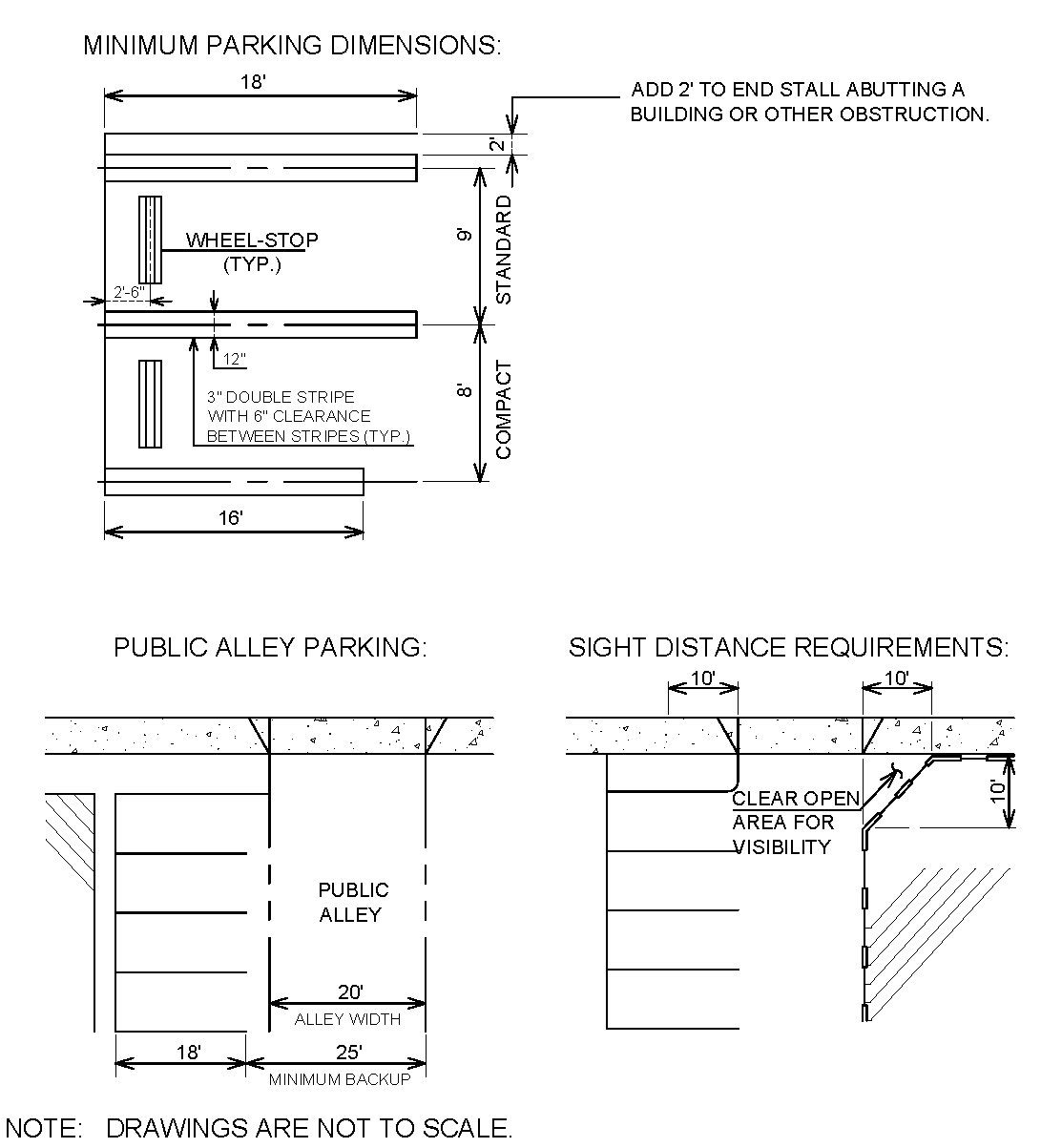
Figure 17.112-1: Parking Layout
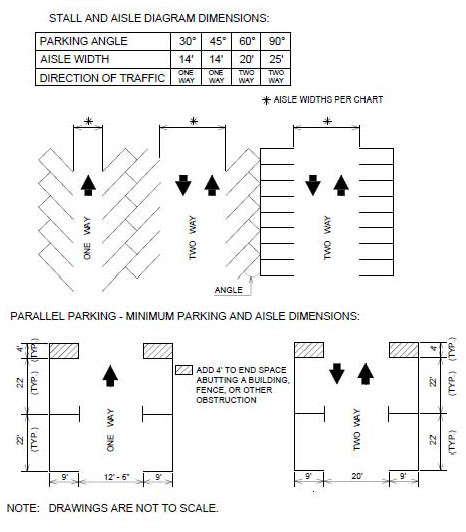
Figure 17.112-2
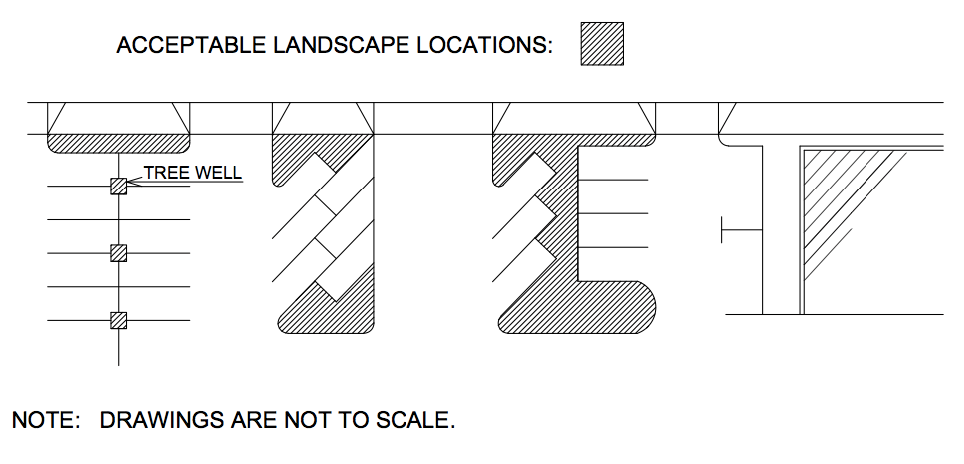
Figure 17.112-3
(Ord. No. 931, § 5(Exh. A), 10-22-13)
17.116.010 - Purpose and intent.
The regulations contained in this chapter are intended to promote the health, safety and welfare of the City by regulating existing and proposed signs of all types. The specific goals of this chapter are to improve the visual, aesthetic and economic environment of the City through:
A.
Controlling the size, type and locations of signs in every zone;
B.
Providing reasonable periods of amortization for existing signs declared nonconforming by the enactment of this chapter;
C.
Creation of a plan for amortization and removal of signs which, because of their size, location or construction, have an adverse effect upon the residential, economic and general aesthetic environment in the City; and
D.
Encouraging the upgrading of existing signs to conform with the requirements set forth hereinafter.
(Ord. No. 931, § 5(Exh. A), 10-22-13)
17.116.020 - Definitions.
For the purpose of this chapter, words, terms and phrases are defined, and shall be deemed to have the meaning ascribed to them herein, as follows:
"Billboard" means a structure of any kind or character erected or maintained by a State-licensed outdoor advertising company for outdoor advertising purposes which:
1.
Solicits public support or directs public attention to the sale, lease, hiring or use of any objects, products or services not produced, sold or otherwise available on the premises where such advertising sign is erected and maintained; or
2.
Contains a visual message to the general public concerning candidates for public office, matters relating to elections, or any public service announcement.
"Building Directory Sign" means any sign which serves the limited purpose of identifying the name, address and lawful use of the premises upon which it is located and sets forth no other advertisement.
"Flag (Vertical) Sign" means a sign attached to the exterior wall of a building with the face area in a vertical plane to the plane of the exterior wall. Such sign to be a directory-type indicating only the name of the business and use conducted by the tenant.
"Freestanding Sign" means any sign not attached or supported by any other structure.
"Freeway" means a highway to which the owners of abutting lands have no right or easement of access to or from their abutting lands, and which is declared to such in compliance with the Streets and Highways Code of the state of California.
"Monument Sign" means a low profile sign, which is an integral part of a landscaping plan, located between a building or street setback line and a street property line for identification purposes, and having a solid base support.
"Roof Sign" means any sign erected on the roof of any building solely for the purpose of advertising the goods and/or services available within such building.
"Sale, Lease or Rent Sign" means any sign advertising the premises for sale, lease or rent.
"Sign" means any device used for visual communication or attraction, including, but not limited to, any announcement, declaration, demonstration, display, illustration, insignia or symbol used to advertise or promote the interest of any person or business, together with all parts, materials, frame and background.
"Sign Area" means the total surface area of a sign, defined as that total area enclosed within a plane or solid figure created by enclosing the sign within imaginary lines in such a manner as to result in plain parallelograms for the surface area of simple two-dimensional signs and solid figure created by plain parallelograms either joined at the extremities of each plane, or by parallel lines joining the extremities in each plain parallelogram. This will result in a solid figure enclosed by plain parallelograms. The surface area is to be computed by adding the area of each plane surface that contains any visual communications as specified in the definition of "sign" above.
"Temporary Sign" means a sign which is intended or designated to advertise community or civic projects, construction projects, rent, sale or lease, or matters relating to elections, sales by merchants, special holidays or other special events on a temporary basis. Such temporary sign shall not be permanently affixed to a building. All temporary signs must be removed within ten (10) days after the conclusion of the event which they advertise.
"Wall Sign" means any sign attached to or erected on the exterior wall of a building or structure with the exposed face of sign in a plane approximately parallel to the plane of the exterior wall, such sign to be of a limited directory type indicating only the name of the business and the use conducted by the tenant.
"Window Sign" means any sign exposed to public view through a window or attached, painted or pasted, in either permanent or temporary form, on the exterior or interior of a window. Window signs shall be permitted in any zone except residential, and shall cover no more than fifteen (15) percent of any window.
(Ord. No. 931, § 5(Exh. A), 10-22-13)
17.116.030 - General provisions, standards and controls.
Signs shall not be permitted in the various zones except as expressly permitted by this chapter, and signs so permitted shall be subject to all standards and regulations in this chapter. Unless specifically provided therein, the Garvey Avenue Specific Plan signage standards established in this Title under Chapter 17.21 within the Specific Plan area shall take precedence over this Chapter.
A.
Nature of Copy. No sign of any kind shall be permitted to advertise or display an unlawful act, business or purpose.
B.
Illumination and Movement. Illumination signs shall be located, and light sources shielded to prevent glare, annoyance or hazard to the public or neighboring properties.
1.
Signs may be internally or indirectly lighted.
2.
No blinking or flashing signs shall be permitted in any zone, except for time and temperature signs.
C.
Height of Sign Permitted. Maximum height of freestanding and roof signs in any commercial or industrial zone shall not exceed thirty-five (35) feet above grade level of the adjoining public walk.
D.
Projecting Signs Prohibited. Signs projecting out over the building line or public right-of-way are prohibited, except projecting flag (vertical) signs.
E.
Flag Signs - Projection Over Right-of-Way. Clearance above grade less than eight feet: no projection is permitted. Clearance above grade over eight feet: one inch of projection is permitted for each additional inch of clearance, provided that no such projection shall exceed a distance of four feet.
F.
Permits. All signs shall be established under a valid building permit in accordance with fire and building code regulations.
G.
Maintenance. All signs shall be maintained in good condition and repair and shall pose no hazard to public safety statutes, standards and ordinances.
(Ord. No. 931, § 5(Exh. A), 10-22-13; Ord. No. 978, § 5(Exh. A), 2-27-18)
17.114.040 - Exceptions.
The provisions in this chapter shall not apply to the following signs except as otherwise indicated herein:
A.
Official notices issued by any court, public body or public officer;
B.
Notices posted by any public officer in performance of a public duty, or by any public agency, to give legal notice;
C.
Traffic, directional, warning or information signs required or authorized by law or by the federal, state or municipal authority, including directives of the Public Utilities Commission;
D.
Official signs used for emergency reasons;
E.
Temporary signs displaying political election campaign material or signs advertising community events, provided that such signs meet all size requirements contained in this chapter and are removed within two working days after the event or election.
(Ord. No. 931, § 5(Exh. A), 10-22-13)
17.116.050 - Signs prohibited in any zone.
A.
Signs that create a safety hazard to pedestrian and vehicular traffic;
B.
Any ground or roof sign if the proposed sign would adversely affect access to air, light or visual corridors by adjacent residential property;
C.
Any portable, folding, A-frame or box sign, or similar signs on rollers, casters or otherwise designed to be portable;
D.
Signs on any utility poles, traffic sign posts, traffic signals, or signs on any parkway or sidewalk, except for freestanding signs on public property located in redevelopment project areas (though the signs may remain after redevelopment of the project area has been completed), are within two hundred (200) feet of property zoned P-D and within seventy-five (75) feet of the Interstate 10 (San Bernardino) Freeway, the physical characteristics, including, but not limited to, height and total area of which are subject to the approval of the City Council;
E.
Freestanding signs displayed from trucks, autos, trailers or other vehicles except public buses;
F.
Revolving and/or flashing signs.
(Ord. No. 931, § 5(Exh. A), 10-22-13)
17.116.060 - Signs in R (residential) zones.
Signs in all R (residential) zones shall be designed and located in a manner which does not interfere with adjoining residential uses, and which assures general aesthetic controls for a harmonious residential and visual environment in the surrounding neighborhood. Those signs permitted in R (residential) zones shall be:
A.
Sale, Lease or Rent Signs. One sign not to exceed seven square feet in sign area.
B.
Temporary Signs During Construction. One temporary sign, not to exceed sixteen (16) square feet in area, giving the names and other pertinent information of the architects, contractors and engineers of the project during any construction period. Such signs may be erected on the date the building permit is issued, and must be removed not later than fifteen (15) days after notice of completion is filed or occupancy granted.
C.
Identification Signs.
1.
Single and Duplex Dwelling Structures. One sign per dwelling, not to exceed ten (10) square feet in area, and displaying only the name of the property owner or occupant of the dwelling, and the address.
2.
Identification Signs for Multiple Dwelling Structures. One sign not to exceed an area of fifteen (15) square feet. Any pylon or freestanding sign shall not exceed a maximum height of six feet or project into a public right-of-way, nor project above the roof line.
D.
Subdivision Signs. Subdivision signs for the limited purpose of advertising the existence and availability of new single-family, duplex or multiple-family dwellings in an approved subdivision, may be erected on property included within the approved subdivision. Such signs shall not exceed a maximum size of six feet by twelve (12) feet and an area of seventy-two (72) square feet, nor a maximum height of twenty (20) feet measured from the adjacent grade level to the top of the sign.
1.
Removal of Subdivision Signs. The developer, upon receiving approval of any subdivision, shall agree, in writing, to remove all signs from the tract within fifteen (15) days after the close of escrow on the last lot on which the signs are located, and shall grant the City the right to enter upon the property and remove the signs upon the expiration of the fifteen (15) days and failure to have removed the signs. The developer shall bear all costs and liability for City removal and disposal of the signs by posting a bond or providing other appropriate guarantee to performance.
2.
Lighting. Subdivision signs may be lighted by internal or indirect lights.
(Ord. No. 931, § 5(Exh. A), 10-22-13)
17.116.070 - Signs in commercial and industrial zones.
All commercial and industrial zones shall have controls and limitations placed upon sign design and location to minimize visual discontinuity created by large numbers of signs spaced in irregular patterns. Spacing, design and size requirements are intended to promote an attractive commercial environment without vehicular distractions, visual disorder, or economic effect on surrounding properties. Those signs permitted in commercial and industrial zones shall be:
A.
Building Directory Signs. One exterior sign at each building entrance, such sign not to exceed ten (10) square feet in area.
B.
Exterior Wall Signs. Exterior wall signs may cover no more than twenty-five (25) percent of any front, side or rear wall of a main building or structure.
C.
Roof Signs.
D.
Flag (Vertical) Signs. One flag sign for each structure or building.
E.
Freestanding Signs.
1.
Number. The number of freestanding signs for each property shall be determined by the number of linear feet the property has along the street from which its address is derived. The number of signs shall be based upon the following formula:
2.
Size. The total area of any freestanding or roof sign (as defined in Section 17.116.020 shall not exceed:
F.
Miscellaneous Signs. All signs permitted in the R (residential) zones as set forth in Section 17.116.060.
(Ord. No. 931, § 5(Exh. A), 10-22-13)
17.116.080 - English language use on on-premises signs.
The following regulations shall apply to on-premises signs in the City:
A.
All commercial, industrial and professional office on-premises signs shall identify the type of business (e.g. "restaurant," "market") in the English language.
B.
All commercial, industrial and professional office locations shall have required street numbers in Arabic numerals.
C.
The signage required in subsections A and B of this section shall be no less than four inches in height and shall be visible from the street for a distance of at least fifty (50) feet.
(Ord. No. 931, § 5(Exh. A), 10-22-13)
17.116.090 - Signs in the P-D, P-O, and R/C MUDO zones.
All signs in the P-D, P-O, and R/C MUDO zones are subject to the following sign provisions and are regulated thereby:
P-D zone: Chapter 17.24 (Section 17.24.040.I)
P-O zone: Chapter 17.16 (Section 17.16.030.B.1.b)
R/C MUDO zone: Chapter 17.28 (Section 17.28.030.D.18)
(Ord. No. 931, § 5(Exh. A), 10-22-13)
17.116.100 - Billboards prohibited.
Because billboards create visual blight, visual distraction to motorists, unsightliness and impairment of the economic environment for residential and commercial uses throughout the City, development of new billboards is expressly prohibited in any zone within the City.
(Ord. No. 931, § 5(Exh. A), 10-22-13)
17.116.110 - Billboards erected prior to December 1, 1979.
To provide for an amortization period for existing billboards and a term of years for the phasing out of existing boards, all existing billboards shall be subject to the amortization periods set forth in this chapter, unless, as of December 1, 1979, such billboard was:
A.
Erected with a valid building permit or pursuant to preexisting regulations of the county of Los Angeles; and
B.
Constructed to a face width of at least twenty-five (25) feet and face height of at least twelve (12) feet.
The owners of billboards qualifying under the provisions of subsections A and B of this section may elect to rehabilitate their billboards to the standards set forth in Section 17.116.120 and, upon successful completion of such rehabilitation, become exempt from the period of amortization set forth in this chapter.
(Ord. No. 931, § 5(Exh. A), 10-22-13)
17.116.120 - Rehabilitation of existing billboards.
All billboards existing as of December 1, 1979, shall be rehabilitated to the following standards on or before December 31, 1980.
A.
Aesthetic Standards.
1.
Face Width: twenty-five (25) feet.
2.
Face Height: twelve (12) feet.
3.
Bottom Edge: Not less than fifteen (15) feet from the ground. But in no event to exceed the dimensions in existence on December 1, 1979.
B.
Structural Standards.
1.
All supports shall be of metal structure, freestanding systems, and shall not be attached to or supported by the roof or sides of any structure.
2.
No billboard shall project onto any portion of the public right-of-way.
3.
The rear of any single face board shall have a solid back of metal and shall remain painted and in good repair at all times or shall have a second conforming face for advertising display.
4.
The name or insignia of the owner of each billboard shall be displayed on the front of each billboard.
5.
All billboards shall be maintained in good condition and repair and shall pose no hazard to public safety.
(Ord. No. 931, § 5(Exh. A), 10-22-13)
17.116.130 - Rehabilitation of existing substandard billboards.
All existing eight-foot by nine-foot size wooden billboards shall be completely removed by their owners within the time allowed by that certain agreement dated September 11, 1984, between Independent Out-door Advertising, Inc., and the City.
Such signs may be replaced in accordance with that certain agreement by the placement of single-faced six-foot by 12-foot stainless steel nonilluminated signs at the following locations only:
8640 E. Garvey Avenue FW, single face
8724 E. Garvey Avenue FW, single face
8905 W. Garvey Avenue FW, single face
2708 N. San Gabriel Blvd. FN, single face
9430 Valley Boulevard FW, single face
(Ord. No. 931, § 5(Exh. A), 10-22-13)
17.116.140 - Effect of conformity to Section 17.116.130.
A.
Billboards not in conformity with the standards of Section 17.116.130 on December 31, 1978, shall be subject to the amortization terms set forth in this chapter.
B.
Billboards conforming to the standards of Section 17.116.130 on December 31, 1980, shall be exempted from the amortization provisions of this chapter.
(Ord. No. 931, § 5(Exh. A), 10-22-13)
17.116.150 - Nonconforming sign—Replacement of alteration.
A.
A nonconforming sign may be replaced only by a conforming sign. Alteration of a nonconforming sign shall be permitted only to decrease or abate the nonconformity. Nothing in this section shall preclude repair for normal maintenance of a sign.
B.
No signs may be added to an occupancy with a nonconforming sign unless all signs associated with such occupancy are made conforming.
(Ord. No. 931, § 5(Exh. A), 10-22-13)
17.116.160 - Nonconforming signs and billboards—Removal procedure.
Upon determination by the Community Development Director that a particular use, structure or sign is nonconforming, the following procedure shall be employed:
A.
Notice. Notice shall be directed, in writing, to the owner of the subject property and the lessee, if known, that a public hearing will be held before the Commission to determine if the use, structure or sign is nonconforming and, therefore, considered a public nuisance, injurious to neighboring properties and to the health and welfare and environment of the city. The notice shall be mailed not less than ten (10) days before the public hearing. In the case of a nonconforming sign, the notice shall be directed to the owner of the sign, if known, and to the owner of the land.
B.
Procedure at Hearing. The procedure to be employed by the Commission and rights of appeal therefrom shall be set forth in Article 6.
C.
Decision. If the Commission finds that the use, structure or sign does not conform to the provisions of this Code, and that the period of continuation of such use, structure or sign has expired, the Commission shall order repair, alteration, correction or removal of such structure, sign or use within thirty (30) days of mailing a copy of its decision to the owners.
D.
If the owner of the land, lessee, the owner of the sign or structure, or other responsible party fails or refuses to repair, correct, demolish or discontinue a use, sign or structure declared to be nonconforming and a nuisance pursuant to subsections A and C of this section, and such correction, repair, discontinuance or demolition is not performed within thirty (30) days of the mailing of the notice set forth in subsection C of this section, the City may order such work be done by, and the costs therefor, assessed against the owner of the land and becoming a lien on such property by operation of law.
(Ord. No. 931, § 5(Exh. A), 10-22-13)
17.116.170 - Illegal signs in public right-of-way—Removal authority.
A.
Any illegal sign in the public right-of-way may be removed by the city.
B.
No notice shall be required prior to removal of illegal signs, including without limitation elections signs, in the public right-of-way.
C.
Any sign removed by the city, except any sign of de minimis value, shall be held in storage and the owner or other person in control of such sign, if the owner or other person in control of such sign is identified, shall be given written notice and ten (10) days to reclaim such sign. In the event the City is not able to identify the owner or person in control of such an illegal sign, no notice is required.
D.
Any sign held in storage by the City may be destroyed by the City if not reclaimed:
1.
In the time period set forth in subsection C of this section; or
2.
Within ten (10) days after the removal if the owner or other person in control of such sign is not known.
E.
In order to reclaim a sign removed by the city, the owner or other person in control of such sign shall first pay to the City a fee as set forth in a resolution adopted by the City Council.
F.
Any illegal sign in the public right-of-way of de minimis value shall be deemed to be abandoned and may be destroyed by the City after removal. No opportunity to reclaim such sign shall be given by the city.
G.
For purposes of this section, any sign made of cardboard or other nondurable material shall be deemed to be of de minimis value.
(Ord. No. 931, § 5(Exh. A), 10-22-13)
17.116.180 - Illegal signs—Presumption of responsible party.
A.
Each of the following persons is pre-sumed to be responsible for the posting of an illegal sign, including without limitation an election sign, on public property:
1.
Any person whose name appears on the sign; and
2.
The promoter or sponsor of an event named on the sign; and
3.
Any person retained to post or distribute such signs.
B.
More than one person may be deemed responsible for the placement of the same sign.
(Ord. No. 931, § 5(Exh. A), 10-22-13)
17.116.190 - Illegal signs on public property—Removal charges.
A.
All persons responsible for an illegal sign posted on public property, as well as any person who actually posted the sign, shall be jointly and severally liable for the costs of the City for the removal of such sign from public property. Such charges shall be in addition to all other legal remedies, criminal, civil and administrative, which may be pursued by the City to address any violation of this Code.
B.
A bill of charges shall be served upon a responsible party by the director of the department which removed the sign.
C.
The total amount of the bill of charges shall be deemed to be a civil debt to the City and the City may take such action to recover such charges as the City is authorized to do by law for the recovery of a civil debt.
(Ord. No. 931, § 5(Exh. A), 10-22-13)
17.116.200 - Hearing on removal costs.
A.
The bill of charges shall include a notice of the right of the person being charged to request a hearing before the City Manager to dispute the imposition of the charges.
B.
Any request for a hearing to dispute the imposition of charges must be in writing and received by the office of City Manager within ten (10) days of the date of service of the bill of charges, and shall include a statement of the reasons and grounds upon which the dispute is based. The office of the City Manager shall conduct the hearing on disputed charges within twenty (20) days of the receipt of the request for hearing.
(Ord. No. 931, § 5(Exh. A), 10-22-13)

