
Roseville City Zoning Code
CHAPTER 1001
IN GENERAL
Sec. 1001.02. - Authority.
(a)
The ordinance from which this title is derived is enacted pursuant to the authority granted by the municipal planning act, Minn. Stat. §§ 462.351 to 462.365, inclusive.
(b)
This title governs the use of all land and structures in the city, unless such regulation is specifically preempted by state or federal statutes or regulations.
(Ord. No. 1606, § 1001.02, 11-8-2021)
Sec. 1001.03. - Intent and purpose.
This title shall divide the city into districts and establish regulations in regard to land and the buildings thereon. These regulations are established to:
(1)
Protect and to promote the public health, safety, peace, comfort, convenience, prosperity, and general welfare of the community and its people through the establishment of minimum regulations governing land development and use;
(2)
Protect and enhance the character, stability, and vitality of residential neighborhoods as well as commercial areas;
(3)
Promote orderly development and redevelopment;
(4)
Assist in the implementation of the comprehensive plan;
(5)
Foster a harmonious, workable relationship among land uses;
(6)
Promote the stability of existing land uses that conform with the comprehensive plan and to protect them from inharmonious influences and harmful intrusions;
(7)
Ensure that public and private lands ultimately are used for the purposes which are most appropriate and most beneficial for the city as a whole;
(8)
Prevent excessive population densities and overcrowding of structures on the land;
(9)
Promote healthful movement of people, goods, and services;
(10)
Foster the provision of adequate off-street parking and off-street truck loading facilities;
(11)
Facilitate the appropriate location of community facilities and institutions;
(12)
Provide human and physical resources of sufficient quantity and quality to sustain needed public services and facilities;
(13)
Protect and enhance real property values;
(14)
Safeguard and enhance the appearance of the city, including natural amenities of open spaces, hills, woods, lakes, and ponds;
(15)
Prescribe penalties for violation of such regulations; and
(16)
Define powers and duties of the city staff, the city council, the planning commission, the board of adjustment and appeals, the variance board, the development review committee, the administrative deviation committee, and the master sign plan committee in relation to the zoning code.
(Ord. No. 1606, § 1001.03, 11-8-2021)
Sec. 1001.04. - Relationship to the comprehensive plan.
It is the policy of the city that the enforcement, amendment, and administration of this title be accomplished with due consideration of the recommendations and policies contained in the comprehensive plan as developed and amended from time to time by the planning commission and city council. The city council recognizes the comprehensive plan as the policy for regulation of land use and development in accordance with the policies and purpose herein set forth.
(Ord. No. 1606, § 1001.04, 11-8-2021)
Sec. 1001.05. - Uses not provided for within zoning districts.
Whenever a use is not specifically permitted in any zoning district and is determined by the community development department to not be consistent with a permitted and/or conditional use chart, the use shall be considered prohibited. In such case, the city council or the planning commission, on its own initiative or upon request, may direct the community development department to conduct a study to determine if the use is acceptable and, if so, what zoning district would be most appropriate as well as what conditions and standards should be imposed relating to development of the use. The city council, planning commission, or property owner, upon receipt of the community development department's study, may, if appropriate, initiate an amendment to this title to provide for the particular use under consideration or shall find that the use is not compatible for development within the city.
(Ord. No. 1606, § 1001.05, 11-8-2021)
Sec. 1001.06. - Application and implementation.
The provisions of this title shall be the minimum requirements for the promotion of the public health, safety, morals, and general welfare. It is not the intention of this title to interfere with, abrogate, or annul any covenant or agreement between parties. Where this title imposes greater restrictions than any other applicable statute, ordinance, rule, or regulation, this title shall control when and to the extent allowed by state or federal law. Where any other applicable statute, ordinance, rule, or regulation imposes greater restrictions than this title, such other statute, ordinance, rule, or regulation shall control. The section, subsection, and paragraph headings are for reference only, and shall not be used to interpret, enlarge, or detract from the provisions of this title.
(1)
Minimum requirements. The provisions of this title are the minimum requirements for the promotion of the public health, safety, morals and general welfare.
(2)
Essential services. Essential services shall be permitted as authorized and regulated by state and/or federal law and ordinances of the city. Such essential services are exempt from the application of this title, except as regulated by the city's floodplain ordinance.
(3)
Measurement. All measured distance expressed in feet shall be to the nearest tenth of a foot. The measurement of distances when required by this title shall be done in a straight line in the plane located at a point one foot above the highest point in the surface of the ground along the path of measurement, from the closest exterior wall (extended vertically if a cantilever) of a building containing the use to the property line of the adjacent street, district, or lot, or other boundary line. If the use is not within a building, the measurement shall be the shortest distance from the location of the use to the property line of the adjacent street, district, or lot, or other boundary line.
(Ord. No. 1606, § 1001.06, 11-8-2021)
Sec. 1001.07. - Definitions.
(a)
The use of the phrase "used for" shall include the phrases "designed for," "intended for," "improved for," "maintained for," "offered for," and "occupied for."
(b)
The following words, terms and phrases, when used in this title, shall have the meanings ascribed to them in this subsection, except where the context clearly indicates a different meaning:
Abutting means having a common border or boundary. The term "abutting" is used interchangeably with "adjacent" and "adjoining."
Accessible electric vehicle charging station means an electric vehicle charging station where the battery charging station is located within accessible reach of a barrier-free access aisle and the electric vehicle.
Accessory means a use or structure which is located on the same lot as a principal use or structure and which is clearly incidental and subordinate to the principal use or structure.
Addition means any walled and/or roofed expansion to the perimeter and/or height of a building in which the addition is connected by a common load-bearing wall or foundation.
Adjacent. See Abutting.
Adjoining. See Abutting.
Aisle means the traveled way by which vehicles enter and depart parking spaces.
Alley means a public or private right-of-way primarily designed to serve as secondary access to the side or rear of those properties whose principal frontage is on a street.
Alteration means any change, addition, or modification in construction or occupancy of an existing structure, or modification to the surface of the ground.
Animal boarding facility means any lot or premises on which dogs, cats, and/or other household pets are kept, boarded, or raised for sale or adoption.
Animal day care. See Animal boarding facility.
Animal hospital means an establishment for the routine examination, medical, or surgical treatment and care of domestic animals, generally with overnight boarding facilities for animals in care.
Antenna means any exterior transmitting or receiving device mounted on a tower, building, or structure and used in communications that radiate or capture electromagnetic waves, digital signals, analog signals, radio frequencies (excluding radar signals), wireless telecommunications signals or other communication signals.
Arborist, certified, means an individual who holds a current certification from the International Society of Arboriculture.
Artisan workshop means a use primarily involving the limited on-site production of goods by hand manufacturing which involves only the use of hand tools or domestic mechanical equipment that does not exceed two horsepower each or a single kiln not exceeding eight cubic feet in volume and the incidental direct sale to consumers. Typical production includes custom furniture, ceramic studios, glass blowing, candle making, custom jewelry, stained and leaded glass, woodworking, custom textile manufacturing and crafts production.
Assembly hall. See Theater.
Assisted living means housing complexes primarily for the elderly or chronically ill in which assistance with daily activities, congregate dining, and limited health care may be provided.
Athletic field means an outdoor facility developed as a baseball diamond, softball diamond, soccer field, football field, lacrosse field, or other surface for conducting outdoor recreational activities.
Awning. See Canopy.
Basement means that portion of a building which is wholly or partly below ground level.
Battery electric vehicle means any vehicle that operates exclusively on electrical energy from an off-board source that is stored in the vehicle's battery and produces zero tailpipe emissions or pollution when stationary or operating.
Bed and breakfast establishment means a private residence that rents rooms as temporary lodging and which is the principal residence of the operator.
Berm means a land alteration where fill is added to the surface of the ground in order to create a earthen mound or hill generally used in conjunction with walls, fences, or plant material to screen one parcel of land from another or from a street.
Bingo hall means a principal or accessory use of a structure or property to operate a bingo hall licensed under chapter 303 and Minn. Stat. § 349.164.
Block means a tract of land bounded by streets, or by a combination of streets and public parks, cemeteries, railroad rights-of-way, or shorelines of waterways. A block may be located in part beyond the boundary lines of the corporate limits of the city.
Boarder. See Roomer.
Body shop. See Motor vehicle repair.
Boulevard means that portion of a street right-of-way between the curbline and property line.
Boutique sale (residential) means the sale of handcrafted items conducted on residential premises, where the items sold are made by the occupant of the premises at which the sale takes place, or by friends of such occupant, and where the sale is conducted by said occupant or friends of such occupant and not by an agent or any other person to whom a commission, fee, or salary is paid. Items for sale shall be made in the home and not purchased for resale from any retail or wholesale business source nor received on consignment for the purpose of resale.
Brewery means a facility that produces for sale more than 3,500 barrels annually of cider, mead, beer or other beverages made from malt by fermentation and containing not less than one-half of one percent alcohol by volume. A brewery may include a taproom.
Brewpub means a restaurant that brews cider, mead, beer or other beverages made from malt by fermentation on the same premises and that also holds one or more retail on-sale licenses and that manufactures fewer than 3,500 barrels of malt liquor in a year, at any one licensed premises, the entire production of which is solely for consumption on tap on any licensed premises owned by the brewer, or for off-sale from those licensed premises as permitted in Minn. Stat. § 340A.24, subd. 2.
Building means a structure with a permanent location on the land, enclosed by walls and having a roof that may provide shelter, support, protection or enclosure of persons, animals, or property of any kind.
Building complex means a group of two or more buildings, planned or developed in a joint manner with shared parking facilities, regardless of whether such buildings or uses are located on the same lot or parcel.
Building height means the vertical distance between the highest adjoining ground level at the building or ten feet above the lowest adjoining ground level, whichever is lower, and the highest point of a flat roof or average height of the highest gable of a pitched or hipped roof.
Building Height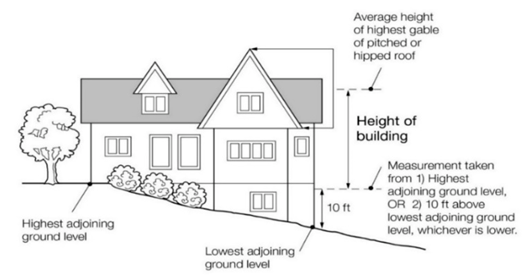
Building materials sales means an establishment that sells or rents building supplies, construction equipment, or home decorating fixtures and accessories. The term "building materials sales" does not include a lumberyard or home improvement center.
Building, attached, means a building joined to another building or structure by a shared wall.
Building, detached, means a building surrounded on all sides by open space on the same lot.
Building, mixed-use, means a building that houses multiple uses, which may include residential and nonresidential uses.
Building, nonresidential, means a building that houses no residential uses, with the possible exception of a caretaker's dwelling.
Building, principal, means a building in which is conducted the principal use of the lot on which it is located.
Building, residential, means a building which is arranged, designed, used or intended to be used for residential occupancy by one or more families or lodgers, and which includes, but is not limited to, the following types multiple-family dwelling, single-family attached dwellings, single-family detached dwellings, and two-family detached dwellings.
Caliper inch means the standard of each tree trunk measurement for replacement or landscaping trees. The caliper inch measurement of the trunk shall be taken at six inches above the ground for trees up to and including four-inch caliper size, and 12 inches above the ground for trees larger than four inch caliper.
Cannabis combination business means a business with a cannabis mezzobusiness license with a retail operations endorsement or a cannabis microbusiness license with a retail operations endorsement from the state office of cannabis management.
Cannabis cultivation business means a business with a cannabis cultivator license, medical cannabis cultivator license, or cultivation endorsement from the state office of cannabis management.
Cannabis delivery/transportation business means a business with a cannabis delivery service license or delivery service endorsement, or cannabis transporter license or transportation endorsement from the state office of cannabis management.
Cannabis lounge means a portion of the premises of a cannabis business or hemp business licensed or endorsed by the state office of cannabis management for on-site consumption of edible cannabis products and lower-potency hemp edibles.
Cannabis or hemp industrial business means a business with a cannabis manufacturer license, cannabis wholesaler license, cannabis testing facility license, medical cannabis manufacturer, medical cannabis combination business license, lower-potency hemp edible manufacturing license, or manufacturing or testing endorsement from the state office of cannabis management.
Cannabis or hemp retailer means a business with a cannabis retailer license, medical cannabis retailer license, lower-potency hemp edible retailer license, or retail endorsement from the state office of cannabis management.
Canopy means a roof-like structure projecting from the building over an entrance or window that provides weather protection for the entry or window and, perhaps, the immediately adjacent area. Canopies shall be considered part of the wall area for the purpose of allocation of signage.
Canopy, auxiliary, means a roof-like structure projecting over, including, but not limited to, fuel pump islands, drive-through banking, or any canopy with a drive-through lane. An auxiliary canopy provides weather protection for more than the building entrance or windows. Auxiliary canopies may be attached or detached from the principal building. For sign purposes, auxiliary canopies shall be considered a separate structure.
Car wash means an establishment where washing, drying, polishing, or vacuuming of an automobile or other motor vehicle is done by service personnel, the driver, or by automated machinery.
Catering establishment means a business that prepares food and beverages to be delivered off premises for consumption at a social, business, or civic function and may also provide service at the function.
Cemetery means an area used for the burial or entombment of one or more deceased persons, including graveyards, mausoleums, and columbaria.
Charging levels means standardized indicators of electrical force, or voltage, at which an electric vehicle's battery is recharged. The terms "1," "2" and "DC" are the most common charging levels and include the following specifications:
(1)
Level 1 is considered slow charging with 120v outlets.
(2)
Level 2 is considered medium charging with 240v outlets, charging head and cord hard-wired to the circuit.
(3)
DC is considered fast or rapid charging. Voltage is greater than 240.
Clinic, medical, dental, or optical, means a building in which a group of physicians, dentists, or other health care professionals are associated for the purpose of carrying on their professions. The term "clinic" may include laboratories, diagnostic imaging, outpatient/inpatient procedures and facilities, or training facilities.
Club, private. See Lodge, private.
Cocktail room means an area for the on-sale consumption of distilled spirits produced on the premises of one distillery and in common ownership to the producer of the distilled spirits.
Coffee shop means an establishment engaged principally in the sale of coffee, tea, and other nonalcoholic beverages for consumption on the premises or for carry out, which may also include the sale of a limited number of food items.
College or post-secondary school, campus, means an institution for post-secondary education, public or private, offering courses in general, technical, or religious education, which incorporates administrative and faculty offices, classrooms, laboratories, chapels, auditoriums, lecture halls, libraries, student and faculty centers, athletic facilities, student housing, fraternities, sororities, and/or other related facilities in a campus environment.
College or post-secondary school, office-based, means an institution for post-secondary education, public or private, offering courses in general, technical, or religious education, which operates in commercial-type buildings, wholly or partially owned or leased by the institution for administrative and faculty offices, classrooms, laboratories, and/or other related facilities.
Co-location means the provision of multiple antennas of more than one commercial wireless communication service provider or government entity on a single tower or structure.
Columbarium means a place such as a vault for the respectful and usually public storage of cremated human remains within cinerary urns. Columbaria are accessory to places of assembly for worship, cemeteries, or mausoleums. The plural of the term "columbarium" is either columbaria or columbariums.
Commercial laundry. See Dry cleaning establishment.
Community garden means an area of land managed and maintained by a group of individuals to grow and harvest food crops and/or non-food, ornamental crops, such as flowers, for personal or group use, consumption or donation. Community gardens may be divided into separate plots for cultivation by one or more individuals or may be farmed collectively by members of the group and may include common areas maintained and used by group members.
Comprehensive plan, land use plan, or comp plan means the city's 2030 comprehensive plan.
Condominium means an estate of real property consisting of an undivided interest in common with other purchasers in a portion of parcel of real property, together with separate interest in space in a building. A condominium may include, in addition, a separate interest in other portions of such real property, such as garage space or in the case of a cluster development, a townhome, or cluster development lot.
Conforming means a lot, use, or structure which satisfies all applicable requirements of this title as amended.
Congregate care. See Assisted living.
Contractor yard means an establishment providing general contracting, building/site maintenance, or building construction services, including, but not limited to, outdoor storage of large construction equipment or machinery (loader, grader, bulldozer, scraper, crane or similar) trailers and/or seasonal equipment, and loose materials. Outdoor storage of these items shall be consistent with the requirements of Table 1006.03 and section 1011.12(f)(8) through (10).
Contractor yard, limited, means an establishment providing general contracting, building/site maintenance, or building construction services, including (but not limited to) fleet vehicles (pickup, cargo, and/or cube variety trucks), outdoor storage of trailers or machinery and/or seasonal equipment. Outdoor storage of these items shall be consistent with the requirements of Table 1006.03 and section 1011.12(f)(8) through (10).
Convent. See Monastery.
Courtyard development means a form of a cluster development that designs the residential units around a common courtyard.
Currency exchange business means any entity, except a bank, trust company, savings bank, savings and loan association, credit union, or industrial loan and thrift company, engaged in the business of cashing checks, drafts, money orders, or travelers' checks for a fee.
Day care, as defined in the Minnesota Rules, means the care of a child in a residence outside the child's own home for gain or otherwise, on a regular basis, for any part of a 24-hour day.
Day care center means a facility in which a child care program is operated when the facility in not excluded by state statutes and is not required to be licensed under said state statutes as a family or group family day care home.
Day care, family, as defined in the Minnesota Rules, means day care for no more than ten children at one time of which no more than six are under school age. The licensed capacity must include all children of any caregiver when the children are present in the residence.
Day care, group family, as defined in the Minnesota Rules, means group family day care for no more than 14 children at any one time. The total number of children includes all children of any caregiver when the children are present in the residence.
Density means the number of dwelling units permitted per net acre of land.
Development means any human-made change to improved or unimproved real estate, including, but not limited to, the placement, construction, or modification of structures, ditching, lagooning, dredging, filling, grading, paving, excavation, or drilling operations, and the deposition or extraction of earthen materials.
Diameter breast height (DBH) means the diameter of trees in inches at breast height, measured 4½ feet (54 inches) above the ground. The diameter of a multi-stemmed tree that splits below 4½ feet shall be measured at the smallest diameter below the split for both deciduous and coniferous trees.
Distillery means a facility that produces for sale ethyl alcohol, hydrated oxide of ethyl, spirits of wine, rum, brandy, gin, or other distilled spirits, including all dilutions and mixtures thereof, for non-industrial use. A distillery may include a cocktail room.
Distribution center means an enclosed building primarily used for receipt, temporary storage and redistribution of goods, typically involving heavy truck and/or freight rail traffic.
Drip line means a vertical line extending from the outer surface of a tree's branch tips down to the ground.
Dormitory. See Student housing.
Dormer means a window set vertically in a structure that projects through a sloping roof or a structure that contains such a window.
Drive-through means consisting of a driveway and window, opening, canopy, or other facilities used for serving patrons seated in an automobile, including the stacking spaces in which vehicles wait. Drive-throughs may be associated with principal uses such as restaurants, banks, or drugstores, or may be free-standing, such as coffee kiosks, ATMs, etc.
Dry cleaning establishment means an establishment that launders or dry cleans fabric, textiles, wearing apparel, or similar articles, including drop-off of articles by customers or cleaning of articles dropped off at other locations.
Dwelling means a building or portion thereof designed or used primarily as living quarters for one or more families, but not including hotels or other accommodations for the transient public, lodginghouses, housing cooperative or other group living arrangements.
Dwelling unit means one or more rooms which are arranged, designed or used as living quarters for one family only. Individual bathrooms and a complete kitchen facility, permanently installed, shall always be included with each dwelling unit. No dwelling unit may have more than one kitchen facility except that a single-family detached dwelling may have more than one kitchen facility, provided the dwelling is designed, arranged or used as living quarters for one family only. For purposes of this exception, the family shall not include roomers.
Dwelling unit, accessory, means a second dwelling unit contained within a single-family dwelling or within a detached building located on the same lot as a single-family dwelling. The term "accessory dwelling unit" includes accessory buildings constructed in connection with a private garage or a private garage converted into a dwelling unit.
Dwelling, courtyard cottage, means a development of one-family detached dwellings where a courtyard of open space fronts on the public street and the individual dwellings are accessed from shared driveways and serve the rear of the dwellings.
Dwelling, four-family (quadruplex), means a building containing four dwelling units that are independent from one another, with yards on all sides of the building.
Dwelling, multifamily, means a building, or portion of a building, designed exclusively for occupancy by five or more families living independently of each other in individual dwelling units.
Dwelling, one-family attached (townhouse, rowhouse), means a one-family dwelling unit, with a private entrance, which is part of a structure whose dwelling units are attached horizontally in a linear arrangement, and having totally exposed front and rear walls to be used for access, light and ventilation.
Dwelling, one-family detached, means a building designed exclusively for and occupied exclusively by one family in one dwelling unit, with yards on all sides.
Dwelling, three-family (triplex), means a building containing three dwelling units that are independent from one another, with yards on all sides of the building.
Dwelling, two-family attached (twin home), means a one-family dwelling which is attached on one side to another one-family dwelling with a common side wall, each of which is located on an individual lot.
Dwelling, two-family detached (duplex), means a building located on one lot containing two dwelling units that are horizontally attached or vertically stacked one above the other, with a separate entrance to each unit and with yards on all sides.
Easement means the grant of one or more of the property rights by the owner to, or for the use by, the public, public utility, corporation, or another person or entity.
Elderly housing. See Senior housing.
Electric vehicle means a vehicle that operates, either partially or exclusively, on electrical energy from the electrical grid, or an off-grid source, that is stored on board for motive purposes. The term "electric vehicle" includes battery electric vehicles and plug-in hybrid electric vehicles.
Electric vehicle charging infrastructure means conduit/wiring, structures, machinery, and equipment necessary and integral to support an electric vehicle, including battery charging stations and rapid charging stations.
Electric vehicle charging station (EVCS) means a public or private parking space that is served by battery charging station equipment that has as its primary purpose the transfer of electric energy (by conductive or inductive means) to a battery or other energy storage device in an electric vehicle.
Electric vehicle parking space means any marked parking space that identifies the use to be exclusively for the parking of an electric vehicle.
Electric vehicle supply equipment (EVSE) means any equipment or electrical component used in charging electric vehicles at a specific location. The term "EVSE" does not include equipment located on the electric vehicles themselves.
Electrical capacity means, at minimum:
(1)
Panel capacity to accommodate a dedicated branch circuit and service capacity to install a 208/240v outlet per charger;
(2)
Conduit from an electric panel to a future EVCS location.
Electrical substation means an assemblage of equipment through which electric energy in bulk is passed for the purposes of switching or modifying its characteristics to meet the needs of consumers.
Entrance, primary, means the building entrance which faces the front lot line or is closest to the front lot line and which entrance provides direct access to the principal use.
Environmental service center means a multi-purpose government-owned facility where the principal use involves the collection of household hazardous waste, recycling, and organics, including associated offices and public outreach rooms
Equipment building, shelter, or cabinet means a building or cabinet used to house equipment used by telecommunication providers.
Façade, front, means the wall of building closest to the street that separates interior spaces from exterior. An open porch without living space above it shall not be considered a front façade. For buildings on corner or through lots, the front façade is usually that façade that fronts the street of higher classification.
Family means one of the following:
(1)
Any group of people living together as a single housekeeping unit, all of whom are related by blood, marriage, or adoption plus children who are under foster care;
(2)
Up to four people not so related, living together as a single housekeeping unit;
(3)
Any group of people living together as a single housekeeping unit, if no more than two adult members function as the heads of the household group and the remaining members are dependent upon them for care and direction due to age, physical disability, a mental incompetency, or for other reasons; or
(4)
Any individual, who is the owner, living, and maintaining a common household and using a common cooking and kitchen facility.
Fence means a structure providing enclosure or serving as a barrier, such as wooden posts, wire, iron, or other manufactured material or combination of materials erected to enclose, screen, or separate areas.
Fitness center. See Health club.
Floor area, when prescribed as the basis of measurement for off-street parking spaces and loading berths for any use, means the sum of the gross horizontal areas of the several floors of the buildings devoted to such use, measured from the exterior faces of the exterior walls or from the centerline of walls separating two buildings, with the common areas divided proportionately according to the usage of said buildings.
Forester, degreed, means a person who holds a minimum of a Bachelor of Science degree in arboriculture, urban forestry or similar field from an accredited academic institution.
Frontage means the relationship between the front façade of a building and the abutting street, encompassing the placement of the building and its entrances, and the treatment of front setback areas.
Funeral home. See Mortuary.
Garage, private, means a detached accessory building or portion of the principal building, including a carport, which is used for storing passenger vehicles, trailer of the occupant, or trucks of a rated capacity not in excess of ¾ ton.
Garage sale, yard sale, attic sale, rummage sale, or moving sale means the sale of used household and personal items conducted on residential premises, where the property sold consists of items owned by the occupant of the premises at which the sale takes place, or by friends of such occupant and where the sale is conducted by such occupant or friends, and not by an agent or any other person to whom a commission, fee or salary is paid. Items for sale shall not have been purchased for resale or received on consignment for the purpose of resale. Except during the sales day and one day before and after for setup, items for sale shall be stored within the garage or residence.
Gazebo means a detached accessory building which is used for the social or recreational shelter of persons and is not used as living quarters.
Greenhouse means an establishment whose principal activity is the sale of plants grown on the site, which may include outdoor storage, growing or display, and may include sales of lawn furniture and garden supplies.
Grocery store means a retail establishment that offers for sale food products, beverages, household items and may include pharmacy, and prepared food items.
Group home. See Community residential facility.
Health club means an establishment for the conduct of indoor sports and exercise activities, which may include related locker and shower rooms, offices, and classrooms, and where use is offered on a membership basis.
Home occupation means an office or studio, service business, or limited production of goods within a dwelling unit by a resident of the dwelling, provided that the use is limited in extent and incidental and secondary to the use of the dwelling unit for residential purposes.
Hospital means an institution, licensed by the state department of health, providing primary health services and medical or surgical care to persons, primarily in-patients, suffering from illness, disease, injury, deformity and other abnormal physical or mental conditions, and including as an integral part of the institution, related facilities such as laboratories, outpatient facilities, or training facilities.
Hotel. See Lodging.
Impervious surface means a surface that has been compacted or covered with a layer of material so that it is highly resistant to infiltration by water. It includes surfaces such as compacted sand, limerock, or clay, as well as conventionally surfaced streets, roofs, sidewalks, parking lots, and other similar structures.
Indoor entertainment center means a facility where the principal purpose is offering indoor attractions such as video games, inflatables, bowling, climbing structures, kart racing, miniature golf, laser tag, virtual reality, puzzle rooms, tabletop games, and archery ranges, but not including theaters, concert venues, or athletic training or fitness facilities.
Inn. See Lodging.
Junkyard means an open area where waste or scrap materials are bought, sold, exchanged, stored, baled, packed, disassembled or handled, including, but not limited to, scrap iron and other metals, paper, rags, rubber tires, bottles and unlicensed or inoperable motor vehicles and parts thereof. A junkyard includes an automobile wrecking or dismantling yard.
Kennel. See Animal boarding facility.
Kitchen facility means a kitchen facility is one which includes kitchen fixtures such as cabinets, sinks, refrigerators and stoves, or articles used or intended to be used for cooking.
Laboratory for research, development, and/or testing means a room, building, or facility equipped for medical, scientific, or technological research, experiments, and/or testing, which may include limited accommodations for researchers or research subjects.
Lattice tower means a self-supporting structure, erected on the ground, which consists of metal crossed strips or bars to support antennas and related equipment.
Landscape plan means an integrated set of documents that may consist of both drawn and written materials whose purpose is to identify, for a proposed development, the means of compliance with the landscaping, screening and site stabilization standards of the Code.
Limited production/processing, accessory use, means light manufacturing, fabrication, assembly, processing, packaging, research, development, or similar uses which are conducted indoors and which would not be disruptive of, or incompatible with, other office, retail, or service uses that may be in the same building or complex. Limited production/processing generally does not include industrial processing from raw materials.
Limited production/processing, principal use, means light manufacturing, fabrication, assembly, processing, packaging, research, development, or similar principal or primary uses which are predominantly conducted indoors and which would not be disruptive of, or incompatible with, other office, retail, or service uses that may be in the same building or complex. Limited production/processing as a principal/primary use generally does not include industrial processing from raw materials.
Limited warehousing and distribution means an establishment providing storage and distribution of merchandise and bulk goods, including those associated with a limited production and processing use, and which use shall involve pickup, cargo, and/or cube variety trucks to distribute goods.
Live-work unit means a dwelling unit in combination with a shop, office, studio, or other workspace within the same unit, where the resident occupant both lives and works.
Loading area means a space accessible from a street, alley or way in a building or on a lot for the use of trucks while loading and unloading merchandise or materials.
Lodge, private, means an association of persons, who are bona fide members paying annual dues, which owns, hires or leases a building, or space within a building, which is restricted to members and their guests. The affairs and management of such private club or lodge are conducted by a board of directors, executive committee or similar body chosen by the members at their annual meeting.
Lodging means a building containing rooming units providing temporary sleeping accommodations (less than 30 days duration) to the general public, which may include additional facilities for food service, meeting space, and/or recreation.
Lot means a tract of land, designated by metes and bounds, land survey, minor land division or plat, and recorded in the office of the county register of deeds.
Lot area means the area of a horizontal plane bounded by the front, side and rear lot lines.
Lot depth means the mean horizontal distance between the front lot line and the rear lot line of a lot measured within the lot boundaries.
Lot line, front, means the boundary of a lot which abuts an existing, dedicated or officially mapped street. In the case of a lot abutting more than one street, the owner may choose any street lot line as the front lot line, with the consent of community development department, based on the effects of such choice on development of the lot itself or on adjacent properties.
Lot line, rear, means that lot line which is opposite and most distant from the front lot line.
Lot line, side, means any lot line that is not a front lot line or a rear lot line.
Lot width means the minimum distance between:
(1)
Side lot lines measured at the midpoint of the building line; and
(2)
Side lot lines at the ordinary high water level, if applicable (see figure below). Otherwise, side lot lines at the rear yard building setback line.
Lot Width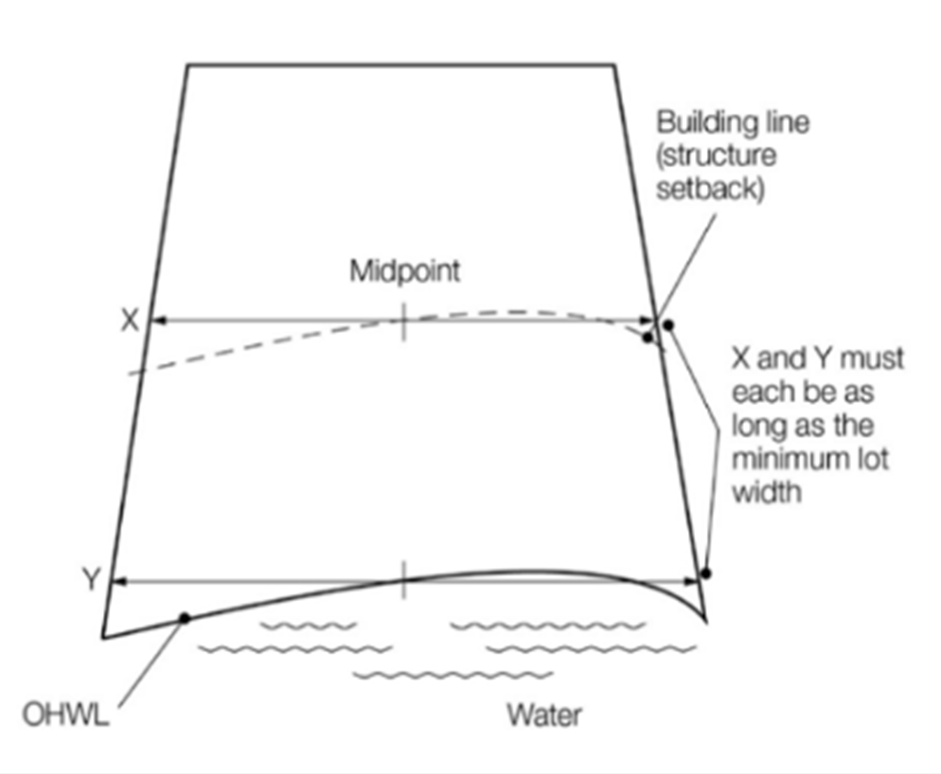
Lot, corner, means a lot of which at least two adjacent sides abut for their full lengths upon a street, provided that the interior angle at the intersection of such two sides is less than 135 degrees. A lot abutting upon a curved street or streets shall be considered a corner lot if the tangents to the curve at its point of beginning within the lot or at the points of intersection of the side lot lines with the street line intersect at an interior angle of less than 135 degrees.
Lot, key, means the first interior lot to the rear of a reverse corner lot.
Lot, nonconforming, preexisting means any lot which does not comply with existing code requirements, but which complied with existing regulations at the time the lot was established.
Lot, reverse corner, means a corner lot the street side lot line of which is substantially a continuation of the front lot line of the key lot to its rear.
Lot, through, means a lot having a pair of opposite lot lines along, and access to, two more or less parallel public streets, and which is not a corner lot. On a through lot, both street lines shall be deemed front lot lines.
Manufactured home means a structure, transportable in one or more sections, which is built on a permanent chassis and is designed to be used with or without a permanent foundation when connected to required utilities. The term "manufactured home" includes a mobile home but does not include a recreational vehicle.
Manufacturing, production and processing means manufacturing, assembly, processing, research, development, or similar uses which may involve raw materials and have the potential to produce objectionable influences on surrounding properties or adverse effects on the environment. Manufacturing, production and processing uses require special measures and careful site selection to ensure compatibility with the surrounding area.
Massage therapy means a profession in which the practitioner applies massage techniques, and may apply adjunctive therapies, with the intention of positively affecting the health and well-being of the client. Massage therapy does not include diagnosis, except to the extent of determining whether massage therapy is indicated. Further, the term "massage" is manual manipulation of the human body, including holding, positioning, causing movement, and applying touch and pressure to the body; the term "therapy" is action aimed at achieving or increasing health and wellness; and the term "adjunctive therapies" may include:
(1)
Application of heat, cold, water, mild abrasives, topical preparations not classified as prescription drugs;
(2)
The use of mechanical devices and tools which mimic or enhance manual actions; and
(3)
Instructed self-care and stress management.
Microbrewery means a facility that produces for sale no more than 3,500 barrels annually of cider, mead, beer or other beverages made from malt by fermentation and containing not less than one-half of one percent alcohol by volume. A microbrewery may include a taproom.
Micro unit means a mobile residential dwelling providing permanent housing within a sacred community that meets the requirements of Minn. Stat. § 327.30, subd. 4.
Mini-storage facility means a building or group of buildings having the following characteristics: control access and secured areas which contain varying sizes of individually compartmentalized and controlled access stalls or lockers for the dead storage of the customer's goods or possessions. Access to all storage units shall be oriented into interior courtyards fully enclosed by buildings or walls, except for ingress and egress openings. Exterior finish shall be face brick or equal.
Mobile home. See manufactured home.
Monastery means a place of residence for members of a religious order who carry on religious, medical, educational or charitable work within related or unrelated institutions.
Monopole means a monopolar structure, erected on the ground to support wireless communication antennas and connecting appurtenances.
Mortuary means a facility where funeral arrangements are made and/or funeral services for the dead are held and where dead bodies are embalmed or otherwise prepared for final disposition.
Motel. See Lodging.
Motor freight terminal means a building or area in which freight brought by motor truck is assembled and/or stored for routing in intrastate or interstate shipment by motor truck.
Motor fuel sales means a place where gasoline, kerosene, or any other motor fuel, lubricating oil or grease for operating motor vehicles is offered for sale to the public and deliveries are made directly into motor vehicles.
Motor vehicle dealer means any person licensed by the state and engaging in the business of selling, purchasing, and generally dealing in new and used motor vehicles having an established place of business for the sale, trade, and display of new and used motor vehicles and having in such motor vehicle dealer's possession new and used vehicles for the purposes of sale or trade.
Motor vehicle rental/leasing facility means a facility primarily engaged in the rental or leasing of automobiles or light trucks and vans that may include incidental parking and servicing.
Motor vehicle repair means the repair and/or replacement of any part or repair of any part, including such items as the engine head or pan, engine transmission or differential, rebuilding or reconditioning of engines, bodywork, framework, welding, painting, upholstering service to passenger vehicles and trucks not exceeding three-quarter-ton capacity.
Motor vehicle repair, large means the repair and/or replacement of any part or repair of any part, including such items as the engine head or pan, engine transmission or differential, rebuilding or reconditioning of engines, bodywork, framework, welding, painting, upholstering service to passenger vehicles, commercial vehicles (e.g., vans, trucks, semis and buses), and large machinery (e.g., construction equipment and farm implements) of any size.
Mulch means a protective covering of materials placed around plants to control weeds and moderate evaporation of moisture or freezing. Examples of mulch include organic mulch such as wood chips, shredded hardwood, and cocoa beans and inorganic mulch such as stones or rocks. Materials creating an impermeable cover shall not be considered mulch.
Natural grade means the grade of a site before it is modified by moving earth, adding or removing fill, or installing a berm, retaining wall or other earthwork feature. Natural grade is determined by reference to a survey, or other information as determined by the zoning administrator.
Nonconforming, illegal, means a lot, use, or structure which failed to satisfy all applicable zoning requirements and was, therefore, illegally established when it was created, initiated, or constructed and which currently fails to satisfy all applicable requirements of this title as amended.
Nonconforming, legal, means a lot, use, or structure which satisfied all applicable zoning requirements when it was created, initiated, or constructed but which currently fails to satisfy all applicable requirements of this title as amended.
Non-motorized pathways means on-road and off-road pathways which are used for pedestrian, bicycle, and other non-motorized means of transportation, the specifications of which shall be established by the public works director.
Noxious matter means material which is capable of causing injury or malaise to living organisms or is capable of causing detrimental effect upon the health or the psychological, social or economic well-being of human beings.
Nursery school means a public or private facility, licensed by the state, the principal function of which is to provide an educational experience outside of the family home for children of preschool age.
Nursing home means a state-licensed establishment having accommodations for the continuous care of two or more invalid, infirm, aged convalescent patients, or disabled persons that are not related.
Office means the general use of a building for administrative, executive, professional, or similar organizations having only limited contact with the public. The term "office" is characterized by a low proportion of vehicle trips attributable to visitors or clients in relationship to employees. Examples include, but are not limited to, firms providing architectural, computer software consulting, data management, engineering, interior design, graphic design, or legal services.
Office showroom means a facility in which up to 50 percent of the total floor area is utilized for the conduct of a business that involves the display and sale of goods or merchandise on the premises.
Ordinary high water level means the boundary of public waters and wetlands, and shall be an elevation delineating the highest water level which has been maintained for a sufficient period of time to leave evidence upon the landscape, commonly that point where the natural vegetation changes from predominantly aquatic to predominantly terrestrial. For watercourses, the ordinary high water level is the elevation of the top of the bank of the channel. For reservoirs and flowages, the ordinary high water level is the operating elevation of the normal summer pool.
Outdoor display means the display of goods for sale or rental outside of an enclosed building on a permanent or recurring basis.
Outdoor sales events means a seasonal or occasional sale held on the sidewalk or other location outside a building.
Outdoor storage, equipment and goods, means storage of equipment (e.g., household lawn/garden implements, larger construction equipment, trailers, etc.) or salable goods on racks, pallets, bundles, etc., outside of an enclosed building. For the purpose of outdoor storage regulation, the term "equipment" does not include snow removal machinery that may be seasonally present on a property for on-site use.
Outdoor storage, fleet vehicles, means storage outside of an enclosed building of fleet vehicles, ranging in size from passenger cars to commercial trucks, which are in active use by a rental agency, dispatch service, or other similar distribution or transportation service. Inoperable vehicles in need of repair or vehicles which are stored for seasonal use (e.g., snow plows in summer months) are defined and regulated as inoperable/out of service vehicles or equipment.
Outdoor storage, inoperable/out of service vehicles or equipment, means storage outside of an enclosed building of vehicles or equipment which are in need of repair or unused for more than 72 hours.
Outdoor storage, loose materials, means storage outside of an enclosed building of gravel, rock, mulch, sand, salt, or other such material stored in piles or bins.
Overhead door means a door for vehicle access to loading docks, service bays, garages, or other similar areas that opens vertically or horizontally.
Overlay district means a zoning district that encompasses one or more primary zoning districts or portions thereof and that imposes additional requirements or relaxes one or more standards required by the primary zoning district.
Owner (of building or land) means any sole owner, part owner, joint owner, tenant in common, joint tenant, or tenant by the entirety.
Parking facility means an area used for parking of customer or employee vehicles; includes parking lots and parking structures.
Parking lot means a one-level, surfaced, open-to-the-air area used for parking vehicles.
Parking space means a paved surface located in a permanently maintained area, either within or outside of a building, of sufficient size to store one automobile.
Parking structure means a multi-level parking area, wherein one or more levels are supported above the lowest level, and is commonly called a parking garage or parking ramp.
Pawnshop means any business establishment operated by a pawnbroker, as defined in chapter 307, in which pawn transactions take place.
Permitted means a use or structure which may be lawfully established in a particular district, provided it conforms with all requirements and regulations of the district in which it is located.
Pervious pavement or pavers means pavement or pavers that are designed and maintained to allow precipitation to infiltrate into the ground, in order to reduce the volume and velocity of stormwater runoff. Pervious pavement materials include pervious interlocking concrete paving blocks, concrete grid pavers, perforated brick pavers, and similar materials determined by the city engineer to qualify.
Photovoltaic system means an active solar energy system that converts solar energy directly into electricity.
Place of assembly means a facility providing for the assembly of persons for interaction as a primary use, including community centers, and religious institutions. Places of assembly do not include community education or art centers, schools, instructional centers, day care facilities, family day shelters, conservatories, convention centers, libraries, museums, residential dwellings, recreational and entertainment facilities, theaters, or social service distribution facilities which fall under separate definitions in this Code.
Plant nursery. See Greenhouse.
Play equipment means equipment used by residents of a principal building for on-premises games and sports, including, but not limited to, swings, slides, climbers, teeter-totters, basketball baskets and backboards, badminton nets, and similar equipment, but not including recreational devices normally utilized off the premises, including, but not limited to, boats, boat trailers, campers, travel trailers, and snowmobiles.
Plug-in hybrid electric vehicle means an electric vehicle that:
(1)
Contains an internal combustion engine and also allows power to be delivered to drive wheels by an electric motor;
(2)
Charges its battery primarily by connecting to the grid or other off-board electrical source;
(3)
May additionally be able to sustain battery charge using an on-board internal-combustion-driven generator; and
(4)
Has the ability to travel powered by electricity.
Portable storage units means a portable structure used for temporary storage of household goods in residential areas.
Principal means the main use or structure to which the premises are devoted or the primary purpose for which the premises exist.
Property means tangible or intangible, real, personal, or mixed property.
Public way means any sidewalk, street, alley, highway, or other public thoroughfare.
Recreational vehicle means:
(1)
Any properly and currently licensed vehicular, portable structure which is built on a chassis, designed to be used as a temporary dwelling for travel, recreational and vacation uses;
(2)
Any structure designed to be mounted on a truck chassis for use as a temporary dwelling for travel, recreation and vacation;
(3)
Any portable, temporary dwelling to be used for travel, recreation and vacation, constructed as an integral part of a self-propelled vehicle; and
(4)
Any folding structure, mounted on wheels and designed for travel, recreation and vacation use.
Recycling center means a facility for the deposit, sorting, or batching, including limited compacting or crushing of recyclable materials, but no further processing of post-consumer recyclable materials.
Renewable energy easement means an easement that limits the height or location, or both, of permissible development on the burdened land in terms of a structure or vegetation, or both, for the purpose of providing access for the benefited land to wind or sunlight passing over the burdened land.
Renewable energy system means a solar energy or wind energy system. Passive systems that serve dual functions, such as greenhouses or windows, are not considered renewable energy systems.
Restaurant, fast food, means an establishment where customers are served their food from a counter or in a motor vehicle, mostly in disposable packages prepared to leave the premises or to be taken to a table or booth for consumption on the premises. Fast food can be a café, coffee shop, ice cream shop, and/or deli. Fast food restaurants may or may not serve intoxicating alcoholic beverages to be consumed upon the premises. Food sales shall account for over 50 percent of the gross receipts at any restaurant serving intoxicating alcoholic beverages. Fast food restaurants may include drive-through facilities, which are regulated separately.
Restaurant, traditional, means an establishment in which customers are served their food in or on non-disposable dishes to be consumed primarily while seated at tables or booths within a building, and which may or may not serve intoxicating alcoholic beverages to be consumed upon the premises. Food sales shall account for over 50 percent of the gross receipts at any restaurant serving intoxicating alcoholic beverages. Traditional restaurants may also be a café, cafeteria or buffet, coffee shop, and/or deli. Customers may take away food, but drive-through facilities are not allowed.
Retail, general and personal services, includes the retail sale of products and/or consumer services to the general public and produces minimal off-site impacts.
Retail, large format, where retail building size is regulated, means a stand-alone, single-tenant retail structure with a gross floor area of 100,000 square feet or more, distributed on one or more stories. The term "large format retail" includes interior space that may be leased to third-party financial, clinical, or other service providers accessible to customers within the large format retail store, but does not include typical multi-tenant retail centers or regional malls that may comprise gross floor area of more than 100,000 square feet.
Reverse corner. See Lot, reverse corner.
Right-of-way means any street, alley, boulevard, parkway, highway, or other public thoroughfare.
Roof pitch means the final exterior slope of a building roof typically but not exclusively expressed as a ratio of the distance, in inches, of vertical "rise" to the distance, in inches, of horizontal "run," such as 3:12, 9:12, 12:12.
Room means a partitioned part of the inside of a building. For the purpose of this definition, the term "partition" shall mean something that divides interior space, especially an interior dividing wall. A wall is one of the sides of a room or building connecting floor and ceiling and may also include anything which encloses or separates space. A partition or wall which intrudes into the space by more than one-third of the least dimension of an existing room may be regarded as creating an additional separate room. The partitioned space shall be considered as a room if privacy is implied; light and ventilation are affected; or a bedroom through a bedroom, bathroom through a bedroom, or bedroom through a bathroom situation is created.
Roomer means a person living in a dwelling unit who is other than part of the family because of blood, marriage, or legal adoption, and is other than a foster child.
Rowhouse. See Townhouse.
Sacred community means a residential settlement established on or contiguous to the grounds of a religious institution's primary worship location primarily for the purpose of providing permanent housing for chronically homeless persons, extremely low-income persons, and designated volunteers that meet the requirements of Minn. Stat. § 327.30, subd. 3.
Salvage yard. See Junkyard.
Schools, elementary or secondary, means public or private schools which provide an educational program for one or more grades between kindergarten and grade 12 and which are commonly known as elementary schools, grade schools, middle schools, junior high schools, or high schools.
Screening means a hedge, wall, or fence to provide a visual separator and physical barrier not less than four feet nor more than six feet in height, unless otherwise provided for in this title.
Seasonal sales, outdoor means outdoor seasonal retail sales, where permitted, including, but not limited to, the seasonal sale of Christmas trees, plants, flowers, vegetables and related products available on a seasonal basis.
Secondhand store. See Consignment store.
Self-storage facility. See Mini-storage facility.
Senior housing means a residential complex containing multifamily dwellings designed for and principally occupied by senior citizens. Such facilities may include a congregate meals program in a common dining area, but exclude institutional care such as medical or nursing care and are distinguished from assisted living or nursing homes.
Services, personal. See Retail, general.
Setback or required yard means the minimum horizontal distance required between a structure, sewage treatment system, or other facility and an ordinary high water level, sewage treatment system, top of a bluff, road or highway right-of-way, property line, or other facility.
Setback, front, means the minimum distance by which any building or structure must be separated from the front lot line.
Setback, rear, means the minimum distance by which any building or structure must be separated from the rear lot line. In the case of an irregular, triangular or gore-shaped lot, a line ten feet in length entirely within the lot, parallel to and most distant from the front lot line shall be considered to be the rear lot line for the purpose of determining the rear yard setback.
Setback, side, means the minimum distance by which any building or structure must be separated from the side lot line.
Shrub means a low, usually several stemmed, woody plant.
Sidewalk means the portion of the street between the curbline and the adjacent property line intended for the use of pedestrians.
Sign means a name, identification, description, display, illustration, or device which is affixed, painted, or represented directly or indirectly upon the outside of a building, structure, or piece of land and which directs attention to an object, product, place, activity, person, institution, organization, or business. A sign shall be considered as a structure or a part of a structure for the purpose of applying yard and height regulations. Official court or public notices, or any flag, emblem, or insignia of a nation, political unit, school, or religious group, shall not be considered a sign under this title. See section 1010.02 for additional sign definitions.
Site means a lot or group of adjacent lots intended, designated, or approved to function as an integrated unit, that is proposed for development in accord with the provisions of this Code and is in a single ownership or has multiple owners, all of whom execute a joint application for development.
Sports club. See Health club.
Solar access means a view of the sun, from any point on the collector surface, that is not obscured by any vegetation, building, or object located on parcels of land other than the parcel upon which the solar collector is located, between the hours of 9:00 a.m. and 3:00 p.m. standard time on any day of the year.
Solar collector means a device, structure or a part of a device or structure for which the primary purpose is to transform solar radiant energy into thermal, mechanical, chemical, or electrical energy.
Solar collector surface means any part of a solar collector that absorbs solar energy for use in the collector's energy transformation process. Collector surface does not include frames, supports and mounting hardware.
Solar daylighting means a device specifically designed to capture and redirect the visible portion of the solar spectrum, while controlling the infrared portion, for use in illuminating interior building spaces in lieu of artificial lighting.
Solar energy means radiant energy received from the sun that can be collected in the form of heat or light by a solar collector.
Solar energy device means a system or series of mechanisms designed primarily to provide heating, to provide cooling, to produce electrical power, to produce mechanical power, to provide solar daylighting or to provide any combination of the foregoing by means of collecting and transferring solar generated energy into such uses either by active or passive means. Such systems may also have the capability of storing such energy for future utilization. Passive solar systems shall clearly be designed as a solar energy device such as a Trombe wall and not merely a part of a normal structure such as a window.
Solar energy easement. See Renewable energy easement.
Solar energy system means a device or structural design feature, a substantial purpose of which is to provide daylight for interior lighting or provide for the collection, storage and distribution of solar energy for space heating or cooling, electricity generating, or water heating.
Solar heat exchanger means a component of a solar energy device that is used to transfer heat from one substance to another, either liquid or gas.
Solar hot water system means a system that includes a solar collector and a heat exchanger that heats or preheats water for building heating systems or other hot water needs, including residential domestic hot water and hot water for commercial processes.
Solar mounting devices means devices that allow the mounting of a solar collector onto a roof surface or the ground.
Solar storage unit means a component of a solar energy device that is used to store solar generated electricity or heat for later use.
Solar system, active, means a solar energy system that transforms solar energy into another form of energy or transfers heat from a collector to another medium using mechanical, electrical, or chemical means.
Solar system, building-integrated, means an active solar system that is an integral part of a principal or accessory building, rather than a separate mechanical device, replacing or substituting for an architectural or structural component of the building. Building-integrated systems include, but are not limited to, photovoltaic or hot water solar systems that are contained within roofing materials, windows, skylights, and awnings.
Solar system, grid-intertie, means a photovoltaic solar system that is connected to an electric circuit served by an electric utility company.
Solar system, off-grid, means a photovoltaic solar system in which the circuits energized by the solar system are not electrically connected in any way to electric circuits that are served by an electric utility company.
Solar system, passive, means a solar energy system that captures solar light or heat without transforming it to another form of energy or transferring the energy via a heat exchanger.
Start of construction, for the purpose of floodplain regulation only, means the date the building permit was issued, provided the actual start of construction, repair, reconstruction, rehabilitation, addition, placement, or other improvement was within 180 days of the permit date. The actual start means either the first placement of permanent construction on a site, such as the pouring of slab or footings, the installation of piles, the construction of columns, or any work beyond initial excavation, or the placement of a manufactured home on a foundation. Permanent construction does not include land preparation, such as clearing, grading and filling, nor does it include the installation of streets and/or walkways, nor does it include excavation for a basement, footings, piers or foundations or the erection of temporary forms, nor does it include the installation on the property of accessory buildings, such as garages or sheds not occupied as dwelling units or not part of the main structure. For an alteration, the actual start of construction means the first alteration of any wall, ceiling, floor or other structural part of a building, whether or not that alteration affects the external dimensions of the building.
Storage, outdoor. See Outdoor storage.
Story means that portion of a building, other than a basement or mezzanine, included between the surface of any floor and the surface of the floor next above it; or, if there be no floor above it, then the space between the floor and the ceiling next above it. For the purposes of this title, there shall be only one basement which shall be counted as a story when the front exterior wall of the basement level is exposed more than 50 percent.
Street means a public right-of-way which affords a primary means of access to abutting property.
Structure means anything constructed or erected, including paved surfaces, the use of which requires, more or less, a permanent location on the ground, or attached to something having a permanent location on the ground, and, in the case of floodplain areas, in the streambed or lakebed. The term "structure" includes, but is not limited to, decks, driveways, and at-grade patios. The term "structure" does not include aerial or underground utility lines such as sewer, electric, telephone, and gas, and towers, poles, and other supporting structures.
Student housing means group living quarters designed for students of an elementary, middle, junior, or high school, college, university, or seminary, organized and owned by such institution.
Swimming pool means any structure intended for swimming or recreational bathing that contains water over 24 inches.
Taproom means an area for the on-sale consumption of cider, mead, beer or other beverages made from malt by fermentation produced for consumption on the premises of a brewery. A taproom may also include sale for off-premises consumption of cider, mead, beer or other beverages made from malt by fermentation produced at the brewery location and owned by the brewery for off-premises consumption, packaged subject to Minn. Stat. § 340A.301, subd. 7(b), or its successor.
Telecommunication facilities means any plant or equipment used to carry wireless commercial telecommunications services by radio signal or other electromagnetic waves, including towers, antennas, equipment buildings, parking area, and other accessory development.
Telecommunications tower means a mast, pole, monopole, guyed tower, lattice tower, free-standing tower, or other structure designed and primarily used to support antennas. A ground or building mounted mast greater than 15 feet tall and six inches in diameter supporting one or more antennas, dishes, or arrays shall be considered a telecommunications tower.
Tenant means any person who occupies the whole or any part of a building or land, either alone or with others.
Theater means a facility for presenting motion pictures or live performances for patrons. This term includes an outdoor stage, band shell, or amphitheater but does not include an adult entertainment establishment.
Townhouse means a form of one-family attached dwelling.
Trailer means any structure which is or may be mounted upon wheels for moving about, is drawn by an external motive power, and which is used as a dwelling or as an accessory building or structure in the conduct of a business, trade or occupation, or is used for hauling purposes.
Transportation demand management (TDM) means measures, including, but not limited to, carpooling, vanpooling, public transit bicycling, walking, telecommuting, and compressed or deviated work schedules that reduce individual vehicle trips and promote alternatives to single occupant vehicle use especially at peak commuting times.
Tree means a self-supporting woody perennial having one or several self-supporting stems or trunks and numerous branches which normally attains an overall height of 15 feet at maturity. Trees may be classified as deciduous or evergreen.
Tree protection zone means an area around a tree defined by either the tree's unique dripline, or the tree's typical root protection zone.
Tree, canopy, means a deciduous tree planted primarily for its high crown of foliage or overhead canopy.
Tree, coniferous/evergreen, means a woody plant having foliage on the outermost portions of the branches year-round which at maturity is at least 12 feet or more in height. Tamaracks and larch are included as coniferous tree species.
Tree, deciduous, means a woody plant, which sheds leaves annually, having a defined crown and at maturity is at least 15 feet or more in height.
Tree, invasive, means any tree species that is not native to the state or its regional ecosystem that can spread or be spread into any non-cultivated soil site and establish itself, expanding the plant species' population by its own volition and generally harm, destroy or prevent native plants. Invasive tree species include Norway maple, black locust, Amur maple, Siberian elm, and buckthorn.
Tree, ornamental, means any tree planted primarily for its ornamental value or for screening purposes and tends to be smaller at maturity than canopy trees.
Tree, overstory, means a self-supporting woody plant or species normally growing to a mature height over 25 feet and a mature spread of at least 25 feet. Many overstory trees are considered deciduous trees.
Tree, understory, means a self-supporting woody plant or species normally growing to a mature height between 15 and 30 feet and a mature spread of at least 15 feet. Many understory trees are considered ornamental trees.
Typical root protection zone means a circle radius around a tree in feet equal to 1.25 times the tree's diameter breast height (in inches) for both deciduous and coniferous trees.
University. See College.
Usable open space means that portion of a site, outside of a required front or corner side yard, as extended to the rear lot line, that is available to all occupants for outdoor use. The term "usable open space" shall not include areas occupied by buildings, driveways, drive aisles, off-street parking, paving and sidewalks, except that paved paths no wider than five feet, and pervious pavement may be included in usable open space. The term "usable open space" may include balconies and roof decks where specified in this title.
Use. The use of property is the purpose or activity for which the land or building thereon is occupied or maintained.
Use, conditional, means a conditional use is a use or structure which, because of its unique or varying characteristics, cannot be properly classified as a permitted use in a particular district. A special exception to the height standards of this title may also be allowed as a conditional use, where specified. After due consideration, as provided for in this title, of the impact of such use or exception upon neighboring land and of the public need for the particular use at a particular location, the conditional use may or may not be granted.
Vehicle. See Motor vehicle.
Veterinary clinic. See Animal hospital.
Warehouse means an enclosed building with the principal use of storing materials or equipment.
Wetland means an area that is inundated or saturated by surface water or groundwater at a frequency and duration sufficient to support, and that, under normal circumstances, does not support a prevalence of vegetation typically adapted for life in saturated soil conditions, commonly known as hydrophytic vegetation.
Wholesale establishment means an establishment providing storage, distribution, and sale of merchandise and bulk goods, including mail order and catalog sales, importing, wholesale, or retail sales of goods received by the establishment but generally not sale of goods for individual consumption.
Yard means open space on a lot between the principal building and the adjoining lot lines.
Yard sale. See Garage sale.
Yard, front, means a yard extending along the full length of the front lot line between the side lot lines.
Yard, rear, means a yard extending along the full length of the rear lot line between the side lot lines.
Yard, required. See Setback.
Yard, side, means a yard extending along a side lot line from the front yard to the rear yard.
(Ord. No. 1606, § 1001.10, 11-8-2021; Ord. No. 1581, 3-9-2020; Ord. No. 1629, § 1, 3-20-2023; Ord. No. 1634, § 1, 7-10-2023; Ord. No. 1644, § 1, 10-23-2023; Ord. No. 1682, § 1(1001.10), 11-25-2024)

