
Safety Harbor City Zoning Code
ARTICLE III
SUPPLEMENTARY DISTRICT REGULATIONS
36.00 - Accessory uses and structures.
(A)
Accessory uses are permitted in all zoning districts in accordance with the requirements of this Code. An accessory use to an existing non-residential primary use shall be one of the permitted uses of the property within the zoning district or a conditional use that has been approved for the subject property.
(B)
An accessory use is a use or structure which complies with the following standards:
(1)
Is clearly incidental to, customarily found in association with, and serves a primary use.
(2)
Is subordinate in purpose, area, and extent to the primary use served.
(3)
Contributes to the comfort, convenience, or necessity of the primary use served.
(4)
Is located on the same lot, tract, parcel, or property as the primary use.
(C)
All accessory structures shall comply with the requirements of the City's building codes.
(D)
An accessory type structure which shares a structural wall with the primary structure, or is attached, shall be deemed to be part of the primary structure and must comply with the primary structure setback requirements of the district in which it is located.
(E)
Notwithstanding 36.00(D) above, an accessory-type structure that is connected to a primary structure by a breezeway or unenclosed roofed passage shall not be considered part of the primary structure for purposes of setback requirements, but shall comply with the setback requirements for accessory structures in the district in which it is located.
(F)
Accessory uses or structures shall only be allowed simultaneously with, or following, establishment/construction of the primary use or structure.
(G)
Accessory structures shall be located as follows:
(1)
No closer than ten (10) feet to the primary structure; and
(2)
No closer than five (5) feet to a lot line; and
(3)
No closer than six (6) feet to any other accessory structure; and
(4)
Not forward of the front face of the primary structure; except that an arbor, trellis, pergola, or gazebo unenclosed by walls or other minor decorative landscape feature may be permitted in a front yard with prior approval of the Planning and Zoning Director;
(5)
Detached garages with alley access are subject to Sec. 149.00(I) and may require a greater setback from the lot line to accommodate vehicle turning movements in accordance with AASHTO standards;
(6)
Accessory structures, excluding swimming pools, may occupy not more than thirty-five (35%) percent of a required rear yard and not more than five percent (5%) of a front yard; and
(7)
Accessory structures shall not exceed twelve (12) feet in height except on property located inside the Community Redevelopment District where accessory structures may have a maximum building height of twenty-five (25) feet provided:
(a)
The accessory structure is located on a lot with alleyway access; and
(b)
Any windows above the ground floor are located to protect the privacy of adjacent residential properties.
(H)
Accessory structures shall not cumulatively exceed twenty-five percent (25%) of the gross floor area of the primary structure or exceed a maximum of five hundred (500) square feet in all zoning districts, except the Estate Residential (E-1) zoning district. Within the E-1 zoning district, accessory structures shall not cumulatively exceed fifty percent (50%) of the gross floor area of the primary structure.
(Ord. No. 2012-09, § 3, 5-21-2012; Ord. No. 2014-16, § 1, 10-6-2014; Ord. No. 2016-14, § 2, 6-6-2016; Ord. No. 2019-19, § 3, 1-6-2020)
36.01 Accessory dwelling units.
(A)
Applicability. Accessory dwelling units shall be permitted in all single-family residential zoning districts located within the City.
(B)
Location. The accessory dwelling unit may be added to or included within the principal dwelling unit, or located in a detached structure. Detached accessory units located outside the Estate Residential E-1 district must be located on either a corner lot or on a lot with improved alley access.
(C)
Approval Process. One accessory dwelling unit is permitted per eligible lot provided the Planning and Zoning Director first approves the proposed accessory dwelling unit and a standard building permit is issued.
(D)
Permit Renewal. A Certificate of Occupancy issued for an accessory dwelling unit shall expire if the accessory dwelling unit is found in violation by the City of Safety Harbor Code Enforcement Board or other code enforcement entity. Once an affidavit of compliance is issued by the City of Safety Harbor Code Enforcement Officer or other code enforcement entity and imposed fines are paid to the City of Safety Harbor, the owner may reapply for a Certificate of Occupancy.
(E)
Enforcement. The City retains the right with reasonable notice to inspect the accessory dwelling unit for compliance with the provisions of this Section.
(F)
Owner Occupancy. Any dwelling on the lot in which an accessory dwelling unit is constructed must be occupied by the owner of the premises. Owner occupancy is defined as the property owner, as reflected in title records, who makes his or her legal residence at the site, as evidenced by homestead exemption status by the Pinellas County Property Appraiser. The accessory dwelling unit shall not affect the homestead exemption status while the accessory dwelling unit is being occupied.
(G)
Subdivision. Accessory dwelling units shall not be subdivided or otherwise segregated in ownership from the principal dwelling unit.
(H)
Number of Occupants. No more than two occupants may reside in an accessory dwelling unit.
(I)
Basic Development Standards.
(1)
Additions to an existing structure or a newly constructed detached accessory dwelling unit shall be designed consistent with the existing roof pitch, siding and windows of the principal dwelling unit.
(2)
The building height of an accessory structure containing an accessory dwelling unit shall not exceed 25 feet in elevation.
(3)
The orientation of the proposed accessory dwelling unit shall, to the maximum extent practical, maintain the privacy of residents in adjoining dwellings as determined by the physical characteristics surrounding the accessory dwelling unit, including landscape screening, fencing, and window and door placement.
(4)
A single-family dwelling containing an accessory dwelling unit shall have only one entrance on each front or side street of the residence.
(5)
Accessory dwelling units must comply with building setback standards for accessory structures.
(6)
The square footage of the accessory dwelling unit shall be a minimum of 300 square feet and a maximum of 800 square feet, excluding any garage area; provided the square footage of the accessory dwelling unit shall not exceed 50 percent of the total square footage of the principal dwelling unit, excluding the garage area, as it exists or as it may be modified.
(7)
The accessory dwelling unit shall not contain more than one bedroom.
(8)
Only one electrical and one water meter shall be allowed to serve the principal dwelling unit and the accessory dwelling unit.
(9)
At least one off-street parking space must be provided to serve the accessory dwelling unit.
(J)
Public Health. The Public Works Director must certify that the water supply and sewage disposal facilities are adequate to serve the proposed accessory dwelling unit.
(K)
Public Safety. The Fire Marshal shall certify that the proposed accessory dwelling unit will comply with the Florida Fire Prevention Code.
(Ord. No. 2019-19, § 4, 1-6-2020)
36.02 Swimming pools.
(A)
All construction shall be in accordance with the City's building codes.
(B)
All pools shall be completely enclosed with an approved wall, fence, cage, or other substantial structure not less than four (4) feet in height. All entryways to fenced or enclosed pools shall be equipped with locks or safety latches which shall remain locked when not used or supervised by the owner.
(C)
Swimming pools and spas and screened cages for swimming pools may occupy a required rear or side yard, provided that no part, including pool decking and other customary accessory structures associated with swimming pools, is located closer than five (5) feet to a lot line. Pools, screened cages and decks may not be placed within an easement, unless documentation is provided with the permit application demonstrating that there are no utilities or storm sewers within the easement, the improvements do not impede or restrict drainage flow, and that a partial easement vacation was approved on the property.
(D)
Accessory swimming pools shall maintain a three (3) foot separation from the water's edge to the primary structure.
(Ord. No. 2018-07, § 4, 5-23-2018; Ord. No. 2021-15, § 2, 7-19-2021)
36.03 Fences, walls and hedges.
(A)
All fences, walls and hedges shall conform to the requirements of this Code for visibility triangles.
(B)
For all one- and two-family residences, no fence, wall, or hedge shall exceed four (4) feet in height when located within a front yard except as follows:
(1)
For properties located in the E-1, Estate Residential District, a fence, wall, or hedge within a required front yard setback up to five (5) feet in height is permitted provided fencing over four feet in height shall not be of chain-link or wood construction.
(2)
For the purposes of this Section, the front yard of a corner lot shall be the side of the property from which the property is addressed. The other side facing a street shall be considered a secondary front yard. The maximum fence height in the secondary front yard is six (6) feet.
(3)
The City Commission may allow a fence, wall, or hedge up to six (6) feet in height within a required front yard setback in connection with any site plan approval for a one- or two-family subdivision.
(4)
Decorative columns, posts or other integral architectural features that do not exceed one foot above the maximum fence or wall height shall be permitted.
(5)
For properties fronting roads designated collectors or arterials, and except within the Community Redevelopment District, where the maximum height is six (6) feet.
(C)
Except in industrial districts, no fence or wall shall exceed six (6) feet in height. The maximum height in industrial districts shall be eight (8) feet.
(D)
Barbed wire shall be limited to three (3) strands at a minimum of six (6) feet above the ground. Barbed wire may be used only on security fences or walls in commercial and industrial districts or accessory to any utility installation.
(E)
Chain-link fencing is prohibited within a required primary or secondary front yard on residentially zoned properties. On non-residentially zoned properties chain-link fencing within a required front yard shall be vinyl coated (including strands, poles, and rails) with a black, green or brown color.
(F)
The finished side of a fence shall face outward toward abutting lots and right-of-way.
(G)
No more than one (1) perimeter fence shall be permitted per lot.
(H)
Fences and walls (including retaining walls) shall be set back at least two (2) feet from a platted alleyway or the edge of a sidewalk. A permit to replace seventy-five percent or more of an existing wall, fence, or retaining wall shall be subject to this requirement, unless the City Arborist determines that moving a retaining wall around a protected tree with a condition rating of 2.5 or greater would be harmful to the tree's health.
(I)
Vehicular gates are permitted on driveways at a minimum set back of twenty (20) feet from the roadway, shall not block the sidewalk when open, and are subject to the same requirements as fences.
(Ord. No. 2011-10, § 1, 8-15-2011; Ord. No. 2012-09, § 4, 5-21-2012; Ord. No. 2014-16, § 2, 10-6-2014; Ord. No. 2016-15, § 1, 6-6-2016; Ord. No. 2018-05, § 2, 5-7-2018; Ord. No. 2019-20, § 3, 1-21-2020)
36.04 Screened cages.
Screened cages or decks may occupy a required rear or side yard, provided that no part is located closer than five (5) feet to a lot line. Screened cages or decks may not be placed within an easement, unless documentation is provided with the permit application demonstrating that there are no utilities or storm sewers within the easement, and the improvements do not impede or restrict drainage flow.
(Ord. No. 2018-07, § 5, 5-23-2018)
36.05 Mechanical equipment.
No mechanical equipment including, but not limited to, heating, air conditioning, refrigeration equipment, generators, propane tanks, plumbing lines, ductwork, and transformers shall be located within a primary front yard. Ground-mounted mechanical equipment may be located within a secondary front yard if opaque screening is provided around all sides of the equipment. Screening shall include an opaque decorative fence or wall or a non-opaque fence with opaque vegetative screening. All screening shall be a minimum of one (1) foot higher than the height of the mechanical equipment being screened and a maximum of six (6) feet in height. For the purposes of this section, the front yard of a corner lot shall be the side of the property from which the property is addressed. The other side facing a street shall be considered a secondary front yard. Ground-mounted mechanical equipment not on single-family residential property shall be screened from public rights-of-way, pedestrian areas, and any adjacent residential property using landscaping or other acceptable material. Rooftop mechanical equipment shall be completely screened from all ground level views by a parapet wall or other architectural feature integrated to the building.
(Ord. No. 2019-01, § 2, 1-22-2019)
36.06 Pavers.
Interlocking pavers or a continuous grouping of pavers, not part of a driveway, are permitted within any yard, provided that no paver is located closer than three (3) feet to a lot line unless the applicant submits drainage data for review by the City Engineer demonstrating positive site drainage and that the improvements do not impede off-site drainage patterns. Pavers are subject to the impervious surface ratio maximum established in Section 40.00 and shall allow for positive site drainage. Pavers are not permitted within six (6) feet from the trunk of a protected tree. Pavers placed under a protected tree canopy are to be pervious and installed at existing grade over sand. Pavers shall not be within three (3) feet of a meter box and require a paver waiver if installed over a utility. Any pavers installed within the right-of-way shall require a maintenance agreement between the applicant and the City.
(Ord. No. 2018-07, § 6, 5-23-2018)
37.00 - Required visibility triangles.
(A)
Visibility triangles are aids in establishing rules relating to the unsafe obstruction of motorist's visibility by objects either in the street right-of-way or on private property.
(B)
Excepting utility appurtenances, traffic control features common to public roadways, nonstructural mailboxes and other materials as may be specifically authorized by an approved site plan, other valid development order or contractual agreement, no structure, landscaping, trees, shrubbery, signs, monuments or object of any kind may be placed, constructed or installed, either permanently or temporarily in any portion of a public street or alley right-of-way.
(C)
Unsafe sight obstructions are regulated on private property by the use of visibility triangles established on all street and alley intersections and at all driveways entering into a public street or alley.
(1)
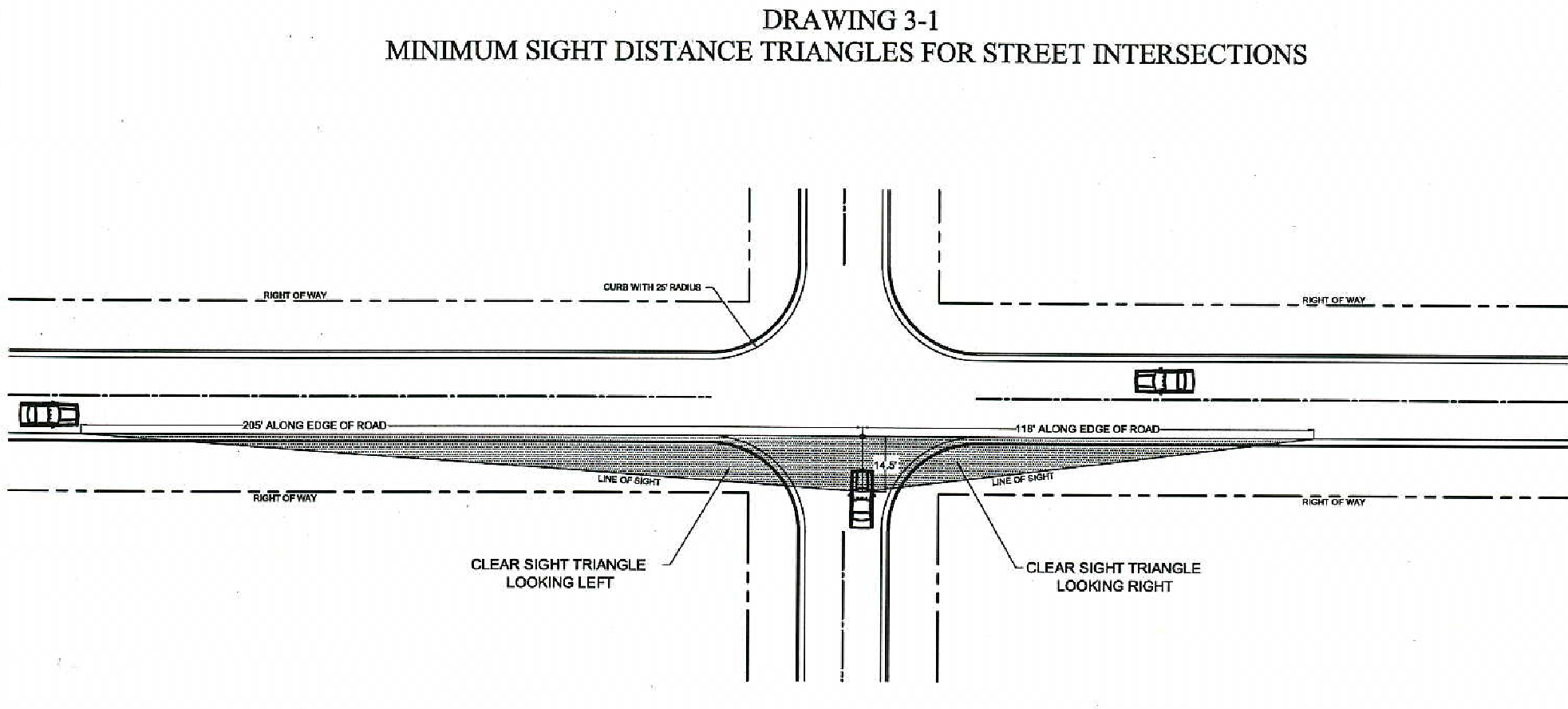
Street Intersections - The visibility triangles shall be as defined in Chapter 3, Section C-3 of the "Manual of Uniform Minimum Standards for Design, Construction & Maintenance for Streets and Highways", commonly known as the "Florida Greenbook" and depicted hereinbelow as Drawing 3-1.
(2)
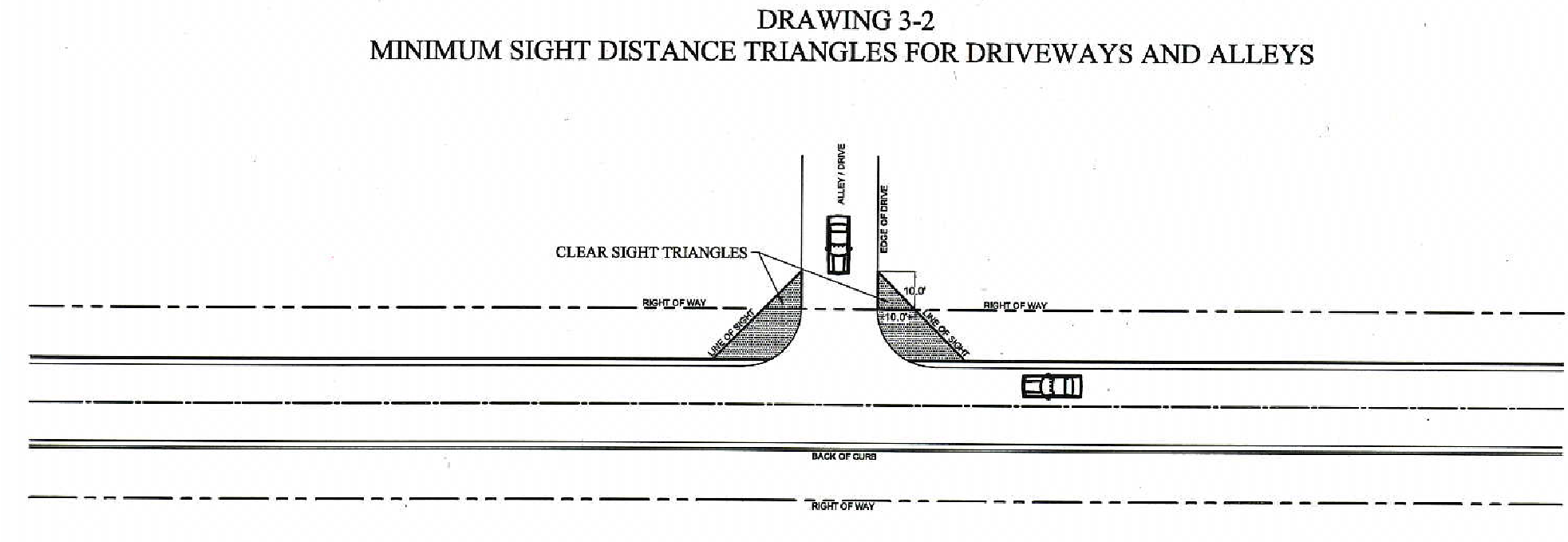
Alley or Driveway Intersections with Streets - The visibility triangle's three sides shall be formed by a ten foot measurement along the driveway edge line, a ten foot measurement along the intersecting right-of-way line and a hypotenuse connecting the two as depicted herein below as Drawing 3-2.
(D)
All visibility triangles on private property shall be kept open for sighting through a space between two feet and 8 feet above the ground. No material including limbs and foliage may occupy that designated space, except separate tree trunks and poles no greater than four inches in diameter are allowed when the City Engineer determines that the spacing of such trunks and poles does not compromise safe sighting.
38.00 - Yard encroachments.
(A)
Every part of every required yard shall be open and unobstructed from 30 inches above the final grade of a lot upward, except as provided for by the following:
(1)
Structures less than 30 inches in height above finished grade are not considered yard encroachments;
(2)
Cornices, awnings, eaves, gutters or similar features which are at least eight (8) feet above grade may extend (30) inches into any required yard;
(3)
Sills, leaders, belt courses and similar ornamental features may extend thirty (30) inches into any required yard, but not over the lot line;
(4)
Bay windows, oriels, balconies, and chimneys not more than ten (10) feet in width may extend thirty (30) inches into any required yard;
(5)
An outside stairway or fire escape, unenclosed, may extend thirty (30) inches into any required yard;
(6)
Air conditioning units and other similar accessory equipment may be located in any required side, rear, or secondary front yard subject to Section 36.05;
(7)
Awnings, canopies, or roof structures which are at least eight (8) feet above finished grade may extend up to five (5) feet into a required front yard abutting Main Street from Philippe Parkway west to 10th Avenue, provided there are no vertical obstructions including, but not limited to, trees and light poles, and no underground utilities within the encroachment area; and
(8)
Except as elsewhere provided by this Code.
(Ord. No. 2018-06, § 3, 5-7-2018; Ord. No. 2021-15, § 3, 7-19-2021)
39.00 - Required access.
(A)
Every structure shall be constructed on a lot adjoining a dedicated public street or with access to a private street determined to be acceptable by the City Engineer and Fire Marshal.
(B)
Easements for the sole purpose of providing access to new lots (not a lot of record) shall not be permitted.
(C)
No land which is residentially zoned shall be used as access to any land which is located in a non-residential district, except to an existing use which does not abut a public street or an approved private street determined to be acceptable by the City Engineer and Fire Marshal.
40.00 - Maximum impervious surface.
(A)
The maximum residential impervious surface ratio (ISR) shall be .60 for one- and two-family dwellings, and .65 for multi-family dwellings. An additional impervious surface coverage up to a maximum of ten percent (10%) may be permitted for swimming pools.
(B)
All other maximum impervious surface ratios are as follows;
Comprehensive Plan Future Land Use Element
Other Adopted Maximum ISRS from the Comprehensive Zoning and Land Development Code
(Ord. No. 2019-23, § 2, 8-17-2020)
41.00 - Community gardens.
(A)
No gardening activities may take place between the hours of 9:00 p.m. and 6:00 a.m.
(B)
The use of hand tools, and domestic gardening tools and equipment is encouraged; the use of small power equipment such as gas-powered tillers and edgers are allowed; however, gas-powered equipment of greater than 10 horsepower is prohibited.
(C)
The property owner(s) on which the community garden is located shall be responsible for maintaining the property so that it does not become overgrown with weeds, infested by exotic plants or vermin, a source of erosion or stormwater runoff, polluted by fertilizer or pesticide, insecticide, herbicide, or other agricultural-use chemicals, or does not become a public nuisance.
(D)
Application of fertilizer, pesticide, insecticide, herbicide, and/or agricultural use chemicals shall be consistent with the manufacturer's instructions.
(E)
The property owner on which the community garden is located shall ensure that the garden complies with all applicable standards as set forth under Chapter 166, Environmental and Natural Resource Protection, of the Pinellas County Code of Ordinances.
(F)
The produce and horticultural plants grown in a community garden shall not be offered for sale on the premises or sold for profit.
(G)
In cases where a community garden is located within ten (10) feet of a residential structure, screening as defined under Section 153.01(V) is required in a manner determined to be acceptable by the Community Development Director.
(H)
Community gardening shall not occur in the front yard of a developed lot that is residentially zoned.
(Ord. No. 2015-05, § 5, 3-16-2015)
42.00 - Design of single-family detached residential units.
(A)
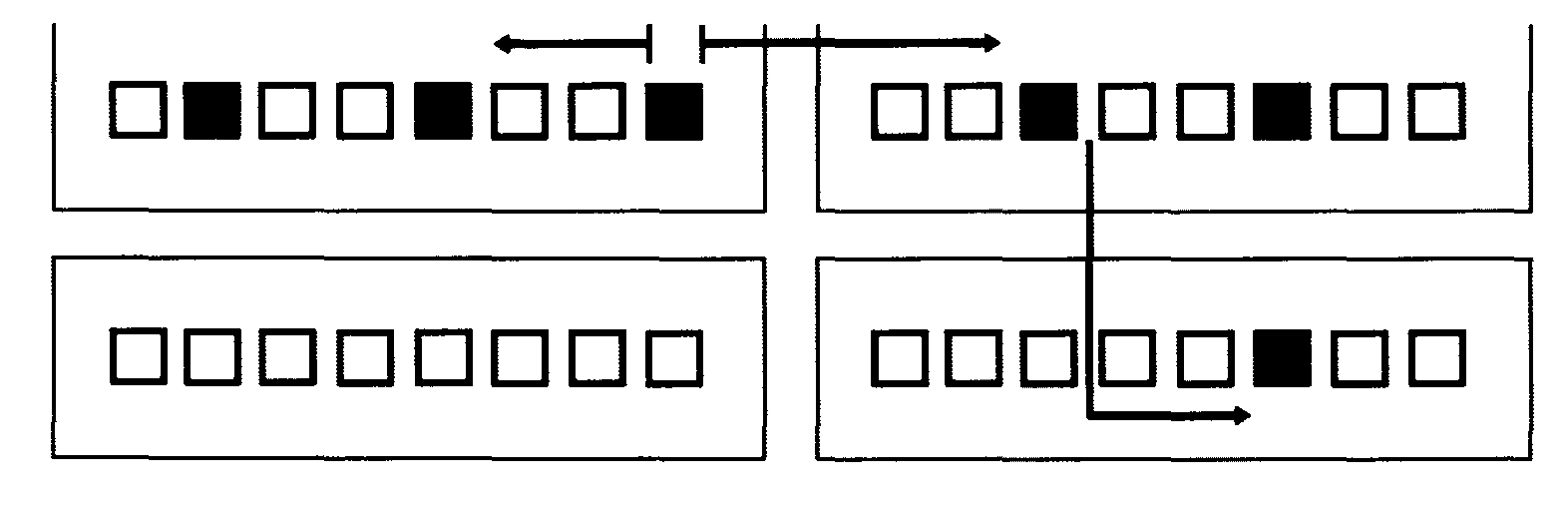
Design of single-family detached residential dwellings on the same block face of either side of the street or within an adjacent block face on either side of the street shall be varied, such that a substantially similar primary front facade will not be replicated. There shall be a minimum separation of two lots next to and across from each dwelling before a substantially similar design can be repeated. (See Figure A below). This shall be applied to all subdivisions and building permit applications where four or more single-family residential dwellings are proposed to be developed as part of the application by the same individual or entity within a twelve-month period.
(B)
Variation shall include differences in at least three (3) of the following elements on the primary front façade:
(1)
Architectural style;
(2)
Roof form (principal or porch);
(3)
Form of unenclosed front porch;
(4)
Form of recessed garage by a minimum of five (5) feet from primary front facade;
(5)
Architectural features:
a.
Columns;
b.
Dormers;
c.
Tower or turret;
d.
Bay window;
e.
Decorative shutters or awnings;
f.
Exposed rafters;
g.
Window sill and door trim a minimum of three and one-half (3.5) inches in width;
h.
Recessed windows by a minimum of two and one-half (2.5) inches.
Element 5 shall only count as one (1) of the three (3) required elements for variation, no matter how many architectural features (a—h) are included. Inclusion of only one (1) of the listed architectural features (a - h) is required to satisfy element 5.
(Ord. No. 2018-18, § 2, 11-19-2018)

