
Safety Harbor City Zoning Code
ARTICLE IV
SPECIAL REGULATIONS
51.00 - Home-based businesses.
(A)
Home-based businesses shall be allowed in any residential zoning district, subject to the requirements of this Section.
(B)
Any person who engages in a home-based business shall be required to have a current business tax receipt from the City.
(C)
A home-based business shall mean: a business operating from a residential property zoned for residential use and which meets the criteria set forth in section 559.955(3), Florida Statutes, as may be amended from time to time. Any use of residential property for business or commercial operations which do not meet the criteria and requirements to be considered a lawful "home-based business" as defined herein are strictly prohibited unless such use is otherwise separately and specifically authorized within the applicable zoning district.
(D)
An address of convenience shall mean the accessory use of a dwelling unit primarily for telephone purposes related to the residence owner's business, provided no business activity, excluding phone calls or transactions occur on the premises.
(Ord. No. 2022-03, § 2, 4-18-2022)
51.01 Reserved.
Editor's note— Sec. 3 of Ord. No. 2022-03, adopted April 18, 2022, repealed § 51.01, which pertained to prohibited home occupations.
51.02 Reserved.
Editor's note— Sec. 4 of Ord. No. 2022-03, adopted April 18, 2022, repealed § 51.02, which pertained to home occupations permitted as an address convenience, and derived from Ord. No. 2012-09, adopted May 21, 2012.
51.03 Reserved.
Editor's note— Sec. 5 of Ord. No. 2022-03, adopted April 18, 2022, repealed § 51.03, which pertained to conditional home occupations.
52.00 - Residential living facilities.
(A)
A family care home shall mean a dwelling unit licensed to serve residents who are clients of the Department of Health and Rehabilitative Services, the Department of Elder Affairs, the Agency for Persons with Disabilities, the Department of Juvenile Justice, or the Department of Children and Family Services or licensed by the Agency for Health Care Administration, which provides a group living environment for up to six (6) unrelated residents who operate as the functional equivalent of a family, including such supervision and care by supportive staff as may be necessary to meet the physical, emotional and social needs of the residents.
(B)
A community residential home shall mean a dwelling unit for 7 to 14 residents which otherwise meets the definition of a family care home.
(C)
A congregate care facility shall mean a dwelling unit for 15 or more residents which otherwise meets the definition of a family care home.
(D)
Residential living facilities shall not include nursing homes, emergency shelters, residential treatment facilities or recovery homes.
(E)
Family care home, community residential home and congregate care home resident shall mean any of the following:
(1)
Aged person as defined in Section 400.618(3), Florida Statutes, as amended; or
(2)
A physically disabled or handicapped person as defined in Section 760.22(7)(a), Florida Statutes, as amended; or
(3)
A developmentally disabled person as defined in Section 393.001(2), Florida Statutes, as amended; or
(4)
A non-dangerously mentally ill person as defined in Section 394.455(3), Florida Statutes, as amended; or
(5)
A child as defined in Sections 39.01(8) and (10), as amended, Florida Statutes; or
(6)
Persons who would not constitute a direct threat to the health and safety of other persons or whose residency would not result in the substantial physical damage to the property of others.
(F)
All locational standards shall be measured from the nearest property line of the existing home to the nearest point of the proposed home.
(G)
When notified of the siting of a residential living facility by an agency listed in subsection (A) above, the Planning Department shall respond within 60 days regarding the local community's zoning procedures and any necessary scheduling requirements, and in the case of a family care home, the approval status.
(H)
To avoid unsafe or unhealthy conditions, residential living facilities shall be provided according to the following standards:
(1)
A minimum of 35 square feet of common area per resident, live-in staff, and live-in family member.
(2)
A minimum of eighty (80) square feet in each sleeping space for single occupancy and sixty (60) square feet per bed in multiple occupancy sleeping space.
(3)
A minimum of one (1) full bathroom for each five (5) residents, and an additional toilet and sink for each additional group of four (4) persons or less.
(4)
Common area shall mean the total of all usable areas of the interior of a building designated accessible to the resident excluding bathrooms, corridors, storage space, or screened porches which cannot be adapted for year round use; facilities with bedrooms which include living space may count the living space square footage and excess bedroom square footage.
(I)
If the structure utilized is a dwelling unit in a residential district, the residential character of the area shall be maintained.
(Ord. No. 2012-19, §§ 1, 2, 12-17-2012)
52.01 Emergency shelters, residential treatment facilities and recovery homes.
(A)
Emergency shelters, residential treatment facilities, and recovery homes shall also be required to comply with items (H) and (I) of 52.00.
52.02 Standards of family care homes.
(A)
Notwithstanding anything contained in this Code to the contrary, family care homes shall be permitted by right in all residential districts provided that the proposed home meets the zoning district regulations for the applicable zoning district and the standard housing code uniformly applied to all single-family homes.
(Ord. No. 2012-19, § 3, 12-17-2012)
52.03 Standards for community residential homes.
(A)
Site plan review shall be required. The site plan shall show compliance with all applicable development regulations.
(B)
All applications for community residential homes shall include a floor plan of the structure locating all bedrooms with the number of proposed residents in each bedroom indicated, all bathrooms indicating whether a full or half bathroom, all other rooms labeled and indicating whether the facilities are existing or proposed.
(C)
All applications for community residential homes shall be accompanied by the results of an inspection by the Fire Marshall.
(D)
The minimum lot area requirements of a community residential home shall be 15,000 square feet.
(E)
All community residential homes shall comply with the required parking and landscaping regulations.
(F)
The use of paver blocks to meet the parking requirements shall be preferred, and shall result in a parking credit of one (1) space for every four (4) spaces required.
(G)
Community residential homes shall not be located within 1,200 feet of a pre-existing community residential home.
(H)
The Board of Appeals may grant a variance to the locational standard provided a finding is made by the Board that the site is suitable in terms of compatibility, size, Comprehensive Plan policies, and such that the nature and character of the area would not be substantially altered.
52.04 Standards for congregate care facilities.
(A)
The maximum intensity of a congregate care facility shall be calculated on the basis of 3.0 beds per allowable unit of residential density.
(B)
Site plan review shall be required. The site plan shall show compliance with all applicable development regulations.
52.05 Facilities established prior to the effective date of this Code.
(A)
Nothing in this Code shall be deemed to affect the authority of any Residential Living Facility lawfully established prior to the effective date of this Code to continue to operate. However, any Residential Living Facility that changes its classification to another type of Residential Living Facility or increases its number of residents shall be required to meet all applicable regulations in effect at that time.
53.00 - Wetlands protection.
(A)
Wetlands shall be defined in accordance with Section 373.421(1), Florida Statutes, and any corresponding sections of the Florida Administrative Code.
(B)
The exact limits of wetlands shall be determined by a field-surveyed boundary line sealed by a Florida Registered Surveyor and approved by the Florida Department of Environmental Protection (FDEP), Southwest Florida Water Management District (SWFWMD) and the U.S. Army Corps of Engineers (USACOE).
(C)
For review purposes the applicant may utilize a qualified consultant to determine wetland boundaries in accordance with the identification requirements of the regulatory agencies. Each survey shall be sealed by a Florida Registered Surveyor and indicate the name of the consultant and date of the field survey. However, any wetlands boundary delineation intended for permitting purposes must have the prior approval of the applicable regulatory agencies as well as indicate the name of the individual and agency signing off on the boundary, and the date the field survey was conducted or the signoff made.
(D)
No development activity shall be undertaken in a wetlands area unless specifically authorized by the provisions of this Code.
(E)
Wetlands may be utilized as follows:
(1)
Scenic, historic, wildlife, or scientific preserves.
(2)
Catwalks and walking trails.
(3)
Commercial or recreational fishing.
(4)
Constructing fences where no fill activity is required.
(5)
Stormwater discharge or treatment in accordance with all applicable federal, state and local regulations.
(6)
Dockage or marinas.
(7)
New riprap or similar structures where all required State and County permits have been received. A combination of riprap and vegetation shall be the preferred shoreline stabilization design.
(8)
Maintenance dredging, and maintenance or replacement of stormwater facilities.
(9)
Construction, replacement, or widening of bridges.
(10)
Installation of subaqueous transmission and distribution lines for water, wastewater, electricity, communication cables, oil or gas.
(11)
The upland transfer of development rights where permitted by this Code.
(12)
Recreational activities.
(F)
The encroachment upon wetlands by development activity shall only be permitted under the following circumstances:
(1)
The public benefits of the activity substantially outweigh the adverse environmental effects, as determined by the appropriate federal, state or local agencies, and
(2)
The appropriate federal, state or local agency examines the alternatives and determines that strict denial would effectively deprive the owner of all reasonable use of the land due to its unusual size, shape, topography, natural conditions, and location, or that an alternative would be technically impractical in terms of engineering, design and construction practices, and
(3)
A compensatory wetland mitigation plan is approved by the appropriate federal, state or local agency.
(G)
Compensatory wetland mitigation shall be performed in accordance with the Florida Uniform Mitigation Assessment Method as adopted in Chapter 62-345, Florida Administrative Code, as may be amended from time to time.
(H)
Other protective measures may be instituted or required as follows:
(1)
Maintaining natural drainage patterns.
(2)
Limiting the removal of vegetation to the minimum necessary to carry out the development activity.
(3)
Stabilizing banks and other un-vegetated areas.
(4)
Minimizing the amount of fill and requiring the use of pilings.
(5)
Disposing of dredged soil at specified locations.
(6)
Prohibiting the use of septic tanks in areas with a high groundwater table.
(7)
Using deed restrictions and conservation easements to protect and maintain the wetland.
(8)
The use of silt screens.
(9)
Restoration of wetlands damaged during construction.
(Ord. No. 2015-02, § 1, 3-16-2105)
53.01 Wetland and shoreline buffers.
(A)
A buffer shall be provided on all lands within 25 feet of any property designated on the Future Land Use Map as Preservation (P), or any property determined to be wetlands under the jurisdiction for the State of Florida ("jurisdictional wetlands"); and all lands within 15 feet to the top of the bank of any creeks, channels, or related waterways which contain jurisdictional wetlands.
(B)
For purposes of this section, a buffer shall mean an area reserved as open space, free of structures, impervious surface, roadways, storage and other enclosures or appurtenances.
(C)
The use of native vegetation as a buffer shall be used where such vegetation exists.
(Ord. No. 2015-02, § 2, 3-16-2015; Ord. No. 2019-05, § 2, 9-16-2019)
54.00 - Temporary uses.
(A)
All requests for temporary use permits shall require prior approval from the Technical Review Committee (TRC) prior to the issuance of a building permit.
(B)
All temporary structures shall comply with the requirements of the applicable building codes.
(C)
Temporary structures are not required to comply with the district setback requirements.
(D)
All requests for temporary use permits shall be accompanied by a plot plan or survey showing the nature of the activity and temporary improvements involved, including any and all tents, and a time period for which the permit is requested. A temporary use permit is required for all tents. Tents associated with a temporary use permit may be approved for up to sixty (60) days and are not subject to the other temporary use permit timeframes in Section 54.00(G)—(J).
(E)
Adequate utility, drainage, refuse management, emergency services and access, parking, and similar necessary facilities and services shall be available for the use. Sanitary facilities shall be approved by the Pinellas County Health Department in writing. Tents in excess 900 sq. ft. shall demonstrate compliance with Florida Fire Prevention Code tent requirements.
(F)
Special Events on public property or right-of-way shall not require temporary use approval under this Section.
(G)
Temporary Use permits may be issued for one day, ninety days, or six months.
(H)
One day permits may be issued for up twelve events per year per applicant
(I)
Six-month permits may be issued for uses open up to two calendar days per week for up to six consecutive months. Thirty days after the permit expiration, the applicant may reapply for a permit for up to six consecutive months with no maximum number of requests.
(J)
Ninety-day permits are for uses open daily (open six or more days a week) and may be approved for up to ninety days.
(K)
Upon a showing of unusual circumstances, the City Manager or his (her) designee may grant one extension of the original approval period for ninety-day permits. No future extensions will be permitted.
(Ord. No. 2016-16, § 1, 6-6-2016; Ord. No. 2021-02, § 2, 6-21-2021)
54.01 Construction trailers.
(A)
The use shall be located on the site of an active construction project.
(B)
The area shall be maintained so as to prevent dust and debris from impacting adjoining property.
(C)
The applicant shall obtain a building or construction permit prior to the issuance of a temporary permit.
(D)
The temporary use may be permitted for a maximum period of twelve (12) months.
54.02 Model homes, temporary real estate offices.
(A)
The use shall be located only in districts where the structures may be erected and occupied for residential purposes.
(B)
The use shall be located on the same site as the units or project with which it is connected. Construction on the project shall be kept active and the sales office shall not be used to market off-site developments.
(C)
At least five (5) off-street parking spaces shall be provided on the same lot or a contiguous lot. The parking area shall be landscaped and mulched; wheel stops shall be utilized to delineate individual parking spaces.
(D)
No more than ten percent (10%) of all units or a maximum of ten (10) units, whichever is less, may be permitted as model homes.
(E)
The temporary use may be permitted for a maximum period of thirty-six (36) months, or upon the sale or lease of all the dwelling units in the project, whichever occurs first.
54.03 Retail promotional activities.
(A)
Tents to be utilized for the temporary sales or display of retail items may be permitted in any commercial district provided the area is immediately adjacent to the place where such goods are usually sold. The sale of seasonal items may be allowed on vacant lots upon review by the Technical Review Committee.
(B)
Sufficient area shall be provided for off-street parking and loading.
(C)
Illuminating fixtures shall not emit glare or light which impacts adjoining residential properties.
(D)
Ingress and egress from the use shall be provided in a manner which ensures sufficient vehicle maneuverability, and vehicle and pedestrian safety.
(E)
All electrical connections shall meet the requirements of the applicable building codes.
(F)
The temporary use may be permitted for a maximum consecutive period of fourteen (14) days, but shall be limited to three (3) consecutive periods per year. The sale of seasonal items may be permitted for up to forty-five (45) days.
55.00 - Outdoor storage.
(A)
No outdoor storage, sales, service, or display of merchandise, equipment or materials shall be permitted except as shown on an approved site plan and provided below:
(1)
Sales or display necessary to a vehicle sales, service, or rental establishment.
(2)
Sales, display, and storage of plant material at a plant nursery or garden center.
(3)
Any outdoor storage area is completely enclosed by opaque screening no less than six (6) feet in height consisting of a fence and appropriate landscaping.
55.01 Nonmobile outdoor independent storage units.
(A)
Shipping containers, truck beds or other vehicle or body parts, or similar equipment shall not be used for storage in any District, nor shall they be stored on any property unless located in an approved impound yard.
(B)
Portable storage units, defined as an above ground container designed to be mobile and designed to be used for short-term storage, may be permitted under the following circumstances:
(1)
No more than one (1) portable storage unit may be permitted per unit on residentially zoned property, or (1) per leased space on property zoned for nonresidential uses.
(2)
Portable storage units shall be allowed for temporary storage not to exceed one (1) week in residential districts and 30 days in nonresidential districts without a permit, not to exceed twice per calendar year. Portable storage units that exceed these time limits must receive Temporary Use approval for a specified time, and subject to other conditions that the City deems necessary. No temporary use shall exceed 30 days in residential districts and 90 days in nonresidential districts.
(3)
Portable storage units shall not exceed 8 feet in width, 8 feet in height, and 16 feet in length.
(4)
A sticker shall be affixed to all portable storage units indicating the date on which the unit is delivered to the property or, at the request of the City, the property owner shall produce a valid invoice indicated the date the unit was delivered to the property.
(5)
No portable storage units shall not interfere with, or obstruct any right of way, drainage, traffic circulation, sidewalk, visibility for pedestrian or traffic circulation, or emergency access. Portable storage units in residential districts shall be located on a driveway or other paved surface.
(6)
The City Manager or designee in the event of a natural disaster may waive these requirements where the City or County has received a state or federal disaster declaration.
(Ord. No. 2021-02, § 3, 6-21-2021; Ord. No. 2024-09, § 2, 4-15-2024)
56.00 - Docks, piers and shoreline stabilization structures.
(A)
These uses shall be subject to the rules and regulations of the Pinellas County Water and Navigation Board.
(B)
No construction shall occur without the approval of the Pinellas County Water and Navigation Board, Florida Department of Natural Resources (DNR), Florida Department of Environmental Regulation (DER), U.S. Army Corps of Engineers (USACOE), or other affected agency which has jurisdiction.
(C)
The installation of accessory facilities requires the issuance of a Building Permit by the City.
57.00 - Day care centers.
(A)
A minimum lot size of 15,000 square feet is required in zoning districts principally zoned for residential use.
(B)
Direct access to a public street is required.
(C)
An on-site circular drive or other means of ingress and egress determined to be acceptable by the Technical Review Committee shall be required for the pick-up and delivery of children.
(D)
One hundred (100) square feet of usable outdoor recreation area shall be provided for each child that may use the recreation area at any one time.
(E)
The recreation area shall not be located in the front yard.
(F)
The recreation area shall be fenced and screened from adjoining residential uses by a continuous hedge and trees, or an opaque fence with a tree spaced each twenty-five (25) linear feet.
58.00 - Retail gasoline pumps.
(A)
A minimum street frontage of one hundred fifty (150) feet on all adjoining streets is required.
(B)
A minimum lot size of 15,000 square feet is required.
(C)
No pump island or pump island canopy shall be located within fifteen (15) feet of any street line or any residentially zoned or used property.
(D)
Notwithstanding anything contained in this Code, pursuant to section 553.79(20), Florida Statutes (as may be amended from time to time) to the extent any regulation contained in this Code conflicts with or impairs corporate trademarks, service marks, trade dress, logos, color patterns, design scheme insignia, image standards, or other features of corporate branding identity on real property or other improvements thereon used in activities conducted under chapter 526, Florida Statutes (Sales of Liquid Fuels; Brake Fluid) such regulation shall not be enforceable against such property so long as the property owner, or its duly authorized representative, first provides the City with evidence sufficient to demonstrate the conflict and/or impairment of the regulation at issue with the corporate trademarks, service marks, trade dress, logos, color patterns, design scheme insignia, image standards, or other features of corporate branding identity.
(Ord. No. 2019-02, § 2, 3-18-2019)
59.00 - Excavation and fill.
(A)
The fill, excavation, or alteration of the natural grade of land, or the construction or removal of a retaining wall shall require a permit issued through the Engineering Department. A retaining wall shall mean a structure constructed or designed to hold back or support an earthen bank.
(B)
Excavation as the primary use of the site for the sole purpose of selling excavated material shall require Conditional Use approval from the City Commission and shall conform to the following requirements:
(1)
No excavation shall occur within 100 feet of any road right-of-way or private street, and 50 feet of any remaining perimeter property line.
(2)
Submission of a program for controlling fugitive dust originating from any areas disturbed by excavation.
(3)
Submission of a haul route and the estimated number of trips per day. Prior to the shipment of excavated material on County roads the City Engineer shall request a review and sign off from the Pinellas County Public Works Department. Prior to the shipment of excavated material on City roads the City Engineer shall consider the impact on roadway stability resulting from such shipments. As a condition of approval, the City Engineer may require a roadway maintenance agreement or bonding to ensure repairs resulting from damage to such roads based upon the pre-existing roadway conditions are the responsibility of the excavator. Such agreement shall require the City Engineer to videotape the condition of the haul route prior to excavation and at the excavation's completion.
(4)
Submission of a Master reclamation and drainage plan.
(5)
Revegetation of all disturbed areas.
(6)
A minimum excavation slope of 3:1.
(7)
Fencing of the site at a minimum height of four (4) feet to restrain public access to the site during excavation.
(8)
Submission of a site plan or engineered drawings sealed by a Florida Registered Engineer.
(C)
No permit for the fill, excavation, or alteration of land shall be issued unless those applicable to the circumstance of the following have been obtained:
(1)
Site plan approval.
(2)
Construction or Right-of-Way and Easement Utilization permit approval.
(3)
Approval of a drainage plan by the Public Works Director.
(4)
Permits from other affected agencies or jurisdictions.
(5)
A grubbing or preliminary land clearing permit has been obtained from Pinellas County.
(6)
Approval of an Erosion Control Plan by the City Engineer.
(D)
In the review and granting of administrative approval of an excavation permit, the Engineering Department may request compliance with any of the items under (B) above.
(E)
The encroachment upon any associated wetlands shall require compliance with the wetlands protection provisions of this Code as set forth in Section 53.00.
(F)
No net encroachment which will adversely affect either conveyance, storage, water quality or adjacent lands within the area encompassed by the 100-year flood event shall be allowed without supporting data provided by a licensed professional engineer demonstrating that the encroachments will not result in any increase in flood levels during occurrence of the base flood discharge. Any required compensating storage will be equivalently provided between the seasonal high water level and the 100-year flood level to allow storage function during all lesser flood events. This shall apply to areas of special flood hazard and areas without established base flood elevations.
(Ord. No. 2015-05, § 6, 3-16-2015)
60.00 - Antennas.
(A)
An antenna shall be defined to include all devices for sending or receiving radio waves or other audio or video signals, including all supporting hardware.
(B)
A satellite antenna is an antenna that includes all parabolic or spherical antennas whose purpose is to receive and/or transmit satellite signals of both audio and video transmission.
(C)
An antenna shall be considered an accessory structure and shall comply with the accessory use regulations of this Code, except for companies whose business involves the reception of transmission of satellite communications.
(D)
All antennas shall be installed and maintained in compliance with the City's Building and Electrical Codes, and a valid building permit from the City shall be required for installation.
(E)
All antennas and any part thereof shall maintain vertical and horizontal clearances from any electric lines in accordance with the National Electric Safety Code, and installation shall meet all FCC and manufacturer rules and requirements.
(F)
All satellite antennas shall be nonreflective and neutral in color so as to blend in with the surroundings.
(G)
No advertising shall be allowed on satellite antennas.
(H)
All antennas shall be permanently mounted and nonportable.
(I)
Pole-mounted antennas may only be mounted on a single pole affixed to the primary structure.
(J)
Pole- or roof-mounted antennas exceeding eight (8) feet in diameter shall only of the mesh or perforated type.
(K)
Associated guy wires shall meet all required setbacks and location limitations.
(L)
There shall be permitted only one (1) accessory satellite antenna per lot or parcel of land for single-family and two-family residences.
(M)
Roof-mounted accessory satellite antennas shall be prohibited on single-family, two-family and mobile home residences. Satellite antennas may be roof mounted on multifamily, commercial and industrial uses.
(N)
There shall be no more than two (2) satellite antennas per lot or parcel of land for multifamily, mobile home park, commercial, and industrial uses. For multifamily and mobile home park (subdivision) uses more than one satellite antenna shall only be allowed for a master system installed for the purpose of serving the entire complex.
(O)
Accessory satellite antennas shall be permitted in side and rear yards only, and shall conform to the setbacks required by the regulations for accessory structures.
(P)
For the purpose of measurement of the dimensions of an antenna, the antenna shall be deemed to extend from its central point of location (post, pole or other fixture that supports the said antenna), a distance equal to the radius of the antenna dish or the maximum extension of any component part or other structure designed for the receiving of satellite or other transmissions.
(Q)
The dimensional regulations shall be as follows:
(1)
For single-family and two-family uses, the maximum height of ground mounted satellite antenna shall not exceed 15 feet including base, pedestal or other mounting devices, and the maximum height of all pole mounted antenna shall not exceed 12 feet above the highest point of the roof. The maximum size shall be 12 feet in diameter for satellite antenna, and shall be a cumulative surface area of 15 square feet for non-satellite antenna.
(2)
For multifamily and mobile home park (subdivision) uses the maximum height of a ground-mounted satellite antenna shall not exceed 21 feet for a master system and 15 feet for an individual system including base, pedestal and other mounting devices. The maximum height of pole-mounted satellite antenna shall not exceed 12 feet above the highest point of the roof, and roof-mounted antenna shall not exceed 15 feet above the highest point of the roof. The maximum height of nonsatellite antenna shall not exceed 20 feet above the highest point of the roof. The maximum size shall be 16½ feet in diameter for a master satellite antenna, 12 feet in diameter for an individual unit satellite antenna, and shall be a cumulative surface area of 20 square feet for nonsatellite antennas.
(3)
For commercial and industrial uses the maximum height shall not exceed 21 feet for a ground-mounted satellite antenna, 12 feet above the highest point of the roof for a pole-mounted satellite antenna, 15 feet above the highest point of the roof for a roof-mounted satellite antenna, and 20 feet above the highest point of the roof for a nonsatellite antenna. The maximum size shall be 16½ feet in diameter for a satellite dish antenna, 25 square feet of cumulative surface area for a nonsatellite antenna in conjunction with commercial uses, and 50 square feet of cumulative surface area for a nonsatellite antenna in conjunction with industrial uses.
(R)
All requests for building permits shall be accompanied by engineering plans sealed by a Florida Registered Engineer certifying that the assembly meets or exceeds the wind velocity and structural loading requirements of the applicable building codes.
60.01 Exemptions.
(A)
The following antennas are exempt from the requirements of Section 60.00:
(1)
An antenna that is designed to receive direct satellite service, which is one (1) meter or less in diameter.
(2)
An antenna that is designed to receive video programming services, which is one (1) meter or less in diameter or diagonal measurement.
(3)
An antenna that is designed to receive television broadcast signals.
(4)
A satellite dish antenna that is located in conjunction with any commercial, industrial or public/semi-public use that is not residential in nature, which is two (2) meters or less in diameter.
61.00 - Lodging facilities.
(A)
Lodging facilities shall be allowed in any district where residential uses are permitted, subject to Conditional Use approval.
(B)
Lodging facility shall be defined as a bed and breakfast facility which is an owner occupied residence which provides lodging on a transient basis in a structure which is listed on a recognized historic site inventory but which does not change the residential or historical character of the structure. The term does not include a hotel, motel or boarding house.
(C)
The use shall only be allowed in residential structures that are listed on the Florida Master Site File, the National Register of Historic Places, the register of the local Historic Incentives Board, or a contributing structure located in a National Register or local historic district.
(D)
The renovation or restoration shall preserve the historical context of the original structure and shall contribute significantly to the character and economic revitalization of the neighborhood.
(E)
The individual rooms that are rented shall not contain cooking facilities.
(Ord. No. 2019-05, § 3, 9-16-2019)
62.00 - Alcoholic beverages.
(A)
The sale or dispensing of alcohol requiring a state beverage license shall not be permitted within five hundred (500) feet of any pre-existing church or school except in the Main Street Marketplace Character District as delineated under Section 98.00 of this Code and in the C1-A, Restricted Commercial District as depicted on the Official Zoning Atlas as established under Section 21.00 of this Code. The distance shall be measured from property line to property line by the most direct route.
(B)
The City Commission may grant a waiver to the requirements of this Section as follows:
(1)
The sale of alcohol is solely for consumption off premises;
(2)
The sale of alcohol is incidental to the use of the establishment as a restaurant which shall have a minimum seating capacity of fifty (50) seats and derives at least fifty-one percent (51%) of its gross revenue from the sale of food and non-alcoholic beverages.
(C)
Dispensing of alcoholic beverages shall mean a bottle club or other commercial establishment operated for a profit, whether or not a profit is actually made, wherein patrons consume alcoholic beverages which are brought onto the premises and not sold or supplied to the patrons by the establishment, whether the patrons bring in and maintain custody of their own alcoholic beverages or surrender custody to the establishment for dispensing on the premises, and which is located in a building or other enclosed permanent structure. This definition does not apply to sporting facilities where events sanctioned by nationally recognized regulatory athletic or sports associations are held, bona fide restaurants licensed by the Division of Hotels and Restaurants of the Department of Business Regulation whose primary business is the service of full course meals, or hotels and motels licensed by the Division of Hotels and Restaurants of the Department of Business Regulation.
(D)
Any waiver made in accordance with this section may be revoked after notice to the owner, if it is found that the sale of alcoholic beverages is no longer incidental to the function of the restaurant business, or in the case of a waiver for sale off-premises, if it is found that alcohol is being consumed on the premises.
(Ord. No. 2011-09, § 1, 8-15-2011; Ord. No. 2012-13, § 2, 8-6-2012)
63.00 - Telecommunications antennas and towers.
(A)
The purpose of Sections 63.00 through 63.08 is to establish general guidelines for the siting of towers and antennas. The goals are to encourage the location of towers in nonresidential areas and minimize the total number of towers throughout the community; strongly encourage the joint use of new and existing tower sites; encourage users of towers and antennas to locate them, to the extent possible, in areas where the adverse impact on the community is minimal; encourage users of towers and antennas to configure them in a way that minimizes the adverse visual impact of the towers and antennas; establish review procedures to ensure that applications for telecommunications facilities are acted upon within a reasonable period of time; and enhance the ability of the providers of telecommunication services to provide such services to the community quickly, effectively and efficiently.
(B)
These requirements shall not have the effect of prohibiting the provision of telecommunications service; shall not have the effect of unreasonably discriminating among providers of functionally equivalent services; and shall not regulate the placement of facilities based upon the environmental effects of radio frequency emissions, if the antennas comply with FCC rules on radio emissions.
(C)
Facilities that are installed in accordance with the requirements of this Code shall not be deemed to constitute the expansion of a nonconforming use or structure.
(D)
All facilities shall comply with the standards and regulations of the FAA and the FCC.
63.01 Definitions.
(A)
Accessory antennas: A facility that is an accessory to an existing use or structure, and is clearly incidental to or subordinate in terms of purpose, area and extent.
(B)
Antenna: Any exterior apparatus designed for telephonic, radio, or television communications through the sending and/or receiving of electromagnetic waves.
(C)
Camouflage techniques: Sometimes referred to as a concealed or stealth facility. A tower or antenna designed to unobtrusively blend into the existing surroundings, be disguised so as to not have the appearance of a communications facility, or be designed or located in such a manner that the tower or antenna is not easily discernable from the ground. These types of facilities may be attached or freestanding. Attached facilities may be camouflaged through the use of paint to match the building or structure, and through the use of faux windows, dormers or other architectural features that blend in with the building or structure. Examples of freestanding facilities include the form and shape of a tree, bell tower, steeple, clock tower, light standard, flagpole and other techniques which serve to diminish the visual impact of the tower or antenna.
(D)
FAA: Federal Aviation Administration.
(E)
FCC: Federal Communications Commission.
(F)
Height: The distance measured from ground level to the highest point on the tower or other structure, even if the highest point on the tower or structure is the antenna.
(G)
Primary use: The predominant use of the land or structure.
(H)
Substantial change: A modification substantially changes the physical dimensions of an existing support structure if it meets any of the following criteria:
(1)
The modification increases the height of a tower by more than 10% or by the height of one additional antenna array with separation from the nearest existing antenna not to exceed twenty (20) feet, whichever is greater, or will protrude from the edge of the tower more than twenty (20) feet; or
(2)
For any other support structure, the modification increases the height of the structure by more than 10% or more than ten (10) feet, whichever is greater, or will protrude from the edge of the structure by more than six (6) feet; or
(3)
The modification would involve the installation of more than the standard number of new equipment cabinets for the technology involved, not to exceed four, or the installation of more than one new equipment shelter; or
(4)
The modification entails any excavation or deployment outside the current site.
(I)
Tower: Any structure designed and constructed primarily for the purpose of supporting one (1) or more antennas, including self-supporting lattice towers, guy towers, or monopole towers. The term includes radio and television transmission towers, microwave towers, common-carrier towers, cellular telephone towers, alternative tower structures and the like.
(J)
Transmission Equipment: Equipment that facilitates the transmission for any FCC-licensed or authorized wireless communication service, including, but not limited to, radio transceivers, antennas, coaxial or fiber-optic cable, and regular and backup power supply. The term includes equipment associated with wireless communications services including, but not limited to, private, broadcast, and public safety services, as well as unlicensed wireless services and fixed wireless services such as microwave backhaul.
(Ord. No. 2016-09, § 1, 6-6-2016)
63.02 Inventory of existing sites and geographic service area; other information required.
(A)
Every applicant for a telecommunications antenna and/or tower shall provide an inventory of its existing facilities within the City and within one-quarter (¼) mile of the City. This inventory shall include specific information about location, height, design and service limitation of each facility.
(B)
Each applicant shall also include a description of the geographic service area of the proposed facility.
(C)
If requested by the City, the applicant shall provide whatever complex technical and other information the City deems necessary to determine issues such as whether these regulations prohibit or have the effect of prohibiting service to the community. At a minimum, this information should include a radio frequency propagation plot plan indicating the coverage of existing facilities, coverage prediction, and design radius, together with an analysis from the applicant's RF Engineer that the coverage cannot be provided by an existing telecommunications (including co-locations), structure, utility distribution tower or other site, including a review of existing structures within the proposed service area, and why they were found to be unacceptable.
(D)
Each applicant shall state whether they intend to connect to a fiber optic network of a cable system provider or electric utility company. The applicant shall not be entitled to connect to the fiber optic network of a cable service provider or electric utility company if the cable service provider or electric utility company has not obtained a telephone franchise allowing for the provision of telecommunications service.
63.03 Accessory telecommunications antenna.
(A)
An accessory telecommunications antenna shall be permitted by right in all zoning districts subject to the following requirements:
(1)
The antenna is installed as accessory to any existing tower or other structure appropriate for antenna location; including, but not limited to, a building (with the exception of any single-family or two-family residence), sign, light pole, water tower, steeple, transmission tower or other freestanding structure; and
(2)
The antenna shall not add more than twenty (20) feet in height to the existing tower or structure; and
(3)
Other supporting equipment used in conjunction with the antenna shall be allowed as an accessory structure provided the equipment is appropriately screened or camouflaged; and
(4)
The antenna and supporting equipment must be of a neutral color that is identical to, or closely compatible with the color of the supporting structure to make the facility as visually unobtrusive as possible. Where the antenna is attached to an existing structure other than a co-location on an existing communications or electric transmission tower, alternative materials, textures and camouflage techniques shall be utilized to conceal the facility; and
(5)
Artificial lighting shall not be utilized unless required by the FAA or other applicable authority. Any required lighting shall be designed to minimize disturbance to adjoining properties and views; and
(6)
A building permit from the City shall be required; and
(7)
For antenna that co-locates on existing towers, a licensed professional engineer shall certify that the tower can support the number of shared users without structural or technological interference; and
(8)
For antenna that co-locates on existing towers, any request that does not substantially change the physical dimensions of such existing tower shall be permitted.
(Ord. No. 2016-09, § 2, 6-6-2016)
63.04 Telecommunications towers as a primary use.
(A)
Telecommunications Towers shall be classified as a light utility use, and shall be located and set back in accordance with the schedule of District Regulations of this Code. The requirements and provisions of Sections 63.00 through 63.08 shall be in addition to the provisions of the District regulations. In case of a conflict between the District regulations and a provision of Sections 63.00 through 63.08, the provisions of Sections 63.00 through 63.08 shall apply.
(B)
Tower guys and accessory facilities must satisfy the minimum setback requirements as set forth in this Code for the particular district.
(C)
Towers shall either maintain a galvanized steel finish, or subject to any standards of the FAA, be painted a neutral color to reduce visual obtrusiveness. Camouflage techniques shall be utilized where feasible and, and if determined infeasible, the applicant shall submit a written justification as to the reason.
(D)
Towers shall not be artificially lighted, unless required by the FAA or other applicable authority.
(E)
Supporting equipment shall be designed to blend in with the natural setting or built environment through the use of color, screening, materials, textures or other technique.
(F)
Towers shall be enclosed by security fencing not less than six (6) feet in height.
(G)
The perimeter of the tower site shall contain a vegetative buffer of native plants no less than four (4) feet wide and three (3) feet high.
(H)
Towers shall not be used for advertising.
(I)
Towers shall be engineered and constructed to encourage and allow for future co-location.
(J)
Towers shall only be permitted where the applicant has provided substantial competent evidence demonstrating that existing towers or structures cannot accommodate and provide the proposed telecommunications service for any of the following reasons:
(1)
No existing towers or structures are located within the geographic area required to meet applicant's engineering requirements.
(2)
Existing towers or structures are not of sufficient height to meet applicant's engineering requirements.
(3)
Existing towers or structures do not have sufficient structural strength to support applicant's proposed antenna and related requirements.
(4)
Existing towers or structures would cause electromagnetic interference to existing or proposed antenna.
(5)
The costs or contractual provisions to adapt an existing tower or structure exceed the development costs for a new tower.
(6)
The applicant demonstrates that there are other limiting factors that render existing towers and structures unsuitable or unable to provide adequate telecommunications service.
(K)
The City may require that the applicant submit a visual line of site analysis, including photo-simulated post construction renderings, to enable the City to assess the visual impact upon surrounding properties.
63.05 Additional requirements for primary use telecommunications towers in residential districts.
(A)
In addition to the requirements of Section 63.04, the following shall apply to primary use telecommunications towers in residential districts:
(1)
The applicant must demonstrate that the residential location is required to provide service, and that alternate locations are not available.
(2)
Towers must be setback from property lines a distance equal to the height of the tower.
(3)
The minimum lot size required shall be one (1) acre.
(4)
Accessory equipment shall meet the minimum district setback requirements.
(5)
Towers over sixty (60) feet in height shall not be located within one-quarter of a mile from any existing tower that is over sixty (60) feet in height.
(6)
In Residential Districts, the following height limits shall apply:
(a)
For a single user, up to sixty (60) feet in height.
(b)
For multiple users or towers that are engineered for multiple users, up to 120 feet in height.
(B)
To the extent that any of the provisions of Section 63.05 are interpreted to be inconsistent with the provisions of Section 63.04, the provisions in Section 63.05 shall be controlling.
63.06 Federal requirements and safety standards.
(A)
All towers and antennas must meet or exceed current standards and regulations of the FAA and FCC, and any other agency of the federal government with authority to regulate towers and antennas. If such standards are changed, the owners of the towers and antennas governed by this Code shall bring such towers and antennas into compliance with the revised standards and regulations within six (6) months of the effective date of such standards and regulations, unless a more stringent compliance schedule is mandated by the controlling federal agency. Failure to bring towers and antennas into compliance with such revised standards and regulations shall constitute a violation of this Code.
(B)
If upon inspection, the City Building Official at any time finds that the structural integrity of the tower or antenna constitutes a danger to persons or property, the owner of the tower or antenna shall be given written notice of the condition and shall have fifteen (15) days to make the tower or antenna structurally sound in accordance with the standard set forth in the applicable codes.
63.07 Removal of abandoned towers and antennas.
(A)
Any tower or antenna that is not operated for a continuous period of six (6) months shall be considered abandoned, and the owner of such tower or antenna shall remove same within sixty (60) days of receipt from the City notifying the owner of such abandonment. If such tower or antenna is not removed within sixty (60) days, the facility shall be in violation of this Code. If there are two (2) or more users of a single tower, then this provision shall not become effective until all users cease using the tower or antenna.
63.08 Variance procedures.
(A)
Any request to deviate from the requirements for Telecommunications Antennas and Towers shall be processed in accordance with the requirements of Sections 234.00 through 234.05 of this Code.
(B)
In addition to the standards of Section 234.02 of this Code, the applicant shall be required to demonstrate that the regulation prevents the applicant from providing service to the area, and that other options for providing service are not available or reasonable.
63.09 Approval process.
(A)
All applications for telecommunications antenna and towers shall be reviewed for completeness. If any item required by Sections 63.00 through 63.09, or as required elsewhere by this Code, is not provided, the application shall be deemed incomplete.
(B)
Applicants shall be notified within 20 business days whether the application is complete. If the application is determined to be incomplete, the City shall identify the missing items or deficiencies that the applicant must correct and/or resubmit. After the information is resubmitted, the City shall have an additional 20 days to make a determination of completeness.
(C)
Once a determination has been made that an application is complete, applications for accessory telecommunications antenna shall be processed within 45 business days, and applications for telecommunications towers as a primary use shall be processed within 90 business days, unless the application is scheduled for City Commission action at the regularly scheduled meeting following the 90-day period.
(D)
The applicant and the City may mutually agree upon a waiver of these timeframes.
(E)
All applications for the co-location of new transmission equipment, removal of transmission equipment, or replacement of transmission equipment shall be approved following the application and review process, unless the co-location, removal, or replacement of the transmission equipment results in a substantial change in the physical dimensions of the tower or base station supporting the transmission equipment. A review of an application for the co-location, removal, or replacement of transmission equipment shall be processed within ninety (90) business days unless the application is scheduled for City Commission action at the regularly scheduled meeting following the 90-day period.
(Ord. No. 2016-09, § 3, 6-6-2016)
64.00 - Public education facilities.
(A)
The location of new public education facilities or the expansion of an existing public education facility beyond its current boundaries shall be processed in accordance with the school siting procedures contained in the Interlocal Agreement for Public Educational Facility Siting for Pinellas County.
(B)
Public education facility siting shall be reviewed in accordance with the review criteria contained in the City of Safety Harbor Comprehensive Plan.
(C)
Site development plans for both new facilities and the expansion of existing facilities shall be submitted to the City for administrative review.
65.00 - Distribution electric substations.
(A)
Distribution Electric Substations shall mean an electric substation which takes electricity from the transmission grid and converts it to a lower voltage so it can be distributed to customers in the local area on the local distribution grid through one or more distribution lines less than 69 kilovolts in size.
(B)
In all residential zoning districts, a setback of 100 feet between the Distribution Electric Substation property boundary and any permanent equipment structures shall be required in the form of open green space formed by the installation of trees and shrub material consistent with the City's land development regulations. In this regard, the site shall be screened for the length of the property line by a vegetative screen maintained at a height of between 6 and 10 feet that meets the requirements of Section 154.05(B) of the Land Development Code. Substation equipment shall be protected by a security fence consistent with the requirements of Section 36.02 of the Land Development Code.
(C)
In all nonresidential zoning districts, a setback of 25 feet between the Distribution Electric Substation property boundary and any permanent equipment structures shall be required. Screening in accordance with the requirements set forth in Subsection (B) above shall be required.
(D)
For requests to place a new Distribution Electric Substation within a residential zoning district, the provider shall consult with the City regarding the selection of a site prior to making application. The provider shall provide the City with information regarding the provider's preferred site, and as many as three (3) alternative sites, including sites in nonresidential zoning districts, which are reasonable for the load to be served. The final determination on the site location shall be made by the City within 90 days after provision by the provider of the necessary technical and other information on the preferred and alternate sites. In the event that the City and the provider cannot reach an agreement on a site, then the request shall be submitted to mediation pursuant to Sections 44.401—44.406, Florida Statutes, unless otherwise agreed to by the City and the provider in writing. The mediation shall be conducted within 30 days unless the City and provider agree to a longer period in writing. The 90-day period for the City to make its final determination shall be tolled from the date of notice of intent to mediate is served by the provider on the City until the mediation is concluded, terminated or impassed. The City and provider may agree to waive or extend the 90-day period.
(E)
Information on a provider's business decisions about its service, customer demand, or quality of service, cannot be required unless the provider voluntarily offers this information to the City.
(F)
Properly completed applications for a Distribution Electric Substation shall be decided within 90 days. The applicant shall be notified by the City within 30 days of submittal whether the application is properly completed. If incomplete, further completeness determinations shall be made within 15 days after the receipt of additional information. A waiver of the time frames may be voluntarily agreed to by the provider and the City in writing.
(Ord. No. 2015-05, § 7, 3-16-2015)
66.00 - Reserved.
Editor's Note—Sec. 1 of Ord. No. 2016-06, adopted June 6, 2016, repealed § 66.00 which pertained to proportionate fair share mitigation of development impacts on transportation corridors, and which derived from the original codification.
67.00 - Patrons' dogs in public food service establishments.
67.01 Purpose.
(A)
The Dixie Cup Clary Local Control Act, Florida Statute 509.233, grants the City the authority to provide exemptions from Section 6-501.115, 2001 FDA Food Code, as adopted and incorporated by the Division of Hotels and Restaurants ("Division") in Chapter 61C-4.010(6), Florida Administrative Code, (2006). The purpose of this section is to allow dogs in public food service establishments in a manner consistent with the 3-year pilot program approved by state statute. The procedure adopted pursuant to this section provides an exemption for those public food service establishments which have applied for and received a permit to those sections of the Food and Drug Administration Food Code that prohibit live animals in public food service establishments.
(B)
No dog shall be in a public food service establishment unless allowed by state law and the public food service establishment has received and maintains an unexpired and valid permit pursuant to this section allowing dogs in designated outdoor areas of the establishment.
(C)
As used in this section "public food service establishments" shall mean eating and retail food establishments as defined by the Comprehensive Zoning and Land Development Code of the City of Safety Harbor. "Employee" or "employees" shall include, but is not limited to, the owner or owners of the public food service establishment.
67.02 Application requirements.
(A)
Public food service establishments must apply for and receive a permit from the City before patrons' dogs are allowed on the premises. The City shall establish a reasonable fee to cover the cost of processing the initial application and renewals. The application for a permit shall require such information from the applicant as is deemed reasonably necessary to enforce the provisions of this section, but shall require, at a minimum, the following information:
(1)
Name, location, mailing address, and division issued license number of the public food service establishment.
(2)
Name, mailing address and telephone contact information of the permit applicant.
(3)
A diagram and description of the outdoor area which is requested to be designated as available to patrons' dogs, including dimensions of the designated area; a depiction of the number and placement of tables, chairs, and restaurant equipment, if any; the entryways and exits to the designated outdoor area; the boundaries of the designated area; and of the other outdoor dining areas not available for patrons' dogs; any fences or other barriers; surrounding property lines and public rights-of-way, including sidewalks and common pathways; and such other information as is deemed necessary by the City.
(4)
The diagram shall be accurate and to scale but need not be prepared by a licensed design professional. A copy of the approved diagram shall be attached to the permit.
(5)
A description of the days of the week and hours of operation that patron's dogs will be permitted in the designated outdoor area.
67.03 Indemnification requirement.
(A)
The public food service establishment, its officials, boards, members, agents and employees, shall indemnify, defend with counsel reasonably acceptable to the city, and hold the city, its officials, boards, members, agents and employees harmless of and from any and all claims for personal injury, death, or property damage, any other losses, damages, charges or costs, including reasonable attorney's fees, witness fees, court costs, and the reasonable value of any services rendered by any officer or employee of the city, and any orders, judgments, or decrees which may be entered, including, but not limited to, any causes of action in equity, arising out of any permit granted the public food service establishment or the regulation and enforcement of the provisions of this section hereunder, regardless of whether the act or omission complained of is authorized, allowed or prohibited by this section, except to the extent any losses arise from the negligence or willful omissions of the city, its officials, boards, members, agents and employees.
(B)
Notwithstanding anything contained herein to the contrary, this indemnification provision shall not be construed as a waiver of any immunity from or limitation of liability to which the city is entitled to pursuant to Florida Statutes 768.28. Furthermore, this provision is not intended to nor shall be interpreted as limiting or in any way affecting any defense the city may have under Florida Statutes 768.28 and is not intended to and shall not be interpreted to alter the extent of the city's waiver of sovereign immunity under Florida Statutes 768.28. Nothing herein is intended to serve as a waiver of sovereign immunity by either party, and nothing herein shall be construed as consent by either party to be sued by third parties in any manner arising out of this Ordinance. This indemnification provision shall survive the expiration or termination of Florida Statutes 509.233, however or whenever expired or terminated.
67.04 Regulations.
(A)
Public food service establishments that receive a permit for a designated outdoor area pursuant to this section shall require that:
(1)
Employees shall wash their hands promptly after touching, petting or otherwise handling any dog(s) and shall wash their hands before entering other parts of the public food service establishment from the designated outdoor area.
(2)
Employees are prohibited from touching, petting or otherwise handling any dog while serving or carrying food or beverages or while handling or carrying tableware.
(3)
Patrons in a designated outdoor area shall be advised by appropriate signage at conspicuous locations, that they should wash their hands before eating. Waterless hand sanitizer shall be provided at all tables in the designated outdoor area.
(4)
Patrons shall keep their dogs on a leash at all times and shall keep their dogs under direct control.
(5)
Employees and patrons shall not allow dogs to come into contact with serving dishes, utensils, tableware, linens, paper products or any other items involved with food service operations.
(6)
Employees and patrons shall not allow any part of a dog to be on chairs, tables, or other furnishings. Dogs must remain on the floor/ground level and shall not be permitted in the lap of the patron.
(7)
Employees shall clean and sanitize all table and chair surfaces with an approved product between seating of patrons.
(8)
Employees shall remove all dropped food and spilled drink from the floor or ground as soon as possible but in no event less frequently than between seating of patrons at the nearest table.
(9)
Employees and patrons shall remove all dog waste immediately and the floor or ground shall be immediately cleaned and sanitized with an approved product. Employees shall keep a kit with the appropriate materials for this purpose near the designated outdoor area.
(10)
Employees and patrons shall not permit dogs to be in, or to travel through, indoor or nondesignated outdoor portions of the public food service establishment.
(11)
A sign or signs notifying the public that the designated outdoor area is available for the use of patrons and patrons' dogs shall be posted in a conspicuous manner that places the public on notice. The mandatory sign shall be not less than eight and one-half inches in width and eleven inches in height (8½ inches by 11 inches) and printed in easily legible type face of not less than twenty (20) point font size.
(12)
A sign or signs informing patrons of these laws shall be posted on premises in a conspicuous manner and place as determined by the City. The mandatory sign shall be not less than eight and one-half inches in width and eleven inches in height (8½ inches by 11 inches) and printed in easily legible type face of not less than twenty (20) point font size.
(13)
A sign or signs informing employees of these laws shall be posted on the premises in a conspicuous manner and place as determined by the City. The mandatory sign shall be not less than eight and one-half inches in width and eleven inches in height (8½ inches by 11 inches) and printed in easily legible type face of not less than twenty (20) point font size.
(14)
Ingress and egress to the designated outdoor area shall not require entrance into or passage through any indoor area or nondesignated outdoor portions of the public food service establishment.
(15)
The public food service establishment and designated outdoor area shall comply with all permit conditions and the approved diagram.
(16)
Employees and patrons shall not allow any dog to be in the designated outdoor areas of the public food service establishment if the public food service establishment is in violation of any of the requirements of this section or if they do not possess a valid permit.
(17)
Permits shall be conspicuously displayed in the designated outdoor area.
(18)
It shall be unlawful to fail to comply with any of the requirements of this section. Each instance of a dog on the premises of a public food service establishment without a permit is a separate violation. Each violation of any of the requirements of this section is considered a separate violation.
(19)
All dogs shall wear a current license tag or rabies tag and the patron shall have a current license certificate or rabies certificate immediately available upon request.
(20)
Employees and patrons shall not permit patrons' dogs to be in food preparation areas.
67.05 Expiration and revocation.
(A)
A permit issued pursuant to this section shall expire automatically upon the sale of the public food service establishment and cannot be transferred to a subsequent owner. The subsequent owner may apply for a permit pursuant to this section if the subsequent owner wishes to continue to allow patrons' dogs in a designated outdoor area of the public food service establishment.
(B)
Permits shall expire on July 1, 2009 and must be renewed if Florida Statute 509.233 is reenacted by the Legislature. However, if Florida Statute 509.233 is repealed at any time, all permits shall expire on the effective date of the repeal.
(C)
A permit may be revoked by the City if, after notice and reasonable time in which the grounds for revocation may be corrected, the public food service establishment fails to comply with any condition of approval, fails to comply with the approved diagram, fails to maintain any required state or local license, or is found to be in violation of any provision of this section. If the ground for revocation is a failure to maintain any required state or local license, the revocation may take effect immediately upon giving notice of revocation to the permit holder.
(D)
If a public food service establishment's permit is revoked, no new permit may be approved for the establishment until the expiration of 90 days following the date of revocation, providing that all issues continued within the revocation have been satisfied. This includes any outstanding fines associated with enforcement of this ordinance.
67.06 Complaints and reporting.
(A)
Complaints may be made in writing to the Community Development Department which shall accept, document, and respond to all complaints and shall timely report to the Division all complaints and the response to such complaints.
(B)
The City shall provide the Division with a copy of all approved applications and permits issued.
(C)
All applications, permits, and other related materials shall contain the Division issued license number for the public food service establishment.
(D)
The patron or the designated person in charge of the public food service establishment, or both, may be issued civil citations for each violation of this ordinance.
(E)
This section shall sunset on July 1, 2009, and be of no further force or effect unless the City Commission readopts this section by ordinance. Any permit issued pursuant to this section shall expire on July 1, 2009, unless the permit has sooner expired or been revoked.
68.00 - Day pet boarding establishment.
(A)
An establishment in which domesticated animals are housed or boarded for less than 24 hours per day with no overnight stays, subject to the following performance standards:
(1)
Such use shall only be permitted within shopping centers in the C-1A (Restricted Commercial) District.
(2)
The minimum setback of the use from residentially zoned or used properties shall be 100 feet.
(3)
Local business tax receipt approval may be revoked after notice and reasonable time in which the grounds for revocation may be corrected if the day pet boarding establishment is found to be in violation of Section 15.03 of the City Code prohibiting excessive or unnecessary noise.
(4)
The facility shall be completely enclosed with any dog runs interior to the building.
(5)
Any external animal waste associated with this use shall be immediately removed.
(6)
The shopping center owner shall authorize in writing an application for local business tax receipt approval for a day pet boarding establishment.
(7)
A ratio of one (1) staff member per each ten (10) domesticated animals is required.
69.00 - Brewpubs, microbreweries, nano breweries, and micro-distilleries.
69.01 Brewpubs.
(A)
Revenue from food sales shall constitute more than 50 percent of the total business revenues.
(B)
No more than 50 percent of the total gross floor area of the establishment shall be used for the brewery function, including, but not limited to, the brewhouse, boiling and water treatment areas, bottling and kegging lines, malt milling and storage, fermentation tanks, conditioning tanks and serving tanks.
(C)
No outdoor storage shall be allowed.
(D)
A wastewater plan is required to be submitted as part of the building permit application demonstrating proper filtration, temperature, and disposal of all wastewater associated with the brewing operation. This plan is required to be approved by the City of Safety Harbor in conjunction with the City of Clearwater's Industrial Pre-Treatment program.
(Ord. No. 2019-05, § 5, 9-16-2019)
69.02 Microbrewery, micro-distillery, and nano brewery.
(A)
A taproom, for a microbrewery or a nano brewery, or a tasteroom for a micro-distillery, each respectively occupying a gross floor area of no less than 500 sq. ft., shall be incorporated and operated as part of said facility when located in one of the following zoning districts:
a.
C-1A, Restricted Commercial
b.
CRD, Community Redevelopment District/MSM, Main Street Marketplace
c.
CRD, Community Redevelopment District/SC-1, Service Corridor-1
[(B)
Reserved.]
(C)
Outside storage for properties located within the Community Redevelopment District is required to be screened by an opaque fence or wall, as approved on the conditional use site plan.
(D)
A wastewater plan is required to be submitted as part of the building permit application demonstrating proper filtration, temperature, and disposal of all wastewater associated with the brewing operation. This plan is required to be approved by the City of Safety Harbor in conjunction with the City of Clearwater's Industrial Pre-Treatment program.
(Ord. No. 2019-05, § 5, 9-16-2019)
69.03 Requirements of law.
Nothing contained herein shall be construed to abrogate any duty for a Brewpub, Microbrewery, Nano brewery, or Micro-distillery to otherwise comply with all laws, rules, and regulations prescribed by the State of Florida or other regulatory authorities.
(Ord. No. 2014-03, § 4, 3-17-2014; Ord. No. 2017-15, § 4, 6-19-2017; Ord. No. 2019-05, § 5, 9-16-2019)
70.00 - Hotels.
(A)
Each hotel establishment shall:
a.
Be entirely located on properties inside the C1-A, Restricted Commercial District within permissible areas shown on Map 1 and generally described below:
1.
For properties located east of McMullen Booth Road and north of Enterprise Road, hotels shall be within 300 feet of McMullen Booth Road and within 600 feet of Enterprise Road, to be measured from the nearest right-of-way line.
2.
For properties located east of McMullen Booth Road and south of Enterprise Road, hotels shall be within 300 feet of McMullen Booth Road and within 675 feet of Enterprise Road, to be measured from the nearest right-of-way line.
3.
For properties located west of McMullen Booth Road and south of Enterprise Road, hotels shall be within 300 feet of Enterprise Road and within 900 feet of McMullen Booth Road, or within 300 feet of McMullen Booth Road and within 730 feet of Enterprise Road, to be measured from the nearest right-of-way line.
Map 1: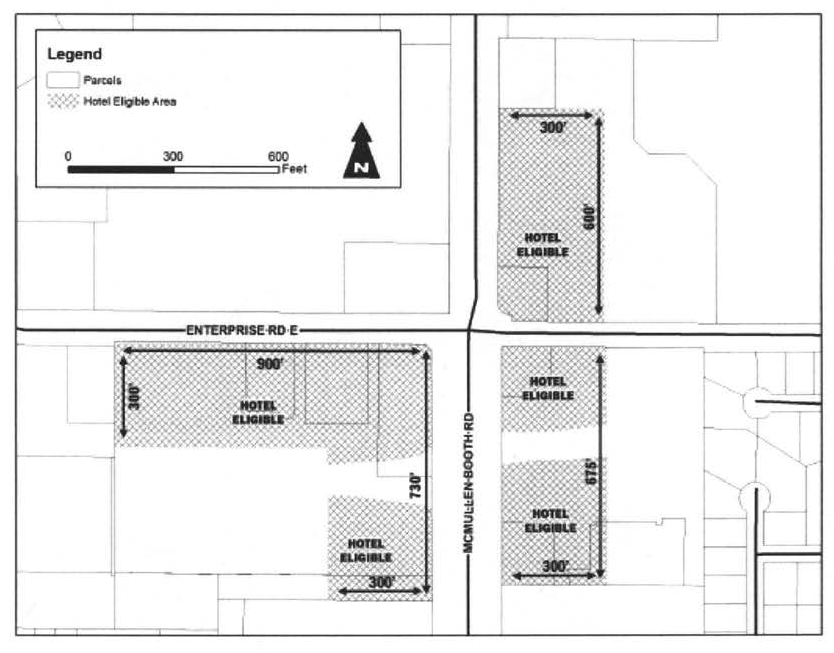
b.
Contain a lobby and front desk, internally oriented and easily accessible to members of the public that is staffed 24 hours a day, seven days a week;
c.
Provide for and maintain a central reservation system or agency for rental of all units; and make such system or agency available for public access at all times; and
(B)
Each hotel room shall:
a.
Contain no less than 300 square feet of gross floor area;
b.
Open to the interior of the building with no exterior entrance;
c.
Not have any exterior balcony facing a residentially zoned property.
(Ord. No. 2014-04, § 3, 5-5-2014; Ord. No. 2019-05, § 8, 9-16-2019)
72.00 - Entertainment.
(A)
Entertainment is permissible as an accessory use for retail uses, brewpubs, microbreweries, micro-distillery, taverns and eating establishments, sit down.
(B)
Entertainment shall not be permissible as an accessory to any other non-residential uses unless approved as a temporary use pursuant to Section 54.00 of this Code or as part of a special event application pursuant to Article IV of the Safety Harbor City Code.
(Ord. No. 2017-03, § 1, 3-6-2017)
73.00 - Medical marijuana treatment centers.
(A)
Medical marijuana treatment center dispensing facilities are prohibited and shall not be located within the boundaries of the City.
(B)
A medical marijuana treatment center cultivating or processing facility may not be located within 500 feet of any public or private elementary school, middle school, or secondary school.
(Ord. No. 2017-37, § 3, 12-18-2017)
74.00 - Cottage food operations.
(A)
A cottage food operation may sell, offer for sale, and accept payment for cottage food products over the internet or by mail order. Such products may be delivered in person to the consumer or to a special venue, or by mail. A cottage food operation may not sell, offer for sale, or deliver cottage food products at wholesale.
(B)
Cottage food operations are subject to the home-based business requirements in Safety Harbor Land Development Code Section 51.00.
(Ord. No. 2022-03, § 7, 4-18-2022)

