
Saint Clair Shores City Zoning Code
ARTICLE XIV
CENTRAL LAKEFRONT DEVELOPMENT DISTRICT1
Editor's note— An ordinance effective Dec. 29, 2010, amended Art. XIV to read as herein set out. Formerly, Art. XIV pertained to the same subject manner and derived from chap. 35, eff. Mar. 7, 1986; as amended by an ordinance effective Aug. 20, 1996.
Sec. 48-399.- Intent.
The intent of this ordinance is to implement the land use direction established in the City's Master Plan and Tax Increment Financing Authority Development Plan, which seeks to create a viable and lively waterfront that is a center of urban redevelopment and economic growth. The CLD is intended to serve the following goals:
(1)
Realize the full economic potential of the lakefront area as a focal point of urban growth based on high intensity, mixed-use, and theme-oriented planning concepts.
(2)
Preserve the recreational functions of the lakefront.
(3)
Promote development that protects and is enhanced by the unique features of the lakefront.
(4)
Promote a harmonious relationship with the surrounding community and nearby established institutions and facilities, including major public works characteristic of the lakefront area.
(5)
Provide for development consistent with the support of the overall concept and theme of the district, both as to uses and design.
(6)
Promote coordination of public and private efforts in the planning, financing, and development of needed infrastructure improvements in concert with evolving private and public uses.
(7)
Provide for orderly and integrated planning, so as to avoid fragmentary, short-term or speculative investments, and avoid delay in achieving the highest and best use of the area.
(8)
Prevent long-term vacancy, decay, blight, and abandonment.
(9)
Provide for an efficient and harmonious relationship between vehicular and pedestrian circulation systems and real estate developments, consistent with the theme of the district.
(Comp. Ords. 1988, § 15.351(35.49.1); ord. eff. Dec. 29, 2010)
Sec. 48-400. - Prior consultation.
All persons considering development of any property located in the district are advised to confer with the Community Development and Inspection Director or designee before investing significant amounts of time, energy, and funds in preparing plans, proposals, or extensive submissions.
(Comp. Ords. 1988, § 15.352(35.49.2); ord. eff. Dec. 29, 2010)
Sec. 48-401. - Principal uses permitted.
Items listed below will be permitted as a principal use in the district:
1.
Multiple unit residential buildings.
2.
Hotels.
3.
Restaurants (provided, however, that drive-in or drive-through facilities shall not be permitted).
4.
Office buildings.
5.
Recreational and entertainment uses, including uses associated with the lakefront, and excluding uses defined as adult entertainment business in section 48-4 of the Zoning Ordinance.
6.
Any generally recognized retail business which supplies commodities on the premises, for persons residing in adjacent residential areas, such as groceries, meats, dairy products, baked goods or other foods, drugs, dry goods and notions, or hardware.
7.
Personal service establishment which performs services, on the premises such as, but not limited to, repair shop (watches, radio, television, shoe, etc.) tailor shops, beauty parlors or barbershops, photographic studios, and self-service laundries.
8.
Dry cleaning establishments, or pick-up stations, dealing directly with consumer; central dry cleaning plants serving more than one retail outlet shall be prohibited.
9.
Business establishments which perform services on the premises, such as, but not limited to, banks, loan companies, insurance offices, and real estate offices.
10.
Professional services, including the following: medical clinics, (outpatient only) and offices of doctors, dentists, osteopaths, and similar or allied professions.
11.
Post office and similar governmental office buildings, servicing persons living in the adjacent residential area.
12.
Child day care centers.
13.
Commercial uses which would, in the judgment of the City Council enhance the theme of, and draw the public to, the special lakefront development contemplated for the district.
14.
Mixed-use commercial, office and residential buildings.
15.
Limited accessory uses in connection with one or more of the above, such as commercial establishments located within and designed to serve hotels or multi-unit residential buildings.
16.
Other uses having the ability in the judgment of the City Council to effectuate the purposes stated in section 48-399.
17.
Uses customarily incidental to the uses enumerated above.
(Comp. Ords. 1988, § 15.353(35.49.3); ord. eff. Dec. 29, 2010)
Sec. 48-402. - Special land uses.
The following uses shall be permitted as special land uses in the CLD District, subject to the standards and requirements set forth herein, and subject to the standards and approval requirements set forth in section 48-561:
(1)
New development in excess of one acre for principal uses permitted in section 48-401.
(2)
New development in excess of two stories for principal uses permitted in section 48-401.
(3)
Drive-through facilities for a bank, credit union or similar financial facility.
(Comp. Ords. 1988, § 15.354(35.49.4); ord. eff. Dec. 29, 2010)
Sec. 48-403. - General requirements.
Any use established in the CLD District shall comply with the standards and requirements set forth in this ordinance and other regulations of the City.
1.
Uses classified as special land use shall provide the following documentation in addition to the site plan review submission requirements of section 48-560:
a.
Topographical analysis.
b.
Soil study.
c.
Views and vistas to and from the lake.
d.
Evidence of compliance with applicable environmental and other lake-related requirements.
2.
Changes in an approved site plan for a principal permitted use may be permitted by the Community Development and Inspection Department, subject to findings that:
a.
Such changes are minor, necessary for building or site maintenance not affecting the original design or involve a re-occupancy of a similar or less intense use.
b.
Such changes will not adversely affect the initial basis for granting approval.
c.
Such changes are the direct result of the owner's (or developer's) reasonable experience obtained during the project's progress.
d.
Such changes will not adversely affect the impact of the project or the overall development of the district in light of the intent and purpose of the district as set forth in section 48-399.
3.
Changes to an approved site plan for a special land use may be permitted by the Community Development and Inspection Department, subject to findings that:
a.
Such change involves re-occupancy of a similar or less intense use.
b.
Such change is necessary and involves building or site maintenance.
4.
Changes to an approved site plan for a special land use may be permitted by the Planning Commission, subject to findings that:
a.
Such changes are minor.
b.
Such changes will not adversely affect the initial basis for granting approval.
c.
Such changes are the direct result of the owner's or developer's reasonable experience obtained during the project's progress.
d.
Such changes will not adversely affect the impact of the project or the overall development of the district in light of the intent and purpose of the district as set forth in section 48-399.
(Comp. Ords. 1988, § 15.355(35.49.5); ord. eff. Dec. 29, 2010)
Sec. 48-404. - Site and building development standards.
Projects shall meet the site and building standards of the following Zoning Ordinance sections:
1.
Section 48-943, Applicability.
2.
Sections 48-948, Building placement standards, 48-949, Retail node, 48-950, Corridor Frontage District, and 48-951, Townhome units for building placement.
3.
Sections 48-952 through 48-955 for parking placement.
4.
Section 48-957, building frontage standards.
5.
Section 48-958, Building height, subsections (2) (Corridor frontage sub-district) and (3) (Townhome units).
6.
Sections 48-959 through 48-966 for architectural standards.
7.
Sections 48-967 through 48-973 for site design standards. An exception is granted for planting within the Jefferson Avenue right-of-way, with the submittal and approval of a landscape plan as part of the building permit application.
(Comp. Ords. 1988, § 15.356(35.49.6); ord. eff. Dec. 29, 2010)
Sec. 48-405. - Architectural design principles and criteria.
The intent of the architectural design principles and criteria is to create a unified visual appearance for the Central Lakefront District and to stimulate an identity for this destination. Long-standing unique and/or architecturally significant structures are encouraged to remain. However, the City goal is to refrain from the eclectic mix of building styles that have become prevalent during the late 20th century.
The design principles listed below provide the development vision and a basis for a site plan decision. Section 35.49.9 [48-407] provides graphic interpretations of the design principles and architectural design criteria.
1.
Diminish building mass to approximate the size of existing buildings.
•
Separate a development into multiple buildings or sub-masses.
•
Vary the facade through the use of wall recesses or projections.
•
Vary the facade using differing wall heights.
•
Vary the roof pitch or parapet line.
•
Use landscape areas to break up large facades.
2.
Support pedestrian use of sidewalks.
•
Transition from high eave edges to lower pedestrian-scale context using awnings, canopies or similar design solution.
•
Provide pedestrian-scaled features inviting activity at the building front using central landscape plazas or sitting areas.
•
Site buildings 60 feet from the centerline of Jefferson Avenue.
•
Define and enhance the street edge.
•
Incorporate smaller tenant spaces in the front of large buildings.
3.
Create a visually appealing environment.
•
Vary the building material using a palette of durable material.
•
Incorporate energy-efficient architecture.
•
Screen warehouse buildings.
•
Reduce the visibility of parking areas through location and landscaping
•
Break up large parking lots.
•
Shield loading and delivery areas.
(Comp. Ords. 1988, § 15.357(35.49.7); ord. eff. Dec. 29, 2010)
Sec. 48-406. - Design interpretation.
The architectural criteria required by this section supports the development vision. The criteria do not encourage the use of appliqué or decoration, but encourage modern design interpretation based on common features.
1.
Facade proportion and rhythm.
a.
Facade design shall be vertically expressed through groupings of windows and doors or through the use of window dividers.
b.
Visually dominant vertical expressions such as turrets are prohibited.
c.
Use of similar window, door, porch, eave and bay proportions should respect those of adjacent buildings.
d.
Duplicating the facade design of adjacent buildings is prohibited.
2.
Rooflines and pitch.
a.
Residential buildings and structures shall have a roof pitch.
b.
The predominant pitch for a gable roof is toward a public street or the larger of two public streets for corner lots.
c.
The use of dormers is not required to meet the minimum roof pitch requirement.
d.
Roofs greater than 2,000 square feet may be flat, provided parapets in the range of two to four feet in height are provided.
e.
Roof materials shall be wood, metal or asphalt shingles in dark gray, brown or natural tones.
f.
Dormers are encouraged as an architectural feature. Such dormers shall be visually subordinate to the main roof.
g.
Porch coverings shall expose a gable to the public street or a primary path for pedestrians.
3.
Building materials.
a.
Ground floors shall be sided in brick, stone or cementations hardboard with a horizontal pattern.
b.
Brick shall be colored in the red-brown range.
c.
Brick shall follow the structural requirements of masonry bearing walls.
d.
Maximum exposure of nonbrick siding shall be six inches.
e.
Corners of nonbrick siding shall be finished with a minimum four-inch corner strip.
f.
Vinyl, aluminum or plywood siding is prohibited.
g.
Wood board and batten siding is permitted for accessory structures.
4.
Windows and doors.
a.
Double-hung, Single-hung or casement windows shall be used. Single panes of glass are permitted for commercial storefronts provided the scale is lessened through the use of dividers.
b.
Spandrels for commercial storefront windows shall be designed as part of the window and not part of the wall.
c.
Windowless or undersized windows on street-side facades are prohibited.
d.
Doors are encouraged to incorporate transoms or sidelights.
(Comp. Ords. 1988, § 15.358(35.49.8); ord. eff. Dec. 29, 2010)
Sec. 48-407. - Illustrative examples of 48-405 design principles and architectural design criteria.
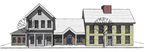
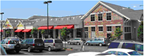
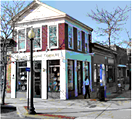
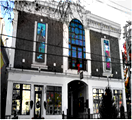
1.
Diminish large building mass through the use of sub-massing, wall recesses and projections, varying wall heights and change in roof pitch direction.
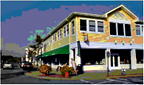
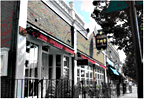
2.
Transition from high eaves edges to lower pedestrian-scale context using awnings, canopies, or similar design solution. Define and enhance the street edge.
3.
Vary the building material using a palette of durable material.
(Comp. Ords. 1988, § 15.359(35.49.9); ord. eff. Dec. 29, 2010)
Sec. 48-408. - Modification of approved plans.
Uses classified as special land use may have the requirements of section 48-405, architectural design criteria modified by recommendation of the Planning Commission and approval of the City Council.
(Comp. Ords. 1988, § 15.360(35.49.10); ord. eff. Dec. 29, 2010)

