
Saint Clair Shores City Zoning Code
ARTICLE XXXII
HARPER AVENUE OVERLAY DISTRICT
(Created by ordinance and adopted August 21, 2006)
Sec. 48-939.- Intent.
The intent of the Harper Avenue Overlay Zoning District is to implement the recommendations of the Harper Avenue Revitalization Plan. The Revitalization Plan is a master redevelopment plan for the Harper Avenue corridor, which was crafted from input from business and property owners, residents, city officials and staff. The objectives of the ordinance are to visually and functionally strengthen the public right-of-way space, create an orderly visual image, and foster a business friendly redevelopment climate.
Regulations established within this ordinance set clear and basic provisions and controls on building form. Broader limits on land usage allow flexibility in determining the proper mix of residences and business types.
The Harper Avenue Overlay Zoning District is established to achieve the following goals:
(1)
Provide for orderly and integrated planning to avoid fragmentary, short-term, or speculative investments.
(2)
Promote development consistent with the plans and programs of the Harper Avenue enhancement efforts.
(3)
Promote development consistent with design guidelines and principles set forth in the Harper Avenue Revitalization Plan.
(4)
Promote coordination of public and private efforts in the planning, financing, and development of infrastructure improvements.
(5)
Reduce and prevent long-term vacancy.
(6)
Reduce and prevent blight, decay and abandonment.
(7)
Provide for safe interaction between vehicular and pedestrian movement systems.
(8)
Protect the residential integrity of adjacent single-family neighborhoods.
(9)
Promote the full economic potential of Harper Avenue.
(10)
Establish clear and predictable standards for development.
(Comp. Ords. 1988, § 15.950; ord. eff. Aug. 21, 2006)
Sec. 48-940. - Regulatory components.
This ordinance sets forth regulations for building placement, building envelope, architectural standards and street and landscape standards. Standards are visually supported through the use of complementary graphics.
Building placement standards regulate the location of buildings and off-street parking areas on a site, as seen in site plan form.
Building envelope standards set the parameters on the three-dimensional building form. These standards provide for building and structure height and the configuration of exterior walls.
Architectural standards establish regulations for the application of fenestration and facade detailing. Standards prescribe the requirements for exterior building walls, roofs, awnings and overhangs, facade colors, lighting, mechanical and electrical equipment and signs.
Streetscape and landscape standards regulate the location and size of street trees and landscaping, quality of plant materials and outdoor dining area regulations.
(Comp. Ords. 1988, § 15.951; ord. eff. Aug. 21, 2006)
Sec. 48-941. - Overlay district boundaries.
The Harper Avenue Overlay Zoning District extends from 8 Mile Road to Kyte Monroe Playfield (north of Masonic Boulevard). The district includes properties fronting Harper Avenue and contiguous properties under same ownership. The boundaries are shown on the map designated as the zoning map on file in the City Planning Department. The district is hereby established and is incorporated in this ordinance by reference and made a part hereof, and the map and all notations, references and other information shown on said map shall be as much a part of this ordinance as if the matters and information set forth were fully contained herein.
(Comp. Ords. 1988, § 15.952; ord. eff. Aug. 21, 2006)
Sec. 48-942. - Sub-districts.
Building sites are coded by their location on the corridor.
(1)
Retail nodes are in proximity of the Nine Mile Road and Thirteen Mile shopping areas.
a)
The Nine Mile Retail Node includes properties fronting Harper Avenue from Broadway Street to Colony Street and properties fronting Nine Mile Road from Elaine Street to Pare Street.
b)
The Thirteen Mile Retail Node includes properties fronting Harper Avenue from Share Street to Hoffman Street.
(2)
The Corridor Frontage Districts encompass the properties abutting the Harper Avenue right-of-way outside the retail nodes.
(3)
Townhome development is permitted in the Retail Node and Corridor Frontage sub-districts, provided that regulations for such use as specified in the Harper Avenue Overlay Zoning District are met (see permitted uses).
(Comp. Ords. 1988, § 15.953; ord. eff. Aug. 21, 2006)
Sec. 48-943. - Applicability.
The requirements of the Harper Avenue Overlay Zoning District are applicable to new construction, changes in building footprint, change in building height, major facade and exterior building renovations, and change or alteration in site design.
Exception: A change in tenant occupancy not requiring building or site construction as described above will require adherence to awning and signage requirements within 30 days of tenancy. Buildings unoccupied for 24 months within a 36-month period shall meet the requirements of the Harper Avenue Overlay Zoning District.
(Comp. Ords. 1988, § 15.954; ord. eff. Aug. 21, 2006)
Sec. 48-944. - Permitted uses.
Land uses permitted as a matter of right, and special requirements thereof, are listed within the applicable underlying zoning classification. An exception is made for development meeting the following standards:
(1)
Townhome units are permitted within one-quarter mile of Nine, Ten, Eleven, Twelve and Thirteen Mile Road.
(2)
Residential units in mixed-use buildings are permitted in upper stories in all sub-districts.
(3)
Residential units shall meet the minimum floor area requirements specified in article XVIII, of the St. Clair Shores Zoning Ordinance.
(4)
The density of all residential units shall be limited by the off-street parking requirements.
(Comp. Ords. 1988, § 15.956; ord. eff. Aug. 21, 2006)
Sec. 48-945. - Accessory structures and uses permitted.
Accessory structures and uses permitted as a matter of right, and special requirements thereof, are listed within the applicable underlying zoning classification.
(Comp. Ords. 1988, § 15.957; ord. eff. Aug. 21, 2006)
Sec. 48-946. - Special land uses.
Special land uses, and special requirements thereof, are listed within the applicable underlying zoning classification.
(Comp. Ords. 1988, § 15.958; ord. eff. Aug. 21, 2006)
Sec. 48-947. - Conflicting regulations.
Where a requirement of the Harper Overlay Zoning District imposes a greater restriction than is required by existing ordinance, rules, regulations, or permits, the provisions of this section shall control, unless otherwise specified.
Requirements of the City of St. Clair Shores Building Code shall supersede the requirements of the Harper Avenue Overlay District.
(Comp. Ords. 1988, § 15.959; ord. eff. Aug. 21, 2006)
Sec. 48-948. - Building placement standards.
A building or structure shall be erected according to the following schedule.
(Comp. Ords. 1988, § 15.960; ord. eff. Aug. 21, 2006)
Sec. 48-949. - Retail Node.
(1)
Building lines.
a)
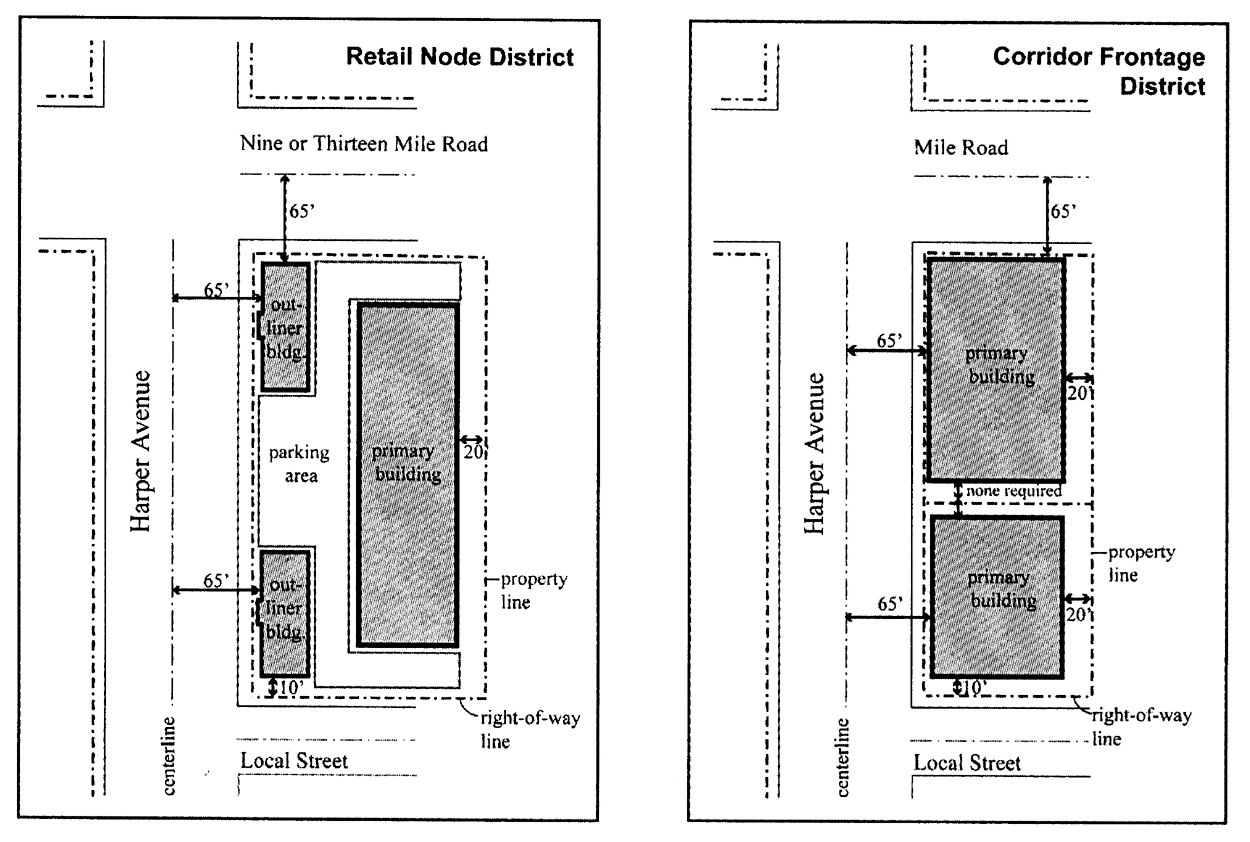
Harper Avenue frontage. A building shall be erected on a line established 65 feet from the Harper Avenue centerline. A front setback from the established building line of a maximum 25 percent of the said building facade is permitted.
b)
Mile Road frontage. A building shall be erected on a line established 65 feet from the subject street centerline. A setback from the established building line of a maximum 25 percent of the said building facade is permitted.
c)
Local street frontage. A building shall be on a line located ten feet from the adjacent right-of-way line.
(2)
Side yard setback. No interior side setback is required, provided that an interior side yard shall be landscaped or used for off-street parking.
(3)
Rear yard setback. A minimum rear yard setback of 20 feet is required for buildings two stories or less in height. A minimum of 40 feet is required for buildings three stories in height.
(4)
Supplemental design standards.
a)
Outliner buildings are permitted provided all standards set forth within the Harper Avenue Overlay Zoning District are met.
b)
Drive-through windows and ordering kiosks shall be located in an interior side yard or rear yard.
(Comp. Ords. 1988, § 15.961; ord. eff. Aug. 21, 2006)
Sec. 48-950. - Corridor Frontage District.
(1)
Building lines.
a)
Harper Avenue frontage. A building shall be erected on a line established 65 feet from the Harper Avenue centerline. A front setback from the established building line of a maximum 25 percent of the said building facade is permitted.
b)
Mile Road frontage. A building shall be erected on a line established 65 feet from the subject street centerline. A front setback from the established building line of a maximum 25 percent of the said building facade is permitted.
c)
Local street frontage. A building shall be on a line located ten feet from the right-of-way line.
(2)
Side yard setback. No interior side setback is required, provided that an interior side yard shall be landscaped or used for off-street parking.
(3)
Rear yard setback. A minimum rear yard setback of 20 feet is required.
(4)
Supplemental design standard. Drive-through windows and ordering kiosks shall be located in an interior side yard or rear yard.
(Comp. Ords. 1988, § 15.962; ord. eff. Aug. 21, 2006)
Sec. 48-951. - Townhome units.
(1)
Building lines.
a)
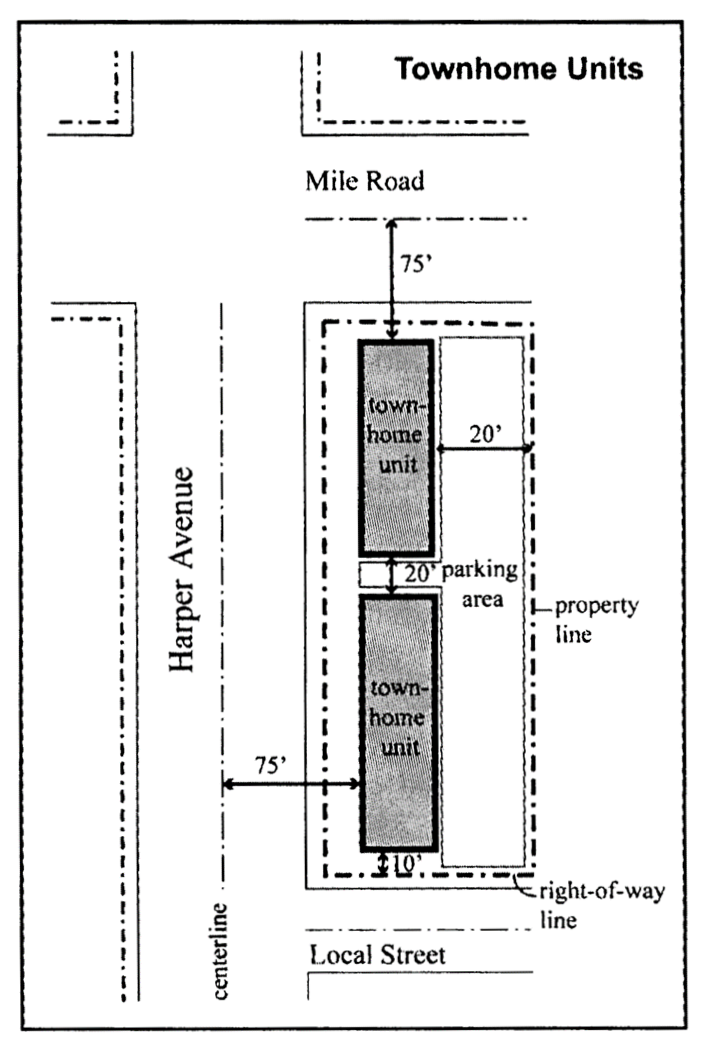
Harper Avenue frontage. Buildings shall be erected on a line established 75 feet from the Harper Avenue centerline. A maximum 25 percent of such building line may be deviated from.
b)
Mile Road frontage. Buildings shall be erected on a line established 75 feet from the subject street centerline. A maximum 25 percent of such building line may be deviated from.
c)
Local street frontage. Buildings shall be on a line located ten feet from the right-of-way line.
(2)
Side yard setback. A minimum interior side yard setback of ten feet is required.
(3)
Building separation. A minimum separation of 20 feet between townhome buildings is required.
(4)
Rear yard setback. A minimum rear yard setback of 20 feet for primary buildings is required.
(5)
Supplemental design standards.
a)
No more than eight dwelling units shall be attached in any single structure.
b)
Each dwelling unit shall have a front and rear/side yard ingress and egress.
c)
The front yard shall contain porches or stoops, bay windows, stair projections, landscaping and front walks.
d)
Each dwelling unit shall have a usable front porch fronting a public street.
e)
Interior side yards shall be landscaped or used for off-street parking.
f)
Properties shall be delineated by a decorative fence or architectural hedge. A decorative fence shall not exceed 36 inches in height.
g)
Each unit shall be connected to the public sidewalk system.
(Comp. Ords. 1988, § 15.963; ord. eff. Aug. 21, 2006)
Sec. 48-952. - Parking placement standards.
There shall be provided, at the time of erection or enlargement of any main building or structure, vehicle off-street parking space with adequate access to all spaces in conjunction with all land and building uses. Such off-street parking space shall be provided prior to issuance of a certificate of occupancy as hereinafter prescribed.
(Comp. Ords. 1988, § 15.964; ord. eff. Aug. 21, 2006)
Sec. 48-953. - Nonresidential uses.
(1)
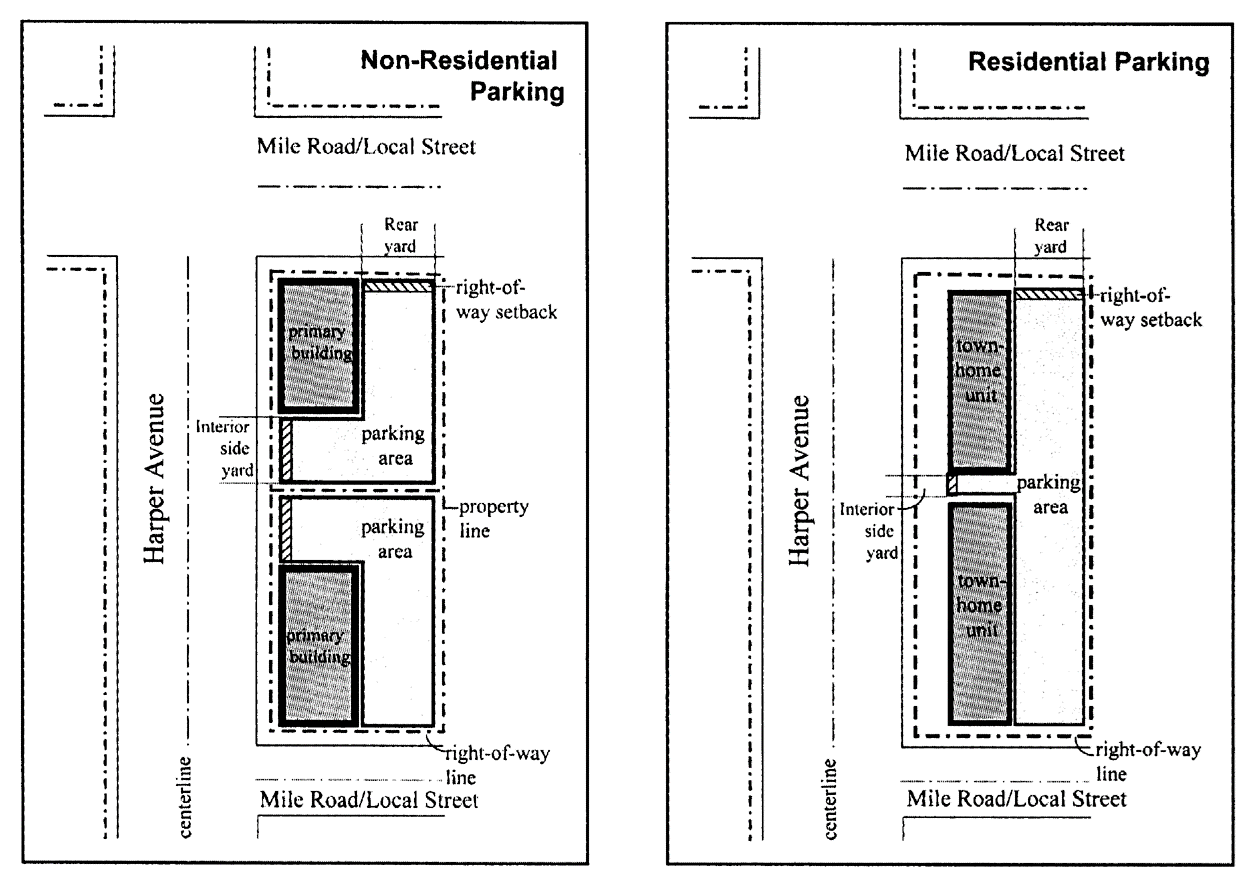
Location. Parking lots shall be placed in rear and/or interior side yards.
(2)
Right-of-way setback. Parking spaces shall not be located within five feet of a right-of-way line.
(3)
Rear yard setback. Rear yard setbacks are not required provided that dimensional requirements for screen walls are accommodated.
(4)
Supplemental design standards.
a)
New drives shall not be sited directly adjacent to an existing driveway.
b)
New drives shall be sited minimally 60 feet from an intersection. The approving body has the authority to modify this requirement if limited corridor frontage does not permit attainment of the dimension.
c)
New drives shall be aligned directly across a street from an existing drive or offset by a minimum of 125 feet. The approving body has the authority to modify this requirement if limited corridor frontage does not permit attainment of the dimension.
d)
A change in materials, textures or use of colored stripes shall be provided where interior pedestrian circulation crosses vehicular routes.
e)
A concrete continuous curb or sidewalk shall be installed a minimum two feet from the outside perimeter of all parking lots unless adjacent to a screen wall.
f)
Any area not required for parking shall be landscaped.
g)
Vehicle washing facilities. A minimum stacking lane of 200 feet is required for buildings with wash lanes of 80 feet in length or less. An additional 20 feet of stacking lane is required for each ten feet of washline greater than 80 feet in length.
(Comp. Ords. 1988, § 15.965; ord. eff. Aug. 21, 2006)
Sec. 48-954. - Townhome units.
(1)
Location. Parking lots shall be placed in rear and interior side yards.
(2)
Right-of-way setback. Parking spaces shall not be located within five feet of a right-of-way line.
(3)
Rear yard setback. Rear yard setbacks are not required provided that dimensional requirements for screen walls are accommodated.
(4)
Supplemental design standards.
a)
All parking and maneuvering lanes shall be at least 15 feet from any first floor dwelling unit window, doorway, or entryway.
b)
Drives shall be provided directly onto public roadways. A maximum of one drive is permitted from Harper Avenue.
c)
A townhome development shall provide enclosed and attached parking for two vehicles per dwelling unit.
d)
No accessory structure or use shall be permitted.
e)
See sections 48-955, off-street parking schedule, and 48-968, streetscape and landscape standards, for design criteria.
(Comp. Ords. 1988, § 15.966; ord. eff. Aug. 21, 2006)
Sec. 48-955. - Off-street parking schedule.
Unless specified in the parking schedule of this ordinance, the number of off-street parking spaces shall meet the requirements of section 48-551, off-street parking requirements, as adopted in the City of St. Clair Shores Zoning Ordinance.
(Comp. Ords. 1988, § 15.967; ord. eff. Aug. 21, 2006)
Sec. 48-956. - Building envelope standards.
The placement of buildings and prominent architectural features such as entrances, sign bands, balconies, and street walls as prescribed in this section shall be met.
(Comp. Ords. 1988, § 15.968; ord. eff. Aug. 21, 2006)
Sec. 48-957. - Building frontage standards.
The construction of a nonresidential use shall meet the following standards for a building fronting a public street:
(1)
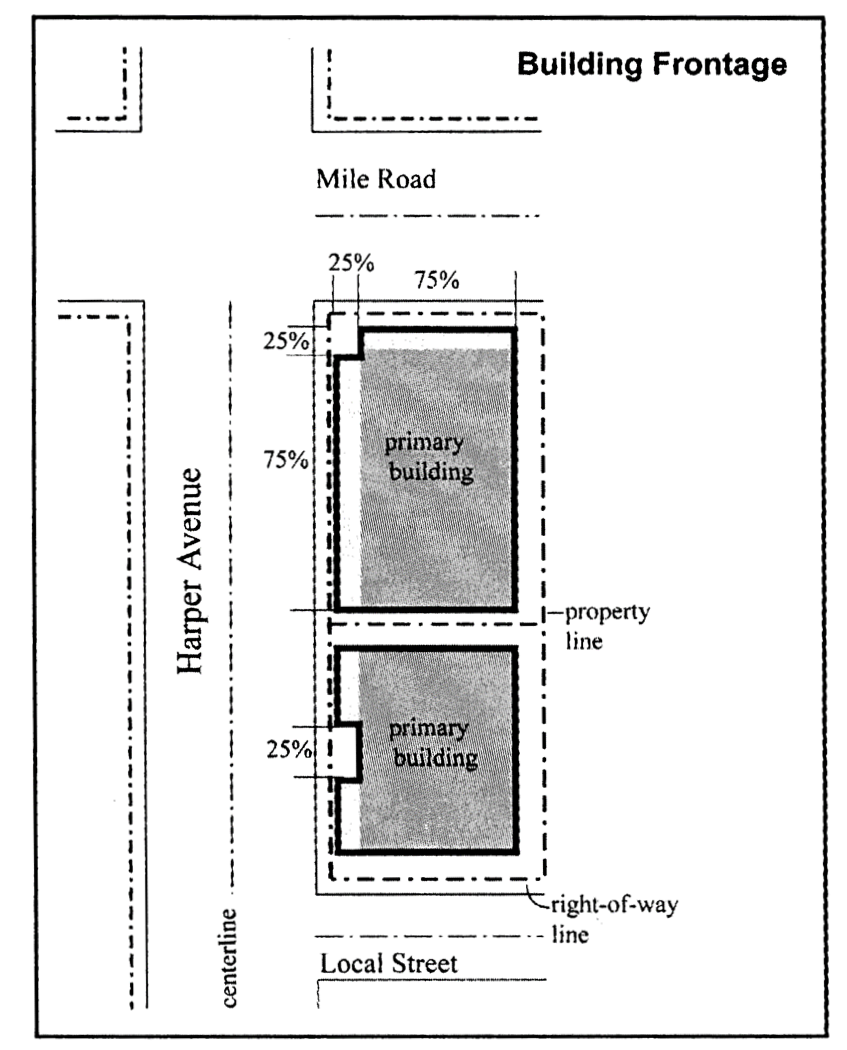
A minimum length of 75 percent of a building facade fronting a public street shall be located on the established building line (see section 48-948, building placement standards).
(2)
A minimum length of 75 percent of a building facade fronting a public street shall be placed parallel to the adjacent street right-of-way line.
(Comp. Ords. 1988, § 15.969; ord. eff. Aug. 21, 2006)
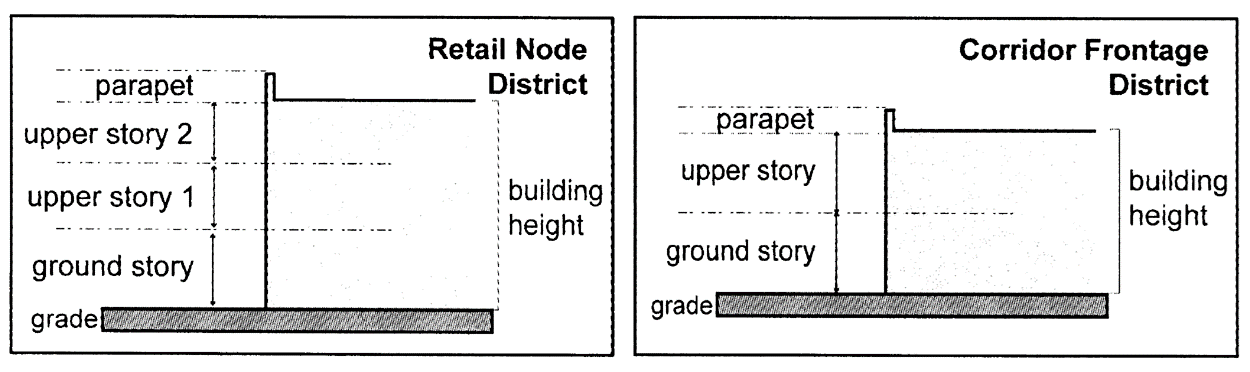
Sec. 48-958. - Building height.
Buildings and structures shall be erected according to the following height dimensions. Heights are prescribed in one of three methods: minimum height, maximum height, or within a range of dimensions. Dimensions shall be measured from the average grade at the front building foundation.
(1)
Retail Node Sub-District.
a)
No building shall exceed three stories in height.
b)
A building with a flat roof configuration shall be erected to a maximum height within the following dimensional range:
1.
One-story building: 16 feet to 20 feet.
2.
Two-story building: 25 feet to 30 feet.
3.
Three-story building: 35 feet to 44 feet.
c)
A building with a pitched roof configuration shall be erected to a maximum height within the following dimensional range:
1.
One-story building: 30 feet to 35 feet.
2.
Two-story building: 50 feet to 60 feet.
3.
Three-story building: not permitted.
d)
Supplemental design standards. A building shall meet the following dimensional requirements:
1.
A ground story shall be a minimum of ten feet in height from finished floor to finished ceiling.
2.
An upper story shall be a minimum of eight feet from finished floor to finished ceiling.
3.
A parapet shall be between two and four feet in height as measured from the roof surface.
(2)
Corridor Frontage Sub-District.
a)
No building shall exceed two stories in height.
b)
A building with a flat roof configuration shall be erected to a maximum height within the following dimensional range:
1.
One-story: 16 feet to 20 feet.
2.
Two-story: 25 feet to 30 feet.
c)
A building with a pitched roof configuration shall be erected to a maximum height within the following dimensional range:
1.
One-story: 30 feet to 35 feet.
2.
Two-story: 50 feet to 60 feet.
d)
Supplemental design standards. A building shall meet the following dimensional requirements:
1.
A ground story shall be a minimum of ten feet in height from finished floor to finished ceiling.
2.
An upper story shall be a minimum of eight feet from finished floor to finished ceiling.
3.
A parapet shall be between two and four feet in height as measured from the roof surface.
(3)
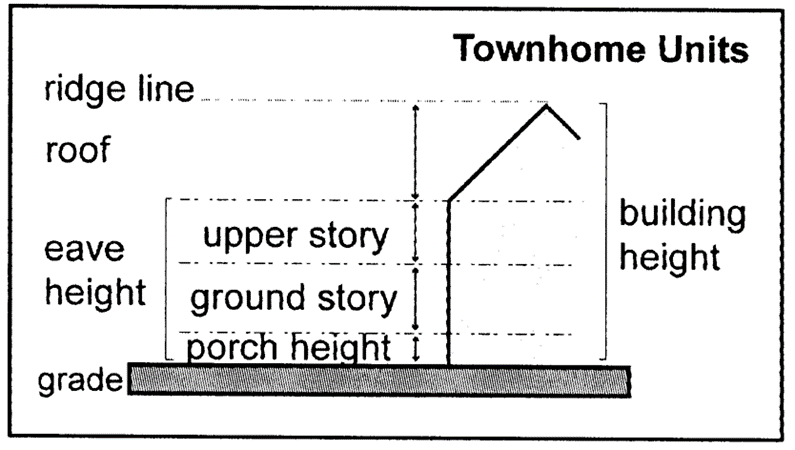
Townhome units.
a)
A building shall be two stories in height.
b)
A building with a flat roof configuration shall be erected at two stories in height and within a height range of 25 to 30 feet.
c)
A building with a pitched roof configuration shall be erected to a maximum height within the following dimensional range:
1.
Building height: 32 feet to 36 feet.
2.
Eave height: Maximum eave height, 20 feet (from grade level to eave line).
d)
Supplemental design standards. A building shall meet the following dimensional requirements:
1.
No more than eight townhome dwelling units shall be attached in any construction group or contained in any single structure.
2.
A parapet shall be between two and four feet in height as measured from the roof surface.
3.
Porches for owner-occupied townhomes shall be raised to a minimum one foot above sidewalk level.
(Comp. Ords. 1988, § 15.970; ord. eff. Aug. 21, 2006)
Sec. 48-959. - Architectural standards.
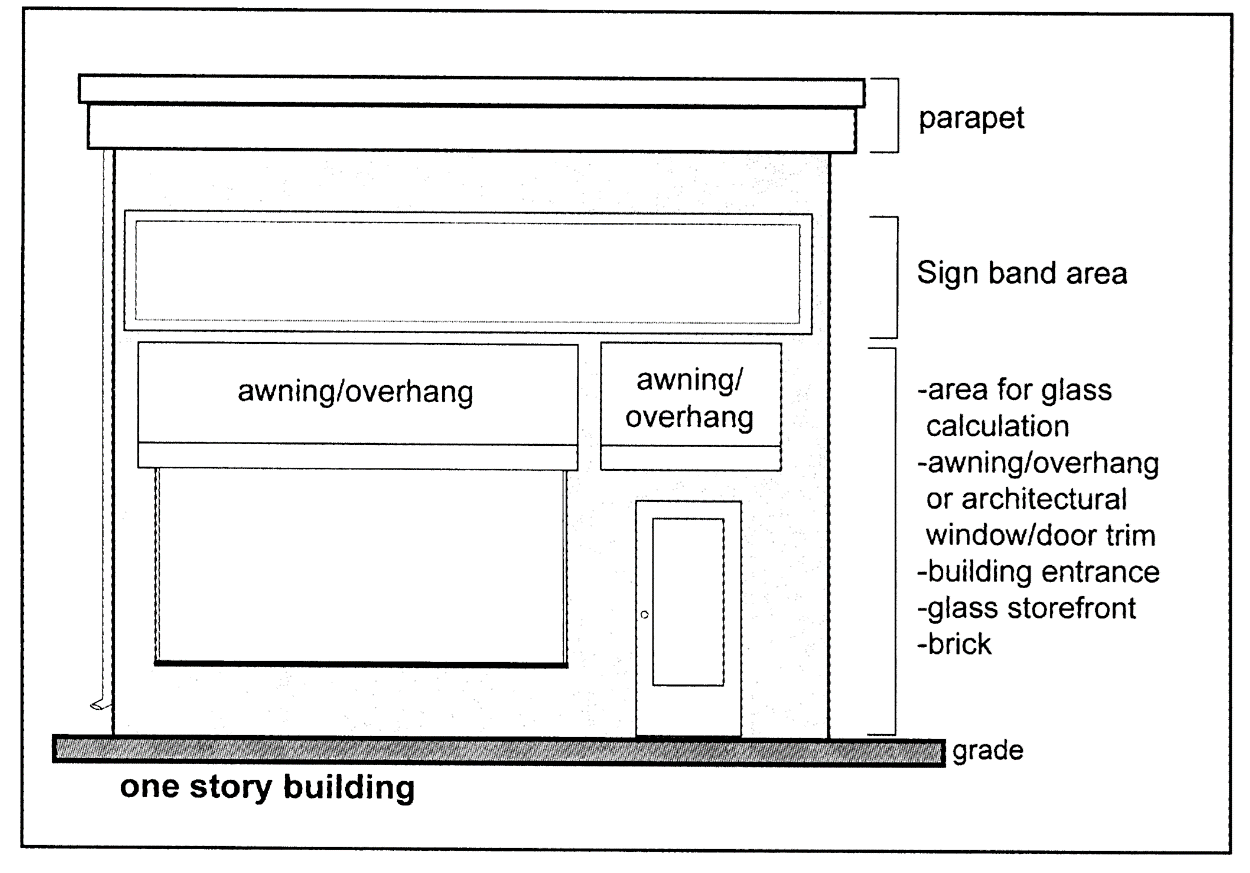
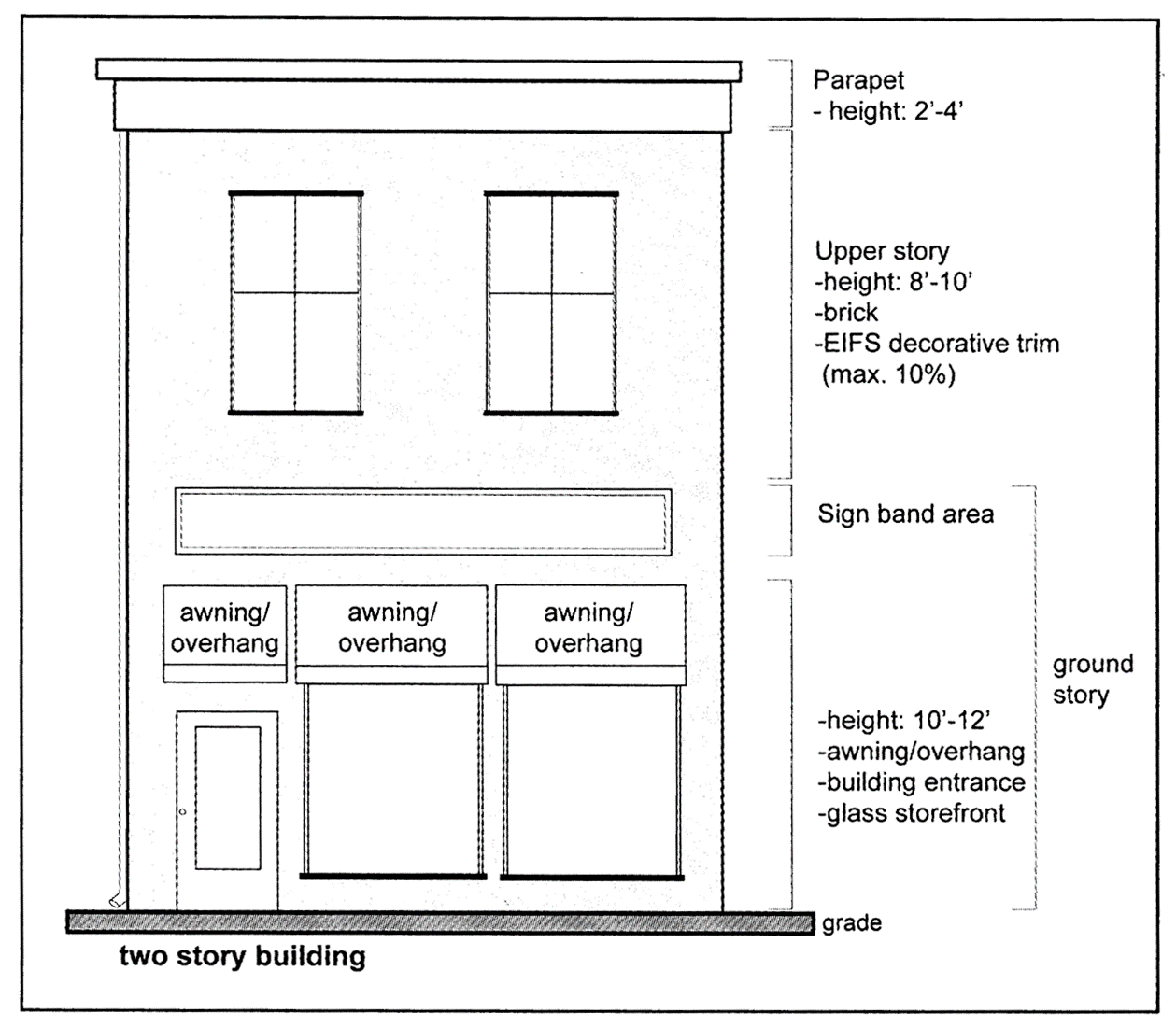
Architectural design standards for building walls, roofs, awnings and overhangs, facade colors, lighting, mechanical and electrical equipment and signage are prescribed in this section.
(Comp. Ords. 1988, § 15.971; ord. eff. Aug. 21, 2006)
Sec. 48-960. - Building walls.
Building walls facing a public street shall be constructed according to the following standards:
(1)
Exterior wall material shall consist of brick (full-dimensioned) including tilt-up systems, structural brick, or other full dimensional brick product, but not including thin brick or tile brick, fiber cement panels systems, pre-finished metal, stone, or glass or other durable, weatherproof, commercial grade exterior finish material with a minimum 30 year manufacturer's warranty as reviewed and recommended by the Planning Commission and reviewed and approved by City Council. (amended 4/15/2019)
(a)
Reflective or mirror glass that does not create glare may be permitted on a case by case basis as reviewed and recommended by the Planning Commission and reviewed and approved by City Council. (amended 4/15/2019)
(b)
The use of secondary accent materials placed a minimum of eight feet above grade including fiber cement siding, corrugated metal panels, exterior insulation and finish systems or other durable, weatherproof, commercial grade finish material with a 30 year manufacturer's warranty shall be permitted as decorative trim on upper stories or parapets and shall not exceed 30 percent of the facade ten percent of upper story or parapet material. (amended 4/15/2019)
(c)
Decorative concrete masonry units are permitted as accent material.
(d)
Concrete block is permitted on the rear facade of an addition to an existing building that currently has a concrete block rear facade. (amended 4/15/2019)
(2)
Exterior windows and doors shall be installed in accordance with the following standards:
(a)
Window frames shall be constructed of aluminum, wood, clad wood, vinyl or steel.
(b)
Exterior exposed steel, or similar material, security measures is not permitted.
(c)
Ground floor windows shall cover between 33 percent and 90 percent of the ground floor wall area.
(d)
Upper story window coverage shall exceed 20 percent of the upper story wall area.
(e)
Primary commercial/office doors shall contain at least 50 percent glass.
(f)
Door glass shall count as part of overall ground floor glass area.
(g)
Window glass shall be clear or tinted to a maximum of 20 percent, but still retain its translucence. (amended 4/15/2019)
(h)
The height of windowsills shall be constructed between 18 inches to 36 inches above the average grade as measured at the front building foundation.
(3)
Walls shall meet the following design standards for configuration:
(a)
The planes of the exterior walls may be varied in height, depth or direction.
(b)
Facades greater than 60 feet in length shall be visually delineated by an entrance, decorative trim, architectural feature or an offset.
(Comp. Ords. 1988, § 15.972; ord. eff. Aug. 21, 2006; Ord. of 4-15-2019(2))
Sec. 48-961. - Roofs.
A building or structure is permitted to have a flat or pitched roof configuration, provided the construction meets the following design standards:
(1)
Flat roofs.
(a)
A parapet height of two feet to four feet, as measured from the roof surface, shall be established.
(b)
A parapet shall be capped by stone, pre-cast concrete or similar durable metal.
(c)
A parapet can be stepped or sloped.
(2)
Pitched roofs.
(a)
A pitched roof is permitted to have a gable or hip roof configuration not exceeding a 6:12 angle.
(b)
Clay, tile (barrel or flat Roman), slate (equivalent synthetic or better), metal and dimensioned asphalt shingles are permitted materials.
(Comp. Ords. 1988, § 15.973; ord. eff. Aug. 21, 2006)
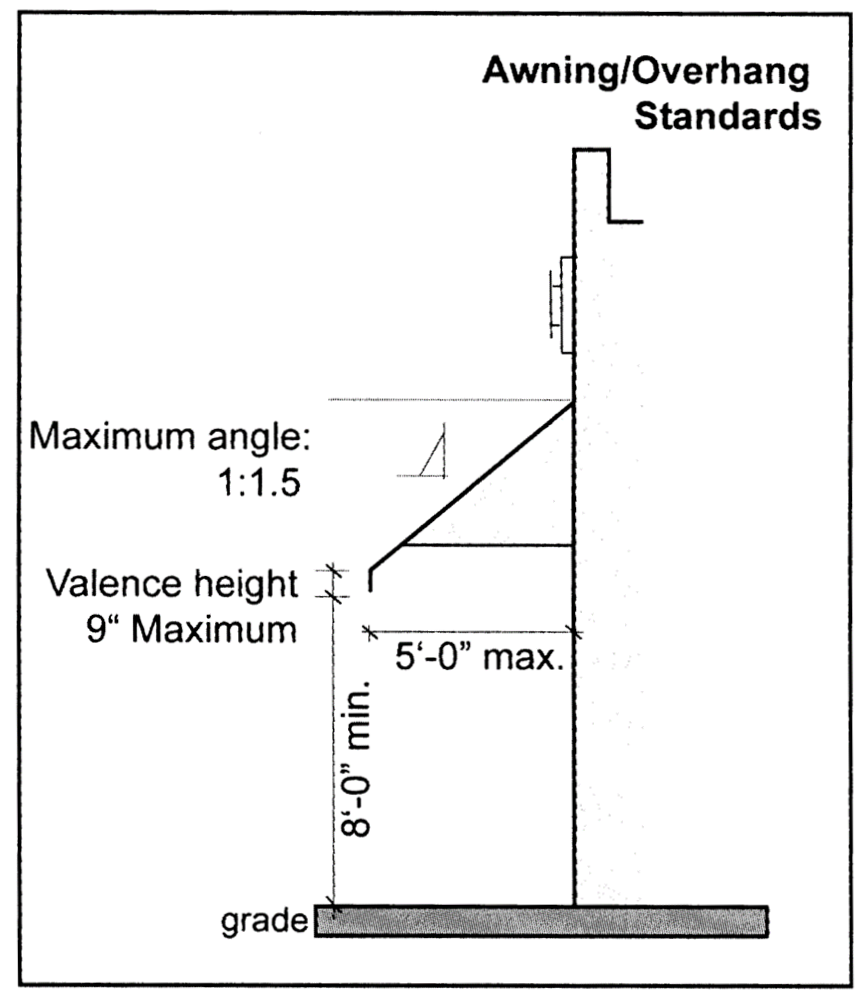
Sec. 48-962. - Awnings/overhangs.
A building or structure shall incorporate awnings or overhangs or architectural window and door trim into a facade design.
(1)
An awning or overhang shall extend from a first story window or entry except where architectural detailing is used. One awning that covers an entire facade is not permitted.
(2)
A maximum depth of five feet shall be observed. An awning or overhang cannot extend beyond the right-of-way line.
(3)
The minimum height to the lowest point of any awning or overhang feature is eight feet above grade.
(4)
Awnings/overhangs may be angled, but such angle shall be no steeper than 1:1.5 horizontal to vertical ratio.
(5)
A valence may not exceed nine inches in height.
(6)
Awnings shall not be used for primary signage, except in valence area.
(7)
Permitted materials include fabric, metal or similar nonplasticized material.
(8)
Backlit awnings are not permitted.
(Comp. Ords. 1988, § 15.974; ord. eff. Aug. 21, 2006)
Sec. 48-963. - Facade colors.
A building or structure shall meet the following standards for facade colors:
(1)
A single building may exhibit a maximum of three colors (one or two body colors and one or two trim colors). For the purpose of the Harper Avenue Overlay Zoning District, the following descriptions shall apply:
Body color. A body color is used on a building wall, freestanding wall, and other primary building elements excluding brick facades.
Trim color. A trim color is used on doors, door frames, window, window frames, storefront frames, handrails, shutters, ornament, fences, and similar features.
(2)
Exposed concrete masonry unit walls shall be painted to match the front facade unless authorized by the approving body.
(3)
Brick or stone walls shall not be painted on new construction.
(4)
All vents, gutters, downspouts, flashing, electrical conduits, etc., shall match or accent the color of the primary building surface.
(Comp. Ords. 1988, § 15.975; ord. eff. Aug. 21, 2006)
Sec. 48-964. - Lighting.
Standards of section 48-967 of the St. Clair Shores Zoning Ordinance shall apply.
(Comp. Ords. 1988, § 15.976; ord. eff. Aug. 21, 2006)
Sec. 48-965. - Mechanical and electrical equipment.
Standards of section 48-967 of the St. Clair Shores Zoning Ordinance shall apply.
(Comp. Ords. 1988, § 15.977; ord. eff. Aug. 21, 2006)
Sec. 48-966. - Signs.
Signs, other than street addresses, shall be mounted in a sign band located between:
(1)
The window lintel or upper edge of an awning of a ground floor and the lowest edge of a parapet for a one-story building; or
(2)
The window lintel or upper edge of an awning of a ground floor and windowsill of a second floor of a multiple-story building (see facade graphics in section 48-960, building walls).
Other standards of the St. Clair Shores Sign Ordinance [chapter 30] shall apply.
(Comp. Ords. 1988, § 15.978; ord. eff. Aug. 21, 2006)
Sec. 48-967. - Site design standards.
Parameters for tree planting, ground cover and screening features are established to shape public space, create subtle delineation between public and private space, soften the hard architectural features, appropriately transition to adjacent neighborhoods and promote the health and success of plant materials.
(Comp. Ords. 1988, § 15.979; ord. eff. Aug. 21, 2006)
Sec. 48-968. - Streetscape and landscape standards.
Standards for plant location, plant materials and installation shall be followed according to the following standards:
(1)
Trees installed within the public right-of-way.
(a)
Street trees shall be located between the public sidewalk and street.
(b)
Street tree spacing shall be at intervals of 30 feet. Adjustments to this spacing can be made to accommodate curb cuts, fire hydrants and other infrastructure elements.
(c)
Street trees shall have a minimum caliper size of three inches.
(d)
Street trees shall be of a large deciduous species as permitted in section 48-554 of the Zoning Ordinance.
(2)
Plant materials installed outside of the public right-of-way.
(a)
Trees, shrubs and plants may be used as building foundation and site entry accents.
(b)
Flowering and understory trees shall have a minimum caliper of two inches or a minimum height of eight feet if multi-stemmed.
(c)
Shrubs can be deciduous or evergreen but shall have a minimum spread of 24 inches.
(d)
Shrubs, perennials and groundcover shall be grouped to result in a mature massed planting effect.
(3)
Installation.
(a)
Tree, shrub and plant material shall comply with federal, state and county laws requiring inspection for plant disease and insect control, the American Standards for Nursery Stock, shall be nursery grown and shall be compatible in a Zone 4 climate as set forth by United States Department of Agriculture.
(b)
Tree pits shall utilize structural soil blends providing superior drainage, aeration and reduced compaction.
(Comp. Ords. 1988, § 15.980; ord. eff. Aug. 21, 2006)
Sec. 48-969. - Site design standards for off-street parking.
The following design standards for off-street parking areas shall be met:
(1)
Off-street parking areas shall be screened in one of the following manners when the measurement of the parking area adjacent to the right-of-way is greater than 40 contiguous feet in any section:
a.
A brick wall with stone or precast cap shall be placed along the right-of-way line of off-street parking areas except in the location of access drives or walks; or
b.
Dense landscaping installed and maintained between 30 inches and 36 inches, providing sufficient yearlong screening, while not infringing onto the public sidewalk, and adhering to the requirements of the Macomb County Department of Roads and as approved by the Community Development and Inspection Department; or
c.
A combination of landscaping and brick kneewall as approved by the Community Development and Inspection Department; or
d.
The use of wrought iron or aesthetic equivalent fencing between stone or brick columns; or
e.
If the width of the area between the public sidewalk and the off-street parking area is greater than four feet and the parking area has a concrete curb, then no screening is required; however, a grass or landscaped greenbelt shall be maintained;
f.
The height of landscaping, fences, and walls shall be between 30 and 36 inches in height measured from the grade of the adjacent sidewalk.
In cases where a parking area is across from a residentially zoned property and the parking spaces are perpendicular to the right-of-way line, a brick kneewall with stone or precast cap shall be placed along the right-of-way line of the off-street parking area where perpendicular parking spaces are located regardless of contiguous length of the parking area.
(2)
Trees shall be a minimum of a 2½-inch caliper and shall be pruned and maintained to prevent directional and informational signage from being blocked from view from the public street where feasible and appropriate.
(3)
Trees shall be of a species as permitted in section 48-554 of the Zoning Ordinance.
(4)
Trees shall be located in areas enclosed with six-inch tall concrete curbing.
(5)
Shrubs, perennials and ground cover shall be maintained below three feet, except when utilized pursuant to (1)b.
(6)
Automobile service stations, vehicular washes and other land uses exhibiting large open paved areas shall follow the site design standards of this section.
(Comp. Ords. 1988, § 15.981; ord. eff. Aug. 21, 2006; amended by ord. eff. June 13, 2018)
Sec. 48-970. - Screening.
Standards of section 48-554 of the St. Clair Shores Zoning Ordinance shall apply.
(Comp. Ords. 1988, § 15.982; ord. eff. Aug. 21, 2006)
Sec. 48-971. - Outdoor dining areas.
Outdoor dining areas are permitted but shall meet the following design standards:
(1)
An outdoor dining area shall abut the Harper Avenue or Mile Road right-of-way.
(2)
An outdoor dining area shall be spaced a minimum 60 feet from residentially used property.
(3)
A wall shall visually screen an outdoor dining area from adjacent residences except where Harper Avenue or a Mile Road provides physical separation.
(4)
Screen walls shall be constructed of brick or decorative iron.
(5)
A wall or fence shall have a minimum height of four feet.
(6)
Furniture shall be constructed of wood, metal or material of comparable quality.
(7)
Umbrellas and furniture shall not visually or physically impede the safe movement of pedestrians and vehicles.
(Comp. Ords. 1988, § 15.983; ord. eff. Aug. 21, 2006)
Sec. 48-972. - Irrigation.
Standards of section 48-967 of the St. Clair Shores Zoning Ordinance shall apply.
(Comp. Ords. 1988, § 15.984; ord. eff. Aug. 21, 2006)
Sec. 48-973. - Utilities.
Standards of section 48-967 of the St. Clair Shores Zoning Ordinance shall apply.
(Comp. Ords. 1988, § 15.985; ord. eff. Aug. 21, 2006)
Sec. 48-974. - Site plan review procedures.
Applicants are required to meet with the City Planner or designated staff prior to submitting a formal site plan review application. Subsequent to meeting with the City Planner or designated staff, the applicant shall follow the site plan review procedures of the City.
(Comp. Ords. 1988, § 15.986; ord. eff. Aug. 21, 2006)

