
Saint Clair Shores City Zoning Code
ARTICLE II
CONSTRUCTION OF LANGUAGE AND DEFINITIONS
Sec. 48-3.- Construction of language.
The following rules of construction apply to the text of this ordinance:
(1)
The particular shall control the general.
(2)
In case of any difference in meaning or implication between the text of this ordinance and any caption or illustration, the text shall control.
(3)
The word "shall" is always mandatory and not discretionary. The word "may" is permissive.
(4)
Words used in the present tense shall include the future; and words used in the singular number shall include the plural, and the plural the singular, unless the context clearly indicates the contrary.
(5)
A "building" or structure includes any part thereof.
(6)
The phrase "used for" includes "arranged for," "designed for," "intended for," "maintained for."
(7)
The word "person" includes an individual, a corporation, a partnership, an incorporated association, or any other similar entity.
(8)
Unless the context clearly indicates the contrary, where a regulation involves two or more items, conditions, provisions, or events connected by the conjunction "and," "or," "either … or," the conjunction shall be interpreted as follows:
(a)
"And" indicates that all the connected items, conditions, provisions, or events shall apply.
(b)
"Or" indicates that the connected items, conditions, provisions, or events may apply singly or in any combination.
(c)
"Either … or" indicates that the connected items, conditions, provisions, or events shall apply singly but not in combination.
(9)
Terms not herein defined shall have the meaning customarily assigned to them.
(Comp. Ords. 1988, § 15.021(35.2); chap. 35 eff. March 7, 1986; amended by ord. eff. Aug. 20, 1996)
Sec. 48-4. - Definitions.
Whenever used in this ordinance the following words and phrases shall have the meaning ascribed to them:
(1)
Accessory building/structure. A building or structure which is clearly incidental to, customarily found in connection with, and located on the same zoning lot or site (groups of lots used together) as the principal structure to which it is related. An accessory building/structure includes, but is not limited to the following:
(a)
Any detached building/structure or any building/structure which does not share a common footing wall with the main structure on the premises.
(b)
Any structure attached to the main building on the premises via a roof overhang, breezeway, porch, or other similar form of attachment.
(c)
Barns, sheds and similar structures.
(d)
[Repealed effective June 8, 2001.]
(2)
Accessory use. A use which is clearly incidental to, customarily found in connection with, and (except in the case of accessory off-street parking spaces or loading), located on the same zoning lot or site (groups of lots used together) as the principal use to which it is related. An accessory use includes, but is not limited to, the following:
(a)
Swimming pools for the use of the occupants of residence, or other guests.
(b)
A newsstand primarily for the convenience of the occupants of a building, which is located wholly within such building and has no exterior signs or displays.
(c)
Storage of merchandise normally carried in stock in connection with a business or industrial use, unless such storage is excluded in the applicable district regulations.
(d)
Storage of goods used in or produced by industrial uses or related activities, unless such storage is excluded in the applicable district regulations.
(e)
Accessory off-street parking spaces, open or enclosed, subject to the accessory parking regulations for the district in which the zoning lot is located.
(f)
Accessory off-street loading, subject to the off-street loading regulations for the district in which the zoning lot is located
(g)
Accessory signs, subject to the sign regulations for the district in which the zoning lot is located.
(3)
Adult entertainment business. A business whose principal service or activity is one of the following types of businesses: adult live conduct business, adult bookstore, adult motion picture theater, adult mini-motion picture theater, or adult personal service business.
(a)
Adult amusement device center. An enclosed building containing coin-operated amusement devices or machines for presenting material for observation by patrons therein, distinguished or characterized by an emphasis on matter depicting, describing, or relating to "specified sexual activities" or "specified anatomical areas," as defined below.
(b)
Adult live conduct business. A business, any part of whose service or function consists of adult live conduct activity (as defined below), whether as work assignment or entertainment.
(c)
Adult bookstore. A business having as its principal activity the sale of books, magazines, newspapers, and motion picture films which are characterized by their emphasis on portrayals of human genitals and pubic regions or acts of human masturbation, sexual intercourse or sodomy.
(d)
Adult motion picture theater. An enclosed building with a capacity of 50 or more persons used for presenting material, for observation by patrons therein, distinguished or characterized by an emphasis on matter depicted, described, or relating to "specified sexual activities" or "specified anatomical areas," as defined below.
(e)
Adult mini-motion picture theater. An enclosed building with a capacity for less than 50 persons used for presenting material for observation by patrons therein, distinguished or characterized by an emphasis on matter depicting, describing, or relating to "specified sexual activities" or "specified anatomical areas," as defined below.
(f)
Adult personal service business. A business whose activities include a person providing any of the following services for another person or includes any of the following activities: massage (except as an accessory use in establishments with a principle use under state licensed supervision, including, by way of example, chiropractic, medical, physical rehabilitation, and cosmetology-oriented facilities); nude dancing or modeling; tattooing, body piercing, body painting involving specified anatomical areas as defined in this ordinance; nude theatrical performances, any activity undertaken by a person while nude with the intention of being observed by a third party.
(g)
Adult live conduct activity. Any work or entertainment activity carried on in a business where the physical human body is nude, as defined below.
(h)
Nude. Having less than completely and/or opaquely covered human genitals, pubic region, buttock, or female breast below a point immediately above the top of the areola.
(i)
Sexual activities and anatomical areas.
For the purposes of this section, "specified sexual activities" shall include:
•
Human genitals in a state of sexual stimulation or arousal.
•
Acts of human masturbation, sexual intercourse, or sodomy.
•
Fondling or other erotic touching of human genitals, pubic region, buttock, or female breast.
For the purposes of this section, "specified anatomical areas" is defined as:
•
Less than complete and opaquely covered human genitals, pubic region, buttock, or female breast below a point immediately above the top of the areola.
•
Human male genitals in a discernibly turgid state, even if completely and opaquely covered.
(4)
Alley. Any dedicated public way affording a secondary means of access to abutting property, and not intended for general traffic circulation.
(5)
Alterations. Any change, addition, or modification in construction or type of occupancy, any change in the structural members of a building, such as walls or partitions, columns, beams or girders, the consummated act of which may be referred to herein as "altered" or "reconstructed."
(6)
Apartment. A suite of rooms or a room in a multiple-family building arranged and intended for a place of residence of a single family or a group of individuals living together as a single housekeeping unit.
(7)
Auto gas/convenience market. A place where gasoline is retailed directly to the public in combination with a convenience store which retails minor auto accessories, perishable and nonperishable food items, and other goods.
(8)
Auto repair center. A place for the light repair and service of automotive vehicles, but not including steam cleaning or undercoating, vehicle body repair, painting, tire recapping, engine rebuilding, auto dismantling, upholstery, auto glass work, and other such activities whose external effects would adversely extend beyond the property line.
(9)
Auto repair station. A place where, along with or without the sale of engine fuels, the following services may be carried out: general repair, engine rebuilding, rebuilding or reconditioning of motor vehicles; collision service, such as body, frame, or fender straightening and repair; overall painting and undercoating of automobiles.
(10)
Auto service station. A place where automobile fluids and lubricants are added or replaced and minor repairs such as tune-ups, tire repairs, and similar functions may be typically performed within the same day.
(11)
Basement. That portion of a building between floor and ceiling, which is partly below and partly above ground level, but so located that the vertical distance from the average grade to the floor below is greater than the vertical distance from the average grade to the ceiling.
(12)
Block. The property abutting one side of a street and lying between the two nearest intersecting streets, (crossing or termination) or between the nearest such street and unsubdivided acreage, lake or navigable water; or between any of the foregoing and any other barrier to the continuity of development, or corporate boundary lines of the municipality.
(13)
Board. The word "Board" shall mean the Board of Zoning Appeals.
(13.5)
Brick. A molded rectangular block of clay, four inches or wider, baked until hard and used as a construction material; stacked on top of each other, secured with mortar.
(14)
Building. Any structure, either temporary or permanent, having a roof, and used or built for the shelter or enclosure of persons, animals, chattels, or property of any kind. This shall include tents, awnings or vehicles situated on private property and used for purposes of a building.
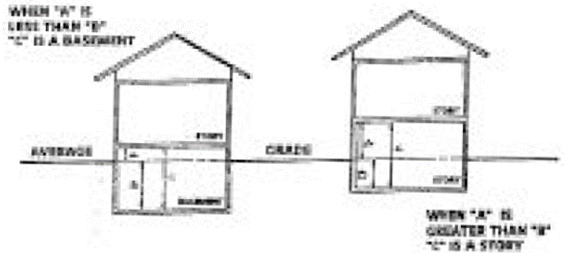
Basement and Story
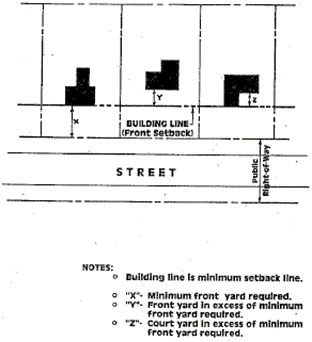
Building Line
(15)
Building height. The vertical distance measured from the established grade to the highest point of the roof surface, to be varied only by City Council.
(16)
Building line. A line formed by the face of the building, and for the purposes of this ordinance, a building line is the same as a front setback line.
(16.5)
Centerline. Exactly half the distance of a dedicated road right-of-way.
(17)
Club. An organization of persons for special purposes or for the promulgation of sports, arts, sciences, literature, politics, or the like, but not operated for profit.
(18)
Clinic. An establishment where human patients who are not lodged overnight are admitted for examination and treatment by a group of physicians, dentists, or similar professions.
(19)
Commission. The City Planning Commission of the City of St. Clair Shores.
(20)
Council. The City Council of the City of St. Clair Shores.
(21)
District. A portion of the incorporated area of the City within which certain regulations and requirements or various combinations thereof apply under the provisions of this ordinance.
(22)
Dwelling unit. A building, or portion thereof, designed for occupancy by one family for residential purposes and having cooking facilities.
(23)
Dwelling, one-family. A detached or attached residential dwelling unit designed for and occupied by one family only, and having individual entrance ways and garage facilities. Attached one-family residential units, also known as cluster housing units, share a common wall.
(24)
Dwelling, two-family. A building designed exclusively for occupancy by two families living independently of each other.
(25)
Dwelling, multiple-family. A building or structure designed for and occupied by three or more families with separate housekeeping, cooking, and bathroom facilities for each. Multiple-family dwellings are commonly served by a common entrance way or foyer and generally do not have individual garage facilities.
(26)
Drive-in restaurant. A business establishment serving food and/or beverages for consumption, on the premises, in a motor vehicle, such businesses shall include those providing service to the vehicle and/or patron self-service.
(27)
Drive-through restaurant. A business establishment serving food and/or beverages to patrons in a motor vehicle.
(28)
Efficiency apartment. A dwelling unit consisting of not more than two rooms in addition to kitchen and necessary sanitary facilities.
(29)
Erected. Built, constructed, altered, reconstructed, moved upon, or any physical operations on the premises which are required for the construction, excavation, fill, drainage, and the like, shall be considered a part of erection.
(30)
Essential services. The erection, construction, alteration or maintenance by public utilities or municipal departments of underground, surface or overhead gas, electrical, steam, fuel, or water transmission or distribution systems, collection, communication, supply or disposal systems, including towers, poles, wires, mains, drains, sewers, pipes, conduits, cables, fire alarm and police call boxes, traffic signals, hydrants and similar accessories in connection therewith, but not including buildings which are necessary for the furnishing of adequate service by such utilities or municipal departments for the general health, safety, or welfare.
(31)
Excavation. Any breaking of ground, except common household gardening and ground care.
(32)
Exception. Certain uses considered by the Planning Commission to be essential or desirable for the welfare of the community, and which are appropriate and not incompatible with the other uses in the district, but not at every location or not without review and not without conditions being imposed due to special problems the use may present from a zoning standpoint.
(33)
Family.
(a)
One or more persons related by blood or marriage occupying a dwelling unit and living as a single nonprofit housekeeping unit; or
(b)
A collective number of individuals living together in one house under one head, whose relationship is of a permanent and distinct domestic character, and cooking as a single housekeeping unit. This definition shall not include any society, club, fraternity, sorority, association, lodge, combine, federation, or group, coterie, or organization, which is not a recognized religious order, nor include a group of individuals whose association is temporary and resort seasonal in character or nature.
(33.5)
Facade line. A line which dictates the placement of a building or structure from the street right-of-way line on which the building or structure fronts. On a corner lot, there shall be a build-to line on both sides of the lot which have street frontage.
(34)
Floor area. For the purposes of computing the minimum allowable floor area in a residential dwelling unit, the sum of the horizontal areas of each story of the building measured from the exterior faces of the exterior walls. The floor area measurement is exclusive of areas of basements, unfinished attics, attached garages, breezeways, and enclosed and unenclosed porches.
(35)
Floor area, gross. The sum total of all floors of a building as measured from the interior faces of the exterior walls.
(36)
Garage, private. An accessory building for parking or storage of not more than that number of vehicles as may be required in connection with the permitted use of the principal building. In residential areas the storage of not more than one commercial vehicle of rated capacity not exceeding three-fourths ton is permitted.
(37)
Garage, public. Any garage other than a private garage available to the public, operated for gain, and used for storage, repair, rental, greasing, washing, sales, servicing, adjusting or equipping of automobiles or other motor vehicles.
(38)
Garage, service. Any premises used for the storage or care of motor-driven vehicles, or where any such vehicles are equipped for operation, repaired, or kept for remuneration, hire, or sale.
(39)
Grade. A ground elevation established for the purpose of regulating the number of stories and the height of the building. The building grade shall be the level of the ground adjacent to the walls of the building if the finished grade is level. If the ground is not entirely level, the grade shall be determined by averaging the elevation of the ground for each face of the building.
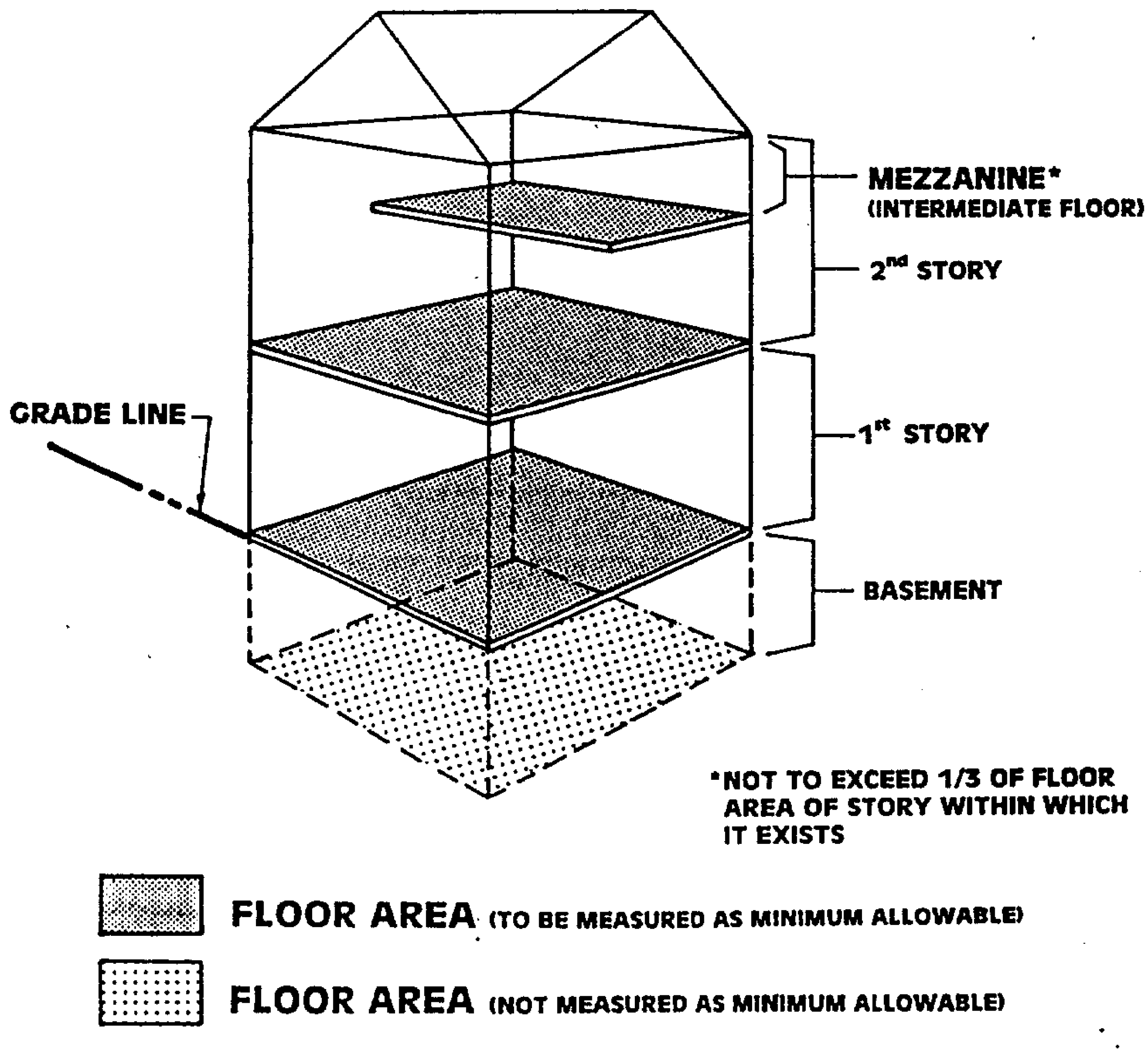
Basiic Structural Terms
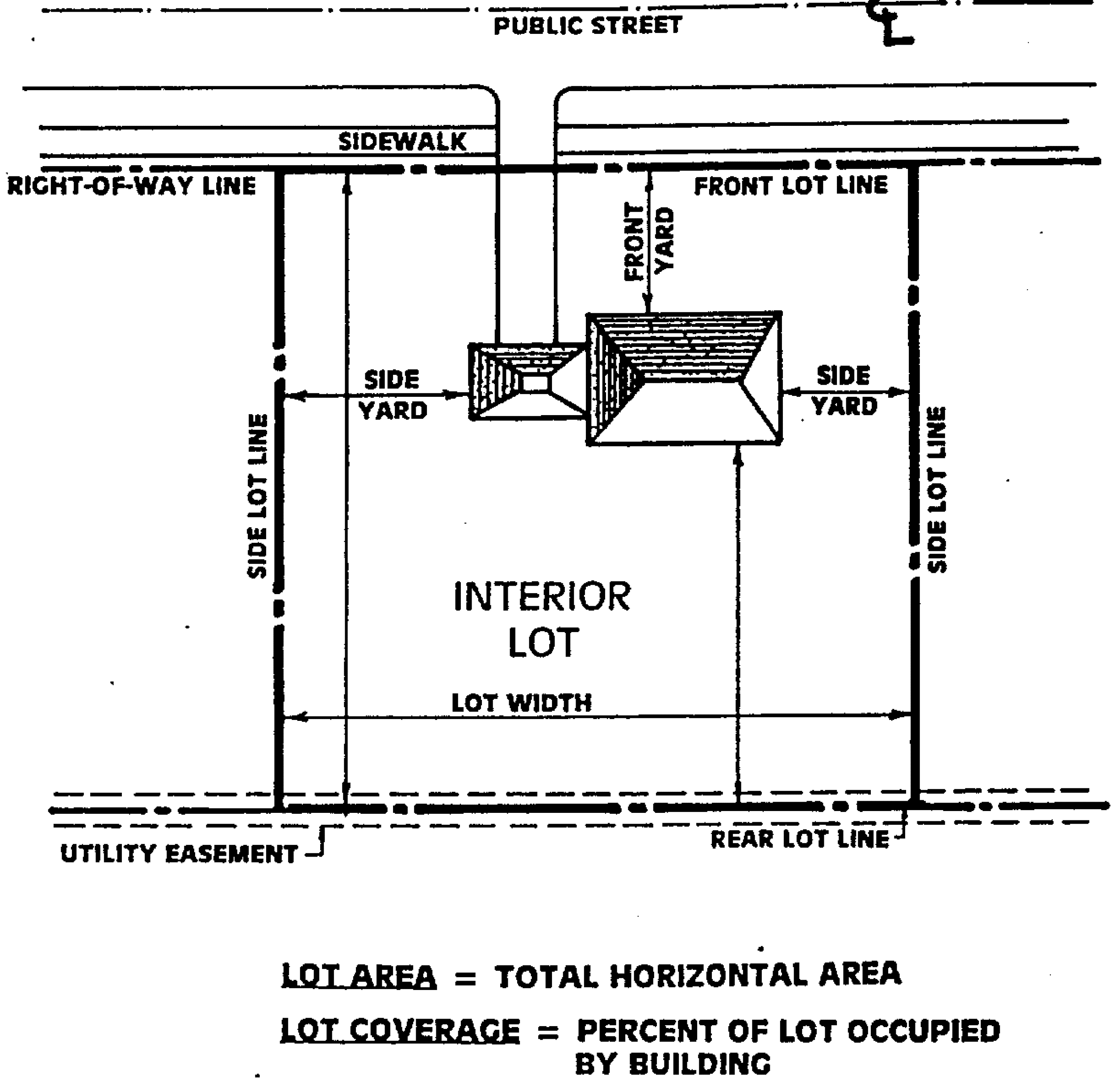
Lots & Areas
Double Frontage, Interior & Corner Lots
(40)
Gross leasable area. The gross floor area minus deductions for public lobbies, common mall areas, atriums, courtyards, and permanently designated corridors which are not subject to relocation by specific lease requirements.
(41)
Housing for the elderly. An installation other than a hospital, hotel, or nursing home, which provides room and board to nontransient persons primarily 62 years of age or older.
(42)
Hotel. A building or part of a building, with a common entrance or entrances, which the dwelling units or rooming units are used primarily for transient occupancy, and in which one or more of the following services are offered:
(a)
Maid service.
(b)
Furnishing of linen.
(c)
Telephone, secretarial, or desk service.
(d)
Bellboy service.
A hotel may include a restaurant or cocktail lounge, public banquet halls, ballrooms, or meeting rooms.
(43)
Junk yards. An open area where waste, used or secondhand materials are bought and sold, exchanged, stored, baled, packed, disassembled, or handled, including, but not limited to, scrap iron and other metals, paper, rags, rubber tires, and bottles. A "junk yard" includes automobile wrecking yards and includes any area of more than 200 square feet for storage, keeping or abandonment of junk but does not include uses established entirely within enclosed buildings.
(44)
Kennel, commercial. Any lot or premise on which three or more dogs, cats, or other household pets are either permanently or temporarily boarded. Kennel shall also include any lot or premises where household pets are bred or sold.
(45)
Loading space. An off-street space on the same lot with a building, or group of buildings, for the temporary parking of commercial vehicle while loading and unloading merchandise or materials.
(46)
Lot. A parcel of land occupied, or to be occupied, by a main building or a group of such buildings and accessory buildings, or utilized for the principal use and uses accessory thereto, together with such open spaces as are required under the provisions of this ordinance. Every lot shall abut upon and have permanent access to a public street and have a minimum frontage of 30 feet therein.
(47)
Lot area. The total horizontal area within the lot lines of the lot.
(48)
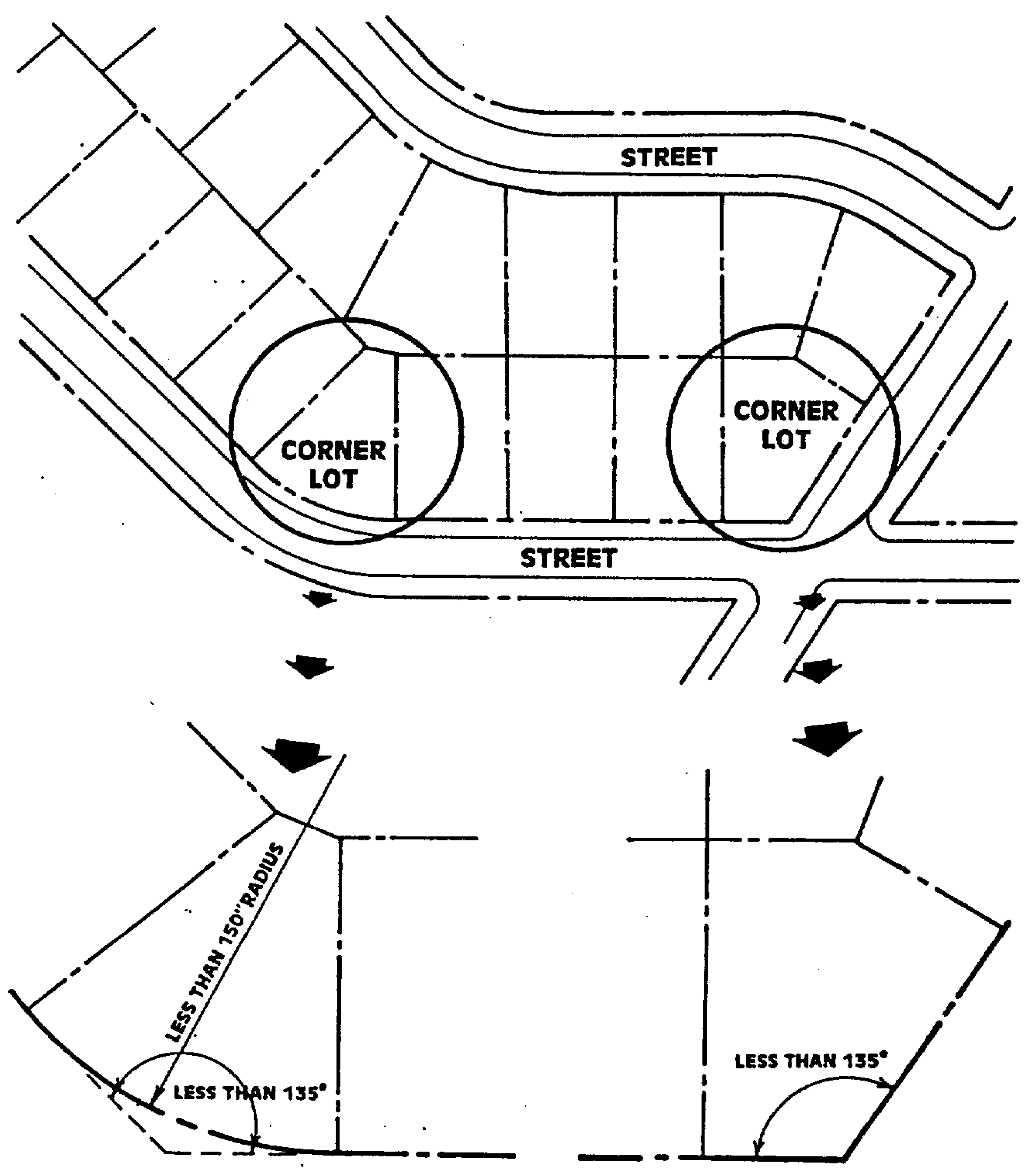
Lot, corner. A lot where the interior angle of two adjacent sides at the intersection of two streets is less than 135 degrees. A lot abutting upon a curved street or streets shall be considered a corner lot for the purposes of this ordinance if the arc is of less radius than 150 feet and the tangents to the curve, at the two points where the lot lines meet the curve or the straight street line extended, form an interior angle of less than 135 degrees.
(49)
Lot coverage. The part of percent of the lot occupied by buildings including accessory buildings.
(50)
Lot depth. The horizontal distance between the front and real lot lines, measured along the median between the side lot lines.
(51)
Lot, interior. Any lot other than a corner lot.
(52)
Lot lines. the lines bounding a lot, as defined herein:
(a)
Front lot line., in the case of an interior lot, that line separating said lot from the street. In the case of a corner lot, or double frontage lot, "front lot line" shall mean that line separating said lot from that street which is designated as the front street in the plat and in the application for a zoning compliance permit.
(b)
Rear lot line. that lot line opposite the front lot line. In the case of a lot pointed at the rear, the rear lot line shall be an imaginary line parallel to the front lot line, not less than ten feet long lying farthest from the front lot line and wholly within the lot.
(c)
Side lot line. any lot line other than the front lot line or rear lot line. A side lot line separating a lot from a street is a side street lot line. A side lot line separating a lot from another lot or lots is an interior side lot line.
(53)
Lot, through. Any interior lot having frontage on two more or less parallel streets as distinguished from a corner lot.
(54)
Lot width. The straight line distance between the side lot lines, measured at the two points where the minimum building line, or setback line, intersects the side lot lines.
(55)
Lot of record. A parcel of land, the dimensions of which are shown on a document or map on file with the county register of deeds or in common use by City or county officials, and which actually exists as so shown, or any part of such parcel held in a record ownership separate from that of the remainder thereof.
(56)
Lot, zoning. A single tract of land, located within a single block, which, at the time of filing for a building permit, is designated by its owner or developer as a tract to be used, developed, or built upon as a unit, under single ownership or control. A zoning lot shall satisfy this ordinance with respect to area, size, dimensions, and frontage as required in the district in which the zoning lot is located. A zoning lot, therefore, may not coincide with a lot of record as filed with the County Register of Deeds, but may include it.
(57)
Main building. A building in which is conducted the principal use of the lot upon which it is situated.
(58)
Main use. The principal use to which the premises are devoted and the principal purpose for which the premises exist.
(59)
Major thoroughfare. An arterial street which is intended to serve as a large volume trafficway for both the immediate City area and the region beyond, and may be designated as a major thoroughfare, parkway, freeway, expressway, or equivalent term to identify those streets comprising the basic structure of the street plan. Any street with a width, existing or proposed, of 86 feet shall be considered a major thoroughfare.
(60)
Master plan. The comprehensive plan including graphic and written proposals indicating the general location for streets, parks, schools, public buildings, and all physical development of the City and includes any unit or part of such plan, and any amendment to such plan or parts thereof. Such plan may or may not be adopted by the Planning Commission and/or the Council.
(61)
Mezzanine. An intermediate floor in any story occupying more than one-third of the floor area of such story, but which extends over only part of the main floor.
(62)
Mobile home. A structure, transportable in one or more sections, which is built on a chassis and designed to be used as a dwelling with or without a permanent foundation, when connected to the required utilities, includes the plumbing, heating, air conditioning, and electrical systems contained in the structure. Mobile home does not include recreational vehicle.
(63)
Mobile home park. A parcel or tract of land upon which three or more mobile homes are located on a continual nonrecreational basis and which is offered to the public for that purpose, together with any building, structure, enclosure, street, equipment, or facility used or intended for use incident to the occupancy of a mobile home.
(64)
Motel. A series of attached, semi-detached or detached rental units containing a bedroom, bathroom, and closet space. Units shall provide for overnight lodging and are offered to the public for compensation, and shall cater primarily to the public traveling by motor vehicle.
(65)
Motor home. A recreational vehicle intended for temporary human habitation, sleeping, and/or eating, mounted upon a chassis with wheels and capable of being moved from place to place under its own power. Motor homes generally contain sanitary, water, and electrical facilities.
(66)
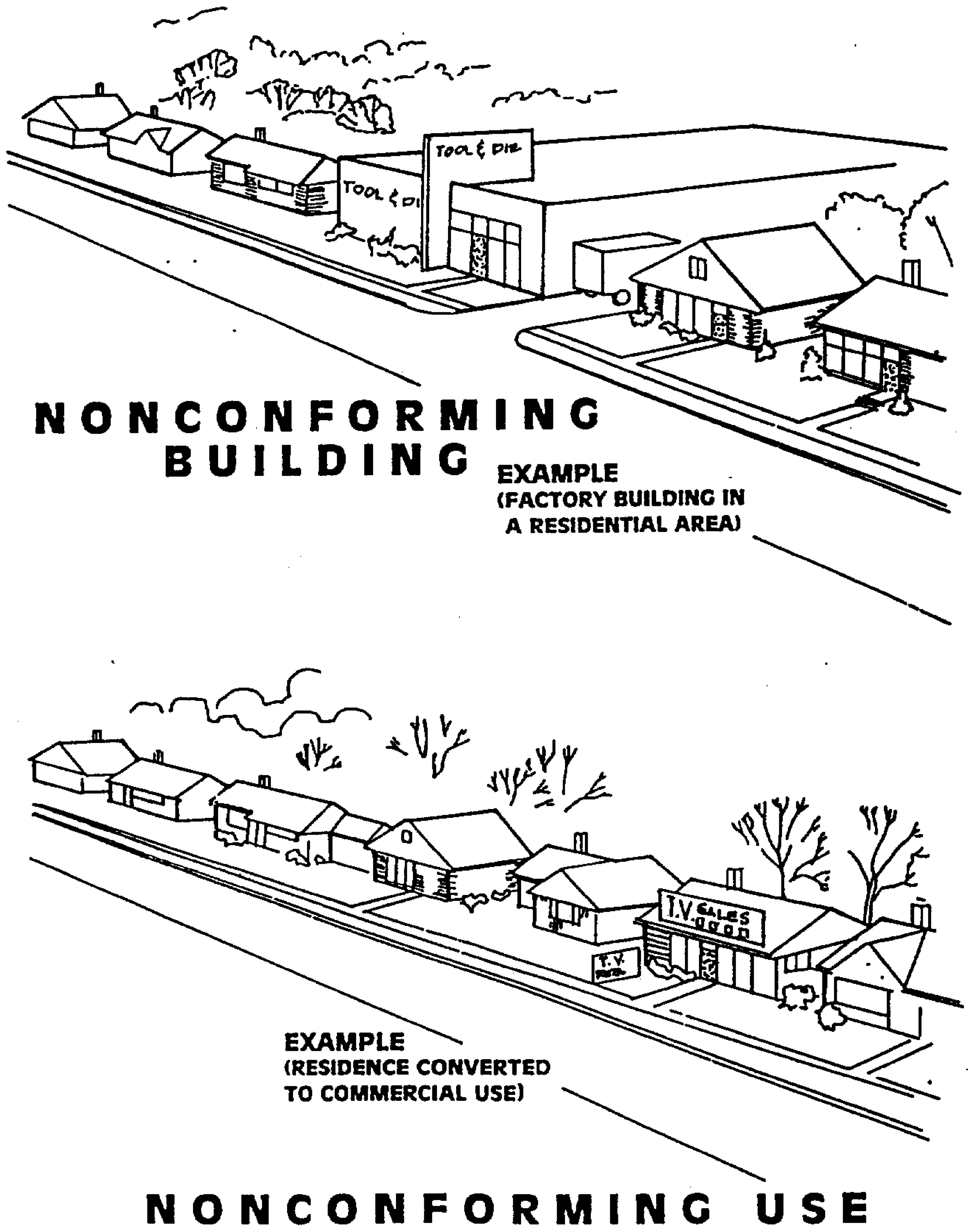
Nonconforming building. A building or portion thereof lawfully existing at the effective date of this ordinance, or amendments thereto, and that does not conform to the provisions of this ordinance in the district in which it is located.
(67)
Nonconforming use. A use which lawfully occupied a building or land at the effective date of this ordinance, or amendments thereto, and that does not conform to the use regulations of the district in which it is located.
(68)
Nursery, plant material. A space, building or structure or combination thereof, for the storage of live trees, shrubs or plants offered for retail sale on the premises including products used for gardening or landscaping. The definition of nursery, within the meaning of this ordinance, does not include any space, building or structure used for the sale of fruits, vegetables, or Christmas trees.
(69)
Nuisance factors. An offensive, annoying unpleasant, or obnoxious thing or practice, a cause or source of annoyance, especially a continuing or repeating invasion of any physical characteristics of activity or use across a property line which can be perceived by or affects a human being, or the generation of an excessive or concentrated movement of people or things, such as:
(a)
Noise;
(b)
Dust;
(c)
Smoke;
(d)
Odor;
(e)
Glare;
(f)
Fumes;
(g)
Flashes;
(h)
Vibration;
(i)
Shock waves;
(j)
Heat;
(k)
Electronic or atomic radiation;
(l)
Objectionable effluent;
(m)
Noise of congregation of people, particularly at night;
(n)
Passenger traffic;
(o)
Invasion of nonabutting street frontage by traffic.
(70)
Off-street parking lot. A facility providing vehicular parking spaces along with adequate drives and aisles, for maneuvering, so as to provide access for entrance and exit for the parking of more than two vehicles.
(71)
Open front store. A business establishment so developed that service to the patron may be extended beyond the walls of the structure, not requiring the patron to enter the structure. The term "open front store" shall not include automobile repair stations or automobile service stations.
(72)
Open space. That part of a zoning lot, including courts or yards which:
(a)
Is open and unobstructed from its lowest level to the sky; and
(b)
Is accessible to all residents upon the zoning lot.
(72.5)
Parapet. A low, protective wall at the edge of a terrace, balcony, or roof, especially that part of an exterior wall, firewall, or part wall that rises above the roof.
(73)
Parking space. An area of definite length and width, said area shall be exclusive of drives, aisles or entrances giving access thereto, and shall be fully accessible for the storage or parking or permitted vehicles.
(74)
Public utility. A person, firm, or corporation, municipal department, board or commission duly authorized to furnish, and furnishing under federal, state, or municipal regulations to the public, gas, steam, electricity, sewage disposal, communication, telegraph, transportation, or water.
(75)
Recreation equipment. Equipment such as boats and boat trailers, snowmobiles, horse trailers, dune buggies, and other similar items.
(76)
Recreation vehicle. A vehicle intended for temporary human habitation, sleeping and/or eating, mounted upon a chassis with wheels, and self-propelled or capable of being pulled by another vehicle.
(77)
Room. For the purpose of determining lot area requirements and density in a multiple-family district, a living room and a bedroom, equal to at least 80 square feet in area. A room shall not include the area in kitchens, opening dining areas, sanitary facilities, utility provisions, corridors, hallways, and storage. Plans presented showing one-, two-, or three-bedroom units and including a den, library, or other extra room shall count such extra room as a bedroom for the purpose of computing density.
(78)
Self-storage facility. A building or group of buildings divided into separate units or compartments used to meet the temporary storage needs of businesses, apartment dwellers and other individuals or firms, and is also known as a mini-warehouse.
(79)
Setback. The distance required to obtain the front, side, or rear yard open space provisions of this ordinance.
(80)
Sign. The use of any words, numerals, figures, devices, designs, or trademarks by which anything is made known such as are used to show an individual firm, profession or business, and are visible to the general public, and a sign as defined in the Sign, Lighting and Display Ordinance.
(81)
Story. That part of a building except a mezzanine as defined herein, included between the surface of the next floor, or if there is no floor above, then the ceiling next above. A story thus defined shall not be counted as a story when more than 50 percent, by cubic content, is below the height level of the adjoining ground.
(81.5)
Sign band area. The horizontal band extending the full width of the front facade located between the first floor windows and the cornice, or second story windows.
(82)
Story, half. An uppermost story lying under a sloping roof, the usable floor area of which, at a height of four feet above the floor does not exceed two-thirds of the floor area in the story directly below, and the height above at least 200 square feet of floor space is seven feet, six inches.
(83)
Street. A public thoroughfare which affords the principal means of access to abutting property.
(84)
Structure. Anything constructed or erected, the use of which requires location on the ground or attachment to something having location on the ground.
(85)
Temporary use of building. A use or building permitted by the Board of Appeals to exist during periods of construction of the main building or use, or for special events.
(86)
Tourist home. A dwelling in which overnight accommodations are provided or offered for transient guests for compensation, without provision of meals.
(87)
Tourist hotel. A building containing apartments, each composed of bedroom, bathroom and closet space, but without cooking facilities, with the exception of the units occupied by the management staff, the apartment units being used only for the accommodation of transients and no cooking being permitted therein.
(88)
Use. The purpose for which land or premises or a building thereon is designed, arranged or intended, or for which it is occupied or maintained, let or leased.
(87.5)
Townhome. A single-family home which may be attached to other single-family homes on one or both sides.
(89)
Variance. A modification of the literal provisions of the zoning ordinance granted when strict enforcement of the zoning ordinance would cause undue hardship owing to the circumstances unique to the individual property on which the variance is granted. The crucial points of variance are:
(a)
Undue hardship;
(b)
Unique circumstances; and
(c)
Applying to property.
A variance is not justified unless all three elements are present in the case.
(90)
Yard. The open spaces on the same lot with a main building, unoccupied and unobstructed from the ground upward, except as otherwise provided in this ordinance, and as defined herein. Also, the area of a site that the main mass of the principal building cannot be located within. A yard can be defined as a front yard, side yard, interior side yard, side street yard or rear yard:
(a)
Front yard. An open space extending the full width of the lot, the depth of which is the minimum horizontal distance between the front lot line and the nearest line of the main building. The required distance between the front facade of the principal building and front site or right-of-way line. This area extends the full width of the unit.
(b)
Rear yard. An open space extending the full width of the lot, the depth of which is the minimum horizontal distance between the real lot line and the nearest line of the main building.
(c)
Side yard. An open space between the main building and the side lot line, extending from the front yard to the rear yard, the width of which is the horizontal distance from the nearest point of the side lot line to the nearest point of the main building.
(d)
Interior side yard. The required distance between the interior side facade of the principal building and the side site line. This area extends from the front yard to the rear yard.
(e)
Front yard zone. An area that unenclosed porches or stoops, bay windows, chimneys or stair projections can be installed. Such zone can be defined within a front or side street yard.
(Comp. Ords. 1988, § 15.022(35.3); chap. 35 eff. March 7, 1986; amended by ord. eff. Aug. 20, 1996; further amend. eff. Mar. 20, 2000; Oct. 3, 2000; June 8, 2001; Apr. 9, 2009)

