
Saint Cloud City Zoning Code
CHAPTER 1
GENERAL PROVISIONS, ADMINISTRATION, AND BOARDS AND COMMISSIONS
1.1.1. - Title and citation.
This Code shall be known as the "St. Cloud Land Development Code" and may be cited and referred to as "The Code", "LDC" or the "Ordinance." Citation to provisions contained in this Code shall be referenced as "Chapter _______, Article _______, Section _______" of the Land Development Code.
1.1.2. - Purpose.
The purpose of the Land Development Code is to establish standards, procedures, and minimum requirements to regulate and control the platting of lands and the development of real estate in the city and to coordinate and integrate the development review process of the city land use plan and the city's platting process, in an effort to, among other things, ensure proper legal description, identification, monumentation, and recording of real estate boundaries; to aid in the coordination of land development throughout the city in accordance with the city's land use plan; to discourage haphazard, premature, uneconomic, or scattered land development; to ensure safe and convenient traffic control; to encourage development of an economically stable and healthful community; to ensure adequate utilities; to provide improved drainage and water control facilities; to provide open spaces for recreation; to ensure land development with installation of adequate and necessary physical improvements; to ensure that the citizens and taxpayers of the city will not have to bear the costs resulting from haphazard development of land; and to ensure the purchaser of land within a subdivision that necessary improvements have been installed. It is the intent of the city that, to the extent permitted by law, all future development orders and permits, both for new and existing projects, shall comply with the requirements of this Code.
1.1.3. - Applicability.
A.
Land or water shall not be developed, used or occupied, and a building, structure, infrastructure or part thereof shall not hereafter be erected, reconstructed, moved, located, or structurally altered, except in conformity with the regulations set out herein and for the district in which it is located.
B.
Within the jurisdiction of these regulations, no development approval shall be approved, nor shall any building permit or certificate of occupancy be issued, unless such development meets all the requirements of these regulations and has been approved in accordance with the requirements as herein provided.
C.
It is the specified intent of the city that all floating structures and buildings, as well as development, buildings and structures or infrastructure built over or in water, shall meet all the requirements of this Code.
D.
Within the jurisdiction of these regulations, no subdivision (excluding exceptions and variances as provided herein) shall be made, platted, or recorded, nor shall any building permit be issued, unless such subdivision meets all the requirements of these regulations and has been approved in accordance with the requirements as herein provided.
E.
The city council or any aggrieved person may have recourse to such remedies in law and equity as may be necessary to ensure compliance with the provisions of the Land Development Code (LDC), including injunctive relief to enjoin and restrain any person violating the provisions of the LDC, and any rules and regulations adopted under the LDC.
1.1.4. - Codes or specifications.
When reference is made in this Code to statutes, codes, specifications or other regulations, it is intended that subsequent amendments to such codes, statutes, specifications or regulations will be automatically adopted by reference herein except as provided by subsequent legislation of the city council.
1.1.5. - Altering of ordinances.
It shall be unlawful for any person to change or amend, by addition or deletion, any part or portion of this Code, or to insert or delete pages or portions thereof, or to alter or tamper with such code, in any manner whatsoever, which will cause the law of the city to be misrepresented thereby.
1.1.6. - Severability of parts of code.
The sections, paragraphs, sentences, clauses and phrases of this Land Development Code are severable, and if any phrase, clause, sentence, paragraph or section of this Code shall be declared unconstitutional by the valid judgment or decree of a court of competent jurisdiction, such unconstitutionality shall not affect any of the remaining phrases, clauses, sentences, paragraphs and sections of this Code.
1.1.7. - City council final authority.
The legislative body of the city is the city council and has the final authority and responsibility for the adoption and enforcement of regulations for the development of land which are based on, related to, and are a means of implementation for the adopted comprehensive plan required by the laws of this state.
A.
Supplemental procedure. In the adoption of the land development regulations, amendments thereto, including the zoning ordinance or general zoning code, and under such zoning ordinance or code, approval/denial decisions of any zoning, rezoning, planned unit development, variance, special exception, conditional use or other development order, no procedure set forth in the LDC shall be exclusive nor prohibit such adoption, amendment, modification or approval/denial by the city council, proceeding in conformity with F.S. §§ 166.041(3)(c)1 and 166.041(3)(c)2, with recommendation of the local planning agency; however, without mandatory review by any land development regulation commission
1.2.1. - Interpretation and conflict.
In their interpretation and application, the provisions of these regulations shall be held to be the minimum requirements for the promotion of the public health, safety, and general welfare.
1.2.2. - Conflict with public and private provisions.
A.
Public provisions. These regulations are not intended to interfere with, abrogate, or annul any other rule, regulation, statute, or other provision of law. Where any provision of these regulations imposes restrictions of these regulations or any other rule, regulation, or other provision of law, whichever provisions are more restrictive, or impose higher standards, shall control.
B.
Private provisions. These regulations are not intended to abrogate any easement, covenant, or any other private agreement, or restriction; provided that, where the provisions of these regulations are more restrictive or impose higher standards or regulations than such easement, covenant, or private agreement or restriction, the requirements of these regulations shall govern.
1.2.3. - Injunction relief.
In addition to any penalty provided by law for the violation of any of the provisions of this Code, the city council may bring suit in the appropriate circuit court to enjoin, restrain, or otherwise prevent the violation of any of the provisions of this Code.
1.2.4. - Officers, employees not liable for failure to perform duties.
No provision of this Code designating the duties of any city officer or employee shall be so construed as to make such officer or employee liable for any fine or penalty for failure to perform such a fine or penalty is specifically and clearly expressed in the section creating the duty.
1.2.5. - Complaints regarding violations.
Whenever a violation of the LDC occurs, or is alleged to have occurred, any person may file a complaint. Such complaint stating fully the causes and basis thereof shall be filed with the city manager or their designee. They shall record properly such complaint, immediately investigate, and take action thereon as provided by this ordinance. He shall maintain as a public record in his office the disposition made of the complaint.
1.2.6. - Penalties for violation; resort to other remedies.
A.
Noncompliance with regulations. Failure to comply with the provisions of this LDC or with any order issued pursuant to any section herein or failure to comply with any of the requirements, including violations of conditions and safeguards established in connection with the granting of variances or conditional uses, shall constitute an ordinance violation and shall be subject to enforcement as prescribed in section 1.2.7 of this Code.
B.
Ordinance violation. Any person who commits, participates in, assists in, or maintains any such violation shall be guilty of an ordinance violation, and may be prosecuted as provided herein.
C.
City action. Nothing herein contained shall prevent the city from taking such other lawful action, including, but not limited to, resort to equitable action, as is necessary to prevent or remedy any violation.
D.
Subsequent owner requirements. The owners and successors of property developed, subdivided, or otherwise modified under this LDC shall not remove, destroy, modify, subvert or render inoperable through act or omission any of the improvements, designs, standards or conditions required either directly or indirectly by these regulations. Such action shall be considered an ordinance violation and may be prosecuted as provided herein.
E.
Site maintenance obligation. The owners and successor shall not remove, destroy, modify, subvert or render inoperable through act or omission any of the improvements, designs, standards or conditions required either directly or indirectly by this Land Development Code.
F.
Required improvements. The city manager shall enforce the improvement bond by resort to legal and equitable remedies if required improvements have not been satisfactorily installed within one calendar year after the site development plan is approved, unless extended by the city council for cause and provided the surety consents to the extension. The city shall notify the owner of the project a minimum of 60 calendar days prior to the expiration of the improvement bond. The owner of the property shall have all improvements complete a minimum of 30 calendar days prior to the expiration of the improvement bond or request an extension and renew the bond.
G.
Prosecution under previous regulations of this LDC. Any violation which occurred prior to, or was pending at the time of, the effective date of these regulations may continue to be prosecuted under the regulations which were in effect at the time the violation occurred.
H.
It shall be a violation of the LDC for any person to sell any lot not subdivided in accordance with the requirements of this LDC, or to lay out, construct, open or dedicate any street, sanitary sewer, storm sewer, water main or drainage structure without having first complied with the provisions of these regulations.
I.
Any person, whether as owner, lessee, principal, agent, employee or otherwise, who violates any of the provisions of this Code, or permits any such violation to continue, or otherwise fails to comply with the requirements of this LDC or of any plan or statement submitted and approved under the provisions of this LDC, shall be guilty of an ordinance violation and subject to prosecution.
1.2.7. - Penalties.
Any person, whether as owner, lessee, principal, agent, employee or otherwise, who violates any of the provisions of this Code, or permits any such violation to continue, or otherwise fails to comply with the requirements of this Code or of any plan or statement submitted and approved under the provisions of this Code, shall be guilty of an ordinance violation and subject to prosecution. Punishment shall be by a fine not exceeding $500.00 or imprisonment for a term not exceeding 60 days, or by both such fine and imprisonment, at the discretion of the court. Each day such violation continues shall be considered a separate offense. At the option of the city, any violation may be processed through the city's code enforcement board.
1.2.8. - Fees and charges.
A.
Establishment of fees.
1.
The city council hereby establishes a list of matters pertaining to these zoning regulations for which the city shall levy a fee or charge. It is the intent of these regulations that the city shall not be required to bear any part of the cost of applications or petitions made under these zoning regulations and that the fees and other costs involved in the processing of applications and petitions shall be borne by the applicant.
2.
Any fees or charges established by the city pursuant to the regulations or requirements established herein may be changed from time to time by resolution of the city council, and such changes shall not be considered an amendment to this Code.
B.
Schedule of fees. The schedule of fees and charges shall be posted in the offices of the as defined within this LDC and the city manager or their designee. The charges shall be authorized from time to time by resolution of the city council and are not subject to the procedure for amendment of these zoning regulations.
C.
Payment of fees and charges. Until applicable fees or charges have been paid in full, no action of any type or kind shall be taken on applications or petitions to the city including, but not limited to, the following:
1.
Rezoning of land not otherwise herein specified;
2.
Rezoning of land to PUD classification;
3.
Arbor permit;
4.
Easement, right-of-way or plat abandonment;
5.
Conditional use;
6.
Interpretation by the board of adjustment;
7.
The processing of a change of use;
8.
Variance by the board of adjustment;
9.
Site development plan approval;
10.
State application for an alcohol beverage license;
11.
Developer's agreements;
12.
Small scale land use amendment;
13.
Large scale land use amendment;
14.
Extension request;
15.
Preliminary plat plans;
16.
Subdivision construction plans;
17.
Concept plan;
18.
Final plat;
19.
Right-of-way utilization permits for single-family residential and industrial, commercial or multi-family residential, when not included as a part of an approved site plan;
20.
Underground utility permits;
21.
Annexations;
22.
Publications, copies;
23.
PUD amendment;
24.
Planned unit development master plan;
25.
Special events;
26.
Waiver requests;
27.
Water service requests;
28.
Sewer service requests;
29.
Construction plans for water and/or sewer extensions outside the municipal boundaries;
30.
Impact fee credits and/or alternate calculations.
D.
Waiver of fees. The city manager, upon a finding that an application or petition filed pursuant to these zoning regulations provides a significant benefit to the city aside from the benefit derived by the particular applicant or petitioner, may waive in whole or part any fees required under these zoning regulations. The city manager's finding shall be based on an application submitted to the city manager that demonstrates the following:
1.
That special conditions and circumstances exist which are peculiar to the applicant or petitioner or the land and structures contained thereon and are not applicable to other applicants, petitioners, lands or structures.
2.
That the special conditions and circumstances do not result from the actions or inaction of the applicant or petitioner or their agent.
In the event that the city manager denies the request for a waiver or partial waiver hereunder, the applicant or petitioner may appeal the decision of the city manager to the city council by filing a request for appeal within 30 days of the date of the city manager's decision. The appeal shall be filed and hear in accordance with section 2.3.4(F) and (G) of the Land Development Code at the next available council meeting.
1.3.1. - Board of adjustment and planning commission.
A.
Establishment and composition. A board of adjustment is hereby established. The establishment and composition of the planning commission of the city is accomplished in the City Charter. The planning commission shall consist of seven members to be appointed by the city council, each for a term of two years. The planning commission shall consist of five regular members and two numbered alternate positions. The board of adjustment shall consist of seven members to be appointed by the city council, each for a term of two years. The board of adjustment shall consist of five regular members and two alternate members.
B.
Qualifications of members. No member of the board of adjustment or planning commission shall be an employee of the city nor hold a position on the city council. No member shall hold a position on both the board of adjustment and the planning commission. All members shall be appointed from among registered voters of the city in a position to represent the public interest, and no person shall be appointed with private or personal interests likely to conflict with the general public interest.
C.
Vacancies.
1.
Board of adjustment membership vacancies shall be filled by appointment by the city council for the unexpired term of the affected member.
2.
Planning commission vacancies shall be filled by appointment as delineated in the City Charter.
3.
It shall be the duty of the city manager or designee to notify the mayor within ten days after any vacancy occurs among members of the board of adjustment or planning commission.
D.
Attendance. A member of the board of adjustment or planning commission missing three consecutive regular meetings without justification acceptable to that particular board or commission shall be considered resigned.
E.
Removal. Members of the board of adjustment or planning commission may be removed from office for cause by the affirmative votes of three members of the city council upon written charges and public hearing, if the member of the board or commission so affected requests such public hearing.
F.
Compensation. Members of the board of adjustment or planning commission shall receive no salaries or fees for service on the board or commission, but may receive actual and necessary expenses incurred in the performance of their duties of office.
G.
Proceedings.
1.
Officers and voting. The board of adjustment and planning commission shall select a chairman and vice-chairman from among its members and may create and fill such other offices as it may determine. All regular members of the board or commission shall be entitled to vote in matters before the board or commission.
2.
Rules of procedure. The board of adjustment and planning commission shall adopt rules of procedure necessary to its governance and the conduct of its affairs, in keeping with the applicable provision of Florida law and these zoning regulations. Such rules of procedure shall be available in a written form to persons appearing before the board or commission and to the public. A failure or refusal to appear in response to a subpoena issued by the board or commission shall constitute a violation of this. The planning commission and board of adjustment shall have the power to take testimony under oath and compel the attendance of witnesses.
3.
Meetings.
a.
Board of adjustment meetings shall be held at the call of the chairman and at such other times as the board of adjustment may determine. Meetings that are not regularly scheduled shall not be held without at least seven days' notice to each member.
b.
Planning commission meetings shall be held at the call of the chairman and at such other times as the planning commission may determine provided that the planning commission shall hold at least one regularly scheduled meeting each month on a day to be determined by the planning commission. Meetings that are not regularly scheduled shall not be held without at least 24 hours' notice to each member.
4.
Quorum, minutes, public records. The board of adjustment and planning commission shall keep records of their proceedings, showing the vote of each member (including the chairman or vice-chairman), or if absent or failing to vote, indicating such fact. The board and commission shall keep records of their considerations, examinations and other official actions, all of which shall be a public record and filed upon acceptance in the office of the city manager or his designee. A quorum for the transaction of business shall consist of three members for the board of adjustment and three members for the planning commission. No action by the planning commission to grant a conditional use or approve a rezoning under these zoning regulations shall be taken without the affirmative vote of three members.
1.3.2. - Board of adjustment.
A.
Hearings, appeals, notices. Appeals to the board of adjustment concerning interpretation or administration of these zoning regulations or for variance under these zoning regulations may be taken by any person aggrieved or by any officer, agency, or department of the city affected by any decision, determination or requirement of the city manager or his designee. Such appeals shall be taken within a reasonable time, not to exceed 30 days, by filing with the city manager, or his designee, and with the board a notice of appeal specifying the grounds thereof. The secretary for the board of adjustment shall forthwith transmit to the board of adjustment all papers constituting the record upon which the action appealed was taken. The board of adjustment shall fix a reasonable time for the hearing of the appeal, give public notice thereof as well as due notice to the parties in interest, and decide the same within a reasonable time. At the hearing, any party may appear in person or by agent or attorney.
B.
Stay of proceedings. An appeal stays all proceedings in furtherance of the action appealed, unless the city manager or his designee from whom the appeal is taken certifies to the board of adjustment after the notice of appeal is filed with him that, by reasons of facts stated in the certificate, a stay would, in his opinion, cause a hazard to life or property. In such case proceedings shall not be stayed other than by a restraining order which may be granted or by a court of record on application, on notice to the city manager or his designee and on due cause shown.
C.
Powers and duties. The board of adjustment shall have the following powers and duties:
1.
Administrative review. To hear and decide appeals where it is alleged there is error in any order, decision or determination of the city manager or his designee in the enforcement of these zoning regulations.
2.
Variances. To authorize upon appeal in specific cases such variance from the terms of these zoning regulations as will not be contrary to the public interest where, owing to special conditions, a literal enforcement of the provisions of these zoning regulations would result in unnecessary and undue hardship. A variance from the terms of these zoning regulations shall not be granted until a public hearing is held before the board of adjustment.
3.
Special exceptions. To authorize uses that are not normally permitted in a particular zoning district upon a demonstration that the application addresses criteria as set out in this section.
4.
Powers. Board of adjustment has powers of the city manager or his designee on appeals; reversing decision of the city manager or his designee. In exercising the above-mentioned powers, the board of adjustment may, so long as such action is in conformity with the terms of these zoning regulations, reverse or affirm, wholly or partly, or may modify the order, requirement, decision, or determination appealed and may make such order, requirement, decision, or determination as ought to be made, and to that end shall have the powers of the city manager or his designee from whom the appeal is taken.
5.
In matters of review. The concurring votes of three members of the board of adjustment shall be necessary to reverse any order, requirement, decision, or determination of the city manager or his designee, or to decide in favor of the applicant on any matter upon which it is required to pass under these regulations.
D.
Procedures for public hearing before board of adjustment.
1.
Written petition. A written petition for a variance or other action shall be submitted by the property owner, or his designated agent, to the city manager or his designee. Such petition shall be accompanied by all pertinent information required for proper consideration and shall demonstrate that the following conditions exist for subject property:
a.
Special conditions and circumstances exist which are peculiar to the land, structure, or building involved and which are not applicable to other lands, structures, or buildings in the same zoning district;
b.
The special conditions and circumstances do not result from the actions of the applicant;
c.
Literal interpretation of the provisions of these zoning regulations would deprive the applicant of rights commonly enjoyed by other properties in the same zoning district under the terms of these zoning regulations and would work an unnecessary and undue hardship on the applicant;
d.
The variance or other action, if granted, is the minimum request that will make possible the reasonable use of the land, building, or structure;
e.
Granting the request will not confer on the applicant any special privilege that is denied by these zoning regulations to other lands, buildings, or structures in the same zoning district;
f.
The grant of the request will be in harmony with the general intent and purpose of these zoning regulations, will not be injurious to the neighborhood, or otherwise detrimental to the public welfare.
2.
Special exceptions. The following shall apply to special exceptions:
a.
A special exception may be initiated by any applicant, who shall pay the application fee and make application on forms prescribed by the planning and zoning department.
b.
Applicant shall submit a completed application including narrative describing the proposed use and information related to the type of operation, hours of operation, traffic impacts, impacts on adjacent uses, and measures proposed to mitigate such impacts (as applicable).
c.
Applicant shall submit a notarized agent authorization form (as applicable).
d.
Application must include a scaled drawing of the proposed use on the site that includes all existing and proposed features such as sidewalks, parking spaces, buffers, setbacks, building dimensions, and accessory structures (as applicable).
e.
The application shall address, at a minimum, the following factual matters below:
(1)
Consistency with the general pattern of land development within the zoning district;
(2)
Is the special exception use consistent with the trends of development in the area or neighborhood, as opposed to being detrimental to the area or neighborhood;
(3)
Is the special exception use consistent with the patterns of development intensity in the area or neighborhood;
(4)
Does the special exception use have reasonable effect on existing traffic patterns, movements and intensities without adverse impacts;
(5)
Is the special exception use consistent with the city's comprehensive plan;
(6)
Can the special exception use development be designed to function effectively for its intended purpose without creating negative off-site impacts for adjoining parcels.
3.
Notices. Required legal notices shall be as included in this section of the code.
4.
Public hearing. A public hearing shall be held by the board of adjustment, pursuant to requirements for public hearing as established under section 1.3.6 of this LDC. Any party may appear in person or be represented by agent or attorney.
5.
Findings. The board of adjustment shall make findings that the requirements of subsection 1.3.2.D.1.a. through f. have or have not been demonstrated by the applicant for variance. The board of adjustment shall make findings that the requirements of subsection 1.3.2.D.2.a through f. have or have not been demonstrated by the applicant for a special exception.
6.
Conditions and safeguards. In granting any variance, the board of adjustment may prescribe appropriate conditions and safeguards in conformity with these zoning regulations, including but not limited to reasonable time limits within which the action for which variance is required shall begin, or be completed, or both. Violation of such conditions and safeguards, when made a part of the terms under which the variance is granted, shall be deemed a violation of these zoning regulations and shall be grounds for revocation of the variance. Unless otherwise specified by the board of adjustment, the time limit for implementation of the variance request shall be six months.
E.
Limitations on power to grant variances.
1.
Under no circumstances shall the board of adjustment grant a variance to permit a use not permitted under the terms of these zoning regulations in the zoning district involved, or any use expressly or by implication prohibited by the terms of these regulations in the said zoning district.
2.
No nonconforming use of neighboring lands, structures, or buildings in the same zoning district, and no permitted use of lands, structures, or buildings in any other district shall be considered grounds for the granting of a variance.
3.
No conditional use of these zoning regulations shall be granted by the board of adjustment.
F.
Time limits for reapplication for variance. No application for a variance may be filed for 12 months after a variance request has been denied on the same property. This time limit may be waived by three affirmative votes of the board of adjustment when such action is deemed necessary to prevent injustice or to facilitate the proper development of the city.
G.
Appeals from decisions of the board of adjustment. Any person aggrieved by the decision of the board of adjustment may seek judicial review of such decisions by filing a notice of appeal, in the form prescribed by the Florida Appellate Rules, in the circuit court, within 30 days of the decision being appealed. The decision of the board of adjustment shall be considered final administrative action and shall only be subject to review based upon the record established at the hearing before the board of adjustment.
1.3.3. - Planning commission.
The functions, powers, and duties of the planning commission shall be as follows:
A.
General. The city manager or his designee shall, upon request or within a reasonable time, furnish to the planning commission such available records or information as may be required in its work.
B.
Specific.
1.
Zoning requirements and Land Development Code amendments. The planning commission shall review and make recommendations to the city council on amendments to the zoning regulations and the official zoning map.
2.
Annexation, land use and zoning designations. The planning commission shall review annexation and zoning designations and land use petitions and submit its recommendations to the city council in accordance with annexation procedures as they may be from time to time adopted by the city council.
3.
Conditional use. The planning commission is empowered to hear all conditional uses specifically provided for in these zoning regulations; to decide such questions as are involved in recommending whether or not conditional uses should be granted; and to recommend to city council whether conditional uses with such conditions and safeguards are reasonable and appropriate under these zoning regulations.
4.
Compatible uses. The planning commission is empowered to review all requests for use allowances in all zoning districts.
C.
Procedures for public hearing before planning commission.
1.
Written petition. All proposals shall be submitted in writing to the department of planning and zoning, accompanied by a letter of authorization from all property owners.
2.
Annexations and zoning designations, rezonings, and land use amendments. These processes require the adoption of an ordinance. One public hearing before the planning commission and one public hearing before the city council are required. The planning commission shall prepare a report and make recommendations to the city council for final action on each request. Public hearing requirements shall be as shown in sections 1.3.6 and 1.3.7 of this Code.
a.
Requirements of the planning commission report to the city council. The report and recommendations to the city council shall show the planning commission has studied and considered, where applicable, whether or not:
(1)
The proposed change is contrary to the established land use pattern;
(2)
The proposed change would create an isolated district unrelated to adjacent and nearby districts;
(3)
The proposed change would materially alter the population density pattern and thereby increase or overtax the load on public facilities such as schools, utilities, streets, etc.;
(4)
Existing district boundaries are illogically drawn in relation to existing conditions on the property proposed for change;
(5)
The proposed change would be contrary to the land use plan and would have an adverse effect on the comprehensive plan;
(6)
Changed or changing conditions make the passage of the proposed amendment necessary;
(7)
The proposed change will adversely influence living conditions in the neighborhood;
(8)
The proposed change will create or excessively increase traffic congestion or otherwise affect public safety;
(9)
The proposed change will create a drainage problem;
(10)
The proposed change will seriously reduce light or air to adjacent areas;
(11)
The proposed change will adversely affect property values in the adjacent area;
(12)
The proposed change will be a deterrent to the improvement or development of adjacent property in accordance with existing regulations;
(13)
The proposed change will constitute a grant of special privilege to an individual owner as contrasted with the public welfare;
(14)
There are substantial reasons why a reasonable use of property cannot be accomplished under existing zoning;
(15)
Whether the change suggested is out of scale with the needs of the neighborhood or the city;
(16)
It is impossible to find other adequate sites in the city for the proposed use in districts already zoned for such use.
b.
Provisions for restrictive rezonings. In recommending a change in the zoning classification of a lot or parcel of land, at the request of the owner, with no negotiations initiated by the planning commission, the planning commission may recommend, and the city council may approve, such change with restrictions applicable only to the property involved in the change; provided that such restrictions confer upon the applicant or subject property no privilege otherwise denied by these regulations to other lands, structures or buildings in the same district. Such restrictions may include one or more of the following:
(1)
Use restrictions greater than those otherwise specified for that particular district;
(2)
Density restrictions greater than those otherwise specified for the particular district;
(3)
Setbacks greater than those otherwise specified for the particular district, including setbacks from lakes and major arterial roadways;
(4)
Height limits more restrictive than otherwise permitted in the district;
(5)
Minimum lot areas or minimum widths greater than otherwise specified for the particular district;
(6)
Minimum floor area greater than otherwise specified for structures in the particular district;
(7)
Open space requirements greater than otherwise required for property in the particular district;
(8)
Parking, loading, driveway or traffic requirements more restrictive than otherwise required for the particular district;
(9)
Fencing or screening requirements greater than otherwise required for the particular district;
(10)
Restrictions on any other matters which the city council is authorized to regulate. Upon approval of such restrictive rezonings, the applicant shall record such restrictions with his deed in the public records of the county and the department of planning and zoning shall enter a reference to the restrictions on the city's official zoning map. Restrictions shall run with the land, without regard to transfer of ownership or other interests, and may be removed only upon further amendment to the zoning classification of the subject property in accordance with the procedures prescribed herein.
3.
Conditional use.
a.
Application. Conditional uses may be initiated by any applicant, who shall pay the application fee and make application on forms prescribed by the planning agency (i.e., the community development department). The application material shall evidence the factual matters set forth in subparagraph (b) below and shall suggest requirements to be established by the city council as required by subparagraph (d) below. The burden of presenting a complete application to: (1) the community development department and to the development review committee for staff review; and to (2) the planning commission at a public hearing for its recommendation to the city council; and to (3) the city council at a public hearing for final approval; shall be upon the applicant. However, unless the city council informs the applicant at its public hearing in what way the application is incomplete and offers the applicant an opportunity to complete the application (either at its public hearing or at a continuation of the hearing), the application, as presented, shall be complete. Public hearing requirements shall be as shown in sections 1.3.6 and 1.3.7 of this Code.
b.
Factual matters. The application shall address the factual matters listed below, which shall be considered of equal weight. These factual matters shall be considered by the planning commission in making its recommendation to the city council, and by the city council in granting approval. Based upon professional urban planning standards methods and techniques or traffic engineering standards methods and techniques, the factual matters to be considered are:
(1)
Consistent with the general pattern of land development within the zoning district;
(2)
Is the conditional use consistent with the trends of development in the area or neighborhood, as opposed to being detrimental to the area or neighborhood;
(3)
Is the conditional use consistent with the patterns of development intensity in the area or neighborhood;
(4)
Does the conditional use have reasonable effect on existing traffic patterns, movements and intensities without adverse impacts;
(5)
Is the conditional use consistent with the city's comprehensive plan;
(6)
Can the conditional use development be designed to function effectively for its intended purpose without creating negative off-site impacts for adjoining parcels.
c.
Finding of the city council. Before any conditional use is granted, the city council shall make a finding, based upon the consideration of the above-listed factual matters stated as questions, that the granting of the conditional use will not adversely affect the public interest, but rather will promote the public health, safety, and general welfare. Such finding shall be made if all of the above listed factual matters, stated as questions, are answered in the affirmative, but if not the conditional use application shall be denied.
d.
Special requirement guidelines. Upon a finding that the conditional use will not adversely affect the public interest, the city council shall review all suggested specific requirements for the individual conditional use and shall establish the requirements based upon professional urban planning and municipal engineering standards, methods and techniques, in regard to the following specific requirement guidelines:
(1)
Ingress and egress to property and proposed structures thereon with particular reference to automotive and pedestrian safety, convenience, traffic flow and control, and access in case of fire or catastrophe;
(2)
Off-street parking and loading areas, where required, with particular attention to the items in (1) above.
(3)
Refuse and service areas, with particular reference to items in (1) and (2) above;
(4)
Utilities, with reference to locations, availability and compatibility;
(5)
Screening and buffering with reference to type, dimensions and character;
(6)
Signage, if any, and proposed exterior lighting with reference to glare, traffic safety, economic effects and compatibility and harmony with properties in the district;
(7)
Required yards and other open spaces;
(8)
General compatibility with adjacent properties as to noise, glare, and odor;
(9)
Any special requirements set forth in the district regulations.
e.
Conditions and safeguards. In reviewing any conditional use, the planning commission may recommend and the city council may prescribe appropriate conditions and safeguards in conformity with these zoning regulations. Violation of such conditions and safeguards, when made a part of the terms under which the conditional use is granted, shall be deemed a violation of these zoning regulations. Any conditional use granted by the city council shall expire 12 months after the effective date of such action by the city council unless any required occupational license or building permit based upon and incorporating the conditional use is obtained within the aforesaid 12-month period. However, the city council, generally, may renew such conditional use for one additional period of six months provided good cause is shown and provided the application for extension is filed with the city manager or his designee at least 30 days prior to the expiration of the aforesaid 12-month period. Any renewal may be granted without public hearing; however, a reapplication fee shall be collected for any renewal in an amount not to exceed the amount of the original application fee.
f.
Abandonment. A conditional use may be changed to any permitted use in the district in which it is located. Once changed to a permitted use, the previous conditional use shall not be reinstated without the procedure outlined for conditional uses. Public hearing requirements shall be as shown in sections 1.3.6 and 1.3.7 of this Code.
g.
Permitted use deleted from code. A particular granted permitted use shall not thereafter become a nonconforming use, solely by virtue of a code amendment, if following the code amendment such use continues to be a use permitted as a conditional use; but rather such use shall continue as if granted a conditional use.
4.
Zoning requirements and Land Development Code amendments. Zoning requirements and Land Development Code amendments require one public hearing before planning commission and one public hearing before the city council and adoption by ordinance. The planning commission shall first review all requests for amendments and make recommendations to the city council. Public hearing requirements shall be as shown in sections 1.3.6 and 1.3.7 of this Code.
1.3.4. - Development review committee.
A.
Establishment and composition.
1.
The Development Review Committee (DRC) shall be composed of representatives City of St. Cloud departments and agencies. In addition, outside agencies may send representatives to the DRC as deemed appropriate.
2.
Members of the DRC shall be knowledgeable in their field with the City of St. Cloud Comprehensive Plan, City of St. Cloud Land Development Code and other applicable regulations.
B.
Development Review Committee rules and procedures.
1.
A chairman shall be chosen by the city manager.
2.
The DRC may adopt rules for the transaction of its business, and conduct meetings pursuant to the provisions of any resolution, policy or ordinance adopted by the City of St. Cloud Council.
3.
Meetings:
a.
The DRC shall set the time and place of all meetings.
b.
The DRC shall meet at least once a month, unless no business is pending before it. Additional meetings shall be held at the call of the Chair and at all such other times as the members may determine and meetings are necessary.
C.
Development Review Committee functions. The general purpose of the DRC shall be to provide assistance to the policy making boards (elected and appointed officials) by reviewing applications and by ensuring that applications proceed in compliance with all applicable rules and regulations. The specific applications where the DRC shall provide a review are noted in Chapter 2 of this Code or as designated by the city manager. The DRC shall recommend such conditions and requirements as are necessary for the protection of the health, safety, comfort, convenience, and welfare of the general public.
1.3.5. - Historic preservation board (HPB).
A.
Establishment. The HPB shall be established within six months of the effective date of the ordinance from which this article derived. The HPB shall convene to establish bylaws which shall be developed within 30 days. The bylaws shall be made available to the public.
B.
Composition and terms. The HPB shall consist of seven members and two alternate members, all of whom shall be appointed by the city council. Members shall be residents of the city. In the event that too few qualified residents apply to meet the professional qualification standards or too few residents are interested in the positions, the city council may appoint non-resident individuals who have demonstrated special interest, experience, or knowledge in history, architecture, or related disciplines to the remaining (HPB) positions.
1.
A minimum of three members shall be chosen from among the disciplines of architecture, history, architectural history, archaeology, landscape architecture, construction, construction management, engineering, planning or a person who is a general contractor.
2.
The remaining four members will be selected from a pool of applicants, according to the following: two members shall be experienced in the areas of commercial development, real estate, banking, or law; the two remaining members shall be citizen members at large; the two alternate members shall be from any of the foregoing professions or citizen members at large.
3.
All members shall have demonstrated a special interest, experience or knowledge in historic preservation or closely related disciplines.
4.
Members of the HPB shall serve for three-year terms for a maximum of up to six consecutive years. Of the initial appointments, four members shall be appointed for a term of three years and three members shall be appointed for a term of two years for a maximum of up to six consecutive years.
5.
Alternate members shall be appointed for a term of two years for a maximum of up to six consecutive years.
6.
Vacancies on the HPB, including expired terms, shall be filled by persons with the same background as the original appointee, or related field within 60 days, in order to maintain the desired HPB makeup.
C.
Procedures of the HPB. The HPB shall hold a minimum of four meetings per year at regular intervals. Additional meetings may be called if necessary to process applications for review in accordance with the required timelines. All meetings of the HPB shall be publicly announced and will have a previously advertised agenda. The meetings shall be open to the public. Persons serving on the HPB are encouraged to attend educational meetings or workshops to develop a special interest, expertise, experience, or knowledge in preservation, architecture, or quasi-judicial boards. The city shall appoint a professionally qualified historic preservation staff member to advise and assist the (HPB), carry out delegated responsibilities, and undertake the requirements for certified local government certification.
D.
Procedures and quorum. The HPB shall adopt rules of procedures, subject to any limitations prescribed by law. The rules of procedures shall be available for public inspection upon request. Four members shall constitute a quorum for the transaction of business. The HPB shall select a chairman and other officers and shall prescribe their duties and powers. The city manager or his or her designee shall designate staff to attend all meetings, acting in an advisory capacity and participating fully in HPB discussions but having no right to vote. All decisions made by the HPB shall take place in a public forum. The HPB shall keep minutes of its proceedings, record the vote on each question, and keep records of its discussions, recommendations, and other official actions. Summary minutes will be prepared and made available to the public after adoption by the HPB.
E.
Removal. Any member of the HPB may be removed pursuant to the procedures outlined in the City Code of Ordinances.
F.
Powers and duties of the HPB. The HPB shall have the following powers and duties within the incorporated city limits of St. Cloud, Florida:
1.
To recommend to the city council the following:
a.
Review nominations of properties and districts to be designated in the city's local historic register;
b.
Adoption, modification, or replacement of a design guidelines handbook;
c.
Update of the Historical and Architectural Survey, City of St. Cloud Project Report, May 1993 (as amended from time to time);
2.
To hold public hearings and to approve or deny applications for certificates of appropriateness or certificates of economic hardship affecting proposed or designated properties or properties within districts;
3.
To call upon available city staff members as well as other experts for assistance and/or technical advice;
4.
To authorize a member of the HPB to testify before a board or commission on any matter affecting historically, culturally, archaeologically, and architecturally significant properties and resources;
5.
To confer recognition upon the owners of properties and districts by means of certificates, plaques or markers;
6.
To recommend amendments or changes to these regulations;
7.
To collaborate with the St. Cloud Main Street organization and any other organization to inform and educate citizens concerning the historic, cultural, archaeological, and architectural heritage of the city;
8.
To participate in survey and planning activities of the certified local government;
9.
Review a list of nominations of properties and districts to the National Register of Historic Places, as a required duty of being a certified local government;
10.
To identify historic properties within the city limits and maintain a detailed inventory of historic districts, sites and structures compatible with the Florida Master Site File.
11.
To coordinate with the State of Florida's Division of Historical Resources Certified Local Government program by satisfying the following requirements:
a.
The state historic preservation officer shall be given 30 calendar days prior notice of all meetings and within 30 days following such meetings shall be provided with the minutes and record of attendance of the HPB and the public.
b.
The state historic preservation officer shall be notified of any change of HPB membership within 30 days of their appointment or resignation.
c.
Notify the state historic preservation officer immediately of all new historic designations or alterations to existing designations.
d.
Submit amendments to the code to the state historic preservation officer for review and comment at least 30 days prior to adoption.
e.
Provide duplicates of all inventory materials to the State Historic Preservation Office.
f.
Submit an annual report by November 1 covering activities of the previous October 1 through September 30 and shall include the following information:
(1)
A copy of the rules of procedure;
(2)
A copy of the historic preservation ordinance;
(3)
Resumes of the HPB members;
(4)
Changes to the HPB membership;
(5)
New local designations and National Register of Historic Places listings;
(6)
A review of survey and inventory activity with a description of the system used;
(7)
A program report on each grant-assisted activity; and
(8)
Number of projects reviewed.
1.3.6. - Required legal notices for public hearings before board of adjustment and planning commission.
Legal notices for public hearings before the board of adjustments will be in accordance with all applicable Florida Statutes and where specifically provided for in this Code. Any additional legal notice procedures will be maintained in the community development department as authorized from time to time by resolution of the city council.
Legal notices for public hearings before the planning commission will be in accordance with all applicable Florida Statutes and where specifically provided for in this Code. Any additional legal notice procedures will be maintained in the community development department as authorized from time to time by resolution of the city council.
1.3.7. - City council; action on receipt of planning commission report.
A.
Report forwarded to city council. The report and recommendations of the planning commission shall be forwarded to the city council for consideration during the course of its public hearings. The reports are advisory only and shall not be binding upon the city council.
B.
Public hearing before city council.
1.
Planning commission report forwarded to city council. After the planning commission's public hearing, the request shall be scheduled for the next available meeting of the city council. The department of planning and zoning shall forward the recommendation of the planning commission, along with all necessary supporting data, to the city clerk's office for inclusion on the city council agenda.
C.
Required procedures.
1.
Legal notice. All legal notices for public hearing before the city council will be in accordance with all applicable Florida Statutes and where specifically provided for in this Code. Any additional legal notice procedures will be maintained in the department of planning and zoning as authorized from time to time by resolution of the city council.
2.
Council action on proposed changes. When considering any requested change in the city's land use regulations conditions, the council shall review such requests and shall include, but not be limited to, the review requirements of the planning commission, sections 1.3.3.C.2, 1.3.3.C.3, and 1.3.3.C.4 of this LDC. The city council shall have the following alternatives in determining disposition of an application hereunder: a motion and formal action for postponement, denial, denial without prejudice, approval or approval with conditions.
1.3.8. - Denial of request.
Whenever the city council has denied an application for the rezoning of property, the planning commission shall not consider another rezoning request for the same parcel except under the following conditions:
A.
Reapplicationfor same rezoning. The planning commission shall not consider any further application for the same rezoning of any part or all of the same property for a period of 12 months from the date of such action. Applications that have been "denied without prejudice" may be reconsidered after a period of three months.
B.
Waiver of time limits. The time limits of subsection A. above may be waived by three affirmative votes of the city council when such action is deemed necessary to prevent injustice or to facilitate the proper development of the city.
1.3.9. - Duties of the city manager or his designee, board of adjustment, planning commission, city council, and courts on matter of appeal.
A.
Interpretation and enforcement. It is the intent of these zoning regulations that petitions requesting interpretations of these zoning regulations or opinions respecting enforcement thereof shall be presented first to the city manager or his designee. The decision of the city manager or his designee may be appealed to the board of adjustment, and that recourse to the courts shall be set forth in these zoning regulations. It is further the intent of these zoning regulations that the duties of the city council, in connection with these zoning regulations, shall not include hearing and deciding questions of enforcement and interpretation that may arise. The procedure for settling such questions shall be governed by the policy set forth in these zoning regulations.
B.
Conditional uses. It is further the intent of these zoning regulations that final decisions involving conditional uses shall be made by the city council.
C.
Zoning amendments. It is the intent of these zoning regulations that all proposed zoning text amendments and amendments to the official zoning map shall be heard first by the planning commission and that the planning commission's report and recommendations on such matters shall be advisory only to the city council.
1.3.10. - Duties of the city council.
Under these zoning regulations, the city council shall have only the duties of:
A.
Appointing or confirming members of the planning commission and board of adjustment as required under these regulations;
B.
Considering and adopting or rejecting proposed amendments to or the repeal of these zoning regulations;
C.
Reviewing recommendations of the planning commission, and then rendering decisions concerning conditional uses, annexations, rezoning requests, abandonments and changes in land use, site plans and subdivision approval when required to do so;
D.
Establishing a schedule of fees and charges as set forth in section 1.2.8 of this LDC.
1.3.11. - Duties of the local land planning agency.
The community development department, acting as the local land planning agency, has the primary responsibility of guiding the comprehensive planning process within the city. This responsibility shall include, but not be limited to, the following:
A.
Preparing the comprehensive plan for the incorporated territory and planning area of the city;
B.
Coordinating said comprehensive plan, or elements or portions thereof, with the comprehensive plans of other local governments;
C.
Establishing procedures for providing effective public participation, in a manner consistent with the planning process, to obtain citizen and public input into all phases of the comprehensive planning process;
D.
Reviewing all proposed land development regulations and codes to ensure consistency with the adopted comprehensive plan;
E.
Monitoring and overseeing the effectiveness and status of the comprehensive plan and recommending to the city council such changes in the adopted comprehensive plan as may be required from time to time;
F.
Reviewing the comprehensive plan and preparing periodic evaluation reports for the city council. Such reports shall be prepared at least once every five years after the adoption of the comprehensive plan; they may, at the request of the city council, be prepared at lesser intervals;
G.
Preparing and recommending to the city council ordinances, regulations and other proposals required for the implementation of the policy statements set forth in the comprehensive plan;
H.
Making or causing to be made any necessary special studies on the location, adequacy and conditions of specific facilities in the city. These may include but are not limited to studies on housing, commercial and industrial conditions and facilities, recreation, public and private utilities, roads and traffic, transportation and the like;
I.
To gather information necessary for the drafting of ordinances, codes and regulations related to the comprehensive plan;
J.
Acquiring and maintaining such information and materials which are necessary for an understanding of past trends, present conditions and forces at work to cause changes in these conditions. Such information and materials may include maps and photographs of manmade and natural physical features of the city, statistics on past trends and present conditions with respect to population, property values, economic base, land use and such other information as is important or likely to be important in determining the amount, direction and kind of development to be expected in the city.
1.4.1. - Intent.
Within the districts established by the LDC or amendments that may later be adopted, there may exist: (a) lots, (b) structures, (c) uses of land and structures, and (d) characteristics of use which were lawful before the LDC was passed or amended, but which would be prohibited, regulated, or restricted under the terms of the LDC or future amendments. It is the intent of the LDC to permit these nonconforming structures to continue as restricted and set forth herein and to protect the health, safety, and welfare of the public by requiring any nonconforming structure that is altered, to be brought up to minimum building standards as set forth in the LDC. It is further the intent of the LDC to permit nonconforming uses to exist until they are discontinued. It is further the intent of that nonconformities shall not be enlarged upon, expanded or extended, except as provided herein, and shall not be used as grounds for adding other structures or uses prohibited elsewhere in the same district.
1.4.2. - Repairs and maintenance.
Minor repair or incidental maintenance work that does not require a permit or inspection may be performed.
1.4.3. - Nonconforming use.
A.
Continuance. A nonconforming use may continue in the same location provided the nonconforming use is continual and legally maintained. A nonconforming use which has not been continual and legally maintained for a period of 180 consecutive days shall irrevocably lose its nonconforming status and become a use which is not permitted. Said use may not revert to nonconforming status. Continuous and legally maintained use shall be determined by license or permit records or other proof as determined by the city manager or his designee. The burden of proof rests with the owner of the property on which the claimed nonconforming use exists.
B.
Replacement with permitted use. A nonconforming use which is replaced by a permitted use shall irrevocably lose its nonconforming use status. Said location may not revert to, or be changed to, any nonconforming uses or uses which are not permitted.
C.
Extension. A nonconforming use shall not be extended, except that permission to extend the use to any portion of a building or lot which portion was arranged or designed for such nonconforming use at the time of the effective date of these regulations may be granted by the board of adjustments. No other extension, enlargement, or relocation of a nonconforming use shall be made. The addition of an accessory structure or expansion of the primary dwelling unit on a lot containing a legal nonconforming single-family residential use which meets the requirements of section 1.4.3.A shall not be considered an expansion of such use provided the addition meets all other requirements of this Code.
D.
Nonconforming use of a mobile home, manufactured home or travel trailer on an individual lot. Whenever a nonconforming mobile home, manufactured home, or travel trailer is located on an individual lot in a district not permitting such use, and the mobile home, manufactured home or travel trailer is removed from the lot, the nonconforming use of the lot shall not thereafter be resumed.
E.
Nonconforming use of a mobile home, travel trailer, or manufactured home park. Whenever a mobile home, travel trailer, or manufactured home park is removed from a zoning district not permitting such use, the nonconforming use of the park shall not thereafter be resumed.
1.4.4. - Nonconforming structures.
Nonconforming structures are defined as existing improvements which do not meet required parking and loading regulations, height regulations, area regulations, and residential floor area regulations, required setbacks or other applicable regulations for the district in which they are located.
A.
Replacement of nonconforming structures. Nonconforming structures may be replaced subject to the provisions below:
1.
Residential: A nonconforming residential structure may be replaced or rebuilt within the setbacks of the existing structure. This includes structures damaged or destroyed by fire or other causes as well as those intentionally demolished by the owner after obtaining a demolition permit.
2.
Non-residential: A nonconforming non-residential structure may be replaced within the setbacks of the existing structure should it be destroyed by fire or other causes.
3.
A replacement structure may only extend the original structure subject to the provisions in section 1.4.4.B.
4.
The burden of proof of the original footprint of the structure rests with the property owner. Proof of the building footprint will be considered a signed and sealed survey of the property or other acceptable proof as determined by the city manager or his or her designee.
B.
Extension of nonconforming structure. Any habitable portion of a nonconforming structure shall not be extended, enlarged, or replaced until a standard building inspection has been completed, and the structure has been found to be of sound construction as defined herein. (Porches, carports or garages shall not require an inspection of the habitable portion of the structure.) Structures determined to be deteriorated or dilapidated, as defined herein, by the building official shall be repaired or rehabilitated to a sound construction condition prior to, or concurrently with, approval of any extension or alteration. Those structures found to be unsafe shall be abated by repair, rehabilitation or demolition in accordance with the provisions of the Standard Unsafe Building Abatement Code. In addition to the standard building inspection, one of the following conditions must be met:
1.
The permitted work will bring the structure into conformity with the dimensional regulations of this Zoning Code.
2.
A variance has been granted by the board of adjustment authorizing the issuance of a building permit.
3.
When a structure exhibits one or more nonconformities, the structure may be enlarged or altered in any lawful way for any permitted use, provided that the enlargement or alteration does not create a new nonconformity.
4.
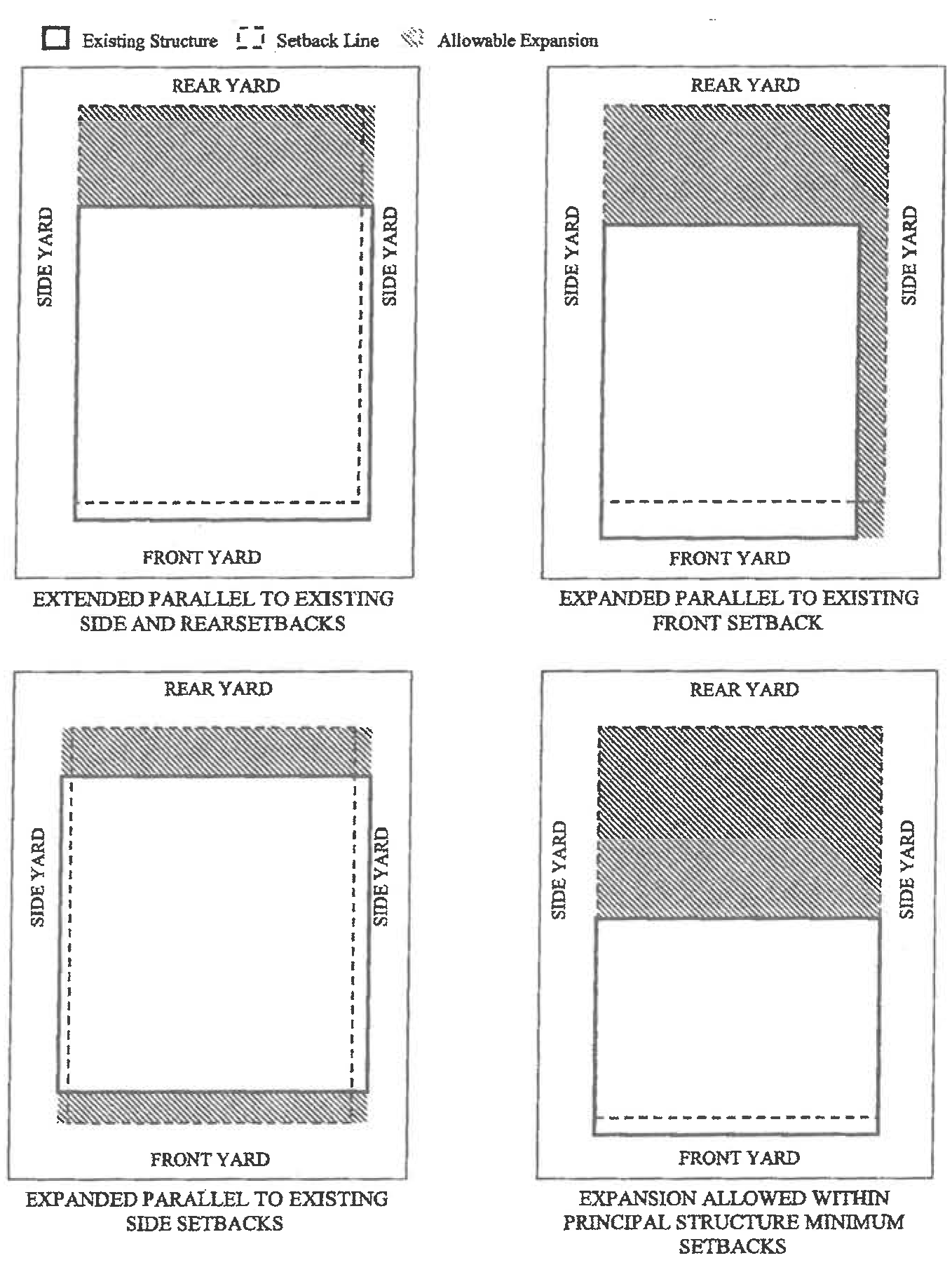
Structures with a nonconforming setback may be expanded along a line parallel to the existing nonconformity, provided that all other applicable zoning, building and fire codes are met. This type of expansion is allowed in front, rear and side yards as shown in Figure 1.4.4.
C.
Nonconforming manufactured homes or mobile home parks. Nonconforming manufactured homes or mobile home parks shall be allowed to continue in existence as approved when constructed.
D.
Nonconforming structures created by address changes required to meet 911 addressing criteria. When a change in address required by the 911 system causes a structure to become nonconforming with regard to required setbacks, that structure hereinafter shall be considered conforming with regard to setbacks. Additions to the structure shall be considered based on the required setbacks prior to the address change. Reconstruction after any event that causes the structure to be completely removed shall comply with the Land Development Code requirements at the time an application for the replacement structure is submitted to the city.
E.
Nonconforming residential structures and uses created by a rezoning to comply with the comprehensive plan future land use map. Any residential structures or uses made nonconforming with development criteria included in the Land Development Code as a result of comprehensive plan consistency-based amendments to the zoning district map that are approved on or after September 23, 2010 shall be considered conforming for the purpose of continuance of use and additions to the structure. These residential uses shall be subject to the development criteria in the zoning district prior to the rezoning. Upon change of the use to a conforming use the structure shall not be converted back to a residential use and all development criteria in the rezoned zoning district shall become applicable.
FIGURE 1.4.4 Examples of Allowable Nonconforming Structure Expansions
1.4.5. - Miscellaneous provisions.
A.
Any use or structure which was permitted by conditional use or variance shall not be deemed a nonconforming use or structure as those terms are used in this section.
B.
A particular permitted use shall not become a nonconforming use solely by virtue of a code amendment, if following the code amendment such use continues to be a use permitted as a conditional use; but rather such use shall continue as if granted as a conditional use, hereunder.
C.
No unlawful use of property or structures existing at the effective date of the ordinance from which this LDC is derived shall be entitled to any of the benefits or exceptions applicable to nonconforming uses or structures.
D.
Any structure or lot which has become nonconforming as a result of a dedication to the public, voluntarily or through an action of eminent domain, shall not be considered nonconforming because of the reduction of lot size.
E.
Only buildings or structures for which a building permit has been obtained, and construction has been diligently prosecuted, will be allowed to continue construction as a nonconforming use or structure. Failure to complete work in accordance with the permit or within approved time limits shall void any claim to nonconforming rights.
1.4.6. - Nonconforming lots.
A.
Nonconforming lot of record. A lot of record is defined as a parcel of land, the dimensions of which are shown on a recorded plat on file with the clerk of the circuit court, or other official record, at the time of the adoption of the original zoning codes (June 24, 1969), and which actually exists as so shown or a lot or parcel described by metes and bounds, the description of which has been so recorded on or before the effective date of the original zoning codes.
In any district in which single-family dwellings are permitted, a single-family dwelling and customary accessory buildings may be erected on any single lot of record existing at the time of the original zoning code (June 24, 1969), notwithstanding limitations imposed by other provisions of this Code. Such lot must be in separate ownership and not of continuous frontage with other lots in the same ownership. This provision shall apply even though such lot fails to meet the requirements for area or width, or both, that are generally applicable in the district, provided that yard dimensions and requirements other than those applying to area or width, or both, of the lot shall conform to the zoning regulations for the district in which such lot is located.
If two or more lots or combinations of lots and portions of lots with continuous frontage in single ownership are of record at the time of passage of the original zoning ordinance (June 24, 1969), and if all or part of the lots do not meet the requirements established for lot width and area, the lands involved shall be considered to be an undivided parcel for the purposes of this Code, and no portion of said parcel shall be used or sold in a manner which diminishes compliance with lot width and area requirements established by this Code, nor shall any division of any parcel be made which creates a lot width or area below the requirements stated in this zoning code.
B.
Nonconforming lot. Nonconforming lots are defined as lots which do not meet the required lot width and/or area requirements and are not defined as lots of record. No construction shall be permitted on a vacant nonconforming lot until such time as the board of adjustments has reviewed and approved any requested variances. Any structure on a nonconforming lot shall be considered a nonconforming structure.
Lots which are annexed into the city, after being platted under county jurisdiction and are assigned a city zoning classification as close to the county zoning as possible, shall not be considered nonconforming lots. Said determination to be made by the city council at the time of annexation.
C.
Nonconforming lots, special application. The East-West dimensions of the following lots in the following blocks, which are now identified as 140 feet in depth with a 20-foot platted alley, will be considered 150 feet in depth in the calculations of minimum square footage of parcels. All other ordinances, rules and policies of the city shall apply.
All in the City of St. Cloud, Florida, according to the Official Plat thereof as recorded in Plat Book B, Pages 33 and 34, Osceola County, Florida.
The East-West dimension depth of all lots which have as their West Boundary, Budinger Avenue or Columbia Avenue, will be considered 150 feet in depth in the calculations of minimum square footage of parcels. All other ordinances, rules and policies of the city shall apply.
All in the City of St. Cloud, Florida, according to the Official Plat thereof as recorded in Plat Book B, Pages 33 and 34, Osceola County, Florida.
The East West dimension depth of all blocks which have as their east boundary, Eastern Avenue, will be considered 150 feet in depth in the calculations of minimum square footage of parcels. All other ordinances, rules and policies of the City of St. Cloud shall apply.
All in the City of St. Cloud, Florida, according to the official plat thereof as recorded in Plat Book B, Pages 33 and 34, Osceola County, Florida.
1.5.1. - Meanings and intent.
A.
All general provisions, terms, phrases and expressions contained in this Code shall be liberally construed in order that the true intent and meaning of the St. Cloud City Council may be fully carried out. This Code is the minimum requirement adopted for the promotion of the public health, safety, comfort, convenience and general welfare. Where any provision of this Code imposes greater restrictions inconsistent with those contained in another provision under the City Code and Land Development Code, the provision imposing the greater restriction or regulation controls.
B.
When a specific section of the LDC gives a different meaning than the general definition provided in this Chapter 8, the specific section's meaning and application of the term shall control.
(Ord. No. 2023-50, § I, 12-14-2023)
1.5.2. - Sections, headings, text, and graphics.
Text within each section is regulatory. However, descriptive headings and graphics are inserted for convenience of reference only. In the event of a conflict or inconsistency between the text of this LDC and any heading, caption, figure, illustration, table, or map, the text shall control. Graphics and other illustrations are provided for informational purposes only and should not be relied upon as a complete and accurate description of all applicable regulations or requirements.
(Ord. No. 2023-50, § I, 12-14-2023)
1.5.3. - Lists and examples.
Unless otherwise specifically indicated, lists of items or examples that use terms like "for example," "including," and "such as," or similar language are intended to provide examples and are not exhaustive lists of all possibilities.
(Ord. No. 2023-50, § I, 12-14-2023)
1.5.4. - Tenses and plurals.
Words used in the present tense include the future tense. Words used in the singular number include the plural number and the plural number includes the singular number, unless the context of the particular usage clearly indicates otherwise. Words used in the masculine gender include the feminine gender, and vice versa.
(Ord. No. 2023-50, § I, 12-14-2023)
1.5.5. - Public officials.
A.
Whenever reference is made to any officer or official, the reference will be taken to be to such officer or official of the City of St. Cloud, Florida.
B.
A provision appearing to require the city manager, head of a department, or some other city officer or employee to do some act or perform some duty is to be construed to authorize the city manager, head of the department, or other officer or employee to designate, delegate and authorize subordinates to perform the required act or perform the duty.
C.
Words giving a joint authority to three or more persons or officers are to be construed as giving such authority to a majority of such persons or officers.
(Ord. No. 2023-50, § I, 12-14-2023)
1.5.6. - Mandatory and discretionary terms.
The words "shall", "must," and "will" are mandatory, establishing an obligation or duty to comply with the particular provision. The word "may," and "should" are permissive.
(Ord. No. 2023-50, § I, 12-14-2023)
1.5.7. - Computation of time.
In computing any period of time prescribed or allowed by the Code, the day of the act, event or default from which the designated period of time begins to run shall not be included. The last day of the period so computed shall be included unless it is a Saturday, Sunday or legal holiday in which the period shall run until the end of the next day which is neither a Saturday, Sunday or legal holiday. When the period of time prescribed or allowed is less than seven days, Saturdays, Sundays and legal holidays shall be excluded in the computation.
(Ord. No. 2023-50, § I, 12-14-2023)
1.5.8. - Interpretive disputes.
It is hereby established as a policy of this code that the city manager or their designee shall decide all questions or disputes which may arise relative to the interpretation of the provisions of this LDC. Appeals to these decisions can be made to the board of adjustment in accordance with section 1.3.2.C.
(Ord. No. 2023-50, § I, 12-14-2023)
1.6.1. - Measuring lot dimensions.
A.
A lot extends to its lot lines, which should be coterminous with the lot lines of abutting lots or with the boundaries of a public right-of-way.
B.
Area dimensions are measured on a horizontal plane in plan view and do not consider topography or the actual surface area of non-level ground.
C.
Areas of lots that are occupied by easements, such as access or utility easements, contribute to total lot area and are considered in calculating impervious coverage and other standards.
D.
The depth of a lot shall be equal to be the distance between the midpoints of straight lines connecting the foremost points of the side lot lines in front and the rearmost points of the side lot lines in the rear.
E.
The width of a lot shall be equal to the distance between straight lines connecting front and rear lot lines at each side of the lot, measured at the required building setback line except for lots on the curved portion of streets and lots on the turning radius of a cul-de-sac. Width of lots on the curved portion of streets and lots on the turning radius of a cul-de-sac shall be considered to be the distance between straight lines connecting front and rear lot lines at each side of the lot, measured at the front building line, provided however, that width between side lot lines at their foremost points, where they intersect with the street right-of-way line, shall not be less than 35 feet in width.
F.
Lot frontage is the aggregate length of all front lot lines.
G.
Impervious coverage is the percent of the lot's horizontal plane that is occupied by impervious, man-made materials, including but is not limited to, area covered by buildings, roads, parking areas, sidewalks, covered parking or walkways and similar areas. Where parking areas and/or sidewalk areas are constructed with pervious materials such as paver block, this area can be considered 50 percent pervious for the purpose of complying with this section of the Code.
(Ord. No. 2023-50, § I, 12-14-2023)
1.6.2. - Measuring setbacks.
A.
When measuring a required setback distance, such as the minimum building setback, the measurement is made at the point where the two entities are closest, such as the nearest points of a lot line and building.
B.
In addition to lot lines, setbacks may also be required from other items as specifically noted within this LDC.
C.
Where a lot borders two streets that do not intersect at a corner of the lot, such as in a through lot, two front lot lines will exist, one along each right-of-way. The required front setback must be provided for each street frontage.
D.
When a lot borders two or more streets that intersect at the corner(s) of the lot, such as in a corner lot, the front setback shall be provided for each street frontage. One street frontage shall be designated as the primary and the other(s) as secondary with corresponding setbacks.
E.
When a lot borders one street with an acute curve of 55 degrees or more so that the street effectively creates two sides of the lot, the lot line(s) along that street shall be considered a front lot line, and a front setback shall be applied to the entire lot frontage.
F.
Lot lines abutting alleys are not considered front lot lines and do not require front setbacks.
(Ord. No. 2023-50, § I, 12-14-2023)
1.6.3. - Measuring structure height
Unless stated otherwise within this LDC, the structure height is measured as the difference in elevation of:
A.
A horizontal line at the average grade along each elevation; and
B.
The elevation of the ceiling of the highest habitable space.
(Ord. No. 2023-50, § I, 12-14-2023)
1.6.4. - Calculating density.
Unless specified otherwise in the LDC, the density of a particular development shall be calculated for commercial, office, industrial, and/or residential developments as noted below. Any appeal to the calculated density shall be made to the city council and the council's decision shall be final and binding.
A.
Density, for commercial, office, and industrial uses. Floor area ratio (FAR) shall determine the density of non-residential developments. The FAR of a given development shall be calculated as the sum of all the floor areas of every building and accessory structure existing and/or to be constructed on a site divided by the net usable area of a site. Net usable area shall be equal to the portion of a site that does not include any right-of-way or lands below the 100-year flood elevation.
B.
Density for residential uses. The number of residential units permitted per acre of land is determined by dividing the number of proposed units by the net usable area of the lot or parcel. Net usable area does not include any existing right-of-way or flood prone preservation areas except as provided for below. In determining the number of residential units to be permitted, any fractional unit shall not entitle the developer to an additional unit.
1.
Formula. The formula for calculating density shall be as follows: Lands above the 100-year flood elevation shall be multiplied by the maximum density allowed for the site; lands below the 100-year flood elevation, hereinafter referred to as flood prone elevation (F.P.E.), shall be multiplied by one-fourth the maximum density allowed for the site. The total number of units allowed for acreage above the F.P.E. is then added to the total number of units allowed for the acreage below the F.P.E. (The latter amount of units shall not exceed 25 percent of the total number of units permitted for acreage above the F.P.E.)
2.
Example:
Given: A nine-acre parcel. Two acres are below the F.P.E. The zoning classification is R-3 and a maximum of 12 units per acre is allowed.
Solution:
a.
9 acres - 2 acres = 7 acres above the F.P.E.
b.
7 acres × 12 units/acre = 84 units above the F.P.E.
c.
2 acres × (12 units/acre × ¼) = 6 units below the F.P.E.
d.
Twenty-five percent of 84 units = 21 units.
e.
Six units is therefore less than 25 percent of total units above the F.P.E.
f.
Eighty-four units (above the F.P.E.) + 6 units (below the F.P.E.) = 90 allowable units.
(Ord. No. 2023-50, § I, 12-14-2023)

