
Salinas City Zoning Code
ARTICLE I
- General Provisions.
Sec. 37-10.010. - Title.
This chapter of the Salinas Municipal Code may be known and cited as the "Salinas Zoning Code" or "zoning regulations."
(Ord. No. 2463 (NCS).)
Sec. 37-10.020. - Purpose.
The purpose of the Zoning Code is to:
(a)
Implement the policies of the Salinas general plan;
(b)
Promote and protect the public health, safety, and general welfare of the people of the city, while respecting property rights;
(c)
Classify, designate, and regulate the location, use, and construction of buildings, structures, and land for residence, commerce, trade, industry, or other purposes; and
(d)
Promote new urbanism development in appropriate locations in the city.
(Ord. No. 2463 (NCS).)
Sec. 37-10.030. - Components.
The Salinas Zoning Code includes the following components:
(a)
Regulations, known as the zoning regulations, establishing various classes of zoning districts and governing the use of land and the placement of buildings and improvements within districts; and
(b)
A map or set of maps, known as the zoning map, delineating the boundaries of zoning districts within the city.
(Ord. No. 2463 (NCS).)
Sec. 37-10.040. - Where filed.
A copy of the Zoning Code and the zoning map, together with a record of all amendments, shall be kept on file with the city clerk and shall constitute the original record. A copy of the Zoning Code and zoning map currently in effect shall also be kept on file with the department of development and engineering services.
(Ord. No. 2463 (NCS).)
Sec. 37-10.050. - General applicability.
The regulations of this Zoning Code adopted by the city council on November 7, 2006 (Ordinance No. 2463) shall take effect and be applied on and after December 7, 2006 and upon subsequent amendments adopted by the city council.
(Ord. No. 2463 (NCS).)
Sec. 37-10.060. - Applicability to private property.
The zoning regulations shall apply to all private land within the city. Application of regulations to specific lots shall be governed by the zoning map.
(Ord. No. 2463 (NCS).)
Sec. 37-10.070. - Applicability to city and redevelopment agency owned property.
Notwithstanding any other regulations of this Zoning Code, land owned or leased by the city or the Salinas redevelopment agency may be developed and used for such public purposes and in such a manner as may be determined by the Salinas city council or the Salinas redevelopment agency, as applicable, to be proper and in the public interest.
(Ord. No. 2463 (NCS).)
Sec. 37-10.080. - Applicability to school district, county, special district, state, and federally owned property.
Land owned by any school district, Monterey County, the state of California, or the United States government shall be subject to the regulations contained in this Zoning Code, unless otherwise provided by law.
(Ord. No. 2463 (NCS).)
Sec. 37-10.090. - Applicability of zoning regulations during an emergency.
The Salinas city council may authorize deviations from any regulation of this Zoning Code during a proclaimed emergency in accordance with Chapter 11A: Emergency Organization and Functions of the Salinas Municipal Code.
(Ord. No. 2463 (NCS).)
Sec. 37-10.100. - Applicability and effect of prior permits.
(a)
The regulations of this Zoning Code shall apply to the erection or alteration of any building or structure, and to the use of any parcel of land, on or after the effective date of the ordinance codified in this Zoning Code and any subsequently adopted ordinance amending this Zoning Code, unless a building permit has been lawfully issued by the city for the construction of a project, in which case, that project may be completed under the provisions of this Zoning Code as they existed at the time of issuance of the building permit; provided, that construction under the permit must be commenced and diligently pursued within the time limit of a building permit. For the purpose of this subsection, a foundation permit shall be treated as equivalent to a building permit, but a grading, demolition, electrical, mechanical, or plumbing permit shall not be considered or treated as building permits.
(b)
All persons empowered by this Zoning Code to grant permits, licenses, certificates, or other approvals shall comply with the provisions of this Zoning Code and grant no permit, license, certificate, or approval in conflict with such provisions. Any permit, license, certificate, or approval granted in conflict with any provisions of this Zoning Code shall be null and void.
(c)
Whenever any discretionary or administrative approval has been issued prior to the effective date of the zoning regulations or any amendment thereto and the uses or improvements for which the permit was issued would not conform to this Zoning Code of the Salinas Municipal Code, the uses or improvements may, nevertheless, be used or developed to the extent authorized by the issued approval, provided the approval has not expired under the terms of its issuance. The uses and improvements shall be deemed legally nonconforming and shall be subject to the provisions of Section 37-50.160: Nonconforming uses and structures.
(Ord. No. 2463 (NCS).)
Sec. 37-10.110. - Existing private agreements.
The regulations of this Zoning Code shall not interfere with or annul any easement, covenant, or other agreement now in effect, provided that where this Zoning Code imposes greater restrictions, this Zoning Code shall control.
(Ord. No. 2463 (NCS).)
Sec. 37-10.120. - Conflict with other regulations.
Where conflict occurs between the regulations of this Zoning Code or any other chapter of the Salinas Municipal Code or other ordinances, the more restrictive or specific regulation(s) shall control unless otherwise specified in this Zoning Code.
(Ord. No. 2463 (NCS).)
Sec. 37-10.130. - Effect on developed land.
The regulations of this Zoning Code apply to new development, as well as to the modification and redevelopment of previously developed property, unless otherwise noted in Section 37-50.160: Nonconforming uses and structures. Improvements and development existing on or before the adoption or amendment of these regulations hereto and that do not conform to the regulations in this Zoning Code may continue to exist as provided by this Zoning Code.
(Ord. No. 2463 (NCS).)
Sec. 37-10.140. - Applicability of land use and development regulations.
Land use and development regulations applicable to specific sites shall be shown on the zoning map by zoning designations consisting of classes of letters and/or numerical designations as follows:
(a)
A base zoning district designation indicating the zoning district name, shall be a component of all zoning districts. See Article II: Establishment of Zoning Districts and Designations and Article III: Base District Regulations.
(b)
An overlay zoning district designation shall be included in a zoning district designation if the provisions of one or more overlay districts are applicable. See Article II: Establishment of Zoning Districts and Designations and Article IV: Overlay District Regulations.
(Ord. No. 2463 (NCS).)
Sec. 37-10.150. - General authority.
This Zoning Code is adopted pursuant to Article XI, Section 7, of the Constitution of the State of California and in compliance with the requirements of Title 7 of the Government Code, Planning and Zoning Law, as may be subsequently amended by the state of California, for the purpose of promoting the public health, safety, and general welfare.
(Ord. No. 2463 (NCS).)
Sec. 37-10.160. - City planner authority.
The city planner shall be appointed by the city manager and shall have the following duties, responsibilities, and authority for this Zoning Code, as well as other duties, responsibilities, and authority prescribed for the city planner under other laws and ordinances, city regulations, and administrative provisions:
(a)
The city planner shall have the authority and responsibilities described and illustrated in Article VI: Administration and anywhere else the city planner is identified within the Salinas Municipal Code.
(b)
The city planner's authority and responsibility may be delegated through deputies or assistants appointed by the city planner for such purpose. Therefore, any time the term "city planner" is used in this Zoning Code, it shall mean "city planner or their designee."
(c)
The city planner shall be responsible for determining the applicable section of this Zoning Code that applies when separate provisions of this Zoning Code appear to be in conflict or where other ambiguity arises regarding the definitions, standards, and regulations of this Zoning Code or the zoning map.
(d)
The city planner shall render interpretations as deemed necessary in order to clarify and carry out the purposes and regulations of the Zoning Code.
(e)
The city planner shall investigate and submit to the planning commission and/or city council, as applicable, their findings on appeals where it is alleged there is an error or abuse of discretion in any order, requirement, decision, or determination made during the administration of this Zoning Code.
(Ord. No. 2463 (NCS).)
Sec. 37-10.170. - Planning commission authority.
The planning commission authority is per Chapter 2, Article VII of the Salinas Municipal Code. With respect to this Zoning Code, the planning commission shall have the authority and responsibilities described and illustrated in Article VI: Administration of this Zoning Code and anywhere else the planning commission is identified within the city of Salinas Municipal Code. The planning commission's primary functions are to:
(a)
Review certain applications and forward recommendations to the city council;
(b)
Hear and decide appeals to city planner decisions;
(c)
In certain instances (see Article VI: Administration of this Zoning Code), the planning commission has the authority to approve, approve with conditions or modifications, or deny certain applications as identified in Article VI: Administration.
(Ord. No. 2463 (NCS).)
Sec. 37-10.180. - City council authority.
The city council authority is per Part I. The Charter of the Salinas Municipal Code. With respect to this Zoning Code, the city council shall have the direct authority and responsibilities described and illustrated in Article VI: Administration and anywhere else the city council is identified within the city of Salinas Municipal Code as follows:
(a)
The city council's primary function is to establish land use policies and regulations and to consider various project applications and planning commission recommendations.
(b)
The city council has the authority to approve, approve with conditions or modifications, or disapprove certain applications as identified in Article VI: Administration.
(c)
The city council may authorize deviations from development standards contained in this Zoning Code if it can be established that the deviation is necessary in the interest of public health and safety or is required as part of environmental mitigation.
(Ord. No. 2463 (NCS).)
Sec. 37-10.190. - Interpretation of regulations as minimum requirements.
These zoning regulations shall be deemed the minimum requirements to promote and preserve the public health, safety, and general welfare of the people, unless otherwise noted.
(Ord. No. 2463 (NCS).)
Sec. 37-10.200. - Interpretation of language.
The following rules for interpretation shall apply:
(a)
The particular shall control the general.
(b)
"Shall" and "must" are mandatory; "should" and "may" are discretionary.
(c)
Unless the context clearly indicates the contrary, the following conjunctions shall be interpreted as follows:
(1)
"And" indicates that all connected words or provisions shall apply.
(2)
"Or" indicates that the connected words or provisions may apply singularly or in any combination.
(3)
"Either…or" indicates that the connected words or provisions shall apply singularly but not in combination.
(d)
In case of conflict between the text and a diagram, the text shall control.
(e)
All references to the "Zoning Code" shall mean Chapter 37 of the city of Salinas Municipal Code.
(f)
All references to Municipal Code shall mean the city of Salinas Municipal Code.
(g)
All references to departments, commissions, boards, or other public agencies are to those of the city of Salinas, unless otherwise indicated.
(h)
All references to the "state" shall mean the state of California. Any reference to a specific state of California regulation or law shall also mean "as the regulation or law may be subsequently amended by the state of California."
(i)
All references to public officials are to those of the city of Salinas and include designated representative of such officials, unless otherwise indicated.
(j)
All references to days are to calendar days unless otherwise indicated. If a deadline falls on a Saturday, Sunday, furlough day, or holiday, it shall be extended to the next full day in which the offices of the community and economic development department are open for business.
(k)
All references to community planning and development shall mean the planning division of the community and economic development department.
(l)
Words used in the present tense shall include the future tense.
(m)
Chapter, article, division, and section headings contained in this Zoning Code shall not be deemed to govern, limit, modify, or in any manner affect the scope, meaning, or intent of any section hereof.
(n)
The words "structure" and "building" shall have the same meaning.
(o)
The words "activities" and "facilities" include any part thereof.
(p)
The word "used" shall include arranged, designed, constructed, altered, converted, rented, leased, or intended to be used.
(q)
The words "chapter," "article," "division," "section," and "subsection" refer to the Salinas Zoning Code unless otherwise noted.
(r)
All terms shall be construed per Division 2: Definitions of this article. Terms that are not defined shall be construed according to the context and approved usage of the language, and as ultimately determined by the city planner.
(Ord. No. 2463 (NCS).)
(Ord. No. 2532 (NCS), § 1, 11-13-2012)
Sec. 37-10.210. - Interpretation of standards and regulations.
(a)
Zoning Regulations. Where uncertainty exists regarding the interpretation of any provision of this Zoning Code or its application to a specific site, the city planner shall determine the intent of the provision.
(b)
Zoning Map. Where uncertainty exists regarding the boundary of a zoning district, the following rules shall apply:
(1)
District boundaries shown as approximately following the property line of a lot shall be construed to follow such property line.
(2)
On unsubdivided land, or where a district or overlay boundary divides a lot, the location of the district boundary shall be determined by using the approximated scale appearing on the zoning map, unless the boundary location is indicated by dimensions printed on the map.
(3)
District boundaries shown as approximately following right-of-way lines of highways, streets, alleys, railroads, or other identifiable boundary lines shall be construed to follow such right-of-way or boundary lines.
(4)
District boundaries shown as lying within right-of-way lines of highways, streets, alleys, railroads, or other identifiable boundary lines shall be construed to follow the centerline of such right-of-way or boundary lines.
(5)
Should any uncertainty remain as to the location of a district boundary or other feature shown on the zoning map, the city planner shall determine the location.
(c)
Similar Uses. When a use is not specifically listed in these zoning regulations, the use may be permitted, or permitted subject to a review or permit, if it is determined by the city planner that the use is similar to other uses listed. In determining if a use not specifically listed in these zoning regulations is similar, the city planner shall make all of the following findings:
(1)
The proposed use shall meet the intent of and be consistent with the goals, objectives, and policies of the Salinas general plan;
(2)
The proposed use shall meet the specific purposes of the zoning district in which the use is proposed to be located; and
(3)
The proposed use shall be similar in nature, intensity, density, and environmental character as those uses listed in the zoning district in which it is to be located.
(d)
Appeals. An interpretation of the zoning regulations or zoning map by the city planner may be appealed in accordance with Article VI, Division 17: Appeals.
(Ord. No. 2463 (NCS).)
Sec. 37-10.220. - Rounding of fractional numbers.
If in the application of the requirements of this Zoning Code, a fractional number is obtained that is less than one-half, the number shall be rounded down to the nearest whole number. A number that is obtained that is one-half or greater shall be rounded up to the next higher whole number except when calculating density. For example, 4.499 would be rounded to four and 4.500 would be rounded to five. In regard to calculating density, fractional numbers shall be rounded down to the next lower whole number. For projects subject to a density bonus, rounding of fractional numbers shall be in accordance with this section except as otherwise provided for in Section 37-50.060: Density bonus and Section 65915 of the State Health and Safety Code.
(Ord. No. 2463 (NCS).)
Sec. 37-10.230. - Severability.
If any section, subsection, sentence, clause, phrase, or portion of this Zoning Code is for any reason held to be invalid or unconstitutional by a court of competent jurisdiction, such portion shall be deemed a separate, distinct, and independent provision, and such decision shall not affect the validity of the remaining portions thereof.
(Ord. No. 2463 (NCS).)
Sec. 37-10.240. - General.
For the purposes of this Zoning Code, certain terms are defined. Words and phrases used in the Zoning Code and not specifically defined herein shall be construed according to the context and approved usage of the language, and as ultimately determined by the city planner.
(Ord. No. 2463 (NCS).)
Sec. 37-10.250. - "A" definitions.
Abandonment. To cease the intended and designated use of a property or building for a period of one hundred eighty days or more.
Abate. To end a nuisance, emergency, or nonconformance.
Abut or Abutting. Having a common border, boundary point, or lot line.
Access. The place or way by which pedestrians and/or vehicles shall have safe, adequate, and suitable ingress and egress to a property or use as required by this Zoning Code.
Accessory Building or Structure. See Section 37-50.010: Accessory uses and structures for this definition.
Accessory Dwelling Unit. An attached or a detached residential dwelling unit defined as either an Accessory Dwelling Unit (ADU) or a Junior Accessory Dwelling (JADU) that is constructed in compliance with State ADU law.
Accessory Use. See Section 37-50.010: Accessory uses and structures for this definition.
Acre. Forty-three thousand five hundred sixty square feet of land area.
ADA. Americans with Disabilities Act.
Adaptive Reuse Project. See Section 37-50.015: definition of adaptive reuse project.
Addition. See Section 37-50.110: Infill residential development in the R-L district.
Adjacent. Lying near or close to, including across a street or alley.
Adjoining. See "Abut or Abutting."
Adult Bookstore. See Section 37-50.020: Adult entertainment facilities for this definition.
Adult Entertainment Facility. See Section 37-50.020: Adult entertainment facilities for this definition.
Adult Live Entertainment Establishment. See Section 37-50.020: Adult entertainment facilities for this definition.
Adult Motion Picture Theater. See Section 37-50.020: Adult entertainment facilities for this definition.
Affordable Housing. See Section 37-50.060: Density bonus for affordable housing-related definitions.
Affordable Ownership Cost. See Section 37-50.060: Density bonus for this definition.
Affordable Rent. See Section 37-50.060: Density bonus for this definition.
Agent of Owner. A person authorized to act for the property owner.
Agriculture. The use of land for agricultural purposes, including the growing of vegetables, fruit, fiber, horticulture, pasturage, or the keeping of apiaries, and the necessary accessory uses for storing produce, provided that the operation of any such accessory use shall be secondary to that of normal agricultural activities. Excludes animal husbandry or stockyards.
Agricultural Produce Processing. An industrial use devoted primarily to the storage, processing, packaging, and distribution of agricultural produce (such as fruits, vegetables, and salads). Excludes nurseries, food product processing, or any processing or preparation activities, which involve cooking, canning, pickling, or preserving.
Airports. Runways and related facilities for the takeoff and landing of aircraft, including rotary-winged and ultralight aircraft. Airports may also include facilities for repair, maintenance, and storage of aircraft.
Airport-related Uses. Those uses, which sell products or services directly to aircraft owners, pilots, or support airport operations, which are dependent on direct access to the airport runway system, or which include limited industrial uses restricted to aviation-related products and services.
Alcohol-related Uses. See Section 37-50.030: Alcohol license review for this definition.
Alcohol-related Use, Off-sale (Off-premises Consumption). See Section 37-50.030: Alcohol license review for this definition.
Alcohol-related Use, On-sale (On-premises Consumption). See Section 37-50.030: Alcohol license review for this definition.
Allowed. Permitted. Also see "Permitted."
Alley. A public or private way generally reserved as a side or rear entrance to abutting property.
Alteration. Any change in construction or occupancy requiring a building permit, a permit required under this Zoning Code, or a business license. For alteration of signs, see Article V, Division 3: Signs for this definition.
Alternative Transportation Modes. See Section 37-50.330: Vehicle trip reduction for this definition.
Ambulance Services. Any business substantially devoted to providing emergency medical care and transportation, including incidental storage and vehicle maintenance.
Animal, Domestic. Animals of the type generally accepted as pets, including dogs, cats, rabbits, birds, reptiles, and the like. Excludes hoofed animals, chickens, ducks, geese, peafowl, fish, and the like, and any animals, birds, or fish maintained for commercial purposes.
Animal Boarding. Provision of shelter and care for domestic animals on a commercial basis. This classification includes activities such as feeding, exercising, grooming, and incidental medical care.
Animal Grooming. Provision of bathing and trimming services for domestic animals on a commercial basis. This classification includes boarding of domestic animals for a maximum period of forty-eight hours per animal.
Animal Hospitals. Establishments where domestic animals receive medical and surgical treatment. This classification includes only facilities that are entirely enclosed and soundproofed. Grooming and temporary (thirty days or less) boarding of animals is included if incidental to the hospital use.
Animal Husbandry. Raising of animals or production of animal products, such as eggs or dairy products, on an agricultural or commercial basis. This classification includes grazing, ranching, dairy farming, and poultry farming.
Animal Retail Sales. Retail sales and boarding of domestic animals, providing such activities take place within an entirely enclosed business. Grooming is included if incidental to the retail use.
Animal Sales and Services. Includes any of the following, as defined in this division: animal boarding, animal grooming, animal hospitals, and animal retail sales.
Annexation. The incorporation of land area into the jurisdiction of the city with a resulting change in the boundaries of the city.
Antenna, Dish (Also Known as a Parabolic Antenna). See Section 37-50.290: Telecommunication facilities for this definition.
Antenna, Panel (Also Known as a Directional Antenna). See Section 37-50.290: Telecommunication facilities for this definition.
Antenna, Whip (Also Known as Omnidirectional Antenna). See Section 37-50.290: Telecommunication facilities for this definition.
Antique/Collectible Shops. Any premises used for the sale or trading of articles of which eighty percent or more are over fifty years old or have collectible value. Also includes the sale or trading of previously owned books. Excludes secondhand stores and adult entertainment uses.
Apartment. A room or suite of rooms, within an apartment building or mixed use building that is designed for rent, lease, and occupancy by one household for living and sleeping purposes.
Apartment Building. Any building, or portion thereof, which is designed, built, rented, leased, let, or hired out to be occupied, or which is occupied as the nontransient home or residence of three or more households living independently of each other and doing their own cooking in such building, and having individual or common laundry facilities. Also see "Dwelling, Multifamily."
Appeal. A request by a project applicant or other qualified individual or agency for a city body to modify, reconsider, or reverse a decision rendered by a subordinate city body or city staff.
Appellant. Those persons or entities filing appeals, paying fees, where required, and complying with procedural requirements stated in this Zoning Code.
Applicant. Any person, firm, or corporation requesting approval of any land use, development, or improvement application, or similar entitlement regulated by the Salinas Municipal Code.
Arcade (Amusement or Video). Any business, use, or structure containing six or more coin-operated or token-operated amusement machines or viewing machines. Any use or business with six or more amusement machines shall be considered an amusement center or arcade in addition to any other principal or conditional use of the land. Excludes adult motion picture theaters or adult entertainment facilities.
Arcade (Architectural). A roofed passageway or lane, typically with shops located on one or both sides (see Figure 37-10.10).
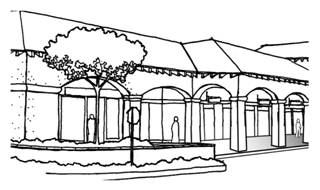
Figure 37-10.10
Arcade
Architectural Diversity. Combination of multiple architectural styles, colors, materials, or ornamentation to produce a harmonious, nonmonotonous built environment.
Architectural Entry Features. See Section 37-50.010: Accessory uses and structures for this definition.
Architectural Projection. Anything attached to and extended outside the outer face of the exterior wall of a structure such as stairs, balcony, bay window, fireplace, etc.
Area Median Income. See Section 37-50.060: Density bonus for this definition.
Art Galleries. Establishments engaged in the sale, loan, or display of art books, paintings, sculpture, or other works of art. Excludes libraries, museums, or noncommercial art galleries.
Arterial Street. Any street so designated in the Salinas general plan, including expressways. Arterial streets provide the highest level of service for vehicles at the greatest speed between major points in an urban area, for the longest uninterrupted distance with some degree of traffic and access control.
Articulation. Multiple changes in facade characteristics within a given building as a result of variation in setback or detailing.
Artist Studios. Workspaces for artists and artisans, including individuals practicing a fine or performing art.
Attached. The physical connection of two structures sharing any part of a common wall or roof.
Attic. The uninhabitable space between the upper surface of the top floor of a building and the roof above. An attic is not considered a story. Any space accessed solely by means of a hatch, ladder, or Jacob's Ladder through the ceiling of the floor below shall be considered an attic.
Automated Teller Machine (ATM). An unmanned machine that customers use to perform financial transactions including deposits and withdrawals of currency.
Automobile or Motorcycle Wrecking Yards. See Section 37-50.230: Salvage and wrecking operations for this definition.
Automobile Repair. See "Vehicle Repair."
Automobile-related Retail Sales and Services. See "Vehicle-related Retail Sales and Services."
Automobile Sales and Services. See "Vehicle Sales and Service."
Automobile Storage. See "Vehicle Storage."
Automobile Washing. See "Vehicle Washing."
Average Daily Trip (ADT). See Section 37-50.330: Vehicle trip reduction for this definition.
Average Vehicle Ridership. See Section 37-50.330: Vehicle trip reduction for this definition.
A-weighted Decibel (dBA). A numerical method of rating judgment of loudness. The A-weighted scale reduces the effects of low and high frequencies in order to simulate human hearing.
Awning. A roof-like structure, attached to and supported entirely by the exterior wall of a building, often made of canvas or similar material that serves as a shelter over a storefront, window, door, or deck. Also see Article V, Division 3: Signs for this definition.
(Ord. No. 2463 (NCS).)
(Ord. No. 2507 (NCS), § 22, 5-18-2010; Ord. No. 2581 (NCS), § 2, 12-6-2016; Ord. No. 2605(NCS), § 1, 7-3-2018; Ord. No. 2693 (NCS), § 1, 2-24-2026)
Sec. 37-10.260. - "B" definitions.
Bakery, Retail. A retail sales facility which offers bakery products only for direct sale to the public and which, as an accessory use, may include the preparation of products normally sold in bakeries, for sale off the premises. Also see "Food and Beverage Sales" and "Restaurant."
Bakery, Wholesale. A bakery or other food store that devotes over ninety percent of its gross floor area to the preparation of bakery products for sale at other locations. Wholesale bakeries may offer bakery products for direct sale to the public.
Balcony. An unenclosed area either recessed or projected from the walls of a building. Balconies are thirty inches or more above grade, are attached to and supported primarily by the exterior wall of the building, are accessible from the building's interior, and are unenclosed on one or more sides except for a railing or parapet that is not greater than sixty inches high. A balcony is not an accessory structure.
Banner. See Article V, Division 3: Signs for this definition.
Bar. An alcohol sales establishment where the primary use is the sale and on-site consumption of alcoholic beverages and where secondary uses may include food service. The premises may contain a counter upon and over which alcoholic beverages, such as beer, wine, and distilled spirits are served.
Base District or Base Zoning District. A portion of the city within which only certain land uses and structures are permitted and certain standards are established for development of land.
Basement. Any floor level below the first story in a building, except that a floor level in a building having only one floor level shall be considered a basement unless such floor level qualifies as a first story.
Bedroom. Any habitable room other than a living room, family room, bathroom, dining room, or kitchen shall be considered a bedroom if (1) it has seventy square feet or more of floor area; (2) the minimum horizontal dimension between interior walls is seven feet and the ceiling height is seven feet, six inches or more; and (3) it meets Uniform Building and Housing Code requirements as stated in Chapter 9 of the Salinas Municipal Code.
Bed and Breakfast Inn. A use/structure containing no more than five guestrooms providing transient occupancy for guests for no more than twenty-eight days continuously that is operated by a resident manager on the premises, and has food and beverage service limited to inn guests only.
Block. A unit of land bounded by streets or by a combination of streets and public land, railroad rights-of-way, waterways, or any other barrier to the continuity of development (see Figure 37-10.20).
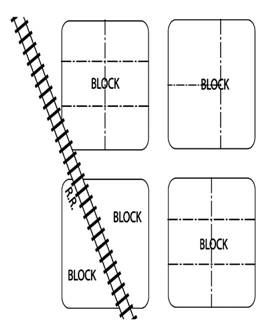
Figure 37-10.20
Block
Blockface, Neighboring. See Section 37-50.110: Infill residential development in the R-L district.
Boardinghouse or Rooming House. See "Interim Housing."
Bollard. A short post, often placed at intervals to delimit an area or to exclude vehicles.
Bona Fide Eating Place. See "Restaurant."
Breezeway. A structure typically open on one side for the principal purpose of connecting the main building or structure on a property with other main buildings or accessory structures.
Brew Pubs. An establishment in which beer is manufactured in limited quantities for on-site and off-site sales, distribution, and consumption. Also see Section 37-50.030: Alcohol license review for this definition.
Build-to Line. A line along the street edge of lots along which the front facades of buildings must be located.
Building. Any structure built entirely of frame or a more lasting type of construction, having a roof supported by columns, or by walls and intended for shelter, housing, or enclosure of any person, animal, or chattel, but not including any tent or trailer.
Building, Main. The principal structure on a property.
Building, Main Residential. A residential building that is the main building on a residential lot.
Building Exposure. A building wall that is parallel to a public or private street, highway, or designated parking area.
Building Line. See Section 37-50.010: Accessory uses and structures for this definition.
Building or Structure Height. The vertical distance from the average contact grade level of the building grade to the highest point of the coping of a flat form or to the deck line of a mansard roof or to the mean height level between eaves and ridge for gable, hip, or gambrel roofs except as otherwise provided for in Section 37-50.110: Infill residential development in the R-L district (see Figure 37-10.30).
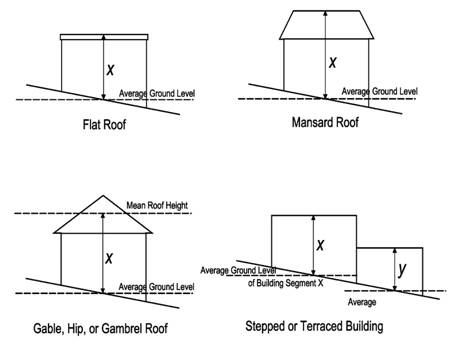
Figure 37-10.30
Building Height
Building Materials and Services. Retailing or wholesaling of building supplies and/or equipment and excludes the general manufacturing of such supplies or equipment. This classification includes lumber yards, tool and equipment sales establishments, and building contractor's yards. Excludes establishments devoted exclusively to retail sales of paint and hardware.
Building-mounted Facility. See Section 37-50.290: Telecommunication facilities for this definition.
Building Site. (1) The ground area of one lot, or (2) the ground area of two or more lots when used in combination for a building or permitted group of buildings, together with all open spaces, parking, and other requirements of the Zoning Code.
Building Transparency. See "Transparency."
Bulb-out. A traffic-calming measure typically located at intersections and pedestrian crossings that utilizes curbs and plantings near traffic lanes to slow traffic flow.
Bulk Reverse Vending Machine. See "Reverse Vending Machine, Bulk."
Business. A commercial establishment, office, institutional, or industrial use, or home occupation that produces goods or distributes goods and services.
(Ord. No. 2463 (NCS).)
(Ord. No. 2569 (NCS), § 1, 4-19-2016)
Sec. 37-10.270. - "C" definitions.
Camper. A structure designed primarily to be mounted upon a motor vehicle and with sufficient facilities to render as suitable for use as a temporary dwelling for camping travel, recreational, and vacation purposes.
Canopy. A permanent projecting roof-like structure (other than an awning) with or without ground supports extending from part or all of a building face that serves as a shelter over a storefront, window, door, or deck. Also see Article V, Division 3: Signs for this definition.
Caretaker. A person residing in a dwelling unit (manufactured unit included) on a property, whose duties include, but are not limited to, direct care, supervision, or maintenance of the property or uses on the property.
Caretaker's Residence (Permanent). A dwelling unit located on a premises with a main nonresidential use and occupied only by a caretaker or guard employed on the premises, and their family.
Caretaker's Residence (Temporary). A dwelling unit containing living quarters and kitchen facilities for temporarily housing persons responsible for administering, overseeing, or maintaining security for the main use on the site during the construction period.
Carpool. See Section 37-50.330: Vehicle trip reduction for this definition.
Carport. A permanent roofed structure permanently open on at least two sides, which is designed for or occupied by private passenger vehicles.
Catering Services. Preparation and delivery of food and beverages for off-site consumption without provision for on-site pickup or consumption.
Cemetery. Land use dedicated to the interment of human or animal remains or cremated remains. May include columbariums, mausoleums, and accessory sales and maintenance facilities, but excludes funeral services.
Central City Overlay, Downtown Core Area. See Article IV, Division 5: Central City (CC) Overlay District.
CEQA. The California Environmental Quality Act, Public Resources Code Section 21000 et seq. and the California Environmental Quality Act guidelines as may be subsequently amended by the state of California.
Chemical Manufacturing/Processing. An industrial process whereby substances are produced from or converted into other substances. In the process, the composition and properties of the starting material are altered.
Chicane. A traffic-calming measure that includes a series of narrowings or curb extensions that alternate from one side of the street to the other forming S-shaped curves. Also called deviations, serpentines, reversing curves, twists, and staggerings (see Figure 37-10.40).
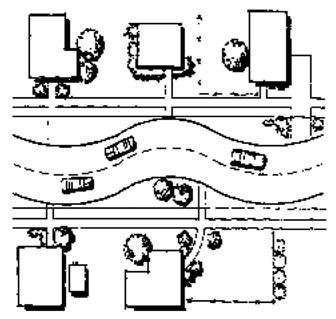
Figure 37-10.40
Chicane
Church. See "Religious Assembly."
Circuses and Carnivals. A temporary attraction including, but not limited to games, eating and drinking facilities, live entertainment (excludes adult entertainment facilities), animal exhibits, souvenir sales, and rides.
City Planner. The officially designated city employee or their designee charged with the responsibility for the interpretation and administration of this Zoning Code. See Section 37-10.160: City planner authority.
Clerestory. An upper portion of a wall or structure containing windows for supplying natural light to a building.
Clubs and Lodges. Meeting, recreational, or social facilities of a private or nonprofit organization primarily for use by members or guests, excludes commercial recreation and entertainment. This classification includes union halls, social clubs, and youth centers.
CNEL. See "Community Noise Equivalent Level (CNEL)."
Collector Street. Any street so designated in the Salinas general plan. In comparison to arterial streets, collector streets provide less highly developed level of service at a lower speed for shorter distances by collecting traffic from local streets and connecting them to arterial streets.
Colonnade. A series of columns placed at regular intervals.
Commercial. A land use or activity involving the sale or goods or services for financial gain.
Commercial Recreation. Includes, but is not limited to, theaters, sports stadiums and arenas, amusement parks, bowling alleys, billiard parlors, bingo parlors, ice/roller skating rinks, golf courses, miniature golf courses, model courses, shooting galleries, tennis and racquetball courts, amusement centers and arcades, martial arts studios, dance studios, health and fitness clubs, or facilities equipped and used for sports training and conditioning. Excludes adult entertainment facilities.
Community Facility. A noncommercial use established primarily for the benefit and service of the population of the community in which it is located.
Community Noise Equivalent Level (CNEL). The average equivalent sound level during a twenty-four-hour day, obtained after addition of five decibels to sound levels in the evening from 7:00 p.m. to 10:00 p.m. and after addition of ten decibels to sound levels in the night after 10:00 p.m. and before 7:00 a.m. Also see "A-weighted Decibel."
Concessions. See Section 37-50.060: Density bonus for this definition.
Conditional Use. Uses which may be permitted, subject to approval of a conditional use permit in accordance with Article VI, Division 8: Conditional Use Permits. Generally, conditional uses are those uses, which have the potential for objectionable operating characteristics or appearance, which may be out of character in a particular zoning district, either of which may make those uses suitable or unsuitable for a particular site or location.
Condominium. An estate in real property consisting of an undivided interest in common in a portion of a parcel or real property together with a separate interest in space in a residential, industrial, or commercial building on the real property. A condominium may include, in addition, a separate interest in other portions of the real property.
Condominium Conversion. The subdivision of any existing building and land to allow for condominium form of ownership.
Congregate Housing. Group housing that combines individual living quarters with communal facilities for food, care, and recreation facilities.
Contiguous. The same as "Abut or Abutting."
Convalescent Hospitals. Facilities providing long-term nursing, dietary, and other medical services to convalescents or invalids in an institutional setting but not providing surgery or primary treatment such as are customarily provided in a hospital. Convalescent hospitals include nursing homes and rest homes. Excludes general or specialized hospitals or residential care facilities.
Convenience Store. A retail store of less than five thousand square feet that sells convenience goods, such as pre-packaged food and beverage items, prepared food items for off-site consumption, tobacco, periodicals, and other limited groceries and household items. May include alcohol sales for off-site consumption subject to Section 37-50.030: Alcohol license review and gasoline sales depending upon the use classifications of the applicable zoning district.
Conversion. Changing the original use or purpose of a building to a different use or purpose.
Cornice. A horizontal molded projection that crowns or completes a building or wall.
Crime Prevention through Environmental Design (CPTED). The proper design and effective use of the built environment that can lead to a reduction in the fear and incidence of crime and an improvement in the quality of life. CPTED addresses both the physical and psychological aspects of design and incorporates several strategies to create defensible space such as natural surveillance, territoriality, natural access control, and physical security. Also see the safety element of the Salinas general plan for additional discussion.
Cultural Institutions. Institutions displaying or preserving objects of interest in one or more of the arts or sciences. This classification generally includes libraries, museums, and art galleries where displayed objects are not intended for sale.
Cupola. A domelike structure mounted on a roof, originally intended for ventilation (see Figure 37-10.50).
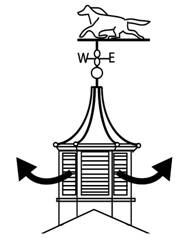
Figure 37-10.50
Cupola
(Ord. No. 2463 (NCS).)
Sec. 37-10.280. - "D" definitions.
Day Care Centers. Facilities approved and licensed by the state, other than family day care homes, that provide nonmedical care on less than a twenty-four-hour basis, including infant centers, preschools, extended day care facilities, adult day care facilities, and elderly day care facilities. Excludes residential care facilities, residential service facilities, interim housing, or convalescent hospitals/nursing homes.
Day Care Home, Family (Large). A home approved and licensed by the State Department of Social Services which regularly provides care, protection, and supervision for nine to fourteen children, inclusive, in the provider's own home, including children under the age of ten years who reside at the home.
Day Care Home, Family (Small). A home approved and licensed by the State Department of Social Services which regularly provides care, protection, and supervision for eight or fewer children in the provider's own home, including children under the age of ten years who reside at the home.
Day-night Average Level (Ldn). The average equivalent sound level during a twenty-four-hour day, obtained after addition of ten decibels to sound levels in the night after 10:00 p.m. and before 7:00 a.m. Also see "Community Noise Equivalent Level (CNEL)."
Decibel (dBA). A unit for measuring the amplitude of sound, as the human ear hears it. Also see "A-weighted Decibel," and "Community Noise Equivalent Level (CNEL)."
Deck. See Section 37-50.010: Accessory uses and structures for this definition.
Defensible Space. See "Natural Surveillance."
Density Bonus. See Section 37-50.060: Density bonus for this and other density bonus-related definitions.
Density Bonus Program Guidelines. See Section 37-50.060: Density bonus for this definition.
Density Bonus Units. See Section 37-50.060: Density bonus for this definition.
Density, Gross. The total number of dwelling units divided by the total (gross) area of the property.
Density, Net. The number of dwelling units per acre of developable land exclusive of public and private streets, greenways, land designated as open space on the general plan land use and circulation policy map, drainage and power transmission line easements, and other public and semipublic uses.
Development. (1) Any subdivision pursuant to the Subdivision Map Act except where the land division is brought about in connection with the purchase of the land by a public agency; (2) the division of a parcel of land into two or more parcels; (3) the construction, reconstruction, conversion, structural alteration, relocation, or enlargement of any structure; (4) any mining, excavation, landfill, or grading; (5) any use or extension of the use of land; (6) any man-made change to improved or unimproved real estate, including, but not limited to, buildings or other structures or modifications thereto, which affect the exterior dimensions of a structure, relocation of a building or structure, condominium conversions, mining, dredging, filling, grading, paving, excavation, or drilling operations.
Development Agreement. An agreement entered into between the city and a contracting party that relates to a specific real property, subject to the terms of the agreement, pursuant to the provisions of this Zoning Code and Article 2.5, Chapter 4, Division 1 of Title 7 of the California Government Code.
Development Approval. See Section 37-50.330: Vehicle trip reduction for this definition.
Development Standard. See Section 37-50.060: Density bonus for this definition.
Disability. A physical or mental impairment that substantially limits one or more of the major life activities of individuals, and there is a record of such an impairment or the individual is regarded as having such an impairment. It is the intent of this definition to substantially comply with the term "disability" as defined by the Federal Americans with Disabilities Act of 1990, as may be amended from time to time.
Disaster Shelter. Limited term facility providing shelter and other basic living necessities following a local emergency as defined in Chapter 11A: Emergency Organization and Functions, including such facilities organized in conjunction with a "state of emergency" proclaimed by the Governor or other authorized state or federal official. For the purpose of this definition, "limited term" means not longer than eighteen consecutive months. Excludes "emergency shelter" and "transitional housing" as defined in Article 1, Division 2: Definitions.
Dormer. A window, which is set vertically on a sloping roof. The dormer has its own roof, which may be flat, arched, or pointed.
Downtown Alcohol-related Use License Area. See Section 37-50.030: Alcohol license review for this definition.
Drive-through or Drive-in Use. A use where a customer is permitted or encouraged, either by the design of physical facilities or by the service and/or packaging procedures offered, to be served while remaining seated in a vehicle including, but not limited to, drive-through or drive-in food, financial services, and automatic or self-serve car washes.
Driveway. A private roadway or travelway and its access point from a public street for the exclusive use of the occupants of a property and their guests, and which provides vehicular access to required parking spaces or structures or uses on a site.
Dwelling or Dwelling Unit. A room or suite of two or more rooms with internal circulation, designed for use by one family for living or sleeping purposes, and having only one kitchen or kitchenette. Dwelling or dwelling unit includes single-family attached and detached dwelling units, duplex, triplex, and multifamily dwelling units, multiple detached dwelling units, and green court dwelling units. Excludes hotels, motels, boarding houses, nursing homes, rest homes, children's homes, or hospitals.
Dwelling, Duplex. A building that contains two attached dwelling units on one lot. The units must share a common wall or common floor/ceiling (see Figure 37-10.70). Excludes second dwelling units.
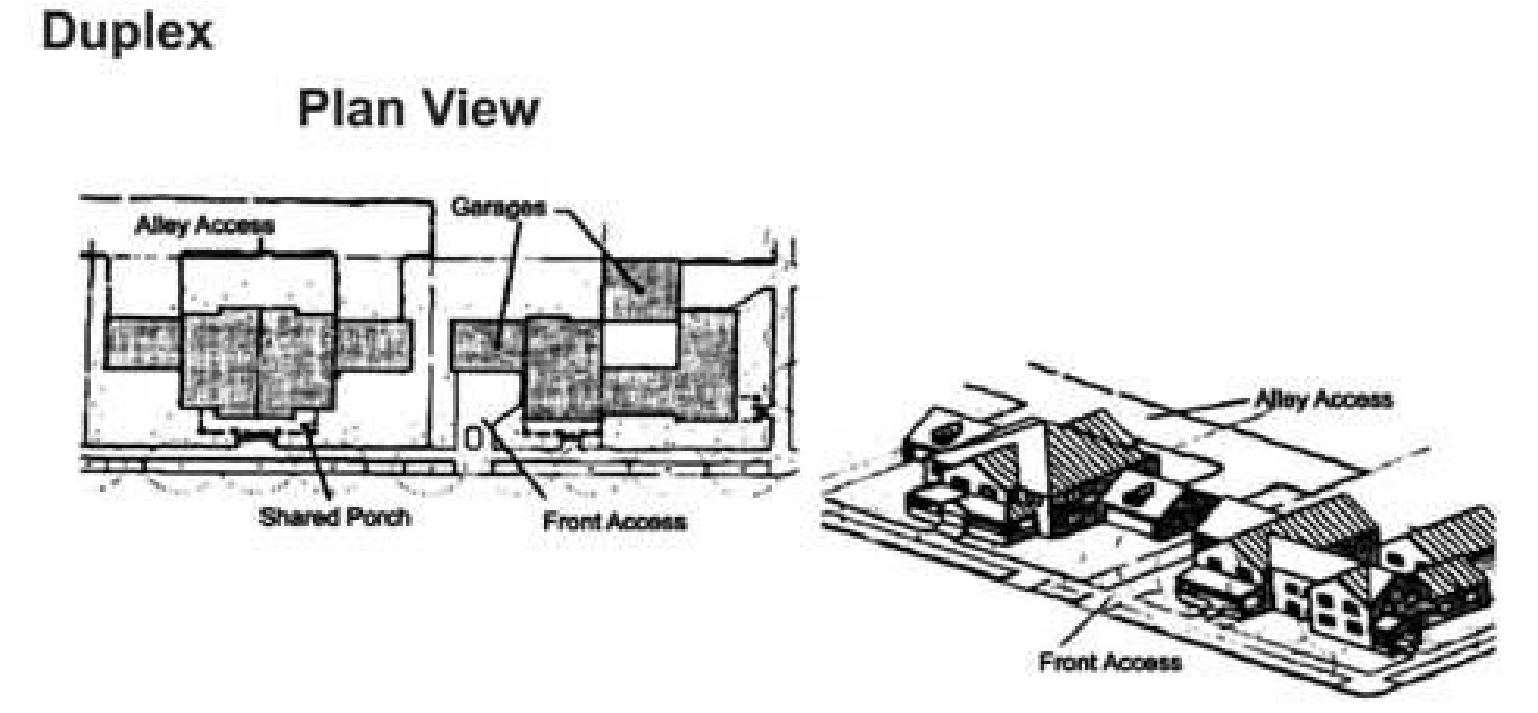
Figure 37-10.70
Duplex Dwellings
Dwelling, Efficiency Unit, or Studio. Any habitable room having cooking and bathroom facilities and is intended or designed to be used for combined living, dining, and sleeping purposes.
Dwelling, Green Court. A single-family unit developed in a cluster with other such units and usually containing a front porch that faces onto a common green (see Figure 37-10.80).
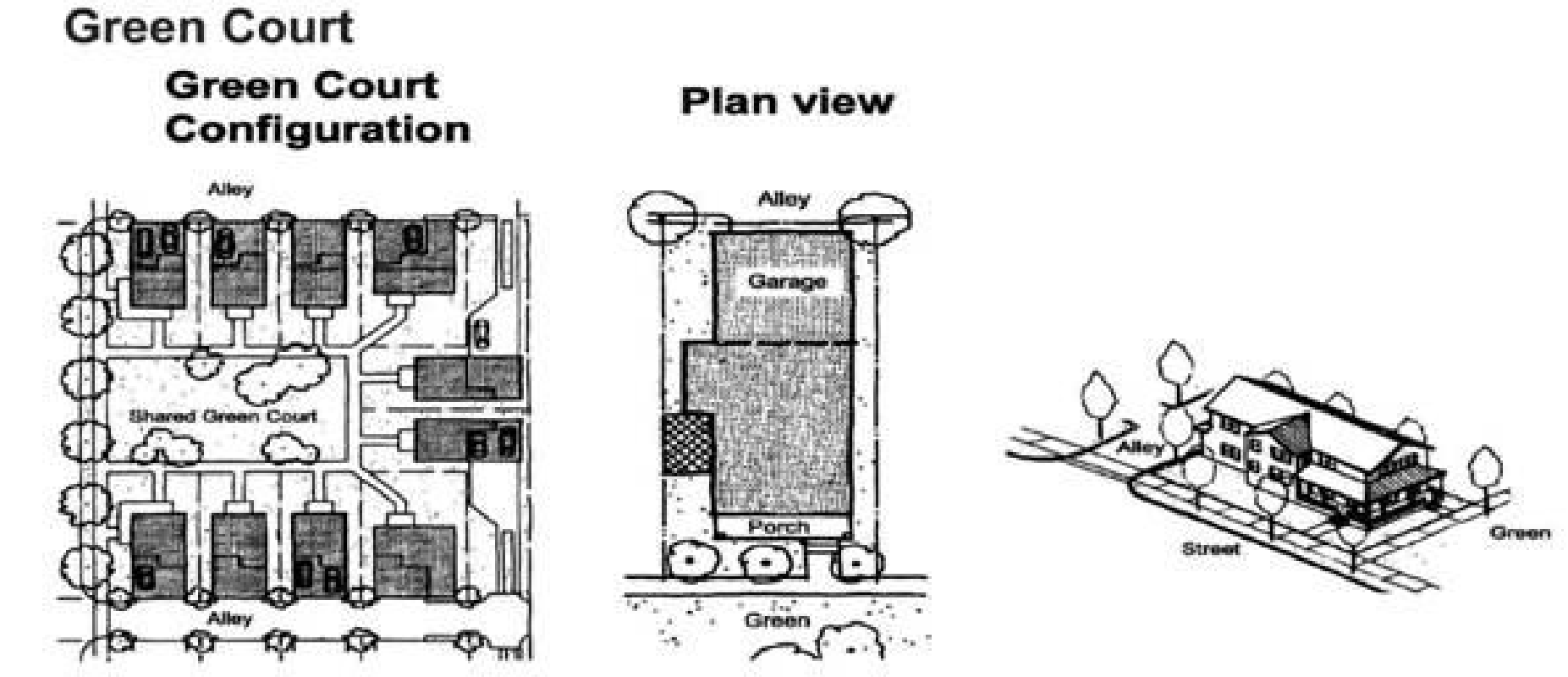
Figure 37-10.80
Green Court Dwellings
Dwelling, Multifamily. A building that contains three or more dwelling units that share common walls or floor/ceilings. The land under the building or units is not divided into separate lots. The units may have separate or joint entrances, and typically have common parking and open space areas. Multifamily dwellings include garden apartments, apartment buildings, and condominiums (see Figure 37-10.100). Excludes second dwelling units.
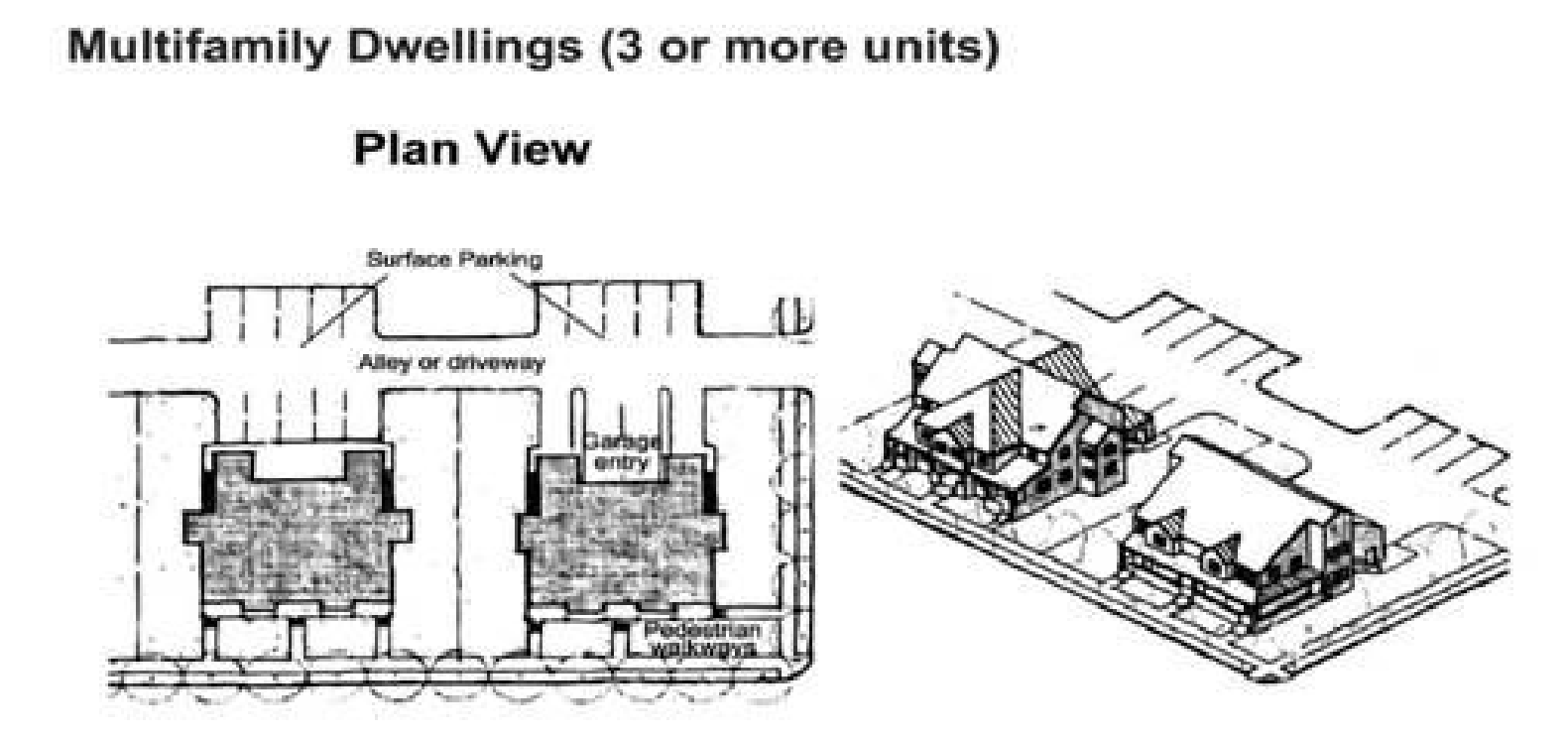
Figure 37-10.100
Multifamily Dwellings
Dwelling, Multiple Detached. A grouping of two or more detached residential buildings where each building contains one or more dwelling units. The land underneath the buildings is not divided into separate lots. A multiple detached dwelling development typically may include an existing single-dwelling detached dwelling with one or more new detached dwellings (excludes second dwelling units) located on the same lot. The key feature of this type of dwelling is that there is no requirement for the dwellings or structures on the site to be attached or of the same type (see Figure 37-10.90).
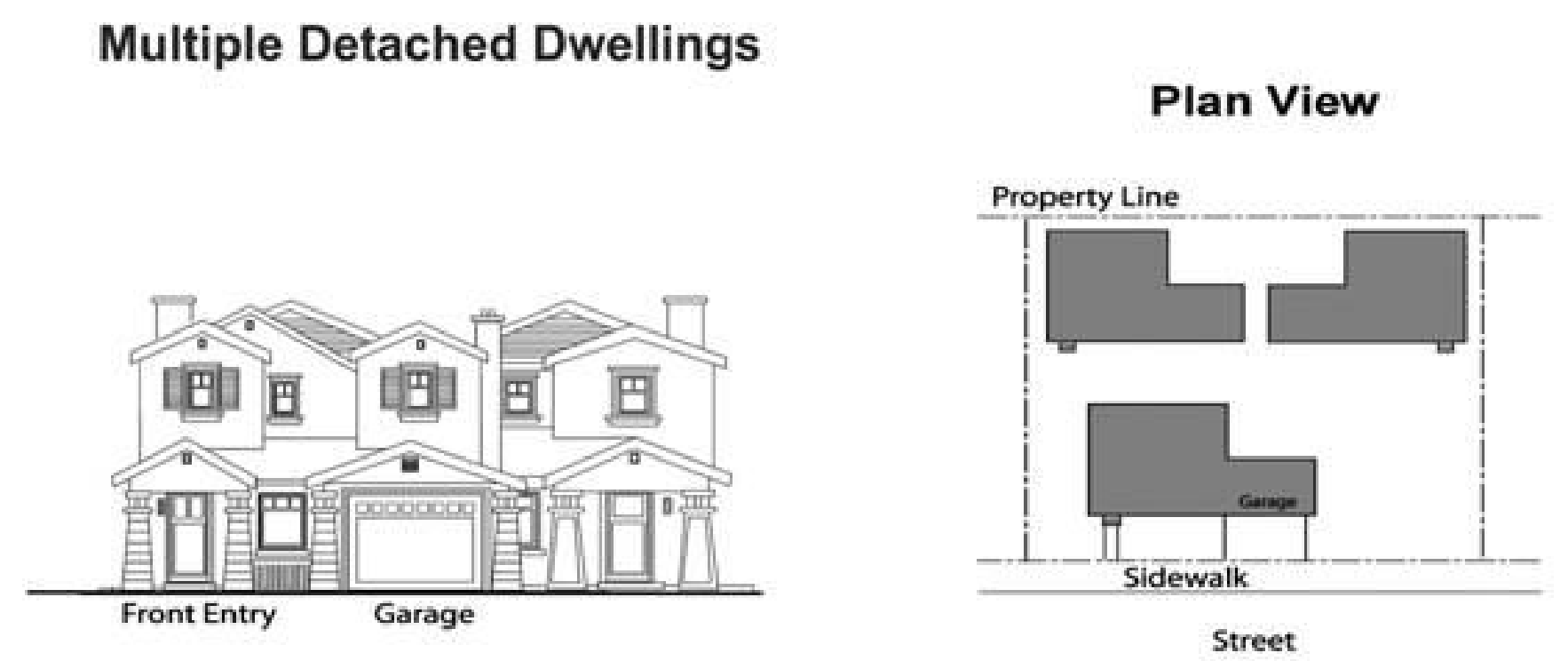
Figure 37-10.90
Multiple Detached Dwellings
Dwelling, Single-family Attached. A dwelling unit that shares one or more common or abutting walls with one or more dwelling units. Each dwelling unit is located on its own lot. The common or abutting wall between the units shall be at least fifty percent of the length of the units. An attached single-family dwelling typically does not share common floor/ceiling with other dwelling units; rather the units are attached horizontally in a linear arrangement. A single-family attached dwelling is also called a rowhouse, townhouse, or common wall house (see Figure 37-10-60).
Dwelling, Single-family Detached. A residential building containing one dwelling unit on one lot (see Figure 37-10.60). Single-family lot may also include one second dwelling.
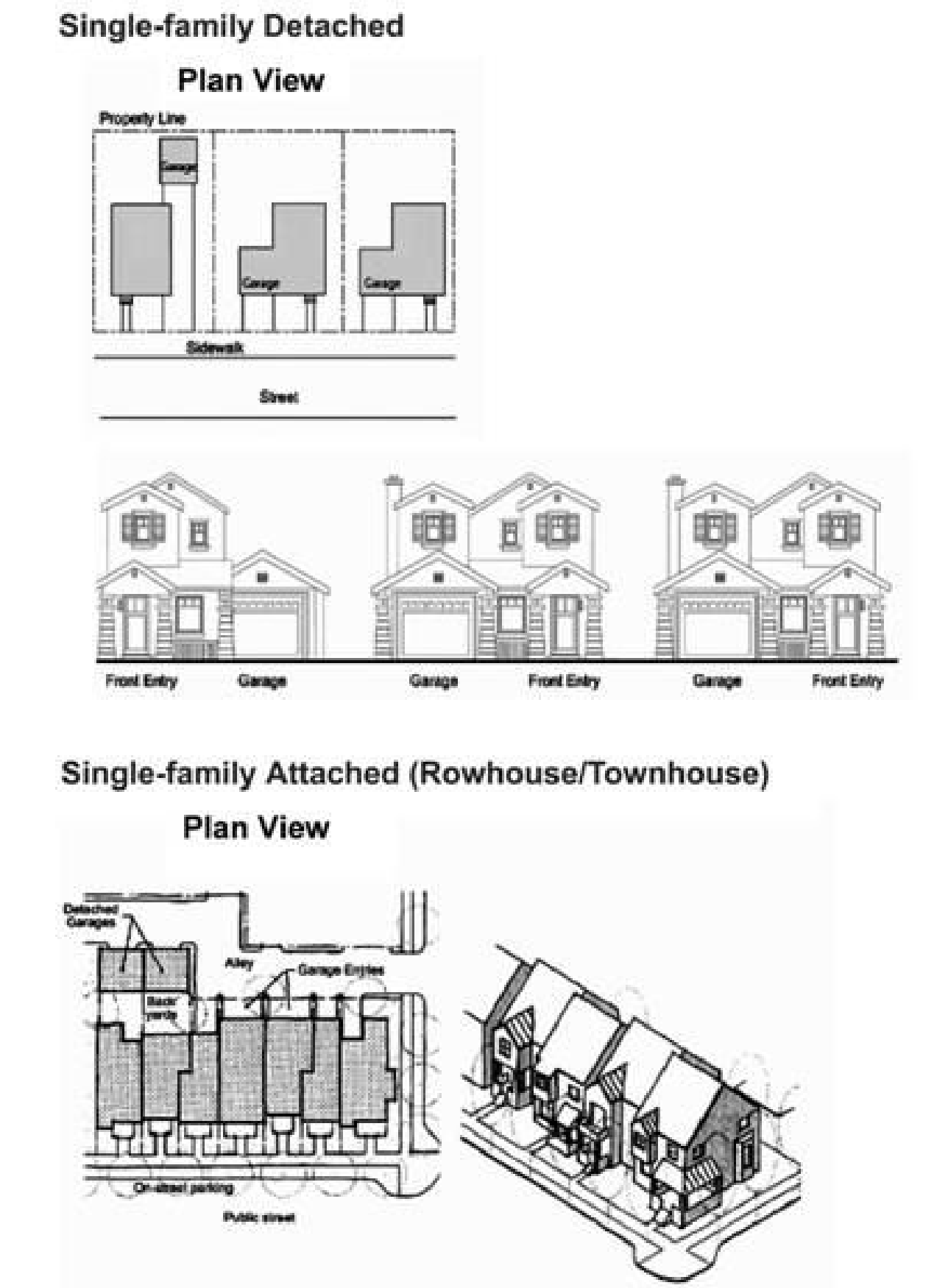
Figure 37-10.60
Single-family Dwellings (Detached and Attached)
(Ord. No. 2463 (NCS).)
(Ord. No. 2532 (NCS), § 2, 11-13-2012; Ord. No. 2581 (NCS), § 3, 12-6-2016)
Sec. 37-10.290. - "E" definitions.
Easement. A recorded right or interest in the land of another, which entitles the holder thereof to some use, privilege, or benefit from over or across such land.
Elevation (Building). A drawing showing the elements of the exterior of a building as a direct projection to a vertical plane.
Emergency Shelters—Type A. Short term housing with minimal supportive services for individuals lacking a fixed, regular and adequate nighttime residence, including those whose primary nighttime residence is a public or private place not designed for, or ordinarily used as, a regular sleeping accommodation for human beings, but excluding individuals imprisoned or otherwise detained pursuant to an Act of the Congress or the laws of a state. For the purpose of this definition, "short term" means not longer than one hundred eighty days residency for any individual within a three hundred sixty-five day period. To qualify as a type A emergency shelter, facility shall comply with the applicable development regulations specified in Section 37-50.305: Emergency shelters. Excludes "disaster shelter" and "transitional housing" as defined in Article 1, Division 2: Definitions.
Emergency Shelters—Type B. Same as emergency shelters—type A except as to the applicable development regulations specified in Section 37-50.305: Emergency shelters.
Employee Housing. Dwellings and other housing accommodations provided and maintained by an employer for employees in connection with work or the place where work is being performed, whether or not rent is involved. Employee housing may be developed or managed by a party other than the employer, provided the employer retains control and ultimate responsibility for the facility. Housing for agricultural workers is also considered employee housing. Employee Housing does not include school district or community college district housing, which is defined and regulated in Sections 37-10.430 and 37-50.235.
Employee Housing, Agricultural. Employee housing for agricultural workers consisting of no more than either thirty-six beds in group quarters on one lot, or twelve dwelling units or spaces designed for use by a single household on one lot. For the application of this chapter's regulations, agricultural employee housing is treated in the same way as other agricultural uses are treated in the same zoning district. Permitted occupancy in a zone allowing agricultural uses shall include agricultural employees who do not work on the property where the employee housing is located. For the purposes of this land use, agricultural workers are those engaged in agriculture and in agricultural produce processing, as both terms are defined herein.
Employee Housing, Small Project. Employee housing providing accommodation for no more than a total of six employees on one lot, which can include housing for agricultural workers. For the application of this chapter's regulations, small project employee housing is treated in the same way as single-family detached dwellings are treated in the same zoning district.
Employee Housing, Medium Project. Employee housing providing accommodation for a total of seven up to fourteen employees, which can include agricultural workers. For the application of this chapter's regulations, medium project employee housing with seven to fourteen employees on one lot may be permitted in any RL or RM residential district subject to approval of an Administrative Conditional Use Permit pursuant to Section 37-60.500. Medium project employee housing with seven to fourteen employees per dwelling unit may be permitted in any RM residential district subject to approval of a Non-administrative Conditional Use Permit pursuant to Section 37-60.505.
Entertainment, Live. A musical, theatrical, dance, karaoke, cabaret, or comedy act performed by one or more persons. Any form of dancing by patrons or guests at a restaurant or bar is live entertainment. Excludes adult entertainment facility or adult entertainment establishment.
Enforcement Officer. Unless otherwise specified, the city planner.
Environmental Impact Report (EIR). A report that describes and analyzes the environmental effects of a proposed project pursuant to the California Environmental Quality Act (CEQA).
Environmental Review. The process of determining the impact of proposed projects on the environment. The review process shall be carried out in accordance with the California Environmental Quality Act, CEQA guidelines, and the applicable city guidelines.
Equipment, Heavy. See Section 37-50.190: Recreational vehicles, prohibited vehicles, and equipment parking and storage for this definition.
Equipment Sales, Services, and Rentals. Sales, services, or rental of equipment including, but not limited to, construction equipment and agricultural equipment.
Excavation. The process of altering the natural grade by cutting or filling the earth or by any activity in which soil or rock is cut, dug, quarried, uncovered, removed, displaced, or relocated.
(Ord. No. 2463 (NCS).)
(Ord. No. 2532 (NCS), § 3, 11-13-2012; Ord. No. 2623 (NCS), § 1, 11-5-2019; Ord. No. 2656 (NCS), § 1, 5-10-2022)
Sec. 37-10.300. - "F" definitions.
Facade. That portion of any exterior elevation on the building extending from grade to top of parapet, wall, or eaves, and the entire width of the building elevation.
Facade, Street. Those portions of a building facade, including porches, that face and are most closely parallel to the front or street lot line.
Facility. (1) The total of all buildings, structures, and grounds encompassing a development site; or (2) a structure, improvement, or place, which is built, installed, or established for a particular purpose including but not limited to bicycle/pedestrian and parking facilities.
Facilities Trip Reduction Plan. See Section 37-50.330: Vehicle trip reduction for this definition.
Family. Any group of individuals living together based on personal relationships. Excludes larger institutional group living situations such as dormitories, fraternities, sororities, monasteries, and nunneries, nor does it include such commercial group living arrangements as congregate housing, boardinghouses, lodging houses, and employee housing.
Family Day Care Home. See "Day Care Home, Family."
Fascia. A flat usually horizontal member of a building having the form of a flat band or broad fillet used as a molding covering the joint between the top of a wall and the projecting eaves. Also see Article V, Division 3: Signs for this definition.
FAR. See "Floor Area Ratio."
Fence. See Section 37-50.090: Fences, walls, and hedges.
File. To formally submit plans, applications, appeals, complaints, requests, or other documents with a governmental agency, private firm, or individual.
Financial Services. A commercial land use involved with the exchange of money and services related to the financial system.
First Approval. See Section 37-50.060: Density bonus for this definition.
Fitness Centers. A commercial recreation use in which a range of indoor and/or outdoor fitness activities and classes are offered for a fee, such as weight training, aerobics, gymnastics, swimming, and racquet sports.
Floor Area, Gross. The total enclosed area of all floors of a building, measured to the outside face of the structural members and exterior walls, and including halls, stairways, elevator shafts at each floor level, service and mechanical equipment rooms, and habitable basement or attic areas. Does not include enclosed parking areas.
Floor Area Ratio (FAR). The gross floor area of a building(s) on a lot divided by the area of the lot (see Figure 37-10.110).
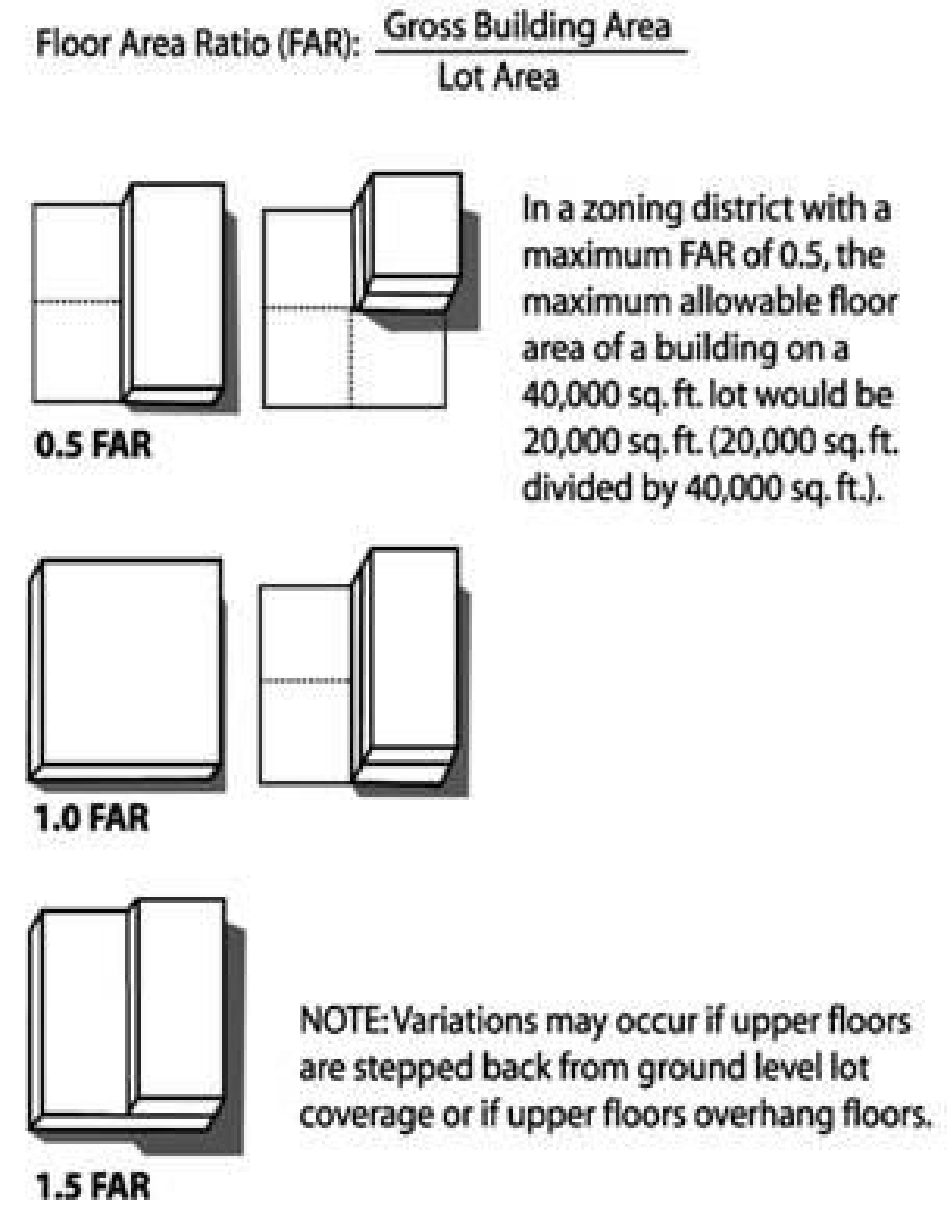
Figure 37-10.110
FAR
Freeway. Any road so designated in the general plan. Freeways are essentially expressways with fully controlled access, providing regional connectivity to neighboring cities.
Food and Beverage Sales. Retail sales of food and beverages for off-site preparation and consumption, and no customer seating or other physical accommodation is provided for on-site dining. Typical uses include groceries, liquor stores, and retail bakeries. Excludes convenience stores.
Food Products Processing. An industrial use that involves the preparation, processing, canning, pickling, preserving, or cooking, and packaging of food products for human consumption. Excludes agricultural produce processing.
Food Truck.See Section 37-50.095: Food Trucks for this definition.
Fortunetelling. A use involving the foretelling of the future in exchange for financial or other valuable consideration. Fortunetelling shall be limited to uses where the fortune is told through astrology, augury, card or tea reading, cartomancy, clairvoyance, clairaudience, crystal gazing, divination, magic mediumship, necromancy, palmistry, psychometry, phrenology, prophecy, spiritual reading, or any similar means. Excludes forecasting based on historical trends or patterns, religious or political dogma, or any of the previously listed arts when presented in an assembly of people who purchase tickets or means in exchange for the presentation at a site licensed for such purpose.
Funeral Services. Establishments primarily engaged in the preparation of the deceased for burial or cremation, the temporary display of the deceased, cremations, accessory retail sales, and rituals connected with the burial or cremation.
(Ord. No. 2463 (NCS).)
(Ord. No. 2507 (NCS), § 22, 5-18-2010; Ord. No. 2623 (NCS), § 2, 11-5-2019; Ord. No. 2649 (NCS), § 1, 9-21-2021)
Sec. 37-10.310. - "G" definitions.
Gable. The generally triangular section of wall at the end of a pitched roof, occupying the space between the two slopes of the roof.
Garage. An enclosed accessory building, or portion of a building, used for the parking or temporary storage of motor vehicles and recreational vehicles for the occupants of the premises.
General Plan. The Salinas general plan, as amended from time to time.
Government Offices. Administrative, clerical or public contact offices of a government agency, including postal facilities, together with incidental storage.
Grading. An excavation, filling in, re-engineering, spreading, or moving of earth, sand, gravel, rock, or other natural material on a lot, building site, street right-of-way, or other land area.
Grand Opening. See Article V, Division 3: Signs for this definition.
Granny Unit. See "Dwelling, Second."
Gross Vehicle Weight Rating (GVWR). The weight specified by the manufacturer of a vehicle as the loaded weight of a single vehicle.
Ground Floor. The floor of a building, which is nearest the surrounding surface of the ground, and is usually considered to be the first floor.
Guests. See Section 37-50.030: Alcohol license review.
(Ord. No. 2463 (NCS).)
Sec. 37-10.320. - "H" definitions.
Habitable Room. Any room designed for sleeping or living purposes. Excludes such spaces as closets, garages, bathrooms, hallways, unfinished attics, foyers, patios, storage spaces, and utility rooms.
Hangar. A shed or shelter, particularly a structure for the shelter, service, or repair of aircraft.
Hangar, Commercial. A hangar in which any person, firm, corporation, or association may conduct any aeronautical business on the airport.
Hangar, Corporate. A hangar housing one or more aircraft for the personal or business use of the hangar owner or lessee, and where no commercial activities are allowed to be conducted.
Hangar, Multiple T. A hangar composed of partitioned, nested units designed to house no more than one aircraft in each unit and having single door openings for each unit and where no commercial activities are allowed to be conducted.
Hazardous Waste. See "Waste, Hazardous."
Hazardous Waste Transfer Station. See "Transfer Station, Hazardous Waste."
Heavy Equipment. See Section 37-50.190: Recreational vehicles, prohibited vehicles, and equipment parking and storage for this definition.
Hedge. A row of bushes or small trees or similar vegetation planted close together to form a barrier enclosing or bordering a yard, boundary, or an object (or any portion thereof). Also see Section 37-50.090: Fences, walls, and hedges.
Height, Building or Structure. See "Building or Structure Height."
Height, Wall. See Section 37-50.090: Fences, walls, and hedges.
Hip. The external angle formed by the meeting of two sloping sides or skirts of a roof, which have their wall plates running in different directions.
Hierarchy. A clearly defined ranking of places within a given area.
Home Occupation. See Section 37-50.100: Home occupations for this definition.
Hospital. An institutional land use consisting of a facility licensed by the State Department of Public Health for the provision of clinical and temporary or emergency service for human patients in need of medical, obstetrical, nursing, surgical, anesthesia, laboratory, radiology, pharmacy, and dietary services, including inpatient, outpatient, and overnight care.
Hotel. A commercial land use providing transient occupancy for guests for twenty-eight or fewer days in a building or portion thereof in which access is provided through a common entrance, lobby, or hallway, and which contains six or more guest rooms.
Hotel, Extended Stay. A commercial land use providing transient occupancy for guests for twenty-eight or fewer days, or longer than twenty-eight days subject to payment of transient occupancy tax per Salinas Municipal Code Section 32-22, in a building or portion thereof in which access is provided through a common entrance, lobby or hallway and which contains six or more guest rooms.
Housing Code. As defined in Chapter 9 of the Salinas Municipal Code.
Housing Development. One or more groups of residential projects.
(Ord. No. 2463 (NCS).)
Sec. 37-10.330. - "I" definitions.
Illegal On-premises Advertising Display. See Section 37-50.660: Nonconforming sign abatement for this definition.
Improvement. Infrastructure and all related appurtenances, bridges, utilities, pedestrian ways, bikeways, equestrian trails, landscaping and irrigation, and related facilities in connection with an approved development or public works project, whether involving the subdivision of land or not.
Incentives. See Section 37-50.060: Density bonus for this definition.
Indirect Illumination. See Article V, Division 3: Signs for this definition.
Interior Illumination. See Article V, Division 3: Signs for this definition.
Industrial Complex. A combination of industrial and/or heavy commercial establishments, the perimeter of which is clearly definable, developed on a single parcel or continuous parcels of land, planned and developed as a single unit, and providing shared on-site parking.
Industry, General. Manufacturing of products, primarily from extracted or raw materials, the bulk storage and handling of such products and materials, or the processing of food items. General industrial uses typically include: production, fabrication, processing, or manufacturing outside an enclosed building; outdoor storage of bulk fuel or other materials; manufacturing uses involving primary production of commodities from raw materials; a high incidence of truck or rail traffic; and exhaust stacks and other exterior piping or ductwork. May include associated research laboratories. Excludes chemical manufacturing/processing. Examples of general industrial may include, but are not limited to, the following:
(a)
Agricultural produce processing;
(b)
Concrete manufacturing;
(c)
Container manufacturing;
(d)
Food products manufacturing;
(e)
Furniture manufacturing;
(f)
Machinery manufacturing;
(g)
Paper products manufacturing;
(h)
Pharmaceuticals manufacturing;
(i)
Primary metal, plastic, and wood products manufacturing;
(j)
Textile manufacturing; or
(k)
Wineries.
Industry, Limited. Assembly of finished parts or products from already manufactured components, fabrication, packaging, warehousing, distribution, and shipping. Limited industrial uses typically include: activity conducted entirely within an enclosed building; the absence of outdoor storage of bulk fuel or other materials; a low incidence of truck or rail traffic; and the absence of exhaust stacks and other exterior piping or ductwork. May include associated research laboratories. Examples of limited industry may include, but are not limited to, the following:
(a)
Apparel manufacturing;
(b)
Biotechnology firms;
(c)
Computer and electronic manufacturing;
(d)
Paper products finishing; or
(e)
Product assembly.
Inoperable Vehicle and Equipment. See Section 37-50.190: Recreational vehicles, prohibited vehicles, and equipment parking and storage for this definition.
Institutional. See "Public and Semipublic Uses."
Instructional and Educational Services. See Section 37-50.100: Home occupations for this definition.
Interim Housing. Shared living quarters, with or without separate kitchen and bathroom facilities for each room or unit, intended to meet short-term shelter and/or other immediate needs. Examples of interim housing may include, but are not limited to, the following:
(a)
Emergency shelters, type A and type B;
(b)
Fraternities;
(c)
Dormitories;
(d)
Disaster shelters;
(e)
Sororities;
(f)
Boardinghouses/rooming houses; or
(g)
Halfway houses.
Interim housing does not include residential care facilities, day care homes, family day care centers, convalescent hospitals, hotels, motels, bed and breakfast inns, or single room occupancy housing.
Internal Circulation. A structural connection between two portions of a structure designed to provide for circulation between habitable portions of a structure without circulation out of doors or through nonhabitable areas such as a garage, or through areas not normally used for interior circulation, such as laundry rooms, bathrooms, and mechanical rooms.
(Ord. No. 2463 (NCS).)
(Ord. No. 2532 (NCS), § 6, 11-13-2012; Ord. No. 2623 (NCS), § 3, 11-5-2019)
Sec. 37-10.340. - "J" definitions.
Junk Yard. See "Salvage and Wrecking Operations."
(Ord. No. 2463 (NCS).)
Sec. 37-10.350. - "K" definitions.
Kiosk, Permanent. A freestanding structure with a foundation located on private property not exceeding a maximum size of one hundred square feet and compatible in design with other existing uses and buildings in the vicinity. Operated for the purpose of vending food, drink, retail goods, or services.
Kiosk, Temporary or Semi-permanent. A freestanding, temporary or semi-permanent structure having one or more open air sides, operating on either private property or public rights-of-way and plazas, not exceeding a maximum of sixty square feet and compatible in design with other existing uses and buildings in the vicinity. Operated for the purpose of vending food, drink, retail goods, or services.
Kitchen or Kitchenette. Any room or part of a room, which is designed, built, used, or intended to be used for food preparation (including but not limited to cooking or dishwashing activities). Excludes a bar, butler's pantry, or similar room adjacent to or connected with a kitchen.
(Ord. No. 2463 (NCS).)
Sec. 37-10.360. - "L" definitions.
Laboratories. Establishments providing medical or dental laboratory services or establishments providing photographic, analytical, or testing services.
LAFCO. Local agency formation commission of Monterey County.
Landscaping. An area devoted to, or developed and maintained with, native or exotic plantings, lawn, groundcover, gardens, trees, shrubs, and other plant materials, decorative treatments such as outdoor landscape surfaces of rock, stone, brick, block, wood, or similar decorative material (excludes driveways, parking, loading, or storage areas), and sculptural elements. Plants on rooftops, porches, or in boxes attached to buildings are not considered landscaping.
Landscaping, Perimeter. A landscaped area adjoining and outside the shortest circumferential line defining the exterior boundary of a parking or loading area, or similar paved area. Excludes driveways or walkways providing access to the facility (as applied to parking and loading facilities or to similar paved areas) (see Figure 37-10.120).
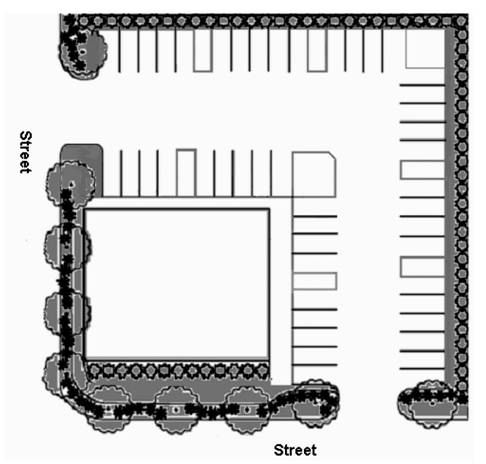
Figure 37-10.120
Perimeter Landscaping
Shaded areas denote areas of perimeter landscaping.
Not to Scale.
Landscaping, Xeriscape. See "Xeriscape."
Lattice Tower. See Section 37-50.290: Telecommunication facilities for this definition.
Laundry or Dry Cleaning, Limited. An establishment to dry clean and/or wash and dry clothes and other fabrics brought in and carried away by the customer. This may include self-service or coin-operated facilities.
Laundry, Unlimited. An establishment where large quantities of clothes and other fabrics are washed and/or ironed or dry-cleaned but are collected and delivered primarily by laundry employees. Excludes laundries or limited dry cleaning.
Ldn. See "Day-night Average Level (Ldn)."
Live-work Units. See Section 37-50.130: Live-work units.
Local Street. Any street not defined as an arterial, collector, or freeway. Local streets primarily provide access to land with little or no through vehicle movements and typically have smaller street cross section widths and lower traffic volumes and speeds. Traffic calming may be used on local streets to reduce vehicle speeds and/or to improve conditions for pedestrians and bicyclists.
Logo. A registered trademark, copyright, brand name, or symbol of an organization or business designed for ready recognition by the public.
Lot or Parcel. A parcel or portion of land separated from other parcels or portions by description, as on a subdivision, parcel, or record-of-survey map, or by metes and bounds, for purpose of the sale, lease, or separate use.
Lot Area, Gross. The total area (measured in a horizontal plane) included within the boundary lines of a lot.
Lot Area, Net. The total area (measured in a horizontal plane) included within the boundary lines of a lot minus any area taken up by surface easements or rights-of-way over the lot, such as areas designated as open space on the general plan, streets, bikeways, open channel storm drains, etc.
Lot Cluster. Two or more adjacent lots having a single uninterrupted perimeter boundary enclosing all of the lots.
Lot Coverage. The percentage of a lot that is covered by a structure or structures including second dwelling units, attached and detached accessory structures, and enclosed porches and patio covers. Excludes projected roof overhangs of a structure, unenclosed patios and porches, and flat work such as paved driveways, sidewalks, pathways, decks, and patios.
Lot, Corner. A lot bounded by two or more adjacent street lines that have an angle of intersection of not more than one hundred thirty-five degrees. The front yard of corner lot shall adjoin the shortest street property line. Where street property lines are substantially the same length, the city planner shall determine the location of the front yard (see Figure 37-10.130).
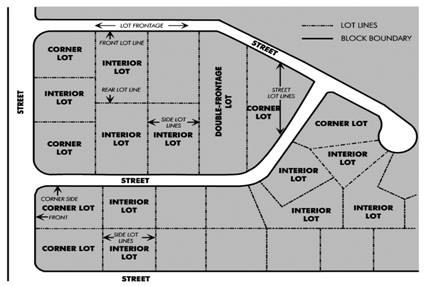
Figure 37-10.130
Lot Types
Lot Depth. The mean horizontal distance between the front and the rear lot lines, or between the front lot line and intersection of the two side lot lines, if there should be no rear lot line (see Figure 37-10.140).
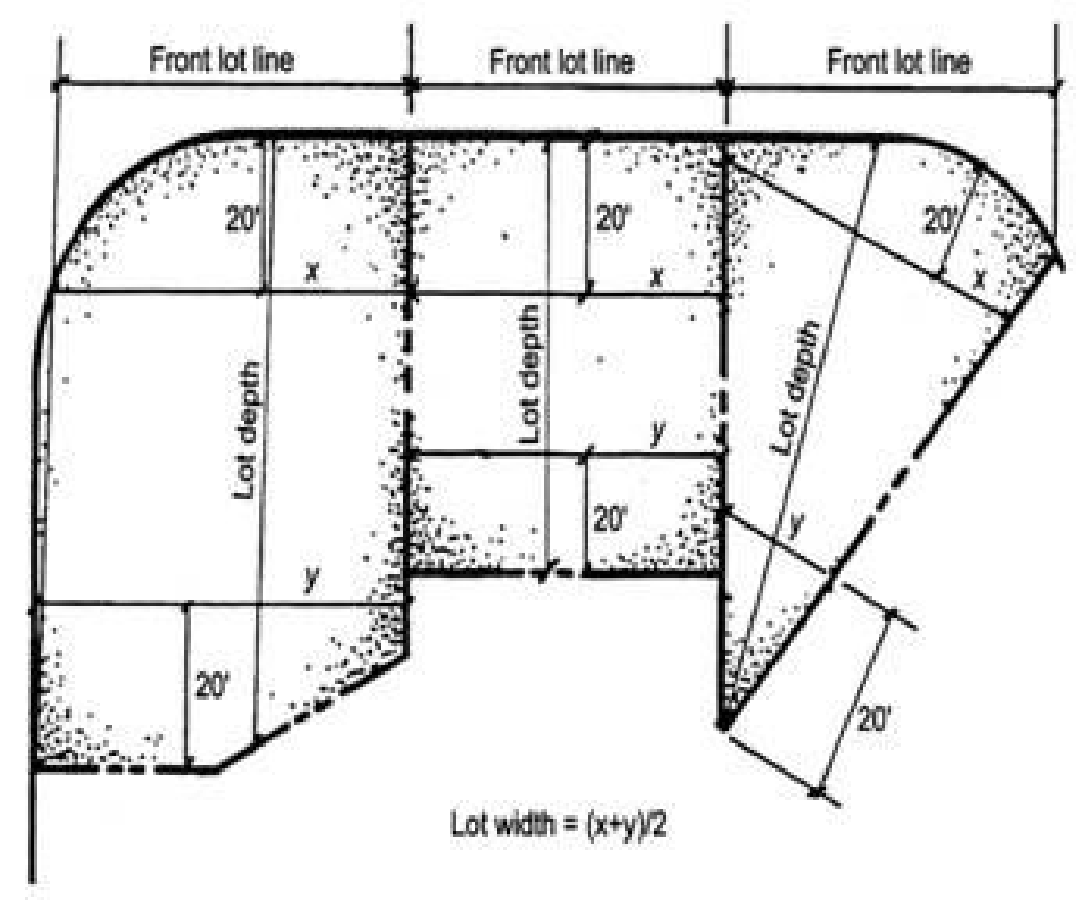
Figure 37-10.140
Lot Depth and Width
Lot, Double-frontage. An interior lot having frontage on more than one street with a street (right-of-way) greater than thirty feet. Each frontage with permitted access shall be deemed a front lot line unless otherwise determined by the city planner (see Figure 37-10.130).
Lot, Frontage. The length of that portion of a lot abutting a street (see Figure 37-10.130).
Lot, Interior. A lot other than a corner lot (see Figure 37-10.130).
Lot Line. A line separating one lot from another or from a public right-of-way or private street.
Lot Line Adjustment. A shift or rotation of an existing lot line between two or more existing adjacent parcels, where the land taken from one parcel is added to an adjacent parcel, and where a greater number of parcels than originally existed is not created, provided the adjustment is approved in accordance with Article VI, Division 6: Lot Line Adjustments.
Lot Line, Front. A lot line abutting a street. The front lot line shall be the shorter of the two frontages on a corner lot (see Figure 37-10.130).
Lot Line, Rear. A lot line, not intersecting a front lot line, which is most distant and most closely parallel to the front lot line (see Figure 37-10.130).
Lot Line, Side. A lot line that is not a front lot line or a rear lot line (see Figure 37-10.130).
Lot Line, Street. A lot line abutting a street (see Figure 37-10.130).
Lot Width. The average width of the lot, measured at right angles to the line measuring its depth twenty feet from the front lot line and twenty feet from the rear lot line (see Figure 37-10.140).
Lower Income Households. See Section 37-50.060: Density bonus for this definition.
(Ord. No. 2463 (NCS).)
(Ord. No. 2532 (NCS), § 7, 11-13-2012; Ord. No. 2623 (NCS), § 4, 11-5-2019)
Sec. 37-10.370. - "M" definitions.
Maintenance and Repair Services, Major. Facilities providing equipment maintenance and repair services and materials storage areas. The classification includes, but is not limited to, corporation yards and equipment service centers. Excludes facilities devoted primarily to the repair of vehicles.
Maintenance and Repair Services, Minor. Establishments providing appliance repair, office machine repair, or building maintenance services. Excludes the maintenance and repair of motor vehicles.
Manufactured Housing. A single-family dwelling that is factory-fabricated, built in one or more sections, complies with regulations adopted by the state of California Department of Housing and Community Development, and designed to be transported and affixed to a permanent foundation.
Marine Sales and Services. Establishments providing marine supplies, equipment, and service for commercial and pleasure boating.
Marquee. See "Canopy."
Massing. The arrangement of a building's major elements.
Maximum Residential Density. See Section 37-50.060: Density bonus for this definition.
Meals. See Section 37-50.030: Alcohol license review.
Mini-warehousing or Mini-storage. See "Warehousing and Storage, Limited."
Mixed Use Building. A structure containing both residential and pedestrian-oriented commercial uses (including retail, restaurants, offices, services, and similar uses deemed compatible with residential uses). The commercial use or uses are typically located on the ground floor of the structure with the residential dwellings predominantly located on the second or higher floors.
Mixed Use Development. A project with both residential and nonresidential uses located on the same lot or site. With this type of development, there is no requirement that the residential and the nonresidential uses be located in the same building. Prohibited commercial uses in mixed residential developments include vehicle-related uses including repair, sales, services, storage, and washing; live entertainment; commercial recreation; animal sales and services; major maintenance and repair services; pawn shops; tattoo and/or body-piercing parlors; industrial uses, and other uses deemed inappropriate by the city planner due to potential adverse land use impacts.
Mobile Recycling Unit. See Section 37-50.210: Recycling facilities for this definition.
Mobilehome. A manufactured dwelling unit capable of being transported to a site on a trailer or on wheels and not designed to be affixed to a permanent foundation. A mobilehome is not considered a building, as defined by the Uniform Building Code.
Mobilehome Park. An area or tract of land designed for the occupancy of mobilehomes, either rented or offered for rent. The land under the mobilehomes is not divided into separate lots. Mobilehome park does not include a recreational vehicle park or a subdivision with manufactured housing.
Moderate Income Households. See Section 37-50.060: Density bonus for this definition.
Monopole. See Section 37-50.290: Telecommunication facilities for this definition.
Motel. A commercial land use providing transient occupancy for guests for twenty-eight or fewer days in one or more buildings on the same lot. The buildings contain guest rooms or dwelling units or both, which are usually individually and independently accessible from outside the building. Motel includes motor lodge, tourist court, motor hotel, or any other designation intended to identify the premises as providing for rental or overnight accommodation for guests.
Motel, Extended Stay. A commercial land use providing transient occupancy for guests for twenty-eight or fewer days, or longer than twenty-eight days subject to payment of transient occupancy tax per Salinas Municipal Code Section 32-22, on one or more buildings on the same lot. The buildings contain guest rooms or dwelling units or both, which are usually individually and independently accessible from outside the building. Motel includes motor lodge, tourist court, motor hotel, or any other designation intended to identify the premises as providing for rental or overnight accommodation for guests.
Motor Home. A portable dwelling designed and constructed as a self-propelled vehicle for camping, travel, recreation, and vacation purposes.
Motor Vehicle. See "Vehicle."
Motor Vehicle Repair, Major. See "Vehicle Repair, Major."
Motor Vehicle Repair, Minor. See "Vehicle Repair, Minor."
Motor Vehicle Storage. See "Vehicle Storage."
Multifamily Dwelling. See "Dwelling, Multifamily."
Multimodal. Pertaining to or accommodating more than one mode of transportation, such as bicycle, pedestrian, automobile, bus, rail, tram, or air travel.
Mural or Mural Exhibit. See Section 37-50.150: Mural exhibits.
(Ord. No. 2463 (NCS).)
Sec. 37-10.380. - "N" definitions.
National Pollutant Discharge Elimination System (NPDES). A national program implemented locally in conjunction with the California Water Quality Control Board for administering and regulating select provisions of the Clean Water Act.
Natural Surveillance. Natural surveillance is a design concept directed primarily at creating environments where there is plenty of opportunity for the intended users of a project and people engaged in their normal behavior to observe the space around them (also known as defensible space).
Node. A center of activity, often at an intersection of major streets.
Nonconforming. A building, structure, parking lot, sign, landscaping, use, or activity that was lawfully established but which, due to the application of this Zoning Code, no longer conforms to existing regulations.
Non Sight-obscuring. See Section 37-50.090: Fences, walls, and hedges for this definition.
Nonrestricted Units. See Section 37-50.060: Density bonus for this definition.
Nuisance. Anything that interferes with the use or comfortable enjoyment of property or life or which is offensive to the senses.
Nursery. The retail or wholesale handling of any article, substance, or commodity related to the planting, maintenance, or harvesting of garden plants, shrubs, trees, packaged fertilizers, soils, chemicals, or other nursery goods and related products in small quantities to the consumer.
Nursing Homes. See "Convalescent Hospitals."
(Ord. No. 2463 (NCS).)
Sec. 37-10.390. - "O" definitions.
Office, Business and Professional. Offices or firms or organizations providing professional, executive, management, or administrative services, such as accounting, architectural, engineering, real estate, insurance, investment, legal, psychological, and medical/dental laboratories incidental to an office use. Excludes banks, savings and loan associations, and similar financial institutions, and dental and medical offices.
Office, Medical and Dental. Offices and clinics used for the practice of medicine, chiropractic, dentistry, optometry, podiatry, and various forms of physical therapy. Excludes the overnight care of a patient.
Off-sale Alcohol-related Use. See "Alcohol-related Use, Off-sale (Off-premises Consumption)."
Off-street Loading Facilities. A site or a portion of a site, including loading berths, aisles, access drives, and landscaped areas, devoted to the loading or unloading of people or materials.
Off-street Parking. A site or portion of a site, including parking spaces, aisles, access drives, and landscaped areas, devoted to the parking of motor vehicles.
On-premises Advertising Display. See Section 37-50.660: Nonconforming sign abatement for this definition.
On-sale Alcohol-related Use. See "Alcohol-related Use, On-sale (On-premises Consumption)."
Open Space. Lands, both public and private, provided for the preservation of natural resources, hillsides, and creeks; as well as open space for the protection of public health and safety, including natural floodways and stormwater retention areas. Excludes areas devoted to parking or vehicular traffic.
Open Space, Usable. An accessible portion of a lot, including decks, swimming pools, balconies, and the like, which is landscaped and/or developed for recreational use or outdoor activities. Usable open space shall not include the floor area of any building other than unenclosed accessory structures designated or used for open space or recreational purposes, any parking spaces, parking lots, or driveways, except as provided in this section, service areas, or slopes over ten percent, and shall not have any dimension less than ten feet, except decks or balconies, which shall not have any dimension less than six feet to qualify as usable open space. Where decks are private in nature or are for the general use of tenants residing on the property and do not serve primarily as a passageway, such decks may be counted as usable open space when otherwise conforming with the requirements of this Zoning Code. Usable open space does not include required front or corner side yards. For lots with single-family detached dwellings, the portions of the driveway that serve a required detached garage and which are located a minimum of forty feet from the front property line of the lot and which meets the minimum size dimensions above may be counted as usable open space.
Outdoor Facilities. Any business enterprise, temporary use, sales or service, storage, or activity conducted outside an enclosed building.
Outdoor Storage, Permanent. See "Storage, Outdoor (Permanent)."
Outdoor Storage, Temporary. See "Storage, Outdoor (Temporary)."
Overlay District. A certain portion of the city wherein regulations relating to specific environmental, physical, or other characteristics (e.g., locational, economic, historical) are imposed in addition to those of the base district covering the land in question.
(Ord. No. 2463 (NCS).)
(Ord. No. 2507 (NCS), § 22, 5-18-2010)
Sec. 37-10.400. - "P" definitions.
Parapet. A low protective wall along the edge of a raised structure such as a roof or balcony.
Park and Recreation Facilities. Noncommercial parks, playgrounds, recreation facilities, and open spaces.
Park-and-ride Lot. See Section 37-50.330: Vehicle trip reduction for this definition.
Parking, Bicycle. Any combination of facilities, including bicycle racks, bicycle lockers, and bins that are designated for the parking, security, and convenient use of bicycles. Bicycle parking facilities are usually conveniently located close to building entrances and locations that provide maximum visibility. At employee destination areas, bicycle parking may also include showers and changing areas for bicyclists.
Parking, Off-site. Any parking lot or structure for the temporary storage, less than twenty-four hours, of motor vehicles, which serves a use or uses which are located on a different legal lot of record from that of the parking lot or structure and do not directly abut the lot served.
Parking, On-street. A parking space for a motorized vehicle that is located within the street right-of-way.
Parking, Off-street Loading Facilities. See "Off-street Loading Facilities."
Parking, Shared. A public or private parking area used jointly by two or more uses.
Parking, Tandem. The placement of parking spaces one behind the other, so that the space nearest the driveway or street access serves as the only means of access to the other space.
Parking Lot, On-site. A site or a portion of a site, devoted to the temporary off-street parking of vehicles, including parking spaces, aisles, access drives, pedestrian walkways, and landscaped areas, and providing vehicle access to a public street.
Parking Space. A readily accessible area maintained exclusively for the parking of one motor vehicle. The parking space may be either within a structure or in the open and does not include driveways, ramps, loading or working areas, and conforms to dimensions and purposes established in this Zoning Code.
Parking Structure. A structure or portion thereof composed of one or more levels or floors primarily used for the parking or storage of motor vehicles. A parking structure may be totally below grade (as in an underground parking garage) or either partially or totally above grade.
Parkway or Park Strip. A piece of land separating the pedestrian from vehicle traffic on a street, located between the rear of a curb and the front of a sidewalk.
Patio. A paved or decked area that may be attached or detached from a structure and may be covered or uncovered. A patio shall not be used as a habitable room or as a parking space for vehicles.
Pawn Shop. A commercial establishment that engages in the business of loaning money on the security of personal property pledged or deposited, including the purchase or sale of such personal property.
Pedestrian-oriented or Friendly. Development that is designed with a primary emphasis on the street sidewalk and facilitating pedestrian access to the site and building rather than on auto access and parking areas. Buildings in such developments are generally placed close to the street and the main entrance is oriented to the street sidewalk. There are generally windows and display areas along the street facades of buildings and outdoor areas (such as plazas) that are oriented to pedestrians. Although parking areas may be provided, they are not emphasized by the design of buildings.
Pedestrian-scaled. Designed to be accessible to pedestrians, as opposed to automobiles.
Pedestrian Walkway. Prepared exterior routes designed to provide pedestrian accessibility and includes plazas, courtyards, paths, and trails that connect uses and neighborhoods with each other and with other community destinations such as schools, parks, retail uses, and other services.
Permanent Cosmetic Facial Shading. A process by which permanent facial cosmetics are placed by the implantation of tints to the skin of the human face along the natural brow line, eyelash lines, cheeks, or lips to define or enhance the natural coloration of such facial features. Excludes the implantation of any image, including, but not limited to: letters, figures, symbols, or any other design, mark, or picture that would not normally appear on a human face and any type of facial or body piercing where a permanent hole is punctured through the skin or other body part to accommodate the insertion of jewelry or similar items. The use is typically an accessory use to a beauty salon.
Permit. A document issued by the city of Salinas pursuant to the provisions of the Salinas Zoning Code authorizing specific activities, uses, or structures together with the conditions upon which such permit is issued, and the plans, specifications, reports, and approved modifications pertaining thereto.
Permitted. Refers to a use or structure that is allowed without the requirement for approval of a discretionary permit. However, some permitted uses and structures may require approval of nondiscretionary permits, such as site plan review, temporary use of land permits, home occupation permits, large family day care home permits, building permits, etc.
Personal Improvement Services. Services or facilities including, but not limited to, music or photography lessons, fine arts, crafts, driving schools (excludes truck driving schools), and diet centers.
Personal Services. A commercial land use providing recurrently needed services of a personal nature. Personal services generally include barbershops, beauty and nail salons (including permanent cosmetic facial shading), day spas, seamstresses, tailors, shoe repair shops, photo processing, and photographic studios.
Planned Unit Development. A discretionary permit issued in accordance with Article VI, Division 13: Planned Unit Development Permits.
Plaza. An open space area that is wholly or partly enclosed by buildings and has pedestrian-oriented amenities typically located at ground level and is readily accessible to the public.
Porch. See Section 37-50.010: Accessory uses and structures for this definition.
Portico. A porch or walkway with a roof supported by columns, often leading to the entrance of a building.
Pre-existing. In existence prior to the effective date of the zoning regulations codified in this Code, as amended.
Precise Plan. See Article IV, Division 2: Specific Plan (SP) Overlay District.
Premises. A lot or parcel, together with all related buildings, structures, open spaces, and parking areas.
Principal Structure. The primary structure(s) within which is conducted the principal use of the lot.
Principal Use. The primary and predominate use on any lot.
Printing and Publishing, Limited. The preparation of camera-ready artwork, and text, photocopying, printing (including banners and similar signs), and binding not exceeding five thousand square feet in floor area.
Printing and Publishing, Unlimited. The preparation of camera-ready artwork and text, photocopying, printing, and binding in a building exceeding five thousand square feet.
Prohibited Vehicle. See Section 37-50.190: Recreational vehicles, prohibited vehicles, and equipment parking and storage for this definition.
Property Line. A line separating lots of real property having separate legal descriptions, or which separates a lot from a public right-of-way. Also see "Lot Line."
Property Line, Street. See "Lot Line, Street."
Public Art. A sculpture, painting, fountain, or similar object that is sited within a development or public area as a focal point and is intended for the enjoyment of the general public.
Public and Semipublic Uses. A class of uses generally open to the public and maintained and supported by public or nonprofit agencies or organizations and which are of a recreational, civic, educational, religious, institutional, or cultural nature.
Public Safety Facilities. Facilities for public safety and emergency services, including police and fire protection.
Public Utility Service Yard. A premises used for the warehouse, storage yard, or vehicle and equipment maintenance of a public utility. Public utility service yard may include one or more of any of the following: office, microwave, radio, cable, or other communications equipment.
(Ord. No. 2463 (NCS).)
Sec. 37-10.410. - "Q" definitions.
Qualifying Residents. See Section 37-50.060: Density bonus for this definition.
(Ord. No. 2463 (NCS).)
Sec. 37-10.420. - "R" definitions.
Railing. See Section 37-50.010: Accessory uses and structures for this definition.
Recreation, Commercial. See "Commercial, Recreation."
Recreational Vehicle. See Section 37-50.190: Recreational vehicles, prohibited vehicles and equipment parking and storage for this definition.
Recreational Vehicle Park. An area where spaces are offered to users of recreational vehicles for occupancy on a temporary basis.
Recyclable Material. See Section 37-50.210: Recycling facilities for this definition.
Recycling Collection Facility, Large. See Section 37-50.210: Recycling facilities for this definition.
Recycling Collection Facility, Small. See Section 37-50.210: Recycling facilities for this definition.
Recycling Processing Facility. See Section 37-50.210: Recycling facilities for this definition.
Recycling Processing Facility, Heavy. See Section 37-50.210: Recycling facilities for this definition.
Recycling Processing Facility, Light. See Section 37-50.210: Recycling facilities for this definition.
Redevelopment Director. The director of the Salinas redevelopment department, or the director's designee.
Religious Assembly. Facilities for religious worship and assembly, incidental religious education, meeting halls, gymnasiums, and similar uses. Religious assembly does not include public and private schools, day care centers, incidental professional and business offices, and retail as defined in this division.
Research and Development Services. Establishments primarily engaged in industrial or scientific research, including product testing.
Residential. A land use category with the principal purpose of providing shelter for people on a long-term basis.
Residential Development. See Section 37-50.060: Density bonus for this definition.
Residential Care Facility, Large. Same as a small residential care facility, but serving seven to fourteen persons under the age of eighteen years or over the age of sixty or for persons who have a disability as defined herein.
Residential Care Facility, Small. Residential facilities approved and licensed by the state in a single-family dwelling in which group care, supervision, and/or assistance are provided for a maximum of six persons under the age of eighteen years or over the age of sixty or for persons who have a disability as defined herein. Excludes family day care, foster care, or any medical services, including nursing services, beyond that required by the residents of the facility for sustaining the activities of daily living. Examples of residential care facilities may include, but are not limited to, facilities for the following:
(a)
Developmentally or mentally disabled;
(b)
Substance abuse recovery;
(c)
Dependent and neglected children;
(d)
Physically disabled; or
(e)
Wards of the court.
Residential Service Facilities. Residential facilities that do not meet the definition of a residential care facility or interim housing in which group care, supervision, and/or assistance are provided for persons. Excludes day care homes or centers, foster care, or any medical or nursing assistance beyond that required by the residents of the facility to sustain the activities of daily living.
Restaurant. A commercial establishment, with kitchen facilities, which is regularly, and in a bona fide manner, used principally for the preparation, cooking, and serving of food to customers for compensation and where seating or other physical accommodation is provided for on-site dining. May also include accessory catering services.
Restaurant, Drive-through. A restaurant, which includes drive-through facilities to serve patrons' food and beverages in their vehicles primarily for off-premises consumption. Also see "Drive-through or Drive-in Use."
Retail. The exchange of goods directly to the ultimate consumer in exchange for financial or other consideration.
Retail Sales. The retail sales of merchandise not specifically listed under another use classification. This classification includes, but is not limited to, department stores, grocery stores, clothing stores, furniture stores, and businesses retailing toys, hobby materials, handcrafted items, jewelry, cameras, photographic supplies, electronic equipment, audio and video sales and rentals, sporting goods, kitchen utensils, hardware, home improvement, appliances, antiques, art supplies and services, paint and wallpaper, carpeting and floor coverings, office supplies, bicycles, and new automotive parts and accessories (excludes service and installation).
Reverse Vending Machine. See Section 37-50.210: Recycling facilities for this definition.
Reverse Vending Machine, Bulk. See Section 37-50.210: Recycling facilities for this definition.
Reverse Vending Machine, Single-feed. See Section 37-50.210: Recycling facilities for this definition.
Reviewing Authority. Unless otherwise specified, the city planner, planning commission, city council, or designee as indicated for the applicable development review application. Also see Section 37-50.330: Vehicle trip reduction for this definition.
Right-of-way. An area or strip of land, either public or private, on which a right of surface passage has been recorded. Thus, right-of-way shall include a public right-of-way, a common lot containing a private street, or other public or private right of surface passage consistent with this definition.
Room, Habitable. See "Habitable Room."
Roof. A structural covering over any portion of a building or structure including projections beyond the walls or support of the building or structure, which is permanently attached.
Roof, Flat. A roof nearly horizontal and level.
Roof, Gabled. A pitched roof having a gable at each end.
Roof, Gambrel. A ridged roof with two slopes on either side, the lower slope having the steeper pitch. It is often flared beyond the front and rear of the dwelling forming a deep overhang.
Roof, Hipped. A hipped (or hip) roof slopes down to the eaves on all four sides. Although a hipped roof is not gabled, it may have dormers or connecting wings with gables.
Roof, Mansard. A mansard roof has two slopes on each of the four sides. The lower slope is steeper than the upper slope. Dormers are often set in the lower slope. The upper slope is usually not visible from the ground.
Rowhouse. See "Dwelling, Single-family Attached."
(Ord. No. 2463 (NCS).)
(Ord. No. 2507 (NCS), § 22, 5-18-2010; Ord. No. 2610 (NCS), § 1, 11-6-2018)
Sec. 37-10.430. - "S" definitions.
Salinas General Plan. The long range and comprehensive plan for the orderly growth and development of Salinas, including text, maps and amendments, adopted by the Salinas city council in accordance with the laws of the state of California or as amended from time to time. Also see "General Plan."
Salvage and Wrecking Operations. See Section 37-50.230: Salvage and wrecking operations for this definition.
Satellite Dish Antenna. An apparatus designed to receive or transmit communications to and from a satellite.
School District or Community College District Housing. Any affordable rental housing at the low- and moderate-income levels that a school district or community college district acquires, constructs, rehabilitates, or preserves consistent with the Teacher Housing Act of 2016 and as may be amended by the State Legislature. See Section 37-50.235: school district or community college district housing.
School, Trade. A commercial land use consisting of an institution of learning for special skill or special knowledge. Trade schools include, but are not limited to, vocational schools, business schools, and professional schools. Excludes public or private schools as defined herein and driving schools.
School, Public/Private. A public and semipublic land use such as a private or public school (grades kindergarten through high school, or their equivalent), college or university qualified by the State Board of Education to give general academic instruction. Excludes trade and driving schools.
Secondhand Store. Any premises used for the sale or handling of used goods. Secondhand store includes establishments for the sale or trade of used clothing, furniture, and appliances. Excludes antique and collectible shops and pawn shops.
Senior Housing. See Section 37-50.060: Density bonus for this definition.
Service Station. A place where motor fuel, lubrication oil, or grease is offered for sale to the public and delivered directly into motor vehicles. Includes minor motor vehicle repair as an accessory use to the sale and delivery of motor fuel, oil, and grease.
Setback or Setback Line. The distance required between a property line and the exterior wall of a structure. Also see "Yards."
Shared Parking. A parking strategy aimed at reducing the amount of parking spaces by allowing buildings with different peak hours to share the same parking lot.
Shopping Center. A group of two or more commercial establishments including indoor swap meets, the perimeter of which is clearly definable, developed on a single parcel or contiguous parcels of land, planned, and developed as a single site and providing shared on-site parking and vehicular access, landscaping, signage, and other facilities.
Signs or Signage. See Article V, Division 3: Signs for all sign-related definitions.
Single-family Dwelling. See "Dwelling, Single-family."
Single-feed Reverse Vending Machine. See Section 37-50.210: Recycling facilities for this definition.
Single-occupant Vehicle. See Section 37-50.330: Vehicle trip reduction for this definition.
Single Room Occupancy (SRO) Housing. A residential facility with individual secure rooms, of a smaller size than normally found in multifamily dwellings, which may have kitchen and bathroom facilities, and which are rented to a one- or two-person household on a long-term basis.
Site. A contiguous area of land, including a lot or lots or a portion thereof, upon which a project is developed or proposed for development.
Site Plan Review. An administrative review process conducted in accordance with Article VI, Division 5: Site Plan Review.
Specified Anatomical Areas. See Section 37-50.020: Adult entertainment facilities for this definition.
Specified Sexual Activities. See Section 37-50.020: Adult entertainment facilities for this definition.
Speculative Building. A permanent structure for which the specific use or uses are not known at the time application is made for building permits.
Stealth Telecommunication Facility. See Section 37-50.290: Telecommunication facilities for this definition.
Storage. Placing of materials, vehicles, or equipment at one location for more than seventy-two uninterrupted hours without use. Also see "Vehicle Storage."
Storage, Outdoor (Permanent). Any business enterprise, sales, service, storage, or activity conducted outside an enclosed building.
Storage, Outdoor (Temporary). The use of a premises or part of a premises, not enclosed by a building, for the storage of materials, vehicles, or equipment for a period of not greater than thirty days or during construction activities.
Story. That portion of a building included between the upper surface of any floor and the upper surface of the floor next above, except that the topmost story shall be that portion of a building included between the upper surface of the topmost floor and the ceiling or roof above. If the finished floor level directly above a usable or unused under floor space is more than six feet above grade, for more than fifty percent of the total perimeter or is more than twelve feet above grade, at any point such usable or unused under-floor space shall be considered as a story. A basement is not considered a story.
Story, First. The lowest story in a building that qualifies as a story, except that a floor level in a building having only one floor level shall be classified as a first story, provided such floor level is not more than four feet below grade, for more than fifty percent of the total perimeter, or not more than eight feet below grade at any point.
Structure. Anything constructed or erected on the ground or which is attached to something erected on the ground.
Street. A public or private right-of-way, usually designed for pedestrian, bicycle, and vehicular travel, which provides a primary means of access to abutting property. The term shall include, but not be limited to, avenue, drive, circle, road, parkway, boulevard, highway, thoroughfare, or any similar term. Excludes alleys and driveways.
Street Frontage. The length of a lot facing a street that affords direct public access to the lot.
Street Furniture. Those features associated with a street that are intended to enhance the street's physical character and intended for use by pedestrians (the general public), such as benches, trash receptacles, lights, and newspaper racks.
Streetscape. The linear environment along a right-of-way created by the placement and design of buildings, trees, open spaces, street furniture, and infrastructure.
Supportive Housing. Dwellings linked to onsite or offsite services that assist the supportive housing resident to retain the housing, to improve his or her health status, and to maximize her or his ability to live and, when possible to work, in the community. Supportive housing serves both individuals and families who lack a fixed, regular and adequate nighttime residence prior to occupying the supportive housing, including persons under twenty-five years of age no longer eligible for foster care on the basis of age, and individuals and families not previously homeless. Supportive housing is considered a residential use of property subject only to development regulations that apply to other residential dwellings of the same type in the same zoning district. Excludes emergency shelters, convalescent hospitals and hospitals.
Swap Meet. Occasional or periodic retail activities held in an open area or enclosed structure where groups of individual sellers are provided space to display, barter, or sell goods to the public. "Swap meet" is interchangeable with and applicable to: flea markets, open-air markets, farmers' markets, or other similar activities.
Swimming Pools, Hot Tubs, and Spas. Any constructed or prefabricated water-filled vessel that is not drained, cleaned, or refilled for each individual, and is used for swimming, soaking, or recreation.
(Ord. No. 2463 (NCS).)
(Ord. No. 2532 (NCS), § 4, 11-13-2012; Ord. No. 2581 (NCS), § 4, 12-6-2016; Ord. No. 2656 (NCS), § 1, 5-10-2022)
Sec. 37-10.440. - "T" definitions.
Target Unit. See Section 37-50.060: Density bonus for this definition.
Tattoo and/or Body Piercing Parlor. An establishment whose principal business activity is the practice of placing of designs, letters, figures, symbols, or other marks upon or under the skin of any person, using ink or other substance that results in the permanent coloration of the skin by means of the use of needles or other instruments designed to contact or puncture the skin. Also includes an establishment whose principal business activity is any type of body piercing where a permanent hole is punctured through the skin or other body part to accommodate the insertion of jewelry or other items. Excludes establishments where the body piercing is incidental to a principal use such as jewelry store and beauty salons.
Telecommunications Facilities. Public, commercial, and private electromagnetic and photoelectrical transmission and receiving facilities. Includes antennas for cellular, enhanced specialized mobile radio (ESMR), personal communications services (PCS), earth stations for satellite-based communications, and similar facilities, but does not include satellite dish antennas, which are included under "Accessory Structures and Uses." Also see Section 37-50.290: Telecommunication facilities for this definition.
Telecommunications Facilities, Major. See Section 37-50.290: Telecommunication facilities for this definition.
Telecommunications Facilities, Minor. See Section 37-50.290: Telecommunication facilities for this definition.
Telecommunications Facilities, Stealth. See Section 37-50.290: Telecommunication facilities for this definition.
Telecommuting. See Section 37-50.330: Vehicle trip reduction for this definition.
Temporary Use. Any use conducted on an intermittent or one-time basis for a specific period of time, not intended to become permanent.
Theater. A structure used for dramatic, operatic, motion pictures, or other performances for which an admission fee is paid. Such establishments may include related services such as food and beverage sales or other concessions. Excludes adult entertainment facilities.
Tourist-oriented Development. See Section 37-50.330: Vehicle trip reduction for this definition.
Tower. A portion of a building that is higher than the remainder of the building or a tall structure of smaller dimension, which is separate from the building, such as the campanile (bell tower) of a church. Also see Section 37-50.290: Telecommunication facilities for definition of lattice tower.
Towing. See "Vehicle Storage."
Townhouse. See "Dwelling, Single-family Attached."
Traditional Neighborhood Design. Developments based on human-scale design principles that promote walkability, compact neighborhoods, and a reduction of automobile usage. Such developments typically exhibit several of the following characteristics: buildings oriented to the street, front porches on houses, emphasis on pedestrian orientation, village squares and greens, alleys, streets laid out in a grid system, and compatible mixed land uses, etc.
Traffic Calming. Measures that reduce motorist speed, decrease motor vehicle volumes, reduce cut-through traffic, enhance the street environment, and/or increase safety for pedestrians and nonmotorized vehicles. Mostly includes physical features, but may also include educational programs, traffic enforcement, and traffic operation changes.
Trail. A bicycle/pedestrian facility separated from motorized vehicular traffic by an open space or barrier and either within the street right-of-way or not.
Transfer Station. A facility limited to the collection, temporary storage, and transfer of household waste, household hazardous waste, and small quantity generator waste.
Transfer Station, Hazardous Waste. Any hazardous waste facility that is not limited to the collection, temporary storage, and transfer of household hazardous waste and small-quantity generator waste.
Transient Occupancy. Any building or portion thereof, used or designed to be used, let, or rented on a daily or weekly basis or for less than twenty-eight days for travelers or guests, or that is subject to the transient occupancy tax per Salinas Municipal Code Section 32-22.
Transit-oriented Development (TOD). A development pattern that clusters and intensifies uses in close proximity to public transportation facilities to encourage pedestrian activity and provide an alternative to private motorized vehicle use.
Transitional Housing. Dwellings operated under program requirements that call for the termination of assistance and recirculation of the assisted unit to another eligible program recipient at some predetermined future point in time at least six months after occupancy. Transitional housing is rented, not owner-occupied, and may be single-family or multifamily; includes duplexes, triplexes, and green court dwellings, and may be either attached or detached. Transitional housing is considered a residential use of property subject only to development regulations that apply to other residential dwellings of the same type in the same zoning district. Some congregate housing, dormitories, halfway houses, and single room occupancy housing may be operated as transitional housing. Excludes emergency and disaster shelters.
Transparency. The ability of people outside a building to see and understand what goes on inside it and vice versa.
Transportation Demand Management (TDM). See Section 37-50.330: Vehicle trip reduction for this definition.
Transportation Management Association. See Section 37-50.330: Vehicle trip reduction for this definition.
Travel Services. Office establishments providing travel information and reservations to individuals and businesses.
Travel Trailer. A vehicular portable structure built on a chassis designed to be used as a temporary dwelling for camping, travel, recreational, and vacation purposes and which is identified as a travel trailer by the manufacturer.
Trip. See Section 37-50.330: Vehicle trip reduction for this definition.
Trip Reduction. See Section 37-50.330: Vehicle trip reduction for this definition.
Truck Depot. A facility for the temporary storage, servicing, or maintenance of trucks or buses. Truck depots may include fueling facilities, traffic routing offices, restaurants, restrooms and shower facilities, wash racks, minor repair facilities, and related business offices and motels. A truck depot may also contain a facility not to exceed twenty-five thousand square feet in size to be used for the retail sale of convenience goods, such as pre-packaged food and beverage items, prepared food items for off-site consumption, tobacco, periodicals, and other limited groceries and household items.
Truck Yard. A facility used exclusively for breaking down and assembling tractor-trailer transport, or for parking of heavy vehicles for short periods of time. Excludes facilities for the loading and unloading of materials being transported.
(Ord. No. 2463 (NCS).)
(Ord. No. 2532 (NCS), § 5, 11-13-2012)
Sec. 37-10.450. - "U" definitions.
Uniform Building Code. As defined in Chapter 9 of the Salinas Municipal Code.
Use. The purpose for which land or a building is occupied, arranged, designed or intended, or for which either land or building is or may be occupied or maintained. Use also means the activity conducted on the land or in the building.
Use Classifications. Categories of land uses.
Utilities, Major. Generating plants, electrical substations, aboveground electrical transmission lines, natural gas pipelines, water wells and storage, water reservoirs, regional flood control or drainage facilities, water or wastewater treatment plants, transportation facilities, and similar facilities of public agencies or utility companies.
Utilities, Minor. Utility facilities that are necessary to support legally established uses and involve only minor structures such as electrical distribution lines and underground water and sewer lines (including lift stations), and appurtenant structures/facilities.
Utility Shed. See Section 37-50.010: Accessory uses and structures for this definition.
(Ord. No. 2463 (NCS).)
Sec. 37-10.460. - "V" definitions.
Vanpool. See Section 37-50.330: Vehicle trip reduction for this definition.
Variance. A permit which grants a property owner relief from development standards contained in the Zoning Code when compliance would result in undue hardship on the owner due to special circumstances or conditions applicable to a property, including size, shape, topography, location, or surroundings.
Vehicle. Any motorized vehicle or transport designed to carry goods or passengers and licensed by the state of California to operate on a public street including, but not limited to, automobiles, motorcycles, trucks, and recreational vehicles.
Vehicle-related Retail Sales and Services. Retail sales conducted at premises where no less than eighty percent of the floor area is devoted to vehicle-related goods provided directly to the ultimate consumer for financial or other consideration. Vehicle-related or vehicle-related retail goods include both sales of parts (e.g., engine heads and alternators) and nondurable items (e.g., fan belts and windshield wiper blades) for motor vehicles. Retail sales do not include replacement or installation of the goods on the premises; such activity is defined as motor vehicle repair. Installation of accessories not required for operation of the vehicle (e.g., alarm systems and cellular phones), and not requiring painting or bodywork, does fall within this category. Also includes primarily vehicle-related financial services such as purchase financing and vehicle insurance and claims, but not including the sale or transfer of vehicles.
Vehicle Repair, Major. A place providing a full range of repair and maintenance services for motor vehicles, including any of the following:
(a)
Cylinder head replacement;
(b)
Valve grinding or replacement;
(c)
Clutch replacement;
(d)
Repair, replace transmission, rear end, rear axles, king pins;
(e)
Body work;
(f)
Engine, motor or transmission removal;
(g)
Fuel tank repair;
(h)
Radiator or heater core repair or replacement;
(i)
Painting;
(j)
Repair activities requiring the use of open flame or welding;
(k)
Exhaust system repair;
(l)
Repair activities requiring entry into the engine block; or
(m)
Any repair activity not listed as minor vehicle repair.
Vehicle Repair, Minor. A place performing the following repair and maintenance services for motor vehicles not exceeding a gross vehicle weight of five tons carrying capacity, including any of the following:
(a)
Tune-ups. Major and minor tune-up involving spark plugs, points, condensers, valve adjustments, carburetor overhauls, adjustment of fuel injection systems, fuel pumps, and all necessary filters;
(b)
Lubrication. Oil changes and filter replacement, transmission and rear end oil changes;
(c)
Cooling System. Replacement of water pumps, heaters, and other hoses; replace thermostats; recharge air conditioners;
(d)
Drive Train. Replacement of driveshaft universal bearings, center support bushing, accelerator and brake cables; minor repair of hydraulic systems; replacement of shock absorbers;
(e)
Brakes. Remove and replace shoes and brake pads; rebuild master and wheel cylinders and disc caliper; adjustment of brakes; machine work related to turning of drums or discs;
(f)
Wheels. Adjustment of steering box; replacement of rubber bushings in suspension; wheel balancing; wheel alignment; replacement of wheel bearings; tire changes and repairs;
(g)
Electrical. Battery charging; remove, repair, and replace starters, alternators, generators, and regulators; rewiring of automobile and lights; repair or replacement of gauges; installation of radios;
(h)
Smog checks;
(i)
Fuel System. Change and repair of fuel lines; replace fuel gauge sending unit; or
(j)
Any activity combining minor and major motor vehicle repair shall be defined as "Major Vehicle Repair." Minor Vehicle Repair uses excludes any activity that involves welding or an open flame.
Vehicle Sales and Services. Sale or rental of automobiles, motorcycles, trucks, and recreational vehicles including display areas, incidental storage, and maintenance. Display areas do not include separate employee/customer parking lots.
Vehicle Storage. Lots for the storage and parking of tow-away and towed vehicles, impound yards, and storage lots for vehicles, trucks, buses, and recreational vehicles. Excludes salvage and wrecking operations.
Vehicle Trip. See Section 37-50.330: Vehicle trip reduction for this definition.
Vehicle Trip Reduction. See Section 37-50.330: Vehicle trip reduction for this definition.
Vehicle Washing. The washing, waxing, detailing, or cleaning of automobiles or similar light vehicles including the use of mechanical automobile washers.
Very-low Income Households. See Section 37-50.060: Density bonus for this definition.
Vocational School. See "School, Trade."
(Ord. No. 2463 (NCS).)
(Ord. No. 2569 (NCS), § 2, 4-19-2016)
Sec. 37-10.470. - "W" definitions.
Wall. See Section 37-50.090: Fences, walls, and hedges.
Wall Height. See Section 37-50.090: Fences, walls, and hedges.
Warehousing and Storage, Limited. A building or group of buildings in a controlled access compound that contains individual compartmentalized stalls which are rented or leased for the storage of customer goods or wares, and which may include an on-site manager's quarters. Excludes warehousing and storage, and wholesale distribution. Limited warehousing and storage shall also mean miniwarehousing. Excludes direct sales, offices, manufacturing and assembly of goods, animal storage, or wholesale distribution.
Warehousing and Storage, Wholesale Distribution. A building or group of buildings used for storage and distribution of wholesale goods without direct public access. Excludes direct sales, offices, manufacturing, and assembly of goods or animal storage.
Waste, Hazardous. A waste or combinations of waste that because of its quantity, concentration, or physical, chemical, or infectious characteristics: (1) cause, or significantly contribute to an increase in mortality or an increase in serious irreversible or incapacitating reversible illness; or (2) pose a substantial present or potential hazard to human health or the environment, due to factors including, but not limited to, carcinogenicity, acute toxicity, chronic toxicity, bioaccumulative properties, or persistence in the environment, when improperly treated, stored, transported, or disposed of, or otherwise managed; and (3) is identified in Section 261 of Title 40 of the Code of Federal Regulations as a hazardous waste as amended.
Waste, Household. Any waste other than household hazardous waste generated incidental to owning or maintaining a place of residence.
Waste, Household Hazardous. Any hazardous waste generated incidental to owning or maintaining a place of residence. Excludes any waste generated in the course of operating a business concern at a residence.
Waste, Small-quantity Generator. Any hazardous waste generated in accordance with and establishment that meets the criteria specified in Section 261 of Title 40 of the Code of Federal Regulations as amended. Small quantity generators typically produce less than one and one-tenths tons of hazardous waste per month.
Wholesale. The exchange of goods not intended for direct sale to the public but intended for future distribution and resale for financial or other consideration.
Wine Tasting Room. An establishment in which wine and wine-related products are available for off-site sale, distribution, and consumption, and where wine, limited to that offered for sale, is sampled on the premises. Nothing in this Zoning Code shall be construed to require that any food be sold or purchased with any beverage. A wine tasting room may include a boutique winery.
Winery. A facility used for the purpose of processing grapes, other fruit products, or vegetables to produce wine or similar spirits. Processing includes crushing, fermenting, blending, aging, storage, bottling, warehousing, wine-tasting facilities, administrative offices, and wholesale and accessory retail sales of associated wine and wine-related items. A winery does not include a boutique winery.
Winery, Boutique. A facility where wine is produced from preprocessed ingredients. Processing permitted at boutique wineries shall be limited to blending ingredients, fermenting wine in sealed containers, bottling of wine, warehousing of ingredients, short-term storage, wine-tasting facilities, administrative offices, and retail and accessory wholesale sales of associated wine and wine-related items. Boutique wineries do not include crushing, pressing, or other processing of fruits or vegetables, and do not include the blending or mixing of ingredients through the use of any machinery or mechanical means.
Worksite. See Section 37-50.330: Vehicle trip reduction for this definition.
(Ord. No. 2463 (NCS); Ord. No. 2482 (NCS), § 1.)
Sec. 37-10.480. - "X" definitions.
Xeriscape. Landscaping characterized by the use of vegetation that is drought-tolerant or requires low water use.
(Ord. No. 2463 (NCS).)
Sec. 37-10.490. - "Y" definitions.
Yard. An open area on the same parcel as a structure, unoccupied and unobstructed by structures or parking from the ground upward except as otherwise provided in this Zoning Code, including a front yard, interior side yard, corner side yard, or rear yard measured to the building or structure at its closest point to the lot line (see Figure 37-10.160).
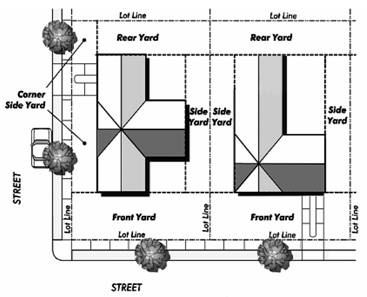
Figure 37-10.160
Yards
Yard, Corner Side. A side yard on the street side of a corner lot (see Figure 37-10.160).
Yard, Front. The area between the front lot line and the building extending across the entire width of the lot. The front yard shall adjoin the shortest street property line. Where street property lines are substantially the same length, the city planner shall determine the location of the front yard (see Figure 37-10.160).
Yard, Minimum. A yard, as defined herein, that occupies the required minimum distance between any property line and a building as established in the development regulations for the applicable base zoning district.
Yard, Rear. The area between the rear lot line and the principal building that extends across the full width of the lot (except on a corner lot) (see Figure 37-10.160).
Yard Side or Interior Side. The area between the front yard and the rear yard between the principal building and the side lot line (see Figure 37-10.160).
(Ord. No. 2463 (NCS).)
Sec. 37-10.500. - "Z" definitions.
Zoning Code.Chapter 37 of the Salinas Municipal Code.
Zoning District. A section of the city described in the text of the zoning regulations and delineated on the zoning map of the city. The text sets forth the requirements for the use of land as well as improvements and development standards.
Zoning Map. Designated official map or maps that show the location and boundaries of the districts established by this Code and are referred to as the "zoning map" and incorporated as a part of this Code. The said "zoning map" together with everything shown thereon and all amendments thereto, are as much a part of this Code as if fully set forth and described in the text.
(Ord. No. 2463 (NCS).)

