- Supplemental Regulations Applying to All Districts.
(a)
Purpose. The purpose of this section is to establish regulations governing the location, maximum height, size, and design requirements for accessory structures and uses within all zoning districts.
(b)
Definitions. The following definitions shall apply to this section:
(1)
Accessory Structure. A structure which:
(A)
Is detached from or attached to a principal structure and not designed or used for living or sleeping purposes;
(B)
Is subordinate to and serves a principal structure;
(C)
Is subordinate in area, extent or purpose to the principal structure;
(D)
Contributes to the comfort, convenience, or necessity of the occupants of the principal structure; and
(E)
Is located on the same lot as the principal structure.
(2)
Accessory Use. A use which:
(A)
Is subordinate to and serves a principal use;
(B)
Is subordinate in areas, extent, or purpose denoted to the principal use;
(C)
Contributes to the comfort, convenience, or necessity of occupants of the principal use; and
(D)
Is located on the same lot as the principal use.
(3)
Architectural Entry Features. Unenclosed projecting overhead elements such as a shed, arch, or gable providing roof coverage and weather protection over the doorways of structures. Such entries shall be an integral architectural feature compatible with and attached to the main structure.
(4)
Building Line. The exterior wall surface of the main residential building exclusive of architectural projections or eaves.
(5)
Deck. An unenclosed accessory structure, usually made of wood or similar material built to provide a solid continuous horizontal surface for outdoor use which is separated from the ground by airspace and has ground-mounted supports such as footings, piers, posts, or similar features. Deck railings shall not be considered an enclosure.
(6)
Facade. That portion of any exterior elevation on the building extending from grade to top of parapet, wall, or eaves along the entire width of the building elevation.
(7)
Porch. An unenclosed (open on a minimum of one side) platform with a roof structure and with or without railings that is attached to and accessible from the principal structure. Porches are typically located at the entrance to the principal structure and are not heated or cooled. Porch railings shall not be considered an enclosure.
(8)
Railing. A nonsight-obscuring fence-like barrier (made of wood, metal, or similar material) comprised of one or more horizontal rails, bars, or members supported by two or more spaced vertical posts typically used in conjunction with decks, porches, balconies, and staircases.
(9)
Utility Shed. A one-story accessory structure enclosed on at least three sides and at least four feet in height, with a floor area not exceeding one hundred twenty square feet.
(c)
Accessory Uses. An accessory use may be deemed accessory to a permitted use, conditionally permitted use, or a use allowed with a site plan review.
(d)
Regulations Applying to Accessory Structures in All Districts. The following regulations shall apply to all accessory structures:
(1)
Residential Occupancy. Unless provided for elsewhere in this Zoning Code, accessory structures shall not be used for residential occupancy. Enclosed accessory structures with plumbing and/or gas utility connections shall be required to obtain a conditional use permit except for hot tubs, gazebos used to cover hot tubs, spas or pools, or other similar uses as determined by the city planner. Plumbing for laundry facilities, water heaters and softeners, and HVAC units in garages are exempt.
(2)
All accessory structures shall be subject to the regulations and standards of this section, regardless of whether the accessory structure is allowed as a permitted use, use subject to the approval of a site plan review, or a conditionally permitted use under the applicable base zoning district.
(3)
Nonconforming Uses. Accessory structures shall not be permitted to be constructed on any parcel or lot that has an existing nonconforming use except as permitted in accordance with Section 37-50.160: Nonconforming uses and structures.
(4)
Accessory Structures as Usable Open Space. Unenclosed accessory structures that are designated for and used for open space or recreational purposes may be counted as usable open space if the structure's size and location are consistent with the definition of usable open space contained in Section 37-10.390: "O" definitions. However the square footage of such structures shall also be counted toward the maximum square footage requirements for accessory structures except as provided for in Section 37-50.010(f)(4).
(5)
Design Standards.
(A)
Accessory structures are subject to the design regulations as specified for the applicable zoning district where the structure is to be located.
(B)
The architectural design of accessory structures shall be compatible with the design of the principal structure by the use of complementary building colors and materials, window and roofing treatments, and architectural detailing.
(C)
The rooflines and pitches of accessory structures shall be compatible and harmonious with those of the principal structure. Flat roofs are discouraged unless appropriate to the architectural style of the principal structure.
(6)
Required Egress. No accessory structure shall be located so as to block pedestrian or vehicular egress from other structures (such as a window or door).
(7)
Distance Between Structures. All accessory structures (except for unenclosed trellises and arbors (no solid roofs or walls), and utility sheds) shall be subject to the minimum distance between structure regulations of the applicable zoning district unless otherwise specified in this section.
(8)
Trampolines, play structures, and similar recreational equipment are subject to the requirements of this section and the applicable zoning district.
(9)
Temporary structures such as carports, tents, and canopies consisting of membrane structures, metal, or similar materials are subject to the requirements of this section and the applicable zoning district.
(10)
Second Dwelling Units. Second dwelling units are not considered accessory structures and are not subject to the regulations of this section.
(e)
Additional Regulations for Residential Accessory Structures Located in R Districts.
(1)
Timing. Residential accessory structures (either attached to or detached from a principal structure) shall not be established or constructed prior to the start of construction of a principal structure on-site, except that construction trailers may be placed on a site not more than fifteen days prior to the time site clearance and grading begins. Construction trailers shall be removed at the completion of construction prior to issuance of a certificate of occupancy. Construction trailers shall not be used for residential occupancy at any time.
(2)
Maximum Height. Except as otherwise provided for in this section, the maximum height of a residential accessory structure shall be twelve feet, subject to the provisions of this subsection, provided that pitched roofs shall not exceed a height of fifteen feet. In no case shall the top of the roof ridge of an accessory structure exceed the top of the roof ridge of the principal structure. For residential accessory structures that are located in the area of historic and architectural merit as indicated on Figure COS-3 (Historic and Architectural Resources) of the general plan conservation/open space element, pitched roofs of accessory structures may exceed the maximum height specified for such structures in order to match the pitch of the roof of the principal structure subject to the approval of the city planner. In order to approve the increased roof height, the city planner must determine the following:
(A)
The exterior walls of the accessory structure do not exceed a maximum of eight feet in height;
(B)
Any portion of the roof structure located within a distance of five feet of the property line does not exceed the maximum height for pitched roofs or other provisions of this section;
(C)
The increased roof height does not contain habitable space;
(D)
The top of the roof ridge of an accessory structure does not exceed the top of the roof ridge of the principal structure or the maximum height for the applicable zoning district, whichever is less; and
(E)
The principal structure has historic or architectural significance.
(3)
Review/Permit Requirements. Residential accessory structures shall be subject to the following review/permit requirements:
(A)
In the R-L and R-M-3.6 districts, residential accessory structures shall be permitted uses on lots with single-family detached dwelling units except as otherwise required in this section. Such structures; however, may be subject to the issuance of a building permit by the development and engineering services department. Residential accessory structures shall require a site plan review or a conditional use permit if required for the principal use by the applicable base zoning district.
(B)
In the R-M 2.9 and R-H districts, residential accessory structures require a site plan review or conditional use permit if required for the principal use. Residential accessory structures on lots located in an R-M-2.9 and R-H district with a single-family detached or attached dwelling unit shall be subject to the regulations in Section 37-50.010(f). Accessory uses shall comply with all regulations applicable to the principal structure on-site.
(f)
Additional Regulations for Residential Accessory Structures Located in R-L and R-M-3.6 Districts—Required Yards—Maximum Square Footage—Exemptions.
(1)
Attached Residential Accessory Structures.
(A)
Front, Corner Side, Interior Side, or Rear Yards. Accessory structures that are attached to the principal structure are subject to the same required yards as the principal structure except that unenclosed porches and architectural entry features may encroach a maximum of five feet into the required front or corner side yard and as specified in Section 37-50.010(i): Utility Sheds.
(2)
Detached Residential Accessory Structures.
(A)
Front or Corner Side Yards. Detached accessory structures shall not be permitted in front or corner side yards or to project beyond the front or corner side yard facade or building line of the principal structure on the site except as specified in Section 37-50.710: Landscape architectural features.
(B)
Rear or Interior Side Yards. Detached accessory structures located in a rear or interior side yard shall be located not less than five feet from a rear or interior side yard property line except:
(i)
As specified in Section 37-50.010(i): Utility Sheds; and
(ii)
Unenclosed trellises and arbors (no solid roofs or walls), including any portions thereof, that are a maximum of one hundred twenty square feet or less in size and a maximum of eight feet or less in height shall not be located closer than one foot from any property line in the rear yard.
(3)
Maximum Square Footage. Unless otherwise specified as exempt in accordance with Sections 37-50.010(f)(4)(A) and (B): Exemptions, the following shall apply to all detached and attached residential accessory structures:
(A)
The total square footage of all residential accessory structures more than four feet in height shall not exceed four hundred square feet or ten percent of lot area, whichever is more except for lots with single-family attached dwelling units. Lots with single-family attached dwelling units shall not exceed a maximum of one hundred twenty square feet for all residential accessory structures more than four feet in height.
(B)
Any residential accessory structure with a square footage greater than fifty percent of the square footage of the principal structure shall be subject to the approval of a conditional use permit.
(4)
Exemptions. The following residential accessory structures shall be exempt from the requirements of Sections 37-50.010(f)(3)(A) and (B):
(A)
Up to a maximum of four hundred square feet for required off-street covered parking; and
(B)
Unenclosed porches that are attached to the front or corner side facade of a principal structure.
(g)
Additional Regulations for Accessory Structures in A, MU, C, PS, OS, P, and I Districts and for Nonresidential Uses in R Districts. Accessory structures and uses require a site plan review or conditional use permit if required by the principal use. Accessory structures shall comply with all regulations applicable to the principal structure on-site. Residential accessory structures shall be subject to the regulations in Section 37-50.010(f).
(h)
Additional Regulations for Accessory Structures in the NU Districts. Accessory structures located in NU districts shall be subject to the requirements of Article III, Division 8: New Urbanism (NU) Districts.
(i)
Utility Sheds. In an A, R-L, R-M, or R-H district, utility sheds shall be allowed on any lot with a single-family detached dwelling unit, subject to the following:
(1)
Area. A utility shed may not exceed a maximum of one hundred twenty square feet in area, and the aggregate area of utility sheds on any lot shall not exceed two hundred forty square feet. The square footage of all utility sheds shall be included in and not be in addition to the maximum area permitted for all accessory structures as specified in Section 37-50.010(f)(3) above.
(2)
Location. Utility sheds shall not occupy a front or corner side yard, nor project beyond the front or corner side yard facade or building line of the principal structure. Utility sheds may be located within other required yards, except that there shall be a minimum one-foot setback from interior property lines within the front half of the lot. In addition to other provisions of this section, placement of utility sheds shall provide on at least three sides, a minimum separation of thirty-six inches from other structures (except fences) and must not impede emergency access.
(3)
Height and Relation to Property Line. Unless allowed by an exception granted in accordance with Section 37-50.010(i)(7), the maximum height of a utility shed shall be seven feet within one foot of any property line, and the roof may slope away from adjacent parcels up to a maximum of nine feet high within required yards.
(4)
Rain Runoff. Utility shed roofs within five feet of any property line shall be equipped with a rain gutter, or otherwise designed to prevent roof runoff from draining onto adjacent property.
(5)
Plumbing. Internal plumbing is prohibited within a utility shed.
(6)
Other Codes. An exemption from the requirement to obtain building permits for utility sheds due to their size shall not be interpreted to exempt such sheds from other such building permits or city approvals as required by law.
(7)
Exceptions. The planning commission or city planner may grant minor exceptions from certain height requirements within this subsection. The process for considering exceptions shall be that set forth for minor exceptions pursuant to Section 37-60.490(a): Conditional Use Permit for a Minor Exception. Exceptions may be considered when a utility shed is screened by existing landscaping or natural features or a utility shed is screened by an adjacent, legal fence. In no case; however, shall a utility shed height exceed the maximum height allowed for accessory structures.
(j)
Satellite Dish Antennas. A satellite dish antenna may be installed on a lot in any zoning district if it complies with the criteria identified in this section. Satellite television antennas less than thirty inches in diameter are permitted in any zone and are not subject to the requirements of this section, provided that such antennas are attached to a permitted main or accessory structure on the lot.
(1)
A, R, and NU (NE, NG-1, NG-2) Districts.
(A)
Locations Prohibited. No satellite dish antenna shall be located in a front or corner side yard or within existing easements;
(B)
Setbacks. Front and corner side property lines: twenty feet; interior side and rear property lines: twenty feet, except that no setback shall be required in interior side and rear setback areas if the antenna does not exceed six feet in height;
(C)
Maximum height: fifteen feet, measured from ground level immediately under the antenna to the highest point of the antenna or any appurtenance attached to it, provided that the city planner may approve mounting an antenna on the rear half of a roof if no other feasible location exists.
(2)
C, I, MU, NU (VC), P, OS, and PS Districts.
(A)
Roof-mounted Antennas. Satellite dish antennas shall be located on the roof of a structure whenever feasible, providing the dish is not visible or can be adequately screened from view of public and private streets;
(B)
Ground-mounted Antennas. All satellite dish antennas that cannot be installed on the roof in a manner that is not visible from a public street shall be located directly adjacent to a building, whenever feasible. Ground-mounted dishes shall be located to the rear or interior side of the building, whenever feasible, in order to be screened from view from the front of the building and public streets. Ground-mounted antennas shall be adequately screened from view from public and private streets, unless required for antenna focusing purposes;
(C)
Location Prohibited. No satellite dish antennas shall occupy a required parking space, adversely impact any vehicle circulation, or be located within existing easements;
(D)
Maximum height: twenty feet measured from ground or roof level immediately under the antenna to the highest point of the antenna or any appurtenance attached thereto;
(E)
Permit Required. A site plan review shall be required for all satellite dish antennas in any C, I, MU, NU (VC), P, OS, or PS district which are visible from public rights-of-way or public areas.
(k)
Swimming Pools, Spas, and Hot Tubs. Swimming pools, spas, and hot tubs may be placed anywhere on a lot except within required front or corner side yards and existing easements, subject to the following:
(1)
Fencing. A fence or wall not less than six feet high shall be provided around the pool, spa, or hot tub. The fence or wall shall enclose the facility completely to prevent unauthorized access. Hedges or other plant materials shall not substitute for a fence or wall.
(2)
Openings in Fence. If a nonsolid fence is provided, fence openings shall not be wider than four inches.
(3)
Latches. Every door or gate opening shall be provided with a self-closing and self-latching device.
(4)
Emergency Access. A three-foot clear path shall be provided around fifty percent or more of the pool perimeter, excepting spas and hot tubs.
(5)
Swimming pool and spa equipment shall be set back a minimum of two and one-half feet from the property line, provided that a screen, which matches the exterior of the principal structure, surrounds such equipment.
(Ord. No. 2463 (NCS).)
(Ord. No. 2507 (NCS), §§ 33, 34, 5-18-2010)
(a)
Purpose. Foster the restoration and/or adaptation of existing, nonresidential buildings into residential dwelling units to produce much needed housing in the city, facilitate economic development, preserve historic resources, and create a vibrant downtown.
(b)
Definitions.
(1)
Adaptive reuse project. Adaptation of all or any portion of an existing, eligible building for the purpose of creating residential dwelling units.
(2)
Eligible building. Any non-residential building that was legally constructed at least fifty years prior to the date of application for consideration as an adaptive reuse project in accordance with the building and zoning codes in effect at the time of its original construction and subsequent legally permitted additions. An eligible building must be either:
(A)
Located in the Central City Overlay Zoning District, or
(B)
A historically significant building.
(3)
Historically significant building. Any building that is listed on the National Register of Historic Places, the California Register of Historical Resources, or the City of Salinas list of Historical Properties.
(4)
Nonresidential use. Any use other than dwelling units, guest rooms, or joint live/work units.
(c)
Regulations applying to adaptive reuse projects. The following regulations shall apply to an adaptive reuse project:
(1)
Definition. All projects shall conform to the definitions set forth in Section 37-50.015(b).
(2)
Zoning. All projects shall conform to the use classification regulations applicable to the underlying zoning district.
(3)
Administration. All projects shall obtain site plan review approval or a conditional use permit, as may be required in the underlying zoning district.
(4)
Incentives. Adaptive reuse projects in an eligible building may receive the following incentives:
(A)
The project can exceed the maximum density and minimum lot area per dwelling unit.
(B)
The project can exceed the minimum lot area and dimensions so long as the lot conforms to Section 37-50.070 Development on Existing Lots.
(C)
The project can exceed the maximum floor area ratio (FAR) otherwise established for the zoning district.
(D)
The existing setbacks may remain provided there are no further encroachments.
(E)
The height of the eligible building, if it exceeds the maximum height of the zoning district, may remain with allowance for the addition of new mechanical equipment or appurtenances in conformance with the Zoning Code.
(F)
Usable open space shall not be required for the adaptation of non-residential space for residential units.
(G)
New off street parking spaces shall not be required for any converted residential use within the existing eligible building envelope, but existing parking spaces shall be retained.
(5)
Residential standards. Each residential unit shall be a minimum of three hundred fifty square feet in size and contain at least one full bathroom including a toilet, sink, and shower or tub and a full kitchen including a sink, countertop at least four feet in length, cooking apparatus, and refrigerator.
(6)
Design standards for projects within the central city overlay zoning district.
(A)
Projects that involve changes, alterations, and/or additions to an exterior elevation shall conform to the applicable development regulations in Section 37-40.320 and design standards in Section 37-40.330.
(B)
Projects that involve changes, alterations, and/or additions to site improvements that increase a discrepancy with a nonconforming condition shall conform to the applicable development regulations in Section 37-40.320 and design standards in Section 37-40.330.
(7)
Design standards for projects within the downtown core, central city overlay zoning district.
(A)
Projects in the mixed use zoning district shall maintain at least fifty percent of the ground floor of the building for commercial/retail space.
(B)
Projects in the mixed use zoning district shall be limited to less than fifty percent of the ground floor square footage for common area spaces such as lobbies, and recreation rooms.
(C)
Changes to existing signs or installation of new signs shall conform to the applicable design standards in Section 37-40.330.
(8)
Requirements for adaptive reuse projects of a historically significant building in the downtown core or citywide. Projects shall comply with the Secretary of Interior Standards for Rehabilitation and the review process as required in Article XI—Historic Resources Board in the Salinas Municipal Code.
(9)
Additional design standards for citywide projects.
(A)
All citywide projects must be located in a historically significant building and therefore, any changes, alterations, and/or additions to an eligible building shall comply with the secretary of interior standards for rehabilitation and the applicable review process pursuant to Article XI of the Salinas Municipal Code.
(B)
Projects that involve changes, alterations, and/or additions to site improvements that increase a discrepancy with a nonconforming condition shall conform to the applicable standards of the underlying zoning district.
(C)
Changes to existing signs or installation of new signs shall conform to the applicable provisions inArticle V—Supplemental Regulations Applying to all Districts, Division 3: Signs.
(Ord. No. 2605(NCS), § 2, 7-3-2018; Ord. No. 2607(NCS), §§ 1, 4, 5, 9-18-2018)
(a)
Purpose. The purpose of this section is to establish regulations governing adult entertainment facilities. The city council recognizes that certain types of adult entertainment facilities possess certain objectionable operational characteristics, which if such uses are allowed to concentrate, will have adverse effects upon the character of the affected area and adjacent neighborhoods. The city council further recognizes that locating adult entertainment facilities in close proximity to facilities frequented by minors will cause the exposure of minors to adult material that may adversely affect such minors due to their immaturity. Additionally, the city council recognizes that while certain adult entertainment enjoys limited protection under the First Amendment to the United States Constitution, substantial numbers of the citizens of the city are offended by the public display of sexually oriented material. Special and limited regulation of adult entertainment uses, consistent with the First Amendment rights of such uses, is therefore necessary to ensure that the adverse effects of adult entertainment uses will not (1) contribute to the blighting or downgrading of zones in which they are permitted or the downgrading of surrounding neighborhoods; (2) adversely affect minors; and (3) offend those citizens of the city who do not wish to be exposed to sexually oriented material.
(b)
Definitions. The following definitions shall apply to this section:
(1)
Adult Bookstore. An establishment where:
(A)
Twenty percent or more of the establishment's stock, books, magazines, or other periodicals or films are devoted to "specified sexual activities" or "specified anatomical areas"; or
(B)
Twenty percent or more of the establishment's films, peepshows, or other similar devices designed for individual viewing on the premises by up to five persons are devoted to "specified sexual activities" or "specified anatomical areas"; or
(C)
Twenty percent or more of the establishment's actual display areas, including without limitation, the areas for the viewing of films, peepshows, or similar devices are substantially devoted to the exhibition of "specified sexual activities" or "specified anatomical areas." This definition does not apply to displays of up to ten periodicals or films in the premises, by title in which sales or rental of the same are incidental to other businesses. Nor does this definition include any art or photography publications depicting the specified anatomical areas defined in this section when such publication devotes at least twenty-five percent of the lineage of each edition to articles and advertisements dealing with the subjects of art or photography. Nor does this definition apply to any news periodical which reports or describes current events and which, from time to time, publishes photographs of nude or semi-nude persons when describing cultures in which nudity or semi-nudity is indigenous to the population. Nor does this definition apply to bona fide education or medical publications.
(2)
Adult Entertainment Facility. Any facility which includes an adult bookstore, an adult motion picture theater, an adult live entertainment establishment or any other place of business of any similar purpose, operation, or function regardless of whether any other use is also conducted on the premises.
(3)
Adult Live Entertainment Establishment. A building or structure or portion thereof used or proposed to be used for presenting live entertainment in which more than forty-five days per calendar year there are live entertainment performances which are substantially devoted to the exhibition of the specified sexual activities or the specified anatomical areas, as defined in this section, for the observation and viewing by patrons therein.
(4)
Adult Motion Picture Theater. An establishment, including a building, structure, drive-in theater, or part thereof used for presenting material in the form of motion picture film, video tape, or other similar means, designed for observation by five or more persons, in which more than forty-five days per calendar year any one or more programs are shown which are substantially devoted to the depiction of the specified sexual activities or specified anatomical areas as defined in this section. Whenever more than one screen or theater exists in any single premises, the total number of days that the films described in this section are shown on each screen or in all theaters on the premises shall be added together for the purpose of determining if the premises is an adult motion picture theater.
(5)
Specified Anatomical Areas.
(A)
Less than completely and opaquely covered human genitals, human buttocks, and human female breast below a point immediately above the top of the areola; and
(B)
Human male genitals in a discernibly turgid state, even if completely and opaquely covered.
(6)
Specified Sexual Activities.
(A)
Human genitals in a state of sexual stimulation or arousal;
(B)
Sexual intercourse, masturbation, oral copulation, or sodomy, whether between humans of the same or opposite sex or between humans and animals; and
(C)
Fondling or other erotic touching or sexual stimulation of human genitals, pubic region, buttock, or female breast.
(c)
Location of Adult Entertainment Facilities.
(1)
No person shall own or operate any adult entertainment facility if that facility is located:
(A)
Within two thousand feet of any other adult entertainment facility;
(B)
Within one thousand feet of any pre-existing public or private school attended primarily by minors under eighteen years of age;
(C)
Within one thousand feet of any pre-existing parcel in the central city overlay (downtown core area) district;
(D)
Within two hundred fifty feet of any pre-existing church;
(E)
Within two hundred fifty feet of any pre-existing public park or recreation facility which is available for use by minors; and
(F)
Within two hundred fifty feet of any pre-existing residential district.
(2)
The distance shall be measured from the closest exterior wall of the building/suite or property line of the site (if there is no building) where the adult entertainment facility is located to the nearest property line of the site containing those uses specified in Section 37-50.020(c)(1)(A) through (F) above.
(3)
An adult entertainment facility shall only be permitted where the applicable zoning district regulations specifically provide for adult entertainment facilities.
(d)
Public Display of Certain Matter Prohibited. Adult entertainment facilities shall not display or exhibit any material depicting specified anatomical areas or specified sexual activities in a manner that exposes such material to the view of persons outside the building in which such facility is located.
(e)
Notice Required. On or near any public entrance to every adult entertainment facility there shall be a sign with letter sizes of one inch or greater stating:
NOTICE:
THIS ESTABLISHMENT CONTAINS ADULT ENTERTAINMENT MATERIALS.
IF YOU ARE OFFENDED BY SUCH MATERIALS,
PLEASE REFRAIN FROM ENTERING.
(f)
Determining Distances Between/From Adult Entertainment Facilities. For the purpose of determining the distances between the public entrance into the adult entertainment facility, the measurement shall be from the nearest public entrance into the adult entertainment facility (as contrasted with a nonpublic entrance, an exit used solely for egress, the nearest lot line of the parcel upon which the use is located or the nearest part of the structure in which it is housed) then along the nearest public street or streets to the nearest lot line of the use being measured.
(g)
Required Findings. The city planner or planning commission, as applicable, shall approve an application for a conditional use permit for adult entertainment uses as it was applied for or in a modified form if, on the basis of the application and testimony submitted, all of the following findings can be made:
(a)
That the proposed location of the use is in accordance with the objectives of the Salinas General Plan, this Zoning Code and the purposes of the district in which the site is located;
(b)
That the proposed location of the conditional use and the proposed conditions under which it would be operated or maintained are consistent with the Salinas General Plan; and
(c)
That the proposed conditional use complies with the provisions of this Zoning Code, including any specific conditions required for the proposed use.
(Ord. No. 2463 (NCS).)
(Ord. No. 2507 (NCS), § 45, 5-18-2010)
(a)
Purpose. The purpose of this section is to provide for the orderly integration of alcohol-related uses in the city, including the sale of beer, wine, and distilled spirits.
(b)
Definitions. The following definitions shall apply to this section:
(1)
Brew Pubs. An establishment in which beer is manufactured in limited quantities for on-site and off-site sales, distribution, and consumption.
(2)
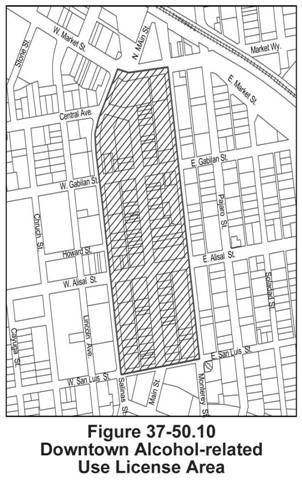
Downtown Alcohol-related Use License Area. All parcels located within the six-block area bounded by Monterey Street, East and West San Luis Street, Salinas Street, and East and West Market Streets as shown on Figure 37-50.10. Parcels must be contained within the area defined by these streets. Frontage on the listed streets is not sufficient to meet the definition.
(3)
Guests. Persons who, during the hours when meals are regularly served, come to a restaurant for the purposes of ordering and obtaining, in good faith, a meal.
(4)
Meals. The usual assortment of foods commonly ordered at various hours of the day and prepared on the premises.
(5)
Off-sale (Off-premises Consumption) Alcohol-related Use. Alcoholic beverages, including distilled spirits, beer, and wine, sold in original, unopened containers for consumption off the premises where sold.
(6)
On-sale (On-premises Consumption) Alcohol-related Use. Alcoholic beverages, including distilled spirits, beer, and wine, sold on the premises to be consumed on the premises.
(7)
Premises. A lot or parcel, together with all related buildings, structures, open spaces, and parking areas.
(8)
Restaurant. A commercial establishment, with kitchen facilities, which is regularly, and in a bona fide manner, used principally for the preparation, cooking, and serving of food to customers for compensation and where seating or other physical accommodation is provided for on-site dining. May also include accessory catering services.
(9)
Wine Tasting Room. An establishment in which wine and wine-related products are available for off-site sale, distribution, and consumption, and where wine, limited to that offered for sale, is sampled on the premises. Nothing in this Zoning Code shall be construed to require that any food be sold or purchased with any beverage. A wine tasting room may include a boutique winery.
(10)
Winery. A facility used for the purpose of processing grapes, other fruit products, or vegetables to produce wine or similar spirits. Processing includes crushing, fermenting, blending, aging, storage, bottling, warehousing, wine tasting facilities, administrative offices, and wholesale and accessory retail sales of associated wine and wine-related items. A winery does not include a boutique winery.
(11)
Winery, Boutique. A facility where wine is produced from preprocessed ingredients. Processing permitted at boutique wineries shall be limited to blending ingredients, fermenting wine in sealed containers, bottling of wine, warehousing of ingredients, short-term storage, wine-tasting facilities, administrative offices, and retail and accessory wholesale sales of associated wine and wine-related items. Boutique wineries do not include crushing, pressing, or other processing of fruits or vegetables, and do not include the blending or mixing of ingredients through the use of any machinery or mechanical means.
(c)
Conditional Use Permit Required. A conditional use permit shall be required for all alcohol-related uses (including changes of existing alcohol license type as administered by the state of California Alcoholic Beverage Control Department) except as provided in Section 37-50.030(g): Exceptions below.
(d)
City Planner and Planning Commission Authority.
(1)
The city planner shall have the authority to grant a conditional use permit for:
(A)
Any on-sale alcohol-related use;
(B)
Any off-sale alcohol-related use not located in an area of undue concentration; and
(C)
Any alcohol-related use (such as brew pubs and wine tasting rooms) with both off-sale and on-sale licenses located in the downtown alcohol-related use license area.
(2)
The planning commission shall have the authority to grant a conditional use permit for all other alcohol-related uses.
(e)
Required Findings. In addition to findings required pursuant to Article VI, Division 8: Conditional Use Permits, the following findings shall be made prior to the approval of a conditional use permit for alcohol-related uses:
(1)
The alcohol-related use will neither adversely affect the welfare of the area nor of surrounding residentially zoned neighborhoods, giving due consideration to the distance of the proposed use from other alcohol-related uses, residentially zoned property, public schools, public playgrounds, and other similar uses; and giving further consideration to crime rates, calls for emergency services, and residential densities in the surrounding area.
(2)
For any off-sale alcohol-related use located within an area of undue concentration (as defined by Business and Professions Code Sections 23958.4, 23817.5, and 23817.7, and administered by the State Department of Alcoholic Beverage Control), Section 37-60.500: Administrative conditional use permits shall not apply except as authorized in Section 37-50.030(e)(3) below. For off-sale alcohol-related uses located in an area of undue concentration, the planning commission shall also make the findings required by Business and Professional Code Section 23958.4, 23817.5, and 23817.7 that public convenience or necessity would be served by the issuance of the alcohol license by the ABC, even though such premises is located within an area of undue concentration. The planning commission is authorized by the city council to make the determination of public convenience or necessity through the conditional use permit process. Such findings are not required or applicable to on-sale alcohol-related uses located in an area of undue concentration.
(3)
For alcohol-related uses that have both on-sale and off-sale alcohol sales (specifically brew pubs and wine tasting rooms) in the downtown alcohol-related use license area, the city council authorizes the city planner in accordance with Section 37-60.500: Administrative conditional use permits to approve an administrative conditional use permit for such uses, if applicable, and to make a determination of public convenience or necessity in conformance with the required findings specified in Section 37-50.030(e)(2) above. The city council authorizes this authority in order to facilitate and implement the redevelopment and entertainment goals for the downtown alcohol-related use license area.
(f)
Additional Requirements for Alcohol-related Uses. The following conditions shall be imposed as part of a conditional use permit issued for an alcohol-related use:
(1)
The premises shall be maintained free of litter at all times.
(2)
For on-sale alcohol-related uses, no alcoholic beverages shall be sold, dispensed, or offered for consumption except within the licensed premises.
(3)
For off-sale alcohol-related uses:
(A)
No alcoholic beverages shall be consumed on the premises;
(B)
No sale or distribution of alcoholic beverages shall be made from a drive-up or walk-up window;
(C)
No display of alcoholic beverages shall be made from an ice tub; and
(D)
No "single-serving" or "one-can" sales of alcoholic beverages shall be made from the premises. A sign to this effect in English and Spanish shall be maintained at the cashier station at all times. Exception: "single serving" or "one-can" non-chilled or non-refrigerated alcoholic beverages may be sold from those premises with at least eight thousand square feet of gross floor area and located in a shopping center with a minimum of ninety thousand square feet of gross floor area.
(4)
For service stations which include off-sale liquor establishments:
(A)
No alcoholic beverage shall be displayed within five feet of the cash register or the front door of the permitted premises unless displayed in a permanently affixed cooler;
(B)
No advertisement of alcoholic beverages shall be displayed at or located on motor fuel islands, nor shall self-illuminated advertising for alcoholic beverages be located on buildings or windows; and
(C)
Alcohol shall not be sold between the hours of 10:00 p.m. and 6:00 a.m. Coolers containing alcoholic beverages shall be locked between the hours of 10:00 p.m. and 6:00 a.m.
(5)
As applicable, conditions including, but not limited to, requirements for employee security, buffering of neighboring uses, exterior lighting, hours of operation, and coin- or token-operated amusement games may be imposed.
(6)
All business owners and managers shall complete a program certified by the Department of Alcoholic Beverage Control (ABC) as a qualified responsible beverage service (RBS) program prior to the commencement of the use. Any business established after the effective date of the ordinance codified in this section shall require such training of all owners and managers within ninety days of ownership transfer or hire. Failure of managers to obtain training shall be the liability of the owner. The owner shall maintain on the premises a file containing the certificates of training and shall present the file and its contents upon request by the city at any time during normal business hours. The provisions of this section regarding responsible beverage training shall be suspended upon a finding by the city planner that the training is not reasonably available.
(g)
Exceptions.
(1)
The following uses are not subject to the requirement to obtain a conditional use permit or a site plan review:
(A)
Any bona fide nonprofit organization which conducts an event or activity not more than twelve days in each calendar year, at which event or activity any alcoholic beverage is to be sold, served, given away, or consumed at such event or activity;
(B)
An establishment that changes business ownership. This exemption shall not apply if the previous (alcohol-related) use has been discontinued for more than six months;
(C)
Wholesale distribution or manufacture of alcoholic beverages.
(2)
An on-sale alcohol use at a restaurant (not located in the downtown alcohol-related use license area) is allowed with a site plan review (in lieu of a conditional use permit) provided all of the following requirements are met:
(A)
The primary use of the restaurant is for sit-down food service of patrons. Seating for sit-down food service of patrons is provided on the premises and constitutes at least fifty percent of the establishment's seating area. The on-sale alcohol use is accessory to the food service use and there is not a distinguishable separate bar area.
(B)
Alcohol shall not be sold on Sunday through Thursday after 11:00 p.m. until 6:00 a.m. the following day, and after 12:00 midnight on Friday and Saturday until 6:00 a.m. the following day.
(C)
The use is not located within one hundred feet of a residence or within three hundred feet of a park or five hundred feet of a school. The distance shall be measured from the closest exterior wall of the building/suite or property line (if there is no building) where the alcohol-related facility is located to the nearest property line of the site containing a residential dwelling unit or zone, school, or park site. This requirement does not apply to restaurants in the downtown alcohol-related use license area.
(3)
Accessory on-sale alcohol-related uses in the downtown alcohol-related use license area are permitted subject to the issuance of a site plan review (in lieu of a conditional use permit) if it meets the following requirements:
(A)
The primary use is limited to a restaurant (including those with outdoor seating), hotel, bed and breakfast inn, or theater and the alcohol-related use is clearly accessory to that use.
(B)
Any bar and related seating area comprises less than fifty percent of the floor area of the principal uses in the building or one thousand square feet, whichever is less.
(C)
For restaurants, the primary use shall be for sit-down food service of patrons. Seating for food service shall be provided on the premises and constitutes at least fifty percent of the establishment's seating area.
(D)
Alcohol shall not be sold on Sunday through Thursday after 11:00 p.m. until 6:00 a.m. the following day, and after 12:00 midnight on Friday and Saturday until 6:00 a.m. the following day.
(4)
The following uses shall not be subject to the requirements of Sections 37-50.030(f)(2) and 37-50.030(f)(3)(A):
(A)
Wine tasting rooms and brew pubs located in the downtown alcohol-related use license area; and
(B)
Wineries.
(Ord. No. 2463 (NCS); Ord. No. 2482 (NCS), § 2; Ord. No. 2483 (NCS), § 1.)
(Ord. No. 2507 (NCS), § 35, 5-18-2010; Ord. No. 2569 (NCS), § 7, 4-19-2016)
(a)
Building Projections. Projections in required yards shall be permitted as follows unless otherwise provided for in this Zoning Code:
(1)
Fireplaces or chimneys: two and one-half feet into a yard;
(2)
Uncovered and unenclosed stairs, terraces, platforms, decks and subterranean garages (not more than thirty inches in height above site grade): three feet for a length of ten feet parallel to the adjoining property line in a side yard; and six feet for a length of ten feet parallel to the adjoining property line in a rear yard;
(3)
Unenclosed porches and architectural entry features: five feet into a front or corner side yard;
(4)
Cornices, eaves, canopies, awnings, and similar ornamental features: two and one-half feet into a yard. Cornices, eaves, canopies, and similar ornamental features provided in conjunction with ground floor unenclosed porches and architectural entry features may encroach an additional two and one-half feet into a front or corner side yard beyond that permitted in Section 37-50.040(3) above;
(5)
Balconies and protruding windows: five feet into a front, corner side, or rear yard and two and one-half feet into an interior side yard, except in the R-H districts, a balcony may encroach five feet into an interior side yard;
(6)
Other stairs: two and one-half feet into an interior side or rear yard except in the R-H districts; stairs may encroach five feet into an interior side or rear yard. Uncovered and unenclosed stairs, which provide direct pedestrian access to and are only used in conjunction with ground floor unenclosed porches and architectural entry features, may encroach an additional three feet into a front or corner side yard beyond that permitted in Section 37-50.040(3) above;
(7)
In R and NU (NE, NG-1, and NG-2) districts, heating, ventilation, air conditioning, swimming pool and spa equipment, and water heating equipment: two and one-half feet into a yard, provided that such equipment is surrounded by an architectural screen which matches the exterior of the residential structure.
(Ord. No. 2463 (NCS).)
(a)
Permit Required. A planned unit development permit shall be required for all condominium conversions. The following findings are required:
(1)
The applicant has submitted an evaluation report prepared by an architect or civil engineer licensed in California describing the condition and useful life of the roof, foundations, mechanical and electrical systems, plumbing, structural elements, paved surfaces, exterior paint, sprinkler systems for landscaping and utility delivery systems of all existing buildings and structures and such report indicates that all such elements have been determined to have a remaining useful life of two or more years;
(2)
The elements identified in Section 37-50.050(a)(1) with a remaining useful life of less than two years shall be repaired or replaced;
(3)
In the case of a residential conversion, the conversion will not have an adverse impact on the supply of affordable housing, particularly for low and very-low income households as indicated by a vacancy/rent study; and
(4)
Additional improvements will be made consistent with these zoning regulations to the extent feasible.
(b)
Vacancy/Rent Study. A vacancy/rent study shall be provided as part of an application for a residential condominium conversion. The study shall be prepared for the city planner by their designee. The applicant shall be responsible for the cost of the study.
(Ord. No. 2463 (NCS).)
(a)
Purpose. In accordance with Sections 65915, 65915.5, and 65917 of the California Government Code, the purpose of this section is to provide density bonuses, incentives, or concessions for the production of housing for very-low, lower, and moderate income households, senior households, and for the provision of day care centers and donations of land. In enacting this section, it is also the intent of the city to implement the goals, objectives, and policies of the city's general plan housing element and to establish a city density bonus for the provision of affordable senior housing.
(b)
Definitions. The following definitions shall apply to this section:
(1)
Affordable Ownership Cost. A reasonable downpayment and an average monthly housing cost during the first calendar year of occupancy, mortgage insurance, property taxes and property assessments, homeowners insurance, homeowners' association dues, if any, and all other dues and fees assessed as a condition of property ownership, which does not exceed:
(A)
Thirty percent of fifty percent of area median income for very-low income households;
(B)
Thirty percent of seventy percent of area median income for lower income households; and
(C)
Thirty percent of one hundred twenty percent of area median income for moderate income households.
Area median income shall be adjusted for assumed household size based on unit size as follows: one person in a studio dwelling unit; two persons in a one-bedroom dwelling unit; three persons in a two-bedroom dwelling unit; four persons in a three-bedroom dwelling unit; five persons in a four-bedroom dwelling unit; and six persons in a five-bedroom dwelling unit. The city council, by resolution, shall establish guidelines for determining affordable ownership cost.
(2)
Affordable Rent. Monthly rent, including a reasonable allowance for garbage collection, water, electricity, gas, and other heating, cooking, and refrigeration fuels, and all mandatory fees charged for use of the property, which does not exceed:
(A)
Thirty percent of fifty percent of area median income for very-low income households; or
(B)
Thirty percent of sixty percent of area median income for lower income households;
(C)
Area median income shall be adjusted for assumed household size based on dwelling unit size as follows: one person in a studio dwelling unit; two persons in a one-bedroom dwelling unit; three persons in a two-bedroom dwelling unit; four persons in a three-bedroom dwelling unit; and five persons in a four-bedroom dwelling unit. The city council, by resolution, shall establish guidelines for determining affordable rent.
(3)
Area Median Income. The annual median income for Monterey County, adjusted for household size, as published periodically in Title 25, Section 6932, California Code of Regulations, or its successor provision, or as established by the city of Salinas in the event that such median income figures are no longer published periodically in the California Code of Regulations.
(4)
Concessions. Such regulatory concessions as listed in Section 37-50.060(k).
(5)
Day Care Center. A facility approved and licensed by the state, other than a family day care home, that provides nonmedical care on less than a twenty-four hour basis, including infant centers, preschools, extended day care facilities, adult day care and elderly day care facilities. Day care center does not include residential care facilities, residential service facilities, interim housing, or convalescent hospitals/nursing homes.
(6)
Density Bonus Units. Those residential dwelling units approved pursuant to this section, which exceed the otherwise allowable maximum residential density for the development site. This definition has the same meaning as "density bonus units" defined in Section 17-8(g) of the Salinas Municipal Code.
(7)
Density Bonus. An increase in the number of dwelling units over the otherwise maximum allowable residential density as established in the land use element of the Salinas general plan in accordance with state law and this section.
(8)
Density Bonus Program Guidelines. Guidelines adopted by resolution of the city that outline the criteria and procedures for implementing density bonuses or other regulations.
(9)
Development Standard. Development regulations, design standards, and site/construction conditions that apply to a residential development pursuant to any ordinance, general plan element, specific plan, or other local condition, law, policy, resolution, or regulation. "Site or construction conditions" are standards that specify the physical development of a site and structures on the site in a residential development.
(10)
First Approval. The first of the following approvals to occur with respect to a residential development: specific plan, development agreement, planned unit development permit, tentative map, minor subdivision, conditional use permit, site plan review, or building permit.
(11)
Incentives. Such regulatory incentives as listed in Section 37-50.060(k).
(12)
Lower Income Households. Households with an annual income that does not exceed the United States Department of Housing and Urban Development's annual determination for lower income households with incomes of approximately eighty percent of area median income, adjusted for household size.
(13)
Maximum Residential Density. The maximum number of residential dwelling units permitted by the Zoning Code on the date the application is deemed complete.
(14)
Moderate Income Households. Households whose income does not exceed one hundred twenty percent of area median income, adjusted for household size in accordance with adjustment factors adopted and amended from time to time by the United States Department of Housing and Urban Development pursuant to Section 8 of the United States Act of 1937.
(15)
Nonrestricted Units. All dwelling units within a residential development except the target units, but including those required to be made affordable pursuant to Chapter 17, Article III: Inclusionary Housing Requirements of the Salinas Municipal Code.
(16)
Qualifying Residents. Persons eligible to reside in senior housing as defined in California Civil Code Section 51.3.
(17)
Residential Development. Any project requiring any specific plan, development agreement, planned unit development permit, tentative map, minor subdivision, conditional use permit, site plan review, or building permit, for which a development review application has been submitted to the city, and which would create five or more additional dwelling units by construction or alteration of structures, not including conversion of existing dwelling units to condominiums. Developments that would create five to nine additional dwelling units may request a density bonus pursuant to Section 37-50.060: Density bonus but are not subject to the city's inclusionary housing ordinance, which is applicable only to developments that would create ten or more additional dwelling units in accordance with Section 17-8(o) of the Salinas Municipal Code.
(18)
Senior Housing Type 1. A senior citizen housing development of thirty-five dwelling units or more as defined in California Civil Code Section 51.3, or a mobilehome park that limits residency based on age requirements for older persons pursuant to California Civil Code Section 798.76 or 799.5. This definition pertains to the density bonus allowed for senior housing dwelling units allowed in accordance with the state density bonus provisions.
(19)
Senior Housing Type 2. A residential development of five dwelling units or more designed for residency by qualifying residents in accordance with California Civil Code Section 51.3 and in which a minimum of fifty percent of the dwelling units are provided at an affordable housing cost as required by Section 37-50.060(i). This definition applies to the density bonus allowed for senior housing dwelling units in accordance with the city of Salinas density bonus provisions.
(20)
Target Unit. A dwelling unit within a housing development that is reserved for sale or rent to, and is made available at an affordable rent or affordable ownership cost to, very-low, lower, or moderate income households, or is a dwelling unit in a senior housing development, and which qualifies the residential development for a density bonus and other incentives or concessions pursuant to Section 37-50.060(c) or 37-50.060(g).
(21)
Very-low Income Households. Households with an annual income, which does not exceed the United States Department of Housing and Urban Development's annual determination for very-low income households with incomes of approximately fifty percent of area median income, adjusted for household size.
(c)
State Density Bonuses, Incentives, and Concessions for Construction of Affordable and Senior Housing.
(1)
Basic Density Bonus in Accordance with State Law (Very-low and Lower Income Units). A residential development is eligible for a twenty percent density bonus if it includes at least five dwelling units, and the applicant seeks a density bonus and agrees to construct at least one of the following:
(A)
Ten percent of the total dwelling units of the residential development as dwelling units affordable to lower income households; or
(B)
Five percent of the total dwelling units of the residential development as dwelling units affordable to very-low income households.
(2)
Basic Density Bonus in Accordance with State Law (Senior Housing Type 1). A senior housing type 1 development is eligible for a twenty percent density bonus if it includes at least thirty-five dwelling units, and the applicant seeks a density bonus. Senior housing type 1 developments are not required under state law to be affordable to very-low, lower, or moderate income households.
(3)
Basic Density Bonus in Accordance with State Law—(Moderate Income Ownership Units). A residential development is eligible for a five percent density bonus if it includes at least five dwelling units, all the dwelling units in the development are offered to the public for purchase, and the applicant seeks a density bonus and agrees to construct ten percent of the total dwelling units as ownership units affordable to moderate income households.
(4)
Additional Density Bonus in Accordance with State Law. The density bonus to which the applicant is entitled shall increase if the percentage of affordable housing units exceeds the base percentage established in Section 37-50.060(c)(1) or (c)(3) above, as follows:
(A)
Very-low Income Units. For each one percent increase above five percent in the percentage of dwelling units affordable to very-low income households, the density bonus shall be increased by two and one-half percent up to a maximum of thirty-five percent.
(B)
Lower Income Units. For each one percent increase above ten percent in the percentage of dwelling units affordable to lower income households, the density bonus shall be increased by one and one-half percent up to a maximum of thirty-five percent.
(C)
Moderate Income Ownership Units. For each one percent increase above ten percent of the percentage of ownership units affordable to moderate income households, the density bonus shall be increased by one percent up to a maximum of thirty-five percent.
(D)
Senior Housing Type 1. No additional state density bonus is provided for senior-only dwelling units.
(5)
Calculation of Density Bonus.
(A)
When calculating the number of permitted density bonus units, any calculations resulting in fractional dwelling units shall be rounded to the next larger whole number.
(B)
The density bonus units shall not be included when determining the number of target units required to qualify for a density bonus. When calculating the required number of target units, any calculations resulting in fractional dwelling units shall be rounded to the next larger whole number.
(C)
The developer may request a lesser density bonus than the project is entitled to, but no reduction will be permitted in the number of required target units pursuant to Sections 37-50.060(c)(1), (c)(2), and (c)(3) above. Regardless of the number of target units, no residential development may be entitled to a total density bonus of more than thirty-five percent except an affordable senior housing project pursuant to Section 37-50.060(g).
(D)
Each residential development is entitled to only one density bonus, which may be selected by the applicant based on the percentage of either very-low income target units, lower income target units, or moderate income ownership target units, or the project's status as either a senior housing type 1 or 2 development. Density bonuses from more than one category may not be combined, except that bonuses for land dedication pursuant to Section 37-50.060(d) may be combined with bonuses granted pursuant to this subsection, up to a maximum of thirty-five percent, and an additional square footage bonus for day care centers may be granted as described in Section 37-50.060(e).
(E)
Consistent with Section 17-11(c) of the Salinas Municipal Code, target units do not meet the inclusionary requirements of Article III of Chapter 17 of the Salinas Municipal Code.
(6)
Incentives or Concessions in Accordance with State Law. A residential development is eligible for incentives and concessions if it includes at least five dwelling units, and the applicant seeks a density bonus and agrees to construct affordable dwelling units as follows:
(A)
Very-low Income Units. A residential development is entitled to one incentive or concessions for a project that includes at least five percent of the dwelling units for very-low income households; two incentives or concessions for a project that includes at least ten percent of the dwelling units for very-low income households; and three incentives or concessions for a project that includes at least fifteen percent of the dwelling units for very-low income households.
(B)
Lower Income Units. A residential development is entitled to one incentive or concession if it includes at least ten percent of the dwelling units for lower income households; two incentives or concessions if it includes at least twenty percent of the dwelling units for lower income households; and three incentives or concessions if it includes at least thirty percent of the dwelling units for lower income households.
(C)
Moderate Income Ownership Units. A residential development with ownership units affordable to moderate income households is entitled to one incentive or concession for a project that includes at least ten percent of the ownership units for moderate income households; two incentives or concessions for a project that includes at least twenty percent of the ownership units for moderate income households; and three incentives or concessions for a project that includes at least thirty percent of the ownership units for moderate income households.
(7)
The requirements of this section are minimum requirements and shall not preclude a residential development from providing additional affordable dwelling units or affordable dwelling units with lower rents or sales prices than required by this section.
(8)
In accordance with state law, neither the granting of an incentive or concession nor the granting of a density bonus shall be interpreted, in and of itself, to require a general plan amendment, Zoning Code amendment or rezone, or other discretionary review application approval.
(d)
State Density Bonus for Land Donation.
(1)
When an applicant for a residential development seeks a density bonus for the donation and transfer of land for the development of units affordable to very-low income households, as provided for in this section, the residential development shall be eligible for a fifteen percent density bonus above the otherwise maximum allowable residential density in accordance with state law. For each one percent increase above the minimum ten percent land donation described in subsection (d)(2) of this section, the maximum density bonus shall be increased by one percent, up to a maximum of thirty-five percent. This increase shall be in addition to any increase in density allowed by Section 37-50.060(c), up to a maximum combined density bonus of thirty-five percent if an applicant seeks both the density bonus authorized by this section and the density bonus authorized by Section 37-50.060(c). When calculating the number of permitted density bonus units, any calculations resulting in fractional dwelling units shall be rounded to the next larger whole number. This density bonus applies only when land is donated for the construction of very-low income housing.
(2)
The city may approve the density bonus described in this section if it makes all of the following findings when approving the residential development:
(A)
The applicant will donate and transfer the land no later than the date of approval of the final map, parcel map, or applicable development review application for the residential development.
(B)
The developable acreage and regulations of the applicable zoning district of the land to be transferred will permit construction of dwelling units affordable to very-low income households in an amount not less than ten percent of the total number of residential dwelling units in the proposed development, or will permit construction of a greater percentage of dwelling units if proposed by the developer to qualify for a density bonus of more than fifteen percent.
(C)
The transferred land is at least one acre in size or is large enough to permit development of at least forty dwelling units, has the appropriate general plan land use designation, has the appropriate zoning and development standards to make feasible the development of very-low income housing, and at the time of project approval is, or at the time of construction will be, served by adequate public facilities and infrastructure.
(D)
No later than the date of approval of the final map, parcel map, or other applicable development review application for the residential development, the transferred land will have all of the applicable development permits and approvals, other than any required building permit approval, necessary for the development of the very-low income dwelling units on the transferred land unless the city council finds that the applicant has provided specific assurances guaranteeing the timely completion of the very-low income units, including satisfactory assurances that construction and permanent financing will be secured for the construction of the dwelling units within a reasonable time.
(E)
The transferred land and the very-low income units constructed on the land will be subject to a recorded density bonus housing agreement ensuring continued affordability of the dwelling units consistent with Section 37-50.060(i), which restriction shall be filed for recordation by the city planner with the Monterey County recorder's office on the property at the time of dedication.
(F)
The land will be transferred to the city, Salinas redevelopment agency, or to a housing developer approved by the city. The city reserves the right to require the applicant to identify a developer for the very-low income units and to require that the land be transferred to that developer.
(G)
The transferred land is within the site boundaries of the proposed residential development. The transferred land may be located within one-quarter mile of the boundary of the proposed residential development provided that the city council finds, based on substantial evidence, that off-site donation will provide as much or more affordable housing at the same or even lower income levels, and of the same or superior quality of design and construction, and will otherwise provide greater public benefit, than donating land on site.
(3)
Consistent with Section 17-11(c) of the Salinas Municipal Code, land dedication qualifying a project for a density bonus does not meet the inclusionary housing requirements of Article III of Chapter 17 of the Salinas Municipal Code.
(e)
State Density Bonus or Incentive or Concession for Day Care Centers.
(1)
A residential development that includes at least five dwelling units; includes target units as specified in Section 37-50.060(c)(1), (c)(2), or (c)(3); and includes a day care center that will be located on the premises of, as part of, or adjacent to the residential development, is eligible for either of the following, at the option of the city, if requested by the applicant in accordance with state law:
(A)
A density bonus in addition to those permitted by Sections 37-50.060(c) and (d) that is equal to the square footage of the gross floor area of the day care center; or
(B)
An additional incentive or concession that contributes significantly to the economic feasibility of the construction of the day care center.
(2)
The city may approve the density bonus or incentive or concession described in this section if it makes the following finding and requires as a condition of approval that the day care center will remain in operation for a period of time equal to or longer than the period of time during which the target units are required to remain affordable pursuant to Section 37-50.060(i).
(3)
Notwithstanding any other requirement of this section, the city shall not be required to provide a density bonus or incentive or concession for a day care center if it finds, based upon substantial evidence, that the community already has adequate day care center facilities.
(f)
State Density Bonus for Condominium Conversions.
(1)
An applicant shall be eligible for either a density bonus or other incentives or concessions of equivalent financial value in accordance with state law if the applicant for a conversion of existing rental apartments to condominiums agrees to provide thirty-three percent of the total dwelling units of the proposed condominium project as target units affordable to households with moderate incomes or less, or to provide fifteen percent of the total dwelling units in the condominium conversion project as target units affordable to lower income households. All such target units shall remain affordable for the period specified in Section 37-50.060(i).
(2)
For purposes of this subsection, a density bonus means an increase in dwelling units of twenty-five percent over the number of dwelling units to be provided within the existing structure or structures proposed for conversion.
(3)
No condominium conversion shall be eligible for a density bonus if the apartments proposed for conversion constitute a housing development for which a density bonus or other incentives or concessions were previously provided pursuant to this article or Government Code Section 65915.
(4)
Also see Section 37-50.050: Condominium conversions for additional requirements.
(g)
City Density Bonus for Affordable Senior Housing Type 2.
(1)
A residential development may be considered for a density bonus under this subsection if:
(A)
The applicant seeks a density bonus and the residential development consists entirely of senior housing type 2;
(B)
At least fifty percent of the dwelling units are affordable housing units. For the purposes of this subsection, "affordable housing units" includes dwelling units available at an affordable rent or affordable ownership cost to lower income and very-low income households. A minimum of sixty percent of such affordable housing units shall be available at an affordable rent or affordable ownership cost to very-low income senior households, and forty percent of such affordable housing units shall be available at an affordable rent or affordable ownership cost to lower income senior households. However, a greater percentage of very-low income senior housing units may be provided in lieu of some or all of the lower income senior housing units on a dwelling unit for dwelling unit basis; and
(C)
The density bonus shall be equal to the percentage of affordable housing units in the senior housing type 2 development.
(2)
A conditional use permit shall be required for a density bonus granted pursuant to this subsection. The approval body shall find that the residential development conforms with the property development regulations of the applicable zoning district or has received a planned unit development permit; is compatible with neighboring development; has adequate open space, on-site amenities, and services for the intended residents; is within reasonable walking distance of neighborhood services; and has adequate available infrastructure to accommodate the proposed density.
(3)
Any density bonus granted under this section that is greater than the bonus that the project is eligible for under Section 37-50.060(c) or 37-50.060(d) shall be considered an incentive or concession as described in Section 37-50.060(k). Any affordable housing units that qualify a project for a density bonus under Section 37-50.060(c) may not also be used to qualify a project for a density bonus under this subsection.
(4)
At its discretion, the city council may grant up to two incentives or concessions for senior housing type 2 that is eligible for a density bonus under this subsection.
(5)
Consistent with Section 17-11(c) of the Salinas Municipal Code, affordable housing units qualifying a project for a density bonus under this subsection do not meet the inclusionary housing requirements of Article III of Chapter 17 of the Salinas Municipal Code.
(h)
Summary Tables. The following tables [(Table 37-50.10), (Table 37-50.20), (Table 37-50.30), and (Table 37-50.40)] summarize the available density bonuses, incentives, and concessions pursuant to state and city density bonus law:
Notes:
(A) Only the project's base density is considered when determining the percentage of target units. See Section 37-50.060(c)(5)(B).
(B) Or an incentive of equal value, at the city's option.
(C) A density bonus may be granted equal to the percentage of affordable senior units (at least fifty percent and up to a maximum of one hundred percent) subject to the approval of a conditional use permit.
Notes:
(A) A concession or incentive may be requested only if an application is also made for a density bonus.
(B) Concessions or incentives may be selected from only one category (very-low, lower, or moderate).
(C) No concessions or incentives are available for land donation.
(D) Condominium conversions and day care centers may have one concession or a density bonus at the city's option, but not both.
Note:
(A) At the discretion of city council.
(i)
Affordability and Occupancy Standards.
(1)
The city council, by resolution, shall approve standard documents to ensure the continued affordability of target units consistent with Government Code Section 65915 and this section. The documents may include, but are not limited to, regulatory agreements, promissory notes, deeds of trust, resale restrictions, rights of first refusal, options to purchase, and/or other documents, which shall be recorded against all target units. Affordability documents for target units offered for sale may also include subordinate shared appreciation documents permitting the city to capture at resale the difference between the market rate price of the target unit and the affordable price at initial sale, plus a share of appreciation realized from an unrestricted sale in such amounts as deemed necessary by the city to replace the target units.
(2)
Target units offered for rent to lower income and very-low income households shall be made available for rent at an affordable rent and shall remain restricted and affordable to the designated income group for a minimum period of thirty years, except that senior housing type 2 target units offered for rent shall remain restricted and affordable to the designated income group for a minimum period of fifty-five years. A longer term of affordability may be required if the residential development receives a subsidy of any type including, but not limited to, a loan, grant, mortgage financing, mortgage insurance, or rental subsidy, and the subsidy program requires a longer term of affordability, or as prescribed in any guidelines adopted pursuant to Section 37-50.060(b)(8).
(3)
Target units offered for sale to very-low, lower, or moderate income households shall be sold at an affordable ownership cost. Senior housing type 2 target units offered for sale shall remain restricted and affordable to the designated income group for a minimum period of forty-five years. For all other target units offered for sale any subordinate shared appreciation documents shall continue for a term of at least thirty years. If resale restrictions are used in lieu of shared appreciation documents, any resale restriction shall continue for a term of at least thirty years. A longer term of affordability may be required if the residential development receives a subsidy of any type including, but not limited to, a loan, grant, mortgage financing, mortgage insurance, or rental subsidy, and the subsidy program requires a longer term of affordability, or as prescribed in any guidelines adopted pursuant to Section 37-50.060(b)(8).
(4)
Any household that occupies a target unit must occupy that dwelling unit as its principal residence.
(5)
No household may begin occupancy of a target unit until the household has been determined by the city or its designee to be eligible to occupy that dwelling unit. The city council, by resolution, shall establish guidelines for determining household income, maximum occupancy standards, affordable ownership cost, affordable rent, provisions for continued monitoring of tenant eligibility, and other eligibility criteria.
(6)
The city council by resolution may establish fees for projects requesting density bonuses and incentives or concessions and for the on-going administration and monitoring of the target units and day care centers, which fees may be updated periodically, as required.
(7)
The city council, by resolution, shall approve standard documents to ensure the continued affordability of the target units. The documents may include, but are not limited to, density bonus housing agreements, regulatory agreements, promissory notes, deeds of trust, rights of first refusal, options to purchase, resale provisions, and/or other documents, which shall be recorded against all target units.
(8)
All promissory note repayments, shared appreciation payments, or other payments collected under this section shall be deposited in the city of Salinas inclusionary housing trust fund established pursuant to Section 17-18 of the Salinas Municipal Code.
(9)
Any person who is a member of the city council or the planning commission, and their immediate family members, or any person having any equity interest in the residential development, including but not limited to, a developer, partner, investor, or applicant and their immediate family members, is ineligible to rent, lease, occupy, or purchase a target unit. The city council, by resolution, may establish guidelines for determination of "immediate family members."
(j)
Development Standards.
(1)
Target units shall be constructed concurrently with nonrestricted dwelling units or pursuant to a schedule included in the density bonus housing agreement approved pursuant to Section 37-50.060(n).
(2)
Single-family detached target units shall be dispersed throughout the residential development. Townhouse, rowhouse, and multifamily target units shall be located so as not to create a geographic concentration of target units within the residential development.
(3)
Target units shall have the same proportion of dwelling unit types as the market-rate dwelling units in the residential development.
(4)
The quality of exterior design and overall quality of construction of the target units shall meet all site, design, and construction standards included in Chapter 9: Buildings, Chapter 31: Subdivisions, and Chapter 37: Zoning of the Salinas Municipal Code including, but not limited to, compliance with all design guidelines included in applicable specific plans or otherwise adopted by the city council.
(5)
Target units made available for purchase shall include space and connections for a clothes washer and dryer within the dwelling unit. Target units made available for rent shall include either connections for a clothes washer and dryer within the target unit or sufficient on-site self-serve laundry facilities to meet the needs of all tenants without laundry connections in their dwelling units.
(6)
Upon the request of the developer, the city shall not require an off-street vehicular parking standard, inclusive of handicapped and guest parking, of a residential development, meeting the criteria of Section 37-50.060(c)(1), (c)(2), or (c)(3) that exceeds the following:
(A)
Zero to one bedroom: one on-site parking space;
(B)
Two to three bedrooms: two on-site parking spaces;
(C)
Four and more bedrooms: two and one-half parking spaces;
(D)
If the total number of parking spaces required for a development is other than a whole number, the number shall be rounded up to the next whole number. For purposes of this section, a residential development may provide on-site parking through tandem parking or uncovered parking, but not through on-street parking.
(k)
Development Incentives or Concessions.
(1)
One to three incentives or concessions may be requested for eligible residential developments pursuant to Section 37-50.060(c)(6).
(2)
For purposes of this section, a concession or incentive shall mean any reduction in development standards or any modification of zoning or architectural design requirements necessary pursuant to Government Code Section 65915(d)(3) or 65915(e) to facilitate the construction of residential development at the densities provided for in Section 65915.
(3)
Concessions Not Requiring Financial Pro Forma from Applicant. The following concessions and incentives shall be available to the applicant without any requirement for the applicant demonstrate to the city that the requested concession or incentives results in identifiable, financially sufficient, and actual cost reductions to the project pursuant to California Government Code Section 65915(l)(1):
(A)
Up to fifteen percent deviation from the minimum yard requirement, with each deviation counting as one concession;
(B)
Up to fifteen percent reduction in the usable open space requirement or maximum lot coverage requirement;
(C)
Up to fifteen percent reduction in lot dimensions;
(D)
Up to fifteen percent increase in maximum building height;
(E)
Up to fifteen percent reduction in minimum distance between buildings;
(F)
Reduction in required off-street parking as described in Section 37-060(j)(6);
(G)
Up to fifteen percent reduction in landscaping area requirements;
(H)
Waiver of fee established pursuant to Section 37-50.060(i)(6);
(I)
Approval of mixed use buildings or developments in conjunction with the residential development, if nonresidential land uses will reduce the cost of the residential development, and if the city finds that the proposed nonresidential uses are compatible with the residential development and with existing or planned development in the area where the proposed residential development will be located;
(J)
Deferral until occupancy of development impact fees (including, but not limited to, park fees, fire fees, sanitary sewer trunk line fees, storm drain trunk line fees, street tree fees, library fees, or traffic impact fees); and
(K)
Density bonus for senior housing type 2 pursuant to Section 37-50.060(g) that is in excess of the density bonus that the project is entitled to under Section 37-50.060(c) or 37-50.060(d).
(4)
Concessions Requiring Financial Pro Forma from Applicant. When requested by the applicant, the following concessions and incentives shall require the applicant to demonstrate to the city council that the requested concessions or incentives result in identifiable, financially sufficient, and actual cost reductions to the project pursuant to California Government Code Section 65915(l)(1):
(A)
A reduction of development regulations standards or a modification of Zoning Code requirements that exceed or are in addition to those permitted in Section 37-50.60(k)(3);
(B)
Reduced parking space dimensions, driveway width, parking aisle width, garage and carport dimension, location of parking spaces within required yards, or reduced bicycle parking requirements;
(C)
Reductions in architectural design standards;
(D)
Other regulatory incentives or concessions that are not listed in this section that result in identifiable, financially sufficient, and actual cost reductions; and
(E)
A density bonus exceeding that required by Government Code Section 65915 where the applicant agrees to construct more affordable units than would qualify the residential project for the maximum thirty-five percent density bonus.
(5)
Applicants may seek a waiver or modification of development standards that will have the effect of precluding the construction of a residential development meeting the criteria of Section 37-50.060(c)(1), (c)(2), or (c)(3) at the densities or with the incentives or concessions permitted by this section. The applicant shall show that the waiver or modification is necessary to make the dwelling units economically feasible based upon appropriate financial analysis and documentation as specified in Section 37-50.060(l)(4).
(6)
Nothing in this section requires the city to grant direct financial incentives for the residential development including, but not limited to, the provision of publicly owned land or waiver of fees or dedication requirements.
(l)
Application Requirements. Applications for a density bonus shall include:
(1)
A density bonus housing plan, showing any density bonus, incentive, concession, waiver, modification, or revised parking standard requested pursuant to this section, shall be submitted as part of the first approval of any residential development. The density bonus housing plan shall specify, at the same level of detail as the application for the residential development: the number, dwelling unit type, level of affordability, tenure, number of bedrooms and baths, approximate location, size, and design, construction and completion schedule of all target units, number and location of all density bonus units, phasing of target units in relation to nonrestricted units, and marketing plan. The density bonus housing plan shall also specify the methods to be used to verify tenant and buyer incomes and to maintain the affordability of the target units. For residential projects with thirty-five dwelling units or more, the density bonus housing plan shall specify a financing mechanism for the on-going administration and monitoring of the target units.
(2)
A description of any requested incentives, concessions, waivers, or modifications of development standards, or modified parking standards.
(3)
For all incentives and concessions except those listed in Section 37-50.060(k)(3), the application shall provide a pro forma to the city demonstrating that the requested incentives and concessions result in identifiable, financially sufficient, and actual cost reductions. The cost of reviewing any required pro forma data submitted in support of a request for a concession or incentive including, but not limited to, the cost to the city of hiring a consultant to review the pro forma, shall be borne by the applicant. The pro forma shall be reviewed by a third party as selected by the city and paid for by the applicant unless the city planner waives the requirement for such a review.
(4)
For waivers or modifications of development standards, the application shall provide a pro forma to the city demonstrating that the waiver or modification is necessary to make the dwelling units economically feasible based upon appropriate financial analysis and documentation. The application shall also demonstrate to the city that the development standards will have the effect of precluding the construction of a housing development at the densities or with the incentives or concessions permitted by this section. The cost of reviewing any required pro forma submitted in support of a request for a waiver or modification including, but not limited to, the cost to the city of hiring a consultant to review the pro forma, shall be borne by the applicant.
(5)
If a density bonus or concession is requested for a land donation, the application shall show the location of the land to be dedicated and provide evidence that each of the findings included in Section 37-50.060(d)(2) can be made.
(6)
If a density bonus or concession is requested for a day care center, the application shall show the location and square footage of the day care center and provide evidence that the findings included in Section 37-50.060(e)(2) can be made.
(7)
If a mixed use building or development is proposed, the application shall provide evidence that the finding included in Section 37-50.060(k)(3)(l) can be made.
(m)
Review of Application.
(1)
An application for a density bonus, incentive, concession, waiver, modification, or revised parking standard pursuant to this section shall be considered by and acted upon by the approval body with authority to approve the residential development. The density bonus plan may be approved, approved with conditions, or denied pursuant to the findings required by this section. Any decision regarding a density bonus, incentive, concession, waiver, modification, or revised parking standard may be appealed to the planning commission and from the planning commission to the city council in accordance with the requirements of Article VI, Division 17: Appeals. In accordance with state law, neither the granting of an incentive, concession, waiver, or modification nor the granting of a density bonus shall be interpreted, in and of itself, to require a general plan amendment, Zoning Code amendment or rezone, variance, or other discretionary review application approval.
(2)
Before approving an application for a density bonus, incentive, concession, waiver, or modification, the approval body shall make the following findings:
(A)
The application is eligible for a density bonus and any concessions, incentives, waivers, modifications, or reduced parking standards requested; conforms to all standards for affordability included in this section, and includes a financing mechanism for all implementation and monitoring costs.
(B)
Any requested incentive or concession will result in identifiable, financially sufficient, and actual cost reductions based upon appropriate financial analysis and documentation as described in Section 37-50.060(l).
(C)
If the density bonus is based all or in part on donation of land, the approval body has made the findings included in Section 37-50.060(d)(2).
(D)
If the density bonus, incentive, or concession is based all or in part on the inclusion of a day care center, the approval body has made the finding included in Section 37-50.060(e)(2).
(E)
If the incentive or concession includes mixed use buildings or developments, the approval body has made the finding included in Section 37-50.060(k)(3)(l).
(F)
If a waiver or modification is requested, the developer has shown that the waiver or modification is necessary to make the dwelling units economically feasible by providing appropriate financial analysis and documentation as described in Section 37-50.060(l), and the development standards will have the effect of precluding the construction of a housing development at the densities or with the incentives or concession permitted by this section.
(3)
If the required findings can be made, and a request for an incentive or concession is otherwise consistent with this section, the approval body may deny an incentive or concession only if it makes a written finding, based upon substantial evidence, of either of the following:
(A)
The incentive or concession is not required to provide for affordable rents or affordable ownership costs; or
(B)
The incentive or concession would have a specific adverse impact upon public health or safety or the physical environment or on any real property that is listed in the California Register of Historic Resources, and there is no feasible method to satisfactorily mitigate or avoid the specific adverse impact without rendering the development unaffordable to lower, very-low and moderate income households. For the purpose of this subsection, "specific adverse impact" means a significant, quantifiable, direct, and unavoidable impact, based on objective, identified, written public health or safety standards, policies, or conditions, as they existed on the date that the application was deemed complete.
(4)
If the required findings can be made, and a request for a waiver or modification is otherwise consistent with this section, the approval body may deny the requested waiver or modification only if it makes a written finding, based upon substantial evidence, of either of the following:
(A)
The modification would have a specific adverse impact upon health, safety, or the physical environment, and there is no feasible method to satisfactorily mitigate or avoid the specific adverse impact without rendering the development unaffordable to lower, very-low, and moderate income households. For the purpose of this subsection, "specific adverse impact" means a significant, quantifiable, direct, and unavoidable impact, based on objective, identified, written public health or safety standards, policies, or conditions as they existed on the date that the application was deemed complete; or
(B)
The modification would have an adverse impact on any real property that is listed in the California Register of Historic Resources.
(5)
If a density bonus or concession is based on the provision of day care centers, and if the required findings can be made, the approval body may deny the bonus or concession only if it finds, based on substantial evidence, that the city already has adequate day care centers.
(6)
A request for a minor modification of an approved density bonus housing plan may be granted by the city manager or their designee if the modification is substantially in compliance with the original density bonus housing plan and conditions of approval. Other modifications to the density bonus housing plan shall be processed in the same manner as the original plan.
(n)
Density Bonus Housing Agreement.
(1)
Following the first approval of a residential development, the city shall prepare a density bonus housing agreement providing for implementation of the density bonus housing plan and conditions of approval and consistent with the provisions of this section and any density bonus program guidelines adopted by city council resolution.
(2)
Prior to the approval of any final or parcel map or issuance of any building permit for a residential development subject to this section, the density bonus housing agreement shall be executed by the city and the applicant and the density bonus housing agreement shall be recorded against the entire residential development property to ensure that the agreement will be enforceable upon any successor in interest. The density bonus housing agreement shall run with the land, and bind future owners and successors in interest as required to ensure compliance with the provisions of this section.
(Ord. No. 2463 (NCS).)
(a)
Development on Existing Lots of Record. A legally created lot having a width or area less than required for the district in which it is located shall be developed subject to the same property development regulations as a standard lot. No substandard lot shall be further reduced in area or width.
(b)
Development on Lots Divided by District Boundaries. The regulations applicable to each district shall be applied to the area within that district, and no use or structure shall be located in a district unless it is permitted or authorized by permit.
(Ord. No. 2463 (NCS).)
(a)
Purpose. Employee housing standards are intended to allow the development and operation by the employer of employee housing in specified zoning districts in a manner that is compatible with surrounding areas, in accordance with California Health & Safety Code § 17008.
(b)
General. Agricultural employee housing is a permitted use in the Agriculture (A) zoning district, subject to all the requirements of Section 37-50.075: Agricultural employee housing. Agricultural employee housing not conforming to this section may be allowed in the A district subject to a non-administrative conditional use permit issued pursuant to Article VI, Division 8: Conditional use permits Small project employee housing is a permitted use in all R districts, subject to all the requirements in Section XX, Small Project Employee Housing. Medium project employee housing use may be allowed in all R districts subject to all the requirements in Section XX, Medium Project Employee Housing and an administrative conditional use permit issued pursuant to Article VI, Division 8: Conditional use permits. Medium project employee housing occupancy greater than fourteen persons per lot, but not greater than 14 persons per dwelling unit may be allowed in R-M districts subject to all the requirements in Section XX, Medium Project Employee Housing and a non-administrative conditional use permit issued pursuant to Article VI, Division 8: Conditional use permits.
(c)
Agricultural Employee Housing Regulations
Development Regulations.
(1)
Capacity. The medium project employee housing facility shall contain a maximum of thirty-six beds, serving no more than one person per bed for a maximum of thirty-six persons, if dormitory style, or a maximum of twelve households if in individual dwellings.
(2)
Occupancy limitation. Occupancy of dormitory-style accommodations shall be limited to agricultural employees only. Occupancy of individual dwellings shall be limited to agricultural employees and their immediate families. The employment site need not be the same as the facility site.
(3)
Parking. On-site parking shall be provided according to the following schedule. For dormitory-style facilities, a minimum of one parking space for every three authorized beds. For individual unit facilities, a minimum of two parking spaces shall be provided for each unit or space. Parking requirements specified in Sections 37-50.350, 37-50.370, 37-50.390, 37-50.410 and 37-50.420 apply to facilities developed pursuant to this section.
(4)
Emergency contact. Emergency contact information shall be posted on the exterior of the facility adjacent to the main entrance. Street address numbers shall be legibly posted on each building comprising the facility.
(5)
Other development regulations. See Table 37-50.45.
(d)
Small Project Employee Housing Regulations
Development Regulations.
(1)
New construction. Small project employee housing shall be constructed subject to the development regulations and design standards in Division 2: Residential Districts of the Zoning Code and Section 37-50.110, Infill Residential Development in the R-L District.
(2)
Occupancy limitation. Small project employee housing shall be limited to six employees per lot.
(3)
Performance Standards. Small project employee housing is subject to Section 37-80.180 Performance standards.
(4)
Transportation. No buses are permitted to pick up and drop off at the property unless approved through a Non-administrative Conditional Use Permit. Only passenger vans or vehicles are permitted to conduct passenger loading at the property.
(5)
Conflict Between Regulations. Except as modified by this Section 37-50.075: Employee housing, small project, development regulations applicable to the zoning district shall apply. Where a conflict occurs between the base district regulations and this section of the code, this section shall prevail.
(e)
Medium Project Employee Housing Regulations
Development Regulations.
(1)
Conditional Use Permit.
(a)
Medium project employee housing with an occupancy of 7 to 14 employees per lot in any R district shall require an administrative conditional use permit issued pursuant to Article VI, Division 8: Conditional Use Permits, which may be subject to additional conditions to ensure neighborhood compatibility and minimize impacts to adjacent properties.
(b)
Medium project employee housing in R-M districts and an occupancy of seven to fourteen employees per dwelling unit shall require a non-administrative conditional use permit issued pursuant to Article VI, Division 8: Conditional use permits, which may be subject to additional conditions to ensure neighborhood compatibility and minimize impacts to adjacent properties.
(2)
New construction. Medium project employee housing shall be constructed subject to the development regulations and design standards in Division 2: Residential Districts of the Zoning Code and Section 37-50.110, Infill Residential Development in the R-L District.
(3)
Occupancy limitation. Medium project employee housing shall be limited to between seven and fourteen employees per lot in all R-L and R-M districts subject to approval of an Administrative CUP. A Medium project employee housing of seven to fourteen employees per dwelling unit may be permitted if approved though a Non-administrative CUP by the Planning Commission.
(4)
Dwelling requirements. Medium project employee housing must include the following:
(a)
A minimum of two full bathroom per dwelling unit.
(b)
A full kitchen including a sink, countertop at least four (4) feet in length, cooking apparatus, and refrigerator.
(c)
Sleeping areas of at least fifty square feet per occupant consistent with the California Employee Housing Act.
(5)
Parking. A minimum of three parking spaces will be provided on-site. Additional spaces shall be required for occupancy greater than fourteen persons per lot based upon a parking ratio of one space for every seven employees. Parking spaces that are not required to be covered under the Zoning Code may be provided in tandem but shall not be located within the front yard setback. An applicant may request a parking reduction through the CUP process by demonstrating that the neighborhood impact is mitigated by providing alternatives such as transportation.
(6)
Compatibility. Medium project employee housing shall be operated in a manner that will not adversely affect adjoining residences or be detrimental to the character of the residential neighborhood.
(7)
Signs. No on-site signs advertising the employer shall be permitted.
(8)
Performance Standards. Medium project employee housing is subject to Section 37-80.180 Performance standards.
(9)
Registration. The property owner must register the medium project employee housing with the City and provide the following: 1) any California Housing and Community Development (HCD) approvals pursuant to the California Health & Safety Code § 17008 Health and Safety Code, 2) emergency contact information, 3) contact for property maintenance, and 4) a transportation plan outlining how employees will get to and from work.
(10)
Emergency contact. Emergency contact information shall be posted on the exterior of the facility adjacent to the main entrance. Street address numbers shall be legibly posted on each building comprising the facility.
(11)
Transportation. No buses are permitted to pick up and drop off at the property. Only passenger vans or vehicles are permitted to conduct passenger loading onsite.
(12)
Property Management. The City Planner may require an onsite property manager, which can be a designated employee, at the expense of the employer and annual building inspections through the approval of a Conditional Use Permit to ensure employee and neighbor safety.
(13)
Administrative Fee. The city may charge an administrative fee for monitoring compliance with the provisions of this section as determined from time to time by the city council.
(14)
Application Fee. The city shall charge an application fee for processing a Conditional Use Permit based upon an approved fee schedule.
(15)
Revocation of Permit. The city planner shall reserve the right to revoke permits authorized by this section if the city planner determines that the facility is in violation of any of the provisions in this section. Revocations shall be conducted in accordance with Section 37-60.1330: Revocation of permits.
(16)
Conflict Between Regulations. Except as modified by this Section 37-50.075: Employee housing, medium project, development regulations applicable to the zoning district shall apply. Where a conflict occurs between the base district regulations and this section of the code, this section shall prevail.
(Ord. No. 2532 (NCS), § 15, 11-13-2012; Ord. No. 2623 (NCS), § 8, 11-5-2019)
(a)
Permitted Exceptions. Towers, cornices, spires, cupolas, and similar architectural features, chimneys, elevator penthouses, water tanks, flagpoles, monuments, radio and television antennas, transmission towers, fire towers, and similar structures, and necessary mechanical appurtenances covering not more than ten percent of the ground areas covered by the structure to which they are accessory may exceed the maximum permitted height in the district in which the site is located. Exceptions do not apply to satellite dish antennas, which are included under Section 37-50.010: Accessory uses and structures or to telecommunications facilities, which are included under Section 37-50.290: Telecommunication facilities.
(b)
Structures in the Airport Overlay District. Structures located in the airport overlay district are subject to the height limitations of Article IV, Division 7: Airport (AR) Overlay District.
(Ord. No. 2463 (NCS).)
(Ord. No. 2569 (NCS), § 21, 4-19-2016; Ord. No. 2623 (NCS), § 8, 11-5-2019)
(a)
Purpose. To provide additional options for the workforce, residents, and travelers in need of longer Hotel/Motel stays that will advance Salinas' economic growth and relieve housing shortages. To ensure that Hotel/Motel, extended stay is operated in a manner that provide the highest possible livability standards of design, environment, and security and achieve overall neighborhood compatibility.
(b)
General. Extended Stay for Hotels/Motels may be permitted in the Commercial Thoroughfare, Commercial Retail, Mixed Arterial Frontage, Mixed Use, and Village Center Zoning Districts subject to all the requirements of Section 37-50.085 and a Conditional Use Permit issued pursuant to Article VI, Division 8: Conditional use permits.
(c)
Administration. Extended Stay for Hotels/Motels may be permitted through an Administrative conditional use permit pursuant to Section 37-60.500 and subject to additional conditions to ensure neighborhood compatibility and minimize impacts to adjacent properties.
(d)
Development Regulations.
(1)
Extended Stay for New Hotel/Motels. New Hotel/Motel, Extended Stay shall comply with development regulations and design standards of the applicable Zoning District and Section 37-50.085.
(2)
Maximum Stay. Length of stay per occupant(s) shall not exceed ten months within a three hundred sixty-five day period.
(3)
Parking Requirements. For new construction, 1.25 off-street parking spaces per guest room shall be provided plus one parking space per fifty square feet of banquet seating area. In addition, parking for other uses and facilities shall be provided as required by Section 37-50.360: Off-street parking and loading spaces regulations. For conversion of an existing hotel/motel to extended stay, with no additional guest rooms, existing parking spaces shall be retained, and no additional parking spaces would be required.
(4)
Floor Area. A minimum one hundred fifty square feet per room, including bathroom. Kitchen floor area is not included in the minimum calculation.
(5)
Bathroom. Each room shall contain a bathroom including a toilet, sink, and shower or tub.
(6)
Common Area. A minimum of five hundred square feet of common area shall be provided, which could include a dining area.
(7)
Laundry Facilities. Laundry facilities consisting of individual or common washer and dryer shall be provided. A minimum of one washer and one dryer shall be provided for every twenty-five (25) rooms.
(8)
Existing Structures. Existing hotel/motel rooms may be converted to extended stay and exempted from the development standards contained in this section provided the following findings are established:
(A)
There is substantial compliance with the development standards.
(B)
Alternative means of compliance with development standards are provided which contribute to livability.
(C)
Strict compliance with development standards would render conversion of the hotel/motel to extended stay is impractical.
(9)
Operating Standards.
(A)
Management and Security Plan. A management and security plan shall be required as part of the conditional use permit (CUP) application and include on-site twenty-four hour property management or alternative which affords guests essentially the same level of service and security. This Management and Security Plan shall be reviewed and approved by the Salinas Police Department to ensure site safety and minimize potential negative neighborhood impacts.
(B)
Master Leasing. The hotel/motel operator may lease the entire hotel/motel to a single user.
(C)
Transient Occupancy Tax. Hotel/motel rooms that are not in use as Extended Stay shall be registered with the City and are subject to the transient occupancy tax (TOT).
(D)
Compatibility. Hotel/Motel, Extended Stay shall be operated in a manner that will not adversely affect or be detrimental to properties in the immediate vicinity.
(E)
Outdoor Activity. For the purpose of neighborhood compatibility, on-site outdoor activities except food and transportation services shall be conducted between the hours of 7:00 a.m. and 10:00 p.m. Outdoor activity may include recreational games and activities, musical performances, and such other similar activities as deemed appropriate by the city planner. The city planner may approve a management plan that allows for the loading and unloading of transportation and provision of food services beyond the hours of 7:00 a.m. to 10:00 p.m. if findings can be made that it will not adversely impact the surrounding neighborhood.
(F)
Performance Standards. Hotel/Motel, Extended Stay shall be subject to Section 37-80.180 Performance standards.
(G)
Emergency Contact. Emergency contact information shall be posted on the exterior of the facility adjacent to the main entrance. Street address numbers shall be legibly posted on each building comprising the facility as required by the Fire Department.
(H)
Parking Restrictions. Overnight parking shall be limited to cars, passenger vans, and other vehicles that can be accommodated in designated parking space. Storage of buses, unmanned trailers, and portable toilets shall be prohibited.
(I)
Temporary Storage/Structure. Temporary storage and structures shall be prohibited unless otherwise approved through a separate Temporary Use of Land Permit (TULP).
(J)
Food Service. One catering vehicle, not to exceed fifty feet, shall be permitted for the purposes of providing food service to those living onsite for a ninety minutes, no more than three times per day. The catering vehicle shall be licensed with the health department. The city planner may approve a larger catering vehicle if a designated space can be provided on site that does not impede traffic and circulation, emergency access, pedestrian pathways and sidewalks, and/or ADA access. A hotel/motel operator may obtain a separate CUP for a Food Truck on private property, which is not subject to this section.
(K)
Passenger Loading. Passenger loading may be permitted if located in an area that does not impede traffic and circulation, emergency access, pedestrian pathways and sidewalks, and/or ADA access as shown on a site plan as part of a CUP application.
(L)
Alcohol. Outdoor consumption of alcohol shall be prohibited except in conjunction with a restaurant that has been fully permitted by the City.
(M)
Trash. Trash and recycling cans shall be provided on site and emptied daily by the hotel/motel operator. Trash cans shall have adequate lids or other devices to prevent airborne trash. The operator also shall provide documentation that regular commercial trash service is being provided on site pursuant to city regulations.
(N)
Maintenance. The site shall be maintained and kept free of weeds, litter, and debris. All landscaped areas shall be maintained free of weeds, trash, and debris, and all plant material shall be continuously maintained in a healthy, growing condition. All exterior building and wall surfaces shall be regularly maintained, and any damage caused by weathering, vandalism, or other factors shall be repaired.
(e)
Inspections. The City shall conduct a joint Community Development/Fire Department inspection of the Hotel/Motel Extended Stay use prior to issuance of the CUP.
(f)
Application. In addition to the CUP application, the applicant shall submit:
(1)
Emergency contact information.
(2)
Contact for property maintenance.
(3)
A written management and security plan including an emergency evacuation plan.
(4)
A site plan outlining circulation, emergency access, pedestrian and ADA pathways, location of loading and catering areas, and open space and common areas.
(5)
Any additional information requested by the city planner to determine compliance with the development regulations and operating standards.
(g)
Administrative Fee. The City may charge an administrative fee for monitoring compliance with the provisions of this section as determined from time to time by the City Council.
(h)
Application Fee. The city shall charge a base application fee for processing a Conditional Use Permit (CUP) based upon the adopted fee schedule at the time of application submittal.
(i)
Revocation of Conditional Use Permit. The city planner shall reserve the right to revoke permits authorized by this section if the city planner determines that the facility is in violation of any of the provisions in this section. Revocations shall be conducted in accordance with Section 37-60.1330: Revocation of permits.
(j)
Conflict Between Regulations. Except as modified by this Section, development regulations applicable to the Zoning District shall apply. Where a conflict occurs between the base district regulations and this Section of the Code, this section shall prevail.
(Ord. No. 2646 (NCS), § 5, 8-10-2021; Ord. No. 2655 (NCS), § 4, 2-15-2022)
(a)
Purpose. The purpose of this section is to establish regulations governing the location and maximum height of fences, walls, and hedges within all zoning districts.
(b)
Definitions. The following definitions shall apply to this section:
(1)
Fence. A barrier enclosing or bordering a yard, boundary, or an object (or any portion thereof) primarily made of wood, vinyl, metal, or similar material.
(2)
Hedge. A row of bushes, small trees, or similar vegetation planted close together to form a barrier enclosing or bordering a yard, boundary, or an object (or any portion thereof).
(3)
Nonsight-obscuring. Something that does not interrupt or interfere with the line of sight.
(4)
Wall. A solid barrier enclosing or bordering a yard, boundary, or an object (or any portion thereof) typically made of stone, masonry, stucco, concrete, or similar material. Excludes retaining or building walls or walls made of wood.
(c)
Height Measurement. The maximum height of a fence, wall, or hedge shall be measured from the existing or finished grade, as applicable, except within the front or corner side yard, the maximum height of a fence, wall, or hedge shall be measured from the top of the nearest street curb elevation. When there is a difference in the ground level between two adjoining lots, the height of any wall or fence constructed along any interior side or rear property line shall be determined by measuring from the lot with the higher finished grade directly abutting the fence, wall, or hedge.
(d)
Location and Maximum Height. The maximum height of fences, walls, and hedges in required yards (also see Section 37-50.090(e): Required Walls) shall be as follows:
(1)
Residential and Agricultural Districts (See Figure 37-50.20).
(A)
Front yards: three feet;
(B)
Corner side yards:
(i)
Within ten feet of a corner side property line: three feet, or
(ii)
If setback a minimum of ten feet from the corner side yard property line: eight feet. Such a fence, wall, or hedge may extend along the corner side yard portion of the lot as well as the length of the house until the fence, wall, or hedge meets the required front yard setback. At no time shall such fence, wall, or hedge encroach into any area of unrestricted visibility as specified in Section 37-50.460: Driveway and corner visibility;
(C)
Interior side or rear yards: eight feet.
(2)
Commercial and Mixed Use Districts.
(A)
Front yards and corner side yards and within required landscape planters adjoining a street pursuant to Section 37-50.690(g)(2)(A): three feet;
(B)
Interior side and rear yards: eight feet.
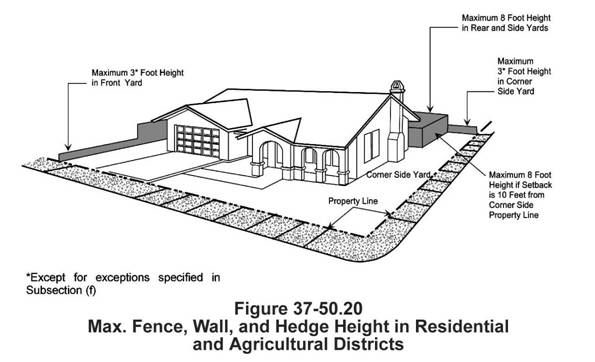
(3)
Industrial Districts.
(A)
Front yards and corner side yards and within required landscape planters adjoining a street pursuant to Section 37-50.690(g)(2)(A): three feet if sight-obscuring. If nonsight-obscuring and set back a minimum of ten feet from the front or corner side yard property line: eight feet, except that electrically-charged wires or fences, subject to the approval of a conditional use permit or a building permit in accordance with Section 37-50.090(l), shall not exceed a maximum height of ten feet;
(B)
Interior side and rear yards: eight feet, except that electrically-charged wires or fences, subject to the approval of a conditional use permit or a building permit in accordance with Section 37-50.090(l), shall not exceed a maximum height of ten feet.
(4)
Public/Semipublic, Parks and Open Space Districts. The maximum height of fences, walls, and hedges in required yards shall be determined at the time of the approval of the site plan review or conditional use permit (as required by the applicable zoning district) for the principal use where the fence, wall or hedge is proposed to be located. If no such approval is required under the applicable zoning district or if the principal use is existing and no use, building or site modifications are proposed for the site other than the installation of a fence, wall, or hedge, the city planner shall make the determination of the maximum fence, wall, or hedge height permitted for the site based on site conditions, use of the site, and surrounding uses and zoning districts.
(5)
New Urbanism Districts. Fences, walls, and hedges located on properties in the new urbanism (NU) districts shall be subject to the requirements of Article III, Division 8: New Urbanism (NU) Districts.
(e)
Required Walls. Solid walls shall be required to be installed as follows:
(1)
An eight-foot-high solid wall shall be required along any property line of an R-H district that abuts an R-L or R-M zoning district except in required front or corner side yards where the maximum height shall be three feet.
(2)
A six-foot-high solid wall shall be required along any property line of an R-M-2.9 district that abuts an R-L-5.5 or R-M-3.6 zoning district except in required front or corner side yards where the maximum height shall be three feet.
(3)
An eight-foot-high solid wall shall be required along any property line of a C or MU district that abuts an R district except in required front and corner street side yards where the maximum height shall be three feet.
(4)
An eight-foot-high solid wall shall be required along any property line of an I district that abuts an R, C, MU, or PS district, except in required front and corner side yards where the maximum height shall be three feet.
(5)
Required walls shall be installed by the developer or property owner of the parcel with the more intensive zoning designation at the time such parcel is developed; or at the time of a major modification of an existing structure or use located on such parcel. For purposes of this section, higher density residential zoning districts are more intensive than lower density residential zoning districts; commercial, mixed use, and industrial zoning districts are more intensive than residential zoning districts; and industrial zoning districts are more intensive than all other zoning districts.
(f)
Exceptions. Decorative fence features such as entry arbors, posts (including caps), pilasters, picket fence scallops, pedestrian gates, and similar features may exceed the maximum height limitations specified for maximum three-foot-high fences located in required front yards and corner side yards (and in required landscape planters) if the fence/feature is nonsight-obscuring and there is no view obstruction as follows:
(1)
Posts, Post Caps, Pilasters, and Similar Features. These features may extend a maximum of twelve inches above the maximum fence height (to a maximum height of forty-eight inches if the features are located a minimum of five feet apart as shown on Figure 37-50.30. The features shall have a consistent design and be constructed of the same materials. The maximum width, length, or depth dimension of the feature shall be eight inches.
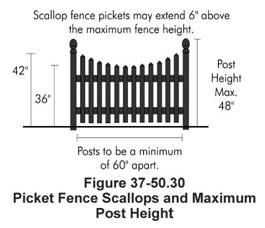
(2)
Picket Fence Scallops. A picket fence may extend a maximum of six inches above the maximum fence height to accommodate a scallop fence design (a series of concave or convex picket projections as shown on Figure 37-50.30. The maximum width of a picket shall be no greater than three and one-half inches. A minimum one inch separation shall be provided between pickets that are less than two inches in width and a minimum one and three-quarters inch separation shall be provided between pickets that are two inches or greater in width.
(3)
Entryway Arbors. One entryway arbor substantially open not exceeding a maximum of twenty square feet in total area and eight feet in height is permitted in either a front or corner side yard (whichever yard provides the primary pedestrian access to the principal building) as shown on Figure 37-50.40A. The square footage of the arbor shall be determined by measuring the length and width of the area located within the rectangle formed around the posts of the arbor or the roof portion of the arbor whichever dimension is larger as shown on Figure 37-50.40B. This exception shall only apply to an entryway arbor. All other freestanding arbors are subject to the provisions of Section 37-50.710: Landscape architectural features. No entryway arbor shall be located in an area of unrestricted visibility pursuant to Section 37-50.460: Driveway and corner visibility.
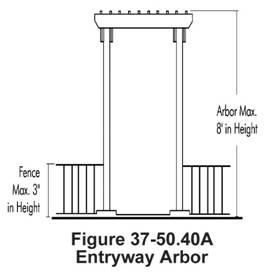
(4)
Pedestrian Gates. A pedestrian gate not exceeding a maximum width of five feet may extend a maximum of twelve inches above the maximum fence height (to a maximum of forty-eight inches in height) if constructed of nonsight-obscuring material consistent with the fence or entryway arbor material and not located in an area of unrestricted visibility pursuant to Section 37-50.460: Driveway and corner visibility.
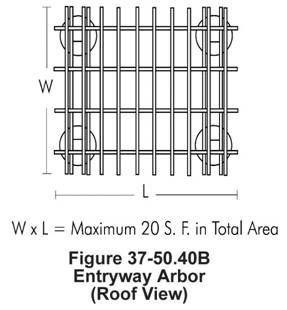
(g)
Screening. Walls or fences used for screening purposes in commercial, mixed use, and industrial zoning districts in accordance with Section 37-50.170: Outdoor storage and display may be higher than eight feet upon a determination by the city planner as part of the site plan review or conditional use permit approval that no adverse visual or aesthetic impacts will affect adjacent properties and public rights-of-way and that the height is the minimum needed to accomplish the screening or buffering purpose for which it is constructed.
(h)
Tennis Courts. Tennis court fencing shall generally be nonsight-obscuring, shall not exceed a maximum height of fifteen feet, and shall observe the setback of accessory structures within the zones where they are located. However, in no case shall such a fence be located closer than five feet from an interior side or rear property line.
(i)
Driveway and Corner Visibility Requirements. All fences, walls, and hedges shall be subject to the driveway visibility requirement of Section 37-50.460: Driveway and corner visibility.
(j)
Noise Mitigation. The city planner may allow the maximum height of fences and walls to be increased above the maximums in order to mitigate noise levels that exceed the maximum levels permitted in Section 37-50.180(a): Noise, subject to the approval of a site plan review. Such an exception may be granted by the city planner upon his/her approval of an acoustic noise study meeting the requirements of Section 37-50.180(a): Noise.
(k)
Prohibited Fences.
(1)
No barbed wire or razor wire or similar fencing is permitted in any district, except that barbed wire may be allowed for security or safety purposes in the IG (General Industrial) district (when not visible from an arterial, collector street, or U.S. Highway 101), and in the IBP (Industrial-Business Park), and in the IGC (Industrial-General Commercial) districts if not visible from any public right-of-way subject to the approval of a Site Plan Review.
(2)
No electrically-charged wires or fences are permitted in any district, except that electrically-charged wires or fences may be allowed for security purposes in the , IBP (Industrial-Business Park) and IGC (Industrial-General Commercial) districts subject to the approval of a conditional use permit in accordance with Section 37-50.090(l). Electrically-charged wires or fences may be allowed for security purposes in the IG (Industrial General) subject to the approval of a building permit per Section 37-50.090(l)(2).
(3)
Chain link fencing shall be prohibited in any front or corner side yard or in any required landscape planter pursuant to Section 37-50.690(g)(2)(A) in an R, C or MU district.
(l)
Electrically-Charged Wires and Fences. It shall be unlawful for any person to install, maintain, or operate any electrically-charged wires or fences in violation of this section.
(1)
Conditional Use Permit Required. A conditional use permit, issued in accordance with Article VI, Division 8, Conditional Use Permits, shall be required for all electrically-charged wires or fences, except in the IG (Industrial-General) wherein a building permit is required per Section 37-50.090(l)(2). Conditional use permit and building permit applications for electrically-charged wires or fences shall be subject to review and approval by the fire chief, the police chief, the building official, the city engineer, and the city planner, or their designees, and shall be subject to conditions as deemed reasonable and appropriate to ensure the protection of public health, safety, and welfare.
(2)
Building Permit Required. A building permit, issued in accordance with Chapter 9 of the City Code, shall be obtained prior to installation of electrically-charged wires or fences. Applicable listing(s) along with other pertinent information and applications shall be provided to the building official prior to approval for building permit issuance.
(3)
Allowable Zoning Districts. Installation of electrically-charged wires or fences is limited to the following zoning districts: IG (Industrial-General), IBP (Industrial-Business Park), and IGC (Industrial-General Commercial).
(4)
Location. Electrically-charged wires or fences shall be prohibited on sites contiguous to existing or planned residential development.
(5)
Public Access. Electrically-charged wires or fences shall be restricted to sites with limited public access.
(6)
Security Purposes. Electrically-charged wires or fences may be allowed for security purposes only including, but not limited to, equipment, vehicles, and the like in outdoor storage areas.
(7)
Energizer Requirements. The energizer for electrically-charged wires or fences shall be driven by a commercial storage battery not to exceed 12 volts direct current. The storage battery shall be charged primarily by a solar panel. However, the solar panel may be augmented by a commercial trickle charger.
(8)
Maximum Height. Electrically-charged wires or fences shall not exceed a maximum height of ten feet.
(9)
Perimeter Fence or Wall. Perimeter fencing shall be required for all electrically-charged wires or fences as follows:
(A)
A perimeter fence or wall a minimum of six feet in height shall be installed on the exterior side (the side facing the abutting public right-of-way and/or abutting properties) of any and all electrically-charged wires or fences.
(B)
The perimeter fence or wall shall be in conformance with requirements including, but not limited to, height and setbacks pursuant to Section 37-50.090.
(C)
The perimeter fence or wall shall be in conformance with the industrial design standards pursuant to Section 37-30.330 or public/semipublic design standards pursuant to Section 37-30.400, as applicable depending on the zoning district.
(10)
Minimum Safe Distance Between Fences. Electrically-charged wires or fences shall be installed a minimum distance of at least twelve inches from the perimeter wall or fence as a safety measure to prevent contact with the electrically-charged wires or fences from the perimeter fence or wall.
(11)
Warning Signs. Electrically-charged wires or fences shall be clearly identified with warning signs, on both sides of the electrically-charged wires or fences, at intervals of not greater than sixty feet. The warning signs shall contain the words "Warning—Electric Fence" in both English and Spanish and shall include the international safety symbol that signifies "Caution, Risk of Electric Shock/High Voltage."
(12)
Knox Box. A "Knox Box" or other similar devise approved by the fire department and the police department shall be installed for emergency access purposes. The "Knox Box" shall be designed such that activation of the "Knox Box" will de-energize the electrically-charged wires or fences.
(13)
Automatic De-energizing. Electrically-charged wires or fences shall be designed to automatically de-activate/de-energize upon manual cutting of the wires.
(14)
Hours of Operation. Electrically-charged wires or fences shall not be allowed in operation when the uses are open to the public.
(15)
Prevention of Fire Hazards. All weeds, brush, trees, and other vegetation in proximity to any electrically-charged wires or fences shall be maintained such that they will not pose a fire hazard, as determined by the fire department.
(Ord. No. 2463 (NCS).)
(Ord. No. 2506 (NCS), §§ 1—3, 4-27-2010; Ord. No. 2674 (NCS), § 1, 11-14-2023)
(a)
Purpose. The provisions of this section are intended to provide conditions and requirements under which food trucks may be permitted to operate by a conditional use permit (see Article VI Division 8: Conditional Use Permits) on private property within certain areas of the city.
(b)
Definitions. The following definitions shall apply to this section:
(1)
Food truck. Any vehicle that may be moved under its own power or a vehicle not easily or readily moved by any person, or which must be hauled or moved by another vehicle, and which is used, designed, or outfitted to dispense ready-to-eat food or beverages to patrons. Does not include:
(A)
Vehicles used solely to deliver food or beverage previously requested by a patron, home, or business establishment, such as "Meals-on Wheels" or delivery trucks.
(B)
Vehicles used for the display, sale or dispersal of food or beverages as part of an organized community event for which permission has been granted by the city.
(c)
Conditional Use Permit Required. Prior to operating a food truck, a conditional use permit (CUP) (see Article VI Division 8: Conditional Use Permits) shall be required pursuant to Sections: 37-30.200, Table 37-30.90; 37-30.240, Table 37-30.110; and 37-30.310, Table 37-30.130.
(d)
Additional Vendor Permit Required. Prior to operating a food truck on private property, a vendor permit shall also be obtained pursuant to Chapter 20, Article XVI—Food Trucks, Ice Cream Trucks, Nonmotorized Pushcarts and Street Vendors—Stopping, Standing and Parking. Food trucks shall comply with requirements set forth by the vendor permit and all applicable local and state laws, rules, and regulations.
(e)
Administration. A detailed site plan shall be submitted with the conditional use permit application and at minimum shall include the following information:
(1)
The land area included within the site with dimensions and property lines clearly shown on the plan, the zoning classification of adjacent sites, and all public and private right-of-way and easements bounding and intersecting the site; and
(2)
The location of each permanent structure on the site and designated location and orientation of the food truck; and
(3)
The location, width, and surface material of drive aisles including fire lanes when required by the fire department; and
(4)
The location and dimension of parking and loading areas including number of spaces; and
(5)
The location of fire hydrants; and
(6)
The location of landscaping and height of all walls, fences, and screening along all street frontages; and
(7)
The location of any electrical outlet(s) provided for food truck operations; and
(8)
Any other information requested by the city planner as deemed necessary to evaluate the conditional use permit.
(f)
Regulations. The following regulations shall apply to Food trucks:
(1)
The site shall be developed in accordance with the development regulations specified in the applicable zoning district including landscaping standards (See Division 4.—Landscaping and Irrigation).
(A)
If the site does not comply with Division 4.—Landscaping and Irrigation, the city planner may allow alternative means of complying provided the alternative achieves results comparable to those achieved through strict application of the provisions of this section (see Section 37-50.690(i)).
(2)
Food trucks shall not be located in required yards or within existing landscape areas.
(3)
Only food and non-alcoholic beverages shall be displayed, sold, or exchanged.
(4)
Alcohol sales shall be prohibited.
(5)
Operations shall be conducted entirely on the property identified in the conditional use permit application.
(6)
Operations shall be prohibited on undeveloped lots and unpaved surfaces.
(7)
A food truck shall be located in a designated space and in a manner that does not block drive aisles, driveways or otherwise create a traffic hazard by preventing adequate circulation and fire access.
(8)
A food truck shall be located in a designated space that protects customers that are ordering or picking up food from potential hazards such as parked cars with a width of at least six feet between the truck and other site obstructions including but not limited to curbs, landscaped areas, trash enclosures, buildings, and other parking spaces. The food truck vendor shall be responsible for managing customer queuing and ensuring pedestrian access is maintained.
(9)
Incorporation of a drive-through lane as a part of food truck operations shall be prohibited; operation shall be strictly limited to walk-up service.
(10)
Required parking shall be two spaces per food truck pursuant to Section 37-50.360 (C), Table 37-50.100, Schedule A: Off-Street Parking and Loading Spaces Required. In addition to this parking standard, existing required parking on site shall be maintained.
(A)
A parking reduction up to thirty percent of the number of parking and loading spaces may be allowed subject to the approval of an administrative conditional use permit (see Section 37-50.370(a). Reductions Allowed by the City Planner).
(B)
A parking reduction greater than thirty percent of the number of parking and loading spaces may be allowed subject to planning commission approval of a non-administrative conditional use permit (see Section 37-50.370(b). Reductions Allowed by the Planning Commission).
(11)
Hours of operation shall be limited to Sunday through Thursday from 9:00 a.m. to 10:00 p.m. and Friday, Saturday, and holidays from 9:00 a.m. to 12:00 a.m.(midnight).
(12)
Outdoor furniture including tables, chairs, and shaded structures shall be prohibited; condiments and utensil dispensers must be shown on the site plan and may be permitted based upon approval of the conditional use permit.
(13)
Outside storage of items related to the operation of a food truck shall be prohibited.
(14)
Portable toilets shall be prohibited.
(15)
Signage shall be limited to the exterior surfaces of the food truck and shall not be mounted in a manner that extends beyond the top, bottom, or side lines of the vehicle.
(16)
Lighting associated with food truck operations shall comply with Section 37-50.480—Outdoor Lighting.
(17)
Amplified sound or the use of any loudspeaker, radio or any other instrument or device for the production of sound in connection with the promotion of the food truck operation shall be prohibited.
(18)
Use of exterior generators for the operation of the food truck shall be prohibited. A generator may be permitted if enclosed within the food truck or if a permanently mounted, weatherproof damage protected GFCI outlet is installed in close proximity to the food truck for use when operating.
(19)
Food truck operations shall be subject to performance standards in Section 37-50.180 Performance Standards.
(20)
The area surrounding the food truck and within a twenty-five foot radius shall be maintained in a clean condition free of trash, debris, oil, and grease.
(A)
Solid waste and recycle container(s) shall be maintained immediately adjacent to the food truck for use by customers; and
(B)
All garbage, refuse or litter consisting of food waste, wrappers, materials dispensed, and any residue deposited on the property from the operation shall be promptly removed.
(21)
The Food Truck shall be continuously maintained in good operating condition with no visual appearance of deterioration such as peeling paint or rust.
(g)
Revocation of Conditional Use Permit. The city planner shall reserve the right to revoke any conditional use permit authorized via this section if the city planner determines that the food truck is operating in violation of any of the provisions in this section. Revocations shall be conducted in accordance with Section 37-60.1330: Revocation of permits.
(Ord. No. 2649 (NCS), § 6, 9-21-2021)
(a)
Purpose. The purpose of this section is to:
(1)
Allow home enterprises that are incidental to and compatible with surrounding residential uses;
(2)
Reduce air pollution and traffic congestion by allowing a residence to double as a place of employment; and
(3)
To allow for limited education and recreational activities in residential zones where such activities would not be detrimental to the neighborhood.
(b)
Definitions. The following definitions shall apply to this section:
(1)
Home Occupation. A business activity conducted in a dwelling unit in compliance with this section, which use does not alter the character of the property and is clearly incidental to a residential use.
(2)
Instructional and Educational Services. A business that solely provides instructional or tutoring services. Includes academic assistance, lessons (such as music, art, language, swim, etc.), and similar services. Excludes counseling, psychological, medical or dental offices, day care homes or facilities, personal services, and schools.
(c)
Permit Required. A home occupation permit (see Article VI, Division 4: Administrative Permits) obtained from community planning and development shall be required to operate any home occupation. Live-work units (see Section 37-50.130: Live-work units) shall not be subject to the requirements of this section.
(d)
Revocation of Permit. The city planner shall reserve the right to revoke any home occupation permit if the city planner determines that the home occupation is in violation of any of the provisions in this section. Revocation shall be conducted in accordance with Section 37-60.1330: Revocation of permits.
(e)
Operating Standards.
(1)
A home occupation shall comply with each of the following regulations:
(A)
The home occupation may not be located in a garage or an accessory structure except as provided for elsewhere in this section and for ancillary storage provided that all required off-street parking requirements are met.
(B)
A home occupation shall be conducted entirely within a dwelling unit and shall occupy no more than twenty-five percent of the floor area except as provided for elsewhere in this section.
(C)
No outdoor storage of materials or equipment used in the home occupation shall be permitted.
(D)
The existence of a home occupation shall not be apparent (e.g., noise, vibrations, odors, etc.) beyond the boundaries of the site.
(E)
A home occupation may be granted only to a resident of the dwelling unit and no one other than a resident of the dwelling unit shall be employed on-site or report to work at the site in the conduct of a home occupation.
(F)
A home occupation shall not create pedestrian or vehicle traffic in excess of the normal amount in the zoning district.
(G)
No prohibited vehicles or equipment as defined in Section 37-50.190: Recreational vehicles, prohibited vehicles, and equipment parking and storage may be parked or stored at the site in conjunction with the home occupation.
(H)
No on-site vehicle repair, beauty or barbershop, food preparation, or boarding or training of animals shall be permitted.
(I)
A home occupation shall not include a sales room or office open to customers/clients. No customers, clients, or students shall come to the home in conjunction with the home occupation except as provided for elsewhere in this section.
(J)
No on-site signs, (including vehicle signs) advertising the home occupation shall be permitted.
(K)
The home occupation shall be subject to the provisions of Section 37-50.180: Performance standards regarding noise, glare, combustibles and explosives, radioactive materials, hazardous materials, heat and humidity, and any other performance standards adopted by the city.
(L)
The home occupation shall be subject to the provisions of Section 37-50.180: Performance standards regarding noise, glare, combustibles and explosives, radioactive materials, hazardous materials, heat and humidity, and any other performance standards adopted by the city.
(f)
Instructional and Educational Services. In addition to the operating standards in Section 37-50.100(e) above, instructional and educational services shall be subject to the following provisions:
(1)
There shall be no more than a maximum of two clients/students (excluding guardians) per hour and a maximum of six clients/students per day;
(2)
The hours of operation as related to client/student visitations per day shall be limited to no earlier than 9:00 a.m. and no later than 7:00 p.m. Monday through Friday, and no earlier than 10:00 a.m. and no later than 4:00 p.m. on a Saturday. No clients/students may come to the home on Sundays;
(3)
Clients/students shall make appointments in advance (e.g., no walk-in business);
(4)
Swim lessons may only be conducted if the pool used for such lessons is located in an enclosed accessory structure, and the pool and related facilities meet all applicable Uniform Building Code, National Electrical Code, and Monterey County Health Department requirements for such use; and
(5)
Home occupations involving instructional and educational services with a maximum of five clients/students per hour (excluding guardians) and thirty-five clients/students per day may be considered as a conditional use permit in lieu of a home occupation permit. In addition to the requirements specified in Sections 37-50.100(e) and (f), and any other conditions the city planner determines are necessary to mitigate significant adverse impacts on the surrounding neighborhood, a conditional use permit may be considered only if the following additional conditions can be met:
(A)
Primary vehicular access to the property is from a street designated as a collector or arterial street by the Salinas general plan;
(B)
Clients/students and their guardians shall remain at the site for the duration of the lessons, and no client/student shall be dropped off by any person who does not remain on-site for the duration of the lesson;
(C)
The subject parcel is not located within three hundred feet of another parcel with an instructional and education services use as measured from the nearest property lines of the respective sites; and
(D)
There shall be a minimum of fifteen minutes between each class to minimize overlapping parking impacts.
(g)
Fortunetelling. In addition to the operating standards in Section 37-50.100(e) above, fortunetelling by a single practitioner is permitted as a home occupation subject to the following provisions:
(1)
The hours of operation as related to client/customer visitations per day shall be limited to no earlier than 7:00 a.m. and no later than 9:00 p.m.;
(2)
There shall be no more than a maximum of three client/customer visitations per day, one at a time for no more than sixty minutes each; and
(3)
Clients/customers shall make appointments in advance (e.g. no walk-in business).
(Ord. No. 2463 (NCS).)
(Ord. No. 2507 (NCS), §§ 2, 36, 5-18-2010; Ord. No. 2644(NCS), § 1, 6-8-2021)
(a)
Purpose. The purpose of this section is to establish infill residential development regulations and design standards to protect the character of the city's established (built-out) single-family residential neighborhoods and is intended to supplement the base zoning district regulations to ensure that all new single-family detached residential dwelling units and applicable residential additions constructed in such areas:
(1)
Preserve existing residential patterns and development, and reinforce the character and functional relationships of established neighborhoods;
(2)
Are compatible in scale and height with the neighboring single-family detached residential dwelling units through the use of similar proportions, level of details, and scale; and
(3)
Reflect some of the best characteristics of adjacent dwelling units in the choice of materials and colors, windows, height, and roofline.
(b)
Definitions. The following definitions shall apply to this section:
(1)
Neighboring Block Face. Those single-family detached dwelling units situated on lots or parcels located within one hundred fifty feet of the nearest property line of the subject site. Such lots or parcels shall include, but not be limited to, those lots or parcels that abut, face, or are located on the same street as the subject site. If a lot or parcel is vacant, undeveloped, or contains another use other than a single-family detached dwelling unit within the neighboring block face, the next closest lot with a single-family detached dwelling unit shall be deemed to be part of the neighboring block face. If any piece or portion of a lot or parcel is located within the neighboring block face, the entire parcel or lot shall be deemed to be in the neighboring block face.
(2)
Addition. Any construction that increases the size of a building or structure in terms of FAR, height, length, width, or gross floor area.
(c)
Applicability. These regulations shall apply to all infill residential development that is located on lots or parcels zoned low density residential (R-L-5.5) as follows: (For purposes of this section, the development scenarios listed below shall constitute "infill residential development.")
(1)
New single-family detached dwelling units that are constructed on:
(A)
Lots where an existing single-family detached dwelling unit has been or will be demolished, or
(B)
Vacant or undeveloped lots in otherwise established residential neighborhoods;
(2)
Second story additions to existing single-family detached dwelling units;
(3)
The subdivision of land, or the demolition of an existing single-family detached dwelling unit or any portions thereof, where the existing dwelling unit is located on two or more legal lots of record; and
(4)
Second story attached second dwelling units with more than two hundred fifty square feet of gross floor area.
(d)
Exceptions. This section shall not apply to the following:
(1)
Building permits for building, electrical, plumbing, mechanical, sidewalk or driveway repairs, or to other activities that do not increase the square footage or height of the existing dwelling unit;
(2)
The construction of new single-family detached dwelling units on lots or parcels located in a specific plan area or in a subdivision tract development with an approved phasing plan, or which is located on a lot or parcel subject to a planned unit development permit or other development review approval that has specific development regulations or design standards applicable to the subject lot or parcel;
(3)
Accessory structures (including garages and carports); however, such structures shall be subject to the requirements of Section 37-50.010: Accessory uses and structures;
(4)
Second dwelling units not specified in subsection (c) above.
(e)
Permit Required. A conditional use permit for a residential design review shall be required for all the residential infill development specified in subsection (c) above.
(f)
Development Regulations. The following supplementary regulations shall apply:
(1)
Yards (Minimum).
(A)
Front and Corner Side Yards. The minimum front and corner side yards shall be determined based on the average of the existing front and corner side yards for single-family detached dwelling units located within the neighboring block face. For purposes of calculating the average, the smallest yard and the greatest yard shall be disregarded. For an addition to an existing single-family detached dwelling unit, the existing front or corner side yard may be maintained, if less than the average for the neighboring block face.
(B)
Rear Yards. The rear yard shall be in accordance with the base district regulations.
(C)
Interior Side Yards.
(i)
For new dwelling units and residential additions that will not exceed the maximum height of the tallest single-family dwelling unit located within the residential block face: The minimum interior side yard shall be in accordance with the base district regulations.
(ii)
For all other new dwelling units and residential additions: The minimum interior side yard shall be five feet for the first twenty feet in building height with an additional two and one-half feet of yard required for each additional five feet, or a fraction thereof, of building height as measured to the peak of the roof.
(2)
Dwelling Unit Size (Maximum).
(A)
For a new dwelling unit or a lot with a pre-existing single-family detached dwelling unit which was demolished: .40 FAR; or two thousand five hundred square feet; or twenty percent more square feet than the existing or pre-existing dwelling unit, whichever is greater;
(B)
For additions: .40 FAR or two thousand five hundred square feet or the square footage of the existing house plus one thousand square feet, whichever is greater;
(C)
The square footage of an attached second story second dwelling unit shall be counted toward the maximum size requirements specified for the principal single-family detached dwelling unit.
(3)
Height (Maximum).
(A)
The maximum height to the peak of the roof shall not exceed the height of the highest roof peak on the neighboring block face, or thirty feet, whichever is more.
(B)
A maximum of two stories shall be permitted (excluding basements).
(C)
Towers, cornices, spires, cupolas, and similar architectural features (excluding chimneys) may not exceed the maximum height limitation specified in Section 37-50.080: Exceptions to height limits.
(g)
Design Standards. The following design standards shall supplement the low density residential design standards contained in the R-L base zoning district (See Section 37-30.080: Design standards):
(1)
Height and Scale.
(A)
The height and scale of new dwelling units and additions shall follow the context of the neighboring residential block face and not overwhelm existing dwelling units with disproportionate size.
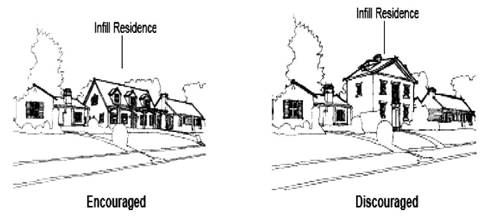
(B)
New dwelling units and additions shall preserve and reinforce the character of established streetscapes by maintaining similar horizontal and vertical proportions with adjacent facades. First and second floor plate heights shall generally be consistent with those of existing dwelling units in the neighborhood.
(C)
The dominant existing scale of an established neighborhood should be maintained. Special attention shall be given to the design of a new two-story dwelling units or an addition constructed in a predominately one-story neighborhood to ensure that it is similar in scale and mass with surrounding structures and contributes to a harmonious transition between the new development and the existing development. In neighborhoods with both one-story and two-story dwelling units, second story additions shall generally reflect the scale, bulk, and height of other two-story dwelling units located in the neighborhood.
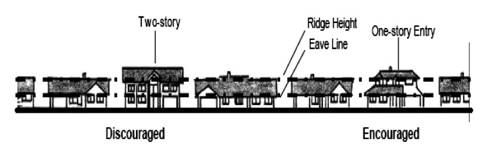
(D)
The perceived scale of new dwelling units and additions should be minimized. To achieve this, two-story buildings should be stepped back from streets and adjacent smaller residential dwellings units, broken up into smaller architectural components, or include a substantial single-story element.
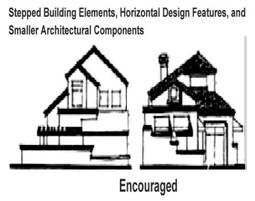
(E)
New dwelling units and additions should maintain a proportional relationship with buildings on adjacent properties including roof ridge height and eave height.
(F)
Accent materials or varied wall planes are encouraged to break up the vertical mass of two-story units and additions.
(2)
Site Planning.
(A)
Placement of new dwelling units and additions on a lot shall reflect the prevailing pattern in the established neighborhood.
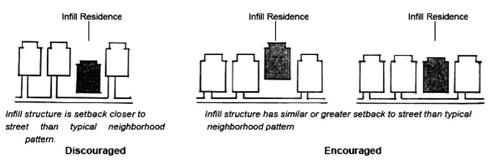
(B)
Site planning and design should complement any mature vegetation on the site. Special emphasis shall be placed on the preservation of on-site large specimen trees (ten-inch diameter or larger).
(3)
Roof Forms and Pitch.
(A)
For new dwelling units, roof forms should be similar to existing single-family dwelling units found in the surrounding neighborhood.
(B)
For additions, roof forms and pitch shall match the existing dwelling unit.
(C)
Multiple roof forms and pitches on smaller structures are generally undesirable. However, on large dwelling units and second story additions varying roof places can add visual interest and decrease the scale of the dwelling unit.
(D)
Artificial roof forms, such as mansards, are discouraged.
(4)
Privacy Considerations.
(A)
The placement of second story windows and balconies should consider the privacy of adjacent dwelling units.
(B)
Placement of windows and openings should not create a direct line sight into the living space or the backyard of adjacent properties. Where privacy is a concern, windows should be staggered, frosted, louvered, or placed above eye level at the top third of the wall.
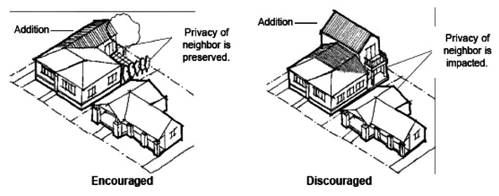
(5)
General.
(A)
New dwelling units shall support the distinctive architectural characteristics and style (scale/level of detail/proportion) of single-family dwelling units in the surrounding neighborhood, or if a residential addition, the characteristics of the existing dwelling unit, including building mass, scale, proportion, decoration and detail, door and window spacing and rhythm, exterior materials, finished floor heights, porches, roof pitch, and style. In areas where there is no prevailing architectural style exists, the general neighborhood character should be maintained by the use of similar forms and materials. The style of individual houses can be varied to reflect the mix of forms and materials that characterize the existing established neighborhood.
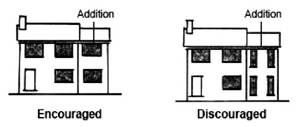
(B)
The design of dwelling units should incorporate an appropriate mixture of the predominant materials in the surrounding neighborhood.
(C)
Exterior color schemes for structures shall consider the color schemes of existing structures in the surrounding neighborhood in order to maintain compatibility and harmony.
(h)
Modification of Standards. The planning commission may authorize modifications to the requirements in this section if the following finding (in addition to the findings required in Section 37-60.500: Administrative conditional use permit) can be established:
(1)
The modification does not represent an exception to the standards of this Zoning Code but rather an alternative resulting in an equal or superior design or neighborhood compatibility in comparison to development that strictly complies with the requirements of this section.
(Ord. No. 2463 (NCS).)
(a)
Permit Required. A large family day care home permit (see Article VI, Division 4: Administrative Permits) obtained from community planning and development shall be required to operate any large family day care home.
(b)
Revocation of Permit. The city planner shall reserve the right to revoke any permit authorized by this section if the city planner determines that the large family day care home is in violation of any of the provisions in this section. Revocations shall be conducted in accordance with Section 37-60.1330: Revocation of permits.
(c)
Development Regulations.
(1)
The site is the principal residence of the operator and is clearly incidental and secondary to the use of the property for residential purposes.
(2)
Temporary conversion and the use of a residential garage so designated for day care activities is subject to compliance with all requirements of the Uniform Building Code or Uniform Housing Code. A "notice of restriction on temporary conversion of garage" shall be completed and signed by the applicant and submitted to the city planner for filing and recordation with the Monterey County recorder's office prior to the issuance of a building permit for the temporary conversion of the garage.
(3)
Temporary garage conversions shall remain valid for the duration of a licensed day care home. The garage shall be returned to its original intended use within forty-five days following cessation of an authorized day care home.
(4)
Residences located on arterial streets (as denoted in the circulation element of the general plan) shall provide a drop-off/pickup area designed to prevent vehicles from backing onto the street.
(5)
The operator shall comply with all applicable regulations or other requirements of the Salinas fire department regarding health and safety requirements and all other applicable codes and regulations.
(6)
No on-site signs advertising the day care home shall be permitted.
(d)
Operational Standards.
(1)
The facility shall be operated in a manner that will not adversely affect adjoining residences or be detrimental to the character of the residential neighborhood.
(2)
The facility shall comply with the provisions of Section 37-50.180: Performance standards.
(Ord. No. 2463 (NCS).)
(a)
Purpose. The purpose of this section is to:
(1)
Provide for the development of live-work units that have both working and living spaces for the use of the business operators or their employees and their households who reside in the live-work units;
(2)
Foster and encourage the development of small businesses;
(3)
Enliven the vitality of commercial corridors by encouraging on-site residential uses through the use of incentives that ease parking and floor area ratio (FAR) requirements for accessory residential uses; and
(4)
Ensure the use and design of the structures with live-work units are compatible with the use and design of surrounding structures and development.
(b)
Definition. The following definition shall apply to this section:
(1)
Live-work Units. A commercial unit designed and intended to function as a work and living space for the person(s) (business operators or their employees and their households) who reside there and where the residential use is secondary or accessory to the primary use as a place of work. A live-work unit has adequate working space available for and is regularly used by the person(s) residing in the live-work unit and one or more rooms with cooking and sanitation facilities in conformance with Building Code and disabled access (A.D.A. and state of California Title 24) requirements.
(c)
Residential Density. The residential density limitations of the general plan and the Zoning Code are not applicable to the live-work units.
(d)
Development Regulations. Development regulations for live-work units shall be in accordance with the development regulations specified in the applicable zoning district for commercial uses except as provided below:
(1)
Unit Size.
(A)
Minimum. The minimum size of a live-work unit shall be eight hundred fifty square feet.
(B)
Maximum. The maximum size of a live-work unit shall be five thousand square feet of gross floor area.
(2)
Minimum/Maximum Floor Area of Commercial Work and Residential Living Areas.
(A)
Work Area. A minimum of fifty-one percent of the total gross floor area of the live-work unit shall be designated and regularly used for the commercial use or activity by the persons residing in the unit.
(B)
Living Area. A maximum of forty-nine percent of the total gross floor area of the live-work unit may be designated for and used as residential living area (consisting of living, kitchen, bathroom, laundry facilities, and closet facilities). In no case shall less than four hundred square feet of residential living area be provided in a unit.
(C)
Maximum Floor Area. The total gross floor area designated as work areas, shall be subject to the maximum floor area ratio (FAR) specified for the applicable zoning district. The gross floor area designated as residential living area shall not be subject to this limitation.
(D)
The living and the work areas shall be in the same unit and may not be located in a separate building.
(3)
Storefront Required. A live-work unit with floor area located on the ground floor of a building shall have a storefront that is readily visible to, regularly open to, and accessible by pedestrians.
(4)
Separation Between Units. Each live-work unit shall be separated from other live-work units and other uses in the building.
(5)
Pedestrian Access. Pedestrian access shall be provided to each live-work unit as follows:
(A)
For individual live-work units with any floor area on the ground floor of the building, public access to the live-work unit shall be provided directly from a street(s) or public open space area (such as a plaza, courtyard, etc.) via a storefront entrance. Where multiple street frontages exist, the city planner shall determine which frontage is the appropriate location for the storefront(s). Secondary resident access to parking areas and other areas that are not intended to serve the general public and which are not located on a street frontage (excluding alleys) or other public open space area shall not be subject to this requirement.
(B)
For live-work units with no floor area on the ground floor (such as second story or higher floors), public access to individual units shall be from the street, parking area, or public open space area via a separate common access area (such as a hall or corridor).
(C)
The access provided to each live-work unit from common access areas shall be clearly separated from other live-work units in the building.
(D)
Access to a live-work unit shall not be provided through another live-work unit.
(6)
Loading. No loading space shall be required for live-work unit uses occupying less than thirty thousand square feet of gross floor area in a building or for those uses that do not require a loading zone pursuant to Section 37-50.360: Off-street parking and loading space regulations. For live-work uses that occupy thirty thousand square feet to fifty thousand square feet of gross floor area in a building, a minimum of one twelve-foot-wide by thirty-five-foot-long by sixteen-foot-high loading space shall be provided. For live-work uses occupying more than fifty thousand square feet in gross floor area in a building one additional loading space measuring twelve feet wide by thirty-five feet long by sixteen feet high shall be provided.
(7)
Parking. For live-work units with less than one thousand square feet of commercial gross floor area, a minimum of two spaces shall be provided per unit. For live-work units with more than one thousand square feet of commercial gross floor area, one additional parking space shall be provided for each three hundred fifty square feet of commercial gross floor area over one thousand square feet. No additional parking is required for the residential use.
(8)
Usable Open Space. A minimum of sixty square feet of usable open space per live-work unit shall be provided; however, conversions of existing structures into live-work units shall not be subject to this requirement.
(e)
Establishment of Live-work Unit. The establishment and operation of a live-work unit shall require the approval of a site plan review or a conditional use permit as required by the applicable base zoning district.
(f)
Uses. The nonresidential use shall be limited to those commercial uses allowed within the use classifications of the applicable zoning district. Live-work units shall not be established in conjunction with the following uses or located in any building with such uses:
(1)
Adult entertainment facilities;
(2)
Animal sales and services;
(3)
Any vehicle-related use including repair, sales, service, storage, and washing;
(4)
Bars;
(5)
Bingo parlors;
(6)
Commercial recreation;
(7)
Live entertainment;
(8)
Major maintenance and repair services;
(9)
Outdoor activities;
(10)
Tattoo and body piercing parlors;
(11)
Warehousing, limited and wholesale distribution; and
(12)
Any use that involves open flame work, or the storage of flammable liquids or hazardous materials beyond that normally associated with a residential use or which is classified as an H occupancy by the California Building Code; or which the city planner determines would be hazardous to or would adversely affect the health, safety, or welfare of the occupants of the live-work unit due to the materials, processes, products, or wastes used in conjunction with the business.
(g)
Deed Restriction. The city shall require the following deed restriction to be recorded on any land with a building containing a live-work unit to notify any future purchaser, property owners, or tenants of potential land use impacts associated with such units and of the city of Salinas regulations governing the use and operation of such units. The deed shall be filed by the city planner for recordation with the Monterey County recorder's office prior to the issuance of any building permits for a live-work unit. The language of the deed restriction shall be as follows:
Notice of Live-Work Unit
You are hereby notified that the live-work unit/property you own, reside in, are purchasing or are renting/leasing is located within a structure or on a parcel of land that allows and has both commercial and residential land uses in individual units (called live-work units) and further is located in a zoning district that allows commercial uses and activities. As a result of the proximity of your unit/property to these activities and uses, you may experience inconvenience or discomfort associated with the activities and uses including, but not limited to, noise, odor, fumes, dust, smoke, vibration, and the operation of machinery or equipment during any twenty-four (24) hour period, seven (7) days a week. If these activities and uses are conducted in a manner consistent with the applicable City, State, and local laws, said inconveniences and discomforts shall not be considered a nuisance. As you live in proximity to commercial uses and areas, you should be prepared to accept such inconveniences and discomfort as a normal and necessary aspect of living in an area with commercial operations and uses. Live-work units are subject to specific limitations and requirements in regard to occupancy, operation, and use in accordance with the Live-Work Unit provisions of the City of Salinas Zoning Code and the applicable development application approval issued by the City for the live-work unit(s), including restrictions on who may occupy the live-work unit.
You are further notified that any owner of a building that leases any portion of a building or parcel with live-work units shall be required to provide this notice to each tenant as part of and at the time of the lease or rental agreement for the unit or land.
This notice does not exempt the owners, tenants, and employees of any live-work unit from compliance with any applicable local, State, or Federal law.
(h)
Fire and Building Code Requirements. Live-work units shall comply with Fire and Building Codes, including accessibility requirements for the disabled, as applicable, and shall provide the same type of building improvements as required for applicable commercial and residential uses.
(i)
Limitation on Outside Employees. No more than two employees other than the residents of the live-work unit shall be employed in the operation of the business during the same work shift unless authorized by a conditional use permit.
(j)
Residential Occupancy. Only the business operators or their employees and their households who conduct the business located in the live-work unit may reside in the live-work unit. If the business ceases to operate in the live-work unit or the persons residing in the unit are no longer conducting the business, the residential occupancy of the live-work unit shall cease within ninety days of the date of either occurrence unless a time extension is otherwise authorized by the city planner to extend the residential occupancy of the unit.
(k)
Conversion of Live-work Unit to a Residential or Commercial Use. A live-work unit shall not be subsequently converted to a residential or commercial use unless authorized subject to the approval of a conditional use permit. For such a conversion, the city planner or planning commission, as applicable, must find, in addition to the findings required for the conditional use permit, that:
(1)
The conversion to a residential or commercial use will not impair the ability of existing commercial or live-work uses on and adjacent to the site to continue operating because of potential health, safety, or nuisance concerns; and
(2)
The proposed commercial or residential use will meet the minimum requirements specified for the use in the applicable district (such as off-street parking and loading, usable open space, affordable housing requirements, bedrooms per dwelling unit, etc.).
(l)
Business License. A business license shall be required for any live-work unit. A live-work unit shall be considered a commercial use and not a home occupation.
(m)
Change of Use. Any change of use from the previous business conducted in a live-work unit shall require the approval of the city planner prior to occupancy of the unit or, if building permits are required, prior to the issuance of any building permit for the use.
(n)
Inclusionary Housing and Bedroom Per Dwelling Unit Requirements. Live-work units shall not be subject to the city's inclusionary housing ordinance or bedroom per dwelling unit requirements of the Zoning Code.
(o)
Required Findings. In addition to the findings required for approval of a conditional use permit, the following additional findings shall apply for approval of live-work units that are subject to the approval of a conditional use permit by the applicable base zoning district:
(1)
The proposed live-work unit has been designed and is intended to be used predominantly as a commercial work space with accessory residential living space intended solely for the occupancy and use of the business operators, their employees, and their households who reside in the unit; and
(2)
The proposed live-work unit complies with the regulations and criteria established in this section.
(p)
Deviation from Standards. Minor deviations from the standards in this section may be granted by the city planner or planning commission, as applicable, subject to the approval of a conditional use permit if the following findings (in addition to those listed above and required for the approval of a conditional use permit) are made:
(1)
The proposed deviation is consistent with and not contrary to the purpose of this section; and
(2)
The proposed deviation would achieve the same or better results than if the standard regulation was strictly applied.
(Ord. No. 2463 (NCS).)
(a)
Purpose. The purpose of this section is to establish the basis for evaluating the adequacy of a mobilehome park in residential areas. Provisions are intentionally general with the intent of allowing flexibility and further detailed evaluation on a case-by-case basis.
(b)
Permit Required. Mobilehome parks are allowed in all residential zoning districts subject to the approval of a conditional use permit.
(c)
Development Regulations.
(1)
A mobilehome park shall not be less than three acres in size.
(2)
A mobilehome park development shall meet or exceed the minimum standards set forth in the zoning district in which it is located. This includes, but is not limited to, density consistent with the Salinas general plan, yards, distance between structures, height, usable open space, fences and walls, off-street parking and loading, signs, outdoor facilities, refuse storage areas, design standards, performance standards, nonconforming uses, and recreational vehicle storage, except that such development regulations and design standards may be changed to allow for unique site design requirements for mobilehome parks.
(Ord. No. 2463 (NCS).)
(a)
Purpose. The purpose of this section is to support art in public places and provide opportunities for noncommercial mural exhibits of a social, cultural, or historical event that beautifies and appeals to all segments of the community.
(b)
Definition. The following definition shall apply to this section:
(1)
Mural or Mural Exhibit. A noncommercial painted or mosaic tile style exhibit which covers all or a major portion of a wall or a building facade and which contains no sign, gang affiliation symbols, or "specified anatomical areas."
(c)
Where Permitted. Mural exhibits are permitted in C, I, MU, NU (VC), P, and PS zoning districts.
(d)
Permit Required. All mural exhibits shall be subject to the approval of site plan review prior to installation.
(e)
Review—Administrative Procedure. Mural exhibits shall be subject to review by the city planner for the sole purpose of ensuring that such exhibits are consistent with the provisions of this section. In recognition of the subjective nature of mural exhibits, should the city planner find the proposed mural exhibit to be in conflict with the provisions of this section, the applicant may request that the planning commission make the final determination in regard to this issue.
(f)
Requirements for Issuance. Prior to the approval of the site plan review for a mural exhibit, the city planner shall determine compliance with the following provisions:
(1)
Mural exhibits shall not have specified anatomical areas or specified sexual activities as defined in Section 37-50.020: Adult entertainment facilities; and
(2)
Gang affiliation symbols shall not be used in mural exhibits.
(g)
Mural Exhibits as Signs.
(1)
Mural exhibits containing an advertising message, announcement/declaration, insignia, surface, or space, which is erected or maintained in view of the observer thereof for identification, advertisement, or promotion of the interests of any person, entity, product, or service, shall be considered a sign.
(2)
Mural exhibits containing any sign message shall be considered a sign and shall be subject to the provisions of Article V, Division 3: Signs.
(Ord. No. 2463 (NCS).)
(a)
Purpose. The purpose of this section is to limit the number and extent of nonconforming uses by controlling their enlargement, their reestablishment following abandonment, their alteration, and their restoration after cessation due to destruction of the structures containing them. This section, while permitting the use and maintenance of nonconforming structures, limits them by prohibiting their restoration following destruction and by prohibiting alteration, enlargement or relocation upon the site in any manner that would increase the discrepancy between the standards contained in this division and the conditions existing on the subject property.
(b)
Continuation and Maintenance of Nonconforming Uses.
(1)
A use, lawfully occupying a structure or a site on the effective date of the ordinance codified in this chapter, or of amendments thereto, that does not conform with the use regulations for the district in which it is located or the applicable lot area per dwelling unit regulations shall be deemed a nonconforming use. Nonconforming uses may only be continued subject to the requirements of this division.
(2)
A use that does not conform with the parking, loading, screening, open space, or planting area regulations of the zoning district in which it is located shall not be deemed a nonconforming use solely on the basis of these deficiencies.
(3)
No nonconforming use shall be enlarged or extended to occupy any part of a structure or site that it did not occupy on the effective date of the ordinance codified in this chapter, or of the amendments hereto that cause it to become a nonconforming use.
(4)
No structure or use that fails to meet the performance standards of Section 37-50.180: Performance standards, shall be enlarged or extended unless conditions are imposed and implemented, which will result in elimination of the nonconformity with the required conditions.
(5)
A structure containing or serving a nonconforming use shall not be relocated, enlarged, or structurally altered unless required by law or for health/safety reasons, or unless the relocation, enlargement, or alteration eliminates or reduces the extent of the nonconformity.
(6)
No structure partially occupied by a nonconforming use shall be relocated, altered, or enlarged in such a way as to permit the enlargement or the expansion of the space occupied by the nonconforming use.
(7)
A structure containing or serving a nonconforming use may be maintained and repaired, provided that the cost of the maintenance and repair does not exceed fifty percent of the cost to replace the structure as determined by the city planner in the same manner as the building official determines final valuation for the purposes of building permit fees.
(c)
Continuation and Maintenance of Nonconforming Structures.
(1)
A structure, lawfully occupying a site on the effective date of the ordinance codified in this chapter, or amendments thereto, which fails to meet certain development standards established in this chapter and enumerated in this section shall be deemed a nonconforming structure. Nonconforming structures may be continued, maintained, and expanded subject to the requirements of this division. Development standards addressed by this paragraph include: size of yards, height of structures, driveways, distance between structures, maximum floor area, and required parking or open space.
(2)
A nonconforming structure may be structurally altered, enlarged, or reconstructed provided there is no increase in the discrepancy with the standards referenced in the section for the zoning district in which the structure is located and the structure is similar in character to the original structure. Routine maintenance and repairs may be performed on nonconforming structures.
(3)
In the case of an enlargement or an addition, the development standards referenced in this section shall only be applicable to the enlargement or addition and not the entire structure.
(d)
Restoration of a Damaged Structure.
(1)
Where Damage Causes Less Than Fifty Percent of Replacement Cost. Whenever a structure that does not comply with the standards for front yards, side yards, rear yards, height of structures, maximum floor area, distances between structures, driveways, or usable open space prescribed in the regulations for the district in which the structure is located, or the use of which does not conform with the regulations for the district in which it is located, is destroyed by fire or other calamity to the extent of less than fifty percent of replacement cost, the structure may be restored and the nonconforming use may be resumed, provided that restoration is started within twelve months and diligently pursued to completion. Floodplain management requirements must also be met.
(2)
Where Damage Causes Fifty Percent or Greater of Replacement Cost. Whenever a structure that does not comply with the standards for front yards, side yards, rear yards, height of structures, maximum floor area, distances between structures, driveways or usable open space prescribed in the regulations for the district in which it is located, or the use of which does not conform with the regulations for the district in which it is located, is destroyed by fire or other calamity, to an extent fifty percent or greater of replacement cost, the structure shall not be restored except in full conformity with the regulations for the district in which it is located, and the nonconforming use shall not be resumed except as follows:
(A)
A property containing a single-family dwelling unit, multifamily consisting of up to four dwelling units, or a residential condominium structure in R, NU (NE, NG-1, and NG-2), and CO/R districts which does not conform to standards for setbacks, height of structures, distance between structures, usable open space, or lot area per dwelling unit may be rebuilt with the same floor area, whatever the extent of the damage, provided that the nonconformity is not enlarged to the extent it would increase the discrepancy between conditions existing at the time of the damage and the standards prescribed in this chapter.
(B)
Commercial office structures which conform to parking requirements in effect prior to the adoption of this Zoning Code shall not be considered nonconforming structures as a result of the adoption of this Zoning Code and may be rebuilt with the same floor area, whatever the extent of the damage, provided that parking or parking lot landscaping is the only nonconformity.
(3)
The extent of damage or partial destruction shall be determined by the city planner in the same manner as the building official determines final valuation for the purposes of building permit fees. Valuation shall be based upon the cost to replace the structure at the time the damage occurs. The determination of the city planner may be appealed in accordance with Article VI, Division 17: Appeals.
(e)
Elimination of Nonconforming Uses and Structures.
(1)
Nonconforming Use When No Structure Involved. In any district the nonconforming use of land shall be discontinued within one year from the date of notification in accordance with the provisions of this section.
(2)
Nonconforming Use of a Structure. All nonconforming uses of a structure shall be discontinued within the time periods specified below, unless an exception is granted pursuant to Section 37-50.160(e)(3) below:
(A)
R and NU (NE, NG-1, and NG-2) districts: three years from the date of notification in accordance with the provisions of this section, except that nonconforming residential uses located in residential zoning districts shall not be required to be discontinued as a result of this section;
(B)
A, C, MU, NU (VC), I, OS, P, and PS districts: ten years from the date of notification in accordance with the provisions of this section.
(3)
Notification and Exception Procedures. The city planner may determine those properties for which lawfully existing uses were rendered nonconforming by reason of adoption of the ordinance codified in this chapter and the zoning map. Written notice of the city planner's determination of such nonconformance, the termination procedures, and the requirements of this section shall be mailed to all owners of record and to the occupant of each such property. Within one year of the date of mailing of such notice, any property owner, lessee with the consent of the owner, or purchaser of such property acting with the consent of the owner may apply to have such property excepted from the provisions of this section as follows:
(A)
Application Requirements. An exception from the requirements of this section shall be initiated by submitting an application to community planning and development.
(B)
Commission Action. The planning commission shall hold a duly noticed public hearing within a reasonable time on each application for an exception from the termination requirements of this section. Following the hearing, the commission may determine whether the use of the property on the date of adoption of the ordinance codified in this Zoning Code is compatible with and not detrimental to the land uses designated in the general plan for the surrounding area and properties, and may issue a certificate of exception. The commission may recommend such conditions as it may find necessary to ensure compatibility including, but not limited to, required improvement of or modifications to existing improvements on the property; limitations on hours of operations; limitations on the nature of operations; and a specified term of years for which the exception shall be granted.
(C)
Appeal of Commission Action. The decision of the planning commission may be appealed in accordance with Article VI, Division 17: Appeals.
(f)
Abandonment of Nonconforming Use.
(1)
A nonconforming use that is abandoned, discontinued, or changed to a conforming use for a continuous period of one hundred eighty days or more shall not be re-established, and the use of the structure or site thereafter shall be in conformity with the regulations for the district in which it is located.
(2)
The city planner may extend the one-hundred-eighty-day limit for re-establishing a nonconforming use if a property owner can demonstrate to the city planner's satisfaction based on substantial evidence that the use has not been abandoned, discontinued, or changed and that the re-establishment of the use is being diligently pursued or that a building permit for reconstruction, without alteration or enlargement, has been issued. The decision of the city planner may be appealed to the planning commission in accordance with Division 17: Appeals.
(g)
Minor Exceptions.
(1)
The planning commission or city planner may grant minor exceptions from certain regulations contained in this section as follows:
(A)
Construction of raised grade stairways, architectural archways, architectural entry features and covered porches in required yards and required open space;
(B)
Construction of a residential addition including a second or third story that will be equal to or less than the existing legal nonconforming setback. A residential addition includes attached or detached covered parking (garages and carports);
(C)
Alteration of historic resources and landmarks whereby the structure's historical or architectural integrity may be affected;
(D)
Replacement of an existing detached accessory structure that encroaches into required setbacks, when all of the following findings are made:
(i)
The replacement detached accessory structure's encroachment(s) into the required setback(s) will be equal to or less than the existing detached accessory structure's respective setback(s) encroachment,
(ii)
The roof of a detached accessory structure located within five feet of any property line shall be equipped with a rain gutter or otherwise designed to prevent roof runoff from draining onto adjacent property,
(iii)
The replacement structure will not exceed the maximum square footage permitted for accessory structures under Section 37-50.010(f)(3),
(iv)
The replacement structure will be of the same nature as the original detached accessory structure (e.g., garage to garage, gazebo to gazebo).
(2)
Application. Applications for a minor exception shall be initiated by submitting an application for a minor conditional use permit for a minor exception to community planning and development.
(Ord. No. 2463 (NCS).)
(a)
Purpose. The purpose of this section is to establish regulations governing the outdoor storage and display of merchandise, materials, equipment, or the conduct of business outdoors on private property except as otherwise provided for in this section.
(b)
Prohibitions. Unless otherwise permitted in this section, outdoor storage and display of merchandise, materials, or equipment, or the conduct of business outdoors, is prohibited unless allowed as a temporary use in accordance with Section 37-50.300: Temporary use of land or authorized by a conditional use permit. Unless specifically authorized, outdoor facilities shall not be located within the public right-of-way.
(c)
Permitted Exceptions. The outdoor storage or display of the following merchandise, materials, or equipment, or the conduct of business outdoors, is permitted:
(1)
Automobiles, boats, recreational vehicles, motorcycles, and construction vehicles, provided outdoor storage and display shall be limited to vehicles or equipment offered for sale or rent only, excepting such vehicles in the R or NU (NE, NG-1 and NG-2) districts in accordance with Section 37-50.190: Recreational vehicles, prohibited vehicles, and equipment parking and storage;
(2)
Nurseries, provided that nonplant materials be screened from an abutting public street in a C district and any adjoining R or NU (NE, NG-1, and NG-2) district;
(3)
Building materials and services, public utility service yards and utilities, provided that such uses be screened from an abutting public street and any adjoining R or NU (NE, NG-1, and NG-2) district and provided that a landscaping planter shall be provided adjoining any street property line which is equal to ten percent of lot width with a minimum of eight feet and maximum of fifteen feet;
(4)
Fruit and vegetable stands in an A district;
(5)
Restaurants, including accessory on-sale (on-premises) alcohol sales, in accordance with all of the following conditions:
(A)
There is no outdoor preparation of food or beverages,
(B)
The premises shall be maintained in a way that prevents the accumulation of waste paper and other debris, and the blowing of such paper and debris off the premises,
(C)
Adequate restroom facilities are provided pursuant to various requirements of this Zoning Code,
(D)
Adequate measures will be taken to prevent the use from becoming a nuisance to adjoining properties or uses;
(6)
Merchandise displayed within a completely roofed alcove, kiosk, or entryway and inside the line of the building face, which does not impact pedestrian circulation, parking, or landscaped areas in the central city overlay (downtown core area);
(7)
Industrial uses in the IG district, provided such uses shall be screened from an abutting IBP, C, R, MU, P, OS, or A district and from an abutting public or private street or U.S. Highway 101;
(8)
Temporary uses, in accordance with Section 37-50.300: Temporary use of land;
(9)
Automobile service stations, repair, and washing, in accordance with Section 37-50.260: Service stations, vehicle repair, and vehicle washing;
(10)
Automatic teller machines (ATMs), in C, MU, and I districts;
(11)
Farmers' markets, street fairs, and swap meets, which do not otherwise qualify as a temporary use in accordance with Section 37-50.300: Temporary use of land, may be allowed in a C, MU, or PS district subject to a conditional use permit;
(12)
Reverse vending machines and small collection facilities, in the C, I, and PS districts.
(d)
Outdoor Uses in the Central City Overlay (Downtown Core Area) District. Outdoor display of the following specialty merchandise, materials, or equipment, or the conduct of business outdoors may be allowed on a public sidewalk in the central city overlay (downtown core area) district upon issuance of an encroachment permit from the development and engineering services permit center:
(1)
Display for the sale of flowers and plants;
(2)
Newspaper and magazine stands operated by an employee;
(3)
Restaurant seating, including accessory on-sale (on-premises) alcohol sales;
(4)
Other specialty services or specialty items for display or sale, intended to enhance the pedestrian orientation of the downtown core area.
(e)
Screening. A solid fence or wall shall be required for all uses requiring a screen. The height of merchandise, materials, and equipment stored or displayed shall not exceed the height of the screening fence or wall. The city planner may require additional screening in highly visible areas and may impose reasonable restrictions on the type of storage or display, or the location of outdoor storage and display areas to avoid adverse visual effects.
(Ord. No. 2463 (NCS).)
The following performance standards shall apply to all use classifications in all zoning districts:
(a)
Noise. No use shall create ambient noise levels which exceed the following standards (see Table 37-50.50), as measured at the property boundary:
(1)
Duration and Timing. The noise standards in Table 37-50.50 shall be modified as follows to account for the effects of time and duration on the impact of noise levels:
(A)
In residential zones, the noise standard shall be 5.0 dBA lower between 9:00 p.m. and 7:00 a.m.
(B)
Noise that is produced for no more than a cumulative period of five minutes in any hour may exceed the standards above by 5.0 dBA.
Note:
(A) The interior noise level in any residential dwelling unit located in a mixed use building or development shall not exceed a maximum of forty-five dBA from exterior ambient noise.
(C)
Noise that is produced for no more than a cumulative period of one minute in any hour may exceed the standards above by 10.0 dBA.
(2)
Acoustic Study. The city planner may require an acoustic study for any proposed project or use that has the potential to create a noise exposure greater than that deemed acceptable by this section and require appropriate mitigation measures. The city planner or their designee shall prepare the study. The applicant shall be responsible for the cost of the study.
(3)
Noise Measurement. Noise shall be measured with a sound level meter, which meets the standards of the American National Standards Institute (ANSI Section S1.4-1979, type 1 or type 2). Noise levels shall be measured in decibels from the property line closest to the noise source. The unit of measure shall be designated as dBA. A calibration check shall be made of the instrument at the time any noise measurement is made.
(4)
Noise Attenuation Measures. The city planner may require the incorporation into a project of any noise attenuation measures deemed necessary and feasible to ensure that noise standards are not exceeded.
(5)
Exceptions. Sporting events and the like shall be exempt from these noise standards. Events issued a special event permit by the city may also be exempted from these noise standards as part of the review and approval process for that permit.
(6)
Delivery Hours. The hours of delivery for commercial/industrial uses with loading areas/docks and related service areas that abut or have direct street access from adjoining residential districts or other noise sensitive uses shall be limited to 7:00 a.m. to 9:00 p.m., seven days a week, unless an acoustic study is prepared for the city planner by their designee which demonstrates that the proposed use and related delivery activities will not exceed the maximum noise levels established in Table 37-50.50.
(b)
Glare.
(1)
From Glass. Mirror or highly reflective glass shall not significantly increase glare visible from adjacent streets and property or pose a hazard for motor vehicles.
(2)
From Roofs. Highly reflective roof surfaces shall be prohibited in the airport overlay district unless it can be demonstrated to the satisfaction of the deputy city manager or their designee, that such surfaces will not pose a hazard to aircraft.
(3)
From Outdoor Lighting. Parking lot and security lighting in any district shall be shielded or directed away from any R or NU (NE, NG-1, or NG-2) district properties located within one hundred feet. Lighting for outdoor court or field games within three hundred feet of an R or NU (NE, NG-1, or NG-2) district shall require approval of a conditional use permit.
(c)
Combustibles and Explosives. The use, handling, storage, and transportation of combustibles and explosives shall comply with the provisions of the most recently adopted Uniform Fire Code.
(d)
Radioactive Materials. The use, handling, storage, and transportation of radioactive materials shall comply with the provisions of the California radiation control regulations (California Administrative Code, Title 17).
(e)
Hazardous and Extremely Hazardous Materials. The use, handling, storage, and transportation of hazardous and extremely hazardous materials shall comply with the provisions of the California hazardous materials regulations (California Administrative Code, Title 22, Division 4).
(f)
Heat and Humidity. Uses, activities, and processes shall not produce any unreasonable, disturbing, or unnecessary emissions of heat or humidity, at the property line of the site on which they are situated, that cause material distress, discomfort, or injury to the average person.
(g)
Electromagnetic Interference. Uses, activities, and processes shall not cause electromagnetic interference with normal radio or television reception in R or NU (NE, NG-1, and NG-2) districts, or with the function of other electronic equipment beyond the property line of the site on which they are situated.
(h)
Ecological and Biological Resources.
(1)
Riparian/Wetland Habitat.
(A)
A one-hundred-foot setback shall be established along Gabilan and Natividad Creeks and other unnamed creeks (including the reclamation ditch) within the city. The setback shall be measured from the top of bank or outside edge of the riparian woodland, whichever is greater.
(B)
A one-hundred-foot setback area shall be established along wetlands not associated with creeks (e.g., seasonal wetland swales or ponds) within the city. The setback shall be measured from the outside edge of the wetland.
(C)
For properties located in the future growth areas of the city as indicated on Figure LU-1 (future growth area) of the general plan land use element, development activities shall be prohibited in the setback area except for recreational uses such as trails, playfields and play equipment, picnic areas, and related activities. No buildings, structures, or parking lots shall be constructed in the required setback area.
(D)
For properties located in the city's existing boundary as indicated on Figure LU-1 (future growth area) of the general plan land use element, development activities may be considered within the setback area if the city planner determines the encroachment will not have a significant adverse impact on the riparian and wetland resources either because: (1) the implementation of alternative mitigation measures will achieve a comparable or a better level of mitigation than the strict application of the one-hundred-foot setback, or (2) the property being developed is adjacent to a reclamation ditch, and no riparian or wetland resources are identified outside of the areas of the improved ditch, as demonstrated and confirmed in either case by a biotic resources study prepared for the city planner by their designee. The applicant shall be responsible for the costs of the study, feasible mitigation, and monitoring during project implementation.
(E)
Prior to the initiation of site construction and grading activities, fencing shall be temporarily placed at the outside edge of the setback area. This fencing shall remain in place until construction is completed.
(F)
If any site grading is proposed in the setback area to accommodate the development activities specified above, a riparian/wetland revegetation, preservation, maintenance and monitoring plan shall be required and prepared for the city planner by their designee for the area of disturbance. Such plan must be prepared and processed/approved concurrent with the grading plan. The applicant shall be responsible for the costs of the plan, feasible mitigation, and monitoring during project implementation.
(G)
Prior to any site grading that may occur in a creek, wetland, or in the setback area, the applicant shall receive authorization/approval to fill wetlands and "other" waters (Section 404 Permit) from the U.S. Army Corps of Engineers, pursuant to the requirements of the Clean Water Act. The applicant shall also obtain a water quality certification from the Regional Water Quality Control Board, and a 1601/1603 streambed alteration agreement from the California Department of Fish and Game. The project shall also comply with the city's stormwater master plan, develop a SWPP approved by the city engineer, and obtain a national pollutant discharge elimination system (NPDES)/stormwater pollution prevention plan (SWPPP) permit.
(H)
Where feasible, creeks and wetlands shall be retained in their natural channels rather than placing them in culverts or in underground pipes. If streambanks must be deepened, widened, or straightened, a riparian/wetland habitat mitigation and management plan shall be required. FEMA floodplain amendments may also be required. The plan shall be prepared for the city planner and city engineer by their designee prior to the approval of the project. The plan shall identify measures for the applicant to compensate for unavoidable impacts to riparian or wetland resources and indicate the appropriate replacement ratio for the impacts to the riparian and wetland resource, pursuant to current state and federal policies. The plan shall include a five-year maintenance and monitoring program. The applicant shall be responsible for the costs of the plan, feasible mitigation, and monitoring during project implementation.
(I)
The applicant shall also receive authorization from the National Marine Fisheries Service for a "take" of steelhead and from the U.S. Fish and Wildlife Service for "take" of California red-legged frog if adverse impacts to creek resources and/or these species can not be avoided.
(2)
Oak Tree Retention.
(A)
Coast live oak and valley oak trees shall not be removed in conjunction with development activities. Prior to any development activities adjacent to or within an oak woodland as indicated in Figure COS-4 (vegetative communities) of the conservation/open space element of the general plan, all coast live oak and valley oak trees shall be surveyed prior to construction activities to determine if any raptor nests are present and active. If active nests are observed, the construction shall be postponed until the end of the fledgling period. The survey shall be prepared for the city planner by their designee. The applicant shall be responsible for the costs of the survey, feasible mitigation, and monitoring during project implementation.
(B)
If such an oak tree must be removed for health or safety reasons, a survey shall be prepared for the city planner by their designee prior to its removal to determine: (1) if any raptors are nesting in the oak woodland, and (2) if the tree is a potential bat roost site. If raptors are found, removal of the tree must be postponed until the end of the fledgling period. If the tree is a potential bat roost site, measures shall be implemented to avoid impacts to bats, such as exclusionary devices. The applicant shall be responsible for the costs of the survey, feasible mitigation, and monitoring during project implementation.
(3)
Special Status Species.
(A)
A biological assessment shall be conducted for the city planner by their designee prior to development activities located within sensitive habitat areas as identified on Figure COS-4 (vegetative communities) of the conservation/open space element of the general plan to access the potential for the following special status species: Congdon's tarplant, Contra Costa goldfields, Pinnacles buckwheat, Alkali milk-vetch, Santa Cruz clover, Hutchison's larkspur, Kellogg's horkelia, burrowing owl, California tiger salamander, California red-legged frog, southwestern pond turtle, and other species which are subsequently listed by a federal or state resource agency. If suitable habitat for any of these species is observed, then focused surveys during the appropriate season shall be conducted. Such surveys, as applicable, will include winter and spring surveys for tiger salamander, protocol presence/absence surveys for burrowing owl, and spring/summer surveys for special status plant species. The applicant shall be responsible for the costs of the assessment/surveys, feasible mitigation, and monitoring during project implementation.
(B)
The California Department of Fish and Game shall be consulted regarding the appropriate level of effort and protocol prior to conducting focused wildlife species surveys. If any of the above-mentioned species are found to inhabit the survey area, the city planner may require the preparation and implementation of a mitigation plan to provide protection for the habitat. If impacts to occurrences are deemed unavoidable, the plan shall identify mitigation measures to compensate for impacts to the species. As part of the mitigation plan, a one-hundred-foot buffer shall be established around rare plant occurrences. The mitigation plan shall include measures to manage the rare plant occurrences for their protection and persistence at the site. The plan shall be reviewed and approved by California Department of Fish and Game prior to the approval of the project. The plan shall be prepared for the city planner by their designee. The applicant shall be responsible for the costs of the plan, feasible mitigation, and monitoring during project implementation.
(C)
Prior to any proposed development within one hundred fifty feet of the stream corridors, protocol presence/absence surveys for California red-legged frog, southwestern pond turtle, and nesting birds shall be conducted and a mitigation measure plan recommended to avoid or mitigate potential adverse impacts. The city shall not approve a project prior to obtaining written approval from the California Department of Fish and Game that the proposed mitigation plan has been approved. The surveys shall be conducted and the plan prepared for the city planner by their designee. The applicant shall be responsible for the costs of the survey, plan, feasible mitigation, and monitoring during project implementation.
(D)
The requirements of this section shall not apply to those species that are subsequently de-listed by a federal or state resource agency.
(i)
Cultural Resources. The following requirements shall apply to discretionary development review application proposals only:
(1)
Historic Resources. For structures that potentially have historic significance, a study shall be conducted for the city planner by their designee to determine whether the structure is a historical resource, the actual significance of the structure, and potential impact of the proposed development in accordance with California Environmental Quality Act (CEQA) Guidelines Section 15064.5. The applicant shall be responsible for the costs of the study, feasible mitigation, and monitoring during project implementation.
(2)
Archaeological Resources. For all development proposals within the Carr Lake/Natividad Creek Corridor as indicated on Figure COS-4 (vegetative communities) of the conservation/open space element of the general plan, a study shall be conducted for the city planner by their designee to determine if significant archaeological resources are potentially present and if the project will significantly impact the resources. If significant impacts are identified, the city planner may require the project to be modified to avoid the impacts, or require mitigation measures to mitigate the impacts. Mitigation may involve archaeological investigation and resources recovery. The applicant shall be responsible for the costs of the study, feasible mitigation, and monitoring during project implementation.
(3)
Paleontological Resources. Development proposals will be assessed by the city planner for potential impacts to paleontological resources in accordance with the CEQA guidelines. If the project involves earthwork, the city planner may require a study to be conducted to determine if paleontological assets are present, and if the project will significantly impact the resources. The study shall be prepared for the city planner by their designee. The applicant shall be responsible for the costs of the study, feasible mitigation, and monitoring during project implementation.
(j)
Dust Control. To reduce dust and particulate matter, implement fugitive dust control measures such as:
(1)
Restrict the outdoor storage of fine particulate matter. The use of tarps, soil surfactants, watering, or other appropriate dust control measures shall be required in conjunction with the storage of such materials;
(2)
Provide tree buffers between residential and agricultural uses. Requirements related to location, minimum spacing, height, and appropriate tree type shall be determined by the city planner or their designee based on the type of adjacent agricultural operation(s) currently existing and assumed to exist in the foreseeable (ten-year) future, distance of closest residential dwelling unit from the nearest agricultural activities, and any other existing or proposed buffers (such as roads, easements, berms, walls, etc.) located between the residential subdivision or development and the ongoing agricultural operation;
(3)
Monitor construction of agricultural activities and emissions;
(4)
Pave areas used for vehicular maneuvering in accordance with the requirements of Section 37-50.350: Basic requirements for off-street parking and loading; and
(5)
Other fugitive dust control measures as approved by the city planner.
(k)
Stormwater and Water Quality Management. Parking lot and site design for new and improved developments shall conform to the city's National Pollutant Discharge Elimination System (NPDES) permit requirements; most recent edition adopted by the State Water Quality Control Board. Such requirements shall also include those contained in the most recently adopted/approved Salinas design standards, development standards, grading ordinance, stormwater management plan, Storm Water Design Standards (SWDS), and stormwater management and discharge control ordinance. Measures to reduce surface runoff from individual sites, encourage low impact development strategies/design, and ensure high quality water discharges therefrom shall be included in all site designs to meet the goals, objectives, and standards of such city NPDES permit.
(l)
Evidence of Compliance. The city planner shall require such evidence of compliance with performance standards as deemed necessary prior to approval of the development review application.
(Ord. No. 2463 (NCS).)
(Ord. No. 2507 (NCS), § 37, 5-18-2010; Ord. No. 2541 (NCS), § 3, 7-23-2013; Ord. No. 2569 (NCS), § 8, 4-19-2016)
(a)
Purpose. The purpose of this section is to minimize adverse aesthetic impacts that large vehicles have in R, NU (NE, NG-1, and NG-2), CO/R, P, OS, and PS districts by limiting the type of such vehicles, their numbers, and the location such vehicles may be parked or stored.
(b)
Definitions. The following definitions shall apply to this section:
(1)
Heavy Equipment. Any special mobile equipment not used primarily for the transportation of persons or property, and which is only incidentally operated or moved over a highway including, but not limited to, ditch-digging apparatus, asphalt spreaders, bituminous mixers, bucket loaders, tractors other than truck-tractors, leveling graders, finishing machines, motor graders, road rollers, scarifiers, earth moving carryalls, scrapers, power shovels, draglines, self-propelled cranes, and earth-moving equipment.
(2)
Inoperable Vehicle and Equipment. Any inoperable vehicle, any vehicle, or equipment included in this subsection which are not legally registered to operate on a public street, or any dismantled portions thereof.
(3)
Prohibited Vehicle. Any commercial vehicle, truck tractor, semi-trailer, independent trailer, walk-in van, walk-in truck, panel truck, tow truck, any flat bed pickup, any utility box mounted on a vehicle chassis, any vehicle designed to provide food or equipment sales or transport, any vehicle equipped with power attachments or tools, any vehicle which exceeds a gross vehicle weight rating (GVWR) of five tons, and any school bus or passenger carrying vehicle which exceeds sixteen persons in capacity or twenty-one feet in length.
(4)
Recreational Vehicle. Any travel trailer or other vehicular portable structure designed to be used as a temporary occupancy for travel or recreation use, including, but not limited to, any motor home, truck slide-in camper, fifth wheel trailer, tent trailer, animal trailer, any trailer used for transporting recreational vehicles, any type of three- or four-wheeled sport racing vehicle, any boat or boat trailer, any raft, aircraft, dune buggy, snowmobile, jet skis, all-terrain vehicle, and vehicle dolly. Such term does not include mobilehomes regulated under Section 37-50.140: Mobilehome parks, motorized coaches and truck slide-in campers which do not exceed seven feet in height or twenty feet in length, camper shells, and motorcycles.
(c)
Parking and Storage—Where Allowed. Table 37-50.60 illustrates where parking and storage is allowed:
Additional Standards:
** See subsection (d): Additional Parking and Storage Regulations of this section.
(d)
Additional Parking and Storage Regulations.
(1)
Temporary parking or storage is allowed and shall be limited to twenty-four hours in a seven-day period.
(2)
Excludes up to one prohibited vehicle parked on a rear or interior side yard and which does not exceed a gross vehicle weight rating (GVWR) of five tons or twenty feet in length and is screened from view from adjoining lots and any public street by a solid fence or wall six feet in height.
(3)
One vehicle not exceeding a gross vehicle width rating (GVWR) of five tons which is owned and operated by a water, gas, electric, or telephone public utility and used for emergency service to prevent injury or hazard to the general public may be parked on any lot in a residential district. One light-duty class A tow truck with a manufacturer's gross vehicle weight rating (GVWR) of ten thousand to nineteen thousand five hundred pounds, and used for emergency service to prevent injury or hazard to the general public may be parked on any lot in a residential district. Such tow trucks must be registered with a city, county, or state agency to provide emergency towing services.
(4)
Temporary parking or storage on any front yard or corner side yard is allowed provided such temporary parking or storage complies with all of the following:
(A)
Recreational vehicle parking or storage shall be limited to forty-eight hours in a seven-day period for purposes of loading and unloading;
(B)
Recreational vehicles shall be parked on a paved driveway (which provides access to the required parking for the site and meets the requirements of Section 37-50.450: Driveways) when parked in the front yard or corner side yard;
(C)
Recreational vehicles shall not be parked over or onto a public sidewalk; and
(D)
See Section 20-49 of the Salinas Municipal Code regarding parking on public streets.
(5)
Parking or storage on any rear yard or interior side yard is allowed provided such parking or storage complies with all of the following:
(A)
Recreational vehicles shall be screened from view of public or public streets and other lots by a solid fence or wall six feet in height;
(B)
No such recreational vehicle shall be located so as to impede safe entry to or exit from any residential structure or be so located so as to inhibit emergency access to and from any structure;
(C)
The storage of a junked or derelict recreational vehicle is prohibited. Recreational vehicles shall be junked or derelict when the cost of repairs to restore such vehicles to operating condition exceeds twenty-five percent of the replacement cost of the recreational vehicles in good working condition; and
(D)
The use of recreational vehicles for living or sleeping purposes is prohibited, unless otherwise provided in this section.
(6)
Guests with recreational vehicles may occupy and park temporarily on a residential lot, provided:
(A)
Temporary occupancy does not exceed seventy-two hours each calendar month;
(B)
The recreational vehicle shall be parked on a paved driveway (which provides access to the required parking for the site and meets the requirements of Section 37-50.450: Driveways) when parked on a corner front or front yard; and
(C)
The recreational vehicle shall not be parked over or onto a public sidewalk.
(7)
Occupancy of any recreational vehicle is permitted on a public street or on any lot during an officially declared state of emergency.
(Ord. No. 2463 (NCS).)
(a)
Purpose. The purpose of this section is to:
(1)
Ensure the provision of adequate locations, which are compatible with surrounding land uses, for the collection, separation, processing, and shipping of recyclable materials including newspapers, plastic, glass, and aluminum;
(2)
Regulate the location of recycling and trash containers and enclosures in order to provide adequate, convenient space for the collection, storage, and loading of recycled materials at multifamily residential, commercial, and industrial land use sites;
(3)
Increase the recycling of reusable materials consistent with statewide goals to reduce solid waste disposal; and
(4)
Decrease the impact of the consumption of renewable and nonrenewable resources on the environment.
(b)
Applicability. Table 37-50.70 describes the applicability of the regulations contained within this section:
Note:
(A) For residential developments in these districts, applies only to five or more
dwelling units.
(c)
Development Regulations.
(1)
Materials, Construction, Design, and Location.
(A)
The walls of each recycling and solid waste enclosure shall be constructed of solid masonry material with an exterior surface finish compatible with the main structure(s).
(B)
Each recycling and solid waste enclosure shall have a solid gate capable of screening the contents of the enclosure. A chain link fence with slats is not permissible except for industrial uses location in the IG zoning district when the trash enclosure will not be visible from any public rights-of-way or public areas (such as parking lots). In such case, the fence shall be black, vinyl coated with black slats unless the city planner approves another type.
(C)
The walls of each recycling and solid waste enclosure shall be a minimum of six feet in height.
(D)
Enclosures shall be adequate in capacity, number, and distribution to achieve fifty percent or greater recycling of the total recyclable wastes generated on-site.
(E)
Each recycling and solid waste enclosure shall be designed to allow walk-in pedestrian access without having to open the main enclosure gate. An example of walk-in pedestrian access is demonstrated in Figure 37-50.50.
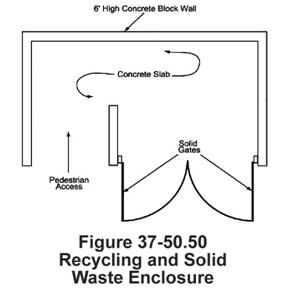
(F)
The property owner shall supply and maintain adequate bins and containers for recycling and waste disposal.
(G)
Whenever feasible, the recycling collection area and the trash collection area shall be adjacent to one another and in one enclosure.
(H)
Recycling and solid waste enclosure dimensions shall be in conformance with the city's recycling and solid waste contractor's requirements.
(2)
Instructional Signs. Signs shall be conspicuously posted on each recycling and trash enclosure giving instructions on the use of the recycling bins and containers.
(3)
Landscaping. A two-foot perimeter surrounding each recycling and solid waste enclosure, exclusive of access to the enclosure, shall be planted with landscaping.
(4)
Setbacks. No recycling or solid waste enclosures shall be located in any front or corner side yard.
(5)
Use of Parking Spaces. No recycling or solid waste enclosures (including access doors, when open) shall be located in any required parking space, except as provided for in this section.
(6)
Waiver of Parking, Landscaping Areas, or Open Space Requirements. In order to meet the required recycling and trash enclosure requirements, an existing development may use one parking space, landscaping area, or open space area for the location of the recycling containers if the city planner can find that the loss of the parking, landscaping area, or open space area will not have a deleterious effect on the need for such areas or the aesthetics of the existing development. Such a waiver shall be obtained in accordance with the site plan review process.
(d)
Exceptions. The city planner may grant exceptions to this section when the city planner finds that existing conditions prevent its practical application.
(Ord. No. 2463 (NCS).)
(a)
Purpose. The purpose of this section is to establish regulations governing recycling consistent with the requirements of the California Beverage Container Recycling and Litter Reduction Act.
(b)
Definitions. The following definitions shall apply to this section:
(1)
Mobile Recycling Unit. An automobile, truck, trailer, van, and appurtenant bins, boxes, or containers used for the collection of recyclable materials.
(2)
Recyclable Material. Material including, but not limited to, metals, glass, plastic, and paper which are intended for reuse, remanufacture, or reconstitution for the purpose of using the altered form. Recyclable material does not include refuse or hazardous materials, but may include used motor oil collected and transported in accordance with Sections 25250.11 and 25143.2(b)(4) of the California Health and Safety Code.
(3)
Recycling Collection Facility, Large. A center for the acceptance by donation, redemption, or purchase of recyclable materials from the public occupying more than five hundred square feet in area and may include permanent structures as well as mobile units, bulk reverse vending machines, and kiosk-type units.
(4)
Recycling Collection Facility, Small. A center for the acceptance by donation, redemption, or purchase of recyclable materials from the public occupying less than five hundred square feet in area, which may include:
(A)
A mobile unit;
(B)
Bulk reverse vending machines or a grouping of reverse vending machines occupying more than fifty square feet;
(C)
Small freestanding structures; and
(D)
Unattended containers placed for the donation of recyclable materials.
(5)
Recycling Facility. A center for the collection and/or processing of recyclable materials. A certified recycling facility or certified processor means a recycling facility certified by the California Department of Conservation as meeting the requirements of the California Beverage Container Recycling and Litter Reduction Act of 1986. On-site storage containers or processing facilities used solely for the recycling of material generated by residential property, business, or manufacturer are not recycling centers for the purposes of this section.
(6)
Recycling Processing Facility. A building or enclosed space used for the collection and processing of recyclable materials. Processing means the preparation of material for efficient shipment, or to an end-user's specifications, by such means as baling, briquetting, compacting, flattening, grinding, crushing, mechanical sorting, shredding, cleaning, or remanufacturing.
(7)
Recycling Processing Facility, Heavy. A processing facility other than a light-processing facility.
(8)
Recycling Processing Facility, Light. A processing facility occupying less than fifty thousand square feet and including equipment for baling, briquetting, crushing, compacting, grinding, shredding, or sorting of source-separated recyclable materials, except ferrous metals other than food and beverage containers and repairing of reusable materials.
(9)
Reverse Vending Machine. An automated mechanical device that accepts at least one or more types of empty beverage containers including aluminum cans, glass and plastic bottles, and issues a cash refund or a redeemable credit slip. A reverse vending machine may sort and process containers mechanically, provided that the entire process is enclosed within the machine.
(10)
Reverse Vending Machine, Bulk. A reverse vending machine designed to accept more than one container at a time and to compute the refund or credit due on the basis of weight.
(11)
Reverse Vending Machine, Single Feed. A reverse vending machine designed to accept individual containers one at a time.
(c)
Permits Required. No person shall permit the placement, construction, or operation of any recycling facility without first obtaining a permit as identified in Table 37-50.80:
Notes:
(A) Additional regulations apply within the gateway and focused growth overlay districts. A CUP is required for any large collection or light processing facility within the IGC or IG districts in the gateway overlay district or within the IGC district in the focused growth overlay district. Heavy processing is not permitted in the gateway overlay or focused growth overlay districts.
(B) A CUP shall be required for any small collection facility in the MX district.
(d)
Permits for Multiple Sites.
(1)
The city planner may grant a single site plan review to allow more than one reverse vending machine or small collection facility located on different sites under the following conditions:
(A)
The operator of each of the proposed facilities is the same.
(B)
The proposed facilities are determined by the city planner to be similar in nature, size and intensity of activity.
(C)
All the applicable criteria and standards set forth in this section are met for each proposed facility.
(e)
Development Regulations and Design Standards.
(1)
Reverse Vending Machines.
(A)
No machine shall obstruct pedestrian or vehicular circulation.
(B)
No required parking space shall be occupied.
(C)
Each machine shall be clearly marked to identify the type of material to be deposited, operating instructions, and the identity and phone number of the operator or responsible person to call if the machine is inoperative.
(D)
The maximum sign area is four square feet per machine, exclusive of operating instructions.
(E)
Adequate nighttime lighting shall be provided.
(F)
No machine located within one hundred feet of an R or NU (NE, NG-1 and NG-2) district shall be visible from residences or public right-of-way located in an R or NU (NE, NG-1, and NG-2) district.
(2)
Small Recycling Collection Facilities.
(A)
Small recycling collection facilities shall be no larger than five hundred square feet in area, shall be set back at least ten feet from a front or corner side property line, and shall not obstruct pedestrian or vehicular circulation.
(B)
No power-driven processing equipment shall be used except for reverse vending machines.
(C)
All containers shall be constructed and maintained with durable waterproof and rustproof material, covered when the site is not attended, secured from unauthorized entry or removal of material, and of a capacity sufficient to accommodate materials collected.
(D)
All recyclable material shall be stored in containers or in a mobile unit vehicle.
(E)
Attended facilities located within one hundred feet of the boundary of an R or NU (NE, NG-1, and NG-2) district shall operate only between 9:00 a.m. and 7:00 p.m.
(F)
Containers shall be clearly marked to identify the type of material that may be deposited; the facility shall be clearly marked to identify the name and telephone number of the facility operator, and the hours of operation, and shall display a notice stating that no material shall be left outside the recycling enclosure or containers.
(G)
The maximum sign area shall be sixteen square feet exclusive of informational requirements and operational instruction. Directional sign bearing no advertising message may be installed with the approval of the city planner if necessary to facilitate traffic circulation or if the facility is not visible from the public right-of-way.
(H)
No additional parking spaces will be required for customers of a small collection facility located at the established site of a host use. One space will be provided for the attendant, if needed.
(I)
No required parking spaces shall be occupied by the facility.
(3)
Large Recycling Collection Facilities.
(A)
A large recycling collection facility shall be located at least three hundred feet from an R or NU (NE, NG-1, and NG-2) district.
(B)
Each facility shall be in an enclosed building or within an area enclosed by a solid masonry wall at least eight feet in height with landscaping.
(C)
Six parking spaces shall be for customers and one parking space shall be provided for each commercial vehicle operated by the recycling facility.
(D)
Power-driven processing, including aluminum foil and can compacting, bailing, plastic shredding, or other light processing activities necessary for efficient temporary storage and shipment of material may be allowed if noise mitigation and other conditions are met.
(4)
Recycling Processing Facilities (Light and Heavy Processing).
(A)
Processors will operate in a wholly enclosed building except for incidental storage, or within an area enclosed on all sides by an opaque fence or wall not less than eight feet in height and landscaped on all street frontages located at least five hundred feet from an R or MU district except that such facilities may be located closer provided a conditional use permit is obtained.
(B)
Power-driven processing shall be permitted provided all noise-level requirements are met in accordance with Section 37-50.180: Performance standards. Light processing facilities are limited to baling, briquetting, crushing, compacting, grinding, shredding, and sorting of source-separated recyclable materials and repairing of reusable materials.
(5)
All Recycling Collection and Processing Facilities.
(A)
No facility shall occupy a required front or corner side yard, and all regulations applicable to the principal structure on the site shall apply to collection and processing facilities except as provided in this section.
(B)
Facilities shall be designed to be compatible with the architectural character of adjacent structures.
(C)
A large collector or processing facility may accept used motor oil for recycling from the generator in accordance with Section 25250.11 of the California Health and Safety Code.
(D)
All exterior storage of material shall be in sturdy containers or enclosures that are covered, secured, and maintained in good condition. Storage containers for flammable material shall be constructed of nonflammable material. No storage, excluding truck trailers and overseas containers, will be visible above the height of the fencing where screening is required.
(E)
All facilities shall be administered by on-site personnel during hours the facility is open. If a processing facility is located within five hundred feet of an R or NU (NE, NG-1, and NG-2) district, it shall not be in operation between 7:00 p.m. and 7:00 a.m. unless such operating hours are extended by a conditional use permit.
(F)
Any containers provided for after-hours donation of recyclable materials shall be of sturdy, rustproof construction; shall have sufficient capacity to accommodate materials collected; and shall be secure from unauthorized entry or removal of materials.
(G)
The site of the facility shall be kept free of litter and any other undesirable material. Containers shall be clearly marked to identify the type of material that may be deposited. A notice shall be displayed stating that no material shall be left outside the recycling containers.
(H)
Sign requirements shall be those provided for in the zoning district in which the facility is located. In addition, each facility shall be clearly marked with the name and phone number of the facility operator and the hours of operation.
(Ord. No. 2463 (NCS).)
(a)
Purpose. The purpose of this section is to:
(1)
Demonstrate the city's support for the preservation of agricultural land and operations;
(2)
Limit the effects of land use conflicts created by the proximity of urban development to agricultural operations located in and adjacent to the city; and
(3)
Provide notice to purchasers, property owners, and tenants of nonagricultural property and uses of their proximity to agricultural land and operations and that they may experience inconveniences and discomforts related to normal farming activities including, but not limited to, noise, odors, fumes, dust, smoke, burning, vibrations, insects, rodents, the application of pesticide, herbicide and fertilizer application, and/or the operation of farm machinery, equipment, and vehicles (including aircraft).
(b)
Farm Operations and Nuisance.
(1)
No agricultural operation, use, or any of its appurtenances conducted in a manner consistent with accepted standards on agricultural land shall be considered a nuisance, provided the agricultural operation, use, or any of its appurtenances complies with all applicable sections of the Salinas Municipal Code and all other applicable local, state, and federal laws.
(2)
The provisions of this section shall not apply whenever a nuisance results from the negligence or improper operation of any agricultural operation, use, or any of its appurtenances.
(3)
This is not intended to be construed as modifying existing law relative to nuisance, but is only to be used in the interpretation and enforcement of this section.
(c)
Deed Restriction/Notice of Right to Farm. As a condition of all discretionary review application approvals, the city shall require the following deed restriction to be recorded on any land located within one thousand feet of agricultural land, agricultural processing, or agricultural farming operations to notify any purchaser, property owners, or tenants of the right to farm. The deed shall be filed by the city planner for recordation by the Monterey County recorder's office prior to the recordation of a final map or issuance of the first building permit (if there is no map) for the project. The language of the deed restriction shall be as follows:
Notice of Right to Farm
The City of Salinas and the County of Monterey permit the operation of properly conducted agricultural operations within the City and the County. You are hereby notified that the property you own, reside in, are purchasing, or are renting/leasing is located within one thousand feet (1,000′) of agricultural land, agricultural processing, and/or agricultural farming operations. As a result of the proximity of your property to these activities and uses, you may experience inconveniences or discomfort associated with these activities and uses including, but not limited to, noise, odor, fumes, dust, smoke, burning, vibration, insects, rodents, the application of pesticides, herbicides, and fertilizers, and/or the operation of machinery and farm equipment (including aircraft) during any twenty-four (24) hour period. If these farming activities and uses are conducted in a manner consistent with applicable State and local laws, said inconveniences and discomforts shall not be considered a nuisance. One or more of the inconveniences described may occur as a result of agricultural operations that are in compliance with existing laws and regulations and accepted customs and standards. As you live in proximity to agricultural areas or uses, you should be prepared to accept such inconveniences and discomfort as a normal and necessary aspect of living in an area with agricultural operations and uses. Lawful ground rig or aerial application of pesticides, herbicides, and fertilizers occur in farming operations. Should you be concerned about spraying you should contact the Monterey County Agricultural Commissioner.
The City of Salinas Right to Farm Ordinance does not exempt farmers, agricultural processors, and others from compliance with any applicable Local, State, or Federal laws.
(Ord. No. 2463 (NCS).)
(a)
Purpose. The purpose of this section is to provide opportunities for locating salvage and wrecking operations in industrial areas so as not to have an adverse impact on adjacent land uses or groundwater supplies.
(b)
Definitions. The following definition shall apply to this section:
(1)
Salvage and Wrecking Operations. A place where used motor vehicles or trailers, or portions thereof, are discarded, bought, sold, exchanged, baled, packed, disassembled, stored, displayed, or handled; house-wrecking operations; used lumber or other used building material yards; and places for storage of salvaged building materials, structural steel materials, and equipment. Excludes the sale of used motor vehicles in operable condition, establishments for the sale, purchase, or storage of used furniture, and household fixtures when conducted entirely within an enclosed building, or those facilities included in Section 37-50.210: Recycling facilities.
(c)
Development Regulations and Design Standards.
(1)
Salvage and wrecking operations shall not be located any closer than five hundred feet from any A, R, C, MU, NU, P, OS, or PS district or any such land so designated in the Salinas general plan;
(2)
Salvage and wrecking operations shall be conducted wholly within an area enclosed by a solid masonry wall at least eight feet in height;
(3)
Any outdoor storage shall not exceed the height of the solid masonry wall within seventy-five feet of such wall;
(4)
No hazardous substances or hazardous wastes, as defined in 42 U.S.C. Section 9601 (22), shall be released on, under, or about the site and no material shall be discharged on, under, or about the site that could affect the quality of the ground or surface waters within the meaning of the California Porter-Cologne Water Quality Act, as amended, Water Code Section 13000, et seq.;
(5)
Any other criteria or standards necessary to minimize adverse impacts on adjacent land uses and to protect the environment.
(Ord. No. 2463 (NCS).)
(a)
Purpose. Facilitate the acquisition, construction, rehabilitation, and preservation of affordable rental housing for teachers, faculty, school district employees, and community college district employees to allow teachers, faculty, school district employees, or community college district employees to access and maintain housing stability.
(b)
Definitions.
(1)
Affordable rental housing. A rental housing development, as defined in the Teacher Housing Act of 2016 with a majority of its rents restricted to levels that are affordable to persons and families of low or moderate income.
(2)
Local public employees. Includes employees of a city, county, city and county, charter city, charter county, charter city and county, special district, or any combination thereof.
(3)
Teacher, faculty, school district employee, or community college district employee. Any person employed by a unified school district maintaining prekindergarten, transitional kindergarten, and grades one to twelve, inclusive, an elementary school district maintaining prekindergarten, transitional kindergarten, and grades one to eight, inclusive, a high school district maintaining grades nine to twelve, inclusive, or a community college district, including, but not limited to, certificated and classified staff.
(c)
Applicability. These provisions only apply to teacher, faculty, school district employee, and community college district employee housing as defined by the State of California, Teacher Housing Act of 2016 and as may be amended from time to time.
(d)
Requirements.
(1)
A school district or community college district may develop or provide employee housing for a teacher, faculty, school district employee, or community college district employee consistent with the Teacher Housing Act of 2016 and as may be amended from time to time.
(2)
Teacher, faculty, school district employee, or community college district employee housing may be developed or managed by a party other than the school or college district (employer), provided the employer retains control and ultimate responsibility for the facility.
(3)
Housing shall be restricted to teacher, faculty, school district employees, or community college district employees, except that a school district or community college district may allow local public employees or other members of the public consistent with the Teacher Housing Act of 2016 and federal Fair Housing law.
(4)
A school district or community college district shall retain the right to prioritize school district or community college district employees over local public employees or other members of the public to occupy housing as allowed by the Teacher Housing Act of 2016 and as may be amended from time to time.
(e)
Relocation assistance. If acquisition of occupied housing would result in displacement of tenants, the school district or community college district shall provide notification and relocation assistance as outlined below:
(1)
Notification. All tenants shall be given written notice at least 90 days before the date the property must be vacated. Notice shall comply with the legal requirements for service by mail contained in Code of Civil Procedure, Sections 1012, 1013, and 1013a or as otherwise required by law or shall be made by personal delivery to each tenant or other person entitled to receive notice. Confirmation of written acknowledgement of receipt of the notice is required. If a rental agreement was negotiated in another language such as in Spanish, all required notices to that tenant shall be issued in that language. The school district or community college district shall provide the City proof of noticing of tenants to comply with the provisions of this section.
(2)
The district shall provide relocation assistance of two times the monthly rent for any tenant household living in any unit before notification of intent to vacate is provided. Relocation assistance shall be in addition to and shall not affect or be affected by any other monetary amounts due to or by the tenant that are payable as a result of the termination of tenancy, including security deposits. Eligible tenants shall be paid relocation assistance at least fourteen days before the tenant is scheduled to vacate the unit. Tenants who have given notice of their intent to vacate prior to receipt of required notification shall not be eligible for relocation assistance.
(Ord. No. 2656 (NCS), § 8, 5-10-2022)
(a)
Purpose. To ensure all mechanical equipment whether building, roof, or ground-mounted is adequately screened from public view.
(b)
Exterior Building and Roof-mounted Mechanical Equipment.
(1)
Except for solar collectors, all exterior building and roof-mounted mechanical equipment shall be screened from view of adjacent streets (including U.S. Highway 101) and properties by architectural building features or other screening elements that are compatible in color, texture, and design with the primary structure.
(2)
Screening for roof-mounted mechanical equipment shall be integrated into the overall architectural and roof design and shall include the use of parapet walls or other architectural screening features. For new structures and building additions, the design of such screening shall be taken into consideration during the initial design phase for the structure and shall not consist of a separate screening device, which is not part of the overall architectural design of structure.
(3)
The screening shall be of the same (or greater) height as the height of the roof-mounted equipment unless the city planner determines that because of the size, height, or location of the proposed equipment/associated building, it will be fully screened from view of adjacent properties and streets (including U.S. Highway 101). In such case, a line of sight graphic shall be provided by the applicant that demonstrates to the satisfaction of the city planner that the proposed screening will fully screen views of the equipment as required by this section.
(4)
Such graphic shall be submitted to planning and development prior to the approval of any building permit for the structure. The line of sight graphic shall illustrate the sight line of the mechanical equipment as viewed from a minimum height of six feet above grade level from all adjacent properties and streets (including U.S. Highway 101) (see Figure 37-50.60).
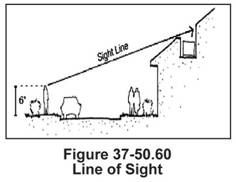
(5)
For existing buildings that do not have existing parapets or other screening features of sufficient height to adequately screen roof-mounted or building-mounted equipment, a solid screen shall be constructed around any new or replacement roof or building-mounted equipment and/or the equipment shall be painted to generally match the color and texture of the nearest building element immediately below or behind the equipment, as applicable, when viewed from any particular direction. The city planner shall determine whether such equipment shall be painted or otherwise screened based on the roof type and architectural design of the structure.
(6)
If roof-mounted equipment will be visible from existing taller buildings with occupied floors adjacent to the subject site, it shall be painted to match the rooftop color.
(7)
In the IG district, building and roof-mounted mechanical equipment screening shall only be required when the mechanical equipment screening will be visible from adjacent streets (including U.S. Highway 101) or when the mechanical equipment will be visible from an adjacent C, R, or MU district.
(c)
Ground-mounted Mechanical Equipment. Ground-mounted mechanical equipment shall be screened by the use of landscaping, low walls, or similar screening features.
(d)
Mechanical Equipment Required to be Screened. Mechanical equipment that shall be screened in accordance with this section includes, but is not limited to, heating, cooling, refrigeration equipment, plumbing lines, ductwork, transformers, and similar equipment. Satellite dish antennas and microwave equipment are not subject to the requirements of this section and shall be screened in accordance with Section 37-50.010(j): Satellite Dish Antennas.
(Ord. No. 2463 (NCS).)
(a)
Purpose. The purpose of this section is to comply with the requirements of the California Government Code relating to accessory dwelling units. In the event of any conflict between this section and the California Government Code, the California Government Code shall prevail. An accessory dwelling unit conforming to the provisions of this section shall be approved ministerially within the time limits specified by Government Code Section 65852.2 or any successor provisions.
(b)
Where Permitted.
(1)
Accessory dwelling units, interior are allowed as a permitted use in the R-L district.
(2)
Accessory dwelling units, other are allowed as a permitted use in an A, R, or NU district, subject to subsection (d) below. All accessory dwelling units are permitted only on lots with one single-family detached dwelling unit and no other dwelling units.
(3)
No accessory dwelling units shall be permitted in a development subject to a planned unit development permit approved under Article IV, Division 13 of Chapter 37, or any applicable predecessor or successor sections of this Code, unless accessory dwelling units are expressly authorized by such planned unit development permit.
(4)
A maximum of one accessory dwelling unit shall be permitted per lot or parcel. An accessory dwelling unit shall not be sold separately from the principal dwelling unit.
(c)
Development Regulations and Design Standards—Accessory dwelling unit, interior.
(1)
The accessory dwelling unit must have exterior access independent from the existing single-family detached dwelling unit.
(2)
Side and rear setbacks must be determined to be sufficient for fire safety by the building official.
(3)
No new or separate utility connection directly between the accessory dwelling unit and the utility may be required.
(4)
Sprinklers may not be required for the accessory dwelling unit unless they are required for the existing single-family detached dwelling unit.
(5)
The total floor area of an accessory dwelling unit, interior, shall not exceed the greater of one-thousand two-hundred square feet or fifty percent of the existing living area of the primary residence.
(d)
Development Regulations and Design Standards - Accessory dwelling unit, other.
(1)
Floor Area.
(A)
The total floor area of a detached accessory dwelling unit shall not exceed a maximum of one-thousand two-hundred square feet of gross floor area.
(B)
The total floor area of an attached accessory dwelling unit shall not exceed a maximum of fifty-percent of the existing living area of the primary residence, not to exceed a maximum of one-thousand two-hundred square feet.
(C)
Accessory dwelling units that require additional floor area for the unit are prohibited on the second floor of a single-family detached dwelling unit. Accessory dwelling units may be located within an existing second floor of a single-family detached dwelling unit subject to the requirements of subsection (c) of this section.
(2)
Design. The exterior design of the accessory dwelling unit shall be in harmony with the principal dwelling unit. This shall be accomplished through the use of building materials, architectural design, height, scale, exterior colors, and finishes that are compatible with the principal dwelling unit. Accessory dwelling units shall be designed so as not to adversely affect the character of the surrounding neighborhood. The design standards of the base zoning district shall apply. No passageway shall be required in conjunction with the construction of an accessory dwelling unit.
(3)
Sprinklers. Sprinklers may not be required for the accessory dwelling unit unless they are required for the existing single-family detached dwelling unit.
(e)
Other Development Standards. Except as modified by this section, the accessory dwelling unit shall conform to all applicable development regulations established for single-family detached dwelling units in the underlying zoning district, including without limitation, the maximum height, required yards, minimum usable open space requirements for single-family detached dwelling units in the applicable zoning district, and distance between structures.
(f)
Parking. One off-street parking space shall be provided for each bedroom in the accessory dwelling unit, and parking required for the single-family dwelling units shall be provided on the same site in accordance with Section 37-50.360, off-street parking and loading spaces regulations. A minimum of one off-street parking space shall be provided for an efficiency unit off-street parking for accessory dwelling units may be provided as tandem parking on an existing legal driveway or in setbacks, excluding the front or side-corner setbacks of a site; however off-street parking spaces for accessory dwelling units are not required in any of the following instances:
(1)
The accessory dwelling unit is located within one-half mile of a public transit stop.
(2)
The accessory dwelling unit is located within an architecturally and historically significant historic district.
(3)
The accessory dwelling unit is an "accessory dwelling unit, interior" as defined in this Chapter 37.
(4)
When on-street parking permits are required but not offered to the occupant of the accessory dwelling unit.
(5)
When there is a car share vehicle pickup location located within one block of the accessory dwelling unit.
Notwithstanding the above, if the accessory dwelling unit replaces an existing garage, carport, or covered parking structure, replacement spaces must be provided to meet the requirements of Division 2 of this Chapter 37. Such replacement spaces may be provided as garaged spaces, covered spaces, uncovered spaces on a legal driveway, tandem spaces, or mechanical parking lifts on the same lot as the primary residence. As used in this subsection (f), "driveway" shall mean a private roadway or travel way and its access point from a public street for the exclusive use of the occupants of a property and their guests.
(g)
Density. An accessory dwelling unit which conforms to the requirements of this section shall not be considered to exceed the allowable density for the lot upon which it is located, and shall be deemed to be a residential use, consistent with the Salinas general plan and zoning designation for the lot.
(h)
Deed Restriction. The owner of the parcel of land upon which the accessory dwelling unit is proposed to be located shall execute a deed restriction, running with the land, in a form satisfactory to and approved by the city, which states that the second dwelling unit shall not be rented for terms less than thirty days, that the lot shall be developed and maintained in conformance with this section, and that the requirements of this section are binding upon any successor in ownership of the property. Such deed restriction shall be filed by the city planner for recordation by the Monterey County recorder's office prior to issuance of any building permits for the accessory dwelling unit.
(i)
Administrative Fee. The city may charge an administrative fee for monitoring compliance with the provisions of this section as determined by the city council.
(Ord. No. 2463 (NCS).)
(Ord. No. 2581 (NCS), § 10, 12-6-2016; Ord. No. 2626 (NCS), § 1, 11-5-2019)
Editor's note— The title of § 37-50.250 was amended by Ord. No. 2581 (NCS), § 10, adopted Dec. 6, 2016.
The following supplementary development regulations shall apply to the service station, vehicle repair, and vehicle washing use classifications:
(a)
Limitations on Use.
(1)
Unless otherwise permitted in the district in which the service station is located, service stations shall be limited to the sale of motor vehicle fuels and lubricants, tires, batteries, accessory items, and minor motor vehicle repair.
(2)
All servicing shall be conducted in an enclosed building except that the following is permitted outside an enclosed building:
(A)
Pumping motor vehicle fluids;
(B)
Checking and supplementing various fluids; and
(C)
Mechanical inspection and adjustments not involving any disassembly.
(3)
Any vehicle washing, drying, or vacuuming done by mechanical means located within one hundred feet of an R or NU (NE, NG-1, and NG-2) district shall be subject to the approval of a conditional use permit. The distance shall be measured from the closest exterior wall of the building/suite or property line of the site (if there is no building) where the car wash is located to the nearest property line of the site containing a residential dwelling or zone.
(4)
All vehicle service stations, repair and washing shall comply with the noise standards contained in Section 37-50.180: Performance standards.
(b)
Outdoor Storage. The outside storage or display of merchandise or equipment shall be prohibited, except that the following shall be permitted:
(1)
Tire display: one display rack per pump island but not exceeding a total of two such tire racks per automobile service station. A maximum of twenty-four tires may be displayed on a service station site;
(2)
Wiper display: two such wiper racks per automobile service station;
(3)
Lubricant display: one lubricant display per pump island;
(4)
Vending machines: three per automobile service station.
(c)
Signs. All signage and outside advertising shall be in accordance with Article V, Division 3: Signs.
(Ord. No. 2463 (NCS).)
(a)
Purpose. The purpose of this section is to:
(1)
Provide affordable and long-term housing for small households and for people with special needs;
(2)
Provide high density housing in close proximity to transportation and services in a commercial environment; and
(3)
Provide the highest possible livability standards of design, environment, and security given the constraints of limited living space and the need to maintain affordability.
(b)
Development Regulations. Single room occupancy housing shall conform to the following development and design regulations:
(1)
Density. Single room occupancy housing that conforms to the requirements of this section shall not be considered to exceed the allowable lot area per dwelling unit for the lot upon which it is located;
(2)
Floor Area. Minimum one hundred fifty square feet per living unit, including bathrooms. Maximum five hundred square feet per living unit, including bathrooms;
(3)
Kitchen. Each living unit shall contain kitchen facilities including a sink, cooking apparatus, and a refrigerator;
(4)
Bathroom. Each living unit shall contain a bathroom including a toilet, sink, and shower or tub;
(5)
Entryways. Living units shall not have separate external entryways;
(6)
Common Area. Fifty square feet per living unit, designed and furnished for the use and comfort of all residents. No common area shall be less than five hundred square feet in size. Common areas shall not include storage rooms, laundry facilities, common kitchens, dining rooms, or hallways;
(7)
Maximum Occupancy. Two persons per living unit;
(8)
Manager's Unit. An on-site manager's unit shall be provided; such unit may exceed the maximum floor area and occupancy limitations in this section;
(9)
Telephone/Cable Television. Living units shall be pre-wired for both telephone and cable television service;
(10)
Laundry Facilities. Laundry facilities consisting of individual or common washer and dryer facilities shall be provided.
(c)
Design Standards. The following standards are intended to assist the designer and operator in understanding the city's purposes in allowing single room occupancy housing that meets the purposes stated in this section. These standards are intended to be interpreted with some flexibility in their application to each project. The standards will be used in conjunction with other regulations and within the discretion afforded the city through a conditional use permit.
(1)
Unit Design. Living units should have amenities sufficient to sustain daily living including, but not limited to, furnishings designed for smaller spaces, built-in cabinets, closets, miscellaneous storage, and individually controlled heating and ventilation.
(2)
Physically Disabled Access. There should be a greater percentage of living units designed for persons with disabilities than required by the California Building Code.
(3)
Janitor Closet. Storage space should be provided for janitorial supplies on each floor.
(4)
Supply Room. A supply room should be provided adjacent to the manager's unit.
(5)
Security. There should be a security plan emphasizing residents' safety without unreasonably imposing on residents' activities.
(d)
Exemptions.
(1)
Property Development Regulations. The requirements for lot area/unit, bedrooms per unit and usable open space applicable to residential uses shall not apply to single room occupancy housing.
(2)
Existing Structures. Existing structures may be converted to single room occupancy housing and exempted from the development standards contained in this section provided the following findings can be made:
(A)
There is substantial compliance with development standards.
(B)
Alternative means of compliance with development standards are provided which contribute to livability.
(C)
Strict compliance with development standards would render conversion of the structure to single room occupancy housing impractical.
(e)
Operating Standards.
(1)
Management Plan. Single room occupancy housing shall have a management plan included as a condition of the conditional use permit, which will ensure:
(A)
The presence of an on-site twenty-four-hour manager or an alternative which affords residents essentially the same level of service and security;
(B)
Short- and long-term physical maintenance of the building and its grounds;
(C)
That operations, rental procedures and staffing contribute to and promote a high quality of life for residents; and
(D)
The safety and security of residents and their property.
(2)
Tenancy. Tenancy shall be limited to a minimum of twenty-nine or more days, and thereafter no less than on a monthly basis.
(f)
Affordability.
(1)
Percent Affordable. A minimum of fifty percent of the living units shall be affordable and available to very-low or low income households, as defined in the State Health and Safety Code, or low income households, as defined in Section 50079.5 of the Health and Safety Code.
(2)
Affordable Housing Plan. An affordable housing plan shall be included as a condition of a conditional use permit, which shall include:
(A)
The number of units to be affordable to very-low and low income households.
(B)
A deed restriction shall be recorded prior to issuance of the first building permit for a project by which permanent maintenance and affordability of the units will be achieved.
(g)
Deed Restriction. The owner of the parcel of land upon which the single room occupancy is located shall execute a deed restriction running with the land in a form satisfactory to and approved by the city, which states that the project shall be developed and maintained in conformance with this section. The language and form of the deed restriction is subject to the approval of the city planner. Such deed restriction shall be filed by the city planner for recordation by the Monterey County recorder's office prior to the issuance of a building permit for the single room occupancy housing.
(h)
Administrative Fee. The city may charge an administrative fee for monitoring compliance with the provisions of this section as determined by the city council.
(Ord. No. 2463 (NCS).)
(Ord. No. 2569 (NCS), § 9, 4-19-2016)
Buildings that are erected, expanded or altered without a specific use or occupant identified shall comply with the following:
(a)
Parking and Loading. Parking and loading shall be provided based on the maximum required for anticipated uses. The total parking required for individual uses shall not exceed the parking provided.
(b)
Site Development Standards. Site development standards shall be the minimum required for any single use regardless of the number of uses contained within the speculative building.
(Ord. No. 2463 (NCS).)
(a)
Purpose. The purpose of this section is to encourage appropriate development of new and significantly modified telecommunication facilities throughout the city and to prescribe the standards for evaluating telecommunication facilities.
(b)
Definitions. The following definitions shall apply to this section:
(1)
Antenna, Dish (also known as a parabolic antenna). A bowl-shaped device for the reception and/or transmission of radio frequency communications signals in a specific directional pattern. Dish antennas generally measure four to six feet in diameter and one and one-half to three feet deep.
(2)
Antenna, Panel (also known as a directional antenna). An antenna that has vertical and horizontal planes that aim signals in specific directions. Panel antennas generally measure three feet to eight feet in height, six inches to twelve inches in width, and six inches to eight inches in depth.
(3)
Antenna, Whip (also known as omnidirectional antenna). An antenna that transmits and/or receives signals in a three-hundred-sixty-degree radial pattern. Shaped cylindrically, they generally have diameters between two inches and six inches, and measure between one foot and eighteen feet in height.
(4)
Building-mounted Facility. A telecommunication facility that is constructed in two general forms: (A) roof-mounted, in which antennas are placed on or above the roof, or (B) facade-mounted, in which antennas are mounted to the sides of buildings. Building-mounted facilities can be located on or inside various structures such as water tanks, church steeples, or other creative locations.
(5)
Lattice Tower. A support structure, typically erected on the ground, consisting of metal crossed strips or bars to support antennas and related equipment.
(6)
Monopole. A support structure, typically erected on the ground, consisting of a single pole to support antennas and related equipment.
(7)
Stealth Telecommunication Facility. A wireless telecommunication facility that is not readily visible or apparent because it has been designed to blend into the surrounding environmental and is visually unobtrusive. Examples may include: architecturally screened building-mounted antennas and facilities in steeples; building-mounted facilities that are painted and treated as architectural features to blend with existing buildings; support structures that are disguised as flag poles, public art, windmills, or similar features; or camouflaged with artificial vegetation to resemble a tree.
(8)
Telecommunications Facilities. Public, commercial, and private electromagnetic and photoelectrical transmission and receiving facilities. Includes antennas for cellular, enhanced specialized mobile radio (ESMR), personal communications services (PCS), earth stations for satellite-based communications, and similar facilities, but does not include satellite dish antennas, which are included under "accessory structures and uses."
(9)
Telecommunications Facilities, Major. Freestanding or attached monopoles and lattice towers, microwave dish antennas, repeater and receiving stations for radio, television, telegraph, telephone, data network, microwave applications, and similar facilities as determined by the city planner.
(10)
Telecommunications Facilities, Minor. Building-mounted panel antennas, building or roof-mounted whip antennas, and similar facilities as determined by the city planner. Roof-mounted panel antennas may be considered "minor" provided the antennas do not intercept a forty-five-degree inclined plane inward from the edge of the roof or top of the parapet roof and do not exceed ten feet in height.
(c)
Development Regulations. The following supplementary development standards shall apply to proposed and significantly modified facilities:
(1)
Setbacks.
(A)
Major Facilities. The antenna, related support structures, and accessory buildings shall maintain minimum setbacks as follows: front yard and corner side yard property lines: twenty feet; interior side yard and rear yard property lines: ten feet.
(B)
Major and Minor Facilities. When located within three hundred feet of an R or NU (NE, NG-1, and NG-2) district, the antenna, related support structures, and accessory buildings shall not intercept a forty-five-degree inclined plane inward from the height of ten feet above existing grade at the R or NU (NE, NG-1, and NG-2) district boundary line.
(2)
Maximum Height. Height is measured from ground level immediately under the antenna to the highest point of the antenna or any appurtenance attached to it. Building-mounted panel antennas shall not extend above the portion of the building to which they are attached, except as provided in this section with required mounting hardware not to exceed four inches above the roof or top of parapet wall. Whip antennas may extend above buildings and exceed maximum height limits. All telecommunication facilities shall meet the requirements of Part 77 of the Federal Aviation regulations and Article IV, Division 7: Airport (AR) Overlay District. Maximum height shall be in accordance with the following standards:
(A)
Major Facilities.
(i)
A district: thirty feet;
(ii)
OS and P districts: thirty feet (only stealth telecommunication facilities permitted);
(iii)
R, NU (NE, NG-1, and NG-2) and CO/R districts: not permitted;
(iv)
MU and NU (VC) Districts. In no case shall the telecommunications facility be higher than the portion of the building to which they are attached, or fifty feet, whichever is less (only stealth telecommunications facilities permitted). The city planner may allow stealth telecommunication facilities, including but not limited to faux chimneys, church steeples or other architectural features which project above the building to which they are attached;
(v)
Focused Growth Overlay, Gateway Overlay, and Central City Overlay (Downtown Core and Downtown Neighborhood Areas). In no case shall the telecommunication facility be higher than the portion of the building to which they are attached, or fifty feet, whichever is less (only stealth telecommunication facilities permitted). The city planner may allow stealth telecommunication facilities which project above the building to which they are attached;
(vi)
C (except for CO/R) and PS districts: one hundred feet; one hundred twenty feet for facilities which are co-located with two or more carriers;
(vii)
I districts: one hundred fifty feet.
(B)
Minor Facilities.
(i)
A district: no higher than the portion of the building to which they are attached, or fifty feet, whichever is less. The city planner may allow stealth telecommunication facilities which project above the building to which they are attached;
(ii)
OS and P districts: thirty feet (only stealth telecommunication facilities permitted);
(iii)
R, NU (NE, NG-1, NG-2) and CO/R districts: thirty feet (only stealth telecommunications facilities are permitted in all NU districts);
(iv)
MU and NU (VC) districts: thirty feet (only stealth telecommunication facilities permitted);
(v)
Focused growth overlay and central city overlay districts: thirty feet (only stealth telecommunication facilities permitted);
(vi)
C (except for CO/R), I, and PS districts, no higher than the building to which they are attached, or the height limit in the applicable district, whichever is less. The city planner may allow stealth telecommunication facilities which project above the building to which they are attached;
(3)
Compatibility—Major and Minor Facilities. Telecommunication facilities shall be aesthetically and architecturally compatible with adjacent structures and features in terms of shape, materials, and colors. The city planner may require stealth telecommunication facilities to achieve compatibility with surrounding uses.
(4)
Stealth Telecommunication Facilities. Only stealth telecommunication facilities are allowed on properties located in the gateway overlay district, central city overlay (downtown core and downtown neighborhood areas) district, focused growth overlay district, and in the P, OS, NU (VC), or MU districts.
(5)
Screening—Major and Minor Facilities. A fence or wall shall be required to secure the facility and to provide screening for equipment. The city planner may consider waiving the requirement for fencing provided all of the following apply: the facility is secured by existing fencing; existing screening is adequate (structures, vegetation, etc.); and no reasonable benefit would be achieved by requiring the fencing.
(6)
Colors.
(A)
Major Facilities. Major facilities, unless otherwise required as part of a stealth communication facility, shall be finished with a non-glare grey colored treatment, unless Federal Aviation Administration (FAA) regulations require otherwise.
(B)
Minor Facilities. Minor facilities, unless otherwise required as part of a stealth communication facility, shall be painted or finished to match the existing structure to which they are attached.
(7)
Antenna Projections. Antennas and mounting hardware shall not extend beyond an imaginary cylinder of five-foot radius, measured from the center of the support structure and running perpendicular to the ground. A maximum seven-foot radius may be considered with a conditional use permit authorized by the planning commission. An exception to the seven-foot maximum radius may be approved by the planning commission for the installation of microwave dish or parabolic antennas. This exception allows up to a nine-foot radius. The exception shall only be granted for a maximum of five microwave antennas per facility with a required separation between the microwave antennas of twelve feet measured between the antenna centerlines.
(8)
Co-location. Where the result is less visual impact and the engineering of the service network permits it, antennas should be co-located with other telecommunications facilities.
(9)
Existing Electrical Transmission Towers. Installation of antennas on existing electrical transmission towers in any zoning district may be considered minor facilities subject to the following standards:
(A)
Antenna projection shall not exceed four feet measured from the nearest edge of the transmission tower.
(B)
Antennas shall not extend more than ten feet measured from the top of the tower.
(C)
Panel antenna(s) shall not exceed eight feet in length.
(D)
Antennas, mounting hardware, and conduit, shall be treated or painted to match the tower.
(E)
Ground equipment shall be screened in accordance with Section 37-50.290(c)(5) above.
(10)
Unused Facilities. All obsolete or unused facilities shall be removed within twelve months of cessation of telecommunications operations at the site. If any telecommunication facility is not removed within twelve months after the cessation of such operations, the city may remove the facilities at the applicant's cost. The city also reserves the right to require any applicant of a telecommunication application to post a bond with the city to cover the cost of removal of any such facility.
(Ord. No. 2463 (NCS).)
(Ord. No. 2507 (NCS), §§ 16—19, 5-18-2010; Ord. No. 2569 (NCS), § 21, 4-19-2016)
(a)
Purpose. The purpose of a temporary use of land permit is to ensure that any land use activity conducted for a specific and finite time period does not become permanent.
(b)
General. Any use conducted on an intermittent or temporary basis or for a specific and finite period of time, not intended to become permanent, shall not necessarily be listed as a use within a zoning district in which it is located.
(c)
Permit Required. A temporary use of land permit (see Article VI, Division 4: Administrative Permits) is required for all temporary uses, unless otherwise indicated.
(d)
Requirements for Issuance. Prior to the issuance of a temporary use of land permit, the city planner shall determine compliance with the provisions of this Zoning Code as evidenced by all of the following to the extent that they are relevant to the particular use:
(1)
The use is temporary as provided for in this Zoning Code;
(2)
The use complies with the provisions of this section;
(3)
The use will not have adverse parking or pedestrian and vehicular circulation impacts; and
(4)
The temporary use site will be completely clean of all evidence of the use within three days (or as otherwise specified by the permit) following termination of the use.
(e)
Limitations—C, MU, NU (VC), PS, and I Districts.
(1)
Temporary uses may include temporary tract offices, model homes, or building yards, parking lots, animal shows, Christmas tree sales, circuses and carnivals, commercial filming, personal property sales, religious assembly, outdoor retail sales, street fairs, swap meets, trade fairs and other temporary uses deemed appropriate by the city planner.
(2)
For the purposes of this section, the term "site" includes a shopping center.
(3)
For shopping centers, the number of temporary use of land permits allowable each calendar year shall be calculated for the entire shopping center irrespective of the number or ownership pattern of parcels.
(f)
Limitations—R and NU (NE, NG-1, and NG-2) Districts. Temporary uses shall be limited to temporary tract offices, model homes, building yards, or special events on public school grounds, public parks, churches, and other public or semipublic grounds.
(g)
Duration.
(1)
Pumpkin Patches. The sale of pumpkins between October 1 and November 1;
(2)
Sales Office, Housing. No longer than thirty days following sale of last dwelling unit in the project;
(3)
Parking Lots. Parking lots associated with a special event or other temporary use for a period of not more than allowed for the temporary use being served;
(4)
Circuses and Carnivals. Provision of games, eating and drinking facilities, live entertainment, animal exhibitions, or similar activities in a tent or other temporary structure, on the same site, for a maximum of five continuous days, twice each calendar year;
(5)
Christmas Tree Sales. Retail sales of Christmas trees between Thanksgiving Day and December 31;
(6)
Farmer's Markets. The sale of fresh vegetables, fruit, grains, meat, fish, and poultry, for a maximum of three continuous days and no more than twice during each calendar year, unless otherwise allowed by a conditional use permit, or as allowed in the central city overlay (downtown core area) district;
(7)
Religious Assembly. Religious services conducted on a site that is not permanently occupied by a religious assembly use, for a maximum of five days each calendar year;
(8)
Outdoor Retail Sales. Retail sales of new merchandise on the site of a shopping center, or individual use not part of a shopping center, for a maximum of four continuous days six times each calendar year;
(9)
Street Fairs. Provision of games, eating and drinking facilities, live entertainment, or similar activities located within a private street, not requiring use of roofed structures for a maximum of five days, unless otherwise allowed by a conditional use permit;
(10)
Swap Meets. Retail sale or exchange of new, hand crafted, or secondhand merchandise, on the same site, for a maximum of three continuous days and no more than twice during each calendar year, unless otherwise allowed by a conditional use permit;
(11)
Temporary Signs. In accordance with Article V, Division 3: Signs;
(12)
Trade Fairs. Display and sale of goods, vehicles, or equipment related to a specific trade or industry, on the same site, for a maximum period of five continuous days each event and not to exceed three such events each calendar year;
(13)
Tract Offices, Model Homes or Building Yards. Offices and building yards necessary for the sale of homes and the conduct of construction administration, fabrication, and storage of materials and equipment incidental to major construction projects. The use of any tract office or building yard shall end within thirty days following sale of last dwelling unit or completion of construction. Development and use of temporary tract offices or building yards shall be subject, but not limited to, approval of the following conditions:
(A)
Location,
(B)
Type and placement of temporary structures,
(C)
Site improvements including parking, circulation, landscaping, signage, lighting, and screening,
(D)
Hours of operation,
(E)
Maintenance, and
(F)
Post construction clean-up;
(14)
Other Temporary Uses. Uses deemed appropriate by the city planner, for a maximum duration commensurate with other temporary uses.
(h)
Extensions. If the city planner makes a finding of special circumstances to warrant the extension, the city planner may consider the extension of a temporary use for one additional increment of time.
(i)
Frequency of Permits. The total maximum number of all temporary use of land permits allowed on a site in a calendar year is:
(1)
For a single land use (uses that do not meet the definition of a shopping center): six;
(2)
For shopping centers with two hundred thousand square feet of gross floor area or less: ten;
(3)
For shopping centers with more than two hundred thousand square feet of gross floor area: twelve.
(Ord. No. 2463 (NCS).)
(Ord. No. 2617(NCS), § 1, 3-19-2019; Ord. No. 2646 (NCS), § 6, 8-10-2021; Ord. No. 2655 (NCS), § 5, 2-15-2022)
(a)
Purpose. Emergency shelter standards are intended to allow the development and operation of shelters in specified zoning districts in a manner compatible with surrounding areas, in accordance with California Government Code § 65583 and § 65589.5.
(b)
General. Type A emergency shelters are a permitted use in the Mixed Arterial Frontage (MAF) and Public/Semipublic (PS) zoning districts, subject to all the requirements of this Section 37-50.305. No individual or household may be denied shelter in a type A emergency shelter due to an inability to pay. Emergency shelters not conforming to this section (i.e., type B emergency shelters) may be allowed in the MAF and PS districts with a non-administrative conditional use permit issued pursuant to Article VI, Division 8: Conditional use permits.
(c)
Development Regulations—Type A Emergency Shelters.
(1)
Capacity. Shelter shall contain a maximum of fifty beds and shall serve no more than fifty persons nightly.
(2)
Maximum stay. Length of stay per individual shall not exceed one hundred eighty days within a three hundred sixty-five day period.
(3)
Staffing. Management shall be provided on-site during all hours of operation. Emergency contact information shall be posted on the exterior of the facility adjacent to the main entrance, as well as on the interior in a location accessible to all residents.
(4)
Enclosed waiting/intake area. Shelter shall provide a minimum of four square feet of on-site, covered waiting and resident intake space per authorized bed. Queuing within the public right-of-way is not permitted. Waiting/intake areas may be used for other purposes as needed during shelter operation.
(5)
Outdoor activity. For the purpose of neighborhood compatibility, on-site outdoor activities may only be conducted between the hours of 7:00 a.m. and 10:00 p.m. Outdoor activity may include recreational games and activities, musical performances, food service restricted to shelter residents and employees, and such other similar activities as deemed appropriate by the city planner; all outdoor activity shall be subject to Sec. 37-50.180: Performance standards and all other applicable law.
(6)
Proximity to other emergency shelters. Emergency shelters shall be located at least three hundred feet from other emergency shelters.
(7)
Parking. A minimum of two parking spaces shall be provided, plus an additional space for every eight authorized residents. Parking required for an emergency shelter may be on the same or a different site, provided that a minimum of fifty percent of such parking shall be within three hundred feet, and the remainder shall be within nine hundred feet of the use, measured from the parking facility to the public entrance, or primary entrance in the case of a private facility, via the shortest pedestrian route as approved by the city planner. Accessible parking requirements specified in Section 37-50.390: Accessible parking spaces apply to facilities permitted pursuant to this section. Required parking for an emergency shelter shall not be located within any Residential low density (RL), Residential medium density (RM), Parks (P), or Open Space (OS) zoning district. When calculating minimum parking requirements, a fractional number equal to, or greater than, one-half will increase the required number by one space.
(8)
National Pollutant Discharge Elimination System (NPDES) permit. Emergency shelter uses shall provide for inlet protection and trash containment and otherwise comply with federal, state and local water quality regulations including those established by the city's NPDES permit.
(d)
Exemptions.
(1)
Type A emergency shelters approved pursuant to this section shall not be required to provide loading spaces.
(e)
Operating Standards. Shelter provider shall provide a written management plan to the city planner for review and approval prior to commencing operation. At a minimum, the management plan shall include the following:
(1)
Description of services to be provided on-site;
(2)
Contact information for shelter administrative staff;
(3)
Staff training plan;
(4)
Security plan and weapons policy;
(5)
Neighborhood outreach program;
(6)
Client code of conduct, including provisions for expulsion and re-admittance;
(7)
Emergency evacuation plan;
(8)
Exterior lighting plan;
(9)
Procedures for temporary storage of client personal belongings;
(10)
Agreement to cooperate with periodic census of homeless population; and
(11)
Commitment to annually update and submit management plan to city planner. Failure to submit updated annual management plans within a reasonable time shall be grounds to initiate revocation of permit.
(f)
Administrative Fee. The city may charge an administrative fee for monitoring compliance with the provisions of this section as determined from time to time by the city council.
(g)
Application Fee. The city may charge an application fee for processing an application for an emergency shelter as determined from time to time by the city council.
(h)
Revocation of Permit. The city planner shall reserve the right to revoke any permit authorized via this section if the city planner determines that the shelter is in violation of any of the provisions in this section. Revocations shall be conducted in accordance with Section 37-60.1330: Revocation of permits.
(i)
Salinas Municipal Airport. Type A emergency shelters shall not be located on the Salinas Municipal Airport, nor within any Runway Protection Zone as delineated in Figure 37-40.210.
(j)
Conflict Between Regulations. Except as modified by this Section 37-50.305: Emergency shelters, development regulations applicable to the zoning district shall apply. Where a conflict occurs between the base district regulations and this section of the code, this section shall prevail.
(k)
Nuisance Conditions. Emergency shelters shall be operated or maintained in such a way that they do not constitute a nuisance to the use and enjoyment of surrounding properties or the city. The conduct of any emergency shelter within the city in violation of any of the applicable terms or provisions of the code is hereby found and declared to be a public nuisance and the city may utilize any available legal or equitable remedies to abate, remove or enjoin the nuisance and restrain and enjoin any person from conducting, operating or maintaining an emergency shelter contrary to the provisions of this code.
(1)
All activities associated with an emergency shelter shall be conducted entirely within the site of the emergency shelter.
(2)
All sidewalks adjacent to the emergency shelter must be kept free of all obstructions to the free flow of pedestrian traffic. No person associated with the emergency shelter or receiving services from the emergency shelter shall obstruct or create a nuisance on any public sidewalk adjacent to the emergency shelter in such a manner as to prevent or obstruct the free flow of pedestrian traffic thereon, prevent or hinder the ingress or egress to or from any place of business, or create a nuisance by congregating and hindering the free passage of pedestrian traffic.
(3)
All sidewalks adjacent to the emergency shelter must be kept free and clear of all debris, trash or other similar items and no person associated with the emergency shelter or receiving services from the emergency shelter shall damage, befoul or disturb public property or property of another so as to create a nuisance or a hazard, unhealthy or physically offensive condition.
(Ord. No. 2532 (NCS), § 16, 11-13-2012)
Reserved.
The following additional regulations shall apply to all limited warehousing uses:
(a)
All storage shall be kept within an enclosed building, except propane or gasoline powered engines or storage tanks or any boats or vehicles incorporating such components shall be stored only in designated screened areas.
(b)
One on-site dwelling unit shall be permitted for exclusive use as a manager's quarters.
(c)
Offices, animal-related uses and animal storage, manufacturing, assembly of goods, and retail or wholesale distribution of any item stored within the facility shall be prohibited at the limited warehouse facility.
(d)
The repair, construction, or reconstruction of any boat, engine, motor vehicle, furniture, appliance, machinery and the storage of any propane or gasoline storage tank is prohibited within any structure used for limited warehousing or on the premises of such limited warehousing, unless otherwise provided for in this Zoning Code.
(Ord. No. 2463 (NCS).)
(a)
Purpose. The purpose of this section is to:
(1)
Meet the state of California air quality and congestion management mandates in accordance with Section 65088 of the Government Code;
(2)
Implement Salinas general plan policies related to achieving and maintaining acceptable level of service standards, supporting Monterey-Salinas transit goals, and encouraging the use of bicycles and walking activities;
(3)
Implement the Salinas bikeways plan and Salinas pedestrian plan;
(4)
Achieve a one and six-tenths percent per year trip reduction; one and thirty-five hundredths average vehicle ridership rate; and/or a sixty percent drive-alone rate; and
(5)
Ensure that new development, redevelopment, and expansion of existing uses contain the needed infrastructure and programs to reduce single-occupant vehicle trips.
(b)
Definitions. The following definitions shall apply to this section:
(1)
Alternative Transportation Modes. Any mode of travel or activity that serves as an alternative to a single occupant vehicle trip. This includes, but is not limited to, all forms of ridesharing such as carpooling or vanpooling, train/rail, public transit, bicycling, walking, or alternative methods of trip reduction such as telecommuting, electronic banking, and on-site employee services.
(2)
Average Daily Trip (ADT). The anticipated weekday vehicle trips generated by a specific land use as established by the Salinas traffic fee ordinance and any implementing resolution.
(3)
Average Vehicle Ridership. The figure derived by dividing the number of employees at a regulated work site who commute to and from work between 6:00 a.m. to 10:00 p.m. Monday through Fri-day, by the number of vehicles driven by these employees between home and the work site over that five-day period.
(4)
Carpool. A motor vehicle, usually privately owned, occupied by at least two individuals traveling together.
(5)
Development Approval. Any land use approval for a specific project granted by the city which allows the developer to apply for and receive a building permit for the intended use including, but not limited to, site plan reviews, conditional use permits, and variances.
(6)
Facilities Trip Reduction Plan. A plan of measures intended to reduce vehicle trips, implemented through the development approval process.
(7)
Park-and-ride Lot. A parking lot conveniently located near residential communities or along highways which is served by a transit route or can be used by commuters as a staging area for carpool formation or for catching a bus or, on occasion, by visitors as a staging area for tourist/special event shuttle buses as approved by the city engineer.
(8)
Reviewing Authority. Unless otherwise specified, the city planner, planning commission, city council, or designee as indicated by the applicable development review application.
(9)
Single Occupant Vehicle. A vehicle occupied by one person.
(10)
Telecommuting. A method of conducting work without leaving one's residence when the residence is not the primary work site.
(11)
Tourist-oriented Development. A development that primarily attracts nonresidents to the city.
(12)
Transportation Demand Management. Strategies that result in efficient use of the city's transportation resources through the implementation of programs, plans, or policies designed to encourage changes in individual travel behavior. These strategies may include, but are not limited to, improved transportation options; incentives to use alternative modes of travel; parking and land use management; implementation of TDM programs such as carpools and vanpools; encouraging transit use or non-peak hour trips to/from an origin/destination; pricing to affect travel mode change; encouraging the reduction of elimination of vehicle trips; and shifts in vehicle commute times to non-peak periods.
(13)
Transportation Management Association. A group of employers or other entities who have joined together in a formal association with the intent to reduce single occupant vehicle trips.
(14)
Trip. Travel taken by an individual between one origin and one destination, by any mode.
(15)
Trip Reduction. Reducing the number of vehicle trips primarily by single occupants.
(16)
Vanpool. Any vehicle, usually provided by an employer or organization used to reduce single occupancy vehicle trips and made available specifically for commuting. Vanpool vehicles generally have larger passenger capacity than a sedan, typically nine or more, and are occupied by two or more individuals traveling together.
(17)
Vehicle Trip. A point-to-point journey or trip in one direction using a motorized vehicle. In the example of an employed mother driving a car and dropping off two children at two day care facilities, then going to an instant cash facility on the way to her job, and finally returning home, five vehicle trips have occurred.
(18)
Worksite. The place of employment, base of operation, or predominant work location of an employee.
(c)
Facilities Trip Reduction Plan Required.
(1)
No applicable development shall be approved without an approved facilities trip reduction plan. Applicable development is any residential development of more than twenty-five dwelling units; or any new tourist, commercial, or industrial development with an anticipated trip generation of two thousand five hundred average daily trips (ADT) or greater; or any existing tourist, commercial, or industrial development with a proposed expansion which is anticipated to generate two thousand five hundred ADTs or more. Trip generation shall be determined by rates established in the Salinas traffic fee ordinance and any implementing resolution. The city engineer shall establish vehicle trip generation factors for applicable development to determine the total number of vehicle trips that would otherwise occur without trip reduction measures. The facilities trip reduction plan shall address achievement of a one and six-tenths percent per year trip reduction, one and thirty-five hundredths average vehicle ridership rate, and/or a sixty percent drive-alone rate.
(2)
A facilities trip reduction plan is not required for mixed use buildings and developments.
(d)
Applicability to Residential Developments.
(1)
The facilities trip reduction plan is applicable to all residential developments with twenty-five or more dwelling units.
(2)
The reviewing authority shall determine the necessary programs to be required of the project as part of the development approval process. The reviewing authority shall consider the nature and size of the project when reviewing the facilities trip reduction plan. Following review of the facilities trip reduction plan, the reviewing authority may require any of the following measures in order to meet the trip reduction required in this section:
(A)
Provide ridesharing, public transportation, and nearby licensed child care facility information to tenants/buyers as part of move-in materials;
(B)
Print transit scheduling and bicycle accessibility information on all promotional materials;
(C)
Bicycle amenities and system improvements, such as bicycle racks, lockers, bicycle lanes, and paths (where appropriate);
(D)
Bus pull-outs, pedestrian access, transit stops, shelters, and amenities as part of the site plan;
(E)
Locked and secure transportation information centers or kiosks with bus route/schedule information, as part of common areas;
(F)
Pedestrian facilities and system improvements linking transit stops and common areas;
(G)
Park-and-ride facilities;
(H)
On-site day care facilities;
(I)
Facilities to encourage telecommuting;
(J)
Transit-oriented development design and/or pedestrian-oriented design; or
(K)
Other measures for reducing single-occupant vehicle trips shall be considered.
(e)
Applicability to Commercial, Industrial and Tourist-Oriented Developments.
(1)
The facilities trip reduction plan is applicable to all commercial, industrial, and tourist-oriented development anticipated to generate two thousand five hundred ADTs or more. In the case of commercial, industrial, and tourist-oriented developments, trip reduction measures shall be implemented to reduce trips by employees, customers, and/or tourists.
(2)
The reviewing authority shall determine the necessary programs to be required of the project as part of the development approval process. The reviewing authority shall consider the nature and size of the project when reviewing the facilities trip reduction plan. Following review of the facilities trip reduction plan, the reviewing authority may require any of the following measures in order to meet the trip reduction required in this section:
(A)
On-site day care facilities for employees and customers;
(B)
Transit scheduling and bicycle accessibility information on all promotional materials;
(C)
Bicycle amenities and system improvements, such as bicycle racks, lockers, bicycle lanes, and paths (where appropriate), as part of common areas and intermodal connection points;
(D)
Bus pull-outs, pedestrian access, transit stops, shelters, and amenities as part of the development;
(E)
Locked and secure transportation information centers or kiosks with bus route/schedule information and a Salinas bicycle facilities map, as part of common areas and at intermodal connection points;
(F)
Pedestrian facilities and system improvements linking transit stops and common areas and at intermodal connection points;
(G)
Park-and-ride facilities;
(H)
Local transportation system management improvements defined as shuttle bus services/bus pools or improved transit service as part of the development;
(I)
Educational and marketing strategies designed to induce employees, customers, and tourists to reduce their vehicle trips;
(J)
On-site banking ATMs, restaurants, dry cleaners, grocery and other typically needed services to reduce the need to travel. Link these uses with convenient and pedestrian-oriented paths. Provide transit access that allows bus passengers convenient access to uses with a minimum of walking distance; or
(K)
Other measures for reducing single-occupant vehicle trips shall be considered such as preferential parking for employees who rideshare; educational and marketing strategies; or other facilities and policies to encourage telecommuting.
(3)
Submittal of an annual facilities trip reduction plan monitoring report to the city engineer on January 31 of each year for three years from the date of occupancy of the project.
(Ord. No. 2463 (NCS).)
The purpose of this section is to:
(a)
Ensure that adequate parking and loading facilities, and outdoor lighting are provided for new land uses, and for major alterations and enlargements of existing uses in proportion to the need for such facilities created by each use; and
(b)
Ensure that off-street parking and loading facilities, and outdoor lighting are designed in a manner that will ensure efficiency, protect the public safety, and, where appropriate, insulate surrounding land uses from adverse impacts.
(Ord. No. 2463 (NCS).)
(a)
When Required. At the time of initial occupancy of a site, change in occupancy or use, construction of a structure, or major alteration or enlargement of a structure, off-street parking facilities, and off-street loading facilities shall be provided in accord with the regulations prescribed in this division. For the purposes of these requirements, "major alteration or enlargement" shall mean a change of use. For purposes of determining parking requirements, a change in occupancy is not a change of use unless the new occupant is considered in a different use classification than the former occupant.
(b)
Required Parking. Except as otherwise provided in this section or as allowed by the new urbanism (NU) districts, mixed use (MU) districts, central city overlay (downtown core area) district, or focused growth overlay district regulations, all parking required by Section 37-50.360: Off-street parking and loading spaces regulations shall be off-street.
(c)
Spaces Required for Alteration or Enlargement. The number of parking spaces or loading berths required for an alteration or enlargement of an existing use or structure, or for a change of occupancy, shall be in addition to the number of spaces or berths existing prior to the alteration, enlargement or change of occupancy unless the pre-existing number is greater than the number required by this division. In this case, the number of spaces or berths in excess of the required minimum shall be counted as a credit in determining the additional number (if any) of spaces or berths required. Additions to detached single-family residential structures exceeding five hundred square feet in gross floor area shall provide required off-street parking facilities in accordance with Section 37-50.360(c) below.
(d)
Nonconforming Parking or Loading. No existing use of land or structure shall be deemed to be nonconforming solely because of the lack of off-street parking or loading spaces required by this division, provided that facilities being used for off-street parking and loading as of the effective date of this Zoning Code shall not be reduced.
(e)
Spaces Required for Multiple Uses. Except as otherwise provided in this section for shopping centers or industrial complexes or as allowed by the new urbanism (NU) districts, mixed use (MU) districts, central city overlay (downtown core area) district, or focused growth overlay district, if more than one use is located on a site, the number of off-street parking spaces and loading berths to be provided shall be equal to the sum of the requirements prescribed for each use. This requirement applies not only to multiple uses under separate ownership but also to multiple uses in the same ownership. If the gross floor area of individual uses on the same site is less than that for which a loading berth would be required, but the aggregate gross floor area of all uses is greater than the minimum for which loading berths would be required, the aggregate gross floor area shall be used in determining the required number of loading berths.
(f)
Joint Use/Shared Parking. Off-street parking and loading facilities required by this division for any use shall not be considered as providing parking spaces or loading berths for any other use except where the provisions of Section 37-50.370: Reduction of required number of parking and loading spaces, and/or new urbanism (NU) districts, mixed use (MU) districts, central city overlay (downtown core area) district, or focused growth overlay district regulations apply. Joint use facilities shall contain not less than the total number of loading berths as determined individually, subject to the provisions of Section 37-50.350(i) below.
(g)
Location and Ownership. The parking and loading required to serve a use shall be on the same site as the use served, except as follows:
(1)
On-street parking which counts toward the required off-street parking requirements for a use in accordance with the new urbanism (NU) districts, mixed use (MU) districts, central city overlay (downtown core area) district, or focused growth overlay district regulations.
(2)
Parking for interim housing may be located on a different site under the same or different ownership within one hundred fifty feet of the use served, measured from the parking facility to the public entrance, or primary entrance in the case of a private facility, of the use served via the shortest pedestrian route as approved by the city planner.
(3)
Parking required to serve a nonresidential use may be on the same or a different site, provided that a minimum of fifty percent of such parking shall be within two hundred feet of the use served, measured from the nearest corner of the parking facility to the public entrance of the use served via the shortest pedestrian route or as otherwise provided in this Zoning Code.
(4)
Required front and corner-side yards and open space areas of a site shall not be used to meet off-street parking requirements, except for ADU replacement parking per Section 37-50.250.
(h)
Life of Facility. Facilities for off-site parking shall be restricted to that use by a recorded deed, lease, or agreement, acceptable to the city planner and for a period of time consistent with the site plan review requiring the parking, provided that the city planner may lift the restriction upon finding that substitute parking facilities meeting the requirements of this division are provided. No use shall be continued if the required parking is removed, unless substitute parking facilities are provided to the satisfaction of the city planner.
(i)
Common Loading Facilities. The off-street loading facilities requirements of this division may be satisfied by the permanent allocation of the prescribed number of berths for each use in a common truck loading facility, provided that the total number of berths shall not be less than the sum of the individual requirements. As a requirement of approval, an attested copy of a contract between the parties concerned setting forth an agreement to allow joint use of a common loading facility shall be filed with the application for a site plan review. The city may record the contract.
(j)
Computation of Spaces Required. If, in the application of the requirements of this division, a fractional number equal to or greater than one-half is obtained for any use or facility, one additional parking space or loading berth shall be required for that use or facility.
(k)
Paving. Any area used for the parking, loading, maneuvering, storage, dismantling, wrecking, salvage, or sale of vehicles, recreational vehicles, or machinery shall be surfaced and maintained with asphaltic, concrete, or other permanent surfacing material sufficient to prevent mud, dust, and loose material from escaping the paved areas; and to control hazardous substances or wastes from affecting the quality of the ground or surface waters, subject to the approval of the city engineer. Parking and loading spaces shall be required independent of any paved surface area used for storage, dismantling, wrecking, salvage, or sale of vehicles, recreational equipment, or machinery.
(l)
Prohibited Locations. No vehicle may be parked within a front or corner side yard in an R or NU (NE, NG-1, and NG-2) zoning district except on a paved driveway which provides direct access to the required parking serving the site and which meets the requirements of Section 37-50.450: Driveways.
(Ord. No. 2463 (NCS).)
(Ord. No. 2626 (NCS), § 2, 11-5-2019)
(a)
Schedule Descriptions. Off-street parking and loading spaces shall be provided in accord with the schedules identified in Table 37-50.90:
(b)
General Provisions.
(1)
References to spaces per square foot are to be computed on the basis of gross floor area unless otherwise specified, and shall include allocations of shared restroom, halls and lobby area, and maintenance areas, but shall exclude area for vertical circulation, mechanical equipment, stairs, or elevators.
(2)
Where the use is undetermined, or not specified in this section, the city planner shall determine the probable use and the number of parking and loading spaces required. In order to make this determination, the city planner may require the submission of survey or other data from the applicant or have data collected at the applicant's expense.
(3)
For uses located in the new urbanism (NU) districts, mixed use (MU) districts, central city overlay (downtown core area) district, or focused growth overlay district, on-street parking may be counted towards the required off-street parking requirement if it meets the requirements of the applicable district.
(c)
Schedule A—Number of Spaces Required. Table 37-50.100 identifies the minimum number of off-street parking spaces required by use classification. These minimum space requirements shall be applied to each project except as otherwise provided in this section or as allowed by the new urbanism (NU) districts, mixed use (MU) districts, central city overlay (downtown core area) district, or focused growth overlay district regulations:
Notes:
(1) On-street parking may be used to satisfy the off-street parking requirements in accordance with the provisions of Section 37-30.280(q)(3): On-street Parking.
(2) The following parking requirements shall apply to properties located in the East Romie Lane Corridor overlay district (see Article IV, Division 6: East Romie Lane Corridor (ERL) Overlay District):
(A) In the East Romie Lane Corridor overlay district, medical and dental offices existing as of September 5, 1996, that convert to business and professional offices and return to medical or dental office uses at a later date shall provide parking at the rate of one space for every two hundred fifty square feet of medical or dental office.
(B) In the East Romie Lane Corridor overlay district, business and professional offices existing as of September 5, 1996, that convert to medical and dental offices shall provide parking at the rate of one space for every two hundred square feet of medical or dental office.
(d)
Schedule B—Number and Type of Off-street Loading Spaces Required.Table 37-50.110 identifies the minimum number of off-street loading spaces required by the use classification group (Note: please refer to the last column of Table 37-50.100 above for the applicable use classification group). These minimum space requirements shall be applied to each project except as otherwise provided in this section or as allowed by the new urbanism (NU) districts, mixed use (MU) districts, central city overlay (downtown core area) district, or focused growth overlay district regulations.
Notes:
(A) Measurements shown = width × length × height
"-" = None required
(Ord. No. 2463 (NCS).)
(Ord. No. 2507 (NCS), §§ 20, 38, 5-18-2010; Ord. No. 2532 (NCS), § 17, 11-13-2012; Ord. No. 2569 (NCS), §§ 10, 11, 4-19-2016; Ord. No. 2581 (NCS), § 11, 12-6-2016; Ord. No. 2649 (NCS), § 5, 9-21-2021)
(a)
Reductions Allowed by the City Planner. The city planner may consider a reduction from zero to a maximum of twenty percent subject to the approval of a site plan review and a reduction of greater than twenty percent to a maximum of thirty percent subject to the approval of an administrative conditional use permit of the number of parking and loading spaces required by Schedules A and B in Section 37-50.360: Off-street parking and loading spaces regulations if the city planner determines/finds any of the following conditions exist:
(1)
Parking and loading requirements for an existing building(s), due to the exceptional shape or size of the site or other unusual site conditions, are burdensome to the point where they prevent a reasonable range of uses similar to other properties in the same zoning district;
(2)
The use or activity is participating in a facilities trip reduction plan in accordance with Section 37-50.330: Vehicle trip reduction;
(3)
Multiple uses with different peak parking hours are sharing the same parking and loading spaces; or
(4)
Survey or other data exists which supports a reduction in parking and loading spaces for uses which, by their nature, are not likely to be converted to another use with greater parking requirements.
(b)
Reductions Allowed by the Planning Commission. Except as otherwise provided for this section, the planning commission may approve reductions greater than thirty percent of the number of parking and loading spaces required by Schedules A and B in Section 37-50.360: Off-street parking and loading spaces regulations, as part of a conditional use permit, and the commission finds any of the conditions listed in subsection 37-50.370(a) of this section.
(c)
Reductions Allowed for Structures with Historical or Architectural Merit. For structures that are located in the area of historic and architectural merit as indicated on Figure COS-3 (historic and architectural resources) of the general plan conservation/open space element, and which are proposed to be converted to a use with a higher parking requirement, the city planner may approve reductions up to a maximum of fifty percent of the number of parking and loading spaces required by Schedules A and B subject to the approval of a site plan review. Reductions greater than fifty percent of the required parking for a site may be considered subject to approval of an administrative conditional use permit. In approving such reductions, the city planner must determine/find, as applicable, that such reduction is required due to existing site factors which prevent the provision of all or some of the parking required for use, and that the proposed reduction is necessary to ensure the historical or architectural significance of the structure is maintained.
(d)
Reductions for Conversions of Existing Residential Dwelling Units into Nonresidential Uses. For conversions of single-family dwelling units into nonresidential uses with a higher parking requirement, the city planner may authorize parking waivers up to a maximum of fifty percent of the number of parking and loading spaces required by Schedules A and B subject to the approval of a site plan review. Reductions greater than fifty percent of the required parking for a site may be considered subject to the approval of an administrative conditional use permit. In approving such reductions, the city planner or planning commission, as applicable, must determine/find, as applicable, that such reduction is required due to existing site factors which prevent the provision of all or some of the parking required for the conversion of the residential structure to a nonresidential land use, and that the proposed reduction is necessary to ensure the character of the structure is maintained.
(Ord. No. 2463 (NCS).)
(a)
Within designated parking districts established by the city council a parking requirement serving nonresidential uses on a site may be met by a cash in-lieu payment to the city prior to issuance of a building permit or a certificate of occupancy, if no building permit is required. The fee shall be to provide public off-street parking in the vicinity of the use.
(b)
The city planner may accept a fee for no greater than twenty spaces. City council approval is required to accept a fee for more than twenty spaces.
(c)
In establishing such parking districts, the city may set limitations on the number of spaces or the maximum percentage of parking spaces required for which an in-lieu fee may be tendered. Determinations as to whether an in-lieu fee will be accepted and the factors used to calculate the amount of the fee, e.g., estimated values for land and improvement costs for parking spaces, shall be at the sole discretion of the city.
(d)
As an alternative to cash in-lieu payments, the city, at its discretion, may consider alternative assessments or financing mechanisms to achieve the intent of this section.
(Ord. No. 2463 (NCS).)
All parking facilities shall comply with the requirements of the California Code of Regulations, Title 24, and the Americans with Disabilities Act of 1990, in regard to the provisions of accessible parking spaces for people with disabilities. One parking space shall be provided for each dwelling unit designed for people with disabilities. Parking for people with disabilities shall be provided for all other projects on the basis of total parking provided on-site as identified in Table 37-50.120:
Note:
(A) When fewer than five total parking spaces are provided at buildings and facilities subject to these regulations, the space shall be a minimum of fourteen feet wide or larger if otherwise required by this section, and shall be lined to provide a nine-foot parking area and a five-foot loading and unloading area. There shall be no requirement that the accessible space is van-accessible or that it be reserved exclusively or identified for use only by persons with disabilities.
(Ord. No. 2463 (NCS).)
(a)
Where Required. Bicycle parking spaces shall be provided for all commercial, industrial, mixed use, and public/semipublic uses with the exception of airport-related uses at the Salinas municipal airport. Bicycle parking shall be in addition to automobile parking spaces.
(b)
Number Required.
(1)
Public/semipublic zoning district use classifications: as specified by the conditional use permit or a site plan review;
(2)
Commercial, mixed use (MU), and industrial zoning districts use classifications: ten percent of the requirement for automobile parking spaces where parking space requirements are ten or more spaces. The maximum required number of bicycle parking spaces need not exceed fifty spaces.
(c)
Design Standards.
(1)
For each bicycle parking space required, a U-lock compatible, wave type (see Figure 37-50.70), or other type bike rack approved by the city engineer shall be provided on-site, to which a user can secure one wheel and the frame of a bicycle. The stationary object may be either a freestanding bicycle rack or a wall-mounted bracket. For long-term parking needs, such as employees wishing to secure bicycle parking for the workday, an alternative is to install bicycle lockers on the site to match the required bicycle parking requirements.
(2)
Bicycle parking shall be provided in a manner that does not interfere with pedestrian or vehicular circulation and shall be located near building entrances (not to exceed one hundred feet from the primary building entrance and clearly visible from such entrance). Such parking may be provided in a required landscape area provided the bicycle parking area is mounted on a concrete pad and direct access to/from the bicycle parking area is paved.
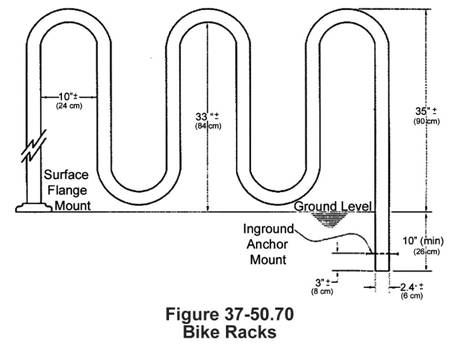
(Ord. No. 2463 (NCS).)
(Ord. No. 2507 (NCS), § 14, 5-18-2010)
(a)
Number of Small Parking Spaces Allowed. Small parking spaces, with dimensions of eight feet by sixteen feet, shall be allowed in accordance with Table 37-50.130. Such parking shall be dispersed throughout the parking lot:
Note:
* Applied to commercial use parking spaces only.
(b)
Dimension Requirements for Obstructed Spaces. Each parking space adjoining a wall, column, or other obstruction higher than one-half foot shall be increased by one foot on each obstructed side.
(c)
Vertical Clearance. Vertical clearance for parking spaces shall be seven feet. For residential uses, nonstructural improvements including wall-mounted shelves, storage surface racks, or cabinets may encroach into the vertical clearance in the front five feet of a parking space, provided a minimum of four and one-half feet of vertical clearance is maintained above the finished floor of the garage.
(d)
Wheel Stops. All spaces shall have wheel stops or a six-inch continuous concrete curb three feet from a building, fence, wall, or walkway. Concrete curbs are preferred over individual wheel stops for maintenance and safety concerns. When no pedestrian passage through the parking spaces is possible, a continuous six-inch concrete curb shall be provided. When a parking space abuts a landscaped planter, no curb is necessary provided that the planter is expanded three feet to allow the parked vehicle to overhang the planter. When a parking space abuts a sidewalk, a minimum of four feet of unobstructed travel path along the sidewalk shall be provided.
(e)
Dimension Requirements for Residential Garages and Carports. The minimum interior dimension (unobstructed) for two car garages or carports shall be twenty feet long by twenty feet wide.
(Ord. No. 2463 (NCS).)
(a)
Each parking space shall be independently accessible to aisles and driveways in accordance with Table 37-50.140:
(1)
Angle Parking. Parking dimensions and aisle widths for angle parking shall conform to the dimensions indicated in the table titled "Parking Space Requirements at Various Parking Angles."
(2)
Parallel Parking. Parking dimensions shall be eight feet by twenty-four feet. End stalls may be eight feet by twenty feet. Aisle shall be twelve feet for one-way aisles, and twenty-four feet for two-way aisles.
Notes:
(1) Excludes overhang allowance.
(2) Twenty-four-foot minimum aisle width for two-way circulation.
(3) The interior dimension requirements for residential garages and carports shall be subject to Section 37-50.410(e).
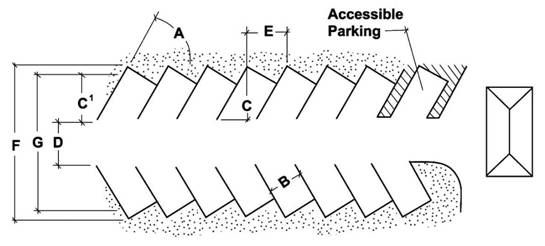
(Ord. No. 2463 (NCS).)
(a)
When an applicant can demonstrate to the satisfaction of the city planner the necessity for variations on the dimensions otherwise required by this division, a specific parking area design may be approved, subject to a site plan review, under the following limitations:
(1)
The area affected by the specific design shall be for parking by persons employed on the site only. Visitor parking spaces shall meet the dimensions required;
(2)
The surface area available for parking shall not be less than would be required to accommodate the minimum required number of spaces for large and small cars; and
(3)
The parking area design will not impede the flow of vehicles, reduce pedestrian safety, or hinder loading or unloading.
(Ord. No. 2463 (NCS).)
All spaces in a parking facility, except single-family dwelling units and dwelling units with up to two attached dwelling units shall be accessed via an internal driveway system which does not require a vehicle to re-enter or back over a public right-of-way to access the space unless it is determined by the city engineer to be physically impossible to provide for such access. However, an alley may be used as maneuvering space for access to off-street parking.
(Ord. No. 2463 (NCS).)
(a)
Driveway[s]. Driveways shall be designed pursuant to the following standards identified in Table 37-50.150 unless otherwise specified by the new urbanism (NU) districts, mixed use (MU) districts, focused growth overlay district, or central city overlay (downtown core area) district regulations:
Notes:
(1)
Driveways located within cul-de-sac "bulbs" or "knuckles" shall not exceed eighteen feet in width.
(2)
A maximum driveway frontage of seventy-five percent, including flares, shall be permitted on parcels with less than forty feet of street frontage and located within a cul-de-sac "bulb" or "knuckle."
(3)
A minimum of twenty feet of full height curb shall be maintained between driveways serving the same property.
(4)
Adjacent driveways on abutting properties may be combined if the total throat width of such combination does not exceed thirty feet.
(5)
No portion of any driveway shall be permitted between:
(A)
The points of curvature of any curb return; and
(B)
Between the point of intersection of extended curb lines and a point thirty feet therefrom; fifty feet therefrom for commercial and industrial parcels and/or uses; and one hundred fifty feet from an arterial street or as otherwise approved by the city engineer.
(6)
Circular ends of cul-de-sacs and curb radial over one hundred feet shall not be considered as curb returns for purposes of this section.
(7)
Minimum one-way driveway width may be increased if required for fire department access.
(8)
Residential single family dwelling unit driveway width may be increased to extend a maximum of ten (10) feet into the adjacent side yard from the existing driveway past the width of the garage into that portion of the required front yard that is on the opposite side of the garage as the front door of the dwelling unit, subject to the approval of a Minor Conditional Use Permit pursuant to Section 37-60.490(b).
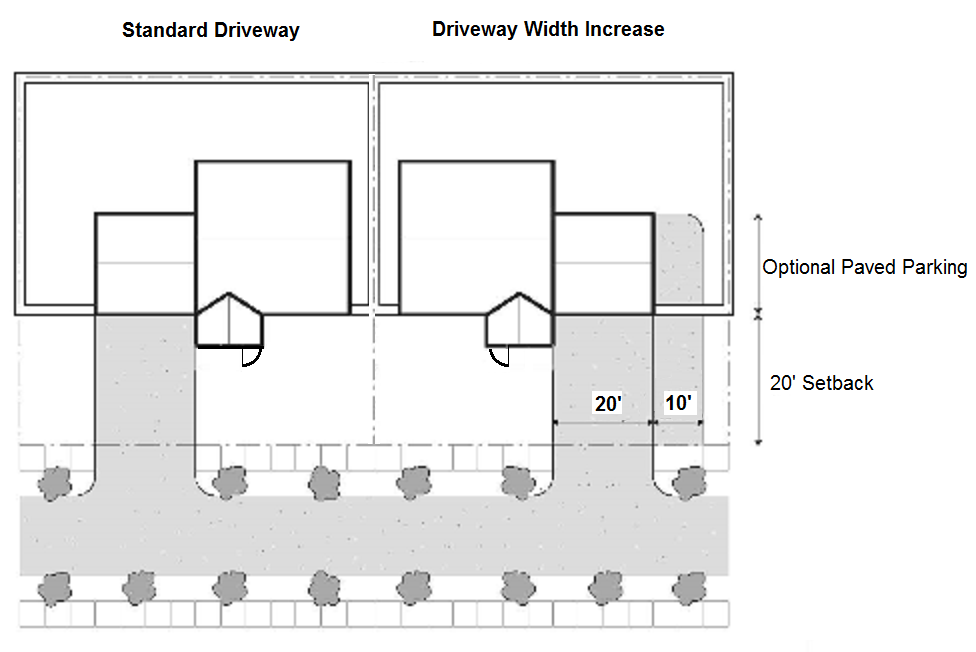
(b)
Street Access. Approval of the city engineer shall be required for the location of driveways for the following classification of traditional streets except as otherwise provided for in the specific plan located in the NU districts:
(1)
Major arterials: one hundred feet or more right-of-way;
(2)
Minor arterials: eighty-four feet of right-of-way or more;
(3)
Collectors: sixty feet to sixty-six feet of right-of-way; and
(4)
Local: sixty feet or less of right-of-way.
(c)
Driveway Clearance. No parking space shall be located so that a vehicle will maneuver within twenty feet of a vehicular entrance measured from the street property line. Deviations from this requirement may be considered in order to accommodate pre-existing conditions if approved by the city engineer and city planner, taking into consideration the effect on traffic flow both on and off-site.
(d)
Safe and Efficient Traffic Flow. The city engineer shall:
(1)
Give consideration to the effect of each driveway upon a safe and efficient flow of traffic upon the street and into and from each driveway;
(2)
Give consideration to the necessity of installing raised median islands at intersections where accidents and congestion may be caused by left turn movements into or from driveways, or across traffic lanes; and
(3)
Make certain that driveways are positioned to assure the best obtainable flow of street traffic, commensurate with the size and configuration of the property involved.
(e)
Variation from Regulations and Standards.
(1)
The city engineer may require driveways in excess of the above widths where unusual traffic, grade, or site conditions prevail.
(2)
The city engineer may approve narrower driveways to accommodate preexisting conditions and allow for adaptive reuse of older structures.
(Ord. No. 2463 (NCS).)
(Ord. No. 2507 (NCS), § 7, 5-18-2010; Ord. No. 2569 (NCS), § 12, 4-19-2016; Ord. No. 2627(NCS), § 1, 11-5-2019)
Visibility at street corners and at driveways connecting with a public street shall be maintained as an area of unrestricted visibility as follows (see Figure 37-50.80):
(a)
For Street Corners. That area between three feet and ten feet above grade which lies twenty-five feet from the intersection of the street rights-of-way measured along both the right-of-way lines, except in the central city overlay (downtown core area) district;
(b)
For Driveways. That area between three feet and ten feet above the driveway grade which lies fifteen feet from the intersection of the edge of the driveway and the property line measured along both the driveway and the property line;
(c)
Exceptions. The city planner may allow exceptions to the unrestricted visibility for street corners and driveways, following a determination by the city engineer that such exceptions will not adversely affect sight distance or pose a hazard to motorists and pedestrians.
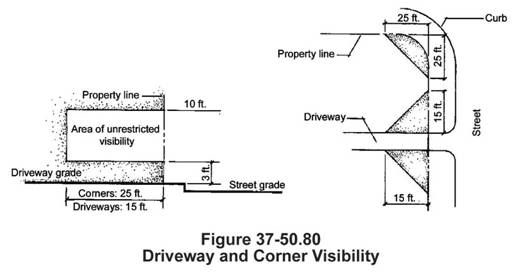
(Ord. No. 2463 (NCS).)
Parking lots shall be landscaped in accordance with Article V, Division 4: Landscaping and Irrigation.
(Ord. No. 2463 (NCS).)
The following shall apply to all on-site outdoor lighting:
(a)
Outdoor lighting shall employ cutoff optics that allows no light emitted above a horizontal plane running through the bottom of the fixture. Parking lots shall be illuminated to no more than an average maintained two and four-tenths footcandles at ground level with uniform lighting levels. All building-mounted and freestanding parking lot lights (including the fixture, base, and pole) shall not exceed a maximum of twenty-five feet (a maximum of forty feet in the IG district) in height in all districts. Illumination at an R or NU (NE, NG-1, and NG-2) district property line shall not exceed one-half footcandle maximum. Lighting adjacent to other property or public rights-of-way shall be shielded to reduce light trespass. No portion of the lamp (including the lens and reflectors) shall extend below the bottom edge of the lighting fixture nor be visible from an adjacent property or public right-of-way. A point to point lighting plan showing horizontal illuminance in footcandles and demonstrating compliance with this section shall be submitted for review and approval prior to issuance of a building permit.
(b)
In the IGC (industrial-general commercial) district, vehicle display areas associated with automobile sales and services may employ a light source of up to twenty-five feet in height maximum. Illumination within vehicle display areas shall not exceed fifteen footcandles at ground level during hours of operation; maximum footcandles shall not exceed five footcandles between 10:00 p.m. and 7:00 a.m. Illumination shall not exceed one-half footcandle at an adjacent R or NU (NE, NG-1, and NG-2) district boundary. Outdoor lighting shall be shielded or directed away from an R or NU (NE, NG-1, and NG-2) district.
(c)
Illumination levels for auto service station canopy lighting, which is located on the underside of the canopy, shall not exceed an average maintained twenty footcandles (maximum of thirty footcandles) with uniform lighting levels at ground level directly under the canopy. All canopy lighting shall be recessed so that no light is emitted above a horizontal plane running through the bottom of the lighting fixture. Illumination shall not exceed one-half footcandle at an adjacent R or NU (NE, NG-1, and NG-2) district boundary. Outdoor lighting shall be shielded or directed away from an R or NU (NE, NG-1, and NG-2) district and public rights-of-way. All parking lot and other building-mounted lighting shall conform with the above standards.
(d)
Outdoor lighting within the airport overlay district shall be subject to the provisions of Article IV, Division 7: Airport (AR) Overlay District.
(e)
Lighting in the focused growth overlay district, central city overlay (downtown core area) district, mixed use (MU), and new urbanism (NU) districts shall be supplemented by the lighting standards and regulations specified for these districts.
(Ord. No. 2463 (NCS).)
(Ord. No. 2569 (NCS), § 21, 4-19-2016)
(a)
Parking lots, parking structures, and driveways shall have paving, drainage, wheel stops, curbing, lighting, space marking, and directional signs, which shall be subject to approval of the city planner and the city engineer.
(b)
In reviewing the design of parking lots, parking structures, and driveways in connection with a zoning approval, the city planner or the planning commission, as the case may be, shall consider the compatibility of the design with adjacent buildings or uses.
(Ord. No. 2463 (NCS).)
Off-street loading spaces are subject to the following regulations:
(a)
Required spaces shall not be within a building, but shall be on the site of the use served or on an adjoining site.
(b)
On a site adjoining an alley, a required loading space shall be accessible from the alley unless the city planner and city engineer approve an alternative access.
(c)
A required loading space shall be accessible without backing a truck across a street property line unless the city engineer determines that provision of turn-around space is infeasible and approves alternative access.
(d)
An occupied loading space shall not prevent access to a required off-street parking space.
(e)
A loading area shall not be located in a required front or corner front yard.
(f)
Except in an I district, a loading area visible from a public or private street or right-of-way shall be screened on three sides by a landscape fence, landscape berm or wall, or hedge at least eight feet in height.
(Ord. No. 2463 (NCS).)
Prior to the construction of an off-street parking area for a nonresidential use or for multifamily dwellings with more than three dwelling units, a plan shall be submitted to the city planner for the purpose of indicating compliance with the provisions of this division. This plan shall include:
(a)
The location and placement of required landscaped areas, including a computation of the required area;
(b)
A planting plan including a list of plants by name and size keyed to their location on the parking area;
(c)
Location and description of fencing and architectural screen walls;
(d)
Layout and method of irrigation of landscaped areas;
(e)
Location and placement of parking stalls, including bumpers, striping, and circulation, directional signs, and all dimensions to permit comparison with approved parking standards;
(f)
Placement and illumination data of parking area lights; and
(g)
Method of drainage and compliance with NPDES requirements.
(Ord. No. 2463 (NCS).)
(a)
Purpose.
(1)
The following design standards are intended as a reference to assist the designer in understanding the city's goals and objectives for parking and loading design. These standards complement the parking and loading regulations contained in this division by providing good examples of potential design solutions and by providing design interpretations of various regulations.
(2)
The design standards are general and may be interpreted with some flexibility in their application to specific projects. The standards will be used in conjunction with a site plan review or conditional use permit, as applicable, to encourage the highest level of design quality while at the same time providing the flexibility necessary to encourage creativity on the part of project designers.
(3)
Projects located within the new urbanism (NU) districts, mixed use (MU) districts, central city overlay (downtown core area) district, or focused growth overlay district are also subject to the parking design standards contained in those sections. Where conflicts between the standards in this section and the parking design standards in the new urbanism districts, mixed use districts, central city overlay (downtown core area) district, or focused growth overlay district exist, the parking standards in those districts shall prevail.
(b)
General Design Principles. A well designed parking facility depends on a variety of desirable elements, including:
(1)
Ease and convenience for drivers, bicyclists, and pedestrians;
(2)
The best utilization of available space;
(3)
Ease of access;
(4)
Good internal circulation;
(5)
Easy parking maneuvers;
(6)
Nearby and accessible public transit;
(7)
Vehicular and pedestrian safety; and
(8)
Well designed landscaping and lighting.
(c)
Access.
(1)
Locate driveways with left-turn entry/exit movements paying special attention to their location relative to the nearest point of street traffic control, especially a signal. Left turn movements can provide unique and special challenges.
(2)
Locate driveways with right-turn entry/exit movements paying special attention to their location relative to street traffic control. Such movements may not impede through traffic.
(3)
Driveway throat distance shall be sufficient to prevent vehicles from backing into the public street.
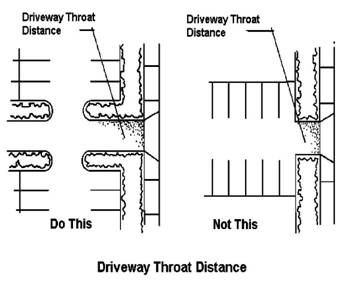
(4)
Driveway design shall be directly related to the layout of the parking area, amount of reservoir space (e.g., drive-through or drive-in service facilities), type of loading facilities, circulation pattern, placement of any buildings, and relation to the design of the public street, traffic control devices, traffic volumes, and placement of other driveways.
(5)
Avoid locating entry and exit points where vehicles entering or leaving the site would conflict with large numbers of pedestrians.
(6)
The number of access points should be limited to only those absolutely necessary to serve the property and to minimize the number of potential conflict points with public streets.
(7)
Driveway throat distance shall be sufficient to minimize any effect on traffic movements on adjacent streets.
(8)
Access roads and aisles for parking should be kept at the maximum distance possible from residential dwelling units.
(d)
Parking Lot Layout.
(1)
When feasible, segregate employee parking from customer parking.
(2)
When feasible, larger parking lots shall be broken into smaller parking modules to reduce the size and visual impact of expansive parking areas.
(3)
Minimize the number of continuous parking spaces without interruption.
(4)
Consolidated parking lots for multiple uses are encouraged where practical.
(5)
Parking shall be designed so that backing and turning movements associated with parking layout will not obstruct or conflict with traffic, either on- or off-site.
(6)
Parking lots shall be designed with adequate room to allow vehicles to turn around within the parking lot and enter an adjoining street in a forward direction.
(7)
Parking shall be provided with concrete curbs, wheel stops, or other barriers to prevent vehicles from extending beyond the perimeter of the parking lot and to prevent vehicles from contacting a wall, a fence, or a sidewalk.
(8)
Access aisles shall be designed to allow the user to walk directly toward, rather than parallel to, the building front.
(9)
End islands shall be used to enhance the functional and aesthetic qualities of a parking lot in the following ways:
(A)
Delineating on-site circulation roadways;
(B)
Ensuring adequate sight distance at the intersections of the parking aisles and driveways;
(C)
Defining the area and geometry of intersections of parking aisles and driveways;
(D)
Protecting the vehicle at the end of a parking bay; and
(E)
Providing aesthetic enhancement of the site design.
(10)
When feasible, parking lots shall be located behind or to the rear of buildings. Parking areas shall not dominate the street frontage.
(e)
Parking Spaces.
(1)
In multifamily dwelling unit developments parking lots, parking spaces shall be generally located to protect the privacy of residents by providing buffers, e.g., fences, walls, or landscaping, from the effects of engine noise, automobile headlights, and vehicle fumes.
(2)
Multifamily dwelling unit parking spaces shall be generally located no further than one hundred fifty feet from the entrance to each dwelling unit to avoid cars from parking on the street unless approved by the city planner.
(3)
Whenever feasible all parking spaces shall be aligned with the same orientation. Having one section at right angles to another tends to create confusion and can produce accident-prone intersections.
(f)
Loading.
(1)
Loading and unloading facilities shall take place on site and not on public right-of-way. There shall be no backing of vehicles onto the public right-of-way from loading areas.
(2)
Loading facilities shall be screened from public entrances, view of public rights-of-way, and other highly visible areas of the site in accordance with the requirements of the base zoning district regulations. Adequate turn-around and backing areas shall be provided without disruption of circulation or parking facilities.
(g)
Lighting.
(1)
All parking lots and loading facilities shall be shielded so that substantially all the directly emitted light falls within the property line;
(2)
No illumination is to be designed or used which produces direct, incident, or reflected light that interferes with the safe movement of motor vehicles on public streets, including any light fixture not designed for street illumination which produces light that could interfere with the operation of a motor vehicle;
(3)
Any light that may be confused with or construed as a traffic control device; or
(4)
Any animated, flashing, or changing intensity lights, except for temporary holiday displays.
(h)
Pedestrian.
(1)
A system of interior pedestrian paths or sidewalks integrated with the parking lot shall link the different parts of the development with one another and with transit stops.
(2)
Provide clearly discernible pedestrian walkways where there is adequate vehicular sight distance. The use of textured or colored pavement and signage shall be used and shall comply with ADA/Title 24 Requirements.
(i)
Transit.
(1)
Large-scale commercial developments and employment centers shall provide transit access as near as possible to the main entrance to the facility.
(2)
Transit stops should be designed as an integrated component of the site and feature pedestrian amenities and shelter. Secured transit information centers or kiosks with bus routes and schedule information should be provided.
(3)
Nonresidential development shall orient the front or main entrance to the facility toward major streets with transit facilities.
(4)
When parking areas separate the front or main entrance to the facility from the transit facility, a separate pedestrian walkway or sidewalk should be provided.
(5)
Bus stop layout shall be designed in accordance with MST (Monterey-Salinas transit) guidelines in effect at the time of development and shall be subject to the approval of the city engineer.
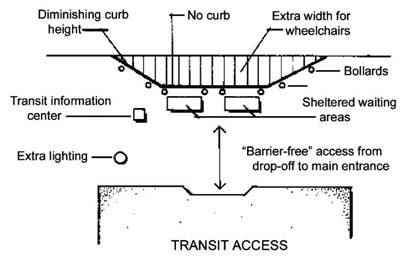
(j)
Bicycles.
(1)
Bicycle parking facilities shall be located adjacent to the building entrance it serves. Those facilities located in parking lots and parking structures shall be located in areas closest to the building.
(2)
Bicycle parking facilities shall be located outside of a vehicular or pedestrian way and be protected and separated from motor vehicle traffic and parking lots by a five-foot separation distance, curb, or other physical barrier.
(3)
Bicycle parking facilities should be made out of a durable and strong material, be permanently anchored to the ground, and be designed so as to allow bikes to be locked to it.
(4)
Bicycle parking facilities shall be sufficiently illuminated.
(k)
Landscaping. See Section 37-50.690(g): Parking Lot Landscaping.
(Ord. No. 2463 (NCS).)
The purpose of this division is to establish uniform sign regulations that are intended to:
(a)
Implement the city's community design and safety standards as set forth in the general plan;
(b)
Maintain and enhance the city's appearance by regulating the design, character, location, number, type, quality of materials, size, illumination, and maintenance of signs;
(c)
Protect and improve pedestrian and vehicular traffic safety by balancing the need for signs which facilitate the safe and smooth flow of traffic (e.g., traffic directional signs) without an excess of signage which may distract motorists, overload their capacity to quickly receive information, visually obstruct traffic signs, or otherwise create congestion and safety hazards;
(d)
Eliminate the traffic safety hazards to pedestrians and motorists posed by off-site signs bearing commercial messages;
(e)
Generally limit commercial signage to on-site locations in order to protect the aesthetic environment from the visual clutter associated with the unrestricted proliferation of signs, while providing channels of communication to the public;
(f)
Allow the communication of information for commercial and noncommercial purposes without regulating the content of noncommercial messages;
(g)
Allow the expression of political, religious, and other noncommercial speech at all times and allow for an increase in the quantity of such speech in the period preceding elections;
(h)
Respect and protect the right of free speech by sign display, while reasonably regulating the structural, locational, and other noncommunicative aspects of signs, generally for the public health, safety, welfare, and, specifically, to serve the public interests in traffic and pedestrian safety and community aesthetics;
(i)
Minimize the possible adverse effects of signs on nearby public and private property;
(j)
Serve the city's interests in maintaining and enhancing its visual appeal for tourists and other visitors, by preventing the degradation of visual quality which can result from excess signage;
(k)
Defend the peace and tranquility of residential zones and neighborhoods by prohibiting commercial signs on private residences, while allowing residents the opportunity, within reasonable limits, to express political, religious, and other noncommercial messages from their homes; and
(l)
Enable the fair, consistent, and efficient enforcement of the sign regulations of the city.
(Ord. No. 2463 (NCS).)
The following definitions shall apply to this division:
Abandoned Sign. A sign that no longer directs advertises or identifies a legal business establishment, product, or activity on the premises where such sign is displayed.
Alteration (Sign). To make a change in the exterior appearance or the supporting members of a structure, such as bearing walls, columns, beams, or girders that will prolong the life of the structure.
Animated Sign. Any sign, which is designed to give a message through a sequence of progressive changes of parts or lights or degree of lighting.
Area of Sign. The surface area of a sign as measured in accordance with Section 37-50.610: Measurement of sign area and height.
Awning. A roof-like structure, attached to and supported entirely by the exterior wall of a building, often made of canvas or similar material that serves as a shelter over a storefront, window, door, or deck.
Awning Sign. A sign painted or printed on or attached flat or otherwise incorporated onto the valance of an awning.
Banner. A visual display device, with or without copy, usually rectangular in shape made of flexible material, usually cloth, paper, or plastic.
Building Signs. All signs mounted, painted, or otherwise attached to a building such as wall signs, projecting/blade signs, hanging signs, awning and canopy signs, multistory tenant identification signs, marquee signs, and window signs. Excludes freestanding signs.
Cabinet Sign. See "Can-type Sign."
Canopy. A permanent projecting roof-like structure (other than an awning) with or without ground supports extending from part or all of a building face that serves as a shelter over a storefront, window, door, or deck.
Canopy Sign. A sign painted or printed on or attached flat or otherwise incorporated onto a canopy. Does not include hanging signs that are suspended from or below a canopy.
Can-type Sign. A sign affixed to, or an integral part of, a cabinet, which is designed as a single unit.
Changeable Copy Sign. A sign which in which the copy is changed manually or electrically.
Channel Letters. Individual letters or figures, illuminated or nonilluminated, affixed to a building or freestanding sign structure.
Commercial Signage or Commercial Message. Any sign or sign copy with wording, logo, color, or other representation that, directly or indirectly, names, advertises, or calls attention to a business, product, service, or other commercial activity, or which proposes a transaction or relates primarily to commercial interests.
Construction Sign. A temporary sign identifying the persons, firms or businesses directly connected with a construction or development project.
Directional Sign. A sign that provides information or direction to the viewer and contains no advertising message. Excludes menu and pre-menu boards.
Electronic Readerboard. A changeable copy sign consisting of a matrix of lamps that are computer controlled.
Fascia. A flat usually horizontal member of a building having the form of a flat band or broad fillet used as a molding covering the joint between the top of a wall and the projecting eaves.
Flashing Sign. An illuminated sign, which contains an intermittent or sequential flashing light source or any other such means to attract attention. This definition is not intended to include changeable copy signs or animated signs.
Freestanding Sign. A sign supported by the ground, landscape/hardscape features, or by freestanding frames, braces, or poles, and not attached to any building. This includes signs that are detached from a building, pole signs, and monument signs.
Grand Opening. A promotional activity not exceeding thirty calendar days used by newly established businesses to inform the public of their location and services.
Ground Sign. See "Freestanding Sign."
Hanging Sign. A sign that is suspended below or from a canopy or marquee.
Incidental Sign. A small sign pertaining to goods, products, services or facilities that are available on the premises where the sign occurs and intended primarily for the convenience of the public. Examples include "Open for Business" signs, hours of operation signs, credit card acceptance signs, and the like.
Indirect Illumination. A light cast on the surface of a sign from an exterior source.
Interior Illumination. Any sign face that is lit from the inside.
Item of Information. Each word, design, symbol, or figure used within a sign.
Logo. A registered trademark, copyright, brand name, or symbol of an organization or business designed for ready recognition by the public.
Marquee. See "Canopy."
Marquee Sign. A changeable copy sign located on or affixed to a canopy for a theater or cinema.
Menu Board Sign. A changeable copy sign displayed in conjunction with a drive-through or drive-in business, which advertises the goods, products, or services offered for sale, and which is provided as a convenience for on-site customers using the drive-through or drive-in lane.
Monument Sign. A low profile freestanding sign with a solid base intended to be viewed at eye level.
Moving Sign. Any sign or device that has any visible moving part, visible revolving part, or visible mechanical movement.
Mural Exhibits. See Section 37-50.150: Mural exhibits for this definition.
Noncommercial Message Sign. Any sign, which is intended to convey a noncommercial message including, by way of example and not limitation, commentary on social, political, educational, religious, scientific, artistic, philosophical, or charitable commentary subjects. It also includes signs regarding fund raising or membership drive activities for noncommercial or nonprofit concerns.
Occupancy Frontage. The lineal length of a building wall (excluding eaves, awnings/canopies, or roof overhangs) that faces a public or private street, an alley, a pedestrian plaza, walkway, drive aisle, or parking area, shall be considered the occupancy frontage, except for building walls that face an R district. For buildings that do not face a public or private street, alley, or which have multiple nonresidential tenant occupancies (such as shop buildings), the exterior portion of the building wall which fronts a pedestrian plaza, walkway, drive aisle, or parking area, and provides the primary pedestrian (public) entrance to the tenant shall be considered an occupancy frontage.
Open House Sign. A sign that identifies a building for sale or lease, which is open and available for inspection by the public.
Off-site Sign. Any sign that advertises goods, products, services, or facilities not sold, produced, manufactured, or furnished on the premises on which the sign is located. These signs are also known as outdoor advertising, off-site subdivision directional or advertising signs, off-site open house signs, and billboards.
On-site Sign. Any sign that advertises goods, products, services, or facilities sold, produced, manufactured, or furnished on the premises on which the sign is located.
Plaque Sign. A sign attached to a building that designates the name and/or address of a business or the words entrance or exit.
Pole Sign. See "Freestanding Sign."
Portable Sign. Any movable sign not permanently attached to the ground or a building including a human sign.
Projecting/Blade Sign. A sign that is attached to and projects from the structure or building face and is not parallel to the structure to which it is attached.
Public Service Information Sign. Any sign intended primarily to promote items of general interest to the community such as time, temperature, date, atmospheric conditions, news, traffic control, and the like.
Real Estate Sign. Any temporary sign pertaining to the sale, exchange, lease, or rental of land or buildings.
Roof Sign. Any sign erected upon or above a roof or parapet wall of a building.
Rotating Sign. Any sign, or portion thereof, that physically revolves about an axis.
Sign or Signage. A visual communications device used to convey a message to its viewers. A sign shall mean and include every advertising message, announcement, declaration, insignia, color, surface, or space erected or maintained in view of the observer thereof for identification, advertisement, or promotion of the interests of any person, entity, product, or service.
Sign Area. The total area used for the display of a sign as determined by Section 37-50.610(a): Sign Area.
Sign Copy. Any words, letters, numbers, figures, designs, graphics, colors (including background colors), or other symbolic representation incorporated into a sign for the purpose of attracting attention.
Shop Building. A building, typically located in a shopping center, that has two or more separate and clearly distinct tenant spaces or occupancies that share common parking, landscaping, and other exterior amenities. A defining characteristic of this type of building is that each space or occupancy has its own public entrance that opens directly to the outside of the building rather than into an interior common area or hall. Excludes buildings with multiple tenants in the same space or suite, enclosed shopping malls, and indoor swap meets.
Street Frontage. See Article I, Division 2: Section 37-10.430: "S" definitions for this definition.
Subdivision Directional Sign. A temporary sign providing direction to a land development project within the city pursuant to this division.
Temporary Sign. A sign that is installed or erected for a limited time period in conjunction with the duration of a specific event or activity as specified elsewhere in this division or, for a maximum of thirty days each calendar year unless specified elsewhere.
Temporary Window Sign. A sign painted or constructed of paper or other lightweight material and affixed to the interior or exterior side of a window or glass area on a building for a limited time.
Wall Sign. Any sign posted, painted, or suspended from or otherwise affixed to the wall or fascia of any building or structure in an essentially flat position or with the exposed face of the sign in a plane approximately parallel to the plane of such a wall.
Window Sign. A sign applied directly to the window of a business.
(Ord. No. 2463 (NCS).)
(Ord. No. 2569 (NCS), § 13, 4-19-2016)
Signs shall only be erected or maintained in any zoning district in compliance with this division. The sign regulations outlined in this division are intended to be maximum standards. The sign design standards are intended to ensure the architectural and visual compatibility of signs. Therefore, the review and approval of sign permits and master sign plan in compliance with Section 37-50.570: Sign permits and master sign plan required shall be consistent with the sign regulations and design standards of this division.
(Ord. No. 2463 (NCS).)
(a)
Owner's Consent Required. The consent of the property owner is required before any sign may be displayed on any real or personal property within the city. In the case of public property, the owner's consent shall be pursuant to a policy adopted by the city council.
(b)
Substitution of Noncommercial Message. Subject to the owner's consent, a noncommercial message of any type may be substituted for all or part of the commercial or noncommercial message on any sign allowed pursuant to this division.
(c)
Substitution of Commercial Messages. Replacing sign copy on a commercial sign due to age, wear, or other aesthetic or safety purposes, or replacing the sign copy panel of an existing can-type sign with sign copy panel of the same size which requires no other modifications in the location, height, or size of the sign cabinet or support structure, or other structural, attachment, or electrical modifications shall not require a sign permit. This substitution provision does not allow the free substitution of a commercial message in a place where only a noncommercial message is allowed.
(d)
Legal Nature of Sign Rights and Duties. All rights, duties, and responsibilities related to permanent signs attached to the land on which the sign is mounted, affixed, or displayed and run with the land or personal property. The city may demand compliance with this division and with the terms of any sign permit from the permit holder, the owner of the sign, the property owner, or the person mounting the sign.
(e)
Transfer of Signage Rights. Rights and duties relating to permanent signs may not be transferred between different parcels of real property except as part of a master sign plan approved for a shopping center or multi-parcel development. All duly issued and valid sign permits for permanent signs affixed to land shall automatically transfer with the right to possession of the real property on which the sign is located.
(f)
Sign Authorized by Lease Agreement with the City. Signs authorized by lease agreement with the city are not subject to the requirements of this section because the city council has determined such signs are proper and in the public interest due to the unique services or other benefit they provide the community.
(Ord. No. 2463 (NCS).)
(a)
Sign Permit. No sign unless otherwise exempt by this division shall be erected, constructed, displayed, or structurally altered unless a sign permit (or other applicable permit as required by this division) is approved by the city planner authorizing the sign in accordance with the following:
(1)
Application Filing. Sign permit applications (including temporary permits) shall be filed on the forms provided by community planning and development and shall include all information described in the city's sign permit application instructions (and other applicable application requirements as required by this division), and the required filing fee.
(2)
Review and Decision. A sign permit shall be approved or disapproved by the city planner in compliance with Section 37-50.570(c) below. The following additional conditions for review may apply:
(A)
The sign permit or temporary sign permit shall contain any conditions on which approval was granted.
(B)
The city planner may require submittal of a master sign plan in accordance with Section 37-50.570(c) below prior to approval of a sign permit.
(C)
The city planner may allow exceptions to these sign regulations as part of a master sign plan, or where such signs would be consistent with Section 37-50.620(h): Highway Signs, or where such exceptions would allow signs that would be better integrated with the architecture or historic character of the existing or proposed building, the project site, or the surrounding neighborhood.
(D)
For temporary signs (that are not exempt) complying with the sign area and sign standards of this article, the city planner may issue a temporary sign permit for up to thirty days, if it is found that the temporary sign is necessary to establish or maintain identity until a permanent sign can be erected. The city planner may approve a temporary sign necessary to avoid a dangerous condition, and may approve temporary signs pertaining to a use permitted by a temporary use of land permit.
(E)
No permit for any sign shall be issued by any department, official, or public employee of the city without meeting the requirement of this division, and any permit issued that does not comply with the requirements of this division shall be null and void. It shall be the duty of the city planner to enforce the provisions of this division pertaining to the use of any property for a sign.
(b)
Master Sign Plan. A master sign plan shall be required for any site having two or more nonresidential tenants and shall be submitted and approved by the city planner prior to the issuance of any sign permit. The master sign plan must be approved by the city planner prior to issuance of a sign permit.
(1)
Applications for a master sign plan shall be submitted to community planning and development and shall include the following:
(A)
A site plan drawn to scale, delineating the site proposed to be included within the signing program, the lineal street frontage of the site, the lineal occupancy frontage of all buildings, and the locations of all existing and proposed signs;
(B)
Drawings indicating the exterior surface details (elevations) of all buildings on the site on which wall signs, directory signs, or projecting signs are proposed (including any existing signs to be retained);
(C)
Drawings indicating typical sign design, height, colors, faces, and methods of construction (including method of attachment for wall signs) for all proposed signs;
(D)
A statement of the reasons for any requested modifications to the regulations or standards of this division;
(E)
A summary indicating the maximum total sign area allowed for the site, the sign area of all existing signs, the allocation of the sign area by sign type (freestanding, building, directional, etc.), and location in the development; and
(F)
The plan shall have provisions for sign maintenance and removal, replacement of nonconforming signs, and other items as determined by community planning and development.
(2)
A master sign plan may include deviations from the standards of this article, provided that the total sign area shall not exceed the area otherwise permitted by Section 37-50.620: On-site sign regulations for both building and freestanding signs, unless consistent with the provisions of the highway signing plan. In approving a master sign plan, the city planner shall determine that such master sign plan:
(A)
Would be consistent with the style and character of existing signs on the site;
(B)
Would be compatible with the character of signs on adjacent properties;
(C)
Would not detract or adversely impact the use and enjoyment of adjacent properties; and
(D)
Would not have an adverse impact on the safe and efficient movement of vehicular or pedestrian traffic.
(3)
The city planner may require any reasonable conditions necessary to carry out the intent of the master sign plan requirement.
(4)
An alternate means of compliance with this section may be approved by the city planner.
(5)
A master sign plan may be part of a site plan review, a conditional use permit, or a planned unit development. If such an application requires the approval of the planning commission or city council, that approval authority may approve the master sign plan in lieu of the city planner.
(6)
The applicant may appeal a decision of the city planner to the planning commission in accordance with Article VI, Division 17: Appeals.
(c)
Findings for Approval. The city planner may approve and/or modify a sign permit, temporary sign permit, or master sign plan application in whole or in part, with or without conditions, only if the following findings are made:
(1)
The proposed sign is permitted within the zoning district and complies with all applicable provisions of this chapter, and any other applicable standards;
(2)
The sign is in proper proportion to the structure or site on which it is located and as an identification device does not excessively compete for the public's attention;
(3)
The sign materials, color, texture, size, shape, height, and placement are compatible with the design of the structure, property, and neighborhood of which it is a part;
(4)
The sign's illumination is at the lowest reasonable level to ensure adequate identification and readability, as determined by the city planner, and is directed solely at the sign or is internal to it;
(5)
The sign is not detrimental to the public interest, health, safety or welfare; and
(6)
The sign is in compliance with Section 37-50.640: Sign design standards.
(Ord. No. 2463 (NCS).)
A sign permit shall not be required for exempt signs. Such signs shall be exempt from the regulations and design standards of this division except for those regulations related to prohibited sign locations in Section 37-50.590: Prohibited signs. Exempt signs include:
(a)
Traffic, danger, emergency, or other municipal signs;
(b)
Official notices of any court, public body, utility, or public or quasi-public agent or officer, or any person giving legal notice as required by law;
(c)
Any signage required by state or federal law or local ordinance to be affixed to a vehicle;
(d)
Street address numbers;
(e)
Monumental citations, commemorative tablets, and the like made an integral part of the structure, and not exceeding twenty square feet in sign area;
(f)
Temporary on-site barricades and other signs within commercial and industrial districts that inform the public of potential hazards resulting from construction or remodeling activities occurring on the same site as the temporary barricades are located. These signs must be removed at the time of the completion of the construction or remodeling activities;
(g)
One temporary construction sign with a maximum sign area of sixty-four square feet per street frontage and not exceeding a maximum of eight feet in height located on a construction site during the course of construction and which is removed prior to final occupancy of the building;
(h)
One temporary on-site real estate sign per street frontage that advertises the sale, lease, or rental of a structure or land, per Table 37-50.160. If freestanding, the sign shall not exceed six feet in height. The sign shall be removed within fifteen days following the sale, lease, or rental of the property;
(i)
One temporary on-site open house sign, not exceeding six square feet in area. If freestanding, the sign shall not exceed four feet in height. An open house sign may be erected only on the day on which the property is available for public showing. Portable signs are permitted for use as open house signs;
(j)
Two temporary off-site directional open house signs per parcel being offered for sale. Such off-site real estate signs may be erected only on the day(s) on which the property is available for public showing and may not exceed six square feet each and, if freestanding, four feet in height. Such a sign may not be located on a wall or fence in the public right-of-way, on a utility pole, nor on a public sidewalk, street, median strip, traffic island, or public landscaped area. Only one sign per parcel being offered for sale may be placed at any intersection. Portable signs are permitted for use as open house signs;
(k)
On-site parking and other directional signs, not exceeding one double-faced sign per entrance and not exceeding six square feet in total sign area and four feet in height or ten square feet if more than one hundred feet from a public way, subject to review and design approval by the city planner. If the sign is not readable from a public or private street there shall be no limitation on the number of direction signs within a site. Directional signage may not include advertising materials;
(l)
One on-site official state inspection sign constructed of a permanent material for each type of inspection service offered on-site, located flat against the wall of a building, and not exceeding four square feet in area;
(m)
Signs manufactured as a standard, integral part of a mass-produced product accessory to a commercial or public or semipublic use, including telephone booths, vending machines, automated teller machines, and gasoline pumps;
(n)
Credit card, trading stamp, or trade association signs not exceeding one-half square foot each;
(o)
Governmental flags of any governmental entity;
(p)
Signs located within the interior of buildings and structures (including enclosed malls) that are not visible from the outside of such building or structure;
(q)
Window signs not exceeding twenty-five percent of the visible area of a window in a C, PS, MU, NU (VC), or I zoning district;
(r)
Holiday lights and displays not advertising a product or sale on-site, erected no sooner than forty-five days before the holiday and removed within fourteen days following the holiday;
(s)
Non-helium-filled balloons of a nonadvertising nature and not exceeding two feet in any dimension, used for decorative purposes for not more than twenty days during a calendar year to celebrate a special event;
(t)
Plaque signs not exceeding one square foot in area;
(u)
Temporary noncommercial message signs, not exceeding thirty-two square feet may be placed on private property or in a portion of the public right-of-way located between the sidewalk and the right-of-way line of a parcel or lot as permitted by Chapter 3 of the Salinas Municipal Code, in any zoning district, for a maximum of ninety days prior to an election. Such signs shall be removed within ten days after the election; however, signs posted in conjunction with a primary election may be maintained until ten days following the final election. In the event of cancellation or postponement of an election, such signs shall be removed within ten days following the official action declaring the election canceled or postponed;
(v)
Works of art containing no advertising matter;
(w)
[Reserved];
(x)
Temporary signs and banners for the noncommercial promotion of civic, charitable, religious, educational, or service organizations are permitted in any zoning district when the signs are erected no earlier than thirty days prior to the event and removed within ten days after completion of the event. Such signs shall not exceed sixteen square feet in any A, R, NU (NE, NG-1, or NG-2), P, OS, or PS district, or thirty-two square feet in any C, MU, NU (VC), or I district. Such signs promoting the same event shall be located no closer than twenty-five feet from each other;
(y)
Two on-site freestanding or wall menu/pre-menu board signs not exceeding a maximum fifty square feet in total sign area and a maximum of eight feet in height for commercial drive-through or drive-in uses.
(z)
Projecting/Blade Signs and Hanging Signs: One on-site two-sided, pedestrian oriented, blade sign not exceeding a maximum of four square feet per sign face, which may include advertising material including logos and business names in accordance with Section 37-50.610: Measurement of sign area and height; subject to city planner approval and building permit issuance, sign must comply with California Building Codes in effect at the time of submittal.
(aa)
Business Directory Signs: One wall-mounted single-sided, pedestrian oriented business directory sign not exceeding four square feet may be permitted per building access frontage.
(bb)
Awning Signs: Awning signs affixed to the flap of the awning not exceeding a maximum of four square feet in area. In the event the awning does not incorporate a flap into its design, an exempt awning sign may be located on the lowest ten inches of the awning.
(Ord. No. 2463 (NCS).)
(Ord. No. 2507 (NCS), §§ 3, 5, 5-18-2010)
The following signs are prohibited:
(a)
Canvas signs (excluding awning signs), banners, pennants, flags, streamers, balloons, or other temporary or wind signs except as otherwise provided in Sections 37-50.580: Exempt signs, 37-50.620: On-site sign regulations, and 37-50.630: Off-site sign regulations of this division;
(b)
Mobile, A-frame, and portable signs except as provided in Section 37-50.580: Exempt signs;
(c)
Roof or canopy signs extending above a building roof, except that with approval of a master sign plan, a wall sign may be architecturally integrated into a sloping roof fascia or mansard roof;
(d)
Signs that resemble any official marker erected by the city, state, or any governmental agency, or that, by reason of position, shape, color, or illumination would conflict with the proper functioning of any traffic sign or signal or would be a hazard to vehicular or pedestrian traffic;
(e)
Signs which produce odor, sound, smoke, fire, or other such emissions;
(f)
Animated signs, flashing signs, moving signs, or rotating signs, except as otherwise allowed in this division;
(g)
Window signs that exceed twenty-five percent of the visible window glass panel area of a window;
(h)
Off-site advertising signs except as provided for in Section 37-50.630: Off-site sign regulations;
(i)
Signs advertising commercial uses, day care homes, residential care facilities, and similar uses on sites where the principal use is a residential dwelling unit unless otherwise allowed in accordance with state law.
(Ord. No. 2463 (NCS).)
(a)
At street intersections, no sign shall create a visual obstruction within a vertical space between three feet above the adjacent curb and a maximum height of ten feet above the adjacent curb, which area lies between the intersecting street right-of-way lines, twenty-five feet from the point of their intersection, or the intersection of the prolongation of such right-of-way lines.
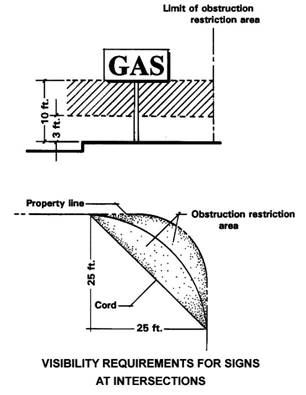
(b)
No sign shall be affixed to any vehicle or trailer on a public right-of-way or public or private property unless the vehicle or trailer is currently and regularly being used in its normal business capacity and is not for the sole purpose of attracting business.
(c)
The city engineer may require additional offset or setback than identified in this section to clear site visibility when a site visibility analysis indicates the need for such additional clearance to promote public safety.
(Ord. No. 2463 (NCS).)
For the purposes of determining compliance with this division, the area and height of signs shall be measured as provided below.
(a)
Sign Area. The area of a sign shall be computed as follows:
(1)
Wall, Awning, Marquee, Canopy, and Window Signs. Sign area shall be computed by measuring the square or rectangle that will encompass the extreme limits of the writing, graphic representation, emblem, or other display, together with any material or color forming an integral part of the background of the message or display or otherwise used to differentiate the sign from the backdrop or structure against which it is placed including any supporting framework. When signs are composed of individual elements, the area of all sign elements, which together convey a single complete message, shall be considered a single sign (see Figure 37-50.90A).
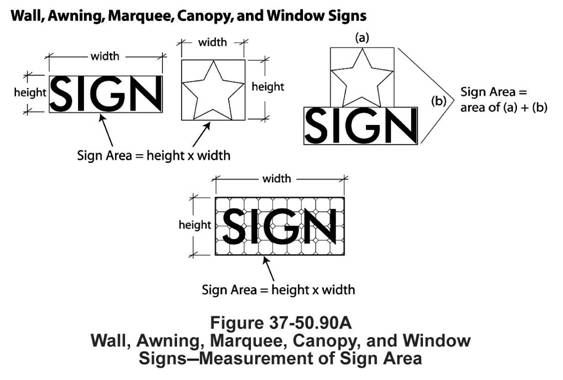
(2)
Monument Signs. Sign area shall be computed by measuring the entire area contained within the frame or cabinet but excluding the monument base if it contains no advertising and is clearly distinguishable from the sign copy area through the use of different texture, color, and design (see Figure 37-50.90B).
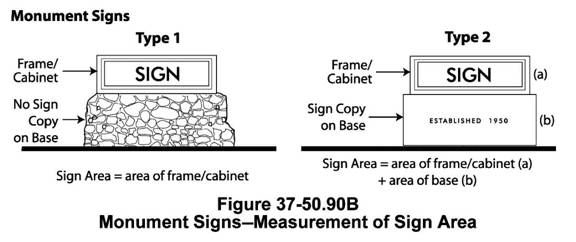
(3)
Projecting/Blade Signs and Hanging Signs. Sign area shall be computed by measuring the entire area contained within the frame or cabinet (see Figure 37-50.90C).
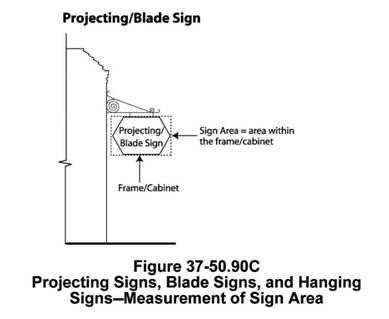
(4)
Pole Signs. Sign area shall be computed as the entire area of the surface(s) upon which the sign message is placed including the supporting column(s) if decorated or displayed with advertising (see Figure 37-50.90D).
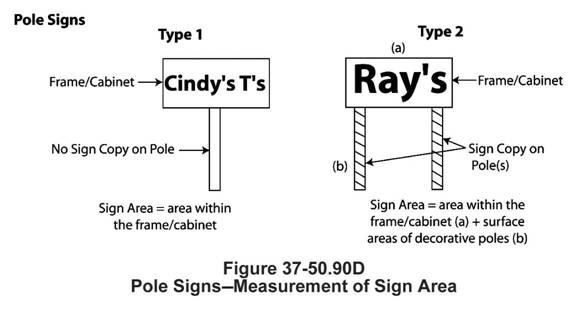
(5)
Multifaced Signs. The sign area for a two-sided or multifaced sign shall be computed by adding together the area of all sign faces (see Figure 37-50.90E).
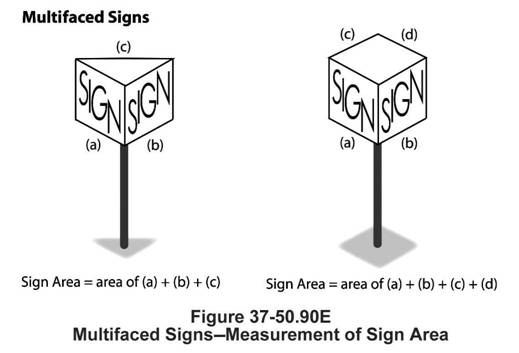
(6)
Flags, Banners, Pennants, etc. Sign area shall be computed as the surface area of both sides of the flag or pennant. For banners, the side(s) containing sign copy shall be counted as sign area (see Figure 37-50.90F).
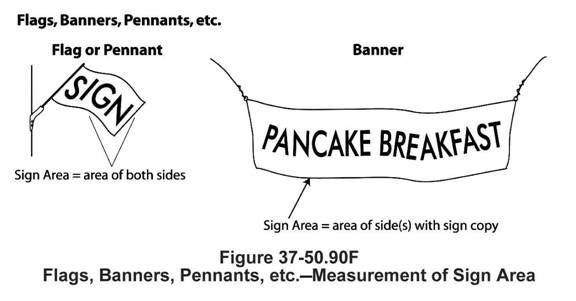
(b)
Sign Height. Sign height shall be measured as the greatest vertical distance from the finished grade adjacent to the sign footing or wall or below a suspended sign, to the top of the sign, including the support structure and any design elements (see Figure 37-50.100).
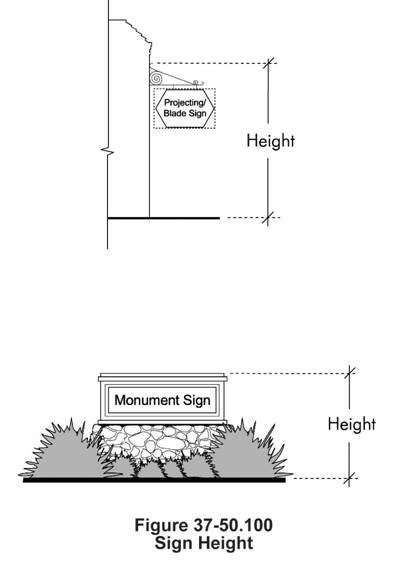
(Ord. No. 2463 (NCS).)
The following regulations shall apply to all on-site nonexempt signs in each zoning district. Such signs shall require a sign permit unless otherwise indicated in this division:
(a)
Maximum Sign Area for Building and Freestanding Signs. The maximum sign area and height allowed for building and freestanding signs on a site shall be as identified in Table 37-50.170 and shall be subject to the following:
(1)
The maximum sign area allowed for building signs shall be calculated based on the occupancy frontage of a building. A maximum of two occupancy frontages shall be used to determine the total maximum sign area allowed for building signs. Where a building has multiple occupancy frontages, the applicant shall determine which occupancy frontages shall be used to calculate the maximum building sign area. The maximum sign area for building signs may be allocated to any occupancy frontage as determined by the applicant.
(2)
The maximum sign area allocated for building signs may be distributed among wall signs, projecting/blade signs, awning and canopy signs, hanging signs, marquee signs, and window signs as determined by the applicant provided that such signs comply with Section 37-50.620(b): Additional Regulations for Building Signs.
(3)
All freestanding signs shall comply with Section 37-50.620(c): Additional Regulations for Freestanding Signs.
(4)
All building and freestanding signs shall comply with Section 37-50.640: Sign design standards.
Notes:
(1) Unless a greater sign area is approved as part of a conditional use permit, as reasonable and necessary for identification of a development or use on a site of more than two acres in size.
(2) Temporary signs may exceed one hundred fifty percent of the maximum total sign area allowed for both wall and freestanding signs in accordance with Section 37-50.620(c)(10): Temporary Signs (Not Exempt).
(3) Signs located within six hundred sixty feet of U.S. Highway 101 may exceed the maximum total sign area in accordance with Section 37-50.620(c)(11): Highway Signs.
(4) Multifamily developments with twenty or more dwelling units shall be allowed a maximum of twenty square feet of total sign area per street frontage for all building and freestanding signs. Other Residential Uses: A maximum of four square feet in total sign area.
(5) Religious assembly may have one freestanding sign not exceeding sixty-four square feet of total sign area and a maximum eight feet in height.
(6) Signs advertising commercial uses, day cares homes, residential care facilities, and similar uses are prohibited in conjunction with residential dwelling units.
(7) Sign area allowed for freestanding signs may be allocated to wall signs in lieu of a freestanding sign subject to the approval of a master sign plan; however, in no case shall the sign area allocated for wall signs be allowed to be transferred to freestanding signs.
(8) Pursuant to Zoning Code Section 37-40.170(g)(2), no pole signs (other than highway signs) are permitted in gateway districts.
(b)
Additional Regulations for Building Signs.
(1)
General Regulations.
(A)
Buildings signs shall not project above an apparent eave or parapet, including the eave of a mansard roof, except that with approval of a master sign plan, a building sign may be located on an architectural building feature such as a clock tower or similar feature if the city planner determines the location and design of such signs to be compatible with and complementary to the architectural design of the building.
(B)
Building signs for tenants located within shop buildings shall be placed on that portion of the building where the establishment being advertised is located and which provides the primary pedestrian (public) access to the establishment unless otherwise authorized by a master sign plan.
(C)
Building signs shall only be located on the occupancy frontages of a building unless otherwise authorized by a master sign plan.
(2)
Wall Signs.
(A)
Wall signs shall not project more than twelve inches from the face of the building on which such signs are placed, except that wall signs, any portion of which is less than eight feet above grade, shall not project more than six inches from the face of the building.
(B)
Wall signs shall not occupy more than seventy-five percent of the height or length of a building fascia, including any architectural features so as to create adequate space between the edges of the sign and the surrounding edges of the wall and any architectural elements.
(C)
Logo can-type wall signs shall not exceed thirty percent of the total wall sign area.
(3)
Projecting/Blade Signs.
(A)
The maximum size of projecting blade signs shall not exceed four square feet per sign face in A, OS, CO/R, R and NU (NE, NG-1 and NG-2).
(B)
No portion of an awning/canopy or projecting/blade sign shall be less than eight feet above the surface of a sidewalk, drive-through lane, or walkway upon which it projects or shall project more than five feet into a public right-of-way. No awning/canopy or projecting/blade sign shall project closer than two feet to a curb. An encroachment permit is required for any awning/canopy or projecting/blade sign (or a portion thereof) located within the public right-of-way and must be fourteen feet above a roadway surface (see Figure 37-50.110).
(C)
No projecting/blade sign shall project into an alley or truck service driveway more than two feet.
(D)
Projecting/blade signs shall be set back at least five feet from an interior property line.
(E)
No portion of a projecting/blade sign shall project above an apparent eave or parapet, including the eave of a simulated mansard roof.
(F)
No portion of a projecting/blade sign shall exceed twenty feet in height measured from finished grade.
(G)
A fabric banner of two dimensions that is suspended perpendicular to a wall from a pole may be displayed in lieu of a projecting/blade sign, provided that a banner shall not be less than six square feet or more than forty square feet in size.
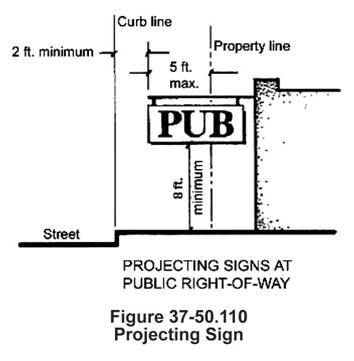
(4)
Awning and Canopy Signs.
(A)
Sign area shall not occupy more than sixty percent of the length or height of any portion of an awning or canopy. The limitation on sign area shall apply to each portion of the valance of an awning or canopy (including the shed, ends, and flap) (see Figure 37-50.120).
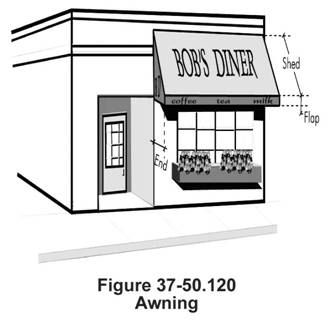
(B)
Awning or canopy signs with backlit graphics or otherwise internally illuminated is not permitted. Lighting directed downward that does not illuminate an awning or canopy may be allowed if the lighting is complementary to and compatible with the architectural design of the building.
(C)
Awnings or canopies shall not project above an apparent eave or parapet including the eave of a mansard roof.
(D)
No portion of an awning/canopy or projecting/blade sign shall be less than eight feet above the surface of a sidewalk, drive-through lane, or walkway upon which it projects or shall project more than five feet into a public right-of-way. No awning/canopy or projecting/blade sign shall project closer than two feet to a curb. An encroachment permit is required for any awning/canopy or projecting/blade sign (or a portion thereof) located within the public right-of-way and must be fourteen feet above a roadway surface (see Figure 37-50.110).
(E)
Awnings or canopies must be permanently attached to the building.
(F)
Awnings or canopies without sign area or copy are not subject to the issuance of a sign permit.
(5)
Hanging Signs.
(A)
The maximum size of a hanging sign shall be two square feet per sign face in an A, CO/R, R, and NU (NE, NG-1, and NG-2) district and six square feet per sign face in all other zoning districts. A hanging sign shall be perpendicular to the building.
(B)
A minimum distance of fifteen feet shall be provided between hanging signs.
(C)
A hanging sign shall only be used at ground-floor locations except for upper floor businesses with covered porches/entries or balconies.
(D)
A hanging sign shall not project above an apparent eave or parapet including the eave of a mansard roof.
(E)
A hanging sign shall not be internally illuminated.
(F)
No portion of a hanging sign shall be less than eight feet above the surface (fourteen feet above a roadway surface) over which it hangs. An encroachment permit is required for any hanging sign (or a portion thereof) located within the public right-of-way.
(6)
Multistory Building Tenant Identification Signs.
(A)
Additional sign area for wall signs identifying commercial tenants in multistory buildings with three or more full stories, beyond that allowed in this section may be allowed as identified in Table 37-50.180:
(B)
For multistory building tenant identification signs, the following shall apply:
(i)
Only a single company name or logo of an organization or enterprise occupying office space within the office building shall be permitted.
(ii)
Subject to approval of the city planner, multistory building tenant identification signs shall be located below the parapet at a height and scale architecturally in harmony with the building.
(iii)
Individual channel-letters, internally illuminated letters, and/or logos (not exceeding thirty percent of the sign area) are allowed. Can-type signs are prohibited.
(c)
Additional Regulations for Freestanding Signs.
(1)
Decorative architectural features such as cornices and pediments may exceed the maximum sign area specified for a monument sign by twenty-five percent and the maximum height by two feet.
(2)
A freestanding sign shall be at least ten feet from the nearest curb and be placed within a landscaped area of not less than seventy-five square feet in the CO, CO/R, IBP, and PS districts and fifty square feet in other districts.
(3)
A freestanding sign shall not extend over a public right-of-way and shall not be located on the same street frontage as a projecting/blade sign that extends over a public right-of-way. The supports for any freestanding sign shall be located entirely in or upon private property.
(4)
A freestanding sign shall not be closer to an interior property line than one-half its height (see Figure 37-50.130A).
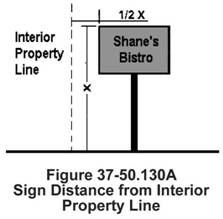
(5)
A freestanding sign shall not be closer than one hundred-feet to another freestanding sign or projecting/blade sign on the same site (see Figure 37-50.130B).
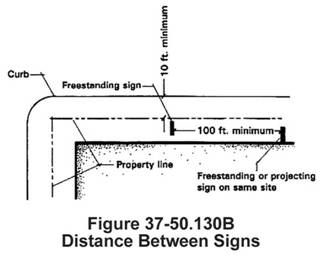
(6)
For freestanding signs located within six hundred sixty feet of the outer limits of the U.S. Highway 101, see Section 37-50.620(h): Highway Signs.
(7)
A commercial identification on a permanent flagpole may be substituted for an allowed freestanding sign within any C, NU (VC), PS, or I district and counted toward the allowable freestanding sign area.
(8)
A freestanding sign shall have a maximum of two sides; however, additional sides may be considered subject to the approval of a master sign plan.
(d)
Illuminated and Moving Signs.
(1)
Signs in an A, R, NU (NE, NG-1, and NG-2), CO, CO/R, P, OS, or PS district shall, if lighted, be indirectly and continuously illuminated.
(2)
Signs shall not have exposed fluorescent tubes or incandescent bulbs, unless such signs are approved as part of a master sign plan or a site plan review for a cinema or theater.
(3)
Signs visible from and within one hundred feet of an R or NU (NE, NG-1, and NG-2) district shall not be illuminated between 10:00 p.m. and 7:00 a.m. unless approved as part of a master sign plan. In order to approve the master sign plan, the city planner shall determine that the proposed sign:
(A)
Identifies a business or use that is open for business during those hours; and
(B)
Has been oriented, sited, or otherwise designed to minimize glare or lighting impacts on the adjacent R or NU zoning district.
(4)
No movement or apparent movement of or in a sign or change in intensity of illumination of a sign shall be permitted (including no changeable copy) except for public service information signs, marquee signs, and changeable copy signs for theaters, cinemas, religious assembly uses, public/private school uses, and service station price signs as provided for in this division.
(e)
Theater, Cinema, Public/Private Schools, and Religious Assembly Signs. Signs deviating from the standards of this division may be allowed for theaters, cinemas, public/private school uses, or religious assembly uses subject to the approval of a master sign plan. The master sign plan may allow marquee signs (for theaters, cinemas, and public/private schools only), changeable copy signs, and other signs for cinema, theater, public/private schools, or religious assembly uses not otherwise authorized by this division, if the city planner or other applicable approval authority determines that such modifications:
(1)
Would be consistent with the style and character of existing signs on the site;
(2)
Would be compatible with the character of signs on adjacent properties;
(3)
Would not detract from the use and enjoyment of adjacent properties; and
(4)
Would not have an adverse impact on the safe and efficient movement of vehicular or pedestrian traffic.
(f)
Service Station Signs.
(1)
Price Signs. A maximum of two double-faced signs per street frontage, of not more than twenty-five square feet per face, and having a maximum height of six feet. Such signs may only be used to indicate the actual current price of fuel, the brand of the gas station, or other information required in accordance with state law requirements. No other advertising is permitted on the sign. Such signs may be changeable copy if permitted in accordance with state law. The use of red, green, or yellow illuminated letters or numbers is prohibited for changeable copy signs for traffic safety reasons, unless approved by the City Engineer taking into consideration the distance to traffic signals and field of view.
(2)
Island Canopy Signs. A logo sign, affixed to a canopy or other rigid roof structure directly above a pump island, the sign area of which shall not exceed fifteen square feet to accommodate a company or brand logo. Island canopy logo signs shall be limited to a maximum of two signs per gas station.
(3)
Fuel pump identification and/or price signs located on the pump face and not exceeding two square feet in area.
(4)
A single- or double-faced sign of not more than twelve inches by twenty inches constructed of motionless materials and mounted to the top of a fuel pump and used for identifying products or services available on the premises. No more than one pump-topper sign per pump shall be allowed.
(5)
The area of signs in Sections 37-50.620(f)(1), (3), and (4) above shall not be counted toward the maximum total sign area allowed for the site.
(g)
Temporary Signs (Not Exempt).
(1)
Temporary Signs, Banners, Flags, Decorations, and Other Advertising Devices (excluding temporary subdivision directional signs and exempt temporary signs). Such signs may be placed on a site for a maximum of thirty days each calendar year subject to the issuance of a temporary use of land permit, provided the total temporary and permanent sign area shall not exceed one hundred fifty percent of permitted permanent sign area, and provided that temporary devices do not create safety hazards or block signs identifying adjoining establishments.
(2)
On-site Subdivision Direction Signs. One on-site unlighted temporary subdivision directional sign not to exceed sixty-four square feet in area for each ten acres in a subdivision, up to a maximum of one hundred twenty-eight square feet, for the purpose of providing necessary travel directions to the subdivision subject to the approval of a temporary use of land permit. If a subdivision has less than ten acres, one such sign not to exceed sixty-four square feet shall be permitted. The city planner may allow joint subdivision directional signs for more than one subdivision. Joint signs may not exceed sixty-four square feet for every ten acres of total subdivision area, not to exceed a total of two hundred square feet in sign area. Where the total area of all subdivisions is less than ten acres, one joint sign, not to exceed sixty-four square feet, is allowed. No more than one on-site subdivision directional sign shall be allowed on any property. The maximum height of an on-site directional sign shall be eight feet. On-site subdivision directional signs may contain, in addition to travel directions, the name of the land development project to which it pertains, including a characteristic trademark or other identifying insignia. Such signs shall be located at least seven hundred feet from any other such sign. The temporary use of land permit shall expire upon the sale of the last residential dwelling unit in the subdivision. The applicant shall remove all on-site subdivision directional signs from the property within seven days from the sale of the last residential dwelling unit in the subdivision. The applicant of any on-site subdivision directional signage shall post a bond to ensure removal of the sign. The city planner may impose any additional conditions that it deems necessary to make the sign, to the extent feasible, compatible to the development in the vicinity. Such conditions may include the requirement of a signed statement by the applicant, owner of the signs, and the owner or lessee of the property on which the signs are to be placed, agreeing that if such signs are not removed within seven days after expiration of permit, they may be removed by the city without further notice.
(h)
Highway Signs. The allowable height, number of freestanding signs, and the total maximum sign area may be increased for on-site freestanding signs located within six hundred sixty feet of U.S. Highway 101 subject to the issuance of a conditional use permit. One-half of the area of the highway sign shall be deducted from the maximum total sign area allowed for the site. Highway signs shall be in addition to the number of otherwise allowable freestanding signs on a site. In addition to findings required for a conditional use permit, the following findings shall also apply:
(1)
Photo studies have been provided by the applicant and site distance/speed of travel or other data exists which supports the determinations that a safe exiting distance is provided and that the sign is the minimum necessary to convey its intended message;
(2)
The increase in sign height or sign area is not primarily for the purpose of giving the business a competitive advantage over another. Criteria for establishing this finding may include an evaluation of signs on neighboring properties;
(3)
The increase in sign height or sign area shall not contribute to visual clutter;
(4)
The need for the increased sign height or sign area cannot be met through changing the location of the sign on the site or the design of the sign, consistent with good site design;
(5)
The sign structure is coordinated with the architecture of the buildings on the property on which the sign is located and is well proportioned as to height in comparison with width and as to design/width of supporting structure in comparison with design/width of sign message. Sign illumination has accounted for adjacent uses;
(6)
The use advertised is a restaurant, service station, hotel, or motel, and is required by the traveling public. The site has immediate access to U.S. Highway 101; and
(7)
The sign area does not exceed one hundred twenty-five square feet per face and contains a maximum of two faces; height does not exceed fifty feet.
(Ord. No. 2463 (NCS).)
(Ord. No. 2507 (NCS), §§ 4, 6, 21, 5-18-2010; Ord. No. 2569 (NCS), §§ 14—17, 4-19-2016; Ord. No. 2673(NCS), § 1, 10-24-2023)
(a)
Off-site Subdivision Directional Signs. One off-site unlighted temporary directional sign shall only be allowed on vacant, undeveloped property, subject to approval of a temporary of use land permit. Such signage shall not exceed sixty-four square feet in area for each ten acres in a subdivision, up to a maximum of one hundred twenty-eight square feet. Directional signs for subdivisions with a combined total area less than ten acres shall not exceed sixty-four square feet. The maximum height of an off-site directional sign shall be eight feet. Off-site directional signs may contain, in addition to travel directions to the subdivision, the name of the land development project to which it pertains, including a characteristic trademark or other identifying insignia. Such signs shall be located at least seven hundred feet from any other such sign. The temporary use of land permit shall expire seven days after the sale of the last residential dwelling unit in the advertised subdivision. The applicant shall remove the off-site subdivision direction sign from the property within seven days of the sale of last residential dwelling unit in the advertised subdivision. The applicant of any off-site subdivision directional signage shall post a bond to ensure removal of the sign. The city planner may impose any additional conditions that it deems necessary to make the sign, to the extent feasible, compatible to the development in the vicinity. Such conditions shall include, but not be limited to, the requirement for a signed statement by the applicant, owner of the signs, and the owner or lessee of the property on which the signs are to be placed, agreeing that if such signs are not removed within seven days after expiration of permit, they may be removed by the city without further notice.
(b)
Off-site Temporary Open House Real Estate Signs. See Section 37-50.580: Exempt signs.
(c)
Other Off-site Advertising Signs. Except for temporary off-site subdivision directional signs and specified exempt signs, off-site advertising signs are not permitted within the city. Existing off-site advertising signs shall be considered nonconforming. Nonconforming off-site advertising signs may only be reconstructed or relocated pursuant to the following:
(1)
In accordance with a relocation agreement between the city and the sign owner, consistent with Section 5412 of the California Business and Professional Code;
(2)
Relocation is allowed only if the sign is located within the IGC district; and
(3)
If the sign area (including the sign structure) does not exceed a maximum dimension of twelve feet by twenty-five feet per sign face and twenty-two feet in height above existing or street grade, whichever is higher. Both sides of off-site advertising signs may be used for purposes of advertising.
(Ord. No. 2463 (NCS).)
(a)
Purpose. The following design standards are intended to assist the designer in understanding the city's requirements for sign design. These standards complement the sign regulations contained in this division by providing good examples of potential design solutions and by providing design interpretations of various regulations. The design standards are general and may be interpreted with some flexibility in their application to specific projects. The standards will be utilized in conjunction with other regulations to ensure the highest level of design quality while at the same time providing the flexibility necessary to encourage creativity on the part of project designers.
(b)
General Design Principles.
(1)
Sign colors, design and materials shall be compatible and complementary with the architectural theme or design of the principal building(s) at the site.
(2)
The use of graphics consistent with the nature of the product to be advertised is encouraged (e.g., hammer symbol for a hardware store, mortar and pestle for a drug store).
(3)
Place signs to indicate the location of access to a business. Signs shall be placed at or near the entrance to a building or site to indicate the most direct access to the business.
(4)
Avoid signs with strange shapes. Signs that are unnecessarily narrow or oddly shaped can restrict the legibility of the message. If an unusual shape is not symbolic, it is probably confusing.
(5)
Make signs smaller if they are oriented to pedestrians. The pedestrian-oriented sign is usually read from a distance of fifteen feet to twenty feet; the vehicle-oriented sign is viewed from a much greater distance. The closer a sign's viewing distance, the smaller that sign needs to be.
(6)
Where there is more than one sign, all signs shall be complementary to each other in the following ways:
(A)
Type of construction materials (sign copy, supports, etc.);
(B)
Letter size and style of copy;
(C)
Method used for supporting or attaching sign (wall or ground base);
(D)
Configuration and shape of sign area and related components; and
(E)
Height, location, and spacing of signs on a building or site shall be generally consistent.
(c)
Wall Signs.
(1)
Wall signs shall be compatible with the predominant visual architectural elements of the building facade.
(2)
Place wall signs to establish facade rhythm, scale, and proportion where such elements are weak. In many existing buildings that have a monolithic or plain facade, signs can establish or continue appropriate design rhythm, scale, and proportion.
(3)
Wall sign raceways shall be painted to match the exterior color of the building where the sign is located.
(4)
Wall signs shall be sized appropriately and in proportion to the scale of the building or fascia.
(5)
Direct and indirect lighting methods are allowed provided that they are not harsh or unnecessarily bright.
(6)
The use of individually cut or channel letter signs are preferred over can-type signs in new development.
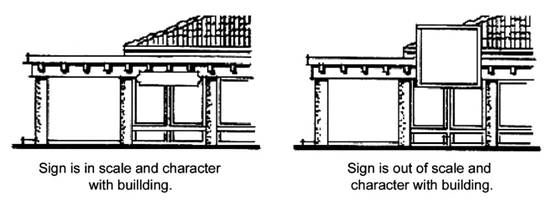
(d)
Awning and Canopy Signs.
(1)
Sign area/copy shall be proportional to and complementary with the style and scale of the awning canopy.
(2)
Awnings/canopies used in conjunction with awning/canopy signs shall not be located so as to obscure transom windows, piers, pilasters, and other architectural building features and shall generally be designed to project over individual doors and window openings, where feasible. Awnings/canopies that are a continuous feature extending over several windows, doors, or similar architectural features are generally discouraged.
(3)
The size of the awning/canopy shall be proportional in scale with the building to which it is attached.
(4)
The style of the awning/canopy shall complement the architectural style of the building to which it is attached. Awnings should generally have a simple horizontal valance if located over rectangular or square window/door openings. Domed or barrel shaped awnings are appropriate for buildings with arched window/door openings.
(5)
An awning with a single, solid color is preferred. The color of the awning/canopy shall be compatible with and complement the exterior color(s) of the building. Awning/canopy colors that call more attention to the awning than the building are inappropriate. Awnings/canopies with highly contrasting corporate/franchise identity colors are not allowed.
(6)
Awnings/canopies shall be regularly cleaned and kept free of visible defects and wear.
(e)
Freestanding Signs.
(1)
Freestanding signs are intended to provide street addresses, and identification for the freestanding building or commercial center development as a whole.
(2)
All tenant freestanding signs on a site shall be generally uniform in size, height, type, and color and shall be compatible with the architectural design or theme of the principal building(s) at the site.
(3)
Freestanding signs should be placed perpendicular to approaching vehicular traffic.
(4)
Low scale monument type signs are preferred over pole type signs in new development. Pole signs may be utilized in new development when the city planner finds as part of a master sign plan that existing site factors (such as site orientation or location, building and driveway locations, existing vegetation, surrounding development, or other factors) warrant the use of such signs for visibility considerations.
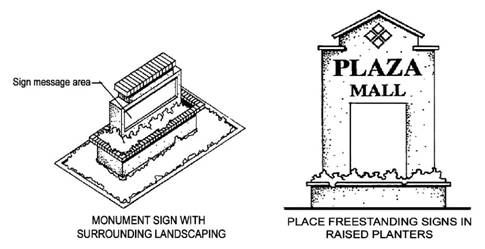
(5)
Each freestanding sign shall be located within a planted landscaped area, which is of a shape and design that will provide a compatible setting and ground definition to the sign. Raised planters are encouraged.
(Ord. No. 2463 (NCS).)
(a)
Purpose. The purpose of this section is to establish that the eventual elimination of existing signs that are not in conformity with the provisions of this division is as important as the prohibition of new signs that would violate these regulations.
(b)
General Regulations.
(1)
Except for normal repair and maintenance and any modification required for National Electric Code (NEC) compliance in accordance with Chapter 9 of the Salinas Municipal Code, no nonconforming sign shall be expanded, structurally altered (not including a change in sign face or sign copy), moved, or relocated, unless it is brought into conformance with all current provisions of this chapter. When a sign, which was in compliance with all applicable laws in effect at the time it was originally erected, is physically damaged, whether by vandalism, forces of nature, or other causes, the sign may be repaired or restored to its original size, shape, height, orientation, and message; however, the repair or restoration must be done in a manner which complies with current Building and Electrical Codes.
(2)
The owner of a nonconforming sign, excepting an off-site advertising sign in accordance with Section 37-50.630: Off-site sign regulations, shall within three months of notification of nonconformity either:
(A)
Remove the sign; or
(B)
Obtain a new permit, with variances to allow the nonconforming aspect; or
(C)
Obtain a new permit subject to modification of the sign to achieve conformity with this division; or
(D)
Obtain an extension of time within which the sign must be moved under the amortization provisions of Section 37-50.650(c) below; or
(E)
Establish to the satisfaction of the city planner that the special restrictions of Business and Professions Code Sections 5490 through 5499 apply.
(c)
Amortization.
(1)
An owner of a nonconforming sign may delay removal or modification of the sign for a reasonable period in order to recover the original costs where, at the time specified for removal, the costs were not yet fully amortized. The amortization period shall be proportionate with the investment involved.
(2)
The owner of a nonconforming sign may apply to the city planner for an extension of time within which the sign must be removed. The application shall contain the following information:
(A)
Name and address of the sign;
(B)
A description of the sign;
(C)
The date the sign was erected;
(D)
Whether and when a sign permit was issued;
(E)
The cost of construction;
(F)
The remaining term of the sign owner's lease of the real property, if applicable;
(G)
The present value of the sign;
(H)
If the sign is being depreciated under Federal Internal Revenue Code, a copy of the last IRS form showing depreciation;
(I)
A detailed statement of the reasons for the extension requested;
(J)
The length of time for which the extension is requested; and
(K)
Other relevant information, which the city planner may request.
(3)
The city planner shall consider the information presented on the application in acting on the request for extension. If the city planner finds that the circumstances warrant granting an extension of time for amortization of the sign, the city planner may grant the extension for a reasonable time not to exceed three years. No extension shall be granted for a portable sign or sign painted on a building or structure.
(Ord. No. 2463 (NCS).)
(Ord. No. 2569 (NCS), § 18, 4-19-2016)
(a)
Scope and Authority. This section is enacted to implement Chapter 2.6 of Division 3 of the California Business and Professions Code.
(b)
Definitions. The following definition shall apply to this section:
(1)
Illegal On-premises Advertising Display. Any of the following:
(A)
An on-premises advertising display erected without first complying with all ordinances and regulations in effect at the time of its construction and erection or use;
(B)
An on-premises advertising display that was legally erected, but whose use has ceased, or the structure upon which the display is placed has been abandoned by its owner, not maintained, or not used to identify or advertise an ongoing business for a period of not less than ninety days;
(C)
An on-premises advertising display that was legally erected which later became nonconforming as a result of the adoption of an ordinance, the amortization period for the display provided by the ordinance rendering the display nonconforming has expired, and conformance has not been accomplished;
(D)
An on-premises advertising display that is a danger to the public or is unsafe; or
(E)
An on-premises advertising display that is a traffic hazard not created by relocation of streets or highways or by acts of the city or county.
(2)
On-premises Advertising Display. Any structure, housing sign, device, figure, statuary, painting, display, message placard, or other contrivance, or any part thereof, which is designed, constructed, created, engineered, intended or used to advertise, or to provide data or information in the nature of advertising, for any of the following purposes:
(A)
To designate, identify, or indicate the name of the business of the owner or occupant of the premises upon which the advertising display is located;
(B)
To advertise the business conducted, services available or rendered, or the goods produced, sold, or available for sale, upon the property where the advertising display is erected.
(c)
Designation of Illegal On-premises Advertising Displays.
(1)
By resolution, the city council may declare as public nuisances and abate all illegal on-premises advertising displays located within the city and identified by an inventory compiled under Section 37-50.670(b). The resolution shall describe the property upon which or in front of which the nuisance exists. Any number of parcels of private property may be included in one resolution.
(2)
Prior to adoption of the resolution by the city council, the city clerk shall send not less than a ten days' written notice to all persons owning property described in the proposed resolution. The notice shall be mailed to each person on whom the described property is assessed as of the last equalized assessment roll available on the date the notice is prepared. The notice shall state the date, time, and place of the hearing, and generally describe the purpose of the hearing and the nature of the illegality of the display.
(d)
Posted Notice. After adoption of the resolution, the enforcement officer shall cause notices to be conspicuously posted on or in front of the property on which the illegal display exists. The notices shall be posted at least ten days prior to the time for hearing objections by the city council.
(e)
Mailed Notice. The city clerk shall mail written notice of the proposed abatement in the form prescribed by Sections 37-50.660(c) and (d) to all persons owning property described in the resolution, as shown on the last equalized assessment roll, at least ten days prior to the time for hearing objections by the city council.
(f)
Public Hearing and Council Action.
(1)
At the time stated in the notices, the city council shall hear and consider all objections to the proposed removal of the on-premises advertising display. The council may continue the hearing from time to time. By motion or resolution at the conclusion of the hearing, the council shall allow or overrule any objections. Following such determination, council acquires jurisdiction to proceed and perform the work of removal.
(2)
The decision of the council is final. If objections have not been made or after the council has disposed of those made, it shall order, by motion or resolution, the enforcement officer to abate the nuisance by having the display removed.
(g)
Abatement Procedure. The enforcement officer may enter private property to remove an illegal advertising display. Before the enforcement officer arrives, any property owner may remove the illegal on-premises advertising display at the owner's own expense. Nevertheless, in any case when an order to abate has been issued, the city council, by motion or resolution, may further order that a special assessment and lien be placed upon the property. Such special assessment and lien shall be limited to the costs incurred by the city in enforcing abatement upon the property, including investigation, boundary determination, measurement, clerical, and other related costs.
(h)
Required Cost Accounting.
(1)
The enforcement officer shall keep an account of the cost of abatement of an illegal on-premises advertising display in front of or on each separate parcel of property where the work is done. The officer shall submit to the city council for confirmation an itemized written report showing that cost.
(2)
A copy of the report shall be posted in the city offices for at least three days, prior to its submission to the council, with notice of the time of submission.
(3)
At the time fixed for receiving and considering the report, the city council shall hear it with any objections of the property owners liable to be assessed for the abatement. It may modify the report if it is deemed necessary. The city council shall then confirm the report by motion or resolution.
(i)
Contracting for Services. Abatement of the nuisance may, at the discretion of the city council, be performed by contract awarded on the basis of competitive bids let to the lowest responsible bidder. In that event, the contractor shall keep the account and submit the itemized written report for each separate parcel of property required by Section 37-50.660(h) above.
(j)
Reimbursement of Costs and Special Assessments.
(1)
The enforcement officer may receive the amount due as reimbursement for abatement costs incurred by the city and issue receipts for such payment at any time after the city council has confirmed the abatement costs pursuant to Section 37-50.660(h) above and until ten days before a copy is given to the county assessor and tax collector.
(2)
Liens and special assessments to recover costs of abatement and costs of enforcing abatement, as confirmed by the city council, shall be payable under the provisions of Section 5499.12 of the Business and Professions Code. Requests for refunds shall be subject to the provisions of Section 5499.14 of the Business and Professions Code.
(Ord. No. 2463 (NCS).)
(a)
Removal Required. Any sign that was illegally installed (e.g., without the required permit or in violation of any provision of this Zoning Code) shall be removed in compliance with Section 37-50.660: Nonconforming sign abatement.
(b)
Illegal and Abandoned Signs Inventory. Should the city council direct that the city planner abate illegal or abandoned signs, the city planner shall compile an inventory of such signs within the city.
(1)
For properties located within the gateway overlay district, should the council direct that the city planner abate illegal or abandoned signs specifically within such overlay district, the city planner shall compile an inventory of such signs located within the gateway overlay district.
(2)
The inventory shall identify the location of each illegal or abandoned sign by lot and block number and by street address, the sign's legal owner or leaseholder, and the specific standards that are violated or the approximate date of abandonment, as the case may be.
(3)
This inventory shall be used to establish an initial date for amortization of nonconforming signs under the provisions of Section 37-50.660: Nonconforming sign abatement.
(4)
The city planner shall regularly update the inventory to include additional illegal signs resulting from zoning map amendments and additional abandoned signs.
(Ord. No. 2463 (NCS).)
The purpose of this section is to establish landscaping and irrigation regulations that are intended to:
(a)
Enhance the aesthetic appearance of development in all areas of the city;
(b)
Reduce heat and glare generated by urban development;
(c)
Minimize water use;
(d)
Minimize impervious surfaces and meet federal, state and local water quality regulations such as the National Pollutant Discharge Elimination System (NPDES) permit requirements, and storm water development standards (SWDS); and
(e)
Protect public health, safety, and welfare by minimizing the impact of all forms of physical and visual pollution, promoting natural surveillance, controlling soil erosion and runoff, screening incompatible land uses, preserving the integrity of neighborhoods, and enhancing pedestrian and vehicular traffic and safety.
(Ord. No. 2463 (NCS).)
(Ord. No. 2541 (NCS), § 4, 7-23-2013; Ord. No. 2569 (NCS), § 19, 4-19-2016)
(a)
Applicability. Landscaping and required planting areas shall be installed in accordance with the standards and requirements of this section for all zoning districts as well as the conditions and requirements contained in Chapter 36A: Water Conservation of the Salinas Municipal Code. Where more specific requirements are identified by an overlay or zoning district, specific plan, site plan review, or conditional use permit, those requirements shall be met. In addition, new landscape projects shall comply with the city's Model Water Efficient Landscape Ordinance if any the following conditions apply:
(1)
New construction projects with an aggregate landscape area equal to or greater than five hundred square feet requiring a building or landscape permit, plan check, or design review;
(2)
Rehabilitated landscape projects with an aggregate landscape area equal to or greater than two thousand five hundred square feet requiring a building or landscape permit, plan check, or design review;
(3)
Existing landscapes limited to Sections 493, 493.1, and 493.2 of the city's Model Water Efficient Landscape Ordinance; and
(4)
Cemeteries. Recognizing the unique landscape management requirements of cemeteries, new and rehabilitated cemeteries are limited to Sections 492.4, 492.11, and 492.12 of the city's Model Water Efficient Landscape Ordinance; existing cemeteries are limited to Sections 493, 493.1, and 493.2 of the city's Model Water Efficient Landscape Ordinance.
(b)
Where Required. Yards shall be landscaped in accordance with Table 37-50.190 to the extent that such yards are provided or required:
(c)
Development Regulations.
(1)
All new development shall apply xeriscape principles including such techniques and materials as native or low water use plants and low precipitation sprinkler heads, bubblers, drip irrigation systems, and timing devices.
(2)
Required planting areas shall be permanently maintained. As used in this section, "maintained" includes: watering, weeding, pruning, insect control, and replacement of plant materials and irrigation equipment as needed to preserve the health and appearance of plant materials.
(3)
Landscape materials shall not be located such that, at maturity:
(A)
They interfere with safe sight distances for vehicular, bicycle, or pedestrian traffic;
(B)
They conflict with overhead utility lines, overhead lights, or walkway lights; or
(C)
They block pedestrian and bicycle ways.
(d)
Landscaping Plans Required. Landscaping plans that show the location of all turf, plant materials, and irrigation systems shall be required for all uses, which include landscaping.
(e)
Materials. Landscape plans shall demonstrate a recognizable pattern or theme for the overall development. To accomplish this, landscape plans shall conform to the following:
(1)
Plant materials shall be selected for energy efficiency and drought tolerance and adaptability and relationship to Salinas' environment. A minimum of ninety percent of nonturf material shall be drought-resistant. All plant materials shall comply with Chapter 36A: Water Conservation of the Salinas Municipal Code.
(2)
In all C, MU, NU (VC), PS, and I districts, and for all multifamily developments, plant materials shall be sized and spaced to achieve immediate effect and shall normally not be less than a fifteen-gallon container for trees, a five-gallon container for shrubs, and a one-gallon container for mass planting. Nonturf areas, such as shrub beds, shall be top-dressed with a bark chip mulch mixed into the topsoil or approved alternative. Dressing material shall be maintained within planter areas and shall not be allowed to migrate onto hard surfaces, such as sidewalks and parking lots.
(3)
Turf shall be limited to twenty-five percent of the total landscaping area. No turf shall be permitted in areas with a dimension of less than eight feet, or on slopes exceeding ten percent.
(f)
Irrigation.
(1)
Turf. Sprinklers shall be installed with a separate irrigation valve from irrigation valves used for other vegetation.
(2)
Sprinklers. All new automatic irrigation systems shall have sprinkler heads with application rates that do not exceed the infiltration rate of the soil. Such systems shall be installed with dual or multiple program controllers that permit cycles of five to ten minutes per hour. Landscaping requiring intensive watering shall be watered by hand or drip irrigation. Overhead irrigation shall be scheduled between 8:00 p.m. and 10:00 a.m. unless weather conditions prevent it. If allowable hours of irrigation differ from the local water purveyor, the stricter of the two shall apply. Operation of the irrigation system outside the normal watering window is allowed for auditing and system maintenance.
(g)
Parking Lot Landscaping.
(1)
All areas within the perimeter of parking lots not used for buildings, parking, loading, circulation, transit, or pedestrian facilities shall be landscaped to minimize the feeling of expansive hard surfaced areas, to improve the parking lot appearance.
(2)
Parking lots, parking structures, and the outdoor display of automobiles, boats, recreational vehicles, motorcycles, or construction vehicles shall have perimeter landscaping areas as prescribed by the following:
(A)
Parking Lots or Parking Structures Adjoining Street Property Line. Where parking lots occur along streets, a landscaped planter shall be provided to minimize views of parked cars from the street and shall be permanently maintained. The landscaped planter at the street shall be at least ten feet wide. Within the landscaped planter, trees should be planted at least thirty feet on center. The landscaped planter shall include a screening feature with a minimum height of thirty-two inches and a maximum height of forty-two inches, such as a short wall, fence, hedge, berm, or equivalent feature. Whenever walls or fences are used to create the screening feature, plants shall be located on the sides of the walls or fences that can be seen from surrounding streets, sidewalks, parks, and other public areas. The maximum height of fences and walls in required landscape planters shall be in accordance with Section 37-50.090: Fences, walls, and hedges;
(B)
Other property lines: five feet;
(C)
Vehicle Overhang. Vehicle overhang may encroach three feet into a landscape planter adjoining a street property line.
(3)
Interior landscaped areas shall have a minimum dimension of five feet, exclusive of curbs, shall equal to five percent of the total parking area, and shall be so located as to interrupt parking rows. When a parking space abuts a landscape planter, no curb is necessary provided that the planter is expanded three feet to allow the vehicle to overhang the planter.
(4)
A minimum of one tree for every five parking spaces shall be provided in landscape islands (see Figure 37-50.140). The islands shall have a minimum dimension of five feet exclusive of curbs.
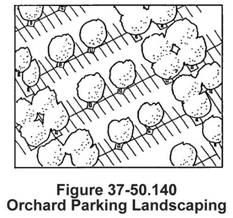
(5)
Landscaping shall be provided on the upper levels of parking structures, where feasible, when these structures are visible from public streets, pedestrian pathways, or adjacent buildings.
(6)
Use landscaping planters to control access to parking lots, to make traffic diverters prominent, to direct the flow of traffic within the lot, and to enhance the safety of parking lots by guiding the circulation of vehicles and people.
(7)
The end of each row of parking stalls shall be separated from driveways by a landscaped planter, sidewalk, or similar means.
(8)
Two feet at the end of landscape islands shall be left unplanted when adjacent to drive aisles and driveways to prevent plant materials from being run over by vehicles. The use of cobbles, patterned concrete, or brick pavers shall generally be installed in these end areas.
(9)
In the IGC and IG zoning districts, landscaping shall not be required for areas of a site that are not substantially visible (as determined by the city planner) from a street or other public area, and which are not public parking area. In such areas the landscaping requirements above may be waived.
(h)
Driveway and Corner Visibility. All landscaping material shall be maintained in accordance with the provisions of Section 37-50.460: Driveway and corner visibility. Landscaped materials shall not be located such that, at maturity:
(1)
They interfere with safe sight distances for vehicular, bicycle, or pedestrian traffic;
(2)
They conflict with overhead utility lines, overhead lights, or walkway lights; or
(3)
They block pedestrian or bicycle ways.
(i)
Alternative Means of Compliance. The city planner may allow alternative means of complying with the requirements of this section provided the alternative achieves results comparable to those achieved through strict application of the provisions of this section.
(Ord. No. 2463 (NCS).)
(Ord. No. 2507 (NCS), §§ 39, 40, 5-18-2010; Ord. No. 2569 (NCS), § 20, 4-19-2016)
(a)
Applicability. These design standards are intended to assist the designer in understanding the city's goals and objectives for landscaping. These standards complement the landscaping regulations found in Article V, Division 4: Landscaping and Irrigation and the requirements of Chapter 36A: Water Conservation of the Salinas Municipal Code by providing good examples of potential design solutions and by providing design interpretations of various regulations. The design standards are general and may be interpreted with some flexibility in their application to specific projects. The standards will be applied in conjunction with other regulations to encourage the highest level of design quality while at the same time providing the flexibility necessary to encourage creativity on the part of project designers.
(b)
Design Standards.
(1)
Landscaping and open spaces shall be designed as an integral part of the overall site plan design. Landscaping and open spaces shall enhance the building design, enhance public views and spaces, provide buffers and transitions, provide for a balance of solar uses, and provide screening.
(2)
Landscape design shall accent the overall design theme through the use of structures such as arbors and trellises that are appropriate to the particular architectural style of adjacent structures.
(3)
Landscape areas shall use xeriscape concepts that: minimize the amount of turf area; use plant materials that have a low water demand; and use a segmented irrigation system calibrated to the specific water demands of various turf, plant, and tree groups.
(4)
Landscaped areas shall incorporate plantings using a three-tier system:
(A)
Grasses and ground covers;
(B)
Shrubs; and
(C)
Trees.
(5)
The following are common planting design concepts that shall be used whenever feasible:
(A)
Specimen trees used in informal grouping and rows at major focal points;
(B)
Extensive use of flowering vines both on walls and arbors;
(C)
Pots, vases, or raised planters;
(D)
The use of planting to create shadow and patterns against walls;
(E)
Large broadleaf deciduous trees to create canopy and shade in the summer and sun in the winter, particularly in parking areas;
(F)
The use of flowering trees in informal groups to provide color;
(G)
Informal massing of colorful plantings;
(H)
Use of distinctive plants as focal points; and
(I)
Plantings and low walls to screen parking areas from view of public rights-of-way while allowing filtered views of larger buildings beyond.
(6)
Planting areas between walls and streets shall be landscaped with a hierarchy of plants in natural formations and groupings. Solid walls over three feet high shall receive vines or hedge when adjacent to public streets.
(7)
A colorful landscape edge should be established at the base of buildings. Avoid asphalt edges at the base of structures as much as possible. Plant materials located in containers are appropriate.
(8)
Planting masses on-site should assume a simple, non-uniform arrangement. The diversity of massing types should be great enough to provide interest, but kept to a level which evokes a relaxed natural feeling.
(c)
Xeriscape Guidelines.
(1)
All landscaping shall employ features and techniques that, in the aggregate, reduce the demand for and consumption of water, including appropriate low-water-using plants, nonliving ground cover, a low percentage of lawn coverage, a high degree of paving permeability, and water conserving irrigation techniques and systems.
(2)
The use of turf shall be minimized or substituted altogether with groundcovers. Turf should generally be excluded from median or sidewalk strips and similar areas that are difficult to irrigate. Low-water-using grass varieties are encouraged. Turf is not allowed on slopes greater than twenty-five percent where the toe of the slope is adjacent to an impermeable hardscape and where twenty-five percent means one foot of vertical elevation change for every four feet of horizontal length (rise divided by run × 100 = slope percent).
(3)
Water efficient irrigation systems, such as drip, low output sprinkler heads, zonal systems, and automatic timers, shall be provided. Planting shall be according to water needs, and the irrigation system matched to these needs.
(4)
Plant varieties shall predominately be low water consuming, suited to the local soil and climate, and grouped according to their water requirements.
(5)
Mulches shall be used generously and reapplied as part of a regular maintenance program to reduce evaporation, soil compaction, and weeds.
(6)
A minimum two-inch layer of mulch shall be applied on all exposed soil surfaces of planting areas except in turf areas, creeping or rooting groundcovers, or direct seeding applications where mulch is contraindicated. Stabilizing mulching products shall be used on slopes. The mulching portion of the seed/mulch slurry in hydro-seeded applications shall meet the mulching requirement.
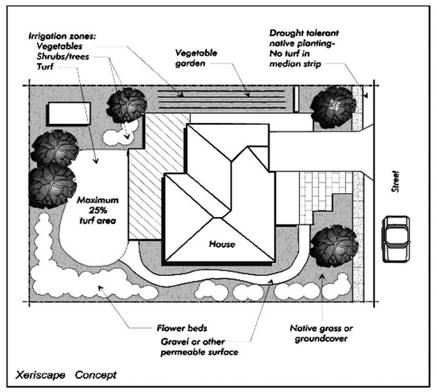
(d)
Installation and Maintenance.
(1)
Trees shall be adequate in trunk diameter to support the top area of the tree. Trees, shrubs, and vines should have body and fullness that is typical of the species.
(2)
All ground cover shall be healthy, densely foliated, and well-rooted cuttings, or one-gallon container plants.
(3)
The spacing of trees and shrubs shall be appropriate to the species used. The plant materials shall be spaced so that they do not interfere with the adequate lighting of the premises or restrict access to emergency apparatus such as fire hydrants or fire alarm boxes. Proper spacing shall also insure unobstructed access for vehicles and pedestrians in addition to providing clear vision of the intersections from approaching vehicles.
(4)
Plant material shall conform to the following spacing standards:
(A)
A minimum of thirty feet from the property corner at a street intersection to the center of the first tree or large shrub;
(B)
A minimum of fifteen feet between center of trees and ten feet between large shrubs to light standards;
(C)
A minimum of ten feet between center of trees or large shrubs and fire hydrants;
(D)
A minimum of fifteen feet from the intersection of a driveway (for commercial, mixed use, or public/semipublic and industrial uses) with a street right-of-way to the center of any tree having a diameter larger than eighteen inches at maturity or large shrub and a minimum of ten feet for residential uses.
(5)
Trees and bushes shall be staked as shown in Figure 37-50.150.
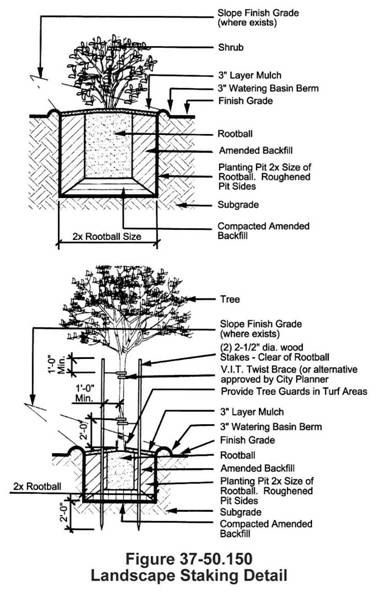
(Ord. No. 2463 (NCS).)
(Ord. No. 2507 (NCS), §§ 41—43, 5-18-2010)
(a)
Purpose. The purpose of this section is to establish regulations governing freestanding landscape-related architectural features such as arbors, decorative lampposts, fountains, and similar features within required front or corner side yards. Play structures, barbeques, sports apparatus, carports, fences, swimming pools, and other structures used for storage, athletic, or recreational purposes shall not be considered landscape architectural features.
(b)
Development Regulations. Landscape architectural features may be permitted to encroach into required front and corner side yards specified for all zoning districts subject to site plan review approval and the following standards:
(1)
Setback. The feature must be setback a minimum of three feet from the front or corner side property lines of the subject parcel, as applicable. No portion of the structure may encroach into the public right-of-way or an easement.
(2)
Height and Bulk. The maximum height of the feature shall be eight feet and have no solid horizontal surface with dimensions of more than twenty-four inches, above a three-foot height as measured from ground level. Arbors shall be substantially open (no solid walls or roof).
(3)
Area. The maximum area of a feature shall be twenty square feet. The area shall be determined by a rectangle formed around the extreme outer limits of the feature.
(4)
Visibility Triangle. The feature shall not be located in an area of unrestricted visibility as defined by Section 37-50.460: Driveway and corner visibility.
(c)
Application. Applications for a landscape architectural feature shall be initiated by submitting an application for a site plan review.
(d)
Public Hearing Notice. No public hearing shall be required if an applicant has obtained the prior approval in writing from all property owners abutting the boundaries of the site and directly across the street or alley from the project site to allow the proposed landscape architectural feature. Such approval shall be in a form approved by the city planner.
(e)
Public Hearing. In the event that the adjacent property owners do not approve the subject application, the planning commission shall hold a public hearing on the application after providing notice in accordance with the provisions of Article VI, Division 7: Public Hearing Notice.
(f)
Standards of Approval. In approving the landscape architectural feature, the city planner or planning commission, as applicable, shall determine:
(1)
The scale, size, and design of the proposed feature is compatible with the existing architectural design and development located on the subject property and on adjoining properties; and
(2)
That the feature is consistent with the general purposes and design standards of the zoning district in which the subject property is located.
(g)
Exceptions. Fences and entryway arbors are subject to the requirements of Section 37-50.090: Fences, walls, and hedges and shall not be subject to the requirements of this section.
(Ord. No. 2463 (NCS).)

- Supplemental Regulations Applying to All Districts.
(a)
Purpose. The purpose of this section is to establish regulations governing the location, maximum height, size, and design requirements for accessory structures and uses within all zoning districts.
(b)
Definitions. The following definitions shall apply to this section:
(1)
Accessory Structure. A structure which:
(A)
Is detached from or attached to a principal structure and not designed or used for living or sleeping purposes;
(B)
Is subordinate to and serves a principal structure;
(C)
Is subordinate in area, extent or purpose to the principal structure;
(D)
Contributes to the comfort, convenience, or necessity of the occupants of the principal structure; and
(E)
Is located on the same lot as the principal structure.
(2)
Accessory Use. A use which:
(A)
Is subordinate to and serves a principal use;
(B)
Is subordinate in areas, extent, or purpose denoted to the principal use;
(C)
Contributes to the comfort, convenience, or necessity of occupants of the principal use; and
(D)
Is located on the same lot as the principal use.
(3)
Architectural Entry Features. Unenclosed projecting overhead elements such as a shed, arch, or gable providing roof coverage and weather protection over the doorways of structures. Such entries shall be an integral architectural feature compatible with and attached to the main structure.
(4)
Building Line. The exterior wall surface of the main residential building exclusive of architectural projections or eaves.
(5)
Deck. An unenclosed accessory structure, usually made of wood or similar material built to provide a solid continuous horizontal surface for outdoor use which is separated from the ground by airspace and has ground-mounted supports such as footings, piers, posts, or similar features. Deck railings shall not be considered an enclosure.
(6)
Facade. That portion of any exterior elevation on the building extending from grade to top of parapet, wall, or eaves along the entire width of the building elevation.
(7)
Porch. An unenclosed (open on a minimum of one side) platform with a roof structure and with or without railings that is attached to and accessible from the principal structure. Porches are typically located at the entrance to the principal structure and are not heated or cooled. Porch railings shall not be considered an enclosure.
(8)
Railing. A nonsight-obscuring fence-like barrier (made of wood, metal, or similar material) comprised of one or more horizontal rails, bars, or members supported by two or more spaced vertical posts typically used in conjunction with decks, porches, balconies, and staircases.
(9)
Utility Shed. A one-story accessory structure enclosed on at least three sides and at least four feet in height, with a floor area not exceeding one hundred twenty square feet.
(c)
Accessory Uses. An accessory use may be deemed accessory to a permitted use, conditionally permitted use, or a use allowed with a site plan review.
(d)
Regulations Applying to Accessory Structures in All Districts. The following regulations shall apply to all accessory structures:
(1)
Residential Occupancy. Unless provided for elsewhere in this Zoning Code, accessory structures shall not be used for residential occupancy. Enclosed accessory structures with plumbing and/or gas utility connections shall be required to obtain a conditional use permit except for hot tubs, gazebos used to cover hot tubs, spas or pools, or other similar uses as determined by the city planner. Plumbing for laundry facilities, water heaters and softeners, and HVAC units in garages are exempt.
(2)
All accessory structures shall be subject to the regulations and standards of this section, regardless of whether the accessory structure is allowed as a permitted use, use subject to the approval of a site plan review, or a conditionally permitted use under the applicable base zoning district.
(3)
Nonconforming Uses. Accessory structures shall not be permitted to be constructed on any parcel or lot that has an existing nonconforming use except as permitted in accordance with Section 37-50.160: Nonconforming uses and structures.
(4)
Accessory Structures as Usable Open Space. Unenclosed accessory structures that are designated for and used for open space or recreational purposes may be counted as usable open space if the structure's size and location are consistent with the definition of usable open space contained in Section 37-10.390: "O" definitions. However the square footage of such structures shall also be counted toward the maximum square footage requirements for accessory structures except as provided for in Section 37-50.010(f)(4).
(5)
Design Standards.
(A)
Accessory structures are subject to the design regulations as specified for the applicable zoning district where the structure is to be located.
(B)
The architectural design of accessory structures shall be compatible with the design of the principal structure by the use of complementary building colors and materials, window and roofing treatments, and architectural detailing.
(C)
The rooflines and pitches of accessory structures shall be compatible and harmonious with those of the principal structure. Flat roofs are discouraged unless appropriate to the architectural style of the principal structure.
(6)
Required Egress. No accessory structure shall be located so as to block pedestrian or vehicular egress from other structures (such as a window or door).
(7)
Distance Between Structures. All accessory structures (except for unenclosed trellises and arbors (no solid roofs or walls), and utility sheds) shall be subject to the minimum distance between structure regulations of the applicable zoning district unless otherwise specified in this section.
(8)
Trampolines, play structures, and similar recreational equipment are subject to the requirements of this section and the applicable zoning district.
(9)
Temporary structures such as carports, tents, and canopies consisting of membrane structures, metal, or similar materials are subject to the requirements of this section and the applicable zoning district.
(10)
Second Dwelling Units. Second dwelling units are not considered accessory structures and are not subject to the regulations of this section.
(e)
Additional Regulations for Residential Accessory Structures Located in R Districts.
(1)
Timing. Residential accessory structures (either attached to or detached from a principal structure) shall not be established or constructed prior to the start of construction of a principal structure on-site, except that construction trailers may be placed on a site not more than fifteen days prior to the time site clearance and grading begins. Construction trailers shall be removed at the completion of construction prior to issuance of a certificate of occupancy. Construction trailers shall not be used for residential occupancy at any time.
(2)
Maximum Height. Except as otherwise provided for in this section, the maximum height of a residential accessory structure shall be twelve feet, subject to the provisions of this subsection, provided that pitched roofs shall not exceed a height of fifteen feet. In no case shall the top of the roof ridge of an accessory structure exceed the top of the roof ridge of the principal structure. For residential accessory structures that are located in the area of historic and architectural merit as indicated on Figure COS-3 (Historic and Architectural Resources) of the general plan conservation/open space element, pitched roofs of accessory structures may exceed the maximum height specified for such structures in order to match the pitch of the roof of the principal structure subject to the approval of the city planner. In order to approve the increased roof height, the city planner must determine the following:
(A)
The exterior walls of the accessory structure do not exceed a maximum of eight feet in height;
(B)
Any portion of the roof structure located within a distance of five feet of the property line does not exceed the maximum height for pitched roofs or other provisions of this section;
(C)
The increased roof height does not contain habitable space;
(D)
The top of the roof ridge of an accessory structure does not exceed the top of the roof ridge of the principal structure or the maximum height for the applicable zoning district, whichever is less; and
(E)
The principal structure has historic or architectural significance.
(3)
Review/Permit Requirements. Residential accessory structures shall be subject to the following review/permit requirements:
(A)
In the R-L and R-M-3.6 districts, residential accessory structures shall be permitted uses on lots with single-family detached dwelling units except as otherwise required in this section. Such structures; however, may be subject to the issuance of a building permit by the development and engineering services department. Residential accessory structures shall require a site plan review or a conditional use permit if required for the principal use by the applicable base zoning district.
(B)
In the R-M 2.9 and R-H districts, residential accessory structures require a site plan review or conditional use permit if required for the principal use. Residential accessory structures on lots located in an R-M-2.9 and R-H district with a single-family detached or attached dwelling unit shall be subject to the regulations in Section 37-50.010(f). Accessory uses shall comply with all regulations applicable to the principal structure on-site.
(f)
Additional Regulations for Residential Accessory Structures Located in R-L and R-M-3.6 Districts—Required Yards—Maximum Square Footage—Exemptions.
(1)
Attached Residential Accessory Structures.
(A)
Front, Corner Side, Interior Side, or Rear Yards. Accessory structures that are attached to the principal structure are subject to the same required yards as the principal structure except that unenclosed porches and architectural entry features may encroach a maximum of five feet into the required front or corner side yard and as specified in Section 37-50.010(i): Utility Sheds.
(2)
Detached Residential Accessory Structures.
(A)
Front or Corner Side Yards. Detached accessory structures shall not be permitted in front or corner side yards or to project beyond the front or corner side yard facade or building line of the principal structure on the site except as specified in Section 37-50.710: Landscape architectural features.
(B)
Rear or Interior Side Yards. Detached accessory structures located in a rear or interior side yard shall be located not less than five feet from a rear or interior side yard property line except:
(i)
As specified in Section 37-50.010(i): Utility Sheds; and
(ii)
Unenclosed trellises and arbors (no solid roofs or walls), including any portions thereof, that are a maximum of one hundred twenty square feet or less in size and a maximum of eight feet or less in height shall not be located closer than one foot from any property line in the rear yard.
(3)
Maximum Square Footage. Unless otherwise specified as exempt in accordance with Sections 37-50.010(f)(4)(A) and (B): Exemptions, the following shall apply to all detached and attached residential accessory structures:
(A)
The total square footage of all residential accessory structures more than four feet in height shall not exceed four hundred square feet or ten percent of lot area, whichever is more except for lots with single-family attached dwelling units. Lots with single-family attached dwelling units shall not exceed a maximum of one hundred twenty square feet for all residential accessory structures more than four feet in height.
(B)
Any residential accessory structure with a square footage greater than fifty percent of the square footage of the principal structure shall be subject to the approval of a conditional use permit.
(4)
Exemptions. The following residential accessory structures shall be exempt from the requirements of Sections 37-50.010(f)(3)(A) and (B):
(A)
Up to a maximum of four hundred square feet for required off-street covered parking; and
(B)
Unenclosed porches that are attached to the front or corner side facade of a principal structure.
(g)
Additional Regulations for Accessory Structures in A, MU, C, PS, OS, P, and I Districts and for Nonresidential Uses in R Districts. Accessory structures and uses require a site plan review or conditional use permit if required by the principal use. Accessory structures shall comply with all regulations applicable to the principal structure on-site. Residential accessory structures shall be subject to the regulations in Section 37-50.010(f).
(h)
Additional Regulations for Accessory Structures in the NU Districts. Accessory structures located in NU districts shall be subject to the requirements of Article III, Division 8: New Urbanism (NU) Districts.
(i)
Utility Sheds. In an A, R-L, R-M, or R-H district, utility sheds shall be allowed on any lot with a single-family detached dwelling unit, subject to the following:
(1)
Area. A utility shed may not exceed a maximum of one hundred twenty square feet in area, and the aggregate area of utility sheds on any lot shall not exceed two hundred forty square feet. The square footage of all utility sheds shall be included in and not be in addition to the maximum area permitted for all accessory structures as specified in Section 37-50.010(f)(3) above.
(2)
Location. Utility sheds shall not occupy a front or corner side yard, nor project beyond the front or corner side yard facade or building line of the principal structure. Utility sheds may be located within other required yards, except that there shall be a minimum one-foot setback from interior property lines within the front half of the lot. In addition to other provisions of this section, placement of utility sheds shall provide on at least three sides, a minimum separation of thirty-six inches from other structures (except fences) and must not impede emergency access.
(3)
Height and Relation to Property Line. Unless allowed by an exception granted in accordance with Section 37-50.010(i)(7), the maximum height of a utility shed shall be seven feet within one foot of any property line, and the roof may slope away from adjacent parcels up to a maximum of nine feet high within required yards.
(4)
Rain Runoff. Utility shed roofs within five feet of any property line shall be equipped with a rain gutter, or otherwise designed to prevent roof runoff from draining onto adjacent property.
(5)
Plumbing. Internal plumbing is prohibited within a utility shed.
(6)
Other Codes. An exemption from the requirement to obtain building permits for utility sheds due to their size shall not be interpreted to exempt such sheds from other such building permits or city approvals as required by law.
(7)
Exceptions. The planning commission or city planner may grant minor exceptions from certain height requirements within this subsection. The process for considering exceptions shall be that set forth for minor exceptions pursuant to Section 37-60.490(a): Conditional Use Permit for a Minor Exception. Exceptions may be considered when a utility shed is screened by existing landscaping or natural features or a utility shed is screened by an adjacent, legal fence. In no case; however, shall a utility shed height exceed the maximum height allowed for accessory structures.
(j)
Satellite Dish Antennas. A satellite dish antenna may be installed on a lot in any zoning district if it complies with the criteria identified in this section. Satellite television antennas less than thirty inches in diameter are permitted in any zone and are not subject to the requirements of this section, provided that such antennas are attached to a permitted main or accessory structure on the lot.
(1)
A, R, and NU (NE, NG-1, NG-2) Districts.
(A)
Locations Prohibited. No satellite dish antenna shall be located in a front or corner side yard or within existing easements;
(B)
Setbacks. Front and corner side property lines: twenty feet; interior side and rear property lines: twenty feet, except that no setback shall be required in interior side and rear setback areas if the antenna does not exceed six feet in height;
(C)
Maximum height: fifteen feet, measured from ground level immediately under the antenna to the highest point of the antenna or any appurtenance attached to it, provided that the city planner may approve mounting an antenna on the rear half of a roof if no other feasible location exists.
(2)
C, I, MU, NU (VC), P, OS, and PS Districts.
(A)
Roof-mounted Antennas. Satellite dish antennas shall be located on the roof of a structure whenever feasible, providing the dish is not visible or can be adequately screened from view of public and private streets;
(B)
Ground-mounted Antennas. All satellite dish antennas that cannot be installed on the roof in a manner that is not visible from a public street shall be located directly adjacent to a building, whenever feasible. Ground-mounted dishes shall be located to the rear or interior side of the building, whenever feasible, in order to be screened from view from the front of the building and public streets. Ground-mounted antennas shall be adequately screened from view from public and private streets, unless required for antenna focusing purposes;
(C)
Location Prohibited. No satellite dish antennas shall occupy a required parking space, adversely impact any vehicle circulation, or be located within existing easements;
(D)
Maximum height: twenty feet measured from ground or roof level immediately under the antenna to the highest point of the antenna or any appurtenance attached thereto;
(E)
Permit Required. A site plan review shall be required for all satellite dish antennas in any C, I, MU, NU (VC), P, OS, or PS district which are visible from public rights-of-way or public areas.
(k)
Swimming Pools, Spas, and Hot Tubs. Swimming pools, spas, and hot tubs may be placed anywhere on a lot except within required front or corner side yards and existing easements, subject to the following:
(1)
Fencing. A fence or wall not less than six feet high shall be provided around the pool, spa, or hot tub. The fence or wall shall enclose the facility completely to prevent unauthorized access. Hedges or other plant materials shall not substitute for a fence or wall.
(2)
Openings in Fence. If a nonsolid fence is provided, fence openings shall not be wider than four inches.
(3)
Latches. Every door or gate opening shall be provided with a self-closing and self-latching device.
(4)
Emergency Access. A three-foot clear path shall be provided around fifty percent or more of the pool perimeter, excepting spas and hot tubs.
(5)
Swimming pool and spa equipment shall be set back a minimum of two and one-half feet from the property line, provided that a screen, which matches the exterior of the principal structure, surrounds such equipment.
(Ord. No. 2463 (NCS).)
(Ord. No. 2507 (NCS), §§ 33, 34, 5-18-2010)
(a)
Purpose. Foster the restoration and/or adaptation of existing, nonresidential buildings into residential dwelling units to produce much needed housing in the city, facilitate economic development, preserve historic resources, and create a vibrant downtown.
(b)
Definitions.
(1)
Adaptive reuse project. Adaptation of all or any portion of an existing, eligible building for the purpose of creating residential dwelling units.
(2)
Eligible building. Any non-residential building that was legally constructed at least fifty years prior to the date of application for consideration as an adaptive reuse project in accordance with the building and zoning codes in effect at the time of its original construction and subsequent legally permitted additions. An eligible building must be either:
(A)
Located in the Central City Overlay Zoning District, or
(B)
A historically significant building.
(3)
Historically significant building. Any building that is listed on the National Register of Historic Places, the California Register of Historical Resources, or the City of Salinas list of Historical Properties.
(4)
Nonresidential use. Any use other than dwelling units, guest rooms, or joint live/work units.
(c)
Regulations applying to adaptive reuse projects. The following regulations shall apply to an adaptive reuse project:
(1)
Definition. All projects shall conform to the definitions set forth in Section 37-50.015(b).
(2)
Zoning. All projects shall conform to the use classification regulations applicable to the underlying zoning district.
(3)
Administration. All projects shall obtain site plan review approval or a conditional use permit, as may be required in the underlying zoning district.
(4)
Incentives. Adaptive reuse projects in an eligible building may receive the following incentives:
(A)
The project can exceed the maximum density and minimum lot area per dwelling unit.
(B)
The project can exceed the minimum lot area and dimensions so long as the lot conforms to Section 37-50.070 Development on Existing Lots.
(C)
The project can exceed the maximum floor area ratio (FAR) otherwise established for the zoning district.
(D)
The existing setbacks may remain provided there are no further encroachments.
(E)
The height of the eligible building, if it exceeds the maximum height of the zoning district, may remain with allowance for the addition of new mechanical equipment or appurtenances in conformance with the Zoning Code.
(F)
Usable open space shall not be required for the adaptation of non-residential space for residential units.
(G)
New off street parking spaces shall not be required for any converted residential use within the existing eligible building envelope, but existing parking spaces shall be retained.
(5)
Residential standards. Each residential unit shall be a minimum of three hundred fifty square feet in size and contain at least one full bathroom including a toilet, sink, and shower or tub and a full kitchen including a sink, countertop at least four feet in length, cooking apparatus, and refrigerator.
(6)
Design standards for projects within the central city overlay zoning district.
(A)
Projects that involve changes, alterations, and/or additions to an exterior elevation shall conform to the applicable development regulations in Section 37-40.320 and design standards in Section 37-40.330.
(B)
Projects that involve changes, alterations, and/or additions to site improvements that increase a discrepancy with a nonconforming condition shall conform to the applicable development regulations in Section 37-40.320 and design standards in Section 37-40.330.
(7)
Design standards for projects within the downtown core, central city overlay zoning district.
(A)
Projects in the mixed use zoning district shall maintain at least fifty percent of the ground floor of the building for commercial/retail space.
(B)
Projects in the mixed use zoning district shall be limited to less than fifty percent of the ground floor square footage for common area spaces such as lobbies, and recreation rooms.
(C)
Changes to existing signs or installation of new signs shall conform to the applicable design standards in Section 37-40.330.
(8)
Requirements for adaptive reuse projects of a historically significant building in the downtown core or citywide. Projects shall comply with the Secretary of Interior Standards for Rehabilitation and the review process as required in Article XI—Historic Resources Board in the Salinas Municipal Code.
(9)
Additional design standards for citywide projects.
(A)
All citywide projects must be located in a historically significant building and therefore, any changes, alterations, and/or additions to an eligible building shall comply with the secretary of interior standards for rehabilitation and the applicable review process pursuant to Article XI of the Salinas Municipal Code.
(B)
Projects that involve changes, alterations, and/or additions to site improvements that increase a discrepancy with a nonconforming condition shall conform to the applicable standards of the underlying zoning district.
(C)
Changes to existing signs or installation of new signs shall conform to the applicable provisions inArticle V—Supplemental Regulations Applying to all Districts, Division 3: Signs.
(Ord. No. 2605(NCS), § 2, 7-3-2018; Ord. No. 2607(NCS), §§ 1, 4, 5, 9-18-2018)
(a)
Purpose. The purpose of this section is to establish regulations governing adult entertainment facilities. The city council recognizes that certain types of adult entertainment facilities possess certain objectionable operational characteristics, which if such uses are allowed to concentrate, will have adverse effects upon the character of the affected area and adjacent neighborhoods. The city council further recognizes that locating adult entertainment facilities in close proximity to facilities frequented by minors will cause the exposure of minors to adult material that may adversely affect such minors due to their immaturity. Additionally, the city council recognizes that while certain adult entertainment enjoys limited protection under the First Amendment to the United States Constitution, substantial numbers of the citizens of the city are offended by the public display of sexually oriented material. Special and limited regulation of adult entertainment uses, consistent with the First Amendment rights of such uses, is therefore necessary to ensure that the adverse effects of adult entertainment uses will not (1) contribute to the blighting or downgrading of zones in which they are permitted or the downgrading of surrounding neighborhoods; (2) adversely affect minors; and (3) offend those citizens of the city who do not wish to be exposed to sexually oriented material.
(b)
Definitions. The following definitions shall apply to this section:
(1)
Adult Bookstore. An establishment where:
(A)
Twenty percent or more of the establishment's stock, books, magazines, or other periodicals or films are devoted to "specified sexual activities" or "specified anatomical areas"; or
(B)
Twenty percent or more of the establishment's films, peepshows, or other similar devices designed for individual viewing on the premises by up to five persons are devoted to "specified sexual activities" or "specified anatomical areas"; or
(C)
Twenty percent or more of the establishment's actual display areas, including without limitation, the areas for the viewing of films, peepshows, or similar devices are substantially devoted to the exhibition of "specified sexual activities" or "specified anatomical areas." This definition does not apply to displays of up to ten periodicals or films in the premises, by title in which sales or rental of the same are incidental to other businesses. Nor does this definition include any art or photography publications depicting the specified anatomical areas defined in this section when such publication devotes at least twenty-five percent of the lineage of each edition to articles and advertisements dealing with the subjects of art or photography. Nor does this definition apply to any news periodical which reports or describes current events and which, from time to time, publishes photographs of nude or semi-nude persons when describing cultures in which nudity or semi-nudity is indigenous to the population. Nor does this definition apply to bona fide education or medical publications.
(2)
Adult Entertainment Facility. Any facility which includes an adult bookstore, an adult motion picture theater, an adult live entertainment establishment or any other place of business of any similar purpose, operation, or function regardless of whether any other use is also conducted on the premises.
(3)
Adult Live Entertainment Establishment. A building or structure or portion thereof used or proposed to be used for presenting live entertainment in which more than forty-five days per calendar year there are live entertainment performances which are substantially devoted to the exhibition of the specified sexual activities or the specified anatomical areas, as defined in this section, for the observation and viewing by patrons therein.
(4)
Adult Motion Picture Theater. An establishment, including a building, structure, drive-in theater, or part thereof used for presenting material in the form of motion picture film, video tape, or other similar means, designed for observation by five or more persons, in which more than forty-five days per calendar year any one or more programs are shown which are substantially devoted to the depiction of the specified sexual activities or specified anatomical areas as defined in this section. Whenever more than one screen or theater exists in any single premises, the total number of days that the films described in this section are shown on each screen or in all theaters on the premises shall be added together for the purpose of determining if the premises is an adult motion picture theater.
(5)
Specified Anatomical Areas.
(A)
Less than completely and opaquely covered human genitals, human buttocks, and human female breast below a point immediately above the top of the areola; and
(B)
Human male genitals in a discernibly turgid state, even if completely and opaquely covered.
(6)
Specified Sexual Activities.
(A)
Human genitals in a state of sexual stimulation or arousal;
(B)
Sexual intercourse, masturbation, oral copulation, or sodomy, whether between humans of the same or opposite sex or between humans and animals; and
(C)
Fondling or other erotic touching or sexual stimulation of human genitals, pubic region, buttock, or female breast.
(c)
Location of Adult Entertainment Facilities.
(1)
No person shall own or operate any adult entertainment facility if that facility is located:
(A)
Within two thousand feet of any other adult entertainment facility;
(B)
Within one thousand feet of any pre-existing public or private school attended primarily by minors under eighteen years of age;
(C)
Within one thousand feet of any pre-existing parcel in the central city overlay (downtown core area) district;
(D)
Within two hundred fifty feet of any pre-existing church;
(E)
Within two hundred fifty feet of any pre-existing public park or recreation facility which is available for use by minors; and
(F)
Within two hundred fifty feet of any pre-existing residential district.
(2)
The distance shall be measured from the closest exterior wall of the building/suite or property line of the site (if there is no building) where the adult entertainment facility is located to the nearest property line of the site containing those uses specified in Section 37-50.020(c)(1)(A) through (F) above.
(3)
An adult entertainment facility shall only be permitted where the applicable zoning district regulations specifically provide for adult entertainment facilities.
(d)
Public Display of Certain Matter Prohibited. Adult entertainment facilities shall not display or exhibit any material depicting specified anatomical areas or specified sexual activities in a manner that exposes such material to the view of persons outside the building in which such facility is located.
(e)
Notice Required. On or near any public entrance to every adult entertainment facility there shall be a sign with letter sizes of one inch or greater stating:
NOTICE:
THIS ESTABLISHMENT CONTAINS ADULT ENTERTAINMENT MATERIALS.
IF YOU ARE OFFENDED BY SUCH MATERIALS,
PLEASE REFRAIN FROM ENTERING.
(f)
Determining Distances Between/From Adult Entertainment Facilities. For the purpose of determining the distances between the public entrance into the adult entertainment facility, the measurement shall be from the nearest public entrance into the adult entertainment facility (as contrasted with a nonpublic entrance, an exit used solely for egress, the nearest lot line of the parcel upon which the use is located or the nearest part of the structure in which it is housed) then along the nearest public street or streets to the nearest lot line of the use being measured.
(g)
Required Findings. The city planner or planning commission, as applicable, shall approve an application for a conditional use permit for adult entertainment uses as it was applied for or in a modified form if, on the basis of the application and testimony submitted, all of the following findings can be made:
(a)
That the proposed location of the use is in accordance with the objectives of the Salinas General Plan, this Zoning Code and the purposes of the district in which the site is located;
(b)
That the proposed location of the conditional use and the proposed conditions under which it would be operated or maintained are consistent with the Salinas General Plan; and
(c)
That the proposed conditional use complies with the provisions of this Zoning Code, including any specific conditions required for the proposed use.
(Ord. No. 2463 (NCS).)
(Ord. No. 2507 (NCS), § 45, 5-18-2010)
(a)
Purpose. The purpose of this section is to provide for the orderly integration of alcohol-related uses in the city, including the sale of beer, wine, and distilled spirits.
(b)
Definitions. The following definitions shall apply to this section:
(1)
Brew Pubs. An establishment in which beer is manufactured in limited quantities for on-site and off-site sales, distribution, and consumption.
(2)
Downtown Alcohol-related Use License Area. All parcels located within the six-block area bounded by Monterey Street, East and West San Luis Street, Salinas Street, and East and West Market Streets as shown on Figure 37-50.10. Parcels must be contained within the area defined by these streets. Frontage on the listed streets is not sufficient to meet the definition.
(3)
Guests. Persons who, during the hours when meals are regularly served, come to a restaurant for the purposes of ordering and obtaining, in good faith, a meal.
(4)
Meals. The usual assortment of foods commonly ordered at various hours of the day and prepared on the premises.
(5)
Off-sale (Off-premises Consumption) Alcohol-related Use. Alcoholic beverages, including distilled spirits, beer, and wine, sold in original, unopened containers for consumption off the premises where sold.
(6)
On-sale (On-premises Consumption) Alcohol-related Use. Alcoholic beverages, including distilled spirits, beer, and wine, sold on the premises to be consumed on the premises.
(7)
Premises. A lot or parcel, together with all related buildings, structures, open spaces, and parking areas.
(8)
Restaurant. A commercial establishment, with kitchen facilities, which is regularly, and in a bona fide manner, used principally for the preparation, cooking, and serving of food to customers for compensation and where seating or other physical accommodation is provided for on-site dining. May also include accessory catering services.
(9)
Wine Tasting Room. An establishment in which wine and wine-related products are available for off-site sale, distribution, and consumption, and where wine, limited to that offered for sale, is sampled on the premises. Nothing in this Zoning Code shall be construed to require that any food be sold or purchased with any beverage. A wine tasting room may include a boutique winery.
(10)
Winery. A facility used for the purpose of processing grapes, other fruit products, or vegetables to produce wine or similar spirits. Processing includes crushing, fermenting, blending, aging, storage, bottling, warehousing, wine tasting facilities, administrative offices, and wholesale and accessory retail sales of associated wine and wine-related items. A winery does not include a boutique winery.
(11)
Winery, Boutique. A facility where wine is produced from preprocessed ingredients. Processing permitted at boutique wineries shall be limited to blending ingredients, fermenting wine in sealed containers, bottling of wine, warehousing of ingredients, short-term storage, wine-tasting facilities, administrative offices, and retail and accessory wholesale sales of associated wine and wine-related items. Boutique wineries do not include crushing, pressing, or other processing of fruits or vegetables, and do not include the blending or mixing of ingredients through the use of any machinery or mechanical means.
(c)
Conditional Use Permit Required. A conditional use permit shall be required for all alcohol-related uses (including changes of existing alcohol license type as administered by the state of California Alcoholic Beverage Control Department) except as provided in Section 37-50.030(g): Exceptions below.
(d)
City Planner and Planning Commission Authority.
(1)
The city planner shall have the authority to grant a conditional use permit for:
(A)
Any on-sale alcohol-related use;
(B)
Any off-sale alcohol-related use not located in an area of undue concentration; and
(C)
Any alcohol-related use (such as brew pubs and wine tasting rooms) with both off-sale and on-sale licenses located in the downtown alcohol-related use license area.
(2)
The planning commission shall have the authority to grant a conditional use permit for all other alcohol-related uses.
(e)
Required Findings. In addition to findings required pursuant to Article VI, Division 8: Conditional Use Permits, the following findings shall be made prior to the approval of a conditional use permit for alcohol-related uses:
(1)
The alcohol-related use will neither adversely affect the welfare of the area nor of surrounding residentially zoned neighborhoods, giving due consideration to the distance of the proposed use from other alcohol-related uses, residentially zoned property, public schools, public playgrounds, and other similar uses; and giving further consideration to crime rates, calls for emergency services, and residential densities in the surrounding area.
(2)
For any off-sale alcohol-related use located within an area of undue concentration (as defined by Business and Professions Code Sections 23958.4, 23817.5, and 23817.7, and administered by the State Department of Alcoholic Beverage Control), Section 37-60.500: Administrative conditional use permits shall not apply except as authorized in Section 37-50.030(e)(3) below. For off-sale alcohol-related uses located in an area of undue concentration, the planning commission shall also make the findings required by Business and Professional Code Section 23958.4, 23817.5, and 23817.7 that public convenience or necessity would be served by the issuance of the alcohol license by the ABC, even though such premises is located within an area of undue concentration. The planning commission is authorized by the city council to make the determination of public convenience or necessity through the conditional use permit process. Such findings are not required or applicable to on-sale alcohol-related uses located in an area of undue concentration.
(3)
For alcohol-related uses that have both on-sale and off-sale alcohol sales (specifically brew pubs and wine tasting rooms) in the downtown alcohol-related use license area, the city council authorizes the city planner in accordance with Section 37-60.500: Administrative conditional use permits to approve an administrative conditional use permit for such uses, if applicable, and to make a determination of public convenience or necessity in conformance with the required findings specified in Section 37-50.030(e)(2) above. The city council authorizes this authority in order to facilitate and implement the redevelopment and entertainment goals for the downtown alcohol-related use license area.
(f)
Additional Requirements for Alcohol-related Uses. The following conditions shall be imposed as part of a conditional use permit issued for an alcohol-related use:
(1)
The premises shall be maintained free of litter at all times.
(2)
For on-sale alcohol-related uses, no alcoholic beverages shall be sold, dispensed, or offered for consumption except within the licensed premises.
(3)
For off-sale alcohol-related uses:
(A)
No alcoholic beverages shall be consumed on the premises;
(B)
No sale or distribution of alcoholic beverages shall be made from a drive-up or walk-up window;
(C)
No display of alcoholic beverages shall be made from an ice tub; and
(D)
No "single-serving" or "one-can" sales of alcoholic beverages shall be made from the premises. A sign to this effect in English and Spanish shall be maintained at the cashier station at all times. Exception: "single serving" or "one-can" non-chilled or non-refrigerated alcoholic beverages may be sold from those premises with at least eight thousand square feet of gross floor area and located in a shopping center with a minimum of ninety thousand square feet of gross floor area.
(4)
For service stations which include off-sale liquor establishments:
(A)
No alcoholic beverage shall be displayed within five feet of the cash register or the front door of the permitted premises unless displayed in a permanently affixed cooler;
(B)
No advertisement of alcoholic beverages shall be displayed at or located on motor fuel islands, nor shall self-illuminated advertising for alcoholic beverages be located on buildings or windows; and
(C)
Alcohol shall not be sold between the hours of 10:00 p.m. and 6:00 a.m. Coolers containing alcoholic beverages shall be locked between the hours of 10:00 p.m. and 6:00 a.m.
(5)
As applicable, conditions including, but not limited to, requirements for employee security, buffering of neighboring uses, exterior lighting, hours of operation, and coin- or token-operated amusement games may be imposed.
(6)
All business owners and managers shall complete a program certified by the Department of Alcoholic Beverage Control (ABC) as a qualified responsible beverage service (RBS) program prior to the commencement of the use. Any business established after the effective date of the ordinance codified in this section shall require such training of all owners and managers within ninety days of ownership transfer or hire. Failure of managers to obtain training shall be the liability of the owner. The owner shall maintain on the premises a file containing the certificates of training and shall present the file and its contents upon request by the city at any time during normal business hours. The provisions of this section regarding responsible beverage training shall be suspended upon a finding by the city planner that the training is not reasonably available.
(g)
Exceptions.
(1)
The following uses are not subject to the requirement to obtain a conditional use permit or a site plan review:
(A)
Any bona fide nonprofit organization which conducts an event or activity not more than twelve days in each calendar year, at which event or activity any alcoholic beverage is to be sold, served, given away, or consumed at such event or activity;
(B)
An establishment that changes business ownership. This exemption shall not apply if the previous (alcohol-related) use has been discontinued for more than six months;
(C)
Wholesale distribution or manufacture of alcoholic beverages.
(2)
An on-sale alcohol use at a restaurant (not located in the downtown alcohol-related use license area) is allowed with a site plan review (in lieu of a conditional use permit) provided all of the following requirements are met:
(A)
The primary use of the restaurant is for sit-down food service of patrons. Seating for sit-down food service of patrons is provided on the premises and constitutes at least fifty percent of the establishment's seating area. The on-sale alcohol use is accessory to the food service use and there is not a distinguishable separate bar area.
(B)
Alcohol shall not be sold on Sunday through Thursday after 11:00 p.m. until 6:00 a.m. the following day, and after 12:00 midnight on Friday and Saturday until 6:00 a.m. the following day.
(C)
The use is not located within one hundred feet of a residence or within three hundred feet of a park or five hundred feet of a school. The distance shall be measured from the closest exterior wall of the building/suite or property line (if there is no building) where the alcohol-related facility is located to the nearest property line of the site containing a residential dwelling unit or zone, school, or park site. This requirement does not apply to restaurants in the downtown alcohol-related use license area.
(3)
Accessory on-sale alcohol-related uses in the downtown alcohol-related use license area are permitted subject to the issuance of a site plan review (in lieu of a conditional use permit) if it meets the following requirements:
(A)
The primary use is limited to a restaurant (including those with outdoor seating), hotel, bed and breakfast inn, or theater and the alcohol-related use is clearly accessory to that use.
(B)
Any bar and related seating area comprises less than fifty percent of the floor area of the principal uses in the building or one thousand square feet, whichever is less.
(C)
For restaurants, the primary use shall be for sit-down food service of patrons. Seating for food service shall be provided on the premises and constitutes at least fifty percent of the establishment's seating area.
(D)
Alcohol shall not be sold on Sunday through Thursday after 11:00 p.m. until 6:00 a.m. the following day, and after 12:00 midnight on Friday and Saturday until 6:00 a.m. the following day.
(4)
The following uses shall not be subject to the requirements of Sections 37-50.030(f)(2) and 37-50.030(f)(3)(A):
(A)
Wine tasting rooms and brew pubs located in the downtown alcohol-related use license area; and
(B)
Wineries.
(Ord. No. 2463 (NCS); Ord. No. 2482 (NCS), § 2; Ord. No. 2483 (NCS), § 1.)
(Ord. No. 2507 (NCS), § 35, 5-18-2010; Ord. No. 2569 (NCS), § 7, 4-19-2016)
(a)
Building Projections. Projections in required yards shall be permitted as follows unless otherwise provided for in this Zoning Code:
(1)
Fireplaces or chimneys: two and one-half feet into a yard;
(2)
Uncovered and unenclosed stairs, terraces, platforms, decks and subterranean garages (not more than thirty inches in height above site grade): three feet for a length of ten feet parallel to the adjoining property line in a side yard; and six feet for a length of ten feet parallel to the adjoining property line in a rear yard;
(3)
Unenclosed porches and architectural entry features: five feet into a front or corner side yard;
(4)
Cornices, eaves, canopies, awnings, and similar ornamental features: two and one-half feet into a yard. Cornices, eaves, canopies, and similar ornamental features provided in conjunction with ground floor unenclosed porches and architectural entry features may encroach an additional two and one-half feet into a front or corner side yard beyond that permitted in Section 37-50.040(3) above;
(5)
Balconies and protruding windows: five feet into a front, corner side, or rear yard and two and one-half feet into an interior side yard, except in the R-H districts, a balcony may encroach five feet into an interior side yard;
(6)
Other stairs: two and one-half feet into an interior side or rear yard except in the R-H districts; stairs may encroach five feet into an interior side or rear yard. Uncovered and unenclosed stairs, which provide direct pedestrian access to and are only used in conjunction with ground floor unenclosed porches and architectural entry features, may encroach an additional three feet into a front or corner side yard beyond that permitted in Section 37-50.040(3) above;
(7)
In R and NU (NE, NG-1, and NG-2) districts, heating, ventilation, air conditioning, swimming pool and spa equipment, and water heating equipment: two and one-half feet into a yard, provided that such equipment is surrounded by an architectural screen which matches the exterior of the residential structure.
(Ord. No. 2463 (NCS).)
(a)
Permit Required. A planned unit development permit shall be required for all condominium conversions. The following findings are required:
(1)
The applicant has submitted an evaluation report prepared by an architect or civil engineer licensed in California describing the condition and useful life of the roof, foundations, mechanical and electrical systems, plumbing, structural elements, paved surfaces, exterior paint, sprinkler systems for landscaping and utility delivery systems of all existing buildings and structures and such report indicates that all such elements have been determined to have a remaining useful life of two or more years;
(2)
The elements identified in Section 37-50.050(a)(1) with a remaining useful life of less than two years shall be repaired or replaced;
(3)
In the case of a residential conversion, the conversion will not have an adverse impact on the supply of affordable housing, particularly for low and very-low income households as indicated by a vacancy/rent study; and
(4)
Additional improvements will be made consistent with these zoning regulations to the extent feasible.
(b)
Vacancy/Rent Study. A vacancy/rent study shall be provided as part of an application for a residential condominium conversion. The study shall be prepared for the city planner by their designee. The applicant shall be responsible for the cost of the study.
(Ord. No. 2463 (NCS).)
(a)
Purpose. In accordance with Sections 65915, 65915.5, and 65917 of the California Government Code, the purpose of this section is to provide density bonuses, incentives, or concessions for the production of housing for very-low, lower, and moderate income households, senior households, and for the provision of day care centers and donations of land. In enacting this section, it is also the intent of the city to implement the goals, objectives, and policies of the city's general plan housing element and to establish a city density bonus for the provision of affordable senior housing.
(b)
Definitions. The following definitions shall apply to this section:
(1)
Affordable Ownership Cost. A reasonable downpayment and an average monthly housing cost during the first calendar year of occupancy, mortgage insurance, property taxes and property assessments, homeowners insurance, homeowners' association dues, if any, and all other dues and fees assessed as a condition of property ownership, which does not exceed:
(A)
Thirty percent of fifty percent of area median income for very-low income households;
(B)
Thirty percent of seventy percent of area median income for lower income households; and
(C)
Thirty percent of one hundred twenty percent of area median income for moderate income households.
Area median income shall be adjusted for assumed household size based on unit size as follows: one person in a studio dwelling unit; two persons in a one-bedroom dwelling unit; three persons in a two-bedroom dwelling unit; four persons in a three-bedroom dwelling unit; five persons in a four-bedroom dwelling unit; and six persons in a five-bedroom dwelling unit. The city council, by resolution, shall establish guidelines for determining affordable ownership cost.
(2)
Affordable Rent. Monthly rent, including a reasonable allowance for garbage collection, water, electricity, gas, and other heating, cooking, and refrigeration fuels, and all mandatory fees charged for use of the property, which does not exceed:
(A)
Thirty percent of fifty percent of area median income for very-low income households; or
(B)
Thirty percent of sixty percent of area median income for lower income households;
(C)
Area median income shall be adjusted for assumed household size based on dwelling unit size as follows: one person in a studio dwelling unit; two persons in a one-bedroom dwelling unit; three persons in a two-bedroom dwelling unit; four persons in a three-bedroom dwelling unit; and five persons in a four-bedroom dwelling unit. The city council, by resolution, shall establish guidelines for determining affordable rent.
(3)
Area Median Income. The annual median income for Monterey County, adjusted for household size, as published periodically in Title 25, Section 6932, California Code of Regulations, or its successor provision, or as established by the city of Salinas in the event that such median income figures are no longer published periodically in the California Code of Regulations.
(4)
Concessions. Such regulatory concessions as listed in Section 37-50.060(k).
(5)
Day Care Center. A facility approved and licensed by the state, other than a family day care home, that provides nonmedical care on less than a twenty-four hour basis, including infant centers, preschools, extended day care facilities, adult day care and elderly day care facilities. Day care center does not include residential care facilities, residential service facilities, interim housing, or convalescent hospitals/nursing homes.
(6)
Density Bonus Units. Those residential dwelling units approved pursuant to this section, which exceed the otherwise allowable maximum residential density for the development site. This definition has the same meaning as "density bonus units" defined in Section 17-8(g) of the Salinas Municipal Code.
(7)
Density Bonus. An increase in the number of dwelling units over the otherwise maximum allowable residential density as established in the land use element of the Salinas general plan in accordance with state law and this section.
(8)
Density Bonus Program Guidelines. Guidelines adopted by resolution of the city that outline the criteria and procedures for implementing density bonuses or other regulations.
(9)
Development Standard. Development regulations, design standards, and site/construction conditions that apply to a residential development pursuant to any ordinance, general plan element, specific plan, or other local condition, law, policy, resolution, or regulation. "Site or construction conditions" are standards that specify the physical development of a site and structures on the site in a residential development.
(10)
First Approval. The first of the following approvals to occur with respect to a residential development: specific plan, development agreement, planned unit development permit, tentative map, minor subdivision, conditional use permit, site plan review, or building permit.
(11)
Incentives. Such regulatory incentives as listed in Section 37-50.060(k).
(12)
Lower Income Households. Households with an annual income that does not exceed the United States Department of Housing and Urban Development's annual determination for lower income households with incomes of approximately eighty percent of area median income, adjusted for household size.
(13)
Maximum Residential Density. The maximum number of residential dwelling units permitted by the Zoning Code on the date the application is deemed complete.
(14)
Moderate Income Households. Households whose income does not exceed one hundred twenty percent of area median income, adjusted for household size in accordance with adjustment factors adopted and amended from time to time by the United States Department of Housing and Urban Development pursuant to Section 8 of the United States Act of 1937.
(15)
Nonrestricted Units. All dwelling units within a residential development except the target units, but including those required to be made affordable pursuant to Chapter 17, Article III: Inclusionary Housing Requirements of the Salinas Municipal Code.
(16)
Qualifying Residents. Persons eligible to reside in senior housing as defined in California Civil Code Section 51.3.
(17)
Residential Development. Any project requiring any specific plan, development agreement, planned unit development permit, tentative map, minor subdivision, conditional use permit, site plan review, or building permit, for which a development review application has been submitted to the city, and which would create five or more additional dwelling units by construction or alteration of structures, not including conversion of existing dwelling units to condominiums. Developments that would create five to nine additional dwelling units may request a density bonus pursuant to Section 37-50.060: Density bonus but are not subject to the city's inclusionary housing ordinance, which is applicable only to developments that would create ten or more additional dwelling units in accordance with Section 17-8(o) of the Salinas Municipal Code.
(18)
Senior Housing Type 1. A senior citizen housing development of thirty-five dwelling units or more as defined in California Civil Code Section 51.3, or a mobilehome park that limits residency based on age requirements for older persons pursuant to California Civil Code Section 798.76 or 799.5. This definition pertains to the density bonus allowed for senior housing dwelling units allowed in accordance with the state density bonus provisions.
(19)
Senior Housing Type 2. A residential development of five dwelling units or more designed for residency by qualifying residents in accordance with California Civil Code Section 51.3 and in which a minimum of fifty percent of the dwelling units are provided at an affordable housing cost as required by Section 37-50.060(i). This definition applies to the density bonus allowed for senior housing dwelling units in accordance with the city of Salinas density bonus provisions.
(20)
Target Unit. A dwelling unit within a housing development that is reserved for sale or rent to, and is made available at an affordable rent or affordable ownership cost to, very-low, lower, or moderate income households, or is a dwelling unit in a senior housing development, and which qualifies the residential development for a density bonus and other incentives or concessions pursuant to Section 37-50.060(c) or 37-50.060(g).
(21)
Very-low Income Households. Households with an annual income, which does not exceed the United States Department of Housing and Urban Development's annual determination for very-low income households with incomes of approximately fifty percent of area median income, adjusted for household size.
(c)
State Density Bonuses, Incentives, and Concessions for Construction of Affordable and Senior Housing.
(1)
Basic Density Bonus in Accordance with State Law (Very-low and Lower Income Units). A residential development is eligible for a twenty percent density bonus if it includes at least five dwelling units, and the applicant seeks a density bonus and agrees to construct at least one of the following:
(A)
Ten percent of the total dwelling units of the residential development as dwelling units affordable to lower income households; or
(B)
Five percent of the total dwelling units of the residential development as dwelling units affordable to very-low income households.
(2)
Basic Density Bonus in Accordance with State Law (Senior Housing Type 1). A senior housing type 1 development is eligible for a twenty percent density bonus if it includes at least thirty-five dwelling units, and the applicant seeks a density bonus. Senior housing type 1 developments are not required under state law to be affordable to very-low, lower, or moderate income households.
(3)
Basic Density Bonus in Accordance with State Law—(Moderate Income Ownership Units). A residential development is eligible for a five percent density bonus if it includes at least five dwelling units, all the dwelling units in the development are offered to the public for purchase, and the applicant seeks a density bonus and agrees to construct ten percent of the total dwelling units as ownership units affordable to moderate income households.
(4)
Additional Density Bonus in Accordance with State Law. The density bonus to which the applicant is entitled shall increase if the percentage of affordable housing units exceeds the base percentage established in Section 37-50.060(c)(1) or (c)(3) above, as follows:
(A)
Very-low Income Units. For each one percent increase above five percent in the percentage of dwelling units affordable to very-low income households, the density bonus shall be increased by two and one-half percent up to a maximum of thirty-five percent.
(B)
Lower Income Units. For each one percent increase above ten percent in the percentage of dwelling units affordable to lower income households, the density bonus shall be increased by one and one-half percent up to a maximum of thirty-five percent.
(C)
Moderate Income Ownership Units. For each one percent increase above ten percent of the percentage of ownership units affordable to moderate income households, the density bonus shall be increased by one percent up to a maximum of thirty-five percent.
(D)
Senior Housing Type 1. No additional state density bonus is provided for senior-only dwelling units.
(5)
Calculation of Density Bonus.
(A)
When calculating the number of permitted density bonus units, any calculations resulting in fractional dwelling units shall be rounded to the next larger whole number.
(B)
The density bonus units shall not be included when determining the number of target units required to qualify for a density bonus. When calculating the required number of target units, any calculations resulting in fractional dwelling units shall be rounded to the next larger whole number.
(C)
The developer may request a lesser density bonus than the project is entitled to, but no reduction will be permitted in the number of required target units pursuant to Sections 37-50.060(c)(1), (c)(2), and (c)(3) above. Regardless of the number of target units, no residential development may be entitled to a total density bonus of more than thirty-five percent except an affordable senior housing project pursuant to Section 37-50.060(g).
(D)
Each residential development is entitled to only one density bonus, which may be selected by the applicant based on the percentage of either very-low income target units, lower income target units, or moderate income ownership target units, or the project's status as either a senior housing type 1 or 2 development. Density bonuses from more than one category may not be combined, except that bonuses for land dedication pursuant to Section 37-50.060(d) may be combined with bonuses granted pursuant to this subsection, up to a maximum of thirty-five percent, and an additional square footage bonus for day care centers may be granted as described in Section 37-50.060(e).
(E)
Consistent with Section 17-11(c) of the Salinas Municipal Code, target units do not meet the inclusionary requirements of Article III of Chapter 17 of the Salinas Municipal Code.
(6)
Incentives or Concessions in Accordance with State Law. A residential development is eligible for incentives and concessions if it includes at least five dwelling units, and the applicant seeks a density bonus and agrees to construct affordable dwelling units as follows:
(A)
Very-low Income Units. A residential development is entitled to one incentive or concessions for a project that includes at least five percent of the dwelling units for very-low income households; two incentives or concessions for a project that includes at least ten percent of the dwelling units for very-low income households; and three incentives or concessions for a project that includes at least fifteen percent of the dwelling units for very-low income households.
(B)
Lower Income Units. A residential development is entitled to one incentive or concession if it includes at least ten percent of the dwelling units for lower income households; two incentives or concessions if it includes at least twenty percent of the dwelling units for lower income households; and three incentives or concessions if it includes at least thirty percent of the dwelling units for lower income households.
(C)
Moderate Income Ownership Units. A residential development with ownership units affordable to moderate income households is entitled to one incentive or concession for a project that includes at least ten percent of the ownership units for moderate income households; two incentives or concessions for a project that includes at least twenty percent of the ownership units for moderate income households; and three incentives or concessions for a project that includes at least thirty percent of the ownership units for moderate income households.
(7)
The requirements of this section are minimum requirements and shall not preclude a residential development from providing additional affordable dwelling units or affordable dwelling units with lower rents or sales prices than required by this section.
(8)
In accordance with state law, neither the granting of an incentive or concession nor the granting of a density bonus shall be interpreted, in and of itself, to require a general plan amendment, Zoning Code amendment or rezone, or other discretionary review application approval.
(d)
State Density Bonus for Land Donation.
(1)
When an applicant for a residential development seeks a density bonus for the donation and transfer of land for the development of units affordable to very-low income households, as provided for in this section, the residential development shall be eligible for a fifteen percent density bonus above the otherwise maximum allowable residential density in accordance with state law. For each one percent increase above the minimum ten percent land donation described in subsection (d)(2) of this section, the maximum density bonus shall be increased by one percent, up to a maximum of thirty-five percent. This increase shall be in addition to any increase in density allowed by Section 37-50.060(c), up to a maximum combined density bonus of thirty-five percent if an applicant seeks both the density bonus authorized by this section and the density bonus authorized by Section 37-50.060(c). When calculating the number of permitted density bonus units, any calculations resulting in fractional dwelling units shall be rounded to the next larger whole number. This density bonus applies only when land is donated for the construction of very-low income housing.
(2)
The city may approve the density bonus described in this section if it makes all of the following findings when approving the residential development:
(A)
The applicant will donate and transfer the land no later than the date of approval of the final map, parcel map, or applicable development review application for the residential development.
(B)
The developable acreage and regulations of the applicable zoning district of the land to be transferred will permit construction of dwelling units affordable to very-low income households in an amount not less than ten percent of the total number of residential dwelling units in the proposed development, or will permit construction of a greater percentage of dwelling units if proposed by the developer to qualify for a density bonus of more than fifteen percent.
(C)
The transferred land is at least one acre in size or is large enough to permit development of at least forty dwelling units, has the appropriate general plan land use designation, has the appropriate zoning and development standards to make feasible the development of very-low income housing, and at the time of project approval is, or at the time of construction will be, served by adequate public facilities and infrastructure.
(D)
No later than the date of approval of the final map, parcel map, or other applicable development review application for the residential development, the transferred land will have all of the applicable development permits and approvals, other than any required building permit approval, necessary for the development of the very-low income dwelling units on the transferred land unless the city council finds that the applicant has provided specific assurances guaranteeing the timely completion of the very-low income units, including satisfactory assurances that construction and permanent financing will be secured for the construction of the dwelling units within a reasonable time.
(E)
The transferred land and the very-low income units constructed on the land will be subject to a recorded density bonus housing agreement ensuring continued affordability of the dwelling units consistent with Section 37-50.060(i), which restriction shall be filed for recordation by the city planner with the Monterey County recorder's office on the property at the time of dedication.
(F)
The land will be transferred to the city, Salinas redevelopment agency, or to a housing developer approved by the city. The city reserves the right to require the applicant to identify a developer for the very-low income units and to require that the land be transferred to that developer.
(G)
The transferred land is within the site boundaries of the proposed residential development. The transferred land may be located within one-quarter mile of the boundary of the proposed residential development provided that the city council finds, based on substantial evidence, that off-site donation will provide as much or more affordable housing at the same or even lower income levels, and of the same or superior quality of design and construction, and will otherwise provide greater public benefit, than donating land on site.
(3)
Consistent with Section 17-11(c) of the Salinas Municipal Code, land dedication qualifying a project for a density bonus does not meet the inclusionary housing requirements of Article III of Chapter 17 of the Salinas Municipal Code.
(e)
State Density Bonus or Incentive or Concession for Day Care Centers.
(1)
A residential development that includes at least five dwelling units; includes target units as specified in Section 37-50.060(c)(1), (c)(2), or (c)(3); and includes a day care center that will be located on the premises of, as part of, or adjacent to the residential development, is eligible for either of the following, at the option of the city, if requested by the applicant in accordance with state law:
(A)
A density bonus in addition to those permitted by Sections 37-50.060(c) and (d) that is equal to the square footage of the gross floor area of the day care center; or
(B)
An additional incentive or concession that contributes significantly to the economic feasibility of the construction of the day care center.
(2)
The city may approve the density bonus or incentive or concession described in this section if it makes the following finding and requires as a condition of approval that the day care center will remain in operation for a period of time equal to or longer than the period of time during which the target units are required to remain affordable pursuant to Section 37-50.060(i).
(3)
Notwithstanding any other requirement of this section, the city shall not be required to provide a density bonus or incentive or concession for a day care center if it finds, based upon substantial evidence, that the community already has adequate day care center facilities.
(f)
State Density Bonus for Condominium Conversions.
(1)
An applicant shall be eligible for either a density bonus or other incentives or concessions of equivalent financial value in accordance with state law if the applicant for a conversion of existing rental apartments to condominiums agrees to provide thirty-three percent of the total dwelling units of the proposed condominium project as target units affordable to households with moderate incomes or less, or to provide fifteen percent of the total dwelling units in the condominium conversion project as target units affordable to lower income households. All such target units shall remain affordable for the period specified in Section 37-50.060(i).
(2)
For purposes of this subsection, a density bonus means an increase in dwelling units of twenty-five percent over the number of dwelling units to be provided within the existing structure or structures proposed for conversion.
(3)
No condominium conversion shall be eligible for a density bonus if the apartments proposed for conversion constitute a housing development for which a density bonus or other incentives or concessions were previously provided pursuant to this article or Government Code Section 65915.
(4)
Also see Section 37-50.050: Condominium conversions for additional requirements.
(g)
City Density Bonus for Affordable Senior Housing Type 2.
(1)
A residential development may be considered for a density bonus under this subsection if:
(A)
The applicant seeks a density bonus and the residential development consists entirely of senior housing type 2;
(B)
At least fifty percent of the dwelling units are affordable housing units. For the purposes of this subsection, "affordable housing units" includes dwelling units available at an affordable rent or affordable ownership cost to lower income and very-low income households. A minimum of sixty percent of such affordable housing units shall be available at an affordable rent or affordable ownership cost to very-low income senior households, and forty percent of such affordable housing units shall be available at an affordable rent or affordable ownership cost to lower income senior households. However, a greater percentage of very-low income senior housing units may be provided in lieu of some or all of the lower income senior housing units on a dwelling unit for dwelling unit basis; and
(C)
The density bonus shall be equal to the percentage of affordable housing units in the senior housing type 2 development.
(2)
A conditional use permit shall be required for a density bonus granted pursuant to this subsection. The approval body shall find that the residential development conforms with the property development regulations of the applicable zoning district or has received a planned unit development permit; is compatible with neighboring development; has adequate open space, on-site amenities, and services for the intended residents; is within reasonable walking distance of neighborhood services; and has adequate available infrastructure to accommodate the proposed density.
(3)
Any density bonus granted under this section that is greater than the bonus that the project is eligible for under Section 37-50.060(c) or 37-50.060(d) shall be considered an incentive or concession as described in Section 37-50.060(k). Any affordable housing units that qualify a project for a density bonus under Section 37-50.060(c) may not also be used to qualify a project for a density bonus under this subsection.
(4)
At its discretion, the city council may grant up to two incentives or concessions for senior housing type 2 that is eligible for a density bonus under this subsection.
(5)
Consistent with Section 17-11(c) of the Salinas Municipal Code, affordable housing units qualifying a project for a density bonus under this subsection do not meet the inclusionary housing requirements of Article III of Chapter 17 of the Salinas Municipal Code.
(h)
Summary Tables. The following tables [(Table 37-50.10), (Table 37-50.20), (Table 37-50.30), and (Table 37-50.40)] summarize the available density bonuses, incentives, and concessions pursuant to state and city density bonus law:
Notes:
(A) Only the project's base density is considered when determining the percentage of target units. See Section 37-50.060(c)(5)(B).
(B) Or an incentive of equal value, at the city's option.
(C) A density bonus may be granted equal to the percentage of affordable senior units (at least fifty percent and up to a maximum of one hundred percent) subject to the approval of a conditional use permit.
Notes:
(A) A concession or incentive may be requested only if an application is also made for a density bonus.
(B) Concessions or incentives may be selected from only one category (very-low, lower, or moderate).
(C) No concessions or incentives are available for land donation.
(D) Condominium conversions and day care centers may have one concession or a density bonus at the city's option, but not both.
Note:
(A) At the discretion of city council.
(i)
Affordability and Occupancy Standards.
(1)
The city council, by resolution, shall approve standard documents to ensure the continued affordability of target units consistent with Government Code Section 65915 and this section. The documents may include, but are not limited to, regulatory agreements, promissory notes, deeds of trust, resale restrictions, rights of first refusal, options to purchase, and/or other documents, which shall be recorded against all target units. Affordability documents for target units offered for sale may also include subordinate shared appreciation documents permitting the city to capture at resale the difference between the market rate price of the target unit and the affordable price at initial sale, plus a share of appreciation realized from an unrestricted sale in such amounts as deemed necessary by the city to replace the target units.
(2)
Target units offered for rent to lower income and very-low income households shall be made available for rent at an affordable rent and shall remain restricted and affordable to the designated income group for a minimum period of thirty years, except that senior housing type 2 target units offered for rent shall remain restricted and affordable to the designated income group for a minimum period of fifty-five years. A longer term of affordability may be required if the residential development receives a subsidy of any type including, but not limited to, a loan, grant, mortgage financing, mortgage insurance, or rental subsidy, and the subsidy program requires a longer term of affordability, or as prescribed in any guidelines adopted pursuant to Section 37-50.060(b)(8).
(3)
Target units offered for sale to very-low, lower, or moderate income households shall be sold at an affordable ownership cost. Senior housing type 2 target units offered for sale shall remain restricted and affordable to the designated income group for a minimum period of forty-five years. For all other target units offered for sale any subordinate shared appreciation documents shall continue for a term of at least thirty years. If resale restrictions are used in lieu of shared appreciation documents, any resale restriction shall continue for a term of at least thirty years. A longer term of affordability may be required if the residential development receives a subsidy of any type including, but not limited to, a loan, grant, mortgage financing, mortgage insurance, or rental subsidy, and the subsidy program requires a longer term of affordability, or as prescribed in any guidelines adopted pursuant to Section 37-50.060(b)(8).
(4)
Any household that occupies a target unit must occupy that dwelling unit as its principal residence.
(5)
No household may begin occupancy of a target unit until the household has been determined by the city or its designee to be eligible to occupy that dwelling unit. The city council, by resolution, shall establish guidelines for determining household income, maximum occupancy standards, affordable ownership cost, affordable rent, provisions for continued monitoring of tenant eligibility, and other eligibility criteria.
(6)
The city council by resolution may establish fees for projects requesting density bonuses and incentives or concessions and for the on-going administration and monitoring of the target units and day care centers, which fees may be updated periodically, as required.
(7)
The city council, by resolution, shall approve standard documents to ensure the continued affordability of the target units. The documents may include, but are not limited to, density bonus housing agreements, regulatory agreements, promissory notes, deeds of trust, rights of first refusal, options to purchase, resale provisions, and/or other documents, which shall be recorded against all target units.
(8)
All promissory note repayments, shared appreciation payments, or other payments collected under this section shall be deposited in the city of Salinas inclusionary housing trust fund established pursuant to Section 17-18 of the Salinas Municipal Code.
(9)
Any person who is a member of the city council or the planning commission, and their immediate family members, or any person having any equity interest in the residential development, including but not limited to, a developer, partner, investor, or applicant and their immediate family members, is ineligible to rent, lease, occupy, or purchase a target unit. The city council, by resolution, may establish guidelines for determination of "immediate family members."
(j)
Development Standards.
(1)
Target units shall be constructed concurrently with nonrestricted dwelling units or pursuant to a schedule included in the density bonus housing agreement approved pursuant to Section 37-50.060(n).
(2)
Single-family detached target units shall be dispersed throughout the residential development. Townhouse, rowhouse, and multifamily target units shall be located so as not to create a geographic concentration of target units within the residential development.
(3)
Target units shall have the same proportion of dwelling unit types as the market-rate dwelling units in the residential development.
(4)
The quality of exterior design and overall quality of construction of the target units shall meet all site, design, and construction standards included in Chapter 9: Buildings, Chapter 31: Subdivisions, and Chapter 37: Zoning of the Salinas Municipal Code including, but not limited to, compliance with all design guidelines included in applicable specific plans or otherwise adopted by the city council.
(5)
Target units made available for purchase shall include space and connections for a clothes washer and dryer within the dwelling unit. Target units made available for rent shall include either connections for a clothes washer and dryer within the target unit or sufficient on-site self-serve laundry facilities to meet the needs of all tenants without laundry connections in their dwelling units.
(6)
Upon the request of the developer, the city shall not require an off-street vehicular parking standard, inclusive of handicapped and guest parking, of a residential development, meeting the criteria of Section 37-50.060(c)(1), (c)(2), or (c)(3) that exceeds the following:
(A)
Zero to one bedroom: one on-site parking space;
(B)
Two to three bedrooms: two on-site parking spaces;
(C)
Four and more bedrooms: two and one-half parking spaces;
(D)
If the total number of parking spaces required for a development is other than a whole number, the number shall be rounded up to the next whole number. For purposes of this section, a residential development may provide on-site parking through tandem parking or uncovered parking, but not through on-street parking.
(k)
Development Incentives or Concessions.
(1)
One to three incentives or concessions may be requested for eligible residential developments pursuant to Section 37-50.060(c)(6).
(2)
For purposes of this section, a concession or incentive shall mean any reduction in development standards or any modification of zoning or architectural design requirements necessary pursuant to Government Code Section 65915(d)(3) or 65915(e) to facilitate the construction of residential development at the densities provided for in Section 65915.
(3)
Concessions Not Requiring Financial Pro Forma from Applicant. The following concessions and incentives shall be available to the applicant without any requirement for the applicant demonstrate to the city that the requested concession or incentives results in identifiable, financially sufficient, and actual cost reductions to the project pursuant to California Government Code Section 65915(l)(1):
(A)
Up to fifteen percent deviation from the minimum yard requirement, with each deviation counting as one concession;
(B)
Up to fifteen percent reduction in the usable open space requirement or maximum lot coverage requirement;
(C)
Up to fifteen percent reduction in lot dimensions;
(D)
Up to fifteen percent increase in maximum building height;
(E)
Up to fifteen percent reduction in minimum distance between buildings;
(F)
Reduction in required off-street parking as described in Section 37-060(j)(6);
(G)
Up to fifteen percent reduction in landscaping area requirements;
(H)
Waiver of fee established pursuant to Section 37-50.060(i)(6);
(I)
Approval of mixed use buildings or developments in conjunction with the residential development, if nonresidential land uses will reduce the cost of the residential development, and if the city finds that the proposed nonresidential uses are compatible with the residential development and with existing or planned development in the area where the proposed residential development will be located;
(J)
Deferral until occupancy of development impact fees (including, but not limited to, park fees, fire fees, sanitary sewer trunk line fees, storm drain trunk line fees, street tree fees, library fees, or traffic impact fees); and
(K)
Density bonus for senior housing type 2 pursuant to Section 37-50.060(g) that is in excess of the density bonus that the project is entitled to under Section 37-50.060(c) or 37-50.060(d).
(4)
Concessions Requiring Financial Pro Forma from Applicant. When requested by the applicant, the following concessions and incentives shall require the applicant to demonstrate to the city council that the requested concessions or incentives result in identifiable, financially sufficient, and actual cost reductions to the project pursuant to California Government Code Section 65915(l)(1):
(A)
A reduction of development regulations standards or a modification of Zoning Code requirements that exceed or are in addition to those permitted in Section 37-50.60(k)(3);
(B)
Reduced parking space dimensions, driveway width, parking aisle width, garage and carport dimension, location of parking spaces within required yards, or reduced bicycle parking requirements;
(C)
Reductions in architectural design standards;
(D)
Other regulatory incentives or concessions that are not listed in this section that result in identifiable, financially sufficient, and actual cost reductions; and
(E)
A density bonus exceeding that required by Government Code Section 65915 where the applicant agrees to construct more affordable units than would qualify the residential project for the maximum thirty-five percent density bonus.
(5)
Applicants may seek a waiver or modification of development standards that will have the effect of precluding the construction of a residential development meeting the criteria of Section 37-50.060(c)(1), (c)(2), or (c)(3) at the densities or with the incentives or concessions permitted by this section. The applicant shall show that the waiver or modification is necessary to make the dwelling units economically feasible based upon appropriate financial analysis and documentation as specified in Section 37-50.060(l)(4).
(6)
Nothing in this section requires the city to grant direct financial incentives for the residential development including, but not limited to, the provision of publicly owned land or waiver of fees or dedication requirements.
(l)
Application Requirements. Applications for a density bonus shall include:
(1)
A density bonus housing plan, showing any density bonus, incentive, concession, waiver, modification, or revised parking standard requested pursuant to this section, shall be submitted as part of the first approval of any residential development. The density bonus housing plan shall specify, at the same level of detail as the application for the residential development: the number, dwelling unit type, level of affordability, tenure, number of bedrooms and baths, approximate location, size, and design, construction and completion schedule of all target units, number and location of all density bonus units, phasing of target units in relation to nonrestricted units, and marketing plan. The density bonus housing plan shall also specify the methods to be used to verify tenant and buyer incomes and to maintain the affordability of the target units. For residential projects with thirty-five dwelling units or more, the density bonus housing plan shall specify a financing mechanism for the on-going administration and monitoring of the target units.
(2)
A description of any requested incentives, concessions, waivers, or modifications of development standards, or modified parking standards.
(3)
For all incentives and concessions except those listed in Section 37-50.060(k)(3), the application shall provide a pro forma to the city demonstrating that the requested incentives and concessions result in identifiable, financially sufficient, and actual cost reductions. The cost of reviewing any required pro forma data submitted in support of a request for a concession or incentive including, but not limited to, the cost to the city of hiring a consultant to review the pro forma, shall be borne by the applicant. The pro forma shall be reviewed by a third party as selected by the city and paid for by the applicant unless the city planner waives the requirement for such a review.
(4)
For waivers or modifications of development standards, the application shall provide a pro forma to the city demonstrating that the waiver or modification is necessary to make the dwelling units economically feasible based upon appropriate financial analysis and documentation. The application shall also demonstrate to the city that the development standards will have the effect of precluding the construction of a housing development at the densities or with the incentives or concessions permitted by this section. The cost of reviewing any required pro forma submitted in support of a request for a waiver or modification including, but not limited to, the cost to the city of hiring a consultant to review the pro forma, shall be borne by the applicant.
(5)
If a density bonus or concession is requested for a land donation, the application shall show the location of the land to be dedicated and provide evidence that each of the findings included in Section 37-50.060(d)(2) can be made.
(6)
If a density bonus or concession is requested for a day care center, the application shall show the location and square footage of the day care center and provide evidence that the findings included in Section 37-50.060(e)(2) can be made.
(7)
If a mixed use building or development is proposed, the application shall provide evidence that the finding included in Section 37-50.060(k)(3)(l) can be made.
(m)
Review of Application.
(1)
An application for a density bonus, incentive, concession, waiver, modification, or revised parking standard pursuant to this section shall be considered by and acted upon by the approval body with authority to approve the residential development. The density bonus plan may be approved, approved with conditions, or denied pursuant to the findings required by this section. Any decision regarding a density bonus, incentive, concession, waiver, modification, or revised parking standard may be appealed to the planning commission and from the planning commission to the city council in accordance with the requirements of Article VI, Division 17: Appeals. In accordance with state law, neither the granting of an incentive, concession, waiver, or modification nor the granting of a density bonus shall be interpreted, in and of itself, to require a general plan amendment, Zoning Code amendment or rezone, variance, or other discretionary review application approval.
(2)
Before approving an application for a density bonus, incentive, concession, waiver, or modification, the approval body shall make the following findings:
(A)
The application is eligible for a density bonus and any concessions, incentives, waivers, modifications, or reduced parking standards requested; conforms to all standards for affordability included in this section, and includes a financing mechanism for all implementation and monitoring costs.
(B)
Any requested incentive or concession will result in identifiable, financially sufficient, and actual cost reductions based upon appropriate financial analysis and documentation as described in Section 37-50.060(l).
(C)
If the density bonus is based all or in part on donation of land, the approval body has made the findings included in Section 37-50.060(d)(2).
(D)
If the density bonus, incentive, or concession is based all or in part on the inclusion of a day care center, the approval body has made the finding included in Section 37-50.060(e)(2).
(E)
If the incentive or concession includes mixed use buildings or developments, the approval body has made the finding included in Section 37-50.060(k)(3)(l).
(F)
If a waiver or modification is requested, the developer has shown that the waiver or modification is necessary to make the dwelling units economically feasible by providing appropriate financial analysis and documentation as described in Section 37-50.060(l), and the development standards will have the effect of precluding the construction of a housing development at the densities or with the incentives or concession permitted by this section.
(3)
If the required findings can be made, and a request for an incentive or concession is otherwise consistent with this section, the approval body may deny an incentive or concession only if it makes a written finding, based upon substantial evidence, of either of the following:
(A)
The incentive or concession is not required to provide for affordable rents or affordable ownership costs; or
(B)
The incentive or concession would have a specific adverse impact upon public health or safety or the physical environment or on any real property that is listed in the California Register of Historic Resources, and there is no feasible method to satisfactorily mitigate or avoid the specific adverse impact without rendering the development unaffordable to lower, very-low and moderate income households. For the purpose of this subsection, "specific adverse impact" means a significant, quantifiable, direct, and unavoidable impact, based on objective, identified, written public health or safety standards, policies, or conditions, as they existed on the date that the application was deemed complete.
(4)
If the required findings can be made, and a request for a waiver or modification is otherwise consistent with this section, the approval body may deny the requested waiver or modification only if it makes a written finding, based upon substantial evidence, of either of the following:
(A)
The modification would have a specific adverse impact upon health, safety, or the physical environment, and there is no feasible method to satisfactorily mitigate or avoid the specific adverse impact without rendering the development unaffordable to lower, very-low, and moderate income households. For the purpose of this subsection, "specific adverse impact" means a significant, quantifiable, direct, and unavoidable impact, based on objective, identified, written public health or safety standards, policies, or conditions as they existed on the date that the application was deemed complete; or
(B)
The modification would have an adverse impact on any real property that is listed in the California Register of Historic Resources.
(5)
If a density bonus or concession is based on the provision of day care centers, and if the required findings can be made, the approval body may deny the bonus or concession only if it finds, based on substantial evidence, that the city already has adequate day care centers.
(6)
A request for a minor modification of an approved density bonus housing plan may be granted by the city manager or their designee if the modification is substantially in compliance with the original density bonus housing plan and conditions of approval. Other modifications to the density bonus housing plan shall be processed in the same manner as the original plan.
(n)
Density Bonus Housing Agreement.
(1)
Following the first approval of a residential development, the city shall prepare a density bonus housing agreement providing for implementation of the density bonus housing plan and conditions of approval and consistent with the provisions of this section and any density bonus program guidelines adopted by city council resolution.
(2)
Prior to the approval of any final or parcel map or issuance of any building permit for a residential development subject to this section, the density bonus housing agreement shall be executed by the city and the applicant and the density bonus housing agreement shall be recorded against the entire residential development property to ensure that the agreement will be enforceable upon any successor in interest. The density bonus housing agreement shall run with the land, and bind future owners and successors in interest as required to ensure compliance with the provisions of this section.
(Ord. No. 2463 (NCS).)

(a)
Development on Existing Lots of Record. A legally created lot having a width or area less than required for the district in which it is located shall be developed subject to the same property development regulations as a standard lot. No substandard lot shall be further reduced in area or width.
(b)
Development on Lots Divided by District Boundaries. The regulations applicable to each district shall be applied to the area within that district, and no use or structure shall be located in a district unless it is permitted or authorized by permit.
(Ord. No. 2463 (NCS).)
(a)
Purpose. Employee housing standards are intended to allow the development and operation by the employer of employee housing in specified zoning districts in a manner that is compatible with surrounding areas, in accordance with California Health & Safety Code § 17008.
(b)
General. Agricultural employee housing is a permitted use in the Agriculture (A) zoning district, subject to all the requirements of Section 37-50.075: Agricultural employee housing. Agricultural employee housing not conforming to this section may be allowed in the A district subject to a non-administrative conditional use permit issued pursuant to Article VI, Division 8: Conditional use permits Small project employee housing is a permitted use in all R districts, subject to all the requirements in Section XX, Small Project Employee Housing. Medium project employee housing use may be allowed in all R districts subject to all the requirements in Section XX, Medium Project Employee Housing and an administrative conditional use permit issued pursuant to Article VI, Division 8: Conditional use permits. Medium project employee housing occupancy greater than fourteen persons per lot, but not greater than 14 persons per dwelling unit may be allowed in R-M districts subject to all the requirements in Section XX, Medium Project Employee Housing and a non-administrative conditional use permit issued pursuant to Article VI, Division 8: Conditional use permits.
(c)
Agricultural Employee Housing Regulations
Development Regulations.
(1)
Capacity. The medium project employee housing facility shall contain a maximum of thirty-six beds, serving no more than one person per bed for a maximum of thirty-six persons, if dormitory style, or a maximum of twelve households if in individual dwellings.
(2)
Occupancy limitation. Occupancy of dormitory-style accommodations shall be limited to agricultural employees only. Occupancy of individual dwellings shall be limited to agricultural employees and their immediate families. The employment site need not be the same as the facility site.
(3)
Parking. On-site parking shall be provided according to the following schedule. For dormitory-style facilities, a minimum of one parking space for every three authorized beds. For individual unit facilities, a minimum of two parking spaces shall be provided for each unit or space. Parking requirements specified in Sections 37-50.350, 37-50.370, 37-50.390, 37-50.410 and 37-50.420 apply to facilities developed pursuant to this section.
(4)
Emergency contact. Emergency contact information shall be posted on the exterior of the facility adjacent to the main entrance. Street address numbers shall be legibly posted on each building comprising the facility.
(5)
Other development regulations. See Table 37-50.45.
(d)
Small Project Employee Housing Regulations
Development Regulations.
(1)
New construction. Small project employee housing shall be constructed subject to the development regulations and design standards in Division 2: Residential Districts of the Zoning Code and Section 37-50.110, Infill Residential Development in the R-L District.
(2)
Occupancy limitation. Small project employee housing shall be limited to six employees per lot.
(3)
Performance Standards. Small project employee housing is subject to Section 37-80.180 Performance standards.
(4)
Transportation. No buses are permitted to pick up and drop off at the property unless approved through a Non-administrative Conditional Use Permit. Only passenger vans or vehicles are permitted to conduct passenger loading at the property.
(5)
Conflict Between Regulations. Except as modified by this Section 37-50.075: Employee housing, small project, development regulations applicable to the zoning district shall apply. Where a conflict occurs between the base district regulations and this section of the code, this section shall prevail.
(e)
Medium Project Employee Housing Regulations
Development Regulations.
(1)
Conditional Use Permit.
(a)
Medium project employee housing with an occupancy of 7 to 14 employees per lot in any R district shall require an administrative conditional use permit issued pursuant to Article VI, Division 8: Conditional Use Permits, which may be subject to additional conditions to ensure neighborhood compatibility and minimize impacts to adjacent properties.
(b)
Medium project employee housing in R-M districts and an occupancy of seven to fourteen employees per dwelling unit shall require a non-administrative conditional use permit issued pursuant to Article VI, Division 8: Conditional use permits, which may be subject to additional conditions to ensure neighborhood compatibility and minimize impacts to adjacent properties.
(2)
New construction. Medium project employee housing shall be constructed subject to the development regulations and design standards in Division 2: Residential Districts of the Zoning Code and Section 37-50.110, Infill Residential Development in the R-L District.
(3)
Occupancy limitation. Medium project employee housing shall be limited to between seven and fourteen employees per lot in all R-L and R-M districts subject to approval of an Administrative CUP. A Medium project employee housing of seven to fourteen employees per dwelling unit may be permitted if approved though a Non-administrative CUP by the Planning Commission.
(4)
Dwelling requirements. Medium project employee housing must include the following:
(a)
A minimum of two full bathroom per dwelling unit.
(b)
A full kitchen including a sink, countertop at least four (4) feet in length, cooking apparatus, and refrigerator.
(c)
Sleeping areas of at least fifty square feet per occupant consistent with the California Employee Housing Act.
(5)
Parking. A minimum of three parking spaces will be provided on-site. Additional spaces shall be required for occupancy greater than fourteen persons per lot based upon a parking ratio of one space for every seven employees. Parking spaces that are not required to be covered under the Zoning Code may be provided in tandem but shall not be located within the front yard setback. An applicant may request a parking reduction through the CUP process by demonstrating that the neighborhood impact is mitigated by providing alternatives such as transportation.
(6)
Compatibility. Medium project employee housing shall be operated in a manner that will not adversely affect adjoining residences or be detrimental to the character of the residential neighborhood.
(7)
Signs. No on-site signs advertising the employer shall be permitted.
(8)
Performance Standards. Medium project employee housing is subject to Section 37-80.180 Performance standards.
(9)
Registration. The property owner must register the medium project employee housing with the City and provide the following: 1) any California Housing and Community Development (HCD) approvals pursuant to the California Health & Safety Code § 17008 Health and Safety Code, 2) emergency contact information, 3) contact for property maintenance, and 4) a transportation plan outlining how employees will get to and from work.
(10)
Emergency contact. Emergency contact information shall be posted on the exterior of the facility adjacent to the main entrance. Street address numbers shall be legibly posted on each building comprising the facility.
(11)
Transportation. No buses are permitted to pick up and drop off at the property. Only passenger vans or vehicles are permitted to conduct passenger loading onsite.
(12)
Property Management. The City Planner may require an onsite property manager, which can be a designated employee, at the expense of the employer and annual building inspections through the approval of a Conditional Use Permit to ensure employee and neighbor safety.
(13)
Administrative Fee. The city may charge an administrative fee for monitoring compliance with the provisions of this section as determined from time to time by the city council.
(14)
Application Fee. The city shall charge an application fee for processing a Conditional Use Permit based upon an approved fee schedule.
(15)
Revocation of Permit. The city planner shall reserve the right to revoke permits authorized by this section if the city planner determines that the facility is in violation of any of the provisions in this section. Revocations shall be conducted in accordance with Section 37-60.1330: Revocation of permits.
(16)
Conflict Between Regulations. Except as modified by this Section 37-50.075: Employee housing, medium project, development regulations applicable to the zoning district shall apply. Where a conflict occurs between the base district regulations and this section of the code, this section shall prevail.
(Ord. No. 2532 (NCS), § 15, 11-13-2012; Ord. No. 2623 (NCS), § 8, 11-5-2019)
(a)
Permitted Exceptions. Towers, cornices, spires, cupolas, and similar architectural features, chimneys, elevator penthouses, water tanks, flagpoles, monuments, radio and television antennas, transmission towers, fire towers, and similar structures, and necessary mechanical appurtenances covering not more than ten percent of the ground areas covered by the structure to which they are accessory may exceed the maximum permitted height in the district in which the site is located. Exceptions do not apply to satellite dish antennas, which are included under Section 37-50.010: Accessory uses and structures or to telecommunications facilities, which are included under Section 37-50.290: Telecommunication facilities.
(b)
Structures in the Airport Overlay District. Structures located in the airport overlay district are subject to the height limitations of Article IV, Division 7: Airport (AR) Overlay District.
(Ord. No. 2463 (NCS).)
(Ord. No. 2569 (NCS), § 21, 4-19-2016; Ord. No. 2623 (NCS), § 8, 11-5-2019)
(a)
Purpose. To provide additional options for the workforce, residents, and travelers in need of longer Hotel/Motel stays that will advance Salinas' economic growth and relieve housing shortages. To ensure that Hotel/Motel, extended stay is operated in a manner that provide the highest possible livability standards of design, environment, and security and achieve overall neighborhood compatibility.
(b)
General. Extended Stay for Hotels/Motels may be permitted in the Commercial Thoroughfare, Commercial Retail, Mixed Arterial Frontage, Mixed Use, and Village Center Zoning Districts subject to all the requirements of Section 37-50.085 and a Conditional Use Permit issued pursuant to Article VI, Division 8: Conditional use permits.
(c)
Administration. Extended Stay for Hotels/Motels may be permitted through an Administrative conditional use permit pursuant to Section 37-60.500 and subject to additional conditions to ensure neighborhood compatibility and minimize impacts to adjacent properties.
(d)
Development Regulations.
(1)
Extended Stay for New Hotel/Motels. New Hotel/Motel, Extended Stay shall comply with development regulations and design standards of the applicable Zoning District and Section 37-50.085.
(2)
Maximum Stay. Length of stay per occupant(s) shall not exceed ten months within a three hundred sixty-five day period.
(3)
Parking Requirements. For new construction, 1.25 off-street parking spaces per guest room shall be provided plus one parking space per fifty square feet of banquet seating area. In addition, parking for other uses and facilities shall be provided as required by Section 37-50.360: Off-street parking and loading spaces regulations. For conversion of an existing hotel/motel to extended stay, with no additional guest rooms, existing parking spaces shall be retained, and no additional parking spaces would be required.
(4)
Floor Area. A minimum one hundred fifty square feet per room, including bathroom. Kitchen floor area is not included in the minimum calculation.
(5)
Bathroom. Each room shall contain a bathroom including a toilet, sink, and shower or tub.
(6)
Common Area. A minimum of five hundred square feet of common area shall be provided, which could include a dining area.
(7)
Laundry Facilities. Laundry facilities consisting of individual or common washer and dryer shall be provided. A minimum of one washer and one dryer shall be provided for every twenty-five (25) rooms.
(8)
Existing Structures. Existing hotel/motel rooms may be converted to extended stay and exempted from the development standards contained in this section provided the following findings are established:
(A)
There is substantial compliance with the development standards.
(B)
Alternative means of compliance with development standards are provided which contribute to livability.
(C)
Strict compliance with development standards would render conversion of the hotel/motel to extended stay is impractical.
(9)
Operating Standards.
(A)
Management and Security Plan. A management and security plan shall be required as part of the conditional use permit (CUP) application and include on-site twenty-four hour property management or alternative which affords guests essentially the same level of service and security. This Management and Security Plan shall be reviewed and approved by the Salinas Police Department to ensure site safety and minimize potential negative neighborhood impacts.
(B)
Master Leasing. The hotel/motel operator may lease the entire hotel/motel to a single user.
(C)
Transient Occupancy Tax. Hotel/motel rooms that are not in use as Extended Stay shall be registered with the City and are subject to the transient occupancy tax (TOT).
(D)
Compatibility. Hotel/Motel, Extended Stay shall be operated in a manner that will not adversely affect or be detrimental to properties in the immediate vicinity.
(E)
Outdoor Activity. For the purpose of neighborhood compatibility, on-site outdoor activities except food and transportation services shall be conducted between the hours of 7:00 a.m. and 10:00 p.m. Outdoor activity may include recreational games and activities, musical performances, and such other similar activities as deemed appropriate by the city planner. The city planner may approve a management plan that allows for the loading and unloading of transportation and provision of food services beyond the hours of 7:00 a.m. to 10:00 p.m. if findings can be made that it will not adversely impact the surrounding neighborhood.
(F)
Performance Standards. Hotel/Motel, Extended Stay shall be subject to Section 37-80.180 Performance standards.
(G)
Emergency Contact. Emergency contact information shall be posted on the exterior of the facility adjacent to the main entrance. Street address numbers shall be legibly posted on each building comprising the facility as required by the Fire Department.
(H)
Parking Restrictions. Overnight parking shall be limited to cars, passenger vans, and other vehicles that can be accommodated in designated parking space. Storage of buses, unmanned trailers, and portable toilets shall be prohibited.
(I)
Temporary Storage/Structure. Temporary storage and structures shall be prohibited unless otherwise approved through a separate Temporary Use of Land Permit (TULP).
(J)
Food Service. One catering vehicle, not to exceed fifty feet, shall be permitted for the purposes of providing food service to those living onsite for a ninety minutes, no more than three times per day. The catering vehicle shall be licensed with the health department. The city planner may approve a larger catering vehicle if a designated space can be provided on site that does not impede traffic and circulation, emergency access, pedestrian pathways and sidewalks, and/or ADA access. A hotel/motel operator may obtain a separate CUP for a Food Truck on private property, which is not subject to this section.
(K)
Passenger Loading. Passenger loading may be permitted if located in an area that does not impede traffic and circulation, emergency access, pedestrian pathways and sidewalks, and/or ADA access as shown on a site plan as part of a CUP application.
(L)
Alcohol. Outdoor consumption of alcohol shall be prohibited except in conjunction with a restaurant that has been fully permitted by the City.
(M)
Trash. Trash and recycling cans shall be provided on site and emptied daily by the hotel/motel operator. Trash cans shall have adequate lids or other devices to prevent airborne trash. The operator also shall provide documentation that regular commercial trash service is being provided on site pursuant to city regulations.
(N)
Maintenance. The site shall be maintained and kept free of weeds, litter, and debris. All landscaped areas shall be maintained free of weeds, trash, and debris, and all plant material shall be continuously maintained in a healthy, growing condition. All exterior building and wall surfaces shall be regularly maintained, and any damage caused by weathering, vandalism, or other factors shall be repaired.
(e)
Inspections. The City shall conduct a joint Community Development/Fire Department inspection of the Hotel/Motel Extended Stay use prior to issuance of the CUP.
(f)
Application. In addition to the CUP application, the applicant shall submit:
(1)
Emergency contact information.
(2)
Contact for property maintenance.
(3)
A written management and security plan including an emergency evacuation plan.
(4)
A site plan outlining circulation, emergency access, pedestrian and ADA pathways, location of loading and catering areas, and open space and common areas.
(5)
Any additional information requested by the city planner to determine compliance with the development regulations and operating standards.
(g)
Administrative Fee. The City may charge an administrative fee for monitoring compliance with the provisions of this section as determined from time to time by the City Council.
(h)
Application Fee. The city shall charge a base application fee for processing a Conditional Use Permit (CUP) based upon the adopted fee schedule at the time of application submittal.
(i)
Revocation of Conditional Use Permit. The city planner shall reserve the right to revoke permits authorized by this section if the city planner determines that the facility is in violation of any of the provisions in this section. Revocations shall be conducted in accordance with Section 37-60.1330: Revocation of permits.
(j)
Conflict Between Regulations. Except as modified by this Section, development regulations applicable to the Zoning District shall apply. Where a conflict occurs between the base district regulations and this Section of the Code, this section shall prevail.
(Ord. No. 2646 (NCS), § 5, 8-10-2021; Ord. No. 2655 (NCS), § 4, 2-15-2022)
(a)
Purpose. The purpose of this section is to establish regulations governing the location and maximum height of fences, walls, and hedges within all zoning districts.
(b)
Definitions. The following definitions shall apply to this section:
(1)
Fence. A barrier enclosing or bordering a yard, boundary, or an object (or any portion thereof) primarily made of wood, vinyl, metal, or similar material.
(2)
Hedge. A row of bushes, small trees, or similar vegetation planted close together to form a barrier enclosing or bordering a yard, boundary, or an object (or any portion thereof).
(3)
Nonsight-obscuring. Something that does not interrupt or interfere with the line of sight.
(4)
Wall. A solid barrier enclosing or bordering a yard, boundary, or an object (or any portion thereof) typically made of stone, masonry, stucco, concrete, or similar material. Excludes retaining or building walls or walls made of wood.
(c)
Height Measurement. The maximum height of a fence, wall, or hedge shall be measured from the existing or finished grade, as applicable, except within the front or corner side yard, the maximum height of a fence, wall, or hedge shall be measured from the top of the nearest street curb elevation. When there is a difference in the ground level between two adjoining lots, the height of any wall or fence constructed along any interior side or rear property line shall be determined by measuring from the lot with the higher finished grade directly abutting the fence, wall, or hedge.
(d)
Location and Maximum Height. The maximum height of fences, walls, and hedges in required yards (also see Section 37-50.090(e): Required Walls) shall be as follows:
(1)
Residential and Agricultural Districts (See Figure 37-50.20).
(A)
Front yards: three feet;
(B)
Corner side yards:
(i)
Within ten feet of a corner side property line: three feet, or
(ii)
If setback a minimum of ten feet from the corner side yard property line: eight feet. Such a fence, wall, or hedge may extend along the corner side yard portion of the lot as well as the length of the house until the fence, wall, or hedge meets the required front yard setback. At no time shall such fence, wall, or hedge encroach into any area of unrestricted visibility as specified in Section 37-50.460: Driveway and corner visibility;
(C)
Interior side or rear yards: eight feet.
(2)
Commercial and Mixed Use Districts.
(A)
Front yards and corner side yards and within required landscape planters adjoining a street pursuant to Section 37-50.690(g)(2)(A): three feet;
(B)
Interior side and rear yards: eight feet.
(3)
Industrial Districts.
(A)
Front yards and corner side yards and within required landscape planters adjoining a street pursuant to Section 37-50.690(g)(2)(A): three feet if sight-obscuring. If nonsight-obscuring and set back a minimum of ten feet from the front or corner side yard property line: eight feet, except that electrically-charged wires or fences, subject to the approval of a conditional use permit or a building permit in accordance with Section 37-50.090(l), shall not exceed a maximum height of ten feet;
(B)
Interior side and rear yards: eight feet, except that electrically-charged wires or fences, subject to the approval of a conditional use permit or a building permit in accordance with Section 37-50.090(l), shall not exceed a maximum height of ten feet.
(4)
Public/Semipublic, Parks and Open Space Districts. The maximum height of fences, walls, and hedges in required yards shall be determined at the time of the approval of the site plan review or conditional use permit (as required by the applicable zoning district) for the principal use where the fence, wall or hedge is proposed to be located. If no such approval is required under the applicable zoning district or if the principal use is existing and no use, building or site modifications are proposed for the site other than the installation of a fence, wall, or hedge, the city planner shall make the determination of the maximum fence, wall, or hedge height permitted for the site based on site conditions, use of the site, and surrounding uses and zoning districts.
(5)
New Urbanism Districts. Fences, walls, and hedges located on properties in the new urbanism (NU) districts shall be subject to the requirements of Article III, Division 8: New Urbanism (NU) Districts.
(e)
Required Walls. Solid walls shall be required to be installed as follows:
(1)
An eight-foot-high solid wall shall be required along any property line of an R-H district that abuts an R-L or R-M zoning district except in required front or corner side yards where the maximum height shall be three feet.
(2)
A six-foot-high solid wall shall be required along any property line of an R-M-2.9 district that abuts an R-L-5.5 or R-M-3.6 zoning district except in required front or corner side yards where the maximum height shall be three feet.
(3)
An eight-foot-high solid wall shall be required along any property line of a C or MU district that abuts an R district except in required front and corner street side yards where the maximum height shall be three feet.
(4)
An eight-foot-high solid wall shall be required along any property line of an I district that abuts an R, C, MU, or PS district, except in required front and corner side yards where the maximum height shall be three feet.
(5)
Required walls shall be installed by the developer or property owner of the parcel with the more intensive zoning designation at the time such parcel is developed; or at the time of a major modification of an existing structure or use located on such parcel. For purposes of this section, higher density residential zoning districts are more intensive than lower density residential zoning districts; commercial, mixed use, and industrial zoning districts are more intensive than residential zoning districts; and industrial zoning districts are more intensive than all other zoning districts.
(f)
Exceptions. Decorative fence features such as entry arbors, posts (including caps), pilasters, picket fence scallops, pedestrian gates, and similar features may exceed the maximum height limitations specified for maximum three-foot-high fences located in required front yards and corner side yards (and in required landscape planters) if the fence/feature is nonsight-obscuring and there is no view obstruction as follows:
(1)
Posts, Post Caps, Pilasters, and Similar Features. These features may extend a maximum of twelve inches above the maximum fence height (to a maximum height of forty-eight inches if the features are located a minimum of five feet apart as shown on Figure 37-50.30. The features shall have a consistent design and be constructed of the same materials. The maximum width, length, or depth dimension of the feature shall be eight inches.
(2)
Picket Fence Scallops. A picket fence may extend a maximum of six inches above the maximum fence height to accommodate a scallop fence design (a series of concave or convex picket projections as shown on Figure 37-50.30. The maximum width of a picket shall be no greater than three and one-half inches. A minimum one inch separation shall be provided between pickets that are less than two inches in width and a minimum one and three-quarters inch separation shall be provided between pickets that are two inches or greater in width.
(3)
Entryway Arbors. One entryway arbor substantially open not exceeding a maximum of twenty square feet in total area and eight feet in height is permitted in either a front or corner side yard (whichever yard provides the primary pedestrian access to the principal building) as shown on Figure 37-50.40A. The square footage of the arbor shall be determined by measuring the length and width of the area located within the rectangle formed around the posts of the arbor or the roof portion of the arbor whichever dimension is larger as shown on Figure 37-50.40B. This exception shall only apply to an entryway arbor. All other freestanding arbors are subject to the provisions of Section 37-50.710: Landscape architectural features. No entryway arbor shall be located in an area of unrestricted visibility pursuant to Section 37-50.460: Driveway and corner visibility.
(4)
Pedestrian Gates. A pedestrian gate not exceeding a maximum width of five feet may extend a maximum of twelve inches above the maximum fence height (to a maximum of forty-eight inches in height) if constructed of nonsight-obscuring material consistent with the fence or entryway arbor material and not located in an area of unrestricted visibility pursuant to Section 37-50.460: Driveway and corner visibility.
(g)
Screening. Walls or fences used for screening purposes in commercial, mixed use, and industrial zoning districts in accordance with Section 37-50.170: Outdoor storage and display may be higher than eight feet upon a determination by the city planner as part of the site plan review or conditional use permit approval that no adverse visual or aesthetic impacts will affect adjacent properties and public rights-of-way and that the height is the minimum needed to accomplish the screening or buffering purpose for which it is constructed.
(h)
Tennis Courts. Tennis court fencing shall generally be nonsight-obscuring, shall not exceed a maximum height of fifteen feet, and shall observe the setback of accessory structures within the zones where they are located. However, in no case shall such a fence be located closer than five feet from an interior side or rear property line.
(i)
Driveway and Corner Visibility Requirements. All fences, walls, and hedges shall be subject to the driveway visibility requirement of Section 37-50.460: Driveway and corner visibility.
(j)
Noise Mitigation. The city planner may allow the maximum height of fences and walls to be increased above the maximums in order to mitigate noise levels that exceed the maximum levels permitted in Section 37-50.180(a): Noise, subject to the approval of a site plan review. Such an exception may be granted by the city planner upon his/her approval of an acoustic noise study meeting the requirements of Section 37-50.180(a): Noise.
(k)
Prohibited Fences.
(1)
No barbed wire or razor wire or similar fencing is permitted in any district, except that barbed wire may be allowed for security or safety purposes in the IG (General Industrial) district (when not visible from an arterial, collector street, or U.S. Highway 101), and in the IBP (Industrial-Business Park), and in the IGC (Industrial-General Commercial) districts if not visible from any public right-of-way subject to the approval of a Site Plan Review.
(2)
No electrically-charged wires or fences are permitted in any district, except that electrically-charged wires or fences may be allowed for security purposes in the , IBP (Industrial-Business Park) and IGC (Industrial-General Commercial) districts subject to the approval of a conditional use permit in accordance with Section 37-50.090(l). Electrically-charged wires or fences may be allowed for security purposes in the IG (Industrial General) subject to the approval of a building permit per Section 37-50.090(l)(2).
(3)
Chain link fencing shall be prohibited in any front or corner side yard or in any required landscape planter pursuant to Section 37-50.690(g)(2)(A) in an R, C or MU district.
(l)
Electrically-Charged Wires and Fences. It shall be unlawful for any person to install, maintain, or operate any electrically-charged wires or fences in violation of this section.
(1)
Conditional Use Permit Required. A conditional use permit, issued in accordance with Article VI, Division 8, Conditional Use Permits, shall be required for all electrically-charged wires or fences, except in the IG (Industrial-General) wherein a building permit is required per Section 37-50.090(l)(2). Conditional use permit and building permit applications for electrically-charged wires or fences shall be subject to review and approval by the fire chief, the police chief, the building official, the city engineer, and the city planner, or their designees, and shall be subject to conditions as deemed reasonable and appropriate to ensure the protection of public health, safety, and welfare.
(2)
Building Permit Required. A building permit, issued in accordance with Chapter 9 of the City Code, shall be obtained prior to installation of electrically-charged wires or fences. Applicable listing(s) along with other pertinent information and applications shall be provided to the building official prior to approval for building permit issuance.
(3)
Allowable Zoning Districts. Installation of electrically-charged wires or fences is limited to the following zoning districts: IG (Industrial-General), IBP (Industrial-Business Park), and IGC (Industrial-General Commercial).
(4)
Location. Electrically-charged wires or fences shall be prohibited on sites contiguous to existing or planned residential development.
(5)
Public Access. Electrically-charged wires or fences shall be restricted to sites with limited public access.
(6)
Security Purposes. Electrically-charged wires or fences may be allowed for security purposes only including, but not limited to, equipment, vehicles, and the like in outdoor storage areas.
(7)
Energizer Requirements. The energizer for electrically-charged wires or fences shall be driven by a commercial storage battery not to exceed 12 volts direct current. The storage battery shall be charged primarily by a solar panel. However, the solar panel may be augmented by a commercial trickle charger.
(8)
Maximum Height. Electrically-charged wires or fences shall not exceed a maximum height of ten feet.
(9)
Perimeter Fence or Wall. Perimeter fencing shall be required for all electrically-charged wires or fences as follows:
(A)
A perimeter fence or wall a minimum of six feet in height shall be installed on the exterior side (the side facing the abutting public right-of-way and/or abutting properties) of any and all electrically-charged wires or fences.
(B)
The perimeter fence or wall shall be in conformance with requirements including, but not limited to, height and setbacks pursuant to Section 37-50.090.
(C)
The perimeter fence or wall shall be in conformance with the industrial design standards pursuant to Section 37-30.330 or public/semipublic design standards pursuant to Section 37-30.400, as applicable depending on the zoning district.
(10)
Minimum Safe Distance Between Fences. Electrically-charged wires or fences shall be installed a minimum distance of at least twelve inches from the perimeter wall or fence as a safety measure to prevent contact with the electrically-charged wires or fences from the perimeter fence or wall.
(11)
Warning Signs. Electrically-charged wires or fences shall be clearly identified with warning signs, on both sides of the electrically-charged wires or fences, at intervals of not greater than sixty feet. The warning signs shall contain the words "Warning—Electric Fence" in both English and Spanish and shall include the international safety symbol that signifies "Caution, Risk of Electric Shock/High Voltage."
(12)
Knox Box. A "Knox Box" or other similar devise approved by the fire department and the police department shall be installed for emergency access purposes. The "Knox Box" shall be designed such that activation of the "Knox Box" will de-energize the electrically-charged wires or fences.
(13)
Automatic De-energizing. Electrically-charged wires or fences shall be designed to automatically de-activate/de-energize upon manual cutting of the wires.
(14)
Hours of Operation. Electrically-charged wires or fences shall not be allowed in operation when the uses are open to the public.
(15)
Prevention of Fire Hazards. All weeds, brush, trees, and other vegetation in proximity to any electrically-charged wires or fences shall be maintained such that they will not pose a fire hazard, as determined by the fire department.
(Ord. No. 2463 (NCS).)
(Ord. No. 2506 (NCS), §§ 1—3, 4-27-2010; Ord. No. 2674 (NCS), § 1, 11-14-2023)
(a)
Purpose. The provisions of this section are intended to provide conditions and requirements under which food trucks may be permitted to operate by a conditional use permit (see Article VI Division 8: Conditional Use Permits) on private property within certain areas of the city.
(b)
Definitions. The following definitions shall apply to this section:
(1)
Food truck. Any vehicle that may be moved under its own power or a vehicle not easily or readily moved by any person, or which must be hauled or moved by another vehicle, and which is used, designed, or outfitted to dispense ready-to-eat food or beverages to patrons. Does not include:
(A)
Vehicles used solely to deliver food or beverage previously requested by a patron, home, or business establishment, such as "Meals-on Wheels" or delivery trucks.
(B)
Vehicles used for the display, sale or dispersal of food or beverages as part of an organized community event for which permission has been granted by the city.
(c)
Conditional Use Permit Required. Prior to operating a food truck, a conditional use permit (CUP) (see Article VI Division 8: Conditional Use Permits) shall be required pursuant to Sections: 37-30.200, Table 37-30.90; 37-30.240, Table 37-30.110; and 37-30.310, Table 37-30.130.
(d)
Additional Vendor Permit Required. Prior to operating a food truck on private property, a vendor permit shall also be obtained pursuant to Chapter 20, Article XVI—Food Trucks, Ice Cream Trucks, Nonmotorized Pushcarts and Street Vendors—Stopping, Standing and Parking. Food trucks shall comply with requirements set forth by the vendor permit and all applicable local and state laws, rules, and regulations.
(e)
Administration. A detailed site plan shall be submitted with the conditional use permit application and at minimum shall include the following information:
(1)
The land area included within the site with dimensions and property lines clearly shown on the plan, the zoning classification of adjacent sites, and all public and private right-of-way and easements bounding and intersecting the site; and
(2)
The location of each permanent structure on the site and designated location and orientation of the food truck; and
(3)
The location, width, and surface material of drive aisles including fire lanes when required by the fire department; and
(4)
The location and dimension of parking and loading areas including number of spaces; and
(5)
The location of fire hydrants; and
(6)
The location of landscaping and height of all walls, fences, and screening along all street frontages; and
(7)
The location of any electrical outlet(s) provided for food truck operations; and
(8)
Any other information requested by the city planner as deemed necessary to evaluate the conditional use permit.
(f)
Regulations. The following regulations shall apply to Food trucks:
(1)
The site shall be developed in accordance with the development regulations specified in the applicable zoning district including landscaping standards (See Division 4.—Landscaping and Irrigation).
(A)
If the site does not comply with Division 4.—Landscaping and Irrigation, the city planner may allow alternative means of complying provided the alternative achieves results comparable to those achieved through strict application of the provisions of this section (see Section 37-50.690(i)).
(2)
Food trucks shall not be located in required yards or within existing landscape areas.
(3)
Only food and non-alcoholic beverages shall be displayed, sold, or exchanged.
(4)
Alcohol sales shall be prohibited.
(5)
Operations shall be conducted entirely on the property identified in the conditional use permit application.
(6)
Operations shall be prohibited on undeveloped lots and unpaved surfaces.
(7)
A food truck shall be located in a designated space and in a manner that does not block drive aisles, driveways or otherwise create a traffic hazard by preventing adequate circulation and fire access.
(8)
A food truck shall be located in a designated space that protects customers that are ordering or picking up food from potential hazards such as parked cars with a width of at least six feet between the truck and other site obstructions including but not limited to curbs, landscaped areas, trash enclosures, buildings, and other parking spaces. The food truck vendor shall be responsible for managing customer queuing and ensuring pedestrian access is maintained.
(9)
Incorporation of a drive-through lane as a part of food truck operations shall be prohibited; operation shall be strictly limited to walk-up service.
(10)
Required parking shall be two spaces per food truck pursuant to Section 37-50.360 (C), Table 37-50.100, Schedule A: Off-Street Parking and Loading Spaces Required. In addition to this parking standard, existing required parking on site shall be maintained.
(A)
A parking reduction up to thirty percent of the number of parking and loading spaces may be allowed subject to the approval of an administrative conditional use permit (see Section 37-50.370(a). Reductions Allowed by the City Planner).
(B)
A parking reduction greater than thirty percent of the number of parking and loading spaces may be allowed subject to planning commission approval of a non-administrative conditional use permit (see Section 37-50.370(b). Reductions Allowed by the Planning Commission).
(11)
Hours of operation shall be limited to Sunday through Thursday from 9:00 a.m. to 10:00 p.m. and Friday, Saturday, and holidays from 9:00 a.m. to 12:00 a.m.(midnight).
(12)
Outdoor furniture including tables, chairs, and shaded structures shall be prohibited; condiments and utensil dispensers must be shown on the site plan and may be permitted based upon approval of the conditional use permit.
(13)
Outside storage of items related to the operation of a food truck shall be prohibited.
(14)
Portable toilets shall be prohibited.
(15)
Signage shall be limited to the exterior surfaces of the food truck and shall not be mounted in a manner that extends beyond the top, bottom, or side lines of the vehicle.
(16)
Lighting associated with food truck operations shall comply with Section 37-50.480—Outdoor Lighting.
(17)
Amplified sound or the use of any loudspeaker, radio or any other instrument or device for the production of sound in connection with the promotion of the food truck operation shall be prohibited.
(18)
Use of exterior generators for the operation of the food truck shall be prohibited. A generator may be permitted if enclosed within the food truck or if a permanently mounted, weatherproof damage protected GFCI outlet is installed in close proximity to the food truck for use when operating.
(19)
Food truck operations shall be subject to performance standards in Section 37-50.180 Performance Standards.
(20)
The area surrounding the food truck and within a twenty-five foot radius shall be maintained in a clean condition free of trash, debris, oil, and grease.
(A)
Solid waste and recycle container(s) shall be maintained immediately adjacent to the food truck for use by customers; and
(B)
All garbage, refuse or litter consisting of food waste, wrappers, materials dispensed, and any residue deposited on the property from the operation shall be promptly removed.
(21)
The Food Truck shall be continuously maintained in good operating condition with no visual appearance of deterioration such as peeling paint or rust.
(g)
Revocation of Conditional Use Permit. The city planner shall reserve the right to revoke any conditional use permit authorized via this section if the city planner determines that the food truck is operating in violation of any of the provisions in this section. Revocations shall be conducted in accordance with Section 37-60.1330: Revocation of permits.
(Ord. No. 2649 (NCS), § 6, 9-21-2021)
(a)
Purpose. The purpose of this section is to:
(1)
Allow home enterprises that are incidental to and compatible with surrounding residential uses;
(2)
Reduce air pollution and traffic congestion by allowing a residence to double as a place of employment; and
(3)
To allow for limited education and recreational activities in residential zones where such activities would not be detrimental to the neighborhood.
(b)
Definitions. The following definitions shall apply to this section:
(1)
Home Occupation. A business activity conducted in a dwelling unit in compliance with this section, which use does not alter the character of the property and is clearly incidental to a residential use.
(2)
Instructional and Educational Services. A business that solely provides instructional or tutoring services. Includes academic assistance, lessons (such as music, art, language, swim, etc.), and similar services. Excludes counseling, psychological, medical or dental offices, day care homes or facilities, personal services, and schools.
(c)
Permit Required. A home occupation permit (see Article VI, Division 4: Administrative Permits) obtained from community planning and development shall be required to operate any home occupation. Live-work units (see Section 37-50.130: Live-work units) shall not be subject to the requirements of this section.
(d)
Revocation of Permit. The city planner shall reserve the right to revoke any home occupation permit if the city planner determines that the home occupation is in violation of any of the provisions in this section. Revocation shall be conducted in accordance with Section 37-60.1330: Revocation of permits.
(e)
Operating Standards.
(1)
A home occupation shall comply with each of the following regulations:
(A)
The home occupation may not be located in a garage or an accessory structure except as provided for elsewhere in this section and for ancillary storage provided that all required off-street parking requirements are met.
(B)
A home occupation shall be conducted entirely within a dwelling unit and shall occupy no more than twenty-five percent of the floor area except as provided for elsewhere in this section.
(C)
No outdoor storage of materials or equipment used in the home occupation shall be permitted.
(D)
The existence of a home occupation shall not be apparent (e.g., noise, vibrations, odors, etc.) beyond the boundaries of the site.
(E)
A home occupation may be granted only to a resident of the dwelling unit and no one other than a resident of the dwelling unit shall be employed on-site or report to work at the site in the conduct of a home occupation.
(F)
A home occupation shall not create pedestrian or vehicle traffic in excess of the normal amount in the zoning district.
(G)
No prohibited vehicles or equipment as defined in Section 37-50.190: Recreational vehicles, prohibited vehicles, and equipment parking and storage may be parked or stored at the site in conjunction with the home occupation.
(H)
No on-site vehicle repair, beauty or barbershop, food preparation, or boarding or training of animals shall be permitted.
(I)
A home occupation shall not include a sales room or office open to customers/clients. No customers, clients, or students shall come to the home in conjunction with the home occupation except as provided for elsewhere in this section.
(J)
No on-site signs, (including vehicle signs) advertising the home occupation shall be permitted.
(K)
The home occupation shall be subject to the provisions of Section 37-50.180: Performance standards regarding noise, glare, combustibles and explosives, radioactive materials, hazardous materials, heat and humidity, and any other performance standards adopted by the city.
(L)
The home occupation shall be subject to the provisions of Section 37-50.180: Performance standards regarding noise, glare, combustibles and explosives, radioactive materials, hazardous materials, heat and humidity, and any other performance standards adopted by the city.
(f)
Instructional and Educational Services. In addition to the operating standards in Section 37-50.100(e) above, instructional and educational services shall be subject to the following provisions:
(1)
There shall be no more than a maximum of two clients/students (excluding guardians) per hour and a maximum of six clients/students per day;
(2)
The hours of operation as related to client/student visitations per day shall be limited to no earlier than 9:00 a.m. and no later than 7:00 p.m. Monday through Friday, and no earlier than 10:00 a.m. and no later than 4:00 p.m. on a Saturday. No clients/students may come to the home on Sundays;
(3)
Clients/students shall make appointments in advance (e.g., no walk-in business);
(4)
Swim lessons may only be conducted if the pool used for such lessons is located in an enclosed accessory structure, and the pool and related facilities meet all applicable Uniform Building Code, National Electrical Code, and Monterey County Health Department requirements for such use; and
(5)
Home occupations involving instructional and educational services with a maximum of five clients/students per hour (excluding guardians) and thirty-five clients/students per day may be considered as a conditional use permit in lieu of a home occupation permit. In addition to the requirements specified in Sections 37-50.100(e) and (f), and any other conditions the city planner determines are necessary to mitigate significant adverse impacts on the surrounding neighborhood, a conditional use permit may be considered only if the following additional conditions can be met:
(A)
Primary vehicular access to the property is from a street designated as a collector or arterial street by the Salinas general plan;
(B)
Clients/students and their guardians shall remain at the site for the duration of the lessons, and no client/student shall be dropped off by any person who does not remain on-site for the duration of the lesson;
(C)
The subject parcel is not located within three hundred feet of another parcel with an instructional and education services use as measured from the nearest property lines of the respective sites; and
(D)
There shall be a minimum of fifteen minutes between each class to minimize overlapping parking impacts.
(g)
Fortunetelling. In addition to the operating standards in Section 37-50.100(e) above, fortunetelling by a single practitioner is permitted as a home occupation subject to the following provisions:
(1)
The hours of operation as related to client/customer visitations per day shall be limited to no earlier than 7:00 a.m. and no later than 9:00 p.m.;
(2)
There shall be no more than a maximum of three client/customer visitations per day, one at a time for no more than sixty minutes each; and
(3)
Clients/customers shall make appointments in advance (e.g. no walk-in business).
(Ord. No. 2463 (NCS).)
(Ord. No. 2507 (NCS), §§ 2, 36, 5-18-2010; Ord. No. 2644(NCS), § 1, 6-8-2021)
(a)
Purpose. The purpose of this section is to establish infill residential development regulations and design standards to protect the character of the city's established (built-out) single-family residential neighborhoods and is intended to supplement the base zoning district regulations to ensure that all new single-family detached residential dwelling units and applicable residential additions constructed in such areas:
(1)
Preserve existing residential patterns and development, and reinforce the character and functional relationships of established neighborhoods;
(2)
Are compatible in scale and height with the neighboring single-family detached residential dwelling units through the use of similar proportions, level of details, and scale; and
(3)
Reflect some of the best characteristics of adjacent dwelling units in the choice of materials and colors, windows, height, and roofline.
(b)
Definitions. The following definitions shall apply to this section:
(1)
Neighboring Block Face. Those single-family detached dwelling units situated on lots or parcels located within one hundred fifty feet of the nearest property line of the subject site. Such lots or parcels shall include, but not be limited to, those lots or parcels that abut, face, or are located on the same street as the subject site. If a lot or parcel is vacant, undeveloped, or contains another use other than a single-family detached dwelling unit within the neighboring block face, the next closest lot with a single-family detached dwelling unit shall be deemed to be part of the neighboring block face. If any piece or portion of a lot or parcel is located within the neighboring block face, the entire parcel or lot shall be deemed to be in the neighboring block face.
(2)
Addition. Any construction that increases the size of a building or structure in terms of FAR, height, length, width, or gross floor area.
(c)
Applicability. These regulations shall apply to all infill residential development that is located on lots or parcels zoned low density residential (R-L-5.5) as follows: (For purposes of this section, the development scenarios listed below shall constitute "infill residential development.")
(1)
New single-family detached dwelling units that are constructed on:
(A)
Lots where an existing single-family detached dwelling unit has been or will be demolished, or
(B)
Vacant or undeveloped lots in otherwise established residential neighborhoods;
(2)
Second story additions to existing single-family detached dwelling units;
(3)
The subdivision of land, or the demolition of an existing single-family detached dwelling unit or any portions thereof, where the existing dwelling unit is located on two or more legal lots of record; and
(4)
Second story attached second dwelling units with more than two hundred fifty square feet of gross floor area.
(d)
Exceptions. This section shall not apply to the following:
(1)
Building permits for building, electrical, plumbing, mechanical, sidewalk or driveway repairs, or to other activities that do not increase the square footage or height of the existing dwelling unit;
(2)
The construction of new single-family detached dwelling units on lots or parcels located in a specific plan area or in a subdivision tract development with an approved phasing plan, or which is located on a lot or parcel subject to a planned unit development permit or other development review approval that has specific development regulations or design standards applicable to the subject lot or parcel;
(3)
Accessory structures (including garages and carports); however, such structures shall be subject to the requirements of Section 37-50.010: Accessory uses and structures;
(4)
Second dwelling units not specified in subsection (c) above.
(e)
Permit Required. A conditional use permit for a residential design review shall be required for all the residential infill development specified in subsection (c) above.
(f)
Development Regulations. The following supplementary regulations shall apply:
(1)
Yards (Minimum).
(A)
Front and Corner Side Yards. The minimum front and corner side yards shall be determined based on the average of the existing front and corner side yards for single-family detached dwelling units located within the neighboring block face. For purposes of calculating the average, the smallest yard and the greatest yard shall be disregarded. For an addition to an existing single-family detached dwelling unit, the existing front or corner side yard may be maintained, if less than the average for the neighboring block face.
(B)
Rear Yards. The rear yard shall be in accordance with the base district regulations.
(C)
Interior Side Yards.
(i)
For new dwelling units and residential additions that will not exceed the maximum height of the tallest single-family dwelling unit located within the residential block face: The minimum interior side yard shall be in accordance with the base district regulations.
(ii)
For all other new dwelling units and residential additions: The minimum interior side yard shall be five feet for the first twenty feet in building height with an additional two and one-half feet of yard required for each additional five feet, or a fraction thereof, of building height as measured to the peak of the roof.
(2)
Dwelling Unit Size (Maximum).
(A)
For a new dwelling unit or a lot with a pre-existing single-family detached dwelling unit which was demolished: .40 FAR; or two thousand five hundred square feet; or twenty percent more square feet than the existing or pre-existing dwelling unit, whichever is greater;
(B)
For additions: .40 FAR or two thousand five hundred square feet or the square footage of the existing house plus one thousand square feet, whichever is greater;
(C)
The square footage of an attached second story second dwelling unit shall be counted toward the maximum size requirements specified for the principal single-family detached dwelling unit.
(3)
Height (Maximum).
(A)
The maximum height to the peak of the roof shall not exceed the height of the highest roof peak on the neighboring block face, or thirty feet, whichever is more.
(B)
A maximum of two stories shall be permitted (excluding basements).
(C)
Towers, cornices, spires, cupolas, and similar architectural features (excluding chimneys) may not exceed the maximum height limitation specified in Section 37-50.080: Exceptions to height limits.
(g)
Design Standards. The following design standards shall supplement the low density residential design standards contained in the R-L base zoning district (See Section 37-30.080: Design standards):
(1)
Height and Scale.
(A)
The height and scale of new dwelling units and additions shall follow the context of the neighboring residential block face and not overwhelm existing dwelling units with disproportionate size.
(B)
New dwelling units and additions shall preserve and reinforce the character of established streetscapes by maintaining similar horizontal and vertical proportions with adjacent facades. First and second floor plate heights shall generally be consistent with those of existing dwelling units in the neighborhood.
(C)
The dominant existing scale of an established neighborhood should be maintained. Special attention shall be given to the design of a new two-story dwelling units or an addition constructed in a predominately one-story neighborhood to ensure that it is similar in scale and mass with surrounding structures and contributes to a harmonious transition between the new development and the existing development. In neighborhoods with both one-story and two-story dwelling units, second story additions shall generally reflect the scale, bulk, and height of other two-story dwelling units located in the neighborhood.
(D)
The perceived scale of new dwelling units and additions should be minimized. To achieve this, two-story buildings should be stepped back from streets and adjacent smaller residential dwellings units, broken up into smaller architectural components, or include a substantial single-story element.
(E)
New dwelling units and additions should maintain a proportional relationship with buildings on adjacent properties including roof ridge height and eave height.
(F)
Accent materials or varied wall planes are encouraged to break up the vertical mass of two-story units and additions.
(2)
Site Planning.
(A)
Placement of new dwelling units and additions on a lot shall reflect the prevailing pattern in the established neighborhood.
(B)
Site planning and design should complement any mature vegetation on the site. Special emphasis shall be placed on the preservation of on-site large specimen trees (ten-inch diameter or larger).
(3)
Roof Forms and Pitch.
(A)
For new dwelling units, roof forms should be similar to existing single-family dwelling units found in the surrounding neighborhood.
(B)
For additions, roof forms and pitch shall match the existing dwelling unit.
(C)
Multiple roof forms and pitches on smaller structures are generally undesirable. However, on large dwelling units and second story additions varying roof places can add visual interest and decrease the scale of the dwelling unit.
(D)
Artificial roof forms, such as mansards, are discouraged.
(4)
Privacy Considerations.
(A)
The placement of second story windows and balconies should consider the privacy of adjacent dwelling units.
(B)
Placement of windows and openings should not create a direct line sight into the living space or the backyard of adjacent properties. Where privacy is a concern, windows should be staggered, frosted, louvered, or placed above eye level at the top third of the wall.
(5)
General.
(A)
New dwelling units shall support the distinctive architectural characteristics and style (scale/level of detail/proportion) of single-family dwelling units in the surrounding neighborhood, or if a residential addition, the characteristics of the existing dwelling unit, including building mass, scale, proportion, decoration and detail, door and window spacing and rhythm, exterior materials, finished floor heights, porches, roof pitch, and style. In areas where there is no prevailing architectural style exists, the general neighborhood character should be maintained by the use of similar forms and materials. The style of individual houses can be varied to reflect the mix of forms and materials that characterize the existing established neighborhood.
(B)
The design of dwelling units should incorporate an appropriate mixture of the predominant materials in the surrounding neighborhood.
(C)
Exterior color schemes for structures shall consider the color schemes of existing structures in the surrounding neighborhood in order to maintain compatibility and harmony.
(h)
Modification of Standards. The planning commission may authorize modifications to the requirements in this section if the following finding (in addition to the findings required in Section 37-60.500: Administrative conditional use permit) can be established:
(1)
The modification does not represent an exception to the standards of this Zoning Code but rather an alternative resulting in an equal or superior design or neighborhood compatibility in comparison to development that strictly complies with the requirements of this section.
(Ord. No. 2463 (NCS).)
(a)
Permit Required. A large family day care home permit (see Article VI, Division 4: Administrative Permits) obtained from community planning and development shall be required to operate any large family day care home.
(b)
Revocation of Permit. The city planner shall reserve the right to revoke any permit authorized by this section if the city planner determines that the large family day care home is in violation of any of the provisions in this section. Revocations shall be conducted in accordance with Section 37-60.1330: Revocation of permits.
(c)
Development Regulations.
(1)
The site is the principal residence of the operator and is clearly incidental and secondary to the use of the property for residential purposes.
(2)
Temporary conversion and the use of a residential garage so designated for day care activities is subject to compliance with all requirements of the Uniform Building Code or Uniform Housing Code. A "notice of restriction on temporary conversion of garage" shall be completed and signed by the applicant and submitted to the city planner for filing and recordation with the Monterey County recorder's office prior to the issuance of a building permit for the temporary conversion of the garage.
(3)
Temporary garage conversions shall remain valid for the duration of a licensed day care home. The garage shall be returned to its original intended use within forty-five days following cessation of an authorized day care home.
(4)
Residences located on arterial streets (as denoted in the circulation element of the general plan) shall provide a drop-off/pickup area designed to prevent vehicles from backing onto the street.
(5)
The operator shall comply with all applicable regulations or other requirements of the Salinas fire department regarding health and safety requirements and all other applicable codes and regulations.
(6)
No on-site signs advertising the day care home shall be permitted.
(d)
Operational Standards.
(1)
The facility shall be operated in a manner that will not adversely affect adjoining residences or be detrimental to the character of the residential neighborhood.
(2)
The facility shall comply with the provisions of Section 37-50.180: Performance standards.
(Ord. No. 2463 (NCS).)
(a)
Purpose. The purpose of this section is to:
(1)
Provide for the development of live-work units that have both working and living spaces for the use of the business operators or their employees and their households who reside in the live-work units;
(2)
Foster and encourage the development of small businesses;
(3)
Enliven the vitality of commercial corridors by encouraging on-site residential uses through the use of incentives that ease parking and floor area ratio (FAR) requirements for accessory residential uses; and
(4)
Ensure the use and design of the structures with live-work units are compatible with the use and design of surrounding structures and development.
(b)
Definition. The following definition shall apply to this section:
(1)
Live-work Units. A commercial unit designed and intended to function as a work and living space for the person(s) (business operators or their employees and their households) who reside there and where the residential use is secondary or accessory to the primary use as a place of work. A live-work unit has adequate working space available for and is regularly used by the person(s) residing in the live-work unit and one or more rooms with cooking and sanitation facilities in conformance with Building Code and disabled access (A.D.A. and state of California Title 24) requirements.
(c)
Residential Density. The residential density limitations of the general plan and the Zoning Code are not applicable to the live-work units.
(d)
Development Regulations. Development regulations for live-work units shall be in accordance with the development regulations specified in the applicable zoning district for commercial uses except as provided below:
(1)
Unit Size.
(A)
Minimum. The minimum size of a live-work unit shall be eight hundred fifty square feet.
(B)
Maximum. The maximum size of a live-work unit shall be five thousand square feet of gross floor area.
(2)
Minimum/Maximum Floor Area of Commercial Work and Residential Living Areas.
(A)
Work Area. A minimum of fifty-one percent of the total gross floor area of the live-work unit shall be designated and regularly used for the commercial use or activity by the persons residing in the unit.
(B)
Living Area. A maximum of forty-nine percent of the total gross floor area of the live-work unit may be designated for and used as residential living area (consisting of living, kitchen, bathroom, laundry facilities, and closet facilities). In no case shall less than four hundred square feet of residential living area be provided in a unit.
(C)
Maximum Floor Area. The total gross floor area designated as work areas, shall be subject to the maximum floor area ratio (FAR) specified for the applicable zoning district. The gross floor area designated as residential living area shall not be subject to this limitation.
(D)
The living and the work areas shall be in the same unit and may not be located in a separate building.
(3)
Storefront Required. A live-work unit with floor area located on the ground floor of a building shall have a storefront that is readily visible to, regularly open to, and accessible by pedestrians.
(4)
Separation Between Units. Each live-work unit shall be separated from other live-work units and other uses in the building.
(5)
Pedestrian Access. Pedestrian access shall be provided to each live-work unit as follows:
(A)
For individual live-work units with any floor area on the ground floor of the building, public access to the live-work unit shall be provided directly from a street(s) or public open space area (such as a plaza, courtyard, etc.) via a storefront entrance. Where multiple street frontages exist, the city planner shall determine which frontage is the appropriate location for the storefront(s). Secondary resident access to parking areas and other areas that are not intended to serve the general public and which are not located on a street frontage (excluding alleys) or other public open space area shall not be subject to this requirement.
(B)
For live-work units with no floor area on the ground floor (such as second story or higher floors), public access to individual units shall be from the street, parking area, or public open space area via a separate common access area (such as a hall or corridor).
(C)
The access provided to each live-work unit from common access areas shall be clearly separated from other live-work units in the building.
(D)
Access to a live-work unit shall not be provided through another live-work unit.
(6)
Loading. No loading space shall be required for live-work unit uses occupying less than thirty thousand square feet of gross floor area in a building or for those uses that do not require a loading zone pursuant to Section 37-50.360: Off-street parking and loading space regulations. For live-work uses that occupy thirty thousand square feet to fifty thousand square feet of gross floor area in a building, a minimum of one twelve-foot-wide by thirty-five-foot-long by sixteen-foot-high loading space shall be provided. For live-work uses occupying more than fifty thousand square feet in gross floor area in a building one additional loading space measuring twelve feet wide by thirty-five feet long by sixteen feet high shall be provided.
(7)
Parking. For live-work units with less than one thousand square feet of commercial gross floor area, a minimum of two spaces shall be provided per unit. For live-work units with more than one thousand square feet of commercial gross floor area, one additional parking space shall be provided for each three hundred fifty square feet of commercial gross floor area over one thousand square feet. No additional parking is required for the residential use.
(8)
Usable Open Space. A minimum of sixty square feet of usable open space per live-work unit shall be provided; however, conversions of existing structures into live-work units shall not be subject to this requirement.
(e)
Establishment of Live-work Unit. The establishment and operation of a live-work unit shall require the approval of a site plan review or a conditional use permit as required by the applicable base zoning district.
(f)
Uses. The nonresidential use shall be limited to those commercial uses allowed within the use classifications of the applicable zoning district. Live-work units shall not be established in conjunction with the following uses or located in any building with such uses:
(1)
Adult entertainment facilities;
(2)
Animal sales and services;
(3)
Any vehicle-related use including repair, sales, service, storage, and washing;
(4)
Bars;
(5)
Bingo parlors;
(6)
Commercial recreation;
(7)
Live entertainment;
(8)
Major maintenance and repair services;
(9)
Outdoor activities;
(10)
Tattoo and body piercing parlors;
(11)
Warehousing, limited and wholesale distribution; and
(12)
Any use that involves open flame work, or the storage of flammable liquids or hazardous materials beyond that normally associated with a residential use or which is classified as an H occupancy by the California Building Code; or which the city planner determines would be hazardous to or would adversely affect the health, safety, or welfare of the occupants of the live-work unit due to the materials, processes, products, or wastes used in conjunction with the business.
(g)
Deed Restriction. The city shall require the following deed restriction to be recorded on any land with a building containing a live-work unit to notify any future purchaser, property owners, or tenants of potential land use impacts associated with such units and of the city of Salinas regulations governing the use and operation of such units. The deed shall be filed by the city planner for recordation with the Monterey County recorder's office prior to the issuance of any building permits for a live-work unit. The language of the deed restriction shall be as follows:
Notice of Live-Work Unit
You are hereby notified that the live-work unit/property you own, reside in, are purchasing or are renting/leasing is located within a structure or on a parcel of land that allows and has both commercial and residential land uses in individual units (called live-work units) and further is located in a zoning district that allows commercial uses and activities. As a result of the proximity of your unit/property to these activities and uses, you may experience inconvenience or discomfort associated with the activities and uses including, but not limited to, noise, odor, fumes, dust, smoke, vibration, and the operation of machinery or equipment during any twenty-four (24) hour period, seven (7) days a week. If these activities and uses are conducted in a manner consistent with the applicable City, State, and local laws, said inconveniences and discomforts shall not be considered a nuisance. As you live in proximity to commercial uses and areas, you should be prepared to accept such inconveniences and discomfort as a normal and necessary aspect of living in an area with commercial operations and uses. Live-work units are subject to specific limitations and requirements in regard to occupancy, operation, and use in accordance with the Live-Work Unit provisions of the City of Salinas Zoning Code and the applicable development application approval issued by the City for the live-work unit(s), including restrictions on who may occupy the live-work unit.
You are further notified that any owner of a building that leases any portion of a building or parcel with live-work units shall be required to provide this notice to each tenant as part of and at the time of the lease or rental agreement for the unit or land.
This notice does not exempt the owners, tenants, and employees of any live-work unit from compliance with any applicable local, State, or Federal law.
(h)
Fire and Building Code Requirements. Live-work units shall comply with Fire and Building Codes, including accessibility requirements for the disabled, as applicable, and shall provide the same type of building improvements as required for applicable commercial and residential uses.
(i)
Limitation on Outside Employees. No more than two employees other than the residents of the live-work unit shall be employed in the operation of the business during the same work shift unless authorized by a conditional use permit.
(j)
Residential Occupancy. Only the business operators or their employees and their households who conduct the business located in the live-work unit may reside in the live-work unit. If the business ceases to operate in the live-work unit or the persons residing in the unit are no longer conducting the business, the residential occupancy of the live-work unit shall cease within ninety days of the date of either occurrence unless a time extension is otherwise authorized by the city planner to extend the residential occupancy of the unit.
(k)
Conversion of Live-work Unit to a Residential or Commercial Use. A live-work unit shall not be subsequently converted to a residential or commercial use unless authorized subject to the approval of a conditional use permit. For such a conversion, the city planner or planning commission, as applicable, must find, in addition to the findings required for the conditional use permit, that:
(1)
The conversion to a residential or commercial use will not impair the ability of existing commercial or live-work uses on and adjacent to the site to continue operating because of potential health, safety, or nuisance concerns; and
(2)
The proposed commercial or residential use will meet the minimum requirements specified for the use in the applicable district (such as off-street parking and loading, usable open space, affordable housing requirements, bedrooms per dwelling unit, etc.).
(l)
Business License. A business license shall be required for any live-work unit. A live-work unit shall be considered a commercial use and not a home occupation.
(m)
Change of Use. Any change of use from the previous business conducted in a live-work unit shall require the approval of the city planner prior to occupancy of the unit or, if building permits are required, prior to the issuance of any building permit for the use.
(n)
Inclusionary Housing and Bedroom Per Dwelling Unit Requirements. Live-work units shall not be subject to the city's inclusionary housing ordinance or bedroom per dwelling unit requirements of the Zoning Code.
(o)
Required Findings. In addition to the findings required for approval of a conditional use permit, the following additional findings shall apply for approval of live-work units that are subject to the approval of a conditional use permit by the applicable base zoning district:
(1)
The proposed live-work unit has been designed and is intended to be used predominantly as a commercial work space with accessory residential living space intended solely for the occupancy and use of the business operators, their employees, and their households who reside in the unit; and
(2)
The proposed live-work unit complies with the regulations and criteria established in this section.
(p)
Deviation from Standards. Minor deviations from the standards in this section may be granted by the city planner or planning commission, as applicable, subject to the approval of a conditional use permit if the following findings (in addition to those listed above and required for the approval of a conditional use permit) are made:
(1)
The proposed deviation is consistent with and not contrary to the purpose of this section; and
(2)
The proposed deviation would achieve the same or better results than if the standard regulation was strictly applied.
(Ord. No. 2463 (NCS).)
(a)
Purpose. The purpose of this section is to establish the basis for evaluating the adequacy of a mobilehome park in residential areas. Provisions are intentionally general with the intent of allowing flexibility and further detailed evaluation on a case-by-case basis.
(b)
Permit Required. Mobilehome parks are allowed in all residential zoning districts subject to the approval of a conditional use permit.
(c)
Development Regulations.
(1)
A mobilehome park shall not be less than three acres in size.
(2)
A mobilehome park development shall meet or exceed the minimum standards set forth in the zoning district in which it is located. This includes, but is not limited to, density consistent with the Salinas general plan, yards, distance between structures, height, usable open space, fences and walls, off-street parking and loading, signs, outdoor facilities, refuse storage areas, design standards, performance standards, nonconforming uses, and recreational vehicle storage, except that such development regulations and design standards may be changed to allow for unique site design requirements for mobilehome parks.
(Ord. No. 2463 (NCS).)
(a)
Purpose. The purpose of this section is to support art in public places and provide opportunities for noncommercial mural exhibits of a social, cultural, or historical event that beautifies and appeals to all segments of the community.
(b)
Definition. The following definition shall apply to this section:
(1)
Mural or Mural Exhibit. A noncommercial painted or mosaic tile style exhibit which covers all or a major portion of a wall or a building facade and which contains no sign, gang affiliation symbols, or "specified anatomical areas."
(c)
Where Permitted. Mural exhibits are permitted in C, I, MU, NU (VC), P, and PS zoning districts.
(d)
Permit Required. All mural exhibits shall be subject to the approval of site plan review prior to installation.
(e)
Review—Administrative Procedure. Mural exhibits shall be subject to review by the city planner for the sole purpose of ensuring that such exhibits are consistent with the provisions of this section. In recognition of the subjective nature of mural exhibits, should the city planner find the proposed mural exhibit to be in conflict with the provisions of this section, the applicant may request that the planning commission make the final determination in regard to this issue.
(f)
Requirements for Issuance. Prior to the approval of the site plan review for a mural exhibit, the city planner shall determine compliance with the following provisions:
(1)
Mural exhibits shall not have specified anatomical areas or specified sexual activities as defined in Section 37-50.020: Adult entertainment facilities; and
(2)
Gang affiliation symbols shall not be used in mural exhibits.
(g)
Mural Exhibits as Signs.
(1)
Mural exhibits containing an advertising message, announcement/declaration, insignia, surface, or space, which is erected or maintained in view of the observer thereof for identification, advertisement, or promotion of the interests of any person, entity, product, or service, shall be considered a sign.
(2)
Mural exhibits containing any sign message shall be considered a sign and shall be subject to the provisions of Article V, Division 3: Signs.
(Ord. No. 2463 (NCS).)
(a)
Purpose. The purpose of this section is to limit the number and extent of nonconforming uses by controlling their enlargement, their reestablishment following abandonment, their alteration, and their restoration after cessation due to destruction of the structures containing them. This section, while permitting the use and maintenance of nonconforming structures, limits them by prohibiting their restoration following destruction and by prohibiting alteration, enlargement or relocation upon the site in any manner that would increase the discrepancy between the standards contained in this division and the conditions existing on the subject property.
(b)
Continuation and Maintenance of Nonconforming Uses.
(1)
A use, lawfully occupying a structure or a site on the effective date of the ordinance codified in this chapter, or of amendments thereto, that does not conform with the use regulations for the district in which it is located or the applicable lot area per dwelling unit regulations shall be deemed a nonconforming use. Nonconforming uses may only be continued subject to the requirements of this division.
(2)
A use that does not conform with the parking, loading, screening, open space, or planting area regulations of the zoning district in which it is located shall not be deemed a nonconforming use solely on the basis of these deficiencies.
(3)
No nonconforming use shall be enlarged or extended to occupy any part of a structure or site that it did not occupy on the effective date of the ordinance codified in this chapter, or of the amendments hereto that cause it to become a nonconforming use.
(4)
No structure or use that fails to meet the performance standards of Section 37-50.180: Performance standards, shall be enlarged or extended unless conditions are imposed and implemented, which will result in elimination of the nonconformity with the required conditions.
(5)
A structure containing or serving a nonconforming use shall not be relocated, enlarged, or structurally altered unless required by law or for health/safety reasons, or unless the relocation, enlargement, or alteration eliminates or reduces the extent of the nonconformity.
(6)
No structure partially occupied by a nonconforming use shall be relocated, altered, or enlarged in such a way as to permit the enlargement or the expansion of the space occupied by the nonconforming use.
(7)
A structure containing or serving a nonconforming use may be maintained and repaired, provided that the cost of the maintenance and repair does not exceed fifty percent of the cost to replace the structure as determined by the city planner in the same manner as the building official determines final valuation for the purposes of building permit fees.
(c)
Continuation and Maintenance of Nonconforming Structures.
(1)
A structure, lawfully occupying a site on the effective date of the ordinance codified in this chapter, or amendments thereto, which fails to meet certain development standards established in this chapter and enumerated in this section shall be deemed a nonconforming structure. Nonconforming structures may be continued, maintained, and expanded subject to the requirements of this division. Development standards addressed by this paragraph include: size of yards, height of structures, driveways, distance between structures, maximum floor area, and required parking or open space.
(2)
A nonconforming structure may be structurally altered, enlarged, or reconstructed provided there is no increase in the discrepancy with the standards referenced in the section for the zoning district in which the structure is located and the structure is similar in character to the original structure. Routine maintenance and repairs may be performed on nonconforming structures.
(3)
In the case of an enlargement or an addition, the development standards referenced in this section shall only be applicable to the enlargement or addition and not the entire structure.
(d)
Restoration of a Damaged Structure.
(1)
Where Damage Causes Less Than Fifty Percent of Replacement Cost. Whenever a structure that does not comply with the standards for front yards, side yards, rear yards, height of structures, maximum floor area, distances between structures, driveways, or usable open space prescribed in the regulations for the district in which the structure is located, or the use of which does not conform with the regulations for the district in which it is located, is destroyed by fire or other calamity to the extent of less than fifty percent of replacement cost, the structure may be restored and the nonconforming use may be resumed, provided that restoration is started within twelve months and diligently pursued to completion. Floodplain management requirements must also be met.
(2)
Where Damage Causes Fifty Percent or Greater of Replacement Cost. Whenever a structure that does not comply with the standards for front yards, side yards, rear yards, height of structures, maximum floor area, distances between structures, driveways or usable open space prescribed in the regulations for the district in which it is located, or the use of which does not conform with the regulations for the district in which it is located, is destroyed by fire or other calamity, to an extent fifty percent or greater of replacement cost, the structure shall not be restored except in full conformity with the regulations for the district in which it is located, and the nonconforming use shall not be resumed except as follows:
(A)
A property containing a single-family dwelling unit, multifamily consisting of up to four dwelling units, or a residential condominium structure in R, NU (NE, NG-1, and NG-2), and CO/R districts which does not conform to standards for setbacks, height of structures, distance between structures, usable open space, or lot area per dwelling unit may be rebuilt with the same floor area, whatever the extent of the damage, provided that the nonconformity is not enlarged to the extent it would increase the discrepancy between conditions existing at the time of the damage and the standards prescribed in this chapter.
(B)
Commercial office structures which conform to parking requirements in effect prior to the adoption of this Zoning Code shall not be considered nonconforming structures as a result of the adoption of this Zoning Code and may be rebuilt with the same floor area, whatever the extent of the damage, provided that parking or parking lot landscaping is the only nonconformity.
(3)
The extent of damage or partial destruction shall be determined by the city planner in the same manner as the building official determines final valuation for the purposes of building permit fees. Valuation shall be based upon the cost to replace the structure at the time the damage occurs. The determination of the city planner may be appealed in accordance with Article VI, Division 17: Appeals.
(e)
Elimination of Nonconforming Uses and Structures.
(1)
Nonconforming Use When No Structure Involved. In any district the nonconforming use of land shall be discontinued within one year from the date of notification in accordance with the provisions of this section.
(2)
Nonconforming Use of a Structure. All nonconforming uses of a structure shall be discontinued within the time periods specified below, unless an exception is granted pursuant to Section 37-50.160(e)(3) below:
(A)
R and NU (NE, NG-1, and NG-2) districts: three years from the date of notification in accordance with the provisions of this section, except that nonconforming residential uses located in residential zoning districts shall not be required to be discontinued as a result of this section;
(B)
A, C, MU, NU (VC), I, OS, P, and PS districts: ten years from the date of notification in accordance with the provisions of this section.
(3)
Notification and Exception Procedures. The city planner may determine those properties for which lawfully existing uses were rendered nonconforming by reason of adoption of the ordinance codified in this chapter and the zoning map. Written notice of the city planner's determination of such nonconformance, the termination procedures, and the requirements of this section shall be mailed to all owners of record and to the occupant of each such property. Within one year of the date of mailing of such notice, any property owner, lessee with the consent of the owner, or purchaser of such property acting with the consent of the owner may apply to have such property excepted from the provisions of this section as follows:
(A)
Application Requirements. An exception from the requirements of this section shall be initiated by submitting an application to community planning and development.
(B)
Commission Action. The planning commission shall hold a duly noticed public hearing within a reasonable time on each application for an exception from the termination requirements of this section. Following the hearing, the commission may determine whether the use of the property on the date of adoption of the ordinance codified in this Zoning Code is compatible with and not detrimental to the land uses designated in the general plan for the surrounding area and properties, and may issue a certificate of exception. The commission may recommend such conditions as it may find necessary to ensure compatibility including, but not limited to, required improvement of or modifications to existing improvements on the property; limitations on hours of operations; limitations on the nature of operations; and a specified term of years for which the exception shall be granted.
(C)
Appeal of Commission Action. The decision of the planning commission may be appealed in accordance with Article VI, Division 17: Appeals.
(f)
Abandonment of Nonconforming Use.
(1)
A nonconforming use that is abandoned, discontinued, or changed to a conforming use for a continuous period of one hundred eighty days or more shall not be re-established, and the use of the structure or site thereafter shall be in conformity with the regulations for the district in which it is located.
(2)
The city planner may extend the one-hundred-eighty-day limit for re-establishing a nonconforming use if a property owner can demonstrate to the city planner's satisfaction based on substantial evidence that the use has not been abandoned, discontinued, or changed and that the re-establishment of the use is being diligently pursued or that a building permit for reconstruction, without alteration or enlargement, has been issued. The decision of the city planner may be appealed to the planning commission in accordance with Division 17: Appeals.
(g)
Minor Exceptions.
(1)
The planning commission or city planner may grant minor exceptions from certain regulations contained in this section as follows:
(A)
Construction of raised grade stairways, architectural archways, architectural entry features and covered porches in required yards and required open space;
(B)
Construction of a residential addition including a second or third story that will be equal to or less than the existing legal nonconforming setback. A residential addition includes attached or detached covered parking (garages and carports);
(C)
Alteration of historic resources and landmarks whereby the structure's historical or architectural integrity may be affected;
(D)
Replacement of an existing detached accessory structure that encroaches into required setbacks, when all of the following findings are made:
(i)
The replacement detached accessory structure's encroachment(s) into the required setback(s) will be equal to or less than the existing detached accessory structure's respective setback(s) encroachment,
(ii)
The roof of a detached accessory structure located within five feet of any property line shall be equipped with a rain gutter or otherwise designed to prevent roof runoff from draining onto adjacent property,
(iii)
The replacement structure will not exceed the maximum square footage permitted for accessory structures under Section 37-50.010(f)(3),
(iv)
The replacement structure will be of the same nature as the original detached accessory structure (e.g., garage to garage, gazebo to gazebo).
(2)
Application. Applications for a minor exception shall be initiated by submitting an application for a minor conditional use permit for a minor exception to community planning and development.
(Ord. No. 2463 (NCS).)
(a)
Purpose. The purpose of this section is to establish regulations governing the outdoor storage and display of merchandise, materials, equipment, or the conduct of business outdoors on private property except as otherwise provided for in this section.
(b)
Prohibitions. Unless otherwise permitted in this section, outdoor storage and display of merchandise, materials, or equipment, or the conduct of business outdoors, is prohibited unless allowed as a temporary use in accordance with Section 37-50.300: Temporary use of land or authorized by a conditional use permit. Unless specifically authorized, outdoor facilities shall not be located within the public right-of-way.
(c)
Permitted Exceptions. The outdoor storage or display of the following merchandise, materials, or equipment, or the conduct of business outdoors, is permitted:
(1)
Automobiles, boats, recreational vehicles, motorcycles, and construction vehicles, provided outdoor storage and display shall be limited to vehicles or equipment offered for sale or rent only, excepting such vehicles in the R or NU (NE, NG-1 and NG-2) districts in accordance with Section 37-50.190: Recreational vehicles, prohibited vehicles, and equipment parking and storage;
(2)
Nurseries, provided that nonplant materials be screened from an abutting public street in a C district and any adjoining R or NU (NE, NG-1, and NG-2) district;
(3)
Building materials and services, public utility service yards and utilities, provided that such uses be screened from an abutting public street and any adjoining R or NU (NE, NG-1, and NG-2) district and provided that a landscaping planter shall be provided adjoining any street property line which is equal to ten percent of lot width with a minimum of eight feet and maximum of fifteen feet;
(4)
Fruit and vegetable stands in an A district;
(5)
Restaurants, including accessory on-sale (on-premises) alcohol sales, in accordance with all of the following conditions:
(A)
There is no outdoor preparation of food or beverages,
(B)
The premises shall be maintained in a way that prevents the accumulation of waste paper and other debris, and the blowing of such paper and debris off the premises,
(C)
Adequate restroom facilities are provided pursuant to various requirements of this Zoning Code,
(D)
Adequate measures will be taken to prevent the use from becoming a nuisance to adjoining properties or uses;
(6)
Merchandise displayed within a completely roofed alcove, kiosk, or entryway and inside the line of the building face, which does not impact pedestrian circulation, parking, or landscaped areas in the central city overlay (downtown core area);
(7)
Industrial uses in the IG district, provided such uses shall be screened from an abutting IBP, C, R, MU, P, OS, or A district and from an abutting public or private street or U.S. Highway 101;
(8)
Temporary uses, in accordance with Section 37-50.300: Temporary use of land;
(9)
Automobile service stations, repair, and washing, in accordance with Section 37-50.260: Service stations, vehicle repair, and vehicle washing;
(10)
Automatic teller machines (ATMs), in C, MU, and I districts;
(11)
Farmers' markets, street fairs, and swap meets, which do not otherwise qualify as a temporary use in accordance with Section 37-50.300: Temporary use of land, may be allowed in a C, MU, or PS district subject to a conditional use permit;
(12)
Reverse vending machines and small collection facilities, in the C, I, and PS districts.
(d)
Outdoor Uses in the Central City Overlay (Downtown Core Area) District. Outdoor display of the following specialty merchandise, materials, or equipment, or the conduct of business outdoors may be allowed on a public sidewalk in the central city overlay (downtown core area) district upon issuance of an encroachment permit from the development and engineering services permit center:
(1)
Display for the sale of flowers and plants;
(2)
Newspaper and magazine stands operated by an employee;
(3)
Restaurant seating, including accessory on-sale (on-premises) alcohol sales;
(4)
Other specialty services or specialty items for display or sale, intended to enhance the pedestrian orientation of the downtown core area.
(e)
Screening. A solid fence or wall shall be required for all uses requiring a screen. The height of merchandise, materials, and equipment stored or displayed shall not exceed the height of the screening fence or wall. The city planner may require additional screening in highly visible areas and may impose reasonable restrictions on the type of storage or display, or the location of outdoor storage and display areas to avoid adverse visual effects.
(Ord. No. 2463 (NCS).)
The following performance standards shall apply to all use classifications in all zoning districts:
(a)
Noise. No use shall create ambient noise levels which exceed the following standards (see Table 37-50.50), as measured at the property boundary:
(1)
Duration and Timing. The noise standards in Table 37-50.50 shall be modified as follows to account for the effects of time and duration on the impact of noise levels:
(A)
In residential zones, the noise standard shall be 5.0 dBA lower between 9:00 p.m. and 7:00 a.m.
(B)
Noise that is produced for no more than a cumulative period of five minutes in any hour may exceed the standards above by 5.0 dBA.
Note:
(A) The interior noise level in any residential dwelling unit located in a mixed use building or development shall not exceed a maximum of forty-five dBA from exterior ambient noise.
(C)
Noise that is produced for no more than a cumulative period of one minute in any hour may exceed the standards above by 10.0 dBA.
(2)
Acoustic Study. The city planner may require an acoustic study for any proposed project or use that has the potential to create a noise exposure greater than that deemed acceptable by this section and require appropriate mitigation measures. The city planner or their designee shall prepare the study. The applicant shall be responsible for the cost of the study.
(3)
Noise Measurement. Noise shall be measured with a sound level meter, which meets the standards of the American National Standards Institute (ANSI Section S1.4-1979, type 1 or type 2). Noise levels shall be measured in decibels from the property line closest to the noise source. The unit of measure shall be designated as dBA. A calibration check shall be made of the instrument at the time any noise measurement is made.
(4)
Noise Attenuation Measures. The city planner may require the incorporation into a project of any noise attenuation measures deemed necessary and feasible to ensure that noise standards are not exceeded.
(5)
Exceptions. Sporting events and the like shall be exempt from these noise standards. Events issued a special event permit by the city may also be exempted from these noise standards as part of the review and approval process for that permit.
(6)
Delivery Hours. The hours of delivery for commercial/industrial uses with loading areas/docks and related service areas that abut or have direct street access from adjoining residential districts or other noise sensitive uses shall be limited to 7:00 a.m. to 9:00 p.m., seven days a week, unless an acoustic study is prepared for the city planner by their designee which demonstrates that the proposed use and related delivery activities will not exceed the maximum noise levels established in Table 37-50.50.
(b)
Glare.
(1)
From Glass. Mirror or highly reflective glass shall not significantly increase glare visible from adjacent streets and property or pose a hazard for motor vehicles.
(2)
From Roofs. Highly reflective roof surfaces shall be prohibited in the airport overlay district unless it can be demonstrated to the satisfaction of the deputy city manager or their designee, that such surfaces will not pose a hazard to aircraft.
(3)
From Outdoor Lighting. Parking lot and security lighting in any district shall be shielded or directed away from any R or NU (NE, NG-1, or NG-2) district properties located within one hundred feet. Lighting for outdoor court or field games within three hundred feet of an R or NU (NE, NG-1, or NG-2) district shall require approval of a conditional use permit.
(c)
Combustibles and Explosives. The use, handling, storage, and transportation of combustibles and explosives shall comply with the provisions of the most recently adopted Uniform Fire Code.
(d)
Radioactive Materials. The use, handling, storage, and transportation of radioactive materials shall comply with the provisions of the California radiation control regulations (California Administrative Code, Title 17).
(e)
Hazardous and Extremely Hazardous Materials. The use, handling, storage, and transportation of hazardous and extremely hazardous materials shall comply with the provisions of the California hazardous materials regulations (California Administrative Code, Title 22, Division 4).
(f)
Heat and Humidity. Uses, activities, and processes shall not produce any unreasonable, disturbing, or unnecessary emissions of heat or humidity, at the property line of the site on which they are situated, that cause material distress, discomfort, or injury to the average person.
(g)
Electromagnetic Interference. Uses, activities, and processes shall not cause electromagnetic interference with normal radio or television reception in R or NU (NE, NG-1, and NG-2) districts, or with the function of other electronic equipment beyond the property line of the site on which they are situated.
(h)
Ecological and Biological Resources.
(1)
Riparian/Wetland Habitat.
(A)
A one-hundred-foot setback shall be established along Gabilan and Natividad Creeks and other unnamed creeks (including the reclamation ditch) within the city. The setback shall be measured from the top of bank or outside edge of the riparian woodland, whichever is greater.
(B)
A one-hundred-foot setback area shall be established along wetlands not associated with creeks (e.g., seasonal wetland swales or ponds) within the city. The setback shall be measured from the outside edge of the wetland.
(C)
For properties located in the future growth areas of the city as indicated on Figure LU-1 (future growth area) of the general plan land use element, development activities shall be prohibited in the setback area except for recreational uses such as trails, playfields and play equipment, picnic areas, and related activities. No buildings, structures, or parking lots shall be constructed in the required setback area.
(D)
For properties located in the city's existing boundary as indicated on Figure LU-1 (future growth area) of the general plan land use element, development activities may be considered within the setback area if the city planner determines the encroachment will not have a significant adverse impact on the riparian and wetland resources either because: (1) the implementation of alternative mitigation measures will achieve a comparable or a better level of mitigation than the strict application of the one-hundred-foot setback, or (2) the property being developed is adjacent to a reclamation ditch, and no riparian or wetland resources are identified outside of the areas of the improved ditch, as demonstrated and confirmed in either case by a biotic resources study prepared for the city planner by their designee. The applicant shall be responsible for the costs of the study, feasible mitigation, and monitoring during project implementation.
(E)
Prior to the initiation of site construction and grading activities, fencing shall be temporarily placed at the outside edge of the setback area. This fencing shall remain in place until construction is completed.
(F)
If any site grading is proposed in the setback area to accommodate the development activities specified above, a riparian/wetland revegetation, preservation, maintenance and monitoring plan shall be required and prepared for the city planner by their designee for the area of disturbance. Such plan must be prepared and processed/approved concurrent with the grading plan. The applicant shall be responsible for the costs of the plan, feasible mitigation, and monitoring during project implementation.
(G)
Prior to any site grading that may occur in a creek, wetland, or in the setback area, the applicant shall receive authorization/approval to fill wetlands and "other" waters (Section 404 Permit) from the U.S. Army Corps of Engineers, pursuant to the requirements of the Clean Water Act. The applicant shall also obtain a water quality certification from the Regional Water Quality Control Board, and a 1601/1603 streambed alteration agreement from the California Department of Fish and Game. The project shall also comply with the city's stormwater master plan, develop a SWPP approved by the city engineer, and obtain a national pollutant discharge elimination system (NPDES)/stormwater pollution prevention plan (SWPPP) permit.
(H)
Where feasible, creeks and wetlands shall be retained in their natural channels rather than placing them in culverts or in underground pipes. If streambanks must be deepened, widened, or straightened, a riparian/wetland habitat mitigation and management plan shall be required. FEMA floodplain amendments may also be required. The plan shall be prepared for the city planner and city engineer by their designee prior to the approval of the project. The plan shall identify measures for the applicant to compensate for unavoidable impacts to riparian or wetland resources and indicate the appropriate replacement ratio for the impacts to the riparian and wetland resource, pursuant to current state and federal policies. The plan shall include a five-year maintenance and monitoring program. The applicant shall be responsible for the costs of the plan, feasible mitigation, and monitoring during project implementation.
(I)
The applicant shall also receive authorization from the National Marine Fisheries Service for a "take" of steelhead and from the U.S. Fish and Wildlife Service for "take" of California red-legged frog if adverse impacts to creek resources and/or these species can not be avoided.
(2)
Oak Tree Retention.
(A)
Coast live oak and valley oak trees shall not be removed in conjunction with development activities. Prior to any development activities adjacent to or within an oak woodland as indicated in Figure COS-4 (vegetative communities) of the conservation/open space element of the general plan, all coast live oak and valley oak trees shall be surveyed prior to construction activities to determine if any raptor nests are present and active. If active nests are observed, the construction shall be postponed until the end of the fledgling period. The survey shall be prepared for the city planner by their designee. The applicant shall be responsible for the costs of the survey, feasible mitigation, and monitoring during project implementation.
(B)
If such an oak tree must be removed for health or safety reasons, a survey shall be prepared for the city planner by their designee prior to its removal to determine: (1) if any raptors are nesting in the oak woodland, and (2) if the tree is a potential bat roost site. If raptors are found, removal of the tree must be postponed until the end of the fledgling period. If the tree is a potential bat roost site, measures shall be implemented to avoid impacts to bats, such as exclusionary devices. The applicant shall be responsible for the costs of the survey, feasible mitigation, and monitoring during project implementation.
(3)
Special Status Species.
(A)
A biological assessment shall be conducted for the city planner by their designee prior to development activities located within sensitive habitat areas as identified on Figure COS-4 (vegetative communities) of the conservation/open space element of the general plan to access the potential for the following special status species: Congdon's tarplant, Contra Costa goldfields, Pinnacles buckwheat, Alkali milk-vetch, Santa Cruz clover, Hutchison's larkspur, Kellogg's horkelia, burrowing owl, California tiger salamander, California red-legged frog, southwestern pond turtle, and other species which are subsequently listed by a federal or state resource agency. If suitable habitat for any of these species is observed, then focused surveys during the appropriate season shall be conducted. Such surveys, as applicable, will include winter and spring surveys for tiger salamander, protocol presence/absence surveys for burrowing owl, and spring/summer surveys for special status plant species. The applicant shall be responsible for the costs of the assessment/surveys, feasible mitigation, and monitoring during project implementation.
(B)
The California Department of Fish and Game shall be consulted regarding the appropriate level of effort and protocol prior to conducting focused wildlife species surveys. If any of the above-mentioned species are found to inhabit the survey area, the city planner may require the preparation and implementation of a mitigation plan to provide protection for the habitat. If impacts to occurrences are deemed unavoidable, the plan shall identify mitigation measures to compensate for impacts to the species. As part of the mitigation plan, a one-hundred-foot buffer shall be established around rare plant occurrences. The mitigation plan shall include measures to manage the rare plant occurrences for their protection and persistence at the site. The plan shall be reviewed and approved by California Department of Fish and Game prior to the approval of the project. The plan shall be prepared for the city planner by their designee. The applicant shall be responsible for the costs of the plan, feasible mitigation, and monitoring during project implementation.
(C)
Prior to any proposed development within one hundred fifty feet of the stream corridors, protocol presence/absence surveys for California red-legged frog, southwestern pond turtle, and nesting birds shall be conducted and a mitigation measure plan recommended to avoid or mitigate potential adverse impacts. The city shall not approve a project prior to obtaining written approval from the California Department of Fish and Game that the proposed mitigation plan has been approved. The surveys shall be conducted and the plan prepared for the city planner by their designee. The applicant shall be responsible for the costs of the survey, plan, feasible mitigation, and monitoring during project implementation.
(D)
The requirements of this section shall not apply to those species that are subsequently de-listed by a federal or state resource agency.
(i)
Cultural Resources. The following requirements shall apply to discretionary development review application proposals only:
(1)
Historic Resources. For structures that potentially have historic significance, a study shall be conducted for the city planner by their designee to determine whether the structure is a historical resource, the actual significance of the structure, and potential impact of the proposed development in accordance with California Environmental Quality Act (CEQA) Guidelines Section 15064.5. The applicant shall be responsible for the costs of the study, feasible mitigation, and monitoring during project implementation.
(2)
Archaeological Resources. For all development proposals within the Carr Lake/Natividad Creek Corridor as indicated on Figure COS-4 (vegetative communities) of the conservation/open space element of the general plan, a study shall be conducted for the city planner by their designee to determine if significant archaeological resources are potentially present and if the project will significantly impact the resources. If significant impacts are identified, the city planner may require the project to be modified to avoid the impacts, or require mitigation measures to mitigate the impacts. Mitigation may involve archaeological investigation and resources recovery. The applicant shall be responsible for the costs of the study, feasible mitigation, and monitoring during project implementation.
(3)
Paleontological Resources. Development proposals will be assessed by the city planner for potential impacts to paleontological resources in accordance with the CEQA guidelines. If the project involves earthwork, the city planner may require a study to be conducted to determine if paleontological assets are present, and if the project will significantly impact the resources. The study shall be prepared for the city planner by their designee. The applicant shall be responsible for the costs of the study, feasible mitigation, and monitoring during project implementation.
(j)
Dust Control. To reduce dust and particulate matter, implement fugitive dust control measures such as:
(1)
Restrict the outdoor storage of fine particulate matter. The use of tarps, soil surfactants, watering, or other appropriate dust control measures shall be required in conjunction with the storage of such materials;
(2)
Provide tree buffers between residential and agricultural uses. Requirements related to location, minimum spacing, height, and appropriate tree type shall be determined by the city planner or their designee based on the type of adjacent agricultural operation(s) currently existing and assumed to exist in the foreseeable (ten-year) future, distance of closest residential dwelling unit from the nearest agricultural activities, and any other existing or proposed buffers (such as roads, easements, berms, walls, etc.) located between the residential subdivision or development and the ongoing agricultural operation;
(3)
Monitor construction of agricultural activities and emissions;
(4)
Pave areas used for vehicular maneuvering in accordance with the requirements of Section 37-50.350: Basic requirements for off-street parking and loading; and
(5)
Other fugitive dust control measures as approved by the city planner.
(k)
Stormwater and Water Quality Management. Parking lot and site design for new and improved developments shall conform to the city's National Pollutant Discharge Elimination System (NPDES) permit requirements; most recent edition adopted by the State Water Quality Control Board. Such requirements shall also include those contained in the most recently adopted/approved Salinas design standards, development standards, grading ordinance, stormwater management plan, Storm Water Design Standards (SWDS), and stormwater management and discharge control ordinance. Measures to reduce surface runoff from individual sites, encourage low impact development strategies/design, and ensure high quality water discharges therefrom shall be included in all site designs to meet the goals, objectives, and standards of such city NPDES permit.
(l)
Evidence of Compliance. The city planner shall require such evidence of compliance with performance standards as deemed necessary prior to approval of the development review application.
(Ord. No. 2463 (NCS).)
(Ord. No. 2507 (NCS), § 37, 5-18-2010; Ord. No. 2541 (NCS), § 3, 7-23-2013; Ord. No. 2569 (NCS), § 8, 4-19-2016)
(a)
Purpose. The purpose of this section is to minimize adverse aesthetic impacts that large vehicles have in R, NU (NE, NG-1, and NG-2), CO/R, P, OS, and PS districts by limiting the type of such vehicles, their numbers, and the location such vehicles may be parked or stored.
(b)
Definitions. The following definitions shall apply to this section:
(1)
Heavy Equipment. Any special mobile equipment not used primarily for the transportation of persons or property, and which is only incidentally operated or moved over a highway including, but not limited to, ditch-digging apparatus, asphalt spreaders, bituminous mixers, bucket loaders, tractors other than truck-tractors, leveling graders, finishing machines, motor graders, road rollers, scarifiers, earth moving carryalls, scrapers, power shovels, draglines, self-propelled cranes, and earth-moving equipment.
(2)
Inoperable Vehicle and Equipment. Any inoperable vehicle, any vehicle, or equipment included in this subsection which are not legally registered to operate on a public street, or any dismantled portions thereof.
(3)
Prohibited Vehicle. Any commercial vehicle, truck tractor, semi-trailer, independent trailer, walk-in van, walk-in truck, panel truck, tow truck, any flat bed pickup, any utility box mounted on a vehicle chassis, any vehicle designed to provide food or equipment sales or transport, any vehicle equipped with power attachments or tools, any vehicle which exceeds a gross vehicle weight rating (GVWR) of five tons, and any school bus or passenger carrying vehicle which exceeds sixteen persons in capacity or twenty-one feet in length.
(4)
Recreational Vehicle. Any travel trailer or other vehicular portable structure designed to be used as a temporary occupancy for travel or recreation use, including, but not limited to, any motor home, truck slide-in camper, fifth wheel trailer, tent trailer, animal trailer, any trailer used for transporting recreational vehicles, any type of three- or four-wheeled sport racing vehicle, any boat or boat trailer, any raft, aircraft, dune buggy, snowmobile, jet skis, all-terrain vehicle, and vehicle dolly. Such term does not include mobilehomes regulated under Section 37-50.140: Mobilehome parks, motorized coaches and truck slide-in campers which do not exceed seven feet in height or twenty feet in length, camper shells, and motorcycles.
(c)
Parking and Storage—Where Allowed. Table 37-50.60 illustrates where parking and storage is allowed:
Additional Standards:
** See subsection (d): Additional Parking and Storage Regulations of this section.
(d)
Additional Parking and Storage Regulations.
(1)
Temporary parking or storage is allowed and shall be limited to twenty-four hours in a seven-day period.
(2)
Excludes up to one prohibited vehicle parked on a rear or interior side yard and which does not exceed a gross vehicle weight rating (GVWR) of five tons or twenty feet in length and is screened from view from adjoining lots and any public street by a solid fence or wall six feet in height.
(3)
One vehicle not exceeding a gross vehicle width rating (GVWR) of five tons which is owned and operated by a water, gas, electric, or telephone public utility and used for emergency service to prevent injury or hazard to the general public may be parked on any lot in a residential district. One light-duty class A tow truck with a manufacturer's gross vehicle weight rating (GVWR) of ten thousand to nineteen thousand five hundred pounds, and used for emergency service to prevent injury or hazard to the general public may be parked on any lot in a residential district. Such tow trucks must be registered with a city, county, or state agency to provide emergency towing services.
(4)
Temporary parking or storage on any front yard or corner side yard is allowed provided such temporary parking or storage complies with all of the following:
(A)
Recreational vehicle parking or storage shall be limited to forty-eight hours in a seven-day period for purposes of loading and unloading;
(B)
Recreational vehicles shall be parked on a paved driveway (which provides access to the required parking for the site and meets the requirements of Section 37-50.450: Driveways) when parked in the front yard or corner side yard;
(C)
Recreational vehicles shall not be parked over or onto a public sidewalk; and
(D)
See Section 20-49 of the Salinas Municipal Code regarding parking on public streets.
(5)
Parking or storage on any rear yard or interior side yard is allowed provided such parking or storage complies with all of the following:
(A)
Recreational vehicles shall be screened from view of public or public streets and other lots by a solid fence or wall six feet in height;
(B)
No such recreational vehicle shall be located so as to impede safe entry to or exit from any residential structure or be so located so as to inhibit emergency access to and from any structure;
(C)
The storage of a junked or derelict recreational vehicle is prohibited. Recreational vehicles shall be junked or derelict when the cost of repairs to restore such vehicles to operating condition exceeds twenty-five percent of the replacement cost of the recreational vehicles in good working condition; and
(D)
The use of recreational vehicles for living or sleeping purposes is prohibited, unless otherwise provided in this section.
(6)
Guests with recreational vehicles may occupy and park temporarily on a residential lot, provided:
(A)
Temporary occupancy does not exceed seventy-two hours each calendar month;
(B)
The recreational vehicle shall be parked on a paved driveway (which provides access to the required parking for the site and meets the requirements of Section 37-50.450: Driveways) when parked on a corner front or front yard; and
(C)
The recreational vehicle shall not be parked over or onto a public sidewalk.
(7)
Occupancy of any recreational vehicle is permitted on a public street or on any lot during an officially declared state of emergency.
(Ord. No. 2463 (NCS).)
(a)
Purpose. The purpose of this section is to:
(1)
Ensure the provision of adequate locations, which are compatible with surrounding land uses, for the collection, separation, processing, and shipping of recyclable materials including newspapers, plastic, glass, and aluminum;
(2)
Regulate the location of recycling and trash containers and enclosures in order to provide adequate, convenient space for the collection, storage, and loading of recycled materials at multifamily residential, commercial, and industrial land use sites;
(3)
Increase the recycling of reusable materials consistent with statewide goals to reduce solid waste disposal; and
(4)
Decrease the impact of the consumption of renewable and nonrenewable resources on the environment.
(b)
Applicability. Table 37-50.70 describes the applicability of the regulations contained within this section:
Note:
(A) For residential developments in these districts, applies only to five or more
dwelling units.
(c)
Development Regulations.
(1)
Materials, Construction, Design, and Location.
(A)
The walls of each recycling and solid waste enclosure shall be constructed of solid masonry material with an exterior surface finish compatible with the main structure(s).
(B)
Each recycling and solid waste enclosure shall have a solid gate capable of screening the contents of the enclosure. A chain link fence with slats is not permissible except for industrial uses location in the IG zoning district when the trash enclosure will not be visible from any public rights-of-way or public areas (such as parking lots). In such case, the fence shall be black, vinyl coated with black slats unless the city planner approves another type.
(C)
The walls of each recycling and solid waste enclosure shall be a minimum of six feet in height.
(D)
Enclosures shall be adequate in capacity, number, and distribution to achieve fifty percent or greater recycling of the total recyclable wastes generated on-site.
(E)
Each recycling and solid waste enclosure shall be designed to allow walk-in pedestrian access without having to open the main enclosure gate. An example of walk-in pedestrian access is demonstrated in Figure 37-50.50.
(F)
The property owner shall supply and maintain adequate bins and containers for recycling and waste disposal.
(G)
Whenever feasible, the recycling collection area and the trash collection area shall be adjacent to one another and in one enclosure.
(H)
Recycling and solid waste enclosure dimensions shall be in conformance with the city's recycling and solid waste contractor's requirements.
(2)
Instructional Signs. Signs shall be conspicuously posted on each recycling and trash enclosure giving instructions on the use of the recycling bins and containers.
(3)
Landscaping. A two-foot perimeter surrounding each recycling and solid waste enclosure, exclusive of access to the enclosure, shall be planted with landscaping.
(4)
Setbacks. No recycling or solid waste enclosures shall be located in any front or corner side yard.
(5)
Use of Parking Spaces. No recycling or solid waste enclosures (including access doors, when open) shall be located in any required parking space, except as provided for in this section.
(6)
Waiver of Parking, Landscaping Areas, or Open Space Requirements. In order to meet the required recycling and trash enclosure requirements, an existing development may use one parking space, landscaping area, or open space area for the location of the recycling containers if the city planner can find that the loss of the parking, landscaping area, or open space area will not have a deleterious effect on the need for such areas or the aesthetics of the existing development. Such a waiver shall be obtained in accordance with the site plan review process.
(d)
Exceptions. The city planner may grant exceptions to this section when the city planner finds that existing conditions prevent its practical application.
(Ord. No. 2463 (NCS).)
(a)
Purpose. The purpose of this section is to establish regulations governing recycling consistent with the requirements of the California Beverage Container Recycling and Litter Reduction Act.
(b)
Definitions. The following definitions shall apply to this section:
(1)
Mobile Recycling Unit. An automobile, truck, trailer, van, and appurtenant bins, boxes, or containers used for the collection of recyclable materials.
(2)
Recyclable Material. Material including, but not limited to, metals, glass, plastic, and paper which are intended for reuse, remanufacture, or reconstitution for the purpose of using the altered form. Recyclable material does not include refuse or hazardous materials, but may include used motor oil collected and transported in accordance with Sections 25250.11 and 25143.2(b)(4) of the California Health and Safety Code.
(3)
Recycling Collection Facility, Large. A center for the acceptance by donation, redemption, or purchase of recyclable materials from the public occupying more than five hundred square feet in area and may include permanent structures as well as mobile units, bulk reverse vending machines, and kiosk-type units.
(4)
Recycling Collection Facility, Small. A center for the acceptance by donation, redemption, or purchase of recyclable materials from the public occupying less than five hundred square feet in area, which may include:
(A)
A mobile unit;
(B)
Bulk reverse vending machines or a grouping of reverse vending machines occupying more than fifty square feet;
(C)
Small freestanding structures; and
(D)
Unattended containers placed for the donation of recyclable materials.
(5)
Recycling Facility. A center for the collection and/or processing of recyclable materials. A certified recycling facility or certified processor means a recycling facility certified by the California Department of Conservation as meeting the requirements of the California Beverage Container Recycling and Litter Reduction Act of 1986. On-site storage containers or processing facilities used solely for the recycling of material generated by residential property, business, or manufacturer are not recycling centers for the purposes of this section.
(6)
Recycling Processing Facility. A building or enclosed space used for the collection and processing of recyclable materials. Processing means the preparation of material for efficient shipment, or to an end-user's specifications, by such means as baling, briquetting, compacting, flattening, grinding, crushing, mechanical sorting, shredding, cleaning, or remanufacturing.
(7)
Recycling Processing Facility, Heavy. A processing facility other than a light-processing facility.
(8)
Recycling Processing Facility, Light. A processing facility occupying less than fifty thousand square feet and including equipment for baling, briquetting, crushing, compacting, grinding, shredding, or sorting of source-separated recyclable materials, except ferrous metals other than food and beverage containers and repairing of reusable materials.
(9)
Reverse Vending Machine. An automated mechanical device that accepts at least one or more types of empty beverage containers including aluminum cans, glass and plastic bottles, and issues a cash refund or a redeemable credit slip. A reverse vending machine may sort and process containers mechanically, provided that the entire process is enclosed within the machine.
(10)
Reverse Vending Machine, Bulk. A reverse vending machine designed to accept more than one container at a time and to compute the refund or credit due on the basis of weight.
(11)
Reverse Vending Machine, Single Feed. A reverse vending machine designed to accept individual containers one at a time.
(c)
Permits Required. No person shall permit the placement, construction, or operation of any recycling facility without first obtaining a permit as identified in Table 37-50.80:
Notes:
(A) Additional regulations apply within the gateway and focused growth overlay districts. A CUP is required for any large collection or light processing facility within the IGC or IG districts in the gateway overlay district or within the IGC district in the focused growth overlay district. Heavy processing is not permitted in the gateway overlay or focused growth overlay districts.
(B) A CUP shall be required for any small collection facility in the MX district.
(d)
Permits for Multiple Sites.
(1)
The city planner may grant a single site plan review to allow more than one reverse vending machine or small collection facility located on different sites under the following conditions:
(A)
The operator of each of the proposed facilities is the same.
(B)
The proposed facilities are determined by the city planner to be similar in nature, size and intensity of activity.
(C)
All the applicable criteria and standards set forth in this section are met for each proposed facility.
(e)
Development Regulations and Design Standards.
(1)
Reverse Vending Machines.
(A)
No machine shall obstruct pedestrian or vehicular circulation.
(B)
No required parking space shall be occupied.
(C)
Each machine shall be clearly marked to identify the type of material to be deposited, operating instructions, and the identity and phone number of the operator or responsible person to call if the machine is inoperative.
(D)
The maximum sign area is four square feet per machine, exclusive of operating instructions.
(E)
Adequate nighttime lighting shall be provided.
(F)
No machine located within one hundred feet of an R or NU (NE, NG-1 and NG-2) district shall be visible from residences or public right-of-way located in an R or NU (NE, NG-1, and NG-2) district.
(2)
Small Recycling Collection Facilities.
(A)
Small recycling collection facilities shall be no larger than five hundred square feet in area, shall be set back at least ten feet from a front or corner side property line, and shall not obstruct pedestrian or vehicular circulation.
(B)
No power-driven processing equipment shall be used except for reverse vending machines.
(C)
All containers shall be constructed and maintained with durable waterproof and rustproof material, covered when the site is not attended, secured from unauthorized entry or removal of material, and of a capacity sufficient to accommodate materials collected.
(D)
All recyclable material shall be stored in containers or in a mobile unit vehicle.
(E)
Attended facilities located within one hundred feet of the boundary of an R or NU (NE, NG-1, and NG-2) district shall operate only between 9:00 a.m. and 7:00 p.m.
(F)
Containers shall be clearly marked to identify the type of material that may be deposited; the facility shall be clearly marked to identify the name and telephone number of the facility operator, and the hours of operation, and shall display a notice stating that no material shall be left outside the recycling enclosure or containers.
(G)
The maximum sign area shall be sixteen square feet exclusive of informational requirements and operational instruction. Directional sign bearing no advertising message may be installed with the approval of the city planner if necessary to facilitate traffic circulation or if the facility is not visible from the public right-of-way.
(H)
No additional parking spaces will be required for customers of a small collection facility located at the established site of a host use. One space will be provided for the attendant, if needed.
(I)
No required parking spaces shall be occupied by the facility.
(3)
Large Recycling Collection Facilities.
(A)
A large recycling collection facility shall be located at least three hundred feet from an R or NU (NE, NG-1, and NG-2) district.
(B)
Each facility shall be in an enclosed building or within an area enclosed by a solid masonry wall at least eight feet in height with landscaping.
(C)
Six parking spaces shall be for customers and one parking space shall be provided for each commercial vehicle operated by the recycling facility.
(D)
Power-driven processing, including aluminum foil and can compacting, bailing, plastic shredding, or other light processing activities necessary for efficient temporary storage and shipment of material may be allowed if noise mitigation and other conditions are met.
(4)
Recycling Processing Facilities (Light and Heavy Processing).
(A)
Processors will operate in a wholly enclosed building except for incidental storage, or within an area enclosed on all sides by an opaque fence or wall not less than eight feet in height and landscaped on all street frontages located at least five hundred feet from an R or MU district except that such facilities may be located closer provided a conditional use permit is obtained.
(B)
Power-driven processing shall be permitted provided all noise-level requirements are met in accordance with Section 37-50.180: Performance standards. Light processing facilities are limited to baling, briquetting, crushing, compacting, grinding, shredding, and sorting of source-separated recyclable materials and repairing of reusable materials.
(5)
All Recycling Collection and Processing Facilities.
(A)
No facility shall occupy a required front or corner side yard, and all regulations applicable to the principal structure on the site shall apply to collection and processing facilities except as provided in this section.
(B)
Facilities shall be designed to be compatible with the architectural character of adjacent structures.
(C)
A large collector or processing facility may accept used motor oil for recycling from the generator in accordance with Section 25250.11 of the California Health and Safety Code.
(D)
All exterior storage of material shall be in sturdy containers or enclosures that are covered, secured, and maintained in good condition. Storage containers for flammable material shall be constructed of nonflammable material. No storage, excluding truck trailers and overseas containers, will be visible above the height of the fencing where screening is required.
(E)
All facilities shall be administered by on-site personnel during hours the facility is open. If a processing facility is located within five hundred feet of an R or NU (NE, NG-1, and NG-2) district, it shall not be in operation between 7:00 p.m. and 7:00 a.m. unless such operating hours are extended by a conditional use permit.
(F)
Any containers provided for after-hours donation of recyclable materials shall be of sturdy, rustproof construction; shall have sufficient capacity to accommodate materials collected; and shall be secure from unauthorized entry or removal of materials.
(G)
The site of the facility shall be kept free of litter and any other undesirable material. Containers shall be clearly marked to identify the type of material that may be deposited. A notice shall be displayed stating that no material shall be left outside the recycling containers.
(H)
Sign requirements shall be those provided for in the zoning district in which the facility is located. In addition, each facility shall be clearly marked with the name and phone number of the facility operator and the hours of operation.
(Ord. No. 2463 (NCS).)
(a)
Purpose. The purpose of this section is to:
(1)
Demonstrate the city's support for the preservation of agricultural land and operations;
(2)
Limit the effects of land use conflicts created by the proximity of urban development to agricultural operations located in and adjacent to the city; and
(3)
Provide notice to purchasers, property owners, and tenants of nonagricultural property and uses of their proximity to agricultural land and operations and that they may experience inconveniences and discomforts related to normal farming activities including, but not limited to, noise, odors, fumes, dust, smoke, burning, vibrations, insects, rodents, the application of pesticide, herbicide and fertilizer application, and/or the operation of farm machinery, equipment, and vehicles (including aircraft).
(b)
Farm Operations and Nuisance.
(1)
No agricultural operation, use, or any of its appurtenances conducted in a manner consistent with accepted standards on agricultural land shall be considered a nuisance, provided the agricultural operation, use, or any of its appurtenances complies with all applicable sections of the Salinas Municipal Code and all other applicable local, state, and federal laws.
(2)
The provisions of this section shall not apply whenever a nuisance results from the negligence or improper operation of any agricultural operation, use, or any of its appurtenances.
(3)
This is not intended to be construed as modifying existing law relative to nuisance, but is only to be used in the interpretation and enforcement of this section.
(c)
Deed Restriction/Notice of Right to Farm. As a condition of all discretionary review application approvals, the city shall require the following deed restriction to be recorded on any land located within one thousand feet of agricultural land, agricultural processing, or agricultural farming operations to notify any purchaser, property owners, or tenants of the right to farm. The deed shall be filed by the city planner for recordation by the Monterey County recorder's office prior to the recordation of a final map or issuance of the first building permit (if there is no map) for the project. The language of the deed restriction shall be as follows:
Notice of Right to Farm
The City of Salinas and the County of Monterey permit the operation of properly conducted agricultural operations within the City and the County. You are hereby notified that the property you own, reside in, are purchasing, or are renting/leasing is located within one thousand feet (1,000′) of agricultural land, agricultural processing, and/or agricultural farming operations. As a result of the proximity of your property to these activities and uses, you may experience inconveniences or discomfort associated with these activities and uses including, but not limited to, noise, odor, fumes, dust, smoke, burning, vibration, insects, rodents, the application of pesticides, herbicides, and fertilizers, and/or the operation of machinery and farm equipment (including aircraft) during any twenty-four (24) hour period. If these farming activities and uses are conducted in a manner consistent with applicable State and local laws, said inconveniences and discomforts shall not be considered a nuisance. One or more of the inconveniences described may occur as a result of agricultural operations that are in compliance with existing laws and regulations and accepted customs and standards. As you live in proximity to agricultural areas or uses, you should be prepared to accept such inconveniences and discomfort as a normal and necessary aspect of living in an area with agricultural operations and uses. Lawful ground rig or aerial application of pesticides, herbicides, and fertilizers occur in farming operations. Should you be concerned about spraying you should contact the Monterey County Agricultural Commissioner.
The City of Salinas Right to Farm Ordinance does not exempt farmers, agricultural processors, and others from compliance with any applicable Local, State, or Federal laws.
(Ord. No. 2463 (NCS).)
(a)
Purpose. The purpose of this section is to provide opportunities for locating salvage and wrecking operations in industrial areas so as not to have an adverse impact on adjacent land uses or groundwater supplies.
(b)
Definitions. The following definition shall apply to this section:
(1)
Salvage and Wrecking Operations. A place where used motor vehicles or trailers, or portions thereof, are discarded, bought, sold, exchanged, baled, packed, disassembled, stored, displayed, or handled; house-wrecking operations; used lumber or other used building material yards; and places for storage of salvaged building materials, structural steel materials, and equipment. Excludes the sale of used motor vehicles in operable condition, establishments for the sale, purchase, or storage of used furniture, and household fixtures when conducted entirely within an enclosed building, or those facilities included in Section 37-50.210: Recycling facilities.
(c)
Development Regulations and Design Standards.
(1)
Salvage and wrecking operations shall not be located any closer than five hundred feet from any A, R, C, MU, NU, P, OS, or PS district or any such land so designated in the Salinas general plan;
(2)
Salvage and wrecking operations shall be conducted wholly within an area enclosed by a solid masonry wall at least eight feet in height;
(3)
Any outdoor storage shall not exceed the height of the solid masonry wall within seventy-five feet of such wall;
(4)
No hazardous substances or hazardous wastes, as defined in 42 U.S.C. Section 9601 (22), shall be released on, under, or about the site and no material shall be discharged on, under, or about the site that could affect the quality of the ground or surface waters within the meaning of the California Porter-Cologne Water Quality Act, as amended, Water Code Section 13000, et seq.;
(5)
Any other criteria or standards necessary to minimize adverse impacts on adjacent land uses and to protect the environment.
(Ord. No. 2463 (NCS).)
(a)
Purpose. Facilitate the acquisition, construction, rehabilitation, and preservation of affordable rental housing for teachers, faculty, school district employees, and community college district employees to allow teachers, faculty, school district employees, or community college district employees to access and maintain housing stability.
(b)
Definitions.
(1)
Affordable rental housing. A rental housing development, as defined in the Teacher Housing Act of 2016 with a majority of its rents restricted to levels that are affordable to persons and families of low or moderate income.
(2)
Local public employees. Includes employees of a city, county, city and county, charter city, charter county, charter city and county, special district, or any combination thereof.
(3)
Teacher, faculty, school district employee, or community college district employee. Any person employed by a unified school district maintaining prekindergarten, transitional kindergarten, and grades one to twelve, inclusive, an elementary school district maintaining prekindergarten, transitional kindergarten, and grades one to eight, inclusive, a high school district maintaining grades nine to twelve, inclusive, or a community college district, including, but not limited to, certificated and classified staff.
(c)
Applicability. These provisions only apply to teacher, faculty, school district employee, and community college district employee housing as defined by the State of California, Teacher Housing Act of 2016 and as may be amended from time to time.
(d)
Requirements.
(1)
A school district or community college district may develop or provide employee housing for a teacher, faculty, school district employee, or community college district employee consistent with the Teacher Housing Act of 2016 and as may be amended from time to time.
(2)
Teacher, faculty, school district employee, or community college district employee housing may be developed or managed by a party other than the school or college district (employer), provided the employer retains control and ultimate responsibility for the facility.
(3)
Housing shall be restricted to teacher, faculty, school district employees, or community college district employees, except that a school district or community college district may allow local public employees or other members of the public consistent with the Teacher Housing Act of 2016 and federal Fair Housing law.
(4)
A school district or community college district shall retain the right to prioritize school district or community college district employees over local public employees or other members of the public to occupy housing as allowed by the Teacher Housing Act of 2016 and as may be amended from time to time.
(e)
Relocation assistance. If acquisition of occupied housing would result in displacement of tenants, the school district or community college district shall provide notification and relocation assistance as outlined below:
(1)
Notification. All tenants shall be given written notice at least 90 days before the date the property must be vacated. Notice shall comply with the legal requirements for service by mail contained in Code of Civil Procedure, Sections 1012, 1013, and 1013a or as otherwise required by law or shall be made by personal delivery to each tenant or other person entitled to receive notice. Confirmation of written acknowledgement of receipt of the notice is required. If a rental agreement was negotiated in another language such as in Spanish, all required notices to that tenant shall be issued in that language. The school district or community college district shall provide the City proof of noticing of tenants to comply with the provisions of this section.
(2)
The district shall provide relocation assistance of two times the monthly rent for any tenant household living in any unit before notification of intent to vacate is provided. Relocation assistance shall be in addition to and shall not affect or be affected by any other monetary amounts due to or by the tenant that are payable as a result of the termination of tenancy, including security deposits. Eligible tenants shall be paid relocation assistance at least fourteen days before the tenant is scheduled to vacate the unit. Tenants who have given notice of their intent to vacate prior to receipt of required notification shall not be eligible for relocation assistance.
(Ord. No. 2656 (NCS), § 8, 5-10-2022)
(a)
Purpose. To ensure all mechanical equipment whether building, roof, or ground-mounted is adequately screened from public view.
(b)
Exterior Building and Roof-mounted Mechanical Equipment.
(1)
Except for solar collectors, all exterior building and roof-mounted mechanical equipment shall be screened from view of adjacent streets (including U.S. Highway 101) and properties by architectural building features or other screening elements that are compatible in color, texture, and design with the primary structure.
(2)
Screening for roof-mounted mechanical equipment shall be integrated into the overall architectural and roof design and shall include the use of parapet walls or other architectural screening features. For new structures and building additions, the design of such screening shall be taken into consideration during the initial design phase for the structure and shall not consist of a separate screening device, which is not part of the overall architectural design of structure.
(3)
The screening shall be of the same (or greater) height as the height of the roof-mounted equipment unless the city planner determines that because of the size, height, or location of the proposed equipment/associated building, it will be fully screened from view of adjacent properties and streets (including U.S. Highway 101). In such case, a line of sight graphic shall be provided by the applicant that demonstrates to the satisfaction of the city planner that the proposed screening will fully screen views of the equipment as required by this section.
(4)
Such graphic shall be submitted to planning and development prior to the approval of any building permit for the structure. The line of sight graphic shall illustrate the sight line of the mechanical equipment as viewed from a minimum height of six feet above grade level from all adjacent properties and streets (including U.S. Highway 101) (see Figure 37-50.60).
(5)
For existing buildings that do not have existing parapets or other screening features of sufficient height to adequately screen roof-mounted or building-mounted equipment, a solid screen shall be constructed around any new or replacement roof or building-mounted equipment and/or the equipment shall be painted to generally match the color and texture of the nearest building element immediately below or behind the equipment, as applicable, when viewed from any particular direction. The city planner shall determine whether such equipment shall be painted or otherwise screened based on the roof type and architectural design of the structure.
(6)
If roof-mounted equipment will be visible from existing taller buildings with occupied floors adjacent to the subject site, it shall be painted to match the rooftop color.
(7)
In the IG district, building and roof-mounted mechanical equipment screening shall only be required when the mechanical equipment screening will be visible from adjacent streets (including U.S. Highway 101) or when the mechanical equipment will be visible from an adjacent C, R, or MU district.
(c)
Ground-mounted Mechanical Equipment. Ground-mounted mechanical equipment shall be screened by the use of landscaping, low walls, or similar screening features.
(d)
Mechanical Equipment Required to be Screened. Mechanical equipment that shall be screened in accordance with this section includes, but is not limited to, heating, cooling, refrigeration equipment, plumbing lines, ductwork, transformers, and similar equipment. Satellite dish antennas and microwave equipment are not subject to the requirements of this section and shall be screened in accordance with Section 37-50.010(j): Satellite Dish Antennas.
(Ord. No. 2463 (NCS).)
(a)
Purpose. The purpose of this section is to comply with the requirements of the California Government Code relating to accessory dwelling units. In the event of any conflict between this section and the California Government Code, the California Government Code shall prevail. An accessory dwelling unit conforming to the provisions of this section shall be approved ministerially within the time limits specified by Government Code Section 65852.2 or any successor provisions.
(b)
Where Permitted.
(1)
Accessory dwelling units, interior are allowed as a permitted use in the R-L district.
(2)
Accessory dwelling units, other are allowed as a permitted use in an A, R, or NU district, subject to subsection (d) below. All accessory dwelling units are permitted only on lots with one single-family detached dwelling unit and no other dwelling units.
(3)
No accessory dwelling units shall be permitted in a development subject to a planned unit development permit approved under Article IV, Division 13 of Chapter 37, or any applicable predecessor or successor sections of this Code, unless accessory dwelling units are expressly authorized by such planned unit development permit.
(4)
A maximum of one accessory dwelling unit shall be permitted per lot or parcel. An accessory dwelling unit shall not be sold separately from the principal dwelling unit.
(c)
Development Regulations and Design Standards—Accessory dwelling unit, interior.
(1)
The accessory dwelling unit must have exterior access independent from the existing single-family detached dwelling unit.
(2)
Side and rear setbacks must be determined to be sufficient for fire safety by the building official.
(3)
No new or separate utility connection directly between the accessory dwelling unit and the utility may be required.
(4)
Sprinklers may not be required for the accessory dwelling unit unless they are required for the existing single-family detached dwelling unit.
(5)
The total floor area of an accessory dwelling unit, interior, shall not exceed the greater of one-thousand two-hundred square feet or fifty percent of the existing living area of the primary residence.
(d)
Development Regulations and Design Standards - Accessory dwelling unit, other.
(1)
Floor Area.
(A)
The total floor area of a detached accessory dwelling unit shall not exceed a maximum of one-thousand two-hundred square feet of gross floor area.
(B)
The total floor area of an attached accessory dwelling unit shall not exceed a maximum of fifty-percent of the existing living area of the primary residence, not to exceed a maximum of one-thousand two-hundred square feet.
(C)
Accessory dwelling units that require additional floor area for the unit are prohibited on the second floor of a single-family detached dwelling unit. Accessory dwelling units may be located within an existing second floor of a single-family detached dwelling unit subject to the requirements of subsection (c) of this section.
(2)
Design. The exterior design of the accessory dwelling unit shall be in harmony with the principal dwelling unit. This shall be accomplished through the use of building materials, architectural design, height, scale, exterior colors, and finishes that are compatible with the principal dwelling unit. Accessory dwelling units shall be designed so as not to adversely affect the character of the surrounding neighborhood. The design standards of the base zoning district shall apply. No passageway shall be required in conjunction with the construction of an accessory dwelling unit.
(3)
Sprinklers. Sprinklers may not be required for the accessory dwelling unit unless they are required for the existing single-family detached dwelling unit.
(e)
Other Development Standards. Except as modified by this section, the accessory dwelling unit shall conform to all applicable development regulations established for single-family detached dwelling units in the underlying zoning district, including without limitation, the maximum height, required yards, minimum usable open space requirements for single-family detached dwelling units in the applicable zoning district, and distance between structures.
(f)
Parking. One off-street parking space shall be provided for each bedroom in the accessory dwelling unit, and parking required for the single-family dwelling units shall be provided on the same site in accordance with Section 37-50.360, off-street parking and loading spaces regulations. A minimum of one off-street parking space shall be provided for an efficiency unit off-street parking for accessory dwelling units may be provided as tandem parking on an existing legal driveway or in setbacks, excluding the front or side-corner setbacks of a site; however off-street parking spaces for accessory dwelling units are not required in any of the following instances:
(1)
The accessory dwelling unit is located within one-half mile of a public transit stop.
(2)
The accessory dwelling unit is located within an architecturally and historically significant historic district.
(3)
The accessory dwelling unit is an "accessory dwelling unit, interior" as defined in this Chapter 37.
(4)
When on-street parking permits are required but not offered to the occupant of the accessory dwelling unit.
(5)
When there is a car share vehicle pickup location located within one block of the accessory dwelling unit.
Notwithstanding the above, if the accessory dwelling unit replaces an existing garage, carport, or covered parking structure, replacement spaces must be provided to meet the requirements of Division 2 of this Chapter 37. Such replacement spaces may be provided as garaged spaces, covered spaces, uncovered spaces on a legal driveway, tandem spaces, or mechanical parking lifts on the same lot as the primary residence. As used in this subsection (f), "driveway" shall mean a private roadway or travel way and its access point from a public street for the exclusive use of the occupants of a property and their guests.
(g)
Density. An accessory dwelling unit which conforms to the requirements of this section shall not be considered to exceed the allowable density for the lot upon which it is located, and shall be deemed to be a residential use, consistent with the Salinas general plan and zoning designation for the lot.
(h)
Deed Restriction. The owner of the parcel of land upon which the accessory dwelling unit is proposed to be located shall execute a deed restriction, running with the land, in a form satisfactory to and approved by the city, which states that the second dwelling unit shall not be rented for terms less than thirty days, that the lot shall be developed and maintained in conformance with this section, and that the requirements of this section are binding upon any successor in ownership of the property. Such deed restriction shall be filed by the city planner for recordation by the Monterey County recorder's office prior to issuance of any building permits for the accessory dwelling unit.
(i)
Administrative Fee. The city may charge an administrative fee for monitoring compliance with the provisions of this section as determined by the city council.
(Ord. No. 2463 (NCS).)
(Ord. No. 2581 (NCS), § 10, 12-6-2016; Ord. No. 2626 (NCS), § 1, 11-5-2019)
Editor's note— The title of § 37-50.250 was amended by Ord. No. 2581 (NCS), § 10, adopted Dec. 6, 2016.
The following supplementary development regulations shall apply to the service station, vehicle repair, and vehicle washing use classifications:
(a)
Limitations on Use.
(1)
Unless otherwise permitted in the district in which the service station is located, service stations shall be limited to the sale of motor vehicle fuels and lubricants, tires, batteries, accessory items, and minor motor vehicle repair.
(2)
All servicing shall be conducted in an enclosed building except that the following is permitted outside an enclosed building:
(A)
Pumping motor vehicle fluids;
(B)
Checking and supplementing various fluids; and
(C)
Mechanical inspection and adjustments not involving any disassembly.
(3)
Any vehicle washing, drying, or vacuuming done by mechanical means located within one hundred feet of an R or NU (NE, NG-1, and NG-2) district shall be subject to the approval of a conditional use permit. The distance shall be measured from the closest exterior wall of the building/suite or property line of the site (if there is no building) where the car wash is located to the nearest property line of the site containing a residential dwelling or zone.
(4)
All vehicle service stations, repair and washing shall comply with the noise standards contained in Section 37-50.180: Performance standards.
(b)
Outdoor Storage. The outside storage or display of merchandise or equipment shall be prohibited, except that the following shall be permitted:
(1)
Tire display: one display rack per pump island but not exceeding a total of two such tire racks per automobile service station. A maximum of twenty-four tires may be displayed on a service station site;
(2)
Wiper display: two such wiper racks per automobile service station;
(3)
Lubricant display: one lubricant display per pump island;
(4)
Vending machines: three per automobile service station.
(c)
Signs. All signage and outside advertising shall be in accordance with Article V, Division 3: Signs.
(Ord. No. 2463 (NCS).)
(a)
Purpose. The purpose of this section is to:
(1)
Provide affordable and long-term housing for small households and for people with special needs;
(2)
Provide high density housing in close proximity to transportation and services in a commercial environment; and
(3)
Provide the highest possible livability standards of design, environment, and security given the constraints of limited living space and the need to maintain affordability.
(b)
Development Regulations. Single room occupancy housing shall conform to the following development and design regulations:
(1)
Density. Single room occupancy housing that conforms to the requirements of this section shall not be considered to exceed the allowable lot area per dwelling unit for the lot upon which it is located;
(2)
Floor Area. Minimum one hundred fifty square feet per living unit, including bathrooms. Maximum five hundred square feet per living unit, including bathrooms;
(3)
Kitchen. Each living unit shall contain kitchen facilities including a sink, cooking apparatus, and a refrigerator;
(4)
Bathroom. Each living unit shall contain a bathroom including a toilet, sink, and shower or tub;
(5)
Entryways. Living units shall not have separate external entryways;
(6)
Common Area. Fifty square feet per living unit, designed and furnished for the use and comfort of all residents. No common area shall be less than five hundred square feet in size. Common areas shall not include storage rooms, laundry facilities, common kitchens, dining rooms, or hallways;
(7)
Maximum Occupancy. Two persons per living unit;
(8)
Manager's Unit. An on-site manager's unit shall be provided; such unit may exceed the maximum floor area and occupancy limitations in this section;
(9)
Telephone/Cable Television. Living units shall be pre-wired for both telephone and cable television service;
(10)
Laundry Facilities. Laundry facilities consisting of individual or common washer and dryer facilities shall be provided.
(c)
Design Standards. The following standards are intended to assist the designer and operator in understanding the city's purposes in allowing single room occupancy housing that meets the purposes stated in this section. These standards are intended to be interpreted with some flexibility in their application to each project. The standards will be used in conjunction with other regulations and within the discretion afforded the city through a conditional use permit.
(1)
Unit Design. Living units should have amenities sufficient to sustain daily living including, but not limited to, furnishings designed for smaller spaces, built-in cabinets, closets, miscellaneous storage, and individually controlled heating and ventilation.
(2)
Physically Disabled Access. There should be a greater percentage of living units designed for persons with disabilities than required by the California Building Code.
(3)
Janitor Closet. Storage space should be provided for janitorial supplies on each floor.
(4)
Supply Room. A supply room should be provided adjacent to the manager's unit.
(5)
Security. There should be a security plan emphasizing residents' safety without unreasonably imposing on residents' activities.
(d)
Exemptions.
(1)
Property Development Regulations. The requirements for lot area/unit, bedrooms per unit and usable open space applicable to residential uses shall not apply to single room occupancy housing.
(2)
Existing Structures. Existing structures may be converted to single room occupancy housing and exempted from the development standards contained in this section provided the following findings can be made:
(A)
There is substantial compliance with development standards.
(B)
Alternative means of compliance with development standards are provided which contribute to livability.
(C)
Strict compliance with development standards would render conversion of the structure to single room occupancy housing impractical.
(e)
Operating Standards.
(1)
Management Plan. Single room occupancy housing shall have a management plan included as a condition of the conditional use permit, which will ensure:
(A)
The presence of an on-site twenty-four-hour manager or an alternative which affords residents essentially the same level of service and security;
(B)
Short- and long-term physical maintenance of the building and its grounds;
(C)
That operations, rental procedures and staffing contribute to and promote a high quality of life for residents; and
(D)
The safety and security of residents and their property.
(2)
Tenancy. Tenancy shall be limited to a minimum of twenty-nine or more days, and thereafter no less than on a monthly basis.
(f)
Affordability.
(1)
Percent Affordable. A minimum of fifty percent of the living units shall be affordable and available to very-low or low income households, as defined in the State Health and Safety Code, or low income households, as defined in Section 50079.5 of the Health and Safety Code.
(2)
Affordable Housing Plan. An affordable housing plan shall be included as a condition of a conditional use permit, which shall include:
(A)
The number of units to be affordable to very-low and low income households.
(B)
A deed restriction shall be recorded prior to issuance of the first building permit for a project by which permanent maintenance and affordability of the units will be achieved.
(g)
Deed Restriction. The owner of the parcel of land upon which the single room occupancy is located shall execute a deed restriction running with the land in a form satisfactory to and approved by the city, which states that the project shall be developed and maintained in conformance with this section. The language and form of the deed restriction is subject to the approval of the city planner. Such deed restriction shall be filed by the city planner for recordation by the Monterey County recorder's office prior to the issuance of a building permit for the single room occupancy housing.
(h)
Administrative Fee. The city may charge an administrative fee for monitoring compliance with the provisions of this section as determined by the city council.
(Ord. No. 2463 (NCS).)
(Ord. No. 2569 (NCS), § 9, 4-19-2016)
Buildings that are erected, expanded or altered without a specific use or occupant identified shall comply with the following:
(a)
Parking and Loading. Parking and loading shall be provided based on the maximum required for anticipated uses. The total parking required for individual uses shall not exceed the parking provided.
(b)
Site Development Standards. Site development standards shall be the minimum required for any single use regardless of the number of uses contained within the speculative building.
(Ord. No. 2463 (NCS).)
(a)
Purpose. The purpose of this section is to encourage appropriate development of new and significantly modified telecommunication facilities throughout the city and to prescribe the standards for evaluating telecommunication facilities.
(b)
Definitions. The following definitions shall apply to this section:
(1)
Antenna, Dish (also known as a parabolic antenna). A bowl-shaped device for the reception and/or transmission of radio frequency communications signals in a specific directional pattern. Dish antennas generally measure four to six feet in diameter and one and one-half to three feet deep.
(2)
Antenna, Panel (also known as a directional antenna). An antenna that has vertical and horizontal planes that aim signals in specific directions. Panel antennas generally measure three feet to eight feet in height, six inches to twelve inches in width, and six inches to eight inches in depth.
(3)
Antenna, Whip (also known as omnidirectional antenna). An antenna that transmits and/or receives signals in a three-hundred-sixty-degree radial pattern. Shaped cylindrically, they generally have diameters between two inches and six inches, and measure between one foot and eighteen feet in height.
(4)
Building-mounted Facility. A telecommunication facility that is constructed in two general forms: (A) roof-mounted, in which antennas are placed on or above the roof, or (B) facade-mounted, in which antennas are mounted to the sides of buildings. Building-mounted facilities can be located on or inside various structures such as water tanks, church steeples, or other creative locations.
(5)
Lattice Tower. A support structure, typically erected on the ground, consisting of metal crossed strips or bars to support antennas and related equipment.
(6)
Monopole. A support structure, typically erected on the ground, consisting of a single pole to support antennas and related equipment.
(7)
Stealth Telecommunication Facility. A wireless telecommunication facility that is not readily visible or apparent because it has been designed to blend into the surrounding environmental and is visually unobtrusive. Examples may include: architecturally screened building-mounted antennas and facilities in steeples; building-mounted facilities that are painted and treated as architectural features to blend with existing buildings; support structures that are disguised as flag poles, public art, windmills, or similar features; or camouflaged with artificial vegetation to resemble a tree.
(8)
Telecommunications Facilities. Public, commercial, and private electromagnetic and photoelectrical transmission and receiving facilities. Includes antennas for cellular, enhanced specialized mobile radio (ESMR), personal communications services (PCS), earth stations for satellite-based communications, and similar facilities, but does not include satellite dish antennas, which are included under "accessory structures and uses."
(9)
Telecommunications Facilities, Major. Freestanding or attached monopoles and lattice towers, microwave dish antennas, repeater and receiving stations for radio, television, telegraph, telephone, data network, microwave applications, and similar facilities as determined by the city planner.
(10)
Telecommunications Facilities, Minor. Building-mounted panel antennas, building or roof-mounted whip antennas, and similar facilities as determined by the city planner. Roof-mounted panel antennas may be considered "minor" provided the antennas do not intercept a forty-five-degree inclined plane inward from the edge of the roof or top of the parapet roof and do not exceed ten feet in height.
(c)
Development Regulations. The following supplementary development standards shall apply to proposed and significantly modified facilities:
(1)
Setbacks.
(A)
Major Facilities. The antenna, related support structures, and accessory buildings shall maintain minimum setbacks as follows: front yard and corner side yard property lines: twenty feet; interior side yard and rear yard property lines: ten feet.
(B)
Major and Minor Facilities. When located within three hundred feet of an R or NU (NE, NG-1, and NG-2) district, the antenna, related support structures, and accessory buildings shall not intercept a forty-five-degree inclined plane inward from the height of ten feet above existing grade at the R or NU (NE, NG-1, and NG-2) district boundary line.
(2)
Maximum Height. Height is measured from ground level immediately under the antenna to the highest point of the antenna or any appurtenance attached to it. Building-mounted panel antennas shall not extend above the portion of the building to which they are attached, except as provided in this section with required mounting hardware not to exceed four inches above the roof or top of parapet wall. Whip antennas may extend above buildings and exceed maximum height limits. All telecommunication facilities shall meet the requirements of Part 77 of the Federal Aviation regulations and Article IV, Division 7: Airport (AR) Overlay District. Maximum height shall be in accordance with the following standards:
(A)
Major Facilities.
(i)
A district: thirty feet;
(ii)
OS and P districts: thirty feet (only stealth telecommunication facilities permitted);
(iii)
R, NU (NE, NG-1, and NG-2) and CO/R districts: not permitted;
(iv)
MU and NU (VC) Districts. In no case shall the telecommunications facility be higher than the portion of the building to which they are attached, or fifty feet, whichever is less (only stealth telecommunications facilities permitted). The city planner may allow stealth telecommunication facilities, including but not limited to faux chimneys, church steeples or other architectural features which project above the building to which they are attached;
(v)
Focused Growth Overlay, Gateway Overlay, and Central City Overlay (Downtown Core and Downtown Neighborhood Areas). In no case shall the telecommunication facility be higher than the portion of the building to which they are attached, or fifty feet, whichever is less (only stealth telecommunication facilities permitted). The city planner may allow stealth telecommunication facilities which project above the building to which they are attached;
(vi)
C (except for CO/R) and PS districts: one hundred feet; one hundred twenty feet for facilities which are co-located with two or more carriers;
(vii)
I districts: one hundred fifty feet.
(B)
Minor Facilities.
(i)
A district: no higher than the portion of the building to which they are attached, or fifty feet, whichever is less. The city planner may allow stealth telecommunication facilities which project above the building to which they are attached;
(ii)
OS and P districts: thirty feet (only stealth telecommunication facilities permitted);
(iii)
R, NU (NE, NG-1, NG-2) and CO/R districts: thirty feet (only stealth telecommunications facilities are permitted in all NU districts);
(iv)
MU and NU (VC) districts: thirty feet (only stealth telecommunication facilities permitted);
(v)
Focused growth overlay and central city overlay districts: thirty feet (only stealth telecommunication facilities permitted);
(vi)
C (except for CO/R), I, and PS districts, no higher than the building to which they are attached, or the height limit in the applicable district, whichever is less. The city planner may allow stealth telecommunication facilities which project above the building to which they are attached;
(3)
Compatibility—Major and Minor Facilities. Telecommunication facilities shall be aesthetically and architecturally compatible with adjacent structures and features in terms of shape, materials, and colors. The city planner may require stealth telecommunication facilities to achieve compatibility with surrounding uses.
(4)
Stealth Telecommunication Facilities. Only stealth telecommunication facilities are allowed on properties located in the gateway overlay district, central city overlay (downtown core and downtown neighborhood areas) district, focused growth overlay district, and in the P, OS, NU (VC), or MU districts.
(5)
Screening—Major and Minor Facilities. A fence or wall shall be required to secure the facility and to provide screening for equipment. The city planner may consider waiving the requirement for fencing provided all of the following apply: the facility is secured by existing fencing; existing screening is adequate (structures, vegetation, etc.); and no reasonable benefit would be achieved by requiring the fencing.
(6)
Colors.
(A)
Major Facilities. Major facilities, unless otherwise required as part of a stealth communication facility, shall be finished with a non-glare grey colored treatment, unless Federal Aviation Administration (FAA) regulations require otherwise.
(B)
Minor Facilities. Minor facilities, unless otherwise required as part of a stealth communication facility, shall be painted or finished to match the existing structure to which they are attached.
(7)
Antenna Projections. Antennas and mounting hardware shall not extend beyond an imaginary cylinder of five-foot radius, measured from the center of the support structure and running perpendicular to the ground. A maximum seven-foot radius may be considered with a conditional use permit authorized by the planning commission. An exception to the seven-foot maximum radius may be approved by the planning commission for the installation of microwave dish or parabolic antennas. This exception allows up to a nine-foot radius. The exception shall only be granted for a maximum of five microwave antennas per facility with a required separation between the microwave antennas of twelve feet measured between the antenna centerlines.
(8)
Co-location. Where the result is less visual impact and the engineering of the service network permits it, antennas should be co-located with other telecommunications facilities.
(9)
Existing Electrical Transmission Towers. Installation of antennas on existing electrical transmission towers in any zoning district may be considered minor facilities subject to the following standards:
(A)
Antenna projection shall not exceed four feet measured from the nearest edge of the transmission tower.
(B)
Antennas shall not extend more than ten feet measured from the top of the tower.
(C)
Panel antenna(s) shall not exceed eight feet in length.
(D)
Antennas, mounting hardware, and conduit, shall be treated or painted to match the tower.
(E)
Ground equipment shall be screened in accordance with Section 37-50.290(c)(5) above.
(10)
Unused Facilities. All obsolete or unused facilities shall be removed within twelve months of cessation of telecommunications operations at the site. If any telecommunication facility is not removed within twelve months after the cessation of such operations, the city may remove the facilities at the applicant's cost. The city also reserves the right to require any applicant of a telecommunication application to post a bond with the city to cover the cost of removal of any such facility.
(Ord. No. 2463 (NCS).)
(Ord. No. 2507 (NCS), §§ 16—19, 5-18-2010; Ord. No. 2569 (NCS), § 21, 4-19-2016)
(a)
Purpose. The purpose of a temporary use of land permit is to ensure that any land use activity conducted for a specific and finite time period does not become permanent.
(b)
General. Any use conducted on an intermittent or temporary basis or for a specific and finite period of time, not intended to become permanent, shall not necessarily be listed as a use within a zoning district in which it is located.
(c)
Permit Required. A temporary use of land permit (see Article VI, Division 4: Administrative Permits) is required for all temporary uses, unless otherwise indicated.
(d)
Requirements for Issuance. Prior to the issuance of a temporary use of land permit, the city planner shall determine compliance with the provisions of this Zoning Code as evidenced by all of the following to the extent that they are relevant to the particular use:
(1)
The use is temporary as provided for in this Zoning Code;
(2)
The use complies with the provisions of this section;
(3)
The use will not have adverse parking or pedestrian and vehicular circulation impacts; and
(4)
The temporary use site will be completely clean of all evidence of the use within three days (or as otherwise specified by the permit) following termination of the use.
(e)
Limitations—C, MU, NU (VC), PS, and I Districts.
(1)
Temporary uses may include temporary tract offices, model homes, or building yards, parking lots, animal shows, Christmas tree sales, circuses and carnivals, commercial filming, personal property sales, religious assembly, outdoor retail sales, street fairs, swap meets, trade fairs and other temporary uses deemed appropriate by the city planner.
(2)
For the purposes of this section, the term "site" includes a shopping center.
(3)
For shopping centers, the number of temporary use of land permits allowable each calendar year shall be calculated for the entire shopping center irrespective of the number or ownership pattern of parcels.
(f)
Limitations—R and NU (NE, NG-1, and NG-2) Districts. Temporary uses shall be limited to temporary tract offices, model homes, building yards, or special events on public school grounds, public parks, churches, and other public or semipublic grounds.
(g)
Duration.
(1)
Pumpkin Patches. The sale of pumpkins between October 1 and November 1;
(2)
Sales Office, Housing. No longer than thirty days following sale of last dwelling unit in the project;
(3)
Parking Lots. Parking lots associated with a special event or other temporary use for a period of not more than allowed for the temporary use being served;
(4)
Circuses and Carnivals. Provision of games, eating and drinking facilities, live entertainment, animal exhibitions, or similar activities in a tent or other temporary structure, on the same site, for a maximum of five continuous days, twice each calendar year;
(5)
Christmas Tree Sales. Retail sales of Christmas trees between Thanksgiving Day and December 31;
(6)
Farmer's Markets. The sale of fresh vegetables, fruit, grains, meat, fish, and poultry, for a maximum of three continuous days and no more than twice during each calendar year, unless otherwise allowed by a conditional use permit, or as allowed in the central city overlay (downtown core area) district;
(7)
Religious Assembly. Religious services conducted on a site that is not permanently occupied by a religious assembly use, for a maximum of five days each calendar year;
(8)
Outdoor Retail Sales. Retail sales of new merchandise on the site of a shopping center, or individual use not part of a shopping center, for a maximum of four continuous days six times each calendar year;
(9)
Street Fairs. Provision of games, eating and drinking facilities, live entertainment, or similar activities located within a private street, not requiring use of roofed structures for a maximum of five days, unless otherwise allowed by a conditional use permit;
(10)
Swap Meets. Retail sale or exchange of new, hand crafted, or secondhand merchandise, on the same site, for a maximum of three continuous days and no more than twice during each calendar year, unless otherwise allowed by a conditional use permit;
(11)
Temporary Signs. In accordance with Article V, Division 3: Signs;
(12)
Trade Fairs. Display and sale of goods, vehicles, or equipment related to a specific trade or industry, on the same site, for a maximum period of five continuous days each event and not to exceed three such events each calendar year;
(13)
Tract Offices, Model Homes or Building Yards. Offices and building yards necessary for the sale of homes and the conduct of construction administration, fabrication, and storage of materials and equipment incidental to major construction projects. The use of any tract office or building yard shall end within thirty days following sale of last dwelling unit or completion of construction. Development and use of temporary tract offices or building yards shall be subject, but not limited to, approval of the following conditions:
(A)
Location,
(B)
Type and placement of temporary structures,
(C)
Site improvements including parking, circulation, landscaping, signage, lighting, and screening,
(D)
Hours of operation,
(E)
Maintenance, and
(F)
Post construction clean-up;
(14)
Other Temporary Uses. Uses deemed appropriate by the city planner, for a maximum duration commensurate with other temporary uses.
(h)
Extensions. If the city planner makes a finding of special circumstances to warrant the extension, the city planner may consider the extension of a temporary use for one additional increment of time.
(i)
Frequency of Permits. The total maximum number of all temporary use of land permits allowed on a site in a calendar year is:
(1)
For a single land use (uses that do not meet the definition of a shopping center): six;
(2)
For shopping centers with two hundred thousand square feet of gross floor area or less: ten;
(3)
For shopping centers with more than two hundred thousand square feet of gross floor area: twelve.
(Ord. No. 2463 (NCS).)
(Ord. No. 2617(NCS), § 1, 3-19-2019; Ord. No. 2646 (NCS), § 6, 8-10-2021; Ord. No. 2655 (NCS), § 5, 2-15-2022)
(a)
Purpose. Emergency shelter standards are intended to allow the development and operation of shelters in specified zoning districts in a manner compatible with surrounding areas, in accordance with California Government Code § 65583 and § 65589.5.
(b)
General. Type A emergency shelters are a permitted use in the Mixed Arterial Frontage (MAF) and Public/Semipublic (PS) zoning districts, subject to all the requirements of this Section 37-50.305. No individual or household may be denied shelter in a type A emergency shelter due to an inability to pay. Emergency shelters not conforming to this section (i.e., type B emergency shelters) may be allowed in the MAF and PS districts with a non-administrative conditional use permit issued pursuant to Article VI, Division 8: Conditional use permits.
(c)
Development Regulations—Type A Emergency Shelters.
(1)
Capacity. Shelter shall contain a maximum of fifty beds and shall serve no more than fifty persons nightly.
(2)
Maximum stay. Length of stay per individual shall not exceed one hundred eighty days within a three hundred sixty-five day period.
(3)
Staffing. Management shall be provided on-site during all hours of operation. Emergency contact information shall be posted on the exterior of the facility adjacent to the main entrance, as well as on the interior in a location accessible to all residents.
(4)
Enclosed waiting/intake area. Shelter shall provide a minimum of four square feet of on-site, covered waiting and resident intake space per authorized bed. Queuing within the public right-of-way is not permitted. Waiting/intake areas may be used for other purposes as needed during shelter operation.
(5)
Outdoor activity. For the purpose of neighborhood compatibility, on-site outdoor activities may only be conducted between the hours of 7:00 a.m. and 10:00 p.m. Outdoor activity may include recreational games and activities, musical performances, food service restricted to shelter residents and employees, and such other similar activities as deemed appropriate by the city planner; all outdoor activity shall be subject to Sec. 37-50.180: Performance standards and all other applicable law.
(6)
Proximity to other emergency shelters. Emergency shelters shall be located at least three hundred feet from other emergency shelters.
(7)
Parking. A minimum of two parking spaces shall be provided, plus an additional space for every eight authorized residents. Parking required for an emergency shelter may be on the same or a different site, provided that a minimum of fifty percent of such parking shall be within three hundred feet, and the remainder shall be within nine hundred feet of the use, measured from the parking facility to the public entrance, or primary entrance in the case of a private facility, via the shortest pedestrian route as approved by the city planner. Accessible parking requirements specified in Section 37-50.390: Accessible parking spaces apply to facilities permitted pursuant to this section. Required parking for an emergency shelter shall not be located within any Residential low density (RL), Residential medium density (RM), Parks (P), or Open Space (OS) zoning district. When calculating minimum parking requirements, a fractional number equal to, or greater than, one-half will increase the required number by one space.
(8)
National Pollutant Discharge Elimination System (NPDES) permit. Emergency shelter uses shall provide for inlet protection and trash containment and otherwise comply with federal, state and local water quality regulations including those established by the city's NPDES permit.
(d)
Exemptions.
(1)
Type A emergency shelters approved pursuant to this section shall not be required to provide loading spaces.
(e)
Operating Standards. Shelter provider shall provide a written management plan to the city planner for review and approval prior to commencing operation. At a minimum, the management plan shall include the following:
(1)
Description of services to be provided on-site;
(2)
Contact information for shelter administrative staff;
(3)
Staff training plan;
(4)
Security plan and weapons policy;
(5)
Neighborhood outreach program;
(6)
Client code of conduct, including provisions for expulsion and re-admittance;
(7)
Emergency evacuation plan;
(8)
Exterior lighting plan;
(9)
Procedures for temporary storage of client personal belongings;
(10)
Agreement to cooperate with periodic census of homeless population; and
(11)
Commitment to annually update and submit management plan to city planner. Failure to submit updated annual management plans within a reasonable time shall be grounds to initiate revocation of permit.
(f)
Administrative Fee. The city may charge an administrative fee for monitoring compliance with the provisions of this section as determined from time to time by the city council.
(g)
Application Fee. The city may charge an application fee for processing an application for an emergency shelter as determined from time to time by the city council.
(h)
Revocation of Permit. The city planner shall reserve the right to revoke any permit authorized via this section if the city planner determines that the shelter is in violation of any of the provisions in this section. Revocations shall be conducted in accordance with Section 37-60.1330: Revocation of permits.
(i)
Salinas Municipal Airport. Type A emergency shelters shall not be located on the Salinas Municipal Airport, nor within any Runway Protection Zone as delineated in Figure 37-40.210.
(j)
Conflict Between Regulations. Except as modified by this Section 37-50.305: Emergency shelters, development regulations applicable to the zoning district shall apply. Where a conflict occurs between the base district regulations and this section of the code, this section shall prevail.
(k)
Nuisance Conditions. Emergency shelters shall be operated or maintained in such a way that they do not constitute a nuisance to the use and enjoyment of surrounding properties or the city. The conduct of any emergency shelter within the city in violation of any of the applicable terms or provisions of the code is hereby found and declared to be a public nuisance and the city may utilize any available legal or equitable remedies to abate, remove or enjoin the nuisance and restrain and enjoin any person from conducting, operating or maintaining an emergency shelter contrary to the provisions of this code.
(1)
All activities associated with an emergency shelter shall be conducted entirely within the site of the emergency shelter.
(2)
All sidewalks adjacent to the emergency shelter must be kept free of all obstructions to the free flow of pedestrian traffic. No person associated with the emergency shelter or receiving services from the emergency shelter shall obstruct or create a nuisance on any public sidewalk adjacent to the emergency shelter in such a manner as to prevent or obstruct the free flow of pedestrian traffic thereon, prevent or hinder the ingress or egress to or from any place of business, or create a nuisance by congregating and hindering the free passage of pedestrian traffic.
(3)
All sidewalks adjacent to the emergency shelter must be kept free and clear of all debris, trash or other similar items and no person associated with the emergency shelter or receiving services from the emergency shelter shall damage, befoul or disturb public property or property of another so as to create a nuisance or a hazard, unhealthy or physically offensive condition.
(Ord. No. 2532 (NCS), § 16, 11-13-2012)
Reserved.
The following additional regulations shall apply to all limited warehousing uses:
(a)
All storage shall be kept within an enclosed building, except propane or gasoline powered engines or storage tanks or any boats or vehicles incorporating such components shall be stored only in designated screened areas.
(b)
One on-site dwelling unit shall be permitted for exclusive use as a manager's quarters.
(c)
Offices, animal-related uses and animal storage, manufacturing, assembly of goods, and retail or wholesale distribution of any item stored within the facility shall be prohibited at the limited warehouse facility.
(d)
The repair, construction, or reconstruction of any boat, engine, motor vehicle, furniture, appliance, machinery and the storage of any propane or gasoline storage tank is prohibited within any structure used for limited warehousing or on the premises of such limited warehousing, unless otherwise provided for in this Zoning Code.
(Ord. No. 2463 (NCS).)
(a)
Purpose. The purpose of this section is to:
(1)
Meet the state of California air quality and congestion management mandates in accordance with Section 65088 of the Government Code;
(2)
Implement Salinas general plan policies related to achieving and maintaining acceptable level of service standards, supporting Monterey-Salinas transit goals, and encouraging the use of bicycles and walking activities;
(3)
Implement the Salinas bikeways plan and Salinas pedestrian plan;
(4)
Achieve a one and six-tenths percent per year trip reduction; one and thirty-five hundredths average vehicle ridership rate; and/or a sixty percent drive-alone rate; and
(5)
Ensure that new development, redevelopment, and expansion of existing uses contain the needed infrastructure and programs to reduce single-occupant vehicle trips.
(b)
Definitions. The following definitions shall apply to this section:
(1)
Alternative Transportation Modes. Any mode of travel or activity that serves as an alternative to a single occupant vehicle trip. This includes, but is not limited to, all forms of ridesharing such as carpooling or vanpooling, train/rail, public transit, bicycling, walking, or alternative methods of trip reduction such as telecommuting, electronic banking, and on-site employee services.
(2)
Average Daily Trip (ADT). The anticipated weekday vehicle trips generated by a specific land use as established by the Salinas traffic fee ordinance and any implementing resolution.
(3)
Average Vehicle Ridership. The figure derived by dividing the number of employees at a regulated work site who commute to and from work between 6:00 a.m. to 10:00 p.m. Monday through Fri-day, by the number of vehicles driven by these employees between home and the work site over that five-day period.
(4)
Carpool. A motor vehicle, usually privately owned, occupied by at least two individuals traveling together.
(5)
Development Approval. Any land use approval for a specific project granted by the city which allows the developer to apply for and receive a building permit for the intended use including, but not limited to, site plan reviews, conditional use permits, and variances.
(6)
Facilities Trip Reduction Plan. A plan of measures intended to reduce vehicle trips, implemented through the development approval process.
(7)
Park-and-ride Lot. A parking lot conveniently located near residential communities or along highways which is served by a transit route or can be used by commuters as a staging area for carpool formation or for catching a bus or, on occasion, by visitors as a staging area for tourist/special event shuttle buses as approved by the city engineer.
(8)
Reviewing Authority. Unless otherwise specified, the city planner, planning commission, city council, or designee as indicated by the applicable development review application.
(9)
Single Occupant Vehicle. A vehicle occupied by one person.
(10)
Telecommuting. A method of conducting work without leaving one's residence when the residence is not the primary work site.
(11)
Tourist-oriented Development. A development that primarily attracts nonresidents to the city.
(12)
Transportation Demand Management. Strategies that result in efficient use of the city's transportation resources through the implementation of programs, plans, or policies designed to encourage changes in individual travel behavior. These strategies may include, but are not limited to, improved transportation options; incentives to use alternative modes of travel; parking and land use management; implementation of TDM programs such as carpools and vanpools; encouraging transit use or non-peak hour trips to/from an origin/destination; pricing to affect travel mode change; encouraging the reduction of elimination of vehicle trips; and shifts in vehicle commute times to non-peak periods.
(13)
Transportation Management Association. A group of employers or other entities who have joined together in a formal association with the intent to reduce single occupant vehicle trips.
(14)
Trip. Travel taken by an individual between one origin and one destination, by any mode.
(15)
Trip Reduction. Reducing the number of vehicle trips primarily by single occupants.
(16)
Vanpool. Any vehicle, usually provided by an employer or organization used to reduce single occupancy vehicle trips and made available specifically for commuting. Vanpool vehicles generally have larger passenger capacity than a sedan, typically nine or more, and are occupied by two or more individuals traveling together.
(17)
Vehicle Trip. A point-to-point journey or trip in one direction using a motorized vehicle. In the example of an employed mother driving a car and dropping off two children at two day care facilities, then going to an instant cash facility on the way to her job, and finally returning home, five vehicle trips have occurred.
(18)
Worksite. The place of employment, base of operation, or predominant work location of an employee.
(c)
Facilities Trip Reduction Plan Required.
(1)
No applicable development shall be approved without an approved facilities trip reduction plan. Applicable development is any residential development of more than twenty-five dwelling units; or any new tourist, commercial, or industrial development with an anticipated trip generation of two thousand five hundred average daily trips (ADT) or greater; or any existing tourist, commercial, or industrial development with a proposed expansion which is anticipated to generate two thousand five hundred ADTs or more. Trip generation shall be determined by rates established in the Salinas traffic fee ordinance and any implementing resolution. The city engineer shall establish vehicle trip generation factors for applicable development to determine the total number of vehicle trips that would otherwise occur without trip reduction measures. The facilities trip reduction plan shall address achievement of a one and six-tenths percent per year trip reduction, one and thirty-five hundredths average vehicle ridership rate, and/or a sixty percent drive-alone rate.
(2)
A facilities trip reduction plan is not required for mixed use buildings and developments.
(d)
Applicability to Residential Developments.
(1)
The facilities trip reduction plan is applicable to all residential developments with twenty-five or more dwelling units.
(2)
The reviewing authority shall determine the necessary programs to be required of the project as part of the development approval process. The reviewing authority shall consider the nature and size of the project when reviewing the facilities trip reduction plan. Following review of the facilities trip reduction plan, the reviewing authority may require any of the following measures in order to meet the trip reduction required in this section:
(A)
Provide ridesharing, public transportation, and nearby licensed child care facility information to tenants/buyers as part of move-in materials;
(B)
Print transit scheduling and bicycle accessibility information on all promotional materials;
(C)
Bicycle amenities and system improvements, such as bicycle racks, lockers, bicycle lanes, and paths (where appropriate);
(D)
Bus pull-outs, pedestrian access, transit stops, shelters, and amenities as part of the site plan;
(E)
Locked and secure transportation information centers or kiosks with bus route/schedule information, as part of common areas;
(F)
Pedestrian facilities and system improvements linking transit stops and common areas;
(G)
Park-and-ride facilities;
(H)
On-site day care facilities;
(I)
Facilities to encourage telecommuting;
(J)
Transit-oriented development design and/or pedestrian-oriented design; or
(K)
Other measures for reducing single-occupant vehicle trips shall be considered.
(e)
Applicability to Commercial, Industrial and Tourist-Oriented Developments.
(1)
The facilities trip reduction plan is applicable to all commercial, industrial, and tourist-oriented development anticipated to generate two thousand five hundred ADTs or more. In the case of commercial, industrial, and tourist-oriented developments, trip reduction measures shall be implemented to reduce trips by employees, customers, and/or tourists.
(2)
The reviewing authority shall determine the necessary programs to be required of the project as part of the development approval process. The reviewing authority shall consider the nature and size of the project when reviewing the facilities trip reduction plan. Following review of the facilities trip reduction plan, the reviewing authority may require any of the following measures in order to meet the trip reduction required in this section:
(A)
On-site day care facilities for employees and customers;
(B)
Transit scheduling and bicycle accessibility information on all promotional materials;
(C)
Bicycle amenities and system improvements, such as bicycle racks, lockers, bicycle lanes, and paths (where appropriate), as part of common areas and intermodal connection points;
(D)
Bus pull-outs, pedestrian access, transit stops, shelters, and amenities as part of the development;
(E)
Locked and secure transportation information centers or kiosks with bus route/schedule information and a Salinas bicycle facilities map, as part of common areas and at intermodal connection points;
(F)
Pedestrian facilities and system improvements linking transit stops and common areas and at intermodal connection points;
(G)
Park-and-ride facilities;
(H)
Local transportation system management improvements defined as shuttle bus services/bus pools or improved transit service as part of the development;
(I)
Educational and marketing strategies designed to induce employees, customers, and tourists to reduce their vehicle trips;
(J)
On-site banking ATMs, restaurants, dry cleaners, grocery and other typically needed services to reduce the need to travel. Link these uses with convenient and pedestrian-oriented paths. Provide transit access that allows bus passengers convenient access to uses with a minimum of walking distance; or
(K)
Other measures for reducing single-occupant vehicle trips shall be considered such as preferential parking for employees who rideshare; educational and marketing strategies; or other facilities and policies to encourage telecommuting.
(3)
Submittal of an annual facilities trip reduction plan monitoring report to the city engineer on January 31 of each year for three years from the date of occupancy of the project.
(Ord. No. 2463 (NCS).)
The purpose of this section is to:
(a)
Ensure that adequate parking and loading facilities, and outdoor lighting are provided for new land uses, and for major alterations and enlargements of existing uses in proportion to the need for such facilities created by each use; and
(b)
Ensure that off-street parking and loading facilities, and outdoor lighting are designed in a manner that will ensure efficiency, protect the public safety, and, where appropriate, insulate surrounding land uses from adverse impacts.
(Ord. No. 2463 (NCS).)
(a)
When Required. At the time of initial occupancy of a site, change in occupancy or use, construction of a structure, or major alteration or enlargement of a structure, off-street parking facilities, and off-street loading facilities shall be provided in accord with the regulations prescribed in this division. For the purposes of these requirements, "major alteration or enlargement" shall mean a change of use. For purposes of determining parking requirements, a change in occupancy is not a change of use unless the new occupant is considered in a different use classification than the former occupant.
(b)
Required Parking. Except as otherwise provided in this section or as allowed by the new urbanism (NU) districts, mixed use (MU) districts, central city overlay (downtown core area) district, or focused growth overlay district regulations, all parking required by Section 37-50.360: Off-street parking and loading spaces regulations shall be off-street.
(c)
Spaces Required for Alteration or Enlargement. The number of parking spaces or loading berths required for an alteration or enlargement of an existing use or structure, or for a change of occupancy, shall be in addition to the number of spaces or berths existing prior to the alteration, enlargement or change of occupancy unless the pre-existing number is greater than the number required by this division. In this case, the number of spaces or berths in excess of the required minimum shall be counted as a credit in determining the additional number (if any) of spaces or berths required. Additions to detached single-family residential structures exceeding five hundred square feet in gross floor area shall provide required off-street parking facilities in accordance with Section 37-50.360(c) below.
(d)
Nonconforming Parking or Loading. No existing use of land or structure shall be deemed to be nonconforming solely because of the lack of off-street parking or loading spaces required by this division, provided that facilities being used for off-street parking and loading as of the effective date of this Zoning Code shall not be reduced.
(e)
Spaces Required for Multiple Uses. Except as otherwise provided in this section for shopping centers or industrial complexes or as allowed by the new urbanism (NU) districts, mixed use (MU) districts, central city overlay (downtown core area) district, or focused growth overlay district, if more than one use is located on a site, the number of off-street parking spaces and loading berths to be provided shall be equal to the sum of the requirements prescribed for each use. This requirement applies not only to multiple uses under separate ownership but also to multiple uses in the same ownership. If the gross floor area of individual uses on the same site is less than that for which a loading berth would be required, but the aggregate gross floor area of all uses is greater than the minimum for which loading berths would be required, the aggregate gross floor area shall be used in determining the required number of loading berths.
(f)
Joint Use/Shared Parking. Off-street parking and loading facilities required by this division for any use shall not be considered as providing parking spaces or loading berths for any other use except where the provisions of Section 37-50.370: Reduction of required number of parking and loading spaces, and/or new urbanism (NU) districts, mixed use (MU) districts, central city overlay (downtown core area) district, or focused growth overlay district regulations apply. Joint use facilities shall contain not less than the total number of loading berths as determined individually, subject to the provisions of Section 37-50.350(i) below.
(g)
Location and Ownership. The parking and loading required to serve a use shall be on the same site as the use served, except as follows:
(1)
On-street parking which counts toward the required off-street parking requirements for a use in accordance with the new urbanism (NU) districts, mixed use (MU) districts, central city overlay (downtown core area) district, or focused growth overlay district regulations.
(2)
Parking for interim housing may be located on a different site under the same or different ownership within one hundred fifty feet of the use served, measured from the parking facility to the public entrance, or primary entrance in the case of a private facility, of the use served via the shortest pedestrian route as approved by the city planner.
(3)
Parking required to serve a nonresidential use may be on the same or a different site, provided that a minimum of fifty percent of such parking shall be within two hundred feet of the use served, measured from the nearest corner of the parking facility to the public entrance of the use served via the shortest pedestrian route or as otherwise provided in this Zoning Code.
(4)
Required front and corner-side yards and open space areas of a site shall not be used to meet off-street parking requirements, except for ADU replacement parking per Section 37-50.250.
(h)
Life of Facility. Facilities for off-site parking shall be restricted to that use by a recorded deed, lease, or agreement, acceptable to the city planner and for a period of time consistent with the site plan review requiring the parking, provided that the city planner may lift the restriction upon finding that substitute parking facilities meeting the requirements of this division are provided. No use shall be continued if the required parking is removed, unless substitute parking facilities are provided to the satisfaction of the city planner.
(i)
Common Loading Facilities. The off-street loading facilities requirements of this division may be satisfied by the permanent allocation of the prescribed number of berths for each use in a common truck loading facility, provided that the total number of berths shall not be less than the sum of the individual requirements. As a requirement of approval, an attested copy of a contract between the parties concerned setting forth an agreement to allow joint use of a common loading facility shall be filed with the application for a site plan review. The city may record the contract.
(j)
Computation of Spaces Required. If, in the application of the requirements of this division, a fractional number equal to or greater than one-half is obtained for any use or facility, one additional parking space or loading berth shall be required for that use or facility.
(k)
Paving. Any area used for the parking, loading, maneuvering, storage, dismantling, wrecking, salvage, or sale of vehicles, recreational vehicles, or machinery shall be surfaced and maintained with asphaltic, concrete, or other permanent surfacing material sufficient to prevent mud, dust, and loose material from escaping the paved areas; and to control hazardous substances or wastes from affecting the quality of the ground or surface waters, subject to the approval of the city engineer. Parking and loading spaces shall be required independent of any paved surface area used for storage, dismantling, wrecking, salvage, or sale of vehicles, recreational equipment, or machinery.
(l)
Prohibited Locations. No vehicle may be parked within a front or corner side yard in an R or NU (NE, NG-1, and NG-2) zoning district except on a paved driveway which provides direct access to the required parking serving the site and which meets the requirements of Section 37-50.450: Driveways.
(Ord. No. 2463 (NCS).)
(Ord. No. 2626 (NCS), § 2, 11-5-2019)
(a)
Schedule Descriptions. Off-street parking and loading spaces shall be provided in accord with the schedules identified in Table 37-50.90:
(b)
General Provisions.
(1)
References to spaces per square foot are to be computed on the basis of gross floor area unless otherwise specified, and shall include allocations of shared restroom, halls and lobby area, and maintenance areas, but shall exclude area for vertical circulation, mechanical equipment, stairs, or elevators.
(2)
Where the use is undetermined, or not specified in this section, the city planner shall determine the probable use and the number of parking and loading spaces required. In order to make this determination, the city planner may require the submission of survey or other data from the applicant or have data collected at the applicant's expense.
(3)
For uses located in the new urbanism (NU) districts, mixed use (MU) districts, central city overlay (downtown core area) district, or focused growth overlay district, on-street parking may be counted towards the required off-street parking requirement if it meets the requirements of the applicable district.
(c)
Schedule A—Number of Spaces Required. Table 37-50.100 identifies the minimum number of off-street parking spaces required by use classification. These minimum space requirements shall be applied to each project except as otherwise provided in this section or as allowed by the new urbanism (NU) districts, mixed use (MU) districts, central city overlay (downtown core area) district, or focused growth overlay district regulations:
Notes:
(1) On-street parking may be used to satisfy the off-street parking requirements in accordance with the provisions of Section 37-30.280(q)(3): On-street Parking.
(2) The following parking requirements shall apply to properties located in the East Romie Lane Corridor overlay district (see Article IV, Division 6: East Romie Lane Corridor (ERL) Overlay District):
(A) In the East Romie Lane Corridor overlay district, medical and dental offices existing as of September 5, 1996, that convert to business and professional offices and return to medical or dental office uses at a later date shall provide parking at the rate of one space for every two hundred fifty square feet of medical or dental office.
(B) In the East Romie Lane Corridor overlay district, business and professional offices existing as of September 5, 1996, that convert to medical and dental offices shall provide parking at the rate of one space for every two hundred square feet of medical or dental office.
(d)
Schedule B—Number and Type of Off-street Loading Spaces Required.Table 37-50.110 identifies the minimum number of off-street loading spaces required by the use classification group (Note: please refer to the last column of Table 37-50.100 above for the applicable use classification group). These minimum space requirements shall be applied to each project except as otherwise provided in this section or as allowed by the new urbanism (NU) districts, mixed use (MU) districts, central city overlay (downtown core area) district, or focused growth overlay district regulations.
Notes:
(A) Measurements shown = width × length × height
"-" = None required
(Ord. No. 2463 (NCS).)
(Ord. No. 2507 (NCS), §§ 20, 38, 5-18-2010; Ord. No. 2532 (NCS), § 17, 11-13-2012; Ord. No. 2569 (NCS), §§ 10, 11, 4-19-2016; Ord. No. 2581 (NCS), § 11, 12-6-2016; Ord. No. 2649 (NCS), § 5, 9-21-2021)
(a)
Reductions Allowed by the City Planner. The city planner may consider a reduction from zero to a maximum of twenty percent subject to the approval of a site plan review and a reduction of greater than twenty percent to a maximum of thirty percent subject to the approval of an administrative conditional use permit of the number of parking and loading spaces required by Schedules A and B in Section 37-50.360: Off-street parking and loading spaces regulations if the city planner determines/finds any of the following conditions exist:
(1)
Parking and loading requirements for an existing building(s), due to the exceptional shape or size of the site or other unusual site conditions, are burdensome to the point where they prevent a reasonable range of uses similar to other properties in the same zoning district;
(2)
The use or activity is participating in a facilities trip reduction plan in accordance with Section 37-50.330: Vehicle trip reduction;
(3)
Multiple uses with different peak parking hours are sharing the same parking and loading spaces; or
(4)
Survey or other data exists which supports a reduction in parking and loading spaces for uses which, by their nature, are not likely to be converted to another use with greater parking requirements.
(b)
Reductions Allowed by the Planning Commission. Except as otherwise provided for this section, the planning commission may approve reductions greater than thirty percent of the number of parking and loading spaces required by Schedules A and B in Section 37-50.360: Off-street parking and loading spaces regulations, as part of a conditional use permit, and the commission finds any of the conditions listed in subsection 37-50.370(a) of this section.
(c)
Reductions Allowed for Structures with Historical or Architectural Merit. For structures that are located in the area of historic and architectural merit as indicated on Figure COS-3 (historic and architectural resources) of the general plan conservation/open space element, and which are proposed to be converted to a use with a higher parking requirement, the city planner may approve reductions up to a maximum of fifty percent of the number of parking and loading spaces required by Schedules A and B subject to the approval of a site plan review. Reductions greater than fifty percent of the required parking for a site may be considered subject to approval of an administrative conditional use permit. In approving such reductions, the city planner must determine/find, as applicable, that such reduction is required due to existing site factors which prevent the provision of all or some of the parking required for use, and that the proposed reduction is necessary to ensure the historical or architectural significance of the structure is maintained.
(d)
Reductions for Conversions of Existing Residential Dwelling Units into Nonresidential Uses. For conversions of single-family dwelling units into nonresidential uses with a higher parking requirement, the city planner may authorize parking waivers up to a maximum of fifty percent of the number of parking and loading spaces required by Schedules A and B subject to the approval of a site plan review. Reductions greater than fifty percent of the required parking for a site may be considered subject to the approval of an administrative conditional use permit. In approving such reductions, the city planner or planning commission, as applicable, must determine/find, as applicable, that such reduction is required due to existing site factors which prevent the provision of all or some of the parking required for the conversion of the residential structure to a nonresidential land use, and that the proposed reduction is necessary to ensure the character of the structure is maintained.
(Ord. No. 2463 (NCS).)
(a)
Within designated parking districts established by the city council a parking requirement serving nonresidential uses on a site may be met by a cash in-lieu payment to the city prior to issuance of a building permit or a certificate of occupancy, if no building permit is required. The fee shall be to provide public off-street parking in the vicinity of the use.
(b)
The city planner may accept a fee for no greater than twenty spaces. City council approval is required to accept a fee for more than twenty spaces.
(c)
In establishing such parking districts, the city may set limitations on the number of spaces or the maximum percentage of parking spaces required for which an in-lieu fee may be tendered. Determinations as to whether an in-lieu fee will be accepted and the factors used to calculate the amount of the fee, e.g., estimated values for land and improvement costs for parking spaces, shall be at the sole discretion of the city.
(d)
As an alternative to cash in-lieu payments, the city, at its discretion, may consider alternative assessments or financing mechanisms to achieve the intent of this section.
(Ord. No. 2463 (NCS).)
All parking facilities shall comply with the requirements of the California Code of Regulations, Title 24, and the Americans with Disabilities Act of 1990, in regard to the provisions of accessible parking spaces for people with disabilities. One parking space shall be provided for each dwelling unit designed for people with disabilities. Parking for people with disabilities shall be provided for all other projects on the basis of total parking provided on-site as identified in Table 37-50.120:
Note:
(A) When fewer than five total parking spaces are provided at buildings and facilities subject to these regulations, the space shall be a minimum of fourteen feet wide or larger if otherwise required by this section, and shall be lined to provide a nine-foot parking area and a five-foot loading and unloading area. There shall be no requirement that the accessible space is van-accessible or that it be reserved exclusively or identified for use only by persons with disabilities.
(Ord. No. 2463 (NCS).)
(a)
Where Required. Bicycle parking spaces shall be provided for all commercial, industrial, mixed use, and public/semipublic uses with the exception of airport-related uses at the Salinas municipal airport. Bicycle parking shall be in addition to automobile parking spaces.
(b)
Number Required.
(1)
Public/semipublic zoning district use classifications: as specified by the conditional use permit or a site plan review;
(2)
Commercial, mixed use (MU), and industrial zoning districts use classifications: ten percent of the requirement for automobile parking spaces where parking space requirements are ten or more spaces. The maximum required number of bicycle parking spaces need not exceed fifty spaces.
(c)
Design Standards.
(1)
For each bicycle parking space required, a U-lock compatible, wave type (see Figure 37-50.70), or other type bike rack approved by the city engineer shall be provided on-site, to which a user can secure one wheel and the frame of a bicycle. The stationary object may be either a freestanding bicycle rack or a wall-mounted bracket. For long-term parking needs, such as employees wishing to secure bicycle parking for the workday, an alternative is to install bicycle lockers on the site to match the required bicycle parking requirements.
(2)
Bicycle parking shall be provided in a manner that does not interfere with pedestrian or vehicular circulation and shall be located near building entrances (not to exceed one hundred feet from the primary building entrance and clearly visible from such entrance). Such parking may be provided in a required landscape area provided the bicycle parking area is mounted on a concrete pad and direct access to/from the bicycle parking area is paved.
(Ord. No. 2463 (NCS).)
(Ord. No. 2507 (NCS), § 14, 5-18-2010)
(a)
Number of Small Parking Spaces Allowed. Small parking spaces, with dimensions of eight feet by sixteen feet, shall be allowed in accordance with Table 37-50.130. Such parking shall be dispersed throughout the parking lot:
Note:
* Applied to commercial use parking spaces only.
(b)
Dimension Requirements for Obstructed Spaces. Each parking space adjoining a wall, column, or other obstruction higher than one-half foot shall be increased by one foot on each obstructed side.
(c)
Vertical Clearance. Vertical clearance for parking spaces shall be seven feet. For residential uses, nonstructural improvements including wall-mounted shelves, storage surface racks, or cabinets may encroach into the vertical clearance in the front five feet of a parking space, provided a minimum of four and one-half feet of vertical clearance is maintained above the finished floor of the garage.
(d)
Wheel Stops. All spaces shall have wheel stops or a six-inch continuous concrete curb three feet from a building, fence, wall, or walkway. Concrete curbs are preferred over individual wheel stops for maintenance and safety concerns. When no pedestrian passage through the parking spaces is possible, a continuous six-inch concrete curb shall be provided. When a parking space abuts a landscaped planter, no curb is necessary provided that the planter is expanded three feet to allow the parked vehicle to overhang the planter. When a parking space abuts a sidewalk, a minimum of four feet of unobstructed travel path along the sidewalk shall be provided.
(e)
Dimension Requirements for Residential Garages and Carports. The minimum interior dimension (unobstructed) for two car garages or carports shall be twenty feet long by twenty feet wide.
(Ord. No. 2463 (NCS).)
(a)
Each parking space shall be independently accessible to aisles and driveways in accordance with Table 37-50.140:
(1)
Angle Parking. Parking dimensions and aisle widths for angle parking shall conform to the dimensions indicated in the table titled "Parking Space Requirements at Various Parking Angles."
(2)
Parallel Parking. Parking dimensions shall be eight feet by twenty-four feet. End stalls may be eight feet by twenty feet. Aisle shall be twelve feet for one-way aisles, and twenty-four feet for two-way aisles.
Notes:
(1) Excludes overhang allowance.
(2) Twenty-four-foot minimum aisle width for two-way circulation.
(3) The interior dimension requirements for residential garages and carports shall be subject to Section 37-50.410(e).
(Ord. No. 2463 (NCS).)
(a)
When an applicant can demonstrate to the satisfaction of the city planner the necessity for variations on the dimensions otherwise required by this division, a specific parking area design may be approved, subject to a site plan review, under the following limitations:
(1)
The area affected by the specific design shall be for parking by persons employed on the site only. Visitor parking spaces shall meet the dimensions required;
(2)
The surface area available for parking shall not be less than would be required to accommodate the minimum required number of spaces for large and small cars; and
(3)
The parking area design will not impede the flow of vehicles, reduce pedestrian safety, or hinder loading or unloading.
(Ord. No. 2463 (NCS).)
All spaces in a parking facility, except single-family dwelling units and dwelling units with up to two attached dwelling units shall be accessed via an internal driveway system which does not require a vehicle to re-enter or back over a public right-of-way to access the space unless it is determined by the city engineer to be physically impossible to provide for such access. However, an alley may be used as maneuvering space for access to off-street parking.
(Ord. No. 2463 (NCS).)
(a)
Driveway[s]. Driveways shall be designed pursuant to the following standards identified in Table 37-50.150 unless otherwise specified by the new urbanism (NU) districts, mixed use (MU) districts, focused growth overlay district, or central city overlay (downtown core area) district regulations:
Notes:
(1)
Driveways located within cul-de-sac "bulbs" or "knuckles" shall not exceed eighteen feet in width.
(2)
A maximum driveway frontage of seventy-five percent, including flares, shall be permitted on parcels with less than forty feet of street frontage and located within a cul-de-sac "bulb" or "knuckle."
(3)
A minimum of twenty feet of full height curb shall be maintained between driveways serving the same property.
(4)
Adjacent driveways on abutting properties may be combined if the total throat width of such combination does not exceed thirty feet.
(5)
No portion of any driveway shall be permitted between:
(A)
The points of curvature of any curb return; and
(B)
Between the point of intersection of extended curb lines and a point thirty feet therefrom; fifty feet therefrom for commercial and industrial parcels and/or uses; and one hundred fifty feet from an arterial street or as otherwise approved by the city engineer.
(6)
Circular ends of cul-de-sacs and curb radial over one hundred feet shall not be considered as curb returns for purposes of this section.
(7)
Minimum one-way driveway width may be increased if required for fire department access.
(8)
Residential single family dwelling unit driveway width may be increased to extend a maximum of ten (10) feet into the adjacent side yard from the existing driveway past the width of the garage into that portion of the required front yard that is on the opposite side of the garage as the front door of the dwelling unit, subject to the approval of a Minor Conditional Use Permit pursuant to Section 37-60.490(b).
(b)
Street Access. Approval of the city engineer shall be required for the location of driveways for the following classification of traditional streets except as otherwise provided for in the specific plan located in the NU districts:
(1)
Major arterials: one hundred feet or more right-of-way;
(2)
Minor arterials: eighty-four feet of right-of-way or more;
(3)
Collectors: sixty feet to sixty-six feet of right-of-way; and
(4)
Local: sixty feet or less of right-of-way.
(c)
Driveway Clearance. No parking space shall be located so that a vehicle will maneuver within twenty feet of a vehicular entrance measured from the street property line. Deviations from this requirement may be considered in order to accommodate pre-existing conditions if approved by the city engineer and city planner, taking into consideration the effect on traffic flow both on and off-site.
(d)
Safe and Efficient Traffic Flow. The city engineer shall:
(1)
Give consideration to the effect of each driveway upon a safe and efficient flow of traffic upon the street and into and from each driveway;
(2)
Give consideration to the necessity of installing raised median islands at intersections where accidents and congestion may be caused by left turn movements into or from driveways, or across traffic lanes; and
(3)
Make certain that driveways are positioned to assure the best obtainable flow of street traffic, commensurate with the size and configuration of the property involved.
(e)
Variation from Regulations and Standards.
(1)
The city engineer may require driveways in excess of the above widths where unusual traffic, grade, or site conditions prevail.
(2)
The city engineer may approve narrower driveways to accommodate preexisting conditions and allow for adaptive reuse of older structures.
(Ord. No. 2463 (NCS).)
(Ord. No. 2507 (NCS), § 7, 5-18-2010; Ord. No. 2569 (NCS), § 12, 4-19-2016; Ord. No. 2627(NCS), § 1, 11-5-2019)
Visibility at street corners and at driveways connecting with a public street shall be maintained as an area of unrestricted visibility as follows (see Figure 37-50.80):
(a)
For Street Corners. That area between three feet and ten feet above grade which lies twenty-five feet from the intersection of the street rights-of-way measured along both the right-of-way lines, except in the central city overlay (downtown core area) district;
(b)
For Driveways. That area between three feet and ten feet above the driveway grade which lies fifteen feet from the intersection of the edge of the driveway and the property line measured along both the driveway and the property line;
(c)
Exceptions. The city planner may allow exceptions to the unrestricted visibility for street corners and driveways, following a determination by the city engineer that such exceptions will not adversely affect sight distance or pose a hazard to motorists and pedestrians.
(Ord. No. 2463 (NCS).)
Parking lots shall be landscaped in accordance with Article V, Division 4: Landscaping and Irrigation.
(Ord. No. 2463 (NCS).)
The following shall apply to all on-site outdoor lighting:
(a)
Outdoor lighting shall employ cutoff optics that allows no light emitted above a horizontal plane running through the bottom of the fixture. Parking lots shall be illuminated to no more than an average maintained two and four-tenths footcandles at ground level with uniform lighting levels. All building-mounted and freestanding parking lot lights (including the fixture, base, and pole) shall not exceed a maximum of twenty-five feet (a maximum of forty feet in the IG district) in height in all districts. Illumination at an R or NU (NE, NG-1, and NG-2) district property line shall not exceed one-half footcandle maximum. Lighting adjacent to other property or public rights-of-way shall be shielded to reduce light trespass. No portion of the lamp (including the lens and reflectors) shall extend below the bottom edge of the lighting fixture nor be visible from an adjacent property or public right-of-way. A point to point lighting plan showing horizontal illuminance in footcandles and demonstrating compliance with this section shall be submitted for review and approval prior to issuance of a building permit.
(b)
In the IGC (industrial-general commercial) district, vehicle display areas associated with automobile sales and services may employ a light source of up to twenty-five feet in height maximum. Illumination within vehicle display areas shall not exceed fifteen footcandles at ground level during hours of operation; maximum footcandles shall not exceed five footcandles between 10:00 p.m. and 7:00 a.m. Illumination shall not exceed one-half footcandle at an adjacent R or NU (NE, NG-1, and NG-2) district boundary. Outdoor lighting shall be shielded or directed away from an R or NU (NE, NG-1, and NG-2) district.
(c)
Illumination levels for auto service station canopy lighting, which is located on the underside of the canopy, shall not exceed an average maintained twenty footcandles (maximum of thirty footcandles) with uniform lighting levels at ground level directly under the canopy. All canopy lighting shall be recessed so that no light is emitted above a horizontal plane running through the bottom of the lighting fixture. Illumination shall not exceed one-half footcandle at an adjacent R or NU (NE, NG-1, and NG-2) district boundary. Outdoor lighting shall be shielded or directed away from an R or NU (NE, NG-1, and NG-2) district and public rights-of-way. All parking lot and other building-mounted lighting shall conform with the above standards.
(d)
Outdoor lighting within the airport overlay district shall be subject to the provisions of Article IV, Division 7: Airport (AR) Overlay District.
(e)
Lighting in the focused growth overlay district, central city overlay (downtown core area) district, mixed use (MU), and new urbanism (NU) districts shall be supplemented by the lighting standards and regulations specified for these districts.
(Ord. No. 2463 (NCS).)
(Ord. No. 2569 (NCS), § 21, 4-19-2016)
(a)
Parking lots, parking structures, and driveways shall have paving, drainage, wheel stops, curbing, lighting, space marking, and directional signs, which shall be subject to approval of the city planner and the city engineer.
(b)
In reviewing the design of parking lots, parking structures, and driveways in connection with a zoning approval, the city planner or the planning commission, as the case may be, shall consider the compatibility of the design with adjacent buildings or uses.
(Ord. No. 2463 (NCS).)
Off-street loading spaces are subject to the following regulations:
(a)
Required spaces shall not be within a building, but shall be on the site of the use served or on an adjoining site.
(b)
On a site adjoining an alley, a required loading space shall be accessible from the alley unless the city planner and city engineer approve an alternative access.
(c)
A required loading space shall be accessible without backing a truck across a street property line unless the city engineer determines that provision of turn-around space is infeasible and approves alternative access.
(d)
An occupied loading space shall not prevent access to a required off-street parking space.
(e)
A loading area shall not be located in a required front or corner front yard.
(f)
Except in an I district, a loading area visible from a public or private street or right-of-way shall be screened on three sides by a landscape fence, landscape berm or wall, or hedge at least eight feet in height.
(Ord. No. 2463 (NCS).)
Prior to the construction of an off-street parking area for a nonresidential use or for multifamily dwellings with more than three dwelling units, a plan shall be submitted to the city planner for the purpose of indicating compliance with the provisions of this division. This plan shall include:
(a)
The location and placement of required landscaped areas, including a computation of the required area;
(b)
A planting plan including a list of plants by name and size keyed to their location on the parking area;
(c)
Location and description of fencing and architectural screen walls;
(d)
Layout and method of irrigation of landscaped areas;
(e)
Location and placement of parking stalls, including bumpers, striping, and circulation, directional signs, and all dimensions to permit comparison with approved parking standards;
(f)
Placement and illumination data of parking area lights; and
(g)
Method of drainage and compliance with NPDES requirements.
(Ord. No. 2463 (NCS).)
(a)
Purpose.
(1)
The following design standards are intended as a reference to assist the designer in understanding the city's goals and objectives for parking and loading design. These standards complement the parking and loading regulations contained in this division by providing good examples of potential design solutions and by providing design interpretations of various regulations.
(2)
The design standards are general and may be interpreted with some flexibility in their application to specific projects. The standards will be used in conjunction with a site plan review or conditional use permit, as applicable, to encourage the highest level of design quality while at the same time providing the flexibility necessary to encourage creativity on the part of project designers.
(3)
Projects located within the new urbanism (NU) districts, mixed use (MU) districts, central city overlay (downtown core area) district, or focused growth overlay district are also subject to the parking design standards contained in those sections. Where conflicts between the standards in this section and the parking design standards in the new urbanism districts, mixed use districts, central city overlay (downtown core area) district, or focused growth overlay district exist, the parking standards in those districts shall prevail.
(b)
General Design Principles. A well designed parking facility depends on a variety of desirable elements, including:
(1)
Ease and convenience for drivers, bicyclists, and pedestrians;
(2)
The best utilization of available space;
(3)
Ease of access;
(4)
Good internal circulation;
(5)
Easy parking maneuvers;
(6)
Nearby and accessible public transit;
(7)
Vehicular and pedestrian safety; and
(8)
Well designed landscaping and lighting.
(c)
Access.
(1)
Locate driveways with left-turn entry/exit movements paying special attention to their location relative to the nearest point of street traffic control, especially a signal. Left turn movements can provide unique and special challenges.
(2)
Locate driveways with right-turn entry/exit movements paying special attention to their location relative to street traffic control. Such movements may not impede through traffic.
(3)
Driveway throat distance shall be sufficient to prevent vehicles from backing into the public street.
(4)
Driveway design shall be directly related to the layout of the parking area, amount of reservoir space (e.g., drive-through or drive-in service facilities), type of loading facilities, circulation pattern, placement of any buildings, and relation to the design of the public street, traffic control devices, traffic volumes, and placement of other driveways.
(5)
Avoid locating entry and exit points where vehicles entering or leaving the site would conflict with large numbers of pedestrians.
(6)
The number of access points should be limited to only those absolutely necessary to serve the property and to minimize the number of potential conflict points with public streets.
(7)
Driveway throat distance shall be sufficient to minimize any effect on traffic movements on adjacent streets.
(8)
Access roads and aisles for parking should be kept at the maximum distance possible from residential dwelling units.
(d)
Parking Lot Layout.
(1)
When feasible, segregate employee parking from customer parking.
(2)
When feasible, larger parking lots shall be broken into smaller parking modules to reduce the size and visual impact of expansive parking areas.
(3)
Minimize the number of continuous parking spaces without interruption.
(4)
Consolidated parking lots for multiple uses are encouraged where practical.
(5)
Parking shall be designed so that backing and turning movements associated with parking layout will not obstruct or conflict with traffic, either on- or off-site.
(6)
Parking lots shall be designed with adequate room to allow vehicles to turn around within the parking lot and enter an adjoining street in a forward direction.
(7)
Parking shall be provided with concrete curbs, wheel stops, or other barriers to prevent vehicles from extending beyond the perimeter of the parking lot and to prevent vehicles from contacting a wall, a fence, or a sidewalk.
(8)
Access aisles shall be designed to allow the user to walk directly toward, rather than parallel to, the building front.
(9)
End islands shall be used to enhance the functional and aesthetic qualities of a parking lot in the following ways:
(A)
Delineating on-site circulation roadways;
(B)
Ensuring adequate sight distance at the intersections of the parking aisles and driveways;
(C)
Defining the area and geometry of intersections of parking aisles and driveways;
(D)
Protecting the vehicle at the end of a parking bay; and
(E)
Providing aesthetic enhancement of the site design.
(10)
When feasible, parking lots shall be located behind or to the rear of buildings. Parking areas shall not dominate the street frontage.
(e)
Parking Spaces.
(1)
In multifamily dwelling unit developments parking lots, parking spaces shall be generally located to protect the privacy of residents by providing buffers, e.g., fences, walls, or landscaping, from the effects of engine noise, automobile headlights, and vehicle fumes.
(2)
Multifamily dwelling unit parking spaces shall be generally located no further than one hundred fifty feet from the entrance to each dwelling unit to avoid cars from parking on the street unless approved by the city planner.
(3)
Whenever feasible all parking spaces shall be aligned with the same orientation. Having one section at right angles to another tends to create confusion and can produce accident-prone intersections.
(f)
Loading.
(1)
Loading and unloading facilities shall take place on site and not on public right-of-way. There shall be no backing of vehicles onto the public right-of-way from loading areas.
(2)
Loading facilities shall be screened from public entrances, view of public rights-of-way, and other highly visible areas of the site in accordance with the requirements of the base zoning district regulations. Adequate turn-around and backing areas shall be provided without disruption of circulation or parking facilities.
(g)
Lighting.
(1)
All parking lots and loading facilities shall be shielded so that substantially all the directly emitted light falls within the property line;
(2)
No illumination is to be designed or used which produces direct, incident, or reflected light that interferes with the safe movement of motor vehicles on public streets, including any light fixture not designed for street illumination which produces light that could interfere with the operation of a motor vehicle;
(3)
Any light that may be confused with or construed as a traffic control device; or
(4)
Any animated, flashing, or changing intensity lights, except for temporary holiday displays.
(h)
Pedestrian.
(1)
A system of interior pedestrian paths or sidewalks integrated with the parking lot shall link the different parts of the development with one another and with transit stops.
(2)
Provide clearly discernible pedestrian walkways where there is adequate vehicular sight distance. The use of textured or colored pavement and signage shall be used and shall comply with ADA/Title 24 Requirements.
(i)
Transit.
(1)
Large-scale commercial developments and employment centers shall provide transit access as near as possible to the main entrance to the facility.
(2)
Transit stops should be designed as an integrated component of the site and feature pedestrian amenities and shelter. Secured transit information centers or kiosks with bus routes and schedule information should be provided.
(3)
Nonresidential development shall orient the front or main entrance to the facility toward major streets with transit facilities.
(4)
When parking areas separate the front or main entrance to the facility from the transit facility, a separate pedestrian walkway or sidewalk should be provided.
(5)
Bus stop layout shall be designed in accordance with MST (Monterey-Salinas transit) guidelines in effect at the time of development and shall be subject to the approval of the city engineer.
(j)
Bicycles.
(1)
Bicycle parking facilities shall be located adjacent to the building entrance it serves. Those facilities located in parking lots and parking structures shall be located in areas closest to the building.
(2)
Bicycle parking facilities shall be located outside of a vehicular or pedestrian way and be protected and separated from motor vehicle traffic and parking lots by a five-foot separation distance, curb, or other physical barrier.
(3)
Bicycle parking facilities should be made out of a durable and strong material, be permanently anchored to the ground, and be designed so as to allow bikes to be locked to it.
(4)
Bicycle parking facilities shall be sufficiently illuminated.
(k)
Landscaping. See Section 37-50.690(g): Parking Lot Landscaping.
(Ord. No. 2463 (NCS).)
The purpose of this division is to establish uniform sign regulations that are intended to:
(a)
Implement the city's community design and safety standards as set forth in the general plan;
(b)
Maintain and enhance the city's appearance by regulating the design, character, location, number, type, quality of materials, size, illumination, and maintenance of signs;
(c)
Protect and improve pedestrian and vehicular traffic safety by balancing the need for signs which facilitate the safe and smooth flow of traffic (e.g., traffic directional signs) without an excess of signage which may distract motorists, overload their capacity to quickly receive information, visually obstruct traffic signs, or otherwise create congestion and safety hazards;
(d)
Eliminate the traffic safety hazards to pedestrians and motorists posed by off-site signs bearing commercial messages;
(e)
Generally limit commercial signage to on-site locations in order to protect the aesthetic environment from the visual clutter associated with the unrestricted proliferation of signs, while providing channels of communication to the public;
(f)
Allow the communication of information for commercial and noncommercial purposes without regulating the content of noncommercial messages;
(g)
Allow the expression of political, religious, and other noncommercial speech at all times and allow for an increase in the quantity of such speech in the period preceding elections;
(h)
Respect and protect the right of free speech by sign display, while reasonably regulating the structural, locational, and other noncommunicative aspects of signs, generally for the public health, safety, welfare, and, specifically, to serve the public interests in traffic and pedestrian safety and community aesthetics;
(i)
Minimize the possible adverse effects of signs on nearby public and private property;
(j)
Serve the city's interests in maintaining and enhancing its visual appeal for tourists and other visitors, by preventing the degradation of visual quality which can result from excess signage;
(k)
Defend the peace and tranquility of residential zones and neighborhoods by prohibiting commercial signs on private residences, while allowing residents the opportunity, within reasonable limits, to express political, religious, and other noncommercial messages from their homes; and
(l)
Enable the fair, consistent, and efficient enforcement of the sign regulations of the city.
(Ord. No. 2463 (NCS).)
The following definitions shall apply to this division:
Abandoned Sign. A sign that no longer directs advertises or identifies a legal business establishment, product, or activity on the premises where such sign is displayed.
Alteration (Sign). To make a change in the exterior appearance or the supporting members of a structure, such as bearing walls, columns, beams, or girders that will prolong the life of the structure.
Animated Sign. Any sign, which is designed to give a message through a sequence of progressive changes of parts or lights or degree of lighting.
Area of Sign. The surface area of a sign as measured in accordance with Section 37-50.610: Measurement of sign area and height.
Awning. A roof-like structure, attached to and supported entirely by the exterior wall of a building, often made of canvas or similar material that serves as a shelter over a storefront, window, door, or deck.
Awning Sign. A sign painted or printed on or attached flat or otherwise incorporated onto the valance of an awning.
Banner. A visual display device, with or without copy, usually rectangular in shape made of flexible material, usually cloth, paper, or plastic.
Building Signs. All signs mounted, painted, or otherwise attached to a building such as wall signs, projecting/blade signs, hanging signs, awning and canopy signs, multistory tenant identification signs, marquee signs, and window signs. Excludes freestanding signs.
Cabinet Sign. See "Can-type Sign."
Canopy. A permanent projecting roof-like structure (other than an awning) with or without ground supports extending from part or all of a building face that serves as a shelter over a storefront, window, door, or deck.
Canopy Sign. A sign painted or printed on or attached flat or otherwise incorporated onto a canopy. Does not include hanging signs that are suspended from or below a canopy.
Can-type Sign. A sign affixed to, or an integral part of, a cabinet, which is designed as a single unit.
Changeable Copy Sign. A sign which in which the copy is changed manually or electrically.
Channel Letters. Individual letters or figures, illuminated or nonilluminated, affixed to a building or freestanding sign structure.
Commercial Signage or Commercial Message. Any sign or sign copy with wording, logo, color, or other representation that, directly or indirectly, names, advertises, or calls attention to a business, product, service, or other commercial activity, or which proposes a transaction or relates primarily to commercial interests.
Construction Sign. A temporary sign identifying the persons, firms or businesses directly connected with a construction or development project.
Directional Sign. A sign that provides information or direction to the viewer and contains no advertising message. Excludes menu and pre-menu boards.
Electronic Readerboard. A changeable copy sign consisting of a matrix of lamps that are computer controlled.
Fascia. A flat usually horizontal member of a building having the form of a flat band or broad fillet used as a molding covering the joint between the top of a wall and the projecting eaves.
Flashing Sign. An illuminated sign, which contains an intermittent or sequential flashing light source or any other such means to attract attention. This definition is not intended to include changeable copy signs or animated signs.
Freestanding Sign. A sign supported by the ground, landscape/hardscape features, or by freestanding frames, braces, or poles, and not attached to any building. This includes signs that are detached from a building, pole signs, and monument signs.
Grand Opening. A promotional activity not exceeding thirty calendar days used by newly established businesses to inform the public of their location and services.
Ground Sign. See "Freestanding Sign."
Hanging Sign. A sign that is suspended below or from a canopy or marquee.
Incidental Sign. A small sign pertaining to goods, products, services or facilities that are available on the premises where the sign occurs and intended primarily for the convenience of the public. Examples include "Open for Business" signs, hours of operation signs, credit card acceptance signs, and the like.
Indirect Illumination. A light cast on the surface of a sign from an exterior source.
Interior Illumination. Any sign face that is lit from the inside.
Item of Information. Each word, design, symbol, or figure used within a sign.
Logo. A registered trademark, copyright, brand name, or symbol of an organization or business designed for ready recognition by the public.
Marquee. See "Canopy."
Marquee Sign. A changeable copy sign located on or affixed to a canopy for a theater or cinema.
Menu Board Sign. A changeable copy sign displayed in conjunction with a drive-through or drive-in business, which advertises the goods, products, or services offered for sale, and which is provided as a convenience for on-site customers using the drive-through or drive-in lane.
Monument Sign. A low profile freestanding sign with a solid base intended to be viewed at eye level.
Moving Sign. Any sign or device that has any visible moving part, visible revolving part, or visible mechanical movement.
Mural Exhibits. See Section 37-50.150: Mural exhibits for this definition.
Noncommercial Message Sign. Any sign, which is intended to convey a noncommercial message including, by way of example and not limitation, commentary on social, political, educational, religious, scientific, artistic, philosophical, or charitable commentary subjects. It also includes signs regarding fund raising or membership drive activities for noncommercial or nonprofit concerns.
Occupancy Frontage. The lineal length of a building wall (excluding eaves, awnings/canopies, or roof overhangs) that faces a public or private street, an alley, a pedestrian plaza, walkway, drive aisle, or parking area, shall be considered the occupancy frontage, except for building walls that face an R district. For buildings that do not face a public or private street, alley, or which have multiple nonresidential tenant occupancies (such as shop buildings), the exterior portion of the building wall which fronts a pedestrian plaza, walkway, drive aisle, or parking area, and provides the primary pedestrian (public) entrance to the tenant shall be considered an occupancy frontage.
Open House Sign. A sign that identifies a building for sale or lease, which is open and available for inspection by the public.
Off-site Sign. Any sign that advertises goods, products, services, or facilities not sold, produced, manufactured, or furnished on the premises on which the sign is located. These signs are also known as outdoor advertising, off-site subdivision directional or advertising signs, off-site open house signs, and billboards.
On-site Sign. Any sign that advertises goods, products, services, or facilities sold, produced, manufactured, or furnished on the premises on which the sign is located.
Plaque Sign. A sign attached to a building that designates the name and/or address of a business or the words entrance or exit.
Pole Sign. See "Freestanding Sign."
Portable Sign. Any movable sign not permanently attached to the ground or a building including a human sign.
Projecting/Blade Sign. A sign that is attached to and projects from the structure or building face and is not parallel to the structure to which it is attached.
Public Service Information Sign. Any sign intended primarily to promote items of general interest to the community such as time, temperature, date, atmospheric conditions, news, traffic control, and the like.
Real Estate Sign. Any temporary sign pertaining to the sale, exchange, lease, or rental of land or buildings.
Roof Sign. Any sign erected upon or above a roof or parapet wall of a building.
Rotating Sign. Any sign, or portion thereof, that physically revolves about an axis.
Sign or Signage. A visual communications device used to convey a message to its viewers. A sign shall mean and include every advertising message, announcement, declaration, insignia, color, surface, or space erected or maintained in view of the observer thereof for identification, advertisement, or promotion of the interests of any person, entity, product, or service.
Sign Area. The total area used for the display of a sign as determined by Section 37-50.610(a): Sign Area.
Sign Copy. Any words, letters, numbers, figures, designs, graphics, colors (including background colors), or other symbolic representation incorporated into a sign for the purpose of attracting attention.
Shop Building. A building, typically located in a shopping center, that has two or more separate and clearly distinct tenant spaces or occupancies that share common parking, landscaping, and other exterior amenities. A defining characteristic of this type of building is that each space or occupancy has its own public entrance that opens directly to the outside of the building rather than into an interior common area or hall. Excludes buildings with multiple tenants in the same space or suite, enclosed shopping malls, and indoor swap meets.
Street Frontage. See Article I, Division 2: Section 37-10.430: "S" definitions for this definition.
Subdivision Directional Sign. A temporary sign providing direction to a land development project within the city pursuant to this division.
Temporary Sign. A sign that is installed or erected for a limited time period in conjunction with the duration of a specific event or activity as specified elsewhere in this division or, for a maximum of thirty days each calendar year unless specified elsewhere.
Temporary Window Sign. A sign painted or constructed of paper or other lightweight material and affixed to the interior or exterior side of a window or glass area on a building for a limited time.
Wall Sign. Any sign posted, painted, or suspended from or otherwise affixed to the wall or fascia of any building or structure in an essentially flat position or with the exposed face of the sign in a plane approximately parallel to the plane of such a wall.
Window Sign. A sign applied directly to the window of a business.
(Ord. No. 2463 (NCS).)
(Ord. No. 2569 (NCS), § 13, 4-19-2016)
Signs shall only be erected or maintained in any zoning district in compliance with this division. The sign regulations outlined in this division are intended to be maximum standards. The sign design standards are intended to ensure the architectural and visual compatibility of signs. Therefore, the review and approval of sign permits and master sign plan in compliance with Section 37-50.570: Sign permits and master sign plan required shall be consistent with the sign regulations and design standards of this division.
(Ord. No. 2463 (NCS).)
(a)
Owner's Consent Required. The consent of the property owner is required before any sign may be displayed on any real or personal property within the city. In the case of public property, the owner's consent shall be pursuant to a policy adopted by the city council.
(b)
Substitution of Noncommercial Message. Subject to the owner's consent, a noncommercial message of any type may be substituted for all or part of the commercial or noncommercial message on any sign allowed pursuant to this division.
(c)
Substitution of Commercial Messages. Replacing sign copy on a commercial sign due to age, wear, or other aesthetic or safety purposes, or replacing the sign copy panel of an existing can-type sign with sign copy panel of the same size which requires no other modifications in the location, height, or size of the sign cabinet or support structure, or other structural, attachment, or electrical modifications shall not require a sign permit. This substitution provision does not allow the free substitution of a commercial message in a place where only a noncommercial message is allowed.
(d)
Legal Nature of Sign Rights and Duties. All rights, duties, and responsibilities related to permanent signs attached to the land on which the sign is mounted, affixed, or displayed and run with the land or personal property. The city may demand compliance with this division and with the terms of any sign permit from the permit holder, the owner of the sign, the property owner, or the person mounting the sign.
(e)
Transfer of Signage Rights. Rights and duties relating to permanent signs may not be transferred between different parcels of real property except as part of a master sign plan approved for a shopping center or multi-parcel development. All duly issued and valid sign permits for permanent signs affixed to land shall automatically transfer with the right to possession of the real property on which the sign is located.
(f)
Sign Authorized by Lease Agreement with the City. Signs authorized by lease agreement with the city are not subject to the requirements of this section because the city council has determined such signs are proper and in the public interest due to the unique services or other benefit they provide the community.
(Ord. No. 2463 (NCS).)
(a)
Sign Permit. No sign unless otherwise exempt by this division shall be erected, constructed, displayed, or structurally altered unless a sign permit (or other applicable permit as required by this division) is approved by the city planner authorizing the sign in accordance with the following:
(1)
Application Filing. Sign permit applications (including temporary permits) shall be filed on the forms provided by community planning and development and shall include all information described in the city's sign permit application instructions (and other applicable application requirements as required by this division), and the required filing fee.
(2)
Review and Decision. A sign permit shall be approved or disapproved by the city planner in compliance with Section 37-50.570(c) below. The following additional conditions for review may apply:
(A)
The sign permit or temporary sign permit shall contain any conditions on which approval was granted.
(B)
The city planner may require submittal of a master sign plan in accordance with Section 37-50.570(c) below prior to approval of a sign permit.
(C)
The city planner may allow exceptions to these sign regulations as part of a master sign plan, or where such signs would be consistent with Section 37-50.620(h): Highway Signs, or where such exceptions would allow signs that would be better integrated with the architecture or historic character of the existing or proposed building, the project site, or the surrounding neighborhood.
(D)
For temporary signs (that are not exempt) complying with the sign area and sign standards of this article, the city planner may issue a temporary sign permit for up to thirty days, if it is found that the temporary sign is necessary to establish or maintain identity until a permanent sign can be erected. The city planner may approve a temporary sign necessary to avoid a dangerous condition, and may approve temporary signs pertaining to a use permitted by a temporary use of land permit.
(E)
No permit for any sign shall be issued by any department, official, or public employee of the city without meeting the requirement of this division, and any permit issued that does not comply with the requirements of this division shall be null and void. It shall be the duty of the city planner to enforce the provisions of this division pertaining to the use of any property for a sign.
(b)
Master Sign Plan. A master sign plan shall be required for any site having two or more nonresidential tenants and shall be submitted and approved by the city planner prior to the issuance of any sign permit. The master sign plan must be approved by the city planner prior to issuance of a sign permit.
(1)
Applications for a master sign plan shall be submitted to community planning and development and shall include the following:
(A)
A site plan drawn to scale, delineating the site proposed to be included within the signing program, the lineal street frontage of the site, the lineal occupancy frontage of all buildings, and the locations of all existing and proposed signs;
(B)
Drawings indicating the exterior surface details (elevations) of all buildings on the site on which wall signs, directory signs, or projecting signs are proposed (including any existing signs to be retained);
(C)
Drawings indicating typical sign design, height, colors, faces, and methods of construction (including method of attachment for wall signs) for all proposed signs;
(D)
A statement of the reasons for any requested modifications to the regulations or standards of this division;
(E)
A summary indicating the maximum total sign area allowed for the site, the sign area of all existing signs, the allocation of the sign area by sign type (freestanding, building, directional, etc.), and location in the development; and
(F)
The plan shall have provisions for sign maintenance and removal, replacement of nonconforming signs, and other items as determined by community planning and development.
(2)
A master sign plan may include deviations from the standards of this article, provided that the total sign area shall not exceed the area otherwise permitted by Section 37-50.620: On-site sign regulations for both building and freestanding signs, unless consistent with the provisions of the highway signing plan. In approving a master sign plan, the city planner shall determine that such master sign plan:
(A)
Would be consistent with the style and character of existing signs on the site;
(B)
Would be compatible with the character of signs on adjacent properties;
(C)
Would not detract or adversely impact the use and enjoyment of adjacent properties; and
(D)
Would not have an adverse impact on the safe and efficient movement of vehicular or pedestrian traffic.
(3)
The city planner may require any reasonable conditions necessary to carry out the intent of the master sign plan requirement.
(4)
An alternate means of compliance with this section may be approved by the city planner.
(5)
A master sign plan may be part of a site plan review, a conditional use permit, or a planned unit development. If such an application requires the approval of the planning commission or city council, that approval authority may approve the master sign plan in lieu of the city planner.
(6)
The applicant may appeal a decision of the city planner to the planning commission in accordance with Article VI, Division 17: Appeals.
(c)
Findings for Approval. The city planner may approve and/or modify a sign permit, temporary sign permit, or master sign plan application in whole or in part, with or without conditions, only if the following findings are made:
(1)
The proposed sign is permitted within the zoning district and complies with all applicable provisions of this chapter, and any other applicable standards;
(2)
The sign is in proper proportion to the structure or site on which it is located and as an identification device does not excessively compete for the public's attention;
(3)
The sign materials, color, texture, size, shape, height, and placement are compatible with the design of the structure, property, and neighborhood of which it is a part;
(4)
The sign's illumination is at the lowest reasonable level to ensure adequate identification and readability, as determined by the city planner, and is directed solely at the sign or is internal to it;
(5)
The sign is not detrimental to the public interest, health, safety or welfare; and
(6)
The sign is in compliance with Section 37-50.640: Sign design standards.
(Ord. No. 2463 (NCS).)
A sign permit shall not be required for exempt signs. Such signs shall be exempt from the regulations and design standards of this division except for those regulations related to prohibited sign locations in Section 37-50.590: Prohibited signs. Exempt signs include:
(a)
Traffic, danger, emergency, or other municipal signs;
(b)
Official notices of any court, public body, utility, or public or quasi-public agent or officer, or any person giving legal notice as required by law;
(c)
Any signage required by state or federal law or local ordinance to be affixed to a vehicle;
(d)
Street address numbers;
(e)
Monumental citations, commemorative tablets, and the like made an integral part of the structure, and not exceeding twenty square feet in sign area;
(f)
Temporary on-site barricades and other signs within commercial and industrial districts that inform the public of potential hazards resulting from construction or remodeling activities occurring on the same site as the temporary barricades are located. These signs must be removed at the time of the completion of the construction or remodeling activities;
(g)
One temporary construction sign with a maximum sign area of sixty-four square feet per street frontage and not exceeding a maximum of eight feet in height located on a construction site during the course of construction and which is removed prior to final occupancy of the building;
(h)
One temporary on-site real estate sign per street frontage that advertises the sale, lease, or rental of a structure or land, per Table 37-50.160. If freestanding, the sign shall not exceed six feet in height. The sign shall be removed within fifteen days following the sale, lease, or rental of the property;
(i)
One temporary on-site open house sign, not exceeding six square feet in area. If freestanding, the sign shall not exceed four feet in height. An open house sign may be erected only on the day on which the property is available for public showing. Portable signs are permitted for use as open house signs;
(j)
Two temporary off-site directional open house signs per parcel being offered for sale. Such off-site real estate signs may be erected only on the day(s) on which the property is available for public showing and may not exceed six square feet each and, if freestanding, four feet in height. Such a sign may not be located on a wall or fence in the public right-of-way, on a utility pole, nor on a public sidewalk, street, median strip, traffic island, or public landscaped area. Only one sign per parcel being offered for sale may be placed at any intersection. Portable signs are permitted for use as open house signs;
(k)
On-site parking and other directional signs, not exceeding one double-faced sign per entrance and not exceeding six square feet in total sign area and four feet in height or ten square feet if more than one hundred feet from a public way, subject to review and design approval by the city planner. If the sign is not readable from a public or private street there shall be no limitation on the number of direction signs within a site. Directional signage may not include advertising materials;
(l)
One on-site official state inspection sign constructed of a permanent material for each type of inspection service offered on-site, located flat against the wall of a building, and not exceeding four square feet in area;
(m)
Signs manufactured as a standard, integral part of a mass-produced product accessory to a commercial or public or semipublic use, including telephone booths, vending machines, automated teller machines, and gasoline pumps;
(n)
Credit card, trading stamp, or trade association signs not exceeding one-half square foot each;
(o)
Governmental flags of any governmental entity;
(p)
Signs located within the interior of buildings and structures (including enclosed malls) that are not visible from the outside of such building or structure;
(q)
Window signs not exceeding twenty-five percent of the visible area of a window in a C, PS, MU, NU (VC), or I zoning district;
(r)
Holiday lights and displays not advertising a product or sale on-site, erected no sooner than forty-five days before the holiday and removed within fourteen days following the holiday;
(s)
Non-helium-filled balloons of a nonadvertising nature and not exceeding two feet in any dimension, used for decorative purposes for not more than twenty days during a calendar year to celebrate a special event;
(t)
Plaque signs not exceeding one square foot in area;
(u)
Temporary noncommercial message signs, not exceeding thirty-two square feet may be placed on private property or in a portion of the public right-of-way located between the sidewalk and the right-of-way line of a parcel or lot as permitted by Chapter 3 of the Salinas Municipal Code, in any zoning district, for a maximum of ninety days prior to an election. Such signs shall be removed within ten days after the election; however, signs posted in conjunction with a primary election may be maintained until ten days following the final election. In the event of cancellation or postponement of an election, such signs shall be removed within ten days following the official action declaring the election canceled or postponed;
(v)
Works of art containing no advertising matter;
(w)
[Reserved];
(x)
Temporary signs and banners for the noncommercial promotion of civic, charitable, religious, educational, or service organizations are permitted in any zoning district when the signs are erected no earlier than thirty days prior to the event and removed within ten days after completion of the event. Such signs shall not exceed sixteen square feet in any A, R, NU (NE, NG-1, or NG-2), P, OS, or PS district, or thirty-two square feet in any C, MU, NU (VC), or I district. Such signs promoting the same event shall be located no closer than twenty-five feet from each other;
(y)
Two on-site freestanding or wall menu/pre-menu board signs not exceeding a maximum fifty square feet in total sign area and a maximum of eight feet in height for commercial drive-through or drive-in uses.
(z)
Projecting/Blade Signs and Hanging Signs: One on-site two-sided, pedestrian oriented, blade sign not exceeding a maximum of four square feet per sign face, which may include advertising material including logos and business names in accordance with Section 37-50.610: Measurement of sign area and height; subject to city planner approval and building permit issuance, sign must comply with California Building Codes in effect at the time of submittal.
(aa)
Business Directory Signs: One wall-mounted single-sided, pedestrian oriented business directory sign not exceeding four square feet may be permitted per building access frontage.
(bb)
Awning Signs: Awning signs affixed to the flap of the awning not exceeding a maximum of four square feet in area. In the event the awning does not incorporate a flap into its design, an exempt awning sign may be located on the lowest ten inches of the awning.
(Ord. No. 2463 (NCS).)
(Ord. No. 2507 (NCS), §§ 3, 5, 5-18-2010)
The following signs are prohibited:
(a)
Canvas signs (excluding awning signs), banners, pennants, flags, streamers, balloons, or other temporary or wind signs except as otherwise provided in Sections 37-50.580: Exempt signs, 37-50.620: On-site sign regulations, and 37-50.630: Off-site sign regulations of this division;
(b)
Mobile, A-frame, and portable signs except as provided in Section 37-50.580: Exempt signs;
(c)
Roof or canopy signs extending above a building roof, except that with approval of a master sign plan, a wall sign may be architecturally integrated into a sloping roof fascia or mansard roof;
(d)
Signs that resemble any official marker erected by the city, state, or any governmental agency, or that, by reason of position, shape, color, or illumination would conflict with the proper functioning of any traffic sign or signal or would be a hazard to vehicular or pedestrian traffic;
(e)
Signs which produce odor, sound, smoke, fire, or other such emissions;
(f)
Animated signs, flashing signs, moving signs, or rotating signs, except as otherwise allowed in this division;
(g)
Window signs that exceed twenty-five percent of the visible window glass panel area of a window;
(h)
Off-site advertising signs except as provided for in Section 37-50.630: Off-site sign regulations;
(i)
Signs advertising commercial uses, day care homes, residential care facilities, and similar uses on sites where the principal use is a residential dwelling unit unless otherwise allowed in accordance with state law.
(Ord. No. 2463 (NCS).)
(a)
At street intersections, no sign shall create a visual obstruction within a vertical space between three feet above the adjacent curb and a maximum height of ten feet above the adjacent curb, which area lies between the intersecting street right-of-way lines, twenty-five feet from the point of their intersection, or the intersection of the prolongation of such right-of-way lines.
(b)
No sign shall be affixed to any vehicle or trailer on a public right-of-way or public or private property unless the vehicle or trailer is currently and regularly being used in its normal business capacity and is not for the sole purpose of attracting business.
(c)
The city engineer may require additional offset or setback than identified in this section to clear site visibility when a site visibility analysis indicates the need for such additional clearance to promote public safety.
(Ord. No. 2463 (NCS).)
For the purposes of determining compliance with this division, the area and height of signs shall be measured as provided below.
(a)
Sign Area. The area of a sign shall be computed as follows:
(1)
Wall, Awning, Marquee, Canopy, and Window Signs. Sign area shall be computed by measuring the square or rectangle that will encompass the extreme limits of the writing, graphic representation, emblem, or other display, together with any material or color forming an integral part of the background of the message or display or otherwise used to differentiate the sign from the backdrop or structure against which it is placed including any supporting framework. When signs are composed of individual elements, the area of all sign elements, which together convey a single complete message, shall be considered a single sign (see Figure 37-50.90A).
(2)
Monument Signs. Sign area shall be computed by measuring the entire area contained within the frame or cabinet but excluding the monument base if it contains no advertising and is clearly distinguishable from the sign copy area through the use of different texture, color, and design (see Figure 37-50.90B).
(3)
Projecting/Blade Signs and Hanging Signs. Sign area shall be computed by measuring the entire area contained within the frame or cabinet (see Figure 37-50.90C).
(4)
Pole Signs. Sign area shall be computed as the entire area of the surface(s) upon which the sign message is placed including the supporting column(s) if decorated or displayed with advertising (see Figure 37-50.90D).
(5)
Multifaced Signs. The sign area for a two-sided or multifaced sign shall be computed by adding together the area of all sign faces (see Figure 37-50.90E).
(6)
Flags, Banners, Pennants, etc. Sign area shall be computed as the surface area of both sides of the flag or pennant. For banners, the side(s) containing sign copy shall be counted as sign area (see Figure 37-50.90F).
(b)
Sign Height. Sign height shall be measured as the greatest vertical distance from the finished grade adjacent to the sign footing or wall or below a suspended sign, to the top of the sign, including the support structure and any design elements (see Figure 37-50.100).
(Ord. No. 2463 (NCS).)
The following regulations shall apply to all on-site nonexempt signs in each zoning district. Such signs shall require a sign permit unless otherwise indicated in this division:
(a)
Maximum Sign Area for Building and Freestanding Signs. The maximum sign area and height allowed for building and freestanding signs on a site shall be as identified in Table 37-50.170 and shall be subject to the following:
(1)
The maximum sign area allowed for building signs shall be calculated based on the occupancy frontage of a building. A maximum of two occupancy frontages shall be used to determine the total maximum sign area allowed for building signs. Where a building has multiple occupancy frontages, the applicant shall determine which occupancy frontages shall be used to calculate the maximum building sign area. The maximum sign area for building signs may be allocated to any occupancy frontage as determined by the applicant.
(2)
The maximum sign area allocated for building signs may be distributed among wall signs, projecting/blade signs, awning and canopy signs, hanging signs, marquee signs, and window signs as determined by the applicant provided that such signs comply with Section 37-50.620(b): Additional Regulations for Building Signs.
(3)
All freestanding signs shall comply with Section 37-50.620(c): Additional Regulations for Freestanding Signs.
(4)
All building and freestanding signs shall comply with Section 37-50.640: Sign design standards.
Notes:
(1) Unless a greater sign area is approved as part of a conditional use permit, as reasonable and necessary for identification of a development or use on a site of more than two acres in size.
(2) Temporary signs may exceed one hundred fifty percent of the maximum total sign area allowed for both wall and freestanding signs in accordance with Section 37-50.620(c)(10): Temporary Signs (Not Exempt).
(3) Signs located within six hundred sixty feet of U.S. Highway 101 may exceed the maximum total sign area in accordance with Section 37-50.620(c)(11): Highway Signs.
(4) Multifamily developments with twenty or more dwelling units shall be allowed a maximum of twenty square feet of total sign area per street frontage for all building and freestanding signs. Other Residential Uses: A maximum of four square feet in total sign area.
(5) Religious assembly may have one freestanding sign not exceeding sixty-four square feet of total sign area and a maximum eight feet in height.
(6) Signs advertising commercial uses, day cares homes, residential care facilities, and similar uses are prohibited in conjunction with residential dwelling units.
(7) Sign area allowed for freestanding signs may be allocated to wall signs in lieu of a freestanding sign subject to the approval of a master sign plan; however, in no case shall the sign area allocated for wall signs be allowed to be transferred to freestanding signs.
(8) Pursuant to Zoning Code Section 37-40.170(g)(2), no pole signs (other than highway signs) are permitted in gateway districts.
(b)
Additional Regulations for Building Signs.
(1)
General Regulations.
(A)
Buildings signs shall not project above an apparent eave or parapet, including the eave of a mansard roof, except that with approval of a master sign plan, a building sign may be located on an architectural building feature such as a clock tower or similar feature if the city planner determines the location and design of such signs to be compatible with and complementary to the architectural design of the building.
(B)
Building signs for tenants located within shop buildings shall be placed on that portion of the building where the establishment being advertised is located and which provides the primary pedestrian (public) access to the establishment unless otherwise authorized by a master sign plan.
(C)
Building signs shall only be located on the occupancy frontages of a building unless otherwise authorized by a master sign plan.
(2)
Wall Signs.
(A)
Wall signs shall not project more than twelve inches from the face of the building on which such signs are placed, except that wall signs, any portion of which is less than eight feet above grade, shall not project more than six inches from the face of the building.
(B)
Wall signs shall not occupy more than seventy-five percent of the height or length of a building fascia, including any architectural features so as to create adequate space between the edges of the sign and the surrounding edges of the wall and any architectural elements.
(C)
Logo can-type wall signs shall not exceed thirty percent of the total wall sign area.
(3)
Projecting/Blade Signs.
(A)
The maximum size of projecting blade signs shall not exceed four square feet per sign face in A, OS, CO/R, R and NU (NE, NG-1 and NG-2).
(B)
No portion of an awning/canopy or projecting/blade sign shall be less than eight feet above the surface of a sidewalk, drive-through lane, or walkway upon which it projects or shall project more than five feet into a public right-of-way. No awning/canopy or projecting/blade sign shall project closer than two feet to a curb. An encroachment permit is required for any awning/canopy or projecting/blade sign (or a portion thereof) located within the public right-of-way and must be fourteen feet above a roadway surface (see Figure 37-50.110).
(C)
No projecting/blade sign shall project into an alley or truck service driveway more than two feet.
(D)
Projecting/blade signs shall be set back at least five feet from an interior property line.
(E)
No portion of a projecting/blade sign shall project above an apparent eave or parapet, including the eave of a simulated mansard roof.
(F)
No portion of a projecting/blade sign shall exceed twenty feet in height measured from finished grade.
(G)
A fabric banner of two dimensions that is suspended perpendicular to a wall from a pole may be displayed in lieu of a projecting/blade sign, provided that a banner shall not be less than six square feet or more than forty square feet in size.
(4)
Awning and Canopy Signs.
(A)
Sign area shall not occupy more than sixty percent of the length or height of any portion of an awning or canopy. The limitation on sign area shall apply to each portion of the valance of an awning or canopy (including the shed, ends, and flap) (see Figure 37-50.120).
(B)
Awning or canopy signs with backlit graphics or otherwise internally illuminated is not permitted. Lighting directed downward that does not illuminate an awning or canopy may be allowed if the lighting is complementary to and compatible with the architectural design of the building.
(C)
Awnings or canopies shall not project above an apparent eave or parapet including the eave of a mansard roof.
(D)
No portion of an awning/canopy or projecting/blade sign shall be less than eight feet above the surface of a sidewalk, drive-through lane, or walkway upon which it projects or shall project more than five feet into a public right-of-way. No awning/canopy or projecting/blade sign shall project closer than two feet to a curb. An encroachment permit is required for any awning/canopy or projecting/blade sign (or a portion thereof) located within the public right-of-way and must be fourteen feet above a roadway surface (see Figure 37-50.110).
(E)
Awnings or canopies must be permanently attached to the building.
(F)
Awnings or canopies without sign area or copy are not subject to the issuance of a sign permit.
(5)
Hanging Signs.
(A)
The maximum size of a hanging sign shall be two square feet per sign face in an A, CO/R, R, and NU (NE, NG-1, and NG-2) district and six square feet per sign face in all other zoning districts. A hanging sign shall be perpendicular to the building.
(B)
A minimum distance of fifteen feet shall be provided between hanging signs.
(C)
A hanging sign shall only be used at ground-floor locations except for upper floor businesses with covered porches/entries or balconies.
(D)
A hanging sign shall not project above an apparent eave or parapet including the eave of a mansard roof.
(E)
A hanging sign shall not be internally illuminated.
(F)
No portion of a hanging sign shall be less than eight feet above the surface (fourteen feet above a roadway surface) over which it hangs. An encroachment permit is required for any hanging sign (or a portion thereof) located within the public right-of-way.
(6)
Multistory Building Tenant Identification Signs.
(A)
Additional sign area for wall signs identifying commercial tenants in multistory buildings with three or more full stories, beyond that allowed in this section may be allowed as identified in Table 37-50.180:
(B)
For multistory building tenant identification signs, the following shall apply:
(i)
Only a single company name or logo of an organization or enterprise occupying office space within the office building shall be permitted.
(ii)
Subject to approval of the city planner, multistory building tenant identification signs shall be located below the parapet at a height and scale architecturally in harmony with the building.
(iii)
Individual channel-letters, internally illuminated letters, and/or logos (not exceeding thirty percent of the sign area) are allowed. Can-type signs are prohibited.
(c)
Additional Regulations for Freestanding Signs.
(1)
Decorative architectural features such as cornices and pediments may exceed the maximum sign area specified for a monument sign by twenty-five percent and the maximum height by two feet.
(2)
A freestanding sign shall be at least ten feet from the nearest curb and be placed within a landscaped area of not less than seventy-five square feet in the CO, CO/R, IBP, and PS districts and fifty square feet in other districts.
(3)
A freestanding sign shall not extend over a public right-of-way and shall not be located on the same street frontage as a projecting/blade sign that extends over a public right-of-way. The supports for any freestanding sign shall be located entirely in or upon private property.
(4)
A freestanding sign shall not be closer to an interior property line than one-half its height (see Figure 37-50.130A).
(5)
A freestanding sign shall not be closer than one hundred-feet to another freestanding sign or projecting/blade sign on the same site (see Figure 37-50.130B).
(6)
For freestanding signs located within six hundred sixty feet of the outer limits of the U.S. Highway 101, see Section 37-50.620(h): Highway Signs.
(7)
A commercial identification on a permanent flagpole may be substituted for an allowed freestanding sign within any C, NU (VC), PS, or I district and counted toward the allowable freestanding sign area.
(8)
A freestanding sign shall have a maximum of two sides; however, additional sides may be considered subject to the approval of a master sign plan.
(d)
Illuminated and Moving Signs.
(1)
Signs in an A, R, NU (NE, NG-1, and NG-2), CO, CO/R, P, OS, or PS district shall, if lighted, be indirectly and continuously illuminated.
(2)
Signs shall not have exposed fluorescent tubes or incandescent bulbs, unless such signs are approved as part of a master sign plan or a site plan review for a cinema or theater.
(3)
Signs visible from and within one hundred feet of an R or NU (NE, NG-1, and NG-2) district shall not be illuminated between 10:00 p.m. and 7:00 a.m. unless approved as part of a master sign plan. In order to approve the master sign plan, the city planner shall determine that the proposed sign:
(A)
Identifies a business or use that is open for business during those hours; and
(B)
Has been oriented, sited, or otherwise designed to minimize glare or lighting impacts on the adjacent R or NU zoning district.
(4)
No movement or apparent movement of or in a sign or change in intensity of illumination of a sign shall be permitted (including no changeable copy) except for public service information signs, marquee signs, and changeable copy signs for theaters, cinemas, religious assembly uses, public/private school uses, and service station price signs as provided for in this division.
(e)
Theater, Cinema, Public/Private Schools, and Religious Assembly Signs. Signs deviating from the standards of this division may be allowed for theaters, cinemas, public/private school uses, or religious assembly uses subject to the approval of a master sign plan. The master sign plan may allow marquee signs (for theaters, cinemas, and public/private schools only), changeable copy signs, and other signs for cinema, theater, public/private schools, or religious assembly uses not otherwise authorized by this division, if the city planner or other applicable approval authority determines that such modifications:
(1)
Would be consistent with the style and character of existing signs on the site;
(2)
Would be compatible with the character of signs on adjacent properties;
(3)
Would not detract from the use and enjoyment of adjacent properties; and
(4)
Would not have an adverse impact on the safe and efficient movement of vehicular or pedestrian traffic.
(f)
Service Station Signs.
(1)
Price Signs. A maximum of two double-faced signs per street frontage, of not more than twenty-five square feet per face, and having a maximum height of six feet. Such signs may only be used to indicate the actual current price of fuel, the brand of the gas station, or other information required in accordance with state law requirements. No other advertising is permitted on the sign. Such signs may be changeable copy if permitted in accordance with state law. The use of red, green, or yellow illuminated letters or numbers is prohibited for changeable copy signs for traffic safety reasons, unless approved by the City Engineer taking into consideration the distance to traffic signals and field of view.
(2)
Island Canopy Signs. A logo sign, affixed to a canopy or other rigid roof structure directly above a pump island, the sign area of which shall not exceed fifteen square feet to accommodate a company or brand logo. Island canopy logo signs shall be limited to a maximum of two signs per gas station.
(3)
Fuel pump identification and/or price signs located on the pump face and not exceeding two square feet in area.
(4)
A single- or double-faced sign of not more than twelve inches by twenty inches constructed of motionless materials and mounted to the top of a fuel pump and used for identifying products or services available on the premises. No more than one pump-topper sign per pump shall be allowed.
(5)
The area of signs in Sections 37-50.620(f)(1), (3), and (4) above shall not be counted toward the maximum total sign area allowed for the site.
(g)
Temporary Signs (Not Exempt).
(1)
Temporary Signs, Banners, Flags, Decorations, and Other Advertising Devices (excluding temporary subdivision directional signs and exempt temporary signs). Such signs may be placed on a site for a maximum of thirty days each calendar year subject to the issuance of a temporary use of land permit, provided the total temporary and permanent sign area shall not exceed one hundred fifty percent of permitted permanent sign area, and provided that temporary devices do not create safety hazards or block signs identifying adjoining establishments.
(2)
On-site Subdivision Direction Signs. One on-site unlighted temporary subdivision directional sign not to exceed sixty-four square feet in area for each ten acres in a subdivision, up to a maximum of one hundred twenty-eight square feet, for the purpose of providing necessary travel directions to the subdivision subject to the approval of a temporary use of land permit. If a subdivision has less than ten acres, one such sign not to exceed sixty-four square feet shall be permitted. The city planner may allow joint subdivision directional signs for more than one subdivision. Joint signs may not exceed sixty-four square feet for every ten acres of total subdivision area, not to exceed a total of two hundred square feet in sign area. Where the total area of all subdivisions is less than ten acres, one joint sign, not to exceed sixty-four square feet, is allowed. No more than one on-site subdivision directional sign shall be allowed on any property. The maximum height of an on-site directional sign shall be eight feet. On-site subdivision directional signs may contain, in addition to travel directions, the name of the land development project to which it pertains, including a characteristic trademark or other identifying insignia. Such signs shall be located at least seven hundred feet from any other such sign. The temporary use of land permit shall expire upon the sale of the last residential dwelling unit in the subdivision. The applicant shall remove all on-site subdivision directional signs from the property within seven days from the sale of the last residential dwelling unit in the subdivision. The applicant of any on-site subdivision directional signage shall post a bond to ensure removal of the sign. The city planner may impose any additional conditions that it deems necessary to make the sign, to the extent feasible, compatible to the development in the vicinity. Such conditions may include the requirement of a signed statement by the applicant, owner of the signs, and the owner or lessee of the property on which the signs are to be placed, agreeing that if such signs are not removed within seven days after expiration of permit, they may be removed by the city without further notice.
(h)
Highway Signs. The allowable height, number of freestanding signs, and the total maximum sign area may be increased for on-site freestanding signs located within six hundred sixty feet of U.S. Highway 101 subject to the issuance of a conditional use permit. One-half of the area of the highway sign shall be deducted from the maximum total sign area allowed for the site. Highway signs shall be in addition to the number of otherwise allowable freestanding signs on a site. In addition to findings required for a conditional use permit, the following findings shall also apply:
(1)
Photo studies have been provided by the applicant and site distance/speed of travel or other data exists which supports the determinations that a safe exiting distance is provided and that the sign is the minimum necessary to convey its intended message;
(2)
The increase in sign height or sign area is not primarily for the purpose of giving the business a competitive advantage over another. Criteria for establishing this finding may include an evaluation of signs on neighboring properties;
(3)
The increase in sign height or sign area shall not contribute to visual clutter;
(4)
The need for the increased sign height or sign area cannot be met through changing the location of the sign on the site or the design of the sign, consistent with good site design;
(5)
The sign structure is coordinated with the architecture of the buildings on the property on which the sign is located and is well proportioned as to height in comparison with width and as to design/width of supporting structure in comparison with design/width of sign message. Sign illumination has accounted for adjacent uses;
(6)
The use advertised is a restaurant, service station, hotel, or motel, and is required by the traveling public. The site has immediate access to U.S. Highway 101; and
(7)
The sign area does not exceed one hundred twenty-five square feet per face and contains a maximum of two faces; height does not exceed fifty feet.
(Ord. No. 2463 (NCS).)
(Ord. No. 2507 (NCS), §§ 4, 6, 21, 5-18-2010; Ord. No. 2569 (NCS), §§ 14—17, 4-19-2016; Ord. No. 2673(NCS), § 1, 10-24-2023)
(a)
Off-site Subdivision Directional Signs. One off-site unlighted temporary directional sign shall only be allowed on vacant, undeveloped property, subject to approval of a temporary of use land permit. Such signage shall not exceed sixty-four square feet in area for each ten acres in a subdivision, up to a maximum of one hundred twenty-eight square feet. Directional signs for subdivisions with a combined total area less than ten acres shall not exceed sixty-four square feet. The maximum height of an off-site directional sign shall be eight feet. Off-site directional signs may contain, in addition to travel directions to the subdivision, the name of the land development project to which it pertains, including a characteristic trademark or other identifying insignia. Such signs shall be located at least seven hundred feet from any other such sign. The temporary use of land permit shall expire seven days after the sale of the last residential dwelling unit in the advertised subdivision. The applicant shall remove the off-site subdivision direction sign from the property within seven days of the sale of last residential dwelling unit in the advertised subdivision. The applicant of any off-site subdivision directional signage shall post a bond to ensure removal of the sign. The city planner may impose any additional conditions that it deems necessary to make the sign, to the extent feasible, compatible to the development in the vicinity. Such conditions shall include, but not be limited to, the requirement for a signed statement by the applicant, owner of the signs, and the owner or lessee of the property on which the signs are to be placed, agreeing that if such signs are not removed within seven days after expiration of permit, they may be removed by the city without further notice.
(b)
Off-site Temporary Open House Real Estate Signs. See Section 37-50.580: Exempt signs.
(c)
Other Off-site Advertising Signs. Except for temporary off-site subdivision directional signs and specified exempt signs, off-site advertising signs are not permitted within the city. Existing off-site advertising signs shall be considered nonconforming. Nonconforming off-site advertising signs may only be reconstructed or relocated pursuant to the following:
(1)
In accordance with a relocation agreement between the city and the sign owner, consistent with Section 5412 of the California Business and Professional Code;
(2)
Relocation is allowed only if the sign is located within the IGC district; and
(3)
If the sign area (including the sign structure) does not exceed a maximum dimension of twelve feet by twenty-five feet per sign face and twenty-two feet in height above existing or street grade, whichever is higher. Both sides of off-site advertising signs may be used for purposes of advertising.
(Ord. No. 2463 (NCS).)
(a)
Purpose. The following design standards are intended to assist the designer in understanding the city's requirements for sign design. These standards complement the sign regulations contained in this division by providing good examples of potential design solutions and by providing design interpretations of various regulations. The design standards are general and may be interpreted with some flexibility in their application to specific projects. The standards will be utilized in conjunction with other regulations to ensure the highest level of design quality while at the same time providing the flexibility necessary to encourage creativity on the part of project designers.
(b)
General Design Principles.
(1)
Sign colors, design and materials shall be compatible and complementary with the architectural theme or design of the principal building(s) at the site.
(2)
The use of graphics consistent with the nature of the product to be advertised is encouraged (e.g., hammer symbol for a hardware store, mortar and pestle for a drug store).
(3)
Place signs to indicate the location of access to a business. Signs shall be placed at or near the entrance to a building or site to indicate the most direct access to the business.
(4)
Avoid signs with strange shapes. Signs that are unnecessarily narrow or oddly shaped can restrict the legibility of the message. If an unusual shape is not symbolic, it is probably confusing.
(5)
Make signs smaller if they are oriented to pedestrians. The pedestrian-oriented sign is usually read from a distance of fifteen feet to twenty feet; the vehicle-oriented sign is viewed from a much greater distance. The closer a sign's viewing distance, the smaller that sign needs to be.
(6)
Where there is more than one sign, all signs shall be complementary to each other in the following ways:
(A)
Type of construction materials (sign copy, supports, etc.);
(B)
Letter size and style of copy;
(C)
Method used for supporting or attaching sign (wall or ground base);
(D)
Configuration and shape of sign area and related components; and
(E)
Height, location, and spacing of signs on a building or site shall be generally consistent.
(c)
Wall Signs.
(1)
Wall signs shall be compatible with the predominant visual architectural elements of the building facade.
(2)
Place wall signs to establish facade rhythm, scale, and proportion where such elements are weak. In many existing buildings that have a monolithic or plain facade, signs can establish or continue appropriate design rhythm, scale, and proportion.
(3)
Wall sign raceways shall be painted to match the exterior color of the building where the sign is located.
(4)
Wall signs shall be sized appropriately and in proportion to the scale of the building or fascia.
(5)
Direct and indirect lighting methods are allowed provided that they are not harsh or unnecessarily bright.
(6)
The use of individually cut or channel letter signs are preferred over can-type signs in new development.
(d)
Awning and Canopy Signs.
(1)
Sign area/copy shall be proportional to and complementary with the style and scale of the awning canopy.
(2)
Awnings/canopies used in conjunction with awning/canopy signs shall not be located so as to obscure transom windows, piers, pilasters, and other architectural building features and shall generally be designed to project over individual doors and window openings, where feasible. Awnings/canopies that are a continuous feature extending over several windows, doors, or similar architectural features are generally discouraged.
(3)
The size of the awning/canopy shall be proportional in scale with the building to which it is attached.
(4)
The style of the awning/canopy shall complement the architectural style of the building to which it is attached. Awnings should generally have a simple horizontal valance if located over rectangular or square window/door openings. Domed or barrel shaped awnings are appropriate for buildings with arched window/door openings.
(5)
An awning with a single, solid color is preferred. The color of the awning/canopy shall be compatible with and complement the exterior color(s) of the building. Awning/canopy colors that call more attention to the awning than the building are inappropriate. Awnings/canopies with highly contrasting corporate/franchise identity colors are not allowed.
(6)
Awnings/canopies shall be regularly cleaned and kept free of visible defects and wear.
(e)
Freestanding Signs.
(1)
Freestanding signs are intended to provide street addresses, and identification for the freestanding building or commercial center development as a whole.
(2)
All tenant freestanding signs on a site shall be generally uniform in size, height, type, and color and shall be compatible with the architectural design or theme of the principal building(s) at the site.
(3)
Freestanding signs should be placed perpendicular to approaching vehicular traffic.
(4)
Low scale monument type signs are preferred over pole type signs in new development. Pole signs may be utilized in new development when the city planner finds as part of a master sign plan that existing site factors (such as site orientation or location, building and driveway locations, existing vegetation, surrounding development, or other factors) warrant the use of such signs for visibility considerations.
(5)
Each freestanding sign shall be located within a planted landscaped area, which is of a shape and design that will provide a compatible setting and ground definition to the sign. Raised planters are encouraged.
(Ord. No. 2463 (NCS).)
(a)
Purpose. The purpose of this section is to establish that the eventual elimination of existing signs that are not in conformity with the provisions of this division is as important as the prohibition of new signs that would violate these regulations.
(b)
General Regulations.
(1)
Except for normal repair and maintenance and any modification required for National Electric Code (NEC) compliance in accordance with Chapter 9 of the Salinas Municipal Code, no nonconforming sign shall be expanded, structurally altered (not including a change in sign face or sign copy), moved, or relocated, unless it is brought into conformance with all current provisions of this chapter. When a sign, which was in compliance with all applicable laws in effect at the time it was originally erected, is physically damaged, whether by vandalism, forces of nature, or other causes, the sign may be repaired or restored to its original size, shape, height, orientation, and message; however, the repair or restoration must be done in a manner which complies with current Building and Electrical Codes.
(2)
The owner of a nonconforming sign, excepting an off-site advertising sign in accordance with Section 37-50.630: Off-site sign regulations, shall within three months of notification of nonconformity either:
(A)
Remove the sign; or
(B)
Obtain a new permit, with variances to allow the nonconforming aspect; or
(C)
Obtain a new permit subject to modification of the sign to achieve conformity with this division; or
(D)
Obtain an extension of time within which the sign must be moved under the amortization provisions of Section 37-50.650(c) below; or
(E)
Establish to the satisfaction of the city planner that the special restrictions of Business and Professions Code Sections 5490 through 5499 apply.
(c)
Amortization.
(1)
An owner of a nonconforming sign may delay removal or modification of the sign for a reasonable period in order to recover the original costs where, at the time specified for removal, the costs were not yet fully amortized. The amortization period shall be proportionate with the investment involved.
(2)
The owner of a nonconforming sign may apply to the city planner for an extension of time within which the sign must be removed. The application shall contain the following information:
(A)
Name and address of the sign;
(B)
A description of the sign;
(C)
The date the sign was erected;
(D)
Whether and when a sign permit was issued;
(E)
The cost of construction;
(F)
The remaining term of the sign owner's lease of the real property, if applicable;
(G)
The present value of the sign;
(H)
If the sign is being depreciated under Federal Internal Revenue Code, a copy of the last IRS form showing depreciation;
(I)
A detailed statement of the reasons for the extension requested;
(J)
The length of time for which the extension is requested; and
(K)
Other relevant information, which the city planner may request.
(3)
The city planner shall consider the information presented on the application in acting on the request for extension. If the city planner finds that the circumstances warrant granting an extension of time for amortization of the sign, the city planner may grant the extension for a reasonable time not to exceed three years. No extension shall be granted for a portable sign or sign painted on a building or structure.
(Ord. No. 2463 (NCS).)
(Ord. No. 2569 (NCS), § 18, 4-19-2016)
(a)
Scope and Authority. This section is enacted to implement Chapter 2.6 of Division 3 of the California Business and Professions Code.
(b)
Definitions. The following definition shall apply to this section:
(1)
Illegal On-premises Advertising Display. Any of the following:
(A)
An on-premises advertising display erected without first complying with all ordinances and regulations in effect at the time of its construction and erection or use;
(B)
An on-premises advertising display that was legally erected, but whose use has ceased, or the structure upon which the display is placed has been abandoned by its owner, not maintained, or not used to identify or advertise an ongoing business for a period of not less than ninety days;
(C)
An on-premises advertising display that was legally erected which later became nonconforming as a result of the adoption of an ordinance, the amortization period for the display provided by the ordinance rendering the display nonconforming has expired, and conformance has not been accomplished;
(D)
An on-premises advertising display that is a danger to the public or is unsafe; or
(E)
An on-premises advertising display that is a traffic hazard not created by relocation of streets or highways or by acts of the city or county.
(2)
On-premises Advertising Display. Any structure, housing sign, device, figure, statuary, painting, display, message placard, or other contrivance, or any part thereof, which is designed, constructed, created, engineered, intended or used to advertise, or to provide data or information in the nature of advertising, for any of the following purposes:
(A)
To designate, identify, or indicate the name of the business of the owner or occupant of the premises upon which the advertising display is located;
(B)
To advertise the business conducted, services available or rendered, or the goods produced, sold, or available for sale, upon the property where the advertising display is erected.
(c)
Designation of Illegal On-premises Advertising Displays.
(1)
By resolution, the city council may declare as public nuisances and abate all illegal on-premises advertising displays located within the city and identified by an inventory compiled under Section 37-50.670(b). The resolution shall describe the property upon which or in front of which the nuisance exists. Any number of parcels of private property may be included in one resolution.
(2)
Prior to adoption of the resolution by the city council, the city clerk shall send not less than a ten days' written notice to all persons owning property described in the proposed resolution. The notice shall be mailed to each person on whom the described property is assessed as of the last equalized assessment roll available on the date the notice is prepared. The notice shall state the date, time, and place of the hearing, and generally describe the purpose of the hearing and the nature of the illegality of the display.
(d)
Posted Notice. After adoption of the resolution, the enforcement officer shall cause notices to be conspicuously posted on or in front of the property on which the illegal display exists. The notices shall be posted at least ten days prior to the time for hearing objections by the city council.
(e)
Mailed Notice. The city clerk shall mail written notice of the proposed abatement in the form prescribed by Sections 37-50.660(c) and (d) to all persons owning property described in the resolution, as shown on the last equalized assessment roll, at least ten days prior to the time for hearing objections by the city council.
(f)
Public Hearing and Council Action.
(1)
At the time stated in the notices, the city council shall hear and consider all objections to the proposed removal of the on-premises advertising display. The council may continue the hearing from time to time. By motion or resolution at the conclusion of the hearing, the council shall allow or overrule any objections. Following such determination, council acquires jurisdiction to proceed and perform the work of removal.
(2)
The decision of the council is final. If objections have not been made or after the council has disposed of those made, it shall order, by motion or resolution, the enforcement officer to abate the nuisance by having the display removed.
(g)
Abatement Procedure. The enforcement officer may enter private property to remove an illegal advertising display. Before the enforcement officer arrives, any property owner may remove the illegal on-premises advertising display at the owner's own expense. Nevertheless, in any case when an order to abate has been issued, the city council, by motion or resolution, may further order that a special assessment and lien be placed upon the property. Such special assessment and lien shall be limited to the costs incurred by the city in enforcing abatement upon the property, including investigation, boundary determination, measurement, clerical, and other related costs.
(h)
Required Cost Accounting.
(1)
The enforcement officer shall keep an account of the cost of abatement of an illegal on-premises advertising display in front of or on each separate parcel of property where the work is done. The officer shall submit to the city council for confirmation an itemized written report showing that cost.
(2)
A copy of the report shall be posted in the city offices for at least three days, prior to its submission to the council, with notice of the time of submission.
(3)
At the time fixed for receiving and considering the report, the city council shall hear it with any objections of the property owners liable to be assessed for the abatement. It may modify the report if it is deemed necessary. The city council shall then confirm the report by motion or resolution.
(i)
Contracting for Services. Abatement of the nuisance may, at the discretion of the city council, be performed by contract awarded on the basis of competitive bids let to the lowest responsible bidder. In that event, the contractor shall keep the account and submit the itemized written report for each separate parcel of property required by Section 37-50.660(h) above.
(j)
Reimbursement of Costs and Special Assessments.
(1)
The enforcement officer may receive the amount due as reimbursement for abatement costs incurred by the city and issue receipts for such payment at any time after the city council has confirmed the abatement costs pursuant to Section 37-50.660(h) above and until ten days before a copy is given to the county assessor and tax collector.
(2)
Liens and special assessments to recover costs of abatement and costs of enforcing abatement, as confirmed by the city council, shall be payable under the provisions of Section 5499.12 of the Business and Professions Code. Requests for refunds shall be subject to the provisions of Section 5499.14 of the Business and Professions Code.
(Ord. No. 2463 (NCS).)
(a)
Removal Required. Any sign that was illegally installed (e.g., without the required permit or in violation of any provision of this Zoning Code) shall be removed in compliance with Section 37-50.660: Nonconforming sign abatement.
(b)
Illegal and Abandoned Signs Inventory. Should the city council direct that the city planner abate illegal or abandoned signs, the city planner shall compile an inventory of such signs within the city.
(1)
For properties located within the gateway overlay district, should the council direct that the city planner abate illegal or abandoned signs specifically within such overlay district, the city planner shall compile an inventory of such signs located within the gateway overlay district.
(2)
The inventory shall identify the location of each illegal or abandoned sign by lot and block number and by street address, the sign's legal owner or leaseholder, and the specific standards that are violated or the approximate date of abandonment, as the case may be.
(3)
This inventory shall be used to establish an initial date for amortization of nonconforming signs under the provisions of Section 37-50.660: Nonconforming sign abatement.
(4)
The city planner shall regularly update the inventory to include additional illegal signs resulting from zoning map amendments and additional abandoned signs.
(Ord. No. 2463 (NCS).)
The purpose of this section is to establish landscaping and irrigation regulations that are intended to:
(a)
Enhance the aesthetic appearance of development in all areas of the city;
(b)
Reduce heat and glare generated by urban development;
(c)
Minimize water use;
(d)
Minimize impervious surfaces and meet federal, state and local water quality regulations such as the National Pollutant Discharge Elimination System (NPDES) permit requirements, and storm water development standards (SWDS); and
(e)
Protect public health, safety, and welfare by minimizing the impact of all forms of physical and visual pollution, promoting natural surveillance, controlling soil erosion and runoff, screening incompatible land uses, preserving the integrity of neighborhoods, and enhancing pedestrian and vehicular traffic and safety.
(Ord. No. 2463 (NCS).)
(Ord. No. 2541 (NCS), § 4, 7-23-2013; Ord. No. 2569 (NCS), § 19, 4-19-2016)
(a)
Applicability. Landscaping and required planting areas shall be installed in accordance with the standards and requirements of this section for all zoning districts as well as the conditions and requirements contained in Chapter 36A: Water Conservation of the Salinas Municipal Code. Where more specific requirements are identified by an overlay or zoning district, specific plan, site plan review, or conditional use permit, those requirements shall be met. In addition, new landscape projects shall comply with the city's Model Water Efficient Landscape Ordinance if any the following conditions apply:
(1)
New construction projects with an aggregate landscape area equal to or greater than five hundred square feet requiring a building or landscape permit, plan check, or design review;
(2)
Rehabilitated landscape projects with an aggregate landscape area equal to or greater than two thousand five hundred square feet requiring a building or landscape permit, plan check, or design review;
(3)
Existing landscapes limited to Sections 493, 493.1, and 493.2 of the city's Model Water Efficient Landscape Ordinance; and
(4)
Cemeteries. Recognizing the unique landscape management requirements of cemeteries, new and rehabilitated cemeteries are limited to Sections 492.4, 492.11, and 492.12 of the city's Model Water Efficient Landscape Ordinance; existing cemeteries are limited to Sections 493, 493.1, and 493.2 of the city's Model Water Efficient Landscape Ordinance.
(b)
Where Required. Yards shall be landscaped in accordance with Table 37-50.190 to the extent that such yards are provided or required:
(c)
Development Regulations.
(1)
All new development shall apply xeriscape principles including such techniques and materials as native or low water use plants and low precipitation sprinkler heads, bubblers, drip irrigation systems, and timing devices.
(2)
Required planting areas shall be permanently maintained. As used in this section, "maintained" includes: watering, weeding, pruning, insect control, and replacement of plant materials and irrigation equipment as needed to preserve the health and appearance of plant materials.
(3)
Landscape materials shall not be located such that, at maturity:
(A)
They interfere with safe sight distances for vehicular, bicycle, or pedestrian traffic;
(B)
They conflict with overhead utility lines, overhead lights, or walkway lights; or
(C)
They block pedestrian and bicycle ways.
(d)
Landscaping Plans Required. Landscaping plans that show the location of all turf, plant materials, and irrigation systems shall be required for all uses, which include landscaping.
(e)
Materials. Landscape plans shall demonstrate a recognizable pattern or theme for the overall development. To accomplish this, landscape plans shall conform to the following:
(1)
Plant materials shall be selected for energy efficiency and drought tolerance and adaptability and relationship to Salinas' environment. A minimum of ninety percent of nonturf material shall be drought-resistant. All plant materials shall comply with Chapter 36A: Water Conservation of the Salinas Municipal Code.
(2)
In all C, MU, NU (VC), PS, and I districts, and for all multifamily developments, plant materials shall be sized and spaced to achieve immediate effect and shall normally not be less than a fifteen-gallon container for trees, a five-gallon container for shrubs, and a one-gallon container for mass planting. Nonturf areas, such as shrub beds, shall be top-dressed with a bark chip mulch mixed into the topsoil or approved alternative. Dressing material shall be maintained within planter areas and shall not be allowed to migrate onto hard surfaces, such as sidewalks and parking lots.
(3)
Turf shall be limited to twenty-five percent of the total landscaping area. No turf shall be permitted in areas with a dimension of less than eight feet, or on slopes exceeding ten percent.
(f)
Irrigation.
(1)
Turf. Sprinklers shall be installed with a separate irrigation valve from irrigation valves used for other vegetation.
(2)
Sprinklers. All new automatic irrigation systems shall have sprinkler heads with application rates that do not exceed the infiltration rate of the soil. Such systems shall be installed with dual or multiple program controllers that permit cycles of five to ten minutes per hour. Landscaping requiring intensive watering shall be watered by hand or drip irrigation. Overhead irrigation shall be scheduled between 8:00 p.m. and 10:00 a.m. unless weather conditions prevent it. If allowable hours of irrigation differ from the local water purveyor, the stricter of the two shall apply. Operation of the irrigation system outside the normal watering window is allowed for auditing and system maintenance.
(g)
Parking Lot Landscaping.
(1)
All areas within the perimeter of parking lots not used for buildings, parking, loading, circulation, transit, or pedestrian facilities shall be landscaped to minimize the feeling of expansive hard surfaced areas, to improve the parking lot appearance.
(2)
Parking lots, parking structures, and the outdoor display of automobiles, boats, recreational vehicles, motorcycles, or construction vehicles shall have perimeter landscaping areas as prescribed by the following:
(A)
Parking Lots or Parking Structures Adjoining Street Property Line. Where parking lots occur along streets, a landscaped planter shall be provided to minimize views of parked cars from the street and shall be permanently maintained. The landscaped planter at the street shall be at least ten feet wide. Within the landscaped planter, trees should be planted at least thirty feet on center. The landscaped planter shall include a screening feature with a minimum height of thirty-two inches and a maximum height of forty-two inches, such as a short wall, fence, hedge, berm, or equivalent feature. Whenever walls or fences are used to create the screening feature, plants shall be located on the sides of the walls or fences that can be seen from surrounding streets, sidewalks, parks, and other public areas. The maximum height of fences and walls in required landscape planters shall be in accordance with Section 37-50.090: Fences, walls, and hedges;
(B)
Other property lines: five feet;
(C)
Vehicle Overhang. Vehicle overhang may encroach three feet into a landscape planter adjoining a street property line.
(3)
Interior landscaped areas shall have a minimum dimension of five feet, exclusive of curbs, shall equal to five percent of the total parking area, and shall be so located as to interrupt parking rows. When a parking space abuts a landscape planter, no curb is necessary provided that the planter is expanded three feet to allow the vehicle to overhang the planter.
(4)
A minimum of one tree for every five parking spaces shall be provided in landscape islands (see Figure 37-50.140). The islands shall have a minimum dimension of five feet exclusive of curbs.
(5)
Landscaping shall be provided on the upper levels of parking structures, where feasible, when these structures are visible from public streets, pedestrian pathways, or adjacent buildings.
(6)
Use landscaping planters to control access to parking lots, to make traffic diverters prominent, to direct the flow of traffic within the lot, and to enhance the safety of parking lots by guiding the circulation of vehicles and people.
(7)
The end of each row of parking stalls shall be separated from driveways by a landscaped planter, sidewalk, or similar means.
(8)
Two feet at the end of landscape islands shall be left unplanted when adjacent to drive aisles and driveways to prevent plant materials from being run over by vehicles. The use of cobbles, patterned concrete, or brick pavers shall generally be installed in these end areas.
(9)
In the IGC and IG zoning districts, landscaping shall not be required for areas of a site that are not substantially visible (as determined by the city planner) from a street or other public area, and which are not public parking area. In such areas the landscaping requirements above may be waived.
(h)
Driveway and Corner Visibility. All landscaping material shall be maintained in accordance with the provisions of Section 37-50.460: Driveway and corner visibility. Landscaped materials shall not be located such that, at maturity:
(1)
They interfere with safe sight distances for vehicular, bicycle, or pedestrian traffic;
(2)
They conflict with overhead utility lines, overhead lights, or walkway lights; or
(3)
They block pedestrian or bicycle ways.
(i)
Alternative Means of Compliance. The city planner may allow alternative means of complying with the requirements of this section provided the alternative achieves results comparable to those achieved through strict application of the provisions of this section.
(Ord. No. 2463 (NCS).)
(Ord. No. 2507 (NCS), §§ 39, 40, 5-18-2010; Ord. No. 2569 (NCS), § 20, 4-19-2016)
(a)
Applicability. These design standards are intended to assist the designer in understanding the city's goals and objectives for landscaping. These standards complement the landscaping regulations found in Article V, Division 4: Landscaping and Irrigation and the requirements of Chapter 36A: Water Conservation of the Salinas Municipal Code by providing good examples of potential design solutions and by providing design interpretations of various regulations. The design standards are general and may be interpreted with some flexibility in their application to specific projects. The standards will be applied in conjunction with other regulations to encourage the highest level of design quality while at the same time providing the flexibility necessary to encourage creativity on the part of project designers.
(b)
Design Standards.
(1)
Landscaping and open spaces shall be designed as an integral part of the overall site plan design. Landscaping and open spaces shall enhance the building design, enhance public views and spaces, provide buffers and transitions, provide for a balance of solar uses, and provide screening.
(2)
Landscape design shall accent the overall design theme through the use of structures such as arbors and trellises that are appropriate to the particular architectural style of adjacent structures.
(3)
Landscape areas shall use xeriscape concepts that: minimize the amount of turf area; use plant materials that have a low water demand; and use a segmented irrigation system calibrated to the specific water demands of various turf, plant, and tree groups.
(4)
Landscaped areas shall incorporate plantings using a three-tier system:
(A)
Grasses and ground covers;
(B)
Shrubs; and
(C)
Trees.
(5)
The following are common planting design concepts that shall be used whenever feasible:
(A)
Specimen trees used in informal grouping and rows at major focal points;
(B)
Extensive use of flowering vines both on walls and arbors;
(C)
Pots, vases, or raised planters;
(D)
The use of planting to create shadow and patterns against walls;
(E)
Large broadleaf deciduous trees to create canopy and shade in the summer and sun in the winter, particularly in parking areas;
(F)
The use of flowering trees in informal groups to provide color;
(G)
Informal massing of colorful plantings;
(H)
Use of distinctive plants as focal points; and
(I)
Plantings and low walls to screen parking areas from view of public rights-of-way while allowing filtered views of larger buildings beyond.
(6)
Planting areas between walls and streets shall be landscaped with a hierarchy of plants in natural formations and groupings. Solid walls over three feet high shall receive vines or hedge when adjacent to public streets.
(7)
A colorful landscape edge should be established at the base of buildings. Avoid asphalt edges at the base of structures as much as possible. Plant materials located in containers are appropriate.
(8)
Planting masses on-site should assume a simple, non-uniform arrangement. The diversity of massing types should be great enough to provide interest, but kept to a level which evokes a relaxed natural feeling.
(c)
Xeriscape Guidelines.
(1)
All landscaping shall employ features and techniques that, in the aggregate, reduce the demand for and consumption of water, including appropriate low-water-using plants, nonliving ground cover, a low percentage of lawn coverage, a high degree of paving permeability, and water conserving irrigation techniques and systems.
(2)
The use of turf shall be minimized or substituted altogether with groundcovers. Turf should generally be excluded from median or sidewalk strips and similar areas that are difficult to irrigate. Low-water-using grass varieties are encouraged. Turf is not allowed on slopes greater than twenty-five percent where the toe of the slope is adjacent to an impermeable hardscape and where twenty-five percent means one foot of vertical elevation change for every four feet of horizontal length (rise divided by run × 100 = slope percent).
(3)
Water efficient irrigation systems, such as drip, low output sprinkler heads, zonal systems, and automatic timers, shall be provided. Planting shall be according to water needs, and the irrigation system matched to these needs.
(4)
Plant varieties shall predominately be low water consuming, suited to the local soil and climate, and grouped according to their water requirements.
(5)
Mulches shall be used generously and reapplied as part of a regular maintenance program to reduce evaporation, soil compaction, and weeds.
(6)
A minimum two-inch layer of mulch shall be applied on all exposed soil surfaces of planting areas except in turf areas, creeping or rooting groundcovers, or direct seeding applications where mulch is contraindicated. Stabilizing mulching products shall be used on slopes. The mulching portion of the seed/mulch slurry in hydro-seeded applications shall meet the mulching requirement.
(d)
Installation and Maintenance.
(1)
Trees shall be adequate in trunk diameter to support the top area of the tree. Trees, shrubs, and vines should have body and fullness that is typical of the species.
(2)
All ground cover shall be healthy, densely foliated, and well-rooted cuttings, or one-gallon container plants.
(3)
The spacing of trees and shrubs shall be appropriate to the species used. The plant materials shall be spaced so that they do not interfere with the adequate lighting of the premises or restrict access to emergency apparatus such as fire hydrants or fire alarm boxes. Proper spacing shall also insure unobstructed access for vehicles and pedestrians in addition to providing clear vision of the intersections from approaching vehicles.
(4)
Plant material shall conform to the following spacing standards:
(A)
A minimum of thirty feet from the property corner at a street intersection to the center of the first tree or large shrub;
(B)
A minimum of fifteen feet between center of trees and ten feet between large shrubs to light standards;
(C)
A minimum of ten feet between center of trees or large shrubs and fire hydrants;
(D)
A minimum of fifteen feet from the intersection of a driveway (for commercial, mixed use, or public/semipublic and industrial uses) with a street right-of-way to the center of any tree having a diameter larger than eighteen inches at maturity or large shrub and a minimum of ten feet for residential uses.
(5)
Trees and bushes shall be staked as shown in Figure 37-50.150.
(Ord. No. 2463 (NCS).)
(Ord. No. 2507 (NCS), §§ 41—43, 5-18-2010)
(a)
Purpose. The purpose of this section is to establish regulations governing freestanding landscape-related architectural features such as arbors, decorative lampposts, fountains, and similar features within required front or corner side yards. Play structures, barbeques, sports apparatus, carports, fences, swimming pools, and other structures used for storage, athletic, or recreational purposes shall not be considered landscape architectural features.
(b)
Development Regulations. Landscape architectural features may be permitted to encroach into required front and corner side yards specified for all zoning districts subject to site plan review approval and the following standards:
(1)
Setback. The feature must be setback a minimum of three feet from the front or corner side property lines of the subject parcel, as applicable. No portion of the structure may encroach into the public right-of-way or an easement.
(2)
Height and Bulk. The maximum height of the feature shall be eight feet and have no solid horizontal surface with dimensions of more than twenty-four inches, above a three-foot height as measured from ground level. Arbors shall be substantially open (no solid walls or roof).
(3)
Area. The maximum area of a feature shall be twenty square feet. The area shall be determined by a rectangle formed around the extreme outer limits of the feature.
(4)
Visibility Triangle. The feature shall not be located in an area of unrestricted visibility as defined by Section 37-50.460: Driveway and corner visibility.
(c)
Application. Applications for a landscape architectural feature shall be initiated by submitting an application for a site plan review.
(d)
Public Hearing Notice. No public hearing shall be required if an applicant has obtained the prior approval in writing from all property owners abutting the boundaries of the site and directly across the street or alley from the project site to allow the proposed landscape architectural feature. Such approval shall be in a form approved by the city planner.
(e)
Public Hearing. In the event that the adjacent property owners do not approve the subject application, the planning commission shall hold a public hearing on the application after providing notice in accordance with the provisions of Article VI, Division 7: Public Hearing Notice.
(f)
Standards of Approval. In approving the landscape architectural feature, the city planner or planning commission, as applicable, shall determine:
(1)
The scale, size, and design of the proposed feature is compatible with the existing architectural design and development located on the subject property and on adjoining properties; and
(2)
That the feature is consistent with the general purposes and design standards of the zoning district in which the subject property is located.
(g)
Exceptions. Fences and entryway arbors are subject to the requirements of Section 37-50.090: Fences, walls, and hedges and shall not be subject to the requirements of this section.
(Ord. No. 2463 (NCS).)