
Salinas City Zoning Code
ARTICLE III
Base District Regulations.
Sec. 37-30.010. - Purpose.
In addition to the general purposes listed in Article I, Division 1: General Provisions, the purpose of the agricultural (A) district regulations is to:
(a)
Preserve and protect agricultural land from urban development; and
(b)
In certain instances, permit agriculture as an interim use until urban development occurs.
(Ord. No. 2463 (NCS).)
Sec. 37-30.020. - Use classifications.
Table 37-30.10 identifies the use classifications for properties located in the agricultural (A) district:
(Ord. No. 2463 (NCS).)
(Ord. No. 2532 (NCS), § 8, 11-13-2012; Ord. No. 2581 (NCS), § 5, 12-6-2016; Ord. No. 2623 (NCS), § 5, 11-5-2019; Ord. No. 2693 (NCS), § 2, 2-24-2026)
Sec. 37-30.030. - Development regulations.
Table 37-30.20 identifies the development regulations for the agricultural (A) district:
Notes:
(A) See Sections 37-50.070(a) and (b): Development on Existing Lots.
(B) Driveway length shall be in accordance with the minimum front or corner side yard setback.
(C) Minimum lot sizes may be reduced when the exclusive use of such lots is intended for utility substations, pumping stations, and similar facilities.
(D) See Section 37-50.040: Building projections into yards.
(E) See Section 37-50.080: Exceptions to height limits.
(F) Unenclosed porches and architectural entry features may encroach a maximum of five feet into required front and corner side yards.
(Ord. No. 2463 (NCS).)
Sec. 37-30.050. - Purpose.
In addition to the general purposes listed in Article I, Division 1: General Provisions, the purpose of the residential low density (R-L) district regulations is to:
(a)
Provide appropriately located areas for single-family dwellings where the minimum density is not less than six dwelling units per net acre and the maximum density is not more than eight dwelling units per net acre without density bonus that are consistent with the general plan and with standards of public health and safety established by the Municipal Code;
(b)
Provide adequate light, air, privacy, and open space for each dwelling unit and protect residents from the harmful effects of excessive noise, inappropriate population density, traffic congestion, and other adverse environmental impacts;
(c)
Promote development of affordable housing, housing for qualifying residents, and day care facilities by providing a density bonus for projects, which meet state and/or city density bonus requirements;
(d)
Achieve design compatibility through the use of site development regulations and design standards;
(e)
Provide sites for public and semipublic land uses needed to complement residential development or requiring a residential environment;
(f)
Ensure the provision of public services and facilities needed to accommodate planned population densities;
(g)
Encourage attractive and interesting single-family residential streetscapes and dwelling units that are pedestrian-oriented and reflect traditional neighborhood design principles; and
(h)
Promote safe residential neighborhoods through the incorporation of crime prevention through environmental design (CPTED) features in dwelling and site design.
(Ord. No. 2463 (NCS).)
Sec. 37-30.060. - Use classifications.
Table 37-30.30 identifies the use classifications for properties located in the residential low density (R-L) district:
(Ord. No. 2463 (NCS).)
(Ord. No. 2507 (NCS), §§ 23, 24, 5-18-2010; Ord. No. 2532 (NCS), § 9, 11-13-2012; Ord. No. 2581 (NCS), § 6, 12-6-2016; Ord. No. 2623 (NCS), § 6, 11-5-2019; Ord. No. 2656 (NCS), § 2, 5-10-2022; Ord. No. 2693 (NCS), § 3, 2-24-2026)
Editor's note— Ord. No. 2532 (NCS), § 9, adopted Nov. 13, 2012, set out provisions adding note (12). To avoid number duplication, and at the editor's discretion, these provisions were included as note (13).
Sec. 37-30.070. - Development regulations.
Table 37-30.40 identifies the development regulations for the residential low density (R-L) district:
(Ord. No. 2463 (NCS).)
Sec. 37-30.080. - Design standards.
(a)
Purpose. These design standards are intended to assist the designer in understanding the city's requirements for high quality low density residential development. These standards complement the development regulations contained in this division by providing good examples of potential design solutions and by providing design interpretations of the various regulations. These standards ensure the highest level of design quality while at the same time providing the flexibility necessary to encourage creativity on the part of project designers. These standards are also intended to promote low density development, which is pedestrian-oriented, safe, and reflects traditional neighborhood design principles.
(b)
Site Planning. It is the intent of these standards to discourage developments where identical single-family dwelling units march down long, uninterrupted streets, with no variation in building scale, placement, or the street scene, and which create no sense of place. Rather, these standards are intended to encourage single-family dwelling units with attached porches and with garages placed back from the street or accessed from rear alleys to promote visual interest, neighborhood interaction, and facilitate natural surveillance by residents and pedestrians.
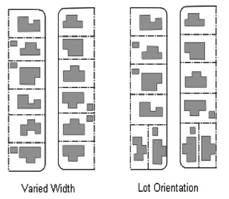
(1)
Varied Side Yards. Varying the distance between adjoining single-family dwelling units, or between dwelling units and fences, results in different types of yards and private patio areas.
(2)
Lot Orientation. On curves or at corners, lots can often be oriented in a different direction than those at mid-block. In these cases, some lots can be nonrectangular and angled on the street. Structures and windows should be oriented so that a majority of primary living spaces receive direct sunlight during the daylight hours and adequate cross-ventilation. In new projects, structures should be positioned to avoid creating severe shadow impacts.
(3)
Varied Lot Widths. Making some lots wider and some narrower than the average can provide different amounts of open areas between structures. It also allows placement of different shapes and sizes of single-family dwelling units. On narrow lots, a variation of only three feet or four feet makes a perceptible difference.
(c)
Natural Surveillance. Whenever feasible, design and placement of residential dwellings and other physical features are encouraged to maximize visibility and facilitate natural surveillance from public rights-of-way and other public areas. This includes building orientation, placement of windows, doors, and balconies, building and site entrances and exits, placement and type of landscape materials, types of walls and fences (including the use of picket, wrought-iron, and similar materials to promote visibility when appropriate), and other physical obstructions in a manner that discourages the potential for criminal activity.
(d)
Architecture.
(1)
There is no particular architectural style required for residential structures; however, the focus shall be on the development of neighborhoods exhibiting high quality architecture.
(2)
In general, the architecture shall be compatible with the surrounding area.
(3)
Individual dwelling units shall be distinguishable from one another to reduce monotony and provide an interesting streetscape.
(4)
Windows and entry features should be emphasized over garage doors on street facades of structures. Front entry doors and features should be visible and easily recognizable from the street. All front entry doors shall include a porch or a covered architectural entry feature that is oriented to the street.
(5)
When provided, porches should extend at least six feet along the front or corner side facade of the structure not including the garage face and shall be compatible with and complementary to the architectural style of the dwelling.
(6)
Window and front entry door placement shall maximize visibility of the street. At least one major window (not including the front door) that looks out onto the street shall be provided from each room located on the front and corner side facades of the structure to provide "eyes on the street."
(7)
Window and front entry door design shall be compatible and complementary to the building design.
(8)
The entire structure shall have a coherent architectural style with the transition from the front, sides, and rear elevations being gradual not abrupt. Architectural style and details shall be consistent on all facades that are visible from adjacent streets or alleys.
(9)
Architectural details and exterior colors shall reinforce and enhance the architectural form and style of the structure.
(e)
Mass and Scale. Mass and scale should relate to the use of the structure as a single-family dwelling. Also, the scale of a structure shall be within a human scale so as not to overwhelm or dominate its surroundings.
(f)
Facade and Roof Articulation.
(1)
The articulation of facades and the massing of structures give them richness and scale. Long uninterrupted exterior walls in excess of thirty feet shall be generally avoided on all structures. Larger wall and roof planes shall include three-dimensional features such as porches, balconies, bay window, dormers, and similar features.
(2)
The integration of varied texture, relief, color, and design accents on building walls can soften the architecture and is encouraged.
(3)
For sloped roofs, both vertical and horizontal articulation is encouraged. Rooflines shall be compatible with the design and scale of surrounding dwelling units. Roof articulation may be achieved by changes in plane of no less than two and one-half feet and/or the use of traditional roof forms such as gables, hips, and dormers. Flat roofs and A-frame type roofs are discouraged unless appropriate to the architectural style of the dwelling unit and/or to facilitate passive and nonpassive solar panels.
(4)
The integration of skylights and the orientation of structures in order to promote natural day lighting is encouraged.
(g)
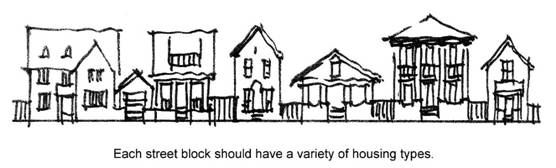
Varied Structure Design. Design of structures shall be varied in tract developments to reduce monotony and create variety and interest. A reasonable difference in the massing and composition (not just finish materials) of each adjacent dwelling unit shall be accomplished. One design should not be repeated more frequently than each fourth dwelling unit. Each street block shall also include a variety of model elevations.
(h)
Materials.
(1)
The choice and mix of materials on the facades of structures and garage doors is important in providing an attractive living environment. Materials shall be consistently applied on all facades of a structure visible from adjacent streets and alleys and be chosen to work harmoniously with adjacent materials.
(2)
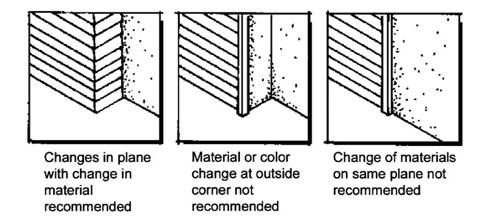
Exterior detailing, piecemeal embellishment, and frequent changes in materials shall be generally avoided. Materials tend to appear substantial and integral when material changes occur at changes in plane. Material or color changes at the outside corners of structures give an impression of thinness and artificiality that should be avoided. Material changes should not occur at external corners, but may occur at reverse or interior corners. Material changes not accompanied by changes in plane give materials an insubstantial or applied quality.
(3)
Varying the building and roof materials from dwelling unit to dwelling unit is encouraged to promote individual identity and provide a varied streetscape.
(4)
The use of renewable and sustainable building materials is encouraged.
(i)
Colors.
(1)
Exterior building and roof colors shall be appropriate to and generally compatible with the architectural style of the dwelling unit. In general, subdued colors are more appropriate on the body of a structure with bright or bold colors generally limited to architectural details and window and door trim. Garish or overly bold colors should be avoided.
(2)
Varying the roof and building colors from dwelling unit to dwelling unit is encouraged.
(3)
All structures on a site shall have a compatible color scheme (including the roof color).
(4)
Roof flashing, rain gutters, downspouts, vents, and other roof protrusions shall be finished to complement the adjacent materials and/or colors.
(j)
Garages.
(1)
Garage doors shall be adequately setback to keep the sidewalk clear of vehicles at all times.
(2)
Front entry garages shall be recessed a minimum of five feet behind the street facade of the principal residential structure except for side-entry garages. Garages that are located behind the principal residential structure or are rear-entry accessible from alleys are strongly encouraged to reduce the visual prominence of the garage on the streetscape.
(3)
Varied garage placements are encouraged to break up the monotony of all garage doors being parallel to the street.
(4)
Garage doors shall appear to be set into the walls rather than flush with the exterior wall of the structure. Garages shall generally not occupy more than fifty percent of any street facade of the principal residential structure.
(5)
A variety of compatible garage door designs shall be used throughout a project to ensure variety. The design of the garage door shall relate to the particular architectural style selected for the structure.
(6)
New or remodeled garages are encouraged to be designed to provide facilities for vehicles with alternative fueling systems (such as appropriate outlets for electric vehicle charging, etc.).
(k)
Fences and Walls.
(1)
Walls and fences are an integral part of the streetscape. The use of picket, wrought-iron, and similar style fencing that promotes visibility is encouraged.
(2)
The use of sound walls shall be minimized except when required as an environmental mitigation measure. Sound walls shall be of masonry, concrete, smooth stucco finish, or other approved material; however, decorative elements (such as tile insets, etc.) may also be incorporated into sound walls to improve their appearance. The style, material, and color of sound walls shall complement neighborhood architecture. All sides of sound walls visible from public or private streets shall be architecturally treated.
(3)
For all other walls and fences, no exposed structural components (unfinished or painted concrete blocks, wood fence framing, etc.) shall be visible from public and private streets.
(4)
Chain link fencing with or without slats is prohibited in the front and corner side yards of lots with residential dwelling units.
(l)
Screening. Any heating or cooling equipment or other mechanical equipment (excluding solar panels), whether on the roof, side of structure, or on the ground, shall be screened from view of public or private streets. The method of screening must be architecturally compatible in terms of materials, color, shape, and size. The screening design shall blend with the building design.
(m)
Infill in Existing Neighborhoods.
(1)
For infill residential development in established neighborhoods, see Section 37-50.110: Infill residential development in the R-L district.
(2)
Residential additions shall incorporate the distinctive architectural characteristics of the existing dwelling unit such as window and door level of detailing, decoration, materials, roof style and pitch, finished floor height, porches, and bay windows.
(3)
Residential additions shall continue the functional, on-site relationships of the surrounding neighborhood. For example, in many older neighborhoods, common patterns that shall be continued are architectural entry features facing the street, front porches, and parking at the rear.
(n)
Accessory Structures. The design of accessory structures shall be compatible with the principal residential structure through the use of complementary architectural style, exterior building and roofing colors and materials, and landscaping styles.
(o)
Cul-de-sac Treatments. Cul-de-sac streets shall be avoided. However, when terrain, traffic safety, or environmental constraints require the use of a cul-de-sac, the cul-de-sac street shall not exceed four hundred feet in length. For cul-de-sac streets located near public facilities, shopping, arterial or collector streets, or transit stops, openings shall be provided at the end of the street for pedestrians, bicyclists, and landscaping. Such openings are pedestrian-friendly and promote connectivity between neighborhoods.
(p)
Nonresidential Facilities.
(1)
Nonresidential facilities such as water well pumping stations and storage, and the like, shall be designed to be compatible with the character of the surrounding neighborhood. Landscaping, decorative walls, or other buffering techniques, as appropriate, shall be used to ensure such facilities blend with and do not adversely impact adjacent uses.
(2)
Any buildings constructed in conjunction with such facilities shall be compatible with the materials, exterior colors, and any distinctive architectural characteristics found in the surrounding neighborhood.
(3)
The operators/property owners of such facilities shall be required (as a condition of approval) to provide regular maintenance for the life of such facilities (e.g., regular watering and care of vegetation (including replacement of any dead plant material or broken irrigation apparatus), trash and graffiti removal, and the repair and replacement of any damaged or worn-out facilities).
(q)
Traffic Calming. Use of traffic-calming measures such as street bulb-outs, mini-circles, chicanes, short street segments, and roundabouts as determined appropriate by the city engineer are encouraged, especially in tract developments, to slow traffic and make streets more pedestrian-friendly. Street segments that are long and uninterrupted are to be avoided.
(r)
Internal Circulation. Internal circulation (see definition of internal circulation Section 37-10.330: "I" definitions) shall be provided between all habitable rooms in a residential dwelling unit.
(Ord. No. 2463 (NCS).)
Sec. 37-30.100. - Purpose.
In addition to the general purposes listed in Article I, Division 1: General Provisions, the purpose of the residential medium density (RM) districts regulations is to:
(a)
Provide appropriately located areas for single-family and medium density multifamily dwellings consistent with the general plan and with standards of public health and safety established by the Municipal Code;
(b)
Provide adequate light, air, privacy, and open space for each dwelling unit and protect residents from the harmful effects of excessive noise, inappropriate population density, traffic congestion, and other adverse environmental impacts;
(c)
Promote development of affordable housing, housing for qualifying residents, and day care facilities by providing a density bonus for projects that meet state and/or city density bonus requirements;
(d)
Achieve design compatibility through the use of site development regulations and design standards;
(e)
Protect adjoining lower density residential districts from excessive noise or loss of sun, light, quiet, and privacy resulting from proximity to higher density and multifamily dwellings;
(f)
Provide sites for public and semipublic land uses needed to complement residential development or requiring a residential environment;
(g)
Ensure the provision of public services and facilities needed to accommodate planned population densities;
(h)
Encourage attractive and interesting residential streetscapes, dwelling units, and developments that are pedestrian-oriented and reflect traditional neighborhood design principles; and
(i)
Promote safe residential neighborhoods through the use of crime prevention through environmental design (CPTED) features in dwelling and site design;
(j)
The additional purposes of each R-M district are as follows:
(1)
R-M-3.6: to provide for detached and attached single-family dwelling units on small lots where the minimum density is more than eight dwelling units per net acre and the maximum density is not more than twelve dwelling units per net acre without density bonus;
(2)
R-M-2.9: to provide for medium density dwellings where the minimum density is more than eight dwelling units per net acre and the maximum density is not more than fifteen dwelling units per net acre without density bonus.
(Ord. No. 2463 (NCS).)
Sec. 37-30.110. - Use classifications.
Table 37-30.50 identifies the use classifications for properties located in the residential medium density (R-M) districts:
(Ord. No. 2463 (NCS).)
(Ord. No. 2532 (NCS), § 10, 11-13-2012; Ord. No. 2581 (NCS), § 7, 12-6-2016; Ord. No. 2623 (NCS), § 7, 11-5-2019; Ord. No. 2656 (NCS), § 3, 5-10-2022; Ord. No. 2693 (NCS), § 4, 2-24-2026)
Sec. 37-30.120. - Development regulations.
Table 37-30.60 identifies the development regulations for the residential medium density (R-M) districts:
(Ord. No. 2463 (NCS).)
(Ord. No. 2569 (NCS), § 3, 4-19-2016)
Sec. 37-30.130. - Design standards.
The design standards that are applicable to single and multifamily dwellings in the residential medium (RM) districts are contained in Section 37-30.080: Design standards (residential low density (R-L) district) and Section 37-30.180: Design standards (residential high density (R-H) district). These design standards are intended to assist the designer in understanding the city's requirements for high quality, small-lot, single-family residential development and medium density multifamily residential development. These standards complement the development regulations contained in this division by providing good examples of potential design solutions and by providing design interpretations of the various regulations. These standards ensure the highest level of design quality while at the same time providing the flexibility necessary to encourage creativity on the part of project designers. The standards are also intended to encourage medium density development, which is pedestrian-oriented, safe, and reflects traditional neighborhood design principles.
(Ord. No. 2463 (NCS).)
Sec. 37-30.150. - Purpose.
In addition to the general purposes listed in Article I, Division 1: General Provisions, the purpose of the residential high density (RH) district regulations is to:
(a)
Provide appropriately located areas for high density and multifamily dwellings consistent with the general plan and with standards of public health and safety established by the Municipal Code;
(b)
Provide adequate light, air, privacy, and open space for each dwelling unit and protect residents from the harmful effects of excessive noise, inappropriate population density, traffic congestion, and other adverse environmental impacts;
(c)
Promote development of affordable housing, housing for qualifying residents, and day care facilities by providing a density bonus for projects, which meet state and/or city density bonus requirements;
(d)
Achieve design compatibility through the use of site development regulations and design standards;
(e)
Protect adjoining low and medium density residential districts from excessive noise or loss of sun, light, quiet, and privacy resulting from proximity to multifamily dwellings;
(f)
Provide sites for public and semipublic land uses needed to complement residential development or requiring a residential environment;
(g)
Ensure the provision of public services and facilities needed to accommodate planned population densities;
(h)
Encourage attractive and interesting residential streetscapes and high density developments that are pedestrian-oriented and reflect traditional residential design principles; and
(i)
Promote safe residential neighborhoods through the incorporation of crime prevention through environmental design (CPTED) features in dwelling and site design;
(j)
The additional purposes of each R-H district are as follows:
(1)
R-H-2.1: to provide for high density multifamily dwelling units where the minimum density is more than fifteen dwelling units per net acre and the maximum density is not more than twenty dwelling units per net acre without density bonus;
(2)
R-H-1.8: to provide for high density multifamily dwelling units where the minimum density is more than fifteen dwelling units per net acre and the maximum density is not more than twenty-four dwelling units per net acre without density bonus.
(Ord. No. 2463 (NCS).)
Sec. 37-30.160. - Use classifications.
Table 37-30.70 identifies the use classifications for properties located in the residential high density (R-H) districts:
(Ord. No. 2463 (NCS); Ord. No. 2581 (NCS), § 8, 12-6-2016; Ord. No. 2656 (NCS), § 4, 5-10-2022; Ord. No. 2693 (NCS), § 5, 2-24-2026)
Sec. 37-30.170. - Development regulations.
Table 37-30.80 identifies the development regulations for the residential high density (R-H) districts:
(Ord. No. 2463 (NCS).)
(Ord. No. 2537 (NCS), § 1, 4-30-2013; Ord. No. 2569 (NCS), § 3, 4-19-2016; Ord. No. 2592 (NCS), § 1)
Sec. 37-30.180. - Design standards.
(a)
Purpose. These design standards are intended to assist the designer in understanding the city's requirements for high quality multifamily and higher density residential development. These standards complement the development regulations contained in this division by providing good examples of potential design solutions and by providing design interpretations of the various regulations. The designer shall also refer to the R-L district design standards, as many of the same architectural and design principles shall be applicable to higher density developments. These standards ensure the highest level of design quality while at the same time providing the flexibility necessary to encourage creativity on the part of project designers. The standards are also intended to promote higher density development that is pedestrian-oriented, safe, and reflects traditional neighborhood design principles.
(b)
Site Planning.
(1)
Multifamily housing, because of its higher densities, tends to generate large parking areas. If not properly designed, parking facilities can dominate the site and open spaces may be relegated to leftover areas, not related to the structures or the people who live there.
(2)
Multifamily developments with dwelling units that face the street are highly encouraged. Developments that are surrounded by parking lots and rows of carports are examples of practices to be avoided. Instead, multifamily developments that have dwelling units that are oriented to the street, with covered architectural entry features or front porches that provide direct access to the street, and parking areas that are located to the rear of the dwelling units are desirable. Such site planning and design promotes neighborhood interaction, provides "eyes on the street," and ensures a more pedestrian-friendly streetscape.
(3)
Clustering of multifamily dwelling units should be a consistent site planning element. Structures composed of a series of simple yet varied planes assure compatibility and variety in overall building form. This can be accomplished through the use of design techniques such as:
(A)
Varying front setbacks within the same structure;
(B)
Staggered and jogged dwelling unit planes;
(C)
Using reverse building plans to add variety;
(D)
A maximum of two adjacent dwelling units with identical wall and rooflines; and
(E)
Using a variety of orientations to avoid the monotony of garage door corridors.
(4)
Natural Surveillance. Whenever feasible, design and placement of residential dwellings and other physical features are encouraged to maximize visibility and facilitate natural surveillance from public rights-of-way and other public areas. This includes building orientation, placement of windows, doors, and balconies, building and site entrances and exits, placement and type of landscape materials, types of walls and fences (including the use of picket, wrought-iron, and similar materials to promote visibility when appropriate), and other physical obstructions in a manner that discourages the potential for criminal activity.
(d)
Architecture. There is no particular architectural style required for multifamily residential structures. The primary focus shall be on constructing a high quality residential environment. The criteria presented here strives for this "quality" through descriptions and examples of appropriate building materials and architectural expression:
(1)
In general, the design of multifamily developments shall consider compatibility with the surrounding neighborhood. The design should ensure that the height and bulk of higher density projects do not adversely impact or overwhelm lower density residential areas.
(2)
Multifamily developments shall utilize a unifying theme and a consistent use of architectural elements and forms.
(3)
Architectural styles that incorporate three-dimensional features such as porches, balconies, bay windows, dormers, and similar features shall be used to break up large wall and roof surfaces and create visual interest. The "barrack or motel" look shall be avoided.
(4)
All elevations of the residential structures visible from streets and common open space areas in the project shall be architecturally treated.
(e)
Mass and Scale. Because multifamily projects are usually taller than one story, their bulk can impose on surrounding uses. The scale of such projects shall be considered within the context of their surroundings. Large projects should be broken up into groups of structures. The use of single "mega-structures" shall be avoided in favor of structures that have a "human" scale.
(f)
Materials. Materials selected for multifamily projects shall be very durable and require low maintenance. Piecemeal embellishment and frequent changes in materials shall be avoided. A palette of materials that convey an image of quality and durability shall be used. Painted surfaces shall reinforce and be compatible with the architectural style of the buildings.
(g)
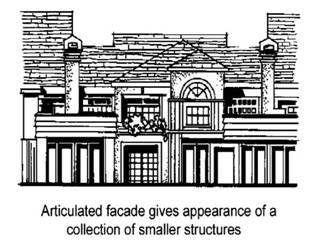
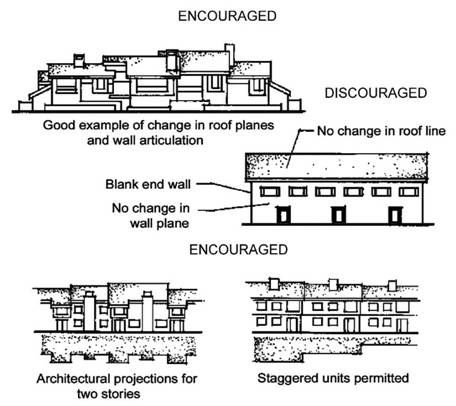
Facade and Roof Articulation. Long, unbroken facades and box-like forms shall be avoided. Building facades shall be broken up to give the appearance of a collection of smaller structures. To the extent possible, each of the dwelling units shall be individually recognizable. Separations, changes in plane and height, and the inclusion of elements such as balconies, porches, arcades, dormers, and cross gables, and the pattern and rhythm of windows and doors help mitigate the barrack-like appearance of flat walls and roofs of excessive length. Secondary hipped or gabled roofs covering the entire mass of a building are preferable to mansard roofs or segments of pitched roof applied at the structure's edge. Structures should incorporate at least one of the following:
(1)
For each dwelling unit, at least one architectural projection not less than two feet from the wall plane and not less than four feet wide shall be provided. Such projections shall extend the full height of single story structures, at least half the height of a two-story building, and two-thirds the height of a three-story building; or
(2)
A change in wall plane of at least three feet in depth for each two dwelling units shall be provided.
(h)
Colors.
(1)
Exterior building and roofing colors shall be appropriate to and enhance the architectural style and materials of the structure. Large areas of intense primary color shall generally be avoided as the dominant overall color for a structure.
(2)
Primary or bold colors may only be used to accent architectural elements, such as door and window frames, trim, and similar features.
(3)
Minimize the number of colors that appear on the structure's exterior. Smaller residential structures shall generally use no more than three colors unless appropriate to the architectural style.
(4)
Roof flashing, rain gutters, and downspouts, vents, and other roof protrusions shall be finished to complement the adjacent materials and/or colors.
(i)
Project Entries. Project entry areas provide the resident and visitor with an overview to the project and create a positive identity for the development. They should provide an open window with landscaping, open space areas, and project directories. Special attention should be given to hardscape and landscape treatments to enhance the overall project image.
(j)
Parking.
(1)
Parking Lots and Drives.
(A)
In multifamily projects, large, monotonous, and undivided parking lots shall not be permitted. Parking areas shall be located to the rear of residential structures or within the interior of the development to reduce their visual impact on the streetscape. When environmental considerations or site constraints preclude such parking locations, dispersed parking courts located to the side of the dwelling units are the desired alternative. In such case, the parking courts shall be screened from view of adjacent streets by a landscape planter and shall not be located closer to the street than the street facade building line of the principal residential structure.
(B)
Parking driveways, when located along the frontage of a site, isolate the development from its surroundings. Such driveways shall be avoided.
(C)
Parking areas shall be conveniently located to the dwelling units that use them.
(D)
Parking areas are encouraged to provide facilities for vehicles with alternative fueling systems (such as electric vehicle charging areas, etc.).
(E)
The principal vehicular access into a multifamily housing project shall be through an entry drive rather than a parking lot driveway whenever feasible. Colored, textured paving treatment at entry drives is required at a minimum depth of ten feet located immediately behind the street property line. When separate exit drives are provided a matching treatment shall be required. Landscaping and site design should frame and distinguish entry and exit drives.
(2)
Parking Courts.
(A)
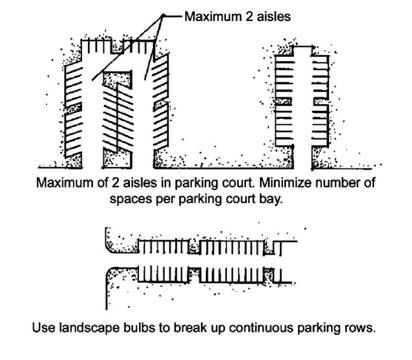
A parking court of any length shall not consist of more than two double-loaded parking aisles (bays) adjacent to each other.
(B)
The length of a parking court shall generally not exceed fourteen parking spaces.
(C)
Parking courts shall be separated from each other by dwelling units or by a landscaped buffer not less than thirty feet wide.
(3)
Garages.
(A)
Individual parking garages within residential structures shall be enclosed behind garage doors.
(B)
Garages with parking aprons less than twenty-three feet in length shall have automatic garage door openers and sectional roll-up doors.
(C)
Rowhouse dwellings that front public streets shall have garages accessible from alleys/driveways located at the rear of the project.
(D)
Garages in multifamily developments shall be accessible only from the interior of a development and shall be oriented to not face public streets.
(4)
Carports. Where carports are permitted, they must follow the same criteria for spatial arrangement as parking courts. Carports may be incorporated with patio walls or used to define public and private open space, but incorporating carports into exterior project walls adjacent to streets is prohibited. The ends of each cluster of carports shall be landscaped if visible from public or private streets, alleys, or adjacent properties. No more than an average of ten covered spaces of uninterrupted parking shall generally be permitted.
(5)
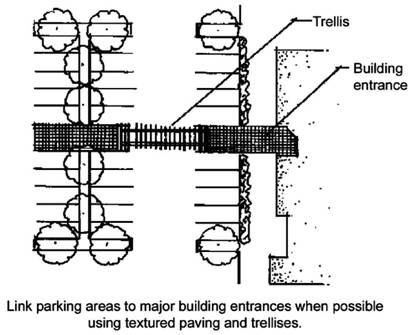
Pedestrian Access from Parking. Landscape bulbs shall, wherever possible, align with major building entrances to provide pedestrian access to the building entrance from a parking court or drive. Bulbs that align with entrances should be at least two car spaces wide and should include a pathway as well as a vertical landscape or architectural element such as a trellis or a tree.
(k)
Usable Open Space.
(1)
Residents of housing projects shall have safe and efficient access to usable open space, whether public or private, for recreation, and social activities. The design and orientation of these areas should take advantage of available sunlight and be sheltered from the wind, noise, and traffic on adjacent streets, and incompatible uses.
(2)
Required common open spaces shall be conveniently and centrally located to the majority of dwelling units in the development to promote a sense of community. Open space areas located within center courtyards is encouraged to provide resident privacy and security.
(3)
Common usable open spaces and children's play areas shall be visible from individual dwelling units and be connected to the internal pedestrian system in the development.
(4)
Private usable open spaces shall be contiguous to and have direct pedestrian access from the dwelling units they serve.
(5)
All usable open space areas shall have appropriate lighting and be regularly maintained to reduce the potential for criminal activities.
(l)
Landscaping. All areas not covered by structures, drives, parking, or hardscape shall be appropriately landscaped and maintained. Landscaping is used to frame, soften, and embellish the quality of the environment, to buffer dwelling units from undesirable views, and to break up large expanses of parking. To accomplish these design objectives, landscape elements need vertical dimension. Trees and tall shrubs are needed in addition to grass, small shrubs, and groundcover. Trees can also be used to provide shading and climatic cooling of nearby dwelling units and moderate prevailing winds.
(m)
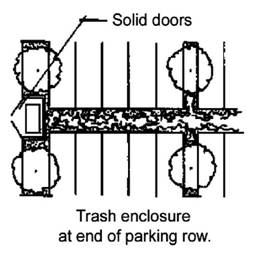
Recycling and Solid Waste Disposal. Recycling and solid waste disposal areas must be fully enclosed by masonry walls and solid gates, and such facilities shall meet the service needs of the city's solid waste operator. These enclosures shall be softened with landscaping on their most visible sides when practical. Recommended locations include inside parking courts or at the end of parking bays. Locations shall be conveniently accessible for trash collection, maintenance, and pedestrians (a separate walk-in access shall be provided), shall minimize solid waste vehicle driveway length into the property, and shall not block access drives during loading operations.
(n)
Security. Multifamily projects shall be designed to provide the appropriate amount of security for residents and visitors. Parking and other site amenities shall be appropriately lit and located so as to be visible from dwelling units. Landscaping and dwelling unit design, including window, door, and balcony/porch placement, shall be planned and maintained to provide views into places where people gather, including adjacent open space areas, on-site recreational facilities/tot lots, and streets and alleys.
(o)
Dwelling Unit Access. The use of long, monotonous access balconies and corridors that provide access to five or more dwelling units shall be avoided. Instead, access points to dwelling units should be clustered in groups of four or less. To the extent possible, the entrances to individual dwelling units shall be plainly visible from nearby parking areas and/or streets, as applicable. The use of distinctive architectural elements and materials to denote individual entrances is required. Individual dwelling units located adjacent to a public street shall be generally oriented to the street and include an entry feature such as porch that provides direct access to the street.
(p)
Exterior Stairs. When provided, simple, clean, bold projections of stairways are encouraged to complement the architectural massing and form of the multifamily structure. Stairways shall be of smooth stucco, plaster, or wood, with accent trim of complementary colors and railings appropriate to the architectural style of the residential structure. Thin-looking, open metal, prefabricated stairs are discouraged.
(q)
Accessory Structures.
(1)
Carports, detached garages, and other accessory structures shall be designed as an integral part of the architecture of projects. They shall be similar in materials, colors, and detail to the principal structure(s) of a development.
(2)
Carports, garages, and other accessory structures shall have a consistent roof design and pitch with the principal residential structure.
(3)
A carport's vertical support structure shall have sufficient mass to be visually as well as structurally harmonious with the roof structure. Thin-looking posts or poles shall be avoided.
(4)
Where garages are provided, doors shall appear to be set into walls rather than flush with the exterior wall.
(r)
Solar Panels. Solar panels shall generally be integrated into the roof design. Frames shall be colored to match roof colors. Natural aluminum finish is strongly discouraged. Any mechanical equipment shall be enclosed and completely screened from view.
(s)
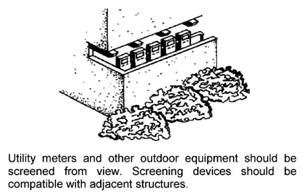
Mechanical and Utility Equipment. All mechanical equipment whether mounted on the roof or ground must be screened from view. Utility meters and equipment shall be placed in locations that are not exposed to view from the street or they must be suitably screened. All screening devices shall be compatible with the architecture and color of the adjacent structures.
(t)
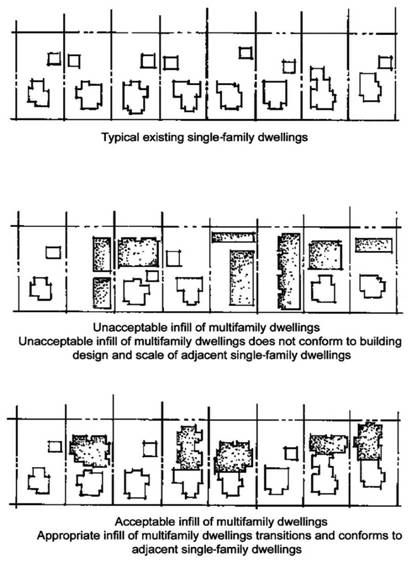
Infill Multifamily in Existing Neighborhoods. Efforts shall be made to integrate new multifamily projects into existing neighborhoods so that they are compatible with adjacent structures and fit within the context of the existing neighborhood.
(1)
Site Design. New multifamily developments shall be designed to continue the on-site relationships of the original structure(s) and surrounding neighborhood.
(2)
Front Yard Setbacks. Front yard setbacks for new multifamily developments shall be compatible with the setbacks of adjacent properties.
(3)
Architectural Compatibility. New multifamily development in existing neighborhoods shall incorporate architectural characteristics and maintain the scale of existing structures on the property and surrounding development. For example: window and door detaining, facade decoration, materials, color, roof style and pitch, and porches.
(4)
Neighborhood Privacy. To provide privacy for adjacent dwelling units, windows on the second and higher floors of buildings which directly face or abut dwelling units in lower density residential zones should be designed either as translucent, louvered, or utilize another solution to achieve privacy for the adjacent dwelling units.
(u)
Nonresidential Facilities.
(1)
Nonresidential facilities such as water well pumping stations and storage, and the like, shall be designed to be compatible with the character of the surrounding neighborhood. Landscaping, decorative walls, or other buffering techniques, as appropriate, shall be used to ensure such facilities blend with and do not adversely impact adjacent uses.
(2)
Any buildings constructed in conjunction with such facilities shall be compatible with the materials, exterior colors, and any distinctive architectural characteristics found in the surrounding neighborhood.
(3)
The operators/property owners of such facilities shall be required (as a condition of approval) to provide regular maintenance for the life of such facilities (e.g., regular watering and care of vegetation (including replacement of any dead plant material or broken irrigation apparatus), trash and graffiti removal, and the repair and replacement of any damaged or worn-out facilities).
(Ord. No. 2463 (NCS).)
(Ord. No. 2507 (NCS), § 26, 5-18-2010)
Sec. 37-30.190. - Purpose.
In addition to the general purposes listed in Article I, Division 1: General Provisions, the purpose of the commercial (C) districts regulations is to:
(a)
Provide appropriately located areas consistent with the general plan for a full range of office, retail commercial, and service commercial uses needed by residents of, and visitors to, the city and region;
(b)
Strengthen the city's economic base, and provide employment opportunities close to home for residents of the city and surrounding communities;
(c)
Create suitable environments for various types of commercial uses, and protect them from the adverse effects of incompatible uses;
(d)
Minimize the impact of commercial development on adjacent residential districts;
(e)
Ensure that the appearance and effects of commercial buildings and uses are harmonious with the character of the area in which they are located;
(f)
Provide opportunities for mixed use buildings/developments and residential developments in commercial districts;
(g)
Ensure the provision of adequate off-street parking and loading facilities;
(h)
Provide sites for public and semipublic uses complementary to commercial development or compatible with a commercial environment;
(i)
Encourage compact, attractive, and pedestrian-oriented streetscapes and commercial developments; and
(j)
Promote vital and safe commercial areas through the incorporation of crime prevention through environmental design (CPTED) features in building and site design;
(k)
The additional purposes of each commercial (C) district are as follows:
(1)
Commercial Office/Residential (CO/R) District. The commercial office/residential district provides a transitional zone between commercial and residential uses, with opportunities for limited commercial, institutional, office, service, and residential uses.
(2)
Commercial Office (CO) District. The commercial office (CO) district provides areas primarily for offices, personal services, financial services, mixed use residential, and for residential uses.
(3)
Commercial Retail (CR) District. The commercial retail (CR) district allows a wide range of retail stores, restaurants, hotels and motels, commercial recreation, personal services, business services, offices, financial services, mixed use residential, and/or limited residential uses.
(4)
Commercial Thoroughfare (CT) District. The commercial thoroughfare (CT) district provides areas for uses required by the traveling public such as hotels and motels, service stations, and restaurants with immediate access to U.S. Highway 101 and when appropriate mixed use residential, and /or limited residential uses.
(Ord. No. 2463 (NCS).)
(Ord. No. 2507 (NCS), § 27, 5-18-2010; Ord. No. 2651 (NCS), § 1, 11-9-2021)
Sec. 37-30.200. - Use classifications.
Table 37-30.90 identifies the use classifications for properties located in the commercial (C) districts:
(Ord. No. 2463 (NCS).)
(Ord. No. 2494 (NCS), § 1, 3-10-2009; Ord. No. 2532 (NCS), § 11, 11-13-2012; Ord. No. 2569 (NCS), § 4, 4-19-2016; Ord. No. 2646 (NCS), § 2, 8-10-2021; Ord. No. 2649 (NCS), § 2, 9-21-2021; Ord. No. 2651 (NCS), § 2, 11-9-2021; Ord. No. 2655 (NCS), § 1, 2-15-2022; Ord. No. 2656 (NCS), § 5, 5-10-2022)
Sec. 37-30.210. - Development regulations.
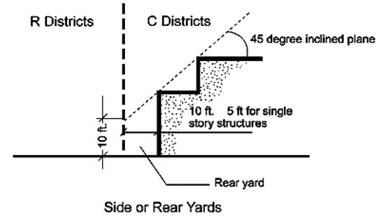
Table 37-30.100 identifies the development regulations for the commercial (C) districts:
(Ord. No. 2463 (NCS).)
(Ord. No. 2651 (NCS), § 3, 11-9-2021)
Sec. 37-30.220. - Design standards.
(a)
Purpose. These design standards are intended to assist the designer in understanding the city's requirements for high quality commercial development. These standards complement the development regulations contained in this division by providing good examples of potential design solutions and by providing design interpretations of the various regulations. These standards ensure the highest level of design quality while at the same time providing the flexibility necessary to encourage creativity on the part of project designers. The standards are also intended to promote commercial developments, which are pedestrian-oriented, safe, and reflect traditional neighborhood design principles.
(b)
General Design Principles.
(1)
Desirable Elements. The qualities and design elements for commercial structures and developments that are most desirable include:
(A)
Richness of surface and texture;
(B)
Significant wall articulation (insets, canopies, wing walls, trellises, etc.);
(C)
Pedestrian-oriented with a "human" scale;
(D)
Multi-planed, pitched roofs;
(E)
Roof overhangs, arcades, awnings, and prominent/attractive entry features;
(F)
Regular or traditional window rhythm;
(G)
Articulated mass and bulk;
(H)
Transparency;
(I)
Significant landscape and hardscape elements;
(J)
Prominent access driveways;
(K)
Street oriented primary building entrances;
(L)
Windows, doors, and balconies placed to facilitate natural surveillance;
(M)
Landscaped and screened parking; and
(N)
Comprehensive sign programs.
(2)
Undesirable Elements. The elements to avoid or minimize include:
(A)
Large blank, monotonous, and unarticulated wall surfaces that contribute little to the streetscape and discourage natural surveillance;
(B)
Primary building entrances that are not oriented to the street and not pedestrian-oriented;
(C)
Highly reflective surfaces that create glare;
(D)
Metal siding on the main facade;
(E)
Plastic siding;
(F)
Square "box-like" structures;
(G)
Mix of unrelated styles (e.g., rustic wood shingles and polished chrome);
(H)
Large, out of scale signs;
(I)
Visible outdoor storage, loading, and equipment areas; and
(J)
Disjointed parking areas and confusing circulation patterns.
(c)
Site Planning.
(1)
Placement of structures shall consider the existing built context of the commercial area, the location of incompatible land uses, the location of major traffic generators, as well as, an analysis of a site's characteristics and particular influences.
(2)
Site structures in a manner that will complement adjacent structures.
(3)
Plan and develop the whole project site in a coordinated manner to provide order, compatibility, and diversity.
(4)
Site structures in a manner that establishes attractive and inviting places in order to form the basis for positive impressions and perceptions of the community.
(5)
Site structures and other improvements in a manner that maximizes visibility of public areas (e.g., parking lots, plazas), and streets and alleys to maximize opportunities for people engaged in their normal behavior to observe the space around them.
(6)
Locate structures and on-site circulation systems to minimize pedestrian/vehicle conflicts where possible. Link structures to the public sidewalk, where feasible, with ADA/Title 24 compliant textured paving, landscaping, and trellises.
(7)
Recognize the importance of spaces between structures as outdoor rooms on the site. Outdoor spaces shall have clear, recognizable shapes that reflect careful planning and are not simply left over areas between structures. Such spaces shall provide pedestrian amenities such as shade, benches, fountains, etc.
(8)
Orient freestanding singular commercial structures with their major entry toward the street where access is provided and to have their major facade parallel to the street.
(9)
Loading facilities shall not be located at the front of structures where it is difficult to adequately screen them from view. Such facilities are more appropriate at the rear of the site. Such facilities shall be screened.
(10)
Open space areas shall be clustered into larger, landscaped areas rather than equally distributing them into areas of low impact such as at building peripheries, behind structures, or in other areas of little impact to the public view.
(11)
Structures are encouraged to be sited along street frontages with parking in the rear when located on pedestrian-oriented streets. Placing parking behind buildings rather than in front of buildings helps to preserve an attractive streetscape and improves pedestrian access to surrounding activities and uses, and it provides an urban border for the street.
(12)
The location and heights of structures are encouraged to relate to adjacent open spaces to allow maximum sun and ventilation, protection from prevailing winds, enhance public views of surrounding mountains, and minimize obstruction of view from adjoining structures.
(13)
When appropriate, new structures are encouraged to be clustered to create plazas.
(d)
Natural Surveillance. Whenever feasible, design and placement of buildings and other physical features are encouraged to maximize visibility and facilitate natural surveillance from public rights-of-way and other public areas. This includes building orientation, placement of windows, doors, and balconies, building and site entrances and exits, placement of parking, lighting, and refuse containers, placement and type of landscape materials, plazas, and other open space areas, location of walkways, types of walls and fences (including the use of picket, wrought-iron, and similar materials to promote visibility when appropriate), and other physical obstructions in a manner that discourages the potential for criminal activity.
(e)
Architecture. A diversity of architectural styles is encouraged except in large-scale developments where a harmonious or unified architectural style is generally desirable.
(f)
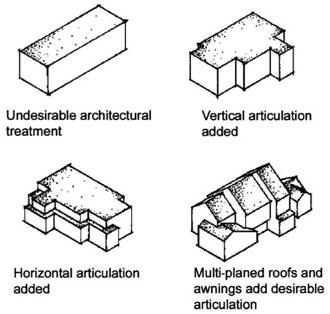
Facade Articulation. Large buildings that give the appearance of box-like structures are generally unattractive and monotonous. To improve the appearance of large buildings:
(1)
Vary the planes of the exterior walls in depth and/or direction. Wall planes shall not run in a continuous direction for more than fifty feet without an offset proportional to the building size or an architectural feature such as a column to provide visual interest.
(2)
Vary the height of the buildings so that it appears to be divided into distinct massing elements.
(3)
Articulate the different parts of a building's facade by use of color, arrangement of facade elements, or a change in materials.
(4)
Use landscaping and architectural detailing at the ground floor level to lessen the impact of an otherwise bulky building.
(5)
Avoid blank walls at the ground floor level. Utilize windows, trellises, wall articulation, arcades, change in materials, or other features.
(6)
Set back buildings from property lines to avoid the use of parapet walls unless abutting existing buildings. Parapet walls can abruptly change the continuity of a building's architecture by creating a cut-off effect and result in large blank walls.
(7)
Architecturally treat all building facades visible from public streets and public areas (such as parking areas).
(g)
Mass and Scale. Scale is the relationship between the size of the new structure and the size of adjoining permanent structures. It is also how the proposed building's size relates to the size of people. Large-scale building elements will appear imposing if they are situated in a visual environment that is predominantly smaller in scale. There are several ways to reduce the appearance of large-scale and bulky structures.
(1)
Building scale can be reduced through the proper use of window patterns, structural bays, roof overhangs, siding, awnings, moldings, fixtures, and other details that promote a "human" scale.
(2)
The scale of buildings should be carefully related to adjacent pedestrian areas (e.g., courtyards) and other structures.
(3)
Height and scale of new development shall be compatible with that of surrounding development. New development height shall "transition" from the height of adjacent development to the maximum height of the proposed structure.
(4)
Large dominating structures shall be broken up by:
(A)
Creating horizontal emphasis through the use of trim;
(B)
Adding three-dimensional architectural elements;
(C)
Use of combinations of complementary colors; and
(D)
Use of landscape materials.
(h)
Colors.
(1)
Exterior building and roofing colors shall be appropriate to and enhance the architectural style and materials of the structure. Large areas of intense primary color shall generally be avoided as the dominant overall color for a structure.
(2)
Primary or bold colors should only be used to accent elements, such as door and window frames and architectural details.
(3)
The color palette chosen for new structures shall generally be compatible with the colors of adjacent structures. An exception is where the colors of adjacent structures strongly diverge from these design standards.
(4)
Minimize the number of colors appearing on the structure's exterior. Small commercial structures shall generally use no more than three colors unless appropriate to the architectural style.
(5)
Roof flashing, rain gutters, and downspouts, vents, and other roof protrusions shall be finished to complement the adjacent materials and/or colors.
(i)
Wall Treatments.
(1)
Base and Top Treatments. All building facades shall have a recognizable base, middle, and top unless the city planner determines that such elements would be inappropriate with the architectural style of the building. The base shall include elements such as richly textured materials, darker color materials, mullions, panels, and similar features, or enhanced landscaping of mature and specimen shrubs and trees with a minimum planter depth of five feet exclusive of curbs. The middle forms the area between the base and the top and as such should be distinguishable from the other two elements. A top shall include elements such as cornice treatments, roof overhangs, stepped parapets, richly textured materials such as tile or masonry treatments, or similar features.
(2)
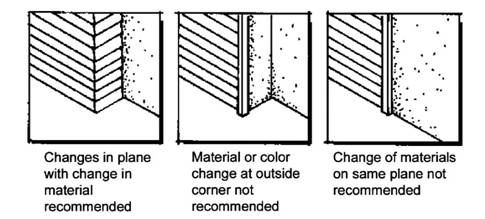
Materials. The choice and mix of materials on the facades of structures is important in providing attractive commercial development. Materials shall be consistently applied on all facades and be chosen to work harmoniously with adjacent materials. Piecemeal embellishment and frequent changes in materials shall be generally avoided. Materials tend to appear substantial and integral when material changes occur at changes in plane. Material or color changes at the outside corners of structures give an impression of thinness and artificiality, which shall be avoided. Material changes shall not occur at external corners, but may occur at reverse or interior corners from the edge of external corners. Material changes not accompanied by changes in plane give materials an insubstantial or applied quality.
(3)
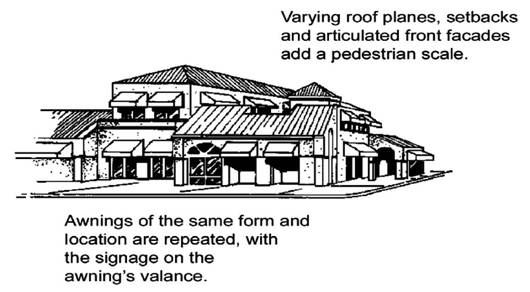
Awnings and Canopies. Awnings and canopies shall be subject to the following:
(A)
Awnings/canopies shall not be located so as to obscure transom windows, piers, pilasters, and other architectural building features and are encouraged to be designed to project over individual doors and window openings where feasible. Awnings/canopies that are a continuous feature extending over several windows, doors, and other architectural features are generally discouraged.
(B)
The size of the awning/canopy shall be proportional in scale with the building to which it is attached.
(C)
No portion of an awning/canopy shall be less than eight feet above the surface above which it projects (fourteen feet above a roadway surface) or shall project more than five feet into a public right-of-way. An encroachment permit is required for any awning/canopy located within the public right-of-way.
(D)
The style of the awning/canopy shall complement the architectural style of the building to which it is attached. Awnings should generally have a simple horizontal valance if located over rectangular or square window/door openings. Domed or barrel-shaped awnings are appropriate for buildings with arched window/door openings.
(E)
An awning/canopy with a single, solid color is preferred. The color of the awning/canopy shall be compatible with and complement the exterior color(s) of the building. Awning/canopy colors that call more attention to the awning/canopy than the building are inappropriate.
(F)
Awnings/canopies shall be regularly cleaned and kept free of visible defects and wear.
(G)
Awnings/canopies with signs shall require the issuance of a sign permit in accordance with Article V, Division 3: Signs.
(4)
Transparency and Windows. Transparency standards help strengthen the relationship between buildings and the street, and other pedestrian-oriented areas and increases public safety by placing eyes on the activity in these areas. The following features shall be utilized along those building facades which face pedestrian-oriented street frontages and public open space areas such as plazas:
(A)
Windows and entry doors (public) in buildings shall not have reflective, translucent, or dark tinted glass on the ground floor as it prevents and discourages building transparency.
(B)
Building facades shall not have a section of blank wall exceeding thirty linear feet without being interrupted by a window or entry door or other architectural feature that promotes building transparency.
(C)
The primary building entry shall be generally visible from the street(s).
(j)
Roof Treatments.
(1)
The roofline at the top of the structure shall not run in continuous plane for more than fifty feet without offsetting or jogging the roof plane.
(2)
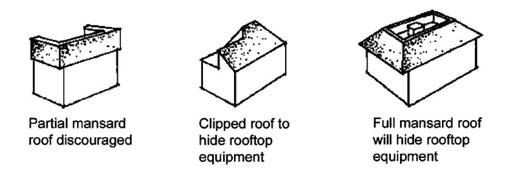
All roof top equipment shall be screened from public view by screening materials of the same nature as the structure's basic materials. Mechanical equipment shall be located below the highest vertical element of the building. Plain equipment boxes are not acceptable.
(3)
The following roof materials shall not be used:
(A)
Corrugated metal (standing rib metal roofs are permitted) unless the city planner determines the material is appropriate for the architectural style or theme of the building;
(B)
Highly reflective surfaces that create glare; and
(C)
Illuminated roofing.
(k)
Parking and Circulation. Parking lot design can be a critical factor in the success or failure of a commercial use. In considering the possibilities for developing a new parking area, a developer shall analyze the following factors: ingress and egress with consideration to possible conflicts with street traffic; pedestrian and vehicular conflicts; on-site circulation and service vehicle zones; and the overall configuration and appearance of the parking area.
(1)
Separate vehicular and pedestrian circulation systems shall be provided. Pedestrian linkages between uses in commercial developments shall be emphasized, including distinct pedestrian access from parking areas in large commercial developments, such as shopping centers.
(2)
Parking aisles shall be separated from vehicle circulation routes whenever possible.
(3)
Common driveways that provide vehicular access to more than one site are encouraged.
(4)
Parking areas shall be landscaped, receiving interior as well as perimeter treatment.
(5)
Parking areas shall be separated from structures by either a raised concrete walkway or landscaped strip, preferably both. Situations where parking spaces directly abut structures shall be avoided whenever possible.
(6)
Whenever feasible, shared parking between adjacent businesses and/or developments is highly encouraged.
(7)
Where parking areas are connected, interior circulation shall allow for a similar direction of travel, and parking bays in all areas to reduce conflict at points of connection.
(8)
Whenever feasible, locate site entries on side streets in order to minimize pedestrian/vehicular conflicts. When this is not feasible, design the front site entry with appropriately patterned concrete or pavers to differentiate it from the sidewalks.
(9)
Parking access points shall be located as far as possible from street intersections so that adequate stacking room is provided. The number of access points shall be limited to the minimum amount necessary to provide adequate circulation.
(10)
Parking areas and pedestrian walkways shall be visible from structures to the greatest degree possible.
(11)
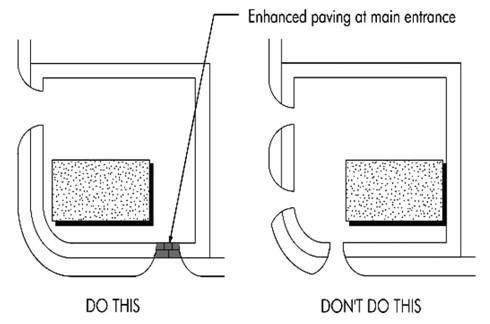
Driveway Entrances. Colored, textured pavement paving shall be provided at a minimum depth of ten feet at all primary vehicular driveway entrances and exits (immediately behind the street right-of-way line) to the development.
(12)
Design parking areas so that pedestrians walk parallel to moving cars. Minimize the need for the pedestrian to cross parking aisles and landscape areas to access structures. When such design is not feasible, pedestrian walkways shall be provided which connect the parking areas and the structures. Such walkways shall be clearly demarked from the parking areas and drive aisles through the use of colored, textured paving or similar treatment.
(13)
The parking area shall be designed in a manner that links the structures to the street sidewalk system as an extension of the pedestrian environment. This can be accomplished by using design features such as walkways with enhanced (colored, textured) paving, trellis structures, or a special landscaping treatment.
(14)
Parking areas that accommodate a significant number of vehicles shall be divided into a series of connected smaller lots divided by landscaping or buildings.
(15)
Parking areas are encouraged to be located to the rear or side of buildings along pedestrian-oriented street frontages.
(16)
The first parking stall which is perpendicular to a driveway or first aisle juncture, shall be set back a sufficient distance from the curb to avoid traffic obstruction based on the number of parking spaces and traffic conditions at the driveway intersection. With larger centers, significantly more setback area will likely be required.
(17)
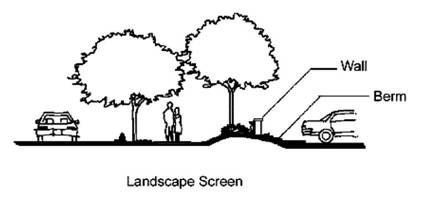
Use an opaque landscaped wall or a landscaped berm to soften views of any parking that is visible from the street periphery. A combination of walls or berms and landscape material is required when parking abuts a street frontage. Where practical, lowering the grade of the parking lot from existing street elevations may aid in softening views of automobiles while promoting views of architectural elements of the structures beyond.
(18)
Parking areas are encouraged to provide facilities for vehicles with alternative fueling systems (such as electric vehicle charging areas, etc.)
(19)
Where appropriate, the use of parking structures instead of parking lots is encouraged. A parking structure's smaller footprint makes parking a less obtrusive use than parking lots. Whether placed under-ground where it can serve as the foundation for buildings or above ground, parking structures shall be designed to minimize the impact of the structure on the street and to be compatible with the architectural style of surrounding buildings. Structures which are linked to adjoining uses or which provide retail or office uses on the ground floor of the parking structure are encouraged.
(l)
Landscaping.
(1)
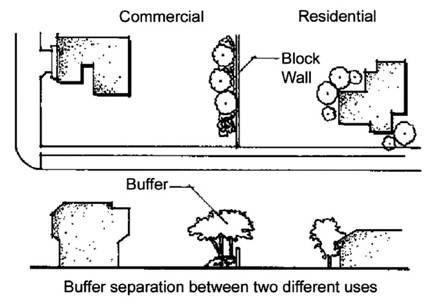
Landscaping for commercial uses shall be used to define specific areas by helping to focus on entrances to buildings and parking lots, define the edges of various land uses, provide transition between neighboring properties (buffering), and provide screening for loading and equipment areas.
(2)
Landscaping shall be in scale with adjacent structures and be of appropriate size at maturity to accomplish its intended purpose.
(3)
Landscaping around the entire base of structures is recommended to soften the edge between the parking lot and the structure. This shall be accented at entrances to provide focus.
(4)
Trees shall be located throughout the parking lot and not simply at the ends of parking aisles. In order to be considered within the parking lot, trees shall be located in planters that are bounded on at least three sides by parking area paving.
(5)
Landscaping shall be protected from vehicular and pedestrian encroachment by raised planting surfaces, depressed walks, or the use of concrete curbs.
(6)
Vines and climbing plants integrated upon buildings, trellises, and walls are strongly encouraged.
(7)
Use potted plants in clay or decorative concrete containers, especially for enhancement of sidewalk shops, plazas, and courtyards, and to soften the hardscape.
(8)
At maturity, trees shall be able to be trimmed ten feet above ground and shrubs shall be maintained at a height of approximately three feet when visibility is a factor.
(m)
Fences and Walls.
(1)
If not required for a specific screening or security purpose, walls should not be utilized within commercial areas. When used, the intent is to keep the walls as low as possible while performing their screening and security functions.
(2)
Where walls are used along property frontages, or screen walls are used to conceal storage and equipment areas, they shall be designed to blend with the site's architecture. Both sides of all perimeter walls or fences shall be architecturally treated when visible from public or private streets and public areas such as parking lots and plazas. Landscaping shall be used in combination with such walls whenever possible.
(3)
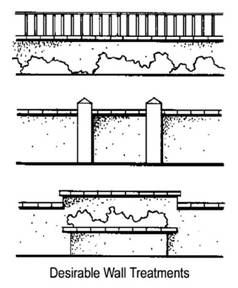
When security fencing is used, it should be a combination of solid walls with pillars and decorative view ports, or short solid wall segments and wrought iron grill work.
(4)
Long expanses of fence or wall surfaces shall be offset or architecturally designed to prevent monotony. Landscape pockets or vines shall be provided whenever possible.
(B)
Barb or razor wire and similar fencing shall be prohibited in commercial districts.
(n)
Screening.
(1)
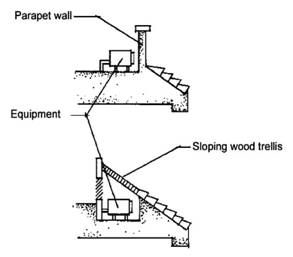
Any outdoor equipment, whether on the roof or side of a structure, or on the ground, shall be appropriately screened from public view. The method of screening shall be architecturally integrated with the adjacent structure in terms of materials, color, shape, and size. Where individual equipment is provided, a continuous screen is desirable.
(2)
Screening for outdoor storage (including cart storage) shall be determined by the height of the material or equipment being screened. When allowed, exterior storage shall be confined to portions of the site least visible to public view. Where screening is required, a combination of elements shall be used including solid masonry walls, berms, and landscaping. Chain link fencing with wood or metal slatting is only permitted when not visible from a public or private street or public areas, such as parking lots and plazas.
(3)
Drive-through aisles, car wash entrances/exits, wash stalls, and similar uses shall be screened from view of adjacent streets by building orientation and/or the provision of landscaping, trellises, berms, low walls, or other features that are compatible with the architecture design and exterior materials of the building.
(o)
Lighting.
(1)
Lighting shall be used to provide illumination for the security and safety of on-site areas such as parking, loading, shipping and receiving, walkways, and working areas.
(2)
The design of light fixtures and their structural support shall be architecturally compatible with the main structures on-site. Illuminators shall be integrated within the architectural design of the structures.
(3)
As a security device, lighting should be adequate, but not overly bright. All building entrances shall be appropriately lighted.
(4)
All lighting fixtures shall be shielded to confine light spread within the site boundaries and reduce "sky-glow" impacts.
(5)
Exterior nonflashing neon lighting or colored lighting used as a building accent rather than an advertising feature may be considered subject to the approval of a conditional use permit.
(p)
Signs.
(1)
Every structure and commercial development should be designed with a precise concept for adequate signing. Provisions for sign placement, sign scale in relationship with the building scale, and sign readability shall be considered in developing the signing concept. All signing shall be highly compatible with the building and site design relative to color, style, material, and placement.
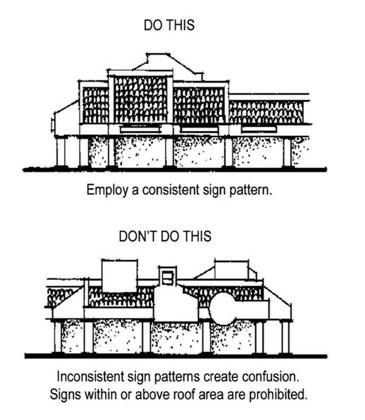
(2)
Monument-type signs are the preferred alternative for business identification in new developments. Where several tenants occupy the same site, individual wall mounted signs are appropriate in combination with a monument sign identifying the development and address.
(3)
The use of backlit individually cut letter signs is strongly encouraged. Can-type signs are discouraged in new developments except for logo signs.
(4)
Each development site should be appropriately signed to give directions to loading and receiving areas, visitor parking, and other special areas.
(q)
Kiosks. Kiosk design and exterior color(s) shall be compatible with the architectural style and exterior color(s) of surrounding buildings.
(Ord. No. 2463 (NCS).)
(Ord. No. 2507 (NCS), § 28, 5-18-2010)
Sec. 37-30.230. - Purpose.
In addition to the general purposes listed in Article I, Division 1: General Provisions, the purpose of the mixed use (MU) districts regulations is to:
(a)
Promote and provide development opportunities for integrated, complementary housing and employment opportunities in the same building, on the same parcel or within the same block. This district allows more intensive development on busier streets without fostering a strip commercial appearance. This development will support transit use and provide a buffer between busy streets and residential neighborhoods, and provide new housing opportunities in the city. The emphasis of nonresidential uses is primarily on locally oriented/neighborhood serving retail, service, and office uses. Development is encouraged to provide businesses on the ground floor with housing on upper stories and provides incentives to assist in achieving this goal. However, stand-alone commercial, public and semipublic, and residential development is also permitted;
(b)
Promote compact development that is intended to be pedestrian-oriented with buildings close to and oriented to the sidewalk;
(c)
Promote residential development that is appropriate in an urban setting in mixed use buildings by providing incentives, as well as, standards and regulations to minimize conflicts between different types of uses; and
(d)
Promote vital and safe mixed use areas through the incorporation of crime prevention through environmental design (CPTED) features in development;
(e)
The purposes of each mixed use (MU) districts are as follows:
(1)
Mixed Arterial Frontage (MAF) District. The mixed arterial frontage district provides a combination of mixed use, commercial, and small-scale non-nuisance industry along certain areas of North Main Street, East and West Market Streets, and other arterials that have highly mixed land use patterns of existing development. Stand-alone residential uses within the MAF district are generally not encouraged, unless on a vacant site or as part of a comprehensive revitalization of the property subject to the approval of a conditional use permit. Residential uses in mixed use buildings may only be combined with office, retail, restaurants, and service commercial uses, and not with industrial, maintenance, vehicle repair and restoration, or storage activities.
(2)
Mixed Use (MX) District. The mixed use district provides opportunities for mixed use, office, public and semipublic uses, and commercial uses that emphasize retail, entertainment, and service activities. Medium and high density residential uses are encouraged within MX districts to facilitate pedestrian-oriented activity centers.
(Ord. No. 2463 (NCS).)
Sec. 37-30.240. - Use classifications.
Table 37-30.110 identifies the use classifications for properties located in the mixed use (MU) districts:
(Ord. No. 2463 (NCS).)
(Ord. No. 2507 (NCS), § 1, 5-18-2010; Ord. No. 2532 (NCS), § 12, 11-13-2012; Ord. No. 2569 (NCS), § 4, 4-19-2016; Ord. No. 2646 (NCS), § 3, 8-10-2021; Ord. No. 2649 (NCS), § 3, 9-21-2021; Ord. No. 2655 (NCS), § 2, 2-15-2022; Ord. No. 2656 (NCS), § 6, 5-10-2022)
Editor's note— Ord. No. 2532 (NCS), § 12, adopted Nov. 13, 2012, set out provisions adding notes (42) and (43). To avoid number duplication, and at the editor's discretion, these provisions were included as notes (43) and (44), respectively.
Sec. 37-30.250. - Development regulations.
Table 37-30.120 identifies the development regulations for the mixed use (MU) districts:
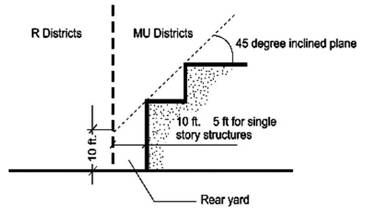
(Ord. No. 2463 (NCS).)
(Ord. No. 2507 (NCS), § 29, 5-18-2010)
Sec. 37-30.260. - Mixed use building incentives.
To encourage pedestrian-oriented activity centers in the mixed use districts and as an incentive to foster mixed use buildings when no more than twenty-five percent of the gross floor area of the ground floor of the mixed use building(s) is dedicated to residential use and the building includes a minimum commercial gross floor area ratio (FAR) of 0.25, the following incentives are provided:
(a)
The residential bedrooms per dwelling unit mix requirement of the R-H-1.8 district for three- and four-bedroom dwelling units is waived.
(b)
The usable open space requirement of the R-H-1.8 district is reduced from five hundred square feet per dwelling unit to one hundred square feet per dwelling unit for studio, one-bedroom and two-bedroom dwelling units, and to three hundred square feet per dwelling unit for three-bedroom dwelling units, and to four hundred square feet per dwelling unit for four- or more bedroom dwelling units provided each dwelling unit is provided with a balcony/terrace of at least sixty square feet in size which is directly accessible to the dwelling unit. No more than thirty percent of the total number of dwelling units in a mixed use building may have more than two bedrooms to receive the reduced open space incentive.
(c)
Parking requirements are reduced to one parking space per dwelling unit for studio, one-bedroom and two-bedroom dwelling units and one parking space for each four hundred square feet of commercial floor area. The parking requirements for dwelling units with more than two bedrooms shall comply with the R-H-1.8 district parking requirements.
(d)
No loading areas shall be required for commercial uses under thirty thousand square feet in size.
(e)
Within a mixed use building providing commercial uses of at least 0.25 FAR, allowable floor area may be substituted for residential dwelling units at a ratio of one dwelling unit for each one thousand square feet of allowable floor area to the maximum FAR of 1.0. For example, the maximum development potential of a one-acre lot is forty-three thousand five hundred sixty square feet of commercial floor area plus ten dwelling units. A proposed mixed use building providing at least ten thousand eight hundred ninety square feet of commercial floor area could also include forty-three dwelling units as follows: 43,560 sq. ft. × 0.25 = 10,890 sq. ft.; 43,560 sq. ft. - 10,890 sq. ft. = 32,670 sq. ft./1,000 sq. ft. = 33 dwelling + 10 dwelling units = 43 dwelling units.
(f)
The following additional requirements shall also apply to mixed use buildings:
(1)
Mixed use buildings must incorporate ground floor occupancies and uses (storefronts or offices regularly open and accessible to the public) which are oriented to the public sidewalks/streets to enhance the pedestrian environment.
(2)
Access to the residential dwelling units shall be provided from a separate ground floor entry and not through a commercial storefront or use.
(3)
Yards shall be in accordance with the applicable MU district.
(4)
Commercial uses within mixed use residential buildings shall be limited to retail, restaurants, offices, services, and similar pedestrian-oriented uses.
(5)
No more than twenty-five percent of the gross floor area of the ground floor of a mixed use building shall be residential to receive the incentives unless approved subject to Section 37-30.270: Modification of use regulations.
(Ord. No. 2463 (NCS).)
Sec. 37-30.270. - Modification of use regulations.
(a)
Mixed use buildings in the MAF or MX districts proposing more than twenty-five percent of the ground floor area dedicated to residential use or less than a minimum commercial gross floor area ratio of 0.25 may request to receive the incentives specified in Section 37-30.260: Mixed use building incentives or other incentives subject to the approval of a conditional use permit. In addition to the findings established in Article VI, Division 8: Conditional Use Permits, the applicant shall be required to also demonstrate how the project will achieve the following:
(1)
The project meets the basic purposes of Section 37-30.230: Purpose and the applicable district.
(2)
The project helps achieve a mix of uses in an area because no more than thirty percent of the existing ground floor area on the block is developed for residential use.
(3)
The project design is consistent with the development regulations and design standards of this division.
(Ord. No. 2463 (NCS).)
Sec. 37-30.280. - Design standards.
(a)
Purpose. These design standards are intended to assist the designer in understanding the city's requirements for high quality development (residential, mixed use, and nonresidential) in the mixed use districts. These standards complement the development regulations contained in this division by providing good examples of potential design solutions and by providing design interpretations of the various regulations. These standards ensure the highest level of design quality while at the same time providing the flexibility necessary to encourage creativity on the part of project designers. These standards are also intended to ensure that buildings and dwellings are visually compatible with one another and adjacent neighborhoods and create mixed use areas, which are attractive, compact, pedestrian and transit-oriented, active, and safe.
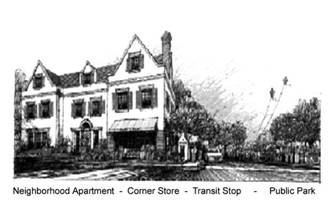
(b)
Applicability. These standards shall also apply to applicable properties located in the focused growth overlay district.
(c)
Site Planning. The location of structures and other site improvements shall create a pedestrian-oriented environment with safe, pleasant, convenient, and accessible pedestrian routes to public sidewalks, transit facilities, and adjacent uses. Site planning shall incorporate the following:
(1)
Structures shall be sited along street frontages of sites with parking in the rear or in limited circumstances to the side. Placing parking areas behind rather than in front of buildings helps to preserve an attractive streetscape and improve pedestrian access to surrounding activities and uses, and it provides an urban border for the street.
(2)
Placement of structures, entrances, and open space areas such as plazas and courtyards shall be oriented to provide direct access to public sidewalks and streets to the maximum extent possible to facilitate pedestrian access and movement between adjacent uses.
(3)
Buildings shall be arranged to create a sense of unity and overall harmony with adjacent structures. A visual link between separate structures can be established through the use of an arcade system, trellis, or similar feature.
(4)
Buildings shall be sited in a manner that maximizes visibility of plazas, courtyards, streets, and alleys to provide opportunities for people engaged in their normal behavior to observe the spaces around them.
(5)
The location of outdoor spaces shall have clear, recognizable shapes that reflect careful planning and are not simply left over areas between structures. Such spaces shall provide pedestrian-oriented amenities such as shady areas, art, benches, fountains, landscaping, etc.
(d)
Natural Surveillance. Whenever feasible, design and placement of buildings and other physical features are encouraged to maximize visibility and facilitate natural surveillance from public rights-of-way and other public areas. This includes building orientation, placement of windows, doors, and balconies, building and site entrances and exits, placement of parking, lighting, and refuse containers, placement and type of landscape materials, plazas, and other open space areas, location of walkways, types of walls and fences (including the use of picket, wrought-iron, and similar materials to promote visibility when appropriate), and other physical obstructions that discourage the potential for criminal activity.
(e)
Yards/Setbacks.
(1)
Buildings with ground floor residential uses shall have a maximum front yard and corner side yard of ten feet to accommodate stairs, landings, porches, covered architectural entry features, and similar building features.
(2)
When provided, the front or corner side yard shall include landscaping and/or a hard-surface expansion of the sidewalk. Walkway connections to building entrances shall include special paving treatment or materials. The use of awnings, canopies, and arcades shall be incorporated as appropriate to provide visual interest, shade, and protect pedestrians from the elements.
(3)
All other buildings shall generally have no required yard and be located directly behind the sidewalk to facilitate pedestrian access to the public realm. Portions of the front or corner-side street facades may be setback to allow for pedestrian-oriented outdoor areas and amenities only, such as plazas and courtyards, outdoor patio dining areas, public art, fountains, entry forecourts, landscaping, or other amenities appropriate to an urban setting. When provided such yards shall generally be no more than ten feet, except where ground floor building space is occupied by retail or other pedestrian-oriented uses with entrances opening directly to a plaza or courtyard. In such cases, the city planner may allow the maximum front or corner-side yard to be extended.
(f)
Building Entrances.
(1)
The main building entrance or entrances shall be oriented to the street or plazas, as applicable, to maximize natural surveillance and provide "eyes on the street." The main entries to buildings shall be clearly demarcated, visible and accessible from the street and/or pedestrian walkways. Main entries shall be recessed or framed by a sheltering element such as an awning, arcade, porch, or portico. Such entrances shall open directly to the outside and shall not require a pedestrian to first pass through a garage, parking lot, or loading area to gain access to the entrance from the street. Secondary building entries may be from parking areas.
(2)
All residential dwellings fronting on streets shall have a main entrance opening onto the front or corner side facade of the dwelling at the ground floor level. Such an entrance shall open directly to the outside. The entrance may be above grade level through a porch, stoop, portico, or similar architectural feature. Ground floor single-family attached dwellings fronting on a street shall have separate entries directly from the sidewalk or a pedestrian walkway. Upper story and ground floor residential dwelling units in a multifamily or mixed use building fronting on streets may share one or more entries accessible directly from the street.
(3)
Multifamily residential buildings with facades over one hundred fifty feet in length facing a street frontage shall provide a minimum of two or more pedestrian building entrances on that frontage.
(g)
Architecture. There is no particular required style for structures and buildings in the mixed use districts. The primary focus shall be on the construction and design of a high quality pedestrian-oriented buildings and developments. A diversity of styles is encouraged.
(h)
Mass and Scale.
(1)
The mass and scale of a new development shall be compatible with neighboring developments and not overwhelm them with disproportionate size or a design that is out of character.
(2)
At residential edges, buildings shall maintain low profiles to provide a transition between urban and residential areas. Taller elements of the building shall increasingly step back from adjacent single-family residential zones.
(3)
Building scale shall be reduced through the proper use of window patterns, structural bays, roof overhangs, awnings, moldings, fixtures, and other details that promote a "human" scale.
(i)
Facade Articulation.
(1)
Building design shall avoid large monotonous facades, long straight-line building fronts, plain box shapes, and barren exterior treatment. All building facades visible from streets or public areas such as plazas shall be highly articulated, and incorporate the chosen design theme in a consistent manner.
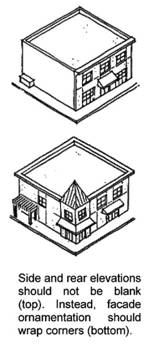
(2)
Vary the planes of the exterior walls in depth and/or direction. Wall planes shall not run in a continuous direction for more than fifty feet without an offset proportional to the building size or an architectural feature such as a column to provide visual interest.
(3)
For residential dwelling units, the facades of the buildings shall be designed so as to give individual identity to each vertical module of dwelling units using techniques such as providing a deep notch (in plane) between the modules; varying architectural elements between dwelling units (e.g., window color, roof shape, window shape, stoop detail, railing type); providing porches and balconies; varying color or materials of each individual module within a harmonious palette of colors and materials, etc.
(j)
Roof Treatments. A variety of roof forms are permitted. Changes in roof form must correspond with a building's structural bays and massing.
(1)
Towers. Towers may be integrated into a building to provide a focal point for the primary entrance(s).
(2)
Articulation. At a minimum, the roofline at the top of the structure shall not run in a continuous plane for more than fifty feet without offsetting or jogging the roof plane.
(3)
Roof Materials. Roof materials shall be appropriate to the style of the building, roof form, and slope. Desirable roofing materials include tile, slate, metal, and composition shingles with an architectural grade shadow shake rather than a simple three-tab. The following roof materials shall not be used:
(A)
Corrugated metal (standing rib metal roofs are permitted) unless the city planner determines the material is appropriate for the architectural style or theme of the building;
(B)
Highly reflective surfaces that create glare; and
(C)
Illuminated roofing.
(k)
Wall Treatments. Architectural treatments bring identity and character to a neighborhood or district. A minimum number of differing architectural features supports visual interest on the street and relieves what too often become monotonous facades. These standards require structural articulation and are intended to produce an architecture that is internally consistent and produces adequate detail and relief in the massing as follows:
(1)
Base, Middle, and Top Treatments. Building facades shall have three recognizable elements: a base, middle, and top unless the city planner determines that such elements would be inappropriate with the architectural style of the building.
(A)
Base. Appropriate materials for the base include richly textured or darker colored materials, mullions, and or panels, masonry materials, special materials such as ceramic tile, granite, or marble, or landscaping.
(B)
Middle. The middle forms the area between the base and the top of the building facade and as such shall be generally distinguishable from the other two elements.
(C)
Top. The top should create an attractive profile for the building. Appropriate elements include cornice treatments, roof overhangs with brackets, stepped parapets, or richly textured materials (e.g., tile or masonry).
(2)
Materials.
(A)
Exterior materials and finishes shall be durable. Buildings must incorporate consistent, pedestrian-scale textures and details on all sides that are visible from public streets and pedestrian pathways.
(B)
Materials that are visibly simulated or prefabricated are discouraged. Scored plywood is prohibited.
(C)
Material changes must not occur at external corners, but may occur at reverse interior corners.
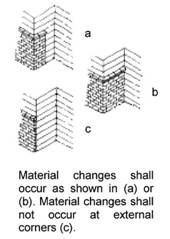
(3)
Articulation. Facade articulation is required. Building fenestration (windows and doors placement) and changes in mass shall relate to structural systems and the organization of interior space. Vertical architectural features such as columns and piers help articulate building mass. Also, see subsection (i) of this section.
(4)
Awnings and Canopies. Awnings and canopies shall be subject to the following:
(A)
Awnings/canopies shall not be located so as to obscure transom windows, piers, pilasters, and other architectural building features and shall generally be designed to project over individual doors and window openings, where feasible. Awnings/canopies that are a continuous feature extending over several windows, doors, and similar architectural features are generally discouraged.
(B)
The size of the awning/canopy shall be proportional in scale to the building to which it is attached.
(C)
No portion of an awning/canopy shall be less than eight feet above the surface above which it projects (fourteen feet above a roadway surface) or shall project more than five feet into a public right-of-way. An encroachment permit is required for any awning/canopy located within the public right-of-way.
(D)
The style of the awning/canopy shall complement the architectural style of the building to which it is attached. Awnings should generally have a simple horizontal valance if located over rectangular or square window/door openings. Domed or barrel-shaped awnings are appropriate for buildings with arched window/door openings.
(E)
An awning/canopy with a single, solid color is preferred. The color of the awning shall be compatible with and complement the exterior color(s) of the building. Awning/canopy colors that call more attention to the awning/canopy than the building are inappropriate.
(F)
Awnings/canopies shall be regularly cleaned and kept free of visible defects and wear.
(G)
Awnings/canopies with signs shall require the issuance of a sign permit in accordance with Article V, Division 3: Signs.
(5)
Transparency and Windows. Transparency standards help strengthen the relationship between buildings and the street and other pedestrian-oriented areas such as plazas and increases public safety by placing eyes on the activities that occur in these areas.
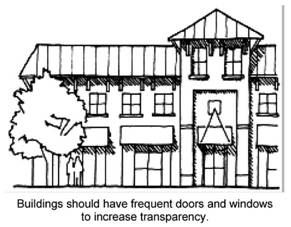
(A)
For buildings which contribute to frontage along build-to lines, or are located along pedestrian-oriented street frontages or public open space areas such as plazas, the following shall apply:
(i)
Windows and entry doors (public) in buildings shall not have reflective, translucent or dark tinted glass on the ground floor as it prevents and discourages building transparency.
(ii)
Building facades shall not have a section of blank wall exceeding thirty linear feet without being interrupted by a window or entry door or other design element that promotes transparency.
(iii)
At least sixty percent of the linear length of nonresidential facades must contain windows, doors, or arcades at all levels. Clerestory windows or other high, non eye-level windows do not count towards the sixty percent requirement.
(iv)
For residential structures, one primary window (excluding clerestory and other high, non eye-level windows) shall be required in each room with an exterior wall on the street facades of the dwellings.
(B)
For buildings that do not contribute to frontage along build-to lines or are not located along pedestrian-oriented street frontages or public open space areas such as plazas, the following shall apply:
(i)
The primary building entry and windows shall be generally visible from the street(s).
(ii)
The main entrance(s) shall open directly onto a publicly accessible connecting walkway. This walkway shall connect directly to the sidewalk or pedestrian walkway of an adjacent street.
(iii)
Building facades that are visible from the street shall not have a section of blank wall exceeding thirty linear feet without being interrupted by a window, entry, or a section of lattice with vines, or other architectural feature.
(l)
Privacy for Residential Dwelling Units.
(1)
To balance privacy, security, and pedestrian friendliness, the primary entrances of ground-floor residential dwelling units shall face a public sidewalk, and the finished-floor elevation shall be at least eighteen inches but no more than sixty inches above the sidewalk provided that an accessible "at grade" entrance is available.
(2)
Buildings should be oriented to promote privacy to the greatest extent feasible. In mixed use projects, residential windows should face away from loading, service, and recycling and solid waste deposal areas. To the extent residential windows face the windows of an adjacent dwelling unit, the windows shall be offset or incorporate other features to provide privacy.
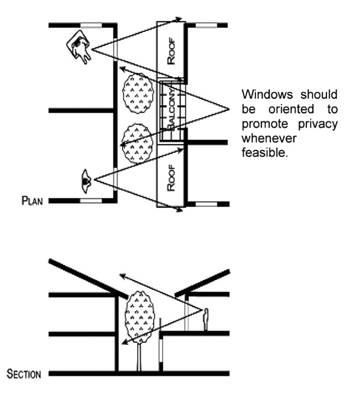
(3)
Windows, balconies, or similar openings should be oriented to minimize direct line-of-sight into adjacent dwelling units within the development. In addition, dwelling units above the ground floor shall generally be designed so that they do not look directly onto private patios or backyards of the adjoining residential property or dwelling units when feasible.
(4)
Landscaping may also be used to aid in privacy screening and as a buffer from commercial development.
(m)
Colors.
(1)
Exterior building and roofing colors shall be appropriate to and enhance the architectural style and materials of the structure. Large areas of intense primary color shall generally be avoided as the dominant overall color for a structure.
(2)
The color palette chosen for new structures shall generally be compatible with the colors of adjacent structures. An exception is where the colors of adjacent structures strongly diverge from these design standards.
(3)
Primary or bold colors may only be used to accent elements, such as door and window frames and architectural details.
(4)
Minimize the number of colors appearing on the structure's exterior. Small commercial structures shall generally use no more than three colors unless appropriate to the architectural style.
(5)
Roof flashing, rain gutters, and downspouts, vents, and other roof protrusions shall be finished to complement the adjacent materials and/or colors.
(n)
Treatment Adjacent to Residential Districts.
(1)
To provide privacy for adjacent dwelling units, windows on the second and higher floors of buildings, which directly face or abut residential zones, should be designed either as translucent, louvered, be offset from existing residential windows, or utilize another solution to achieve privacy for the adjacent dwelling units.
(2)
Developments shall be designed to minimize motor vehicle circulation through local single-family neighborhood streets; however, pedestrian connections are encouraged.
(3)
Parking areas shall be located and designed to be convenient in order to minimize parking in residential neighborhoods.
(4)
Building facades and garages that face existing dwelling units shall be designed to be compatible with the setbacks and scale of the existing development.
(o)
Vehicle Circulation and Access.
(1)
Site access and internal circulation shall promote safety, efficiency, and convenience. Vehicular traffic shall be adequately separated from pedestrian circulation. Vehicular entrances shall be clearly identified and easily accessible to minimize pedestrian/vehicle conflict.
(2)
The number of site access points or driveway aprons shall be minimized. Driveway entrances shall be located as far as possible from street intersections and shall be coordinated with existing or planned median openings and driveways on the opposite side of the roadway. Common driveways that provide vehicular access to more than one site are encouraged.
(3)
A driveway entrance for a drive-through lane shall not have direct access from the primary street serving the site. Such entrances shall only be located off driveways located within the interior of the development.
(p)
Pedestrian Circulation.
(1)
All new uses shall be oriented and designed to enhance pedestrian movement to and between adjacent uses and public streets.
(2)
New development shall include pedestrian walkways. Pedestrian circulation shall be adequately separated from vehicular traffic. Pedestrian entrances and walkways shall be clearly identified and easily accessible to minimize pedestrian/vehicle conflict.
(3)
In mixed use projects, pedestrian walkways shall link dwelling units with the compatible commercial facilities in the project, common open space, plazas and courtyards, parking areas, and public sidewalks.
(4)
Colored, textured paving shall be used to delineate pedestrian crossings at circulation drives and parking aisles.
(q)
Parking.
(1)
Mixed Use Buildings.
(A)
A reduction in parking requirements for residential dwelling units (applicable to studios, one- and two-bedroom dwelling units only) when incorporated into a mixed use residential building to one parking space per dwelling unit is provided to encourage residential uses in conjunction with neighborhood-serving commercial uses.
(B)
For the commercial use portion of a mixed use building, a parking standard of one space for each four hundred square feet of retail, office, restaurant, service, and similar pedestrian-oriented uses shall apply. As an alternative, when the mixture of uses is known, the Urban Land Institute's (ULI's) shared parking standards may be used to calculate the total number of shared parking spaces. To determine shared parking demand, two or more uses would be added for each hour of the day, for both weekdays and for Saturdays, to see which hour produces the highest parking demand. The following steps shall be used to determine the required minimum and maximum number of spaces for projects including a mix of uses:
(i)
For each hour of the day, determine the parking demand for each individual land use (as determined by the Urban Land Institute's shared parking standards).
(ii)
Add together the parking demands for each land use to determine the aggregate parking demand for each hour. For example, add the amount of parking demanded by restaurants at 1:00 p.m. to the amount of parking demanded by retail at 1:00 p.m.
(iii)
Determine the minimum shared parking space requirement by using the largest of the aggregate parking demand figures. On-street parking spaces shall be used to help meet this requirement.
(iv)
Where visitor parking is required, the sharing of visitor parking and nonresidential parking is permitted.
(2)
Other Uses. Residential, mixed use developments (excluding mixed use buildings), commercial uses, and public and semipublic uses shall be subject to the parking requirements by use classification in Section 37-50.360: Off-street parking and loading spaces regulations.
(3)
On-street Parking. With the exception of streets where parallel parking operations would adversely impact traffic flow or where on-street parking is not "currently" allowed, all street improvement projects must include provisions for on-street parking. Existing on-street parking along the length of the lot shall be counted towards the required parking of adjacent buildings on the street side abutting the uses. Such parking shall not be counted, however, if the city engineer determines that the parking must be removed at a later time to implement general plan circulation improvements.
(4)
Parking Structures. Where feasible, the use of parking structures instead of parking lots is encouraged. A parking structure's smaller footprint makes such parking a less obtrusive use than parking lots. Parking structures or garages shall be subject to the following:
(A)
When ground floor parking is permitted, the exterior of the street facade of the parking structure shall have the appearance of a building and incorporate similar materials, colors, and architectural features as adjacent buildings. In no case shall unscreened vehicles in the parking structure be visible from public streets.
(B)
Parking structures are generally discouraged along the primary and pedestrian-oriented street frontages serving a site unless retail, restaurants, services, offices, or other habitable uses occupy the ground floor portion of the parking structure that fronts the street. On secondary street frontages and other non pedestrian-oriented street frontages serving a site, ground floor parking may occupy the portion of the structure that fronts a street if the city planner determines that the street frontage serving the site is not expressly pedestrian-oriented in nature and that such parking would not adversely impact surrounding uses on the block.
(C)
Stand-alone parking structures should generally not exceed thirty-five feet in height except higher structures may be considered through the conditional use permit process.
(D)
Whether placed underground where it can serve as a foundation for buildings or above ground, parking structures shall be designed to minimize the impact of the structure on the street and to be compatible with the architectural style of the surrounding buildings.
(5)
Bicycle Parking. Bicycle parking must be provided in easily accessible locations from the street. Bicycle parking must be visible from the building it serves in order to improve security for parked bicycles.
(6)
Parking Lot Location. All new construction of parking lots shall occur behind or to the sides of structures, or within the interior of the development where it is not visible from the street.
(7)
Driveway Entrances. Colored, textured pavement paving shall be provided at a minimum depth of ten feet at all primary vehicular driveway entrances and exits (immediately behind the street right-of-way line) to the development.
(8)
Parking Lot Landscaping. Where parking lots abut streets, a minimum eight-foot-wide landscaped frontage shall be provided on the site, adjacent to the sidewalk. Landscaped frontages are not required when parking lots are sited behind buildings or plazas. A minimum number of shade trees are required, equivalent to one tree per five parking stalls. Trees in parking lots shall be spread uniformly (in an orchard parking lot landscaping design) throughout the parking area and may not be located only at the end of parking rows. Trees planted along connecting walkways and adjacent landscaped frontages may also contribute to the one-per-five requirement for parking lots. Trees in parking lots must be set into a tree well or planter having a minimum interior dimension of five feet (exclusive of curbs). Trees adjacent to walkways and in plazas shall be protected by attractive bollards, raised concrete curbing or tree guards designed to be compatible with the development.
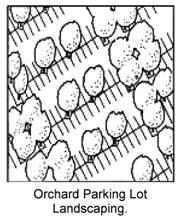
(9)
Vehicle Maneuvering Areas. Vehicle maneuvering areas (including drive-through lanes, queuing areas, service station pump islands, and similar vehicle-related areas) shall be located within the interior of developments and be screened from view of adjacent streets. Such areas shall not be located between the street and the street facades of buildings.
(10)
Alternative Fueling Facilities. Parking areas are encouraged to provide facilities for vehicles with alternative fueling systems (such as electric vehicle charging areas, etc.)
(11)
Connecting Walkways. Parking lots shall not exceed one hundred spaces without being segmented by connecting walkways, landscaped frontages, or buildings. Where building entries do not abut a street, connecting walkways are required to link the building entrance to street sidewalks. Connecting walkways must meet the following requirements:
(A)
Width and Clearance. The width of the paved walking surface must be at least six feet clear. Any covered structure such as a trellis must have at least ten feet of clear height, but must not obstruct visibility.
(B)
Paving. Connecting walkways must be paved with a special paving or concrete in a pattern or color that contrasts with the surrounding pavement.
(C)
Tree Planting. Connecting walkways must be planted with either shade trees spaced thirty feet on center or a shade structure such as a trellis with climbing vines.
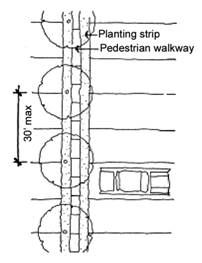
(D)
Lighting. Connecting walkways must be equipped with lighting on one side. Lighting standards spaced a maximum of thirty feet apart, and a maximum of sixteen feet tall are recommended.
(r)
Landscaping.
(1)
Landscaping shall be used to define specific areas by helping to focus on entrances to buildings and parking lots, define the edges of various land uses, provide transition between neighboring properties (buffering), and provide screening for parking lots and loading and equipment areas.
(2)
Landscaping shall be in scale with adjacent structures and be of appropriate size at maturity to accomplish its intended purpose.
(3)
Landscaping around the base of structures is recommended to soften the edge between the structure and the sidewalk and parking lot. Landscaping shall be accented at entrances to provide focus.
(4)
Landscaping shall be protected from vehicular and pedestrian encroachment by raised planting surfaces, depressed walks, and the use of concrete curbs or similar features.
(5)
Vines and climbing plants integrated upon buildings, trellises, and walls are strongly encouraged.
(6)
Use potted plants in clay or decorative concrete containers, especially for enhancement of sidewalk shops, plazas, and courtyards, and to soften the hardscape.
(7)
At maturity, trees shall be able to be trimmed ten feet above ground and shrubs shall be maintained at a height of approximately three feet when visibility is a factor.
(s)
Usable Open Space.
(1)
The design of the common usable open space shall complement the street pedestrian realm with plazas, pocket parks, public gathering spaces, street furniture, and landscaping.
(2)
Nonresidential and mixed use projects are encouraged to incorporate plazas and courtyards, which are oriented to the public realm/sidewalks, into their design. Buildings can be clustered to create usable pedestrian areas.
(3)
The design shall provide visual and physical cues that demark the public space from the private space.
(4)
To integrate new buildings within the surrounding area, such buildings are encouraged to provide passageways that allow for light and air to adjacent buildings.
(5)
In mixed use residential and residential projects, common usable open space shall be provided in large, meaningful areas that are visible from the residential dwellings they serve. Common open space areas shall be convenient to the majority of dwellings and shall contain amenities appropriate to the project's size.
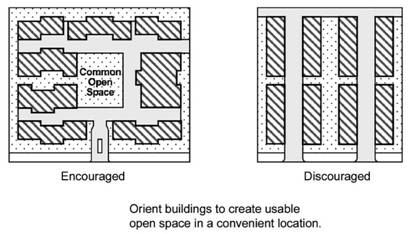
(6)
In mixed use and residential projects, private usable open space shall be contiguous to the dwelling unit it serves and be screened from public view for privacy. All balconies and patios that front a public street shall be designed to screen items being stored on the balcony or patio.
(7)
Rooftop open space may be used as common usable open space or private usable open space, when directly accessible to the dwelling unit(s) it serves.
(t)
Recycling and Solid Waste Disposal.
(1)
In mixed use projects, the residential dwelling units shall have and maintain a recycling and solid waste disposal area that is separate from that used by the commercial uses. It shall be clearly marked for residential use only and use by commercial uses is prohibited.
(2)
All recycling and solid waste disposal areas for commercial uses shall be located so as to be convenient to the commercial users and where associated odors and noise will not adversely impact the residential uses.
(3)
Recycling and solid waste receptacles shall be screened so as to not be visible from the public right-of-way, public plazas, or residential dwelling units.
(u)
Loading Facilities. Loading facilities and related service areas must be located away from and screened from view of streets, parks, plazas, and landscaped walkways, and shall generally be located within the interior of the development, whenever feasible.
(v)
Screening.
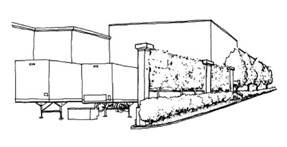
(1)
Screening for outdoor storage (including cart storage) shall be determined by the height of the material or equipment being screened. When allowed, exterior storage shall be confined to portions of the site least visible to public view. Where screening is required, a combination of elements shall be used including solid masonry walls, berms, and landscaping. Chain link fencing with or without slatting shall not be permitted.
(2)
Any outdoor equipment, whether on the roof or side of a structure, or on the ground, shall be appropriately screened from public view. The method of screening shall be architecturally integrated with the adjacent structure in terms of materials, color, shape, and size. Where individual equipment is provided, a continuous screen is desirable.
(3)
When permitted, roll-up doors, vehicle bays, drive-through aisles, car wash entrances/exits, wash stalls, and similar features shall be screened from view of adjacent streets by building orientation and/or the provision of landscaping, berms, trellises, or low walls that are consistent with the architecture and exterior materials of the building.
(w)
Accessory Structures. The design of accessory structures shall be architecturally compatible with the principal structure on the site through the use of consistent architectural style, exterior building and roofing colors and materials, and landscaping.
(x)
Lighting. The design of light fixtures and their structural support shall be architecturally compatible with the principal structure(s) on the site and be pedestrian-oriented and scaled. The following additional standards shall apply to on-site lighting, including lighting of signs, structures, landscaping, plazas, parking, and service areas.
(1)
Intensity and Direction of Lighting.
(A)
All lighting fixtures, including spotlights, electrical reflectors, and other means of illuminating signs, structures, landscaping, parking, loading, and similar areas, shall be focused, directed, and arranged to prevent horizontal glare or direct illumination on adjoining property or streets. A sharp cut-off must be used to direct light toward walls and landscaping to avoid shining light up into the sky. No lamp or lens may be visible, as viewed horizontally.
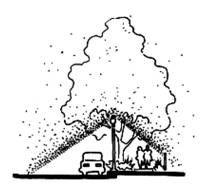
(B)
No mercury vapor utility yard lights or other light fixtures with high-intensity discharge lamps or bulbs, which are not designed to limit or control light direction or which do not shield the light source from view of neighboring residential properties, shall be permitted.
(2)
Types of Lighting Applications.
(A)
Architectural Enhancement. Accent lighting of architectural features is encouraged to highlight building massing and rhythm and enhance the pedestrian environment. Accent lighting shall not be a source of glare, reflected glare, or excessive light, especially when viewed from dwellings, streets, walkways, or open spaces. Neon lighting does not qualify as accent lighting.
(B)
Building Entries. Building entries with high activity levels shall be illuminated. Appropriate treatments include: bathing entry surfaces with light, allowing the building interior light glow through glazing, or using decorative lighting fixtures to announce entries.
(C)
Service Areas. Building-mounted downlight fixtures, in combination with pole fixtures, are preferred for the illumination of building service areas. Such fixtures do not cause glare or light leakage beyond the service areas.
(D)
Landscaped Frontages. Regular up-lighting of walls or other structures in landscaped frontages shall occur throughout the mixed use district and must be coordinated to create a consistent and dramatic effect.
(E)
Landscaping and Furnishing. Up-lighting is recommended for all landscaping and furnishings (in both public and private areas) that require accenting (such as specimen trees, shrubs, and sculptural features). Specific areas include streets, parks, and plazas.
(F)
Plazas, Walkways, and Paths. Plazas, walkways, and other pedestrian paths shall be lit by pole or lighting bollard type fixtures that are of a human scale, typically not to exceed sixteen feet or four feet in height, respectively.
(G)
Outdoor Seating Areas. Where intimate environments are desired, (e.g., seating areas in parks and plazas, and some pedestrian walkways), light bollards and other forms of indirect illumination are appropriate.
(y)
Signs.
(1)
As development in the mixed use district is to support pedestrian activity, signage shall be scaled appropriately. As such, the use of blade, awning, and hanging signs are encouraged. Can-type wall signs and freestanding pole signs are generally prohibited in new developments.
(2)
Every structure shall be designed with a precise concept for adequate signing. Provisions for sign placement, sign scale in relationship with the building, and sign readability should be considered in developing the signing concept. All signing shall be highly compatible with the building and site design relative to color, material, and placement.
(3)
The use of backlit individually cut letter signs is strongly encouraged.
(4)
Each development site shall be appropriately signed to give directions to loading and receiving areas, visitor parking, and other special areas.
(z)
Streetscape. The following standards are intended to further promote the creation of pedestrian-oriented, safe, attractive, and unified streetscapes in the mixed use (MU) districts and focused growth (FG) overlay areas. The standards are intended to apply to improvements located within public rights-of-way and shall be subject to the approval of the city engineer and city planner:
(1)
Traffic Calming. Measures to slow traffic and protect pedestrians from vehicles may be required by the city engineer when deemed appropriate and necessary. Examples of appropriate traffic calming measures include:
(A)
Lighted and clearly marked crosswalks;
(B)
Horizontal deflections such as landscaped center islands, street bulb-outs, road narrowing, chicanes, and roundabouts;
(C)
Vertical deflections such as raised and textured intersections and crosswalks;
(D)
Street trees and parkway planters that provide visual interest and buffer pedestrians from motor vehicles on the public streets;
(E)
The use of speed bumps, street closures, or forced turns is not desirable and shall be avoided.
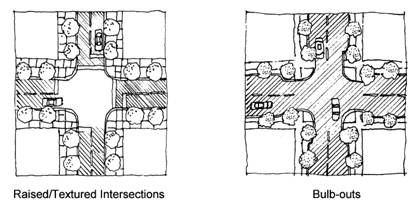
(2)
Transit-oriented. Streetscape design should consider and promote pedestrian access to transit facilities.
(3)
Other Design Elements. Other design elements such as enhanced street paving, lighting standards, and other street furnishings should also be considered to enhance the pedestrian-oriented nature of the area as follows:
(A)
Enhanced street paving, including textured and colored concrete, interlocking pavers (with even edges) or other materials as approved by the city engineer, should be used to denote pedestrian street crossings. Paving patterns and colors should be simple, and be consistently used, throughout the applicable zoning district and overlay district.
(B)
Light standards along pedestrian-oriented streets should be lower in height to create an environment that is more human in scale. Such street lighting shall generally not be more than twenty-five feet high. Light standards along arterial streets may be taller than those on local streets. Lighting standards are also encouraged to be placed over the sidewalk rather than street and in such case should not be higher than sixteen feet above the sidewalk.
(C)
Light standards shall have a high quality appearance and be generally consistent in design, color, and fixture type throughout the applicable zoning district and overlay district. Landscaping planters attached to metal light poles are also encouraged.
(D)
Pedestrian-oriented street furnishings such as benches, water fountains, etc. are encouraged. Street furniture shall generally not be located adjacent to crosswalks, curb cuts, fire hydrants, or loading and bus zones. There should be five feet of clear passage on sidewalks to ensure pedestrian safety and ADA-compliant access. Such features shall be compatible with the architectural style of adjacent buildings and reflect a compatible theme and style.
(E)
Newspaper racks should be located around major pedestrian gathering areas. The design shall consolidate all vending boxes into one rack. Rack construction should use masonry elements or metal that compliments other site furnishings in the area or the architecture of adjacent buildings. The rack shall be attractive on all sides and properly anchored. Individual racks will not be permitted.
(F)
Street trees shall be planted on both sides of the street and generally be spaced forty feet apart, on center. When possible, one species of street tree should be used for the sidewalk planting area with an additional street type for any on-street parking space streets or planted medians. Tree grates or guards should be provided along sidewalks and in plazas where a continuous walking surface is needed. Tree openings should be expandable.
(G)
Such design elements shall generally be maintained through a maintenance district funded by the benefiting property owner(s).
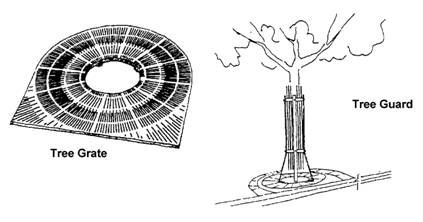
(aa)
Kiosks. Kiosk design and exterior color(s) shall be compatible with the architectural style and exterior color(s) of surrounding buildings.
(Ord. No. 2463 (NCS).)
(Ord. No. 2507 (NCS), § 28, 5-18-2010)
Sec. 37-30.290. - Exemptions from development regulations and design standards.
(a)
The city planner may administratively exempt the following projects from the development regulations and design standards of this division:
(1)
Additions expanding existing structures by less than twenty-five percent of the existing gross floor area or two thousand five hundred square feet, whichever is less;
(2)
Exterior or interior remodels involving no increase in gross floor area;
(3)
Parking lot, loading spaces, recycling and solid waste enclosures, open space, landscaping, and similar site improvements on existing developed properties; and
(4)
Additions to structures and site improvements provided to comply with the ADA/Title 24 requirements.
(b)
Exemptions for additions expanding existing structures more than twenty-five percent or two thousand five hundred square feet may be considered subject to the approval of a conditional use permit if the planning commission finds that the addition will not conflict with the purposes of this division, will enhance the existing conditions, and provide site amenities that bring the property closer to achieving consistency with the development regulations and design standards of the district.
(c)
An exemption for additions to architecturally significant historic structures (as determined by the city planner) not meeting the requirements of subsection (a) or (b) of this section may be considered subject to the approval of a conditional use permit by the city planner. In addition to the required findings in Article VI, Division 8: Conditional Use Permits, the city planner shall also find that the addition will not damage the historic integrity, architecture, or significance of the building.
(d)
As may otherwise be provided for restoration of a damaged nonconforming structure in Section 37-50.160: Nonconforming uses and structures.
(e)
These above-referenced exemptions shall not apply to standards or supplemental regulations applicable to all developments in the city and that are not unique to this district.
(Ord. No. 2463 (NCS).)
Sec. 37-30.300. - Purpose.
In addition to the general purposes listed in Article I, Division 1: General Provisions, the purpose of the industrial (I) districts regulations is to:
(a)
Provide appropriately located areas consistent with the general plan for a broad range of manufacturing and service uses;
(b)
Strengthen the city's economic base, and provide employment opportunities close to home for residents of the city and surrounding communities;
(c)
Minimize the impact of industrial uses on adjacent residential and commercial districts; and
(d)
Promote safe industrial areas through the incorporation of crime prevention through environmental design (CPTED) features in development;
(e)
The additional purposes of each industrial (I) district are as follows:
(1)
Industrial-General Commercial (IGC) District. The industrial-general commercial (IGC) district provides for a range of retail, wholesale, and service businesses not generally suitable in commercial districts because they attract heavy automobile and truck traffic or have certain adverse impacts; and to provide opportunities for certain limited manufacturing uses that have impacts comparable to those of retail and service.
(2)
Industrial-Business Park (IBP) District. The industrial-business park (IBP) district regulations allow development of sites with high architectural and landscape standards for industrial office centers, limited manufacturing, warehousing and large-scale, single destination retail and other limited retail uses which may not be appropriate in retail areas.
(3)
Industrial-General (IG) District. The industrial-general (IG) district regulations provide for the full range of manufacturing, industrial processing, general service, and distribution uses deemed suitable for location in Salinas; and protect Salinas' general industrial areas from competition for space from unrelated commercial uses that could more appropriately be located elsewhere in the city.
(Ord. No. 2463 (NCS).)
Sec. 37-30.310. - Use classifications.
Table 37-30.130 identifies the use classifications for properties located in industrial (I) districts:
(Ord. No. 2463 (NCS).)
(Ord. No. 2507 (NCS), §§ 9—11, 44, 46, 5-18-2010; Ord. No. 2569 (NCS), § 5, 4-19-2016; Ord. No. 2592 (NCS), § 2; Ord. No. 2634(NCS), § 1, 6-9-2020; Ord. No. 2635(NCS), § 1, 6-23-2020; Ord. No. 2649 (NCS), § 4, 9-21-2021)
Sec. 37-30.320. - Development regulations.
Table 37-30.140 identifies the development regulations for the industrial (I) districts:
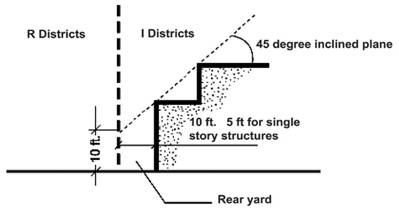
(Ord. No. 2463 (NCS).)
(Ord. No. 2507 (NCS), § 8, 5-18-2010)
Sec. 37-30.330. - Design standards.
(a)
Purpose. These design standards are intended to assist the designer in understanding the city's requirements for high quality industrial development. These standards complement the development regulations contained in this division by providing good examples of potential design solutions and by providing design interpretations of the various regulations. These standards ensure the highest level of design quality while at the same time providing the flexibility necessary to encourage creativity on the part of project designers.
(b)
Applicability. Although most applicable to the IGC and IBP zoning districts, these standards shall also apply to the IG zoning district but primarily for those uses visible from public rights-of-way and U.S. Highway 101.
(c)
Site Planning.
(1)
The main elements of sound industrial site design include the following:
(A)
Controlled site access;
(B)
Site planning, lighting, and architectural design that encourage natural surveillance;
(C)
Service areas located at the sides and rear of buildings;
(D)
Convenient access, visitor parking, and on-site circulation;
(E)
Screening of outdoor storage, work areas, and equipment; and
(F)
Landscaped open space.
(2)
A variety of building and parking setbacks should be provided in order to avoid long monotonous building facades and to create diversity on those facades that are visible from any private or public street.
(3)
Structures should be located on landscape islands, where the office portion of the building does not directly abut paved parking areas. A minimum five- to seven-foot landscape strip should be provided between parking areas and the office portion of a structure.
(4)
Where industrial uses are adjacent to nonindustrial uses, appropriate buffering techniques such as setbacks proportional to building size, screening and landscaping need to be provided to mitigate any negative effects of industrial operations.
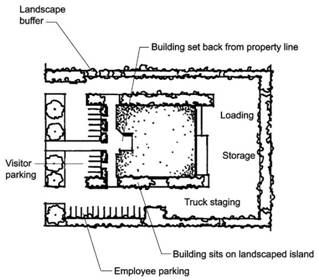
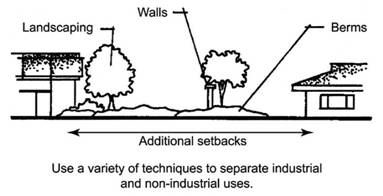
(d)
Natural Surveillance. Whenever feasible, design and placement of buildings and other physical features are encouraged to maximize visibility and facilitate natural surveillance from public rights-of-way and other public areas. This includes building orientation, placement of windows, doors, and balconies, building and site entrances and exits, placement of parking, lighting, and refuse containers, placement and type of landscape materials, location of walkways, types of walls and fences (including the use of picket, wrought-iron, and similar materials to promote visibility when appropriate), and other physical obstructions in a manner which discourages the potential for criminal activity.
(e)
Architecture. As a category of structure types, industrial structures often present unattractive and monotonous facades. There are, however, a variety of design techniques that can be used on building facades that are visible from any public or private street, to help overcome this situation and to direct development into a cohesive design statement.
(1)
Employ variety in structure forms, to create visual character and interest.
(2)
Avoid long, unarticulated facades. Facades with varied front setbacks are strongly encouraged. Wall planes should not run in a continuous direction for more than fifty feet without an offset.
(3)
Avoid blank front and corner side wall elevations on street frontages.
(4)
Windows are encouraged to be placed to maximize natural surveillance.
(5)
Entries to industrial structures should portray a quality office appearance while being architecturally tied into the overall mass and building composition.
(6)
All elevations of a structure that are visible from public and private streets and U.S. Highway 101 shall be architecturally treated.
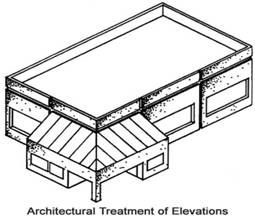
(7)
Windows and doors are key elements of any structure's form and should relate to the scale of the elevation on which they appear. Windows and doors can establish character by their rhythm and variety. Recessed openings help to provide depth and contrast on elevation planes.
(8)
Sensitive alteration of colors and materials can produce diversity and enhance architectural forms.
(9)
The staggering of planes along an exterior wall elevation creates pockets of light and shadow, providing relief from monotonous, uninterrupted expanses of wall.
(10)
Design elements which are undesirable and should be avoided include:
(A)
Highly reflective surfaces at the ground story;
(B)
Large blank, unarticulated wall surfaces;
(C)
Exposed, untreated precision block walls;
(D)
Chain link, barbed wire, or razor wire fencing visible from public rights-of-way;
(E)
False fronts;
(F)
"Stuck on" mansard roofs on small portions of the roofline;
(G)
Unarticulated building facades; and
(H)
Materials with high maintenance such as stained wood, shingles, or metal siding.
(11)
Wall materials that will withstand abuse by vandals or accidental damage from machinery and vehicles are encouraged.
(12)
All metal buildings shall have architectural enhancements on street facades to provide visual interest and variety to the streetscape.
(13)
Berming in conjunction with landscaping can be used at the building edge to reduce structure mass and height along facades.
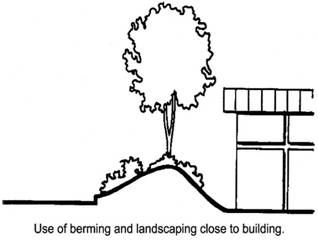
(14)
Doors located on the inside of the building are the preferred method for providing large loading doors while keeping a clean, uncluttered appearance from the exterior.
(f)
Roof Treatments.
(1)
The roofline at the top of the structure should not run in a continuous plane for more than fifty feet without offsetting or jogging the roof plane.
(2)
Nearly vertical roofs (A-frames) and piecemeal mansard roofs (used on a portion of the building perimeter only) should not be used. Mansard roofs should wrap around the entire perimeter of the structure.
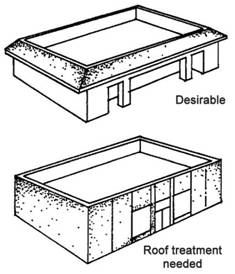
(3)
All roof top equipment must be screened from public view by screening materials of the same nature as the building's basic materials. Mechanical equipment should be located below the highest vertical element of the building.
(4)
The following roof materials shall not be used:
(A)
Corrugated metal (standing rib metal roofs are permitted) unless the city planner determines the material is appropriate for the architectural style or theme of the building;
(B)
Highly reflective surfaces that create glare; and
(C)
Illuminated roofing.
(5)
The roof design should be considered as a component of the overall architectural design theme.
(g)
Parking and Circulation.
(1)
The parking lot and cars should not be the dominant visual elements of the site. Large expansive paved areas, located between the street and the building, are to be avoided in favor of smaller multiple lots separated by landscaping and buildings. Angled parking is highly encouraged for larger parking lots that can accommodate one-way aisles.
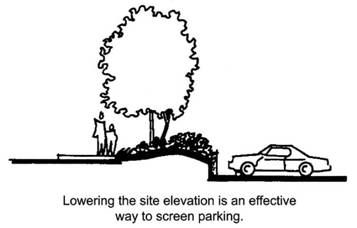
(2)
Site access and internal circulation should be designed in a straightforward manner that emphasizes safety and efficiency. The circulation system should be designed to reduce conflicts between vehicular and pedestrian traffic, combine circulation and access areas, where feasible, provide adequate maneuvering and stacking areas, and consideration for emergency vehicle access. Circulation routes and parking areas should be separated.
(3)
Entrances and exits to and from parking and loading facilities shall be clearly marked with appropriate directional signage where multiple access points are provided. The use of sidewalks, pavement, gates, lighting, and landscaping to and from entrances and exits shall also be used to clearly guide the public.
(4)
Vehicles shall not be required to enter the street in order to move from one area to another on the same site.
(5)
Parking lots adjacent to and visible from public streets shall be adequately screened from view through the use of rolling landscaped earth berms, low screen walls, changes in grade elevation, landscaping, or combinations thereof.
(6)
All parking areas serving the public are encouraged to be visible from the interior of the structures, especially entrances.
(7)
The industrial site shall be a self-contained development capable of accommodating its own parking needs. The use of the public street for parking and staging of trucks is not allowed.
(8)
Parking areas are encouraged to provide facilities for vehicles with alternative fueling systems (such as electric vehicle charging areas, etc.)
(9)
Industrial uses that rely on larger trucks for pickup and deliveries shall include separated truck parking facilities on-site to support the use.
(h)
Loading Facilities.
(1)
To alleviate the unsightly appearance of loading facilities for industrial uses, these areas should not be located at the front of buildings where it is difficult to adequately screen them from view. Such facilities are more appropriate at the rear of the site where special screening may not be required.
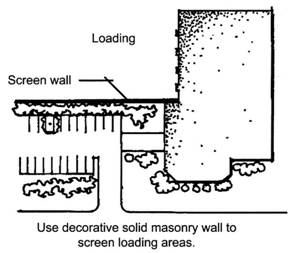
(2)
When it is not feasible to locate loading facilities at the rear of the building, loading docks and doors shall not dominate the frontage and must be screened from view of the street by the use of landscaped berms or a combination of landscaping and architecturally enhanced walls. Chain link with slats is not acceptable for screening along public or private streets. Loading facilities should be offset from driveway openings.
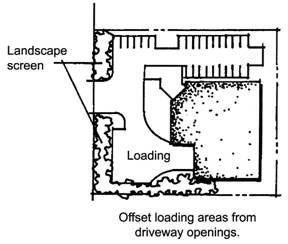
(3)
Backing from the public street onto the site, for loading into front-end docks, causes unsafe truck maneuvering and shall not be used.
(i)
Landscaping.
(1)
For industrial uses, landscaping should be used to define areas by helping to focus on entrances to buildings, parking lots, loading areas, defining the edges of various land use, providing transition between neighboring properties (buffering), and providing screening for outdoor storage, loading, and equipment areas.
(2)
Landscaping shall be in scale with adjacent buildings and be of appropriate size at maturity to accomplish its intended goals.
(3)
Use of vines on walls is appropriate in industrial areas because such walls often tend to be large and blank.
(4)
Landscaping around the entire base of buildings, especially where offices and similar customer-oriented areas are located, is encouraged to soften the edge between the parking lot and the structure.
(5)
Trees should be located throughout the parking lot and not simply at the ends of parking aisles. In order to be considered within the parking lots, trees should be located in planters that are bounded on at least three sides by parking area paving or related site hardscape. Trees shall also be provided between the public sidewalk and parking areas.
(6)
Landscaping shall be protected from vehicular and pedestrian encroachment by raised planting surfaces, depressed walks, or the use of concrete curbs.
(7)
As the ground cover, shrubs and trees mature, landscaping shall be maintained to minimize the conflicts between natural surveillance and the landscaping.
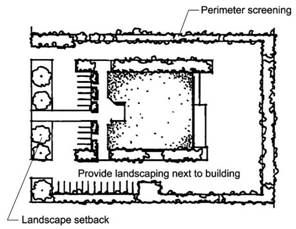
(j)
Walls and Fences.
(1)
Walls will serve a major function in the industrial landscape to provide a clear indication of ownership of space and movement from public to semipublic to private space. Walls will also be used to screen automobiles, loading and storage areas, and utility structures and provide barriers to conflicting uses. Walls should be as low as possible while still performing their screening and security functions.
(2)
Where walls are used at property frontages, or screen walls are used to conceal storage and equipment areas, they should be designed to blend with the site's architecture. Both sides of all perimeter walls should be architecturally treated. Plant materials should be used in combination with such walls.
(3)
When security fencing is required, it should be a combination of solid pillars or short solid wall segments and wrought iron grill work.
(4)
Long expanses of fence or wall surfaces should be offset and architecturally designed to prevent monotony. Landscape pockets should be provided.
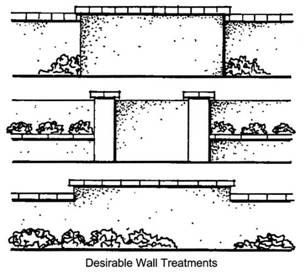
(k)
Screening.
(1)
Screening for outdoor storage shall be determined by the height of the material being screened.
(2)
Where screening is required, a combination of elements should be used including solid masonry walls, berms, and landscaping.
(3)
Black powder or vinyl-coated chain link fencing with black slatting is an acceptable screening material only for areas of a lot not visible from a public or private street or U.S. Highway 101.
(4)
Any outdoor equipment, whether on the roof or side of a structure, or on the ground, shall be screened from public view. The method of screening shall be architecturally integrated in terms of materials, color, shape, and size. The screening design shall blend with the building design. Where individual equipment is provided, a continuous screen is desirable.
(5)
The need to screen rooftop equipment shall be taken into consideration during the initial design phase for the structure.
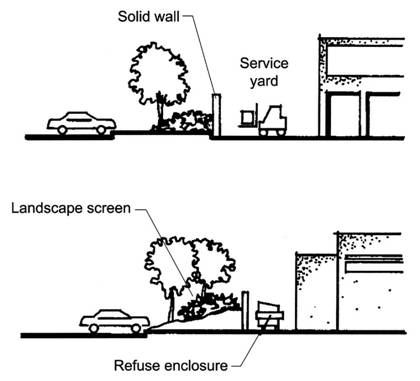
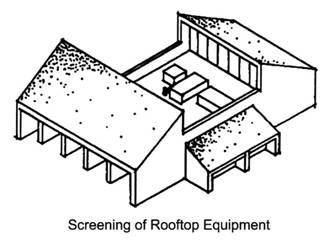
(l)
Lighting.
(1)
Lighting should be used to provide illumination for the security and safety of on-site areas such as parking lots, walkways, entrances, exits, and related areas.
(2)
The design of light fixtures and their structural support shall be architecturally compatible with main buildings on-site. Illuminators should be integrated within the architectural design for the buildings.
(3)
As a security device, lighting should be adequate but not overly bright. All accesses to buildings should be well lighted.
(4)
All exterior fixtures should be illuminated from dusk until dawn, unless otherwise approved for the site.
(5)
Any exterior lighting device designed for security lighting should be protected by weather and vandal-resistant covering.
(6)
All lighting should be shielded to confine light spread within the site boundaries and "sky-glow" impacts.
(7)
Lighting shall be maintained at all times to the standards approved for the site.
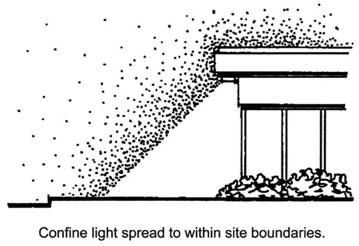
(m)
Signs.
(1)
Every structure should be designed with a precise concept for adequate signing. Provisions for sign placement, sign scale in relationship with the building, and the readability of the sign shall be considered in developing the overall signing concept. All signs should be highly compatible with the structure and site design relative to color, material, and placement.
(2)
Monument-type signs are the preferred alternative for business identification. Where several tenants occupy the same site, individual wall mounted signs are appropriate in combination with a monument sign identifying the development and address.
(3)
The use of backlit individually cut letter signs is strongly encouraged.
(4)
The industrial site should be appropriately signed to give directions to loading and receiving areas, visitor parking, and other special areas.
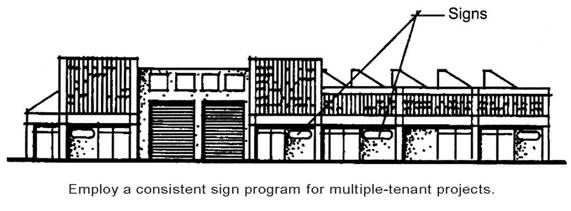
(Ord. No. 2463 (NCS).)
Sec. 37-30.340. - Purpose.
In addition to the general purposes listed in Article I, Division 1: General Provisions, the purposes of the parks (P) and open space (OS) districts regulations are to:
(a)
Establish and maintain park and open space areas in the city for recreational opportunities;
(b)
Prevent incompatible development in areas that should be preserved or regulated for scenic, recreational, conservation, aesthetic, or health and safety purposes; and
(c)
Promote vital and safe parks and open space areas through the incorporation of crime prevention through environmental design (CPTED) features in development;
(d)
The additional purposes of the park (P) district and open space (OS) district are:
(1)
Parks (P) District. The parks (P) district provides for existing and proposed active and passive parks and recreational facilities.
(2)
Open Space (OS) District. The open space (OS) district provides lands for the preservation of natural resources, hillsides, and creeks; as well as open space areas for the benefit and protection of the public health and safety.
(Ord. No. 2463 (NCS).)
Sec. 37-30.350. - Use classifications.
Table 37-30.150 identifies the use classifications for properties located in parks (P) and open space (OS) districts:
Notes:
P = Permitted Use
NP = Not Permitted Use
CUP = Conditional Use Permit Required
SPR = Site Plan Review Required
TULP = Temporary Use of Land Permit Required
(1) Recreational uses include activity areas that may be developed for multipurpose fields for community events and informal recreation, areas for active and passive play, tot lots, picnic areas, multipurpose sports fields and courts, concessions, community event space, outdoor amphitheaters, nature study centers, maintenance/support facilities, caretaker facilities, and similar recreational facilities.
(2) In the OS district, recreational uses are limited to trails, interpretive centers, picnic areas, and similar uses.
(3) School facilities shall be limited to nature study centers, maintenance/support facilities, caretaker facilities, and similar uses.
(4) Only interim agricultural uses shall be permitted.
(5) See Section 37-50.010: Accessory uses and structures. Accessory uses and structures will require a SPR or a CUP if required for the principal use.
(6) Minor utilities shall not unreasonably interfere with the use, enjoyment, or aesthetics of adjacent uses.
(7) Only stealth telecommunication facilities shall be permitted. See Section 37-50.290: Telecommunications facilities.
(8) See Section 37-50.300: Temporary use of land. Accessory uses and structures will require a SPR or a CUP if required for the principal use.
(9) Does not apply to the parking required to serve the use per Section 37-50.360: Off-street parking and loading spaces regulations.
(10) Water well, drainage, and flood control facilities may be considered subject to the approval of a CUP.
(Ord. No. 2463 (NCS).)
Sec. 37-30.360. - Development regulations.
Table 37-30.160 identifies the development regulations for the public (P) and open space (OS) districts:
Notes:
N/A—not applicable
(A) Minimum lot size for caretaker facility is twenty acres.
(Ord. No. 2463 (NCS).)
Sec. 37-30.370. - Design standards.
The city planner, planning commission, and/or city council, as the case may be, shall be guided by those design standards of the zoning district within closest proximity to the subject property.
(Ord. No. 2463 (NCS).)
Sec. 37-30.380. - Purpose.
In addition to the general purposes listed in Article I, Division 1: General Provisions, the purpose of the public/semipublic (PS) district regulations is to:
(a)
Allow consideration of a large public or semipublic use separately from regulations for an underlying base zoning district that may or may not be appropriate in combination with the public or semipublic use;
(b)
Allow consideration of establishment or expansion of a large public or semipublic use at rezoning hearings rather than at conditional use permit hearings only, and to give public notice of the extent of a site approved for a large public or semipublic use by delineating it on the zoning map;
(c)
Promote vital and safe public or semipublic areas through the incorporation of crime prevention through environmental design (CPTED) features in development; and
(d)
Allow the planning commission and city council to consider the most appropriate use of a site following discontinuance of a large public or semipublic use without the encumbrance of a base zoning district that may or may not provide appropriate regulations for reuse of the site.
(Ord. No. 2463 (NCS).)
Sec. 37-30.390. - Use classifications.
Table 37-30.170 identifies the use classifications for properties located in the public/semipublic (PS) district:
(Ord. No. 2463 (NCS).)
(Ord. No. 2532 (NCS), § 13, 11-13-2012; Ord. No. 2624 (NCS), § 1, 11-5-2019; Ord. No. 2656 (NCS), § 7, 5-10-2022; Ord. No. 2693 (NCS), § 6, 2-24-2026)
Sec. 37-30.400. - Development regulations and design standards.
Development regulations and design standards for public/semipublic uses shall be as specified by the required conditional use permit in accordance with Article VI, Division 8: Conditional Use Permits and or the required site plan review in accordance with Article VI, Division 5: Site Plan Review (see Table 37-30.180). The city planner, planning commission, and/or city council, as the case may be, shall be guided by those regulations and design standards of the zoning district within closest proximity or a zoning district intended for uses similar to those proposed in the PS district. For properties located in the future growth areas of the city as identified on Figure LU-1 (future growth area) of the general plan land use element, the NU districts design standards shall apply. In addition, all new public buildings and sites shall generally be designed to promote energy efficiency and safety.
Note:
N/A = Not applicable.
(Ord. No. 2463 (NCS).)
(Ord. No. 2507 (NCS), § 32, 5-18-2010)
Sec. 37-30.410. - Purpose.
In addition to the general purposes listed in Article I, Division 1: General Provisions, the purposes of the new urbanism (NU) districts regulations are to:
(a)
Promote the principles of new urbanism through the creation of distinct identifiable neighborhoods that have traditional neighborhood development (TND) characteristics as expressed in the Salinas general plan;
(b)
Ensure the development of a pedestrian-sensitive, yet auto-accommodating community containing a range of residential housing types, mixed use buildings and developments, neighborhood commercial, and employment opportunities which may be developed in one or more phases;
(c)
Provide for a number of design, development, and infrastructure features indicative of a self-reliant neighborhood; including, but not limited to, multipurpose streets linking residential areas with neighborhood activity and commercial centers and multimodal transportation alternatives; quality and craftsmanship in the built environment; a lively mix of neighborhood shopping and community services; an advantageous and sensitive use of natural resource features and open space; and innovative and imaginative site planning in order to develop a sense of place where the amenities, facilities, and features all exhibit an overall high level of urban design and architectural integration;
(d)
Ensure the creation of walkable neighborhoods with mixed use village centers overlaid on a network of schools, civic amenities, parks, and open space;
(e)
Provide a circulation system that avoids significant pedestrian barriers and replaces the standard collector street (too often lined by back yard fences) with more frequent and less congested "connector" streets to establish a traditional grid circulation system offering a variety of circulation options and allow connections from neighborhood to neighborhood. The combination of such a circulation system with design standards that ensure pedestrian-friendly neighborhoods with defined village centers should result in a pattern of development, which enhances the city and its future inhabitants; and
(f)
Promote vital and safe residential and mixed use areas through the incorporation of crime prevention through environmental design (CPTED) features in development;
(g)
The additional purposes of each new urbanism (NU) district are as follows:
(1)
Neighborhood Edge/Low Density Residential (NE). To provide areas for predominately detached single-family dwellings, together with other dwelling types so that the minimum average density per net residential acre within this district is not less than six dwelling units per net residential acre and the maximum average density is not more than eight dwelling units per net residential acre without density bonus. "Net residential acres" are the private lands zoned for residential uses exclusive of streets, parks, and other uses. "Average density" is the total dwelling units in that district divided by the net residential acres.
(2)
Neighborhood General 1/Medium Density Residential (NG-1). To provide areas for a diverse range of low, medium, and some high density dwellings such as detached single-family dwelling units on large and small lots, rowhouses, green courts, duplexes, cottages, and attached multifamily dwelling units where the minimum average density within this district is not less than nine dwelling units per net residential acre and the maximum average density is not more than fifteen dwelling units per net residential acre without density bonus.
(3)
Neighborhood General 2/High Density Residential (NG-2). To provide areas for medium and high density dwellings such as lane homes, green courts, cottages, rowhouses, and multifamily dwelling units where the minimum average density is not less than sixteen dwelling units per net residential acre and the maximum average density is not more than twenty-four dwelling units per net residential acre without density bonus.
(4)
Village Center (VC). To provide areas for mixed use, stand-alone retail and office uses, flex use, high density residential, and public and semipublic facilities generally sited along a "Main Street" or around a village square where the maximum dwelling units per acre is ten dwelling units per acre and the maximum floor area (FAR) is 1.0 or as otherwise provided for in this division.
(5)
New Urbanism Interim (NI). To provide a transitional zone for the future growth areas of the city located north of East Boronda Road that are annexed to the city and are subject to the preparation of specific plans and subsequent subdivision maps.
(Ord. No. 2463 (NCS).)
Sec. 37-30.420. - Applicability.
The new urbanism (NU) districts regulations shall supplement the Zoning Code and Municipal Code requirements and apply to properties located in the future growth area of the city located generally north of East Boronda Road as indicated on Figure 37-40.20 in Article IV, Division 2: Specific Plan (SP) Overlay District. All properties located in the future growth area shall be subject to the preparation of a specific plan in accordance with Article IV, Division 2: Specific Plan (SP) Overlay District, Article VI, Division 15: Specific Plans, and the regulations and standards of this division, except for subdivisions of up to four (4) lots may be considered pursuant to the Agricultural (A) district development regulations if no physical improvements are proposed.
(Ord. No. 2463 (NCS).)
(Ord. No. 2625 (NCS), § 1, 11-5-2019)
Sec. 37-30.430. - Use classifications.
Table 37-30.190. Except as set forth in each specific plan, the following table identifies the use classifications for properties located in the new urbanism (NU) districts. The use classifications for the NI district shall be in accordance with those allowed in the agricultural (A) district (See Section 37-30.020: Use classifications):
(Ord. No. 2463 (NCS).)
(Ord. No. 2507 (NCS), § 15, 5-18-2010; Ord. No. 2532 (NCS), § 14, 11-13-2012; Ord. No. 2581 (NCS), § 9, 12-6-2016; Ord. No. 2646 (NCS), § 4, 8-10-2021; Ord. No. 2655 (NCS), § 1, 2-15-2022; Ord. No. 2693 (NCS), § 7, 2-24-2026)
Editor's note— Ord. No. 2655 (NCS), § 1, adopted February 15, 2022, set out provisions adding note (38). To avoid number duplication, and at the editor's discretion, these provisions were included as note (39).
Sec. 37-30.440. - Use districts or classifications not otherwise specified.
(a)
Lands designated for parks and open space land uses in accordance with the general plan land use plan shall be subject to the requirements of Division 6: Parks (P) and Open Space (OS) Districts except as modified by the specific plan or this division.
(b)
Lands designated for public and semipublic land uses in accordance with the general plan shall be subject to the requirements of Division 7: Public/Semipublic (PS) District.
(Ord. No. 2463 (NCS).)
Sec. 37-30.450. - Development regulations.
(a)
Specific Plan Development Regulations. Each specific plan shall contain tables establishing development regulations for each new urbanism district, as applicable, governing the following:
(1)
Lot size—minimum;
(2)
Lot area per dwelling unit—minimum;
(3)
Lot width—minimum;
(4)
Lot depth—minimum;
(5)
Yards—minimum;
(6)
Distances between structures—minimum;
(7)
Height—maximum;
(8)
Driveway length;
(9)
Usable open space area per dwelling unit—minimum;
(10)
Floor area ratio;
(11)
Landscaping;
(12)
Fences, walls, and hedges;
(13)
Off-street parking and outdoor lighting;
(14)
Driveway and corner visibility;
(15)
Signs;
(16)
Outdoor facilities;
(17)
Accessory uses and structures;
(18)
Screening of mechanical equipment;
(19)
Recycling and solid waste disposal;
(20)
Performance standards;
(21)
Nonconforming uses and structures;
(22)
Recreational vehicles and prohibited vehicles and equipment;
(23)
Vehicle trip reduction;
(24)
Swimming pools, spas, and hot tubs; and
(25)
Administrative procedures.
(b)
Zoning Code Development Regulations. Development regulations not established through the specific plan or the new urbanism districts shall be subject to the applicable development regulations of the Salinas Zoning Code as follows:
(1)
The applicable development regulations shall be those of the zoning district having the most similar characteristics to that of the applicable new urbanism district, as determined by the city planner, as follows:
(A)
Development on land located in the new urbanism-village center (VC) district shall be in accordance with the mixed use (MX) district regulations.
(B)
Development on land located in the new urbanism-neighborhood edge/low density residential (NE) district shall be in accordance with the residential low density (R-L) district regulations.
(C)
Development on land located in the new urbanism-neighborhood general 1/medium density residential (NG-1) district will be in accordance with the medium density residential (R-M-3.6 and R-M-2.9) districts regulations.
(D)
Development on land located in the new urbanism-neighborhood general 2/high density residential (NG-2) district will be subject to the high density residential (R-H-2.1 and 1.8) districts regulations.
(E)
Development on land located in the new urbanism-interim (NI) district shall be in accordance with the agricultural (A) district regulations.
(2)
Article V: Supplemental Regulations Applying to All Districts of the Zoning Code shall apply to the new urbanism districts except as modified by the specific plan or this division.
(Ord. No. 2463 (NCS).)
Sec. 37-30.460. - Minimum residential density and dwelling unit mix.
The following requirements shall apply to each specific plan in the future growth area in regard to the minimum residential density and dwelling unit mix as follows:
(a)
Each specific plan shall demonstrate that the total minimum dwelling units in each specific plan area divided by the total net residential acres within the specific plan area must equal or exceed nine dwelling units per net residential acre.
(b)
The number of dwelling units within an individual parcel divided by that parcel's net acreage may be less than or more than that district's allowable minimum or maximum average dwelling units per net residential acre, provided, the total dwelling units within a district divided by the total net residential acres in that district falls within the allowable density ratios for that district as established in the general plan and demonstrated in the specific plan.
(c)
Each specific plan shall demonstrate that the total number of low, medium, and high density units within each specific plan achieves the percentage mix required in the Salinas general plan.
(Ord. No. 2463 (NCS).)
Sec. 37-30.470. - Design standards.
(a)
Purpose. The design standards in this division are intended to assist the designer in understanding the city's requirements for high quality, traditional neighborhood development in the future growth areas of the city and shall serve as the design basis for the specific plans prepared for these areas. These design standards complement the development regulations in this division by providing good examples of potential design solutions and concepts and by providing design interpretations of the various mandatory regulations. These standards are intended to ensure the highest level of design quality while providing the flexibility necessary to encourage creativity on the part of project designers. These standards are also intended to promote development, which is pedestrian-oriented, safe, and reflects traditional neighborhood design principles. Each specific plan shall further refine and delineate the design concepts and standards that shall apply to their specific plan area. The design standards are divided into specific design standard categories to address the various types of development in the future growth areas.
(Ord. No. 2463 (NCS).)
Sec. 37-30.480. - Village center (VC) district design standards.
(a)
Concept. The village center district of each specific plan area should comprise a mix of office, commercial, and residential uses in accordance with the following:
(b)
Uses. The mixed use village centers should be developed as important destinations for each specific plan area providing a variety of offices, shops, services, restaurants, and civic facilities that serve the needs of the surrounding neighborhoods.
(c)
Floor Area Ratio (FAR). The buildings within the mixed use village center district may be developed with a maximum FAR of 1.0.
(d)
Allowable Residential Densities. The district must incorporate, but every building need not incorporate residential uses. The minimum average residential density of the entire VC district shall be three dwelling units per net acre and a maximum average residential density of twenty-four dwelling units per net acre without density bonus. Any one acre may contain between zero to forty-three dwelling units per net acre (FAR 1.0) should commercial floor area be converted to residential use.
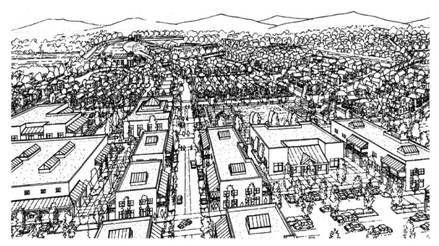
(e)
Anchor Grocery Store.
(1)
The village centers provide areas for medium and high density housing, retail and office uses, and public and semipublic facilities. The village center district may be supported by an anchor supermarket grocery store, one of the most important local destinations and critical for the economic viability of a local shopping area. Other appropriate uses in this district include offices, retail shops, services, restaurants, public and semipublic facilities, and similar uses that complement the anchor store. Village centers should be anchored along Boronda Road and may extend north into each planning area. In some cases, these may be extensions of the existing grocery-anchored retail areas on the south side of Boronda Road.
(2)
Each village center should contain no more than one full-service supermarket except the central area may contain a second full-service supermarket near Russell Road. Secondary anchors, such as drug, hardware, or specialty grocery are allowed.
(3)
Regional retail-sized facilities (greater than one hundred twenty thousand square feet) are generally not appropriate anchor stores in the village center unless the village center is located adjacent to an existing regional retail facility such as Harden Ranch Plaza.
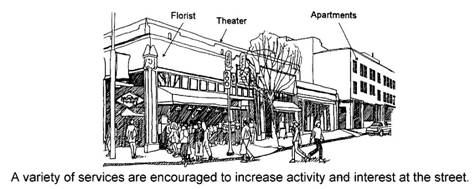
(f)
Residential. Appropriate housing types for the village center district include: stand-alone multifamily dwellings such as apartments and/or condominiums, housing for the elderly, residential over office and commercial in mixed use and flex use buildings, townhouses, rowhouses, live-work units, and duplexes. Bungalows, green court dwellings, cottages, small-lot single-family, and standard-lot single-family are generally not appropriate housing types in the village center, except at the transition between districts as established by the specific plan.
(g)
Urban Design Character. Buildings should be placed to form active street fronts and create other connecting pedestrian spaces. On-site parking should be to the rear or side of the buildings. The large stores may be placed back from the main street with the smaller stores along the main street. The size of parking lots should be reduced by breaking large lots into smaller blocks of parking, locating employee parking in less-used areas, and by maximizing the main street's on-street parking. Auto-oriented uses with drive-through travel lanes are prohibited, unless permitted in Section 37-30.430: Use classifications when findings of compatibility and demonstrated assurances that the connectivity of the pedestrian environment will not be compromised. Auto-serving uses such as gasoline service stations should be sited in locations that do not disrupt the connectivity of the pedestrian spaces.
(h)
Building Locations. Buildings should be sited close to the streets, with doors and windows facing the street, to form an active street front with parking located at the rear of the building or in courtyard style. Buildings should offer attractive pedestrian scale features and spaces. Building placement and massing should provide visual interest and architectural variety while relating to nearby buildings in the village center.
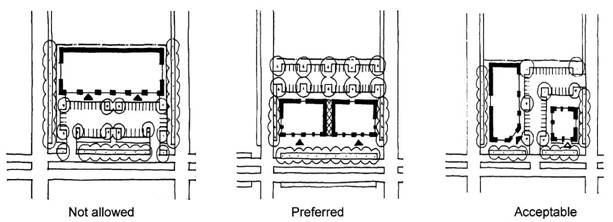
(i)
Connections to Rear Parking. Pedestrian and/or auto connections to the rear parking should be provided to increase access to the stores. Connections should be provided at least every four hundred feet. Care must be taken in the design of the mid-block connection so they do not encourage mid-block street crossing.
(j)
Land Use Transitions. Land use boundaries and massing changes in village centers should be planned so buildings facing each other are compatible and transitions are gradual.
(k)
Relationship of Buildings to Public Spaces. Buildings should be designed to create safe, active streets, and public spaces, by providing an ordered variety of entries, windows, bays, and balconies along public ways. Buildings should have human scale in details and massing. Monument buildings should be reserved for public uses. Buildings should have frequent doors and windows along public ways.
(l)
Building Transparency. The majority of the building facade adjacent to a public street or a pedestrian corridor should be transparent with a pattern of windows and doors with clear or lightly tinted glass allowing visibility into the structure or into display windows. When circumstances inhibit the placement of windows and doors along the majority of the facade, such as for a building with multiple street frontages, the building facade must include a variety of design elements to provide visual interest and maintain a pedestrian-friendly character.
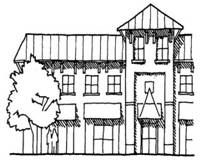
(m)
Central Feature or Gathering Place. A village center shall include one or more, centrally located green(s) or a plaza of at least one acre with public amenities such as benches, monuments, kiosk, and/or public art. As a community gathering spot, consideration must be given to the environmental factors that will make the space a pleasure to be in. Design considerations include solar orientation and prevailing winds as well as visibility to and from adjacent streets and public areas.
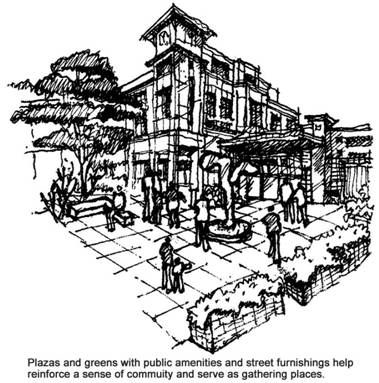
(n)
Required Main Street. Each village center shall create a mixed use commercial core area that is required to provide at least one main street of a minimum length of three hundred feet. This shopping street is required to have retail- and/or resident-serving commercial uses on the ground floor of buildings that line each side of one whole block of the main street. Longer main streets may transition to high-density flex use buildings and then all residential use buildings. The buildings along the main street are encouraged to be mixed use or flex use buildings with residential or office uses above. The main street may be placed along a connector street, local street, or developed as a private street.
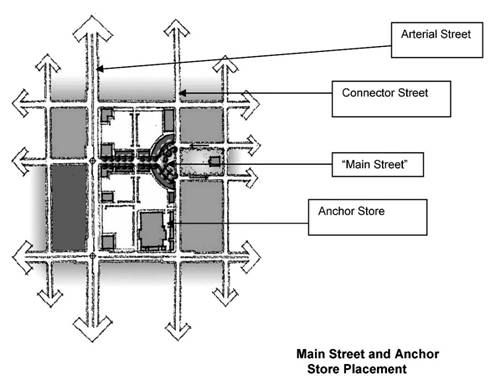
(o)
Direct Local Connections. Direct local street access from surrounding neighborhoods must be provided so visitors do not need to use arterial streets to access the village centers and to ensure that pedestrian, bicycle and/or auto access from surrounding neighborhoods is provided.
(p)
Arterial Streets as Frontage. The village center should open to an arterial street to assist in providing the neighborhood with a sense of place and identity.
(q)
Integrations of the Transit Stop. The village center shall, when feasible, be considered a major stop on the local transit network. Associated transit stop facilities should be integrated into the design of the center, centrally located, and easily accessible for pedestrians.
(r)
Pattern of Streets and Blocks. A pattern of streets and blocks interconnected at both ends of the block, scaled to the needs of pedestrians, is required. Super blocks, dead-end streets, and cul-de-sacs shall be avoided, unless necessitated by natural topographic features. All buildings should contribute to a cohesive "fabric" and reinforce the overall goal of creating a walkable district.
(s)
Block Size. Except for the block containing the anchor grocery store, individual blocks should generally average less than eight hundred feet in length and less than two thousand feet in perimeter.
(t)
Minimum Building Frontage. Buildings within the village center shall frame the public right-of-way. Minimum building frontage shall be eighty percent on the designated main street, sixty percent on arterial or connector streets, and forty percent on local streets. Twenty percent of the required frontage area can be comprised of plazas or pedestrian-accessible landscaped areas with depths no more than thirty feet. In no case shall parking lots, garage, or blank rear or sidewalls be included in meeting the minimum frontage calculation.
(Ord. No. 2463 (NCS).)
Sec. 37-30.490. - Village and neighborhood center mixed use, commercial, and flex use building design standards.
(a)
Concept. The village center's and neighborhood center's mixed use, commercial, and flex use buildings enclose and enliven the spaces they surround. Their design quality should set the tone for the entire neighborhood in accordance with the following:
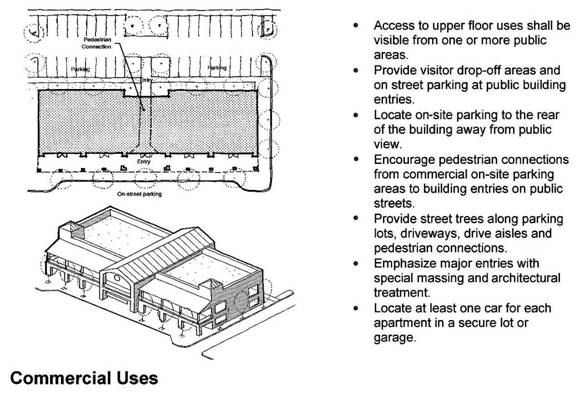
(b)
Natural Surveillance. Whenever possible, design and placement of buildings and other physical features are encouraged to maximize visibility and facilitate natural surveillance from public rights-of-way and other public areas. This includes building orientation, placement of windows, doors and balconies, building and site entrances and exit locations, placement of parking, lighting, and refuse containers, placement and type of landscape materials, plazas, and other open space areas, location of walkways, types of walls, and fences (including the use of picket, wrought-iron, and similar materials to promote visibility), to promote crime prevention through environmental design (CPTED).
(c)
Relation of Buildings to Streets. The primary facades of buildings in mixed use areas and commercial areas should face a public or private street. When an anchor store abuts a street but the primary access is provided from a parking area other than the street, the street-facing facade of the store should be articulated and provide pedestrian-scaled architectural features including windows and, if possible, a significant entry feature.
(d)
Primary Entries and Facades. Except for the anchor store, as applicable, the primary entrances of ground floor uses should be visible and accessible directly from a public street ("street" herein may be a public or private street which function as a public street). Building design should be used to call out the location of building entries. For example, greater height can be used to accentuate entries in the form of tower elements, tall voids, or a central mass at an entry plaza. Primary facades that front onto a street should be built parallel or nearly parallel to the public right-of-way except for courtyards, plazas, and corner locations. Generally, the street-facing facades should stay within five feet of the back of the continuous sidewalk.
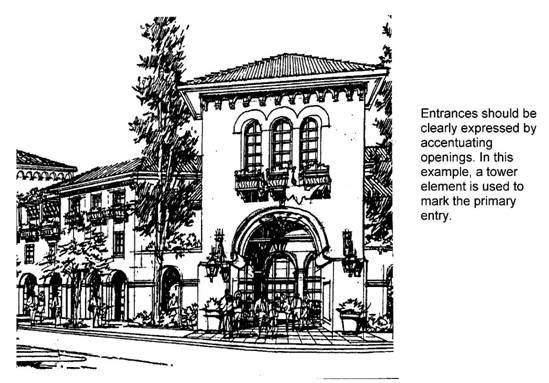
(e)
Street-facing Facades. Street-facing facades should be lined with windows. Uninterrupted blank walls and/or garage doors should not occupy over twenty percent of a building's street frontage. With the exception of the larger scaled "anchor" stores or stores with multiple frontages, blank walls should not exceed twenty linear feet without being interrupted by a window, significant architectural feature, or entry. Anchor stores shall provide architectural features and enhancements when sited adjacent to street frontages. Enhancements may include landscaped setbacks, trellis elements, or similar decorative features.
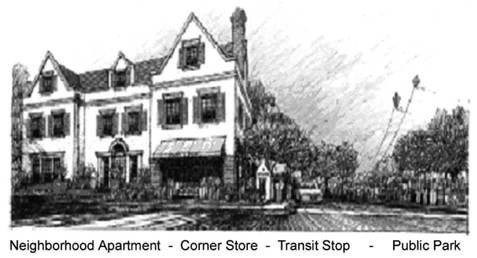
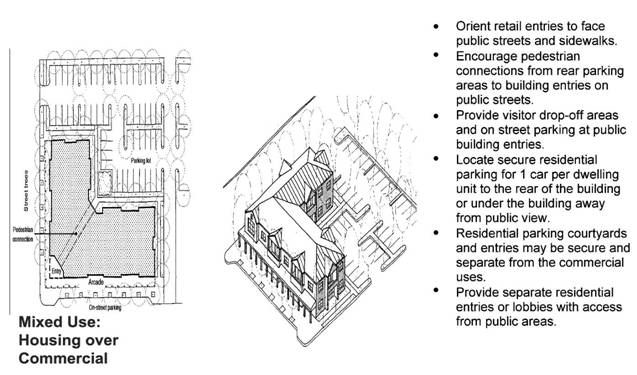
(f)
Walkway—Facing Facades. The main entrance of all buildings without street edge facades should open directly onto a publicly accessible walkway. This walkway must directly connect to an adjacent street's sidewalk. One specific exception includes: village center anchor stores (e.g., supermarkets or major drug stores), where parking may be necessary directly in front or to the side of the building. In this case, the primary pedestrian entry and windows should be visible from the parking area and front onto a publicly accessible walkway that should connect to the street. In the limited circumstances that anchor stores are accessed primarily from the rear-oriented parking area, the street facade of the store should include a significant entry feature and pedestrian-scaled architectural features.
(g)
Connecting Walkways. Connecting walkways should link street sidewalks with building entries. Walkways must be clearly distinguished from the parking lot and have paved surfaces meeting accessibility requirements. Connecting walkways should be landscaped with either shade trees or climbing vines on trellises and should be equipped with lighting. Lighting standards a maximum of twenty-four feet tall in the parking field and a maximum of sixteen feet tall along the walkway are recommended. Lighting standards shall be spaced to maintain an appropriate illumination level as determined by a photometric study.
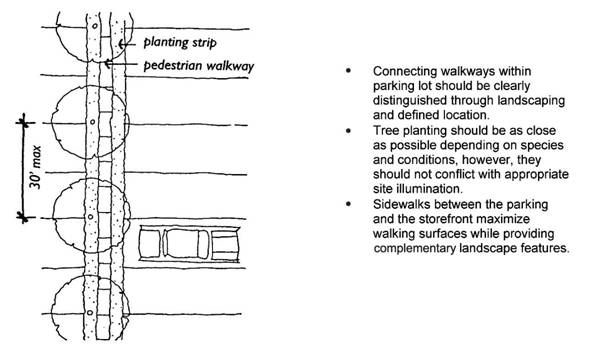
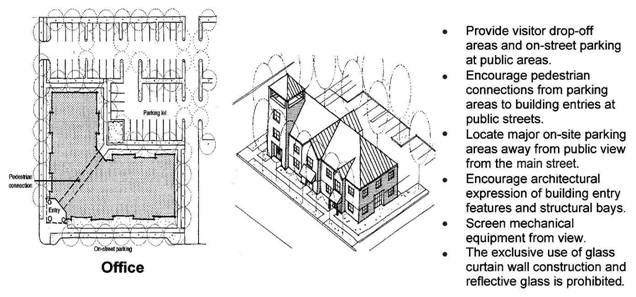
(h)
Architecture.
(1)
Projections. Special architectural features, such as bay windows, decorative roofs, overhangs, and major entry features may project up to three feet into front setbacks and conditionally into public rights-of-way, provided that they do not compromise the use of the public right-of-way as determined by the city engineer. Trellises, canopies, blade signs, and fabric awnings may project up to five feet into front setbacks and public rights-of-way, provided they are not less than eight feet above the sidewalk. Subject to the approval of the city engineer, arcades may project into the public right-of-way provided a path of travel at least eight feet wide is maintained and ceiling heights are not less than eight feet.
(2)
Recesses. A retail building's first floor may be recessed from the front setback for the purpose of architectural variation or to accommodate an arcade. For variation, the building should stay within five feet of the required setback. An arcade should maintain a minimum of eight feet of clear covered depth.
(3)
Base. All facades should have a recognizable base consisting of (but not limited to):
(A)
Thicker walls;
(B)
Richly textured materials (e.g., tile or masonry treatments);
(C)
Special materials such as ceramic tile, granite, and marble;
(D)
Darker colored materials, mullion, and/or panels; and/or
(E)
Enriched landscaping that is permanently maintained.
(4)
Top. All facades should have a recognizable top consisting of (but not limited to):
(A)
Cornice treatments;
(B)
Roof overhangs with brackets;
(C)
Stepped parapets;
(D)
Richly textured materials (e.g., tile or masonry treatments).
(5)
Ground Level Bays. For mixed use areas, storefronts, and/or other commercial building, bays should be narrow enough to maintain visual interest and variety along the streetscape. Typically, storefronts and bays should be not wider than thirty feet and be defined by vertical architectural features such as columns, pilasters, doors, and windows.
(6)
Storefronts. Display windows should encompass a minimum of forty percent and a maximum of eighty percent of a storefront's linear frontage. This standard is not applicable to a side street or driveway frontage.
(7)
Entries. Primary pedestrian entries should be clearly expressed and be recessed or framed.
(8)
Windows. Windows should generally be vertical or square in proportion and in character with the architectural style of the building. The exclusive use of mirrored glass or glass curtain wall construction is prohibited. Clear or lightly tinted glass should be used for storefront windows and doors.
(9)
Roof-mounted Mechanical Equipment. Roof-mounted mechanical equipment shall be integrated into the overall mass of a building by screening it behind parapets or by recessing equipment into hips, gables, parapets, or similar features in accordance with city standards.
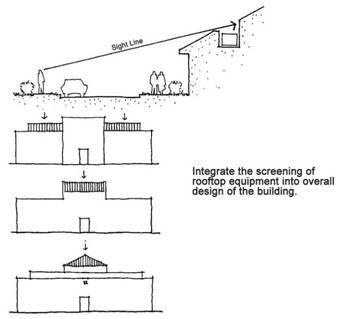
(10)
Building Height. Height will be limited by the number of stories and/or a maximum height depending on the neighborhood location and context. Variation in building height is encouraged to provide visual interest and variety in mixed use areas (see Section 37-30.450: Development regulations). Commercial and retail floors may have no more than twenty feet of floor-to-floor heights. Higher buildings may be considered through a conditional use permit process or as established in the specific plan.
(11)
Massing of Large Buildings. Buildings should provide substantial variations in massing. Variations in massing include changes in height and horizontal plane and should also include substantial architectural elements that either project up or away from the building, such as a tower, bay, lattice, or other architectural feature. Stepping the building can also reduce the apparent scale of the building. Changes in mass should relate to the structural system(s) and the organization of interior space.
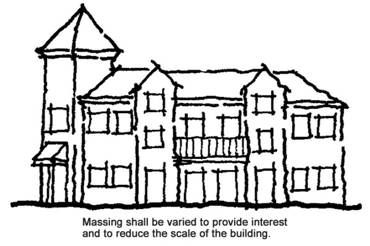
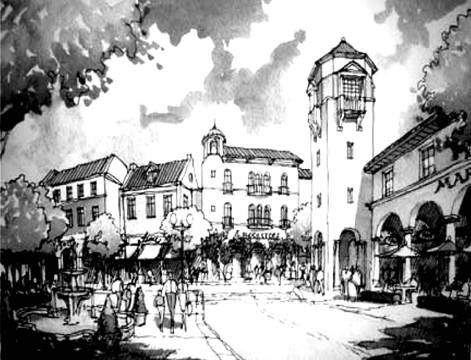
(12)
Materials. Buildings should support regional traditions and maintain a high level of craft in the process of construction. Buildings should have consistent materials, but not necessarily only one material and detail. Material changes should not occur at external corners, but may occur at "reverse" or interior corners or as a "return" from external corners, provided the "return" is of a sufficient depth to be consistent with and complement the architectural style of the building.
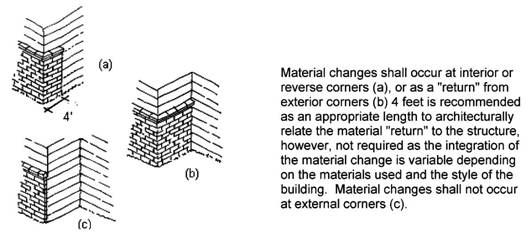
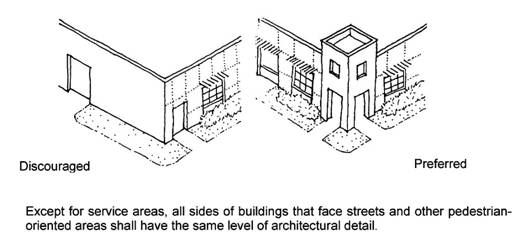
(i)
Village Center Parking Design Standards.
(1)
Vehicle Maneuvering Areas. Vehicle maneuvering areas (such as queuing areas, service station pump islands, and similar vehicle-related areas) shall be located within the interior of developments and be screened from view of adjacent streets. Such areas should not be located between the street and the street facades of buildings.
(2)
Parking Requirements. The parking requirements for the village center districts shall be as established in the specific plan (See Section 37-30.450: Development regulations).
(3)
Shared Parking. A mix of uses creates staggered peak periods of parking demand; shared parking should be provided in accordance with these design standards to reduce the total amount of required parking. Residential, retail, office, and entertainment uses should share parking areas, particularly within the mixed use village centers. To the extent possible, parking facilities should be located on street and in shared lots to serve as many uses and activities as possible in order that customers can park once and be in close proximity to a variety of shops, services, and activities.
(4)
On-street Parking. Adjacent on-street parking shall be counted towards the parking requirement at the time of initial development. It must, however, be acknowledged that this on-street parking may be subject to removal in the event of necessary traffic circulation improvements. The amount of on-street parking should be maximized and diagonal parking may be appropriate in most village center locations.
(5)
Reduce Scale of Parking Lots. Large surface parking lots should be visually and functionally segmented into several smaller lots by the use of drive aisles or walkways where possible. Land devoted to surface parking lots is encouraged to be reduced, over time, through redevelopment and/or construction of structured parking facilities.
(6)
Parking Lot Landscaping (Orchard Parking Landscaping). Surface parking areas should be planted with wide canopy trees at a minimum ratio of one tree for every five parking spaces. Trees should be planted in a landscape planter area with a minimum interior dimension of five feet (inside curb to inside curb) and protected by curbs. Features to enhance the parking area such as bollards or tree guards may also be incorporated into the site. A landscape planter should be provided at the end of each parking isle.
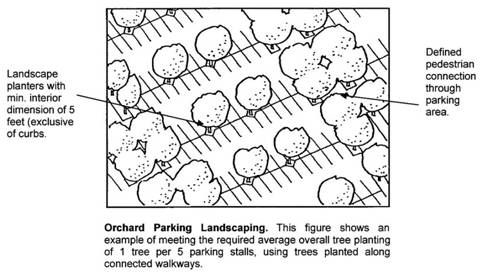
(j)
Landscaping, Screening, and Street Furnishings.
(1)
Parking Lot Frontage. Where parking lots occur along streets, a landscaped buffer shall be provided to minimize views of parked cars from the street and shall be permanently maintained. The landscaped edge at the street shall be at least eight feet wide measured from the property line. Within the landscaped buffer, trees should be planted a minimum of thirty feet on-center and within five feet of the front property line. In addition, the landscaped edge should include a screening feature with a minimum height of thirty-two inches and a maximum height of forty-two inches such as a short wall, fence, hedge, or equivalent feature. Absent this feature, plant materials shall be of sufficient quantity and of a species to meet the minimum height requirement. The screening and landscape features shall not impact visibility at driveway and corner locations.
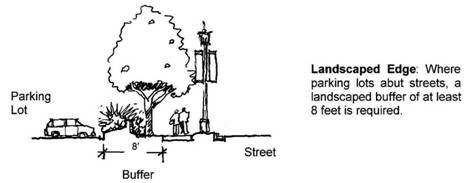
(2)
Shade Trees. Large species of deciduous trees should dominate in parking areas and public plazas to provide shade in the summer and sun in the winter. Large species of evergreen trees are also appropriate in locations where year-round foliage is desirable and when needed to visually screen unsightly views.
(3)
Screening. Loading areas, transformers, heating units, trash enclosures, and other ground-mounted equipment shall be adequately screened from public view with walls or fences and plantings such as evergreen vines, shrubs, and trees in accordance with city standards.
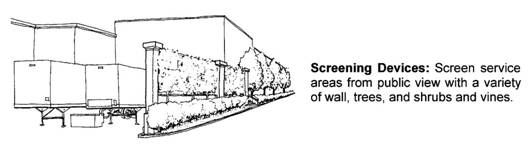
(4)
Benches, Street Furniture, and Transit Shelter. These items should be made of durable and high quality materials that harmonize with the nearby buildings and complement the public realm.
(Ord. No. 2463 (NCS).)
Sec. 37-30.500. - Neighborhood general 2/high density residential (NG-2) district design standards.
(a)
Concept. Neighborhood general 2/high density residential districts as established through the specific plan process are more frequent than village centers and are typically located adjacent to the village center district to create a transition to the neighborhood general 1/medium density residential district or it is used to create a neighborhood center focal point within a five- to ten-minute walk from most dwelling units. They should be typically anchored by an elementary school and/or other civic uses such as a park, day care center, and/or other community facilities. Small, neighborhood-serving retail and mixed use buildings may be considered and could be a neighborhood asset, however, because of the difficult economic constraints for retail at this small scale, is not required. Neighborhood general 2/high density residential districts, which create neighborhood centers, should typically be located at the crossroads of the "connector" street system that are not more than two lanes.
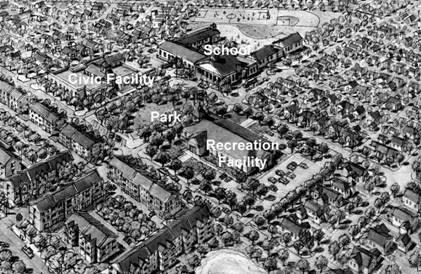
(b)
Mix of Uses. Each neighborhood other than the neighborhood served by the village center should have a neighborhood center that includes a school, park, and/or appropriate civic buildings. In addition, when viable, a neighborhood center may include day care, elderly care, places of worship, recreation facilities, small businesses, and (potentially) neighborhood-focused retail (e.g., small markets with no more than ten thousand square feet of space, convenience stores, delis, small video stores, bakeries, etc.). Buildings within the neighborhood center may include mixed use and flex use buildings that are initially predominately residential occupancies, however, readily adapted for commercial use when economically viable. Live-work units that are a mix of commercial and residential uses may also considered. Typically, the location of the neighborhood center should be at the intersection of connecting streets and defined through the specific plan.
(c)
Housing. Housing located within or adjacent to the neighborhood center area should be integrated with its design. Appropriate housing types may include mixed use and flex use buildings, stand-alone multifamily dwellings (such as apartment buildings and condominiums), senior housing, townhouses, rowhouses, duplexes, green courts, cottages, small-lot single-family, and, potentially standard-lot single-family dwelling units.
(d)
Pedestrian-oriented Design and Access. Neighborhood centers should create pedestrian-oriented gathering places that help establish the identity and character of the neighborhood. Neighborhood centers require access by autos and, if applicable, truck-loading areas in the rear, but their design should prioritize convenient and comfortable access for pedestrians and bicycles.
(e)
Park and School. The local elementary (and in some cases the middle schools) may form the focus of a neighborhood center. Along with an adjacent neighborhood park, these facilities could provide the identity and common gathering point for the surrounding neighborhood. The school building should be sited and designed as a prominent civic element of the area. Its recreation areas and other facilities should be designed for joint use, community after school programs, and shared, whenever possible, with civic groups. Its main entry should be architecturally significant and located on the street, not behind a parking lot or bus area. Additionally, the design of the school facility should include a suggested school route map incorporating applicable pedestrian enhancing facilities and traffic calming measures.
(Ord. No. 2463 (NCS).)
Sec. 37-30.510. - Neighborhood general 1/medium density residential (NG-1) district design standards.
(a)
Concept. Neighborhood general 1/medium density residential (NG-1) districts are established to create an area for large- and small-lot detached single-family dwellings, green courts, rowhouses, and townhouses, with potentially a few apartments. The average density of dwelling units in each block in the neighborhood general 1/medium density residential (NG-1) district may become gradually less as one proceeds from the adjoining neighborhood general 2/high density residential (NG-2) district near the village center or neighborhood center to the neighborhood edge/low density residential (NE) district farthest from the village and neighborhood centers.
(b)
Housing Diversity. The district should include a variety of housing sizes and styles. In order to maintain the desired density of residential neighborhoods, a variety of housing sizes, lot sizes, and/or patterns should be used in each neighborhood general 1/medium density residential (NG-1) district.
(Ord. No. 2463 (NCS).)
Sec. 37-30.520. - Neighborhood edge/low density residential (NE) district design standards.
(a)
Concept. Neighborhood edge/low density residential (NE) districts are established to create a low density edge for the specific plan area.
(b)
Housing Diversity. Typically, large-lot single-family dwelling units are allowed in this district, however, other dwelling unit types and styles may be allowed as provided for in each specific plan to promote neighborhood diversity and achieve minimum density requirements.
(Ord. No. 2463 (NCS).)
Sec. 37-30.530. - General neighborhood design standards.
The following design standards shall apply to both the neighborhood general 1/medium density residential (NG-1) and neighborhood edge/low density residential (NE) districts except as noted:
(a)
Housing Design and Orientation. New residential neighborhoods should orient buildings to streets and public parks.
(1)
Dwelling units are to be oriented to the local street system and public spaces with entries, balconies, porches, and architectural features to enliven the streets, provide "eyes on the street," and create safe and pleasant walking environments.
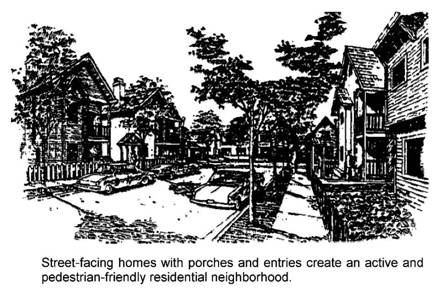
(2)
Housing should be "human scale" in massing, setbacks, and character. Residential developments should encourage structures that foster diversity in design and maintain the character of the community.
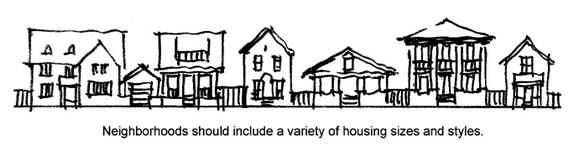
(3)
In addition to large-lot single-family dwelling units, alternative housing forms, such as small-lot single-family, green court, paseo homes, townhouses, rowhouses, multifamily dwellings generally not larger than sixteen dwelling units, and second dwelling units on appropriate lots containing a detached single-family dwelling unit assist to increase density and provide diversity of housing opportunities that is encouraged in the NG-1 district.
(4)
The design of attached and multifamily dwellings should include features typically associated with detached single-family dwelling units, including human-scaled architectural elements such as doors, windows, balconies, and other design features to provide interest and variety as well as a sense of individuality. The importance of the scale of the multifamily housing must be emphasized, as the scale and the architectural articulation are critical for successful neighborhood integration of multifamily residences.
(5)
Parking lots for higher density multifamily housing shall not be allowed to dominate the frontage and must be located as unobtrusively as possible and be appropriately screened. In no case shall multifamily housing be allowed to back up to a street.
(b)
Neighborhood Design. To create a pedestrian-oriented, safe, livable environment, each neighborhood should demonstrate the following characteristics:
(1)
The average residential densities per net acre should be highest at the village center and should generally decrease through the adjoining neighborhoods and become predominately low density uses at the neighborhood edges. Neighborhoods should be organized to allow the majority of the residents to walk to either a neighborhood center or the village center main street within five to ten minutes.
(2)
Front yard setbacks should decrease and residential densities should increase from the neighborhood edge to the village center.
(3)
Small parks should be distributed throughout the neighborhood and elementary schools should be easily accessible within a five- to ten-minute walking distance to a majority of the residents.
(4)
Where a natural open space corridor or a pedestrian-friendly boulevard borders a neighborhood edge, the dwelling units along the neighborhood edge should face onto these spaces or boulevards. If the neighborhood is adjacent to agricultural operations, a variety of buffering techniques should be used such as tree rows, streets, etc.
(5)
Whenever feasible, design and placement of buildings and other physical features are encouraged to maximize visibility and facilitate natural surveillance from public rights-of-way and other public areas. This includes building orientation, placement of windows, doors, and balconies, building and site entrances and exits, placement of parking, lighting, and refuse containers, placement and type of landscape materials, plazas, and other open space areas, location of walkways, types of walls and fences (including the use of picket, wrought-iron, and similar materials to promote visibility), and other features that promote crime prevention through environmental design (CPTED).
(c)
Neighborhood Parks.
(1)
Pedestrian and bicycle paths and street connections should be placed to allow surrounding residents to easily and safely access public recreational facilities and schools.
(2)
Larger parks with multiple play fields may be located with schools and should be connected to the citywide parks and open space network, whenever possible. All parks should encourage easy access via streets and trails, and foster safety by making it easy to view into parks from streets and surrounding dwelling units (e.g., placing streets along parks and open spaces and facing dwelling units onto these streets.) Small parks should include program elements that make the construction and on-going maintenance of small parks affordable.
(3)
In addition to providing five-acre neighborhood parks, small parks, tot lots, and open space features of one acre or less, however, not smaller than eight thousand square feet are encouraged to provide close parks or open spaces for smaller clusters of dwelling units (not more than one thousand five hundred feet from any dwelling unit to a large or small park). These open space features may be designed as tot lots and/or for passive recreational areas and should generally not include more active uses such as ball fields.
(4)
Dwelling units should not back onto more than twenty-five percent of a five-acre or larger park or public open space. Smaller "pocket" parks and tot lots of eight thousand square feet to five acres may be surrounded on three sides by dwelling units.
(5)
Additionally, appropriately scaled and accessible public parks, plazas, and open space areas should be located in close proximity to high and medium density housing, such as placing that type of use directly across the street from and facing onto a village green or park.
(d)
Nonresidential Facilities.
(1)
Nonresidential facilities such as water well pumping stations and storage, and the like, shall be designed to be compatible with the character of the surrounding neighborhood. Landscaping, decorative walls, or other buffering techniques, as appropriate, shall be used to ensure such facilities blend with and do not adversely impact adjacent uses.
(2)
Any buildings constructed in conjunction with such facilities shall be compatible with the materials, exterior colors, and any distinctive architectural characteristics found in the surrounding neighborhood.
(3)
The operators/property owners of such facilities shall be required (as a condition of approval) to provide regular maintenance for the life of such facilities (e.g., regular watering and care of vegetation (including replacement of any dead plant material or broken irrigation apparatus), trash and graffiti removal, and the repair and replacement of any damaged or worn-out facilities).
(e)
Street Configuration. Local streets will form an interconnected network, including automobile, bicycle, and pedestrian routes, that provide direct connections to local destinations. Local streets will provide for both intra and inter-neighborhood connections and thus knit neighborhoods together, not form barriers between them. Gated entryways into new developments or neighborhoods will not be allowed.
(f)
Street Design. Local and connector streets should be considered to be both public ways and neighborhood amenities. They should have continuous detached sidewalks and large species of street trees on both sides. Individual residential dwelling units should provide entries, gates, porches, and other inviting features that face local streets to help create a sense of community and improve safety. In the limited circumstances where cul-de-sac streets are appropriate, the cul-de-sac should be open at the end to create pedestrian and bicycle access.
(g)
Natural Features. Natural features including creeks, significant trees, sloping topography, and wetlands shall be protected, where reasonably feasible and accentuated through sensitive site planning, landscaping, building placement, and other measures to ensure that these features are assets benefiting the entire community. Dwelling units shall not back up to these natural features; however, cul-de-sac streets may extend to the natural features provided the cul-de-sac is open at the end and provides access to trails and/or activity areas.
(h)
Phasing. Neighborhoods should be livable at all stages of their development. Important developer-provided facilities such as streets, utilities, and local neighborhood parks shall be provided concurrently with neighborhood development. Important public facilities that are beyond the scope of the developer's responsibilities, such as schools, and civic buildings are also encouraged to be provided concurrently with the neighborhood development or as soon as feasible.
(i)
Dwelling Types. A diverse range of housing types are permitted and encouraged within each residential land use designation as established by the applicable district. The following are examples of the various dwelling types:
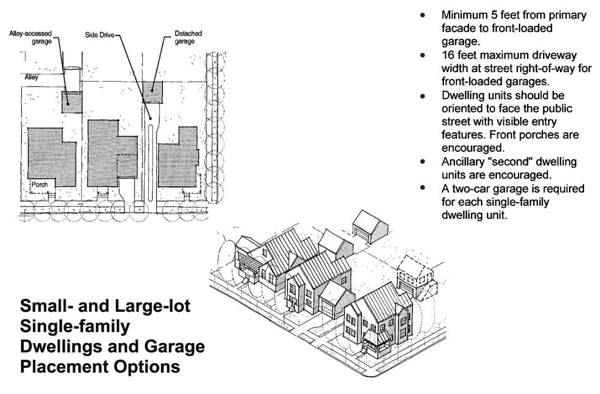
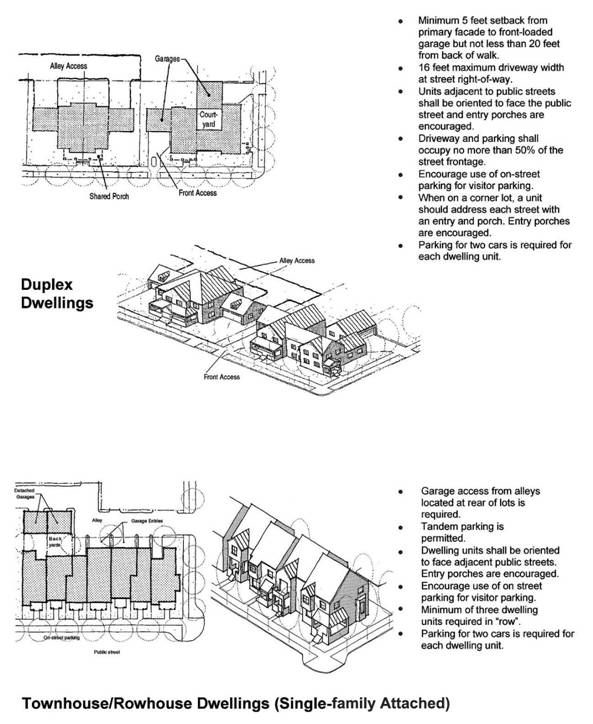
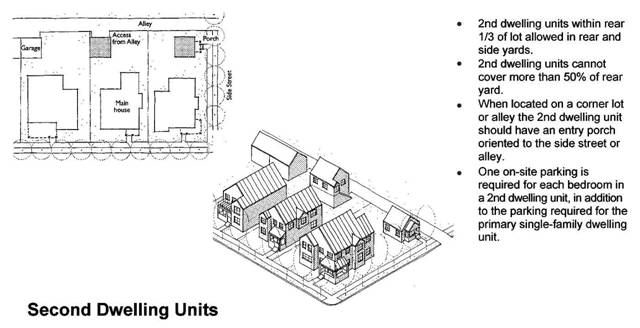
(j)
Residential Design Guidelines.
(1)
Entrances: Porches and Entries. To build a walkable community, it is essential that most residential front doors or front porches be visible from the street, court, or paseo. This is critical not only for practical purposes, but because an important element of residential environments is the relationship of the private home to the public street and sidewalk. Therefore, all front entrance areas should be easily recognizable from the street, and include a welcoming architectural feature such as a porch or covered entry.
(2)
Porches. Porches should be an integral architectural feature with the main structure. All porches will incorporate railings when required by UBC. Porches may extend up to five feet into the front setback. Porches may be raised or at ground level.
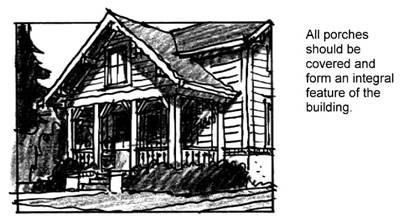
(3)
Entries. A projecting architectural entry feature such as a shed, arch, or gable providing roof coverage and weather protection should accompany entries. Entries should be an integral architectural feature compatible with the main structure.
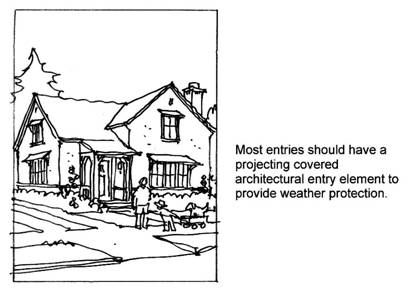
(4)
Garage Location.
(A)
All garages facing a public street shall be set back at least twenty feet from the property line with a roll-up door or twenty-three feet from the property line with a standard door to provide an adequate parking apron/driveway.
(B)
The face of the garage shall be set back a minimum of five feet from the residence's front facade.
(C)
For single-family dwelling units and duplexes, front loading garage doors shall not be greater than fifty percent of the street-facing width of the dwelling unit. Front-loading garages and parking access shall only be permitted for interior lots at least forty feet in width and for corner lots at least forty-five feet in width.
(D)
No parking shall be permitted within the exterior yard areas (front or corner side yard/setback areas).
(E)
For rowhouses, townhouses, paseo homes, and green court dwelling units, the garage must be accessed from an alley or lane.
(F)
For multifamily dwellings such as apartments and condominiums, garages and/or parking areas shall not amount to more than thirty-three percent of the building's street-facing facade. Parking for multifamily dwellings, garages, carports, or open parking lots, shall generally be located behind the building.
(G)
Alley or lane accessed parking and/or garages shall be set back from the paved travel way a sufficient distance to accommodate the turning radius of a typical vehicle as established by the city engineer.
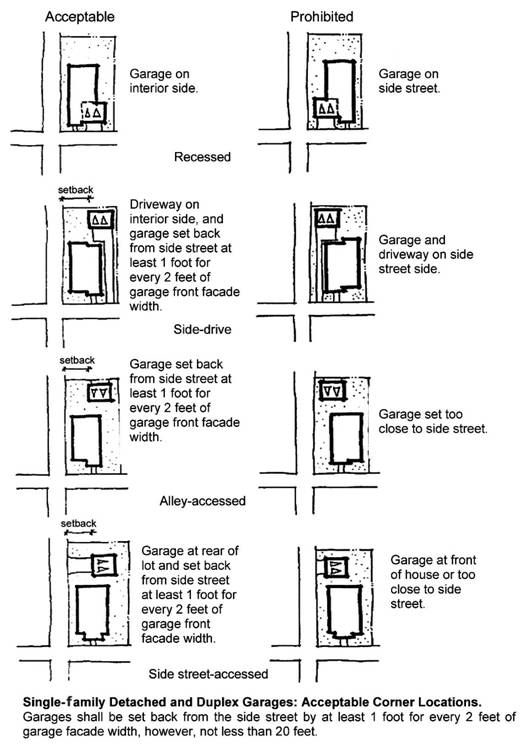
(5)
Fencing. Fences help define the edges of yards and provide privacy. They are considered background elements that help highlight landscaping and architecture. Front yard fences are allowed up to thirty-six inches in height. All interior side yard privacy fences must be set back a minimum of four feet from the front facade of the building. The following regulations apply to fencing:
(A)
Locations.
(i)
Interior side yard: four feet minimum back from front building facade, perpendicular to the facade of the dwelling unit,
(ii)
Corner side yard: ten feet minimum back from right-of-way and in rear fifty percent of lot only,
(iii)
Alley fences: minimum of one inch behind the face of the garage. However, alley fencing shall not obstruct the visibility from the parking area and shall relate to the setbacks required to allow for turning radius within the alley;
(B)
Height.
(i)
Rear and interior side yard: six feet maximum,
(ii)
Front and corner side yard: three feet maximum,
(iii)
The overall fence height may be exceeded for lots on sloping topography when fencing is combined with a retaining or garden wall. In this instance, the maximum height of the combined fence and wall shall not exceed nine feet measured from the toe of the wall on the downhill side of the fence.
(C)
All fences, wall, and hedges shall be subject to the driveway visibility requirements of Section 37-50.460: Driveway and corner visibility;
(D)
Acceptable materials: wrought iron, wood, vinyl, plastic-wood composite (e.g., Trex), and masonry (including veneer).
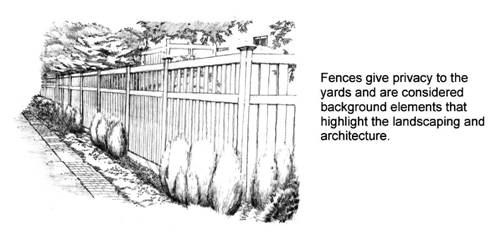
(6)
Architecture.
(A)
Materials. New buildings should support regional traditions and maintain a high level of craft in construction and materials. Exterior finishes should be primarily wood, masonry, and/or stucco. In general, imitation materials should be avoided in favor of genuine materials. Where this is not practical, materials (cement board siding, artificial stone, vinyl fencing, etc.) should be as close to their original models as possible.
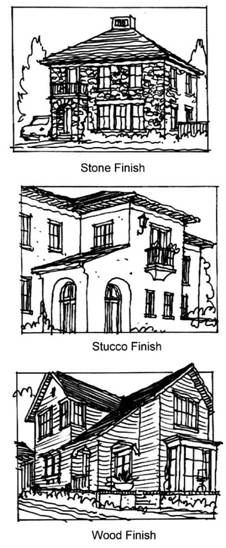
(B)
Windows. Windows should be compatible with the building design. Window placement should provide each primary room with natural light and effective cross ventilation.
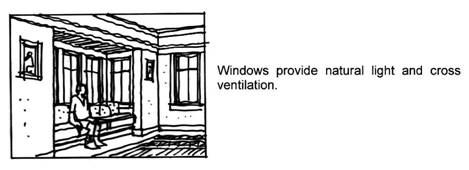
(i)
Provide at least one window that looks out onto the life of the street from an active room. These "eyes on the street" should make each neighborhood a safer place and provide connection to the street to encourage neighborhood interaction.
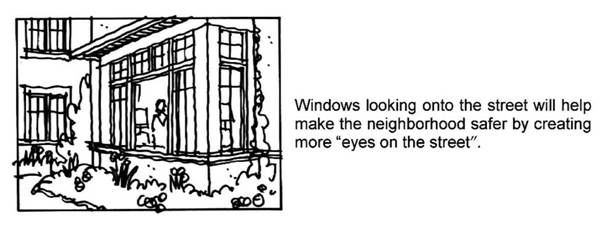
(ii)
Consider the dwelling unit's solar orientation for window placement. Tailoring window placement to the dwelling unit's location creates alternating elevations that vary for practical, ecologically sound reasons.
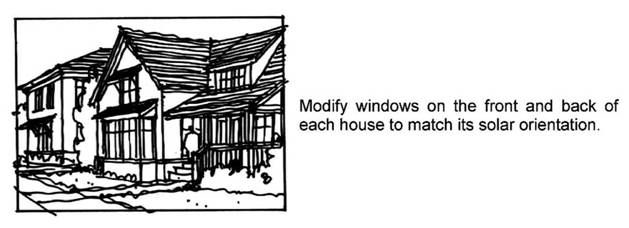
(C)
Trim. Although often decorative in appearance, trim originated to fill a functional need. Traditionally, trim occurred to cover the joints between different planes or different materials and to protect the structure of the dwelling unit from the elements. Corners, soffits, the edges of windows and doors, the edge of the roof, the roof ridge, each had its own distinct type of trim.
(i)
Trim should be applied consistently around the exterior of the dwelling unit.
(ii)
Trim should be appropriately scaled to the size and style of the dwelling unit.
(iii)
Trim should be applied three-dimensionally. Horizontal trim bands should wrap outside corners and only terminate at inside corners. Fascia should wrap gracefully from rake to eave.
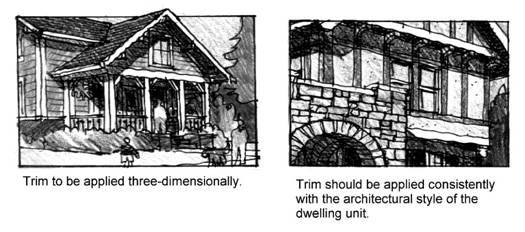
(D)
Roofs. The form of the roof is one of the most memorable and characteristic elements of a dwelling unit.
(i)
Keep the overall roof form of each dwelling unit simple and compact. This is particularly important with smaller dwelling units.
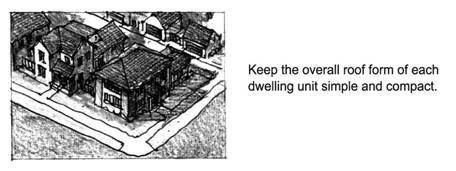
(ii)
Visual variety can be achieved with roof forms, overhangs, and shading devices that relate to the solar orientation of a lot. This results in a more livable and energy efficient dwelling unit and brings a subtle and natural variety to a neighborhood's streetscape.
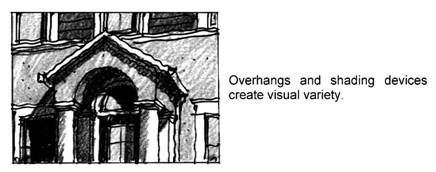
(iii)
Roof materials should be appropriate to the style of the dwelling unit, roof form, and slope. Heavier or more complex roofing materials (tile or concrete tiles) should be placed on simpler roofs. If they are used on complex roofs, they can cause leakage or unnecessary problems. More complex roofs, however, require monolithic, simpler materials (shingles). The allowable materials for roofs include tile, slate, treated wood, concrete tiles, and thicker architectural grade composition shingles.
(Ord. No. 2463 (NCS).)
Sec. 37-30.540. - Streets and streetscape design standards.
(a)
Hierarchy of Streets. The hierarchy of streets within the future growth area modifies the standard street system by establishing the framework to create distinct identifiable neighborhoods that have traditional neighborhood development (TND) characteristics and corresponding circulation systems. The street network within each neighborhood should exhibit the following characteristics:
(1)
Individual blocks should be compact and average less than six hundred feet in length and average less than one thousand eight hundred feet in perimeter measured along the property line;
(2)
Streets should be organized into a comprehensive hierarchical interconnected (grid-like) network;
(3)
Cul-de-sac streets should be avoided unless natural topographic features or other environmental conditions justify their use; and
(4)
The street network design must consider public safety, appropriate transit access and facilities, and pedestrian and bicycle connectivity.
(b)
Street Network. The street network provides for the following roadway conditions:
(1)
Arterial Streets. Arterial streets are major high-volume roadways often occurring at the neighborhood perimeters and include Boronda Road, San Juan Grade Road, Russell Road, Old Stage Road, Williams Road, Sanborn Road, Natividad Road, and Constitution Boulevard.
(2)
Main Streets. Each village center shall also have a main street of shops. The main street should have two lanes with one lane in each direction with parking on both sides. In addition, areas of intense development within the villages may have commercial streets that have added dimension for more frequent truck delivery and emergency access to taller buildings.
(3)
Connector Streets. Connector streets lead from village to neighborhood centers and from neighborhood to neighborhood. Their frequency is such that they replace minor arterials and collector streets with roads that are typically two travel lanes (turn lanes may be added at intersections if necessary) with on-street parking. Connector streets occur more frequently than traditional collector streets and are integral components of a neighborhood unlike many collector types of streets that have the potential to fracture neighborhood areas.
(4)
Local Streets. Local streets form the basic network of medium and low density neighborhoods. These streets are intended to be as narrow as safety allows, provide primary access to the residences, and are typically lined with parallel parking to reduce traffic speeds.
(c)
Street Sections. Each specific plan shall include neighborhood street sections appropriately sized for the expected demands as identified in Table 37-30.200 as follows:
Notes:
(a) Streets were the tested street sections.
(b) Measurements in feet.
(c) ADT favors quality of life/convenience and number of dwelling units fronting the street rather than physical capacity.
(d)
Traffic-calming Features. The design of an interconnected street network must include provisions to discourage fast through-traffic on neighborhood connector and local streets. Traffic measures that restrict traffic at the expense of the overall interconnectedness and coherence of the future growth area should be avoided. While consideration must always be given to specific demands and conditions (e.g., traffic volume, proximity to larger roads, turning movements, special vehicle needs, and intersection spacing), recommended traffic management measures on connecting and local streets may include:
(1)
Appropriate Street Widths. Each street's design should be based on its anticipated role within the project and surrounding neighborhoods. Street widths should be narrow enough to slow traffic, while accommodating demonstrated traffic demand at a reduced speed and providing adequate emergency vehicle access. Streets should not be wider than needed to accommodate demonstrated traffic demand.
(2)
Traffic Circles. To slow and divert traffic, small traffic circles may be placed at the center of intersections. These islands should be landscaped, but foliage should be pruned to avoid obstructing drivers' views. Traffic circles function most efficiently when they are used without stop signs.
(3)
Median Islands. These islands are installed in the center of a street, and can serve to narrow and redirect traffic lanes, manage traffic movements, and provide a safe pedestrian crossing.
(4)
Bulb-outs, Textured Crosswalks, and Raised Intersections. These features can be used singly or in combination. Bulb-outs slow traffic and reduce pedestrian crossing distances by narrowing the curb-to-curb dimension of the street, either at an intersection or mid-block. Bulb-outs are typically created by eliminating the parking area next to the intersection when a turn lane is not needed. Crosswalks can be textured by means of special pavers or other treatment, to alert drivers that the area being traversed has a special identity for pedestrians. Raised intersections raise the entire intersection a few inches to make drivers aware of pedestrian crossings.
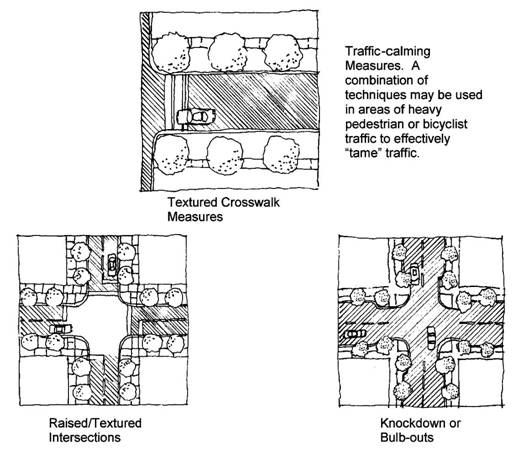
(5)
"T" Intersections. Road alignments are generally offset at least one hundred fifty feet, forcing turning movements. If carefully sited, "T" intersections can also create prominent vistas to parks and civic features.
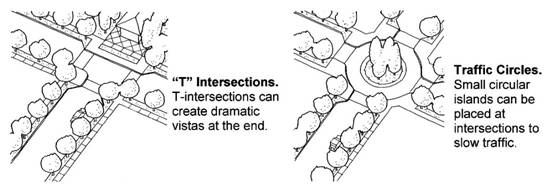
(6)
Inappropriate Measures. Traffic-calming measures not recommended include the following:
(A)
Speed Bumps. Speed bumps traverse travel lanes with raised strips that are typically three to four inches high. The need for speed bumps is symptomatic of road designs that fail to slow traffic. While offering a method for slowing traffic within pre-existing conditions, other methods for slowing traffic should be employed on new streets.
(B)
Street Closure and Forced Turn. Using permanent barriers and diverters work against the creation of an interconnected street network, and is not recommended.
(e)
Street Trees/Groundscaping. The future growth area shall be landscaped with a palette of street trees and groundscaping keyed to each of the differing street types, to help establish the hierarchy of streets and provide a cohesive theme for the area.
(1)
Spacing. Street trees should be planted on both sides of streets and generally be spaced no more than forty feet apart.
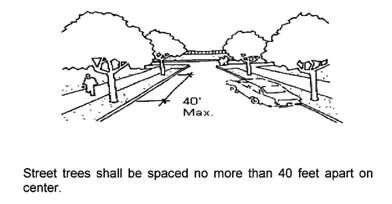
(2)
Species. Each street should typically have one dominant species of street tree for the sidewalk parkway planting area, with perhaps an additional street tree type for any in-street parking space trees or planted medians. Large-canopy deep-root street trees should be used on all streets. London Plane, Maple, and Elm are typical street trees used in our beautiful old time traditional neighborhoods.
(3)
Plant Materials. Village center sidewalks are likely to be hardscaped, with generous tree grates around street trees. In residential districts, a common palette of groundscaping such as low plants is recommended for the area between paving and roadway. A judicious selection of plants includes consideration of site-specific conditions such as shade, wind, moisture, drought tolerance, and soils.
(f)
Street Lights. Streets must be lit with light standards (fixtures and poles) with a consistent and high quality appearance throughout the area. Light bollards are also encouraged in areas with high pedestrian activity levels. The height of light standards should correspond to the activities they illuminate:
(1)
Along Pedestrian Streets. Light standards in environments where pedestrians are the primary focus (e.g., main streets and pedestrian walkways) should be lower in height to create an environment that is more human in scale. These poles should be not more than twenty-five feet high and spaced approximately one hundred fifty feet to one hundred seventy-five feet along streets. A photometric plan shall be required to determine the appropriate spacing to achieve acceptable/reasonable lighting levels as approved by the city engineer.
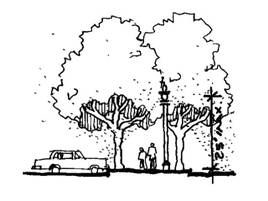
(2)
Along Primarily Automobile-oriented Streets. Light standards along major streets must relate to both vehicles and pedestrians at the edge of street, and may be taller than those on local and connector streets.
(3)
Placement. To the extent feasible, light standards should be placed on both sides of the street in a triangulated pattern.
(g)
Village Center Main Street Treatments.
(1)
Kiosks. Kiosks serve as information booths and/or shelter for small vendors. Kiosk design should be consistent with the architectural style of surrounding buildings and any nearby landscaped frontages.
(2)
Newspaper Racks. Newspaper racks should occur around major pedestrian gathering areas. The design should consolidate all vending boxes into one rack. Rack construction should use masonry elements or metal that complements other site furnishings in the area or the architecture of adjacent buildings. The rack should be attractive on all sides and properly anchored. Individual racks should not be permitted.
(3)
Bicycle Racks. Bicycle racks should be selected that are durable and visually subdued. Based on their performance, "wave type," "loop racks," and "ribbon bars" are required and should be sized according to parking requirements. The color of bicycle racks should coordinate with the color scheme established for all of the street furnishings in the specific plan's main street area.
(4)
Recycling and Solid Waste Disposal. Throughout the village center, solid waste and recycling receptacles should be provided. Receptacles should have vertical metal bars and be painted to match other recommended features. To avoid overflow, receptacles should be sized to be at least a thirty-gallon capacity, especially in commercial areas, and should be properly anchored. Multiple coats of a powder coating or comparable finish are recommended for durability.
(5)
Planters. Planters should be simple in form. Round and square types are typically recommended. The planter's material should be durable and attractive. Planters should be at least three feet in diameter. Where planters are called for, group various sizes in clusters to enrich streetscapes and plazas.
(6)
Street Paving and Furnishings. Paving, plants, and site furnishings should help set the character of the village and neighborhood centers. These features should be consistent with the following recommendations, whether in streets, parks, plazas, or as on-site landscaping:
(A)
Paving. Special pavers are recommended in parks, plazas, and in crosswalks on main streets. Pavers should be durable and of brick, stone, or other materials appropriate to the traditional style of the region. Interlocking pavers should be used to avoid uneven edges. Paving patterns should be simple and should be reviewed to ensure quality and consistency.
(B)
Tree Grates. Tree grates should occur along sidewalks and in plazas where a continuous walking surface is needed. Tree openings should be expandable.
(C)
Tree Guards. Tree guards should extend vertically from tree grates to protect trees in highly active areas. To relate to other site furnishings, tree guard bars should be narrow and vertical, and should be attached to the tree grate. Welds should not be visible. Tree guards should be about four feet in height with openings varying in diameter according to tree species.
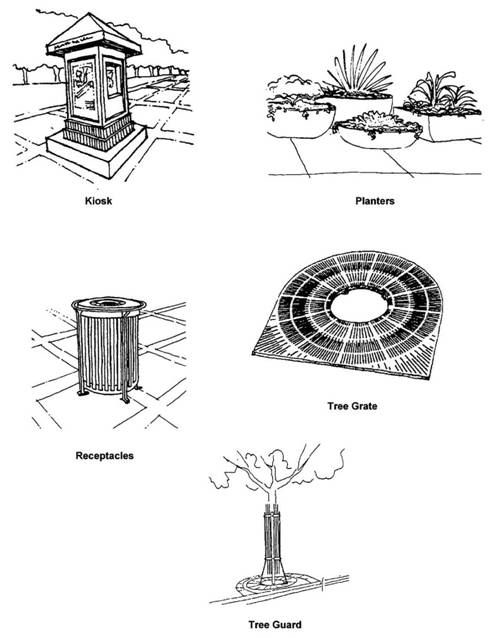
(Ord. No. 2463 (NCS).)

