11 - GLOSSARY
This Chapter provides definitions of terms and phrases used in this Development Code that are technical or specialized, or that may not reflect common usage. If any of the definitions in this Chapter conflict with definitions in other provisions of the County Code, these definitions shall control for the purposes of this Development Code. If a word is not defined in this Chapter, or in other provisions of the Santa Barbara County Code, the Director shall determine the correct definition utilizing the latest edition standard dictionary.
As used in this Development Code, the following terms and phrases shall have the meaning ascribed to them in this Section, unless the context in which they are used clearly requires otherwise.
A.
Definitions, "A."
Abut. To physically touch or border upon; or to share a common property line.
Accessory Agricultural Structure. A structure designed and constructed primarily for storing farm implements or supplies, hay, grain, poultry, livestock or horticultural products that supports the agricultural use of the lot.
Accessory dwelling unit. An attached or a detached residential dwelling unit that is located on the same lot as a one-family or multiple-family dwelling to which the accessory dwelling unit is accessory and (1) provides complete independent living facilities for one or more persons including permanent provisions for cooking, eating, living, sanitation, and sleeping, and (2) provides interior access between all habitable rooms. An accessory dwelling unit may also include an efficiency unit, as defined in Section 17958.1 of Health and Safety Code, and a manufactured home, as defined in Section 18007 of the Health and Safety Code.
1.
Attached accessory dwelling unit. An accessory dwelling unit that shares at least five feet of common wall with, or is stacked above or below, the principal dwelling or an attached accessory structure.
2.
Detached accessory dwelling unit. An accessory dwelling unit that is detached from the principal dwelling and is located on the same lot as the principal dwelling. A detached accessory dwelling unit may be attached to a detached accessory structure.
Accessory Residential Structure or Use. Any use and/or structure that is customarily a part of, and clearly incidental and secondary to a residence, and does not change the character of the residential use. This definition includes the following attached and detached accessory structures, and other similar structures normally associated with a residential use of property. Accessory Agricultural Structures are separately defined. Examples of this land use include the following:
artist studios
cabanas
garages
gazebos
greenhouses (non-commercial)
guesthouses
spas and hot tubs
storage sheds
swimming pools
tennis and other onsite sport courts
workshops
Also includes the indoor storage of automobiles, personal recreational vehicles and other personal property, accessory to a residential use.
Accessory Retail or Services. The limited retail sale of various products, or the provision of certain personal services within a health care facility, hotel, office, or industrial complex, to employees or customers of, or visitors to the principle use. Examples of these uses include pharmacies, gift shops, and food service establishments within hospitals; convenience stores and food service establishments within hotel, office and industrial complexes; and barber and beauty shops within residential care facilities.
Accessory Structure. A structure located upon the same site as the structure or use to which it is accessory. The use of an accessory structure is customarily incidental, appropriate and subordinate to the use of the principal structure, or to the principal land use of the site.
Accessory Use. A use that is customarily incidental, appropriate and subordinate to the use of the principal structure, or to the principal land use of the site and that does not alter the principal use of the lot or adversely affect other properties in the vicinity.
Adjacent. See "abut."
Aerial Approach Zone. An area at ground level that begins at the end of each runway and extends under the path of landing or departing aircraft to a distance determined by the characteristics of the runway.
Affordable Housing. The State defines affordable housing as housing that can be purchased or rented by households whose gross annual household income does not exceed 120 percent of area median income, adjusted for household size. Santa Barbara County expands this to include households with income up to 200 percent of area median income. This housing may be subject to a covenant or deed restriction that restricts sales price or rent for a given period of time. Certain types of housing such as homeless shelters, dormitories, farm labor camps, and housing for people with disabilities may not require price controls because they generally provide housing for a special needs group.
Agent. A person authorized in writing by the property owner to represent and act for a property owner in contacts with County employees, committees, Commissions, and the Board, regarding matters regulated by this Development Code.
Aggrieved Person. A person who, in person or through a representative, appeared at a public hearing in connection with the decision or action appealed, or who, by other appropriate means prior to a hearing, informed the County of the nature of their concerns, or who for good cause was unable to do either.
Agricultural Development. Any agricultural structure, practice, or operation that a) requires a building, grading, or brush-clearing permit on land designated for agriculture; b) is located on land which has had no history of cultivation; and/or c) is on land not designated for agriculture. A permit solely for plumbing or electricity shall not constitute a standard building permit.
Agricultural Employee Housing. A dwelling occupied by one or more agricultural employees including family members.
Agricultural Improvement. Agricultural activities or structures on agriculturally designated lands which are not subject to building, grading, or brush clearing permits. These activities and structures may be subject to special agricultural building, agricultural grading, or agricultural brush-clearing permits.
Agricultural Premises. The area of agricultural land consisting of a single lot or multiple contiguous lots under one ownership.
Agricultural Preserve Contract. A contract complying with the Land Conservation (Williamson) Act (Government Code Section 51200 et seq.) between the County and a landowner in which the landowner restricts development of lands devoted to agricultural uses in return for a reduction in property taxes.
Agricultural Processing and Product Preparation. The initial processing or preparation for shipping of agricultural products, not including animal products, produced on the same site ("on-premises products") or from other properties ("off-premises products"), for onsite marketing or for additional processing and/or packaging elsewhere. Examples of this land use include the following:
drying of corn, rice, hay, fruits and vegetables
flower packing or packaging
freeze-drying of fruits and vegetables
milling by simple mechanical process without additives, chemical reactions, changes in ambient temperatures and/or hazardous materials
pre-cooling and packaging of fresh or farm dried fruits and vegetables
pressing olives to create olive oil
sorting, grading and packing of fruits and vegetables
Does not include "cannabis" and "winery," which are defined separately
Agricultural Processing - Extensive. The refinement or other processing of agricultural products to substantially change them from their raw form, which involves machinery, chemical reactions, and/or hazardous or highly odiferous materials or products. Examples of this land use include the following:
corn shelling
cotton ginning
ethanol production
grain cleaning and custom grinding
grist mills
milling of flour, feed and grain
sugar mills
Agricultural Processing - Small-Scale Processing Beyond the Raw State. On a limited scale, the refinement or other processing of agricultural products (not including animal products) to minimally change them from their raw form. Small-scale agricultural processing beyond the raw state may involve some use of machinery, additives, chemical reactions, and changes in ambient temperature but does not involve pasteurization, or the use of hazardous or highly odiferous materials or products. Small-scale agricultural processing beyond the raw state may include activities such as curing, pickling, preserving, and milling of flour, feed and grain, when conducted on a limited, small-scale basis in support of onsite agriculture. Does not include "cannabis," "winery," and "agricultural processing - extensive," which are defined separately.
Agricultural Product Sales. The sale of agricultural products, including flowers, fresh fruit, herbs, plants and vegetables, grown on or off the premises or other products as allowed by Section 35.42.050 (Agricultural Product Sales) of this Development Code.
Agricultural Product Transportation Facility. A transportation facility required to support agriculture.
Agricultural Soil Export Mining. Grading done for agricultural activities, as defined in California Code of Regulations, Title 14, Section 3501, that requires the export of soil and such export does not exceed 75,000 cubic yards from any one parcel or group of contiguous parcels since January 1, 2005. For the purposes of this definition any permitted or unpermitted export of soil since January 1, 2005, whether or not qualified as agricultural grading, shall be included in the calculation of 75,000 cubic yards.
Agricultural Structural Development. Any structure that is constructed, erected, or placed with or without a foundation, the use of which requires location on the ground and is covered by a roof, the use of which is restricted to those uses that are directly accessory, ancillary and secondary to the agricultural use of the property. Dwelling units are considered agricultural structural development only if they provide housing for agricultural employees of the owner or lessee of the land and are permitted in compliance with Section 35.42.030 (Agricultural Employee Dwellings) or Section 35.42.260 (Temporary Uses and Trailers).
Agricultural Support Use. Uses such as the sorting and processing of local fruits and vegetables, wineries, or feed distribution; that are a necessary and integral part of maintaining on-premise production and marketing, and that are directly associated with onsite agricultural or ornamental crop, or animal raising operations. Other uses permitted by Conditional Use permit in an agricultural district such as oil drilling are not to be construed as an agricultural support use.
Agriculture. The production of food and fiber, the growing of plants, the raising and keeping of animals, aquaculture, and the preparation for sale and marketing of products in their natural form when grown on the premises, and the sale of products which are accessory and customarily incidental to the marketing of products in their natural form grown on the premises, and as allowed by Section 35.42.050 (Agricultural Product Sales), but not including a slaughter house, fertilizer works, commercial packing or processing plant, or plant for the reduction of animal matter or any other similarly objectionable use.
Airport. An area of land or water used for the landing and take-off of aircraft as well as any appurtenant areas used for airport buildings, aircraft operations, and related facilities, including aprons and taxiways, control towers, hangers, safety lights, and structures. These facilities may also include parachute jump areas and FAA-certified parachute lofts; and facilities for aircraft manufacturing, maintenance, repair, and reconditioning. Also includes agricultural, personal, restricted, and public use landing strips, defined as follows:
1.
Airstrip. An airfield without normal airport facilities consisting of a landing strip or heliport used for agricultural crop dusting or the personal use of the tenant or owner of the site and excluding public use and commercial operations.
2.
Airstrip, Temporary. An airstrip without hard surface materials
3.
Public Use Airfield. Any landing strip, airport, or heliport available for public use, or listed in the Airport Directory of the current Airman's Information Manual or in the Pacific Airman's Guide and Chart Supplement.
Alley. A public passage or way affording generally a secondary means of vehicular access to abutting property and not intended for general traffic circulation.
Amateur Radio Station. A radio station operated in the Amateur Radio Service under license by the Federal Communications Commission.
Amine Column or Tower. A tall, cylindrical vessel used to remove contaminants, such as hydrogen sulfide and carbon dioxide, from natural gas with the use of amines.
Animal Enclosure. A structure for restricting the movement of, and/or sheltering animals. Includes corrals, paddocks, pens, etc. Barns, stables, and other similar roofed structures are also included under the definition of Agricultural Accessory Structure.
Animal Hospital. See Medical Services - Animal Hospital.
Animal Keeping. See Section 35.42.060 (Animal Keeping).
Antenna. See "Telecommunications Facility."
Antenna Envelope. See "Telecommunications Facility."
Antenna Support Structure. See "Telecommunications Facility."
Apartment. A room or suite of rooms within a building comprising an independent self-contained dwelling unit, with kitchen or cooking facilities, and a bathroom, occupied or suitable for occupation as a residence for living and sleeping purposes.
Appliance Manufacturing. An establishment that manufactures appliances or equipment for domestic use, including stoves, refrigerators, and washing machines.
Applicant. A person who is filing an application requesting an action who:
1.
Is the owner or lessee of property;
2.
Has contracted to purchase property contingent upon that party's ability to acquire the necessary approvals required for that action in compliance with this Development Code, and who presents written authorization from the property owner to file an application with the County; or
3.
Presents written authorization from the property owner to file an application with the County.
4.
Is a person, business or organization making a written request to the County for reasonable accommodation in the strict application of the Development Code.
Aquaculture. The raising and harvesting of aquatic plant and animal organisms.
Aquaponics. A closed system of aquaculture in which the waste produced by farmed fish or other aquatic creatures supplies the nutrients for plants grown hydroponically which in turn purify the water in the system.
Arcade. A permanent roofed structure attached to the building, projecting over public property, and partially enclosed and supported by supports located on public property.
Architectural Element. A portion of a building that exceeds the height limit and extends beyond the roof of the building.
Architectural Projection. A projection not intended for occupancy and which extends beyond the face of an exterior wall or roof of a building, but not including signs.
Artisanal Crafts. Anything handmade and designed by a person skilled in an applied art; examples include glass blowing, jewelry making, leatherworking, metalworking, pottery, and woodworking.
Artisan Shop. A retail store selling art glass, ceramics, jewelry, paintings, sculpture, and other handcrafted items, where the store includes an area for the crafting of the items being sold.
Artist Studio. A structure or portion of a structure used as a place of work by a professional artist (e.g., painter, sculptor, etc.) for the commercial production of art.
Attached Structure. A structure with at least five linear feet of wall serving as a common wall with the structure to which it is attached.
Attendant Structure. See "Accessory Structure."
Auto and Vehicle Sales/Rental. A retail or wholesale establishment selling and/or renting automobiles, trucks and vans, trailers, motorcycles, and bicycles (bicycle sales are also included under "General Retail"). Vehicles for sale may be displayed outdoors or indoors, as allowed by the applicable zone.
May also include repair shops and the sales of parts and accessories, incidental to vehicle dealerships. Does not include: the sale of auto parts/accessories separate from a vehicle dealership (see "Auto Parts Sales"); mobile home, recreational vehicle, or watercraft sales (see "Mobile Home, RV and Boat Sales"); tire recapping establishments (see "Vehicle Services"); businesses dealing exclusively in used parts, (see "Recycling - Scrap and Dismantling Yards"); or "Service Stations," which are separately defined.
Auto Wrecking Yard. See "Recycling Facility."
Automobile Service Station. A retail place of business engaged in supplying goods and services generally required in the normal operation and maintenance of automotive vehicles and to the fulfilling of motorists needs. These include sale of petroleum products, sale of alternative fuels, sale and servicing of tires, batteries, automotive accessories and replacement items, washing and lubrication services, the performance of minor automotive maintenance and repair, and the supplying of other incidental customer services (e.g., electronic vehicle charging stations) and products. Major motor repairs, painting and body and fender work and mechanical car wash are excluded. Incidental products and services may include non-auto related items such as refreshments provided the floor area devoted to these items is no greater than 100 square feet.
Awning. A roof-like structure, often made of canvas or plastic, that serves as a shelter, as over a storefront, window, door, or deck.
B.
Definitions, "B."
Bakery and Baked Goods Production and Distribution. The production and wholesale distribution of baked goods, including bread, pastries, etc. Does not include retail bakeries where the majority of products baked are sold at retail on the same premises, which are included under the definition of "General Retail".
Bank, Financial Services. Financial institutions including:
banks and trust companies
credit agencies
holding (but not primarily operating) companies
lending and thrift institutions
other investment companies
securities/commodity contract brokers and dealers
security and commodity exchanges
Does not include check cashing stores, which are instead defined under "Personal Services."
Bar, Tavern. A business where alcoholic beverages are sold for onsite consumption, which are not part of a larger restaurant. Includes bars, taverns, pubs, cocktail lounges, and similar establishments where any food service is subordinate to the sale of alcoholic beverages.
Barber and Beauty Shop. A commercial establishment that provides services relating to barbering and cosmetic treatments including face, foot and hand care. May also include accessory retail sales of products related to the services provided.
Base Flood Elevation. The computed elevation to which floodwater is anticipated to rise during the base flood, which is a flood having a one percent chance of being equaled or exceeded in any given year. This is the regulatory standard also referred to as the "100-year flood." Base Flood Elevations (BFEs) are shown on Flood Insurance Rate Maps (FIRMs) which may be supplemented by studies for other areas which allow implementation of Chapter 15A of the County Code and which are recommended to the board of directors by the floodplain administrator and on the flood profiles. The BFE is the regulatory requirement for the elevation or flood-proofing of structures.
Basement. A story partly or wholly underground. A basement shall be counted as a story if its floor-to-ceiling height is 6.5 feet or more, and more than one-half of its height is above the average level of the adjoining ground surface.
Basement - Summerland. Any usable or unused under floor space where the finished floor directly above is not more than four feet above grade (as defined by the latest addition of the Uniform Building Code).
Bathroom. A room containing toilet and sink and bathing facilities.
Bed and Breakfast Inn (B&B). See "Lodging."
Bedroom. An enclosed habitable room within the conditioned area of a structure that (1) is arranged, designed or intended to be occupied by one or more persons primarily for sleeping purposes, (2) complies with applicable building and housing codes, and (3) is permitted by Santa Barbara County to be used as a bedroom. Also known as a sleeping room.
Block. The property abutting on one side of a street and lying between the two nearest intersecting or intercepting streets, or between the nearest intersection or intercepting streets, and a railroad right-of-way, water course or other body of water.
Board, or Board of Supervisors. The Board of Supervisors of the County of Santa Barbara, State of California, referred to in this Development Code as the "Board."
Boarding or Rooming House. See "Lodging."
Boat Building and Sales. A site and/or facility for the manufacture and sale of boats.
Boat club. A club that promotes and supports yachting and boating.
Boat launching facility, accessory to approved recreation use. A facility specifically designed to assist with the ingress/egress of boats and other aquatic vehicles.
Broadcasting Studio. Commercial and public communications use including radio and television broadcasting and receiving stations and studios, with facilities entirely within buildings. Does not include transmission and receiving apparatus, including antennas and towers, which are instead defined under "Telecommunications Facilities."
Buffer. An open area or barrier used to separate potentially incompatible activities and/or development features; for example, a required setback to separate an area of development from environmentally sensitive habitat, to reduce or eliminate the effects of the development on the habitat.
Buffer, Agricultural. A designated width of land used to minimize potential land use conflicts between non-agricultural development/uses and adjacent agricultural uses. The following terms are defined for the purposes of Section 35.30.025 (Agricultural Buffers).
1.
Production Agriculture. A commercial agricultural operation that excludes rangeland or pastureland operations. Production agriculture allows for a change of crop or fallow periods.
2.
Rangeland or Pastureland.
a.
Land that is not currently used for agricultural production but is used for the grazing or pasturing of livestock, such as cattle and horses, which may also include facilities for confining animals, but not involving a commercial livestock feed or sales yard or dairy.
b.
Land which is limited in its potential use, as defined by soils or other constraining factors, from supporting production agriculture. See the Agricultural Buffer Implementation Guidelines (Appendix G) for details.
3.
Sensitive Non-agricultural Uses. Child care facilities, educational facilities, medical facilities, schools, student dormitories, senior housing, and other similar uses.
4.
Small Lot. A lot equal to or smaller than one-half acre that is located adjacent to an Urban Boundary Line as designated on the Comprehensive Plan maps.
Buffer, Stream. A designated width of land abutting a stream that protects biological productivity, water quality, and the hydrological characteristics of the stream.
Building. A structure with a roof supported by columns or walls and intended to provide shelter, housing or enclosure of persons, animals or chattel. Does not include travel trailers.
Building Coverage. The amount of land covered or permitted to be covered by buildings or structures, excluding tennis courts and unenclosed swimming pools, usually measured as a percent of a lot.
Building and Landscape Materials Sales. A retail business selling hardware, lumber and other large building materials, plant materials, and other landscaping materials.
Building Official. The Building Official of the County of Santa Barbara, and/or designee of the Building Official.
Building Site. A single lot of land under one ownership occupied or intended to be occupied by a structure.
Build-to-Line. The Build-to Line establishes a specific distance from the front line where a building shall be located on a lot.
Bulk water importation facilities. A facility specifically designed to import bulk amounts of water including those associated with ocean going vessels, or other similar facilities.
Business Machine Manufacturing and Assembly. An establishment that manufactures and assembles business machines, including:
electronic data processing equipment
accounting machines
calculators
typewriters and related equipment
Business Plan. See "Hazardous Waste, Business Plan."
Business Support Service. A commercial use that provides services to other commercial uses. Examples of these services include:
blueprinting
computer related services (rental, repair)
copying and quick printing services
courier, messenger, and delivery services, small scale without fleet vehicle storage (see also "Freight Terminals")
film processing and photofinishing (retail)
outdoor advertising services
mailing and mail box services
protective services (other than office related)
security systems services
C.
Definitions, "C."
Cabaña. A building, the use of which is incidental and accessory to the use of a swimming pool, or sports court that may include bathrooms, but does not include sleeping quarters or cooking facilities.
California Environmental Quality Act (CEQA). State law (California Public Resources Code Sections 21000 et seq.) requiring public agencies to document and consider the environmental effects of a proposed action, prior to allowing the action to occur.
California Public Utilities Commission (CPUC). The governmental agency which regulates the terms and conditions of public utilities in the State.
Campground. An area of land with one or more individual campsites for temporary occupancy by campers. May include accommodations for recreational vehicles unless prohibited within the applicable zone.
Camping Area or Campground - Low-Impact. An area of private property that provides for short-term overnight recreational camping with not more than nine individual campsites.
Campsite. An area within a campground occupied by a camping party (a person or camper or a group of up to eight persons or campers occupying one campsite).
Cannabis. All parts of the plant Cannabis sativa Linnaeus, Cannabis indica, or Cannabis ruderalis, whether growing or not; the seeds thereof; the resin extracted from any part of the plant; and every compound, manufacture, salt, derivative, mixture, or preparation of the plant, its seeds or resin, including, but not limited to, separated resin. Cannabis also means medical and non-medical marijuana. Cannabis does not include industrial hemp, as defined in Section 11018.5 of the Health and Safety Code as may be amended. Additionally, the following terms are defined for the purposes of Section 35.42.075 (Cannabis Regulations):
1.
Commercial cannabis activity. Any activity, recreational or medicinal, including the cultivation, possession, manufacture, distribution, processing, storing, laboratory testing, packaging, labeling, transportation, delivery, or sale of cannabis and cannabis products as provided in this Chapter.
2.
Cultivation. Any activity involving the planting, growing, harvesting, drying, curing, or trimming of cannabis, as well as grading of land to conduct any such activity. Cultivation includes outdoor cultivation, indoor cultivation, and mixed light cultivation as follows:
a.
Indoor cultivation. The cultivation of cannabis within a structure using exclusively artificial light.
b.
Outdoor cultivation. The cultivation of cannabis, outside of a structure, without the use of artificial lighting in the canopy area at any point in time. Cultivation within a hoop structure is considered outdoor cultivation. No artificial lighting is permissible for outdoor cultivation, including within hoop structures.
c.
Mixed-light cultivation. The cultivation of cannabis in a greenhouse, glasshouse, conservatory, hothouse, or other similar structure using light deprivation and/or one of the artificial lighting models, excluding hoop structures.
3.
Distribution. The procurement, sale, and transport of cannabis and cannabis products between licensees.
4.
Distributor. A facility used for the storage and distribution of cannabis and cannabis products.
5.
Manufacturing. All aspects of the extraction and/or infusion process, including preparing, holding, storing, packaging, or labeling of cannabis products. Manufacturing also includes any preparing, holding, or storing of components and ingredients.
6.
Microbusiness. Permit by an owner or entity to engage in three of the four following cannabis activities: cultivation, distribution, non-volatile manufacturing, and/or retail. Microbusiness permits must demonstrate compliance with all requirements imposed by this Article on cultivators, distributors, non-volatile manufacturers, and retailers to the extent the permit is to engage in such activities.
7.
Nonvolatile Manufacturing. Manufacturing using any solvent in the extraction process that is not a volatile solvent. For purposes of this Section, nonvolatile solvents include, but are not limited to, carbon dioxide and ethanol.
8.
Nursery. The production solely of clones, immature plants, seeds, and other agricultural products used specifically for the propagation and cultivation of cannabis.
9.
Personal Use. The cultivation, harvesting, drying, or processing of cannabis plants with the intent to possess, smoke, or ingest cannabis or cannabis products for one's own individual use or by a primary caregiver for their qualified patient(s) in accordance with State law.
10.
Premise. The designated structure or structures and land specified in the state application that is owned, leased, or otherwise held under the control of the applicant where the commercial cannabis activity will be or is conducted. The premise shall be a contiguous area and shall only be occupied by one state license.
11.
Private residence. A house, an apartment unit, a mobile home, a condominium, a townhome, an accessory dwelling unit, or other similar dwelling.
12.
Processing. All activities associated with drying, curing, trimming, storing, packaging, and labeling of nonmanufactured cannabis products.
13.
Retail.
a.
Non-Storefront Retailer. Delivery-only retail of commercial cannabis or cannabis products.
b.
Storefront Retail. The retail sale and delivery of cannabis or cannabis products to customers, also referred to as a Storefront Retailer. A retailer shall operate from a licensed premise, which is a physical location from which commercial cannabis activities are conducted. A retailer's premise may be closed to the public. A storefront retailer may also conduct some sales by delivery.
14.
Testing. An accredited laboratory, facility, or entity that offers or performs tests of cannabis or cannabis products.
15.
Volatile Manufacturing. Manufacturing using any solvent that is or produces a flammable gas or vapor that, when present in the air in sufficient quantities, will create explosive or ignitable mixtures. Examples of volatile solvents include, but are not limited to, butane, hexane, and propane.
Canopy. A permanent roof structure that does not project over public property, which may be freestanding, attached to a building, or entirely or partly supported by a building.
Carnivals, Circuses, and Similar Activities. A temporary amusement show usually including rides, games, and sideshows.
Caretaker/Manager Dwelling. A permanent residence that is secondary or accessory to the principal use of the property, and used for housing a caretaker employed on the site of any non-residential use where needed for security purposes or to provide 24-hour care or monitoring of people, plants, animals, equipment, or other conditions on the site.
Carpinteria Valley Consolidated Planning Area (CVCPA). An oil and gas planning region bounded by the Santa Barbara/Ventura County boundary to the east, the three-mile offshore limit line to the south, the City of Santa Barbara eastern boundary to the west, and the ridge of the Santa Ynez Mountains to the north. See Figure 11-1, below.
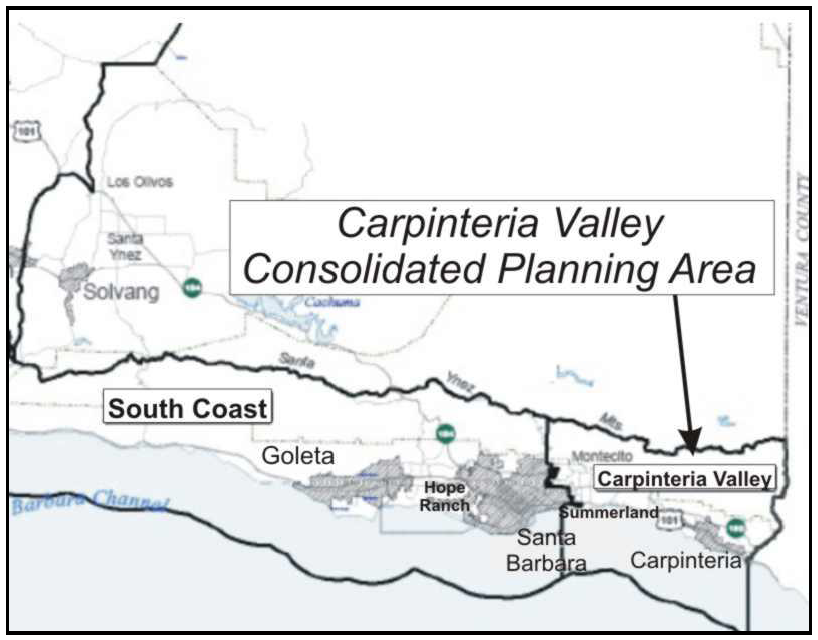
Figure 11-1 - Carpinteria Valley Consolidated Planning Area
Cemetery. An interment establishment that provides subdivided cemetery lots and burial plots or air space for sale. May include: animal cemeteries; cemetery, mausoleum (see also definition of Mausoleum), columbarium, and crematorium facilities, and accessory chapels. Mortuaries and funeral homes are defined separately.
Centerline of Street. A line that bisects the right-of-way of a street or highway into two equal parts. The centerline of the service road of a freeway or limited access highway shall be defined as the centerline of the traveled way of the service road.
Ceramic Product Manufacturing. An establishment that manufactures ceramic products, such as pottery, figurines, and small glazed tiles, utilizing only previously pulverized clay, provided that kilns are fired only by electricity or gas. Also see "Handcraft Industries and Small Scale Manufacturing," "Home Occupations."
Certified Farmers Market. A location and operation where agricultural products are sold by producers or certified producers directly to consumers in compliance with the State's Direct Marketing Regulations (California Code of Regulations Section 1392 et seq.) and the provisions of this Development Code.
Certified Farmers Market, Incidental. An incidental Certified Farmer's Market is a temporary and periodic use conducted in a parking lot or other open area on the site of another principle use.
Change of Use. The replacement of an existing use on a lot or any portion of a lot, by a new use, but does not include a change of ownership, tenancy, or management associated with a use for which the previous nature of the use will remain substantially unchanged.
Charitable Function. An event or activity whose primary purpose is of a charitable or noncommercial nature.
Charitable or Philanthropic Organization. An office-type facility occupied by an organization engaged in charitable or philanthropic works serving various groups or individual persons.
Chemical Product Manufacturing. An establishment that produces or uses chemicals and other establishments creating products predominantly by chemical processes. Examples of these products include: basic chemicals, including acids, alkalis, salts, and organic chemicals; chemical products to be used in further manufacture, including synthetic fibers, plastic materials, dry colors, and pigments; and finished chemical products to be used for ultimate consumption; or to be used as materials or supplies in other industries including paints, fertilizers, and explosives. Also includes sales and transportation establishments handling the chemicals described above, except as part of retail sales.
Child Care. See "Day Care."
Church. See "Meeting Facility, Religious."
Civil Code. The Civil Code of the State of California.
Clinic. See "Medical Services - Clinic, Urgent Care."
Clothing store. A retail outlet designed to sell clothing and clothing accessories.
Club. An organization, group or association supported by its members, having as a primary purpose the promotion of some common objective such as literature, science, politics or fellowship, but not including organizations, groups or associations whose primary purpose is to render a service customarily carried out as a business or formed to provide housing for its members. See also Meeting Facility
Coastal Act. The California Coastal Act of 1976, commencing with Public Resources Code Section 30000.
Coastal Commission. The California Coastal Commission created by and operating under the Coastal Act of 1976.
Coastal Land Use Plan (Coastal Plan). The Land Use Plan of the Santa Barbara County Local Coastal Program, including maps and text which indicate the kinds, location, and intensity of land uses and includes resource protection and development policies.
Coastal Zone. The land and water area within the County extending seaward to the State's outer limit of jurisdiction, including all offshore islands, and extending inland to the boundary shown on the official Coastal Zone Maps, as amended from time to time.
Cogeneration. The sequential use of energy for the production of electrical and useful thermal energy, as provided by Public Resources Code 25134.
Commercial Entertainment - Indoor. A facility accommodating and/or providing indoor amusement and recreation activities for a fee or admission charge. Examples of this land use include the following:
bowling alleys
card rooms
coin operated amusement arcades
dance halls, clubs and ballrooms
electronic game arcades (video games, pinball, etc.)
ice skating and roller skating
internet cafes
pool and billiard rooms as principle uses
This use does not include adult oriented businesses, which are separately defined and regulated in County Code Chapter 35, Article XIII. Does not include theaters, which are separately defined ("Theater"). May also include commercial facilities customarily associated with the above indoor commercial recreational uses, including bars and restaurants.
Commercial Entertainment - Outdoor. A facility accommodating and/or providing outdoor amusement and recreational activities for a fee or admission charge. Examples of this land use include the following:
amusement and theme parks
go-cart tracks
golf driving range
water slides
May also include commercial facilities customarily associated with the above outdoor commercial recreational uses, including bars and restaurants, video game arcades, etc. See also "Outdoor Festival."
Commercial Livestock Feed Yard. A place where livestock are confined for feeding prior to commercial sale or slaughter, where the number of livestock exceeds the normal carrying capacity of the combined carrying and feeding capacity of the property.
Commercial Vehicle. A vehicle or article of equipment used primarily in conjunction with a business or industrial use, but not including vehicles or equipment used primarily in conjunction with the permitted use of land in residential or agricultural districts.
Community Apartment. A development of real property in which an undivided interest in land is coupled with the right of exclusive occupancy of a designated apartment located thereon and therein.
Community Care Facility. Any facility, place or building that is licensed by the State and is maintained and operated to provide non-medical residential care, day treatment, adult day care, or foster family agency services for adults, children, or adults and children, including the physically handicapped, mental impaired, incompetent persons, and abused or neglected children.
Community Center. A public meeting place where members of a community may gather for cultural, public information, social, recreational, and other purposes. Also includes functionally related internal facilities such as kitchens, multi-purpose rooms, and storage. Does not include conference and meeting rooms accessory and incidental to another primary use that are typically used only by onsite employees and clients, and occupy less floor area on the site than the offices they support (see "Offices"). Does not include: sports or other commercial entertainment facilities (see "Theater," and "Sports and Entertainment Assembly"); or convention centers (see "Conference Center"). Related onsite facilities such as day care centers and schools are separately defined, and separately regulated.
Composting Facility. A commercial facility or agricultural operation that produces compost from the organic material fraction of the waste stream and is permitted, designed, and operated in compliance with the applicable regulations in California Code of Regulations, Title 14, Division 7.
Composting Operation. A commercial facility or agricultural operation that produces compost from the organic material fraction of the waste stream and is permitted, designed, and operated in compliance with the applicable regulations in California Code of Regulations, Title 14, Division 7.
Comprehensive Plan. The Santa Barbara County Comprehensive Plan, including the Coastal Land Use Plan and all Community or Area Plans, as it may be amended by the Board of Supervisors from time to time.
Concrete, Gypsum, and Plaster Product Manufacturing. An establishment that produces bulk concrete, concrete building block, brick, and/or other types of pre-cast and prefabricated concrete products. Also includes ready-mix concrete batch plants, lime manufacturing, and the manufacture of gypsum products, including plasterboard. A retail ready-mix concrete operation as an incidental use in conjunction with a building materials outlet is defined under "Building and Landscape Materials Sales."
Conditional Use. A use that requires a special degree of control because of characteristics peculiar to it, or because of size, technological processes or type of equipment, or because of the proposed site location with respect to surroundings, streets and existing improvements or demands upon public facilities. The additional control is to ensure that the particular use on the particular proposed site is compatible with other existing or permitted uses surrounding the site.
Condominium. As defined by Civil Code Section 1351, a development where undivided interest in common in a portion of real property is coupled with a separate interest in an individual unit, the boundaries of which are described on a recorded Final Map or Parcel Map.
Conference Center. A building or group of buildings with accessory land and structures, that provides conference facilities for persons assembled for study and discussion of educational, religious, economic, scientific, charitable, or governmental subjects, including music, art and drama, and shall include the necessary accessory and incidental housing, dining, classroom, and recreational facilities.
Conjunctive Use. The joint siting and use of property, structures, and/or parking for two or more non-residential land uses, where the hours of operation and demand for parking or services are such that efficiency and economy in services and land use is achieved. Typically the site is designed, and the days and hours of operation of the individual uses are collaboratively scheduled, so that a single site can serve more than one use.
Conservation or Open Space Easement. A nonpossessory interest in real property imposing limitations or affirmative obligations for the purpose of conserving, protecting, or retaining the open space values of the real property; ensuring its availability for agricultural, forest, recreational, or open space use; or protecting natural resources.
Contiguous. See "abut."
Contractor Equipment Storage Yard. Indoor or outdoor facilities operated by, or on behalf of a licensed contractor for the storage of equipment, vehicles, and/or other materials commonly used in the individual contractor's type of business; storage of materials used for repair and maintenance of the contractor's own equipment; and buildings or structures for uses including equipment repair. Includes building contractors, landscape contractors, sign contractors, etc. Does not include office-only facilities that are not located on the same site as storage and/or maintenance facilities, which are instead included under the definition of "Office - Business/Service." Does not include junk yards.
Convenience Store. A retail establishment offering for sale prepackaged food products, household items, and other goods.
Cosmetic and Pharmaceutical Manufacturing. The manufacturing and assembling, of cosmetics, soaps (not including refining or rendering of fats or oils), pharmaceuticals, toiletries, and similar products.
Cottage Food Employee. An individual, paid or volunteer, who is involved in the preparation, packaging, handling, and storage of a cottage food product, or otherwise works for the cottage food operation. An employee does not include an immediate family member or household member of the cottage food operator.
Cottage Food Operation. A commercial enterprise conducted within the registered or permitted area of a dwelling unit where the cottage food operator, as defined by California Health and Safety Code Section 113758, resides and where cottage food products are prepared or packaged for direct, indirect, or direct and indirect sale to consumers in compliance with California Health and Safety Code Section 113758.
Cottage Food Operator. An individual who operates a cottage food operation in his or her private home and is the owner of the cottage food operation.
Cottage Food Products. Nonpotentially hazardous foods, including foods that are described in California Health and Safety Code Section 114365.5 and that are prepared for sale in the kitchen of a cottage food operation.
Country Club, Swim and Tennis Club. A private membership recreational facility that may include swim and tennis facilities, fitness facilities, a restaurant, and related facilities. A country club may also be part of, or adjacent to a golf course.
County. The County of Santa Barbara, State of California. For the purposes of this Development Code, "County" includes the Santa Barbara County Board of Supervisors, Planning Commission, advisory agencies, appeals boards, agents, employees, and officers of Santa Barbara County.
Court. An open area other than a yard on the same lot with a building or buildings that is bounded on two or more sides by the building or buildings.
Creek Channel, Natural. A water course that has not been altered by human activity. Appears as a solid or dashed blue line on a USGS 7½-minute or 15-minute quadrangle map.
Creek, Top of Bank. The uppermost ground elevation paralleling a creek or watercourse where the gradient changes from a more defined vertical component to more horizontal.
Cultivated Agriculture, Orchard, Vineyard. Commercial agricultural production field and orchard uses, including the production of the following, primarily in the soil on the site and not in containers, other than for initial propagation prior to planting in the soil on the site. Examples of this land use include the following:
field crops
flowers and seeds
fruits
grains
melons
ornamental crops
tree nuts
trees and sod
vegetables
wine and table grapes
Also includes associated crop preparation services and harvesting activities, such as mechanical soil preparation, irrigation system construction, spraying, and crop processing. Does not include agricultural processing or greenhouses which are separately defined. Does not include non-commercial home gardening, which is allowed as an accessory use without County approval in all zones that otherwise allow residential uses. Activities that constitute grading are separately regulated under Chapter 14 of the County Code.
1.
Limited Slope. For the purposes of the MT-GOL and MT-TORO zones, "Cultivated Agriculture, Orchard, Vineyard - Limited Slope" means that the listed new or expanded agricultural activities occur on slopes of 40 percent or less, or on slopes greater than 40 percent where the cumulative area of disturbance (pre-existing and proposed) totals five acres or less.
2.
Steep Slope. For the purposes of the MT-GOL and MT-TORO zones, "Cultivated Agriculture, Orchard, Vineyard - Steep Slope" means that the listed new or expanded agricultural activities occur on slopes greater than 40 percent, where the cumulative area of disturbance (pre-existing and proposed) exceeds five acres.
3.
Historic Legal Use. "Cultivated Agriculture, Orchard, Vineyard - Historic Legal Use" means that there is evidence of a permitted or legal nonconforming use on the site within the previous 10-year period.
D.
Definitions, "D."
Dairy. A commercial operation where three or more cows or goats are maintained to produce milk or other dairy products for sale.
Day Care. Facilities that provide non-medical care and supervision of adults or minor children in need of personal services, supervision or assistance essential for sustaining the activities of daily living or for the protection of the individual for periods of less than 24 hours. These facilities include the following which may be required to be licensed by the County or the State unless they are able to operate legally without a license in compliance with County and State laws.
1.
Day Care Center. A commercial or non-profit use designed and approved to accommodate 15 or more adults or children. Includes facilities providing overnight care, providing that said care is for periods of less than twenty-four hours per day. A day care center may be operated in conjunction with a school or church facility, or as an independent land use. The owner or operator of a residential day care center is not required to reside at the day care center.
a.
Non-dwelling, principal use. A day care center where group care is provided in a structure not used as a dwelling unit.
b.
Non-dwelling, accessory. A day care center that is within or on the site of another use and provides day care services for occupants of the other use.
c.
Dwelling, accessory. A day care center where group care is provided in a dwelling for 15 or more adults or children, including adults or children who reside at the dwelling.
2.
Family Day Care Home, serving adults. A one-family dwelling whose regular and permanent occupant(s) provides, on a regular basis care, protection, and supervision for 14 or fewer adults for periods of less than 24 hours per day while the parents or guardians are away. Family day care homes serving adults shall be classified as follows:
a.
Large Family Day Care Home, serving adults. A day care facility that provides care for seven to 14 adults, inclusive.
b.
Small Family Day Care Home, serving adults. A day care facility in a one-family dwelling where an occupant of the residence provides family day care for six or fewer adults.
3.
Family Day Care Home, serving children. A facility (in a detached single-family dwelling, a townhouse, a dwelling unit within a dwelling, or a dwelling unit within a covered multifamily dwelling in which the underlying zoning allows for residential uses) that regularly provides care, protection, and supervision for 14 or fewer children, in the provider's own home, for periods of less than 24 hours per day while the parents or guardians are away. Family day care homes serving children shall be classified as follows:
a.
Large Family Day Care Home, serving children. A day care facility that provides care, protection, and supervision for seven to 14 children, inclusive, including children under the age of 10 years who reside at the home, as set forth in Health and Safety Code Section 1597.465 and as defined in state regulations, as may be amended.
b.
Small Family Day Care Home, serving children. A day care facility provides care, protection, and supervision for eight or fewer children, including children under the age of 10 years who reside at the home, as set forth in Health and Safety Code Section 1597.44 and as defined in state regulations, as may be amended.
Debris Flow. A saturated mass of loose particles, including rock, earth, and other debris, that travels down a slope and often into creek and/or stream channels.
Defensible Space. An area surrounding a building or structure where basic wildfire protection practices are implemented, providing the key point of defense from an approaching wildfire or escaping structure fire. The area is characterized by the establishment of fuel modification measures. Defensible space is required in State and Local Responsibility Areas as defined by the County Fire Department. The area of required defensible space around all buildings and structures is as required by the County Fire Department Defensible Space Standards.
Delicatessens. A retail business primarily selling foods that are already prepared or require little preparation for serving, such as cheeses, cooked meats, and salads.
Density. The maximum number of dwelling units permitted per specified area of land.
Density Bonus. See Density Bonus Program.
Density Bonus Program. Refers to the state mandated Density Bonus Program (Government Code Section 65915 et seq.) that entitles qualified housing projects to a density increase, incentives or concessions, waivers or reductions of development standards, and/or parking ratios as outlined in Chapter 35.32 (Density Bonus Program).
Department. The Santa Barbara County Planning and Development Department, referred to in this Development Code as the "Department."
Desalination facility. A facility specifically designed to remove salts and other chemicals from sea water to render it potable.
Detached Structure. A structure, no part of which is attached by any means to any other structure.
Determination, Use. An action by the Commission determining and/or finding that a use not identified as an permitted use in a specific zone is similar in nature and/or character to the other permitted uses in that zone and is not more injurious to the health, safety, or welfare of the neighborhood because of noise, odor, dust, vibration, traffic congestion, danger to life and property, or other similar causes, and is therefore also considered a permitted use.
Development. A change made by a person to unimproved or improved real property, including the placement, the moving, construction, reconstruction, enlarging, demolition, or alteration of buildings or structures, landscaping improvements, mining excavation, or drilling operations. Agricultural improvements as defined are not considered as development within this Development Code.
Development Code. The Santa Barbara County Land Use & Development Code, Section 35-1 of Chapter 35, Zoning, of the Santa Barbara County Code.
Dining Commons. A facility accessory to a residence hall and used primarily for preparing and serving food to residence hall occupants and which excludes service to the general public.
Director. The Director of the Santa Barbara County Planning and Development Department, including designees of the Director, referred to in this Development Code as "the Director."
Direct Sale. A transaction between a cottage food operation operator and a consumer, where the consumer purchases the cottage food product directly from the cottage food operation. Direct sales include transactions at holiday bazaars or other temporary events, such as bake sales or food swaps, transactions at farm stands, certified farmers' markets, or through community-supported agriculture subscriptions, and transactions occurring in person in the cottage food operation.
Distillation Column or Tower. A tall, cylindrical vessel in which a liquid or vapor mixture of two or more substances is separated into its component fractions of desired purity, by the application and removal of heat.
Drainage Channel. A channel, either natural or manmade, that conveys water.
Drive-through Facility. A facility where customers wait in line in their vehicles to progress to a service point at which they briefly transact business from their vehicles and then leave the premises. Includes banks (motor banks, drive-through banks, drive-up banks), fast food establishments, and film deposit and pickup establishments. Does not include drive-in movies, drive-in car washes through which the vehicles do not travel on their own power, drive-in food establishments where customers do not wait in line in their vehicles for service, or gas stations.
Driveway.
1.
A designated passageway providing vehicular access between an alley or street and a garage or carport, a designated parking area, or other driveway or street.
2.
A private right-of-way that provides the principal means of vehicular access from a public right-of-way to four or fewer lots that, in aggregate, under the minimum lot area requirements of this Development Code, cannot be divided into more than four lots.
Driving Range. See "Golf Driving Range."
Duplex. See "Dwelling, Two-Family."
Dwelling. A room or group of rooms with interior access between all habitable rooms, including permanent provisions for living, sleeping, eating, cooking, bathing and sanitary facilities, constituting a separate and independent housekeeping unit, occupied or intended for occupancy by a family on a non-transient basis and having not more than one kitchen. Boarding or rooming houses, dormitories, and hotels are not dwellings.
Dwelling, Multiple. A building or portion of a building, designed for and occupied exclusively by three or more families, and containing three or more dwellings. Includes triplexes, apartment houses, apartment hotels, condominiums, community apartment projects, flats, rowhouses, and townhouses, but does not include organizational houses, trailer courts or camps, motels, hotels or resort type hotels.
Dwelling, One-Family. A building designed for and occupied exclusively by one family and containing one dwelling. Also known as a Single Family Dwelling.
Dwelling, Two-family. A building designed for and occupied exclusively by two families, and containing two dwellings.
E.
Definitions, "E."
Eastern Goleta Valley Community Plan Area. That portion of the County located within the boundaries of the Eastern Goleta Valley Community Plan as shown on the map titled Eastern Goleta Valley Community Plan Land Use Designations.
Education or Research Facility, Limited. Limited facilities or developments for educational purposes or scientific research, e.g., water quality monitoring stations, access roads, storage facilities).
Educational Experiences and Opportunities. An agricultural enterprise use, operated on a commercial basis, consisting of the following uses: small guided tours of a farm or ranch; academic and technical training for farmers and ranchers in all areas of the agricultural sciences and agricultural business; and educational workshops and experiences for the general public regarding the agricultural and natural resources on the premises including large guided farm and ranch tours, botany, bird and wildlife viewing and studies, photography, astronomy, and other similar agricultural, natural resources, and cultural educational experiences.
Electrical Substation, Major. A substation that receives and transmits electric energy directly from a generating source, the primary purpose of which is to receive the energy at its transmission voltage from the generator, and to transform the energy by lowering the voltage.
Electrical Substation, Minor. A substation that receives electric energy from transmission or distribution lines at voltages below the generation voltage, and transmits the energy at voltages suitable for domestic and non-residential consumers.
Electrical Transmission Line. A line that is interconnected with other transmission lines and associated equipment for the movement or transfer of electric energy between points of supply and points at which it is transformed for delivery to customers or is delivered to other electric systems.
Electronics Assembly. Assembly of:
electrical appliances
electronic instruments and devices
radios
phonographs
televisions
Includes the manufacture of small parts only, such as coils, condensers, transformers, crystal holders, transistors, capacitors, resistors, etc.
Electronics Equipment Manufacturing. An establishment that manufactures equipment, apparatus, and/or supplies for the generation, storage, transmission, transformation and use of electrical energy, including:
aviation instruments
computers, computer components, peripherals
electrical transmission and distribution, equipment
electrical welding apparatus
electronic components and accessories, semiconductors, integrated circuits, related devices
industrial controls
instruments for measurement, testing, analysis and control, associated sensors, and accessories
lighting and wiring equipment including lamps and fixtures, wiring devices, vehicle lighting
miscellaneous electrical machinery, equipment and supplies, including batteries, X-ray apparatus and tubes, electro-medical and telephone and telegraph apparatus electrotherapeutic apparatus, electrical equipment for internal combustion engines
motors and generators
optical instruments and lenses
photographic equipment and supplies
radio and television receiving equipment
scientific instruments and equipment
storage media, blank and pre-recorded, including magnetic, magneto-optical, and optical products such as compact disks (CDs), computer diskettes and hard drives, digital versatile disks (DVDs), magnetic tape products, phonograph records, etc.
surgical, medical and dental instruments, equipment, and supplies
surveying and drafting instruments
transformers, switch gear and switchboards
watches and clocks
Does not include testing laboratories (soils, materials testing, etc.) (see "Business Support Services"), or research and development facilities separate from manufacturing (see "Research and Development").
Emergency. A sudden unexpected occurrence demanding immediate action to prevent or mitigate loss or damage to life, health, property, or essential public services. The definition extends to efforts by a public agency or utility performing a public service to restore, repair or maintain public works, utilities or services which have been destroyed, damaged, or interrupted by natural disaster, serious accident, or in other cases of emergency.
Emergency Shelter. Housing with minimal supportive services for homeless persons. Emergency shelters may include other interim interventions, including, but not limited to, a navigation center, bridge housing, and respite or recuperative care.
Employee-Serving Retail. Small-scale retail uses located in stores, shops, or establishments supplying commodities intended to meet the day-to-day needs of industrial research park employees in the vicinity.
Energy Facility. A public or private processing, producing, generating, storing, transmitting, or recovering facility for electricity, natural gas, petroleum, coal, or other source of energy. The following definitions apply only to those facilities subject to Chapter 35.56 (Oil/Gas Land Uses - Abandonment and Removal Procedures).
1.
Abandoned (or Abandonment). The discontinuance of a permitted land use, or any independent business function of a permitted land use, and there is no evidence of a clear intent on the part of the owner to restart operations of the permitted land use, or the independent business function of a permitted land use.
2.
Idled (or Idle). A permitted land use or an independent business function of a permitted land use has had a zero throughput (enter and exit) for a period of one continuous year.
3.
Natural Conditions. The reasonable and feasible return of land to a state that reflects the natural environment of the area without development. Retention of certain improvements or other items including pipeline support footings would qualify as natural conditions if their removal would result in undesired environmental outcomes such as destabilization of slopes due to removal of a retaining wall. Natural conditions do not necessarily equate to original or pre-development conditions.
4.
Permitted Land Use. Any land use, facility, activity, or site subject to Chapter 35.56 (Oil/Gas Land Uses - Abandonment and Removal Procedures).
5.
Reclamation. As used in Chapter 35.56 (Oil/Gas Land Uses - Abandonment and Removal Procedures) of this Development Code, reclamation shall mean conversion of a host site to natural conditions, or other conditions, in compliance with applicable laws and permits, including remediation of contamination, contouring of topography, re-vegetation and landscaping.
Environmental Review. The analysis of the potential environmental effects that may result from development, performed in compliance with the California Environmental Quality Act (Public Resources Code Sec. 21000 et seq.) and the Guidelines for Implementation of the California Environmental Quality Act (Public Resources Code Sec. 15000 et seq.) and the County of Santa Barbara Environmental Thresholds and Guidelines Manual.
Environmentally Sensitive Habitat Area. An area in which plant or animal life or their habitats are either rare or especially valuable because of their special nature or role in an ecosystem, and that could be easily disturbed or degraded by human activities and developments.
Equestrian Facility. A commercial facility for the boarding of horses, donkeys, and mules, and where such animals are available for hire. Examples of these facilities include:
boarding stables
horse exhibition facilities
riding schools and academies
Also includes barns, stables, corrals, and paddocks accessory and incidental to the above uses. Does not include rodeos (see "Rodeo"), or polo fields (see "Sports and Outdoor Recreation Facility").
Equipment Rental. A service establishment that may offer a wide variety of household and business equipment, furniture, and materials for rental. Does not include construction equipment rental, which is separately defined.
Existing Developed Rural Neighborhood. An area shown on the Comprehensive Plan maps within which development has occurred historically with lots smaller than those found in the surrounding Rural or Inner Rural Areas.
Explosive. A substance defined as an explosive by California Health and Safety Code Sections 12000, et seq., and for which a permit is required by the Health and Safety Code.
Explosives, Fireworks, and Ordinance Manufacturing. The commercial manufacturing and storage of all types of explosives, including blasting powder and blasting caps, dynamite, petards, fireworks, gunpowder, high explosives, and the manufacture of conventional explosives for weapons use (including ammunition, bombs, missile warheads, etc.).
F.
Definitions, "F."
Façade. That portion of any exterior elevation of a structure extending from grade to the eaves or the top of the parapet wall and the entire width of the structure elevation.
Fairgrounds. An area of land where a fair or exhibition is held.
Family. One or more persons occupying premises and living as a single housekeeping unit not operated for profit, as distinguished from two or more persons occupying a boarding or lodging house, hotel, club, or similar structure used for residential purposes. A family shall not include a fraternal, religious, social, or business organization. A family shall be deemed to include domestic servants employed by the family. A family shall also be deemed to include the clients and operators of a residential facility licensed by the State that serves six or fewer clients.
Family Day Care. See "Day Care."
Farm Employee Dwelling. See Agricultural Employee Housing. Also includes farmworker employee housing.
Farmers' Market. See "Certified Farmers' Market."
Farm Labor Camp. One or more structures used as a dwelling for five or more farm employees who are engaged full-time in agriculture either on or off the site where the structure is located.
Farm Stand. A structure, which may be of permanent or temporary construction, that sells farm produce and other incidental items
Farmstay. Transient lodging visitor-serving accommodations provided as part of a working farm or ranch operation.
Farm Supply and Feed Store. A retail business selling supplies for use in soil preparation and maintenance, the planting and harvesting of crops, the keeping and raising of farm animals, and other operations and processes pertaining to farming and ranching. Does not include the sale, rental, or repair of farm machinery and equipment, which is instead included in the definition of "Truck, Trailer, Construction, Farm, and Heavy Equipment Sales/Rental."
Farmworker Housing. The following terms and phrases are defined for the purposes of Section 35.42.135 (Farmworker Housing).
1.
Farmworker. An agricultural employee as defined in the California Labor Code Section 1140.4(b).
2.
Farmworker employee housing. Any housing accommodation that provides housing for farmworkers and complies with the California Health and Safety Code. Farmworker employee housing consists of either of the following:
a.
Farmworker dwelling unit. A single-family dwelling that provides accommodations for six or fewer farmworkers at any one time. A farmworker dwelling unit shall be considered as a single-family dwelling, and permitted and regulated in the same manner by this Development Code.
b.
Farmworker housing complex. Farm employee housing other than a farmworker dwelling unit that contains a maximum of 36 beds if the housing consists of any group living quarters, such as a barrack or a bunkhouse, or contains a maximum of 12 residential units. A farmworker housing complex shall be occupied exclusively by farmworkers and their households.
3.
Permanent employee housing. Any labor camp which is not temporary or seasonal(California Health and Safety Code Section 17010(c)).
4.
Seasonal employee housing. Any camp which is operated annually on the same site and which is occupied for not more than 180 days in any calendar year (California Health and Safety Code Section 17010(b)).
5.
Temporary employee housing. A labor camp which is not operated on the same site annually and which is established for one operation and is then removed (California Health and Safety Code Section 17010(a)).
Feasible. Capable of being accomplished in a successful manner within a reasonable period of time, taking into account economic, environmental, legal, social, and technological factors.
Feed Distribution. The storage and dispersal of animal feed for the purpose of supporting the primary onsite animal raising activities.
Feedstock. Any decomposable material used as a basis for the manufacture of compost.
Fertilizer Plant. A manufacturing facility where chemical fertilizers are manufactured and packaged, and/or where animal fertilizers are collected, processed and packaged.
Fill.
1.
A deposit of earth, sand, gravel, rock or any other suitable materials placed by artificial means; any act by which earth, sand, gravel, rock or any other suitable material is placed, pushed, dumped, pulled, transported or moved to a new location above the natural surface of the ground or on top of the stripped surface and shall include the conditions resulting therefrom.
2.
The difference in elevation between a point on the original ground and a designated point of higher elevation on the final grade, as measured in a vertical plane.
Fire Protection Plan. A written plan that identifies the fire risk associated with a project and develops requirements for fire protection including but not limited to water supply, defensible space, fuel modification and vegetation management, emergency ingress and egress, access, special event parking, and resident and visitor safety.
Firewood Processing and Sales. The conversion of raw plant material into firewood and the sale thereof.
First Public Road Paralleling the Sea. The nearest road to the sea that is dedicated for public use to a public agency, and is in fact improved and suitable for public use. In the event a public road does not connect with other public roads, the first public road paralleling the sea shall mean the first public road that in fact connects with other public roads providing a continuous public access system paralleling the shoreline.
Fish Cannery. Manufacturing establishment producing or processing fish products.
Fishing. The activity of catching fish, either for food or as a sport.
Fishing Operation. Commercial, recreational fishing within an artificial pond or reservoir that is stocked with fish.
Fitness/Health Facility. A commercial fitness center, gymnasium, health and athletic club, which may include any of the following: climbing rocks (which may be outdoors), sauna, spa or hot tub facilities; swimming pools; indoor or outdoor handball, racquetball, tennis, volleyball, and other sport court activities; weight rooms; outdoor volleyball courts.
Fitness/Health Facility, Accessory. A fitness/health facility restricted to the employees of the principle use.
Flare Stack. A tall, specially constructed vertical pipe or stack used to safely dispose of hydrocarbon vapors or, in an emergency, to dispose of process feed.
Flood control. The act or technique of trying to control water with dams, berms, drainage, weirs, etc., to minimize occurrence of floods.
Flood Plain. Any land area susceptible to being inundated by water from any source, as defined within County Code Chapter 15A (Flood Plain Management) which may be amended from time to time.
Floodway. The channel of a stream, plus any adjacent flood plain area, that must be kept free of encroachment so that the 100-year flood will be accommodated without substantial increase in flood height, as defined within County Code Chapter 15A (Flood Plain Management) which may be amended from time to time. As minimum standards, the Federal Insurance Administration limits such increases in flood heights to one foot, provided that hazardous velocities are not produced.
Floodway Fringe. The area between the floodway and the boundary of the 100-year flood, and which encompasses the portion of the flood plain that could be completely obstructed without increasing the water-surface elevation of the 100-year flood more than one foot at any point, as defined within County Code Chapter 15A (Flood Plain Management) which may be amended from time to time.
Floor Area, Gross. The area included within the surrounding exterior walls of all floors or levels of a building or portion thereof, exclusive of vent shafts and unroofed courtyards, as measured to the interior surfaces of exterior walls, or from the centerline of a common or party wall separating two buildings, and including:
1.
Corridors and halls;
2.
Stairways;
3.
Elevator shafts;
4.
Closets, storage, service, utility and mechanical equipment rooms;
5.
Attached garages;
6.
Open or roofed porches, balconies, or porticos;
7.
Roofed arcades, plazas, courts, walkways, or breezeways;
8.
Permanently roofed and either partially enclosed or unenclosed, building features used for sales, service, display, storage or similar uses;
9.
Basements, cellars or attic areas where the floor to ceiling height is six feet or greater and that are deemed usable by the Building Official; and
10.
In residential zones, additionally all roofed porches, arcades balconies, porticos, breezeways or similar features when located above the ground floor.
The gross floor area of a structure that lacks walls shall be the area of all floors or levels included under the roofed or covered area of the structure.
This definition shall not apply to accessory dwelling units and junior accessory dwelling units, which shall be subject to the definition of "floor area" as defined in Section 35.42.015 (Accessory Dwelling Units and Junior Accessory Dwelling Units). The gross floor area, as defined above, of any existing or proposed accessory dwelling unit or junior accessory dwelling unit shall be included in any total gross floor area calculations of the subject lot.
Floor Area, Net. The gross floor area excluding shafts, stairways, corridors and halls, unusable attics, and unenclosed porches and balconies.
Floor Area, Net - Commercial - Summerland. The gross floor area excluding shafts, stairways, unusable attics, unenclosed porches and balconies, and any areas with a ceiling height of less than five feet above finished floor.
Floor Area, Net - Residential - Summerland. The total floor area of all floors of a primary residence on a residential lot or on a lot devoted to a residential use as measured to the interior surfaces of exterior walls, or from the centerline of a common or party wall separating two structures, excluding any areas with a ceiling height of less than five feet above finished floor, unenclosed porches, balconies and decks. Interior stairs shall be counted on only one floor.
Floor Area Ratio (FAR) - Summerland. A measurement of development intensity represented by the quotient of the Net Floor Area of a structure divided by the Net Lot Area.
Floor Below Grade - Summerland. A floor wholly or partially below grade.
Food and Beverage Product Manufacturing. Manufacturing establishments producing or processing foods and beverages for human consumption, and certain related products. Examples of this land use include the following:
bottling plants
breweries
candy, sugar, confectionery products manufacturing
catering services separate from stores or restaurants
coffee roasting
dairy products manufacturing
fruit and vegetable canning, preserving, and related processing
grain mill products and by-products
miscellaneous food item preparation from raw products
soft drink production
Does not include: bakeries, which are separately defined; manufacturing of fish, meat, sauerkraut, vinegar, yeast; or refining of fats and oils.
Foundry. A facility that produces cast-metal products.
Fraction Lot. A lot created as a result of an instrument of conveyance, in which the lot is not separately conveyed as a distinctly described parcel. Fraction lots are identified by overlaying separate legal descriptions of real property within an area of land and then making reference to the cumulative boundary lines to describe parcels derived by their intersections. Fraction lots do not include remainder lots, which result from the conveyance of a separate and distinct legal description of real property, where the described property is conveyed to a new owner and the remainder portion is retained by the seller.
Freeway. A defined by the Comprehensive Plan, a four or six lane divided arterial highway with full control of access and with grade separations at intersections. As the highest type of road facility, Freeways provide maximum service and safety for through traffic. Freeways serve as the principal arterials of the inter- and intra-state system of highways, carrying traffic between cities, traffic generators and points of interest.
Freight Terminal. A transportation facility furnishing services incidental to air, motor freight, and rail transportation. Examples of these facilities include:
freight forwarding services
freight terminal facilities
home and business moving and storage services
joint terminal and service facilities
overnight mail processing and deliver dispatch facilities
packing, crating, inspection and weighing services
postal service bulk mailing distribution centers
Does not include "U-Haul" operations which are defined under Truck, Trailer, Construction, Farm, Heavy Equipment Sales/Rental.
Front Line. The shortest boundary line of a lot which corresponds with a street line; the boundary lines of a through lot which corresponds with street lines shall be "front lines." When the street side boundary lines of a corner lot, are of equal or of substantially equal lengths, the front line shall be the line located on the principal (more heavily trafficked) street.
Fuel Dealer. A retail trade establishment that sells fuel oil, butane, propane and liquefied petroleum gas (LPG), bottled or in bulk, to consumers.
Fuel Modification. An area where the volume of flammable vegetation has been reduced, providing reduced fire intensity and duration. Fuel modification includes ongoing requirements for removal of dead vegetation, litter, vegetation that might grow into overhead power lines, certain ground and ladder fuels, and limbing of live trees.
Fully enclosed or fully screened structure. A structure, constructed of permanent, solid materials, with a roof that completely covers the structure, doors or gates that are kept closed and latched, and walls that extend from the foundation floor either to the roof of the structure or to a sufficient height such that any contents of the fully enclosed or fully screened structure are not visible when viewed from the outside other than when viewed through a window. A fully enclosed or fully screened structure does not include a carport or other accessory structure that allows the contents therein to be observed from outside the structure other than when viewed through a window. Does not include awnings, fabric shelters, tents and similar structures of a nonpermanent type of construction.
Furniture and Fixtures Manufacturing, Cabinet Shop. Manufacturers producing: wood and metal household furniture and appliances; bedsprings and mattresses; all types of office furniture and partitions, shelving, lockers and store furniture; and miscellaneous drapery hardware, window blinds and shades. Includes furniture repair and re-upholstering businesses, wood and cabinet shops, but not sawmills or planing mills, which are instead included under "Lumber and Wood Product Manufacturing."
Furniture, Furnishings, and Appliance/Equipment Stores. A store that primarily sells the following products and related services, that may also provide incidental repair services:
computers and computer equipment
draperies
floor coverings
furniture
glass and chinaware
home appliances
home furnishings
home sound systems
interior decorating materials and services
musical instruments
office furniture
other household electrical and gas appliances
outdoor furniture
pool tables
refrigerators
spas; hot tubs; swimming pools; and related supplies
stoves
televisions
G.
Definitions, "G."
Garage, Private. A building or portion thereof used or designed to be used as an accessory building for the storage of motor vehicles for use by the occupants of the same site.
Garage, Public. A building or portion thereof, except a private garage, used or designed to be used for storage and care of motor vehicles or where any such vehicles are repaired or kept for remuneration, hire or sale.
Gaviota Coast Plan Area. That portion of the County located within the boundaries of the Gaviota Coast Plan as shown on the Gaviota Coast Plan Land Use Map.
General Retail. Stores and shops selling many lines of merchandise. Examples of these stores and lines of merchandise include:
Does not include adult oriented businesses, which are separately defined and regulated under Article VIII (Sexually Oriented Business Regulations) of County Code Chapter 35.
Generator. See "Hazardous Waste."
Generator Permit. See "Hazardous Waste."
Glide Path Ratio. A ratio that relates the height of aircraft above a point on the ground to the distance of that point to the nearest end of the runway.
Goleta Community Plan Area. That portion of the County located within the boundaries of the Goleta Community Plan as shown on the maps titled Goleta Community Plan Land Use Designations South and Goleta Community Plan Land Use Designations North, including the western area but excluding the Eastern Goleta Valley Community Plan area.
Golf Course. A commercial or members-only facility for playing golf, with three to 18 holes, and accessory facilities and uses which may include: a clubhouse with bar and/or restaurant, locker and shower facilities; driving ranges; "pro shops" for onsite sales of golfing equipment; and golf cart repair, storage and sales facilities. Does not include driving ranges separate from golf courses or miniature golf courses unless specifically allowed.
Golf Driving Range. An area designated for hitting golf balls for practice drives. This activity is included under the definition of "Golf Course" if part of a golf course, and under the definition of "Commercial Entertainment - Outdoor" if not part of a golf course.
Government Code. The Government Code of the State of California.
Grade, Existing. The existing condition of the ground elevation of the surface of a building site at the time or permit application, including Board of Architectural Review applications, that represent either (1) the natural grade prior to the placement of any fill on the site or the excavation or removal of earth from the site, or (2) the manufactured grade following the completion of an approved grading operation, including grading approved in conjunction with the subdivision of the site.
Grade, Finished. The level of the finished surface of the site that results from any permitted grading activities, including cut and fill of existing slopes associated with specific permit applications.
Grading. Any excavation or filling of earth or combination thereof.
Grazing. To put livestock out to feed.
Greenhouse. A structure, including a hothouse, used for the indoor propagation of plants that has permanent structural elements (e.g. footings, foundations) that is typically constructed with a translucent roof or walls, and may have utility facilities (e.g., electrical, natural gas, plumbing).
Grocery and Specialty Food Store. A retail business where the majority of the floor area open to the public is occupied by food products packaged for preparation and consumption away from the store; however, areas for the on-premises sale and consumption of both packaged food products and specially prepared food items such as salads and sandwiches are allowed. Includes delicatessens, and retail bakeries where any onsite baking is only for onsite sales.
Groundwater. Water located below the land surface in the saturated zone of the soil or rock. Groundwater includes perched water tables, shallow water tables, and zones that are seasonally or permanently saturated.
Guesthouse. Detached living quarters of a permanent type of construction without kitchen or cooking facilities, used primarily for temporary guests of the occupants of the principal building on the lot, and not rented or otherwise used as a separate dwelling.
Guest Ranch. See "Lodging."
H.
Definitions, "H."
Habitable. Space within a building that is suitable for living, sleeping, eating, cooking and which may or may not be conditioned (e.g., heated, cooled).
Habitable Room. A space intended for living, sleeping, eating, or cooking, including living rooms, dining rooms, bedrooms, kitchens, dens, family rooms, recreation rooms, and enclosed porches suitable for year-round use. Specifically excluded are balconies, bathrooms, foyers, garages, hallways, laundries, open porches, pantries, storage closets, utility rooms, unfinished attics and basements, other unfinished spaces used for storage, and water closets.
Handcraft Industry, Small-Scale Manufacturing. Establishments manufacturing and/or assembling small products primarily by hand, including jewelry, musical instruments, novelties, pottery and other ceramics, toys, as wells as small glass and metal art and craft products.
Hazardous Waste. A waste, or combination of wastes, which because of quantity, concentration or physical, and chemical characteristics may either a) cause or significantly contribute to an increase in mortality or an increase in serious irreversible or incapacitating reversible illness, or b) pose a substantial present or potential hazard to human health or the environment when improperly treated, stored, transported, disposed or otherwise managed. Hazardous waste also includes the materials described in California Code of Regulations Title 22, Division 4.5, Chapter 11.
1.
Business Plan. The plan that a business with specified quantities of hazardous materials (including wastes) must prepare in compliance with Health and Safety Code Chapter 6.95. The business plan must include an inventory of hazardous materials onsite, an emergency response plan and employee training procedures.
2.
Generator. The person, business or facility who by nature or ownership, management or control is responsible for causing or allowing to be caused the creation of hazardous waste.
3.
Generator Permit. The annual permit to operate which all generators of hazardous waste must obtain from the County. Through the generator permit program, the County ensures that generators of hazardous waste store, treat, transport and dispose of hazardous waste in accordance with state and federal laws.
4.
Hazardous Waste Management Plan. The plan prepared in compliance with California Health and Safety Code Section 25135 by counties and certain regions to direct the management of hazardous wastes within the boundaries of the affected jurisdiction.
5.
Hazardous Waste Element. The Hazardous Waste Management Plan, adopted as an Element of the Comprehensive Plan.
6.
Waste Minimization. The reduction, to the maximum extent feasible, of hazardous waste that is generated or subsequently stored, treated or disposed. Waste minimization is a reduction in the total volume or quantity of hazardous waste, and minimizes the present and future threats to human health and the environment. As used in the Hazardous Waste Management Plan and this Development Code, waste minimization includes source reduction, recycling and onsite treatment of hazardous wastes.
Hazardous Waste Management Facility, Offsite. A facility that accepts hazardous wastes from more than one generator, including the following:
1.
Storage Facility. A hazardous waste facility at which hazardous waste is contained for a period greater than 96 hours at an offsite facility or for periods greater than 90 days at an onsite facility, with specified exceptions. (California Health and Safety Code, Section 25123.3.).
2.
Transfer Station. A facility where hazardous waste from more than one source is collected and consolidated for shipment to a treatment recycling, and/or disposal facility or facilities.
3.
Treatment Facility. A facility where the toxicity, chemical form, and/or volume of a hazardous waste is altered.
4.
Recycling Facility. A facility engaged in the process of reclaiming, using or reusing hazardous waste.
5.
Residual Repository. A disposal facility for the long-term storage of the byproducts of treated hazardous waste for which there is no further practical treatment.
Hazardous Waste Management Facility, Onsite. A facility that stores, treats, recycles, and/or disposes of hazardous waste generated only within the facility's boundaries.
Health Club, Spa. A fitness center, gymnasium, health and athletic club, which may include any of the following: sauna, spa or hot tub facilities; swimming pools; handball, racquetball, tennis, volleyball, and other sport court activities; weight rooms.
Health and Safety Code. The California Health and Safety Code.
Height Limit. The maximum allowed height of a structure as established by an imaginary surface located at the allowed number of feet above and parallel to the existing grade (see Section 35.30.090 (Height Measurement, Exceptions and Limitations)).
Heliport. A designated, marked area on the ground or on a structure where helicopters may land at any time.
Highway. See "Street."
Highway 101 Corridor. Any property shown on the Zoning Map (within 500 feet of the centerline of Highway 101 at time of adoption) in the area between the Ventura County line and Eagle Canyon.
Hillside. Land with slopes exceeding 20 percent.
Historical Park. An area designated by the county, state or federal government within which the buildings, structures, appurtenances or places are of basic and vital importance because of their association with history, or because of their unique architectural detail, or because of their being a part of or related to a square, park, or area the design or general arrangement of which should be preserved and/or developed according to a fixed plan based on cultural, historical or architectural motives and purposes, see Section 35.42.180 (Historical Parks).
Hog Ranch. A site used for the raising or keeping of more than six hogs.
Home Occupation. A commercial activity conducted entirely within the dwelling portion of a dwelling by residents of the dwelling, or conducted entirely within an artist studio by a person residing in a dwelling on the same lot.
Homestay. See "Lodging."
Hoop Structure. A structure consisting of a light-weight, frame with no permanent structural elements (e.g. footings, foundations, plumbing, electrical wiring) and an impermeable, removable covering used to protect plants grown in the soil or in containers upon the soil. Includes structures commonly known as berry hoops and hoop houses.
Hospital. See "Medical Services - Hospital."
Hostel. See "Lodging."
Hotel. See "Lodging."
Hotel, Resort. See "Lodging."
Household, or Housekeeping Unit. A person or group of persons living together in a single dwelling unit, with common access to and common use of all living and eating areas and all areas and facilities for the preparation and storage of food within the dwelling unit.
Household Pet. Animals that are customarily kept within a dwelling or a yard for the personal use or enjoyment of the residents. Household pets include domestic birds, cats and dogs, fish, rabbits, rodents and snakes, but do not include horses, mules, goats, cows, hogs, or other similar size animals, or roosters or peacocks.
Housing Development. As used in Chapter 35.32 (Density Bonus Program), Density Bonuses and other Incentives for Affordable Housing, a housing development is a development project for five or more residential units, including mixed-use developments and shared housing buildings, as defined by Government Code Section 65915(o) or successor statute. Housing development also includes a subdivision or common interest development approved by the Department which consists of residential units or unimproved residential lots and either a project to substantially rehabilitate and convert an existing commercial building to residential use or the substantial rehabilitation of an existing multifamily dwelling where the result of the rehabilitation would be a net increase in available residential units.
Human Habitation. The occasional, temporary or permanent use of a building, trailer or any motor vehicle for eating and/or sleeping quarters for any person.
Hunting. The activity of hunting animals, either for food or as a sport.
Hydraulic Fracturing. A well stimulation technique that consists of pumping an engineered fluid with a propping agent such as sand down the wellbore under pressure to create fractures in a targeted formation.
I.
Definitions, "I."
Illegal Sign. A sign that includes any of the following:
1.
A sign installed without complying with all regulations in effect at the time of its construction or use.
2.
A sign installed or maintained contrary to Chapter 35.38 (Sign Standards).
3.
A sign which is a danger to the public or is unsafe.
4.
A sign which is a traffic hazard not created by relocation of streets or highways or by acts of the County.
Improvement. An object affixed to or growing in the ground other than a structure.
Incentive dwelling unit. A dwelling unit on a permanent foundation that provides complete, independent living facilities for one or more persons that may be allowed in addition to the principal dwelling on the same lot in exchange for implementing landowner actions consistent with the Gaviota Coast Land Use Incentive Program. The incentive dwelling unit may either be an attached incentive dwelling unit or detached incentive dwelling unit.
1.
Attached Incentive Dwelling Unit. An incentive dwelling unit that shares a common wall with the principal dwelling.
2.
Detached Incentive Dwelling Unit. An incentive dwelling unit not attached to the principal dwelling by a common wall.
Incidental Food Service. Provision of food to guests of an agricultural premises allowed in conjunction with an agricultural enterprise activity that brings the public to the farm or ranch. Provision of food shall be secondary, incidental, and subordinate to the primary commercial agricultural use of the premises and the agricultural enterprise uses.
Indirect sale. An interaction between a cottage food operation, a third-party retailer, and a consumer, where the consumer purchases cottage food products made by the cottage food operation from a third-party retailer that holds a valid permit issued pursuant to California Health and Safety Code Section 114381. Indirect sales include, but are not limited to, sales made to retail shops or to retail food facilities where food may be immediately consumed on the premises.
Individual With a Disability. A qualifying individual in compliance with the Federal Fair Housing Act and the California Fair Employment and Housing Act (the Acts) who has a physical or mental impairment that limits one or more major life activities, anyone who is regarded as having such impairment, or anyone who has a record of such impairment, but not including an individual's current, illegal use of a controlled substance.
Inhabited Area. Any dwelling, any other structure regularly occupied by people, or any area used by people on a regular basis.
In-home Retail Sales. A type of direct sales occurring within a dwelling in which sellers operate either from their primary residence or the homes of customers.
Inland Area. All portions of the land area of Santa Barbara County located outside of the Coastal Zone.
Inner Rural Area. An area shown on the Comprehensive Plan maps within which development is limited to rural uses such as agriculture and its accessory uses, mineral extraction and its accessory uses, recreation (public or private), ranchette development, and uses of a public or quasi-public nature.
Interior Access. Unobstructed, enclosed passageways with conditioned air systems connecting habitable rooms, which are not blocked by doors that are fixed in a closed position or are capable of being fixed in a closed position by a one-way deadbolt or similar device. Access through sleeping rooms, bathrooms and garages is not considered interior access.
Isosceles Trapezoid. A quadrilateral having only two parallel sides, the two non-parallel sides being equal in length.
J.
Definitions, "J."
Junior accessory dwelling unit. A residential dwelling unit that is no more than 500 gross square feet in size (as measured in compliance with Section 35.42.015 (Accessory Dwelling Units and Junior Accessory Dwelling Units)) and contained entirely within a one-family dwelling or its attached garage. A junior accessory dwelling unit may include separate sanitation facilities, or may share sanitation facilities with the existing structure.
Junk Yard. In a non-residential zone, the use of an aggregate area of 200 square feet or more for the storage of junk, including scrap material, salvage material or used material held for recycling, reuse or resale. In a residential zone, the area that may be used for the storage of junk and other listed materials may not exceed 100 square feet. See County Code Chapter 19 (Junk Yard and Dumps) for definitions of "dump" and "auto wrecking yard" and the applicable permit requirements.
K.
Definitions, "K."
Kennel, Animal Boarding. A facility for the grooming, keeping, boarding or maintaining of four or more dogs, six months of age or older. See also "Veterinary Clinic, Animal Hospital."
1.
Kennel, Commercial. A kennel as defined above which may include boarding facilities, where the dogs are for other than private enjoyment of the occupants of the premises, and where boarding services are offered to the public.
2.
Kennel, Private. A kennel as defined above where the dogs are kept for the private enjoyment of the occupants of the premises.
Kill Floor. An area within an agricultural building or structure where livestock raised on the premises are slaughtered, packed, or wrapped on a commercial basis, but not including processing beyond the raw state.
Kitchen. A room, all or any part of which is designed, built, equipped, maintained, used, or intended to be used for the preparation and cooking of food.
L.
Definitions, "L."
Laboratory - Medical, Analytical, Research and Development. A facility for testing and analysis, and/or research. Examples of this use include clinical laboratories, soils and materials testing labs, forensic labs, and experimental photo or motion picture film labs. See also "Research and Development."
Land Use Element. The Land Use Element of the Santa Barbara County Comprehensive Plan, as it may be amended from time to time.
Laundromat. A commercial establishment that primarily provides self-service washing and drying facilities, e.g., coin operated machines. May also include accessory retail sales of products related to the services provided.
Laundry and dry cleaning pick-up store. A commercial establishment that provides dry cleaning and laundry services where the cleaning primarily occurs an off-site location. Does not include laundries and dry cleaning plants engaged primarily in high-volume laundry and garment services. May also include accessory retail sales of products related to the services provided.
Laundry, Dry Cleaning Plant. A service establishment engaged primarily in high volume laundry and garment services, including: carpet and upholstery cleaners; diaper services; dry cleaning and garment pressing; commercial laundries; linen supply. These facilities may include accessory customer pick-up facilities. These facilities do not include coin-operated laundries or dry cleaning pick-up stores without dry cleaning equipment; see "Personal Services."
Library. A place in which literary and artistic materials, such as books, periodicals, newspapers, pamphlets, prints and audio materials are kept for reading, reference, or lending.
Lighting. The method or equipment used to provide artificial illumination as used in Section 35.30.120 (Outdoor Lighting) of this Development Code. Lighting related terms include the following:
1.
Foot-candle. The unit of measure expressing the quantity of light received on a surface. One foot-candle is equal to the amount of light generated by one candle shining on one square foot surface located one foot away.
2.
Fossil Fuel Light. Light produced directly or indirectly by the combustion of natural gas or other utility-type fossil fuels, for example: gas, propane and kerosene lighting.
3.
Kelvin. A unit of measure for color temperature. Kelvin is used in lighting to measure the color temperature of a light fixture. In short, the lower the Kelvin rating (expressed in K), the warmer the light. The higher the Kelvin rating, the colder and brighter the light.
4.
Lamp. A generic term for a source of optical radiation (i.e. "light"), often called a "bulb" or "tube". Examples include incandescent, fluorescent, high-intensity discharge (HID) lamps, and low pressure sodium (LPS) lamps, as well as light-emitting diode (LED) modules and arrays.
5.
Light Fixture. Complete lighting unit consisting of lamp(s) and ballast(s) (when applicable) together with the parts designed to distribute the light (reflector, lens, diffuser) and any shields to position and protect the lamps, and to connect the lamps to the power source.
Full Cutoff. A light fixture constructed and mounted such that the luminous intensity (in candelas) at or above an angle of 90° above nadir is zero, and the luminous intensity (in candelas) at or above a vertical angle of 80° above nadir does not numerically exceed 10 percent of the luminous flux (in lumens) of the lamp or lamps in the lighting fixture.
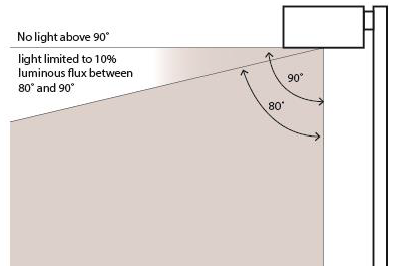
Full Cutoff Light Fixture
Fully Shielded. A light fixture constructed and mounted such that the luminous intensity (in candelas) at or above an angle of 90° above nadir is zero.
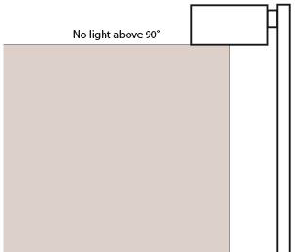
Fully Shielded Light Fixture
Partially shielded. A light fixture constructed and mounted such that most light emitted by the fixture is projected below the horizontal. A partially shielded light fixture may allow some light to pass through a semi-translucent barrier, and/or may allow visibility of the lamp from certain perspectives.
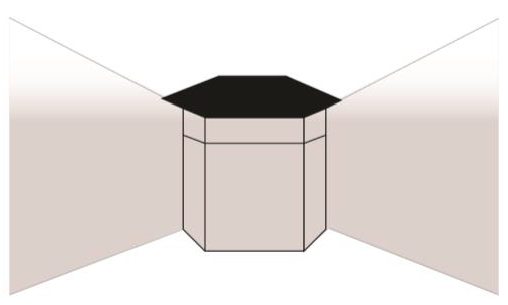
Partially Shielded Light Fixture
6.
Light Pollution. Artificial light which causes a detrimental effect on the environment, astronomical research, enjoyment of the night sky or causes undesirable glare or light trespass.
7.
Light Shielding. A barrier around a light fixture that conceals or partially conceals the lamp and controls light distribution.
8.
Light Trespass. Light that falls beyond the property line of the property on which the light fixture is located.
9.
Lumen. Unit of luminous flux; used to measure the amount of light emitted by a lamp.
10.
Uplighting. Light radiating above the horizontal plane.
Limbing. The process of pruning the lower branches of a live tree for fuel modification in defensible space, the vertical clearance of which as specified in the County Fire Department Defensible Space Standards.
Limited Concession Facility. Retail facilities that are clearly ancillary and incidental to a recreational use and that are customarily offered and available to the general public in connection with a recreational use (e.g., boat rentals, fishing supplies). May include snack bars and similar goods and services. Also includes vending machines dispensing foods when operated independently or in conjunction with such facilities.
Limited-equity Housing Cooperative. A corporation which meets the criteria of a stock cooperative as defined in this Article and which also meets the criteria of Section 33007.5 of the Health and Safety Code.
Live/work Unit. A room, or suite of rooms, that are internally connected and combine a commercial or low-intensity manufacturing activity with a residential living space for a resident owner or employee of the non-residential activity and that person's household, where the resident owner or employee is responsible for the commercial or low-intensity manufacturing activity performed.
Living Area. The interior living portion of a dwelling unit including basements and attics, not including the garage or an accessory structure.
Local Coastal Program. The County's (a) Coastal Land Use Plan, (b) Development Code, (c) Zoning Map, and (d) within sensitive coastal resource areas, other implementing actions, that when taken together, meet the requirements of, and implement the provisions and policies of the Coastal Act of 1976 within the County.
Lodging.
1.
Bed and Breakfast. A residential structure with one or more bedrooms rented for overnight lodging, where meals may be provided subject to applicable County health regulations.
2.
Boarding or Rooming House. A residence or dwelling other than a hotel, where the business of keeping boarders is generally carried on and which is held out by the owner or keeper as a place where boarders are kept.
3.
Guest Ranch. A vacation resort, generally a farm or ranch, that derives all or part of its income from the use of its facilities by paying visitors or guests, and provides food, lodging, and recreational activities.
4.
Homestay. A residential structure, including portions thereof, rented for 30 consecutive days or less where the owner or long-term tenant of the property inhabits a legal dwelling on the same lot at the same time as the transient occupant. Additionally, the following terms are defined for the purposes of Section 35.42.193 (Homestay).
a.
Hosting Platform. A marketplace which facilitates the consummation of Homestay agreements through advertising and from which, in whatever format, information is provided about or relating to a residential structure, including portions thereof, for occupancy as a Homestay.
b.
Long-term Tenant or Owner. A person who occupies the property, who is the owner of the property or who rents the property for six months or more.
c.
Visitor. A person who enters the property on which a Homestay is located for the purpose of visiting, seeing or communicating with the transient occupant of the Homestay.
5.
Hostel. Overnight sleeping accommodations that provide supervised and inexpensive lodging for travelers, and may provide kitchen and eating facilities. Occupancy is generally of a limited duration.
6.
Hotel. A building or group of buildings containing six or more sleeping rooms occupied, intended or designed to be occupied as the more or less temporary abiding place of persons who, for compensation, are lodged with or without meals, but not including a trailer court or camp, sanitarium, hospital, asylum, orphanage or building where persons are housed under restraint.
7.
Motel. A transient lodging establishment containing six or more rooms with at least 25 percent of all rooms having direct access to the outside without the necessity of passing through a main lobby.
8.
Resort Hotel. A hotel which serves as a destination point for visitors. A resort generally provides recreational facilities for persons on vacation. A resort shall be self-contained and provide personal services customarily furnished at hotels, including the serving of meals. Buildings and structures in a resort should complement the scenic qualities of the location in which the resort is situated.
9.
Short-Term Rental. A structure which is rented for overnight lodging, in whole or in part and with or without the presence onsite of the owner or representative of the owner, for 30 consecutive days or less.
Los Alamos Community Plan Area. That portion of the County located within the boundaries of the Los Alamos Community Plan as shown on the Los Alamos Community Plan Land Use Map.
Lot. An existing area of land under one ownership that was lawfully created as required by the Subdivision Map Act and predecessor ordinances and statutes, and local ordinances, that can lawfully be conveyed in fee as a discrete unit separate from any contiguous lot. A lot also means a lot for which a Certificate of Compliance or Conditional Certificate of Compliance has been recorded and the boundaries of which have not subsequently been altered by merger or further subdivision.
Lot, Corner. A lot situated at the intersection of two or more streets or bounded on two or more adjacent sides by street lines.
Lot, Flag. See "Lot, Interior."
Lot, Interior. A lot that (1) has no street frontage or (2) the street frontage is less than 40 feet in width.
Lot, Key. A lot the side line of which abuts the rear line of one or more adjoining lots.
Lot, Through. A lot having frontage on two parallel or approximately parallel streets.
Lot Area, Gross. The area included within the boundaries of the lot as described in the latest recorded deed to the lot or as shown on the recorded lot or subdivision map creating the lot, inclusive of any portion so described or mapped, lying within a public or private street.
Lot Area, Net. The gross lot area excluding any area lying within a public street which is defined as a permanently reserved right-of-way which has been dedicated to the County.
Lot Depth. The average distance between the front or street line and the rear lot line or between the front lot line and intersection of the two side lot lines if there should be no rear lot line.
Lot Frontage. The length of the front line measured at the street right-of-way line.
Lot Line. The lines forming the boundaries of a lot that distinguish it from other lots.
Lot Width, Gross. The average distance between the side lot lines, measured at right angles to the lot depth, including any area lying within a public street which is defined as a permanently reserved right-of-way that has been dedicated to the County. Exception: Within the EX-1 zone gross lot width is the distance between the side lines of the lot measured at the front setback line of the primary dwelling, provided that as to a lot with no front setback line, lot width shall be the average distance between the side lines of the lot most nearly perpendicular to the nearest street, omitting easements or lot extensions necessary to gain access to the lot.
Lot Width, Net. The average distance between the side lot lines, measured at right angles to the lot depth, excluding any area lying within a public street which is defined as a permanently reserved right-of-way which has been dedicated to the County.
Low Barrier Navigation Center (Government Code Section 65660(a)). A Housing First, low-barrier, service-enriched shelter focused on moving people into permanent housing that provides temporary living facilities while case managers connect individuals experiencing homelessness to income, public benefits, health services, shelter, and housing. A low barrier navigation center may be non-congregate and relocatable. For purposes of this definition, "Housing First" has the same definition as included in Welfare and Institutions Code Section 8255, or successor statute. "Low barrier" means best practices to reduce barriers to entry, and may include, but is not limited to, the following:
1.
The presence of partners if it is not a population-specific site, such as for survivors of domestic violence or sexual assault, women, or youth.
2.
Pets.
3.
The storage of possessions.
4.
Privacy, such as partitions around beds in a dormitory setting or in larger rooms containing more than two beds, or private rooms.
Lumber and Wood Product Manufacturing. Manufacturing, processing, and sales involving the milling of forest products to produce rough and finished lumber and other wood materials for use in other manufacturing, craft, or construction processes. Includes the following processes and products:
containers, pallets and skids
manufactured and modular homes
matches
milling operations
trusses and structural beams
turning and shaping of wood products
wholesaling of basic wood products
wood product assembly
Does not include craft-type shops ("Handcraft Industries and Small-Scale Manufacturing"); other wood and cabinet shops ("Furniture and Fixtures Manufacturing, Cabinet Shops"); or the entirely indoor retail sale of building materials, construction tools and equipment ("Building and Landscape Materials Sales").
Lumber Processing and Milling. A facility that produces lumber including dimensional boards and specific shaped items from harvested trees.
M.
Definitions, "M."
Maintenance Service, Client Site Services. Base facilities for various businesses that provide services on the premises of their clients. Includes the following processes and products:
appliances
computers
electronics
elevators
equipment
gardening
HVAC
instruments
janitorial
pest control
plumbing
water and smoke damage recovery and similar services
other maintenance and repair services not operating from a retail establishment that sells products being maintained or repaired
When these services operate from a retail establishment that sells the products being maintained or repaired, they are instead considered part of the retail use. When the base facilities for these services include service or storage yards, or fleet vehicle storage, they are instead classified under "Contractor's Equipment Storage Yard."
Manufactured Home. A structure constructed on or after June 15, 1976, that is certified under the National Manufactured Housing Construction and Safety Act of 1974, which is designed and equipped to be used as a single-family dwelling, with or without a permanent foundation, as defined in the California Health and Safety Code Section 18007.
Map Act. The California Subdivision Map Act, Division 2, Title 7 of the California Government Code, commencing with Section 66410 as presently constituted, and any amendments to those provisions.
Marquee. A permanent roofed structure, not including an arcade, attached to and supported by the building and projecting over public property.
Mausoleum. A large stately tomb or a building housing such a tomb or several tombs.
Mean High Tide Line. The high water mark of the ocean, which is an ambulatory line varying over time as a result of climatic and other influences. The line is the normal or average inland extent of tidal influence.
Media Production. Facilities for motion picture, television, video, sound, computer, and other communications media production. These facilities include administrative and technical production support facilities, including administrative and production offices, post-production facilities (editing and sound recording studios, foley stages, etc.), optical and special effects units, film processing laboratories, etc.
Medical Services - Animal Hospital. A facility specifically designed for the medical or surgical treatment of animals or pets where all of the animals are taken in from off the premises and where the boarding of animals is limited to short-term care incidental to the hospital.
Medical Services - Clinic, Urgent Care. A facility other than a hospital where medical, mental health, surgical and other personal health services are provided on an outpatient basis. Examples of these uses include:
medical offices
out-patient care facilities
urgent care facilities
other allied health services
These facilities may also include accessory medical laboratories, and limited fabrication activities as in the case of a dentist office or an optometrist. Counseling services by other than medical doctors or psychiatrists are included under "Offices - Professional."
Medical Services - Doctor Office. A facility other than a hospital where medical, dental, mental health, surgical, and/or other personal health care services are provided on an outpatient basis (e.g., chiropractors, medical doctors, psychiatrists, physical therapists). These facilities may also include accessory medical laboratories, and limited fabrication activities as in the case of a dentist office or an optometrist. Counseling services by other than medical doctors or psychiatrists are included under "Offices - Professional."
Medical Services - Extended Care. Residential facilities providing nursing and health-related care as a primary use with in-patient beds. These facilities may also include accessory medical laboratories, and limited fabrication activities. Examples of these uses include: board and care homes; convalescent and rest homes; extended care facilities; and skilled nursing facilities. Long-term personal care facilities that do not emphasize medical treatment are included under "Residential Care."
Medical Services - Hospital. Hospitals and similar facilities engaged primarily in providing diagnostic services and extensive medical treatment, including surgical and other hospital services. These establishments have an organized medical staff, inpatient beds, and equipment and facilities to provide complete health care. May include onsite accessory clinics and laboratories, accessory retail uses and emergency heliports, and onsite ambulance dispatch facilities.
Medical Services - Laboratory. Non-research facilities for the testing of blood and tissue samples for medical diagnoses, and for the fabrication of dental prosthetics and eyeglasses. Does not include laboratories for medical research, which are classified under "Laboratory - Analytical, Research and Development, Testing."
Meeting Facility, Public or Private. A facility for public or private meetings, including community centers, religious institutions, civic and private auditoriums, grange halls, union halls, meeting halls for clubs and other membership organizations, etc. Also includes functionally related internal facilities such as kitchens, multi-purpose rooms, and storage. Does not include conference and meeting rooms accessory and incidental to another primary use that are typically used only by onsite employees and clients, and occupy less floor area on the site than the offices they support (see "Offices"). Does not include: sports or commercial facilities (see "Theater," and "Sports and Entertainment Assembly"); or convention centers (see "Conference Center"). Related onsite facilities such as day care centers and schools are separately defined, and separately regulated.
Meeting Facility, Religious. A meeting facility for a religious institution as identified in "Meeting Facility, Public or Private," above, that is restricted to religious institutions only in response to the specific requirements of a particular zone.
Meeting Room. A room within an organizational house that provides an area for the residents of the organizational house to conduct meetings.
Mello-Roos District. Districts that raise funds from property owners within a given area in order to provide public improvements in that area. Similar to assessment districts, their enabling legislation is the Mello-Roos Community Facilities Act of 1982, Government Code Section 55311 et seq.
Merchandise Manufacturing. The manufacture, compounding, assembling, or treatment of articles or merchandise from previously prepared materials: bone, cellophane, canvas, cloth, cork, feathers, felt, fiber, fur, glass, hair, horn, leather, paper, plastics, precious or semi-precious metals or stone, shell, textiles, tobacco, wood, yarns, and paint not employing a boiling process.
Metal Products Fabrication, Machine and Welding Shops. An establishment engaged in the production and/or assembly of metal parts, including the production of metal cabinets and enclosures, cans and shipping containers, doors and gates, duct work, forgings and stampings, hardware and tools, plumbing fixtures and products, tanks, towers, and similar products. Examples of these uses include:
blacksmith and welding shops
machine shops and boiler shops
plating, stripping, and coating shops
sheet metal shops
Mission Canyon Community Plan. That portion of the County located within the boundaries of the Mission Canyon Community Plan Area as shown on the adopted Mission Canyon Community Plan Land Use Map.
Mining. The extraction of mineral resources through surface or underground mining operations, including the following:
1.
Surface Mining. Excavation and quarrying operations to obtain building and construction materials including diatomaceous earth, including all of the following components. The following terms and phrases are defined for the purposes of Section 35.82.160 (Reclamation and Surface Mining Permits).
a.
Haul Road. A road along which material is transported from the area of excavation to the processing plant or stock pile area of the surface mining operation.
b.
Idle. To curtail for a period of 12 months or more surface mining operations by more than 90 percent of the operation's previous maximum annual mineral production, with the intent to resume those surface mining operations at a future date. (See SMARA, Section 2727.1)
c.
Mined Lands. Includes the surface, subsurface, and ground water of an area in which surface mining operations will be, are being, or have been conducted, including private ways and roads appurtenant to any area, land excavations, workings, mining waste, and areas in which structures, facilities, equipment, machines, tools or other materials or property that result from, or are used in, surface mining operations are located. Mined lands include all lands affected by a mining operation.
d.
Minerals. A naturally occurring chemical element or compound, or groups of elements and compounds, formed from inorganic processes and organic substances, including bituminous rock, but excluding coal, geothermal resources, natural gas, peat, and petroleum. (See State Regulations, Section 3501). For the purposes of this Development Code, minerals shall also include: decorative stone, diatomaceous earth, flagstone, gravel, limestone, rip-rap, sand, and shale.
e.
Mining Waste. The residual of soil, rock, mineral, liquid, vegetation, equipment, machines, tools, or other materials or property directly resulting from, or displaced by, surface mining operations.
f.
Operator. A person who is engaged in surface mining operations, or who contracts with others to conduct operations on their behalf, except a person who is engaged in surface mining operations as an employee with wages as their sole compensation.
g.
Overburden. Rock, soil, or other materials that lie above a natural mineral deposit or in between mineral deposits, before or after their removal by surface mining operations. (See SMARA, Section 2732)
h.
Reclamation. The combined process of land treatment that minimizes air pollution, damage to aquatic or wildlife habitat, erosion, flooding, water degradation, and other adverse effects from mining operations, including adverse surface effects incidental to underground mines, so that mined lands are reclaimed to a usable condition which is readily adaptable for alternative land uses and create no danger to public health or safety. The process may extend to affected lands surrounding mined lands, and may require backfilling, grading, resoiling, revegetation, soil compaction, stabilization, or other measures. (See SMARA, Section 2733)
i.
Surface Mining Operations. All or any part of the process involved in the mining of minerals on mined lands by removing overburden and mining directly from the mineral deposits, open pit mining of minerals naturally exposed, mining by the auger method, dredging, and quarrying, or surface work incidental to an underground mine. Surface mining operations include:
(1)
In-place distillation, leaching, or retorting;
(2)
The production and disposal of mining waste(s); and
(3)
Prospecting and exploratory activities. (See SMARA, Section 2735)
Surface mining operations also include the creation of borrow pits, segregation, streambed skimming, and the stockpiling and recovery of mined materials (and recovery of same). (See State Regulations, Section 3501)
2.
Underground Mining. Mining operations where minerals are extracted using shafts and/or tunnels.
Mixed Use Development, Residential Component. Dwellings associated with mixed use project.
Mixed-Use Projects. The combination of residential, commercial and/or industrial uses on the same lot and/or in the same structure, where the residential component is located either above (vertical mixed-use) or behind (horizontal mixed-use) the nonresidential component. Nonresidential uses are typically commercial uses.
Mobile Home. A trailer, transportable in one or more sections, that is certified under the National Mobile Home Construction and Safety Standards Act of 1974, which is over eight feet in width and 40 feet in length, which is designed and equipped to contain not more than two dwelling units with or without a permanent foundation and not including recreational vehicle, commercial coach or factory-built housing. For the purposes of this Development Code, a mobile home on a permanent foundation is considered a structure.
Mobile Home, Boat, or RV Sales and Repair. Retail establishments selling mobile home dwelling units, and/or various recreational vehicles and watercraft. Includes the sale of boats, campers and camper shells, jet skis, mobile homes, motor homes, and travel trailers.
Mobile Home Park. Any area or tract of land where two or more lots are rented or leased, held out for rent or lease, or were formerly held out for rent or lease and later converted to a subdivision, cooperative, condominium, or other form of resident ownership, to accommodate manufactured homes, mobile homes, or recreational vehicles as allowed by Civil Code Section 798.3 used for human habitation. The rental paid for a manufactured home, a mobile home, or a recreational vehicle as allowed by Civil Code Section 798.3, shall be deemed to include rental for the lot it occupies.
1.
Mobile Home Park, Senior. A mobile home park where at least 80 percent of the occupied spaces or lots are rented or leased to senior citizens for use as their primary residence or has at least one resident at the age of 55 years or older and the unit is their primary residence.
2.
Mobile Home Park, All-ages. A mobile home park where the spaces or lots are rented or leased to the general public regardless of the ages of the residents or occupants.
Mobilehome Park Closure. When a mobilehome park owner or operator chooses to cease renting or leasing mobilehome lots for human habitation and this cessation of use would result in the displacement of mobilehome park residents or, when 25 percent or more of the mobilehome units or lots within a park become vacant and the Director determines that an unauthorized closure is underway pursuant to Section 35.89.080 (Vacancy of a Mobilehome Park of 25 Percent or More).
Mobilehome Owner. The record owner or any person having possession and control of the mobilehome.
Mobilehome Owner-approved Receiving Site. A site which has been agreed upon by both the applicant and the mobilehome owner as a mutually acceptable location to receive a relocated mobilehome.
Mobilehome Park Renters. Residents who rent mobilehomes as their primary residences, but who do not own the mobilehomes.
Mobile Vendor. A commercial establishment that conducts business from a motor vehicle or stand not affixed to the ground.
Modular Home. A dwelling unit constructed in whole or in part of prefabricated material or components to be assembled onsite and affixed to a permanent foundation, subject to the requirements of the Uniform Building Code.
Monastery. A residential facility operated by a religious organization that provides permanent or long-term housing for members of the organization, with group facilities for dining.
Montecito Community Plan. That portion of the County located within the boundaries of the Montecito Community Plan area as shown on the Montecito Community Plan Land Use Map.
Mortuary, Funeral Home. Funeral homes and parlors, where deceased are prepared for burial or cremation, funeral services may be conducted, and cremation services (and a crematorium) may occur.
Motel. See "Lodging."
Motor vehicle. Vehicles that have their own motive power and that are used for the transportation of people or goods on streets. Motor vehicle includes motorcycles, passengers, trucks, and recreational vehicles with motive power.
1.
Motor vehicle, inoperative. A motor vehicle that is incapable of being immediately started and moved under its own power without any modifications or repairs or does not have a current, unexpired registration with the California Department of Motor Vehicles that allows the vehicle to be driven, moved, towed or left standing (parked) upon any road or street.
2.
Motor vehicle, operative. A motor vehicle that is able to be immediately started without any modifications or repairs and has a current, unexpired registration with the California Department of Motor Vehicles that allows the vehicle to be driven, moved, towed or left standing (parked) upon any road or street.
Motor Vehicle and Equipment Manufacture. Manufacturers of equipment for transporting passengers and cargo by land, air and water, including motor vehicles, aircraft, spacecraft, ships, boats, railroad and other vehicles such as motorcycles, bicycles and snowmobiles. Includes manufacture of motor vehicle parts and accessories; trailers and campers for attachment to other vehicles; self-contained motor homes; and van conversions. Does not include mobile home and modular home assembly (listed under "Lumber and Wood Products").
Museum. A building, place, or institution devoted to the acquisition, conservation, study, exhibition, and educational interpretation of objects having scientific, historical, or artistic value.
Music recording studio. A studio where audio materials are recorded.
N.
Definitions, "N."
Natural Creek Channel. See "Creek Channel, Natural."
Night Club. A facility with the primary function of providing entertainment, examples of which include live music and/or dancing, comedy, etc., which may serve alcoholic beverages for onsite consumption. Does not include adult entertainment businesses, which are separately defined and regulated.
Noise Sensitive Use. Noise-sensitive land uses include:
1.
Residential, including single and multifamily dwellings, mobile home parks, dormitories, and similar uses.
2.
Transient lodging, including hotels, motels, and similar uses.
3.
Hospitals, nursing homes, convalescent hospitals, and other facilities for long-term medical care.
4.
Public or private educational facilities, libraries, churches, and places of public assembly.
Non-agricultural structural development. Any structure that is constructed, erected, or placed with or without a foundation, the use of which requires location on the ground and is covered by a roof, the use of which is not restricted to those uses that are directly accessory, ancillary and secondary to the agricultural use of the property.
Nonconforming Lot. A lot the area, dimensions or location of which was lawful prior to the effective date of this Development Code or any amendments, or previously adopted County Zoning Ordinances, and that does not conform to the present regulations of this Development Code.
Nonconforming Sign. An advertising structure or sign which was lawfully erected and maintained prior to the adoption of this Development Code, but does not now completely comply with current regulations.
Nonconforming Structure. A structure that was lawful prior to the effective date of this Development Code or any amendments, or previously adopted County Zoning Ordinances, and that does not conform to the present regulations of this Development Code, including height, location, lot coverage or setbacks.
Nonconforming Use. A use of land, or structure that was lawful prior to the effective date of this Development Code or any amendment, or previously adopted County Ordinances, and that does not conform to the present regulations on use of this Development Code, including:
1.
A land use established where the use is not identified as a permitted use by the zone applicable to the lot on which the use is located;
2.
A land use that is identified as a permitted use by the zone applicable to the lot on which the use is located but is not allowable on the particular site because of planning area standards of a Community and Area Plan Overlay;
3.
A land use that was lawfully established without obtaining a planning entitlement (e.g., Conditional Use Permit, Development Plan) pursuant to the Development Code. This definition does not apply to commercial cannabis cultivation (outdoor, mixed-light, indoor, and nursery) in the AG-II zone that is lawfully existing under this zoning ordinance with a Land Use Permit and continues to conform to the Land Use Permit;
4.
A land use that is operated or conducted in a manner that does not now conform with the standards of this Development Code, including floor area ratios, minimum site area, limitations on use, or location criteria; or
5.
A residential use that exceeds the number of dwelling units or bedrooms allowed on the lot by this Development Code.
Non-ionizing Electromagnetic Radiation. Electromagnetic radiation occurring primarily in the visible, infrared, and radio-frequency portions of the electromagnetic spectrum.
Non-mobilehome Residents. Residents who meet the definition of Permanent Resident and own residential units which do not meet the definition of Mobilehome.
Non-passenger, commercial motor vehicle. A motor vehicle whose primary purpose is not transporting of passengers for compensation (e.g., buses, taxicabs) including:
Auto trucks
Any earth-moving equipment
Camper trucks and station wagons (if they require commercial registrations)
Fork lifts (if operated on public streets)
Light delivery cars
Power shovels
Road-building machines
Road rollers
Road sweepers
Sand spreaders
Snowplows
Traction engines
Tractor cranes
Tractor-trailers and semi-trailers
Truck cranes
Well drillers and servicing rigs
North County Consolidation Planning Area. A planning area for oil and gas development in the western portion of Santa Barbara County, defined by the following boundaries: the Santa Barbara County—San Luis Obispo County boundary to the north, the three-mile offshore limit line to the west, the ridge of the Santa Ynez Mountains to the south, and to the east Highway 101 north to California Highway 154 east to California Highway 166 north until it turns in a northwesterly direction, east to the Los Padres National Forest just south of Lookout Mountain, and the National Forest north to the County line.
Notice to Property Owner. A notarized, legal document required by the County, to be completed and recorded against the property by the property owner as part of a permit approval process and/or in conjunction with correction of a zoning violation. The purpose of the notice is to document specific conditions and/or restrictions that apply to a particular property and its improvements.
O.
Definitions, "O."
Office. This Development Code distinguishes between the following types of offices. These do not include medical offices (see "Medical Service - Clinic, Laboratory, Urgent Care," and "Medical Service - Doctor Office").
1.
Accessory. Office facilities for administration, and/or onsite business and operations management, that are incidental and accessory to another business, sales, and/or service activity that is the primary use.
2.
Business/Service. Establishments providing direct services to customers. Examples of these uses include bail bond services, elected official satellite offices, employment agencies, insurance agent offices, realtor offices, travel agencies, utility company offices, vehicle sales offices with no vehicles for sale onsite, etc. This use does not include "Bank, Financial Services," which is separately defined.
3.
Executive Headquarters. Executive headquarters of business firms that are compatible with uses permitted in the applicable zone.
4.
Processing. Office-type facilities characterized by high employee densities, and occupied by businesses engaged in information processing, and other computer-dependent and/or telecommunications-based activities. Examples of these uses include the following, but do not include small-scale telephone answering services, which are instead classified under "Office - Professional or Administrative":
airline, lodging chain, and rental car company reservation centers
computer software and hardware design and
development
consumer credit reporting
data processing services
health management organization (HMO) offices where no medical services are provided
insurance claim processing
mail order and electronic commerce transaction processing
telecommunications facility design and management
telemarketing
5.
Professional and Administrative. Office-type facilities occupied by businesses that provide professional services and/or engaged in the production of intellectual property. Examples of these uses include:
accounting, auditing and bookkeeping services
advertising agencies
answering services
attorneys
business associations, chambers of commerce
commercial art and design services
construction contractors (office facilities only)
counseling services
court reporting services
detective agencies and similar services
design services including architecture, engineering,
landscape architecture, urban planning
educational, scientific and research organizations
financial management and investment counseling
government offices
literary and talent agencies
management and public relations services
media postproduction services
news services
photographers and photography studios
political campaign headquarters
psychologists
secretarial, stenographic, word processing and temporary clerical employee services
security and commodity brokers
writers and artists offices
6.
Temporary. A mobile home, recreational vehicle or modular unit used as a temporary office facility. Temporary Offices may include: construction supervision offices on a construction site or off-site construction yard; a temporary onsite real estate office for a development project; or a temporary business office in advance of permanent facility construction.
7.
Temporary Real Estate. The temporary use of a dwelling unit within a residential development project as a sales office for the units on the same site, which is converted to residential use at the conclusion of its office use.
Office-Supporting Retail. A retail store or branch bank that carries one or more types of merchandise that will typically be of frequent interest to and/or needed by the various businesses listed under the definition of "Office," and/or the employees of those businesses. Examples of these types of stores include:
branch banks
book store
computer equipment stores
convenience store
florists, flower stands
newsstands, newspapers and magazine stores
office supplies, stationery store
pharmacy, drug store
photographic supplies and camera store
Offshore Oil and/or Gas Reservoir. The portion of an oil and/or gas reservoir that is seaward of the mean high tide line.
Oil. Gas and other hydrocarbon substances.
Oil and Gas Drilling Rig. The derrick or mast, draw works, and attendant surface equipment used to drill for oil, natural gas, or both from underground reservoirs, and to drill injection wells for disposal of fluids into subsurface reservoirs. Drilling rigs are also used to complete (prepare for production) a well, or redrill or rework a well. The derrick consists of a large load-bearing structure, usually bolted construction of metal beams. In drilling, the standard derrick has four legs standing at the corners of the substructure and reaching to the crown block. The substructure is an assembly of heavy beams used to elevate the derrick and provide space underneath to install the blowout-preventive equipment, casing head, and other equipment.
Oil and Gas Exploration. Drilling for oil and/or gas that occurs outside the limits of an established oil field, as delineated on California Division of Oil and Gas, Department of Conservation Maps.
Oil and Gas Production. Drilling for oil and/or gas that occurs within the limits of an established oil field, as delineated on California Division of Oil and Gas, Department of Conservation Maps.
Oil and Gas Separation Plant. Facilities necessary and incidental to dehydration and/or separation of oil, gas and water.
Oil and Gas Treatment/Processing Plant. A facility designed to separate and recover hydrocarbons (i.e., butane, ethane, propane) and/or to remove impurities (i.e., hydrogen sulfide) from oil or gas.
Oil and Gas Workover/Pulling Rig. The derrick or mast, draw works, and attendant surface equipment to service oil/gas or injection wells, including, among other things, running the pump and tubing, replacing parts, fixing casing, and plugging and abandoning a well. These rigs are typically mobile, wheel-based trucks capable of moving from one well to another.
Oil Refinery. A facility designed to produce one or more petroleum products by physically and/or chemically altering crude oil.
One Ownership. The ownership or possession of property under a contract to purchase, or under a lease, in any manner whereby the property is under a single or unified control, including ownership of property by a person, firm, partnership, association, corporation, company, syndicate, estate, trust, or organization of any kind.
Open Space.
1.
Public Open Space. Public open space includes public parks, recreational support facilities (e.g., restrooms, stairways, picnic tables), public parking lots, beaches, access corridors such as bike paths, hiking, or equestrian trails, usable natural areas, and vista points that are accessible to members of the general public. Environmentally sensitive habitat areas and archaeological sites may be included in public open space. Water bodies such as streams, ponds, and lakes may be included in public open space only if available for active recreational purposes (e.g., swimming, boating, fishing) but in no case shall water bodies be credited for more than five percent of the total public open space requirement. Public open space shall not include areas which are unusable for recreational purposes (e.g., private or public streets, private parking lots, or hazardous areas such as steep slopes and bluff faces).
2.
Common Open Space. Common open space includes recreational areas and facilities for the use of the residents or guests of a development. These areas and facilities include tennis courts, swimming pools, playgrounds, community gardens, landscaped areas for common use, or other open areas of the site needed for the protection of the habitat, archaeological, scenic, or other resources. Water bodies may be included but shall not be credited for more than five percent of the total common open space requirement. Common open space shall not include driveways, public or private streets, parking lots, private patios and yards, other developed areas or hard surfaced walkways.
3.
Private Open Space. A usable open space adjoining and directly accessible to a dwelling unit that includes patios, decks, and yards, reserved for the exclusive use of the residents of adjoining dwelling units and their guests.
Open Space, Usable. Outdoor space that serves a recreational function or provides visual relief from the building mass, the minimum dimension of which shall be six feet excluding required front yards not used for balconies or patios.
Organizational House. A residential lodging facility operated by a membership organization for its members and not open to the general public. Includes fraternity and sorority houses, student dormitories, convents, monasteries, and religious residential retreats.
Outdoor Festival. A musical festival, dance festival, "rock" festival or similar musical activity at which music is provided by paid, professional, or amateur performers, or by prerecorded means, that is held at a place other than in a facility that has been constructed and approved for public assembly and entertainment, to which members of the public are invited or admitted for a charge or free of cost, and that is to be or is attended by 500 or more persons.
Outdoor Recreation Facility. An area designated for active recreation, whether publicly or privately owned, including baseball and softball diamonds, soccer and football fields, equestrian arenas, golf courses, tennis courts, skateboard ramps and swimming pools.
Owner. The record owner or any person having possession and control of the subject property.
P.
Definitions, "P."
Parcel. See "Lot."
Park, Playground. An area of land set aside for private or public use, maintained for recreational and ornamental purposes.
Park Trailer. A trailer, with or without a permanent foundation, designed for human habitation that meets the requirements of the California Health and Safety Code Section 18009.3.
Parking, Lot. An off-street area, usually surfaced and improved, for the temporary storage of five or more vehicles.
Parking Lot Sale. A temporary sale that is conducted by a retail store, shop, establishment in the area usually used for on-premise customer parking or pedestrian access (not within a public right-of-way) of that retail store, shop, or establishment and at which sale the same type of merchandise sold within that store, shop, or establishment is sold at retail.
Parking Space. A space designed and reserved for the parking of vehicles, including all necessary maneuvering space, as provided elsewhere in this Development Code.
Parking, Tandem. The arrangement of not more than two parking spaces in depth, wherein one space is located directly in front of another space, such that it is necessary to pass through one space in order to enter or leave the other space, see Figure 11-2 - Tandem Parking, below.
Passageway. A pathway that is unobstructed clear to the sky and extends from a street to one entrance of an accessory dwelling unit or junior accessory dwelling unit.
Paving and Roofing Materials Manufacturing. The manufacture of various common paving and petroleum-based roofing materials, including bulk asphalt, paving blocks made of asphalt, creosote wood, and various compositions of asphalt and tar. Includes concrete and clay roof tiles and pavers, and metal roofing materials. Does not include the manufacture of wood roofing materials (shingles, shakes, etc.), which are instead under "Lumber and Wood Product Manufacturing".
Peak Parking Period. The two hour period within seven consecutive days with the highest calculated parking demand for a single site.
Pedestrian Oriented. Any physical structure or place with design qualities and elements that contribute to an active, inviting and pleasant place for pedestrians including:
1.
A continuous sidewalk, with a minimum of intrusions into pedestrian right-of-way.
2.
Building facades that are highly articulated at the street level, with interesting uses of architectural detailing, color, and material, located directly adjacent to the sidewalk.
3.
Continuity of building facades along the street with few interruptions in the progression of structures.
4.
Design amenities related to the street level (e.g., arcades, awnings, paseos).
5.
Landscaping (including outdoor patios or pocket parks).
6.
Signs oriented and scaled to the pedestrian rather than the motorist.
7.
Street furniture.
8.
Visibility into buildings at the street level.
Permanent Resident. Any person who lives in a mobilehome park for 270 days or more in any 12-month period, and whose residential address in the mobilehome park can be verified as one that meets at least three of the following criteria:
1.
Address where registered to vote.
2.
Home address on file at place of employment or business.
3.
Home address on file at dependents' primary or secondary school.
4.
Not receiving a homeowner's exemption for another property or mobilehome in this state nor having a principal residence in another state.
5.
California Department of Motor Vehicles identification address.
6.
Mailing address.
7.
Vehicle insurance address.
8.
Home address on file with Bank account.
9.
Home address on file with the Internal Revenue Service.
10.
Home address on file with local club/association membership.
11.
Any other criteria determined to be acceptable by the Director.
Person. An individual, organization, partnership, or other business association, corporation, or entity, including any utility, and any federal, state, local government, or special district or any agency thereof.
Personal Services. Establishments providing non-medical services to individuals as a primary use. Examples of these uses include:
barber and beauty shops
check cashing stores
clothing rental
day spas
dry cleaning pick-up stores, not exceeding 2,000 sf
fortune tellers
home electronics and small appliance repair
laundromats (self-service laundries)
locksmiths
massage (licensed, therapeutic)
palm and card readers
pet grooming with no boarding
pawnshops
psychics
shoe repair shops
spas and hot tubs for hourly rental
tailors
tanning salons
tattoo and body piercing services
These uses may also include accessory retail sales of products related to the services provided.
Planning and Development Department. The Santa Barbara County Planning and Development Department, referred to in this Development Code as the "Department."
Planning Commission. The Santa Barbara County Planning Commissions, including the Montecito Planning Commission, referred to in this Development Code as the "Commission."
Planning Permit. A generic term which means any permit or other entitlement authorized by this Development Code including the following: Conditional Use Permit, Development Plan, Land Use Permit, Minor Conditional Use Permit, Modification, Sign Certificate of Conformance, Variance.
Plant Nursery. A retail or commercial business where plants are grown in the ground or in containers for sale or propagation.
Plate Heights - Summerland. The distance between the finished floor and where the wall intersects with the lower portion of the floor joists of the story above, or if there is no intervening story, the lower portion of the structural roof members.
Precision Machine Shop. A business that provides metal working facilities for manufacturing or altering machinery or equipment requiring fine tolerances in their metrics.
Premises. The area of land in one ownership surrounding a house or building.
Primary Metal Industries. Manufacturing establishments engaged in: the smelting and refining of ferrous and nonferrous metals from ore, pig, or scrap; the rolling, drawing, and alloying of metals; the manufacture of castings, forgings, stampings, extrusions, and other basic metal products; and the manufacturing of nails, spikes, and insulated wire and cable. Also includes merchant blast furnaces and by-product or beehive coke ovens.
Prime Agricultural Lands. Prime agricultural lands include any of the following.
1.
All land that qualifies for rating as Class I or Class II in the Soil Conservation Service land use capability classifications.
2.
Land that qualifies for rating 80 through 100 in the Storie Index Rating.
3.
Land that supports livestock used for the production of food and fiber and which has an annual carrying capacity equivalent to at least one animal unit per acre as defined by the United States Department of Agriculture.
4.
Land planted with fruit- or nut-bearing trees, vines, bushes, or crops which have a nonbearing period of less than five years and which will normally return during the commercial bearing period on an annual basis from the production of unprocessed agricultural plant production not less than $200 per acre.
5.
Land that has returned from the production of unprocessed agricultural plant products an annual gross value of not less than $200 per acre for three of the previous five years.
Principal Dwelling. A detached dwelling that is the principal residential use of the lot.
Principal Structure. A structure in which the principal use of its lot is conducted. In any residential or agricultural zone a dwelling shall be deemed to be the principal structure on the lot on which it is situated.
Printing and Publishing. An establishment engaged in printing by letterpress, lithography, embossing, etching, screen, offset, or electrostatic (xerographic) copying; and other establishments serving the printing trade such as bookbinding, typesetting, engraving, photoengraving and electrotyping. This use also includes establishments that publish newspapers, books and periodicals; establishments manufacturing business forms and binding devices. "Quick printing" services are included in the definition of "Business Support Services."
Private Home. A dwelling, including an apartment or other leased space, where individuals reside.
Private Residential Recreation Facility. A privately-owned, non-commercial recreation facility provided for residential project or neighborhood residents, including outdoor facilities such as swimming pools, swim and tennis clubs, park and sport court facilities, and indoor facilities (e.g., recreation rooms). Does not include golf courses and country clubs, which are separately defined.
Private Services.
1.
All production, storage, transmission, treatment and recovery facilities for water, sewerage, energy and other similar utilities and facilities owned or operated by any business organization, person or private entity, except for Oil and Gas Facilities regulated by Article 35.5 (Oil and Gas, Wind Energy and Cogeneration Facilities).
2.
All private transportation facilities, including streets, roads and other related facilities.
Project. Any activity governed to any extent by this Development Code that involves the issuance, by one or more agencies governed by the Board, of a permit, license, certificate, or other entitlement for use. The term "project" generally refers to the whole of an activity that may be subject to more than one entitlement for use issued by one or more public agencies. However, the term "project" may refer to any specific action or activity which is part of a larger undertaking, depending upon the context in which the term "project" may be specifically used in this Development Code. See also Public Resources Code Section 21065(c); and Government Code Section 65931.
Public Property. Property owned by the government.
Public Safety Facility. A facility that houses public safety personnel and equipment, (e.g., police, fire, paramedics). Facility may include kitchens, sleeping accommodations, areas for equipment maintenance.
Public Works and Utilities. Public works and utilities include all of the following:
1.
Production, storage, transmission, treatment and recovery facilities for water, sewerage, energy, telephone, and other similar utilities and facilities owned or operated by any public agency or by any utility that is subject to the jurisdiction of the Public Utilities Commission, except for oil and gas facilities regulated by Article 35.5 (Oil and Gas, Wind Energy and Cogeneration Facilities).
2.
Operating bases and service centers for public utilities, including facilities from which maintenance and repair services are dispatched to utility service lines and other facilities operated by the public works or public utility, including equipment and materials storage. Also includes facilities serving as junction points for transferring a utility commodity from a regional transmission system to a local distribution system, including facilities for natural gas distribution.
3.
Any of the following facilities that are not exempted from planning permit requirements by Government Code Section 53091, except electrical substations, which are separately defined, and office or customer service centers (classified in "Offices"):
corporation and maintenance yards
natural gas regulating and distribution facilities
public water system wells, treatment plants and storage
telephone switching facilities
wastewater treatment plants, settling ponds and disposal fields
4.
Publicly financed recreational facilities, all projects of the State Coastal Conservancy, and any development by a special district.
Public Works or Private Service Facility. A base facility from which maintenance and repair services are dispatched to utility service lines and other facilities operated by the public works or private service entity. Includes equipment and materials storage, and "corporation" yards.
Public Works, Transportation Related. All public transportation facilities, including streets, roads, highways, bridges, public parking lots and structures, ports, harbors, airports, railroads, and mass transit facilities and stations, trolley wires, and other related facilities financed and owned by the government.
Q.
Definitions, "Q." No specialized terms beginning with the letter "Q" are defined at this time.
R.
Definitions, "R."
Railroad. A permanent road that has a line of rails, fixed to ties and laid on a roadbed, for the purpose of providing a track for cars and equipment moved by locomotives or propelled by self-contained motors. The general categories of lines include.
1.
Main Line. A main line provides for the long-distance intercity and interstate movement of trains.
2.
Branch Line. A branch line generally connects cities, military bases, and commercial/industrial areas to the mainline.
3.
Spur Line. A spur line connects specific entities, such as a factory, refinery, warehouse, or lumber yard to the branch line or main line.
4.
Siding or Turn-out. A section of railroad track used to allow the safe passage of trains, switching or rail cars, or parking of trains.
Railroads may include bridges, underpasses, overpasses, tunnels, signals and other accessory facilities and structures that are attendant to road facilities.
Reasonable Accommodation. Providing an individual with a disability flexibility in the strict application of zoning regulations or procedures when necessary to eliminate regulatory barriers and afford an individual with a disability an equal opportunity to use and enjoy a dwelling.
Recreational Vehicle. A motor home, travel trailer, camper or camping trailer, with or without motorized power, designed for human habitation for recreational or emergency occupancy. Recreational vehicles shall also include trailer-borne boats and other watercraft.
Recreational Vehicle Accommodations. Any facilities intended to accommodate recreational vehicles, including parking spaces, septic disposal, water, electrical, propane, and liquefied petroleum gas.
Recreational Vehicle Park. Any area or tract of land, where one or more lots are rented or leased or held out for rent to owners or users of recreational vehicles or tents, and which is occupied for temporary purposes.
Recycling Facility. A center for the collection and/or processing of recyclable materials. A "certified" recycling or processing facility is certified by the California Department of Conservation as meeting the requirements of the California Beverage Container Recycling and Litter Reduction Act of 1986.
1.
Small Collection Center. A center where the public may donate, redeem or sell recyclable materials, which may include the following, where allowed by the applicable zone:
a.
Reverse vending machines.
b.
Small collection facilities which occupy an area of 350 square feet or less and may include a mobile unit.
2.
Large Collection Center. A collection facility that occupies more than 350 square feet, and/or includes permanent structures.
3.
Mobile Recycling Unit. An automobile, truck, trailer, or van used for the collection of recyclable materials, carrying bins, boxes, or other containers.
4.
Processing Facility. A structure or enclosed space used for the collection and processing of recyclable materials for shipment, or to an end-user's specifications, by such means as baling, briquetting, cleaning, compacting, crushing, flattening, grinding, mechanical sorting, re-manufacturing and shredding. Processing facilities include the following types, both of which are included under the definition of "Scrap and Dismantling Yards," below:
a.
Light processing facility occupies an area of under 45,000 square feet of collection, processing and storage area, and averages two outbound truck shipments each day. Light processing facilities are limited to baling, briquetting, compacting, crushing, grinding, shredding and sorting of source separated recyclable materials sufficient to qualify as a certified processing facility. A light processing facility shall not shred, compact, or bale ferrous metals other than food and beverage containers; and
b.
A heavy processing facility is any processing facility other than a light processing facility.
5.
Recycling or Recyclable Material. Reusable domestic containers and other materials which can be reconstituted, re-manufactured, or reused in an altered form, including glass, metals, paper and plastic. Recyclable material does not include refuse or hazardous materials.
6.
Reverse Vending Machine. An automated mechanical device which accepts at least one or more types of empty beverage containers and issues a cash refund or a redeemable credit slip with a value not less than the container's redemption value, as determined by State law. These vending machines may accept aluminum cans, glass and plastic bottles, and other containers.
A bulk reverse vending machine is a reverse vending machine that is larger than 50 square feet, is designed to accept more than one container at a time, and issues a cash refund based on total weight instead of by container.
7.
Scrap or Dismantling Yard. An outdoor establishment primarily engaged in assembling, breaking up, sorting, and the temporary storage and distribution of recyclable or reusable scrap and waste materials, including auto wreckers engaged in dismantling automobiles for scrap, and the incidental wholesale or retail sales of parts from those vehicles. Includes light and heavy processing facilities for recycling (see the definitions above). Does not include: pawn shops, and other secondhand stores; the sale of operative used cars; or landfills or other waste disposal sites.
8.
Specialized Materials Collection Center. A center that provides for the collection of non-ferrous metals, high-temperature alloys, exotic and precious metals, and other similar materials, in addition to household recyclable materials.
Registered or Permitted Area. The portion of a private home that contains the private home's kitchen used for the preparation, packaging, storage, or handling of cottage food products and related ingredients or equipment, or both, and attached rooms within the home that are used exclusively for storage.
Religious Institution. Religious institutions include churches, mosques, synagogues, etc., and functionally related internal facilities such as kitchen, multi-purpose rooms, and storage.
Relocation Counselor. A counselor providing the services described in Subsection 35.89.070.B.1.
Relocation Plan. A document which describes the relocation assistance to be provided for all permanent mobilehome park residents who will be displaced, whether they rent or own their mobilehome unit.
Repair Service - Equipment, Large Appliances, etc. A service and facility where various types of electrical, electronic, and mechanical equipment, and home and business appliances are repaired and/or maintained away from the site of the equipment owner. Does not include vehicle repair or maintenance, which is included under "Vehicle Services", the repair of small home appliances and electronic equipment, which is included under "Personal Services", maintenance and repair activities that occur on the client's site, which are included under "Maintenance Service - Client Site Services," or repair services provided on the site of a retail use that sells the products for which repair services are offered, which are incidental to the onsite sales.
Request for Reasonable Accommodation. A request to modify zoning regulations or procedures in order to give individuals with disabilities an equal opportunity to use and enjoy a dwelling.
Research and Development. A facility for scientific research, and the design, development, and testing of electrical, electronic, magnetic, optical and computer and telecommunications components in advance of product manufacturing, and the assembly of related products from parts produced off-site, where the manufacturing activity is secondary to the research and development activities. Includes pharmaceutical, chemical and biotechnology research and development. Does not include soils and other materials testing laboratories (see "Laboratory"), or medical laboratories (see "Laboratory - Medical, Analytical, Research & Development").
Reservoir. A natural or artificial pond or lake used for the storage and regulation of water.
Residence Hall. A boarding house or lodging house, or combination thereof, used primarily for the purpose of providing facilities for student housing, but excluding fraternity or sorority house.
Resident-approved Receiving Site. A site which has been agreed upon by both the applicant and the non-mobilehome resident as a mutually acceptable location to receive a relocated residential unit which does not meet the definition of mobilehome.
Residential Second Unit. See "Accessory Dwelling Unit."
Residential Structure. A structure containing one or more dwelling units, except for a mixed use building.
Resort. See "Lodging - Resort Hotel."
Restaurant, Café, Coffee Shop. A retail business selling ready-to-eat food and/or beverages for on- or off-premise consumption. These include establishments where customers are served from a walk-up ordering counter for either on- or off-premise consumption ("counter service"); and establishments where customers are served food at their tables for on-premise consumption ("table service"), that may also provide food for take-out. Either may include indoor and/or outdoor eating areas, and/or accessory bars or cocktail lounges.
Restroom. A room that may contain a toilet and washbasin but shall specifically exclude any type of bathing facilities.
Retreat. A building or group of buildings with appurtenant land and structures used for the purpose of providing facilities for groups assembled for discussion, study, and recreation. See Section 35.42.240 (Rural Recreation).
Review Authority. The individual or official County body (Boards of Architectural Review, the Planning Director, Zoning Administrator, Planning Commissions, or Board of Supervisors) identified by this Development Code as having the responsibility and authority to review, and approve or disapprove the permit applications described in Article 35.8 (Planning Permit Procedures).
Right-of-Way Line. The recorded boundary of a public or private street or the existing or planned boundary of a public street as indicated in the Comprehensive Plan.
Riparian Vegetation. Vegetation normally found along the banks and beds of streams, creeks, and rivers.
Road. See "Street." The following terms as they are used in Chapter 35.76 (Road Naming and Address Numbering) shall be defined as follows:
1.
Road, continuous. Two or more road segments within sight of one another at an intersection with its centerlines offset by less than 100 feet or with an interior angle of intersection greater than 110 degrees.
2.
Road, private. A street which is not a public road and does not meet the definition of a driveway.
3.
Road, public. All existing Federal, State, and County public roads and all public streets acquired in the future where the area within the right-of-way is held either in fee or as an easement by Federal, State, or County government.
4.
Road segment. A linear section of road being added to the address numbering system, or a section that stands as a separate or non-continuous road.
Rodeos. A public or private competition or exhibition in which skills such as riding and roping are displayed.
Rooming House. See "Lodging".
Rural Area. An area shown on the Comprehensive Plan maps.
Rural Recreation. Low intensity recreational uses including campgrounds with minimum facilities, hunting clubs, retreats, and summer camps. May include accommodations for recreational vehicles unless prohibited within the applicable zone.
S.
Definitions, "S."
Sanitarium. A health retreat, boarding house, hospice or other place for the treatment of disease or care of invalids.
Scenic Highway Corridor. A corridor of land that extends 2,000 feet outward from the right-of-way lines of any state-designated scenic highway.
School. A public or private academic educational institution, examples include:
boarding school
community college, college or university
elementary, middle, junior high, and high schools
military academy
School - Business, Professional, or Trade. Includes schools providing specialized education/training. Examples include:
art school
ballet and other dance school
business, secretarial, and vocational school
computers and electronics school
drama school
driver education school
establishments providing courses by mail
gymnastics school
language school
martial arts
music school
professional school (law, medicine, etc.)
seminaries/religious ministry training facility
swimming and other sports instruction schools
Sea. The Pacific Ocean and all harbors, bays, channels, estuaries, salt marshes, sloughs, and other areas subject to tidal action through any connection with the Pacific Ocean, excluding nonestuarine rivers, streams, tributaries, creeks, and flood control and drainage channels.
Sea Wall. Structures, sand or other materials placed adjacent to the sea to reduce or eliminate upland damage from wave action or flooding during storms.
Secondary Use. A land use subordinate or accessory to a principal land use
Seismic Retrofit. An alteration to the structural elements of a structure for the purposes of resisting earthquake forces.
Service Station. A retail business selling gasoline and/or other motor vehicle fuels, and related products, where gasoline is stored underground. A service station may also include "Vehicle Services," and/or trailer rental ("Auto and Vehicle Sales or Rental"), which are separately defined. Does not include convenience stores, which are separately defined, and regulated by this Development Code as a separate land use type.
Setback. The minimum required distance that a structure must be located away from any property line of the lot on which it is located, or street center line or right-of-way line or easement boundary, to provide an open yard area that is unoccupied and unobstructed from the ground upward except as specifically allowed for in this Development Code.
Setback, Front. An open yard area extending across the front of a lot between the side lot lines, the depth of which is the required minimum setback distance as measured perpendicularly between the front lot line and a line parallel thereto on the lot.
1.
Primary Front. On a corner lot less than 100 feet in width, the primary front setback is the setback which is adjacent to the front line of the lot.
2.
Secondary Front. On a corner lot less than 100 feet in width, the secondary front setback is the front setback which is not the primary front.
Setback, Rear. An open yard area located opposite the front line and extending across the rear of the lot between the side lot lines, the depth of which is the required minimum setback distance as measured perpendicularly between the rear lot line and a line parallel thereto on the lot.
Setback, Side. An open yard area extending between the front setback and the rear setback, the width of which is the required minimum setback distance as measured perpendicularly between the side lot lines and a line parallel thereto on the lot.
Sewage Treatment Facilities - Central Plant. Central plant facilities for sewage treatment, including wastewater treatment plants, wastewater package plants, reclamation facilities and other similar facilities, proposed to serve 200 or more connections.
Shade Structure. A structure consisting of a frame with no permanent structural elements (e.g. footings, foundations, plumbing, electrical wiring, etc.) and a dark, permeable, removable covering (e.g. netting) used to shade plants grown in the soil or in containers upon the soil.
Shadow Construction. Pipeline construction involving two or more separate pipeline projects in the same corridor, coordinated at closely-timed intervals so that site rehabilitation is required only once.
Shoe repair. A commercial establishment rebuilds, remodels, repairs boots and shoes and other footwear. May also include the repair of handbags, luggage and sports equipment such as golf bags, saddles and tents. May also include accessory retail sales of products related to the services provided.
Shopping Center. A retail commercial center, or group of retail commercial enterprises, planned, developed, managed, and maintained as a unit; with common off-street parking provided to serve all uses on the property.
Shooting range. An enclosed or unenclosed firing range with targets for rifle or handgun practice.
Short-Term Rental. See "Lodging."
Sign. A structure, device, figure, display, message placard, or other contrivance, or any part thereof, situated outdoors or indoors, which is designed, constructed, intended, or used to advertise, or to otherwise provide information, to direct or attract attention to an object, person, institution, business, product, service, event, or location by any means, including words, letters, figures, designs, symbols, fixtures, colors, illumination, or projected images. Does not include murals, paintings and other works of art that are not intended to advertise or identify any business or product. Types of signs and sign related terms include the following:
1.
A-Board Sign. A portable "a-frame" or "sandwich board" sign, see Figure 11-3 - A-Board Sign, below.
2.
Abandoned Sign. A sign that no longer advertises a business, lessor, owner, product, service or activity on the premises where the sign is displayed.
3.
Animated or Moving Sign. A sign which uses movement, lighting, or special materials to depict action or create a special effect to imitate movement.
4.
Awning Sign. A sign placed on an awning, see Figure 11-4 below.
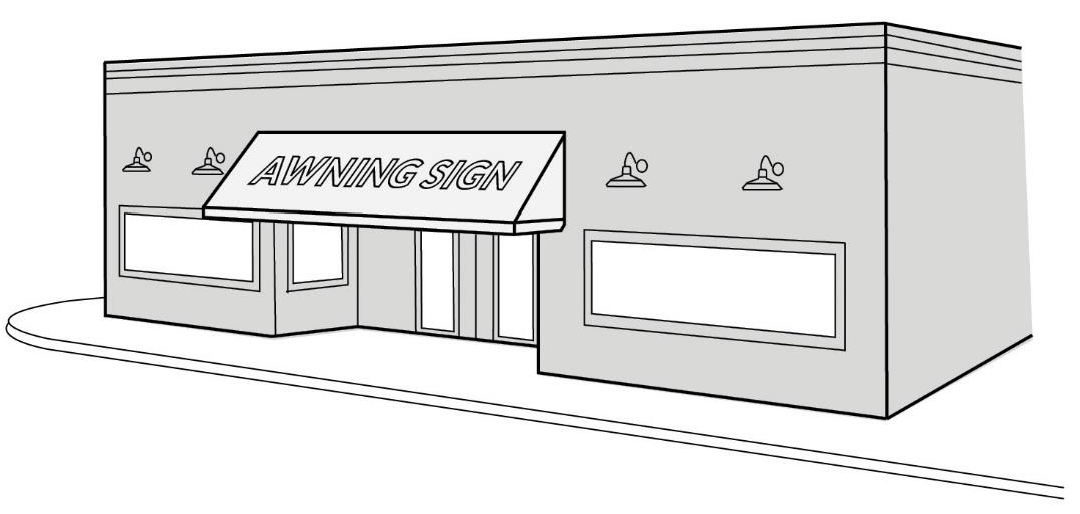
Figure 11-4 - Awning Sign
5.
Banner or Pennant. Cloth, bunting, plastic, paper, or similar non-rigid material used for advertising purposes attached to a structure, staff, pole, line, framing, or vehicle.
6.
Canopy Sign. A sign placed on a canopy, see Figure 11-5 below.
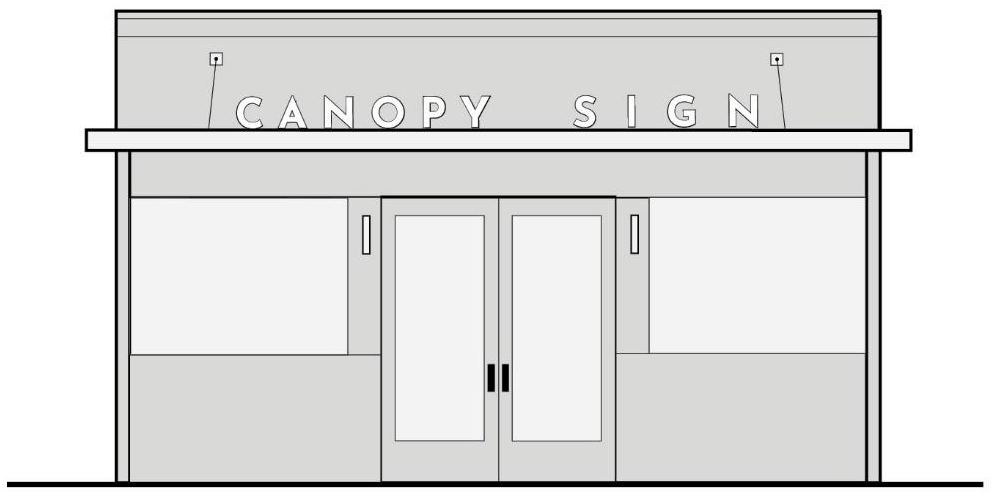
Figure 11-5 - Canopy Sign
7.
Commercial Message. A message on a sign, or portion of a sign, that promotes, informs, or proposes economic transaction, primarily concerns the economic interests of the sign sponsor and/or audience, or is intended to further discussion in the marketplace of goods and services.
8.
Copy. Also called "sign copy." The visually communicative elements mounted on a sign.
9.
Changeable Copy Sign. A sign designed to allow the changing of copy through manual, mechanical, or electrical means including time and temperature.
10.
Construction Sign. A temporary sign placed at a construction site that provides information regarding the project architect, owner, contractors, etc.
11.
Directional Sign. A sign that is designed and erected solely for the purposes of directing vehicular and/or pedestrian circulation within a project site.
12.
Double-Faced Sign. A sign constructed to display its message on the outer surfaces of two opposite planes.
13.
Electronic Message Center Sign. A sign with a fixed or changing display formed by the selective illumination of an array of light bulbs, light emitting diodes (LEDs), or liquid crystal displays (LCDs) that can be changed electronically.
14.
Flag. Any fabric or banner containing distinctive colors, patterns, or design that displays the symbol(s) of a nation, state, local government, company, organization, belief system, idea, or other meaning.
15.
Flashing Sign. An animated sign that contains an intermittent or sequential flashing light source.
16.
Freestanding Sign. A sign fixed in an upright position on the ground not attached to a structure other than a framework, pole, braces, solid base, or other device, erected primarily to support the sign, see Figure 11-6 below.
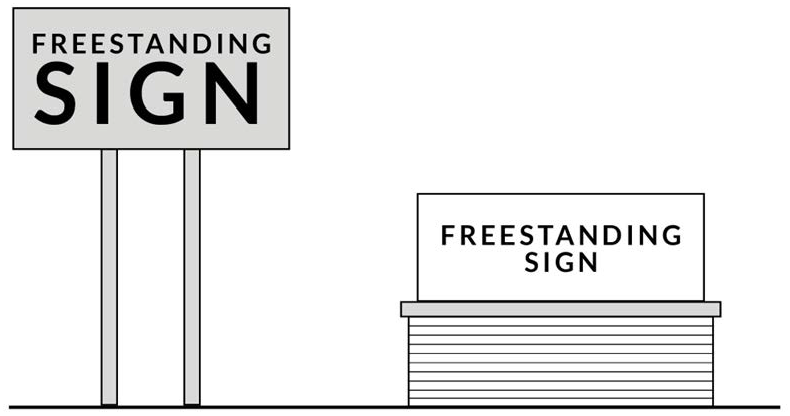
Figure 11-6 - Freestanding Signs
17.
Indirectly Illuminated Sign. A sign whose light source is external to the sign and which casts its light onto the sign from a distance; or where the light source is behind an opaque sign element and causes the opaque element to be outlined by light reflected from the surface to which the sign is mounted.
18.
Institutional Sign. A sign used only for the purpose of identifying an established organization or foundation, typically of a public character (e.g., school, hospital, museum, lodge).
19.
Internally Illuminated Sign. A sign whose light source is located in the interior of the sign so that light passes through the face of the sign, or light source which is attached to the face of the sign and is perceived as a design element of the sign.
20.
Menu Board Sign. A sign that is either affixed to a wall or freestanding, which may be illuminated, which indicates information that is essential for the efficient intake of orders from customers of a drive-through facility.
21.
Mobile Billboard. Any vehicle, or wheeled conveyance which carries, conveys, pulls, displays, or transports any sign or billboard for the primary purpose of advertising a commercial or noncommercial message.
22.
Non-Commercial Message. A message or image on a sign that directs public attention to or advocates an idea or issue of public interest or concern that does not serve to advertise or promote any business, product, activity, service, interest, or entertainment.
23.
Off-Site Directional Sign. A sign providing directions to another location.
24.
Off-Site Sign. A sign identifying a use, facility, service, or product that is not located, sold, or manufactured on the same premises that the sign is located on.
25.
Onsite Sign. A sign containing copy relating only to the business, product, service, or activity conducted or sold on the same premises as that on which the sign is located.
26.
Permanent Sign. A sign constructed of durable materials and intended to exist for the duration of time that the use or occupant is located on the premises.
27.
Political or Social Issue Sign. A sign that addresses:
a.
The passage or defeat of a measure appearing on the ballot in any national, state, or local election;
b.
The election or defeat of any candidate for any public office in any national, state, or local election; or
c.
An international, national, state, or local political or social issue.
28.
Portable Sign. A sign that is not permanently affixed to a structure or the ground.
29.
Projecting Sign. A sign that projects horizontally from the face of a building, see Figure 11-7 below.
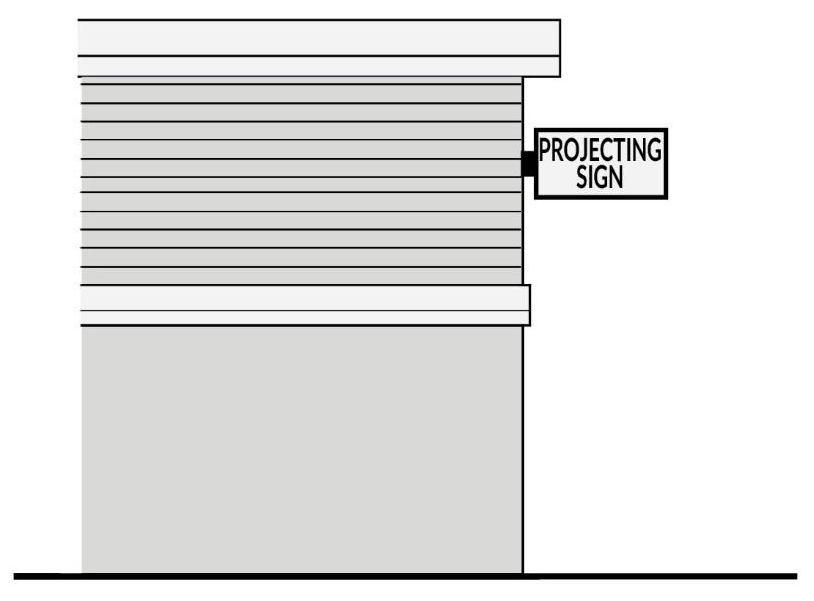
Figure 11-7 - Projecting Signs
30.
Real Estate Sign. A sign indicating that a property or any portion thereof is available for inspection, sale, lease, rent, or directing people to a property, but not including temporary subdivision signs.
31.
Roof Sign. A sign constructed upon or over a roof, or placed so as to extend above the edge of the roof, see Figure 11-8 below. Signs mounted on parapet walls are not considered roof signs. Signs which are on pylons or other architectural projections and extend above a roof or parapet wall are, for the purpose of this Development Code, roof signs.
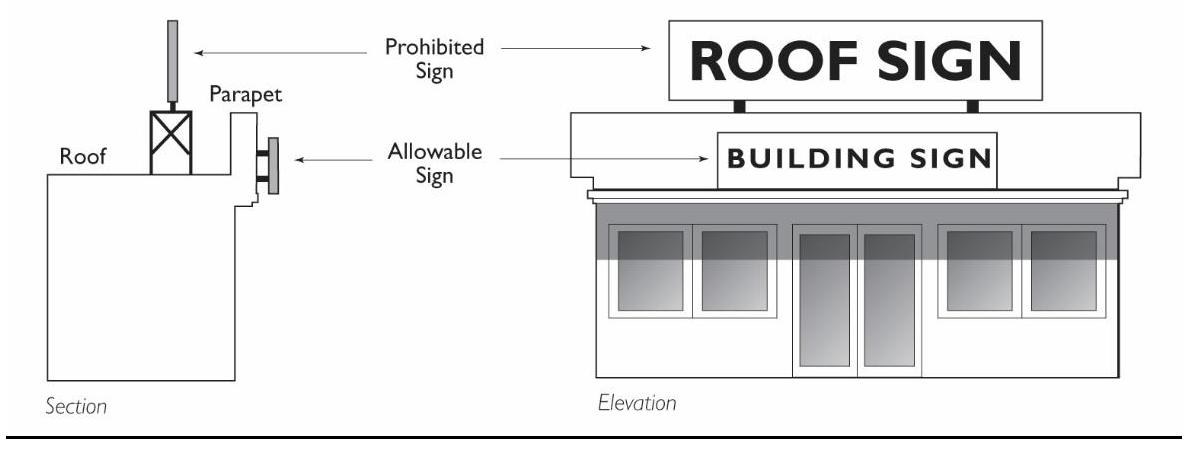
Figure 11-8 - Roof Signs
32.
Safety Sign. A sign warning of hazards.
33.
Shingle Sign. A sign that is suspended beneath a marquee, covered walkway, canopy, or awning, see Figure 11-9 below.
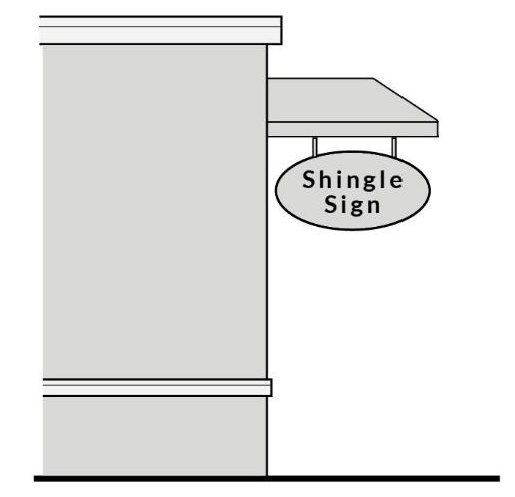
Figure 11-9 - Shingle Sign
34.
Sign Area. The area contained within a single continuous perimeter enclosing all parts of such sign copy, excluding any structural elements outside the limits of the sign required to support the sign.
35.
Sign Face. An exterior display surface of a sign, including non-structural trim, exclusive of the supporting structure. The area of a sign which is available for mounting and public display of the visually communicative image.
36.
Sign Structure. A structure that supports or is capable of supporting any sign as defined in this Code.
37.
Temporary Sign. A temporary sign intended to be displayed for a limited period of time and capable of being viewed from a public right-of-way, parking area or neighboring property.
38.
Wall Sign. A sign affixed in any manner to any exterior wall of a building and which is parallel to and projects not more than 18 inches from the building wall and which does not extend more than six inches above the parapet wall or roof of the building on which it is located. Signs which are on architectural projections which do not extend more than six inches above the roof or parapet wall of the building are, for the purpose of this Development Code, wall signs.
39.
Window Sign. A sign posted, painted, placed, or affixed in or on a window, or located within 12 inches from the inside of a window, in a manner that it can be viewed from the exterior of the structure, see Figure 11-10 below.
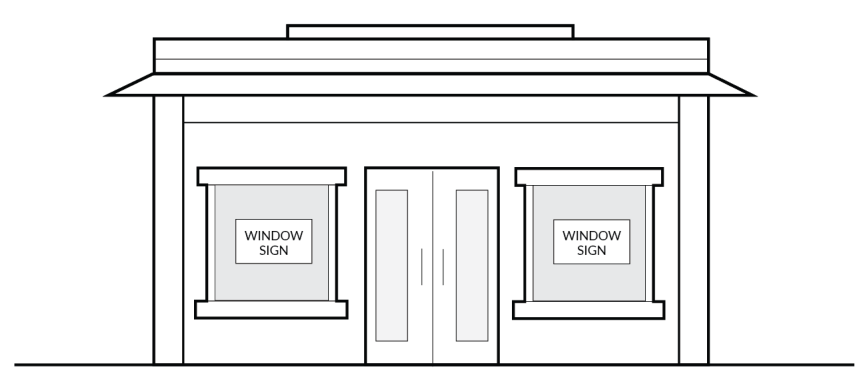
Figure 11-10 - Window Signs
Silo (Industrial). A large, cylindrical vessel used to store processed or unprocessed minerals, powders, plastic raw materials, calcium carbonate, processed grain products, asphalt hot-mix, or concrete ready-mix. Accessory equipment may include light poles, emission-control equipment, walkway access, conveyors, loading and unloading elevators, weighing equipment, and other equipment for filling and emptying the silo.
Single Room Occupancy. A multi-unit residential use where occupants share common kitchen and bathroom facilities.
Site. A lot or adjoining lots, considered a unit for the purposes of development or other use.
Slaughter House. A facility where livestock that have been raised off of the premises are slaughtered, packed, or wrapped on a commercial basis, but not including processing beyond the raw state.
Small-Scale Special Event - Agricultural Enterprise. A use or event of short duration operated on a commercial basis that is accessory and incidental to the principal commercial agricultural use of an agricultural premises. The use may recur on an intermittent basis. The recurring use or event may include farm-to-table dinners, cooking classes, weddings, receptions, parties, writing or yoga workshops, and similar gatherings, and non-motorized trail runs, bike races, equestrian endurance rides, and similar activities.
Solar Energy System. Solar energy system means either (a) any solar collector or other solar energy device whose primary purpose is to provide for the collection, storage, and distribution of solar energy for space heating, space cooling, electric generation, or water heating, or (b) any structural design feature of a building, whose primary purpose is to provide for the collection, storage, and distribution of solar energy for electricity generation, space heating or cooling, or for water heating. Additionally, the following terms and phrases are defined for the purposes of permitting solar energy systems:
1.
Feasible method to satisfactorily mitigate or avoid the specific adverse impact. A "feasible method to satisfactorily mitigate or avoid the specific, adverse impact" includes any cost-effective method, condition, or mitigation imposed by the County on another similarly situated application in a prior successful application for a permit. The County shall use its best efforts to ensure that the selected method, condition, or mitigation meets the conditions of subparagraphs (A) and (B) of paragraph (1) of subdivision (d) of Section 714 of the Civil Code.
2.
Specific, adverse impact. A "specific, adverse impact" means a significant, quantifiable, direct, and unavoidable impact, based on objective, identified, and written public health or safety standards, policies, or conditions as they existed on the date the application was deemed complete.
Solar Photovoltaic System. A type of Solar Energy System that uses semiconductor technology to directly convert sunlight into electricity, including thin film and crystalline silicon technology.
South Coast Consolidated Oil and Gas Processing Site. The site supporting the Las Flores Canyon Oil and Gas Processing facility (the industrially zoned portions of Assessor's Parcel Numbers 081-220-014 and 081-230-019). Any new oil and gas production from offshore reservoirs or zones that is processed within the South Coast Consolidated Planning Area must be processed at this site.
South Coast Consolidation Planning Area. The unincorporated area from Point Arguello to the City of Santa Barbara and from the ridge of the Santa Ynez Mountains to the three-mile offshore limit line to the south and southeast.
Spa. A business establishment with equipment and facilities for exercising and personal care treatments including depilation, facials, massages, pedicures.
Special Care Home. A residential home providing 24-hour non-medical care and supervision (also known as a "Group Home-Children," "Adult Residential Home," "Residential Care Facility for the Elderly or Handicapped," or "Foster Home"). Note: Homes which serve six or fewer persons shall be considered a residential use, subject to the regulations for any other residential dwelling in the applicable zone, and the residents and operators of the home shall be considered a family.
Special District. A public agency other than a city or county, formed in compliance with general law or special act for the local performance of governmental or proprietary functions within limited boundaries. Includes a county service area, a maintenance district or area, an improvement district or improvement zone, or any other zone or area, formed for the purpose of designating an area within which a property tax rate will be levied to pay for a service or improvement benefiting the area.
Special Problems Area. An area designated by the Board of Supervisors in compliance with Article XV (Special Problems Areas) of Chapter 10 (Building Regulations) of the Santa Barbara County Code as having severe constraints to development that include access, drainage and wastewater disposal.
Sports and Outdoor Recreation Facility. Public and private facilities for various outdoor sports and other types of recreation, where the facilities are oriented more toward participants than spectators. Examples include:
athletic/sport fields (e.g., baseball, football, polo, softball, soccer
health and athletic club outdoor facilities
skateboard parks
swimming pools
tennis and other sport courts (e.g., handball, squash)
Sports and Outdoor Recreation Facility, Accessory. A sports and outdoor recreation facility accessory to the principle use.
Sports and Entertainment Assembly. A large-scale indoor or outdoor facility accommodating spectator-oriented sports, concerts, and other entertainment activities. Examples of this land use include amphitheaters, race tracks, stadiums and coliseums. May also include commercial facilities customarily associated with the above uses, including bars and restaurants, gift shops, video game arcades, etc.
Sports Court. A structure which consists of a hardscape or other surface having a minimum size of 30 feet by 60 feet that is utilized in connection with a flat game court structure devoted to recreational purposes including basketball, handball, tennis, and volleyball but excluding bocce ball courts, lawn bowling courts and similar facilities, patios, and areas used for driveways or parking of vehicles.
Stable, Private. An accessory building in which horses are kept for private use and not for remuneration, hire or sale.
Stable, Public. An accessory building in which horses are kept for commercial use including riding, training, boarding, hire, and sale. See also "Equestrian Facility."
State. The State of California.
State University or College. The University of California and the California State University and Colleges.
Stock Cooperative. A corporation which is formed or availed of primarily for the purpose of holding title to, either in fee simple or for a term of years, improved real property, if all or substantially all of the shareholders of such corporation receive right of exclusive occupancy in a portion of the real property, title to which is held by the corporation, which right of occupancy is transferable only concurrently with the transfer of the share or shares of stock or membership certificate in the corporation held by the persons having such right of occupancy. The term "stock cooperative" does not include a limited-equity housing cooperative, as defined in this Chapter.
Storage - Accessory. The indoor storage of materials accessory and incidental to a principle use is not considered a land use separate from the principle use.
Storage - Contractor Storage Yard. See "Contractor Equipment Storage Yard."
Storage - Outdoor. The storage of various materials outside of a structure either as an accessory or principle use.
Storage - Personal Storage Facility. Structures containing generally small, individual, compartmentalized stalls or lockers rented as individual storage spaces and characterized by low parking demand.
Storage - Warehouse, Indoor Storage. Facilities for the storage of furniture, household goods, or other commercial goods of any nature. Includes cold storage. Does not include: warehouse, storage or mini-storage facilities offered for rent or lease to the general public ("Storage - Personal Storage Facility"); warehouse facilities primarily used for wholesaling and distribution (see "Wholesaling and Distribution"); or terminal facilities for handling freight (see "Freight Terminal").
Story. The portion of a building included between the surface of any floor and the surface of the next floor above it, or if there is no floor above it, then the space between the floor and the ceiling next above.
Street. A permanently reserved, public or private right-of-way, not including alleys or driveways, that provides the public a principal means of vehicular access to abutting or adjacent property. The service or frontage road of a freeway or limited access highway shall be considered as a street separate from the freeway or highway.
Street Frontage. The portion of a property abutting a public or private street, except that when this term is used in Chapter 35.38 (Sign Standards) it shall mean the portion of a property that abuts an improved street or streets open to public use to which the property has access.
Stripper Column, Pole or Tower. A tall, cylindrical vessel used to physically remove contaminants from gas or liquid.
Structural Alteration. A change in the supporting members of a structure, including bearing walls, column beams, girders, or trusses, or in the dimensions, support members, or configuration of the roof.
Structure. Anything constructed or erected, the use of which requires location on the ground or attachment to something located on the ground, excluding trailers and sidewalks.
Structure Separation. The distance between structures on the same building site.
Studio - Art, Dance, Martial Arts, Music, etc. Small scale facilities, typically accommodating one group of students at a time, in no more than one instructional space. Examples of these facilities include: individual and group instruction and training in the arts; production rehearsal; photography, and the processing of photographs produced only by users of the studio facilities; martial arts training studios; gymnastics instruction, and aerobics and gymnastics studios with no other fitness facilities or equipment. Also includes production studios for individual musicians, painters, sculptors, photographers, and other artists. Does not include artist studios that are accessory to a residential use.
Studio Dwelling Unit. A dwelling unit that does not contain a bedroom and which is located within a two-family dwelling or a multiple dwelling.
Subdivision. The division, by any subdivider, of any unit or portion of land shown on the latest equalized Santa Barbara County assessment roll as a unit or contiguous units, for the purpose of sale, lease or financing, whether immediate or future. Property shall be considered as contiguous units even if it is separated by roads, streets, utility easement or railroad rights-of-way. Subdivision includes the following, as defined in Civil Code Section 1715: a condominium project; a community apartment project; or the conversion of five or more existing dwelling units to a stock cooperative.
Substantially Visible. An object is considered to be substantially visible if it stands out as a conspicuous feature of the landscape when viewed with the naked eye.
Summerland Community Plan Area. That portion of the County located within the boundaries of the Summerland Community Plan as shown on the Summerland Community Plan Land Use Map.
Supportive Housing. Housing with no limit on length of stay, that is occupied by the target population, and that is linked to an onsite or offsite service that assists the supportive housing resident in retaining the housing, improving his or her health status, and maximizing his or her ability to live and, when possible, work in the community. (See Government Code Section 65582(g).)
Surface Debris. Loose surface litter on the soil surface, normally consisting of fallen leaves, needles, twigs, bark, cones, small branches and downed logs.
Swap Meet. An open-air market operating during daylight hours on weekends and holidays for the retail sale or exchange of merchandise by a number of sellers.
T.
Definitions, "T."
Tannery. A facility that transforms hides into leather by tanning or curing.
Tasting Room. See "Winery, Tasting Room."
Target Population. Persons with low incomes who have one or more disabilities, including mental illness, HIV or AIDS, substance abuse, or other chronic health condition, or individuals eligible for services provided pursuant to the Lanterman Developmental Disabilities Services Act (Division 4.5 (commencing with Section 4500) of the Welfare and Institutions Code) and may include, among other populations, adults, emancipated minors, families with children, elderly persons, young adults aging out of the foster care system, individuals exiting from institutional settings, veterans, and homeless people. (See Government Code Section 65582(i).)
Telecommunications Facility. A facility that transmits or receives electromagnetic signals for communication purposes including data transfer. It includes antennas, microwave dishes, horns, and other types of equipment for the transmission or reception of such signals; telecommunication towers or similar structures supporting said equipment; equipment buildings; parking areas; and other accessory development. It does not include facilities staffed with other than occasional maintenance and installation personnel or broadcast studios. Additionally, the following terms and phrases are defined for the purposes of Chapter 35.44 (Telecommunications Facilities).
1.
Antenna. Any system of wires, poles, rods, horizontal or vertical elements, panel, reflecting discs, or similar devices used for the transmission or reception of electromagnetic waves.
2.
Antenna Envelope. The three-dimensional cylinder shaped space that is occupied by antennas and the support structure on which the antennas are mounted. This area/space is measured from the portion of the antenna located furthest from the support structure.
3.
Antenna Support Structure. A pole, utility pole, monopole tower, lattice tower, guyed tower, telescoping mast, tower tripod, or other similar structure utilized for the purpose of supporting an antenna used for the transmission and reception of electromagnetic waves.
4.
Base Station. A structure or equipment at a fixed location that enables Federal Communication Commission-licensed or authorized wireless communications between user equipment and a communications network, which does not encompass a tower or any equipment associated with a tower, and as further defined by 47 C.F.R. Section 1.6100(b)(1), as amended.
5.
Collocation. The mounting of installation of an antenna on an existing tower, building or structure for the purpose of transmitting and/or receiving radio frequency signals for communication purposes, whether or not there is an existing antenna on the structure.
6.
Collocated Telecommunications Facility. A telecommunication facility composed of one or more antennas mounted to an existing tower or other structure.
7.
Collocated Telecommunications Site. Any site where more than one antenna support structure is installed in close proximity to one another on one lot.
8.
Commercial. A telecommunications facility that is operated primarily for or accessory to a business purpose.
9.
Equipment Cabinet. An enclosed physical container installed on the ground or other horizontal surface (e.g. roof, etc.) to house multiple, distinct, non-transmission equipment or devices. Does not include housing for small electronic components such as breaker boxes, housing for transmission equipment, router switch boxes, etc.
10.
Height. The height of a telecommunication tower shall be measured from the natural, undisturbed ground surface below the center of the base of said tower to the top of the tower itself, or, if higher, the uppermost point of the highest antenna or piece of equipment attached thereto. In the case of an antenna or antenna support structure mounted on a building or structure, the height of the antenna or antenna support structure includes the height of the portion of the building that it is mounted on.
11.
Hub Site. A supplemental equipment site that is void of transceiving antennas operated as an accessory to a wireless telecommunications facility. Equipment may include cabinets, switchboards, computer servers, batteries, utility racks, air conditioning units, and emergency back-up generators including fuel storage.
12.
Lattice Tower. A multiple sided open metal frame support structure which supports antennas and related equipment.
13.
Mobile Telecommunications Temporary Facility. A facility that transmits or receives electromagnetic signals for communication purposes including data transfer function that would operate for a limited duration (determined on a case by case basis) and is wholly contained within and/or on a mobile non-permanent vehicle (e.g. trailer, van, or truck). Facility equipment including poles, masts, antennas, computer servers, batteries, generators or similar equipment must be mounted on the vehicle, or located inside.
14.
Monopole. A single pole support structure, constructed without guy wires and ground anchors, used to support communication antennas and connecting appurtenances.
15.
Multiple User. A telecommunications facility comprised of multiple telecommunication towers or buildings supporting one or more antennas owned or used by more than one public or private entity.
16.
Natural Gas Telecommunications Facilities. Natural gas telecommunications facilities includes, but is not limited to, new utility poles, solar panels, antennas, wireless signal transmitting and/or receiving devices, or other telecommunications facilities that are designed for the purpose of natural gas pipeline safety and operations.
17.
Non-commercial. A telecommunication facility that is operated solely for a non-business purpose.
18.
Ridgeline. When used within Section 35.44.010 (Commercial Telecommunication Facilities) and Section 35.44.030 (Telecommunications Facilities Appurtenant to Natural Gas Distribution Facilities), ridgeline shall mean a visually prominent, relatively narrow strip or crest of land, which includes the highest points of elevation within a watershed, that separates one drainage basin from another.
19.
Substantially Visible. A facility is considered to be substantially visible if any portion of the facility stands out as a conspicuous feature of the landscape or breaks the skyline when viewed with the naked eye.
20.
Tenant Improvement. A wireless telecommunication facility where the general public does not have access to the facility and the transmission facility and the associated antennas are (1) entirely enclosed within an existing building or (2) located on the roof of an existing structure, or (3) the antennas are located on the exterior wall of a structure. Tenant improvements do not include antennas that are mounted on utility poles or similar structures.
21.
Tower. A mast, pole, monopole, guyed tower, lattice tower, freestanding tower, or other structure designed and primarily used to support one or more antennas.
22.
Utility Pole Existing. A pole or similar structure owned by a public body or utility that provides support for electrical, telegraph, telephone or television cables, and is in place at the time that an application is submitted to attach telecommunications equipment thereto. A new utility pole that replaces an existing utility pole is also considered to be existing provided the height and width of the replacement pole are substantially the same as the pole it replaces.
23.
Vault. A subterranean room allowing placement and storage of facility support equipment underground. Components of the vault may also include a ventilation system, drainage system, utility meters and personnel access such as a door, hatch, manhole or cover.
24.
Wireless Telecommunication Facility. A commercial facility that transmits and/or receives radio communication signals through the air for cellular, personal communication services, pagers, and/or similar services. The facility may include; antennas, radio transmitters, equipment shelter or cabinet, air vents, antenna support structure, air conditioning units, fire suppression systems, and emergency back-up generators including fuel storage.
Temporary Guest. Non-paying guests occupying the premises for not more than 120 days in any 12-month period.
Temporary Use. The use of a structure or land for an event for a limited period of time where the site is not to be permanently altered by grading or construction of accessory facilities. Examples of temporary uses include: art shows, car washes, charitable functions, seasonal sales lots.
Tent Cabin. A hybrid structure between a tent and a cabin typically with a wood floor, frame, and door, and covered by a heavy-duty or waterproof canvas or other durable fabric.
Theater. An indoor or outdoor facility for spectator group entertainment, other than sporting events. Examples of these facilities include civic theaters, and facilities for "live" theater and concerts, performing arts centers, and movie theaters. Does not include drive-in theaters. See also "Meeting Facility, Public or Private," and "Sports and Entertainment Assembly."
Toro Canyon Plan Area. That portion of the County located within the boundaries of the Toro Canyon Plan area as shown on the Toro Canyon Plan Land Use Map.
Trail. A marked or beaten path, as through woods or wilderness.
Trout farm. A commercial, recreational facility consisting of tanks or ponds in which trout are kept to be fished for.
Trailer. A vehicle with or without motor power which is designed or used for hauling materials, personal property, or vehicles, including watercraft, or for human habitation, office, or storage including camper, recreational vehicle, travel trailer, and mobile home but not including mobile homes on a permanent foundation.
Transient. Any person who exercises occupancy or is entitled to occupancy by reason of concession, permit, right of access, license or other agreement for a period of 30 consecutive days or less. Any such person so occupying space in any lodging shall be deemed to be a transient until the period of 30 days has expired unless there is an agreement in writing between the owner or operator and the occupant providing for a longer period of occupancy. A transient is also referred to as a transient occupant.
Transitional Housing. Buildings configured as rental housing developments, but operated under program requirements that require the termination of assistance and recirculating of the assisted unit to another eligible program recipient at a predetermined future point in time that shall be no less than six months from the beginning of the assistance. (See Government Code Section 65582(j).)
Transit Station or Terminal. A passenger station for vehicular, and rail mass transit systems; also terminal facilities providing maintenance and service for the vehicles operated in the transit system. Includes buses, taxis, railway, etc.
Tree Nut Hulling. Removing the soft outer hull (also known as the husk) from the nut by manual or mechanical methods.
Truck or Freight Terminal. A transportation facility furnishing services incidental to air, motor freight, and rail transportation. Examples of these facilities include:
freight forwarding services
freight terminal facilities
joint terminal and service facilities
overnight mail processing facilities
packing, crating, inspection and weighing services
postal service bulk mailing distribution centers
transportation arrangement services
trucking facilities, including transfer and storage
Truck Stop. A facility primarily engaged in providing gas/service station services for cargo vehicles. May include driver services including showers, a restaurant, and/or a convenience store of 1,000 square feet or less.
Truck, Trailer, Construction, Farm, and Heavy Equipment Sales/Rental. Retail establishments selling or renting construction, farm, or other heavy equipment. Examples include cranes, earth moving equipment, tractors, combines, heavy trucks, etc.
U.
Definitions, "U."
Under Construction. The placing of construction materials in permanent position and fastened in a permanent manner.
Understory - Summerland. The portion of the structure between the exposed finished floor and the finished grade.
Uniform Rules for Agricultural Preserves and Farm Security Zones. Rules that are adopted by the Board that implement the Land Conservation (Williamson) Act within the County and determine appropriate uses of land subject to agricultural preserve and farm security zone contract.
Urban Area. An area shown on the Comprehensive Plan maps within which is permitted the development of residential, commercial, and industrial activities, and their related uses and structures.
Urbanization. Any commercial, industrial, or residential structure on lots of less than five acres in size, or the creation by land divisions of lots of less than five acres in size.
Utility Infrastructure. Pipelines for water, natural gas, and sewage collection and disposal; and facilities for the transmission of electrical energy for sale, including transmission lines for a public utility company. Also includes telephone, telegraph, cable television and other communications transmission facilities utilizing direct physical conduits. Does not include offices or service centers (see "Offices - Business and Service"), or distribution substations (see "Utility Facility").
Utility-Scale Solar Photovoltaic Facilities. Facilities that are connected to the electrical grid on the utility side of the electric meter and are built for the primary purpose of generating and selling wholesale power. The electricity generated by the facility is not primarily used for on-site activities (such as farming or domestic water heating).
Utility Service Line. A line providing electricity, gas, television, and other similar utilities.
V.
Definitions, "V."
Vegetation Removal. The removal of vegetation, by hand or with mechanical equipment, including the roots, such that the plant, shrub or tree is completely removed.
Vehicle. A device by which any person or property may be propelled, moved or drawn upon a highway, except a device moved by human power or used exclusively upon stationary rails or tracks.
Vehicle Dispatch Facility. A base facility where ambulances, taxis, limousines, armored cars, tow trucks and similar vehicles for specialized transportation are stored, and from which they are dispatched, and/or where ambulance vehicles and crews not based at a hospital or fire department stand by for emergency calls. Does not include storage facilities for towed vehicles, which is classified under "Vehicle Storage."
Vehicle Services. The repair, servicing, alteration, restoration, towing, painting, cleaning, or finishing of automobiles, trucks, recreational vehicles, boats and other vehicles as a principle use, including the incidental wholesale and retail sale of vehicle parts as an accessory use. This use includes the following categories.
1.
Car Wash, Mechanical. A commercial establishment equipped for washing cars and other motor vehicles utilizing the mechanized movement of vehicles.
2.
Major Repair/Body Work. These establishments include towing, collision repair, other body work, and painting services; tire recapping.
3.
Minor Maintenance/Repair. Minor facilities providing repair and maintenance services. Examples include: detailing services; muffler and radiator shops; quick-lube services; tire and battery sales and installation (not including recapping).
Does not include automobile parking, repair shops that are part of a vehicle dealership on the same site (see "Auto and Vehicle Sales and Rental," and "Mobile Home, RV, and Boat Sales and Rental"); gas stations, which are separately defined; or dismantling yards.
Vehicle Storage. A facility for the storage of operative cars and other fleet vehicles, trucks, buses, recreational vehicles, and other motor vehicles. Includes facilities for the storage and/or servicing of fleet vehicles. Does not include public or private parking lots; or dismantling yards (classified in "Recycling - Scrap and Dismantling Yards").
Veterinary Clinic, Animal Hospital. See "Medical Services - Animal Hospital."
Vision Clearance Area. A triangular space at the street or highway corner of a corner lot wherein the height of plantings, fences, walls, and other structures is restricted by Subsection 35.30.090.J (Vision clearance).
Visitor-Serving Commercial. Retail and service uses not otherwise listed as allowable in a specific zone, that are oriented to the needs of tourists and the traveling public, including barber and beauty shops, gift and souvenir shops, recreational clothing stores, recreational equipment rental (e.g., beach and swimming equipment) and restaurants.
W.
Definitions, "W."
Warehouse. See "Storage - Warehouse, Indoor Storage."
Waste Minimization. See "Hazardous Waste, Waste Minimization."
Wastewater Treatment System. A system, not connected to a wastewater treatment facility, that treats, stabilizes, stores and disposes into the soil sewage generated onsite. The following terms are defined for purposes of permitting and regulating wastewater treatment systems; see Article 1 (Onsite Wastewater Treatment Systems) of Chapter 18C (Environmental Health Services) for additional definitions regarding wastewater treatment systems:
1.
Alternative Wastewater Treatment System. An onsite wastewater dispersal field that consists of components other than a conventional or supplemental treatment system. Examples include "mound", "evapotranspiration", and "at grade" systems.
2.
Conventional Onsite Wastewater Treatment System. An onsite wastewater treatment system composed of a septic tank and a dispersal field that uses leach lines, a leaching bed or seepage pits, a shallow drip or pressurized drain field and does not include alternative onsite wastewater treatment systems.
3.
Drywell. An excavation, typically cylindrical in shape and filled with rock, constructed for the purpose of disposing of sewage effluent from a septic tank or treatment tank.
4.
Maintenance. Work related to the upkeep of a wastewater treatment system. Examples include any installation, repair or replacement of septic tank baffles, risers, tees, ells, tops, access port lids, pumps and blowers.
5.
Modification. The replacement or enlargement of any component of an onsite wastewater treatment system, not defined as maintenance or repair in this Development Code, which results in a change in flow, capacity or design of the system.
6.
Onsite Wastewater Treatment System. A system composed of a septic tank and a dispersal field and related equipment and appurtenances. Onsite wastewater treatment systems are also referred to as septic systems, onsite sewage disposal systems, individual sewage disposal systems or private sewage disposal systems and may include alternative and supplemental treatment systems.
7.
Performance Test. A test conducted to determine the absorptive capacity of a seepage pit by measuring the maximum rate of water absorption after initial presaturation usually expressed as gallons per day.
8.
Repair. The restoration, replacement, or alteration of any malfunctioning or damaged component of an onsite wastewater treatment system except those defined in this Development Code as maintenance. The alteration of a hollow seepage pit to a rock filled seepage pit for the purposes of this article shall be considered a repair.
9.
Septic Tank. A water tight, compartmentalized, covered receptacle designed and constructed to: receive the discharge of sewage; separate the solids from the liquid; digest organic matter; store digested solids for a period of retention; and allow the resultant effluent to discharge from the tank to the dispersal field.
10.
Sewage. Any and all waste substance, liquid or solid, associated with human habitation, or which contains or may contain human or animal excreta or excrement, offal or any feculent matter. Industrial wastewater shall not be considered as sewage.
11.
Supplemental Wastewater Treatment System. An onsite wastewater treatment system that utilizes engineered designs and/or technology to treat effluent to reduce one or more constituents of concern in wastewater. It may also be referred to as an Advanced Treatment System or Enhanced Treatment System. Examples include sand filters, textile filters and aerobic treatment units but do not include composting or incinerating toilets.
Wastewater Treatment Facility. A system that that treats, stabilizes, stores and disposes into the soil sewage generated from more than one lot.
Water Diversion Project. The diversion of water from a natural channel to another location through alteration of the natural channel and/or artificial structures.
Water Extraction, Commercial. The pumping and processing of natural, carbonated or mineral water from a well for commercial purposes, including bottling, shipping, storage and trucking.
Water System. A system for the extraction and provision of water utilizing a well or wells and including any collection, treatment, storage and distribution facilities.
Water Supply, Treatment, Storage Facilities - Central Plant. Central plant facilities for domestic, commercial, industrial or recreational water production, including onsite water wells, water systems, water treatment plants, water package plants and other similar facilities proposed to serve 200 or more connections.
Water Trucking Facility, Commercial. A commercial facility involving extraction and storage operations that transports water by truck from the point of extraction to offsite locations.
Wetbar. An area of a room that may include cabinets, counters, refrigeration units and sinks but no cooking facilities, as restricted by Chapter 35.42 (Standards for Specific Land Uses).
Wetland. Lands that may be covered periodically or permanently with shallow water and include saltwater marches, freshwater marshes, open or closed brackish water marshes, swamps, mudflats, and fens.
Wholesaling and Distribution. An establishment engaged in selling merchandise to retailers; to contractors, industrial, commercial, institutional, farm, or professional business users; to other wholesalers; or acting as agents or brokers in buying merchandise for or selling merchandise to such persons or companies. Examples of these establishments include:
agents, merchandise or commodity brokers, and commission merchants
assemblers, buyers and associations engage in the cooperative marketing of farm products
merchant wholesalers
packaging business
stores primarily selling electrical, plumbing, heating and air conditioning supplies and equipment
Also includes storage, processing, packaging, and shipping facilities accessory to the principle use.
Wind Energy Conversion System. A machine or group of machines used to convert wind energy to a usable form (e.g., mechanical, electrical).
Wind Turbine Generators. A wind energy conversion system that utilizes a turbine to convert wind power to electrical energy.
Winery. The following terms are defined for the purposes of Section 35.42.280 (Wineries).
1.
Incidental Food Service at Winery Tasting Room. Provision of food to guests of a winery tasting room within the same structure and/or footprint of the tasting room area, allowed in conjunction with the marketing and sale of wine produced on the winery premises. Provision of food shall be secondary, incidental, and subordinate to tasting room operations, including wine tasting, sales, and education.
2.
Tasting Room. A room or rooms, open to the general public, primarily used for the retail marketing of winery products. Merchandise offered for sale within the tasting room may also include souvenirs and clothing bearing the logo of the winery, as well as wine related items and other products that reflect or enhance the character or theme of the winery. A room or rooms where wine tasting occurs, where wine tasting is part of the normal business practice in the wholesale marketing of winery products and not open to the public is not considered a tasting room.
3.
Winery. A bonded agricultural processing facility primarily used for the commercial processing of grapes or other fruit products to produce wine or similar spirits or the refermenting of still wine into sparking wine. Processing consists of controlled fermentation combined with any of the following: crushing, blending, barrel aging, and bottling. Storage of case goods shall only occur in conjunction with processing. Retail sales and tasting of wine and retail sales of related promotional items may be allowed as part of the winery operation.
4.
Winery Premises. A lot or group of contiguous lots that has an approved Development Plan, Conditional Use Permit, or Land Use Permit that allows for the development and operation of a winery. Lots shall be considered to be contiguous even if separated by roads, streets, utility easements, or railroad rights-of-way.
5.
Winery Special Event. An event of less than one day and occurring on a winery premises attended by 80 or more people including concerts with or without amplified sound, such as weddings, and advertised events, fund raising events, winemaker dinners open to the general public, etc. Winery special events do not include wine industry-wide events (e.g., Vintner's Festival, Harvest Festival) including associated events held at individual wineries, the normal patronage of a tasting room, and private gatherings of the owner or employees where the general public does not attend.
6.
Winery Structural Development. Anything constructed, erected, or placed with or without a foundation, the use of which requires location on the ground and is covered by a roof. The footprint area of uncovered storage tanks and wine caves is also included as winery structural development. Winery structural development is restricted to development associated with the winery operation and does not include residential development including employee housing, development that is solely accessory to vineyards, and other agricultural activities not directly associated with the winery.
X.
Definitions, "X." No specialized terms beginning with the letter "X" are defined at this time.
Y.
Definitions, "Y."
Yard. See "Setback."
Yurt. A circular structure with a lattice framework and conical roof of poles, installed on a wood or concrete floor or platform, and covered by a heavy-duty or waterproof canvas or other durable fabric.
Z.
Definitions, "Z."
Zoning Administrator. A position authorized by Government Code Section 65900 et seq. created by ordinance, which authorizes a hearing officer to hear and decide on applications including Development Plans, Minor Conditional Use Permits, Modifications and Variances, in compliance with this Development Code.
Zoo. A park or an institution in which living animals are kept and usually exhibited to the public. Also called zoological garden.
(Ord. No. 5161, § 8, 8-16-2022; Ord. No. 5167, §§ 14, 15, 11-29-2022; Ord. No. 5192, § 27, 11-7-2023; Ord. No. 5202, § 17, 2-13-2024; Ord. No. 5226, §§ 16—19, 12-10-2024; Ord. No. 5231, § 2, 2-4-2025; Ord. No. 5238, § 22, 2-11-2025; Ord. No. 5259, § 3, 6-24-2025; Ord. No. 5263, § 4, 7-15-2025)
11 - GLOSSARY
This Chapter provides definitions of terms and phrases used in this Development Code that are technical or specialized, or that may not reflect common usage. If any of the definitions in this Chapter conflict with definitions in other provisions of the County Code, these definitions shall control for the purposes of this Development Code. If a word is not defined in this Chapter, or in other provisions of the Santa Barbara County Code, the Director shall determine the correct definition utilizing the latest edition standard dictionary.
As used in this Development Code, the following terms and phrases shall have the meaning ascribed to them in this Section, unless the context in which they are used clearly requires otherwise.
A.
Definitions, "A."
Abut. To physically touch or border upon; or to share a common property line.
Accessory Agricultural Structure. A structure designed and constructed primarily for storing farm implements or supplies, hay, grain, poultry, livestock or horticultural products that supports the agricultural use of the lot.
Accessory dwelling unit. An attached or a detached residential dwelling unit that is located on the same lot as a one-family or multiple-family dwelling to which the accessory dwelling unit is accessory and (1) provides complete independent living facilities for one or more persons including permanent provisions for cooking, eating, living, sanitation, and sleeping, and (2) provides interior access between all habitable rooms. An accessory dwelling unit may also include an efficiency unit, as defined in Section 17958.1 of Health and Safety Code, and a manufactured home, as defined in Section 18007 of the Health and Safety Code.
1.
Attached accessory dwelling unit. An accessory dwelling unit that shares at least five feet of common wall with, or is stacked above or below, the principal dwelling or an attached accessory structure.
2.
Detached accessory dwelling unit. An accessory dwelling unit that is detached from the principal dwelling and is located on the same lot as the principal dwelling. A detached accessory dwelling unit may be attached to a detached accessory structure.
Accessory Residential Structure or Use. Any use and/or structure that is customarily a part of, and clearly incidental and secondary to a residence, and does not change the character of the residential use. This definition includes the following attached and detached accessory structures, and other similar structures normally associated with a residential use of property. Accessory Agricultural Structures are separately defined. Examples of this land use include the following:
artist studios
cabanas
garages
gazebos
greenhouses (non-commercial)
guesthouses
spas and hot tubs
storage sheds
swimming pools
tennis and other onsite sport courts
workshops
Also includes the indoor storage of automobiles, personal recreational vehicles and other personal property, accessory to a residential use.
Accessory Retail or Services. The limited retail sale of various products, or the provision of certain personal services within a health care facility, hotel, office, or industrial complex, to employees or customers of, or visitors to the principle use. Examples of these uses include pharmacies, gift shops, and food service establishments within hospitals; convenience stores and food service establishments within hotel, office and industrial complexes; and barber and beauty shops within residential care facilities.
Accessory Structure. A structure located upon the same site as the structure or use to which it is accessory. The use of an accessory structure is customarily incidental, appropriate and subordinate to the use of the principal structure, or to the principal land use of the site.
Accessory Use. A use that is customarily incidental, appropriate and subordinate to the use of the principal structure, or to the principal land use of the site and that does not alter the principal use of the lot or adversely affect other properties in the vicinity.
Adjacent. See "abut."
Aerial Approach Zone. An area at ground level that begins at the end of each runway and extends under the path of landing or departing aircraft to a distance determined by the characteristics of the runway.
Affordable Housing. The State defines affordable housing as housing that can be purchased or rented by households whose gross annual household income does not exceed 120 percent of area median income, adjusted for household size. Santa Barbara County expands this to include households with income up to 200 percent of area median income. This housing may be subject to a covenant or deed restriction that restricts sales price or rent for a given period of time. Certain types of housing such as homeless shelters, dormitories, farm labor camps, and housing for people with disabilities may not require price controls because they generally provide housing for a special needs group.
Agent. A person authorized in writing by the property owner to represent and act for a property owner in contacts with County employees, committees, Commissions, and the Board, regarding matters regulated by this Development Code.
Aggrieved Person. A person who, in person or through a representative, appeared at a public hearing in connection with the decision or action appealed, or who, by other appropriate means prior to a hearing, informed the County of the nature of their concerns, or who for good cause was unable to do either.
Agricultural Development. Any agricultural structure, practice, or operation that a) requires a building, grading, or brush-clearing permit on land designated for agriculture; b) is located on land which has had no history of cultivation; and/or c) is on land not designated for agriculture. A permit solely for plumbing or electricity shall not constitute a standard building permit.
Agricultural Employee Housing. A dwelling occupied by one or more agricultural employees including family members.
Agricultural Improvement. Agricultural activities or structures on agriculturally designated lands which are not subject to building, grading, or brush clearing permits. These activities and structures may be subject to special agricultural building, agricultural grading, or agricultural brush-clearing permits.
Agricultural Premises. The area of agricultural land consisting of a single lot or multiple contiguous lots under one ownership.
Agricultural Preserve Contract. A contract complying with the Land Conservation (Williamson) Act (Government Code Section 51200 et seq.) between the County and a landowner in which the landowner restricts development of lands devoted to agricultural uses in return for a reduction in property taxes.
Agricultural Processing and Product Preparation. The initial processing or preparation for shipping of agricultural products, not including animal products, produced on the same site ("on-premises products") or from other properties ("off-premises products"), for onsite marketing or for additional processing and/or packaging elsewhere. Examples of this land use include the following:
drying of corn, rice, hay, fruits and vegetables
flower packing or packaging
freeze-drying of fruits and vegetables
milling by simple mechanical process without additives, chemical reactions, changes in ambient temperatures and/or hazardous materials
pre-cooling and packaging of fresh or farm dried fruits and vegetables
pressing olives to create olive oil
sorting, grading and packing of fruits and vegetables
Does not include "cannabis" and "winery," which are defined separately
Agricultural Processing - Extensive. The refinement or other processing of agricultural products to substantially change them from their raw form, which involves machinery, chemical reactions, and/or hazardous or highly odiferous materials or products. Examples of this land use include the following:
corn shelling
cotton ginning
ethanol production
grain cleaning and custom grinding
grist mills
milling of flour, feed and grain
sugar mills
Agricultural Processing - Small-Scale Processing Beyond the Raw State. On a limited scale, the refinement or other processing of agricultural products (not including animal products) to minimally change them from their raw form. Small-scale agricultural processing beyond the raw state may involve some use of machinery, additives, chemical reactions, and changes in ambient temperature but does not involve pasteurization, or the use of hazardous or highly odiferous materials or products. Small-scale agricultural processing beyond the raw state may include activities such as curing, pickling, preserving, and milling of flour, feed and grain, when conducted on a limited, small-scale basis in support of onsite agriculture. Does not include "cannabis," "winery," and "agricultural processing - extensive," which are defined separately.
Agricultural Product Sales. The sale of agricultural products, including flowers, fresh fruit, herbs, plants and vegetables, grown on or off the premises or other products as allowed by Section 35.42.050 (Agricultural Product Sales) of this Development Code.
Agricultural Product Transportation Facility. A transportation facility required to support agriculture.
Agricultural Soil Export Mining. Grading done for agricultural activities, as defined in California Code of Regulations, Title 14, Section 3501, that requires the export of soil and such export does not exceed 75,000 cubic yards from any one parcel or group of contiguous parcels since January 1, 2005. For the purposes of this definition any permitted or unpermitted export of soil since January 1, 2005, whether or not qualified as agricultural grading, shall be included in the calculation of 75,000 cubic yards.
Agricultural Structural Development. Any structure that is constructed, erected, or placed with or without a foundation, the use of which requires location on the ground and is covered by a roof, the use of which is restricted to those uses that are directly accessory, ancillary and secondary to the agricultural use of the property. Dwelling units are considered agricultural structural development only if they provide housing for agricultural employees of the owner or lessee of the land and are permitted in compliance with Section 35.42.030 (Agricultural Employee Dwellings) or Section 35.42.260 (Temporary Uses and Trailers).
Agricultural Support Use. Uses such as the sorting and processing of local fruits and vegetables, wineries, or feed distribution; that are a necessary and integral part of maintaining on-premise production and marketing, and that are directly associated with onsite agricultural or ornamental crop, or animal raising operations. Other uses permitted by Conditional Use permit in an agricultural district such as oil drilling are not to be construed as an agricultural support use.
Agriculture. The production of food and fiber, the growing of plants, the raising and keeping of animals, aquaculture, and the preparation for sale and marketing of products in their natural form when grown on the premises, and the sale of products which are accessory and customarily incidental to the marketing of products in their natural form grown on the premises, and as allowed by Section 35.42.050 (Agricultural Product Sales), but not including a slaughter house, fertilizer works, commercial packing or processing plant, or plant for the reduction of animal matter or any other similarly objectionable use.
Airport. An area of land or water used for the landing and take-off of aircraft as well as any appurtenant areas used for airport buildings, aircraft operations, and related facilities, including aprons and taxiways, control towers, hangers, safety lights, and structures. These facilities may also include parachute jump areas and FAA-certified parachute lofts; and facilities for aircraft manufacturing, maintenance, repair, and reconditioning. Also includes agricultural, personal, restricted, and public use landing strips, defined as follows:
1.
Airstrip. An airfield without normal airport facilities consisting of a landing strip or heliport used for agricultural crop dusting or the personal use of the tenant or owner of the site and excluding public use and commercial operations.
2.
Airstrip, Temporary. An airstrip without hard surface materials
3.
Public Use Airfield. Any landing strip, airport, or heliport available for public use, or listed in the Airport Directory of the current Airman's Information Manual or in the Pacific Airman's Guide and Chart Supplement.
Alley. A public passage or way affording generally a secondary means of vehicular access to abutting property and not intended for general traffic circulation.
Amateur Radio Station. A radio station operated in the Amateur Radio Service under license by the Federal Communications Commission.
Amine Column or Tower. A tall, cylindrical vessel used to remove contaminants, such as hydrogen sulfide and carbon dioxide, from natural gas with the use of amines.
Animal Enclosure. A structure for restricting the movement of, and/or sheltering animals. Includes corrals, paddocks, pens, etc. Barns, stables, and other similar roofed structures are also included under the definition of Agricultural Accessory Structure.
Animal Hospital. See Medical Services - Animal Hospital.
Animal Keeping. See Section 35.42.060 (Animal Keeping).
Antenna. See "Telecommunications Facility."
Antenna Envelope. See "Telecommunications Facility."
Antenna Support Structure. See "Telecommunications Facility."
Apartment. A room or suite of rooms within a building comprising an independent self-contained dwelling unit, with kitchen or cooking facilities, and a bathroom, occupied or suitable for occupation as a residence for living and sleeping purposes.
Appliance Manufacturing. An establishment that manufactures appliances or equipment for domestic use, including stoves, refrigerators, and washing machines.
Applicant. A person who is filing an application requesting an action who:
1.
Is the owner or lessee of property;
2.
Has contracted to purchase property contingent upon that party's ability to acquire the necessary approvals required for that action in compliance with this Development Code, and who presents written authorization from the property owner to file an application with the County; or
3.
Presents written authorization from the property owner to file an application with the County.
4.
Is a person, business or organization making a written request to the County for reasonable accommodation in the strict application of the Development Code.
Aquaculture. The raising and harvesting of aquatic plant and animal organisms.
Aquaponics. A closed system of aquaculture in which the waste produced by farmed fish or other aquatic creatures supplies the nutrients for plants grown hydroponically which in turn purify the water in the system.
Arcade. A permanent roofed structure attached to the building, projecting over public property, and partially enclosed and supported by supports located on public property.
Architectural Element. A portion of a building that exceeds the height limit and extends beyond the roof of the building.
Architectural Projection. A projection not intended for occupancy and which extends beyond the face of an exterior wall or roof of a building, but not including signs.
Artisanal Crafts. Anything handmade and designed by a person skilled in an applied art; examples include glass blowing, jewelry making, leatherworking, metalworking, pottery, and woodworking.
Artisan Shop. A retail store selling art glass, ceramics, jewelry, paintings, sculpture, and other handcrafted items, where the store includes an area for the crafting of the items being sold.
Artist Studio. A structure or portion of a structure used as a place of work by a professional artist (e.g., painter, sculptor, etc.) for the commercial production of art.
Attached Structure. A structure with at least five linear feet of wall serving as a common wall with the structure to which it is attached.
Attendant Structure. See "Accessory Structure."
Auto and Vehicle Sales/Rental. A retail or wholesale establishment selling and/or renting automobiles, trucks and vans, trailers, motorcycles, and bicycles (bicycle sales are also included under "General Retail"). Vehicles for sale may be displayed outdoors or indoors, as allowed by the applicable zone.
May also include repair shops and the sales of parts and accessories, incidental to vehicle dealerships. Does not include: the sale of auto parts/accessories separate from a vehicle dealership (see "Auto Parts Sales"); mobile home, recreational vehicle, or watercraft sales (see "Mobile Home, RV and Boat Sales"); tire recapping establishments (see "Vehicle Services"); businesses dealing exclusively in used parts, (see "Recycling - Scrap and Dismantling Yards"); or "Service Stations," which are separately defined.
Auto Wrecking Yard. See "Recycling Facility."
Automobile Service Station. A retail place of business engaged in supplying goods and services generally required in the normal operation and maintenance of automotive vehicles and to the fulfilling of motorists needs. These include sale of petroleum products, sale of alternative fuels, sale and servicing of tires, batteries, automotive accessories and replacement items, washing and lubrication services, the performance of minor automotive maintenance and repair, and the supplying of other incidental customer services (e.g., electronic vehicle charging stations) and products. Major motor repairs, painting and body and fender work and mechanical car wash are excluded. Incidental products and services may include non-auto related items such as refreshments provided the floor area devoted to these items is no greater than 100 square feet.
Awning. A roof-like structure, often made of canvas or plastic, that serves as a shelter, as over a storefront, window, door, or deck.
B.
Definitions, "B."
Bakery and Baked Goods Production and Distribution. The production and wholesale distribution of baked goods, including bread, pastries, etc. Does not include retail bakeries where the majority of products baked are sold at retail on the same premises, which are included under the definition of "General Retail".
Bank, Financial Services. Financial institutions including:
banks and trust companies
credit agencies
holding (but not primarily operating) companies
lending and thrift institutions
other investment companies
securities/commodity contract brokers and dealers
security and commodity exchanges
Does not include check cashing stores, which are instead defined under "Personal Services."
Bar, Tavern. A business where alcoholic beverages are sold for onsite consumption, which are not part of a larger restaurant. Includes bars, taverns, pubs, cocktail lounges, and similar establishments where any food service is subordinate to the sale of alcoholic beverages.
Barber and Beauty Shop. A commercial establishment that provides services relating to barbering and cosmetic treatments including face, foot and hand care. May also include accessory retail sales of products related to the services provided.
Base Flood Elevation. The computed elevation to which floodwater is anticipated to rise during the base flood, which is a flood having a one percent chance of being equaled or exceeded in any given year. This is the regulatory standard also referred to as the "100-year flood." Base Flood Elevations (BFEs) are shown on Flood Insurance Rate Maps (FIRMs) which may be supplemented by studies for other areas which allow implementation of Chapter 15A of the County Code and which are recommended to the board of directors by the floodplain administrator and on the flood profiles. The BFE is the regulatory requirement for the elevation or flood-proofing of structures.
Basement. A story partly or wholly underground. A basement shall be counted as a story if its floor-to-ceiling height is 6.5 feet or more, and more than one-half of its height is above the average level of the adjoining ground surface.
Basement - Summerland. Any usable or unused under floor space where the finished floor directly above is not more than four feet above grade (as defined by the latest addition of the Uniform Building Code).
Bathroom. A room containing toilet and sink and bathing facilities.
Bed and Breakfast Inn (B&B). See "Lodging."
Bedroom. An enclosed habitable room within the conditioned area of a structure that (1) is arranged, designed or intended to be occupied by one or more persons primarily for sleeping purposes, (2) complies with applicable building and housing codes, and (3) is permitted by Santa Barbara County to be used as a bedroom. Also known as a sleeping room.
Block. The property abutting on one side of a street and lying between the two nearest intersecting or intercepting streets, or between the nearest intersection or intercepting streets, and a railroad right-of-way, water course or other body of water.
Board, or Board of Supervisors. The Board of Supervisors of the County of Santa Barbara, State of California, referred to in this Development Code as the "Board."
Boarding or Rooming House. See "Lodging."
Boat Building and Sales. A site and/or facility for the manufacture and sale of boats.
Boat club. A club that promotes and supports yachting and boating.
Boat launching facility, accessory to approved recreation use. A facility specifically designed to assist with the ingress/egress of boats and other aquatic vehicles.
Broadcasting Studio. Commercial and public communications use including radio and television broadcasting and receiving stations and studios, with facilities entirely within buildings. Does not include transmission and receiving apparatus, including antennas and towers, which are instead defined under "Telecommunications Facilities."
Buffer. An open area or barrier used to separate potentially incompatible activities and/or development features; for example, a required setback to separate an area of development from environmentally sensitive habitat, to reduce or eliminate the effects of the development on the habitat.
Buffer, Agricultural. A designated width of land used to minimize potential land use conflicts between non-agricultural development/uses and adjacent agricultural uses. The following terms are defined for the purposes of Section 35.30.025 (Agricultural Buffers).
1.
Production Agriculture. A commercial agricultural operation that excludes rangeland or pastureland operations. Production agriculture allows for a change of crop or fallow periods.
2.
Rangeland or Pastureland.
a.
Land that is not currently used for agricultural production but is used for the grazing or pasturing of livestock, such as cattle and horses, which may also include facilities for confining animals, but not involving a commercial livestock feed or sales yard or dairy.
b.
Land which is limited in its potential use, as defined by soils or other constraining factors, from supporting production agriculture. See the Agricultural Buffer Implementation Guidelines (Appendix G) for details.
3.
Sensitive Non-agricultural Uses. Child care facilities, educational facilities, medical facilities, schools, student dormitories, senior housing, and other similar uses.
4.
Small Lot. A lot equal to or smaller than one-half acre that is located adjacent to an Urban Boundary Line as designated on the Comprehensive Plan maps.
Buffer, Stream. A designated width of land abutting a stream that protects biological productivity, water quality, and the hydrological characteristics of the stream.
Building. A structure with a roof supported by columns or walls and intended to provide shelter, housing or enclosure of persons, animals or chattel. Does not include travel trailers.
Building Coverage. The amount of land covered or permitted to be covered by buildings or structures, excluding tennis courts and unenclosed swimming pools, usually measured as a percent of a lot.
Building and Landscape Materials Sales. A retail business selling hardware, lumber and other large building materials, plant materials, and other landscaping materials.
Building Official. The Building Official of the County of Santa Barbara, and/or designee of the Building Official.
Building Site. A single lot of land under one ownership occupied or intended to be occupied by a structure.
Build-to-Line. The Build-to Line establishes a specific distance from the front line where a building shall be located on a lot.
Bulk water importation facilities. A facility specifically designed to import bulk amounts of water including those associated with ocean going vessels, or other similar facilities.
Business Machine Manufacturing and Assembly. An establishment that manufactures and assembles business machines, including:
electronic data processing equipment
accounting machines
calculators
typewriters and related equipment
Business Plan. See "Hazardous Waste, Business Plan."
Business Support Service. A commercial use that provides services to other commercial uses. Examples of these services include:
blueprinting
computer related services (rental, repair)
copying and quick printing services
courier, messenger, and delivery services, small scale without fleet vehicle storage (see also "Freight Terminals")
film processing and photofinishing (retail)
outdoor advertising services
mailing and mail box services
protective services (other than office related)
security systems services
C.
Definitions, "C."
Cabaña. A building, the use of which is incidental and accessory to the use of a swimming pool, or sports court that may include bathrooms, but does not include sleeping quarters or cooking facilities.
California Environmental Quality Act (CEQA). State law (California Public Resources Code Sections 21000 et seq.) requiring public agencies to document and consider the environmental effects of a proposed action, prior to allowing the action to occur.
California Public Utilities Commission (CPUC). The governmental agency which regulates the terms and conditions of public utilities in the State.
Campground. An area of land with one or more individual campsites for temporary occupancy by campers. May include accommodations for recreational vehicles unless prohibited within the applicable zone.
Camping Area or Campground - Low-Impact. An area of private property that provides for short-term overnight recreational camping with not more than nine individual campsites.
Campsite. An area within a campground occupied by a camping party (a person or camper or a group of up to eight persons or campers occupying one campsite).
Cannabis. All parts of the plant Cannabis sativa Linnaeus, Cannabis indica, or Cannabis ruderalis, whether growing or not; the seeds thereof; the resin extracted from any part of the plant; and every compound, manufacture, salt, derivative, mixture, or preparation of the plant, its seeds or resin, including, but not limited to, separated resin. Cannabis also means medical and non-medical marijuana. Cannabis does not include industrial hemp, as defined in Section 11018.5 of the Health and Safety Code as may be amended. Additionally, the following terms are defined for the purposes of Section 35.42.075 (Cannabis Regulations):
1.
Commercial cannabis activity. Any activity, recreational or medicinal, including the cultivation, possession, manufacture, distribution, processing, storing, laboratory testing, packaging, labeling, transportation, delivery, or sale of cannabis and cannabis products as provided in this Chapter.
2.
Cultivation. Any activity involving the planting, growing, harvesting, drying, curing, or trimming of cannabis, as well as grading of land to conduct any such activity. Cultivation includes outdoor cultivation, indoor cultivation, and mixed light cultivation as follows:
a.
Indoor cultivation. The cultivation of cannabis within a structure using exclusively artificial light.
b.
Outdoor cultivation. The cultivation of cannabis, outside of a structure, without the use of artificial lighting in the canopy area at any point in time. Cultivation within a hoop structure is considered outdoor cultivation. No artificial lighting is permissible for outdoor cultivation, including within hoop structures.
c.
Mixed-light cultivation. The cultivation of cannabis in a greenhouse, glasshouse, conservatory, hothouse, or other similar structure using light deprivation and/or one of the artificial lighting models, excluding hoop structures.
3.
Distribution. The procurement, sale, and transport of cannabis and cannabis products between licensees.
4.
Distributor. A facility used for the storage and distribution of cannabis and cannabis products.
5.
Manufacturing. All aspects of the extraction and/or infusion process, including preparing, holding, storing, packaging, or labeling of cannabis products. Manufacturing also includes any preparing, holding, or storing of components and ingredients.
6.
Microbusiness. Permit by an owner or entity to engage in three of the four following cannabis activities: cultivation, distribution, non-volatile manufacturing, and/or retail. Microbusiness permits must demonstrate compliance with all requirements imposed by this Article on cultivators, distributors, non-volatile manufacturers, and retailers to the extent the permit is to engage in such activities.
7.
Nonvolatile Manufacturing. Manufacturing using any solvent in the extraction process that is not a volatile solvent. For purposes of this Section, nonvolatile solvents include, but are not limited to, carbon dioxide and ethanol.
8.
Nursery. The production solely of clones, immature plants, seeds, and other agricultural products used specifically for the propagation and cultivation of cannabis.
9.
Personal Use. The cultivation, harvesting, drying, or processing of cannabis plants with the intent to possess, smoke, or ingest cannabis or cannabis products for one's own individual use or by a primary caregiver for their qualified patient(s) in accordance with State law.
10.
Premise. The designated structure or structures and land specified in the state application that is owned, leased, or otherwise held under the control of the applicant where the commercial cannabis activity will be or is conducted. The premise shall be a contiguous area and shall only be occupied by one state license.
11.
Private residence. A house, an apartment unit, a mobile home, a condominium, a townhome, an accessory dwelling unit, or other similar dwelling.
12.
Processing. All activities associated with drying, curing, trimming, storing, packaging, and labeling of nonmanufactured cannabis products.
13.
Retail.
a.
Non-Storefront Retailer. Delivery-only retail of commercial cannabis or cannabis products.
b.
Storefront Retail. The retail sale and delivery of cannabis or cannabis products to customers, also referred to as a Storefront Retailer. A retailer shall operate from a licensed premise, which is a physical location from which commercial cannabis activities are conducted. A retailer's premise may be closed to the public. A storefront retailer may also conduct some sales by delivery.
14.
Testing. An accredited laboratory, facility, or entity that offers or performs tests of cannabis or cannabis products.
15.
Volatile Manufacturing. Manufacturing using any solvent that is or produces a flammable gas or vapor that, when present in the air in sufficient quantities, will create explosive or ignitable mixtures. Examples of volatile solvents include, but are not limited to, butane, hexane, and propane.
Canopy. A permanent roof structure that does not project over public property, which may be freestanding, attached to a building, or entirely or partly supported by a building.
Carnivals, Circuses, and Similar Activities. A temporary amusement show usually including rides, games, and sideshows.
Caretaker/Manager Dwelling. A permanent residence that is secondary or accessory to the principal use of the property, and used for housing a caretaker employed on the site of any non-residential use where needed for security purposes or to provide 24-hour care or monitoring of people, plants, animals, equipment, or other conditions on the site.
Carpinteria Valley Consolidated Planning Area (CVCPA). An oil and gas planning region bounded by the Santa Barbara/Ventura County boundary to the east, the three-mile offshore limit line to the south, the City of Santa Barbara eastern boundary to the west, and the ridge of the Santa Ynez Mountains to the north. See Figure 11-1, below.
Figure 11-1 - Carpinteria Valley Consolidated Planning Area
Cemetery. An interment establishment that provides subdivided cemetery lots and burial plots or air space for sale. May include: animal cemeteries; cemetery, mausoleum (see also definition of Mausoleum), columbarium, and crematorium facilities, and accessory chapels. Mortuaries and funeral homes are defined separately.
Centerline of Street. A line that bisects the right-of-way of a street or highway into two equal parts. The centerline of the service road of a freeway or limited access highway shall be defined as the centerline of the traveled way of the service road.
Ceramic Product Manufacturing. An establishment that manufactures ceramic products, such as pottery, figurines, and small glazed tiles, utilizing only previously pulverized clay, provided that kilns are fired only by electricity or gas. Also see "Handcraft Industries and Small Scale Manufacturing," "Home Occupations."
Certified Farmers Market. A location and operation where agricultural products are sold by producers or certified producers directly to consumers in compliance with the State's Direct Marketing Regulations (California Code of Regulations Section 1392 et seq.) and the provisions of this Development Code.
Certified Farmers Market, Incidental. An incidental Certified Farmer's Market is a temporary and periodic use conducted in a parking lot or other open area on the site of another principle use.
Change of Use. The replacement of an existing use on a lot or any portion of a lot, by a new use, but does not include a change of ownership, tenancy, or management associated with a use for which the previous nature of the use will remain substantially unchanged.
Charitable Function. An event or activity whose primary purpose is of a charitable or noncommercial nature.
Charitable or Philanthropic Organization. An office-type facility occupied by an organization engaged in charitable or philanthropic works serving various groups or individual persons.
Chemical Product Manufacturing. An establishment that produces or uses chemicals and other establishments creating products predominantly by chemical processes. Examples of these products include: basic chemicals, including acids, alkalis, salts, and organic chemicals; chemical products to be used in further manufacture, including synthetic fibers, plastic materials, dry colors, and pigments; and finished chemical products to be used for ultimate consumption; or to be used as materials or supplies in other industries including paints, fertilizers, and explosives. Also includes sales and transportation establishments handling the chemicals described above, except as part of retail sales.
Child Care. See "Day Care."
Church. See "Meeting Facility, Religious."
Civil Code. The Civil Code of the State of California.
Clinic. See "Medical Services - Clinic, Urgent Care."
Clothing store. A retail outlet designed to sell clothing and clothing accessories.
Club. An organization, group or association supported by its members, having as a primary purpose the promotion of some common objective such as literature, science, politics or fellowship, but not including organizations, groups or associations whose primary purpose is to render a service customarily carried out as a business or formed to provide housing for its members. See also Meeting Facility
Coastal Act. The California Coastal Act of 1976, commencing with Public Resources Code Section 30000.
Coastal Commission. The California Coastal Commission created by and operating under the Coastal Act of 1976.
Coastal Land Use Plan (Coastal Plan). The Land Use Plan of the Santa Barbara County Local Coastal Program, including maps and text which indicate the kinds, location, and intensity of land uses and includes resource protection and development policies.
Coastal Zone. The land and water area within the County extending seaward to the State's outer limit of jurisdiction, including all offshore islands, and extending inland to the boundary shown on the official Coastal Zone Maps, as amended from time to time.
Cogeneration. The sequential use of energy for the production of electrical and useful thermal energy, as provided by Public Resources Code 25134.
Commercial Entertainment - Indoor. A facility accommodating and/or providing indoor amusement and recreation activities for a fee or admission charge. Examples of this land use include the following:
bowling alleys
card rooms
coin operated amusement arcades
dance halls, clubs and ballrooms
electronic game arcades (video games, pinball, etc.)
ice skating and roller skating
internet cafes
pool and billiard rooms as principle uses
This use does not include adult oriented businesses, which are separately defined and regulated in County Code Chapter 35, Article XIII. Does not include theaters, which are separately defined ("Theater"). May also include commercial facilities customarily associated with the above indoor commercial recreational uses, including bars and restaurants.
Commercial Entertainment - Outdoor. A facility accommodating and/or providing outdoor amusement and recreational activities for a fee or admission charge. Examples of this land use include the following:
amusement and theme parks
go-cart tracks
golf driving range
water slides
May also include commercial facilities customarily associated with the above outdoor commercial recreational uses, including bars and restaurants, video game arcades, etc. See also "Outdoor Festival."
Commercial Livestock Feed Yard. A place where livestock are confined for feeding prior to commercial sale or slaughter, where the number of livestock exceeds the normal carrying capacity of the combined carrying and feeding capacity of the property.
Commercial Vehicle. A vehicle or article of equipment used primarily in conjunction with a business or industrial use, but not including vehicles or equipment used primarily in conjunction with the permitted use of land in residential or agricultural districts.
Community Apartment. A development of real property in which an undivided interest in land is coupled with the right of exclusive occupancy of a designated apartment located thereon and therein.
Community Care Facility. Any facility, place or building that is licensed by the State and is maintained and operated to provide non-medical residential care, day treatment, adult day care, or foster family agency services for adults, children, or adults and children, including the physically handicapped, mental impaired, incompetent persons, and abused or neglected children.
Community Center. A public meeting place where members of a community may gather for cultural, public information, social, recreational, and other purposes. Also includes functionally related internal facilities such as kitchens, multi-purpose rooms, and storage. Does not include conference and meeting rooms accessory and incidental to another primary use that are typically used only by onsite employees and clients, and occupy less floor area on the site than the offices they support (see "Offices"). Does not include: sports or other commercial entertainment facilities (see "Theater," and "Sports and Entertainment Assembly"); or convention centers (see "Conference Center"). Related onsite facilities such as day care centers and schools are separately defined, and separately regulated.
Composting Facility. A commercial facility or agricultural operation that produces compost from the organic material fraction of the waste stream and is permitted, designed, and operated in compliance with the applicable regulations in California Code of Regulations, Title 14, Division 7.
Composting Operation. A commercial facility or agricultural operation that produces compost from the organic material fraction of the waste stream and is permitted, designed, and operated in compliance with the applicable regulations in California Code of Regulations, Title 14, Division 7.
Comprehensive Plan. The Santa Barbara County Comprehensive Plan, including the Coastal Land Use Plan and all Community or Area Plans, as it may be amended by the Board of Supervisors from time to time.
Concrete, Gypsum, and Plaster Product Manufacturing. An establishment that produces bulk concrete, concrete building block, brick, and/or other types of pre-cast and prefabricated concrete products. Also includes ready-mix concrete batch plants, lime manufacturing, and the manufacture of gypsum products, including plasterboard. A retail ready-mix concrete operation as an incidental use in conjunction with a building materials outlet is defined under "Building and Landscape Materials Sales."
Conditional Use. A use that requires a special degree of control because of characteristics peculiar to it, or because of size, technological processes or type of equipment, or because of the proposed site location with respect to surroundings, streets and existing improvements or demands upon public facilities. The additional control is to ensure that the particular use on the particular proposed site is compatible with other existing or permitted uses surrounding the site.
Condominium. As defined by Civil Code Section 1351, a development where undivided interest in common in a portion of real property is coupled with a separate interest in an individual unit, the boundaries of which are described on a recorded Final Map or Parcel Map.
Conference Center. A building or group of buildings with accessory land and structures, that provides conference facilities for persons assembled for study and discussion of educational, religious, economic, scientific, charitable, or governmental subjects, including music, art and drama, and shall include the necessary accessory and incidental housing, dining, classroom, and recreational facilities.
Conjunctive Use. The joint siting and use of property, structures, and/or parking for two or more non-residential land uses, where the hours of operation and demand for parking or services are such that efficiency and economy in services and land use is achieved. Typically the site is designed, and the days and hours of operation of the individual uses are collaboratively scheduled, so that a single site can serve more than one use.
Conservation or Open Space Easement. A nonpossessory interest in real property imposing limitations or affirmative obligations for the purpose of conserving, protecting, or retaining the open space values of the real property; ensuring its availability for agricultural, forest, recreational, or open space use; or protecting natural resources.
Contiguous. See "abut."
Contractor Equipment Storage Yard. Indoor or outdoor facilities operated by, or on behalf of a licensed contractor for the storage of equipment, vehicles, and/or other materials commonly used in the individual contractor's type of business; storage of materials used for repair and maintenance of the contractor's own equipment; and buildings or structures for uses including equipment repair. Includes building contractors, landscape contractors, sign contractors, etc. Does not include office-only facilities that are not located on the same site as storage and/or maintenance facilities, which are instead included under the definition of "Office - Business/Service." Does not include junk yards.
Convenience Store. A retail establishment offering for sale prepackaged food products, household items, and other goods.
Cosmetic and Pharmaceutical Manufacturing. The manufacturing and assembling, of cosmetics, soaps (not including refining or rendering of fats or oils), pharmaceuticals, toiletries, and similar products.
Cottage Food Employee. An individual, paid or volunteer, who is involved in the preparation, packaging, handling, and storage of a cottage food product, or otherwise works for the cottage food operation. An employee does not include an immediate family member or household member of the cottage food operator.
Cottage Food Operation. A commercial enterprise conducted within the registered or permitted area of a dwelling unit where the cottage food operator, as defined by California Health and Safety Code Section 113758, resides and where cottage food products are prepared or packaged for direct, indirect, or direct and indirect sale to consumers in compliance with California Health and Safety Code Section 113758.
Cottage Food Operator. An individual who operates a cottage food operation in his or her private home and is the owner of the cottage food operation.
Cottage Food Products. Nonpotentially hazardous foods, including foods that are described in California Health and Safety Code Section 114365.5 and that are prepared for sale in the kitchen of a cottage food operation.
Country Club, Swim and Tennis Club. A private membership recreational facility that may include swim and tennis facilities, fitness facilities, a restaurant, and related facilities. A country club may also be part of, or adjacent to a golf course.
County. The County of Santa Barbara, State of California. For the purposes of this Development Code, "County" includes the Santa Barbara County Board of Supervisors, Planning Commission, advisory agencies, appeals boards, agents, employees, and officers of Santa Barbara County.
Court. An open area other than a yard on the same lot with a building or buildings that is bounded on two or more sides by the building or buildings.
Creek Channel, Natural. A water course that has not been altered by human activity. Appears as a solid or dashed blue line on a USGS 7½-minute or 15-minute quadrangle map.
Creek, Top of Bank. The uppermost ground elevation paralleling a creek or watercourse where the gradient changes from a more defined vertical component to more horizontal.
Cultivated Agriculture, Orchard, Vineyard. Commercial agricultural production field and orchard uses, including the production of the following, primarily in the soil on the site and not in containers, other than for initial propagation prior to planting in the soil on the site. Examples of this land use include the following:
field crops
flowers and seeds
fruits
grains
melons
ornamental crops
tree nuts
trees and sod
vegetables
wine and table grapes
Also includes associated crop preparation services and harvesting activities, such as mechanical soil preparation, irrigation system construction, spraying, and crop processing. Does not include agricultural processing or greenhouses which are separately defined. Does not include non-commercial home gardening, which is allowed as an accessory use without County approval in all zones that otherwise allow residential uses. Activities that constitute grading are separately regulated under Chapter 14 of the County Code.
1.
Limited Slope. For the purposes of the MT-GOL and MT-TORO zones, "Cultivated Agriculture, Orchard, Vineyard - Limited Slope" means that the listed new or expanded agricultural activities occur on slopes of 40 percent or less, or on slopes greater than 40 percent where the cumulative area of disturbance (pre-existing and proposed) totals five acres or less.
2.
Steep Slope. For the purposes of the MT-GOL and MT-TORO zones, "Cultivated Agriculture, Orchard, Vineyard - Steep Slope" means that the listed new or expanded agricultural activities occur on slopes greater than 40 percent, where the cumulative area of disturbance (pre-existing and proposed) exceeds five acres.
3.
Historic Legal Use. "Cultivated Agriculture, Orchard, Vineyard - Historic Legal Use" means that there is evidence of a permitted or legal nonconforming use on the site within the previous 10-year period.
D.
Definitions, "D."
Dairy. A commercial operation where three or more cows or goats are maintained to produce milk or other dairy products for sale.
Day Care. Facilities that provide non-medical care and supervision of adults or minor children in need of personal services, supervision or assistance essential for sustaining the activities of daily living or for the protection of the individual for periods of less than 24 hours. These facilities include the following which may be required to be licensed by the County or the State unless they are able to operate legally without a license in compliance with County and State laws.
1.
Day Care Center. A commercial or non-profit use designed and approved to accommodate 15 or more adults or children. Includes facilities providing overnight care, providing that said care is for periods of less than twenty-four hours per day. A day care center may be operated in conjunction with a school or church facility, or as an independent land use. The owner or operator of a residential day care center is not required to reside at the day care center.
a.
Non-dwelling, principal use. A day care center where group care is provided in a structure not used as a dwelling unit.
b.
Non-dwelling, accessory. A day care center that is within or on the site of another use and provides day care services for occupants of the other use.
c.
Dwelling, accessory. A day care center where group care is provided in a dwelling for 15 or more adults or children, including adults or children who reside at the dwelling.
2.
Family Day Care Home, serving adults. A one-family dwelling whose regular and permanent occupant(s) provides, on a regular basis care, protection, and supervision for 14 or fewer adults for periods of less than 24 hours per day while the parents or guardians are away. Family day care homes serving adults shall be classified as follows:
a.
Large Family Day Care Home, serving adults. A day care facility that provides care for seven to 14 adults, inclusive.
b.
Small Family Day Care Home, serving adults. A day care facility in a one-family dwelling where an occupant of the residence provides family day care for six or fewer adults.
3.
Family Day Care Home, serving children. A facility (in a detached single-family dwelling, a townhouse, a dwelling unit within a dwelling, or a dwelling unit within a covered multifamily dwelling in which the underlying zoning allows for residential uses) that regularly provides care, protection, and supervision for 14 or fewer children, in the provider's own home, for periods of less than 24 hours per day while the parents or guardians are away. Family day care homes serving children shall be classified as follows:
a.
Large Family Day Care Home, serving children. A day care facility that provides care, protection, and supervision for seven to 14 children, inclusive, including children under the age of 10 years who reside at the home, as set forth in Health and Safety Code Section 1597.465 and as defined in state regulations, as may be amended.
b.
Small Family Day Care Home, serving children. A day care facility provides care, protection, and supervision for eight or fewer children, including children under the age of 10 years who reside at the home, as set forth in Health and Safety Code Section 1597.44 and as defined in state regulations, as may be amended.
Debris Flow. A saturated mass of loose particles, including rock, earth, and other debris, that travels down a slope and often into creek and/or stream channels.
Defensible Space. An area surrounding a building or structure where basic wildfire protection practices are implemented, providing the key point of defense from an approaching wildfire or escaping structure fire. The area is characterized by the establishment of fuel modification measures. Defensible space is required in State and Local Responsibility Areas as defined by the County Fire Department. The area of required defensible space around all buildings and structures is as required by the County Fire Department Defensible Space Standards.
Delicatessens. A retail business primarily selling foods that are already prepared or require little preparation for serving, such as cheeses, cooked meats, and salads.
Density. The maximum number of dwelling units permitted per specified area of land.
Density Bonus. See Density Bonus Program.
Density Bonus Program. Refers to the state mandated Density Bonus Program (Government Code Section 65915 et seq.) that entitles qualified housing projects to a density increase, incentives or concessions, waivers or reductions of development standards, and/or parking ratios as outlined in Chapter 35.32 (Density Bonus Program).
Department. The Santa Barbara County Planning and Development Department, referred to in this Development Code as the "Department."
Desalination facility. A facility specifically designed to remove salts and other chemicals from sea water to render it potable.
Detached Structure. A structure, no part of which is attached by any means to any other structure.
Determination, Use. An action by the Commission determining and/or finding that a use not identified as an permitted use in a specific zone is similar in nature and/or character to the other permitted uses in that zone and is not more injurious to the health, safety, or welfare of the neighborhood because of noise, odor, dust, vibration, traffic congestion, danger to life and property, or other similar causes, and is therefore also considered a permitted use.
Development. A change made by a person to unimproved or improved real property, including the placement, the moving, construction, reconstruction, enlarging, demolition, or alteration of buildings or structures, landscaping improvements, mining excavation, or drilling operations. Agricultural improvements as defined are not considered as development within this Development Code.
Development Code. The Santa Barbara County Land Use & Development Code, Section 35-1 of Chapter 35, Zoning, of the Santa Barbara County Code.
Dining Commons. A facility accessory to a residence hall and used primarily for preparing and serving food to residence hall occupants and which excludes service to the general public.
Director. The Director of the Santa Barbara County Planning and Development Department, including designees of the Director, referred to in this Development Code as "the Director."
Direct Sale. A transaction between a cottage food operation operator and a consumer, where the consumer purchases the cottage food product directly from the cottage food operation. Direct sales include transactions at holiday bazaars or other temporary events, such as bake sales or food swaps, transactions at farm stands, certified farmers' markets, or through community-supported agriculture subscriptions, and transactions occurring in person in the cottage food operation.
Distillation Column or Tower. A tall, cylindrical vessel in which a liquid or vapor mixture of two or more substances is separated into its component fractions of desired purity, by the application and removal of heat.
Drainage Channel. A channel, either natural or manmade, that conveys water.
Drive-through Facility. A facility where customers wait in line in their vehicles to progress to a service point at which they briefly transact business from their vehicles and then leave the premises. Includes banks (motor banks, drive-through banks, drive-up banks), fast food establishments, and film deposit and pickup establishments. Does not include drive-in movies, drive-in car washes through which the vehicles do not travel on their own power, drive-in food establishments where customers do not wait in line in their vehicles for service, or gas stations.
Driveway.
1.
A designated passageway providing vehicular access between an alley or street and a garage or carport, a designated parking area, or other driveway or street.
2.
A private right-of-way that provides the principal means of vehicular access from a public right-of-way to four or fewer lots that, in aggregate, under the minimum lot area requirements of this Development Code, cannot be divided into more than four lots.
Driving Range. See "Golf Driving Range."
Duplex. See "Dwelling, Two-Family."
Dwelling. A room or group of rooms with interior access between all habitable rooms, including permanent provisions for living, sleeping, eating, cooking, bathing and sanitary facilities, constituting a separate and independent housekeeping unit, occupied or intended for occupancy by a family on a non-transient basis and having not more than one kitchen. Boarding or rooming houses, dormitories, and hotels are not dwellings.
Dwelling, Multiple. A building or portion of a building, designed for and occupied exclusively by three or more families, and containing three or more dwellings. Includes triplexes, apartment houses, apartment hotels, condominiums, community apartment projects, flats, rowhouses, and townhouses, but does not include organizational houses, trailer courts or camps, motels, hotels or resort type hotels.
Dwelling, One-Family. A building designed for and occupied exclusively by one family and containing one dwelling. Also known as a Single Family Dwelling.
Dwelling, Two-family. A building designed for and occupied exclusively by two families, and containing two dwellings.
E.
Definitions, "E."
Eastern Goleta Valley Community Plan Area. That portion of the County located within the boundaries of the Eastern Goleta Valley Community Plan as shown on the map titled Eastern Goleta Valley Community Plan Land Use Designations.
Education or Research Facility, Limited. Limited facilities or developments for educational purposes or scientific research, e.g., water quality monitoring stations, access roads, storage facilities).
Educational Experiences and Opportunities. An agricultural enterprise use, operated on a commercial basis, consisting of the following uses: small guided tours of a farm or ranch; academic and technical training for farmers and ranchers in all areas of the agricultural sciences and agricultural business; and educational workshops and experiences for the general public regarding the agricultural and natural resources on the premises including large guided farm and ranch tours, botany, bird and wildlife viewing and studies, photography, astronomy, and other similar agricultural, natural resources, and cultural educational experiences.
Electrical Substation, Major. A substation that receives and transmits electric energy directly from a generating source, the primary purpose of which is to receive the energy at its transmission voltage from the generator, and to transform the energy by lowering the voltage.
Electrical Substation, Minor. A substation that receives electric energy from transmission or distribution lines at voltages below the generation voltage, and transmits the energy at voltages suitable for domestic and non-residential consumers.
Electrical Transmission Line. A line that is interconnected with other transmission lines and associated equipment for the movement or transfer of electric energy between points of supply and points at which it is transformed for delivery to customers or is delivered to other electric systems.
Electronics Assembly. Assembly of:
electrical appliances
electronic instruments and devices
radios
phonographs
televisions
Includes the manufacture of small parts only, such as coils, condensers, transformers, crystal holders, transistors, capacitors, resistors, etc.
Electronics Equipment Manufacturing. An establishment that manufactures equipment, apparatus, and/or supplies for the generation, storage, transmission, transformation and use of electrical energy, including:
aviation instruments
computers, computer components, peripherals
electrical transmission and distribution, equipment
electrical welding apparatus
electronic components and accessories, semiconductors, integrated circuits, related devices
industrial controls
instruments for measurement, testing, analysis and control, associated sensors, and accessories
lighting and wiring equipment including lamps and fixtures, wiring devices, vehicle lighting
miscellaneous electrical machinery, equipment and supplies, including batteries, X-ray apparatus and tubes, electro-medical and telephone and telegraph apparatus electrotherapeutic apparatus, electrical equipment for internal combustion engines
motors and generators
optical instruments and lenses
photographic equipment and supplies
radio and television receiving equipment
scientific instruments and equipment
storage media, blank and pre-recorded, including magnetic, magneto-optical, and optical products such as compact disks (CDs), computer diskettes and hard drives, digital versatile disks (DVDs), magnetic tape products, phonograph records, etc.
surgical, medical and dental instruments, equipment, and supplies
surveying and drafting instruments
transformers, switch gear and switchboards
watches and clocks
Does not include testing laboratories (soils, materials testing, etc.) (see "Business Support Services"), or research and development facilities separate from manufacturing (see "Research and Development").
Emergency. A sudden unexpected occurrence demanding immediate action to prevent or mitigate loss or damage to life, health, property, or essential public services. The definition extends to efforts by a public agency or utility performing a public service to restore, repair or maintain public works, utilities or services which have been destroyed, damaged, or interrupted by natural disaster, serious accident, or in other cases of emergency.
Emergency Shelter. Housing with minimal supportive services for homeless persons. Emergency shelters may include other interim interventions, including, but not limited to, a navigation center, bridge housing, and respite or recuperative care.
Employee-Serving Retail. Small-scale retail uses located in stores, shops, or establishments supplying commodities intended to meet the day-to-day needs of industrial research park employees in the vicinity.
Energy Facility. A public or private processing, producing, generating, storing, transmitting, or recovering facility for electricity, natural gas, petroleum, coal, or other source of energy. The following definitions apply only to those facilities subject to Chapter 35.56 (Oil/Gas Land Uses - Abandonment and Removal Procedures).
1.
Abandoned (or Abandonment). The discontinuance of a permitted land use, or any independent business function of a permitted land use, and there is no evidence of a clear intent on the part of the owner to restart operations of the permitted land use, or the independent business function of a permitted land use.
2.
Idled (or Idle). A permitted land use or an independent business function of a permitted land use has had a zero throughput (enter and exit) for a period of one continuous year.
3.
Natural Conditions. The reasonable and feasible return of land to a state that reflects the natural environment of the area without development. Retention of certain improvements or other items including pipeline support footings would qualify as natural conditions if their removal would result in undesired environmental outcomes such as destabilization of slopes due to removal of a retaining wall. Natural conditions do not necessarily equate to original or pre-development conditions.
4.
Permitted Land Use. Any land use, facility, activity, or site subject to Chapter 35.56 (Oil/Gas Land Uses - Abandonment and Removal Procedures).
5.
Reclamation. As used in Chapter 35.56 (Oil/Gas Land Uses - Abandonment and Removal Procedures) of this Development Code, reclamation shall mean conversion of a host site to natural conditions, or other conditions, in compliance with applicable laws and permits, including remediation of contamination, contouring of topography, re-vegetation and landscaping.
Environmental Review. The analysis of the potential environmental effects that may result from development, performed in compliance with the California Environmental Quality Act (Public Resources Code Sec. 21000 et seq.) and the Guidelines for Implementation of the California Environmental Quality Act (Public Resources Code Sec. 15000 et seq.) and the County of Santa Barbara Environmental Thresholds and Guidelines Manual.
Environmentally Sensitive Habitat Area. An area in which plant or animal life or their habitats are either rare or especially valuable because of their special nature or role in an ecosystem, and that could be easily disturbed or degraded by human activities and developments.
Equestrian Facility. A commercial facility for the boarding of horses, donkeys, and mules, and where such animals are available for hire. Examples of these facilities include:
boarding stables
horse exhibition facilities
riding schools and academies
Also includes barns, stables, corrals, and paddocks accessory and incidental to the above uses. Does not include rodeos (see "Rodeo"), or polo fields (see "Sports and Outdoor Recreation Facility").
Equipment Rental. A service establishment that may offer a wide variety of household and business equipment, furniture, and materials for rental. Does not include construction equipment rental, which is separately defined.
Existing Developed Rural Neighborhood. An area shown on the Comprehensive Plan maps within which development has occurred historically with lots smaller than those found in the surrounding Rural or Inner Rural Areas.
Explosive. A substance defined as an explosive by California Health and Safety Code Sections 12000, et seq., and for which a permit is required by the Health and Safety Code.
Explosives, Fireworks, and Ordinance Manufacturing. The commercial manufacturing and storage of all types of explosives, including blasting powder and blasting caps, dynamite, petards, fireworks, gunpowder, high explosives, and the manufacture of conventional explosives for weapons use (including ammunition, bombs, missile warheads, etc.).
F.
Definitions, "F."
Façade. That portion of any exterior elevation of a structure extending from grade to the eaves or the top of the parapet wall and the entire width of the structure elevation.
Fairgrounds. An area of land where a fair or exhibition is held.
Family. One or more persons occupying premises and living as a single housekeeping unit not operated for profit, as distinguished from two or more persons occupying a boarding or lodging house, hotel, club, or similar structure used for residential purposes. A family shall not include a fraternal, religious, social, or business organization. A family shall be deemed to include domestic servants employed by the family. A family shall also be deemed to include the clients and operators of a residential facility licensed by the State that serves six or fewer clients.
Family Day Care. See "Day Care."
Farm Employee Dwelling. See Agricultural Employee Housing. Also includes farmworker employee housing.
Farmers' Market. See "Certified Farmers' Market."
Farm Labor Camp. One or more structures used as a dwelling for five or more farm employees who are engaged full-time in agriculture either on or off the site where the structure is located.
Farm Stand. A structure, which may be of permanent or temporary construction, that sells farm produce and other incidental items
Farmstay. Transient lodging visitor-serving accommodations provided as part of a working farm or ranch operation.
Farm Supply and Feed Store. A retail business selling supplies for use in soil preparation and maintenance, the planting and harvesting of crops, the keeping and raising of farm animals, and other operations and processes pertaining to farming and ranching. Does not include the sale, rental, or repair of farm machinery and equipment, which is instead included in the definition of "Truck, Trailer, Construction, Farm, and Heavy Equipment Sales/Rental."
Farmworker Housing. The following terms and phrases are defined for the purposes of Section 35.42.135 (Farmworker Housing).
1.
Farmworker. An agricultural employee as defined in the California Labor Code Section 1140.4(b).
2.
Farmworker employee housing. Any housing accommodation that provides housing for farmworkers and complies with the California Health and Safety Code. Farmworker employee housing consists of either of the following:
a.
Farmworker dwelling unit. A single-family dwelling that provides accommodations for six or fewer farmworkers at any one time. A farmworker dwelling unit shall be considered as a single-family dwelling, and permitted and regulated in the same manner by this Development Code.
b.
Farmworker housing complex. Farm employee housing other than a farmworker dwelling unit that contains a maximum of 36 beds if the housing consists of any group living quarters, such as a barrack or a bunkhouse, or contains a maximum of 12 residential units. A farmworker housing complex shall be occupied exclusively by farmworkers and their households.
3.
Permanent employee housing. Any labor camp which is not temporary or seasonal(California Health and Safety Code Section 17010(c)).
4.
Seasonal employee housing. Any camp which is operated annually on the same site and which is occupied for not more than 180 days in any calendar year (California Health and Safety Code Section 17010(b)).
5.
Temporary employee housing. A labor camp which is not operated on the same site annually and which is established for one operation and is then removed (California Health and Safety Code Section 17010(a)).
Feasible. Capable of being accomplished in a successful manner within a reasonable period of time, taking into account economic, environmental, legal, social, and technological factors.
Feed Distribution. The storage and dispersal of animal feed for the purpose of supporting the primary onsite animal raising activities.
Feedstock. Any decomposable material used as a basis for the manufacture of compost.
Fertilizer Plant. A manufacturing facility where chemical fertilizers are manufactured and packaged, and/or where animal fertilizers are collected, processed and packaged.
Fill.
1.
A deposit of earth, sand, gravel, rock or any other suitable materials placed by artificial means; any act by which earth, sand, gravel, rock or any other suitable material is placed, pushed, dumped, pulled, transported or moved to a new location above the natural surface of the ground or on top of the stripped surface and shall include the conditions resulting therefrom.
2.
The difference in elevation between a point on the original ground and a designated point of higher elevation on the final grade, as measured in a vertical plane.
Fire Protection Plan. A written plan that identifies the fire risk associated with a project and develops requirements for fire protection including but not limited to water supply, defensible space, fuel modification and vegetation management, emergency ingress and egress, access, special event parking, and resident and visitor safety.
Firewood Processing and Sales. The conversion of raw plant material into firewood and the sale thereof.
First Public Road Paralleling the Sea. The nearest road to the sea that is dedicated for public use to a public agency, and is in fact improved and suitable for public use. In the event a public road does not connect with other public roads, the first public road paralleling the sea shall mean the first public road that in fact connects with other public roads providing a continuous public access system paralleling the shoreline.
Fish Cannery. Manufacturing establishment producing or processing fish products.
Fishing. The activity of catching fish, either for food or as a sport.
Fishing Operation. Commercial, recreational fishing within an artificial pond or reservoir that is stocked with fish.
Fitness/Health Facility. A commercial fitness center, gymnasium, health and athletic club, which may include any of the following: climbing rocks (which may be outdoors), sauna, spa or hot tub facilities; swimming pools; indoor or outdoor handball, racquetball, tennis, volleyball, and other sport court activities; weight rooms; outdoor volleyball courts.
Fitness/Health Facility, Accessory. A fitness/health facility restricted to the employees of the principle use.
Flare Stack. A tall, specially constructed vertical pipe or stack used to safely dispose of hydrocarbon vapors or, in an emergency, to dispose of process feed.
Flood control. The act or technique of trying to control water with dams, berms, drainage, weirs, etc., to minimize occurrence of floods.
Flood Plain. Any land area susceptible to being inundated by water from any source, as defined within County Code Chapter 15A (Flood Plain Management) which may be amended from time to time.
Floodway. The channel of a stream, plus any adjacent flood plain area, that must be kept free of encroachment so that the 100-year flood will be accommodated without substantial increase in flood height, as defined within County Code Chapter 15A (Flood Plain Management) which may be amended from time to time. As minimum standards, the Federal Insurance Administration limits such increases in flood heights to one foot, provided that hazardous velocities are not produced.
Floodway Fringe. The area between the floodway and the boundary of the 100-year flood, and which encompasses the portion of the flood plain that could be completely obstructed without increasing the water-surface elevation of the 100-year flood more than one foot at any point, as defined within County Code Chapter 15A (Flood Plain Management) which may be amended from time to time.
Floor Area, Gross. The area included within the surrounding exterior walls of all floors or levels of a building or portion thereof, exclusive of vent shafts and unroofed courtyards, as measured to the interior surfaces of exterior walls, or from the centerline of a common or party wall separating two buildings, and including:
1.
Corridors and halls;
2.
Stairways;
3.
Elevator shafts;
4.
Closets, storage, service, utility and mechanical equipment rooms;
5.
Attached garages;
6.
Open or roofed porches, balconies, or porticos;
7.
Roofed arcades, plazas, courts, walkways, or breezeways;
8.
Permanently roofed and either partially enclosed or unenclosed, building features used for sales, service, display, storage or similar uses;
9.
Basements, cellars or attic areas where the floor to ceiling height is six feet or greater and that are deemed usable by the Building Official; and
10.
In residential zones, additionally all roofed porches, arcades balconies, porticos, breezeways or similar features when located above the ground floor.
The gross floor area of a structure that lacks walls shall be the area of all floors or levels included under the roofed or covered area of the structure.
This definition shall not apply to accessory dwelling units and junior accessory dwelling units, which shall be subject to the definition of "floor area" as defined in Section 35.42.015 (Accessory Dwelling Units and Junior Accessory Dwelling Units). The gross floor area, as defined above, of any existing or proposed accessory dwelling unit or junior accessory dwelling unit shall be included in any total gross floor area calculations of the subject lot.
Floor Area, Net. The gross floor area excluding shafts, stairways, corridors and halls, unusable attics, and unenclosed porches and balconies.
Floor Area, Net - Commercial - Summerland. The gross floor area excluding shafts, stairways, unusable attics, unenclosed porches and balconies, and any areas with a ceiling height of less than five feet above finished floor.
Floor Area, Net - Residential - Summerland. The total floor area of all floors of a primary residence on a residential lot or on a lot devoted to a residential use as measured to the interior surfaces of exterior walls, or from the centerline of a common or party wall separating two structures, excluding any areas with a ceiling height of less than five feet above finished floor, unenclosed porches, balconies and decks. Interior stairs shall be counted on only one floor.
Floor Area Ratio (FAR) - Summerland. A measurement of development intensity represented by the quotient of the Net Floor Area of a structure divided by the Net Lot Area.
Floor Below Grade - Summerland. A floor wholly or partially below grade.
Food and Beverage Product Manufacturing. Manufacturing establishments producing or processing foods and beverages for human consumption, and certain related products. Examples of this land use include the following:
bottling plants
breweries
candy, sugar, confectionery products manufacturing
catering services separate from stores or restaurants
coffee roasting
dairy products manufacturing
fruit and vegetable canning, preserving, and related processing
grain mill products and by-products
miscellaneous food item preparation from raw products
soft drink production
Does not include: bakeries, which are separately defined; manufacturing of fish, meat, sauerkraut, vinegar, yeast; or refining of fats and oils.
Foundry. A facility that produces cast-metal products.
Fraction Lot. A lot created as a result of an instrument of conveyance, in which the lot is not separately conveyed as a distinctly described parcel. Fraction lots are identified by overlaying separate legal descriptions of real property within an area of land and then making reference to the cumulative boundary lines to describe parcels derived by their intersections. Fraction lots do not include remainder lots, which result from the conveyance of a separate and distinct legal description of real property, where the described property is conveyed to a new owner and the remainder portion is retained by the seller.
Freeway. A defined by the Comprehensive Plan, a four or six lane divided arterial highway with full control of access and with grade separations at intersections. As the highest type of road facility, Freeways provide maximum service and safety for through traffic. Freeways serve as the principal arterials of the inter- and intra-state system of highways, carrying traffic between cities, traffic generators and points of interest.
Freight Terminal. A transportation facility furnishing services incidental to air, motor freight, and rail transportation. Examples of these facilities include:
freight forwarding services
freight terminal facilities
home and business moving and storage services
joint terminal and service facilities
overnight mail processing and deliver dispatch facilities
packing, crating, inspection and weighing services
postal service bulk mailing distribution centers
Does not include "U-Haul" operations which are defined under Truck, Trailer, Construction, Farm, Heavy Equipment Sales/Rental.
Front Line. The shortest boundary line of a lot which corresponds with a street line; the boundary lines of a through lot which corresponds with street lines shall be "front lines." When the street side boundary lines of a corner lot, are of equal or of substantially equal lengths, the front line shall be the line located on the principal (more heavily trafficked) street.
Fuel Dealer. A retail trade establishment that sells fuel oil, butane, propane and liquefied petroleum gas (LPG), bottled or in bulk, to consumers.
Fuel Modification. An area where the volume of flammable vegetation has been reduced, providing reduced fire intensity and duration. Fuel modification includes ongoing requirements for removal of dead vegetation, litter, vegetation that might grow into overhead power lines, certain ground and ladder fuels, and limbing of live trees.
Fully enclosed or fully screened structure. A structure, constructed of permanent, solid materials, with a roof that completely covers the structure, doors or gates that are kept closed and latched, and walls that extend from the foundation floor either to the roof of the structure or to a sufficient height such that any contents of the fully enclosed or fully screened structure are not visible when viewed from the outside other than when viewed through a window. A fully enclosed or fully screened structure does not include a carport or other accessory structure that allows the contents therein to be observed from outside the structure other than when viewed through a window. Does not include awnings, fabric shelters, tents and similar structures of a nonpermanent type of construction.
Furniture and Fixtures Manufacturing, Cabinet Shop. Manufacturers producing: wood and metal household furniture and appliances; bedsprings and mattresses; all types of office furniture and partitions, shelving, lockers and store furniture; and miscellaneous drapery hardware, window blinds and shades. Includes furniture repair and re-upholstering businesses, wood and cabinet shops, but not sawmills or planing mills, which are instead included under "Lumber and Wood Product Manufacturing."
Furniture, Furnishings, and Appliance/Equipment Stores. A store that primarily sells the following products and related services, that may also provide incidental repair services:
computers and computer equipment
draperies
floor coverings
furniture
glass and chinaware
home appliances
home furnishings
home sound systems
interior decorating materials and services
musical instruments
office furniture
other household electrical and gas appliances
outdoor furniture
pool tables
refrigerators
spas; hot tubs; swimming pools; and related supplies
stoves
televisions
G.
Definitions, "G."
Garage, Private. A building or portion thereof used or designed to be used as an accessory building for the storage of motor vehicles for use by the occupants of the same site.
Garage, Public. A building or portion thereof, except a private garage, used or designed to be used for storage and care of motor vehicles or where any such vehicles are repaired or kept for remuneration, hire or sale.
Gaviota Coast Plan Area. That portion of the County located within the boundaries of the Gaviota Coast Plan as shown on the Gaviota Coast Plan Land Use Map.
General Retail. Stores and shops selling many lines of merchandise. Examples of these stores and lines of merchandise include:
Does not include adult oriented businesses, which are separately defined and regulated under Article VIII (Sexually Oriented Business Regulations) of County Code Chapter 35.
Generator. See "Hazardous Waste."
Generator Permit. See "Hazardous Waste."
Glide Path Ratio. A ratio that relates the height of aircraft above a point on the ground to the distance of that point to the nearest end of the runway.
Goleta Community Plan Area. That portion of the County located within the boundaries of the Goleta Community Plan as shown on the maps titled Goleta Community Plan Land Use Designations South and Goleta Community Plan Land Use Designations North, including the western area but excluding the Eastern Goleta Valley Community Plan area.
Golf Course. A commercial or members-only facility for playing golf, with three to 18 holes, and accessory facilities and uses which may include: a clubhouse with bar and/or restaurant, locker and shower facilities; driving ranges; "pro shops" for onsite sales of golfing equipment; and golf cart repair, storage and sales facilities. Does not include driving ranges separate from golf courses or miniature golf courses unless specifically allowed.
Golf Driving Range. An area designated for hitting golf balls for practice drives. This activity is included under the definition of "Golf Course" if part of a golf course, and under the definition of "Commercial Entertainment - Outdoor" if not part of a golf course.
Government Code. The Government Code of the State of California.
Grade, Existing. The existing condition of the ground elevation of the surface of a building site at the time or permit application, including Board of Architectural Review applications, that represent either (1) the natural grade prior to the placement of any fill on the site or the excavation or removal of earth from the site, or (2) the manufactured grade following the completion of an approved grading operation, including grading approved in conjunction with the subdivision of the site.
Grade, Finished. The level of the finished surface of the site that results from any permitted grading activities, including cut and fill of existing slopes associated with specific permit applications.
Grading. Any excavation or filling of earth or combination thereof.
Grazing. To put livestock out to feed.
Greenhouse. A structure, including a hothouse, used for the indoor propagation of plants that has permanent structural elements (e.g. footings, foundations) that is typically constructed with a translucent roof or walls, and may have utility facilities (e.g., electrical, natural gas, plumbing).
Grocery and Specialty Food Store. A retail business where the majority of the floor area open to the public is occupied by food products packaged for preparation and consumption away from the store; however, areas for the on-premises sale and consumption of both packaged food products and specially prepared food items such as salads and sandwiches are allowed. Includes delicatessens, and retail bakeries where any onsite baking is only for onsite sales.
Groundwater. Water located below the land surface in the saturated zone of the soil or rock. Groundwater includes perched water tables, shallow water tables, and zones that are seasonally or permanently saturated.
Guesthouse. Detached living quarters of a permanent type of construction without kitchen or cooking facilities, used primarily for temporary guests of the occupants of the principal building on the lot, and not rented or otherwise used as a separate dwelling.
Guest Ranch. See "Lodging."
H.
Definitions, "H."
Habitable. Space within a building that is suitable for living, sleeping, eating, cooking and which may or may not be conditioned (e.g., heated, cooled).
Habitable Room. A space intended for living, sleeping, eating, or cooking, including living rooms, dining rooms, bedrooms, kitchens, dens, family rooms, recreation rooms, and enclosed porches suitable for year-round use. Specifically excluded are balconies, bathrooms, foyers, garages, hallways, laundries, open porches, pantries, storage closets, utility rooms, unfinished attics and basements, other unfinished spaces used for storage, and water closets.
Handcraft Industry, Small-Scale Manufacturing. Establishments manufacturing and/or assembling small products primarily by hand, including jewelry, musical instruments, novelties, pottery and other ceramics, toys, as wells as small glass and metal art and craft products.
Hazardous Waste. A waste, or combination of wastes, which because of quantity, concentration or physical, and chemical characteristics may either a) cause or significantly contribute to an increase in mortality or an increase in serious irreversible or incapacitating reversible illness, or b) pose a substantial present or potential hazard to human health or the environment when improperly treated, stored, transported, disposed or otherwise managed. Hazardous waste also includes the materials described in California Code of Regulations Title 22, Division 4.5, Chapter 11.
1.
Business Plan. The plan that a business with specified quantities of hazardous materials (including wastes) must prepare in compliance with Health and Safety Code Chapter 6.95. The business plan must include an inventory of hazardous materials onsite, an emergency response plan and employee training procedures.
2.
Generator. The person, business or facility who by nature or ownership, management or control is responsible for causing or allowing to be caused the creation of hazardous waste.
3.
Generator Permit. The annual permit to operate which all generators of hazardous waste must obtain from the County. Through the generator permit program, the County ensures that generators of hazardous waste store, treat, transport and dispose of hazardous waste in accordance with state and federal laws.
4.
Hazardous Waste Management Plan. The plan prepared in compliance with California Health and Safety Code Section 25135 by counties and certain regions to direct the management of hazardous wastes within the boundaries of the affected jurisdiction.
5.
Hazardous Waste Element. The Hazardous Waste Management Plan, adopted as an Element of the Comprehensive Plan.
6.
Waste Minimization. The reduction, to the maximum extent feasible, of hazardous waste that is generated or subsequently stored, treated or disposed. Waste minimization is a reduction in the total volume or quantity of hazardous waste, and minimizes the present and future threats to human health and the environment. As used in the Hazardous Waste Management Plan and this Development Code, waste minimization includes source reduction, recycling and onsite treatment of hazardous wastes.
Hazardous Waste Management Facility, Offsite. A facility that accepts hazardous wastes from more than one generator, including the following:
1.
Storage Facility. A hazardous waste facility at which hazardous waste is contained for a period greater than 96 hours at an offsite facility or for periods greater than 90 days at an onsite facility, with specified exceptions. (California Health and Safety Code, Section 25123.3.).
2.
Transfer Station. A facility where hazardous waste from more than one source is collected and consolidated for shipment to a treatment recycling, and/or disposal facility or facilities.
3.
Treatment Facility. A facility where the toxicity, chemical form, and/or volume of a hazardous waste is altered.
4.
Recycling Facility. A facility engaged in the process of reclaiming, using or reusing hazardous waste.
5.
Residual Repository. A disposal facility for the long-term storage of the byproducts of treated hazardous waste for which there is no further practical treatment.
Hazardous Waste Management Facility, Onsite. A facility that stores, treats, recycles, and/or disposes of hazardous waste generated only within the facility's boundaries.
Health Club, Spa. A fitness center, gymnasium, health and athletic club, which may include any of the following: sauna, spa or hot tub facilities; swimming pools; handball, racquetball, tennis, volleyball, and other sport court activities; weight rooms.
Health and Safety Code. The California Health and Safety Code.
Height Limit. The maximum allowed height of a structure as established by an imaginary surface located at the allowed number of feet above and parallel to the existing grade (see Section 35.30.090 (Height Measurement, Exceptions and Limitations)).
Heliport. A designated, marked area on the ground or on a structure where helicopters may land at any time.
Highway. See "Street."
Highway 101 Corridor. Any property shown on the Zoning Map (within 500 feet of the centerline of Highway 101 at time of adoption) in the area between the Ventura County line and Eagle Canyon.
Hillside. Land with slopes exceeding 20 percent.
Historical Park. An area designated by the county, state or federal government within which the buildings, structures, appurtenances or places are of basic and vital importance because of their association with history, or because of their unique architectural detail, or because of their being a part of or related to a square, park, or area the design or general arrangement of which should be preserved and/or developed according to a fixed plan based on cultural, historical or architectural motives and purposes, see Section 35.42.180 (Historical Parks).
Hog Ranch. A site used for the raising or keeping of more than six hogs.
Home Occupation. A commercial activity conducted entirely within the dwelling portion of a dwelling by residents of the dwelling, or conducted entirely within an artist studio by a person residing in a dwelling on the same lot.
Homestay. See "Lodging."
Hoop Structure. A structure consisting of a light-weight, frame with no permanent structural elements (e.g. footings, foundations, plumbing, electrical wiring) and an impermeable, removable covering used to protect plants grown in the soil or in containers upon the soil. Includes structures commonly known as berry hoops and hoop houses.
Hospital. See "Medical Services - Hospital."
Hostel. See "Lodging."
Hotel. See "Lodging."
Hotel, Resort. See "Lodging."
Household, or Housekeeping Unit. A person or group of persons living together in a single dwelling unit, with common access to and common use of all living and eating areas and all areas and facilities for the preparation and storage of food within the dwelling unit.
Household Pet. Animals that are customarily kept within a dwelling or a yard for the personal use or enjoyment of the residents. Household pets include domestic birds, cats and dogs, fish, rabbits, rodents and snakes, but do not include horses, mules, goats, cows, hogs, or other similar size animals, or roosters or peacocks.
Housing Development. As used in Chapter 35.32 (Density Bonus Program), Density Bonuses and other Incentives for Affordable Housing, a housing development is a development project for five or more residential units, including mixed-use developments and shared housing buildings, as defined by Government Code Section 65915(o) or successor statute. Housing development also includes a subdivision or common interest development approved by the Department which consists of residential units or unimproved residential lots and either a project to substantially rehabilitate and convert an existing commercial building to residential use or the substantial rehabilitation of an existing multifamily dwelling where the result of the rehabilitation would be a net increase in available residential units.
Human Habitation. The occasional, temporary or permanent use of a building, trailer or any motor vehicle for eating and/or sleeping quarters for any person.
Hunting. The activity of hunting animals, either for food or as a sport.
Hydraulic Fracturing. A well stimulation technique that consists of pumping an engineered fluid with a propping agent such as sand down the wellbore under pressure to create fractures in a targeted formation.
I.
Definitions, "I."
Illegal Sign. A sign that includes any of the following:
1.
A sign installed without complying with all regulations in effect at the time of its construction or use.
2.
A sign installed or maintained contrary to Chapter 35.38 (Sign Standards).
3.
A sign which is a danger to the public or is unsafe.
4.
A sign which is a traffic hazard not created by relocation of streets or highways or by acts of the County.
Improvement. An object affixed to or growing in the ground other than a structure.
Incentive dwelling unit. A dwelling unit on a permanent foundation that provides complete, independent living facilities for one or more persons that may be allowed in addition to the principal dwelling on the same lot in exchange for implementing landowner actions consistent with the Gaviota Coast Land Use Incentive Program. The incentive dwelling unit may either be an attached incentive dwelling unit or detached incentive dwelling unit.
1.
Attached Incentive Dwelling Unit. An incentive dwelling unit that shares a common wall with the principal dwelling.
2.
Detached Incentive Dwelling Unit. An incentive dwelling unit not attached to the principal dwelling by a common wall.
Incidental Food Service. Provision of food to guests of an agricultural premises allowed in conjunction with an agricultural enterprise activity that brings the public to the farm or ranch. Provision of food shall be secondary, incidental, and subordinate to the primary commercial agricultural use of the premises and the agricultural enterprise uses.
Indirect sale. An interaction between a cottage food operation, a third-party retailer, and a consumer, where the consumer purchases cottage food products made by the cottage food operation from a third-party retailer that holds a valid permit issued pursuant to California Health and Safety Code Section 114381. Indirect sales include, but are not limited to, sales made to retail shops or to retail food facilities where food may be immediately consumed on the premises.
Individual With a Disability. A qualifying individual in compliance with the Federal Fair Housing Act and the California Fair Employment and Housing Act (the Acts) who has a physical or mental impairment that limits one or more major life activities, anyone who is regarded as having such impairment, or anyone who has a record of such impairment, but not including an individual's current, illegal use of a controlled substance.
Inhabited Area. Any dwelling, any other structure regularly occupied by people, or any area used by people on a regular basis.
In-home Retail Sales. A type of direct sales occurring within a dwelling in which sellers operate either from their primary residence or the homes of customers.
Inland Area. All portions of the land area of Santa Barbara County located outside of the Coastal Zone.
Inner Rural Area. An area shown on the Comprehensive Plan maps within which development is limited to rural uses such as agriculture and its accessory uses, mineral extraction and its accessory uses, recreation (public or private), ranchette development, and uses of a public or quasi-public nature.
Interior Access. Unobstructed, enclosed passageways with conditioned air systems connecting habitable rooms, which are not blocked by doors that are fixed in a closed position or are capable of being fixed in a closed position by a one-way deadbolt or similar device. Access through sleeping rooms, bathrooms and garages is not considered interior access.
Isosceles Trapezoid. A quadrilateral having only two parallel sides, the two non-parallel sides being equal in length.
J.
Definitions, "J."
Junior accessory dwelling unit. A residential dwelling unit that is no more than 500 gross square feet in size (as measured in compliance with Section 35.42.015 (Accessory Dwelling Units and Junior Accessory Dwelling Units)) and contained entirely within a one-family dwelling or its attached garage. A junior accessory dwelling unit may include separate sanitation facilities, or may share sanitation facilities with the existing structure.
Junk Yard. In a non-residential zone, the use of an aggregate area of 200 square feet or more for the storage of junk, including scrap material, salvage material or used material held for recycling, reuse or resale. In a residential zone, the area that may be used for the storage of junk and other listed materials may not exceed 100 square feet. See County Code Chapter 19 (Junk Yard and Dumps) for definitions of "dump" and "auto wrecking yard" and the applicable permit requirements.
K.
Definitions, "K."
Kennel, Animal Boarding. A facility for the grooming, keeping, boarding or maintaining of four or more dogs, six months of age or older. See also "Veterinary Clinic, Animal Hospital."
1.
Kennel, Commercial. A kennel as defined above which may include boarding facilities, where the dogs are for other than private enjoyment of the occupants of the premises, and where boarding services are offered to the public.
2.
Kennel, Private. A kennel as defined above where the dogs are kept for the private enjoyment of the occupants of the premises.
Kill Floor. An area within an agricultural building or structure where livestock raised on the premises are slaughtered, packed, or wrapped on a commercial basis, but not including processing beyond the raw state.
Kitchen. A room, all or any part of which is designed, built, equipped, maintained, used, or intended to be used for the preparation and cooking of food.
L.
Definitions, "L."
Laboratory - Medical, Analytical, Research and Development. A facility for testing and analysis, and/or research. Examples of this use include clinical laboratories, soils and materials testing labs, forensic labs, and experimental photo or motion picture film labs. See also "Research and Development."
Land Use Element. The Land Use Element of the Santa Barbara County Comprehensive Plan, as it may be amended from time to time.
Laundromat. A commercial establishment that primarily provides self-service washing and drying facilities, e.g., coin operated machines. May also include accessory retail sales of products related to the services provided.
Laundry and dry cleaning pick-up store. A commercial establishment that provides dry cleaning and laundry services where the cleaning primarily occurs an off-site location. Does not include laundries and dry cleaning plants engaged primarily in high-volume laundry and garment services. May also include accessory retail sales of products related to the services provided.
Laundry, Dry Cleaning Plant. A service establishment engaged primarily in high volume laundry and garment services, including: carpet and upholstery cleaners; diaper services; dry cleaning and garment pressing; commercial laundries; linen supply. These facilities may include accessory customer pick-up facilities. These facilities do not include coin-operated laundries or dry cleaning pick-up stores without dry cleaning equipment; see "Personal Services."
Library. A place in which literary and artistic materials, such as books, periodicals, newspapers, pamphlets, prints and audio materials are kept for reading, reference, or lending.
Lighting. The method or equipment used to provide artificial illumination as used in Section 35.30.120 (Outdoor Lighting) of this Development Code. Lighting related terms include the following:
1.
Foot-candle. The unit of measure expressing the quantity of light received on a surface. One foot-candle is equal to the amount of light generated by one candle shining on one square foot surface located one foot away.
2.
Fossil Fuel Light. Light produced directly or indirectly by the combustion of natural gas or other utility-type fossil fuels, for example: gas, propane and kerosene lighting.
3.
Kelvin. A unit of measure for color temperature. Kelvin is used in lighting to measure the color temperature of a light fixture. In short, the lower the Kelvin rating (expressed in K), the warmer the light. The higher the Kelvin rating, the colder and brighter the light.
4.
Lamp. A generic term for a source of optical radiation (i.e. "light"), often called a "bulb" or "tube". Examples include incandescent, fluorescent, high-intensity discharge (HID) lamps, and low pressure sodium (LPS) lamps, as well as light-emitting diode (LED) modules and arrays.
5.
Light Fixture. Complete lighting unit consisting of lamp(s) and ballast(s) (when applicable) together with the parts designed to distribute the light (reflector, lens, diffuser) and any shields to position and protect the lamps, and to connect the lamps to the power source.
Full Cutoff. A light fixture constructed and mounted such that the luminous intensity (in candelas) at or above an angle of 90° above nadir is zero, and the luminous intensity (in candelas) at or above a vertical angle of 80° above nadir does not numerically exceed 10 percent of the luminous flux (in lumens) of the lamp or lamps in the lighting fixture.
Full Cutoff Light Fixture
Fully Shielded. A light fixture constructed and mounted such that the luminous intensity (in candelas) at or above an angle of 90° above nadir is zero.
Fully Shielded Light Fixture
Partially shielded. A light fixture constructed and mounted such that most light emitted by the fixture is projected below the horizontal. A partially shielded light fixture may allow some light to pass through a semi-translucent barrier, and/or may allow visibility of the lamp from certain perspectives.
Partially Shielded Light Fixture
6.
Light Pollution. Artificial light which causes a detrimental effect on the environment, astronomical research, enjoyment of the night sky or causes undesirable glare or light trespass.
7.
Light Shielding. A barrier around a light fixture that conceals or partially conceals the lamp and controls light distribution.
8.
Light Trespass. Light that falls beyond the property line of the property on which the light fixture is located.
9.
Lumen. Unit of luminous flux; used to measure the amount of light emitted by a lamp.
10.
Uplighting. Light radiating above the horizontal plane.
Limbing. The process of pruning the lower branches of a live tree for fuel modification in defensible space, the vertical clearance of which as specified in the County Fire Department Defensible Space Standards.
Limited Concession Facility. Retail facilities that are clearly ancillary and incidental to a recreational use and that are customarily offered and available to the general public in connection with a recreational use (e.g., boat rentals, fishing supplies). May include snack bars and similar goods and services. Also includes vending machines dispensing foods when operated independently or in conjunction with such facilities.
Limited-equity Housing Cooperative. A corporation which meets the criteria of a stock cooperative as defined in this Article and which also meets the criteria of Section 33007.5 of the Health and Safety Code.
Live/work Unit. A room, or suite of rooms, that are internally connected and combine a commercial or low-intensity manufacturing activity with a residential living space for a resident owner or employee of the non-residential activity and that person's household, where the resident owner or employee is responsible for the commercial or low-intensity manufacturing activity performed.
Living Area. The interior living portion of a dwelling unit including basements and attics, not including the garage or an accessory structure.
Local Coastal Program. The County's (a) Coastal Land Use Plan, (b) Development Code, (c) Zoning Map, and (d) within sensitive coastal resource areas, other implementing actions, that when taken together, meet the requirements of, and implement the provisions and policies of the Coastal Act of 1976 within the County.
Lodging.
1.
Bed and Breakfast. A residential structure with one or more bedrooms rented for overnight lodging, where meals may be provided subject to applicable County health regulations.
2.
Boarding or Rooming House. A residence or dwelling other than a hotel, where the business of keeping boarders is generally carried on and which is held out by the owner or keeper as a place where boarders are kept.
3.
Guest Ranch. A vacation resort, generally a farm or ranch, that derives all or part of its income from the use of its facilities by paying visitors or guests, and provides food, lodging, and recreational activities.
4.
Homestay. A residential structure, including portions thereof, rented for 30 consecutive days or less where the owner or long-term tenant of the property inhabits a legal dwelling on the same lot at the same time as the transient occupant. Additionally, the following terms are defined for the purposes of Section 35.42.193 (Homestay).
a.
Hosting Platform. A marketplace which facilitates the consummation of Homestay agreements through advertising and from which, in whatever format, information is provided about or relating to a residential structure, including portions thereof, for occupancy as a Homestay.
b.
Long-term Tenant or Owner. A person who occupies the property, who is the owner of the property or who rents the property for six months or more.
c.
Visitor. A person who enters the property on which a Homestay is located for the purpose of visiting, seeing or communicating with the transient occupant of the Homestay.
5.
Hostel. Overnight sleeping accommodations that provide supervised and inexpensive lodging for travelers, and may provide kitchen and eating facilities. Occupancy is generally of a limited duration.
6.
Hotel. A building or group of buildings containing six or more sleeping rooms occupied, intended or designed to be occupied as the more or less temporary abiding place of persons who, for compensation, are lodged with or without meals, but not including a trailer court or camp, sanitarium, hospital, asylum, orphanage or building where persons are housed under restraint.
7.
Motel. A transient lodging establishment containing six or more rooms with at least 25 percent of all rooms having direct access to the outside without the necessity of passing through a main lobby.
8.
Resort Hotel. A hotel which serves as a destination point for visitors. A resort generally provides recreational facilities for persons on vacation. A resort shall be self-contained and provide personal services customarily furnished at hotels, including the serving of meals. Buildings and structures in a resort should complement the scenic qualities of the location in which the resort is situated.
9.
Short-Term Rental. A structure which is rented for overnight lodging, in whole or in part and with or without the presence onsite of the owner or representative of the owner, for 30 consecutive days or less.
Los Alamos Community Plan Area. That portion of the County located within the boundaries of the Los Alamos Community Plan as shown on the Los Alamos Community Plan Land Use Map.
Lot. An existing area of land under one ownership that was lawfully created as required by the Subdivision Map Act and predecessor ordinances and statutes, and local ordinances, that can lawfully be conveyed in fee as a discrete unit separate from any contiguous lot. A lot also means a lot for which a Certificate of Compliance or Conditional Certificate of Compliance has been recorded and the boundaries of which have not subsequently been altered by merger or further subdivision.
Lot, Corner. A lot situated at the intersection of two or more streets or bounded on two or more adjacent sides by street lines.
Lot, Flag. See "Lot, Interior."
Lot, Interior. A lot that (1) has no street frontage or (2) the street frontage is less than 40 feet in width.
Lot, Key. A lot the side line of which abuts the rear line of one or more adjoining lots.
Lot, Through. A lot having frontage on two parallel or approximately parallel streets.
Lot Area, Gross. The area included within the boundaries of the lot as described in the latest recorded deed to the lot or as shown on the recorded lot or subdivision map creating the lot, inclusive of any portion so described or mapped, lying within a public or private street.
Lot Area, Net. The gross lot area excluding any area lying within a public street which is defined as a permanently reserved right-of-way which has been dedicated to the County.
Lot Depth. The average distance between the front or street line and the rear lot line or between the front lot line and intersection of the two side lot lines if there should be no rear lot line.
Lot Frontage. The length of the front line measured at the street right-of-way line.
Lot Line. The lines forming the boundaries of a lot that distinguish it from other lots.
Lot Width, Gross. The average distance between the side lot lines, measured at right angles to the lot depth, including any area lying within a public street which is defined as a permanently reserved right-of-way that has been dedicated to the County. Exception: Within the EX-1 zone gross lot width is the distance between the side lines of the lot measured at the front setback line of the primary dwelling, provided that as to a lot with no front setback line, lot width shall be the average distance between the side lines of the lot most nearly perpendicular to the nearest street, omitting easements or lot extensions necessary to gain access to the lot.
Lot Width, Net. The average distance between the side lot lines, measured at right angles to the lot depth, excluding any area lying within a public street which is defined as a permanently reserved right-of-way which has been dedicated to the County.
Low Barrier Navigation Center (Government Code Section 65660(a)). A Housing First, low-barrier, service-enriched shelter focused on moving people into permanent housing that provides temporary living facilities while case managers connect individuals experiencing homelessness to income, public benefits, health services, shelter, and housing. A low barrier navigation center may be non-congregate and relocatable. For purposes of this definition, "Housing First" has the same definition as included in Welfare and Institutions Code Section 8255, or successor statute. "Low barrier" means best practices to reduce barriers to entry, and may include, but is not limited to, the following:
1.
The presence of partners if it is not a population-specific site, such as for survivors of domestic violence or sexual assault, women, or youth.
2.
Pets.
3.
The storage of possessions.
4.
Privacy, such as partitions around beds in a dormitory setting or in larger rooms containing more than two beds, or private rooms.
Lumber and Wood Product Manufacturing. Manufacturing, processing, and sales involving the milling of forest products to produce rough and finished lumber and other wood materials for use in other manufacturing, craft, or construction processes. Includes the following processes and products:
containers, pallets and skids
manufactured and modular homes
matches
milling operations
trusses and structural beams
turning and shaping of wood products
wholesaling of basic wood products
wood product assembly
Does not include craft-type shops ("Handcraft Industries and Small-Scale Manufacturing"); other wood and cabinet shops ("Furniture and Fixtures Manufacturing, Cabinet Shops"); or the entirely indoor retail sale of building materials, construction tools and equipment ("Building and Landscape Materials Sales").
Lumber Processing and Milling. A facility that produces lumber including dimensional boards and specific shaped items from harvested trees.
M.
Definitions, "M."
Maintenance Service, Client Site Services. Base facilities for various businesses that provide services on the premises of their clients. Includes the following processes and products:
appliances
computers
electronics
elevators
equipment
gardening
HVAC
instruments
janitorial
pest control
plumbing
water and smoke damage recovery and similar services
other maintenance and repair services not operating from a retail establishment that sells products being maintained or repaired
When these services operate from a retail establishment that sells the products being maintained or repaired, they are instead considered part of the retail use. When the base facilities for these services include service or storage yards, or fleet vehicle storage, they are instead classified under "Contractor's Equipment Storage Yard."
Manufactured Home. A structure constructed on or after June 15, 1976, that is certified under the National Manufactured Housing Construction and Safety Act of 1974, which is designed and equipped to be used as a single-family dwelling, with or without a permanent foundation, as defined in the California Health and Safety Code Section 18007.
Map Act. The California Subdivision Map Act, Division 2, Title 7 of the California Government Code, commencing with Section 66410 as presently constituted, and any amendments to those provisions.
Marquee. A permanent roofed structure, not including an arcade, attached to and supported by the building and projecting over public property.
Mausoleum. A large stately tomb or a building housing such a tomb or several tombs.
Mean High Tide Line. The high water mark of the ocean, which is an ambulatory line varying over time as a result of climatic and other influences. The line is the normal or average inland extent of tidal influence.
Media Production. Facilities for motion picture, television, video, sound, computer, and other communications media production. These facilities include administrative and technical production support facilities, including administrative and production offices, post-production facilities (editing and sound recording studios, foley stages, etc.), optical and special effects units, film processing laboratories, etc.
Medical Services - Animal Hospital. A facility specifically designed for the medical or surgical treatment of animals or pets where all of the animals are taken in from off the premises and where the boarding of animals is limited to short-term care incidental to the hospital.
Medical Services - Clinic, Urgent Care. A facility other than a hospital where medical, mental health, surgical and other personal health services are provided on an outpatient basis. Examples of these uses include:
medical offices
out-patient care facilities
urgent care facilities
other allied health services
These facilities may also include accessory medical laboratories, and limited fabrication activities as in the case of a dentist office or an optometrist. Counseling services by other than medical doctors or psychiatrists are included under "Offices - Professional."
Medical Services - Doctor Office. A facility other than a hospital where medical, dental, mental health, surgical, and/or other personal health care services are provided on an outpatient basis (e.g., chiropractors, medical doctors, psychiatrists, physical therapists). These facilities may also include accessory medical laboratories, and limited fabrication activities as in the case of a dentist office or an optometrist. Counseling services by other than medical doctors or psychiatrists are included under "Offices - Professional."
Medical Services - Extended Care. Residential facilities providing nursing and health-related care as a primary use with in-patient beds. These facilities may also include accessory medical laboratories, and limited fabrication activities. Examples of these uses include: board and care homes; convalescent and rest homes; extended care facilities; and skilled nursing facilities. Long-term personal care facilities that do not emphasize medical treatment are included under "Residential Care."
Medical Services - Hospital. Hospitals and similar facilities engaged primarily in providing diagnostic services and extensive medical treatment, including surgical and other hospital services. These establishments have an organized medical staff, inpatient beds, and equipment and facilities to provide complete health care. May include onsite accessory clinics and laboratories, accessory retail uses and emergency heliports, and onsite ambulance dispatch facilities.
Medical Services - Laboratory. Non-research facilities for the testing of blood and tissue samples for medical diagnoses, and for the fabrication of dental prosthetics and eyeglasses. Does not include laboratories for medical research, which are classified under "Laboratory - Analytical, Research and Development, Testing."
Meeting Facility, Public or Private. A facility for public or private meetings, including community centers, religious institutions, civic and private auditoriums, grange halls, union halls, meeting halls for clubs and other membership organizations, etc. Also includes functionally related internal facilities such as kitchens, multi-purpose rooms, and storage. Does not include conference and meeting rooms accessory and incidental to another primary use that are typically used only by onsite employees and clients, and occupy less floor area on the site than the offices they support (see "Offices"). Does not include: sports or commercial facilities (see "Theater," and "Sports and Entertainment Assembly"); or convention centers (see "Conference Center"). Related onsite facilities such as day care centers and schools are separately defined, and separately regulated.
Meeting Facility, Religious. A meeting facility for a religious institution as identified in "Meeting Facility, Public or Private," above, that is restricted to religious institutions only in response to the specific requirements of a particular zone.
Meeting Room. A room within an organizational house that provides an area for the residents of the organizational house to conduct meetings.
Mello-Roos District. Districts that raise funds from property owners within a given area in order to provide public improvements in that area. Similar to assessment districts, their enabling legislation is the Mello-Roos Community Facilities Act of 1982, Government Code Section 55311 et seq.
Merchandise Manufacturing. The manufacture, compounding, assembling, or treatment of articles or merchandise from previously prepared materials: bone, cellophane, canvas, cloth, cork, feathers, felt, fiber, fur, glass, hair, horn, leather, paper, plastics, precious or semi-precious metals or stone, shell, textiles, tobacco, wood, yarns, and paint not employing a boiling process.
Metal Products Fabrication, Machine and Welding Shops. An establishment engaged in the production and/or assembly of metal parts, including the production of metal cabinets and enclosures, cans and shipping containers, doors and gates, duct work, forgings and stampings, hardware and tools, plumbing fixtures and products, tanks, towers, and similar products. Examples of these uses include:
blacksmith and welding shops
machine shops and boiler shops
plating, stripping, and coating shops
sheet metal shops
Mission Canyon Community Plan. That portion of the County located within the boundaries of the Mission Canyon Community Plan Area as shown on the adopted Mission Canyon Community Plan Land Use Map.
Mining. The extraction of mineral resources through surface or underground mining operations, including the following:
1.
Surface Mining. Excavation and quarrying operations to obtain building and construction materials including diatomaceous earth, including all of the following components. The following terms and phrases are defined for the purposes of Section 35.82.160 (Reclamation and Surface Mining Permits).
a.
Haul Road. A road along which material is transported from the area of excavation to the processing plant or stock pile area of the surface mining operation.
b.
Idle. To curtail for a period of 12 months or more surface mining operations by more than 90 percent of the operation's previous maximum annual mineral production, with the intent to resume those surface mining operations at a future date. (See SMARA, Section 2727.1)
c.
Mined Lands. Includes the surface, subsurface, and ground water of an area in which surface mining operations will be, are being, or have been conducted, including private ways and roads appurtenant to any area, land excavations, workings, mining waste, and areas in which structures, facilities, equipment, machines, tools or other materials or property that result from, or are used in, surface mining operations are located. Mined lands include all lands affected by a mining operation.
d.
Minerals. A naturally occurring chemical element or compound, or groups of elements and compounds, formed from inorganic processes and organic substances, including bituminous rock, but excluding coal, geothermal resources, natural gas, peat, and petroleum. (See State Regulations, Section 3501). For the purposes of this Development Code, minerals shall also include: decorative stone, diatomaceous earth, flagstone, gravel, limestone, rip-rap, sand, and shale.
e.
Mining Waste. The residual of soil, rock, mineral, liquid, vegetation, equipment, machines, tools, or other materials or property directly resulting from, or displaced by, surface mining operations.
f.
Operator. A person who is engaged in surface mining operations, or who contracts with others to conduct operations on their behalf, except a person who is engaged in surface mining operations as an employee with wages as their sole compensation.
g.
Overburden. Rock, soil, or other materials that lie above a natural mineral deposit or in between mineral deposits, before or after their removal by surface mining operations. (See SMARA, Section 2732)
h.
Reclamation. The combined process of land treatment that minimizes air pollution, damage to aquatic or wildlife habitat, erosion, flooding, water degradation, and other adverse effects from mining operations, including adverse surface effects incidental to underground mines, so that mined lands are reclaimed to a usable condition which is readily adaptable for alternative land uses and create no danger to public health or safety. The process may extend to affected lands surrounding mined lands, and may require backfilling, grading, resoiling, revegetation, soil compaction, stabilization, or other measures. (See SMARA, Section 2733)
i.
Surface Mining Operations. All or any part of the process involved in the mining of minerals on mined lands by removing overburden and mining directly from the mineral deposits, open pit mining of minerals naturally exposed, mining by the auger method, dredging, and quarrying, or surface work incidental to an underground mine. Surface mining operations include:
(1)
In-place distillation, leaching, or retorting;
(2)
The production and disposal of mining waste(s); and
(3)
Prospecting and exploratory activities. (See SMARA, Section 2735)
Surface mining operations also include the creation of borrow pits, segregation, streambed skimming, and the stockpiling and recovery of mined materials (and recovery of same). (See State Regulations, Section 3501)
2.
Underground Mining. Mining operations where minerals are extracted using shafts and/or tunnels.
Mixed Use Development, Residential Component. Dwellings associated with mixed use project.
Mixed-Use Projects. The combination of residential, commercial and/or industrial uses on the same lot and/or in the same structure, where the residential component is located either above (vertical mixed-use) or behind (horizontal mixed-use) the nonresidential component. Nonresidential uses are typically commercial uses.
Mobile Home. A trailer, transportable in one or more sections, that is certified under the National Mobile Home Construction and Safety Standards Act of 1974, which is over eight feet in width and 40 feet in length, which is designed and equipped to contain not more than two dwelling units with or without a permanent foundation and not including recreational vehicle, commercial coach or factory-built housing. For the purposes of this Development Code, a mobile home on a permanent foundation is considered a structure.
Mobile Home, Boat, or RV Sales and Repair. Retail establishments selling mobile home dwelling units, and/or various recreational vehicles and watercraft. Includes the sale of boats, campers and camper shells, jet skis, mobile homes, motor homes, and travel trailers.
Mobile Home Park. Any area or tract of land where two or more lots are rented or leased, held out for rent or lease, or were formerly held out for rent or lease and later converted to a subdivision, cooperative, condominium, or other form of resident ownership, to accommodate manufactured homes, mobile homes, or recreational vehicles as allowed by Civil Code Section 798.3 used for human habitation. The rental paid for a manufactured home, a mobile home, or a recreational vehicle as allowed by Civil Code Section 798.3, shall be deemed to include rental for the lot it occupies.
1.
Mobile Home Park, Senior. A mobile home park where at least 80 percent of the occupied spaces or lots are rented or leased to senior citizens for use as their primary residence or has at least one resident at the age of 55 years or older and the unit is their primary residence.
2.
Mobile Home Park, All-ages. A mobile home park where the spaces or lots are rented or leased to the general public regardless of the ages of the residents or occupants.
Mobilehome Park Closure. When a mobilehome park owner or operator chooses to cease renting or leasing mobilehome lots for human habitation and this cessation of use would result in the displacement of mobilehome park residents or, when 25 percent or more of the mobilehome units or lots within a park become vacant and the Director determines that an unauthorized closure is underway pursuant to Section 35.89.080 (Vacancy of a Mobilehome Park of 25 Percent or More).
Mobilehome Owner. The record owner or any person having possession and control of the mobilehome.
Mobilehome Owner-approved Receiving Site. A site which has been agreed upon by both the applicant and the mobilehome owner as a mutually acceptable location to receive a relocated mobilehome.
Mobilehome Park Renters. Residents who rent mobilehomes as their primary residences, but who do not own the mobilehomes.
Mobile Vendor. A commercial establishment that conducts business from a motor vehicle or stand not affixed to the ground.
Modular Home. A dwelling unit constructed in whole or in part of prefabricated material or components to be assembled onsite and affixed to a permanent foundation, subject to the requirements of the Uniform Building Code.
Monastery. A residential facility operated by a religious organization that provides permanent or long-term housing for members of the organization, with group facilities for dining.
Montecito Community Plan. That portion of the County located within the boundaries of the Montecito Community Plan area as shown on the Montecito Community Plan Land Use Map.
Mortuary, Funeral Home. Funeral homes and parlors, where deceased are prepared for burial or cremation, funeral services may be conducted, and cremation services (and a crematorium) may occur.
Motel. See "Lodging."
Motor vehicle. Vehicles that have their own motive power and that are used for the transportation of people or goods on streets. Motor vehicle includes motorcycles, passengers, trucks, and recreational vehicles with motive power.
1.
Motor vehicle, inoperative. A motor vehicle that is incapable of being immediately started and moved under its own power without any modifications or repairs or does not have a current, unexpired registration with the California Department of Motor Vehicles that allows the vehicle to be driven, moved, towed or left standing (parked) upon any road or street.
2.
Motor vehicle, operative. A motor vehicle that is able to be immediately started without any modifications or repairs and has a current, unexpired registration with the California Department of Motor Vehicles that allows the vehicle to be driven, moved, towed or left standing (parked) upon any road or street.
Motor Vehicle and Equipment Manufacture. Manufacturers of equipment for transporting passengers and cargo by land, air and water, including motor vehicles, aircraft, spacecraft, ships, boats, railroad and other vehicles such as motorcycles, bicycles and snowmobiles. Includes manufacture of motor vehicle parts and accessories; trailers and campers for attachment to other vehicles; self-contained motor homes; and van conversions. Does not include mobile home and modular home assembly (listed under "Lumber and Wood Products").
Museum. A building, place, or institution devoted to the acquisition, conservation, study, exhibition, and educational interpretation of objects having scientific, historical, or artistic value.
Music recording studio. A studio where audio materials are recorded.
N.
Definitions, "N."
Natural Creek Channel. See "Creek Channel, Natural."
Night Club. A facility with the primary function of providing entertainment, examples of which include live music and/or dancing, comedy, etc., which may serve alcoholic beverages for onsite consumption. Does not include adult entertainment businesses, which are separately defined and regulated.
Noise Sensitive Use. Noise-sensitive land uses include:
1.
Residential, including single and multifamily dwellings, mobile home parks, dormitories, and similar uses.
2.
Transient lodging, including hotels, motels, and similar uses.
3.
Hospitals, nursing homes, convalescent hospitals, and other facilities for long-term medical care.
4.
Public or private educational facilities, libraries, churches, and places of public assembly.
Non-agricultural structural development. Any structure that is constructed, erected, or placed with or without a foundation, the use of which requires location on the ground and is covered by a roof, the use of which is not restricted to those uses that are directly accessory, ancillary and secondary to the agricultural use of the property.
Nonconforming Lot. A lot the area, dimensions or location of which was lawful prior to the effective date of this Development Code or any amendments, or previously adopted County Zoning Ordinances, and that does not conform to the present regulations of this Development Code.
Nonconforming Sign. An advertising structure or sign which was lawfully erected and maintained prior to the adoption of this Development Code, but does not now completely comply with current regulations.
Nonconforming Structure. A structure that was lawful prior to the effective date of this Development Code or any amendments, or previously adopted County Zoning Ordinances, and that does not conform to the present regulations of this Development Code, including height, location, lot coverage or setbacks.
Nonconforming Use. A use of land, or structure that was lawful prior to the effective date of this Development Code or any amendment, or previously adopted County Ordinances, and that does not conform to the present regulations on use of this Development Code, including:
1.
A land use established where the use is not identified as a permitted use by the zone applicable to the lot on which the use is located;
2.
A land use that is identified as a permitted use by the zone applicable to the lot on which the use is located but is not allowable on the particular site because of planning area standards of a Community and Area Plan Overlay;
3.
A land use that was lawfully established without obtaining a planning entitlement (e.g., Conditional Use Permit, Development Plan) pursuant to the Development Code. This definition does not apply to commercial cannabis cultivation (outdoor, mixed-light, indoor, and nursery) in the AG-II zone that is lawfully existing under this zoning ordinance with a Land Use Permit and continues to conform to the Land Use Permit;
4.
A land use that is operated or conducted in a manner that does not now conform with the standards of this Development Code, including floor area ratios, minimum site area, limitations on use, or location criteria; or
5.
A residential use that exceeds the number of dwelling units or bedrooms allowed on the lot by this Development Code.
Non-ionizing Electromagnetic Radiation. Electromagnetic radiation occurring primarily in the visible, infrared, and radio-frequency portions of the electromagnetic spectrum.
Non-mobilehome Residents. Residents who meet the definition of Permanent Resident and own residential units which do not meet the definition of Mobilehome.
Non-passenger, commercial motor vehicle. A motor vehicle whose primary purpose is not transporting of passengers for compensation (e.g., buses, taxicabs) including:
Auto trucks
Any earth-moving equipment
Camper trucks and station wagons (if they require commercial registrations)
Fork lifts (if operated on public streets)
Light delivery cars
Power shovels
Road-building machines
Road rollers
Road sweepers
Sand spreaders
Snowplows
Traction engines
Tractor cranes
Tractor-trailers and semi-trailers
Truck cranes
Well drillers and servicing rigs
North County Consolidation Planning Area. A planning area for oil and gas development in the western portion of Santa Barbara County, defined by the following boundaries: the Santa Barbara County—San Luis Obispo County boundary to the north, the three-mile offshore limit line to the west, the ridge of the Santa Ynez Mountains to the south, and to the east Highway 101 north to California Highway 154 east to California Highway 166 north until it turns in a northwesterly direction, east to the Los Padres National Forest just south of Lookout Mountain, and the National Forest north to the County line.
Notice to Property Owner. A notarized, legal document required by the County, to be completed and recorded against the property by the property owner as part of a permit approval process and/or in conjunction with correction of a zoning violation. The purpose of the notice is to document specific conditions and/or restrictions that apply to a particular property and its improvements.
O.
Definitions, "O."
Office. This Development Code distinguishes between the following types of offices. These do not include medical offices (see "Medical Service - Clinic, Laboratory, Urgent Care," and "Medical Service - Doctor Office").
1.
Accessory. Office facilities for administration, and/or onsite business and operations management, that are incidental and accessory to another business, sales, and/or service activity that is the primary use.
2.
Business/Service. Establishments providing direct services to customers. Examples of these uses include bail bond services, elected official satellite offices, employment agencies, insurance agent offices, realtor offices, travel agencies, utility company offices, vehicle sales offices with no vehicles for sale onsite, etc. This use does not include "Bank, Financial Services," which is separately defined.
3.
Executive Headquarters. Executive headquarters of business firms that are compatible with uses permitted in the applicable zone.
4.
Processing. Office-type facilities characterized by high employee densities, and occupied by businesses engaged in information processing, and other computer-dependent and/or telecommunications-based activities. Examples of these uses include the following, but do not include small-scale telephone answering services, which are instead classified under "Office - Professional or Administrative":
airline, lodging chain, and rental car company reservation centers
computer software and hardware design and
development
consumer credit reporting
data processing services
health management organization (HMO) offices where no medical services are provided
insurance claim processing
mail order and electronic commerce transaction processing
telecommunications facility design and management
telemarketing
5.
Professional and Administrative. Office-type facilities occupied by businesses that provide professional services and/or engaged in the production of intellectual property. Examples of these uses include:
accounting, auditing and bookkeeping services
advertising agencies
answering services
attorneys
business associations, chambers of commerce
commercial art and design services
construction contractors (office facilities only)
counseling services
court reporting services
detective agencies and similar services
design services including architecture, engineering,
landscape architecture, urban planning
educational, scientific and research organizations
financial management and investment counseling
government offices
literary and talent agencies
management and public relations services
media postproduction services
news services
photographers and photography studios
political campaign headquarters
psychologists
secretarial, stenographic, word processing and temporary clerical employee services
security and commodity brokers
writers and artists offices
6.
Temporary. A mobile home, recreational vehicle or modular unit used as a temporary office facility. Temporary Offices may include: construction supervision offices on a construction site or off-site construction yard; a temporary onsite real estate office for a development project; or a temporary business office in advance of permanent facility construction.
7.
Temporary Real Estate. The temporary use of a dwelling unit within a residential development project as a sales office for the units on the same site, which is converted to residential use at the conclusion of its office use.
Office-Supporting Retail. A retail store or branch bank that carries one or more types of merchandise that will typically be of frequent interest to and/or needed by the various businesses listed under the definition of "Office," and/or the employees of those businesses. Examples of these types of stores include:
branch banks
book store
computer equipment stores
convenience store
florists, flower stands
newsstands, newspapers and magazine stores
office supplies, stationery store
pharmacy, drug store
photographic supplies and camera store
Offshore Oil and/or Gas Reservoir. The portion of an oil and/or gas reservoir that is seaward of the mean high tide line.
Oil. Gas and other hydrocarbon substances.
Oil and Gas Drilling Rig. The derrick or mast, draw works, and attendant surface equipment used to drill for oil, natural gas, or both from underground reservoirs, and to drill injection wells for disposal of fluids into subsurface reservoirs. Drilling rigs are also used to complete (prepare for production) a well, or redrill or rework a well. The derrick consists of a large load-bearing structure, usually bolted construction of metal beams. In drilling, the standard derrick has four legs standing at the corners of the substructure and reaching to the crown block. The substructure is an assembly of heavy beams used to elevate the derrick and provide space underneath to install the blowout-preventive equipment, casing head, and other equipment.
Oil and Gas Exploration. Drilling for oil and/or gas that occurs outside the limits of an established oil field, as delineated on California Division of Oil and Gas, Department of Conservation Maps.
Oil and Gas Production. Drilling for oil and/or gas that occurs within the limits of an established oil field, as delineated on California Division of Oil and Gas, Department of Conservation Maps.
Oil and Gas Separation Plant. Facilities necessary and incidental to dehydration and/or separation of oil, gas and water.
Oil and Gas Treatment/Processing Plant. A facility designed to separate and recover hydrocarbons (i.e., butane, ethane, propane) and/or to remove impurities (i.e., hydrogen sulfide) from oil or gas.
Oil and Gas Workover/Pulling Rig. The derrick or mast, draw works, and attendant surface equipment to service oil/gas or injection wells, including, among other things, running the pump and tubing, replacing parts, fixing casing, and plugging and abandoning a well. These rigs are typically mobile, wheel-based trucks capable of moving from one well to another.
Oil Refinery. A facility designed to produce one or more petroleum products by physically and/or chemically altering crude oil.
One Ownership. The ownership or possession of property under a contract to purchase, or under a lease, in any manner whereby the property is under a single or unified control, including ownership of property by a person, firm, partnership, association, corporation, company, syndicate, estate, trust, or organization of any kind.
Open Space.
1.
Public Open Space. Public open space includes public parks, recreational support facilities (e.g., restrooms, stairways, picnic tables), public parking lots, beaches, access corridors such as bike paths, hiking, or equestrian trails, usable natural areas, and vista points that are accessible to members of the general public. Environmentally sensitive habitat areas and archaeological sites may be included in public open space. Water bodies such as streams, ponds, and lakes may be included in public open space only if available for active recreational purposes (e.g., swimming, boating, fishing) but in no case shall water bodies be credited for more than five percent of the total public open space requirement. Public open space shall not include areas which are unusable for recreational purposes (e.g., private or public streets, private parking lots, or hazardous areas such as steep slopes and bluff faces).
2.
Common Open Space. Common open space includes recreational areas and facilities for the use of the residents or guests of a development. These areas and facilities include tennis courts, swimming pools, playgrounds, community gardens, landscaped areas for common use, or other open areas of the site needed for the protection of the habitat, archaeological, scenic, or other resources. Water bodies may be included but shall not be credited for more than five percent of the total common open space requirement. Common open space shall not include driveways, public or private streets, parking lots, private patios and yards, other developed areas or hard surfaced walkways.
3.
Private Open Space. A usable open space adjoining and directly accessible to a dwelling unit that includes patios, decks, and yards, reserved for the exclusive use of the residents of adjoining dwelling units and their guests.
Open Space, Usable. Outdoor space that serves a recreational function or provides visual relief from the building mass, the minimum dimension of which shall be six feet excluding required front yards not used for balconies or patios.
Organizational House. A residential lodging facility operated by a membership organization for its members and not open to the general public. Includes fraternity and sorority houses, student dormitories, convents, monasteries, and religious residential retreats.
Outdoor Festival. A musical festival, dance festival, "rock" festival or similar musical activity at which music is provided by paid, professional, or amateur performers, or by prerecorded means, that is held at a place other than in a facility that has been constructed and approved for public assembly and entertainment, to which members of the public are invited or admitted for a charge or free of cost, and that is to be or is attended by 500 or more persons.
Outdoor Recreation Facility. An area designated for active recreation, whether publicly or privately owned, including baseball and softball diamonds, soccer and football fields, equestrian arenas, golf courses, tennis courts, skateboard ramps and swimming pools.
Owner. The record owner or any person having possession and control of the subject property.
P.
Definitions, "P."
Parcel. See "Lot."
Park, Playground. An area of land set aside for private or public use, maintained for recreational and ornamental purposes.
Park Trailer. A trailer, with or without a permanent foundation, designed for human habitation that meets the requirements of the California Health and Safety Code Section 18009.3.
Parking, Lot. An off-street area, usually surfaced and improved, for the temporary storage of five or more vehicles.
Parking Lot Sale. A temporary sale that is conducted by a retail store, shop, establishment in the area usually used for on-premise customer parking or pedestrian access (not within a public right-of-way) of that retail store, shop, or establishment and at which sale the same type of merchandise sold within that store, shop, or establishment is sold at retail.
Parking Space. A space designed and reserved for the parking of vehicles, including all necessary maneuvering space, as provided elsewhere in this Development Code.
Parking, Tandem. The arrangement of not more than two parking spaces in depth, wherein one space is located directly in front of another space, such that it is necessary to pass through one space in order to enter or leave the other space, see Figure 11-2 - Tandem Parking, below.
Passageway. A pathway that is unobstructed clear to the sky and extends from a street to one entrance of an accessory dwelling unit or junior accessory dwelling unit.
Paving and Roofing Materials Manufacturing. The manufacture of various common paving and petroleum-based roofing materials, including bulk asphalt, paving blocks made of asphalt, creosote wood, and various compositions of asphalt and tar. Includes concrete and clay roof tiles and pavers, and metal roofing materials. Does not include the manufacture of wood roofing materials (shingles, shakes, etc.), which are instead under "Lumber and Wood Product Manufacturing".
Peak Parking Period. The two hour period within seven consecutive days with the highest calculated parking demand for a single site.
Pedestrian Oriented. Any physical structure or place with design qualities and elements that contribute to an active, inviting and pleasant place for pedestrians including:
1.
A continuous sidewalk, with a minimum of intrusions into pedestrian right-of-way.
2.
Building facades that are highly articulated at the street level, with interesting uses of architectural detailing, color, and material, located directly adjacent to the sidewalk.
3.
Continuity of building facades along the street with few interruptions in the progression of structures.
4.
Design amenities related to the street level (e.g., arcades, awnings, paseos).
5.
Landscaping (including outdoor patios or pocket parks).
6.
Signs oriented and scaled to the pedestrian rather than the motorist.
7.
Street furniture.
8.
Visibility into buildings at the street level.
Permanent Resident. Any person who lives in a mobilehome park for 270 days or more in any 12-month period, and whose residential address in the mobilehome park can be verified as one that meets at least three of the following criteria:
1.
Address where registered to vote.
2.
Home address on file at place of employment or business.
3.
Home address on file at dependents' primary or secondary school.
4.
Not receiving a homeowner's exemption for another property or mobilehome in this state nor having a principal residence in another state.
5.
California Department of Motor Vehicles identification address.
6.
Mailing address.
7.
Vehicle insurance address.
8.
Home address on file with Bank account.
9.
Home address on file with the Internal Revenue Service.
10.
Home address on file with local club/association membership.
11.
Any other criteria determined to be acceptable by the Director.
Person. An individual, organization, partnership, or other business association, corporation, or entity, including any utility, and any federal, state, local government, or special district or any agency thereof.
Personal Services. Establishments providing non-medical services to individuals as a primary use. Examples of these uses include:
barber and beauty shops
check cashing stores
clothing rental
day spas
dry cleaning pick-up stores, not exceeding 2,000 sf
fortune tellers
home electronics and small appliance repair
laundromats (self-service laundries)
locksmiths
massage (licensed, therapeutic)
palm and card readers
pet grooming with no boarding
pawnshops
psychics
shoe repair shops
spas and hot tubs for hourly rental
tailors
tanning salons
tattoo and body piercing services
These uses may also include accessory retail sales of products related to the services provided.
Planning and Development Department. The Santa Barbara County Planning and Development Department, referred to in this Development Code as the "Department."
Planning Commission. The Santa Barbara County Planning Commissions, including the Montecito Planning Commission, referred to in this Development Code as the "Commission."
Planning Permit. A generic term which means any permit or other entitlement authorized by this Development Code including the following: Conditional Use Permit, Development Plan, Land Use Permit, Minor Conditional Use Permit, Modification, Sign Certificate of Conformance, Variance.
Plant Nursery. A retail or commercial business where plants are grown in the ground or in containers for sale or propagation.
Plate Heights - Summerland. The distance between the finished floor and where the wall intersects with the lower portion of the floor joists of the story above, or if there is no intervening story, the lower portion of the structural roof members.
Precision Machine Shop. A business that provides metal working facilities for manufacturing or altering machinery or equipment requiring fine tolerances in their metrics.
Premises. The area of land in one ownership surrounding a house or building.
Primary Metal Industries. Manufacturing establishments engaged in: the smelting and refining of ferrous and nonferrous metals from ore, pig, or scrap; the rolling, drawing, and alloying of metals; the manufacture of castings, forgings, stampings, extrusions, and other basic metal products; and the manufacturing of nails, spikes, and insulated wire and cable. Also includes merchant blast furnaces and by-product or beehive coke ovens.
Prime Agricultural Lands. Prime agricultural lands include any of the following.
1.
All land that qualifies for rating as Class I or Class II in the Soil Conservation Service land use capability classifications.
2.
Land that qualifies for rating 80 through 100 in the Storie Index Rating.
3.
Land that supports livestock used for the production of food and fiber and which has an annual carrying capacity equivalent to at least one animal unit per acre as defined by the United States Department of Agriculture.
4.
Land planted with fruit- or nut-bearing trees, vines, bushes, or crops which have a nonbearing period of less than five years and which will normally return during the commercial bearing period on an annual basis from the production of unprocessed agricultural plant production not less than $200 per acre.
5.
Land that has returned from the production of unprocessed agricultural plant products an annual gross value of not less than $200 per acre for three of the previous five years.
Principal Dwelling. A detached dwelling that is the principal residential use of the lot.
Principal Structure. A structure in which the principal use of its lot is conducted. In any residential or agricultural zone a dwelling shall be deemed to be the principal structure on the lot on which it is situated.
Printing and Publishing. An establishment engaged in printing by letterpress, lithography, embossing, etching, screen, offset, or electrostatic (xerographic) copying; and other establishments serving the printing trade such as bookbinding, typesetting, engraving, photoengraving and electrotyping. This use also includes establishments that publish newspapers, books and periodicals; establishments manufacturing business forms and binding devices. "Quick printing" services are included in the definition of "Business Support Services."
Private Home. A dwelling, including an apartment or other leased space, where individuals reside.
Private Residential Recreation Facility. A privately-owned, non-commercial recreation facility provided for residential project or neighborhood residents, including outdoor facilities such as swimming pools, swim and tennis clubs, park and sport court facilities, and indoor facilities (e.g., recreation rooms). Does not include golf courses and country clubs, which are separately defined.
Private Services.
1.
All production, storage, transmission, treatment and recovery facilities for water, sewerage, energy and other similar utilities and facilities owned or operated by any business organization, person or private entity, except for Oil and Gas Facilities regulated by Article 35.5 (Oil and Gas, Wind Energy and Cogeneration Facilities).
2.
All private transportation facilities, including streets, roads and other related facilities.
Project. Any activity governed to any extent by this Development Code that involves the issuance, by one or more agencies governed by the Board, of a permit, license, certificate, or other entitlement for use. The term "project" generally refers to the whole of an activity that may be subject to more than one entitlement for use issued by one or more public agencies. However, the term "project" may refer to any specific action or activity which is part of a larger undertaking, depending upon the context in which the term "project" may be specifically used in this Development Code. See also Public Resources Code Section 21065(c); and Government Code Section 65931.
Public Property. Property owned by the government.
Public Safety Facility. A facility that houses public safety personnel and equipment, (e.g., police, fire, paramedics). Facility may include kitchens, sleeping accommodations, areas for equipment maintenance.
Public Works and Utilities. Public works and utilities include all of the following:
1.
Production, storage, transmission, treatment and recovery facilities for water, sewerage, energy, telephone, and other similar utilities and facilities owned or operated by any public agency or by any utility that is subject to the jurisdiction of the Public Utilities Commission, except for oil and gas facilities regulated by Article 35.5 (Oil and Gas, Wind Energy and Cogeneration Facilities).
2.
Operating bases and service centers for public utilities, including facilities from which maintenance and repair services are dispatched to utility service lines and other facilities operated by the public works or public utility, including equipment and materials storage. Also includes facilities serving as junction points for transferring a utility commodity from a regional transmission system to a local distribution system, including facilities for natural gas distribution.
3.
Any of the following facilities that are not exempted from planning permit requirements by Government Code Section 53091, except electrical substations, which are separately defined, and office or customer service centers (classified in "Offices"):
corporation and maintenance yards
natural gas regulating and distribution facilities
public water system wells, treatment plants and storage
telephone switching facilities
wastewater treatment plants, settling ponds and disposal fields
4.
Publicly financed recreational facilities, all projects of the State Coastal Conservancy, and any development by a special district.
Public Works or Private Service Facility. A base facility from which maintenance and repair services are dispatched to utility service lines and other facilities operated by the public works or private service entity. Includes equipment and materials storage, and "corporation" yards.
Public Works, Transportation Related. All public transportation facilities, including streets, roads, highways, bridges, public parking lots and structures, ports, harbors, airports, railroads, and mass transit facilities and stations, trolley wires, and other related facilities financed and owned by the government.
Q.
Definitions, "Q." No specialized terms beginning with the letter "Q" are defined at this time.
R.
Definitions, "R."
Railroad. A permanent road that has a line of rails, fixed to ties and laid on a roadbed, for the purpose of providing a track for cars and equipment moved by locomotives or propelled by self-contained motors. The general categories of lines include.
1.
Main Line. A main line provides for the long-distance intercity and interstate movement of trains.
2.
Branch Line. A branch line generally connects cities, military bases, and commercial/industrial areas to the mainline.
3.
Spur Line. A spur line connects specific entities, such as a factory, refinery, warehouse, or lumber yard to the branch line or main line.
4.
Siding or Turn-out. A section of railroad track used to allow the safe passage of trains, switching or rail cars, or parking of trains.
Railroads may include bridges, underpasses, overpasses, tunnels, signals and other accessory facilities and structures that are attendant to road facilities.
Reasonable Accommodation. Providing an individual with a disability flexibility in the strict application of zoning regulations or procedures when necessary to eliminate regulatory barriers and afford an individual with a disability an equal opportunity to use and enjoy a dwelling.
Recreational Vehicle. A motor home, travel trailer, camper or camping trailer, with or without motorized power, designed for human habitation for recreational or emergency occupancy. Recreational vehicles shall also include trailer-borne boats and other watercraft.
Recreational Vehicle Accommodations. Any facilities intended to accommodate recreational vehicles, including parking spaces, septic disposal, water, electrical, propane, and liquefied petroleum gas.
Recreational Vehicle Park. Any area or tract of land, where one or more lots are rented or leased or held out for rent to owners or users of recreational vehicles or tents, and which is occupied for temporary purposes.
Recycling Facility. A center for the collection and/or processing of recyclable materials. A "certified" recycling or processing facility is certified by the California Department of Conservation as meeting the requirements of the California Beverage Container Recycling and Litter Reduction Act of 1986.
1.
Small Collection Center. A center where the public may donate, redeem or sell recyclable materials, which may include the following, where allowed by the applicable zone:
a.
Reverse vending machines.
b.
Small collection facilities which occupy an area of 350 square feet or less and may include a mobile unit.
2.
Large Collection Center. A collection facility that occupies more than 350 square feet, and/or includes permanent structures.
3.
Mobile Recycling Unit. An automobile, truck, trailer, or van used for the collection of recyclable materials, carrying bins, boxes, or other containers.
4.
Processing Facility. A structure or enclosed space used for the collection and processing of recyclable materials for shipment, or to an end-user's specifications, by such means as baling, briquetting, cleaning, compacting, crushing, flattening, grinding, mechanical sorting, re-manufacturing and shredding. Processing facilities include the following types, both of which are included under the definition of "Scrap and Dismantling Yards," below:
a.
Light processing facility occupies an area of under 45,000 square feet of collection, processing and storage area, and averages two outbound truck shipments each day. Light processing facilities are limited to baling, briquetting, compacting, crushing, grinding, shredding and sorting of source separated recyclable materials sufficient to qualify as a certified processing facility. A light processing facility shall not shred, compact, or bale ferrous metals other than food and beverage containers; and
b.
A heavy processing facility is any processing facility other than a light processing facility.
5.
Recycling or Recyclable Material. Reusable domestic containers and other materials which can be reconstituted, re-manufactured, or reused in an altered form, including glass, metals, paper and plastic. Recyclable material does not include refuse or hazardous materials.
6.
Reverse Vending Machine. An automated mechanical device which accepts at least one or more types of empty beverage containers and issues a cash refund or a redeemable credit slip with a value not less than the container's redemption value, as determined by State law. These vending machines may accept aluminum cans, glass and plastic bottles, and other containers.
A bulk reverse vending machine is a reverse vending machine that is larger than 50 square feet, is designed to accept more than one container at a time, and issues a cash refund based on total weight instead of by container.
7.
Scrap or Dismantling Yard. An outdoor establishment primarily engaged in assembling, breaking up, sorting, and the temporary storage and distribution of recyclable or reusable scrap and waste materials, including auto wreckers engaged in dismantling automobiles for scrap, and the incidental wholesale or retail sales of parts from those vehicles. Includes light and heavy processing facilities for recycling (see the definitions above). Does not include: pawn shops, and other secondhand stores; the sale of operative used cars; or landfills or other waste disposal sites.
8.
Specialized Materials Collection Center. A center that provides for the collection of non-ferrous metals, high-temperature alloys, exotic and precious metals, and other similar materials, in addition to household recyclable materials.
Registered or Permitted Area. The portion of a private home that contains the private home's kitchen used for the preparation, packaging, storage, or handling of cottage food products and related ingredients or equipment, or both, and attached rooms within the home that are used exclusively for storage.
Religious Institution. Religious institutions include churches, mosques, synagogues, etc., and functionally related internal facilities such as kitchen, multi-purpose rooms, and storage.
Relocation Counselor. A counselor providing the services described in Subsection 35.89.070.B.1.
Relocation Plan. A document which describes the relocation assistance to be provided for all permanent mobilehome park residents who will be displaced, whether they rent or own their mobilehome unit.
Repair Service - Equipment, Large Appliances, etc. A service and facility where various types of electrical, electronic, and mechanical equipment, and home and business appliances are repaired and/or maintained away from the site of the equipment owner. Does not include vehicle repair or maintenance, which is included under "Vehicle Services", the repair of small home appliances and electronic equipment, which is included under "Personal Services", maintenance and repair activities that occur on the client's site, which are included under "Maintenance Service - Client Site Services," or repair services provided on the site of a retail use that sells the products for which repair services are offered, which are incidental to the onsite sales.
Request for Reasonable Accommodation. A request to modify zoning regulations or procedures in order to give individuals with disabilities an equal opportunity to use and enjoy a dwelling.
Research and Development. A facility for scientific research, and the design, development, and testing of electrical, electronic, magnetic, optical and computer and telecommunications components in advance of product manufacturing, and the assembly of related products from parts produced off-site, where the manufacturing activity is secondary to the research and development activities. Includes pharmaceutical, chemical and biotechnology research and development. Does not include soils and other materials testing laboratories (see "Laboratory"), or medical laboratories (see "Laboratory - Medical, Analytical, Research & Development").
Reservoir. A natural or artificial pond or lake used for the storage and regulation of water.
Residence Hall. A boarding house or lodging house, or combination thereof, used primarily for the purpose of providing facilities for student housing, but excluding fraternity or sorority house.
Resident-approved Receiving Site. A site which has been agreed upon by both the applicant and the non-mobilehome resident as a mutually acceptable location to receive a relocated residential unit which does not meet the definition of mobilehome.
Residential Second Unit. See "Accessory Dwelling Unit."
Residential Structure. A structure containing one or more dwelling units, except for a mixed use building.
Resort. See "Lodging - Resort Hotel."
Restaurant, Café, Coffee Shop. A retail business selling ready-to-eat food and/or beverages for on- or off-premise consumption. These include establishments where customers are served from a walk-up ordering counter for either on- or off-premise consumption ("counter service"); and establishments where customers are served food at their tables for on-premise consumption ("table service"), that may also provide food for take-out. Either may include indoor and/or outdoor eating areas, and/or accessory bars or cocktail lounges.
Restroom. A room that may contain a toilet and washbasin but shall specifically exclude any type of bathing facilities.
Retreat. A building or group of buildings with appurtenant land and structures used for the purpose of providing facilities for groups assembled for discussion, study, and recreation. See Section 35.42.240 (Rural Recreation).
Review Authority. The individual or official County body (Boards of Architectural Review, the Planning Director, Zoning Administrator, Planning Commissions, or Board of Supervisors) identified by this Development Code as having the responsibility and authority to review, and approve or disapprove the permit applications described in Article 35.8 (Planning Permit Procedures).
Right-of-Way Line. The recorded boundary of a public or private street or the existing or planned boundary of a public street as indicated in the Comprehensive Plan.
Riparian Vegetation. Vegetation normally found along the banks and beds of streams, creeks, and rivers.
Road. See "Street." The following terms as they are used in Chapter 35.76 (Road Naming and Address Numbering) shall be defined as follows:
1.
Road, continuous. Two or more road segments within sight of one another at an intersection with its centerlines offset by less than 100 feet or with an interior angle of intersection greater than 110 degrees.
2.
Road, private. A street which is not a public road and does not meet the definition of a driveway.
3.
Road, public. All existing Federal, State, and County public roads and all public streets acquired in the future where the area within the right-of-way is held either in fee or as an easement by Federal, State, or County government.
4.
Road segment. A linear section of road being added to the address numbering system, or a section that stands as a separate or non-continuous road.
Rodeos. A public or private competition or exhibition in which skills such as riding and roping are displayed.
Rooming House. See "Lodging".
Rural Area. An area shown on the Comprehensive Plan maps.
Rural Recreation. Low intensity recreational uses including campgrounds with minimum facilities, hunting clubs, retreats, and summer camps. May include accommodations for recreational vehicles unless prohibited within the applicable zone.
S.
Definitions, "S."
Sanitarium. A health retreat, boarding house, hospice or other place for the treatment of disease or care of invalids.
Scenic Highway Corridor. A corridor of land that extends 2,000 feet outward from the right-of-way lines of any state-designated scenic highway.
School. A public or private academic educational institution, examples include:
boarding school
community college, college or university
elementary, middle, junior high, and high schools
military academy
School - Business, Professional, or Trade. Includes schools providing specialized education/training. Examples include:
art school
ballet and other dance school
business, secretarial, and vocational school
computers and electronics school
drama school
driver education school
establishments providing courses by mail
gymnastics school
language school
martial arts
music school
professional school (law, medicine, etc.)
seminaries/religious ministry training facility
swimming and other sports instruction schools
Sea. The Pacific Ocean and all harbors, bays, channels, estuaries, salt marshes, sloughs, and other areas subject to tidal action through any connection with the Pacific Ocean, excluding nonestuarine rivers, streams, tributaries, creeks, and flood control and drainage channels.
Sea Wall. Structures, sand or other materials placed adjacent to the sea to reduce or eliminate upland damage from wave action or flooding during storms.
Secondary Use. A land use subordinate or accessory to a principal land use
Seismic Retrofit. An alteration to the structural elements of a structure for the purposes of resisting earthquake forces.
Service Station. A retail business selling gasoline and/or other motor vehicle fuels, and related products, where gasoline is stored underground. A service station may also include "Vehicle Services," and/or trailer rental ("Auto and Vehicle Sales or Rental"), which are separately defined. Does not include convenience stores, which are separately defined, and regulated by this Development Code as a separate land use type.
Setback. The minimum required distance that a structure must be located away from any property line of the lot on which it is located, or street center line or right-of-way line or easement boundary, to provide an open yard area that is unoccupied and unobstructed from the ground upward except as specifically allowed for in this Development Code.
Setback, Front. An open yard area extending across the front of a lot between the side lot lines, the depth of which is the required minimum setback distance as measured perpendicularly between the front lot line and a line parallel thereto on the lot.
1.
Primary Front. On a corner lot less than 100 feet in width, the primary front setback is the setback which is adjacent to the front line of the lot.
2.
Secondary Front. On a corner lot less than 100 feet in width, the secondary front setback is the front setback which is not the primary front.
Setback, Rear. An open yard area located opposite the front line and extending across the rear of the lot between the side lot lines, the depth of which is the required minimum setback distance as measured perpendicularly between the rear lot line and a line parallel thereto on the lot.
Setback, Side. An open yard area extending between the front setback and the rear setback, the width of which is the required minimum setback distance as measured perpendicularly between the side lot lines and a line parallel thereto on the lot.
Sewage Treatment Facilities - Central Plant. Central plant facilities for sewage treatment, including wastewater treatment plants, wastewater package plants, reclamation facilities and other similar facilities, proposed to serve 200 or more connections.
Shade Structure. A structure consisting of a frame with no permanent structural elements (e.g. footings, foundations, plumbing, electrical wiring, etc.) and a dark, permeable, removable covering (e.g. netting) used to shade plants grown in the soil or in containers upon the soil.
Shadow Construction. Pipeline construction involving two or more separate pipeline projects in the same corridor, coordinated at closely-timed intervals so that site rehabilitation is required only once.
Shoe repair. A commercial establishment rebuilds, remodels, repairs boots and shoes and other footwear. May also include the repair of handbags, luggage and sports equipment such as golf bags, saddles and tents. May also include accessory retail sales of products related to the services provided.
Shopping Center. A retail commercial center, or group of retail commercial enterprises, planned, developed, managed, and maintained as a unit; with common off-street parking provided to serve all uses on the property.
Shooting range. An enclosed or unenclosed firing range with targets for rifle or handgun practice.
Short-Term Rental. See "Lodging."
Sign. A structure, device, figure, display, message placard, or other contrivance, or any part thereof, situated outdoors or indoors, which is designed, constructed, intended, or used to advertise, or to otherwise provide information, to direct or attract attention to an object, person, institution, business, product, service, event, or location by any means, including words, letters, figures, designs, symbols, fixtures, colors, illumination, or projected images. Does not include murals, paintings and other works of art that are not intended to advertise or identify any business or product. Types of signs and sign related terms include the following:
1.
A-Board Sign. A portable "a-frame" or "sandwich board" sign, see Figure 11-3 - A-Board Sign, below.
2.
Abandoned Sign. A sign that no longer advertises a business, lessor, owner, product, service or activity on the premises where the sign is displayed.
3.
Animated or Moving Sign. A sign which uses movement, lighting, or special materials to depict action or create a special effect to imitate movement.
4.
Awning Sign. A sign placed on an awning, see Figure 11-4 below.
Figure 11-4 - Awning Sign
5.
Banner or Pennant. Cloth, bunting, plastic, paper, or similar non-rigid material used for advertising purposes attached to a structure, staff, pole, line, framing, or vehicle.
6.
Canopy Sign. A sign placed on a canopy, see Figure 11-5 below.
Figure 11-5 - Canopy Sign
7.
Commercial Message. A message on a sign, or portion of a sign, that promotes, informs, or proposes economic transaction, primarily concerns the economic interests of the sign sponsor and/or audience, or is intended to further discussion in the marketplace of goods and services.
8.
Copy. Also called "sign copy." The visually communicative elements mounted on a sign.
9.
Changeable Copy Sign. A sign designed to allow the changing of copy through manual, mechanical, or electrical means including time and temperature.
10.
Construction Sign. A temporary sign placed at a construction site that provides information regarding the project architect, owner, contractors, etc.
11.
Directional Sign. A sign that is designed and erected solely for the purposes of directing vehicular and/or pedestrian circulation within a project site.
12.
Double-Faced Sign. A sign constructed to display its message on the outer surfaces of two opposite planes.
13.
Electronic Message Center Sign. A sign with a fixed or changing display formed by the selective illumination of an array of light bulbs, light emitting diodes (LEDs), or liquid crystal displays (LCDs) that can be changed electronically.
14.
Flag. Any fabric or banner containing distinctive colors, patterns, or design that displays the symbol(s) of a nation, state, local government, company, organization, belief system, idea, or other meaning.
15.
Flashing Sign. An animated sign that contains an intermittent or sequential flashing light source.
16.
Freestanding Sign. A sign fixed in an upright position on the ground not attached to a structure other than a framework, pole, braces, solid base, or other device, erected primarily to support the sign, see Figure 11-6 below.
Figure 11-6 - Freestanding Signs
17.
Indirectly Illuminated Sign. A sign whose light source is external to the sign and which casts its light onto the sign from a distance; or where the light source is behind an opaque sign element and causes the opaque element to be outlined by light reflected from the surface to which the sign is mounted.
18.
Institutional Sign. A sign used only for the purpose of identifying an established organization or foundation, typically of a public character (e.g., school, hospital, museum, lodge).
19.
Internally Illuminated Sign. A sign whose light source is located in the interior of the sign so that light passes through the face of the sign, or light source which is attached to the face of the sign and is perceived as a design element of the sign.
20.
Menu Board Sign. A sign that is either affixed to a wall or freestanding, which may be illuminated, which indicates information that is essential for the efficient intake of orders from customers of a drive-through facility.
21.
Mobile Billboard. Any vehicle, or wheeled conveyance which carries, conveys, pulls, displays, or transports any sign or billboard for the primary purpose of advertising a commercial or noncommercial message.
22.
Non-Commercial Message. A message or image on a sign that directs public attention to or advocates an idea or issue of public interest or concern that does not serve to advertise or promote any business, product, activity, service, interest, or entertainment.
23.
Off-Site Directional Sign. A sign providing directions to another location.
24.
Off-Site Sign. A sign identifying a use, facility, service, or product that is not located, sold, or manufactured on the same premises that the sign is located on.
25.
Onsite Sign. A sign containing copy relating only to the business, product, service, or activity conducted or sold on the same premises as that on which the sign is located.
26.
Permanent Sign. A sign constructed of durable materials and intended to exist for the duration of time that the use or occupant is located on the premises.
27.
Political or Social Issue Sign. A sign that addresses:
a.
The passage or defeat of a measure appearing on the ballot in any national, state, or local election;
b.
The election or defeat of any candidate for any public office in any national, state, or local election; or
c.
An international, national, state, or local political or social issue.
28.
Portable Sign. A sign that is not permanently affixed to a structure or the ground.
29.
Projecting Sign. A sign that projects horizontally from the face of a building, see Figure 11-7 below.
Figure 11-7 - Projecting Signs
30.
Real Estate Sign. A sign indicating that a property or any portion thereof is available for inspection, sale, lease, rent, or directing people to a property, but not including temporary subdivision signs.
31.
Roof Sign. A sign constructed upon or over a roof, or placed so as to extend above the edge of the roof, see Figure 11-8 below. Signs mounted on parapet walls are not considered roof signs. Signs which are on pylons or other architectural projections and extend above a roof or parapet wall are, for the purpose of this Development Code, roof signs.
Figure 11-8 - Roof Signs
32.
Safety Sign. A sign warning of hazards.
33.
Shingle Sign. A sign that is suspended beneath a marquee, covered walkway, canopy, or awning, see Figure 11-9 below.
Figure 11-9 - Shingle Sign
34.
Sign Area. The area contained within a single continuous perimeter enclosing all parts of such sign copy, excluding any structural elements outside the limits of the sign required to support the sign.
35.
Sign Face. An exterior display surface of a sign, including non-structural trim, exclusive of the supporting structure. The area of a sign which is available for mounting and public display of the visually communicative image.
36.
Sign Structure. A structure that supports or is capable of supporting any sign as defined in this Code.
37.
Temporary Sign. A temporary sign intended to be displayed for a limited period of time and capable of being viewed from a public right-of-way, parking area or neighboring property.
38.
Wall Sign. A sign affixed in any manner to any exterior wall of a building and which is parallel to and projects not more than 18 inches from the building wall and which does not extend more than six inches above the parapet wall or roof of the building on which it is located. Signs which are on architectural projections which do not extend more than six inches above the roof or parapet wall of the building are, for the purpose of this Development Code, wall signs.
39.
Window Sign. A sign posted, painted, placed, or affixed in or on a window, or located within 12 inches from the inside of a window, in a manner that it can be viewed from the exterior of the structure, see Figure 11-10 below.
Figure 11-10 - Window Signs
Silo (Industrial). A large, cylindrical vessel used to store processed or unprocessed minerals, powders, plastic raw materials, calcium carbonate, processed grain products, asphalt hot-mix, or concrete ready-mix. Accessory equipment may include light poles, emission-control equipment, walkway access, conveyors, loading and unloading elevators, weighing equipment, and other equipment for filling and emptying the silo.
Single Room Occupancy. A multi-unit residential use where occupants share common kitchen and bathroom facilities.
Site. A lot or adjoining lots, considered a unit for the purposes of development or other use.
Slaughter House. A facility where livestock that have been raised off of the premises are slaughtered, packed, or wrapped on a commercial basis, but not including processing beyond the raw state.
Small-Scale Special Event - Agricultural Enterprise. A use or event of short duration operated on a commercial basis that is accessory and incidental to the principal commercial agricultural use of an agricultural premises. The use may recur on an intermittent basis. The recurring use or event may include farm-to-table dinners, cooking classes, weddings, receptions, parties, writing or yoga workshops, and similar gatherings, and non-motorized trail runs, bike races, equestrian endurance rides, and similar activities.
Solar Energy System. Solar energy system means either (a) any solar collector or other solar energy device whose primary purpose is to provide for the collection, storage, and distribution of solar energy for space heating, space cooling, electric generation, or water heating, or (b) any structural design feature of a building, whose primary purpose is to provide for the collection, storage, and distribution of solar energy for electricity generation, space heating or cooling, or for water heating. Additionally, the following terms and phrases are defined for the purposes of permitting solar energy systems:
1.
Feasible method to satisfactorily mitigate or avoid the specific adverse impact. A "feasible method to satisfactorily mitigate or avoid the specific, adverse impact" includes any cost-effective method, condition, or mitigation imposed by the County on another similarly situated application in a prior successful application for a permit. The County shall use its best efforts to ensure that the selected method, condition, or mitigation meets the conditions of subparagraphs (A) and (B) of paragraph (1) of subdivision (d) of Section 714 of the Civil Code.
2.
Specific, adverse impact. A "specific, adverse impact" means a significant, quantifiable, direct, and unavoidable impact, based on objective, identified, and written public health or safety standards, policies, or conditions as they existed on the date the application was deemed complete.
Solar Photovoltaic System. A type of Solar Energy System that uses semiconductor technology to directly convert sunlight into electricity, including thin film and crystalline silicon technology.
South Coast Consolidated Oil and Gas Processing Site. The site supporting the Las Flores Canyon Oil and Gas Processing facility (the industrially zoned portions of Assessor's Parcel Numbers 081-220-014 and 081-230-019). Any new oil and gas production from offshore reservoirs or zones that is processed within the South Coast Consolidated Planning Area must be processed at this site.
South Coast Consolidation Planning Area. The unincorporated area from Point Arguello to the City of Santa Barbara and from the ridge of the Santa Ynez Mountains to the three-mile offshore limit line to the south and southeast.
Spa. A business establishment with equipment and facilities for exercising and personal care treatments including depilation, facials, massages, pedicures.
Special Care Home. A residential home providing 24-hour non-medical care and supervision (also known as a "Group Home-Children," "Adult Residential Home," "Residential Care Facility for the Elderly or Handicapped," or "Foster Home"). Note: Homes which serve six or fewer persons shall be considered a residential use, subject to the regulations for any other residential dwelling in the applicable zone, and the residents and operators of the home shall be considered a family.
Special District. A public agency other than a city or county, formed in compliance with general law or special act for the local performance of governmental or proprietary functions within limited boundaries. Includes a county service area, a maintenance district or area, an improvement district or improvement zone, or any other zone or area, formed for the purpose of designating an area within which a property tax rate will be levied to pay for a service or improvement benefiting the area.
Special Problems Area. An area designated by the Board of Supervisors in compliance with Article XV (Special Problems Areas) of Chapter 10 (Building Regulations) of the Santa Barbara County Code as having severe constraints to development that include access, drainage and wastewater disposal.
Sports and Outdoor Recreation Facility. Public and private facilities for various outdoor sports and other types of recreation, where the facilities are oriented more toward participants than spectators. Examples include:
athletic/sport fields (e.g., baseball, football, polo, softball, soccer
health and athletic club outdoor facilities
skateboard parks
swimming pools
tennis and other sport courts (e.g., handball, squash)
Sports and Outdoor Recreation Facility, Accessory. A sports and outdoor recreation facility accessory to the principle use.
Sports and Entertainment Assembly. A large-scale indoor or outdoor facility accommodating spectator-oriented sports, concerts, and other entertainment activities. Examples of this land use include amphitheaters, race tracks, stadiums and coliseums. May also include commercial facilities customarily associated with the above uses, including bars and restaurants, gift shops, video game arcades, etc.
Sports Court. A structure which consists of a hardscape or other surface having a minimum size of 30 feet by 60 feet that is utilized in connection with a flat game court structure devoted to recreational purposes including basketball, handball, tennis, and volleyball but excluding bocce ball courts, lawn bowling courts and similar facilities, patios, and areas used for driveways or parking of vehicles.
Stable, Private. An accessory building in which horses are kept for private use and not for remuneration, hire or sale.
Stable, Public. An accessory building in which horses are kept for commercial use including riding, training, boarding, hire, and sale. See also "Equestrian Facility."
State. The State of California.
State University or College. The University of California and the California State University and Colleges.
Stock Cooperative. A corporation which is formed or availed of primarily for the purpose of holding title to, either in fee simple or for a term of years, improved real property, if all or substantially all of the shareholders of such corporation receive right of exclusive occupancy in a portion of the real property, title to which is held by the corporation, which right of occupancy is transferable only concurrently with the transfer of the share or shares of stock or membership certificate in the corporation held by the persons having such right of occupancy. The term "stock cooperative" does not include a limited-equity housing cooperative, as defined in this Chapter.
Storage - Accessory. The indoor storage of materials accessory and incidental to a principle use is not considered a land use separate from the principle use.
Storage - Contractor Storage Yard. See "Contractor Equipment Storage Yard."
Storage - Outdoor. The storage of various materials outside of a structure either as an accessory or principle use.
Storage - Personal Storage Facility. Structures containing generally small, individual, compartmentalized stalls or lockers rented as individual storage spaces and characterized by low parking demand.
Storage - Warehouse, Indoor Storage. Facilities for the storage of furniture, household goods, or other commercial goods of any nature. Includes cold storage. Does not include: warehouse, storage or mini-storage facilities offered for rent or lease to the general public ("Storage - Personal Storage Facility"); warehouse facilities primarily used for wholesaling and distribution (see "Wholesaling and Distribution"); or terminal facilities for handling freight (see "Freight Terminal").
Story. The portion of a building included between the surface of any floor and the surface of the next floor above it, or if there is no floor above it, then the space between the floor and the ceiling next above.
Street. A permanently reserved, public or private right-of-way, not including alleys or driveways, that provides the public a principal means of vehicular access to abutting or adjacent property. The service or frontage road of a freeway or limited access highway shall be considered as a street separate from the freeway or highway.
Street Frontage. The portion of a property abutting a public or private street, except that when this term is used in Chapter 35.38 (Sign Standards) it shall mean the portion of a property that abuts an improved street or streets open to public use to which the property has access.
Stripper Column, Pole or Tower. A tall, cylindrical vessel used to physically remove contaminants from gas or liquid.
Structural Alteration. A change in the supporting members of a structure, including bearing walls, column beams, girders, or trusses, or in the dimensions, support members, or configuration of the roof.
Structure. Anything constructed or erected, the use of which requires location on the ground or attachment to something located on the ground, excluding trailers and sidewalks.
Structure Separation. The distance between structures on the same building site.
Studio - Art, Dance, Martial Arts, Music, etc. Small scale facilities, typically accommodating one group of students at a time, in no more than one instructional space. Examples of these facilities include: individual and group instruction and training in the arts; production rehearsal; photography, and the processing of photographs produced only by users of the studio facilities; martial arts training studios; gymnastics instruction, and aerobics and gymnastics studios with no other fitness facilities or equipment. Also includes production studios for individual musicians, painters, sculptors, photographers, and other artists. Does not include artist studios that are accessory to a residential use.
Studio Dwelling Unit. A dwelling unit that does not contain a bedroom and which is located within a two-family dwelling or a multiple dwelling.
Subdivision. The division, by any subdivider, of any unit or portion of land shown on the latest equalized Santa Barbara County assessment roll as a unit or contiguous units, for the purpose of sale, lease or financing, whether immediate or future. Property shall be considered as contiguous units even if it is separated by roads, streets, utility easement or railroad rights-of-way. Subdivision includes the following, as defined in Civil Code Section 1715: a condominium project; a community apartment project; or the conversion of five or more existing dwelling units to a stock cooperative.
Substantially Visible. An object is considered to be substantially visible if it stands out as a conspicuous feature of the landscape when viewed with the naked eye.
Summerland Community Plan Area. That portion of the County located within the boundaries of the Summerland Community Plan as shown on the Summerland Community Plan Land Use Map.
Supportive Housing. Housing with no limit on length of stay, that is occupied by the target population, and that is linked to an onsite or offsite service that assists the supportive housing resident in retaining the housing, improving his or her health status, and maximizing his or her ability to live and, when possible, work in the community. (See Government Code Section 65582(g).)
Surface Debris. Loose surface litter on the soil surface, normally consisting of fallen leaves, needles, twigs, bark, cones, small branches and downed logs.
Swap Meet. An open-air market operating during daylight hours on weekends and holidays for the retail sale or exchange of merchandise by a number of sellers.
T.
Definitions, "T."
Tannery. A facility that transforms hides into leather by tanning or curing.
Tasting Room. See "Winery, Tasting Room."
Target Population. Persons with low incomes who have one or more disabilities, including mental illness, HIV or AIDS, substance abuse, or other chronic health condition, or individuals eligible for services provided pursuant to the Lanterman Developmental Disabilities Services Act (Division 4.5 (commencing with Section 4500) of the Welfare and Institutions Code) and may include, among other populations, adults, emancipated minors, families with children, elderly persons, young adults aging out of the foster care system, individuals exiting from institutional settings, veterans, and homeless people. (See Government Code Section 65582(i).)
Telecommunications Facility. A facility that transmits or receives electromagnetic signals for communication purposes including data transfer. It includes antennas, microwave dishes, horns, and other types of equipment for the transmission or reception of such signals; telecommunication towers or similar structures supporting said equipment; equipment buildings; parking areas; and other accessory development. It does not include facilities staffed with other than occasional maintenance and installation personnel or broadcast studios. Additionally, the following terms and phrases are defined for the purposes of Chapter 35.44 (Telecommunications Facilities).
1.
Antenna. Any system of wires, poles, rods, horizontal or vertical elements, panel, reflecting discs, or similar devices used for the transmission or reception of electromagnetic waves.
2.
Antenna Envelope. The three-dimensional cylinder shaped space that is occupied by antennas and the support structure on which the antennas are mounted. This area/space is measured from the portion of the antenna located furthest from the support structure.
3.
Antenna Support Structure. A pole, utility pole, monopole tower, lattice tower, guyed tower, telescoping mast, tower tripod, or other similar structure utilized for the purpose of supporting an antenna used for the transmission and reception of electromagnetic waves.
4.
Base Station. A structure or equipment at a fixed location that enables Federal Communication Commission-licensed or authorized wireless communications between user equipment and a communications network, which does not encompass a tower or any equipment associated with a tower, and as further defined by 47 C.F.R. Section 1.6100(b)(1), as amended.
5.
Collocation. The mounting of installation of an antenna on an existing tower, building or structure for the purpose of transmitting and/or receiving radio frequency signals for communication purposes, whether or not there is an existing antenna on the structure.
6.
Collocated Telecommunications Facility. A telecommunication facility composed of one or more antennas mounted to an existing tower or other structure.
7.
Collocated Telecommunications Site. Any site where more than one antenna support structure is installed in close proximity to one another on one lot.
8.
Commercial. A telecommunications facility that is operated primarily for or accessory to a business purpose.
9.
Equipment Cabinet. An enclosed physical container installed on the ground or other horizontal surface (e.g. roof, etc.) to house multiple, distinct, non-transmission equipment or devices. Does not include housing for small electronic components such as breaker boxes, housing for transmission equipment, router switch boxes, etc.
10.
Height. The height of a telecommunication tower shall be measured from the natural, undisturbed ground surface below the center of the base of said tower to the top of the tower itself, or, if higher, the uppermost point of the highest antenna or piece of equipment attached thereto. In the case of an antenna or antenna support structure mounted on a building or structure, the height of the antenna or antenna support structure includes the height of the portion of the building that it is mounted on.
11.
Hub Site. A supplemental equipment site that is void of transceiving antennas operated as an accessory to a wireless telecommunications facility. Equipment may include cabinets, switchboards, computer servers, batteries, utility racks, air conditioning units, and emergency back-up generators including fuel storage.
12.
Lattice Tower. A multiple sided open metal frame support structure which supports antennas and related equipment.
13.
Mobile Telecommunications Temporary Facility. A facility that transmits or receives electromagnetic signals for communication purposes including data transfer function that would operate for a limited duration (determined on a case by case basis) and is wholly contained within and/or on a mobile non-permanent vehicle (e.g. trailer, van, or truck). Facility equipment including poles, masts, antennas, computer servers, batteries, generators or similar equipment must be mounted on the vehicle, or located inside.
14.
Monopole. A single pole support structure, constructed without guy wires and ground anchors, used to support communication antennas and connecting appurtenances.
15.
Multiple User. A telecommunications facility comprised of multiple telecommunication towers or buildings supporting one or more antennas owned or used by more than one public or private entity.
16.
Natural Gas Telecommunications Facilities. Natural gas telecommunications facilities includes, but is not limited to, new utility poles, solar panels, antennas, wireless signal transmitting and/or receiving devices, or other telecommunications facilities that are designed for the purpose of natural gas pipeline safety and operations.
17.
Non-commercial. A telecommunication facility that is operated solely for a non-business purpose.
18.
Ridgeline. When used within Section 35.44.010 (Commercial Telecommunication Facilities) and Section 35.44.030 (Telecommunications Facilities Appurtenant to Natural Gas Distribution Facilities), ridgeline shall mean a visually prominent, relatively narrow strip or crest of land, which includes the highest points of elevation within a watershed, that separates one drainage basin from another.
19.
Substantially Visible. A facility is considered to be substantially visible if any portion of the facility stands out as a conspicuous feature of the landscape or breaks the skyline when viewed with the naked eye.
20.
Tenant Improvement. A wireless telecommunication facility where the general public does not have access to the facility and the transmission facility and the associated antennas are (1) entirely enclosed within an existing building or (2) located on the roof of an existing structure, or (3) the antennas are located on the exterior wall of a structure. Tenant improvements do not include antennas that are mounted on utility poles or similar structures.
21.
Tower. A mast, pole, monopole, guyed tower, lattice tower, freestanding tower, or other structure designed and primarily used to support one or more antennas.
22.
Utility Pole Existing. A pole or similar structure owned by a public body or utility that provides support for electrical, telegraph, telephone or television cables, and is in place at the time that an application is submitted to attach telecommunications equipment thereto. A new utility pole that replaces an existing utility pole is also considered to be existing provided the height and width of the replacement pole are substantially the same as the pole it replaces.
23.
Vault. A subterranean room allowing placement and storage of facility support equipment underground. Components of the vault may also include a ventilation system, drainage system, utility meters and personnel access such as a door, hatch, manhole or cover.
24.
Wireless Telecommunication Facility. A commercial facility that transmits and/or receives radio communication signals through the air for cellular, personal communication services, pagers, and/or similar services. The facility may include; antennas, radio transmitters, equipment shelter or cabinet, air vents, antenna support structure, air conditioning units, fire suppression systems, and emergency back-up generators including fuel storage.
Temporary Guest. Non-paying guests occupying the premises for not more than 120 days in any 12-month period.
Temporary Use. The use of a structure or land for an event for a limited period of time where the site is not to be permanently altered by grading or construction of accessory facilities. Examples of temporary uses include: art shows, car washes, charitable functions, seasonal sales lots.
Tent Cabin. A hybrid structure between a tent and a cabin typically with a wood floor, frame, and door, and covered by a heavy-duty or waterproof canvas or other durable fabric.
Theater. An indoor or outdoor facility for spectator group entertainment, other than sporting events. Examples of these facilities include civic theaters, and facilities for "live" theater and concerts, performing arts centers, and movie theaters. Does not include drive-in theaters. See also "Meeting Facility, Public or Private," and "Sports and Entertainment Assembly."
Toro Canyon Plan Area. That portion of the County located within the boundaries of the Toro Canyon Plan area as shown on the Toro Canyon Plan Land Use Map.
Trail. A marked or beaten path, as through woods or wilderness.
Trout farm. A commercial, recreational facility consisting of tanks or ponds in which trout are kept to be fished for.
Trailer. A vehicle with or without motor power which is designed or used for hauling materials, personal property, or vehicles, including watercraft, or for human habitation, office, or storage including camper, recreational vehicle, travel trailer, and mobile home but not including mobile homes on a permanent foundation.
Transient. Any person who exercises occupancy or is entitled to occupancy by reason of concession, permit, right of access, license or other agreement for a period of 30 consecutive days or less. Any such person so occupying space in any lodging shall be deemed to be a transient until the period of 30 days has expired unless there is an agreement in writing between the owner or operator and the occupant providing for a longer period of occupancy. A transient is also referred to as a transient occupant.
Transitional Housing. Buildings configured as rental housing developments, but operated under program requirements that require the termination of assistance and recirculating of the assisted unit to another eligible program recipient at a predetermined future point in time that shall be no less than six months from the beginning of the assistance. (See Government Code Section 65582(j).)
Transit Station or Terminal. A passenger station for vehicular, and rail mass transit systems; also terminal facilities providing maintenance and service for the vehicles operated in the transit system. Includes buses, taxis, railway, etc.
Tree Nut Hulling. Removing the soft outer hull (also known as the husk) from the nut by manual or mechanical methods.
Truck or Freight Terminal. A transportation facility furnishing services incidental to air, motor freight, and rail transportation. Examples of these facilities include:
freight forwarding services
freight terminal facilities
joint terminal and service facilities
overnight mail processing facilities
packing, crating, inspection and weighing services
postal service bulk mailing distribution centers
transportation arrangement services
trucking facilities, including transfer and storage
Truck Stop. A facility primarily engaged in providing gas/service station services for cargo vehicles. May include driver services including showers, a restaurant, and/or a convenience store of 1,000 square feet or less.
Truck, Trailer, Construction, Farm, and Heavy Equipment Sales/Rental. Retail establishments selling or renting construction, farm, or other heavy equipment. Examples include cranes, earth moving equipment, tractors, combines, heavy trucks, etc.
U.
Definitions, "U."
Under Construction. The placing of construction materials in permanent position and fastened in a permanent manner.
Understory - Summerland. The portion of the structure between the exposed finished floor and the finished grade.
Uniform Rules for Agricultural Preserves and Farm Security Zones. Rules that are adopted by the Board that implement the Land Conservation (Williamson) Act within the County and determine appropriate uses of land subject to agricultural preserve and farm security zone contract.
Urban Area. An area shown on the Comprehensive Plan maps within which is permitted the development of residential, commercial, and industrial activities, and their related uses and structures.
Urbanization. Any commercial, industrial, or residential structure on lots of less than five acres in size, or the creation by land divisions of lots of less than five acres in size.
Utility Infrastructure. Pipelines for water, natural gas, and sewage collection and disposal; and facilities for the transmission of electrical energy for sale, including transmission lines for a public utility company. Also includes telephone, telegraph, cable television and other communications transmission facilities utilizing direct physical conduits. Does not include offices or service centers (see "Offices - Business and Service"), or distribution substations (see "Utility Facility").
Utility-Scale Solar Photovoltaic Facilities. Facilities that are connected to the electrical grid on the utility side of the electric meter and are built for the primary purpose of generating and selling wholesale power. The electricity generated by the facility is not primarily used for on-site activities (such as farming or domestic water heating).
Utility Service Line. A line providing electricity, gas, television, and other similar utilities.
V.
Definitions, "V."
Vegetation Removal. The removal of vegetation, by hand or with mechanical equipment, including the roots, such that the plant, shrub or tree is completely removed.
Vehicle. A device by which any person or property may be propelled, moved or drawn upon a highway, except a device moved by human power or used exclusively upon stationary rails or tracks.
Vehicle Dispatch Facility. A base facility where ambulances, taxis, limousines, armored cars, tow trucks and similar vehicles for specialized transportation are stored, and from which they are dispatched, and/or where ambulance vehicles and crews not based at a hospital or fire department stand by for emergency calls. Does not include storage facilities for towed vehicles, which is classified under "Vehicle Storage."
Vehicle Services. The repair, servicing, alteration, restoration, towing, painting, cleaning, or finishing of automobiles, trucks, recreational vehicles, boats and other vehicles as a principle use, including the incidental wholesale and retail sale of vehicle parts as an accessory use. This use includes the following categories.
1.
Car Wash, Mechanical. A commercial establishment equipped for washing cars and other motor vehicles utilizing the mechanized movement of vehicles.
2.
Major Repair/Body Work. These establishments include towing, collision repair, other body work, and painting services; tire recapping.
3.
Minor Maintenance/Repair. Minor facilities providing repair and maintenance services. Examples include: detailing services; muffler and radiator shops; quick-lube services; tire and battery sales and installation (not including recapping).
Does not include automobile parking, repair shops that are part of a vehicle dealership on the same site (see "Auto and Vehicle Sales and Rental," and "Mobile Home, RV, and Boat Sales and Rental"); gas stations, which are separately defined; or dismantling yards.
Vehicle Storage. A facility for the storage of operative cars and other fleet vehicles, trucks, buses, recreational vehicles, and other motor vehicles. Includes facilities for the storage and/or servicing of fleet vehicles. Does not include public or private parking lots; or dismantling yards (classified in "Recycling - Scrap and Dismantling Yards").
Veterinary Clinic, Animal Hospital. See "Medical Services - Animal Hospital."
Vision Clearance Area. A triangular space at the street or highway corner of a corner lot wherein the height of plantings, fences, walls, and other structures is restricted by Subsection 35.30.090.J (Vision clearance).
Visitor-Serving Commercial. Retail and service uses not otherwise listed as allowable in a specific zone, that are oriented to the needs of tourists and the traveling public, including barber and beauty shops, gift and souvenir shops, recreational clothing stores, recreational equipment rental (e.g., beach and swimming equipment) and restaurants.
W.
Definitions, "W."
Warehouse. See "Storage - Warehouse, Indoor Storage."
Waste Minimization. See "Hazardous Waste, Waste Minimization."
Wastewater Treatment System. A system, not connected to a wastewater treatment facility, that treats, stabilizes, stores and disposes into the soil sewage generated onsite. The following terms are defined for purposes of permitting and regulating wastewater treatment systems; see Article 1 (Onsite Wastewater Treatment Systems) of Chapter 18C (Environmental Health Services) for additional definitions regarding wastewater treatment systems:
1.
Alternative Wastewater Treatment System. An onsite wastewater dispersal field that consists of components other than a conventional or supplemental treatment system. Examples include "mound", "evapotranspiration", and "at grade" systems.
2.
Conventional Onsite Wastewater Treatment System. An onsite wastewater treatment system composed of a septic tank and a dispersal field that uses leach lines, a leaching bed or seepage pits, a shallow drip or pressurized drain field and does not include alternative onsite wastewater treatment systems.
3.
Drywell. An excavation, typically cylindrical in shape and filled with rock, constructed for the purpose of disposing of sewage effluent from a septic tank or treatment tank.
4.
Maintenance. Work related to the upkeep of a wastewater treatment system. Examples include any installation, repair or replacement of septic tank baffles, risers, tees, ells, tops, access port lids, pumps and blowers.
5.
Modification. The replacement or enlargement of any component of an onsite wastewater treatment system, not defined as maintenance or repair in this Development Code, which results in a change in flow, capacity or design of the system.
6.
Onsite Wastewater Treatment System. A system composed of a septic tank and a dispersal field and related equipment and appurtenances. Onsite wastewater treatment systems are also referred to as septic systems, onsite sewage disposal systems, individual sewage disposal systems or private sewage disposal systems and may include alternative and supplemental treatment systems.
7.
Performance Test. A test conducted to determine the absorptive capacity of a seepage pit by measuring the maximum rate of water absorption after initial presaturation usually expressed as gallons per day.
8.
Repair. The restoration, replacement, or alteration of any malfunctioning or damaged component of an onsite wastewater treatment system except those defined in this Development Code as maintenance. The alteration of a hollow seepage pit to a rock filled seepage pit for the purposes of this article shall be considered a repair.
9.
Septic Tank. A water tight, compartmentalized, covered receptacle designed and constructed to: receive the discharge of sewage; separate the solids from the liquid; digest organic matter; store digested solids for a period of retention; and allow the resultant effluent to discharge from the tank to the dispersal field.
10.
Sewage. Any and all waste substance, liquid or solid, associated with human habitation, or which contains or may contain human or animal excreta or excrement, offal or any feculent matter. Industrial wastewater shall not be considered as sewage.
11.
Supplemental Wastewater Treatment System. An onsite wastewater treatment system that utilizes engineered designs and/or technology to treat effluent to reduce one or more constituents of concern in wastewater. It may also be referred to as an Advanced Treatment System or Enhanced Treatment System. Examples include sand filters, textile filters and aerobic treatment units but do not include composting or incinerating toilets.
Wastewater Treatment Facility. A system that that treats, stabilizes, stores and disposes into the soil sewage generated from more than one lot.
Water Diversion Project. The diversion of water from a natural channel to another location through alteration of the natural channel and/or artificial structures.
Water Extraction, Commercial. The pumping and processing of natural, carbonated or mineral water from a well for commercial purposes, including bottling, shipping, storage and trucking.
Water System. A system for the extraction and provision of water utilizing a well or wells and including any collection, treatment, storage and distribution facilities.
Water Supply, Treatment, Storage Facilities - Central Plant. Central plant facilities for domestic, commercial, industrial or recreational water production, including onsite water wells, water systems, water treatment plants, water package plants and other similar facilities proposed to serve 200 or more connections.
Water Trucking Facility, Commercial. A commercial facility involving extraction and storage operations that transports water by truck from the point of extraction to offsite locations.
Wetbar. An area of a room that may include cabinets, counters, refrigeration units and sinks but no cooking facilities, as restricted by Chapter 35.42 (Standards for Specific Land Uses).
Wetland. Lands that may be covered periodically or permanently with shallow water and include saltwater marches, freshwater marshes, open or closed brackish water marshes, swamps, mudflats, and fens.
Wholesaling and Distribution. An establishment engaged in selling merchandise to retailers; to contractors, industrial, commercial, institutional, farm, or professional business users; to other wholesalers; or acting as agents or brokers in buying merchandise for or selling merchandise to such persons or companies. Examples of these establishments include:
agents, merchandise or commodity brokers, and commission merchants
assemblers, buyers and associations engage in the cooperative marketing of farm products
merchant wholesalers
packaging business
stores primarily selling electrical, plumbing, heating and air conditioning supplies and equipment
Also includes storage, processing, packaging, and shipping facilities accessory to the principle use.
Wind Energy Conversion System. A machine or group of machines used to convert wind energy to a usable form (e.g., mechanical, electrical).
Wind Turbine Generators. A wind energy conversion system that utilizes a turbine to convert wind power to electrical energy.
Winery. The following terms are defined for the purposes of Section 35.42.280 (Wineries).
1.
Incidental Food Service at Winery Tasting Room. Provision of food to guests of a winery tasting room within the same structure and/or footprint of the tasting room area, allowed in conjunction with the marketing and sale of wine produced on the winery premises. Provision of food shall be secondary, incidental, and subordinate to tasting room operations, including wine tasting, sales, and education.
2.
Tasting Room. A room or rooms, open to the general public, primarily used for the retail marketing of winery products. Merchandise offered for sale within the tasting room may also include souvenirs and clothing bearing the logo of the winery, as well as wine related items and other products that reflect or enhance the character or theme of the winery. A room or rooms where wine tasting occurs, where wine tasting is part of the normal business practice in the wholesale marketing of winery products and not open to the public is not considered a tasting room.
3.
Winery. A bonded agricultural processing facility primarily used for the commercial processing of grapes or other fruit products to produce wine or similar spirits or the refermenting of still wine into sparking wine. Processing consists of controlled fermentation combined with any of the following: crushing, blending, barrel aging, and bottling. Storage of case goods shall only occur in conjunction with processing. Retail sales and tasting of wine and retail sales of related promotional items may be allowed as part of the winery operation.
4.
Winery Premises. A lot or group of contiguous lots that has an approved Development Plan, Conditional Use Permit, or Land Use Permit that allows for the development and operation of a winery. Lots shall be considered to be contiguous even if separated by roads, streets, utility easements, or railroad rights-of-way.
5.
Winery Special Event. An event of less than one day and occurring on a winery premises attended by 80 or more people including concerts with or without amplified sound, such as weddings, and advertised events, fund raising events, winemaker dinners open to the general public, etc. Winery special events do not include wine industry-wide events (e.g., Vintner's Festival, Harvest Festival) including associated events held at individual wineries, the normal patronage of a tasting room, and private gatherings of the owner or employees where the general public does not attend.
6.
Winery Structural Development. Anything constructed, erected, or placed with or without a foundation, the use of which requires location on the ground and is covered by a roof. The footprint area of uncovered storage tanks and wine caves is also included as winery structural development. Winery structural development is restricted to development associated with the winery operation and does not include residential development including employee housing, development that is solely accessory to vineyards, and other agricultural activities not directly associated with the winery.
X.
Definitions, "X." No specialized terms beginning with the letter "X" are defined at this time.
Y.
Definitions, "Y."
Yard. See "Setback."
Yurt. A circular structure with a lattice framework and conical roof of poles, installed on a wood or concrete floor or platform, and covered by a heavy-duty or waterproof canvas or other durable fabric.
Z.
Definitions, "Z."
Zoning Administrator. A position authorized by Government Code Section 65900 et seq. created by ordinance, which authorizes a hearing officer to hear and decide on applications including Development Plans, Minor Conditional Use Permits, Modifications and Variances, in compliance with this Development Code.
Zoo. A park or an institution in which living animals are kept and usually exhibited to the public. Also called zoological garden.
(Ord. No. 5161, § 8, 8-16-2022; Ord. No. 5167, §§ 14, 15, 11-29-2022; Ord. No. 5192, § 27, 11-7-2023; Ord. No. 5202, § 17, 2-13-2024; Ord. No. 5226, §§ 16—19, 12-10-2024; Ord. No. 5231, § 2, 2-4-2025; Ord. No. 5238, § 22, 2-11-2025; Ord. No. 5259, § 3, 6-24-2025; Ord. No. 5263, § 4, 7-15-2025)