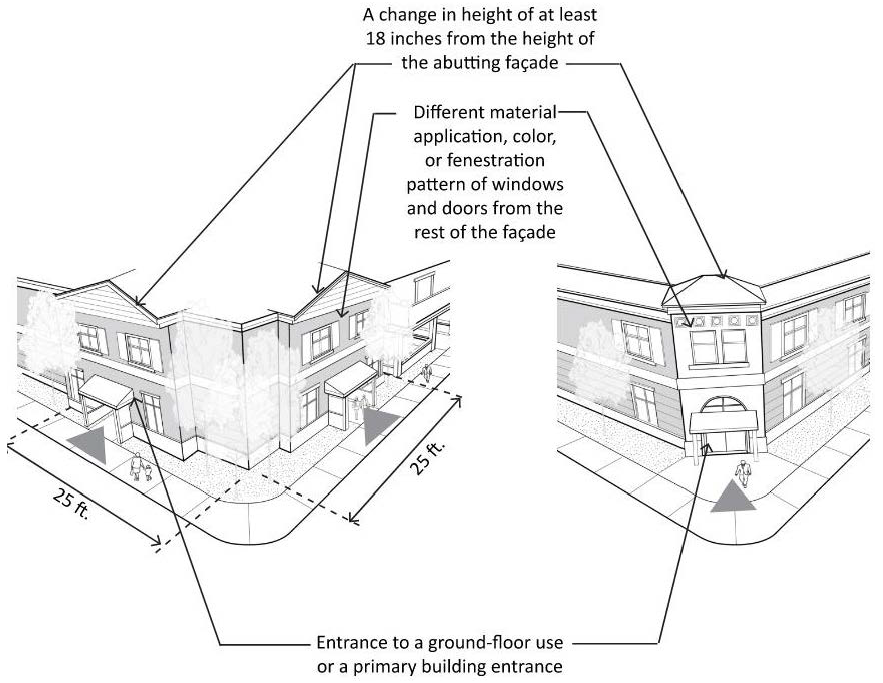
3 - SITE PLANNING AND OTHER PROJECT STANDARDS
Editor's note— Ord. No. 5200, § 10, adopted February 13, 2024, repealed and reenacted Chapter 35.31 in its entirety to read as herein set out. Formerly, Chapter 35.31 pertained to affordable housing streamlined review, and derived from Ord. No. 5172, § 1, adopted January 24, 2023.
Editor's note— Ord. No. 5200, § 11, adopted February 13, 2024, repealed and reenacted Chapter 35.32 in its entirety to read as herein set out. Formerly, Chapter 35.32, §§ 35.32.010—35.32.060 pertained to density bonus for affordable housing, and derived from original codification.
Editor's note— Ord. No. 5238, § 8, adopted February 11, 2025, repealed and reenacted Chapter 35.38 in its entirety to read as herein set out. Formerly, Chapter 35.38, sections 35.38.010—35.38.130 pertained to similar subject matter and derived from original codification.
This Article expands upon the standards of Article 35.2 (Zones and Allowable Land Uses) by addressing the details of site planning and project design. These standards are intended to ensure that all development:
A.
Produces an environment of stable and desirable character;
B.
Is compatible with existing and future development; and
C.
Protects the use and enjoyment of neighboring properties, consistent with the Comprehensive Plan.
The requirements of this Article shall apply to all proposed development and new land uses, except as specified in Chapter 35.101 (Nonconforming Uses, Structures, and Lots) and shall be considered in combination with the standards for the applicable zone in Article 35.2 (Zones and Allowable Land Uses) and those in Article 35.4 (Standards for Specific Land Uses). If there is a conflict, the standards in Article 35.4 (Standards for Specific Land Uses) shall control.
A.
Purpose and intent. The purpose of agricultural buffers is to implement adopted Comprehensive Plan policies that assure and enhance the continuation of agriculture as a major viable production industry in Santa Barbara County through establishing development standards that provide for the creation of buffers between agricultural uses and new non-agricultural development and uses. The intent of agricultural buffers is to minimize potential conflicts between agricultural and adjacent land uses that result from noise, dust, light, and odor incidental to normal agricultural operations as well as potential conflicts originating from residential and other non-agricultural uses (e.g., domestic pets, insect pests and invasive weeds).
B.
Applicability. This Section applies to all discretionary applications for non-agricultural development and uses (project) which satisfy all of the following criteria:
1.
The project site is located within an Urban or Inner-Rural Area, or an Existing Developed Rural Neighborhood, as designated on the Comprehensive Plan maps; or located on property zoned industrial that is located in the Rural Areas as designated on the Comprehensive Plan maps.
2.
The project site is located immediately adjacent to land that is:
a.
Located in a Rural Area as designated on the Comprehensive Plan maps, and
(1)
Has an agricultural zone designation as identified in Section 35.14.020 (Zoning Map and Zones) or Article V of Ordinance No. 661, excluding state or federally owned land, or
(2)
Is subject to a contract executed in accordance with the County Uniform Rules for Agricultural Preserves and Farmland Security Zones.
C.
Exceptions. This Section does not apply to the following:
1.
Single-family dwelling, accessory dwelling units, junior accessory dwelling units, and residential accessory structures.
2.
Agricultural employee dwellings approved in compliance with Section 35.42.030 (Agricultural Employee Dwellings) and farmworker housing approved in compliance with Section 35.42.135 (Farmworker Housing).
3.
Non-agricultural, discretionary development approved prior to May 9, 2013.
4.
Changes to a non-agricultural, discretionary project approved prior to May 9, 2013, provided that prior to an action by the review authority to approve an application in compliance with Subsection 35.84.040.C or D the review authority shall first determine that the changes to the project proposed by the application do not result in any new or greater impacts to agriculture than those resulting from the already approved project.
a.
If the review authority cannot make the determination required in compliance with Subsection C.4, above, then the project shall be subject to the provisions of this Section.
5.
Non-commercial agricultural uses. An agricultural buffer is not required adjacent to a common lot line between the project site and an adjacent agriculturally zoned lot if the adjacent lot is used for non-commercial agriculture.
6.
State and County roadway projects.
7.
Lot line adjustments and modifications to lot line adjustments that:
a.
Do not exceed a 10 percent increase or decrease in the area of the smallest existing lot; and
b.
Do not result in an increase in the number of developable lots in compliance with Subsection 35.30.110.B.3.c.
D.
Agricultural buffer requirements. All applications subject to this Section shall designate and maintain an agricultural buffer on the project site in compliance with this Section.
1.
Agricultural buffer width. The width of the agricultural buffer shall be in compliance with the range of agricultural buffer widths as shown in the following Table 3-1 (Range of Agricultural Buffer Widths). Ranges are provided because unique circumstances may require the buffer width to be adjusted; however, the agricultural buffer width as adjusted shall neither be less than the minimum buffer width nor greater than the maximum buffer width shown in the following Table 3-1 (Range of Agricultural Buffer Widths). If the proposed project is located adjacent to a lot that contains both Production Agriculture and Rangeland or Pastureland, then the most protective buffer:
a.
Shall be applied adjacent to any portion of the common lot line between the project site and the adjacent agriculturally zoned lot where Production Agriculture is immediately adjacent; and
b.
May be applied to any portion of the common lot line between the project site and the adjacent agriculturally zoned lot where Production Agriculture is not immediately adjacent, if Production Agriculture is located on the adjacent lot within the distance, as measured from the common lot line, that is equal to the width of the required buffer that would otherwise be applicable to the project site.
Refer to Section II.C. (Agricultural Buffer Width Adjustment) of the Agricultural Buffer Implementation Guidelines (Appendix G) for guidance.
Table 3-1- Range of Agricultural Buffer Widths
2.
Agricultural buffer location. The agricultural buffer shall be located:
a.
On the lot on which the non-agricultural project is proposed.
b.
Adjacent to the common lot line between the project site and the adjacent agriculturally zoned lot.
3.
Agricultural buffer width measurement. The agricultural buffer width shall be measured from the common lot line between the project site and the adjacent agriculturally zoned lot. The agricultural buffer shall be coterminous with the length of said common lot line.
4.
Agricultural buffer width adjustment. The following factors shall be considered when determining the agricultural buffer width in compliance with Subsection D.1 (Agricultural buffer width), above. See the Agricultural Buffer Implementation Guidelines (Appendix G) for guidance in determining the appropriate agricultural buffer width.
a.
Site specific factors. The following factors shall be considered when determining the agricultural buffer width:
(1)
Crop type/agricultural practices.
(2)
Elevation differences and topography.
(3)
Extent and location of existing non-agricultural development.
(4)
Location of existing roads or naturally occurring barriers.
(5)
Historical land use on the agricultural lot.
(6)
Future farming potential of the agricultural lot.
(7)
Site design of the non-agricultural proposal.
(8)
Non-agricultural lot size/configuration.
(9)
Prevailing wind direction.
b.
Vegetative screening adjacent to production agriculture. Vegetative screening may be used to offset an increase in the buffer width for projects adjacent to Production Agriculture, as it may be adjusted in compliance with Subsection D.4.a (Site-specific factors). See Subsection F.3 for vegetative screening criteria and the Agricultural Buffer Implementation Guidelines (Appendix G) for guidance.
c.
Constrained agricultural areas. If the adjacent lot is used for production agriculture and contains land areas that are constrained by physical features or easements such that those land areas cannot be used for agriculture, then the agricultural buffer width may be reduced on the project site by an amount equal to the width of the constrained land area located on the adjacent agricultural lot, provided:
(1)
The physical feature is permanently part of the landscape (e.g., a protected riparian area, or rock out-cropping); and
(2)
The physical feature or easement precludes any kind of agricultural use and be located adjacent to the non-agricultural project site.
5.
Comprehensive Plan consistency. Where Comprehensive Plan policies and this Section both address agricultural buffer requirements, the most protective agricultural buffer requirement shall prevail.
6.
Reasonable use. This Section is not intended, and shall not be construed as authorizing the review authority acting in compliance with this Section to exercise their power to grant or deny a permit in a manner which will take or damage private property for public use, without the payment of just compensation therefore. This section is not intended to increase or decrease the rights of any owner of property under the Constitution of the State of California or the United States or under this Development Code.
7.
Buffer recordation.
a.
Notice to Property Owner required. Prior to the approval of a Land Use Permit in compliance with Section 35.82.110 (Land Use Permits) or a Zoning Clearance in compliance with Section 35.82.210 (Zoning Clearance) following the approval of a discretionary planning permit, a Notice to Property Owner shall be required to be recorded by the property owner that will provide notification to all future owners and successors of the restrictions of this Section 35.30.025. Said Notice shall include:
(1)
An exhibit showing the location of the agricultural buffer by metes and bounds description or surveyor's description.
(2)
The uses that are allowed within the agricultural buffer in compliance with Subsection 35.30.025.E (Allowable uses within agricultural buffers).
(3)
The Landscape, Lighting and Irrigation Plan in compliance with Subsection 35.30.025.F (Agricultural buffer Landscape, Lighting and Irrigation Plan requirements).
(4)
The Maintenance Plan in compliance with Subsection 35.30.025.G (Agricultural buffer maintenance requirements).
b.
The requirement to record said Notice in compliance with this Subsection D.7 shall be included as a condition of approval of an application for a discretionary planning permit subject to this Section.
E.
Allowable uses within agricultural buffers. The property owner shall use his best efforts to consult with the adjacent agricultural land owner(s) to address food safety and agricultural production concerns with regard to landscape, lighting, and vegetative screening design and siting. See the Agricultural Buffer Implementation Guidelines (Appendix G) for information on the purpose and intent of restricting uses within agricultural buffers and how to incorporate site design and other features that are compatible with agriculture.
1.
Unrestricted uses within agricultural buffers. Subject to other provisions of this Section, or other provisions of the County Code, the following uses may be allowed within a designated agricultural buffer:
a.
Drainage channels, irrigation canals, storm water retention basins and Low Impact Development (LID) drainage features.
b.
Fences and walls.
c.
Low-lying landscaping and vegetative screening that does not include trees or hedges exceeding three feet in height.
d.
Oil and gas, wind energy and cogeneration facilities that are:
(1)
Permitted in compliance with Article 35.5 (Oil and Gas, Wind Energy and Cogeneration Facilities), or
(2)
Operated in compliance with Chapter 35.101 (Nonconforming Uses, Structures, and Lots).
e.
Natural waterways including rivers, creeks, lakes, ponds, and flood plains.
f.
Signs.
g.
Solar energy systems permitted in compliance with Section 35.30.160 (Solar Energy Systems).
h.
Telecommunication facilities permitted in compliance with Chapter 35.44 (Telecommunication Facilities).
i.
Utility lines and facilities.
j.
Any other use determined by the review authority to be consistent with the purpose and intent of the buffer requirement.
k.
Modifications or additions to structures legally existing as of May 10, 2013 provided that any addition to a structure that is located within a buffer required by this Section shall not extend further towards the immediately adjacent agricultural lot.
2.
Restricted uses within agricultural buffers. Subject to other provisions of this Section, or other provisions of the County Code, the following uses may be allowed within the agricultural buffer provided they are not located any closer to the common lot line between the project site and the adjacent agriculturally zoned lot than half the width of the buffer. This requirement may be modified by the review authority when it is determined that strict compliance with this section is not required to minimize conflicts with adjacent agriculture.
a.
Industrial or commercial loading docks and rear service areas.
b.
Landscaping and vegetative screening.
c.
Lighting.
d.
Non-habitable structures such as those used for storage.
e.
Parking areas including carports and garages.
f.
Public and private open space areas with limited passive recreational uses such as trails, bike paths and walking paths.
g.
Roads and transportation infrastructure.
3.
Prohibited uses within agricultural buffers. Recreational uses such as parks, picnic areas, playgrounds and ball fields shall not be allowed in an agricultural buffer.
4.
Open space credit. The agricultural buffer may be counted toward open space requirements as long as the limits on allowed uses are consistent with the requirements of this Section and the Development Code.
5.
The unrestricted uses, restricted uses and prohibited uses within the designated agricultural buffer shall be included as a condition of approval of the approved project.
F.
Agricultural buffer Landscape, Lighting and Irrigation Plan requirements.
1.
A Landscape, Lighting and Irrigation Plan (Plan) shall be required for all agricultural buffers. The Plan shall:
a.
Graphically depict and label the agricultural buffer.
b.
Graphically depict and label the following elements within the agricultural buffer:
(1)
Erosion control measures.
(2)
Hardscape.
(3)
Irrigation systems.
(4)
Landscaping, vegetation, and materials.
(5)
Lighting.
c.
Incorporate Low Impact Development (LID) measures to maximize runoff retention and groundwater infiltration on-site.
d.
Incorporate a fence or other barrier that complies with the Development Code, with a minimum height of six feet, that discourages trespassing and domestic animals from crossing the common lot boundary between the project site and the adjacent agricultural land.
e.
Prohibit the planting or installation of turf within 50 feet of the adjacent agricultural land unless required by County, State or Federal regulations.
f.
Be compatible with the surrounding land uses and rural character of the agricultural area.
2.
Landscaping, lighting and irrigation are not required within the agricultural buffer. However, if vegetation is included within the buffer, the plant palette shall meet the following requirements:
a.
The plants shall be compatible with agriculture.
b.
Shading of adjacent agricultural crops shall be minimized.
c.
To the maximum extent feasible, the plants shall be fire resistant and drought- tolerant or low water use.
d.
The plants shall not be considered noxious according to Section 4500 of the California Code of Regulations or considered invasive by the California Invasive Plant Council (Cal-IPC).
3.
If a vegetative screen is used to offset an agricultural buffer width increase for production agriculture as described in Subsection D.4.b (Vegetative screening adjacent to production agriculture), the vegetative screen shall be consistent with the requirements in this Subsection F (Agricultural buffer Landscape, Lighting and Irrigation Plan requirements) and shall be in compliance with the following additional criteria:
a.
The vegetative screen shall consist of two staggered rows of vegetation consisting of a layered canopy with evergreen trees and shrubs with foliage extending from the base to the crown.
b.
The plants shall thoroughly screen the agricultural use from the non-agricultural use within five years from time of installation.
c.
The minimum height of trees at maturity shall be 15 feet.
d.
The vegetative screen shall be at least 25 feet deep.
4.
The Landscape, Lighting and Irrigation Plan shall be compatible with the requirements in Subsection E (Allowable uses within agricultural buffers).
5.
The applicant shall provide a signed and notarized agreement and a performance security acceptable to the Director that guarantees the installation of landscaping, lighting and irrigation and provides for the successful establishment of the agricultural buffer for a minimum of five years. The performance security shall be released upon approval by the Director.
G.
Agricultural buffer maintenance requirements.
1.
A Maintenance Plan shall be required that provides for the maintenance of the agricultural buffer for the life of the project. The Maintenance Plan shall:
a.
Include provisions for managing agricultural pests such as vertebrate pests, invasive weeds, and crop threatening insects. Integrated Pest Management practices shall be used to the extent feasible.
b.
Include provisions for removing weeds, trash and debris.
c.
Provide for regular fuel management and removal of accumulated plant matter within the agricultural buffer so as to minimize fire risk.
d.
Be consistent with the requirements in Subsection F (Agricultural buffer Landscape, Lighting and Irrigation Plan requirements).
e.
Provide for the regular maintenance of the elements as described in Subsection F (Agricultural Buffer Landscape, Lighting and Irrigation Plan requirements).
H.
Future conversion of adjacent agricultural land. If the underlying purpose for the agricultural buffer no longer exists, the review authority, upon application for permit revision in compliance with Article 35.8 (Planning Permit Procedures), may remove agricultural buffer requirements originally required in compliance with this Section.
I.
Findings. In addition to other findings that may be required, the review authority shall not approve or conditionally approve any application subject to the requirements of this Section for which an agricultural buffer is required unless it first makes all of the following findings:
1.
The design and configuration of the agricultural buffer minimizes, to the maximum extent feasible, conflicts between the adjacent agricultural and non-agricultural uses which are the subject of the permit application.
2.
The Landscape, Lighting, Irrigation and Maintenance Plans are compatible with the character of the adjacent agricultural land and the rural setting.
Bikeways shall be provided where determined by the review authority to be appropriate and feasible for recreational and commuting use.
A.
The densities specified in the Comprehensive Plan are maximums and may be reduced through discretionary project review if the review authority determines that a reduction is warranted by conditions specifically applicable to a site, including topography, geologic or flood hazards, habitat areas, or steep slopes.
B.
Density may be increased for an affordable housing project in compliance with Housing Element policies.
A.
Rural. Within Rural areas as designated on the Comprehensive Plan maps, the height, scale, and design of each structure shall be compatible with the character of the surrounding natural environment, as determined by the review authority, except where the review authority determines that technical requirements dictate otherwise. Structures shall be subordinate in appearance to natural landforms, shall be designed to follow the natural contours of the landscape, and shall be sited so as not to intrude into the skyline as seen from public viewing places.
B.
Urban and Existing Developed Rural Neighborhoods. Within Urban areas and Existing Developed Rural Neighborhoods as designated on the Comprehensive Plan maps, new structures shall conform with the scale and character of the existing community. Clustered development, varied circulation patterns, and diverse housing types shall be encouraged.
A.
Purpose. This Section provides regulations for the installation, construction, and placement of fences. For the purposes of this Section, the term "fence" includes fences, walls, gates, gateposts, and other structures in the nature of a fence, except where any of these are specifically identified and separately regulated by this Section.
B.
Measurement of fence height. Fence height shall be measured as the vertical distance between the natural grade at the base of the lower side of the fence, and the top edge of the fence material. See Figure 3-1 (Measurement of Fence Height) below.
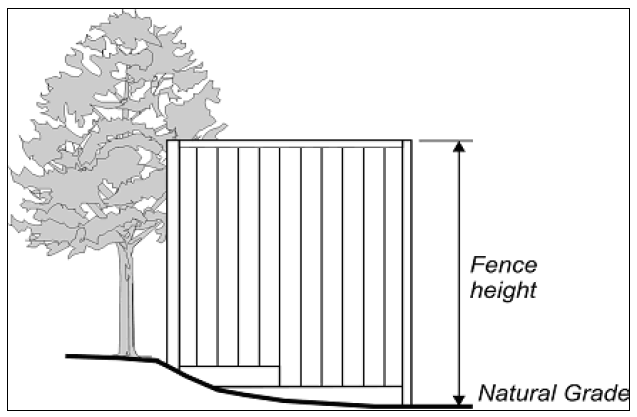
Figure 3-1 - Measurement of Fence Height
C.
Height limits and permit requirements. Each fence shall comply with following the height limits and permit requirements. In no case shall the height of the fence exceed the height limit established for the applicable zone by Article 35.2 (Zones and Allowable Land Uses). Additionally, a fence on a corner lot shall comply with the vision clearance requirements in Section 35.30.090 (Height Measurement and Exceptions and Limitations).
1.
Non-Agricultural zones. Each fence shall comply with the height limits and permit requirements in Table 3-2 below.
2.
Agricultural zones. Each fence shall comply with the height limits and permit requirements in Table 3-3 below.
a.
Entrance gates, AG-II zone. In addition to fences allowed in compliance with Table 3-3 below, on property zoned AG-II, entrance gates that comply with the following are exempt from planning permits and may be located within required setback areas. Structures that do not comply with the following may be allowed with a Land Use Permit issued in compliance with Section 35.82.110 (Land Use Permits).
(1)
The height of the gateposts including any cross member, signage, and/or ornamentation, does not exceed 18 feet in height as measured from the ground level at the bottom of the gateposts to the top of the gatepost, cross member, signage, and/or ornamentation.
(2)
The portion of each gatepost taller than eight feet if located in the front setback, or 10 feet in all other locations, does not exceed two feet in width.
(3)
The cross member does not exceed two feet in height and thickness.
(4)
Lighting associated with the entrance gate, gateposts, and cross member shall be for safety purposes only and shall comply with Section 35.30.120 (Outdoor Lighting).
(5)
Ornamentation that is appurtenant to the entrance gate, gateposts, and cross member shall be in compliance with the following:
(a)
The size and scale of any ornamentation shall be secondary to the entrance gate.
(6)
Signs that are allowed in agricultural zones in compliance with Chapter 35.38 (Sign Standards) may be affixed to the entrance gate, gateposts, and cross member provided that the size and scale of any signs shall be secondary to the entrance gate, gateposts, and cross member.
(7)
In addition to the development standards listed above, all development associated with the construction of the entrance gate, gateposts, or cross member shall be located no less than 100 feet from the following environmental sensitive habitat areas that are determined by a qualified professional to be intact and of high quality. This setback may be adjusted upward or downward on a case-by-case basis depending upon site specific conditions such as slopes, biological resources and erosion potential. If these requirements are in conflict with other provisions of the Comprehensive Plan and any applicable community or area plan, this Development Code, and any permit conditions established by the County, the more restrictive requirement shall control.
(a)
Native plant communities recognized as rare by California Department of Fish and Wildlife (2003 or as amended). Examples include Native Grasslands, Maritime chaparral, Bishop Pine Forests, and Coastal Dune Scrub.
(b)
Native woodlands and forests.
(c)
Nesting, roosting, and/or breeding areas for rare, endangered or threatened animal species.
(i)
Rare, endangered, or threatened species are defined as those listed by State or Federal wildlife agencies under the State or Federal Endangered Species Acts, candidates for listing, species of special concern, and species that meet the definition of "rare" in Section 15380 of California Environmental Quality Act.
(ii)
A separation of greater than 100 feet may be required in order to fully protect formally listed Endangered Species (e.g., a 100-foot separation may not fully protect known breeding ponds for California Tiger Salamander).
(d)
Plant communities known to contain rare, endangered, or threatened species.
(e)
Streams, riparian areas, vernal pools, and wetlands.
(f)
Any designated Environmental Sensitive Habitat Areas.
3.
Exception to height limits. A maximum of 10 percent of the total linear length of a wall or fence may be allowed to exceed the maximum height specified for exemption from a permit in Subsections C.1 (Non-Agricultural zones) or C.2 (Agricultural zones) above, where the review authority first determines that topographic or other unavoidable conditions will destroy its architectural integrity if held to the maximum height specified for its entire length.
4.
Retaining wall exemption. A retaining wall (retaining earth only) that is not over four feet in height measured from the bottom of a footing to the top of the wall, and does not require a Grading Permit in compliance with County Code Chapter 14 is exempt from Land Use Permit requirements.
5.
Naples Townsite zone. All fences located on a lot zoned Naples Townsite shall be in compliance with the fencing plan component of the Final Development Plan in effect for the subject lot.
Table 3-2- Fence, Gate, Gatepost, and Wall Height and Permit Requirements
In All Zones Except In Agricultural Zones
Notes:
(1) Within the Naples Townsite zone, additional height may not be allowed with a Minor Conditional Use Permit.
(2) Mission Canyon Plan area - Within the Mission Canyon Plan area, only fences, gates, and walls 3.5 feet or less in height, and gateposts four feet or less in height, are exempt from a planning permit.
(3) Mission Canyon Plan area - Within the Mission Canyon Plan area, fences, gates, and walls greater than 3.5 feet in height, and gateposts greater than four feet in height, require the issuance of a Land Use Permit.
Table 3-3Fence Height and Permit Requirements in Agricultural Zones
Notes:
(1) See Subsection C.2.a regarding entrance gates on property zoned AG-II.
(Ord. No. 5238, § 5, 2-11-2025)
A.
Purpose. The intent of the Flood Hazard development standards is to avoid exposing new development to flood hazards and to reduce the need for future flood control protective works and resulting alteration of stream and wetland environments by regulating development within the 100-year flood plain.
B.
Development within floodway. All development, including construction, excavation, and grading, except for flood control projects and non-structural agricultural uses, shall be prohibited in the floodway, as determined by the County Public Works Department, unless off-setting improvements in accordance with Housing and Urban Development regulations are provided. If the proposed development falls within the floodway fringe, development may be permitted, providing creek setback requirements are met and finish floor elevations are above the projected 100-year flood elevation as specified in County Code Chapter 15A (Floodplain Management).
C.
Permitted development limitations. Permitted development shall not cause or contribute to flood hazards or lead to expenditure of public funds for flood control works, such as dams, stream channelizations, etc.
A.
Purpose. This Section describes the required methods for measuring the height of structures to determine compliance with the height limits established by this Development Code, and provides exceptions to those height limits.
B.
Height limit of structures. The height of each structure shall not exceed the applicable height limit established for the applicable zone by Article 35.2 (Zones and Allowable Land Uses), and/or other requirements of this Development Code, except as otherwise provided by this Section and this Development Code.
C.
Height measurement. The following methodology shall be used to determine the height of a structure. Additionally, Subsections D. through J. below, provide or reference additional specific height measurement criteria and exemptions for specific types of development.
1.
Height of structures. The height of a structure shall be the vertical distance between the existing grade and the uppermost point of the structure directly above that grade. The height of any structure shall not exceed the applicable height limit except as provided in Subsections D. through J. below. See Figure 3-2 (Height Limit).
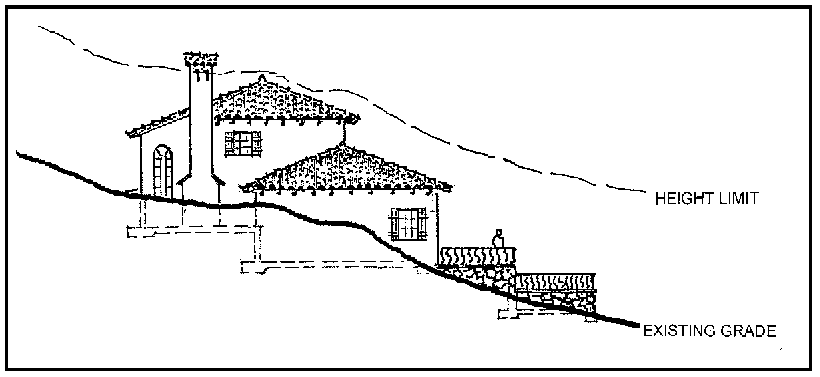
Figure 3-2 - Height Limit
2.
Maximum height in ridgeline/hillside locations. In addition to the height limit applicable to a structure as described in Subsection C.1 (Height of structures) above, a structure subject to Chapter 35.62 (Ridgeline and Hillside Development) shall not exceed a maximum height of 32 feet as measured from the highest part of the structure, excluding chimneys, vents and noncommercial antennas, to the lowest point of the structure where an exterior wall intersects the finished grade or the existing grade, whichever is lower.
a.
In the case where the lowest point of the structure is cantilevered over the ground surface, then the calculated maximum height shall include the vertical distance below the lowest point of the structure to the finished grade or the existing grade, whichever is lower.
b.
This 32-foot limit may be increased by no more than three feet where the highest part of the structure is part of a roof element that exhibits a pitch of four in 12 (rise to run) or greater. See Figure 3-3 (Maximum Height).
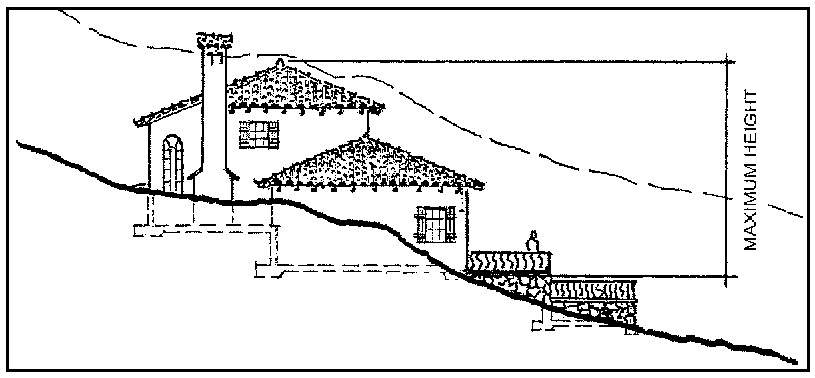
Figure 3-3 - Maximum Height
D.
General height limit exceptions. The height of a structure may exceed the applicable height limit in compliance with the following:
1.
Chimneys, church spires, elevator, minor mechanical and stair housings, flag poles, towers, vents, and similar structures which are not used for human activity may be up to 50 feet in height in all zones where the excess height is not prohibited by Section 35.28.060 (Airport Approach (F) Overlay Zone). The use of towers or similar structures to provide higher ceiling heights for habitable space shall be deemed a use intended for human activity. No such structure shall be employed for any commercial or advertising use unless specifically allowed by the applicable zone, except that antennas and associated equipment may be located within such structures.
2.
Portions of a structure may exceed the applicable height limit by no more than three feet where the roof exhibits a pitch of four in 12 (rise to run) or greater.
3.
In order to provide for architectural character, architectural elements, whose aggregate area is less than or equal to 10 percent of the total roof area of the structure or 400 square feet, whichever is less, may exceed the height limit by no more than eight feet when approved by the Board of Architectural Review.
4.
Allowances for exceeding the applicable height limit in compliance with Subsections D.2 through D.3 above, are not cumulative.
E.
Exemptions for specific structures and equipment. The following structures and equipment may exceed the applicable height limit as provided below where the excess height is not prohibited by Section 35.28.060 (Airport Approach (F) Overlay Zone).
1.
Amine columns, distillation columns, stripper columns, and flare stacks associated with gas processing, oil and gas production, or oil and gas transportation allowed in compliance with Article 35.5 (Oil and Gas, Wind Energy and Cogeneration Facilities) may exceed the applicable height limit where compliance would render such facilities technically infeasible.
2.
Workover/pulling rigs necessary to service oil, gas and injection wells may exceed the applicable height limit, provided that the use of these rigs is completed in a diligent manner.
3.
Silos used to store and load concrete ready-mix in the M-1 zone may exceed applicable height limits where compliance would render operations technically infeasible.
4.
Structures and equipment associated with facilities in the M-2 zone may exceed applicable height limits where compliance would render operations technically infeasible.
5.
Temporary drilling rigs necessary to explore for and develop oil and gas reservoirs, or to inject gas or fluids into subsurface reservoirs, allowed in compliance with Article 35.5 (Oil and Gas, Wind Energy and Cogeneration Facilities).
6.
Wind turbines allowed in compliance with Chapter 35.57 (Wind Energy Conversion Systems) may exceed applicable height limits where compliance would render operations technically infeasible.
F.
Accessory dwelling units and junior accessory dwelling units. See Section 35.42.015 (Accessory Dwelling Units and Junior Accessory Dwelling Units) for height limits and exceptions for accessory dwelling units and junior accessory dwelling units.
G.
Fences and walls. A fence or wall shall comply with the height limits established by Section 35.30.070 (Fences and Walls).
H.
Guesthouses, artist studios and cabañas. See Section 35.42.150 (Guesthouses, Artist Studios, and Cabañas) for height limits and exceptions for guesthouses, artist studios, and cabañas.
I.
Telecommunication facilities. See Chapter 35.44 (Telecommunications Facilities) for height limits and exceptions for commercial and noncommercial telecommunication facilities.
J.
Vision clearance. Structures and landscaping on a corner lot shall not exceed the height limits provided by this Subsection within a required vision clearance area.
1.
Measurement of vision clearance area. See Figure 3-4 (Vision Clearance Area).
a.
Straight corners. The boundaries of a vision clearance area are defined by drawing lines from the point of intersection of a lot's street property lines at the corner to a point a minimum of 10 feet from the corner along the two property lines, and then connecting the two points with a straight line forming the hypotenuse of the triangle.
b.
Rounded corners. In the case of rounded corners, the boundaries of a vision clearance area are defined by extending the street property lines from the tangents at the beginning and end of the curving corner to a point of intersection, then drawing lines from the point of intersection to a point a minimum of 10 feet from the point of intersection along the two property lines, and then connecting the two points with a straight line forming the hypotenuse of the triangle.
2.
Height limits within vision clearance area. No planting, fence, wall, or other structure shall exceed a height of two and one-half feet above the adjacent curb grade, or three feet above the adjacent surface of pavement, whichever is less, within a vision clearance area.
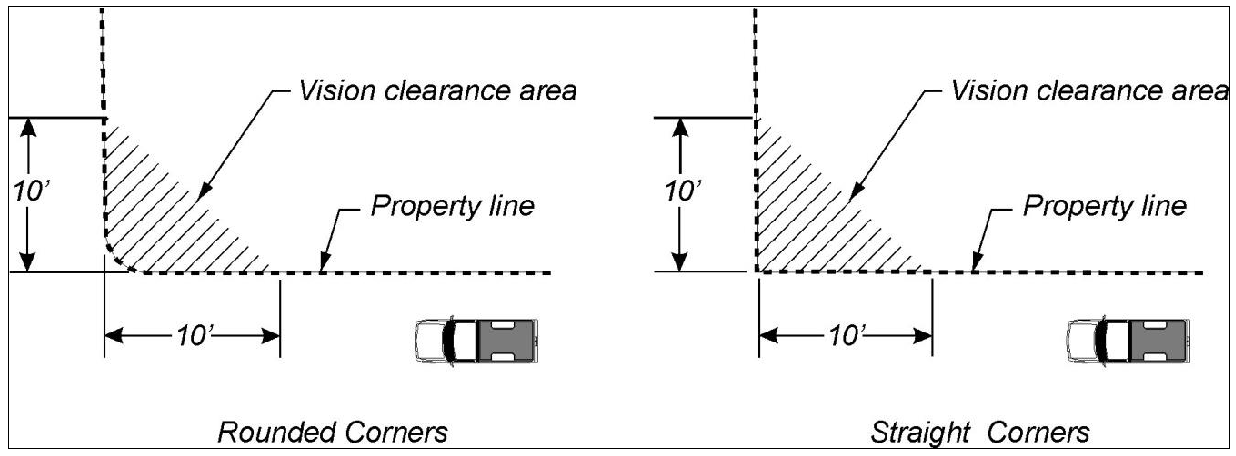
Figure 3-4 - Vision Clearance Area
A.
Adequacy of infrastructure required. Issuance of a Land Use Permit (Section 35.82.110) or Zoning Clearance (Section 35.82.210) shall require that the review authority first find, based on information provided by environmental documents, staff analysis, and the applicant, that adequate public or private services and resources (e.g., water, sewer, roads) are available to serve a proposed development.
B.
Applicant responsibilities. The applicant shall assume full responsibility for costs incurred in service extensions or improvements that are required as a result of the proposed project. Lack of available public or private services or resources shall be grounds for denial of a project or reduction in the density otherwise indicated in the Comprehensive Plan or zoning maps.
C.
General requirement for water and sewer services. Within Urban areas designated on the Comprehensive Plan maps, new development other than that for agricultural purposes shall be served by the appropriate public sewer and water district or an existing mutual water company, if such service is available.
A.
Purpose and applicability. This Section establishes standards for the approval of a Lot Line Adjustment consistent with this Development Code, the Comprehensive Plan, and County Code Chapter 21 (Subdivision Regulations), in compliance with Map Act Section 66412. The provisions of this Section and the procedures and requirements in County Code Chapter 21 shall apply to all applications for Lot Line Adjustments.
B.
Required findings for approval. The approval of a Lot Line Adjustment application shall require that the review authority first make all of the following findings.
1.
The Lot Line Adjustment is in conformity with all applicable provisions of the Comprehensive Plan and this Development Code.
2.
Minimum lot area.
a.
Minimum lot area. No lot involved in the Lot Line Adjustment whose area is equal to or greater than the minimum lot area requirement of the applicable zone shall become smaller than the minimum lot area requirement of the applicable zone as a result of the Lot Line Adjustment.
3.
Except as provided in this Section, all lots resulting from the Lot Line Adjustment shall comply with the minimum lot area requirements of the applicable zone. A Lot Line Adjustment may be approved that results in one or more lots that are smaller than the minimum lot area requirement of the applicable zone provided that it complies with all of the following requirements.
a.
The Lot Line Adjustment shall not result in increased subdivision potential for any lot involved in the lot line adjustment.
b.
The Lot Line Adjustment will not result in a greater number of residential developable lots than existed prior to the adjustment. For the purposes of this Subsection B.3 only, a lot shall not be deemed residentially developable if the documents reflecting its approval and/or creation identify that, 1) the lot is not a building site, or 2) the lot is designated for a non-residential purpose including well sites, reservoirs and roads. A lot shall be deemed residentially developable for the purposes of this Subsection B.3 if it has an existing one-family dwelling constructed in compliance with a valid County permit, or existing and proposed lots comply with all of the following criteria.
(1)
Water supply. The lot shall have adequate water resources to serve the estimated interior and exterior needs for residential development as follows: 1) a letter of service from the appropriate district or mutual water company shall document that adequate water service is available to the lot and that the service complies with the company's Domestic Water Supply Permit, or 2) a Public Health Department or State approved water system.
(2)
Sewage disposal. The lot is served by a public sewer system and a letter of available service can be obtained from the appropriate district. A lot to be served by an onsite wastewater treatment system shall meet all applicable County requirements for permitting and installation, including percolation tests, as determined by the Public Health Department.
(3)
Access. The lot is currently served by an existing private road meeting applicable fire agency roadway standards that connects to a public road or right-of-way easement, or can establish legal access to a public road or right-of-way easement meeting applicable fire agency roadway standards.
(4)
Slope stability. Development of the lot including infrastructure avoids slopes of 30 percent and greater.
(5)
Agriculture viability. Development of the lot shall not threaten or impair agricultural viability on productive agriculture lands within or adjacent to the lot.
(6)
Environmentally sensitive habitat. Development of the lot avoids or minimizes impacts where appropriate to environmentally sensitive habitat and buffer areas, and riparian corridor and buffer areas.
(7)
Hazards. Development of the lot shall not result in a hazard to life and property. Potential hazards include, flood, geologic and fire.
(8)
Consistency with Comprehensive Plan and Development Code. Development of the lot is consistent with the setback, lot coverage and parking requirements of the Development Code and consistent with the Comprehensive Plan and the public health, safety and welfare of the community.
To provide notification to existing and subsequent property owners when a finding is made that a lot is deemed not to be residentially developable, a statement of this finding shall be recorded concurrently with the deed of the lot, in compliance with County Code Section 21-92 (Procedures).
4.
The Lot Line Adjustment will not increase any violation of lot width, setback, lot coverage, parking or other similar requirement of the applicable zone, or make an existing violation more onerous.
5.
The affected lots are in compliance with all laws, rules and regulations pertaining to zoning uses, setbacks and any other applicable provisions of this Development Code, or the Lot Line Adjustment has been conditioned to require compliance with these rules and regulations, and any zoning violation fees imposed in compliance with applicable law have been paid. This finding shall not be interpreted to impose new requirements on legal nonconforming uses and structures under the requirements of Chapter 35.101 (Nonconforming Uses, Structures, and Lots).
6.
Conditions have been imposed to facilitate the relocation of existing utilities, infrastructure and easements.
C.
Additional required findings for Lot Line Adjustments within an agricultural preserve. In addition to the findings required under Subsection B. (Required findings for approval) above, the approval of a Lot Line Adjustment proposed on agriculturally zoned lots that are subject to an Agricultural Preserve Contract in compliance with the County Uniform Rules for Agricultural Preserves and Farmland Security Zones shall require that the review authority also make the following findings:
1.
The new contract or contracts will enforceably restrict the adjusted boundaries of the lot for an initial term for at least as long as the unexpired term of the rescinded contract or contracts, but for not less than 10 years.
2.
There is no net decrease in the amount of the acreage restricted. In cases where two lots involved in a lot line adjustment are both subject to contracts rescinded pursuant to this section, this finding will be satisfied if the aggregate acreage of the land restricted by the new contracts is at least as great as the aggregate acreage restricted by the rescinded contracts.
3.
At least 90 percent of the land under the former contract or contracts remains under the new contract or contracts.
4.
After the lot line adjustment, the parcels of land subject to contract will be large enough to sustain their agricultural use.
5.
The lot line adjustment would not compromise the long-term agricultural productivity of the lot or other agricultural lands subject to a contract or contracts.
6.
The lot line adjustment is not likely to result in the removal of adjacent land from agricultural use.
7.
The lot line adjustment does not result in a greater number of developable lots than existed prior to the adjustment, or an adjusted lot that is inconsistent with the Comprehensive Plan.
A.
Purpose. The purpose of this Section is to create standards for outdoor lighting that minimize light pollution caused by inappropriate or misaligned light fixtures. These standards conserve energy, preserve the nighttime sky, and protect neighbors and wildlife while maintaining night-time safety, utility, security and productivity. The County of Santa Barbara recognizes that the unique development patterns and environments of the County created ideal areas for astronomical observation and enjoyment of the nighttime sky. Additionally, resources in the County warrant the protection of nighttime viewsheds and wildlife corridors from light trespass. The County, through the provisions contained herein, intends to preserve and protect the nighttime environment of the County by regulating unnecessary and excessive outdoor lighting.
1.
See "Lighting" within Article 35.11 (Glossary) for definitions related to outdoor lighting used within this Section.
B.
Applicability. The standards of this Section apply to all new or replaced outdoor light fixtures or systems and to existing lighting as provided below unless specifically exempted or required pursuant to any other applicable code or regulation.
1.
Existing Lighting. All outdoor lighting fixtures lawfully installed prior to the effective date of this Section are subject to only Subsections E.4 (Glare Prevention) and E.7 (Timing Controls) of this Section.
2.
New and Replaced Lighting. The standards of this Section apply to all new or replaced outdoor light fixtures or systems, except as specifically exempted pursuant to Subsection B.4 (Exemptions) below.
3.
Additions and Remodels. Additions totaling 50 percent or more of the existing gross floor area of a structure or exterior alterations affecting 50 percent or more of a building's exterior shall require that all existing lighting on the lot be brought into compliance with the provisions of this Section.
4.
Exemptions. The following types of lighting are exempt from the provisions of this Section.
a.
Fossil fuel lights.
b.
Traffic control signs and devices.
c.
Street lights installed prior to the effective date of the Ordinance adding this section.
d.
Temporary construction or emergency lighting under direction of a public agency (e.g., fire, police, public works).
e.
Navigation lights (e.g., airports, heliports, radio/television towers).
f.
Seasonal lighting decorations illuminated no longer than 60 days per calendar year.
g.
Light fixtures with a maximum output of 60 lumens, including solar lights.
h.
Underwater lights used to illuminate swimming pools, spas, fountains, and other water features.
i.
Temporary lighting for agricultural activities of a limited duration, not including unshielded arena lights.
5.
Alternative Compliance. The provisions of this Section are not intended to prevent the use of any design, material or method of installation not specifically prescribed by this Section provided any such alternate has been approved by the Director as part of a planning permit. The Director may approve any such alternate provided that the proposed design, material or method:
a.
Provides approximate equivalence to the specific requirements of this Section; and
b.
Is otherwise satisfactory and complies with the purpose of this Section.
C.
Prohibited Lights and Lighting. The following lights and lighting are prohibited.
1.
Search lights, strobe lights, laser source lights, or similar high intensity lights except as specifically exempted or for the purposes of gathering meteorological data.
2.
Mercury vapor lights.
3.
Uplighting.
D.
Maximum Light Levels. Outdoor lighting shall comply with the following maximum light levels except where otherwise allowed through the approval of the Conditional Use Permit or Development Plan, as applicable.
1.
Light Levels Within Designated Environmentally Sensitive Habitat Areas and Buffer Areas.
a.
Environmentally Sensitive Habitat Areas shall not be illuminated, including illumination of the Environmentally Sensitive Habitat area from a light source located outside of the Environmentally Sensitive Habitat area.
b.
The maximum lighting level within designated Environmentally Sensitive Habitat areas shall not exceed 0.0 foot-candles.
c.
No light fixture located within an Environmentally Sensitive Habitat buffer area shall exceed 630 lumens.
2.
Light Levels at Property Lines. The light level at property lines shall not exceed 0.1 foot-candles, except as provided below.
a.
Multi-family Zoned Property Abutting or Within a Multi-family, Commercial, or Industrial Zone. Where a property is located within a Multi-family Zone and the neighboring property is located within a Multi-family, Commercial, or Industrial Zone, the maximum lighting level at the shared property line shall be 0.2 foot-candles.
b.
Commercial and Industrial Zoned Property.
(1)
Abutting a Multi-family Zone. Where a property is located within a Commercial or Industrial Zone and the neighboring property is located within a Multi-family Zone, the maximum lighting level at the shared property line shall be 0.2 foot-candles.
(2)
Abutting or Within a Commercial or Industrial Zone. Where a property is located within a Commercial or Industrial Zone and the neighboring property is located within a Commercial or Industrial Zone, the maximum lighting level at the shared property line shall be 0.25 foot-candles.
E.
General requirements.
1.
Shielding. All outdoor light fixtures shall be fully shielded or full cut off, except as provided below.
a.
Decorative string lights are not required to be shielded.
b.
Lights at building entrances located under an overhang or building element are not required to be shielded provided that none of the light emitted by the fixture projects above the horizontal of the edge of the overhang or building element.
c.
Outdoor light fixtures used for outdoor recreational facilities shall be fully shielded except when such shielding would cause impairment to the visibility required in the intended recreational activity. In such cases, partially shielded fixtures and downward lighting methods shall be utilized to limit light pollution, glare, and light trespass to a reasonable level as determined by the Director.
d.
Partially shielded light fixtures may be allowed provided the light source is obscured by translucent glass or other means, the light fixture does not exceed 850 lumens, and the lighting complies with all other provisions of this Section.
2.
Externally Illuminated Signs, Advertising Displays and Building Identification. Externally illuminated signs, advertising displays and building identification shall use top mounted light fixtures which shine downward.
3.
Maximum Height. Lighting fixtures shall be installed at the lowest height required to achieve the design purpose of the lighting fixture.
a.
Building Mounted. Light fixtures shall not exceed the height of the building upon which it is attached.
b.
Freestanding Light Fixtures. The maximum height of freestanding light fixtures and lighting fixtures mounted on a structure or feature other than a building is as follows:
(1)
Within 100 feet of a Residential Zone: 15 feet from finished grade.
(2)
Other Locations: 20 feet from finished grade.
c.
Exceptions. The Director may allow additional height for activities, uses, or development with unique lighting needs; for accentuating historic architectural features of a building, accentuating signage and/or landscape features; lighting of recreational facilities; or for security purposes.
4.
Glare Prevention. All lights shall be directed and oriented to prevent light spillover and glare onto adjacent properties. No unobstructed beam of exterior light shall land off-site.
5.
Traffic Safety. Lighting shall be designed so as not to interfere with vehicular traffic on any portion of a street.
6.
Kelvin. Light fixtures for outdoor security lighting shall not exceed 4,000 Kelvin. All other outdoor light fixtures shall not exceed 2,700 Kelvin.
7.
Timing Controls. Outdoor lighting shall be turned off during daylight hours and between 9:00 p.m. and sunrise the following day, except as provided below.
a.
When People are Present. Outdoor lighting may remain on when people are present in the outdoor areas being illuminated, except as provided below.
(1)
In Residential Zones and any area adjacent to a Residential Zone, outdoor lighting shall be turned off as follows:
(a)
Sunday through Thursday: between 10:00 p.m. and sunrise the following day.
(b)
Friday and Saturday: between midnight and sunrise the following day.
b.
Code Required Lighting. Building or other construction and safety code required lighting for steps, stairs, walkways, entrances, parking areas, and other building and site features that is dimmed to the minimum light level necessary to meet code requirements.
c.
Safety and Security Lighting.
(1)
Motion-Controlled Security Lighting. Security lighting may be controlled by a motion-sensor switch between the hours of 9:00 p.m. and sunrise the following day provided the lighting does not remain on longer than five minutes after activation.
(2)
Commercial and Industrial Zones Not Adjacent to Residential Zones. Outdoor security lighting in Commercial and Industrial Zones not adjacent to a Residential Zone may remain on between 9:00 p.m. and sunrise the following day provided lights are dimmed to the minimum level to meet safety and security requirements and are on a timer or sensor that automatically extinguishes the light when sufficient daylight is available.
(3)
Additional Security Lighting. Additional security lighting may be allowed through the approval of the Conditional Use Permit or Development Plan, as applicable.
d.
On-Premise Signs. All illuminated advertising signs shall not be illuminated between 11:00 p.m. and sunrise the following day, except that on-premises signs may be illuminated while the business is open to the public.
e.
Private Recreational Courts. Private lighting of recreational sports courts shall be prohibited between the hours of 9:00 p.m. and sunrise the following day.
F.
Submittal of plans and evidence of compliance. Any application for a permit that includes outdoor light fixtures subject to the standards of this Section shall include evidence that the proposed outdoor lighting will comply with all of the standards of this Section. The application shall include:
1.
Plans showing the locations of all outdoor lighting fixtures.
2.
Description of the outdoor lighting fixtures including manufacturers catalog cuts and drawings. Descriptions and drawings should include lamp or bulb type, wattage, lumen output, beam angle, and shielding.
3.
Photometric plans showing foot-candle readings every ten feet within the property or site and ten feet beyond the property lines, except as provided below.
a.
Applications for outdoor lighting associated with residential development of four or fewer units and property-owner installed lighting are not required to submit photometric plans unless requested by the Director due to project location, size, use, and proposed lighting.
4.
The above plans and descriptions shall be sufficiently complete to enable the plan examiner to readily determine whether compliance with the requirements of this Section have been met.
G.
Temporary exemption. The following temporary exemptions may be allowed in accordance with the provisions of Section 35.42.260 (Temporary Uses and Trailers).
1.
The Director may grant a temporary exemption from one or more requirements of this Section for such activities, including, but not limited to circuses, fairs, carnivals, sporting events, and promotional activities, only if all of the following findings are first made:
a.
The purpose for which the lighting is proposed is not intended to extend beyond 30 days.
b.
The proposed lighting is designed in such a manner as to minimize light pollution as much as feasible.
c.
The proposed lighting will comply with the purpose of this Section.
2.
The application for a temporary exemption shall at a minimum include all of the following information:
a.
Name and address of applicant and property owner.
b.
Location of proposed fixtures.
c.
Type, wattage and lumen output of lamp(s).
d.
Type and shielding of proposed fixtures.
e.
Intended use of lighting.
f.
Duration of time for requested exemption.
g.
The nature of the exemption.
3.
Such other information as the Department may request.
(Ord. No. 5238, § 6, 2-11-2025)
A.
Location of development. No urban development shall be permitted beyond the boundaries of land designated on the Comprehensive Plan maps for urban uses, except in Existing Developed Rural Neighborhoods.
B.
Environmental resource management. The standards in this Section are from the Environmental Resource Management Element, and serve to implement policies and key recommendations contained in other elements of the Comprehensive Plan (e.g., the Seismic Safety and Safety, Conservation, and Open Space Elements).
1.
Urbanization should be prohibited in all cases on lands subject to one or more of the following environmental factors:
a.
Geologic Problems Index V (see Seismic Safety and Safety Element);
b.
Reservoirs and areas tributary to existing and proposed reservoirs;
c.
Slopes of 30 percent or greater;
d.
Existing croplands with a high agricultural suitability rating (see Environmental Resource Management Element) or a Class I or II soil capability classification. However, urban uses may be permitted within urban areas on lots of 10 acres or less;
e.
Mineral resource sites;
f.
Existing parks and recreation sites, historic sites, and archaeological sites; and
g.
Proposed scientific preserves.
2.
Urbanization should be prohibited except in a relatively few special instances on lands subject to one or more of the following environmental factors:
a.
Geologic Problems Index IV (see Seismic Safety and Safety Element);
b.
Slopes of 20 percent or greater but less than 30 percent;
c.
Existing croplands with a moderate or low agricultural suitability rating (see Environmental Resource Management Element) or a Class III or IV soil capability classification;
d.
Land highly suitable for expansion of cultivated agriculture (see Environmental Resource Management Element);
e.
Significant habitats and/or prime examples of common ecological communities (see Environmental Resource Management and Conservation Elements).
A.
Visitor-serving facilities shall be permitted within the Rural areas as designated on the Comprehensive Plan maps only if it is determined that approval of such development will not result in a need for major ancillary facilities on nearby lands (e.g., residences, stores, or gas stations).
A.
Purpose. This Section provides standards for the use and minimum dimension of setbacks. These standards provide open areas around structures for: visibility and traffic safety; access to and around structures; access to natural light, ventilation and direct sunlight; separation of incompatible land uses; and space for landscaping and recreation.
B.
Setback requirements.
1.
General. Each structure shall be located on its site so that it is set back from property lines and other structures in compliance with the setback requirements of the applicable zone in Article 35.2 (Zones and Allowable Land Uses), and with any setbacks established for specific uses by Chapter 35.42 (Standards for Specific Land Uses) except as otherwise provided by this Section or this Development Code.
2.
Property lines and rights-of-way. No portion of any structure, including eaves or roof overhangs, shall extend beyond a property line or into a public street right-of-way, except as provided by Subsection E (Projection into right-of-way) below, and Subsection 35.44.020.D.1.d.
C.
Measurement of setbacks. The setbacks required by Subsection B (Setback requirements) above, shall be measured as follows.
1.
Front setback. A front setback shall be measured at right angles from the front line of the lot.
a.
Corner lot. A corner lot shall have a front setback along each property line adjacent to a street. If the corner lot has a lot width of 100 feet or more, then each front setback shall be considered to be a primary front setback. If the corner lot has a lot width of less than 100 feet, then the front setback adjacent to the front line (see definition of front line) of the lot shall be considered the primary front setback and the front setback that is not adjacent to the front line shall be considered a secondary front setback. See Figure 3-5 (Corner Lot Setbacks).
(1)
Corner lot 100 feet or greater in width. There shall be a primary front setback along each street abutting the lot and all such setbacks shall conform to the front setback requirements of the applicable zone.
(2)
Corner lot less than 100 feet in width. There shall be a primary front setback along the property line considered the front line of the lot. The secondary front setback along the property line not considered the front line shall be not less than 20 percent of the width of the lot, but in no case shall said secondary front setback be less than 10 feet.
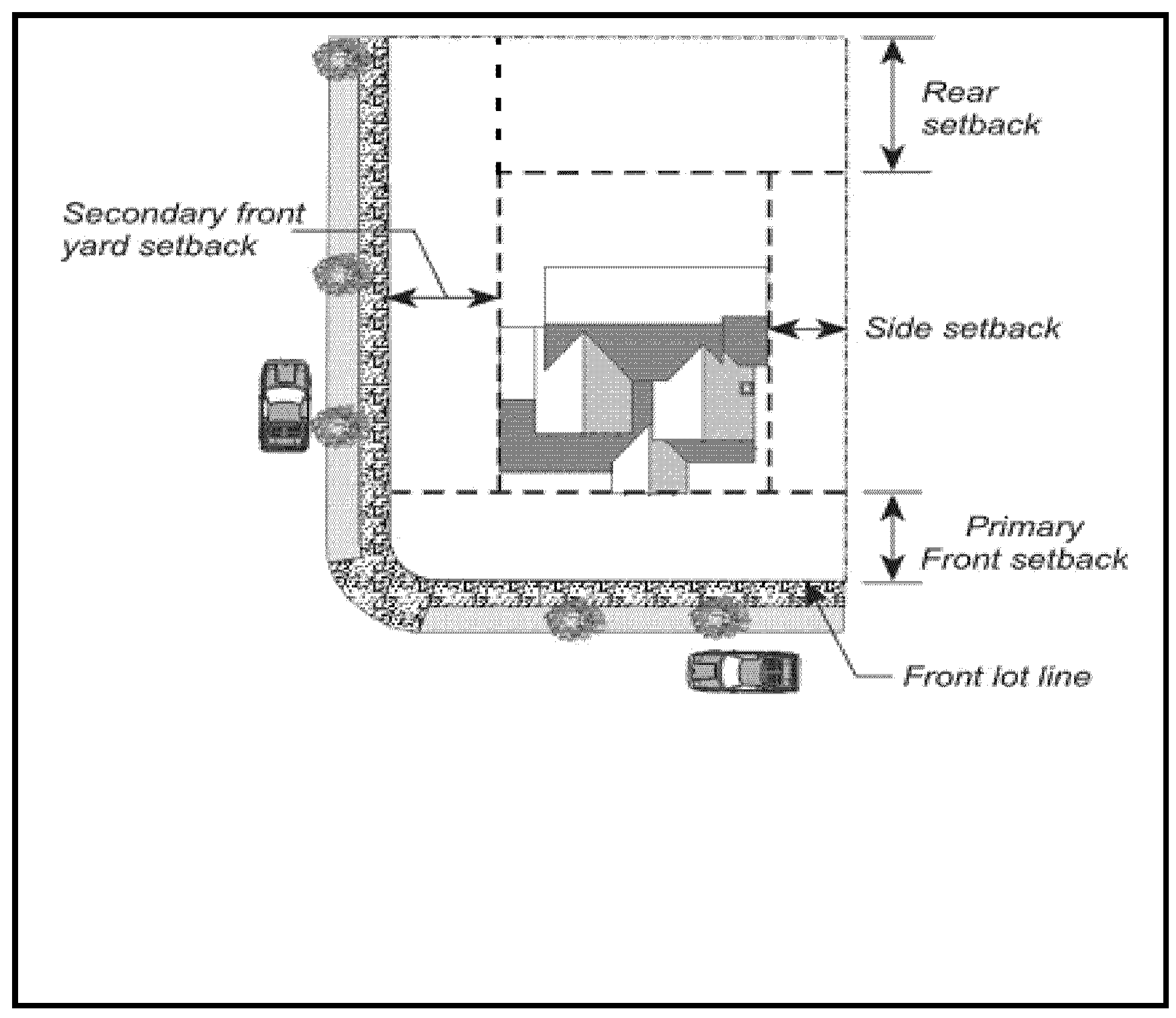
Figure 3-5 - Corner Lot Setbacks
b.
Through lot. A through lot shall provide front setbacks as required by the applicable zone adjacent to each abutting street.
c.
Sloping lot setback. Where the elevation of the ground at a point 50 feet from the centerline of any street is seven feet or more below or above the grade of the centerline, the front setback for a private detached garage (not carport) may be decreased by 40 percent and the front setback for a dwelling may be decreased by 20 percent, provided that the front face of the garage is no closer than 10 feet to the abutting street right-of-way.
2.
Side setbacks. A required side setback shall be measured at right angles from the side property line, establishing a setback line parallel to the side property line which extends between the front and rear setbacks.
a.
Side setback adjacent to alley. In computing the width of a side setback, if the setback abuts an alley, and the owner of the lot owns all or one-half of the underlying fee of the alley, up to one-half of the width of the alley may be included in the side yard.
b.
Through lot. On a through lot, the side setbacks shall extend the full depth of the lot between the front setbacks.
c.
Side setback variations in R-1/E-1 and R-2 zones. The required side setback for portions of a structure, including attached and detached accessory structures, may be varied subject to all of the following limitations. See Figure 3-6 (Variable Side Setback)
(1)
No portion of the structure shall be less than five feet from the side lines of the lot.
(2)
No portion of an exterior wall of a structure containing non-fixed windows or doors opening into rooms of a structure (except a garage or other non-habitable space) shall be located closer to the side lines of a lot than the required side setback prior to any variation allowed by Subsection b.(3) below.
(3)
A portion of a structure may be located within the required side setback provided that the footprint area of the portion of the structure that intrudes into the required side setback, combined with the footprint area of any other existing portions of the structure that intrude into the required side setback, shall be compensated by an equal or greater area that is not covered by any building footprint area located outside of and adjacent to the same side setback and the side setback line without any intervening obstruction. The compensating area used to vary a side setback shall be located adjacent to the side setback line that is being varied, outside of the required rear and front setback areas, and shall not be located farther from the portion of the structure intruding into the setback area than one-half of the lot depth.
(4)
The compensating area used to vary a side setback shall not be used to vary a rear setback on the same lot.
Figure 3-6 - Variable Side Setback
3.
Rear setback. The rear setback shall be measured at right angles from the rear property line, establishing a setback line parallel to the rear property line.
a.
Corner lot. The rear setback for a corner lot backing upon a key lot may be reduced to the size of the required side setback for the key lot or 10 feet, whichever is greater, provided that the total front, side, and rear setback area required by the applicable zone is not reduced. An accessory structure on a corner lot backing on a key lot shall be set back from the rear property line by a distance equal to the side setback requirements applicable to the key lot.
b.
Rear setback adjacent to alley. In computing the depth of a rear setback, if the setback abuts an alley, and the owner of the lot owns all or one-half of the underlying fee of the alley, up to one-half of the width of the alley may be included in the rear setback.
c.
Rear setback on triangular lot. Where a triangular lot has no rear lot line because its side lot lines converge to a point, an assumed line 10 feet long within the lot, parallel to and at the maximum possible distance from the front lot line, shall be deemed to be the rear lot line for the purpose of measuring the required rear setback. See Figure 3-7 (Triangular lot rear setback measurement).
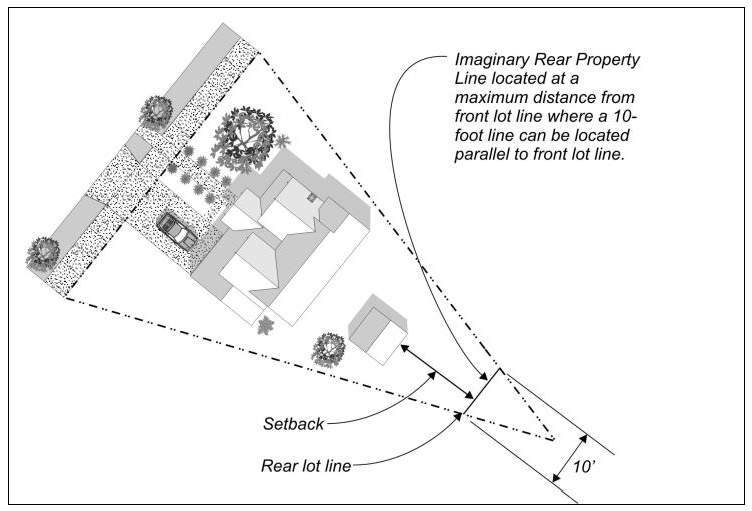
Figure 3-7 - Triangular lot rear setback measurement
d.
Rear setback variations in R-1/E-1, and R-2 zones. The required rear setback for portions of a structure, including attached and detached accessory structures, may be varied subject to all of the following limitations. See Figure 3-8 (Variable Rear Setback)
(1)
No portion of a structure shall be closer than 15 feet to the rear line of the lot.
(2)
A portion of a structure may be located within the required rear setback provided that the footprint area of the portion of the structure that intrudes into the required rear setback, combined with the footprint area of any other existing portions of the structure that currently intrude into the required rear setback, shall be compensated by an equal or greater area that is not covered by any footprint area located outside of and adjacent to the rear setback and the rear setback line without any intervening obstruction. The compensating area used to vary a rear setback shall be located outside the required side setback areas and shall not be located farther from the portion of the structure intruding into the setback area than one-half of the lot width.
(3)
The compensating area used to vary a rear setback shall not be used to vary a side setback on the same lot.
Figure 3-8 - Variable Rear Setback
4.
Interior and odd-shaped lots.
a.
Interior lot. The setback requirements of the applicable zone shall not apply, and a structure on an interior lot shall have a setback of at least 10 feet from all property lines (25 feet in the EX-1 zone), and the total area in square feet of all setbacks shall equal the total area in square feet of all setbacks otherwise required by the applicable zone for a non-interior lot. See Figure 3-9 (Interior Lot). Where no setback is required by the applicable zone, a setback of 10 feet shall not be required.
b.
Odd-shaped lots. In the case of odd-shaped lots, the Director shall determine the required setbacks, which widths and depths shall approximate as closely as possible the required widths and depths of corresponding setbacks on rectangular lots in the applicable zone district.
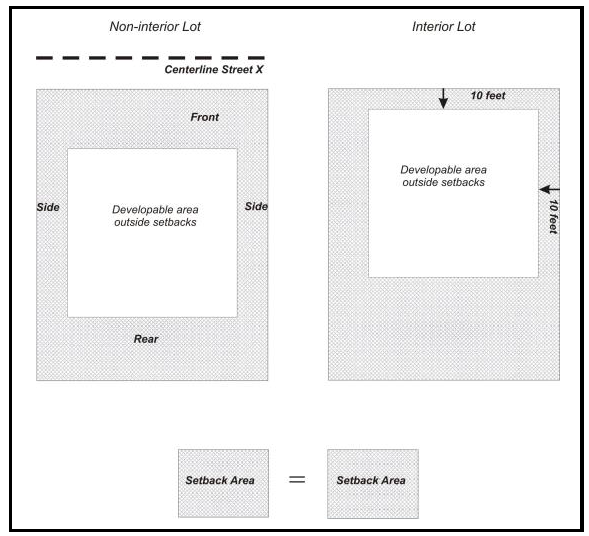
Figure 3-9 - Interior Lot
5.
Additional exceptions.
a.
Setback shown on Final Map or Parcel Map or Development Plan. Where a setback line is called for or shown on a Final Map or Parcel Map, or Final Development Plan, or other document approved along with the Final Map or Parcel Map, or Final Development Plan, the required setback shall be that shown on the Final Map, Parcel Map, or Final Development Plan or other document.
(1)
If there is a conflict between a setback shown on a recorded document (e.g., Final Map) and a setback described in an unrecorded document, then the language of the recorded document shall prevail.
b.
Setbacks on lot reduced through road widening. On any lot that has been reduced in width or depth below the original dimensions of the lot legally created by a recorded subdivision map or deed prior to October 1, 1960, where the reduction was required by the County for road widening, the required setbacks shall be computed on the basis of the original dimensions of the lot as though the road widening had not occurred.
D.
Limitations on the use of setbacks, allowable projections into setbacks. Every part of a setback, except for mobile home site setbacks required by Section 35.23.080 (MHP Zone Standards) shall be unobstructed from the ground to the sky, except as otherwise provided in this Section.
1.
The ordinary projection of sills, belt courses, buttresses, cornices, chimneys, eaves, outdoor stairways, and ornamental features may extend into a required setback no more than three feet. Handrails on outdoor stairways may extend into the setback an additional six inches.
2.
Fire escapes, balconies, and unroofed and unenclosed porches or landings, may extend into a setback as provided below when constructed and placed in a manner that shall not obstruct light to or ventilation of structures or the ready use of the setback for ingress or egress.
a.
The front or rear setback by four feet.
b.
A side setback by three feet.
3.
Trellises and patio covers that are attached to a dwelling, not including a mobile home subject to Section 35.23.080 (MHP Zone Standards), may be located within the rear setback when no closer than 15 feet to the rear property line, or no closer than 10 feet to the rear property line when adjacent to a permanently dedicated open space area or road right-of-way.
4.
Ornamental garden and landscaping structures without roofs (e.g., fountains, elevated ponds, planters) may be located within the front and side setbacks provided the feature is either:
a.
Less than 30 inches high, or
b.
Covers an area of 50 square feet or less and is less than either six feet in height and, if located within a vision clearance area, is consistent with the regulations of Subsection 35.30.090.J (Vision clearance).
5.
Decks less than 32 inches in vertical distance as measured from finished grade to the top of the decking material may be located within the front or side setback unless located in a designated Environmentally Sensitive Habitat area.
6.
Pedestals supporting utility meters no greater than four feet in height and 24 square feet in area may be located in a front or side setback provided they are completely screened from view from any public or private street and adjoining lot.
7.
Unroofed enclosures for irrigation equipment, solid waste containers and utilities may be located in a front setback provided that:
a.
The total area surrounded by all these enclosures does not exceed 120 square feet; and
b.
Each individual enclosure:
(1)
Is no greater than six feet in height;
(2)
Surrounds an area no greater than 50 square feet; and
(3)
Is located behind (as viewed from the street) a fence or a wall that is at least as tall as the enclosure, such that the enclosure is not visible from a public or private street or adjoining lot.
E.
Projection into right-of-way. In an area where a structure can be legally constructed on or closely adjacent to the right-of-way line of a public street, eaves and roof overhangs, sills, belt courses, fire escapes, balconies, and unroofed and unenclosed porches may project into a street right-of-way not more than 30 inches; provided that all these encroachments shall be at least eight feet above any area used by pedestrians, and at least 14 feet above any area used for vehicular traffic; and provided further, that an encroachment permit for the projections is obtained from the County Public Works Department.
(Ord. No. 5238, § 7, 2-11-2025)
Solar energy systems located on the roof of an existing structure and freestanding solar energy systems are exempt from design review and do not require planning permit approval, however such systems do require the issuance of a Building Permit, Electrical Permit, Plumbing Permit and/or Solar Use Permit, as applicable, in compliance with Chapter 10 (Building Regulations) of the County Code.
A.
Solar Use Permit. If the Building Official has a good faith belief that the solar energy system could have a specific, adverse impact upon the public health and safety, the Building Official may require the applicant to additionally apply for a Solar Use Permit in compliance with this Subsection. The decision of the Building Official to require the applicant to apply for a Solar Use Permit may be appealed to the Commission in compliance with Chapter 35.102 (Appeals).
1.
Contents of application. An application for a Solar Use Permit shall be submitted in compliance with Chapter 35.80 (Permit Application Filing and Processing).
2.
Processing.
a.
The Building Official shall review the Solar Use Permit application for compliance with this Development Code and approve, conditionally approve, or deny the request.
(1)
The Building Official shall not deny an application for a Solar Use Permit unless the Building Official makes written findings based upon substantial evidence in the record that the proposed installation would have a specific, adverse impact upon the public health or safety, and there is no feasible method to satisfactorily mitigate or avoid the specific, adverse impact. The findings shall include the basis for the rejection of potential feasible alternatives of preventing the adverse impact.
b.
The action of the Building Official to approve, conditionally approve, or deny an application for a Solar Use Permit is final subject to appeal in compliance with Chapter 35.102 (Appeals).
c.
No entitlement for development shall be granted prior to the effective date of the Solar Use Permit. A Solar Use Permit shall not be issued and deemed effective:
(1)
Prior to the expiration period of the appeal period, or, if appealed, prior to final action on the appeal by the review authority in compliance with Chapter 35.102 (Appeals).
(2)
Until all conditions of the Solar Use Permit that are required to be satisfied prior to issuance of the Solar Use Permit have been satisfied.
(3)
Until all necessary prior approvals have been obtained.
d.
Notice of the approval or conditional approval of a Solar Use Permit shall be given in compliance with Section 35.106.050 (Land Use Permits).
3.
Findings required for approval. A Solar Use Permit application shall be approved or conditionally approved only if the Building Official first makes all of the following findings. In compliance with the limitation on the ability of the Building Official to deny an application for a Solar Use Permit contained in Subsection B.1.b, the Building Official may approve the application subject conditions that will provide the basis for making the following findings.
a.
The proposed installation will not have a specific, adverse impact upon the public health or safety.
b.
The proposed installation conforms with the applicable provisions of this Development Code or falls within the limited exception allowed in compliance with Chapter 35.101 (Nonconforming Uses, Structures, and Lots).
c.
The proposed installation is on a legally created lot.
d.
The subject property is in compliance with all laws, regulations, and rules pertaining to uses, subdivisions, setbacks, and any other applicable provisions of this Development Code and any applicable zoning violation enforcement and processing fees have been paid. This Subsection shall not be interpreted to impose new requirements for legal nonconforming uses and structures in compliance with Chapter 35.101 (Nonconforming Uses, Structures, and Lots).
4.
Permit expiration. A Solar Use Permit shall remain valid only as long as compliance with all applicable provisions of this Development Code and the Solar Use Permit conditions continues.
B.
Conditions. Any conditions imposed on an application to install a solar energy system, including a Solar Use Permit, which are required to mitigate a specific, adverse impact upon the public health and safety shall be designed to mitigate the specific, adverse impact upon the public health and safety at the lowest cost possible.
A.
Purpose. This Section provides standards which recognize County support for and compliance with the California Solid Waste Reuse and Recycling Access Act (Public Resources Code Section 42900 through 42911).
B.
Applicability. These requirements apply to the following projects:
1.
Non-residential development. Any new, non-residential development including commercial, industrial, or institutional building, or marina or any changes to such an existing non-residential development which requires a building permit.
2.
Residential building. Any new residential building having five or more dwelling units or any changes to such an existing residential building which requires a building permit.
3.
Residential development. Any new residential project where solid waste is collected and loaded in a location serving five or more dwelling units, or any changes to an existing residential project which requires a building permit.
4.
One-family subdivision. Any subdivision of one-family detached dwellings if, within such subdivisions there is an area where solid waste is collected and loaded in a location which serves five or more dwelling units. In such instances, recycling areas as specified in this Section are only required to serve the needs of the dwelling units which utilize the solid waste collection and loading area.
5.
Public facility. Any new public facility where solid waste is collected and loaded and any improvements for areas of a public facility used for collecting and loading solid waste.
C.
Standards for storage areas. All projects identified in Subsection B (Applicability) above shall be required to provide solid waste areas specifically identified for the storage of both trash and recycling containers in compliance with the following.
1.
Functional use. Solid waste enclosures shall be properly located, exterior of living space, for functional use by occupants and by the disposal and hauling companies providing collection services.
2.
Size and location. The exact size and location of the solid waste and recycling facilities storage areas shall be determined by the review authority on a case-by-case basis taking into account types and quantities of recyclable materials to be generated by the proposed land use and by the mode of collection.
3.
Screening requirements. Solid waste enclosures shall be constructed to be as inconspicuous as possible and, in accordance with Santa Barbara County Code Chapter 17; the contents of enclosures shall be screened from public view.
D.
Solid Waste Management Plan. A Solid Waste Management Plan shall be developed by the permittee as directed by the County Solid Waste Management Plan Guidelines, and may require review and approval by the County Public Works Department prior to the issuance of building permits by the Department.
A.
Applicability. The following development or redevelopment is subject to the requirement that project-appropriate controls are in place to prevent or minimize water quality impacts:
1.
Residential subdivisions with 10 or more dwelling units.
2.
Commercial development of 0.5 acres or greater.
3.
Parking lots of 5,000 square feet or more or have 25 or more parking spaces and are potentially exposed to storm water runoff.
4.
Automobile repair shops.
5.
Retail gasoline outlets.
6.
Restaurants.
7.
One-family residences located on slopes of 20 percent or greater.
8.
Any new development or redevelopment exceeding one acre.
B.
Processing. No permit for any development listed in Subsection A (Applicability) above, shall be approved except in compliance with the Comprehensive Plan, and the California Environmental Quality Act if applicable.
A.
Minimum lot area. Except as otherwise permitted in this Development Code, no lot held under separate ownership at the time of adoption of this Development Code shall be separated in ownership or reduced in size below the minimum lot width or area required by the applicable zone, or other applicable provisions of this Development Code, nor shall any lot having a width or area less than that required by this Development Code be further reduced in any manner.
B.
Area of lots.
1.
Building sites. A lot or group of lots in one ownership, legally created and existing prior to the effective date of any County zoning regulations applicable to the lots, and containing less area than the required lot or building site area of the applicable zone may be used as building sites for not more than two dwellings per lot, provided that:
a.
The lot or group of lots were legally created prior to the effective date of any County zoning regulations applicable to the lots;
b.
A lot or group of lots having a total combined area in one ownership less than 6,000 square feet exclusive of any portion within a street right-of-way may not be used for more than one dwelling per lot, except within the SUM overlay zone where the minimum lot size for a duplex in any instance is 10,000 square feet; and
c.
The lots comply with all other applicable requirements of this Development Code.
2.
Lot reconfiguration. Two or more legal lots with insufficient area to meet the minimum lot area requirements of the applicable zone may be combined or resubdivided provided:
a.
All other regulations of this Development Code and County Code Chapter 21 are complied with;
b.
The combined or resubdivided lots are as large or larger than the original lots; and
c.
The minimum area of each new lot is 7,000 square feet.
C.
Measurement of lot area.
1.
The lot area or building site area of a lot shall be as defined in Article 35.11 (Glossary), provided that:
a.
In any zone in which portions of a street right-of-way are specifically excluded, the lot or building site area of a lot shall be exclusive of the portion of the lot within the street right-of-way.
b.
For the purpose of computing the lot area or building site area of a lot in any zone, any portion of a driveway or easement less than 40 feet in width and reserved for access to a public street, the length of which portion is not adjacent to any front, side, or rear setback of said lot shall be excluded.
2.
For the purpose of computing the lot area or building site area of any lot, the boundaries of the lot shall be the boundaries established by the latest recorded deed, subdivision map, etc., provided that the recorded document does not create or attempt to create a lot in violation of any applicable California or County law or ordinance.
D.
Measurement of lot width. For the purpose of computing the width of a lot having side lines that are not parallel, the lot width shall be the average width of the lot. An easement or corridor connecting the major portion of an irregularly shaped lot to a street shall not be used for the purpose of computing lot width.
A.
Purpose and Intent. The purpose of this Chapter is to implement a streamlined application review process for "qualifying streamlined housing projects", consistent with the requirements of state law. It is intended that the provisions of this Chapter be interpreted, as needed, to comply with the requirements of Government Code Section 65913.4.
B.
Applicability. The provisions of this Chapter apply to applications deemed complete before January 1, 2036, that meet the criteria for "qualifying streamlined housing projects". The Department will not accept any application under this Chapter after January 1, 2036, unless the state extends Government Code Section 65913.4. This Chapter shall not apply if the state has determined that the County is not subject to the streamlined ministerial approval process based on its housing element annual progress report or shall apply only to projects with specific affordability restrictions under specific circumstances as described in Government Code Section 65913.4(a)(4). The provisions of this Chapter 35.31 will become null and void, and are repealed, once the last application deemed completed before January 1, 2036 is fully processed.
C.
Qualifying Streamlined Housing Projects. For purposes of this Chapter, "qualifying streamlined housing projects" means housing development projects that satisfy all of the standards set forth in Government Code Section 65913.4(a).
(Ord. No. 5202, § 10, 2-13-2024)
Qualifying streamlined housing projects must comply with all objective land use regulations, development standards, and design review standards including but not limited to objective design standards provided in Chapter 35.33 (Multiple Unit and Mixed-Use Housing Objective Design Standards). The objective standards applied to the project shall be those in effect at the time a notice of intent in the form of a complete preliminary application is submitted pursuant to Subsection 35.31.040.A. Qualifying streamlined housing projects are eligible for parking exemptions under certain circumstances as described in Government Code Section 65913.4(e)(1). Qualifying streamlined housing projects require a Zoning Clearance in conformance with Section 35.82.210 (Zoning Clearances) and do not require a conditional use permit or other discretionary review or approval.
(Ord. No. 5202, § 10, 2-13-2024)
Qualifying streamlined housing projects may not include a request for an exception to objective standards by applying for a variance, modification, exception, waiver, or other discretionary approval for height, density, setbacks, open yard, land use, development plan approval, or similar development standard, other than modifications granted as part of a density bonus concession or incentive pursuant to County density bonus program or State Density Bonus Law.
(Ord. No. 5202, § 10, 2-13-2024)
A.
Preliminary Application/Notice of Intent. Before submitting an application for a development subject to this Section, the applicant must submit a notice of intent in the form of a preliminary application that includes all of the information described in Government Code Section 65941.1.
B.
Public Meeting. Public meetings are required following submittal of a notice of intent for certain projects. See Government Code Section 65913.4 (q) for definitions and implementation requirements.
C.
Scoping Consultation. Upon receipt of a notice of intent, the Department will engage in a scoping consultation with any California Native American tribe that is traditionally and culturally affiliated with the geographic area, as described in Public Resources Code Section 21080.3.1, according to the timelines and procedures established by state law and described in Government Code Section 65913.4(b). After concluding the scoping consultation as described in Government Code Section 65913.4(b)(2)(D), the applicant and any California Native American tribe that is a party to that scoping consultation will be notified as follows:
1.
The applicant may submit an application for review if it is either determined that no potential tribal cultural resource could be affected by the proposed development, or if all parties enter into an enforceable agreement establishing the methods, measures, and conditions for treatment of the tribal cultural resource. The agreement shall be included in the requirements and conditions for the proposed development.
2.
The development is not eligible for approval under this Section if it is determined that a potential tribal cultural resource could be affected by the proposed development, and all parties do not reach an enforceable agreement on methods, measures, and conditions to avoid or address impacts to tribal cultural resources. Additionally, the development is not eligible if any of the reasons included in Government Code Section 65913.4(b)(5)(A) apply.
If the development or environmental setting substantially changes after the completion of the scoping consultation, the Department shall notify the California Native American tribes that were party to the original scoping consultation of the changes and engage in a subsequent scoping consultation if requested by the California Native American tribes.
D.
Consistency Determination. After receiving notification pursuant to Subsection C.1. above, the applicant may submit a complete application in accordance with Section 35.80.030 (Application Preparation and Filing) for development subject to streamlined review. After an application is determined to be complete, the Director will review the application for consistency with the applicable criteria required for streamlined housing projects and for compliance with applicable objective zoning, subdivision, and design review standards. If it is determined that the project is in conflict with any of the applicable objective standards, the applicant will be provided with written documentation of which standard or standards the development conflicts with, and an explanation for the reason or reasons the development conflicts with that standard or standards. This notification will be issued within 60 days of a complete application submittal if the development contains 150 or fewer housing units or within 90 days of a complete application submittal if the development contains more than 150 housing units.
E.
Design Review. Design review will be completed within the scope of the Director's review under Section 35.82.210 (Zoning Clearances). Qualifying streamlined housing projects shall not be subject to separate design review approval under Section 35.82.070 (Design Review) of this code.
F.
Project Approval. The Director must approve a project that meets all the requirements of state law and this Section, and complies with all applicable objective standards within 90 days of a complete application submittal if the development contains 150 or fewer housing units, or within 180 days of a complete application submittal if the project contains more than 150 housing units.
G.
Expiration. Projects approved pursuant to this Chapter shall not have that approval expire as long as the project includes public investment in housing affordability beyond tax credits and at least 50 percent of the project units are affordable to households making at or below 80 percent of the area median income. For projects that do not meet these requirements, the project approval shall remain valid for three years from the date of final action subject to the limitations and allowances under Government Code Section 65913.4(g).
H.
Modifications. An applicant may request a modification to a development that has been approved under the streamlined, ministerial approval process in accordance with Section 35.84 (Post Approval Procedures) if that request is submitted before the issuance of the final building permit required for the construction of the development. Modifications will be considered in accordance with Government Code Section 65913.4(h).
(Ord. No. 5202, § 10, 2-13-2024)
This Chapter implements State Density Bonus Law, including Government Code Sections 65915 through 65918, and successor statutes. State Density Bonus Law allows qualified projects to include more residential units than the Comprehensive Plan and this Development Code would otherwise allow. In exchange, these projects must include a specified number of residential units for lower- or moderate-income households, senior citizens, or special groups (i.e., transitional foster youth, disabled veterans, homeless persons, or lower-income students). Qualified projects may also receive incentives or concessions, waivers or reductions of development standards, and parking ratios. Special incentives are available for certain projects that include land donations or childcare facilities. There are also conditions under which the conversion of apartments to condominiums may receive a density bonus or other incentive.
State Density Bonus Law requires the County to adopt an ordinance that specifies how compliance with the State Density Bonus Law will be implemented. The intent of this Chapter is to implement State Density Bonus Law, as may be amended. The intent of the following regulations is to ensure that, to the maximum extent feasible, the provisions of Government Code Sections 65915 through 65918 are implemented in a manner that is consistent with the policies of the Comprehensive Plan. If legislation is enacted that amends Government Code Sections 65915 through 65918 or other provisions of State Density Bonus Law which would supersede or preempt any section or subsection of this Chapter then, the Board deems that section or subsection null and void and this Chapter shall remain in effect without said section or subsection and continue to apply to all density bonus requests.
(Ord. No. 5202, § 11, 2-13-2024)
A.
Eligible projects. Except as provided in Subsection B (Ineligible projects) below, the following projects shall be eligible for density bonuses, incentives or concessions, waivers or reductions of development standards, and/or parking ratios pursuant to the amount, type, and other applicable criteria in this Chapter and the State Density Bonus Law:
1.
Housing developments. A housing development for five or more residential units, including mixed-use developments, which will contain at least one of the following:
a.
A specific percent of the total units for lower-, very low-, moderate-, or lower- and moderate-income households pursuant to Government Code Sections 65915(b)(1)(A), (B), (D), and (G) or successor statutes;
b.
A senior citizen housing development pursuant to Government Code Section 65915(b)(1)(C) or successor statute;
c.
A mobile home park that limits residency based on age requirements for housing for older persons pursuant to Government Code Section 65915(b)(1)(C) or successor statute;
d.
Ten percent of the total units for transitional foster youth, disabled veterans, or homeless persons pursuant to Government Code Section 65915(b)(1)(E) or successor statute; or
e.
Twenty percent of the total units for lower-income students in an eligible student housing development pursuant to Government Code Section 65915(b)(1)(F) or successor statute.
2.
Condominium projects. A project to convert apartments to a condominium that will provide at least 33 percent of the total units of the proposed condominium project to persons and families of low or moderate income, or at least 15 percent of the total units of the proposed condominium project to lower-income households pursuant to Government Code Section 65915.5 or successor statute. See Section 35.32.080 (Condominium Projects) for information on qualified projects and applicable density bonuses and incentives.
B.
Ineligible projects. The following projects shall be ineligible for density bonuses or other incentives or concessions:
1.
Ineligible housing development projects. An applicant shall be ineligible for a density bonus or any other incentives or concessions under this Chapter and Government Code Section 65915 if the housing development is proposed on any property that includes a parcel or parcels on which rental dwelling units are or, if the dwelling units have been vacated or demolished in the five-year period preceding the application, have been subject to a recorded covenant, ordinance, or law that restricts rents to levels affordable to persons and families of lower or very low income; subject to any other form of rent or price control through a public entity's valid exercise of its police power; or occupied by lower- or very low-income households, unless the proposed housing development replaces those units, and otherwise complies with the terms in Government Code Section 65915(c)(3) or successor statute.
2.
Ineligible condominium projects. The following projects to convert apartments to a condominium shall be ineligible for a density bonus or other incentives:
a.
Pursuant to Government Code Section 65915.5(f) or successor statute, the apartments proposed for conversion constitute a housing development for which a density bonus or other incentives were provided under this Chapter or Government Code Section 65915.
b.
Pursuant to Government Code Section 65919.5(g) and (h) or successor statutes, the condominium project is proposed on any property that includes a parcel or parcels on which rental dwelling units are or, if the dwelling units have been vacated or demolished in the five-year period preceding the application, have been subject to a recorded covenant, ordinance, or law that restricts rents to levels affordable to persons and families of lower or very low income; subject to any other form of rent or price control through the County's valid exercise of its police power; or occupied by lower- or very low-income households.
(Ord. No. 5202, § 11, 2-13-2024)
A.
Applicability. The Department shall grant density bonuses in accordance with Government Code Sections 65915(b) and 65915(v) or successor statute to housing developments that meet the criteria in Subsections 35.32.020.A.1 (Housing developments) above, and Government Code Section 65915(b) or successor statute.
B.
Meaning. "Density bonus" means a density increase over the otherwise maximum allowable gross residential density as of the date of application submittal by the applicant to the Department, or, if elected by the applicant, a lesser percentage of density increase, including, but not limited to, no increase in density.
C.
Amount/percentage. The amount of density increase for eligible housing developments shall be calculated pursuant to the percentages, conditions, and other provisions in Government Code Section 65915(f) or successor statute.
D.
Optional increase in amount/percentage. The Department may grant a density bonus greater than what is described in Government Code Section 65915(f) or successor statute for housing developments that meet the requirements of this Chapter.
E.
Density bonus location. Eligible housing developments and density bonuses shall be located in areas as defined in Government Code Section 65915(i) or successor statute.
F.
Continued affordability and affordable housing agreement - rental units. An applicant shall agree to, and the County shall ensure, the continued affordability of all very low-, low-, and moderate-income rental units that qualified the applicant for a density bonus for a minimum duration as follows:
1.
Projects that are funded without low-income housing tax credits shall ensure affordability for a minimum period of 90 years;
2.
Projects that are funded with low-income housing tax credits shall ensure affordability for a minimum period of 55 years.
In addition, the County shall enforce an affordable housing agreement, pursuant to the terms in Government Code Section 65915(c)(1) or successor statute.
G.
Continued affordability - for-sale units. An applicant shall agree to, and the Department shall ensure that the qualified applicant for the density bonus award meets either of the following pursuant to Government Code Section 65915(c)(2) or successor statue:
1.
The initial occupant of all for-sale units that qualified the applicant for the density bonus are persons and families of very low, low, or moderate income, the units are offered at an affordable housing cost, and are subject to an equity sharing agreement, unless this is in conflict with the requirements of another public funding source or Chapter 46 of the County Code.
2.
If the unit is not purchased by an income-qualified person or family within 180 days after the issuance of the certificate of occupancy, the unit is purchased by a qualified nonprofit housing corporation pursuant to a recorded contract that satisfies the requirements in the California Revenue & Tax Code §402.1(a)(10) and includes all of the following:
a.
The nonprofit corporation has a determination letter from the Internal Revenue Service affirming its tax-exempt status pursuant to Section 501(c)(3) of the Internal Revenue Code and is not a private foundation as that term is defined in Section 509 of the Internal Revenue Code;
b.
The nonprofit corporation is based in California;
c.
All of the board members of the nonprofit corporation have their primary residence in California; and
d.
The nonprofit corporation incorporates within their contracts for initial purchase a repurchase option that requires a subsequent purchaser of the property to offer the nonprofit corporation the right to repurchase the property prior to selling or conveying that property to any other purchaser pursuant to an equity sharing agreement, unless this is in conflict with the requirements of another public funding source or Chapter 46 of the County Code; or affordability restrictions requiring the property to be sold or resold only to very low-, low-, or moderate-income households and preserved for lower-income housing for at least 45 years if the project is funded with low-income housing tax credits or at least 90 years if the project is funded without low-income housing tax credits.
For the purposes of this Chapter a qualified nonprofit housing corporation shall mean a nonprofit housing corporation organized pursuant to Internal Revenue Code §501(c)(3) that has received a welfare exemption under the California Tax and Revenue Code §214.15 for properties intended to be sold to low-income families who participate in a special no-interest loan program.
(Ord. No. 5202, § 11, 2-13-2024)
A.
Applicability. An applicant for a density bonus pursuant to Section 35.32.030 (Density Bonus for Housing Developments) above, and Government Code Section 65915(b) or successor statute, may submit to the Department a proposal for the specific incentives or concessions that the applicant requests pursuant to this Section 35.32.040 (Incentives or Concessions for Housing Developments) and Government Code Section 65915(d) or successor statute.
B.
Number of incentives or concessions. Except as provided in Subsection D (Approval and findings for denial) below, and Government Code Section 65915(d)(1) or successor statute, the applicant shall receive from one to five incentives or concessions pursuant to Government Code Section 65915(d)(2) and Government Code Section 65915(v) or successor statutes.
C.
Types of incentives or concessions. For the purposes of this Chapter and in accordance with Government Code Section 65915(k), incentive or concession means any of the following.
1.
Modification of development standards. A reduction in site development standards or a modification of zoning requirements or architectural design requirements of this Development Code that exceed the minimum building standards in County Code Chapter 10, Building Regulations, that would otherwise be required, that results in identifiable and actual cost reductions.
2.
Approval of mixed use zoning. Approval of mixed use zoning in conjunction with the housing development if commercial, office, industrial or other land uses will reduce the cost of the housing development and if the commercial, office, industrial, or other land uses are compatible with the housing development and the existing or planned development in the area where the housing development will be located.
3.
Other regulatory incentives or concessions. Other regulatory incentives or concessions proposed by the applicant or the Department that result in identifiable and actual cost reductions to provide for affordable housing costs, as defined in Health and Safety Code Section 50052.5, or for rents for the targeted units to be set as specified in Government Code Section 65915(c) or successor statute.
4.
Direct financial incentives. This Section 35.32.040 (Incentives or Concessions for Housing Developments) does not limit or require the provision of direct financial incentives for a housing development, including the provision of publicly owned land by the County or the waiver of fees or dedication requirements.
D.
Approval and findings for denial. The Department shall grant the incentives or concessions requested by the applicant unless the Department makes a written finding, based on substantial evidence, of any of the following:
1.
The concession or incentive does not result in identifiable and actual cost reductions to provide for affordable housing costs or for rents for the targeted units pursuant to Government Code Section 65915(d)(1)(A) or successor statute;
2.
The concession or incentive would have a specific, adverse impact upon public health and safety, or on any real property that is listed in the California Register of Historical Resources, and for which there is no feasible method to satisfactorily mitigate or avoid the specific, adverse impact without rendering the development unaffordable to low- and moderate-income households pursuant to Government Code Section 65915(d)(1)(B) or successor statute; or
3.
The concession or incentive would be contrary to state or federal law, pursuant to Government Code Section 65915(d)(1)(C) or successor statute.
(Ord. No. 5202, § 11, 2-13-2024)
A.
Applicability. Except as provided in Subsection B (Limitations and standards for a waiver or reduction in development standards) below, an applicant may submit to the Department a proposal for the waiver or reduction of development standards that will have the effect of physically precluding the construction of a housing development that meets the criteria in Subsection 35.32.020.A.1 (Housing developments) above, and Government Code Section 65915(b) or successor statute at the densities or with the concessions or incentives permitted under this Chapter.
B.
Limitations and standards for a waiver or reduction in development standards. The Department shall apply the following limitations and standards when considering an applicant's request for a waiver or reduction of development standards:
1.
Limitation on development standards. The Department shall not apply any development standard that will have the effect of physically precluding the construction of a housing development meeting the criteria in Section 35.32.020.A.1 (Housing developments) above, and Government Code Section 65915(b) or successor statute at the densities or with the concessions or incentives permitted by this Chapter.
2.
Impact on health or safety. Nothing in this subdivision shall be interpreted to require the Department to waive or reduce development standards if the waiver or reduction would have a specific, adverse impact, as defined in Government Code Section 65589.5(d)(2) or successor statute, upon health or safety and for which there is no feasible method to satisfactorily mitigate or avoid the specific adverse impact.
3.
Impact on historical resources. Nothing in this subdivision shall be interpreted to require the Department to waive or reduce development standards that would have an adverse impact on any real property that is listed in the California Register of Historical Resources.
4.
No effect on state and federal law. Nothing in this subdivision shall be interpreted to require the Department to grant any waiver or reduction that would be contrary to state or federal law.
5.
No effect on incentives or concessions. A proposal for the waiver or reduction of development standards pursuant to this Section 35.32.050 (Waiver or Reduction in Development Standards for Housing Developments) shall neither reduce nor increase the number of incentives or concessions to which the applicant is entitled pursuant to Section 35.32.040 (Incentives or Concessions for Housing Developments) and Government Code Section 659195(d) or successor statute.
6.
Limitation for a housing development near a major transit stop. A housing development that receives a waiver from any maximum controls on density because it is located within one-half mile of a major transit stop shall only be eligible for a waiver or reduction of development standards as provided in Government Code Sections 65915(d)(2)(D) and 65915(f)(3)(D)(ii) or successor statutes, unless the Department agrees to additional waivers or reductions of development standards.
a.
For purposes of this Chapter, "major transit stop" shall have the same meaning as defined in Public Resources Code Section 21155.
b.
For purposes of this Chapter, "located within one-half mile of a major transit stop" shall have the same meaning as defined in Government Code Section 65915(o)(3) or successor statute.
(Ord. No. 5202, § 11, 2-13-2024)
A.
Maximum parking ratios. Upon the request of the applicant, except as provided in Subsection B (Limited or no parking ratio for certain housing developments) below, and Government Code Sections 65915(p)(2), (3), and (4), or successor statutes, the Department shall not require a vehicular parking ratio for a housing development meeting the criteria of this Chapter that exceeds the following:
1.
Zero to one bedroom: one onsite parking space.
2.
Two to three bedrooms: one and one-half onsite parking spaces.
3.
Four and more bedrooms: two and one-half onsite parking spaces.
B.
Limited or no parking ratio for certain housing developments. Notwithstanding Subsection A (Maximum parking ratios) above, and Government Code Section 65915(p)(1) or successor statute, and upon the request of the applicant, the Department shall impose a limited vehicular parking ratio or no vehicular parking ratio, inclusive of parking for persons with a disability and guests, for the following housing developments:
1.
The parking ratio shall not exceed 0.5 spaces per unit for a housing development that includes at least 20 percent low-income units or at least 11 percent very low-income units and meets the remaining criteria in Government Code Section 65915(p)(2)(A) or successor statue.
2.
The parking ratio shall not exceed 0.5 spaces per bedroom for a housing development that includes at least 40 percent moderate-income units and meets the remaining criteria in Government Code Section 65915(p)(2)(A) or successor statute.
3.
No parking ratio or standards for a housing development that consists solely of rental units, exclusive of a manager's unit or units, with an affordable housing cost to lower-income families shall be imposed if it meets the criteria in Government Code Section 65915(p)(3) or successor statute.
4.
Pursuant to the criteria in Government Code Section 65915(p)(4) or successor statute, and notwithstanding Government Code Sections 65915(p)(1) and (8), no minimum parking requirement shall be imposed for a housing development that consists solely of rental units, exclusive of a manager's unit or units, with an affordable housing cost to lower-income families and is a special needs housing development with either paratransit service or unobstructed access, within one-half mile, to fixed bus route service that operates at least eight times per day, or a supportive housing development.
C.
General requirements. The Department shall apply the following requirements when processing an applicant's request for a reduced vehicular parking ratio in accordance with Government Code Section 65915(p) or successor statute:
1.
If the total number of parking spaces required for a housing development is other than a whole number, the number shall be rounded up to the next whole number.
2.
For purposes of this Chapter, a housing development may provide onsite parking through tandem parking or uncovered parking, but not through onstreet parking.
3.
An applicant may request parking incentives or concessions beyond those provided in this Section 35.32.060 (Parking Ratios for Housing Developments), pursuant to Government Code Section 65915(d), or successor statute.
4.
Notwithstanding Subsection B (Limited or no parking ratio for certain housing developments), above, and Government Code Sections 65915(p)(2) and (3), or successor statutes, the Department may impose a higher vehicular parking ratio not to exceed the ratio described in Subsection A (Maximum parking ratios), above, based upon substantial evidence found in a parking study.
5.
A request pursuant to this Section 35.32.060 (Parking Ratios for Housing Developments) shall neither reduce nor increase the number of incentives or concessions to which the applicant is entitled pursuant to Section 35.32.040 (Incentives or Concessions for Housing Developments), above, and Government Code Section 65915(d) or successor statute.
(Ord. No. 5202, § 11, 2-13-2024)
A.
Applicability and Type of Density Bonus. The Department shall grant an additional density bonus or incentive or concession as follows:
1.
Land donations. When an applicant for a tentative subdivision map, parcel map, or other residential development approval donates land to the County for the development of very low-income housing units, the applicant shall be entitled to an increase above the otherwise maximum allowable density mandated by Government Code Section 65915(b) or successor statute pursuant to the amount and conditions specified in Government Code Section 65915(g) or successor statute and any other applicable provisions in Government Code Section 65915.
2.
Childcare facilities. A housing development that conforms to Government Code Sections 65915(b) and (h), or successor statutes, and includes a childcare facility that will be located on the premises of, as part of, or adjacent to, the project shall receive an additional density bonus that is an amount of square feet of residential space or an additional incentive or concession pursuant to the amount and conditions of Section 35.32.040 (Incentives or Concessions for Housing Developments) and Government Code Sections 65915(h) and (k) or successor statutes.
For purposes of this Chapter, "childcare facility" shall mean a day care center for children.
(Ord. No. 5202, § 11, 2-13-2024)
A.
Applicability. The Department shall grant a density bonus or provide other incentives of equivalent financial value to an eligible project to convert apartments to a condominium pursuant to the amount and criteria in this Section 35.32.080 (Condominium Projects), Subsections 35.32.020.A.2 (Condominium projects) and 35.32.020.B.2 (Ineligible condominium projects) above, and Government Code Section 65915.5 or successor statute.
1.
Density bonus. For purposes of this Section 35.32.080 (Condominium Projects) and Government Code Section 65915.5 or successor statute, "density bonus" means an increase in units of 25 percent over the number of apartments, to be provided within the existing structure or structures proposed for conversion.
2.
Other incentives. For purposes this Section 35.32.080 (Condominium Projects) and Government Code Section 65915.5 or successor statute, "other incentives of equivalent financial value" shall not be construed to require the County to provide cash transfer payments or other monetary compensation but may include the reduction or waiver of requirements which the Department might otherwise apply as conditions of conversion approval.
B.
General requirements. The following provisions and all applicable provisions in Government Code Section 65915.5 or successor statute shall apply to a project to convert apartments to a condominium:
1.
Administrative costs. The applicant shall pay for the reasonably necessary administrative costs incurred by the County pursuant to this Section 35.32.080 (Condominium Projects) and Government Code Section 65915.5 or successor statute.
2.
Conditions of approval. The Department may place reasonable conditions on the granting of a density bonus or other incentives of equivalent financial value as it finds appropriate, including, but not limited to, conditions which assure continued affordability of units to subsequent purchasers who are persons and families of low and moderate income or lower-income households.
3.
Authority to deny. Nothing in this Section 35.32.080 (Condominium Projects) or Government Code Section 65915.5 or successor statute shall be construed to require the Department to approve a proposal to convert apartments to a condominium.
(Ord. No. 5202, § 11, 2-13-2024)
A.
Pre-Application Assessment. Applicants should submit an application and obtain a Planning and Development Department Pre-Application Assessment before submitting a formal application for a housing development or a project to convert apartments to a condominium. The Pre-Application Assessment will provide information and guidance that applicants should consider before entering into binding commitments; incurring substantial expense in the preparation of plans, surveys, and other information; or submitting a formal planning permit application. The Pre-Application Assessment should relate to a specific proposal that outlines the concept and characteristics of the project. The Pre-Application Assessment application lists specific information that applicants should include to help ensure a thorough assessment.
1.
Processing time for a project to convert apartments to a condominium. The Department shall, within 90 days of receipt of a Pre-Application Assessment for a project to convert apartments to a condominium, notify the applicant in writing of the manner in which the proposed project complies with Section 35.32.080 (Condominium Projects), above, and Government Code Section 65915.5 or successor statute.
B.
Formal planning permit application. The Department and applicants for density bonuses, incentives or concessions, waivers or reductions of development standards, and/or parking ratios pursuant to this Chapter and State Density Bonus Law, shall comply with the following procedures for processing planning permit applications:
1.
Planning permit applications. Applicants for density bonuses, incentives or concessions, waivers or reductions of development standards, and/or parking ratios pursuant to this Chapter and State Density Bonus Law, shall complete and file the Density Bonus Program Supplemental Application and an application form(s) for the standard permit(s) (e.g., Development Plan, Conditional Use Permit, and/or Land Use Permit) required for the project by this Development Code, which includes the following information: site information, number of units, requested density bonus units, proposed number of affordable units, requested incentives, financial information, and site plan.
2.
Preparation, filing, and initial processing of the planning permit applications. The Department and applicants shall follow the procedures and requirements in Chapter 35.80 (Permit Application Filing and Processing) and Government Code Sections 65915(a)(2), 65915(a)(3), and 65943, or successor statutes, for the preparation, filing, and initial processing of the planning permit applications.
Once an application submitted pursuant to this Chapter is deemed complete, the Department shall provide the applicant with a determination as to the amount of density bonus for which the applicant is eligible; and, if requested by the applicant, the parking ratio for which the applicant is eligible; and, if requested by the applicant, whether the applicant has provided adequate information for the Department to make a determination as to incentives, concessions, or waivers or reductions of development standards requested by the applicant; and/or the amount of additional density bonus or incentive or concession for which the applicant is eligible.
3.
Permit review and decisions. The Department shall follow the procedures in Chapter 35.82 (Permit Review and Decisions) for the review, and approval, conditional approval, or denial of housing developments or a project to convert apartments to a condominium under this Chapter and State Density Bonus Law.
a.
Land use and development standards. All housing developments or projects to convert apartments to a condominium shall comply with all applicable requirements of the primary zone in addition to the requirements of this Chapter and State Density Bonus Law. If a requirement of this Chapter or State Density Bonus Law conflicts with a requirement of the primary zone, the requirements of this Chapter and State Density Bonus Law shall control.
b.
Amendments or other discretionary approval. The granting of density bonuses, incentives or concessions, waivers or reductions of development standards, and/or parking ratios shall not be interpreted, in and of itself, to require a Comprehensive Plan amendment, Development Code text amendment, zoning map amendment, or other discretionary approval separate from the discretionary approval otherwise required for the project.
c.
Affordable Housing (AH) overlay zone. The Affordable Housing (AH) overlay zone provides density bonuses and other incentives for projects that provide a significant amount of affordable housing. Density bonuses and other incentives granted pursuant to the AH overlay zone shall be inclusive of the density bonuses and other incentives offered in this Chapter, and shall not be in addition to the density bonuses and other incentives offered in this Chapter.
d.
Affordable housing agreement. Prior to the issuance of any planning permit for a project receiving a density bonus or other incentive under this Chapter, the applicant shall record an affordable housing agreement for a project with rental units along with a resale restrictive covenant for projects with for-sale units, approved as to form by County Counsel. The agreements and covenants shall ensure the continued availability of the units for persons and households of the types and incomes included in Subsection 35.32.020.A (Eligible projects), above, pursuant to the costs, periods, and other requirements in Government Code Sections 65915(c)(1), 65915(c)(2), and 65916 or successor statutes. All units shall be restricted for the maximum period allowed by this Chapter, Chapter 46 (Affordable Housing Enforcement), and Government Code Sections 65915(c)(1), 65915(c)(2), and 65916, or successor statutes.
(Ord. No. 5202, § 11, 2-13-2024)
A.
Purpose and Intent. The purpose of this Chapter is to provide the public, building and design professionals, and decision-makers with objective criteria for multiple-unit and mixed-use housing development projects in the county. The intent is to provide clear design direction that enhances an area's unique character and sense of place, respects existing neighborhood compatibility and privacy, and ensures a high-quality living environment. It is also intended that this Chapter establish "objective" design standards, as that term is defined under state housing law, that apply to multiple-unit residential and mixed-use development projects where state housing law restricts County review of such projects to objective standards, to the fullest extent permitted under state housing law.
B.
Applicability. The provisions of this Chapter apply to multiple-unit residential and mixed-use development in all Zone Districts, including such development that constitutes a "housing development project" under Government Code Section 65589.5 (Housing Accountability Act), qualifying "multifamily housing development" under Government Code Section 65913.4 (SB 35), and "supportive housing" under Government Code Section 65651 (AB 2162), as well as any other multiple-unit residential or mixed-use development project for which the Department may require compliance with "objective" standards under applicable state housing law.
C.
Consistency with All Objective Standards. In addition to the objective design standards established in this Chapter, multiple-unit residential and mixed-use development projects shall also comply with all other applicable objective standards and policies, including all adopted design guidelines, per the Land Use and Development Code and the County's Comprehensive Plan.
1.
Exception. Applicants may request concessions, incentives, or waivers of development standards pursuant to Chapter 35.32 (Density Bonus Program).
2.
Conflicting Standards. If there is any conflict between the objective standards set forth in this Chapter and any existing County or State objective standards, the more restrictive objective standard shall apply.
Nothing in this Chapter is intended to limit the County's discretion, to the fullest extent permitted under law, to condition the approval of multi-unit residential and mixed use development projects, as authorized under state housing law and this code.
D.
Design Review Exemption. Multi-unit and mixed-use projects that are subject to this Chapter, which comply with all applicable objective design review standards, shall not be subject to separate Design Review approval under Section 35.82.070 (Design Review) of this code. In the event that any other provision of this code, in conflict with this provision, requires Design Review approval for a project subject to this Chapter, this Section shall apply. However, a maximum of one non-binding conceptual review by the appropriate Board of Architectural Review may occur to improve project design.
E.
Design Standards Compliance. Department staff may consult with a Board of Architectural Review Chair, designee, or other design professional to assist in determining a project's compliance with the objective design standards contained in this Chapter.
(Ord. No. 5172, § 2, 1-24-2023; Ord. No. 5202, § 12, 2-13-2024)
A.
Building Form, Massing, and Articulation.
1.
Building Form and Vertical Hierarchy. Buildings that are three stories or more in height shall be designed to differentiate between a defined base; a middle or body; and a top, cornice, or parapet cap. Buildings two stories or less shall include a defined base and a top, cornice, or parapet cap. All buildings shall achieve this effect through at least two of the following (See Figure 35.33-1):
a.
Color, texture, or material changes.
b.
Variations, projections, or reveals in the wall plane.
c.
Variations in fenestration size or pattern.
d.
Decorative architectural details, such as cornices and columns.
Figure 35.33-1: Building Form And Vertical Hierarchy
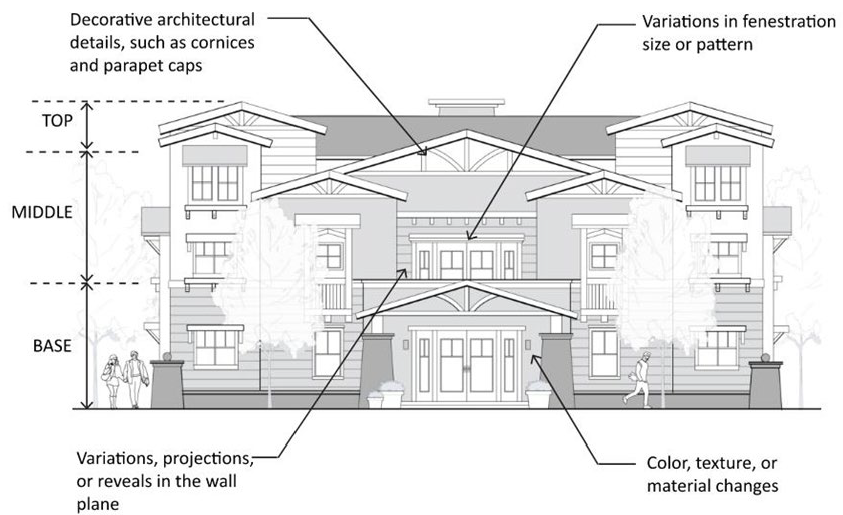
2.
Wall Plane Variation. Building façades visible from the primary street shall not extend more than 50 feet in length without either an architectural element or a two-foot variation in depth in the wall plane. Architectural elements include: building entrances, front porches, balconies, upper-story setbacks, projections, and recessions, such as stoops, bay windows, overhangs, and trellises. (See Figure 35.33-2)
Figure 35.33-2 Wall Plane Variation
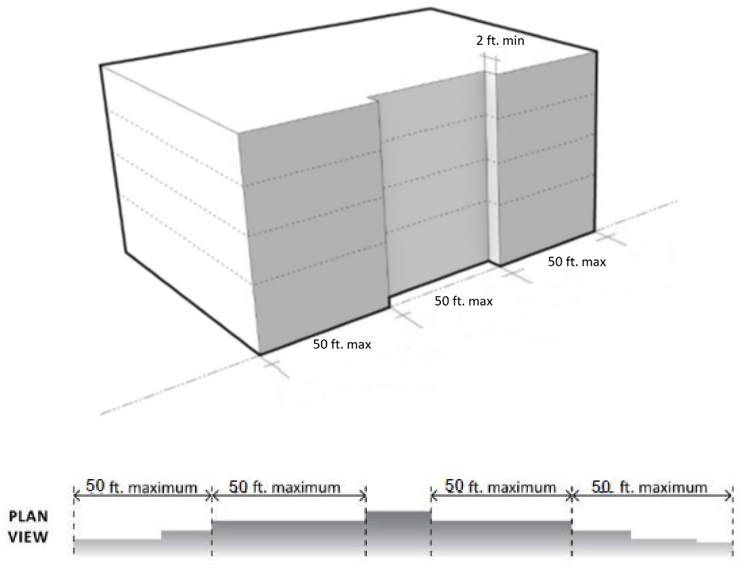
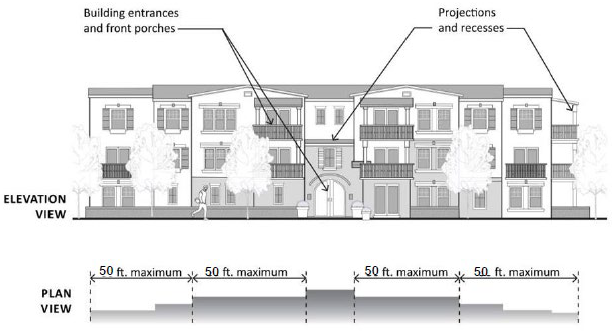
3.
All-Sided Architecture. Buildings shall be designed and articulated with common details, articulation, materials, and elements on all sides.
4.
Corner Lots. Buildings located on corner lots shall include one or more of the following features on both street-facing facades, located within 25 feet of the corner of the building closest to the intersection:
a.
An entrance to a ground-floor use or a primary building entrance.
b.
A different material application, color, or fenestration pattern of windows and doors from the rest of the façade.
c.
A change in height of at least 18 inches from the height of the abutting façade.
5.
Roof Line Variation. Roof lines shall not extend more than a length of 50 feet without at least one prominent change as described below:
a.
Variation in roof form, such as hip, mansard, gable, shed, and flat with parapet.
b.
Variation in architectural elements, such as parapets or varying cornices.
c.
Variation of roof height of at least 24 inches for buildings of two stories or less and 30 inches for buildings of three stories or more (as measured from the highest point of each roof line).
Figure 35.33-4: Roof Line Variation
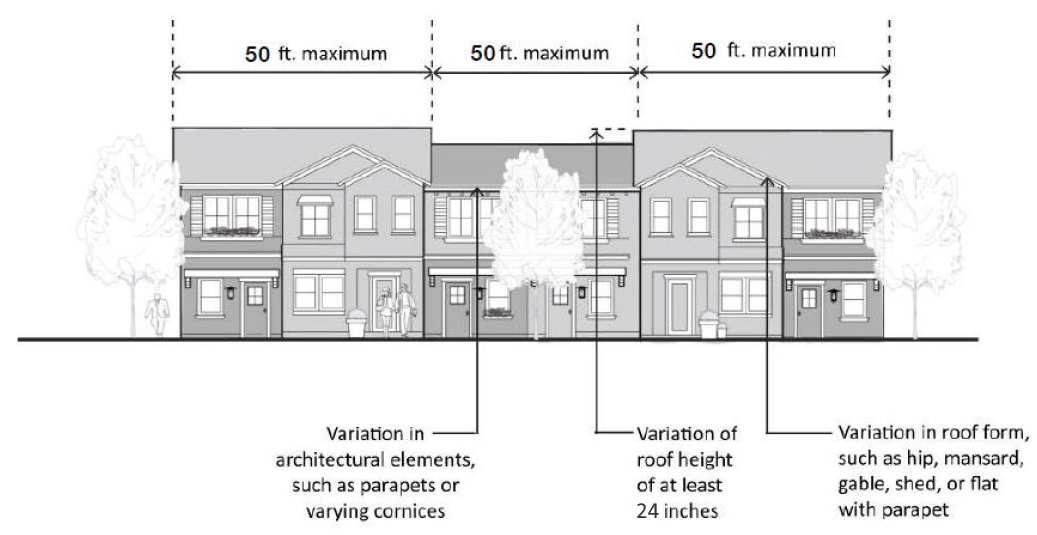
6.
Roof Slopes.
a.
For buildings of three or more stories or roof spans of 30 feet or greater, sloped roofs shall have a minimum pitch of 4:12.
7.
Flat Roofs and Parapets.
a.
Where rooftop equipment is located within 10 feet of a roof edge, a parapet shall be provided that is a minimum of six inches taller than all roof-top equipment.
b.
Interior side of parapet walls shall not be visible from a common open space or public right-of-way.
c.
Parapets shall be capped with precast treatment, continuous banding, projecting cornices, dentils, or similar edge treatment.
B.
Building and Dwelling Unit Entrances. See Subsection 35.33.030.A for orientation of building and dwelling unit entrances within a site.
1.
Primary Building Entrance.
a.
Street-Facing Entrance. Buildings located within 20 feet of the primary street right-of-way shall have a ground-level primary building entrance facing the primary street.
2.
Exterior Individual Dwelling Unit Entrance.
a.
General Requirement. All individual unit entrances shall have either a projected sheltering element or be recessed from the main facade; the projection or recess shall have a minimum depth of 24 inches.
b.
Visibility. All individual unit entrances shall be illuminated or shall face towards a common area or public street.
c.
Street-Facing Unit Entrance. Each dwelling unit located within 20 feet of a primary street right-of-way shall include at least one street-facing porch, balcony, or patio unless a setback of five feet or less is provided.
d.
Upper-Floor Unit Entrance. Exterior entrances to individual dwelling units on upper floors are permitted.
3.
Architectural Treatments. Entrances for buildings and individual dwelling units shall incorporate at least two of the following architectural treatments:
a.
Feature window details;
b.
Towers;
c.
Decorative veneer or siding;
d.
Porches or stoops; or
e.
Changes in roof line or wall plane.
Figure 35.33-5: Architectural Treatment at Entrances
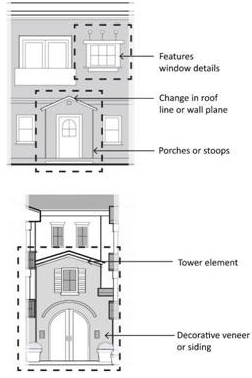
C.
Windows.
1.
Privacy. Where windows are proposed within 10 feet of a window on another building, the design and placement shall avoid unfiltered/direct views into the adjacent site and shall be designed with one or more of the following:
a.
Use non-transparent or obscured glazing, such as frosted/patterned glass. Reflective glazing is not permitted.
b.
Provide permanent architectural screens or affixed louvers at windows.
c.
Offset windows horizontally at least 12 inches from any windows in adjacent buildings (edge to edge), so as not to have a direct line-of-sight into adjacent units.
d.
Permanent landscaping screening.
2.
Window Treatment.
a.
Design Treatment. Windows shall either be recessed at least three inches from the plane of the surrounding exterior wall or shall have a trim or windowsill at least one-half inch in depth.
b.
Windows Facing a Public Street. Windows facing a public street shall feature enhanced window treatments, such as decorative architectural brackets, trim, shutters, awnings, and/or trellises.
D.
Materials and Colors.
1.
Wall Material. The primary exterior siding material for buildings shall be wood, composite wood, stone, stone veneer, granite, slate, brick, brick veneer, stucco, plaster, fiber cement, vinyl, or metal including aluminum or steel. The use of exposed plywood or glass curtain walls is prohibited.
2.
Window Consistency. Window frame materials and color shall be used on all elevations.
3.
Material and Color Transition. Changes in material or color shall occur at inside corners of intersecting walls or at architectural features that break up the wall plane, such as columns.
4.
Accent Material. Use of two or more accent materials, such as glass, tile, brick, stone, concrete, wood, metal, or plaster, shall be incorporated to highlight building features.
5.
Architectural Consistency. Affordable units and market rate units in the same development shall be constructed of the same exterior materials and details such that the units are not distinguishable from one another in quality and detail.
E.
Parking Structures.
1.
Wall Plane Variation. Building façades visible from the primary street shall not extend more than 50 feet in length without at least one of the following: a two-foot variation in depth in the wall plane, architectural element, or other prominent feature that provides visual interest.
2.
Materials and Colors. The parking structure shall utilize the same colors and materials as the primary buildings.
3.
Articulation. The exterior of the parking structure shall apply at least one of the following as articulation:
a.
Applied materials, such as brick, stone, and/or siding, which extend at least two inches from the face of the structure to the face of the applied materials. Painted concrete, smooth concrete, or stucco walls shall not be considered sufficient articulation.
b.
Decorative architectural features, such as cut metal screens, awnings, trellises, louvers, and/or decorative security grills.
4.
Vertical Plantings. Vertical plantings shall be located between openings, entrances, and architectural accent features. Plantings shall be evergreen vegetation that will grow to a minimum height equivalent to 75 percent of the height of the parking structure; container size shall be selected to achieve a height of at least 50 percent of the height of the parking structure within at least two years from the time of installation.
F.
Garages and Carports.
1.
Garages.
a.
Garage doors shall be recessed a minimum of six inches from the surrounding wall plane.
b.
Garages shall feature at least one of the following treatments:
i.
Garage door windows.
ii.
Paneled garage door surface.
iii.
Two different colors.
iv.
Alternative architectural materials, finishes, or treatments.
2.
Carports. Carports shall incorporate the same colors and materials as the primary residential or mixed-use building design.
(Ord. No. 5172, § 2, 1-24-2023; Ord. No. 5202, § 12, 2-13-2024)
A.
Building Placement and Orientation.
1.
Street Facade. If buildings on adjacent properties establish a contiguous street facades along the primary street frontage, new buildings shall be located to maintain the contiguous street wall, with allowances for variation in facade and entrances which are projected or recessed.
2.
Visibility of Entrances. On all lots 60 feet or less in width, at least one primary building entrance or individual unit entrance shall be visible from the front or street side lot line. See Subsection 35.33.030.C.
3.
Buffer for Adjacent Single Family Homes. When developing multi-family buildings of three or more stories adjacent to single-family residential zones (e.g. R-1/E-1), site design shall utilize parking areas, common open space, landscaping, and/or other site features to provide a buffer for adjacent development.
B.
Vehicular Parking and Access. Vehicular parking and access shall comply with the provisions of Chapter 35.36 (Parking and Loading Standards), of this Code. In addition, projects shall provide the following:
1.
Primary Access. Side street or alley access shall serve as the primary vehicular access to parking areas, if available. If not available, the primary street shall serve vehicular access.
2.
Number of Access Points.
a.
Normal Lots. A maximum of one vehicle access point from the street is permitted per 100 feet of street frontage.
b.
Corner Lots.
i.
One vehicular access point is permitted per lot where all street frontages are less than 100 linear feet.
ii.
Two vehicular access points are permitted on lots where at least one street has a frontage of 100 linear feet or more.
Figure 35.33-6: Vehicular Access Points
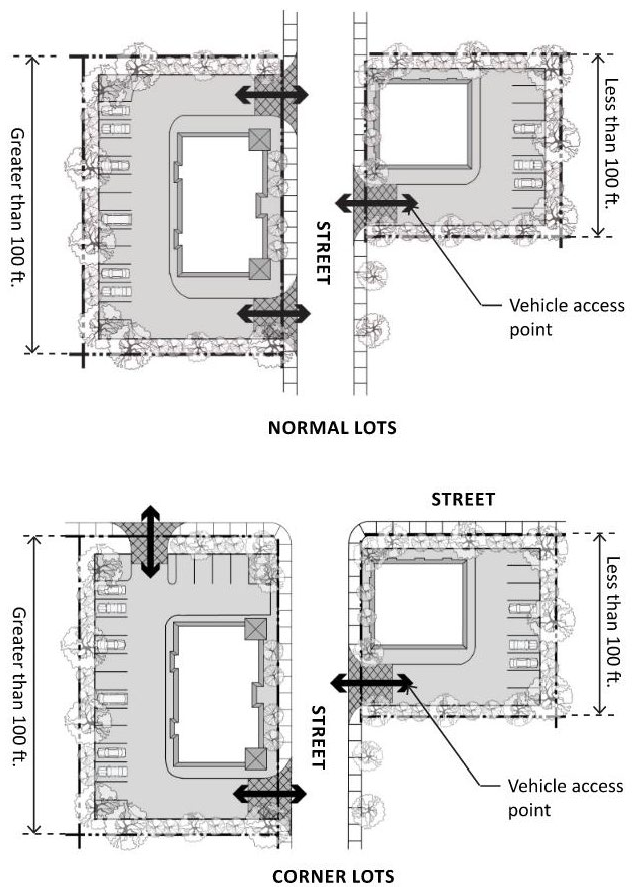
2.
Parking Location. Parking areas shall not be located within any front or street side setback.
3.
Mixed-Use Loading and Service Areas. In addition to the provisions below, loading and service areas shall comply with the standards of Chapter 35.36 (Parking and Loading Standards), as applicable.
a.
All required loading and service areas shall be located adjacent to a façade other than the primary street frontage.
b.
Loading and service areas shall be located so as to not disrupt or block the flow of on-site and off-site vehicular traffic.
c.
Loading and service areas shall not be located adjacent to residential dwelling units or common open space areas.
d.
Loading and service areas shall be screened from view with walls, solid fencing, and/or landscape privacy screening as described in Subsection 35.33.030.E.
e.
On-Site Loading Spaces. Every nonresidential use shall provide and maintain on-site loading and unloading spaces for vehicles as required by this Section:
Table 35.33-1Number of Spaces Required
Table 35.33-2Minimum Dimensions for Loading Spaces
4.
Enhanced Paving for Entrance Driveways. Paving treatment using patterned and/or colored pavers, brick, or decorative colored and/or scored concrete shall be used for entrance driveways, a minimum of 14 feet in length, and spanning the width of the entrance driveway.
Figure 35.33-7: Enhanced Paving For Entrance
Driveways
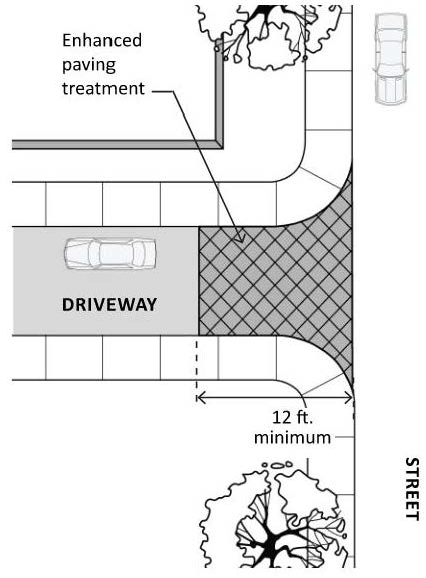
5.
Vehicle Light Intrusion. Vehicle headlights shall be obstructed from direct alignment with habitable interior spaces with a minimum 3-foot high evergreen shrub or vine and/or features such as fencing or walls.
C.
Pedestrian Circulation and Access.
1.
General. The following pedestrian walkways shall be provided and interconnected within the site:
a.
Pedestrian walkways shall connect residential dwelling units to areas throughout the site, such as vehicle parking areas, bicycle parking areas, common open space, waste and recycling enclosures, and other amenities.
b.
Pedestrian walkways shall connect public sidewalks, building entrances, and vehicle parking areas.
c.
Pedestrian walkways shall connect building entrances and vehicle parking areas through the site interior to all transit stops directly adjacent to the site.
2.
Pedestrian Walkways. Pedestrian walkways shall be provided with a minimum width of four feet along their entire length and shall be designed as follows:
a.
Through Lot Connection. Through lots located more than 300 feet from a street intersection, measured from the closest point of the lot, shall provide a publicly accessible sidewalk or walkway connecting the two streets.
b.
Materials. Walkways shall be constructed of firm, stable, and slip-resistant materials, such as poured-in-place concrete (including stamped concrete), permeable paving, decomposed granite, or concrete pavers.
c.
Paving for Pedestrian Crossings. Where an intersection of pedestrian and vehicle access exists, enhanced paving treatment using patterned and/or colored pavers, brick, or decorative colored and scored concrete shall be used. Pedestrian crossings shall feature enhanced paving a minimum width of five feet and span the length of the intersecting drive area.
Figure 35.33-8: Pedestrian Walkways
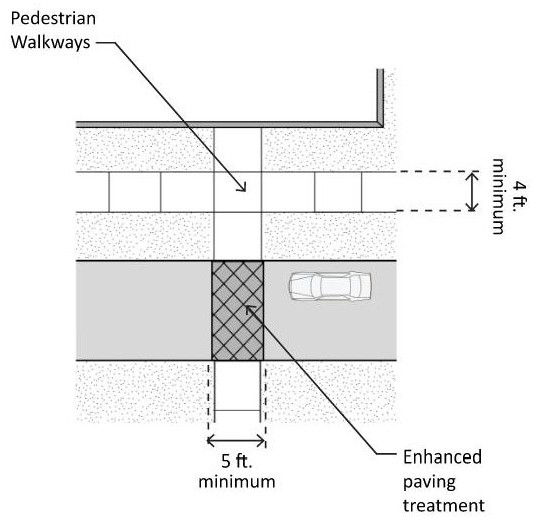
d.
Maintenance. Pedestrian walkways shall be maintained in good condition for the life of the project and shall not be allowed to fall into disrepair so as to constitute a nuisance or hazard to the public.
3.
Enhanced Paving for Building Entrances. Primary building entrances shall provide decorative and accent paving that contrast in color and texture with the adjacent walkway paving. Grass-crete is prohibited.
D.
Common Open Space. Common open spaces for multiple-unit developments shall comply with the minimums required by the base Zone District in which they are located in accordance with Chapter 35. Rooftops may be used to satisfy up to 75% of the common open space requirements.
E.
Landscaping. Landscaping shall be used for all outdoor areas that are not specifically used for parking, driveways, walkways, or open space.
1.
Additional Landscaping Requirements. Landscaping must comply with Chapter 35.34 (Landscaping), including all requirements of the State and County's Water Efficient Landscaping Ordinance (WELO) including the submittal of irrigation plans.
2.
Plant Materials. Plant materials are limited to non-invasive Mediterranean, California native, and other drought-tolerant species.
3.
Parking and Loading Area Landscaping. Parking and loading area landscaping must comply with Subsection 35.34.100 (Landscaping Requirements for Parking Areas).
4.
Landscape Buffer. A landscape buffer of a minimum width of five feet shall be located between all ground-level restricted open spaces and pedestrian walkways. The buffer shall be planted to create a barrier while ensuring visibility. Plants shall be selected to enhance security (e.g. spines or thorny plants) and shall be demonstrated to grow to a minimum height of four feet.
Figure 35.33-9: Landscape Buffer
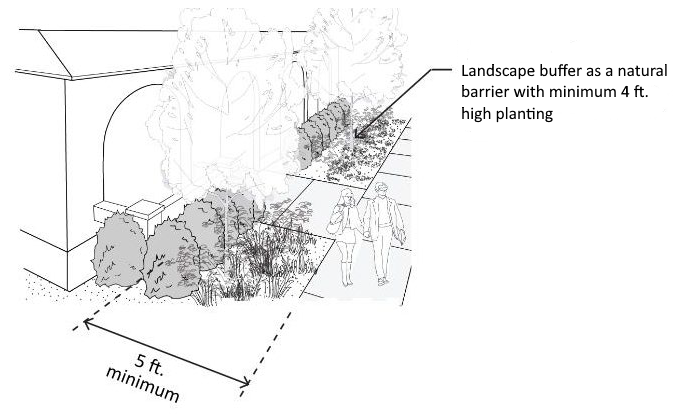
5.
Pedestrian Walkways. Pedestrian walkways shall be flanked on at least one side with landscaping, and may include a mix of turf, groundcover, and shrubs. Trees shall be provided along walkways in order to shade at least 50 percent of the overall walkway length at maturity.
Figure 35.33-10: Pedestrian Walkways
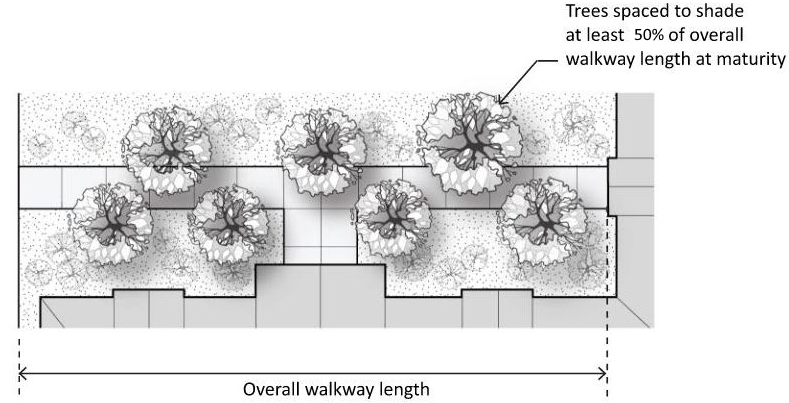
6.
Number of Plants. A minimum of one 15-gallon tree or equivalent box size and 10 five-gallon shrubs shall be planted for every 1,000 square feet of required landscape area.
7.
Groundcover. Groundcover shall be sized and located to cover at least 75 percent of all landscape areas that are not planted with shrubs or trees within 5 years of installation.
a.
While groundcovers and shrubs are establishing, a minimum layer of 3-inch bark mulch or decorative gravel shall be placed within all landscape areas to provide 100 percent coverage of such landscape areas.
8.
Plant Selection. Artificial or synthetic plants, except for turf, are prohibited. Artificial turf is not permitted in front or street side setbacks.
9.
Solar Access. Landscaping shall not obstruct solar access to adjacent solar collectors for water heating, space heating or cooling, or electricity generation.
10.
Privacy. Landscape screening shall obscure direct sight lines into dwelling units and open space areas from communal areas such as parking areas, common mailboxes, and pedestrian walkways. Landscape screening may be used in combination with walls, fencing, and/or trellises to screen views.
a.
Location. Landscape screening shall fit within associated planting areas and canopy sizes must not overlap with building foundations or eaves.
b.
Plant Selection. Landscape screening shall use evergreen trees, shrubs, and/or vines located and sized to buffer views. Deciduous species, perennials, and grasses or grass-like plants are not permitted for privacy screening.
c.
Minimum Sizes. Landscape screening and vegetation shall use the following minimum container sizes at the time of planting:
i.
Trees 15-gallon size.
ii.
Shrubs 5-gallon size.
iii.
Vines 5-gallon size.
(Ord. No. 5172, § 2, 1-24-2023; Ord. No. 5202, § 12, 2-13-2024)
A.
Ground Floor Height. The ground floor of a mixed-use building shall have a minimum floor height of 12 feet, measured from the finished ground floor to the bottom of the finished second floor.
B.
Ground Floor Transparency. Exterior walls facing a public street shall include transparent windows and doors for at least 50 percent of the building wall area located between three and seven feet above the elevation of the sidewalk. Parking garages are not required to meet the ground floor transparency requirement.
C.
Street-Facing Setbacks. Street-facing setbacks shall be landscaped and/or prepared for use by pedestrians. The setback area on each lot shall contain at least two amenities per 50 linear feet, such as benches, drinking fountains, shade structures, or other design element (e.g., public art, planters, kiosks, etc.).
D.
Street-Facing Entrance. Mixed-use buildings located within 20 feet of a primary street right-of-way shall incorporate at least one primary building entrance directly from the public sidewalk or right-of-way. The primary building entrance shall include weather protection that is a minimum of six feet wide and four feet deep by recessing the entrance or providing an awning or similar weather protection element.
(Ord. No. 5172, § 2, 1-24-2023; Ord. No. 5202, § 12, 2-13-2024)
A.
Bicycle Parking. Bicycle parking shall be provided as follows:
1.
Parking Spaces Required. One (1) space for every two (2) dwelling units. A minimum of two (2) spaces shall be provided.
2.
Parking Location. Bicycle parking must be located on the same lot as the use it serves.
a.
Located at surface levels near main pedestrian entrances to nearby facilities or structures, or in the parking garages of such facilities or structures;
b.
Located so as not to block pedestrian entrances, walkways, or circulation patterns in or around nearby facilities or structures;
c.
Access to and from nearby public streets and sidewalks for the target users of the bicycle parking;
d.
Accessible only to residents and owners, operators, and managers of a residential facility when the involved use is residential.
3.
Size and Accessibility. Each bicycle parking space must be a minimum of two feet in width and six feet in length and must be accessible without moving another bicycle. Two feet of clearance must be provided between bicycle parking and adjacent walls, poles, landscaping, street furniture, drive aisles, and pedestrian ways, and at least five feet from vehicle parking spaces.
4.
Anchoring and Security.
a.
Bicycle parking must be located in one or more of the following:
i.
An enclosed bicycle locker;
ii.
An illuminated, fenced, covered, and locked or guarded bicycle storage area;
iii.
A secure area within a building or structure.
b.
Bicycle Locker. When using bicycle lockers, they shall be:
i.
Of sufficient size to hold an entire bicycle; and
ii.
Securely anchored to a permanent surface.
c.
Bicycle Rack. When using bicycle racks, they shall be:
i.
Located and installed to support an entire bicycle, including the frame and wheels, so that the frame and wheels can be locked without damage when using a customary, heavy-duty cable, or U-shaped bicycle lock, or any other security device.
B.
Trash, Recycling, and Green Waste Container Enclosures. Enclosures for recycling, green waste, and any other waste containers required by law are required for multiple-unit and mixed-use developments, and shall comply with the provisions of Section 35.30.170 (Solid Waste and Recycling Storage Facilities), of this Code. Enclosures shall be located within a building, incorporated into the exterior building design, or located within a detached enclosure designed and placed as follows:
1.
Location. The enclosure shall be located to the rear or side of the building(s) and located outside of view from a public right-of-way.
2.
Materials. The enclosure shall incorporate the materials and colors of the primary residential or mixed-use building design.
C.
Fences and Walls. Fences and walls shall comply with the provisions of Section 35.30.070 (Fences and Walls) of this Code.
D.
Lighting. Lighting shall comply with the provisions of Section 35.30.120 (Outdoor Lighting) of this Code.
E.
Screening of Mechanical Equipment. The following development standards shall apply to new development projects subject to this Chapter, as well as to the replacement or provision of new equipment that is added to serve existing building(s) that are subject to this Chapter.
1.
General Requirements. All exterior mechanical equipment, whether on a roof, on the side of a structure, or located on the ground, must be screened from public view. Exterior mechanical equipment to be screened includes, without limitation, heating, ventilation, air conditioning, refrigeration equipment, plumbing lines, ductwork, transformers, smoke exhaust fans, water meters, backflow preventers, service entry sections, and similar utility devices.
a.
Screening must be architecturally integrated into the main structure with regard to materials, color, shape, and size to appear as an integral part of the building or structure.
b.
Equipment must be screened on all sides.
c.
The use of expanded metal lath or chain link for the purpose of screening is prohibited.
2.
Requirements for Specific Types of Mechanical Equipment. The following additional screening standards apply to the specified types of mechanical equipment.
a.
Ground-Mounted Equipment. Ground-mounted equipment that faces a public viewing area must be screened to a height of 12 inches above the equipment and designed and painted to blend in with the surrounding area, unless such screening conflicts with utility access, in which case screening shall comply to the greatest extent that is technically feasible. Acceptable screening devices consist of decorative walls, berms, and/or plant materials.
b.
Exterior Wall Equipment. Screening for wall-mounted equipment, (e.g., electrical meters, cable-connection boxes, electrical distribution cabinets, etc.) must incorporate elements of the building design (e.g., shape, color, texture, material, etc.). For screen walls that are three feet in height or lower, vegetative materials may be substituted for the screening device. This requirement does not apply to equipment that has accessibility and visibility requirements for health and safety.
F.
Vents and Exhaust. All wall-mounted vent and exhaust elements shall be located at interior corners of building walls or behind building elements that conceal them from public view. All flashing, sheet metal vents, exhaust fans or ventilators, and pipe stacks shall be painted a color to match the adjacent roof or wall material.
(Ord. No. 5172, § 2, 1-24-2023; Ord. No. 5202, § 12, 2-13-2024)
For the purpose of Chapter 35.33, the following definitions apply. Any terms used in this Chapter 35.33 that are undefined below, but that are defined in Chapter 35.110, shall have the meaning ascribed to them in Chapter 35.110.
Arcade. A series of arches supported by columns, pilasters, or piers.
Bracket. A projection from a vertical surface providing structural or visual support, typically found under cornices, balconies, windows, or any other overhanging element.
Colonnade. A row or series of evenly-spaced columns set at regular intervals, often freestanding or supporting a roof.
Cornice. A projecting shelf along the top of a wall supported by a series of brackets; the exterior trim where a roof and wall meet, consisting of soffit, fascia, and crown molding.
Dentil. An architectural detail of small, repeating blocks, typically used as a decoration under the soffit of a cornice.
Fenestration. The arrangement, proportioning, and design of windows, doors, and other exterior openings in a building.
Grasscrete. A type of permeable surfacing product that is manufactured using reinforced concrete pavers and designed to allow for grass, gravel, or stone to fill in the voids of the pavers and is sturdy enough to accommodate occasional vehicular use.
Groundcover. Low-growing herbaceous or woody vegetation, other than turf, which typically grows less than two feet high and is used for understory planting under shrubs and trees. Generally grows with a creeping or spreading habit and is used to cover bare soil areas within landscape planter areas.
Multiple-Unit. A housing development that contains two or more residential units.
Objective Design Standard. A standard that involves no personal or subjective judgment by a public official and is uniformly verifiable by reference to an external and uniform benchmark or criterion available and knowable by both the development applicant and the public official prior to submittal.
Parking Structure. A wholly or partly enclosed structure, comprised of one or more stories, used exclusively for the parking and storage of vehicles. A parking structure may be totally below-grade or subterranean, partially above-grade, or totally above-grade.
Pilaster. A partial pier or column, often with a base, shaft, and capital that is embedded in a wall and projects slightly.
Reveal. An inner surface of an opening or recess in a wall, typically in relation to a window or door.
Roof, Gable. A roof which slopes downward in two opposite directions from an upper, central ridge.
Roof, Hip. A roof which slopes downward in four directions from an upper, central point.
Roof, Mansard. A roof with a steep lower slope and flatter upper slope on all sides, either of convex or concave shape.
Roof, Shed. A roof which slopes downward in one direction and has no hips, ridges, or valleys.
Street, Primary. A primary street in relation to an existing or proposed site is the right-of-way with the higher street classification according to the City's Transportation Element, and which carries the greater volume of vehicular traffic.
Street Facade. The wall plane or facade of buildings facing a street, comprised of one or more contiguous buildings. Often used to describe a pedestrian-oriented environment.
(Ord. No. 5172, § 2, 1-24-2023; Ord. No. 5202, § 12, 2-13-2024)
This Chapter establishes requirements for landscaping to enhance the appearance of development, provide shade, reduce heat and glare, control soil erosion, conserve water, screen potentially incompatible land uses, enhance the quality of neighborhoods, improve air quality and improve pedestrian and vehicular traffic and safety.
The provisions of this Chapter apply to new, existing, and future development and land uses. The standards apply countywide unless otherwise indicated.
A.
Landscape plans. Landscape plans shall be required in compliance with Section 35.34.050 through Section 35.34.100 below, as a condition of an approved planning permit, and where a Conditional Use Permit in compliance with Section 35.82.060 (Conditional Use Permits and Minor Conditional Use Permits) or a Development Plan in compliance with Section 35.82.080 (Development Plans) is required. A landscape design professional shall prepare landscape plans. Landscape plans shall be in compliance with the Department handout, "Landscape Plan and Performance Security Procedures."
B.
Plan review.
1.
Director. The Director shall review landscape plans that do not require review and approval by the Board of Architectural Review in compliance with Subsection B.2 (Board of Architectural Review) below, and shall approve, conditionally approve, or deny the plan.
2.
Board of Architectural Review. The Board of Architectural Review shall approve, conditionally approve, or deny:
a.
Landscape plans required by the Board of Architectural Review.
b.
Landscape plans that require review and approval of the landscape plan by the Board of Architectural Review as a condition of approval of a planning permit.
C.
Duration. Landscaping shall be installed and permanently maintained in compliance with the approved landscape plan.
A.
Landscape agreement and performance security required. Prior to the issuance of a Land Use Permit in compliance with Section 35.82.110 (Land Use Permits), or a Zoning Clearance in compliance with Section 35.82.210 (Zoning Clearances), a signed and notarized landscape agreement and a performance security that guarantees the installation of plantings, walls, and fences, in compliance with the approved landscape plan, and provides for adequate maintenance for a designated time period shall be filed with the Department in compliance with Sections 35.84.020 (Performance Guarantees) and Section 35.84.070 (Post Approval Inspections).
B.
Performance security release. Performance securities shall be released upon approval by the Director for the installation and the remaining performance security for landscaping maintenance shall be released at the end of the designated time period, provided the planting has been adequately maintained in compliance with Sections 35.84.020 (Performance Guarantees) and Section 35.84.070 (Post Approval Inspections).
A.
Agricultural (AG-I) zone. A landscape plan shall be approved for the following development within the AG-I zone:
1.
Greenhouses. A greenhouse shall require a landscape plan in compliance with the following:
a.
Plan requirements. The plan shall include landscaping that, within five years, will reasonably screen the view of structures and onsite parking areas from adjacent public streets. The plan shall also include landscaping along public streets. The landscaping shall consist of plant material compatible with existing plants on the property.
b.
Installation requirements. Landscaping shall be completely installed prior to final Building Permit inspection.
c.
Parking areas. Parking areas shall be landscaped in compliance with Section 35.34.100 (Landscaping Requirements for Parking Areas) below.
A.
Design Residential (DR) zone. A landscape plan shall be approved for all development requiring a Development Plan within the DR zone. The landscape plan shall include, at a minimum, the following:
1.
Uncovered parking areas shall be screened from the street and adjacent residences by hedges, dense plantings, shrubbery, solid fences or walls not less than four feet in height.
2.
A landscape area with a minimum width of five feet shall be provided between all lot lines and any driveway or uncovered parking area except for areas provided for site access.
3.
A landscape area with a minimum width of 10 feet shall be provided adjacent to the perimeter lot lines of a clustered residential development.
4.
Parking areas shall be landscaped in compliance with Section 35.34.100 (Landscaping Requirements for Parking Areas) below.
B.
Mobile Home Planned Development (MHP) zone and Mobile Home Subdivision (MHS) zone. A landscape plan shall be approved for all development requiring a Development Plan within the MHP and MHS zones. The landscape plan shall include at a minimum, and landscaping whall [shall] be provided in compliance with, the following:
1.
Perimeter setback areas that are part of the common open space shall be landscaped.
2.
Unsightly areas within the development (e.g., common parking areas, trash storage areas) shall be thoroughly screened by landscaping.
3.
Parking areas shall be landscaped in compliance with Section 35.34.100 (Landscaping Requirements for Parking Areas) below.
C.
Multi-family Residential - Orcutt (MR-O) zone. A landscape plan shall be approved for all development within the MR-O zone. The landscape plan shall include, at a minimum, the following:
1.
Perimeter setback areas that are part of the common open space shall be landscaped.
2.
Unsightly areas within the development (e.g., common parking areas, trash storage areas) shall be thoroughly screened by landscaping.
3.
Parking areas shall be landscaped in compliance with Section 35.34.100 (Landscaping Requirements for Parking Areas) below.
D.
Planned Residential Development (PRD) zone. A landscape plan shall be approved for all development requiring a Development Plan within the PRD zone. The landscape plan shall include, at a minimum, the following:
1.
An adequate buffer area comprised of fencing/walls, plant materials, or any combination thereof shall be provided adjacent to any portion of a lot line that abuts property zoned other than PRD to protect adjacent properties from impacts of noise or lighting and to provide separation between different uses. The buffer area shall be depicted on any Preliminary or Final Development Plan associated with the development project.
2.
Uncovered parking areas shall be screened from the street and adjacent residences by hedges, dense plantings, shrubbery, solid fences, or walls not less than four feet in height.
3.
Parking areas shall be landscaped in compliance with Section 35.34.100 (Landscaping Requirements for Parking Areas) below.
E.
Small Lot Planned Development (SLP) zone. A landscape plan shall be approved for all development requiring a Development Plan within the SLP zone. The landscape plan shall include, at a minimum the following:
1.
Perimeter setback areas that are part of the common open space shall be landscaped.
2.
Unsightly areas within the development (e.g., common parking areas, trash storage areas) shall be thoroughly screened by landscaping.
3.
Parking areas shall be landscaped in compliance with Section 35.34.100 (Landscaping Requirements for Parking Areas) below.
A.
Limited Commercial (C-1) zone. A landscape plan shall be approved for all development within the C-1 zone except a one-family dwelling and its accessory structures and uses on an existing lot of record. The landscape plan shall include, at a minimum, the following:
1.
A landscape area with a minimum width of five feet shall be provided adjacent to any lot line that abuts a residential zone.
2.
A landscape area with a minimum width of 15 feet shall be provided adjacent to any street right-of-way line.
3.
Parking areas shall be landscaped in compliance with Section 35.34.100 (Landscaping Requirements for Parking Areas) below.
B.
Retail Commercial (C-2) zone and General Commercial (C-3) zone. A landscape plan shall be approved for all development within the C-2 and C-3 zones. The landscape plan shall include, at a minimum, the following:
1.
Parking areas shall be landscaped in compliance with Section 35.34.100 (Landscaping Requirements for Parking Areas) below.
C.
Highway Commercial (CH) zone. A landscape plan shall be approved for all development within the CH zone. The landscape plan shall include, at a minimum, the following:
1.
A minimum of five percent of the net lot area shall be landscaped.
2.
An ornamental masonry wall not less than six feet in height extending to within 20 feet of the street right-of-way line of existing or proposed streets shall be provided adjacent to any portion of a lot line that abuts a residential zone. In addition, a row of trees that provide continuous screening to an approximate height of not less than 20 feet nor more than 40 feet when mature shall be provided.
3.
An ornamental masonry wall not less than three feet in height shall be provided along and located a minimum of three feet from any street right-of-way line that abuts the project site where the property on the opposite site of the street has a residential zone.
a.
The area between the wall and the street right-of-way line shall be landscaped.
b.
This requirement may be modified by the review authority when it is determined that strict compliance with this requirement is not required to protect residential values due to the street width or other conditions.
c.
This requirement shall not apply to areas provided for site access and where a service station abuts a street right-of-way.
4.
Parking areas shall be landscaped in compliance with Section 35.34.100 (Landscaping Requirements for Parking Areas) below.
D.
Community Mixed Use - Los Alamos (CM-LA) zone.
1.
Parking lots. Parking lots shall be landscaped in compliance with Section 35.34.100 (Landscaping Requirements for Parking Areas).
2.
Forecourt Building Front type. Landscaping shall be provided for buildings with a forecourt (Subsection 35.24.070.I) that exceeds a gross floor area of 500 square feet.
3.
Through lots. For parking setback exceptions approved according to Subsection 35.24.070.G.e.1, the setback area along the rear or secondary street property line shall be maintained in landscaping subject to review and approval by the applicable Board of Architectural Review.
E.
Neighborhood Commercial (CN) zone. A landscape plan shall be approved for all development within the CN zone. The landscape plan shall include, at a minimum, the following:
1.
A landscape area with a minimum width of five feet and an ornamental wall not less than five feet in height extending to within 20 feet of the street right-of-way line of existing or proposed streets shall be provided adjacent to any portion of a lot line that abuts a residential zone. The wall shall be reduced to three feet in height when located within a front setback area.
2.
Parking areas shall be landscaped in compliance with Section 35.34.100 (Landscaping Requirements for Parking Areas) below.
F.
Resort/Visitor Serving Commercial (C-V) zone. A landscape plan shall be approved for all development within the C-V zone. The landscape plan shall include, at a minimum, the following:
1.
An adequate buffer comprised of fencing, walls, plant materials, or any combination thereof shall be provided adjacent to any portion of a lot line that abuts a residential zone to protect adjacent properties from impacts of noise or lighting and to provide separation between residential and commercial uses. The buffer area shall be depicted on any Preliminary or Final Development Plan associated with the development project.
2.
Parking areas shall be landscaped in compliance with Section 35.34.100 (Landscaping Requirements for Parking Areas) below.
G.
Professional and Institutional (PI) zone. A landscape plan shall be approved for all development within the PI zone. The landscape plan shall include, at a minimum, the following:
1.
A minimum of 10 percent of the net lot area of the property shall be devoted to landscaping.
2.
Parking areas shall be landscaped in compliance with Section 35.34.100 (Landscaping Requirements for Parking Areas) below.
(Ord. No. 5192, § 11, 11-7-2023)
A.
Coastal Related Industry (M-CR) zone. A landscape plan shall be approved for all development except for exploratory oil and gas drill sites and agricultural uses within the M-CR zone. The landscape plan shall include, at a minimum, the following:
1.
A landscape area with a minimum width of five feet shall be provided adjacent to all lot lines except for areas provided for site access.
2.
A masonry wall not less than six feet in height shall be provided adjacent to any portion of a lot line that abuts a commercial or residential zone.
3.
Outdoor storage areas shall be screened by a wall or fence not less than six feet in height. The wall or fence shall be set back a minimum of five feet from any street right-of-way line. The area between the wall or fence and the street right-of-way line shall be landscaped. Areas where stored materials or equipment exceed a height of six feet shall be landscaped with a row of trees of a type approved by the Director to provide continuous screening to an approximate height of not less than 20 feet nor more than 40 feet when mature.
4.
Parking areas shall be landscaped in compliance with Section 35.34.100 (Landscaping Requirements for Parking Areas) below.
B.
Industrial Research Park (M-RP) zone. A landscape plan shall be approved for all development within the M-RP zone. The landscape plan shall include, at a minimum, the following:
1.
A minimum of 30 percent of the net lot area of the property shall be landscaped.
2.
A landscape area with a minimum width of 20 feet shall be provided within the rear setback area adjacent to any portion of a lot line that abuts a residential zone.
3.
A landscape area with a minimum width of five feet shall be provided within the side setback areas adjacent to any portion of a lot line that abuts a residential zone.
4.
A masonry wall not less than six feet in height shall be provided adjacent to any portion of a lot line that abuts a residential zone.
5.
Parking areas shall be landscaped in compliance with Section 35.34.100 (Landscaping Requirements for Parking Areas) below.
C.
Light Industry (M-1) zone. A landscape plan shall be approved for all development within the M-1 zone. The landscape plan shall include, at a minimum, the following:
1.
A minimum of 10 percent of the net lot area shall be landscaped.
2.
A landscape area with a minimum width of five feet shall be provided adjacent to any side or rear lot line.
3.
A landscape area with a minimum width of 10 feet shall be provided adjacent to any street right-of-way line except for areas provided for site access.
4.
A masonry wall not less than six feet in height shall be provided adjacent to any portion of a lot line that abuts a residential or commercial zone.
5.
Outdoor storage areas shall be screened from view of a street by a wall or fence not less than six feet in height. The wall or fence shall be set back a minimum of five feet from any street right-of-way line. The area between the wall or fence and the street right-of-way line shall be landscaped. Areas where stored materials or equipment exceed a height of six feet shall be landscaped with a row of trees of a type approved by the Department to provide continuous screening to an approximate height of not less than 20 feet nor more than 40 feet when mature.
6.
Parking areas shall be landscaped in compliance with Section 35.34.100 (Landscaping Requirements for Parking Areas) below.
D.
General Industry (M-2) zone. A landscape plan shall be approved for all development within the M-2 zone. The landscape plan shall include, at a minimum, the following:
1.
A landscape area with a minimum width of five feet shall be provided adjacent to any street right-of-way line except for areas provided for site access.
2.
A landscape area with a minimum width of five feet and a masonry wall not less than six feet in height shall be provided adjacent to any portion of a lot line that abuts a residential or commercial zone.
3.
Parking areas shall be landscaped in compliance with Section 35.34.100 (Landscaping Requirements for Parking Areas) below.
A.
Mixed Use (MU) zone. A landscape plan shall be approved for all development within the MU zone. The landscape plan shall include, at a minimum, the following:
1.
A landscape area with a minimum width of 10 feet shall be provided adjacent to the perimeter of the project site except for areas provided for site access.
2.
A landscape area with a minimum width of 10 feet shall be provided between all lot lines and any driveway or uncovered parking area except for areas provided for site access.
3.
A landscaped buffer shall be provided between residential and commercial and/or industrial portions of the development to ensure adequate screening, privacy, and noise reduction.
4.
Uncovered parking areas shall be screened from all streets and any residences by hedges, dense plantings, solid fences, or walls not less than four feet in height.
5.
Parking areas shall be landscaped in compliance with Section 35.34.100 (Landscaping Requirements for Parking Areas) below.
B.
Naples Townsite (NTS) zone. A landscape plan shall be approved for all development within the NTS zone. The landscape plan shall be in compliance with the requirements of Subsection 35.26.060.H.9.
C.
Old Town (OT) zones. A landscape plan shall be approved for all development except a one-family dwelling and its accessory structures and uses on an existing lot of record within the OT-R, OT-R/LC and OT-R/GC zones. The landscape plan shall include, at a minimum, the following:
1.
Old Town Residential/Light Commercial (OT-R/LC) zone and Old Town Residential/General Commercial (OT-R/GC) zone.
a.
All parking areas shall be landscaped in compliance with Section 35.34.100 (Landscaping Requirements for Parking Areas) below.
2.
Old Town Residential (OT-R) zone.
a.
Uncovered parking areas shall be screened from all streets and adjacent residences by hedges, dense plantings, solid fences or walls not less than four feet in height.
b.
A landscape area with a minimum width of five feet shall be provided between all lot lines and any driveway or uncovered parking area except for areas provided for site access.
c.
A landscape area with a minimum width of 10 feet shall be provided adjacent to the perimeter lot lines of a clustered residential development.
d.
Parking areas shall be landscaped in compliance with Section 35.34.100 (Landscaping Requirements for Parking Areas) below.
D.
Public Utilities (PU) zone. A landscape plan shall be approved for all development within the PU zone. The landscape plan shall include, at a minimum, the following:
1.
A landscape area with a minimum width of five feet shall be provided adjacent to any street right-of-way except for areas provided for site access
2.
A landscape area with a minimum width of five feet and a masonry wall not less than six feet in height shall be provided adjacent to any portion of a lot line that abuts a residential or commercial zone.
3.
Parking areas shall be landscaped in compliance with Section 35.34.100 (Landscaping Requirements for Parking Areas) below.
E.
Recreation (REC) zone. A landscape plan shall be approved for all development within the REC zone. The landscape plan shall include, at a minimum, the following:
1.
Landscaping, fencing, and/or walls adequate to properly screen the facilities (e.g., tennis courts, concession stands, restrooms, and other structures) shall be provided when the lot is adjacent to a residential zone.
2.
Parking areas shall be landscaped in compliance with Section 35.34.100 (Landscaping Requirements for Parking Areas) below.
In addition to the applicable landscaping requirements contained within Section 35.34.050 through Section 35.34.090 above, parking areas shall be landscaped in compliance with the following requirements. For the purpose of landscaping and screening requirements within this Chapter, parking area includes the parking spaces and the maneuvering space necessary for their use.
A.
Screening between residential and nonresidential uses. Where nonresidential parking areas abut residentially zoned or developed property, a wall or solid fence not less than five feet in height shall be constructed and maintained between the parking area and the adjoining residentially zoned or developed property.
B.
Existing trees. The design of the parking area should make the best use of the growth and shade provided by existing trees on the project site.
C.
Screening requirements and authority. Screening shall be provided adjacent to all lot lines consisting of a five-foot wide strip, planted with sufficient shrubbery to effectively screen the parking area, or a solid fence or wall not less than four feet in height. Fences or walls abutting streets shall be ornamental in texture, pattern, or shadow relief. Planting, fences, or walls abutting streets shall not exceed 30 inches in height for a distance of 25 feet on either side of entrances or exits to the property. This requirement for screening may be waived or modified by the review authority if the adjacent property already has provided a solid wall not less than four feet in height.
D.
Additional requirements for uncovered parking areas exceeding 3,600 square feet. When the total uncovered parking area on the project site (including adjoining lots over which the project has parking privileges) exceeds 3,600 square feet, the following shall be required, in addition to other provisions of this Section, as part of a landscape plan:
1.
Trees, shrubbery, and ground cover shall be provided at suitable intervals in order to break up the continuity of the parking area. Planting islands for these trees and shrubs shall be protected from automobile traffic by either asphalt or concrete curbs.
2.
Landscape islands shall be provided at the ends of all parking lanes.
The purpose of this Chapter is to ensure the provision and maintenance of safe, adequate, well-designed, off-street parking facilities in conjunction with a use or development. The intent is to reduce street congestion and traffic hazards and to promote an attractive environment through design and landscaping standards for parking areas. The standards in this Chapter shall be considered minimums, and more extensive parking provisions may be required by the Commission as a condition of project approval when the Commission is the original review authority.
Every use, including a change or expansion of a use or structure, except as otherwise provided for in Subsection 35.36.090.A (Exemption) below, and in Chapter 35.101 (Nonconforming Uses, Structures, and Lots) shall have appropriately maintained off-street parking and loading areas in compliance with the provisions of this Chapter. A use shall not be commenced and structures shall not be occupied until improvements required by this Chapter are satisfactorily completed.
A.
Change of use. Upon the change of a use, the number of parking spaces to be provided shall be calculated according to the requirements of this Chapter for the new use. Previous parking modifications granted by the review authority shall be null and void.
B.
Addition to use or structure. For additions to existing developments, the increased or decreased parking requirement shall be based on the aggregate total of the floor area and/or number of employees of existing and proposed structures and uses on the property.
Residential parking requirements shall be in compliance with the provisions in this Section, and in Section 35.36.080 (Standards for All Zones and Uses) and in Section 35.36.100 (Standards for Residential Zones and Uses) below.
A.
Not applicable to CM-LA zone. Table 3-5 shall not apply to development on lots zoned CM-LA (Community Mixed Use - Los Alamos). Development located in the CM-LA (Community Mixed Use - Los Alamos) zone shall be in compliance with the parking standards of Subsection 35.36.110.G (Community Mixed Use - Los Alamos (CM-LA) zone), as applicable.
Table 3-5- Residential Parking Standards
Notes:
(1) In the Mission Canyon Community Plan area (excluding the RR zone), a minimum of 3 spaces shall be required for:
(a) A new dwelling unit,
(b) Habitable additions to an existing dwelling unit, either individually or combined, greater than 500 square feet, or
(c) An addition or remodel of an existing dwelling that includes one or more new bedrooms and results in a dwelling with three or more bedrooms.
(2) In the Summerland Community Plan area additional parking spaces may be required in compliance with Section 35.28.210 (Community Plan Overlays).
(3) Includes residential units constructed as a live/work unit or a mixed-use residential component.
(4) See Subsection 35.23.060.D for parking requirements for qualifying affordable housing, senior housing, or special care housing developments.
(5) Does not apply to special care homes serving 6 or fewer clients that are permitted as a one-family dwelling.
(6) A reduction in required parking may be allowed (1) with the submittal of a parking study that sets forth substantial evidence to support a reduction in the required parking (e.g., the daycare center involves clients that do not have access to automobiles, the daycare center is located in proximity to a major transit stop, and/or sufficient parking already exists on or near the project site); and (2) subject to a Minor Conditional Use Permit granted at the discretion of the County decision-makers in compliance with Section 35.82.060 (Conditional Use Permits and Minor Conditional Use Permits).
(Ord. No. 5167, § 12, 11-29-2022; Ord. No. 5259, § 1, 6-24-2025)
Nonresidential parking requirements shall be in compliance with the provisions in this Section, and in Section 35.36.080 (Standards for All Zones and Uses) and in Section 35.36.110 (Standards for Nonresidential Zones and Uses) below.
A.
CM-LA zone. Table 3-6 shall not apply to development on lots zoned CM-LA (Community Mixed Use-Los Alamos). Development located in the CM-LA (Community Mixed Use - Los Alamos) zone shall be in compliance with the parking standards of Subsection 35.36.110.G (Community Mixed Use - Los Alamos (CM-LA) zone) as applicable.
Table 3-6- Nonresidential Parking Standards
Notes:
(1) See Subsection 35.36.110.I (Professional and Institutional (PI) zone).
(2) A reduction in required parking may be allowed (1) with the submittal of a parking study that sets forth substantial evidence to support a reduction in the required parking (e.g., the daycare center involves clients that do not have access to automobiles, the daycare center is located in proximity to a major transit stop, and/or sufficient parking already exists on or near the project site); and (2) subject to a Minor Conditional Use Permit granted at the discretion of the County decision-makers in compliance with Section 35.82.060 (Conditional Use Permits and Minor Conditional Use Permits).
(Ord. No. 5167, § 12, 11-29-2022; Ord. No. 5192, § 12, 11-7-2023)
Off-street parking areas in all zones and for all uses shall be developed in the compliance with the standards in this Section, and as provided in Section 35.36.090 through Section 35.36.120.
A.
Bicycle parking requirements.
1.
Development Plans. For development that is subject to the requirements of a Development Plan, the Commission shall determine if there is a need to provide bicycle parking. If a need exists, the Commission shall then determine the required number of parking spaces, bike racks, and locking devices that shall be provided.
B.
Construction and design.
1.
Parking areas shall be graded and drainage shall be provided so as to dispose of surface water without erosion, flooding, and other inconveniences or hazards.
2.
Except as provided below, uncovered parking areas and driveways shall be paved with a minimum of two inches of asphalt, concrete, masonry pavers, or equivalent, including pervious materials, on a suitable base.
(a)
Mission Canyon Community Plan area. The following parking spaces shall be paved with pervious materials on a suitable base, including masonry pavers, turf blocks, or porous asphalt, unless inconsistent with Fire Department minimum structural design standards for emergency access:
(1)
One of the three required parking spaces associated with the principal dwelling on a lot zoned R-1/E-1 where the principal use is residential; and
(2)
In any zone, any parking spaces that are provided in addition to parking spaces provided in compliance with Section 35.36.050 (Required Number of Spaces: Residential Uses) and Section 35.36.060 (Required Number of Spaces: Nonresidential Uses).
3.
Parking spaces shall be marked and access lanes clearly defined. Bumpers and wheel stops shall be installed as necessary. Every stall designed to accommodate compact cars shall be clearly marked as a compact car stall.
4.
Except for residential uses within the 20-R-1 through 7-R-1, and 20-R-2 through 7-R-2 zones, parking areas shall be designed so that no vehicle shall be required to encroach into a street or sidewalk when backing out of a parking space.
5.
The design of parking spaces shall not require the moving of a car to gain access to a required parking space unless:
a.
The applicable zone regulations specifically allow tandem parking.
b.
The lot is a residentially zoned lot located within the Mission Canyon Community Plan area and is 7,000 square feet (net) or less in size.
6.
Parking areas serving uses operating at night shall be adequately lighted. Lighting shall be directed away from adjoining residences.
7.
The design of parking spaces and the maneuvering space in connection with the spaces shall be in compliance with the requirements of Table 3-8 (Parking Dimensions - One Way Traffic) and Table 3-9 (Parking Dimensions - Two Way Traffic), below, and as illustrated in Figure 3-8 through Figure 3-10, below.
C.
Driveways.
1.
Width, number, and location. Unless otherwise provided in the specific, applicable zone, the width and number of driveways in relation to intersections, obstructions, other driveways, and property lines shall be in compliance with the engineering design standards adopted by the Board.
2.
Driveways to parking areas. A driveway used for access to a parking area shall be a minimum of 10 feet wide in clear distance between an obstruction to vehicular traffic.
3.
Special requirements. Upon recommendation of the Director or the Public Works Department, or upon their own initiative when considering a project, the Commission may place special requirements on an individual building site that will have the effect of reducing or increasing the number or width of driveways or prescribing their location on the building site when the Commission determines that special requirements either reduce or do not create traffic hazards or street parking problems. The decision of the Commission to impose special requirements is final subject to appeal to the Board in compliance with Chapter 35.102 (Appeals).
D.
Gross floor area measurement. For the purposes of this Chapter, gross floor area shall be the measure of the square footage for a project; however, stairways and open, unenclosed corridors shall be excluded.
E.
Fractional space. Where the standards result in a fractional space, the next larger whole number shall be the number of spaces required.
F.
Handicapped parking spaces. Parking areas shall provide handicap parking spaces as required in compliance with State and Federal law.
G.
Joint use of parking facilities for mixed use development. In order to encourage efficient use of commercial parking space and good design practices, the total parking requirements for mixed uses and conjunctive uses shall be based on the number of spaces adequate to meet the various needs of the individual uses operating during the peak parking period.
H.
Location. Except as provided below, off-street parking spaces shall not be located in the required front or side setback area unless specifically allowed by this Development Code. Provisions shall be made for direct access from the street to each parking space. The access shall be adequate for standard size automobiles unless the parking area is restricted to compact cars.
1.
Mission Canyon Community Plan area. Within the Mission Canyon Community Plan area, one of the three required parking spaces associated with the principal dwelling on a lot zoned R-1\E-1 may be located within the front setback area provided the location is approved by the Board of Architectural Review in compliance with Section 35.82.070 (Design Review).
I.
Maintenance of minimum parking requirements. The minimum number of parking spaces required in this Chapter shall be provided and continuously maintained.
J.
Maintenance of parking areas and parking spaces. A parking area or parking space provided for the purpose of complying with the provisions of this Chapter shall not be eliminated, reduced, or converted unless equivalent facilities approved by the review authority are provided elsewhere in compliance with this Chapter. The permit for the use for which the parking was provided shall immediately become void upon the failure to comply with the requirements of this Section.
K.
Modifications of parking requirements. Modifications to the parking requirement may be granted, in compliance with Section 35.42.015 (Accessory Dwelling Units and Junior Accessory Dwelling Units), Section 35.82.060 (Conditional Use Permits and Minor Conditional Use Permits), Section 35.82.080 (Development Plans), Section 35.82.130 (Modifications) or Section 35.82.200 (Variances).
L.
Parking requirement not listed. Where the parking requirement for a use is not specifically provided in this Chapter, the parking requirement shall be determined by the Director based upon the requirement for the most comparable use specified in this Chapter.
M.
Size. Parking space sizes shall comply with the following standards:
1.
Residential parking spaces shall be a minimum of 8.5 feet wide by 16.5 feet long.
2.
Nonresidential parking spaces:
a.
Compact car spaces shall be a minimum of 8 feet wide by 14.5 feet long.
b.
Standard spaces shall be a minimum of 9 feet wide by 16.5 feet long.
c.
Oversized spaces to accommodate bus/limousine parking shall be a minimum of 10 feet wide by 30 feet long.
d.
Storage parking spaces for recreational vehicles (e.g., travel trailers, campers) shall be a minimum of 10 feet wide by 20 feet long.
A.
Exemption. Agricultural improvements (see Article 35.11 (Glossary) the AG-I and AG-II zones shall be exempt from the provisions of this Chapter.
B.
Marking or striping.
1.
Agricultural developments not requiring Development Plan approval shall not be required to comply with design specifications for marking or striping, except for handicap parking spaces required in compliance with State and Federal law.
2.
Agricultural development projects requiring Development Plan approval may request that the review authority waive certain design specifications for marking or striping otherwise required in Subsection 35.36.080.B.3 above.
C.
Screening (AG-I zones). Onsite parking areas for greenhouses or other plant protection structures shall be screened from the view of adjacent public streets in compliance with Section 35.34.050 (Agricultural Zone Landscaping Requirements) and Section 35.34.100 (Landscaping Requirements for Parking Areas).
A.
Location. Required residential parking spaces shall be provided on the same site that the dwelling is located. For dwelling units containing two or more bedrooms in multiple-family residential developments, spaces shall be located within 200 feet of the dwelling that the space serves.
B.
R-1/E-1 and R-2 zones.
1.
Agricultural product sales. A minimum of two parking spaces shall be provided. Parking spaces shall be located no closer than 20 feet to the right of way of any street.
2.
Overnight parking of commercial vehicles. For one-family and two-family dwelling units located on property zoned either R-1/E-1 or R-2, not more than one bus or nonpassenger motor vehicle or trailer used in commerce may be parked overnight on a lot. The bus, motor vehicle, or trailer shall not exceed two axles, four tons, or eight feet in height. This restriction shall not apply to the emergency overnight parking of disabled motor vehicles or trailers and the occasional overnight parking of moving vans, pickup, or delivery or construction vehicles or trailers when occasional overnight parking is reasonably serving the residential use of a particular lot.
C.
One-Family Exclusive Residential (EX-1) zone. Required parking shall be provided with adequate provisions for ingress from and egress to the street at the time the main structure is constructed or enlarged or at the time a guesthouse is erected.
D.
Design Residential (DR) zone.
1.
Construction and design. Parking areas shall be arranged to prevent through traffic to other parking areas.
2.
Encroachment prohibited. Laundry facilities located in a garage for a dwelling unit shall not encroach upon parking.
3.
Landscape/screening of parking areas. Uncovered parking areas shall be screened in compliance with Subsection 35.34.060.A (Design Residential (DR) zone) above, and Section 35.34.100 (Landscaping Requirements for Parking Areas).
4.
Location. Parking lots, carports, and garages designed and used for individual units within a development may be either adjacent to the units or centrally located to serve a group of units.
5.
Setbacks. Uncovered parking areas shall not be located closer than 15 feet to the street right-of-way line and closer than five feet to any other property line.
6.
Agricultural product sales. A minimum of two parking spaces shall be provided. Parking spaces shall be located no closer than 20 feet to the right of way of any street.
7.
Common parking areas. Preservation and maintenance of common parking areas shall be in compliance with Section 35.23.060 (DR Zone Standards).
E.
Mobile Home Planned Development (MHP) zone.
1.
Storage areas for recreational vehicles shall be screened by landscaping and fencing for security purposes. Minimum dimensions for each storage space shall be 10 feet by 20 feet.
2.
Common parking areas may be provided but shall not be located closer than 10 feet to a mobile home site.
3.
A minimum of one parking space shall be located on each individual site. One additional space may be located in a common parking area located within the mobile home development. Tandem parking is allowed if two spaces are provided within an individual site.
4.
Preservation and maintenance of common parking areas shall be in compliance with Subsection 35.23.080.F (Open Space).
5.
Common parking areas shall be landscaped in compliance with Subsection 35.34.060.B (Mobile Home Planned Development (MHP) zone and Mobile Home Subdivision (MHS) zone) and Section 35.34.100 (Landscaping Requirements for Parking Areas).
F.
Mobile Home Subdivisions (MHS) zone.
1.
Storage areas for recreational vehicles shall be screened by landscaping and fencing for aesthetic and security purposes.
2.
Common parking areas shall not be located closer than 10 feet to a lot line.
3.
A carport or garage shall be set back a minimum of 15 feet from the front line of the lot on which it is located.
4.
A minimum of one parking space shall be located on each individual site. One additional space may be located in a common parking area located within the mobile home subdivision.
5.
Preservation and maintenance of common parking areas shall be in compliance with Subsection 35.23.090.C (Development Standards).
6.
Common parking areas shall be landscaped in compliance with Subsection 35.34.060.B (Mobile Home Planned Development (MHP) zone and Mobile Home Subdivision (MHS) zone) and Section 35.34.100 (Landscaping Requirements for Parking Areas).
G.
Multi-family Residential - Orcutt (MR-O) zone.
1.
Parking shall be located in compliance with Section 35.23.130 (Multi-family Residential - Orcutt).
2.
Parking areas shall be landscaped in compliance with Section 35.34.100 (Landscaping Requirements for Parking Areas).
H.
Planned Residential Development (PRD) zone.
1.
Construction and design. Parking areas shall be arranged to prevent through traffic to other parking areas.
2.
Landscape/screening of parking areas. Uncovered parking areas shall be screened and landscaped in compliance with Subsection 35.34.060.D (Planned Residential Development (PRD) zone) and Section 35.34.100 (Landscaping Requirements for Parking Areas).
3.
Agricultural product sales. A minimum of two parking spaces shall be provided. Parking spaces shall be located no closer than 20 feet to the right of way of any street.
I.
Small Lot Planned Development (SLP) zone.
1.
Parking spaces may be allowed on individual lots or one parking space may be provided on each lot and the other parking space may be located in common parking areas located throughout the SLP development.
2.
Common parking areas shall not be located closer than 10 feet to a lot line.
3.
A carport or garage shall be set back a minimum of 15 feet from the front lot line on which it is located.
4.
Common parking areas shall be landscaping in compliance with Subsection 35.34.060.E (Small Lot Planned Development (SLP) zone) and Section 35.34.100 (Landscaping Requirements for Parking Areas).
5.
Preservation and maintenance of common parking areas shall be in compliance with Subsection 35.23.110.C (Open Space).
6.
Storage parking areas for recreational vehicles shall be screened by landscaping and fences for aesthetic and security purposes.
7.
The numeric parking requirement for the storage of recreation vehicles provided in Section 35.36.050 (Required Number of Spaces: Residential Uses) above, may be modified if the review authority makes one of the following findings:
a.
There is adequate provision for parking for recreational vehicles on individual lots; or
b.
Opportunities for such parking exist within a reasonable distance of the SLP development; or
c.
Adequate standards for such parking are provided in the CC&R's for the SLP development.
J.
Exterior parking. The following standards apply to the keeping, parking, or storage (hereinafter referred to as "parked" or "parking" within the meaning of this Subsection J) of operative and inoperative motor vehicles and recreational vehicles outside of a fully enclosed or fully screened structure. A Land Use Permit in compliance with Section 35.82.110 (Land Use Permits) is not required to establish exterior parking except when 1) this Subsection 35.36.100.J requires a permit, or 2) the parking involves construction of a new structure or alteration of an existing structure that is not exempt from a Land Use Permit in compliance with Section 35.20.040 (Exemptions from Planning Permit Requirements), or 3) the parking in not in compliance with Section 35.20.040 (Exemptions from Planning Permit Requirements). However, other permits may be required in compliance with Chapter 17 (Solid Waste Services), Chapter 19 (Junk Yards and Dumps) and Chapter 23 (Motor Vehicles and Traffic) of the County Code. Nothing in this Subsection 35.36.100.J shall be construed as preventing the enforcement or implementation of the provisions of Chapter 17 (Solid Waste Services), Chapter 19 (Junk Yards and Dumps) and Chapter 23 (Motor Vehicles and Traffic) of the County Code.
1.
Current registration or certificate of non-operation required. All motor vehicles and recreational vehicles parked on a lot outside of a fully enclosed or fully screened structure shall either:
a.
Have a current, unexpired registration with the California Department of Motor Vehicles that allows the vehicle to be driven, moved, towed or left standing (parked) upon any road or street; or,
b.
Have a current, unexpired certificate of non-operation or planned non-operation on file with the California Department of Motor Vehicles.
2.
Limitation on number.
a.
Not including the number of vehicles for which parking spaces are required to be provided in compliance with Section 35.36.050 (Required Number of Spaces: Residential Uses), the exterior parking of operative motor vehicles and recreational vehicles is allowed provided that the number of such vehicles parked on a lot outside of a fully enclosed or fully screened structure does not exceed one per each bedroom located within the dwelling(s) on the lot.
(1)
Parking allowed in compliance with this Subsection J.2.a. may be located on driveways including portions of driveways located within a required front setback or side setback area provided:
(a)
Any portion of a driveway on which parking occurs shall be paved with a minimum of two inches of asphalt, concrete, masonry pavers, or equivalent, including pervious materials, on a suitable base.
(b)
The width of any portion of a driveway located in a front setback area shall not exceed 50 percent of the adjacent street frontage for each front setback area except that:
(i)
A greater width may be allowed if necessary to comply with County or fire protection district regulations.
(ii)
In all cases a driveway having a maximum width of 10 feet shall be allowed.
(c)
All parking located within a required front setback shall be located within one contiguous area for each street frontage.
(d)
A recreational vehicle shall not be parked within a front setback area.
b.
Additional parking allowed. In addition to exterior parking allowed in compliance with Subsection J.2.a, above, the exterior parking of operative and inoperative motor vehicles and recreational vehicles that are registered with the California Department of Motor Vehicles to a person(s) residing on the lot on which the parking occurs outside of a fully enclosed or fully screened structure is allowed in compliance with the following standards.
(1)
The number of vehicles and the area used for the parking of said vehicles shall be limited to the following maximum number and area based upon the lot area of the lot on which the vehicles are parked:
(2)
Any area used for parking shall be located so that vehicles parked thereon are not visible from any public road or other area of public use (e.g., park, trail), or any adjoining lot.
(a)
Structures or other devices used to comply with this requirement shall not include awnings, fabric shelters, tents, vehicle covers and similar structures or other devices of a nonpermanent type of construction.
(3)
On lots having a net lot area of less than 20,000 square feet, vehicles shall not be parked in any area located between the front line of the lot and the principal dwelling.
3.
Additional standards for inoperative motor vehicles and recreational vehicles. The parking of inoperative motor vehicles and recreational vehicles outside of a fully enclosed or fully screened structure shall also comply with the following standards in addition to the standards listed in Subsections J.1 and J.2, above:
a.
Vehicles shall not be parked on parking spaces required in compliance with Section 35.36.050 (Required Number of Spaces: Residential Uses).
b.
Any area use for parking shall be designed and installed to prevent the discharge of pollutants onto adjacent lots and adjacent streets.
c.
Vehicles that are parked for a period in excess of 14 consecutive days without being moved under their own motive power shall be drained of gasoline, oil and other flammable liquids.
d.
The parking of inoperative motor vehicles regulated under Subsection 35.23.050.D (Motor vehicle assemble, dismantling, maintenance, repair, restoration, etc.) shall also be in compliance with the requirements of that Subsection.
4.
Modifications to standards allowed with a Minor Conditional Use Permit. Parking of motor vehicles and recreational vehicles that does not comply with the standards contained in Subsections J.1 through J.3, above, may be allowed in compliance with a Minor Conditional Use Permit approved in compliance with Section 35.82.060 (Conditional Use Permits and Minor Conditional Use Permits).
5.
Noncompliance deemed a violation of this Development Code. The parking of motor vehicles and recreational vehicles that does not comply with the standards contained in Subsections J.1 through J.3, above, or is not allowed by a Minor Conditional Use Permit approved in compliance with Section 35.82.060 (Conditional Use Permits and Minor Conditional Use Permits) as allowed by Subsection J.4, above, shall be considered a violation of this Development Code and subject to enforcement and penalties in compliance with Chapter 35.108 (Enforcement and Penalties).
A.
Compact spaces. Thirty percent of the required parking for nonresidential uses may be provided as compact car spaces.
B.
Location. For nonresidential structures or uses, the required parking spaces shall be provided within 500 feet of the principal structure, or site if there is no principal structure, as measured along streets excluding alleys, except as provided in Subsection D. (Limited Commercial (C-1) zone) below.
C.
Off-street loading facilities. Off-street loading facilities shall be in compliance with the following standards:
1.
Number of loading spaces. For every newly constructed structure to be occupied by commercial or industrial uses requiring the receipt or distribution by vehicles of materials and merchandise (e.g., manufacturing, storage, warehouse, retail store, wholesale store, market, restaurant, hotel, hospital, mortuary, laundry, dry cleaning), off-street loading spaces shall be provided as follows:
a.
Commercial Uses:
3,000 or more square feet gross floor area - 1 loading space
b.
Industrial Uses:
10,000 to 24,999 square feet gross floor area - 1 loading space
25,000 to 49,000 square feet gross floor area - 2 loading spaces
For each additional 50,000 square feet or major fraction thereof - 1 loading space
2.
Dimensions. Each loading space shall not be less than 10 feet in width, 30 feet in length, and with an overhead clearance of 14 feet.
3.
Setback restrictions. The space may not be located in any part of any required front or side setback.
4.
Safety. The space shall be designed to ensure that it will not interfere with vehicular circulation, parking, or with pedestrian circulation.
D.
Limited Commercial (C-1) zone. Required parking spaces may be provided in publicly owned parking lots of legally constituted Parking Districts as long as the spaces provided are within a distance of no greater than 500 feet as measured along streets, not alleys, from the property line, subject to approval of the availability of the parking spaces by the Parking District Governing Board and the Director.
E.
Retail Commercial (C-2) zone. Required parking spaces may be provided in publicly owned parking lots of legally constituted Parking Districts subject to approval of the availability of the parking spaces by the Parking District Governing Board and Director.
F.
Highway Commercial (CH) - Agricultural product sales. A minimum of two parking spaces shall be provided. Parking spaces shall be located no closer than 20 feet to the right of way of any street.
G.
Community Mixed Use - Los Alamos (CM-LA) zone.
1.
Design. Parking areas on adjacent lots should be designed to allow shared use of parking and through traffic to adjacent lots.
2.
Location. Required onsite parking for residential uses shall be located behind buildings and be visually screened as viewed from the street. Parking in garages shall be designed so vehicle storage area entrances are not visible from the public right-of-way.
3.
Required number of spaces - residential.
a.
Projects with three or more dwelling units. Minimum of one space per dwelling unit.
b.
Projects with two or fewer dwelling units. Onsite parking is not required for projects containing two or fewer residential units. However, on-street parking shall be demonstrated to be available within 200 feet of the lot as measured along the streets not alleys, from the property line, subject to approval of the Director.
4.
Required number of spaces - nonresidential. The provision of onsite parking for commercial use is not required, however, it may be provided.
5.
Parking Space Size. Onsite parking shall be in compliance with Section 35.36.080.
6.
Driveways. All driveways shall comply with the following:
a.
Driveways shall be a minimum width as required by the Fire Department.
b.
Driveways shall not access Bell Street. An exception shall only be granted to key lots in existence as of March 18, 2011 with no other access to the street.
c.
If feasible, driveways shall not be located within 40 feet of a street intersection.
H.
Resort/Visitor Serving Commercial (C-V) zone. The Commission may require additional parking for projects that provide for public access to and use of recreational facilities or open space.
I.
Professional and Institutional (PI) zone. The required spaces for offices shall be one parking space for each 200 square feet of floor space.
J.
Public Works and Utilities and Private Service Facilities (PU) zone. Roads shall be paved with asphaltic concrete and parking areas may be surfaced with gravel.
(Ord. No. 5192, § 13, 11-7-2023)
A.
Mixed Use (MU) zone.
1.
Residential screening. Uncovered parking areas shall be screened in compliance with Subsection 35.34.090.A (Mixed Use (MU) zone) and Section 35.34.100 (Landscaping Requirements for Parking Areas).
2.
Conjunctive use of parking facilities.
a.
For the purpose of this Section, conjunctive use shall be defined as the joint use of parking spaces for two or more land uses where the hours of operation and demand for parking require that the parking spaces can be used by the individual uses at different times of the day or week, and can serve more than one use. The intent is to provide for possible reduction in the number of parking spaces ordinarily required for two or more land uses and the sharing of parking spaces under a set of unique circumstances, including the compatibility of the land uses, adjacent properties, and lack of need for separate parking facilities.
b.
A Conditional Use Permit shall be required for the joint use of parking spaces, in compliance with Section 35.82.060 (Conditional Use Permits and Minor Conditional Use Permits). The Conditional Use Permit shall be subject to the following requirements:
(1)
The applicant shall demonstrate a need for parking spaces required for the individual uses according to the parking regulations in this Chapter. The applicant shall state the type of use proposed, time period of operation, and other necessary information to demonstrate that the joint use of parking spaces will not create traffic congestion or be detrimental to surrounding uses.
(2)
In cases where the required number of parking spaces for individual uses differs, the parking requirement that is greater shall become effective.
(3)
The applicant shall submit a title report for the lot proposed for conjunctive parking use and an agreement between the owners of record of the lot and prospective users. This agreement shall obligate the lot for conjunctive parking use, clearly define the obligation of each party to the agreement, and be recorded in the Santa Barbara County Recorder's Office. The Agreement shall provide that any modification to the terms of the Conjunctive Use Agreement shall be subject to Commission approval.
(4)
Violation of the Conditional Use Permit shall be grounds for revocation of the joint parking use.
3.
Off-street parking is prohibited in front of the building between the building and the street right-of-way line of a road having a roadway classification of P2 or 2 Lane Expressway on the circulation map for a Community Plan area.
B.
Old Town Residential/Light Commercial (OT-R/LC), Old Town Residential/General Commercial (OT-R/GC) and Old Town Residential (OT-R).
1.
One-family and two-family dwellings. Except as provided in Subsection C. (Old Town Orcutt Pedestrian Overlay (PA-OTO) zone) below for lots located within the PA-OTO Overlay, parking for structures containing only one- family or two-family residential uses within the OT-R/LC, OT-R/GC and OT-R zones shall be provided in compliance with Section 35.36.080 (Standards for All Zones and Uses) above, and Section 35.36.100 (Standards for Residential Zones and Uses) above.
2.
Multiple dwelling units. Except as provided in Subsection C. (Old Town Orcutt Pedestrian Overlay (PA-OTO) zone) below for lots located within the PA-OTO Overlay, parking for multi-family residential development within the OT-R/LC, OT-R/GC and OT-R zones shall be provided in compliance with Section 35.36.080 (Standards for All Zones and Uses) above, and Section 35.36.100 (Standards for Residential Zones and Uses), above.
3.
Commercial uses only. Except as provided in Subsection C. (Old Town Orcutt Pedestrian Overlay (PA-OTO) zone) below for lots located within the PA-OTO Overlay, parking for structures containing only commercial uses shall be provided in compliance with Section 35.36.110 (Standards for Nonresidential Zones and Uses), above.
4.
Commercial and residential use. Except as provided in Subsection C. (Old Town Orcutt Pedestrian Overlay (PA-OTO) zone) below for lots located within the PA-OTO Overlay, parking for structures containing both commercial and residential uses shall be provided as applicable to each use in compliance with Section 35.36.100 (Standards for Residential Zones and Uses) above, and Section 35.36.110 (Standards for Nonresidential Zones and Uses) above.
5.
Landscaping. All parking areas shall be landscaped in compliance with Subsection 35.34.090.B (Old Town (OT) zones) and Section 35.34.100 (Landscaping Requirements for Parking Areas).
C.
Old Town Orcutt Pedestrian Overlay (PA-OTO) zone.
1.
Two-family and multiple dwelling units. In the delineated Core Pedestrian Area or Peripheral Pedestrian Area, the parking requirements for two-family or multiple dwelling units shall be one space per residential unit and no guest parking shall be required.
2.
Commercial uses only. Parking requirements for structures containing only commercial uses shall be in compliance with Section 35.36.110 (Standards for Nonresidential Zones and Uses), subject to the following exceptions:
a.
In the delineated Core Pedestrian Area, no onsite parking spaces are required.
b.
In the delineated Peripheral Pedestrian Area, onsite parking requirements shall be reduced by 50 percent.
3.
Commercial and residential use. Parking requirements for structures containing both commercial and residential uses shall be as applicable to each use as provided in Subsections C.1 (Two-family and multiple dwelling units) and C.2 (Commercial uses only) above.
4.
Additional design and location requirements.
a.
Core Pedestrian Area.
(1)
New development. No vehicular access shall be allowed via curb cuts and/or driveways on Clark Avenue and Broadway Avenue to new development projects except for one-family and two-family dwellings. If applicable, required onsite parking areas shall be located at the rear of structures and shall be designed so as to take access off side streets and/or alleys to the maximum extent feasible. Development on lots containing no alley or street frontage other than Broadway, Clark Avenue or Foxenwood Lane shall be exempt from the specific parking access requirements of the Core Pedestrian Areas.
(2)
Renovations, additions or expansions. Renovations to, additions to, or expansions of existing multi-family residential, mixed-use, and commercial development projects not resulting in an increase of 1,000 square feet or more than 10 percent of approved site coverage, shall be exempt from the specific parking access requirements of the Core Pedestrian Area.
b.
Peripheral Pedestrian Area.
(1)
New development. Vehicular access to new multi-family residential, mixed-use, and commercial development projects via curb cuts and/or driveways on Clark Avenue and Broadway Avenue shall be avoided where feasible. Onsite parking areas shall be located at the rear of structures and shall be designed so as to take access off side streets and/or alleys to the maximum extent feasible.
(2)
Renovations, additions or expansions. Renovations to, additions to or expansions of existing multi-family residential, mixed-use, and commercial development projects not resulting in an increase of 1,000 square feet or more than 10 percent of approved site coverage, shall be exempt from the specific parking access requirements of the Peripheral Pedestrian Area.
Table 3-8- Parking Dimensions
One-Way Traffic (All Dimensions in Feet)
Note: Specifications for any parking angle not specifically enumerated can be determined by interpolation from the above table.
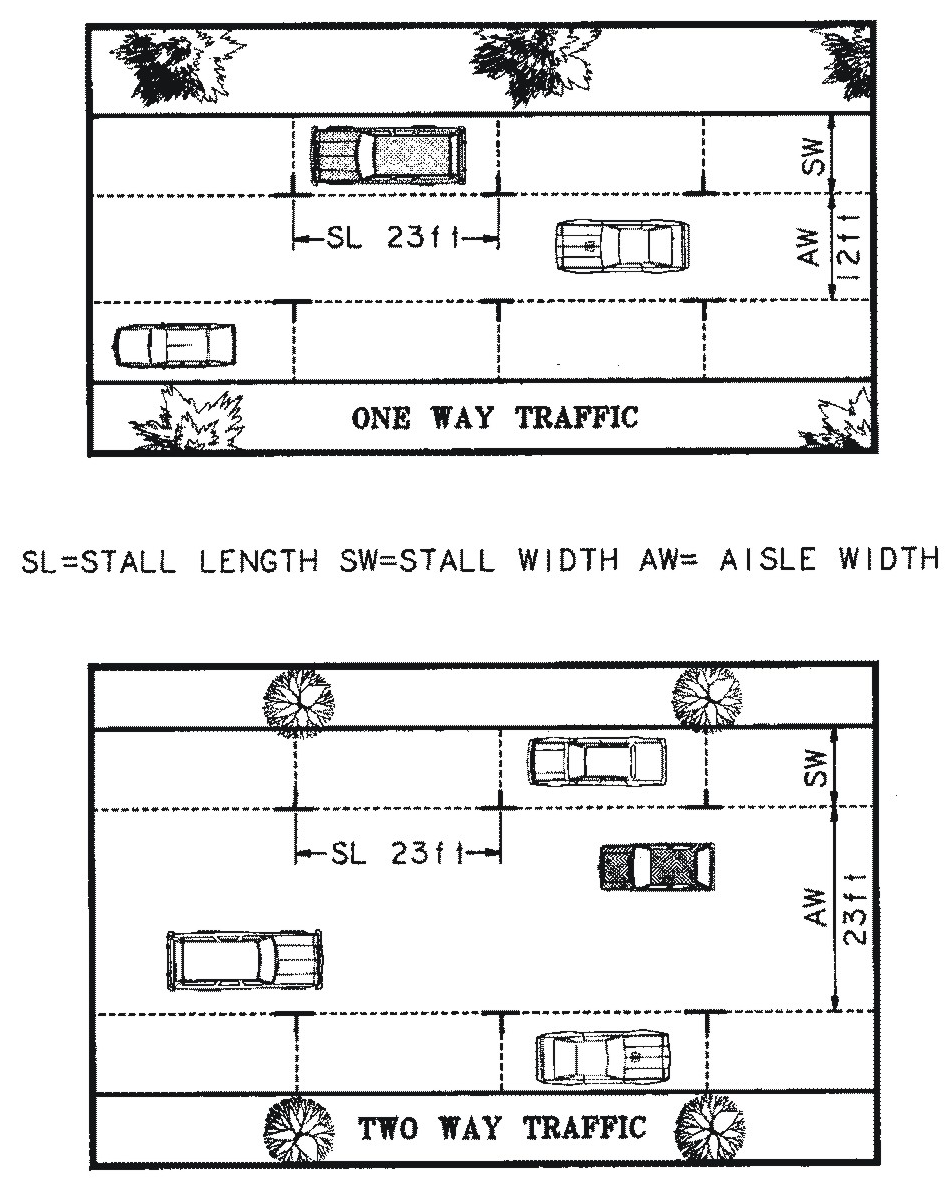
Table 3-9- Parking Dimensions
Two-Way Traffic (All Dimensions in Feet)
Note: Specifications for any parking angle not specifically enumerated can be determined by interpolation from the above table.
Figure 3-8 - Parallel Parking Diagram
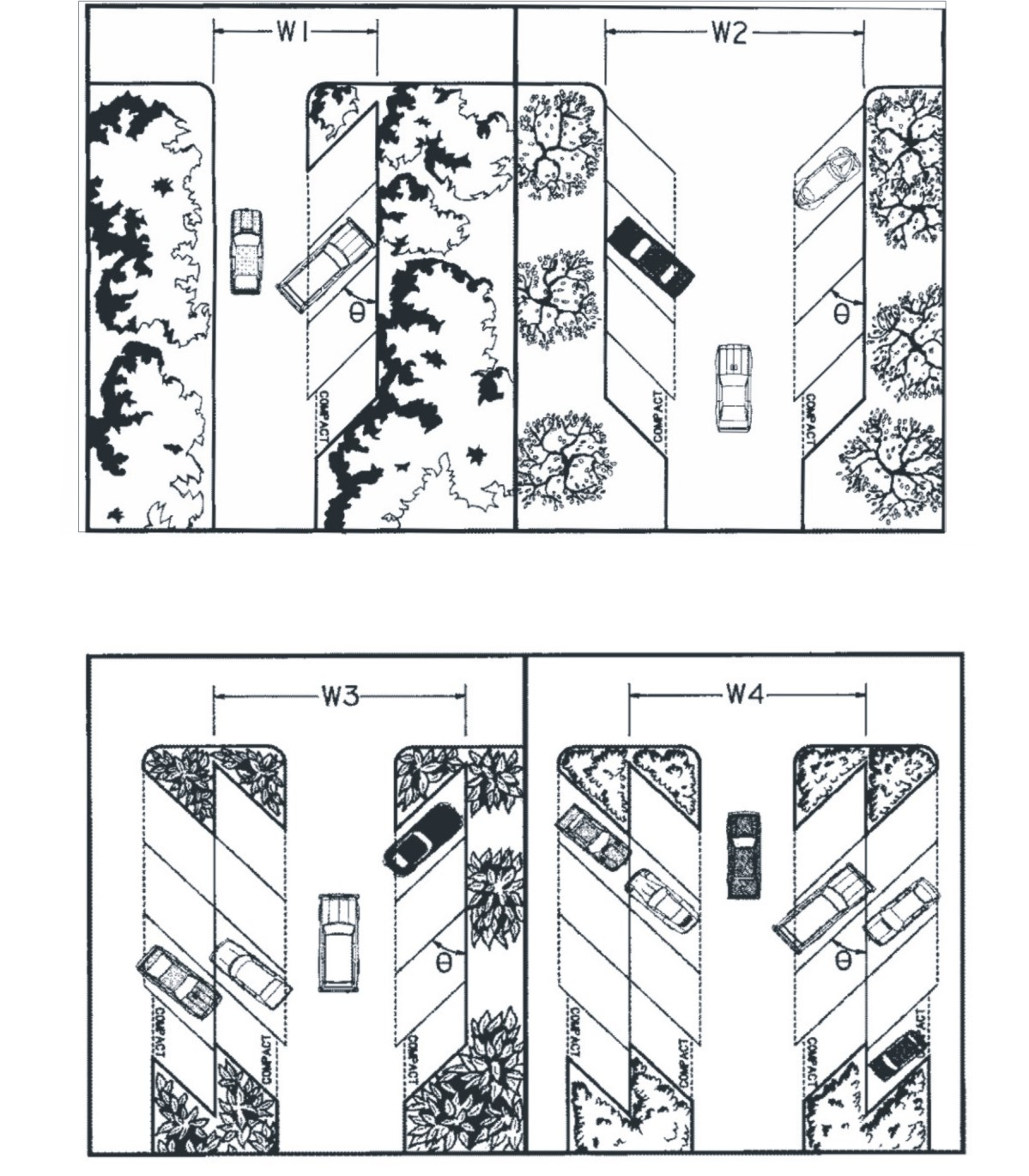
Figure 3-9 - Angle Parking Diagram — One Way Traffic
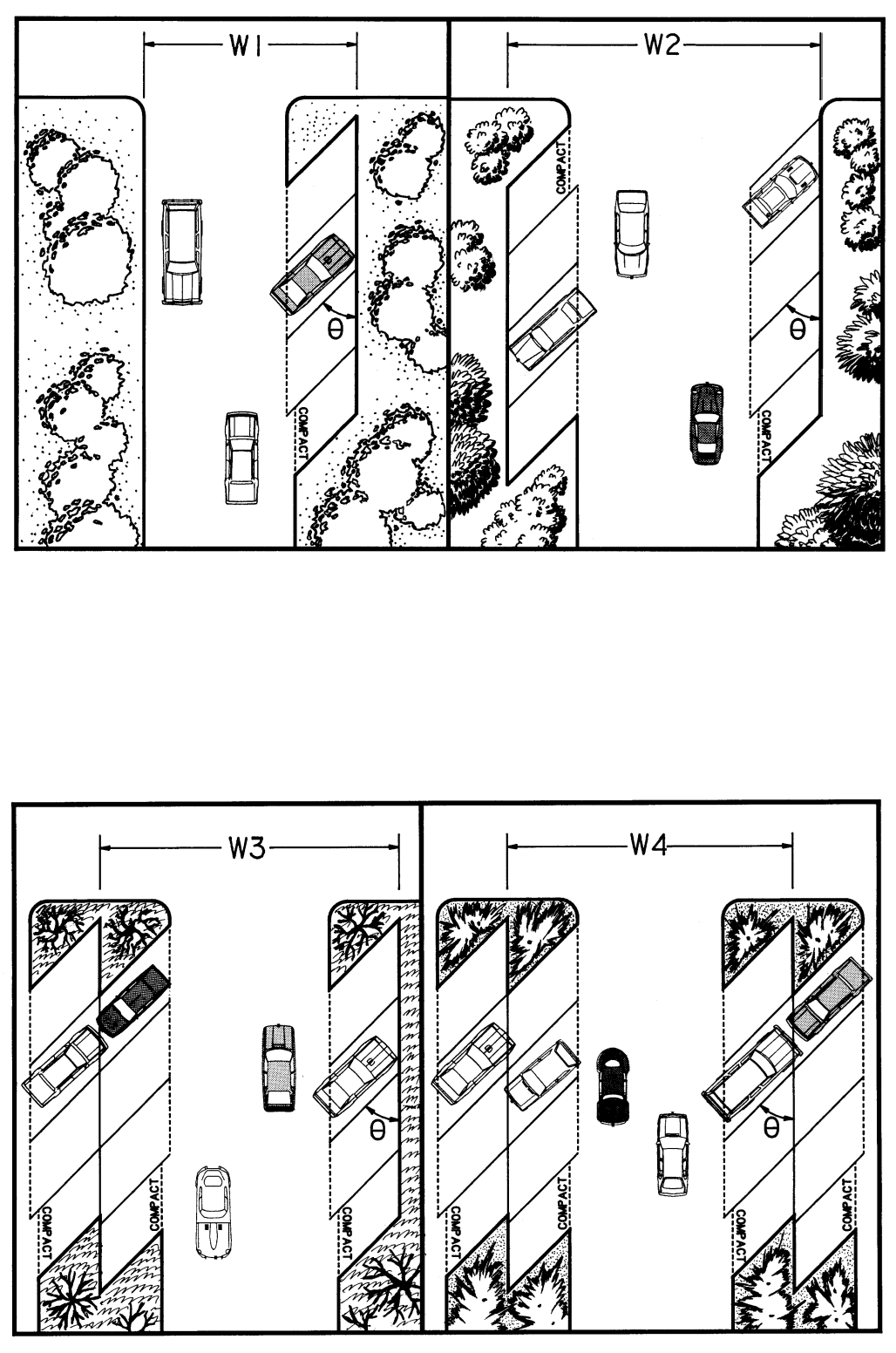
Figure 3-10 - Angle Parking Diagram — Two Way Traffic
A.
The purpose and intent of this Chapter is to ensure equal access to housing and to remove barriers to fair housing opportunities for individuals with disabilities in compliance with the Federal Fair Housing Act and the California's Fair Employment and Housing Act (the Acts) by providing a procedure to request reasonable accommodation in the application of this Development Code and to establish relevant criteria to be used when considering such requests.
B.
Reasonable accommodation means providing an individual with a disability flexibility in the strict application of zoning regulations or procedures when necessary to eliminate regulatory barriers and afford an individual with a disability an equal opportunity to use and enjoy a dwelling.
C.
This Chapter shall be interpreted and applied in accordance with the Acts, and nothing in this Section shall be deemed to create greater rights than exist under the Acts.
A.
In order to make specific housing available to individuals with disabilities, any person, including an individual with a disability, his or her representative, or provider of housing for individuals with disabilities, may request a modification or exception to the rules, standards and practices for the siting, development and use of housing or housing-related facilities as regulated by this Development Code that would eliminate regulatory barriers and provide an individual with a disability equal opportunity to housing of their choice. This Chapter applies only to those individuals who qualify as disabled under the Acts.
B.
Typical improvements which may be considered for reasonable accommodation provisions include elevators or other mechanical access devices, handrails, ramps, walls, and other similar accessibility improvements necessary to accommodate an individual's disability. Reasonable accommodations include:
1.
Adjustments to encroachment allowances, floor area provisions, height and setback requirements.
2.
Adjustments to requirements for buffers, fences, walls and screening requirements.
3.
Allowing hardscape additions such as widening driveways, parking areas or walkways that would otherwise not comply with landscape, lot coverage, or open space provisions.
C.
The approval of a reasonable accommodation does not affect an individual's obligations to comply with other applicable regulations not at issue in the requested accommodation.
Notice of the availability of reasonable accommodation shall be displayed at the Department's public information counters. Forms for requesting reasonable accommodation shall be made available to the public at the Department.
A.
An application for reasonable accommodation shall be submitted in compliance with Chapter 35.80 (Permit Application Filing and Processing).
1.
An application for reasonable accommodation may be filed at any time that the accommodation may be necessary to ensure equal access to housing.
2.
If the project for which the application is being made also requires some other discretionary approval under this Development Code, the applicant shall file the application for reasonable accommodation concurrent with the application for the discretionary approval.
B.
Additional submittal requirements. The application shall include the following in addition to the standard submittal requirements.
1.
Verification by the applicant that the property is or will be the primary residence of the individual for whom the accommodation is requested.
2.
The regulation or procedure from which accommodation is being requested.
3.
An explanation of why the reasonable accommodation is necessary to make the specific property accessible to the individual with the disability.
4.
The basis for the claim that the individual (or group of individuals, if application is made by an entity acting on behalf of a person or persons with disabilities) is considered disabled under the Acts.
A.
Review authority and processing procedures.
1.
If the project for which the application for reasonable accommodation is requested requires ministerial approval in compliance with this Development Code, then the Director shall be the review authority for the application for reasonable accommodation and the related application, and the application for reasonable accommodation shall be submitted and reviewed concurrently with the related ministerial application.
a.
Notice of the application for reasonable accommodation and pending decision by the Director shall be given in the same manner as a Land Use Permit in compliance with Chapter 35.106 (Noticing and Public Hearings).
b.
The Director shall review the application for reasonable accommodation for compliance with the Comprehensive Plan including any applicable community or area plan, this Development Code, and other applicable conditions and regulations, and approve, conditionally approve, or deny the request. A public hearing is not required.
c.
The action of the Director is final subject to appeal in compliance with Chapter 35.102 (Appeals).
d.
The Director may take action on the application for reasonable accommodation prior to taking an action on any companion application.
2.
If the project for which the application for reasonable accommodation is requested requires discretionary approval in compliance with this Development Code, then:
a.
The review authority for the related discretionary application shall be the review authority for the application for reasonable accommodation.
b.
The application for reasonable accommodation shall be processed concurrently and in compliance with the applicable processing requirements for the related discretionary application, including noticing and public hearing requirements.
c.
The review authority shall review the application for reasonable accommodation for compliance with the Comprehensive Plan including any applicable community or area plan, this Development Code, and other applicable conditions and regulations, and approve, conditionally approve, or deny the request. The review authority shall take action on the application for reasonable accommodation concurrently with taking action on any related discretionary application.
d.
The action of the review authority is final subject to appeal in compliance with Chapter 35.102 (Appeals).
B.
Standards for approval.
1.
The review authority shall approve or conditionally approve the application if, based upon all of the evidence presented to the County, the findings required for approval in compliance with Section 35.37.060 (Findings Required for Approval) can first be made.
2.
An application for reasonable accommodation granted in compliance with this Chapter shall not require the approval of any Modification in compliance with Section 35.82.130 (Modifications) or Variance in compliance with Section 35.82.200 (Variances) as to the reasonable accommodation.
C.
Conditions of approval. The review authority may impose conditions on the approval of an application for reasonable accommodation that are consistent with the purpose of the Acts and this Chapter to further fair housing. Such conditions include:
1.
That the reasonable accommodation shall only be applicable to the specific use for which the application is made.
2.
That a reasonable accommodation involving an exterior physical improvement or structure is designed to be substantially similar to the architectural character, colors, and texture of materials of the existing structure (if applicable) and other structures on the project site and in the neighborhood.
3.
That the reasonable accommodation is subject to any and all Building Code permit and inspection requirements of the County.
D.
Written determination. The review authority shall issue a written determination, which shall be mailed to the applicant by first class mail, of the action on the application for reasonable accommodation that:
1.
Explains the basis of the decision and includes the findings required in compliance with Section 35.37.060 (Findings Required for Approval).
2.
Includes notice of the right to appeal and the appeals process.
E.
Other required approvals. If the final action by the County results in the approval or conditional approval of the requested accommodation, other required approvals of the County (e.g., building permits) still apply.
An application for reasonable accommodation shall be approved or conditionally approved only if the review authority, in compliance with the Federal Fair Housing Act and the California Fair Employment and Housing Act (the Acts), first makes all of the following findings:
A.
The project that is the subject of the request for reasonable accommodation:
1.
Conforms to the applicable provisions of the Comprehensive Plan including applicable community and area plans.
2.
Conforms to the applicable provisions of this Development Code and other applicable zoning conditions and regulations that apply to the subject project, except as modified by the accommodation.
B.
The project that is the subject of the request for reasonable accommodation will be occupied as the primary residence by an individual with a disability under the Acts.
C.
The accommodation is necessary to make specific housing available to an individual with a disability protected under the Acts.
D.
The accommodation will not impose an undue financial or administrative burden on the County and the community.
E.
The accommodation will not require a fundamental alteration of the regulations or procedures of this Development Code.
F.
The accommodation will not waive a requirement for a Land Use Permit, Building Permit or Encroachment Permit, or result in approved uses otherwise not allowed by this Development Code.
G.
Any adverse impact that results from the accommodation is minimized to the extent feasible.
H.
The accommodation is limited to the minimum necessary to accommodate the needs of the individual with a disability and reasonable alternatives are not available that will provide an equivalent level of benefit without requiring a modification or exception to regulations or procedures of this Development Code.
I.
The project that is the subject of the request for reasonable accommodation.
1.
Will not be detrimental to the general welfare, health, and safety of the neighborhood and will not be incompatible with the surrounding areas.
2.
Will not conflict with any easements required for public access through, or public use of a portion of the property that the project is located on.
3.
Will not require extensive alteration of the topography with the exception of only those design modifications which are necessary to provide the accommodation.
4.
If located in a Rural area as designated on the Comprehensive Plan maps, will be compatible with and subordinate to the rural and scenic character of the area with the exception of only those design modifications which are necessary to provide the accommodation.
If the project for which the application for reasonable accommodation is submitted also requires design review approval in compliance with Section 35.82.070 (Design Review), then any approval or conditional approval of the project by the Board of Architectural Review shall not have the effect of rendering an approved reasonable accommodation infeasible.
The purpose of this Chapter is to promote the public health, safety, and welfare through a comprehensive system of reasonable, effective, consistent, content-neutral, and nondiscriminatory sign standards and requirements. More specifically, this Chapter is intended to:
A.
Balance public and private objectives by allowing adequate avenues for both commercial and non-commercial messages;
B.
Allow signs to serve as an effective channel of communication while preventing visual clutter that will detract from the aesthetic character of the County;
C.
Maintain and enhance the County's appearance by regulating the location, number, type, quality of materials, size, illumination, and maintenance of signs;
D.
Restrict signs that may create a nuisance to nearby properties, violate privacy, or create hazards or unreasonable distractions for pedestrians or drivers;
E.
Provide clear and unambiguous sign standards that enable fair and consistent enforcement; and
F.
Ensure that the constitutionally guaranteed right of free speech is protected.
See "Signs" within Article 35.11 (Glossary) for definitions related to signage as used within this Chapter.
(Ord. No. 5238, § 8, 2-11-2025)
The provisions of this Chapter apply to all signs in all zones, erected, constructed or physically altered on or after the effective date of the Ordinance amending this Chapter, unless otherwise specified.
A.
Message Neutrality. It is the County's policy and intent to regulate signs in a manner consistent with the U.S. and California constitutions, which is content neutral as to non-commercial speech and does not favor commercial speech over non-commercial speech.
B.
Registered Mark. The provisions of this Chapter shall not require alteration of the display of any registered mark, trademark, service mark, trade name, or corporate name that may be associated with or incorporated into a registered mark, where such alteration would require the registered mark to be displayed in a manner differing from the mark as exhibited in the certificate of registration issued by the United States Patent and Trademark Office. It is the responsibility of the applicant to establish that a proposed sign includes a registered mark.
C.
Noncommercial Signs. Non-commercial signs are allowed wherever commercial signage is permitted and are subject to the same standards and total maximum allowances per site or building of each sign type specified in this Chapter. For purposes of this Chapter, all non-commercial speech messages are deemed to be "on-site," regardless of location.
(Ord. No. 5238, § 8, 2-11-2025)
The following signs are exempt from the permit requirements of this Chapter, do not count towards the maximum number of signs or maximum sign area, and may be located in setback areas, provided that they are erected on an allowed and, where applicable, permitted, structure and conform to the specified standards.
A.
Address Signs. Required address identification signs that are in conformance with the Building Code.
B.
Commercial Displays on Vehicles. Displays that are part of the vehicle and related to the goods or services provided by the vehicle owner or operator and public transit/public carrier graphics on properly licensed buses, taxicabs, and similar vehicles for hire that legally pass through the County.
C.
Construction Signs. Nonilluminated construction informational signs not to exceed eight square feet per site, erected after the required permits for the construction have been obtained and removed prior to final inspection.
D.
Directional Signs. Non illuminated directional signs not more than eight square feet in area or four feet in height for the direction of the public such as outlining/assisting vehicle and pedestrian circulation within a site, to ingress and egress, and to facilities such as restrooms, telephones, walkways, and other similar features.
E.
Flags. Flags that do not display a commercial message.
F.
Gas Pump Signs. Signs on or within five feet of a gas pump.
G.
Government Signs. Signs and devices erected by a governmental entity, including, but not limited to, Santa Barbara County and public schools.
H.
Historic Plaques and Commemorative Signs. Historic plaques, memorial signs or tablets, or commemorative signs indicating names of buildings and dates of building erection, either attached to or cut into the surfaces of buildings, with a maximum allowable sign area of four square feet per sign.
I.
Informational Signs. Informational signs not more than two square feet in area indicating information such as hours and days of operation, whether a business is open or closed, payment information, crop identification, and emergency address and telephone numbers.
J.
Interior Signs. Signs that are in the interior areas of a building and at least 12 inches from a window, door, or other exterior wall opening.
K.
Manufacturer's Mark. Manufacturer's marks, including signs on items such as vending machines, gas pumps, and ice containers with a maximum allowable sign area of four square feet per sign.
L.
Nameplate. One nameplate for each tenant or occupant not to exceed two square feet in area indicating the name of the occupant or tenant.
M.
No Trespassing Signs. "No Trespassing" signs not more than one square foot in area and located a minimum of 50 feet from any other "No Trespassing" sign or in compliance with the requirements of law.
N.
Official and Safety Signs. Official notices issued by a court, public body, or office and posted in the performance of a public duty; safety and other notices posted by a utility or other quasi-public agency; signs erected by a governmental body to direct or regulate pedestrian or vehicular traffic; non-commercial bus stop signs erected by a public transit agency, or other signs required for safety or authorized by law.
O.
Open House Directional Signs. Up to four off-site signs directing the public to "open house" events for the viewing of lots, premises, dwellings or structures that are for sale, lease, or rent, are permitted on private land, provided they comply with the following standards:
1.
No sign or signs exceeds four square feet in area, or three feet in height from finished grade.
2.
The sign or signs may not be placed more than two hours before the start or remain more than two hours after the conclusion of the open house event.
P.
Political, Social Issue, and Other Noncommercial Signs. Signs informing of political candidates, parties, issues, measures, propositions, philosophies or personal beliefs, and which are not commercial messages, shall be exempt from all regulations of this Chapter, except that such signs shall not be placed within the public right-of-way. Political signs shall conform to the requirements of the California State Code for placement and removal.
Q.
Real Estate Signs. One nonilluminated, on-site sign pertaining to the sale, lease, or rental of a structure or land, not exceeding six square feet in a Residential Zone or 25 square feet in any zone other than a Residential Zone.
R.
Subdivision Signs. The following signs are allowed on the site of a subdivision of five or more lots where a Tentative Map has been approved by the County.
1.
One nonilluminated, on-site sign per street frontage with a maximum size of 32 square feet per sign is allowed for a maximum of one-year period.
2.
One nonilluminated lot identification sign per undeveloped lot containing only the subdivision lot number, with a maximum size of one square foot, is allowed until the subject lot is sold.
S.
Temporary Signs.
1.
Temporary Window Signs. Temporary window signs not exceeding four square feet or 15 percent of the window area, whichever is greater, displayed for a maximum of 30 consecutive days.
2.
Temporary Event Balloons, Inflatable Signs, Streamers, Pennants and Other Attention-Getting Devices. Balloons, banners, inflatable signs, streamers, pennants, and other attention-getting devices associated with a temporary event. The balloons, inflatable signs, streamers, pennants, and other attention-getting devices shall be erected no more than five days prior to the associated temporary event and shall be removed within 24 hours after the end of the associated temporary event.
3.
Other Temporary Signs. Other temporary signs, including garage and yard sale signs, not exceeding six square feet displayed for a maximum of 30 consecutive days. A maximum of two temporary signs may be displayed at the same time on a single site.
(Ord. No. 5238, § 8, 2-11-2025)
Unless otherwise permitted by a specific provision of this Chapter, the following sign types are prohibited:
A.
Animated or Moving Signs. Animated, flashing, blinking, reflecting, revolving, or other similar sign with visibly moving or rotating elements or visible mechanical movement of any kind except when integrated into a gas pump.
B.
Balloons, Inflatable Signs, Streamers, Pennants and Other Attention-Getting Devices. Balloons, inflatable signs, streamers, pennants, and other attention-getting devices, made of light-weight fabric or similar material, designed to rotate or move with the wind, that direct, promote, or that are otherwise designed to attract attention.
C.
Mobile Billboards. Any sign carried or conveyed by a vehicle for the primary purpose of general advertising for hire. This prohibition eliminates mobile billboard advertising within the County to reduce traffic congestion, promote the safe movement of vehicular traffic, to reduce air pollution, and improve the aesthetic appearance of the County. This prohibition does not apply to displays that are part of the vehicle and related to the goods or services provided by the vehicle owner or operator or to public transit/public carrier graphics on properly licensed buses, taxicabs, and similar vehicles for hire that legally pass through the County.
D.
Off-Site Signs. Any sign advertising any activity, business, product, or service that are not conducted on the premises upon which the sign is located.
E.
Roof Signs. Signs constructed upon or over a roof; placed on a rooftop structure such as penthouse walls, chimneys, or mechanical enclosures; or placed so as to extend above the roofline or parapet.
F.
Signs Located in the Public Right-of-Way or on Public Property. Other than official government signs or warning signs required by law, no inanimate sign may be placed in or project into the public right-of-way or on public property unless authorized by an encroachment permit.
G.
Signs Affixed to Trees. Signs affixed to or cut into trees or other living vegetation.
H.
Signs on Terrain. Signs cut, burned, marked, or displayed in any manner on a street, sidewalk, cliff, hillside, or other terrain feature.
I.
Signs Creating Traffic or Pedestrian Safety Hazards. Signs placed, located, or displayed in such a manner as to constitute a traffic or pedestrian safety hazard.
1.
Signs that obstruct use of any door, window, or fire escape.
2.
Signs that impede normal pedestrian use of public sidewalks. A minimum unobstructed width of four feet must always be maintained.
3.
Signs that constitute a traffic hazard or obstruct the view of traffic, any authorized traffic sign, or signal device.
4.
Signs that create confusion or conflict with any authorized traffic sign or signal device due to color, location, wording, or use of specific phrases, symbols, or characters.
J.
Signs Producing Noise or Emissions. Signs producing visible smoke, vapor, particles, odor, noise, or sounds that can be heard at the property line shall be prohibited. This prohibition excludes menu boards with voice units at Drive-Through Facilities.
K.
Signs for Prohibited Uses. A sign displaying a commercial message promoting a business that is a prohibited use and has not been established as a legal nonconforming use.
L.
Unauthorized Signs. Signs shall not be placed on private or public property without the permission of the property owner.
(Ord. No. 5238, § 8, 2-11-2025)
A.
Measuring Sign Area. The area of a sign face includes the entire area within the perimeter of a maximum of two squares and/or rectangles that enclose the extreme limits of the frame or outline of the sign copy, or where there is no frame or outline, letters, pictures, symbols, logos, artwork, emblems, color, or other details conveying a message. Supporting structures, such as sign bases and columns, are not included in sign area provided that they contain no lettering or graphics. The area of an individual sign shall be calculated as follows.
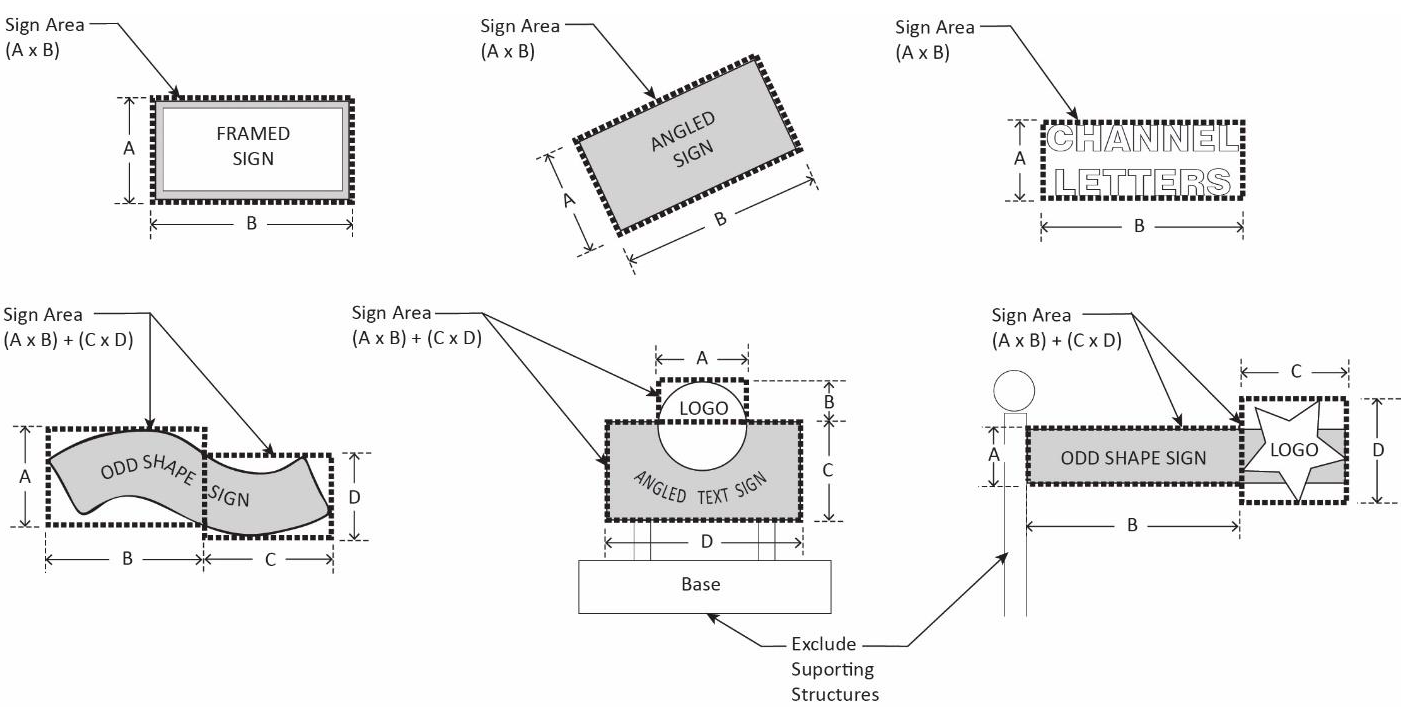
Figure 3-11 - Measuring Sign Area
1.
Single-Faced Signs. The sign area of a sign with a single face area is the area of the sign face.
2.
Double-Faced Signs. Where two faces of a double-faced sign are located two feet or less from one another at all points, or located at an interior angle of 45 degrees or less from one another, the sign area of double-faced signs is computed as the area of one face. Where the two faces are not equal in size, the larger sign face will be used. Where two faces of a double-faced sign are located more than two feet or greater than 45 degrees from one another, both sign faces are counted toward sign area.
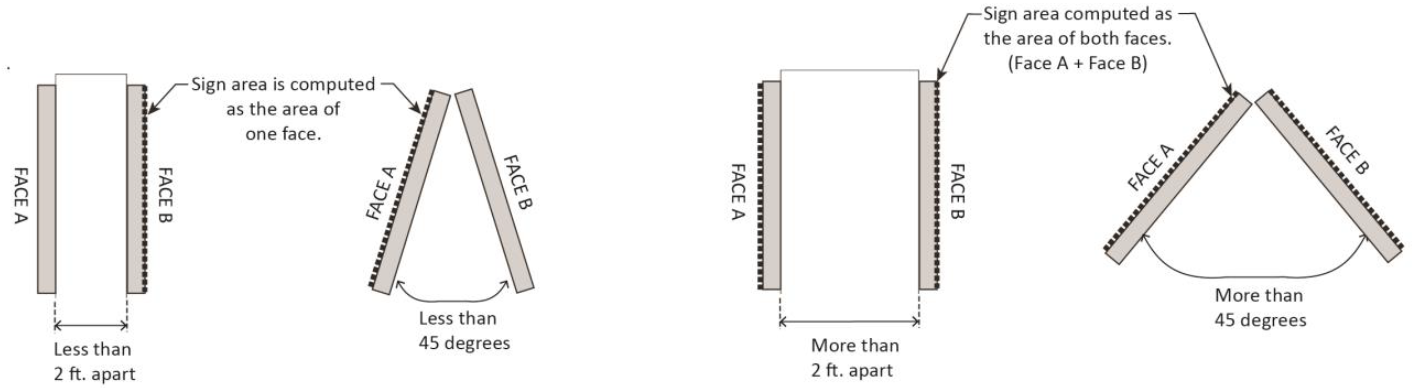
Figure 3-12 - Measuring Double-Faced Signs
3.
Multi-Faced Signs. On a three-faced sign, where at least one interior angle is 45 degrees or less, the area of two faces (the largest and smallest face) must be summed to determine sign area. In all other situations involving a sign with three or more sides, sign area will be calculated as the sum of all faces.
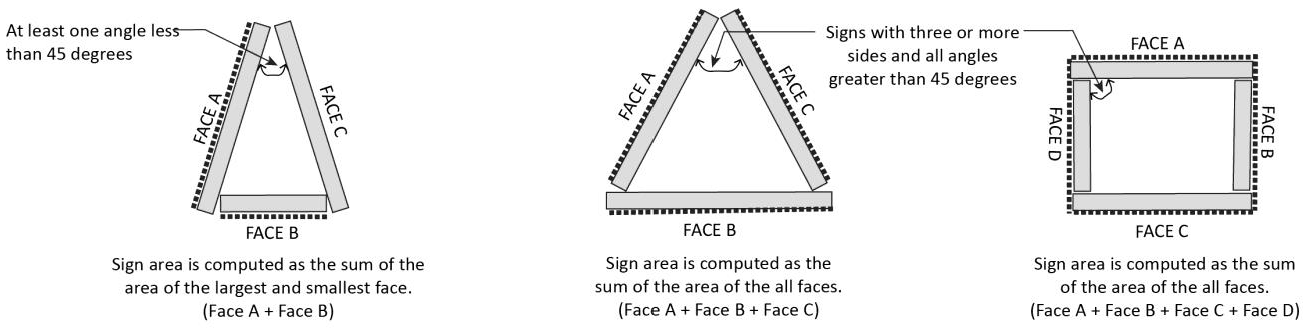
Figure 3-13 - Measuring Multi-faced Signs
4.
Three-Dimensional (3D) Signs. Signs that consist of, or have attached to them, one or more three-dimensional objects (i.e., balls, cubes, clusters of objects, sculpture, or statue-like trademarks), may have a sign area that is the sum of all areas using the four vertical sides of the smallest rectangular prism that will encompass the sign.
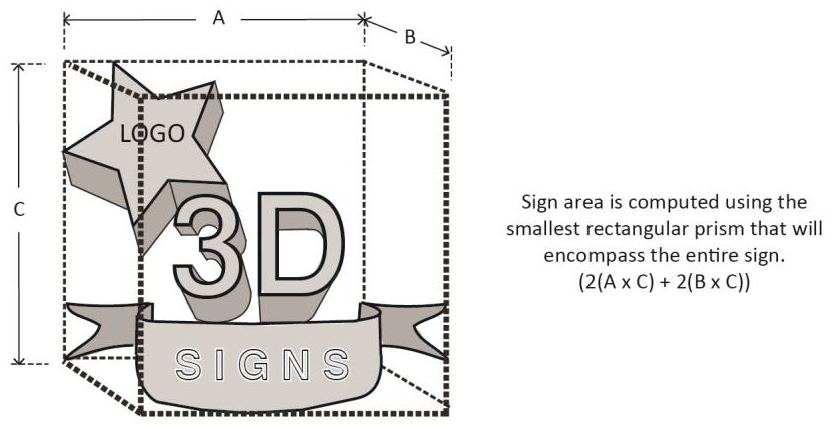
Figure 3-14 - Measuring 3D Signs
B.
Measuring Sign Height. The height of a sign is the vertical distance from the uppermost point used to measure sign area to the existing grade immediately below the sign.
C.
Measuring Sign Clearance. Sign clearance shall be measured as the smallest vertical distance between finished grade and the lowest point of the sign, including any framework or background embellishments.
D.
Street Frontage. The length of street frontage is measured along the property line adjacent to the public right-of-way.
E.
Building Frontage. Building frontage shall be measured as the widest lineal dimension, parallel to the ground, of a continuous frontage. A building's frontage is considered continuous if projections or recesses in a building wall do not exceed 10 feet in any direction.
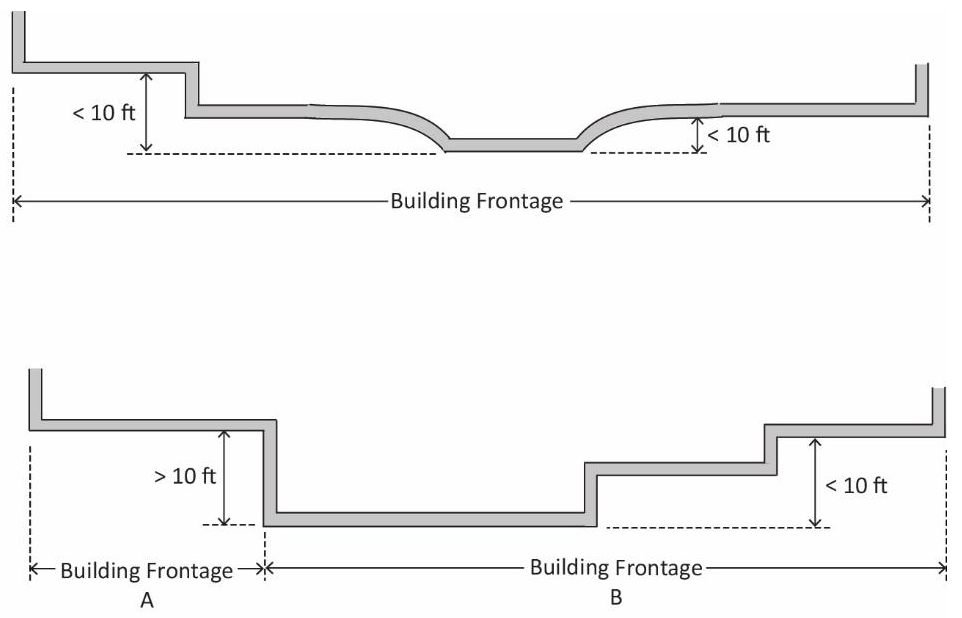
Figure 3-15 - Building Frontage
(Ord. No. 5238, § 8, 2-11-2025)
This Section establishes general standards that apply to all sign types and in all zone districts.
A.
Applicable Codes. In addition to complying with the provisions of this Section, all signs must be constructed in accordance with applicable construction, sign, and building codes and all other applicable laws, rules, regulations, and policies.
B.
Materials. Signs shall be made of sturdy, durable materials. Paper, cardboard and other materials subject to rapid deterioration shall be limited to temporary signs. Signs made of fabric are limited to awnings, canopies, flags, and temporary signs.
C.
Minimum Sign Clearance. Signs shall have a minimum of eight feet clearance when located above any walkway or other area people may walk.
D.
Illumination. Where allowed, all sign illumination shall be consistent with Section 35.30.120 (Outdoor Lighting).
E.
Changeable Copy.
1.
Manual Changeable Copy. Manually changeable copy is allowed.
2.
Automatic Changeable Copy and Electronic Message Center Signs. Electronic Message Center (EMC) signs and automatic changeable copy in which copy can be changed or altered by electric, electro-mechanical, electronic, or any other artificial energy means, are allowed subject to the following standards.
a.
Limitations. Electronic Message Center (EMC) signs and automatic changeable copy are limited to institutional signs and as fuel price signs at service stations.
b.
Display Duration. The display shall change no more frequently than once every eight seconds and must have an unlighted interval between copy displays of 0.3 second or more.
c.
Static Message. Displays shall contain static messages only, and shall not have movement, or the appearance or optical illusion of movement, of any part of the sign structure, design, or pictorial segment of the sign, including the movement or appearance of movement of any illumination, or the flashing, scintillating or varying of light intensity.
d.
Light Intensity. EMC signs shall have a maximum light intensity of 0.3 foot-candles over ambient lighting conditions when measured at a distance equal to the square root of 100 times the area of the sign in square feet. All electronic copy must be equipped with a sensor or other device that automatically determines the ambient illumination and programmed to automatically dim according to ambient light conditions, or that can be adjusted to comply with the 0.3 foot-candle measurements.
e.
Automatic Controls. All electronic message displays shall be equipped with automatic controls to allow for adjustment of brightness based on ambient lighting conditions.
(Ord. No. 5238, § 8, 2-11-2025)
Table 35.38.070 (Signage Allowances and Standards) establishes signage allowances for specific uses and development and standards applicable to specific sign types.
Table 35.38.070: Signage Allowances and Standards
(Ord. No. 5238, § 8, 2-11-2025)
Modifications to the standards established in this Chapter are allowed in compliance with Section 35.82.150 (Overall Sign Plans).
(Ord. No. 5238, § 8, 2-11-2025)
A.
Sign Certificate of Conformance Required. A Sign Certificate of Conformance in compliance with Section 35.82.170 (Sign Certificates of Conformance) shall be required for all non-exempt signs. Except as otherwise expressly provided in this Chapter, it is unlawful for any person to affix, place, erect, suspend, attach, construct, structurally or electrically alter (not including a face change of sign copy), move, or display any temporary or permanent sign within the County without first obtaining a Sign Certificate of Conformance in compliance with Section 35.82.170 (Sign Certificates of Conformance).
B.
Overall Sign Plan. An Overall Sign Plan in compliance with Section 35.82.150 (Overall Sign Plan) shall be required for the following:
1.
Developments with four or more nonresidential tenants that will have individual signs.
C.
Design Review. Design review in compliance with Section 35.82.070 (Design Review) is required for Overall Sign Plans, for signs that are part of a project that otherwise requires Design Review, and as required pursuant to any other provision of this Code.
D.
Application. The required permit application shall be filed in compliance with Section 35.80.030 (Application Preparation and Filing).
(Ord. No. 5238, § 8, 2-11-2025)
A.
Continuance and Maintenance. A nonconforming sign may be continued, maintained, altered, reconstructed, and restored pursuant to Section 35.101.030, Nonconforming Structures.
B.
Removal. Whenever a nonconforming sign has been abandoned, or the use of the property has been discontinued for a continuous period of at least 12 consecutive months, the nonconforming sign must be removed.
(Ord. No. 5238, § 8, 2-11-2025)
Each sign displayed within the County, including exempt signs, shall be maintained to comply with the following standards:
A.
Graffiti on a sign shall be removed within seven days of notice of its placement on such sign.
B.
The display upon any sign area of a sign shall be maintained in good condition, without rips, tears, and similar damage.
C.
All parts, portions, units and materials composing a sign, together with the frame, background, surface, support or enclosure therefore shall be maintained in a safe condition, painted, and adequately protected from weathering with all braces, bolts and structural parts and supporting frames and fastenings reasonably free from deterioration, rot, rust, and loosening so that they do not create a hazard to persons or property or constitute a nuisance.
D.
Any sign or sign structure that is sagging, leaning, fallen, decayed, broken, deteriorated, or other dilapidated condition shall be promptly repaired, to the satisfaction of the County, or removed.
E.
Whenever any sign, by virtue of its physical nature and condition, poses an immediate and serious threat to the public safety, the sign may be removed by County personnel, or its physical deficiency cured, to the extent necessary to protect the public safety. The cost of such removal or repair shall be assessed against the sign or property owner.
F.
An on-premise sign identifying an activity, business, service or product shall be removed within 30 days following the discontinuance of the activity, business, service or product. If the sign is not so removed, the Director may have the sign removed in accordance with the public nuisance abatement provisions of this Code.
(Ord. No. 5238, § 8, 2-11-2025)
A.
Violations. A sign set up, applied, erected, constructed, altered, affixed, repaired, installed, relocated, enlarged, converted, maintained, or projected as an image contrary to the provisions of this Chapter, shall be and is declared to be unlawful and a public nuisance and shall be subject to the provisions of Chapter 35.108 (Enforcement and Penalties).
B.
Enforcement. Enforcement of the provisions of this Chapter shall be in compliance with Chapter 35.108 (Enforcement and Penalties).
(Ord. No. 5238, § 8, 2-11-2025)
A.
Purpose and Intent. This Chapter allows housing developments as a "use by right" to incentivize lower-income housing on certain sites that the County rezoned to accommodate its 2023-2031 Regional Housing Needs Allocation (RHNA) for very low- and/or low-income households or identified in a prior housing element to accommodate its prior RHNA, pursuant to Government Code Section 65583.2(h) and Program 1 of Chapter 5 of the 2023-2031 Housing Element Update.
B.
Applicability. This Chapter shall apply to housing developments on the following sites:
1.
A site that the County rezoned at a density of at least 20 units per acre to accommodate its 2023-2031 RHNA for very low- and/or low-income households, pursuant to Government Code Section 65583.2(h). This minimum density and the applicable development standards will permit at least 16 units per site.
a.
Qualifying sites consist of the following Assessor Parcel Numbers:
097-371-075 (3965 Apollo Way, Lompoc; 26.11 acres)
129-120-024 (Intersection of Clark Ave. and Highway 101, Orcutt; 8.00 acres)
103-740-016 (5301 S Bradley Rd, Santa Maria; 9.81 acres)
103-181-006 (250 E Clark Ave, Santa Maria; 21.43 acres)
107-470-011 (4300 Hummel Drive, Santa Maria; 14.90 acres)
107-270-051 (619 Hummel Village Ct., Orcutt; 4.47 acres)
143-220-005, 143-220-007 and 143-261-002 (1011 Meadowvale Rd, Santa Ynez; 5.89 acres)
149-290-001 (Immediately west of Cuyama Valley High School, New Cuyama; 37.88 acres)
103-080-048 (4890 Bethany Ln, Santa Maria; 3.83 acres)
071-140-072 (300 Sumida Gardens Ln, Goleta; 20.56 acres)
071-140-071 (5381 Ekwill St, Goleta; 9.38 acres)
071-140-048 (Immediately east of 5381 Ekwill St, Goleta; 8.23 acres)
065-090-031 (600 S. Patterson Ave, Santa Barbara; 15.22 acres)
065-230-012 (620 S. Patterson Ave, Santa Barbara; 15.85 acres)
071-190-036 (905 S. Patterson Ave, Santa Barbara; 39.00 acres)
065-040-041 (4960 Hollister Ave, Santa Barbara; 27.37 acres)
065-030-012 (125 S. San Marcos Santa Barbara; 5.70 acres)
077-530-012, 077-530-021, and 077-530-020 (7380 Cathedral Oaks Rd, Goleta; 112.88 acres)
059-130-011 (400 ft. N of intersection of Hwy 154 and Cathedral Oaks Rd, Santa Barbara; 15.69 acres)
059-130-014 and 059-130-015 (4150 Foothill Rd, Santa Barbara; 33.37 acres)
057-143-001 (560 N. La Cumbre Rd, Santa Barbara; 2.95 acres)
065-080-024, 065-080-008, and 065-080-009 (5050 Hollister Ave, Santa Barbara; 11.40 acres)
065-040-026 (4750 Hollister Ave, Santa Barbara; 23.00 acres)
C.
Permit requirements. Housing developments that comply with all of the development standards in Section 35.39.010.D (Development standards), below, shall be allowed as a use by right subject to the issuance of a Zoning Clearance in compliance with Section 35.82.210 (Zoning Clearances).
1.
Use by right. For purposes of this section, "use by right" means the County's review shall not require a Conditional Use Permit, Development Plan, environmental review under the California Environmental Quality Act, or other discretionary review or approval pursuant to Government Code Section 65583.2(i) and Government Code Section 65589.5 for multifamily residential housing. Housing developments shall be subject to all objective standards in this Development Code, including the objective design standards of Chapter 35.33 (Multiple-Unit and Mixed-Use Housing Objective Design Standards). Any subdivision of a site shall continue to be subject to all laws, including, but not limited to, discretionary review and approval in compliance with County Code Chapter 21 (Land Division) and the Subdivision Map Act.
D.
Development standards. Housing developments on a rezone site or non-vacant or vacant site listed in Section 35.39.010.B.1.a and Section 35.39.010.B.2.a, respectively, above, shall comply with the following development standards.
1.
Housing type. The housing development shall consist of owner-occupied and/or rental multifamily residential uses.
2.
Affordability. At least 20 percent of the units shall be affordable to very low- and/or low-income households. The applicant shall record a restrictive covenant that ensures the continued affordability of all very low- and low-income rental units for 90 years and all very low- and low-income for-sale units for 90 years, unless a different affordability term is required by low-income tax credit regulations or other applicable law.
3.
Objective standards. The housing development shall comply with all objective land use policies, regulations, development standards, and design review standards in effect at the time a complete application is submitted, including but not limited to objective design standards provided in Chapter 35.33 (Multiple-Unit and Mixed-Use Housing Objective Design Standards).
4.
Program Environmental Impact Report mitigation measures. The housing development shall comply with all applicable mitigation measures of the Mitigation Monitoring and Reporting Program of the 2023-2031 Housing Element Update Program Environmental Impact Report (Case. No. 23EIR-00004)
5.
Replacement units. Existing or previously existing dwelling units on the site of the housing development shall be replaced in the manner provided in Government Code Section 65583.2(g)(3) or successor statute.
(Ord. No. 5207, § 5, 5-3-2024; Ord. No. 5230, § 2, 2-4-2025)

3 - SITE PLANNING AND OTHER PROJECT STANDARDS
Editor's note— Ord. No. 5200, § 10, adopted February 13, 2024, repealed and reenacted Chapter 35.31 in its entirety to read as herein set out. Formerly, Chapter 35.31 pertained to affordable housing streamlined review, and derived from Ord. No. 5172, § 1, adopted January 24, 2023.
Editor's note— Ord. No. 5200, § 11, adopted February 13, 2024, repealed and reenacted Chapter 35.32 in its entirety to read as herein set out. Formerly, Chapter 35.32, §§ 35.32.010—35.32.060 pertained to density bonus for affordable housing, and derived from original codification.
Editor's note— Ord. No. 5238, § 8, adopted February 11, 2025, repealed and reenacted Chapter 35.38 in its entirety to read as herein set out. Formerly, Chapter 35.38, sections 35.38.010—35.38.130 pertained to similar subject matter and derived from original codification.
This Article expands upon the standards of Article 35.2 (Zones and Allowable Land Uses) by addressing the details of site planning and project design. These standards are intended to ensure that all development:
A.
Produces an environment of stable and desirable character;
B.
Is compatible with existing and future development; and
C.
Protects the use and enjoyment of neighboring properties, consistent with the Comprehensive Plan.
The requirements of this Article shall apply to all proposed development and new land uses, except as specified in Chapter 35.101 (Nonconforming Uses, Structures, and Lots) and shall be considered in combination with the standards for the applicable zone in Article 35.2 (Zones and Allowable Land Uses) and those in Article 35.4 (Standards for Specific Land Uses). If there is a conflict, the standards in Article 35.4 (Standards for Specific Land Uses) shall control.
A.
Purpose and intent. The purpose of agricultural buffers is to implement adopted Comprehensive Plan policies that assure and enhance the continuation of agriculture as a major viable production industry in Santa Barbara County through establishing development standards that provide for the creation of buffers between agricultural uses and new non-agricultural development and uses. The intent of agricultural buffers is to minimize potential conflicts between agricultural and adjacent land uses that result from noise, dust, light, and odor incidental to normal agricultural operations as well as potential conflicts originating from residential and other non-agricultural uses (e.g., domestic pets, insect pests and invasive weeds).
B.
Applicability. This Section applies to all discretionary applications for non-agricultural development and uses (project) which satisfy all of the following criteria:
1.
The project site is located within an Urban or Inner-Rural Area, or an Existing Developed Rural Neighborhood, as designated on the Comprehensive Plan maps; or located on property zoned industrial that is located in the Rural Areas as designated on the Comprehensive Plan maps.
2.
The project site is located immediately adjacent to land that is:
a.
Located in a Rural Area as designated on the Comprehensive Plan maps, and
(1)
Has an agricultural zone designation as identified in Section 35.14.020 (Zoning Map and Zones) or Article V of Ordinance No. 661, excluding state or federally owned land, or
(2)
Is subject to a contract executed in accordance with the County Uniform Rules for Agricultural Preserves and Farmland Security Zones.
C.
Exceptions. This Section does not apply to the following:
1.
Single-family dwelling, accessory dwelling units, junior accessory dwelling units, and residential accessory structures.
2.
Agricultural employee dwellings approved in compliance with Section 35.42.030 (Agricultural Employee Dwellings) and farmworker housing approved in compliance with Section 35.42.135 (Farmworker Housing).
3.
Non-agricultural, discretionary development approved prior to May 9, 2013.
4.
Changes to a non-agricultural, discretionary project approved prior to May 9, 2013, provided that prior to an action by the review authority to approve an application in compliance with Subsection 35.84.040.C or D the review authority shall first determine that the changes to the project proposed by the application do not result in any new or greater impacts to agriculture than those resulting from the already approved project.
a.
If the review authority cannot make the determination required in compliance with Subsection C.4, above, then the project shall be subject to the provisions of this Section.
5.
Non-commercial agricultural uses. An agricultural buffer is not required adjacent to a common lot line between the project site and an adjacent agriculturally zoned lot if the adjacent lot is used for non-commercial agriculture.
6.
State and County roadway projects.
7.
Lot line adjustments and modifications to lot line adjustments that:
a.
Do not exceed a 10 percent increase or decrease in the area of the smallest existing lot; and
b.
Do not result in an increase in the number of developable lots in compliance with Subsection 35.30.110.B.3.c.
D.
Agricultural buffer requirements. All applications subject to this Section shall designate and maintain an agricultural buffer on the project site in compliance with this Section.
1.
Agricultural buffer width. The width of the agricultural buffer shall be in compliance with the range of agricultural buffer widths as shown in the following Table 3-1 (Range of Agricultural Buffer Widths). Ranges are provided because unique circumstances may require the buffer width to be adjusted; however, the agricultural buffer width as adjusted shall neither be less than the minimum buffer width nor greater than the maximum buffer width shown in the following Table 3-1 (Range of Agricultural Buffer Widths). If the proposed project is located adjacent to a lot that contains both Production Agriculture and Rangeland or Pastureland, then the most protective buffer:
a.
Shall be applied adjacent to any portion of the common lot line between the project site and the adjacent agriculturally zoned lot where Production Agriculture is immediately adjacent; and
b.
May be applied to any portion of the common lot line between the project site and the adjacent agriculturally zoned lot where Production Agriculture is not immediately adjacent, if Production Agriculture is located on the adjacent lot within the distance, as measured from the common lot line, that is equal to the width of the required buffer that would otherwise be applicable to the project site.
Refer to Section II.C. (Agricultural Buffer Width Adjustment) of the Agricultural Buffer Implementation Guidelines (Appendix G) for guidance.
Table 3-1- Range of Agricultural Buffer Widths
2.
Agricultural buffer location. The agricultural buffer shall be located:
a.
On the lot on which the non-agricultural project is proposed.
b.
Adjacent to the common lot line between the project site and the adjacent agriculturally zoned lot.
3.
Agricultural buffer width measurement. The agricultural buffer width shall be measured from the common lot line between the project site and the adjacent agriculturally zoned lot. The agricultural buffer shall be coterminous with the length of said common lot line.
4.
Agricultural buffer width adjustment. The following factors shall be considered when determining the agricultural buffer width in compliance with Subsection D.1 (Agricultural buffer width), above. See the Agricultural Buffer Implementation Guidelines (Appendix G) for guidance in determining the appropriate agricultural buffer width.
a.
Site specific factors. The following factors shall be considered when determining the agricultural buffer width:
(1)
Crop type/agricultural practices.
(2)
Elevation differences and topography.
(3)
Extent and location of existing non-agricultural development.
(4)
Location of existing roads or naturally occurring barriers.
(5)
Historical land use on the agricultural lot.
(6)
Future farming potential of the agricultural lot.
(7)
Site design of the non-agricultural proposal.
(8)
Non-agricultural lot size/configuration.
(9)
Prevailing wind direction.
b.
Vegetative screening adjacent to production agriculture. Vegetative screening may be used to offset an increase in the buffer width for projects adjacent to Production Agriculture, as it may be adjusted in compliance with Subsection D.4.a (Site-specific factors). See Subsection F.3 for vegetative screening criteria and the Agricultural Buffer Implementation Guidelines (Appendix G) for guidance.
c.
Constrained agricultural areas. If the adjacent lot is used for production agriculture and contains land areas that are constrained by physical features or easements such that those land areas cannot be used for agriculture, then the agricultural buffer width may be reduced on the project site by an amount equal to the width of the constrained land area located on the adjacent agricultural lot, provided:
(1)
The physical feature is permanently part of the landscape (e.g., a protected riparian area, or rock out-cropping); and
(2)
The physical feature or easement precludes any kind of agricultural use and be located adjacent to the non-agricultural project site.
5.
Comprehensive Plan consistency. Where Comprehensive Plan policies and this Section both address agricultural buffer requirements, the most protective agricultural buffer requirement shall prevail.
6.
Reasonable use. This Section is not intended, and shall not be construed as authorizing the review authority acting in compliance with this Section to exercise their power to grant or deny a permit in a manner which will take or damage private property for public use, without the payment of just compensation therefore. This section is not intended to increase or decrease the rights of any owner of property under the Constitution of the State of California or the United States or under this Development Code.
7.
Buffer recordation.
a.
Notice to Property Owner required. Prior to the approval of a Land Use Permit in compliance with Section 35.82.110 (Land Use Permits) or a Zoning Clearance in compliance with Section 35.82.210 (Zoning Clearance) following the approval of a discretionary planning permit, a Notice to Property Owner shall be required to be recorded by the property owner that will provide notification to all future owners and successors of the restrictions of this Section 35.30.025. Said Notice shall include:
(1)
An exhibit showing the location of the agricultural buffer by metes and bounds description or surveyor's description.
(2)
The uses that are allowed within the agricultural buffer in compliance with Subsection 35.30.025.E (Allowable uses within agricultural buffers).
(3)
The Landscape, Lighting and Irrigation Plan in compliance with Subsection 35.30.025.F (Agricultural buffer Landscape, Lighting and Irrigation Plan requirements).
(4)
The Maintenance Plan in compliance with Subsection 35.30.025.G (Agricultural buffer maintenance requirements).
b.
The requirement to record said Notice in compliance with this Subsection D.7 shall be included as a condition of approval of an application for a discretionary planning permit subject to this Section.
E.
Allowable uses within agricultural buffers. The property owner shall use his best efforts to consult with the adjacent agricultural land owner(s) to address food safety and agricultural production concerns with regard to landscape, lighting, and vegetative screening design and siting. See the Agricultural Buffer Implementation Guidelines (Appendix G) for information on the purpose and intent of restricting uses within agricultural buffers and how to incorporate site design and other features that are compatible with agriculture.
1.
Unrestricted uses within agricultural buffers. Subject to other provisions of this Section, or other provisions of the County Code, the following uses may be allowed within a designated agricultural buffer:
a.
Drainage channels, irrigation canals, storm water retention basins and Low Impact Development (LID) drainage features.
b.
Fences and walls.
c.
Low-lying landscaping and vegetative screening that does not include trees or hedges exceeding three feet in height.
d.
Oil and gas, wind energy and cogeneration facilities that are:
(1)
Permitted in compliance with Article 35.5 (Oil and Gas, Wind Energy and Cogeneration Facilities), or
(2)
Operated in compliance with Chapter 35.101 (Nonconforming Uses, Structures, and Lots).
e.
Natural waterways including rivers, creeks, lakes, ponds, and flood plains.
f.
Signs.
g.
Solar energy systems permitted in compliance with Section 35.30.160 (Solar Energy Systems).
h.
Telecommunication facilities permitted in compliance with Chapter 35.44 (Telecommunication Facilities).
i.
Utility lines and facilities.
j.
Any other use determined by the review authority to be consistent with the purpose and intent of the buffer requirement.
k.
Modifications or additions to structures legally existing as of May 10, 2013 provided that any addition to a structure that is located within a buffer required by this Section shall not extend further towards the immediately adjacent agricultural lot.
2.
Restricted uses within agricultural buffers. Subject to other provisions of this Section, or other provisions of the County Code, the following uses may be allowed within the agricultural buffer provided they are not located any closer to the common lot line between the project site and the adjacent agriculturally zoned lot than half the width of the buffer. This requirement may be modified by the review authority when it is determined that strict compliance with this section is not required to minimize conflicts with adjacent agriculture.
a.
Industrial or commercial loading docks and rear service areas.
b.
Landscaping and vegetative screening.
c.
Lighting.
d.
Non-habitable structures such as those used for storage.
e.
Parking areas including carports and garages.
f.
Public and private open space areas with limited passive recreational uses such as trails, bike paths and walking paths.
g.
Roads and transportation infrastructure.
3.
Prohibited uses within agricultural buffers. Recreational uses such as parks, picnic areas, playgrounds and ball fields shall not be allowed in an agricultural buffer.
4.
Open space credit. The agricultural buffer may be counted toward open space requirements as long as the limits on allowed uses are consistent with the requirements of this Section and the Development Code.
5.
The unrestricted uses, restricted uses and prohibited uses within the designated agricultural buffer shall be included as a condition of approval of the approved project.
F.
Agricultural buffer Landscape, Lighting and Irrigation Plan requirements.
1.
A Landscape, Lighting and Irrigation Plan (Plan) shall be required for all agricultural buffers. The Plan shall:
a.
Graphically depict and label the agricultural buffer.
b.
Graphically depict and label the following elements within the agricultural buffer:
(1)
Erosion control measures.
(2)
Hardscape.
(3)
Irrigation systems.
(4)
Landscaping, vegetation, and materials.
(5)
Lighting.
c.
Incorporate Low Impact Development (LID) measures to maximize runoff retention and groundwater infiltration on-site.
d.
Incorporate a fence or other barrier that complies with the Development Code, with a minimum height of six feet, that discourages trespassing and domestic animals from crossing the common lot boundary between the project site and the adjacent agricultural land.
e.
Prohibit the planting or installation of turf within 50 feet of the adjacent agricultural land unless required by County, State or Federal regulations.
f.
Be compatible with the surrounding land uses and rural character of the agricultural area.
2.
Landscaping, lighting and irrigation are not required within the agricultural buffer. However, if vegetation is included within the buffer, the plant palette shall meet the following requirements:
a.
The plants shall be compatible with agriculture.
b.
Shading of adjacent agricultural crops shall be minimized.
c.
To the maximum extent feasible, the plants shall be fire resistant and drought- tolerant or low water use.
d.
The plants shall not be considered noxious according to Section 4500 of the California Code of Regulations or considered invasive by the California Invasive Plant Council (Cal-IPC).
3.
If a vegetative screen is used to offset an agricultural buffer width increase for production agriculture as described in Subsection D.4.b (Vegetative screening adjacent to production agriculture), the vegetative screen shall be consistent with the requirements in this Subsection F (Agricultural buffer Landscape, Lighting and Irrigation Plan requirements) and shall be in compliance with the following additional criteria:
a.
The vegetative screen shall consist of two staggered rows of vegetation consisting of a layered canopy with evergreen trees and shrubs with foliage extending from the base to the crown.
b.
The plants shall thoroughly screen the agricultural use from the non-agricultural use within five years from time of installation.
c.
The minimum height of trees at maturity shall be 15 feet.
d.
The vegetative screen shall be at least 25 feet deep.
4.
The Landscape, Lighting and Irrigation Plan shall be compatible with the requirements in Subsection E (Allowable uses within agricultural buffers).
5.
The applicant shall provide a signed and notarized agreement and a performance security acceptable to the Director that guarantees the installation of landscaping, lighting and irrigation and provides for the successful establishment of the agricultural buffer for a minimum of five years. The performance security shall be released upon approval by the Director.
G.
Agricultural buffer maintenance requirements.
1.
A Maintenance Plan shall be required that provides for the maintenance of the agricultural buffer for the life of the project. The Maintenance Plan shall:
a.
Include provisions for managing agricultural pests such as vertebrate pests, invasive weeds, and crop threatening insects. Integrated Pest Management practices shall be used to the extent feasible.
b.
Include provisions for removing weeds, trash and debris.
c.
Provide for regular fuel management and removal of accumulated plant matter within the agricultural buffer so as to minimize fire risk.
d.
Be consistent with the requirements in Subsection F (Agricultural buffer Landscape, Lighting and Irrigation Plan requirements).
e.
Provide for the regular maintenance of the elements as described in Subsection F (Agricultural Buffer Landscape, Lighting and Irrigation Plan requirements).
H.
Future conversion of adjacent agricultural land. If the underlying purpose for the agricultural buffer no longer exists, the review authority, upon application for permit revision in compliance with Article 35.8 (Planning Permit Procedures), may remove agricultural buffer requirements originally required in compliance with this Section.
I.
Findings. In addition to other findings that may be required, the review authority shall not approve or conditionally approve any application subject to the requirements of this Section for which an agricultural buffer is required unless it first makes all of the following findings:
1.
The design and configuration of the agricultural buffer minimizes, to the maximum extent feasible, conflicts between the adjacent agricultural and non-agricultural uses which are the subject of the permit application.
2.
The Landscape, Lighting, Irrigation and Maintenance Plans are compatible with the character of the adjacent agricultural land and the rural setting.
Bikeways shall be provided where determined by the review authority to be appropriate and feasible for recreational and commuting use.
A.
The densities specified in the Comprehensive Plan are maximums and may be reduced through discretionary project review if the review authority determines that a reduction is warranted by conditions specifically applicable to a site, including topography, geologic or flood hazards, habitat areas, or steep slopes.
B.
Density may be increased for an affordable housing project in compliance with Housing Element policies.
A.
Rural. Within Rural areas as designated on the Comprehensive Plan maps, the height, scale, and design of each structure shall be compatible with the character of the surrounding natural environment, as determined by the review authority, except where the review authority determines that technical requirements dictate otherwise. Structures shall be subordinate in appearance to natural landforms, shall be designed to follow the natural contours of the landscape, and shall be sited so as not to intrude into the skyline as seen from public viewing places.
B.
Urban and Existing Developed Rural Neighborhoods. Within Urban areas and Existing Developed Rural Neighborhoods as designated on the Comprehensive Plan maps, new structures shall conform with the scale and character of the existing community. Clustered development, varied circulation patterns, and diverse housing types shall be encouraged.
A.
Purpose. This Section provides regulations for the installation, construction, and placement of fences. For the purposes of this Section, the term "fence" includes fences, walls, gates, gateposts, and other structures in the nature of a fence, except where any of these are specifically identified and separately regulated by this Section.
B.
Measurement of fence height. Fence height shall be measured as the vertical distance between the natural grade at the base of the lower side of the fence, and the top edge of the fence material. See Figure 3-1 (Measurement of Fence Height) below.
Figure 3-1 - Measurement of Fence Height
C.
Height limits and permit requirements. Each fence shall comply with following the height limits and permit requirements. In no case shall the height of the fence exceed the height limit established for the applicable zone by Article 35.2 (Zones and Allowable Land Uses). Additionally, a fence on a corner lot shall comply with the vision clearance requirements in Section 35.30.090 (Height Measurement and Exceptions and Limitations).
1.
Non-Agricultural zones. Each fence shall comply with the height limits and permit requirements in Table 3-2 below.
2.
Agricultural zones. Each fence shall comply with the height limits and permit requirements in Table 3-3 below.
a.
Entrance gates, AG-II zone. In addition to fences allowed in compliance with Table 3-3 below, on property zoned AG-II, entrance gates that comply with the following are exempt from planning permits and may be located within required setback areas. Structures that do not comply with the following may be allowed with a Land Use Permit issued in compliance with Section 35.82.110 (Land Use Permits).
(1)
The height of the gateposts including any cross member, signage, and/or ornamentation, does not exceed 18 feet in height as measured from the ground level at the bottom of the gateposts to the top of the gatepost, cross member, signage, and/or ornamentation.
(2)
The portion of each gatepost taller than eight feet if located in the front setback, or 10 feet in all other locations, does not exceed two feet in width.
(3)
The cross member does not exceed two feet in height and thickness.
(4)
Lighting associated with the entrance gate, gateposts, and cross member shall be for safety purposes only and shall comply with Section 35.30.120 (Outdoor Lighting).
(5)
Ornamentation that is appurtenant to the entrance gate, gateposts, and cross member shall be in compliance with the following:
(a)
The size and scale of any ornamentation shall be secondary to the entrance gate.
(6)
Signs that are allowed in agricultural zones in compliance with Chapter 35.38 (Sign Standards) may be affixed to the entrance gate, gateposts, and cross member provided that the size and scale of any signs shall be secondary to the entrance gate, gateposts, and cross member.
(7)
In addition to the development standards listed above, all development associated with the construction of the entrance gate, gateposts, or cross member shall be located no less than 100 feet from the following environmental sensitive habitat areas that are determined by a qualified professional to be intact and of high quality. This setback may be adjusted upward or downward on a case-by-case basis depending upon site specific conditions such as slopes, biological resources and erosion potential. If these requirements are in conflict with other provisions of the Comprehensive Plan and any applicable community or area plan, this Development Code, and any permit conditions established by the County, the more restrictive requirement shall control.
(a)
Native plant communities recognized as rare by California Department of Fish and Wildlife (2003 or as amended). Examples include Native Grasslands, Maritime chaparral, Bishop Pine Forests, and Coastal Dune Scrub.
(b)
Native woodlands and forests.
(c)
Nesting, roosting, and/or breeding areas for rare, endangered or threatened animal species.
(i)
Rare, endangered, or threatened species are defined as those listed by State or Federal wildlife agencies under the State or Federal Endangered Species Acts, candidates for listing, species of special concern, and species that meet the definition of "rare" in Section 15380 of California Environmental Quality Act.
(ii)
A separation of greater than 100 feet may be required in order to fully protect formally listed Endangered Species (e.g., a 100-foot separation may not fully protect known breeding ponds for California Tiger Salamander).
(d)
Plant communities known to contain rare, endangered, or threatened species.
(e)
Streams, riparian areas, vernal pools, and wetlands.
(f)
Any designated Environmental Sensitive Habitat Areas.
3.
Exception to height limits. A maximum of 10 percent of the total linear length of a wall or fence may be allowed to exceed the maximum height specified for exemption from a permit in Subsections C.1 (Non-Agricultural zones) or C.2 (Agricultural zones) above, where the review authority first determines that topographic or other unavoidable conditions will destroy its architectural integrity if held to the maximum height specified for its entire length.
4.
Retaining wall exemption. A retaining wall (retaining earth only) that is not over four feet in height measured from the bottom of a footing to the top of the wall, and does not require a Grading Permit in compliance with County Code Chapter 14 is exempt from Land Use Permit requirements.
5.
Naples Townsite zone. All fences located on a lot zoned Naples Townsite shall be in compliance with the fencing plan component of the Final Development Plan in effect for the subject lot.
Table 3-2- Fence, Gate, Gatepost, and Wall Height and Permit Requirements
In All Zones Except In Agricultural Zones
Notes:
(1) Within the Naples Townsite zone, additional height may not be allowed with a Minor Conditional Use Permit.
(2) Mission Canyon Plan area - Within the Mission Canyon Plan area, only fences, gates, and walls 3.5 feet or less in height, and gateposts four feet or less in height, are exempt from a planning permit.
(3) Mission Canyon Plan area - Within the Mission Canyon Plan area, fences, gates, and walls greater than 3.5 feet in height, and gateposts greater than four feet in height, require the issuance of a Land Use Permit.
Table 3-3Fence Height and Permit Requirements in Agricultural Zones
Notes:
(1) See Subsection C.2.a regarding entrance gates on property zoned AG-II.
(Ord. No. 5238, § 5, 2-11-2025)
A.
Purpose. The intent of the Flood Hazard development standards is to avoid exposing new development to flood hazards and to reduce the need for future flood control protective works and resulting alteration of stream and wetland environments by regulating development within the 100-year flood plain.
B.
Development within floodway. All development, including construction, excavation, and grading, except for flood control projects and non-structural agricultural uses, shall be prohibited in the floodway, as determined by the County Public Works Department, unless off-setting improvements in accordance with Housing and Urban Development regulations are provided. If the proposed development falls within the floodway fringe, development may be permitted, providing creek setback requirements are met and finish floor elevations are above the projected 100-year flood elevation as specified in County Code Chapter 15A (Floodplain Management).
C.
Permitted development limitations. Permitted development shall not cause or contribute to flood hazards or lead to expenditure of public funds for flood control works, such as dams, stream channelizations, etc.
A.
Purpose. This Section describes the required methods for measuring the height of structures to determine compliance with the height limits established by this Development Code, and provides exceptions to those height limits.
B.
Height limit of structures. The height of each structure shall not exceed the applicable height limit established for the applicable zone by Article 35.2 (Zones and Allowable Land Uses), and/or other requirements of this Development Code, except as otherwise provided by this Section and this Development Code.
C.
Height measurement. The following methodology shall be used to determine the height of a structure. Additionally, Subsections D. through J. below, provide or reference additional specific height measurement criteria and exemptions for specific types of development.
1.
Height of structures. The height of a structure shall be the vertical distance between the existing grade and the uppermost point of the structure directly above that grade. The height of any structure shall not exceed the applicable height limit except as provided in Subsections D. through J. below. See Figure 3-2 (Height Limit).
Figure 3-2 - Height Limit
2.
Maximum height in ridgeline/hillside locations. In addition to the height limit applicable to a structure as described in Subsection C.1 (Height of structures) above, a structure subject to Chapter 35.62 (Ridgeline and Hillside Development) shall not exceed a maximum height of 32 feet as measured from the highest part of the structure, excluding chimneys, vents and noncommercial antennas, to the lowest point of the structure where an exterior wall intersects the finished grade or the existing grade, whichever is lower.
a.
In the case where the lowest point of the structure is cantilevered over the ground surface, then the calculated maximum height shall include the vertical distance below the lowest point of the structure to the finished grade or the existing grade, whichever is lower.
b.
This 32-foot limit may be increased by no more than three feet where the highest part of the structure is part of a roof element that exhibits a pitch of four in 12 (rise to run) or greater. See Figure 3-3 (Maximum Height).
Figure 3-3 - Maximum Height
D.
General height limit exceptions. The height of a structure may exceed the applicable height limit in compliance with the following:
1.
Chimneys, church spires, elevator, minor mechanical and stair housings, flag poles, towers, vents, and similar structures which are not used for human activity may be up to 50 feet in height in all zones where the excess height is not prohibited by Section 35.28.060 (Airport Approach (F) Overlay Zone). The use of towers or similar structures to provide higher ceiling heights for habitable space shall be deemed a use intended for human activity. No such structure shall be employed for any commercial or advertising use unless specifically allowed by the applicable zone, except that antennas and associated equipment may be located within such structures.
2.
Portions of a structure may exceed the applicable height limit by no more than three feet where the roof exhibits a pitch of four in 12 (rise to run) or greater.
3.
In order to provide for architectural character, architectural elements, whose aggregate area is less than or equal to 10 percent of the total roof area of the structure or 400 square feet, whichever is less, may exceed the height limit by no more than eight feet when approved by the Board of Architectural Review.
4.
Allowances for exceeding the applicable height limit in compliance with Subsections D.2 through D.3 above, are not cumulative.
E.
Exemptions for specific structures and equipment. The following structures and equipment may exceed the applicable height limit as provided below where the excess height is not prohibited by Section 35.28.060 (Airport Approach (F) Overlay Zone).
1.
Amine columns, distillation columns, stripper columns, and flare stacks associated with gas processing, oil and gas production, or oil and gas transportation allowed in compliance with Article 35.5 (Oil and Gas, Wind Energy and Cogeneration Facilities) may exceed the applicable height limit where compliance would render such facilities technically infeasible.
2.
Workover/pulling rigs necessary to service oil, gas and injection wells may exceed the applicable height limit, provided that the use of these rigs is completed in a diligent manner.
3.
Silos used to store and load concrete ready-mix in the M-1 zone may exceed applicable height limits where compliance would render operations technically infeasible.
4.
Structures and equipment associated with facilities in the M-2 zone may exceed applicable height limits where compliance would render operations technically infeasible.
5.
Temporary drilling rigs necessary to explore for and develop oil and gas reservoirs, or to inject gas or fluids into subsurface reservoirs, allowed in compliance with Article 35.5 (Oil and Gas, Wind Energy and Cogeneration Facilities).
6.
Wind turbines allowed in compliance with Chapter 35.57 (Wind Energy Conversion Systems) may exceed applicable height limits where compliance would render operations technically infeasible.
F.
Accessory dwelling units and junior accessory dwelling units. See Section 35.42.015 (Accessory Dwelling Units and Junior Accessory Dwelling Units) for height limits and exceptions for accessory dwelling units and junior accessory dwelling units.
G.
Fences and walls. A fence or wall shall comply with the height limits established by Section 35.30.070 (Fences and Walls).
H.
Guesthouses, artist studios and cabañas. See Section 35.42.150 (Guesthouses, Artist Studios, and Cabañas) for height limits and exceptions for guesthouses, artist studios, and cabañas.
I.
Telecommunication facilities. See Chapter 35.44 (Telecommunications Facilities) for height limits and exceptions for commercial and noncommercial telecommunication facilities.
J.
Vision clearance. Structures and landscaping on a corner lot shall not exceed the height limits provided by this Subsection within a required vision clearance area.
1.
Measurement of vision clearance area. See Figure 3-4 (Vision Clearance Area).
a.
Straight corners. The boundaries of a vision clearance area are defined by drawing lines from the point of intersection of a lot's street property lines at the corner to a point a minimum of 10 feet from the corner along the two property lines, and then connecting the two points with a straight line forming the hypotenuse of the triangle.
b.
Rounded corners. In the case of rounded corners, the boundaries of a vision clearance area are defined by extending the street property lines from the tangents at the beginning and end of the curving corner to a point of intersection, then drawing lines from the point of intersection to a point a minimum of 10 feet from the point of intersection along the two property lines, and then connecting the two points with a straight line forming the hypotenuse of the triangle.
2.
Height limits within vision clearance area. No planting, fence, wall, or other structure shall exceed a height of two and one-half feet above the adjacent curb grade, or three feet above the adjacent surface of pavement, whichever is less, within a vision clearance area.
Figure 3-4 - Vision Clearance Area
A.
Adequacy of infrastructure required. Issuance of a Land Use Permit (Section 35.82.110) or Zoning Clearance (Section 35.82.210) shall require that the review authority first find, based on information provided by environmental documents, staff analysis, and the applicant, that adequate public or private services and resources (e.g., water, sewer, roads) are available to serve a proposed development.
B.
Applicant responsibilities. The applicant shall assume full responsibility for costs incurred in service extensions or improvements that are required as a result of the proposed project. Lack of available public or private services or resources shall be grounds for denial of a project or reduction in the density otherwise indicated in the Comprehensive Plan or zoning maps.
C.
General requirement for water and sewer services. Within Urban areas designated on the Comprehensive Plan maps, new development other than that for agricultural purposes shall be served by the appropriate public sewer and water district or an existing mutual water company, if such service is available.
A.
Purpose and applicability. This Section establishes standards for the approval of a Lot Line Adjustment consistent with this Development Code, the Comprehensive Plan, and County Code Chapter 21 (Subdivision Regulations), in compliance with Map Act Section 66412. The provisions of this Section and the procedures and requirements in County Code Chapter 21 shall apply to all applications for Lot Line Adjustments.
B.
Required findings for approval. The approval of a Lot Line Adjustment application shall require that the review authority first make all of the following findings.
1.
The Lot Line Adjustment is in conformity with all applicable provisions of the Comprehensive Plan and this Development Code.
2.
Minimum lot area.
a.
Minimum lot area. No lot involved in the Lot Line Adjustment whose area is equal to or greater than the minimum lot area requirement of the applicable zone shall become smaller than the minimum lot area requirement of the applicable zone as a result of the Lot Line Adjustment.
3.
Except as provided in this Section, all lots resulting from the Lot Line Adjustment shall comply with the minimum lot area requirements of the applicable zone. A Lot Line Adjustment may be approved that results in one or more lots that are smaller than the minimum lot area requirement of the applicable zone provided that it complies with all of the following requirements.
a.
The Lot Line Adjustment shall not result in increased subdivision potential for any lot involved in the lot line adjustment.
b.
The Lot Line Adjustment will not result in a greater number of residential developable lots than existed prior to the adjustment. For the purposes of this Subsection B.3 only, a lot shall not be deemed residentially developable if the documents reflecting its approval and/or creation identify that, 1) the lot is not a building site, or 2) the lot is designated for a non-residential purpose including well sites, reservoirs and roads. A lot shall be deemed residentially developable for the purposes of this Subsection B.3 if it has an existing one-family dwelling constructed in compliance with a valid County permit, or existing and proposed lots comply with all of the following criteria.
(1)
Water supply. The lot shall have adequate water resources to serve the estimated interior and exterior needs for residential development as follows: 1) a letter of service from the appropriate district or mutual water company shall document that adequate water service is available to the lot and that the service complies with the company's Domestic Water Supply Permit, or 2) a Public Health Department or State approved water system.
(2)
Sewage disposal. The lot is served by a public sewer system and a letter of available service can be obtained from the appropriate district. A lot to be served by an onsite wastewater treatment system shall meet all applicable County requirements for permitting and installation, including percolation tests, as determined by the Public Health Department.
(3)
Access. The lot is currently served by an existing private road meeting applicable fire agency roadway standards that connects to a public road or right-of-way easement, or can establish legal access to a public road or right-of-way easement meeting applicable fire agency roadway standards.
(4)
Slope stability. Development of the lot including infrastructure avoids slopes of 30 percent and greater.
(5)
Agriculture viability. Development of the lot shall not threaten or impair agricultural viability on productive agriculture lands within or adjacent to the lot.
(6)
Environmentally sensitive habitat. Development of the lot avoids or minimizes impacts where appropriate to environmentally sensitive habitat and buffer areas, and riparian corridor and buffer areas.
(7)
Hazards. Development of the lot shall not result in a hazard to life and property. Potential hazards include, flood, geologic and fire.
(8)
Consistency with Comprehensive Plan and Development Code. Development of the lot is consistent with the setback, lot coverage and parking requirements of the Development Code and consistent with the Comprehensive Plan and the public health, safety and welfare of the community.
To provide notification to existing and subsequent property owners when a finding is made that a lot is deemed not to be residentially developable, a statement of this finding shall be recorded concurrently with the deed of the lot, in compliance with County Code Section 21-92 (Procedures).
4.
The Lot Line Adjustment will not increase any violation of lot width, setback, lot coverage, parking or other similar requirement of the applicable zone, or make an existing violation more onerous.
5.
The affected lots are in compliance with all laws, rules and regulations pertaining to zoning uses, setbacks and any other applicable provisions of this Development Code, or the Lot Line Adjustment has been conditioned to require compliance with these rules and regulations, and any zoning violation fees imposed in compliance with applicable law have been paid. This finding shall not be interpreted to impose new requirements on legal nonconforming uses and structures under the requirements of Chapter 35.101 (Nonconforming Uses, Structures, and Lots).
6.
Conditions have been imposed to facilitate the relocation of existing utilities, infrastructure and easements.
C.
Additional required findings for Lot Line Adjustments within an agricultural preserve. In addition to the findings required under Subsection B. (Required findings for approval) above, the approval of a Lot Line Adjustment proposed on agriculturally zoned lots that are subject to an Agricultural Preserve Contract in compliance with the County Uniform Rules for Agricultural Preserves and Farmland Security Zones shall require that the review authority also make the following findings:
1.
The new contract or contracts will enforceably restrict the adjusted boundaries of the lot for an initial term for at least as long as the unexpired term of the rescinded contract or contracts, but for not less than 10 years.
2.
There is no net decrease in the amount of the acreage restricted. In cases where two lots involved in a lot line adjustment are both subject to contracts rescinded pursuant to this section, this finding will be satisfied if the aggregate acreage of the land restricted by the new contracts is at least as great as the aggregate acreage restricted by the rescinded contracts.
3.
At least 90 percent of the land under the former contract or contracts remains under the new contract or contracts.
4.
After the lot line adjustment, the parcels of land subject to contract will be large enough to sustain their agricultural use.
5.
The lot line adjustment would not compromise the long-term agricultural productivity of the lot or other agricultural lands subject to a contract or contracts.
6.
The lot line adjustment is not likely to result in the removal of adjacent land from agricultural use.
7.
The lot line adjustment does not result in a greater number of developable lots than existed prior to the adjustment, or an adjusted lot that is inconsistent with the Comprehensive Plan.
A.
Purpose. The purpose of this Section is to create standards for outdoor lighting that minimize light pollution caused by inappropriate or misaligned light fixtures. These standards conserve energy, preserve the nighttime sky, and protect neighbors and wildlife while maintaining night-time safety, utility, security and productivity. The County of Santa Barbara recognizes that the unique development patterns and environments of the County created ideal areas for astronomical observation and enjoyment of the nighttime sky. Additionally, resources in the County warrant the protection of nighttime viewsheds and wildlife corridors from light trespass. The County, through the provisions contained herein, intends to preserve and protect the nighttime environment of the County by regulating unnecessary and excessive outdoor lighting.
1.
See "Lighting" within Article 35.11 (Glossary) for definitions related to outdoor lighting used within this Section.
B.
Applicability. The standards of this Section apply to all new or replaced outdoor light fixtures or systems and to existing lighting as provided below unless specifically exempted or required pursuant to any other applicable code or regulation.
1.
Existing Lighting. All outdoor lighting fixtures lawfully installed prior to the effective date of this Section are subject to only Subsections E.4 (Glare Prevention) and E.7 (Timing Controls) of this Section.
2.
New and Replaced Lighting. The standards of this Section apply to all new or replaced outdoor light fixtures or systems, except as specifically exempted pursuant to Subsection B.4 (Exemptions) below.
3.
Additions and Remodels. Additions totaling 50 percent or more of the existing gross floor area of a structure or exterior alterations affecting 50 percent or more of a building's exterior shall require that all existing lighting on the lot be brought into compliance with the provisions of this Section.
4.
Exemptions. The following types of lighting are exempt from the provisions of this Section.
a.
Fossil fuel lights.
b.
Traffic control signs and devices.
c.
Street lights installed prior to the effective date of the Ordinance adding this section.
d.
Temporary construction or emergency lighting under direction of a public agency (e.g., fire, police, public works).
e.
Navigation lights (e.g., airports, heliports, radio/television towers).
f.
Seasonal lighting decorations illuminated no longer than 60 days per calendar year.
g.
Light fixtures with a maximum output of 60 lumens, including solar lights.
h.
Underwater lights used to illuminate swimming pools, spas, fountains, and other water features.
i.
Temporary lighting for agricultural activities of a limited duration, not including unshielded arena lights.
5.
Alternative Compliance. The provisions of this Section are not intended to prevent the use of any design, material or method of installation not specifically prescribed by this Section provided any such alternate has been approved by the Director as part of a planning permit. The Director may approve any such alternate provided that the proposed design, material or method:
a.
Provides approximate equivalence to the specific requirements of this Section; and
b.
Is otherwise satisfactory and complies with the purpose of this Section.
C.
Prohibited Lights and Lighting. The following lights and lighting are prohibited.
1.
Search lights, strobe lights, laser source lights, or similar high intensity lights except as specifically exempted or for the purposes of gathering meteorological data.
2.
Mercury vapor lights.
3.
Uplighting.
D.
Maximum Light Levels. Outdoor lighting shall comply with the following maximum light levels except where otherwise allowed through the approval of the Conditional Use Permit or Development Plan, as applicable.
1.
Light Levels Within Designated Environmentally Sensitive Habitat Areas and Buffer Areas.
a.
Environmentally Sensitive Habitat Areas shall not be illuminated, including illumination of the Environmentally Sensitive Habitat area from a light source located outside of the Environmentally Sensitive Habitat area.
b.
The maximum lighting level within designated Environmentally Sensitive Habitat areas shall not exceed 0.0 foot-candles.
c.
No light fixture located within an Environmentally Sensitive Habitat buffer area shall exceed 630 lumens.
2.
Light Levels at Property Lines. The light level at property lines shall not exceed 0.1 foot-candles, except as provided below.
a.
Multi-family Zoned Property Abutting or Within a Multi-family, Commercial, or Industrial Zone. Where a property is located within a Multi-family Zone and the neighboring property is located within a Multi-family, Commercial, or Industrial Zone, the maximum lighting level at the shared property line shall be 0.2 foot-candles.
b.
Commercial and Industrial Zoned Property.
(1)
Abutting a Multi-family Zone. Where a property is located within a Commercial or Industrial Zone and the neighboring property is located within a Multi-family Zone, the maximum lighting level at the shared property line shall be 0.2 foot-candles.
(2)
Abutting or Within a Commercial or Industrial Zone. Where a property is located within a Commercial or Industrial Zone and the neighboring property is located within a Commercial or Industrial Zone, the maximum lighting level at the shared property line shall be 0.25 foot-candles.
E.
General requirements.
1.
Shielding. All outdoor light fixtures shall be fully shielded or full cut off, except as provided below.
a.
Decorative string lights are not required to be shielded.
b.
Lights at building entrances located under an overhang or building element are not required to be shielded provided that none of the light emitted by the fixture projects above the horizontal of the edge of the overhang or building element.
c.
Outdoor light fixtures used for outdoor recreational facilities shall be fully shielded except when such shielding would cause impairment to the visibility required in the intended recreational activity. In such cases, partially shielded fixtures and downward lighting methods shall be utilized to limit light pollution, glare, and light trespass to a reasonable level as determined by the Director.
d.
Partially shielded light fixtures may be allowed provided the light source is obscured by translucent glass or other means, the light fixture does not exceed 850 lumens, and the lighting complies with all other provisions of this Section.
2.
Externally Illuminated Signs, Advertising Displays and Building Identification. Externally illuminated signs, advertising displays and building identification shall use top mounted light fixtures which shine downward.
3.
Maximum Height. Lighting fixtures shall be installed at the lowest height required to achieve the design purpose of the lighting fixture.
a.
Building Mounted. Light fixtures shall not exceed the height of the building upon which it is attached.
b.
Freestanding Light Fixtures. The maximum height of freestanding light fixtures and lighting fixtures mounted on a structure or feature other than a building is as follows:
(1)
Within 100 feet of a Residential Zone: 15 feet from finished grade.
(2)
Other Locations: 20 feet from finished grade.
c.
Exceptions. The Director may allow additional height for activities, uses, or development with unique lighting needs; for accentuating historic architectural features of a building, accentuating signage and/or landscape features; lighting of recreational facilities; or for security purposes.
4.
Glare Prevention. All lights shall be directed and oriented to prevent light spillover and glare onto adjacent properties. No unobstructed beam of exterior light shall land off-site.
5.
Traffic Safety. Lighting shall be designed so as not to interfere with vehicular traffic on any portion of a street.
6.
Kelvin. Light fixtures for outdoor security lighting shall not exceed 4,000 Kelvin. All other outdoor light fixtures shall not exceed 2,700 Kelvin.
7.
Timing Controls. Outdoor lighting shall be turned off during daylight hours and between 9:00 p.m. and sunrise the following day, except as provided below.
a.
When People are Present. Outdoor lighting may remain on when people are present in the outdoor areas being illuminated, except as provided below.
(1)
In Residential Zones and any area adjacent to a Residential Zone, outdoor lighting shall be turned off as follows:
(a)
Sunday through Thursday: between 10:00 p.m. and sunrise the following day.
(b)
Friday and Saturday: between midnight and sunrise the following day.
b.
Code Required Lighting. Building or other construction and safety code required lighting for steps, stairs, walkways, entrances, parking areas, and other building and site features that is dimmed to the minimum light level necessary to meet code requirements.
c.
Safety and Security Lighting.
(1)
Motion-Controlled Security Lighting. Security lighting may be controlled by a motion-sensor switch between the hours of 9:00 p.m. and sunrise the following day provided the lighting does not remain on longer than five minutes after activation.
(2)
Commercial and Industrial Zones Not Adjacent to Residential Zones. Outdoor security lighting in Commercial and Industrial Zones not adjacent to a Residential Zone may remain on between 9:00 p.m. and sunrise the following day provided lights are dimmed to the minimum level to meet safety and security requirements and are on a timer or sensor that automatically extinguishes the light when sufficient daylight is available.
(3)
Additional Security Lighting. Additional security lighting may be allowed through the approval of the Conditional Use Permit or Development Plan, as applicable.
d.
On-Premise Signs. All illuminated advertising signs shall not be illuminated between 11:00 p.m. and sunrise the following day, except that on-premises signs may be illuminated while the business is open to the public.
e.
Private Recreational Courts. Private lighting of recreational sports courts shall be prohibited between the hours of 9:00 p.m. and sunrise the following day.
F.
Submittal of plans and evidence of compliance. Any application for a permit that includes outdoor light fixtures subject to the standards of this Section shall include evidence that the proposed outdoor lighting will comply with all of the standards of this Section. The application shall include:
1.
Plans showing the locations of all outdoor lighting fixtures.
2.
Description of the outdoor lighting fixtures including manufacturers catalog cuts and drawings. Descriptions and drawings should include lamp or bulb type, wattage, lumen output, beam angle, and shielding.
3.
Photometric plans showing foot-candle readings every ten feet within the property or site and ten feet beyond the property lines, except as provided below.
a.
Applications for outdoor lighting associated with residential development of four or fewer units and property-owner installed lighting are not required to submit photometric plans unless requested by the Director due to project location, size, use, and proposed lighting.
4.
The above plans and descriptions shall be sufficiently complete to enable the plan examiner to readily determine whether compliance with the requirements of this Section have been met.
G.
Temporary exemption. The following temporary exemptions may be allowed in accordance with the provisions of Section 35.42.260 (Temporary Uses and Trailers).
1.
The Director may grant a temporary exemption from one or more requirements of this Section for such activities, including, but not limited to circuses, fairs, carnivals, sporting events, and promotional activities, only if all of the following findings are first made:
a.
The purpose for which the lighting is proposed is not intended to extend beyond 30 days.
b.
The proposed lighting is designed in such a manner as to minimize light pollution as much as feasible.
c.
The proposed lighting will comply with the purpose of this Section.
2.
The application for a temporary exemption shall at a minimum include all of the following information:
a.
Name and address of applicant and property owner.
b.
Location of proposed fixtures.
c.
Type, wattage and lumen output of lamp(s).
d.
Type and shielding of proposed fixtures.
e.
Intended use of lighting.
f.
Duration of time for requested exemption.
g.
The nature of the exemption.
3.
Such other information as the Department may request.
(Ord. No. 5238, § 6, 2-11-2025)
A.
Location of development. No urban development shall be permitted beyond the boundaries of land designated on the Comprehensive Plan maps for urban uses, except in Existing Developed Rural Neighborhoods.
B.
Environmental resource management. The standards in this Section are from the Environmental Resource Management Element, and serve to implement policies and key recommendations contained in other elements of the Comprehensive Plan (e.g., the Seismic Safety and Safety, Conservation, and Open Space Elements).
1.
Urbanization should be prohibited in all cases on lands subject to one or more of the following environmental factors:
a.
Geologic Problems Index V (see Seismic Safety and Safety Element);
b.
Reservoirs and areas tributary to existing and proposed reservoirs;
c.
Slopes of 30 percent or greater;
d.
Existing croplands with a high agricultural suitability rating (see Environmental Resource Management Element) or a Class I or II soil capability classification. However, urban uses may be permitted within urban areas on lots of 10 acres or less;
e.
Mineral resource sites;
f.
Existing parks and recreation sites, historic sites, and archaeological sites; and
g.
Proposed scientific preserves.
2.
Urbanization should be prohibited except in a relatively few special instances on lands subject to one or more of the following environmental factors:
a.
Geologic Problems Index IV (see Seismic Safety and Safety Element);
b.
Slopes of 20 percent or greater but less than 30 percent;
c.
Existing croplands with a moderate or low agricultural suitability rating (see Environmental Resource Management Element) or a Class III or IV soil capability classification;
d.
Land highly suitable for expansion of cultivated agriculture (see Environmental Resource Management Element);
e.
Significant habitats and/or prime examples of common ecological communities (see Environmental Resource Management and Conservation Elements).
A.
Visitor-serving facilities shall be permitted within the Rural areas as designated on the Comprehensive Plan maps only if it is determined that approval of such development will not result in a need for major ancillary facilities on nearby lands (e.g., residences, stores, or gas stations).
A.
Purpose. This Section provides standards for the use and minimum dimension of setbacks. These standards provide open areas around structures for: visibility and traffic safety; access to and around structures; access to natural light, ventilation and direct sunlight; separation of incompatible land uses; and space for landscaping and recreation.
B.
Setback requirements.
1.
General. Each structure shall be located on its site so that it is set back from property lines and other structures in compliance with the setback requirements of the applicable zone in Article 35.2 (Zones and Allowable Land Uses), and with any setbacks established for specific uses by Chapter 35.42 (Standards for Specific Land Uses) except as otherwise provided by this Section or this Development Code.
2.
Property lines and rights-of-way. No portion of any structure, including eaves or roof overhangs, shall extend beyond a property line or into a public street right-of-way, except as provided by Subsection E (Projection into right-of-way) below, and Subsection 35.44.020.D.1.d.
C.
Measurement of setbacks. The setbacks required by Subsection B (Setback requirements) above, shall be measured as follows.
1.
Front setback. A front setback shall be measured at right angles from the front line of the lot.
a.
Corner lot. A corner lot shall have a front setback along each property line adjacent to a street. If the corner lot has a lot width of 100 feet or more, then each front setback shall be considered to be a primary front setback. If the corner lot has a lot width of less than 100 feet, then the front setback adjacent to the front line (see definition of front line) of the lot shall be considered the primary front setback and the front setback that is not adjacent to the front line shall be considered a secondary front setback. See Figure 3-5 (Corner Lot Setbacks).
(1)
Corner lot 100 feet or greater in width. There shall be a primary front setback along each street abutting the lot and all such setbacks shall conform to the front setback requirements of the applicable zone.
(2)
Corner lot less than 100 feet in width. There shall be a primary front setback along the property line considered the front line of the lot. The secondary front setback along the property line not considered the front line shall be not less than 20 percent of the width of the lot, but in no case shall said secondary front setback be less than 10 feet.
Figure 3-5 - Corner Lot Setbacks
b.
Through lot. A through lot shall provide front setbacks as required by the applicable zone adjacent to each abutting street.
c.
Sloping lot setback. Where the elevation of the ground at a point 50 feet from the centerline of any street is seven feet or more below or above the grade of the centerline, the front setback for a private detached garage (not carport) may be decreased by 40 percent and the front setback for a dwelling may be decreased by 20 percent, provided that the front face of the garage is no closer than 10 feet to the abutting street right-of-way.
2.
Side setbacks. A required side setback shall be measured at right angles from the side property line, establishing a setback line parallel to the side property line which extends between the front and rear setbacks.
a.
Side setback adjacent to alley. In computing the width of a side setback, if the setback abuts an alley, and the owner of the lot owns all or one-half of the underlying fee of the alley, up to one-half of the width of the alley may be included in the side yard.
b.
Through lot. On a through lot, the side setbacks shall extend the full depth of the lot between the front setbacks.
c.
Side setback variations in R-1/E-1 and R-2 zones. The required side setback for portions of a structure, including attached and detached accessory structures, may be varied subject to all of the following limitations. See Figure 3-6 (Variable Side Setback)
(1)
No portion of the structure shall be less than five feet from the side lines of the lot.
(2)
No portion of an exterior wall of a structure containing non-fixed windows or doors opening into rooms of a structure (except a garage or other non-habitable space) shall be located closer to the side lines of a lot than the required side setback prior to any variation allowed by Subsection b.(3) below.
(3)
A portion of a structure may be located within the required side setback provided that the footprint area of the portion of the structure that intrudes into the required side setback, combined with the footprint area of any other existing portions of the structure that intrude into the required side setback, shall be compensated by an equal or greater area that is not covered by any building footprint area located outside of and adjacent to the same side setback and the side setback line without any intervening obstruction. The compensating area used to vary a side setback shall be located adjacent to the side setback line that is being varied, outside of the required rear and front setback areas, and shall not be located farther from the portion of the structure intruding into the setback area than one-half of the lot depth.
(4)
The compensating area used to vary a side setback shall not be used to vary a rear setback on the same lot.
Figure 3-6 - Variable Side Setback
3.
Rear setback. The rear setback shall be measured at right angles from the rear property line, establishing a setback line parallel to the rear property line.
a.
Corner lot. The rear setback for a corner lot backing upon a key lot may be reduced to the size of the required side setback for the key lot or 10 feet, whichever is greater, provided that the total front, side, and rear setback area required by the applicable zone is not reduced. An accessory structure on a corner lot backing on a key lot shall be set back from the rear property line by a distance equal to the side setback requirements applicable to the key lot.
b.
Rear setback adjacent to alley. In computing the depth of a rear setback, if the setback abuts an alley, and the owner of the lot owns all or one-half of the underlying fee of the alley, up to one-half of the width of the alley may be included in the rear setback.
c.
Rear setback on triangular lot. Where a triangular lot has no rear lot line because its side lot lines converge to a point, an assumed line 10 feet long within the lot, parallel to and at the maximum possible distance from the front lot line, shall be deemed to be the rear lot line for the purpose of measuring the required rear setback. See Figure 3-7 (Triangular lot rear setback measurement).
Figure 3-7 - Triangular lot rear setback measurement
d.
Rear setback variations in R-1/E-1, and R-2 zones. The required rear setback for portions of a structure, including attached and detached accessory structures, may be varied subject to all of the following limitations. See Figure 3-8 (Variable Rear Setback)
(1)
No portion of a structure shall be closer than 15 feet to the rear line of the lot.
(2)
A portion of a structure may be located within the required rear setback provided that the footprint area of the portion of the structure that intrudes into the required rear setback, combined with the footprint area of any other existing portions of the structure that currently intrude into the required rear setback, shall be compensated by an equal or greater area that is not covered by any footprint area located outside of and adjacent to the rear setback and the rear setback line without any intervening obstruction. The compensating area used to vary a rear setback shall be located outside the required side setback areas and shall not be located farther from the portion of the structure intruding into the setback area than one-half of the lot width.
(3)
The compensating area used to vary a rear setback shall not be used to vary a side setback on the same lot.
Figure 3-8 - Variable Rear Setback
4.
Interior and odd-shaped lots.
a.
Interior lot. The setback requirements of the applicable zone shall not apply, and a structure on an interior lot shall have a setback of at least 10 feet from all property lines (25 feet in the EX-1 zone), and the total area in square feet of all setbacks shall equal the total area in square feet of all setbacks otherwise required by the applicable zone for a non-interior lot. See Figure 3-9 (Interior Lot). Where no setback is required by the applicable zone, a setback of 10 feet shall not be required.
b.
Odd-shaped lots. In the case of odd-shaped lots, the Director shall determine the required setbacks, which widths and depths shall approximate as closely as possible the required widths and depths of corresponding setbacks on rectangular lots in the applicable zone district.
Figure 3-9 - Interior Lot
5.
Additional exceptions.
a.
Setback shown on Final Map or Parcel Map or Development Plan. Where a setback line is called for or shown on a Final Map or Parcel Map, or Final Development Plan, or other document approved along with the Final Map or Parcel Map, or Final Development Plan, the required setback shall be that shown on the Final Map, Parcel Map, or Final Development Plan or other document.
(1)
If there is a conflict between a setback shown on a recorded document (e.g., Final Map) and a setback described in an unrecorded document, then the language of the recorded document shall prevail.
b.
Setbacks on lot reduced through road widening. On any lot that has been reduced in width or depth below the original dimensions of the lot legally created by a recorded subdivision map or deed prior to October 1, 1960, where the reduction was required by the County for road widening, the required setbacks shall be computed on the basis of the original dimensions of the lot as though the road widening had not occurred.
D.
Limitations on the use of setbacks, allowable projections into setbacks. Every part of a setback, except for mobile home site setbacks required by Section 35.23.080 (MHP Zone Standards) shall be unobstructed from the ground to the sky, except as otherwise provided in this Section.
1.
The ordinary projection of sills, belt courses, buttresses, cornices, chimneys, eaves, outdoor stairways, and ornamental features may extend into a required setback no more than three feet. Handrails on outdoor stairways may extend into the setback an additional six inches.
2.
Fire escapes, balconies, and unroofed and unenclosed porches or landings, may extend into a setback as provided below when constructed and placed in a manner that shall not obstruct light to or ventilation of structures or the ready use of the setback for ingress or egress.
a.
The front or rear setback by four feet.
b.
A side setback by three feet.
3.
Trellises and patio covers that are attached to a dwelling, not including a mobile home subject to Section 35.23.080 (MHP Zone Standards), may be located within the rear setback when no closer than 15 feet to the rear property line, or no closer than 10 feet to the rear property line when adjacent to a permanently dedicated open space area or road right-of-way.
4.
Ornamental garden and landscaping structures without roofs (e.g., fountains, elevated ponds, planters) may be located within the front and side setbacks provided the feature is either:
a.
Less than 30 inches high, or
b.
Covers an area of 50 square feet or less and is less than either six feet in height and, if located within a vision clearance area, is consistent with the regulations of Subsection 35.30.090.J (Vision clearance).
5.
Decks less than 32 inches in vertical distance as measured from finished grade to the top of the decking material may be located within the front or side setback unless located in a designated Environmentally Sensitive Habitat area.
6.
Pedestals supporting utility meters no greater than four feet in height and 24 square feet in area may be located in a front or side setback provided they are completely screened from view from any public or private street and adjoining lot.
7.
Unroofed enclosures for irrigation equipment, solid waste containers and utilities may be located in a front setback provided that:
a.
The total area surrounded by all these enclosures does not exceed 120 square feet; and
b.
Each individual enclosure:
(1)
Is no greater than six feet in height;
(2)
Surrounds an area no greater than 50 square feet; and
(3)
Is located behind (as viewed from the street) a fence or a wall that is at least as tall as the enclosure, such that the enclosure is not visible from a public or private street or adjoining lot.
E.
Projection into right-of-way. In an area where a structure can be legally constructed on or closely adjacent to the right-of-way line of a public street, eaves and roof overhangs, sills, belt courses, fire escapes, balconies, and unroofed and unenclosed porches may project into a street right-of-way not more than 30 inches; provided that all these encroachments shall be at least eight feet above any area used by pedestrians, and at least 14 feet above any area used for vehicular traffic; and provided further, that an encroachment permit for the projections is obtained from the County Public Works Department.
(Ord. No. 5238, § 7, 2-11-2025)
Solar energy systems located on the roof of an existing structure and freestanding solar energy systems are exempt from design review and do not require planning permit approval, however such systems do require the issuance of a Building Permit, Electrical Permit, Plumbing Permit and/or Solar Use Permit, as applicable, in compliance with Chapter 10 (Building Regulations) of the County Code.
A.
Solar Use Permit. If the Building Official has a good faith belief that the solar energy system could have a specific, adverse impact upon the public health and safety, the Building Official may require the applicant to additionally apply for a Solar Use Permit in compliance with this Subsection. The decision of the Building Official to require the applicant to apply for a Solar Use Permit may be appealed to the Commission in compliance with Chapter 35.102 (Appeals).
1.
Contents of application. An application for a Solar Use Permit shall be submitted in compliance with Chapter 35.80 (Permit Application Filing and Processing).
2.
Processing.
a.
The Building Official shall review the Solar Use Permit application for compliance with this Development Code and approve, conditionally approve, or deny the request.
(1)
The Building Official shall not deny an application for a Solar Use Permit unless the Building Official makes written findings based upon substantial evidence in the record that the proposed installation would have a specific, adverse impact upon the public health or safety, and there is no feasible method to satisfactorily mitigate or avoid the specific, adverse impact. The findings shall include the basis for the rejection of potential feasible alternatives of preventing the adverse impact.
b.
The action of the Building Official to approve, conditionally approve, or deny an application for a Solar Use Permit is final subject to appeal in compliance with Chapter 35.102 (Appeals).
c.
No entitlement for development shall be granted prior to the effective date of the Solar Use Permit. A Solar Use Permit shall not be issued and deemed effective:
(1)
Prior to the expiration period of the appeal period, or, if appealed, prior to final action on the appeal by the review authority in compliance with Chapter 35.102 (Appeals).
(2)
Until all conditions of the Solar Use Permit that are required to be satisfied prior to issuance of the Solar Use Permit have been satisfied.
(3)
Until all necessary prior approvals have been obtained.
d.
Notice of the approval or conditional approval of a Solar Use Permit shall be given in compliance with Section 35.106.050 (Land Use Permits).
3.
Findings required for approval. A Solar Use Permit application shall be approved or conditionally approved only if the Building Official first makes all of the following findings. In compliance with the limitation on the ability of the Building Official to deny an application for a Solar Use Permit contained in Subsection B.1.b, the Building Official may approve the application subject conditions that will provide the basis for making the following findings.
a.
The proposed installation will not have a specific, adverse impact upon the public health or safety.
b.
The proposed installation conforms with the applicable provisions of this Development Code or falls within the limited exception allowed in compliance with Chapter 35.101 (Nonconforming Uses, Structures, and Lots).
c.
The proposed installation is on a legally created lot.
d.
The subject property is in compliance with all laws, regulations, and rules pertaining to uses, subdivisions, setbacks, and any other applicable provisions of this Development Code and any applicable zoning violation enforcement and processing fees have been paid. This Subsection shall not be interpreted to impose new requirements for legal nonconforming uses and structures in compliance with Chapter 35.101 (Nonconforming Uses, Structures, and Lots).
4.
Permit expiration. A Solar Use Permit shall remain valid only as long as compliance with all applicable provisions of this Development Code and the Solar Use Permit conditions continues.
B.
Conditions. Any conditions imposed on an application to install a solar energy system, including a Solar Use Permit, which are required to mitigate a specific, adverse impact upon the public health and safety shall be designed to mitigate the specific, adverse impact upon the public health and safety at the lowest cost possible.
A.
Purpose. This Section provides standards which recognize County support for and compliance with the California Solid Waste Reuse and Recycling Access Act (Public Resources Code Section 42900 through 42911).
B.
Applicability. These requirements apply to the following projects:
1.
Non-residential development. Any new, non-residential development including commercial, industrial, or institutional building, or marina or any changes to such an existing non-residential development which requires a building permit.
2.
Residential building. Any new residential building having five or more dwelling units or any changes to such an existing residential building which requires a building permit.
3.
Residential development. Any new residential project where solid waste is collected and loaded in a location serving five or more dwelling units, or any changes to an existing residential project which requires a building permit.
4.
One-family subdivision. Any subdivision of one-family detached dwellings if, within such subdivisions there is an area where solid waste is collected and loaded in a location which serves five or more dwelling units. In such instances, recycling areas as specified in this Section are only required to serve the needs of the dwelling units which utilize the solid waste collection and loading area.
5.
Public facility. Any new public facility where solid waste is collected and loaded and any improvements for areas of a public facility used for collecting and loading solid waste.
C.
Standards for storage areas. All projects identified in Subsection B (Applicability) above shall be required to provide solid waste areas specifically identified for the storage of both trash and recycling containers in compliance with the following.
1.
Functional use. Solid waste enclosures shall be properly located, exterior of living space, for functional use by occupants and by the disposal and hauling companies providing collection services.
2.
Size and location. The exact size and location of the solid waste and recycling facilities storage areas shall be determined by the review authority on a case-by-case basis taking into account types and quantities of recyclable materials to be generated by the proposed land use and by the mode of collection.
3.
Screening requirements. Solid waste enclosures shall be constructed to be as inconspicuous as possible and, in accordance with Santa Barbara County Code Chapter 17; the contents of enclosures shall be screened from public view.
D.
Solid Waste Management Plan. A Solid Waste Management Plan shall be developed by the permittee as directed by the County Solid Waste Management Plan Guidelines, and may require review and approval by the County Public Works Department prior to the issuance of building permits by the Department.
A.
Applicability. The following development or redevelopment is subject to the requirement that project-appropriate controls are in place to prevent or minimize water quality impacts:
1.
Residential subdivisions with 10 or more dwelling units.
2.
Commercial development of 0.5 acres or greater.
3.
Parking lots of 5,000 square feet or more or have 25 or more parking spaces and are potentially exposed to storm water runoff.
4.
Automobile repair shops.
5.
Retail gasoline outlets.
6.
Restaurants.
7.
One-family residences located on slopes of 20 percent or greater.
8.
Any new development or redevelopment exceeding one acre.
B.
Processing. No permit for any development listed in Subsection A (Applicability) above, shall be approved except in compliance with the Comprehensive Plan, and the California Environmental Quality Act if applicable.
A.
Minimum lot area. Except as otherwise permitted in this Development Code, no lot held under separate ownership at the time of adoption of this Development Code shall be separated in ownership or reduced in size below the minimum lot width or area required by the applicable zone, or other applicable provisions of this Development Code, nor shall any lot having a width or area less than that required by this Development Code be further reduced in any manner.
B.
Area of lots.
1.
Building sites. A lot or group of lots in one ownership, legally created and existing prior to the effective date of any County zoning regulations applicable to the lots, and containing less area than the required lot or building site area of the applicable zone may be used as building sites for not more than two dwellings per lot, provided that:
a.
The lot or group of lots were legally created prior to the effective date of any County zoning regulations applicable to the lots;
b.
A lot or group of lots having a total combined area in one ownership less than 6,000 square feet exclusive of any portion within a street right-of-way may not be used for more than one dwelling per lot, except within the SUM overlay zone where the minimum lot size for a duplex in any instance is 10,000 square feet; and
c.
The lots comply with all other applicable requirements of this Development Code.
2.
Lot reconfiguration. Two or more legal lots with insufficient area to meet the minimum lot area requirements of the applicable zone may be combined or resubdivided provided:
a.
All other regulations of this Development Code and County Code Chapter 21 are complied with;
b.
The combined or resubdivided lots are as large or larger than the original lots; and
c.
The minimum area of each new lot is 7,000 square feet.
C.
Measurement of lot area.
1.
The lot area or building site area of a lot shall be as defined in Article 35.11 (Glossary), provided that:
a.
In any zone in which portions of a street right-of-way are specifically excluded, the lot or building site area of a lot shall be exclusive of the portion of the lot within the street right-of-way.
b.
For the purpose of computing the lot area or building site area of a lot in any zone, any portion of a driveway or easement less than 40 feet in width and reserved for access to a public street, the length of which portion is not adjacent to any front, side, or rear setback of said lot shall be excluded.
2.
For the purpose of computing the lot area or building site area of any lot, the boundaries of the lot shall be the boundaries established by the latest recorded deed, subdivision map, etc., provided that the recorded document does not create or attempt to create a lot in violation of any applicable California or County law or ordinance.
D.
Measurement of lot width. For the purpose of computing the width of a lot having side lines that are not parallel, the lot width shall be the average width of the lot. An easement or corridor connecting the major portion of an irregularly shaped lot to a street shall not be used for the purpose of computing lot width.
A.
Purpose and Intent. The purpose of this Chapter is to implement a streamlined application review process for "qualifying streamlined housing projects", consistent with the requirements of state law. It is intended that the provisions of this Chapter be interpreted, as needed, to comply with the requirements of Government Code Section 65913.4.
B.
Applicability. The provisions of this Chapter apply to applications deemed complete before January 1, 2036, that meet the criteria for "qualifying streamlined housing projects". The Department will not accept any application under this Chapter after January 1, 2036, unless the state extends Government Code Section 65913.4. This Chapter shall not apply if the state has determined that the County is not subject to the streamlined ministerial approval process based on its housing element annual progress report or shall apply only to projects with specific affordability restrictions under specific circumstances as described in Government Code Section 65913.4(a)(4). The provisions of this Chapter 35.31 will become null and void, and are repealed, once the last application deemed completed before January 1, 2036 is fully processed.
C.
Qualifying Streamlined Housing Projects. For purposes of this Chapter, "qualifying streamlined housing projects" means housing development projects that satisfy all of the standards set forth in Government Code Section 65913.4(a).
(Ord. No. 5202, § 10, 2-13-2024)
Qualifying streamlined housing projects must comply with all objective land use regulations, development standards, and design review standards including but not limited to objective design standards provided in Chapter 35.33 (Multiple Unit and Mixed-Use Housing Objective Design Standards). The objective standards applied to the project shall be those in effect at the time a notice of intent in the form of a complete preliminary application is submitted pursuant to Subsection 35.31.040.A. Qualifying streamlined housing projects are eligible for parking exemptions under certain circumstances as described in Government Code Section 65913.4(e)(1). Qualifying streamlined housing projects require a Zoning Clearance in conformance with Section 35.82.210 (Zoning Clearances) and do not require a conditional use permit or other discretionary review or approval.
(Ord. No. 5202, § 10, 2-13-2024)
Qualifying streamlined housing projects may not include a request for an exception to objective standards by applying for a variance, modification, exception, waiver, or other discretionary approval for height, density, setbacks, open yard, land use, development plan approval, or similar development standard, other than modifications granted as part of a density bonus concession or incentive pursuant to County density bonus program or State Density Bonus Law.
(Ord. No. 5202, § 10, 2-13-2024)
A.
Preliminary Application/Notice of Intent. Before submitting an application for a development subject to this Section, the applicant must submit a notice of intent in the form of a preliminary application that includes all of the information described in Government Code Section 65941.1.
B.
Public Meeting. Public meetings are required following submittal of a notice of intent for certain projects. See Government Code Section 65913.4 (q) for definitions and implementation requirements.
C.
Scoping Consultation. Upon receipt of a notice of intent, the Department will engage in a scoping consultation with any California Native American tribe that is traditionally and culturally affiliated with the geographic area, as described in Public Resources Code Section 21080.3.1, according to the timelines and procedures established by state law and described in Government Code Section 65913.4(b). After concluding the scoping consultation as described in Government Code Section 65913.4(b)(2)(D), the applicant and any California Native American tribe that is a party to that scoping consultation will be notified as follows:
1.
The applicant may submit an application for review if it is either determined that no potential tribal cultural resource could be affected by the proposed development, or if all parties enter into an enforceable agreement establishing the methods, measures, and conditions for treatment of the tribal cultural resource. The agreement shall be included in the requirements and conditions for the proposed development.
2.
The development is not eligible for approval under this Section if it is determined that a potential tribal cultural resource could be affected by the proposed development, and all parties do not reach an enforceable agreement on methods, measures, and conditions to avoid or address impacts to tribal cultural resources. Additionally, the development is not eligible if any of the reasons included in Government Code Section 65913.4(b)(5)(A) apply.
If the development or environmental setting substantially changes after the completion of the scoping consultation, the Department shall notify the California Native American tribes that were party to the original scoping consultation of the changes and engage in a subsequent scoping consultation if requested by the California Native American tribes.
D.
Consistency Determination. After receiving notification pursuant to Subsection C.1. above, the applicant may submit a complete application in accordance with Section 35.80.030 (Application Preparation and Filing) for development subject to streamlined review. After an application is determined to be complete, the Director will review the application for consistency with the applicable criteria required for streamlined housing projects and for compliance with applicable objective zoning, subdivision, and design review standards. If it is determined that the project is in conflict with any of the applicable objective standards, the applicant will be provided with written documentation of which standard or standards the development conflicts with, and an explanation for the reason or reasons the development conflicts with that standard or standards. This notification will be issued within 60 days of a complete application submittal if the development contains 150 or fewer housing units or within 90 days of a complete application submittal if the development contains more than 150 housing units.
E.
Design Review. Design review will be completed within the scope of the Director's review under Section 35.82.210 (Zoning Clearances). Qualifying streamlined housing projects shall not be subject to separate design review approval under Section 35.82.070 (Design Review) of this code.
F.
Project Approval. The Director must approve a project that meets all the requirements of state law and this Section, and complies with all applicable objective standards within 90 days of a complete application submittal if the development contains 150 or fewer housing units, or within 180 days of a complete application submittal if the project contains more than 150 housing units.
G.
Expiration. Projects approved pursuant to this Chapter shall not have that approval expire as long as the project includes public investment in housing affordability beyond tax credits and at least 50 percent of the project units are affordable to households making at or below 80 percent of the area median income. For projects that do not meet these requirements, the project approval shall remain valid for three years from the date of final action subject to the limitations and allowances under Government Code Section 65913.4(g).
H.
Modifications. An applicant may request a modification to a development that has been approved under the streamlined, ministerial approval process in accordance with Section 35.84 (Post Approval Procedures) if that request is submitted before the issuance of the final building permit required for the construction of the development. Modifications will be considered in accordance with Government Code Section 65913.4(h).
(Ord. No. 5202, § 10, 2-13-2024)
This Chapter implements State Density Bonus Law, including Government Code Sections 65915 through 65918, and successor statutes. State Density Bonus Law allows qualified projects to include more residential units than the Comprehensive Plan and this Development Code would otherwise allow. In exchange, these projects must include a specified number of residential units for lower- or moderate-income households, senior citizens, or special groups (i.e., transitional foster youth, disabled veterans, homeless persons, or lower-income students). Qualified projects may also receive incentives or concessions, waivers or reductions of development standards, and parking ratios. Special incentives are available for certain projects that include land donations or childcare facilities. There are also conditions under which the conversion of apartments to condominiums may receive a density bonus or other incentive.
State Density Bonus Law requires the County to adopt an ordinance that specifies how compliance with the State Density Bonus Law will be implemented. The intent of this Chapter is to implement State Density Bonus Law, as may be amended. The intent of the following regulations is to ensure that, to the maximum extent feasible, the provisions of Government Code Sections 65915 through 65918 are implemented in a manner that is consistent with the policies of the Comprehensive Plan. If legislation is enacted that amends Government Code Sections 65915 through 65918 or other provisions of State Density Bonus Law which would supersede or preempt any section or subsection of this Chapter then, the Board deems that section or subsection null and void and this Chapter shall remain in effect without said section or subsection and continue to apply to all density bonus requests.
(Ord. No. 5202, § 11, 2-13-2024)
A.
Eligible projects. Except as provided in Subsection B (Ineligible projects) below, the following projects shall be eligible for density bonuses, incentives or concessions, waivers or reductions of development standards, and/or parking ratios pursuant to the amount, type, and other applicable criteria in this Chapter and the State Density Bonus Law:
1.
Housing developments. A housing development for five or more residential units, including mixed-use developments, which will contain at least one of the following:
a.
A specific percent of the total units for lower-, very low-, moderate-, or lower- and moderate-income households pursuant to Government Code Sections 65915(b)(1)(A), (B), (D), and (G) or successor statutes;
b.
A senior citizen housing development pursuant to Government Code Section 65915(b)(1)(C) or successor statute;
c.
A mobile home park that limits residency based on age requirements for housing for older persons pursuant to Government Code Section 65915(b)(1)(C) or successor statute;
d.
Ten percent of the total units for transitional foster youth, disabled veterans, or homeless persons pursuant to Government Code Section 65915(b)(1)(E) or successor statute; or
e.
Twenty percent of the total units for lower-income students in an eligible student housing development pursuant to Government Code Section 65915(b)(1)(F) or successor statute.
2.
Condominium projects. A project to convert apartments to a condominium that will provide at least 33 percent of the total units of the proposed condominium project to persons and families of low or moderate income, or at least 15 percent of the total units of the proposed condominium project to lower-income households pursuant to Government Code Section 65915.5 or successor statute. See Section 35.32.080 (Condominium Projects) for information on qualified projects and applicable density bonuses and incentives.
B.
Ineligible projects. The following projects shall be ineligible for density bonuses or other incentives or concessions:
1.
Ineligible housing development projects. An applicant shall be ineligible for a density bonus or any other incentives or concessions under this Chapter and Government Code Section 65915 if the housing development is proposed on any property that includes a parcel or parcels on which rental dwelling units are or, if the dwelling units have been vacated or demolished in the five-year period preceding the application, have been subject to a recorded covenant, ordinance, or law that restricts rents to levels affordable to persons and families of lower or very low income; subject to any other form of rent or price control through a public entity's valid exercise of its police power; or occupied by lower- or very low-income households, unless the proposed housing development replaces those units, and otherwise complies with the terms in Government Code Section 65915(c)(3) or successor statute.
2.
Ineligible condominium projects. The following projects to convert apartments to a condominium shall be ineligible for a density bonus or other incentives:
a.
Pursuant to Government Code Section 65915.5(f) or successor statute, the apartments proposed for conversion constitute a housing development for which a density bonus or other incentives were provided under this Chapter or Government Code Section 65915.
b.
Pursuant to Government Code Section 65919.5(g) and (h) or successor statutes, the condominium project is proposed on any property that includes a parcel or parcels on which rental dwelling units are or, if the dwelling units have been vacated or demolished in the five-year period preceding the application, have been subject to a recorded covenant, ordinance, or law that restricts rents to levels affordable to persons and families of lower or very low income; subject to any other form of rent or price control through the County's valid exercise of its police power; or occupied by lower- or very low-income households.
(Ord. No. 5202, § 11, 2-13-2024)
A.
Applicability. The Department shall grant density bonuses in accordance with Government Code Sections 65915(b) and 65915(v) or successor statute to housing developments that meet the criteria in Subsections 35.32.020.A.1 (Housing developments) above, and Government Code Section 65915(b) or successor statute.
B.
Meaning. "Density bonus" means a density increase over the otherwise maximum allowable gross residential density as of the date of application submittal by the applicant to the Department, or, if elected by the applicant, a lesser percentage of density increase, including, but not limited to, no increase in density.
C.
Amount/percentage. The amount of density increase for eligible housing developments shall be calculated pursuant to the percentages, conditions, and other provisions in Government Code Section 65915(f) or successor statute.
D.
Optional increase in amount/percentage. The Department may grant a density bonus greater than what is described in Government Code Section 65915(f) or successor statute for housing developments that meet the requirements of this Chapter.
E.
Density bonus location. Eligible housing developments and density bonuses shall be located in areas as defined in Government Code Section 65915(i) or successor statute.
F.
Continued affordability and affordable housing agreement - rental units. An applicant shall agree to, and the County shall ensure, the continued affordability of all very low-, low-, and moderate-income rental units that qualified the applicant for a density bonus for a minimum duration as follows:
1.
Projects that are funded without low-income housing tax credits shall ensure affordability for a minimum period of 90 years;
2.
Projects that are funded with low-income housing tax credits shall ensure affordability for a minimum period of 55 years.
In addition, the County shall enforce an affordable housing agreement, pursuant to the terms in Government Code Section 65915(c)(1) or successor statute.
G.
Continued affordability - for-sale units. An applicant shall agree to, and the Department shall ensure that the qualified applicant for the density bonus award meets either of the following pursuant to Government Code Section 65915(c)(2) or successor statue:
1.
The initial occupant of all for-sale units that qualified the applicant for the density bonus are persons and families of very low, low, or moderate income, the units are offered at an affordable housing cost, and are subject to an equity sharing agreement, unless this is in conflict with the requirements of another public funding source or Chapter 46 of the County Code.
2.
If the unit is not purchased by an income-qualified person or family within 180 days after the issuance of the certificate of occupancy, the unit is purchased by a qualified nonprofit housing corporation pursuant to a recorded contract that satisfies the requirements in the California Revenue & Tax Code §402.1(a)(10) and includes all of the following:
a.
The nonprofit corporation has a determination letter from the Internal Revenue Service affirming its tax-exempt status pursuant to Section 501(c)(3) of the Internal Revenue Code and is not a private foundation as that term is defined in Section 509 of the Internal Revenue Code;
b.
The nonprofit corporation is based in California;
c.
All of the board members of the nonprofit corporation have their primary residence in California; and
d.
The nonprofit corporation incorporates within their contracts for initial purchase a repurchase option that requires a subsequent purchaser of the property to offer the nonprofit corporation the right to repurchase the property prior to selling or conveying that property to any other purchaser pursuant to an equity sharing agreement, unless this is in conflict with the requirements of another public funding source or Chapter 46 of the County Code; or affordability restrictions requiring the property to be sold or resold only to very low-, low-, or moderate-income households and preserved for lower-income housing for at least 45 years if the project is funded with low-income housing tax credits or at least 90 years if the project is funded without low-income housing tax credits.
For the purposes of this Chapter a qualified nonprofit housing corporation shall mean a nonprofit housing corporation organized pursuant to Internal Revenue Code §501(c)(3) that has received a welfare exemption under the California Tax and Revenue Code §214.15 for properties intended to be sold to low-income families who participate in a special no-interest loan program.
(Ord. No. 5202, § 11, 2-13-2024)
A.
Applicability. An applicant for a density bonus pursuant to Section 35.32.030 (Density Bonus for Housing Developments) above, and Government Code Section 65915(b) or successor statute, may submit to the Department a proposal for the specific incentives or concessions that the applicant requests pursuant to this Section 35.32.040 (Incentives or Concessions for Housing Developments) and Government Code Section 65915(d) or successor statute.
B.
Number of incentives or concessions. Except as provided in Subsection D (Approval and findings for denial) below, and Government Code Section 65915(d)(1) or successor statute, the applicant shall receive from one to five incentives or concessions pursuant to Government Code Section 65915(d)(2) and Government Code Section 65915(v) or successor statutes.
C.
Types of incentives or concessions. For the purposes of this Chapter and in accordance with Government Code Section 65915(k), incentive or concession means any of the following.
1.
Modification of development standards. A reduction in site development standards or a modification of zoning requirements or architectural design requirements of this Development Code that exceed the minimum building standards in County Code Chapter 10, Building Regulations, that would otherwise be required, that results in identifiable and actual cost reductions.
2.
Approval of mixed use zoning. Approval of mixed use zoning in conjunction with the housing development if commercial, office, industrial or other land uses will reduce the cost of the housing development and if the commercial, office, industrial, or other land uses are compatible with the housing development and the existing or planned development in the area where the housing development will be located.
3.
Other regulatory incentives or concessions. Other regulatory incentives or concessions proposed by the applicant or the Department that result in identifiable and actual cost reductions to provide for affordable housing costs, as defined in Health and Safety Code Section 50052.5, or for rents for the targeted units to be set as specified in Government Code Section 65915(c) or successor statute.
4.
Direct financial incentives. This Section 35.32.040 (Incentives or Concessions for Housing Developments) does not limit or require the provision of direct financial incentives for a housing development, including the provision of publicly owned land by the County or the waiver of fees or dedication requirements.
D.
Approval and findings for denial. The Department shall grant the incentives or concessions requested by the applicant unless the Department makes a written finding, based on substantial evidence, of any of the following:
1.
The concession or incentive does not result in identifiable and actual cost reductions to provide for affordable housing costs or for rents for the targeted units pursuant to Government Code Section 65915(d)(1)(A) or successor statute;
2.
The concession or incentive would have a specific, adverse impact upon public health and safety, or on any real property that is listed in the California Register of Historical Resources, and for which there is no feasible method to satisfactorily mitigate or avoid the specific, adverse impact without rendering the development unaffordable to low- and moderate-income households pursuant to Government Code Section 65915(d)(1)(B) or successor statute; or
3.
The concession or incentive would be contrary to state or federal law, pursuant to Government Code Section 65915(d)(1)(C) or successor statute.
(Ord. No. 5202, § 11, 2-13-2024)
A.
Applicability. Except as provided in Subsection B (Limitations and standards for a waiver or reduction in development standards) below, an applicant may submit to the Department a proposal for the waiver or reduction of development standards that will have the effect of physically precluding the construction of a housing development that meets the criteria in Subsection 35.32.020.A.1 (Housing developments) above, and Government Code Section 65915(b) or successor statute at the densities or with the concessions or incentives permitted under this Chapter.
B.
Limitations and standards for a waiver or reduction in development standards. The Department shall apply the following limitations and standards when considering an applicant's request for a waiver or reduction of development standards:
1.
Limitation on development standards. The Department shall not apply any development standard that will have the effect of physically precluding the construction of a housing development meeting the criteria in Section 35.32.020.A.1 (Housing developments) above, and Government Code Section 65915(b) or successor statute at the densities or with the concessions or incentives permitted by this Chapter.
2.
Impact on health or safety. Nothing in this subdivision shall be interpreted to require the Department to waive or reduce development standards if the waiver or reduction would have a specific, adverse impact, as defined in Government Code Section 65589.5(d)(2) or successor statute, upon health or safety and for which there is no feasible method to satisfactorily mitigate or avoid the specific adverse impact.
3.
Impact on historical resources. Nothing in this subdivision shall be interpreted to require the Department to waive or reduce development standards that would have an adverse impact on any real property that is listed in the California Register of Historical Resources.
4.
No effect on state and federal law. Nothing in this subdivision shall be interpreted to require the Department to grant any waiver or reduction that would be contrary to state or federal law.
5.
No effect on incentives or concessions. A proposal for the waiver or reduction of development standards pursuant to this Section 35.32.050 (Waiver or Reduction in Development Standards for Housing Developments) shall neither reduce nor increase the number of incentives or concessions to which the applicant is entitled pursuant to Section 35.32.040 (Incentives or Concessions for Housing Developments) and Government Code Section 659195(d) or successor statute.
6.
Limitation for a housing development near a major transit stop. A housing development that receives a waiver from any maximum controls on density because it is located within one-half mile of a major transit stop shall only be eligible for a waiver or reduction of development standards as provided in Government Code Sections 65915(d)(2)(D) and 65915(f)(3)(D)(ii) or successor statutes, unless the Department agrees to additional waivers or reductions of development standards.
a.
For purposes of this Chapter, "major transit stop" shall have the same meaning as defined in Public Resources Code Section 21155.
b.
For purposes of this Chapter, "located within one-half mile of a major transit stop" shall have the same meaning as defined in Government Code Section 65915(o)(3) or successor statute.
(Ord. No. 5202, § 11, 2-13-2024)
A.
Maximum parking ratios. Upon the request of the applicant, except as provided in Subsection B (Limited or no parking ratio for certain housing developments) below, and Government Code Sections 65915(p)(2), (3), and (4), or successor statutes, the Department shall not require a vehicular parking ratio for a housing development meeting the criteria of this Chapter that exceeds the following:
1.
Zero to one bedroom: one onsite parking space.
2.
Two to three bedrooms: one and one-half onsite parking spaces.
3.
Four and more bedrooms: two and one-half onsite parking spaces.
B.
Limited or no parking ratio for certain housing developments. Notwithstanding Subsection A (Maximum parking ratios) above, and Government Code Section 65915(p)(1) or successor statute, and upon the request of the applicant, the Department shall impose a limited vehicular parking ratio or no vehicular parking ratio, inclusive of parking for persons with a disability and guests, for the following housing developments:
1.
The parking ratio shall not exceed 0.5 spaces per unit for a housing development that includes at least 20 percent low-income units or at least 11 percent very low-income units and meets the remaining criteria in Government Code Section 65915(p)(2)(A) or successor statue.
2.
The parking ratio shall not exceed 0.5 spaces per bedroom for a housing development that includes at least 40 percent moderate-income units and meets the remaining criteria in Government Code Section 65915(p)(2)(A) or successor statute.
3.
No parking ratio or standards for a housing development that consists solely of rental units, exclusive of a manager's unit or units, with an affordable housing cost to lower-income families shall be imposed if it meets the criteria in Government Code Section 65915(p)(3) or successor statute.
4.
Pursuant to the criteria in Government Code Section 65915(p)(4) or successor statute, and notwithstanding Government Code Sections 65915(p)(1) and (8), no minimum parking requirement shall be imposed for a housing development that consists solely of rental units, exclusive of a manager's unit or units, with an affordable housing cost to lower-income families and is a special needs housing development with either paratransit service or unobstructed access, within one-half mile, to fixed bus route service that operates at least eight times per day, or a supportive housing development.
C.
General requirements. The Department shall apply the following requirements when processing an applicant's request for a reduced vehicular parking ratio in accordance with Government Code Section 65915(p) or successor statute:
1.
If the total number of parking spaces required for a housing development is other than a whole number, the number shall be rounded up to the next whole number.
2.
For purposes of this Chapter, a housing development may provide onsite parking through tandem parking or uncovered parking, but not through onstreet parking.
3.
An applicant may request parking incentives or concessions beyond those provided in this Section 35.32.060 (Parking Ratios for Housing Developments), pursuant to Government Code Section 65915(d), or successor statute.
4.
Notwithstanding Subsection B (Limited or no parking ratio for certain housing developments), above, and Government Code Sections 65915(p)(2) and (3), or successor statutes, the Department may impose a higher vehicular parking ratio not to exceed the ratio described in Subsection A (Maximum parking ratios), above, based upon substantial evidence found in a parking study.
5.
A request pursuant to this Section 35.32.060 (Parking Ratios for Housing Developments) shall neither reduce nor increase the number of incentives or concessions to which the applicant is entitled pursuant to Section 35.32.040 (Incentives or Concessions for Housing Developments), above, and Government Code Section 65915(d) or successor statute.
(Ord. No. 5202, § 11, 2-13-2024)
A.
Applicability and Type of Density Bonus. The Department shall grant an additional density bonus or incentive or concession as follows:
1.
Land donations. When an applicant for a tentative subdivision map, parcel map, or other residential development approval donates land to the County for the development of very low-income housing units, the applicant shall be entitled to an increase above the otherwise maximum allowable density mandated by Government Code Section 65915(b) or successor statute pursuant to the amount and conditions specified in Government Code Section 65915(g) or successor statute and any other applicable provisions in Government Code Section 65915.
2.
Childcare facilities. A housing development that conforms to Government Code Sections 65915(b) and (h), or successor statutes, and includes a childcare facility that will be located on the premises of, as part of, or adjacent to, the project shall receive an additional density bonus that is an amount of square feet of residential space or an additional incentive or concession pursuant to the amount and conditions of Section 35.32.040 (Incentives or Concessions for Housing Developments) and Government Code Sections 65915(h) and (k) or successor statutes.
For purposes of this Chapter, "childcare facility" shall mean a day care center for children.
(Ord. No. 5202, § 11, 2-13-2024)
A.
Applicability. The Department shall grant a density bonus or provide other incentives of equivalent financial value to an eligible project to convert apartments to a condominium pursuant to the amount and criteria in this Section 35.32.080 (Condominium Projects), Subsections 35.32.020.A.2 (Condominium projects) and 35.32.020.B.2 (Ineligible condominium projects) above, and Government Code Section 65915.5 or successor statute.
1.
Density bonus. For purposes of this Section 35.32.080 (Condominium Projects) and Government Code Section 65915.5 or successor statute, "density bonus" means an increase in units of 25 percent over the number of apartments, to be provided within the existing structure or structures proposed for conversion.
2.
Other incentives. For purposes this Section 35.32.080 (Condominium Projects) and Government Code Section 65915.5 or successor statute, "other incentives of equivalent financial value" shall not be construed to require the County to provide cash transfer payments or other monetary compensation but may include the reduction or waiver of requirements which the Department might otherwise apply as conditions of conversion approval.
B.
General requirements. The following provisions and all applicable provisions in Government Code Section 65915.5 or successor statute shall apply to a project to convert apartments to a condominium:
1.
Administrative costs. The applicant shall pay for the reasonably necessary administrative costs incurred by the County pursuant to this Section 35.32.080 (Condominium Projects) and Government Code Section 65915.5 or successor statute.
2.
Conditions of approval. The Department may place reasonable conditions on the granting of a density bonus or other incentives of equivalent financial value as it finds appropriate, including, but not limited to, conditions which assure continued affordability of units to subsequent purchasers who are persons and families of low and moderate income or lower-income households.
3.
Authority to deny. Nothing in this Section 35.32.080 (Condominium Projects) or Government Code Section 65915.5 or successor statute shall be construed to require the Department to approve a proposal to convert apartments to a condominium.
(Ord. No. 5202, § 11, 2-13-2024)
A.
Pre-Application Assessment. Applicants should submit an application and obtain a Planning and Development Department Pre-Application Assessment before submitting a formal application for a housing development or a project to convert apartments to a condominium. The Pre-Application Assessment will provide information and guidance that applicants should consider before entering into binding commitments; incurring substantial expense in the preparation of plans, surveys, and other information; or submitting a formal planning permit application. The Pre-Application Assessment should relate to a specific proposal that outlines the concept and characteristics of the project. The Pre-Application Assessment application lists specific information that applicants should include to help ensure a thorough assessment.
1.
Processing time for a project to convert apartments to a condominium. The Department shall, within 90 days of receipt of a Pre-Application Assessment for a project to convert apartments to a condominium, notify the applicant in writing of the manner in which the proposed project complies with Section 35.32.080 (Condominium Projects), above, and Government Code Section 65915.5 or successor statute.
B.
Formal planning permit application. The Department and applicants for density bonuses, incentives or concessions, waivers or reductions of development standards, and/or parking ratios pursuant to this Chapter and State Density Bonus Law, shall comply with the following procedures for processing planning permit applications:
1.
Planning permit applications. Applicants for density bonuses, incentives or concessions, waivers or reductions of development standards, and/or parking ratios pursuant to this Chapter and State Density Bonus Law, shall complete and file the Density Bonus Program Supplemental Application and an application form(s) for the standard permit(s) (e.g., Development Plan, Conditional Use Permit, and/or Land Use Permit) required for the project by this Development Code, which includes the following information: site information, number of units, requested density bonus units, proposed number of affordable units, requested incentives, financial information, and site plan.
2.
Preparation, filing, and initial processing of the planning permit applications. The Department and applicants shall follow the procedures and requirements in Chapter 35.80 (Permit Application Filing and Processing) and Government Code Sections 65915(a)(2), 65915(a)(3), and 65943, or successor statutes, for the preparation, filing, and initial processing of the planning permit applications.
Once an application submitted pursuant to this Chapter is deemed complete, the Department shall provide the applicant with a determination as to the amount of density bonus for which the applicant is eligible; and, if requested by the applicant, the parking ratio for which the applicant is eligible; and, if requested by the applicant, whether the applicant has provided adequate information for the Department to make a determination as to incentives, concessions, or waivers or reductions of development standards requested by the applicant; and/or the amount of additional density bonus or incentive or concession for which the applicant is eligible.
3.
Permit review and decisions. The Department shall follow the procedures in Chapter 35.82 (Permit Review and Decisions) for the review, and approval, conditional approval, or denial of housing developments or a project to convert apartments to a condominium under this Chapter and State Density Bonus Law.
a.
Land use and development standards. All housing developments or projects to convert apartments to a condominium shall comply with all applicable requirements of the primary zone in addition to the requirements of this Chapter and State Density Bonus Law. If a requirement of this Chapter or State Density Bonus Law conflicts with a requirement of the primary zone, the requirements of this Chapter and State Density Bonus Law shall control.
b.
Amendments or other discretionary approval. The granting of density bonuses, incentives or concessions, waivers or reductions of development standards, and/or parking ratios shall not be interpreted, in and of itself, to require a Comprehensive Plan amendment, Development Code text amendment, zoning map amendment, or other discretionary approval separate from the discretionary approval otherwise required for the project.
c.
Affordable Housing (AH) overlay zone. The Affordable Housing (AH) overlay zone provides density bonuses and other incentives for projects that provide a significant amount of affordable housing. Density bonuses and other incentives granted pursuant to the AH overlay zone shall be inclusive of the density bonuses and other incentives offered in this Chapter, and shall not be in addition to the density bonuses and other incentives offered in this Chapter.
d.
Affordable housing agreement. Prior to the issuance of any planning permit for a project receiving a density bonus or other incentive under this Chapter, the applicant shall record an affordable housing agreement for a project with rental units along with a resale restrictive covenant for projects with for-sale units, approved as to form by County Counsel. The agreements and covenants shall ensure the continued availability of the units for persons and households of the types and incomes included in Subsection 35.32.020.A (Eligible projects), above, pursuant to the costs, periods, and other requirements in Government Code Sections 65915(c)(1), 65915(c)(2), and 65916 or successor statutes. All units shall be restricted for the maximum period allowed by this Chapter, Chapter 46 (Affordable Housing Enforcement), and Government Code Sections 65915(c)(1), 65915(c)(2), and 65916, or successor statutes.
(Ord. No. 5202, § 11, 2-13-2024)
A.
Purpose and Intent. The purpose of this Chapter is to provide the public, building and design professionals, and decision-makers with objective criteria for multiple-unit and mixed-use housing development projects in the county. The intent is to provide clear design direction that enhances an area's unique character and sense of place, respects existing neighborhood compatibility and privacy, and ensures a high-quality living environment. It is also intended that this Chapter establish "objective" design standards, as that term is defined under state housing law, that apply to multiple-unit residential and mixed-use development projects where state housing law restricts County review of such projects to objective standards, to the fullest extent permitted under state housing law.
B.
Applicability. The provisions of this Chapter apply to multiple-unit residential and mixed-use development in all Zone Districts, including such development that constitutes a "housing development project" under Government Code Section 65589.5 (Housing Accountability Act), qualifying "multifamily housing development" under Government Code Section 65913.4 (SB 35), and "supportive housing" under Government Code Section 65651 (AB 2162), as well as any other multiple-unit residential or mixed-use development project for which the Department may require compliance with "objective" standards under applicable state housing law.
C.
Consistency with All Objective Standards. In addition to the objective design standards established in this Chapter, multiple-unit residential and mixed-use development projects shall also comply with all other applicable objective standards and policies, including all adopted design guidelines, per the Land Use and Development Code and the County's Comprehensive Plan.
1.
Exception. Applicants may request concessions, incentives, or waivers of development standards pursuant to Chapter 35.32 (Density Bonus Program).
2.
Conflicting Standards. If there is any conflict between the objective standards set forth in this Chapter and any existing County or State objective standards, the more restrictive objective standard shall apply.
Nothing in this Chapter is intended to limit the County's discretion, to the fullest extent permitted under law, to condition the approval of multi-unit residential and mixed use development projects, as authorized under state housing law and this code.
D.
Design Review Exemption. Multi-unit and mixed-use projects that are subject to this Chapter, which comply with all applicable objective design review standards, shall not be subject to separate Design Review approval under Section 35.82.070 (Design Review) of this code. In the event that any other provision of this code, in conflict with this provision, requires Design Review approval for a project subject to this Chapter, this Section shall apply. However, a maximum of one non-binding conceptual review by the appropriate Board of Architectural Review may occur to improve project design.
E.
Design Standards Compliance. Department staff may consult with a Board of Architectural Review Chair, designee, or other design professional to assist in determining a project's compliance with the objective design standards contained in this Chapter.
(Ord. No. 5172, § 2, 1-24-2023; Ord. No. 5202, § 12, 2-13-2024)
A.
Building Form, Massing, and Articulation.
1.
Building Form and Vertical Hierarchy. Buildings that are three stories or more in height shall be designed to differentiate between a defined base; a middle or body; and a top, cornice, or parapet cap. Buildings two stories or less shall include a defined base and a top, cornice, or parapet cap. All buildings shall achieve this effect through at least two of the following (See Figure 35.33-1):
a.
Color, texture, or material changes.
b.
Variations, projections, or reveals in the wall plane.
c.
Variations in fenestration size or pattern.
d.
Decorative architectural details, such as cornices and columns.
Figure 35.33-1: Building Form And Vertical Hierarchy
2.
Wall Plane Variation. Building façades visible from the primary street shall not extend more than 50 feet in length without either an architectural element or a two-foot variation in depth in the wall plane. Architectural elements include: building entrances, front porches, balconies, upper-story setbacks, projections, and recessions, such as stoops, bay windows, overhangs, and trellises. (See Figure 35.33-2)
Figure 35.33-2 Wall Plane Variation
3.
All-Sided Architecture. Buildings shall be designed and articulated with common details, articulation, materials, and elements on all sides.
4.
Corner Lots. Buildings located on corner lots shall include one or more of the following features on both street-facing facades, located within 25 feet of the corner of the building closest to the intersection:
a.
An entrance to a ground-floor use or a primary building entrance.
b.
A different material application, color, or fenestration pattern of windows and doors from the rest of the façade.
c.
A change in height of at least 18 inches from the height of the abutting façade.
5.
Roof Line Variation. Roof lines shall not extend more than a length of 50 feet without at least one prominent change as described below:
a.
Variation in roof form, such as hip, mansard, gable, shed, and flat with parapet.
b.
Variation in architectural elements, such as parapets or varying cornices.
c.
Variation of roof height of at least 24 inches for buildings of two stories or less and 30 inches for buildings of three stories or more (as measured from the highest point of each roof line).
Figure 35.33-4: Roof Line Variation
6.
Roof Slopes.
a.
For buildings of three or more stories or roof spans of 30 feet or greater, sloped roofs shall have a minimum pitch of 4:12.
7.
Flat Roofs and Parapets.
a.
Where rooftop equipment is located within 10 feet of a roof edge, a parapet shall be provided that is a minimum of six inches taller than all roof-top equipment.
b.
Interior side of parapet walls shall not be visible from a common open space or public right-of-way.
c.
Parapets shall be capped with precast treatment, continuous banding, projecting cornices, dentils, or similar edge treatment.
B.
Building and Dwelling Unit Entrances. See Subsection 35.33.030.A for orientation of building and dwelling unit entrances within a site.
1.
Primary Building Entrance.
a.
Street-Facing Entrance. Buildings located within 20 feet of the primary street right-of-way shall have a ground-level primary building entrance facing the primary street.
2.
Exterior Individual Dwelling Unit Entrance.
a.
General Requirement. All individual unit entrances shall have either a projected sheltering element or be recessed from the main facade; the projection or recess shall have a minimum depth of 24 inches.
b.
Visibility. All individual unit entrances shall be illuminated or shall face towards a common area or public street.
c.
Street-Facing Unit Entrance. Each dwelling unit located within 20 feet of a primary street right-of-way shall include at least one street-facing porch, balcony, or patio unless a setback of five feet or less is provided.
d.
Upper-Floor Unit Entrance. Exterior entrances to individual dwelling units on upper floors are permitted.
3.
Architectural Treatments. Entrances for buildings and individual dwelling units shall incorporate at least two of the following architectural treatments:
a.
Feature window details;
b.
Towers;
c.
Decorative veneer or siding;
d.
Porches or stoops; or
e.
Changes in roof line or wall plane.
Figure 35.33-5: Architectural Treatment at Entrances
C.
Windows.
1.
Privacy. Where windows are proposed within 10 feet of a window on another building, the design and placement shall avoid unfiltered/direct views into the adjacent site and shall be designed with one or more of the following:
a.
Use non-transparent or obscured glazing, such as frosted/patterned glass. Reflective glazing is not permitted.
b.
Provide permanent architectural screens or affixed louvers at windows.
c.
Offset windows horizontally at least 12 inches from any windows in adjacent buildings (edge to edge), so as not to have a direct line-of-sight into adjacent units.
d.
Permanent landscaping screening.
2.
Window Treatment.
a.
Design Treatment. Windows shall either be recessed at least three inches from the plane of the surrounding exterior wall or shall have a trim or windowsill at least one-half inch in depth.
b.
Windows Facing a Public Street. Windows facing a public street shall feature enhanced window treatments, such as decorative architectural brackets, trim, shutters, awnings, and/or trellises.
D.
Materials and Colors.
1.
Wall Material. The primary exterior siding material for buildings shall be wood, composite wood, stone, stone veneer, granite, slate, brick, brick veneer, stucco, plaster, fiber cement, vinyl, or metal including aluminum or steel. The use of exposed plywood or glass curtain walls is prohibited.
2.
Window Consistency. Window frame materials and color shall be used on all elevations.
3.
Material and Color Transition. Changes in material or color shall occur at inside corners of intersecting walls or at architectural features that break up the wall plane, such as columns.
4.
Accent Material. Use of two or more accent materials, such as glass, tile, brick, stone, concrete, wood, metal, or plaster, shall be incorporated to highlight building features.
5.
Architectural Consistency. Affordable units and market rate units in the same development shall be constructed of the same exterior materials and details such that the units are not distinguishable from one another in quality and detail.
E.
Parking Structures.
1.
Wall Plane Variation. Building façades visible from the primary street shall not extend more than 50 feet in length without at least one of the following: a two-foot variation in depth in the wall plane, architectural element, or other prominent feature that provides visual interest.
2.
Materials and Colors. The parking structure shall utilize the same colors and materials as the primary buildings.
3.
Articulation. The exterior of the parking structure shall apply at least one of the following as articulation:
a.
Applied materials, such as brick, stone, and/or siding, which extend at least two inches from the face of the structure to the face of the applied materials. Painted concrete, smooth concrete, or stucco walls shall not be considered sufficient articulation.
b.
Decorative architectural features, such as cut metal screens, awnings, trellises, louvers, and/or decorative security grills.
4.
Vertical Plantings. Vertical plantings shall be located between openings, entrances, and architectural accent features. Plantings shall be evergreen vegetation that will grow to a minimum height equivalent to 75 percent of the height of the parking structure; container size shall be selected to achieve a height of at least 50 percent of the height of the parking structure within at least two years from the time of installation.
F.
Garages and Carports.
1.
Garages.
a.
Garage doors shall be recessed a minimum of six inches from the surrounding wall plane.
b.
Garages shall feature at least one of the following treatments:
i.
Garage door windows.
ii.
Paneled garage door surface.
iii.
Two different colors.
iv.
Alternative architectural materials, finishes, or treatments.
2.
Carports. Carports shall incorporate the same colors and materials as the primary residential or mixed-use building design.
(Ord. No. 5172, § 2, 1-24-2023; Ord. No. 5202, § 12, 2-13-2024)
A.
Building Placement and Orientation.
1.
Street Facade. If buildings on adjacent properties establish a contiguous street facades along the primary street frontage, new buildings shall be located to maintain the contiguous street wall, with allowances for variation in facade and entrances which are projected or recessed.
2.
Visibility of Entrances. On all lots 60 feet or less in width, at least one primary building entrance or individual unit entrance shall be visible from the front or street side lot line. See Subsection 35.33.030.C.
3.
Buffer for Adjacent Single Family Homes. When developing multi-family buildings of three or more stories adjacent to single-family residential zones (e.g. R-1/E-1), site design shall utilize parking areas, common open space, landscaping, and/or other site features to provide a buffer for adjacent development.
B.
Vehicular Parking and Access. Vehicular parking and access shall comply with the provisions of Chapter 35.36 (Parking and Loading Standards), of this Code. In addition, projects shall provide the following:
1.
Primary Access. Side street or alley access shall serve as the primary vehicular access to parking areas, if available. If not available, the primary street shall serve vehicular access.
2.
Number of Access Points.
a.
Normal Lots. A maximum of one vehicle access point from the street is permitted per 100 feet of street frontage.
b.
Corner Lots.
i.
One vehicular access point is permitted per lot where all street frontages are less than 100 linear feet.
ii.
Two vehicular access points are permitted on lots where at least one street has a frontage of 100 linear feet or more.
Figure 35.33-6: Vehicular Access Points
2.
Parking Location. Parking areas shall not be located within any front or street side setback.
3.
Mixed-Use Loading and Service Areas. In addition to the provisions below, loading and service areas shall comply with the standards of Chapter 35.36 (Parking and Loading Standards), as applicable.
a.
All required loading and service areas shall be located adjacent to a façade other than the primary street frontage.
b.
Loading and service areas shall be located so as to not disrupt or block the flow of on-site and off-site vehicular traffic.
c.
Loading and service areas shall not be located adjacent to residential dwelling units or common open space areas.
d.
Loading and service areas shall be screened from view with walls, solid fencing, and/or landscape privacy screening as described in Subsection 35.33.030.E.
e.
On-Site Loading Spaces. Every nonresidential use shall provide and maintain on-site loading and unloading spaces for vehicles as required by this Section:
Table 35.33-1Number of Spaces Required
Table 35.33-2Minimum Dimensions for Loading Spaces
4.
Enhanced Paving for Entrance Driveways. Paving treatment using patterned and/or colored pavers, brick, or decorative colored and/or scored concrete shall be used for entrance driveways, a minimum of 14 feet in length, and spanning the width of the entrance driveway.
Figure 35.33-7: Enhanced Paving For Entrance
Driveways
5.
Vehicle Light Intrusion. Vehicle headlights shall be obstructed from direct alignment with habitable interior spaces with a minimum 3-foot high evergreen shrub or vine and/or features such as fencing or walls.
C.
Pedestrian Circulation and Access.
1.
General. The following pedestrian walkways shall be provided and interconnected within the site:
a.
Pedestrian walkways shall connect residential dwelling units to areas throughout the site, such as vehicle parking areas, bicycle parking areas, common open space, waste and recycling enclosures, and other amenities.
b.
Pedestrian walkways shall connect public sidewalks, building entrances, and vehicle parking areas.
c.
Pedestrian walkways shall connect building entrances and vehicle parking areas through the site interior to all transit stops directly adjacent to the site.
2.
Pedestrian Walkways. Pedestrian walkways shall be provided with a minimum width of four feet along their entire length and shall be designed as follows:
a.
Through Lot Connection. Through lots located more than 300 feet from a street intersection, measured from the closest point of the lot, shall provide a publicly accessible sidewalk or walkway connecting the two streets.
b.
Materials. Walkways shall be constructed of firm, stable, and slip-resistant materials, such as poured-in-place concrete (including stamped concrete), permeable paving, decomposed granite, or concrete pavers.
c.
Paving for Pedestrian Crossings. Where an intersection of pedestrian and vehicle access exists, enhanced paving treatment using patterned and/or colored pavers, brick, or decorative colored and scored concrete shall be used. Pedestrian crossings shall feature enhanced paving a minimum width of five feet and span the length of the intersecting drive area.
Figure 35.33-8: Pedestrian Walkways
d.
Maintenance. Pedestrian walkways shall be maintained in good condition for the life of the project and shall not be allowed to fall into disrepair so as to constitute a nuisance or hazard to the public.
3.
Enhanced Paving for Building Entrances. Primary building entrances shall provide decorative and accent paving that contrast in color and texture with the adjacent walkway paving. Grass-crete is prohibited.
D.
Common Open Space. Common open spaces for multiple-unit developments shall comply with the minimums required by the base Zone District in which they are located in accordance with Chapter 35. Rooftops may be used to satisfy up to 75% of the common open space requirements.
E.
Landscaping. Landscaping shall be used for all outdoor areas that are not specifically used for parking, driveways, walkways, or open space.
1.
Additional Landscaping Requirements. Landscaping must comply with Chapter 35.34 (Landscaping), including all requirements of the State and County's Water Efficient Landscaping Ordinance (WELO) including the submittal of irrigation plans.
2.
Plant Materials. Plant materials are limited to non-invasive Mediterranean, California native, and other drought-tolerant species.
3.
Parking and Loading Area Landscaping. Parking and loading area landscaping must comply with Subsection 35.34.100 (Landscaping Requirements for Parking Areas).
4.
Landscape Buffer. A landscape buffer of a minimum width of five feet shall be located between all ground-level restricted open spaces and pedestrian walkways. The buffer shall be planted to create a barrier while ensuring visibility. Plants shall be selected to enhance security (e.g. spines or thorny plants) and shall be demonstrated to grow to a minimum height of four feet.
Figure 35.33-9: Landscape Buffer
5.
Pedestrian Walkways. Pedestrian walkways shall be flanked on at least one side with landscaping, and may include a mix of turf, groundcover, and shrubs. Trees shall be provided along walkways in order to shade at least 50 percent of the overall walkway length at maturity.
Figure 35.33-10: Pedestrian Walkways
6.
Number of Plants. A minimum of one 15-gallon tree or equivalent box size and 10 five-gallon shrubs shall be planted for every 1,000 square feet of required landscape area.
7.
Groundcover. Groundcover shall be sized and located to cover at least 75 percent of all landscape areas that are not planted with shrubs or trees within 5 years of installation.
a.
While groundcovers and shrubs are establishing, a minimum layer of 3-inch bark mulch or decorative gravel shall be placed within all landscape areas to provide 100 percent coverage of such landscape areas.
8.
Plant Selection. Artificial or synthetic plants, except for turf, are prohibited. Artificial turf is not permitted in front or street side setbacks.
9.
Solar Access. Landscaping shall not obstruct solar access to adjacent solar collectors for water heating, space heating or cooling, or electricity generation.
10.
Privacy. Landscape screening shall obscure direct sight lines into dwelling units and open space areas from communal areas such as parking areas, common mailboxes, and pedestrian walkways. Landscape screening may be used in combination with walls, fencing, and/or trellises to screen views.
a.
Location. Landscape screening shall fit within associated planting areas and canopy sizes must not overlap with building foundations or eaves.
b.
Plant Selection. Landscape screening shall use evergreen trees, shrubs, and/or vines located and sized to buffer views. Deciduous species, perennials, and grasses or grass-like plants are not permitted for privacy screening.
c.
Minimum Sizes. Landscape screening and vegetation shall use the following minimum container sizes at the time of planting:
i.
Trees 15-gallon size.
ii.
Shrubs 5-gallon size.
iii.
Vines 5-gallon size.
(Ord. No. 5172, § 2, 1-24-2023; Ord. No. 5202, § 12, 2-13-2024)
A.
Ground Floor Height. The ground floor of a mixed-use building shall have a minimum floor height of 12 feet, measured from the finished ground floor to the bottom of the finished second floor.
B.
Ground Floor Transparency. Exterior walls facing a public street shall include transparent windows and doors for at least 50 percent of the building wall area located between three and seven feet above the elevation of the sidewalk. Parking garages are not required to meet the ground floor transparency requirement.
C.
Street-Facing Setbacks. Street-facing setbacks shall be landscaped and/or prepared for use by pedestrians. The setback area on each lot shall contain at least two amenities per 50 linear feet, such as benches, drinking fountains, shade structures, or other design element (e.g., public art, planters, kiosks, etc.).
D.
Street-Facing Entrance. Mixed-use buildings located within 20 feet of a primary street right-of-way shall incorporate at least one primary building entrance directly from the public sidewalk or right-of-way. The primary building entrance shall include weather protection that is a minimum of six feet wide and four feet deep by recessing the entrance or providing an awning or similar weather protection element.
(Ord. No. 5172, § 2, 1-24-2023; Ord. No. 5202, § 12, 2-13-2024)
A.
Bicycle Parking. Bicycle parking shall be provided as follows:
1.
Parking Spaces Required. One (1) space for every two (2) dwelling units. A minimum of two (2) spaces shall be provided.
2.
Parking Location. Bicycle parking must be located on the same lot as the use it serves.
a.
Located at surface levels near main pedestrian entrances to nearby facilities or structures, or in the parking garages of such facilities or structures;
b.
Located so as not to block pedestrian entrances, walkways, or circulation patterns in or around nearby facilities or structures;
c.
Access to and from nearby public streets and sidewalks for the target users of the bicycle parking;
d.
Accessible only to residents and owners, operators, and managers of a residential facility when the involved use is residential.
3.
Size and Accessibility. Each bicycle parking space must be a minimum of two feet in width and six feet in length and must be accessible without moving another bicycle. Two feet of clearance must be provided between bicycle parking and adjacent walls, poles, landscaping, street furniture, drive aisles, and pedestrian ways, and at least five feet from vehicle parking spaces.
4.
Anchoring and Security.
a.
Bicycle parking must be located in one or more of the following:
i.
An enclosed bicycle locker;
ii.
An illuminated, fenced, covered, and locked or guarded bicycle storage area;
iii.
A secure area within a building or structure.
b.
Bicycle Locker. When using bicycle lockers, they shall be:
i.
Of sufficient size to hold an entire bicycle; and
ii.
Securely anchored to a permanent surface.
c.
Bicycle Rack. When using bicycle racks, they shall be:
i.
Located and installed to support an entire bicycle, including the frame and wheels, so that the frame and wheels can be locked without damage when using a customary, heavy-duty cable, or U-shaped bicycle lock, or any other security device.
B.
Trash, Recycling, and Green Waste Container Enclosures. Enclosures for recycling, green waste, and any other waste containers required by law are required for multiple-unit and mixed-use developments, and shall comply with the provisions of Section 35.30.170 (Solid Waste and Recycling Storage Facilities), of this Code. Enclosures shall be located within a building, incorporated into the exterior building design, or located within a detached enclosure designed and placed as follows:
1.
Location. The enclosure shall be located to the rear or side of the building(s) and located outside of view from a public right-of-way.
2.
Materials. The enclosure shall incorporate the materials and colors of the primary residential or mixed-use building design.
C.
Fences and Walls. Fences and walls shall comply with the provisions of Section 35.30.070 (Fences and Walls) of this Code.
D.
Lighting. Lighting shall comply with the provisions of Section 35.30.120 (Outdoor Lighting) of this Code.
E.
Screening of Mechanical Equipment. The following development standards shall apply to new development projects subject to this Chapter, as well as to the replacement or provision of new equipment that is added to serve existing building(s) that are subject to this Chapter.
1.
General Requirements. All exterior mechanical equipment, whether on a roof, on the side of a structure, or located on the ground, must be screened from public view. Exterior mechanical equipment to be screened includes, without limitation, heating, ventilation, air conditioning, refrigeration equipment, plumbing lines, ductwork, transformers, smoke exhaust fans, water meters, backflow preventers, service entry sections, and similar utility devices.
a.
Screening must be architecturally integrated into the main structure with regard to materials, color, shape, and size to appear as an integral part of the building or structure.
b.
Equipment must be screened on all sides.
c.
The use of expanded metal lath or chain link for the purpose of screening is prohibited.
2.
Requirements for Specific Types of Mechanical Equipment. The following additional screening standards apply to the specified types of mechanical equipment.
a.
Ground-Mounted Equipment. Ground-mounted equipment that faces a public viewing area must be screened to a height of 12 inches above the equipment and designed and painted to blend in with the surrounding area, unless such screening conflicts with utility access, in which case screening shall comply to the greatest extent that is technically feasible. Acceptable screening devices consist of decorative walls, berms, and/or plant materials.
b.
Exterior Wall Equipment. Screening for wall-mounted equipment, (e.g., electrical meters, cable-connection boxes, electrical distribution cabinets, etc.) must incorporate elements of the building design (e.g., shape, color, texture, material, etc.). For screen walls that are three feet in height or lower, vegetative materials may be substituted for the screening device. This requirement does not apply to equipment that has accessibility and visibility requirements for health and safety.
F.
Vents and Exhaust. All wall-mounted vent and exhaust elements shall be located at interior corners of building walls or behind building elements that conceal them from public view. All flashing, sheet metal vents, exhaust fans or ventilators, and pipe stacks shall be painted a color to match the adjacent roof or wall material.
(Ord. No. 5172, § 2, 1-24-2023; Ord. No. 5202, § 12, 2-13-2024)
For the purpose of Chapter 35.33, the following definitions apply. Any terms used in this Chapter 35.33 that are undefined below, but that are defined in Chapter 35.110, shall have the meaning ascribed to them in Chapter 35.110.
Arcade. A series of arches supported by columns, pilasters, or piers.
Bracket. A projection from a vertical surface providing structural or visual support, typically found under cornices, balconies, windows, or any other overhanging element.
Colonnade. A row or series of evenly-spaced columns set at regular intervals, often freestanding or supporting a roof.
Cornice. A projecting shelf along the top of a wall supported by a series of brackets; the exterior trim where a roof and wall meet, consisting of soffit, fascia, and crown molding.
Dentil. An architectural detail of small, repeating blocks, typically used as a decoration under the soffit of a cornice.
Fenestration. The arrangement, proportioning, and design of windows, doors, and other exterior openings in a building.
Grasscrete. A type of permeable surfacing product that is manufactured using reinforced concrete pavers and designed to allow for grass, gravel, or stone to fill in the voids of the pavers and is sturdy enough to accommodate occasional vehicular use.
Groundcover. Low-growing herbaceous or woody vegetation, other than turf, which typically grows less than two feet high and is used for understory planting under shrubs and trees. Generally grows with a creeping or spreading habit and is used to cover bare soil areas within landscape planter areas.
Multiple-Unit. A housing development that contains two or more residential units.
Objective Design Standard. A standard that involves no personal or subjective judgment by a public official and is uniformly verifiable by reference to an external and uniform benchmark or criterion available and knowable by both the development applicant and the public official prior to submittal.
Parking Structure. A wholly or partly enclosed structure, comprised of one or more stories, used exclusively for the parking and storage of vehicles. A parking structure may be totally below-grade or subterranean, partially above-grade, or totally above-grade.
Pilaster. A partial pier or column, often with a base, shaft, and capital that is embedded in a wall and projects slightly.
Reveal. An inner surface of an opening or recess in a wall, typically in relation to a window or door.
Roof, Gable. A roof which slopes downward in two opposite directions from an upper, central ridge.
Roof, Hip. A roof which slopes downward in four directions from an upper, central point.
Roof, Mansard. A roof with a steep lower slope and flatter upper slope on all sides, either of convex or concave shape.
Roof, Shed. A roof which slopes downward in one direction and has no hips, ridges, or valleys.
Street, Primary. A primary street in relation to an existing or proposed site is the right-of-way with the higher street classification according to the City's Transportation Element, and which carries the greater volume of vehicular traffic.
Street Facade. The wall plane or facade of buildings facing a street, comprised of one or more contiguous buildings. Often used to describe a pedestrian-oriented environment.
(Ord. No. 5172, § 2, 1-24-2023; Ord. No. 5202, § 12, 2-13-2024)
This Chapter establishes requirements for landscaping to enhance the appearance of development, provide shade, reduce heat and glare, control soil erosion, conserve water, screen potentially incompatible land uses, enhance the quality of neighborhoods, improve air quality and improve pedestrian and vehicular traffic and safety.
The provisions of this Chapter apply to new, existing, and future development and land uses. The standards apply countywide unless otherwise indicated.
A.
Landscape plans. Landscape plans shall be required in compliance with Section 35.34.050 through Section 35.34.100 below, as a condition of an approved planning permit, and where a Conditional Use Permit in compliance with Section 35.82.060 (Conditional Use Permits and Minor Conditional Use Permits) or a Development Plan in compliance with Section 35.82.080 (Development Plans) is required. A landscape design professional shall prepare landscape plans. Landscape plans shall be in compliance with the Department handout, "Landscape Plan and Performance Security Procedures."
B.
Plan review.
1.
Director. The Director shall review landscape plans that do not require review and approval by the Board of Architectural Review in compliance with Subsection B.2 (Board of Architectural Review) below, and shall approve, conditionally approve, or deny the plan.
2.
Board of Architectural Review. The Board of Architectural Review shall approve, conditionally approve, or deny:
a.
Landscape plans required by the Board of Architectural Review.
b.
Landscape plans that require review and approval of the landscape plan by the Board of Architectural Review as a condition of approval of a planning permit.
C.
Duration. Landscaping shall be installed and permanently maintained in compliance with the approved landscape plan.
A.
Landscape agreement and performance security required. Prior to the issuance of a Land Use Permit in compliance with Section 35.82.110 (Land Use Permits), or a Zoning Clearance in compliance with Section 35.82.210 (Zoning Clearances), a signed and notarized landscape agreement and a performance security that guarantees the installation of plantings, walls, and fences, in compliance with the approved landscape plan, and provides for adequate maintenance for a designated time period shall be filed with the Department in compliance with Sections 35.84.020 (Performance Guarantees) and Section 35.84.070 (Post Approval Inspections).
B.
Performance security release. Performance securities shall be released upon approval by the Director for the installation and the remaining performance security for landscaping maintenance shall be released at the end of the designated time period, provided the planting has been adequately maintained in compliance with Sections 35.84.020 (Performance Guarantees) and Section 35.84.070 (Post Approval Inspections).
A.
Agricultural (AG-I) zone. A landscape plan shall be approved for the following development within the AG-I zone:
1.
Greenhouses. A greenhouse shall require a landscape plan in compliance with the following:
a.
Plan requirements. The plan shall include landscaping that, within five years, will reasonably screen the view of structures and onsite parking areas from adjacent public streets. The plan shall also include landscaping along public streets. The landscaping shall consist of plant material compatible with existing plants on the property.
b.
Installation requirements. Landscaping shall be completely installed prior to final Building Permit inspection.
c.
Parking areas. Parking areas shall be landscaped in compliance with Section 35.34.100 (Landscaping Requirements for Parking Areas) below.
A.
Design Residential (DR) zone. A landscape plan shall be approved for all development requiring a Development Plan within the DR zone. The landscape plan shall include, at a minimum, the following:
1.
Uncovered parking areas shall be screened from the street and adjacent residences by hedges, dense plantings, shrubbery, solid fences or walls not less than four feet in height.
2.
A landscape area with a minimum width of five feet shall be provided between all lot lines and any driveway or uncovered parking area except for areas provided for site access.
3.
A landscape area with a minimum width of 10 feet shall be provided adjacent to the perimeter lot lines of a clustered residential development.
4.
Parking areas shall be landscaped in compliance with Section 35.34.100 (Landscaping Requirements for Parking Areas) below.
B.
Mobile Home Planned Development (MHP) zone and Mobile Home Subdivision (MHS) zone. A landscape plan shall be approved for all development requiring a Development Plan within the MHP and MHS zones. The landscape plan shall include at a minimum, and landscaping whall [shall] be provided in compliance with, the following:
1.
Perimeter setback areas that are part of the common open space shall be landscaped.
2.
Unsightly areas within the development (e.g., common parking areas, trash storage areas) shall be thoroughly screened by landscaping.
3.
Parking areas shall be landscaped in compliance with Section 35.34.100 (Landscaping Requirements for Parking Areas) below.
C.
Multi-family Residential - Orcutt (MR-O) zone. A landscape plan shall be approved for all development within the MR-O zone. The landscape plan shall include, at a minimum, the following:
1.
Perimeter setback areas that are part of the common open space shall be landscaped.
2.
Unsightly areas within the development (e.g., common parking areas, trash storage areas) shall be thoroughly screened by landscaping.
3.
Parking areas shall be landscaped in compliance with Section 35.34.100 (Landscaping Requirements for Parking Areas) below.
D.
Planned Residential Development (PRD) zone. A landscape plan shall be approved for all development requiring a Development Plan within the PRD zone. The landscape plan shall include, at a minimum, the following:
1.
An adequate buffer area comprised of fencing/walls, plant materials, or any combination thereof shall be provided adjacent to any portion of a lot line that abuts property zoned other than PRD to protect adjacent properties from impacts of noise or lighting and to provide separation between different uses. The buffer area shall be depicted on any Preliminary or Final Development Plan associated with the development project.
2.
Uncovered parking areas shall be screened from the street and adjacent residences by hedges, dense plantings, shrubbery, solid fences, or walls not less than four feet in height.
3.
Parking areas shall be landscaped in compliance with Section 35.34.100 (Landscaping Requirements for Parking Areas) below.
E.
Small Lot Planned Development (SLP) zone. A landscape plan shall be approved for all development requiring a Development Plan within the SLP zone. The landscape plan shall include, at a minimum the following:
1.
Perimeter setback areas that are part of the common open space shall be landscaped.
2.
Unsightly areas within the development (e.g., common parking areas, trash storage areas) shall be thoroughly screened by landscaping.
3.
Parking areas shall be landscaped in compliance with Section 35.34.100 (Landscaping Requirements for Parking Areas) below.
A.
Limited Commercial (C-1) zone. A landscape plan shall be approved for all development within the C-1 zone except a one-family dwelling and its accessory structures and uses on an existing lot of record. The landscape plan shall include, at a minimum, the following:
1.
A landscape area with a minimum width of five feet shall be provided adjacent to any lot line that abuts a residential zone.
2.
A landscape area with a minimum width of 15 feet shall be provided adjacent to any street right-of-way line.
3.
Parking areas shall be landscaped in compliance with Section 35.34.100 (Landscaping Requirements for Parking Areas) below.
B.
Retail Commercial (C-2) zone and General Commercial (C-3) zone. A landscape plan shall be approved for all development within the C-2 and C-3 zones. The landscape plan shall include, at a minimum, the following:
1.
Parking areas shall be landscaped in compliance with Section 35.34.100 (Landscaping Requirements for Parking Areas) below.
C.
Highway Commercial (CH) zone. A landscape plan shall be approved for all development within the CH zone. The landscape plan shall include, at a minimum, the following:
1.
A minimum of five percent of the net lot area shall be landscaped.
2.
An ornamental masonry wall not less than six feet in height extending to within 20 feet of the street right-of-way line of existing or proposed streets shall be provided adjacent to any portion of a lot line that abuts a residential zone. In addition, a row of trees that provide continuous screening to an approximate height of not less than 20 feet nor more than 40 feet when mature shall be provided.
3.
An ornamental masonry wall not less than three feet in height shall be provided along and located a minimum of three feet from any street right-of-way line that abuts the project site where the property on the opposite site of the street has a residential zone.
a.
The area between the wall and the street right-of-way line shall be landscaped.
b.
This requirement may be modified by the review authority when it is determined that strict compliance with this requirement is not required to protect residential values due to the street width or other conditions.
c.
This requirement shall not apply to areas provided for site access and where a service station abuts a street right-of-way.
4.
Parking areas shall be landscaped in compliance with Section 35.34.100 (Landscaping Requirements for Parking Areas) below.
D.
Community Mixed Use - Los Alamos (CM-LA) zone.
1.
Parking lots. Parking lots shall be landscaped in compliance with Section 35.34.100 (Landscaping Requirements for Parking Areas).
2.
Forecourt Building Front type. Landscaping shall be provided for buildings with a forecourt (Subsection 35.24.070.I) that exceeds a gross floor area of 500 square feet.
3.
Through lots. For parking setback exceptions approved according to Subsection 35.24.070.G.e.1, the setback area along the rear or secondary street property line shall be maintained in landscaping subject to review and approval by the applicable Board of Architectural Review.
E.
Neighborhood Commercial (CN) zone. A landscape plan shall be approved for all development within the CN zone. The landscape plan shall include, at a minimum, the following:
1.
A landscape area with a minimum width of five feet and an ornamental wall not less than five feet in height extending to within 20 feet of the street right-of-way line of existing or proposed streets shall be provided adjacent to any portion of a lot line that abuts a residential zone. The wall shall be reduced to three feet in height when located within a front setback area.
2.
Parking areas shall be landscaped in compliance with Section 35.34.100 (Landscaping Requirements for Parking Areas) below.
F.
Resort/Visitor Serving Commercial (C-V) zone. A landscape plan shall be approved for all development within the C-V zone. The landscape plan shall include, at a minimum, the following:
1.
An adequate buffer comprised of fencing, walls, plant materials, or any combination thereof shall be provided adjacent to any portion of a lot line that abuts a residential zone to protect adjacent properties from impacts of noise or lighting and to provide separation between residential and commercial uses. The buffer area shall be depicted on any Preliminary or Final Development Plan associated with the development project.
2.
Parking areas shall be landscaped in compliance with Section 35.34.100 (Landscaping Requirements for Parking Areas) below.
G.
Professional and Institutional (PI) zone. A landscape plan shall be approved for all development within the PI zone. The landscape plan shall include, at a minimum, the following:
1.
A minimum of 10 percent of the net lot area of the property shall be devoted to landscaping.
2.
Parking areas shall be landscaped in compliance with Section 35.34.100 (Landscaping Requirements for Parking Areas) below.
(Ord. No. 5192, § 11, 11-7-2023)
A.
Coastal Related Industry (M-CR) zone. A landscape plan shall be approved for all development except for exploratory oil and gas drill sites and agricultural uses within the M-CR zone. The landscape plan shall include, at a minimum, the following:
1.
A landscape area with a minimum width of five feet shall be provided adjacent to all lot lines except for areas provided for site access.
2.
A masonry wall not less than six feet in height shall be provided adjacent to any portion of a lot line that abuts a commercial or residential zone.
3.
Outdoor storage areas shall be screened by a wall or fence not less than six feet in height. The wall or fence shall be set back a minimum of five feet from any street right-of-way line. The area between the wall or fence and the street right-of-way line shall be landscaped. Areas where stored materials or equipment exceed a height of six feet shall be landscaped with a row of trees of a type approved by the Director to provide continuous screening to an approximate height of not less than 20 feet nor more than 40 feet when mature.
4.
Parking areas shall be landscaped in compliance with Section 35.34.100 (Landscaping Requirements for Parking Areas) below.
B.
Industrial Research Park (M-RP) zone. A landscape plan shall be approved for all development within the M-RP zone. The landscape plan shall include, at a minimum, the following:
1.
A minimum of 30 percent of the net lot area of the property shall be landscaped.
2.
A landscape area with a minimum width of 20 feet shall be provided within the rear setback area adjacent to any portion of a lot line that abuts a residential zone.
3.
A landscape area with a minimum width of five feet shall be provided within the side setback areas adjacent to any portion of a lot line that abuts a residential zone.
4.
A masonry wall not less than six feet in height shall be provided adjacent to any portion of a lot line that abuts a residential zone.
5.
Parking areas shall be landscaped in compliance with Section 35.34.100 (Landscaping Requirements for Parking Areas) below.
C.
Light Industry (M-1) zone. A landscape plan shall be approved for all development within the M-1 zone. The landscape plan shall include, at a minimum, the following:
1.
A minimum of 10 percent of the net lot area shall be landscaped.
2.
A landscape area with a minimum width of five feet shall be provided adjacent to any side or rear lot line.
3.
A landscape area with a minimum width of 10 feet shall be provided adjacent to any street right-of-way line except for areas provided for site access.
4.
A masonry wall not less than six feet in height shall be provided adjacent to any portion of a lot line that abuts a residential or commercial zone.
5.
Outdoor storage areas shall be screened from view of a street by a wall or fence not less than six feet in height. The wall or fence shall be set back a minimum of five feet from any street right-of-way line. The area between the wall or fence and the street right-of-way line shall be landscaped. Areas where stored materials or equipment exceed a height of six feet shall be landscaped with a row of trees of a type approved by the Department to provide continuous screening to an approximate height of not less than 20 feet nor more than 40 feet when mature.
6.
Parking areas shall be landscaped in compliance with Section 35.34.100 (Landscaping Requirements for Parking Areas) below.
D.
General Industry (M-2) zone. A landscape plan shall be approved for all development within the M-2 zone. The landscape plan shall include, at a minimum, the following:
1.
A landscape area with a minimum width of five feet shall be provided adjacent to any street right-of-way line except for areas provided for site access.
2.
A landscape area with a minimum width of five feet and a masonry wall not less than six feet in height shall be provided adjacent to any portion of a lot line that abuts a residential or commercial zone.
3.
Parking areas shall be landscaped in compliance with Section 35.34.100 (Landscaping Requirements for Parking Areas) below.
A.
Mixed Use (MU) zone. A landscape plan shall be approved for all development within the MU zone. The landscape plan shall include, at a minimum, the following:
1.
A landscape area with a minimum width of 10 feet shall be provided adjacent to the perimeter of the project site except for areas provided for site access.
2.
A landscape area with a minimum width of 10 feet shall be provided between all lot lines and any driveway or uncovered parking area except for areas provided for site access.
3.
A landscaped buffer shall be provided between residential and commercial and/or industrial portions of the development to ensure adequate screening, privacy, and noise reduction.
4.
Uncovered parking areas shall be screened from all streets and any residences by hedges, dense plantings, solid fences, or walls not less than four feet in height.
5.
Parking areas shall be landscaped in compliance with Section 35.34.100 (Landscaping Requirements for Parking Areas) below.
B.
Naples Townsite (NTS) zone. A landscape plan shall be approved for all development within the NTS zone. The landscape plan shall be in compliance with the requirements of Subsection 35.26.060.H.9.
C.
Old Town (OT) zones. A landscape plan shall be approved for all development except a one-family dwelling and its accessory structures and uses on an existing lot of record within the OT-R, OT-R/LC and OT-R/GC zones. The landscape plan shall include, at a minimum, the following:
1.
Old Town Residential/Light Commercial (OT-R/LC) zone and Old Town Residential/General Commercial (OT-R/GC) zone.
a.
All parking areas shall be landscaped in compliance with Section 35.34.100 (Landscaping Requirements for Parking Areas) below.
2.
Old Town Residential (OT-R) zone.
a.
Uncovered parking areas shall be screened from all streets and adjacent residences by hedges, dense plantings, solid fences or walls not less than four feet in height.
b.
A landscape area with a minimum width of five feet shall be provided between all lot lines and any driveway or uncovered parking area except for areas provided for site access.
c.
A landscape area with a minimum width of 10 feet shall be provided adjacent to the perimeter lot lines of a clustered residential development.
d.
Parking areas shall be landscaped in compliance with Section 35.34.100 (Landscaping Requirements for Parking Areas) below.
D.
Public Utilities (PU) zone. A landscape plan shall be approved for all development within the PU zone. The landscape plan shall include, at a minimum, the following:
1.
A landscape area with a minimum width of five feet shall be provided adjacent to any street right-of-way except for areas provided for site access
2.
A landscape area with a minimum width of five feet and a masonry wall not less than six feet in height shall be provided adjacent to any portion of a lot line that abuts a residential or commercial zone.
3.
Parking areas shall be landscaped in compliance with Section 35.34.100 (Landscaping Requirements for Parking Areas) below.
E.
Recreation (REC) zone. A landscape plan shall be approved for all development within the REC zone. The landscape plan shall include, at a minimum, the following:
1.
Landscaping, fencing, and/or walls adequate to properly screen the facilities (e.g., tennis courts, concession stands, restrooms, and other structures) shall be provided when the lot is adjacent to a residential zone.
2.
Parking areas shall be landscaped in compliance with Section 35.34.100 (Landscaping Requirements for Parking Areas) below.
In addition to the applicable landscaping requirements contained within Section 35.34.050 through Section 35.34.090 above, parking areas shall be landscaped in compliance with the following requirements. For the purpose of landscaping and screening requirements within this Chapter, parking area includes the parking spaces and the maneuvering space necessary for their use.
A.
Screening between residential and nonresidential uses. Where nonresidential parking areas abut residentially zoned or developed property, a wall or solid fence not less than five feet in height shall be constructed and maintained between the parking area and the adjoining residentially zoned or developed property.
B.
Existing trees. The design of the parking area should make the best use of the growth and shade provided by existing trees on the project site.
C.
Screening requirements and authority. Screening shall be provided adjacent to all lot lines consisting of a five-foot wide strip, planted with sufficient shrubbery to effectively screen the parking area, or a solid fence or wall not less than four feet in height. Fences or walls abutting streets shall be ornamental in texture, pattern, or shadow relief. Planting, fences, or walls abutting streets shall not exceed 30 inches in height for a distance of 25 feet on either side of entrances or exits to the property. This requirement for screening may be waived or modified by the review authority if the adjacent property already has provided a solid wall not less than four feet in height.
D.
Additional requirements for uncovered parking areas exceeding 3,600 square feet. When the total uncovered parking area on the project site (including adjoining lots over which the project has parking privileges) exceeds 3,600 square feet, the following shall be required, in addition to other provisions of this Section, as part of a landscape plan:
1.
Trees, shrubbery, and ground cover shall be provided at suitable intervals in order to break up the continuity of the parking area. Planting islands for these trees and shrubs shall be protected from automobile traffic by either asphalt or concrete curbs.
2.
Landscape islands shall be provided at the ends of all parking lanes.
The purpose of this Chapter is to ensure the provision and maintenance of safe, adequate, well-designed, off-street parking facilities in conjunction with a use or development. The intent is to reduce street congestion and traffic hazards and to promote an attractive environment through design and landscaping standards for parking areas. The standards in this Chapter shall be considered minimums, and more extensive parking provisions may be required by the Commission as a condition of project approval when the Commission is the original review authority.
Every use, including a change or expansion of a use or structure, except as otherwise provided for in Subsection 35.36.090.A (Exemption) below, and in Chapter 35.101 (Nonconforming Uses, Structures, and Lots) shall have appropriately maintained off-street parking and loading areas in compliance with the provisions of this Chapter. A use shall not be commenced and structures shall not be occupied until improvements required by this Chapter are satisfactorily completed.
A.
Change of use. Upon the change of a use, the number of parking spaces to be provided shall be calculated according to the requirements of this Chapter for the new use. Previous parking modifications granted by the review authority shall be null and void.
B.
Addition to use or structure. For additions to existing developments, the increased or decreased parking requirement shall be based on the aggregate total of the floor area and/or number of employees of existing and proposed structures and uses on the property.
Residential parking requirements shall be in compliance with the provisions in this Section, and in Section 35.36.080 (Standards for All Zones and Uses) and in Section 35.36.100 (Standards for Residential Zones and Uses) below.
A.
Not applicable to CM-LA zone. Table 3-5 shall not apply to development on lots zoned CM-LA (Community Mixed Use - Los Alamos). Development located in the CM-LA (Community Mixed Use - Los Alamos) zone shall be in compliance with the parking standards of Subsection 35.36.110.G (Community Mixed Use - Los Alamos (CM-LA) zone), as applicable.
Table 3-5- Residential Parking Standards
Notes:
(1) In the Mission Canyon Community Plan area (excluding the RR zone), a minimum of 3 spaces shall be required for:
(a) A new dwelling unit,
(b) Habitable additions to an existing dwelling unit, either individually or combined, greater than 500 square feet, or
(c) An addition or remodel of an existing dwelling that includes one or more new bedrooms and results in a dwelling with three or more bedrooms.
(2) In the Summerland Community Plan area additional parking spaces may be required in compliance with Section 35.28.210 (Community Plan Overlays).
(3) Includes residential units constructed as a live/work unit or a mixed-use residential component.
(4) See Subsection 35.23.060.D for parking requirements for qualifying affordable housing, senior housing, or special care housing developments.
(5) Does not apply to special care homes serving 6 or fewer clients that are permitted as a one-family dwelling.
(6) A reduction in required parking may be allowed (1) with the submittal of a parking study that sets forth substantial evidence to support a reduction in the required parking (e.g., the daycare center involves clients that do not have access to automobiles, the daycare center is located in proximity to a major transit stop, and/or sufficient parking already exists on or near the project site); and (2) subject to a Minor Conditional Use Permit granted at the discretion of the County decision-makers in compliance with Section 35.82.060 (Conditional Use Permits and Minor Conditional Use Permits).
(Ord. No. 5167, § 12, 11-29-2022; Ord. No. 5259, § 1, 6-24-2025)
Nonresidential parking requirements shall be in compliance with the provisions in this Section, and in Section 35.36.080 (Standards for All Zones and Uses) and in Section 35.36.110 (Standards for Nonresidential Zones and Uses) below.
A.
CM-LA zone. Table 3-6 shall not apply to development on lots zoned CM-LA (Community Mixed Use-Los Alamos). Development located in the CM-LA (Community Mixed Use - Los Alamos) zone shall be in compliance with the parking standards of Subsection 35.36.110.G (Community Mixed Use - Los Alamos (CM-LA) zone) as applicable.
Table 3-6- Nonresidential Parking Standards
Notes:
(1) See Subsection 35.36.110.I (Professional and Institutional (PI) zone).
(2) A reduction in required parking may be allowed (1) with the submittal of a parking study that sets forth substantial evidence to support a reduction in the required parking (e.g., the daycare center involves clients that do not have access to automobiles, the daycare center is located in proximity to a major transit stop, and/or sufficient parking already exists on or near the project site); and (2) subject to a Minor Conditional Use Permit granted at the discretion of the County decision-makers in compliance with Section 35.82.060 (Conditional Use Permits and Minor Conditional Use Permits).
(Ord. No. 5167, § 12, 11-29-2022; Ord. No. 5192, § 12, 11-7-2023)
Off-street parking areas in all zones and for all uses shall be developed in the compliance with the standards in this Section, and as provided in Section 35.36.090 through Section 35.36.120.
A.
Bicycle parking requirements.
1.
Development Plans. For development that is subject to the requirements of a Development Plan, the Commission shall determine if there is a need to provide bicycle parking. If a need exists, the Commission shall then determine the required number of parking spaces, bike racks, and locking devices that shall be provided.
B.
Construction and design.
1.
Parking areas shall be graded and drainage shall be provided so as to dispose of surface water without erosion, flooding, and other inconveniences or hazards.
2.
Except as provided below, uncovered parking areas and driveways shall be paved with a minimum of two inches of asphalt, concrete, masonry pavers, or equivalent, including pervious materials, on a suitable base.
(a)
Mission Canyon Community Plan area. The following parking spaces shall be paved with pervious materials on a suitable base, including masonry pavers, turf blocks, or porous asphalt, unless inconsistent with Fire Department minimum structural design standards for emergency access:
(1)
One of the three required parking spaces associated with the principal dwelling on a lot zoned R-1/E-1 where the principal use is residential; and
(2)
In any zone, any parking spaces that are provided in addition to parking spaces provided in compliance with Section 35.36.050 (Required Number of Spaces: Residential Uses) and Section 35.36.060 (Required Number of Spaces: Nonresidential Uses).
3.
Parking spaces shall be marked and access lanes clearly defined. Bumpers and wheel stops shall be installed as necessary. Every stall designed to accommodate compact cars shall be clearly marked as a compact car stall.
4.
Except for residential uses within the 20-R-1 through 7-R-1, and 20-R-2 through 7-R-2 zones, parking areas shall be designed so that no vehicle shall be required to encroach into a street or sidewalk when backing out of a parking space.
5.
The design of parking spaces shall not require the moving of a car to gain access to a required parking space unless:
a.
The applicable zone regulations specifically allow tandem parking.
b.
The lot is a residentially zoned lot located within the Mission Canyon Community Plan area and is 7,000 square feet (net) or less in size.
6.
Parking areas serving uses operating at night shall be adequately lighted. Lighting shall be directed away from adjoining residences.
7.
The design of parking spaces and the maneuvering space in connection with the spaces shall be in compliance with the requirements of Table 3-8 (Parking Dimensions - One Way Traffic) and Table 3-9 (Parking Dimensions - Two Way Traffic), below, and as illustrated in Figure 3-8 through Figure 3-10, below.
C.
Driveways.
1.
Width, number, and location. Unless otherwise provided in the specific, applicable zone, the width and number of driveways in relation to intersections, obstructions, other driveways, and property lines shall be in compliance with the engineering design standards adopted by the Board.
2.
Driveways to parking areas. A driveway used for access to a parking area shall be a minimum of 10 feet wide in clear distance between an obstruction to vehicular traffic.
3.
Special requirements. Upon recommendation of the Director or the Public Works Department, or upon their own initiative when considering a project, the Commission may place special requirements on an individual building site that will have the effect of reducing or increasing the number or width of driveways or prescribing their location on the building site when the Commission determines that special requirements either reduce or do not create traffic hazards or street parking problems. The decision of the Commission to impose special requirements is final subject to appeal to the Board in compliance with Chapter 35.102 (Appeals).
D.
Gross floor area measurement. For the purposes of this Chapter, gross floor area shall be the measure of the square footage for a project; however, stairways and open, unenclosed corridors shall be excluded.
E.
Fractional space. Where the standards result in a fractional space, the next larger whole number shall be the number of spaces required.
F.
Handicapped parking spaces. Parking areas shall provide handicap parking spaces as required in compliance with State and Federal law.
G.
Joint use of parking facilities for mixed use development. In order to encourage efficient use of commercial parking space and good design practices, the total parking requirements for mixed uses and conjunctive uses shall be based on the number of spaces adequate to meet the various needs of the individual uses operating during the peak parking period.
H.
Location. Except as provided below, off-street parking spaces shall not be located in the required front or side setback area unless specifically allowed by this Development Code. Provisions shall be made for direct access from the street to each parking space. The access shall be adequate for standard size automobiles unless the parking area is restricted to compact cars.
1.
Mission Canyon Community Plan area. Within the Mission Canyon Community Plan area, one of the three required parking spaces associated with the principal dwelling on a lot zoned R-1\E-1 may be located within the front setback area provided the location is approved by the Board of Architectural Review in compliance with Section 35.82.070 (Design Review).
I.
Maintenance of minimum parking requirements. The minimum number of parking spaces required in this Chapter shall be provided and continuously maintained.
J.
Maintenance of parking areas and parking spaces. A parking area or parking space provided for the purpose of complying with the provisions of this Chapter shall not be eliminated, reduced, or converted unless equivalent facilities approved by the review authority are provided elsewhere in compliance with this Chapter. The permit for the use for which the parking was provided shall immediately become void upon the failure to comply with the requirements of this Section.
K.
Modifications of parking requirements. Modifications to the parking requirement may be granted, in compliance with Section 35.42.015 (Accessory Dwelling Units and Junior Accessory Dwelling Units), Section 35.82.060 (Conditional Use Permits and Minor Conditional Use Permits), Section 35.82.080 (Development Plans), Section 35.82.130 (Modifications) or Section 35.82.200 (Variances).
L.
Parking requirement not listed. Where the parking requirement for a use is not specifically provided in this Chapter, the parking requirement shall be determined by the Director based upon the requirement for the most comparable use specified in this Chapter.
M.
Size. Parking space sizes shall comply with the following standards:
1.
Residential parking spaces shall be a minimum of 8.5 feet wide by 16.5 feet long.
2.
Nonresidential parking spaces:
a.
Compact car spaces shall be a minimum of 8 feet wide by 14.5 feet long.
b.
Standard spaces shall be a minimum of 9 feet wide by 16.5 feet long.
c.
Oversized spaces to accommodate bus/limousine parking shall be a minimum of 10 feet wide by 30 feet long.
d.
Storage parking spaces for recreational vehicles (e.g., travel trailers, campers) shall be a minimum of 10 feet wide by 20 feet long.
A.
Exemption. Agricultural improvements (see Article 35.11 (Glossary) the AG-I and AG-II zones shall be exempt from the provisions of this Chapter.
B.
Marking or striping.
1.
Agricultural developments not requiring Development Plan approval shall not be required to comply with design specifications for marking or striping, except for handicap parking spaces required in compliance with State and Federal law.
2.
Agricultural development projects requiring Development Plan approval may request that the review authority waive certain design specifications for marking or striping otherwise required in Subsection 35.36.080.B.3 above.
C.
Screening (AG-I zones). Onsite parking areas for greenhouses or other plant protection structures shall be screened from the view of adjacent public streets in compliance with Section 35.34.050 (Agricultural Zone Landscaping Requirements) and Section 35.34.100 (Landscaping Requirements for Parking Areas).
A.
Location. Required residential parking spaces shall be provided on the same site that the dwelling is located. For dwelling units containing two or more bedrooms in multiple-family residential developments, spaces shall be located within 200 feet of the dwelling that the space serves.
B.
R-1/E-1 and R-2 zones.
1.
Agricultural product sales. A minimum of two parking spaces shall be provided. Parking spaces shall be located no closer than 20 feet to the right of way of any street.
2.
Overnight parking of commercial vehicles. For one-family and two-family dwelling units located on property zoned either R-1/E-1 or R-2, not more than one bus or nonpassenger motor vehicle or trailer used in commerce may be parked overnight on a lot. The bus, motor vehicle, or trailer shall not exceed two axles, four tons, or eight feet in height. This restriction shall not apply to the emergency overnight parking of disabled motor vehicles or trailers and the occasional overnight parking of moving vans, pickup, or delivery or construction vehicles or trailers when occasional overnight parking is reasonably serving the residential use of a particular lot.
C.
One-Family Exclusive Residential (EX-1) zone. Required parking shall be provided with adequate provisions for ingress from and egress to the street at the time the main structure is constructed or enlarged or at the time a guesthouse is erected.
D.
Design Residential (DR) zone.
1.
Construction and design. Parking areas shall be arranged to prevent through traffic to other parking areas.
2.
Encroachment prohibited. Laundry facilities located in a garage for a dwelling unit shall not encroach upon parking.
3.
Landscape/screening of parking areas. Uncovered parking areas shall be screened in compliance with Subsection 35.34.060.A (Design Residential (DR) zone) above, and Section 35.34.100 (Landscaping Requirements for Parking Areas).
4.
Location. Parking lots, carports, and garages designed and used for individual units within a development may be either adjacent to the units or centrally located to serve a group of units.
5.
Setbacks. Uncovered parking areas shall not be located closer than 15 feet to the street right-of-way line and closer than five feet to any other property line.
6.
Agricultural product sales. A minimum of two parking spaces shall be provided. Parking spaces shall be located no closer than 20 feet to the right of way of any street.
7.
Common parking areas. Preservation and maintenance of common parking areas shall be in compliance with Section 35.23.060 (DR Zone Standards).
E.
Mobile Home Planned Development (MHP) zone.
1.
Storage areas for recreational vehicles shall be screened by landscaping and fencing for security purposes. Minimum dimensions for each storage space shall be 10 feet by 20 feet.
2.
Common parking areas may be provided but shall not be located closer than 10 feet to a mobile home site.
3.
A minimum of one parking space shall be located on each individual site. One additional space may be located in a common parking area located within the mobile home development. Tandem parking is allowed if two spaces are provided within an individual site.
4.
Preservation and maintenance of common parking areas shall be in compliance with Subsection 35.23.080.F (Open Space).
5.
Common parking areas shall be landscaped in compliance with Subsection 35.34.060.B (Mobile Home Planned Development (MHP) zone and Mobile Home Subdivision (MHS) zone) and Section 35.34.100 (Landscaping Requirements for Parking Areas).
F.
Mobile Home Subdivisions (MHS) zone.
1.
Storage areas for recreational vehicles shall be screened by landscaping and fencing for aesthetic and security purposes.
2.
Common parking areas shall not be located closer than 10 feet to a lot line.
3.
A carport or garage shall be set back a minimum of 15 feet from the front line of the lot on which it is located.
4.
A minimum of one parking space shall be located on each individual site. One additional space may be located in a common parking area located within the mobile home subdivision.
5.
Preservation and maintenance of common parking areas shall be in compliance with Subsection 35.23.090.C (Development Standards).
6.
Common parking areas shall be landscaped in compliance with Subsection 35.34.060.B (Mobile Home Planned Development (MHP) zone and Mobile Home Subdivision (MHS) zone) and Section 35.34.100 (Landscaping Requirements for Parking Areas).
G.
Multi-family Residential - Orcutt (MR-O) zone.
1.
Parking shall be located in compliance with Section 35.23.130 (Multi-family Residential - Orcutt).
2.
Parking areas shall be landscaped in compliance with Section 35.34.100 (Landscaping Requirements for Parking Areas).
H.
Planned Residential Development (PRD) zone.
1.
Construction and design. Parking areas shall be arranged to prevent through traffic to other parking areas.
2.
Landscape/screening of parking areas. Uncovered parking areas shall be screened and landscaped in compliance with Subsection 35.34.060.D (Planned Residential Development (PRD) zone) and Section 35.34.100 (Landscaping Requirements for Parking Areas).
3.
Agricultural product sales. A minimum of two parking spaces shall be provided. Parking spaces shall be located no closer than 20 feet to the right of way of any street.
I.
Small Lot Planned Development (SLP) zone.
1.
Parking spaces may be allowed on individual lots or one parking space may be provided on each lot and the other parking space may be located in common parking areas located throughout the SLP development.
2.
Common parking areas shall not be located closer than 10 feet to a lot line.
3.
A carport or garage shall be set back a minimum of 15 feet from the front lot line on which it is located.
4.
Common parking areas shall be landscaping in compliance with Subsection 35.34.060.E (Small Lot Planned Development (SLP) zone) and Section 35.34.100 (Landscaping Requirements for Parking Areas).
5.
Preservation and maintenance of common parking areas shall be in compliance with Subsection 35.23.110.C (Open Space).
6.
Storage parking areas for recreational vehicles shall be screened by landscaping and fences for aesthetic and security purposes.
7.
The numeric parking requirement for the storage of recreation vehicles provided in Section 35.36.050 (Required Number of Spaces: Residential Uses) above, may be modified if the review authority makes one of the following findings:
a.
There is adequate provision for parking for recreational vehicles on individual lots; or
b.
Opportunities for such parking exist within a reasonable distance of the SLP development; or
c.
Adequate standards for such parking are provided in the CC&R's for the SLP development.
J.
Exterior parking. The following standards apply to the keeping, parking, or storage (hereinafter referred to as "parked" or "parking" within the meaning of this Subsection J) of operative and inoperative motor vehicles and recreational vehicles outside of a fully enclosed or fully screened structure. A Land Use Permit in compliance with Section 35.82.110 (Land Use Permits) is not required to establish exterior parking except when 1) this Subsection 35.36.100.J requires a permit, or 2) the parking involves construction of a new structure or alteration of an existing structure that is not exempt from a Land Use Permit in compliance with Section 35.20.040 (Exemptions from Planning Permit Requirements), or 3) the parking in not in compliance with Section 35.20.040 (Exemptions from Planning Permit Requirements). However, other permits may be required in compliance with Chapter 17 (Solid Waste Services), Chapter 19 (Junk Yards and Dumps) and Chapter 23 (Motor Vehicles and Traffic) of the County Code. Nothing in this Subsection 35.36.100.J shall be construed as preventing the enforcement or implementation of the provisions of Chapter 17 (Solid Waste Services), Chapter 19 (Junk Yards and Dumps) and Chapter 23 (Motor Vehicles and Traffic) of the County Code.
1.
Current registration or certificate of non-operation required. All motor vehicles and recreational vehicles parked on a lot outside of a fully enclosed or fully screened structure shall either:
a.
Have a current, unexpired registration with the California Department of Motor Vehicles that allows the vehicle to be driven, moved, towed or left standing (parked) upon any road or street; or,
b.
Have a current, unexpired certificate of non-operation or planned non-operation on file with the California Department of Motor Vehicles.
2.
Limitation on number.
a.
Not including the number of vehicles for which parking spaces are required to be provided in compliance with Section 35.36.050 (Required Number of Spaces: Residential Uses), the exterior parking of operative motor vehicles and recreational vehicles is allowed provided that the number of such vehicles parked on a lot outside of a fully enclosed or fully screened structure does not exceed one per each bedroom located within the dwelling(s) on the lot.
(1)
Parking allowed in compliance with this Subsection J.2.a. may be located on driveways including portions of driveways located within a required front setback or side setback area provided:
(a)
Any portion of a driveway on which parking occurs shall be paved with a minimum of two inches of asphalt, concrete, masonry pavers, or equivalent, including pervious materials, on a suitable base.
(b)
The width of any portion of a driveway located in a front setback area shall not exceed 50 percent of the adjacent street frontage for each front setback area except that:
(i)
A greater width may be allowed if necessary to comply with County or fire protection district regulations.
(ii)
In all cases a driveway having a maximum width of 10 feet shall be allowed.
(c)
All parking located within a required front setback shall be located within one contiguous area for each street frontage.
(d)
A recreational vehicle shall not be parked within a front setback area.
b.
Additional parking allowed. In addition to exterior parking allowed in compliance with Subsection J.2.a, above, the exterior parking of operative and inoperative motor vehicles and recreational vehicles that are registered with the California Department of Motor Vehicles to a person(s) residing on the lot on which the parking occurs outside of a fully enclosed or fully screened structure is allowed in compliance with the following standards.
(1)
The number of vehicles and the area used for the parking of said vehicles shall be limited to the following maximum number and area based upon the lot area of the lot on which the vehicles are parked:
(2)
Any area used for parking shall be located so that vehicles parked thereon are not visible from any public road or other area of public use (e.g., park, trail), or any adjoining lot.
(a)
Structures or other devices used to comply with this requirement shall not include awnings, fabric shelters, tents, vehicle covers and similar structures or other devices of a nonpermanent type of construction.
(3)
On lots having a net lot area of less than 20,000 square feet, vehicles shall not be parked in any area located between the front line of the lot and the principal dwelling.
3.
Additional standards for inoperative motor vehicles and recreational vehicles. The parking of inoperative motor vehicles and recreational vehicles outside of a fully enclosed or fully screened structure shall also comply with the following standards in addition to the standards listed in Subsections J.1 and J.2, above:
a.
Vehicles shall not be parked on parking spaces required in compliance with Section 35.36.050 (Required Number of Spaces: Residential Uses).
b.
Any area use for parking shall be designed and installed to prevent the discharge of pollutants onto adjacent lots and adjacent streets.
c.
Vehicles that are parked for a period in excess of 14 consecutive days without being moved under their own motive power shall be drained of gasoline, oil and other flammable liquids.
d.
The parking of inoperative motor vehicles regulated under Subsection 35.23.050.D (Motor vehicle assemble, dismantling, maintenance, repair, restoration, etc.) shall also be in compliance with the requirements of that Subsection.
4.
Modifications to standards allowed with a Minor Conditional Use Permit. Parking of motor vehicles and recreational vehicles that does not comply with the standards contained in Subsections J.1 through J.3, above, may be allowed in compliance with a Minor Conditional Use Permit approved in compliance with Section 35.82.060 (Conditional Use Permits and Minor Conditional Use Permits).
5.
Noncompliance deemed a violation of this Development Code. The parking of motor vehicles and recreational vehicles that does not comply with the standards contained in Subsections J.1 through J.3, above, or is not allowed by a Minor Conditional Use Permit approved in compliance with Section 35.82.060 (Conditional Use Permits and Minor Conditional Use Permits) as allowed by Subsection J.4, above, shall be considered a violation of this Development Code and subject to enforcement and penalties in compliance with Chapter 35.108 (Enforcement and Penalties).
A.
Compact spaces. Thirty percent of the required parking for nonresidential uses may be provided as compact car spaces.
B.
Location. For nonresidential structures or uses, the required parking spaces shall be provided within 500 feet of the principal structure, or site if there is no principal structure, as measured along streets excluding alleys, except as provided in Subsection D. (Limited Commercial (C-1) zone) below.
C.
Off-street loading facilities. Off-street loading facilities shall be in compliance with the following standards:
1.
Number of loading spaces. For every newly constructed structure to be occupied by commercial or industrial uses requiring the receipt or distribution by vehicles of materials and merchandise (e.g., manufacturing, storage, warehouse, retail store, wholesale store, market, restaurant, hotel, hospital, mortuary, laundry, dry cleaning), off-street loading spaces shall be provided as follows:
a.
Commercial Uses:
3,000 or more square feet gross floor area - 1 loading space
b.
Industrial Uses:
10,000 to 24,999 square feet gross floor area - 1 loading space
25,000 to 49,000 square feet gross floor area - 2 loading spaces
For each additional 50,000 square feet or major fraction thereof - 1 loading space
2.
Dimensions. Each loading space shall not be less than 10 feet in width, 30 feet in length, and with an overhead clearance of 14 feet.
3.
Setback restrictions. The space may not be located in any part of any required front or side setback.
4.
Safety. The space shall be designed to ensure that it will not interfere with vehicular circulation, parking, or with pedestrian circulation.
D.
Limited Commercial (C-1) zone. Required parking spaces may be provided in publicly owned parking lots of legally constituted Parking Districts as long as the spaces provided are within a distance of no greater than 500 feet as measured along streets, not alleys, from the property line, subject to approval of the availability of the parking spaces by the Parking District Governing Board and the Director.
E.
Retail Commercial (C-2) zone. Required parking spaces may be provided in publicly owned parking lots of legally constituted Parking Districts subject to approval of the availability of the parking spaces by the Parking District Governing Board and Director.
F.
Highway Commercial (CH) - Agricultural product sales. A minimum of two parking spaces shall be provided. Parking spaces shall be located no closer than 20 feet to the right of way of any street.
G.
Community Mixed Use - Los Alamos (CM-LA) zone.
1.
Design. Parking areas on adjacent lots should be designed to allow shared use of parking and through traffic to adjacent lots.
2.
Location. Required onsite parking for residential uses shall be located behind buildings and be visually screened as viewed from the street. Parking in garages shall be designed so vehicle storage area entrances are not visible from the public right-of-way.
3.
Required number of spaces - residential.
a.
Projects with three or more dwelling units. Minimum of one space per dwelling unit.
b.
Projects with two or fewer dwelling units. Onsite parking is not required for projects containing two or fewer residential units. However, on-street parking shall be demonstrated to be available within 200 feet of the lot as measured along the streets not alleys, from the property line, subject to approval of the Director.
4.
Required number of spaces - nonresidential. The provision of onsite parking for commercial use is not required, however, it may be provided.
5.
Parking Space Size. Onsite parking shall be in compliance with Section 35.36.080.
6.
Driveways. All driveways shall comply with the following:
a.
Driveways shall be a minimum width as required by the Fire Department.
b.
Driveways shall not access Bell Street. An exception shall only be granted to key lots in existence as of March 18, 2011 with no other access to the street.
c.
If feasible, driveways shall not be located within 40 feet of a street intersection.
H.
Resort/Visitor Serving Commercial (C-V) zone. The Commission may require additional parking for projects that provide for public access to and use of recreational facilities or open space.
I.
Professional and Institutional (PI) zone. The required spaces for offices shall be one parking space for each 200 square feet of floor space.
J.
Public Works and Utilities and Private Service Facilities (PU) zone. Roads shall be paved with asphaltic concrete and parking areas may be surfaced with gravel.
(Ord. No. 5192, § 13, 11-7-2023)
A.
Mixed Use (MU) zone.
1.
Residential screening. Uncovered parking areas shall be screened in compliance with Subsection 35.34.090.A (Mixed Use (MU) zone) and Section 35.34.100 (Landscaping Requirements for Parking Areas).
2.
Conjunctive use of parking facilities.
a.
For the purpose of this Section, conjunctive use shall be defined as the joint use of parking spaces for two or more land uses where the hours of operation and demand for parking require that the parking spaces can be used by the individual uses at different times of the day or week, and can serve more than one use. The intent is to provide for possible reduction in the number of parking spaces ordinarily required for two or more land uses and the sharing of parking spaces under a set of unique circumstances, including the compatibility of the land uses, adjacent properties, and lack of need for separate parking facilities.
b.
A Conditional Use Permit shall be required for the joint use of parking spaces, in compliance with Section 35.82.060 (Conditional Use Permits and Minor Conditional Use Permits). The Conditional Use Permit shall be subject to the following requirements:
(1)
The applicant shall demonstrate a need for parking spaces required for the individual uses according to the parking regulations in this Chapter. The applicant shall state the type of use proposed, time period of operation, and other necessary information to demonstrate that the joint use of parking spaces will not create traffic congestion or be detrimental to surrounding uses.
(2)
In cases where the required number of parking spaces for individual uses differs, the parking requirement that is greater shall become effective.
(3)
The applicant shall submit a title report for the lot proposed for conjunctive parking use and an agreement between the owners of record of the lot and prospective users. This agreement shall obligate the lot for conjunctive parking use, clearly define the obligation of each party to the agreement, and be recorded in the Santa Barbara County Recorder's Office. The Agreement shall provide that any modification to the terms of the Conjunctive Use Agreement shall be subject to Commission approval.
(4)
Violation of the Conditional Use Permit shall be grounds for revocation of the joint parking use.
3.
Off-street parking is prohibited in front of the building between the building and the street right-of-way line of a road having a roadway classification of P2 or 2 Lane Expressway on the circulation map for a Community Plan area.
B.
Old Town Residential/Light Commercial (OT-R/LC), Old Town Residential/General Commercial (OT-R/GC) and Old Town Residential (OT-R).
1.
One-family and two-family dwellings. Except as provided in Subsection C. (Old Town Orcutt Pedestrian Overlay (PA-OTO) zone) below for lots located within the PA-OTO Overlay, parking for structures containing only one- family or two-family residential uses within the OT-R/LC, OT-R/GC and OT-R zones shall be provided in compliance with Section 35.36.080 (Standards for All Zones and Uses) above, and Section 35.36.100 (Standards for Residential Zones and Uses) above.
2.
Multiple dwelling units. Except as provided in Subsection C. (Old Town Orcutt Pedestrian Overlay (PA-OTO) zone) below for lots located within the PA-OTO Overlay, parking for multi-family residential development within the OT-R/LC, OT-R/GC and OT-R zones shall be provided in compliance with Section 35.36.080 (Standards for All Zones and Uses) above, and Section 35.36.100 (Standards for Residential Zones and Uses), above.
3.
Commercial uses only. Except as provided in Subsection C. (Old Town Orcutt Pedestrian Overlay (PA-OTO) zone) below for lots located within the PA-OTO Overlay, parking for structures containing only commercial uses shall be provided in compliance with Section 35.36.110 (Standards for Nonresidential Zones and Uses), above.
4.
Commercial and residential use. Except as provided in Subsection C. (Old Town Orcutt Pedestrian Overlay (PA-OTO) zone) below for lots located within the PA-OTO Overlay, parking for structures containing both commercial and residential uses shall be provided as applicable to each use in compliance with Section 35.36.100 (Standards for Residential Zones and Uses) above, and Section 35.36.110 (Standards for Nonresidential Zones and Uses) above.
5.
Landscaping. All parking areas shall be landscaped in compliance with Subsection 35.34.090.B (Old Town (OT) zones) and Section 35.34.100 (Landscaping Requirements for Parking Areas).
C.
Old Town Orcutt Pedestrian Overlay (PA-OTO) zone.
1.
Two-family and multiple dwelling units. In the delineated Core Pedestrian Area or Peripheral Pedestrian Area, the parking requirements for two-family or multiple dwelling units shall be one space per residential unit and no guest parking shall be required.
2.
Commercial uses only. Parking requirements for structures containing only commercial uses shall be in compliance with Section 35.36.110 (Standards for Nonresidential Zones and Uses), subject to the following exceptions:
a.
In the delineated Core Pedestrian Area, no onsite parking spaces are required.
b.
In the delineated Peripheral Pedestrian Area, onsite parking requirements shall be reduced by 50 percent.
3.
Commercial and residential use. Parking requirements for structures containing both commercial and residential uses shall be as applicable to each use as provided in Subsections C.1 (Two-family and multiple dwelling units) and C.2 (Commercial uses only) above.
4.
Additional design and location requirements.
a.
Core Pedestrian Area.
(1)
New development. No vehicular access shall be allowed via curb cuts and/or driveways on Clark Avenue and Broadway Avenue to new development projects except for one-family and two-family dwellings. If applicable, required onsite parking areas shall be located at the rear of structures and shall be designed so as to take access off side streets and/or alleys to the maximum extent feasible. Development on lots containing no alley or street frontage other than Broadway, Clark Avenue or Foxenwood Lane shall be exempt from the specific parking access requirements of the Core Pedestrian Areas.
(2)
Renovations, additions or expansions. Renovations to, additions to, or expansions of existing multi-family residential, mixed-use, and commercial development projects not resulting in an increase of 1,000 square feet or more than 10 percent of approved site coverage, shall be exempt from the specific parking access requirements of the Core Pedestrian Area.
b.
Peripheral Pedestrian Area.
(1)
New development. Vehicular access to new multi-family residential, mixed-use, and commercial development projects via curb cuts and/or driveways on Clark Avenue and Broadway Avenue shall be avoided where feasible. Onsite parking areas shall be located at the rear of structures and shall be designed so as to take access off side streets and/or alleys to the maximum extent feasible.
(2)
Renovations, additions or expansions. Renovations to, additions to or expansions of existing multi-family residential, mixed-use, and commercial development projects not resulting in an increase of 1,000 square feet or more than 10 percent of approved site coverage, shall be exempt from the specific parking access requirements of the Peripheral Pedestrian Area.
Table 3-8- Parking Dimensions
One-Way Traffic (All Dimensions in Feet)
Note: Specifications for any parking angle not specifically enumerated can be determined by interpolation from the above table.
Table 3-9- Parking Dimensions
Two-Way Traffic (All Dimensions in Feet)
Note: Specifications for any parking angle not specifically enumerated can be determined by interpolation from the above table.
Figure 3-8 - Parallel Parking Diagram
Figure 3-9 - Angle Parking Diagram — One Way Traffic
Figure 3-10 - Angle Parking Diagram — Two Way Traffic
A.
The purpose and intent of this Chapter is to ensure equal access to housing and to remove barriers to fair housing opportunities for individuals with disabilities in compliance with the Federal Fair Housing Act and the California's Fair Employment and Housing Act (the Acts) by providing a procedure to request reasonable accommodation in the application of this Development Code and to establish relevant criteria to be used when considering such requests.
B.
Reasonable accommodation means providing an individual with a disability flexibility in the strict application of zoning regulations or procedures when necessary to eliminate regulatory barriers and afford an individual with a disability an equal opportunity to use and enjoy a dwelling.
C.
This Chapter shall be interpreted and applied in accordance with the Acts, and nothing in this Section shall be deemed to create greater rights than exist under the Acts.
A.
In order to make specific housing available to individuals with disabilities, any person, including an individual with a disability, his or her representative, or provider of housing for individuals with disabilities, may request a modification or exception to the rules, standards and practices for the siting, development and use of housing or housing-related facilities as regulated by this Development Code that would eliminate regulatory barriers and provide an individual with a disability equal opportunity to housing of their choice. This Chapter applies only to those individuals who qualify as disabled under the Acts.
B.
Typical improvements which may be considered for reasonable accommodation provisions include elevators or other mechanical access devices, handrails, ramps, walls, and other similar accessibility improvements necessary to accommodate an individual's disability. Reasonable accommodations include:
1.
Adjustments to encroachment allowances, floor area provisions, height and setback requirements.
2.
Adjustments to requirements for buffers, fences, walls and screening requirements.
3.
Allowing hardscape additions such as widening driveways, parking areas or walkways that would otherwise not comply with landscape, lot coverage, or open space provisions.
C.
The approval of a reasonable accommodation does not affect an individual's obligations to comply with other applicable regulations not at issue in the requested accommodation.
Notice of the availability of reasonable accommodation shall be displayed at the Department's public information counters. Forms for requesting reasonable accommodation shall be made available to the public at the Department.
A.
An application for reasonable accommodation shall be submitted in compliance with Chapter 35.80 (Permit Application Filing and Processing).
1.
An application for reasonable accommodation may be filed at any time that the accommodation may be necessary to ensure equal access to housing.
2.
If the project for which the application is being made also requires some other discretionary approval under this Development Code, the applicant shall file the application for reasonable accommodation concurrent with the application for the discretionary approval.
B.
Additional submittal requirements. The application shall include the following in addition to the standard submittal requirements.
1.
Verification by the applicant that the property is or will be the primary residence of the individual for whom the accommodation is requested.
2.
The regulation or procedure from which accommodation is being requested.
3.
An explanation of why the reasonable accommodation is necessary to make the specific property accessible to the individual with the disability.
4.
The basis for the claim that the individual (or group of individuals, if application is made by an entity acting on behalf of a person or persons with disabilities) is considered disabled under the Acts.
A.
Review authority and processing procedures.
1.
If the project for which the application for reasonable accommodation is requested requires ministerial approval in compliance with this Development Code, then the Director shall be the review authority for the application for reasonable accommodation and the related application, and the application for reasonable accommodation shall be submitted and reviewed concurrently with the related ministerial application.
a.
Notice of the application for reasonable accommodation and pending decision by the Director shall be given in the same manner as a Land Use Permit in compliance with Chapter 35.106 (Noticing and Public Hearings).
b.
The Director shall review the application for reasonable accommodation for compliance with the Comprehensive Plan including any applicable community or area plan, this Development Code, and other applicable conditions and regulations, and approve, conditionally approve, or deny the request. A public hearing is not required.
c.
The action of the Director is final subject to appeal in compliance with Chapter 35.102 (Appeals).
d.
The Director may take action on the application for reasonable accommodation prior to taking an action on any companion application.
2.
If the project for which the application for reasonable accommodation is requested requires discretionary approval in compliance with this Development Code, then:
a.
The review authority for the related discretionary application shall be the review authority for the application for reasonable accommodation.
b.
The application for reasonable accommodation shall be processed concurrently and in compliance with the applicable processing requirements for the related discretionary application, including noticing and public hearing requirements.
c.
The review authority shall review the application for reasonable accommodation for compliance with the Comprehensive Plan including any applicable community or area plan, this Development Code, and other applicable conditions and regulations, and approve, conditionally approve, or deny the request. The review authority shall take action on the application for reasonable accommodation concurrently with taking action on any related discretionary application.
d.
The action of the review authority is final subject to appeal in compliance with Chapter 35.102 (Appeals).
B.
Standards for approval.
1.
The review authority shall approve or conditionally approve the application if, based upon all of the evidence presented to the County, the findings required for approval in compliance with Section 35.37.060 (Findings Required for Approval) can first be made.
2.
An application for reasonable accommodation granted in compliance with this Chapter shall not require the approval of any Modification in compliance with Section 35.82.130 (Modifications) or Variance in compliance with Section 35.82.200 (Variances) as to the reasonable accommodation.
C.
Conditions of approval. The review authority may impose conditions on the approval of an application for reasonable accommodation that are consistent with the purpose of the Acts and this Chapter to further fair housing. Such conditions include:
1.
That the reasonable accommodation shall only be applicable to the specific use for which the application is made.
2.
That a reasonable accommodation involving an exterior physical improvement or structure is designed to be substantially similar to the architectural character, colors, and texture of materials of the existing structure (if applicable) and other structures on the project site and in the neighborhood.
3.
That the reasonable accommodation is subject to any and all Building Code permit and inspection requirements of the County.
D.
Written determination. The review authority shall issue a written determination, which shall be mailed to the applicant by first class mail, of the action on the application for reasonable accommodation that:
1.
Explains the basis of the decision and includes the findings required in compliance with Section 35.37.060 (Findings Required for Approval).
2.
Includes notice of the right to appeal and the appeals process.
E.
Other required approvals. If the final action by the County results in the approval or conditional approval of the requested accommodation, other required approvals of the County (e.g., building permits) still apply.
An application for reasonable accommodation shall be approved or conditionally approved only if the review authority, in compliance with the Federal Fair Housing Act and the California Fair Employment and Housing Act (the Acts), first makes all of the following findings:
A.
The project that is the subject of the request for reasonable accommodation:
1.
Conforms to the applicable provisions of the Comprehensive Plan including applicable community and area plans.
2.
Conforms to the applicable provisions of this Development Code and other applicable zoning conditions and regulations that apply to the subject project, except as modified by the accommodation.
B.
The project that is the subject of the request for reasonable accommodation will be occupied as the primary residence by an individual with a disability under the Acts.
C.
The accommodation is necessary to make specific housing available to an individual with a disability protected under the Acts.
D.
The accommodation will not impose an undue financial or administrative burden on the County and the community.
E.
The accommodation will not require a fundamental alteration of the regulations or procedures of this Development Code.
F.
The accommodation will not waive a requirement for a Land Use Permit, Building Permit or Encroachment Permit, or result in approved uses otherwise not allowed by this Development Code.
G.
Any adverse impact that results from the accommodation is minimized to the extent feasible.
H.
The accommodation is limited to the minimum necessary to accommodate the needs of the individual with a disability and reasonable alternatives are not available that will provide an equivalent level of benefit without requiring a modification or exception to regulations or procedures of this Development Code.
I.
The project that is the subject of the request for reasonable accommodation.
1.
Will not be detrimental to the general welfare, health, and safety of the neighborhood and will not be incompatible with the surrounding areas.
2.
Will not conflict with any easements required for public access through, or public use of a portion of the property that the project is located on.
3.
Will not require extensive alteration of the topography with the exception of only those design modifications which are necessary to provide the accommodation.
4.
If located in a Rural area as designated on the Comprehensive Plan maps, will be compatible with and subordinate to the rural and scenic character of the area with the exception of only those design modifications which are necessary to provide the accommodation.
If the project for which the application for reasonable accommodation is submitted also requires design review approval in compliance with Section 35.82.070 (Design Review), then any approval or conditional approval of the project by the Board of Architectural Review shall not have the effect of rendering an approved reasonable accommodation infeasible.
The purpose of this Chapter is to promote the public health, safety, and welfare through a comprehensive system of reasonable, effective, consistent, content-neutral, and nondiscriminatory sign standards and requirements. More specifically, this Chapter is intended to:
A.
Balance public and private objectives by allowing adequate avenues for both commercial and non-commercial messages;
B.
Allow signs to serve as an effective channel of communication while preventing visual clutter that will detract from the aesthetic character of the County;
C.
Maintain and enhance the County's appearance by regulating the location, number, type, quality of materials, size, illumination, and maintenance of signs;
D.
Restrict signs that may create a nuisance to nearby properties, violate privacy, or create hazards or unreasonable distractions for pedestrians or drivers;
E.
Provide clear and unambiguous sign standards that enable fair and consistent enforcement; and
F.
Ensure that the constitutionally guaranteed right of free speech is protected.
See "Signs" within Article 35.11 (Glossary) for definitions related to signage as used within this Chapter.
(Ord. No. 5238, § 8, 2-11-2025)
The provisions of this Chapter apply to all signs in all zones, erected, constructed or physically altered on or after the effective date of the Ordinance amending this Chapter, unless otherwise specified.
A.
Message Neutrality. It is the County's policy and intent to regulate signs in a manner consistent with the U.S. and California constitutions, which is content neutral as to non-commercial speech and does not favor commercial speech over non-commercial speech.
B.
Registered Mark. The provisions of this Chapter shall not require alteration of the display of any registered mark, trademark, service mark, trade name, or corporate name that may be associated with or incorporated into a registered mark, where such alteration would require the registered mark to be displayed in a manner differing from the mark as exhibited in the certificate of registration issued by the United States Patent and Trademark Office. It is the responsibility of the applicant to establish that a proposed sign includes a registered mark.
C.
Noncommercial Signs. Non-commercial signs are allowed wherever commercial signage is permitted and are subject to the same standards and total maximum allowances per site or building of each sign type specified in this Chapter. For purposes of this Chapter, all non-commercial speech messages are deemed to be "on-site," regardless of location.
(Ord. No. 5238, § 8, 2-11-2025)
The following signs are exempt from the permit requirements of this Chapter, do not count towards the maximum number of signs or maximum sign area, and may be located in setback areas, provided that they are erected on an allowed and, where applicable, permitted, structure and conform to the specified standards.
A.
Address Signs. Required address identification signs that are in conformance with the Building Code.
B.
Commercial Displays on Vehicles. Displays that are part of the vehicle and related to the goods or services provided by the vehicle owner or operator and public transit/public carrier graphics on properly licensed buses, taxicabs, and similar vehicles for hire that legally pass through the County.
C.
Construction Signs. Nonilluminated construction informational signs not to exceed eight square feet per site, erected after the required permits for the construction have been obtained and removed prior to final inspection.
D.
Directional Signs. Non illuminated directional signs not more than eight square feet in area or four feet in height for the direction of the public such as outlining/assisting vehicle and pedestrian circulation within a site, to ingress and egress, and to facilities such as restrooms, telephones, walkways, and other similar features.
E.
Flags. Flags that do not display a commercial message.
F.
Gas Pump Signs. Signs on or within five feet of a gas pump.
G.
Government Signs. Signs and devices erected by a governmental entity, including, but not limited to, Santa Barbara County and public schools.
H.
Historic Plaques and Commemorative Signs. Historic plaques, memorial signs or tablets, or commemorative signs indicating names of buildings and dates of building erection, either attached to or cut into the surfaces of buildings, with a maximum allowable sign area of four square feet per sign.
I.
Informational Signs. Informational signs not more than two square feet in area indicating information such as hours and days of operation, whether a business is open or closed, payment information, crop identification, and emergency address and telephone numbers.
J.
Interior Signs. Signs that are in the interior areas of a building and at least 12 inches from a window, door, or other exterior wall opening.
K.
Manufacturer's Mark. Manufacturer's marks, including signs on items such as vending machines, gas pumps, and ice containers with a maximum allowable sign area of four square feet per sign.
L.
Nameplate. One nameplate for each tenant or occupant not to exceed two square feet in area indicating the name of the occupant or tenant.
M.
No Trespassing Signs. "No Trespassing" signs not more than one square foot in area and located a minimum of 50 feet from any other "No Trespassing" sign or in compliance with the requirements of law.
N.
Official and Safety Signs. Official notices issued by a court, public body, or office and posted in the performance of a public duty; safety and other notices posted by a utility or other quasi-public agency; signs erected by a governmental body to direct or regulate pedestrian or vehicular traffic; non-commercial bus stop signs erected by a public transit agency, or other signs required for safety or authorized by law.
O.
Open House Directional Signs. Up to four off-site signs directing the public to "open house" events for the viewing of lots, premises, dwellings or structures that are for sale, lease, or rent, are permitted on private land, provided they comply with the following standards:
1.
No sign or signs exceeds four square feet in area, or three feet in height from finished grade.
2.
The sign or signs may not be placed more than two hours before the start or remain more than two hours after the conclusion of the open house event.
P.
Political, Social Issue, and Other Noncommercial Signs. Signs informing of political candidates, parties, issues, measures, propositions, philosophies or personal beliefs, and which are not commercial messages, shall be exempt from all regulations of this Chapter, except that such signs shall not be placed within the public right-of-way. Political signs shall conform to the requirements of the California State Code for placement and removal.
Q.
Real Estate Signs. One nonilluminated, on-site sign pertaining to the sale, lease, or rental of a structure or land, not exceeding six square feet in a Residential Zone or 25 square feet in any zone other than a Residential Zone.
R.
Subdivision Signs. The following signs are allowed on the site of a subdivision of five or more lots where a Tentative Map has been approved by the County.
1.
One nonilluminated, on-site sign per street frontage with a maximum size of 32 square feet per sign is allowed for a maximum of one-year period.
2.
One nonilluminated lot identification sign per undeveloped lot containing only the subdivision lot number, with a maximum size of one square foot, is allowed until the subject lot is sold.
S.
Temporary Signs.
1.
Temporary Window Signs. Temporary window signs not exceeding four square feet or 15 percent of the window area, whichever is greater, displayed for a maximum of 30 consecutive days.
2.
Temporary Event Balloons, Inflatable Signs, Streamers, Pennants and Other Attention-Getting Devices. Balloons, banners, inflatable signs, streamers, pennants, and other attention-getting devices associated with a temporary event. The balloons, inflatable signs, streamers, pennants, and other attention-getting devices shall be erected no more than five days prior to the associated temporary event and shall be removed within 24 hours after the end of the associated temporary event.
3.
Other Temporary Signs. Other temporary signs, including garage and yard sale signs, not exceeding six square feet displayed for a maximum of 30 consecutive days. A maximum of two temporary signs may be displayed at the same time on a single site.
(Ord. No. 5238, § 8, 2-11-2025)
Unless otherwise permitted by a specific provision of this Chapter, the following sign types are prohibited:
A.
Animated or Moving Signs. Animated, flashing, blinking, reflecting, revolving, or other similar sign with visibly moving or rotating elements or visible mechanical movement of any kind except when integrated into a gas pump.
B.
Balloons, Inflatable Signs, Streamers, Pennants and Other Attention-Getting Devices. Balloons, inflatable signs, streamers, pennants, and other attention-getting devices, made of light-weight fabric or similar material, designed to rotate or move with the wind, that direct, promote, or that are otherwise designed to attract attention.
C.
Mobile Billboards. Any sign carried or conveyed by a vehicle for the primary purpose of general advertising for hire. This prohibition eliminates mobile billboard advertising within the County to reduce traffic congestion, promote the safe movement of vehicular traffic, to reduce air pollution, and improve the aesthetic appearance of the County. This prohibition does not apply to displays that are part of the vehicle and related to the goods or services provided by the vehicle owner or operator or to public transit/public carrier graphics on properly licensed buses, taxicabs, and similar vehicles for hire that legally pass through the County.
D.
Off-Site Signs. Any sign advertising any activity, business, product, or service that are not conducted on the premises upon which the sign is located.
E.
Roof Signs. Signs constructed upon or over a roof; placed on a rooftop structure such as penthouse walls, chimneys, or mechanical enclosures; or placed so as to extend above the roofline or parapet.
F.
Signs Located in the Public Right-of-Way or on Public Property. Other than official government signs or warning signs required by law, no inanimate sign may be placed in or project into the public right-of-way or on public property unless authorized by an encroachment permit.
G.
Signs Affixed to Trees. Signs affixed to or cut into trees or other living vegetation.
H.
Signs on Terrain. Signs cut, burned, marked, or displayed in any manner on a street, sidewalk, cliff, hillside, or other terrain feature.
I.
Signs Creating Traffic or Pedestrian Safety Hazards. Signs placed, located, or displayed in such a manner as to constitute a traffic or pedestrian safety hazard.
1.
Signs that obstruct use of any door, window, or fire escape.
2.
Signs that impede normal pedestrian use of public sidewalks. A minimum unobstructed width of four feet must always be maintained.
3.
Signs that constitute a traffic hazard or obstruct the view of traffic, any authorized traffic sign, or signal device.
4.
Signs that create confusion or conflict with any authorized traffic sign or signal device due to color, location, wording, or use of specific phrases, symbols, or characters.
J.
Signs Producing Noise or Emissions. Signs producing visible smoke, vapor, particles, odor, noise, or sounds that can be heard at the property line shall be prohibited. This prohibition excludes menu boards with voice units at Drive-Through Facilities.
K.
Signs for Prohibited Uses. A sign displaying a commercial message promoting a business that is a prohibited use and has not been established as a legal nonconforming use.
L.
Unauthorized Signs. Signs shall not be placed on private or public property without the permission of the property owner.
(Ord. No. 5238, § 8, 2-11-2025)
A.
Measuring Sign Area. The area of a sign face includes the entire area within the perimeter of a maximum of two squares and/or rectangles that enclose the extreme limits of the frame or outline of the sign copy, or where there is no frame or outline, letters, pictures, symbols, logos, artwork, emblems, color, or other details conveying a message. Supporting structures, such as sign bases and columns, are not included in sign area provided that they contain no lettering or graphics. The area of an individual sign shall be calculated as follows.
Figure 3-11 - Measuring Sign Area
1.
Single-Faced Signs. The sign area of a sign with a single face area is the area of the sign face.
2.
Double-Faced Signs. Where two faces of a double-faced sign are located two feet or less from one another at all points, or located at an interior angle of 45 degrees or less from one another, the sign area of double-faced signs is computed as the area of one face. Where the two faces are not equal in size, the larger sign face will be used. Where two faces of a double-faced sign are located more than two feet or greater than 45 degrees from one another, both sign faces are counted toward sign area.
Figure 3-12 - Measuring Double-Faced Signs
3.
Multi-Faced Signs. On a three-faced sign, where at least one interior angle is 45 degrees or less, the area of two faces (the largest and smallest face) must be summed to determine sign area. In all other situations involving a sign with three or more sides, sign area will be calculated as the sum of all faces.
Figure 3-13 - Measuring Multi-faced Signs
4.
Three-Dimensional (3D) Signs. Signs that consist of, or have attached to them, one or more three-dimensional objects (i.e., balls, cubes, clusters of objects, sculpture, or statue-like trademarks), may have a sign area that is the sum of all areas using the four vertical sides of the smallest rectangular prism that will encompass the sign.
Figure 3-14 - Measuring 3D Signs
B.
Measuring Sign Height. The height of a sign is the vertical distance from the uppermost point used to measure sign area to the existing grade immediately below the sign.
C.
Measuring Sign Clearance. Sign clearance shall be measured as the smallest vertical distance between finished grade and the lowest point of the sign, including any framework or background embellishments.
D.
Street Frontage. The length of street frontage is measured along the property line adjacent to the public right-of-way.
E.
Building Frontage. Building frontage shall be measured as the widest lineal dimension, parallel to the ground, of a continuous frontage. A building's frontage is considered continuous if projections or recesses in a building wall do not exceed 10 feet in any direction.
Figure 3-15 - Building Frontage
(Ord. No. 5238, § 8, 2-11-2025)
This Section establishes general standards that apply to all sign types and in all zone districts.
A.
Applicable Codes. In addition to complying with the provisions of this Section, all signs must be constructed in accordance with applicable construction, sign, and building codes and all other applicable laws, rules, regulations, and policies.
B.
Materials. Signs shall be made of sturdy, durable materials. Paper, cardboard and other materials subject to rapid deterioration shall be limited to temporary signs. Signs made of fabric are limited to awnings, canopies, flags, and temporary signs.
C.
Minimum Sign Clearance. Signs shall have a minimum of eight feet clearance when located above any walkway or other area people may walk.
D.
Illumination. Where allowed, all sign illumination shall be consistent with Section 35.30.120 (Outdoor Lighting).
E.
Changeable Copy.
1.
Manual Changeable Copy. Manually changeable copy is allowed.
2.
Automatic Changeable Copy and Electronic Message Center Signs. Electronic Message Center (EMC) signs and automatic changeable copy in which copy can be changed or altered by electric, electro-mechanical, electronic, or any other artificial energy means, are allowed subject to the following standards.
a.
Limitations. Electronic Message Center (EMC) signs and automatic changeable copy are limited to institutional signs and as fuel price signs at service stations.
b.
Display Duration. The display shall change no more frequently than once every eight seconds and must have an unlighted interval between copy displays of 0.3 second or more.
c.
Static Message. Displays shall contain static messages only, and shall not have movement, or the appearance or optical illusion of movement, of any part of the sign structure, design, or pictorial segment of the sign, including the movement or appearance of movement of any illumination, or the flashing, scintillating or varying of light intensity.
d.
Light Intensity. EMC signs shall have a maximum light intensity of 0.3 foot-candles over ambient lighting conditions when measured at a distance equal to the square root of 100 times the area of the sign in square feet. All electronic copy must be equipped with a sensor or other device that automatically determines the ambient illumination and programmed to automatically dim according to ambient light conditions, or that can be adjusted to comply with the 0.3 foot-candle measurements.
e.
Automatic Controls. All electronic message displays shall be equipped with automatic controls to allow for adjustment of brightness based on ambient lighting conditions.
(Ord. No. 5238, § 8, 2-11-2025)
Table 35.38.070 (Signage Allowances and Standards) establishes signage allowances for specific uses and development and standards applicable to specific sign types.
Table 35.38.070: Signage Allowances and Standards
(Ord. No. 5238, § 8, 2-11-2025)
Modifications to the standards established in this Chapter are allowed in compliance with Section 35.82.150 (Overall Sign Plans).
(Ord. No. 5238, § 8, 2-11-2025)
A.
Sign Certificate of Conformance Required. A Sign Certificate of Conformance in compliance with Section 35.82.170 (Sign Certificates of Conformance) shall be required for all non-exempt signs. Except as otherwise expressly provided in this Chapter, it is unlawful for any person to affix, place, erect, suspend, attach, construct, structurally or electrically alter (not including a face change of sign copy), move, or display any temporary or permanent sign within the County without first obtaining a Sign Certificate of Conformance in compliance with Section 35.82.170 (Sign Certificates of Conformance).
B.
Overall Sign Plan. An Overall Sign Plan in compliance with Section 35.82.150 (Overall Sign Plan) shall be required for the following:
1.
Developments with four or more nonresidential tenants that will have individual signs.
C.
Design Review. Design review in compliance with Section 35.82.070 (Design Review) is required for Overall Sign Plans, for signs that are part of a project that otherwise requires Design Review, and as required pursuant to any other provision of this Code.
D.
Application. The required permit application shall be filed in compliance with Section 35.80.030 (Application Preparation and Filing).
(Ord. No. 5238, § 8, 2-11-2025)
A.
Continuance and Maintenance. A nonconforming sign may be continued, maintained, altered, reconstructed, and restored pursuant to Section 35.101.030, Nonconforming Structures.
B.
Removal. Whenever a nonconforming sign has been abandoned, or the use of the property has been discontinued for a continuous period of at least 12 consecutive months, the nonconforming sign must be removed.
(Ord. No. 5238, § 8, 2-11-2025)
Each sign displayed within the County, including exempt signs, shall be maintained to comply with the following standards:
A.
Graffiti on a sign shall be removed within seven days of notice of its placement on such sign.
B.
The display upon any sign area of a sign shall be maintained in good condition, without rips, tears, and similar damage.
C.
All parts, portions, units and materials composing a sign, together with the frame, background, surface, support or enclosure therefore shall be maintained in a safe condition, painted, and adequately protected from weathering with all braces, bolts and structural parts and supporting frames and fastenings reasonably free from deterioration, rot, rust, and loosening so that they do not create a hazard to persons or property or constitute a nuisance.
D.
Any sign or sign structure that is sagging, leaning, fallen, decayed, broken, deteriorated, or other dilapidated condition shall be promptly repaired, to the satisfaction of the County, or removed.
E.
Whenever any sign, by virtue of its physical nature and condition, poses an immediate and serious threat to the public safety, the sign may be removed by County personnel, or its physical deficiency cured, to the extent necessary to protect the public safety. The cost of such removal or repair shall be assessed against the sign or property owner.
F.
An on-premise sign identifying an activity, business, service or product shall be removed within 30 days following the discontinuance of the activity, business, service or product. If the sign is not so removed, the Director may have the sign removed in accordance with the public nuisance abatement provisions of this Code.
(Ord. No. 5238, § 8, 2-11-2025)
A.
Violations. A sign set up, applied, erected, constructed, altered, affixed, repaired, installed, relocated, enlarged, converted, maintained, or projected as an image contrary to the provisions of this Chapter, shall be and is declared to be unlawful and a public nuisance and shall be subject to the provisions of Chapter 35.108 (Enforcement and Penalties).
B.
Enforcement. Enforcement of the provisions of this Chapter shall be in compliance with Chapter 35.108 (Enforcement and Penalties).
(Ord. No. 5238, § 8, 2-11-2025)
A.
Purpose and Intent. This Chapter allows housing developments as a "use by right" to incentivize lower-income housing on certain sites that the County rezoned to accommodate its 2023-2031 Regional Housing Needs Allocation (RHNA) for very low- and/or low-income households or identified in a prior housing element to accommodate its prior RHNA, pursuant to Government Code Section 65583.2(h) and Program 1 of Chapter 5 of the 2023-2031 Housing Element Update.
B.
Applicability. This Chapter shall apply to housing developments on the following sites:
1.
A site that the County rezoned at a density of at least 20 units per acre to accommodate its 2023-2031 RHNA for very low- and/or low-income households, pursuant to Government Code Section 65583.2(h). This minimum density and the applicable development standards will permit at least 16 units per site.
a.
Qualifying sites consist of the following Assessor Parcel Numbers:
097-371-075 (3965 Apollo Way, Lompoc; 26.11 acres)
129-120-024 (Intersection of Clark Ave. and Highway 101, Orcutt; 8.00 acres)
103-740-016 (5301 S Bradley Rd, Santa Maria; 9.81 acres)
103-181-006 (250 E Clark Ave, Santa Maria; 21.43 acres)
107-470-011 (4300 Hummel Drive, Santa Maria; 14.90 acres)
107-270-051 (619 Hummel Village Ct., Orcutt; 4.47 acres)
143-220-005, 143-220-007 and 143-261-002 (1011 Meadowvale Rd, Santa Ynez; 5.89 acres)
149-290-001 (Immediately west of Cuyama Valley High School, New Cuyama; 37.88 acres)
103-080-048 (4890 Bethany Ln, Santa Maria; 3.83 acres)
071-140-072 (300 Sumida Gardens Ln, Goleta; 20.56 acres)
071-140-071 (5381 Ekwill St, Goleta; 9.38 acres)
071-140-048 (Immediately east of 5381 Ekwill St, Goleta; 8.23 acres)
065-090-031 (600 S. Patterson Ave, Santa Barbara; 15.22 acres)
065-230-012 (620 S. Patterson Ave, Santa Barbara; 15.85 acres)
071-190-036 (905 S. Patterson Ave, Santa Barbara; 39.00 acres)
065-040-041 (4960 Hollister Ave, Santa Barbara; 27.37 acres)
065-030-012 (125 S. San Marcos Santa Barbara; 5.70 acres)
077-530-012, 077-530-021, and 077-530-020 (7380 Cathedral Oaks Rd, Goleta; 112.88 acres)
059-130-011 (400 ft. N of intersection of Hwy 154 and Cathedral Oaks Rd, Santa Barbara; 15.69 acres)
059-130-014 and 059-130-015 (4150 Foothill Rd, Santa Barbara; 33.37 acres)
057-143-001 (560 N. La Cumbre Rd, Santa Barbara; 2.95 acres)
065-080-024, 065-080-008, and 065-080-009 (5050 Hollister Ave, Santa Barbara; 11.40 acres)
065-040-026 (4750 Hollister Ave, Santa Barbara; 23.00 acres)
C.
Permit requirements. Housing developments that comply with all of the development standards in Section 35.39.010.D (Development standards), below, shall be allowed as a use by right subject to the issuance of a Zoning Clearance in compliance with Section 35.82.210 (Zoning Clearances).
1.
Use by right. For purposes of this section, "use by right" means the County's review shall not require a Conditional Use Permit, Development Plan, environmental review under the California Environmental Quality Act, or other discretionary review or approval pursuant to Government Code Section 65583.2(i) and Government Code Section 65589.5 for multifamily residential housing. Housing developments shall be subject to all objective standards in this Development Code, including the objective design standards of Chapter 35.33 (Multiple-Unit and Mixed-Use Housing Objective Design Standards). Any subdivision of a site shall continue to be subject to all laws, including, but not limited to, discretionary review and approval in compliance with County Code Chapter 21 (Land Division) and the Subdivision Map Act.
D.
Development standards. Housing developments on a rezone site or non-vacant or vacant site listed in Section 35.39.010.B.1.a and Section 35.39.010.B.2.a, respectively, above, shall comply with the following development standards.
1.
Housing type. The housing development shall consist of owner-occupied and/or rental multifamily residential uses.
2.
Affordability. At least 20 percent of the units shall be affordable to very low- and/or low-income households. The applicant shall record a restrictive covenant that ensures the continued affordability of all very low- and low-income rental units for 90 years and all very low- and low-income for-sale units for 90 years, unless a different affordability term is required by low-income tax credit regulations or other applicable law.
3.
Objective standards. The housing development shall comply with all objective land use policies, regulations, development standards, and design review standards in effect at the time a complete application is submitted, including but not limited to objective design standards provided in Chapter 35.33 (Multiple-Unit and Mixed-Use Housing Objective Design Standards).
4.
Program Environmental Impact Report mitigation measures. The housing development shall comply with all applicable mitigation measures of the Mitigation Monitoring and Reporting Program of the 2023-2031 Housing Element Update Program Environmental Impact Report (Case. No. 23EIR-00004)
5.
Replacement units. Existing or previously existing dwelling units on the site of the housing development shall be replaced in the manner provided in Government Code Section 65583.2(g)(3) or successor statute.
(Ord. No. 5207, § 5, 5-3-2024; Ord. No. 5230, § 2, 2-4-2025)