
Santa Barbara County Unincorporated
City Zoning Code
City Zoning Code
APPENDIX G
AGRICULTURAL BUFFER IMPLEMENTATION GUIDELINES
_____
I.
Purpose and Intent. The Agricultural Buffer Implementation Guidelines (Guidelines) are intended to assist planners and the review authority in implementing the requirements contained in Section 35.30.025 (Agricultural Buffers). Specifically, the guidelines assist with (1) determining buffer widths for a proposed project, (2) identifying locations of proposed development and land uses allowed within the agricultural buffer (3) clarifying the process and, (4) incorporating site design concepts that are compatible with agriculture.
II.
Agricultural Buffer Width Adjustment. The Agricultural Buffer Width table in Subsection 35.30.025.D (Agricultural Buffer Requirements) contains ranges for the buffer width. The minimum buffer width minimizes potential land use conflicts to a reasonable, typical level. However, ranges are provided because circumstances may require the buffer width to be adjusted.
A.
The following site specific factors may warrant an increase in the width of the required buffer:
1.
Crop type/agricultural practices. Crop type influences agricultural practices. Rotational crops such as strawberries and vegetables require intensive farming practices that generate substantial amounts of dust, odors, noise and other irritants. Crops that utilize intensive farming practices may warrant an increase in the buffer.
2.
Elevation differences and topography. Elevation differences and topographical features, such as a valley or hill, affect air flow and may separate agriculture and non-agricultural development and uses. Projects located on terrain that provides no natural separation between agricultural and non-agricultural development and uses may warrant an increase in the buffer width.
3.
Location of existing roads or naturally occurring barriers. An increase in buffer width may be warranted if such features are absent or ineffective because of wind direction, terrain or other reasons.
4.
Historical land use on the agricultural lot. The agricultural lot may currently be fallow, in between plantings, planted with a temporary crop (such as a cover crop) or may have supported crops in the past. Therefore, if the agricultural lot is not currently used for agriculture, a buffer may still be warranted if the lot was used for agriculture within the last 10 years. If the project applicant claims a buffer is not required due to existing lack of agriculture on the agriculturally zoned lot, the project applicant must prove the land was not used for agriculture within the last 10 years. The Department of Conservation's Important Farmland Maps and aerial imagery can provide historical agricultural use information.
5.
Future farming potential of the agricultural lot. A buffer width increase may be warranted if the current agricultural use is rangeland/pastureland or not currently used for agriculture but the soils have the potential to support higher value crops and there is a source for agricultural water. For the purposes of these Guidelines, land has future farming potential if its predominant soil type has an irrigated land capability classification of Class I, Class II, Class III or Class IV as defined by the Natural Resource Conservation Service (NRCS) soil survey maps for Santa Barbara County. Land has limited farming potential if its predominant soil type has an irrigated land capability classification of Class VI, Class VII, or Class VIII. Santa Barbara County does not have Class V soils.
6.
Site design of the non-agricultural proposal. Non-agricultural projects with site design features that contribute toward potential land use conflicts may warrant a buffer width increase. See Section V (Site Design) of these Guidelines for a discussion on site design.
7.
Prevailing wind direction. Consider a buffer width increase if the prevailing wind blows from the agricultural lot toward the non-agricultural lot.
B.
If an increase in the width of the buffer is warranted based on site specific factors, the following additional factors may offset a buffer width increase:
1.
Non-agricultural lot size and configuration. If a lot cannot reasonably accommodate a buffer increase because of lot size or configuration, consider redesigning the project or applying the minimum buffer width. Refer to Subsection 35.30.025.D.6. (Reasonable use) of this Development Code.
2.
Extent and location of existing non-agricultural development. An increase in buffer width may not be warranted if the project applicant can demonstrate that the agricultural lot has already been severely impacted by existing non-agricultural development and uses adjacent to the agricultural lot.
3.
Vegetative screening adjacent to Production Agriculture. In compliance with Subsection 35.30.025.D.3.b. of this Development Code, if the project is adjacent to production agriculture and site specific factors warrant a buffer width increase, vegetative screening may be used to offset an increase in the buffer width. For example, a commercial development proposed adjacent to production agriculture would require a minimum 100-foot buffer as per Subsection 35.30.025.D.1 of this Development Code. The Department and Agricultural Commissioner's Office may recommend a buffer width increase due to site specific factors (e.g. increase an additional 50 feet or 100 feet). The Department and Agricultural Commissioner's Office may also recommend the use of a vegetative screen and reduce the buffer width increase. The vegetative screen may mitigate only a portion of the buffer width increase (e.g. offset 50 feet of a 100 feet buffer width increase).
C.
If the agricultural lot contains both Production Agriculture and Rangeland or Pastureland and the Production Agriculture is not immediately adjacent to common lot line between the project site and the adjacent agriculturally zoned lot where the Production Agriculture is located, Subsection 35.30.025.D.1.b (Agricultural buffer width) of this Development Code describes how to determine the buffer width. The following steps and diagrams illustrate how to determine the buffer width for those scenarios.
Step 1. Determine the buffer width required for the proposed use for the adjacent Rangeland or Pastureland.
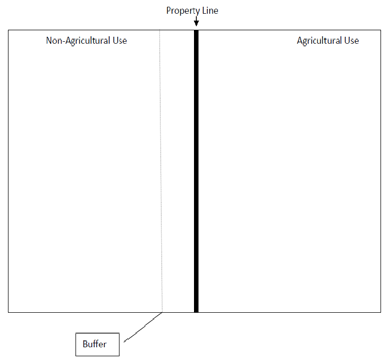
Step 2. Take the distance determined in Step 1 and apply it to the agricultural use side of the property line.
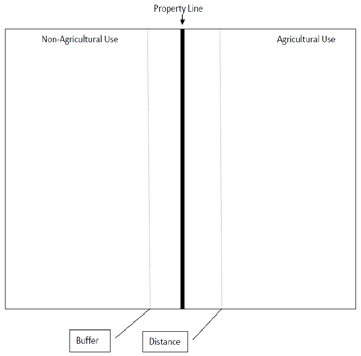
Step 3. Determine if the production agriculture is within the distance as determined in Step 2.
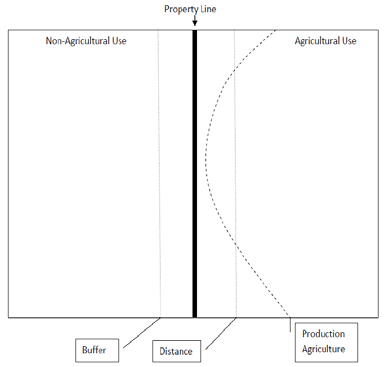
Step 4. If the Production Agriculture is within the distance as determined in Step 2, than the adjusted buffer is the buffer width that would be applied for Production Agriculture. For example, if the Agricultural Buffer width is 200 feet for the proposed use when adjacent to Production Agriculture, the adjusted buffer width would be 200 feet.
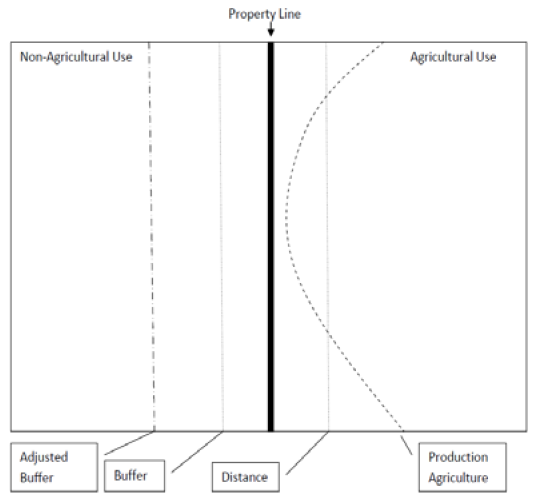
III.
Allowable Uses Within Agricultural Buffers. Subsection 35.30.025.E (Allowable uses within Agricultural Buffers) specifies unrestricted uses and restricted uses within the buffer.
A.
Unrestricted uses are compatible with agriculture because they do not invite visitors, do not require frequent maintenance, and do not attract wildlife. Uses that invite visitors or attract wildlife may conflict with agriculture and the location of such uses is restricted within the buffer.
B.
Restricted Use Modification. The Department, in consultation with the Agricultural Commissioner's Office, may recommend that the review authority modify a restricted use within the agricultural buffer if it can be determined that strict compliance with Subsection 35.30.025.E (Allowable uses within Agricultural Buffers) is not required to minimize conflicts with adjacent agriculture. To determine if the restricted use modification is warranted, the Department may consider site specific factors, agricultural practices and input from adjacent agricultural land owners/ property operators.
IV.
Application Procedures.
A.
Prior to application submittal. It is recommended the applicant meet with the Department, the Agricultural Commissioner's Office, and adjacent landowners (in conjunction with property operators) to discuss the non-agricultural project's compatibility with adjacent agriculture and application of proposed agricultural buffer requirements. Applicants are encouraged to include site planning and project design features that are compatible with adjacent agriculture.
B.
Project review. During the application review process, the Department should consult adjacent agricultural landowners (in conjunction with property operators) whenever possible to discuss the proposed non-agricultural development.
C.
Recommendations. For all discretionary development applications subject to the provisions of Section 35.30.025 (Agricultural Buffers) of this Development Code, the Department in consultation with the Agricultural Commissioner shall review the permit application and make recommendations to the review authority concerning buffer width, uses within the buffer, the Landscape, Lighting and Irrigation Plan, and the Buffer Maintenance Plan.
V.
Site Design. Urban development that is "agriculturally friendly" can play a significant role in promoting compatibility between agricultural and non-agricultural uses. Projects can achieve compatibility by incorporating creative site planning and project design concepts such as:
A.
Locating outdoor use areas such as backyards, patios, and playgrounds, away from agricultural areas.
B.
Terminating roads away from agricultural areas to reduce trespassing on agricultural land.
C.
Including the use of sound proof construction materials such as double pane windows. See Guide to Edge Planning - Promoting Compatibility Along Urban-Agricultural Edges, British Columbia, Ministry of Agriculture and Lands, June 2009.
D.
Clustering of buildings to maximize buffering between residences and agriculture.

