
Sarasota City Zoning Code
Appendix D
ADVISORY COMMUNITY DESIGN GUIDELINES1
The Role of these Guidelines
The citizens of Sarasota value their neighborhoods, both residential and commercial. Most new development in the City is located on "in-fill" or redevelopment sites within these neighborhoods, so well-designed projects cannot be judged in isolation of their surroundings. To that end, these guidelines are intended to improve the fit of new development, respect how architecture, landscape features, and public improvements help establish context, and steadily improve the quality of Sarasota's residential and commercial neighborhoods. These guidelines are intended to influence and inspire designers, developers, staff, and decision-makers to look closely at local conditions and produce new buildings, structures and development that enhance and complement the built and natural environment.
These guidelines address the following categories:
□ Site Planning
□ Height, Bulk and Scale
□ Architecture
□ Pedestrian Environment
□ Signs
□ Bicycle Parking
The guidelines are general and may be interpreted with some flexibility in their application to specific projects. The guidelines will be utilized during the review of site plans by the Development Review Committee to provide comments so as to encourage the highest level of design quality while at the same time providing the flexibility necessary to encourage creative designs. Unless stated elsewhere in the zoning code, these guidelines are advisory and voluntary. Approval of a design, site plan or development shall not be denied for failure to comply in part or in whole with these guidelines.
Site Planning Guidelines
The site planning guidelines primarily address the organization of a project's components on the development site. They deal with the location of buildings and site features such as parking lots, open space and service areas. Good site planning can minimize a project's adverse impacts on its neighbors (e.g., by separating tall or bulky structures, retaining trees, enhancing views), increase the quality of the streetscape, continue existing patterns, or enhance the value of nearby land or improvements.
A.
Responding to site characteristics. The placement of buildings should respond to specific site conditions and opportunities such as nonrectangular lots, location on prominent intersections, environmental constraints, significant vegetation and views or other natural features.
Site characteristics to consider in project design include, but are not limited to, the following:
1.
Site buildings to avoid or lessen the impact of development on environmentally sensitive and critical areas such as wetlands, stream corridors, fragile vegetation and wildlife areas, etc.
2.
The design and placement of a structure and its massing on the site should enhance solar exposure for the project and consider the shadow impacts on adjacent buildings and public areas.
3.
The placement of buildings and other development features should enable the preservation of significant or important trees or other vegetation.
4.
Where a new structure shares a site with an existing structure, or a major addition to an existing structure is proposed, the design of the new should be designed to be compatible with the original structure. This is particularly important if the original structure has historical or architectural merit to the community.
5.
The placement and massing of a building should, to the extent feasible, preserve desirable public views that would otherwise be blocked by the new development.
B.
Streetscape compatibility. The placement and orientation of buildings should acknowledge and reinforce the existing desirable spatial characteristics of the public right-of-way.
The character of a neighborhood is often defined by the experience of traveling along its streets. We often perceive streets within neighborhoods as individual spaces or "rooms". How buildings face and are set back from the street in large part determines the character and proportion of this room. For instance, a multistory mixed use building proposed for a downtown corner zoning lot should reinforce the existing streetscape by placing pedestrian-oriented businesses and shops on the ground level and presenting a consistent building edge abutting the sidewalk.
C.
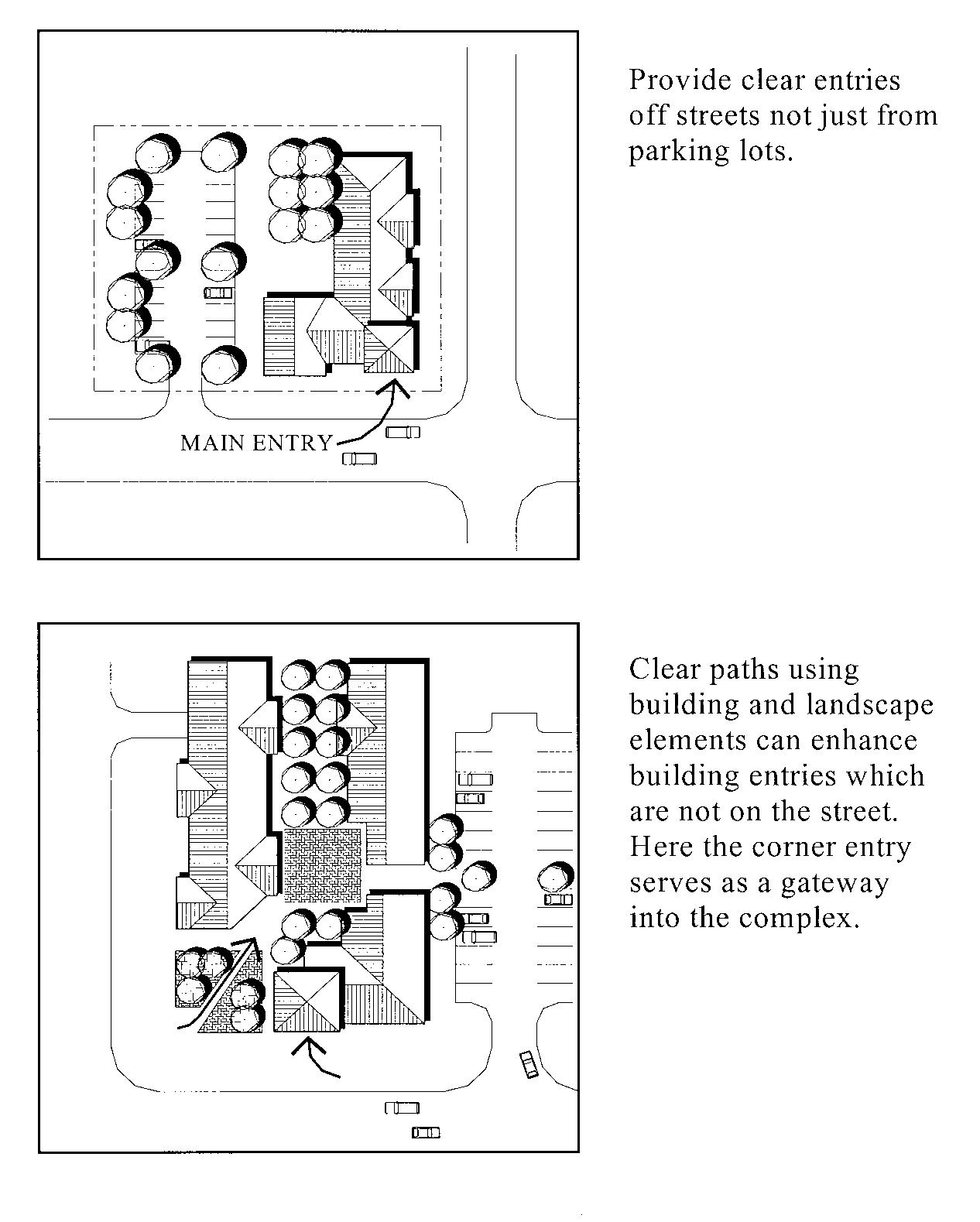
Entrances visible from the street. Building entrances should be clearly visible from the street. Using entries that are visible from the street makes a project more approachable and creates a sense of association among neighbors.
Visible Entrances
D.
Human activity. New development should be sited and designed to encourage human activity on the street. Livelier street edges make safer streets. Ground floor shops and market spaces providing services needed by residents can attract human activity to the street and increase safety through informal surveillance. Entrances, porches, balconies, decks, seating and other elements can promote use of the street front and provide places for human interaction. For instance, on commercial streets, such elements can include shopfront windows, plaza space with outdoor seating, rooftop decks, balconies, and canopies that protect pedestrians from the elements.
E.
Land use transitions and respect for adjacent sites. Buildings should respect adjacent properties by being designed on their sites to minimize disruption of the privacy and outdoor activity of occupants in adjacent buildings.
1.
For instance, one consideration is the views from upper stories of new buildings into adjacent houses or yards, whether in a similar or less intense zone district. This problem can be addressed in several ways: Reduce the number and/or location of windows and decks on the proposed building overlooking the neighbors; step back the upper floors or increase the setback so windows are further from the property line; or stagger windows to not align with adjacent windows.
2.
When land uses with significantly different visual character are proposed abutting each other and where gradual transitions are not possible or not in the best interest of the community, the development plan should, to the extent feasible, achieve compatibility through compliance with these guidelines regarding scale, form, materials and implementation of operational standards including limits on hours of operation, lighting, placement of noise-generating activities and similar restrictions.
F.
Parking and vehicle access. Site design should minimize the impact of automobile parking and driveways on the pedestrian environment, adjacent properties and pedestrian safety. The following are some examples of techniques used to minimize the impacts of driveways and parking lots:
1.
Locate surface parking at the rear or side of the zoning lot.
2.
Break large parking lots into multiple smaller ones.
3.
Minimize the number and width of driveways and curb cuts.
4.
Share driveways with abutting zoning lots.
5.
Locate parking in less visible areas of the site.
6.
Locate driveways so they are visually less dominant.
7.
Provide special pavers or other surface treatments to enhance and separate pedestrian areas from vehicle maneuvering and parking areas.
G.
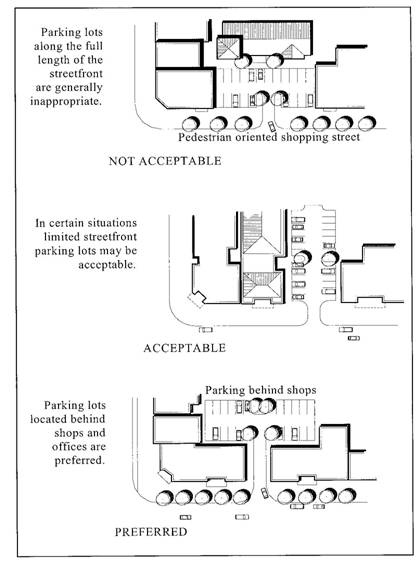
Location of parking on commercial street fronts. Parking located along a commercial street front where pedestrian traffic is desirable lessens the attractiveness of the area to pedestrians and compromises the safety of pedestrians along the street. On-site surface parking on a commercial street front should be minimized and where possible should be located behind a building.
Location of Parking
Height, Bulk and Scale Guidelines
These guidelines address the compatibility of the scale between new development and its surroundings. Elements that contribute to the perceived scale of new construction are addressed in the context of specific site conditions, including the relationship of a project to any less-intensive zone districts nearby (e.g., multifamily, mixed-use, or commercial zone districts on the edge of a single-family zone district).
A.
Projects should be compatible with the scale of development anticipated by the applicable Future Land Use Classification for the surrounding area and should be sited and designed to provide a sensitive transition to nearby, less intense zone districts and uses. Projects on the edges of zone districts should be developed in a manner that creates a step down in perceived height, bulk and scale between the proposed development and the adjacent lower-intensity zone district(s).
B.
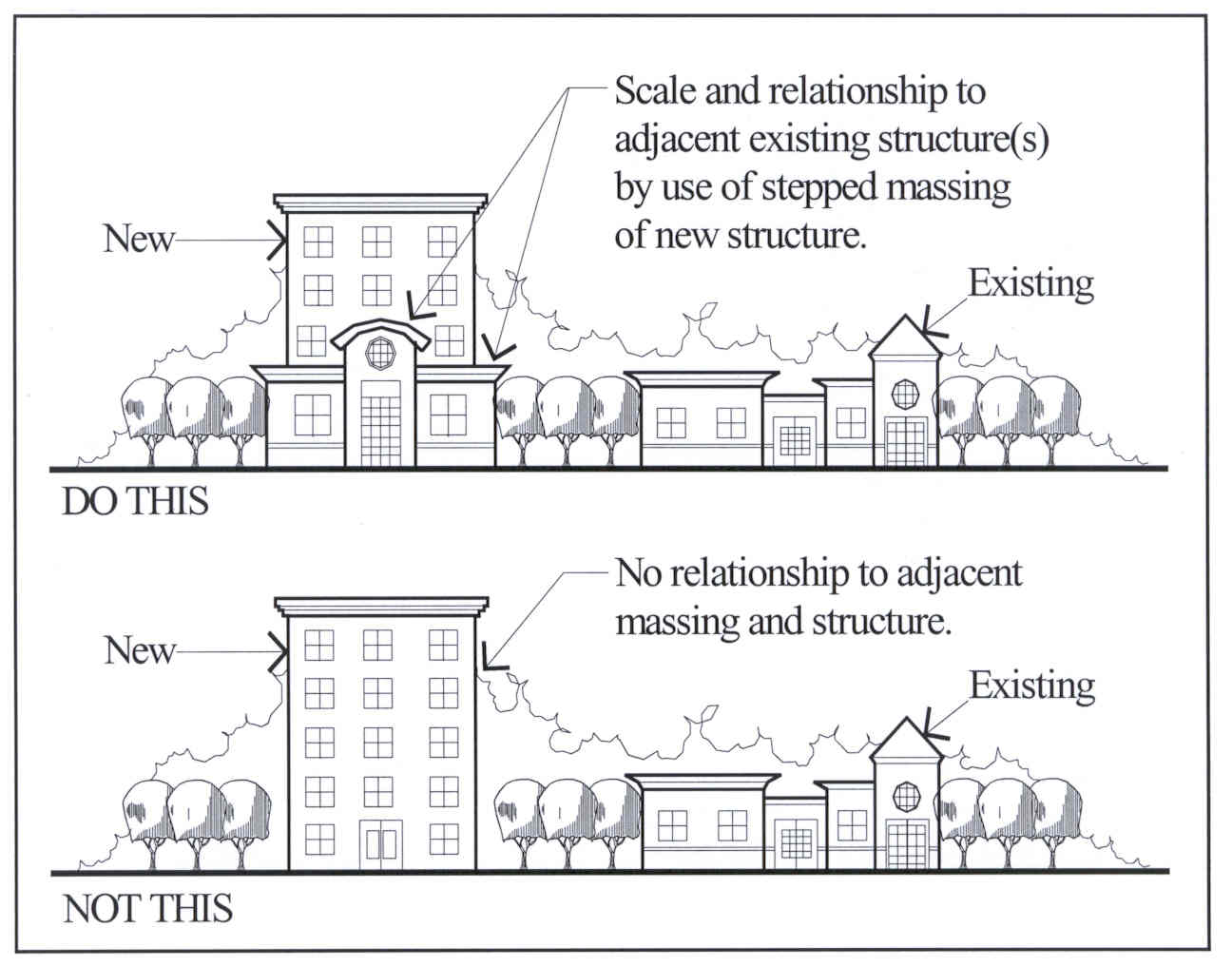
Development projects in multi-family, special purpose, and nonresidential zone districts may create substantial adverse impacts that result from inappropriate height, bulk and scale relative to their neighbors. Careful siting and design treatments can help mitigate some height, bulk and scale impacts; in other cases, actual reduction in the height, bulk and scale of a project are advisable to adequately mitigate adverse effects. For infill development, buildings should either be similar in size and height, or if larger, be articulated and subdivided into massing that is proportional to the mass and scale of other structures on the same block, or if no buildings exist in the block, then on adjoining blocks.
Height, Bulk and Scale of Building
1.
Height, bulk and scale mitigation is advisable in two general circumstances:
a.
Projects on or near the edge of a less intensive zone district. A substantial incompatibility in scale may result from different development standards in the two zone districts and may be compounded by physical factors such as large development sites and zoning lot orientation.
b.
Projects proposed on zoning lots with unusual physical characteristics such as large zoning lot size or unusual shape.
2.
Some of the factors to consider in the design and analysis of a development for potential height, bulk and scale impacts include:
a.
Distance from the edge of a less intensive zone district.
b.
Differences in development standards between abutting zone districts.
c.
Effects of site size and shape.
d.
Height, bulk and scale relationships resulting from zoning lot orientation (e.g., back zoning lot line to back zoning lot line vs. back zoning lot line to side zoning lot line).
e.
Type and amount of separation between zoning lots in the different zone districts (e.g., separation by only a property line, by an alley or street, or by other physical features such as streams).
3.
In some instances, careful siting and design treatment may be sufficient to achieve reasonable transition and mitigation of height, bulk and scale differences. Some techniques for achieving compatibility are:
a.
Use of architectural style, details (such as rooflines or fenestration), exterior colors or materials that derive from the less intensive zone district.
b.
Creative use of landscaping or other screening.
c.
Location of features on-site to facilitate transition, such as locating required open space on the zone district edge so the building is located farther from the lesser intensity zone district.
d.
In a mixed-use project, siting the more compatible use(s) near the zone district edge.
4.
In some cases, reductions in the height, bulk and scale of a proposed structure are advisable to mitigate adverse impacts and achieve an acceptable level of compatibility. Some techniques that can be used in such instances include:
a.
Articulating the building's facades vertically or horizontally in intervals that conform to existing structures or building patterns in the area.
b.
Increasing building setbacks from the zone district edge at ground level.
c.
Reducing the bulk of the building's upper floors (with upper level step-backs usually beginning between 20 to 40 feet above grade).
d.
Limiting the length of, or otherwise modifying, facades.
e.
Reducing the height of the structure.
f.
Reducing the number and/or size of accessory buildings, if any.
Architectural Guidelines
These guidelines deal with the exterior architectural elements of buildings and structures (i.e., components which define the appearance of a building, such as roofs, windows, porches, modulations, entries, materials, balconies and details).
New buildings developed in an established neighborhood with an identifiable character may be viewed as undesirable intrusions unless they respond positively to the architectural characteristic of existing buildings. Therefore, guidelines for architectural elements encourage new development in established neighborhoods to complement neighboring buildings and consider how design gives a neighborhood its identity. This does not mean that new buildings must excessively mimic older existing buildings. Rather, the guidelines suggest that new buildings use some traditional building concepts or elements. New buildings can successfully relate to older buildings while still looking contemporary, not stifling the designer's creativity and responding to changing societal needs and design opportunities.
A.
Architectural context. New buildings proposed for existing neighborhoods with a well-defined and desirable character should be compatible with or complement the architectural character and siting pattern of neighboring buildings.
1.
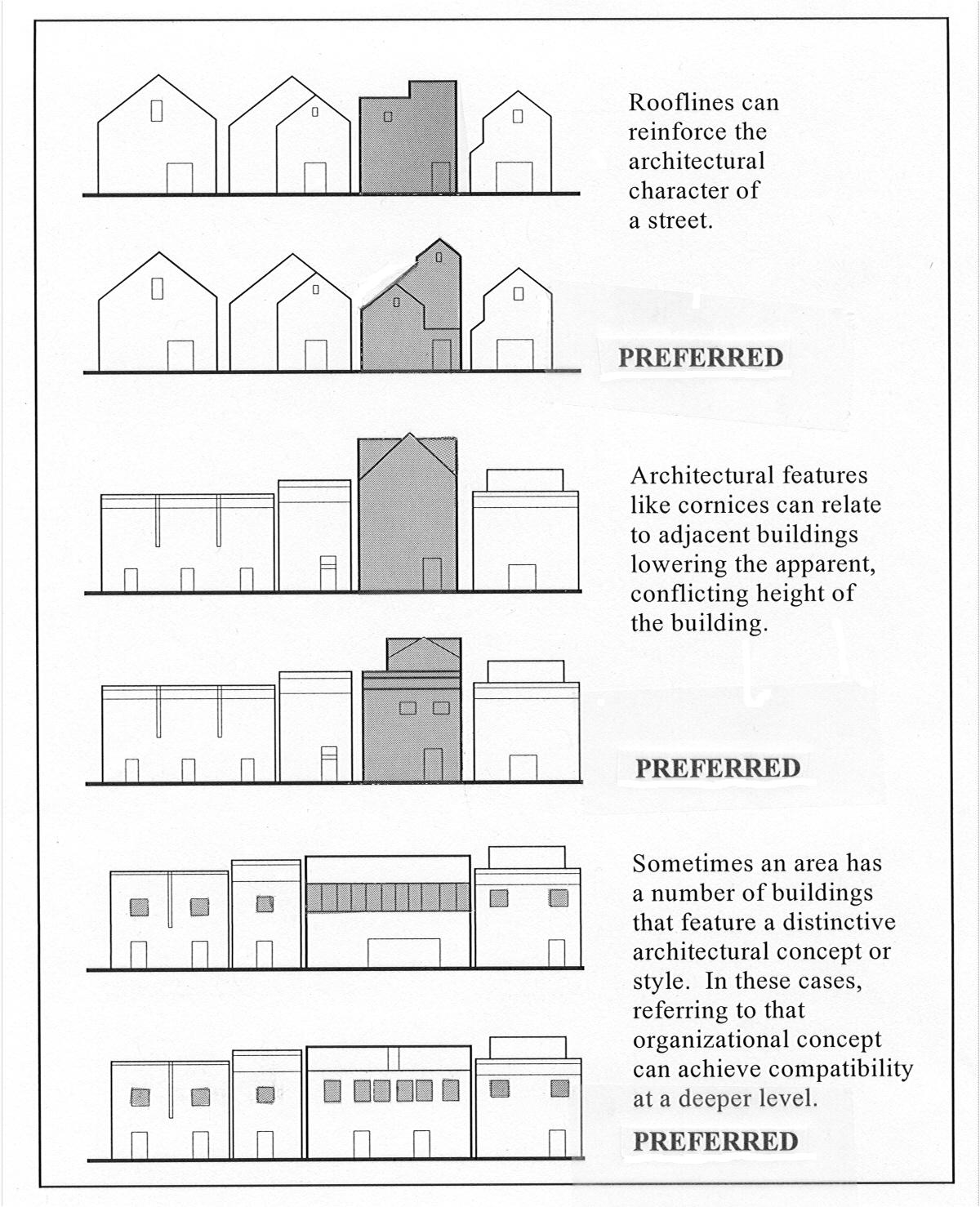
Architectural features. Paying attention to, and honoring architectural characteristics of surrounding buildings can help new buildings be compatible with their neighbors, especially if a consistent pattern is already established by:
□ Similar building articulation;
□ Similar building scale and proportions;
□ Similar or complementary architectural style(s);
□ Similar or complementary roof forms;
□ Similar building details and fenestration patterns; or
□ Similar or complementary materials.
Even when there is no consistent architectural pattern, building design and massing can be used to complement and enhance certain physical conditions of existing surrounding development.
2.
Conversely, in some cases the existing context is either not well defined, or may be undesirable. In such cases, a well-designed new project can become a pioneer with the opportunity to establish a pattern or identity that future redevelopment can build on.
Architectural Context
B.
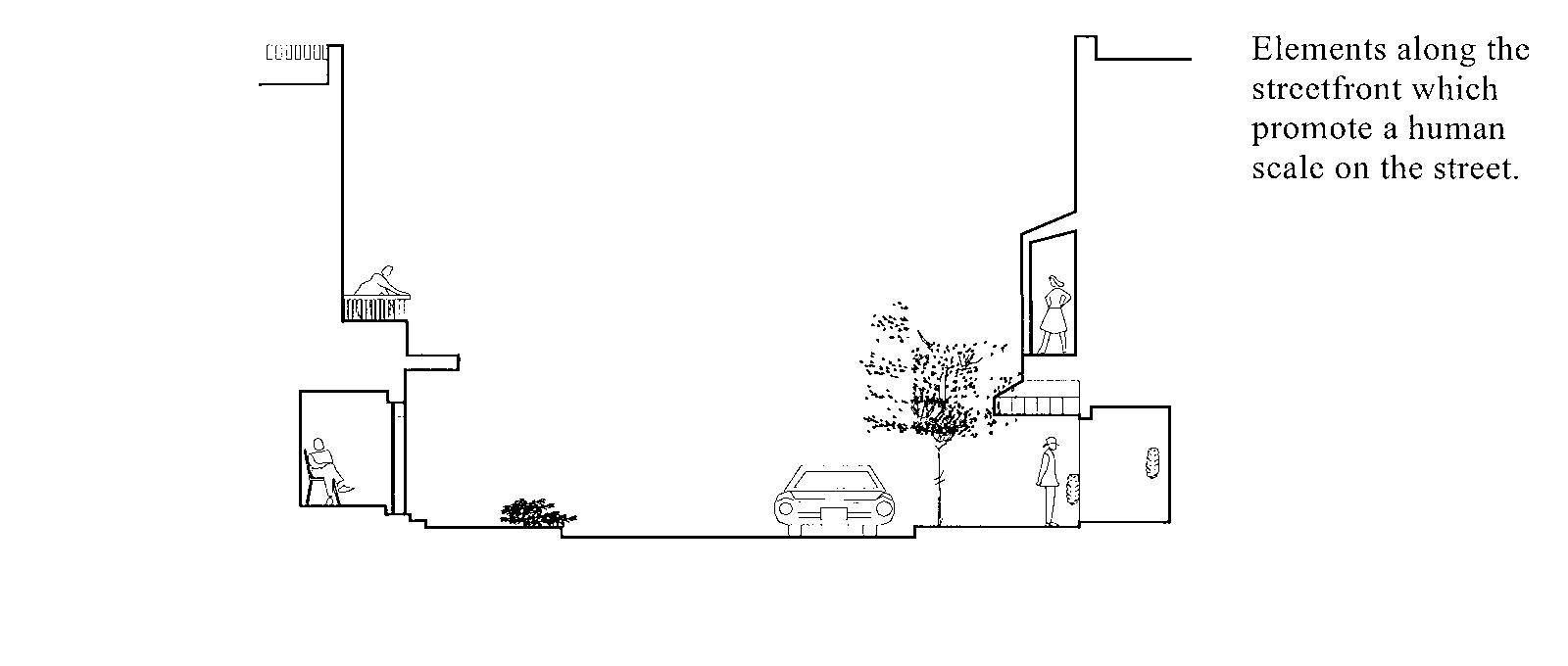
Human scale. The design of new buildings should incorporate architectural features, elements and details that achieve a desirable human scale.
"Human scale" generally refers to the use of human-proportioned architectural features and site design elements clearly oriented to human activity. A building has a good human scale if its details, elements and materials allow people to feel comfortable using and approaching it. Features that give a building human scale also encourage human activity.
Human Scale
1.
The following are some of the building elements that may be used to achieve better human scale:
a.
Pedestrian-oriented storefront windows and doors directly facing the street or publicly accessible open space such as courtyards, gardens, patios, or other unified landscaped areas.
b.
Bay windows extending out from the building face that reflect in internal space such as a room or alcove.
c.
Individual windows in upper stories that:
1)
Are approximately the size and proportion of a traditional window;
2)
Include a trim or molding that appears substantial from the sidewalk;
3)
Are separated from adjacent windows by a vertical element;
4)
Windows grouped together to form larger areas of glazing can have a human scale if individual window units are separated by moldings or jambs;
5)
Windows with small multiple panes of glass;
6)
Window patterns, building articulation and other exterior treatments that help identify individual residential units in a multifamily building;
7)
Upper story step-backs (generally above the third or fourth floor);
8)
A porch or covered entry;
9)
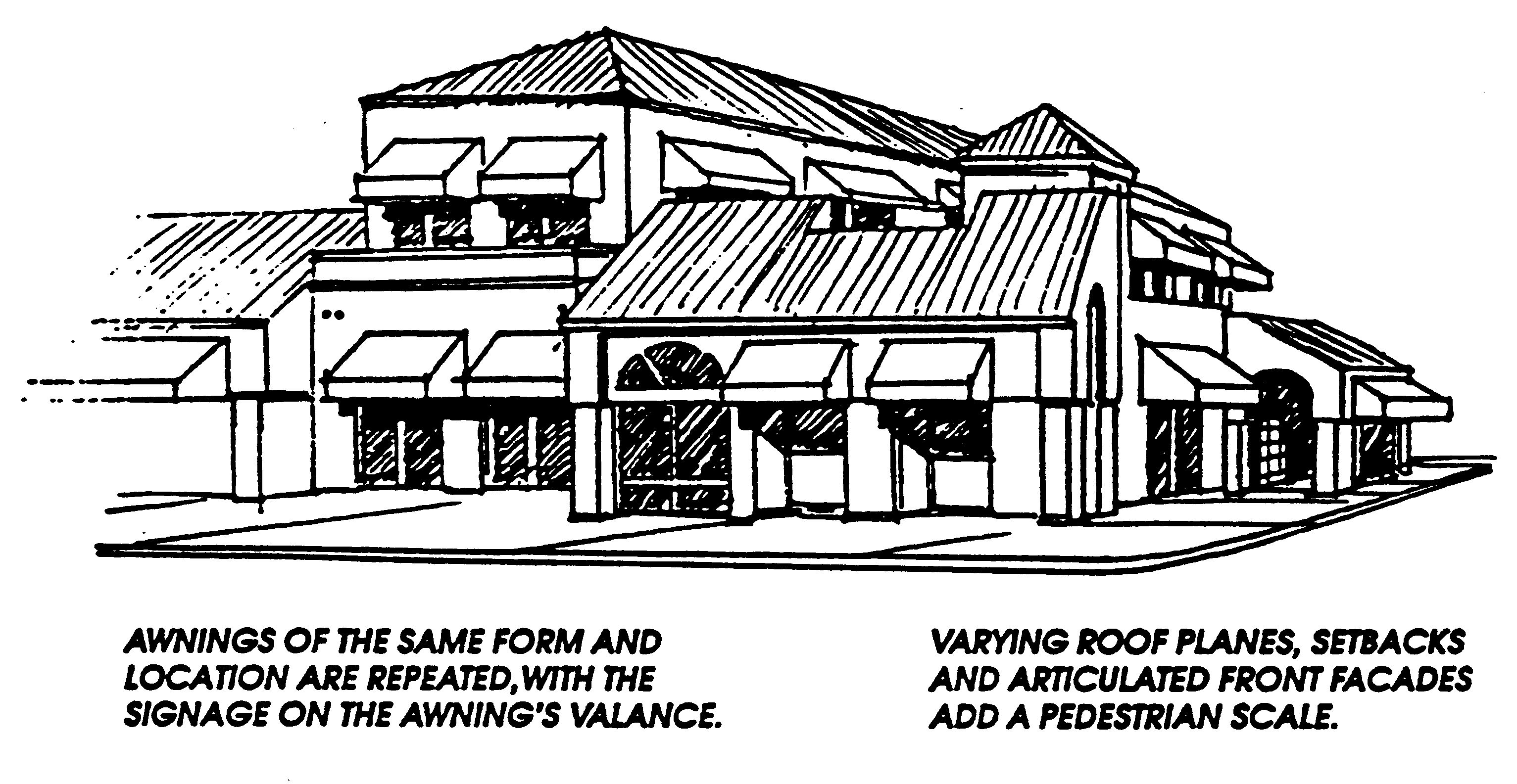
Pedestrian weather protection such as canopies, awnings, arcades, or other similar elements wide enough to protect at least one person.
C.
Structured parking garages. The presence and appearance of structured parking garages and their entrances should be minimized so they do not dominate the street frontage.
D.
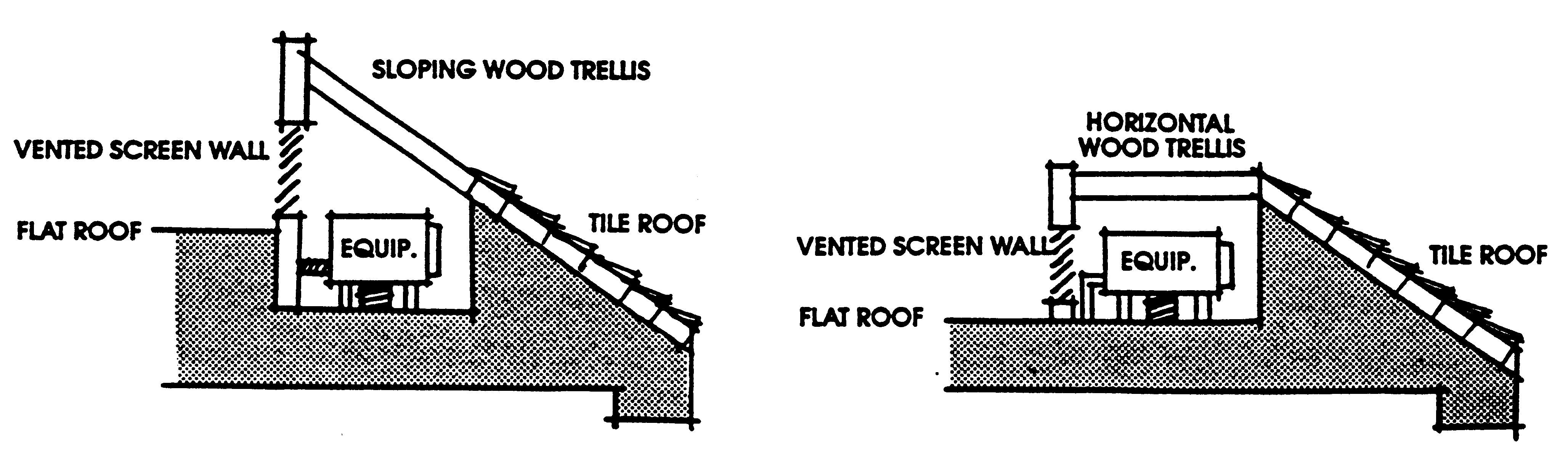
Rooftop mechanical equipment. All rooftop mechanical equipment should be screened from public view from both above and below by integrating it into building and roof design to the extent feasible.
Screening Rooftop Mechanical Equipment
Pedestrian Guidelines
People traveling on foot see their city and its neighborhoods most intimately. Making the pedestrian environment attractive and comfortable is one way to encourage the street activity that provides both security and a sense of community.
The pedestrian environment guidelines are directed towards improving the pedestrian qualities of all neighborhood streets by avoiding or mitigating undesirable conditions. These guidelines specifically address issues related to street-level uses; blank walls near sidewalks; buildings with ground floor parking; dumpsters and service areas among other elements.
Attractive Pedestrian Environment
A.
Pedestrian open spaces and entrances. Convenient and attractive access to a building's entry should be provided. To ensure comfort and security, pedestrian paths and entry areas should be sufficiently lighted, and entry areas should be protected from the weather. In addition, opportunities for creating lively, pedestrian-oriented open spaces should be considered. To the extent feasible, primary facades and entries should face the abutting street. Main building entrances should face a connecting walkway with a direct pedestrian connection to the street without requiring pedestrians to walk through parking lots or cross driveways. Continuous internal pedestrian walkways, no less than five feet in width, should be provided from the public sidewalk or right-of-way to the principal customer entrance(s) of all principal buildings on the site. At a minimum, walkways should connect focal points of pedestrian activity such as, but not limited to, transit stops, street crossings, building and store entry points. In addition, such walkways should generally feature adjoining landscaped areas that include trees, shrubs, benches, flower beds, ground covers or other such materials over a majority of its length.
1.
When a building, or portions thereof, is set back from the sidewalk, the space between the building and the public right-of-way may be conducive to pedestrian or resident activity. In nonresidential or mixed-use areas where pedestrian activity is desired, the primary function of any open space between commercial buildings and the sidewalk is to provide visual and physical access into the building and perhaps also to provide a space for additional outdoor activities such as vending, resting, sitting or dining.
2.
When a commercial or mixed-use building is set back from the sidewalk a sufficient distance, pedestrian enhancements (e.g., walking surfaces with attractive pavers, areas for vendors in commercial areas, site furniture, pedestrian scale signage, amenities such as fountains, art work, kiosks, etc.) should be considered to enhance the space.
B.
Blank walls. Buildings should avoid large blank walls facing the street, especially near sidewalks. Where blank walls are unavoidable, they should receive design treatment to increase pedestrian comfort and interest. Vertical trellises, landscaped or raised planter beds placed in front of the wall, wall murals, decorative masonry patterns, canopies, awnings and other similar techniques can be utilized to break up the size of a blank wall and add visual interest.
C.
Visual impacts of parking structures. The visibility of at-grade parking structures or accessory parking garages should be minimized. The parking portion of a structure should be architecturally compatible with the rest of the structure and streetscape.
D.
Utilities and service areas. Service elements can detract from the compatibility of new projects and create hazards for pedestrians and motor vehicles. Building sites should locate service elements like trash dumpsters, loading docks and mechanical equipment away from the street front wherever possible. When elements such as dumpsters, utility meters, mechanical units and service areas cannot be located away from the street front, they should be situated and screened from view and should not be located near pedestrian routes.
E.
Personal safety and security. Project design should consider opportunities for enhancing personal safety and security in the environment under review. Project design will be reviewed for its contribution to enhancing the real and perceived feeling of personal safety and security within the environment under review. To this end, the question needs to be answered: Do the design elements detract from or do they reinforce feelings of security in the residents, workers, shoppers, and visitors who enter the area?
Sign Design Guidelines
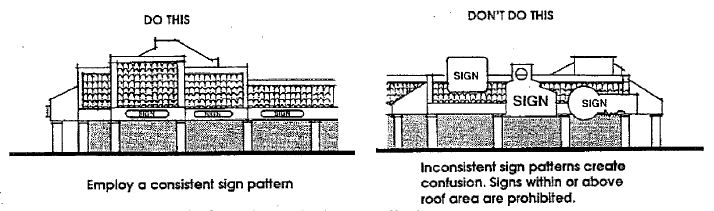
The following design guidelines should be consulted prior to developing signs for any project:
1.
Use a brief message. The fewer the words, the more effective the sign. A sign with a brief, succinct message is simpler and faster to read, looks cleaner and is more attractive.
2.
Avoid hard-to-read, overly intricate typefaces. These typefaces are difficult to read and reduce the sign's ability to communicate.
3.
Avoid faddish and bizarre typefaces. Such typefaces may look good today, but soon go out of style. The image conveyed may quickly become that of a dated and unfashionable business.
4.
Sign colors and materials. [Sign colors and materials] should be selected to contribute to legibility and design integrity. Even the most carefully thought-out sign may be unattractive and a poor communicator because of poor color selection. Day-glo colors must be avoided.
5.
Use significant contrast between the background and letter or symbol colors. If there is little contrast between the brightness or hue of the message of a sign and its background, it will be difficult to read.
6.
Avoid too many different colors on a sign. Too many colors overwhelm the basic function of communication. The colors compete with the viewer's attention. Limited use of the accent colors can increase legibility, while large areas of competing colors tend to confuse and disturb.
7.
Place signs to indicate the location of access to a business. Signs should be placed at or near the entrance to a building or site to indicate the most direct access to the business.
8.
Place signs consistent with the proportions of scale of building elements within the façade. Within a building façade, the sign may be placed in different areas. A particular sign may fit well on a plain wall area, but would overpower the finer scale and proportion of the lower storefront. A sign which is appropriate near the building entry may look tiny and out of place above the ground level.
9.
Place wall signs to establish façade rhythm, scale and proportion where such elements are weak. In many buildings that have a monolithic or plan façade signs can establish or continue appropriate design rhythm, scale, and proportion.
10.
Avoid signs with strange shapes. Signs that are unnecessarily narrow or oddly shaped can restrict the legibility of the message. If an unusual shape is not symbolic, it is probably confusing.
11.
Carefully consider the proportion of letter area to overall sign background area. If letters take up too much sign, they may be harder to read. Large letters are not necessarily more legible than smaller ones. A general rule is that letters should not appear to occupy more than 75 percent of the sign panel area.
12.
Make signs smaller if they are oriented to pedestrians. The pedestrian-oriented sign is usually read from a distance of 15 to 20 feet; the vehicle-oriented sign is viewed from a much greater distance. The closer a sign's viewing distance, the smaller that sign need be.
13.
[Wall signs.] Wall signs should be compatible with the predominant visual elements of the building.
14.
[Master signage plan for multitenant buildings.] A master signage plan should be provided at the time of permitting for multitenant buildings. Where there is more than one sign on a single zoning lot, all signs should be complementary to each other in the following ways:
a.
Type of construction materials.
b.
Letter size and style of copy.
c.
Method used for supporting sign.
d.
Configuration of sign area.
e.
Placement on the building
BICYCLE PARKING GUIDELINES
Bicycle parking facilities should be located with easy access, near main building entrances, in areas with natural surveillance. The following criteria should be used in determining the placement and installation of bicycle parking facilities.
A.
Type and location: There are many types of bicycle racks and lockers available. Some are suitable for certain situations but not others, and some designs are unsuitable anywhere. There are two general categories of bicycle parking.
Short-term parking is needed where bicycles will be left for short stops. It requires a high degree of convenience (as close to destinations as possible). At least some short-term bicycle parking should be protected from the weather (a portion can be unprotected, since demand tends to increase during dry weather). Short-term bicycle parking provides shoppers, customers, messengers and other visitors who generally park for two hours or less a convenient and readily accessible place to park bicycles. It should be located within 100 feet of the building entrance that cyclists use. Where there is more than one building on a site, or where building has more than one main entrance, the parking must be distributed to serve all buildings or main entrances. If more than ten short-term spaces are required, at least 50 percent should be covered.
Long-term parking is needed where bicycles will be left for hours at a time. It requires a high degree of security and weather protection, with well-designed racks in covered areas, lockers, storage rooms, or fenced areas with restricted access. Long-term bicycle parking provides employees, students, residents, commuters and others who stay at a site for several hours a secure and weather-protected place to store their bicycles. Locate on-site or within 500 feet of the site - daily bicycle commuters are generally willing to walk a short distance, if they are confident the parking is secure.
B.
Visibility: Racks should be highly visible so cyclists can spot them immediately when they arrive from the street. A visible location also discourages theft and vandalism. Avoid locations "off on the side", "around the corner" or in unsupervised parking structures or garages. The parking area should be convenient to building entrances and street access, but away from normal pedestrian and auto traffic.
C.
Security: Surveillance is essential to reduce theft and vandalism. For security, locate parking within view of passers-by, retail activity, or office windows. Better yet: officially assign building security, parking lot attendant or other personnel to watch for suspicious behavior. Adequate lighting and surveillance is essential for the security of the bicycles and the users. Bicycle racks and lockers must be well anchored to the ground to avoid vandalism and theft.
D.
Weather protection: Whenever possible, a portion of bicycle parking should be protected from the weather (some short-term bicycle parking can be unprotected since bicycle use tends to increase significantly during fair weather). This can be accomplished by use of an existing overhang or covered walkway, a special covering, weatherproof outdoor bicycle lockers, or an indoor storage area.
E.
Clearance: Adequate clearance is required around racks to give cyclists room to maneuver, and to prevent conflicts with pedestrians, moving traffic or parked cars. Racks should not block access to building entrances or fire hydrants.
(Ord. No. 10-4912, § 2(att. 1), 2-7-11)
Editor's note— Ord. No. 10-4912, adopted Feb. 7, 2011 amended and restated App. D, Advisory Community Design Guidelines to read as herein set out.

