
Sarasota City Zoning Code
ARTICLE II
DEFINITIONS AND RULES OF CONSTRUCTION
Sec. II-101. - Rules of construction.
For the purposes of these regulations, the following rules of construction shall apply:
(1)
These regulations shall be construed to achieve the purposes and intent for which they are adopted.
(2)
In case of a conflict between the text of these regulations and any caption, figure, illustration, table, or map, the text of these regulations shall control. In case of a conflict between a chart and an illustration, the chart shall control. All illustrations included in these regulations are for illustrative purposes only.
(3)
In case of any conflict in limitations, restrictions, or standards applying to an individual use or structure, the more restrictive provisions shall apply.
(4)
The words "shall," "must," and "will," are mandatory in nature, implying an obligation or duty to comply with the particular provision.
(5)
The words "may" and "should" are permissive in nature.
(6)
Words used in the present tense include the future tense.
(7)
Words used in the singular number include the plural number and the plural number includes the singular number, unless the context of the particular usage clearly indicates otherwise.
(8)
Words used in the masculine gender include the feminine gender.
(9)
Any act authorized by these regulations to be carried out by a specific official or agency of the city may also be carried out by a designee of such official or agency. Any transfer of duties to a different official transfers the authority to carry out acts under these regulations.
(10)
The time within which an act is to be done shall be computed by excluding the first and including the last day; if the last day is a Saturday, Sunday or a legal holiday, that day shall be excluded and computed using the next business day.
(11)
Any words and terms not defined herein shall have the meaning indicated by common dictionary definition.
(12)
Any reference to Florida Statutes shall be construed to be a reference to the most recent enactment of such statute, and shall include any amendments as may from time to time be adopted.
(13)
Any references to conditional uses shall be interpreted to mean major conditional uses. Only those uses specifically cited, as being allowed by minor conditional use shall use said minor conditional use process.
(14)
The Lexicon of the New Urbanism, the Downtown Master Plan 2020, and the SmartCode, authored by Duany Plater-Zyberk and Company, were used to develop the new urbanism standards in article VI, division 10 (downtown zone districts) and may be used as an aid in understanding the principles of new urbanism and the application of these standards.
(Ord. No. 02-4357, 4-29-02; Ord. No. 04-4531, § 3, 6-7-04)
Sec. II-201. - Definitions.
For the purposes of these regulations, the following words and terms have the meanings specified herein:
A street: See primary/secondary street grid (synonym: A/B grid).
Abandonment: The cessation of the use of property without the intention of transferring rights to the property or of resuming the use of the property.
Abutting: Having property boundaries or zoning lot lines in common, with no separation by a street, alley or other right-of-way.
Accessory: A use, building or structure, or part of a building or structure which:
(1)
Is subordinate to and serves the primary building or structure or primary use;
(2)
Is subordinate in area, extent, or purpose to the primary building or structure or primary use served;
(3)
Contributes to the comfort, convenience, or necessity of occupants of the primary building or primary use; and
(4)
Is located on the same zoning lot as the primary building or structure or primary use served, with the exception of such accessory off-street parking facilities as are permitted to locate elsewhere than on the same zoning lot as the building or use served and such accessory water-related uses to leasehold uses in "G" zone districts.
See also "primary use."
Accessory dwelling unit: See residential structure types.
Accessory kitchen: A secondary residential kitchen associated with a dwelling unit that may feature storage, sinks, refrigeration, ovens, and other similar amenities. Also known as "butler's pantry."
Acre: A measure of land equating to 43,560 square feet.
Acres, gross: A measure of land equating to the entire area of a property.
Adjacent/adjoining: Abutting or being directly across a street, alley, other rights-of-way or waterways.
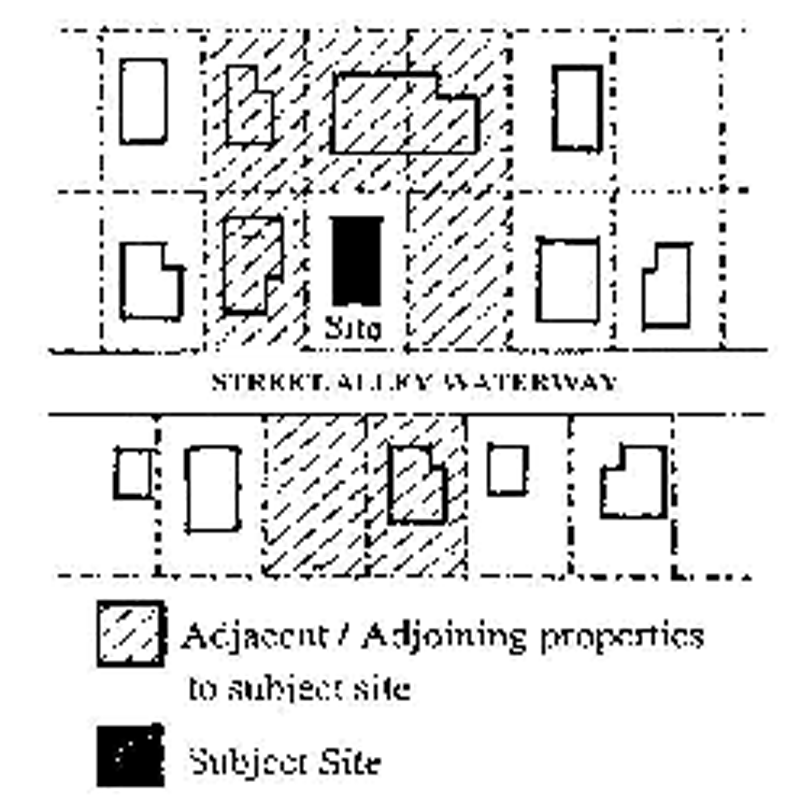
Adjustment (for downtown zone districts and urban mixed-use zone districts): Relief by the director of development services, planning board, or city commission from the requirements of the downtown zone districts and urban mixed-use zone districts, subject to the standards in section IV-1903.
Adult bookstore/video store: An establishment having as a substantial or significant portion of its stock in trade, books, magazines, periodicals, or other printed matter or photographs, films, motion pictures, video cassettes, slides, or other visual representations or recordings, or other audio matter which are adult material, as defined below, if the adult material is accessible by individuals other than employees, agents or independent contractors.
Adult day care center: Any building or buildings, or part of a building, whether operated for profit or not, in which is provided through its ownership or management for a part of a day, basic services to three or more persons who are 18 years of age or older, who are not related to the owner or operator by blood or marriage, and who require such services. See also assisted living facility, community residential home, group home facility and nursing home.
Adult use establishment: A site or premises, or portion thereof, upon which adult use activities or operations are conducted.
Adult material: Any one or more of the following, regardless of whether it is new or used:
(1)
Books, magazines, periodicals, or other printed matter, paintings, drawings, or other publications or graphic media, photographs, films, motion pictures, video cassettes or disks, slides, or other visual representations, or recordings, or other audio matter, which have as their primary or dominant theme matter depicting, illustrating, describing, or relating to specified sexual activities or specified anatomical areas as defined hereafter; or
(2)
Instruments, novelties, devices, or paraphernalia that are designed for use in connection with specified sexual activities.
Adult modeling studio: Any establishment which offers, advertises, or conducts as a substantial or significant portion of its business, service or trade the use of its premises for the purpose of modeling of apparel that exhibits specified anatomical areas, or modeling, demonstrating, or presenting any product or service for sale, in a private performance setting, in which the model or sales representative exhibits specified anatomical areas.
Adult photographic studio: Any establishment which offers, advertises, or conducts as a substantial or significant portion of its business, service or trade, the use of its premises for the purpose of photographing or exhibiting specified sexual activities or specified anatomical areas.
Adult theater: An enclosed building or an enclosed space within a building, where, for any form of consideration or compensation, live performances, films, motion pictures, video cassettes, slides, or similar photographic reproductions, distinguished or characterized by an emphasis on material depicting, describing, or relating to specified sexual activities or specified anatomical areas, are regularly shown for observation by patrons therein. However, a theater, performing arts hall, opera, or other like activity presenting or staging a performance which constitutes a part of a bona fide live communication by a person wherein a specified sexual activity takes place or specified anatomical area is displayed in the sense of expressive conduct incidental to and necessary for the conveyance or communication of a genuine message or public expression shall not be deemed an adult theater under the provisions of this division.
Adult use, commencement of business of (includes any of the following):
(1)
The opening or starting of any adult use as a new business;
(2)
The conversion of an existing business, whether or not an adult use, to any adult use;
(3)
The addition of any adult use to an existing adult use;
(4)
The relocation of any adult use.
Adult use or adult business: An adult bookstore/video store, adult modeling studio, special cabaret, adult theater, adult photographic studio, or physical culture establishment as defined in this section.
Adult use permittee: A person in whose name a permit to operate an adult use has been issued, as well as any other person listed as an applicant on the application for a permit.
Aggrieved person:
(1)
The city;
(2)
The applicant for a development permit; and
(3)
Any person or entity which will suffer to a greater degree than the general public an adverse effect to a legally recognized interest protected or furthered by the land development regulations or the comprehensive plan.
Alcohol production terminology:
Accessory nanobrewery/nanodistillery: A duly licensed establishment that produces alcoholic beverages as an accessory use to a restaurant, bar, or nightclub primarily for on-premises consumption.
Brewpub: An establishment where food and non-distilled fermented beverages are duly licensed to be made on the premises.
Craft distillery: A duly licensed establishment that produces less than 75,000 gallons of spirits per year. Spirits can be sold or distributed on premises. On-site sale may include package sales for off-site consumption and limited on-site consumption through an accessory testing room.
Microbrewery: An duly licensed establishment that produces less than 15,000 barrels of non-distilled fermented beverages a year. Non-distilled fermented beverages can be sold or distributed on the premises. On-site sale may include packages sales for off-site consumption and limited on-site consumption through an accessory testing room.
Regional brewery: A duly licensed establishment that produces an amount equal to or greater than 15,000 barrels of non-distilled fermented beverages a year and follows state statutes for any accessory testing room.
Tasting room: A room that is ancillary to the production of alcohol at a regional brewery, microbrewery, winery, or craft distillery where the public can purchase and/or consume alcoholic beverages.
Winery: An establishment where wine and/or mead beverages are duly licensed to be made on the premises and then sold or distributed, and which produces less than 100,000 gallons of wine and/or mead per year. On-site sale may include packages sales for off-site consumption and limited on-site consumption through an accessory testing room.
Alcohol receiving center: A facility primarily engaged in the inpatient and outpatient treatment of alcoholic non-surgical patients.
Alcoholic beverage store: A facility devoted primarily to the sale of alcoholic beverages in containers for off-premises consumption.
Alley: See transportation-related definitions.
Alter or alteration: See development-related definitions.
Antenna, commercial wireless telecommunication: Any structure or device used for the purpose of collecting or transmitting, for commercial purposes, electromagnetic waves, including but not limited to directional antennas, such as panels, microwave dishes, and satellite dishes, and omni-directional antennas, such as whip antennas.
Antenna, directional: An antenna or array of antennas designed to concentrate a radio signal in a particular area.
Antenna, dish: A dish-like antenna used to link communications sites together by wireless transmission of voice or data. Also called microwave antenna or microwave dish antenna.
Antenna, microwave: A dish-like antenna manufactured in many sizes and shapes used to link communication sites together by wireless transmission of voice or data.
Antenna, omni-directional: An antenna that is equally effective in all directions and whose size varies with the frequency and gain for which it was designed.
Antenna support structure: Any pole, telescoping mast, tower tripod, or any other structure which supports a device used in the transmitting and/or receiving of electromagnetic waves.
Antenna, whip: An antenna that transmits signals in 360 degrees. Whip antennas are typically cylindrical in shape, are less than 6 inches in diameter, and measure up to 18 inches in height. Also called omni-directional, stick or pipe antennas.
Antique shop: A place offering antiques for sale. An antique, for purposes of this Code, shall be a work of art, piece of furniture, decorative object, or the like, of or belonging to the past.
Appeal: A request for review of a decision of an administrative official, the city commission, or a board relating to a request for development approval.
Applicant: A person seeking any determination or approval under, or permits required by, this Code.
Application for development approval: The application form and all accompanying documents, exhibits, and fees required for development review purposes.
Approving authority: Refers to the city commission, planning board, board of adjustment and historic preservation board as the context of these regulations so require in regard to the review of development approvals. This term shall also include the city manager, director of neighborhood and development services, city engineer, or their designees in regard to the review of administratively issued permits as the context of these regulations so require.
Arcade: See frontage terminology.
Arterial street: See transportation-related definitions.
Art experts: Professionals in the field of art such as, but not limited, to museum directors and curators, artists, professors of art and art history, critics or art administrators.
Art gallery: A place for display or retail facility for finished art materials, including paintings, statues, tapestries, ceramics, or other art objects.
Artificial illumination: Any light that is produced by a mechanical means.
Artist, sculptor, potter, etc. studio (commercial): A building or portion of a building, used as a place of work by an artist primarily engaged in painting, sculpting, graphic art and other similar art forms. This shall not include live performance space, unless otherwise permitted.
Assembly: The piecing together of various components to construct a finished product.
Assisted living facility: Any building or buildings, section of a building, or distinct part of a building, residence, private home, boarding home, home for the aged, whether operated for profit or not, which undertakes through its ownership or management to provide, housing, and one or more personal services for a period exceeding 24 hours to one or more adults, not related to the owner or administrator by blood or marriage, who require such services; or to provide extended congregate care, limited nursing services, or limited mental health services, when specifically licensed to do so pursuant to F.S. § 400.407 (see also adult day care center, community residential home, group home facility and nursing home).
Attached duplex: See residential structure types.
Attached single family: See residential structure types.
Attached structure: Any structure that is attached to another structure by a common wall, by a roof, or by structural connections that allow pedestrian access to both structures. For example, decks or stairways are attached structures when they are connected to another structure. A garage may be attached to another structure by sharing a wall or by a breezeway. Structures connected only by an "I" beam or similar connections are not considered attached.
Attainable housing: Housing units that are affordable to households earning from 60 to 120 percent of the area median income (AMI) in the North Port-Sarasota-Bradenton MSA. The exterior appearance (fixtures, finishes, and building entrances) of attainable housing units shall be indistinguishable from and functionally equivalent to market rate units. If the attainable housing is provided in the form of owner-occupied units, such units shall be interspersed throughout 50 percent of the owner-occupied units and shall have a common entrance providing access to all such owner-occupied units. If the attainable housing is provided in the form of rental units, such units shall be interspersed throughout 50 percent of the rental units and shall have a common entrance providing access to all such rental units. The bedroom mix of attainable housing units should be comparable to the bedroom mix of the market rate units. The attainable housing income range shall be updated annually by the city based on U.S. Department of Housing and Urban Development (HUD) data and existing mortgage financing conditions. Incentives associated with attainable housing units within the Sarasota City Plan and Zoning Code, such as density bonuses, shall also be applicable for households earning below 60.0 percent of the AMI.
Attic: A room or a space within the slope of a roof.
Auditorium: A large enclosed and roofed structure used for spectator sports, exhibitions, or cultural events.
Automatic fueling station: An unattended establishment automatically dispensing motor vehicle fuels, water, air and oil, limited to commercial, governmental and other fleet vehicles, with no facilities for additional service, repairs or maintenance.
Automobile: See vehicle types.
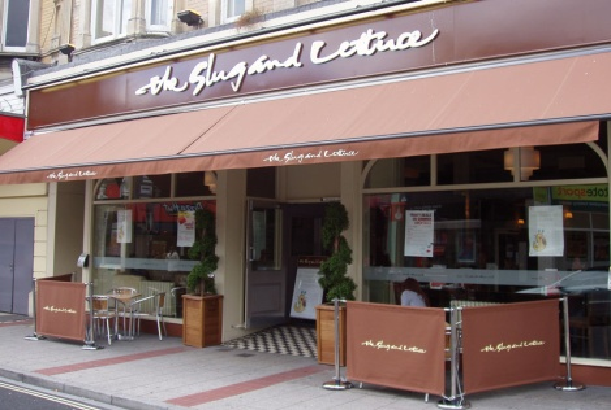
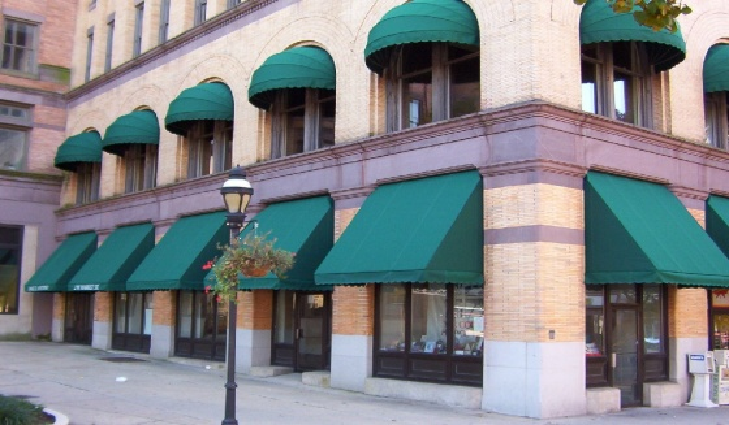
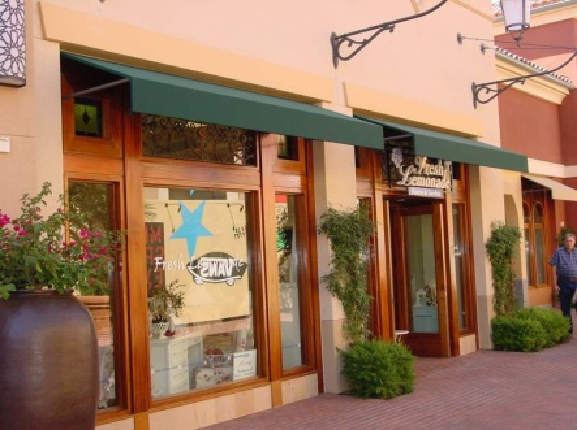
Awning: A temporary hood or cover that projects from the wall of a building and that may include a type which can be retracted, folded or collapsed against the face of a supporting building. With the addition of support columns, an awning becomes a canopy. See also canopy and frontage terminology.
 |  |  |
B street: See primary/secondary street grid (synonym: A/B grid).
Bank: See financial institution.
Banner: See sign-related definitions.
Banner, internal: See sign-related definitions.
Banner, perimeter: See sign-related definitions.
Bar: A commercial establishment at which the principal business is the sale of alcoholic beverages for consumption on premises and at which the location of the counter where alcoholic beverages are served is within a building fully enclosed by windows and doors.
Bar, outdoor: A commercial establishment at which the principal business is the sale of alcoholic beverages for consumption on premises and at which the location of the counter where alcoholic beverages are served is outdoors or located in a building that is not fully enclosable.
Base density: The maximum number of dwelling units per acre that is allowed on a parcel or development site prior to awarding of additional density that may be approved as specified within the development standards for the zone districts within urban edge, downtown core, downtown bayfront, and urban mixed-use future land use classifications and applicable portions of urban neighborhood.
Bay window: A window, or series of windows, formed as an exterior structure that projects outward from an exterior wall. It is comprised of a window or series of windows that project out beyond an exterior wall.
Bed and breakfast inn: An owner or operator-occupied single-family detached dwelling unit which contains no more than one kitchen and five or less guest rooms intended or designed to be used, or which are used, rented or hired out to be occupied or which are occupied for sleeping purposes by guests, other than temporary personal guests of the family in the dwelling unit, for compensation with or without meals.
Bingo, non-profit: A game, operated by a non-profit, charitable, or veterans' organization as defined in F.S. § 849.0931(1)(c), in which each player pays a sum of money for the use of one or more bingo cards printed with different numbered squares on which to place markers when the respective numbers are drawn and announced. The winner being the first player to mark a compete row of numbers in a given order that has been preannounced for that particular game. More than one game may be played on a bingo card, and the numbers announced for one game may be used for a succeeding game or games.
Block: All of the property bounded by streets, rights-of-way (except alleys), and water features, but not divided or separated in any way by streets, rights-of-way (except alleys) or water features.
Block frontage: All of the property fronting on one side of a street that is between intersecting or intercepting streets, or that is between a street and a water feature, or end of a dead end street. An intercepting street determines only the boundary of the block frontage on the side of the street that it intercepts. See also frontage terminology.
Boat, gambling: Any vessel which provides gaming or gambling activities for its passengers, contains gaming or gambling paraphernalia, or transports passengers to another vessel which either provides gaming or gambling activities for its passengers or contains gaming or gambling paraphernalia.
Boat sales area: An area used for the display, sale or rental of boats, where no repair work is performed, except minor incidental repair of boats displayed, sold or rented on the premises.
Botanical gardens: A place or facility, owned and operated by either a governmental entity or a nonprofit organization, open to the public where a wide variety of plants are cultivated for scientific, educational, display and/or ornamental purposes.
Bottle club: A club or association which formally or informally issues memberships, and at which the principal purpose is to offer, serve, dispense, keep, or allow alcoholic beverages purchased, reserved, or otherwise brought to the premises or establishment to be consumed by a patron.
Boundary adjustment: The process of reconfiguring one or more existing zoning lots into two or more new legally conforming zoning lots in the same ownership. See also consolidation.
Boundary adjustment plat: A legal document, prepared by a qualified professional licensed to prepare such in the state, for the purpose of the legal reconfiguring of contiguous zoning lots in the same ownership. See also consolidation plat.
Buffer: Any combination of vegetation, walls, fencing, berms and open spaces, which are used to physically separate and screen, land uses.
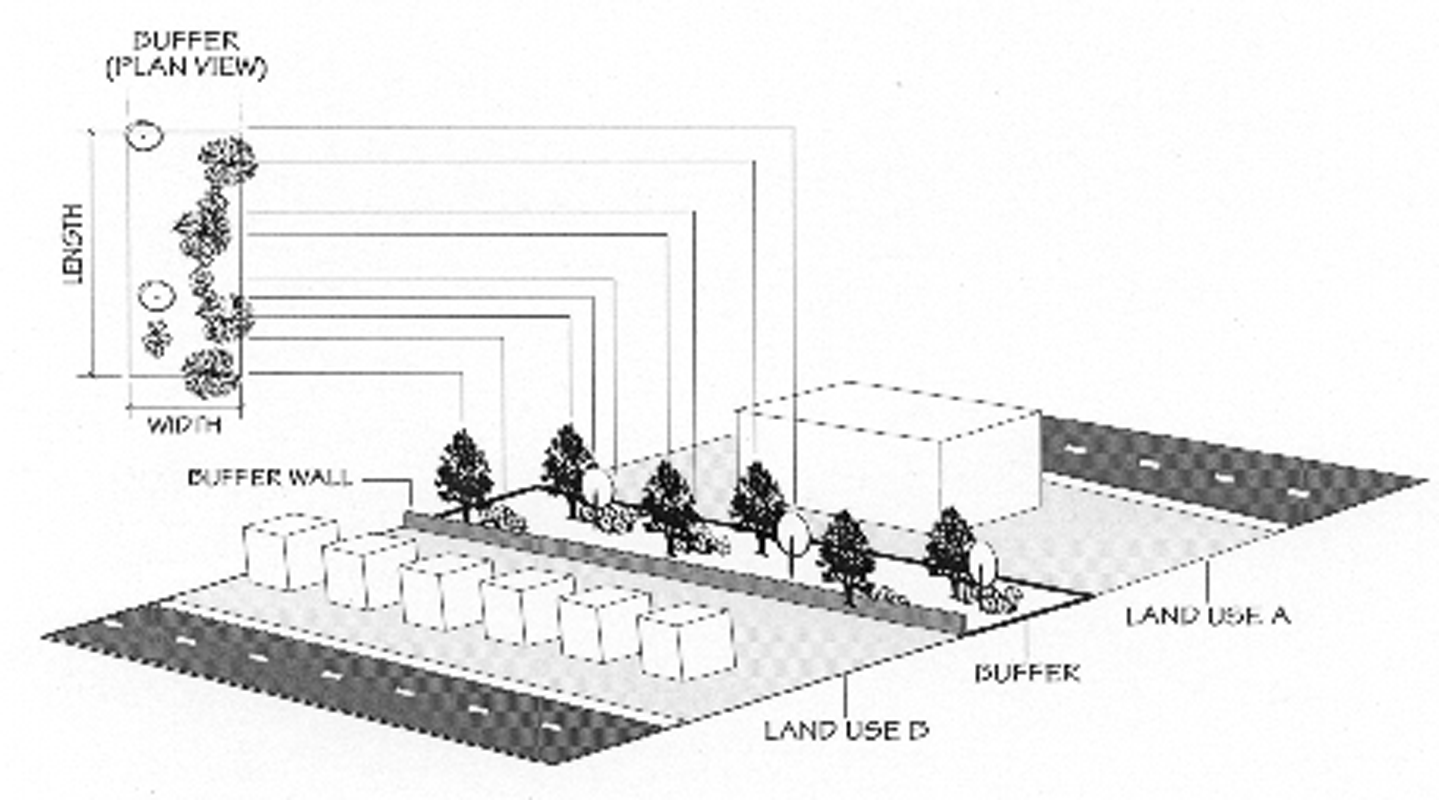
Buffers
Building: See development-related definitions.
Building, completely enclosed: See development-related definitions.
Building coverage: See development-related definitions.
Building elevation terminology:
Parapet line: A continuous vertical projection or wall running horizontally for the majority of a facade. See illustration.
Eave line: A horizontal line at the edge of a pitched roof. See illustration.
Recess line: a horizontal line, the full width of a facade, above which the facade is set back a specified distance from the facade below. See illustration.
Transition/expression line: A horizontal line, for a major part of the width of a facade, expressed by a variation of material or by a limited projection, such as a molding, awning or a balcony. See illustration.
Entry level: The maximum or minimum vertical dimension from the sidewalk level measured from the midpoints of the lot frontage to the entry floor of a building. See illustration.
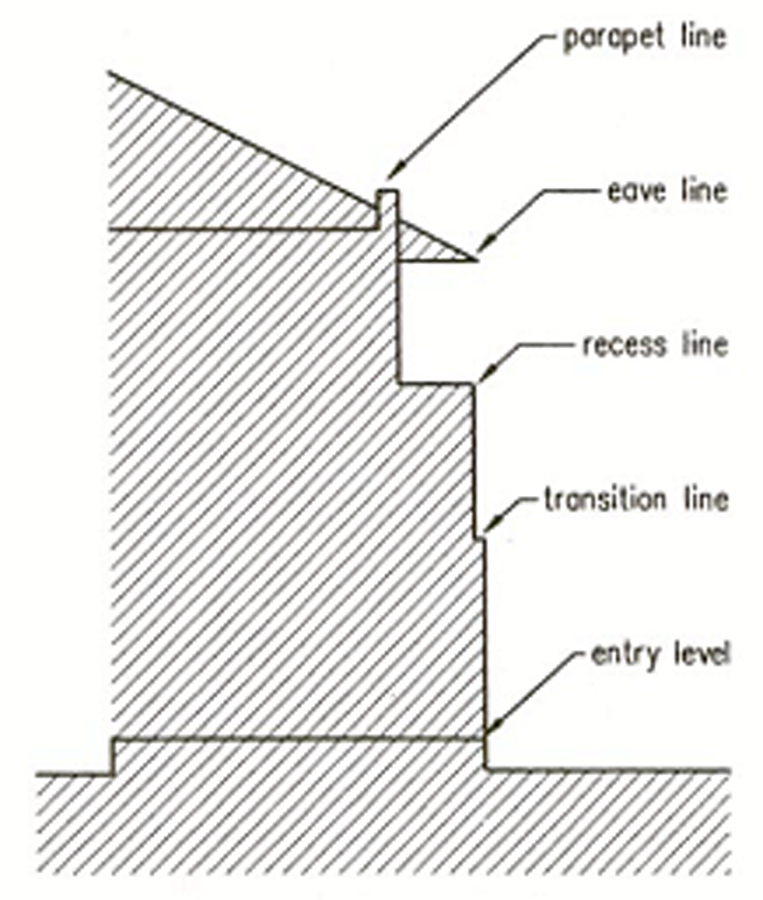
Building Elevation Terminology
Building frontage: See frontage terminology.
Building line: A line running parallel to a zoning lot line, that is the same distance from the zoning lot line as the closest portion of a building on the site.
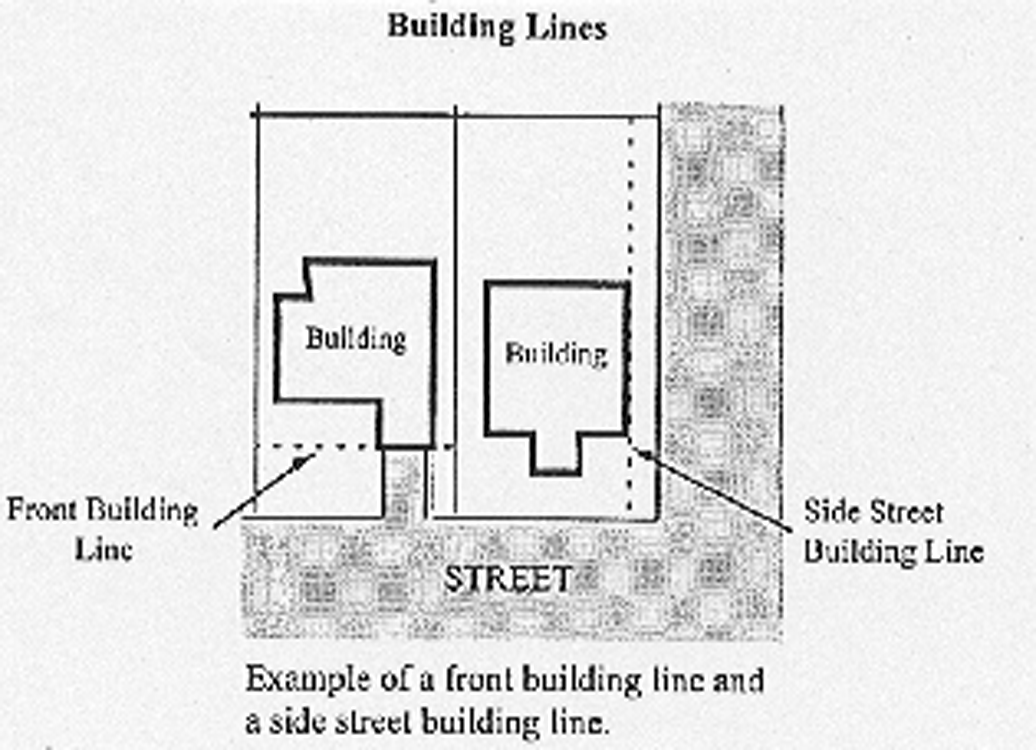
Building Lines
Building, principal: See primary structure.
Bus station (commercial): Facility for the pick up and discharge of passengers and freight for buses; includes ticket sales and may include administrative offices.
Business school: See vocational, business and trade school.
Camouflaging architectural treatment: Alternative tower structures such as manmade trees, clock towers, bell steeples, light poles, and similar alternative-design mounting structures that conceal the presence of antennas or towers. See also stealth facility.
Candlepower: The total luminous intensity of a light source expressed in foot-candles. Maximum (peak) candlepower is the largest amount of foot-candles emitted by any lamp, light source, or luminaire.
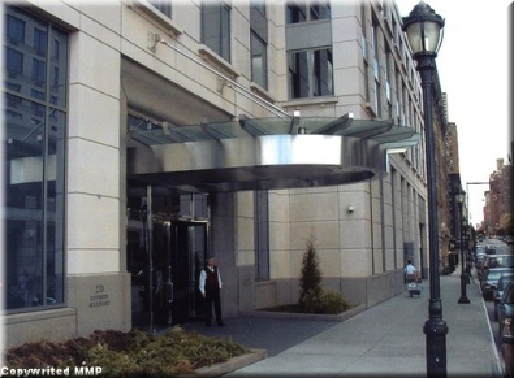
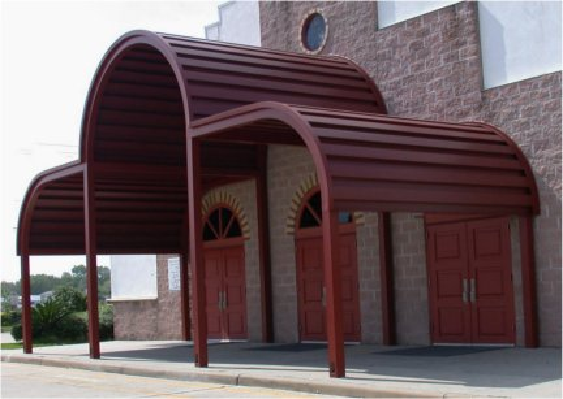
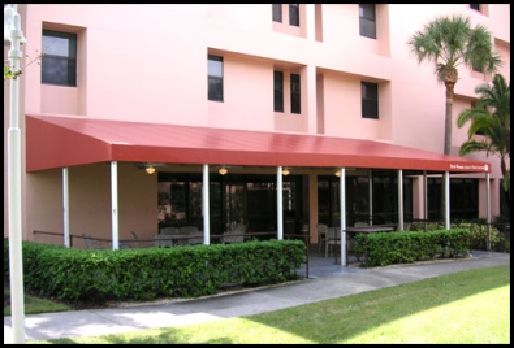
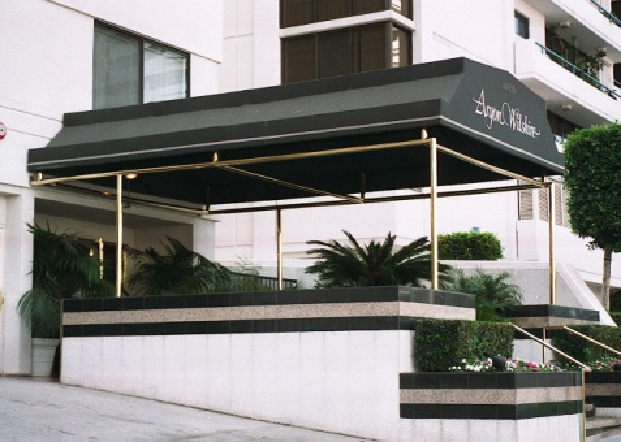
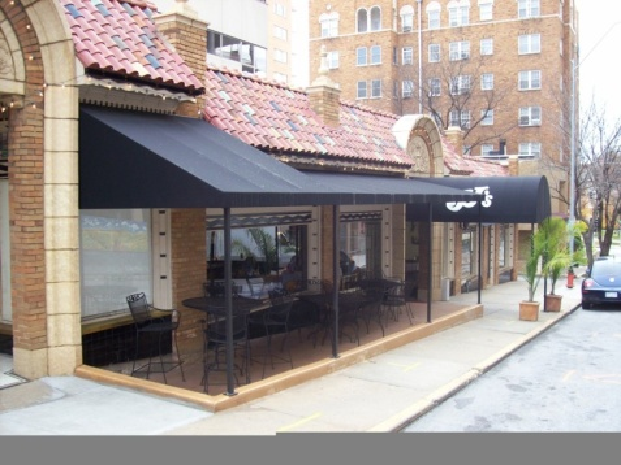
Canopy: A permanently roofed shelter cantilevered or otherwise extending from the exterior wall of a building, used to shade or screen windows or doors or the entire length of a facade, which may be wholly supported by a building or may be wholly or partially supported by columns, poles, or braces extending from the ground. Canopy structures typically differ from regular window and door awnings in that they are more permanent and often require structural steel, trusses and posts for added support. Canopies that extend along all or a significant length of a building facade may also be described as a gallery or light colonnade. See also awning and gallery under frontage terminology.
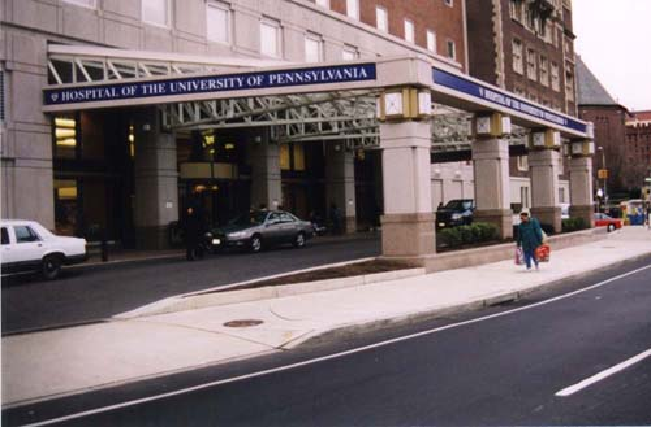 |  |  |
 |  |  |
Caretaker's dwelling: An accessory dwelling unit, generally associated with a nonresidential use, for the person/employee affiliated with the nonresidential use(s) on the zoning lot.
Carpet or flooring retail sales: Retail sales of carpet and other floor covering, in which less than 50 percent of the facility is storage area or installation work area that is not open to the general public.
Carport: An accessory structure or portion of a primary structure, not more than 75 percent enclosed by walls, consisting of a roof and supporting members such as columns or beams and designed for the storage of vehicles owned and used by the occupants of the building to which it is accessory.
Car wash, self-service: A cleaning facility for motor vehicles where the cleaning is physically performed by someone other than an employee of the facility, using supplies and water from the facility, and including coin-operated facilities.
Car wash, not self-service: Any staffed cleaning facility for motor vehicles, in which employees of the facility perform the cleaning.
Catering, commercial (off-site): Preparation of food and related materials for a special event, occasion, or other related contracts, which are to be delivered to a location other than where prepared.
Cell site: A zoning lot or portion of a zoning lot that contains a commercial wireless telecommunication antenna, its support structure, accessory building(s), and parking, and may include other uses associated with an ancillary to cellular communications transmission.
Cemeteries, mausoleum, and columbaria: Property used for the interring of the dead.
Certificate of appropriateness: A written authorization issued by the historic preservation board to a property owner for a proposed alteration, relocation, or demolition of an historically designated building.
Certificate of concurrency: The certificate issued by the city upon finding that an application for a development permit will not result in the reduction in the level of service standards set forth in the Sarasota City Plan for public facilities and services.
Certificate of occupancy: A document issued by the building department certifying that a newly constructed structure, addition to an existing structure, or existing structure undergoing a change in use is in full compliance with all applicable city codes and regulations.
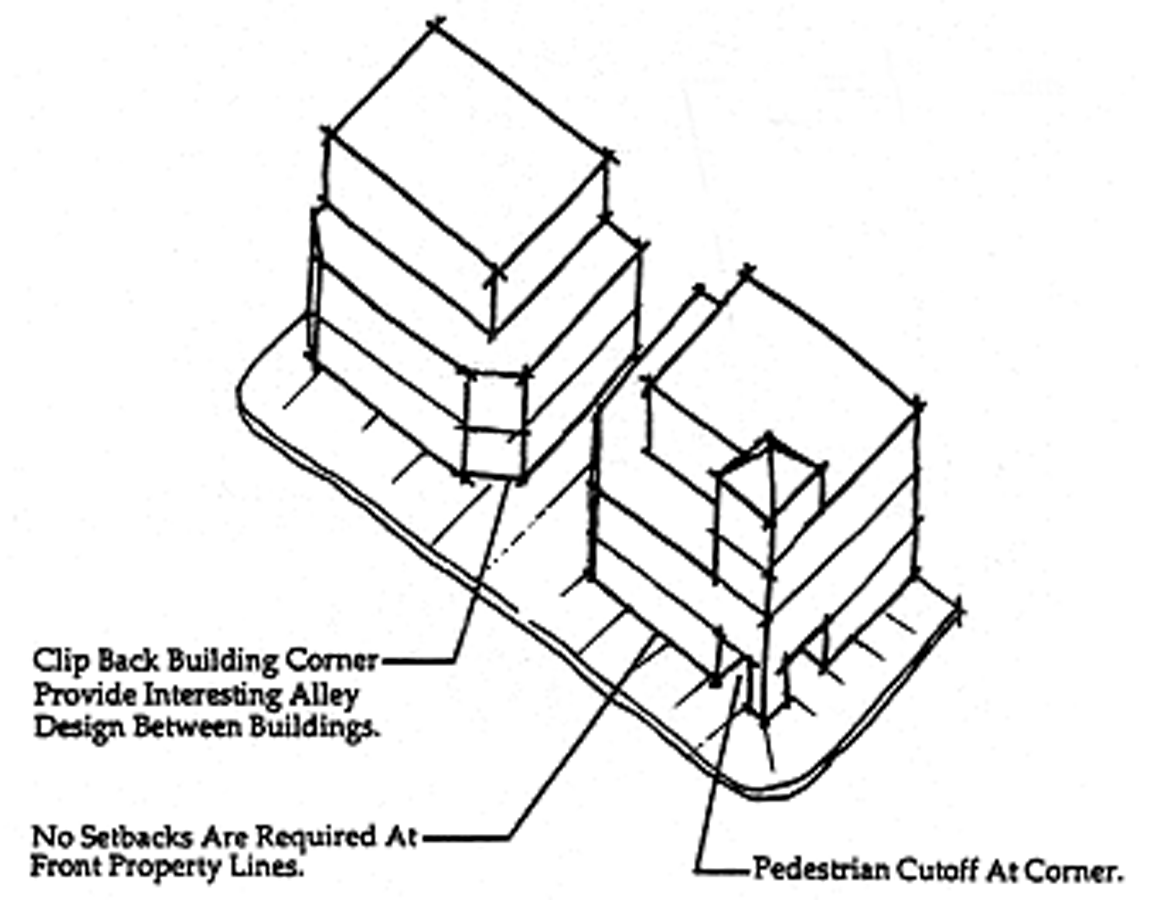
Chamfered corner: A building corner which is cut back to a diagonal or oblique angle in order to permit a clear view triangle for vehicles in an urban condition where setbacks from the front property line are not required. A chamfered corner is an excellent location for the door of a commercial establishment, as it taps into the pedestrian flow from both thoroughfares. See illustration below.
Change of occupancy: A discontinuance of an existing use, and the substitution therefor of a use of a different kind or class.
Change of use: Change of the primary type of activity on a zoning lot.
Child care center: A facility which provides care, protection and supervision of children for a period of less than 24 hours a day for more than five children unrelated to the operator, which is licensed under the provisions of F.S. § 402.302. See also day care, family.
Church/synagogue: Tax-exempt buildings used for nonprofit purposes by a recognized and legally established religious organization for the purpose of worship, including such legal accessory uses as may be operated by such church/synagogue.
City: The City of Sarasota, Florida.
City manager: The city manager of the City of Sarasota or his designee.
Civic boardwalk and pier: A government-owned structure which provides public open space, which extends from land but is located primarily over water (seaward of the mean high-water line), which is contiguous to the G zone district or public or government-owned land, and which consists of overwater pathways, conveyance areas and/or platforms providing public access to overwater locations for the purpose of recreation, public gathering, and/or conveyance. A civic boardwalk and pier may also be used for fishing and non-motorized boating access. Shade structures over walkways, conveyance areas and platforms are permissible.
Clinic, medical: See office or clinic, medical or dental.
Club, private: A facility used by a group of people organized for a common purpose to pursue common goals, interests or activities and usually characterized by certain membership qualifications, payment of fees and dues, regular meetings, and a constitution and bylaws. See also club, private recreation; country club; and health club.
Club, private recreation: A land area and one or more buildings and structures containing recreational facilities, club house and usual accessory uses, operated for the pleasure and recreation only of its members and their guests for a membership fee, which may include, but are not limited to, indoor restaurant, bar, lounge, meeting rooms, exercise and sauna, outdoor swimming pool, tennis courts, shuffle board courts, cabanas, outdoor furniture and other similar facilities. See also club, private; country club; and health club.
Cluster development: A development design technique that concentrates buildings in specific areas on a site to allow the remaining land to be used for recreation, common open space, and preservation of environmentally sensitive areas.
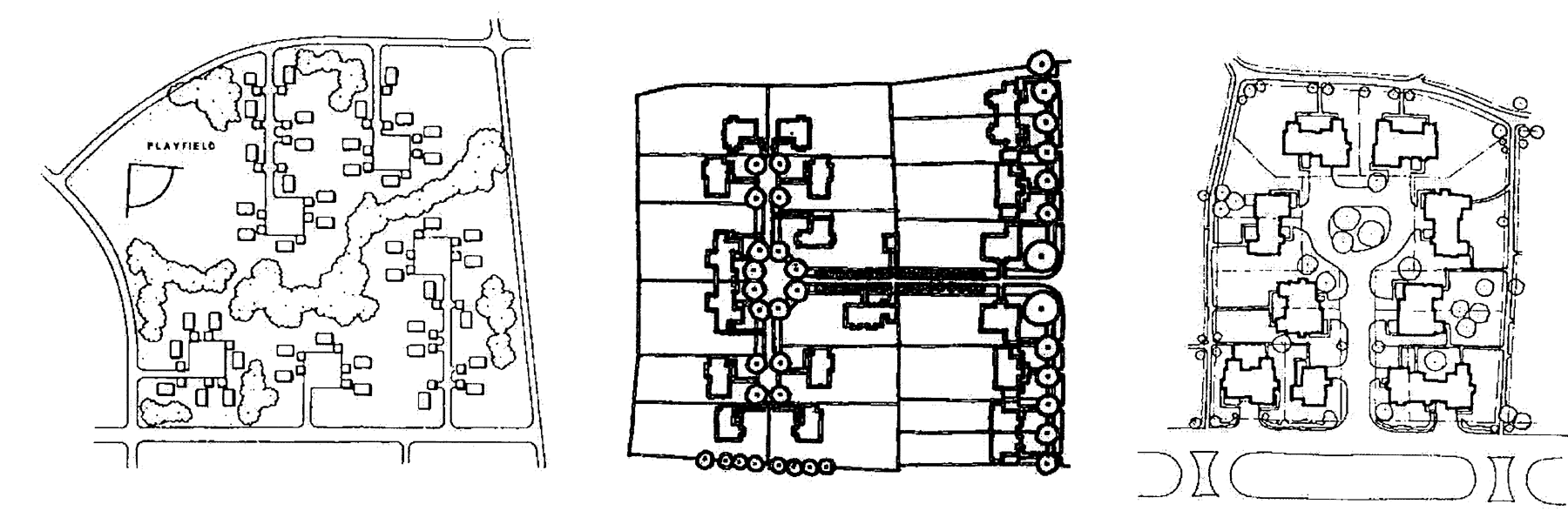
Examples of Cluster Development Areas
Cottage court housing development: See residential structure types.
Co-location: Locating wireless communications equipment from more than one provider on a single tower, building or structure.
Cold storage facility: A facility primarily engaged in the warehousing and storage of goods under refrigeration; may include incidental processing, preparing, or packaging of items for storage.
Collapse zone: The area surrounding a commercial wireless telecommunication tower within which the tower would fall or collapse in the event of a structural failure of all, or part, of the tower.
Collector street: See transportation-related definitions.
College, university or seminary: An institution of higher education, including teaching and research, and offering a course of general studies leading to advanced academic degrees; which may include related facilities such as, but not limited to, classroom buildings; libraries; laboratories; dormitories (except when specifically prohibited); administration; physical plant; dining hall; campus center; theater; student gymnasium, stadium, field house. See also school and vocational, business, and trade school.
Commercial use: An occupation, employment, enterprise or activity that is carried on for profit, or not for profit, by the owner, lessee or licensee.
Commercial wireless telecommunication facility: A cellular telecommunications facility consisting of the equipment and structures involved in receiving telecommunication or radio signals from mobile radio communications sources and transmitting those signals to a central switching computer which connects the mobile unit with the land-based telephone lines.
Commercial wireless telecommunication services: Licensed commercial wireless telecommunication services including cellular, personal communication services, specialized mobilized radio, enhanced specialized mobilized radio, paging, and similar services that are marketed to the general public.
Common yard: See frontage terminology.
Community residential home: A dwelling unit licensed to serve clients of the department of children and family services which provides a living environment for seven to 14 unrelated residents who operate as the functional equivalent of a family, including such supervision and care by supportive staff as may be necessary to meet the physical, emotional and social needs of the residents. See also adult day care center, assisted living facility, group home facility and Nursing home.
Community residential home resident: A frail elder person as defined in F.S. § 400.618; a physically disabled or handicapped person as defined in F.S. § 760.22; a developmentally disabled person as defined in F.S. § 393.063; a non-dangerous mentally ill person as defined in F.S. § 394.455; or a child as defined in F.S. § 39.01.
Complete application: An application for development approval that contains the supporting documentation required by these regulations.
Concurrency: The existence of sufficient infrastructure to maintain adopted levels of service impacted by development.
Concurrency management system: The procedures and processes utilized by the city to determine that development permits, when issued, will not result in the reduction of the level of service standards set forth in the Sarasota City Plan.
Conditional use: A use that has operational, physical and other characteristics that may be different from those of the predominant permitted uses in a zoning district, but which is a use that complements or may otherwise be compatible with the intended over-all development within a district, provided that specified standards are met.
Consistent with the Sarasota City Plan: The land uses, densities or intensities, and other aspects of development permitted by a development permit are compatible with and further the goals, objectives, and action strategies of the Sarasota City Plan, as may be amended.
Consolidation: The removal of common property lines between abutting zoning lots in the same ownership. See also boundary adjustment.
Consolidation plat: A legal document, prepared by a qualified professional licensed to prepare such in the state, for the purpose of the legal removal of common property lines between abutting zoning lots in the same ownership. See also boundary adjustment plat.
Construction, actual commencement of: The lawful placing of substantial construction materials in permanent position, fastened in a permanent manner; except that, where demolition, excavation or removal of an existing structure has been substantially begun preparatory to new construction, such excavation, demolition or removal shall be deemed to be actual construction.
Construction, continual: Construction performed by a full complement of workers and equipment mobilized at the project site, actively engaged in incorporating materials and equipment into the building or structure each normal working day.
Construction costs: The total value of the construction of, or reconstruction work on structures, as determined by the director of building, zoning and code enforcement in issuing a building permit for construction or reconstruction.
Construction equipment: The construction machinery, vehicles, tools, derricks, hoists, scaffolds, platforms, runways, ladders and all material, handling equipment, safeguards, and protective devices used in construction operations.
Construction operation: The erection, repair, renovation, demolition or removal of any building or structure; and the excavation, filling, grading and alteration of property in connection therewith.
Contractor or tradesman: Building or service industry contractors, including but not limited to plumbing, heating, air conditioning, carpentry, electrical, masonry, and metal working.
Contractor or tradesman's shop (limited): A shop that does not involve millwork, operation of heavy equipment, furnaces, or heating pots, or the dipping of furniture. Cabinet-making, floor work, duct work, framing and other similar light work on or off-site is permitted.
Contractor or tradesman's shop (unlimited): Contracting or trade operations involving millwork with industrial lathe, heavy equipment, furnaces or heating pots, automated tools, or the dipping or refinishing of furniture, or similar processes.
Convenience store: See retail structure types.
Convention, conference center: A facility used for business or professional conferences and seminars, often with accommodations for sleeping, eating and recreation.
Copy, duplicating shop: A retail establishment that provides duplicating services using photocopying, blueprint, and computer printing equipment, and may include the collating and binding of booklets and reports.
Country club: A land area and buildings containing recreational facilities, club house and usual accessory uses, primarily open to members and their guests for a membership fee; may include but are not limited to swimming pools, tennis courts, squash courts, golf courses, stables and riding facilities, polo and equestrian events but not racetracks, and may include dining facilities, which may also include a lounge, a conference room, and a bar all of which may be for use by members, guests, and the general public. See also club, private; club, private recreation; and health club.
Cutoff: The point at which all light rays emitted by a lamp, light source, or luminaire are completely eliminated (cutoff) at a specific angle above the ground.
Cutoff angle: The angle formed by a line drawn from the direction of light rays at the light source and a line perpendicular to the ground from the light source, above which no light is emitted.
Crematory: A facility that provides for the incineration of corpses.
Day care, family: Family day care home means an occupied residence in which child care is regularly provided for children from at least two unrelated families and which receives a payment, fee or grant for any of the children receiving care, whether or not operated for profit. A family day care home shall be allowed to provide care for one of the following groups of children, which shall include those children under 13 years of age who are related to the caregiver:
(a)
A maximum of four children from birth to 12 months of age.
(b)
A maximum of three children from birth to 12 months of age, and other children, for a maximum total of six children.
(c)
A maximum of six preschool children if all are older than 12 months of age.
(d)
A maximum of ten children if no more than five are preschool age and, of those five, no more than two are under 12 months of age.
(See also child care center)
State Law reference— Similar provisions, F.S. § 402.301, as amended.
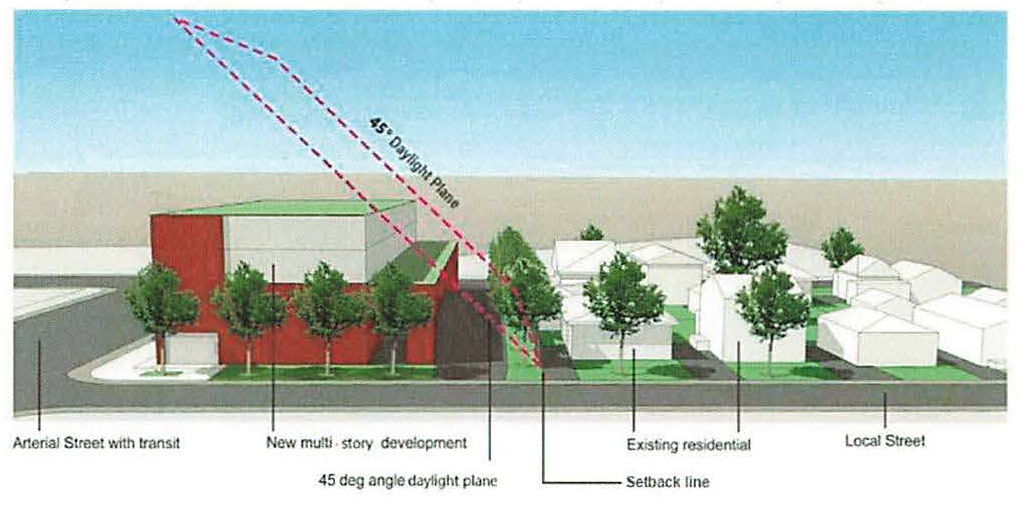
Daylight plane (non-single-family): An angled building height limitation that regulates the massing and design of buildings and defines the building envelope within which new structures must be contained. The purpose of the daylight plane requirement is to enhance compatibility by a gradual increase in height between developments; promote a reasonable building scale; and promote privacy for neighboring properties. The daylight plane may further limit the height or horizontal extent of the building at any specific point where the daylight plane is more restrictive than the height limit applicable at such point on the site. See section VI-102(u) for daylight plane requirements applicable to single-family dwellings.
Demolition: The complete or constructive removal of a structure or any substantial part thereof.
Density: A measurement (ratio), generally used for residential purposes, of the number of people or dwelling units in relationship to a specified amount of land. See also intensity and floor area ratio.
Department of building, zoning and code compliance: The director of building, zoning and code compliance and the staff of the building, zoning and code compliance department. All references to the "department of building, zoning and code enforcement" or the "department of building, zoning and code compliance," as utilized in these regulations, shall mean the "department of neighborhood and development services."
Department of engineering: The city engineer/director of engineering and the staff of the engineering department. All references to the "department of engineering" or "engineering department," as utilized in these regulations, shall mean the "department of public works".
Department of neighborhood and development services: The director of neighborhood services and the staff of the neighborhood and development services department.
Department of planning: The director of planning and the staff of the planning department. All references to the "department of planning" or "department of planning and development" or the "department of planning and redevelopment," as utilized in these regulations, shall mean the "director of neighborhood and development services."
Department of public works: The director of public works and the staff of the public works department.
Department store: See retail structure types.
Detention pond: Depressions in the earth for the temporary storage of surface runoff with the controlled release of the stored water over a period of time. See also drainageway and retention pond.
Develop: See development-related definitions.
Development: See development-related definitions.
Development project: See development-related definitions.
Development-related definitions:
(1)
Accessory building: See accessory and residential structure types, accessory dwelling unit.
(2)
Alter or alteration: Any change, rearrangement, enlargement, extension, or reduction of any structure or zoning lot, or any change in a category of occupancy of a structure. Alteration includes any of the following:
a.
Changes to the facade of a building;
b.
Changes to the interior of a building;
c.
Increases or decreases in floor area of a building;
d.
Changes to other structures on the zoning lot, or the construction of a new structure;
e.
Changes to exterior improvements;
f.
Changes in the topography of a zoning lot.
(3)
Building: Any structure that encloses a space used for sheltering any occupancy. Each portion of a building separated from other portions by a firewall shall be considered as a separate building.
(4)
Building coverage: The percent of a zoning lot that is covered by buildings or other roofed structures, excluding eaves, and that provides an impervious cover over what is below.
(5)
Completely enclosed building: A building separated on all sides from adjacent open space or from other buildings by permanent roof and by exterior walls or party walls, pierced only by closed windows and normal entrance or exit doors. Such doors shall not be kept open except for normal ingress and egress. This definition shall apply to any building in existence as of January 26, 1998 and to any building constructed thereafter.
(6)
Develop: To construct or alter a structure or to make a physical change to the land including excavations and fills.
(7)
Development: Includes any of the following activities:
a.
The subdivision of a zoning lot;
b.
The construction, reconstruction, conversion, structural alteration, relocation, enlargement, or demolition of a structure;
c.
The mining, excavation, landfill, drilling, grading, deposition of refuse, solid or liquid waste, or fill on a zoning lot;
d.
The alteration of the shore or bank of a pond, lake, river, or other waterway;
e.
Any use or change in the use or intensity of use of any structure or any change in the intensity of use of land.
(8)
Development agreement: An agreement between the city and one or more persons entered into pursuant to F.S. §§ 163.3220 through 163.3243.
(9)
Development approval: Development approvals include any of the following:
a.
Adjustments;
b.
Building permit;
c.
Site plans;
d.
Rezoning;
e.
Preliminary and final plats;
f.
Conditional use;
g.
Variances;
h.
Development permits for developments of regional impact;
i.
Historic designation;
j.
Certificate of appropriateness;
k.
Adult use permits;
l.
Development agreements;
m.
"G" zone waiver;
n.
Off-site parking agreement.
(10)
Development permit: Any action granting, denying or granting with conditions an application for a development approval.
(11)
Development project: All improvements on a zoning lot, including buildings, other structures, parking and loading areas, landscaping, paved or graveled areas, and areas devoted to exterior display, storage, or activities. Development includes improved open areas such as plazas and walkways, but does not include natural geologic forms or unimproved land. See also exterior improvements.
(12)
Development types:
a.
Auto-accommodating development. Development that is designed with an emphasis on patrons who use automobiles to travel to the site, rather than orienting to pedestrians. This type of development usually has large areas of the site devoted to surface parking and the main building entrance is oriented to the parking area. In many cases, the site will have parking between the street and the building. Other typical characteristics are blank walls along much of the facade, more than one driveway, and a low percentage of the site covered by buildings. See also pedestrian-oriented development.
b.
Pedestrian-oriented development. Development, which is oriented primarily towards the street sidewalk and on pedestrian access to the site and building, rather than on auto access and surface parking areas. Buildings are generally placed close to the street and main entrances are oriented to the street sidewalk. There are generally storefront windows or display cases along building facades that face the street. Typically, buildings cover a large portion of the site. Although on-site parking areas may be provided, they are generally limited in size and they are not emphasized by the design of the site (i.e. no parking in front yards). See also auto-accommodating development.
(13)
Exterior alteration: A physical change to a zoning lot that is outside of any buildings. Exterior alteration does not include normal maintenance and repair or total demolition. Exterior alteration includes any of the following:
a.
Changes to the facades of a building;
b.
Increases or decreases in the floor area that result in changes to the exterior of a building;
c.
Changes to other structures on the zoning lot or the construction of a new structure;
d.
Changes to exterior improvements;
e.
Changes to landscaping;
f.
Changes in the topography of a zoning lot.
(14)
Exterior improvements: All improvements except buildings or other roofed structures. Exterior improvements include surface parking and loading areas, paved and graveled areas, and areas devoted to exterior display, storage, or activities. It includes improved areas such as plazas and walkways, but does not include vegetative landscaping, natural geologic forms or unimproved land. See also development project.
(15)
Liner building: A building, shallow in depth, conceived specifically to mask a parking lot, parking structure or blank wall from the frontage. See illustration below.
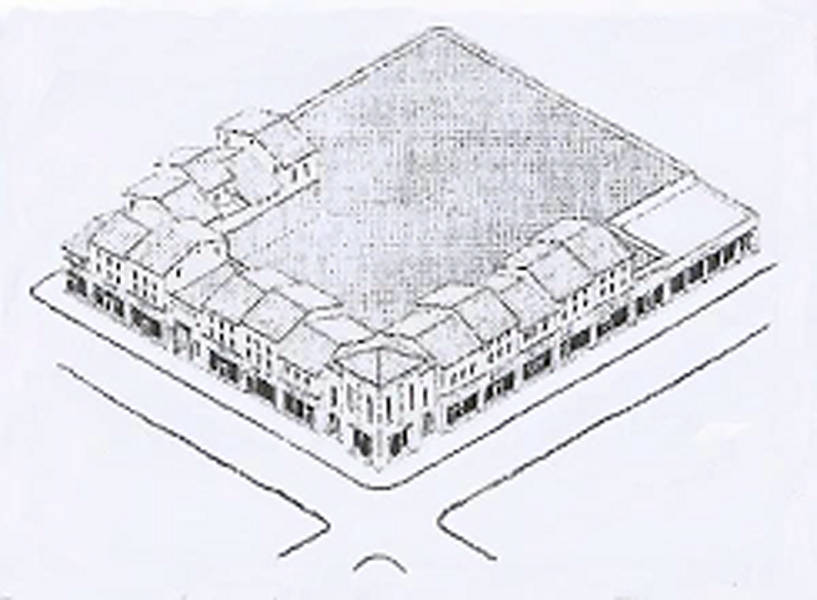
Liner Building
(16)
Structure: Any assembly of materials constructed or erected on, in, or over (or any combination thereof) land or water, that are attached to something having a location on the ground. The word structure shall be construed as though followed by the words "or parts thereof" unless the context clearly requires a different meaning. The word structure shall include buildings, decks, fences, towers, flagpoles, signs, and other similar objects. Structure does not include paved areas or vegetative landscaping materials or objects that are not permanently secured to the ground.
(17)
Reserved.
(18)
Reserved.
(19)
Structures, non-water dependent: Gazebos, awnings, canopies, sundecks, boathouses, screen houses, or other enclosed or semi-enclosed structures, or any other structures not dependent upon the water. This definition shall not include fish cleaning tables, benches, boat lockers, boatlifts or davits.
(20)
Structure, nonresidential: A structure where no sleeping accommodations are provided, except that hotels and motels shall be deemed nonresidential structures.
(21)
Structure, residential: A structure where sleeping accommodations are provided, excluding hotels and motels. See also residential structure types.
Diameter at breast height (DBH): Diameter of a tree measured in inches at four and one-half feet above the natural grade.
Direct broadcast satellite service antenna: An antenna that is designed to receive direct broadcast satellite service, including direct-to-home satellite services.
Director of building, zoning and code compliance: The director of building, zoning and code compliance of the city or his/her designee. All references to the "manager of building and zoning and code enforcement" or "director of building," or "director of building, zoning and code enforcement," "director of building, zoning and code compliance," or "building director," or "building, zoning and code enforcement director," or "building, zoning, and code compliance director," as utilized in these regulations shall mean the "director of neighborhood and development services."
Director of neighborhood and development services: The director of neighborhood and development services of the city or his/her designee.
Director of planning: The director of planning or his/her designee. All references to the "director of planning," or "director of planning and development," or "director of planning and redevelopment," or "planning director," or "planning and development director," or "planning and redevelopment director," as utilized in these regulations, shall mean the "director of neighborhood and development services."
Director of public works: The director of public works or his/her designee.
District: A part or geographic area within the city within which certain land development regulations apply.
Dock: Any structure, whether fixed or floating, secured on or by a piling, seaward of mean high water which is designed for or capable of being used to moor a water vessel, whether or not motorized.
Dock, access: That part of a dock that is connected to uplands, and leads to terminal platform and finger piers.
Dock, commercial: A dock intended for the mooring of vessels for commercial purposes.
Dock, community: A facility with a waterfront location for secure mooring of boats provided in conjunction with a residential single-family subdivision for use by residents of the development as opposed to the public at large.
Dock, marginal: A dock not exceeding eight feet in width or 250 square feet, placed immediately contiguous and parallel to a functional vertical bulkhead.
Dock, private: A dock that is intended for the mooring of boats not for commercial purposes.
Dooryard or light court: See frontage terminology.
Dormitory, educational: A dwelling owned or operated by a school or college and intended to be occupied by students of the educational institution, which does not provide separate kitchen facilities in the rooms.
Drainageway: An open linear depression, whether manmade or natural, for the collection and conveyance of surface water. It may be permanently or temporarily inundated. See also detention pond and retention pond.
Drip line: An imaginary, perpendicular line that extends downward from the outermost tips of a tree's branches to the ground.
Drive-through facility: An establishment that by design, physical features, or service, encourages or permits customers to receive services, or obtain goods, while remaining in their motor vehicles.
Driveway: The area that provides vehicular access to a zoning lot. A driveway begins at the property line and extends into the zoning lot. Driveway does not include parking, maneuvering, or circulation areas in parking areas. See also garage (private and public), parking area, parking lot or garage (commercial), parking space, structured parking, surface parking, and vehicle areas.
Drugstore: An establishment engaged in the sale of non-prescription medicine and a variety of general products including consumable and non-consumable products including, but not limited to, pre-packaged food and beverage, batteries, electronics, beer and wine, toiletries, healthcare products, vitamins, nutritional supplements and beauty supplies.
Dry cleaning establishment (non-self-service): A staffed business enterprise offering dry cleaning of clothing and related services at retail to the general public.
Dry marine slip: A space designed for the storage of single watercraft in an upland location with access to a waterway from the upland location.
Duplex: See residential structure types.
Dwelling, accessory: See residential structure types.
Dwelling, single-family: See residential structure types.
Dwelling, multiple family, large: See residential structure types.
Dwelling, multiple family, small: See residential structure types.
Dwelling, two-family (duplex): See residential structure types.
Dwelling unit: See residential structure types.
Eave line: See building elevation terminology.
Emergency: Any occurrence or set of circumstances involving actual or imminent physical trauma or property damage that necessitates immediate action.
Emergency work: Work necessary to restore property to a safe condition following an emergency, or work required to protect persons or property from exposure to imminent danger or damage.
Entry level: See building elevation terminology.
Environmentally sensitive area: All lands and waters, publicly and privately owned, which are landward of the mean high water line and which exhibits one or both of the following characteristics:
(1)
The area is identified as a marine or estuarine habitat or upland area (on barrier islands) in the most current wetlands inventory maps (U.S. Department of the Interior); or
(2)
The area exhibits a landward extent of waters of the state by the presence of one or a combination of dominant plant species identified in VI-907E.
Erected: Includes "built," "constructed," "developed," "reconstructed," "moved upon" or any physical operation required for building. Excavation, fill, drainage, demolition of an existing structure and similar activities shall be considered part of erection. See construction, actual.
Essential governmental services: Distribution or service connection facilities, structures, and appurtenances thereto, for gas, electricity, land line telephone, water, sanitary sewer, storm water, fuel, law enforcement and fire and rescue services, and other similar consumable public commodities or services owned and operated by a governmental entity or public utility; not including jails, fire stations, electric or gas generating plants, sewage treatment facilities, water treatment or aeration facilities.
Excavation: Any act by which earth, sand, gravel, concrete, asphalt and similar nondecomposable materials, whether permanent or temporary in nature, are dug into, cut, quarried, uncovered, removed, displaced, relocated, or bulldozed, including the conditions resulting therefrom. Excavation, for purposes of these land development regulations, does not include the movement of earth or gravel, asphalt or other paving materials that is done in conjunction with road improvements within public rights-of-way. See also fill and grade.
Expert witness: A person who has special professional training and experience or special knowledge or skill about the subject upon which (s)he is called to testify.
Extended property line: An imaginary line that extends the line connecting the front and rear zoning lot lines at each side of the zoning lot. See also zoning lot.
Exterior: All outside surfaces of a building or structure.
Exterior alteration: See development-related definitions.
Exterior display: Exterior display is an outdoor showroom for customers to examine and compare products and includes the outdoor display of products, vehicles, equipment and machinery for sale or lease. The display area does not have to be visible to the street. Examples of uses that often have exterior display are motor vehicle and boat sales, and plant nurseries.
Exterior display does not include goods that are being stored or parked outside. It does not include damaged motor vehicles, vehicles or equipment being serviced, and other similar products. See also exterior storage.
Exterior improvements: See development-related definitions.
Exterior storage: Exterior storage includes the outdoor storage of goods that generally have little or no differentiation by type. The goods may be for sale or lease, but if so, they are the types that customers generally do not inspect and compare. Exterior storage includes the storage of raw or finished goods (packaged or bulk), including gases, oil, chemicals, gravel; building materials, packing materials; salvage goods; machinery, tools, and equipment; and other similar items. Examples are lumberyards, tool and equipment rental, bark chip and gravel sales, and storage of goods used in manufacturing. Damaged or inoperable motor vehicles or motor vehicles that have missing parts that are kept outside are included as exterior storage. The storage of motor vehicles that do not have any missing parts or damage that is visible from the outside of the vehicle is considered parking rather than exterior storage. The storage of motor vehicles that have minor dents or other minor defects in the body is also considered parking rather than storage if the motor vehicle is in working order. See also exterior display.
Exterior work activities: Exterior work activities include the outdoor processing, assembly, or fabrication of goods; the maintenance, repair, and salvage of vehicles and equipment; and other similar activities that generally have an industrial orientation. Exterior work activities do not include normal pick-up and deliveries to a site, parking, excavation and fills, accessory outdoor restaurants and sidewalk cafes, outdoor recreation, or outdoor markets. See exterior display and exterior storage.
Facade: See frontage terminology.
Family: An individual, or two or more persons related by blood, marriage or adoption, living together as a single housekeeping unit; or a group of not more than four persons not related by blood, marriage or adoption, living together as a single housekeeping unit.
Family day care: See day care, family.
Fill: Any act by which earth, sand, shell, gravel, rock or similar material is pushed, placed, dumped, stacked, or in any way moved to a new location above the existing natural surface of the ground or on the top of a stripped surface, including the condition resulting therefrom. Fill, for purposes of these land development regulations, does not include the placement of earth or gravel, asphalt or other paving materials that is done in conjunction with road improvements within public rights-of-way. See also: excavation and grade.
Financial institution: Any establishment, the primary business of which is concerned with such state or federally regulated activities as banking, savings and loans, and consumer loan companies.
Finger piers: That part of a dock that is connected to the access dock and is used for securing or lading a vessel on a multi-slip dock.
Flag zoning lot: See zoning lot.
Florida-friendly plant species: Includes plants or landscapes that conserve water, protect the environment, are adaptable to local conditions, and are drought-tolerant. Specific plant species include those listed for the Central Region on the most recent version of the Florida-Friendly Plant List published by the University of Florida IFAS Extension or Florida Yards and Neighborhoods.
Floor area: The total floor area of the portion of a building that is above ground. Floor area is measured from the exterior faces of a building or structure. Floor area does not include any of the following:
a.
Vent shafts and courts;
b.
Basement areas with more than one-half of its height above ground level;
c.
Roof area;
d.
Roof top mechanical equipment, and associated enclosures;
e.
Roofed porches, exterior balconies, or other similar areas, unless they are enclosed by walls that are more than 42 inches in height, for 50 percent or more of their perimeter;
f.
Structured parking garages.
Floor area, gross: The total floor area of a building that is both above and below ground. Gross building area is measured from the exterior faces of a building or structure. Gross floor area does not include any of the following:
(1)
Roof area;
(2)
Roof top mechanical equipment, and associated enclosures;
(3)
Roofed porches, exterior balconies, or other similar areas, unless they are enclosed by walls that are more than 42 inches in height, for 50 percent or more of their perimeter.
Floor area, gross leasable: The total floor area of a building that is both above and below ground. Gross building area is measured from the interior faces of a building or structure. Gross floor area does not include any of the following:
(1)
Roof area;
(2)
Roof top mechanical equipment, and associated enclosures;
(3)
Roofed porches, exterior balconies, or other similar areas, unless they are enclosed by walls that are more than 42 inches in height, for 50 percent or more of their perimeter.
Floor area ratio (FAR): The total amount of gross floor area of all buildings, excluding structured parking, on a zoning lot in relation to the total square footage of zoning lot area, expressed as a ratio. For example, a floor area ratio of 2:1 means two square feet of floor area for every square foot of zoning lot area.
0.5 FAR—One story on 50 percent of zoning lot or two stories on 25 percent of zoning lot
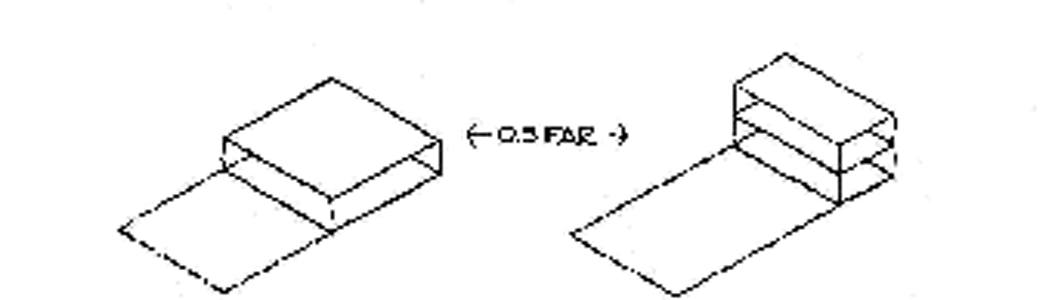
0.5 FAR Floor Area Ratio
2.0 FAR—Two stories on 100 percent of zoning lot or four stories on 50 percent of zoning lot
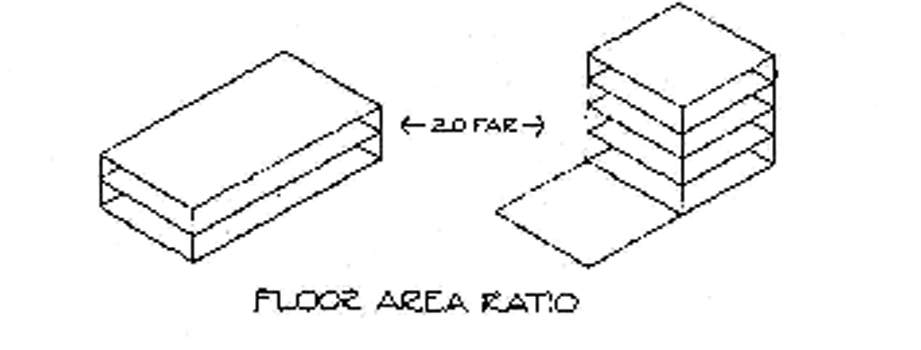
2.0 Floor Area Ratio
Florida master site file: The list or catalogue of all recorded historical and archaeological sites and properties in the state maintained by the state department of state, division of historical resources.
Food pantry: A non-profit organization or establishment maintains unprepared food, or other provisions for distribution at no cost, or very low cost, to people in need.
Food store: A retail facility primarily engaged in the sale of foodstuffs and related materials.
Foot-candle: A unit for measuring illumination, which is equal to the amount of light, from a uniform point source of light on a square foot of surface which is one foot away.
Forecourt: See frontage terminology.
Frontage line: See frontage terminology.
Frontage terminology (for downtown zone districts and urban mixed-use zone districts):
(1)
Building frontage: The layer in front of the building facade. The variables of building frontage are the depth of the setback and the combination of architectural elements such as fences, stoops, porches, and galleries. The frontage layer may overlap the public streetscape in case of awnings, galleries and arcades.
(2)
Facade: An exterior wall of a building that is set along a frontage line. This refers to all surfaces parallel to the frontage line, though not necessarily flush with it. See illustration.
(3)
Frontage line: Those lot lines that coincide with a street. Streets, defined by this Code, do not include alleys. See illustration.
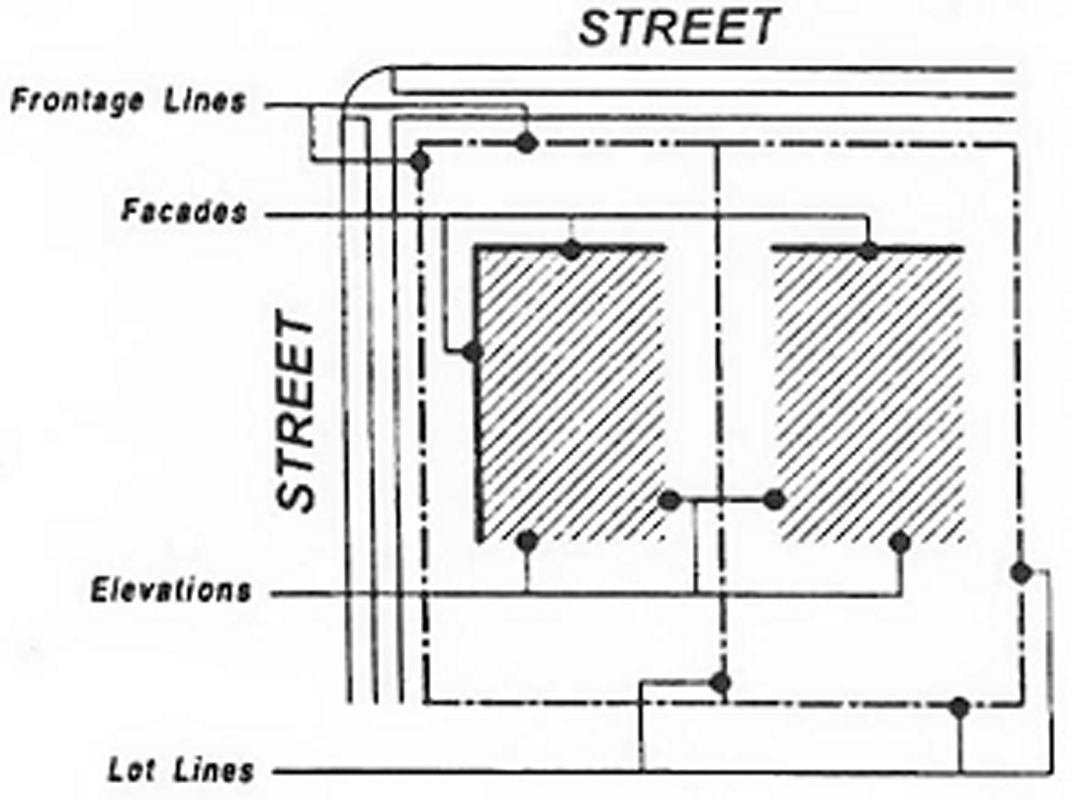
Frontage Terminology 1
(4)
Layer: The depth of the lot measured from the frontage line within which certain elements are permitted. The first layer is the area between the frontage line and the facade line. The second layer is the area between the facade line and 20 feet from the same facade. The third layer is the area that begins 20 feet behind the same facade line and continues to the rear property line. See illustration.
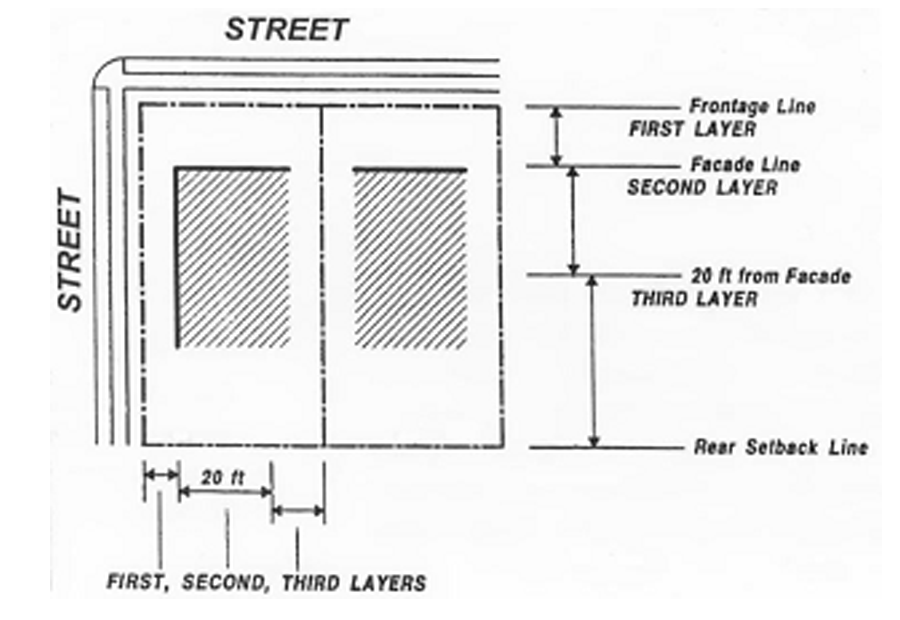
Frontage Terminology 2
(5)
Streetwall: A freestanding masonry wall built along the front lot line, or generally coplanar with the facade, often for the purpose of masking a parking lot from the street. The opaque portions of the streetwall shall not exceed three and one-half feet in height, except for optional pilasters. Decorative metal (wrought iron or aluminum) may be incorporated in the streetwall materials.
(6)
Building frontage types:
a.
Common yard: A frontage wherein the facade is setback substantially from the frontage line. The front yard thus created remains unfenced and is visually continuous in landscaping with adjacent yards simulating a common rural landscape. Common yards are suitable along higher speed thoroughfares, as the setback provides a buffer.
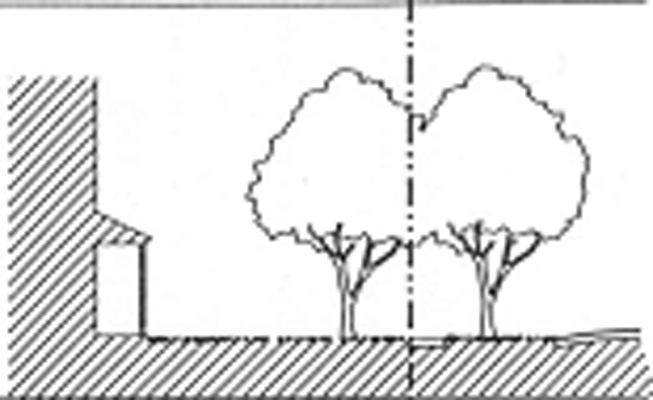
Common Yard
b.
Porch and fence: A frontage wherein the facade is set back from the frontage line with an attached porch. The porch should be within a conversational distance of the sidewalk. A fence at the frontage line maintains the demarcation of the yard.
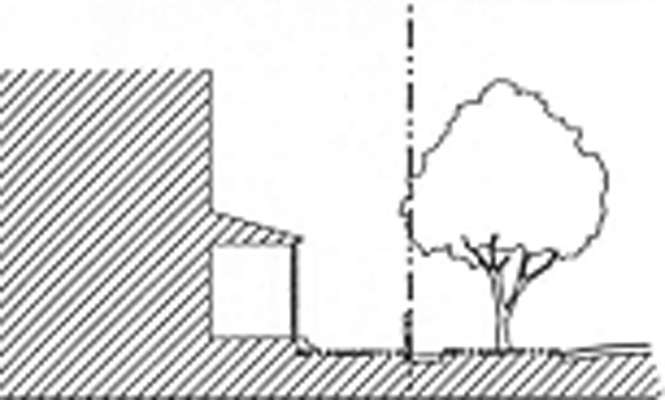
Porch and Fence
c.
Dooryard or light court: A frontage wherein the facade is set back from the frontage line by an elevated garden or terrace, or a fenced, sunken light court. This type buffers residential uses from urban sidewalks, while protecting the private yard from public intrusion. The terrace is suitable for transformation for outdoor dining and the light court can give light and access to a habitable basement.
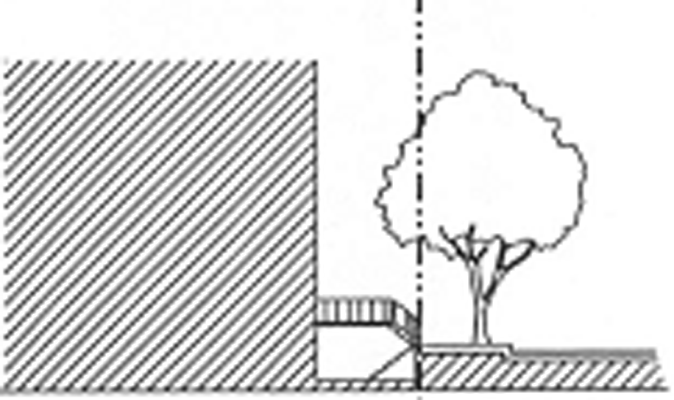
Dooryard or Light Court
d.
Forecourt: A frontage wherein a portion of the facade is close to the frontage line while a substantial portion of it is set back. The forecourt created is suitable for gardens and drop-offs. This type should be allocated sparingly in conjunction to other frontage types. Trees within the forecourts may overhang the sidewalks.
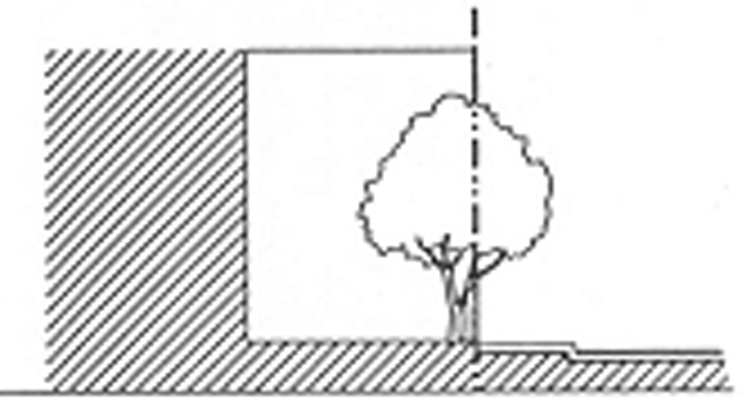
Forecourt
e.
Stoop: A frontage wherein a portion of the facade is aligned close to the frontage line with the lower story elevated from the side walk sufficient to secure privacy for the windows. The access is usually an exterior stair. This type is recommended for ground-floor residential uses.
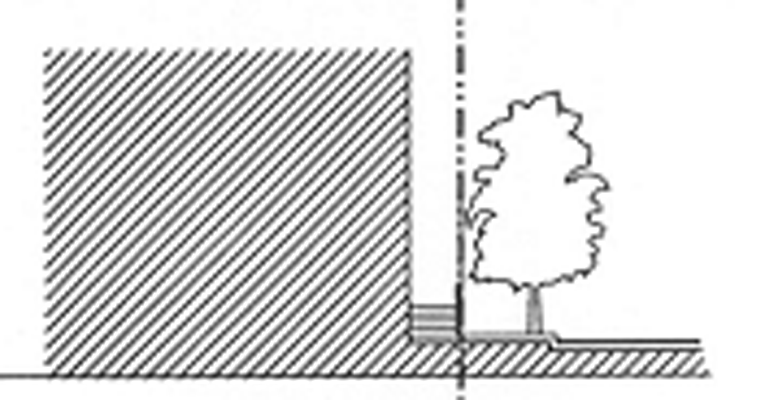
Stoop
f.
Awning: A frontage wherein the facade is aligned close to the frontage line with an attached awning overlapping the sidewalk. The building entrance is at sidewalk grade. This type is conventional for retail use.
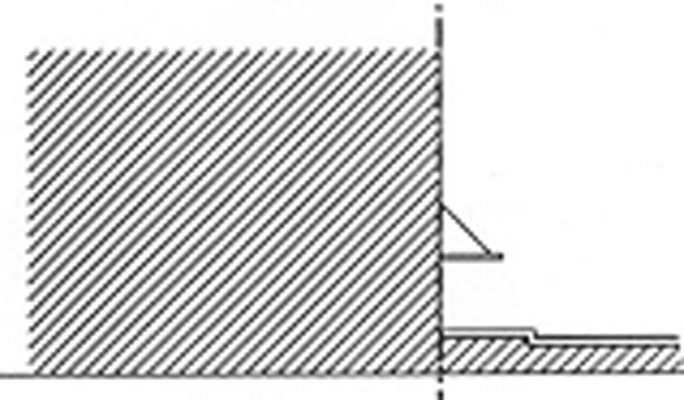
Awning
g.
Gallery: A frontage wherein the facade is aligned close to the frontage line with an attached canopy or a light colonnade overlapping the sidewalk. The building entrance is at the sidewalk grade. This type is appropriate for retail use.
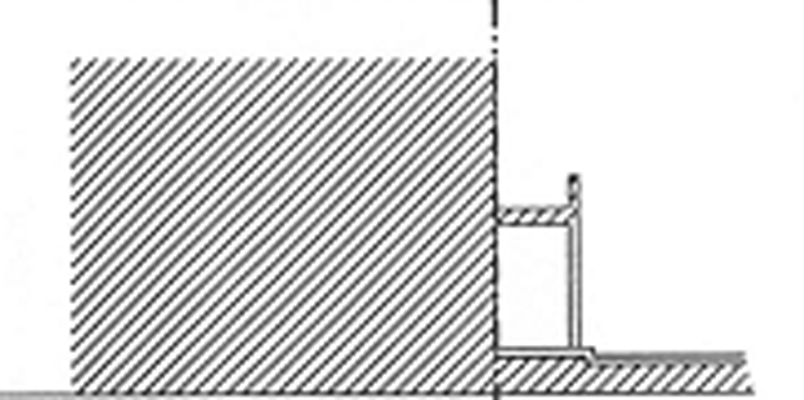
Gallery
h.
Arcade: A frontage wherein the facade is above a colonnade that overlaps the sidewalk. The building entrance is at the sidewalk grade. This type is appropriate for retail use.
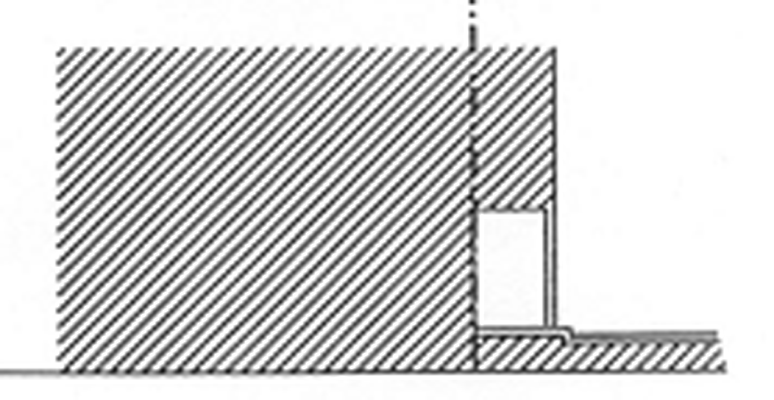
Arcade
Functional classification: The assignment of streets and roads into systems according to the character of service they provide in relation to the total highway network. Basic functional classifications include arterial, collector, and local streets. These basic classifications may be divided into major or minor sub-classifications.
Functionally dependent use (for areas of special flood hazard, article VII, division 4.): A use, which cannot perform its intended purpose, unless it is located or carried out in close proximity to water. The term includes only docking facilities, port facilities that are necessary for the loading and unloading of cargo or passengers, and ship building and ship repair facilities, but does not include long-term storage or related manufacturing facilities.
Funeral home: A facility used for the preparation of the deceased for burial and the display of the deceased and ceremonies connected therewith before burial or cremation, and may include storage of caskets, funeral urns, and other related funeral supplies and the storage of funeral vehicles.
Gallery: See frontage terminology.
Gaming/gambling: Any activity declared, whether legislatively or judicially, to be a violation of F.S. ch. 849, as amended from time to time.
Garage, private: A structure designed or used for inside parking of motor vehicles under the control of the owner or tenant of the premises which it serves and which is not operated or leased for commercial gain. See also driveway, garage public, parking area, parking lot or garage (commercial), parking space, structured parking, surface parking, and vehicle areas.
Garage, public: A building or portion thereof designed or used for parking of motor vehicles that is available to the public. See also driveway, garage private, parking area, parking lot or garage (commercial), structured parking, surface parking, and vehicle areas.
Garage, storage: A building or portion thereof designed and used exclusively for the storage of motor vehicles, within which temporary parking may also be permitted.
Garden center: A facility engaged in the retail sale of plants, supplies and equipment employed in connection with the raising and cultivation of house plants, herbs, flowers, vegetables, trees, shrubs or other indoor or outdoor plants.
Glare: A continuous source of bright light, such as when sunlight is reflected from a surface.
Glint: A momentary flash of bright light, such as when sunlight is reflected from a surface.
Golf course: A tract of land with at least nine holes for playing the game of golf and improved with tees, greens, fairways, and hazards and that may include a clubhouse, shelter, and other similar accessory buildings.
Government use: Any use for public purposes, without reference to the ownership of the building or structures or the realty upon which it is situated, by any department or branch of the United States, State of Florida, Sarasota County, or City of Sarasota government or any other entity created, designated or otherwise approved by United States, State of Florida, Sarasota County or City of Sarasota legislation. Government use may also include attainable housing projects authorized and approved by any department or branch of the United States, the state, the county or the city government or any other entity created by the United States, state, county or city.
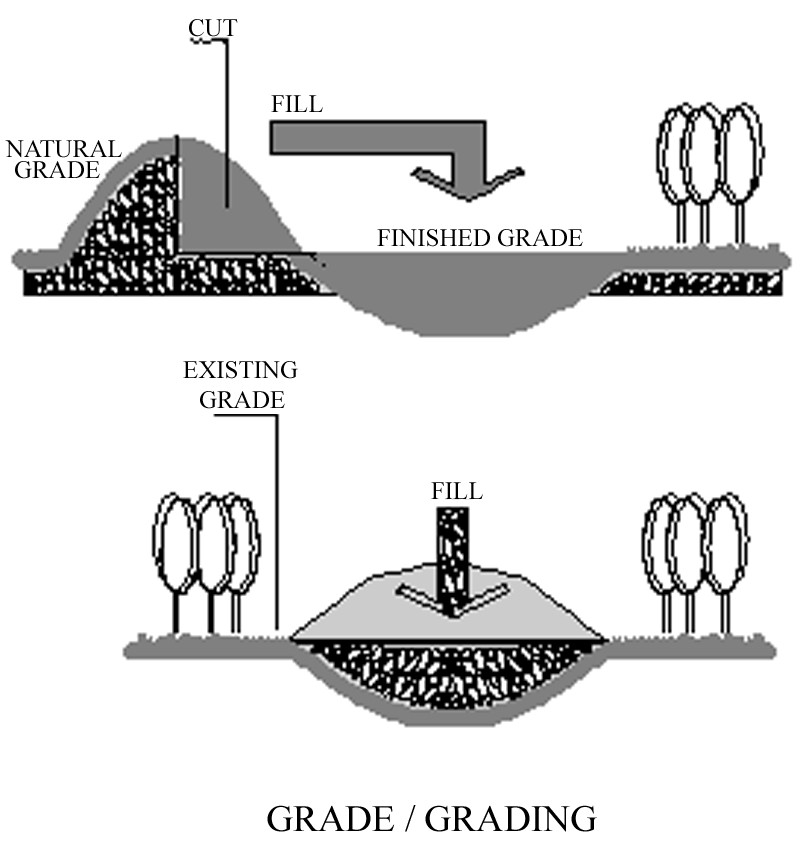
Grade, average: The average natural elevation of the ground level, measured in feet above mean sea level. See also excavation and fill.
Grade, finished: The final elevation of the ground level after development, measured in feet above mean sea level. See also excavation and fill.
Grade, natural: The elevation of the ground level in its natural state, before construction, filling, or excavation, measured in feet above mean sea level. See also excavation and fill.
Grocery store: An establishment engaged primarily in the sale of produce and pre-packaged food and beverages. Ancillary sales may include, but not be limited to, beer and wine, tobacco products, kitchen and cooking products, beauty products and toiletries, vitamins and nutritional supplements, gift cards, stamps, and made- or cut-to-order baked goods, cheese, meat, poultry and seafood such as occurs in delicatessens, butcher shops and seafood stores.
Group home facility: A residential facility licensed under F.S. ch. 393 which provides a family living environment for at least four but not more than 15 residents, including supervision and care necessary to meet the physical, emotional, and social needs of its residents. See also assisted living facility, community residential home, adult day care center, and nursing home.
Group living structure: See residential structure types.
Grubbing: The removal of vegetation by methods such as digging, raking, dragging or otherwise disturbing the roots of under-story vegetation.
Guest unit: A room, or rooms connected together, in a hotel or motel, in which sleeping accommodations are offered to the public and intended primarily for rental to transients with a daily charge.
Habitable floor: The area of a building that contains space for living, sleeping, eating or cooking. Bathrooms, toilet compartments, closets, halls, storage or utility space, and similar areas are not considered habitable space.
Habitable space: Building space whose use involves human presence with direct view of the streets or open space, excluding parking garages and display windows separated from retail activity.
Hardware store: See retail structure types.
Hazardous material or process (HAZMAT): For the purposes of this Code, a hazardous material or process shall be any substance or activity involving any substance listed in 40 CFR (Code of Federal Regulation) part 355, appendix A, as an extremely hazardous substance (EHS), F.S. ch. 442, or chapter 38F-41, FAC when that substance is stored, generated, used or released in quantities equal to or greater than the lowest quantity listed for either the threshold planning quantity (TPQ) or reporting quantity (RQ) for the substance.
Health club or spa: A facility in which memberships in a program of physical exercise or the rights and privileges to use one or more of the following are sold: sauna, whirlpool, weightlifting room, massage, steam room, or exercising machine or device. The term "health spa" shall not include any of the following:
(1)
Bona fide nonprofit organizations, including, but not limited to, the Young Men's Christian Association (YMCA), Young Women's Christian Association (YWCA), or similar organizations whose functions as health spas are only incidental to their overall functions and purposes;
(2)
Any private club owned and operated by its members;
(3)
Any organization primarily operated for the purpose of teaching a particular form of self-defense such as judo or karate;
(4)
Any facility owned or operated by the United States government;
(5)
Any facility owned or operated by the State of Florida or any of its political subdivisions;
(6)
Any nonprofit public or private school, college or university.
See also club, private; club, private recreation; and country club.
Height related definitions:
(1)
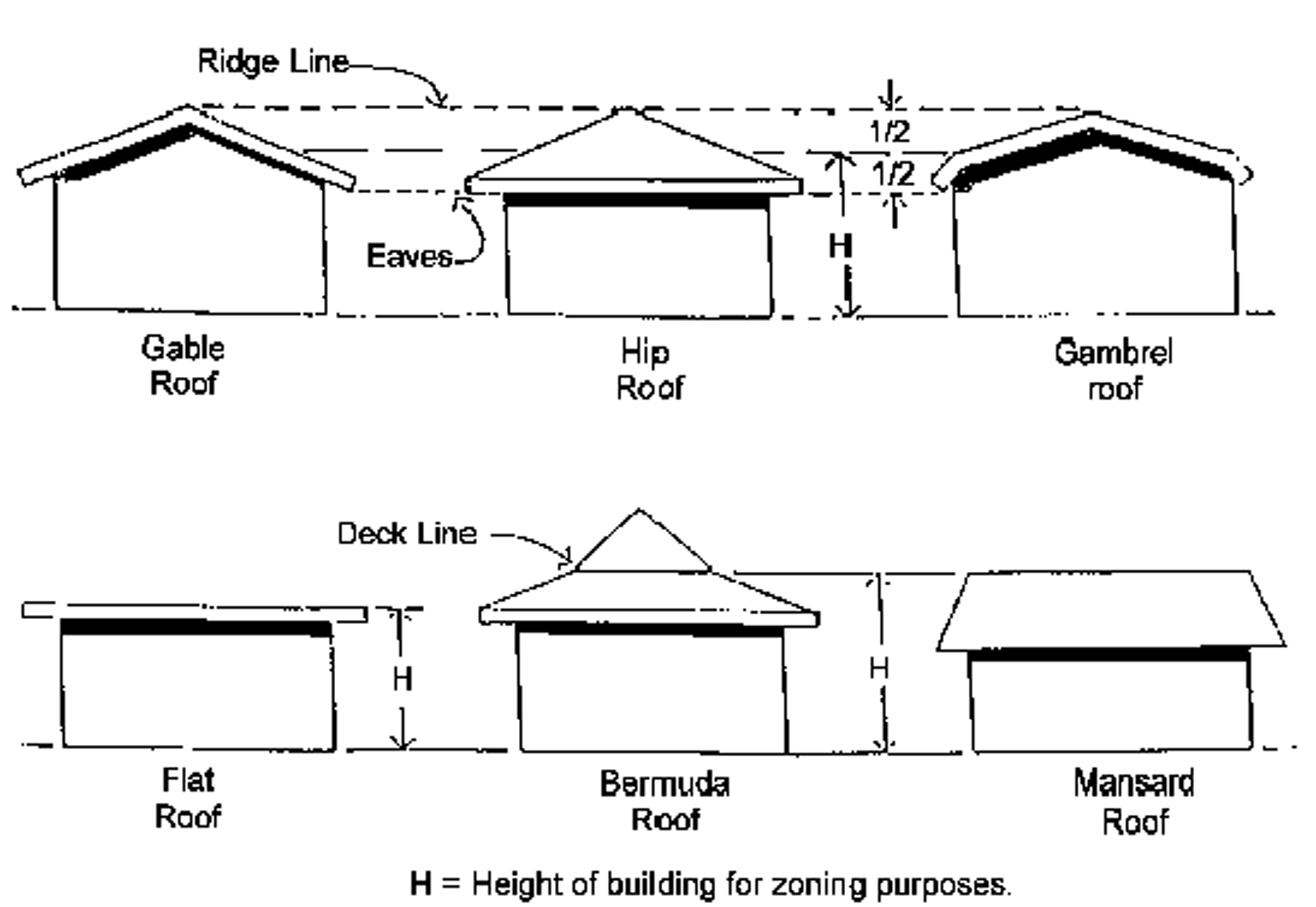
Height; buildings other than single-family dwellings: The vertical distance above finished grade to the highest point of a flat roof, to the deck of a mansard roof or to the average height between the plate and the ridge of gable or hip roofs, not including chimneys, antennas, elevator shafts, mechanical rooms, or other non-habitable areas. Unless otherwise specified in this Code, where minimum floor elevations in flood-prone areas have been established by law, which exceed the minimum point of measurement established by this Code, the building height shall be measured from such required minimum floor elevation. If the structure is dry floodproofed, the building height shall be measured from finished grade. See also: VI-102(p).
(2)
Reference level (height; single-family dwellings): The elevation on a property to begin measurements for determining the overall allowable height of a single-family structure shall be the average elevation of all abutting properties at finished grade of existing structures or buildable areas of a vacant lot. The director of development services may accept an alternative method for calculating the elevation of abutting properties upon submission by a surveyor of an affidavit stating that access upon abutting property was denied and the alternative methodology used to determine the elevation is a standard accepted in their profession.
(3)
Recovery elevation: The midpoint elevation between the reference level and the minimum flood elevation required by law or the minimum flood elevation required by law plus up to three feet of freeboard (up to a maximum of four feet of freeboard).
(4)
Freeboard: An additional amount of height above the base flood elevation used as a factor of safety in determining the elevation to which a structure's lowest floor or lowest horizontal structural member of the lowest floor, as applicable, must be elevated or floodproofed, as required by the Florida Building Code and where amended by the Zoning Code.
(5)
FEMA Elevation (height; single-family dwellings): For the purpose of these regulations, FEMA elevation means the minimum flood elevation required by law plus up to three feet of freeboard (up to a maximum of four feet of freeboard).
Historic building or site: A property, site, zoning lot, building, or structure, designated as being historic by the city commission that is worthy of protection, enhancement and perpetuation because of its cultural, historic, architectural, or archaeological significance and integrity.
Historic designation report: A written document indicating the basis for the recommendation of the historic preservation board to the city commission on a proposed historic or archaeological designation.
Historic district: A geographically definable area possessing a significant concentration, linkage or continuity of sites, buildings, structures or objects united by past events or aesthetically by plan or physical development. A district may also be comprised of individual elements separated geographically but linked by association or history.
Historic preservation certificate of appropriateness: A written authorization issued by the historic preservation board to a property owner for a proposed alteration, relocation or demolition of a building.
Historic preservation transfer of development rights-related definitions (section VI-914):
Buildable square footage: The portion of a zoning lot remaining after required setbacks have been provided where construction can legally occur in accordance with this Code (measured in square feet), multiplied by the number of stories permitted in the zone district.
Designated historic building: A building (structure intended for human habitation or activity) that is:
(1)
Locally designated by the City of Sarasota as a significant historic property; or
(2)
Located within the City of Sarasota Local Historic District and identified by the City of Sarasota as a contributing property to such historic district; or
(3)
Individually listed in the National Register of Historic Places; or
(4)
Located within a historic district listed in the National Register of Historic Places and identified as a contributing property to such historic district; or
(5)
Eligible noncontributing structures identified on Map VI-914.
Maintenance plan: A written document submitted by the owner of a designated historic building for the transfer of development rights program, that identifies any existing structural and/or code deficiencies in the building along with a remediation plan for the short term, and which further identifies a plan for the cyclical maintenance of the building for the long term.
Preservation restrictive covenant agreement: An agreement that specifies the protective measures applicable to the historic building located on a sending site that will ensure the historic value and integrity of the building are preserved. A preservation restrictive covenant agreement shall be entered between the owner of a sending site and the City of Sarasota. The restrictive covenant is intended to ensure the protection of historic buildings. Each preservation restrictive covenant agreement shall be recorded in the Official Records of Sarasota County.
Receiving site: A zoning lot located within a receiving zone that may receive transferable development rights in accordance with the terms and conditions of section VI-914. A zoning lot that is located in a receiving zone and includes a designated historic building that will either be demolished or materially altered in connection with the development project for which transferable development rights are proposed to be utilized shall not be an eligible receiving site.
Receiving zone: Receiving zones are the areas within which receiving sites may be located and are identified as "receiving zones" in Map VI-914: Historic Preservation Transfer of Development Rights Boundary.
Sending site: A zoning lot located within a sending zone that may send transferable development rights in accordance with the terms and conditions of section VI-914. No transferable development rights shall be severed unless the structure is considered a designated historic building.
Sending zone: Sending zones are the areas within which sending sites may be located and are identified as "sending zones" in Map VI-914: Historic Preservation Transfer of Development Rights Boundary.
TDR sending/receiving agreement: An agreement in perpetuity between the owner of a sending site or entity selling the transferable development rights, the owner of a receiving site or entity purchasing the transferable development rights, and the City of Sarasota, that specifies the transferable development rights to be permanently removed and severed from such sending site together with any terms and conditions agreed to between the owner of such site and the City of Sarasota with respect to the removal and severance of the transferable development rights. Each TDR sending/receiving agreement shall be recorded in the Official Records of Sarasota County.
TDR zoning code confirmation letter: A written document issued by the director of development services, or designee stipulating the potential transferable development rights of a designated historic building.
Transferable development rights: Property development rights in excess of the existing development density and/or buildable square footage of a sending site that are severed and removed from such sending site through a sale or other transfer in accordance with the procedures and requirements of section VI-914.
Historic structure or site: Any building or site that is:
(1)
Listed individually in the National Register of Historic Places (a listing maintained by the Department of Interior) or preliminarily determined by the Secretary of the Interior as meeting the requirements for individual listing on the National Register;
(2)
Certified or preliminarily determined by the Secretary of Interior as contributing to the historical significance of a registered historic district or a district preliminarily determined by the secretary to qualify as a registered historic district;
(3)
Designated as being historic by the city commission, thea county commission or the state.
Holiday: Those days designated pursuant to the city's personnel rules and regulations, rule 10.1, authorized holidays.
Home improvement center: See retail structure types.
Home occupation: An occupation carried on in a dwelling unit by the resident thereof; provided that the use is limited in extent and secondary or accessory to the use of the dwelling unit for residential purposes and does not change the character thereof. See also live/work unit.
Hospital: An establishment primarily engaged in providing diagnostic services, extensive medical treatment including surgical services, and other services, as well as continuous nursing services. The establishment has an organized medical staff on duty 24 hours a day, inpatient beds, and equipment and facilities to provide complete health care; may also provide emergency room care and include less intensive medical uses such as convalescent and ambulatory care facilities.
Hotel, motel: A building or group of detached or connected buildings, containing six or more guest rooms, designed or used primarily for providing sleeping accommodations for automobile travelers and/or tourists on a daily or weekly rate basis. Such establishments shall provide customary hotel/motel services such as linen, maid service, telephone, etc. Said use may also contain such ancillary facilities as conference facilities, restaurant, bar, recreational facilities, ballroom, banquet room, and meeting rooms.
House of worship: See church/synagogue.
Impact vibrations: Earthborne oscillations occurring in discrete pulses at or less than 100 per minute.
Impervious surfaces: Those surfaces and development features on a zoning lot which are non-porous and which substantially prevent rain or stormwater from absorbing or percolating into the ground beneath them. Impervious surfaces include, but are not limited to: roof areas, patios, sidewalks, paved driveways, swimming pools, and other development features surfaced with asphaltic pavement, concrete, or other non-porous materials. Development features, pavement materials, and landscape improvements which have a runoff coefficient ("C" factor) of 0.60 or higher shall be considered impervious. See also run-off coefficient.
Industrial, heavy: A use engaged in the basic processing and manufacturing of materials or products predominately from extracted or raw materials, or a use engaged in storage of, or manufacturing processes using flammable or explosive materials, or storage or manufacturing processes that potentially involve hazardous or commonly recognized offensive conditions.
Industrial, light: A use engaged in the manufacture, predominantly from previously prepared materials of finished products or parts, including processing, fabrication, assembly, treatment, packaging, incidental storage, sales, and distribution of such products, but excluding basic industrial processing.
Infirmary: A facility providing on-site medical care and pharmacy service to patients who are residents of an assisted living facility.
Intensity: The amount or magnitude of a use on a site or allowed in a zone district. Generally, it is measured by floor area. Intensity may be measured by such things as number of employees, amount of production, trip generation, or hours of operation. See also density and floor area ratio.
Interstate connector street: See transportation-related definitions.
Institutional pharmacy: The ancillary dispensing of prescription medicine by a state licensed caregiver within a medical center or group home facility.
Junk: Any old, dilapidated, abandoned, or scrap machinery, dismantled, inoperable, or dilapidated motor vehicles, including parts, building material, iron, steel, other ferrous and nonferrous metals, tanks and drums, tires, pipes, tools, implements or portions thereof, glass, plastic, cordage, and other kind of salvage or waste material that has been abandoned from its original use and may be used again in its present or in a new form.
Junkyard: Any land or structure used for the storage, keeping, collection, salvage, sale, disassembling, wrecking, baling, maintenance, or abandonment of junk or other discarded material.
Kennel: A structure, zoning lot or other facility where dogs, cats, and other small animals normally kept as pets (excluding farm animals) which are six months of age or older are kept for commercial purposes. This may include commercial breeding, boarding, training and selling of animals, and facilities for the breeding, training and sale (or contract service) for guard and security dogs.
Kitchen or kitchen facilities: Any room or portion of a room within a building designed and/or used or intended to be used for the cooking or preparation of food, which may also include, but is not limited to, stoves, microwave ovens, sinks, refrigerators, storage or other food preparation equipment, or any combination thereof; this may not include outside grilling facilities, or other items determined by the director of building, zoning and code enforcement as not constituting a kitchen.
Knee wall: A partial interior wall built beneath the roof rafters. These short walls define the living space by creating a vertical surface between the sloping rafters and the finished floor.
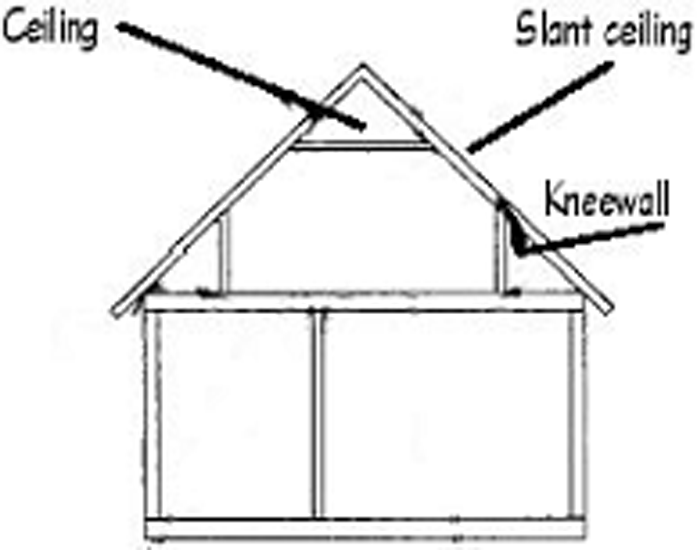
Knee Wall
Laboratory: A place providing the opportunity for experimentation, observation, or practice in a field of study.
Land clearing: The process by which trees and vegetation are removed prior to the construction of manmade improvements.
Land development regulations (LDR): Any document of the city that regulates the review and approval of the development of property within the city including, but not limited to, the Sarasota City Plan, the Code of the city, the zoning code of the City of Sarasota, the Florida Building Code, and the Engineering Design Criteria Manual, as may be amended.
Lawn mower, sales, and service: Maintenance, repair, sales or lease of lawn mowers and related yard equipment; no equipment that may be defined as a motor vehicle is to be sold or repaired at the location unless otherwise permitted.
Layer: See frontage terminology.
Leasehold use: A principal use conducted, on a zoning lot owned by a government agency, by a non-governmental entity that is leasing the land, facility and/or building from a government agency.
Library: A place in which literary and artistic materials, such as books, periodicals, newspapers, computers, pamphlets, prints, records, and tapes, are kept for reading, reference, or lending.
Liner building: See development-related definitions.
Live aboard: The occupancy or use of a watercraft, by one or more persons, as a place of habitation, residence, as living quarters or for dwelling purposes, temporarily or permanently, continuously or transiently.
Live/work unit: See residential structure types.
Loading area: The area available for the maneuvering and standing of vehicles engaged in delivering and loading of freight or other articles or the boarding or discharging of passengers.
Loading space: A space with access to a street or alley for the standing, loading, or unloading of motor vehicles delivering or picking up goods and materials.
Local street: See transportation-related definitions.
Lodging house: See bed and breakfast inn.
Lot, corner zoning: See zoning lot.
Lot coverage, zoning: See development related definitions, building coverage.
Lot, interior zoning: See zoning lot.
Lot line, rear zoning: See zoning lot line.
Lot line, side zoning: See zoning lot line.
Lot line, zoning front: See zoning lot line.
Lot width, zoning: See zoning lot width.
Lot, zoning: See zoning lot.
Lot line, zoning: See zoning lot line.
Lot line, front zoning: See zoning lot line.
Lot of record:
(1)
A lot which is part of a subdivision lawfully recorded in the public records of the county; which subdivision was approved by the city in accordance with this Code and the city subdivision code; or
(2)
A parcel created by plat or written deed, in which metes and bounds describe the platted property, which was recorded on or before January 10, 1974.
Luminaire: A complete lighting unit consisting of a light source and all necessary mechanical, electrical and decorative parts. A luminaire does not include a pole or other support.
Luminaire, cutoff-type: A luminaire with elements such as shields, reflectors, or refractor panels that direct and cut off the light at a cutoff angle that is less than 90 degrees.
Main entrance: The entrance to a building that most pedestrians are expected to use. Generally, each building has one main entrance. In multi-tenant buildings, main entrances open directly into the building's lobby or principal interior ground level circulation space. When a multi-tenant building does not have a lobby or common interior circulation space, each tenant's outside entrance is a main entrance. In single-tenant buildings, main entrances open directly into lobby, receptions, or sales areas.
Mangrove stand: An assemblage of mangrove trees which are mostly low trees noted for a copious development of interlacing adventitious roots above the ground and which contains one or more of the following species: black mangrove, red mangrove, white mangrove or button woods.
Manufacture, manufacturing: The processing and converting of raw, unfinished materials or products, into articles or substances of different character, or for a different purpose.
Manufactured home: See residential structure types.
Manufactured home park: See residential structure types.
Manufacturing, heavy: See industrial, heavy.
Manufacturing, light: See industrial, light.
Marina, commercial: A facility for the servicing, fueling, berthing and storage of boats that may include accessory retail and eating facilities including haul-out facilities, covered or uncovered wet storage slips, dry storage of watercraft, yacht brokerage, boat sales, and retail sales of boating supplies.
Marine sanitation device: Any equipment required to be installed on board a watercraft for the purpose of receiving and treating, prior to discharge, human body wastes and the wastes from toilets and other receptacles intended to receive body wastes, or equipment required to hold or retain said wastes, and any process to treat such wastes.
Marquee: A permanent roof-like shelter extending from part or all of a building face and constructed of some durable material, which may or may not project over a portion of a public right-of-way.
Mass shelter: A structure that contains one or more open sleeping areas, or is divided only by non-permanent partitions, furnished with cots, floor mats, or bunks. Individual sleeping rooms are not provided. The shelter may or may not have food preparation or shower facilities. The shelter is managed by a public or non-profit agency to provide shelter, with or without a fee, on a daily basis.
Mass shelter beds: Accommodation provided in a mass shelter. The number of beds is determined by the maximum number of people who can be given overnight accommodations at one time on the site.
Mean high-water: The average height of the high waters over a 19-year period. For shorter periods of observation, it is the average height of the high waters after corrections are applied to eliminate known variations and to reduce the results to the equivalent of a mean 19-year value.
Mean low water: The average height of the low waters over a 19-year period. For shorter periods of observation, it is the average height of the low waters after corrections are applied to eliminate known variations and to reduce the results to the equivalent of a mean 19-year value.
Mean sea level: For purposes of the National Flood Insurance Program, mean sea level is the National Geodetic Vertical Datum (NGVD) of 1929 or other datum, to which base flood elevations shown on the flood insurance rate maps are referenced.
Measurement of depth: Depth of a required front yard shall be measured at right angles to a straight line joining the foremost points of the side zoning lot lines. The foremost point of the side zoning lot line, in the case of rounded property corners at street intersections, shall be assumed to be the point at which the side and front zoning lot lines would have met without such rounding.
Medical center: A large-scale health facility that contains multiple medical offices and therefore provides for a diverse array of medical care. Sometimes surgical and overnight care is associated with a medical center, but this is not a requirement.
Medical marijuana dispensary: An establishment where marijuana is dispensed for medical use to qualified patients. For purposes of this definition, the terms "marijuana," "medical use," and "qualified patients" shall have the meanings ascribed to them by F.S.(2017) § 381.986. Medical marijuana dispensaries are permitted as principal uses in those zone districts in which pharmacies are identified as permitted principal uses. Medical marijuana dispensaries are permitted as accessory uses in those zone districts in which pharmacies are identified as permitted accessory uses.
Medical massage therapy: Any method for treating or manipulating the soft tissue and/or external parts of the human body for remedial, therapeutic, educational, or health purposes. The massage practitioner must be a licensed massage therapist (LMT) by the Florida Board of Massage Therapy. The establishment must be licensed by the Florida Board of Massage Therapy.
Medical or dental laboratory: Establishment engaged in providing professional analytic or diagnostic services to the medical, dental, or other health service professions; includes denture laboratories and prosthetic facilities. Eyeglass and contact lens and denture manufacturing is permitted; all other manufacturing prohibited.
Medical or dental office or clinic: See office or clinic, medical or dental.
Mezzanine: A generally open floor level between two stories in a building, typically between the first story (i.e. ground or entry-level floor) and second story.
Minimum flood elevation (for single-family dwellings): See height related definitions.
Mini-warehouse: See self storage center.
Mitigate: To rectify, repair or compensate for impacts, which result from other actions.
Mixed use development: A development on one zoning lot that combines residential uses with commercial and/or office uses, consisting of one or more buildings. See also section II-303(b) and residential structure types, live/work unit.
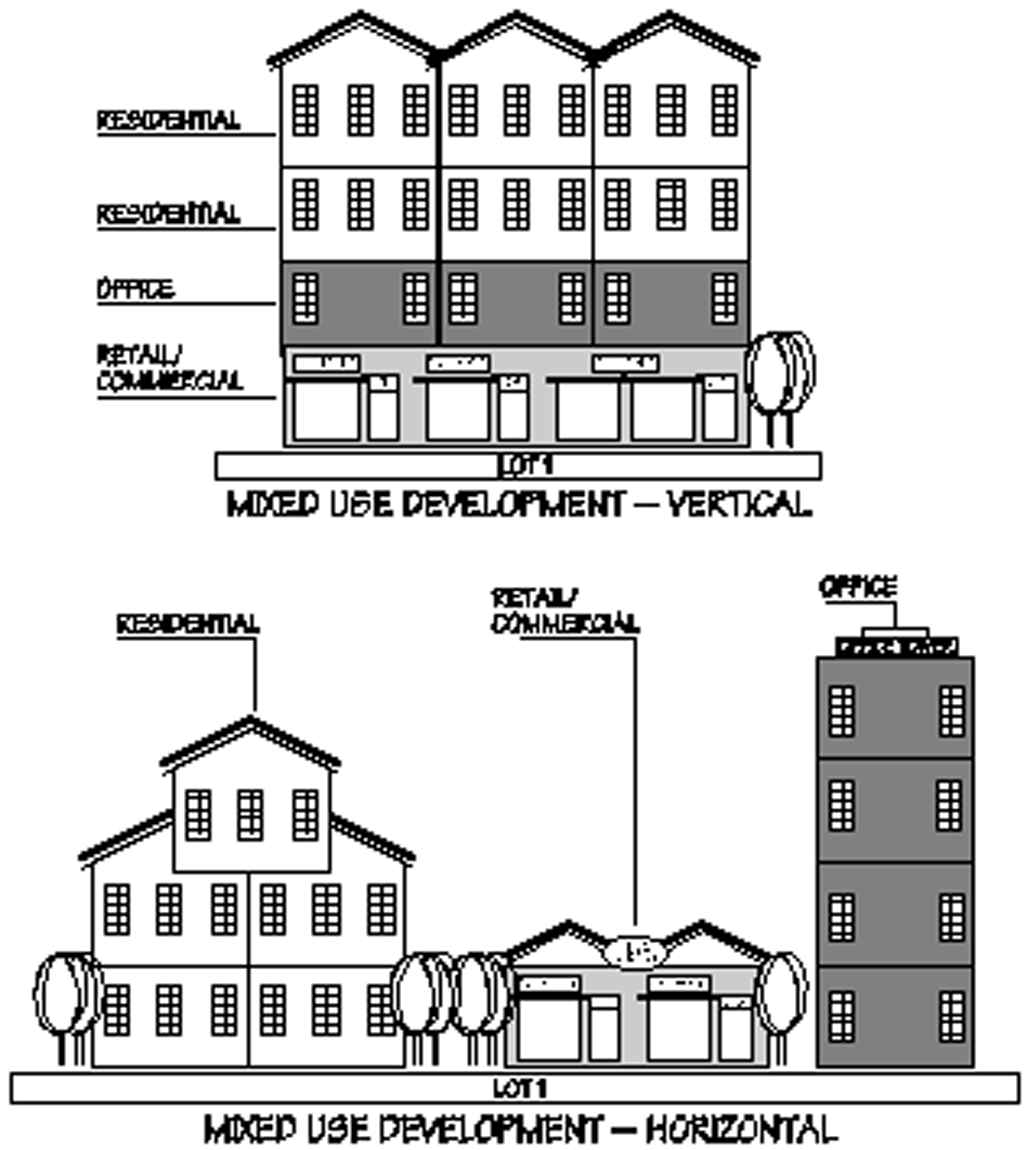
Mixed Use Development
Mobile home: See residential structure types.
Moor: To tie-up to and dock, piling or other stationary object or device or to anchor a watercraft in open water.
Motor home: See vehicle types.
Motor vehicle: See vehicle types.
Motor vehicle fuel pump: A device for dispensing gasoline into motor vehicles.
Motor vehicle fuel station (retail): A structure, building or premise or any portion thereof where a flammable fluid is stored, housed and sold for supply to motor vehicles; and does not include any accessory motor vehicle servicing. See also motor vehicle service station.
Motor vehicle parts, retail: A facility engaged in retail sales of motor vehicle parts.
Motor vehicle related uses: Uses in the quick vehicle servicing, vehicle repair, and commercial parking facilities categories described in article II division 3 of this Code.
Motor vehicle repair: Any modification, reconditioning, restructuring, and rebuilding of a motor vehicle or a motor vehicle component.
Motor vehicle repair shop: A building, structure, enclosure or premises in or on which the general business of repairing motor vehicles is conducted, including body shop, engine rebuilding or reconditioning, upholstering, radiator reconditioning and repairing, and similar industrial processes. Incidental servicing of motor vehicles is permitted.
Motor vehicle sales agency: Any building and premises which displays, demonstrates, sells or leases new automobiles, trucks, vans, trailers, recreational vehicles, motorcycles, recreational boats or similar motorized vehicles which includes a showroom enclosed within a sizable building and open display areas. A motor vehicle sales agency may maintain an inventory of the vehicles for sale or lease on-site or at a nearby location and may include accessory on-site facilities for repair services and the sale of used motor vehicles.
Motor vehicle sales lots (used): An open area upon which used automobiles, trucks, vans, trailers, recreational vehicles, motorcycles, recreational boats or similar motorized vehicles are, or may be, parked or displayed for the purpose of sales or demonstration, which may include a small accessory building necessary for the conduct of the use, and where no repair work, except for minor incidental repairs on the vehicles for display or sale, is done.
Motor vehicle service station: A structure, building or premises or any portion thereof where a flammable fluid is stored, housed and sold for supply to motor vehicles; and which includes routine motor vehicle servicing within the principal building, not including body shop, engine rebuilding, upholstering, radiator reconditioning and repair and similar industrial type processes. See also motor vehicle fuel station (retail).
Motor vehicle showroom: A building where new or used automobiles, trucks, vans, trailers, recreational vehicles, motorcycles, or similar motorized vehicles are displayed and offered for sale in a completely enclosed building, where no repair work or storage is done on-site.
Motor vehicle storage lot: Any property for the short- or long-term parking of motor vehicles for sale or lease at an off-site motor vehicle sales agency, which agency is located within the city. No display, demonstrations, sales, repairs or service may take place on a motor vehicle storage lot, and there shall be no buildings permitted on the lot.
Motor vehicle towing: A principal use or accessory to another use with more than one salvaging vehicle such as, tow trucks, cranes, and flatbed trucks used to tow or haul motor vehicles.
Motor vehicle wrecking yard: A facility for the dismantling, disassembling or storage of inoperable motor vehicles or trailers or the storage, sale or dumping of dismantled, partially dismantled, obsolete or wrecked vehicles or their parts.
Multi-channel multi-point distribution service antennas: An antenna that is designed to receive video programming services via a multi-point distribution services, including institutional fixed services, and local multi-point distribution services.
Multi-dwelling development: See residential structure types.
Multi-dwelling structure, large: See residential structure types.
Multi-dwelling structure, small: See residential structure types.
Museums, public: A building, place, or institution, owned and operated by either a governmental entity or a nonprofit organization, open to the public and devoted to the acquisition, conservation, study, exhibition, and educational interpretation of objects having scientific, historical, or artistic value.
Music store: An establishment primarily engaged in the retail sale of instruments, recordings, sheet music and literature; lessons are permitted accessory uses.
New construction (for areas of special flood hazard, article VII, division 4: For floodplain management purposes, "new construction" means structures for which the "start of construction" commenced on or after July 30, 1971, and includes any subsequent improvements to such structures.
New development project: See development-related definitions.
Nightclub: A commercial indoor establishment that operates after 11:00 p.m. on any night from Sunday through Thursday and/or operates after 11:59 p.m. Friday, Saturday, and the day prior to a holiday, that includes a bar and live entertainment or amplified entertainment, and that may include a dance area or a restaurant. Windows and doors shall remain continuously closed after 11:00 p.m. other than to allow the ingress and egress of patrons. For purposes of this definition, the term live entertainment shall include, but not be limited to, live bands or live musicians and the term amplified entertainment shall include, but not be limited to amplified music generated by live DJs and music that is electronically produced or transmitted. Televised entertainment and background music shall not be considered amplified entertainment. Background music is amplified music intended as unobtrusive accompaniment to some activity, such as dining or consuming alcoholic beverages.
No tree verification statement: A signed, notarized statement by the property owner, his agent, landscape architect, architect, civil engineer or land surveyor, stating that no trees protected by these regulations exist on the site.
Nonconforming characteristics of use: Characteristics of the use of a zoning lot or structure which do not conform to the zone district provisions applicable to the structure or use. Examples include: minimum off-street parking requirements, minimum landscape requirements, residential density requirements, or other matters pertaining to the use of land or structures.
Nonconforming residential density: A residential use that is an allowed use in the zone district and that was constructed at a lawful density, but that subsequently, due to a change in the zone or zoning regulations, now has a greater density than is allowed in the zone district.
Nonconforming structure: A structure that, although lawfully constructed, does not now conform to one or more specific development standards for the zone district in which the structure is located. Examples include: structures which exceed allowable building height limits, floor area ratio, building coverage, or which encroach into required setback areas.
Nonconforming use: A use that was lawful when commenced, but that subsequently, due to a change of the zone district of the zoning lot or zoning regulations, the use is now prohibited in the zone district.
Nonprofit organization: An entity that exists solely for religious, charitable, educational, political or civic purposes and is not in business to make a profit.
Nursing home: A private home, institution, building, residence or other place, whether operated for profit or not, including those places operated by units of government, which undertakes through its ownership or management to provide, for a period exceeding 24 hours, maintenance, personal care or nursing for three or more persons not related by blood or marriage to the operator, who by reason of illness, physical infirmity or advanced age require such services, but does not include any place providing care and treatment primarily for the acutely ill; provided that this definition shall include homes offering services for less than three persons where the homes are held out to the public to be establishments which regularly provide nursing, extended care and custodial services. See also adult day care center, assisted living facility, community residential home and group home facility.
Nursery, plant (commercial): A licensed plant or tree nursery offering plants or trees to the general public for sale in the ordinary course of business.
Nutritional counseling and food distribution services: Those certain services described herein which are provided by a "community services" as that use is defined in section II-307(c). A nutritional counseling and food distribution service shall only be provided to clients who have been referred to the service provider by a medical care provider. The purpose of nutritional counseling and food distribution services shall be to offer nutritional counseling, and concurrent unprepared food items, for treatment of a diagnosed medical need, disease or illness which has particular nutritional needs. The food products are to be provided uncooked and for the referred client as well as his/her direct family members. The nutritional counseling and food distribution services are to be provided on an appointment only basis. Nutritional counseling and food distribution services shall be provided to no more than 24 clients per day (averaged over a calendar month) at any one location. A nutritional counseling and food distribution service is not a food pantry or soup kitchen.
Office: A building, or portion of a building, wherein activities are performed involving predominately administrative, record keeping, professional, and/or clerical operations and, where in the case of professions such as dentists, physicians, lawyers or engineers, the facility where such professional services are rendered.
Office or clinic, medical or dental: A facility engaged in the examination, diagnosis and treatment of medical chiropractic, ophthalmologic, dental, and pediatric or other health care patients; includes administrative and clerical operations of the practice; does not include overnight facilities for patients.
Office or industrial park: A group of several office and/or industrial sites with or without ancillary uses, developed as an integrated project, and either connected contiguously, or directly across a public or private street; and also having at least one of the following characteristics:
(1)
Some or all of the uses share common parking, travelways, or entrances; or
(2)
The land, uses, or facilities are organized under one management or ownership form for the purpose of enforcing reciprocal covenants.
Open space: Any portion of a zoning lot or area of land or water that is open and unobstructed from the ground to the sky, including areas maintained in a natural and undisturbed character.
Open space, interior: Space which is either: (1) within a completely enclosed building; or (2) accessible only by passing through a completely enclosed building and which is developed and maintained for use by the general public through the provision of facilities and design features such as seating, tables, plants, fountains, sculpture and areas for public exhibits, entertainment or performances. A combination of any of the following requirements shall apply to an interior open space area:
(1)
Walls of an interior space which abut sidewalks or an exterior urban open space shall provide a clear view between interior and exterior space.
(2)
There shall be a sufficiently high level of natural illumination either through walls or glazed roof or ceiling areas to permit the maintenance of plants without additional light sources.
(3)
An interior open space shall provide public toilet facilities and drinking fountains.
(4)
The interior open space shall be open without restriction to the general public during normal business hours.
(5)
An interior open space which functions as a building lobby shall not be counted as interior space unless it also functions as a passage through the building accessible to the general public and contains seating available for use by the general public.
Examples of interior open space which are accessible only by passing through a completely enclosed building but which may be open to the sky and which may be at or above ground level include courtyards, atriums, patios, terraces and sun decks. Outdoor restaurants may be counted as interior open space if all of the above definitional criteria are satisfied. Interior restaurants shall not be counted as interior open space.
Open space, urban: That portion of a zoning lot that is not occupied by buildings, parking areas, streets, driveways or loading areas and is:
(1)
Developed and maintained for use by the general public; and
(2)
Accessible to pedestrians from public streets and sidewalks; and
(3)
Equipped with amenities or development features designed to encourage the use and enjoyment of the space by the general public such as but not limited to vegetation, pools and fountains, sculptures, public seating, arbors, trellises, drinking fountains and public telephones. Urban open space may also include areas that are covered by awnings or canopies. Outdoor restaurants are permitted in urban open space areas.
Optical and eye care facility: A facility for the fitting and retail sale of eyeglasses and contact lenses to individuals by opticians; oculists, ophthalmologists, and optometrists, are considered within the range of medical offices or medical clinics.
Ordinary maintenance: Work not requiring a building permit done to prevent deterioration of a building or structure, or decay of or damage to a building or structure or any part thereof, by restoring the building or structure as nearly as practicable to its condition prior to such deterioration, decay or damage.
Outdoor sales and display: The display and sale of products and services outside of a building as an accessory use to a principal retail use.
Outside storage: The keeping of goods or materials, excluding junk, outside of a building for more than 24 hours, and which shall be considered as an accessory use, unless specifically enumerated as a principal use (such as a contractor's storage yard or building material sales yard).
Overlay district: A zoning designation specifically delineated on the city official zoning atlas establishing land use requirements in addition to the standards set forth in the underlying residential, commercial, downtown, urban mixed-use, or industrial district.
Owner, property: Any person who holds fee simple title to a given area of land.
Parapet line: See building elevation terminology.
Parcel: A continuous area of land in the possession of, owned by, or recorded as the property of the same person or persons, which was created prior to January 10, 1974.
Package, express delivery and courier service: Operations office for the dispatching, coordination, preparation and routing of package pick-up and delivery.
Pari-mutuel facility: Facility devoted to racing of dogs or horses that uses a system of betting on races whereby winnings are divided in proportion to the sums individually wagered and with regard to the odds assigned to particular outcomes.
Park: A tract of land, submerged lands, or water, designated and used for active and/or passive recreation.
Park and opens space types (for downtown and urban mixed-use zone districts):
(1)
Park: An open space available as a natural preserve and for unstructured recreation or community gardens. A park may be located at a neighborhood edge, independent of surrounding building frontages. Parks may be lineal, following the trajectories of natural corridors, and may include civic boardwalk and pier.
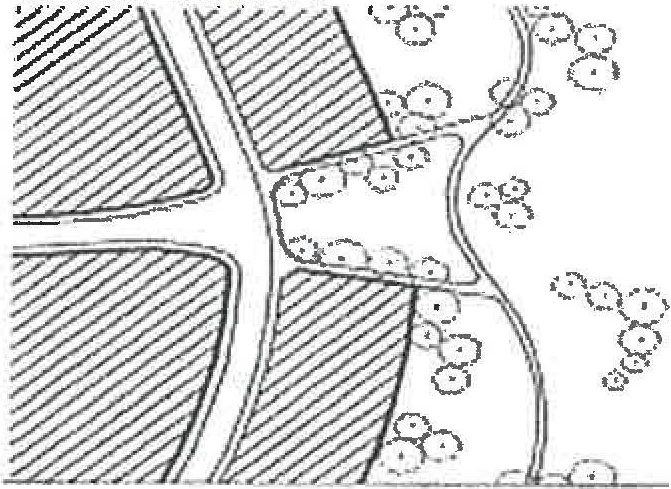
Park
(2)
Green: An open space available for unstructured recreation. Building frontages shall circumscribe a green. Its landscape shall consist of lawn and trees, naturalistically disposed.
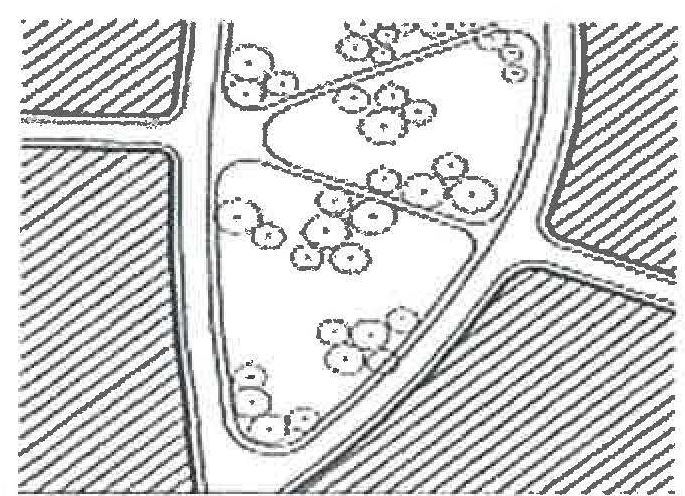
Green
(3)
Square: An open space available for unstructured recreation and civic purposes. Frontages circumscribe a square. Its landscape shall consist of paved walks, lawns, and trees formally disposed. It shall be placed at the intersection of important streets.
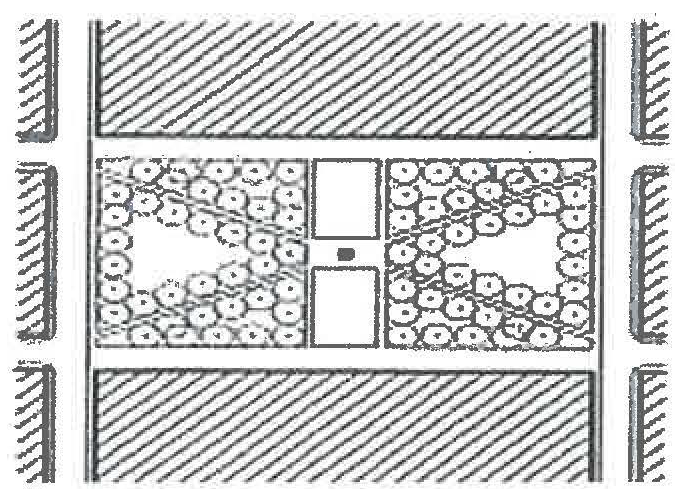
Square
(4)
Plaza: An open space available for civic purposes and commercial activities. Frontages circumscribe a plaza. Its landscape consists primarily of pervious pavement/pavement and some trees formally disposed. It shall be placed at the intersection of important streets.
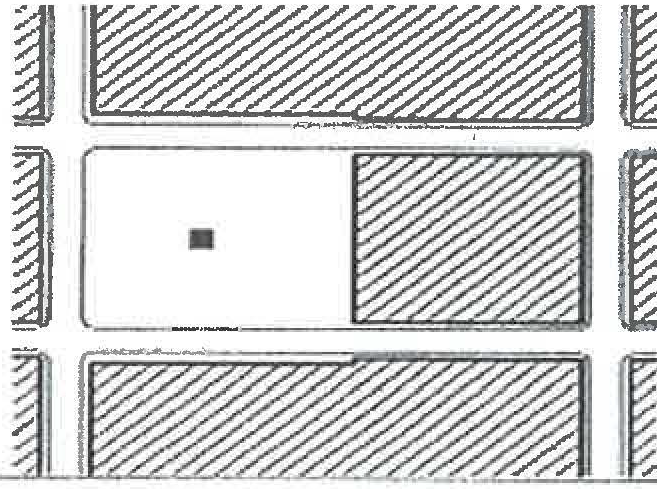
Plaza
(5)
Playground: An open space designed and equipped for the play of children. A playground may be fenced and may include an open shelter. Playgrounds should be interspersed within residential areas and may be placed within the block. Playgrounds may be included within parks, greens, squares, and plazas.
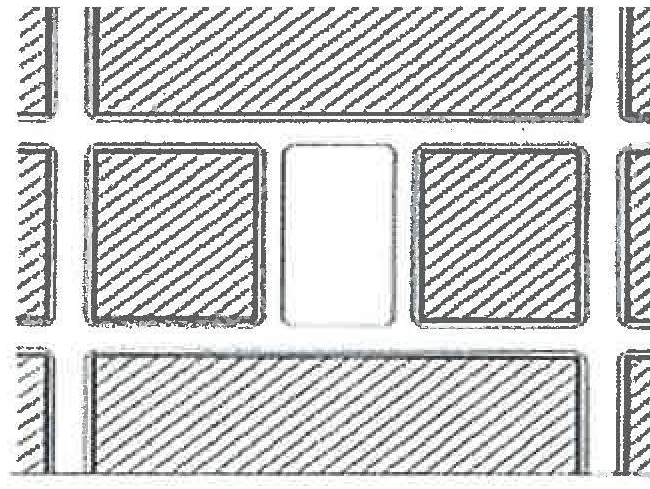
Playground
Park permit: A permit for any public assembly, picnic or other event in any public park involving 75 or more individuals or to use a public park during hours it is open, as may be required by chapter 22 of the city Code of Ordinances. (Persons seeking to reserve park facilities or amenities for events to be attended by fewer than 75 people that do not require city services or commercial vending may do so on a first-come, first-served basis by contacting the office of special events. Such reservation shall not require a special event permit or a park permit.)
Parking area: The area devoted to the standing, maneuvering and circulation of motor vehicles. Parking areas do not include driveways or areas devoted exclusively to non-passenger loading. See also driveway, garage (private and public), parking lot or garage (commercial, parking space, structured parking, surface parking, and vehicle areas.
Parking lot or garage (commercial): An off-street parking area or structure, available to the public for compensation, but may also be used to accommodate employees, customers and clients. See also driveway, garage (private and public), parking area, parking space, structured parking, surface parking, and vehicle areas.
Parking space: A space for parking a motor vehicle that meets the requirements of section VII-209. See also driveway, garage (private and public), parking area, parking lot or garage (commercial), structured parking, surface parking, and vehicle areas.
Particulate matter: Material, including smoke, discharged into or suspended in the atmosphere in finely divided form.
Permittee: A person in whose name a permit to operate an adult use has been issued, as well as any person listed as an applicant on the application for an adult use permit.
Person: Any individual, partnership, firm, association, public or private corporation, trust, joint venture, estate, cooperative, political subdivision or other instrumentality of this state, or other legal entity.
Personal services: Individual assistance with or supervision of essential activities of daily living, such as eating, bathing, grooming, dressing, toileting and ambulating; supervision of self-administered medication; and other similar services, not including the provision of medical, nursing, dental or mental health services by the staff of a facility (F.S. § 400.492).
Personal service use: An establishment which provides work done or duties performed for humans, such as, but not limited to, barbershop, beauty parlor, tailor shop, dressmaker shop, shoe repair shop, etc.
Pet: Animals that are customarily kept for personal use or enjoyment within the home. Household pets shall include, but not be limited to, domestic dogs, domestic cats, domestic tropical birds, domestic rodents, and fish.
Pet grooming service: A facility engaged in the manicuring, bathing, clipping and styling of pets.
Pharmacy: An establishment licensed by the State of Florida as a community pharmacy (Schedule II and III) or a medical marijuana treatment center and that primarily operates as a facility that fulfills prescription orders for controlled substances under an active license in good standing with the State of Florida.
Photographic studio (commercial): Facility primarily engaged in photographic or video services. Film development facilities shall occupy 25 percent or less of the gross floor area of the principal use.
Photography store, retail: A facility primarily engaged in the retail sale, lease, and service of photography equipment and supplies, including limited on-site processing or development.
Physical culture establishment: Any business which offers or advertises massage, body rubs, or physical contact with specified anatomical areas. Businesses that routinely provide medical services by state licensed medical practitioners, electrolysis treatment by permitted operators of electrolysis equipment, and massage by licensed massage therapist shall be excluded from the definition of physical culture establishments.
Playground: An active recreation area with a variety of facilities, including equipment for younger children as well as court and field games.
Plaza: An area generally open to the public on a controlled basis and used for passive recreational activities and relaxation. Plazas are paved areas typically provided with amenities, such as seating, drinking and ornamental fountains, art, trees, and landscaping, for use by pedestrians.
Porch: A roofed-over space, with the roof impervious to weather, attached to the outside of an exterior wall of a building, which has no enclosure other than the exterior walls of such building. Open-mesh screening shall not be considered an enclosure.
Porch and fence: See frontage terminology.
Premises: A zoning lot, or a zoning lot and the structures and improvements thereon, as the context may require.
Primary structure: A structure or combination of structures of chief importance or function on a zoning lot. In general, the primary use of the zoning lot is carried out in a primary structure. The difference between a primary and accessory structure is determined by comparing the size, placement, and similarity of design, use of common building materials and the orientation of the structures on a zoning lot. See also accessory.
Primary use: An activity or combination of activities of chief importance on the zoning lot. One of the main purposes for which the land or structures are intended, designed or ordinarily used. A zoning lot may have more than one primary use. See also accessory.
Primary/secondary street grid (synonym: A/B grid): A system of assigning street frontages to superior (primary) and lesser (secondary) pedestrian quality. Wide sidewalks, narrow roadways, buildings up close to the street, low pedestrian-scaled lighting on street parking and building entrances on the street are all examples of features that enhance the quality of the pedestrian experience and would be found on primary streets. By contrast secondary streets allow uses (e.g. drive through and service stations) and building design (e.g. blank walls and open parking) which reflect less emphasis on the quality of the pedestrian experience.
Private performance: The modeling, posing, display or exposure of any specified anatomical area by an employee, agent or independent contractor of an adult use to a person while the person is in an area during such display which is not accessible or observable to all other persons in the adult use establishment, or while during the display the person is in an area in which the person is totally or partially screened or partitioned from the view of all persons outside the area.
Project: An existing or proposed development.
Property: One or more lots or combinations of lots of record in single ownership or which is in separate ownership but is used as a unified entity, such as a shopping center.
Protected residential property: Any property within the city that meets either of the following requirements:
(1)
The property is zoned residential single family or residential multiple family; or
(2)
The property is designated on the Sarasota City Plan as a residential classification.
Protective barrier: A physical structure limiting access to a protected area.
Public art or public works of art: Public art or public works of art is defined as the creative application of skill and taste by artists to production of permanent tangible objects according to the aesthetic principles, including but not limited to: paintings, sculptures, site specific installations, engravings, carvings, frescos, mobiles, murals, collages, mosaics, statues, and bas-reliefs. Public art or public works of art shall also include the creative application of skill and taste by artists according to aesthetic principles to the architectural embellishment of a building or structure.
However, the following shall not be considered public art or public works of art:
(1)
Reproductions, or unlimited copies of original art work;
(2)
Art objects which are mass produced;
(3)
Works that are decorative, ornamental or functional elements of the architecture or landscape design, except when commissioned from an artist as an integral aspect of a structure or site;
(4)
Architectural rehabilitation or historical preservation.
Public facilities and services: The following public facilities and services for which levels of service standards have been established in the Sarasota City Plan:
(1)
Potable water.
(2)
Wastewater.
(3)
Solid waste.
(4)
Recreation/open space.
(5)
Stormwater management.
(6)
Transportation.
Public place: Government or privately owned land or buildings that are open to the general public on a consistent basis.
Public property: Any real property owned by a government agency, which is not classified as public right-of-way, (as defined in right-of-way) whether or not the same has been improved, and shall include driveways and parking lots.
Public utility: Persons, corporations, or governments supplying gas, electric, transportation, water, sewer, or land line telephone service to the general public. For the purpose of this Code, commercial wireless telecommunication service facilities shall not be considered public utility uses, and are defined separately.
Railroad right-of-way: Land in which a railroad owns the fee or has an easement devoted to or required for use as a transportation facility.
Railroad switching facilities: An area where railroad cars are switched and trains assembled.
Readily visible: Visually conspicuous from public view. A commercial wireless telecommunication facility which is camouflaged, screened or obstructed from view from a public street, public place (where the general public has a right to be and to go), or a residential use on a protected residential property such that its presence is not conspicuous, as determined by the approving authority, shall not be deemed readily visible.
Real property line: Either:
(1)
The imaginary line including its vertical extension that separates one zoning lot of real property from another; or
(2)
The vertical and horizontal boundaries of a dwelling unit that is one unit in a multi-dwelling-unit building.
Real property used for residential purposes: Any real property in use as a residence with single-family, two-family, or multiple-family dwellings located thereon, regardless of the zone district.
Recess line: See building elevation terminology.
Recovery elevation (for single-family dwellings): See height related definitions.
Recreation facility: A zoning lot, with or without improvements designed and equipped for the conduct of sports and leisure time activities.
Recreational facility (commercial): A sports or activity facility open to the general public for a fee. These include, but are not limited to, the following:
(1)
Indoor: Roller or ice skating rink, bowling alley, billiard hall, dart pavilion, amusement arcade (video, pinball or other), swimming pools, slot cars, hard and soft courts, miniature golf. See also bingo, non-profit.
(2)
Outdoor: Driving range, golf course, miniature golf; batting and pitching cages; hard and soft courts; facilities for radio controlled vehicle or airplanes, go-carts, pony rides; kiddie parks; swimming pools, water slides; ice skating rink; but not including amusement or theme parks.
Recycling center: A site or facility that accepts only non-hazardous, non-special, homogenous, nonputrescible materials such as dry paper, glass, cans, or plastics, for subsequent use in the secondary materials market. This shall not include a facility that handles, collects, or otherwise stores or processes automobile bodies or parts, toxic or hazardous materials, or recyclable materials mixed with other refuse.
Redevelopment: The conversion, relocation, reconstruction, structural alteration, enlargement of any building and/or use existing prior to the effective date of this Code.
Reference level (height; single-family dwellings): See height related definitions.
Refuse: Waste materials including ashes, garbage, rubbish, junk, industrial waste, dead animals, and other solid waste materials.
Research and development: A facility primarily used for the administration and conduct of investigation, examination, prototype production, experimentation, testing, and/or training aimed at the discovery and interpretation of facts, theories, and/or the practical application of the above to products or processes. Prototype manufacturing shall be permitted as an accessory use.
Residential structure types:
(1)
Accessory dwelling unit: A dwelling unit, for use as a complete independent living facility, located on the same zoning lot as a detached single-family or attached single-family dwelling. The second unit is created auxiliary to, and is always smaller than the detached single-family or attached single-family dwelling.
(2)
Attached duplex: A duplex, located on its own zoning lot, that shares one or more common or abutting walls with one other duplex (for a total of four dwelling units). The common or abutting wall must be shared for at least 50 percent of the length of the side of the dwelling. See also attached structure.
(3)
Attached single-family dwelling: A dwelling unit, located on its own zoning lot, that shares one or more common or abutting walls with one or more dwelling units. The common or abutting wall must be shared for at least 50 percent of the length of the side of the dwelling. An attached single-family dwelling does not share common floor/ceilings with other dwelling units. An attached single-family dwelling is also called a townhouse, rowhouse or common-wall house. See also attached structure.
(4)
Cottage court housing development: A development of individual building zoning lots or sites consisting of detached, semi-detached, or attached structures arranged to define a shared court. The shared court takes the place of a private rear yard and becomes a community-enhancing element. This building type maintains a single dwelling character and enables flexible development options where a standard lot pattern is not practical due to physical constraints.
(5)
Detached single-family dwelling: A detached dwelling unit located on its own zoning lot, designed for, or intended to be occupied by one family.
(6)
Duplex/two family dwelling: A building that contains two primary dwelling units on one zoning lot. Each dwelling unit must share common walls or common floor/ceilings, or portion thereof.
(7)
Dwelling unit: Any building or portion thereof designed, occupied or intended for occupancy as a complete, independent living facility for the exclusive use of one family, including permanent full provisions for sleeping, eating, cooking and sanitation. A dwelling unit shall have no more than one primary kitchen and shall provide complete internal access to all rooms in the unit. Buildings with more than one set of cooking facilities are considered to contain multiple dwelling units unless the additional cooking facilities are clearly incidental and accessory, such as an outdoor grill or accessory kitchen. An attached room without complete internal access to all rooms in the dwelling unit shall be permitted when the room is clearly incidental and accessory, such as a pool bath or utility room.
(8)
Group living structure: A structure that contains sleeping areas and at least one set of cooking and sanitary facilities that are used as a residence for group living uses.
(9)
Live/work unit: A structure or portion of a structure combining a residential living space with an integrated workspace principally used by one of the residents. See also mixed use development.
(10)
Manufactured home: A factory-built, single family structure that is manufactured under the authority of 42 U.S.C. Sec. 5401, the National Manufactured Home Construction and Safety Standards Act, that is transportable in one or more sections, is built on a permanent chassis, is designed to be used as a year-round permanent single-family dwelling, with or without a permanent foundation when connected to the required utilities, and includes the plumbing, heating, air conditioning, and electrical systems contained in the structure; but which is not constructed with a permanent hitch or other device allowing transport of the unit other than for the purpose of initial delivery to a permanent site, and which does not have wheels or axles permanently attached to its body or frame. This definition does not include recreational vehicle, mobile home, or modular home.
(11)
Manufactured home (for areas of Special Flood Hazard, Article VII, Division 4): A structure, transportable in one or more sections, which is built on a permanent chassis and is designed for use with or without a permanent foundation when attached to the required utilities. The term "manufactured home" does not include a "recreational vehicle."
(12)
Manufactured home park: Premises where manufactured and/or mobile homes are parked for non-transient living or sleeping purposes and where lots are offered only for rent or lease for use by mobile homes, including any land, building, structure or facility used by occupants of, mobile homes on such premises.
(13)
Mobile home: A factory-built, single-family structure that was manufactured prior to the enactment of the National Manufactured Home Construction and Safety Standards Act of 1974, which became effective June 15, 1976, that is transportable in one or more sections, is built on a permanent chassis, is designed to be used as a year-round permanent single-family dwelling, with or without a permanent foundation when connected to the required utilities, and includes the plumbing, heating, air conditioning, and electrical systems contained in the structure; but which is not constructed with a permanent hitch or other device allowing transport of the unit other than for the purpose of initial delivery to a permanent site, and which does not have wheels or axles permanently attached to its body or frame. This definition does not include recreational vehicle, manufactured home or modular home.
(14)
Modular homes: A structure designed to be used as a dwelling unit when connected to the required utilities that is in whole or in part manufactured at an offsite facility, built in accordance with F.S. Ch. 553, and regulated by Florida's Department of Community Affairs or its successor state agency, and assembled onsite. Also known as a "DCA home." This definition does not include recreational vehicle, manufactured home or mobile home.
(15)
Multi-dwelling development: A grouping of individual structures where each structure contains one or more dwelling units. The land underneath the structures is not divided into separate zoning lots. A multi-dwelling development project may include an existing detached single-family dwelling with one or more new detached structures located to the rear or the side of the existing house. It might also include a duplex in front with either one or more single-family dwellings behind, or one or more duplex units or multifamily dwellings behind. The key characteristic of this housing type is there is no requirement for the structures on the zoning lot to be attached.
(16)
Multi-dwelling, large: A structure that contains 13 or more dwelling units that share common walls or floor/ceilings with one or more units. The land underneath the structure is not divided into separate zoning lots. Large multi-dwellings include structures commonly called garden apartments, apartments and condominiums.
(17)
Multi-dwelling, small: A structure that contains four to 12 dwelling units that share common walls or floor/ceilings with one or more units. The land underneath the structure is not divided into separate zoning lots.
(18)
Triplex/three-family dwelling: A building that contains three primary dwelling units on one zoning lot. Each dwelling unit must share common walls or common floor/ceilings, or portions thereof.
Residential treatment facility: A facility providing residential care and treatment to individuals exhibiting symptoms of mental illness who are in need of a 24-hour, seven day-a-week structured living environment, respite care, or short-term or long-term community placement.
Restaurant: A commercial establishment of which the principal business is preparing and serving meals selected from a menu to customers during all operating hours. Meals are prepared within a structure or out of view from the public right-of-way, on or off-site, and may be served and eaten on premises.
Restaurant, fast food: A retail food service establishment without table service (order placement and delivery) provided to patrons; walk-up counter, and carryout trade is a primary portion of the facility; includes fast food, food delivery, carryout, public snack bar/automats, and delicatessens.
Retail structure types:
(1)
Convenience shopping center: A shopping and service center located on seven or fewer acres with four or more business establishments located in a complex which is planned, developed and managed as a single unit, and located within and intended to primarily serve the consumer demands of adjacent neighborhoods.
(2)
Convenience store: Any retail food store that is under 4,000 gross floor area and is open at least 15 hours a day.
(3)
Department store: A store of 15,000 or more square feet of gross floor area selling a wide variety of retail goods arranged in general departments.
(4)
Hardware store: A facility of 30,000 or fewer square feet gross floor area, primarily engaged in the retail sale of various basic hardware lines, such as tools, builders' hardware, plumbing and electrical supplies, paint and glass, housewares and household appliances, garden supplies and cutlery; if greater than 30,000 square feet, such a facility is a home improvement center.
(5)
Home improvement center: A facility of more than 30,000 square feet gross floor area, engaged in the retail sale of various basic hardware lines, such as tools, builders' hardware, paint and glass, housewares and household appliances, garden supplies, and cutlery.
(6)
Large store: A retail establishment, or any combination of retail establishments in a single building, occupying more than 25,000 gross square feet of floor area.
(7)
Retail store or retail shop: Any building used, or designed and constructed for display and sale of merchandise at retail or for the rendering of personal services, such as the following, which will serve as illustrations: drugstore, pharmacy, newsstand, grocery store, candy shop, milk dispensary, drygoods and notion store, antique store and gift shop, hardware store, household appliance store, furniture store, florist, optician, music and radio store, tailor shop, barber shop and beauty parlor.
(8)
Shopping center: A group of five or more retail/commercial uses, located in a zoning district where retailing is permitted as a principal use and having any or all of the following characteristics:
a.
The uses are connected by party walls, partitions, canopies, and, similar features;
b.
Some or all of the uses are located in separate buildings which are designed as a single commercial group sharing common parking areas and vehicular travelways and are connected by walkways and accessways designed to encourage customer interchange between uses, and otherwise present the appearance of a continuous commercial area without regard to ownership; or
c.
The uses are under the same management or association for the purpose of enforcing reciprocal agreements controlling management, parking, site coverage, advertising and similar, agreements.
(9)
Shopping mall: A facility with five or more stores for retail goods and services, which are structurally designed in an integrated fashion around or along both sides of a promenade, walkway, concourse, or courtyard; primary individual store entrances front onto this promenade; may include offices; includes satellite or unattached structures that are served by mall site road network. For purposes of this Code, this definition shall only apply to a facility in which 85 percent or more of the gross floor area is accessed from enclosed promenades, walkways, concourses or courtyard.
(10)
Variety retail store: A store of less than 15,000 square feet of gross floor area selling a wide variety of retail goods generally arranged in departments.
Retention pond: Depressions in the earth for the storage of surface runoff that remain partially filled with water from a constant baseflow, which are constructed by excavation and/or embankment procedures. See also detention pond and drainageway.
Right-of-way: See transportation-related definitions.
Ringelmann chart: As described in United States Bureau of Mines Information Circular 6888, containing standards for estimating the light-obscuring capacity, and thus the density, of smoke. Ringelmann numbers are used for identifying the standardized elements of the Ringelmann Chart.
Riparian rights: Those rights incident to land bordering upon navigable waters, as defined in F.S. § 253.141, as amended.
Riparian rights line: A line that establishes an adjacent upland property owner's riparian rights.
Riverine: Relating to, formed by or resembling a river (including tributaries), stream, brook, etc.
Roadside stand: Any land or structure, not in the public right-of-way, used for the sale of seasonal goods, meaning Christmas trees, pumpkins, and fireworks in accordance with the provisions of article VII, division 15 of this Code.
Run-off coefficient ("C" factor): A value expressed in numerical form, for various surfaces based on the surface roughness, capabilities of absorption, and slope. The higher the coefficient number (the highest being one) such as 0.95 for concrete, asphalt or roofs, the more volume of each rain drop is runoff from that surface.
Sarasota City Plan: The comprehensive plan adopted by the city commission pursuant to F.S. ch. 163, pt. II, as said plan may be amended from time to time.
School: Premises or site upon which there is a nursery school, kindergarten, elementary school, middle school, senior high school, exceptional learning center, or an institution devoted solely to vocational or professional education or training. See also college and vocational, business and trade school.
Search radius: The geographic area established by the city as the area in which an applicant for a commercial wireless telecommunication tower must evaluate the siting preferences and co-location possibilities.
Secondary street: See primary/secondary street grid (synonym: A/B grid).
Self-storage center: A building or group of buildings divided into separate compartments used to meet the storage needs of small businesses, apartment dwellers and other residential uses.
Setback: The required minimum horizontal distance between a specified object, such as a building and a zoning lot line. A setback area shall remain, unoccupied and unobstructed from the ground upward, except for permitted encroachments. Unless otherwise indicated, an unspecified setback refers to a building setback. In addition, the following setbacks indicate where each setback is measured:
(1)
Front setback: A setback that is measured from a front zoning lot line.
(2)
Rear setback: A setback that is measured from a rear zoning lot line.
(3)
Side setback: A setback that is measured from a side zoning lot line.
(4)
Street setback: A setback that is measured from a street zoning lot line.
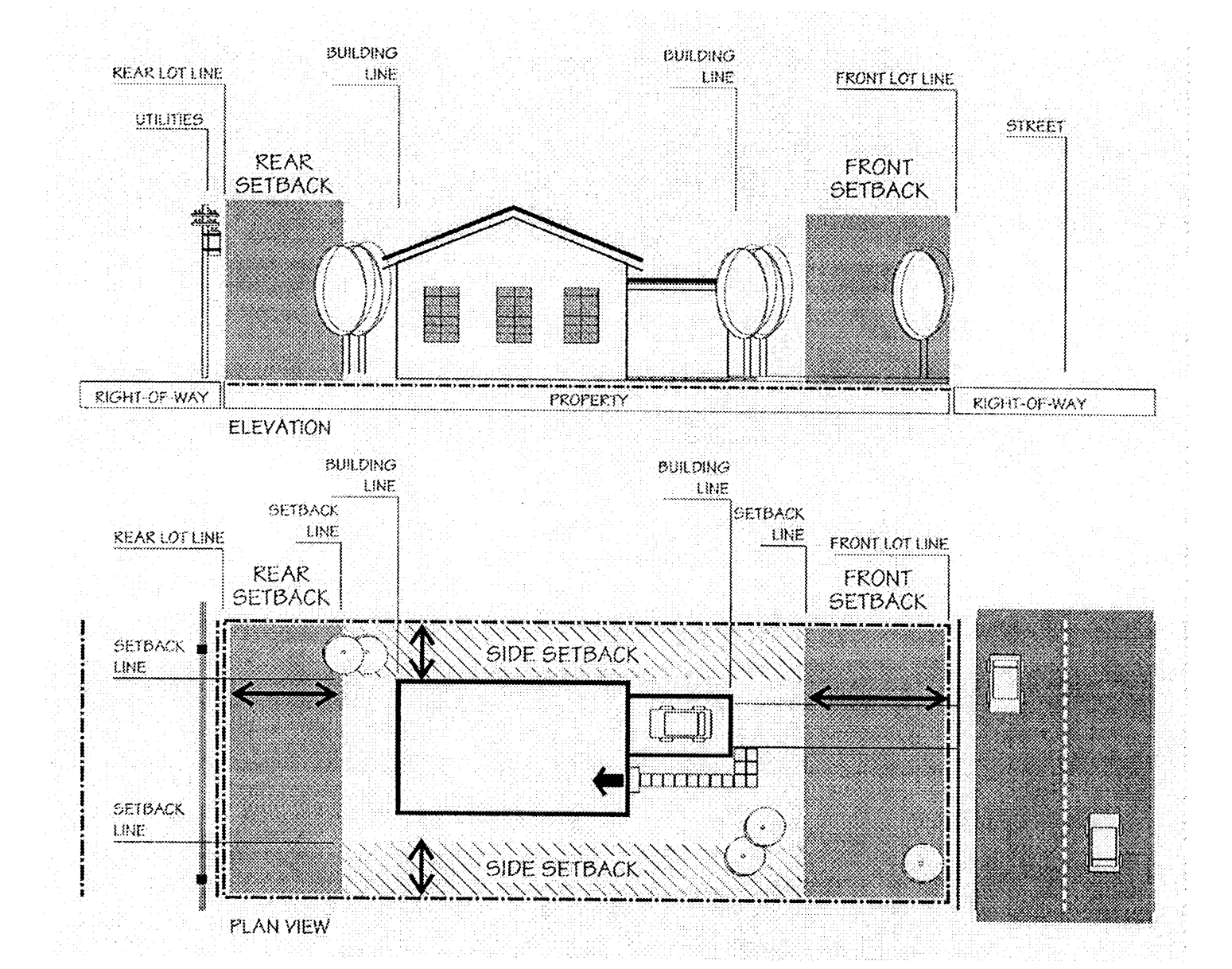
Setbacks
Shopping center: See retail structure types.
Shopping mall: See retail structure types.
Short-term housing: A structure that contains one or more individual sleeping rooms, and where tenancy of all rooms may be arranged for periods of less than one month. The short-term housing facility may or may not have food preparation facilities, and shower or bath facilities may or may not be shared. The facility is managed by a public or non-profit agency to provide short-term housing, with or without a fee. Examples include transitional housing, and emergency shelter where individual rooms are provided. Where individual rooms are not provided, the facility may be a mass shelter. See also mass shelter.
Sidewalk cafe: A street level portion of a restaurant, of any type, located within the sidewalk area of the public right-of-way, which is normally adjacent to a street, which functions as an extension of the principal use of the private property of the restaurant. A sidewalk cafe is open to the sky except that it may have awnings or umbrellas, and shall be used temporarily for dining, drinking and circulation therein pursuant to a provisional use permit. A sidewalk cafe may provide either waiter or waitress service or self-service. See also outdoor restaurant.
Sidewalk system:
(1)
Amenity zone: The section of the sidewalk between the curb and the pedestrian zone in which street furniture and amenities, including, but not limited to, lighting, benches, public art, utility poles, trees, and bicycle parking are provided. The amenity zone shall be measured from back of curb to the pedestrian zone.
(2)
Pedestrian zone: The primary, accessible, and clear walking pathway that typically runs parallel to the street. The pedestrian zone ensures that pedestrians have a safe and adequate place to walk and are not encroached upon by streetlights, utility boxes, tree trunks, street furniture, landscaping, and similar impediments to pedestrian travel.
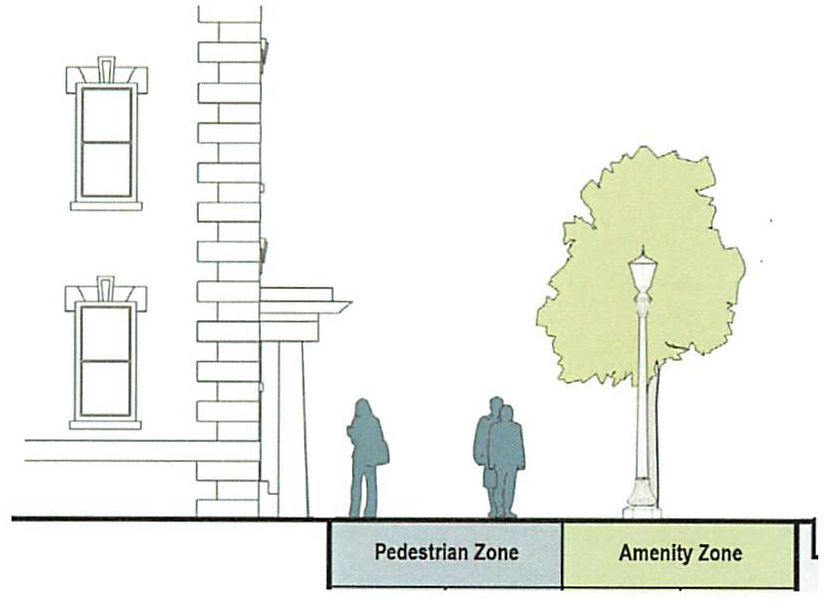
Sight triangle: The area of the corner zoning lot closest to the intersection that is kept free of visual impairment to allow full view of both pedestrian and vehicular traffic.
Sign-related definitions:
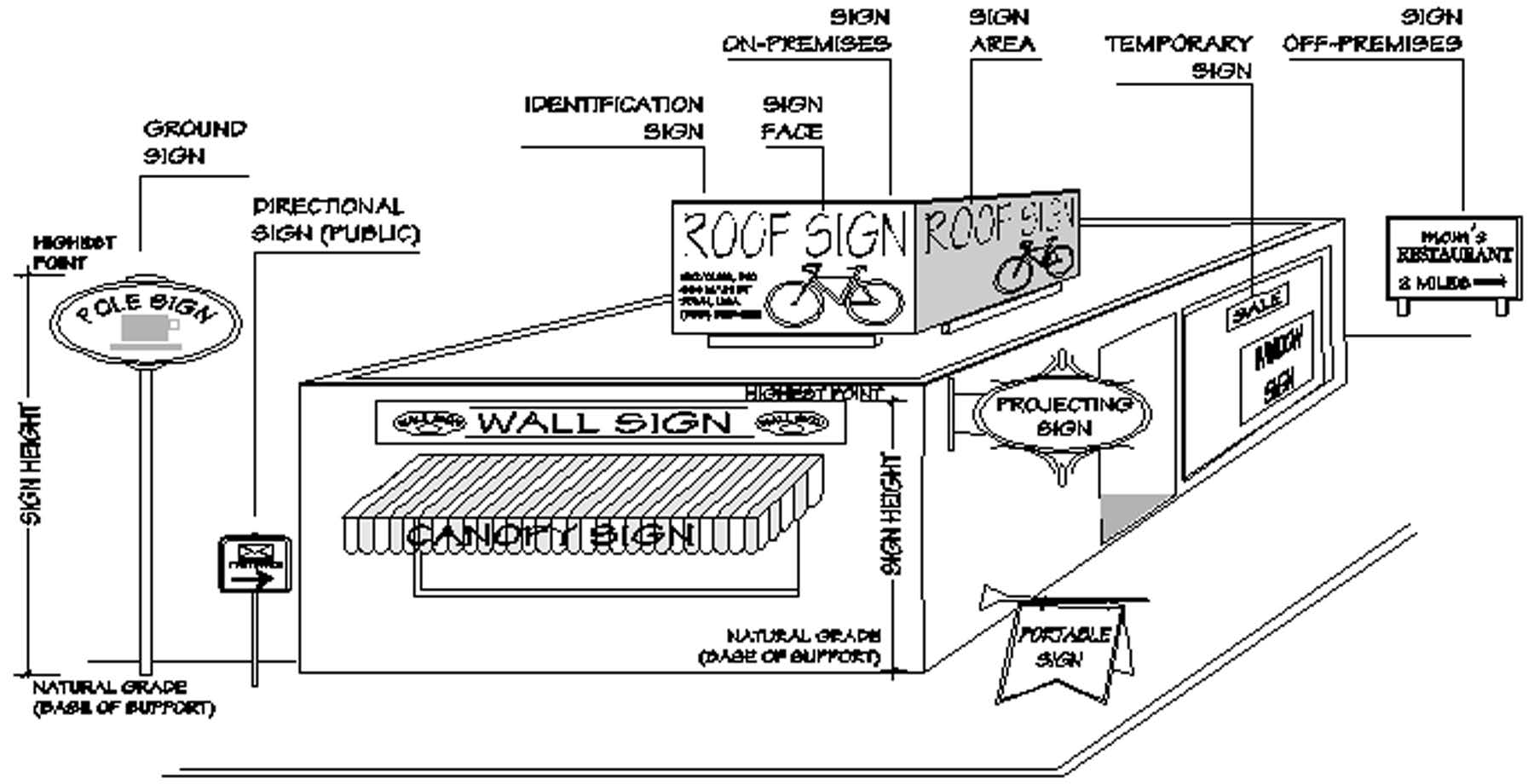
Signs
(1)
Animated: A sign having externally moving parts or messages or operating so as to give the viewer the illusion of moving parts or messages. This does not include signs whose informational content can be changed or altered on a fixed display. See also electronic message board.
(2)
Banner: A sign intended to be hung either with or without a frame, possessing characters, letters, illustrations or ornamentation applied to paper, plastic, fabric or other non-rigid material, excluding flags and insignias of any government entity. See also internal banner and perimeter banner.
(3)
Canopy sign: Any sign that is affixed to, painted on, or suspended from a canopy or awning.
(4)
Commercial artwork sign: Any sign containing drawings, pictures, symbols, paintings (including the painting of patterns or designs), or objects which include a company or corporate logo, commercial name, branding, or images identifying any product, service, or item sold or available on the premises.
(5)
Directory sign: A sign that lists the names of two or more establishments, persons or agencies which exist on a premises and is located in a place or location common to all.
(6)
Electronic message board: A type of sign whose alphabetic, pictographic, or symbolic informational content can be changed or altered on a fixed display screen composed of electrically illuminated segments. See also animated.
(7)
Free-standing sign: Any sign which is permanently affixed in or upon the ground, supported by one or more structural members (poles, columns, braces, etc.), with air space between the ground and the sign face.
(8)
Ground sign: Any sign which is neither attached to, nor part of, a building and which is permanently affixed in or upon the ground. Ground signs shall include freestanding, monument, pole or post, and pylon signs.
(9)
Identification sign: A sign that states the name of the business or establishment, including the national company or local proprietor, and/or the address of a building.
(10)
Indirectly illuminated sign: A sign illuminated with a light directed primarily toward such sign, including back-lighted signs, and so shielded that no direct rays from the lights are visible elsewhere than on the zoning lot where such illumination occurs.
(11)
Internal banner: A banner that is located more than 50 feet from the boundaries of the zoning lot upon which it is located.
(12)
Marquee sign: Any sign painted on, attached to, or supported by a marquee.
(13)
Monument sign: A ground sign having a horizontal dimension greater than its vertical dimension, whose base is on the ground, or a maximum of 12 inches above the adjacent grade.
(14)
Off-site sign: A sign that identifies or communicates a commercial or noncommercial message related to an activity conducted, a service rendered, or a commodity sold at a location other than where the sign is located.
(15)
On-site sign: A sign relating in its subject matter to the premises on which it is located or to products, accommodations, services, or activities on the premises.
(16)
Perimeter banner: A banner that is located within 50 feet of the boundaries of the zoning lot upon which it is located.
(17)
Pole/post sign: A freestanding sign.
(18)
Portable sign: Any sign that is not permanently attached to the ground, a structure or a building.
(19)
Projecting sign: Any sign that is attached to a wall in a perpendicular manner.
(20)
Pylon sign: A ground sign having a vertical dimension greater than its horizontal dimension.
(21)
Real estate sign: A sign that advertises the sale, rental, or development of property.
(22)
Roof sign: A sign erected, constructed, maintained, or located wholly upon, over, or through the roof of any building, with the principal support on the roof structure
(23)
Sign: Any object, device, display or structure which is used to advertise, identify, display or direct or attract attention to an object, person, establishment, product, service, event or location.
(24)
Wall sign: Any sign attached to or erected against a wall of a building or structure with the exposed face of the sign in plane, or approximately parallel to the plane of the wall. Shall include projecting signs.
(25)
Wind sign: Any sign or display, including, but not limited to, banners, balloons, streamers and rotating devices, fastened in such a manner as to move when subjected to pressure by wind or breeze.
(26)
Window sign: A temporary nonstructural sign affixed to the interior or exterior of a window or door or any other sign containing a message legible from the public right-of-way or adjacent property clearly intended for public recognition outside the building.
(27)
Yard sign: A sign erected on private property that contains information that is not of a permanent character.
Site plan: A graphic portrayal of a proposed development describing both existing and proposed conditions of the zoning lot(s), including, but not limited to, use, location and bulk of buildings and structures, density of development, public facilities, means of ingress and egress, landscaping, signs, drainage and lighting.
Slope: Any ground whose surface makes an angle from the horizontal plane of the ground. The extent of slope may be expressed as ratio (e.g. 4:1) or a percentage (e.g. 25%).
Smoke: Particulate matter resulting from the process of combustion.
Social service facility: A facility owned and operated by a private nonprofit organization or by a public agency which offers counseling services, meals and temporary shelter to transient or indigent persons. Such facilities may also provide counseling and temporary custodial care to nonviolent prerelease inmates from federal and state correctional facilities.
Solar utility: An electric production facility that utilizes photovoltaic cells to convert sunlight into electricity which may be transmitted to a power grid for consumption away from the production site. A solar utility may be either a ground mounted solar utility or floating solar utility. Facilities at a solar utility generally consist of solar panels that convert sunlight into electricity using photovoltaic cells, an inverter that converts direct current (DC) electricity to alternating current (AC) electricity, as well as other mechanical or electrical components such as controllers, meters, transformers, battery systems, electrical cables, fire suppression equipment, and structures for administration, maintenance, or storage. Additionally, a floating solar utility may include floats with anchoring systems and floating walkways.
Special cabarets: Any bar, dance hall, restaurant, or other place of business which features: persons who display or expose specified anatomical areas to others; topless or bottomless dancers; or topless waiters or waitresses. Additionally, special cabarets shall include any bar, dance hall, restaurant, or other place of business for which the advertising for, or a sign or signs identifying it, use the words, "adult," "topless," "nude," "bottomless," or other words of similar import. For purposes of these regulations, any establishment in which employees, agents, or independent contractors engage in straddle dance or lap dance activities shall be considered a special cabaret.
Special event: An organized outdoor activity occurring on city-owned property or within city-maintained rights-of-way for which the organizer requests the use of city services above and beyond the ordinary everyday use, or which requires a commercial vending permit, pursuant to section 23-3.6 of the city Code of Ordinances.
Special event permit: A permit for a special event as may be required pursuant to chapter 29.5 of the city Code of Ordinances.
Special magistrate or magistrate: The special magistrate or any alternate magistrates appointed by the city commission (per section 2-306 of the City Code).
Special master or code enforcement special master: All references to "special master" or "code enforcement special master" as utilized in these regulations, shall mean "special magistrate" or "magistrate".
Specified anatomical areas: Those areas of the human body set forth hereinafter which are not completely and opaquely covered:
(1)
The male or female genitals or any portion thereof;
(2)
The male or female pubic area or any portion thereof;
(3)
The areola of the female breast;
(4)
Human male genitals in a discernibly turgid state even if completely and opaquely covered; or
(5)
The male or female anal cleft.
Specified criminal act (may consist of any of the following):
(1)
A criminal violation of division 4 of article IV;
(2)
An offense under F.S. ch. 794 (sexual battery);
(3)
An offense under F.S. ch. 796 (prostitution);
(4)
An offense under F.S. ch. 800 (lewdness, indecent exposure);
(5)
An offense under F.S. ch. 826 (bigamy, incest);
(6)
An offense under F.S. ch. 847 (obscene literature, profanity);
(7)
An offense under an analogous statute of a state other than Florida, or under an analogous ordinance of another county or city.
Specified sexual activities:
(1)
Human genitals in a state of sexual stimulation or arousal;
(2)
Acts of human masturbation, sexual intercourse, or sodomy, whether actual or simulated; or
(3)
Fondling or other erotic touching of human genitals, pubic region, buttock, or female breasts.
Stadium: A structure or facility designed primarily for athletic events and containing seating for spectators of those events.
Start of construction (for other than new construction or substantial improvements under the Coastal Barrier Resources Act (Pub. L. 97-348): Includes substantial improvement, and means the date the building permit was issued, provided the actual start of construction, repair, reconstruction, rehabilitation, addition placement, or other improvement was within 180 days of the permit date. The actual start means either the first placement of permanent construction of a structure on a site, such as the pouring of slab or footings, the installation of piles, the construction of columns, or any work beyond the stage of excavation; or the placement of a manufactured home on a foundation. Permanent construction does not include land preparation, such a clearing, grading and filling; nor does it include the installation of streets and/or walkways; nor does it include excavation for a basement, footings, piers, or foundations or the erection of temporary forms; nor does it include the installation on the property of accessory buildings, such as garages or sheds not occupied as dwelling units or not part of the main structure. For a substantial improvement, the actual start of construction means the first alteration of any wall, ceiling, floor, or other structural part of a building, whether or not that alteration affects the external dimensions of the building.
Stealth facility: Any communications facility that is designed to blend into the surrounding environment. Examples of stealth facilities may include architecturally screened roof-mounted antennas, building-mounted antennas painted to match the existing structure, antennas integrated into architectural elements, and antenna structures designed to look like light poles. See also camouflaging architectural treatment.
Stoop: See frontage terminology.
Story: A floor level within a building of no more than 14 feet in height from finished floor to finished ceiling. The first story shall be the ground or entry-level floor, which includes open areas and parking garages under a building. However, basements that emerge less than four feet from grade or attics, with or without dormer windows, not exceeding four feet at the knee wall shall not constitute a story. See illustration.
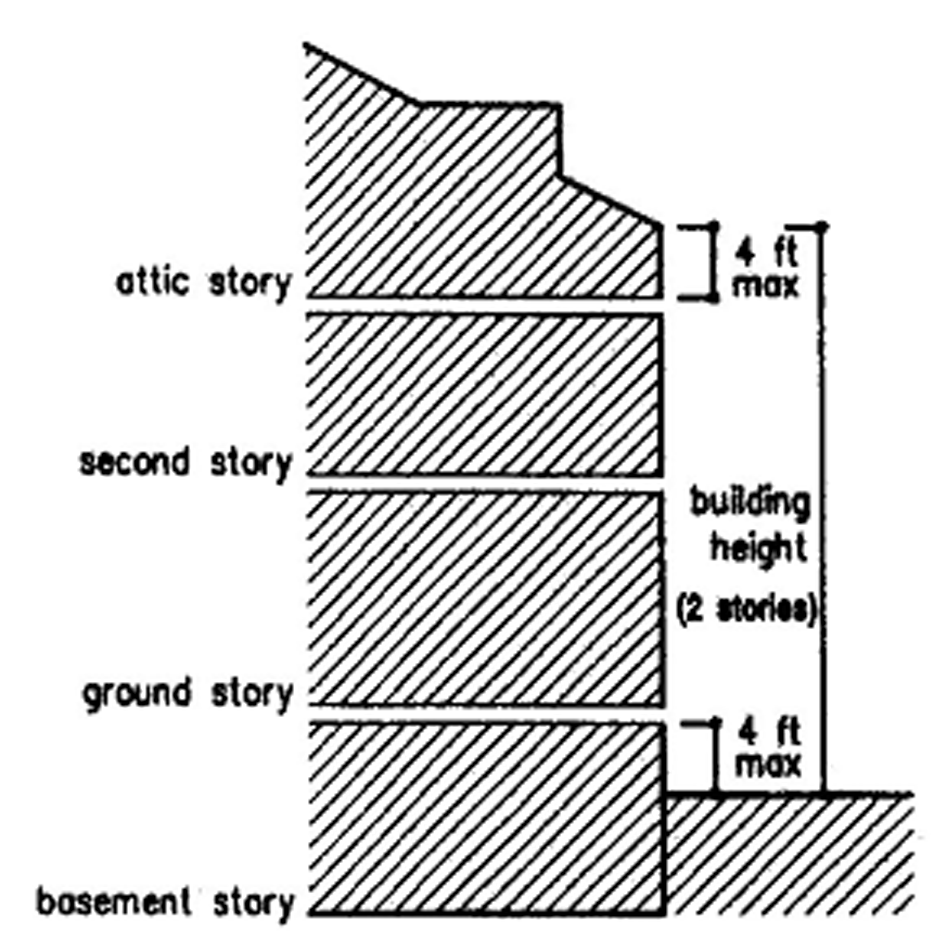
Story
Straddle dance or lap dance: The use by an employee, agent or independent contractor of an adult business of any part of his or her body to touch the genital, buttocks or pubic area of a person, or to touch the breast(s) of a female person, whether clothed or unclothed, while at the adult business; or the touching of the genital, buttocks or pubic area of any such employee, agent or independent contractor by a person while at the Adult Business; or the touching of the breast(s) of a female employee, agent or independent contractor, whether clothed or unclothed, by a person while at the adult business. It shall be a straddle dance or lap dance regardless of whether the touch or touching occurs while the employee, agent or independent contractor is nude, semi-nude or displaying or exposing any specified anatomical area. It shall also be a straddle dance or lap dance regardless of whether the touch or touching is direct or through a medium.
Street: See transportation-related definitions.
Streetwall: See frontage terminology.
Structure: See development-related definitions.
Structures, non-water dependent: See development-related definitions.
Structure, nonresidential: See development-related definitions.
Structure, residential: See development-related definitions.
Structured parking: A covered structure or portion of a covered structure that provides parking areas for motor vehicles. Parking on top of a structure where there is gross building area below the parking, but not above it, is structured parking. The structure can be a primary structure for a commercial parking facility or be accessory to multi-dwelling residential, commercial, employment, industrial, institutional or other structures. A structure that is accessory to detached single-family, attached single-family, duplex, triplex or manufactured home is considered a garage and not structured parking. See also driveway, garage (private and public), parking area, parking lot or garage (commercial), parking space, structured parking, surface parking, and vehicle areas.
Subdivider: Any person who commences proceedings under these regulations to affect a subdivision of land.
Subdivision: The division of real property into three or more zoning lots; and includes the establishment of a new street or alley.
Substantial improvement: Repair, renovation or improvements to an existing structure, the cost of which equals or exceeds 75 percent of the market value of the structure either before the repair, renovation or improvement is started or if the structure has been damaged and is being restored before the damage occurred.
Substantial remodel: The removal, in whole or in part, of a structure. A structure shall be deemed to have been substantially remodeled or demolished if at least 50 percent of exterior walls have been relocated or removed for any duration of time. In determining whether a project is a substantial remodel, a wall shall be deemed to be demolished if the structural supporting members (columns, two-by-fours, or other such elements) of the wall have been removed or are no longer attached to the foundation. The roof structure must also be retained unless the roofline is being modified or additional floors are being added, in which case the roof structure may be removed.
Sufficient application: An application for development approval that has been reviewed by the development review committee under applicable codes.
Surface parking: A parking area for motor vehicles where there is no gross building area below the parking area and no gross building area or roof above. Area occupied by small, permanent buildings, such as booths used by parking attendants, is not parking area. See also driveway, garage (private and public), parking area, parking lot or garage (commercial), parking space, structured parking and vehicle areas.
Talking signs: Any sign that provides information with sound.
Taxi or limousine dispatching service: A facility engaged in the dispatching of passenger vehicle transportation for hire, including business offices and the temporary parking of vehicles; no servicing or overnight storage of vehicles permitted.
Taxi or limousine operations and service: The provision of passenger vehicle transportation for hire; including business offices and dispatching; service of fleet permitted in accordance with limitations in the definition of motor vehicle service station.
Temporary use: A use on private property, but not on public parks or city-owned property, which is established for a fixed period of time with the intent to discontinue such use upon the expiration of such time, and which does not involve the construction or alteration of any permanent structure.
Terminal platform: That part of a dock that is connected to the access dock and is used for securing and loading a vessel or for fishing. The terminal platform is considered the activity area of the dock.
Testing and experimental laboratories (HAZMAT): Testing and production facilities, including storage, (not specifically mentioned elsewhere) involving significant amounts of hazardous materials or operations.
Theater: A building devoted to showing motion pictures or for dramatic, dance, musical or other live performances.
Three-component measuring device: A device for recording the intensity of any vibration in three mutually perpendicular directions.
Through lot or double-frontage zoning lots: See zoning lot.
Tool and equipment rental: A facility engaged in rental of tools or minor or heavy equipment, to the general public or to contractors; maintenance, and repair of equipment on-site; outside storage is not limited.
Tourist attraction: A commercial establishment designed for amusement, entertainment, and recreational purposes. A tourist attraction shall be open to the general public for a fee and contain a combination of three or more activities from each of the following categories: amusement rides, displays, live entertainment, concession stands, and passive recreational facilities (such as picnic areas, botanical displays, and trails).
Tower: A guyed, monopole, or self-supporting tower, taller than ten feet constructed as
a free standing structure or in association with a building, other permanent structure
or equipment, containing one or more antennas intended for transmitting and/or receiving
television, radio, digital, microwave, cellular, telephone, or similar forms of electronic
communication.
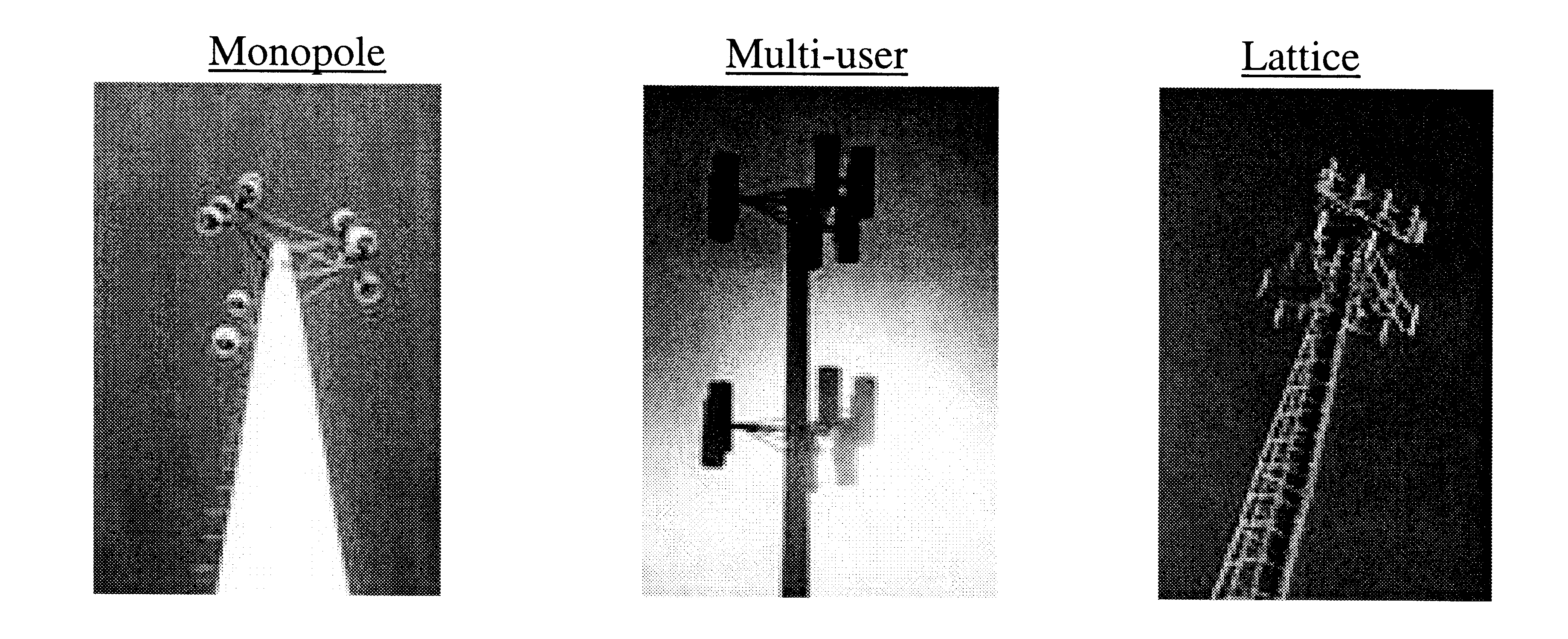
Towers
Tower, guyed: A communication tower that is supported, in whole or in part, by guy wires and ground anchors.
Tower, lattice: A guyed or self-supporting three or four sided, open, steel frame structure used to support telecommunications equipment.
Tower, monopole: A communication tower consisting of a single pole, constructed without guy wires and ground anchors.
Tower, multi-user: A tower to which is attached the antennas of more than one commercial wireless telecommunication service provider or governmental entity.
Tower, self-supporting: A communication tower that is constructed without guy wires and ground anchors.
Tower, single-user: A tower to which is attached only the antennas of a single user, although the tower may be designed to accommodate the antennas of multiple users as required by this Code.
Townhouse: A group of three or more closely placed, interrelated single family dwelling units which are joined to one another side-to-side by a common party wall or garage, and/or with connecting permanent and architecturally unified structures such as breezeways, carports, or walls, which structures continue the design, pattern and/or materials of the facade from one dwelling unit to another. Connecting structures and outdoor living space may be so designed as to provide access between front and rear yards. Each unit shall have its own outside entrance and not be occupied by more than one family. Townhouses may be classified as one of several residential structure types, depending on their configuration. See also residential structure types.
Toxic or noxious matter: Any solid, liquid or gaseous matter, including, but not limited to, gases, vapors, dusts, fumes and mists, containing properties which by chemical means are inherently harmful and likely to destroy life or impair health or capable of causing injury to the well-being of persons or damage to property.
Tradesman's shop: Facility for building or service industry contractors. See contractor or tradesman's shop.
Trade and service establishments: Establishments primarily engaged in providing assistance, services or entertainment, as opposed to products, to the general public.
Trailer: See vehicle types.
Transfer of ownership or control of an adult use business: Includes any of the following:
(1)
The sale, lease, or sublease of the adult business;
(2)
The transfer of securities which constitute a controlling interest in the adult business, whether by sale, exchange, or similar means; or
(3)
The establishment of a trust, gift, or other similar legal device which transfers the ownership or control of the adult business, except for transfer by bequest or other operation of law upon the death of the person possessing the ownership or control.
Transition line: See building elevation terminology.
Transplant: The removal by a property owner of a tree from one location on his real property to another location.
Transportation-related definitions:
(1)
Alley: A public or private way within a block, generally giving access to the rear of zoning lots or buildings and not used for general traffic circulation.
(2)
Arterial street: An arterial street is designed to convey major movements of traffic within or through the city and county. It interconnects the principal traffic generators within the city, and in rare instances provides direct access to individual abutting zoning lots. The arterial classifications are of two types:
a.
Minor arterial street: A street designed for intra-city circulation and designation of neighborhood boundaries. It generally does not penetrate identifiable neighborhoods. Access to neighboring development is achieved by good design and the appropriate intersection spacing. The facility may carry local bus routes.
b.
Major arterial street: A street designed primarily for through traffic and intra and inter municipal movement. On the principal arterial system, service to the abutting land is subordinate to the provision of travel service to major traffic movements. Access to the abutting land is minimized and is consolidated into service roads, shared entrances and appropriate designated intersections. The facility may carry local bus routes.
(3)
Interstate connector street: A street that connects an interstate highway interchange directly to the city limits. Limited or controlled access is common, but not necessary in all instances.
(4)
Local street: A local street represents the least intensive category of the functional classification system. Its sole function is to provide direct access to individual abutting zoning lots. Its traffic is local in nature and extent, rather than intra-county, inter-county, or regional.
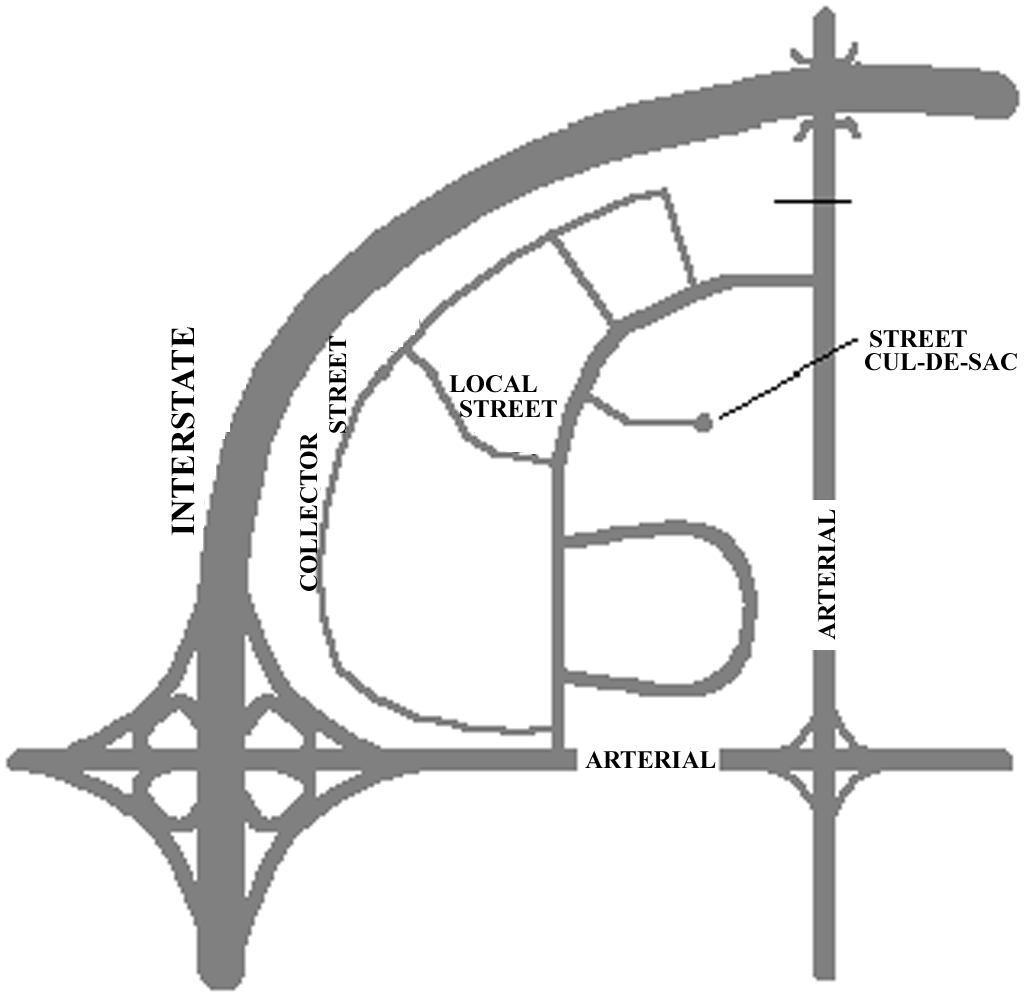
Street Types
(5)
Major collector street: A major collector street has a primary function of providing intra-neighborhood linkages and aggregating traffic, and then carrying it to the arterial system. It may also penetrate a neighborhood, distributing trips to ultimate destinations, and in some instances providing direct access to individual abutting zoning lots. The facility may carry local bus routes.
(6)
Minor collector street: A minor collector street is designed primarily to serve the collection function for a group of local streets. Additionally, its purpose is to provide direct access to individual abutting zoning lots. It is designed to serve internal traffic movements within a neighborhood, and connect with the arterial system. It is not meant to handle long through trips.
(7)
Right-of-way: A public or private area or strip of land on which an irrevocable right of passage for people or goods or utilities has been recorded for the use of vehicles, pedestrians, or both. A public right-of-way is one that is dedicated or deeded, in fee or by easement, to the public for public use and under the control of a public agency.
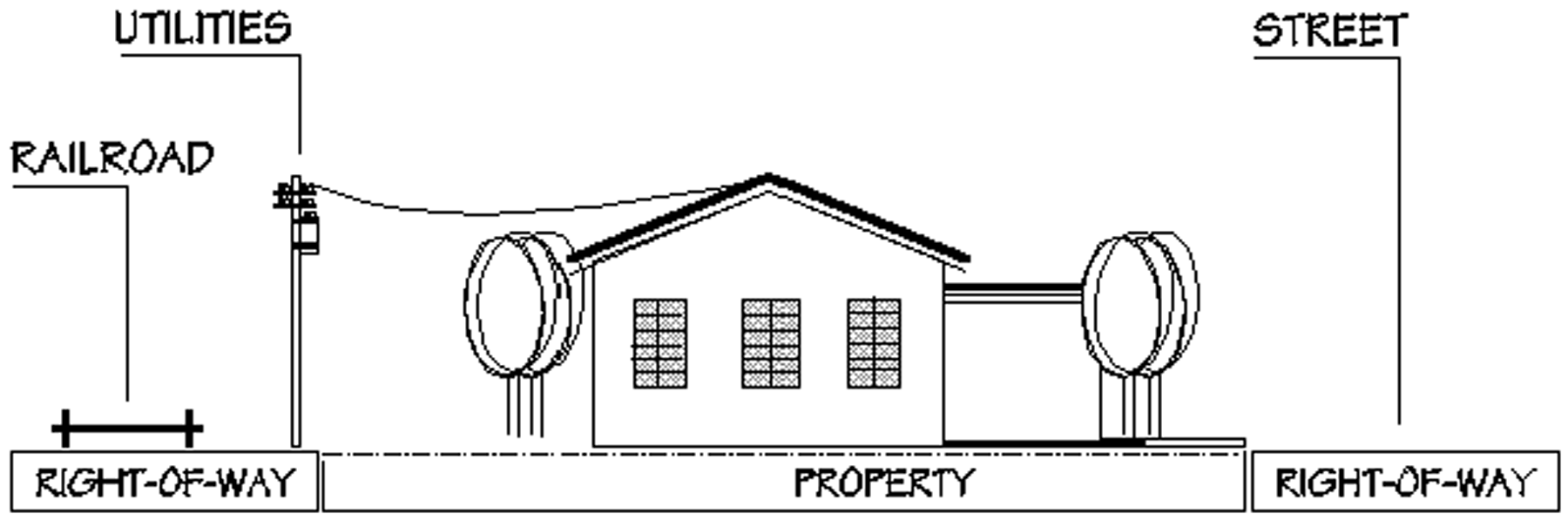
Rights-of-Way
(8)
Roadway: The portion of a street that is improved for motor vehicle travel. Roadway includes vehicle travel lanes and on-street parking areas. Roadway does not include area devoted to curbs, parking strips or sidewalks.
(9)
Street: A public or private right-of-way that is intended for motor vehicle travel or for motor vehicle access to abutting property. Street includes all the area within the right-of-way, such as roadways, parking strips and sidewalks. For the purposes of this Code street does not include alleys.
Transportation facility: Any premises used for:
(1)
The storage or parking of buses, trains or watercraft; or
(2)
The loading and unloading of passengers.
Trailer, commercial: Any vehicle without motor power, designed to be drawn by a motor vehicle and used for carrying equipment, tools, products, materials, or other cargo used in connection with a commercial business or enterprise. This definition does not include recreational or recreational accessory vehicles.
Trash and refuse removal service (local only): Establishment engaged in the collection of refuse for disposal at an approved processing, recycling, or destruction plant, such as incinerators, waste treatment plant, landfills, or other locations approved by the city; on-site storage of refuse is prohibited.
Tree protection-related definitions (see article VII, division 3.1, tree protection):
Buildable area: Shall mean that portion of a lot remaining after required setback yards have been provided in accordance with this Code.
Caliper: Trunk diameter of trees up to four inches are to be measured 6 inches above the soil line. Caliper for all trees over four inches in diameter shall be measured 12 inches above the soil line.
Canopy tree: Those trees that compose the top layer of canopy of vegetation and will generally reach a mature height of 35 feet or more and a mature crown spread of 15 feet or more.
Commercial nursery: A licensed plant or tree nursery offering plants or trees to the general public for sale in the ordinary course of business.
Diameter breast height (D.B.H): The diameter of a tree measured in inches at four and one-half feet above the original soil line (grade) at the base of the tree trunk. For a tree trunk not perpendicular to the ground the D.B.H. shall be measured from the soil level along and following the angle of the trunk for four and one-half feet.
Diseased tree: A tree that creates an immediate and real hazard to people, buildings or other existing improvements on the subject real property or to other trees or which has a 50-percent or greater crown loss.
Drip line: An imaginary, perpendicular line that extends downward from the outermost tips of the tree branches to the ground.
Grand tree: A tree is considered a grand tree if it is determined to have a good or moderate suitability rating by a city arborist, based on the definitions found under the suitability ratings below and is either a Live Oak (Quercus virginia) or Sand Live Oak (Quercus geminata) that has a DBH measurement of 24 inches or greater; or is a Slash Pine (Pinus elliottii), Longleaf Pine (Pinus palustris) or Southern Red Cedar (Juniperus virginiana) that has a DBH measurement of 20 inches or greater. A grand tree shall have the same meaning, and force and effect of law, as a specimen or historical tree under state law (including F.S. § 163.3209, as may be amended from time to time).
Suitability Ratings:
Good: Trees in this category are in good health and structural stability and have potential for longevity at the site.
Moderate: Trees in this category are in fair health and/or have structural defects that may be mitigated with treatment. These trees may require more intense management and monitoring, and may have shorter life-spans than those in the "good" category.
Poor: Trees in this category are in poor health or have significant defects in structure that cannot be mitigated with treatment. These trees can be expected to decline regardless of management.
The final decision as to the health of the tree is to be determined by a city arborist.
Grubbing: The removal of vegetation by methods such as digging, raking, dragging or otherwise disturbing the roots of the under story vegetation.
Infrastructure: Utilities, drainage, graded areas, and any underground facilities that support a development.
Land clearing: The process by which trees and vegetation are removed.
Native tree: An indigenous, naturally occurring tree, adapted to the city climate and soil conditions. Reference guides: Native Plants for Home Landscapes, University of Florida Cooperative Extension Service; Plant Guide, Southwest Florida Water Management District.
No tree verification statement: A signed, notarized statement by the property owner, his agent, landscape architect, architect, civil engineer or land surveyor, stating that no trees protected by this Code exist on the site. The no tree verification statement may be substantiated by an inspection on site by the director of building, zoning and code enforcement.
Person: Individuals, associations, firms, partnerships and bodies politic and corporate, and as the same relates to real property shall include both the record title owner of such real property, a tenant thereon or any person in possession of such real property. As the same relates to construction upon real property, the term "person" shall include contractors, subcontractors, tree service contractors, their agents and employees at a tree site.
Prohibited trees: The following species of trees are prohibited: Malalueca quinquenervia (Punk Tree), Schinus terebinthifolius (Brazilian Pepper), Casuarina spp. (Australian Pine), Capaniopsis anacardioides (Carrotwood), Melia azedarach (Chinaberry), Sapium sebiferum (Chinese Tallow), and Ficus macrocarpa (Cuban Laurel).
Protective barrier: A physical structure limiting access to a protected area.
Protected tree: Any self-supporting live woody plant of at least four and one-half inches in diameter measured at DBH (which is approximately equivalent to a circumference of at least 14¼ inches), either a dicotyledon or monocotyledon of a species which has a main stem or cluster of main stems and commonly exceeding ten feet in height and having an average mature spread or crown of greater than 15 feet. Any tree planted to satisfy a requirement of any portion of this Code, including, but not limited to, trees with a DBH less than four and one-half inches when planted to fulfill either tree removal mitigation or other zoning requirements. All species of Red Mangrove, White Mangrove and Black Mangrove and Buttonwood Mangrove are classified as trees. Typical palms are included in this definition such as: Queen Palm, Pindo Palm, Date Palm, Coconut Palm, Washingtonia Palm and Royal Palm. Sabal Palmetto (Cabbage Palm) with greater than eight feet clear trunk.
Removal: The relocation, removal, cutting down, poisoning, topping, lolly popping, damaging or any other action that causes irreparable injury to a protected tree.
Replacement tree fund: A fund serving as the repository for the minimum fees paid by applicants for tree removal permits who are required by section VII-323 of this Code to pay a minimum fee to the city when a replacement tree cannot be planted.
Topping or lolly popping: Indiscriminate pruning of a tree regardless of branch structure. Often circular to head back natural growth of a tree. Results in poor, potentially hazardous branch structure and abnormal growth.
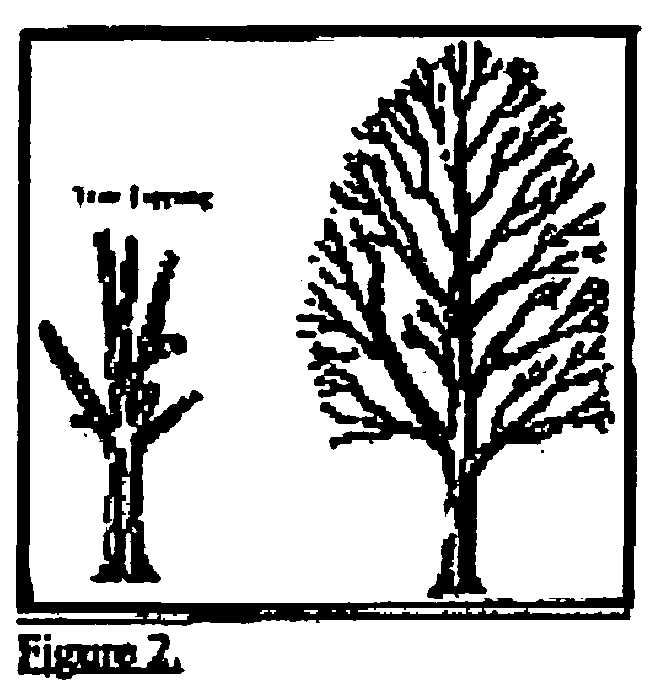
Transplant: The relocation by a person of a tree from one location on real property to another location on real property.
Understory tree: A tree that, under normal forest conditions, may grow to maturity beneath canopy trees and will generally reach a mature height of at least ten feet but less than 35 feet.
Tree removal: The relocation of a tree by digging or cutting the tree.
Truck stop: An establishment where the principal use is the refueling and servicing of trucks and tractor-trailer rigs. Such establishments may have restaurants or snack bars and sleeping accommodations for the drivers of such over-the-road equipment and may provide facilities for the repair and maintenance of such equipment.
Truck terminal: An area and building where trucks load and unload cargo and freight and where the cargo and freight may be broken down or aggregated into smaller or larger loads for transfer to other vehicles or modes of transportation.
Upland walkway: A structure landward of mean high water that connects a dock to uplands.
Use: The purpose for which land or water or a structure thereon is designed, arranged or intended to be occupied or utilized or for which it is occupied or maintained.
Use, principal: See primary use.
Utilities: Distribution or service connection facilities and appurtenances thereto, for gas, electricity, water, sanitary sewer, storm sewer, communications, heating, fuel, cable television and other similar consumable public commodities or services.
Vacant structure: A structure not currently occupied, or a structure to which water service has been disconnected for a period of time exceeding 60 days.
Variance: A grant of relief by the board of adjustment or city commission from the requirements of the zoning code (except the downtown zone districts found in article VI, division 10 and urban mixed-use zone districts found in article VI, division 11) which permits development in a manner otherwise prohibited, subject to the standards set forth in section IV-606.
Variety retail: See retail structure types.
Vehicle: A device or structure, self-propelled or towed, by which persons or property may be transported, propelled, moved or drawn, except by human power.
Vehicle, commercial: Any vehicle that has one or more of the following characteristics:
(1)
Signage of a commercial, charitable, religious, or governmental nature. Such signs shall not include bumper stickers, decorative license plates or dealer stickers.
(2)
Attached or visible equipment or tools, whether or not the vehicle, equipment or tools are covered with a tarpaulin or any opaque or translucent covering.
(3)
Special purpose configurations, such as flat beds, refrigeration equipment, hydraulic lifts, loading ramps or other specially designed commercial systems.
Vehicle areas: All areas on a zoning lot where vehicles may circulate or park including parking areas, driveways, drive-through lanes and loading areas. See also driveway, garage (private and public), parking area, parking lot or garage (commercial), parking space, structured parking and surface parking.
Vehicle-related definitions:
Primary purpose: Foremost intention.
Vehicle types:
(1)
Motor vehicle: A vehicle which is self-propelled or designed to be self-propelled, in or upon which one or more persons or goods may be transported, except on rails, such as automobiles, trucks, vans, motorcycles, buses, all-terrain vehicles, etc. See also passenger vehicle, recreational vehicle, and truck.
(2)
Recreational vehicle: A vehicle with or without motor power, which is designed for sport or recreational use, or which is designed for human occupancy on an intermittent basis. Recreational vehicles are divided into three categories: motor homes, boats, and accessory recreational vehicles.
(3)
Accessory recreational vehicle: Non-motorized recreational vehicles designed for human occupancy on an intermittent basis, such as vacation trailers and fifth-wheel trailers. A camper is considered an accessory recreational vehicle when it is standing alone. Accessory recreational vehicle also includes vehicles designed for off-road use, such as all-terrain vehicles, dune buggies and recreational boats.
(4)
Motor home: Motorized recreational vehicles designed for human occupancy on an intermittent basis.
(5)
Advertising vehicle: A vehicle that displays a sign identifying or communicating a commercial or noncommercial message related to an activity conducted, a service rendered or a commodity sold at a location other than where the vehicle is parked.
(6)
Bus: Any public conveyance, running on fixed routes and stopping at designated bus stops in the city to take on or discharge passengers desiring transportation.
(7)
For-hire vehicle: Any vehicle rented with a driver which is provided with seating accommodations for not less than four passengers, in addition to the driver, which is not equipped with a taxi meter, and the charge for the use of which is determined by the length of time for which the motor vehicle is engaged.
(8)
Sightseeing vehicle: Any motor vehicle with seating accommodations for seven or more persons in addition to the driver which is used on regularly conducted sightseeing trips to destinations and over routes not controlled by the passenger or passengers transported therein.
(9)
Recreational vehicle: A vehicle which is:
a.
Built on a single chassis;
b.
400 square feet or less when measured at the largest horizontal projection;
c.
Designed to be self-propelled or permanently towable by a light duty truck; and
d.
Designed primarily not for use as a permanent dwelling but as temporary living quarters for recreational, camping, travel or seasonal use.
(10)
Mobile food truck: A temporary, non-permanent structure, such as a vehicle, truck, or van, with an associated trailer, stand, or cart, where the preparing, cooking, and/or service of food and/or beverages is performed.
Vehicle weight: The actual scale weight in pounds of a commercial vehicle or a commercial trailer with complete catalog equipment. The director of neighborhood and development services may utilize the vehicle's registration, the National Automobile Dealers Association Official Used Car Guide ("N.A.D.A. Official Used Car Guide") or a similar source commonly accepted in the automobile industry to determine vehicle weight. In the event of a conflict between any of these sources, the greater vehicle weight shall be utilized.
Vessel: Synonymous with the definition of vessel found in F.S. § 327.02(39), includes every description of watercraft, barge and air boat, other than a seaplane on the water, used or capable of being used as means of transportation on water.
Veterinary clinic: A facility where animals are given medical care and the boarding of animals is limited to dogs, cats and other small animals (excluding farm animals) which are kept in a facility designed and constructed to prevent the sound of such animals being heard from beyond the property boundaries when the boarded animals are within the facility. The boarding area within the veterinary clinic shall not exceed 25 percent of the net leasable floor area of the facility. No more than one animal may be boarded at any one time per each 20 square feet of the boarding area. The boarding of any animals shall be limited to boarding indoors of the facility. In the event a veterinary clinic has a property line abutting residentially zoned property or property used for residential dwellings and the veterinary clinic will be used for boarding of animals, the veterinary clinic shall be screened by a six-foot tall, 100 percent opaque fence or wall constructed at the expense of the owner of the veterinary clinic and shall not include mesh or chain-link fences.
Video, movie retail store (non-adult): Establishment primarily engaged in the retail rental or lease of videotapes, films, CD-ROMS, laser discs, electronic games, cassettes or other electronic media. Sales of film, videotapes, laser discs, CD-ROMS and electronic merchandise associated with VCRs, video cameras and electronic games are permitted accessory uses.
View corridor: A three-dimensional area extending out from a viewpoint. The width of the view corridor depends on the focus of the view. The focus of the view may be a single object, such as an historic building or object d'art, which would result in a narrow corridor, or a group of objects, such as a downtown skyline, which would result in a wide corridor. Panoramic views have very wide corridors and may include a 360-degree perspective. Although the view corridor extends from the viewpoint to the focus of the view, the mapped portion of the corridor extends from the viewpoint and is based on the area where base zone heights must be limited in order to protect the view.
Violation (for areas of special flood hazard, article VII, division 4.): The failure of a structure or other development to be fully compliant with the city's floodplain management regulations. A structure or other development without the elevation certificate, other certifications, or other evidence of compliance required in section VII-407, is presumed to be in violation until such time as that documentation is provided.
Vocational, business, and trade school: A non-college degree-granting school providing specialized vocational education courses; offices and classroom facilities are permitted by right; however, laboratory or other specialized training facilities are required to be located, and permitted in accordance with restrictions, in zoning districts in which the underlying activities may be conducted. See also college and school.
Warehousing: An operation from a structure, or part of a structure, for storing goods, wares, commodities and merchandise, whether for the owner thereof or for others, and whether it is a public or private warehousing operation, but excluding mini-warehouse self-storage centers.
Watercraft: Any boat, motorboat, sailboat, vessel, houseboat, barge, floating structure, floating home or any contrivance of any nature whatsoever which is waterborne and is capable of moving under its own mechanical power or by sail.
Waterfront zoning lot: See zoning lot.
Wet bar: A small counterspace typically used for serving beverages that includes a small sink with running water and may include an under-counter refrigerator and/or dishwasher.
Wet marine slip: A space designed for the mooring of a single watercraft in water. Such spaces may extend from a dock or pier, however, any piers authorized for fishing or observation are not considered wet slips.
Wholesaling: The business of selling merchandise to retailers, to industrial, commercial, institutional, or professional business users, or to other wholesalers.
Wrecker: Includes all of the following types of wreckers: Class "A" wrecker as defined in 15B-9.005(7)(b), or (c), Florida Administrative Code, as amended; Class "B" wrecker, as defined in 15B-9.005(7)(d), Florida Administrative Code, as amended; or Class "C" wrecker, as defined in 15B-9.005(7)(e), Florida Administrative Code, as amended.
Yard, front: A yard extending across the full width of a lot between the front lot line of the zoning lot and the front facade of the principal building on the zoning lot.
Yard, rear: A yard extending across the full width of a parcel measured perpendicularly from the rear wall(s) of the principal building situated on the parcel to the rear lot line of the zoning lot.
Yard, side: A yard extending from the front yard to the rear yard, or from the side lot line to the nearest facade of the principal building on the zoning lot.
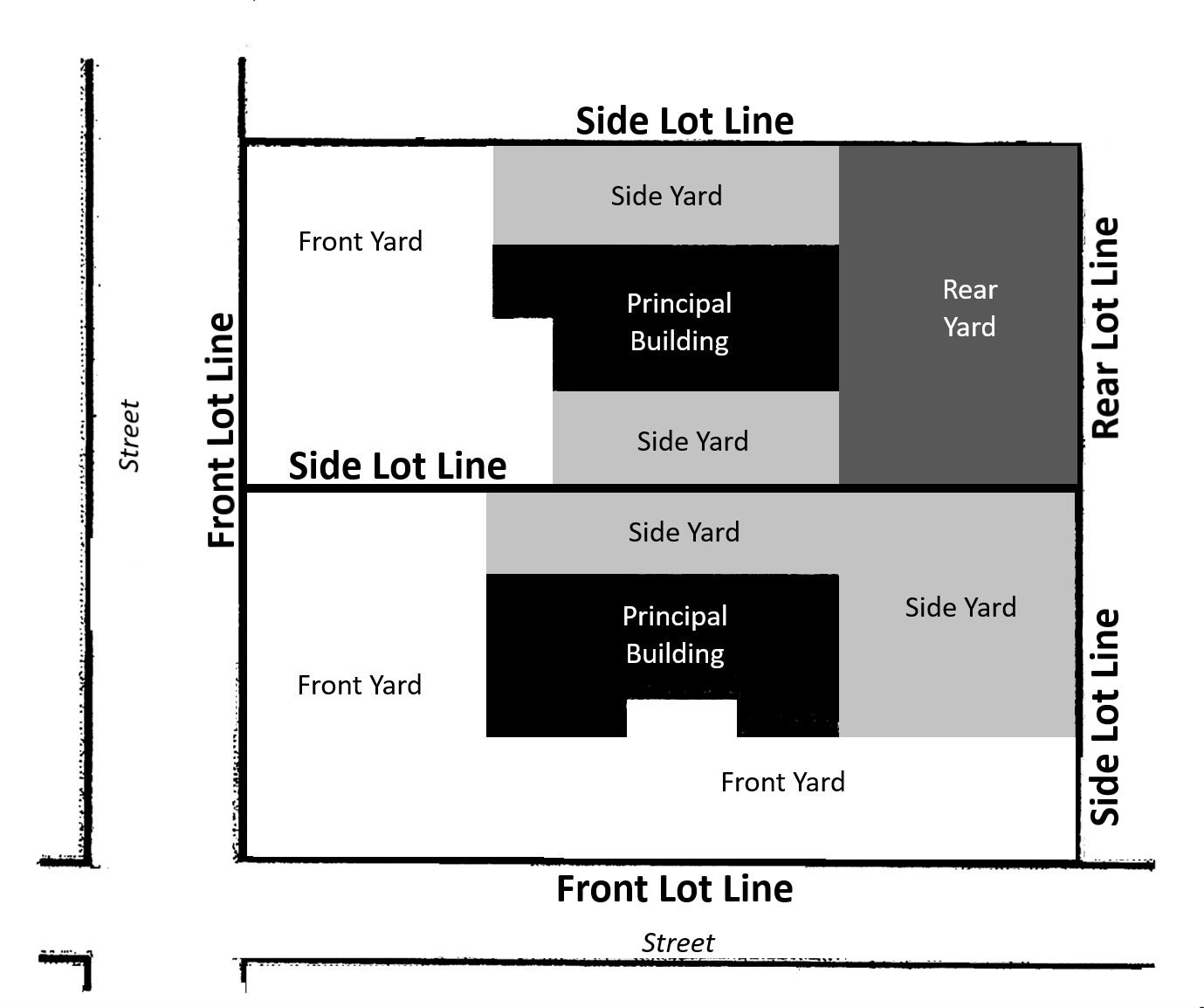
Yard, special: A yard behind any required yard adjacent to a public street, required to perform the same functions as a side or rear yard, but adjacent to a zoning lot line and so placed or oriented that neither the term side yard nor the term rear yard clearly applies.
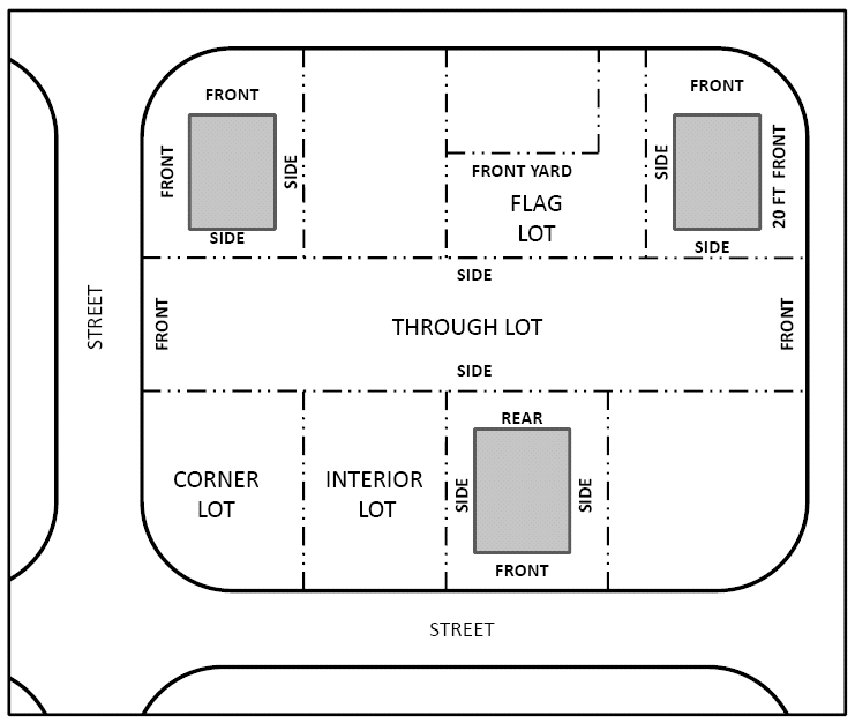
Zoning lot: An area of land under one ownership of at least sufficient size to meet minimum zoning requirements for use, coverage and area and to provide such yards and other open spaces as are required by this Zoning Code, as well as certain nonconforming lots of record exempted by article V of this Zoning Code. Such zoning lots shall have frontage on a public street or on an approved private street as set out in section VI-102(L) of this Zoning Code, and may consist of any of the following:
(1)
A single lot of record;
(2)
A portion of a lot of record;
(3)
A combination of complete lots of record or complete lots of record and portions of lots of record or of portions of lots of record;
(4)
A parcel of land described by metes and bounds;
Provided that in no case of division, boundary adjustment, or consolidation shall any residual area of land be created which does not meet the requirements of this Zoning Code. The grant of an interest, for security or other purposes, in real property for less than an entire zoning lot, or the foreclosure or sale of such interest, shall not be deemed to create a legal zoning lot unless properly approved in accordance with this Code and the city subdivision code.
(1)
Corner zoning lot: A zoning lot that has frontage on more than one intersecting street. A street that curves with angles that are 135 degrees or less is considered two intersecting streets for the purpose of evaluating whether a zoning lot is a corner zoning lot.
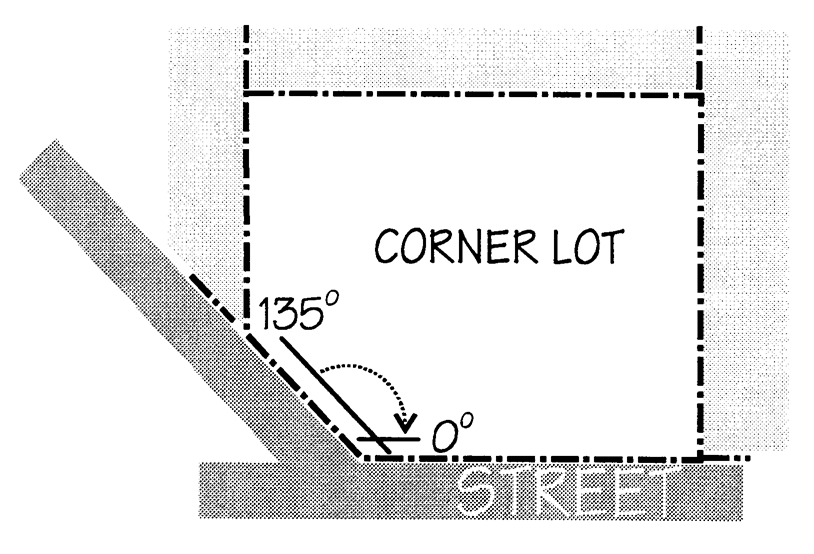
(2)
Flag zoning lot: A zoning lot located behind another zoning lot that has normal street frontage. A flag zoning lot includes a strip of land that goes out to the street and is generally used for an access drive. There are two distinct parts to a flag zoning lot; the flag that comprises the actual building site located behind another zoning lot, and the pole that provides access from the street to the flag. A flag zoning lot usually results from the subdivision of a large zoning lot with the required area and depth for two zoning lots, but that has insufficient width to locate both zoning lots on the street frontage. See illustration.
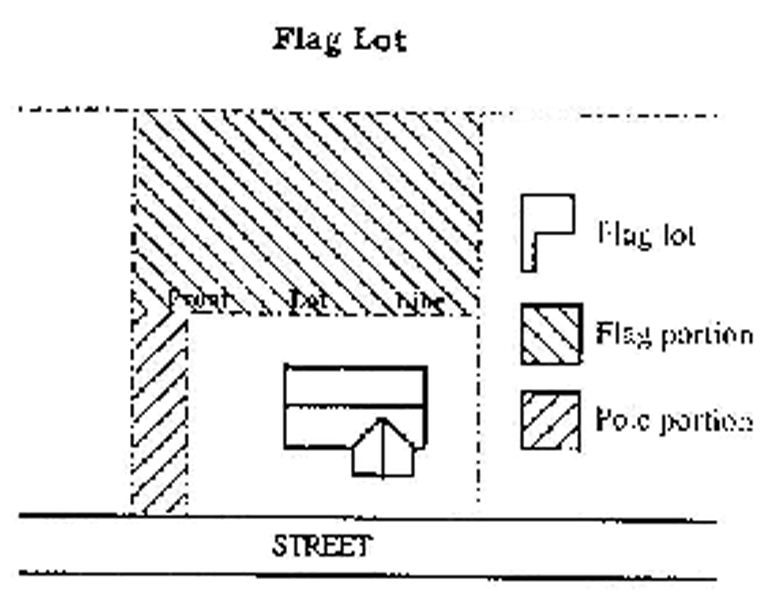
(3)
Interior zoning lot: A zoning lot other than a corner zoning lot with only one frontage on a street.
(4)
Through zoning lot: A zoning lot that has frontage on two parallel or approximately parallel streets.
(5)
Waterfront zoning lot: A zoning lot that borders upon a navigable body of water.
Zoning lot lines: A line defining the ownership boundary of a zoning lot.
(1)
Front zoning lot line: A zoning lot line that abuts a street. However, flag lots are defined differently. See flag zoning lot.
(2)
Rear zoning lot line: A zoning lot line that is opposite a front zoning lot line. A triangular zoning lot has two side zoning lot lines but no rear zoning lot line. For other irregularly shaped zoning lots, the rear zoning lot line is all zoning lot lines that are most nearly opposite the front zoning lot line.
(3)
Side zoning lot line: A zoning lot line that is neither a front zoning lot line or a rear zoning lot line.
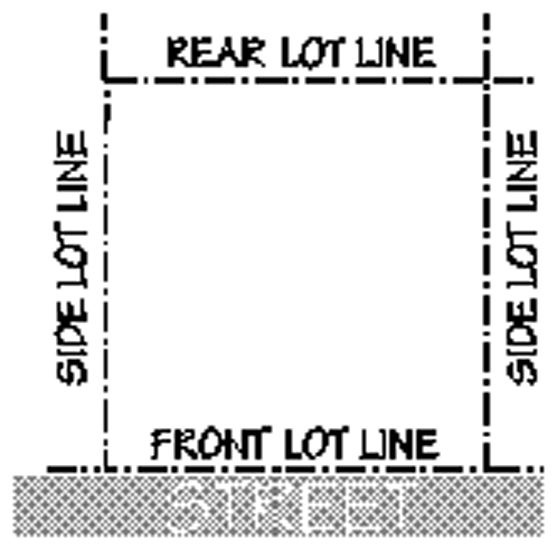
Zoning lot width: The average distance between straight lines connecting the front and rear zoning lot lines at each side of the zoning lot, measured as straight lines between the foremost points of the side zoning lot lines in front, where they intersect with the street line, and the rearmost points of the side zoning lot lines in the rear; provided that the width between the side zoning lot lines at their foremost points in the front shall not be less than 80 percent of the required zoning lot width except in the case of zoning lots on the turning circle of a cul-de-sac, where the width shall not be less than 60 percent of the required zoning lot width.
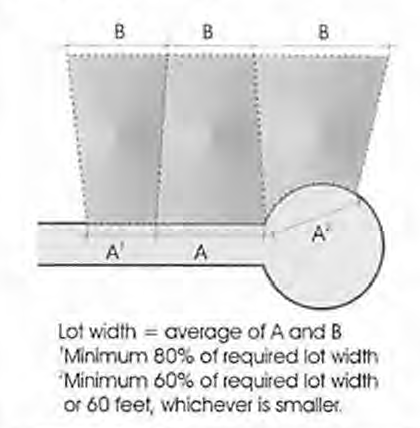
(Ord. No. 02-4357, 4-29-02; Ord. No. 03-4429, § 2, 1-21-03; Ord. No. 03-4422, § 1, 3-3-03; Ord. No. 02-4379, § 2, 4-21-03; Ord. No. 03-4471, § 2, 6-16-03; Ord. No. 02-4401, § 2, 8-4-03; Ord. No. 04-4513, § 2, 1-20-04; Ord. No. 04-4531, § 3, 6-7-04; Ord. No. 04-4538, § 2, 6-7-04; Ord. No. 04-4547, § 8, 6-7-04; Ord. No. 04-4573, § 15, 6-20-05; Ord. No. 06-4663, § 2, 3-20-06; Ord. No. 06-4682, § 2, 7-26-06; Ord. No. 07-4720, § 2, 5-21-07; Ord. No. 07-4770, § 2, 12-17-07; Ord. No. 08-4799, § 2, 4-28-08; Ord. No. 09-4838, § 2(att. 1), 2-17-09; Ord. No. 09-4888, § 2(att. 1), 11-2-09; Ord. No. 10-4927, § 2(att. 1), 2-22-11; Ord. No. 13-5041, § 2(att. 1), 3-4-13; Ord. No. 16-5173, § 2, 7-5-16; Ord. No. 17-5213, § 2, 6-19-17; Ord. No. 18-5234, § 2(Exh. A), 2-5-18; Ord. No. 19-5285, § 2(Exh. A), 7-15-19; Ord. No. 19-5284, § 7(Exh. E), 12-2-19; Ord. No. 20-5319, § 2, 7-20-20; Ord. No. 20-5309, § 4(Exh. C), 11-2-20; Ord. No. 21-5346, § 3(Exh. A), 12-7-20; Ord. No. 21-5364, § 2(Exh. A), 5-18-21; Ord. No. 21-5369, § 4, 5-2-22; Ord. No. 22-5414, § 2(Exh. A), 5-16-22; Ord. No. 22-5415, § 2(Exh. A), 4-16-22; Ord. No. 22-5427, § 2(Exh. A), 9-6-22; Ord. No. 22-5430, § 2(Exh. A), 12-5-22; Ord. No. 23-5468, § 2(Exh. A), 4-17-23; Ord. No. 23-5469, § 2(Exh. A), 4-17-23; Ord. No. 23-5487, § 2(Exh. A), 9-5-23; Ord. No. 23-5502, § 2(Exh. A), 2-20-24; Ord. No. 24-5510, § 2(Exh. A), 4-1-24; Ord. No. 24-5523, § 2(Exh. A), 7-15-24; Ord. No. 24-5540, § 2(Exh. A), 9-16-24; Ord. No. 25-5552, § 2(Exh. A), 2-18-25; Ord. No. 25-5556, § 2(Exh. A), 2-18-25; Ord. No. 25-5583, § 2(Exh. A), 11-17-25)
Sec. II-301. - Purpose.
This division classifies land uses and activities into use categories on the basis of common functional, product, or physical characteristics. Characteristics include the type and amount of activity, the characteristics of customers or residents, how goods or services are sold or delivered, and certain site factors. The use categories provide a systematic basis for assignment of present and future uses to zones. The decision to allow or prohibit a use in the various zones is based on the goals and action strategies of the Sarasota City Plan.
(Ord. No. 02-4357, 4-29-02)
Sec. II-302. - Category titles.
(a)
The names of the use categories start with capital letters throughout this Code.
(b)
The following use categories are defined in this division:
(1)
Residential use categories:
a.
Group living.
b.
Household living.
(2)
Commercial use categories:
a.
Commercial recreation.
b.
Commercial parking.
c.
Quick vehicle servicing.
d.
Major event entertainment.
e.
Office.
f.
Retail sales and service.
g.
Self-storage.
h.
Vehicle repair.
(3)
Industrial use categories:
a.
Industrial service.
b.
Manufacturing and production.
c.
Warehouse and freight movement.
d.
Waste-related.
e.
Wholesale sales.
(4)
Institutional use categories.
a.
Basic utilities.
b.
Colleges.
c.
Community services.
d.
Daycare.
e.
Medical centers.
f.
Parks and open space.
g.
Private clubs.
h.
Religious institutions.
i.
Schools.
(5)
Other use categories:
a.
Aviation.
b.
Detention facilities.
c.
Radio and frequency transmission facilities.
d.
Railroad lines and utility corridors.
(Ord. No. 02-4357, 4-29-02)
Sec. II-303. - Classification of uses.
(a)
Considerations.
(1)
Uses are assigned to the category whose description most closely describes the nature of the primary use. The characteristics subsection of each use category describes the characteristics of each use category. Developments may have more than one primary use. Developments may also have one or more accessory uses. Developments with more than one primary use are addressed in subsection (b) below. Accessory uses are addressed in subsection (c) below.
(2)
The following items are considered to determine what use category the use is in, and whether the activities constitute primary uses or accessory uses:
a.
The description of the activity(ies) in relationship to the characteristics of each use category;
b.
The relative amount of site or floor space and equipment devoted to the activity;
c.
Relative amounts of sales from each activity;
d.
The customer type for each activity;
e.
The relative number of employees in each activity;
f.
Hours of operation;
g.
Building and site arrangement;
h.
Vehicles used with the activity;
i.
The relative number of vehicle trips generated by the activity;
j.
Signs;
k.
How the use advertises itself; and
l.
Whether the activity would be likely to be found independent of the other activities on the site.
(b)
Developments with multiple primary uses. When all the primary uses of a development fall within one use category, then the development is assigned to that use category. For example, a development that contains a retail bakery and a cafe would be classified in the retail sales and service category because all of the primary uses are in that category. When the primary uses of a development fall within different use categories, each primary use is classified in the applicable category and is subject to the regulations for that category.
(c)
Accessory uses. Accessory uses are allowed by right in conjunction with the primary use unless stated otherwise in the regulations. Also, unless otherwise stated, they are subject to the same regulations as the primary use. Common accessory uses are listed as examples with each use categories.
(d)
Use of examples. The examples subsection of each use category provides a list of examples of uses that are included in the use category. The names of uses on the lists are generic. They are based on the common meaning of the terms and not on what a specific use may call itself. For example, a use whose business name is "wholesale liquidation" but that sells mostly to general public, would be included in the retail sales and service category rather than the wholesale sales category. This is because the actual activity on the site matches the description of the retail sales and service category.
(Ord. No. 02-4357, 4-29-02)
Sec. II-304. - Residential use categories.
(a)
Group living.
(1)
Characteristics. Group living is characterized by the residential occupancy of a structure by a group of people who do not meet the description of household living in paragraph (b) below. The size of the group will be larger than the average size of a family. Tenancy is arranged for periods longer than one week. Uses where tenancy is arranged for a period of one week or less are not considered residential. They are considered to be a form of transient lodging (see retail sales and service and community service categories). Generally, group living structures have a common eating area for residents. The residents may or may not receive any combination of care, training, or treatment, as long as they also reside at the site. Group living includes the state definition of assisted living facility. See article II division 2, definitions.
(2)
Accessory uses. Accessory uses commonly found are recreational facilities, parking of autos for the occupants and staff, and parking of vehicles for the facility.
(3)
Examples. Examples include dormitories; communes; fraternities and sororities; monasteries and convents; nursing and convalescent homes; group homes for the physically disabled, mentally retarded, or emotionally disturbed where tenancy is arranged for periods longer than one week.
(4)
Exceptions.
a.
Lodging where tenancy is arranged for one week or less are considered to be a form of transient lodging (see retail sales and service and community service categories). These uses may be classified as a hotel or motel use in the retail sales and service category. Alternatively, they may be classified as short-term housing or a mass shelter in the community service category.
b.
Lodging where the residents meet the definition of household, and where tenancy is arranged for periods longer than one week are classified as household living.
c.
Facilities for people who are under judicial detainment and are under the supervision of sworn officers are included in the detention facilities category.
(b)
Household living.
(1)
Characteristics. Household Living is characterized by the residential occupancy of a dwelling unit by a family. Tenancy is arranged for periods longer than one week. Uses where tenancy may be arranged for a shorter period are not considered residential. They are considered to be a form of transient lodging (see the retail sales and service and community service categories). Condominiums, apartment complexes that have accessory services such as food service, dining rooms, and housekeeping are included as household living.
(2)
Accessory uses. Accessory uses commonly found are recreational activities, hobbies, and parking of the occupants' vehicles. Home occupations and accessory dwelling units are accessory uses that are subject to additional regulations.
(3)
Examples. Uses include living in houses, duplexes, apartments, condominiums, retirement center apartments, manufactured housing and other structures with self-contained dwelling units.
(4)
Exceptions.
a.
Guesthouses that contain kitchen facilities are prohibited as accessory to household living uses.
b.
Lodging where tenancy is arranged for one week or less are considered to be a form of transient lodging (see retail sales and service and community service categories). These uses may be classified as a hotel or motel use in the retail sales and service category. Alternatively, they may be classified as short-term housing or a mass shelter in the community service category.
(Ord. No. 02-4357, 4-29-02)
Sec. II-305. - Commercial use categories.
(a)
Commercial recreation.
(1)
Characteristics. Commercial Recreation uses are large, generally commercial uses that provide continuous recreation or entertainment oriented activities. They take place both indoors and outdoors. They may take place in a number of structures that are arranged together in an outdoor setting.
(2)
Accessory uses. Accessory uses may include concessions, restaurants, parking and maintenance facilities.
(3)
Examples. Examples include amusement parks, theme parks, golf driving ranges, bowling alleys, ice rinks, game arcades, miniature golf facilities, zoos, and marinas.
(4)
Exceptions.
a.
Golf courses are classified as parks and open space.
b.
Uses that draw large numbers of people to periodic events, rather than on a continuous basis, are classified as major event entertainment.
c.
Fraternal organizations, recreation clubs, country clubs and yacht clubs are classified as private clubs.
d.
Theaters, including drive-in theaters are classified as retail sales and service.
(b)
Commercial parking.
(1)
Characteristics. Commercial parking facilities provide parking that is not accessory to a specific use. A fee may or may not be charged. A facility that provides both accessory parking for a specific use and regular fee parking for people not connected to the use is also classified as a commercial parking facility.
(2)
Accessory uses. In a parking structure only, accessory uses may include car washing if this use provides service to autos parked in the garage, and not towards general traffic.
(3)
Examples. Examples include short- and long-term fee parking facilities, commercial district shared parking lots, commercial shuttle parking and mixed parking lots (partially for a specific use, partly for rent to others).
(4)
Exceptions.
a.
Parking facilities that are accessory to a use, but which charge the public to park for occasional events nearby, are not considered commercial parking facilities.
b.
Parking facilities that are accessory to a primary use are not considered commercial parking uses, even if the operator leases the facility to the primary use or charges a fee to the individuals who park in the facility. See accessory parking facilities in article II, division 2, definitions.
c.
Public transit park-and-ride facilities are classified as basic utilities.
(c)
Quick vehicle servicing.
(1)
Characteristics. Quick vehicle servicing uses provide direct services for motor vehicles where the driver generally waits in or with the car before and while the service is performed. The development will include a drive-through facility and the area where the service is performed. Full-serve and mini-serve gas stations are always classified as a primary use (quick vehicle servicing), rather than an accessory use, even when they are in conjunction with other uses.
(2)
Accessory uses. Accessory uses may include auto repair and tire sales.
(3)
Examples. Examples include full-serve and mini-serve gas stations, unattended card key fueling stations, car washes and quick lubrication services.
(4)
Exceptions.
a.
Truck stops are classified as industrial service.
b.
Refueling facilities for the vehicles that belong to a specific use (fleet vehicles) which are on the site where the vehicles are kept, are accessory to the use.
(d)
Major event entertainment.
(1)
Characteristics. Activities and structures that draw large numbers of people to specific events or shows characterize major event entertainment uses. Activities are generally of a spectator nature.
(2)
Accessory uses. Accessory uses may include restaurants, bars, concessions, parking, and maintenance facilities.
(3)
Examples. Examples include stadiums, sports arenas, coliseums, race tracks (auto, horse, dog, etc.), auditoriums, exhibition and meeting areas, and fairgrounds.
(4)
Exceptions.
a.
Exhibition and meeting areas with less than 20,000 square feet of total event area are classified as retail sales and service. Banquet halls with less than 5,000 square feet of total event area are classified as retail sales and service and permitted where restaurant uses are permitted.
b.
Banquet halls that are part of hotels or restaurants are accessory to those uses, which are included in the retail sales and service category.
c.
Theaters, including drive-in theaters, are classified as retail sales and service.
(e)
Office.
(1)
Characteristics. Office uses are characterized by activities conducted in an office setting and generally focusing on business, government, professional, medical, or financial services.
(2)
Accessory uses. Accessory uses may include cafeterias, day care facilities, health facilities, parking, or other amenities primarily for the use of employees in the firm or building.
(3)
Examples. Examples include professional services such as lawyers, accountants, engineers, or architects; financial businesses such as lenders, brokerage houses, banks, or real estate agents; travel agencies, employment agencies, data processing; sales offices; government offices and public utility offices; TV and radio studios; medical and dental clinics, medical and dental labs; and blood-collection facilities.
(4)
Exceptions.
a.
Offices that are part of and are located with a firm in another category are considered accessory to the firm's primary activity.
b.
Contractors and others who perform services off-site are included in the office category if equipment and materials are not stored on the site and fabrication, services, or similar work is not carried on at the site.
(f)
Retail sales and service.
(1)
Characteristics. Retail sales and service firms are involved in the sale, lease or rent of new or used products to the general public. They may also provide personal services or entertainment, or provide product repair or services for consumer and business goods.
(2)
Accessory uses. Accessory uses may include offices, storage or repackaging of goods for on-site sale, and parking.
(3)
Examples. Examples include uses from the five subgroups listed below:
a.
Sales-oriented: Stores selling, leasing, or renting consumer, home, and business goods including art, art supplies, bicycles, clothing, dry goods, electronic equipment, fabric, furniture, garden supplies, gifts, groceries, hardware, home improvements, household products, jewelry, pets, pet food, pharmaceuticals, plants, printed material, stationary, and videos; food sales, and sales or leasing of consumer vehicles including passenger vehicles, motorcycles, light and medium trucks, and other recreational vehicles.
b.
Personal service-oriented: Laundromats; photographic studios; photocopy and blueprint services; hair, tanning, and personal care services; business, martial arts, dance or music classes and other vocational, business or trade schools; taxidermists; mortuaries; veterinarians; and animal grooming.
c.
Entertainment-oriented: Restaurants, cafes, delicatessens, brewpubs, bars, and outdoor bars; continuous entertainment activities such as pool halls; indoor firing ranges; theaters, health clubs, gyms, hotels, motels, recreational vehicle parks, and other transient lodging with an average length of stay of less than one week.
d.
Repair-oriented: Repair of TVs, bicycles, clocks, watches, shoes, guns, appliances and office equipment; recycling drop-off; tailor; locksmith; and furniture upholsterer.
e.
Adult use establishments: Adult bookstore, video store, theatre, modeling studio, photographic studio, physical culture establishment and similar uses.
(4)
Exceptions.
a.
Lumber yards and other building material sales that sell primarily to contractors and do not have a retail orientation are classified as wholesale sales.
b.
Sales of landscape materials, including bark chips and compost, is classified as industrial service.
c.
Repair and service of consumer motor vehicles, motorcycles, and light and medium trucks is classified as vehicle repair. Repair and service of industrial vehicles and equipment, and heavy trucks is classified as industrial service.
d.
Sales, rental, or leasing of heavy trucks and equipment is classified as wholesale sales.
e.
Hotels, restaurants, and other services that are part of a truck stop are considered accessory to the truck stop that is classified as industrial service.
f.
In certain situations, hotels and motels may be classified as a community service use, such as short-term housing or mass shelter. See community services.
g.
An establishment engaged in the licensed dispensing of prescription pharmaceuticals is classified as a pharmacy use. See pharmacy and medical marijuana dispensary. Institutional pharmacies are excluded from this use category and are considered to be within the institutional use category as ancillary uses that occur within a hospital or medical center. See medical centers.
(g)
Self-storage.
(1)
Characteristics. Self-storage uses provide separate storage areas for individual uses. The storage areas are designed to allow private access by the tenant for storing or removing personal property.
(2)
Accessory uses. Accessory uses may include living quarters for a resident manager or security and leasing offices. Use of the storage areas for sales, service and repair operations, or manufacturing is not considered accessory to the self-storage use. The rental of trucks or equipment is also not considered accessory to a self-storage use.
(3)
Examples. Examples include single story and multistory facilities that provide individual storage areas for rent. These uses are also called mini-warehouses.
(4)
Exceptions. A transfer and storage business where there are no individual storage areas or where employees are the primary movers of the goods to be stored or transferred is in the warehouse and freight movement category.
(h)
Vehicle repair.
(1)
Characteristics. Firms servicing passenger vehicles, light and medium trucks and other consumer motor vehicles such as motorcycles, boats and recreational vehicles. Generally, the customer does not wait at the site while the service or repair is being performed.
(2)
Accessory uses. Accessory uses may include offices and sales of parts.
(3)
Examples. Examples include vehicle repair, transmission or muffler shop, auto body shop, alignment shop, auto upholstery shop, and tire sales and mounting.
(4)
Exceptions. Repair and service of industrial vehicles and equipment, and of heavy trucks; towing and vehicle storage; and vehicle wrecking and salvage are classified as industrial service.
(Ord. No. 02-4357, 4-29-02; Ord. No. 18-5234, § 2(Exh. A), 2-5-18; Ord. No. 22-5427, § 2(Exh. A), 9-6-22; Ord. No. 23-5470, § 2(Exh. A), 4-17-23; Ord. No. 23-5502, § 2(Exh. A), 2-20-24)
Sec. II-306. - Industrial use categories.
(a)
Industrial service.
(1)
Characteristics. Industrial service firms are engaged in the repair or servicing of industrial, business or consumer machinery, equipment, products or by-products. Firms that service consumer goods do so by mainly providing centralized services for separate retail outlets. Contractors and building maintenance services and similar uses perform services off-site. Few customers, especially the general public, come to the site.
(2)
Accessory activities. Accessory activities may include offices, parking, storage, rail spur or lead lines, and docks.
(3)
Examples. Examples include welding shops; machine shops; tool repair; electric motor repair; repair of scientific or professional instruments; sales, repair, storage, salvage or wrecking of heavy machinery, metal, and building materials; towing and vehicle storage; auto and truck salvage and wrecking; heavy truck servicing and repair; tire retreading or recapping; truck stops; building, heating, plumbing or electrical contractors; boarding kennels; printing, publishing and lithography; exterminators; recycling operations; janitorial and building maintenance services; fuel oil distributors; solid fuel yards; research and development laboratories; drydocks and the repair or dismantling of ships and barges; industrial laundry and dry-cleaning, and carpet cleaning plants.
(4)
Exceptions:
a.
Contractors and others who perform services off-site are included in the office category, if major equipment and materials are not stored at the site, and fabrication, or similar work is not carried on at the site.
b.
Hotels, restaurants, and other services that are part of a truck stop are considered accessory to the truck stop.
(b)
Manufacturing and production.
(1)
Characteristics. Manufacturing and production firms are involved in the manufacturing, processing, fabrication, packaging, or assembly of goods. Natural, manmade, raw, secondary, or partially completed materials may be used. Products may be finished or semi-finished and are generally made for the wholesale market, for transfer to other plants, or to order for firms or consumers. Goods are generally not displayed or sold on site, but if so, they are a subordinate part of sales. Relatively few customers come to the manufacturing site.
(2)
Accessory uses. Accessory activities may include offices, cafeterias, parking, employee recreational facilities, warehouses, storage yards, rail spur or lead lines, docks, repair facilities, truck fleets, and caretaker's quarters. Living quarters, except for caretakers, are subject to the regulations for residential uses in the zone.
(3)
Examples. Examples include processing of food and related products; breweries, distilleries, and wineries; weaving or production of textiles or apparel; lumber mills, pulp and paper mills, and other wood products manufacturing; woodworking, including cabinet makers; production of chemical, rubber, leather, clay, bone, plastic, stone, or glass materials or products; movie production facilities; ship and barge building; concrete batching and asphalt mixing; production or fabrication of metals or metal products including enameling and galvanizing; manufacture or assembly of machinery, equipment, instruments, including musical instruments, vehicles, appliances, precision items, and other electrical items; production of artwork and toys; sign making; production of prefabricated structures, including mobile homes; and the production of energy.
(4)
Exceptions.
a.
Manufacturing of goods to be sold primarily on-site and to the general public is classified as retail sales and service.
b.
Manufacture and production of goods from composting organic material is classified as waste-related uses.
(c)
Warehouse and freight movement.
(1)
Characteristics. Warehouse and freight movement firms are involved in the storage, or movement of goods for themselves or other firms. Goods are generally delivered to other firms or the final consumer, except for some will-call pickups. There is little on-site sales activity with the customer present.
(2)
Accessory uses. Accessory uses may include offices, truck fleet parking and maintenance areas, rail spur or lead lines, docks, and repackaging of goods.
(3)
Examples. Examples include separate warehouses used by retail stores such as furniture and appliance stores; household moving and general freight storage; cold storage plants, including frozen food lockers; major wholesale distribution centers; truck, marine, or air freight terminals; bus barns and light rail barns; parcel services; major post offices; and the stockpiling of sand, gravel, or other aggregate materials.
(4)
Exceptions:
a.
Uses that involve the transfer or storage of solid or liquid wastes are classified as waste-related uses.
b.
Mini-warehouses are classified as self-service storage uses.
(d)
Waste-related.
(1)
Characteristics. Waste-related uses are characterized by uses that receive solid or liquid wastes from others for disposal on the site or for transfer to another location, uses that collect sanitary wastes, or uses that manufacture or produce goods or energy from the composting of organic material. Waste-related uses also include uses that receive hazardous wastes from others.
(2)
Accessory uses. Accessory uses may include recycling of materials, offices, and repackaging and transshipment of by-products.
(3)
Examples. Examples include sanitary landfills, limited use landfills, waste composting, energy recovery plants, sewer treatment plants, portable sanitary collection equipment storage and pumping, and hazardous-waste-collection sites.
(4)
Exceptions. Disposal of dirt, concrete, asphalt, and similar non-decomposable materials is considered as fill.
(e)
Wholesale sales.
(1)
Characteristics. Wholesale sales firms are involved in the sale, lease, or rent of products primarily intended for industrial, institutional, or commercial businesses. The uses emphasize on-site sales or order taking and often include display areas. Businesses may or may not be open to the general public, but sales to the general public are limited. Products may be picked up on site or delivered to the customer.
(2)
Accessory uses. Accessory uses may include offices, product repair, warehouses, parking, minor fabrication services, and repackaging of goods.
(3)
Examples. Examples include sale or rental of machinery, equipment, heavy trucks, building materials, special trade tools, welding supplies, machine parts, electrical supplies, janitorial supplies, restaurant equipment, and store fixtures; mail order houses; and wholesalers of food, clothing, plants, landscape material, auto parts, building hardware.
(4)
Exceptions:
a.
Firms that engage primarily in sales to the general public or on a membership basis are classified as retail sales and service.
b.
Firms that are primarily storing goods with little on-site business activity are classified as warehouse and freight movement.
(Ord. No. 02-4357, 4-29-02; Ord. No. 22-5427, § 2(Exh. A), 9-6-22; Ord. No. 23-5502, § 2(Exh. A), 2-20-24)
Sec. II-307. - Institutional use categories.
(a)
Basic utilities.
(1)
Characteristics. Basic utilities are infrastructure services that need to be located in or near the area where the service is provided. Basic utility uses generally do not have regular employees at the site. Services may be public or privately provided. All public safety facilities are basic utilities.
(2)
Accessory uses. Accessory uses may include parking; control, monitoring, data or transmission equipment; and holding cells within a police station.
(3)
Examples. Examples include water and sewer pump stations; electrical substations; water towers and reservoirs; regional stormwater retention and detention facilities; telephone exchanges; mass transit stops or turn arounds, light rail stations, transit centers, park-and-ride facilities for mass transit; and public safety facilities, including fire and police stations, and emergency communication broadcast facilities.
(4)
Exceptions.
a.
Services where people are generally present, other than mass transit stops or turn arounds, light rail stations, transit centers, park-and-ride facilities for mass transit; and public safety facilities, are classified as community services or offices.
b.
Utility offices where employees or customers are generally present are classified as offices.
c.
Bus and light rail barns are classified as warehouse and freight movement.
d.
Regional power lines and utility pipelines are classified as rail lines and utility corridors.
(b)
Colleges.
(1)
Characteristics. This category includes colleges and other institutions of higher learning that offer courses of general or specialized study leading to a degree. They are certified by the state board of higher education or by a recognized accrediting agency. Colleges tend to be in campus-like settings or on multiple blocks.
(2)
Accessory uses. Accessory uses include offices, housing for students, food service, laboratories, health and sports facilities, theaters, meeting areas, parking and maintenance facilities.
(3)
Examples. Examples include universities, liberal arts colleges, community colleges, nursing and medical schools not accessory to a hospital, and seminaries.
(4)
Exceptions. Vocational, business and trade schools are classified as retail sales and service.
(c)
Community services.
(1)
Characteristics. Community services are uses of a public, nonprofit, or charitable nature generally providing a local service to people of the community. Generally, they provide the service on the site or have employees at the site on a regular basis. The service is ongoing, not just for special events. Community centers or facilities that have membership provisions are open to the general public to join at any time, (for instance, any senior citizen could join a senior center). The use may provide mass shelter or short-term housing where tenancy may be arranged for periods of less than one month when operated by a public or non-profit agency. The use may also provide special counseling, education, or training of a public, nonprofit or charitable nature.
(2)
Accessory uses. Accessory uses may include offices; meeting areas; food preparation areas; parking, health, and therapy areas; appropriately licensed food distribution on an individual appointment-only basis; daycare uses; and athletic facilities.
(3)
Examples. Examples include libraries, museums, senior centers, community centers, publicly owned swimming pools, youth club facilities, hospices, drug and alcohol centers, social service facilities, mass shelters or short term housing when operated by a public or non-profit agency, vocational training for people with disabilities, soup kitchen, and surplus food distribution centers. Programs that provide care and training or treatment for psychiatric, alcohol, or drug problems, where patients are residents of the program, but where patients are not supervised by sworn officers. Programs that provide transitional living experience for former offenders, such as halfway houses, where sworn officers do not supervise residents.
(4)
Exceptions.
a.
Commercial museums (such as a wax museum) are in retail sales and service.
b.
Parks are in parks and open space.
c.
Uses where tenancy is arranged for periods longer than one week are residential, and are classified as household or group living.
d.
Public safety facilities are classified as basic utilities.
e.
Private fraternal organizations are classified as private clubs.
(d)
Daycare.
(1)
Characteristics. Daycare use includes day or evening care of two or more children outside of the children's homes, for a fee. Daycare uses also include the daytime care of teenagers or adults who need assistance or supervision.
(2)
Accessory uses. Accessory uses include offices, play areas, and parking.
(3)
Examples. Examples include preschools, nursery schools, latch key programs, and adult daycare programs.
(4)
Exceptions. Daycare use does not include care given by the parents, guardians, or relatives of the children, or by babysitters. Daycare use also does not include care given by a family daycare provider as defined by F.S. § 402.302. Family daycare is care regularly given in the family living quarters of the provider's home.
(e)
Medical centers.
(1)
Characteristics. Medical centers includes uses providing medical or surgical care to patients and offering overnight care. Medical centers tend to be on multiple blocks or in campus settings.
(2)
Accessory uses. Accessory uses include outpatient clinics, offices, laboratories, teaching facilities, meeting areas, cafeterias, parking, maintenance facilities, institutional pharmacies, and housing facilities for staff or trainees.
(3)
Examples. Examples include hospitals and medical complexes that include hospitals.
(4)
Exceptions.
a.
Uses that provide exclusive care and planned treatment or training for psychiatric, alcohol, or drug problems, where patients are residents of the program, are classified in the group living category.
b.
Medical clinics that provide care where patients are generally not kept overnight are classified as office.
(f)
Parks and open space.
(1)
Characteristics. Parks and opens areas are uses of land, submerged lands, or water focusing on natural areas, larges areas consisting mostly of vegetative landscaping or outdoor recreation, community gardens, water, submerged lands, or public squares. Lands tend to have few structures.
(2)
Accessory uses, activities and structures. Accessory uses, activities and structures may include, but are not limited to, clubhouses, restrooms, maintenance facilities, concessions, pools, interactive fountains and water features, docks, civic boardwalks and piers, special events, water-related uses in the MP zone district contiguous to the G zone district or other government-owned property, caretaker's quarters, and parking.
(3)
Examples. Examples include parks, golf courses, cemeteries, public squares, plazas, recreational trails, botanical gardens, pools, interactive fountains and water features, docks, civic boardwalks and piers, public beaches and public beach access areas, boat launching area and nature preserves.
(g)
Private clubs.
(1)
Characteristics. Facilities used by a group of people organized for a common purpose to pursue common goals, interests or activities and usually characterized by certain membership qualifications, payment of fees and dues, regular meetings, and constitution and bylaws. Facilities may contain one or more buildings and structures operated only for the benefit of its members and their guests. Occasional special event activities may be open to the public.
(2)
Accessory uses. Accessory uses include offices; meeting rooms; indoor restaurant; bar; lounge; cabanas; boat docks; parking; indoor or outdoor recreation such as: swimming pools, tennis courts, fitness center, sauna, and other similar facilities.
(3)
Examples. Examples may include fraternal organizations such as lodges or guilds, recreation clubs, country clubs, yacht clubs, or bottle clubs.
(4)
Exceptions.
a.
Community centers and facilities that have membership provisions and are open to the general public to join at any time and bona-fide nonprofit organizations, including, but not limited to, the Young Men's Christian Association (YMCA), Young Women's Christian Association (YWCA), or similar organizations whose functions as health spas are only incidental to their overall functions and purposes are classified as community services.
b.
Any organization primarily operated for the purpose of teaching a particular form of martial arts, dance or music class and health clubs or spas are classified as retail sales and service.
(h)
Religious institutions.
(1)
Characteristics. Religious institutions are intended to primarily provide areas for religious activities.
(2)
Accessory uses. Accessory uses include religious education facilities, food pantries, parking, caretaker's housing, group living facilities such as convents, events hosted by the religious institution, and community meetings.
(3)
Examples. Examples include churches, temples, synagogues, and mosques.
(i)
Schools.
(1)
Characteristics. This category includes public and private schools at the primary, kindergarten, elementary, middle, junior high, or high school level that provide state mandated basic education.
(2)
Accessory uses. Accessory uses include play areas, cafeterias, recreational and sport facilities, auditoriums, and before- or after-school daycare.
(3)
Examples. Examples include public and private daytime schools, boarding schools and military academies.
(4)
Exceptions.
a.
Preschools are classified as daycare uses.
b.
Vocational, business and trade schools are classified as retail sales and service.
(Ord. No. 02-4357, 4-29-02; Ord. No. 03-4429, § 3, 1-21-03; Ord. No. 18-5234, § 2(Exh. A), 2-5-18; Ord. No. 21-5346, § 3(Exh. A), 12-7-20; Ord. No. 23-5502, § 2(Exh. A), 2-20-24; Ord. No. 24-5540, § 2(Exh. A), 9-16-24; Ord. No. 25-5552, § 2(Exh. A), 2-18-25)
Sec. II-308. - Other use categories.
(a)
Aviation and surface passenger terminals.
(1)
Characteristics. Aviation and surface passenger terminals means airport facilities, including, but not limited to, landing fields, hangars, and all other facilities necessary or desirable for the landing, taking off, operating, servicing, repairing, and parking accommodation, convenience, and comfort of passengers. Aviation facilities may be improved or unimproved. Aviation facilities may be for commercial carriers or for shared use by private and corporate aircraft. Aviation and surface passenger terminals also includes passenger terminals for regional bus service, regional rail service, and regional marine transportation.
(2)
Accessory uses. Accessory uses include shops, restaurants and catering facilities, ground transportation facilities, automobile rental, freight handling areas, concessions, offices, parking, maintenance and fueling facilities, and aircraft sales areas.
(3)
Examples. Examples include airports, bus passenger terminals for regional bus service, railroad passenger stations for regional rail service, passenger docks for regional marine travel such as ocean-going cruise ships, airstrips, seaplane facilities, and helicopter landing facilities.
(4)
Exceptions.
a.
Bus and rail passenger stations for sub-regional service such as mass transit stops and park-and-ride facilities are classified as basis utilities.
b.
Marine passenger docks for sub-regional marine travel such as water taxis, or recreational boating; and other marine tie ups (such as the boat launching area at Centennial Park or the seawall area at Island Park) are not included in this category and are classified as accessory to their adjacent facilities. Marine passenger terminals that are accessory to marine freight terminals are classified as accessory facilities in the warehouse and freight movement category.
c.
Private helicopter landing facilities that are accessory to another use are considered accessory uses. However, they are subject to all the regulations and approval criteria for helicopter landing facilities.
(b)
Detention facilities.
(1)
Characteristics. Detention facilities includes facilities for the judicially required detention or incarceration of people. Inmates and detainees are under 24-hour supervision by sworn officers, except when on an approved leave.
(2)
Accessory uses. Accessory uses include offices, recreational and health facilities, therapy facilities, maintenance facilities, and hobby activities.
(3)
Examples. Examples include prisons, jails, probation centers, and juvenile detention homes.
(4)
Exceptions. Programs that provide care and training or treatment for psychiatric, alcohol, or drug problems, where patients are residents of the program, but where sworn officers do not supervise patients are classified as community services. Programs that provide transitional living experience for former offenders, such as halfway houses, where sworn officers do not supervise residents, are also classified as community services.
(c)
Radio and frequency transmission facilities.
(1)
Characteristics. Radio and frequency transmission facilities includes all devices, equipment, machinery, structures or supporting elements necessary to produce non-ionizing electromagnetic radiation within the range of frequencies from 100 KHz to 300 GHz and operating as a discrete unit to produce a signal or message. Towers may be self-supporting, guyed, or mounted on poles or buildings.
(2)
Accessory uses. Accessory use may include transmitter facility buildings.
(3)
Examples. Examples include radio and television broadcast towers, commercial wireless telecommunication towers and point-to-point microwave towers.
(4)
Exceptions.
a.
Receive-only antennas are not included in this category.
b.
Radio and television studios are classified in the office category.
c.
Radio and frequency transmission facilities that are public safety facilities are classified as basic utilities.
d.
Amateur radio antennas that are accessory to an allowed primary use.
(d)
Rail lines and utility corridors.
(1)
Characteristics. This category includes railroad tracks and lines for the movement of trains. The land may be owned or leased by the railroad. The category also includes public or private passageways, including easements, for the express purpose of transmitting or transporting electricity, gas, oil, water, sewage, communication signals, or other similar services on a regional level.
(2)
Examples. Examples include rail trunk and feeder lines; regional electrical transmission lines; and regional gas and oil pipelines.
(3)
Exceptions.
a.
Railroad lead and spur lines for delivery of rail cars to sites or for unloading of rail cars on specific sites are classified as accessory to the primary use of the site.
b.
Rail lines and utility corridors that are located within motor vehicle rights-of-way are not included.
c.
Light rail lines and railroad yards are not included.
(Ord. No. 02-4357, 4-29-02)

