
Sarasota City Zoning Code
ARTICLE V
VESTED RIGHTS AND NON-CONFORMITIES
Sec. V-101. - General purposes.
One purpose of this article is to vest certain existing uses and structures that otherwise would not conform to these regulations. The intent of the vested rights provisions are to protect private property rights and recognize certain pre-existing or historic uses, structures, or developments which, in part, help define the city's character.
A second purpose of this article is to provide regulations governing nonconforming uses, structures, and other situations. Nonconformities are created when the application of a specific zone district to a zoning lot changes, or a zoning regulation changes. As part of the change, existing uses, characteristics of uses, or structures may no longer be allowed or may not conform to all applicable zoning provisions. Generally, the intent of new zone districts or new zoning regulations is to guide future uses and development, consistent with the Sarasota City Plan.
(Ord. No. 02-4357, 4-29-02)
Sec. V-102. - Vested rights for lawful existing uses and structures.
(a)
Purpose, applicability. The purpose of this section is to regulate certain uses and structures established prior to the effective date of these regulations that do not conform to these regulations. The provisions of this section are designed to allow certain uses and structures to continue. Uses or structures that were not lawful when established have no vested right to continue and must cease or be removed.
(b)
The following uses and structures shall not be deemed nonconforming but shall be deemed to lawfully exist in conformity with these regulations and shall be allowed to continue as a lawfully existing use or structure. A structure regulated herein that is involuntarily destroyed by any means may be reconstructed to their former footprint and the scale that existed immediately prior to the involuntary destruction. Any expansion of a use or structure regulated herein shall be subject to minor conditional use approval or condition(s) of a previous approval (e.g. special exception, conditional use). Any change in the condition(s) of a previous approval shall be made in the same manner as the original approval. Should a use regulated herein be voluntarily terminated for a period of time exceeding 24 consecutive months, then such use shall not be reestablished or resumed and any subsequent use of the land shall conform to the requirements of the zone district in which the use is located.
(1)
Tourist attractions in RSF-E districts;
(2)
Cemeteries in RSF, RMF, and OPB districts;
(3)
Railroad ROW, not including switching, freight or storage yards, building or maintenance structures in RSF, RMF, and OPB districts;
(4)
Single-family dwellings in CBN, CG, CI, CP and NT districts;
(5)
Two-family dwellings in CG, CI and NT districts;
(6)
Religious institutions or schools on the same zoning lot existing on effective date of Ordinance No. 02-4357 (June 28, 2002) if the zoning lot is less than two acres in size;
(7)
Hotels and motels and their accessory uses and structures, existing or approved by January 22, 1999, on the zoning lots on which they are located in RMF-4, RMF-5 and RMF-6 zone districts. The multiple family development standards found in these zone districts except for the maximum number of guest rooms, which shall equal twice the number of dwelling units permitted in the particular zone district shall govern any expansion of these uses or structures;
(8)
Pharmacies as principal or accessory uses in DTE.
(c)
The following uses and structures shall not be deemed nonconforming but shall be deemed to lawfully exist in conformity with these regulations and shall be allowed to continue as a lawfully existing use or structure. A structure regulated herein that is involuntarily destroyed by any means may be reconstructed to their former footprint and the scale that existed immediately prior to the involuntary destruction.
(1)
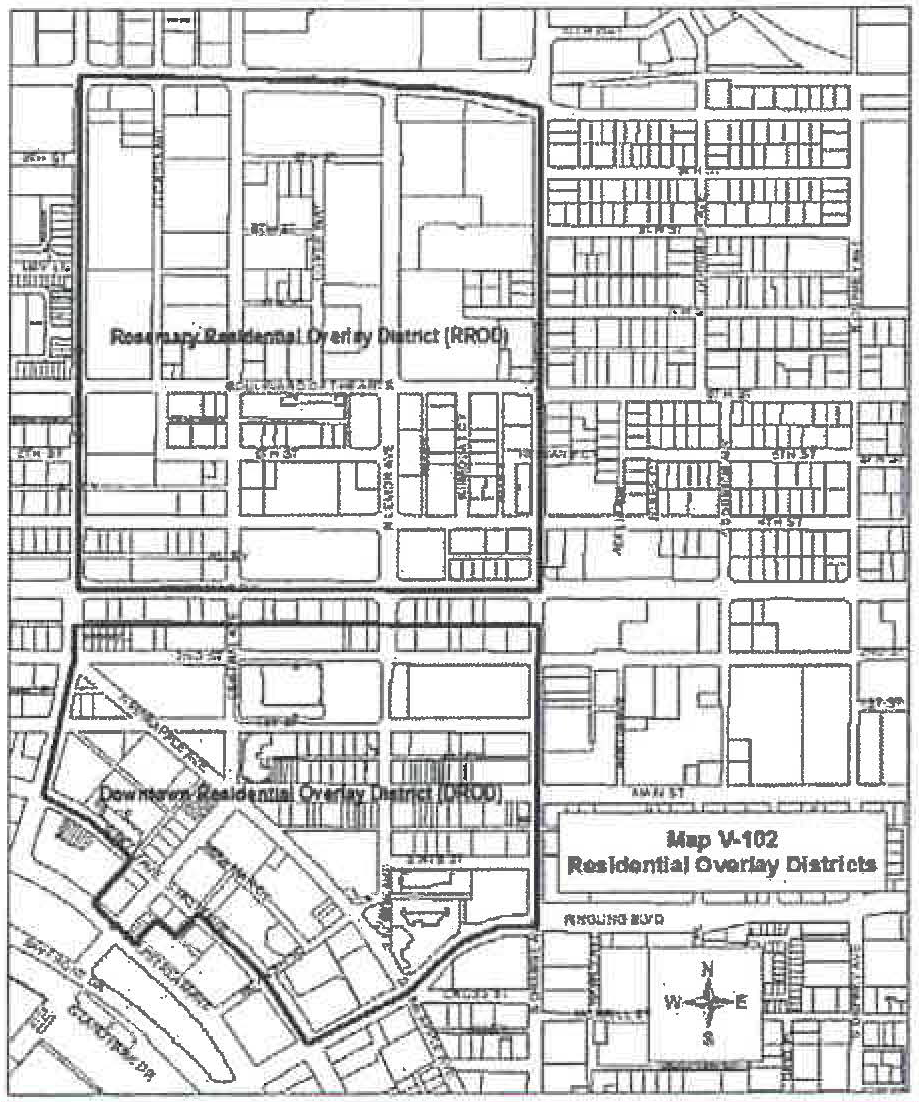
Structures built in accordance with a Downtown Residential Overlay District (DROD) or Rosemary Residential Overlay District (RROD) development approval. The DROD, with a maximum of 200 dwelling units per acre, and the RROD, with a maximum of up to 100 dwelling units per acre, allow for residential development at a greater density than the maximum allowed by the base zone district. See Map V-102.
(Ord. No. 02-4357, 4-29-02; Ord. No. 03-4471, § 5, 6-16-03; Ord. No. 06-4682, § 2, 7-26-06; Ord. No. 18-5234, § 2(Exh. A), 2-5-18; Ord. No. 19-5284, § 5(Exh. C), 12-2-19; Ord. No. 21-5366, § 2(Exh. A), 6-7-21)
Sec. V-103. - Regulations that apply to all nonconforming uses or structures.
(a)
Uses or structures that were not lawful when established have no legal right to continue and must cease or be removed.
(b)
Ownership. The status of a nonconforming use or structure is not affected by changes in ownership.
(c)
Change to a conforming use or structure. A nonconforming use or structure may be changed to a conforming use or structure at any time in accordance with the appropriate approval processes in article IV. Once a conforming use or structure occupies the zoning lot, the nonconforming rights are lost and a nonconforming use or structure may not be re-established.
(Ord. No. 02-4357, 4-29-02)
Sec. V-104. - Nonconforming uses.
Purpose, applicability. The purpose of this section is to regulate and limit the continued existence of certain uses established prior to the effective date of these regulations that do not conform to these regulations. Any nonconformity created by a change in the classification of property or the text of these regulations shall be regulated by the provisions of this article. Many nonconformities may continue, but the provisions of this section are designed to curtail substantial investment in nonconforming uses and to bring about their eventual elimination in order to preserve the integrity and intent of these regulations.
(1)
Nonconforming uses of land, nonconforming structures that contain nonconforming uses, and conforming structures that contain nonconforming uses may continue only in accordance with the provisions of this section.
(2)
Normal repair and maintenance may be performed to allow the continuation of a nonconforming use. However, the continuation, maintenance, or normal repair shall not extend or expand the nonconforming use and may only include:
a.
Repairs that are necessary to maintain and to correct any damage or deterioration to the structural soundness or interior appearance of a building or structure without expanding or altering the building or structure;
b.
Maintenance of land areas to protect against health hazards and to promote the safety of surrounding land uses;
c.
Repairs which are required to remedy unsafe conditions which cause a threat to public safety; and
d.
Maintenance or repair of a sign in a way that does not change the exterior message.
(3)
A nonconforming use shall not be expanded nor shall a nonconforming use be enlarged by additions to the structure in which the nonconforming use is located or the occupation of additional lands.
(4)
A structure in which a nonconforming use is located shall not be moved unless the use thereafter conforms to the standards of the zoning district or districts to which it is moved.
(5)
Where a nonconforming use ceases for any reason except where a governmental action impedes access to the premises for more than nine consecutive months, for a minimum of six consecutive months, or is displaced for any period of time due to structural damage, then the nonconforming use rights are lost and the use shall not be reestablished or resumed, and any subsequent use of the land shall conform to the requirements of these regulations.
(6)
Where a structure in which a nonconforming use is located is destroyed or damaged (either gradually or suddenly) to 75 percent or more of its market value as determined by a state-certified property appraiser, the re-establishment of the nonconforming use is prohibited and the structure may be repaired or restored only for uses which conform to the standards of these regulations for the zoning district in which it is located. A state-certified property appraiser shall determine market value for the year the structure is destroyed or damaged. The director of neighborhood and development services shall determine the extent of damage or destruction by comparing the estimated cost of repairs or restoration with the market value as determined above. In the event that such damage or destruction occurs suddenly and is less than 75 percent of the market value of the entire building or structure as determined by a state-certified property appraiser, no repairs or restoration shall be made unless such restoration is started within one year from the date of the partial destruction and is diligently pursued to completion. In the case of gradual destruction where the damage to the structure does not total more than 75 percent of its market value as determined by a state-certified property appraiser, the repair or restoration must commence within six months after discovery of gradual destruction and must be diligently pursued to completion. The director of neighborhood and development services may calculate the 75 percent threshold described in this section based upon assessed value instead of market value in the event the applicant does not submit an appraisal performed by a state-certified property appraiser. In such event, assessed value shall be determined by reference to the official property tax assessment rolls for the year the structure, accessory use or accessory structure is destroyed or damaged.
(Ord. No. 02-4357, 4-29-02; Ord. No. 04-4547, § 5, 6-7-04; Ord. No. 04-4573, § 25, 6-20-05; Ord. No. 06-4663, § 2, 3-20-06; Ord. No. 09-4838, § 2(att. 1), 2-17-09)
Sec. V-105. - Nonconforming structures.
(a)
A nonconforming structure devoted to a use permitted in the zoning district in which it is located may continue only in accordance with the provisions of this section.
(b)
Normal repair and maintenance may be performed to allow the continuation of nonconforming structures.
(c)
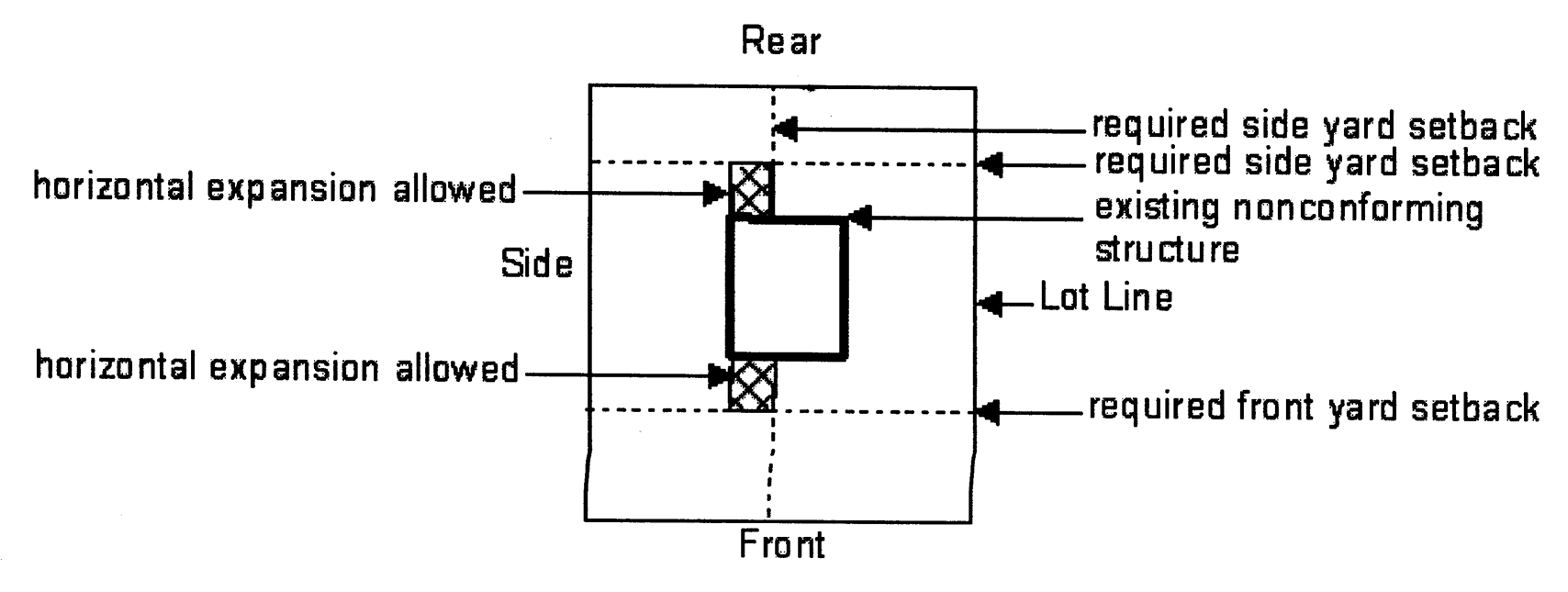
Structures with a nonconforming setback may be expanded, but only horizontally, along a line parallel to the existing nonconformity, provided all of the other zoning code requirements are met. This type of expansion is allowed in front, rear and side yards, however, this type of expansion is not allowed in waterfront yards. In residential zone districts, this type of expansion is not allowed where the existing setback is less than three feet. This subparagraph shall apply to one story structures which have a finished floor elevation which is no more than 24 inches above the average elevation of the crown of a dedicated public street abutting a front yard.
(d)
A nonconforming structure shall not be moved unless it thereafter conforms to the standards of the zoning district in which it is located and other pertinent regulations.
(e)
Any nonconforming structure which is destroyed or damaged (either gradually or suddenly) to 75 percent or more of its market value as determined by a state certified property appraiser may be repaired or restored only if the structure conforms to the standards of these regulations for the zoning district in which it is located. A state-certified property appraiser shall determine market value for the year the structure is destroyed or damaged. The director of neighborhood and development services shall determine the extent of damage or destruction by comparing the estimated cost of repairs or restoration with the market value as determined above. In the event that such damage or destruction occurs suddenly and is less than 75 percent of the market value of the entire building or structure as determined by a state-certified property appraiser, no repairs or restoration shall be made unless such restoration is started within one year from the date of the partial destruction and is diligently pursued to completion. In the case of gradual destruction where the damage to the structure does not total more than 75 percent of its market value as determined by a state-certified property appraiser, the repair or restoration must commence within six months after discovery of gradual destruction and must be diligently pursued to completion. The director of neighborhood and development services may calculate the 75 percent threshold described in this section based upon assessed value instead of market value in the event the applicant does not submit an appraisal performed by a state-certified property appraiser. In such event, assessed value shall be determined by reference to the official property tax assessment rolls for the year the structure, accessory use or accessory structure is destroyed or damaged.
(1)
Notwithstanding the foregoing restrictions as to reconstruction, any structure or structures on a single zoning lot under condominium ownership or cooperative long term leases may be rebuilt after destruction to the prior extent of nonconformity as to height and density of units per acre regardless of the percentage of destruction. In the event of such rebuilding, all setbacks and other applicable district requirements shall be met unless a variance therefor is obtained from the board of adjustment.
(2)
Notwithstanding the foregoing restrictions as to reconstruction, any single-family structure or accessory structure thereto which exists on a single zoning lot within a zone district which permits single-family residences, may be rebuilt, after destruction in whole or in part, as a single-family structure or accessory structure, so long as all setbacks and other applicable district requirements are met except minimum requirements as to zoning lot width or area. A variance as to setbacks and other applicable district requirements may be sought from the board of adjustment.
(3)
Notwithstanding the foregoing restrictions as to reconstruction, for any project which was granted a special exception for height in a zone district pursuant to a prior zone code which previously provided for a special exception for height and if such special exception was granted prior to the effective date of these regulations, then such project may be rebuilt after destruction to the prior extent of nonconformity as to height and density of units per acre regardless of the percentage of destruction. In the event of such rebuilding, all setbacks and other applicable district requirements shall be met unless a variance therefor is obtained from the board of adjustment.
(4)
Notwithstanding the foregoing restrictions as to reconstruction, a structure built in accordance with a development approval issued in conjunction with the Downtown Residential Overlay District (DROD) or the Rosemary Residential Overlay District (RROD) may be rebuilt after destruction to the prior extent of nonconformity as to the number of previously existing dwelling units regardless of the percentage of destruction. The DROD provides for residential density to a maximum of 200 dwelling units per acre and the RROD provides for residential density up to a maximum of 100 dwelling units per acre.
(f)
No conforming ground sign shall be erected on the same premises as an existing nonconforming ground sign until the nonconforming sign has been removed or changed to a conforming sign. However, in commercial retail establishments, the fact that one particular establishment therein has a nonconforming sign shall not prohibit a different establishment therein from erecting a conforming sign on the same premises.
(g)
Structures which have been designated as historically significant pursuant to article IV, division 8 of this Code shall be exempt from the provisions of subsection V-105(e) concerning limitations upon the repair of nonconforming structures. Structures located in a district which has been designated as an historic district pursuant to article IV, division 8 of this Code shall be exempt from the provisions of subsection V-105(e) concerning limitations upon the repair of nonconforming structures, provided that such structures have been classified as contributing or contributing with alterations.
(h)
The reconstruction or repair of any nonconforming dock abutting a residentially zoned parcel shall be governed by zoning code section VII-1306.
(Ord. No. 02-4357, 4-29-02; Ord. No. 03-4471, § 6, 6-16-03; Ord. No. 04-4547, § 5, 6-7-04; Ord. No. 07-4720 § 2, 5-21-07; Ord. No. 07-4770, § 2, 12-17-07; Ord. No. 09-4838, § 2(att. 1), 2-17-09; Ord. No. 19-5284, § 5(Exh. C), 12-2-19; Ord. No. 23-5470, § 2(Exh. A), 4-17-23)
Sec. V-106. - Nonconforming characteristics of uses and structures.
If characteristics of a use or structure, such as densities, off-street parking or off-street loading, or other matters pertaining to the use of land and structures, are made nonconforming by these regulations as adopted or amended, no change shall thereafter be made in such characteristics of use which increase or extends the nonconformity; provided that changes may be made which do not increase, extend, or which decrease such nonconformity.
(Ord. No. 02-4357, 4-29-02)
Sec. V-107. - Nonconforming accessory uses and accessory structures.
(a)
No nonconforming accessory use or accessory structure shall continue after the principal use or structure is terminated by abandonment, damage, or destruction, unless such accessory use or accessory structure thereafter is made to conform to the standards for the zoning district in which it is located.
(b)
A nonconforming accessory use or accessory structure may be expanded only if the nonconforming features are not expanded so as to increase the nonconforming element of that accessory use or accessory structure and the expansion is otherwise in conformance with these regulations.
(c)
Any nonconforming accessory use or accessory structure shall be brought into conformity with these regulations whenever a substantial improvement to, addition to, or change in the principal use or structure on the property is proposed and approved.
(d)
Any part of a nonconforming accessory use or accessory structure which is destroyed or damaged (either gradually or suddenly) to 75 percent or more of its market value as determined by a state-certified property appraiser may be repaired or restored only if the accessory use or accessory structure conforms to the standards of these regulations for the zoning district in which it is located. A state-certified property appraiser shall determine market value for the year the accessory use or accessory structure is destroyed or damaged. The director of neighborhood and development services shall determine the extent of damage or destruction by comparing the estimated cost of repairs or restoration with the market value as determined above. In the event that such damage or destruction occurs suddenly and is less than 75 percent of the market value of the entire building or structure as determined by a state-certified property appraiser, no repairs or restoration shall be made unless such restoration is started within one year from the date of the partial destruction and is diligently pursued to completion. In the case of gradual destruction where the damage to the structure does not total more than 75 percent of its market value as determined by a state-certified property appraiser, the repair or restoration must commence within six months after discovery of gradual destruction and must be diligently pursued to completion. The director of neighborhood and development services may calculate the 75 percent threshold described in this section based upon assessed value instead of market value in the event the applicant does not submit an appraisal performed by a state-certified property appraiser. In such event, assessed value shall be determined by reference to the official property tax assessment rolls for the year the structure, accessory use or accessory structure is destroyed or damaged.
(Ord. No. 02-4357, 4-29-02; Ord. No. 04-4547, § 5, 6-7-04; Ord. No. 09-4838, § 2(att. 1), 2-17-09)
Sec. V-108. - Nonconforming zoning lots.
(a)
In any district in which single-family dwellings are permitted, a single-family dwelling and customary accessory buildings may be erected, expanded, or altered on any single zoning lot in separate ownership from abutting zoning lots existing on January 10, 1974, provided that the district regulations other than minimum zoning lot area and zoning lot width are met.
(b)
Such nonconforming zoning lots for one- and two-family dwellings must be in separate ownership and not of continuous frontage with other zoning lots in the same ownership.
(c)
If two or more lots of record or combinations of lots of record and portions of lots of record with continuous frontage in single ownership are of record on January 10, 1974, or the effective date of any future amendment of this zoning code and if all or part of the lots of record do not meet the requirements established for zoning lot width and for area, the lands involved shall be considered to be an undivided parcel for the purposes of this zoning code; and no portion of such parcel shall be used so as to diminish compliance with zoning lot width and area requirements established by this zoning code, nor shall any division of any parcel or lot of record be made which creates a zoning lot with a width or area less than the requirements stated in this zoning code. If a one- or two-family dwelling exists, or existed as of January 10, 1974, on each of the two or more nonconforming zoning lots which are described in this section V-108(c), then this provision does not apply, and the lots are each considered a buildable lot of record. However, if such lots were at any time intentionally combined as evidenced by a single Sarasota County Property Appraiser's Office Parcel ID Number, such intentionally combined property shall be considered a single lot of record. The property owner may file an application and seek from the board of adjustment or special magistrate a minimum lot area variance. If some, but not all, of the lots of record contain a one- and two-family dwelling, then the property owner may file an application and seek from the board of adjustment or special magistrate a minimum lot area variance. All five of the variance criteria set forth in section IV-606 shall be applicable to such a variance request.
(d)
If two or more adjacent and vacant nonconforming zoning lots are in single ownership at any time, and such zoning lots individually have less frontage or area than the minimum requirements of the district in which such zoning lots are located, then such zoning lots shall, following their consolidation (see section VI-104), be considered and treated as a single zoning lot or several zoning lots which meet the minimum requirements of these regulations for the district in which such zoning lots are located. Such consolidated zoning lots may be developed without need of variances for lot width and area; however, all other development standards of the zone district in which it is located shall be met, unless variances thereto have been approved.
(Ord. No. 02-4357, 4-29-02; Ord. No. 13-5062, § 2(att. 1), 7-15-13; Ord. No. 16-5190, § 2, 11-21-16)
Sec. V-109. - Nonconforming nonresidential uses located in residential zone districts.
(a)
The zoning code (1974 Ed.), as amended, which predated the effective date of these regulations, provided an amortization period of 25 years for the termination of commercial or industrial uses in residential zone districts contained in structures classified as type V, ordinary construction and type VI, wood frame construction. The city commission on July 7, 1997, adopted Ordinance No. 96-3928 providing a limited exemption from the termination provisions of the zoning code (1974 Ed.), as amended, for specified nonconforming uses. This section sets forth the requirements for obtaining and maintaining this limited exemption and is applicable solely to those properties identified by site number and legal description in Ordinance No. 96-3928, copies of which are on file in the office of the city auditor and clerk. Those requirements are as follows:
(1)
No later October 5, 1997, the owners of the structures at the locations referenced above shall submit to the director of neighborhood and development services the following:
a.
A current signed and sealed survey depicting all structures and parking.
b.
A diagram of the premises containing the nonconforming use showing a plan thereof specifying the interior floor area devoted to the nonconforming use. A professionally prepared diagram in the nature of an engineer's or architect's blueprint is not required; however, each diagram should be oriented to the north or to some designated street or object and should be drawn to a designated scale with marked dimensions sufficient to show the various internal dimensions of all areas of the interior of the premises to an accuracy of plus or minus six inches.
c.
A sworn notarized statement describing the following characteristics of the nonconforming use: the type of use, the number of employees, hours of operation, the number of units for hotel use, and the gross floor area for a commercial use. By filing a notarized statement under this section, the property owner shall be deemed to have consented to the inspection of the nonconforming use by the department of building, zoning and code enforcement for the purpose of verification of the facts contained in the notarized statement and for ensuring compliance with this section, at any time the nonconforming use is occupied or open for business.
(2)
The director of neighborhood and development services shall determine whether the property owner has submitted all of the information required by subsection (1) within 30 working days from the date of filing. In the event the information submitted is deemed complete, the director of neighborhood and development services shall have 120 days from the date of the completeness determination to verify the accuracy of the information submitted. Alternatively, if the information is determined by the director of neighborhood and development services to be incomplete, then the manager shall notify the property owner in writing of the additional information which is required, and the property owner shall have 30 days to submit the required information. If the information required by subsection (2) hereof has not been submitted and deemed complete by the director of neighborhood and development services by March 14, 1998, then the director shall notify the city auditor and clerk and the procedures set forth in subsection (5) shall apply.
(3)
Upon verification of the information submitted by the property owner, the director of neighborhood and development services shall prepare a verification form. In the event of a conflict between the facts set forth in the notarized statement submitted by the property owner and the verification form, the facts in the verification form shall prevail. The verification form shall be recorded in the public records of the county to document the type and intensity of the nonconforming use which is exempted from the termination provisions of the zoning code (1974 Ed.), as amended.
(4)
The existing nonconforming uses shall be limited to the structures and parking depicted in the survey, and the type of use, number of employees, hours of operation, number of units for hotel use and gross floor area for commercial use as stated in the verification form. The nonconforming uses shall cease to be exempt from the termination provisions of the zoning code (1974 Ed.), as amended in the event the use is enlarged beyond the square footage shown on the diagram or is converted to another use. In such event, the director of neighborhood and development services shall notify the city auditor and clerk of the change in the nonconforming use and the procedures set forth in subsection (5) hereof shall apply.
(5)
Upon receipt of the notification of noncompliance, change in nonconforming use or failure to buffer from the director of neighborhood and development services pursuant to subsections (2), (4), (6) or (7) hereof, the city auditor and clerk shall schedule an ordinance for public hearing before the city commission, to revoke the exemption from the termination provisions of the zoning code (1974 Ed.), as amended. Notice of the time and place of the public hearing by the city commission shall be sent at least ten days in advance of the hearing by certified mail to the owner of the subject property upon which the nonconforming use is located as well as to all owners of property within 500 feet of the property lines of the land upon which the nonconforming use is located.
(6)
Notwithstanding the foregoing, the existing nonconforming use located at 1740 South East Avenue shall not be subject to the termination provisions of the zoning code (1974 Ed.), as amended for a limited period of five years after the expiration of the amortization period, such that the nonconforming use would terminate by July 10, 2004. It is the intent of the city commission to provide only a limited exemption from the termination provisions as to this existing nonconforming use due to the minimal impact of such use upon the residentially zoned district within which it is located.
(7)
The existing nonconforming use located at 528 South Polk Drive is further subject to the following conditions in order to provide adequate buffering of the existing motel from the adjacent single-family homes:
a.
The property owner shall provide a six-foot high masonry wall, fence or landscaped hedge along both the sides and rear of the property.
b.
In the event a hedge is used for such buffering requirement, it shall be at least 80 percent opaque and between two and six feet above the average ground level when viewed horizontally.
c.
The wall, fence or hedge may be reduced to four feet in height within 20 feet of the front lot line.
In the event the above buffering requirement has not been installed by the property owner January 7, 1998, then the director of neighborhood and development services shall notify the city auditor and clerk and the procedures set forth in subsection (5) hereof shall apply.
(b)
The medical office uses located at 1428 South Osprey Avenue, 2003 South Osprey Avenue, and 3313 South Osprey Avenue may continue; provided however, that the use is limited to those structures and parking depicted on the survey sketch that was submitted pursuant to this article. The submittal included a written statement from each owner of the structures reflecting the square footage within the building devoted to medical office use and the square footage devoted to residential use. The square footage devoted to medical office use and the square footage devoted to residential use as described in the written statement shall remain unchanged. The existing medical office uses described herein may not be converted to another professional office use nor may an existing medical office use be intensified.
(Ord. No. 02-4357, 4-29-02; Ord. No. 09-4838, § 2(att. 1), 2-17-09)
Sec. V-201. - Intent.
The provisions of this division shall apply to real property when the city, county, or state has exercised its power of eminent domain and has acquired or is in the process of acquiring a portion of an existing zoning lot, lot of record, or parcel, with or without structures, buildings, or improvements located thereon. This division shall apply without regard for whether the real property acquisition is pursuant to order of a court of competent jurisdiction, is pursuant to a process of negotiated purchase, or otherwise. This division shall apply without regard to whether suit was filed or threatened by the city, county, or state.
(Ord. No. 02-4357, 4-29-02; Ord. No. 04-4547, § 6, 6-7-04; Ord. No. 15-5141, § 2(Exh. A), 9-8-15)
Sec. V-202. - Existing nonconformities preserved.
A nonconformity, of any nature whatsoever, which existed at the time of the real property acquisition by the city, county, or state pursuant to an exercise of the power of eminent domain, shall not be deemed to result in the existing nonconformity being reduced, in any manner, nor to any extent, by the application of this division.
(Ord. No. 02-4357, 4-29-02; Ord. No. 04-4547, § 6, 6-7-04; Ord. No. 15-5141, § 2(Exh. A), 9-8-15)
Sec. V-203. - Eminent domain—No creation of new nonconformities.
When the city, county, or state acquires property or is in the process of acquiring property pursuant to an exercise of the power of eminent domain and the acquisition would result in the creation of any of the following nonconformities, to wit: Lot area or width, lot coverage by an existing structure(s), location of improvements on a lot or parcel, required yards, off-street parking or the size or location of signs, by the application of this division the real property impacted by the eminent domain acquisition shall not be deemed to have resulted in the creation of any of the nonconformities set forth in this section. Thereafter, said real property shall be deemed to exist as if conforming as to all those matters set forth in this section. In the application and implementation of this section, the following guidelines shall apply:
(1)
A building or structure existing at the time of the acquisition of a portion of the property of the owner, by the city, the county or the state, may be rebuilt in part to replace the portion of the building or structure removed because of the property acquisition. The property owner shall not be required to meet off-street parking requirements of the zoning code. However, the amount of off-street parking existing at the time of the property acquisition, by the city, the county or the state, shall be retained.
(2)
A building or structure existing at the time of the acquisition of a portion of the property of the owner, by the city, the county or the state, may be rebuilt in part to replace the portion of the building or structure removed because of the property acquisition without regard for whether new nonconformities were created by the property acquisition, but for the application of this division. Provided, however, that any nonconformity existing at the time of the property acquisition by the city, the county or the state, shall not be increased by the application of this division.
(3)
A building or structure existing at the time of the acquisition of a portion of the property of the owner, by the city, the county or the state, may be rebuilt in part to replace the portion of the building or structure removed because of the property acquisition without regard for any new nonconformities that would be created pertaining to the property or the building or structure, but for the application of this division. However, the rebuilding may not increase any of the nonconformities that would have been created but for the application of this division.
(Ord. No. 02-4357, 4-29-02; Ord. No. 04-4547, § 6, 6-7-04; Ord. No. 15-5141, § 2(Exh. A), 9-8-15)
Sec. V-204. - Relocating of a building or structure.
When the city, county, or state acquires property or is in the process of acquiring property, and the property owner desires to relocate an existing building or structure(s) on a portion of the real property remaining after the partial acquisition by the city, the county or the state, and in the event that the relocation of the building or structure(s) would create any of the nonconformities specified in section V-203, above, the building or structure(s) may be relocated without regard for the new nonconformities created by the relocation, subject to the favorable determination of the director of the neighborhood and development services department, as is set forth hereafter:
(1)
The property owner shall submit to the director of the neighborhood and development services department, such documentation as the administrator deems necessary in order to determine that the proposed relocation will not adversely affect the public health, safety and welfare, and will not adversely impact surrounding properties.
(2)
The director of the neighborhood and development services department, shall apply the criteria set forth in section IV-906 pertaining to conditional uses, in order to make a determination that the proposed relocation of the building or structure(s) will not be contrary to the public health, safety and welfare, and will not adversely impact surrounding properties.
(3)
The determination of the director of the neighborhood and development services department shall be made in writing and may contain conditions or safeguards pertaining to the relocation.
(Ord. No. 02-4357, 4-29-02; Ord. No. 04-4547, § 6, 6-7-04; Ord. No. 09-4838, § 2(att. 1), 2-17-09; Ord. No. 15-5141, § 2(Exh. A), 9-8-15)
Sec. V-205. - Destruction of building or structure.
In the event that a building or structure is relocated on the real property remaining after the partial acquisition by the city, county, or state, or is partially rebuilt, and thereafter should the building or structure be destroyed, by any means whatsoever, to an extent of more than 75 percent of the market value as determined by a state certified property appraiser at the time of destruction, the building or structure(s) may be rebuilt to the same dimensions and extent and in the same location as was the case at the time of destruction. Provided, however, that the rebuilt building or structure(s) shall meet the requirements of all current technical codes such as building codes, electrical codes and plumbing codes.
(Ord. No. 02-4357, 4-29-02; Ord. No. 04-4547, § 6, 6-7-04; Ord. No. 15-5141, § 2(Exh. A), 9-8-15)
Sec. V-206. - Fire safety regulations.
The provisions of section V-201 through V-204 shall not apply nor be interpreted to waive or alter the application of any fire prevention code or fire prevention requirements adopted as local amendments to a standard building code.
(Ord. No. 02-4357, 4-29-02; Ord. No. 04-4547, § 6, 6-7-04; Ord. No. 15-5141, § 2(Exh. A), 9-8-15)

