
Schaumburg City Zoning Code
Off-Street Parking
and Loading
§ 154.120 - PURPOSE.
The off-street parking and loading regulations, set forth herein, are established in order to protect public health and promote public safety, convenience, prosperity and welfare. These general goals include, among others, the following purposes:
(A)
To increase safety and lessen congestion in the public streets.
(B)
To meet parking demand associated with land development and increased automobile use while limiting excess parking and impervious pavement areas.
(C)
To set standards for the requirements of off-street parking and loading facilities based on the amount of traffic generated by each use.
(D)
To prohibit the on-street storage of vehicles along major traffic routes.
(E)
To provide for adequate, safe, and smooth on-site circulation through promoting excellence in parking lot design.
(Ord. 163, passed 12-5-1961; Am. Ord. 1696, passed 2-27-1979; Am. Ord. 92-112, passed 10-13-1992; Am. Ord. 95-62, passed 6-13-1995; Am. Ord. 21-004, passed 1-12-2021)
§ 154.121 - GENERAL PROVISIONS.
(A)
Scope of Regulations: In all zoning districts, off-street parking and loading areas shall be provided and maintained as follows:
(1)
Off-Street Parking and Loading Required: For all buildings or structures erected and all uses of land established after the effective date hereof or subsequent amendment, accessory parking and loading facilities shall be provided as required by this chapter. However, where a building permit has been issued prior to the effective date hereof and provided that construction is begun within six (6) months of such effective date and diligently prosecuted to completion, parking and loading facilities as required hereinafter need not be provided.
(2)
Parking is prohibited in drive aisles, access driveways, or public rights-of-way.
(3)
Tandem/stadium parking is prohibited unless otherwise permitted in this section.
(4)
Change in Intensity of Use:
(a)
When the intensity of use of any building, structure, or premises is increased through the provision of additional dwelling units, floor area, occupancy load or other units of measurements specified herein for required parking and loading facilities, modifications to the parking provisions may be required. However, buildings or structures lawfully erected or uses lawfully established shall not be required to provide additional parking or loading facilities when the number of existing provided spaces equals at least eighty-five percent (85%) of the total number of required spaces. If the number of existing provided spaces is less than eighty-five percent (85%) of the total number of required spaces, the total number of required spaces shall be provided.
(b)
When the intensity of use of any building, structure, or premises is decreased through the reduction of dwelling units, floor area, occupancy load, or other units of measurements specified herein for required parking and loading facilities, if the parking required exceeds the maximum parking allowed by this subsection, modifications to the existing parking supply will not be required.
(5)
Change in Use: When a change in the use of a building or structure occurs, modifications to the parking and loading facilities may be required as follows:
(a)
Minimum Parking Requirement. Buildings or structures lawfully established shall not be required to provide additional parking or loading facilities when the number of existing provided spaces equals at least eighty-five percent (85%) of the total number of required spaces. If the number of existing provided spaces is less than eighty-five percent (85%) of the total number of required spaces, the total number of required spaces shall be provided.
(b)
Maximum Parking Requirement. Buildings or structures lawfully established shall not be required to reduce the number of parking or loading facilities when the number of existing provided spaces is greater than the maximum number of spaces required by this subchapter.
(B)
Existing Parking and Loading Facilities: Off-street parking or loading facilities which were in existence on the effective date hereof or were provided voluntarily after such effective date shall not hereafter be reduced below the requirements of this chapter for a similar new building or use.
(C)
Permissive Parking and Loading Facilities: Nothing in this chapter shall be deemed to prevent the voluntary establishment of off-street parking or loading facilities to serve any existing use of land or buildings, provided that all regulations herein governing the location, design, improvement and operation of such facilities are adhered to.
(D)
Location of Accessory Off-Street Parking: The location of off-street parking spaces in relation to the use served shall be as prescribed hereinafter. Required off-street parking areas shall be located on the same zoning lot as the building, structure, or premises, or use with which it is associated and may be located in any yard except as prohibited in this chapter. Therefore, parking areas must be designed so as to prevent parking from being remote from the principal or primary use served.
(1)
R-1 to R-7 Districts, Inclusive: Parking spaces accessory to dwellings shall be located on the same zoning lot as the use served. Spaces accessory to uses other than dwellings may be located on a lot adjacent to, or directly across the street or alley from, the lot occupied by the use served, but in no case at a distance in excess of three hundred feet (300') from such use.
(2)
Business and Manufacturing Districts: All required parking spaces shall be within one thousand feet (1,000') of the use served, except for spaces accessory to dwelling units (except those located in a motel/hotel), which shall be within three hundred feet (300') of the use served. However, no parking spaces accessory to a use in a business or manufacturing district shall be located in a residence district. Where paved parking spaces are provided, vehicles used in the conduct of business must be parked in the rear or side of the building.
(E)
Damage or Destruction: For any conforming or legally nonconforming building or use which is in existence on the effective date hereof which subsequently thereto is damaged or partially destroyed to the extent of less than fifty percent (50%) of its replacement value by fire, collapse, explosion or other cause and which is reconstructed, reestablished or repaired, off-street parking or loading facilities need not be provided except that parking or loading facilities equivalent to any maintained at the time of such damage or destruction.
In the event the principal building or structure is damaged or destroyed by any means of fifty percent (50%) or more of its replacement value, it shall be necessary to provide parking or loading facilities as required by this chapter for equivalent new uses or construction; provided, however, that if the principal building or structure contains more than one (1) use, parking and loading facilities, as required by this chapter, need be provided only for those uses which have been damaged or destroyed to the extent of fifty percent (50%) or more of their replacement value. In no instance, however, shall it be necessary to restore or maintain off-street parking or loading facilities in excess of those required by this chapter for equivalent new uses or construction.
(F)
Control of Off-street Parking Facilities: Where required parking facilities are provided on land other than the zoning lot on which the building or use served by such facilities is located, they shall be and shall remain available for the use of the occupant of the zoning lot for as long as the use is maintained on said zoning lot. No such off-site parking facilities shall be authorized and no occupancy certification shall be issued where the plans call for parking facilities other than on the same zoning lot until and unless the zoning board has reviewed the plans and heard the applicant and made findings that the availability of the parking facilities are reasonably certain to continue and that the off-street parking facilities will be maintained at all times during the life of the proposed use or building on the zoning lot.
(G)
Parking Restrictions in Residential Districts:
(1)
Parking of Commercial Vehicles Prohibited in Residential Districts: It shall be unlawful for any person to park a commercial vehicle, including contractors' equipment, having a gross weight when fully loaded in excess of eight thousand (8,000) pounds and/or bearing a classification other than "B" under the provisions of the Illinois Vehicle Code, but excluding public passenger vehicles in any zoning area classified as a residential district at any time, except where making a delivery or rendering a service at such premises or as listed below. The parking of a commercial vehicle or contractors' equipment by the operator of said vehicle or equipment at their place of residence shall not constitute the making of a delivery or the rendering of a service and shall be prohibited.
(a)
Box trucks shall be prohibited to be parked or stored in a residential district regardless of size or license plate classification, except when making a delivery or rendering a service in the residential district.
(b)
Commercial vehicles having a gross weight when fully loaded in excess of eight thousand (8,000) pounds and bearing a classification of "D" under the provisions of the Illinois Vehicle Code may be permitted to be parked in a zoning area classified as a residential district with the following restrictions:
1.
Storage of commercial/contractors' equipment and materials within the vehicle shall be completely concealed from view, and without the use of a tarp or other temporary means, except that ladders may remain on top of the vehicle parked in a residential district. The maximum height of the vehicle shall be no taller than nine feet (9'), including ladders on top of the vehicle. One (1) commercial vehicle shall be permitted to be parked per place of residence.
2.
Any commercial vehicle located on residentially zoned property on the effective date hereof which does not conform to the provisions of this chapter shall be removed from the property or stored inside a structure on the property no later than January 1, 2008.
(c)
Public Passenger Vehicles. It shall be unlawful for any person to park a public passenger vehicle at their place of residence unless parked and/or stored in accordance with the applicable off-street parking and loading requirements of the village Code and in compliance with the parking restrictions of title 7, chapter 70.
(d)
Aircrafts Such as Airplanes, Airplane Fuselage and Helicopters. It shall be unlawful for any person to park an airplane, airplane fuselage or helicopter in a residential district.
(2)
Parking and/or Storing Trailers in Residential Districts:
(a)
Recreational vehicle trailers are permitted to be parked and/or stored in residential districts.
(b)
Hauling trailers may not exceed nine feet (9') in overall height and may not exceed twenty-five (25') feet in body length excluding the hitch.
(c)
Commercial trailers are permitted to be parked and/or stored in residential districts, but storage of commercial/contractors' equipment and materials shall be completely concealed from view within an enclosed trailer, and without the use of a tarp or other temporary means. Any commercial trailer located on residentially zoned property on the effective date hereof which does not conform to the provisions of this chapter shall be removed from the property or stored inside a structure on the property no later than October 1, 2007.
(d)
All trailers shall conform to subsection 154.63(F)(3), "Recreational Vehicles", of this title.
(e)
All trailers shall be parked and/or stored in accordance with the applicable off-street parking and loading requirements in section 154.122, "Off-Street Parking", of this title.
(f)
Hauling trailers that exceed nine feet (9') in overall height and or twenty-five feet (25') in body length, excluding the hitch may be temporarily stored for the purposes of loading, unloading and cleaning for up to twenty-four (24) hours once per month. Property owners must contact the village to obtain permission to store hauling trailers in excess of the size requirements.
(g)
Any hauling trailer located on a residentially zoned property which does not conform to the provisions of this chapter shall be removed from the property no later than December 1, 2017.
(3)
Number of Permitted Vehicles to be Parked:
(a)
The number of permitted vehicles allowed to be parked in the rear yards of single-family residences shall be limited to the number of ground-level parking spaces available in any detached garage located on the property. In the absence of a detached garage, no more than two (2) vehicles shall be permitted to be parked in the rear yard on an approved surface.
(b)
There shall be no more than one (1) hauling trailer parked at each residential lot.
(H)
Required Approval and Site Plan: Any application for a parking site plan approval shall include a site plan drawn to scale and fully dimensioned showing any parking or loading facilities to be provided in compliance with this chapter. The director of community development or his/her authorized designee, acting in the capacity of zoning administrator, will designate such other information needed for reviewing the adequacy of the parking and loading facilities.
(I)
Signage: Where required and/or provided, all signage shall be in compliance with the applicable zoning district regulations as set forth in chapter 155 of this title.
(J)
Short-Term Parking Spaces:
(1)
A maximum of four percent (4%) of the minimum number of on-site parking spaces provided or no more than fifteen (15) spaces, whichever is less, shall be permitted for short-term parking. Additionally, no more than ten (10) spaces will be allowed for any one (1) business.
(2)
Short-term parking spaces may be designated with signage but said signage shall be minimized. Signage shall be clearly depicted on the plan described above.
(a)
Short-term parking signage must be generic in nature and not dedicated to a specific business (i.e., fifteen (15) minute parking).
1.
Signs shall not contain any advertising for a specific business.
(b)
Car towing prohibited: Vehicles parked in a designated short-term parking space for a period of longer than fifteen (15) minutes shall not be towed. Towing of vehicles from a short-term parking space shall only be permitted if the vehicle has been parked for twenty-four (24) hours or more in a designated short-term parking space.
(c)
Signage dedicated for curbside pickup can be specific to a business. Curbside pickup is defined as short-term parking spaces specifically used for pickup of goods, food, or materials ordered where employees bring said goods, food or material to the vehicle. In these instances, the customer orders in advance and is not required to leave the vehicle for pickup.
1.
Such signs may be permitted to utilize graphics or logos in compliance with the height restriction, provided that such logos shall not exceed one (1) square foot in gross surface area.
2.
One (1) sign may be permitted for each curbside parking space.
(d)
Signs shall be no larger than two (2) square feet in gross surface area. One (1) sign is permitted for each short-term parking space.
(3)
A plan depicting the location of the short-term parking spaces shall be submitted for review by the director of community development or designee. The village manager or designee may administratively approve the designation of on-site parking spaces as short-term parking spaces described above under provision of section 154.51 of this Code. If a tenant or property owner requests a larger number of short-term parking spaces than permitted by code, a variation to the code shall be reviewed by the zoning board of appeals and village board.
(K)
Traffic Agreements: Traffic agreements between the village and the property owner allow the village to enforce parking and traffic regulations on the property, including, but not limited to, speed of vehicles, reckless driving, stop signs, fire lanes, loading zones, handicap parking, and the prohibition, restriction, or limitation of the stopping, standing, or parking of vehicles in and upon said property. For requests including site plan approvals, site plan amendments and special use requests for standalone properties, the property owner shall be required to sign a traffic agreement, unless otherwise determined by the director of community development or designee. Said traffic agreement shall be recorded prior to the issuance of a permit.
(Ord. 163, passed 12-5-1961; Am. Ord. 1696, passed 2-27-1979; Am. Ord. 1870, passed 6-24-1980; Am. Ord. 1920, passed 11-18-1980; Am. Ord. 92-112, passed 10-13-1992; Am. Ord. 95-62, passed 6-13-1995; Am. Ord. 97-152, passed 12-9-1997; Am. Ord. 00-45, passed 4-11-2000; Am. Ord. 02-18, passed 2-26-2002; Am. Ord. 06-112, passed 6-13-2006; Am. Ord. 06-168, passed 9-12-2006; Am. Ord. 07-061, passed 4-24-2007; Am. Ord. 07-111, passed 7-24-2007; Am. Ord. 07-198, passed 12-11-2007; Am. Ord. 08-114, passed 8-12-2008; Am. Ord. 12-031, passed 2-28-2012; Am. Ord. 17-070, passed 7-25-2017; Am. Ord. 21-004, passed 1-12-2021; Am. Ord. 23-042, passed 5-9-2023)
§ 154.122 - OFF-STREET PARKING.
(A)
Use of Parking Facilities: Required off-street parking facilities shall be solely for the parking of vehicles of patrons, occupants (or their guests) or employees of such uses or used in the business but not vehicles in excess of eight thousand (8,000) pounds and bearing a class designation of other than "A" or "B". Those vehicles greater than eight thousand (8,000) pounds which are used in the conduct of business, bearing a class designation of "D" or greater, shall be parked/stored in accordance with the applicable off-street parking and loading requirements for the zoning district in which they are located. Vehicle classifications are those found under the Illinois Motor Vehicle Law.
State Law reference— 625 ILCS 5/3-813, 3-815, 3-816.
Unless otherwise specified in this chapter, off-street parking and loading facilities shall not be used for the sale, display, storage, repair, dismantling, or servicing of any vehicles, equipment, materials, goods, or supplies. However, emergency service required to start vehicles shall be permitted. Servicing of vehicles does not include the charging of electric vehicles as provided for in this Code.
(B)
Design and Maintenance: It shall be the responsibility of the director of community development or his/her authorized designee, acting in the capacity of zoning administrator, to review plans for all parking lots over four (4) spaces to ensure compliance with this chapter and his/her approval must be obtained as part of site plan approval. The arrangement, character, extent, width, grade and location of all parking areas shall be considered in relation to existing and planned streets, to reasonable circulation to traffic within and adjacent to parking areas, to topographical conditions, to runoff of stormwater, public convenience and safety, and in their appropriate relations to the proposed uses to be served. All traffic intersections and confluences must encourage safe and efficient traffic flow.
(1)
Parking Lot Design: The following are requirements for parking lot design:
(a)
Circulation aisles shall align with one another.
(b)
Parking aisles shall not exceed four hundred fifty feet (450') in length so as not to encourage high speed and irregular traffic flow.
(c)
Parking spaces are prohibited along main circulation aisles, unless otherwise allowed by the director of community development or his/her authorized designee acting in the capacity of zoning administrator.
(d)
For uses with frequent drop off or pick up, as determined by the director of community development or his/her authorized designee acting in the capacity of zoning administrator, segregated drop off/pick up areas shall be provided. These areas should be designed so that they are segregated from the main circulation aisles.
(e)
Smooth and efficient on-site circulation must be provided.
(f)
All parking lots shall be landscaped in accordance with sections 154.135 and 154.136 of this chapter.
(g)
Shared interconnects and shared driveways with adjoining properties shall be provided wherever feasible as determined by the director of community development or his/her authorized designee acting in the capacity of zoning administrator.
(2)
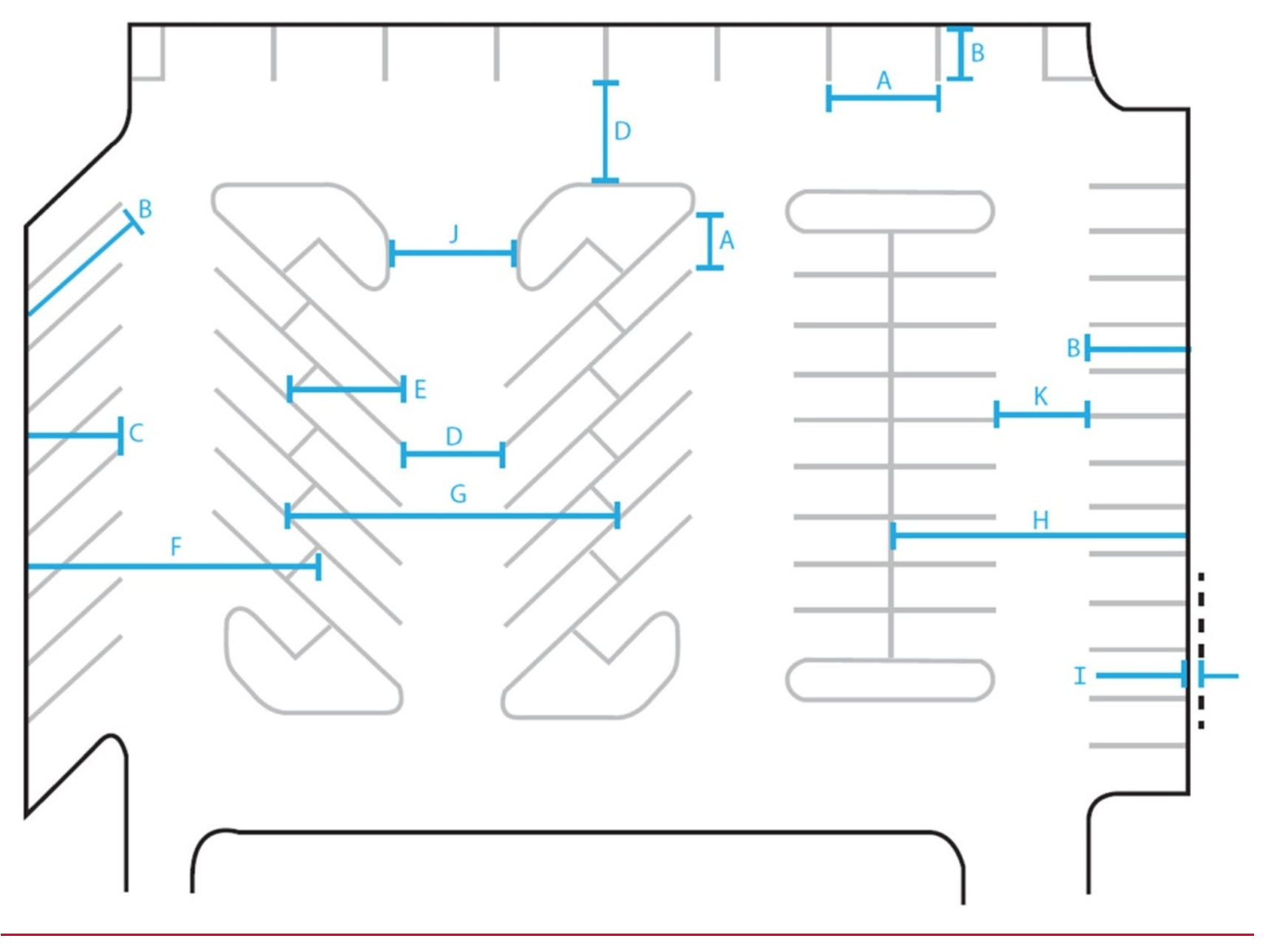
Size: All parking stall and aisle dimensions except at certain entrances as stated in subsection (B)(13) of this section shall have the minimum dimensions, as set forth in Figure 1 of this section. An automobile overhang may be included in stall depth calculations where such overhang does not extend beyond a required parking setback line or encroach upon a sidewalk. When an automobile overhang beyond an installed curb is included in the stall depth calculation, such overhang shall be considered as part of the parking stall for landscaping or setback purposes.
_____
FIGURE 1
PARKING LOT LAYOUT DIMENSIONS
FOR NINE FOOT STALL AT VARIOUS ANGLES
Notes:
1. Parking lots shall be bordered by six inches (6") of concrete barrier curb.
2. Ingress/egress driveways shall have thirty-foot radii on all returns.
3. Concrete islands abutting ninety-degree parking shall have ten-foot radii on returns.
4. Covered parking stalls for office uses, located in parking structures, shall not be less than eight and one-half feet (8.5') wide.
5. If a two-foot bumper overhang is utilized, the parking stall length shall be reduced by two feet (2'). The two-foot bumper overhang may not encroach into any required setback area. The two-foot bumper overhang width shall be added to the adjacent landscaping or sidewalk width.
6. All ninety-degree parking stalls for office, warehouse, and manufacturing uses may be reduced in width to eight and one-half feet (8.5') and in length to eighteen feet (18').
7. One-way aisle width may be less than twenty feet (20') if prior approval is granted by the fire department.
8. Motor vehicle sales may tandem/stadium park inventory vehicles, so long as inventory vehicles do no obstruct drive aisles, access drives, or public rights-of-way.
9. Parallel parking is prohibited in the B-1, B-2, and B-4 zoning districts as identified in this chapter.
(3)
Clearance: Parking lots not open to the sky shall have a minimum vertical clearance of seven feet six inches (7'6") to any obstruction, except where handicapped parking stalls are provided, then a vertical clearance of eight feet two inches (8'2") must be provided.
(4)
Access: Off-street parking spaces shall open directly upon an aisle or driveway at least twenty-four feet (24') wide for two-way travel and at least twenty feet (20') wide for one-way travel. One-way drive aisles may be less than twenty feet (20') wide if approved by the fire department. The minimum width of an access drive intersecting a street or alley is twenty-four feet (24') for two-way travel or twenty feet (20') for one-way travel. The minimum return radius from an access drive to a street or alley shall be thirty feet (30') as measured from the back of the curb wherever possible. The widths referred to in this subsection (B)(4) are actual pavement widths.
(5)
Construction: The minimum acceptable design for parking shall be consistent with those requirements as specified in the Subdivision Control Ordinance of the Village of Schaumburg.
(6)
Striping: Striping shall be provided for each parking space and shall consist of one (1) parallel line four inches (4") in width and equal in length to the required length of the parking space. Striping of each parking space shall be painted in yellow or white, except handicapped accessible spaces which must be painted in yellow. Thermoplastic or other similar pavement markings are acceptable alternatives.
(7)
Restriping: Parking lots shall be restriped in accordance with the original approved plans and requirements or in accordance with the standards stated herein.
(8)
Curbs and Gutters: Combination concrete curb and gutter or concrete barrier curb is required around the perimeter of all parking lots greater than four (4) spaces and around all islands. Where alternatives to concrete curb and gutter are demonstrated to be more appropriate and recommended by the village engineer of community development, said alternatives may be approved by the director of community development or his/her authorized designee, acting in the capacity of zoning administrator.
(9)
Landscaping: Landscaping and screening shall be provided for all parking areas as required in subsection 154.136 of this chapter.
(10)
Lighting: Exterior lighting shall be provided for all parking areas as required in chapter 151 of this title.
(11)
Maintenance: Upon completion, all parking areas shall be properly maintained at all times, without potholes, broken curbing, or other irregularities.
(12)
Fire Lanes: All areas designated as fire lanes by the fire chief shall be marked by posting of signs wherever feasible and yellow markings.
(13)
Parking Lot Design and Sidewalks at Entrances:
(a)
Application of Standards: The following provisions do not create a legal nonconforming situation. The application of these standards shall apply only as follows:
1.
To new buildings or parking lot construction in or part of retail establishments, shopping centers, or restaurants larger than five thousand (5,000) square feet in gross floor area; or
2.
If fifty percent (50%) or more of the building or parking lot is being reconstructed in or at retail establishments, shopping centers or restaurants larger than five thousand (5,000) square feet in gross floor area.
(b)
Standards:
1.
Sidewalk: A sidewalk outside an entrance or exit to a building which is adjacent to a drive aisle shall be at least four feet (4') wide clear of any obstructions, such as pillars, landscaping, furniture, material for sale, etc. Where a bumper overhang is utilized for parking abutting a sidewalk, the required sidewalk width shall be at least six feet (6') wide and clear of any obstructions.
2.
Drive Aisle: At the entrance to a building where a parking lot drive aisle abuts the curb and walk adjacent to the entrance, where no parking is provided on the entrance side of the aisle, the aisle adjacent to the building shall be at least twenty feet (20') wide, measured back of curb to back of curb.
3.
Drop Off/Parcel Pick Up/Attended Vehicle Parking: Drop off/pick up parking may be required by the zoning administrator. It shall not interfere with fire lanes. If drop off/loading areas are required at the entrance area, they shall be at least ten feet (10') wide, be at least fifty-four feet (54') long, be striped, and signed "loading/unloading area, no unattended vehicles".
(C)
Computation of Required Parking Spaces: When determination of the number of off-street parking spaces required by this subchapter results in a requirement of a fractional space, any fraction of one-half (½) or less may be disregarded, while a fraction in excess of one-half (½) shall be counted as one (1) parking space.
(D)
Maximum Parking: For projects involving site plan approvals or site plan amendments, the number of parking spaces provided shall not exceed ten percent (10%) of the minimum number of parking spaces required by this section or three (3) plus the number of parking spaces required by this section, whichever is greater, unless otherwise approved by the village board. The maximum parking requirement shall not apply to office, residential, or hospital uses.
(E)
Reduction to Required Parking Spaces:
(1)
Administrative Approval:
(a)
Under provision of section 154.51 of this Code, the village manager or designee may approve a reduction or modification to the required number of parking spaces.
(b)
Shared Parking: The village will consider the utilization of shared parking with abutting properties. The petitioner must complete and submit an analysis and substantiated projections of the collective peak parking demand for the entire development to justify the shared use of parking spaces for separate uses. The allowable reduction to the number of required parking spaces will be determined by the administrator based on the results of the shared parking analysis.
(2)
Reduction or Modification to Required Parking Spaces—Village Board Approval: The village board may approve a reduction or modification to the required number of parking spaces as defined in this subsection under the following circumstances:
(a)
Shared Parking: The village will consider the utilization of shared parking with abutting properties. The petitioner must complete and submit an analysis and substantiated projections of the collective peak parking demand for the entire development to justify the shared use of parking spaces for separate uses. The allowable reduction to the number of required parking spaces will be determined by the administrator based on the results of the shared parking analysis. Shared parking reductions greater than twenty percent (20%) shall require approval of the village board.
(b)
Proximity to Transit: A reduction of required parking may be granted for any complex within one-fourth (¼) mile of any regularly scheduled bus route or commuter train station, with service available during commuting hours, equal to the substantiated projection of use of public transportation by employees of such complex (i.e., based on census mode-share data). The allowable reduction to the number of required parking spaces will be determined by the administrator based on the substantiated projection of use of public transportation.
(c)
Transportation Demand Management: Transportation demand management (TDM) is a means of modifying travel to encourage use of active transportation modes and reduce single-occupancy automobile trips in order to increase the efficiency of the transportation system. TDM strategies include employer-sponsored carpooling and vanpooling programs, subscription bus services, and shared ride programs. Implementation of TDM strategies for large new developments is strongly encouraged. A reduction of required parking may be granted where TDM strategies are implemented to reduce the parking demand. The petitioner must complete and submit to the zoning board an analysis and substantiated projections of the parking reductions due to the implementation of TDM strategies to justify the reduction in parking requirement. A reduction in required parking spaces of up to ten percent (10%) may be approved administratively based on implementation of TDM strategies.
(d)
In Lieu Fee: Reduction of the number of required parking spaces may be considered in areas where convenient municipal-owned on- or off-street parking is available or is planned to be available within one (1) calendar year, and where such public parking is sufficient to meet peak time parking demands of the proposed use. A fee shall be assessed per required space that is eliminated based on this provision in order to offset the acquisition, construction, and maintenance costs associated with the municipal parking facility. The amount of such fee shall be determined by the village board but shall be no less than twenty thousand dollars ($20,000.00) per space.
(e)
Land Banking: In lieu of the above described parking reduction or modification standards, the construction of a portion of the parking spaces required by this subchapter may be deferred as follows:
1.
The village board may approve a lesser amount of parking than what is required upon demonstration by the property owner or applicant that intended land use will generate less parking than what is required by this subsection. An area of the proposed development shall be retained as open space and shall be utilized to meet the parking space requirements of this subsection in the event additional parking is required.
2.
The site plan shall note the area where parking is being land-banked, including dimensions and a future parking lot layout. Landscaping and screening shall be provided as required in subsection 154.136 of this chapter. Landscaping in the landbanked area does not count toward the site landscaping requirement. The owner shall agree to construct the additional parking, based on observed usage, within six (6) months of being informed of such request from the village.
3.
Design of the stormwater management facilities for the entire potential parking area (i.e., including the land-banked parking area) shall be carried out at the time of the village board's approval of the lesser amount of parking. The construction of all stormwater management facilities may not be required to serve the lesser amount of parking. In such cases, the property owner shall agree to construct the additional stormwater management facilities when the additional parking is constructed. The site plan shall note the area where the deferred stormwater management facilities will be constructed.
(Ord. 163, passed 12-5-1961; Am. Ord. 92-112, passed 10-13-1992; Am. Ord. 94-78, passed 8-9-1994; Am. Ord. 95-62, passed 6-13-1995; Am. Ord. 97-152, passed 12-9-1997; Am. Ord. 98-57, passed 5-26-1998; Am. Ord. 99-51, passed 7-13-1999; Am. Ord. 01-160, passed 10-23-2001; Am. Ord. 04-099, passed 7-13-2004; Am. Ord. 07-198, passed 12-11-2007; Am. Ord. 10-029, passed 4-13-2010; Am. Ord. 19-009, passed 2-12-2019; Am. Ord. 21-004, passed 1-12-2021)
§ 154.123 - SCHEDULE OF PARKING REQUIREMENTS.
Parking Requirements By Use: For the following uses, accessory off-street parking spaces shall be provided as required herein. Parking spaces required on an employee basis shall be based on the maximum number of employees on duty or residing, or both, on the premises at any one (1) time. See section 154.27 of this chapter for the definitions of net floor area (NFA) and gross floor area (GFA) used in this subchapter. Unless otherwise provided by the petitioner or applicant, NFA is assumed to be ninety percent (90%) of GFA for the purpose of determining the number of parking spaces required by this section.
(Ord. 163, passed 12-5-1961; Am. Ord. 588, passed 1-13-1970; Am. Ord. 1450, passed 8-9-1977; Am. Ord. 2351, passed 4-10-1984; Am. Ord. 92-112, passed 10-13-1992; Am. Ord. 95-62, passed 6-13-1995; Am. Ord. 97-112, passed 9-23-1997; Am. Ord. 06-10, passed 1-10-2006; Am. Ord. 06-154, passed 8-22-2006; Am. Ord. 07-110, passed 7-24-2007; Am. Ord. 07-198, passed 12-11-2007; Am. Ord. 09-021, passed 2-24-2009; Am. Ord. 09-046, passed 4-28-2009; Am. Ord. 14-048, passed 5-13-2014; Am. Ord. 19-098, passed 12-10-2019; Am. Ord. 19-107, passed 12-10-2019; Am. Ord. 20-032, passed 5-12-2020; Am. Ord. 21-004, passed 1-12-2021; Am. Ord. 21-044, passed 4-13-2021)
§ 154.124 - ACCESSIBLE PARKING.
(A)
Required Number of Spaces: If any parking is provided for residents, employees, and/or visitors, the minimum number of accessible parking spaces to be provided for individuals with disabilities shall be according to the Illinois Accessibility Code (current edition) and the ADA Standards for Accessible Design (current edition).
Parking spaces, ramps, and other accessibility features in the public right-of-way shall be provided in accordance with the Public Right-of-Way Accessibility Guidelines, PROWAG (current edition).
(B)
Design:
(1)
Size: Accessible parking stalls shall be sixteen feet (16') in width by eighteen and one-half feet (18.5') in depth for ninety-degree (90°) parking or shall be proportionately larger at other angles as set forth in Figure 1, section 154.122 of this chapter. The depth of the stall may be reduced by two feet (2') where overhanging a curbed sidewalk or landscaped area. The sixteen-foot (16') width shall include either a five-foot (5') or eight-foot (8') wide access aisle. Access aisles for ninety-degree (90°) parking may be on either side of the space, access aisles for all other parking angles shall be on the passenger (right) side of the parking space. A high quality yellow paint recommended for pavement striping shall be used for all the accessible pavement markings.
(2)
Accessible parking spaces in the public right-of-way shall be designated as set forth in the Public Right-of-Way Accessibility Guidelines (PROWAG), and the Manual of Uniform Traffic Control Devices (MUTCD) (current editions).
(C)
Ramps:
(1)
Curb Ramps:
(a)
Location: Depressed curbs shall be provided whenever an accessible route crosses a curb.
(b)
Slope: The least possible slope shall be used for any ramp. The maximum slope of a curb ramp shall be one to twelve (1:12).
1.
A four-foot (4') by four-foot (4') landing shall be provided at the top of the ramp. The maximum slope of a landing shall be two percent (2%) in any direction.
(c)
Width: The minimum width of a curb ramp shall be four feet (4'), exclusive of any flared sides. Flared sides shall only be provided where there exists the possibility of pedestrian cross-traffic.
(d)
Sides of Curb Ramps: If a curb ramp is located where pedestrians may walk across the ramp, or where it is not protected by handrails or guardrails, it shall have flared sides. The maximum slope of the flare shall be one to twelve (1:12).
(e)
Built Up Ramps: Built up ramps shall be located so that they do not project into the access aisle or vehicular traffic lanes.
(f)
Detectable Warnings: Curb ramps on private property do not require a detectable warning feature.
(g)
Obstructions: Curb ramps shall be located or protected to prevent their obstruction by parked vehicles, merchandise displays, posts or signs, and other obstacles.
(h)
Islands: Crossings in any raised islands shall be cut through level with the pavement or have curb ramping at both sides and a level area at least four feet (4') long between the curb ramps in the part of the island intersected by the crossing.
(i)
Curb ramps in the public right-of-way, or for publicly dedicated sidewalks and shared-use paths, shall meet the requirements of PROWAG.
(D)
Signage: Accessible parking spaces shall be designated as reserved for persons with disabilities by providing an R7-8 (U.S. Department of Transportation standard) sign which contains the international symbol of accessibility. Such sign shall exhibit the current minimum fine amount as defined by the State of Illinois (625 ILCS 5/11-1301.3), in the format of "$XXX.XX FINE"
(E)
Location: Accessible parking spaces serving a particular building shall be located according to the Illinois Accessibility Code (current edition) and the ADA Standards for Accessible Design (current edition).
(F)
Enforcement: The designation of accessible parking stalls shall constitute consent by the property owner to the enforcement of the restriction of such spaces to individuals with disabilities by the village.
(Ord. 163, passed 12-5-1961; Am. Ord. 2945, passed 2-23-1988; Am. Ord. 92-112, passed 10-13-1992; Am. Ord. 95-62, passed 6-13-1995; Am. Ord. 98-57, passed 5-26-1998; Am. Ord. 15-120, passed 10-27-2015; Am. Ord. 21-004, passed 1-12-2021)
§ 154.125 - BICYCLE PARKING REQUIREMENTS.
(A)
Required Number of Spaces: The following uses are required to install the following minimum bicycle parking spaces:
(B)
Location: Bike racks shall be conveniently located near the entrance of the building it is serving and should be highly visible from the building entrance from where bicyclists approach. Bicycle parking areas shall be separated from motor vehicle parking areas. In developments with multiple uses and/or buildings, bicycle parking shall be appropriately distributed or relocated if necessary.
(C)
Design Criteria and Dimensions:
(1)
Bicycle racks must be capable of locking the bicycle and of supporting the bicycle in an upright position.
(2)
A hard-surfaced parking area is required. Racks must be securely anchored to supporting surface.
(3)
Installation of bike racks shall conform with the requirements set forth by the bike rack manufacturer with a rectangular space no less than two and one-half feet (2½') wide by six feet (6') long per bicycle unless a locker or permanent device to stand the bicycle on end is provided.
(4)
Bicycle racks shall be installed with adequate space beside the parked bicycle so that a bicyclist will be able to reach and operate the locking mechanism.
(D)
Collective Provisions: Off-street bicycle rack facilities in a development with multiple uses may be provided collectively if the total number of spaces provided collectively is not less than the greatest minimum requirement by a single use in the development and provided that all regulations governing location of accessory parking spaces in relation to the use served are adhered to.
(E)
Developments with less than ten (10) employees or extenuating circumstances may be exempt as determined by the director of community development or his/her authorized designee, acting in the capacity of zoning administrator.
(Ord. 163, passed 12-5-1961; Am. Ord. 1992, passed 5-26-1981; Am. Ord. 92-112, passed 10-13-1992; Am. Ord. 95-62, passed 6-13-1995; Am. Ord. 07-198, passed 12-11-2007; Am. Ord. 14-049, passed 5-13-2014; Am. Ord. 21-004, passed 1-12-2021)
§ 154.126 - RESERVED.
Editor's note— Ord. 21-004, § 10, adopted Jan. 12, 2021, deleted § 154.126 entitled "Adjustments to required parking," which derived from: Ord. 163, passed Dec. 5, 1961; Ord. 2124, passed May 25, 1982; Ord. 92-112, passed Oct. 13, 1992; Ord. 95-62, passed June 13, 1995; Ord. 97-152, passed Dec. 9, 1997; and Ord. 07-198, passed Dec. 11, 2007.
§ 154.127 - OFF-STREET LOADING.
(A)
Purpose: The following regulations, applicable to all zoning districts, are established to increase safety and lessen congestion in the public streets, to set standards for the requirement of off-street loading facilities in amount directly proportioned to the amount of traffic generated by each use, and to eliminate the on-street parking of vehicles along major traffic routes.
(B)
Location: All required loading berths shall be located on the same zoning lot as the use served. No loading berth for vehicles over two (2) tons shall be closer than fifty feet (50') to any property in a residential district unless completely enclosed by a building wall or uniformly painted solid fence or wall, or any combination thereof, not less than six feet (6') in height. No permitted or required loading berth shall be located within twenty-five feet (25') of the nearest point of intersection of any two (2) streets. No loading berth shall be located in required side yards.
(C)
Design and Maintenance:
(1)
Size: Unless otherwise specified, a required loading berth shall be at least ten feet (10') in width by at least fifty feet (50') in length, exclusive of aisles and maneuvering space and shall have a vertical clearance of at least fourteen feet (14').
(2)
Access: Each required off-street loading berth shall be designed with appropriate means of vehicular access to a street or alley in a manner which will least interfere with traffic movements and subject to approval of the zoning board.
(3)
Projection: No portion of a vehicle shall project into a street, drive, alley or other public right-of-way while being loaded or unloaded.
(4)
Exclusive Use: Spaces allocated to any off-street loading shall not, while so allocated, be used to satisfy the space requirements for any off-street parking facilities or portions thereof.
(5)
Landscaping: Landscaping and screening shall be provided for all loading areas as required in sections 154.135 and 154.136 of this chapter.
(D)
Repair and Service: No motor vehicle repair work or service of any kind shall be permitted in conjunction with loading facilities provided in any residence or business district.
(E)
Loading Requirements by Use: In all zoning districts where property uses include the loading and unloading of materials or merchandise from vehicles, off-street loading and unloading facilities shall be provided with adequate receiving facilities, based on demand as determined appropriate by the village board. Access to said facilities shall be taken from any adjacent alley, service drive, or open space located on the same zoning lot on which the principal or primary use of the premises is located.
(Ord. 163, passed 12-5-1961; Am. Ord. 92-112, passed 10-13-1992; Am. Ord. 95-62, passed 6-13-1995; Am. Ord. 97-152, passed 12-9-1997)
§ 154.128 - ELECTRIC VEHICLE PARKING.
(A)
Purpose: The intent of this section is to remove barriers to the use of electric vehicles, expedite and promote the development of safe, convenient, and cost-effective electric vehicle infrastructure to support the use of electric vehicles, and protect the environment by reducing vehicle emissions.
(B)
Permitted Locations:
(1)
Retail Charging, Accessory Use:
(a)
Level 1 and Level 2 Charging Stations: Level 1 and level 2 charging stations are permitted in every zoning district, when accessory to the primary permitted use of said district. Charging stations located at single-family and multiple-family dwellings shall be designated as private use only. Installation of charging stations shall be subject to permit approval. All necessary permits must be obtained prior to the installation of any charging station.
(b)
Level 3 (DC Fast) Charging Stations: Level 3 (DC fast) charging stations are permitted only in business and manufacturing districts when accessory to the primary permitted use. All necessary building and electrical permits must be obtained prior to the installation of any charging station. Installation thereof shall be subject to permit approval.
(2)
Retail Charging Primary Use: If the primary use of a parcel is the retail charging of electric vehicle batteries, then the use shall be considered a gas station for zoning purposes.
(C)
Station Requirements and Design Criteria:
(1)
Charging Station Space Requirements:
(a)
Minimum Requirements: A charging station space may be included in the calculation for minimum parking spaces that are required pursuant to other village and state regulations; however, the designation of a parking space exclusively for use by electric vehicles shall not have a negative impact on the parking demand within the village. The director of community development or his or her designee may require the removal of this exclusive designation if, in his or her sole discretion, said designation creates any parking issues within the village.
(2)
Charging Station Space Location and Design Criteria: Where provided, spaces for charging station purposes are required to include the following:
(a)
Maintenance: Charging station equipment, bollards and parking spaces shall be maintained in all respects. The property owner of the equipment shall be responsible for the maintenance of the charging station and shall provide warranty and service for the charging stations and infrastructure for the duration of their useful life. A phone number or other contact information shall be provided on the charging station equipment for reporting purposes when the equipment is not functioning or other equipment problems are encountered.
(b)
Accessibility: Where charging station equipment is provided within a pedestrian circulation area, such as a sidewalk or other accessible route to a building entrance, the charging station equipment shall be located so as not to interfere with accessibility requirements of the Illinois Accessibility Code or other applicable accessibility standards.
(c)
Lighting: Where charging station equipment is installed, adequate site lighting shall be provided in accordance with village ordinances and regulations.
(d)
Charging Station Equipment: Charging station outlets and connector devices shall be no less than thirty-six inches (36") and no higher than forty-eight inches (48") from the ground or pavement surface where mounted, and shall contain a retraction device and/or a place to hang permanent cords and connectors a sufficient and safe distance above the ground or pavement surface. Equipment shall be mounted on pedestals, and located as to not impede pedestrian travel or create trip hazards on sidewalks.
(e)
Charging Station Equipment Protection: Adequate charging station equipment protection, such as barrier curbing, concrete filled steel bollards, or similar shall be used.
(f)
Usage Fees: An owner of a charging station is not prohibited from collecting a fee for the use of a charging station, in accordance with applicable state and federal regulations. Fees shall be prominently displayed on the charging station.
(g)
Notification: Information on the charging station, identifying voltage and amperage levels and time of use, fees, or safety information.
(h)
Location: Electric vehicle charging station equipment is encouraged in landscaped areas. When located within a parking lot, electric vehicle charging station equipment shall be centrally located between parking spaces to avoid vehicle conflicts.
(i)
Pavement Marking: Any and all pavement markings shall be in compliance with section 154.122 of this Code. Any and all pavement markings shall be the color white or yellow and shall match the color used for all other parking stalls. No additional stencil will be permitted.
(3)
Data Collection: To allow for maintenance and notification, the village shall require the owners of public charging stations to provide information on the charging station's geographic location, date of installation, equipment type and model, and owner contact information to the village manager or his/her designee.
(D)
Quantity and Location Requirements:
(1)
Residential: In order to proactively plan for and accommodate the anticipated growth in market demand for electric vehicles, all new single-family residences and small multifamily residences with garages be constructed to be EV Capable. All new large multifamily residences shall be constructed to provide a minimum of twenty percent (20%) EV-ready parking spaces relative to the total number of parking spaces constructed. All terms used herein shall share definitions with those of the Illinois Electric Vehicle Charging Act, 765 ILCS 1085/l et seq.
(2)
Nonresidential: In order to proactively plan for and accommodate the anticipated future growth in market demand for electric vehicles, it is strongly encouraged, but not required, that all new and expanded nonresidential development parking areas provide the electrical capacity necessary to accommodate the future hardwire installation of level 2 charging stations. It is recommended that a typical parking lot (e.g., one thousand (1,000) or less parking spaces) have a minimum ratio of two percent (2%) of the total parking spaces prepared for such stations.
(3)
Accessible Charging Stations: Any location where electric vehicle charging stations are installed shall be required to have at least one (1) parking space equipped with an accessible charging station. Accessible charging stations should be located in close proximity to the building or facility entrance and shall be connected to a barrier-free accessible route of travel to and from the building or facility. It is not necessary to designate the accessible charging station exclusively for the use of disabled persons. Accessible charging stations shall be maintained in compliance with the Americans with Disability Acts of 1990, 42 U.S.C. § 12101 and all applicable state and federal laws.
(E)
Signage:
(1)
All electric vehicle charging stations shall comply with all village sign regulations except this provision supersedes section 119.37 of this Code with respect to electric vehicle charging station signage only.
(2)
Off-site signage and advertising are allowed on an electric vehicle charging station if it meets the definition of a public service object as permitted pursuant to subsection 155.50(E)(3).
(3)
On-site advertising is allowed on an electric vehicle charging station only when it is an integral part of the electric vehicle charging station. All advertising is limited to the promotion of goods, services and products of the owner and tenants on-site where the electric vehicle charging station is located. The on-site advertising may consist of static images that change no faster than once every ten (10) seconds or a continuous video on a LED screen. No advertisement shall play or emit any sound. Except as indicated in this section, the size of any on-site advertising signage shall not exceed four (4) square feet in gross surface area for each exposed face, nor exceed an aggregate gross surface area of six (6) square feet. On-site advertising signage on a video screen shall not exceed an aggregate gross surface area of one-fourth (0.25) square feet. If the electric vehicle charging station is located at a shopping center greater than five hundred thousand (500,000) square feet in total size, the size of any on-site advertising signage shall not exceed eleven (11) square feet in gross surface area for each exposed face, nor exceed an aggregate gross surface area of sixteen (16) square feet.
(4)
Each charging station space shall be posted with signage indicating days and hours of operation if time limits or tow away provisions are to be enforced.
(F)
License Required:
(1)
Any person or entity owning or operating an electric vehicle charging station within the village must obtain a vending machine license pursuant to section 119.30 et seq. of this Code.
(Ord. 19-009, passed 2-12-2019; Am. Ord. 21-004, passed 1-12-2021; Am. Ord. 21-044, passed 4-13-2021; Am. Ord. 21-082, passed 8-24-2021; Am. Ord. 25-031, passed 3-11-2025; Am. Ord. 25-066, passed 7-8-2025)

