
Schaumburg City Zoning Code
General Provisions
§ 154.60 - SCOPE OF REGULATIONS.
(A)
New Uses: No building, other structure, or part thereof, shall hereafter be erected, constructed, reconstructed, enlarged, moved, or structurally altered, and no building, structure, or land shall hereafter be used, occupied, arranged, or designed for use or occupancy, nor shall any excavating or grading be commenced in connection with any of the above, except as permitted by the regulations of this chapter for the zoning district in which such building, structure or land is located.
(B)
Existing Building Permits: Where a building permit has been issued in accordance with law prior to the effective date hereof and where construction has commenced within six (6) months of such effective date and diligently prosecuted to completion within two (2) years of such effective date, the building or other structure may be completed in accordance with the approved plans and may, upon completion, be occupied under a certificate of occupancy for the use originally designated, subject thereafter to the provisions of sections 154.75 through 154.79 of this chapter.
(C)
Existing Uses: Except as may otherwise be provided, all structural alterations or locations of existing buildings or other structures occurring hereafter, and all enlargements of or additions to existing uses occurring hereafter shall be subject to the regulations of this chapter for the zoning district in which such building, structure, or use is located.
(D)
Existing Unlawful Uses: Any unlawful use existing at the time of adoption hereof which is in conflict with the requirements of this chapter shall remain unlawful hereunder.
(Ord. 163, passed 12-5-1961; Am. Ord. 95-62, passed 6-13-1995)
§ 154.61 - ZONING LOTS.
(A)
Division of Zoning Lots: No zoning lot improved with a building or buildings shall hereafter be divided into two (2) or more zoning lots and no portion of any zoning lot which is improved with a building or buildings shall be sold unless all zoning lots, resulting from each such division or sale and improved with a building or buildings, shall conform with all bulk regulations of the zoning district in which the property is located.
(B)
Number of Buildings on a Zoning Lot: Except for those instances where they are under unified ownership or control, not more than one detached principal building shall be located on any zoning lot.
(C)
Common Ownership of Adjoining Lots: When two (2) or more parcels of land, each of which lacks adequate area and dimension to qualify for a permitted use under the requirements of the use district in which they are located, are contiguous, and are held in one (1) ownership, they shall be used as one (1) zoning lot for such use.
(D)
Access to Public Street: Every principal building hereafter erected shall be on a zoning lot or parcel of land which adjoins a public street or a permanent access easement to a public street; such easement to be at least twenty-four feet (24') wide unless a lesser width was duly established and recorded prior to the effective date hereof.
(E)
Open Use: Where a zoning lot is to be occupied by a permitted use without structures, the required yards for such lots shall be provided and maintained as set forth in this chapter.
(F)
Required Open Space: All yards, courts and other open space allocated to a building or dwelling group shall be located on the same zoning lot as such building or dwelling group.
(Ord. 163, passed 12-5-1961; Am. Ord. 95-62, passed 6-13-1995)
§ 154.62 - BUILDING HEIGHTS, BULK REGULATIONS, AND REQUIRED YARDS.
(A)
Height: The following requirements qualify or supplement, as the case may be, the district regulations appearing elsewhere in this chapter.
(1)
Public and Semipublic Uses: Public, semipublic hospitals, institutions, schools, or public utility and service buildings, when permitted in a district, may be erected to a height not exceeding sixty feet (60'), provided said specified buildings shall be set back from the front, rear, and side lot lines in the ratio of two feet (2') for every one foot (1') building height greater than forty feet (40'); provided, however, that said specified requirements shall apply in addition to the other requirements for building line setback and for rear and side yards specifically set forth in this chapter.
(2)
Through Lots: On through lots one hundred twenty-five feet (125') or less in depth, the height of the building may be established from established grade on either street. On through lots more than one hundred twenty-five feet (125') in depth, the height regulations and the basis of height measurements from the street permitting the greater height shall apply to a depth of not more than one hundred feet (100') from that street.
(B)
Required Yards:
(1)
Reduction Below Required Yard: No yards now or hereafter provided for a building existing on the effective date hereof shall subsequently be reduced below, or further reduced below if already less than, the minimum yard requirements of this chapter for equivalent new construction.
(2)
Maintenance of Required Yards and Open Space: The maintenance of yards, courts, other open space, and minimum lot area legally required for a building shall be a continuing obligation of the owner of such building or the property on which it is located, as long as the building is in existence. Furthermore, no legally required yards, courts, other open space, or minimum lot area allocated to any building shall, by virtue of change of ownership or for any other reason, be used to satisfy yard, court, other open space, or minimum lot area requirements for any other building.
(C)
Solar Access Protection:
(1)
Creation of Easements: Solar skyspace easements across contiguous or nearby lots, tracts, or land may be created to establish a window of exposure to the sun so as to protect an existing or intended solar collector's exposure to the sun from obstruction of buildings and trees. Such easements may be purchased, reserved, granted or otherwise obtained. Adverse possession cannot create such an easement. An easement infringed upon is a compensable property right through private remedy.
(2)
Recording of Easements: A solar easement may, at the discretion of the easement owner, be recorded with the Cook County Recorder of Deeds, or DuPage County Recorder of Deeds and filed with the community development department.
(3)
Construction in Easement Areas: Any person seeking a building permit to construct or modify any structure or building so as to increase the consumption of airspace over that lot shall certify in writing that no solar skyspace easement exists over that lot. Where a solar skyspace easement exists, the applicant for the permit shall present a copy of the deed containing the legal description of the easement, unless the easement is already filed with the community development department. Should the community development department determine that the proposed construction would intrude upon the easement, no building permit shall be granted.
(Ord. 163, passed 12-5-1961; Am. Ord. 95-62, passed 6-13-1995; Am. Ord. 03-37, passed 3-11-2003; Am. Ord. 07-110, passed 7-24-2007)
§ 154.63 - ACCESSORY BUILDINGS, STRUCTURES AND USES.
(A)
Purpose: Accessory buildings, structures and uses customarily incidental to and commonly associated with a use allowed as a permitted or special use within a particular zoning district may be allowed to occupy the same zoning lot as the permitted or special use.
(B)
Standards: Accessory buildings, structures and uses are permitted in any zoning district except for planned unit developments in connection with a use which is permitted within such district. For standards regarding accessory buildings, structures and uses in planned unit developments, refer to sections 154.105 through 154.111 of this chapter. An accessory building, structure or use in any zoning district is one which:
(1)
Is customarily incidental and subordinate to and serves a principal use established on the same zoning lot;
(2)
Is subordinate in area, floor area, intensity, extent, and purpose to the principal building, structure, or use;
(3)
Contributes to the comfort, convenience, or necessity of occupants or users of the principal building, structure or use;
(4)
Is located on the same zoning lot as the principal building, structure or use served;
(5)
Shall not be established on any lot prior to the establishment of the principal building, structure or use to which it is accessory;
(6)
Shall not include structural features that are significantly inconsistent with the principal building, structure or use;
(7)
Shall be operated under the same ownership or control as the principal structure or use;
(8)
Shall be compatible with the principal use.
(C)
Accessory Structure Coverage for Single-Family Detached Properties:
(1)
No more than forty percent (40%) of the front yard shall be covered, when combining the total square footage of both attached and detached accessory structures within the front yard.
(2)
No more than forty percent (40%) of the rear yard shall be covered, when combining the total square footage of both attached detached accessory structures within the rear yard.
(D)
Attached Accessory Structures: An attached accessory structure shall comply with all zoning district regulations applicable to the principal building, structure or use to which it is accessory.
(E)
Detached Accessory Structures: Detached accessory structures shall:
(1)
Not be located less than five feet (5') from an interior side lot line and a rear lot line when located in a rear yard.
(2)
Comply with the height limitations of the zoning district in which it is located, provided that the accessory building or structure does not exceed the height of the principal building or structure. In residential districts, no accessory building or structure shall exceed fifteen feet (15') in height, provided that the accessory building or structure shall not exceed the height of the principal building or structure.
(3)
When located in a court bounded on three (3) sides by the walls of a structure, shall comply with all of the applicable regulations and uses allowed in the yard to which the court is oriented. When located in an interior court bounded on all four (4) sides by the walls of a structure shall comply with the regulations as outlined in subsection (F) of this section.
(4)
Size restrictions for detached accessory structures:
(a)
The maximum allowable area for a portable shed shall be twenty-five (25) square feet.
(b)
The maximum allowable area for a detached garage shall be six hundred (600) square feet or no more than forty percent (40%) of the rear yard (including all accessory structures within the rear yard), whichever is less.
1.
The measurements for a detached garage shall be no less than ten feet (10') in width and no more than twenty-five feet (25') in depth.
2.
Year-round landscaping shall be installed around the base of a detached garage where thirty inches (30") or more of the foundation is exposed. This landscaping shall be installed prior to final approval of the construction.
(c)
The maximum allowable area for any other accessory building excluding detached garages, playhouses, and portable sheds, and including, but not limited to, gazebos, greenhouses, workshops, or fixed sheds shall be two hundred (200) square feet or no more than forty percent (40%) of the rear yard (including all accessory structures within the rear yard), whichever is less. Changes in use of the accessory structure must conform with all applicable requirements of this Code.
(d)
Fixed sheds located in side yards shall not exceed one hundred (100) square feet in area and shall not exceed a maximum height of nine feet (9').
(e)
Fixed sheds located in side yards or rear yards shall be located a minimum of two feet (2') from the principal structure or any other accessory building. The area between the structures shall be kept clear of any equipment, materials or debris.
(5)
Properties are limited to no more than two (2) of the following structures: fixed shed, workshop, greenhouse. For example, a property can have a fixed shed and a greenhouse or a greenhouse and a workshop.
(6)
If a property has a detached garage then the property is limited to one (1) of the following structure types: fixed shed, workshop, or greenhouse.
(7)
There shall not be more than one (1) detached garage per property.
(8)
The maximum height of a detached accessory structure shall be measured at the front of the structure and from the top of the finished floor to the highest point of the building, and shall be no taller than fifteen feet (15') in height. In the event there are significant grade changes on the property as to expose eighteen inches (18") or more of the foundation of the structure, a grading plan shall be a required component of the building permit application.
(9)
There shall not be more than one (1) portable shed per property.
(10)
Fixed and portable sheds shall not be located in the required side yard (ten percent (10%) of the width of the lot as measured at the building line).
(11)
Fixed and portable sheds shall not be located closer to the front lot line than the principal structure located on the lot or the principal structure located on the adjoining lot, whichever places the structure furthest from the front lot line.
(12)
Landscaping shall be provided across fifty percent (50%) of the front and sides of a fixed shed to a minimum height of three feet (3') when located in a side yard. A minimum of fifty percent (50%) of such landscaping for sheds shall consist of evergreen trees or shrubs.
(13)
Portable sheds twenty-five (25) square feet or less in area shall not require a building permit.
(F)
Permitted Locations In Yards: Accessory buildings, structures or uses shall be permitted in designated yards of a zoning lot as follows (see also the Corner Side Yard Fence Accessary Structure graphic—Appendix D):
_____
(G)
Regulations for Specific Uses and Structures: In addition to the other requirements of this chapter, those uses and structures enumerated in this section shall comply with the following:
(1)
Fences, Walls and Screening Materials:
(a)
In Public Rights-of-Way: No fence, wall or other similar screening material shall be erected or maintained in any public right-of-way except those fences, walls, and other screening materials erected by a public body to ensure the public safety.
(b)
Obstruction to Line of Sight: In no event shall any fence, wall or other screening material be erected or maintained in a location relative to a public or private street, alley, driveway or other means of ingress or egress such that the visibility of oncoming vehicles or pedestrian traffic is impaired for users of such means of ingress and egress.
(c)
Vision Clearance; Corner Lots: No building or structure hereafter erected and no planting or other obstruction to the vision of drivers of motor vehicles shall be located:
1.
In any residence district, exceeding a height of three and one-half feet (3½') above the street grade within twelve feet (12') of the intersecting street lines bordering a corner lot.
2.
In any business or manufacturing district, exceeding a height of three and one-half feet (3½') above the street grade within eight feet (8') of the intersecting street lines bordering a corner lot, provided that this regulation shall not apply to that part of a building above the first floor.
(d)
Parks and Schools: There shall be no height restrictions on the erection of open mesh type fences enclosing parks, recreational areas and school sites.
(e)
Wing Walls: Walls that are actual extensions of the exterior walls of the existing dwellings are permitted if on or to the rear of the building line. Such walls shall average no more than four feet (4') in height within the side yard. Such a wall may not be extended any closer than five feet (5') to an interior side lot line.
(f)
Conformance With Fence Code: All fences shall be erected in conformance with the provisions of title 9, chapter 102, "Fences", of this Code.
(2)
Noncommercial Antenna Towers:
(a)
Noncommercial antenna towers shall include those used by FCC licensed ham amateur radio operators and all voluntary disaster communication facilities, including civil defense and citizens band facilities. Before receiving a permit under the provisions of this subsection, the applicant shall file with the village a location plan, the manufacturer's specifications for the tower and its support, the manufacturer's details of footings, guys, and braces. The erection of windmill type towers are not permitted.
(b)
An "antenna tower" shall be defined as a triangular structure (steel or aluminum) reinforced with horizontal and/or diagonal support bracing, steel pole towers, and wood constructed towers.
(c)
Maximum permissible tower height shall not exceed eighty feet (80') from the established grade, except towers constructed of wood may not exceed twenty feet (20') in height. "Tower height" shall be defined as the distance measured from the established grade to the top of the tower, excluding antenna or antenna support mast. All metallic towers which exceed a height of thirty feet (30') shall be embedded in a concrete foundation. Foundations of such towers shall meet the requirements of the building code.
(d)
All towers and antenna shall be constructed to withstand minimum wind velocity of one hundred (100) miles per hour (impact pressure forty (40) pounds per square foot). An engineering report prepared by a certified structural engineer must accompany the application for a building permit.
(e)
All towers and/or roof-mounted structures supporting antenna as noted in this chapter shall be grounded. It is recommended by the Village of Schaumburg that a secondary surge arrester be installed with all external antenna and/or towers. Said arrester is normally installed in or as near as practical to electric power panel.
(3)
Recreational Vehicles: Recreational vehicles, when parked or stored overnight as an accessory use including, but not limited to, boats, canoes, pop-up campers, motor homes, snowmobiles, off-road vehicles, and approved licensed trailers may be located on a zoning lot in any zoning district. Special use approval is required when a recreational vehicle is parked or stored as the principal use of a zoning lot.
(a)
All such vehicles shall be owned by the occupants of the premises on which they are parked or stored. For the purposes of this subsection, a loaded or unloaded trailer shall be considered one (1) recreational vehicle.
(b)
Recreational vehicles may be stored or parked on a zoning lot subject to the following:
1.
If located in a front or corner side yard, shall not encroach in the public right-of-way or extend over any lot line.
2.
If located in an interior side yard, shall be a minimum of three feet (3') from any lot line.
3.
If located in a rear yard, shall be a minimum of five feet (5') from any lot line.
(c)
Recreational vehicles shall not be parked or stored within any zoning district at any location other than on an approved concrete or asphalt parking area intended as a driveway or parking pad, as referenced in section 72.07, "Approved Parking Areas", of this Code.
(d)
Recreational vehicles shall not be used as accessory structures in any zoning district.
(e)
At no time shall a parked or stored recreational vehicle be used for permanent living, sleeping, or other purposes. No recreational vehicle shall be permanently connected to gas, water, or sanitary sewer service.
(f)
Recreational vehicles shall not be parked or stored in such a way as to create a dangerous or unsafe condition. All pointed objects such as boat propellers, motors and trailer hitches, except ball-type hitches and trailer tongues, protruding from recreational vehicles located within two feet (2') of a sidewalk, bike path, roadway pavement or other pedestrian or vehicular way, shall be covered or protected so as not to create a safety hazard.
(g)
No major repairs shall be performed on any recreational vehicle except within a garage or other structure.
(h)
Recreational vehicles shall not have their wheels removed or be affixed to the ground so as to prevent ready removal of the vehicle. Boats, jet skis and snowmobiles shall be stored on an approved licensed trailer at all times when not in use. Except for smaller more portable watercraft, such as, but not limited to, rowboats, kayaks and canoes.
(i)
A recreational vehicle may be placed, kept or maintained for an aggregate of fourteen (14) days (which may or may not be consecutive) within a period of thirty (30) days for storage or sleeping quarters if such recreational vehicle is located in a residence district and owned by a guest of the occupants of the residence.
(4)
Dog runs as defined in this chapter may be erected in residential areas, subject to the following:
(a)
Dog runs shall not be located closer to the front lot line than the principal structure located on the lot or the principal structure located on the adjoining lot, whichever places the structure furthest from the front lot line.
(b)
Dog runs located in rear yards shall not exceed one hundred (100) square feet in area.
(5)
Storage of Disabled or Damaged Motor Vehicles:
(a)
Residence Districts:
1.
Storage: Disabled or damaged motor vehicles may be stored in the open, within a required yard, and on an approved parking surface for a period not to exceed thirty (30) days.
2.
Hazardous Conditions: Motor vehicles shall not have their wheels removed or be affixed to the ground so as to prevent ready removal of the vehicle. Motor vehicles shall not be parked or stored in such a way as to create a dangerous or unsafe condition.
3.
Repair: Motor vehicle repairs shall not be performed on such vehicles except within a garage or other structure.
4.
Maintenance: Motor vehicle maintenance should be performed inside a garage or enclosed area and may be performed on the driveway, providing that the maintenance to the vehicle shall not exceed seven (7) consecutive days. In rare and extreme circumstances, a resident may make a written request for an extension of time for vehicle maintenance. Such requests shall be received within five (5) days of a notice of violation and will be reviewed by the village manager.
(b)
Non-residence Districts: Disabled or damaged motor vehicles awaiting or under repair may be stored in the open, on an approved parking surface, within a required yard in a nonresidential district, and shall only be located on a zoning lot where such storage and repair are customary in the operation of the lawfully established principal use. However, such vehicles shall be removed, placed within an enclosed structure, or relocated to a lawfully permitted motor vehicle salvage yard within thirty (30) days from the date of their initial storage.
(6)
Swimming Pools and Pool Spas, Private:
(a)
Private swimming pools and pool spas shall be operated for the exclusive use of the residents of the zoning lot upon which they are located and their invited guests. No private swimming pool or pool spa shall be operated as a business or private club.
(b)
No private swimming pool or pool spa, including, but not limited to, aprons, walks, and equipment rooms, shall protrude into any required side yard, nor be less than eight feet (8') from any lot line.
(c)
Inground or above ground pools shall be completely enclosed by a fence. The fence may be located at the property line along the perimeter at a height of at least four feet (4') but no greater than five feet (5') of a semi-open or open-type. The fence may also be located within the interior of the lot at least five feet (5') from the property line at a height of at least four feet (4') but not greater than five feet (5') of a semi-open or open-type. Privacy fences are only permitted in accordance with section 102.10 of this Code.
(d)
Above ground pools need not be enclosed by a fence of the type described above if the pool has a deck and deck fence or fence extending from the top of the pool side wall to a height of seven feet (7') from the surface of the ground.
(7)
Tennis Courts:
(a)
Private tennis courts shall be operated for the exclusive use of the residents of the zoning lot upon which they are located and their invited guests. No private tennis court shall be operated as a private business or club.
(b)
No private tennis court, including, but not limited to, aprons, walks, and equipment rooms, shall protrude into any required yards, including the rear.
(c)
Private outdoor tennis courts may be completely surrounded by a fence or wall to a height not exceeding ten feet (10') above the established grade level adjacent to the tennis court.
(8)
Tents: Except as otherwise permitted as temporary uses in section 154.64 of this chapter, tents shall not be erected, used or maintained on any zoning lot except such tents as are customarily used for recreational purposes and then not as living quarters. Such recreational tents shall be located on the same zoning lot as a dwelling and shall not be allowed within a required front, corner side, or interior side yard.
(9)
Wind Energy Conversion Systems (WECS): Wind energy conversion systems have been found by the village board to be a viable and useful method of localized energy generation. Special use permits to authorize WECS are allowed in all zoning districts, subject to compliance with the standards listed herein.
(10)
Playhouses: Permanent playhouses as defined in this chapter may be erected in residential areas, subject to the following:
(a)
Permanent playhouses shall only be located in the rear yard.
(b)
Permanent playhouses shall be located a minimum of five feet (5') away from the property line.
(c)
Permanent playhouses shall comply with the height limitations of the zoning district in which it is located, provided that the accessory structure does not exceed ten feet (10') in height or the height of the principal building or structure.
(d)
Permanent playhouses shall be no more than one hundred (100) square feet or no more than forty percent (40%) of the rear yard (including all accessory structures within the rear yard), whichever is less. Appurtenances including, but not limited to, sandboxes and play equipment shall not count towards the square footage of a playhouse.
(e)
Permanent playhouses shall not be used for purposes of storage of materials including, but not limited to, garden equipment or refuse materials.
(f)
A building permit shall not be required for a playhouse or treehouse. Exemption from the permit requirements of this Code shall not be deemed to grant authorization for any work to be done in violation of the provision of the accessory structures ordinance of this jurisdiction.
(11)
Donation Boxes: Donation boxes are prohibited in all zoning districts, unless the donation box is accessory to the principle use of the premises. To qualify as an approved accessory use, the donation box must be owned, maintained, and operated by the owner of the principle use.
(12)
Tree Houses: Tree houses, defined as structures built in, on, or attached to trees, may be erected in residential areas, subject to the following:
(a)
Only one (1) tree house shall be permitted on a lot.
(b)
Tree houses shall only be located in the rear yard.
(c)
Tree houses shall be located a minimum of ten feet (10') from the property line.
(d)
Tree houses shall not exceed the maximum building height for residential uses in the residential zoning district in which the tree house is located.
(e)
Tree houses shall not exceed one hundred (100) square feet in size.
(f)
A building permit shall be required prior to the construction of any tree house.
(Ord. 163, passed 12-5-1961; Am. Ord. 582, passed 12-9-1969; Am. Ord. 755, passed 7-13-1971; Am. Ord. 1280, passed 6-8-1976; Am. Ord. 1320, passed 9-14-1976; Am. Ord. 2053, passed 9-8-1981; Am. Ord. 2802, passed 6-9-1987; Am. Ord. 2982, passed 5-10-1988; Am. Ord. 3228, passed 8-22-1989; Am. Ord. 91-66, passed 6-25-1991; Am. Ord. 94-133, passed 12-13-1994; Am. Ord. 95-62, passed 6-13-1995; Am. Ord. 96-80, passed 9-24-1996; Am. Ord. 97-152, passed 12-9-1997; Am. Ord. 02-82, passed 6-11-2002; Am. Ord. 03-80, passed 6-24-2003; Am. Ord. 03-157, passed 11-11-2003; Am. Ord. 06-51, passed 3-14-2006; Am. Ord. 06-112, passed 6-13-2006; Am. Ord. 06-225, passed 11-14-2006; Am. Ord. 06-251, passed 12-12-2006; Am. Ord. 07-051, passed 3-27-2007; Am. Ord. 07-089, passed 6-26-2007; Am. Ord. 08-054, passed 4-8-2008; Am. Ord. 08-092, passed 6-24-2008; Am. Ord. 08-093, passed 6-24-2008; Am. Ord. 08-132, passed 9-23-2008; Am. Ord. 09-031, passed 3-24-2009; Am. Ord. 12-030, passed 2-28-2012; Am. Ord. 15-102, passed 9-22-2015; Am. Ord. 17-070, passed 7-25-2017; Am. Ord. 23-028, passed 3-28-2023; Am. Ord. 23-032, passed 4-11-2023; Am. Ord. 23-053, passed 6-13-2023)
§ 154.64 - TEMPORARY USE AND STRUCTURE REGULATIONS.
(A)
Purpose: The provisions of this section are based on the recognition that there are uses, buildings, and structures which, because of their unique characteristics, should not be permitted in any particular zoning district on a permanent basis, but which may be either necessary or desirable for a temporary period, provided that they are carefully regulated with respect to location and operation. The temporary uses, buildings and other structures permitted in this section shall be established and maintained so as to least interfere with the use and enjoyment of neighboring uses, buildings and other structures and to ensure public safety.
(B)
Permit Required: A temporary use permit shall be required prior to the establishment of any temporary use, buildings, or other structure. Any permit issued and found to be in conflict with the provisions of this section shall be null and void upon notice by the village of said conflicts to said permittee.
(C)
Petition for Temporary Use Procedure:
(1)
Standing: A petition for temporary use shall be made by the owner of the affected property or his duly authorized agent.
(2)
Filing: All temporary use applications shall be filed with the director of community development or designee who will determine which department(s) must review the temporary use applications. Petitions for temporary use shall include, but are not limited to, the following:
(a)
Information necessary to accurately locate and portray the property; such as a survey or legal description of the property to be used, rented, leased, licensed or authorized for the temporary use.
(b)
A written description of the temporary use and a drawing of the proposed temporary structures.
(c)
Sufficient information to determine the yard requirements, sanitary facilities, and availability of parking spaces to adequately service the temporary use or structures.
(d)
Specification as to when the temporary use is to begin and conclude and the hours of operation, if applicable.
(e)
Other information as may be determined by the director of community development or designee as necessary to complete the evaluation of the proposed temporary use or structure.
(D)
Permitted Temporary Use and Structures: Temporary uses and structures which may be allowed pursuant to this section shall include, but not be limited to, the following:
(1)
Carnivals, Zoos: Carnivals, zoos, animal exhibits, petting zoos, and animal rides may be allowed in all zoning districts.
(2)
Circuses: Circuses may be allowed in all zoning districts.
(3)
Christmas Trees Displayed: The display of Christmas trees may be allowed only in B-1, B4 and B-5 zoning districts or on property owned by not for profit organizations.
(4)
Contractor's Offices; Storage Areas: Contractor's offices, equipment sheds, and trailers may be allowed in all zoning districts if required for a permitted construction project; however, temporary portable storage units shall only be permitted for existing single-family residences as provided in subsection (D)(5) below and storage containers may be permitted for auto service uses as provided in chapter 129F of the municipal Code. The office, shed, trailer, and/or storage area shall be removed within thirty (30) days of the completion of the construction project for which it was installed.
(5)
Temporary Portable Storage Units: Temporary portable storage units may be allowed in residential districts under certain conditions: A temporary portable storage unit used for the storage of personal property may be allowed for up to forty-five (45) days for on-site use of the storage unit in a residential district. The temporary portable storage unit shall be located on an approved paved surface, such as a parking lot or driveway. The size of the storage unit shall not exceed sixteen feet (16') feet by eight (8') feet and shall not encroach on the sidewalk, street, or other property. Storage units to be located in a common parking lot or driveway of a multifamily property shall require the written permission of the property owner or homeowners association.
(6)
Real Estate Offices: Temporary real estate offices may be allowed in all zoning districts.
(a)
Real Estate Offices in Model Units: A temporary use permit shall be required for temporary real estate offices located in model units in any new construction project in the Village of Schaumburg for the sale of tracts within that project only. Each such permit shall be valid until the sale of the last unit in the project.
(b)
Real Estate Offices in Trailers: A temporary use permit shall be required for temporary real estate offices located in trailers in any new construction project in the village for the sale of units within that project only. Each such permit shall be valid for a period of six (6) months or until the first model unit for the project is completed, whichever occurs first.
(7)
Gardening Products: Temporary outdoor sales of gardening products shall be conducted by the operator of said premises with a current Village of Schaumburg business license to sell gardening products and may be allowed in the B-2 zoning district.
(8)
Truck or Trailer Display and/or Sales: Sales and/or display of products from trucks or truck trailers shall be prohibited unless otherwise authorized by village ordinance.
(9)
Recycling Facilities: A temporary use permit shall be required for a temporary recycling facility. The operation of temporary recycling facilities shall be limited to not for profit organizations. Temporary recycling facilities shall be conducted only in accordance with all applicable village codes and ordinances. Each such permit is valid for a period of not more than seven (7) days, but is renewable. The temporary recycling facility shall be removed within three (3) days after cessation of the recycling activity.
(10)
Tents:
(a)
Noncommercially Sponsored Events: A temporary use permit shall be required for a tent or other temporary structure used to house a noncommercially sponsored event. Such activities may be allowed in all zoning districts. Each such permit shall be valid for a period not to exceed ten (10) days and may be renewed three (3) times during any calendar year. Any tent or other temporary structure erected to house all or part of an event shall be removed within three (3) days of the completion of the function.
(b)
Commercially Sponsored Events: A temporary use permit shall be required for a tent or other temporary structure used to house a commercially sponsored event. Such activities may be allowed in the B-1, B-2, B-3, B-4, M-1, and M-P zoning districts.
1.
Each such permit shall be valid for a period not to exceed ten (10) days and may be renewed twice during any calendar year, provided that a period of at least ninety (90) days has intervened between approvals for the same location. Should liquor be offered for sale or distribution, village board approval is required. Any tent or other temporary structure erected to house all or part of an event shall be removed within three (3) days of the completion of the function.
2.
The time limits listed above may be extended if a written extension request is submitted to the director of community development or designee and if compliance with the following minimum requirements are met:
A.
Only tents located at hotels and cultural or entertainment centers are eligible to exceed the standard time limits of a tent.
B.
Tents shall be located on a hard surface, and be of a durable material to comply with all village building and life safety codes and ordinances. Tent specifications and a current certificate of flame resistance shall be required for review. Staff shall also be provided with drainage calculations to verify proper detention be maintained on the site.
C.
Landscaping and/or decorative fencing shall be provided around the tent to provide for a more aesthetically pleasing temporary structure. A landscape plan and fencing details shall be submitted and reviewed by the director of community development.
D.
Information regarding parking at the establishment shall be reviewed by staff, in order to ensure there will be adequate parking at the establishment with the additional capacity of the tent. Parking studies and/or other parking related information shall be provided to the director of community development for review as deemed necessary.
E.
Any other information deemed necessary by the director of community development shall be provided to staff for review.
(11)
Pavement or Concrete Batch Plants: Temporary pavement or concrete batch plants shall be allowed only as a special use requiring review by the zoning board of appeals at a public hearing prior to final determination by the village board.
(12)
Parking and Storage of New and Pre-Owned Vehicles: Off-site parking and storage of new and pre-owned vehicles on vacant industrial/commercial properties for automobile dealerships.
(a)
The temporary off-site parking and storage of new and pre-owned vehicles for automobile dealerships will be allowed on improved industrial, office or commercial properties. The property typically must not be governed by a shared parking agreement. If the property is governed by a shared parking agreement, then the terms of the agreement must be reviewed with the proposed off-site storage request. Vehicle storage shall not be permitted on commercial parcels within the Woodfield Regional Center, nor shall vehicle storage be permitted in the B-5 planned regional center zoning district. However, vehicle storage may be permitted at office and industrial properties in the Woodfield Regional Center.
(b)
A temporary use permit shall be required for off-site parking and storage of new and pre-owned vehicles by automobile dealerships. Said permit shall be valid for a period of one (1) year and shall be subject to review by the village manager or designee annually. Permits for properties along arterials in the Woodfield Regional Center shall be valid for three (3) months and, but may be extended on a case-by-case basis after review by the village manager or designee. The applicant must submit a letter from the owner of the subject property authorizing the parking.
(c)
Only new and pre-owned vehicles for sale will be allowed to be stored on the site in designated parking areas or inside the building. No disabled vehicles shall be permitted on-site, and pre-owned vehicles shall be no more than five (5) model years old.
(d)
No sales, service, or dealer prep shall be permitted on-site under the temporary use permit. Only employees and delivery persons shall be allowed on the premises.
(e)
If the industrial/commercial/office property contains a vacant building, the structure shall be maintained in good, weathertight condition and shall not be used in the conduct of automotive business or other business without prior village board approval. If the building is used to store vehicles, the building shall meet all fire and building codes. No service on the vehicles shall occur in the building unless allowed as a permitted use per the applicable zoning district regulations.
(f)
The applicant shall ensure that all landscaping, parking surfaces, and parking lot lighting are maintained on the site during the tenure of the temporary use.
(g)
Any violations of these requirements may result in the revocation of the temporary use permit. Any automobile dealer not currently in compliance with all village codes and ordinances shall not be issued a temporary use permit for off-site parking and storage of new and pre-owned vehicles.
(h)
New and pre-owned vehicles may be stored on industrial, office or commercial properties that contain a building on the lot that is not vacant but the lot has an excess of parking. Parking requirements per the zoning ordinance shall be met for existing uses within said building, and all other applicable provisions as listed above shall be met.
(13)
Temporary Seasonal Outdoor Seating: Existing restaurants may provide an area for outdoor seating in accordance with the following:
(a)
Temporary seasonal outdoor seating permits shall be permitted from May 1 to November 1 of the calendar year.
(b)
Outdoor seating shall be placed on an existing paved area.
(c)
Parking spaces may be used for dining tables.
(d)
A fence or similar barrier shall be constructed around any outdoor seating area where liquor is served. The fence shall include a self-latching gate with a sign reading:
NO ALCOHOL BEYOND THIS POINT
(e)
A maximum of ten (10) parking stalls may be used for temporary seasonal outdoor dining. If the area is shared with more than one (1) restaurant then an increased size may be approved by the director of community development.
(f)
A physical barrier or separation to protect and separate customers from vehicle traffic shall be required, such as, planter boxes, metal fencing or other alternate barrier design, which could be approved by the director of community development. Usage of timbers or cinder blocks as means of physical barrier shall not be permitted.
(g)
If the area is self-service by customers, then a trash receptacle shall be kept in the outdoor area to provide for efficient disposal of waste.
(h)
A minimum of five feet (5') of clear space must be maintained for all pedestrian walkways or aisles.
(i)
Use of outdoor tents may be permitted on a seasonal basis.
(j)
No flat top tents are permissible.
(k)
Temporary structures such as huts and sheds are not permitted.
(l)
The outdoor seating permit shall be posted in a visible location within the restaurant, near the occupancy load sign and business license.
(m)
Once approved, temporary seasonal outdoor seating areas shall remain in compliance with the final approved plan.
(14)
Temporary Permit to Allow for Food Trucks: Food trucks may be allowed on private property with the following criteria met:
(a)
A food truck permit shall be required, shall be issued to the property owner, and shall be renewed annually. At the time of permit submittal, a list shall be provided to the community development department of contracted food truck vendors who are properly licensed with the village, and days and times when food trucks shall be located on the property, along with a site plan depicting the location of the food truck(s). Said information shall be provided annually as part of the permit renewal process, and when there are revisions to food truck vendors, scheduling, or locations throughout the year.
(b)
Food trucks shall be located in designated parking spaces as illustrated on the submitted site plan, and shall not be allowed in fire lanes, drive aisles, or handicapped parking spaces, nor impede traffic flow or emergency access or have an adverse effect on other activities on the property. No more than three (3) food trucks shall be allowed on a property at any given time, and no tables or chairs may be set up alongside a food truck. Appropriate refuse and recycling containers shall be provided for proper disposal of waste.
(c)
Said property shall have the required number of parking spaces as stipulated in the zoning ordinance to accommodate the food truck(s).
(d)
Food trucks shall only be allowed in the B-2, B-3, B-4, B-5, M-1, and M-P zoning districts, unless affiliated with an approved temporary special event.
(e)
Food trucks shall be allowed on a property for a maximum of three (3) hours, unless affiliated with an approved temporary special event and meet proper water storage needs on the truck per health code requirements.
(15)
Similar and Compatible Uses: Other uses which are similar and compatible to those allowed as temporary uses in this section. Determination of what constitutes similar and compatible shall be made by the director of community development.
(E)
Standards: A temporary use permit shall be issued only when the proposed temporary use structure complies with all of the following:
(1)
Compatible With Existing Development: The nature and intensity of the temporary use and the size and placement of any temporary structure is so planned that the temporary use or structure will be compatible with existing development.
(2)
Not Typically Located Within Permanent Building or Structure: The temporary use is of such a nature that it is not typically located within a permanent building or structure, nor will it cause prolonged undue economic competition with an adjoining permanent permitted or special use.
(3)
Parcel of Sufficient Size: The size of the parcel is of sufficient size to adequately accommodate the temporary use or structure.
(4)
Traffic: The location of the temporary use or structure is such that adverse effects on surrounding properties will be minimal, particularly regarding the traffic generated by the temporary use or structure.
(5)
Parking and Access: Off-street parking areas shall be paved (except during temporary events which are sponsored by and for which parking will be located on property which is owned by a religious institution, public agency, school district, park district, or eleemosynary civic organization) and of adequate size for the particular temporary use or structure and properly located and the entrance and exit drives are laid out so as to prevent traffic hazards and nuisances.
(6)
Effect on Surrounding Areas: In all respects, the temporary use or structure is not significantly or materially detrimental to the health, safety and welfare of the public or injurious to other property or improvements in the surrounding area.
(7)
Business License Required: Such temporary uses shall be conducted by the operator of said premises with a Schaumburg business license.
(F)
Conditions of Approval: In addition to the specific regulations, standards and time limitations set forth in this section, temporary uses and structures shall be subject to such conditions and restrictions on their location and operation as deemed necessary from time to time by the village board.
(G)
Fees: No temporary use permit shall be issued until all necessary fees are paid.
(Ord. 163, passed 12-5-1961; Am. Ord. 2589, passed 12-17-1985; Am. Ord. 2875, passed 10-13-1987; Am. Ord. 3024, passed 8-9-1988; Am. Ord. 3238, passed 9-12-1989; Am. Ord. 90-86, passed 7-10-1990; Am. Ord. 92-113, passed 10-13-1992; Am. Ord. 94-21, passed 3-22-1994; Am. Ord. 95-62, passed 6-13-1995; Am. Ord. 97-57, passed 6-10-1997; Am. Ord. 97-152, passed 12-9-1997; Am. Ord. 99-72, passed 9-14-1999; Am. Ord. 00-23, passed 3-14-2000; Am. Ord. 02-56, passed 4-23-2002; Am. Ord. 02-118, passed 8-27-2002; Am. Ord. 03-103, passed 7-22-2003; Am. Ord. 03-174, passed 12-9-2003; Am. Ord. 04-104, passed 7-13-2004; Am. Ord. 05-030, passed 3-22-2005; Am. Ord. 06-167, passed 9-12-2006; Am. Ord. 07-110, passed 7-24-2007; Am. Ord. 07-198, passed 12-11-2007; Am. Ord. 12-069, passed 5-22-2012; Am. Ord. 12-083, passed 7-24-2012; Am. Ord. 14-007, passed 1-14-2014; Am. Ord. 17-036, passed 4-25-2017; Am. Ord. 22-032, passed 4-26-2022; Am. Ord. 25-029, passed 3-11-2025; Am. Ord. 25-055, passed 5-27-2025)
§ 154.65 - HOME-BASED BUSINESSES.
Home-based businesses shall be permitted as an accessory use in all residence districts subject to the provisions of this section. The standards for home-based businesses specified in this section are intended to ensure compatibility with other permitted uses and that the home-based business is conducted in such a manner that it does not change in any way the residential character of the neighborhood or infringe on the rights of abutting and adjoining homeowners and residents. The following standards, combined with the compatibility of the home-based business with surrounding uses, and evidence that the home-based business is clearly incidental and secondary to the residential use of the dwelling shall be used as the criteria for determining whether a proposed accessory use qualifies as a home-based business. Once approved, all home-based businesses require the attainment of a village business license or other appropriate business license which shall be renewed annually.
(A)
Permitted Home-Based Businesses: Home-based businesses are permitted by the director of community development and his/her designees only in accordance with the following use regulations or as are permitted as a special use:
(1)
Occupancy: Owners of home-based businesses must reside within the home where the conduct of business is occurring.
(2)
Accessory Use: The home-based business shall be secondary to the use of the dwelling for residential purposes and shall not occupy more than one hundred sixty (160) square feet of the principal structure and garage. No occupational use or storage for the home-based business shall be located in any accessory structure or building other than a garage, whether attached or detached.
(3)
Appearance: There shall be no signs, activities or display that will indicate from the exterior that the building is being used, in part, for any purpose other than as a dwelling.
(4)
Structural Alterations: There shall be no special internal or external structural alterations or construction features, either permanent or accessory, to the dwelling or garage, nor the installation of special equipment to walls, floors or ceilings, which would change the residential character of the dwelling or garage. Any indoor storage, construction, alterations or electrical or mechanical equipment used shall not change the fire rating of the structure or the fire district in which the structure is located. No separate entrance from the outside of the building shall be added to the residence for the sole use of the home-based business.
(5)
Outdoor Storage: Home-based businesses and all related activities, including storage, shall be conducted completely within the dwelling or garage by the occupants of the dwelling. There shall be no outdoor storage for home-based businesses. Home-based businesses involving the parking of a commercial vehicle or trailer shall abide by section 154.121 of this chapter.
(6)
Receipt or Delivery of Merchandise: There shall be no commodities sold or services rendered that require receipt or delivery of merchandise, goods or equipment other than by vehicles typically employed by parcel or letter carriers in residential deliveries. The receipt or delivery of merchandise by a home-based business shall not restrict traffic circulation or create a safety risk or nuisance in the public streets. Deliveries by semi-tractor/trailer trucks are prohibited. Any violation of this section, as determined by the director of community development or his or her designee, will be considered a violation of the village Code and may result in the suspension and/or revocation of the business license.
(7)
Traffic: The home-based business and any related activity shall not create any traffic hazards or nuisances in the public streets, nor use more vehicle parking than exists on the residential drive or assigned parking spaces servicing the dwelling unit. The frequency of trips to and from the dwelling shall be limited to avoid the creation of traffic patterns other than are customary in a residential neighborhood.
(8)
Limited Wholesale, Retail and Service: No article can be sold or offered for sale except as may be produced or assembled on the premises. All other sales or provision of goods or services must be conducted off-premises unless by telephone or online and no traffic shall be generated from such activities in conflict with subsection (A)(7) of this section. Except for daycare homes, distribution of goods or services taking place at the dwelling are prohibited.
(9)
Employment: Persons employed by the home-based business shall be a member of the household residing in the dwelling unit or conduct work from an off-premises location. Employees that do not live in the home shall not visit the home for conduct of the home-based business.
(10)
Performance Standards: There shall be no noise, odor, dust, vibration, smoke, glare, television or radio interference, electrical interference, fire hazard or any other hazard emanating from the dwelling or garage so as to create a nuisance other than that usually experienced in an average dwelling or garage under normal circumstances wherein no home-based business exists. No home-based business shall involve the use or production of noxious, toxic or harmful materials.
(11)
Manufacturing: Any production on the premises typically only permitted in an M-1 or an M-P manufacturing district shall not be allowed if it causes noise, odor, dust, vibration, smoke, glare, television signal interference or radio signal interference, electrical interference, fire hazard or any other hazard emanating from the dwelling. No home-based businesses shall involve the use or production of noxious, toxic or harmful materials. The purpose of this standard is to ensure that a home-based business has no adverse environmental impact on adjoining properties.
(12)
Automobile/Motor Vehicle Service: Home-based businesses related to on-site automobile or vehicles, including but not limited to, service, repair or auto body, shall be prohibited. This provision shall not apply to any home-based business related to on-site automobile/motor vehicle service properly licensed by the village on the date of the adoption of this provision.
(13)
Daycare Homes: Daycare homes are subject to the requirements of subsection 154.65(A) with the following exceptions:
(a)
Daycare homes licensed to provide care may provide care for a maximum of eight (8) children during all or part of the day. The maximum number of children includes children of the daycare home operator up to twelve (12) years of age.
(b)
Daycare homes may exceed one hundred sixty (160) square feet when used in conduct of the business.
(c)
Daycare homes may locate outdoor play equipment in the rear yard of the residence.
(B)
Home-Based Businesses Requiring Special Use Approval: Certain home-based businesses by their very nature require additional review in the form of a special use permit to ensure the promotion of the public health, safety, comfort and welfare. The following home-based businesses require special use approval:
(1)
Noncompliance with Subsection (A) of this Section: Any home-based business not complying with all or part of the requirements specified in subsection (A) of this section.
(2)
More than One (1) Home-Based Business: Any dwelling or lot containing more than one (1) home-based business.
(3)
Handling of Food: Any home-based business that requires the handling of food or foodstuffs within the home.
(4)
Care or Treatment of Animals: Any home-based business that requires the care or treatment of animals, including birds, fowl, fish and reptiles within the home.
(5)
Care or Treatment of Humans: Any home-based business that requires the care or treatment of humans within the home.
(6)
Daycare Homes: Daycare homes, when licensed to provide care to more than eight (8) children or which require an assistant caregiver to satisfy the State of Illinois licensing standards for daycare homes.
(7)
Notwithstanding the provisions of section 154.44 of this Code, any special use authorizing a home-based business will terminate and be void, without need of further hearing, upon the transfer of ownership of the property or if the home-based business authorized by the special use permit ceases operation for a continuous period of six (6) months.
(C)
Gun Sales Prohibited: The sale of firearms and/or ammunition as a home-based business is hereby prohibited from single-family or multiple-family dwellings in all residential zoning districts.
(D)
Homeowners' Associations: If the proposed home-based business is within the jurisdiction of a homeowners' association, and the homeowners' association has recorded and legally binding rules governing home-based businesses, an application for home-based business shall not be considered until a letter approving such home-based business is submitted from an officer of the homeowners' association. If the homeowners' association has recorded and legally binding rules that govern home-based businesses and deny or do not provide the letter agreeing to the home-based business, the application for home-based business shall not be approved. If there are no legally binding homeowners' association rules governing home-based businesses, the home-based business application may be considered.
(E)
Property Owner: If the owner of the home-based business is not the property owner of record, the property owner of record must submit a letter approving such home-based business. An application for a home-based business shall not be considered until such letter is received.
(F)
Inspection of Home-Based Businesses:
(1)
Inspections are to ensure that all of the regulations in this and all other village ordinances are adhered to as a responsibility of receiving a license for such use in a dwelling.
(2)
Home-based businesses that receive special use approval for care or treatment of humans or animals or handling of food shall be inspected annually.
(3)
Daycare homes, with or without special use approval, shall receive two (2) unannounced inspections per year.
(4)
All home-based businesses are subject to inspection at any time.
(G)
Failure to comply with the provisions of this and other codes and ordinances will result in the revocation of the business license and home-based business permit for the home-based business.
(Ord. 163, passed 12-5-1961; Am. Ord. 2191, passed 11-16-1982; Am. Ord. 3140, passed 3-28-1989; Am. Ord. 3299, passed 12-12-1989; Am. Ord. 94-37, passed 4-26-1994; Am. Ord. 94-79, passed 8-9-1994; Am. Ord. 95-62, passed 6-13-1995; Am. Ord. 98-78, passed 7-14-1998; Am. Ord. 98-89, passed 7-28-1998; Am. Ord. 06-112, passed 6-13-2006; Am. Ord. 07-198, passed 12-11-2007; Am. Ord. 08-008, passed 1-8-2008; Am. Ord. 10-011, passed 2-9-2010; Am. Ord. 20-013, passed 2-25-2020; Am. Ord. 21-117, passed 12-14-2021)
§ 154.66 - NEW AND USED MOTOR VEHICLE DISPLAY AND STORAGE STANDARDS.
(A)
Purpose: Motor vehicle sales, rental, and leasing establishments are unique and different from any other permitted or special use in the village's business districts. Outdoor display of goods within business districts if allowed only on a temporary basis. Motor vehicle dealerships, however, require permanent vehicle display on-site. Outdoor storage of goods is also strictly prohibited within the business districts. Once again, however, motor vehicle dealerships require permanent outdoor vehicle storage on-site. The following standards are intended to promote compatibility of these outdoor display and storage areas with adjoining residential and business uses so as not to detract from nor negatively impact the operation, use or enjoyment of surrounding properties.
(B)
Applicability: Standards for motor vehicle display and storage shall be applied to all new and used motor vehicle dealerships, automobile dealership off-site parking lots, new motor vehicle leasing operations, and new and used vehicle rental operations.
(C)
Landscaping: Standards for landscape screening, bufferyards, and parking lot islands shall conform to the regulations set forth in section 154.136 of this chapter.
(D)
Vehicle Arrangement: Vehicles must be parked in an approved striped parking space.
(E)
Vehicle Quality: All automobiles stored must conform to all requirements of the State of Illinois Vehicle Code; shall be operable; shall include all engine, muffler, brakes, and operating parts; shall be equipped with all exterior body parts as if new (for a passenger vehicle, truck or van, this shall mean four (4) tires, all doors, windows, headlamps and grillwork, mirrors, fenders, hood, trunk, lids, body panels and moldings, etc., or if a boat, all windshields, safety railings, hulls, trailer, etc.); shall be uniformly and wholly painted; and shall be free from having any loose or damaged exterior parts.
(F)
Nonconforming Uses: The lawful use of a lot for outdoor motor vehicle display or storage in existence on April 9, 1991, may be continued although such use does not conform with the provisions herein. However, the site plan or exterior of the motor vehicle dealership may not be enlarged, extended, reconstructed, structurally altered, or changed to a different use, unless modified to conform with the provisions herein to the fullest extent.
The director of community development or his/her authorized designee, acting in the capacity of the zoning administrator, may recommend approval of minor site plan amendments or building modifications which do not significantly alter the function or appearance of the site, without requiring full conformance with the provisions herein.
(G)
Standards for Automobile Display:
(1)
Motor Vehicle Display: All outdoor motor vehicles displayed in the open in conjunction with a new or used automobile dealership, motor vehicle rental, or motor vehicle leasing facility shall be screened in accordance with the regulations herein. These standards apply to all vehicles displayed outdoors and shall include all customer parking spaces, employee parking spaces, any short-term and/or business-related service spaces.
(2)
Parking: Parking requirements for all motor vehicle display areas shall conform to the regulations set forth in sections 154.120 through 154.127 of this chapter as well as the standards contained herein.
(a)
Placement of Vehicles: Motor vehicle display areas shall be allowed in the front, side and rear yards. All motor vehicles parked or displayed in the open on a zoning lot must be parked in a standard parking stall unless a permanent concrete, aggregate, marble, or comparable material podium, terrace, building apron, pad, or other special parking design such as double rows of display vehicles has been allowed as part of an approved site plan.
(b)
Elevated Displays: The use of elevated displays, lifts, metal or mechanical structures used in conjunction with the display of motor vehicles shall be permitted only within those area specifically designated upon the site plan. Said structures shall be uniformly and wholly painted and shall be free from major rust or damage.
(c)
Vehicle Height Restrictions: The height of any motor vehicle displayed or parked upon the lot shall not exceed fifteen feet (15') in height unless the vehicle itself with its wheels at grade or when located on a required trailer exceeds this height. No vehicles shall be displayed on any lawn, gravel, or unapproved surface, nor shall any boat or other similar vehicle be allowed to be displayed on other than a trailer made for the hauling of such vehicles.
(d)
Customer and Specialty Parking Placement: Customer parking shall be clearly striped and signed and shall be clearly illustrated upon the approved site plan. Customer parking shall be clustered wherever feasible and shall read as a separate group from the display area.
(H)
Standards for Motor Vehicle Storage:
(1)
Motor Vehicle Storage: All outdoor motor vehicle storage in conjunction with semi-truck and trailer sales, new or used motor vehicle dealerships, motor vehicle rental, or motor vehicle leasing facility shall be screened in accordance with the regulations herein. These standards apply to all vehicles stored in the open which do not meet the requirements above for vehicle display areas and shall include vehicles received in trade in, dealership support vehicles such as service trucks, and vehicles undergoing repair or preparation. All vehicles parked on a lot in conjunction with a motor vehicle rental or leasing facility where the rental or leasing facility is not the principal use of the zoning lot, shall meet the requirements for motor vehicle display above.
(2)
Parking: Parking requirements for all motor vehicle storage areas shall conform to the regulations herein.
(a)
Placement of Vehicles: Motor vehicle storage areas shall be located in the rear and/or side yards. No vehicle storage area shall be located in the front yard, corner side yard, nor extend beyond the front of the building in either the front or corner side yard, except as permitted in the M-1 manufacturing district. Vehicle storage areas may be allowed in the front yard in the M-1 manufacturing district but must meet all of the requirements of a typical parking lot.
(b)
Vehicle Storage Setback: All vehicle storage areas shall meet all applicable parking setbacks as determined by the underlying zoning district.
(I)
Standards for Automobile Dealership Off-site Parking Lots:
(1)
Off-site parking lots are only allowed for dealerships with a primary sales location within the corporate limits of the Village of Schaumburg.
(2)
The parking lot is the primary use and there can be no building on the property.
(3)
Off-site storage shall be located within a one (1) mile radius from the affiliated auto dealership.
(4)
Only employees and delivery persons shall be allowed on the premises.
(5)
No sales, service, or dealer prep shall be permitted on-site.
(Ord. 163, passed 12-5-1961; Am. Ord. 2459, passed 1-22-1985; Am. Ord. 91-40, passed 4-9-1991; Am. Ord. 95-62, passed 6-13-1995; Am. Ord. 07-198, passed 12-11-2007; Am. Ord. 23-035, passed 4-25-2023)
§ 154.67 - FLOODPLAIN REGULATIONS.
Floodplain regulations are covered in chapter 150 of this title.
(Ord. 163, passed 12-5-1961; Am. Ord. 95-62, passed 6-13-1995)
§ 154.68 - PROTECTION OF EXISTING TREES.
Protection of existing trees is covered under sections 154.135 and 154.136 of this chapter.
(Ord. 163, passed 12-5-1961; Am. Ord. 95-62, passed 6-13-1995)
§ 154.69 - AMUSEMENT AND ENTERTAINMENT ESTABLISHMENTS AND DEVICES.
Amusement and entertainment establishments are unique and different from other permitted and special uses and, as such, require the imposition of certain specific regulations intended to promote the public health, safety, comfort, welfare and convenience by ensuring that such uses are compatible with their surroundings.
A.
Location.
(1)
Amusement and entertainment establishments whose principal use is to provide amusement or entertainment for a fee shall be permitted, or allowed as a special use as noted in appendix A of this chapter; and these establishments shall be allowed only in the regional center.
(2)
Establishments whose accessory use is to provide amusement or entertainment where no payment is required are permitted throughout the village as long as all other village ordinances are met.
B.
Standards for Video Game, Electronic, and Amusement Devices Which Require a Method of Payment:
(1)
Method of Payment: Video game, electronic, and amusement devices may only be operated by a debit card or similar system issued on the premises of the devices. Operation by the insertion of a coin, slug, token, or currency shall be prohibited.
(2)
Principal or Accessory Use: Video game, electronic, and amusement devices may be operated as a principal or accessory use in an establishment which has a gross floor area no less than twenty thousand (20,000) square feet.
(3)
Restaurant: An amusement and entertainment establishment (principal use) shall have a sit-down type restaurant of at least four thousand five hundred (4,500) square feet in the establishment.
(4)
Principal Use Patrons: Users of the games or devices must be patrons of the principal use. It shall be a violation of this Code for video game, electronic, or amusement device users who are not patrons of the principal use to be allowed access to the game or amusement device area.
C.
Approval Required. All plans require approval of the village prior to the issuance of a permit.
(1)
Floor Plan Required: A floor plan or site plan of the amusement and entertainment establishment shall be submitted, showing the internal and external layout, location of tables, bars, waiting areas, offices, kitchen and all other uses, including accessary entertainment.
(2)
Description of Amusement Devices: A general description of the amusement devices and entertainment activity shall be submitted.
(Ord. 16-015, passed 2-9-2016)
§ 154.70 - RENEWABLE ENERGY.
(A)
Solar Energy Systems.
(1)
Intent: The intent of these standards is to allow for the safe and effective development of solar energy systems that reduce the on-site consumption of fossil fuels or utility supplied electric energy throughout the Village of Schaumburg. These regulations are intended to encourage the use of local renewable energy resources and promote sustainable building design and management practices in residential, commercial and industrial buildings.
(2)
General Requirements:
a.
Accessory Structure: Solar energy systems are permitted as accessory structures as detailed in this section.
b.
On-Site Use: Energy produced through the solar energy system shall be utilized on site; however, the energy output may be delivered to a power grid to offset the cost of energy on-site.
c.
Utility Provider Notification: Written evidence must be provided at the time a building permit is requested that the utility company has been notified of the customer's intent to install a solar energy system.
d.
Glare: Installation of the solar collection system shall not adversely impact adjacent properties. A solar collection device or combination of devices shall be designed and located to avoid glare or reflection onto adjacent properties, businesses, residential homes and adjacent roadways and shall not interfere with traffic or create a safety hazard. All solar energy systems using a reflector to enhance solar production shall minimize glare from the reflector that impacts adjacent or nearby properties.
e.
Emergency Disconnect: An external disconnect switch, readily accessible by emergency responders, and which is clearly identifiable and unobstructed, shall be provided to disconnect power at the solar panel.
f.
Tree Removal: Tree removal shall be minimized.
g.
Special Use: Additional height may be requested through the special use process outlined in section 154.44 of this chapter.
i.
In reviewing the request for additional height, such factors as height of the system in relationship to existing and potential structures, manmade or natural, and their impact on the system's efficacy shall be considered.
h.
Arrangement: Where feasible, solar collector units shall be consolidated into array groupings located toward the center of the roof, rather than situated in a disjointed manner.
(3)
Freestanding Systems: Freestanding systems shall be developed according to the following parameters. Refer to subsection (D), Figure 1 of this section.
a.
Yard Location:
1.
Residential: Permitted in the rear yard only.
2.
Nonresidential: Permitted in the interior side and rear yard.
b.
Setback: All parts of the freestanding system shall be set back ten feet (10') from the interior side and rear property lines when oriented at minimum design tilt, except as otherwise allowed for building mechanical systems, and shall not be located in a public utility easement.
c.
Height: Shall be a maximum of fifteen feet (15') in height, measured from the average grade at the base of the pole to the highest edge of the system when oriented at maximum tilt.
d.
Quantity: Single-family residential lots are limited to a total of one hundred (100) square feet in area of panels.
e.
Coverage: Freestanding systems on nonresidential lots shall not exceed half the building footprint of the principal structure.
f.
Visibility: Active solar energy systems shall be screened from routine view from public rights-of-way; provided, that screening shall not affect the operation of the system. Any power transmission lines connecting a freestanding system to any other structure on the property shall be buried underground.
g.
Impervious Surface: Freestanding systems shall be exempt from impervious surface calculations if the soil under the collector is not compacted and is maintained in vegetation.
h.
Abandonment: If a freestanding system is inoperable or abandoned for a period of twelve (12) consecutive months; the owner may be notified by the village that the energy system must either be repaired and made operable or removed within ninety (90) days.
(4)
Building-Mounted Systems: Building-mounted systems shall be developed according to the following parameters. Refer to subsection (D), Figures 2 through 4 of this section.
a.
Residential:
1.
Location: Building-mounted systems are permitted in the following locations:
i.
Principal and accessory structures. Solar collection panels shall be allowed on the roof of only the principal structure of the property and must be mounted flush with the slope of the roof. Solar shingles are integral to the roof of the structure on which they are installed, and may be installed on any roof face of accessory structures. Solar collection devices shall not be constructed on any part of the vertical portion of a mansard roof.
2.
Orientation: Panels shall be oriented to maximize solar access.
3.
Height: Height is measured from the roof surface, on which the solar collection device is mounted, to the highest edge of the system. Refer to subsection (D), Figure 2 of this section.
i.
Sloping Roof: Solar energy systems shall be mounted flush with the roof, shall not have a highest finished pitch steeper than the roof pitch on which the system is mounted, and the surface of the collector shall not extend any further than twelve (12) inches from the roof surface at any point. No portion of the solar collectors shall extend beyond the ridgeline of the roof at any point. The total height of the building including the solar collection devices shall comply with the height regulations of the zoning district.
ii.
Flat Roof: Solar collection devices mounted on a flat roof may be oriented to achieve maximum sun exposure but shall not exceed two (2) feet in overall height, or extend above the building parapet whichever results in less height. No such mounted panel shall be visible from adjacent properties or exceed the height regulations of the zoning district.
4.
Projection: The collector surface and mounting devices for roof-mounted solar energy systems shall not extend beyond the roof edge or the exterior perimeter of the principal structure.
5.
Roof Access: Roof-mounted solar energy systems shall allow for adequate roof access for firefighting purposes.
b.
Nonresidential:
1.
Location: Building-mounted systems are permitted in the following locations:
i.
Principal and accessory structures.
ii.
Any roof face.
iii.
Side and rear building facades.
iv.
Front or corner building facades, if the following conditions are met:
A.
Solar access is optimized on the front and corner facades.
B.
Systems are simultaneously used to shade the structure's windows. Refer to subsection (D), Figures 3 and 4 of this section.
2.
Orientation: Panels shall be oriented to maximize solar access.
3.
Height: Height is measured from the roof surface, on which the system is mounted, to the highest edge of the system. Refer to subsection (D), Figure 2 of this section.
i.
Sloping Roof: Solar collection devices mounted on a sloping roof shall be mounted parallel to the roof whenever possible, and shall not exceed a height of fifteen (15) inches above the ridge of the roof. No such mounted panel shall exceed the maximum permitted height of the structure.
ii.
Flat Roof: Solar collection devices mounted on a flat roof may be angled to achieve maximum sun exposure but shall not exceed eight feet (8') in overall height, or extend above the building parapet whichever results in less height. Solar collection devices shall be consolidated into array groupings located toward the center of the roof, rather than situated in a disjointed manner. No such mounted panel shall exceed the maximum permitted height of the structure.
4.
Projection: The collector surface and mounting devices for roof-mounted solar energy systems shall not extend beyond the exterior perimeter of the building on which the system is mounted or built, unless the collector and mounting system has been explicitly engineered to safely extend beyond the roof edge or building facade as follows. Refer to subsection (D), Figure 3 of this section on how to measure projection.
i.
May project up to four feet (4') from a building facade or roof edge provided the systems are simultaneously used to shade the structure's windows.
ii.
May project into a side or rear setback, but shall be no closer than five feet (5') to the side or rear property line.
5.
Roof Access: Roof-mounted solar energy systems shall allow for adequate roof access for firefighting purpose.
(5)
Historic Buildings:
a.
Solar energy systems on infill construction within the Olde Schaumburg Centre District shall be permitted as of right, subject to issuance of all necessary permits.
b.
Solar energy systems on all residential landmark buildings and contributing structures as described in the Olde Schaumburg Center Design Manual shall receive a review and recommendation from the plan commission and approval by the village board.
c.
Solar energy systems on all commercial landmark buildings and contributing structures as described in the Olde Schaumburg Center Design Manual shall receive a review and recommendation from the zoning board of appeals and approval by the village board.
(6)
Solar Access Protection:
a.
Creation of Easements: Solar access easements across contiguous or nearby lots, tracts, or land may be created to establish a window of exposure to the sun so as to protect an existing or intended solar collector's exposure to the sun from obstruction of buildings and trees.
1.
Such easements may be purchased, reserved, granted, or otherwise obtained.
2.
Adverse possession cannot create such an easement.
3.
An easement infringed upon is a compensable property right through private remedy.
b.
Recording of Easements: Solar access easements shall be recorded with the Cook County Recorder of Deeds or DuPage County Recorder of Deeds and filed with the community development department.
c.
Construction in Easement Areas: Any person seeking a building permit to construct or modify any structure or building so as to increase the consumption of airspace over that lot shall certify in writing that no solar access easement exists over that lot.
d.
Denial of Permit: Should the community development department determine that the proposed construction would intrude upon the easement, no building permit shall be granted.
(7)
Requirements:
a.
Approved Solar Components: Electric solar energy system components must have an Underwriters Laboratory (UL) listing or approved equivalent and solar hot water systems must have a Solar Rating and Certification Corporation (SRCC) rating.
b.
Compliance with Building Code: All solar energy systems shall meet approval of local building code officials, consistent with Village of Schaumburg's current adopted codes; and solar thermal systems shall comply with HVAC-related requirements of the current edition of the International Energy Conservation Code as adopted by the State of Illinois.
c.
Compliance with National Electrical Code (NEC): All photovoltaic systems shall comply with the current edition of the National Electrical Code (NEC).
d.
Compliance with State Plumbing Code: Solar thermal systems shall comply with applicable State of Illinois Plumbing Code requirements.
(B)
Small Wind Energy Systems.
(1)
Intent: The intent of these standards is to allow for the safe, effective, and efficient development use of small wind energy systems in the Village of Schaumburg.
(2)
General Requirements:
a.
Accessory Structure: Small wind energy systems are permitted as accessory structures as detailed in this section.
b.
Codes: All Federal Aviation Administration (FAA) regulations shall be adhered.
c.
On-Site Use: Energy produced through the wind energy system shall be utilized on-site.
d.
Signage: No signs shall be attached except for a manufacturer and/or installer identification and those required for safety; provided that they do not measure more than two (2) square feet.
e.
Abandonment: If a small wind energy system is inoperable or abandoned for a period of twelve (12) consecutive months; the owner may be notified by the village that the energy system must either be repaired or removed within ninety (90) days.
f.
Sound: Measured at the property line, the energy system shall not exceed fifty-five (55) dBA in residential (R) districts and sixty (60) dBA in all business (B) and manufacturing (M) districts; except during such short-term events as utility outage or a severe windstorm.
g.
Clearance: Minimum clearance between the lowest tip of the rotor or blade and the ground shall be fifteen feet (15').
h.
Utility Provider Notification: Written evidence must be provided at the time a building permit is requested that the utility company has been notified of the customer's intent to install a small wind energy system.
i.
Additional Height: Additional height may be requested through the special use permit process. Refer to section 154.44 of this chapter.
1.
In reviewing the request for additional height, such factors as height of the system in relationship to existing and potential structures, manmade or natural, and their impact on the systems efficacy shall be considered.
(3)
Freestanding Systems: Freestanding systems shall be developed according to the following parameters:
a.
Special Use Permit: All freestanding systems require a special use permit. Refer to section 154.44 of this chapter.
b.
Zoning Districts: Permitted in all districts, except in the R-6, R-6C, and R-7 districts when the lots are utilized for a residential use.
c.
Yard Location: Permitted in the interior side and rear yards; front and corner yards may be permitted in nonresidential districts with a special use permit. Refer to section 154.44 of this chapter.
d.
Setback: All parts of the freestanding system (tower, rotor blades, etc.), shall be located a minimum of ten feet (10') from all property lines and not in a public utility easement.
e.
Height: Height is measured from the average grade at the base of the tower to the highest edge of the system. Refer to subsection (D), Figure 5 of this section.
1.
Maximum height of seventy feet (70') is permitted in R-1 and R-4 districts and for nonresidential uses in R-6, R-6C and R-7.
2.
A maximum tower height of ninety feet (90') is permitted in all business (B) and manufacturing (M) districts.
f.
Distance Between Systems: Freestanding systems on adjacent lots shall be at least five (5) rotor lengths apart, unless written proof of no interference can be provided at the time a building permit is requested.
g.
Quantity: One (1) per lot is permitted; a special use permit (refer to section 154.44 of this chapter) may be requested for additional systems in nonresidential districts.
h.
Tower Access: Climbing access (rungs or foot pegs) to the tower shall not start until twelve feet (12') above grade to prevent unauthorized access.
i.
Lighting: Freestanding system shall not be illuminated, except as required by the FAA.
(4)
Building-Mounted Systems: Building-mounted systems shall be developed according to the following parameters:
a.
Location: Building-mounted systems are permitted in the following locations:
1.
Principal and accessory structures.
2.
Any roof face.
b.
Height: Height is measured from the roof surface on which the system is mounted to the highest edge of the wind turbine. Refer to subsection (D), Figure 6 of this section.
1.
Shall have a maximum height of fifteen feet (15').
2.
Shall not extend more than ten feet (10') above the highest peak of a pitched roof.
(5)
Wind Access Protection:
a.
Creation of Easements: Wind access easements across contiguous or nearby lots, tracts, or land may be created to establish a window of exposure to the wind so as to protect an existing or intended wind turbine's ability to harness the wind from obstruction of buildings and trees.
1.
Such easements may be purchased, reserved, granted, or otherwise obtained.
2.
Adverse possession cannot create such an easement.
3.
An easement infringed upon is a compensable property right through private remedy.
b.
Recording of Easements: Wind access easements shall be recorded with the Cook County Recorder of Deeds or DuPage County Recorder of Deeds and filed with the community development department.
c.
Construction in Easement Areas: Any person seeking a building permit to construct or modify any structure or building so as to increase the consumption of airspace over that lot shall certify in writing that no wind access easement exists over that lot.
d.
Denial of Permit: Should the community development department determine that the proposed construction would intrude upon the easement, no building permit shall be granted.
(C)
Geothermal and District Energy Systems.
(1)
Intent: The intent of these standards is to allow for the safe, effective and efficient development of geothermal and district energy systems.
(2)
Geothermal General Requirements:
a.
Setback: Geothermal well sites shall be set back a minimum of ten feet (10') from all property lines and not located in a public utility easement.
b.
Additional Regulations: Refer to this title for additional construction and maintenance requirements, in addition to all other applicable codes and ordinances.
(3)
District Energy General Requirements:
a.
Use: District energy is a permitted use in all village zoning districts.
b.
Appearance: The structure housing the district energy source shall be designed with similar characteristics of the surrounding buildings, including, but not limited to, roof type (pitched or flat), setback, and transparency (windows) on the street facing facades.
c.
Utilities in Right-of-way: Conduit piping from the central energy plant to participating structures shall be located in easements on lots or within the vehicular rights-of-way. Refer to chapter 151, "Subdivision and Land Development", of this title for more information on utilities and public rights-of-way.
(D)
Solar and Wind Energy System Figures.
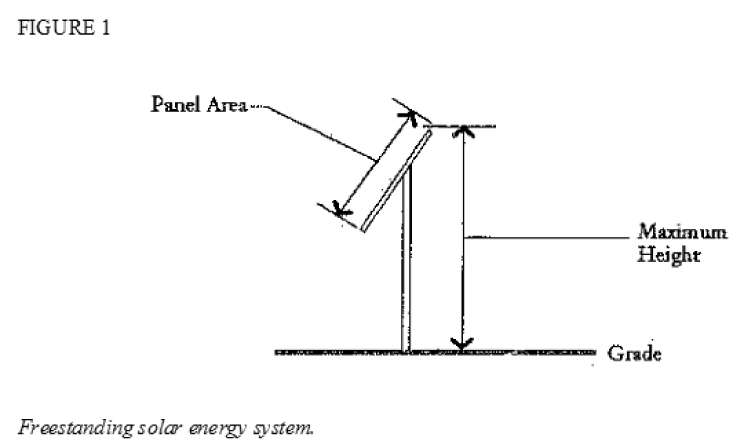
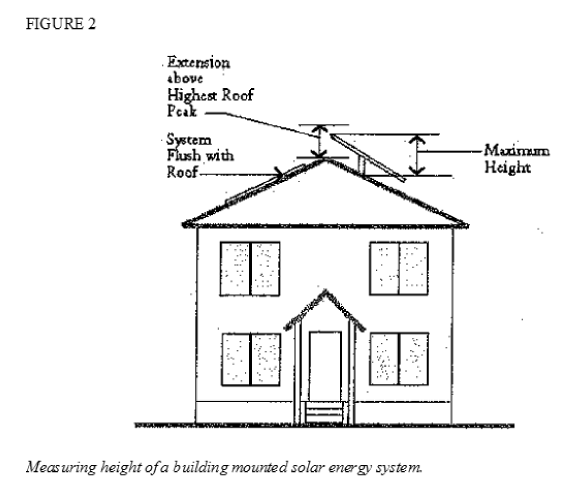
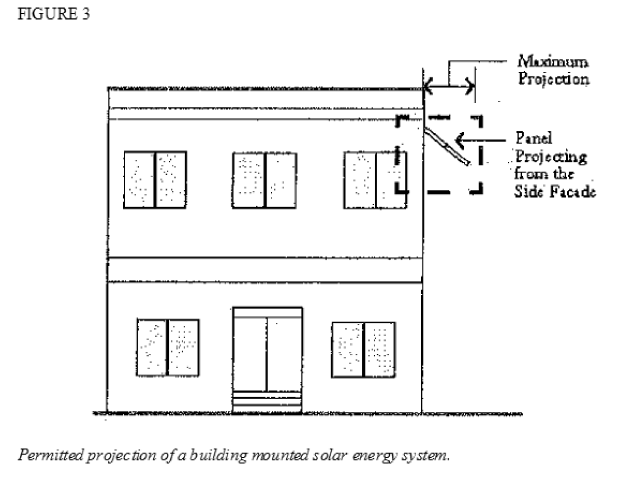
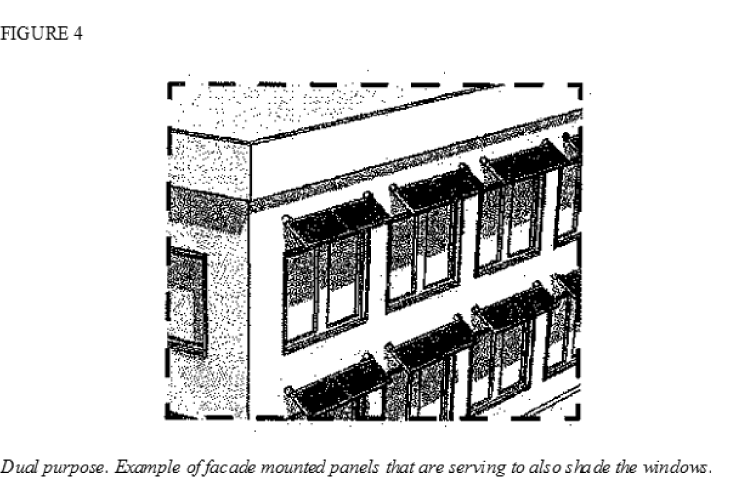
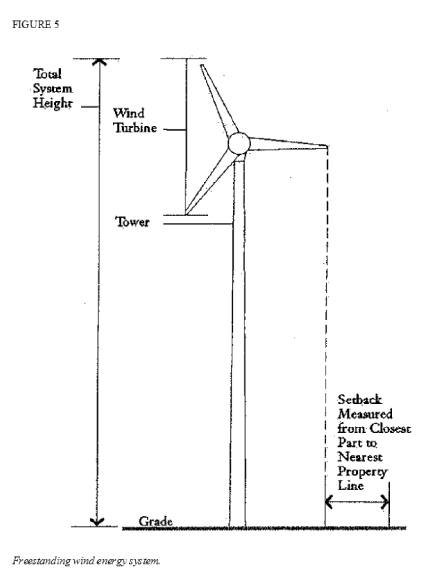
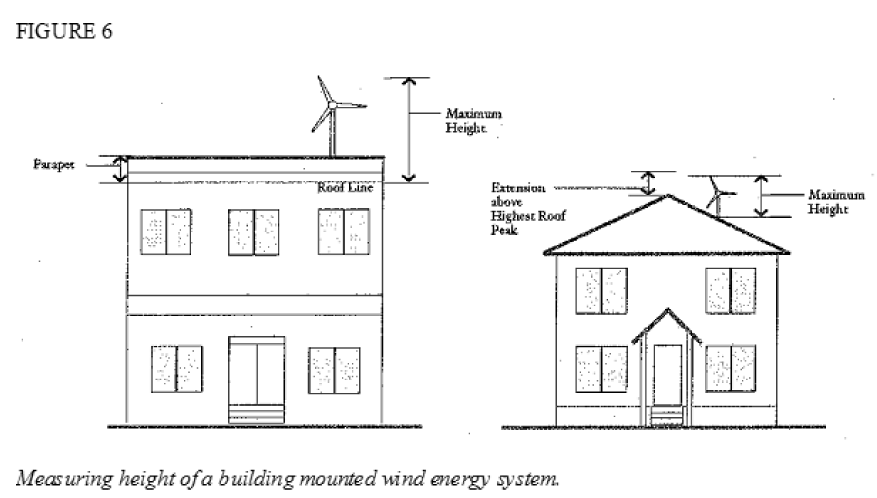
(Ord. 16-021, passed 2-23-2016; Am. Ord. 18-004, passed 1-9-2018; Am. Ord. 23-044, passed 5-9-2023)
§ 154.71 - DESIGNATION OF LANDMARKS.
(A)
Designation of Landmarks:
(1)
Procedures for Designation:
(a)
Any person, group, group of persons, association, the commission, or the village board may institute a request for a historic landmark designation for any structure or site in the village which may have historic significance. The community development department shall supply, upon request, application forms. All designations of landmarks in the village are subject to review by the plan commission. Notification for such public hearings must be in accordance with section 154.41.
(b)
Based on the designation criteria in subsection (A)(2) of this section, the plan commission shall make a recommendation to the village board concerning the proposed designation.
The village board shall determine whether the designation criteria have been met and may designate the structure or site as a historic landmark.
(2)
Designation Criteria: In making its recommendation for designation of a landmark structure and/or site, the commission shall consider the following criteria concerning such structure and/or site:
(a)
Its character, interest or value as part of the development, heritage or cultural characteristics of the village, Cook and/or DuPage Counties, the state or the United States;
(b)
Its location as a site of a significant historic event;
(c)
Its identification with a person or persons who significantly contributed to the culture or development of the village, Cook and/or DuPage Counties, the state or the United States;
(d)
Its exemplification of the cultural, economic, social or historic heritage of the village, county(ies), the state or the United States;
(e)
Its portrayal of the environment of a group in an era of history characterized by the distinctive architectural style;
(f)
Its embodiment of distinguishing characteristics of an architectural type;
(g)
Its identification as the work of an architect or master builder whose individual work has influenced the development of the village, Cook and/or DuPage Counties, the state or the United States;
(h)
Its embodiment of elements of architectural design, detail, materials, or craftsmanship which represent a significant architectural innovation;
(i)
Its relationship to other distinctive areas which are eligible for preservation according to a plan based on a historic, cultural or architectural motif;
(j)
Its unique location or singular physical characteristic representing an established or familiar visual feature of a neighborhood, community or the village or Cook and/or DuPage Counties;
(k)
Its archaeological significance to the community, village, state and the United States;
(l)
Its vernacular culture (utilitarian purpose without consideration of aesthetic value); or
(m)
Its economic and functional potential.
(B)
Regulation of Construction, Rehabilitation, Demolition, and Removal; Historic Landmarks:
(1)
It shall be unlawful for any person to construct, move, alter, change, make addition to, make any improvement to, add structures or buildings on a lot or tract with a designated historical landmark, demolish or remove the exterior or any aspect of the exterior of any designated historic landmark, unless the village has previously authorized such work. Prior approval shall not be required for ordinary repair and maintenance, in which there is no exterior change in appearance or materials, or changes in color according to subsection 154.195(G) of the zoning code. However, it shall be unlawful to change the color of the exterior of a designated historic landmark in violation of subsection 154.195(G) of the zoning code.
(2)
Plans for the alteration of the exterior of a designated historic landmark or new construction to a designated historic landmark on a lot with a designated historic landmark shall be processed in the same manner as subsection 154.195(E) of the zoning code.
(3)
In reviewing the proposed plans, the commission or the director shall determine:
(a)
Whether the proposed work will highlight or positively enhance any exterior architectural feature of the improvement upon which said work is to be done.
(b)
Whether the proposed work will detract from those characteristics and qualities which deem the structure or site a landmark.
(c)
Whether the proposed work will have a positive effect on the use of the landmark.
(d)
Whether the proposed work is consistent with the Secretary of the Interior's standards for rehabilitation.
(e)
Whether the proposed work is consistent with the Olde Schaumburg Centre design manual.
(4)
All conditions in subsection 154.195(E)(3) of the zoning code, referring to demolition and removal of structures in the Olde Schaumburg Centre shall herein apply to any proposed demolition, partial demolition or removal of a structure, accessory structure or site designated a historic landmark in the village.
(5)
Nothing in this section shall be construed to prevent the ordinary maintenance or repair of any exterior architectural feature of a historic landmark which does not involve a change in design, material, color or the outward appearance thereof; nor to prevent any alteration or demolition which the director shall certify is required for the public safety due to an unsafe or dangerous condition.
(Ord. 22-024, passed 3-22-2022)
§ 154.72 - APIARIES.
The intent of these standards is to establish safe and effective practices related to the keeping of bees for hobby purposes to benefit the environment.
(A)
Accessory Use: The keeping of honey bees, of the European species Apis mellifera, is considered an accessory use to a principal use. No owner of any property shall allow other persons, not residing on such property, to maintain bee colonies on such property except when used in conjunction with an education curriculum at a school. In addition to the standards included in this section, the keeping of honey bees shall be allowed as special or permitted uses as stipulated in chapter 154.
(B)
General Standards:
(1)
Hive Type: All bee colonies must be kept in a hive with removable combs which shall be kept in good repair and usable condition.
(2)
Colony Density:
a.
Two (2) full beehives (hives) and two (2) "nucleus hives" shall be permitted on lots up to and including a minimum lot area of ten thousand (10,000) square feet of area, and one (1) beehive and one (1) nucleus hive shall be permitted for each additional ten thousand (10,000) square feet. There shall be no limit on the number of hives kept on parcels with an area of two hundred thousand (200,000) square feet or more.
b.
Maximum Number of Colonies: Not more than five (5) honey bee colonies may be kept on any lot or parcel.
c.
Two (2) apiary sites may not exist within six hundred feet (600') of each other.
(3)
Minimum Yard Setback Requirements: The following minimum yards shall be required and maintained:
a.
Residential:
1.
Rear Yard Only: Apiaries shall be located in the rear yard only.
2.
Interior Side Yards: Apiaries shall be located a minimum of five feet (5') from the abutting interior lot line.
3.
Rear Yard: Apiaries shall be located a minimum of five feet (5') from the abutting rear yard lot line.
4.
Right-of-Way: Apiaries shall be located a minimum of fifteen feet (15') from a property line that abuts a street right-of-way, private road or alley.
5.
Rooftops or Balconies: Apiaries shall not be permitted on balconies.
b.
Non-Residential:
1.
Apiaries shall be permitted in all properties zoned B-3 Planned Office Business and in all properties zoned M-1 Manufacturing and M-P Planned Manufacturing.
2.
Rear or Side Yard Only: Apiaries shall be located in the rear or side yard, or on the rooftop.
3.
Interior Side Yards: Apiaries shall be located a minimum of ten feet (10') from the abutting interior lot line.
4.
Rear Yard: Apiaries shall be located a minimum of ten feet (10') from the abutting rear yard lot line.
5.
Right-of-Way: Apiaries shall be located a minimum of fifteen feet (15') from a property line that abuts a street right-of-way, private road or alley.
6.
Apiaries shall be located a minimum of twenty five (25') feet from a public building entrance or public pedestrian walkway.
7.
Apiaries shall be prohibited on retail properties.
8.
Additional landscaping that will provide a food source for the bees may be required.
(4)
Flyway barrier: If any colony is situated within twenty feet (20') of any property line, as measured from the nearest point on the hive to the property line, the beekeeper shall establish and maintain a flyway barrier, which directs the honey bees upwards as they exit the beehive. The flyway barrier may consist of a solid wall, fence, dense vegetation, or combination thereof; that completely encloses the apiary, or forms an effective barrier, so that the bees are forced to fly at an elevation of at least six feet (6') above ground level when crossing the property line in the vicinity of the apiary. Any such flyway barrier shall be constructed in compliance with applicable village ordinances.
(5)
Signage: A sign, or signs, identifying the presence of beehives on the property shall be posted so as to be reasonably visible within close proximity of the apiary. The sign shall be conspicuous and weatherproof, measuring at least ten inches (10") by one foot (1'), located on all lot lines facing abutting properties, and within ten feet (10') of the beehive or apiary. The sign shall contain the statement: "State Registered Beehive(s) on Property", or similar language that makes it clear that bees are on the premises. The sign must be visible and easily read from outside the property.
(6)
Maintenance: Beekeepers shall keep all beekeeping equipment in good condition and secure unused equipment from weather, potential theft, vandalism or occupancy by migratory colonies.
a.
Components. Beekeepers shall ensure that no bee comb, wax or other materials are left upon the grounds of the beehive or apiary site. Beekeepers shall promptly store or dispose of any bee comb, wax or other materials which have been removed from the beehive in a sealed container or within a building or other bee-proof enclosure.
b.
Water. Beekeepers shall ensure that a continuously available source of water is located within the parcel, provided that it is closer than water sources on any adjoining parcel. The water source shall be available at all times during the beehive's active months, March through November. The water source must be maintained by changing the water at least once a week so as not to create a breeding site for mosquitoes.
c.
Colony Maintenance. Beekeepers shall monitor and maintain their colony or colonies so as not to become a nuisance. Colonies must be monitored at least twice a month from March 1st to November 30th.
(7)
Beehive By-Products:
a.
Honey, beeswax and other by products from the beehives that may be sold from time to time.
(8)
Application Requirements:
a.
A scaled site plan of the proposed apiary showing placement of the beehive(s), the flyway barrier and compliance with all applicable requirements;
b.
A certificate of insurance from property owner's insurance company verifying that beekeeping is covered by the insurance policy covering the property on which the apiary will be located;
c.
Certificate of completion or similar documentation, from a beekeeping training course. Beekeepers are required to stay current and demonstrate their knowledge of colony health and management;
d.
State Registration. Beekeeper must, within thirty (30) days of installation of a colony into a beehive, submit proof of registration of the colonies with the Illinois Department of Agriculture or as otherwise required by the State of Illinois. State registration must be maintained for the life of the beehive.
e.
Illinois Bees and Apiaries Act. All beekeepers shall be in compliance with the Illinois Bees and Apiaries Act.
(9)
Removal: Any honey bee colony not residing in a hive structure intended for beekeeping, or any swarm of honey bees or colony residing in a hive which, by virtue of its condition, has been abandoned by the beekeeper, is unlawful, and shall be removed from the village limits by the property owner upon receipt of written notice from the village.
(Ord. 24-057, passed 7-23-2024)

