
Shelby City Zoning Code
ARTICLE 10
OFFICE AND COMMERCIAL DISTRICTS
Section 10.00.- Provisions applicable to office and commercial districts.
A.
Building design standards. The planning commission shall evaluate the architectural character, attractiveness, and compatibility of the exterior of all office and commercial buildings in relation to the following standards. These standards are offered for the purpose of achieving the following objectives:
•
Maintain and enhance the visual quality of the township.
•
Improve the compatibility between residential and non-residential development.
•
Encourage the establishment of an attractive and visually distinctive character for the township.
1.
Scale and proportion.
a.
The height, width and general proportions of a building shall be compatible with good design principles and practices. The ratio of wall surface to openings and the ratio of the width and height of windows and doors shall also be of compatible style.
b.
Buildings shall avoid long, monotonous, uninterrupted walls or roof planes. Building wall offsets, including projections, recesses and changes in floor level, shall be used in order to add architectural interest and variety and to relieve the visual effect of a simple, long wall.
c.
The evaluation of the appearance of a project shall be based on the quality of its design and relationship to community [township] objectives expressed above.
2.
Windows and doors.
a.
The pattern, placement, proportion, materials, design and style of windows and doors shall be architecturally compatible with the building.
b.
Windows shall be vertically proportioned whenever possible.
c.
Metal or plastic window or door frames are generally unacceptable, unless they are anodized or painted.
d.
Whenever shutters are used, they should be sized to match the building.
e.
Windows shall not be permanently covered, unless approved as part of the building elevations.
f.
Window placement and size shall be evaluated in relation to the proposed use.
g.
Fixtures and shelves shall not be permanently placed in front of any windows. Floor-to-ceiling windows will only be permitted when it can be demonstrated that this condition will be observed.
h.
Window placement and design shall be evaluated in relation to interior building lighting. Interior illumination shall not extend beyond the pedestrian access in front of the building.
i.
Awnings and canopies shall be limited to freestanding buildings. Awnings and canopies may be allowed in planned centers, provided their design, color and placement on the building are uniform. Awnings and canopies shall not be illuminated. Awnings and canopies shall be maintained in good condition. Torn or damaged awnings or canopies shall be removed or repaired by the owner(s) of the site. The face of the building behind the canopy shall be uniform in appearance with the remainder of the building.
3.
Roof form and materials.
a.
Roof types should be appropriate to the building's architecture. Architectural embellishments that add visual interest to the roof line, such as dormers, masonry chimneys, cupolas, clock towers and other similar elements, are encouraged.
b.
Roof line offsets or other architectural features shall be provided in order to provide architectural interest and variety to the massing of a building and to relieve the effect of a single long roof.
c.
Asphalt shingles, standing metal seamed material, or other compatible materials shall be required on pitched roofs. On flat roofs that are not visible to the public, other roof materials may be appropriate.
4.
Architectural details.
a.
Building elevations shall include sufficient architectural details to create a distinctive appearance or character. All details and fixtures shall be in proportion to the building.
b.
Exterior lighting fixtures, standards, and all exposed accessories shall be harmonious with the design of the building.
c.
Buildings facing a public street or internal open space shall be architecturally emphasized through fenestration, entrance treatment and details. Buildings with more than one facade facing a public street shall be required to provide similar front facade treatments on each street. Deviations in facade design may be permitted when it provides visual interest or improves the appearance of the building.
d.
Cornerstone date markers shall be included at the front corner of all buildings. The cornerstone shall include the date of the building construction. It may also include the name of the architect and builder and/or other relevant information.
5.
Wall materials.
a.
The entire exterior surface of all building's walls hereafter erected shall be constructed of brick and/or stone building material. Other durable, decorative building materials may be approved by the planning commission in instances where the character and style or use of the proposed structure warrants special consideration. The use of other material may be allowed for accent purposes only. The use of decorative block or exposed surfaces to public view shall not be permitted. When dryvit is permitted, it shall be limited to upper portions of the building.
b.
The architectural treatment of the front facade shall be continued, in its major features, around all visibly exposed sides of a building. All sides of a building shall be architecturally designed to be consistent with regard to style, materials, colors and details. Blank walls or service area treatment of side and/or rear elevations visible from public view is discouraged.
c.
In any design in which the structural frame of the building is exposed to view, the structural materials shall be compatible with the rest of the building and its surroundings.
d.
Interior courtyards used for trash storage or loading that are not exposed to public view are not required to observe the brick surfacing requirement referenced above.
6.
General standards.
a.
Variation of detail, form and siting shall be used to provide visual interest. Monotony of design in single or multiple building projects shall be avoided. Variations of detail, form and siting shall be used to provide visual interest. In multiple building projects, variable siting or individual buildings may be used to prevent a monotonous appearance.
7.
Maintenance standards.
a.
The choice of materials and their use, together with the types of finishes and other protective measures, shall be conducive to easy maintenance and upkeep. A maintenance schedule shall be provided for those materials requiring periodic maintenance.
b.
Materials and finishes shall be selected for their durability and wear, as well as for their beauty. Proper measures and devices shall be incorporated for protection against the elements, neglect, damage and abuse.
c.
Designs that tend to accumulate debris, leaves, trash, dirt and rubbish shall be avoided.
B.
Rear yard access and parking. Required yards may be used for off-street parking, as regulated in this article, provided adequate access to the rear of the building for fire fighting and emergency equipment is available. Where rear yard parking is permitted, its quantity, size and layout shall be designed mainly to encourage "employee parking."
C.
Landscaping. Portions of the site not used for parking, driveways and buildings shall be provided with landscaping, lawn and irrigation (see section 5.03), approved by the planning commission, and so maintained in attractive condition.
D.
Roof-mounted fixture screening. Roof-mounted equipment, including, but not limited to, air conditioners, heating apparatus, dust collectors, filters, transformers, noise control devices and any other such appliance or apparatus, shall be concealed from view by obscuring screening so as not to be visible from the ground. The design of the screening shall be approved by the planning commission and shall be compatible with the architectural design of the building upon which it is located, and shall be designed to mitigate noise generated by any roof mounted appliances.
E.
Front building line. Once a building line has been established by the construction of a principal building upon an approved site, no other principal building or use shall be located between the established building line and the front lot line (or side lot line abutting a side street) without first obtaining approval of the planning commission. The planning commission shall review the building and/or use proposed to be located in front of the established building to determine whether the building or use is of such location, size and character to be in harmony with the appropriate and orderly development of the balance of the site, is not detrimental to the development of adjacent uses, does not create any vehicular or pedestrian hazards, and is aesthetically compatible with the buildings and uses located (or to be located) upon the site. Landscaping plans, site plans (including signs and the location of dumpsters), and elevations of all sides of any building to be constructed shall be submitted to enable the planning commission to determine whether the proposed additional front building and/or use conforms with the requirements of this section. All dumpsters shall be visibly screened from any area visible to the public by use of a wall of the same material as the building walls to ensure aesthetic compatibility and constructed to the standards of section 5.08. In reviewing this request, the planning commission shall apply the standards contained herein and in section 13.01.A. (special land use approval), and may impose reasonable conditions as authorized by section 13.02.E. to ensure that the standards are satisfied.
F.
Lighting limitations. Lighting of parking areas shall be as approved by the planning commission in accordance with section 5.06, and as specified for each district.
G.
Signs. Signs shall be governed by section 5.05 of this ordinance, unless as otherwise approved as part of the project development plan for a planned unit development (PUD) or C-5 multi-use project.
H.
Screening. Screening between abutting properties shall be provided as specified in section 5.01, in addition to the requirements specified in section 7.02, site plan submission requirements.
I.
Off-street loading. Loading shall be provided only in rear yards. Side yard loading may be permitted by the planning commission when such space and loading facilities do not interfere with parking and circulation, either vehicular or pedestrian, and would not be detrimental to any nearby residential district or use. No part of any loading or unloading area may be located closer than 45 feet to any rear property line adjacent to a residential district. Loading areas shall be screened from view of adjoining residences and from view of any adjoining road. Raised sidewalks at least five feet in width shall be provided adjacent to the building separating the building from the loading area.
J.
Site coverage. Maximum lot coverage shall be governed by meeting all requirements for yard space, landscaping, screening, off-street parking, loading and road rights-of-way.
K.
Restaurants with outdoor seating. Restaurants with outdoor seating may be permitted in any zoning district permitting restaurants, subject to compliance with the following standards:
1.
Outdoor seating shall not be located adjacent to any residential zoning district.
2.
The location of the outdoor dining area shall not disrupt the vehicular or pedestrian circulation pattern of the site, nor result in a situation where the placement of vehicles may negatively influence diners. Outdoor dining shall not obstruct the entrance to any building or sidewalk. If the outdoor dining areas are located on a sidewalk in front of a building, a minimum five-foot wide pedestrian path shall be maintained on the sidewalk.
3.
Hours of operation shall be specified.
4.
All outdoor lighting shall be shielded from adjoining parcels and shall meet the requirements of section 5.06.
5.
No outdoor entertainment, music or speakers shall be permitted where the site abuts an existing residential zoning district or use.
6.
Reserved.
7.
All proposed outdoor seating areas shall be shown on a site plan meeting the submission requirements of section 7.02. As provided in section 7.02.2.F., the planning commission may waive certain submission requirements that are determined to not be necessary to the review and understanding of the site.
8.
No outdoor storage may be allowed in an approved outdoor dining area.
L.
Accessory propane sales. Accessory propane tanks may be permitted for domestic sales and refilling purposes subject to site plan review and provided that the proposed use is incidental to the principal use and is appropriately located relative to existing site features. The proposed storage shall also be consistent with all other applicable requirements of this ordinance.
M.
Massage therapy as an accessory use. Massage therapy may be allowed as an accessory use to other permitted uses in all office and commercial zoning districts subject to compliance with the requirements for massage establishments as contained in the Charter Township of Shelby Code of Ordinances. Massage therapy establishments as the principal use may be allowed as a special land use subject to the requirements of section 13.02 of the zoning ordinance.
(Ord. No. 212.48, 10-21-2004; Ord. No. 212.59, 8-18-2005; Ord. No. 212.85, 3-15-2011; Ord. No. 212.92, 5-20-2014)
Section 10.10. - District O-1 professional office.
The O-1 professional office district is designed to provide a suitable environment for various types of office uses performing professional, administrative and related service occupations. This district is also intended to provide a transition or buffer between more intense uses and/or major thoroughfares and abutting single-family residential neighborhoods.
A.
Uses permitted. In all O-1 districts, no land or building shall be used except for one or more of the following uses:
1.
Office buildings with the majority of its occupancy made up of the following service professions: Attorneys-at-law, doctors of medicine, dentistry, optometry, osteopathy, physicians and surgeons, land surveyors, architects, landscape architects, professional engineers, community [township] planners, certified public accountants, and such other similar professional occupations as determined by the planning commission.
2.
Occupations and uses permitted to make up the balance of the office buildings whose occupancy is primarily professional may include the following: Clerical, drafting, executive, accounting, administrative, stenographic, insurance and similar occupations as determined by the planning commission, subject to the standard that such businesses do not normally operate seven days per week.
3.
Accessory uses customary and incidental to a principal use shall be permitted provided such accessory uses are within the building. Accessory buildings shall not be permitted. The accessory use within the building shall not have an outside entrance for customers (users) separate from the entrances that serve the principal use.
4.
All principal uses permitted and special land uses as regulated under this ordinance in the immediate abutting R-1-A, R-1-B, R-1-C, or R-2 residential districts.
The outside storage of vehicles, materials or equipment on the premises is prohibited and no uses with a drive-thru shall be permitted in this district.
B.
Special land uses. The following special land uses, and other uses similar to those cited in this section, may be granted approval by the township board following review by the planning commission, subject to the standards of this article and the general and specific standards for each cited in article 13.
1.
Funeral homes and mortuaries, not including crematoriums (section 13.20).
2.
Nursery schools, day-care centers and similar uses (section 13.34).
3.
Planned unit development (section 13.37).
4.
Public utility buildings without storage (section 13.42).
C.
Site, area and placement requirements.
1.
The minimum size of each lot per buildings:
(a)
Area: 12,000 square feet.
(b)
Width: 80 feet.
2.
Minimum yard setback per lot:
(a)
Front and street-side building and parking setbacks shall be measured from the centerline of each road right-of-way (R.O.W.) in accordance with the township's master plan, as follows:
Distance from centerline (in feet):
il=5p * Freeways shall be measured from the established right-of-way lines.
il=5p ** In the case of private roads, the front yard setback shall be measured from the road easement or common usage line abutting the subject lot.
Parking shall not be permitted in the required front or street side setback.
(b)
Side: No side yard on one side is required along the interior side lot line, except as otherwise specified in the building code. If the exterior side yard borders on a residential district, there shall be provided a side setback of not less than 30 feet.
Where the wall of a structure faces interior side lot lines and contains windows or other openings, a side yard of not less than 20 feet shall be provided. Corner lot side yards must equal the setback required for the front yards on the street which they side. See (a) above.
(c)
Rear: Twenty feet (a suitable 24-foot wide access drive shall be provided to the rear yard). Whenever a rear yard abuts a residential zoning district, the rear yard setback shall be increased to 30 feet.
D.
Building requirements.
1.
Building height. No building shall exceed 18 feet in height, except as otherwise provided in section 4.02 of this ordinance.
2.
Number of stories. No building shall contain more than one story above the ground level, except as, otherwise provided in section 4.02 of this ordinance.
3.
The style and design of architectural features of the structure shall be compatible in appearance and scale with neighboring residential units. In making this assessment, the planning commission shall consider the following factors: building roofline and eves, door and window openings, building proportions and type, and color of facing materials.
E.
Additional site requirements. In addition to those requirements cited in section 10.00, the following additional site requirements also apply to this district:
1.
During office hours of the O-1 use after sunset, the parking areas shall be adequately lighted for safety of users and not create nuisances for adjacent property owners.
2.
Parking lot and building lighting shall be of a pedestrian scale and character. No lighting shall exceed ten feet in height. All outdoor lighting shall observe the requirements of section 5.06.
F.
Environmental and off-street parking. Environmental (landscaping, lighting, screening and signs) and off-street parking improvements shall be provided in accordance with articles 5 and 6 of this ordinance.
(Ord. No. 212.85, 3-15-2011)
Section 10.20. - District O-2 service office.
The purpose of the O-2 district is to accommodate the development of larger scale office buildings or office building complexes or other institutional or public service uses of an intensity that is normally greater than what is permitted in the O-1 district. The O-2 district is intended to be applied to larger parcels that have direct access to major thoroughfares. Offices within this district are intended to be developed as a planned or integrated cluster of establishments served by consolidated driveways and parking areas, as well as unified architecture and landscaping features.
A.
Uses permitted. In all O-2 districts, no land or building shall be used except for one or more of the following uses:
1.
Real estate offices and all uses permitted in the O-1 professional office districts, except those listed in section 10.10.A.4. (residential).
2.
Accessory buildings and accessory uses (customarily incident to the following uses permitted).
3.
Banks, credit unions, and similar uses (see 6. below concerning drive-thru).
4.
Public utility buildings not including outside storage (section 13.42).
5.
Retail businesses normally associated with and complementary to office districts, such as pharmacies limited to the dispensing and sale of medicine and medical supplies, optical stores, stores for orthopedic appliances and corrective garments, coffee or sandwich shops, stationery shops, office supplies, and office machine repair.
6.
Uses that are principally of a drive-thru nature and outside storage of materials and/or equipment on the premises are prohibited in this district.
B.
Special land uses. The following special land uses, and others similar to those cited in this section, may be permitted by the township board following review by the planning commission, subject to the standards of this article and the general and specific standards for each cited in article 13.
1.
Colleges, universities and similar institutions (section 13.15).
2.
Nursing homes and skilled nursing facilities (section 13.17).
3.
Funeral homes and mortuaries, not including crematoriums (section 13.20).
4.
General hospitals, emergency care treatment centers, and similar outpatient treatment facilities (section 13.24).
5.
Child care centers and nursery schools (section 13.34).
6.
Planned unit development (section 13.37).
7.
Private clubs, fraternal organizations and lodge halls (section 13.38).
8.
Private non-commercial recreation facilities (section 13.39).
C.
Site, area and placement requirements.
1.
The minimum size of each lot per building:
(a)
Area: 15,000 square feet.
(b)
Width: 100 feet.
2.
Minimum yard setbacks per lot:
(a)
Front and street-side building and parking setbacks shall be measured from the centerline of each road right-of-way (R.O.W.) in accordance with the township's master plan, as follows:
Distance from centerline (in feet):
il=5p * Freeways shall be measured from the established right-of-way lines.
il=5p ** In the case of private roads, the front yard setback shall be measured from the road easement or common usage line abutting the subject lot.
Parking shall not be permitted in the required front or street side setback.
The planning commission may vary the setback upon site plan review where it is found that the change in setback serves to promote more uniform access, interconnection of adjacent parking facilities or the aesthetic quality of the block front.
(b)
Side: Ten feet. Where the wall of a structure faces interior side lot lines and contains windows or other openings, a side yard of not less than 20 feet shall be provided. If the exterior side yard borders on a residential district, there shall be provided a side setback of not less than 30 feet. Corner lot side yards must equal the setback required for the front yards on the street which they side. See subsection (a) above.
(c)
Rear: Twenty feet (a suitable 24-foot wide access drive shall be provided to the rear yard).
D.
Building requirements.
1.
Building height. No building shall exceed 25 feet in height, except as otherwise provided in section 4.02 of this ordinance.
2.
Number of stories. No building shall contain more than two stories above the ground level, except as otherwise provided in section 4.02 of this ordinance.
E.
Additional site requirements. In addition to those requirements cited in section 10.00, the following additional site requirements also apply to this district:
1.
During office hours of the O-2 use after sunset, the parking areas shall be adequately lighted for safety of users and not create a nuisance for adjacent property owners.
2.
Parking lot and building lighting shall be of a pedestrian scale and character. No lighting shall exceed ten feet in height. All outdoor lighting shall observe the requirements of section 5.06.
F.
Environmental and off-street parking. Environmental (landscaping, lighting, screening and signs) and off-street parking improvements shall be provided in accordance with articles 5 and 6 of this ordinance.
(Amend. of 7-7-2009; Ord. No. 212.85, 3-15-2011)
Section 10.30. - District C-1 local retail business.
The C-1 local retail business district is designated to meet the day-to-day convenience shopping and service needs of persons residing in adjacent residential areas. Protection of nearby residential districts is considered of importance; thus, businesses which tend to be a nuisance to immediately surrounding residential areas are excluded, even though the goods sold or services offered might fall within the convenience classification.
It is further the intent of this district to provide these goods and services in a physical setting that is compatible with surrounding residential neighborhoods and which are of a neighborhood size and character. Whenever possible, local retail business districts should be developed with consolidated site features to provide for a continuity of appearance and function and to minimize any negative impacts on nearby residential neighborhoods or the township's thoroughfare system.
A.
Uses permitted. In all C-1 districts, the following uses of building or land shall be permitted provided that all uses (except for off-street parking or loading) shall be conducted within a completely enclosed building; that all uses shall be of a retail or service nature dealing directly with consumers; and that all goods produced on the premises shall be sold at retail on the same premises.
Permitted convenience commercial categories and common activities permitted in each category are described below, together with maximum permitted square footage totals for each particular use. Uses exceeding the floor area standards noted below may be approved administratively by the planning director. In considering the appropriateness of an increase, the planning director shall consider the arrangement of the floor space, the amount of traffic generated by the use, the potential for nuisances and the scale of the use in relation to any surrounding residential neighborhoods. Uses that exceed these floor area standards that are not approved by the planning director and planning commission chairperson shall require special land use approval.
1.
Convenience stores (party stores, stores selling beer and wine, and similar retail businesses) (3,000 square feet).
2.
Bakery (outlets or on-site baking for in-store sale and limited sale off-site) (2,400 square feet).
3.
Restaurants (sit-down restaurants (without entertainment), restaurants with liquor service, and cocktail lounges) (5,000 square feet).
4.
Food, specialty (fish market, pasta, meat market, specialty produce, prepared foods, ethnic foods, coffee houses and health foods) (1,200 square feet).
5.
Fast-food/carry-out (ice cream/yogurt, donuts, pizza, sandwiches, Chinese food, etc.) (1,500 square feet).
6.
Wearing apparel/accessories (men's, women's and children's clothes, shoes, uniforms, bridal gowns, lingerie, etc.) (1,500 square feet).
7.
Home furnishings (curtains/draperies, picture frames, linens, glassware, furniture, floor covering (showrooms and outlets with no large-item storage), lighting, and small appliances) (2,400 square feet).
8.
Specialty home improvement (building and remodeling contractor showrooms, glass and door showrooms, paint/wallpaper, specialty hardware, invisible fencing) (2,000 square feet).
9.
Hardware stores (10,000 square feet).
10.
Drug stores and grocery stores (12,000 square feet).
11.
Gifts/Specialty (florist, records/tapes, party supplies, cosmetics, baseball cards, collectibles, hobby supplies, cake decorating supplies, jewelry, trophy shops, art gallery, eye glasses, sporting goods, pets, fabrics, computers and musical instruments, among others) (1,600 square feet).
12.
Stationary (5,000 square feet).
13.
Personal services and banking:
a.
Barber/beauty salons including beauty schools (2,400 square feet for beauty salons and 5,000 square feet for beauty schools).
b.
Dry cleaners/laundromats (pick-up stations with limited dry cleaning on site) (2,400 square feet).
c.
Tanning salons (1,200 square feet).
d.
Video stores (7,500 square feet).
e.
Repair services (television/video recorders, shoe, tailor/seamstress, upholstery and sewing machines) (1,000 square feet).
f.
Others (dog grooming, dance/instructional studios, photo studios, weight loss clinics, income tax services, travel agencies, mailing supplies, instant printers, copier and fax services, driving schools, veterinary clinics (without boarding) and tuxedo rentals) (1,600 square feet).
g.
Banks (banks, savings and loans, and other financial institutions) (3,500 square feet).
14.
Professional offices, as permitted in the O-1 district.
15.
Public utility buildings, telephone exchange buildings, transformer stations and substations. No such use shall have a service yard or storage yard.
16.
Accessory buildings.
17.
Accessory uses.
18.
Temporary buildings pursuant to the establishment of a permanent building and permitted use. All such temporary buildings shall be immediately removed upon expiration of the time limit established as a condition of their construction. Approval of temporary buildings may be allowed as per the requirements of section 15.05.
B.
Special land uses. The following special land uses, and others similar to those cited in this section, may be granted approval by the township board following review by the planning commission, subject to the standards of this article and the general and specific standards for each use cited in article 13.
1.
Churches and private schools (section 13.13).
2.
Gasoline self-service stations (only on sites where a gasoline service station has existed as a lawful nonconforming use) (section 13.21).
3.
Nursery schools and day-care centers (section 13.34).
4.
Planned unit development (section 13.37).
5.
Public utility buildings, without storage (section 13.42).
C.
Site, area and placement requirements.
1.
The minimum size of each lot per building.
(a)
Area: 12,000 square feet.
(b)
Width: 80 feet.
2.
Minimum yard setback per lot.
(a)
Front and street-side building and parking setbacks shall be measured from the centerline of each road right-of-way (R.O.W.) in accordance with the township's master plan, as follows:
Distance from centerline (in feet):* or as otherwise noted
* Freeways shall be measured from the established right-of-way lines.
** In the case of private roads, the front yard setback shall be measured from the road easement or common usage line abutting the subject lot.
The parking lot setback requirements noted above only apply to new development. Modifications to existing commercial sites which require site plan review shall provide a three foot high brick wall along the frontage of the site to partially screen the parking lot from public view. In lieu of a wall, the planning commission may accept an alternative treatment that introduces additional landscaping improvements to the perimeter and interior of the parking lot. This may include lowering the grade of the parking lot to reduce its visibility if determined to be feasible.
The planning commission may vary the setback upon site plan review where it is found that the change in setback serves to promote more uniform access, interconnection of adjacent parking facilities or the aesthetic quality of the block front.
(b)
Side: Twenty feet from the lot line that does not abut a street or alley; provided that if all portions of one side of the building are enclosed with an unpierced wall of two hour construction, with a parapet wall extending not less than 18 inches above the adjoining roof construction (except along a lot line adjacent to a residential district), said building may be extended or constructed to the lot line; provided, further, that no side yard of less than five feet in width shall be left between the lot line and the building. Where side lot line abuts a side street, the side yard shall be the same as the front yard required for the use fronting on the street adjacent to said property. If an exterior side lot line abuts residential zoned land, a side yard setback of 30 feet shall be provided.
(c)
Rear: Twenty-four feet (a suitable 24-foot wide access drive shall be provided to the rear yard).
D.
Building requirements.
1.
Building height. No building shall exceed 25 feet in height, except as otherwise provided in section 4.02 of this ordinance.
2.
Number of stories. No building shall exceed two stories above the ground level, except as otherwise provided in section 4.02 of this ordinance.
E.
Additional site requirements. In addition to those requirements cited in section 10.00, the following additional site requirements also apply to this district.
1.
Lighting of parking areas shall be in a manner so as to prevent rays and illumination therefrom from being cast upon neighboring residences and to prevent glare therefrom into other nearby buildings or streets. All outdoor lighting shall meet the requirements of section 5.06.
2.
Outdoor storage and display of merchandise is prohibited. Minor day-to-day, in-and-out display may be permitted when kept behind established building setback line.
3.
Drive-thru service shall not be allowed, except accessory to a bank subject to special land use approval and with a maximum of three service bays.
4.
Heavy loading or unloading of primarily large items or the installation or deliveries of large merchandise other than those incidental to a permitted use shall be prohibited.
5.
Twenty-four hour service shall be prohibited, except for an automatic teller accessory to a bank or drop-boxes.
6.
No service shall be provided after midnight or before 7:00 a.m.
7.
No signage shall be allowed that is distracting or out of character with nearby residential uses.
8.
Noise, odor or lighting that exceeds the performance standards of section 5.07 shall be prohibited.
F.
Environmental and off-street parking. Environmental (landscaping, lighting, screening and signs) and off-street parking improvements shall be provided in accordance with articles 5 and 6 of this ordinance.
(Ord. No. 212.5, § 27, 7-20-1999; Ord. No. 212.59, 8-18-2005; Amend. of 2-17-2009; Ord. No. 212.92, 5-20-2014)
Section 10.40. - District C-2 linear retail business.
The C-2 linear retail business district is designated to address the historic use of Van Dyke and Auburn Road for commercial business use. It is designed to accommodate both the neighborhood and local needs of persons residing in the community [township]. Since the existing districts are historically placed, the proximity of the frontage to residential varies from lot-to-lot. Where sufficient lot depth exists, isolation is possible that permits uses of greater intensity than those allowed in C-1. These uses, however, must be of scale and nature that they do not negatively impact the nearby residential uses, nor impede the traffic flow on the abutting thoroughfare.
A.
Uses permitted. In all C-2 districts, the following uses of building or land shall be permitted, provided that all uses (except for off-street parking or loading) shall be conducted within a completely enclosed building; that all uses shall be of a retail or service nature dealing directly with consumers; and that all goods produced on the premises shall be sold at retail on the same premises. Where it is determined by the planning commission that effects of a listed use may tend to extend beyond the site, then special land use approval shall be required.
1.
Any use allowed in the C-1 district including professional offices. (The floor area restrictions applicable to the C-1 district do not apply to the C-2 zoning district.
2.
General merchandise stores, department stores and variety stores (stores selling numerous lines of merchandise, such as dry goods, apparel and accessories, furniture, home furnishings, small wares, hardware, and food).
3.
Home furniture, furnishing and equipment stores (floor covering; drapery, curtain and upholstery; miscellaneous home furnishings; household appliances; radio, television, consumer electronics, computer and computer software, records and tapes; and musical instruments).
4.
Eating and drinking establishments (except for fast-food or carry-out restaurants with drive-thru windows).
5.
Used merchandise.
6.
Sporting goods and bicycles.
7.
Books.
8.
Stationery.
9.
Jewelry.
10.
Hobbies, toys and games.
11.
Cameras and photographic supplies.
12.
Gifts, novelties and souvenirs.
13.
Luggage and leather goods.
14.
Sewing, needle work and piece goods.
15.
Catalog/mail order sales.
16.
Florists.
17.
Tobacco stores.
18.
Optical goods.
19.
Other miscellaneous retail stores (except used lumber, tires, gravestones, ice dealers, direct selling establishments, and fuel dealers).
20.
Laundry, cleaning and garment services (except dry-cleaning plants, carpet and upholstery cleaners and industrial laundries).
21.
Photographic studios.
22.
Funeral parlors.
23.
Petshops.
24.
Other miscellaneous personal services (except escort services, massage parlors and lingerie sales with modeling). Tattoo parlors may be allowed subject to the following requirements:
1.
Hours of operation shall be limited to 9:00 a.m. to 9:00 p.m. daily.
2.
The business shall not have opaque front windows and shall not have private workstations in order to maintain adequate interior visibility.
3.
The facility shall comply with the requirements of Public Act 149 of 2007, Requirements for Body Art Facilities and obtain approval from the Macomb County Health Department.
25.
Passenger car rental and leasing and used vehicle display lots subject to the following conditions:
1.
The surface of the parking lot and arrangement of vehicles shall conform to the standards of section 6.03 of the zoning ordinance.
2.
No repair or refinishing of vehicles shall occur on the site unless the work is performed within a building conforming to all applicable building code requirements.
3.
Devices for transmitting or broadcasting of voices shall be prohibited outside of the building.
4.
No outdoor storage of used tires, auto parts or inoperable or dismantled vehicles shall be permitted on the site.
5.
Any lot with a capacity of more than ten cars shall provide a front yard landscaped greenbelt conforming to the requirements of section 5.03 and 5.04 of the zoning ordinance. A site plan illustrating compliance with this requirement shall be submitted to the planning and zoning department for approval.
6.
All signage must conform to section 5.05 of the zoning ordinance. The use of banners, streamers, string lights or inflatable signs is prohibited.
7.
Used car lots may be permitted for multiple tenant buildings provided that the applicant can demonstrate that adequate parking is available for the display of vehicles and other businesses as required by section 6.02 of the zoning ordinance.
26.
Auto parking for a fee, except tow-in parking lots.
27.
Auto and motorcycle services including minor or light repair subject to compliance with the standards listed below. Heavy repair including collision shops and transmission repair are not allowed in the C-2 district.
1.
All repair activities shall be confined to the interior of the building.
2.
No outdoor storage of parts or equipment is permitted. This shall not prohibit temporary storage of vehicles waiting for repair, provided that no such vehicle shall be stored on site for a period exceeding two weeks.
3.
An adequate means of waste disposal shall be provided, as required by applicable state or federal law.
4.
Adequate measures shall be taken to ensure that any noise, dust, smoke, odor, fumes or other negative environmental impacts are confined to the site.
28.
Repair services, including electronic (home and business); watch, clock and jewelry; reupholsters and furniture repair; and small repair shops, including lawnmower, bicycle and taxidermy.
29.
Dance and instructional studios, including martial arts and similar activities.
30.
Art galleries.
31.
Veterinary clinics, doctors, dog grooming, boarding and dog day care subject to the following requirements:
1.
All operations shall be conducted completely within an enclosed building. Outdoor pens and runs may be allowed only when the site is located adjacent to parcels zoned C-2, LM or HM. Outdoor pens or runs shall not be located adjacent to any residential zoning district or use.
2.
Outdoor pens or runs shall be completely enclosed by a six-foot fence and shall not be visible from a public road.
3.
The areas within a building where animals are boarded shall be sufficiently soundproofed to prevent a disturbance or become a nuisance to surrounding properties as determined by the building department.
4.
The areas of the building where animals are boarded shall have a minimum of ten air changes per hour.
5.
Animal isolation areas shall have 100 percent fresh air with all air exhausted and none returned to the ventilation system.
6.
Public access areas shall be provided with a separate ventilation system from animal treatment and boarding areas.
7.
Areas used for animal boarding, isolation and treatment shall be constructed of easily cleanable materials.
8.
All areas where animals are present shall be cleaned a minimum of twice daily to provide appropriate odor control and sanitation.
9.
Any pets boarded overnight shall be confined to the building from the hours of 9:00 p.m. to 7:00 a.m.
32.
Weight-lifting, exercise and body building establishments.
33.
Public utility buildings, telephone exchange buildings, gas regulator stations, transformer stations and substations.
34.
Accessory buildings and uses.
35.
Temporary buildings pursuant to the establishment of a permanent building and permitted use. All such temporary buildings shall be immediately removed upon expiration of the time limit established as a condition of their construction.
B.
Special land uses. The following special land uses, and others similar to those cited in this section, may be granted approval by the township board following review by the planning commission, subject to the standards of this article and the general and specific standards for each use cited in article 13.
1.
Amusement device centers (section 13.04).
2.
Automobile washing facilities (section 13.08).
3.
Churches and private schools (section 13.13).
4.
Fast-food and carry-out restaurants with accessory drive-thrus [throughs] (section 13.19).
5.
Gasoline service stations (full and self-service) (sections 13.21 and 13.23).
6.
Nurseries and greenhouses (section 13.33).
7.
Planned unit development (section 13.37).
8.
Public utility buildings without outdoor storage (section 13.42).
9.
Nursery schools and day care centers (section 13.22).
C.
Site, area and placement requirements.
1.
The minimum size of each lot per building.
(a)
Area: 16,000 square feet.
(b)
Width: 80 feet.
2.
Minimum yard setback per lot.
(a)
Front and street-side building and parking setbacks shall be measured from the centerline of each road right-of-way (R.O.W.) in accordance with the township's master plan, as follows:
Distance from centerline (in feet):* or as otherwise noted
* Freeways shall be measured from the established right-of-way lines.
** In the case of private roads, the front yard setback shall be measured from the road easement or common usage line abutting the subject lot.
The parking lot setback requirements noted above only apply to new development. Modifications to existing commercial sites which require site plan review shall provide a three foot high brick wall along the frontage of the site to partially screen the parking lot from public view. In lieu of a wall, the planning commission may accept an alternative treatment that introduces additional landscaping improvements to the perimeter and interior of the parking lot. This may include lowering the grade of the parking lot to reduce its visibility if determined to be feasible.
The planning commission may vary the setbacks upon site plan review where it is found that the change in setback serves to promote more uniform access, interconnection of adjacent parking facilities, or the aesthetic quality of the block front. The planning commission may also permit canopies over gasoline service pumps to intrude into the front yard setback by no more than 25 feet.
(b)
Side: Twenty feet from the lot line that does not abut a street or alley; provided that if all portions of one side of the building are enclosed with an unpierced wall of two hour construction, with a parapet wall extending not less than 18 inches above the adjoining roof construction (except along a lot line adjacent to a residential district), said building may be extended or constructed to the lot line; provided, further, that no side yard of less than five feet in width shall be left between the lot line and the building. Where side lot line abuts a side street, the side yard shall be the same as the front yard required for the use fronting on the street adjacent to said property. If an exterior side lot line abuts a residential zoning district, a side yard setback of 30 feet shall be required.
(c)
Rear: Twenty-four feet (suitable access shall be provided to the rear yard).
D.
Building requirements.
1.
Building height. No building shall exceed 25 feet in height, except as otherwise provided in section 4.02 of this ordinance.
2.
Number of stories. No building shall exceed two stories above the ground level, except as otherwise provided in section 4.02 of this ordinance.
E.
Additional site requirements. In addition to those requirements cited in section 10.00, the following additional site requirements also apply to this district:
1.
Lighting of parking areas shall be in a manner so as to prevent rays and illumination therefrom from being cast upon neighboring residences and to prevent glare therefrom into other nearby buildings or streets. All outdoor lighting shall meet the requirements of section 5.06.
2.
Outdoor storage and display of merchandise is prohibited. Minor day-to-day, in-and-out display may be permitted when kept behind the established building setback line.
F.
Environmental and off-street parking. Environmental (landscaping, lighting, screening and signs) and off-street parking improvements shall be provided in accordance with articles 5 and 6 of this ordinance.
(Ord. No. 212.5, §§ 29, 30, 7-20-1999; Ord. No. 212.59, 8-18-2005; Ord. No. 212.85, 3-15-2011; Ord. No. 212.92, 5-20-2014)
Section 10.50. - District C-3 shopping center business.
This district is intended to provide a combination of convenience and comparison retail goods and services serving the needs of a broader market area than neighborhood areas, as is the case with the C-1 district. These shopping centers may include an anchor tenant, such as a supermarket or an intermediate department store. Uses within this district are intended to be developed as a planned or integrated cluster of common wall establishments served by consolidated driveways and parking areas as well as unified architecture and landscaping features.
A.
Uses permitted. In all C-3 districts, the following uses shall be permitted, provided that all uses or services (except for off-street parking or loading) shall be conducted within a completely enclosed building; that all uses shall be of a retail and service nature dealing directly with consumers; and that all goods produced on the premises shall be sold at retail on the same premises. However, where it is determined by the planning commission that effects of a listed use may tend to extend beyond the site, then special land use approval shall be required.
1.
Any one or more of the uses permitted in section 10.10.A. of the O-1 district and section 10.30 of the C-1 district, except as otherwise provided herein. The floor area standards referenced in the C-1 district do not apply to the C-3 district.
2.
General merchandise department stores.
3.
Home furniture, furnishings and equipment stores.
4.
Eating and drinking establishments, including fast-food restaurants and coffee shops with drive-thru windows.
5.
Grocery stores and supermarkets.
6.
Apparel and accessory stores.
7.
Various retail stores (sporting goods, books, jewelry, hobbies, toys, guns, cameras, gifts, luggage, florists, optical goods and stationery).
8.
Pet shops.
9.
Photographic studios.
10.
Motion picture theaters, except drive-ins.
11.
Art galleries.
12.
Weight-lifting, exercise and body-building establishments.
13.
Accessory buildings.
14.
Accessory uses.
15.
Temporary buildings pursuant to the establishment of a permanent building and permitted use. All such temporary buildings shall be immediately removed upon expiration of the time limit established as a condition of their construction.
B.
Special land uses. The following special land uses, and others similar to those cited in this section, may be granted approval by the township board following review by the planning commission, subject to the standards of this article and the general and specific standards for each use cited in article 13.
1.
Amusement device centers located in a mall area of a shopping center (section 13.03).
2.
Gas stations and auto service (section 13.21).
3.
Churches and private schools (section 13.13).
4.
Reserved.
5.
Nurseries and greenhouses (section 13.33).
6.
Outdoor retail sales of plant material not grown on the site, lawn furniture, playground equipment and garden supplies when the outdoor sales operation is clearly secondary to retail sales taking place within a building.
7.
Planned unit development (section 13.37).
8.
Public utility buildings without storage (section 13.42).
9.
Recreational space providing children's amusement park and other similar recreation when part of and clearly secondary to a planned shopping center. Such recreation space shall be fenced on all sides with not less than a four foot chain-link type fence. Other indoor recreation activities for children may be allowed as a special land use.
C.
Site, area and placement requirements.
1.
The minimum size of each lot per building:
(a)
Area: Five acres.
A site may consist of one or more contiguous parcels of C-3 zoned property, the total of which shall equal five acres or more. In order to assure compliance with the intent of the C-3 district, a development on a parcel of less than five acres contained within a contiguous five-acre site may occur only if reviewed and approved in conjunction with an overall development plan. In making such determination, the planning commission shall consider placement of buildings, parking areas, landscaping, and points of ingress and egress to ensure that the proposed development is harmonious with existing or future adjacent developments on or off said site.
Modifications to the minimum area and width standards for developed sites may be approved administratively by the planning director provided that reciprocal access and parking agreements are provided.
(b)
Width: Three hundred feet.
2.
Minimum yard setback per lot:
(a)
Front and street-side building and parking setbacks shall be measured from the centerline of each road right-of-way (R.O.W.) in accordance with the township's master plan, as follows:
Distance from centerline (in feet):* or as otherwise noted
* Freeways shall be measured from the established right-of-way lines.
** In the case of private roads, the front yard setback shall be measured from the road easement or common usage line abutting the subject lot.
The parking lot setback requirements noted above only apply to new development. Modifications to existing commercial sites which require site plan review shall provide a three foot high brick wall along the frontage of the site to partially screen the parking lot from public view. In lieu of a wall, the planning commission may accept an alternative treatment that introduces additional landscaping improvements to the perimeter and interior of the parking lot. This may include lowering the grade of the parking lot to reduce its visibility if determined to be feasible.
The planning commission may vary the setback upon site plan review where it is found that the change in setback serves to promote more uniform access, interconnection of adjacent parking facilities, or the aesthetic quality of the block front.
(b)
Side: Forty feet. Sites having frontage on two streets shall observe front yard setbacks from both streets as provided above.
(c)
Rear: Forty-five feet; however, not within 100 feet of any residential district.
D.
Building requirements.
1.
Building height. No building shall exceed 35 feet in height, except as otherwise provided in section 4.02 of this ordinance.
2.
Number of stories. No building shall exceed two stories above the ground level, except as otherwise provided in section 4.02 of this ordinance.
E.
Additional site requirements. In addition to those requirements cited in section 10.00, the following additional site requirements also apply to this district:
1.
The proposed development shall be constructed in accordance with an overall plan, shall be designed as a single architectural unit with appropriate landscaping, and shall provide initially for the construction of a minimum of 20,000 square feet of floor area, and not less than three of the permitted or special approval uses listed in this section, or be of such diversity that the planning commission determines that this requirement is intrinsically met.
2.
All buildings shall be arranged in a group or groups.
3.
The distance, at the closest point, between any two buildings or groups of units of attached buildings shall not be less than 30 feet.
4.
All points of vehicular access to and from public streets shall be located not less than 200 feet from the intersection of any public street lines with each other.
5.
No part of any parking access and/or service area may be located closer than 100 feet from any property line adjacent to a residential district.
6.
Lighting of parking areas shall be in a manner so as to prevent rays and illumination there from being cast upon neighboring residences and to prevent glare there from into other nearby buildings or streets. All outdoor lighting shall meet the requirements of section 5.06.
7.
Outdoor display of merchandise and storage is prohibited, except as may be permitted by the township board as part of an approved special land use. Sidewalk sales may be allowed as provided for in section 3.26.
F.
Environmental and off-street parking. Environmental (landscaping, lighting, screening and signs) and off-street parking improvements shall be provided in accordance with articles 5 and 6 of this ordinance.
(Ord. No. 212.59, 8-18-2005; Amend. of 9-7-2008; Ord. No. 212.92, 5-20-2014)
Section 10.60. - District C-4 general business.
The C-4 general business district is designed to provide for a wide diversity of business activities which are predominantly, but not necessarily, totally retail in character. In addition to retail uses, a number of other activities, usually requiring considerable land area and access to major thoroughfares, are permitted. Uses in this district normally must have good vehicular accessibility, but should not cause congestion on adjacent thoroughfares.
A.
Uses permitted. In all C-4 districts, the following uses shall be permitted, provided that all uses, servicing or processing (except for off-street parking or loading and permitted outdoor storage or sales), shall be conducted within a completely enclosed building; that all uses shall be of a retail and service nature dealing directly with consumers; and that all goods produced on the premises shall be sold at retail on the same premises.
However, where it is determined by the planning commission that effects of a listed use may tend to extend beyond the site, then special land use approval shall be required.
1.
Any one or more uses permitted in the C-2 linear retail business district.
2.
Building materials, hardware and garden supplies (except mobile home dealers).
3.
General merchandise stores.
4.
Food stores.
5.
Automotive dealers and gasoline service station.
6.
Hotel, motel and tourist court.
7.
Personal service (excluding escort services, massage parlors and tattoo parlors).
8.
Repair services (electrical, furniture, and other miscellaneous mechanical services other than automotive).
9.
Motion pictures (except drive-in theater).
10.
Accessory buildings.
11.
Accessory uses, including five or fewer amusement devices shall be considered an accessory use only to eating and drinking places, billiard and pool establishments, bowling alleys, roller/ice rinks, membership sports and recreation clubs.
12.
Temporary buildings pursuant to the establishment of a permanent building and permitted use. All such temporary buildings shall be immediately removed upon expiration of their time limit established as a condition of their construction.
13.
Outdoor display of merchandise provided that it shall be kept back at least 80 feet from the centerline of all roads, except Mound and 26 Mile Road, where a 125-foot setback shall be required; and outdoor storage shall be limited to the side or rear yard and totally enclosed with view obscuring screening, as specified by the planning commission based on section 5.01, when adjacent to any residential district or open to public view. These regulations limiting outdoor display shall not apply to any approved auto dealerships.
14.
Auto services including collision shops, transmission repair and similar heavy repair services subject to the following requirements:
1.
All repair activities shall be confined to the interior of the building.
2.
No outdoor storage of parts or equipment is permitted. This shall not prohibit temporary storage of vehicles waiting for repair, provided that no such vehicle shall be stored on site for a period exceeding two weeks.
3.
An adequate means of waste disposal shall be provided, as required by applicable state or federal law.
4.
Adequate measures shall be taken to ensure that any noise, dust, smoke, odor, fumes or other negative environmental impacts are confined to the site.
B.
Special land uses. The following special land uses, and others similar to those cited in this section, may be granted approval by the township board following review by the planning commission, subject to the standards of this article and the general and specific standards for each use cited in article 13.
1.
Amusement and recreation services (except racing and all ride-type uses), including amusement device centers (section 13.04).
2.
Reserved.
3.
Automobile washing facilities (automatic or self-service) (section 13.08).
4.
Businesses of a drive-in nature, but not including outdoor theaters (section 13.08).
5.
Churches and private schools (section 13.13).
6.
Open air business uses, including the retail sales of plant materials not grown on the site and sale of lawn furniture, playground equipment, boats, and home, garden or building supplies.
7.
Reserved.
8.
Planned unit development (section 13.37).
9.
Public utility buildings without outdoor storage (section 13.42).
10.
Self-storage facilities (section 13.45).
11.
Nurseries and greenhouses (section 13.33).
C.
Site, area and placement requirements.
1.
The minimum size of each lot per building:
(a)
Area: Forty thousand square feet.
(b)
Width: One hundred feet.
2.
Minimum yard setback per lot:
(a)
Front and street-side building and parking setbacks shall be measured from the centerline of each road right-of-way (R.O.W.) in accordance with the township's master plan, as follows:
Distance from centerline (in feet):* or as otherwise noted
il=3p * Freeways shall be measured from the established right-of-way lines.
il=3p ** In the case of private roads, the front yard setback shall be measured from the road easement or common usage line abutting the subject lot.
The parking lot setback requirements noted above only apply to new development. Modifications to existing commercial sites which require site plan review shall provide a three foot high brick wall along the frontage of the site to partially screen the parking lot from public view. In lieu of a wall, the planning commission may accept an alternative treatment that introduces additional landscaping improvements to the perimeter and interior of the parking lot. This may include lowering the grade of the parking lot to reduce its visibility if determined to be feasible.
The planning commission may vary the setback upon site plan review where it is found that the change in setback serves to promote more uniform access, interconnection of adjacent parking facilities, or the aesthetic quality of the block front.
(b)
Side: Thirty feet.
(c)
Rear: Thirty feet. (A suitable 24-foot wide access drive shall be provided to the rear yard and space shall be provided for loading and unloading in the rear yard only.)
D.
Building requirements.
1.
Building height. No building shall exceed 35 feet in height, except as otherwise provided in section 4.02 of this ordinance.
2.
Number of stories. No building shall exceed two stories above the ground level, except as otherwise provided in section 4.02 of this ordinance.
E.
Additional site requirements. In addition to those requirements cited in section 10.00, the following additional site requirements also apply to this district:
1.
Lighting of parking areas shall be in a manner so as to prevent rays and illumination therefrom from being cast upon neighboring residences and to prevent glare therefrom into other nearby buildings or streets. All site lighting shall meet the requirements of section 5.06.
F.
Environmental and off-street parking. Environmental (landscaping, lighting, screening and signs) and off-street parking improvements shall be provided in accordance with articles 5 and 6 of this ordinance.
(Ord. No. 212.59, 8-18-2005; Ord. No. 212.85, 3-15-2011; Ord. No. 212.92, 5-20-2014)
Section 10.70. - District C-5 multi-use.
The C-5 multi-use district, established to encourage a diversity of compatible land uses, shall include a mixture of such uses, such as residential, office, retail, recreational, and other similar uses within an aesthetically attractive environment conducive to the development and protection against nuisance-type uses and combinations.
Development shall be guided by an approved project development plan that conforms with public plans and policies and is implemented through the use of the special land use and site plan review processes. The project development is intended to accomplish the following:
1.
Help create major new multi-use developments in planned locations with appropriate densities, heights and mixtures of uses.
2.
Encourage areas devoted primarily to pedestrians by separating pedestrian from vehicular circulation patterns and by requiring off-street parking spaces in accordance with this objective and with the objectives of an approved project development plan.
3.
Encourage originality, flexibility and innovation in site planning and development, including architecture, landscaping and graphic design, in a manner compatible and harmonious with adjoining development and within the district as a whole.
4.
Make recreation and open space areas more accessible to the district's residents, visitors, and nearby residential and commercial areas.
5.
Create environments conducive to a higher quality of life and surroundings for residents, businesses, employees and institutions, as specified in the Charter Township of Shelby's plans and policies.
The multi-use area and any other affected area shall be provided with adequate public facilities, services and transportation networks to support the proposed uses; or such facilities, services and transportation networks should be planned to be provided concurrently with the development of the project.
A.
Uses permitted. This is a planned unit development district. The following uses shall be permitted, provided that all business, servicing or processing (except for off-street parking or loading) shall be conducted entirely within a completely enclosed building and development shall be in complete conformity with the requirements of this section and section 13.35 planned unit development, except as may be modified by the planning commission in accordance with PUD procedures:
1.
Retail sales or services as specified in section 10.50.A., shopping center business district.
2.
Multiple-family residential and uses permitted in the HMR high and mid-rise district.
3.
Restaurant or fast-food restaurant with drive-thru windows. Outdoor seating areas may be provided, subject to compliance with all other applicable provisions of this ordinance and site plan review by the planning commission.
4.
Theaters, auditoriums, concert halls and similar places of assembly.
5.
Business and technical schools.
6.
Health and athletic clubs.
7.
Artists' studios and galleries.
8.
Community [township] center.
9.
Indoor recreation.
10.
Library or museum.
11.
Common open space, including pedestrian plazas and courts.
12.
Accessory Uses. Accessory buildings and uses customarily incidental to the principal uses permitted, or the entire project, including the following:
(a)
Indoor and outdoor recreational facilities, such as swimming pools, saunas, game and craft rooms, tennis courts and exercise studios, which are provided in association with a permitted use.
(b)
Amusement devices shall be permitted if accessory to retail business, personal service shops, restaurants, or in various permitted indoor commercial recreation facilities, as regulated in section 13.03.
(c)
Day-care facilities.
(d)
Parking and loading structures and areas provided in conjunction with a permitted use.
(e)
Radio, telephone and television towers, antennae, and similar structures or public utilities.
Outdoor storage and display of merchandise or equipment is prohibited, as well as the following uses which are considered incompatible with the overall intent of this district and which include, but are not necessarily limited to:
(a)
Animal hospital, veterinarian or kennel.
(b)
Car wash or auto service as a principal use.
(c)
Any manufacturing, storage or distribution.
(d)
Reserved.
(e)
Outdoor material storage.
(f)
Commercial parking lot as a principal use.
(g)
Gasoline service station.
(h)
Outdoor rifle range, outdoor golf driving range, and similar outdoor recreation facilities. Sidewalk sales may be allowed as provided for in section 3.26.
B.
Site, area and placement requirements.
1.
The minimum size of each project development area:
(a)
Area: Eighty acres, such minimum area being determined by the planning commission pursuant to the standards and objectives set forth in this section.
(b)
Width to depth ratio: 1 to 4 maximum.
Substandard outlots that are included in this district, which are not in the ownership of the principal property owner, shall be regulated by the C-3 shopping center district requirements and the planning standards of this section and planned in coordination with the principal PUD project development plan.
Nothing contained in this section shall be construed to prevent the owner of land from dividing any project development plan into two or more lots, parcels, or sale or land-lease units. In such instance, the project development plan shall include a parcelization plan of intended land divisions, splits, lease parcels or condominium units and provisions for the development of any adjoining out-parcels (whether owned by the applicant or not) as an integral part of the overall development concept. An out-parcel shall include any parcel in which the applicant does not have full ownership in fee or as land contract purchaser, or which is proposed to be continued as a nonconforming use and where such parcel is contiguous on a line with three changes of direction. The development of any out-parcels shall conform to the development concept as reflected in the project development plan.
2.
Minimum individual lot, parcel or unit requirements:
(a)
Lot coverage. Lot coverage, including all buildings and paved areas (parking, access drives and loading/unloading areas), shall not exceed 75 percent of the gross lot area. Building coverage is limited to 30 percent of the gross lot area.
(b)
Minimum lot area and dimensions:
(1)
Area: One acre.
(2)
Width: One hundred fifty foot road or service drive frontage.
(3)
Depth: Two hundred ninety feet.
(c)
Minimum yard requirements for accessory buildings. The minimum distance of any accessory building from bounding lot lines shall be at least 50 feet for front and rear yards, and 25 feet for side yards. Accessory buildings shall not be less than 100 feet from any property line abutting residentially zoned lands. Carports may be located as provided in section 6.04. The following improvements are expressly excluded from this setback restriction:
(1)
Structures below and covered by the ground.
(2)
Planters, walls or fences not exceeding three feet in height.
3.
Minimum yard setback per lot:
(a)
Front and street-side building and parking setbacks shall be measured from the centerline of each road right-of-way (R.O.W.) in accordance with the township's master plan, as follows:
Distance from centerline (in feet):
il=1p * Freeways shall be measured from the established right-of-way lines.
il=1p ** In the case of private roads, the front yard setback shall be measured from the road easement or common usage line abutting the subject lot.
il=1p Parking shall not be permitted in the required front or street side setback.
(b)
Side: Twenty feet, plus the height of each level of the building which exceeds 35 feet in height measured from the nearest point of each level to the property line. Side yards abutting any residential district shall provide a setback of 50 feet, plus the height of the building which exceeds 35 feet in height measured from the nearest point of each level to the property line.
(c)
Rear: Thirty feet, plus the height of each level of the building which exceeds 35 feet in height measured from the nearest point of each level to the property line. Rear yards abutting any residential district shall provide a setback of 50 feet, plus the height of the building which exceeds 35 feet in height measured from the nearest point of each level to the property line.
C.
Building requirements.
1.
Minimum building height (except restaurants, retail, utility buildings or accessory buildings):
(a)
Stories: Two.
(b)
Feet: Thirty.
2.
Maximum building height: Two hundred feet.
3.
Distance between buildings: The minimum distance between any two buildings shall be regulated according to the length and height of such buildings, and in no instance shall this distance be less than 30 feet, except for pedestrian passages and approved service access. The formula regulating the required minimum distance between two buildings is as follows:
Where S equals required minimum horizontal distance between any wall of building "A" and any wall of building "B" or the vertical prolongation of either.
LA equals total length of building "A." The total length of building "A" is the length of that portion or portions of a wall or walls of building "A" from which, when viewed directly from above, lines drawn perpendicular to building "A" will intersect any wall of building "B."
LB equals total length of building "B." The total length of building "B" is the length of that portion or portions of a wall or walls of building "B" from which, when viewed directly from the above, lines drawn perpendicular to building "B" will intersect any wall of building "A."
HA equals height of building "A." The height of building "A" at any given level is the height above natural grade level of any portion or portions of a wall or walls along the length of building "A." Natural grade level shall be the mean level of the ground immediately adjoining the portion or portions of the wall or walls along the total length of the building.
HB equals height of building "B." The height of building "B" at any given level is the height above natural grade level of any portion or portions of a wall or walls along the length of building "B." Natural grade level shall be the mean level of the ground immediately adjoining the portion or portions of the wall or walls along the total length of the building.
D.
Additional site requirements. In addition to those requirements cited in section 10.00, the following additional site requirements also apply to this district:
1.
Access to each parcel or lot must be from an internal street and not from abutting major thoroughfares or arterials.
2.
The internal circulation system shall include pedestrian walkways which provide continuous circulation from the boundary streets to each lot or parcel within the development, common open space area, and all other important interior site destinations.
3.
There shall be set aside for common open space not less than one acre of land for every ten acres of land, or fraction thereof, in the project development area. Such computation shall exclude the right-of-way area devoted to the internal street system.
The location of common open space shall be consistent with the declared purpose of the common useable open space and, where possible, the common open space shall be planned as a contiguous area, located on the site in accordance with the approved project development plan for the maximum benefit of the area. Protected environmentally sensitive areas, such as woodlands, wetlands, ponds and drainage areas, may be included in the calculation of required common open space upon planning commission approval.
4.
Open spaces for public congregation (plazas) are required and must be equipped or designed to allow pedestrian seating and to be easily observed and accessible from the pedestrian circulation system.
As a minimum, there shall be one square foot of plaza open space for every 100 square feet of gross building floor area. Step space shall not be counted as meeting this requirement. Such plaza area must be located behind the required setback and easily accessible to, and visible from, the street, but in no instance more than three feet above or below the level of the adjoining grade.
Within the plaza area, one tree must be planted for each 500 square feet of plaza area, or portion thereof, up to 2,000 square feet of plaza area. One additional tree is required for each additional 1,000 square feet of plaza space. At least 20 percent of this requirement shall be of the ornamental variety. Urban design features are encouraged as part of pedestrian plazas. The following amenities, such as, but not limited to, ornamental fountains, stairways, waterfalls, sculptures, arbors, trellises, planted beds, drinking fountains, clock pedestals, public telephones, awnings, unlit canopies, and similar structures, are permitted.
5.
Screening between development features in the C-5 district and abutting districts shall be provided as specified in section 5.01. As provided in section 5.01. the planning commission may modify the screening requirements to include any existing site vegetation or characteristics. In addition to the requirements specified elsewhere in this ordinance, the following additional requirements shall apply to the C-5 district:
(a)
Perimeter street setbacks. A minimum landscaped buffer shall be provided between any perimeter roads and any building or parking area. Said setback shall be measured from the centerline of each road right-of-way in accordance with the township's master plan as follows:
Distance from centerline (in feet):
il=5p * Freeways shall be measured from the established right-of-way lines.
il=5p ** In the case of private roads, the front yard setback shall be measured from the road easement or common usage line abutting the subject lot.
This setback shall be landscaped to include street trees that are the same or similar species as those on the perimeter of other developments within the district.
(b)
Screening of parking, loading and truck maneuvering areas. Provide a landscaped berm (maximum slope of 1:3) poured decorative concrete wall or massed plantings of sufficient height to screen the view of loading and truck maneuvering activity and buffer parking areas from adjoining public access roads or properties.
6.
No outdoor storage of materials or equipment shall be allowed. All trash storage shall be provided within a central service court.
7.
If the site is to be served by public transportation facilities, shelter structures for passengers shall be provided. The location, number and design of these structures and approaches shall be approved by the planning commission as part of site plan review.
E.
Environmental and off-street parking. Environmental (landscaping, lighting, screening and signs) and off-street parking improvements shall be provided in accordance with articles 5 and 6 of this ordinance.
F.
Processing requirements. The process for obtaining review and approval of a multi-use development project is as follows:
1.
At the review conference. The planning commission will review the information (preliminary plan) and consider the following:
(a)
Whether the proposal has the following characteristics and furthers the objectives of the multi-use district:
(1)
Has three or more significant revenue-producing uses (such as, but not limited to, retail, office, residential, hotel/motel, restaurant, entertainment/cultural/recreation) that are well-planned and mutually supporting.
(2)
Contains significant physical and functional integration of project components (and thus a relatively intensive use of land) including uninterrupted pedestrian connections.
(3)
Will be developed to produce a coherent project development plan which identifies the type and scale of uses, permitted densities, and related items.
(4)
Possesses a catalytic use or arrangement that will drive the interrelationship of the multi-use mix.
(b)
The relationship of the proposal to the purposes listed in the intent of the district and other planning considerations for the area and Shelby Township as a whole, including specific plans, programs and policies of the township.
(c)
Adequacy of public and private services/infrastructure.
(d)
The impact of the proposal on neighboring properties.
(e)
The proposal's relationship of different uses on the site.
2.
Formal review and approval shall follow the two-step process, including a public hearing as outlined in the requirements for planned unit development (PUD) in section 13.35.
(Ord. No. 212.82, 6-15-2010)
Sec. 10.80. - District C-6 Shelby Center.
A.
Intent.
The C-6 Shelby Center District is designed to create an area within the township that defines a sense of community and promotes a traditional architectural and visual environment that supports the vision of the Shelby Center Design Plan. A fully realized Shelby Center concept will incorporate the elements of institutional, commercial, residential, vehicular and pedestrian environments into an integrated commercial and civic design which reflects the development of this area of the township as a central community focal point.
In order to implement the Shelby Center concept, the following objectives shall be followed:
1.
The pedestrian environment in the Shelby Center is essential for developing a sense of community described in the Shelby Center Design Plan. Amenities shall be provided in the Shelby Center to promote pedestrian usage.
2.
Vehicular circulation and parking should be accommodated without impacting the pedestrian experience. Adequate measures shall be provided to reduce vehicular/pedestrian circulation conflicts.
3.
The architectural character of new and renovated buildings should be harmonious with the overall design plan for this area.
4.
Signs shall be of a scale, height, material and illumination, which reflect the traditional concepts, being promoted in the Shelby Center.
5.
Provide appropriately located areas consistent with the general plan for a full range of office, retail commercial and service commercial uses needed by residents of and visitors to the township.
6.
Minimize the impact of commercial development on adjacent residential districts. Buildings located near the perimeter of the Shelby Center District shall be designed to provide a harmonious transition between the mixed-use development and its residential neighbors.
7.
Provide for public and semi-public uses needed to compliment commercial development or that are compatible with commercial development.
8.
Ensure the provision of adequate infrastructure and services for the Shelby Center District including off-street parking and loading facilities.
9.
Encourage a mixture of compatible uses including residential, commercial and office.
B.
Uses permitted.
The following uses shall be permitted, provided that all business, servicing or processing (except for off-street parking or loading) shall be conducted entirely within a completely enclosed building and development shall conform with the requirements of this section and section 13.37 Planned Unit Development, except as may be modified by the planning commission - in accordance with this section:
1.
Residential.
2.
Civic and institutional.
3.
Office.
Professional Business Offices
Medical and Dental Offices
Financial Institutions (w/o drive-through facilities)
4.
Commercial.
5.
Outdoor dining and merchandising: Outdoor display and merchandising of goods or material shall be prohibited except as provided for below:
a.
The display of retail merchandise that is not of a permanent nature and is removed at the close of business each day; and
b.
The display is located against the building wall and does not extend more than three feet into the sidewalk; and
c.
The display area does not exceed 30 percent of the length of the storefront.
d.
Restaurants may have outdoor seating areas provided that a six foot wide pedestrian path remains clear between the building and the street, as illustrated on an approved site plan.
C.
Exceptions to uses.
It is recognized that every conceivable use cannot be identified in this chapter, anticipating that new uses will arise over time, this section authorizes the planning commission, after recommendation from the planning director, to compare a proposed use and measure it against those listed for determining similarity. In determining similarity, the planning commission shall make the following findings:
1.
The proposed use shall meet the intent of, and be consistent with the goals objectives and policies of the Shelby Center Design Plan (adopted April, 1999);
2.
The proposed use shall meet the stated purpose of and general intent of the zone in which the use is proposed to be located;
3.
The proposed use shall not adversely impact the public health, safety and general welfare of the community;
4.
The proposed use shall share the characteristics common with, and not be of greater intensity, density or generate more environmental impact, than those uses listed as Uses Permitted in C-6 Shelby Center District.
D.
Special land uses.
The following special land uses may be permitted by the township board, following review by the planning commission, subject to the standards of this article and the general and specific standards for each use cited in article 13. The standards contained in article 13 may be modified by the planning commission when it is determined that standards conflict with the intent of the C-6 district.
1.
Assisted living, housing for elderly (special senior housing) (section 13.05).
2.
Funeral homes and mortuaries, not including crematoriums (section 13.20).
3.
Nursery schools and day care centers (section 13.34).
4.
Banks, savings and loan offices, credit unions, and similar financial institutions with drive-through window service subject to the general standards of article 13.
5.
Pharmacies with drive-through window service subject to the general standards of article 13.
6.
"Suites Hotel" and bed and breakfast inns.
7.
"Big Box" commercial developments (single commercial user within a structure exceeding 40,000 square feet in gross area) that are designed, by virtue of their size, to serve a regional market are not considered consistent with the intent of the C-6 district. However, these large scale businesses may be considered as a special land use if unique design elements are incorporated into the facade and design of their building that represent a traditional downtown development, buildings are located close to the street, and the planning commission determines that the development will meet the intent of the Shelby Center Design Plan and the guidelines set forth in the Shelby Center Design Guidelines Manual.
8.
Seasonal specialty markets with limited outdoor merchandising.
9.
Any use similar to the uses permitted in "B" above may be permitted as a special land use, based upon findings of fact by the planning commission and subject to the general standards of article 13.
E.
Uses not permitted.
When a use is not specifically listed in this chapter, it shall be understood that the use is prohibited unless the standards of subsection C are met. In addition, the following uses are considered inconsistent with the intent of the C-6 district and would not be permitted:
1.
Uses that are principally of a drive-through or drive-in nature not including those listed in subsection C above.
2.
Gasoline and auto service stations.
3.
Car washes, both enclosed and self-serve.
4.
Automotive repair shops.
5.
Outdoor storage.
Exceptions to this list may be made when renovation/redevelopment of a business existing at the time of adoption of this ordinance is proposed and the existing use is considered not permitted in the C-6 district. The existing business may be permitted to renovate/redevelop their site when traditional downtown design principles are applied and the planning commission finds that the site, after redevelopment, will meet the objectives of this section, the Shelby Center Design Plan and the Shelby Center Design Guidelines Manual. This only applies to existing businesses wishing to redevelop under the same use. Exceptions do not apply to changes in uses.
F.
Site, area and placement requirements.
1.
Residential requirements.
Density and area requirements shall be as follows:
a.
The overall residential density permitted will be in conformance with the following standards and shall be based on the net site acreage for the proposed development as a whole less areas proposed for non-residential buildings, structures, parking areas and required open space and setback (net acreage is equal to gross acreage less right-of-way and regulated wetlands).
b.
The following lot area and setbacks are required. However, these requirements may be modified where the reduction in lot size and width is supplemented with an equal area of common open space or park area that provides a direct benefit to the residents of the development. In no event can minimum lot area or width be reduced by more than ten percent of that required. Open space areas used to compensate for reduced residential area is considered in addition to any other landscape or open space requirement within the development.
_____
(1)Front yard porches may be permitted within the front yard setback area.
_____
_____
_____
c.
All two-family and multiple family residential structures shall be constructed as townhouses, with a single unit occupying a minimum of two floors; provided however, that apartment style construction must provide an exterior facade with the appearance of townhouse-style construction, as determined appropriate by the planning commission.
d.
No multiple family building can exceed 180 feet in length. This length may be modified for senior housing/assisted living developments where common kitchen and community facilities are proposed within residential buildings. In no case will buildings exceed 360 feet in length.
e.
Front and side entry garages are not considered consistent with the intent of the Shelby Center District. Garages shall be placed behind the main structure for one, two and multiple family developments. Garages may be attached or detached and accessed by driveways or by use of alleyways.
f.
Two-story multiple family dwellings abutting a single-family zoning district shall observe a minimum setback of 50 feet to the property line. A minimum setback of 35 feet shall be provided for one-story multiple family units.
2.
Non-residential requirements.
a.
Minimum non-residential yard setbacks: The relationship of uses within the C-6 district shall be consistent with the arrangement shown on the approved Shelby Center Design Plan. Consistent with this plan, a transitional land use pattern shall be provided where the C-6 district abuts an existing single-family neighborhood. Acceptable transitional land uses include detached single-family units, duplexes or one story multiple family units. Two-story multiple family units shall be allowed subject to the setback standards referenced above. The placement of C-6 residential uses adjacent to other single or multi-family dwelling districts is encouraged. All nonresidential structures abutting a one family zoning district shall observe a minimum setback of not less than 100 feet.
b.
Front and street-side building and parking setbacks shall be measured from the centerline of each road right-of-way (R.O.W) in accordance with the township's master plan, as follows:
NOTE: (Zero lot line) Non-residential buildings may be permitted with a setback equal to the right-of-way boundary line for the adjacent street when the planning commission determines a more efficient use of the site is achieved and that the modification will promote more of a traditional downtown character than can be achieved with conventional setbacks. This modification is not permitted for parking setbacks.
c.
The attaching of buildings is encouraged to promote a downtown character. Where non-residential buildings are not attached the distances between buildings on the same lot shall not be less than 15 feet.
d.
Parking lots.
(1)
Parking space requirements and design shall be based on the standards found in article 6.
(2)
The number of parking spaces required for a use may be modified when the planning commission determines that a more efficient use of the site can be achieved and the applicant can provide documentation and/or case history that justifies the reduction. In no case will parking be reduced by more than 20 percent from the minimum required in article 6. A landscaped area for landbanked parking shall be required that provides for at least half of the number of spaces that were eliminated from the minimum requirement. A parking deferral agreement specified in section 6.01.11 shall be provided if required by the planning commission.
(3)
Shared parking may be permitted between two or more uses when the minimum parking requirements of the use requiring the largest number of parking spaces has been met and the applicant has demonstrated that the peak parking demand for one use will not overlap with the peak parking demand for the other uses.
(4)
A reciprocal use easement may be required for all non-residential developments that permit shared parking between uses within the same block.
(5)
All parking lots shall be located at the rear or side of buildings (limited front yard parking may be permitted by the planning commission). Parking areas shall be located in the center of proposed blocks and surrounded by buildings on at least two sides.
(6)
Parking lots shall be screened from all public rights-of-way by either a three and one-half foot ornamental brick wall or a three foot high landscaped berm. Refer to sections 5.03 and 5.04.
(7)
All pedestrian and auto entranceways into parking areas shall be defined by an archway
or other similar entrance feature. These entrance features shall be uniform throughout
the development and their design shall be approved by
the planning commission. Entranceways shall be provided with a combination of brick,
stone and/or wrought iron and conform to the guidelines in the Shelby Center Design
Guidelines Manual.
(8)
Off-street parking shall not be placed within ten feet of any wall of a dwelling structure which contains openings involving living areas, and no closer than five feet to any wall that does not contain such openings.
3.
Maximum building height for all uses: (subject to subsection G.1.(c), below)
(1) Additional requirements for fire department approval may be required for any structure over 35 feet in height.
(2) Any structure within 200 feet of a residential district shall have a maximum height of 35 feet.
G.
Architectural standards.
1.
Architectural features and details: This section applies to all new structures and to additions to existing structures.
(a)
During the site plan and planned development approval (PDA) review and approval process, the planning commission shall find affirmatively that all proposed buildings in the C-6 Shelby Center District are designed and constructed in a manner consistent with the standards of the Shelby Center Design Plan and the Shelby Center Design Guidelines Manual, the standards of which are incorporated herein.
(b)
Building facades shall maintain a consistent street edge, with the exception of passages for pedestrian access and drives to parking areas. The street elevation of the principal structure shall have at least one street-oriented entrance and contain the principal windows of the structure.
(c)
Buildings located at the corner of two streets should provide greater massing and height than in other locations throughout the district. Buildings in such locations are encouraged to contain two or more stories, or incorporate architectural features that exceed 35 feet in height.
(d)
The wall face that abuts all public and private streets and interior pedestrian passageways must be provided with windows and/or entranceways to the principal structure. Continuous massing of solid walls along any of these corridors are prohibited.
(e)
Exterior facades, including eaves, columns, pilaster, cornices, windows, doors, balusters, canopies, fascias, and roofs, shall be proportionate with the building and consistent with Shelby Center design concepts. The scale of new construction, including the arrangement of windows, doors and other openings within the building facade shall be compatible with surroundings in the C-6 district.
(f)
Compatible finishes and colors shall relate to the Shelby Center concept as identified above. Inappropriate contemporary materials which are deemed not to be consistent with or do not blend well with the traditional context of Shelby Center are prohibited on building facades. To the extent practical, accessory structures shall conform to the finishes and colors established for the principal building.
(g)
All roof-top equipment shall be enclosed in or screened by building materials that match the structure or which are visually compatible with the structure.
(h)
Dumpsters shall be located behind buildings within the rear yard. All trash receptacles and dumpsters shall be screened on three sides by a brick wall to match the main structure and a gate to screen the side, which provides access to the container(s).
(i)
The size and scale of buildings in the C-6 district shall be complementary to a pedestrian environment.
(j)
Multiple family dwellings, townhouse or row house designs, which provide similar design features such as building materials, stoops, porches, windows and architectural treatments, are preferred.
2.
Colors: Colors utilized for building exteriors shall be compatible and shall visually reflect the traditional concept of the Shelby Center. Examples of incompatible colors include metallic, neon and/or primary colors.
3.
Materials: Traditional materials (masonry, wood and stone) are generally required in the C-6 district, however, contemporary material (glass, steel, concrete, and plastic/vinyl siding) may be considered if they are treated in a manner complementary to the standards identified in the Shelby Center Design Plan. Examples of incompatible materials include exposed concrete masonry unit, block, E.I.F.S (dryvit) except for decorative facade features, metal siding and reflective glass.
4.
The planning commission may waive the requirements in subsection G above for existing businesses/buildings where an addition of less than 400 square feet is proposed.
H.
General performance standards.
These General Performance Standards are required for all Shelby Center developments. More detailed design requirements are outlined in the Shelby Center Design Guidelines Manual, the standards of which are incorporated as part of the development approval process for all Shelby Center projects in addition to the following:
1.
Sidewalks and bicycle paths: Sidewalks are required for all developments which abut any street or roadways. In addition, there shall be a system of internal pedestrian connections within all developments and between all buildings in the C-6 district. Sidewalks in residential areas shall be a minimum of five feet wide. Multi-user, non-motorized pathways shall be a minimum of eight feet wide. Sidewalks serving retail, personal service, entertainment and similar uses in the Shelby Center shall be a minimum of 12 feet wide with eight-foot walkways and four feet of pavers (or similar high quality material to match the appearance of brick) at back of curb (See Figure 1).
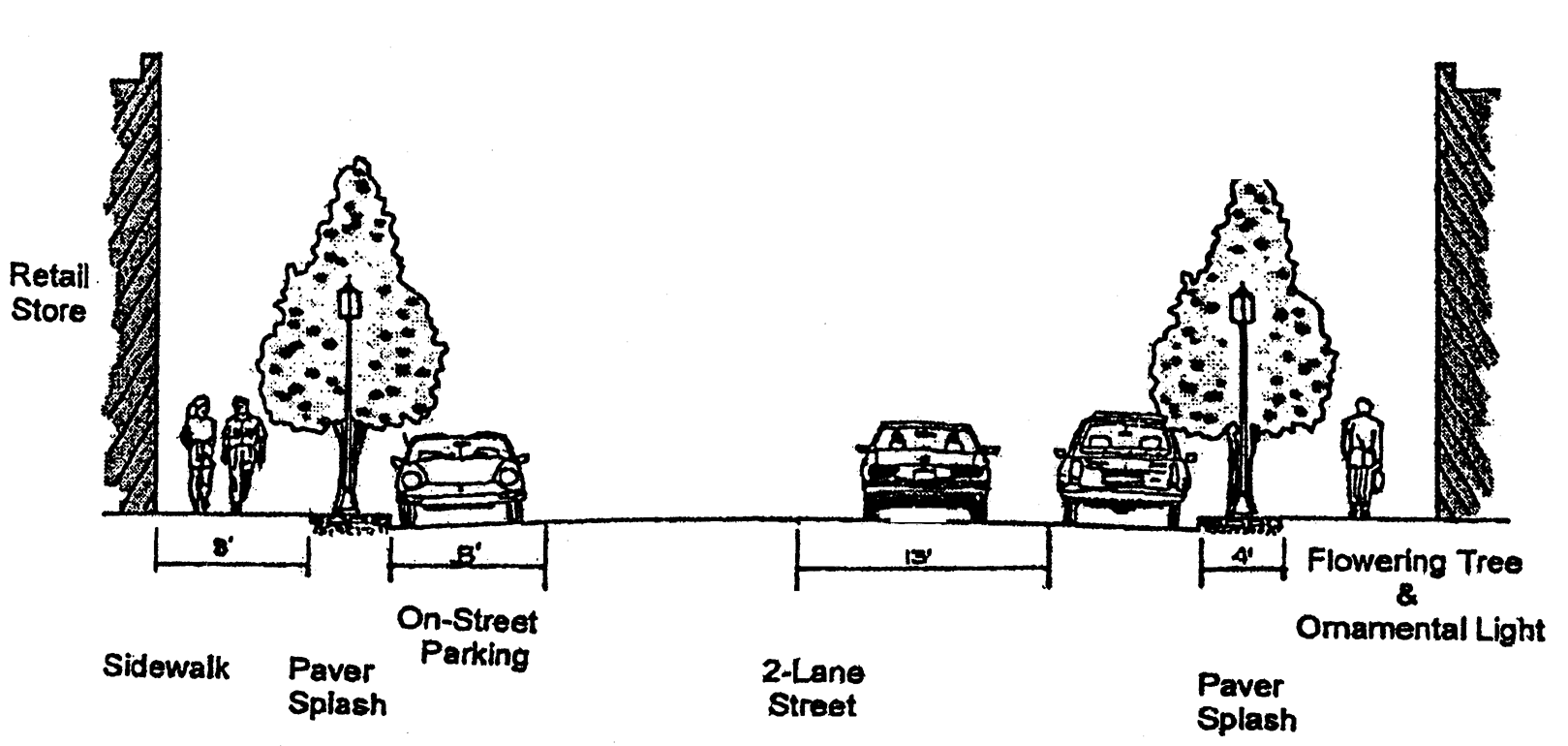
Street Cross Section
2.
Street width and design: All public and private streets within the C-6 district shall be designed with a pedestrian orientation. On street parking is required along all collector and major local roads within the C-6 district. Reference should be made to the Shelby Center Design Plan for an approved street network.
Minimum road rights-of-way for all local, collector and major roadways must conform to township standards, the township master plan and road network detailed within the Shelby Center Design Plan. See Figure 1 above for a typical main street collector road design with sidewalks and pavers. Drive lanes are 13 feet in width with eight foot wide on-street parking on both sides of the roadway.
3.
Crosswalks: All crosswalks within Shelby Center shall be designed by a unique textured material as defined in the Shelby Center Design Guidelines Manual and as approved by the planning commission. Crosswalks are required at every intersection within Shelby Center. Crosswalks shall be composed of pavers or textured pavement that resembles brick or cobblestone and provides a visual extension of the sidewalks to which it is connected.
4.
Streetscape amenities: The pedestrian environment in Shelby Center is essential for development of the sense of community desired by the township. Amenities shall be provided that promote pedestrian usage. The use of decorative, pedestrian-scale parking lot lighting, public pathways, bicycle racks, and similar site features shall be an integral part of any site plan in the C-6 district. All Shelby Center developments shall meet the intent of the Shelby Center Design Plan to include the development of pocket parks, public nodes, plazas, and other modest-scale pedestrian areas and integration of unique public interest pieces such as fountains, kiosks, and sculptures.
a.
For every 100 square feet of non-residential gross floor area (GFA) there shall be one square foot of a public plaza or activity node required with a minimum of 500 square feet. Public plazas or nodes shall be pedestrian oriented. They may contain play space areas for children, fountains and sculptures, benches and other pedestrian amenities. They are not permitted within the required setback, if any, and must be accessible from and connected to the pedestrian circulation system.
b.
Plazas and nodes shall also incorporate landscaped areas. One tree and three shrubs are required for each 500 square feet of plaza area up to 2000 square feet and one additional tree and three shrubs for each additional 1000 square feet.
c.
Designated areas for bicycle parking shall also be required for all developments.
5.
All business establishments shall be retail, service, and entertainment establishments dealing directly with customers. All goods produced on the premises shall be sold at retail on the premises.
6.
Landscaping requirements: All areas not used for parking, pedestrian pathways, buildings and pedestrian plazas will require landscaping, as required in section 5.03. Where the standards of this article conflict with section 5.03, then the standards found herein shall apply.
a.
Not less than ten percent of the total area of the site will be landscaped and preserved as open space. This does not include interior or exterior street right-of-way or private road easement and required yards or berms. Natural features that exist on the site such as woodlands, wetlands and floodplains shall be incorporated into screening and buffering requirements where appropriate.
b.
All landscaped areas except raised planters and sidewalk tree grates shall be irrigated and an irrigation plan shall be submitted for review with the landscape plan. Design guidelines shall establish street character or landscape themes.
c.
In addition to the required open space area and street trees, planters and planter boxes shall also be incorporated into all developments. The use of ornamental planters and window boxes is encouraged along all major roadways within Shelby Center. Street planters and window boxes may be used to meet minimum landscape requirements if the applicant can ensure their long-term maintenance.
d.
A maintenance plan will be required which details the frequency to which all on-site landscaping will be maintained and who will be responsible for its maintenance.
e.
Parking lot landscaping shall be in conformance with the requirements of section 5.04.
f.
Screening shall be required as recommended within the Shelby Center Design Guidelines (Also see chart below).
*All parking areas adjacent to a public or private road shall be screened by a three and one-half foot ornamental brick wall or a three foot high landscaped berm.
7.
Street trees: Street trees shall be provided along all public and private road ways at a maximum spacing of 60 feet on center and placed within the four foot paver area, between the back of curb and the sidewalk. Small deciduous trees are encouraged and should be planted so as not to interfere with any proposed wall mounted signage. It is recommended that the type and species of trees be uniform along the same streets. Street grates shall be used for all street trees. Refer to design manual for list of appropriate street trees.
8.
Lighting requirements:
a.
Street lighting is required along all public and private roadways at a maximum spacing of 60 feet and shall be placed between proposed street trees. Street lighting shall be of a pedestrian scale and shall uniquely identify Shelby Center. The lighting fixtures defined within the Shelby Center Design Guidelines Manual shall be used along the interior street network within Shelby Center (See Figure 2).
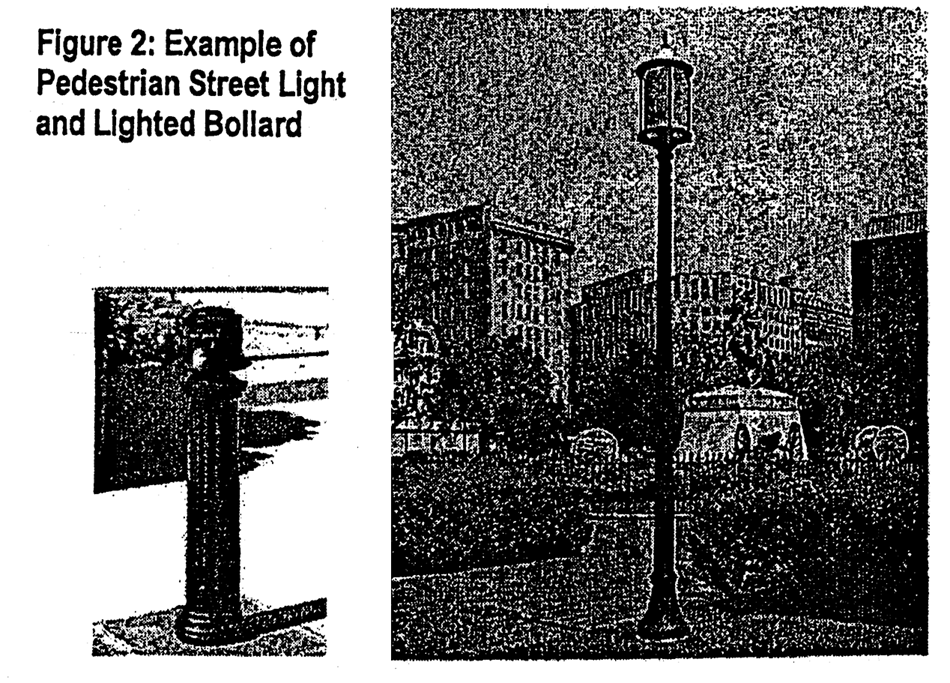
Pedestrian Street Light
b.
Parking lot lighting must be shielded downward and cannot exceed 25 feet in height. Light poles must be similar in design to pedestrian streetlights.
c.
All building mounted lighting must also be shielded downwards so as not cross exterior property lines. They shall be of a similar design to that required for street lighting.
9.
Signs: All signs shall be approved by the planning director based on a master sign plan submitted with the preliminary plan. No pole mounted signs will be permitted. Entryway, monument, directional, wall and awning signs may be permitted and must meet the general standards of section 5.05. Where ever the standards of section 5.05 conflict with the standards herein, these standards shall prevail.
a.
In addition, entryway monument signs, which identify Shelby Center, will be required for all developments located at the intersections of Van Dyke and 24 Mile Road and at the main intersections of the proposed internal streets with Van Dyke and 24 Mile Road. Only the township name and logo and the name of development may be permitted on these signs. Entryway directional signs shall also be required to identify rear yard parking areas.
b.
All signs shall be designed in accordance with the Shelby Center Design Guidelines Manual.
c.
No flashing or moving signs will be permitted within Shelby Center. Pennants, pylon signs, backlit canopies, and any other sign not specifically permitted in this section shall be prohibited.
d.
Neon signs are considered not consistent with the objectives of the C-6 district, however, the planning commission may consider such signage where the applicant justifies that the intent and objectives of the C-6 district will be maintained.
e.
Wall signs shall be made of wood or signboard, carved masonry, glass, metal, stone, and in some cases neon subject to planning commission approval as described under subsection (d) above. Uniform material shall be used for signs on buildings that are connected by common walls, located in a common plaza or otherwise associated as a single group. Etched window glass may also be permitted as a wall sign.
f.
Sign type, height, size, material and location shall be permitted as described below in the following charts:
SIGN STANDARDS
g.
Illumination: Sign lighting should minimize glare and maintain the aesthetic character of the area.
h.
Logo: In the event that a picture logo is displayed on a sign, it shall be incorporated into the permitted sign area to comprise not more than 25 percent of the sign area.
i.
Colors: Colors shall match or complement the predominant building color. Bright, bold primary colors are not considered consistent with Shelby Center.
j.
Clear vision area: The clear vision area at all intersections shall be unobstructed by signs.
k.
Temporary window signs are not permitted:
10.
All utility lines, electric, telephone, cable television lines, etc. shall be placed underground.
I.
Environmental.
Environmental features (including landscaping, lighting, screening and signs) shall be provided in accordance with this section and with articles 5 and 6 of Shelby Township Zoning Ordinance unless modified by specific standards contained herein. The planning commission and township board have the authority to approve variations or make interpretations regarding the applicability of conflicting standards as part of the review and approval process.
J.
Requirements and process for planned development approval.
The process for obtaining review and approval of a Shelby Center development project is as follows:
1.
Pre-application review conference. A pre-application conference shall be held with the applicant, township staff and consultants in order to discuss the proposed development, inform the applicant of the intent of the Shelby Center District and district requirements.
2.
Preliminary application and plan. The plan for final approval shall include a public hearing and follow the standards and requirements listed in subsequent subsections. The filing of a preliminary plan will provide an opportunity for the applicant and the planning commission to become generally acquainted with the proposed project and conduct discussions about the features of the proposed project. An application for preliminary plan consideration shall comply with and include the following requirements and standards:
a.
The applicant shall submit an understandable plan showing the entire project area in a preliminary form and scale, indicating proposed land use area(s), their relationship to each other, circulation patterns, and existing site characteristics.
b.
The existing topography shall be depicted at two foot contour intervals for the project area and all nearby areas; if the land is generally flat, spot elevations shall be provided at intervals necessary to establish any grade differential.
c.
A map of the township indicating the project area and its relationship to existing roads, streets and use districts within, and immediately adjacent to, the township.
d.
Existing utilities, including storm drain facilities, shall be located and noted.
e.
Preliminary architectural plans for all buildings, including basic building planning and number of units per building, shall be clearly set forth.
f.
Intensity of commercial or industrial uses and number of units by type shall be clearly set forth.
g.
Adequacy of public and private services/infrastructure shall be described.
h.
Existing and proposed land use and development features as they impact neighboring properties.
If the planning commission agrees that the proposal has merit and has potential to meet the requirements of this ordinance and the applicable review requirements contained in this section, an application may be filed for final plan review in conformance with the requirements of the following subsections. If the planning commission does not agree with the proposed plan or approach, it shall deny the request at this point and provide the reasons therefore in the minutes.
3.
Final plan review may be made after the planning commission has agreed by motion that the preliminary plan has potential to meet the requirements of this article. Upon receipt of an application for final approval, the planning commission shall hold a public hearing. The applicant's presentation at said hearing shall include drawings, exhibits, narratives and draft covenants and agreements identified for reference by letter or number. If the application for final approval complies with the applicable standards of this Shelby Center District, and the planning commission further finds the following standards to have been met, the application shall be approved.
a.
All applicable provisions of this section shall have been met. If any provision of this section is in direct conflict with the provisions or authority of any other section of this ordinance, the provisions included within this section shall apply to land included within the C-6 district.
b.
All minimum requirements pertaining to residential, commercial, institutional or other uses shall be subject to the requirements of each individual classification hereinafter referenced, except for those instances where this section affords discretion to the planning commission in reviewing and approving a C-6 project.
c.
Adequate, well-designed and properly planned areas have been provided for all walkways, recreation, parking, access, screening, pedestrian amenities, and other open areas to be used by the public and/or residents of the township.
d.
Adequate sanitary sewer disposal, water supply, and road and other storm water drain systems. Water, sewer and storm drains shall be subject to applicable township standards and ordinances.
e.
Efficient and desirable use of open areas in keeping with the physical character of the township and surrounding areas.
f.
Assurances that areas shown on the plan for use by the public and occupants shall be, or have been, irrevocably committed for that purpose. The township reserves the right to require conveyances or other documents to be placed in escrow.
g.
Assurance of financial support for and maintenance of all improvements indicated on the plan for open space areas and common use areas. Assurances may require posting of bonds or cash performance guarantees, as determined by the township planning commission and approved by the township board.
4.
Final application and plans shall include, in addition to compliance with the applicable requirements for site plan review contained in section 7.02, the following:
a.
A boundary survey of exact acreage requested, performed by a professional surveyor or civil engineer (Scale: one inch equals 100 feet).
b.
A physical features map of the area and its vicinity, including topography drawn as contours with an interval of at least two feet (or spot elevations, where applicable). Map shall indicate all trees, bodies of water and unbuildable areas due to soil conditions, wetlands, topography or similar conditions (Scale: one inch equals 200 feet).
c.
A legal description of the property.
d.
An aerial photograph of the area not more than five years old (Minimum scale: one inch equals 100 feet).
e.
Existing and proposed streets and other developments within and surrounding the proposed C-6 project area shall be shown.
f.
A plan for the entire project area indicating the functional use areas and dwelling unit types being requested; densities proposed; thoroughfare, road, traffic and pedestrian circulation plan; public utilities plan; building locations, driveways, walkways, parking areas, natural areas (streams, drains, woodlands); sites reserved for public facilities and service activities; playgrounds, recreation areas and other open spaces; areas used by public and/or residents within the project. Such plan shall designate each land use category in contrasting colors or by other means.
g.
A preliminary estimate of contemplated total storm water flow and sanitary sewage volume. Each utility shall be shown as a one-line diagram with flow direction indicated on the proposed street layout and shown on the topographic map.
h.
A schedule indicating the proposed timing of the development, including phasing and parcelization, if appropriate.
i.
A written impact statement (section 7.04).
j.
Statement of covenants, grants of easements and other restrictions to be imposed upon the uses of land and structures.
k.
Any other data, plans or drawings considered by the planning commission to be necessary for the consideration of the proposal.
l.
All materials required to be submitted as part of the application shall be submitted in the required number of copies for distribution to the planning commission and appropriate reviewing agencies.
5.
The planning commission shall review the application materials and reviewing agencies' comments. In the process of review, the planning commission shall consider:
a.
Specific development requirements set forth in this article.
b.
The location and design of service roads or drives and driveways providing vehicular ingress to and egress from each building site, in relation to streets giving access to the site and in relation to pedestrian traffic.
c.
The traffic circulation features within the site and location of automobile parking areas; and may make such requirements with respect to any matters as will assure:
(1)
Safety and convenience of both vehicular and pedestrian traffic, both within the site and in relation to access streets.
(2)
Satisfactory and harmonious relationships between the development on the site and the existing and prospective development of contiguous land and adjacent parcels and districts.
(3)
Accessibility afforded to emergency vehicles.
d.
The arrangement of use areas on the site in relation to functional, efficient and compatible arrangements within the site and also to adjacent uses.
(1)
The treatment of public space.
(2)
The availability of sewer and water capacity and the capacity of other utilities.
(3)
The impact on air quality.
(4)
The potential noise from development and traffic sources.
e.
The proposal's conformity to, and compatibility with, the adopted Shelby Center Design Plan and accompanying Shelby Center Design Guidelines Manual.
f.
Any other matters that are within the township departments' or the commission's jurisdiction.
g.
Only applications properly prepared and submitted with all required fees, paid in full will be processed. Review and processing of the application shall be subject to the requirements and procedures contained within this ordinance and as administered and finally approved by the planning commission. Initial approval shall be valid for a period of two years, with one year extensions possible with the approval of the planning commission upon proper application. After the start of construction, if development of the site has lapsed or discontinued for a period exceeding one year, the owner/applicant or his successors, shall be required to return to the township for reconsideration of the plan, following the procedure outlined for original approval in this section.
6.
In the course of implementing the plan, minor plan adjustments, including the minor shifting of buildings, service areas and other features requested by the developers, may be authorized by the planning commission and processed as site plan applications. The planning director shall make the determination as to whether a change is minor or if an amendment is required based upon the standards contained in this paragraph. Amendments that significantly impact factors considered by the planning commission in approving the C-6 project plan, such as changes to circulation systems, densities and major building rearrangements, shall require the applicant, or the applicants' successors, to return to the planning commission for approval of an amended plan. The procedure outlined for original approval shall be followed when submitting an amended plan.
7.
Once a C-6 project is approved by the planning commission, no zoning board of appeals requests shall be permitted. Any requested changes in the development plans shall conform to the revision procedures contained within this section.
8.
It is expressly understood that a C-6 project will not be allowed to apply for building permits or begin construction of any site improvements until approval of the final plan or subsequent amended plan shall have received official approval of the township planning commission at one of its meetings.
(Ord. No. 212.17, 8-7-2001)

