
Shelby City Zoning Code
ARTICLE 5
SITE DEVELOPMENT AND ENVIRONMENTAL STANDARDS
Section 5.00.- Intent.
The intent of the environmental provisions is to preserve the general health, safety and welfare, and the quality and character of the township's environment by regulating man-made development and by conserving natural resources. The requirements of this section are promulgated pursuant to the following objectives:
•
Screen and buffer incompatible views and activities within and between uses.
•
Define the limits of site functions and areas.
•
Reduce or eliminate glare into and from adjacent sites and activities.
•
Reduce dust and other pollutants from the air.
•
Control noise and provide acoustical modification into and from adjacent sites.
•
Contain odors and minimize their passage into and from adjacent sites.
•
Control the direction and velocity of surface water runoff and minimize soil erosion.
•
Moderate interior and exterior temperatures by controlling solar radiation on buildings and paved surfaces.
•
Maintain aesthetic quality of property and preserve its value.
•
Maintain and enhance the visual quality of the township.
Section 5.01. - Screening requirements.
Screening shall be required between different zoning districts and uses according to the requirements of this section of the zoning ordinance. The type of screening required in different situations is based on the following impact rankings: 1) none; 2) minor; 3) moderate, and 4) major.
Where screening is required, only one adjoining use shall be responsible for its installation, except as otherwise provided herein. This use shall be referred to as the "use providing screening." The other use shall be the "protected use." To determine the appropriate level of impact, refer to the adjoining zoning districts on the following schedule of screening requirements. The level of impact is indicated where both uses intersect.
1.
Screening requirements for each intensity/impact classification.
A.
None. No screening or buffering shall be required between adjoining uses.
B.
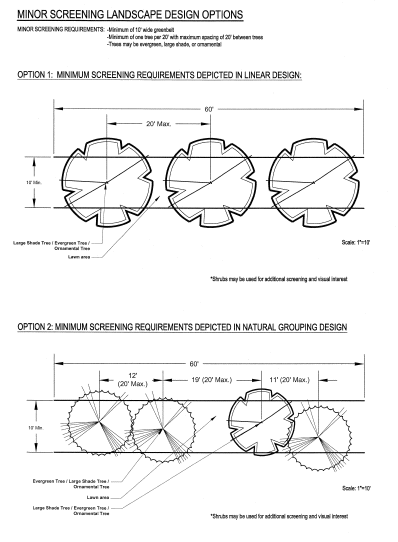
Minor. The purpose of screening in this situation is to soften the impact of one land use on another. An interrupted or open screen is required, which creates an impression of space separation without necessarily eliminating visual contact. Screening intended to satisfy these objectives shall conform to the following standards:
(1)
Minimum of ten-foot wide greenbelt.
(2)
Minimum of one tree per 20 feet with a maximum spacing of 20 feet in between trees. Trees may be large shade trees, evergreen trees or ornamental trees.
(3)
Shrubs may be used to provide additional screening and visual interest.
C.
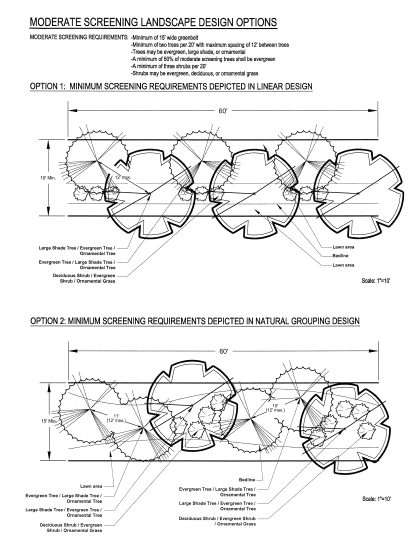
Moderate. Screening required for areas where a moderate impact is identified [as] is necessary to provide a better separation and buffering of land uses and activities and to minimize the impact of one use or activity on another. Screening provided in these instances shall conform to the following standards:
(1)
Minimum of 15-foot-wide greenbelt.
(2)
Minimum of two trees per 20 feet with a maximum spacing of 12 feet in between trees. Trees may be large shade trees, evergreen trees, or ornamental trees with a minimum of 50 percent being evergreen trees.
(3)
Minimum of three shrubs per 20 feet. Shrubs may be deciduous, evergreen or ornamental grass.
(4)
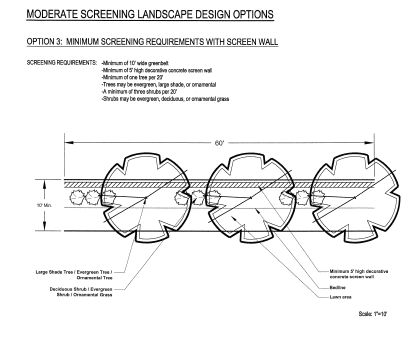
The applicant may reduce the minimum width of the greenbelt to ten feet if a minimum five-foot high decorative concrete screen wall is constructed. The wall shall be placed on the property line and shall not be permitted to extend into any required front yard setback or the parking lot setback, whichever is less. The landscape requirements described above shall stay the same except that the tree requirement may be reduced to a minimum of one tree per 20 feet and may be a large shade tree, evergreen tree or ornamental tree.
(5)
Whenever the layout of the site places passenger vehicular parking areas, roads or driveways adjacent to a residential district a minimum five-foot high decorative concrete screen wall shall be required. The greenbelt and landscape requirements above shall be followed.
D.
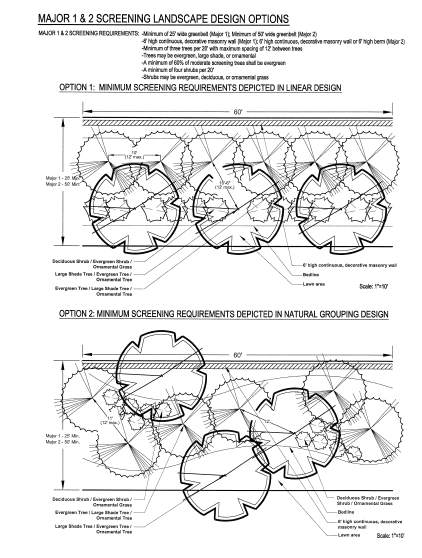
Major (1 and 2). The intent of the screening requirements where major impacts are anticipated is to block the view of obtrusive or undesirable visual elements, exclude all contact between such uses, and create a strong impression of spatial separation. Screening in these situations shall conform to the following minimum standards:
Major 1. A minimum buffer zone of 25 feet shall be maintained between the protected use and the more intense use. The buffer zone shall be developed with a six-foot high continuous, decorative masonry wall.
Major 2. A minimum buffer zone of 50 feet shall be maintained between the protected use and the more intense use. The buffer zone shall be developed with a six-foot high continuous, decorative masonry wall or a six-foot high landscaped berm.
Major 1 and 2. The buffer areas described above shall conform to the following standards:
(1)
Minimum of three trees per 20 feet with a maximum spacing of 12 feet in between trees. Trees may be large shade trees, evergreen trees, or ornamental trees with a minimum of 60 percent being evergreen trees.
(2)
Minimum of four shrubs per 20 feet. Shrubs may be deciduous, evergreen, or ornamental grass.
(Blank) = None;
il=1p (A) ql lz il=3p One- and two-family developments shall be the protected use in all instances, except the following:
il=3p (1) ql lz il=5p In the event that a one or two-family development results in the creation of an excepted parcel that is not intended for residential development, the single- or two-family development shall be responsible for providing the screening. The type of screening required shall be the same as indicated in the schedule of screening requirements based upon anticipated use of the excepted parcel.
il=3p (2) ql lz il=5p For those instances where future industrial uses are intended to abut residential development, both uses shall be required to share in the screening obligation. The residential district shall provide added lot depth and plantings while the industrial use shall provide a six- to eight-foot high decorative poured concrete wall.
il=3p (3) ql lz il=5p In PUD developments screening requirements may be waived in between different uses if design intent is to integrate the whole development as one use.
E.
The following tables and graphics show examples of recommended screening plants and plant layouts for each screening intensity. However; additional Michigan hardy plant varieties are encouraged. Plant materials should have some of the following characteristics: tolerant of urban conditions, salt tolerant, shade or sun tolerant based on exposure, drought or water tolerant based on location:
None: N/A
Minor: (Section 5.01.1.B)
Moderate: (Section 5.01.1.C)
Moderate: (Section 5.01.1.D)
2.
Modification of landscaping and screening requirements. The planning commission may reduce or modify the screening requirements specified above, provided that equivalent screening is provided by existing wooded areas on the site, topographic, or other natural conditions. The planning commission may also determine if dimensional conditions unique to the parcel would prevent development of required buffer zones, off-street parking area landscaping, greenbelts or required buffer zones. If such a determination is made, the planning commission may waive, in whole or in part, the landscaping provisions of this section. Criteria which shall be used when considering a waiver shall include, but shall not be limited to, the following:
A.
Existing natural vegetation.
B.
Topography.
C.
Existing wetland, floodplain, and poor soil areas.
D.
Existing and proposed building placement.
E.
Adjacent land uses.
F.
Distance between land uses.
G.
Dimensional conditions unique to the parcel.
3.
Other screening specifications.
A.
Walls. Whenever a wall is used in conjunction with, or in lieu of, the previously mentioned screening requirements, it shall be constructed according to the following minimum specifications:
(1)
Walls shall be constructed of reinforced protective face brick, decorative poured reinforced concrete with a brick embossed pattern, or similar decorative building material determined to be acceptable by the planning commission. The color of brick or facing shall be compatible with brick used on the site and shall be durable, weather resistant and easy to maintain. Masonry units may be integrally colored at the factory or stained on-site.
(2)
Walls shall be placed on the lot line and shall have no openings for vehicular traffic or other purposes, except as otherwise provided in this ordinance and/or as may be approved by the planning commission for the purposes of public safety. Where walls are pierced, the openings shall be so spaced as to maintain the overall obscuring character required and shall not reduce the minimum height requirement.
(3)
All walls shall rest on a concrete foundation which extends at least 42 inches in depth below the finished grade of the land, and shall conform to the requirements of the applicable Shelby Building Code and the Shelby Township Engineering Design Standards Ordinance. Masonry walls shall have a durable pointed cap meeting the requirements of the Shelby Township Building Department [Planning and Zoning Coordinator].
(4)
No such wall shall be painted, nor shall it be constructed of exposed concrete block, cinder block or wood products.
(5)
Unless otherwise expressly directed by the provisions of this ordinance, all protective walls or greenbelts shall be provided when required along and immediately adjoining the zoning district boundary line and/or property line, and shall be installed so as to lie wholly on the land of the applicant seeking site plan approval. In instances where drains, trees or other obstacles preclude such location, the planning commission shall determine the most appropriate alternative location.
(6)
All walls or greenbelts required by this ordinance shall be completely installed prior to the issuance of a certificate of occupancy for the use of the premises, except as provided hereinafter.
(7)
In any case where the development of the land and/or buildings has been fully completed and a certificate of occupancy would otherwise be issued, and the completed installation of the wall, greenbelt and/or landscaping required is prevented by inclement weather or acts of nature beyond the control of the owner, the owner may receive an extension of no more than six months subject to the requirements of section 16.03 of this ordinance. A performance guarantee, as specified by section 7.03.4. may be required.
(8)
Maintenance of the wall, or any other substituted screening device, shall be the responsibility of the property owner on whose property such wall or screen is located. Such walls shall be kept and maintained in a state of good repair. Required wall maintenance shall also include cleaning and removal of any graffiti painted on the wall.
(9)
Whenever this ordinance specifies a wall height and the grade is not the same on both sides of the wall, the height shall be at least equal to the minimum requirement, as specified by the planning commission, on both sides of the wall.
B.
Berms.
(1)
Berms shall be designed to be consistent with architectural character of the building(s) to be located on the site and shall consist of landscaped earth mounds possessing a maximum slope ratio of four feet horizontal to one foot vertical, except where retaining walls are used. Side slopes shall be designed and planted with sod or hydro seeded to prevent erosion. Upon approval of the planning commission, a retaining wall may be incorporated into the construction of the berm to reduce the horizontal dimension.
(2)
In those instances where a berm is included as part of a greenbelt, a detailed drawing and cross-section of the proposed berm shall be provided as part of the landscape plan.
C.
Pressure-treated fencing. Whenever pressure-treated fencing is permitted in conjunction with the screening requirements permitted by this section, it shall conform to the Shelby Township Fence Ordinance of the Charter Township of Shelby Code of Ordinances and the following standards:
(1)
The height of the fence shall not exceed six feet.
(2)
All fences shall be constructed using pressure-treated lumber.
(3)
The fence construction shall meet the applicable requirements of the Shelby Township Building Code.
(4)
Only shadow-box style fences shall be permitted.
(Ord. No. 212.5, §§ 11, 12, 7-20-1999; Amend. of 7-7-2009)
Section 5.02. - Preservation of wooded and shrubbed areas.
The purpose of this section is to provide for the protection of natural resources; to preserve wooded and shrubbed areas of Shelby Township; stabilize slopes and erosion; conserve water quality; maintain a micro climate; filter pollution from the atmosphere; decrease noise; provide a habitat for wildlife; and enhance the visual character and appearance of the township as cited in the adopted Charter Township of Shelby Master Plan. Recognizing the above-cited benefits of vegetation and woodlands, it is important to integrate these natural features into future development to improve the community's [township's] environmental qualities and to enhance the visual character of the constructed environment. Review by the planning commission, planning coordinator, and the planning commission secretary shall be consistent with this intent and the provisions of the Tree and Woodland Preservation Ordinance of the Charter Township of Shelby Code of Ordinances.
The developer or owner shall provide the planning commission with a detailed description of the natural features and characteristics located on the site to be developed. Alterations of the site, such as tree removal, shrub and ground cover removal, regrading or filling, is prohibited prior to submission of an inventory and preservation plan to the planning commission in compliance with Ordinance Number 191.
Section 5.03. - Landscaping requirements.
All site landscaping improvements, when applicable and required by this ordinance, shall conform to the following standards:
1.
General requirements.
A.
Whenever any yard (front, side or rear) is not designated for building, off-street parking, loading and unloading, storage or other purpose within the terms and requirements of a given zoning district, it shall be landscaped with either approved natural materials or living plant materials which shall be maintained in an aesthetically pleasing condition.
B.
All landscaping shall consist either of approved natural materials or living plant materials. All landscaped areas shall be protected from the encroachment of vehicles by curbing or other suitable device, as approved by the planning commission. The installation of automatic sprinklers shall be required to ensure the maintenance of all landscaped areas. The planning commission may waive the requirement for the installation of automatic sprinklers serving bio-swales, rain gardens, other storm water storage areas and parking lot tree islands, unless the tree islands are planted with grass or another type of ground cover requiring irrigation.
C.
Detailed landscape plan for all yard areas shall be submitted to the planning commission showing the names (common and botanical), location, spacing, starting size and planting and staking details of all plantings to be installed, and the location and types of all natural materials proposed to be included in the landscape treatment of the yard areas. This provision shall apply to all landscape yards including those expanded beyond the minimum setback requirements of this ordinance. This landscape plan shall be reviewed and approved by the planning commission.
D.
Existing significant trees, tree stands, natural vegetation, and wildlife habitat shall be integrated into the site landscape plan to the maximum extent possible.
E.
Subsequent phases of the site shall be seeded, mowed and maintained.
F.
The planning commission may approve constructed features of other materials, such as masonry walls or brick, stone and cobblestone pavement, as a supplement or substitute, upon a showing by the applicant that general plantings will not prosper at the intended location.
G.
Landscaping shall be planted, landscape elements shall be installed, and earth moving or grading performed in a sound workmanlike manner and according to accepted good planting and grading procedures, with the quality of plant materials and grading as hereinafter described. [A] Copy of current acceptable standards is available from the township building department [planning and zoning coordinator].
H.
The owner of property required to be landscaped by this section shall maintain such landscaping in good condition so as to present a healthy, neat and orderly appearance, free from refuse and debris. All plant materials shall be continuously maintained in a sound, weed-free, healthy and vigorous growing condition, and shall be kept free of plant diseases, weeds and insect pests. All unhealthy and dead material shall be replaced within one year or the next appropriate planting period, whichever comes first.
I.
Plant and grass materials shall be of acceptable varieties and species, hardy in Macomb County, and shall conform to standards of the American Association of Nurserymen and the Charter Township of Shelby, and shall have passed any inspections required under state regulations. Standards shall be in written form and made available by the building department [planning and zoning coordinator].
No plant materials used to satisfy some or all planting requirements of this section shall be comprised of non-living materials, except as provided herein.
J.
Approved ground cover used in lieu of grass, in whole or in part, shall be planted in such a manner as to present a finished appearance and reasonably complete coverage after one complete growing season, with at least three plants per square foot.
K.
Grass areas shall be planted in species normally grown as permanent lawns in Macomb County. Grass may be plugged, sprigged, hydroseeded, seeded or sodded, except that rolled sod, erosion reducing net or suitable mulch shall be used in swales or other areas subject to erosion.
2.
Design objectives.
A.
The following general design objectives and criteria shall be considered in the evaluation of landscape plans:
(1)
Ample variety and quantity of ornamental plants, trees and shrubs should be provided. A few dominant types are usually chosen with subordinate types interspersed for accent. Repeating some types creates unity, but no types should be overused. Variety should be achieved with respect to seasonal changes, species selected, texture, color and size at maturity.
(2)
Landscaping should be encouraged that will serve the functions of enhancing the visual environment, ensuring public safety, moderating the microclimate and minimizing nuisances.
(3)
Landscaping should serve to integrate the project with the site, with a particular sensitivity to the natural topography, drainage and existing native vegetation. It should enhance the architecture of surrounding structures, when possible, by being of similar scale.
(4)
Preservation of the existing landscape material and landforms is mandatory, particularly where mature trees are a part of the site to the standards of section 5.02.
(5)
Visual variety should be the aim of landscaping treatment. Landscaping should be used to break up large expanses of pavement.
(6)
Local soil, water, and other climatic conditions should be considered when choosing landscape materials to create optimum conditions for their survival and to ensure that they will thrive with a minimum amount of maintenance.
(7)
Landscaping should be protected from vehicular and pedestrian encroachment. Raised planting surfaces and the use of curbs may be used to achieve this objective.
(8)
Species that are a public nuisance or that cause litter should be avoided. When landscaping is to be installed in areas that children will frequent, trees and bushes with sharp needles shall be prohibited.
(9)
The aesthetic and functional aspects of the proposed landscaping, both at installation and at maturity, shall be a paramount consideration in review and approval by the planning commission.
B.
The following tables show recommended plant materials for landscape areas that are important to creating aesthetically pleasing developments. However; additional Michigan hardy plant varieties are encouraged. Plant materials should have some of the following characteristics: tolerant of urban conditions, salt tolerant, shade or sun tolerant based on exposure, drought or water tolerant based on location:
(1)
Street trees: Street trees are used to create shade and visual interest along public or private streets and roads. The use of multiple species is encouraged to help prevent the possibility of massive disease or insect mortality and to provide different colors and textures. However, repetition may also be desired to provide uniform streetscapes and to accentuate key areas (i.e. subdivision entrances, formal parks, etc.). Therefore, diversification of plant species is desired with special consideration given to design intent. Trees that can tolerate urban conditions should be used.
Street tree requirements: One tree per 40 linear feet shall be required along any public right-of-way lien of any street, road or highway and shall be planted within the public right-of-way greenbelt. Trees that can not be planted within the public right-of-way greenbelt due to lack of space shall be planted in other locations on the same site; however, these trees may not be used towards other landscape requirements.
(2)
Entrance landscape: Entrance landscaping is used to create visual interest at the entrances into subdivisions, shopping plazas, office and commercial centers, etc. Plantings should match the character of the surrounding uses as well as the use in which it is being planted. Hedges, ornamental trees, flowers and ornamental grasses are encouraged.
(3)
Detention/Retention/Rain Garden: Detention, retention and rain garden landscapes are used to help improve water quality, slow runoff, provide natural habitats for wildlife, beautify the surroundings and provide more environmentally sound solutions.
3.
Plants and materials.
A.
All plant materials used shall be placed in fertile soil with good surface drainage and shall be given reasonable maintenance necessary to ensure their healthy existence and survival. All natural materials shall be maintained, refurbished or replaced, as necessary, to ensure a positive aesthetic quality.
B.
All proposed landscaped plantings shall meet the minimum size requirements specified in the table on the following pages.
4.
Where a landscape plan is required, the following plant materials are specifically prohibited:
A.
Boxelder.
B.
Soft Maple.
C.
Elm.
D.
Poplar.
E.
Willow.
F.
Horse chestnut (nut bearing).
G.
Tree of heaven.
H.
Catalpa.
I.
Fruit-bearing trees.
J.
All thorned trees and shrubs.
K.
Ribes (gooseberry).
L.
Cottonwood.
_____
(1)
Additional Michigan hardy plant varieties are encouraged.
(Amend. of 7-7-2009>
Section 5.04. - Parking lot landscaping requirements.
The intent of these requirements is to enhance the visual environment of the township; to promote public safety; to moderate heat, wind and other local climatic effects produced by parking lots; and to minimize nuisances, particularly noise and glare.
1.
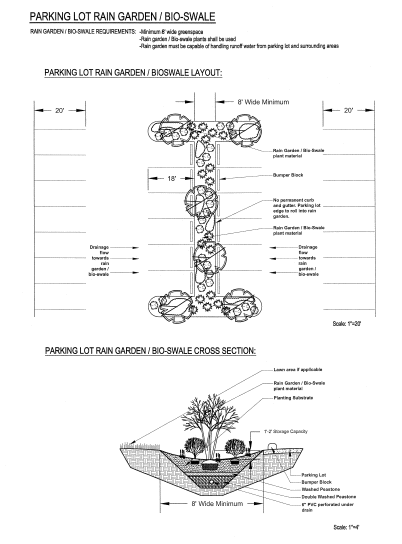
Interior parking lot landscaping. Parking lot trees shall be provided at a ratio of one tree for each six parking spaces, or fraction thereof. Parking areas of less than 20 spaces may place the required trees next to the parking area, or within the required yards, rather than within the lot proper, subject to the approval of the planning commission. Parking lot landscaping islands shall be consolidated to provide massed plantings wherever feasible. Rain gardens and bio-swales are encouraged in landscape islands within a parking lot and on the outer edges of a parking lot. Rain gardens and bio-swales are not encouraged in the greenbelt along public roads, streets and highways. The parking lot tree requirement shall not apply to industrial buildings in LM, Light Manufacturing and HM, Heavy Manufacturing zoning districts.
The following types of trees are considered to be suitable for parking lots and other intense urban conditions. However; additional Michigan hardy plant varieties are encouraged. Plant materials should have some of the following characteristics: tolerant of urban conditions, salt tolerant, shade or sun tolerant based on exposure, drought or water tolerant based on location:
2.
Exterior parking lot landscaping. Where parking lots face a public road, street or highway a hedge shall be planted to provide a visual screen in between the parking lot and the public road, street or highway. A decorative screen wall or fence may be substituted for a planted hedge at the discretion of the planning commission. The following types of trees and shrubs are considered to be suitable for exterior parking lots and other intense urban conditions. However; additional Michigan hardy plant varieties are encouraged. Plant materials should have some of the following characteristics: tolerant of urban conditions, salt tolerant, shade or sun tolerant based on exposure, drought or water tolerant based on location:
(Ord. No. 212.5, § 14, 7-20-1999; Amend. of 7-7-2009; Ord. No. 212.92, 5-20-2014)
Section 5.05. - Sign regulations.
1.
Intent. The intent of these standards is to regulate the location, size, construction and display of signs to prevent conditions that may adversely impact public health, safety and welfare. These standards are further intended to recognize the legitimate needs of businesses for identification and informational purposes. The standards offered in this ordinance are intended to promote traffic safety for pedestrians and motorists, avoid conflicts between different types of land uses, prevent the blighting impact created by an excessive number of under regulated signs and enhance the visual appearance of the township. These broad community goals are accomplished by establishing the minimum regulations necessary to achieve the following objectives:
A.
Enable the public to locate businesses or other uses without excessive difficulty or confusion by limiting the number, placement, and size of signs.
B.
Prevent the placement of signs that will conceal or obscure other signs or adjacent businesses.
C.
Keep the number of signs and sign messages at the level reasonably necessary to identify a business and its principal products and services.
D.
Provide signs that are in scale and proportion to their sites and buildings.
E.
Reduce visual distractions and obstructions to motorists.
F.
Recognize that the principal intent of commercial signs should be for the identification of an establishment on the premises. A secondary purpose of signs is to provide limited advertising of products and services and for seasonal promotional events.
G.
Protect the public right to receive messages, especially noncommercial messages such as religious, political, economic, social, philosophical and other types of information protected by the First Amendment of the U.S. Constitution.
H.
Maintain and improve the image of the township by encouraging signs of consistent size which are compatible with and complementary to their surroundings.
I.
Restrict the use of portable and temporary signs except as necessary for promotional events.
J.
Recognize that electronic changeable message signs are an increasingly important feature for many businesses. Electronic signs provide an effective mechanism for informing the public of goods and services as well as promoting sales or special events. The use of electronic signs will reduce the need for temporary signs which detract from the visual appearance of the community.
2.
Zoning district regulations. Except as otherwise provided herein, the following conditions, standards and regulations shall apply to all signs erected or located in the specified zoning district:
A.
Residential districts. No sign shall be permitted in a residential zoning district, except in accordance with the provisions of this section and the following standards:
(1)
Residential entrance identification signs. Residential entrance signs for single-family subdivisions, multiple-family developments and mobile home parks may be allowed subject to the following standards:
a.
Not more than two residential entrance identification signs may be allowed for each entrance to the development from a regional, major, secondary, collector, or local road. The maximum sign area shall be limited to 24 square feet per sign. Not more than one sign may be placed on each side of the principal street entrance to the site or within the entrance median/boulevard.
b.
Residential entrance signs may be placed on the wall of any landscaped entrance structures submitted as part of the approved landscaping plan for the residential development. The size of the sign shall be determined by measuring that portion of the sign reasonably encompassing the sign lettering and graphics.
c.
The maximum height of a freestanding, residential entrance identification sign shall not exceed seven feet. Columns, corner posts, and other architectural details of an entranceway structure shall not exceed ten feet in height.
d.
Residential entrance identification signs shall be symmetrical in appearance and be in character with the development and surrounding area in terms of size, bulk, and use of materials, as determined by the reviewing authority.
e.
The developer, homeowners' association, or similar organization shall have responsibility for maintaining all residential entrance identification signs, structures, and landscaping. An agreement, in recordable form, providing for such maintenance shall be furnished to the township attorney for review as part of the sign approval process, unless provided for in the covenants and restrictions recorded with the final plat or master deed.
(2)
Churches, schools and other public and semipublic uses.
a.
The maximum allowable sign area shall not exceed 48 square feet with a maximum height not to exceed seven feet.
b.
Signs for churches and schools may be allowed a changeable message board provided that the overall sign area does not exceed the 48 square feet standard noted above. Electronic message signs may be allowed for churches, public and private schools (K-12), colleges and government agencies. Continuous scrolling messages are not permitted. Messages shall not change at intervals less than 30 seconds.
c.
These standards also apply to churches, schools and other public uses in all zoning districts.
(3)
Setbacks.
a.
All residential signs shall be required to observe the setback standards of section 5.05.5.C.
(4)
Real estate signs. Real estate signs in residential zoning districts shall observe the following standards:
a.
Real estate development signs. Real estate development signs may be allowed for any single family subdivision, multiple family development or mobile home complex subject to compliance with the standards provided below:
* The maximum allowable sign area is 48 square feet with a maximum height of ten feet.
* Not more than two signs may be allowed, one on each road frontage that the project abuts or one at each entrance. Real estate development signs shall not be constructed on any site prior to site plan or final site condominium approval by the planning commission or final preliminary plat approval by the township board.
* All development signs shall be confined to the site of the proposed development. Off-site signs placed at other locations are not permitted.
* Real estate development signs are allowed for a period of not more than two years. Extensions may be granted for additional 12 month periods of time if at least five percent of lots remain vacant and new homes are under construction.
* Not more than two flags may be installed at each entrance to the site or as part of the real estate development sign. Flags shall not be tattered, torn or weathered and must remain legible.
* All real estate development signs must observe the setback standards of subsection 5.05.5.C.
* A permit from the planning and zoning department is required.
b.
For sale or lease signs. A single, nonilluminated for sale, rent, or lease sign may be allowed for any single-family lot or attached condominium unit provided that the sign does not exceed six square feet. The sign shall not be placed in the road right-of-way. Signs shall be removed no later than two weeks after the sale, rental or lease of the property.
c.
Model signs. Signs for detached single-family model units may be allowed subject to compliance with the following conditions:
* The maximum allowable sign area shall not exceed 24 square feet with a maximum sign height of eight feet.
* All signs shall be placed at least ten feet from all property lines.
* Signs may be placed on a site as long as there are vacant lots in the subdivision that are being marketed or under construction.
* One model, open or builder flag may be placed on each model site. Flags shall not be tattered, torn or weathered and must remain legible.
* A permit from the planning and zoning department is not required for model signs or flags.
d.
Accessory signs. Accessory signs no larger than two square feet in area such as no trespassing, garage sale, alarm/security, and animal warning signs may be permitted in any residential zoning district provided that said signs do not exceed a total combined area of more than six square feet, per residential lot or parcel.
e.
Directional signs. Signs for providing directions for open houses or garage sales may be permitted with the permission of the owners of the property on which the sign is located. Directional signs shall be removed daily at the close of the open house or garage sale.
B.
Office, commercial and industrial districts. No sign shall be permitted in any office, commercial or industrial zoning districts, except in accordance with the following standards:
(1)
Maximum number of signs. The number of signs allowed at each site shall be limited as follows:
a.
Single-tenant buildings. One wall sign and one ground-mounting sign may be approved for each business occupying its own site. Freestanding buildings on corner sites with frontage on two roads may be allowed a second wall sign. The size of the second sign shall not exceed the maximum sign area allowed for the principal sign.
b.
Double-tenant buildings. If a building occupies a single site and has two tenants with separate businesses, the site may be permitted one ground sign/monument and two wall signs.
c.
Secondary tenants. Buildings with secondary tenants without a separate entrance may be allowed additional wall signage for the purpose of identifying the occupant. The maximum size of the sign shall not be more than 16 square feet. Not more than two secondary tenant signs may be allowed per establishment.
d.
Sign style. Whenever two or more wall signs are permitted on the front face of the building, the style of sign shall be of a similar design and character.
e.
Rear elevation signs. Single or multi-tenant buildings that back-up to existing retail centers may be allowed a secondary wall sign on the rear elevation of the building for identification purposes. The size of the wall sign shall not exceed 16 square feet. The style of sign shall be consistent with the approved sign plan for the remainder of the retail center.
(2)
Shopping center signs. Signs for buildings with more than three tenants shall conform to the following standards:
a.
Number of signs. Shopping centers or freestanding businesses with access to a single road shall be permitted not more than one ground identification or directory of tenant sign. A shopping center with access to a second major or secondary road may be allowed two ground signs, one on each road frontage that the property abuts. The size of the signs shall be based on the schedule of ground sign regulations.
b.
Sign plan. Signs for individual tenants in shopping centers or any multiple-tenant building shall be uniformly designed and comply with the overall design plan for the center. A sign plan shall be submitted to the planning and zoning department prior to the approval of any individual tenant signs. The sign plan shall specify the type and style of sign permitted in the center.
c.
Directory of tenants. A directory of tenants shall be permitted for any shopping center or office complex with multiple tenants. All directories of tenant signs shall be integrated with the overall design for the center as a whole.
d.
Wall signs. Only one wall sign shall be permitted for each tenant in a shopping center. Tenant spaces at corner locations fronting more than one access road may be allowed a second wall sign. The size of the second sign shall not exceed the maximum sign area allowed for the principal sign.
(3)
Ground signs. The principal business identification sign located on the road for any office, commercial, or industrial use shall be a ground sign. Pylon signs shall not be permitted.
(4)
Setbacks. All office, commercial and industrial signs shall observe the setback requirements specified in section 5.05.5.C.
(5)
Schedule of area and height of ground signs. All freestanding ground signs allowed in office, commercial and industrial zoning districts shall conform to the following standards:
_____
SCHEDULE OF GROUND SIGN REGULATIONS
Part I. Maximums
(O-1, O-2 and C-1)
(1)Per side.
Part II. Maximums
(C-2, C-3, C-4, LM and HM)
(1)Per side.
_____
(6)
Real estate development signs. Real estate development signs may be allowed for each new office, commercial or industrial site identifying the name of the project, architect, engineer, contractor or anticipated opening date subject to compliance with the following conditions:
* The maximum allowable sign area is 48 square feet with a maximum height of ten feet.
* One sign may be allowed for each road frontage that the project abuts or each entrance.
* Real estate development signs shall not be constructed on any site prior to site plan approval by the planning commission.
* All development signs shall be confined to the site of the proposed development. Off-site signs placed at other locations are not permitted.
* Real estate development signs are allowed for a period of not more than two years. Extensions may be granted for additional 12-month periods of time as determined by the planning and zoning department.
* All real estate development signs must observe the setback standards of subsection 5.05.5.C.
* A permit from the planning and zoning department is required.
(7)
For sale or lease signs. Signs indicating the sale or lease of nonresidential buildings or land may be allowed subject to the following conditions:
* The maximum allowed sign area is 24 square feet for retail and office sites and 32 square feet for industrial sites.
* The sign placement may encroach into the required front yard setback provided that it does not encroach into the road right-of-way and is located outside of the 25-foot clear vision triangle formed by the road right-of-way and site entrances and exits.
* Signs must be removed once the building is sold or leased.
* For multiple tenant buildings, the signs must be removed once the building is 100 percent leased.
* Lease signs for existing retail centers that have vacant tenant spaces may be approved as a temporary sign by the planning and zoning department.
* Permanent lease sign information may be included as part of a shopping center identification sign. The allowable sign area specified in the schedule of ground sign regulations may be increased by not more than 20 percent to accommodate this additional information.
* A sign permit is not required except for temporary lease signs for existing shopping centers as specified above.
* One lease sign not to exceed 16 square feet may be placed in the window of any vacant unit in a multiple tenant building.
* A permanent shopping center information sign may be allowed on the site not to exceed 16 square feet and subject to the setback requirements referenced above.
(8)
Directional signs. Directional signs may be permitted provided that they are necessary to the safe and convenient flow of traffic at the site. Accessory signs providing information not necessary for directing traffic on the site are not allowed as directional signs. The maximum allowable area of any single sign shall not exceed four square feet. The size of the directional signs may be increased with the approval of the planning director if it is determined that the size is not out of scale with the site as a whole and if the increased size is necessary to direct traffic on the site. The number of signs permitted shall be determined based on the number of driveways and the arrangement of the parking lot and any drive-through lanes on the site. Directional signs shall not include advertising. Business logos may be permitted. Directional signs may be illuminated.
(9)
Gasoline station signage. Gasoline price signs may be permitted as part of the allowable sign area for any gasoline station. Signs on pump islands identifying self- or full-service options may be permitted provided that there are no more than two such signs for each island and that no individual sign shall exceed four square feet in area. Signs advertising products or services available at the gas station are not permitted. Signs for secondary tenants may be allowed provided the total sign area requirements of section 5.05.2.B.1.b are observed.
(10)
Open and closed sign. A single "open" or "closed" sign may be allowed for each business establishment, provided that such sign does not exceed more than three square feet in area. Such signs may be illuminated.
(11)
Window signs. Window signs or window graphics may be permitted for each individual business establishment provided that they do not exceed more than 50 percent of the total window area of a single building or individual unit of a multiple-tenant building.
(12)
Menu board signs may be allowed for fast food restaurants with a drive thru lane. The number and size of menu board signs shall be determined by the planning director based on the size of the site and the vehicle circulation pattern.
(13)
Professional office (O-1) and office service (O-2) districts. No sign shall be approved in an office zoning district except in accordance with the regulations of this section and the following standards:
a.
The height and area of the permitted ground sign shall be regulated by part I of the schedule of ground sign regulations.
b.
The maximum size of a single wall sign identifying the name of the office building shall not exceed 24 square feet.
c.
If tenants have a separate entrance from the exterior of a building, a single identification sign may be placed over the entrance. Said sign shall not exceed six square feet in area. A uniform sign plan shall be provided for the office complex, and approved by the reviewing authority.
d.
A directory of tenants may be approved provided that the area of the sign does not exceed the standard specified in the schedule of ground sign regulations and subject to the standards for tenant directory signs listed in section 5.05.2.B.2.C.
(14)
Local retail business zoning districts (C-1). No sign shall be approved in a local retail business zoning district, except in accordance with the provisions of this section and in accordance with the following:
a.
For uses located on individual sites, the wall sign shall not exceed 50 square feet, and the ground sign shall conform to height and area regulations of part I of the schedule of ground sign regulations.
b.
For uses grouped in shopping centers or office complexes, the wall sign shall not exceed 32 square feet. Individual shopping center tenants occupying multiple units may be allowed up to 50 percent of the maximum size of a sign for each unit, or 20 linear feet of storefront, whichever is greater. A listing of occupants of the shopping center or complex may be approved as part of the ground sign by specific approval of the reviewing authority within the height and area requirements of part I of the schedule of ground sign regulations.
(15)
Linear retail shopping center and general business zoning districts (C-2, C-3, and C-4). No sign shall be approved in a linear retail, shopping center or general business zoning district, except in accordance with the provisions of this section and in accordance with the following:
a.
For individual sites, the wall sign shall not exceed 50 square feet.
b.
For uses grouped in shopping centers, the wall sign shall not exceed 32 square feet. Individual shopping center tenants occupying multiple units may be allowed up to 50 percent of the maximum size of the sign for each unit or 20 linear feet, whichever is greater.
c.
Height and area of ground and pylon signs shall be regulated by part II of the schedule of ground and pylon sign regulations.
(16)
Multi-use zoning district (C-5). No sign permits shall be approved in a multi-use zoning district, except in accordance with the provisions of this section and in accordance with the following:
a.
Each freestanding building or shopping center shall be allowed one wall sign. The maximum size of each wall sign shall be equal to one-half square foot for each foot of setback from the centerline of street or road abutting the site.
b.
One ground sign may be permitted for each individual project within the C-5 district. The height and area of the ground sign shall be regulated by part II of the schedule of ground sign regulations.
(17)
Industrial districts. No sign shall be approved in industrial zoning districts, except in accordance with the provisions of this section and the following:
a.
Signs for permitted retail use shall be regulated as if it was erected in a linear retail business district (C-2).
b.
Each single tenant industrial building allowed in the LM (light manufacturing) or HM (heavy manufacturing) districts shall be allowed one ground and one wall sign. One employment bulletin board not exceeding 16 square feet may also be permitted. The wall sign shall not exceed 50 square feet. The height and area of the ground sign shall be regulated by part II of the schedule of ground sign regulations. If a building occupies a site and has multiple tenants, the site may be allowed one ground sign. One wall sign per tenant may also be allowed subject to the size requirements referenced above.
c.
A listing of occupants of a multitenant industrial building may be approved as part of the ground sign by specific approval of the reviewing authority within the height and area requirements for such sign.
d.
Multi-tenant buildings. Buildings with multiple tenants may be allowed individual wall signs for each tenant up to a maximum area of 32 square feet. Individual industrial tenants occupying multiple units may be allowed up to 50 percent of the maximum size of a sign for each unit, or 20 linear feet of storefront, whichever is greater.
e.
Outdoor advertising signs may be approved only within a heavy manufacturing zoning district (HM) which abuts a freeway or portion of an interstate highway system, subject to the following:
1.
Such signs shall not have any mechanical movement and shall not be a flashing, animated or moving sign.
2.
Such signs shall not exceed 25 feet in height from a finished grade.
3.
Such signs shall not exceed 300 square feet.
4.
Such signs shall not be located within 1,500 feet of another such sign.
5.
Such signs shall not be located within 500 feet of an interchange, an intersecting street, road or highway crossing on the same side of the highway, nor within 500 feet of the zoning district boundary.
6.
Such signs shall not be located within 50 feet of the freeway right-of-way line.
7.
The spacing requirements apply separately to each side of the freeway or interstate highway system and shall be measured along the nearest edge of the pavement of the freeway or such system between points directly opposite each sign.
8.
Official and on-premises signs, as defined in 23 USC 131(c), shall not be counted nor shall measurements be made from such signs for purposes of determining compliance with the spacing requirements provided in this subsection.
(18)
Changeable message signs (electronic and non-electronic).
a.
Changeable message signs may be allowed in the following zoning districts: C-1, local retail; C-2, linear retail; C-3, shopping center; C-4, general retail; C-5, mixed use; LM, light manufacturing and HM, heavy manufacturing.
b.
The size and height of any sign with a changeable message component shall not exceed the standards established for the zoning district in which the sign is located as referenced in subsection 5.05.2.B.5.
c.
The changeable message component of the sign shall not exceed 50 percent of the total sign area.
d.
The electronic message or image shall not change more frequently than once every eight seconds. Changes between messages shall be accomplished within one second or less.
e.
The sign shall not contain full motion video or moving images.
f.
The image or message shall not flash or scroll vertically or horizontally. Flashing, blinking or other visual effects are prohibited.
g.
The LED of the electronic message board shall not be illuminated beyond the default settings of the manufacturer's brightness or dimming controls. The applicant shall also provide documentation that the sign conforms to UL rating standards.
h.
The sign shall have automatic dimming capabilities that adjust to the brightness of the sign to the ambient light levels at all times of the day and night.
i.
The owner of an electronic message sign shall allow the township to use the sign message board to communicate emergency public service information approved by the township relating to disasters or emergencies.
j.
No electronic sign shall create glare, or have characteristics that impair the vision of motorists, or create a nuisance for surrounding parcels.
k.
Electronic message signs displayed at sites with multiple tenants shall be available to all of the tenants located at that particular site.
l.
Sites utilizing electronic message signs shall be prohibited from using freestanding temporary signs or banners or any signs displayed on vehicles.
m.
Non-electronic changeable message signs may be allowed subject to the height and area standards referenced above. The changeable message component of the sign must be incorporated into the design of the principal sign. Lettering used on the sign must be uniform in appearance and properly maintained.
3.
Exempt signs. The following signs shall be allowed without a sign permit being issued, provided that such signs shall conform to the regulations specified in this section:
A.
Agricultural sales signs. Two temporary, nonilluminated signs not exceeding 16 square feet each. Each may be permitted for each site selling produce grown on the site.
B.
Name plates and house numbers. Name plates and house numbers not exceeding two square feet in size. Memorial signs, monumental citations, historical or commemorative markers or tablets shall not exceed two square feet in size.
C.
Noncommercial signs. Noncommercial signs containing noncommercial messages, such as those designating the location of public telephones, restrooms, no smoking signs and restrictions on building entrances provided that such signs do not exceed two square feet in area.
D.
Parking lot signs. Parking lot signs indicating restrictions on parking, when placed within a permitted parking lot, not to exceed six feet in height and not to exceed three [square] feet in area.
E.
Regulatory, directional and street signs. Regulatory, directional and street signs erected by a public agency in compliance with the Michigan Manual of Uniform Traffic Control Devices.
F.
Flags. Flags bearing the insignia of any governmental or nonprofit organization provided that they are not displayed in connection with a commercial promotion or as an advertising device.
G.
Small accessory signs. Any accessory sign erected on a premise [premises] which is no more than two square feet in area, such as no trespassing signs, and signs warning of animals. The total area of all small accessory signs on premises shall not exceed eight square feet.
H.
Government signs. Government signs erected by, on behalf of or pursuant to the authorization of a government body including legal notices, informational signs, directional or regulatory signs.
I.
Political signs. Political signs shall not encroach into any road right-of-way nor shall they be attached to any utility poles or trees. All political signs shall observe the setbacks of this section. No political sign shall be erected more than 45 days prior to an election and shall be removed not more than three days following an election. Approval of the property owner shall be required prior to the placement of a political sign on any site.
4.
Prohibited signs. The following signs shall be prohibited in any district in the township.
A.
Awnings and canopies. Awnings and canopies may be used for signs provided that the design of these structures is architecturally compatible with the building and consistent with the standards of subsection 10.00.2.i and section 3.06. Awnings and canopies may not be used for signage in a shopping center or office building with multiple tenants unless they are part of the approved sign plan for the center. Awning or canopy signs shall be considered a wall sign for the purpose of determining the maximum number of wall signs and the allowable sign area.
B.
Exposed neon. Exposed neon may not be used to outline buildings or accent building features. Exposed neon may only be used for small accessory window signs that emphasize products and services. Neon open and closed signs may also be permitted. The maximum allowable size of neon accent signs is four square feet.
C.
Painted signs. Signs painted directly into any exterior building wall.
D.
Projecting signs. Signs projecting above the roof of a building, or more than 18 inches from a building wall except as modified elsewhere in this zoning ordinance.
E.
Inflatable signs. The use of inflatable objects for temporary or permanent signage purposes.
F.
Moving signs. Signs that revolve or are animated or that utilize movement or apparent movement to attract attention, except signs indicating the time, date, or temperature and electronic changeable copy signs for uses permitted under subsection 5.05.2.A(2)b. and approved electronic message signs.
G.
Flashing signs. Signs which are illuminated by or in any manner incorporate lights that flash, twinkle, move or give the appearance of movement. Time and temperature signs shall be exempt from this prohibition. Electronic changeable copy signs for uses permitted under this ordinance are also exempt from this provision.
H.
Banners and streamers. Exterior banners, pennants, spinners, other than a banner pennant approved as a temporary sign.
I.
String lights. Exterior string lights used in connection with commercial premises, other than holiday decorations which shall be removed within 15 days after the holiday.
J.
Utility poles and landscaping. Any sign erected on a utility pole, directional signpost, or landscaping including trees. Prohibited signs shall not include street signs erected or approved by the township, county, state or federal government or a public transit agency.
K.
Business no longer existing. If the owner fails to remove the sign, the township shall serve written notice upon the owner. The notice shall include a demand that the sign be removed within 180 days thereof. If the owner fails to remove the sign, the township shall remove the sign at the owner's expense, the actual costs and expenditures including administrative expenses and attorney fees, incurred by the township as a result of the removal, shall be at the expense of the owner and such cost and expenditures shall be assessed against the property and become due, be collected and be returned for nonpayment in the same manner, and at the same time, as ad valorem property tax levies of the township. The removal of the sign by the township shall not constitute a taking of the sign nor vest in the public any additional rights.
L.
Motor vehicle signs. It shall be unlawful to park, place or store a vehicle or trailer on which there is a motor vehicle sign, for more than 72 hours if on private or public property for the purposes of advertising a business or products or for the purpose of directing people to a business or business activity. For the purpose of this subsection, a motor vehicle shall be defined as a sign measuring more than two square feet in size that is mounted, placed, written, or painted on a vehicle or trailer, whether motor driven or not.
1.
Presumption. There shall be a presumption that subsection (L), above has been violated if the motor vehicle sign is visible from the street and one or more of the following circumstances exists:
a.
The motor vehicle is attached to a vehicle or trailer that is unregistered or not operable;
b.
The motor vehicle sign is larger in any dimension than or extends beyond any surface of the vehicle or trailer to which it is attached;
c.
The motor vehicle sign is attached to a vehicle or trailer that is parked or stored in a public right-of-way or an area not designed, designated, or commonly used for parking;
d.
The motor vehicle sign is attached to a vehicle or trailer that is regularly parked or stored in a "front yard" or "side yard", as such terms are defined in section 17.01 of this zoning ordinance, that abuts a street, when there are other areas of the property designed or available for the parking or storage of the vehicle or trailer that are not visible from the street or do not abut streets; or
e.
The motor vehicle sign is attached to a vehicle or trailer that is regularly parked or stored within 50 feet of a street when there are other areas of the property designed, designated, or available for the parking or storage of the vehicle or trailer that are more distant from the street or not visible from the street.
2.
Rebuttal presumption. The presumption set forth in subsection (1) above, may be rebutted by evidence showing all of the following:
a.
The vehicle is temporarily parked in a particular location in the course of conducting personal activities or business activities that involve loading or unloading of goods for customers, providing services to off-site customers, conducting off-site business, or engaging in work breaks;
b.
The activities in subsection (a) above, are being actively undertaken during such periods of parking;
c.
The activities in subsection (a) above, require the presence of the vehicle for purposes of transporting equipment, people, supplies and/or goods necessary for carrying out such activities; and
d.
The activities in subsection (a) above, are not, other than incidentally, related to advertising, indentifying, displaying, directing or attracting attention to an object, person, institution, organization, business, product, service, event or location.
M.
Changeable message signs. Signs with changeable messages and removable letters except for churches, schools, public buildings, gasoline price signs, or other similar uses approved by the planning and zoning department.
N.
Off-site/nonaccessory signs. All signs shall pertain to the use of the property on which they are located. Off-site or nonaccessory signs shall not be allowed except for billboards as regulated in section 5.05.B.17. Non-accessory signs include those advertising businesses, services and other functions that are not located on the same parcel as the principal business that they advertise.
O.
Other prohibited signs. Other prohibited signs include snipe and bandit signs, sign walkers and search lights or illuminated beacons.
5.
General regulations. The following regulations shall be applicable to signs in any zoning district.
A.
Time and temperature signs. Time and temperature devices may be approved in all commercial and industrial zoning districts provided that they are designed as an integrated features of the approved wall or ground sign.
B.
Garage sale signs. Garage sale signs with a maximum area of four square feet and a maximum height of four feet are permitted when located on the property where the event will occur or on private property with that property owner's consent. Such signs must be removed immediately following the event they describe.
C.
Setbacks. Setbacks shall observe front and street-side setbacks as measured from centerline of each road right-of-way as designated by the master plan as follows:
Distance from centerline in feet:
All signs shall be located outside of a 25-foot clear vision triangle measured along any abutting road right(s)-of-way and/or driveways to the site.
Temporary signs may encroach into the required front yard setback as noted above, provided that they observe the 25-foot clear vision triangle and do not encroach into any existing road right-of-way.
D.
Addresses. For identification purposes, all businesses shall prominently display their addresses on the permitted ground sign. All street addresses shall be large enough to read from the street. All numbers shall contrast with the surface they are applied to and shall be mounted high enough to be visible from the street and shall not be obstructed from view by any site landscaping. In the case of shopping centers with individual tenants, address ranges for the tenants shall be provided. Addresses shall not be included in the area of the measurements of the sign.
E.
Information. Wall or ground signs shall be permitted to display the name of the business and a brief description of the products or services offered by the business. Telephone numbers and logos or graphics may also be included.
6.
Nonconforming signs.
A.
Intent. It is the intent of this article to encourage eventual elimination of signs that as a result of the adoption of this article become nonconforming, to administer this article to realize the removal of illegal nonconforming signs, and to avoid any unreasonable invasion of established private property rights.
B.
Lawful existing signs. Any sign lawfully existing at the time of this article which does not fully comply with all provisions shall be considered a legal nonconforming sign and may be permitted to remain as long as the sign is properly maintained and not detrimental to the health, safety and welfare of the community except as hereafter provided.
C.
Continuance. A nonconforming sign shall not:
(1)
Be increased in size or altered in such a way to result in another nonconforming sign;
(2)
Be relocated;
(3)
Be structurally reconstructed so as to prolong the life of the sign; or so as to change the shape, size, type, placement, or design of the sign's structural parts; or so as to add illumination;
(4)
Be repaired or re-erected after being damaged if the repair or re-erection of the sign, within any 12-month period, would be more than 50 percent of the cost of an identical new sign. If deemed necessary by the building official, the cost of an identical new sign shall be determined as the average of no less than three cost estimates obtained from three contractors.
(5)
Be altered unless the alteration or reconstruction is in compliance with the provisions of this article. For the purpose of this article only, the term "altered" or "reconstructed" shall not include normal maintenance; changing of surface sign space to a lesser or equal area; landscaping below the base line; or changing electrical wiring or devices, backgrounds, letters, figures, or characters.
D.
Termination of business. Nonconforming signs and sign structures shall be removed or made to conform within 180 days of the termination of the business or use to which they are accessory. If the owner fails to remove the sign, the township shall serve written notice upon the owner. The notice shall include a demand that the sign be removed within 180 days thereof. If the owner fails to remove the sign, the township shall remove the sign at the owner's expense, the actual costs and expenditures including administrative expenses and attorney fees, incurred by the township as a result of the removal, shall be at the expense of the owner and such cost and expenditures shall be assessed against the property and become due, be collected and be returned for nonpayment in the same manner, and at the same time, as ad valorem property tax levies of the township. The removal of the sign by the township shall not constitute a taking of the sign nor vest in the public any additional rights.
E.
Change of property. If the owner of a sign or the premises on which a sign is located changes the location of a building so that any sign on the premises is rendered nonconforming, such sign must be removed or made to conform to his article.
7.
Temporary signs. Temporary signs may be permitted for the following:
A.
When a business lacks a permanent sign, or for new businesses.
B.
For a change of use of the premises.
C.
For a change in the basic services or products offered at the site.
D.
All temporary signs shall observe the setback standards of section 5.05.C.
8.
Application review procedures. The planning director or his/her designee shall have the sole authority to approve or deny applications for temporary or permanent signs. The planning director or his/her designee shall review the application for conformance with the requirements of this section and all other provisions of the zoning ordinance. The planning director may refer any application for sign approval to the planning commission for their review. Planning and zoning department approval is not required for the refacing of existing signs provided that there are no changes to the size, height, placement or structure of the sign on the site. The application shall be either approved or denied within a reasonable time frame as follows:
A.
Any application for a permanent and/or temporary sign shall provide the following information:
(1)
A sketch plan drawn to scale, illustrating the location of all existing and proposed structures, abutting streets, parking lots and driveways serving the site.
(2)
A sign sketch or drawing of the proposed sign(s) which shall include all of the following information:
a.
Height of the sign above finished grade.
b.
Surface of the sign (material, color and dimensions).
c.
Area of the sign surface.
d.
Lettering of the sign, neatly printed in the size and weight substantially approximating the style of that which will appear on the sign.
e.
Method and color of illumination, if any.
f.
Logos, emblems and all additional features.
g.
Applications for wall signs shall also include a drawing of the total building wall area upon whose face the sign will be displayed.
h.
Such additional information and details as the planning director deems necessary and/or pertinent to the application.
B.
Applications for residential entrance way signs shall include the following additional documents and information unless otherwise provided as part of the final plat or final condominium approval:
(1)
A description of the property interest of the applicant and any other parties in interest to the site where the residential entrance way will be located.
(2)
Evidence, satisfactory to the township attorney, of the right to construct such entrance way sign on the site.
(3)
Existing or proposed sign and landscape easement(s) for the residential entrance way.
(4)
Existing or proposed residential entrance way construction and maintenance agreement.
Applications for residential entrance signs shall be submitted and reviewed separately from the subdivision or site plan review process.
C.
Application review process. The planning director shall have the sole authority to approve or deny applications for temporary or permanent signs. The planning director shall review the application for conformance with the requirements of this section and all other provisions of the zoning ordinance. The planning director may refer any application for sign approval to the planning commission for their review. The application shall be either approved or denied within a reasonable time frame as follows:
(1)
Sign applications that conform to all applicable zoning ordinance standards shall be approved.
(2)
All applications for sign permits that are incomplete or do not meet the requirements of this ordinance shall be denied.
(3)
An approval of sign permit may be conditioned upon compliance with reasonable conditions or limitations having regard to the character of the sign, the surroundings in which it is to be displayed, and the purposes of this ordinance.
(4)
Approved applications for permanent signs shall be reviewed by the township building department for conformity with all building codes in effect in the township, and if in compliance therewith, the building director shall issue the appropriate sign and building permit.
(Ord. No. 212.9, § 2, 10-17-2000; Ord. No. 212.48, 10-21-2004; Amend. of 10-21-2008; Ord. No. 212.82, 6-15-2010; Ord. No. 212.85, 3-15-2011; Ord. No. 212.92, 5-20-2014)
Section 5.06. - Lighting.
1.
Intent. The intent of this section is to regulate outdoor lighting to establish appropriate minimum levels of illumination, prevent unnecessary glare, reduce spillover onto adjacent properties, prevent nuisances for abutting residential neighborhoods and reduce unnecessary transmission of light into the night sky.
2.
Submission requirements. Specifications for outdoor lighting shall be provided for all uses requiring site plan review by the planning commission. In addition to the information required for site plan review as specified in section 7.02 of the Zoning Ordinance, the following additional lighting details shall be provided:
a.
Specifications for all proposed and existing lighting fixtures, including
i.
Photometric data.
ii.
Fixture height.
iii.
Mounting design.
iv.
Glare control devices.
v.
Type and color rendition of lamps.
vi.
Hours of operation.
b.
A photometric plan illustrating the levels of illumination at ground level. The photometric plan shall specify minimum, maximum and average illumination levels for those portions of the site being illuminated.
c.
Building elevations illustrating portions of walls to be illuminated.
3.
Review standards. The planning commission shall consider the following standards for the review of outdoor lighting during site plan review:
a.
Whether the lighting is designed to minimize glare.
b.
Whether the light will be directed beyond the boundaries of the area to be illuminated or onto adjacent properties or streets.
c.
Whether the plan will achieve appropriate levels of illumination for the proposed use including safety and security.
d.
Whether the lighting will cause negative impacts on adjacent residential districts and uses.
e.
Whether the lighting is in harmony with the character of the surrounding area and the illumination levels of neighboring properties.
4.
Required conditions. When a site plan is required for the installation or modification of exterior lighting, the following conditions shall apply:
a.
Parking lot light fixtures shall not exceed a maximum height of 20 feet. Unshielded pedestrian light fixtures shall not exceed a maximum height of ten feet. The planning commission may modify these height standards in commercial and industrial zoning districts based on a consideration of the following:
i.
The position and height of buildings.
ii.
Other structures located on the site.
iii.
Existing trees.
iv.
The potential off-site impact of the lighting.
v.
The character of the proposed use.
vi.
The character of the surrounding area.
In no case shall the height of the lights exceed the maximum allowable building height in the district.
b.
All electrical service to light fixtures shall be placed underground.
c.
Artificial light shall be maintained stationary in intensity and color at all times when in use. There shall be no flashing, oscillating, moving or intermittent type of lighting or illumination. In addition, there shall be no bare bulb illumination of any kind exposed to public view.
d.
To control glare, all light fixtures shall have a cutoff angle of 90 degrees or less except decorative pedestrian fixtures of 100 watts or less. Full cutoff fixtures shall be used to prevent glare and to direct illumination from adjacent properties and streets. Glare control shall be accomplished primarily through the proper selection and application of lighting equipment. Only after these means have been exhausted shall landscaping and similar screening methods be considered as an acceptable method for reducing glare.
e.
Light fixtures shall be located at least five feet from any property line and shall be directed and shielded to cast light away from adjacent properties and streets. No direct light source shall be visible at the property line five feet above grade. Where a site abuts a nonresidential district, the maximum illumination levels at the property line shall not exceed one foot candle. Where a site abuts a residential district, the maximum illumination levels at the property line shall not exceed one-half foot candle.
f.
Lamps with true-color rendition are preferred such as incandescent and metal halide lamps. The use of mercury vapor and low or high pressure sodium lamps are prohibited. The planning commission may permit the use of high pressure sodium lighting at the intersection of driveways with public streets when the average illumination level on the ground does not exceed six foot candles.
g.
Exterior lighting fixtures should be of a design and size compatible with the building. The use of flood lights, wall pack lights, or other types of diffused, unshielded lighting is prohibited.
h.
Outdoor lighting shall be designed to achieve uniform illumination levels. The ratio of the average light level of the surface being lit to the lowest light level of the surface being lit, measured in foot candles shall not exceed a ratio of 4 to 1. The planning commission may modify these requirements where they determine it is necessary to protect nearby residences, driver visibility on adjacent roads, or where it is demonstrated that additional lighting is necessary for safety or security purposes.
i.
Minimum illumination levels of 0.2 foot candles shall be provided for parking lots for security purposes.
j.
Entrance lights. One lighting structure shall be provided on each side of an entrance or exit drive or street at its intersection with the public road, except where a boulevard or divided entrance and exit drive is proposed. One lighting structure may be located in the boulevard or island area for the purpose of illuminating the intersection.
k.
Light fixtures mounted on canopies shall be installed so that the lens cover is recessed or flush with the bottom of the surface (ceiling) of the canopy and/or shielded by the fixture or the edge of the canopy.
5.
Maintenance. All installed and approved light fixtures shall be kept in good repair. This includes but is not limited to, replacing nonworking bulbs, repairing broken or malfunctioning fixtures and similar devices.
6.
Exemptions. The following uses shall be exempt from the provisions of this section:
a.
Roadway lighting required by the appropriate public agency for health, safety and welfare purposes;
b.
Construction lighting approved by the building department as part of the building permit;
c.
Flag lighting, provided that the illumination is the minimum necessary, and that the light source is aimed and shielded to direct light only onto the intended target and to prevent glare for motorists and pedestrians;
d.
Emergency lighting approved by the township, provided the lighting is discontinued upon the abatement of the emergency necessitating said lighting;
e.
Holiday decoration lighting, and
f.
Other temporary lighting determined to be reasonable and appropriate to the township.
(Ord. No. 212.5, § 15, 7-20-1999; Ord. No. 212.71, 9-3-2007)
Section 5.07. - Performance standards.
The following performance standards are established in order to preserve the environmental health, safety and welfare of the township. No activity or operation or use of land, building or equipment shall be used or occupied in any manner so as to create any dangerous, injurious, noxious or otherwise objectionable element or condition that adversely affects the surrounding area or adjoining parcels. Any use permitted by this ordinance shall be operated in conformance with all applicable performance standards set forth in this section. The following standards are deemed the minimum requirements to be maintained.
1.
Noise. Noise which is objectionable due to intensity, frequency or duration shall be muffled, attenuated or otherwise controlled, subject to the following:
a.
Objectionable sounds of an intermittent nature, or sounds characterized by high frequencies shall be controlled so as not to become a nuisance to adjacent uses.
b.
Sirens and related apparatus used solely for public purposes are exempt from this requirement. Noise resulting from temporary construction activity shall also be exempt from this requirement.
c.
The emission of measurable noises from the premises shall not exceed 65 decibels as measured at the boundary or property lines, except that where normal street traffic noises exceed 65 decibels during such periods, the measurable noise emanating from the premises may equal, but shall not exceed such traffic noises. Within LM, Light Manufacturing and HM, Heavy Manufacturing districts, sound levels not exceeding 75 decibels may be permitted.
2.
Odors. Any condition or operation which results in the creation of odors of such intensity and character as to be detrimental to the health and welfare of the public or which interferes unreasonably with the comfort of the public shall be removed, stopped or modified as to remove the odor. Such odors shall be prohibited when perceptible at any point along the property line.
3.
Glare. Glare from any process shall be controlled in such a manner as not create a public nuisance or hazard along lot lines.
4.
Vibration. Vibration shall not be discernible at any property line to the human sense of feeling.
5.
Reserved.
6.
Reserved.
7.
Electrical radiation. Electrical radiation shall not adversely affect at any point any operations or any equipment other than those of the creator of the radiation.
8.
Utilities underground. All lines for telephone, electric, television and other similar services distributed by wire or cable shall be placed underground entirely throughout the development area, except for major thoroughfare right-of-way, and such conduits or cables shall be placed within private easements provided to such service companies by the developer or within dedicated public ways. Overhead lines may be permitted by not less than six affirmative votes of the township planning commission at the time of final approval where it is determined that overhead lines will not constitute a detriment to the health, safety, general welfare or area design. All such facilities placed in dedicated public ways shall be planned so as not to conflict with other underground utilities. All such facilities shall be constructed in accordance with standards of construction approved by the Michigan Public Service Commission. All underground utility installations which traverse privately owned property shall be protected by easements granted to the appropriate authority by the applicant.
9.
Air pollution. No use of property shall release fly ash, dust, smoke, vapors, noxious, toxic or corrosive matter or other air pollutants in such concentrations as to be detrimental to health, animals, vegetation or property or conflict with public air quality standards.
10.
Radiation and radioactivity. All activities involving radioactive materials shall be conducted according to state and federal rules and regulations adopted for human safety. Operations shall cause no dangerous radiation, as specified by the regulation of the United States Nuclear Regulatory Commission, at the property line. No radioactive materials shall be emitted in excess of standards established by the U.S. Bureau of Standards for human safety.
11.
Waste. All sewage and industrial wastes shall be handled, stored, treated and/or disposed of in compliance with the all federal and state of Michigan laws and regulations.
12.
Fire and explosive hazards. The storage and handling of flammable liquids, liquefied petroleum gases and explosives shall comply with applicable state and federal regulations.
13.
Heat. Any operation generating heat shall be contained within a building. In no case shall the generated heat raise the ambient temperature at a property line higher than the prevailing normal temperature at the time of the occurrence. This does not apply to outdoor dining or patios with heat generating equipment approved by the building department or fire department.
14.
Storage of hazardous substances.
A.
Definition of hazardous substances. Hazardous substances include hazardous chemicals as defined by the Michigan Department of Public Health and the Michigan Department of Labor; hazardous materials as defined by the U.S. Department of Transportation; critical materials and polluting materials as defined by the Michigan Department of Natural Resources, and hazardous waste as defined by the Michigan Department of Natural Resources.
B.
Applicability. These provisions apply to all businesses and facilities which use, store or generate hazardous substances in quantities greater than 100 kilograms per month (equal to 25 gallons or 220 pounds).
C.
Above-ground storage.
(1)
Primary containment of hazardous substances shall be product-tight.
(2)
Secondary containment of hazardous substances shall be provided for all facilities, subject to site plan review. Secondary containment shall be sufficient to store the substance for the maximum anticipated period of time necessary for the recovery of any released substance.
(3)
Outdoor storage of hazardous substances is prohibited except in product tight containers which are protected from weather, leakage, accidental damage and vandalism. Secondary containment shall be sufficient to store the substance for the maximum anticipated period of time necessary for the recovery of any released substance, including an allowance for the expected accumulation of precipitation.
(4)
At a minimum, state and federal agency requirements for storage, leak detection, record-keeping, spill prevention, emergency response, transport and disposal shall be met.
D.
Below-ground storage.
(1)
At a minimum, regulations of the Michigan Department of Natural Resources, Michigan Fire Marshal Division, and the township for the installation, inspection, maintenance of a leak detection system, inventory and record-keeping, emergency response and closure must be met.
(2)
All underground storage tanks which have been out-of-service for 12 months or longer shall be removed from the site subject to the requirements of the State Fire Marshal and the Shelby Township Fire Prevention Ordinance.
E.
Plan review and approval. Site plans for facilities with hazardous substances shall be reviewed by the fire chief or his/her designee prior to the approval by the planning commission.
(Ord. No. 212.92, 5-20-2014)
Section 5.08. - Location and screening of trash receptacles.
The location of trash receptacles shall be indicated on all site plans. All such trash receptacles shall be located so as to facilitate collection and minimize any negative impact on persons occupying the development site, neighboring properties, site traffic circulation patterns, or any public right-of-way.
All trash receptacles shall be screened on three sides by decorative masonry walls which are similar to, or compatible with, the exterior construction materials used elsewhere on site. Chain-link fencing with view obscuring slats or wooden fencing shall not be considered to be suitable screening materials. All trash receptacles shall be placed on a concrete pad having a minimum dimension of six inches by ten feet by ten feet. Concrete or metal bollards shall be placed between the trash receptacle and the rear wall of the enclosure.
The height of the masonry screening shall be six feet in height. The walls shall be maintained so as to remain structurally sound and neat and clean in appearance. Trash shall not be allowed to overflow from the receptacle. Trash receptacles shall be so located and arranged to minimize their visibility from adjacent streets and uses. No trash receptacle shall be placed any closer than 20 feet to any residential zoning district. All trash receptacles shall be located on site to be as accessible as possible without interfering with vehicular circulation patterns. If usage patterns determine that the number of trash receptacles provided on-site are insufficient, additional receptacles may be required by the planning commission. Any additional trash receptacles so provided shall be located and constructed according to the standards contained herein. The planning commission may allow for the removal of gates on the front of trash enclosures where they are not visible from the road or from abutting parcels.
On single family residential lots or parcels, the use of a trash dumpster is limited to a period not to exceed 14 days. The temporary container shall be located in the residential driveway and not in any public road right-of-way. Trash containers or corrals on construction sites shall be provided as required by the Building Department.
(Ord. No. 212.5, § 16, 7-20-1999; Ord. No. 212.92, 5-20-2014)
Section 5.09. - Construction scheduling.
Building and construction activity shall be confined to between the hours of 7:00 a.m. and 7:00 p.m., Monday through Saturday. Building and construction shall be prohibited on Sundays and holidays, except with the approval of the township board.
(Ord. No. 212.5, § 17, 7-20-1999)

