
Shelby City Zoning Code
ARTICLE 6
OFF-STREET PARKING AND LOADING REQUIREMENTS
Section 6.00.- Intent.
The off-street parking and loading requirements of this ordinance are established to prevent congestion on public streets by providing clearly defined parking areas that are separated from roadways; to remove the hazard to pedestrians of emerging between parked vehicles onto a public street; to facilitate proper storm-water runoff; to prevent the generation of dust into the area; and to make clear the availability and arrangement of spaces to all users.
Section 6.01. - General parking requirements.
It shall be the duty of both the owner and occupant of any premises to provide off-street parking spaces as required in this article. Such off-street parking areas shall be laid out, constructed and maintained in accordance with the following standards and regulations:
1.
Whenever a use or an activity requiring off-street parking is created, enlarged or increased in activity or intensity, off-street parking spaces shall be provided on site and maintained as required by this ordinance.
2.
The amount of required off-street parking for new uses of buildings, additions to existing buildings, new uses of land and accessory buildings shall be determined in accordance with the regulations in effect at the time the new use or addition was proposed, and the space so required shall be shown on the site plan and shall be irrevocably reserved for such use. No such designated parking area shall be changed to any other use unless and until equal facilities are property approved and provided elsewhere on the site.
3.
Off-street parking existing at the effective date of this ordinance in conjunction with the operation of an existing building or use shall not be reduced to an amount less than hereinafter required for a similar new building or new use.
4.
Nothing in this section shall be construed to prevent the collective provisions of off-street parking facilities for two or more buildings or uses on separate sites, provided that, collectively, such parking shall not be less than the sum of requirements for the various uses computed separately. The provision for shared parking shall not be construed to allow for development without parking located reasonably proximate to the development it is intended to serve. Parking shall be reasonably distributed to fulfill the parking needs of each use being served and be irrevocably dedicated to each use.
5.
Where the owners of two or more buildings or uses, whose peak operating hours do not overlap, desire to utilize shared off-street parking facilities, the planning commission may permit such shared parking provided that the following conditions have been met:
A.
The peak business hours of the buildings or uses do not overlap. In the event that there is a change of uses that no longer meets the criteria established for shared parking, the required number of spaces as provided below shall be installed.
B.
The shared parking lot meets the off-street parking requirements of the larger building or more intensive use, plus 15 percent.
C.
The shared parking lot meets all of the locational requirements of this ordinance with respect to each building or use.
D.
The site plan shall indicate a reserve area that is capable of accommodating the required number of parking spaces, if necessary. The developer shall execute an agreement, in a form satisfactory to the township attorney, that will obligate the property owners to install additional parking at the township board's request if the need arises.
E.
All such provisions for shared parking for two or more buildings or uses on the same site or on separate sites shall be set forth in a recordable instrument recorded at the office of the Macomb County Register of Deeds, describing the lands affected by this agreement.
6.
Off-street parking facilities required herein shall be located within 300 feet of the permitted use it is intended to serve, such distance to be measured along lines of public access to the property between the nearest point of the parking facility and the building to be served, provided that the said off-street parking facility shall not be separated from the building to be served by any major or secondary thoroughfare so designated by the Charter Township of Shelby Master Plan, drain or physical barrier or public improvement.
7.
Required off-street parking shall not be enclosed with a gate that would permit it to be closed to either employees or patrons.
8.
When units or measurements determining the number of required parking spaces result in the requirement of a fractional space, any fraction shall require one parking space.
9.
For the purpose of determining off-street parking requirements for all uses, floor area shall mean 100 percent of the gross floor area as measured from the interior of all exterior walls. For those buildings which feature unique interior natural features, such as atriums and landscaped areas, the floor area occupied by such areas may be deducted from the gross floor area used to calculate parking requirements.
10.
The planning commission may allow for a reduction of the required parking for sites in commercial zoning districts, not to exceed ten percent, for the purpose of increasing the amount of landscaping on the site. In considering the appropriateness of the reduction, the applicant shall be required to submit parking calculations, a demand study, or a shared parking study demonstrating the basis for the requested reduction. The request shall be accompanied by a site plan designating an area to be used for the reserve parking spaces capable of accommodating the required number of parking spaces and their relationship to the proposed parking lot. A landscaping plan for this reserve area shall also be required. The developer shall execute an agreement, satisfactory to the township attorney, obligating the property owners to install the parking at the township board's request, if it is determined that the existing parking spaces are insufficient.
11.
Whenever drive-through or vehicle stacking lanes are provided, such lanes shall be so located so as not to impede pedestrian or vehicular circulation on the site or on abutting sites, nor shall any drive-through lane cross a vehicle maneuvering lane or aisle. Unless otherwise provided in section 6.02, a minimum of six stacking spaces shall be provided for each service window. A minimum waiting space shall be 23 feet long by ten feet wide.
12.
Whenever a parking space abuts a pedestrian walkway within a parking lot, the minimum width of said walkway shall be seven feet.
(Amend. of 7-7-2009)
Section 6.02. - Minimum number of off-street parking spaces.
The minimum number of off-street parking spaces by type of use shall be determined in accordance with the following schedule. For those uses not specifically mentioned, the requirements for off-street parking facilities shall be in accord with a use which is most similar in type as determined by the planning commission.
1.
Residential.
A.
The off-street parking facilities required for one- and two-family dwellings shall be located on the same lot or plot of ground other than in the required front yard space of the building they are intended to serve and shall consist of a paved parking strip, parking apron, carport and/or garage on the basis of two parking spaces for each dwelling unit. Such parking shall be paved to provide not less than two off-street parking spaces in other than the required front yard space. Parking shall be restricted to paved areas. Paved areas shall not be permitted in the required front yard area, except for horseshoe drives as provided for below. Paved driveways may be allowed in required side yards to provide access to a side-entry garage or to a detached garage located in the rear yard. No storage of motor vehicles or recreational vehicles may be allowed within a required front yard, except for short-term parking or loading and unloading. Horseshoe driveways shall be permitted, provided they are not used for permanent on-site parking required by this section.
B.
Multiple-family residential dwellings shall require two off-street parking spaces for each efficiency, studio, and one bedroom unit, and two and one-quarter off-street parking spaces for each two or more bedroom unit.
C.
Age-restricted adult housing. Independent living facilities shall require two off-street parking spaces per dwelling unit. Assisted living facilities shall require one off-street parking space for each two dwelling units plus one space per employee during the largest working shift. Should the dwelling units revert to general occupancy, then parking shall be provided as required for multiple-family residential dwellings.
D.
Mobile homes. Two spaces per unit, plus one space for every two mobile home sites for visitor parking. Visitor parking shall be located within 500 feet of the mobile home sites they are intended to serve.
E.
Community [Township] buildings (multiple-family and mobile home parks). One space for each four persons allowed within the maximum occupancy load, as determined by the fire department.
F.
In multiple-family residential districts and mobile home parks where recreation vehicles are permitted, a secured storage area for such vehicles shall be provided and buffered from adjacent uses. No unlicensed motor vehicle of any type shall be parked within the development at any time, except within a covered building or the enclosed storage area. In the mobile home park district, no motorized recreation vehicles or boats shall be parked on individual home sites. All group off-street parking lots shall be adequately lighted during hours of darkness with no more than one-half footcandle of illumination.
_____
(Ord. No. 212.5, §§ 18, 19, 7-20-1999; Amend. of 7-7-2009)
_____
Section 6.03. - Off-street parking space layout standards, construction and maintenance.
Wherever the off-street parking requirements in section 6.02 above require the construction of an off-street parking facility, such off-street parking lot shall be laid out, constructed and maintained in accordance with the following standards and regulations:
1.
No parking lot shall be constructed, enlarged or altered, unless and until a permit therefore is issued by the building department [planning and zoning coordinator]. Applications for a permit shall be submitted as per the requirements of site plan review (section 7.02).
2.
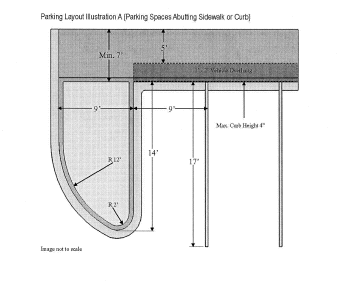
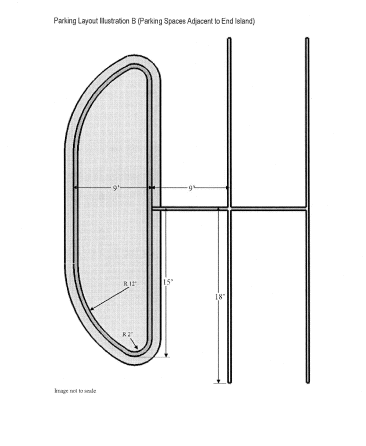
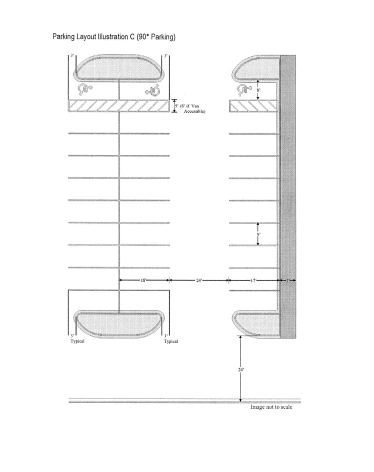
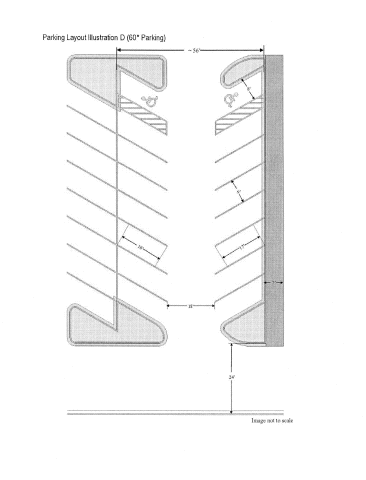
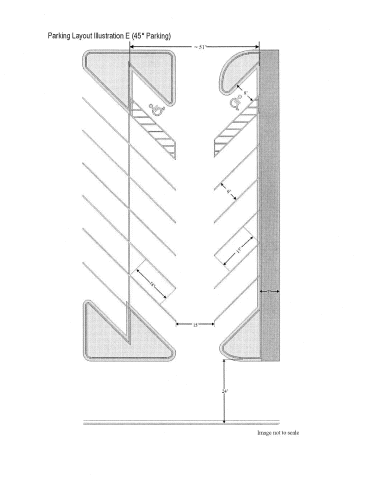
Plans for the layout of an off-street parking lot shall have dimensions consistent with the following standards and illustrations:
A.
Off-street parking areas shall be designed with either a 90-degree, 60-degree, 45-degree, or parallel parking pattern. All spaces shall be laid out in the dimension of nine feet by 18 feet, with the exception of parking spaces to accommodate vehicles with trailers (boats and recreational vehicles) shall be at least 12 feet by 40 feet.
B.
In any area where front-end parking abuts a curbed landscaped area at least five feet in width or a raised sidewalk at least seven feet in width with a raised curb of a maximum height of four inches, the minimum parking stall depth of 18 feet (as otherwise specified herein) may be decreased by up to two feet in depth in order to allow for a vehicle to overhang such landscaped area or such sidewalk. In no case shall the parking stall depth be decreased to allow a vehicle to overhang a required parking setback or property line. The parking lot shall be curbed to prevent vehicles from encroaching into a setback or across a property line.
C.
Off-street parking areas shall be designed in accordance with the dimensional standards displayed on Parking Lot illustrations A through E. All required dimensions shall be measured from the face-of-curb (where applicable), with the exception of curb radii which shall be measured from the back-of-curb. The dimensions of the following parking lot elements shall conform to the applicable Parking Lot Illustrations:
a.
Parking space width (typically nine feet)
b.
Parking space length (typically 18 feet)
c.
Maneuvering aisle width (varies)
d.
End aisle width (24 feet for two-way traffic)
e.
Island radii (varies)
f.
Island width (typically nine feet)
g.
Island length (varies)
h.
Sidewalk width adjacent to parking spaces (typically seven feet minimum)
i.
Curb height of sidewalk or landscaped area adjacent to parking spaces (maximum four inches)
j.
Barrier-free space width (eight feet)
k.
Barrier-free access aisle width (five feet, or eight feet if van-accessible)
D.
In order to delineate on-site circulation, ensure adequate sight distance at the intersection of parking aisles, ring roads, and private roads, protect the vehicle at the end of a parking bay, and define the geometry of internal intersections, landscaped end islands shall be required at the end of all parking bays. Landscaped end islands shall generally conform to the dimensional standards displayed in Parking Lot Illustrations A through E and the planting requirements of section 5.04. The planning commission may approve painted or raised-curb end islands in lieu of landscaped islands when it is demonstrated by the applicant that a landscaped island can not be accommodated, or it is determined by the planning commission to improve overall site design.
3.
Handicapped spaces shall be furnished as required by federal law.
4.
Parallel parking shall not be permitted.
5.
All parking spaces shall be provided with adequate access by means of paved maneuvering lanes or driveway. Spaces shall not be designed to permit backing directly onto a street.
6.
The entire parking area, including parking spaces, maneuvering lanes and drives required under this section, shall be paved with asphalt or concrete surfacing in accordance with specifications of the township engineering design standards ordinance of the Charter Township of Shelby Code of Ordinances. The planning commission may approve a non-paved gravel surface for an outdoor storage yard during site plan review. The minimum specification for a non-paved storage or parking area shall be eight inches of 21AA gravel unless a different standard is recommended by the township engineer. Any gravel lot must be adequately maintained to provide a dust-free surface and adequate drainage. Unless a waiver is granted by the zoning board of appeals for a specified period of time, the parking area shall be surfaced prior to the issuance of the certificate of occupancy for the building or buildings which it serves, or cash deposit or irrevocable letter of credit acceptable to the Charter Township of Shelby in an amount equal to 110 percent of the estimated cost of the improvement. Any improvements for which a letter of credit or cash deposit has been posted shall be installed by the end of the construction season following the posting.
7.
Off-street parking areas shall be drained to dispose of all surface water accumulated in the parking area in such a way as to prevent drainage of water onto adjacent property or toward buildings, and drainage plans shall meet the specifications of the township engineering design standards ordinance.
8.
Ingress and egress to a parking lot for non-residential purposes shall not be provided across land zoned for one-family or two-family residential purposes, except as provided in section 3.00. All such entrances and exits shall also be located at least 25 feet from any property zoned for one-family residential use.
9.
Parking lot lighting shall meet the requirements of section 5.06.
10.
The surface of the parking lot area, shall be maintained and kept free from weeds, rubbish, refuse and debris.
11.
All parking serving other than one- or two-family dwellings shall be side-by-side. Tandem parking may be allowed for multiple-family developments provided that one parking space is located within an enclosed garage. Tandem parking to a depth of three cars may be permitted in vehicle storage and inventory areas provided such areas are under the control of employees and are not accessory by the general public. Any parking or vehicle circulation areas accessible to the public shall meet the size standards specified in this section.
12.
Except as otherwise provided in this article, required off-street parking space shall be for the use of occupants, employees, visitors, customers, clients and patrons. Off-street parking shall not be used for other than parking purposes or allowed to become unusable, except for temporary repairs. The storage of vehicles or merchandise in any off-street parking space is prohibited, except as permitted in conjunction with the principal or accessory use and sale of motor vehicles.
13.
The planning commission may require an access easement to provide for vehicular access to existing or contemplated adjacent parking lots to minimize the need for driveways to each facility and thereby decreasing hazards to vehicular traffic. In such instances, a reciprocal use agreement shall be signed by each owner in a form satisfactory to the township attorney and shall be recorded with the Macomb County Register of Deeds.
14.
Adequate ingress and egress to the parking lot by means of clearly limited and defined paved drives shall be provided for all vehicles. All parking areas shall be provided with an entrance and exit from the abutting public thoroughfare. Such entrance and exit may be combined as one, which shall be 30 feet in width. The number of driveways permitted for each site shall be determined by the planning commission as part of site plan review.
In making this determination, consideration shall be given to the following factors: the location of driveways on adjacent sites and across the street, turning movements and traffic volumes. The location of each such entrance and exit shall be submitted for approval to the Macomb County Road Commission or the Michigan Department of Transportation, as the case may be, and the Charter Township of Shelby. Tapers and bypass lanes shall be required, as determined by the appropriate agency.
15.
Curbs, meeting the construction standards of the township engineering design standards ordinance, shall be required. The use of bumper blocks is prohibited, except in such circumstances as determined by the planning commission where the site or development characteristics necessitate their use.
16.
Whenever a parking lot abuts a residential lot, a side yard setback of ten feet shall be provided between the parking lot and the adjoining residential property line. The parking lot setback from the road shall not be less than the setback for the residential dwellings located on the same block as the parking lot. The front yard setback between the road and the parking lot shall be landscaped.
17.
All parking lots abutting residential lots shall be screened as per the requirements of section 5.01.
18.
It shall be unlawful for any person to leave, park or store any motor vehicle or to permit any motor vehicle to be left, parked or stored in a parking lot as permitted in this subsection for a period of longer than 18 hours. It shall also be unlawful to park or permit to be parked any motor vehicle in such parking area between the hours of 12:00 midnight and 6:00 a.m. the following morning, unless the business maintaining such parking area remains open after midnight, in which case said lot shall be closed and all parked cars removed within 30 minutes after said business has closed. No repairs or service to vehicles and no display of vehicles for purpose of sale shall be carried on or permitted upon such premises. The parking of vehicles accessory to the principal use of the site is exempt from this provision.
19.
No charge for parking shall be made in an off-street parking area provided under this subsection.
20.
The use of any outdoor loud noise-producing device or public address system shall be prohibited.
(Ord. No. 212.6, § 3, 11-2-1999; Amend. of 7-7-2009; Ord. No. 212.85, 3-15-2011)
Section 6.04. - Parking structure and carport development standards.
It is intended that the provision of parking within structures or buildings shall serve to increase the value and convenience of related development and to enhance, rather than detract from, the appearance of the overall development. It is further intended that the provision of such facilities shall not negatively impact the safety and security of the public. All parking structures shall observe the layout, construction and maintenance requirements of section 6.03, plus the following additional standards:
1.
Parking structures shall be physically integrated into the overall design and functioning of the site. The exterior treatment of the parking structure element of a building complex shall be substantially the same in appearance to that of the principal building, and shall further be designed so that all architectural and vehicular lighting is shielded or screened from view from adjacent properties.
2.
The design of multiple-level parking structures shall be subject to approval by the planning commission with respect to parking arrangement, circulation, accommodations for pedestrians, and the adequacy of ingress and egress with respect to safety and convenience.
3.
Parking structures may be allowed in any multiple-family, office, commercial or industrial zoning district, subject to site plan review by the planning commission.
4.
The development of parking structures shall be in accordance with safety and security requirements established by the township building code.
5.
Carports may be located on the side or rear lot line when part of an approved site plan. When carports are so located, they shall be part of an approved method of screening from adjacent properties.
6.
No carport may be allowed to encroach into an existing easement.
7.
No carport may exceed a maximum height of 14 feet, measured from grade to the peak of the structure.
8.
Carports shall be screened on those sides facing any public right-of-way.
Section 6.05. - Off-street loading and unloading.
The number, size and location of off-street loading and unloading areas shall be provided whenever it is determined by the planning commission that the nature of the building or use is such that loading areas would be necessary.
1.
All loading or unloading areas shall provide a minimum height clearance of 14 feet.
2.
Loading and unloading areas shall be so located and designed that the vehicles intended to use them can maneuver safely and conveniently to and from a public right-of-way and complete loading and unloading operations without obstructing or interfering with any public right-of-way or any parking space or parking lot maneuvering lane or aisle. When required, loading and unloading areas shall be designated and defined.
3.
No area allocated to loading and unloading facilities may be used to satisfy the area requirements for off-street parking, nor shall any portion of any off-street parking area be used to satisfy the area requirements for loading and unloading facilities, except as specifically authorized by this ordinance.
4.
Unless otherwise specified, loading and unloading areas shall be provided only in rear yards. Side yard loading may be permitted by the planning commission when it is determined that such space and loading facilities would not interfere with parking and circulation, either vehicular or pedestrian, or with abutting uses.
5.
All loading and unloading areas shall be surfaced, drained, and otherwise developed in accordance with the provisions applicable to off-street parking areas (section 6.03).

