
Sherwood City Zoning Code
Division V
COMMUNITY DESIGN
Chapter 16.100 - GENERAL SIGN PROVISIONS[39]
Editor's note— Ord. No. 2020-005, § 2, adopted September 7, 2021, amended the Code by, in effect, repealing former Ch. 16.100, §§ 16.100.010—16.100.030, and adding new Chs. 16.100 and 16.101. Former Ch. 16.100 pertained to permanent signs, and derived from Ord. No. 2012-009, adopted August 7, 2012; and Ord. No. 2018-007, adopted October 2, 2018.
Chapter 16.102 - TEMPORARY, PORTABLE, AND BANNER SIGNS[40]
Editor's note— Ord. No. 2020-005, § 2, adopted September 7, 2021, amended the Code by, in effect, repealing former Ch. 16.102, §§ 16.102.010—16.102.060, and adding new Ch. 16.102. Former Ch. 16.102 pertained to similar subject matter, and derived from Ord. No. 2012-009, adopted August 7, 2012; Ord. No. 2015-003, adopted March 17, 2015; and Ord. No. 2018-007, adopted October 2, 2018.
16.89.010 - Purpose and Intent
A.
Purpose
The Residential Design Checklist Review and Residential Design Review are intended to provide an opportunity for the City of Sherwood to encourage development of a variety of housing types while providing for a review process that encourages traditional forms commonly found in Sherwood while providing for a variety of design and site-specific situations for these housing types.
This process is designed to provide a streamlined review process to encourage development of housing at a variety of types and scales. The Residential Design Checklist Review is a clear and objective review process and will be implemented at time of Residential Building Permit submittal. For projects seeking additional flexibility, the Residential Design Checklist Review may be paired with either a concurrent Type I Adjustment or Type II Class B Variance process referenced in Section 16.84.030.
For residential projects seeking the highest level of flexibility, the Residential Design Review is a Type IV discretionary review. Projects subject to Residential Design Review are to be reviewed against the design guidelines rather than against the degree of departure from the standard.
B.
Intent
The following standards are intended to create walkable residential neighborhoods that are visually interesting, compatible with existing development, and avoid monotony in design. Should the Residential Design Review process be applied, see the design guidelines in Table 16.14-1, Residential Design Standards for design intent for each standard.
(Ord. No. 2021-010, § 2, 12-7-2021)
16.89.020 - Residential Design Checklist Review or Residential Design Review Required
A.
When Required. Residential Design Checklist Review or Residential Design Review is required prior to new residential development, expansions or conversions that are subject to the design standards of 16.14, or any substantial change to a site or use and is required prior to issuance of building permits for a new residential dwelling, or for substantial alteration of an existing residential dwelling or use. Exemptions noted below.
Either a Residential Design Checklist Review or a Residential Design Review is required for the following housing types (Multi-Family dwellings are subject to Section 16.90 review):
1.
Accessory Dwelling Unit
2.
Single detached dwelling
3.
Duplex
4.
Townhouse
5.
Triplex
6.
Quadplex
7.
Cottage Cluster development
B.
Applicability. For the purposes of Section 16.89.020, the terms "substantial change" and "substantial alteration" mean any development activity as defined by this Code that generally requires a building permit and exhibits one or more of the following characteristics:
1.
Construction of new residential dwelling(s).
2.
The activity involves changes in the use of a structure, building, or property from a non-residential to a residential use listed above.
3.
The activity involves non-conforming uses as defined in Chapter 16.48.
4.
The activity is identified as an expansion or conversion per 16.14.010.C.2
C.
Exemption to Residential Design Checklist Review Requirement
1.
Residential accessory structure subject to Chapter 16.50.
D.
Required Standards
1.
For the Residential Design Checklist Review application, all of the following are to be met:
a.
All of the design standards noted in Subsection 16.14.010, Subsection 16.14.040, and/or Chapter 16.52 Accessory Dwelling Units.
b.
For a stand-alone Accessory Dwelling Unit, the standards and criteria in 16.52.020.H shall apply.
2.
If the standards listed in Subsection D above cannot be met outright, there are two concurrent options with the Residential Design Checklist Review:
a.
Adjustment. See Section 16.84.030 for a Type I Adjustment for up to 5 percent modifications of the design standards associated with Table 16.14-1, Residential Design Standards, A-C. Applying the Adjustment provision creates a concurrent review that is no longer clear and objective.
b.
Variance. See Section 16.84.030 for a Type II Class B Variance for 5 to 10 percent modifications of the design standards associated with Table 16.14-1, Residential Design Standards, A-C. Applying the Variance provision, creates a concurrent review that is no longer clear and objective.
E.
Time Limits
Residential Design Checklist approvals are void after one (1) year unless construction on the site has begun, as determined by the City. The City may extend approvals for an additional period not to exceed one (1) year, upon written request from the applicant showing adequate cause for such extension, and payment of an extension application fee as per Section 16.74.010.
(Ord. No. 2022-004, § 2, 6-13-2022; Ord. No. 2021-010, § 2, 12-7-2021)
16.89.030 - Residential Design Review
As an alternative to meeting the clear and objective standards in Sections 16.89.020.A, an applicant may opt to have a design review hearing before the Planning Commission to demonstrate how the proposed development meets or exceeds the design guidelines of Section 16.14.010.B, Table 16.14-1:
A.
Intent. The intent of this Review is to provide a flexible option for projects which implement the design guidelines rather than the design standards.
B.
Approval Criteria:
1.
The proposed development demonstrates conformance with the applicable design guidelines of Section 16.14.010.B, Table 16.14-1.
2.
The proposed development meets applicable zoning district standards and standards in Division II, and all applicable provisions of Divisions V, VI, VIII and IX unless revised through the Adjustment or Variance process.
3.
The proposed development can be adequately served by services conforming to the Community Development Plan, including but not limited to water, sanitary facilities, storm water, solid waste, parks and open space, public safety, electric power, and communications.
C.
Time Limits
Residential Design Review approvals are void after two (2) years unless construction on the site has begun, as determined by the City. The City may extend approvals for an additional period not to exceed one (1) year, upon written request from the applicant showing adequate cause for such extension, and payment of an extension application fee as per Section 16.74.010.
(Ord. No. 2021-010, § 2, 12-7-2021)
16.90.010 - Purpose
Site planning review is intended to:
A.
Encourage development that is compatible with the existing natural and manmade environment, existing community activity patterns, and community identity.
B.
Minimize or eliminate adverse visual, aesthetic or environmental effects caused by the design and location of new development, including but not limited to effects from:
1.
The scale, mass, height, areas, appearance and architectural design of buildings and other development structures and features.
2.
Vehicular and pedestrian ways and parking areas.
3.
Existing or proposed alteration of natural topographic features, vegetation and water-ways.
(Ord. No. 2015-003, § 2, 3-17-2015; Ord. No. 2010-015, § 2, 10-5-2010; Ord. 86-851, § 3)
16.90.020 - Site Plan Review
A.
Site Plan Review Required
Site Plan review is required prior to any substantial change to a site or use that is not subject to Residential Design Checklist or Residential Design Review, does not meet the criteria of a minor or major modification per 16.90.030, issuance of building permits for a new building or structure, or for the substantial alteration of an existing structure or use. Exemptions noted below.
Site Plan Review is required for the following development:
1.
Multi-dwelling
2.
Commercial
3.
Industrial
4.
Mixed-use
For the purposes of Section 16.90.020, the terms "substantial change" and "substantial alteration" mean any development activity as defined by this Code that generally requires a building permit and may exhibit one or more of the following characteristics:
1.
The activity alters the exterior appearance of a structure, building or property and is not considered a modification.
2.
The activity involves changes in the use of a structure, building, or property from residential to commercial or industrial and is not considered a modification.
3.
The activity involves non-conforming uses as defined in Chapter 16.48.
4.
The activity constitutes a change in a City approved plan, per Section 16.90.020 and is not considered a modification.
5.
The activity is subject to site plan review by other requirements of this Code.
6.
The activity increases the size of the building by more than 100% (i.e. the building more than doubles in size), regardless of whether it would be considered a major or minor modification.
B.
Exemption to Site Plan Requirement
1.
Single Family detached and middle housing developments are exempt from Site Plan Review but are required to complete either a Residential Design Checklist or Residential Design Review per Chapter 16.89, unless otherwise noted.
2.
Manufactured homes located on individual residential lots per Section 16.46.010, and including manufactured home parks.
C.
Reserved
D.
Required Findings
No site plan approval will be granted unless each of the following is found:
1.
The proposed development meets applicable zoning district standards and design standards in Division II, and all provisions of Divisions V, VI, VIII and IX.
2.
The proposed development can be adequately served by services conforming to the Community Development Plan, including but not limited to water, sanitary facilities, storm water, solid waste, parks and open space, public safety, electric power, and communications.
3.
Covenants, agreements, and other specific documents are adequate, in the City's determination, to assure an acceptable method of ownership, management, and maintenance of structures, landscaping, and other on-site features.
4.
The proposed development preserves significant natural features to the maximum extent feasible, including but not limited to natural drainage ways, wetlands, trees, vegetation (including but not limited to environmentally sensitive lands), scenic views, and topographical features, and conforms to the applicable provisions of Division VIII of this Code and Chapter 5 of the Community Development Code.
5.
For developments that are likely to generate more than 400 average daily trips (ADTs), or at the discretion of the City Engineer, the applicant must provide adequate information, such as a traffic impact analysis (TIA) or traffic counts, to demonstrate the level of impact to the surrounding transportation system. The developer is required to mitigate for impacts attributable to the project, pursuant to TIA requirements in Section 16.106.080 and rough proportionality requirements in Section 16.106.090. The determination of impact or effect and the scope of the impact study must be coordinated with the provider of the affected transportation facility.
6.
Electric Vehicle Conduits
a.
For proposed multi-family residential or mixed-use developments - proposed multi-family residential buildings with five or more residential dwelling units and proposed mixed-use buildings consisting of prvateiy owned commercial space and five or more residential dwelling units, shall provide sufficient electrical service capacity, as defined in ORS 455.417, to accommodate no less than 40 percent of all vehicle parking spaces. Dwelling units in townhouses are not included for purposes of determining the applicability of this regulation.
b.
For proposed Non-Residential Development under private ownership - Each building for a proposed non-residential development, under private ownership, shall provide electrical service capacity at no less than 20 percent of the vehicle parking spaces in the garage or parking area for the building. Fractional numbers derived from a calculation of the vehicle parking spaces must be rounded up to the nearest whole number.
7.
The proposed commercial, Multi-Family dwelling, institutional or mixed-use development is oriented to the pedestrian and bicycle, and to existing and planned transit facilities. Urban design standards include the following:
a.
Primary, front entrances are located and oriented to the street, and have significant articulation and treatment, via facades, porticos, arcades, porches, portal, forecourt, or stoop to identify the entrance for pedestrians. Additional entrance/exit points for buildings, such as a postern, are allowed from secondary streets or parking areas.
b.
Buildings are located adjacent to and flush to the street, subject to landscape corridor and setback standards of the underlying zone.
c.
The architecture of buildings are oriented to the pedestrian and designed for the long term and be adaptable to other uses. Aluminum, vinyl, and T-111 siding are prohibited. Street facing elevations have windows, transparent fenestration, and divisions to break up the mass of any window. Roll up and sliding doors are acceptable. Awnings that provide a minimum 3 feet of shelter from rain are required unless other architectural elements are provided for similar protection, such as an arcade.
d.
Multi-family development requires a minimum of 15 percent of the area of the primary building elevation adjacent to a public right-of-way to include windows and entrance doors, and for the side building elevation, adjacent to a public right-of-way or public accessway, a minimum of 10 percent glazing of area is required.
e.
As an alternative to the standards in Section 16.90.020.D.6.a—d, the following Commercial Design Review Matrix may be applied to any commercial, multi-family, institutional or mixed use development (this matrix may not be utilized for developments within the Old Town Overlay). A development must propose a minimum of 60 percent of the total possible points to be eligible for exemption from the standards in Section 16.90.020.D.6.a—d. In addition, a development proposing between 15,001 and 40,000 square feet of floor area, parking or seating capacity and proposing a minimum of 80 percent of the total possible points from the matrix below may be reviewed as a Type II administrative review, per the standards of Section 16.72.010.A.2.
COMMERCIAL DESIGN REVIEW MATRIX
e.
As an alternative to the standards in Sections 16.90.020.D.6.a—c, the Old Town Design Standards (Chapter 16.162) may be applied to achieve this performance measure.
f.
As an alternative to the standards in Sections 16.90.020.D.6.a.—e, an applicant may opt to have a design review hearing before the Planning Commission to demonstrate how the proposed development meets or exceeds the objectives in Section 16.90.010.B of this Code. This design review hearing will be processed as a Type IV review with public notice and a public hearing.
7.
Industrial developments provide employment opportunities for citizens of Sherwood and the region as a whole. The proposed industrial development is designed to enhance areas visible from arterial and collector streets by reducing the "bulk" appearance of large buildings. Industrial design standards include the following:
a.
Portions of the proposed industrial development within 200 feet of an arterial or collector street and visible to the arterial or collector (i.e. not behind another building) must meet any three of the following five design criteria:
(1)
Primary building entries - entries open to the general public
Primary building entries should be readily identifiable and well-defined through the use of pedestrian scale improvements such as, but not limited to, projections, recesses, columns, roof structures, extra landscaping, hardscapes, seating, or other design elements.
(2)
A minimum of two (2) building materials used to break up vertical facade street facing frontages (no T-111 or aluminum siding).
(3)
Maximum thirty-five (35) foot setback for all parts of the building from the property line separating the site from all arterial or collector streets (required visual corridor falls within this maximum setback area).
(4)
Parking is located to the side or rear of the building when viewed from the arterial or collector.
(5)
Loading areas are located to the side or rear of the building when viewed from the arterial or collector. If a loading area is visible from an arterial or collector, it must be screened with vegetation or a screen made of materials matching the building materials.
b.
A minimum 15% window glazing shall be required for all frontages facing an arterial or collector.
c.
All roof-mounted equipment shall be required to be screened with materials complimentary to the building design materials.
d.
As an alternative to Section 16.90.020.D.7.a—c, an applicant may opt to have a design review hearing before the Planning Commission to demonstrate how the proposed development meets or exceeds the applicable industrial design objectives below (this design review hearing will be processed as a Type IV review):
(1)
Provide high-value industrial projects that result in benefits to the community, consumers and developers.
(2)
Provide diversified and innovative working environments that take into consideration community needs and activity patterns.
(3)
Support the City's goals of economic development.
(4)
Complement and enhance projects previously developed under the industrial design standards identified in Section 16.90.020.D.7.
(5)
Enhance the appearance of industrial developments visible from arterials and collectors, particularly those considered "entrances" to Sherwood, including but not limited to: Highway 99W, Tualatin-Sherwood Road and Oregon Street.
(6)
Reduce the "bulk" appearance of large industrial buildings as viewed from the public street by applying exterior features such as architectural articulation, windows and landscaping.
(7)
Protect natural resources and encourage integration of natural resources into site design (including access to natural resources and open space amenities by the employees of the site and the community as a whole).
8.
Driveways that are more than twenty-four (24) feet in width shall align with existing streets or planned streets as shown in the Local Street Connectivity Map in the adopted Transportation System Plan (Figure 17), except where prevented by topography, rail lines, freeways, pre-existing development, or leases, easements, or covenants.
E.
Approvals
The application is reviewed pursuant to Chapter 16.72 and action taken to approve, approve with conditions, or deny the application for site plan review. Conditions may be imposed by the Review Authority if necessary to fulfill the requirements of the adopted Comprehensive Plan, Transportation System Plan or the Zoning and Community Development Code. The action must include appropriate findings of fact as required by Section 16.90.020. The action may be appealed to the Council in accordance with Chapter 16.76.
F.
Time Limits
Site plan approvals are void after two (2) years unless construction on the site has begun, as determined by the City. The City may extend site plan approvals for an additional period not to exceed one (1) year, upon written request from the applicant showing adequate cause for such extension, and payment of an extension application fee as per Section 16.74.010. A site plan approval granted on or after January 1, 2007 through December 31, 2009, is extended until December 31, 2013.
(Ord. No. 2024-002, § 1, 8-6-2024; Ord. No. 2023-002, § 2, 3-7-2023; Ord. No. 2022-004, § 2, 6-13-2022; Ord. No. 2021-010, § 2, 12-7-2021; Ord. No. 2021-010, § 2, 12-7-2021; Ord. No. 2015-003, § 2, 3-17-2015; Ord. No. 2012-003, § 2, 5-1-2012; Ord. No. 2011-011, § 1, 10-4-2011)
Editor's note— Ord. No. 2011-011, § 1, adopted October 4, 2011, amended the Code by, in effect, repealing former § 16.90.020, and adding new §§ 16.90.020 and 16.90.030. Former § 16.90.020 pertained to site plan review, and derived from Ord. 86-851; Ord. 91-922; Ord. 98-1053; Ord. 2003-1148; Ord. 2005-009; Ord. 2006-021; Ord. No. 2009-005, adopted June 2, 2009; Ord. No. 2010-05, adopted April 6, 2010; Ord. No. 2010-06, adopted April 6, 2010; and Ord. No. 2010-015, adopted October 5,2010.
No aluminum or T-111 siding permitted.
--- (27) ---
Pictures and/or artistic renderings must be submitted for review by the Planning Commission if metal roofs are proposed.
--- (28) ---
Two (2) points if there is only one street-facing side and it is >20% glazing with inactive windows.
--- (29) ---
If multiple buildings are proposed, average the building sizes in the development.
--- (30) ---
If multiple buildings are proposed in one development, one point is awarded if one or more buildings are located adjacent to one or more rights-of-way and two points are awarded if there is at least one building adjacent to each right-of-way.
--- (31) ---
If primary entrance is oriented to the pedestrian, the project is automatically given these points without need for a second entrance.
--- (32) ---
Percent of minimum required. For development projects in the Climate Friendly and Equitable Communities frequent transit corridor, no parking is required therefore points are based on the percentage of stalls provided relative to the underlying parking standards.
--- (33) ---
Based on tree inventory submitted with development application.
--- (34) ---
When no mitigation is required, the project receives zero points.
--- (35) ---
In addition to mitigated trees on-site, does not include Water Quality Facility Plantings.
--- (36) ---
Shrubs and drought resistant ground cover are better.
Schools automatically receive the full 3 points and are not penalized for amount of grass.
--- (37) ---
Includes visual corridor.
--- (38) ---
Including retaining walls.
16.90.030 - Site Plan Modifications and Revocation
A.
Modifications to Approved Site Plans
1.
Major Modifications to Approved Site Plans
a.
Defined. A major modification review is required if one or more of the changes listed below are proposed:
(1)
A change in land use (i.e. residential to commercial, commercial to industrial, etc.);
(2)
An increase in density by more than ten (10) percent, provided the resulting density does not exceed that allowed by the land use district;
(3)
A change in setbacks or lot coverage by more than ten (10) percent, provided the resulting setback or lot coverage does not exceed that allowed by the land use district;
(4)
A change in the type and/or location of access-ways, drives or parking areas negatively affecting off-site traffic or increasing Average Daily Trips (ADT) by more than 100;
(5)
An increase in the floor area or height proposed for non-residential use by more than ten (10) percent;
(6)
A reduction of more than ten (10) percent of the area reserved for common open space; or
(7)
Change to a condition of approval that was specifically applied to this approval (i.e. not a "standard condition"), or a change similar to items identified in Section 16.90.030.A.1.a.(1)—(2) as determined by the Review Authority.
b.
Approval Criteria. An applicant may request a major modification as follows:
(1)
Upon the review authority determining that the proposed modification is a major modification, the applicant must submit an application form, filing fee and narrative, and a site plan using the same plan format as in the original approval. The review authority may require other relevant information, as necessary, to evaluate the request.
(2)
The application is subject to the same review procedure (Type II, III or IV) and decision making body as the initial project approval, except that adding a Conditional Use to an approved Type II project is reviewed using a Type III procedure. The approval criteria and standards in effect at the time of the current land use submittal apply to the modification request.
(3)
The scope of review is limited to the modification request and does not open the entire site up for additional review unless impacted by the proposed modification. For example, a request to modify a parking lot requires site design review only for the proposed parking lot and any changes to associated access, circulation, pathways, lighting, trees, and landscaping.
(4)
Notice must be provided in accordance with Chapter 16.72.020.
(5)
The decision maker approves, denies, or approves with conditions an application for major modification based on written findings of the criteria.
2.
Minor Modifications to Approved Site Plans
a.
A Minor Modification is any modification to a land use decision or approved development plan that is not within the description of a major modification.
b.
Minor Modification Review Procedure. An application for approval of a minor modification is reviewed by the review authority using a Type I review procedure under Section 16.72.010.A. Minor modifications involve only clear and objective Code standards.
c.
Minor Modification Applications. An application for minor modification must include an application form, filing fee and narrative, updated Clean Water Services (CWS) Service Provider Letter or equivalent acknowledgement from CWS, and a site plan using the same plan format as in the original approval if possible. The review authority may require other relevant information, as necessary, to evaluate the request.
d.
Minor Modification Approval Criteria. The review authority approves, denies, or approves with conditions an application for minor modification based on written findings that the modification is in compliance with all applicable requirements of the Development Code in effect at the time of the current land use submittal and continues to comply with the conditions of approval in the original decision, and the modification is not a major modification.
B.
Revocation
Any departure from an approved plan is cause for revocation of applicable building and occupancy permits. Furthermore if, in the City's determination, a condition or conditions of site plan approval are not or cannot be satisfied, the site plan approval, or building and occupancy permits, will be revoked.
(Ord. No. 2023-002, § 2, 3-7-2023; Ord. No. 2015-003, § 2, 3-17-2015; Ord. No. 2014-012, § 3, 7-17-2014; Ord. No. 2011-011, § 1, 10-4-2011)
16.92.010 - Landscaping Plan Required
All proposed developments for which site plan review is required pursuant to Section 16.90.020 shall submit a landscaping plan that meets the standards of this Chapter. All areas not occupied by structures, paved roadways, walkways, or patios shall be landscaped or maintained according to an approved site plan.
(Ord. No. 2021-010, § 2, 12-7-2021; Ord. No. 2012-008, § 2, 7-17-2012; Ord. 2006-021; Ord. 86-851, § 3)
16.92.020 - Landscaping Materials
A.
Type of Landscaping
Required landscaped areas shall include an appropriate combination of native evergreen or deciduous trees and shrubs, evergreen ground cover, and perennial plantings. Trees to be planted in or adjacent to public rights-of-way shall meet the requirements of this Chapter. Plants may be selected from the City's "Suggested Plant Lists for Required Landscaping Manual" or suitable for the Pacific Northwest climate and verified by a landscape architect or certified landscape professional.
1.
Ground Cover Plants
a.
All of the landscape that is not planted with trees and shrubs must be planted in ground cover plants, which may include grasses. Mulch is not a substitute for ground cover, but is allowed in addition to the ground cover plants.
b.
Ground cover plants other than grasses must be at least the four-inch pot size and spaced at distances appropriate for the plant species. Ground cover plants must be planted at a density that will cover the entire area within three (3) years from the time of planting.
2.
Shrubs
a.
All shrubs must be of sufficient size and number to be at full growth within three (3) years of planting.
b.
Shrubs must be at least the one-gallon container size at the time of planting.
3.
Trees
a.
Trees at the time of planting must be fully branched and must be a minimum of two (2) caliper inches and at least six (6) feet in height.
b.
Existing trees may be used to meet the standards of this chapter, as described in Section 16.92.020.C.2.
B.
Plant Material Selection and Preparation
1.
Required landscaping materials shall be established and maintained in a healthy condition and of a size sufficient to meet the intent of the approved landscaping plan. Specifications shall be submitted showing that adequate preparation of the topsoil and subsoil will be undertaken.
2.
Landscape materials should be selected and sited to produce a hardy and drought-resistant landscape area. Selection of the plants should include consideration of soil type, and depth, the amount of maintenance required, spacing, exposure to sun and wind, the slope and contours of the site, and compatibility with existing native vegetation preserved on the site.
C.
Existing Vegetation
1.
All developments subject to site plan review per Section 16.90.020 and required to submit landscaping plans per this section shall preserve existing trees, woodlands and vegetation on the site to the maximum extent possible, as determined by the Review Authority, in addition to complying with the provisions of Section 16.142.(Parks, Trees and Open Space) and Chapter 16.144 (Wetland, Habitat, and Natural Resources).
2.
Existing vegetation, except those plants on the Nuisance Plants list as identified in the "Suggested Plant Lists for Required Landscaping Manual" may be used to meet the landscape standards, if protected and maintained during the construction phase of the development.
a.
If existing trees are used, each tree six (6) inches or less in diameter counts as one (1) medium tree.
b.
Each tree that is more than six (6) inches and up to nine (9) inches in diameter counts as two (2) medium trees.
c.
Each additional three (3) inch diameter increment above nine (9) inches counts as an additional medium tree.
D.
Non-Vegetative Features
1.
Landscaped areas as required by this Chapter may include architectural features interspersed with planted areas, such as sculptures, benches, masonry or stone walls, fences, rock groupings, bark dust, semi-pervious decorative paving, and graveled areas.
2.
Impervious paving shall not be counted toward the minimum landscaping requirements unless adjacent to at least one (1) landscape strip and serves as a pedestrian pathway.
3.
Artificial plants are prohibited in any required landscaped area.
(Ord. No. 2015-003, § 2, 3-17-2015; Ord. No. 2012-008, § 2, 7-17-2012; Ord. No. 2010-015, § 2, 10-5-2010; Ord. 2006-021; Ord. 86-851, § 3)
16.92.030 - Site Area Landscaping and Perimeter Screening Standards
A.
Perimeter Screening and Buffering
1.
Perimeter Screening Separating Residential Zones:
A minimum six-foot high sight-obscuring wooden fence, decorative masonry wall, or evergreen screen, shall be required along property lines separating residential zones from commercial, institutional/public or industrial zones subject to the provisions of Chapter 16.48.020 (Fences, Walls and Hedges).
a.
For new uses adjacent to inventoried environmentally sensitive areas, screening requirements shall be limited to vegetation only to preserve wildlife mobility. In addition, the Review Authority may require plants and other landscaping features in locations and sizes necessary to protect the privacy of residences and buffer any adverse effects of adjoining uses.
b.
The required screening shall have breaks, where necessary, to allow pedestrian access to the site. The design of the wall or screening shall also provide breaks or openings for visual surveillance of the site and security.
c.
Evergreen hedges used to comply with this standard shall be a minimum of thirty-six (36) inches in height at maturity, and shall be of such species, number and spacing to provide the required screening within one (1) year after planting.
2.
Perimeter Landscaping Buffer
a.
A minimum ten (10) foot wide landscaped strip comprised of trees, shrubs and ground cover shall be provided between off-street parking, loading, or vehicular use areas on separate, abutting, or adjacent properties.
b.
The access drives to a rear lots in the residential zone (i.e. flag lot) shall be separated from abutting property(ies) by a minimum of forty-two-inch sight-obscuring fence or a forty-two-inch to an eight (8) feet high landscape hedge within a four-foot wide landscape buffer. Alternatively, where existing mature trees and vegetation are suitable, Review Authority may waive the fence/buffer in order to preserve the mature vegetation.
3.
Perimeter Landscape Buffer Reduction
If the separate, abutting property to the proposed development contains an existing perimeter landscape buffer of at least five (5) feet in width, the applicant may reduce the proposed site's required perimeter landscaping up to five (5) feet maximum, if the development is not adjacent to a residential zone. For example, if the separate abutting perimeter landscaping is five (5) feet, then applicant may reduce the perimeter landscaping to five (5) feet in width on their site so there is at least five (5) feet of landscaping on each lot.
B.
Parking Area Landscaping
1.
Purpose
The standard is a landscape treatment that uses a combination of trees, shrubs, and ground cover to provide shade, storm water management, aesthetic benefits, and screening to soften the impacts of large expanses of pavement and vehicle movement. It is applied to landscaped areas within and around the parking lot and loading areas.
2.
Applicability. The provisions of this section apply to off-street parking areas of more than four (4) parking and/or loading spaces.
3.
Definitions
a.
Parking Area Landscaping: Any landscaped area on the site that is not required as perimeter landscaping § 16.92.030 (Site Landscaping and Screening).
b.
Canopy Factor
(1)
Landscape trees are assigned a canopy factor to determine the specific number of required trees to be planted. The canopy factor is calculated based on the following formula:
Canopy Factor = Mature Height (in feet) × Canopy Spread (in feet) × Growth Rate Factor × .01
(2)
Growth Rate Factor: The growth rate factor is three (3) for fast-growing trees, two (2) for medium growing trees, and one (1) for slow growing trees. The growth rate of a tree is identified in the "Suggested Plant Lists for Required Landscaping Manual."
4.
Required Landscaping
There shall be at least forty-five (45) square feet parking area landscaping for each parking space located on the site. The amount of required plant materials are based on the number of spaces as identified below.
5.
Amount and Type of Required Parking Area Landscaping
a.
Number of Trees required based on Canopy Factor
Small trees have a canopy factor of less than forty (40), medium trees have a canopy factor from forty (40) to ninety (90), and large trees have a canopy factor greater than ninety (90);
(1)
Any combination of the following is required:
(i)
One (1) large tree is required per four (4) parking spaces;
(ii)
One (1) medium tree is required per three (3) parking spaces; or
(iii)
One (1) small tree is required per two (2) parking spaces.
(iv)
At least five (5) percent of the required trees must be evergreen.
(2)
Street trees may be included in the calculation for the number of required trees in the parking area.
b.
Shrubs:
(1)
Two (2) shrubs are required per each space.
(2)
For spaces where the front two (2) feet of parking spaces have been landscaped instead of paved, the standard requires one (1) shrub per space. Shrubs may be evergreen or deciduous.
c.
Ground cover plants:
(1)
Any remainder in the parking area must be planted with ground cover plants.
(2)
The plants selected must be spaced to cover the area within three (3) years. Mulch does not count as ground cover.
6.
Individual Landscape Islands Requirements
a.
Individual landscaped areas (islands) shall be at least ninety (90)square feet in area and a minimum width of five (5) feet and shall be curbed to protect the landscaping.
b.
Each landscape island shall be planted with at least one (1) tree.
c.
Landscape islands shall be evenly spaced throughout the parking area.
d.
Landscape islands shall be distributed according to the following:
(1)
Residential uses in a residential zone: one (1) island for every eight (8) contiguous parking spaces.
(2)
Multi or mixed-uses, institutional and commercial uses: one (1) island for every ten (10) contiguous parking spaces.
(3)
Industrial uses: one (1) island for every twelve (12) contiguous parking spaces.
e.
Storm water bio-swales may be used in lieu of the parking landscape areas and may be included in the calculation of the required landscaping amount.
f.
Exception to Landscape Requirement
Linear raised or marked sidewalks and walkways within the parking areas connecting the parking spaces to the on-site buildings may be included in the calculation of required site landscaping provide that it:
(1)
Trees are spaced a maximum of thirty (30) feet on at least one (1) side of the sidewalk.
(2)
The minimum unobstructed sidewalk width is at least six (6) feet wide.
(3)
The sidewalk is separated from the parking areas by curbs, bollards, or other means on both sides.
7.
Landscaping at Points of Access
When a private access-way intersects a public right-of-way or when a property abuts the intersection of two (2) or more public rights-of-way, landscaping shall be planted and maintained so that minimum sight distances shall be preserved pursuant to Section 16.58.010.
8.
Exceptions
a.
For properties with an environmentally sensitive area and/or trees or woodlands that merit protection per Chapters 16.142 (Parks, Trees and Open Space) and 16.144 (Wetland, Habitat and Natural Areas) the landscaping standards may be reduced, modified or "shifted" on-site where necessary in order to retain existing vegetation that would otherwise be removed to meet the above referenced landscaping requirements.
b.
The maximum reduction in required landscaping buffer permitted through this exception process shall be no more than fifty (50) percent. The resulting landscaping buffer after reduction may not be less than five (5) feet in width unless otherwise permitted by the underlying zone. Exceptions to the required landscaping may only be permitted when reviewed as part of a land use action application and do not require a separate variance permit.
C.
Screening of Mechanical Equipment, Outdoor Storage, Service and Delivery Areas
All mechanical equipment, outdoor storage and manufacturing, and service and delivery areas, shall be screened from view from all public streets and any adjacent residential zones. If unfeasible to fully screen due to policies and standards, the applicant shall make efforts to minimize the visual impact of the mechanical equipment.
D.
Visual Corridors
Except as allowed by subsection 6. above, new developments shall be required to establish landscaped visual corridors along Highway 99W and other arterial and collector streets, consistent with the Natural Resources and Recreation Plan Map, Appendix C of the Community Development Plan, Part II, and the provisions of Chapter 16.142( Parks, Trees, and Open Space). Properties within the Old Town Overlay are exempt from this standard.
(Ord. No. 2021-010, § 2, 12-7-2021; Ord. No. 2012-008, § 2, 7-17-2012; Ord. No. 2011-003, § 2, 4-5-2011; Ord. No. 2011-001, §§ 1, 2, 2-15-2011; Ord. No. 2010-015, § 2, 10-5-2010; Ord. 2006-021; Ord. 91-922, § 3; Ord. 86-851 § 3)
16.92.040 - Installation and Maintenance Standards
A.
Installation
All required landscaping must be in-ground, except when in raised planters that are used to meet minimum Clean Water Services storm water management requirements. Plant materials must be installed to current nursery industry standards. Plant materials must be properly supported to ensure survival. Support devices such as guy wires or stakes must not interfere with vehicular or pedestrian movement.
B.
Maintenance and Mitigation of Landscaped Areas
1.
Maintenance of existing non-invasive native vegetation is encouraged within a development and required for portions of the property not being developed.
2.
All landscaping shall be maintained in a manner consistent with the intent of the approved landscaping plan.
3.
Any required landscaping trees removed must be replanted consistent with the approved landscaping plan and comply with § 16.142, (Parks, Trees and Open Space).
C.
Irrigation
The intent of this standard is to ensure that plants will survive the critical establishment period when they are most vulnerable due to lack of watering. All landscaped areas must provide an irrigation system, as stated in Option 1, 2, or 3.
1.
Option 1: A permanent built-in irrigation system with an automatic controller installed.
2.
Option 2: An irrigation system designed and certified by a licensed landscape architect or other qualified professional as part of the landscape plan, which provides sufficient water to ensure that the plants become established. The system does not have to be permanent if the plants chosen can survive independently once established.
3.
Option 3: Irrigation by hand. If the applicant chooses this option, an inspection will be required one (1) year after final inspection to ensure that the landscaping has become established.
D.
Deferral of Improvements
Landscaping shall be installed prior to issuance of occupancy permits, unless security equal to one hundred twenty-five (125) percent of the cost of the landscaping is filed with the City. "Security" may consist of a performance bond payable to the City, cash, certified check, or other assurance of completion approved by the City. If the installation of the landscaping is not completed within one (1) year, the security may be used by the City to complete the installation.
(Ord. No. 2012-008, § 2, 7-17-2012; Ord. No. 2010-015, § 2, 10-5-2010; Ord. 2006-021; Ord. 86-851 § 3)
16.94.010 - General Requirements
A.
Off-Street Parking Required
No site shall be used for the parking of vehicles until plans are approved providing for off-street parking and loading space as required by this Code. Any change in uses or structures that reduces the current off-street parking and loading spaces provided on site, or that increases the need for off-street parking or loading requirements shall be unlawful and a violation of this Code, unless additional off-street parking or loading areas are provided in accordance with Section 16.94.020, or unless a variance from the minimum or maximum parking standards is approved in accordance with Chapter 16.84 Variances.
B.
Deferral of Improvements
Off-street parking and loading spaces shall be completed prior to the issuance of occupancy permits, unless the City determines that weather conditions, lack of available surfacing materials, or other circumstances beyond the control of the applicant make completion impossible. In such circumstances, security equal to one hundred twenty five (125) percent of the cost of the parking and loading area is provided the City. "Security" may consist of a performance bond payable to the City, cash, certified check, or other assurance of completion approved by the City. If the installation of the parking or loading area is not completed within one (1) year, the security may be used by the City to complete the installation.
C.
Options for Reducing the Required Parking Spaces
1.
Two (2) or more uses or, structures on multiple parcels of land may utilize jointly the same parking and loading spaces when the peak hours of operation do not substantially overlap, provided that satisfactory evidence is presented to the City, in the form of deeds, leases, or contracts, clearly establishing the joint use.
a.
Within residential, commercial, institutional and public, or industrial zones, shared parking may be provided on lots that are within two thousand (2,000) feet of the property line of the use to be served.
b.
Shared parking is allowed if the application can show that the combined peak use is available by a parking study that demonstrates:
(1)
There is a sufficient number of parking spaces to accommodate the requirements of the individual businesses; or
(2)
That the peak hours of operation of such establishments do not overlap, and
(3)
That an exclusive permanent easement over a delineated area has been granted for parking space use.
2.
Mixed use projects are developments where a variety of uses occupies a development project or complex. For example, an eating establishment, professional office building and movie theater are all components of a mixed use site. It does not include a secondary use within a primary use such as an administrative office associated with a retail establishment. In mixed-use projects, the required minimum vehicle parking shall be determined using the following formula:
a.
Primary use: i.e. that with the largest proportion of total floor area within the development at one hundred (100) percent of the minimum vehicle parking required for that use.
b.
Secondary Use: i.e. that with the second largest percentage of total floor area within the development, at ninety (90) percent of the vehicle parking required for that use.
c.
Subsequent use or uses, at eighty (80) percent of the vehicle parking required for that use.
3.
Parking reduction is allowed with development that provides solar panels or wind power capacity, carsharing parking spaces, electric-vehicle parking spaces, and housing units that are fully accessible to people with mobility disabilities as defined in Section 16.94.020.B(6).
D.
Prohibited Uses
Required parking, loading and maneuvering areas shall not be used for long-term storage or sale of vehicles or other materials, and shall not be rented, leased or assigned to any person or organization not using or occupying the building or use served.
E.
Location
1.
Residential off-street parking spaces:
a.
Garages and carports are not required for residential developments.
b.
If garages and carports are proposed, the garage and carport parking space(s) shall count as off- street parking.
c.
Residential off-street parking spaces can be shared per Section 16.94.010.C.1.a.
d.
If all proposed parking is off-site, off-site parking for people with disabilities must be located within the shortest possible distance of an accessible entrance via an accessible path and no greater than 200 feet from that entrance.
2.
For other non-residential uses, required off-street parking spaces may include adjacent on-street parking spaces, nearby public parking and shared parking located within 2,000 feet of the use. The distance from the parking, area to the use shall be measured from the nearest parking space to a building entrance, following a sidewalk or other pedestrian route. The right to use private off-site parking must be evidenced by a recorded deed, lease, easement, or similar written notarized letter or instrument.
3.
Vehicle parking is allowed only on improved parking shoulders that meet City standards for public streets, within garages, carports and other structures, or on driveways or parking lots that have been developed in conformance with this code. Specific locations and types of spaces (car pool, compact, etc.) for parking shall be indicated on submitted plans and located to the side or rear of buildings where feasible.
a.
Any new development with more than fifty (50) employees shall include preferential spaces for carpool/vanpool designation. Carpool and vanpool parking spaces shall be located closer to the main employee entrance than all other parking spaces with the exception of ADA parking spaces. Carpool/vanpool spaces shall be clearly marked as reserved for carpool/vanpool only.
b.
Existing development may redevelop portions of designated parking areas for multi-modal facilities (transit shelters, park and ride, and bicycle parking), subject to meeting all other applicable standards, including minimum space standards.
c.
In applying subsections a and b above, access for emergency vehicles must be retained and adequate parking for truck loading should be considered.
4.
Any new development that includes more than one-half acre of new off-street surface parking on a lot or parcel shall provide one of the provisions below. The new surface parking area shall be measured based on the perimeter of all new off-street spaces, maneuvering lanes, and maneuvering areas, including driveways and drive aisles.
a.
Installation of solar panels with a generation capacity of at least 0.5 kilowatt per new parking space. Panels may be located anywhere on the property. In lieu of installing solar panels on site, the developer may pay $1,500 per new parking space in the development into a city fund dedicated to equitable solar or wind energy development or a fund at the Oregon Department of Energy designated for such purpose; or
b.
Actions to comply with Green Energy Technology per OAR 330-135-0010; or
c.
Tree canopy covering at least 40 percent of the new parking lot area at maturity but no more than 15 years after planting.
5.
Any new development that includes more than one-half acre of new surface parking on a lot or parcel shall provide either trees along driveways or a minimum of 30 percent tree canopy coverage over parking areas. Developments are not required to provide trees along drive aisles. The tree spacing and species planted must be designed to maintain a continuous canopy, except when interrupted by driveways, drive aisles, and other site design considerations, and
6.
Provisions under subsections 4 and 5 above, the following shall apply:
a.
Development of a tree canopy plan shall be done in coordination with the local electric utility, including pre-design, design, building, and maintenance phases.
b.
Trees must be planted and maintained to maximize their root health and chances for survival, including having ample high-quality soil, space for root growth, and reliable irrigation according to the needs of the species. Trees should be planted in continuous trenches where possible. The minimum standards for planting and tree care no lower than the current American National Standards Institute A300 standards.
7.
Conversion and redevelopment of underutilized parking areas for other uses is allowed.
The City may allow the development of underused parking areas for uses permitted in the applicable zone. Underutilized shall mean any portion of the parking area that remains mostly vacant throughout most of the year (excluding special events or peak periods). A study shall accompany any request for site plan review Land Use applications. The study shall demonstrate, to the satisfaction of the City, that the elimination of the existing parking will have no detrimental effects, that cannot be mitigated by the applicant, on the property or sounding properties. This includes, out is not limited to, the possibility that the elimination of parking areas may shift the need for parking onto neighboring properties or cause any other negative impacts to surrounding properties.
8.
Any new development that includes more than one-half acre of new off-street surface parking on a lot or parcel shall meet pedestrian walkway standards per Section 16.96.020 or 16.96.030.
F.
Marking
All parking, loading or maneuvering areas shall be clearly marked and painted. All interior drives and access aisles shall be clearly marked and signed to show the direction of flow and maintain vehicular and pedestrian safety.
G.
Surface and Drainage
1.
All parking and loading areas shall be improved with a permanent hard surface such as asphalt, concrete or a durable pervious surface. Use of pervious paving material is encouraged and preferred where appropriate considering soils, location, anticipated vehicle usage and other pertinent factors.
2.
Parking and loading areas shall include storm water drainage facilities approved by the City Engineer or Building Official.
H.
Repairs
Parking and loading areas shall be kept clean and in good repair. Breaks in paved surfaces shall be repaired. Broken or splintered wheel stops shall be replaced. Painted parking space boundaries and directional symbols shall be maintained in a readable condition.
I.
Parking and Loading Plan
An off-street parking and loading plan, drawn to scale, shall accompany requests for building permits or site plan approvals. A parking and loading plan is not required for all residential housing types, except for Multi-family, on residential lots in a recorded subdivision. The plan shall show but not be limited to:
1.
Delineation of individual parking and loading spaces and dimensions.
2.
Circulation areas necessary to serve parking and loading spaces.
3.
Location of accesses to streets, alleys and properties to be served, and any curb cuts.
4.
Landscaping as required by Chapter 16.92.
5.
Grading and drainage facilities.
6.
Signing and bumper guard specifications.
7.
Bicycle parking facilities as specified in Section 16.94.020.C.
8.
Parking lots more than one (1) acre in size shall provide street-like features including curbs, sidewalks, and street trees or planting strips.
J.
Parking Districts
The City may establish a parking district (i.e., permits or signage) in residential areas in order to protect residential areas from spillover parking generated by adjacent commercial, employment or mixed-use areas, or other uses that generate a high demand for parking. The district request shall be made to the City Manager, who will forward a recommendation to the City Council for a decision.
K.
Structured parking and on-street parking are exempt from the parking space maximums in Section 16.94.020.A.
L.
Commercial Uses
Parking spaces for rented or leased commercial uses shall be unbundled per Title 5.36.
(Ord. No. 2024-002, § 1, 8-6-2024; Ord. No. 2021-010, § 2, 12-7-2021; Ord. No. 2014-012, § 3, 7-17-2014; Ord. No. 2012-008, § 2, 7-17-2012; Ord. No. 2010-015, § 2, 10-5-2010; Ord. 2006-021; 2000-2001, § 3; Ord. 2000-2001, § 3; Ord. 86-851, § 3)
16.94.020 - Off-Street Parking Standards
A.
Generally
Where square feet are specified, the area measured shall be the gross building floor area primary to the functioning of the proposed use. Where employees are specified, persons counted shall be those working on the premises, including proprietors, during the largest shift at peak season. Fractional space requirements shall be counted as a whole space. The Review Authority may determine alternate off - street parking and loading requirements for a use not specifically listed in this Section based upon the requirements of comparable uses. Per OAR 660-012-0440 Parking Reform Near Transit Corridors no off-street parking is required for developments on a lot or parcel that includes lands within one-half (½) mile of a frequent transit corridor. Per OAR 660-012-0435 Climate Friendly Areas, no off-street parking is required within the Sherwood Town Center and one-quarter mile of the area (see CFEC Parking Delineated Area Map at the end of this section).
Table 1: Parking Standards for lots or parcels not within the CFEC Parking Delineated
Area
(Metro spaces are based on 1 per 1,000 sq ft of gross leasable area; ADU standards
are per OAR Division 46)
1 Parking Zone A reflects the maximum number of permitted vehicle parking spaces allowed for each listed land use. Parking Zone A areas include those parcels that are located within one-quarter (¼) mile walking distance of bus transit stops, one-half (½) mile walking distance of light rail station platforms, or both, or that have a greater than twenty-minute peak hour transit service.
2 Parking Zone B reflects the maximum number of permitted vehicle parking spaces allowed for each listed land use. Parking Zone B areas include those parcels that are located at a distance greater than one-quarter (¼) mile walking distance of bus transit stops, one-half (½) mile walking distance of light rail station platforms, or both.
3 If the street on which the house has direct access does not permit on-street parking or is less than twenty-eight (28) feet wide, two (2) off-street parking spaces are required per single-family-detached dwelling (includes a manufactured home on an individual lot) if the abutting street is twenty-eight (28) feet or wider, one (1) standard (9 ft. × 20 ft.) parking space is required.
4 Visitor parking in residential developments: Multi-Family dwelling units with more than ten (10) required parking spaces shall provide an additional fifteen (15) percent of the required number of parking spaces for the use of guests of the residents of the development. The spaces shall be centrally located or distributed throughout the development. Required bicycle parking facilities shall also be centrally located within or evenly distributed throughout the development.
B.
Dimensional and General Configuration Standards
1.
Dimensions For the purpose of this Chapter, a "parking space" means a stall nine (9) feet in width and twenty (20) feet in length. Up to twenty five (25) percent of required parking spaces may have a minimum dimension of eight (8) feet in width and eighteen (18) feet in length so long as they are signed as compact car stalls.
2.
Layout
Parking space configuration, stall and access aisle size shall be of sufficient width for all vehicle turning and maneuvering. Groups of more than four (4) parking spaces shall be served by a driveway so as to minimize backing movements or other maneuvering within a street, other than an alley. All parking areas shall meet the minimum standards shown in the following table and diagram.
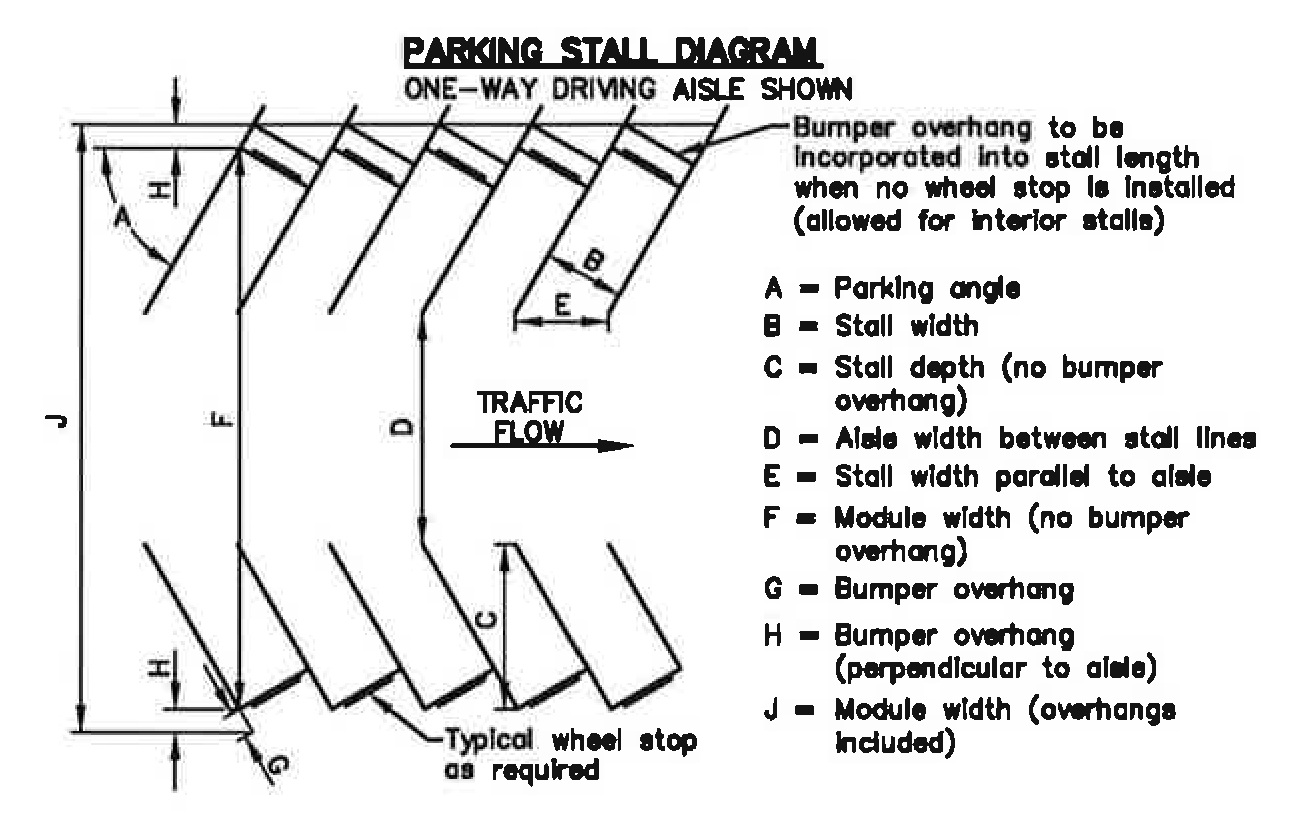
Table 2: Minimum Parking Dimension Requirements
One-Way Driving Aisle (Dimensions in Feet)
Table 3: Two-Way Driving Aisle
(Dimensions in Feet)
3.
Wheel Stops
a.
Parking spaces along the boundaries of a parking lot or adjacent to interior landscaped areas or sidewalks shall be provided with a wheel stop at least four (4) inches high, located three (3) feet back from the front of the parking stall as shown in the above diagram.
b.
Wheel stops adjacent to landscaping, bio-swales or water quality facilities shall be designed to allow storm water runoff.
c.
The paved portion of the parking stall length may be reduced by three (3) feet if replaced with three (3) feet of low lying landscape or hardscape in lieu of a wheel stop; however, a curb is still required. In other words, the traditional three-foot vehicle overhang from a wheel stop may be low-lying landscaping rather than an impervious surface.
4.
Service Drives
Service drives shall be clearly and permanently marked and defined through use of rails, fences, walls, or other barriers or markers, and shall have minimum vision clearance area formed by the intersection of the driveway center line, the street right-of-way line, and a straight line joining said lines through points fifteen (15) feet from their intersection.
5.
Credit for On-Street Parking
a.
On-Street Parking Credit. Except for residential uses, the amount of off-street parking required shall be reduced by one (1) off-street parking space for every on-street parking space adjacent to the development. On-street parking shall follow the established configuration of existing on-street parking, except that angled parking may be allowed for some streets, where permitted by City standards.
b.
The following constitutes an on-street parking space:
(1)
Parallel parking, each twenty-four (24) feet of uninterrupted curb;
(2)
Forty-five (45)/sixty (60) degree diagonal, each with ten (10) feet of curb;
(3)
Ninety (90) degree (perpendicular) parking, each with eight (8) feet of curb;
(4)
Curb space must be connected to the lot which contains the use;
(5)
Parking spaces that would not obstruct a required clear vision area, nor any other parking that violates any law or street standard; and;
(6)
On-street parking spaces credited for a specific use may not be used exclusively by that use, but shall be available for general public use at all times. No signs or actions limiting general public use of on-street spaces is permitted.
6.
Reduction in Required Parking Spaces
a.
Developments utilizing Engineered storm water bio-swales or those adjacent to environmentally constrained or sensitive areas may reduce the amount of required parking spaces by ten (10) percent when twenty-five (25) through forty-nine (49) parking spaces are required, fifteen (15) percent when fifty (50) and seventy-four (74) parking spaces are required and twenty (20) percent when more than seventy-five (75) parking spaces are required, provided the area that would have been used for parking is maintained as a habitat area or is generally adjacent to an environmentally sensitive or constrained area.
b.
Solar Panels or Wind Power - developments utilizing solar panels or wind power may reduce the amount of required parking spaces by one (1) parking space when three kilowatts of capacity in solar panels or wind power is proposed to be provided in a development.
c.
Car-Sharing - developments utilizing car-sharing parking may reduce the amount of required parking spaces by one (1) off-street parking space for each dedicated car-sharing parking space in a development. Dedicated car-sharing parking spaces shall count as spaces for parking mandates.
d.
Electric Vehicle Charging Station - developments that provide electric vehicle charging station may reduce the amount of required parking spaces by two (2) off-street parking spaces for every electric vehicle charging station provided in a development. Parking spaces that include electric vehicle charging while an automobile is parked shall count towards parking mandates.
e.
Fully Accessible Parking - developments utilizing this provision may reduce one (1) off-street parking space for every two units in a development above minimum requirements that are fully accessible to people with mobility disabilities.
f.
Any reductions under Section 16.94.020.B.6 (a-e) above, shall be cumulative and not capped.
7.
Parking Location and Shared Parking
Owners of off-street parking facilities may post a sign indicating that all parking on the site is available only for residents, customers and/or employees, as applicable.
C.
Bicycle Parking Facilities
1.
General Provisions
a.
Applicability. Bicycle parking spaces shall be provided for new development, changes of use, and major renovations, defined as construction valued at twenty-five (25) percent or more of the assessed value of the existing structure.
b.
Types of Spaces. Bicycle parking facilities shall be provided in terms of short-term bicycle parking and long-term bicycle parking. Short-term bicycle parking is intended to encourage customers and other visitors to use bicycles by providing a convenient and readily accessible place to park bicycles. Long-term bicycle parking provides employees, students, residents, commuters, and others who generally stay at a site for at least several hours a weather-protected place to park bicycles.
c.
Minimum Number of Spaces. The required total minimum number of bicycle parking spaces for each use category is shown in Table 4, Minimum Required Bicycle Parking Spaces.
d.
Minimum Number of Long-term Spaces. If a development is required to provide eight (8) or more required bicycle parking spaces in Table 4, at least twenty-five (25) percent shall be provided as long-term bicycle with a minimum of one (1) long-term bicycle parking space.
e.
Multiple Uses. When there are two or more primary uses on a site, the required bicycle parking for the site is the sum of the required bicycle parking for the individual primary uses.
2.
Location and Design.
a.
General Provisions
(1)
Each space must be at least two (2) feet by six (6) feet in area, be accessible without moving another bicycle, and provide enough space between the rack and any obstructions to use the space properly.
(2)
There must be an aisle at least five (5) feet wide behind all required bicycle parking to allow room for bicycle maneuvering. Where the bicycle parking is adjacent to a sidewalk, the maneuvering area may extend into the right-of-way.
(3)
Lighting. Bicycle parking shall be at least as well lit as vehicle parking for security.
(4)
Reserved Areas. Areas set aside for bicycle parking shall be clearly marked and reserved for bicycle parking only.
(5)
Bicycle parking in the Old Town Overlay District can be located on the sidewalk within the right-of-way. A standard inverted "U shaped" or staple design is appropriate. Alternative, creative designs are strongly encouraged.
(6)
Hazards. Bicycle parking shall not impede or create a hazard to pedestrians. Parking areas shall be located so as to not conflict with vision clearance standards.
b.
Short-term Bicycle Parking
(1)
Provide lockers or racks that meet the standards of this section.
(2)
Locate inside or outside the building within thirty (30) feet of the main entrance to the building or at least as close as the nearest vehicle parking space, whichever is closer.
c.
Long-term Bicycle Parking
(1)
Provide racks, storage rooms, or lockers in areas that are secure or monitored (e.g., visible to employees or customers or monitored by security guards).
(2)
Locate the outside bicycle parking spaces within one hundred (100) feet of the entrance that will be accessed by the intended users.
(3)
All of the spaces shall be covered.
d.
Covered Parking (Weather Protection)
(1)
When required, covered bicycle parking shall be provided in one (1) of the following ways: inside buildings, under roof overhangs or awnings, in bicycle lockers, or within or under other structures.
(2)
Where required covered bicycle parking is not within a building or locker, the cover must be permanent and designed to protect the bicycle from rainfall and provide seven-foot minimum overhead clearance.
(3)
Where required bicycle parking is provided in lockers, the lockers shall be securely anchored.
Table 4: Minimum Required Bicycle Parking Spaces
(Ord. No. 2024-002, § 1, 8-6-2024; Ord. No. 2022-004, § 2, 6-13-2022; Ord. No. 2021-010, § 2, 12-7-2021; Ord. No. 2018-007, § 2, 10-2-2018; Ord. No. 2015-003, § 2, 3-17-2015; Ord. No. 2014-012, § 3, 7-17-2014; Ord. No. 2012-008, § 2, 7-17-2012; Ord. No. 2010-015, § 2, 10-5-2010; Ord. 2006-021; 2005-009 § 8; Ord. 2000-2001 § 3; Ord. 86-851 § 3)
City of Sherwood CFEC Parking Delineated Area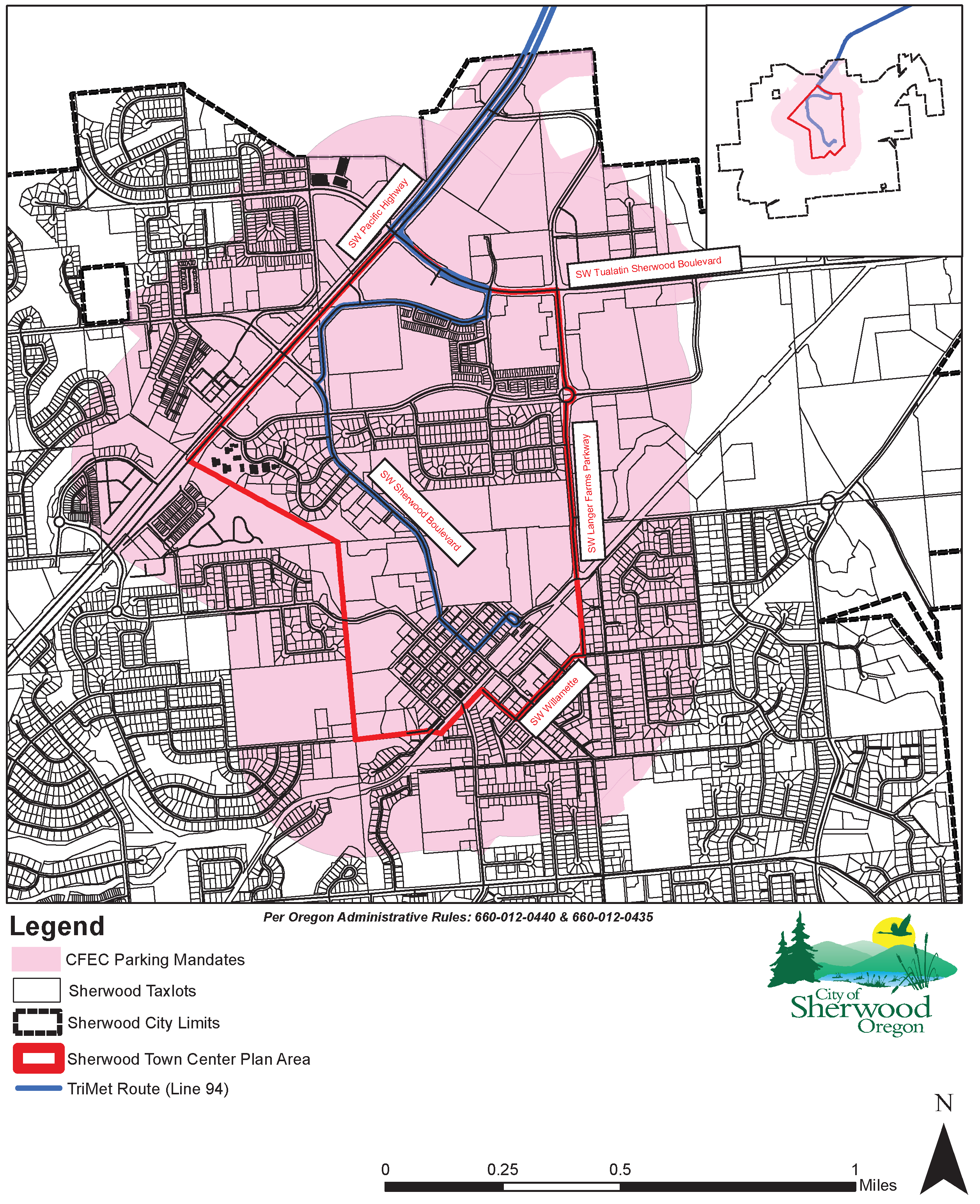
16.94.030 - Off-Street Loading Standards
A.
Minimum Standards
1.
A driveway designed for continuous forward flow of passenger vehicles for the purpose of loading and unloading passengers shall be located on the site of any school, or other public meeting place, which is designed to accommodate more than twenty five (25) persons at one time.
2.
The minimum loading area for non-residential uses shall not be less than ten (10) feet in width by twenty-five (25) feet in length and shall have an unobstructed height of fourteen (14) feet.
3.
Multiple uses on the same parcel or adjacent parcels may utilize the same loading area if it is shown in the development application that the uses will not have substantially overlapping delivery times.
4.
The following additional minimum loading space is required for buildings in excess of twenty thousand (20,000) square feet of gross floor area:
a.
Twenty thousand (20,000) to fifty (50,000) sq. ft. - five hundred (500) sq. ft.
b.
Fifty (50,000) sq. ft. or more - seven hundred fifty (750) sq. ft.
B.
Separation of Areas
Any area to be used for the maneuvering of delivery vehicles and the unloading or loading of materials shall be separated from designated off-street parking areas and designed to prevent the encroachment of delivery vehicles onto off-street parking areas or public streets. Off-street parking areas used to fulfill the requirements of this Chapter shall not be used for loading and unloading operations.
C.
Exceptions and Adjustments.
The review authority, through Site Plan Review, may approve loading areas within a street right-of-way in the Old Town Overlay District when all of the following conditions are met:
1.
Short in duration (i.e., less than one (1) hour);
2.
Infrequent (less than three (3) operations occur daily between 5:00 a.m. and 12:00 a.m. or all operations occur between 12:00 a.m. and 5:00 a.m. at a location that is not adjacent to a residential zone);
3.
Does not unreasonably obstruct traffic; [or] Does not obstruct traffic during peak traffic hours;
4.
Does not obstruct a primary emergency response route; and
5.
Is acceptable to the applicable roadway authority.
(Ord. No. 2014-012, § 3, 7-17-2014; Ord. No. 2012-008, § 2, 7-17-2012; Ord. No. 2010-015, § 2, 10-5-2010; Ord. No. 2009-005, § 2, 6-2-2009; Ord. 86-851, § 3)
16.96.010 - General Requirements for On-Site Pedestrian and Bicycle Circulation
A.
Purpose
All new development, (except single-family detached and middle housing types), shall provide a continuous system of private pathways/sidewalks. The on-site facilities shall connect to adjacent residential areas and neighborhood activity centers within one-half mile of the development. Neighborhood activity centers include but are not limited to existing or planned schools, parks, shopping areas, transit stops or employment centers.
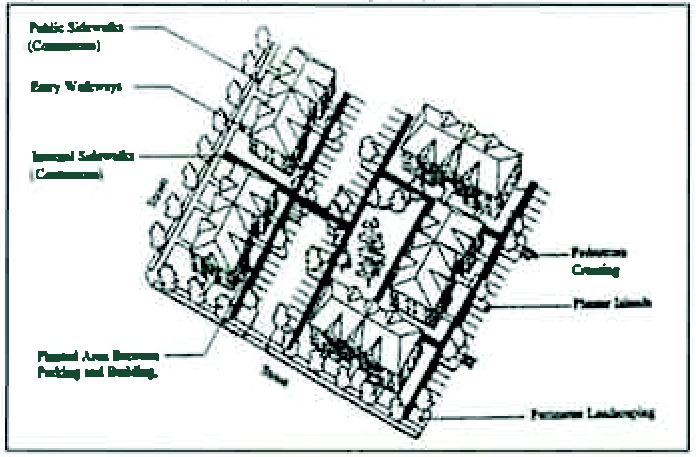
On-Site Circulation System
(Multi-Family Dwelling Example)
B.
Maintenance
No building permit or other City permit shall be issued until plans for pedestrian ingress, egress and circulation have been approved by the City. Any change increasing any ingress, egress or circulation requirements, shall be a violation of this Code unless additional facilities are provided in accordance with this Chapter. Required ingress, egress and circulation improvements shall be kept clean and in good repair.
C.
Joint Pedestrian Access
Two (2) or more uses, structures, or parcels of land may utilize the same ingress and egress when the combined ingress and egress of all uses, structures, or parcels of land satisfied the other requirements of this Code, provided that satisfactory legal evidence is presented to the City in the form of deeds, easements, leases, or contracts to clearly establish the joint use.
D.
Connection to Streets
1.
Except for joint access per this Section, all ingress and egress to a use or parcel shall connect directly to a public street, excepting alleyways with paved sidewalk.
2.
Required private sidewalks shall extend from the ground floor entrances or the ground floor landing of stairs, ramps or elevators to the public sidewalk or curb of the public street which provides required ingress and egress.
(Ord. No. 2023-002, § 2, 3-7-2023; Ord. No. 2022-004, § 2, 6-13-2022; Ord. No. 2021-010, § 2, 12-7-2021; Ord. No. 2012-008, § 2, 7-17-2012; Ord. No. 2010-015, § 2, 10-5-2010; Ord. 2006-021; Ord. 2005-009, § 6; Ord. 86-851)
16.96.020 - Minimum Residential Pedestrian Circulation Standards
Minimum standards for private, on-site pedestrian circulation improvements in residential developments:
A.
Sidewalks, Pathways and Curbs
1.
Single Family Detached, middle housing types, and Manufactured Homes on Individual Residential Lot: No on-site sidewalks and curbs are required when not part of a proposed partition or subdivision. Pedestrian circulation standards for subdivisions and partitions are located in Section 16.106.060 Sidewalks. For cottage clusters, on-site pedestrian pathways are required consistent with Section 16.14.040.
2.
Multi-Family Dwelling:
a.
A system of private pedestrian sidewalks/pathways extending throughout the development site shall connect each dwelling unit to vehicular parking areas, common open space, storage areas, recreation facilities, adjacent developments, transit facilities within five hundred (500) feet of the site, and future phases of development. Main building entrances shall also be connected to one another.
b.
Required private pathways/sidewalks shall extend from the ground floor entrances or the ground floor landing of stairs, ramps or elevators, on one (1) side of approved driveways connecting to the public sidewalk or curb of the public street that provides required ingress and egress. Curbs shall also be required at a standard approved by the Review Authority.
c.
Private Pathway/Sidewalk Design. Private pathway surfaces shall be concrete, brick/masonry pavers, or other durable surface, at least five (5) feet wide and conform to ADA standards. Where the system crosses a parking area, driveway or street, it shall be clearly marked with contrasting paving materials or raised crosswalk (hump).
d.
Exceptions Private pathways/sidewalks shall not be required where physical or topographic conditions make a connection impracticable, where buildings or other existing development on adjacent lands physically preclude a connection now or in the future considering the potential for redevelopment; or pathways would violate provisions of leases, restrictions or other agreements.
(Ord. No. 2023-002, § 2, 3-7-2023; Ord. No. 2022-004, § 2, 6-13-2022; Ord. No. 2021-010, § 2, 12-7-2021; Ord. No. 2012-008, § 2, 7-17-2012; Ord. No. 2010-015, § 2, 10-5-2010; Ord. 2006-021; Ord. 2005-009, §§ 5, 8; 91-922)
16.96.030 - Minimum Non-Residential Pedestrian Circulation Standards
Minimum standards for private, on-site pedestrian circulation improvements in non-residential developments:
A.
Sidewalks and Curbs
1.
A private pathway/sidewalk system extending throughout the development site shall be required to connect to existing development, to public rights-of-way with or without improvements, to parking and storage areas, and to connect all building entrances to one another. The system shall also connect to transit facilities within five hundred (500) feet of the site, future phases of development, and whenever possible to parks and open spaces.
2.
Curbs shall also be required at a standard approved by the Hearing Authority. Private pathways/sidewalks shall be connected to public rights-of-way along driveways but may be allowed other than along driveways if approved by the Hearing Authority.
3.
Private Pathway/Sidewalk Design. Private pathway surfaces shall be concrete, asphalt, brick/masonry pavers, or other pervious durable surface. Primary pathways connecting front entrances to the right of way shall be at least 6 feet wide and conform to ADA standards. Secondary pathways between buildings and within parking areas shall be a minimum of four (4) feet wide and/or conform to ADA standards. Where the system crosses a parking area, driveway or street, it shall be clearly marked with contrasting paving materials or raised crosswalk (hump). At a minimum all crosswalks shall include painted striping.
4.
Exceptions. Private pathways/sidewalks shall not be required where physical or topographic conditions make a connection impracticable, where buildings or other existing development on adjacent lands physically preclude a connection now or in the future considering the potential for redevelopment; or pathways would violate provisions of leases, restrictions or other agreements.
(Ord. No. 2023-002, § 2, 3-7-2023; Ord. No. 2010-015, § 2, 10-5-2010; Ord. 2006-021; Ord. 2005-009, § 8; Ord. 86-851)
16.96.040 - General Requirements for On-Site Vehicle Circulation
A.
Maintenance
No building permit or other City permit shall be issued until plans for vehicle ingress, egress and circulation have been approved by the City. Any change increasing any ingress, egress or circulation requirements, shall be a violation of this Code unless additional facilities are provided in accordance with this Chapter.
B.
Joint Access
Two (2) or more uses, structures, or parcels of land are strongly encouraged to utilize jointly the same ingress and egress when the combined ingress and egress of all uses, structures, or parcels of land satisfy the other requirements of this Code, provided that satisfactory legal evidence is presented to the City in the form of deeds, easements, leases, or contracts to clearly establish the joint use. In some cases, the City may require a joint access to improve safety, vision clearance, site distance, and comply with access spacing standards for the applicable street classification.
C.
Connection to Streets
Except for joint access per this Section, all ingress and egress to a use or parcel shall connect directly to a public street, excepting alleyways.
D.
Maintenance of Required Improvements
Required vehicle ingress, egress and circulation improvements shall be kept clean and in good repair.
E.
Service Drives
Service drives shall be provided pursuant to Section 16.94.030.
(Ord. No. 2023-002, § 2, 3-7-2023; Ord. No. 2010-015, § 2, 10-5-2010; Ord. 2005-009 § 8)
16.96.050 - Minimum Residential Vehicle Circulation Standards
Minimum standards for private, on-site vehicle circulation improvements in residential developments:
A.
Driveways
1.
Single-Family Detached with or without an Accessory Dwelling Unit (ADU). One (1) driveway improved with hard surface pavement with a minimum width of ten (10) feet and maximum width of 24 ft., not to exceed a grade of 14%. Lots with more than 60 ft. of frontage on a public street are permitted a maximum width of 30 ft. Permeable surfaces and planting strips between driveway ramps are encouraged in order to reduce stormwater runoff.
2.
Duplex: One (1) shared driveway improved with hard surface pavement with a minimum width of twenty (20) feet; or two (2) driveways improved with hard surface pavement with a minimum width of ten (10) feet each. Permeable surfaces and planting strips between driveway ramps are encouraged in order to reduce stormwater runoff.
3.
Townhome: A maximum of one (1) driveway per unit improved with hard surface pavement with a minimum width of ten (10) feet. See also the provisions of 16.14.020.D.
4.
Triplex and Quadplex: See the provisions of 16.14.030.A.
5.
Cottage Clusters: See the provisions of 16.14.040.C
6.
Multi-Family: Improved hard surface driveways are required as follows:
(Ord. No. 2023-002, § 2, 3-7-2023)
16.96.060 - Minimum Non-Residential Vehicle Circulation Standards
Minimum standards for private, on-site circulation improvements in non-residential developments:
A.
Driveways
1.
Commercial and Mixed-Use: Improved hard surface driveways are required as follows:
2.
Industrial: Improved hard surfaced driveways are required as follows:
3.
Surface materials are encouraged to be pervious when appropriate, considering soils, anticipated vehicle and other pertinent factors.
(Ord. No. 2023-002, § 2, 3-7-2023)
16.98.010 - Recreational Vehicles and Equipment
Recreational vehicles and equipment may be stored only within designated and improved off-street parking areas. Such areas shall meet the screening and landscaping requirements of Section 16.92.030.
16.98.020 - Solid Waste and Recycling Storage
All uses shall provide solid waste and recycling storage receptacles which are adequately sized to accommodate all solid waste generated on site. All solid waste and recycling storage areas and receptacles shall be located out of public view. Solid waste and recycling receptacles for multi-family, commercial, industrial and institutional uses shall be screened by six (6) foot high sight-obscuring fence or masonry wall and shall be easily accessible to collection vehicles.
(Ord. No. 2010-015, § 2, 10-5-2010; Ord. 2006-021; Ord. 86-851, § 3)
16.98.030 - Material Storage
A.
Generally. Except as otherwise provided herein, external material storage is prohibited, except in commercial and industrial zones where storage areas are approved by the Review Authority as part of a site plan or per Section 16.98.040.
B.
Standards. Except as per Section 16.98.040, all service, repair, storage, and merchandise display activities carried on in connection with any commercial or industrial activity, and not conducted within an enclosed building, shall be screened from the view of all adjacent properties and adjacent streets by a six (6) foot to eight (8) foot high, sight obscuring fence subject to chapter 16.58.020. In addition, unless adjacent parcels to the side and rear of the storage area have existing solid evergreen screening or sight-obscuring fencing in place, new evergreen screening no less than three (3) feet in height shall be planted along side and rear property lines. Where other provisions of this Code require evergreen screening, fencing, or a landscaped berm along side and rear property lines, the additional screening stipulated by this Section shall not be required.
C.
Hazardous Materials. Storage of hazardous, corrosive, flammable, or explosive materials, if such storage is otherwise permitted by this Code, shall comply with all local fire codes, and Federal and State regulations.
(Ord. No. 2011-003, § 2, 4-5-2011; Ord. No. 2011-001, §§ 1, 2, 2-15-2011; Ord. No. 2010-015, § 2, 10-5-2010; Ord. 89-901, § 1; Ord. 86-851, § 3)
16.98.040 - Outdoor Sales and Merchandise Display
A.
Sales Permitted
Outdoor sales and merchandise display activities, including sales and merchandise display that is located inside when the business is closed but otherwise located outside, shall be permitted when such activities are deemed by the Commission to be a customary and integral part of a permitted commercial or industrial use.
1.
Permanent outdoor sales and merchandise display are in use year round or in excess of four (4) months per year and require the location to be reviewed through a site plan review. They will be reviewed as conditional uses in accordance with Chapter 16.82. Permanent outdoor and merchandise display are subject to the standards outlined in subsection B, below.
2.
Temporary outdoor sales and merchandise display are seasonal and are not displayed year round and must meet the requirements of Chapter 16.86 (temporary uses). When the temporary use is not occurring the site shall return to its original state.
3.
Food vendors including food carts, ice cream trucks, hotdog stands or similar uses are only permitted as a permanent outdoor sale use as described in A.1 above.
B.
Standards
1.
Outdoor sales and merchandise display areas shall be kept free of debris. Merchandise shall be stacked or arranged, or within a display structure. Display structures shall be secured and stable.
2.
Outdoor sales and merchandise display shall not be located within required yard, building, or landscape setbacks, except where there is intervening right-of-way of a width equal to or greater than the required setback; and shall not interfere with on-site or off-site pedestrian or vehicular circulation.
3.
Outdoor retail sales and merchandise display areas for vehicles, boats, manufactured homes, farm equipment, and other similar uses shall be improved with asphalt surfacing, crushed rock, or other dust-free materials.
4.
Additional standards may apply to outdoor sales and merchandise display dependent on specific restrictions in the zone.
(Ord. No. 2012-001, § 2, 1-3-2012; Ord. No. 2010-015, § 2, 10-5-2010; Ord. 89-901, § 1)
16.100.010 - Definitions
For purposes of Chapters 16.100, 16.101, and 16.102, the following terms shall have the following meanings, except when the context requires otherwise:
A.
Animated Signs: Signs that are animated by a person or animal using, carrying, or wearing a sign.
B.
Area, Sign Face: The area of the sign shall be measured as follows if the sign is composed of one (1) or more individual cabinets or sides:
a.
The area around and enclosing the perimeter of each cabinet, sign face or module shall be summed and then totaled to determine total area. The perimeter of measurable area shall include all written advertising copy, symbols or logos.
b.
If the sign is composed of more than two (2) sign cabinets, sign faces, or modules, the area enclosing the entire perimeter of all cabinets and/or modules within a single, continuous geometric figure shall be the area of the sign.
C.
Awning or Canopy Sign: A sign attached below a building awning, porch, canopy, or other roof-like structure and limited to six (6) square feet.
D.
Banner Sign: Signs made of lightweight fabric or other non-rigid material supported by two (2) or more points, and hung on a building, which does not meet the definition of a flag.
E.
Commercial Center: Any lot, or combination of lots legally bound together by a deed restriction, restrictive covenant or other recorded document, having at least two (2) but no more than three (3) legally permitted businesses on the site.
F.
Commercial Plaza: Any lot, or combination of lots legally bound together by a deed restriction, restrictive covenant or other recorded document, having four (4) or more legally permitted businesses on the site.
G.
Electronic Message Signs: Consistent with 16.100.020.E. and F., electronic message signs may not change more than once every thirty (30) seconds. In addition, the change may not involve movement or flashing. Electronic message signs are limited to no more than thirty-five (35) percent of the total sign area per sign face.
H.
Flag: A sign which consists of a single piece of lightweight material which is designed to, or which actually does, wave or move in the wind, which meets all of the following criteria:
a.
Is two-sided and rectangular in shape.
b.
Is a maximum of six (6) feet wide and a maximum of four (4) feet tall in all residential zones, and a maximum of eight (8) feet wide and a maximum of five (5) feet tall in all other zones.
c.
Is attached by one side, which must be one of the two shorter sides, to a single metal pole, which is either (1) vertical and permanently installed in the ground or (2) vertical or a maximum of 45 degrees from vertical and attached to a building by a wall mount.
I.
Feather sign: A sign constructed in whole or in part of lightweight material which is designed to, or which actually does, wave or move in the wind, and which does not meet the definition of a flag or banner sign. Feather signs are sometimes commonly referred to as teardrop signs, feather banners, or flag signs.
J.
Free-Standing Signs:
a.
Monument Sign: A sign constructed so that it is erected on grade or set into a hillside. If the monument sign is supported by poles, the sign shall extend to cover the support poles to within four (4) inches of the grade. Each free-standing monument sign shall have no more than two (2) faces.
b.
Column Sign: A sign supported by two (2) square columns covered by wood, brick, metal or stone with a minimum width of twenty-four (24) inches or a single square column with a minimum width of thirty-six (36) inches.
c.
Pole Sign: A free-standing sign mounted on one (1) vertical support less than thirty-six (36) inches wide.
K.
Over-Right-of-Way Banner Sign: A banner sign, placed over a public right of way for a limited period of time, by or with the permission of the agency with jurisdiction over said right-of-way.
L.
Permanent Residential Development Sign: Any permanent sign erected within 100 feet of any entrance to a residential subdivision or Planned Unit Development (PUD).
M.
Portable A-Frame Sign: A double-faced portable sign with an A-shaped frame, no greater than four (4) feet in height and seven (7) square feet per sign face, composed of two (2) sign boards attached at the top and separated at the bottom, and not supported by a structure in the ground.
N.
Portable Sign: Small movable signs no greater than twenty-four (24) inches in height and a sign face no larger than eighteen (18) inches by twenty-four (24) inches in size used for a temporary period of time. Portable signs include stand-alone signs, not attached to a building or any other permanent structure. Examples include political signs, real estate open house signs, and other similar signage.
O.
Projecting Sign: A projecting sign is a sign which projects from and is supported by a wall or parapet of a building with the display surface of the sign in a plane that is generally perpendicular to the wall.
P.
Roof Signs: Signs erected in or directly above a roof or parapet of a building or structure.
Q.
Rotating or Revolving Signs: Signs that rotate or turn in motion by electrical or mechanical means in a circular pattern.
R.
Single Business Site: Any lot, or combination of lots legally bound together by a deed restriction, restrictive covenant or any other recorded document, having a single legally permitted business on the site.
S.
Snipe Sign: Any sign of any size, made of any material, including paper, cardboard, wood and metal, when such sign is tacked, nailed, posted, pasted, glued, or otherwise attached to trees, poles, fences or other objects.
T.
Temporary Sign: Signs that are firmly affixed to a temporary structure that is placed into the ground and designed to be temporary. Characteristics of a temporary sign include signs constructed of a rigid material attached to wood or metal posts which do not require permanent footings. Examples of temporary signs include, but are not limited to residential and commercial real estate signs.
U.
Vehicle Sign: A sign that is attached to a vehicle, on or above the vehicle that is parked in a location for the primary purpose of advertising.
V.
Wall Sign: A sign attached to, erected against or painted on a wall of a building.
(Ord. No. 2021-010, § 2, 12-7-2021; Ord. No. 2020-005, § 2, 9-7-2021)
16.100.020 - Prohibited Signs
A.
Unsafe or Unmaintained Signs
All signs and sign structures must be constructed, erected and maintained to withstand the wind, seismic and other loads as specified in the Uniform Building Code. No sign shall be constructed, erected or maintained in violation of the maintenance provisions of this Chapter.
B.
Signs on Streets
No sign shall substantially obstruct free and clear vision along streets or by reason of the position, shape or color, may interfere with, obstruct the view of, or be confused with any authorized traffic signal or device. No sign shall use the words "stop", "look", "danger", or any other similar word, phrase, symbol or character that interferes with or misleads motorists, pedestrians or bicyclists.
C.
Obstructing Signs
No sign or sign structure shall be located or constructed so that it obstructs access to any fire escape, exit doorway or other means of egress from a building. No sign or supporting structure shall cover, wholly or partially, any window or doorway in any manner that will substantially limit access to the building in case of fire.
D.
Rotating or Revolving Signs
Rotating or revolving signs are prohibited.
E.
Illuminated Signs
Flashing signs, exposed reflective type bulbs, strobe lights, rotary beacons, par spots, zip lights and similar devices are prohibited. No exposed incandescent lamp which exceeds twenty-five (25) watts shall be used on the exterior surface of any sign so as to expose the face of such bulb or lamp to a public street. All permitted signs shall bear an approved Underwriters Laboratory label or equivalent third party product safety testing and certification organization.
F.
Changing Image Signs
Any sign that, through the use of moving structural elements, flashing or sequential lights, lighting elements, or other automated method, results in movement, the appearance of movement or change of sign image or message is prohibited. Changing image signs do not include otherwise static signs where illumination is turned off and back on at a maximum of once every thirty (30) seconds and such change does not involve movement or flashing.
G.
Pole Signs, over six (6) feet in height
H.
Signs on Vacant Land
Any sign on unimproved property, unless allowed as a portable or temporary sign under Chapter 16.102 is prohibited.
I.
Permanent Residential Development Signs
J.
Roof Signs
K.
Feather Signs
L.
Flags, except as provided in 16.101.010(C).
(Ord. No. 2020-005, § 2, 9-7-2021)
16.100.030 - Violations
Violation of Chapter 16.100 is a Class B violation. Each day on which a violation continues shall be considered a separate violation.
(Ord. No. 2020-005, § 2, 9-7-2021)
16.101.010 - Common Regulations
A.
Sign Permits
1.
Except as otherwise provided in this Section and in Chapter 16.102, a person may not construct, install, structurally alter or relocate any sign without first obtaining an administrative sign permit from the City as required by Chapter 16.72, including payment of the fee required by Section 16.74.010. In addition, all permitted illuminated signs are subject to the provisions of the State Electrical Code and any applicable permit fees.
B.
Sign Application.
1.
Application for a sign permit shall be made upon forms provided by the City and shall include the following information:
a.
Name, address and telephone number of the applicant. Name, address, telephone number and signature of the property owner.
b.
Location of the building structure, lot or parcel to which or upon which the sign is to be attached or erected.
c.
A scaled drawing showing sign design including colors, dimensions, sign size, height above ground, method of attachment, construction and materials, type, source and intensity of illumination and the relationship to any building to which the sign will be attached.
d.
A plot plan drawn to scale indicating the location of all buildings, property lines, existing signs, street lights, easements, and overhead power lines on the same premises.
e.
Name, address and telephone number of the person or firm who will erect, construct and maintain the sign.
C.
Exceptions
1.
The following signs do not require a permanent sign permit but shall conform to all other applicable provisions of this Chapter:
a.
Traffic signs installed per the Manual of Uniform Traffic Control Devices and other federal, state and local traffic sign regulations.
b.
Changes to the copy of a legally erected, painted or printed advertising sign, theater marquee or similar sign specifically designed for the use of replaceable copy that does not alter the dimensions of the sign.
c.
On-site painting, repainting, cleaning and normal maintenance and repair of a sign.
d.
A sign that is accessory to a construction site and construction activities that does not exceed thirty-two (32) square feet in area, provided that such sign is removed within thirty (30) days from date of issuance of the final occupancy permit or within two (2) years, whichever is less.
e.
Portable/temporary signs allowed per Chapter 16.102.
f.
Public utility signs and other signs required by law.
g.
Signs on private property three (3) square feet or less per sign face and under three (3) feet tall when freestanding and installed to be readable only on private property.
h.
Flags on private property which meet the following standards:
A property in a residential zone may have up to two flags or twenty-four (24) square feet of flags, whichever is less. Flag poles shall not exceed twenty (20) feet in height and must be located within the front yard setback.
A property in a nonresidential zone may have up to four (4) flags or one-hundred and twenty (120) square feet of flags, whichever is less. Flag poles shall not exceed forty (40) feet in height and must be located within the front yard setback.
D.
Violations
1.
The City may order the removal of any sign erected or maintained in violation of the provisions of this Chapter. If the City orders the removal of a sign under this Section, the City shall give ninety (90) days written notice to the owner of the sign or, if the owner of the sign cannot be notified, to the owner of the building, structure or premises on which such sign is located, to remove the sign or to bring it into compliance. After ninety (90) days the City may remove the sign at cost to the owner of the building, structure or premises. All costs incurred by the City will be a lien against the land or premises on which the sign is located and may be collected or foreclosed in the same manner as an assessment lien.
E.
Nonconforming Signs
1.
Signs that do not conform to the provisions of this Chapter are regarded as nonconforming signs and shall be brought into compliance with this Code's standards.
2.
Except as exempted in subsection four (4) below, a nonconforming sign in existence on the effective date of Ordinance 2005-002, shall be brought into compliance within five (5) years of the effective date of Ordinance 2005-002. A nonconforming sign erected after the effective date of Ordinance 2005-002 or made non-conforming by subsequent sign ordinance amendments, shall be brought into compliance within five (5) years of the issuance of a building permit to construct the sign or adoption of the ordinance creating the non-conformity. A nonconforming sign that is not brought into compliance within five (5) years shall be removed at the expense of the sign owner or, at the City's discretion, the owner of the property upon which it is located.
3.
Except as exempted in subsection 4 below, a nonconforming sign that is structurally altered, relocated or replaced shall immediately be brought into compliance.
4.
A sign that is forty five (45) feet tall or less and that is three hundred (300) square feet or less in size is exempt from the requirement to come into compliance within five (5) years and may remain until: a.) structurally altered, relocated or replaced, or b.) until such time as the property on which it is located is developed or re-developed pursuant to a Type IV land use application.
F.
Abandoned Signs
A person who owns or leases a sign shall remove the sign when the business advertised is discontinued or moves. The City shall give the owner of the building, structure or premises upon which an abandoned sign is located ninety (90) days written notice to remove the sign. After ninety (90) days the City may remove the sign at cost to the owner of the building, structure or premises. All costs incurred by the City may be a lien against the land or premises on which such sign is located and may be collected or foreclosed in the same manner as similar liens.
G.
City-Owned Signs
Permanent signs owned by the City of Sherwood shall be exempt from the provisions of this Code.
H.
Construction and Maintenance
Except as otherwise provided in this Code, the construction of all signs or sign structures shall conform to applicable provisions of the Uniform Building Code. All signs, supports, braces, guys and anchors and sign sites shall be kept in good repair and maintained in a clean, safe condition.
(Ord. No. 2020-005, § 2, 9-7-2021)
16.101.030 - Sign Regulations by Zone
A.
Residential Zones
No permanent sign requiring a permit shall be allowed in residential zones except for the following:
1.
Public/Semi-Public Uses
For churches, schools and other public uses located within a residential zone:
a.
One (1) wall sign not exceeding thirty-six (36) square feet shall be permitted on a maximum of two (2) building elevations. Wall signs must be attached flat against the building face.
b.
One (1) free-standing sign per street frontage not exceeding thirty-six (36) square feet per sign face shall be permitted. A minimum setback of fifteen (15) feet from property lines adjacent to public streets is required. The maximum height of any portion of a free-standing sign shall be limited to six (6) feet from ground level at its base.
2.
Multi-Family Dwelling Development Signs
a.
One (1) non-illuminated free-standing sign per street frontage not exceeding thirty-six (36) square feet per sign face shall be permitted on a property with a permitted multi-family development, and the maximum height of any portion of the sign shall be limited to six (6) feet from ground level at its base.
3.
Non-Residential Signs
a.
One (1) monument sign not more than sixteen (16) square feet in area on a property with a permitted non-residential use in a residential zone shall be allowed.
B.
Commercial Zones
A permanent sign that requires a sign permit is not allowed in a commercial zone except for the following:
1.
Free-Standing Signs
a.
Number Permitted: Except as otherwise provided in (1-3) below, one (1) multifaced, free-standing sign.
(1)
Where the total street frontage exceeds three-hundred (300) feet in length, one (1) additional free-standing sign is permitted. Except as otherwise permitted in (2) or (3) below, no more than one (1) free-standing sign per street frontage shall be permitted. Where two (2) or more signs are allowed due to multiple frontages, each sign shall be oriented to face a different direction or street frontage.
(2)
One (1) additional free-standing monument sign may be provided for fueling stations.
(3)
A Commercial Center or Commercial Plaza with at least two (2) stand- alone businesses may have one (1) additional free-standing sign provided the site has more than three hundred (300) feet of frontage
b.
Height Limit: The maximum sign height shall not exceed six (6) feet in all commercial zones except that in the locations identified in (1-5) below, the height, for no more than one (1) sign per single business site, commercial center or plaza, may be increased to no more than twenty (20) feet to allow for the construction of a column sign only. The exception locations are identified as:
(1)
On or within one hundred (100) feet of Pacific Highway,
(2)
Tualatin-Sherwood Road between 99W and SW Olds Place,
(3)
Roy Rogers Road between 99W and Borchers,
(4)
Sherwood Boulevard between 99W and Century Boulevard, and
(5)
Edy Road between 99W and Borchers.
The height of the sign shall be measured from the average grade of the building footprint located on site to the highest point of the sign. For sites with more than one (1) building, the average grade of the building closest to the location of the sign shall be used.
c.
Clearance: Signs are prohibited over a driveway or parking area.
d.
Area: The maximum sign area for all commercial zones shall not exceed thirty-six (36) square feet per sign face with a maximum of two (2) sign faces permitted except that in those areas identified in 16.100.030.B.1.b.1—5, the sign area for one (1) sign may be increased up to one hundred (100) square feet for a commercial center or up to one hundred fifty (150) square feet for a commercial plaza.
e.
Location: No free-standing sign or any portion of any free-standing sign shall be located within a public right-of-way. Free-standing signs must comply with the Clear Vision Area requirements of Section 16.58.010.
2.
Wall Signs
a.
Wall signs in combination with projecting signs shall not exceed twenty (20) percent of the gross area face of the building to which the sign is attached. Signs placed on or within one (1) foot of display windows and designed to be viewed from the exterior of the building shall be included in determining the amount of signage. A minimum of thirty (30) square feet is guaranteed and the maximum shall be two-hundred fifty (250) square feet. Wall signs may not project more than one and one-half (1½) feet from the wall to which they are attached. Wall signs shall be constructed of rigid materials. No banner sign shall be framed or encased in a manner to be constructed as a wall sign.
3.
Projecting Signs
a.
Projecting signs supported by a wall of a building or structure shall be permitted under the following conditions:
(1)
Only one (1) projecting sign will be permitted per store front. Projecting signs are attached so that they hang perpendicular to the facade of the building, and are limited in size by the provisions of 16.101.030 above.
(a)
In addition, businesses within commercial districts with a porch or awning, will be permitted to have one (1) additional awning sign that is perpendicular to the building and oriented to pedestrians provided that they are:
(i)
Hung from the roof of the porch or awning;
(ii)
No more than six (6) square feet in area; and
(iii)
The bottom of the sign is at least eight (8) feet above the grade of the sidewalk.
(2)
No projecting sign shall be permitted on the same premises where there is a free-standing sign.
(3)
No projecting sign shall extend more than three (3) feet above the roof line at the wall or the top of a parapet wall, whichever is higher.
(4)
When a projecting sign is used no angle irons guy wires or braces shall be visible except those that are an integral part of the overall design such as decorative metals or woods or unless they are required for safety.
(5)
No sign shall project to within two (2) feet of the curb of a public street or beyond five (5) feet from the building face, whichever is less.
4.
Directional Signs
a.
The requirements of chapter 16.102 shall apply.
C.
Industrial Zones
No permanent sign requiring a permit shall be allowed in industrial zones except for the following:
1.
Free Standing Signs
a.
Industrial zoned properties that have an approved PUD and approval for permitted commercial uses, shall apply requirements in Section 16.101.030.B.1—4.
b.
Other than allowed under (a) above, a property in an industrial zone may have one (1) multi-faced free-standing sign per street frontage provided the height does not exceed six (6) feet and the sign face does not exceed thirty-six (36) square feet per sign face for a maximum of seventy-two (72) square feet.
2.
Directional Signs
a.
The requirements of Chapter 16.102 shall apply.
3.
Wall Signs
a.
The requirements of Section 16.101.030.B.2, Commercial Signs shall apply.
D.
Institutional and Public zones
No permanent sign requiring a permit shall be allowed in an institutional public zone except for the following:
1.
Wall Signs shall be permitted as follows.
a.
The maximum total wall sign area shall not exceed one-hundred (100) square feet across a maximum of two (2) wall signs, which may be located across a maximum of two building elevations. No wall sign may be larger than twenty percent (20%) of the size of the wall on which it is located.
b.
For buildings located on property adjacent to one or more collector or arterial roadways, when the nearest point of the building to the right-of-way for any such roadway is located at a distance of at least one-hundred (100) feet from said right-of- way, the maximum total wall sign area described in subsection (a) above shall be increased to one-hundred fifty (150) square feet. All other requirements of subsection (a) shall still apply.
2.
Free Standing Signs shall be permitted as follows:
a.
One (1) free-standing sign per street frontage, with a size not exceeding thirty-six (36) square feet per sign face, shall be permitted. A minimum setback of fifteen (15) feet from property lines adjacent to public streets is required. The maximum height of any portion of a free-standing sign shall be limited to six (6) feet from ground level at its base.
(Ord. No. 2021-010, § 2, 12-7-2021; Ord. No. 2020-005, § 2, 9-7-2021)
16.101.040 - Violations
Violation of Chapter 16.101 is a Class B violation. Each day on which a violation continues shall be considered a separate violation.
(Ord. No. 2020-005, § 2, 9-7-2021)
16.102.010 - Temporary and Portable Signs—Purpose
Temporary, portable, and banner signs regulated by this code are intended to allow the City of Sherwood citizens to exercise their right to free speech while ensuring that the City's streets remain clear of visual clutter and safe for travel. Signs that are not clearly regulated by the provisions of this chapter are subject to the standards for permanent signs in Chapter 16.101. Definitions for permanent, temporary, and portable signs can be found in Section 16.100.010. All temporary, portable, and banner signs are subject to the time, place, and manner regulations of this chapter.
(Ord. No. 2020-005, § 2, 9-7-2021)
16.102.020 - Temporary, Portable, and Banner Signs—General Regulations
A.
Temporary and portable signs are prohibited in the following locations:
1.
Within any ODOT right-of-way, including but not limited to Highway 99.
2.
Within any Washington County right-of-way, including but not limited to Roy Rogers Road, Edy Road, and Tualatin-Sherwood Road. However, if the city or county right-of-way extends more than 50 feet beyond the outermost point of road paving, curb or sidewalk, a banner or other temporary sign may be displayed at 50 feet or more from the curb or edge of pavement, subject to authorization from the entity with jurisdiction over the right-of-way.
3.
Within any clear vision area as defined in Section 16.58.010.
B.
The following temporary, portable, and banner signs are exempt from the provisions of this chapter.
1.
Public notice signs as required by Section 16.72.020, or by any federal, state or local law.
2.
Signs that have been approved in association with a City of Sherwood Special Event Permit.
3.
A public-necessity sign such as safety and instructional signs, for public facilities and public parks, or City sponsored community events, installed by or with permission of the City of Sherwood.
4.
Over-Right-of-Way Banner Signs.
C.
Temporary and portable signs on private property do not require a permit, but are subject to all of the applicable standards within this section.
D.
Signs shall not be placed on private property without the express permission of the property owner.
E.
Signs shall not be illuminated and may not include pennant strings, balloons, streamers, spinners, propellers, search lights, or other items that involve motion to attract attention.
F.
Signs shall not obstruct vehicular or pedestrian traffic.
G.
It is the responsibility of the person posting a temporary or portable sign to remove it.
H.
In the event that a sign is requested by a business whose regular access is blocked due to road construction and/or road closures, signs may be permitted to remain in the public right-of-way, at an approved location, until construction is completed. Such signs do not require a permit. Such signs may be located in ODOT, City of Sherwood or Washington County rights-of-way if approved by the agency.
(Ord. No. 2020-005, § 2, 9-7-2021)
16.102.030 - Temporary Sign Regulations
A.
The following regulations apply to all temporary signs as defined in Section 16.100.010.
1.
Temporary signs on properties zoned VLDR, LDR, and MDRL, may be double sided, but are limited to a maximum height of six (6) feet, and a maximum sign width of three (3) feet. The actual sign face of each side of the sign shall not exceed six (6) square feet. The sign must be constructed of wood or vinyl in the colonial post style and is allowed one (1) rider not to exceed six (6) inches in height.
2.
Temporary signs in all other zones may be double sided, and are limited to a maximum height of eight and one-half (8½) feet, and a maximum width of four (4) feet. The actual sign face of each side of the sign shall not exceed thirty-two (32) square feet.
3.
No more than one (1) temporary sign is permitted on any one (1) lot unless the property fronts more than one (1) street or has more than three hundred (300) feet of frontage along a street. In these limited cases up to two (2) temporary signs may be allowed.
4.
Where multiple temporary signs are placed on the same property, as authorized above, the signs shall be spaced at least fifty (50) feet apart.
5.
Temporary signs are not permitted in the public right-of-way.
(Ord. No. 2020-005, § 2, 9-7-2021)
16.102.040 - Portable Sign Regulations
A.
The following regulations apply to all portable signs as defined in Section 16.100.010 in all zones.
1.
No more than four (4) portable signs are allowed on any residentially zoned lot, except that properties over an acre in size that are developed with an approved nonresidential use may place one (1) portable sign every fifty (50) feet for the length of the sites frontage along a public street.
2.
No more than (1) portable sign per business is allowed in all other zones, except the Institutional and Public (I-P) zone.
3.
Properties zoned Institutional and Public (I-P) may place one (1) portable sign, every fifty (50) feet for the length of the sites frontage along a public street.
4.
No portable sign shall be placed in any publicly owned right-of-way except on Friday after 6:00 a.m. through Sunday at 6:00 p.m. unless exempt per B below or 16.102.020.B above or unless the following Monday is a Federal holiday in which case the sign can be within the right-of-way through 6:00 p.m. Monday.
5.
Portable signs shall also meet the following standards:
a.
Because maintenance of the right-of-way in front of a single-family home is the responsibility of the homeowner, signs are not permitted in the right-of-way adjacent to residential zones without the authorization of the adjoining property owner.
b.
Portable signs may not be located within the right-of-way adjacent to City owned property or on City owned property without express permission of the City Manager or designee.
c.
Signs shall not be located within, or within 50 feet of the entry and exit lanes of, a round-about and shall not otherwise create a traffic safety or maintenance problem.
d.
Signs shall be freestanding and shall not be attached to any structure or vegetation such as utility poles, traffic signs, street signs, trees, or similar items.
e.
Portable signs shall be either an A-frame design or shall be attached to a wood or wire h-frame stake driven into the ground well clear of tree roots, irrigation lines, and any other underground utility that could be damaged by such stakes.
f.
Portable signs shall be spaced at least twenty-five (25) feet apart when placed on the same property. The City may remove all signs in any right-of-way area where signs are placed less than twenty-five (25) feet apart.
B.
The following regulations apply to all portable signs located within the Old Town Overlay District.
1.
A business who has a valid City of Sherwood business license and is physically located within the Old Town Overlay District may display two (2) portable signs, without a permit, on private property or within the public right-of-way in the Old Town Overlay District.
2.
Each portable sign can be a maximum of seven (7) square feet per sign face. A business that wishes to place a portable sign on the sidewalk in front of someone else's property must receive written permission from the property owner of the property where the sign is placed. Signs must be sited per Section 16.102.040.
(Ord. No. 2020-005, § 2, 9-7-2021)
16.102.050 - Banner Sign Regulations
A.
The following banner signs are exempt from these regulations:
1.
Banner signs not visible from a public street.
2.
Signs that meet any of the provisions of section 16.102.020(B).
B.
The following regulations apply to all banner signs as defined in Section 16.100.010 in all zones.
1.
Except for banner signs approved as over the right-of-way banner signs or 5 below, banner signs shall be firmly attached to the side of a building. No banner sign shall be attached to a fence, wall, building roofs, vehicles, trailers, or anything else.
2.
Banner signs shall not cover building windows.
3.
Banner signs shall be maintained in good condition. They shall not droop, have frayed ends, and shall be graphically clear and readable. Sun-faded, weather-damaged banner signs are prohibited.
4.
Banner signs shall be made of all-weather material.
5.
If the city or county right-of-way extends more than 50 feet beyond the outermost point of road paving, curb or sidewalk, a banner or other temporary sign may be displayed on a fence or wall at fifty (50) feet or more from the curb or edge of pavement, subject to authorization from the entity with jurisdiction over the right-of-way.
C.
Permitted Locations
1.
Commercial, Industrial, and Institutional Public Zoning Districts.
a.
Each business having a valid City of Sherwood business license and which business is physically located in the Neighborhood Commercial (NC), Office Commercial (OC), Retail Commercial (RC), General Commercial (GC), General Industrial (GI), Light Industrial (LI) or Institutional Public (IP) zoning district may display one (1) banner sign on private property.
b.
Banner signs shall be no larger than thirty-two (32) square feet in size.
2.
Residential Zoning Districts.
a.
One (1) banner sign not exceeding thirty-two (32) square feet per tax lot.
D.
Review Process
1.
No banner sign, except signs exempt by the provisions of sections 16.102.020.B, and 16.102.050.A shall be placed anywhere within the City without a permit.
2.
Requests for permits shall be processed through a Type I administrative review and are subject to the standards listed above.
3.
Permits for banner signs within the City shall be valid for a period of thirty (30) days.
4.
Permits may be reissued on the same property a maximum of three (3) times in any calendar year.
(Ord. No. 2020-005, § 2, 9-7-2021)
16.102.070 - Violations
A.
Violation of Chapter 16.102 is an infraction. Each day on which a violation continues shall be considered a separate violation.
B.
Notwithstanding Sherwood Municipal Code Chapter 2.28, illegally placed portable signs found within the right-of-way will be confiscated and held for ten (10) business days. The City will provide one or more opportunities to retrieve confiscated signs during the ten (10) business days. If a sign is not retrieved within ten (10) business days it will be disposed of.
(Ord. No. 2020-005, § 2, 9-7-2021)

