
South Miami City Zoning Code
ARTICLE VIII
TRANSIT-SUPPORTIVE DEVELOPMENT DISTRICT TSDD2
Editor's note—Ord. No. 28-24-2513, § 2(Exh. A), adopted Dec. 10, 2024, repealed the former Art. VIII, §§ 20-8.1—10-8.9, 20-8.9.1, 20-8.10—20-8.17, and enacted a new Art. VIII as set out herein. The former Art. VIII pertained to similar subject matter, and derived from Ord. No. 9-97-1630, § 1, adopted April 1-97; Ord. No. 20-99-1694, §§ 2, 3, adopted Nov. 16, 1999; Ord. No. 23-99-1697, § 5, adopted Nov. 16, 1999; Ord. No. 25-01-1756, §§ 2, 3, adopted Oct. 2, 2001; Ord. No. 18-06-1887, § 4, adopted Aug. 1, 2006; Ord. No. 14-07-1915, § 1, adopted June 5, 2007; Ord. No. 05-07-1906, § 2, adopted Feb. 20, 2007; Ord. No. 30-08-1965, § 4, adopted Aug. 5, 2008; Ord. No. 25-10-2050, § 3, adopted Sept. 7, 2010; Ord. No. 26-10-2051, § 1, adopted Sept. 7, 2010; Ord. No. 13-11-2086, § 1, adopted Mar. 1, 2011; Ord. No. 17-11-2090, § 1, adopted Apr. 19, 2011; Ord. No. 08-12-2124, § 1, adopted June 5, 2012; Ord. No. 18-15-2225, § 1, adopted Aug. 18, 2015; Ord. No. 07-17-2277, §§ 3, 4, adopted Apr. 4, 2017; Ord. No. 07-19-2320, § 2, adopted Feb. 26, 2019; Ord. No. 13-20-2367, § 2, adopted May 19, 2020; Ord. No. 14-20-2368, § 2, adopted May 19, 2020; Ord. No. 15-20-2369, §§ 4—7, adopted May 19, 2020; Ord. No. 17-20-2371, §§ 4—13, adopted June 2, 2020; Ord. No. 11-22-2432, § 2, adopted May 3, 2022; Ord. No. 35-20-2389, § 2, adopted Dec. 1, 2020; Ord. No. 02-23-2453, § 2(Exh. A), adopted Mar. 21, 2023; Ord. No. 09-24-2494, § 3(Exh. B), adopted Mar. 19, 2024; and Ord. No. 13-24-2498, § 3(Exh. B), adopted May 7, 2024.
20-8.1 - Purpose.
The purpose and intent of this article is to support transportation alternatives and increased use of the South Miami Metrorail Station by incentivizing high density, mixed-use, pedestrian-supportive redevelopment of the Transit Supportive Development District ("TSDD"). The TSDD zoning district is designed to encourage a mix of high-intensity uses, particularly multi-family residential, retail, service, office uses, artist studios and workrooms, and live-work units ("LWU") as defined in Section 20-2.3. Redevelopment for mixed-use is encouraged throughout the TSDD through flexible performance-oriented zoning and incentives. The strategic expansion of the TSDD into the City's Hometown District Overlay (HD-OV), will promote responsible in-fill redevelopment to support the development of a transit supportive development area by locating TSDD development on the southeast side of the Metrorail Station.
The Transit-Oriented Development Area ("TODA") located within the TSDD consists of the properties that are contiguous to or abutting the South Miami Metrorail Station, and properties that are within one thousand (1,000) feet of the Metrorail station. TODA properties are subject to TSDD regulations but may be eligible for additional development incentives or allowances as may be provided by law for transit-oriented districts. TODA properties will be defined by the TODA zoning subdistrict on the official, adopted City Zoning Map.
TSDD properties that are abutting or adjacent to lower-density residentially zoned neighborhoods are to be included in the Transit Supportive Neighborhood Area (TSNA). TSNA properties are for development of residential use at higher densities, have limited eligibility for additional development incentives, and include additional requirements for compatible transitions to existing neighborhoods. TSNA properties will be defined by the TSNA zoning subdistrict on the official, adopted City Zoning Map.
The TSDD is intended to meet multiple goals: promote efficiency of land use; reduce the combined housing and transportation costs for households by providing diversity of housing options and alternatives to automobile travel; support healthier lifestyles by facilitating a pattern of development that encourages walking, biking and transit use as part of everyday travel behaviors; decrease vehicle miles traveled (VMT) and the volume of vehicular traffic; reduce the costs of delivering public services by encouraging infill and redevelopment; capitalize on and facilitate public investments in transit infrastructure; and provide convenience by establishing a harmonious mix of uses within a pedestrian-scaled and multimodal transportation-friendly environment. The TSDD regulations are designed to encourage a strong base of diverse residential development, coupled with provisions for complementary retail services and local employment opportunities, all within acceptable walking distances. To accomplish these goals, the Code facilitates higher density new development and redevelopment, combined with a high-quality pedestrian environment that is achievable through a series of development bonuses and the application of design standards. The orientation of U.S. 1, which cuts diagonally across a grid pattern arranged at right angles, results in irregularly shaped parcels within the TSDD. The shape of these lots may cause unforeseen practical difficulties that could impede the type of transit supportive development these regulations are to promote. Similarly, practical difficulties may arise based on applying these regulations, which have been calibrated to address mixed-use and residential development with maximum heights above six (6) stories, to mixed-use developments with office as its primary use that are six (6) stories and under. To address these and other practical difficulties, these regulations allow for adjustments approved by the City Commission under certain circumstances. All other properties are eligible for minor waivers based on a showing that the regulations result in a practical difficulty.
The orientation of U.S. 1, which cuts diagonally across a grid pattern arranged at right angles, results in irregularly shaped parcels within the TSDD. The shape of these lots may cause unforeseen practical difficulties that could impede the type of transit supportive development these regulations are to promote. Similarly, practical difficulties may arise based on applying these regulations, which have been calibrated to address mixed-use and residential development with maximum heights above six (6) stories, to mixed-use developments with office as its primary use that are six (6) stories and under. To address these and other practical difficulties, these regulations allow for adjustments approved by the City Commission under certain circumstances. All other properties are eligible for minor waivers based on a showing that the regulations result in a practical difficulty.
(Ord. No. 28-24-2513, § 2(Exh. A), 12-10-24)
20-8.2 - Definitions.
Terms used throughout this article shall take their commonly accepted meaning unless otherwise defined in Article II of this Code. The definitions in this section shall only be used in this article. When there are conflicts between the Code and this section, this section shall control terms requiring interpretation specific to this article. The terms as used in this article shall have the following meaning:
Accessway: A street or driveway that traverses a parcel providing access to an abutting street, alley, or other vehicular use area.
Alley: A twenty- to twenty-four-foot wide way providing access to the rear of lots and buildings.
Building depth: The absolute distance between the outer wall surface of the building frontage and the outer wall surface of the rear wall of the building.
Building frontage: The side of a building that faces the primary street.
Build-to-line: An alignment established a certain distance from the curb line to a line, along which the building shall be built. Front porches and handicap ramps shall be exempt from build-to-line requirements, and must occur behind the property line.
Building height: Building height is defined herein for the Transit Supportive Development District, and supersedes the Building Height definition in Article II, Section 20-2.3. Building height shall be calculated as the vertical distance from grade to the highest rooftop element or feature. For purposes of calculating building height, elements and features, including, but not limited to, vertical circulation elements (such as stairs and elevators), illumination elements, chillers, mechanical space, mechanical structures, architectural features, parapets, and solar panels, attached to or serving structures, may extend above the roof slab of the highest habitable floor and are to be counted toward the maximum permissible building height. Such elements and features that extend above the highest roof slab shall not in sum have an area that is greater than twenty percent (20%) of the roof area. Notwithstanding the foregoing, communications equipment regulated by other sections of this Code and Federal Statutes shall not be included in the calculation of building height.
Historic building: A building that has been designated by the City of South Miami per the historic preservation portion of the Environmental Review and Preservation Board regulations.
Irregularly shaped lot: A lot or unified development site that includes frontage on at least two (2) streets with two (2) non-adjacent sides that are not parallel to each other.
(Ord. No. 28-24-2513, § 2(Exh. A), 12-10-24)
20-8.3 - Creation of TSDD subdistricts.
(A)
The Transit Supportive Development District (TSDD) is divided into sub-districts for the purpose of recognizing the existing patterns of land use, the need to encourage a logical mix of land uses, the need to promote a higher density of uses together with practical development bonus opportunities, and the need to create appropriate transitions of scale and intensity of use. All regulations that are provided for the TSDD apply to all subdistricts, except where regulations are established for each subdistrict, then the subdistrict regulations supersede.
(1)
All development within the TSDD shall require site plan approval of projects of greater than forty thousand (40,000) gross square feet or greater than four (4) stories shall require large scale development approval.
(2)
Each of the subdistricts is geographically established by boundaries that are adopted on the City of South Miami Zoning Map.
(3)
Each of the subdistricts implements the Transit Supportive Development District (TSDD) Future Land Use Plan category, established in Policy 1.1.1. in the adopted city of South Miami Comprehensive Plan.
(B)
The following TSDD subdistricts are hereby established:
(1)
"Transit Supportive Development Area" ("TSDA").
a.
The TSDA shall not be located where it is abutting or adjacent to any single-family zoning district.
(2)
"Transit Oriented Development Area" ("TODA").
a.
The TODA shall not be located where it is abutting or adjacent to any single-family zoning district or townhouse zoning district.
(3)
"Transit Supportive Neighborhood Area" ("TSNA").
(4)
The boundaries of the Transit-Supportive Development District (TSDD) and its subdistricts: the Transit Supportive Development Area (TSDA), the Transit Oriented Development Area (TODA), and the Transit Supportive Neighborhood Area (TSNA) are established in the map of Section 208.3(5) and on the City's Official Zoning Map. Where boundaries of the district or subdistricts are shown, such boundaries are always located on the right-of-way centerline or a property line. No boundary of the TSDD district or its subdistricts divides a single property of record.
(5)
Map of TSDD Subdistricts.
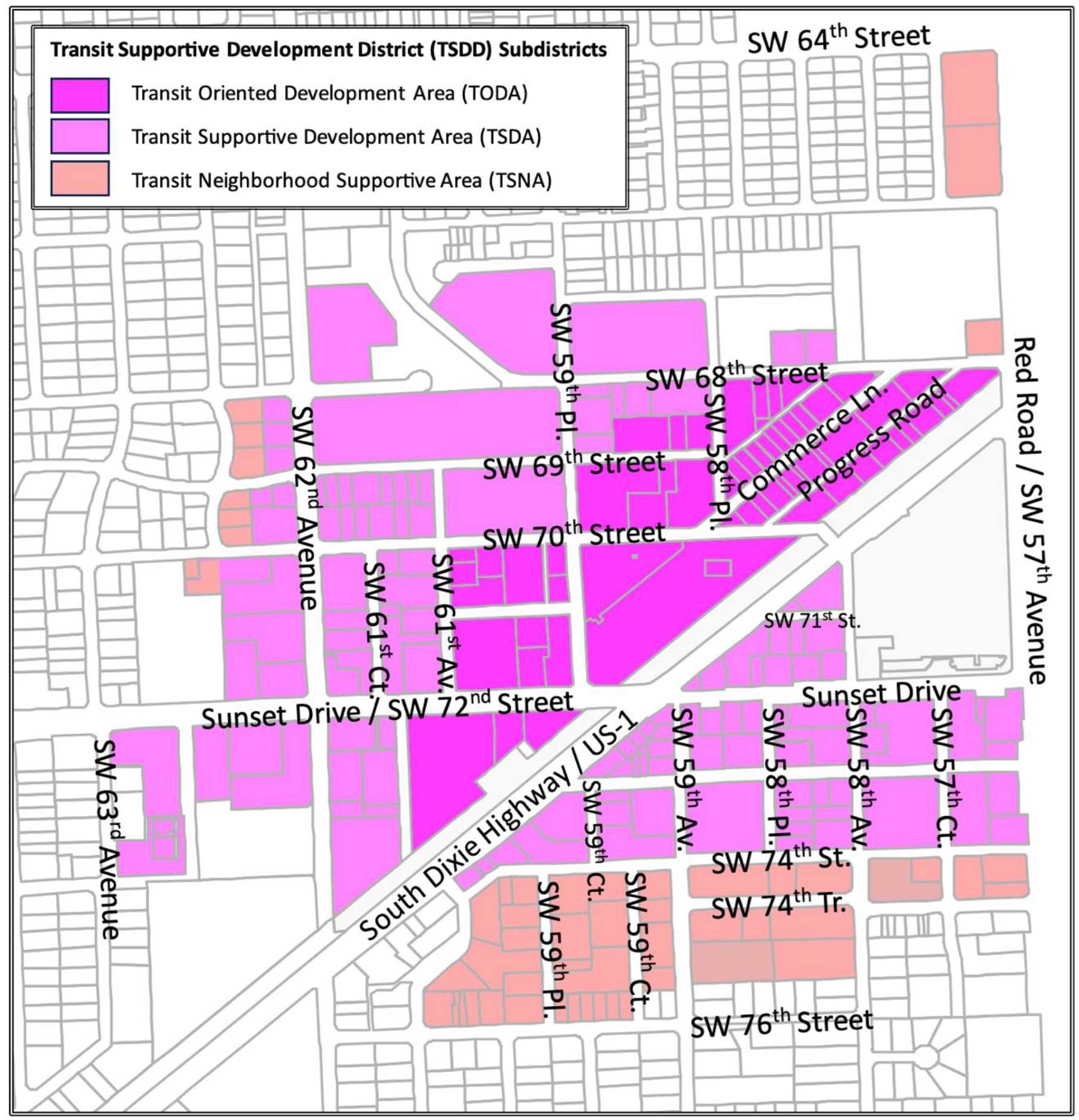
(C)
Permitted Uses.
(1)
There are thirteen (13) use categories within the TSDD district. The permitted uses are categories of uses as established in Section 20-8.4 and 20-8.5.
(2)
Where a building is located within an subdistrict adjacent to a TSNA subdistrict, office and parking uses may encroach into TSNA subdistrict on the same building site provided that such uses are not located closer than seventy-five (75) feet from any property line of the building site that is abutting or adjacent to a residentially zoned district.
(D)
Permitted Building Heights. Minimum and maximum building heights, numbers of stories, and floor-to-floor heights are regulated for the TSDD zoning district by the Building Height Plan, Section 20-8.9(D).
(Ord. No. 28-24-2513, § 2(Exh. A), 12-10-24)
20-8.4 - Permitted and special residential uses.
(A)
The following residential uses are permitted in these zoning classifications that specify this category (Residential use) within the TSDD.
(1)
Multi-family dwelling units are permitted to the maximum density permitted for the respective TSDD subdistrict.
(2)
Townhouse Dwellings are permitted to the maximum density for the respective TSDD subdistrict.
(3)
Home offices are permitted as an ancillary use to principal residential uses.
(4)
Shared offices are permitted as ancillary amenities to multifamily residential uses, such that they are not available for use or membership to the general public outside of a unified residential development.
(5)
Accessory Dwelling Units (ADU) are not permitted in mixed-use zoning categories, except within the ground floor of townhomes in the TSNA subdistrict.
(6)
Two-family duplexes are not permitted.
(7)
Single-family residences are not permitted.
(8)
Nursing homes and assisted living residential units may be permitted by approval as a Special Use pursuant to Section 20.5-7, and Section 20-3.4 "Special Use Conditions."
(9)
Community Residences, three (3) residents maximum and with four (4) to ten (10) units may be permitted by approval as a Special Use pursuant to Section 20.5-7, and Section 20-3.4, "Special Use Conditions."
(B)
Floor Area. The minimum floor area required for any residential unit: five hundred (500) square feet.
(C)
Density. The number of residential units are limited to as many units as can be constructed within the building form and height requirements of Section 20-8.8 with parking as required by Section 20-8.6, and all other applicable code requirements, such that the residential density is at or less than the requirements of the following table below:
(D)
Location. Residential uses shall be located vertically within a mixed-use building according to the table below. This section does not apply to Live Work Units as established in Section 20-8.6(E).
(1)
Residential Unit Vertical Location within a Building.
(2)
Pursuant to Section 20-8.9, residential uses are not permitted on the first floor of Large-Scale Developments within the portion of the building or development fronting on the primary street.
(3)
The horizontal mixing of stand-alone residential developments and adjacent stand-alone nonresidential or nonresidential mixed-use developments is allowed in the TSDD, such that they shall be well-integrated in terms of complementary uses, access and circulation, and compatible design.
(E)
Live-Work Units.
(1)
Live-Work Units (LWU) are defined as a space within a residential or mixed-use building that is used jointly for commercial and residential purposes, where: a) the resident/owner of the business is responsible for the commercial activity performed, and b) the commercial activity conducted takes place subject to a valid business license associated with the premises. Live-Work Units are permitted subject to the criteria below:
a.
Permitted occupations include those in the use category Professional Office use category, and Artisan Occupations, use category. Healthcare offices may be permitted as a special use.
i.
Human health care and medical offices occupied by a maximum of one medical professional and one administrative assistant and provide only regular preventative care and diagnostic visits to one patient at a time are permitted. Waiting rooms with more than four (4) seats and more than one hundred fifty (150) square feet of floor area are not permitted for such uses.
ii.
Veterinary offices are not permitted.
b.
The minimum area of an individual LWU is eight hundred fifty (850) square feet.
c.
The LWU shall count as one residential unit toward all residential density calculations.
d.
The commercial area and the living area are to be separated by a wall or permanent partition on a single level, or by floor or mezzanine for a multi-level LWU.
e.
The commercial area of an LWU may be located at the ground floor fronting on any secondary street in the TODA or TSDD subdistricts provided that such commercial area does not face a single-family residential district.
f.
The residential component must meet minimum floor area requirements relative to the number of bedrooms established in Section 20-8.34(A).
g.
The LWU shall be constructed with an external door for work-related component opening to a street frontage, or internal, publicly accessible courtyard, and an additional door to the interior circulation of the building for residential use.
h.
The LWU shall include a full kitchen.
i.
The LWU shall include at least one full bath within the living area and one half-bath within the work area.
j.
The LWU is permitted to have a sign relating to the commercial component displayed on the transom of the external commercial entrance door, or on a plaque to the side of the door and shall not be larger than two (2) square feet. The sign may not be lighted.
k.
All supplies and inventories affiliated with the commercial functions of the commercial activity will be completely contained within the LWU.
l.
The LWU shall not be permitted to store materials, substances, waste or chemicals classified under applicable government laws, rules or regulations as hazardous or toxic substances, materials, waste or chemicals as inventory or for resale. The presence of minimum working quantities may be permitted where the quantity represents no more than an operational supply for one month for use that is typical for the endeavor at its scale.
m.
No variances of the requirements c. through l. may be granted.
n.
An annually renewable certificate of use and occupancy shall be required for the commercial use component.
(2)
General Retail and Personal Services, Section 20-12.6(A) are occupations that may be permitted in a Live-Work Unit by approval as a Special Use pursuant to Section 20-5.7, and Section 20-3.4, "Special Use Conditions."
a.
General criteria for approval shall include, but not be limited to:
i.
The anticipated volume of patrons or induced traffic at a time;
ii.
There shall be no sales of any food, beverage, libation, smoking or vaping consumables and apparatus, cannabis-derived products, or any pharmaceuticals whether prepared or packaged, whether for on-site or off-site consumption; and
iii.
Convenience stores shall not be permitted.
(Ord. No. 28-24-2513, § 2(Exh. A), 12-10-24)
20-8.5 - Permitted and special nonresidential uses.
No land, body of water or structure shall be used or permitted to be used, and no structure shall be hereafter erected, constructed, reconstructed, moved, structurally altered, or maintained for any nonresidential purpose in TSDD zoning district, except as provided in this section and in accordance with Section 20-8.3(C)(2). The use categories delineated herein shall be permitted only in compliance with the regulating plan and general requirements provided in this section. In mixed-use districts, the vertical or horizontal integration of two (2) or more of residential, live-work, business and office, civic and institutional uses is encouraged as provided herein. Vertical integration allows any combination of primary uses, with commercial/retail uses typically located on the ground floor and office and/or residential uses located in accordance with Section 20-8.4(C). Horizontal integration allows any combination of parcels with different primary uses within the same block under the same ownership. The use categories for the TSDD zoning district with specific regulations applying to the categories are established in the table below.
(A)
Vertical Location. Commercial uses are permitted on all floors.
(B)
Drive-through services and sales are not permitted in any location in the TSDD zoning district.
(C)
All existing legal uses and structures established prior to the enactment of these TSDD district regulations shall be deemed to be lawful, conforming, and permitted uses and structures unless the use is abandoned for more than six (6) consecutive months or any such structure is damaged by more than fifty percent (50%) of its replacement value. A structure damaged by less than fifty percent (50%) of its replacement value may be repaired or reconstructed so long as a building permit is obtained within eighteen (18) months of the damage event, during which time the use will not be considered abandoned so long as the owner diligently pursues permitting of the repairs or reconstruction. Legally nonconforming uses and structures within the TSDD district shall be subject to the provisions of Section 20-4.8, South Miami Land Development Code.
(Ord. No. 28-24-2513, § 2(Exh. A), 12-10-24)
20-8.6 - Parking.
(A)
TSDD Parking Regulations. Parking in the TSDD must be developed and managed primarily as an element of infrastructure critical to enhancing South Miami's tax base through the economic success of the district.
(B)
General Regulations.
(1)
All outside surface parking is to be located at the rear of building if feasible, otherwise, it shall be located at the side of the building, in accordance with this section. Under no circumstances, shall outside surface parking to be located on a Primary Street or at the front of the building.
(2)
Where appropriate, rights-of-way adjacent to business property may be improved by the abutting property owner to provide on-street parking, and such on-street parking may be credited towards the required minimum spaces by written agreement approved by the City Manager. The City Manager shall determine if the installation of paid parking regulation is warranted and appropriate for the area.
(3)
Properties that cannot provide the required number of spaces on-site or through the provision of off-site spaces pursuant to Section 20-8.6(C)(4) for a change to a use other than one that is medical in nature, shall purchase monthly parking permits from the City for the number of spaces that aren't provided on-site or through the provision of off-site spaces pursuant to Section 20-4.4(F). Proof of purchase of the permits shall be submitted at the time of application for and renewal of the Business Tax Receipt for the use(s) occupying the property. Failure to obtain the required permit(s) in any given month shall be treated as a violation of this Code pursuant to Section 20-6.3. New construction or expansions of the gross floor area of an existing building shall provide the required number of spaces pursuant to Section 20-3.3 and Section 20-4.4.
(4)
Off-site parking shall be permitted in accordance with Section 20-4.4 provided the site providing the parking is within the boundaries of the TSDD, but not within seventy-five (75) feet of any property not zoned TSDD, or within the TSNA subdistrict. A long-term lease may be substituted for the Unity of Title if the owner and the lessee, if any, agree to the revocation of any applicable certificate of occupancy, certificate of use, and/or business tax receipt if the lease expires or is terminated and no alternative and allowable off-site parking or on-site parking is provided for in accordance with this section. As a condition to a certificate of occupancy or certificate of use, as applicable, the owner shall execute an agreement, in form and substance acceptable to the City Attorney, acknowledging that the certificate of occupancy, certificate of use, and/or business tax receipt is conditioned on the provision of the parking and that any change to the availability of such parking may render the certificate of occupancy, certificate of use, and/or business tax receipt void, and indemnifying and holding harmless the City.
(5)
Parking fees shall be permitted under this section, except for the minimum number of spaces designated for residential units as required by Section 20-8.6(C).
(6)
No open-air storage of vehicles shall be permitted, other than for parking spaces as defined in Section 20-2.3.
(7)
Parking for bicycles shall be provided in safe, convenient, accessible locations, and protected from the elements, if possible. Accessible routes shall be provided between the required bicycle parking and any public bicycle lanes, paths, or routes on adjacent streets.
(8)
In the case of Large-Scale Developments (see Section 20-8.7), the City Commission may require space for bikeshare, rideshare, valet parking, shared parking, pick-up and drop-off by on-demand rides, and/or delivery services.
(C)
Required Parking by Use. The number of parking spaces required for development within the TSDD, shall be calculated based on the parking rates for each subdistrict established by the table below. These parking requirements are based on the Institute of Transportation Engineers (ITE) Parking Generation Manual for parking in urban areas and are modified for district-wide, mixed-use shared parking, and for walking proximity to transit; therefore, shared-use parking studies and parking studies for reduced parking by reason of proximity to transit shall not be applicable. The parking amount requirements are based on the general use categories provided in Section 20-8.5.
gsf: Gross square feet, measured as the entire floor area of a use, from wall centerlines, and to include back-of-house components, but not including circulation or services that are outside of the entrance door. Structured parking shall not be counted toward the gross floor area calculation of developments within the TSDD, but shall count towards the height.
(1)
Bicycle Parking.
(a)
Bicycle parking shall be provided as established in the table below:
(b)
All outdoor rack spaces shall be located in secure, well-illuminated locations, shall not impede pedestrian paths, and shall be located in an area that is protected from weather by the building or a dedicated shelter/canopy.
(c)
Shared-use bicycle docks may be counted toward the requirement for bicycle parking for hotels.
(2)
Motorcycle and scooter parking shall count towards up to five percent (5%) of vehicle parking requirements. Motorcycle and scooter spaces shall be marked for motorcycles and scooters, have a minimum dimension of eight (8) feet long by four (4) feet wide per two-wheeled vehicle, and shall have direct access to parking circulation aisles. The location of these spaces is encouraged to increase the utilization of garage floor area by using unused areas near building structures and corners.
(3)
Horizontal, non-mechanized tandem (stacked) parking spaces shall be permitted toward the off-street parking requirement for multi-family dwelling units with three (3) or more bedrooms, townhouses, and live-work units where both tandem spaces are assigned to the same dwelling unit.
(4)
Horizontal tandem (stacked) parking spaces and mechanically stacked parking spaces may be permitted toward the off-street parking requirement for mixed-uses, subject to the requirements of Sections 20-4.4(I)(1), 20-4.4(I)(3), and 20-4.4(I)(4).
(5)
Adult day care facilities shall provide one accessible passenger loading zone per every five thousand (5,000) gross square feet of facility area.
(D)
Parking Structures in the TSDD Zoning District.
(1)
At the rear of the property the setback requirement for garages may be eliminated only if the garage:
(a)
Abuts an existing garage; or
(b)
Abuts a permanent open space.
(2)
Garages in the TSDD shall comply [with] the following requirements:
(a)
Garages shall be designed in accordance with the requirements of the Regulating Plan in Section 20-8.9. and the Architectural Standards, Section 20-8.10.
(b)
Garages shall be screened with fenestration, and other architectural treatment that replicates the design of the rest of the building, or by art in compliance with this section and permitted as part of the South Miami Art in Public Places program, subject to the requirements of Section 7-17 of the South Miami Code.
(c)
Where a garage fronts on a primary street facade, architectural design and fenestration for screening shall include grillwork at the openings that provides a backdrop to appear as the opening of an actual window.
(d)
Garages that are substantially open on their street-facing facades that reveal parked vehicles within the garage are not permitted. Entire sides or substantial lengths of parking garage walls designed to be open with no fenestration are prohibited. Long runs of openings that do not conform to or replicate a window or storefront pattern are prohibited. Metal grillwork within the openings that do not replicate a window or storefront pattern are prohibited.
(e)
Garages shall not front on a street or property line that is adjacent to an existing residentially zoned area, without a habitable liner use that shields the view and sound of parking from the residential area.
(f)
Landscaping in a private or public open space may optionally be used to screen a parking structure.
(3)
Freestanding garages may only be allowed in TSDA and TODA subdistricts and may not exceed six (6) levels in height.
(4)
Where garage structures are attached to and part of a use that is permitted within the subdistrict where it is located, such parking structures may be partially located within any adjacent TSDD subdistrict.
(5)
Underground parking is defined as having more than sixty percent (60%) of its structure below grade.
(E)
Loading, Delivery and Curbside Pick-up Zones.
(1)
Adequate space for loading, unloading, and delivery of materials, goods, or services in the TSDD shall be provided and maintained on the same unified site as the building which it serves. Loading and/or unloading spaces for unified mixed-use projects shall be provided and maintained in accordance with the following:
(2)
Each loading space shall be directly accessible from a street or alley without crossing or entering any other required loading or unloading space, and shall be arranged for convenient and safe ingress and egress by motor truck and/or trailer combination, require no more than three (3) turning maneuvers, and be acceptable by the City Engineer.
(3)
Loading spaces and docks shall be shielded from view from any street or public space. Screening from view may be accomplished by location within a parking garage, or by a driveway door to be maintained in the closed position at all times when not in use.
(4)
Loading access or egress shall not be from a primary street as established in Section 20-8.9. Where a property is located on two (2) primary streets, and loading access and egress is not feasible except at one of the primary streets, the location of the loading access shall be by written determination of the City Development Services Director.
(5)
Loading access or egress shall not be from the front of any building.
(6)
All off-street loading spaces shall also be accessible from the interior of the building or buildings that it is intended to serve.
(7)
Where a development is a unified horizontal mixed-use development, loading spaces may be consolidated into a single logistics center. Consolidated loading areas may be excepted from internal circulation access, and shall provide an operation plan. Consolidated loading may only be approved as part of a Large-Scale Special Exception per Section 20-8.7.
(8)
On-street loading shall be provided for parcel delivery, car-sharing and taxi pick-up and drop-off, and prepared food deliveries; unless otherwise provided on-site within the project.
(9)
The number and size of off-street and on-street loading spaces shall be provided in accordance with the table below:
(Ord. No. 28-24-2513, § 2(Exh. A), 12-10-24)
20-8.7 - Large-scale development special exception.
(A)
All Large-Scale Developments in the Transit-Supportive Development District (TSDD) shall provide only one or more permitted uses in compliance with all the required TSDD conditions and standards as well as the conditions and standards set forth in this section. Any alterations or additions to existing property or Development in the TSDD that result in the Development meeting the definition of a Large-scale Development, shall conform to the provisions of this section. Existing heights of existing buildings and existing floors may remain in their current condition; however, additional floors, if authorized, may only be added if they are developed in accordance with this section.
(B)
A Large-scale Development is defined as the development of any building site that is more than forty thousand (40,000) square feet or any development, as defined in F.S. § 380.04 (hereinafter referred to as "Development"), that is in excess of four (4) stories. A Large-scale Development shall be reviewed by the Planning Board and shall require approval by the City Commission. The computation of the size of the Development to determine if it is a Large-scale Development includes the square footage of an alteration or addition to an existing site and the square footage of the existing site that is being altered or to which an addition is being proposed.
(1)
A Large-scale Development Special Exception ("Special Exception") shall be valid for eighteen (18) months unless a greater period is approved by the City Commission in the development order resolution, within which time a building permit must be obtained. The expiration date shall be tolled for any legal, administrative, or judicial challenge to the development order until the conclusion of such challenge, including all appeals.
Notwithstanding the foregoing, the City Manager or City Commission may extend the Approval Term of a Special Exception for one additional year or for some other amount of time as appropriate under the circumstances. An application for an extension of the Approval Term of a Special Exception shall be filed sixty (60) days prior to the expiration of the Approval Term.
(2)
Any property designated as a Large-scale Development may have residential uses on the first floor, however, residential uses are not permitted on the first floor within that portion of the building or development fronting on the primary street, as defined in Section 20-8.2.
(C)
General Requirements.
(1)
The owner of the land on which a Large-scale Development is to be constructed and the developer of the project shall enter into a development agreement with the City ("Development Agreement"). The Development Agreement shall require approval by the City Commission at a public hearing before the issuance of a building permit. The Development Agreement may include provisions to mitigate the impacts of the Large-scale Development in addition to implementing any other requirements of this Land Development Code or the City Code, as may be amended.
(2)
The use for which the Large-scale Development is intended is specifically listed as a permitted use for the TSDD district, TODA subdistrict, or TSNA subdistrict as applicable and established in Sections 20-8.4 and 20-8.5.
(3)
The use complies with the general requirements and any other requirements that the City Commission may consider appropriate and necessary.
(4)
All such uses shall comply with all requirements established in this article, unless additional or more restrictive requirements are set forth below or by the City Commission.
(5)
All such uses must be of a compatible and complementary nature with any existing or planned surrounding uses. The City Commission shall determine the overall compatibility of the development with the existing or planned surrounding uses.
(6)
If during the review process it is determined that the Development, as proposed, will potentially cause adverse impacts, the Planning and Zoning Department may recommend, and the City Commission may require as a condition of approval, remedial measures to eliminate or reduce, to the extent possible, these impacts. Development projects that are recommended for remedial measures will not be required to submit a new application unless it is determined by the Planning and Zoning Department that the remedial changes would have the effect of increasing the density, FAR, or height of the development, or if there is a change to the mix of uses which increases project trip generation more than ten percent (10%). Remedial measures may include, but are not limited to:
(a)
Additional screening or buffering;
(b)
Additional landscaping;
(c)
Building orientation;
(d)
Relocation of proposed open space, or alteration of the use of such space;
(e)
Pedestrian and bicycle safety and access;
(f)
Changes to ingress and egress;
(g)
Addressing traffic flow to and from the development to avoid intrusion on local streets in nearby single-family residential areas; or
(h)
Improvement of the streets adjacent to the project, if applicable.
(D)
Project Approval.
(1)
Required Conditions. Prior to approving a Large-scale Development, the City Commission must find that the development meets the requirements set forth in subsection (C) above and that it:
(a)
Will not adversely affect the health or safety of persons residing or working in the vicinity of the proposed use;
(b)
Will not be detrimental to the public welfare, property, or improvements in the neighborhood; and
(c)
Complies with all other applicable Code provisions.
(2)
Additional Conditions. The City Commission may designate such additional requirements in connection with the approval of a Large-Scale Development as will, in its opinion, assure that such development will conform to the foregoing requirements.
(E)
Reapplication for Development Review. If the City Commission disapproves of a Large-scale Development, no reapplication for the same, or substantially the same, project may be made within six (6) months of the date of final disapproval by the City Commission of the original application unless evidence is submitted and accepted by the City Commission that justifies such reconsideration.
(F)
No commercial retail store within the TSDD, except a grocery, shall exceed forty thousand (40,000) square feet of gross floor area. Structured parking shall not be counted toward the gross floor area calculation for this purpose.
(G)
Where there is no minimum distance between adjacent buildings, nor a minimum building setback from a property line, one of the following conditions shall be met:
(1)
If the distance from the exterior wall to the property line is less than five (5) feet at any location, the applicant must provide the Planning Department with a copy of a maintenance easement in favor of the adjacent property; or
(2)
The structure shall be built on the property line and the owner shall give a maintenance easement to the adjacent property owner(s).
(H)
In no instance shall a roof overhang extend beyond the property line, except in the front of the building.
(I)
The City Commission shall have the discretion to condition the granting of a Special Exception and memorialize such conditions in a Development Agreement with the Applicant, in a form acceptable to the City. As set forth in Section 20-8.9(C), the Development Agreement may include provisions to mitigate the impacts of the Large-scale Development in addition to implementing any other requirements of this Land Development Code or the City Code, as may be amended. The Development Agreement, after it has been drafted by the City Attorney shall be subject to approval by the City Commission. A separate agreement or covenant ("Covenant") that provides for maintenance of common elements and any other condition specified as a prerequisite to approval of the Special Exception ("Maintenance Covenants") shall be signed by the owner of the property in question. The Maintenance Covenant shall be treated as a covenant running with and binding the land upon which the Development is situated, and it shall be recorded in the land records of Miami-Dade County and, at the option of the City and if allowed by law, the Maintenance Covenant may be rerecorded when necessary or required to maintain, uninterrupted, the effectiveness of the covenant running with the land. The Covenant shall provide that the owner and his/her/its grantees, heirs, successors, and assigns ("Owner") shall comply with the Maintenance Covenants at the Owner's expense and without any cost to the City.
(1)
In the event that any special exception condition includes the development of any common areas ("Common Areas"), the Maintenance Covenant shall include the following provisions:
(a)
The Common Areas shall continue in existence, as part of the structure and those Common Areas shall be operated and maintained at the expense of the Owner of the property so long as the Development continues to exist, in whole or in part;
(b)
The operation and maintenance of the Common Areas shall include a provision for landscaping in accordance with an approved site and development plan, approved by the City Commission, or as amended from time to time with approval of the City Commission, the maintenance of the landscape as well as other maintenance services and private security protection of the Common Areas;
(c)
The Owner shall continue, operate, and maintain the Common Areas in such a manner as to keep such areas in good order, clean, attractive, fully functional (subject to interruption for maintenance, repair, restoration, and renovation) and, generally, so as not to create a nuisance to owners, occupants and users of the adjacent land and surrounding areas and to the general public.
(2)
The Maintenance Covenant shall define the phrase "continue, operate and maintain," as it applies to landscaping, to include, but not be limited to, the following activities:
(a)
The monitoring of the landscape areas by a recognized landscape expert, acceptable to the City, and the preparation of reports by such expert certifying that the landscaping is in compliance or is not in compliance with the approved Landscape Plan and all provisions included in such plan pertaining to pruning, fertilizing and general maintenance; the reports shall be prepared annually;
(b)
The replacing of plants, trees, shrubs, or the like, at the Owner's sole expense, as determined by the landscape expert to be necessary in order for the landscaping to perpetually be in compliance with the Landscape Plan; and
(c)
In the event that the City disagrees with the opinion of the landscape expert hired by the Owner, the City shall have the right to hire its own landscape expert whose decision shall be final. If the City's expert agrees with the expert hired by the Owner, the City shall pay the cost of its own expert, otherwise, the Owner shall pay the cost of the City's expert.
(3)
The Development Agreement and the Maintenance Covenant shall contain the following provision:
(a)
In the event the Owner breaches its agreement ("a Default") and fails to cure the default within thirty (30) days ("the Cure Period") after receiving written notice of the default or fails to use all due diligence in commencing the cure and in proceeding to effectuate the cure a fine will be assessed against the Owner as set forth below in this paragraph (a). If the Owner is unable to timely cure the default after receiving written notice, the Owner may request an extension of time from the City Commission which shall be granted ("Extended Cure Period") upon presentation of substantial competent evidence establishing the Owner's good faith and due diligence, justifiable reasons for the delay and the amount of time needed to cure the default. In the event that the Owner fails to cure the default within the Cure Period, or within the Extended Cure Period, whichever is greater, a fine shall be assessed against the owner in the amount of one hundred fifty dollars ($150.00), or such amount as may be set forth in the City Fee Schedule, for each day the owner remains in default thereafter. If the Development is determined to be out of compliance for thirty (30) days after the Cure Period or Extended Cure Period, as applicable, the Development Agreement may be revoked by Resolution of the City Commission after a public hearing.
(b)
In the event that a fine is assessed against the Owner, or the City incurs any expense towards curing the default, the City shall have the right to file a lien, or a continuing special assessment lien, as may be applicable, against the property and file a lien foreclose action for the full amount of money incurred by the City for said expense as well as for any fine that has been assessed. The City's lien shall be perfected upon being recorded in the land records in Miami-Dade County, Florida and shall be of equal rank and dignity as the lien of City's ad valorem taxes and superior in rank and dignity to all other liens, encumbrances, titles and claims in, to, or against the land in question, unless in conflict with state statutes or Miami-Dade County Code.
(c)
The City shall have the right to proceed against the Owner to collect the above-described costs and expenses without resorting to a lien and/or lien foreclosure. The City's remedies shall include all those available in law or in equity, including injunctive relief. The exercise of one available remedy shall not be deemed a waiver of any other available remedy.
(d)
Invalidation of any of the covenants identified in Section 20-8.9, by judgment of court shall not affect any of the other provisions, which shall remain in full force and effect. In the event of a violation of the Development Agreement or the Maintenance Covenant, in addition to any other remedies available, the City of South Miami is hereby authorized to withhold any future permits, and refuse to make any inspections or grant any approvals, until such time as the Development Agreement or the Maintenance Covenant are complied with. All rights, remedies and privileges granted pursuant to the Development Agreement and/or Maintenance Covenant shall be deemed to be cumulative and the exercise of any one or more shall neither be deemed to constitute an election of remedies, nor shall it preclude the party exercising the same from exercising such other additional rights, remedies, or privileges.
(J)
The Development Agreement required by this Section 20-8.9 is not intended to mean a development agreement under F.S. §§ 163.3220—163.3243, as amended by the Florida Legislature (the "Development Agreement Statute"). Notwithstanding the foregoing, an applicant may seek that the Development Agreement be approved under the Development Agreement Statute provided the Development Agreement meets the requirements of this Section 20-8.9 and the Development Agreement Statute, is adopted pursuant to the Development Agreement Statute, and is subject to the requirements and remedies set forth in the Development Agreement Statute.
(K)
To the extent that a project includes Affordable or Workforce Housing, the applicant is encouraged to consider commitments to reserve units for Florida Hometown Heroes Loan Program housing or successor program supported by the Florida Housing Finance Corporation, with any such commitments to be included in the Development Agreement. To the extent feasible, accommodations to assist eligible city employees in obtaining such housing are encouraged.
(Ord. No. 28-24-2513, § 2(Exh. A), 12-10-24)
20-8.7.1 - Administrative approval of minor modifications to an approved development within the TSDD district.
The purpose of this section is to secure the ability of a property owner to make minor modifications to a previously approved development on land that is within the TSDD district, as contemporaneously designated at the time of Minor Modification application, district that was previously obtained through the public hearing process. The intent of this section is to establish the framework for a streamlined and expedited administrative approval process for specific minor modifications. Consistent with these stated intents and purposes, an application for a Minor Modification to an Approved Development may be reviewed and approved administratively in accordance with the procedures of this section.
(A)
Terms and Definitions. For purpose of this section, the term "Approved Development" shall mean: A development within the TSDD which has received Special Exception for a Large-Scale Development approval following review by the Design Review Board and public hearings by the Planning Board and City Commission.
(B)
Administrative Approval. An administrative approval of a Minor Modification shall constitute a final development order approval. For clarity, no further public hearing review or public hearing approval shall be required for an Approved Development to obtain administrative approval for a Minor Modification.
(C)
Minor Modification. An applicant shall have the right to make a modification or a series of modifications to an approved Final Site Plan prior to the issuance of a building permit, provided the proposed modifications, either individually or cumulatively conform with the following criteria:
(1)
Building Footprint. The ground floor building footprint shall not exceed the dimensions provided for in the approved Final Site Plan by more than three percent (3%) or five (5) feet in any horizontal direction, whichever is lesser.
(2)
Vehicular Circulation. The vehicular circulation shall not be materially altered from that vehicular circulation approved in the Final Site Plan. Notwithstanding the forgoing, minimal adjustments to the location of driveways of less than three (3) feet shall be deemed a Minor Modification.
(3)
Vehicular Parking. The number of on-site vehicular parking spaces provided may be modified so long as the total number of on-site vehicular parking spaces provided is consistent with all code requirements and is within five percent (5%) of the number provided in the approved Final Site Plan.
(4)
Exterior Architectural Features and Material Selections. Exterior architectural features and material selections may be modified so long as they are generally consistent with the architectural character, materials, and color palette in the approved Final Site Plan.
(5)
Building Height. The overall building height may be increased by up to five percent (5%) of the previously approved building height so long as the building height does not exceed the permitted maximum building height. The overall building height may be reduced.
(6)
Residential Units. The number of residential units may be increased so long as the total number of residential units provided is within five percent (5%) of the number provided in the approved Final Site Plan. The number of residential units may be reduced.
(D)
Application and Approval Process. An applicant for a Minor Modification shall submit to the Planning and Zoning Department a proposed modified site plan and letter of intent outlining the proposed modifications. The Planning and Zoning Department shall review the modified site plan to the approved Final Site Plan for compliance with this section within thirty (30) days of submission. Following review, the Planning and Zoning Director (or his/her designee) shall submit a recommendation to the City Manager. Upon receipt of a recommendation of approval from the Planning and Zoning Department, the City Manager shall review and affix any conditions deemed expedient to further the intent of this Section 20-8.9 or to mitigate any additional impacts of the Minor Modification. If approved by the City Manager, the City Manager shall place a copy of the approved Site Plan with Minor Modification in the TSDD file. Notice of the administrative decision regarding the Minor Modification shall be posted on the City's website within ten (10) days of the transmission of the recommendation of approval to the City Manager.
(E)
No Impact on Approval Term. Neither the application for, or the issuance of, a Minor Modification shall extend Special Exception validity periods, including specifically the Approval Term, established in Section 20-8.9.
(Ord. No. 28-24-2513, § 2(Exh. A), 12-10-24)
20-8.8 - Bonus allocations.
(A)
The bonus applicability table in Section 20-8.8(G), shall be applicable only to the TODA and TSDA subdistricts as established in Section 20-8.3. Bonus development area or height shall not be awarded to any building that is in the TSNA subdistrict.
(B)
Bonus floor allocations may be awarded as habitable stories up to the maximum number of building floors permitted by the TSDD Building Height Plan of Section 20-8.9(C). The Building Height Plan establishes a maximum number of stories that is permittable as-of-right for each subdistrict, and also establishes a maximum number of stories that may be applied through the Bonus Allocation program of this section. The stories that are attainable through the Bonus Allocation program shall not exceed the number of stories established by the TSDD Building Height Plan of Section 20-8.9(C).
(C)
All bonuses shall only be awarded to a development application through the Large-Scale Development Special Exception process, pursuant to Section 20-8.7. A Large-Scale Development is defined as the development of any building site that is more than forty thousand (40,000) square feet or any development, as defined in F.S. § 380.04 (hereinafter referred to as "Development"), or that is in excess of four (4) stories.
(D)
Unused floor area from as-of-right floors may not be applied against bonus floors. Bonus floors shall only be achieved through, and consist entirely of floor area derived from, the bonus program set forth herein.
(E)
The stories that are attainable through the Bonus Allocation program are not as-of-right, and shall only be permitted if approved by the City Commission through the Large-Scale Development Special Exception process, pursuant to Section 20-8.7.
(F)
Any and all bonus floors through bonus area that are awarded to a proposed site plan, are only applicable to the specific site plan, and are not severable to any other land or other site plan on the same land.
(G)
The development bonuses and qualifications described in the table below are applicable to the Transit Oriented Development Area (TODA) subdistrict, and the Transit Supportive Development Area (TSDA) subdistrict of the TSDD zoning district.
(H)
Public Open Space Bonus. The Open Space Bonus shall require the development of additional public open space that exceeds required open space as established in Section 20-8.9(C). Required open space and bonus open space shall be combined to create public areas of significance and shall be located and designed in compliance with Section 20-8.9. Such areas shall be open to the general public as set forth in an easement memorialized by the Development Agreement, acceptable to the City Manager and City Attorney, providing public access from 6:00 a.m. to 9:00 p.m., and subject to reasonable rules and regulations.
Where the development of open space includes the relocation of a public park within the development site, the relocated park area may be used toward the open space bonus if the relocation explicitly supports an existing policy of the City's adopted Comprehensive Plan to relocate the subject park, and the cost of relocation, improvement and reprograming are borne entirely by the developer.
The development of additional open space shall be eligible for the award of two (2) bonus floors and two thousand four hundred (2,400) square feet of bonus floor area for every one hundred (100) square feet of additional open space that exceeds the amount required by Section 20-8.9(C).
(I)
Affordable Housing Bonus. Affordable housing shall be limited to rents or a sales price that is affordable to qualifying households at eighty percent (80%) of Area Median Income as set forth by Miami-Dade County statistics promulgated by the U.S. Department of Housing and Urban Development. The owner shall commit by covenant prior to building permit to maintain such affordability restriction on the property for a minimum period of twenty-five (25) years. Units thus restricted shall be spread among all unit types in the building and shall be interspersed throughout the building to avoid overconcentration in any portion of the building. Impact fees, as set forth in Section 7-3.2, shall be waived for the floor area devoted to Affordable Housing.
(J)
Workforce Housing Bonus. Workforce housing shall be limited to rents or sales prices that are affordable to qualifying households at one hundred forty percent (140%) of Area Median Income as set forth by Miami-Dade County statistics promulgated by the U.S. Department of Housing and Urban Development. The owner shall commit by covenant prior to building permit to maintain such affordability restriction on the property for a minimum period of twenty-five (25) years. Units thus restricted shall be spread among all unit types in the building and shall be interspersed throughout the building to avoid overconcentration in any portion of the building.
(K)
Sustainability Bonus. Provided all buildings on the property are constructed for certification to a minimum LEED or equivalent certification as required by Section 20-8.10(B), individual buildings developed to higher sustainability standards shall be eligible for bonus height as follows:
(1)
LEED Gold (sixty (60) to seventy-nine (79) points). For each eight hundred (800) square feet of a building that achieves LEED GOLD, or equivalent certification approved by the City Manager, the overall development shall qualify for one hundred (100) square foot of bonus floor area.
(2)
LEED Platinum (eighty (80) or more points), PassivHaus, or Living Building Challenge certification, or equivalent certification approved by the City Manager: For each four hundred (400) square feet of a building that achieves LEED Platinum, PassivHaus, or Living Building Challenge certification, the overall development shall qualify for one hundred (100) square [feet] of bonus floor area.
(3)
Prior to issuance of a building permit, the owner shall post a bond or letter of credit for the benefit of the City in an amount in accordance with Section 20-8.8(L), plus fifty percent (50%). Such bond or letter of credit shall be released only if the building obtains the intended certification within one year following temporary or final certificate of occupancy, whichever is first to occur. If the intended certification is not produced to the City Manager on or before the one-year anniversary of the temporary or final certificate of occupancy, whichever is first to occur, the City may claim the full amount of the bond or draw the full amount of the letter of credit.
(L)
In lieu of providing the in-kind public benefits to be eligible for approval of bonus floors, an owner may make a contribution of payment in lieu to the City of South Miami Public Benefit Trust Fund as follows:
(1)
The basis of all bonus payment-in-lieu amounts is the awarded gross bonus floor area; therefore, for additional bonus floors that are above the base height limit described in Section 20-8.9(C), the bonus payment-in-lieu will be equal to the sum for all bonus floor gross floor area of each bonus story times the amount per square foot. Rates for the bonus payment-in-lieu shall be based on the date of large scale development approval, unless the rate is increased before the master building permit is obtained, in which case any difference between the total bonus payment calculated based on the rate in place at time of master building permit and the bonus payment made following large scale development approval, shall be due and payable to the City on or before issuance of the master building permit. All payments shall be deposited in the City's Public Benefit Trust Fund to be established.
(2)
The contribution amount to the City of South Miami Public Benefit Trust Fund shall be thirty dollars ($30.00) per square foot of bonus floor area until December 31, 2026, with such payment to be made within ninety (90) days of large scale development approval.
(3)
In the event that in-kind benefits are committed to at the large scale development approval stage, but are later withdrawn and not incorporated into the development project at time of building permit, the developer shall pay a thirty-seven and one-half percent (37.5%) penalty over and above the regular bonus contribution rate, with the total contribution due at building permit.
(4)
As of January 1, 2027, the contribution rate shall be increased to fifty dollars ($50.00) per square foot of bonus floor area until December 31, 2027, and thereafter be re-evaluated and adjusted in January of each year thereafter. The re-evaluated rate shall be recommended by the City Manager, and approved by the City Commission, with each year's rate based on the average ground cost per unit of bonus development for approved developments in the TSDD for the two (2) years that are contemporaneously prior. The City shall re-evaluate the public benefit bonus contribution rates and recalibrate the rates to achieve the objectives to promote increased density in the Transit Supportive Development District and achieve the public benefit objectives. In the event that the Commission has not reevaluated the rate in the calendar year preceding January 1, 2028, or as of any January 1 thereafter, the then-existing contribution rate shall automatically be increased by one dollar and fifty cents ($1.50) on each such date.
(5)
The Commission of the City of South Miami may waive contributions to the City of South Miami Public Benefits Trust Fund for development that is sited on land that is owned by the City of South Miami at the time of application, if such waiver is determined to be in the public interest.
(M)
Sunset Drive Buffer Area Bonus.
(1)
Eligible Sending Sites.
(a)
A property owner within the Sunset Drive Buffer as determined by the Building Height Plan provided in Section 20-8.9(C) shall be eligible to apply to sell their unused development rights.
(2)
Eligible Receiving Sites.
(a)
A property owner within the Transit Supportive Development Area (TSDA) or the Transit Oriented Development Area (TODA) which is eligible to utilize bonus allocations in accordance with this section.
(3)
Transferrable Development Rights.
(a)
Upon application from an eligible sending site, the Director of Development Services or their designee shall calculate the unused floor area of a sending site which shall be determined by calculating the maximum developable floor area for the property based on an ten-story envelope and eighty percent (80%) lot coverage, and subtracting the existing or proposed building floor area of the sending site.
(b)
The Director of Development Services or their designee may require the property owner to provide additional materials needed to demonstrate the transferrable floor area sought to be certified for sale for the property.
(c)
Certificate of Eligibility. Upon review of a complete application from an eligible sending site, the Director of Development Services or their designee shall issue a Certificate of Eligibility stipulating the total unused floor area available for transfer. No eligible floor area shall be transferred except in accordance with subsection (4) below.
(4)
Certificate of Transfer.
(a)
Prior to the City Commission's review of a special exception application for a Large-scale Development in accordance with Section 20-8.7, any applicant seeking to utilize the Sunset Drive Buffer Area Bonus shall obtain a Certificate of Transfer from the City. A Certificate of Transfer is a document issued by Director of Development Services or their designee that authorizes the transfer of all or a portion of the unused floor area from an eligible sending site to the eligible receiving site. Once a Certificate of Transfer has been issued, the sending site cannot use the floor area identified in the Certificate of Transfer on the sending site.
(b)
To qualify for a Certificate of Transfer, the sending site property owner or its tenant(s) must have completed qualifying improvements to the sending site since January 1, 2025 at the time of the application for a Certificate of Transfer. Qualifying improvements are limited to new construction, remodeling, reconstruction, or expansion of an existing building, facade improvements, or other modifications to the building that increase the number of potential uses of the building available to tenants and visitors. Maintenance, repairs, or replacement of plumbing, mechanical, electrical, and structural components of the building that do not increase the number of potential uses of the building available to tenants and visitors.
(c)
The Applicant requesting the Certificate of Transfer shall provide documentation demonstrating the improvements to the sending site and the cost of the construction of such improvements.
(d)
In no event shall the floor area authorized for transfer pursuant to a Certificate of Transfer exceed the amount resulting from dividing the cost of construction of the improvements to the sending site by fifteen dollars ($15.00) for Certificates of Transfer issued on or before December 31, 2026, or twenty-five dollars ($25.00) thereafter.
(e)
Two dollars and fifty cents ($2.50) per square foot authorized by a Certificate of Transfer shall be remitted to the City prior to issuance of the Certificate of Transfer, which funds shall be used for public improvements to Sunset Drive within the TSDD zone.
(f)
As a condition of the issuance of a Certificate of Transfer, the eligible sending site shall execute and record a covenant on its property, in form and substance acceptable to the City Manager and City Attorney, that the owner, and its successors and assigns shall not pursue development densities, intensities, or tax reductions resulting in reduced property tax revenue to the City under F.S. § 166.04151 or any other law adopted by the State of Florida or Miami-Dade County providing for additional or different development intensities through a preemption of the City's laws (collectively "Preemption Laws"), as such preemption laws may be adopted or amended from time to time.
(Ord. No. 28-24-2513, § 2(Exh. A), 12-10-24)
20-8.9 - Regulating plan—Intent.
This section establishes the Regulating Plan that defines the district-wide regulations for development on the properties within the Transit Supportive Development District (TSDD). The Regulating Plan consists of the following plans:
20-8.9(A) Street Hierarchy Plan
20-8.9(B) Open Space Plan
20-8.9(C) Building Height Plan
20.8.9(D) Building Location, Massing, and Form Requirements
20-8.9(A) - Street Hierarchy Plan.
The Street Hierarchy Plan is intended to support the City's vision for a highly connected, multi-modal, pedestrian, and bike-friendly network of streets to support a mixed-use, transit-supportive downtown.
(1)
The street hierarchy plan identifies the function and classification of each street within the TSDD, and the standards for existing streets concerning dimensions for determining dedication, construction, and redevelopment by the City of South Miami and property owners.
(2)
Sidewalk requirements established in this section, supersede the sidewalk width requirement of Section 17-19.
(3)
Redevelopment of existing rights-of-way to the center-line shall be the responsibility of the individual property owners for the portion of the right-of-way on all sides of development that is considered street frontage, and shall be in accordance with the City of South Miami TSDD Streetscape Plan to be established.
(4)
Wherever the existing right-of-way does not accommodate the location of the build-to-line at the edge or outside of the public right-of-way, a dedication amounting to the minimum required to achieve this criterion shall be made by the owner prior to the City's issuance of a building permit.
(5)
The Street Hierarchy Plan is established by the map exhibit in this section and by the list provided below that establishes the Primary Streets, Secondary Streets, Alleys and Paseo locations.
(6)
For each street type and right-of-way width, the cross-section criteria provided in the table below shall be the street standards applied for all new development towards determining build-to line location and to guiding streetscape improvement approvals. The cross-section criteria below, excluding the right-of-way widths, dedication requirements, and build-to line, shall be subject to modification based on the adoption of a Streetscape Master Plan. In the event of a conflict between such cross-section criteria and the Streetscape Master Plan, the terms of the Streetscape Master Plan shall control.
Street Hierarchy Plan
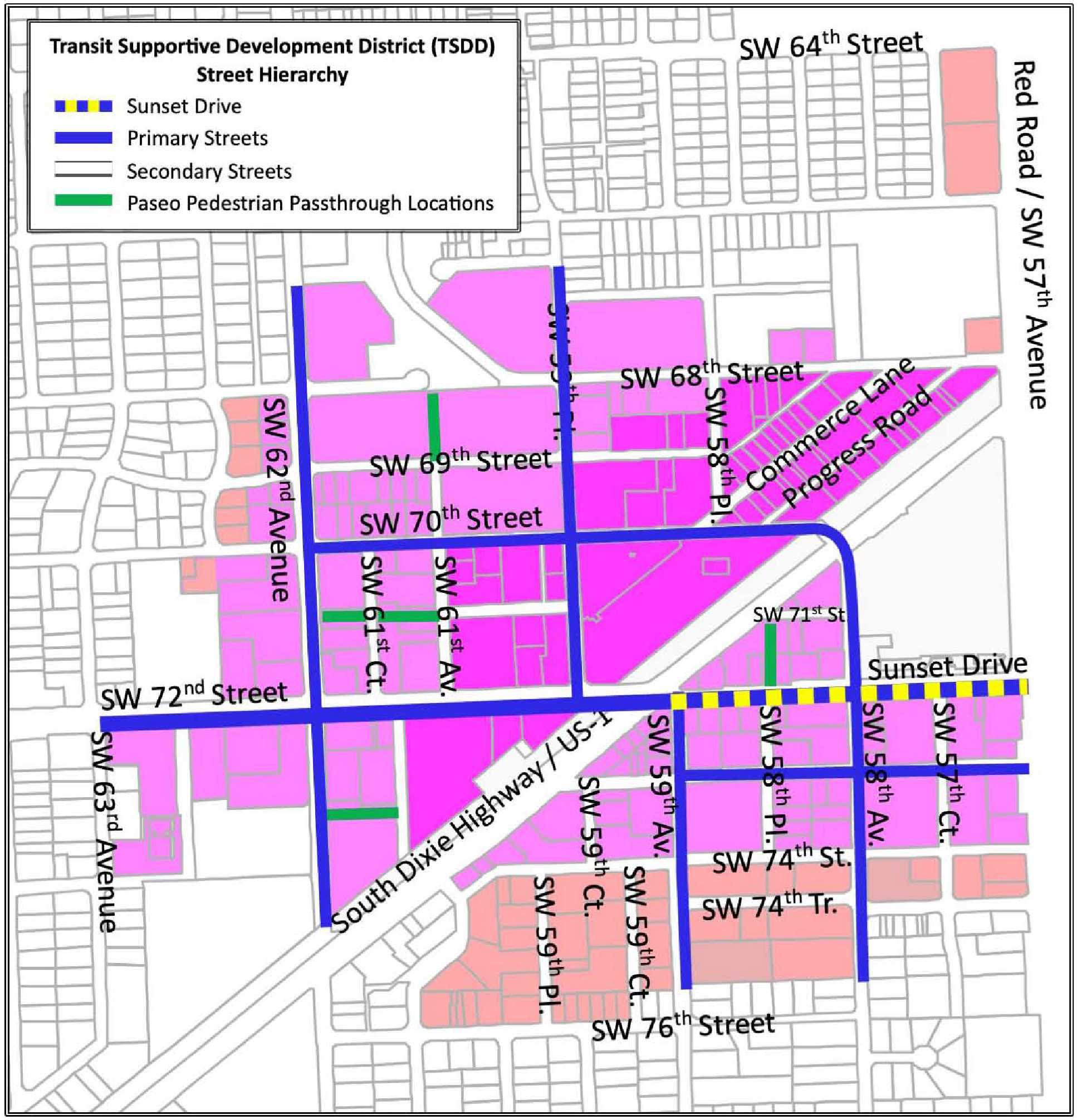
TSDD Street, Streetscape and Build-To Criteria
(Ord. No. 28-24-2513, § 2(Exh. A), 12-10-24)
20-8.9(B) - Open Space Plan.
The intent of the Open Space Plan is to encourage landmark opportunities, including plazas, squares, courtyards, pocket parks, and paseos as required for public passage, assembly, and social activity in visible and functional locations. It is the intent to integrate open spaces to create a sense of place and activate the sidewalks and streets. The goal for TSDD Open Space Plan is to achieve ten percent (10%) of community open space in the public realm throughout the district.
(1)
There are requirements for public open space and private open space, as defined below:
(a)
Public Open Space: public open space is to be located at ground level, at the outside of a building, directly adjacent to a street, at the same general elevation of the street, and must be ADA accessible. Public open space is to be maintained for general public access without restriction as to residency, tenancy or patronage of a business within the development.
(b)
Private Open Space: a private open space is for the use of residents in the residential components of mixed-use buildings, and is located interior to a development site and may also be accessible open space on a podium, or at a terrace level above the street. Private open space is for the common use of the residents, visitors, or other inhabitants of a building, and may be restricted to residency, tenancy or patronage of a business within the development; however, private balconies, terraces, courts and other spaces that are exclusive only to a single occupant or special group of occupants shall not count toward Private Open Space.
(2)
Types of public open space. The following types of open space shall be used to meet required open space criteria or to count toward open space performance standards for bonus criteria.
(a)
Plaza: a public open space that is used for pedestrian circulation and as a gathering space, and is lined with active uses in the buildings fronting the plaza. A plaza is primarily hardscaped to support market, civic or entertainment activity. A plaza is on the same building site to which it is used as open space.
(b)
Square: a public open space that is used for pedestrian circulation and as a gathering space, is similar to a plaza; however, a square may be separated by a vehicular right-of-way on one or more sides from the site to which it used as open space.
(c)
Pocket Park: a small open space that is used as a passive activity gathering space. It does not have a circulation function to the building for which it is used as an open space.
(d)
Linear Open Space: an area that runs alongside the property boundary with the public right-of-way to enhance the pedestrian experience and use of the right-of-way and open space in a manner that both function together. When fronting commercial establishments that serve food or beverages, linear open space may be used for consumption of food and beverages in a manner that enhances the public right-of-way streetscape and does not reduce or otherwise impede pedestrian passage along the adjacent sidewalk. Linear open space may not be organized as a hedgerow or grass area parallel to the edge of the building and shall be organized with seating areas, fountains, art, or other points of interest.
(e)
Paseo: a linear open space that is used primarily for circulation through a block. It may include passive gathering space along its sides, and may serve small retail uses along its sides.
(3)
Open space area requirements shall be based on net unified development lot area and shall apply to all unified development sites with an area of twenty thousand (20,000) square feet and greater.
(4)
Public open spaces, both required and by bonus allocation shall be provided outside of the right-of-way, and in accordance with these standards.
(5)
Public open space shall be a unified area of contiguous publicly accessible space at ground level that has at least one side abutting the property line and a public right-of-way.
(6)
Public open space locations shall prioritize high visibility locations at corners of and along Primary Streets as established in the Street Hierarchy Plan, Section 20-8.9(A) to serve the needs of employees and visitors with more active amenities (including art, fountains, but not play or sports areas) and larger sizes.
(7)
Where feasible, public open space locations are also to be located at distributed locations along Secondary Streets as established in the Street Hierarchy Plan, Section 20-8.9(A) to serve the needs of district residents with smaller pocket parks and plazas with passive programming.
(8)
Paseos are to be located at the locations established in the Street Hierarchy Plan, Section 20-8.9(A) to serve pedestrian needs and reinforce a fine-grain pedestrian network throughout the Transit Supportive Development District. They are required to pass through oddly shaped or unusually long blocks, especially to access to parks, schools, mass transit facilities, and community services.
(a)
Paseos shall be a minimum of twenty (20) feet wide, and shall have a minimum unobstructed walking path of ten (10) feet wide. The sides of the paseo may be used for landscape or street furniture.
(b)
Paseos shall be open to the sky for their entire width for at least fifty percent (50%) of their length.
(c)
Paseos shall have planters and benches and include points of interest features along the sides.
(d)
Architecturally compatible pavers shall be used for the pedestrian surface.
(e)
Pedestrian seating shall be provided, and consist of a minimum of four (4) persons per seventy-five (75) linear feet, and with fifty percent (50%) protected from weather.
(f)
Landscaping shall be provided on twenty percent (20%) of the length along the sides of the paseo that is not in the clear pedestrian path, with locations as appropriate to conditions of natural light. Planters or in-ground landscaping may be used. Other conditions of Section 20-4.5 shall apply.
(g)
Lighting for pedestrian ways shall be provided to ensure personal safety. Lighting shall be integrated into the architectural character both in terms of illumination and fixtures. Lighting shall not impact off-site uses or traffic on adjacent streets. Lighting shall consist of downlighting from top of the first floor of the abutting building. The illumination level shall average one-half (½) foot candle at a maximum ratio of ten (10) to one, illuminated from one hour before sunset to one hour after sunrise.
(9)
Playgrounds and active sports are to be programmed in designated parks for safety and security and are not intended for public open spaces as required herein.
(10)
A restrictive covenant for the owner's perpetual maintenance of all public open spaces shall be recorded prior to building permit in a form approved by the City Attorney.
(11)
Buildings and open spaces shall provide amenities to improve the microclimate along streets, with respect to excessive heat or sunlight. Shade trees shall be planted to provide additional climate protection and contribute to an attractive pedestrian environment.
(12)
Except as provided herein, landscape shall be provided as required in City of South Miami Landscape Standards, Section 20-4.5, 20-4.5.1 and 20-8.
(13)
The private open space requirement is applied to residential multi-family buildings and the residential component of mixed use buildings. Private open space shall be provided in the form of interior courtyards, balconies, terraces, lawns, community gardens, amenity recreation decks, and landscaped roof terraces and gardens on buildings and parking structures.
(a)
The amount of private open space is established in Section 20-8.9(B)(14).
(b)
Private open space may include outdoor food or drink service areas for restaurants or other uses.
(c)
Private open space may be programmed with sports activities, such that building and safety standards are met.
(d)
Parking shall not be required for any use of private open space.
(e)
The area of any covered patio, gazebo, or other roofed shade structures shall count towards meeting the private open space requirements if two (2) sides are opened to the outside.
(14)
Open Space requirements below shall supersede the requirements of Section 20-4.5. All other requirements of Section 20-4.5 shall apply.
(Ord. No. 28-24-2513, § 2(Exh. A), 12-10-24)
20-8.9(C) - Building Height Plan.
The Building Height Plan is established to regulate minimum and maximum building heights, numbers of stories, and floor-to-floor heights in the TSDD zoning district by subdistrict according to the table below and by the Building Height Plan, Section 20-8.9(C)(2).
(1)
Maximum numbers of floors and maximum heights without bonuses are based on the table below, and are regulated by subdistricts: TSNA, TSDA, and TODA. The number of floors not including any bonuses and building heights permitted without any bonuses may be considered as of right.
(2)
Building Heights and Number of Stories by Subdistrict.
(3)
Bonuses are based on the requirements for the bonuses to be applied in Section 20.8-8. Bonuses are applicable differentially within each subdistrict in accordance to the Regulating Plan, Section 20-8.9(d)(4) and subject to City Commission approval as part of a large scale development; therefore, building heights and numbers of floors with bonuses are not to be considered as-of-right by zoning subdistrict, nor a right that is applicable equally throughout the subdistricts.
(4)
Bonuses may not be applied to stand-alone garages, unless the garage includes habitable stories above the parking decks.
(5)
The Building Height Plan of Section 20-8.9(C)(5) establishes the maximum building floor and height limits with bonuses. The intent is to provide the greatest densities and intensities of development directly around the South Miami Metrorail Station, with building heights diminishing to achieve compatibility at the edges of the TSDD with the adjacent existing residential communities in the City. In addition to balancing the goals of transit-supportive development and neighborhood compatibility, the height plan provides considerations for light and air on streets, and application of concepts of enclosure, sightlines and view termination, and breezeways.
(6)
Residential Buffer. All properties within the Transit Supportive Development Districts are subject to the compatibility requirement that any building or parts of a building that are within seventy-five (75) feet of a property line that is abutting or adjacent to a single-family residential zoning district shall not exceed three (3) stories and forty (40) feet to the top of the roof.
(7)
Structures, Equipment, and Design Features Above the Roof.
a.
Roof appurtenances, and architectural design features may exceed the roof by twelve (12) feet.
b.
All machinery, elevator shafts, stairwell shafts, and non-architectural features shall be shielded from view by parapets of other architectural design features, such that they are not visible on a view angle from the property line across the adjacent street at a height of five (5) feet above ground level.
(8)
The height to top of parapet or screening feature may rise no more than forty-eight (48) inches from the roof, except for where a parapet feature is considered to contribute to the historic context of the location. If they are to shield from view solar-generation panels, the parapet may rise at an angle to the north side of the building to fully shield from view the rear of the panel array.
(9)
The building height plan is provided below. Height plan boundaries are generally located on the right-of-way centerline or a property line. Buffers that show height controls in front of step-back lines are located within properties. They are indicated in the building height plan as cross-hatched areas, and have horizontal depths from their respective build-to or step-back lines as provided in Section 20-8.9(C).
(10)
Building heights along both sides of Sunset Drive as established in the TSDD street hierarchy plan, from South Dixie Highway (U.S. 1) to Red Road (SW 57th Avenue) shall be as described herein with the description superseding interpretation of the map.
(a)
On the south side of Sunset Drive from South Dixie Highway (U.S. 1) to Dorn Avenue (SW 59th Avenue), the entire block may be constructed to a maximum height of sixteen (16) floors and two hundred four (204) feet to the rooftop, consisting of eight (8) floors of as-of-right height and eight (8) bonus floors, except that all development within seventy (70) feet of the center-line of Sunset Drive shall not exceed the higher of: (i) four (4) stories and fifty (50) feet or (ii) the existing height of any portion of such area improved with a building on the property as of the adoption date of the ordinance from which this section is derived, provided such portion of the building is within the Historical Overlay District.
(b)
On the south side of Sunset Drive to SW 73rd Street, within the north portion of the block within one hundred fifty-five (155) feet from the centerline of Sunset Drive from Dorn Avenue (SW 59th Avenue) to Red Road (SW 57th Avenue), properties shall be limited to a maximum height of four (4) floors and fifty (50) feet to the rooftop.
(c)
On the north side of Sunset Drive from South Dixie Highway (U.S. 1) to SW 58th Avenue, the south portion of the block within one hundred forty (140) feet from the centerline of Sunset Drive may be constructed to a maximum height of four (4) floors and fifty (50) feet to the rooftop. On the part of the block extending from one hundred forty feet (140) north of the centerline of Sunset Drive, buildings may be constructed to a maximum height of six (16) floors and two hundred four (204) feet to the rooftop, consisting of eight (8) floors of as-of-right height and eight (8) bonus floors.
Maximum Building Heights Plan
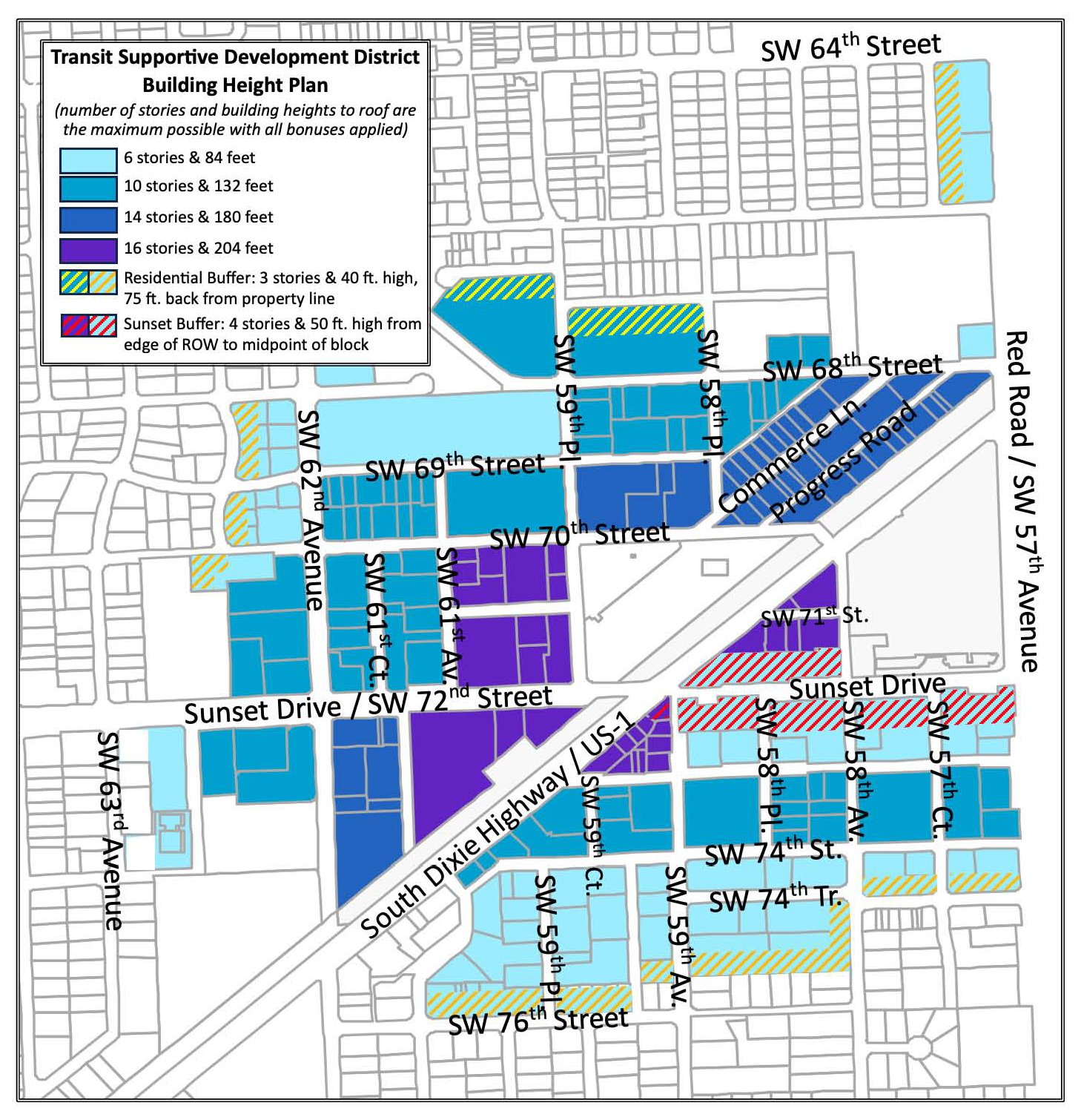
(Ord. No. 28-24-2513, § 2(Exh. A), 12-10-24)
20-8.9(D) - Building location, massing, and form requirements.
(1)
The build-to line is established to bring building frontages to the sidewalk, and to provide adequate, safe and comfortable sidewalks for a walkable retail environment where comfort includes the room for two (2) people walking in opposite directions pass with comfortable personal space for pedestrians, and to provide for window shoppers. Shade tree in grates spaced at twenty-five-foot intervals may narrow the pedestrian through zone, but maintain areas for people to pass by each other. Areas between trees may be used for street furniture, and bicycle amenities in conformance with City streetscape plans.
(2)
Frontage ratios along street front ground floors are measured along the build-to line and are to continue vertically for the height of the ground floor (up to twenty-four (24) feet high). The percentage of unbuilt space along street fronts may be met by the design of recessed entryways and foyers to storefronts, offices, and residences, and by small courtyards that may also count as open space. No continuous wall shall be more than seventy (70) feet wide. Storefront recess areas may accommodate display windows that are angled (not parallel) to the street.
(3)
Frontage along street front upper floors are measured along the build-to line, and are to continue vertically for the height of each floor to which they are located. The percentage of unbuilt facade along the build-to line may be met by the design of recessed terraces or may be met by balcony lines at the build-to lines with the structural building wall recesses. Variety of facade lines is encouraged.
(Ord. No. 28-24-2513, § 2(Exh. A), 12-10-24)
20-8.10 - Architectural standards.
The Architectural Standards are intended to provide a degree of predictability about the quality of building designs and to promote harmony among buildings.
A primary goal for the Architectural Standards is authenticity. The standards encourage construction that is straightforward and functional, and that draws its ornament and variety from the traditional assembly of genuine materials. Good site planning and street relationship; use of authentic materials; and contextuality of design elements and styles are some of the principles encouraged to ensure an attractive and tasteful aesthetic image for the neighborhood.
(Ord. No. 28-24-2513, § 2(Exh. A), 12-10-24)
20-8.10(A) - General requirements.
(1)
All construction must comply with the Florida Building Code, the latest edition, as amended. The general requirements shall be the same as those specified in Sections 20-7.16 through 20-7.25. Buildings shall be constructed as varying masses with different materiality, texture and depth.
(2)
For building articulation and to break the facade massing, varied materials and extrusion of elements shall be used. Horizontal and vertical extrusions will be used to create the desired building form. Building massing treatment shall address a pedestrian scale to enhance the street level public realm area.
a.
Vertical form shall be in accordance with the dimensions established in Section 20-8.9(D).
b.
The use of a variety of architectural attributes and materiality shall enhance the street-level experience.
(3)
Except for portions of buildings or developments improved with townhouses, buildings shall provide fenestration on all sides in accordance with Section 20-8.10(C).
(4)
Except for portions of buildings or developments improved with townhouses, public main entrances shall include a recessed entry of at least three-foot depth from primary streets. The intent is to create a transition space near entrance doors and pedestrians walking along the sidewalk.
(5)
Glare. In all districts, any lighting shall be arranged so as not to shine directly on any residential use. Direct or sky-reflected glare, when from floodlights.
(6)
Service and loading areas shall not be visible from public streets and adjacent residential properties. All service areas shall be screened from the view of any pedestrian or vehicular path.
(7)
All parking structures in the TSDD shall be screened from view where facing any street, or any view from an adjacent residentially zoned are in the City of South Miami.
a.
Parking garage screening shall be by permanent architectural design elements that are permanently affixed or an integral part of the garage facade structure.
b.
Parking garage screening, where permitted, may include screens that may be permitted as part of the South Miami Art in Public Places program, subject to the requirements of Section 7-17 of the City of South Miami Code.
(Ord. No. 28-24-2513, § 2(Exh. A), 12-10-24)
20-8.10(B) - Sustainable buildings.
The purpose of this article shall be to promote sustainable development within the City of South Miami TSDD zoning district by supporting resilient design and construction practices. Sustainable building practices will promote the economic and environmental health of the City and ensure that the City continues to become environmentally resilient. This article is designed to achieve the following objectives: increase energy efficiency in buildings; encourage water and resource conservation; reduce waste generated by construction projects; reduce long-term building operating and maintenance costs; improve indoor air quality and occupant health; contribute to meeting state and local commitments to reduce greenhouse gas production and emissions; and encourage sound urban planning principles.
(1)
Sustainability Requirements.
(a)
All buildings and building additions on a unified development site above forth thousand (40,000) square feet shall be constructed for certification by the U.S. Green Building Council (USGBC) to a minimum Silver certification for Leadership in Energy and Environmental Design (LEED) (fifty (50) to fifty-nine (59) points) or equivalent certification.
(b)
All buildings and building additions on sites between twenty thousand (20,000) square feet and forty thousand (40,000) square feet shall be constructed for certification by the U.S. Green Building Council (USGBC) (green) for Leadership in Energy and Environmental Design (LEED) (forty (40) to forty-nine (49) points) or equivalent certification.
(c)
Buildings that are constructed as townhouses, both as a buffer use or as a primary use in the TSDD, shall not be required to meet these sustainability requirements. Where townhouses are part of a larger development, the other buildings or portions of the development that are twenty thousand (20,000) square feet or greater shall be required to meet sustainability requirements as established in Paragraphs 20-8.10(B)(1)(a) and 20-8.10(B)(1)(b) above.
(2)
Standards. This article shall be administered using standards developed for and standards developed by the Florida Green Building Council, United States Green Building Council (USGBC). All eligible participants who are certified as having satisfied all of the requirements of the green building certification, including, but not limited to, any monetary or certification requirements, are eligible for a partial or full refund of the sustainability fee identified in Paragraph (4) herein based upon the level of compliance with the regulations in this article.
(3)
Generally. A sustainability fee will be assessed for all eligible participants. The calculation of the fee, provisions for refunding all or portions of the fee, its purpose, and eligible uses are detailed within this division.
(4)
Sustainability Fee Calculation.
(a)
In order to obtain a temporary certificate of occupancy (TCO), certificate of occupancy (CO), or certificate of completion (CC), whichever comes first, the eligible participant must first post a sustainability fee payment bond or issue full payment of the sustainability fee to the City. The sustainability fee shall be valued at five percent (5%) of the total construction valuation of the building permit. However, the eligible participant may be entitled to a refund or partial refund, of the bond, or payment of the sustainability fee, based upon achieving the program certification levels in the compliance schedule below:
FGBC Florida Green High-Rise Residential Building
Standard Certification Compliance Schedule
If the proof of green building certification is provided prior to the obtaining a TCO, CO, or CC, the "sustainability fee" shall be in the full amount identified above, minus the refund for the level of green building certification achieved identified in the certification compliance schedule.
(b)
The sustainability fee shall be valuated upon the eligible participant's submittal at the time of application for temporary certificate of occupancy (TCO), certificate of occupancy (CO), or certificate of completion (CC), whichever comes first, upon review by the Planning and Zoning Department during zoning review of the certificate. The sustainability fee bond or full payment shall be provided by participant prior to obtaining a temporary certificate of occupancy (TCO), certificate of occupancy (CO) or certificate of completion, whichever comes first.
c.
Refund of the sustainability fee or bond to the eligible participant may occur as provided for in Subsection (a), above, provided the eligible participant complies with the certification compliance schedule within the timeframe identified in Paragraph (4)(b).
d.
The entirety of the sustainability fee shall be forfeited to the City based upon participant's failure to achieve the applicable green building certification levels identified Paragraph(4)(a) within the timeframe identified in Paragraph (4)(b).
(5)
Review Procedures.
(a)
Prior to obtaining a temporary certificate of occupancy, certificate of occupancy (CO) or certificate of completion (CC), whichever comes first, the qualifying projects shall post a bond with the City, or in the alternative, provide a payment to the City, in the amount of the "sustainability fee" identified in Paragraph (4)(a).
(b)
Within one year from the receipt of a certificate of occupancy (CO) or certificate of completion (CC), the owner shall submit proof of green building certification for the development from the green building certification agency.
i.
The bond or payment provided, or percentage thereof, shall be refunded to program participants that have achieved a level of green building certification identified in the certification compliance schedule in Paragraph (6).
ii.
The Planning and Zoning Department Director may approve, upon the request of the eligible participant, a one-time one-year extension, provided proof that the green building certification agency's review remains pending to determine final certification.
(c)
Building permit applications for a green building project submitted or resubmitted for review shall be given priority review over projects that are not green building projects by the City's departments reviewing such applications.
(d)
All building inspections requested for green building projects shall be given priority over projects that are not green building projects.
(6)
Deposit of Funds; Account.
(a)
The City shall establish a sustainability and resiliency fund. The revenue generated through the sustainability fee program shall be deposited in the sustainability and resiliency fund.
i.
Interest earned under the account shall be used solely for the purposes specified for funds of such account.
ii.
Sustainability fees deposited and credited to the sustainability and resiliency fund account, and credited to the eligible participant, pursuant to Paragraph (7), shall be identified, within the City's sustainability and resiliency fund.
iii.
Appropriation of deposited funds in the sustainability and resiliency fund shall not be permitted until the applicable refund period, established in Paragraph (7)(b), for those funds has lapsed.
iv.
Should the eligible participant provide a bond, rather than pay the sustainability fee, then, the City shall safeguard the bond, to ensure compliance with this article. The City shall return the bond or make a claim for a portion of the bond, depending on the eligible participant's compliance with Paragraph (7)(b) and Paragraph (6)(a).
b.
Earned fees in the sustainability and resiliency fund shall be utilized to provide public improvements that increase the sustainability and resiliency of the City. Expenditures from these funds shall require prior City Commission approval. Prior to any expenditure, the City Manager shall provide a recommendation to the City Commission.
c.
Such improvements that increase the resiliency of the City may include:
i.
Environmental restoration projects;
ii.
Environmental remediation projects;
iii.
Environmental monitoring;
iv.
Green infrastructure;
v.
Enhanced stormwater quality and quantity improvements; and/or vi. Sustainability planning efforts.
(Ord. No. 28-24-2513, § 2(Exh. A), 12-10-24)
20-8.10(C) - Building elevations.
(1)
Buildings shall abut the street-front sidewalk and orient the primary entrance or entrances toward the street, or the corner of two (2) streets if the corner includes an entry plaza, and the building facade is angled, of uses a convex or concave curved facade to accommodate the entry plaza area.
(2)
All new construction and major reconstruction along street frontages must provide windows and entrances or other features to afford interest to pedestrians and to enhance the pedestrian quality of the environment.
(3)
Along a frontage containing a required building line, transparent glazing shall be used as provided in the table below for the horizontal dimension of the first-floor elevation between two (2) feet and twelve (12) feet height for the first floor and measured by the horizontal dimension for upper floors, without limitation to vertical placement.
(4)
Reflective glass that mirrors external surroundings shall not be used for any external glazing.
(5)
All glazing is to meet building code requirements for energy efficiency and impact resistance.
(6)
In addition to vertical variation required in Section 20-8.9(D), on Sunset Drive and Primary Streets, architectural features such as brows, variation of surface material, or variation of glazing patterns or color, shall be used to provide horizontal visual relief and interest. At minimum, a cornice or other visual break line in the facade design at the tops of the fourth floor, eighth floor, and the two (2) top floors shall be provided. Brows used for this purpose may not encroach beyond the property lines or build-to lines established in Section 20-8.9(D).
(Ord. No. 28-24-2513, § 2(Exh. A), 12-10-24)
20-8.10(D) - Building encroachments.
(1)
Canopies. Buildings shall provide amenities to improve the climate along streets, and reduce excessive heat or sunlight for pedestrian comfort. Where appropriate, canopies can be provided along the street frontage of buildings, and shall be designed so as not to obstruct views and access between building entrances, the sidewalk, and the street. Canopies shall be a minimum of twenty (20) feet wide, and have a break of at least one foot between canopies. Canopies shall be a minimum of twelve (12) feet high from the sidewalk grade to the lowest point of the canopy, and shall not extend more than six (6) feet on primary streets or three (3) feet on secondary streets.
(2)
Balconies.
(a)
Balconies on the facade below the second level are not permitted.
(b)
Balconies on stories above the ground floor level, may not encroach the build-to line.
(c)
No storage or display of items other than furniture shall be permitted on balconies. Balconies may not be enclosed or screened.
(Ord. No. 28-24-2513, § 2(Exh. A), 12-10-24)
20-8.10(E) - Historic context.
(1)
All new construction along the blocks of Sunset Avenue, shall provide interpretive facades in design and materials for the first and second floors or up to the first step-back that are compatible with the structures on the same block that are zoned in the Historic Overlay.
(2)
Where a development site includes a property that is zoned in the Historic Overlay, the new facade shall integrate the historically significant features as part of its design at the stories below the step-back level.
(Ord. No. 28-24-2513, § 2(Exh. A), 12-10-24)
20-8.11 - Street standards.
(A)
Landscaping and Utilities. All plant materials shall conform to the standards for Florida No. 1 or better as given in "Grades and Standards for Nursery Plants" Part I, 1963 and Part II, State of Florida, Department of Agriculture, Tallahassee, or equal thereto. Grass sod shall be clean and reasonably free of weeds and noxious pests or diseases. Grass areas shall be planted in species normally grown as permanent lawns. Grass areas must be sodded. All new landscaping must incorporate the xeriscape principles provided in Section 20-7.17. Existing healthy plant material may remain and be incorporated into future streetscape projects.
(1)
Tree Requirements.
(a)
Tree Requirements for Lands Zoned TSDD. Landscaping and tree protection requirements shall be subject to the provisions of Sections 20-4.5 and 20-4.5.1. Notwithstanding the foregoing, in recognition of the infill nature of lands zoned TSDD, an applicant may satisfy the requirements of this section with the following adjustments, credits, and mitigation.
(b)
Site Tree Adjustments. When the minimum number of trees required under Section 20-4.5 cannot be reasonably planted on the ground level of the subject property, the applicant may utilize one or more of the following adjustments:
i.
Minimum Number of Site Trees Required. In order to promote safe, functional, and accessible public sidewalks and, at the same time, encourage the activation of public plazas and encourage the improvement of the public realm with public seating areas while avoiding conflict with landscape features, where the minimum number of street trees cannot be reasonably accommodated, the City Manager may designate (i) a location within the City for the planting of any remaining required trees or (ii) a payment to the City consistent with the costs of planting the deficient required trees.
ii.
Site Trees in the Public Right-of-Way. Site Trees may be planted within the public right-of-way so long as they are within ten (10) feet of the private property line and the trees do not unreasonably interfere with the activities of the right-of-way. Site Trees planted in the public right-of-way shall be in addition to any Street Tree requirement for a site and shall only count toward the Site Tree requirement for that site. When trees are requested by a property owner to be planted within the right-of-way, the requesting property owner shall execute a covenant provided by the City to provide for the maintenance of such trees subsequent to planting.
(2)
Shade trees may be planted to provide additional climate protection and contribute to an attractive pedestrian environment. Street trees shall be planted on all street frontages in accordance with Section 20-4.5.1(O). The street tree requirement may be modified or waived at the discretion of the Development Services Director upon a demonstration of practical difficulty in strict compliance. Any such waiver shall be the smallest deviation from the requirements necessary to maximize the health of the tree and maintenance of the public realm.
(3)
Utilities. Where feasible and permissible all electrical power utilities, communication, and other utility lines shall run underground.
(Ord. No. 28-24-2513, § 2(Exh. A), 12-10-24)
20-8.12 - Unity of title or covenant in lieu of unity of title.
A Unity of Title or Covenant in Lieu of Unity of Title, in a form acceptable to the City Attorney, as set forth in Section 20-5.16, is required for all platted lots in any development project within the TSDD if any of the following conditions exist:
(1)
If a development project is to be built on two (2) or more abutting platted lots;
(2)
If the required parking for a development project is located on a lot other than on the site that is generating the required parking.
(Ord. No. 28-24-2513, § 2(Exh. A), 12-10-24)
20-8.13 - Waivers.
Specific deviations from the TSDD zoning code Sections 20-8.9, Regulating Plan, and 20-8.10, Architectural Standards, that are consistent with the principles and intent of the TSDD zoning district shall be relieved by waivers, depending upon the nature of the deviation, the property attributes, and the applicable regulations. Waivers are intended to relieve practical difficulties in complying with the strict requirements of this Code. Waivers shall include a complete waiver or partial adjustment of an applicable requirement, and for the purpose of the TSDD zoning regulations, the terms are one and the same. All of the requirements herein shall apply to waivers and adjustments. Waivers are not intended to relieve specific cases of financial hardship, nor to allow circumventing of the intent of the TSDD. A waiver may not be granted if it conflicts with the City Code or the Florida Building Code, is contrary to the public interest, or results solely from the actions of the applicant. Waivers may be approved by the City Commission in connection with a large scale development approval, or by waiver application for smaller developments, and only for properties that meet specific criteria.
(A)
Permitted Waivers. A waiver shall be authorized to be granted only if the minor deviation is less than ten percent (10%) of a quantifiably regulated standard set forth in Sections 20-8.9, Regulating Plan, and 20-8.10, Architectural Standards.
(B)
Prohibited Waivers. Waivers shall not be granted if the minor deviation:
(1)
Allows a prohibited use, or one that is contrary to the City of South Miami Comprehensive Plan;
(2)
Establishes or expands a use that is otherwise prohibited;
(3)
Has the effect of increasing density or intensity of a use beyond that permitted by the TSDD district and its sub-districts;
(4)
Is requested because of the presence of nonconformities in the zoning district or uses in an adjoining zoning district;
(5)
Is requested because of prior variances or waives granted.
(C)
Waiver Application.
(1)
A complete application shall include the application form, applicable fee(s), a current survey, a site plan, building elevations, a landscape plan, and additional information determined as necessary for determination by the Planning Director.
(2)
A waiver application that is made for a development that is eligible for administrative site plan review, shall follow the general procedures for assuring neighborhood awareness of the request. All applications for a waiver shall be accompanied by a map that shows all properties and the names of all property owners within a five hundred-foot radius of the subject property. A notarized affidavit shall be presented to the Planning and Zoning Department within five (5) business days of submittal of an accepted application, attesting that the applicant gave notice of the proposed application to all the property owners within the noted five hundred-foot radius by regular U.S. mail with the exception of the abutting, or contiguous, property owners, who shall be made aware via Certified Mail. The affidavit shall be accompanied by a copy of the notification letter together with copies of the Certified Mail receipts.
(3)
A waiver application that is made as part of a [Section] 20-8.7 large-scale development special exception, shall be reviewed pursuant to the application procedures and review standards of the process provided in Sections 20-8.7 and 20-8.7.1, Administrative Approval of Minor Modifications, to an Approved Development within the TSDD district, as part of any such application.
(D)
Waiver Approval and Grant. Upon receipt of a complete application for waiver for development eligible for administrative site plan review, it shall be reviewed and a determination issued by the Planning Director to grant, deny or grant with conditions the requested waiver.
(1)
Appeal of an administrative determination to grant, deny, or grant with conditions a requested waiver, may be appealed by the applicant or affected party pursuant to Section 20-6.2. An affected party is one that was noticed as a property owner within a five hundred-foot radius of the subject property. The appeal must be filed with the Development Services Director within thirty (30) days of the decision on the waiver.
(E)
Criteria and Standards for Granting Waivers.
(1)
Practical Difficulty. The granting of a waiver based on practical difficulty shall balance the rights of property owners in the TSDD and adjacent districts within the City and the need of the individual applicant based on an evaluation of the factors below:
(a)
Whether a waiver of the minor deviation would be compatible with development patterns in the TSDD;
(b)
Whether the essential character of the TSDD will be preserved;
(c)
Whether the waiver of minor deviation can be approved without causing substantial detriment to adjoining properties;
(d)
Whether the waiver of minor deviation would do substantial justice to the property owner as well as to other property owners justifying a relaxation of the TSDD requirements;
(e)
Whether the plight of the applicant is due to unique circumstances of the property and/or applicant which would render conformity with the strict requirements of this chapter unnecessarily burdensome; and
(f)
Whether the special conditions and circumstances that exist are the result of actions beyond the control of the applicant.
(2)
Conditions and safeguards may be imposed. In granting any waiver, appropriate modifications or conditions may be prescribed to mitigate the proposed deviation and to ensure safeguards in conformity with the Comprehensive Plan and the City Code or any other enacted ordinance.
(3)
The effect and limitation of a waiver shall be applicable to the development for which it is granted and not to the individual applicant, nor shall it be applicable to the land.
(F)
Waivers for Irregular Lots and Office Development Limited to Six (6) Stories. Through a large scale development approval, the Commission may approve waivers to ground floor requirements and limitations, and limitations related to horizontal dimensions for irregular lots or mixed-use projects that include office uses within properties limited to six (6) stories in height, where there are practical difficulties in meeting the regulations and the change is in the best interest of the City. Waivers under this section may exceed ten percent (10%) of the limitations established in this Code. Where waivers are approved for open space and/or on-site or street trees, the applicant shall be required to provide a monetary contribution into the "South Miami Public Benefit Trust Fund" in an amount negotiated by the City Commission to be utilized for the improvement of existing public parks; or by undertaking and incorporating off-site improvements and enhancements, as approved by the City Commission, to a public park within the TSDD and/or the City. Such contribution or off-site improvement shall not satisfy more than fifty percent (50%) of the required open space and/or private open space requirements of a proposed project. Waivers shall be based on a consideration of the factors provided in Section 20-8.13(E).
(Ord. No. 28-24-2513, § 2(Exh. A), 12-10-24)

