
South Miami City Zoning Code
ARTICLE III
ZONING REGULATIONS
20-3.1 - Zoning use districts and purposes.
(A)
Zoning Districts Established. In order to implement the intent of this Code and the City's adopted Comprehensive Plan, the City is hereby divided into the zoning use, overlay and special districts with the symbol designations and general purposes listed below and permitted uses set forth in Section 20-3.3(D). Except as expressly set forth within the regulations governing the DS district, standards shall be uniform throughout each district.
(B)
District Purpose Statements.
(1)
"RS-1" Estate Residential District: The purpose of this district is to provide for estate type single-family residential development located in a spacious rural-like setting which emphasizes the preservation of open space. This district is appropriate in areas designated "Single-Family Residential" on the City's adopted Comprehensive Plan.
(2)
"RS-2" Semi-Estate Single-Family Residential District: The purpose of this district is to provide for semi-estate type single-family residential development located in a relatively spacious setting which emphasizes the preservation of open space. This district is appropriate in areas designated "Single-Family Residential" on the City's adopted Comprehensive Plan.
(3)
"RS-3" Low-Density Single-Family Residential District: The purpose of this district is to provide for low-density single-family residential development located in a moderately spacious setting which emphasizes the preservation of open space. This district is appropriate in areas designated "Single-Family Residential" on the City's adopted Comprehensive Plan.
(4)
"RS-4" Single-Family Residential District: The purpose of this district is to provide for single-family residential development located on smaller lots and to protect and improve the character of existing development in the area. This district is appropriate in areas designated "Single-Family Residential" on the City's adopted Comprehensive Plan.
(5)
"RS-5" Single-Family (fifty-foot lots) Residential District: The purpose of this district is to provide for built-out single-family residential subdivisions characterized by smaller lots with fifty-foot frontages and to protect and improve the character of existing development in the area. This district is appropriate in areas designated "Single-Family Residential" on the City's adopted Comprehensive Plan.
(6)
"RT-6" Townhouse Residential District: The purpose of this district is to provide suitable sites for the development of well planned, environmentally compatible, low-density townhouse or duplex projects on sites of at least ten thousand (10,000) square feet, which are located in such a manner as to serve as effective transitional land use elements between single-family and more intensive multi-family residential or commercial areas. This district is appropriate in areas designated "Townhouse Residential" or "Duplex Residential" on the City's adopted Comprehensive Plan.
(7)
"RT-9" Two-Family/Townhouse Residential District: The purpose of this district is to provide suitable sites for the development of well planned, environmentally compatible, low-density attached single-family residential projects of a two-family and/or townhouse nature, which are located in such a manner as to serve as effective transitional land use elements between single-family and more intensive multi-family residential or commercial areas. This district is appropriate in areas designated "Townhouse Residential" or "Mixed Residential Moderate-Density" on the City's adopted Comprehensive Plan.
(8)
"RT-18" Townhouse District: The purpose of this district is to provide suitable sites for the development of well-planned, innovative and environmentally compatible residential uses that transition between single-family residential areas and zoning districts of higher residential density or commercial intensity. This district is "residential" and implements a residential land use category of the City's adopted Comprehensive Plan. Allowances provided in the RT-18 district for Live-Work Units (LWU) or for home offices shall not be construed to mean the district is "commercial" or "mixed-use." Townhouse dwelling units may optionally use the first ground floor area that is above minimum flood elevation and not used for required vehicle storage as: (a) part of the dwelling unit; (b) a live-work space as defined for Live-Work Units (LWU); or (c) an Accessory Dwelling Unit (ADU) pursuant to F.S. § 163.31771. An application for a building permit to construct an accessory dwelling unit must include a recorded title restriction by the applicant which commits that the unit will be rented at an affordable rate to extremely low-income, very low-income, or low-income person or persons, as such terms are defined in the Florida Statutes. Each townhouse primary dwelling unit and each ADU shall have its own direct entrance fronting to a public street with front-facing glazing for both. Single-family residences are also permitted on individual lots. Townhouse dwelling units, exclusive of ADUs, shall be developed at densities no greater than eighteen (18) dwelling units per net acre. This district is appropriate in areas designated "Townhouse Residential," "Mixed-Use Commercial Residential" or "Multi-Family Residential" on the City's adopted Comprehensive Plan Future Land Use Map.
(9)
"RM-18" Low-Density Multi-Family Residential District: The purpose of this district is to provide suitable sites for the development of low-density multi-family residential uses with appropriate landscaped open space which are located in such a manner as to serve as an effective transitional land use element between less intensive residential uses and more intensive multi-family and/or commercial uses. This district is appropriate in areas designated "Multi-Family Residential" on the City's adopted Comprehensive Plan.
(10)
"RM-24" Medium-Density Multi-Family Residential District: The purpose of this district is to provide suitable sites for the development of medium-density multi-family residential uses with appropriate landscaped open space. This district is appropriate in areas designated "Multi-Family Residential" on the City's adopted Comprehensive Plan.
(11)
"RO" Residential Office District: The purpose of this district is to provide suitable sites which will accommodate the limited office space needs of certain low impact professional services in attractive low profile buildings on heavily landscaped sites, architecturally similar to and compatible with nearby single-family structures. The district should serve as a transitional buffer between established single-family neighborhoods and major traffic arterials or more intensive uses, and is appropriate in areas designated "Business Office (Low Intensity and Volume)" on the City's adopted Comprehensive Plan.
(12)
"LO" Low-Intensity Office District: The purpose of this district is to permit low-intensity office development and redevelopment, without necessarily being compatible in appearance with single-family residential areas. This district is appropriate in areas designated "Commercial Retail and Office", "Mixed Use Commercial/Residential", and "Business Office (Low Intensity and Volume)" on the City's adopted Comprehensive Plan.
(13)
"MO" Medium-Intensity Office District: The purpose of this district is to accommodate professional and business office space needs in a relatively intensive centrally located manner. This district is appropriate in areas designated "Mixed-Use Commercial/Residential" on the City's adopted Comprehensive Plan.
(14)
"NR" Neighborhood Retail District: The purpose of this district is to permit convenience commercial uses which provide for the everyday retail and personal service needs of nearby residential neighborhoods in a compatible and convenient manner. This district is appropriate in areas designated "Commercial Retail and Office" on the City's adopted Comprehensive Plan.
(15)
"SR" Specialty Retail District: The purpose of this district is to maintain the basic specialty retail character of the Sunset Drive commercial area by encouraging comparison retail uses at the pedestrian-oriented grade level and office and residential uses on the upper floors of all buildings. This district is appropriate in areas designated "Mixed-Use Commercial/Residential" on the City's adopted Comprehensive Plan.
(16)
"GR" General Retail District: The purpose of this district is to delineate areas which permit a broad range of retail uses. Uses that are strongly oriented toward the motoring public are discouraged in this district. This district is appropriate in areas designated "Commercial Retail and Office" on the City's adopted Comprehensive Plan.
(17)—(22)
"TSDD," Transit - Supportive Development District: (includes subcategories TSDD (MU-4), TSDD (MU-5), TSDD (MU-6), TSDD (MU-M), TSDD (PI), and TSDD (PR)) The purpose of this district is to maximize and support the presence of a mass transit center located within walking distance of the boundaries of the district. The TSDD is intended to provide for the development of office, retail, residential uses, and related services in multi-story and mixed-use projects that are characteristic of transit-supportive developments. Regulations provide for the continuation of existing light industrial uses, but encourages redevelopment through land assembly, flexible building heights, design standards, and performance-oriented incentives. The portion of the TSDD consisting of properties contiguous or abutting the South Miami Metrorail Station property is known as the Transit-Oriented Development Area ("TODA").
(23)—(25)
"PUD" Planned Unit Development: (includes PUD-R, PUD-M, PUD-H) The purpose of this district is to allow a tract of land to be developed as a unit under single ownership or unified control, which includes one or more principal buildings or uses. A PUD encourages design flexibility versus traditional siting such as side yards, setbacks, height. A greater flexibility in locating buildings and in combining various uses will achieve better economics in construction, preservation of open space and inclusion of amenities. The district is appropriate in areas designated residential, multi-family, commercial, transit oriented, mixed use or public/institutional areas on the city's adopted Comprehensive Plan and Future Land Use Map.
(26)
"HP-OV" Historic Preservation Overlay: The purpose of this district is to preserve and protect historic and/or architecturally worthy buildings, sites, neighborhoods or archaeological zones, which impart a distinct aspect to the City of South Miami and which serve as visible reminders of the history and cultural heritage of the City, the State and the Nation. The HP-OV zoning district shall overlay existing use districts, and all uses allowed by the underlying use district shall be permitted. The provisions, standards, and procedures set forth for properties designated as an historic site or district shall be in addition to all other applicable requirements in the Land Development Code. The district is appropriate in any land use categories on the city's adopted Comprehensive Plan and Future Land Use Map.
(27)
"HD-OV" Hometown District Overlay: The purpose of this district is to implement a mixed-use commercial/residential land use category that is characteristic of traditional down-towns. It is intended to provide for different levels of retail uses, office uses, retail and office services and residential dwelling units with an emphasis on mixed use development. In order to assure a mix of uses, the City requires that a minimum of two of the above uses must be included within each project. The land development regulations contained herein reinforce South Miami's Comprehensive Plan by establishing new standards for development as an overlay to existing development regulations within the boundaries of the Hometown District. The district is appropriate in the mixed use areas on the city's adopted Comprehensive Plan and Future Land Use Map.
(28)
"CS-OV" Community Service Overlay: The purpose of this district is to promote the health, safety, community-acceptable standards of morals and general welfare of the residents of the City of South Miami. The Community Services overlay zoning district is intended to provide for the establishment of an overlay zoning district in the Charrette Two Study Area, in order to provide for the special needs of community-based service providers and, specifically, to permit parking lot improvements, out-parcel development, day care center facilities and building additions for those properties under the sole ownership of community-based service providers, such as churches, mosques, synagogues, or temples. The district is appropriate in the residential areas on the city's adopted Comprehensive Plan and Future Land Use Map.
(29)
"H" Hospital District: The purpose of this district is to permit, as a special use, areas that will accommodate various hospital needs in a manner compatible with nearby residential areas. The district also permits office uses at appropriate intensities in the event that hospital uses are terminated and is appropriate in areas designated "Hospital/Office" on the city's adopted Comprehensive Plan. The unique nature of hospital usage and its quickly changing needs and characteristics makes their proper regulation under ordinary zoning regulations difficult. Hospitals located near residential areas are both an asset in terms of jobs and services provided and a liability in terms of traffic generated and their propensity to expand. It is the intent of this district to establish stable land use patterns in hospital areas upon which local residents and hospitals can both rely.
(30)
"PI" Public/Institutional District: The purpose of this district is to provide for governmental facilities, utilities and similar uses, with building heights and intensities compatible with surrounding districts. This district is appropriate in areas designated "Public Institutional" on the City's adopted Comprehensive Plan.
(31)
"PR" Parks and Recreation District: The purpose of this district is to provide for public parks and open space areas, including those associated with schools and other community facilities. This district is appropriate in areas designated "Parks and Open Space" on the City's adopted Comprehensive Plan.
(32)
"MU-AH" Mixed Use-Affordable Housing (Two-Story): The purpose of this district is to permit mixed use projects which combine affordable housing with a compatible mix of retail, office, business or professional services and cultural/entertainment in a unified cohesively designed development. The residential component of developments in this district is mandatory and shall be limited to housing units which service the low to moderate income segment of the affordable housing group as defined by the U.S. Department of Housing and Urban Development. This district is appropriate in areas designated as "Mixed-Use Commercial/Residential" on the City's Comprehensive Plan.
(33)
"R" Religious District: The purpose of this district is to provide for religious facilities and uses and could also permit other ancillary uses implemented by the category, which by design and construction are intended for organized worship and commonly related services, such as educational, recreational, and social services, including day care and office. Such ancillary uses shall be subordinate to the principal use. Zoning regulations may permit religious uses on sites not so designated by the Comprehensive Plan.
(34)
"DS" Downtown SoMi District: The purpose of this district is to provide for the establishment of placemaking development that is urban in scale. This district authorizes a mixture of uses, densities, intensities, and heights that contribute to a vibrant urban experience within walking distance to rail-based rapid transit. Permitted uses and structures on both a temporary and permanent basis include retail, restaurant, residential, hotel, office, entertainment, theaters and attractions, permanent and nonpermanent kiosks, active rooftop uses and those uses reasonably accessory thereto. The regulations applicable to the DS District are contained in Article XII of these Land Development Regulations.
Permitted heights in the DS district shall be up to one hundred ninety-five (195) feet as defined in Section 20-12.8.
The permitted Floor Area Ratio (F.A.R.) shall be up to 3.0 and shall only apply to non-residential structures. Permitted residential density shall be up to sixty-five (65) dwelling units per acre. Hotel uses within this district shall be deemed part of the commercial intensity and shall not be counted for purposes of calculating residential density or intensity. For the avoidance of doubt, residential uses shall not count towards F.A.R. and commercial uses (including hotel uses) shall not count towards residential density.
To promote an active, urban, and vibrant pedestrian experience outdoor seating as a convenience for tenants and guests and as an accessory to restaurants, cafés and similar uses shall be encouraged within the DS district.
Land may be zoned DS if it satisfies all of the following requirements:
(1)
The area of the land so zoned is ten (10) acres or less but exceeds five (5) acres;
(2)
A portion of the land so zoned is adjacent to a principal arterial roadway;
(3)
A portion of the land so zoned is adjacent to a minor arterial roadway; and
(4)
A portion of the land so zoned is within one thousand five hundred (1,500) feet radius of an existing rail-based transit station.
This district is appropriate in areas designated "Downtown SoMi" in the City's adopted Comprehensive Plan and Future Land Use Map.
(C)
Official Zoning Map.
(1)
The city's Official Zoning Map shall be known as the "City of South Miami Official Zoning Map" and is hereby made part of this Code as fully as if set forth herein in detail.
(2)
The original Official Zoning Map, bearing the signature of the mayor and the attestation of the city clerk, is hereby adopted.
(3)
The original map shall be located in the office of the city clerk.
(4)
No changes of any nature shall be made on the original map or matter shown thereon except in conformity with the procedures set forth in Section 20-5.5.
(5)
Replacement of official map:
(a)
In the event that the original Official Map becomes damaged, destroyed, lost or difficult to interpret because of the nature or number of changes or additions, the city commission may, by resolution, adopt a new Official Zoning Map which shall supersede the prior map.
(b)
The new Official Map may correct drafting or other errors or omissions in the prior Official Map, but no such corrections shall have the effect of amending the original Official Zoning Map or any subsequent amendment thereof.
(D)
District Boundaries:
(1)
District boundaries are usually along streets, alleys, property lines or extensions thereof.
(2)
Where uncertainty exists concerning boundaries of districts as shown on the Official Map, the following guidelines shall be used:
(a)
In cases where a boundary line is within a street, alley or easement, it shall be deemed to be the centerline of such right-of-way.
(b)
If the actual location of a street, alley or easement varies slightly from the location as shown on the official map, then the actual location shall control.
(c)
In cases where a boundary line is shown as being located a specific distance from a street right-of-way line or other physical feature, such distance shall control.
(d)
Where district boundaries are not otherwise indicated and where the property is divided into blocks and lots, district boundaries shall be construed to be the lot lines.
(e)
Where bounded approximately by lot lines, said lot lines described in subsection (d) above shall be construed to be the boundary of such districts unless said boundaries are otherwise indicated on the official map or by ordinance.
(f)
All water areas are controlled by applicable district regulations.
(g)
District boundary lines on the official map shall be determined by the use of the scale contained on such map.
(h)
Boundaries indicated as approximately following city limits shall be construed as following such city limits.
(i)
Whenever any street, alley or other public way is vacated by official city action or whenever such is franchised for building purposes, the zoning district line adjoining each side of the public way shall be automatically extended to the centerline of such vacated public way. All area so involved shall be subject to all regulations of the extended districts.
(j)
Where physical or cultural features existing on the ground are at variance with those shown on the Official Map, or in other circumstances not covered by subsections (a) through (i) above, the city commission shall interpret the district boundaries.
(Ord. No. 8-95-1581, §§ 1, 2, 6-6-95; Ord. No. 20-99-1694, § 1, 11-16-99; Ord. No. 11-04-1818, § 1, 10-5-04; Ord. No. 14-04-1821, § 1, 11-16-04; Ord. No. 56-08-1991, § 1, 2-2-08; Ord. No. 34-10-2059, § 1, 10-5-10; Ord. No. 25-11-2098, § 1, 9-6-11; Ord. No. 21-12-2137, § 1, 10-2-12; Ord. No. 05-18-2294, § 2, 3-6-18; Ord. No. 10-18-2308, §§ 1, 2, 11-6-18; Ord. No. 15-19-2328, § 1, 4-23-19; Ord. No. 07-19-2320, § 2, 2-26-19; Ord. No. 06-20-2360, § 2, 2-4-20; Ord. No. 17-20-2371, § 1, 6-2-20; Ord. No. 26-23-2477, § 2(Exh. A), 11-21-23; Ord. No. 27-23-2478, § 2, 11-21-23; Ord. No. 09-24-2494, § 2(Exh. A), 3-19-24; Ord. No. 17-24-2502, § 2(Exh. B), 6-18-24)
20-3.2 - Application of district regulations.
(A)
Minimum Standards. The regulations established by this Code within each district shall be the minimum standards and shall apply uniformly to each class or kind of structure or land, except as hereinafter provided.
(B)
Total Compliance. No building, structure, land or water areas shall be used or occupied, and no building or structure or part thereof shall hereafter be erected, constructed, enlarged, reconstructed, moved or structurally altered except in conformity with all the regulations specified for the district in which it is located.
(C)
Structural Compliance. No structure shall be erected, converted, enlarged, reconstructed, moved or structurally altered which:
(1)
Exceeds the height or bulk established for the district;
(2)
Occupies a greater amount of impervious area or coverage than the percentage permitted in the district; or
(3)
Encroaches upon the minimum yard setbacks or other areas herein required; or is in any other manner inconsistent with the provisions of this Code.
(D)
Separate Compliance. No part of a yard, open space or off-street parking space required in connection with any building for the purpose of complying with this Code, shall be included as part of a yard, open space or off-street parking space similarly required for any other building.
(E)
Yard and Lot Compliance. No yard or lot existing at the time of passage of this Code shall be reduced in dimension or area below the minimum requirements set forth in Section 20-3.5.
(F)
Parking Compliance. Buildings erected, converted, enlarged, reconstructed, moved or structurally altered shall conform to the off-street parking requirements in Section 20-4.3.
20-3.3 - Permitted use schedule.
(A)
Type of Permitted Uses.
(1)
Uses permitted by right or as a special use in each district shall be determined from the Permitted Use Schedule in Section 20-3.3(D).
(2)
All uses shall comply with:
(a)
Any specific special use conditions referenced and set forth in Section 20-3.4;
(b)
All off-street parking requirements referenced and established in Section 20-4.4, other than as modified for Article VIII of this chapter; and
(c)
All other applicable requirements of this Code.
(B)
Established Nonconforming Uses. Uses which were established prior to the adoption of this Code or its predecessors, but which are now inconsistent with the requirements of this Code shall be permitted if such uses meet the requirements of this Code for a valid nonconforming use.
(C)
Permitted Use Schedule.
(1)
Uses identified in a particular district column with a "P" are "permitted by right" and may be allowed in such district, subject to all other applicable requirements of this Code.
(2)
Uses identified in a particular district column with an "S" are "special uses" and may be permitted in such district with such conditions as referenced in the "Conditions" column (second from right on the Schedule) and defined in Section 20-3.4, subject to all other applicable requirements of this Code.
(3)
Off-street parking requirements for each permitted or special use are referenced in the "Parking" column (far right on the Schedule) and are further defined in Section 20-4.4(B).
(4)
Uses not listed as "permitted by right" or as "permitted as special use" in a district are not allowed in such district unless otherwise expressly permitted under this Code in accordance with paragraph (5) below.
(5)
New or unlisted uses of similar nature.
(a)
The director of building/zoning and community development shall consider the nature of the proposed use, its compatibility with other uses permitted in the various districts and determine the zoning district or districts within which the use should be permitted, if any.
(b)
The city manager shall transmit the findings and recommendations of the director of building/zoning and community development for the classification proposed for any new or unlisted use to the city commission for review at its next regularly scheduled meeting.
(c)
The city commission shall approve the recommendations of the director or make such determination concerning the classification of the new or unlisted use as it determines appropriate.
(6)
Location of Permitted "SR" District Uses. In the "SR" Specialty Retail District, permitted retail uses shall be located only on first and second floor building levels, permitted office uses only on second floor building levels, and permitted residential uses only on second floor building levels or above, except that for buildings abutting U.S. 1 (South Dixie Highway) that contain more than fifty thousand (50,000) square feet of ground floor space, permitted office uses may be located on the first, second or third floor building levels within that portion of the building lying within one hundred seventy-five (175) feet of the U.S. 1 (South Dixie Highway) right-of-way.
(a)
The percentage of permitted office uses that would be allowed to occupy the first or ground floor of multi-tenant structures shall not exceed a contiguous twenty-two (22%) percent of the first or ground floor building area of the entire building. Requests for office uses in excess of a contiguous twenty-two (22%) percent will require a "special exception" approval pursuant to Section 20-7.51 of the Land Development Code.
(b)
Ground floor office uses shall be required to have ground floor visibility from the adjacent streets and interior walkways, and shall be open and regularly accessible to customers and patrons during regular business hours. These uses shall to the best of their ability, maintain a retail storefront look along the interior walkways comparable to traditional retail sales operations.
(c)
The ground-floor office uses with a facade along the adjacent street shall have storefront windows covering no less than twenty-five (25) percent of the ground-floor building frontage wall area. Storefronts shall remain un-shuttered at night and shall utilize transparent glazing material, and shall provide view of interior spaces lit from within. Where interior building frontages exceed fifty (50) feet, doors or entrances with public access or egress shall be provided at intervals averaging no greater than twenty-five (25) feet.
Note: Subsection (E) deleted and Standard Industrial Classification Column deleted from the Permitted Use Chart on August 21, 1990 by Ord. No. 11-90-1451.
SECTION 20-3.3(D)
PERMITTED USE SCHEDULE
* Revised January 15, 1991 by Ord. No. 3-91-1468 under section 15-63, miscellaneous provisions, South Miami Code of Ordinances (see text at end of table).
** Parking requirement category; one space per three hundred (300) square feet gross floor area.
*** This activity is permitted as of right if it does not include the sale of alcoholic beverages and if it is not in the TSDD MU-M district. Otherwise, it shall be approved as a Special Use (Section 20-3.4) and as to the sale of alcoholic beverages it will also be subject to the requirements of Chapter 4 of the South Miami Code of Ordinances.
**** All businesses that adjoin or abut a single-family or multi-family zoned district may not be open before 8:00 a.m. and must close on or before 7:00 p.m.; if they are not adjoining or abutting such districts they shall not be open before 6:00 a.m. and they must be closed on or before 10:00 p.m. Gross floor area of the use shall not exceed two thousand (2,000) square feet.
1 Within the DS district, an Automobile Rental Agency shall operate only as concierge service accessory to a hotel. No automobile rental inventory shall be permitted to be stored or parked in on-site parking resources.
2 Automobiles for display to consumers may be stored inside the Automobile Showroom but may not be stored or parked in on-site parking resources. No more than ten (10) vehicles for consumer test driving use may be stored or parked in on-site parking resources. No automobile inventory shall be permitted to be stored or parked in on-site parking resources.
3 A microbrewery is an establishment primarily engaged in the production and distribution of beer, ale, or other malt beverages, and which may include retail sales and on-site consumption. Parking shall be provided at a rate of one space per one thousand (1,000) gfa for the area devoted to production and one space per one hundred (100) gfa for patron areas.
4 Parking shall be provided based on the standard required for the particular use that is operating as a home-based business.
5 In the RT-18 district, Live-Work Units shall not require special use permit approval, provided that the Planning Director finds that the proposed Live-Work Units otherwise comply with all requirements of this Code. To determine compatibility, the Special Use Conditions listed in Section 20-3.4(B)(27), and Section 20-3.4(B)(28) as applicable to Artist Studios shall be applied to the review of all uses proposed for Live-Work Units. Live-Work Units may include professional services, personal services, and artist studios that are determined as compatible with the surrounding area. Live-Work Units shall not include in-person retail sales or pickup by customers, and not be permitted to engage in prepared food service, including dine-in or take-out. Operations shall be limited to the hours of 8:00 a.m to 7:00 p.m. Signage shall be permitted subject to the criteria of Section 20-4.3. Prior to the issuance of a certificate of use for any Live-Work Units, the property owner must execute and record a Declaration of Restrictive Covenants running with the land in a form approved by the Planning Director and the City Attorney which covenants that the Live-Work Unit(s) shall comply with the requirements of this Code, expressly lists requirements of Section 20-3.4(B)(27), and provides that the City may enforce said covenant through all means authorized by law including, but not limited to, the denial of building permits or revocation of certificates of use or occupancy on the subject property, injunctive relief, and other means.
6 Urgent care facilities shall not exceed six thousand five hundred (6,500) square feet in gross floor area, and shall not be designed to accept transport of patients from ambulances, or provide beds for overnight stays or ongoing treatment. A condition of Certificate of Occupancy shall require communication by the operator to any ambulance service charged with transporting patients from the urgent care facility to not operate sirens or any other plainly audible attention attracting devices within the property where the urgent care facility is located.
EXCERPT FROM THE SOUTH MIAMI CODE OF ORDINANCES
Section 15-63 Mobile vendors: definition and regulation
(a) A mobile vendor is any person, firm, corporation or other entity which travels from place to place selling any and all goods, wares, and merchandise, including, specifically, food, food products and beverages.
(b) All mobile vendors are prohibited from operating or doing business in the City of South Miami except as hereinafter provided.
(c) Mobile vendors selling food, food products and beverages may operate and do business in I zoning districts or upon construction sites where work is actively in progress upon the following terms and conditions:
i.
No mobile vendor shall station itself upon any public street or right-of-way. Neither
shall any mobile vendor station itself upon any private property except with the express
permission of the owner thereof and in a manner which does not impede the flow of
traffic in public streets or rights-of-way nor block pedestrian access to streets
or rights-of-way.
ii.
All mobile vendors must provide for their own trash and garbage removal such that
no trash or garbage remains on the premises upon which the vending was conducted.
iii.
No mobile vendor shall remain in any one site longer than thirty (30) minutes except
in the case of a special event, exhibition, exposition, art show and/or festival not
to exceed five (5) days and when further specifically permitted by a majority affirmative
vote of the city commission by resolution.
iv.
Mobile vendors must operate from four-wheel motorized vehicles registered in the State
of Florida except in the case of fairs, exhibitions and expositions not exceeding
five (5) days.
(Ord. No. 12-90-1452, 7-24-90; Ord. No. 11-90-1451, 8-21-90; Ord. No. 2-91-1467, 1-15-91; Ord. No. 3-91-1468, 1-15-91; Ord. No. 4-91-1469, 2-5-91; Ord. No. 7-91-9091, 3-19-91; Ord. No. 12-91-1477, 4-16-91; Ord. No. 15-91-1480, 5-21-91; Ord. No. 19-91-1484, 7-23-91; Ord. No. 26-91-1490, 11-5-91; Ord. No. 26-91-1491-A, 11-19-91; Ord. No. 3-92-1498, 1-7-92; Ord. No. 7-92-1502, 5-5-92; Ord. No. 10-92-1505, 6-2-92; Ord. No. 13-92-1508, 8-4-92; Ord. No. 29-92-1524, 11-3-92; Ord. No. 1-94-1550, 2-1-94; Ord. No. 16-94-1566, § 1, 11-1-94; Ord. No. 10-97-1631, § 1, 4-1-97; Ord. No. 14-98-1662, § 2, 9-1-98; Ord. No. 9-99-1683, § 1, 5-4-99; Ord. No. 20-99-1694, § 1, 11-16-99; Ord. No. 22-99-1696, § 2, 11-16-99; Ord. No. 12-00-1714, § 2, 4-18-00; Ord. No. 5-01-1736, § 1, 2-6-01; Ord. No. 8-01-1739, § 1, 3-6-01; Ord. No. 15-01-1746, § 1, 7-24-01; Ord. No. 16-01-1747, § 1, 7-24-01; Ord. No. 21-01-1752, § 1, 10-2-01; Ord. No. 25-01-1756, § 1, 10-2-01; Ord. No. 6-02-1774, § 1, 7-23-02; Ord. No. 9-03-1793, § 1, 5-20-03; Ord. No. 03-04-1810, § 1, 4-6-04; Ord. No. 05-04-1812, § 1, 5-18-04; Ord. No. 07-07-1908, § 1, 3-20-07; Ord. No. 12-08-1947, § 1, 3-18-08; Ord. No. 17-08-1952, § 1, 5-20-08; Ord. No. 33-08-1968, § 1, 9-2-08; Ord. No. 34-08-1969, § 2, 9-2-08; Ord. No. 47-08-1982, § 2, 8-21-08; Ord. No. 01-09-1993, § 2, 2-3-09; Ord. No. 10-09-2002, § 2, 7-21-09; Ord. No. 10-10-2035, § 2, 4-6-10; Ord. No. 27-10-2052, § 1, 9-21-10; Ord. No. 34-10-2059, § 2, 10-5-10; Ord. No. 47-10-2072, § 1, 12-7-10; Ord. No. 05-11-2078, § 1, 1-18-11; Ord. No. 01-12-2117, § 2, 1-3-12; Ord. No. 22-12-2138, § 1, 10-2-12; Ord. No. 7-13-2154, § 1, 2-5-13; Ord. No. 14-13-2161, § 1, 6-4-13; Ord. No. 01-14-2179, § 1, 1-7-14; Ord. No. 09-14-2187, § 1, 5-20-14; Ord. No. 21-16-2254, § 1, 9-20-16; Ord. No. 29-16-2262, § 2, 11-1-16; Ord. No. 04-17-2274, § 2, 3-21-17; Ord. No. 06-17-2276, § 2, 4-4-17; Ord. No. 03-18-2292, § 1, 3-6-18; Ord. No. 04-18-2293, § 1, 3-6-18; Ord. No. 05-18-2294, § 3, 3-6-18; Ord. No. 11-18-2300, § 1, 5-15-18; Ord. No. 07-19-2320, § 2, 2-26-19; Ord. No. 15-19-2328, §§ 2, 3, 4-23-19; Ord. No. 37-19-2350, § 3, 11-19-19; Ord. No. 41-19-2354, § 2, 12-3-19; Ord. No. 06-20-2360, § 1, 2-4-20; Ord. No. 07-20-2361, § 3(Exh. A), 2-4-20; Ord. No. 17-20-2371, § 2, 6-2-20; Ord. No. 36-20-2390, § 2, 12-16-20; Ord. No. 09-22-2430, § 3, 4-19-22; Ord. No. 13-22-2434, § 3, 5-17-22; Ord. No. 10-21-2400, § 2, 6-1-21; Ord. No. 19-21-2409, § 3, 9-7-21; Ord. No. 27-23-2478, § 2, 11-21-23; Ord. No. 09-24-2494, § 2(Exh. A), 3-19-24; Ord. No. 17-24-2502, § 2(Exh. B), 6-18-24; Ord. No. 19-24-2504, § 3(Exh. A), 8-20-24; Ord. No. 22-24-2507, § 2, 9-17-24; Ord. No. 27-24-2512, § 2, 12-10-24)
20-3.4 - Special use conditions.
Any of the following special uses may be approved and permitted in accordance with the development review process in Section 20-5.2, provided that such use is specifically listed as a permitted special use in the appropriate district column in the Permitted Use Schedule (Section 20-3.3(D)), and that such use complies with the following general and special requirements, as well as any other conditions that the City Commission may consider appropriate and necessary:
(A)
General Requirements.
(1)
All such uses shall comply with all requirements established in the appropriate zoning use district, unless additional or more restrictive requirements are set forth below or by the City Commission.
(2)
All such uses shall be determined to be of a compatible and complementary nature with any existing, planned or anticipated surrounding uses.
(3)
A public hearing shall be held by the City Commission to determine the overall compatibility of the use with the surrounding neighborhood.
(4)
If a special use is, in the future, determined by the Director of the Planning and Zoning Department or the City Commission, to be adversely affecting the health, safety or welfare, including quiet enjoyment, of persons residing or working in the vicinity of the proposed use, or otherwise to be detrimental to the public welfare or property or improvements in the surrounding neighborhood, or to be not in compliance with any other applicable Code provisions, the special use approval may be modified, with conditions of approval revised or added to alleviate such adverse effect, or revoked by the City Commission upon notification and public hearing.
(B)
Special Requirements.
(1)
CHURCH, TEMPLE, MOSQUE OR SYNAGOGUE
(a)
In RM-18, RM-24, and RO Districts, all such uses shall be located on a site of not less than two (2) net acres in area.
(b)
No structure shall be located less than one hundred (100) feet from any adjacent residential district.
(c)
Ancillary uses such as education, recreational and social uses shall be subordinate to the principal use as a church.
(2)
FRATERNAL ORGANIZATION OR PRIVATE CLUB
(a)
All such uses shall be located on a site of not less than one net acre in area.
(b)
The activities, uses and structures located on the property shall be adequately screened and/or buffered from residentially zoned districts as recommended by the Planning and Zoning Director or as required by the City Commission to reduce any noise emanating from the property and limit the vision of the structure and activity taking place on the property.
(c)
No vehicular ingress nor egress shall be permitted along streets and rights-of-way bordering a residentially zoned district in the City.
(3)
FUNERAL HOME
(a)
All such uses shall be located on a site of not less than one net acre in area.
(b)
All such uses shall have not less than twenty-five (25) off-street parking spaces on-site.
(c)
No parking spaces shall be located between the front or side of the principal structure and any street right-of-way line.
(d)
All ambulances and other equipment shall be stored in a completely enclosed structure when not in actual use.
(e)
Principal structures shall have a minimum setback of at least forty (40) feet from any side property line.
(4)
RESTAURANTS
(a)
RESTAURANTS, CONVENIENCE
i.
No vehicular ingress nor egress shall be permitted along streets and rights-of-way bordering residential zoning districts in the City of South Miami. Public streets, rights-of-way, sidewalks and required setbacks may not be used for patio or street-side services of any kind.
ii.
The City Commission shall review and recommend approval, disapproval or modification of all site plans and project specifications, including, but not limited to, traffic circulation, landscaping, lot size, access and facility arrangement for this Special Use Permit.
(b)
RESERVED
(c)
RESERVED
(d)
RESTAURANT, DENSITY
i.
Respective restaurant sites shall not be allowed to occupy more than the following percentage of the allowable first floor building area of any of the following zoning districts:
NR 5% I 10% GR 25% SR 25%
(5)
GASOLINE SERVICE STATION
(a)
Objectives of this Subsection.
i.
The following standards are established for service stations to ensure that such uses shall be compatible with other uses permitted in the same district and to protect the public health, safety and welfare of the community.
ii.
These standards are to promote design which is architecturally compatible with the surrounding area and the design goals of the community.
(b)
Applicability.
i.
This section shall apply to all new service stations, additions or renovations in excess of $10,000 as determined by the City, including tank removal or upgrades.
ii.
Exceptions to this section can be approved by the City Commission.
(c)
Appearance.
i.
All structures on the site shall create a unified architectural theme.
ii.
Service station roofs shall be pitched with generous overhangs. The roofing shall be [composed of] incombustible materials, such as shingle, clay tile, cement tile, or metal.
iii.
The canopy shall be restricted to a clearance of 13 feet in height and shall be consistent with the main building design. The canopy columns shall be architecturally finished to match the building.
iv.
The use of flat steel or metal panels for the exterior walls of the service station shall not be permitted.
v.
The rear and sides of buildings shall be finished with material that, in texture and color, resembles the front of the building.
vi.
Glass windows and doors must make up 35% of the primary elevation and 15% of the secondary elevation. This calculation is excluding areas designated as service bays.
vii.
The adopted color palette and painting standards shall be applied; however, the use of "earth tone" or light pastel colors shall be encouraged. The use of gray tone colors shall not be permitted.
viii.
Perimeter walls of the site shall be architecturally compatible with the principal structure.
(d)
Landscaping. The service station must comply with Section 20-4.5, Landscaping Requirements, as well as the items specified below:
i.
The service station site landscaping must be compatible with the existing landscaping of the surrounding community.
ii.
Street tree requirements shall be altered to require palm clusters on the ends of the landscape buffer parallel to the service pump canopy. The palm clusters shall consist of three palms with a minimum height of 13 feet.
iii.
The use of planters and window boxes shall be incorporated into the overall landscape design of the building and the site.
iv.
The service pump island shall contain planters on the ends equal to the width of the island.
v.
Where hedges are required, a tiered effect is required.
vi.
Landscaped areas shall be surrounded with a six-inch raised concrete curb. Grade within areas to be landscaped shall be raised to curb height.
(e)
Signage and Lighting.
i.
Landscape signs pursuant to Section 20-4.3(I)(5) shall be used in place of pole or pylon signs.
ii.
Canopies shall not contain any signage, striping or super graphics.
iii.
Temporary window signage shall not be permitted.
iv.
Lighting fixtures shall be baffled and arranged so that illumination is deflected away from adjacent properties and roadways.
(f)
Ancillary Uses.
i.
The sale of snack foods, soft drinks, candies, gum, cigarettes and related items, but not alcoholic beverages, is permitted within approved principle building structures.
ii.
The sale of automotive service items, such as motor oil, antifreeze or allied products, is permitted within approved principle building structures.
iii.
There shall be no storage or display of any merchandise, including tires, outside of the principle building structure.
iv.
On-site preparation of ready-to-consume food is only permitted via special use approval.
v.
Automatic teller machines shall be permitted only within or as a part of the principal building.
vi.
Automobile washing/detailing operations may be permitted as an accessory use in the GR General Retail Zoning District.
(g)
Operation and Maintenance.
i.
No sales, rentals, leasing of storage space, major engine, painting, body work, tire recapping or dismantling of any kind shall be permitted on the service station site. No vehicle may be parked on the site for more than 48 hours.
ii.
No storage of used auto parts or wrecked vehicles, including water craft and trailers, shall be located outside the principle structure.
iii.
At all times, the premises shall be maintained in a clean and orderly condition and landscaping must be maintained in a healthy and viable condition.
(6)
USED MERCHANDISE STORE
(a)
No such establishment shall be located less than one hundred (100) feet from any adjacent residential district.
(b)
No outside display of goods or merchandise shall be permitted.
(c)
No such establishment shall be located less than five hundred (500) feet from another such establishment.
(7)
DRY CLEANING PLANT
(a)
Only nonflammable solvents in self-contained dry cleaning units shall be used.
(b)
A decorative wall of masonry, reinforced concrete, or precast concrete, six (6) feet in height, shall be erected along all interior property lines, including the rear property line, which abut residential districts (RS, RT, RM, and RO). This requirement may be waived or modified by the city commission if adequate acoustical and visual buffering are provided.
(c)
Landscaping, in addition to that which is required under Section 20-4.5, Landscaping requirements, may be required by the city commission.
(8)
PLANNED UNIT DEVELOPMENT. All such uses shall be located on a site of not less than two (2) net acres in area. (See Section 20-3.7 for additional requirements)
(9)
AUTOMOBILE, BOAT OR RECREATIONAL VEHICLE DEALER
(a)
No structure shall be located less than one hundred (100) feet from any adjacent residential district.
(b)
All vehicles or boats located on site shall be in operating and saleable condition and have valid current registration and license tags.
(c)
When adjacent to a residential district, a masonry or concrete wall of between six (6) and eight (8) feet in height shall be constructed along dividing property lines.
(d)
When adjacent to public rights-of-way, a landscaped buffer of at least seven (7) feet in width shall be provided, except for approved access points.
(e)
All on-site servicing or repairing of vehicles or boats shall be conducted in completely enclosed soundproof structures.
(f)
A decorative masonry or concrete wall of five (5) feet in height shall be erected along all rear and interior side property lines. Said wall shall be located not less than ten (10) feet from any property or right-of-way line and said area between the wall and property or right-of-way lines shall be landscaped. In the event that any interior side property line abuts the same or less restrictive zoning district, said wall and landscaped area shall not be required. Walls located within ten (10) feet of the front property line shall not exceed four (4) feet in height.
(10)
AUTO WASH OPERATION
(a)
All such uses involving an automated car washing operation shall be conducted in a structure enclosed on three sides.
(b)
All such uses involving an automated car washing operation shall have storage lanes adequate to accommodate four (4) vehicles for each bay.
(c)
No such use involving an automated car washing operation shall be located less than one hundred (100) feet from any residential district.
(11)
BOWLING ALLEY OR SKATING RINK
(a)
All such uses shall be located within a fully enclosed soundproof structure.
(b)
No such use shall be located less than one hundred (100) feet from any residential district.
(12)
MATERIAL STORAGE YARD
(a)
All such uses shall be accessory and incidental to a permitted principal use.
(b)
All such uses shall be completely surrounded by a masonry or concrete wall of not less than six (6) nor more than eight (8) feet in height which shall be permanently maintained in an attractive condition. Storage of all materials and equipment shall not exceed the height of said wall.
(c)
No on-site storage of heavy road-building or earth-moving equipment shall be permitted.
(d)
No structure shall be located less than five hundred (500) feet from any adjacent residential district.
(13)
ADULT FAMILY CARE HOME, ASSISTED LIVING FACILITY, COMMUNITY RESIDENTIAL HOME, CONTINUING CARE RETIREMENT COMMUNITY, AND NURSING HOME. All such uses shall comply with all applicable requirements of state law.
(14)
HOSPITAL. The construction of new or the expansion or conversion of existing hospital facilities and accessory uses shall be subject to the following:
(a)
Such construction, expansion, conversion shall:
i.
Not create additional traffic on adjacent residential streets;
ii.
Not overburden any other public facility, except that the hospital may agree to provide or expand needed facilities at no added public cost;
iii.
Be compatible with the surrounding area and conform to the city's adopted Comprehensive Plan.
(b)
The city commission may attach such conditions and safeguards to an approval of a special use as are reasonably necessary and required to protect public interest in:
i.
Completion of the development according to approved plans;
ii.
Provision for continuing operation and maintenance of such areas, facilities and functions as are not to be provided, operated or maintained at public expense; and
iii.
Provision for such dedications, contributions or guarantees are required for provision of needed public facilities and services.
(c)
The preceding paragraph shall not deny the city commission the authority to set other conditions and safeguards at the time of special use approval, but where such conditions and safeguards are attached the city commission shall determine that they are reasonably necessary and required to protect the public interest and to carry out the intent and purpose of the "H" District and the city's adopted Comprehensive Plan.
(d)
The provisions of this section shall not apply in the event that a "Planned Unit Development-Hospital" (PUD-H) District has been enacted by the city commission for a subject property. In such event, the provisions of the PUD-H District, as approved by the city commission, shall apply. In the event that a PUD-H District is applied to a property subsequent to the adoption of this Code, then the provisions of said PUD-H District shall supersede the provisions of this section.
(e)
Dimensional requirements shall be approved by the city commission but in no case shall they be less restrictive than requirements applicable to the MO District.
(15)
GROUP HOME I and GROUP HOME II
(a)
There is required a minimum of two (2) parking spaces, but no more than two (2) unenclosed parking spaces.
(b)
A business tax receipt shall be required.
(c)
Supervisory staff shall be on-premises 24 hours per day, 365 days per year.
(d)
Emergency telephone numbers shall be provided to the Police department and be kept current at all times.
(e)
The address number must be placed on the house in a way to be clearly visible from the street.
(16)
ACCESSORY RETAIL AND SERVICE USES. Within any permitted principal building in LO or MO districts, accessory retail or service uses may be permitted provided that:
(a)
Such uses are located entirely within the principal building for the convenience of the occupants of or visitors to the principal use;
(b)
Such uses do not occupy more than ten (10) percent of the gross floor area of the principal building in which located; and
(c)
Such uses shall not have any signs or advertising visible from outside the principal building.
(17)
RESIDENTIAL USES WITHIN RESIDENTIAL OFFICE DISTRICTS. Within any Residential Office "RO" district, single-family residential uses shall be permitted subject to the dimensional requirements of the RS-4 Single-Family Residential district.
(18)
ACCESSORY MEDICAL SERVICES
(a)
Facilities may be permitted only in conjunction with an approved hospital use and located on hospital premises.
(b)
Facilities may be provided in the form of a trailer unit which is periodically located for a specified length of time as determined by the city commission on an approved site and conforms to all applicable codes.
(c)
Only one trailer unit may be permitted per each approved, specially permitted hospital use.
(d)
Only those services that are not already provided by the hospital facility and which is for the sole use of the hospital staff and patients may be permitted.
(e)
No vehicular ingress nor egress shall be permitted along streets or rights-of-way bordering residential zoning districts in the City of South Miami.
(f)
The city commission shall review and recommend approval, disapproval or modification of all site plans and project specifications, including, but not limited to, traffic circulation, landscaping, facility placement, access and facility arrangement for this special use permit.
(19)
Reserved.
(20)
MOBILE AUTOMOBILE WASH/WAX SERVICE
(a)
Mobile carwash services may operate from 9:00 a.m. to 5:00 p.m. on Monday through Saturday only. No mobile service vendor shall station itself upon any public street or right-of-way. Neither shall any mobile service vendor station itself upon any private property except with the express permission of the owner thereof and in a manner, which does not impede the flow of traffic in public streets or rights-of-way nor block pedestrian access to public streets or rights-of-way. No mobile service vendor shall station itself within one hundred (100) feet of a residential zoning district; however, this restriction shall not apply to mobile carwash vendors operating in residential districts and servicing the primary residents.
(b)
All mobile service vendors must provide for their own trash and garbage removal such that no trash or garbage remains on the premises upon which the vending was conducted.
(c)
No property owner may permit mobile carwash services to operate on their property for longer than two (2) hours, or operate on site more than two (2) times per week.
(d)
No signage, other than normal commercial graphics painted upon the actual mobile service vehicle, shall be permitted, except as provided for in (e) below.
(e)
With special use approval, exception to (c) above may be made for mobile service vendors who are stationed within approved parking structures. No exterior signage visible from a public street shall be permitted for locations within parking structures.
(f)
Mobile service vendors must operate from four-wheel motorized vehicles registered in the State of Florida.
(e)
No steam-cleaning, solvents, and/or degreasers may be used.
(f)
No run-off into catch basins is permitted.
(g)
If soap is used, any run-off must be negligible and contained on private property.
(21)
ANIMAL HOSPITAL/VETERINARIAN
(a)
All such uses shall be located within a fully enclosed, air-conditioned, soundproof structure.
(b)
There shall be no overnight boarding of animals except for medical purposes.
(c)
The hours of operation for visits and treatment will be 7:00 a.m. to 9:00 p.m. Monday through Saturday; hours of operation shall not prevent emergency medical treatment.
(22)
AUTOMOBILE RENTAL AGENCY. The following requirements shall be applicable to all automobile rental agencies allowed as a special use:
(a)
No ingress or egress to the automobile rental agency shall be permitted through abutting residentially zoned parcels.
(b)
When adjacent to a residential district, a landscape buffer shall be required.
(c)
Required parking spaces are to be designated for customers and employees only, and not to be used for the storage of vehicles.
(d)
Maintenance, mechanical repair or washing of cars on site is prohibited.
(23)
SCHOOLS AND CHILD CARE FACILITIES: The following requirements shall be applicable to all schools and child care facilities allowed as a special use:
(a)
The maximum student capacity of a school (K-12) shall not exceed one hundred and fifty (150) students per net acre based upon the site size of the property.
(b)
The maximum capacity of a child care center shall be governed by life safety codes and licensing standards for such facilities, as amended.
(c)
Notwithstanding the parking requirements set forth in Section 20-4.4(B)(12), all schools, except high schools, shall provide one parking space for every three hundred (300) square feet of gross floor area. High schools shall provide one parking space for every two hundred (200) square feet of gross floor area.
(d)
The proposed school shall meet State standards for class size and for recreation and open space.
(e)
A traffic study to include a parking impact on the surrounding neighborhood and requirements for adequate queuing on site shall be provided indicating the impact of the proposed facility on the surrounding area; the traffic study consultant shall contract with the City and be paid for by the school applicant.
(f)
Child care facilities with fifteen (15) or more children shall be required to provide a traffic circulation plan, a traffic study, if required, and a facilities impact statement to the Planning Department for review. The Planning Department and the Police Department will assess the information and determine whether a traffic study is warranted based on the proposed number of children and the surrounding neighborhood conditions. The traffic circulation plan must be supported by the data for the use before a license to operate the facility may be issued. If a traffic study is warranted, the traffic study consultant shall contract with the City and be paid for by the child care facility applicant. If the traffic circulation plan is not supported by the data, then the permit may not be issued unless the applicant complies with appropriate mitigation.
(g)
All required parking for the school and child care facility shall be located on site.
(h)
The drop off and pick-up loading zone areas for students and children attending the child care facility shall be completely accommodated on site.
(i)
All proposed driveways, vehicular circulation, and parking areas shall be designed to avoid a backup of traffic onto a public right-of-way.
(j)
No ingress or egress to a school or child care facility shall be permitted through abutting residentially zoned parcels.
(k)
When adjacent to a residential zone district, a landscape opaque buffer shall be constructed along dividing property lines.
(l)
All playground and athletic activities areas shall be accommodated on site.
(m)
There may not be any school activities on site after 11:00 p.m.
(n)
The school and child care facility shall be financially responsible for the appropriate solution of any problems that arise after approval.
(o)
If the proposed school or child care facility, or the traffic generated by the school or facility is, in the future, determined by the Director of Planning, to be adversely affecting the health or safety of persons residing or working in the vicinity of the proposed use, or to be detrimental to the public welfare or to the property or improvements in the neighborhood, or to be not in compliance with other applicable Code provisions, the special use approval may be modified or revoked by the City Commission upon notification and public hearing.
(24)
MEDICAL MARIJUANA RETAIL CENTER (MMRC) AND DRUG, PHARMACY OR SUNDRY STORES SELLING PRESCRIPTION DRUGS. The following requirements shall be applicable to all Medical Marijuana Retail Centers (MMRC), and Drug, Pharmacy or Sundry Stores selling prescription drugs (Pharmacies) allowed as a special use:
All distances shall be measured by drawing a straight line between the closest point of a building housing the MMRC or Pharmacy to the closest property line of the RS zoning district, school, day care facility, or park, or another business with the same use that is controlled by this section (i.e., the separation between two (2) MMRCs or two (2) Pharmacies). Applicants seeking reductions in the required spacing may seek relief in accordance with the standards in Section 20-5.9 (Variance Approvals).
(a)
Location requirements. A MMRC shall not be located:
i.
Within three hundred (300) feet of any RS zoning district;
ii.
Within one thousand (1,000) feet of another MMRC, whether it is located in the City or in another jurisdiction; or
iii.
Within five hundred (500) feet of a child day care facility, an elementary, middle or secondary school or within five hundred (500) feet of a county or municipal park located outside the Commercial Core.
(b)
Location requirements. A Pharmacy shall not be located:
i.
Within three hundred (300) feet of any RS zoning district;
ii.
Within one thousand (1,000) feet of another Pharmacy, whether it is located in the City or in another jurisdiction; or
iii.
Within five hundred (500) feet of a child day care facility, an elementary, middle or secondary school or within five hundred (500) feet of a county or municipal park located outside the Commercial Core.
(c)
Hours of operation. MMC and Pharmacies shall only be permitted to operate between the hours of 7:00 a.m. and 9:00 p.m.
(d)
Vehicular traffic. The MMRC or Pharmacy shall ensure that there is no queuing of vehicles in the rights-of-way. No MMRC or Pharmacy shall have a drive-through or drive-in service aisle or a walk-up service window for doing business to the outside of the space housing the MMRC or Pharmacy; a variance may be requested for drive-through and/or drive-in service for a Pharmacy use in accordance with the standards in Section 20-5.9 (Variance Approvals).
(e)
Parking. Any parking demand created by a MMC or Pharmacy shall not exceed the parking spaces located or allocated on site, as required by the City's parking regulations. An applicant shall be required to demonstrate that on-site vehicle circulation and parking attributable to the MMC or Pharmacy will be sufficient to accommodate traffic and parking demands generated by the MMC or Pharmacy, based upon a current traffic and parking study prepared by a certified professional.
(f)
Requirement for indoor operation and prohibition on loitering. All MMCs and Pharmacies are prohibited from having or allowing outdoor seating, outdoor queues, or outdoor customer waiting areas. All activities of the MMC or Pharmacy including sales, display, preparations and storage shall be conducted entirely within an enclosed building. The MMC and Pharmacy shall not direct or encourage any patient or business invitee to stand, sit, gather, or loiter outside of the building where the MMC or Pharmacy operates, including in a parked car, in any parking areas, sidewalks, rights-of-way, or neighboring properties for any period of time longer than reasonably required for patients to conduct their official business. The owner of the building housing the MMC or Pharmacy shall post conspicuous signs on all sides of the building stating that no loitering is allowed on the property.
(g)
Prohibition of on-site consumption of marijuana. No consumption of medical marijuana shall be allowed on the premises of any MMC or Pharmacy that engages in any of the activities of an MMC, including in the parking areas, sidewalks, or rights-of-way.
(h)
Landlord responsibilities.
i.
Any landlord, leasing agent, or owner of property upon which a MMC or Pharmacy that engages in any of the activities of an MMC operates, who knows, or in the exercise of reasonable care should know, that such a business is operating in violation of City Code or applicable law, including the rules and regulations promulgated by the state department of health, must take all reasonable measures to prevent, stop, or take reasonable steps to prevent the continued illegal activity on the leased premises.
ii.
Landlords who lease space to such a MMC or Pharmacy must expressly incorporate language into the lease or rental agreement stating that failure to comply with City Code is a material non-curable breach of the lease and shall constitute grounds for termination of the lease and immediate eviction by the landlord ("termination clause"). It shall be a violation of this section for a landlord to fail to incorporate such a termination clause in the tenant's lease and/or the failure to take reasonable steps to evict a tenant when the tenant is in violation of the City Code. The landlord shall pay a fine of five hundred dollars ($500.00) each day that the landlord fails to take reasonable steps to evict the tenant as required by this section. If the landlord takes reasonable steps to evict the tenant but is unable to evict due to the landlord's failure to incorporate the termination clause, the landlord shall pay a fine of five hundred dollars ($500.00) per day for each day that the tenant is in violation of the City Code.
(i)
If a special use is, in the future, determined by the Director of Planning and Zoning, to be adversely affecting the health or safety of persons residing or working in the vicinity of the proposed use, to be detrimental to the public welfare or property or improvements in the neighborhood, or to be not in compliance with other applicable Code provisions, the special use approval may be modified or revoked by the City Commission upon notification and public hearing.
(j)
Any person desiring to commence the operations of a Pharmacy or MMRC (the "Applicant") may apply to the City's Planning and Zoning Department for a reservation ("Reservation"). The Planning and Zoning Department shall issue the Reservation if the proposed use meets the spacing requirements of this section. If any other person applies for a Reservation, such Reservation shall be limited to a location that is more than one thousand (1,000) feet from a proposed use for which a Reservation has been issued. A Reservation shall expire if a building permit is not issued within one hundred twenty (120) days from the date that the Reservation was issued, unless the Applicant demonstrates to the Planning and Zoning Department that the Applicant has been diligently engaged in the process of applying for a building permit and the Planning and Zoning Department extends the expiration date. However, in no event shall the Reservation be extended beyond three hundred sixty-five (365) days from the date of issuance unless the City Commission extends the Reservation for good cause. In the event that the Applicant is denied an extension of time or a building permit, or denied any relief needed to obtain a building permit, and if the Applicant fails to take a timely appeal from such denial, the Reservation shall immediately expire on the date that the time for appeal expires. The Applicant shall have the right to appeal the denial of an extension of time. Such an appeal must be taken within fifteen (15) days of denial and shall be heard by the City Commission.
(25)
ADULT DAY CARE FACILITY
(a)
Adult day care facilities shall be licensed under the Health Care Licensing Procedures Act, F.S. ch. 408, Part II and subject to F.S. ch. 429, Part III.
(b)
Hours of operation shall be less than twenty-four (24) hours per day.
(c)
Parking and passenger loading zones shall be provided for employees and visitors and reserved passenger pick-up/drop-off areas pursuant to Section 20-8.8.
(d)
The facility may transport clients to and from the facility by vanpooling. Provisions should be made for parking and storage when the vehicles are not in use.
(26)
NEIGHBORHOOD CONVENIENCE STORE THAT INCLUDES SALE OF ALCOHOLIC BEVERAGES
(a)
Neighborhood convenience stores shall be subject to these conditions only if the store includes sale of alcoholic beverages. Stores that do not sell alcoholic beverages are permitted as of right.
(b)
The sale of alcoholic beverages requires licensing from the City and the State of Florida and is subject to all applicable requirements of Chapter 4 of the South Miami Code of Ordinances.
(c)
Parking for this use shall be provided pursuant to Section 20-8.8(C)2.
(27)
LIVE-WORK UNITS
(a)
At least one resident in the unit shall maintain a valid Business License for the business on the premises.
(b)
Operation.
i.
Deliveries for nonresidential uses that are part of live-work and work-live units shall be limited to the hours of 8:00 a.m. to 7:00 p.m.
ii.
The nonresidential use must not generate traffic in volume or type in excess of that normally occurring by uses in the surrounding neighborhood.
iii.
Live-work units shall not be used for storage of flammable liquids or toxic hazardous materials, which means any and all materials, substances, waste or chemicals classified under applicable governmental laws, rules or regulations as hazardous or toxic substances, materials, waste or chemicals.
(28)
ARTIST STUDIO
(a)
Artist studios are subject to the same conditions as light industrial uses per Sections 20-8.7(B) and (C).
(b)
Artist studios may be part of live-work units. When that is the case, this use is subject to the special requirements of Section 20-3.4(B)(27).
(c)
The use must not generate traffic in volume or type in excess of that normally occurring by uses in the surrounding neighborhood.
(d)
All activity must be carried out within the building or unit, including the storage of materials.
(e)
Mass production and assembly line techniques are not allowed in artist studios.
(f)
No more than two (2) persons shall practice or be employed at one time per artist studio.
(29)
PHYSICAL FITNESS FACILITY
(a)
Hours of operation shall be limited to 8:00 a.m. to 7:00 p.m. if the business abuts or adjoins a single-family or multi-family zoned district, otherwise it shall be limited to 6:00 a.m. to 10:00 p.m.
(b)
All activities shall occur within a fully enclosed, soundproof structure. Evidence of such soundproofing shall be provided to the satisfaction of the City.
(c)
All activities shall occur on the ground floor of the building.
(30)
COMMUNITY GARDENS
(a)
The following requirements apply to all Community Gardens:
1.
Application. An application to operate a Community Garden shall be submitted to the Planning and Zoning Department as part of the special use application. The application must include the following information:
a.
Site Plan. A site plan, drawn to scale, showing the property size, the location of existing and proposed structures and features, and the source of irrigation water to be used; and
b.
On-site water source and a water management plan to prevent run off to adjoining property, waterways or public right-of-way; and
c.
A description of any proposed rain-capture systems including size, location and method of operation stating how water stagnation will be prevented.
2.
Standards. All Community Gardens must comply with the following standards:
a.
One utility or tool shed may be a permitted as an accessory structure, subject to the provisions of Section 20-3.6(I).
b.
Tools and equipment. The following tools and equipment may be employed:
(i)
Riding/push mower designed for personal use;
(ii)
Handheld tillers or edgers that may be gas or electrically powered;
(iii)
Other handheld equipment designed for personal household use that create minimal impacts related to the operation of said equipment, including noise, odors, and vibration.
c.
Tools and equipment shall be stored indoors or removed from the property daily.
d.
One Two-Axle Vehicle with a gross vehicle weight rating (GVWR) of fourteen thousand (14,000) pounds or less may be used in the operation of the Community Garden but may not remain on site overnight.
e.
Community Gardens must be planted with produce or plants. Ancillary compost, mulch, and soil storage within the Community Garden boundary may be permitted provided the materials are properly contained to control odor and are not visible from adjacent residential properties or a public right-of-way.
f.
No gardening activities may take place before sunrise or after sunset.
g.
If operation of a Community Garden has been discontinued for six (6) months or longer, the property owner must level, clean and sod the property, including removal of plant materials, planting structures, accessory structures, screening, materials, and debris.
h.
No signage shall be visible from the public right-of-way.
i.
All sheds, fences and other structures shall comply with the Florida Building Code.
(b)
As a condition of approval, the following standards may also be imposed:
a.
Off-street parking. Off-street parking is not required for a Community Garden unless the need for such is determined by the Planning and Zoning Director. Said determination shall be based on the garden size, potential number of gardeners, plans for on-site distribution of produce, and the availability of on-street parking.
b.
Screening. Plantings or garden features located within ten (10) feet of a residential structure may require screening, such as landscaping or fencing, as determined by the Planning and Zoning Director.
(Ord. No. 12-90-1452, 7-24-90; Ord. No. 13-90-1452, 8-21-90; Ord. No. 2-91-1467, 1-15-91; Ord. No. 14-91-1476, 4-16-91; Ord. No. 15-91-1480, 5-21-91; Ord. No. 19-91-1484, 7-23-91; Ord. No. 26-91-1490, 11-5-91; Ord. No. 26-91-1491-A, 11-19-91; Ord. No. 3-92-1498, 1-7-92; Ord. No. 5-93-1534, 6-1-93; Ord. No. 16-94-1566, § 2, 11-1-94; Ord. No. 2-97-1623, § 1, 3-4-97; Ord. No. 14-98-1662, § 3, 9-1-98; Ord. No. 22-99-1696, § 3, 11-16-99; Ord. No. 21-01-1752, § 2, 10-2-01; Ord. No. 6-02-1774, § 2, 7-23-02; Ord. No. 47-08-1982, § 1, 8-21-08; Ord. No. 01-09-1993, § 3, 2-3-09; Ord. No. 10-10-2035, § 3, 4-6-10; Ord. No. 27-10-2052, § 2, 9-21-10; Ord. No. 47-10-2072, § 2, 12-7-10; Ord. No. 05-11-2078, § 2, 1-18-11; Ord. No. 01-12-2117, § 3, 1-3-12; Ord. No. 23-12-2139, § 1, 10-2-12; Ord. No. 15-14-2193, § 1, 7-5-14; Ord. No. 29-16-2262, § 1, 11-1-16; Ord. No. 06-17-2276, § 3, 4-4-17; Ord. No. 04-18-2293, § 3, 3-6-18; Ord. No. 07-19-2320, § 2, 2-26-19; Ord. No. 37-19-2350, § 4, 11-19-19; Ord. No. 41-19-2354, § 3, 12-3-19; Ord. No. 04-20-2358, § 2, 1-21-20; Ord. No. 07-20-2361, § 4, 2-4-20; Ord. No. 09-22-2430, § 4, 4-19-22; Ord. No. 13-24-2498, § 3(Exh. B), 5-7-24; Ord. No. 17-24-2502, § 3(Exh. B), 6-18-24)
20-3.5 - Dimensional requirements.
(A)
Residential Districts. In residential districts, the maximum density, minimum lot area and frontage, minimum yard setbacks, maximum coverage and maximum building heights for the permitted uses in each district shall be determined from the Dimensional Requirements Table for either single-family residential districts one-story (Section 20-3.5(E)) or single-family residential districts two-story (Section 20-3.5(H)) or multi-family districts (Section 20-3.5(F)).
(B)
Nonresidential Districts. In nonresidential districts, except for the Downtown SoMi (DS) district, the minimum lot area and frontage, minimum yard setbacks, maximum floor area, maximum coverage and maximum building heights for permitted uses in each district shall be determined from the Dimensional Requirements Table for nonresidential districts (Section 20-3.5(G)). In the DS district the applicable dimensional requirements are set forth in Article XII of these Land Development Regulations.
(C)
Dimensional Requirement Tables.
(1)
The use of land and the erection of buildings and other structures on land shall be subject to the dimensional requirements of the applicable zoning district, as reflected on the four (4) tables labeled "Dimensional Requirements, Single-Family Residential Districts, One-Story" (Section 20-3.5(E)) or "Dimensional Requirements, Single-Family Residential Districts, Two-Story" (Section 20-3.5(H)), "Dimensional Requirements, Attached Single-Family and Multi-family Residential Districts" (Section 20-3.5(F)), and "Dimensional Requirements, Nonresidential Districts" (Section 20-3.5(G)).
(2)
There shall be no variation or deviation from such dimensional requirements except where expressly allowed by this Code.
(3)
Minimum and maximum dimensional requirements for permitted uses within a PR or PI use district shall be the same as those listed in the following tables for uses within the most restrictive use district located adjacent to the subject PR or PI property.
(D)
Properties Within One Hundred (100) Feet of RM-18 or Lower Density Districts.
(1)
Except where otherwise provided in regulations applicable to a specific zoning district, the maximum height of any new building or any vertical addition to an existing building located in RM-24 or more intense district and within one hundred (100) feet of RM-18 or lower density districts shall be limited to two (2) stories.
(2)
Properties or projects constructed under a City-approved Planned Unit Development Site Plan or projects subject to Development Agreements during the period that the Agreement is in effect, shall not be subject to the provisions of this section. In no case shall a project be rebuilt which exceeds the height, setback or density that was set forth in the Development Agreement or applicable Planned Unit Development Site Plan.
(3)
Properties presently existing and actually built on the effective date of this ordinance shall be grandfathered in and exempted from the provisions of this section and allowed to be rebuilt to the same height if they are destroyed by an act of God or other natural disaster.
Section 20-3.5E
DIMENSIONAL REQUIREMENTS
SINGLE-FAMILY RESIDENTIAL DISTRICTS - ONE-STORY
a Cumulative width of both side yards may not be not less than twenty percent (20%) of total lot width.
b Except that additions to existing structures may have five (5) feet interior side setbacks where any portion of the building already has a five-foot setback.
c Except that a lot of record with a depth of ninety (90) feet or less may have a front setback of twenty (20) feet.
d Except that a lot of record with a depth of eighty (80) feet or less and a lot frontage of thirty-five (35) feet or less may have a rear setback of twenty (20) feet. A lot of record with a depth of sixty-five (65) feet or less may have a rear setback of fifteen (15) feet.
e Except that a lot of record with a frontage of forty (40) feet or less may have a side (interior) setback of five (5) feet.
f Except that a lot of record with an area two thousand (2,000) square feet or less may have a maximum building coverage of fifty percent (50%). A lot of record with an area of two thousand one (2,001) to three thousand (3,000) square feet may have a maximum building coverage of forty percent (40%).
g Except that a lot of record with an area of two thousand (2,000) square feet or less may have a maximum impervious coverage of seventy-five percent (75%). A lot of record with an area of two thousand one (2,001) to three thousand (3,000) square feet may have a maximum impervious coverage of sixty percent (60%).
Section 20-3.5F
DIMENSIONAL REQUIREMENTS
ATTACHED SINGLE-FAMILY AND
MULTI-FAMILY RESIDENTIAL DISTRICTS
a The land area per dwelling unit refers to that fraction of a development site (shown in square feet) that supports each unit proposed in the development. In the case of townhouses, this does not mean a platted lot, but may be thought of as the equivalent of a lot area per each townhouse unit. The frontage requirement applies to two-family and single-family structures but not townhouses.
b Based on lot area.
c Front setback may be reduced to ten (10) feet to accommodate vehicle access at the rear of the units and a five-foot buffer between that accessway and the adjoining property.
d In addition to all other required setbacks when the site area is greater than two (2) acres.
Section 20-3.5G
DIMENSIONAL REQUIREMENTS
NONRESIDENTIAL DISTRICTS
a 5′ setback with wall opening adjacent to rear property line; no setback if no openings in wall.
b Applies to ground floor only; columns are permitted within the setback. Columns shall not be greater than twenty-four (24) inches in diameter; columns on the property line shall not be closer to each other than ten (10) feet.
c The frontage requirement does not apply to uses in the SR District.
Section 20-3.5H
DIMENSIONAL REQUIREMENTS
SINGLE-FAMILY RESIDENTIAL DISTRICTS - TWO-STORY
a Cumulative width of both side yards may not be less than twenty percent (20%) of total lot width.
b Except that a lot of record with a depth of ninety (90) feet or less may have a front setback of twenty (20) feet.
c Except that a lot of record with a depth of eighty (80) feet or less and a lot frontage of thirty-five (35) or less may have a rear setback of twenty (20) feet.
d Except that a lot of record with a frontage of forty (40) feet or less may have a side (interior) setback of five (5) feet.
Special dimensional requirements and performance standards for two-story single family structure and two story additions.
(A)
Purpose. The purpose of this ordinance is to establish special dimensional requirements and performance standards to regulate two-story single family structures and two-story additions within the residential zoning districts: "RS-1" Estate Residential, "RS-2" Semi-Estate Residential, "RS-3" Low Density Single-Family Residential, "RS-4" Single-Family Residential and "RS-5" Single-Family Residential (fifty-foot lots) of the City of South Miami.
(B)
Applicability. The requirements of this Section shall be in addition to each and every other requirement of the City of South Miami Land Development Code (Code), and in the case of conflict, the provision of this section shall control.
(C)
Performance Standards. The performance standard set forth in this section will guide the development of two-story residential homes in the single family residential districts: RS-1, RS-2, RS-3, RS-4 and RS-5. The performance standards are necessary in order to address yard setbacks, open space, adequate landscaping, plan review process, and existing character of the residential neighborhoods in the City of South Miami. By implementing these standards the city will be able to preserve and enhance the neighborhood character through architectural designs that are consistent and responsive to the individual context of the city architecturally diverse neighborhoods.
(1)
Building Site. The development of two-story residential homes shall be constructed on a lot that is suitable for residential development, provides adequate setbacks and the necessary infrastructure to support the development.
(2)
Minimum Lot Size. The minimum lot size for residential homes shall be subject to the dimensional requirements set forth in the Land Development Code table labeled "Dimensional Requirements Single-Family Residential District Two Story" Section 20-3.5(H). For irregular shaped lots, the average lot width rather than the frontage width shall be used at the discretion of the Planning Director.
(3)
Yard Setback Requirements. No building or structure, or any part thereof, including covered porches or terraces, but not including uncovered steps, projections shall be erected at a lesser distance from the front, side or rear line of any building site than the front, side or rear setback distance, respectively, prescribed and established herein for such building site. Nothing herein shall prohibit a building or structure from having more than the minimum required setbacks.
(a)
Side Setbacks (Interior). Refer to Table 1: "Proposed Preliminary Minimum Side Yard Setbacks."
Side yards shall be measured from the closest point of the structure's vertical outside wall to the side lot line, on a bearing parallel to the front lot line, at ground level.
TABLE 1
New Two-Story Single Family Residential and
Second Story Additions
Minimum Setbacks Requirements
(Interior Lot)
a Except that additions to existing structures may have five (5) feet interior side setbacks where any portion of the building already has a five-foot setback.
b For pre-existing improved lots of record in RS-3 or RS-4 districts, that are fifty (50) feet or less in lot width, the second floor setback must be the same as the first floor setback.
(b)
Front Setback. The minimum front setback shall be consistent with the dimensional requirements reflected on the Land Development Code table labeled "Dimensional Requirements Single-Family Residential District Two Story" (Section 20-3.5(H)).
(c)
Side Setbacks (Street). The minimum side setback (street) for structure that abuts a street shall be consistent with the dimensional requirements reflected on the Land Development Code table labeled "Dimensional Requirements Single-Family Residential District Two Story" (Section 20-3.5(H)).
(d)
Rear Setback. The minimum rear setback of twenty-five (25) feet shall be maintained and required on principle buildings in the single-family residential district, as reflected on the Land Development Code table labeled "Dimensional Requirements Single-Family Residential District Two Story" (Section 20-3.5(H)).
(4)
Building Height Limit. No single-family residential home shall be built in the City of South Miami that is more than two (2) stories in height. The maximum building height for two-story homes shall not exceed twenty-five (25) feet.
(5)
Maximum Building Coverage. The maximum building coverage permitted for a two-story single family residence shall be determined for for each application by using the dimensional requirements set forth in Table 2, Section (C)12, Development Standards.
(6)
Maximum Impervious Coverage. The maximum impervious coverage permitted for a two-story single-family residence shall be determined for each application by using the dimensional requirements set forth in Table 2, Section (C)12, Development Standards.
(7)
Maximum Floor Area Ratio. The maximum floor area ratio permitted for a two-story single-family residence shall be determined for each application by using the dimensional requirements set forth in Table 2, Section (C)12, Development Standards.
(8)
Landscape Requirements. A minimum of fifty percent (50%) of the entire front yard area shall be green space. All yard areas shall be landscaped with trees and drought resistant native vegetation, as necessary, to enhance privacy from abutting properties. The landscaped open space required by this section shall consist of pervious landscaped area and shall not consist of any paved or otherwise impervious areas. The minimum height of new trees for two-story homes shall be eighteen (18) feet.
(9)
Development Standards. The development standards are based on percentage of lot size consistent with the table provided below. The lot size that does not exactly match table 2 shall be rounded up to the next highest lot size in order to determine the appropriate lot size.
TABLE 2
New Two-Story Single-Family Residential and Second Story Additions
Percentage Requirements for Maximum Building Coverage,
Impervious Coverage and FAR
Section 20-3.5I
DIMENSIONAL, LANDSCAPE AND PARKING REQUIREMENTS
TOWNHOUSE RESIDENTIAL RT-18 DISTRICT
a. Lot frontage: Where individual lots or aggregation of lots includes a corner, lot frontage shall be measured along a State Road or County Road as depicted in Map 2.3 of the City's adopted Comprehensive Plan, Transportation Element. Where all abutting streets are in the City's maintenance jurisdiction, frontage shall be established on the roadway with the longer frontage of the block on which the site is located. Lot frontage for lots with more than one frontage shall be administratively determined by the Planning Director.
b. Net area applies to land allocated to each unit, whether each unit is owned fee-simple or property is rented and land under each unit remains aggregated under common ownership.
c. Except that additions to existing structures may have five-foot interior side setbacks where any portion of the building already has a five-foot setback.
d. Except that a lot of record with an area two thousand (2,000) square feet or less may have a maximum building coverage of fifty percent (50%). A lot of record with an area of two thousand one (2,001) to three thousand (3,000) square feet may have a maximum building coverage of forty percent (40%).
e. Except that a lot of record with an area of two thousand (2,000) square feet or less may have a maximum impervious coverage of seventy-five percent (75%).
f. Impervious area includes building footprint, driveways, accessways and parking as applicable, and does not include walkway or hardscape leading from sidewalk to front doors in forecourt.
g. Forecourt landscape area may include walkways from sidewalk to door(s) and other hardscape elements, such that a minimum of sixty percent (60%) of forecourt is pervious, not including driveway where a driveway is located in the front of the townhouse.
h. Where parking for each primary dwelling unit is to be located at the front of the property, at least one space shall be in an enclosed garage at the ground floor of the building and one in the driveway leading to the garage door. There shall be no more than one front-facing garage door, not greater than nine (9) feet in width. Driveways and garages of adjacent townhouse units are to be arranged so that they abut and permit one full on-street space for each two (2) units. This space may be calculated towards the parking requirements for the LWU or ADU. Driveway and garage dimensions shall comply with Section 20-4.4.
i. Parking shall be required to be located to the rear of the RT-18 development site under any of the following circumstances: (1) adjacent to an existing public trafficway alley abutting the rear lot line of the development; or (2) a common accessway easement is dedicated at the rear of an RT-18 development and all dimensional requirements are met; or (3) where the lot has sufficient depth for an interior common accessway easement may be dedicated with midblock access along a side street and such that all dimensional requirements are met. Parking spaces for Primary Dwelling Units and Accessory Dwelling Units where required behind buildings, may be configured as a common lot that is accessed by a single two-way accessway to a side street. The parking area shall not be visible from the front of the development. If parking abuts a single-family residential zone, surface parking shall be buffered by a landscape buffer of a minimum of ten (10) feet width, with a minimum of one medium shade tree as described in Section 20-4.5.1 and understory landscaping of a minimum height of thirty-six (36) inches.
(J)
Reserved.
Section 20-3.5K
DIMENSIONAL REQUIREMENTS
RELIGIOUS DISTRICT
1 Includes contiguous residential zoning or residential zoning across a street or alley.
New development and additions to existing religious facilities within the Religious District that exceeds five thousand (5,000) square feet shall require a Special Use approval to ensure that the proposed project and design of the religious campus as a whole, together with existing and proposed uses sufficiently mitigates any potential design and operational impacts, and is compatible and sensitive to surrounding properties. As part of the Special Use application, the applicant shall provide, at minimum, sufficient information to enable the City Commission to evaluate all such impacts, including, without limitation, a traffic study, operational plan, and buffering plan. In considering the Special Use application, the City Commission may affix any conditions it deems necessary or expedient to improve zoning, design, and operational compatibility with surrounding properties and area traffic patterns. This requirement shall not apply to applications that have received preliminary approval from the Environmental Review and Preservation Board prior to the effective date of the ordinance from which this section is derived.
(Ord. No. 2-90-1445, 1-2-90; Ord. No. 2-92-1497, 1-7-92; Ord. No. 13-93-1541, § 1, 9-17-93; Ord. No. 23-94-1573, § 1, 12-20-94; Ord. No. 8-95-1581, § 3, 6-6-95; Ord. No. 1-96-1601, § 1, 1-16-96; Ord. No. 8-97-1629, § 1, 4-1-97; Ord. No. 17-03-1801A, § 1, 9-2-03; Ord. No. 27-07-1928, § 2, 9-4-07; Ord. No. 04-10-2029, § 1, 2-2-10; Ord. No. 34-10-2059, § 3, 10-5-10; Ord. No. 35-10-2060, § 1, 10-5-10; Ord. No. 23-16-2256, § 1, 9-20-16; Ord. No. 15-19-2328, §§ 4, 5, 4-23-19; Ord. No. 06-20-2360, § 2, 2-4-20; Ord. No. 28-20-2382, §§ 2, 3, 9-15-20; Ord. No. 18-23-2469, § 3, 9-19-23; Ord. No. 26-23-2477, § 2(Exh. A), 11-21-23; Ord. No. 27-23-2478, § 2, 11-21-23; Ord. No. 13-24-2498, § 3(Exh. B), 5-7-24; Ord. No. 17-24-2502, § 2(Exh. B), 6-18-24)
20-3.6 - Supplemental regulations.
(A)
Height Limit Exceptions. Height limits established in Section 20-3.5 of this Code shall not apply to:
(1)
Chimneys;
(2)
Church spires;
(3)
Cooling towers;
(4)
Elevator penthouses;
(5)
Flag poles;
(6)
Monuments;
(7)
Ornamental towers and spires;
(8)
Radio and television towers of less than one hundred twenty-five (125) feet in height; or
(9)
Water tanks and towers.
(B)
Yard Encroachments.
(1)
Every part of a required yard shall be open to the sky, except as otherwise permitted in this Code.
(2)
No part of a yard setback required for any principal building shall be included as part of a required yard setback for another principal building.
(3)
Ordinary projections of sills, belt courses, roof overhangs, window air-conditioning units, chimneys, cornices, cantilevers and ornamental features may project up to thirty-six (36) inches into required yard setback areas.
(4)
Movable awnings may be placed over doors and windows in any required yard setback area, but such awning shall not project closer than two (2) feet from any lot line or be vertically supported.
(5)
Canopies may extend from the main entrance of a principal building to the street line in multi-family or nonresidential districts provided that they:
(a)
Do not extend beyond eighteen (18) inches from any curb line,
(b)
Do not exceed fifteen (15) feet in width or twelve (12) feet in height,
(c)
Are not screened or enclosed in any manner, and
(d)
Provide a minimum unobstructed, clear space of seven and one-half (7.5) feet between grade and bottom of valance.
(6)
Service station pumps.
(a)
Service station pumps and pump islands, with or without roof structures and not attached to a principal building, may occupy required yards.
(b)
Pumps, pump islands and roof structures shall not be located less than fifteen (15) feet from public right-of-way lines.
(7)
Concrete slabs. Concrete slabs, A/C equipment and/or wood decks may project into required setbacks and extend up to five (5) feet from property lines. There shall be no obstructions above forty-two (42) inches in height.
(C)
Building Coverage.
(1)
In computing permissible building coverage, lot area shall be divided into the following:
(a)
Total building area on the ground floor, including all porches, steps and balconies; and
(b)
Total building area of accessory buildings or other structures on the property;
(2)
The resulting number shall be multiplied by one hundred (100) to yield lot coverage as a percentage and divided into the net lot area.
(D)
Impervious Coverage. The maximum amount of total site area which may be covered by all uses requiring impervious ground cover shall not exceed that amount set forth in the Dimensional Requirements tables in Section 20-3.5 and include, but not be limited to, structures, streets, alleys, driveways, pedestrian ways, parking areas, tennis courts, patios and swimming pools. Within the Downtown SoMi (DS) district impervious coverage shall be calculated as a percentage of total site open space in accordance with Section 20-12.9(C), South Miami Land Development Code.
(E)
Multiple Buildings on Single Lot.
(1)
In the event that a lot is to be used for either multi-family residential, institutional, hotel or motel purposes, more than one building may be located on the lot, provided that such buildings are located not less than fifteen (15) feet from one another and conform to all required yard setbacks set forth in Section 20-3.5.
(2)
In the event that a lot is to be used for nonresidential purposes, more than one building may be located on a lot, provided that such buildings conform to all required yard setbacks set forth in Section 20-3.5.
(F)
Roadway Dedications, Improvements and Setbacks.
(1)
Public road rights-of-way shall be dedicated and paved to the minimum widths set forth in the city's adopted Transportation Element or as follows, whichever is greater:
(a)
One hundred (100) feet for: Bird Road (SW 40 Street), Miller Road (SW 56 Street) and Sunset Drive (SW 57 Avenue).
(b)
Eighty (80) feet for Kendall Drive (SW 88 Street).
(c)
Twenty-five (25) feet for Progress Road (from SW 70 Street to SW 68 Street).
(d)
Seventy (70) feet for section and half section line roads.
(e)
Fifty (50) feet for all other roads, unless required otherwise herein.
(f)
Thirty-five (35) feet for all private roadways.
(g)
Twenty (20) feet for all alleys.
(2)
All dedicated public roadways shall be improved by the abutting property owner to the specifications of the city or county.
(3)
No structures, other than utility poles, shall be located nearer to the centerline of an abutting roadway than a distance equal to one-half of the official right-of-way width plus the minimum required yard setback.
(4)
In determining which streets are the frontage and side streets, the Director of the Planning and Zoning Department shall be guided by the existing development pattern.
(5)
Required yard setback distances shall be measured from the official right-of-way line, regardless of whether such rights-of-way have been dedicated.
(G)
Triangles of Visibility.
(1)
On any corner lot in a residential district, nothing shall be erected, located, planted or allowed to grow and no vehicle shall be parked which materially impedes vision between a height of three (3) feet and six (6) feet within the area bounded by the two intersecting street rights-of-way lines and a diagonal line drawn joining said rights-of-way lines twenty (20) feet from their point of intersection.
(2)
At the intersection of any alley or driveway and a street in any residential district, nothing shall be erected, located, planted or allowed to grow and no vehicle shall be parked which materially impedes vision between a height of three (3) feet and six (6) feet within the area bounded by the street or alley right-of-way lines or a line drawn along the interior pavement edge of the driveway and a diagonal line joining said lines ten (10) feet from their point of intersection.
(3)
Subject to subsections (1) and (2) above, fences, walls and vegetation may be permitted in any required yard setback area, or along the edge of any yard, provided the fence, wall or vegetation does not materially impede vision between vehicular or pedestrian traffic.
(4)
In any required yard setback area, nothing permanent over three (3) feet high may be installed which materially impedes vision between vehicular or pedestrian traffic.
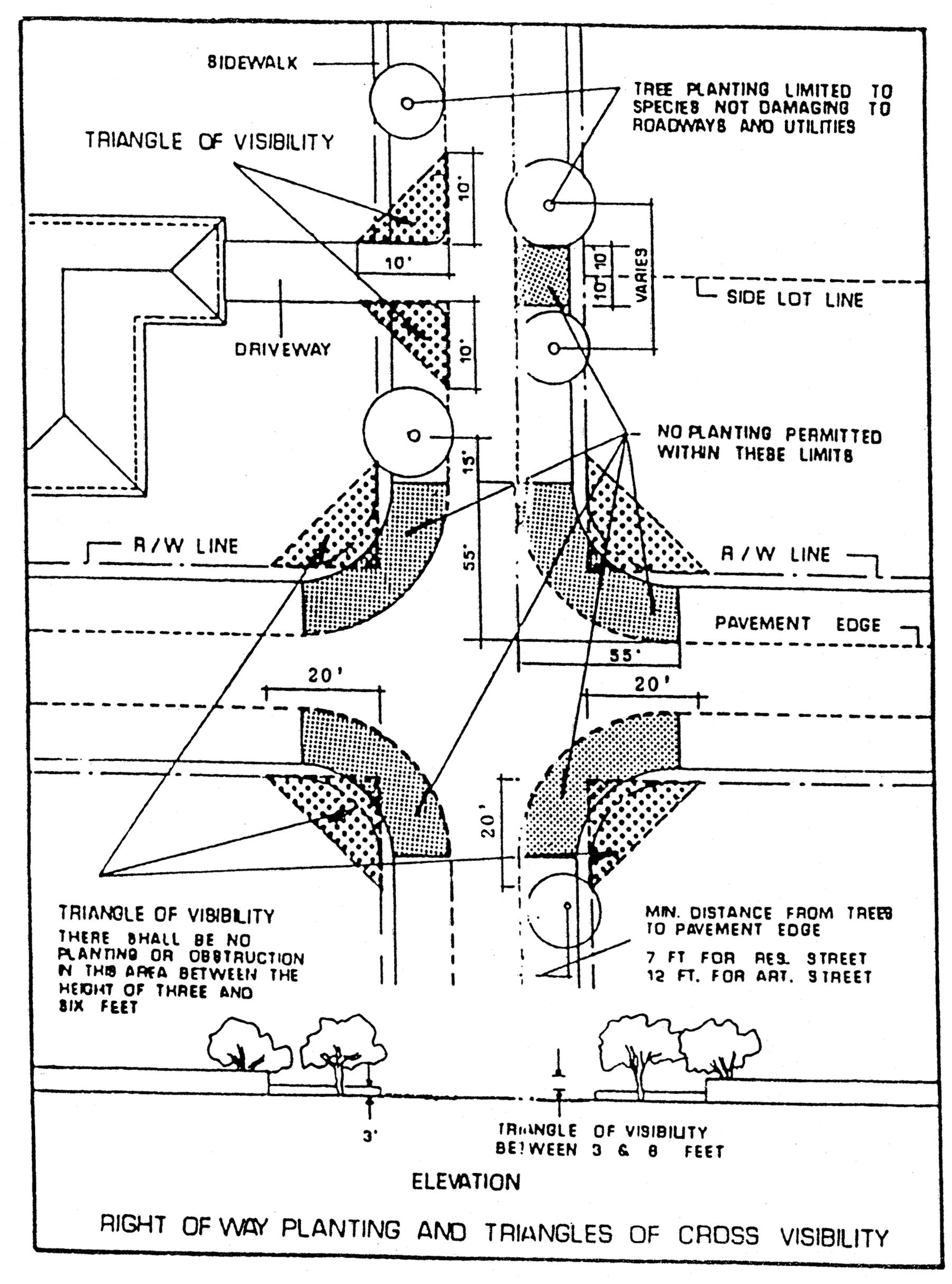
(H)
Physical Barriers.
(1)
All fences, walls, trellises and hedges may be erected on or along a property line, but shall not extend into official public rights-of-way or project on or over adjacent properties.
(2)
Height limit.
Residential:
(a)
Chain link fences will not be permitted on required yards adjacent to a right-of-way.
(b)
In all yards, fences, walls, and trellises (excluding arbors) shall not exceed six (6) feet in height above grade, unless further restricted as provided in (c) below.
(c)
In the setback areas adjacent to a right-of-way, and along that portion of a rear setback area that is adjacent to the front yard of an adjoining property, fences, walls, trellises, gates and hedges shall not exceed four (4) feet in height above grade with the following exceptions:
(i)
Wooden fences exceeding four (4) feet in height adjacent to a right-of-way in required front setback areas shall provide for a minimum of sixty (60) percent open area for all portions between four (4) and six (6) feet in height above grade. The graphic "Wooden Fence Types" includes an example of both an unacceptable and acceptable prototype.

(ii)
Masonry wall exceeding four (4) feet in height adjacent to a right-of-way in required front setback areas shall provide a minimum of sixty (60) percent open area for all portions between four (4) and six (6) feet in height above grade. No portion of any solid masonry wall above four (4) feet in height above grade along rights-of-way shall exceed sixteen (16) inches in width. This is to provide for vertical support (per section 20-3.6(H)(2)(c)) of screening material. The remaining balance of open area may be screened by metal work, lattice or any other non-masonry screening material. A minimum of sixty (60) percent open area shall be maintained. The graphic "Masonry Wall Types" includes an example of both an unacceptable and acceptable prototype.

(iii)
Gates may be increased by three (3) feet above grade provided that the upper three (3) feet of the gate between vertical supports is designed as a uniform pattern with a minimum of sixty (60) percent open area.
[(iv)]
Trellises cannot exceed four (4) feet in height along rights-of-way. Freestanding trellises not located along property lines and not installed to create a physical barrier may extend up to six (6) feet in height above grade in any required yard. Tree species included in the Official Tree List of the City of South Miami shall not be considered as physical barriers.
[(v)]
Vines, as defined under Section 20-2.3 may be permitted on any physical barrier. There is no height limitation for vines and hedges, but they must be maintained and trimmed regularly. All hedges and vines located along property lines abutting a right-of-way, must be in conformity with the triangle of visibility regulations as set forth in Section 20-3.6(G).
[(vi)]
Light fixtures are permitted to extend up to sixteen (16) inches above the maximum height for permitted physical barriers on single-family residential properties.
Nonresidential:
(d)
Fences, walls, trellises or hedges on property zoned for nonresidential uses shall not exceed eight (8) feet in height above grade, except that hedges up to twelve (12) feet that provide greater privacy to neighboring properties shall be permitted in the Religious District.
(3)
Prohibited features. Fences constructed wholly or partially of barbed wire are prohibited, except fences or walls exceeding six (6) feet which have a maximum top extension of sixteen (16) inches bearing a maximum of three (3) strands of barbed wire. Use of electrically charged fences shall not be permitted in any district.
(I)
Accessory Structures or Uses.
(1)
No accessory structure shall be constructed upon a lot until construction of the principal structure or use has commenced.
(2)
No accessory structure shall be used unless the principal structure on the lot is also being used.
(3)
No accessory structures or uses shall be located within any required yard setback area, except as permitted in subsection (4) below.
(4)
Accessory structures or uses may be located in a required rear yard, provided such structures or uses do not occupy more than thirty percent (30%) of required setback areas.
(5)
Accessory structures or uses shall be located not less than five (5) feet from any rear or side lot line. No accessory structures or uses shall be located in the required setbacks that are adjacent to a street right-of-way line; nor shall any accessory structures be located less than five (5) feet from any rear lot line.
(6)
Canvas tents and cabanas, used for temporary shelter and not containing cooking facilities, shall be subject to the accessory structure regulations.
(7)
No accessory structure or use may exceed fifteen (15) feet above grade.
(8)
Temporary structures.
(a)
The building official is authorized to issue a permit for temporary structures and uses that are not constructed within the public right-of-way. Permits shall be limited as to time of service, but shall not be permitted for more than one hundred and eighty (180) days. The building official is authorized to grant extensions for demonstrated cause.
(b)
Temporary structures shall be subject to the location requirements for accessory structures. The city manager or designee may authorize an alternate location of said structure for demonstrated cause.
(J)
Swimming Pools.
(1)
Swimming pools which are open and unenclosed, or covered by a screen enclosure or a screen enclosure not covering a swimming pool, may occupy a required rear or side yard, subject to the following conditions:
(a)
Minimum front setbacks shall be at the front building line.
(b)
Minimum side setbacks shall be ten (10) feet from each side lot line.
(c)
Minimum rear setbacks shall be ten (10) feet from rear lot lines.
(d)
A walk space at least eighteen (18) inches in width shall be provided between pool walls and fences or screen enclosure walls.
(e)
All setback distances shall be measured from the waters edge.
(2)
Pool enclosures.
(a)
Unless a pool is entirely screened in, it shall be surrounded by a protective wall or fence of at least four (4) feet in height.
(b)
Chain link fencing shall be at least eleven (11) gauge, with a maximum distance between wires of two (2) inches.
(c)
Any enclosure, other than standard chain link fencing, shall be shown in complete detail on plans submitted for a building permit.
(d)
Such detail shall include the spacing between the vertical and horizontal wires, spacing and slope of louvers, spacing of posts and such other details as may be required by the city.
(3)
Gates and latches.
(a)
Fence and wall gates must close automatically by spring hinges and must be provided with a positive stop at the closed position.
(b)
The direction for swing of such gates shall be away from the pool during gate opening.
(c)
Fence and wall gates shall have an automatic latch located so that it is not accessible from the outside by pre-school age children.
(d)
Automatic latches shall be as required by the Florida Building Code.
(e)
All gates or latches shall be constructed to provide for their use in conjunction with use of a padlock.
(f)
A padlock shall be in place before final inspection or approval will be given for the pool enclosure.
(4)
Screen enclosures.
(a)
Screen enclosures shall be of a type approved by the building and zoning department.
(b)
Screen enclosure doors shall automatically close and lock by hydraulic closers or an approved equivalent.
(c)
Enclosure door knobs shall not be located less than five (5) feet, six (6) inches above grade.
(d)
Automatic closing and locking devices on screened doors, fences or gates shall be properly adjusted.
(e)
Gates and doors shall swing shut freely and lock from any position.
(f)
Minimum for screen enclosures shall be:
* setbacks required are set forth in sections 20-3.5 E, 20-3.5 F, and 20-3.5 G.
(g)
Screen enclosures shall not be included in the computation of the total building area or required pervious area; cement slabs within a screen enclosure are included in the computation of required pervious area.
(5)
Portable pools.
(a)
Portable pools, four (4) feet or less above grade, are not subject to the enclosure requirements in this section.
(b)
Any steps or ladders leading up to such a pool shall be properly enclosed with fence and gate conforming to the requirements of this section.
(K)
Whirlpool Spas.
(1)
Open, enclosed or screen enclosures covering whirlpool spas may occupy required rear or side yards, subject to the requirements of this section.
(2)
Impervious coverage shall be as per Section 20-3.5.
(3)
Minimum front setback shall be at the rear of the front building line.
(4)
Minimum side setbacks shall be five (5) feet each and minimum rear setbacks shall be twelve and one-half (12.5) feet.
(5)
In instances where a screen enclosure or wall serves as a structural part of the spa, the side setback shall be not less than five (5) feet and the rear setback shall be not less than ten (10) feet from the lot line.
(6)
Spas shall be subject to the protective enclosure requirements applicable to swimming pools.
(L)
Boats and Trailers.
(1)
Storage of Boats. A boat stored in the RS zoning district must be stored on a trailer that is in good condition, operable and capable of moving the boat (hereinafter referred to as a "Trailered Boat"). A Trailered Boat shall be stored only in accordance with the following definitions and requirements:
(a)
Definitions:
(i)
A "Boat" includes motorboats, sailboats, personal watercraft or any other vessel intended for use on or within water.
(ii)
Storage of a boat is defined for this subsection as a Trailered Boat that has been parked in one position for more than twelve (12) hours.
(iii)
An Existing Boat is a Trailered Boat owned by a Current Property Owner that is timely registered with the City in accordance with this Section (L) in connection with storage on a specific parcel of real property.
(iv)
Current Property Owner shall mean an individual, group, or entity that currently holds legal ownership of a specific parcel of real property and that registers an Existing Boat with the City in the manner provided in this section.
(v)
A Replacement Boat shall be any replacement vessel purchased and owned by a Current Property Owner to replace an Existing Boat or a previous Replacement Boat. A Replacement Boat shall be registered with the City as the replacement for an Existing Boat or a previous Replacement Boat within thirty (30) days of the owner acquiring it.
(vi)
Street Yard shall mean the area of private property between the portion of the building wall closest to a primary or secondary (i.e. corner) right-of-way and the right-of-way.
(b)
A Trailered Boat, existing and located within the City, as of October 17, 2023, shall be registered with the City within ninety (90) days of October 17, 2023 in order to be exempted from these regulations to the extent provided in Subsection (L)(1)(d). If properly registered, the boat will be considered an Existing Boat under this Subsection (L).
(c)
A Trailered Boat shall not be stored within the right-of-way or a Street Yard.
(d)
Exception. An Existing Boat or a Replacement Boat may be stored in a Street Yard for the duration of the time the Current Property Owner owns the registered property subject to the following:
(i)
An Existing Boat or a Replacement Boat shall not be stored closer than five (5) feet from any property line.
(ii)
Where an Existing Boat or a Replacement Boat is stored in a side, or secondary, Street Yard, the Existing Boat shall be visually buffered by trees and/or shrubs maintained to a minimum height of six (6) feet.
(e)
No major repairs or overhaul work may be made or performed on a Trailered Boat.
(f)
A Trailered Boat must have a valid state vessel registration decal visible on the front of the boat, it must be parked on a trailer that has a valid state registration, license tag and decal, and it must be registered and belong to a resident of the home where the boat is being stored.
(g)
Except for an Existing Boat, a Trailered Boat shall not exceed thirty-two (32) feet in length.
(h)
No boat engine may be "revved" (the rapid acceleration with rapid deceleration).
(i)
All boats must be operational and usable and the areas where the boats are stored must be maintained in a clean, neat, and presentable condition.
(j)
All Trailered Boats must be secured to the trailer so that it will not be a hazard or menace during a hurricane or high winds.
(k)
Trailered Boat shall not be used for living or sleeping quarters.
(l)
The temporary parking of a boat in a Street Yard for no more than four (4) hours in any twenty-four-hour period, while the boat is hitched to an operable motor vehicle with a valid permanent license tag, for the purposes of washing the boat, and loading/unloading equipment and supplies shall be permitted, but under no circumstances shall a boat be parked or stored in the public right-of-way, including the swale area of a right-of-way.
(2)
Storage of camp trailers shall not be permitted in the required Street Yard.
(M)
Tennis Courts.
(1)
Minimum front yard setbacks for tennis courts shall be at the rear of the front building line.
(2)
Minimum rear and side yard setbacks for tennis courts shall not be less than fifteen (15) feet each.
(3)
Courts shall be completely enclosed by a chain link fence of at between ten (10) and twelve (12) feet in height.
(4)
Court lighting is prohibited in RS districts or on lots adjacent thereto.
(N)
Canopy Carports.
(1)
New canopy carports shall be approved by the board and may be constructed as accessory structures in the front yard setback in residential districts, provided that they:
(a)
Shall not exceed ten (10) feet in height measured from grade to the uppermost point of the carport cover.
(b)
Shall not exceed twenty (20) feet in either length or width.
(c)
Shall be located at least five (5) feet from the front property line and seven and one-half (7.5) feet from any side property line, except where existing lot widths are fifty (50) feet or less, in which case no side setback requirement shall apply, provided written consent of the adjacent property owner is furnished to the city.
(d)
Shall have all four (4) sides left open if the structure is freestanding and three (3) sides open if attached to a principal building.
(e)
Shall have a flexible, weather-proof, canvas or canvas-like cover which shall be maintained in good condition and free from holes, tears and fading.
(f)
Shall, if it becomes deteriorated, be restored to its original condition or replaced with a new cover by its owner which complies with the requirements of this section.
(g)
Shall not remain coverless or have a deteriorated cover for more than fifteen (15) calendar days following notification by the city that the cover condition is in violation of this section.
(2)
Canopy carports existing prior to or on the effective date of this Code and located in front yard setback areas in residential districts shall be deemed conforming accessory structures, provided that they:
(a)
Shall have a permit from the Building and Zoning Department.
(b)
Shall comply with all applicable maintenance requirements for new carports.
(c)
Shall be used solely for the storage of operable vehicles or boats.
(d)
Shall have all four (4) sides left open if the structure is freestanding and three (3) sides open, if attached to a principal building.
(O)
RO Restrictions.
(1)
In addition to all other requirements, a continuous visual buffer shall be provided whenever an RO use abuts or faces directly (within fifty (50) feet) a property zoned for single-family residential purposes. To accomplish this, the normally required perimeter landscaped buffer shall be increased from five (5) to eight (8) feet in width and trees from Table 20-3.6(O)(5) shall be planted according to the spacing listed. These trees shall be a minimum of ten (10) to twelve (12) feet tall immediately after planting.
(2)
No structure shall be constructed or altered to produce a store front, display window, or any other feature that would detract from residential character except for where RO zoned property abuts the MetroRail right-of-way.
(3)
A decorative wall or fence of masonry, reinforced concrete, precast concrete, chain link, wood, or other like material that will be compatible with the main structure, five (5) feet in height shall be erected along all interior property lines, including the rear property line; provided, however, that in the event that the rear property line abuts a secondary road, said wall shall be set in ten (10) feet from the official right-of-way of the secondary road, and said ten (10) feet shall be landscaped; provided, further, in the event that the interior side property line abuts the same or more liberal zoning district, the requirement for the wall along said common interior property line shall not apply. Walls within or extending into the required twenty-five-foot front setback area shall be no more than four (4) feet in height. Further, individual buildings shall not be connected by fences, walls, breezeways or any other structures which make the building appear to have a single facade more than eighty (80) feet in width, provided that buildings may be connected by a breezeway at the first level only of no more than eight (8) feet in width.
(4)
No accessory buildings, or storage of supplies, heavy equipment, or large vehicles shall be permitted anywhere on the lot. In addition, air conditioning equipment may not be placed in the required front setback area.
(5)
Table 20-3.6 (O)(5).
Tree Species* and Required Spacing for Continuous Visual Buffer
* Or substitute to be recommended by the Design Review Board.
* Or substitution to be made from Commission approved tree list submitted by the Tree Committee.
(P)
Home-Based Businesses.
(1)
Home based businesses are businesses that operate in whole or in part from a residential property. It is the intent of this section to provide minimum standards for home-based businesses in order to ensure compatibility with surrounding land uses and consistency with Section 559.955, Florida Statutes. Home-based businesses shall be conducted in an occupied residential unit in accordance with these standards. Community Residential Homes and Family Day Care Homes as defined by Florida Statutes shall be permitted in residential zoning districts in accordance with applicable statutes and are not subject to the requirements of this section:
(a)
The activities of the home-based business shall be secondary to the property's use as a residential dwelling.
(b)
The employees of the business who work at the residential dwelling must also reside in the residential dwelling, except that up to a total of two employees or independent contractors who do not reside at the residential dwelling may work at the business. The business may have additional remote employees that do not work at the residential dwelling.
(c)
The home-based business may not conduct retail transactions at a structure other than the residential dwelling; however, incidental business uses and activities may be conducted at the residential property.
(d)
The activities of the home-based business must be secondary to the property's use as a residential dwelling.
(e)
All goods, material and/or equipment, other than motor vehicles, which are used off the site shall not be stored on the site.
(f)
No signs relating to the home occupation or any business shall be located on the site.
(g)
As viewed from the street, the use of the residential property must be consistent with the uses of the residential areas that surround the property. External modifications made to a residential dwelling to accommodate a home-based business must conform to the residential character and architectural aesthetics of the neighborhood.
(h)
Parking related to the business activities of the home-based business must comply with the requirements of the Land Development Code and the need for parking generated by the business may not be greater in volume than would normally be expected at a similar residence where no business is conducted. Vehicles and trailers used in connection with the business must be parked in legal parking spaces that are not located within the right-of-way, on or over a sidewalk, or on any unimproved surfaces at the residence. No heavy equipment shall be parked or stored at the business which is visible from the street or neighboring property. For purposes of this paragraph, the term "heavy equipment" means commercial, industrial, or agricultural vehicles, equipment, or machinery.
(i)
The business activities shall comply with the Land Development Code and Code of Ordinances with respect to equipment or processes that create noise, vibration, heat, smoke, dust, glare, fumes, or noxious odors.
(2)
Home-based businesses which do not conform to all of the above standards shall be prohibited.
(3)
Permission to have a home-based business shall require the submission of a home-based business license application to the Building Department. The application must be accompanied by:
(a)
If the applicant for a home-based business does not own the property on which the business will be operated, a notarized statement of authorization to conduct the business on the premises from the property owner must be submitted along with the application form before a license is issued.
(b)
A sworn affidavit on a form prepared by the City, which form confirms that the home-based business will conform to all of the standards contained herein and agreeing that the City, upon probable cause to believe that there is a violation of one or more of the standards so stated, may inspect the property to determine if there is a violation. Failure to allow an inspection will result in the automatic cancellation of the certificate of use and Business Tax Receipt. Failure to correct code violations, after notice, will also result in the cancellation of the certificate of use and Business Tax Receipt.
(4)
An occupational license and annual certificate of use shall be obtained for any home-based business.
(Q)
Screening and Soundproofing of Exterior Heating, Ventilating, Air Conditioning Equipment, and Other Mechanical Equipment.
(1)
Air-cooled condensing and/or compressor equipment, water cooling towers, and any other similar mechanical or service equipment or apparatus installed or replaced on the roof of any building erected shall be screened from view by a parapet wall or such other screening device as shall be approved by the Planning Director, provided such screening shall be constructed so as to conceal the equipment visible in elevation.
(2)
Air-cooled condensing (excluding window and wall units), and/or compressor equipment, water cooling towers, liquid propane gas tanks, irrigation pumps, pool equipment, and any other similar mechanical or service equipment or apparatus installed or replaced on the ground or on a building (other than on its roof) shall be screened from view, at ground level outside the subject property, by the use of landscaping or such other screening device as shall be approved by the Planning Director. The requirement of approval by the environmental review and preservation board shall not apply to replacement equipment if existing screening is in place and found sufficient by the Planning Director.
(3)
It shall be unlawful to operate mechanical equipment including air-cooled condensing, and/or compressor equipment, and any other noise producing equipment in an all residential, institutional, commercial and industrial zoned property, when such equipment emits noise which exceeds the following noise levels, measured at the receiving property line nearest to the source; such sound levels shall be measured by City of South Miami staff or other representatives designated by the City Manager with a sound level meter manufactured according to standards prescribed by the American National Standards Institute:
Maximum Permitted Sound Level in Decibels dBA
(4)
The above sound levels shall be applicable to existing, replacement or new mechanical equipment including air-cooled condensing and/or compressor equipment, mechanical equipment, and any other noise producing equipment.
(5)
The city's existing commercial buildings shall meet the requirements of this subsection and mitigate excessive noise levels upon the issuance of a notice of violation by the City of South Miami Code Enforcement Office.
(6)
Sound proofing shall be effective for the life of the equipment. If sound proofing device/equipment is determined not to be adequate, the owner shall be required to mitigate or replace the equipment and/or sound proofing material as necessary to reach acceptable sound levels.
(7)
Soundproofing for larger equipment serving commercial buildings shall consist of at a minimum a barricade or complete ventilated enclosure lined on the inside with a sound blocking (including landscaping) and sound absorbent material, in order to reduce sound to an acceptable level.
(8)
Installation of any fixed barricades or enclosures must be installed with applicable permits.
(9)
Measurement of sound levels at a specific location shall be the average of three (3) readings each taken for a period of thirty (30) seconds during the day or night hours when subject equipment is in continuous operation.
(10)
These regulations shall not apply to generators or other equipment used during a declared state of emergency or during intermittent power outages; this exemption to maximum sound levels shall end when electric power is restored.
(R)
Screening and Landscaping of Refuse Enclosures and Containers for the Storage of Refuse in Commercial and Multifamily Residential Zoning Districts. When plans for new commercial or multifamily residential construction, or plans for an addition to an existing commercial or multifamily residential structure and plans for the renovation of an existing commercial or multifamily residential structure, where the cumulative cost of the addition or renovation exceeds fifty (50) percent of the assessed value of the existing commercial or multifamily residential structure, are submitted, then all such plans shall make provisions for a refuse enclosure and containers for storage of refuse, in accordance with the following provisions:
(1)
The refuse enclosure shall be located in the required rear setback area or required side setback area of the property.
(2)
The refuse enclosure shall be placed at least five (5) feet from any property line, but not within any triangle of visibility or utility easement.
(3)
The refuse enclosure shall be located such that garbage or trash trucks will not block the intersections of streets or alleys while servicing containers.
(4)
The refuse enclosure shall consist of:
(a)
A concrete pad or impervious pavers as a base which is designed to prevent seepage of any sanitizing chemical or liquid waste into the ground or into any stormwater drainage system;
(b)
Minimum five-foot-high enclosure walls. The height of walls must be equal to or greater than the contemplated height of refuse containers; and
(c)
An access gate which screens all refuse containers from view. The height of gates must be equal to or greater than the contemplated height of refuse containers.
(5)
An impervious surface shall be provided between the enclosure and street or alley from which the containers will be serviced, and shall be maintained in good condition.
(6)
Landscaping, hedges and trees shall be provided as set forth in Section 20-4.5, Landscaping requirements, in the same manner as prescribed for vehicular use areas, and shall constitute a landscape buffer of at least five (5) feet in width.
(7)
Plans may include a refuse container room in lieu of a refuse enclosure, provided that the container room:
(a)
Shall be located on the rear or side of the structure;
(b)
Shall be easily accessible for servicing; and
(c)
Shall be fully enclosed and include doors which may be secured and locked to prevent vandalism or other damage.
(8)
Refuse container rooms and refuse enclosures shall be subject to review and approval by both the director of building, zoning and community development and the director of public works prior to permit approval.
(S)
Accessory Storage of Recreational Vehicles.
(1)
Definitions.
Recreational Vehicle (RV). Shall mean a vehicle self-propelled or capable of being towed and primarily designed, constructed or converted to provide temporary living quarters for camping or recreational travel. Recreational vehicles shall include, but not be limited to, trailers, off road vehicles, trailer coaches, camping trailers, full-tent trailers, motor homes and mini-motor homes. A boat shall not be considered a recreational vehicle as defined and regulated by this section.
(2)
Storage Regulations.
(a)
No recreational vehicle shall be parked upon the streets or other public places of the city between the hours of 7:00 p.m. on one day and 7:00 a.m. of the next day, except as provided below.
(b)
No recreational vehicle shall be used as a place of abode or dwelling while parked within the city, either on public or private property. Exceptions to this provision may be made in the case of city approved special events, or during a city declared state of emergency.
(c)
An RV shall not be used as temporary living quarters and may be parked in the open, on sites containing a residence, subject to the following conditions:
(i)
No more than one such RV shall be parked on such site.
(ii)
Such parking shall be limited to such RV owned or leased by the occupant-owner or occupant-lessee of the site concerned. A guest of the occupant-owner or occupant-lessee of the site concerned with the parking of such RV by guest shall be limited to a period not to exceed fourteen (14) days.
(iii)
The location for such parked RV shall be in the rear yard or in the side yard to the rear of a line established by the front setback line and to the rear setback line wherever possible, but in no event in front of such front setback line. Such RV may be located in the side setback provided that a six-foot high wall, fence or landscaping is installed along the area adjacent to the parked RV and shall be set back from the rear property line at least ten (10) feet.
(iv)
The RV parking area shall be maintained in a clean, neat and presentable manner.
(v)
The RV shall be in a usable condition at all times and shall, at all times, have attached a current vehicle registration license plate.
(vi)
No major repairs or overhaul work on such RV shall be made or performed on the site, (or any other work performed thereon which would constitute a nuisance under existing ordinances).
(vii)
When parked on the site, such RV shall not be used for living or sleeping quarters, or for housekeeping or storage purposes and shall not have attached thereto any service connections lines, except as may periodically be required to maintain the RV and appliances.
(viii)
Such RV shall not exceed the maximum length, width, height and weight permitted under applicable provisions of the motor vehicle laws of the State of Florida; provided, however, the maximum length shall not exceed forty (40) feet and the maximum height shall not exceed fifteen (15) feet.
(ix)
Such RV shall be secured so that it will not be a hazard or menace during high winds or hurricane.
(d)
A recreational vehicle may not be used as a commercial vehicle as defined by this Code or the City Code.
(T)
General Requirements and Standards for Permanent Generators in Residential Zone Districts.
(a)
Intent and Purpose. The intent and purpose of this section is to regulate the use and installation of permanent generators in residential zone districts using standards listed herein.
(b)
Definitions. For purposes of this section, the following definitions shall apply:
Decibel—A logarithmic measure of sound. Pertaining to generators, the required decibel level of the generator shall be listed in the generator manual or be measured by a sound engineer or other qualified individual as approved by the Building Department.
Decibel meausurement—Decibels shall be measured according to industry standards by a qualified individual at the abutting property line.
Externally-filled generator—A permanent generator which receives fuel from an external source, thus needing to be manually refueled in order to work properly. This is accomplished through pouring fuel into an intake area (e.g. gasoline) or connecting containers of fuel to an intake valve (e.g. propane).
Internally-filled generator—A permanent generator which receives fuel from an internal source. This is accomplished through a permanent connection to a fuel source, thus avoiding manual refueling (e.g. natural gas).
(c)
Submittal Requirements.
(1)
Installation of permanent generators in two-family, townhouse, or multi-family zone districts shall be subject to all requirements set forth in this Section and shall also be required to receive approval via the Special Use process, in accordance with procedures set forth in Section 20-5.5.
(2)
Installation of permanent generators in all residential zones shall undergo the following process:
(1)
Planning Department Submittal:
(a)
Site plan drawings and specifications shall be submitted showing the location of the property, the placement of the generator on the property, location of all doors, windows and other openings into the dwelling and each distance from the generator, measurements and placement of exhaust of the generator, setback from abutting property(ies), and screening type, size, and measurements.
(b)
A copy of the generator's use manual, listing specifications for the generator.
(c)
Any other information as deemed necessary by the Planning Department.
(2)
Building Department Application—Upon sit plan and screening approval by the Planning Department, an application and submittal process to the Building Department shall have the following requirements:
(a)
Enumerated list of each electrical device that will be input into the generator, the required amount of voltage needed to power the electrical device, and calculations showing the output of the generator is not exceeded by the input of electrical devices.
(b)
Proof of purchase of an indoor, battery-powered carbon monoxide detector.
(c)
Signed affidavit by a licensed electrician stating the installation will follow the requirements of this ordinance, any other applicable city ordinances, the National Electric Code, the Florida Building Code, and any other requirement of law having jurisdiction over the process listed herein.
(d)
Approved Planning Department information listed in (C)(1) of this ordinance.
(e)
Any other information as deemed necessary by the Building Department.
(3)
If the generator is an externally fuel filled generator, then the applicant shall submit the following to the Planning Department and the Building Department:
(a)
Description and specifications of the type of containers that will be used to store the fuel.
(b)
The area at the dwelling where the fuel will be stored.
(c)
Fuel containers shall be kept outside pursuant to the "South Florida Fire Prevention Code", Chapter 14—Article III of the Miami-Dade County Code of Ordinances and shall be held in an approved area and properly screened.
(d)
Criteria.
(1)
Location. Permanent generators shall only be permitted on improved property with a principal structure and installed behind the front facade of the structure.
(2)
Setbacks. The generator shall be installed a minimum of 12.5 feet from the side and rear property lines.
(3)
Noise. The maximum noise output from the generator cannot exceed 65dB (decibels) at the minimum setback.
(4)
Emissions.
(a)
Generator shall be located at a minimum distance away from any window, door, or other opening into the dwelling as set forth in the Florida Building Code.
(b)
Generator's exhaust shall be located at a minimum distance away from any window, door, or opening into the dwelling as set forth in the Florida building Code, and a minimum of fifteen (15) feet from any window, door, or opening of adjacent properties.
(c)
A battery-powered carbon monoxide detector shall be purchased and placed at the nearest window, door, or opening into the dwelling.
(d)
The United State Environmental Protection Agency (EPA) and the California EPA Air Resources board test and certify small engines for minimal emissions:
(i)
If the proposed generator is EPA or CARB certified, the generator shall be deemed to meet safe emissions standards.
(ii)
If the generator is not EPA or CARB certified, the Building Department shall make a determination if the generator submitted by the applicant will result in emissions performance which are equivalent to the above standards.
(5)
Electrical requirements, generally:
(a)
Electrical permit for the installation of the generator shall be obtained by the licensed electrician or the electrician's agent.
(b)
The input of electrical devices into the generator shall not exceed the output of the generator.
(c)
Any change in electrical inputs into the generator shall receive prior approval from the Building Department and shall be performed by a licensed electrician. Applicant shall resubmit all necessary items listed in Section (C) herein.
(d)
the generator shall be certified by the Underwriters Laboratory (UL) for electrical safety.
(6)
Gas Supply, internally:
(a)
An internal gas supply into a generator shall be installed by an appropriate licensed professional and the professional shall obtain all proper and necessary permits.
(b)
All specifications and information concerning an internal gas feed shall be submitted with all other necessary information required.
(7)
Gas Supply, externally:
(a)
In order to assure safety from fumes, spillage, and other safety precautions, the Building Department shall examine and have the power to approve:
(i)
Type of fuel;
(ii)
Fuel storage containers; and,
(iii)
Outdoor fuel holding area.
(b)
The Planning Department will examine site plans for an outside fuel storage area and appropriate screening.
(c)
The applicant shall submit all information required under (D)(2)9(g) of this ordinance.
(e)
Usage. The use of permanent generators shall be permitted only during the following:
(1)
General power outage.
(a)
Sut off immediately after utilities are restored.
(2)
Testing.
(a)
Shall be as set forth in the manufacturer's specification for the installed unit.
(b)
Only during the period 9:00 a.m. to 5:00 p.m.
(c)
Testing shall not exceed thirty (30) minutes.
(f)
Fees.
(1)
A fifty dollar ($50.00) fee shall be paid to the Planning Department as part of the site plan inspection.
(2)
Additional fees shall be established pursuant to Ordinance No. 15-04-1822, as amended, "Processing Fee Schedule", of the City of South Miami.
(3)
If the generator is externally filled, or does not meet emissions certifications standards, the Planning Department or Building Department may have to assess additional fees to the applicant for research into whether or not the generator meets safe emissions standards.
(g)
Final Inspection.
(1)
Applicant shall setup a final site plan inspection with the Planning Department within seven (7) days of final installation and screening of permanent generator and outdoor fuel storage area, where applicable.
(2)
No later than six (6) months following the approval for a permanent generator, the applicant shall schedule a final inspection with the Department for verification and acceptance of the final work authorized.
(3)
Failure to meet final inspection deadlines shall:
(a)
Prohibit the installation and use of the permanent generator, and
(b)
Cancel the application process and force applicant to reapply to the Planning Department and Building Department and pay all appropriate fees, or
(c)
Force the applicant to immediately remove the generator from the property with notice, if there is no compliance.
(U)
Outdoor Lighting Spillage.
(A)
Purpose and Intent. It is the purpose of this section to establish a minimum standard for the provision and use of outdoor lighting on public and private property and in residential areas in order to assure night-time safety and security for private property while at the same time protecting adjacent properties from intrusive light conditions.
All outdoor lighting fixtures installed on private and public property after the effective date of this ordinance shall comply with this ordinance. This ordinance does not apply to interior lighting. However, overly bright inside light emitted outdoors from any structure will be subject to control by this ordinance if it is determined by the code administrator that it creates a nuisance glare or a disabling glare as defined by this ordinance.
(B)
General Requirements.
(1)
All outdoor lighting affecting residential zoned districts, (RS, RT, RM, PUD-R) shall be designed so that any overspill of lighting onto other properties shall not exceed one-half (½) foot candle (vertical) and one-half (½) foot candle (horizontal) illumination on other properties. However, any special requirements concerning lighting for the categories listed below shall take precedence.
(a)
Lighting specified or identified in a specific use permit.
(b)
Lighting required by federal state, or county law.
(2)
For residential properties, including multiple residential properties not having common areas, all outdoor lighting must be shielded and shall not exceed one thousand two hundred sixty (1,260) lumens.
(3)
Light trespassing onto residential property is prohibited except for lights associated with street, roadway or public safety lighting.
(4)
External illumination of displays, buildings and architectural features shall be performed with a luminaire or luminaries with a total rating, of all luminaries combined, of not more than two thousand (2,000) initial lumens. Lighting shall be specifically targeted at particular architectural features and shall not project beyond such features.
(C)
Measurement.
Horizontal measurements shall be taken at a height five (5) feet above, or immediately above any barrier, at or near the property line of the affected property and the vertical measurement shall be taken at or near the property line of the affected property, or at a location on the affected property that provides the highest reading.
(D)
Definitions as used in this section.
1.
Accent lighting means any directional lighting which emphasizes a particular object or draws attention to a particular area.
2.
Foot candle means a measure of luminance or light intensity received on an area of a surface that is a sphere with a one-foot radius, or how bright the light is one foot away from the source. The foot candle is equal to one lumen per square foot.
3.
Disabling glare means lighting that impairs visibility and creates a potentially hazardous situation for any person, including pedestrians and motorists.
4.
Lamp or Bulb means the light-producing source installed in the socket portion of a luminaire or fixture.
5.
Light pollution means general sky glow caused by the scattering of artificial light in the atmosphere and resulting in decreased ability to see the natural night sky.
6.
Light trespass means light emitted by a fixture that shines beyond the property on which the fixture is installed.
7.
Lumen means a measurement of the total amount of visible light emitted by a source
8.
Luminaire or Fixture means a complete lighting unit including the lamps or bulbs, together with the parts required to distribute the light, to position and protect the lamps, and to connect the lamps to the power supply.
9.
Nuisance glare means light that creates an annoyance or aggravation but does not create a potentially hazardous situation.
10.
Shielding means that no light rays are emitted by a fixture above the horizontal plane running through the lowest point of the fixture where light is emitted.
11.
Spotlight or Floodlight means any lamp that incorporates a reflector or a refractor to concentrate the light output into a directed beam in a particular direction.
(E)
Requirements for Residential Landscape Lighting.
1.
Shall comply with the above requirements.
2.
Shall not be aimed onto adjoining properties.
(F)
Lighting Exceptions. It is recognized by the City that there are certain uses or circumstances not otherwise addressed in this Article. The following types of lighting shall be exempt from, and are not regulated by, this ordinance but shall be placed and directed to minimize the detrimental effects of glare on motorists, pedestrians and abutting lots:
(a)
Lighting within the public right-of-way or easement for the principle purpose of illuminating streets or roads. No exception shall apply to any lighting within the public right-of-way or easement when the purpose of the luminaire is to illuminate areas outside the public right-of-way or easement, unless regulated with a street lighting ordinance.
(b)
Lighting for public monuments or statuary.
(c)
Lighting solely for signs as regulated under Section 20-4.3, Sign Regulations.
(d)
Temporary lighting used on construction sites, where the hours during which construction is permitted is permissible under the zoning ordinance or through special provision approved by the City.
(e)
One partially shielded or unshielded luminaire at the main entry, which may not exceed four hundred twenty (420) lumens.
(f)
Any other partly shielded or unshielded luminaires not exceeding four hundred twenty (420) lumens.
(g)
Low voltage landscape lighting aimed away from adjacent properties and not exceeding one thousand fifty (1,050) lumens.
(h)
Low voltage landscape lighting controlled by an automatic device that is set to turn the lights off at one hour after the site is closed to the public or at a time established by the City.
(i)
Shielded directional flood lighting aimed so that direct glare is not visible from adjacent properties and not exceeding one thousand two hundred sixty (1,260) lumens.
(j)
Open flame gas lamps.
(k)
Lighting installed with a vacancy sensor, where the sensor extinguishes the lights within fifteen (15) minutes after the area is vacated.
(1)
Temporary lighting for theatrical, television, performance areas, or construction sites.
(m)
Underwater lighting in swimming pools and other water features.
(n)
Temporary lighting and seasonal lighting provided that individual lamps are less than ten (10) watts and seventy (70) lumens.
(o)
Lighting that is used only under emergency conditions.
(p)
Outdoor recreational facilities, provided that no such facility shall be illuminated after 10:30 p.m.
(V)
Commercial Activity Conducted Outside of a Building.
(1)
No activity conducted on Commercial Property, with the exception of those uses and activities listed in Sections (3), (4) and (5) below, is allowed to be conducted outside of a Fully Enclosed Building. Outdoor business activity that is not listed in paragraphs (3), (4) and (5) below may be allowed on a temporary basis if a proper permit is issued for such activity. The owner of any structure that houses commercial activity and-the operator of any business on such property are prohibited from allowing any sound emanating from within the building from being plainly audible at or inside the property line of any property that is a single-family dwelling, two-family dwelling or townhouse, with the exception of random, unintentional and intermittent sound created, or escaping from the structure, when people enter or leave the structure.
(2)
Private property. Outside retail merchandise display set out on private property will be permitted subject to the following limitations and conditions;
(a)
The outside merchandise display may only include items which are sold inside the building of the business; the business must have a valid current business tax receipt (occupational license);
(b)
A restaurant may not have an outside display of retail merchandise;
(c)
The outside display of retail merchandise may not be placed on any vehicular parking spaces or in any area which blocks access to or from a required vehicular parking area;
(d)
The outside merchandise display may only occupy a maximum square footage of ten percent (10%) of the gross square footage occupied by the business inside the building; the posted permit as required by subparagraph (j) below, must indicate the square footage of the business inside the building and the square footage occupied by the outside display of retail merchandise. Additional parking spaces are required for all additional square footage of outdoor display;
(e)
The outside merchandise display may only include retail merchandise that can be immediately carried away by a customer after purchase; merchandise which requires delivery to the customer or requires being carried by hand truck or similar device is prohibited from being displayed outside the business;
(f)
The outside merchandise may only be displayed while the business is open and must be removed on or before the close of business for each calendar day;
(g)
Retail merchandise display set out on private property must obtain a permit from the Code Enforcement Department as set forth in the City's schedule of fees;
(h)
The outside display of retail merchandise permit regulations will be enforced using procedures set forth in the Code of Ordinances;
(i)
The outside display of retail merchandise permit may be revoked by the City Manager upon finding that one or more conditions of these regulations were violated, or that the outside display of retail merchandise is being operated in a manner which constitutes a public nuisance or in any way constitutes a reasonable risk of potential liability to the City;
(j)
Any business purchasing an outside display of retail merchandise permit consents to abide by the limitations and conditions set forth in this ordinance and must display the required permit so that it is visible on the outside of the building during any period when there is an outside display of retail merchandise; a copy of this ordinance must be furnished to all businesses purchasing an outside display of retail merchandise permit.
(k)
A business establishment may only place outdoor displays on private property.
(3)
Recognized outside uses.
(a)
The following permitted and licensed uses as may be limited by the permitted use table in Section 20-3.3(D) are recognized as commercial activities that, by the nature of the business, are required to be, or are more efficiently, conducted outside of a building, provided that, the placement of retail merchandise outside of a building shall comply with the requirements, limitations and conditions concerning displays of merchandise outside of a business as set forth in this Subsection (V):
(i)
Agricultural farming activities on public property;
(ii)
Vehicle repair and detailing;
(iii)
Vehicle sales;
(iv)
Motor vehicle service stations;
(v)
Bicycle rentals, sales, and service;
(vi)
Commercial nurseries;
(vii)
Outdoor dining/seating areas when part of a permitted and licensed restaurant;
(viii)
Commercial outdoor running programs.
All businesses shall obtain a non-transferable annual permit for any of the above activities.
(b)
Required conditions of business activity outside of a Fully Enclosed Structure:
(i)
Outdoor business activity, other than a restaurant, that is first conducted on or after October 1, 2021, and all restaurants with outdoor seating/dining (the Use) are only allowed if the business enters into an agreement with the City to comply with all of the conditions set forth in this subparagraph (b).
(ii)
The Use must not Abut a single-family dwelling, two-family dwelling or townhouse;
(iii)
All structures that are associated with the outside activity must be acoustically well-buffered so that no sound from within any building that services outdoor activity is plainly audible at or inside the property line of any property that is a single-family, two-family or townhouses, with the exception of random, unintentional and intermittent sound created, or escaping from the structure, when people enter or leave the structure;
(iv)
The owner of the property and operator of the business do not allow outdoor vocal sounds, music or the use of any device that emits sound, including but not limited to outdoor electronic speakers, handheld electronic devices, or musical instruments, by anyone, including customers, or other sound emanating from the outdoor business operations if the sound is plainly audible at or inside the property line of any property on which there is a townhouse, single-family dwelling or duplex (two-family dwelling) (Residential Property);
(v)
Nothing contained herein is intended to authorize sound that would otherwise be in violation of the City's Code, including the City's noise ordinances.
(4)
Special events exempted. Retail sales and activities associated with special events such as, but not limited to, art fairs, art festivals, fund raising events, and special promotion programs which have received a Special Events Permit from the City is not required to obtain a permit for the outside display of retail merchandise as set forth in this Subsection (V).
(5)
Outdoor Seating/Dining.
(a)
Definitions. Solely for the purposes of this Subsection (V), the following words, terms and phrases, when used in this Subsection (V) will have the meanings ascribed to them in this Subsection, except where the context clearly indicates a different meaning:
Abut or Abutting means that one lot or parcel is contiguous with another lot or parcel or separated only by a right-of-way.
Applicant means the person or entity that applies for a permit.
City means the City of South Miami, except that when the context suggests an individual will take some action on behalf of the City, the term City will be interpreted to mean the City Manager or designee.
City Manager means the City Manager or the City Manager's designee.
Code compliance officer means the code compliance officers or code enforcement officer, or any other authorized agent or employee of the City whose duty it is to assure compliance with the City's Land Development Code or the City's Code of Ordinances.
Commercial Properties means real estate that is used for business activities but not including residential properties located in any residentially zoned districts other than RM-24 and they are in or contiguous to the Hometown District Overlay Zone.
Contiguous with a public right-of-way means outdoor locations that abut the public right-of-way and are not completely separated from such right-of-way by any permanent structures or walls.
Fully Enclosed Building means a building whose openings remain closed except for the normal and reasonable opening of doors when entering or leaving the building.
Menu board means a board allowing for the posting of a restaurant's menu and fabricated in such a manner so as not to constitute a form of general advertising or establishment identification.
Nuisance means any of the places or acts defined by Section 823.05, Florida Statutes.
Outdoor seating and dining means tables and/or seating that are situated outdoors and where food and/or beverages are sold, served and/or consumed or where they are intended to be sold, served and/or consumed and includes sidewalk cafes.
Outdoor means an area outside of a permanent structure that may or may not be permanently covered with a roof.
Permanent structure means a structure permanently affixed to the ground, which has four (4) walls and a roof and that might or might not have an opening to the outdoor seating and dining areas.
Permittee means the recipient of an Outdoor Seating/Dining Permit under the terms and provisions of this paragraph (5).
Permit year means the City's fiscal year that commences on October 1 and that ends on September 30 of the following calendar year.
Restaurant means a food service establishment that is maintained and operated as a place where food and/or beverages are prepared and/or served and sold for consumption within the premises, or a business establishment which has, as an ancillary or secondary use, a part thereof where food and/or beverages are prepared and/or served and sold for consumption within the premises.
Right-of-way, or public right-of-way, means land in which a governmental body owns the fee title or has an easement devoted to or required for use as a transportation facility including sidewalks and streets.
Sandwich board sign has the same definition as set forth in Section 20-4.3(B) under the name "Sign, portable outdoor dining."
Seating means any type of chair or other furniture provided for or used by customers for the intended purpose of sitting while consuming beverages or food.
Sidewalk means that portion of the right-of-way which is intended for use by pedestrians and is located between the curb line or the lateral line of a street and the adjacent property line.
Sidewalk café ("café") means an outdoor seating and dining use located on a right-of-way or on private property that is contiguous with a public right-of-way and which is associated with a restaurant and is primarily characterized by tables and chairs; may be shaded by awnings, canopies or umbrellas; and may include such other sidewalk Café furniture as permitted and/or approved pursuant to this paragraph (5).
Sign has the same meaning as provided for in Section 20-4.3 of this Code.
Sign, address identification. Shall mean a sign which gives the name of the owner or occupant and/or the postal address of the property in numerical or written form.
Street means that portion of a right-of-way improved, designed or ordinarily used for vehicular traffic and/or parking.
Table means any furniture which is used for the placement of food or beverages.
(b)
Outdoor seating/dining is permitted on all commercial properties located anywhere in the City with the exception of commercial properties located in the NR Neighborhood Retail, the RO Residential Office and RM-24 (Medium Density Multifamily Residential) zoned districts. Outdoor seating/dining is only permitted in the NR Neighborhood Retail, the RO Residential Office and RM-24 (Medium Density Multifamily Residential) zoned districts if they are located within or contiguous to the Hometown District Overlay Zone (HD). If the property is outside of, but contiguous to, the HD, it must be unified with a property that is within the HD and the owner must have recorded a Unity of Title as to those parcels; and
(c)
A permit application for outdoor seating and dining or a sidewalk café on public property or on public rights-of-way or on private property contiguous with a public right-of-way, must be filed with the Planning and Zoning Department and approved by the City Manager prior to such use. The application must include a layout (site plan) of the location of all tables, chairs (including number and type of chairs), benches, and other furniture; pedestrian ingress and egress; location of refuse containers; location of approved outdoor speakers; and other elements necessary to illustrate the proposed outdoor seating/dining use and area (all drawings must be titled, indicate orientation, and be at an acceptable scale). If applicable, the site plan must clearly indicate which seats and tables are on private property and which are on the public right-of-way. The City Manager may require that an amended site plan be submitted in order to address specific problems. At least seven (7) days prior to the City's Manager's decision on an application for a property that is located in the NR Neighborhood Retail, the RO Residential Office or RM-24 (Medium Density Multifamily Residential) zoned district and located within or contiguous to the Hometown District Overlay Zone (HD), the City must post a sign on the subject property which identifies the nature of the pending application and the means by which questions or comments on the application may be directed. The City Manager will consider any comments received by the public prior to issuing a decision on the application.
(d)
A permit for a sidewalk café or outdoor seating/dining areas and uses of the public right-of-way and/or any private property contiguous with a public right-of-way (hereinafter referred to as an "outdoor seating/dining permit") may be approved, denied, or approved with conditions, modifications, safeguards, or stipulations appropriately and reasonably related to the intent, purposes, standards, and requirements of the related regulations by the City Manager. Such outdoor seating/dining permit is not transferable in any manner and it is strictly a conditional use permit, issued for a period of one year, renewable annually via payment of the annual business tax receipt, annual proof of compliance with the requirements of this ordinance, including insurance and, if applicable, payment of the per seat fee set forth below.
(e)
The fee for outdoor seating/dining permit will be charged annually, and paid at the same time as the applicant/permittee pays its business tax receipt, for each outdoor seat located on public rights-of-way or on any private property contiguous with a public right-of-way and/or any stand-alone table top with no seating which is provided in conjunction with the sale of, or intended to be used for, or in the course of, the consumption of beverages or food. If the applicant has an existing restaurant, the initial fee will be prorated based on the time remaining before the applicant's business tax receipt expires. The permit fees to be charged will be set forth in the City's schedule of Fees. The permit fee will be added to the annual business tax receipt and the payment of all outstanding violation fees for the main business. No outdoor seating/dining permit will be issued while the applicant/permittee is delinquent in the payment of any money owed to the City.
(f)
The applicant/permittee must provide the City with:
(i)
A copy of the business tax receipt from the City of South Miami;
(ii)
Copies of all required health department permits to operate a sidewalk café or equivalent outdoor seating/dining restaurant;
(iii)
A policy and/or certificate of insurance and an indemnification agreement that is acceptable to the City Manager and that provides for compliance with the City's insurance and indemnification requirements, including:
a.
Commercial general liability insurance in the amount of one million dollars ($1,000,000.00) per occurrence for bodily injury and property damage;
b.
For sidewalk cafes and other outdoor seating/dining area that serve alcoholic beverages, liquor liability insurance in the amount of one million dollars ($1,000,000.00) per occurrence for bodily injury and property damage;
c.
A Workers' compensation and employers' liability policy as required by the state of Florida;
d.
The City must be named as an additional insured on this policy, and an endorsement must be issued as part of the policy reflecting compliance with this requirement to cover liability applicable to outdoor seating/dining and/or sidewalk cafes as described in this paragraph (5);
e.
All policies must be issued by companies authorized to do business in Florida and rated A-VIII or better per Best's Key Rating Guide, latest edition. The City Manager may increase these insurance requirements provided such requirements are applied to all parties similarly situated;
f.
Proof of insurance must be provided to the City as a requirement of the permit. If such proof is a nonbinding certificate, the applicant/permittee's insurance agent or carrier must annually advise the City in writing, on a form acceptable to the City Manager under penalty of perjury, of the insurance coverage being provided, the term of the coverage and verifying that the outdoor seating/dining area and the City are covered by the required insurance. Such affidavit/declaration must include the policy number, company name and company contact information and the form numbers of the policy and all of the endorsements to the policy. City administrative staff may contact the permittee's insurance company periodically to verify the existence and continuance of such insurance; however, this in no way relieves the insurance agent of the agent's duty to provide truthful information to the City. Unless the owner or operator of the outdoor seating/dining area provides the City with a binding certificate of insurance and an endorsement to provide the City with at least ten (10) days' advanced notice of intent to cancel the policy, the owner or operator must pay the City a fee each time the City contacts the insurance company, to cover the cost to verify existence of coverage. Failure to comply with these requirements will be deemed to be operating without a valid permit and, upon a finding by the City Manager that such failure has occurred, will cause an immediate suspension of the permit and the assessment of a daily fine as set forth in the City's schedule of fines until the permit is revoked or the requirements are met. Applications for permits must include an indemnification of the City for any and all liability associated with the permittee's operation of the sidewalk café/outdoor seating and dining area.
(g)
It is a violation of this paragraph (5) to operate the sidewalk café/outdoor seating and dining area in a manner that is inconsistent with the approved site plan or constitutes a nuisance as defined in this Subsection 20-3.6(V), or that in any way constitutes a unreasonable risk of injury to persons or damage to property or potential liability to the City
(h)
An outdoor seating/dining permit may be temporarily expanded by the City Manager upon receipt of a written request including a site plan during special events.
(i)
An outdoor seating/dining permit area must be kept in a neat and orderly appearance and must be kept free from refuse and debris. The permittee is responsible for daily cleaning and sweeping of the sidewalk café area and for the cleanliness and maintenance of any outdoor planters immediately adjacent to the outdoor seating/dining area. Cleaning includes twice-monthly pressure cleaning or other appropriate cleaning methods, as determined by the City. Use of City sidewalks for trash and garbage removal is prohibited.
(j)
A sidewalk café must not interfere with the free and unobstructed pedestrian or vehicular circulation of traffic, public access to any street intersections, crosswalks, public seating areas and conveniences, bus stops, alleys, service casements, handicap facilities, or access to any other public, residential or commercial establishments. The width and location of the sidewalk pedestrian passage through the sidewalk café must be as follows:
(i)
If there is seating on one side of the sidewalk, a minimum of five (5) feet of sidewalk must remain unobstructed by outdoor seating furniture and the maneuvering of chairs, and clear for pedestrian passage;
(ii)
If there is seating on two (2) sides of the sidewalk, a minimum of five (5) feet of sidewalk between the two (2) seating areas must remain unobstructed by outdoor seating furniture and the maneuvering of chairs, and clear for pedestrian passage;
(iii)
All outdoor furniture, including, but not limited to, tables, chairs and umbrellas (excluding outdoor planters), must be located a minimum of eighteen (18) inches from the curb.
(k)
A sidewalk café on the public rights-of-way must be open and unenclosed. No building structures of any kind is allowed in or over any portion of the outdoor seating/dining area located on public property, except by prior express written authority of the City Manager.
(l)
Tables, chairs and all other furniture used in the operation of an outdoor seating/dining area on the public rights-of-way may not be anchored or restrained in any manner. Individual table umbrellas, planters, or other such non-stationary elements may be permitted within the outdoor seating/dining area and, where applicable, must have a minimum clearance height of seven (7) feet above the sidewalk.
(m)
A sidewalk café must apply for and receive advanced written specific approval to provide amplified sound of any kind in the outdoor seating area. In the event the City Manager determines that the amplified sound constitutes a nuisance as defined in this Subsection 20-3.6(V), the City Manager will impose additional conditions; in the event of a second offense, the City Manager will revoke the approval authorizing the use of amplified sound. Sound must be kept at a low volume so as to not disturb neighboring businesses, residences, or to be audible in neighboring residential districts. Plans for amplified sound must be submitted with the site plan. Each establishment must sign an agreement in order to have amplified music.
(n)
A sidewalk café on public rights-of-way is restricted to the length of the sidewalk or public right-of-way immediately fronting the sidewalk café unless expressly authorized in writing by the City Manager. The utilization of space extending beyond the subject property frontage onto the immediately adjacent property may be authorized by the City Manager with the express written approval of the adjacent storefront owner; however, the seats and chairs in this location may not block the adjacent storefront windows. This expansion is subject to annual written consent provided by the property owners in front of whose properties the outdoor seating/dining service would occur. The annual written consent form must be provided to the City and must include an insurance policy naming the City as an additional insured and a hold harmless clause in favor of the City.
(o)
A sidewalk café must be at the same elevation as the adjoining sidewalk or public right-of-way unless expressly authorized in writing by the City Manager.
(p)
Carts and trays for serving food are permitted in the outdoor seating/dining area but must comply with the provisions of paragraph 9(a) and (b).
(q)
The maximum number of outdoor seats may not exceed eighty (80) percent of the number of indoor seating, except for restaurants with indoor seating of twenty-five (25) seats or less which may have outdoor seats not to exceed one hundred (100) percent of the number of indoor seats.
(r)
During the operating hours all outdoor furniture must be securely placed as shown on the approved site plan or as may be ordered by the City Manager in writing. After operating hours, outdoor furniture must be neatly stacked to a maximum height of five (5) feet without blocking the sidewalk. A City approved cover may be required by the City Manager for chairs left outside when stacked.
(s)
No person, property owner, lessee or restaurant may allow outdoor seating/dining without a permit. Each day that outdoor seating/dining or similar activity occurs without a permit or in violation of the site plan, constitutes a separate incident of violation and results in a fine for each day of continued violation. The continuing operation of a sidewalk café or any outdoor seating/dining activity without a permit as required by this ordinance after the receipt of a violation notice from the City Manager may also result in the revocation of the restaurant business tax receipt pursuant to Section 13-16 of the City Code.
(t)
Any violation of the regulations and standards set forth in this paragraph (5) constitutes a separate violation. The violator of a subsequent violation of any of the regulations and standards set forth in this paragraph (5) will be fined for each day of such continued violation as set forth in the City's schedule of fines. The continuing operation of an activity governed by this paragraph (5) without a permit or with a suspended permit or after the receipt of a violation notice from the City Manager and the failure to timely cure the violation, may result in the revocation of the business tax receipt of the person or entity responsible, pursuant to Section 13-16 of the City Code.
(u)
The City will issue twenty-four-hour warning notices for all non-life safety violations of this paragraph (5) which must be corrected with twenty-four (24) hours of receipt of such notice.
(v)
No warning notices are required prior to the issuance of a violation for failure to have a permit or for life safety violations and/or life safety or sidewalk café site plan violations and such violations must be corrected immediately. Life safety violations are defined as those conditions which, in the reasonable determination and judgment of the City Manager, involve serious danger and/or risk to the public health, safety or welfare (including, without limitation, blocking pedestrian pathways and violations of the state accessibility code for building construction). Life safety outdoor seating/dining site plan violations are defined to include those instances where the permittee is operating outside of the permitted outdoor seating/dining use area (as approved pursuant to this code) such as where sidewalk café furniture is found outside the approved boundaries of the outdoor seating/dining use site plan; but will not be deemed to include instances where a chair or chairs are temporarily moved outside the approved boundaries of site plan by a sidewalk café patron(s) unless it remains in such unauthorized location for more than fifteen (15) minutes.
(w)
If City personnel finds a violation of this ordinance after a twenty-four-hour warning notice of such violation has been previously issued, then a notice of violation will be issued to the violator. No such warning notice is required for the failure to have a valid permit or for life safety violations of this paragraph (5) and for life safety outdoor seating/dining site plan violations, and a violation may be issued at any time.
(x)
The City Manager or designee may order all furniture, including, but not limited to, seats, tables, and planters to be removed in the event of a pending storm, hurricane, or other declared emergency.
(y)
Tables, chairs and other furniture on the sidewalk may be removed by the City, and a reasonable fee charged for labor, transportation, and storage as well as a fine which is initially set at two hundred fifty dollars ($250.00) and which will be levied against the person or entity who owns and/or controls such furniture, should the responsible person or entity fail to remove said items within thirty-six (36) hours of receipt of the City's notice to do so for any reason under this paragraph (5). In the event of a pending storm, hurricane or other declared emergency, the City Manager may reduce the thirty-six (36) hour time frame. The City Manager will promulgate and review, as needed, regulations regarding the storage and disposition of sidewalk café furniture under this paragraph (5).
(z)
An outdoor seating/dining permit may be temporarily suspended by the City Manager for public use/purpose, utility, sidewalk or road repairs, emergency situations. The length of suspension will be determined by the City Manager as necessary. Removal of all street furniture and related obstructions is the responsibility of the permittee as well as the owner/operator of the outdoor seating/dining area.
(6)
Outdoor Seating/Dining Within the Downtown SoMi (DS) Zoning District.
(a)
Outdoor seating and dining or a Sidewalk Café on private property within the Downtown SoMi (DS) district is permitted upon approval of an outdoor seating site plan filed with and subject to administrative approval by the City Manager and the issuance of an outdoor seating and dining permit. The application for such administrative site plan approval must include a layout (site plan) of the location of all tables, chairs (including number and type of chairs), benches, and other furniture; pedestrian ingress and egress; location of refuse containers; location of approved outdoor speakers; and other elements necessary to illustrate the proposed outdoor seating/dining use and area (all drawings must be titled, indicate orientation, and be at an acceptable scale). If applicable, the site plan must clearly indicate which tables, chairs, benches, and other furniture are on private property versus within a public right-of-way. Approval of outdoor seating/dining is subject to the availability of sufficient parking for said use and that accessibility and life safety standards are met, as based on adopted ordinances and building codes effective within the City. In addition, outdoor seating and dining within the DS district must comply with and is governed by Subsection (V) paragraph (3)(b)(i) through (v) and (vii) and paragraph (5)(m), (t), (u), (w) and (x).
(b)
Outdoor seating/dining located within a public right-of-way that is adjacent to or within the DS district is required to comply with the provisions of paragraph (5) of this Subsection (V).
(7)
A business license/Business Tax Receipt (BTR) or a permit to operate outside of a structure may be revoked or suspended by the City Manager.
(a)
Suspension. The City Manager may suspend a permit or a BTR for up to 30 days upon a finding that one or more of these Subsection (V) regulations have been violated or, in the case of a sidewalk café (Café) or Outdoor Dining, the business is being operated in a manner that is inconsistent with the approved site plan or constitutes a nuisance as defined in this Subsection 20-3.6(V), or in any way constitutes an unreasonable risk of injury to persons or damage to property or potential liability to the City provided the following conditions are met;
(i)
The City Manager is authorized to set the period of suspension, but it must be established by the City Manager as an administrative order that is consistently enforced against businesses that are similarly situated;
(ii)
the City Manager has given the business and property owner a courtesy Notice of Civil Infraction (Citation) of the violation and a reasonable time to correct the violation if the violation cannot be immediately ceased;
(iii)
A second violation of this Subsection (V);
(iv)
The City Manager gives the business and property owner reasonable notice of the hearing by personal service or in the same manner as set forth in Chapter 48, Fla. Stat. for service of process, or certified mail delivery, or if the business or property owner have been communicating with the City by email, then service may be by email to which the owner either responds or in which the owner confirms receipt of the email, no later than ten (10) days prior to the date of the hearing;
(v)
The business and property owner are given a reasonable opportunity to be heard and to present evidence and cross examine witnesses
(vi)
The City Manager finds by competent substantial evidence that this Subsection (V) was violated (Substantiated Violation);
(vii)
In lieu of a hearing held by the City Manager, the City Manager may suspend the permit or BTR if the owner of the property and/or business owner who conducts outside commercial activity has been found to have violated this Subsection (V) by the City's Special Magistrate (Substantiated Violation) in accordance with the procedure set forth in Section 2-25 of the City's Code of Ordinances.
(b)
Revocation. The City Manager may revoke the BTR or permit after a hearing if there have been three (3) or more violations of this Subsection (V) within any one 90-day period of time and
(i)
The City Manager gives the business and property owner reasonable notice of the hearing by personal service or in the same manner as set forth in Chapter 48, Fla. Stat. for service of process, or certified mail delivery, or if the business or property owner have been communicating with the City by email, then service may be by email to which the owner either responds or in which the owner confirms receipt of the email, no later than ten (10) days prior to the date of the hearing and an opportunity to show cause why the BTR or permit should not be revoked;
(ii)
The business and property owner are given a reasonable opportunity to be heard, to present evidence and to cross examine witnesses.
(c)
Appeal. A decision by the City Manager to suspend (including a suspension due to a noise violation governed by this Subsection (V) or to revoke a BTR or permit for failure to comply with these regulations may be appealed by the property or business owner to the City Commission pursuant to the appeal procedure set forth in Section 13-105 of the City's Code of Ordinances. Notwithstanding anything contained in Section 13-105 to the contrary, an appeal must be filed with the City Clerk within thirty (30) days of receipt of written notice of the City Manager's decision. An appeal of the City Manager's decision stays the implementation of the City Manager's decision unless the activity in question clearly meets the definition of a nuisance as defined in this Subsection 20-3.6(V) The City Commission must hear and enter a decision within sixty (60) days from the date the appeal is filed. The City Manager's decision must be in writing and indicate the grounds for this action and the provisions of the City's Code that have been violated, if any, and/or the nuisance that exists as defined in this Subsection 20-3.6(V).
(W)
Solar Requirements.
(1)
Applicability. All new construction of single-family residences with living area greater than one thousand one hundred (1,100) square feet, townhouses, and any multi-story residential building where a section of roof can be reasonably allocated, as determined by the Director of the Building Department or the Planning and Zoning Department, to a separately metered dwelling unit (hereinafter referred to as "qualifying multi-story residential building"), and all alterations or additions made to existing residential structures that either increases by seventy-five percent or more the air-conditioned square footage of the structure, or that replaces seventy-five (75) percent or more of the existing sub-roof (any portion of the sub-roof that is necessarily replaced due to damage from a natural disaster shall not be included in the calculation of this percentage) must either
(a)
Install solar collectors in the amount set forth in Subsection (W)(2) below, or;
(b)
Pay a fee as set forth in Subsection (W)(3), to the City of South Miami Solar Trust Fund.
(2)
Solar Collectors.
(a)
Design and construct the roof so as to withstand the combined weight of all product approved roofing material and the weight of solar collectors and install at least the minimum number of solar collectors required in Subsection (W)(2)(b).
(b)
Minimum Required Installation. Either install:
i.
A minimum of one solar panel with a rating of 2.75 kW nameplate photovoltaic capacity per one thousand (1,000) square feet of roof area or the maximum number for which there is sufficient space within the available roof top solar zone, whichever is less; or
ii.
One hundred seventy-five (175) square feet of a solar thermal system per one thousand (1,000) square feet of roof area, or the maximum number for which there is sufficient space within the available roof top solar zone, whichever is less.
(c)
Avoiding the Creation of Shade. Structures must be designed in such a way so as to maximize the available solar zone and the plans submitted must include a certificate from the architect certifying that the design of the structure has maximized the available solar zone. The available solar zone does not include areas that are obstructed by objects that are not located on the roof or another part of the same building, such as landscaping or a neighboring building.
(d)
Minimum Specifications for Solar Collectors.
i.
Solar photovoltaic systems: Photovoltaic collectors satisfying the requirements of this section shall be at rated at no less than ten (10) watts DC faceplate capacity per square foot.
ii.
Solar thermal systems: Single-family residential solar domestic water heating systems shall be OG-300 System Certified by either the Solar Rating and Certification Corporation (SRCC) or the International Association of Plumbing and Mechanical Officials (IAPMO).
iii.
Solar photovoltaic systems and solar thermal systems must be installed in accord with all applicable state code requirements, including access, pathway, smoke ventilation, and spacing requirements, all applicable local code requirements, and manufacturer's specifications.
(e)
Approval and Compliance. The issuance of a City building permit for the installation of a solar collector must be obtained before the installation of a solar collector. The plans must demonstrate that the requirements of the City code and the Florida Building Code are satisfied and the architect of record must sign and seal the plans indicating compliance. Subsequent review approval must be carried out through the standard review processes for residential construction. Inspection must be performed by the Building Department as per the City's permit requirements for solar power or water heating installations. Enforcement of this subsection will be carried out by the City including the Code Enforcement Division.
(3)
Payment-in-lieu. If solar panels are not installed as described above, then the property owner/applicant must pay a "Solar Collector Fee", in the amount set forth in the City's current Schedule of Fees and Fines. Said fee must be set at fifty (50%) percent of the cost, at market rate, to obtain the minimum amount of solar collectors that would otherwise be required.
(4)
Solar Collector Trust Fund.
(a)
Definitions. As used in this section, the following words shall have the following meanings:
Fund means the Solar Collector acquisition and development fund.
(b)
Purpose. The fund is hereby created for the purposes of acquiring and developing Solar Collector Systems.
(c)
Funding sources. City budgeted funds as well as federal, state, county and private funding, including the Solar Collector Fees charged in lieu of the installation of Solar Collectors on property to be developed and other similar sources.
(d)
Use of funds. Any monies deposited into the Fund and their interest or investment earnings must be applied toward the acquiring and developing of Solar Collectors on City property.
(e)
Each year as part of the city's annual budget process, the City Manager must submit a proposed spending plan for the Fund.
(X)
Bird-Friendly Design.
(1)
Glazing. In all zoning districts other than RS and RT, one hundred percent of the window and door glazing in the Bird Activity Zone must use Bird-Safe Glazing Treatment. Other glazed areas within the Bird Activity Zone that have unbroken glazed segments twenty-four (24) square feet and larger must also be constructed using Bird-Safe Glazing Treatment. Areas above the Bird Activity Zone do not need to use Bird-Safe Glazing Treatment regardless of size.
(2)
Lighting. Lighting shall be shielded. No up-lighting shall be used. Searchlights are prohibited.
(Y)
Home Garages in Single-Family Residential Districts.
(1)
No garage other than a Home Garage shall be permitted on a single-family residential lot, subject to development criteria for the residential district, regulations applicable to accessory structures generally, and the provisions of this Section 20-3.6(Y).
(2)
No new Home Garage shall be constructed upon a lot unless a single-family dwelling on the same lot already exists or is under construction.
(3)
No Home Garage shall be used unless the single-family dwelling on the same lot is also being used for residential purposes.
(4)
The maximum area of a Home Garage shall not exceed twenty-five percent (25%) of the habitable area of the single-family home on the same lot.
(5)
The maximum height of an accessory structure that includes a Home Garage shall be the height of the single-family home on the same lot. The finished floor to ceiling height of the Home Garage shall be no more than fifteen (15) feet.
(6)
All vehicle lifts are prohibited except those designed to allow one vehicle to park beneath another raised vehicle.
(7)
A Home Garage located in the rear yard of a home that is within twenty-five (25) feet of a property line shall be a permanent structure, fully enclosed with masonry walls to minimize sound impacts to neighboring properties. Modular structures, trailers, utility sheds, carports in the rear or side yard, or similar structures shall not be used to store vehicles in single-family districts.
(8)
The Home Garage shall not be used in connection with a home based business that:
(a)
Involves retail transactions related to automotive services, repair, parts, or supplies in the Home Garage;
(b)
Results in storage of any commercial, industrial, or agricultural vehicles, equipment, or machinery within the Home Garage;
(c)
Results in noise, vibration, heat, smoke, dust, glare, fumes, or noxious odors in a manner that violates City, County, State, or Federal law;
(d)
Does not comply with all relevant City, County, State, or Federal regulations with respect to the use, storage, or disposal of any corrosive, combustible, or other hazardous or flammable materials or liquids; or
(e)
Does not obtain a business tax receipt and any other approvals required by City, County, State, or Federal law.
(Ord. No. 1-90-1444, 1-2-90; Ord. No. 2-90-1452, 7-24-90; Ord. No. 12-90-1452, 7-24-90; Ord. No. 21-91-1486, 8-20-91; Ord. No. 30-91-1494, 12-17-91; Ord. No. 1-92-1496, 1-7-92; Ord. No. 15-92-1510, 9-1-92; Ord. No. 30-92-1525, 11-3-92; Ord. No. 6-93-1535, 6-1-93; Ord. No. 7-94-1556, § 1, 4-19-94; Ord. No. 14-94-1563, § 2, 9-7-94; Ord. No. 21-94-1571, §§ 1—5, 12-20-94; Ord. No. 22-94-1572, § 1, 12-20-94; Ord. No. 13-96-1613, §§ 1, 2, 7-30-96; Ord. No. 16-97-1637, § 1, 6-3-97; Ord. No. 12-00-1714, § 3, 4-18-00; Ord. No. 27-01-1758, § 1, 10-16-01; Ord. No. 27-05-1849, § 1, 8-16-05; Ord. No. 32-05-1854, § 1, 9-6-05; 09-06-1877, § 1, 3-7-06; Ord. No. 30-06-1898, § 1, 12-5-06; Ord. No. 24-08-1959, § 1, 7-29-08; Ord. No. 50-08-1985, § 1, 10-21-08; Ord. No. 08-09-2000, § 1, 6-2-09; Ord. No. 17-11-2090, § 1, 4-19-11; Ord. No. 25-11-2098, § 2, 9-6-11; Ord. No. 11-12-2127, § 1, 8-21-12; Ord. No. 29-12-2145, § 1, 12-4-12; Ord. No. 11-14-2189, § 1, 5-20-14; Ord. No. 14-16-2247, § 1, 6-21-16; Ord. No. 23-16-2256, § 2, 9-20-16; Ord. No. 14-17-2284, § 2, 7-18-17; Ord. No. 15-19-2328, § 6, 4-23-19; Ord. No. 01-21-2391, § 2, 2-2-21 Ord. No. 11-21-2401, § 2, 7-6-21; Ord. No. 21-21-2411, § 3, 9-7-21; Ord. No. 19-21-2409, § 2, 9-7-21; Ord. No. 27-21-2417, § 2, 11-16-21; Ord. No. 29-21-2419, § 2, 11-16-21; 13-22-2434, § 4, 5-17-22; Ord. No. 17-23-2468, § 2, 4-4-23; Ord. No. 19-23-2470, § 2, 10-17-23; Ord. No. 27-23-2478, § 2, 11-21-23; Ord. No. 29-23-2480, § 2, 12-5-23; Ord. No. 33-23-2484, § 3, 12-19-23; Ord. No. 13-24-2498, § 3(Exh. B), 5-7-24; Ord. No. 16-24-2501, § 2, 6-4-24)
20-3.7 - Planned unit developments.
(A)
General Provisions.
(1)
Planned unit development shall be so related to general development patterns and the objectives of the city's adopted Comprehensive Plan as to provide for the comfort and convenience of occupants, facilitate protection of surrounding neighborhoods and alleviate traffic congestion.
(2)
Housing, commercial uses, service facilities and principal places of employment for and in planned unit developments shall be related either by physical proximity or by major street networks and rapid transit to promote these objectives.
(3)
Where there are conflicts between the planned unit development regulations contained in this section and other sections of this Code, the regulations in this section shall apply to all planned unit developments approved as special uses after the effective date of this Code, unless the city commission determines in a particular case that:
(a)
The regulation fails to serve public purposes to a degree at least equivalent to general city zoning regulations or other requirements; or
(b)
Actions or other solutions proposed by the applicant, although not literally in accord with the regulations of this section, satisfy public purposes to an equal or greater degree.
(B)
Basic Requirements.
(1)
Unity of Title Required. [1]
(a)
A Unity of Title as set forth in Section 20-5.16 shall be required for all Planned Development Projects.
(2)
Density:
(a)
The intensity in planned unit development districts shall be governed by those densities and intensities established for the zoning district or districts involved and the City's adopted Comprehensive Plan.
(b)
If more than one residential zoning district is involved, the maximum number of dwelling units shall be the combined amount permitted in all of the districts, with each district calculated separately according to its site area times the permitted density.
(3)
Site Characteristics:
(a)
The site shall be suitable for development in the manner proposed, without potential hazard to persons or property on or off-site, from flooding, erosion, subsidence or soil slippage, or other dangers, annoyances or inconveniences.
(b)
Soil condition, ground water level, drainage and topography shall be appropriate for the type and pattern of use intended.
(c)
The site shall meet all requirements for development under the Florida Building Code and other applicable city, county, state and federal regulations.
(d)
Site division:
i.
If appropriate to the form of planned unit development, lands to be included in the planned unit development may be divided by public or approved private streets, alleys, paths, bicycle paths, people movers, rights-of-way or easements.
ii.
The site shall be located and arranged to permit unified planning and development, and to meet all requirements, as well as provide necessary protection against adverse relationships between or among uses in the planned unit development and uses in surrounding areas.
(4)
Traffic Flow and Control:
(a)
Traffic flow to and from the development shall be so designed that it will not intrude on local streets in nearby residential areas.
(b)
Traffic flow to and from the development shall be designed to retain the major portion of such traffic on arterial and collector streets.
(c)
Adequate ingress and egress to the development shall be required and shall be measured by acceptable traffic engineering projections, methods and standards in determining:
i.
Safety and convenience of vehicle traffic entering and leaving the site.
ii.
Safety and convenience of pedestrian movements in relation to vehicular traffic.
iii.
General access of residents, employees and visitors to, from and within the site.
iv.
Access to and within the site in the event of fire, crime or other emergency or catastrophe.
v.
General traffic flow and control, with determinations to be based upon existing street patterns, or future improvements as they may be decided as a condition of approval.
(d)
Where rapid or mass transit is a major consideration, the relationship of such facilities shall be a part of consideration of traffic flow and control.
(5)
External Relationships.
(a)
Scale shall be such that careful consideration be given to the relationship of the development to nearby uses and structures, and to the manner in which the development will impact the city and surrounding areas.
(b)
Site planning shall protect surrounding areas from potentially adverse impacts and influences of the development.
(6)
Screening and Buffering.
(a)
Yards, fences, walls or vegetative screening shall be provided and maintained at edges of developments to protect occupants from undesirable views, lighting, noise or other deleterious off-site influences and to protect nearby residents and businesses from similar adverse influences.
(b)
In particular, screening may be required for off-street parking and loading areas, refuse storage and collection areas and intensive recreational areas.
(7)
Off-Street Parking and Loading.
(a)
Off-street parking shall be provided in such locations and amounts that residents, visitors and employees of the development arriving by vehicle will not have to park in non-planned development-related parking facilities.
(b)
Off-street facilities for the loading and unloading of goods and products shall be provided in locations and amounts that such activity can be conducted off public streets without inconvenience to vehicle flow into and from the development and without inconvenience to vehicular parking.
(c)
Determinations as to the location and amount of off-street parking and loading shall consider:
i.
Rapid or mass transit potential to and from the site and standard traffic engineering projections, principles and practices.
ii.
The relationship of off-street parking and loading facilities to adjacent streets, as they presently exist or as they may be improved or patterns changed as a condition to granting approval.
iii.
Pedestrian circulation and its relationship to proposed off-street parking and loading.
iv.
Internal traffic flow and control.
v.
Arrangement of such facilities in relation to fire, crime or other emergency or catastrophe.
vi.
Screening or landscaping of parking or loading areas to minimize the visual impacts of such facilities.
(8)
Signs and Lighting.
(a)
The number, size, character, location and orientation of proposed signs and lighting shall be as necessary to ensure the safety of vehicular and pedestrian traffic.
(b)
Lighting and signs shall be such as to provide for compatibility and harmony with nearby and adjacent properties and the general character of the surrounding area.
(c)
Following final approval, the city shall erect and maintain all street name signs and traffic-control signs for public streets.
(9)
Service Areas.
(a)
Refuse and service areas for a planned unit development shall be designed, located, scaled and screened in a manner which minimizes impacts on surrounding properties or adjacent public rights-of-way.
(b)
The manner and timing of refuse collection or other service delivery activities shall be arranged so as to minimize impacts on surrounding properties or adjacent public rights-of-way.
(10)
Control of Potentially Adverse Effects.
(a)
The use and occupancy of a proposed planned unit development shall be compatible and harmonious with other development in the area, to a degree which will avoid substantial depreciation of the value of nearby properties.
(b)
As the case requires, special remedial measures to eliminate or reduce, to the maximum extent possible, adverse impacts shall be required.
(c)
Such special remedial measures shall include, but shall not be limited to:
i.
Screening or buffering;
ii.
Landscaping;
iii.
Control or manner of operation;
iv.
Changes in proposed construction or design of buildings;
v.
Change in building location;
vi.
Relocation of proposed open space or alteration of use of such space;
vii.
Changes in traffic patterns; or
viii.
Improvement of streets.
(11)
Streets.
(a)
Where improvements in existing street systems, including pavement widening, divider medians, signalization and the like are found by standard traffic engineering projections and methods to be required in connection with a proposed planned unit development, approval of a special use permit for a planned unit development shall be conditioned on arrangements satisfactory to the City and the applicant for the provision of such improvements.
(b)
Emergency access roads shall conform to standard engineering requirements for emergency vehicle use; utilize proper and sufficient signing and lighting; be designed to minimize interference with other access routes and pedestrian circulation; and, wherever possible, a separate, parallel pedestrian walkway system to all emergency entrances and exits shall be provided.
(c)
Unobstructed access roadways, easements and other facilities shall be provided in accordance with the requirements of the Miami-Dade County Fire Department.
(12)
Uses.
(a)
Planned unit development uses shall form complementary and compatible groupings contributing to the efficiency, safety and convenience of the development and its surrounding area by its nature, location and design.
(b)
Applications for approval of a planned unit development may be denied if the proposed development does not contain facilities demonstrated to be completely compatible, or if a particular use or combination of uses proposed would not be appropriate in the location proposed because of the character of surrounding development, the city's adopted Comprehensive Plan or other uses permitted in the applicable zoning district.
(13)
Building Heights.
(a)
In determining the height of buildings, where a proposed development is bounded by one or more public streets, plans for such development shall take into account:
i.
The heights of existing structures surrounding the proposed development;
ii.
The nature and character of development desired by the city in such areas; and
iii.
The objectives of the city's adopted Comprehensive Plan for such areas.
(14)
Pedestrian Amenities. The proposed development shall maximize pedestrian amenities along street fronts, such as providing for covered walkways, landscaping and appropriate street furniture.
(15)
Transit Availability. Where the location of a development will reasonably relate to rapid or mass transit facilities, the development shall be planned to afford:
(a)
The fullest opportunities for convenient and safe access to such facilities; and
(b)
The greatest safety and convenience compared with other possible major points of access to and from the development.
(16)
Spatial Relationships. The site plan for a proposed planned unit development shall provide for safe, efficient, convenient and harmonious groupings of structures, uses and facilities; for appropriate relationship of space inside and outside of buildings to intended uses and structural and architectural features.
(17)
Open Space. Within every development, open space shall be permanently provided and maintained exclusively for leisure and recreational purposes as follows:
(a)
Each residential development shall provide at least thirty percent (30%) of its total site area as usable private or public open space.
i.
At least one-half (½) of the open space above shall be contiguous.
ii.
Active open spaces shall be at least twenty-five (25) feet in width at their narrowest dimension.
iii.
Passive open space may be of any size or shape.
(b)
The following areas shall not be considered as usable open space:
i.
Parking areas and driveways;
ii.
Buildings and structures;
iii.
Private ownership areas; and
iv.
Street surface areas.
(18)
Sidewalks.
(a)
Any second level connector from the development to the MetroRail Station shall be constructed in accordance with the PUD agreement.
(b)
To the greatest extent possible, all sidewalks shall be located at the right-of-way line.
(c)
All sidewalks shall be modified to accommodate the handicapped.
(C)
Types of Planned Unit Developments.
(1)
Planned Unit Development — Residential (PUD-R)
(2)
Planned Unit Development — Mixed Use (PUD-M)
(3)
Planned Unit Development — Hospital (PUD-H)
(D)
Residential District (PUD-R).
(1)
General requirements.
(a)
A PUD-R district may be established for planned residential development and redevelopment.
(b)
Such development shall be subject to the general procedures of this Code applicable to all planned unit developments, as well as the requirements of this section.
(c)
Establishment of a PUD-R district shall consider:
i.
General housing needs and requirements in the City as a whole;
ii.
Housing needs in the area in which the PUD-R district is proposed and;
iii.
Housing needs of a particular type.
(2)
Uses and structures.
(a)
Principal and accessory uses and structures may be permitted in PUD-R developments, subject to the limitations and requirements herein.
(b)
Uses and structures in a PUD-R district generally shall be permitted as follows:
i.
Residential dwellings;
ii.
Public and private schools;
iii.
Houses of worship;
iv.
Social, recreational and cultural facilities, such as neighborhood or community centers, game rooms, libraries, swimming pools, tennis courts and the like; and
v.
Structures required for the operation of utility, performance of governmental functions, or performance of any function necessary for a PUD-R development.
(c)
In multi-family residential buildings or complexes of at least seventy-five (75) dwelling units, establishments may be permitted for the sale of convenience goods, eating and drinking places and professional services, provided that:
i.
The total floor area occupied by all such uses shall not exceed ten percent (10%) percent of the residential floor area of such building or complex;
ii.
Such establishments shall be designed, scaled, oriented and located so that they meet only the requirements of occupants of the development and their guests; and
iii.
There shall be no signs or other evidence of such establishments when viewed from adjacent rights-of-way.
(3)
Minimum land area for PUD-R development shall be two (2) net acres.
(4)
When adjoining a single-family residential district, a landscaped buffer area of not less than twenty (20) feet in width shall be provided.
(5)
Except along boundaries where a PUD-R district adjoins a district permitting the same or greater heights within similar areas, no portion of any building in a PUD-R development shall project through imaginary planes leaning inward from the PUD boundaries at a forty-five (45) degree angle.
(6)
Walkways.
(a)
Walkways within the planned unit development shall form a logical, safe and convenient system for pedestrian access to all dwelling units, appropriate project facilities and principal off-site pedestrian destinations.
(b)
Open air walking distances between dwellings and parking, delivery and refuse areas shall not exceed two hundred fifty (250) feet.
(c)
If the planned unit development is primarily for elderly housing, such distances shall not exceed one hundred fifty (150) feet.
(7)
Bicycle paths.
(a)
Bicycle paths, if any, shall be coordinated with the local roadway system.
(b)
Bicycle paths and pedestrian ways may be combined with other easements and used by emergency and service vehicles, but shall not be used by other vehicular traffic.
(E)
Mixed Use (PUD-M).
(1)
General Requirements.
(a)
A PUD-M district may be established for complementary and compatible combinations of commercial, office, hotel or motel, multi-family residential and similar uses directly located and related to the MetroRail station.
(b)
Such planned unit developments shall be subject to the general procedures, standards and requirements of this Code applicable to all planned unit development, as well as the requirements of this section.
(c)
The closest major pedestrian entrance to any proposed PUD-M development shall be less than twelve hundred (1,200) feet from the MetroRail station, as measured along the shortest route to accommodate the largest number of pedestrians.
(2)
Uses and Structures.
(a)
Principal and accessory uses and structures may be permitted in PUD-M developments, subject to the limitations and requirements herein.
(b)
Specific uses and structures in a PUD-M district shall be as follows:
i.
Multi-family residential dwellings;
ii.
Hotels and motels;
iii.
Child care centers;
iv.
Houses of worship;
v.
Vocational schools, business colleges and similar uses;
vi.
Private clubs and lodges;
vii.
Professional and business offices, medical and dental clinics and offices and travel agencies;
viii.
Banks and savings associations;
ix.
Retail stores, except those dealing in used merchandise other than antiques;
x.
Business and personal service and repair establishments;
xi.
Eating and drinking places;
xii.
Cultural or recreational facilities;
xiii.
Parking lots and structures, subject to controls to insure parking integrity of the development;
xiv.
Uses other than those listed above, required for the performance of government, except uses involving storage as the primary purpose; and
xv.
Structures and uses relating to the operation of public utilities and required to serve the development and neighboring areas; transit or related facilities other than yards, storage, switching or repair shops.
(3)
The minimum site area for a PUD-M development shall be four (4) net acres.
(4)
MetroRail Station Access.
(a)
MetroRail station accessways may be required at second or third floor levels within the development where necessary to avoid pedestrian/vehicular conflicts.
(b)
Consideration shall be given in designing such accessways for their possible use by buildings and activities in the general area, but not a part of the planned unit development.
(5)
Approval of a PUD-M district shall not be given until arrangement for providing off-street parking and loading in specific amounts and locations are agreed upon by the city and the applicant.
(6)
Uses in PUD-M developments shall be so arranged horizontally and vertically that:
(a)
Retail and service uses shall be concentrated for maximum pedestrian convenience and be located for easy accessibility by visitors and employees working in the development;
(b)
Residential access shall be separated from other access to the development;
(c)
Office uses shall be located so as to prevent interruption from all other uses; and
(d)
Loading zones shall be located so as to prevent interference with pedestrian movements.
(F)
Hospital District (PUD-H).
(1)
General Requirements. A PUD-H district may be established for complementary and compatible combinations of hospitals, medical offices, laboratories and related educational facilities and other support services. Such development shall be subject to the general procedures and requirements of this Code applicable to all planned unit developments, as well as the requirements of this Section.
(2)
Uses and Structures.
(a)
Principal and accessory uses and structures may be permitted in PUD-H developments, subject to the limitations and requirements herein.
(b)
Specific uses and structures in a PUD-H shall be the following hospital and accessory uses:
i.
Intermediate care facility;
ii.
Extended care facility;
iii.
Medical clinic;
iv.
Medical offices;
v.
Laboratory and research facility;
vi.
Medical educational facilities;
vii.
Hospital support facilities including a laundry, cafeteria, dietary services, child care, staff and offices and data processing;
viii.
Convenience facilities for hospital staff, patients and visitors, including chapels, snack bars, gift shops and florists; and
ix.
Any other uses determined as part of the PUD-H application, to be compatible with the existing and/or prospective character of the proposed development and surrounding area.
(c)
Accessory uses, such as convenience facilities, which may provide services to members of the public not associated with the hospital and/or to members of the public not having any business at the hospital shall be so located and designed that there shall be no external features which shall indicate or otherwise draw attention to the existence of said uses.
(3)
Minimum land area for PUD-H development shall be three (3) net acres.
(4)
Approval of a PUD-H district shall not be given until arrangement for providing off-street parking and loading in specific amounts and locations are agreed upon by the city and applicant.
(5)
Waste Handling Facilities.
(a)
Storage and disposal of hazardous and non-hazardous waste shall be specifically addressed in the preliminary development concept plan.
(b)
Provision shall be made and sufficient area must be provided to ensure that all waste material will be stored and disposed of safely and in a manner that will not detrimentally impact surrounding areas.
(6)
The location and design of liquid oxygen and other chemical handling equipment shall be addressed in the preliminary development concept plan such that they will be compatible with the surrounding areas and shall present no hazard to adjacent properties.
(7)
Uses in PUD-H developments shall be so arranged horizontally and vertically that:
(a)
The location of specific hospital services are easily identifiable for the convenience and/or emergency needs of the hospital user;
(b)
The amount of parking determined to be necessary to service a particular hospital function is located within a reasonable distance of said function and appropriate pedestrian linkages are provided;
(c)
The arrangement of uses does not additionally complicate access and circulation routes for both vehicular and pedestrian traffic; and
(d)
Service areas shall be located and arranged so as to avoid significant interference between pedestrian, vehicular and emergency vehicle movements.
(G)
Staged Development.
(1)
Nothing in this Code shall prevent an applicant from developing in stages or phases, provided that the requirements of this Code are met.
(2)
Staged development shall be subject to the following:
(a)
Proposed stages shall be delineated on plan;
(b)
Data required for the project as a whole shall be given for each proposed stage;
(c)
When any stage is developed, it shall conform to the plan of development as approved; and
(d)
A time frame for each stage shall be established.
(3)
Where time limits have been established for the initiation or completion of development stages, or where other requirements have been established for an approved planned unit development, and where such time limits or other requirements are not met, the director of building and zoning shall inform the developer and city manager in writing. The city manager shall promptly call the matter to the attention of the city commission with an account of the circumstances and the findings of the department. The city commission may refer the matter to the planning board for review and recommendation. The developer shall be afforded full opportunity to be heard in the matter. The city commission may take action:
(a)
That the approval of the special use permit as previously granted be continued with revised time limits; or
(b)
That approval be continued for part of the planned development with or without revised time limits, that appropriate steps be taken to correct any deficiencies in designated portions of the planned development that have not be developed, and that planned development approval be canceled for the remaining portions of the development as originally approved; or
(c)
That planned development approval be revoked; or
(d)
That such other steps be taken as will be equitable to the developer and to the protection of the city's interests.
(H)
Official Zoning Map.
(1)
Upon approval of a planned unit development, the boundaries of such development shall be placed upon the Official Zoning Map of the City of South Miami.
(2)
Placement upon the map shall contain a reference in the margin to the effect of the following: "By Resolution No. ___________ of the City Commission of South Miami, Florida, adopted on (date), a (indicate type) planned unit development was approved for this property by special use permit. The requirements applying to such permit are on file in the office of the city clerk."
(I)
Expiration of Planned Unit Development Approval. An approved planned unit development shall lapse after six (6) months if no building permit or certificate of occupancy has been issued for such use and if the city commission has not specified a longer approval period for good cause. Four (4) affirmative votes of the city commission may grant an extension for a previously approved planned unit development if a proper and timely request is made by the applicant prior to the expiration of the approval period.
(Ord. No. 23-99-1697, § 3, 11-16-99; Ord. No. 04-05-1826, § 1, 2-15-05; Ord. No. 17-11-2090, § 1, 4-19-11)
Editor's note— Per instruction from the city, section 3 of Ord. No. 23-99-1697 has been added as 3.7(B)(1), and subsections (B)(1)—(B)(17) have been renumbered as (B)(2)—(B)(18).
20-3.8 - Annexations.
All territory hereinafter annexed to the city shall continue to be subject to Miami-Dade County zoning regulations until such territory is rezoned by the city. The city commission shall, as soon as practical after annexation, establish permanent zoning of said territory pursuant to the procedures and provisions of this Code.
(Ord. No. 17-11-2090, § 1, 4-19-11)

