
South Palm Beach City Zoning Code
ARTICLE IV
- ZONING DISTRICTS
Sec. 26-100.- Definitions.
The following words, terms and phrases, when used in this article, shall have the meanings ascribed to them in this section, except where the context clearly indicates a different meaning:
Accessory use or structure means a use or structure on the same lot with, and of a nature customarily incidental and subordinate to, the principal use or structure.
Acreage means that land lying within the town limits which has not been subdivided according to the records on file in the office of the clerk of the circuit court, in and for the county.
Adjacent means that which lies near or close to, not widely separated nor necessarily touching.
Adjoining means that which is joined or united, actually touching.
Alteration means any change or modification in construction.
Apartment means a room or suite of rooms intended or designed for use as a residence by a single family, including bath and culinary accommodations.
Apartment, efficiency, means a dwelling unit consisting of one room, other than a bathroom, providing cooking facilities.
Apartment house means any building where separate accommodations are supplied for more than two families living independently of each other.
Basement means a story, the floor of which is two feet or more underground and having at least one-half of its height above the average level of the adjoining ground. A basement shall not be considered a story with regard to height regulations mentioned in this chapter if the basement does not exceed eight feet in height above the average level of the adjoining ground. Basements shall be floodproofed in accordance with provisions of Federal Insurance Administration requirements. See Floodproofing.
Buildable area means the portion of a lot remaining after required yards have been provided.
Building means any structure, either temporary or permanent, having a roof, and used or built for the shelter or enclosure of persons, animals, vehicles, goods, merchandise, equipment, materials, or property of any kind.
Building, front line of, means the line of that face of the building nearest the front line of the lot.
Building, principal, means a building in which is conducted the main or principal use of the lot on which the building is situated.
Building exterior wall line means the line of a building, as established by the enclosing walls of the building designed and constructed to exclude the weather.
Building height means the vertical dimension measured from the average elevation of the finished lot grade at the front of the building, to the highest finished roof surface in the case of a flat roof and mansard roof and to the average height between the plate and ridge of a gable, hip, or gambrel roof. The term "building height" excludes elevator, penthouse structures, parapets, and ground level parking within a parking garage.
Building line means the line, established by law, beyond which a building shall not extend, except as specifically provided by law.
Building site means a portion or parcel of land considered as a unit, devoted to a certain use or occupied by a building or group of buildings that are united by a common interest or use, and the customary accessories and open spaces belonging to the site.
Common area means the total area not designed for rental to tenants and which is available for common use by all tenants or groups of tenants and their invitees, including parking lots and their appurtenances, malls, sidewalks, landscaped areas, public restrooms, truck and service facilities, and similar areas.
Court means an open, unoccupied space on the same lot, and fully enclosed on at least three adjacent sides by walls of the building.
Court, inner, means any other required court.
Court, outer, means any court facing for its full required width on a street, or on any other required open space not a court.
Curb level means the officially established grade of the curb in front of the midpoint of the lot.
Datum means the official datum plane to be used in the town as a plane of reference for all elevations, which is hereby declared to be the National Geodetic Vertical Datum (NGVD).
Dual front means a building designed or constructed so as to present the appearance of having two fronts.
Dune means the natural sand or soil ridge which lies immediately landward of the beach and which forms a continuous barrier running parallel to the shoreline.
Dwelling, mobile home, means a detached residential dwelling unit designed for transportation after fabrication on streets or highways on its own wheels or on flatbeds or other trailers, and arriving at the site where it is to be occupied as a dwelling complete and ready for occupancy except for minor and incidental unpacking and assembly operations, location on jacks, or other temporary or permanent foundations, connections to utilities, and the like. A travel trailer is not to be considered as a mobile home.
Dwelling, multiple-family, means a building or portion thereof containing three or more dwelling units.
Dwelling, single-family, means a detached residential dwelling unit, other than a mobile home, designed for and occupied by one family only.
Dwelling, two-family or duplex, means a detached building designed for or occupied exclusively by two families independently of each other.
Dwelling unit means one or more rooms, including a bathroom and kitchen, arranged, designed or used as living quarters for a single family, but not including a motel or hotel room, or apartments rented or leased for periods of less than 30 days, or time-share estates.
Easement means any strip of land created by a subdivider or granted by the owner, for public or private utilities, drainage, sanitation, or other specified uses having limitations, the title to which shall remain in the name of the property owner, subject to the right of use designated in the reservation of the servitude.
Elevations means all elevations for any building, sidewalk, street, sewer grade, or other structure within the town as described with reference to the official town datum.
Enforcing official means the officials and employees of the town to whom the duty of enforcing the terms of this article is assigned.
Family means one or more persons related by blood or marriage. If no relationship exists, no family shall contain over five unrelated persons, and further provided that domestic servants employed on the premises may be housed on the premises without being counted as a family.
Floodproofing means all basements or other spaces located below base flood level, having walls which are watertight and which are substantially impermeable to the passage of water and with structural components having the capability of resisting hydrostatic and hydrodynamic loads and the effects of buoyancy.
Flood level means the base flood level as established by the Federal Insurance Administration and as designated on the town's flood insurance rate map.
Frontage means all the property on one side of a dedicated public street or place between two intersecting dedicated public streets or places measured along the line of the dedicated public street or place, or if the dedicated public street or place is dead-ended, then all the property abutting on one side between an intersecting dedicated public street or place and the dead-end of the dedicated public street or place. The term "frontage" also includes dedicated ingress-egress easements when used for the only means of access. For lots abutting State Road A1A, frontage is State Road A1A.
Garage, parking, means a building or portion of a building, or area beneath a building or structure, except those described as a private garage, used for the parking only of automotive vehicles.
Garage, private, means a building or space used as an accessory to or a part of a main building permitted in any residence district and providing for the storage of motor vehicles and in which no business, occupation or service for profit is in any way conducted.
Grade, finished, for premises improved by a building, means the elevation of the surfaces of the ground adjoining the building.
Grade, minimum, for premises, whether vacant or improved, means the curb level.
Grade, natural, means the actual grade of the building site before the ground has been disturbed from its natural or original state.
Gross floor area means the sum of the total areas taken on a horizontal plane of a floor or several floors of a building measured between the outside face of exterior walls.
Home occupation means any occupation in which there is no stock in trade or commodity sold upon the premises; there is no person employed other than a member of the immediate family residing upon the premises; there is no mechanical equipment used, except that used for purely domestic or household purposes; there is no sign or external display utilized which indicates a business on the premises; and which home occupation complies with each and every provision of this Code.
Lot means a parcel of land of at least sufficient size to meet minimum land use requirements for use, coverage, and area, and to provide yards and other open spaces as are required in this chapter. The term "lot" includes the terms "plot" and "parcel."
Lot coverage means that portion of the area of a lot, plot, or building site, expressed as a percentage, occupied by all buildings or structures which are roofed or otherwise covered.
Lot depth means the distance between the midpoints of straight lines connecting the foremost points of the side lot lines in front and the rearmost points of the side lot lines in the rear.
Lot frontage means that portion of a lot nearest the street.
Lot lines means the lines bounding a lot.
Lot of record means a lot which is part of a subdivision recorded in the office of the clerk of the circuit court, or a lot or parcel described by metes and bounds, the description of which has been so recorded.
Lot width means the distance between straight lines connecting front and rear lot lines at each side of the lot, measured across the rear of the required front yard.
Lowest floor means the lowest floor or space in a building, including a basement, which must be located at an elevation equal to or exceeding the minimum floor elevation as established in this chapter.
Minimum building area orminimum living area means the area or the floor measured from the outside of the exterior walls to the centerline of dividing walls; not to include more than 20 percent of the total area of garages, carports, open porches, open breezeways, storerooms, or screened-in porches.
Mobile unit means a non-self-propelled unit or moveable structure utilized as a temporary accessory use during construction or preconstruction sales.
Nonconforming use means a use that does not conform with the regulations of the use district in which it is situated.
Off-street parking space means a parking space having minimum dimensions of nine feet in width by 20 feet in length for the parking of each automobile, exclusive of access drives or aisles.
Parking lot means a paved area used for the storage or parking of motor vehicles, not including parking areas contained in a parking garage.
Party wall means a wall used or adapted for joint service between two dwelling units.
Penthouse means an enclosed structure above the roof of a building, other than a roof structure or bulkhead, occupying not more than one-third of the roof area.
Plat means a map, plan, or layout of the town, section, or subdivision indicating the location and boundaries of individual properties.
Porch means a roofed space attached to the outside of an outer wall of a building, open on one or more sides, which may have railings, screens, or glass enclosure. An open or unenclosed porch is one without railings, glass, canvas, screens, or similar materials on the open sides.
Principal use means the primary activity, function, or purpose for which a parcel of land or building is used.
Public agency means any government or governmental agency, board, commission, authority, or public body of the town, county, state, United States of America, or any other legally constituted district.
Public use means the use of any land, water, or building by a public agency for the general public.
Public utility means and includes any publicly or privately owned utility, such as, but not limited to, storm drainage, sanitary sewers, electric power, water service, gas service, and telephone lines, whether underground or overhead.
Setback means the horizontal distance between the front line, side line, or rear line of the building site to the front, side, or rear of the building or structure, respectively. Setbacks shall be measured perpendicular to and parallel with property or right-of-way lines.
Sign, off-site, means a sign other than an on-site sign.
Sign, on-site, means a sign relating in its subject matter to the premises on which it is located, or to products, accommodations, services, or activities on the premises. On-site signs do not include signs erected by the outdoor advertising industry in the conduct of the outdoor advertising business.
Special exception means a use that would not be appropriate generally or without restriction throughout the land use district, but which, if controlled as to number, area, location, or relation to the neighborhood, would promote the public health, safety, welfare, morals, order, comfort, convenience, appearance, prosperity, or general welfare of the district and the community.
Storage, open, means the safekeeping of any goods or products in an unoccupied space open to the sky for eventual removal not expected within 72 hours, or for continuous replacement by same or similar goods or products.
Story means that portion of a building included between the surface of any floor and the surface of the next floor above it, or if there is no floor above it, then the space between the floor and the ceiling next above it.
Street means any dedicated public way or ingress-egress easement as the principal means of access.
Street centerline means the line midway between the street right-of-way lines of the surveyed and platted centerline of a street, which may or may not be the line midway between the existing right-of-way lines or pavement.
Street centerline setback means the minimum distance measured from the street centerline required for the preservation of existing right-of-way and future right-of-way expansion.
Street right-of-way line means the line which abounds the right-of-way set aside for use as a street or public roadway.
Structural alteration means any change in the supporting members of a building, such as bearing walls, partitions, columns, beams, or girders, or any substantial change in the roof or in the exterior walls, excepting any repairs or replacements as may be required for the safety of the building.
Structure means anything constructed or erected with a fixed location on the ground, or attached to something having a fixed location on the ground, or any piece of work artificially built up or composed of parts joined together in some definite manner, including, but not limited to, buildings, walls, fences, billboards, and mobile homes. For the purposes of this chapter, the term "structure" shall not include a walkway constructed to provide access to the beach.
Tenant oroccupant, when applied to a building or land, means any person holding a written or oral lease of or who occupies the whole or a part of the building or land, either alone or with others.
Townhouse means a single-family, two-story residential building horizontally attached to a series of other single-family, two-story residential buildings by not more than two party walls.
Townhouse complex means a group of not less than four nor more than eight townhouses connected by party walls.
Trailer means a separate vehicle, not driven or propelled by its own power, but drawn by some independent power. The term "trailer" includes any portable or moveable structure or vehicle, including trailers designed for living quarters, offices, storage, or for moving or hauling freight, equipment, or merchandise of any kind, including boats and boat trailers.
Transient facility means a dwelling unit offered for rental to any number of persons for short-term accommodations, which for purposes of this chapter shall mean less than 30 consecutive days, to any one person or group of persons. The term "transient facility" includes, but is not limited to, hotels, motels existing at the time of adoption of the ordinance from which this chapter was derived, roominghouses, boardinghouses, single-family dwelling units, multiple-family dwelling units, guest facilities in multiple-family dwellings, or other similar uses.
Travel trailer orrecreational vehicle means any vehicle or structure designed and constructed in such manner as will permit occupancy as sleeping quarters for one or more persons, and so designed that it is or may be mounted on wheels and used as a conveyance on streets or highways, propelled or drawn by its own or other motive power. These vehicles or structures shall have a body width not exceeding eight feet, and be of any length, provided its gross weight does not exceed 4,500 pounds, or being of any weight, provided its body length does not exceed 29 feet.
Use means any activity, function, or purpose to which a parcel of land or building is put, and shall include the words "used," "arranged," or "occupied," for any purpose, including all residential, commercial, or public use.
Variance means a deviation from the district requirements of this chapter, granted by the zoning board of adjustment.
Vehicle means any self-propelled conveyance designed and used for the purpose of transporting or moving persons, animals, freight, merchandise, or any substance, and shall include passenger cars, trucks, buses, motorcycles, and scooters.
Yard means the unoccupied and unobstructed open space on the same lot with the main building which extends from the ground upward.
Front yard means the open space extending the full width of the lot, the depth of which is the minimum horizontal distance between the front lot line and the nearest line of the main building.
Rear yard means the open space extending the full width of the lot, the depth of which is the minimum horizontal distance between the rear lot line and the nearest line of the main building.
Side yard means the open space between the main building and the side lot line, extending from the front yard to the rear yard, the width of which is the horizontal distance from the nearest point of the side lot line to the nearest point of the main building.
(Code 1983, § 159.03; Code 1996, § 26-101; Ord. No. 212, § 2, 2-26-2002; Ord. No. 250, § 1, 9-16-2008)
Sec. 26-101. - Purpose.
This article is adopted for the purpose of promoting the health, safety, and the general welfare of the people of the town. The regulations in this article are designed to minimize congestion in the street; secure safety from fire, panic, and other dangers; enhance the benefits of adequate light and air; prevent the overcrowding of land; avoid undue concentration of population; and to prevent blight and the deterioration of property by regulating the height, number of stories, and size of buildings and other structures, the percentage of lot area that may be occupied, the size of yards, courts, and other open spaces, the density of population, the location and use of buildings, structures, land, and water for trade, residence, and other purposes, establishing setback lines, and providing for transportation facilities, public utilities, parks, and other community facilities.
(Code 1983, § 159.02; Code 1996, § 26-102)
Sec. 26-131.- Construction document submittal requirements.
Each application for a permit to construct a new building or modify an existing building or site at grade level shall be accompanied by a survey which bears the signature of a state registered land surveyor and which clearly shows the following data:
(1)
The boundary, dimensions, and corner angles of the subject property.
(2)
The centerline of State Road A1A and the location of the apron or edge of the paving of State Road A1A.
(3)
The location of all utilities on or near the site to which the proposed building will be connected.
(4)
Topographical data on a 50-foot grid in both directions from the high water line to the centerline of State Road A1A with edges of State Road A1A paving and bicycle path shown. A minimum of three rows of elevations are required per lot or parcel.
(5)
Topographical data on oceanfront property shall be provided on a 25-foot grid from high water line to a point 100 feet landward of the crown of the existing dune or the top of any existing revetment, seawall, bulkhead, or other similar structure.
(6)
Surveys of oceanfront property shall show a profile of the lot at the highest point of the dune from the high water line to the centerline of State Road A1A.
(7)
Surveys of oceanfront property with existing improvements shall show all improvements, including, but not limited to, ladders, stairs or walkways to the beach, bulkheads, seawalls or revetments, buildings, swimming pools, driveways, and all other similar improvements.
(Code 1983, § 159.08; Code 1996, § 26-121)
Sec. 26-161.- Purpose and intent.
(a)
Within the districts established by this chapter or amendments that may be adopted, there exist lots, structures, uses of land and structures, and characteristics of use which were lawful before this chapter was passed or amended, but which would be prohibited, regulated, or restricted under the terms of this chapter or future amendments. It is the intent of this chapter to permit these nonconformities to continue until they are removed, but not to encourage their survival. It is further the intent of this chapter that nonconformities shall not be enlarged upon, expanded, or extended, nor be used as grounds for adding other structures or uses prohibited elsewhere in the same district.
(b)
Nonconforming uses are declared by this chapter to be incompatible with permitted uses in the districts involved. A nonconforming use of a structure, a nonconforming use of land, or a nonconforming use of a structure and land in combination shall not be extended or enlarged after passage of this chapter by attachment on a building or premises of additional signs intended to be seen from off the premises, or by the addition of other uses, of a nature which would be prohibited generally in the district involved.
(c)
To avoid undue hardship, nothing in this chapter shall be deemed to require a change in the plans, construction, or designated use of any building on which actual construction was lawfully begun prior to the effective date of adoption or amendment of this chapter and upon which actual building construction has been carried on diligently and in a continuous manner.
(d)
The term "actual construction," as used in this section, includes the placing of construction materials in permanent position and fastened in a permanent manner. Where excavation or demolition or removal of an existing building has been substantially begun preparatory to rebuilding, the excavation or demolition or removal shall be deemed to be actual construction, provided that work shall be carried on diligently and in a continuous manner.
(Code 1983, § 159.45; Code 1996, § 26-136)
Sec. 26-162. - Nonconforming lots of record.
(a)
In any district in which single-family dwellings are permitted, a single-family dwelling and customary accessory buildings may be erected on any single lot of record at the effective date of adoption or amendment of this chapter, notwithstanding limitations imposed by other provisions of this chapter. The lot must be in separate ownership and not of continuous frontage with other lots in the same ownership. These provisions shall apply even though the lot fails to meet the requirements for area or width, or both, that are generally applicable in the district, provided that yard dimensions and requirements other than those applying to area or width, or both, of the lot shall conform to the regulations for the district in which the lot is located. Variance of yard requirements shall be obtained only through action of the board of adjustment.
(b)
If two or more lots or a combination of lots and portions of lots with continuous frontage in single ownership are of record at the time of passage or amendment of this chapter, and if all or part of the lots do not meet the requirements established for lot width and area, the lands involved shall be considered to be an undivided parcel for the purposes of this chapter, and no portion of the parcel shall be used in a manner which diminishes compliance with lot width and area requirements established by this chapter, nor shall any division of any parcel be made which creates a lot with width or area below the requirements stated in this chapter.
(Code 1983, § 159.46; Code 1996, § 26-137)
Sec. 26-163. - Nonconforming structures.
Where a lawful structure exists at the effective date of adoption or amendment of this chapter that could not be built under the terms of this chapter by reason of restrictions on area, lot coverage, height, yard requirements, its location on the lot, or other requirements concerning the structure, the structure may be continued so long as it remains otherwise lawful, subject to the following provisions:
(1)
No nonconforming structure may be enlarged or altered in any way which increases its nonconformity, but any structure or portion thereof may be altered to decrease its nonconformity.
(2)
Should a nonconforming structure or nonconforming portion of structure be destroyed by any means to an extent of more than 75 percent of its replacement cost at the time of destruction, it shall not be reconstructed except in conformity with the provisions of this chapter, except that any nonconforming multifamily and commercial structures shall be permitted to be reconstructed or repaired, provided that such structures shall be subject to all then-current and applicable fire and construction codes.
(3)
Should a structure be moved for any reason, for any distance whatever, it shall thereafter conform to the regulations for the district in which it is located after it is moved.
(Code 1983, § 159.47; Code 1996, § 26-138)
Sec. 26-164. - Continuation of nonconforming use.
If a lawful use involving individual structures, or of structure and premises in combination, exists at the effective date of adoption or amendment of this chapter, that would not be allowed in the district under the terms of this chapter, the lawful use may be continued so long as it remains otherwise lawful, subject to the following provisions:
(1)
No existing structure devoted to a use not permitted by this chapter in the district in which it is located shall be enlarged, extended, constructed, reconstructed, moved, or structurally altered except in changing the use of the structure to a use permitted in the district in which it is located.
(2)
Any nonconforming use may be extended throughout any parts of a building which were manifestly arranged or designed for that use at the time of adoption or amendment of this chapter, but no use shall be extended to occupy any land outside the building.
(3)
Any nonconforming use of a structure, or structure and premises, may not, as a special exception, be changed to another nonconforming use.
(4)
Any structure, or structure and land in combination, in or on which a nonconforming use becomes a permitted use, shall thereafter conform to the regulations for the district, and the nonconforming use may not thereafter be resumed.
(5)
When a nonconforming use of a structure, or structure and premises in combination, is discontinued or abandoned for six consecutive months or for 18 months during any three-year period, except when governmental action impedes access to the premises, the structure, or structure and premises in combination, shall not thereafter be used except in conformity with the regulations of the district in which it is located.
(6)
When the use of a nonconforming structure is ceased due to natural disaster, replacement or reconstruction of the use must begin within one year from the date of disaster and the replacement or reconstruction must remain continuous.
(7)
Where nonconforming use status applies to a structure and premises in combination, removal or destruction of the structure shall eliminate the nonconforming status of the land. The term "destruction," for the purpose of this section, is defined as damage to an extent of more than 75 percent of the replacement cost at time of destruction; except that nothing contained in this article shall prohibit the reconstruction of a nonconforming multifamily or commercial structure and use following a natural disaster up to and including 100 percent of the destroyed structure.
(Code 1983, § 159.48; Code 1996, § 26-139)
Sec. 26-165. - Special exception uses.
Any use which is permitted as a special exception in a district under the terms of this chapter shall not be deemed a nonconforming use in the district, but shall without further action be considered a conforming use.
(Code 1983, § 159.50; Code 1996, § 26-140)
Sec. 26-166. - Sale or lease of nonconforming uses.
Nothing in this chapter shall be construed as preventing or restricting the sale, lease, or transfer of buildings or property constituting a nonconforming use within the meaning of this chapter.
(Code 1983, § 159.51; Code 1996, § 26-141)
Sec. 26-186.- Definitions.
The following words, terms and phrases, when used in this division, shall have the meanings ascribed to them in this section, except where the context clearly indicates a different meaning:
Special exception means a permitted use which would not be appropriate without restriction, but which, if controlled as to number, area, location, or relation to the neighborhood, would promote the public health, safety, welfare, order, comfort, convenience, appearance, or general welfare. Such uses may be permitted in a land use district as special exceptions if specific provision for a special exception is made in the applicable section.
(Code 1983, § 159.10(A); Code 1996, § 26-161)
Sec. 26-187. - Application; fee.
Applications for special exceptions may be obtained from the office of the town administrator. A filing fee as established by the town council must accompany the application, for the purpose of covering the costs of investigations, notifications, and other operations incidental to consideration of the matter.
(Code 1983, § 159.10(B); Code 1996, § 26-162)
Sec. 26-188. - Standards for approval.
(a)
In the exercise of its authority in the approval of a special exception, the town council shall be guided by the standards in this section and shall consider the factors set out in subsection (b) of this section, and shall show in its record that each factor was considered. Before final approval of a special exception is granted, the town council shall find in the case of these factors and any other significant factors that the purposes and requirements of this article have been met by the application.
(b)
Special exception uses and their related accessory uses or any expansion, enlargement, or modification of an existing special exception use shall be permitted only upon authorization by the town council, provided that the uses shall be found to comply with, but are not limited to, the following and other applicable requirements as set forth in this article:
(1)
Ingress and egress to property and proposed structures thereon, with particular reference to automotive and pedestrian safety, traffic flow and control, and access in case of fire or catastrophe.
(2)
Off-street loading and parking areas, with particular attention to the items in subsection (b)(1) of this section, and the economic, noise, glare, or odor effects of the location of these areas on adjoining properties.
(3)
Refuse and service areas, with particular reference to the items in subsections (b)(1) and (b)(2) of this section.
(4)
Screening and buffering, with particular reference to type, dimensions, and character as it relates to adjacent properties.
(5)
Required yards and open space.
(6)
Signs and proposed exterior lighting with reference to glare, traffic safety, economic effects of the signs and exterior lighting on properties in the district, and compatibility and harmony with nearby properties.
(7)
The height of the structure as related to adjacent properties.
(8)
Economic effect.
(9)
The use is a permitted special exception use as set forth in the schedule of use regulations.
(10)
The use is so designed, located, and proposed to be operated that the public health, safety, and welfare will be protected.
(11)
The use will not cause substantial injury to the value of other property in the neighborhood where it is to be located.
(12)
The use will be compatible with adjoining development and the intended purpose of the district in which it is to be located.
(13)
The use conforms with all applicable regulations governing the district where located, except as may otherwise be permitted.
(Code 1983, § 159.10(C), (D); Code 1996, § 26-163)
Sec. 26-215. - Establishment of districts.
(a)
In order to regulate and limit the height and size of buildings, to regulate and limit the intensity of use of land area, to regulate and determine the areas of open spaces within, around and surrounding buildings, to classify, regulate, and restrict the location of land uses and the location of buildings designed for specified residential uses, the town is hereby divided into districts, of which there shall be four, as follows:
(1)
R-1 Single-Family Residence District.
(2)
R-2 Multifamily-West Residence District.
(3)
R-2A Multifamily-East Residence District.
(4)
Public Ownership.
(b)
The boundaries of the districts shall be as shown on the official land development district map adopted by this division.
(c)
In the creation of the respective land development districts of the town, the town council has given due and careful consideration to the peculiar suitability of each district for the particular regulations applied thereto, and the necessary, proper and comprehensive groupings and arrangements of the various uses and densities of population in accordance with a well-considered plan for the development of the town.
(Code 1983, § 159.06; Code 1996, § 26-181)
Sec. 26-216. - Compliance required.
The regulations set by this division within each district shall be the minimum regulations and shall apply uniformly to each class or kind of structure or land, and particularly, except as provided in this section.
(1)
No building, structure, or use of land shall be used or occupied, and no building or structure or part thereof shall be erected, constructed, reconstructed, moved, or structurally altered except in conformity with all of the regulations specified in this division for the district in which it is located.
(2)
No building or other structure shall be erected or altered to achieve the following results:
a.
To exceed the height or bulk.
b.
To accommodate or house a greater number of families.
c.
To occupy a greater percentage of lot area.
d.
To have a narrower or smaller rear yard, front yard, side yard, or other open space than required in this article, or in any other manner contrary to the provisions of this chapter.
(3)
No part of a yard or other open space, or off-street parking or loading space, required about or in connection with any building for the purpose of complying with this chapter, shall be included as part of a yard, open space, or off-street parking or loading space similarly required for any other building.
(4)
No yard or lot existing at the time of the passage of this chapter shall be reduced in dimension or area below the minimum requirements set forth herein. Yards and lots created after the effective date of this chapter shall meet at least the minimum requirements established by this chapter.
(5)
All land which may be annexed to the town shall be considered to be in the appropriate zone classification compatible to adjacent districts.
(Code 1983, § 159.07; Code 1996, § 26-182)
Sec. 26-217. - Official land development district map.
(a)
The boundaries of each of the land development districts designated in this article are set forth and shown on the official land development district map which, together with all explanatory matter, is hereby adopted by reference and declared to be a part of this chapter.
(b)
The official land development district map shall be identified by the signature of the mayor, attested by the town clerk, and bear the seal of the town under the following words: "This is to certify that this is the Official Land Development District Map as referred to in the Town of South Palm Beach Code of Ordinances, as adopted by Ordinance _____."
(c)
Regardless of the existence of purported copies of the official land development district map which may from time to time be made or published, the official land development district map located in the office of the town administrator shall be the final authority as to the current land development district status of land and water areas, buildings, and other structures in the town.
(Code 1983, § 159.04(A)(1), (4); Code 1996, § 26-183)
Sec. 26-218. - Interpretation of district boundaries.
Where uncertainty exists as to the boundaries of districts as shown on the official land development district map, the following rules shall apply:
(1)
Land development district boundaries, unless otherwise indicated on the land development district map, are the lot lines, the centerlines of streets, street rights-of-way, alleys, the corporate limits as they exist at the time of the enactment of this chapter, or other geographical or topographical features.
(2)
In unsubdivided property where a district boundary line is shown, the location of the boundary, unless the boundary is indicated by dimensions, shall be determined by the use of the scale appearing on the map.
(3)
For any public street or alley which is officially vacated or abandoned, the regulations applicable to each parcel of abutting property shall apply to the centerline of the property which is abandoned. If abandoned property is not divided at the centerline for abutting properties, the zoning districts applicable shall apply to the ownership lines as determined by virtue of the abandonment.
(4)
For any public property other than streets or alleys, the regulations applicable to the land development district classification which abuts the abandoned property for the greatest number of linear feet shall apply to the entire property.
(5)
For all areas within the corporate limits of the town which are under water and are not shown as included within any of the use districts designated in this article, the boundaries of each district shall be construed to extend into the water area in a straight line until they meet the other district.
(6)
Where physical or cultural features existing on the ground are at variance with those shown on the official land development district map, or in other circumstances not covered by subsections (1) through (5) of this section, the town council shall interpret the district boundaries.
(7)
Plat requirements will be enforced by the town as to yard requirements. The town has no jurisdiction over use restrictions set forth by either plat or deed restrictions.
(Code 1983, § 159.05; Code 1996, § 26-184)
Sec. 26-245. - Permitted uses.
Permitted uses in the R-1 Single-Family Residence District are as follows:
(1)
Single-family dwelling and its customary private accessory uses, including garage, swimming pool and tennis court.
(2)
Community residential home.
(3)
Home occupations.
(Code 1996, § 26-201; Ord. No. 212, § 2, 2-26-2002)
Sec. 26-246. - Special exceptions.
Special exceptions permitted subject to town council approval are as follows in the R-1 Single-Family Residence District:
(1)
Public and private utility uses.
(2)
Private recreation facilities and clubs.
(3)
Houses of worship and accessory buildings.
(Code 1996, § 26-202)
Sec. 26-247. - Property development regulations.
Property development regulations for the R-1 Single-Family Residence District are as follows:
(1)
Minimum lot area. Minimum lot area is 9,000 square feet.
(2)
Minimum yard setback requirements. Minimum yard setback requirements are as follows:
a.
Front: 30 feet.
b.
Side, interior: ten feet.
c.
Rear: ten feet.
Balconies, bay windows, exterior chimneys, or other architectural features which do not measure more than 25 square feet in the horizontal plane, and eaves which do not extend more than three feet from the vertical wall of the building, shall not be considered as encroachments in the setback.
(3)
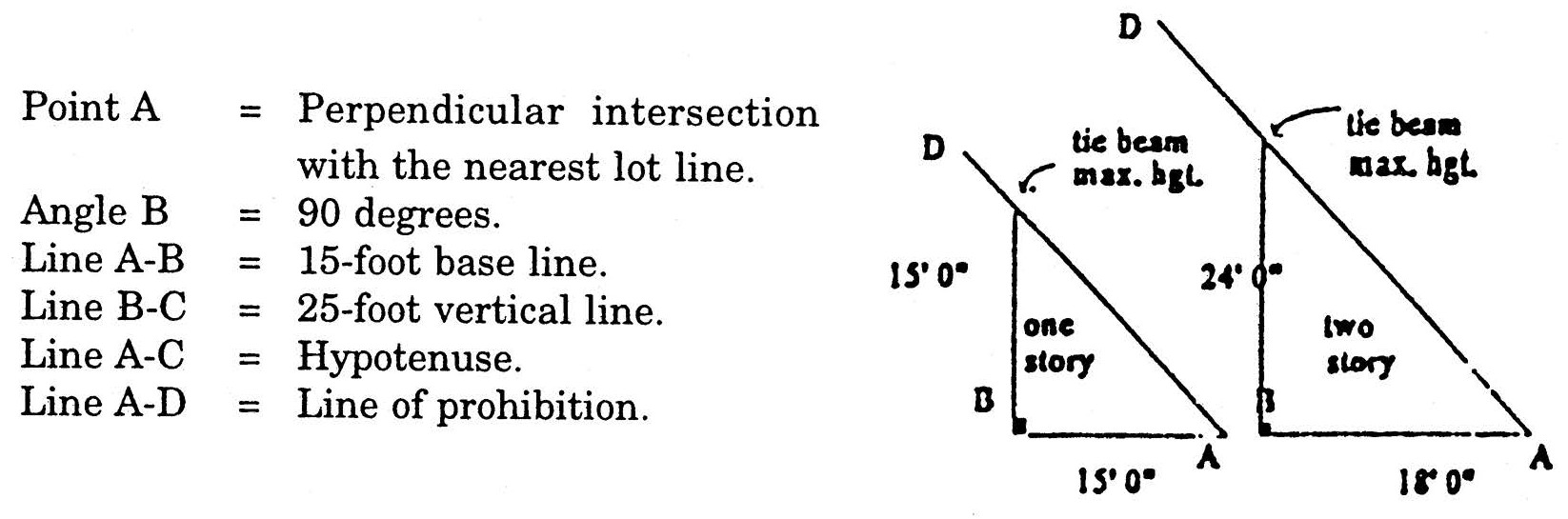
Maximum building height. Maximum building height shall be no more than 32 feet for single-story buildings or 36 feet for two-story buildings to the ridge or highest point of the structure, excluding chimneys, as measured from the top of the average finished floor elevation of the first floor, as described in section 10-6. Rooflines shall not encroach within an extension of the hypotenuse of a right triangle set on a base line of 15 feet for a single-story building or a base line of 18 feet for a two-story building, such base being set at the top of the average finished floor elevation, and beginning at a point which is perpendicular to the adjacent lot line, and a vertical leg of 15 feet for a single-story building and a vertical leg of 24 feet for a two-story building (line of prohibition); see figure 26-247.
FIGURE 26-247
R-1 Single-Family Residence District
(4)
Minimum floor area. Minimum floor area is 1,800 square feet.
(5)
Maximum lot coverage. Maximum lot coverage shall be 50 percent of the total lot area.
(6)
Maximum floor area. The maximum floor area of all finished floors under roof shall be 36 percent of the total lot area. The floor area occupied by balconies, bay windows, lofts (within the enclosed roof space), chimneys, or other architectural features shall be exempt from this provision.
(Code 1996, § 26-203)
Sec. 26-248. - Special regulations.
See division 6 of this article for regulations on access, parking, landscaping, fences and signs.
(Code 1996, § 26-204)
Sec. 26-275. - Purpose and intent.
The purpose and intent of the R-2 Multifamily-West Residence District is to include land found by the comprehensive plan to be suitable for multifamily residential types west of State Road A1A.
(Code 1996, § 26-221)
Sec. 26-276. - Permitted uses.
Permitted uses in the R-2 Multifamily-West Residence District are as follows:
(1)
Single-family dwellings and their customary accessory uses.
(2)
Multiple-family development and accessory uses and buildings.
(3)
Private garage accessory to a principal residence.
(4)
Private swimming pool accessory to a principal residence.
(5)
Private tennis court accessory to a principal residence.
(6)
Residential accessory use.
(7)
Home occupations.
(Code 1996, § 26-222; Ord. No. 212, § 2, 2-26-2002)
Sec. 26-277. - Special exceptions.
Special exceptions permitted subject to town council approval are as follows in the R-2 Multifamily-West Residence District:
(1)
Public and private utility uses.
(2)
Private recreation facilities and clubs.
(3)
Houses of worship and accessory buildings and structures.
(4)
Manufactured housing.
(5)
Marina facilities.
(6)
Antenna (as defined at section 26-504).
(7)
Tower (as defined at section 26-504).
(Code 1996, § 26-243; Ord. No. 242, § 1, 1-23-2007)
Sec. 26-278. - Property development regulations.
Property development regulations for the R-2 Multifamily-West Residence District are as follows:
(1)
Minimum lot area.
a.
Minimum lot area for a single-family dwelling is 9,000 square feet.
b.
Minimum lot area for a multiple-family dwelling is 7,500 square feet for the first two dwelling units and 1,200 square feet for each additional unit thereafter.
(2)
Minimum building setbacks. The minimum building setbacks shall apply both to the proximity of one building to another as well as to the proximity to the property line. Minimum building setbacks are as follows:
a.
Front: 40 feet.
b.
Side, interior: ten feet.
c.
Rear: ten feet.
(3)
Maximum building height. Maximum building height is 40 feet and no more than four stories, except that a single-family dwelling shall not exceed 35 feet in height. A parking garage on the ground level shall not be considered a story and shall not be included in overall height calculations.
(4)
Maximum lot coverage. Maximum lot coverage is 35 percent of the total lot area.
(5)
Minimum floor area. Minimum floor area is as follows:
a.
Efficiency: 700 square feet.
b.
One bedroom: 850 square feet.
c.
Two bedrooms: 1,000 square feet.
d.
Three bedrooms: 1,200 square feet.
e.
More than three bedrooms: 1,400 square feet.
(6)
Minimum roof parapet. After September 16, 2008, a roof parapet shall be installed to a height of four feet above the highest finished floor surfaces of a flat roof on the following structures:
a.
A new structure constructed after this date.
b.
Any existing structure which has been destroyed to an extent of more than 75 percent of its replacement cost at the time of destruction, except that a parapet shall be required as part of reconstruction only if it is feasible to add a parapet to the existing building as certified by a state-licensed professional engineer.
(Code 1996, § 26-224; Ord. No. 250, § 2, 9-16-2008)
Sec. 26-279. - Site plan review.
A site plan review shall be required prior to the issuance of a building permit for the construction or alteration of any multiple-family development within this R-2 Multifamily-West Residence District.
(Code 1996, § 26-225)
Sec. 26-307. - Purpose and intent.
The purpose and intent of the R-2A Multifamily-East Residence District is to include land found by the comprehensive plan to be suitable for single-family detached and multifamily residential types east of State Road A1A.
(Code 1996, § 26-251)
Sec. 26-308. - Permitted uses.
Permitted uses in the R-2A Multifamily-East Residence District are as follows:
(1)
Single-family dwelling and its customary accessory uses.
(2)
Multiple-family development and accessory uses and buildings.
(3)
Private garage accessory to a principal residence.
(4)
Private swimming pool accessory to a principal residence.
(5)
Private tennis court accessory to a principal residence.
(6)
Residential accessory use.
(7)
Home occupations.
(Code 1996, § 26-252; Ord. No. 212, § 2, 2-26-2002)
Sec. 26-309. - Special exceptions.
Special exceptions permitted subject to town council approval are as follows in the R-2A Multifamily-East Residence District:
(1)
Public and private utility uses.
(2)
Private recreation facilities and clubs.
(3)
Houses of worship and accessory buildings and structures.
(4)
Manufactured housing.
(5)
Antenna (as defined at section 26-504).
(6)
Tower (as defined at section 26-504).
(Code 1996, § 26-253; Ord. No. 242, § 1, 1-23-2007)
Sec. 26-310. - Property development regulations.
Property development regulations for the R-2A Multifamily-East Residence District are as follows:
(1)
Minimum lot area.
a.
Minimum lot area for a single-family dwelling is 9,000 square feet.
b.
Minimum lot area for a multiple-family dwelling is 7,500 square feet for the first two dwelling units and 1,200 square feet for each additional unit thereafter.
(2)
Minimum building setbacks. The minimum building setbacks shall apply both to the proximity of one building to another as well as to the proximity to the property line. Minimum building setbacks are as follows:
a.
Front: 40 feet.
b.
Side (interior): ten feet.
c.
Rear: ten feet.
(3)
Maximum building height. Maximum building height is 60 feet and no more than six stories. A parking garage on the ground level shall not be considered a story and shall not be included in overall height calculations.
(4)
Maximum lot coverage. Maximum lot coverage is 35 percent of the total lot area.
(5)
Minimum floor area. Minimum floor area is as follows:
a.
Efficiency: 700 square feet.
b.
One bedroom: 850 square feet.
c.
Two bedrooms: 1,000 square feet.
d.
Three bedrooms: 1,200 square feet.
e.
More than three bedrooms: 1,400 square feet.
(6)
Minimum roof parapet. After September 16, 2008, a roof parapet shall be installed to a height of four feet above the highest finished floor surfaces of a flat roof on the following structures:
a.
A new structure constructed after this date.
b.
Any existing structure which has been destroyed to an extent of more than 75 percent of its replacement cost at the time of destruction, except that a parapet shall be required as part of reconstruction only if it is feasible to add a parapet to the existing building as certified by a Florida-licensed professional engineer.
(Code 1996, § 26-254; Ord. No. 250, § 2, 9-16-2008)
Sec. 26-311. - Site plan review.
A site plan review shall be required prior to the issuance of a building permit for the construction or alteration of any multiple-family development within this R-2A Multifamily-East Residence District.
(Code 1996, § 26-255)
Sec. 26-369. - Lot requirements generally.
(a)
A lot shall have frontage on an improved public street, or on an approved private street, and may consist of the following: A single lot of record; a portion of a lot of record; a combination of complete lots of record and portion of lots of record, or of portions of lots of record which have unity of title; or a parcel of land described by metes and bounds. In no case of division or combination shall any residual lot or parcel be created which does not meet the requirements of this chapter.
(b)
For the purposes of determining yard requirements on corner lots and through lots, all sides of a lot adjacent to streets shall be considered lot frontage, and yards shall be provided as indicated in this chapter.
(c)
Width between side lot lines at their foremost points (where they intersect with the street line) shall not be less than 80 percent of the required lot width except in the case of lots on the turning circle of cul-de-sacs, where the 80-percent requirement shall not apply.
(Code 1983, § 159.03; Code 1996, § 26-291)
Sec. 26-370. - Measurement of yards.
(a)
In the case of through lots, unless the prevailing front yard pattern on adjoining lots indicates otherwise, front yards shall be provided on all frontages. Where one of the front yards that would normally be required on a through lot is not in keeping with the prevailing yard pattern, the building code administrator may waive the requirement for the normal front yard and substitute a special yard requirement which shall not exceed the average of the yards provided on adjacent lots.
(b)
In the case of corner lots which do not have reversed frontage, a front yard of the required depth shall be provided in accordance with the prevailing yard pattern and a second front yard of half the depth required generally for front yards in the district shall be provided on the other frontage.
(c)
In the case of reversed frontage corner lots, a front yard of the required depth shall be provided on either frontage, and a second front yard of half the depth required generally for front yards in the district shall be provided on the other frontage.
(d)
In the case of corner lots with more than two frontages, the building code administrator shall determine the front yard requirements, subject to the following limitations:
(1)
At least one front yard shall be provided having the full depth required generally in the district.
(2)
No other front yard on the lot shall have less than half the full depth required generally.
(Code 1983, § 159.30; Code 1996, § 26-292)
Sec. 26-371. - Projections into yards.
(a)
R-1 Single-Family Residence District. In the R-1 Single-Family Residence District, first floor entrance platforms, open porches, open balconies, canopies, and architectural features may extend six feet into the front yard, provided, that no vertical closure shall exceed four feet in height above the average lot level.
(b)
R-2 Multifamily-West Residence District and R-2A Multifamily-East Residence District. In R-2 Multifamily-West and R-2A Multifamily-East Residence Districts first floor entrance platforms, open porches, open balconies, canopies, and architectural features may extend six feet into the front yard, provided that no vertical closure part shall exceed four feet in height above the average lot level.
(Code 1983, § 159.31; Code 1996, § 26-293)
Sec. 26-372. - Fences, walls, hedges, and shrubbery.
The height and location of all fences, walls, hedges, shrubbery, and other plants shall be subject to the following regulations:
(1)
For the purposes of proper traffic and pedestrian safety, a fence, wall, hedge, shrub, or other plant located on the front property line and on that portion of the side property line from the front property line to the front building setback line shall not exceed four feet in height above the finished lot grade at that portion of the fence, wall, hedge, shrub, or other plant which is closest to State Road A1A.
(2)
On the rear property line and on that portion of the side property line from the rear property line to the front building setback line, a fence, wall, or hedge shall not exceed six feet in height above the elevation of the lowest grade opposite the point of measurement.
(3)
Notwithstanding any other provision of this chapter, the enclosure of a commercial trash container (dumpster) with an approved wall, fence, or hedge shall not constitute an encroachment in any yard setback. Such enclosures shall be subject to all other provisions of this Code, and all other applicable law.
(4)
Walls, fences, walkways, driveways, air conditioners, and irrigation pumps shall not constitute an encroachment in any side or rear yard setback.
(Code 1983, § 159.32; Code 1996, § 26-294; Ord. No. 170, § 1, 4-26-1994)
Sec. 26-373. - Basement height.
In computing the height of a building, the height of a basement shall be included if it exceeds eight feet in height above the average level of the adjoining ground.
(Code 1983, § 159.03; Code 1996, § 26-295)
Sec. 26-374. - Clothing or towels hung on buildings.
No towels, clothing, bathing suits, or laundry of any sort shall be hung on any part of a building, including, but not limited to, balconies, where they will be in public view.
(Code 1983, § 159.39; Code 1996, § 26-296)
Sec. 26-375. - Roof structures; use restricted.
Occupiable spaces shall not be contained within structures, placed on or above the roof of any building.
(Code 1983, § 159.03; Code 1996, § 26-297)
Sec. 26-376. - Mobile units.
These units must be removed prior to issuance of a certificate of occupancy and may include uses similar to construction trailers or shacks, model sales units or offices. Model sales units or offices require the issuance of a permit prior to construction, erection, or placement.
(Code 1983, § 159.03; Code 1996, § 26-298)
Sec. 26-396. - Applicability.
The regulations set out in this subdivision apply to all districts within the town.
(Code 1983, § 159.34(intro. ¶); Code 1996, § 26-321)
Sec. 26-397. - Aisle width; general design requirements.
(a)
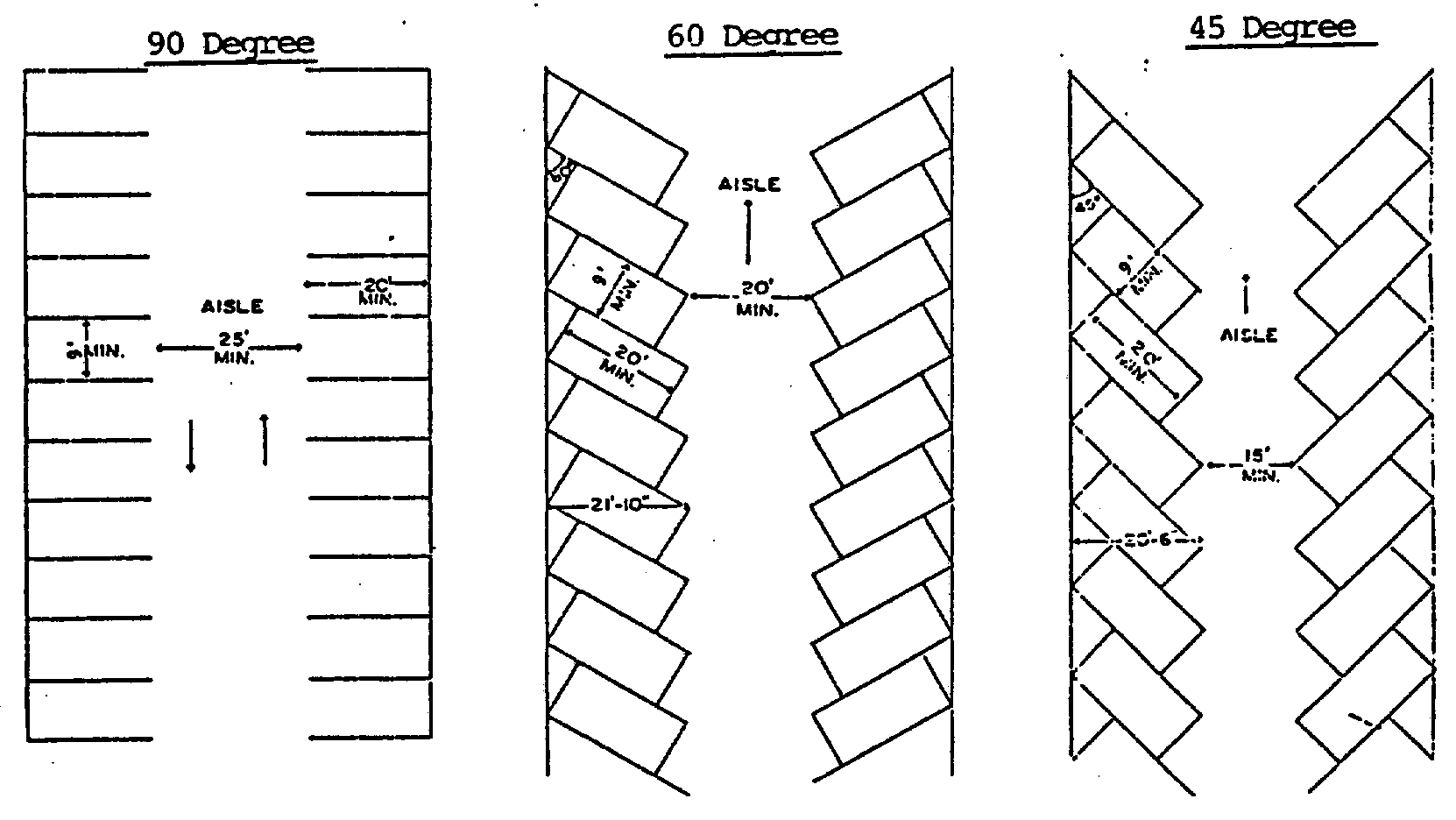
The minimum width of an aisle designed and intended for the maneuvering of an automobile into a parking space shall be determined by the angle of parking as shown in subsection (e) of this section, parking lot dimension table. The parking plan shall be so arranged that each automobile may be placed and removed from the parking space assigned and taken to and from the property without the necessity of moving any other automobile to complete the maneuver.
(b)
Required yards and setbacks may be used for off-street parking, provided that access drives or aisles and turning spaces shall be located within the lot lines. Street or sidewalk areas may not be used for off-street parking purposes.
(c)
Where parking space is provided in open areas adjacent to or beneath any building, structure or portion thereof, the parking spaces shall be paved with asphalt or concrete, and it shall be unlawful for the owners or occupants of the building or structure to place on the parking area any furniture or other property that will obstruct or hinder the free use of the parking area.
(d)
For other than single-family uses, parking spaces for the handicapped shall be provided in all required parking lots, garages, or other similar facilities. These parking spaces shall be provided at the rate of five percent of the total number of required spaces and shall be at a dimension of not less than 12 feet by 20 feet each.
(e)
The following illustrates the off-street parking area standards:
OFF-STREET PARKING AREA STANDARDS
(Code 1983, § 159.34(A); Code 1996, § 26-322)
Sec. 26-398. - Minimum parking spaces required; approval.
(a)
There shall be provided at the time of the erection of any main building or structure, or at the time that any main building or structure is enlarged by more than 25 percent of the square footage of the existing building or structure, or increased in capacity by adding dwelling units, guestrooms, floor area, or seats, minimum off-street automobile parking space with adequate provision for ingress and egress by an automobile of standard size, in accordance with the following requirements:
(1)
Single-family dwelling structures: two spaces per dwelling unit.
(2)
Multiple-family dwelling structures: two spaces per dwelling unit.
(b)
Parking spaces for all dwelling structures shall be located on the same lot with the main building or structure to be served.
(c)
A certificate of occupancy for a given structure or premises shall be prohibited until the required parking area has been inspected and approved.
(d)
The minimum parking space size, aisle width, and driveway width shall be based upon the degree of angle of the individual parking space and shall be in accordance with the parking lot dimensions table in section 26-397(e), provided that the width of the parking space shall not be less than nine feet, except as required in section 26-397.
(e)
For other than single-family uses, each parking space shall be marked either by painted lines, precast curbs, or in a similar fashion so as to indicate the individual parking spaces.
(Code 1983, § 159.34(B), (C), (E)—(G); Code 1996, § 26-323)
Sec. 26-399. - Drainage control.
All off-street parking facilities shall be drained so as not to cause any nuisance to adjacent private or public property through the use of on-site control techniques for stormwater runoff, such as, but not limited to, permeable surface, French drains, catchbasins, swales, and the like.
(Code 1983, § 159.34(I); Code 1996, § 26-324)
Sec. 26-400. - Off-street loading spaces.
Space shall be logically and conveniently located for bulk pickups and deliveries and accessible to vehicles when required off-street parking spaces are filled. Required off-street loading space of one per principal use is not to be included as an off-street parking space in the computation of required off-street parking space. The size of a required loading space shall not be less than 12 feet by 25 feet with a vertical clearance of not less than 14 feet.
(Code 1983, § 159.34(J); Code 1996, § 26-325)
Sec. 26-401. - Landscaping and design requirements.
(a)
All off-street parking areas for all uses except single-family residential shall be landscaped as outlined in the town landscape ordinance. The building code administrator will determine from the site plans submitted whether the requirements of the landscape ordinance have been met.
(b)
Each parking site or lot shall be designed individually with reference to the size, street pattern, adjacent properties, buildings, and other improvements in the general neighborhood, number of cars to be accommodated, hours, and kinds of use.
(Code 1983, § 159.34(K), (L); Code 1996, § 26-326)
Sec. 26-402. - Interior parking facilities.
When the parking facilities for multiple-family structures are housed beneath a portion of a building, a plan shall be submitted for the following:
(1)
Interior traffic circulation;
(2)
Parking stall and aisle dimensions;
(3)
Proper traffic control signing and pavement marking for safe and efficient vehicular and pedestrian operation;
(4)
Location of entrances and exits on public roads;
(5)
Approval of site distances at the entrances and exits and at corners of intersecting public streets and ways; and
(6)
Approval of the effective screening of the cars located in or on the parking structures from adjoining properties, the same property, and from public streets.
(Code 1983, § 159.34(M); Code 1996, § 26-327)
Sec. 26-403. - Pedestrian walkways.
All parking lots having two or more rows of parking spaces shall provide safe pedestrian walkways through the parking lot.
(Code 1983, § 159.34(N); Code 1996, § 26-328)
Sec. 26-435. - Definitions and rules of construction.
(a)
Definitions. The following words, terms and phrases, when used in this subdivision, shall have the meanings ascribed to them in this subsection, except where the context clearly indicates a different meaning, subject to the rules of construction set out in subsection (b) of this section.
Agricultural, construction, or industrial equipment means any motor vehicle, trailer, or implement used in agriculture, construction, or industry, and only incidentally operated or moved over public highways. The term "agricultural construction" includes, but is not necessarily limited to, farm tractors and implements, bulldozers, cranes, excavators, forklifts, motor graders, road rollers, tow trucks, mixers, earthmovers, compressors, generators, and lot clearing equipment. The term "agricultural construction" shall not include lawnmowers, edgers, wheelbarrows, and other lawn maintenance equipment for primary use on the premises.
Boat means any watercraft, including barges and airboats, designed, used, or capable of being used as a means of transportation on water.
Bus means any motor vehicle, other than taxicabs, designed or used for the transportation of persons for compensation.
Camper means any separate structure designed or used for human habitation, which can be attached to or detached from a pickup truck, and which has sufficient headroom for an adult six feet in height to stand upright. A pickup truck with a cap shall not be construed as a camper.
Cap means any separate structure which can be attached to or detached from a pickup truck, and which does not have sufficient headroom for an adult six feet in height to stand upright.
Chassis camper means any motor vehicle with a cab and a habitable structure permanently attached to the motor vehicle chassis.
Commercial lettering means letters, numbers, symbols, or combinations thereof which advertise a trade, business, industry, or other activity for profit, or a product, commodity, or service. The term "commercial lettering" shall not include bumper stickers affixed to bumpers only, or the decal or plate commonly applied to a motor vehicle by a motor vehicle dealer.
Commercial vehicle means any agricultural, construction, or industrial equipment, or any bus, step van, truck, or truck tractor. The term "commercial vehicle" shall include any motor vehicle upon which commercial lettering has been affixed. The term "commercial vehicle" shall also include, but shall not necessarily be limited to, a pickup truck with an altered cargo box, or from which the cargo box has been removed. Any motor vehicle with tools, building materials, or merchandise visible from the street or from abutting residential property shall be deemed a commercial vehicle.
Habitable means containing facilities for sleeping or equipment for cooking.
Light van means any motor vehicle having a generally rectangular bulk, which is licensed and registered for operation upon public highways and which has a carrying capacity of one ton or less.
Motor home means any motor vehicle to which a habitable structure has been permanently attached to a motor vehicle chassis. The term "motor home" shall include, but shall not necessarily be limited to, any light van with the roof permanently raised to allow an adult six feet in height to stand upright.
Owner means any person to whom a motor vehicle or trailer is registered according to the certificate of title for the motor vehicle or trailer, and shall include, if the motor vehicle or trailer is under lease, rental agreement, or on loan under any type of arrangement, gratuitous or otherwise, the person having possession or control of the vehicle. When used in this subdivision in relation to privately owned real property in a residential district, the term "owner" shall mean the owner of the property according to the latest ad valorem tax records of the county, and shall include, if the privately owned real property is under lease, rental agreement, or deed, or similar land contract, the person in possession and control of the property.
Pickup truck means any motor vehicle designed primarily for the transportation of property within a permanently attached open cargo box and having a carrying capacity of one ton or less.
Recreational vehicle means any camper, pickup truck with a camper mounted, chassis camper, motor home, or swamp buggy as defined in this section; or any similar vehicle or trailer designed primarily for recreational use.
Residential district means an R-1, R-2, or R-2A district as established and designated on the official land development district map adopted by reference in section 26-217.
Screening means a visual barrier consisting of permanent, dense vegetation or other permitted structure at least equal in height to the recreational vehicle, boat, or boat trailer, but which does not exceed the maximum height limitation permitted.
Step van means any motor vehicle having a generally rectangular bulk, designed and manufactured primarily as a commercial delivery or service truck, and characterized by having sufficient headroom for an adult six feet in height to stand upright. The term "step van" shall include, but shall not necessarily be limited to, a light van to which an enlarged cargo area has been fitted.
Street means any street, avenue, road, paved alley, or other public thoroughfare, however designated, including all of the right-of-way between the centerline and the boundary line which is the residential property line, to the extent that the right-of-way adjoins a residential district.
Swale means that area of a public street between the pavement and the limiting property line of the right-of-way.
Swamp buggy means any motor vehicle designed primarily for operation on land other than improved roads.
Trailer means any vehicle without motive power designed for carrying persons or property on its own structure and to be drawn by a motor vehicle regardless of hitch type.
Truck means any motor vehicle, other than a pickup truck or light van, which is designed primarily for the transportation of property or cargo.
Truck tractor means any motor vehicle, other than a pickup truck, which is designed for or equipped with a fifth wheel hitch for drawing semitrailers.
(b)
Rules of construction. In applying the terms of this subdivision:
(1)
Any motor vehicle, boat, or trailer which is partially built or in the process of conversion shall be included under the most stringent definition that can be applied.
(2)
In case of doubt as to the proper classification of a specific vehicle, a determination by the state department of highway safety and motor vehicles shall be controlling. The body description and classification on the motor vehicle certificate of title shall be prima facie evidence of the determination.
(Code 1983, § 159.40(A), (B); Code 1996, § 26-351)
Sec. 26-436. - Construction of subdivision.
(a)
This subdivision is primarily for the purpose of protecting residential uses and structures. Therefore, any ordinances of this town or laws of this state regulating motor vehicles are in addition to this subdivision. Wherever any provision of some other ordinance of the town or applicable statute, whether primarily for the regulation of motor vehicles or for purposes of land use, imposes more stringent requirements or limitations than are imposed or required by the provisions of this subdivision, then the more stringent requirements or limitations shall apply.
(b)
This subdivision shall not be construed to limit any deed restrictions, condominium regulations, or similar private limitations on land use imposing more stringent requirements or limitations than are provided in this subdivision. This subdivision shall not be construed as creating an obligation on the town to enforce private limitations on land use.
(Code 1983, § 159.40(J); Code 1996, § 26-352)
Sec. 26-437. - Scope of provisions.
Nothing contained in this subdivision shall be construed to permit any type of commercial activity not otherwise permitted in this chapter at any location within a residential district.
(Code 1983, § 159.40(G); Code 1996, § 26-353)
Sec. 26-438. - Prohibited acts; exceptions.
(a)
It shall be unlawful for any owner, agent, operator, or person in charge of a commercial vehicle, recreational vehicle, boat, or trailer to park, store, or keep such vehicle, boat, or trailer on the pavement or in the swale of any public street within any residential district in the town.
(b)
It shall be unlawful for any owner of privately owned real property in any residential district in the town to park on, cause to be parked on, or allow to be parked on such property any commercial vehicle, recreational vehicle, boat, or trailer, except as may otherwise be provided in this subdivision.
(c)
It shall be unlawful for motor homes, recreational vehicles, or any other vehicles to be used for living or sleeping quarters within the town limits.
(d)
Exceptions. The prohibitions of subsections (a) and (b) of this section shall not apply to:
(1)
The temporary parking of any commercial vehicle or trailer on privately owned real property within a residential district where construction for which a current and valid permit has been issued by the town is underway on the property and the permit is properly displayed on the premises. Nothing in this subsection (d) is intended to require a permit where none is otherwise required.
(2)
Deliveries by tradespeople, or the use of commercial vehicles or trailers in making service calls.
(3)
The emergency parking of a disabled commercial vehicle, recreational vehicle, boat, or trailer. However, any such commercial vehicle, recreational vehicle, boat, or trailer shall be removed from the residential district within 24 hours by wrecker towing or other available means regardless of the nature of the emergency.
(4)
The active loading or unloading of a recreational vehicle or trailer preparatory for or following an off-premises trip, but in no case shall this loading or unloading period exceed 24 hours in any seven-day period.
(5)
Boats which are docked in a canal, or landed from a canal by a permanent hoist mechanism.
(Code 1983, §§ 131.05(C), 159.40(C), (D); Code 1996, § 26-354)
Sec. 26-439. - Permissive parking.
Notwithstanding the prohibitions in section 26-438, there may be parked in any residential district, on a plot improved with a permitted structure, any combination of the following motor vehicles or trailers:
(1)
Any recreational vehicle, boat, or trailer, or commercial vehicle, provided that:
a.
The vehicle, boat, or trailer is parked in a permitted garage or carport.
b.
No part of the vehicle, boat, or trailer, when parked in a garage or carport, may project horizontally beyond the roofline of the garage or carport.
c.
When parked in a carport, the vehicle, boat, or trailer is screened on three sides.
(2)
Any recreational vehicle, boat, or boat trailer, provided that:
a.
The recreational vehicle, boat, or boat trailer is parked on the plot in the minimum rear yard, or in the minimum side yard to the rear of the extension of the front roofline.
b.
The recreational vehicle, boat, or boat trailer is screened from off-premises view by a fence, wall, or hedge. Any screening shall be limited to and in compliance with the requirements for a fence, wall, or hedge as set forth in section 26-372.
c.
At least three feet of separation shall be provided between the building and the recreational vehicle, boat, or boat trailer. For this purpose, the roof overhang shall not be deemed part of the building.
(Code 1983, § 159.40(E); Code 1996, § 26-355)
Sec. 26-440. - Parking regulations; exemptions.
Exempt from the provisions of section 26-439 are commercial vehicles or trailers in actual use or moving directly to or from the location of actual use which are owned or leased by:
(1)
The town for the accomplishment of a municipal purpose.
(2)
A contractor or subcontractor under agreement with the town to accomplish a municipal purpose.
(3)
A public utility operating within the town, or a contractor or subcontractor under agreement with the public utility, for the installation, maintenance, adjustment, or repair of or to a public utility facility.
(Code 1983, § 159.40(F); Code 1996, § 26-356)
Sec. 26-441. - Temporary parking permit.
The town administrator or designee may issue, upon application by an owner or agent, a permit extending any parking time limit set forth in this subdivision up to but not exceeding 24 hours, upon establishing that such permit is requested in good faith for good cause shown. The permit shall be displayed upon the vehicle, boat, or trailer in such a manner as to be visible from the street.
(Code 1983, § 159.40(H); Code 1996, § 26-357)
Sec. 26-466. - Definitions.
The following words, terms and phrases, when used in this article, shall have the meanings ascribed to them in this section, except where the context clearly indicates a different meaning:
Abandoned sign means a sign in which a business advertised on the sign is no longer licensed, no longer has a certificate of occupancy, or is no longer doing business at that location.
Advertising sign means a sign directing attention to a business, commodity, service, or entertainment conducted, sold or offered.
Advertising structure means any structure erected for advertising purposes, with or without any advertisement display thereon, situated upon, painted upon, or attached to real property, upon which any poster, bill, printing, painting, device, or other advertisement may be placed, posted, painted, tacked, nailed, or otherwise fastened, affixed, or displayed. This definition shall include bus bench advertising. However, the term "advertising structure" shall not include buildings.
Animated sign means a sign with action or motion using electrical energy, electronic or manufactured sources of supply or wind actuated elements, including rotating, revolving or flashing signs.
Awning sign means any sign which is painted on or otherwise affixed to an awning made of flexible cloth material which covers a metal, wood or composite frame.
Banner means any sign having the characters, letters, illustrations, or ornamentations applied to cloth, paper, balloons, or fabrics of any kind with only those materials for a foundation.
Billboard means any framework for signs advertising merchandise, services, or entertainment sold, produced, manufactured, or furnished at a place other than the location of the structure.
Blank copy means any paraphernalia including pennants, streamers, and banners that are intended solely to attract attention, and which contain no letters or symbols.
Building face means that portion of any exterior elevation of a building extending from grade to the top of the parapet wall or eaves and the entire width of the building elevation.
Building official means the individual designated by the town manager as the enforcing administrative officer of this article.
Bulletin board means a sign of permanent character, but with removable letters, words, or numerals, indicating the names of persons associated with, events conducted upon, or products or services offered upon, the place where the sign is maintained; also known as a changeable copy sign.
Canopy sign means a sign suspended from, attached to or forming a part of a building canopy made of rigid materials, and attached to, and supported by, columns, poles, or braces extending to the ground.
Changeable copy sign means a sign which is constructed so that the sign letters, words, numbers and other symbols on the face may be changed from time to time, regardless of how the letters, words, numbers or other symbols are attached or projected onto the face.
Directional sign means any sign permanently or temporarily erected by or with the approval of the town or any authorized government agency to denote the route to any historic place, shrine, or hospital; signs directing and regulating traffic; notices of any transportation or transmission company necessary for the direction or safety of the public; signs, notices, or symbols as to the time and place of public meetings; and any entrance signs into, or exit signs from parking lots open to the public; and any signs indicating the location of an automated teller machine (ATM) in parking lots.
Double-faced sign means a sign with two faces which are always parallel and back-to-back.
Electrical sign. See Illuminated sign.
Engineer means a person registered as a professional engineer in the state.
Entrance feature means an identification structure located along the main access to a town-approved subdivision or development. The only advertising on the structure shall be the subdivision or development name and logo.
Fixed projecting sign means and includes any sign which is attached to a building and supported throughout its length by the wall of the building.
Flashing sign means any illuminated sign which exhibits changes in light or color; any sign used for identification, directional, advertising or promotional purposes that includes approved lighting fixtures which flash, blink, cut on and off intermittently, and are used as exterior signs visible from the public right-of-way.
Flat sign. See Wall sign.
Freestanding, pole or pylon sign means a detached sign, made of non-combustible materials, and which shall include any signs supported by uprights or braces placed upon or in or supported by the ground, and not attached to any building.
Ground sign. See Monument sign.
Home number-nameplate means a number-nameplate not more than three square feet in area, indicating the apartment or house number-name, identification or location identification.
Identification sign means a sign other than a bulletin board sign or nameplate sign, indicating the name of the primary use, the name or address of a building, or the name of the management thereof.
Illuminated sign orelectrical sign means a sign in which an artificial source of light is used in order to make the message readable, and shall include internally and externally lighted signs.
Instructional sign means a sign conveying instruction with respect to the premises on which it is maintained, such as a no trespassing sign, a danger sign, and other similar signs which do not show names or advertising or any sign required by law or necessary for safety.
Land development code means the land development (zoning) code of the town, set out in this chapter, as adopted by the town council.
Monument sign means a low profile, freestanding sign with a solid base on the ground, of the same or larger dimension as the height of the sign, and which is fabricated of non-combustible materials, to incorporate design and building materials which complement the architectural theme of the buildings on the same parcel.
Nonconforming sign means a sign or advertising structure existing within the town on the effective date of the ordinance from which this article is derived which, by its length, height, square foot area, location, type, use, or structural support does not conform to the requirements of this article.
Painted wall sign means any sign painted on any surface or roof of any building, visible from any public right-of-way or adjacent property advertising services or products.
Plastic sign means any mural or sign, embellishment, or sign area made of plastic, flat sheet, corrugated panels, formed or molded on one or more faces.
Point of purchase sign means any structure, service, display board, screen, surface, or wall with characters, letters, or illustrations placed thereto, thereon, or thereunder by any method or means whatsoever where matter displayed is used for advertising on the premises a product actually or actively offered for sale or rent thereon or therein or services rendered.
Pole sign. Also known colloquially as a "pylon sign." See Freestanding sign.
Political sign means any advertising structure used in connection with a local, state, or national election campaign.
Projecting sign means any sign projecting at an angle from and attached to the outside wall of any building which is supported by only one rigid support, irrespective of the number of guy wires used in connection therewith.
Real estate sign means any sign erected by the owner, his exclusive agent, or a multiple-listing service advertising the real property upon which the sign is located for rent or for sale.
Roof sign means any sign erected, constructed or painted and maintained wholly upon or over the roof of any building.
Sign means any writing, including letters, words, or numerals; statuary; pictorial representation, including illustrations or decorations; emblem, including any device, symbol, or trademark; flag, including a banner or pennant; or any other figure of similar character, which is a structure or any part thereof, or is attached, painted on, or in any other manner represented on a building or other structure, and shall include any sign placed upon a vehicle used to announce, direct attention to, or advertise, and is visible from outside a building. The term "sign" shall include writing, representation, or other figures of similar character within a building and located in a window. See also specific signs defined in this section.
Sign area means the background area upon which the advertising surface area is placed. Where the advertising surface area is attached directly to the wall of a building, that wall shall be construed to be the background sign area if it is an integral part of the sign.
Snipe sign means any sign made of any material, including paper, cardboard, wood, and metal, when the sign is tacked, nailed, posted, pasted, glued, or otherwise attached to trees, poles, fences, or other objects and the advertising matter appearing thereon is not applicable to the premises upon which the sign is located.
Surface area means the actual area of the letters or symbols applied to a background. For computation purposes, straight lines forming a rectangle shall be drawn closest to the extremities of the copy, encompassing all individual letters or symbols.
Temporary sign means any sign erected and maintained for a specific length of time.
Vehicular sign means a sign affixed to or painted onto a transportation vehicle or trailer, for the purposes of business advertising. However, the term "vehicular sign" shall not include signs affixed to vehicles for identification purposes or as otherwise required by law.
Wall sign means any sign erected parallel to the face or on the outside wall of any building, and supported throughout its length by the wall of the building which can project no more than 12 inches from the building. It shall also include any sign affixed to a freestanding wall.
Window sign means any sign which is within 36 inches of a building opening or transparent or translucent covered opening (for example, a window, door or arch), and which is facing such opening so that the message on the sign is visible from outside the building.
(Code 1996, § 26-376; Ord. No. 231, § 1, 10-28-2005)
Sec. 26-467. - Prohibited signs.
The following signs are prohibited:
(1)
Animated signs with surface movements.
(2)
Awning signs.
(3)
Murals or other painted wall signs.
(4)
Flashing lights, flashing and/or moving messages, bright flashing colors, or exposed outdoor neon; or changeable sign copy (except as expressly permitted herein); search lights and beacons not operated by a governmental agency; and signs with chasing borders and twinkling lamps; any illuminated sign of an intensity that the vision of the observer becomes momentarily impaired thereby constituting a driving hazard.
(5)
Extruding figures, translucent fiberglass or composite awning signs, or any waving, fluttering, or revolving object, or any other such device to attract attention.
(6)
Statuary of any kind, except that of a distinctly religious nature located on the lot whereon a place of worship exists.
(7)
Signs which produce noise or sounds capable of being heard even though the sounds produced are not understandable sounds.
(8)
Signs which emit visible smoke, vapor, particles, or odor.
(9)
Signs or other advertising matter as regulated by this article, erected at the intersection of any street, or in or near any street right-of-way in such a manner as to obstruct free and clear vision; or at any location where, by reason of the position, shape, color, it may interfere with, obstruct the view of, or be confused with any authorized traffic sign, signal, or device; or which makes the use of the words "stop," "look," "drive-in," or any other word, phrase, symbol, or character in such a manner as to interfere with, mislead, or confuse vehicular traffic as determined by the town council.
(10)
Signs erected, constructed, or maintained so as to obstruct or be attached to any firefighting equipment, window, door, or opening used as a means of ingress or egress or for firefighting purposes, or placed so as to interfere with any opening required for proper light and ventilation as required by the building code of the town.
(11)
Signs with any lighting or control mechanism which causes radio or television or other communication interruption or interference.
(12)
Flags, banners, streamers, twirling, A-type, sandwich type, sidewalk or curb signs, balloons, or other air- or gas-filled figures and blank copy signs as well as vehicular signs.
(13)
Moving or stationary advertising signs on any vessel plying the canals or other water bodies.
(14)
Outdoor advertising of any kind or character where any live animals or human beings are used as part of the advertising and which is visible from any public street or adjacent properties.
(15)
Signs/billboards offering services or products for sale or rent not offered or provided on the same lot or premises as the advertising structure. No off-premises signs shall be permitted.
(16)
Any snipe sign.
(17)
Any banner over any street or sidewalk without permission from the town manager.
(18)
Any sign, portable or fixed, placed or erected on or over any part of the ultimate road right-of-way other than directional signs erected by county, state or town officials.
(19)
Any sign or device which displays signage, on town property or rights-of-way within the town, unless specifically authorized in writing by the town manager. Other governmental entities which have jurisdiction and/or control of public rights-of-way may install directional or official traffic signs thereon, and shall be deemed exempt from this Code. Any signs not authorized on such rights-of-way shall be removed by the promulgator of the sign, if known, within 24 hours of notification by the town. If the sign is not removed within 24 hours, or if the promulgator cannot be identified, the town may remove such sign and the cost of such removal shall be a liability, due and payable by the promulgator of the sign. Such expense shall constitute a lien against the real and personal property of the promulgator of such sign, as later provided herein.
(20)
Any sign which exhibits thereon any lewd, lascivious, indecent, pornographic, profane, or immoral material.
(21)
Any signs attached to trees, utility poles, trailers, trash receptacles, and any other unapproved supporting structures including portable signs and vehicular signs, including those on trailers.
(22)
Any roof sign or projecting sign.
(23)
Bus bench advertising, except where such bench advertises the bus or transit carrier for whose benefit the bench is installed, except as may otherwise be approved by the town council.
(Code 1996, § 26-377; Ord. No. 231, § 1, 10-28-2005)
Sec. 26-468. - Nonconforming signs.
(a)
If any sign regulated herein is not in compliance with this subdivision on its effective date (January 1, 2006), then the sign shall be permitted to remain until it is next replaced, or until damaged more than 50 percent, or until the use of the sign is abandoned or unused for more than 90 days, following which, the sign shall be removed by the owner, agent or responsible person within 45 days thereafter.
(b)
Nonconforming signs and sign structures shall not be enlarged, replaced, redesigned, or structurally altered unless the sign or structure is brought into conformity except as required by the building official in cases where it has been determined that there exists eminent danger to the public safety, and except as otherwise permitted by this article.
(c)
Should any sign be removed for any reason, other than maintenance or name change of the occupant, from its location and reinstalled, then the sign shall conform to all requirements of this article. However, nothing herein shall be construed to prohibit only a change in the copy or face of an existing nonconforming sign.
(Code 1996, § 26-378; Ord. No. 231, § 1, 10-28-2005)
Sec. 26-469. - Temporary signs.
One or more temporary signs or banners of not more than 15 square feet in surface area per side, may be erected by a business, charity, governmental agency, or not-for-profit organization, on public or private property, with the written consent of the property owner, for not more than 72 hours prior to an sale or event. Prior to erecting such sign, the firm, organization or agency shall obtain a no cost temporary sign permit from the town manager, who shall designate and approve the location, size, materials and construction for such signs. Such signs shall be removed within 24 hours after the event. Such approval shall be limited to a maximum of three times per year, per organization. These signs shall be constructed so as not to create any hazardous or dangerous conditions to the public.
(Code 1996, § 26-379; Ord. No. 231, § 1, 10-28-2005)
Sec. 26-470. - All land development (zoning) districts.
(a)
Where other sign or outdoor advertising regulations are in effect and are more restrictive than the provisions of this article, the more restrictive provisions shall prevail.
(b)
Traffic reflectors and lights shall be permitted on ground signs and wall signs, provided that the light source shall provide proper shielding so as to prevent glare upon adjacent property.
(c)
No portions of any sign shall project over a public sidewalk, driveway, parking area, public or private right-of-way, or required landscape buffer except that monument signs may be placed within landscape buffers, and landscaped accordingly.
(d)
All lighted signs permitted within this Code shall be backlit or ground lit with white lights only. All replacement of backlit letters or bulbs shall be with white lights only. All signs must conform to this provision no later than January 1, 2013.
(Code 1996, § 26-380; Ord. No. 231, § 1, 10-28-2005)
Sec. 26-471. - Residential entrance signs and features.
(a)
All entrance signs (limit one sign per development) and features, including, but not limited to, gates, walls, and fountains may be located at the front property line, adjacent to the right-of-way.
(b)
Maximum sign area: 18 square feet per sign face.
(c)
Maximum sign height: Six feet as measured from the immediate adjacent natural grade.
(d)
Sign copy limits: Name of building or development, street address numbers, and development logo. Capital letters and logos shall not exceed 13 inches in height, and lower case letters and street numbers shall not exceed ten inches in height.
(e)
All signs shall be erected so as not to obstruct or impair driver vision at ingress-egress points, aisles, and intersections in conformance with section 26-478.
(f)
Entrance features are permitted in any residential land development (zoning) district, except an R-l Single-Family Residential District, for the exclusive purpose of identifying residential developments, and to be constructed by the developer, homeowners' association, or condominium association and maintained by same.
(Code 1996, § 26-381; Ord. No. 231, § 1, 10-28-2005; Ord. No. 270, § 1, 8-27-2013)
Sec. 26-472. - Real estate signs in residential land development districts.
A temporary sign, conveying instructions with respect to the sale, rental, or lease of a lot, premises, dwelling, structure, or a combination thereof, shall be related only to the premises upon which the sign is located, limited to the following requirements:
(1)
A maximum of three feet in height and not to exceed six square feet, in single-family residential districts.
(2)
A maximum of six feet in height and not to exceed 15 square feet (on each side), in multifamily residential land development districts, but only for the sale of the entire condominium or cooperative building or property.
(3)
No real estate signs shall be allowed any closer than 15 feet from the property line or edge of pavement or walkway, whichever is the greater distance.
(4)
There shall be only one doubled-faced sign permitted per each street frontage on which the premises abut.
(5)
Real estate signs, permitted herein, shall be removed by the advertising broker or designee, when the transaction being advertised is completed.
(Code 1996, § 26-382; Ord. No. 231, § 1, 10-28-2005)
Sec. 26-473. - Point of purchase (business) signs.
(a)
The town recognizes that one (and only one) business (a hotel and restaurant) exists within the town and it is a nonconforming use within a residential multifamily zoning district. Notwithstanding that it is a nonconforming use, all signage shall hereafter conform to the requirements of this section, except signs that may have been erected prior to the effective date of the ordinance from which this subdivision is derived.
(b)
Point of purchase signs shall include only monument signs. All such signs permitted herein are restricted to point of purchase only, and on at least one such sign per property, shall contain the numerical street address, in not smaller than eight-inch numbers, and each such sign shall be landscaped with not less than three feet of landscape material on each side of the sign base, and incorporated into the required landscape areas, whenever possible. Notwithstanding the setbacks provided in this article, no business sign shall be located nearer than five feet from the ultimate right-of-way or expanded intersection as shown on the county's thoroughfare identification map (TIM) nor encroach within any required sight triangles required by law or ordinance.
(c)
Except as otherwise provided herein, one double-faced monument sign shall be permitted per parcel. The permitted sign shall only contain the individual business name. The maximum height of the sign, including the base, shall be six feet from the immediately adjacent grade, which shall not be artificially filled to created additional height, and shall not exceed 15 square feet on a side.
(Code 1996, § 26-383; Ord. No. 231, § 1, 10-28-2005)
Sec. 26-474. - Permit required; exemptions.
(a)
It shall be unlawful for any person to post, display, paint, or erect any sign or advertising structure without having first obtained a permit therefor, except as provided in subsection (b) of this section and in other provisions of this article.
(b)
The following types of signs are exempt from permit and zoning requirements:
(1)
Signs of a duly-constituted governmental body, including traffic or similar regulatory devices, legal notices, or warnings at railroad crossings.
(2)
Flags or emblems of the United States, the State of Florida, or other governmental body within the state.
(3)
Political campaign signs of not more than four square feet on a side, in surface area, may be erected on private property, not more than 30 days prior to any election and shall be removed within ten days after the election. These signs shall be so constructed as not to create any hazardous or dangerous conditions to the public.
(4)
Memorial signs or tablets erected and authorized, in writing, by the town manager.
(5)
Temporary signs denoting the architect, engineer, or general contractor when placed on construction sites and which do not exceed a total of 15 square feet on a side for all such signs on a development lot. The signs shall be removed upon the issuance of a certificate of occupancy or the abandonment of work.
(6)
Signs required to be maintained by law, governmental rule, order, or regulation.
(7)
Non-electrical directional signs displayed for the public, including signs which identify restrooms, freight entrances, stairs, walkways or the like with a total surface area not exceeding 1½ square feet on a side, per sign, and not more than six signs total, per commercial or multifamily residential parcel.
(8)
Non-electrical instructional signs, with a total surface area not exceeding 1½ square feet per side, and not more than five signs total, per commercial or multifamily residential parcel.
(9)
Home number-nameplate signs restricted to not more than one for each principal building or use on a premises and none exceeding 1½ square feet on a side, showing only the numerical address designations on the premises upon which they are maintained.
(Code 1996, § 26-384; Ord. No. 231, § 1, 10-28-2005)
Sec. 26-475. - Application.
An application for a sign permit shall be filed by the applicant or his agent with the town upon forms furnished by the building official. All monument signs shall be designed, signed, and certified by a state-registered engineer, who shall submit sufficient data to enable the building official to determine whether the sign complies with the Florida Building Code.
(Code 1996, § 26-384.1; Ord. No. 231, § 1, 10-28-2005)
Sec. 26-476. - Conditions for issuance; expiration.
(a)
The building official shall act upon an application for a sign permit with plans as filed or as amended within 30 days. A permit issued shall be construed to be a license to proceed with the work and shall not be construed as authority to violate, cancel, alter, or set aside any of the provisions of this Code or any other regulation of the town, nor shall the issuance of a permit prevent the building official from thereafter requiring a correction of errors in the plans or in construction, or of violations of this Code or other regulations of the town. Any permit issued shall become invalid unless the work authorized by it shall have been commenced within 90 days after its issuance, or if the work authorized by the permit is suspended or abandoned for a period of six months after the time of work is commenced. No refunds of permits shall be allowed after 30 days from the original issuance.
(b)
A sign permit shall expire and become null and void if the sign for which the approval was issued, and all conditions imposed in connection with the approval have not been completed within six months of issuance of the sign permit, or within three months of a newly completed building's issuance of a certificate of occupancy, whichever occurs first.
(Code 1996, § 26-384.2; Ord. No. 231, § 1, 10-28-2005)
Sec. 26-477. - Inspections.
Prior to the erection of any monument sign or placing concrete for any sign base, a request for an inspection shall have been made with the building official 24 hours in advance. The sign contractor shall have the approved plans on the job and available to the inspector. The contractor shall request final inspection on all signs permitted.
(Code 1996, § 26-384.3; Ord. No. 231, § 1, 10-28-2005)
Sec. 26-478. - Construction standards; no traffic hazard.
(a)
Every sign shall be constructed and anchored in a secure and substantial manner and constructed in accordance with the Florida Building Code.
(b)
No sign shall be placed at any location in the town where it may interfere with or obstruct the view of any motorist, or be confused with any authorized traffic sign, signal, or device. A sign, which, at the time of construction, was not considered a traffic hazard, shall be removed at the owner's expense if at a later time it is determined by the town manager that the sign has become a traffic hazard due to changed circumstances.
(Code 1996, § 26-384.4; Ord. No. 231, § 1, 10-28-2005)
Sec. 26-479. - Duty of owner to maintain signs, remove unsafe signs, and remove or cover abandoned signs; notice; removal by town.
(a)
All signs shall be properly maintained. Exposed surfaces shall be cleaned and painted, if paint is required. Defective or damaged parts shall be replaced.
(b)
If any sign regulated herein is found by the building official to be unsafe, insecure, a menace to the public, or constructed, erected or maintained in violation of the provisions of this article, written notice by the building official shall be given to the owner of the sign and of the property the sign is located on. If the owner or person in possession fails to remove or alter the structure so as to comply with the provisions herein set forth within ten days after the notice is delivered, the town manager shall approve the removal or alteration of the sign to comply at the expense of the owner of the property upon which it is located. The land development department may cause any sign which is an immediate peril to persons or property to be removed summarily and without notice.
(c)
If any sign regulated herein is found to be abandoned, or the business advertised shall move from the property where the sign is located, the owner, agent or responsible person, or any of them, shall be responsible to remove the sign, cover the sign with a plain fabric cover, or place a blank copy panel in the sign frame within 90 days of the abandonment or relocation of the business.
(d)
Upon the failure, neglect or refusal of any owner, agent or responsible person to remove or repair any sign in violation of this article, after notification by the building official, the town manager is hereby authorized and empowered to effect the removal of the sign which is in violation.
(Code 1996, § 26-384.5; Ord. No. 231, § 1, 10-28-2005)
Sec. 26-480. - Owner to bear cost of repair or removal; lien right.
When the town has effected the repair or removal of a sign or has paid for the repair or removal thereof, the actual cost thereof plus accrued interest at the rate of ten percent per annum shall be charged to the owner of the property on the next regular tax bill forwarded to the owner. The charge shall be due and payable to the town within 30 days following written notice, given to the property owner, of the amount due. If the amount shall not be paid by the property owner, then such amount due to the town shall become a lien upon the property of the owner, and the town manager may cause the filing of such lien in the public records of Palm Beach County or any other county in which the property owner owns real property.
(Code 1996, § 26-384.6; Ord. No. 231, § 1, 10-28-2005)
Sec. 26-481. - Fees.
It shall be unlawful for signs to be permitted without the payment of the fees established from time to time by resolution of the town council.
(Code 1996, § 26-384.7; Ord. No. 231, § 1, 10-28-2005)
Sec. 26-482. - Variances.
Variances from the strict interpretation of this subdivision may be granted for good cause by the town council, after initial review by the architectural review board on an advisory basis only at a subsequent quasi-judicia1 hearing noticed at least ten days prior to the final hearing before town council. Such good cause may include the traditional basis for the grant of a zoning variance contained elsewhere in this Code at section 2-154(b)(1), but may also include a review of the total signage on a property, and may include any special requirements, such as natural or manmade sight limitations from the public rights-of-way. It is the intent of the architectural review board and town council to review any such requests, for impact on the community, as well as the business owner or condominium association, and to balance the needs of each. Application for variances shall be on forms provided by the town clerk, and fees for the same shall be as provided by resolution of the town council. Any appeal of the town council's final decision on a sign variance shall be to the Circuit Court of the 15th Judicial Circuit.
(Code 1996, § 26-384.8; Ord. No. 231, § 1, 10-28-2005; Ord. No. 270, § 1, 8-27-2013)
Sec. 26-503. - Purpose and goals.
(a)
Purpose. The purpose of this subdivision is to establish general guidelines for the siting of wireless communications towers and antennas.
(b)
Goals. The goals of this subdivision are to:
(1)
Protect residential areas and land uses from potential adverse impacts of towers and antennas;
(2)
Encourage the location of towers in nonresidential areas;
(3)
Minimize the total number of towers throughout the community;
(4)
Strongly encourage the joint use of new and existing tower sites as a primary option rather than construction of additional single-use towers;
(5)
Encourage users of towers and antennas to locate them, to the extent possible, in areas where the adverse impact on the community is minimal;
(6)
Encourage users of towers and antennas to configure them in a way that minimizes the adverse visual impact of the towers and antennas through careful design, siting, landscape screening, and innovative camouflaging techniques;
(7)
Enhance the ability of the providers of telecommunications services to provide such services to the community quickly, effectively, and efficiently;
(8)
Consider the public health and safety of communication towers; and
(9)
Avoid potential damage to adjacent properties from tower failure through engineering and careful siting of tower structures.
In furtherance of these goals, the town shall give due consideration to the town's comprehensive plan, zoning map, existing land uses, and environmentally sensitive areas in approving sites for the location of towers and antennas.
(Code 1996, § 26-385; Ord. No. 191, § 1, 6-24-1997)
Sec. 26-504. - Definitions
The following words, terms and phrases, when used in this subdivision, shall have the meanings ascribed to them in this section, except where the context clearly indicates a different meaning:
Alternative or stealth tower structure means manmade trees, clock towers, bell steeples, and similar alternative design mounting structures that camouflage or conceal the presence of antennas or towers.
Antenna means any exterior stealth designed device used for transmitting and receiving, mounted on a tower, alternative tower structure, building or structure and used in communications that radiate or capture electromagnetic waves, digital signals, analog signals, radio frequencies (excluding radar signals), wireless telecommunications signals or other communication signals. This definition does not include over-the-air reception devices which deliver television broadcast signals, direct broadcast signals; direct broadcast satellite services or multi-channel, multi-point distribution services, as defined and regulated by 47 CFR 1.4000, as amended.
Backhaul network means the lines that connect a provider's towers/cell sites to one or more cellular telephone switching offices, and/or long distance providers, or the public switched telephone network.
Engineer means a registered engineer licensed in the state to provide any information of an engineering nature, whether civil, electrical or mechanical.
FAA means the Federal Aviation Administration.
FCC means the Federal Communications Commission.
Height means, when referring to a tower or other structure, the distance measured from the zero datum of the lot, as defined in the land development code, to the highest point on the tower or other structure, including any antenna.
Preexisting towers or preexisting antennas means any tower or antenna for which a building permit has been properly issued prior to the effective date of the ordinance from which this subdivision is derived, including permitted towers or antennas that have not yet been constructed, so long as such approval is current and not expired.
Stealth design means a method that would hide or conceal an antenna, and its supporting electrical or mechanical equipment, or any other support structure that is identical to, or closely compatible with, the color, and texture of the supporting structure so as to make the antenna and related equipment as visually unobtrusive as possible.
Tower means any ground mounted structure that is designed and constructed primarily for the purpose of supporting one or more antennas for telephone, radio and similar communication purposes, including self-supporting lattice towers, guyed towers, or monopole towers. The term "tower" includes radio and television transmission towers, microwave towers, common-carrier towers, cellular telephone towers, alternative tower structures, and the like. The term "tower" includes the structure and any support thereto.
(Code 1996, § 26-386; Ord. No. 191, § 1, 6-24-1997)
Sec. 26-505. - Applicability.
(a)
New towers and antennas. All new towers or antennas in the town shall be subject to these regulations, and shall require major site plan review.
(b)
Preexisting towers or antennas. At the time of adoption of the ordinance from which this section is derived, no preexisting towers and preexisting antennas exist within the town.
(Code 1996, § 26-387; Ord. No. 191, § 1, 6-24-1997)
Sec. 26-506. - General requirements.
(a)
Permitted or special exception use. Antennas and towers shall be a permitted use on town owned property and a special exception use in the remainder of the R-2 and R-2 A Multifamily Residence Districts. A different existing use of an existing structure on the same lot shall not preclude the installation of an antenna or tower on such lot.
(b)
Inventory of existing sites. Each applicant for an antenna and/or tower shall provide to the building code administrator an inventory of its existing towers, antennas, or sites approved for towers or antennas, that are either within the jurisdiction of the town or within two miles of the border thereof, including specific information about the location, height, and design of each tower.
(c)
Aesthetics. Towers and antennas shall meet the following requirements:
(1)
Towers shall either maintain a galvanized steel finish or, subject to any applicable standards of the FAA, be painted a color so as to reduce visual obtrusiveness.
(2)
At a tower or antenna site, the design of the buildings and related structures shall, to the maximum extent possible, use materials, colors, textures, screening, and landscaping that will blend them into the natural setting and surrounding buildings. Said towers, antennas, buildings and related structures shall be required to be approved by the town council as part of the site plan review.
(3)
If an antenna is installed on a structure other than a tower, the antenna and supporting electrical and mechanical equipment must be, to the maximum extent possible, of stealth design.
(d)
Lighting. Towers/antennas shall not be artificially lighted, unless required by the FAA or other applicable authority. If lighting is required, the lighting alternatives and design chosen must cause the least disturbance to the surrounding views.
(e)
State or federal requirements. All towers/antennas must meet or exceed current standards and regulations of the FAA, the FCC, and any other agency of the state or federal government with the authority to regulate towers and antennas. If such standards and regulations are changed, then the owners of the towers and antennas governed by this subdivision shall bring such towers and antennas into compliance with such revised standards and regulations within six months of the effective date of such standards and regulations, unless a different compliance schedule is mandated by the controlling state or federal agency. Failure to bring towers and antennas into compliance with such revised standards and regulations shall constitute grounds for the removal of the tower or antenna at the owner's expense.
(f)
Building codes; safety standards. Prior to the issuance of a building permit to construct an antenna or tower, the owner/applicant shall provide the town with all applicable approvals from federal, state and county agencies. To ensure the structural integrity of towers, the owner of a tower shall ensure that it is maintained in compliance with standards contained in applicable state or local building codes and the applicable standards for towers that are published by the Electronic Industries Association, as amended from time to time. If upon inspection, the town administrator or his designee concludes that a tower fails to comply with such codes and standards and constitutes a danger to persons or property, then upon notice being provided to the owner of the tower, the owner shall have 30 days to bring such tower into compliance with such standards. Failure to bring such tower into compliance within said 30 days shall constitute grounds for the removal of the tower or antenna at the owner's expense.
(g)
Measurement. Measurement of tower setbacks and separation distances shall be calculated and applied in relation to all adjacent facilities whether located inside or outside the boundaries of the town.
(h)
Not essential services. Towers and antennas shall be regulated and permitted pursuant to this subdivision, and shall not be regulated or permitted as essential services, public utilities or private utilities.
(i)
Franchises. Owners and/or operators of towers or antennas shall certify that all franchises required by law for the construction and/or operation of a wireless communication system in the town have been obtained and shall file a copy of all required franchises with the building code administrator.
(j)
Signs. No signs shall be allowed on an antenna or tower.
(k)
Multiple antenna/tower plan. So as to lessen proliferation, the town encourages the users of towers and antennas to submit a single application for approval of multiple users on a single site. Applications for approval of multiple user sites shall be given priority in the review process.
(Code 1996, § 26-388; Ord. No. 191, § 1, 6-24-1997)
Sec. 26-507. - Permitted uses.
(a)
General. The uses listed in this section are deemed to be permitted uses and shall not require special exception approval.
(b)
Antennas or towers located on property owned, leased, or otherwise controlled by the town are a permitted use, provided the following:
(1)
That a license or lease authorizing an antenna or tower has been approved by the town council.
(2)
That prior to the granting of a building permit for the construction of a tower, a duly noticed and advertised public hearing shall be required by the town council. Such due notice and advertisement of said public hearing shall be provided as required by law. These notice and public hearing requirements shall not pertain to the placement of antennas.
(Code 1996, § 26-389; Ord. No. 191, § 1, 6-24-1997)
Sec. 26-508. - Special exception uses.
(a)
General. The following provisions shall govern the review and approval of special exception applications for towers or antennas by the town council:
(1)
If the tower or antenna is not a permitted use, then special exception approval for towers and antennas shall be allowed for the construction of a tower or the placement of an antenna only as provided in this section.
(2)
In granting a special exception approval, the town council may impose conditions to the extent it concludes such conditions are necessary to minimize any adverse effect of the proposed tower or antenna on adjoining properties.
(3)
Any information of an engineering nature which the applicant submits, whether civil, mechanical, or electrical, shall be certified by a state-licensed professional engineer.
(4)
An applicant for a special exception use shall submit the information described in this section, and for site plans generally, and shall pay such deposits and fees as may be established by resolution of the town council.
(b)
Towers/antennas.
(1)
Information required. In addition to any information required for applications for special exception use and site plan approval, applicants for a special exception for a tower/antenna shall submit the following information:
a.
A scaled site plan clearly indicating the location, type and height of the proposed tower/antenna, on-site land uses and zoning, adjacent land uses and zoning (including when adjacent to other municipalities), comprehensive plan future land use designation of the site and all properties within the applicable separation distances set forth above, adjacent roadways, proposed means of access, setbacks from property lines, elevation drawings of the proposed tower/antenna ancillary other structures, topography, parking, and other information deemed by the building code administrator to be necessary to assess compliance with this subdivision.
b.
Legal description of the parent tract and leased parcel (if applicable).
c.
The setback distance between the proposed tower/antenna and the nearest residential unit, platted residentially zoned properties, and unplatted residentially zoned properties.
d.
The separation distance from other towers/antennas described in the inventory of existing sites submitted shall be shown on an updated site plan or map. The applicant shall also identify the type of construction of the existing tower/antenna and the owner/operator of the existing tower, if known.
e.
A landscape plan showing specific landscape materials.
f.
Method of providing security enclosure and finished color and, if applicable, the method of providing stealth design and illumination.
g.
A description of compliance with all applicable federal, state or local laws, including all provisions within this chapter.
h.
A notarized statement by the applicant's engineer as to whether construction of the tower will accommodate collocation of additional antennas for future users.
i.
Identification of the entities providing the backhaul network for the tower's antennas described in the application and other cellular sites owned or operated by the applicant in the town.
j.
A description of the suitability of the use of existing towers, other structures or alternative technology not requiring the use of towers or structures to provide the services to be provided through the use of the proposed new tower.
k.
A description of the feasible locations of future towers or antennas within the town based upon existing physical, engineering, technological or geographical limitations in the event the proposed tower or antenna is erected.
(2)
Factors considered in granting special exception approval for towers and/or antennas. In addition to any standards for consideration of special exception applications, the town council shall consider the following factors in determining whether to approve a special exception:
a.
Height of the proposed tower/antenna;
b.
Proximity of the tower/antenna to residential structures and residential district boundaries;
c.
Nature of uses on adjacent and nearby properties;
d.
Surrounding topography;
e.
Surrounding tree coverage and foliage;
f.
Design of the tower/antenna, with particular reference to design characteristics having the effect of reducing or eliminating visual obtrusiveness;
g.
Proposed ingress and egress; and
h.
Availability of suitable existing towers, antennas, other structures, or alternative technologies not requiring the use of towers or structures.
(3)
Availability of suitable existing towers, other structures, or alternative technology. No new tower shall be permitted unless the applicant demonstrates to the reasonable satisfaction of the town council that no reasonable alternative technology exists that can accommodate the applicant's proposed antenna. An applicant shall submit information requested by the town council related to the availability of suitable existing towers, other structures or alternative technology. Evidence submitted to demonstrate that no existing tower, structure or alternative technology can accommodate the applicant's proposed antenna may consist of any of the following:
a.
No existing towers or structures are located within the geographic area which meet the applicant's engineering requirements.
b.
Existing towers or structures are not of sufficient height to meet the applicant's engineering requirements.
c.
Existing towers or structures do not have sufficient structural strength to support the applicant's proposed antenna and related equipment.
d.
The applicant's proposed antenna would cause electromagnetic interference with the antenna on the existing towers or structures, or the antenna on the existing towers or structures would cause interference with the applicant's proposed antenna.
e.
The fees, costs, or contractual provisions required by the owner in order to share an existing tower or structure or to adapt an existing tower or structure for sharing are unreasonable. Costs exceeding new tower development are presumed to be unreasonable.
f.
The applicant demonstrates that there are other limiting factors that render existing towers and structures unsuitable.
g.
The applicant demonstrates that an alternative technology that does not require the use of towers or structures, such as a cable microcell network using multiple low-powered transmitters/receivers attached to a wire line system, is unsuitable. Costs of alternative technology that exceed new tower or antenna development shall not be presumed to render the technology unsuitable.
(4)
Setbacks. The following setback requirements shall apply to all towers for which a special exception is required:
a.
Towers must be set back a distance equal to at least 110 percent of the height of the tower from any adjoining P Public Ownership, R-2 or R-2-A, Multifamily Residence Districts.
b.
Towers must be set back a distance equal to at least 130 percent of the height of the tower from any adjoining R-1 Single-family Residence District property lot line.
c.
Guys and accessory buildings must satisfy the minimum zoning district setback requirements.
(5)
Separation. The following separation requirements shall apply to all towers for which a special exception approval is required:
a.
Separation distances between towers shall be applicable for and measured between the proposed tower and preexisting towers.
b.
The separation distances shall be measured by drawing or following a straight line between the base of the existing tower and the proposed base, pursuant to a site plan, of the proposed tower.
c.
The separation distances (listed in linear feet) shall be as shown in Table 1.
TABLE 1. SEPARATION OF TOWERS BY TYPES
(6)
Security enclosure. Towers shall be enclosed with a security enclosure not less than six feet in height and said towers shall also be equipped with an appropriate anti-climbing device.
(7)
Landscaping. The following requirements shall govern the landscaping surrounding towers for which a special exception is required:
a.
Tower facilities shall be landscaped with a buffer of plant materials that effectively screens the view of the tower compound from property used for residences. The standard buffer shall consist of a landscaped strip at least four feet wide outside the perimeter of the compound. The minimum landscaping within said buffer shall be a continuous four-foot-high hedge at the time of planting and an ultimate height of six feet, and one tree, 12 feet in height at the time of planting, every 25 linear feet.
b.
Existing mature tree growth and natural land forms on the site shall be preserved to the maximum extent possible. In some cases, such as towers sited on large, wooded lots, natural growth around the property perimeter may be a sufficient buffer.
(Code 1996, § 26-390; Ord. No. 191, § 1, 6-24-1997)
Sec. 26-509. - Buildings or other equipment storage.
(a)
Antennas mounted on structures or rooftops. The equipment cabinet or structure used in association with antennas shall comply with the following:
(1)
The cabinet or structure shall not contain more than 350 square feet of gross floor area or be more than ten feet in overall height, assuming at all times that a structural engineer has declared that the structural integrity of the structure or rooftop will not be compromised by the cabinet or structure.
(2)
If the equipment structure is located on the roof of a building, the area of the equipment structure and other equipment and structures shall not occupy more than ten percent of the roof area.
(3)
Equipment storage buildings or cabinets shall comply with all applicable building codes.
(b)
Antennas mounted on utility poles or light poles. Antennas shall be prohibited on existing utility or light poles. However, as part of a stealth design, monopoles may be made to look like light poles.
(c)
Antennas located on towers. The related unmanned equipment structure shall not contain more than 350 square feet of gross floor area or be more than 12 feet in overall height, and shall be located in accordance with the minimum yard requirements of the zoning district in which it is located.
(Code 1996, § 26-391; Ord. No. 191, § 1, 6-24-1997)
Sec. 26-510. - Removal of abandoned antennas and towers.
Any antenna or tower that is not operated for a continuous period of six months shall be considered abandoned, and the owner of such antenna or tower shall remove the same within 45 days of receipt of notice from the town notifying the owner of such abandonment. Failure to remove an abandoned antenna or tower within said 45 days shall be grounds to remove the tower or antenna at the owner's expense. If there are two or more users of a single tower, then this provision shall not become effective until all users cease using the tower.
(Code 1996, § 26-392; Ord. No. 191, § 1, 6-24-1997)
Sec. 26-511. - Nonconforming uses; no expansion of nonconforming use.
Towers constructed, and antennas installed, in accordance with the provisions of this subdivision shall not be deemed to constitute the expansion of a nonconforming use or structure.
(Code 1996, § 26-393; Ord. No. 191, § 1, 6-24-1997)

