
Springerville City Zoning Code
CHAPTER 17
104 - PARKING AND LOADING REQUIREMENTS
Sections:
17.104.010 - Purpose.
The purpose of this chapter is to alleviate or prevent congestion of the public streets, and to promote the safety and welfare of the public by establishing minimum requirements for the off-street parking of motor vehicles in accordance with the use to which the property is put. It is the further purpose of this section to place upon the property owner the primary responsibility for relieving public streets of the burden of on-street parking. (Ord. 2007-004 § 1 (part))
(Ord. No. 2010-002, § 1, 4-7-2010)
17.104.020 - General regulations.
A.
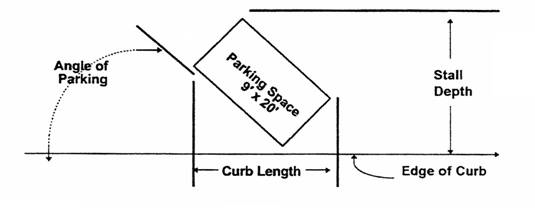
Size. A parking space shall mean an area of not less than one hundred eighty (180) feet, with a minimum width of nine feet and a minimum depth of twenty (20) feet, which is specifically designated for and used for, the parking of an automobile or light truck, exclusive of all driveways and access ways.
B.
Permits. An applicant for plan review must submit plans showing the off-street parking required by this chapter. These plans must show location, arrangement and dimensions of the off-street parking, turning spaces, drives, aisles and ingress and egress, and must be approved by the zoning administrator in accordance with the provisions of Chapter 17.88. Whenever approval has been issued in compliance with the requirements of this chapter, subsequent use of the structure, or use of the land is conditioned upon the unqualified availability of off-street parking as shown in the approved plans.
C.
Alterations, Additions and Expansion of a Business.
1.
A new use, addition or alteration of a building shall not be approved if it would create or increase a deficit in off-street parking, except by conditional use permit.
2.
It is unlawful to reduce the amount of existing parking below the minimum required by this chapter without first supplying other spaces as are required.
3.
If a building or business is destroyed, and if it is allowed to be reconstructed subject to the provisions of Chapter 17.96, it shall be required to provide only the number of parking spaces which existed prior to the destruction.
4.
If a business expands, it shall, in addition to the parking spaces in existence prior to such expansion, be required to provide only the number of additional parking spaces necessitated by the expansion.
Requirements of this section may be modified up to a maximum of ten (10) percent at the discretion of the zoning administrator or by conditional use permit, when it is demonstrated that such adjustment will not result in a danger to persons or property or in increased traffic.
D.
[Other Spaces Allocated for Parking.] All garage or other space allocated for the parking of vehicles, within buildings, basements or on roofs of buildings, shall be considered part of the off-street parking facilities, and may be included as such in computing the parking area requirements.
E.
Access. All off-street parking shall have access from a public street or alley.
F.
[Design requirements.] Ingress, egress, internal traffic circulation, off-street parking and loading facilities and pedestrian ways shall be designed so as to promote safety and convenience and so that traffic visibility is not obstructed. (Ord. 2007-004 § 1 (part))
(Ord. No. 2010-002, § 1, 4-7-2010)
17.104.030 - Design and location of parking spaces.
A.
Single-Family Residences, Mobile/Manufactured Homes, Multiple-Family Residences of Four or Less Dwelling Units and Agricultural Uses.
1.
Location. Required off-street parking for residential and agricultural uses shall be located on the same lot or parcel as the use it is intended to serve and shall be so designed as to prevent motor vehicles from backing onto a public street or from projecting beyond the property lines except that a vehicle shall be allowed to back onto a public street from a driveway which serves a residence.
2.
Surfacing. Residential parking spaces, driveways and access ways shall be improved and surfaced with asphalt, concrete, chip and seal, aggregate base, gravel, or some other material and graded to prevent impoundment of surface water in a manner satisfactory to the town engineer.
3.
Driveways. Driveways and access ways for residential and agricultural uses shall be not less than ten feet wide for one-way traffic, and not less than twenty (20) feet wide for two-way traffic.
4.
Commercial Vehicles. Not more than one commercial vehicle up to five-ton capacity may be parked on a residential property for purposes other than delivery, provided it is parked within a garage or in a rear yard screened by a fence or vegetation.
B.
All Uses Except as Provided Above.
1.
Location. Required off-street parking shall be located within three hundred (300) feet the building or use it is intended to serve, the distance being measured along the street line from the nearest point of the building or use to the nearest point of the parking lot.
Whenever the use of a separate lot or parcel is proposed for fulfillment of minimum parking requirements, the business owner shall submit as a part of his application satisfactory assurance by the property owner that the separate lot or parcel is permanently committed to parking use.
2.
Design. All off-street parking lots and spaces shall be so designed as to prevent automobiles from backing onto a public street or from projecting beyond the property lines. This shall be accomplished through the use of such devices as curbing, striping, landscaping, setbacks, driveways or any other method which will ensure compliance with this requirement.
All areas of a parking lot, with the exception of necessary points of ingress and egress, shall be no closer than ten (10) feet from the front property line. Undeveloped areas shall be landscaped and maintained in accordance with Chapter 17.90, design review.
Access to off-street parking areas from a public street shall be from a two-way driveway with a minimum width of twenty (20) feet or two one-way driveways each with a minimum width of twelve (12) feet. No access driveway shall be located closer than twenty (20) feet from a street intersection or other access driveway, nor any closer than ten (10) feet from any property line.
3.
Dimensions. Arrangement of parking spaces within the parking and driveway widths shall conform with the following requirements:
4.
Surfacing. All off-street parking areas, access ways and driveways shall be improved and surfaced with asphalt, concrete or some other material in a manner satisfactory to the town engineer.
a.
Driveways, parking spaces and parking areas within a 50-foot setback from a dedicated road or street must be surfaced with asphalt, concrete, chip seal or some other impermeable material satisfactory to the town engineer.
b.
Parking spaces shall be clearly marked with painted lines, concrete bumpers, or in another manner satisfactory to the town engineer.
c.
All surface water run-off shall be retained on-site or drained into a drainage system approved by the city engineer, and shall be maintained by the property owner.
5.
Lighting. Parking lots used during hours of darkness shall be lighted to minimum levels of five footcandles. Lighting shall be indirect, hooded and arranged so that the source of light does not create a nuisance or hazard to traffic or adjacent properties.
G.
[Prohibited Use.] The use of designated off-street parking space for the storage or display of merchandise, vehicles for sale or rent, or for repair of vehicles, shall be expressly prohibited. Parking for delivery vehicles or vehicles for rent or sale, or for repair of vehicles, shall be separate from off-street parking. (Ord. 2007-004, § 1(part))
(Ord. No. 2010-002, § 1, 4-7-2010)
17.104.040 - Schedule of required off-street spaces.
A.
[Specific Uses.] Off-street parking spaces shall be provided for each specified use in accordance with the schedule below.
B.
Definitions. In calculating the total number of required parking spaces, "usable floor area" as used herein means the area capable of being devoted to the specified use (does not include such spaces as kitchens, restrooms, hallways, etc.) and the term "seat" shall also include thirty (30) inches each of bench seating when individual seats are not provided.
C.
Mixed Uses. In the event of mixed uses, the total requirement for off-street parking spaces is the sum of the requirements of the various uses computed separately.
D.
Shared Parking. In the case that a daytime use and a nighttime/weekend use share a common parking lot, the developer and/or property owner may use shared parking as a means of satisfying off-street parking requirements. Shared parking would allow a site with multiple uses that have different operating hours or different peak business periods to share a parking lot that has less total parking spaces than would be required if each use had a separate parking lot.
1.
"Daytime Uses" means uses that operate predominantly during weekdays (Monday through Friday, six a.m. to six p.m.) and require the most parking spaces during weekdays. Examples of these uses are: banks, office buildings, and schools.
2.
"Nighttime/Weekend Uses" means uses that predominantly operate during nights (six p.m. to two a.m.) and weekends (Saturday and Sunday) and require the most parking spaces during nights and/or weekends. Examples of these uses are: restaurants, theaters, bowling alleys, night clubs, bars, and dance halls.
E.
Fractional Amount. In calculating the total number of required off-street parking spaces, fractional amounts are to be disregarded.
F.
Unlisted Uses. Parking requirements for a specific use not listed in this section shall be determined by the zoning administrator.
G.
Schedule:
16.
Parking for Retail Uses not listed above. For all other retail buildings or for any building converted to such use or occupancy, there shall be provided one (1) parking space for each two hundred (200) square feet of floor area designated for public use, excluding areas for restrooms and storage areas, plus one per two employees.
17.
Parking for Other Commercial Buildings. For all other non-retail commercial buildings, or for any building converted to such use occupancy, there shall be provided one parking space for each three hundred (300) square feet of floor area, excluding areas for restrooms and storage areas, plus one per two employees. ADA Compliant Spaces. ADA (Americans with Disabilities Act) compliant spaces shall be paved and provide an access aisle next to the space with a minimum width of five (5) feet. All spaces shall be developed in accordance with state and federal regulations.
(Ord. 2007-004, § 1(part); Ord. No. 2010-002, § 1, 4-7-2010)
17.104.050 - Off-street loading requirements.
A.
In all zoning districts, for every building or part thereof, erected or enlarged after the effective date of the ordinance codified in this title, which is occupied by a use receiving or distributing materials or merchandise by motor truck, there shall be provided and maintained on the same premises as the building or use, adequate off-street loading space meeting the minimum requirements hereinafter specified. Loading space shall not be considered as satisfying requirements for off-street parking space.
B.
Schedule of Loading Space Requirements.
C.
Location. Required off-street loading space shall not be permitted in any required front yard, nor in any required side yard except in a nonresidential district where a side yard abuts an alley. Off-street loading space may occupy all or any part of a required rear yard, except as otherwise provided herein, and may be partially or entirely enclosed within a building.
D.
Alleys. Where a building or use in a nonresidential district abuts an alley, such alley may be used as maneuvering space for loading and unloading spaces; provided however, that no alley abutting any residential district may be so used.
E.
Size. Every required off-street loading space shall have a minimum width of twelve (12) feet, a minimum length of forty-five (45) feet and a minimum height of fourteen (14) feet, exclusive of access aisles and maneuvering space.
F.
Shared Loading and Unloading. This chapter shall not be construed to prevent the joint use of loading and unloading spaces for two buildings or uses if the total of such spaces when used together is not less than the sum of spaces required for the various individual buildings or uses computed separately.
(Ord. 2007-004, § 1(part); Ord. No. 2010-002, § 1, 4-7-2010)

