
Springerville City Zoning Code
CHAPTER 17
28 - GENERAL PROVISIONS
Sections:
17.28.010 - Application.
Except as hereinafter provided, no building, structure or premises shall be used and no building or structure or part thereof shall be constructed, altered, repaired, improved, moved, removed, erected, demolished or materially altered except in conformity with these provisions and the provisions of the zone in which it is located. Any use that is not specifically allowed is declared to be prohibited.
(Ord. 2007-004 § 1 (part))
17.28.020 - Use restrictions.
A.
Permitted Uses. Those uses listed as "permitted uses" shall be allowed to establish within any zone district in which they are listed, subject to the specific requirements of this title. All other uses shall be prohibited except as otherwise provided in this title.
B.
Conditional Uses. Those uses listed as "conditional uses" shall require a conditional use permit in order to establish within any zone district in which they are listed, and shall be subject to all conditions and requirements imposed by the planning and zoning commission in connection with the conditional use permit.
C.
Accessory Uses. A use which is incidental, related, appropriate and clearly subordinate to the main use of the lot or building, and which does not alter the principal use of the lot or building, shall be allowed to establish within any given zone district, but may not be constructed more than six months prior to the erection of the main building.
D.
Unspecified Uses. Whenever a use is proposed which is not listed as a permitted or conditional use in any zone district, the planning and zoning commission shall determine, through minute action, the appropriate zoning classification of such use. In making their determination the planning and zoning commission shall consider similar uses which are listed in the code.
(Ord. 2007-004 § 1 (part))
17.28.030 - Redividing of recorded lots.
No lot may be divided to create a lot not in conformance with these regulations. No lot shall be divided or combined in any manner other than through subdivision procedures as specified by the subdivision regulations of the town.
(Ord. 2007-004 § 1 (part))
17.28.040 - Yard, lot and area requirements.
A.
Application. No building shall be erected, nor shall any existing building be altered, enlarged, moved or rebuilt, nor shall any open space surrounding any building be encroached upon or reduced in any manner, except in conformity with the yard, lot, area and building location regulations hereinafter designated for the zone in which such building or open space is located, except as otherwise specifically provided.
B.
Yards. Except as provided herein, every part of a required yard shall be open to the sky and unobstructed. Trees, shrubbery, etc., and accessory structures as allowed in this title, shall not be considered obstructions.
C.
Projections Over and Into Required Yards.
1.
Awnings, open fire escape balconies, fire escape stairs, window-type refrigeration units, suspended or roof evaporative coolers and other similar features may project not more than five feet over any required yard, provided that they shall be no closer than three feet from any lot line.
2.
Architectural details such as canopies, cornices and eaves, may project not more than two feet over any required yard provided that they shall be no closer than two feet from any lot line.
3.
Sills, leaders, belt courses and similar ornamental features may project not more than six inches over or into any required yard.
D.
Patios and Steps. Unroofed terraces, patios, steps or similar features not over three feet in height above grade, may project into any required yard, provided that they shall be no closer than two feet from any lot line, except that a sidewalk and/or driveway may extend to the property line.
E.
Accessory Buildings (Attached). A private automobile garage, carport or accessory building having any part of a wall in common with a dwelling shall be considered an integral part of the main building in determined yard, lot and area requirements.
F.
Accessory Building (Detached) and Swimming Pools. Any detached accessory building or swimming pool in any zone shall not be located in the required front yard, shall be at least five feet from the main structure, shall be at least five feet from the rear and interior side lot lines, and shall maintain side yard setbacks from the street side lot lines as required for the main structure in that zone.
G.
Solar Units. Solar heating and solar cooling units, solar greenhouses and associated apparatus may, notwithstanding any other provisions of this title, be located in a rear or side yard provided that such apparatus does not cover more than thirty (30) percent of that side or rear yard and shall be no closer than two feet to any lot line.
H.
Service Station Pumps and Storage of Inflammable Materials. No automobile service station pump shall be located closer than twelve (12) feet to a street property line, and no combustible, inflammable, explosive or similar material, gas or liquid in excess of ten gallon shall be stored within a distance of fifty (50) feet, (or a distance as required by the Springerville fire chief or other regulation) from a residential structure or property line, unless such material is used for domestic power or heating purposes on the same lot on which such material is stored.
(Ord. 2007-004 § 1 (part))
17.28.050 - Building height requirements.
A.
Application. No building shall be erected, reconstructed or structurally altered to exceed in height the limit hereinafter designated for the zone in which such building is located, except as otherwise specifically provided.
B.
Exceptions. Height regulations established elsewhere in this title shall not apply:
1.
In any district, to church spires, belfries, cupolas and domes not for human occupancy; monuments, water towers, flagpoles; provided that such structures shall be so located and constructed that if it should collapse, its reclining length would still be contained on the property in which it was constructed;
2.
In any district, to noncommercial radio or television antennas;
3.
In industrial districts to chimneys, smokestacks, derricks, conveyors, grain elevators or similar structures wherein the industrial process involved customarily require a height greater than otherwise permitted, provided that such structures shall be so located and constructed that if it should collapse, its reclining length would still be contained on the property in which it was constructed;
4.
In any district to solar heating or cooling apparatus, the plans of which have been approved by the zoning administrator.
(Ord. 2007-004 § 1 (part))
17.28.060 - Height limitations on corner lots.
The following regulations shall apply to all corner lots, within the triangle formed by the street front and side lot lines and a line connecting these lot lines at points measured along these lot lines a distance of twenty-five (25) feet from their intersection (see diagram):
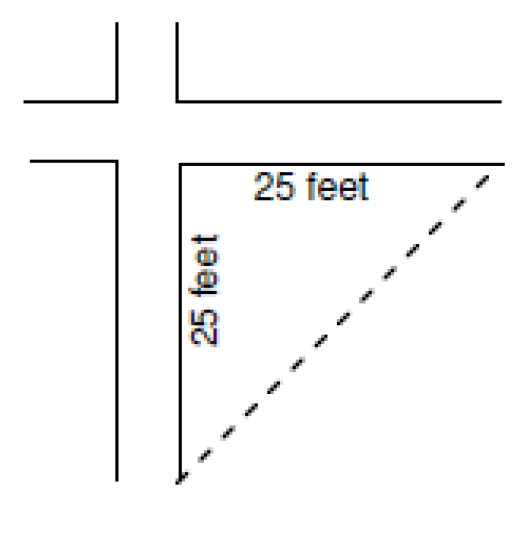
1.
Trees must be spaced far enough apart and pruned high enough to permit unobstructed vision to vehicular traffic.
2.
No other fixtures, solid walls or fences, construction, terraced yards, hedges, shrubbery or other plantings shall exceed four feet in height above street grade.
3.
In agricultural and residential zones, corner, rear and side yard fences made of chain link, wire fence or similar open, non-view-obscuring material exceeding four feet but not more than six feet in height may be approved by the zoning administrator if they do not cause a visibility hazard or nuisance.
4.
In commercial zones, fences up to six feet in height made of chain link, wire fence or similar open, non-view-obscuring material may be approved by the zoning administrator if they do not cause a visibility hazard or nuisance.
(Ord. 2007-004, § 1 (part); Ord. No. 2010-003, § 1, 7-21-2010)
17.28.070 - Walls and fences.
A.
Permits. A permit shall be required before a wall or fence may be constructed or erected in any zone within the Town of Springerville. An application for a wall or fence permit shall be filed with the zoning administrator on a form prescribed by the zoning administrator. The application shall include the following:
1.
Sketch showing the property location, property boundaries, location of existing structures and positioning of the proposed wall or fence.
2.
Description of materials to be used and design of the wall or fence.
3.
Any other information the planning and zoning administrator might need to evaluate the wall or fence proposal.
4.
Within ten days after receipt of a complete application for a wall or fence permit, the zoning administrator shall review the plans, and, in writing, deny, approve or conditionally approve the plans, basing this decision on the conformity of the proposal with the provisions of this chapter.
B.
Materials and Design. Walls and fences in all zoning districts shall be constructed of material in new condition. Natural, recycled or other materials may [be] used at the discretion of the zoning administrator. Barbed wire and low-voltage wire shall be limited to the keeping of livestock in all zoning districts.
C.
Regulations Applicable to Walls and Fences in Agricultural and Residential Zones.
1.
In addition to these regulations, walls or fences on a corner lot shall be subject to the provisions of Section 17.28.060.
2.
Height: No wall, fence or hedge over four (4) feet high shall be constructed or maintained nearer to the street line than the required front or street-side building setback line.
3.
Rear or side yard fences facing a street and made of chain link, wire fence or similar open, non-view-obscuring material up to six (6) feet in height may be approved by the zoning administrator if they do not cause a visibility hazard or nuisance.
4.
In the case of double fronting lots, a wall or fence up to six (6) feet in height may be erected in the property's rear or street-side yard, provided it does not cause a visibility hazard or nuisance.
5.
Variations from these regulations, including solid walls or fences exceeding four (4) feet in height at a corner or in a front or street-facing side or rear yard, materials, or design, may be allowed by administrative review.
D.
Regulations Applicable to Walls and Fences in Commercial and Industrial Zones.
1.
Height: Walls or fences up to six (6) feet in height shall be allowed in any front, side or rear yard for the purpose of securing commercial property, subject to the provisions of Section 17.28.060.
2.
Fences may be topped with barbed wire for added security, provided such wire is located not less than six (6) feet above grade and the total structure does not exceed eight (8) feet.
3.
The use of barbed wire below six (6) feet in height shall be restricted to the keeping of livestock.
4.
Razor wire, high-voltage electrical current or other hazardous materials or devices may be allowed by administrative review. High voltage electric current fences will require a warning sign.
E.
Exceptions.
1.
Provided such walls or fences conform to all other regulations set forth in this chapter, walls or fences may exceed six (6) feet in height under the following circumstances:
a.
Around schools and other public or quasi-public institutions when necessary for the safety or restraint of the occupants thereof;
b.
Within industrial zoning districts;
c.
When fences of greater heights are required by the planning and zoning commission for any reason.
2.
In the case of double fronting lots, a fence up to six (6) feet in height may be erected in the property's rear yard provided the materials, height and location conform to all other regulations set forth in this chapter.
3.
All swimming pools shall be enclosed by a solid wall, wood or chain link fence of not less than five (5) feet nor more than six (6) feet in height so as to prevent uninvited access.
4.
Walls or fences of a material, design, height or placement other than those described herein may be allowed by administrative review.
(Ord. 2007-004, § 1(part); Ord. 2008-002, § 1; Ord. No. 2010-003, § 1, 7-21-2010; Ord. No. 2024-003, § 1, 1-15-25)
17.28.080 - Outdoor storage of junk automobiles.
A.
Definition. "Junk automobiles" means any vehicle or any major portion thereof which is incapable of movement under its own power and will remain so without major repair.
B.
Outdoor Storage. Junk automobiles shall not be stored in the front of main structure and the rear lot line except as otherwise specifically allowed in a commercial or industrial zone district.
(Ord. 2007-004 § 1 (part))
17.28.090 - Home occupations.
Home occupations may be permitted in any residential zones, subject to the following requirements:
A.
Home Occupations. Shall be clearly incidental and subordinate to the use of the property and dwelling unit for dwelling purposes, shall be conducted entirely within the dwelling and shall not change the residential character thereof.
B.
Home occupations must meet all licensing, certification and/or regulatory requirements of the town of Springerville.
C.
Area. No more than twenty-five (25) percent of the gross floor area of the dwelling shall be devoted to the home occupation.
D.
Delivery Vehicles—Commercial Vehicle Parking. No home occupation business shall be conducted which requires the home occupation itself to park at the residence or otherwise utilize its own delivery vehicles or other services not customary to a residence. Such requirement does not prohibit delivery vehicles coming to residences, whether for a home occupation or otherwise, to make deliveries to the residences so long as such deliveries are no longer than thirty (30) minutes and comply with applicable parking and roadway obstruction restrictions.
E.
Nuisances. There shall be no external evidence of the activity such as outdoor storage, displays, noise, dust, odors, fumes, vibration or other nuisances discernible beyond the property lines. There shall be no indication of business activities other than those typical of a residential dwelling before eight a.m. or after eight p.m. No flammable liquids or hazardous materials shall be handled, used or stored in association with a home occupation.
F.
Prohibited Home Occupations. The following home occupations are prohibited in residential zones: motor vehicle repair or similar services; kennels, stables or veterinary clinics; restaurants, clubs or drinking establishments; undertaking or funeral parlors; adult entertainment establishments, adult retail establishments, or adult theaters; outdoor storage of firewood for sale; or any business determined by minute order of the planning and zoning commission to be similar to the uses listed or detrimental to the health, safety and welfare of the community.
G.
Home Occupations Requiring a Conditional Use Permit. The following home occupations may be allowed in residential zones with a conditional use permit: barber shops and beauty salons; medical and dental clinics; day care centers; bed and breakfast establishments that are owner-occupied and do not exceed four units; uses requiring more off-street parking than is typical for a residence; or any business determined by minute order of the planning and zoning commission to be similar to the uses listed and not detrimental to the health, safety and welfare of the community.
(Ord. 2007-004 § 1 (part))
(Ord. No. 2024-005, § 1, 4-16-25)
17.28.100 - Animals and pets.
That certain public document known as "Animals and Pets Ordinance," three copies of which are on file in the office of the town clerk of the Town of Springerville, Arizona, which document was made a public record by Resolution No. 2008-R016 of the Town of Springerville, Arizona, is hereby referred to, adopted and made a part hereof as if fully set out in this section.
(Ord. 2007-004 § 1 (part))
(Ord. No. 2008-006, § 1, 11-5-2008)
17.28.110 - Exterior lighting.
All lighting for off-street parking or loading areas or for the external illumination of buildings or signs shall be directed away from and shielded from any adjacent residential property and shall not detract from driver visibility on adjacent streets.
(Ord. 2007-004 § 1 (part))
17.28.120 - Public service facilities.
A conditional use permit shall be required by all public service companies in order to establish or substantially expand utility buildings, structures or appurtenances thereto, in any zoning district. Extension of public service lines in public or private right-of-way is exempt from these requirements.
(Ord. 2007-004 § 1 (part))
17.28.130 - Trash enclosures.
A permanent enclosure for temporary storage of garbage, refuse and other waste materials shall be provided for every use, other than single-family dwelling, multiple-family dwellings of less than four units, and mobile/manufactured homes in every zoning districts except where a mechanically loaded steel bin approved by the zoning administrator is used for the purpose or where a property is entirely surrounded by screen walls or buildings. Trash enclosures shall comply with the following regulations:
A.
Construction. Trash enclosures shall be constructed so that contents are not visible from a height of five feet above grade from any abutting street or property, and shall be constructed of solid or ornamental pierced-masonry walls with solid concrete floor sloped for drainage and maintenance of sanitary conditions. Enclosures shall be of sufficient height to conceal contents including containers, but in no case shall be less than four feet in height above grade. Gates shall be solid or baffled, equal in height to the enclosure and equipped with latches to insure closure when not in use.
B.
Location. Trash enclosures shall not be located in any required front or side yard.
(Ord. 2007-004 § 1 (part))
17.28.140 - Structures near airplane runway or landing strip.
Current Federal Aviation Administration (FAA) regulations and guidelines shall govern the location, placement, height, size and design of airplane runways and landing strips within the town.
(Ord. 2007-004 § 1 (part))
17.28.150 - Performance standards.
Any permitted or conditional use must conform to the following performance standards. In conjunction with the plan review process, the developer-applicant shall provide to the zoning administrator data which is sufficient to show that the proposed use and the manner of its conduct will meet these performance standards.
A.
Noise. No noise shall be permitted which is loud enough to create a nuisance or hazard beyond the property lines.
B.
Smoke, Dust, Fumes, Vapors, Gases and Other Forms of Air Pollution. No emission is permitted which can cause damage to health, animals or vegetation, or other forms of property, or which can cause any excessive soiling.
C.
Liquids and Solid Waste. No wastes will be discharged in the public sewage system which endangers the normal operation of the public sewage system.
D.
Odors. No emission of odorous gases or other odorous matter shall be permitted in such quantities as to be offensive in such a manner as to create a nuisance or hazard beyond the property lines.
E.
Vibration. No vibration shall be permitted which is discernible beyond the lot line to the human sense of feeling for three minutes or more in duration in any one hour of the day between the hours of seven a.m. to seven p.m., or of thirty (30) seconds or more in duration in any one hour during the hours of seven p.m. and seven a.m.
(Ord. 2007-004 § 1 (part))
17.28.160 - Reserved.
Editor's note— Ord. No. 2022-007, adopted February 15, 2023, repealed § 17.28.160. Former § 17.28.160 pertained to campgrounds and derived from Ord. 2007-004 § 1 (part).
17.28.170 - Travel trailers and recreational vehicles.
A.
Travel trailers or recreational vehicles as defined in Section 17.08.010 shall not be used as a dwelling on any lot outside an approved recreational vehicle park and shall not be connected to a sewer or septic system other than in an approved recreational vehicle park except as allowed in this section.
B.
Travel trailers and recreational vehicles shall be stored only on private property and not on any public street, alley or thoroughfare.
C.
Travel trailers and recreational vehicles shall not be used for storage purposes or as an accessory building except as allowed in this section.
D.
A travel trailer, recreational vehicle or mobilehome may be used on construction sites for temporary residence and/or storage of materials for up to twelve (12) months by conditional use permit, provided there are active permits for the construction.
E.
A travel trailer or recreational vehicle may be used as guest quarters on a residential lot for up to fifteen (15) consecutive days, not to exceed forty-five (45) days per calendar year, with a minimum of fifteen (15) days in between uses as guest quarters. There will be a maximum allowance of two (2) visiting travel trailers or RVs per half-acre simultaneously. The intent of this section is to allow relatives or friends to visit for a short period of time or for an immediate, but temporary, solution for hardship or emergency living quarters.
(Ord. 2007-004 § 1 (part))
(Ord. No. 2022-007, 2-15-2023; Ord. No. 2024-004, § 1, 1-15-25)
17.28.172 - Recreational vehicle parks.
A.
Conditional Use Permit. Recreational vehicle parks shall be allowed only within those zones that specifically permit or conditionally permit mobile/manufactured home parks, and shall require a conditional use permit issued by the planning and zoning commission in accordance with the provisions of Chapter 17.84.
B.
Site Specifications.
1.
Recreational vehicle sites must be clearly defined, well drained, and reasonably level.
2.
Each recreational vehicle plot must be no less than one thousand two hundred (1,200) square feet in area.
3.
Recreational vehicle plots should be at a 30- to 45-degree angle from the driveway for ease of placement. Plots may be up to ninety (90) degrees, but must be restricted to park models if greater than forty-five (45) degrees.
4.
All recreational vehicle placements (as well as any permanent additions or accessory structures) shall be required to maintain minimum separation distances of ten feet between any permanent placements or accessory structures.
C.
Office and Registration Facilities. Each recreational vehicle park must provide an adequate and easily identifiable office or registration area. Registration facilities must be located so as not to interfere with the normal flow of traffic in and out of the park. A single-family home or manufactured home may be used as an office or registration area and/or a single-family residence for the owner or manager.
D.
Property Development Standards.
1.
Minimum recreational vehicle park size: One acre.
2.
Minimum street frontage: One hundred (100) feet.
3.
Maximum lot coverage: Sixty (60) percent of the entire site, including buildings, manufactured homes, recreational vehicles and paved areas.
4.
Minimum setback of any recreational vehicle or accessory structures from any public utility and/or access: Ten feet.
5.
Minimum setback of any recreational vehicle or accessory structures from recreational vehicle park boundary: Ten feet, except that where a side yard lot line abuts a public street, there shall be a side yard of not less than twenty (20) feet.
6.
Minimum setback of any recreational vehicle or accessory structures from private access: Ten feet.
7.
All recreational vehicle parks shall be screened with a solid material fence six feet in height subject to the provisions of Section 17.28.070 of this code, or as otherwise required by the planning and zoning commission.
8.
No structures shall be permitted in any required separation distance as required by this section.
9.
Each plot shall include one automobile parking space measuring at least nine by twenty (20) feet as set forth in Chapter 17.104.
10.
One visitor parking space measuring at least nine by twenty (20) feet shall be provided for every ten plots.
11.
All common facilities shall be equipped with adequate exterior lighting for nighttime hours of operation.
E.
Public Utilities.
1.
All utilities shall be in compliance with applicable codes, and all utility distribution and service lines shall be installed underground.
2.
All waste from showers, toilets, laundries, faucets and lavatories shall be drained into an approved sewer or septic system.
3.
All sanitary facilities in any trailer which are not connected to an approved sewer or septic system by means of sewer hose of sufficient size shall be sealed, and it shall be not lawful to use the same.
4.
An adequate supply of potable water shall be furnished for drinking and domestic purposes, with individual supply faucets provided for each recreational vehicle plot.
5.
Each faucet site shall be equipped with facilities for drainage of waste and excess water into the sewer or septic system. In no case shall any wastewater be thrown or discharged upon the surface of the ground or disposed of by means other than as herein provided.
6.
An abundant supply of hot water shall be provided for laundry facilities or common areas equipped with bathroom or kitchen facilities.
7.
Every plot shall be furnished with an electric service outlet. Such outlet(s) shall conform to the National Electric Code.
F.
Driveways and Vehicular Access.
1.
Recreational vehicle parks shall be located on or have direct access to a dedicated public collector street, except that no individual recreational vehicle plot within the development may have direct access to a public street.
2.
All driveways shall have a minimum width of twenty-four (24) feet, except when a driveway is located between trailer parking spaces it shall have a minimum width of thirty (30) feet.
3.
All driveways and interior streets shall be graveled or hard-surfaced with an impermeable material such as cold-mix, cement or asphalt, approved by the town, and maintained by the owner on an as-needed basis.
4.
All surface water runoff shall be retained on site or drained into a drainage system approved by the town, and shall be maintained by the property owner.
5.
All plans and traffic engineering shall be based upon the spacing and maneuverability requirements for fifty-foot-long trailers.
G.
Trash. Recreational vehicle parks shall subscribe to a solid waste collection service and enclose storage areas in conformance with Chapter 17.28.130.
H.
Maintenance. Recreational vehicle parks must be well maintained in all areas and all structures. This includes the grounds, restroom facilities, trash enclosures, buildings and any recreational space and equipment. All park structures, facilities and landscaping shall conform to Chapter 17.90, design review.
(Ord. No. 2008-007, § 1, 12-3-2008; Ord. No. 2009-002, § 1, 3-4-2009)
17.28.180 - Mobile homes or manufactured homes.
Mobile homes and manufractured homes as defined by ordinance, codified in Title 17 shall not be older than ten (10) years from the date of manufacture at the time the installation permit application is submitted to the town, and no permit shall be issued to relocate a mobile or manufactured home that is older than fifteen (15) years from lot to lot within the town limits.
(Ord. 2007-004, § 1(part); Ord. No. 2013-004, §§ 1, 2, 9-4-2013; Ord. No. 2022-005, § 1, 11-16-2022)
17.28.190 - Storage.
A.
Manufactured homes, truck toppers, mobile homes, truck trailers, utility trailers, commercial trailers, boxcars, refurbished sea cargo/ocean-going or freight containers (mobile storage or similar cargo carrying devices) or any other similar vehicles, devices or structures shall not be attached to or placed on any lot and are not allowed to be stored or utilized for storage purposes except as allowed in this section.
B.
Commercial trailers, sea cargo or freight containers may be used in the agricultural general (AG), light industrial (L-1) and industrial (I-1) zones or by conditional use permit in residential and commercial zones subject to the following regulations:
1.
Such vehicles/containers shall meet all development standards for the zoning classification, including lot coverage, height and setback requirements.
2.
Such vehicles/containers shall be painted and maintained the primary structure color or an earth tone consistent with the surrounding terrain.
3.
Such vehicles/containers shall be screened from view of any adjacent property subject to the walls and fences regulations set forth in Section 17.28.070.
4.
Such vehicles/containers shall be located in the side or rear yard of the property and not on any public street or thoroughfare.
5.
Such vehicles/containers shall be permitted and installed in accordance with the municipal building codes.
C.
Manufactured homes, truck toppers, mobile homes, truck trailers, utility trailers, commercial trailers, boxcars, refurbished sea cargo/ocean-going or freight containers (mobile storage or similar cargo carrying devices) or any other similar vehicles, devices or structures shall not be attached to or placed on any lot and are not allowed to be utilized for storage purposes in any residential or commercial zone except as allowed for by a conditional use permit.
D.
Not more than one travel trailer, motor home, recreational vehicle, boat, boat trailer, utility trailer or other similar vehicles of a noncommercial nature owned by a party other than the present owner or tenant of the property shall be stored on a residential lot. All such vehicles and trailers shall be operable and/or registered in accordance with the junk vehicle regulations set forth in Chapter 8.12 of this code.
E.
No travel trailer, motor home, recreational vehicle, boat, utility trailer, truck toppers or other similar vehicles or devices shall be used for storage on any lot.
F.
Appliances, including, but not limited to, washers, dryers, refrigerators, freezers, ranges, stoves, furnaces, hot water heaters, and air conditioners, may not be stored outdoors or in a manner visible from the street or adjacent properties unless said appliance is operable and hooked up for on-site use.
(Ord. 2008-001 §§ 1, 2; Ord. 2007-004 § 1 (part))
(Ord. No. 2015-002, § 1, 3-18-2015)
17.28.200 - Parcel line combinations and parcel line adjustments.
A.
Applicability. The provisions of this section shall apply to all administrative determinations, vested in the Community Development Director.
B.
Purpose. The purpose of this section is to establish decision criteria and procedures for Parcel Line Adjustments and Parcel Combination.
C.
Administrative Authority. The Community Development Director is authorized to approve, or remand to the Planning/Zoning Commission for further discussion and action. At the discretion of the Community Development Director, the request for an parcel combination or parcel line application can be heard by the Planning/Zoning Commission. The Commission may deny an application if the use fails to comply with current zoning ordinances or if any of the required findings are not supported by evidence in the record as determined.
D.
Purpose. The purpose of this section is to provide a process to combine or redefine land into three or fewer parcels, with a level of review to ensure that the combination of land complies with zoning ordinances, zoning map and does not constitute a subdivision as defined by A.R.S. Section 9-463.02. This section is not intended to prohibit or prevent the combination of land as authorized and permitted by the Arizona Revised Statutes and the Town of Springerville zoning and subdivision ordinance.
E.
Application. All applications shall be made on forms supplied by the Community Development Director. The Community Development Director shall review the application for compliance and completeness. If there are deficiencies, the applicant shall be notified.
1.
Submittal and Fee.
a.
Prior to the recordation of a deed combining or redefining the parcels of land into one parcel, for the purpose of sale, lease, or transfer of ownership, the owner shall submit a parcel line, a parcel adjustment or parcel combination application to the Community Development Department.
b.
The processing fee is set by the Town of Springerville Council by resolution.
2.
Record of Survey. A registered land surveyor (R.L.S.) shall prepare the legal descriptions and a record of survey. The record of survey shall be of a format acceptable to the County Recorder (see A.R.S. Section 11-481).
3.
Review Criteria. The deed and survey map shall conform to the requirements of all the applicable town zoning codes. In addition:
a.
The design, shape, size and orientation of the tracts should be appropriate for the use, which the zoned area is intended and to the character of the area in which they are located.
F.
Action on Application. The application shall be processed as follows:
1.
Based on staff comments and those from affected property owners, the Community Development Director shall review the proposed development, request modification(s) of the standard(s), and either approve, approve subject to conditions, or deny the application, or forward it to the Commission per Section 903(C), within seven working days from the end of the fifteen-day comment period.
2.
The Community Development Director shall use the following criteria to evaluate the proposal:
a.
The proposed modification will not violate any provisions of the Town of Springerville's Planning/Zoning Plan, or other provisions of applicable ordinances and regulations;
b.
The proposed modification will not substantially reduce the amount of privacy currently enjoyed by nearby property owners if the development is located as specified by these regulations;
c.
The proposed modification will not substantially and adversely affect traffic or traffic circulation, drainage, sewage treatment systems, or other such systems; and
d.
The modification does not create a situation where the proposed use of the property will create a hazard or nuisance.
3.
The Community Development Director shall provide the applicant with a notice of disposition and written statement of the decision and reasons therefore, and any conditions of approval.
G.
Appeals. The decision of the Community Development Director or the Commission (made in F.1.) may be appealed as follows:
1.
Any person aggrieved or affected by the decision of the Community Development Director may take an appeal concerning approval or denial of this permit to the Planning/Zoning Commission. Such appeals shall be taken within thirty (30) days by filing with the Community Development Director a notice of appeal specifying the grounds therefore on forms provided by the Community Development Department. The Community Development Director shall transmit to the Commission all papers constituting the record of the action being appealed. Such appeal shall stay all proceedings in the matter being appealed, unless the Community Development Director certifies to the Commission that, by reason of the facts stated in the appeal, the stay would in the Community Development Director's opinion cause imminent peril to life or property. The appeal of the application shall be on the next Commission meeting agenda only if and when there is adequate time to meet the posting and notice requirements of a regular conditional use permit per Title 17.84.
2.
The Commission shall make a recommendation regarding the application, approving, approving with conditions, or denying. The Commission shall forward this recommendation to the Town Council.
3.
The Town Council shall make the final determination in an appeal of the application. The Town Council shall hear the application at the next regularly scheduled meeting following proper notification. The Town Council shall, approve, approve with conditions, or deny the recommendations of the Commission.
H.
Approval. If the Community Development Director approves the application, he or she shall enter the following certification the approved record of survey:
I, _______________________, Community Development Director of the Town of Springerville, certify that the combining or recombining of these parcels subject to and approved in accordance with the Town of Springerville ordinance for Parcel line/Parcel Combination.
I.
Recording New Parcel. A survey of the new parcel signed by the appropriate entities, will be recorded at the Apache County Recorder's Office (by the applicant and the applicant paying all recording fees). A copy of the recorded survey will be furnished to the Town of Springerville's Planning and Zoning office for their records.
1.
Where the resulting parcel(s) do not meet the review criteria, the Town may have a notice of code violation issued. Nothing herein shall be construed to create a right or expectation of such approval and no building or use permit may be issued by the Town until the parcel(s) has/have met the review criteria. It shall be responsibility of the landowner to remedy all the deficiencies.
(Ord. No. 2016-001, § 1, 3-16-2016)
17.28.210 - Tiny houses requirements.
The town of Springerville has adopted the public document known as "Tiny Houses Requirements," three copies of which are on file in the office of the town clerk of the town of Springerville, Arizona, which document was made a public record by Resolution No. 2018-R007 of the town of Springerville, Arizona, is hereby referred to, adopted and made a part hereof as if fully set out in this section.
(Ord. No. 2019-001, § A, 4-17-2019; Ord. No. 2018-001, § 1, 9-19-2018; Res. No. 2018-R007, 9-5-2018)
Editor's note— Ord. No. 2018-001, § 1, adopted September 19, 2018 set out provisions intended for use as § 17.28.200. To avoid duplication of section numbers and pursuant to Ord. No. 2019-001, adopted April 17, 2019, these provisions have been included as § 17.28.210.
17.28.230 - Wireless communications facilities and transmitting towers.
A.
Purpose and Applicability. The purpose of this section is to establish appropriate regulation of wireless communications facilities and transmitting towers within the town except those exempt from zoning review pursuant to A.R.S. § 9-592, subsections I and J. These regulations are intended to encourage competition in the telecommunications industry and remove regulatory barriers consistent with the town's responsibility to protect the health, welfare and safety of its residents. It is further the purpose of this section to preserve the town's residential character and uncluttered appearance, ensure compliance with federal radio frequency emissions standards, provide for nondiscriminatory treatment of substantially equivalent telecommunications providers and allow for the provision of telecommunications services within the town.
B.
General Requirements.
1.
Approvals. Wireless facilities, other than structure-mounted wireless facilities that comply with the requirements of Paragraph C.2 below and transmitting towers are subject to approval of a conditional use permit. The town council may approve a conditional use permit subject to all the conditions of this Section 17.28.230 and requirements for a conditional use permit. In approving a conditional use permit, the town council may impose conditions to the extent it concludes such conditions are necessary to minimize any adverse effect of the proposed wireless facility or transmitting tower on adjacent properties. Structure mounted wireless facilities that comply with Paragraph C.2 below may be approved by the town manager.
2.
Compliance with Federal Requirements. Permittees shall be responsible for registering all qualifying wireless facilities or transmitting towers with the Federal Aviation Administration (FAA) and Federal Communications Commission (FCC).
3.
Access. The site of a tower shall provide access that is paved or surfaced with permeable paving and at least one parking space designed to applicable town standards which parking space may be incorporated as part of the maneuvering areas and access drives. This requirement may be waived by the town manager when hard surfaced adjacent or nearby parking already exists, or when the town manager concludes that the goals of the town are better served by modifying the parking requirement.
4.
Signage. Signs warning against trespassing and climbing support structures shall be posted near all scalable towers located outside of secured areas. Step pegs shall not be placed lower than fifteen (15) feet from grade.
5.
Aesthetics. To the extent possible and in addition to any specific requirements set forth in Paragraph C below, all components of a tower shall be finished or painted so as to minimize the visual obtrusiveness of the structure and shall not be illuminated unless otherwise required by state or federal regulations. Arrays and associated cables shall be painted to match the tower to reduce visual impact.
6.
Compliance with Codes. All towers shall be constructed and maintained in a structurally sound maimer and comply with OSHA regulations, FCC Radio Frequency Exposure Guidelines (FCC OET Bulletin 65), ANSI/TIA-G-2 Standards and all other applicable laws and regulations in effect from time to time. If, upon inspection, the town determines that a tower fails to comply with said codes and standards, the town shall provide a notice to the owner, and the owner shall have thirty (30) days to bring the tower into compliance. If the owner fails to bring the tower into compliance, then the town may remove the tower and charge such costs to the owner or property owner where the tower is located or take such other legal action permitted by law.
7.
Public Right-of-Way. No tower are permitted in the public right-of-way, except for those small wireless facilities permitted pursuant to Section 12.04.050, Paragraph 0 of the Town Code.
8.
Cessation of Operations. If a tower ceases operation, the tower and related equipment shall be removed by the permittee or the permittee's representative within six months of the shutdown date.
9.
Radio Frequency Standards; Interference; Noise.
a.
Tower shall comply with federal standards for radio frequency emissions. Failure to meet federal standards may result in termination or modification of the permit.
b.
The permittee shall ensure that the tower will not cause interference with the reception of existing wireless facilities, cable television, community antennae television systems, or satellite broadcast television systems. If at any time the town finds that the tower interferes with such reception, and if such interference is not cured within thirty (30) days, the town may revoke or modify the permit.
c.
A tower and any related equipment, including backup generators and air conditioning units, shall not generate continuous noise in excess of forty (40) decibels (dBa) measured at the property line of any residential property, and shall not generate continuous noise in excess of fifty (50) decibels (dBa) during the hours of seven a.m. to ten p.m. and forty (40) decibels (dBa) during the hours of ten p.m. to seven a.m. measured at the property line of any non-residential property.
C.
Types of Wireless Facilities.
1.
Freestanding Wireless Facilities.
a.
Permitted Districts.
(1)
Freestanding monopole wireless facilities less than thirty-five (35) feet in height are permitted in C-2 (Heavy Commercial), L-1 (Light Industrial) and I-1 (Industrial) zoning districts subject to approval of a conditional use permit.
(2)
No lattice wireless facilities or guyed wireless facilities are permitted.
(3)
Freestanding monopole wireless facilities are permitted in any zoning district, if the wireless facility is located on property owned by a governmental entity, including a school district or community college district, so long as such property is used for its governmental purposes.
b.
Collocation. Prior to approval, the applicant shall demonstrate an inability, or technical rationale, for not collocating the wireless facilities on an existing vertical element. The applicant shall provide the following information for town review:
(1)
A comprehensive list of all existing vertical elements of within a two mile radius of the proposed site which are: (a) of sufficient height to be used for wireless facility collocation, and (b) eligible for collocation under town requirements.
(2)
A written narrative statement explaining why collocation on the existing vertical elements was not pursued or is not a viable alternative to the proposed site.
(3)
Map exhibits displaying: (a) the existing gap in signal coverage of the new wireless facility will remediate and, (b) the projected signal coverage of the new wireless facility.
(4)
Applicants shall cooperate and exercise good faith in collocating freestanding wireless facilities on the same support structures or site. Good faith shall include sharing technical information to evaluate the feasibility of collocation, and may include negotiations for erection of a replacement support structure to accommodate collocation. A competitive conflict to collocation or financial burden caused by sharing such information normally will not be considered as an excuse to the duty of good faith.
(5)
In the event a dispute arises as to whether a permittee has exercised good faith in accommodating other users, the town may require the permittee to obtain a third party technical study at permittee's expense. The town may review any information submitted by the permittee and other providers in determining whether good faith has been exercised.
(6)
No collocation may be required where the shared use would or does result in significant interference in the broadcast or reception capabilities of the existing telecommunications facilities or failure of the existing wireless facility to meet federal standards for emissions.
(7)
Failure to comply with collocation requirements when feasible may result in denial of a permit request or revocation of an existing permit.
c.
Alternative Structure Designs.
(1)
Freestanding monopole wireless facilities shall be alternative structure designs, (otherwise referred to as "stealth designs") in character with the surrounding area (i.e., a flagpole at a public building, a palm tree in an area with mature palm trees, a pine tree in an area with mature evergreen trees, a spire or steeple at a religious institution, an architectural tower element associated with a building, or a saguaro cactus in an area with other mature saguaro cacti); provided, however, that monopole may be permitted without alternative structure designs, if the applicant provides such information as necessary to determine that the character of the proposed monopole will blend in with the surrounding area (i.e. within the confines of an electrical substation containing other structures of similar height).
(2)
Alternative tower structures shall be limited to sixty-five (65) feet in height above the original grade, except a functioning security or recreational light pole shall have a height consistent with existing light poles or height usually allowed for such light poles. A greater height may be permitted by the town council upon further review.
d.
Ground Equipment. Equipment cabinets shall not exceed eight feet in height and a building shall not exceed one story. Associated ground equipment shall be completely screened by dense landscaping and either (1) a masonry enclosure that meets the requirements of this zoning code, (2) a decorative cabinet as approved by the town manager. Equipment enclosures/cabinets which exceed four feet in height shall not be located within the required building setback area for the zoning district in which the facility is located. Setback and screening requirements may be waived by the town manager in instances where ground equipment is placed inside an existing walled electrical substation or similar facility which encroaches into a required setback. In no instance shall ground equipment be located within the public right-of-way.
e.
Setbacks. Freestanding monopole wireless facilities shall be set back from all property lines a minimum distance of one foot for each one foot of the monopole wireless facilities height above finished grade except that freestanding monopole wireless facilities located within electrical substations, receiving stations, or government facilities shall be exempt from setback requirements. For the purpose of determining whether a freestanding wireless facility complies with setback requirements, the dimensions of the entire lot shall control, even though the wireless facility may be located on leased parcels within such lot.
f.
Lighting. Artificial lighting of a wireless facility, including its components, is prohibited, unless otherwise required by the Federal Aviation Administration. A motion-sensor light may be used if the beam is directed downwards and shielded from adjacent properties.
g.
Safety.
(1)
Security fencing, if any, shall not exceed six feet in height, except fencing shall be eight feet in height if screening a cabinet of such height. Fencing shall be effectively screened from view through the use of landscaping. No chain link fences shall be visible from public view.
(2)
Anticlimbing features shall be incorporated into the freestanding wireless facility, as needed, to reduce potential for trespass and injury.
h.
Waiver of Requirements. The town council may waive or modify requirements of this section only upon finding that strict compliance with the provisions of this section would result in noncompliance with applicable federal or state law. In this case, the town council may require such conditions as will, in its judgment, secure substantially the objectives of the standards or requirements waived or modified.
2.
Structure-Mounted Wireless Facilities.
a.
Permitted Districts. Structure-mounted wireless facilities are permitted in all zoning districts subject to approval of the town manager.
b.
Alternative Structures. Structure-mounted wireless facilities shall be alternative structures integrated into the design of the building as an integral architectural element or roof mounted and completely screened by the height of the parapet.
c.
Ground Equipment. Associated ground equipment shall be located within the building upon which antennae are placed if technically feasible. Otherwise, equipment cabinets shall be screened from view by a wall or landscaping, as approved by the town. Any wall shall be architecturally compatible with the building or immediate surrounding area.
d.
Town Property. If the wireless facility is located on town property, a written lease with the town for such use is required which shall at a minimum include provisions requiring re-location of the wireless facility at permittee's cost in the event of any expansion or other improvement to the town property that results in interference by permittee's wireless facility.
3.
Location of Wireless Facilities on Existing or Planned Vertical Elements.
a.
Vertical Elements. Wireless facilities may be mounted on the following existing or planned vertical elements subject to approval of town manager:
(1)
Utility provided electrical poles.
(2)
Athletic field light towers.
(3)
Other existing or planned vertical elements on which the mounting of antennas will not significantly alter the function and character of the structure as determined by the town manager.
b.
Height. Wireless facilities mounted on existing vertical elements shall not cause the height of the element to increase, except that wireless facilities mounted on electrical poles may extend up to fifteen (15) feet above the existing height of the electrical pole.
c.
Size. Wireless facilities mounted on existing elements shall utilize the smallest antenna and array sizes technically and reasonably feasible. The maximum increase in pole diameter from the existing pole by the replacement pole is fifty (50) percent.
d.
Aesthetics. To the extent possible, all visible components of a wireless facility shall be finished or painted to match the existing vertical element, to minimize visual obtrusiveness, and shall not be illuminated unless otherwise required by state or federal regulations.
4.
Small wireless facilities subject to zoning review pursuant to A.R.S. § 9-592, subparagraphs I and J.
a.
Utility poles. A new, replacement or modified utility pole (as that term is defined in the Wireless Facilities in the Right-of-Way Standard Terms and Conditions adopted pursuant to Section 12.04.050, Paragraph 0 of the Town Code that is associated with the collocation of small wireless facilities) is not permitted in the public right-of-way if the pole exceeds the greater of either:
(1)
Ten feet in height above the tallest existing utility pole, other than a utility pole supporting only wireless facilities, that is in place on August 9, 2017, that is located within five hundred (500) feet of the new, replacement or modified utility pole and that is in the same right-of-way within the jurisdictional boundary of the town, but not more than fifty (50) feet above ground level.
(2)
Forty (40) feet above ground level.
b.
Wireless facilities. New small wireless facilities collocated on a utility pole or wireless support structure are not permitted in the public right-of-way if they extend more than ten feet above the utility pole or wireless support structure or exceed fifty (50) feet above ground level.
D.
Additional Requirements for Transmitting Towers.
1.
Permitted Districts. Transmitting towers are allowed only in industrial area districts subject to approval of a conditional use permit.
2.
Setbacks. Transmitting towers exceeding thirty-five (35) feet shall be located at least one foot from all property lines for every one foot of the transmitting tower's height above finished grade.
E.
Applicant's Submittal Requirements. An applicant shall submit the following items to the town manager:
1.
Inventory. For wireless facilities, an inventory list and map of existing wireless facilities operated by the applicant and other providers within two miles of the proposed site ("service area"). The inventory list must include specific information as to location, height and design of each facility. The town may share such information with other applicants seeking to locate wireless facilities within the service area, in order to encourage collocation.
2.
Report on Alternatives. For wireless facilities, a report explaining why the wireless facility is needed at the requested location. If applicant is seeking to construct a new monopole wireless facility, applicant shall explain why collocation or location on another kind of support structure is not feasible, including efforts made to develop such an alternative. If the town has requested that applicant collocate its wireless facility on a site, applicant shall explain why collocation is not feasible, including efforts made to develop such an alternative. If the town has requested applicant to consider location of the wireless facility in possible alternative sites in adjacent cities, applicant shall include in its report efforts made to develop such alternatives, and a discussion of the feasibility of such alternatives. Failure to make a report on alternatives and develop viable alternatives when so requested may result in denial of a permit.
3.
Structural Plans for Towers. Plans shall include a diagram of the proposed facility and antennae, including height, shape, size and nature of construction. The plans shall include a diagram showing the separation between the proposed tower and any existing wireless facility or facilities on the same support structure or site, if collocation is planned.
4.
Site Plan. A site/landscaping plan showing the specific placement of the tower on the site, including setbacks from adjacent property lines; showing the location of existing structures, trees, and other significant site features; and indicating type and locations of plant materials used to screen towers components and the proposed color(s) for the wireless facility.
5.
Photosimulations. Photosimulations of the view of the proposed tower from residential properties and public rights-of-way at varying distances.
6.
Signed Statement. For wireless facilities, a signed statement stating that:
a.
The applicant agrees to allow collocation of additional wireless facility equipment by other providers on the applicant's support structure or within the same site location, when feasible; and
b.
If the applicant locates its wireless facility on leased property, the applicant agrees it will not request the landowner to exclude other providers from collocating a wireless facility on such site when collocation may be feasible.
7.
Radio Frequency Emissions. Prior to beginning operations, the applicant shall submit a verified report which provides a calculation of its installed peak radio frequency ("RF") emissions capacity at the site, the cumulative installed peak RF emissions capacity at the site (including a description of any collocation providers) and compare the results with established federal standards.
8.
Conditional Use Permit Requirements. Any other information required by the Town for issuance of a conditional use permit.
9.
Waiver or Modification. If applicant seeks a waiver or modification of any requirement herein, the Town will request applicant to submit additional information to determine whether strict compliance with this section is feasible.
10.
Fees. Applicants shall pay a permit fee as established by resolution of the town council, which fee shall include all consulting costs as may be required by the town to review the application.
F.
Approval Process.
1.
Determination of Completeness. An application for a tower shall be filed with the town manager. The town manager shall review the application for completeness and notify the applicant in writing if the application is incomplete. The notice shall describe any deficiencies.
(a)
If the application is for collocation on an existing structure, notice of incompleteness shall be given within ten days of the date of the application.
(b)
If the application is for placement of an antenna on a new tower, notice of incompleteness shall be given within thirty (30) days of the date of the application,
(c)
If the application is for a new monopole, notice of incompleteness shall be given within sixty (60) days of the date of the application.
2.
Approvals. All approvals shall be complete within the following time frames unless tolled by a notice of deficiency:
a.
For collocation on an existing structure, sixty (60) days of the date of the application.
b.
For an application for an antenna on a new structure, ninety (90) days of the date of the application.
c.
For a new monopole, one hundred fifty (150) days from the date of the application.
3.
Final Decision. Any final decision to approve or deny a request shall be in writing and set forth the reasons and substantial evidence for the decision.
G.
Modifications.
1.
Applications for modification of an existing wireless facility that does not substantially change the physical dimensions of such wireless facility and that involves (i) collocation of new transmission equipment, (ii) removal of transmission equipment, or (iii) replacement of transmission equipment shall be approved.
2.
All applications for modification of a wireless facility shall be submitted on a form provided by the community development department. The application may not require the applicant to demonstrate a need or business case for the proposed modification.
3.
An application for modification of the wireless facility shall specifically state nature of the modification and include sufficient information and documentation for the town to determine whether the modification constitutes a substantial change to the wireless facility and is therefore an eligible facilities request.
4.
Upon receipt of an application for an eligible facilities request, the community development department shall review such application to determine whether the application so qualifies.
5.
Within sixty (60) days of the date on which an applicant takes the first procedural step and submits written documents showing that the proposed modification is eligible, the application shall be approved. The application shall be deemed approved if it is not approved within that timeframe. This time period may be tolled by mutual agreement or if the application is incomplete. If the town determines that the application is incomplete, the town shall provide notice to the applicant within thirty (30) days of the date of the application, which notice shall describe all missing documents or information. Following a supplemental submission, the town shall notify the applicant that the supplemental submission did not provide the required information.
6.
If the town determines the application is a substantial modification to the support structure, the timeframe for approving the application will begin to run from the issuance of the town's decision that the application is not a covered request. To the extent such information is necessary, the town may request additional information from the applicant to evaluate the application under applicable law.
H.
Permit Term and Limitations.
1.
A conditional use permit for a wireless facility shall expire ten years after the effective date of the permit approval.
2.
Any permitted wireless facility must be constructed and placed into use within twelve (12) months of the date of the town council's approval or the approval shall expire. A collocation shall be completed within one hundred eighty (180) days from the issuance of the permit.
3.
Upon failure to comply with conditions of approval or discontinuance of the wireless facility use for over one year, the permit may be revoked and permittee must remove the wireless facility or the town may cause the facility to be removed at the expense of the permittee or property owner where the facility is located.
4.
Permittee shall maintain the wireless facility, including paint and landscaping, to standards imposed by the town at the time of granting the permit. If the permittee fails to maintain the facility, the town may undertake maintenance at the expense of the applicant or terminate the permit, at its sole option.
5.
The permittee shall notify the town in writing of all changes in ownership of the facility within sixty (60) days of the change.
I.
Renewal of Permit. A permittee may apply for a renewal of its permit within six months prior to expiration.
(Ord. No. 2020-007, § 1.2, 12-16-2020)

