
St Tammany Parish City Zoning Code
CHAPTER 100
ADMINISTRATION
SEC. 100-4 - MUNICIPAL COORDINATION.
A.
Growth Management/Annexation Agreements. In accordance with LA R.S. 33:172 and the "Joint Projects and Other Cooperative Endeavors" clause of the Growth Management and Annexation Agreements of 2003 between St. Tammany Parish Government and various municipalities within the boundaries of the parish, the parish government will coordinate infrastructure improvements so that both parish and municipal standards will be considered for all new development within the annexation agreement areas. The more restrictive set of standards, whether they be standards established by the parish or municipal governing body, will be applied to the project.
B.
Restrictive Standards. For the purposes of this section, the most restrictive standard shall be applied to the following types of infrastructure:
1.
Drainage design standards.
2.
Road design standards.
3.
Potable water standards.
4.
Sewer standards.
C.
Section Effective Date. This section shall be considered in effect upon:
1.
Notice, by certified copy to the Parish President, that a municipality located within St. Tammany Parish has adopted similar legislation.
2.
The adoption of a resolution by the Parish Council recognizing said municipal legislation.
D.
Operating Agreements between Parish and Municipalities Enabling Legislation. Act No. 159 of the First Extraordinary Session of the 2002 Louisiana Legislature amended and reenacted LA R.S. 33:172 and provided relative to municipal annexation procedures and the use of operating agreements between certain municipalities and certain parishes. Pursuant to said Act, on March 26, 2003, the Parish Council adopted ordinances authorizing operating agreements with each of the following municipalities:
1.
City of Covington, Ordinance C.S. No. 03-0639.
2.
City of Mandeville, Ordinance C.S. No. 03-0640.
3.
Town of Abita Springs, Ordinance C.S. No. 03-0641.
4.
Town of Madisonville, Ordinance C.S. No. 03-0642.
5.
Town of Pearl River, Ordinance C.S. No. 03-0643.
6.
Village of Folsom, Ordinance C.S. No. 03-0644.
7.
Village of Sun, Ordinance C.S. No. 03-0645.
SEC. 100-5 - DEFINITIONS.
- A -
Abutting. Having a border with, or being separated from such common border by, an alley or easement.
Access. An entry to, or exit from a property, lot, building, parking lot, or other area within a planned site or planned community.
Accessory. A use, activity, structure, or part of a structure that is subordinate and incidental to the main activity or structure on the site.
Accessory Building or Structure. A building that is subordinate to and serves a principal structure or principal use; is located on the same lot as the principal structure or principal use; is customarily incidental to the principal structure or principal use.
Accessory Dwelling Unit or ADU. A smaller, independent residential dwelling unit located on the same lot as a stand-alone (i.e., detached) single-family home. Also referred to as accessory apartments, secondary suites, and granny flats. ADUs can be converted portions of existing homes (i.e., internal ADUs), additions to new or existing homes (i.e., attached ADUs), or new stand-alone accessory structures or converted portions of existing stand-alone accessory structures (i.e., detached ADUs). See also Guest Home.
Accessory Use. A use which is subordinate to and serves a principal structure or principal use; is subordinate extent, and purpose to the principal structure or principal use served; is located on the same lot as the principal structure or principal use served except as otherwise expressly authorized by provisions of this ordinance; and is customarily incidental to the principal structure or principal use.
Accessway. A way of approaching or entering a property.
Acre. Forty-three thousand five hundred sixty (43,560) square feet.
Activity. Any and all lawful acts, projects, uses, developments, and construction; public or private; industrial, commercial, residential, or recreational; for profit or not for profit. The term "activity" includes both the act of doing and the completed product. Activity is designated in the classification system given in the 1987 Standard Industrial Classification (SIC) Manual maintained by U.S. Department of Labor, Occupational Safety and Health Administration available online at: https://www.osha.gov/data/sic-search.
Addition. An extension or increase in floor area or height of a building or structure.
Adult Use. Any retail or entertainment establishment that offers, advertises, or is engaged in any activity, service, sale, or display of any commodity that is distinguished or characterized by an emphasis on the obscene, sexually oriented, or sexually explicit. Adult use refers to the characteristics of a use and can be applied to a range of uses. An adult use establishment consists, or has characteristics, of the following: adult cabaret, adult theater, adult store, massage parlor (other than those massage businesses licensed by the State of Louisiana), or any other similar adult-oriented use. Adult uses are prohibited within 1,000 feet of any residential district, place of worship, educational facility, park, or playground.
Adult Use, Massage Parlor. Any place, establishment, club, or business by whatever name designated which offers, advertises, or is equipped or arranged so far as to provide, as its primary purpose or as a substantial or significant portion of its services, any of the following: physical massage of the person, body rubs, alcohol rubs, baths, steam baths, hot box, magnetic baths, or any other similar services commonly rendered by such establishments. The following, however, shall not be included within this definition of massage parlor:
- Establishments or businesses which routinely provide such services by a licensed physician, a licensed chiropractor, a licensed practical nurse, a registered professional nurse, or a massage therapist licensed pursuant to LA RS 37:3551 et seq. "Louisiana Massage Therapists and Massage Establishments Act;"
- Establishments or businesses which provide electrolysis treatment by a licensed operator or electrolysis equipment;
- Hospitals, nursing homes, medical clinics, or medical offices;
- Barber shops or beauty parlors which offer massage to the scalp, the face, the neck, or the shoulders only or which are operated by or employ licensed cosmetologists or licensed barbers performing functions authorized under the license held; and
- Any establishment or business operated by, or employing, licensed physical therapists or licensed athletic trainers performing functions authorized under the license held.
Aggrieved Party. Any person who receives a decision adverse to their interests or proposed objectives.
Agricultural Building or Structure. Any building or structure existing or erected on land used principally for agricultural purposes, with the exception of dwelling units.
Agricultural Use. This term refers to the use of land for agricultural purposes, including farming, dairying, pasturage, agriculture, horticulture, floriculture, viticulture, or animal and poultry husbandry and the necessary accessory uses for packing, treating, or storing the produce; provided however, that the operation of any such accessory uses shall be secondary to that of the normal agricultural activities.
Agriculture, Household. That growing of vegetables, poultry, and livestock for the use of the residents of the property whereon it is grown or kept. Permitted animals and insects include, but are not limited to, those raised for consumption or as food producers (cows, goats, bees, rabbits, chickens, etc.) or those used for pleasure (horses, birds, turtles, dogs, cats, etc.). Poisonous, wild, or dangerous animals are not permitted (snakes, lions, tigers, bears, etc.). All animals must be housed in such a manner as to not create a nuisance to the adjoining residents by way of sight, smell, or sound.
Air Contaminant. The presence in the outdoor atmosphere of any dust, fume, mist, smoke, vapor, gas, other gaseous fluid, or particular substance differing in composition from, or exceeding in concentration, the natural components of the atmosphere such as, but not limited to, the resulting ambient conditions created by the unlawful burning of solid waste.
Air Pollution. The presence in the outdoor atmosphere of any air contaminant or combination thereof in such quantity, of such nature and duration, and under such conditions as would be injurious to human health or welfare, to animal or plant life, to property, or to interfere unreasonably with the enjoyment of life or property.
Airport (Landing Strip, Heliport, or Aircraft Stop). Any premises which are used or intended for use, for the landing and take-off of aircraft; and any appurtenant areas which are used or intended for use for buildings incidental to aircraft services, including hangars, facilities for refueling and repair, and various accommodations for passengers, together with all buildings and structures thereon.
Aisle. The traveled way by which cars enter and depart parking spaces.
Alcohol and Drug Treatment Center. A center or clinic sponsored or operated by a non-profit, charitable, or for-profit entity or by a public agency and subject to licensing by the state whose purpose is the treatment of chemically dependent persons. No dispensing of controlled substances in connection with, or related to, the rehabilitation program is permitted.
Alley. A narrow service way, providing a secondary means of public access to premises or service entrances of buildings abutting, which is not generally used as a thoroughfare by both pedestrians and vehicles, is not used for general traffic circulation, or which is not in excess of 30 feet in width at its intersection with a street.
Alley, Rear. A narrow service access way to the rear of more urban buildings providing service areas, parking access, and utility easements. Alleys, as they are used by trucks and must accommodate dumpsters, should be paved from building face to building face, with drainage by inverted crown at the center. Buildings facing the alley must have windows.
Alterations, Structural. Any change in either the supporting members of a building, such as bearing walls, columns, beams, or girders, or in the roof and exterior walls.
Alternative Access, Vehicle. Any hover craft, helicopter, air cushion vehicle, or any other vehicle which does not require dredging.
Alternative Access, Wetlands Areas. Methods of gaining access, ingress, and egress, other than by the dredging of canals into the wetlands for drilling, servicing, work over, or any other production of minerals activity.
Ambulance Service. A commercial facility for the housing, maintenance, and dispatch of vehicles designed to transport sick or injured persons to medical facilities.
Amusement Center. Any indoor place or enclosure in which is maintained or operated for the amusement, patronage, or recreation of the public; any coin-controlled amusement device of any description, commonly known as video games, pool or billiards, and pinball amusement games.
Animal Services, Breeding and Care for Farm or Research Animals. A facility for the animal husbandry, care, feeding and breeding of research animals including, but not limited to, non-human primates.
Animal Services, Housing Government (Indoor/Outdoor). A facility for housing for all animals, including non-human primates, with both indoor and outdoor facilities.
Animal Services, Training. A facility for the training of animals.
Antenna. A device used in communications, which transmits or receives radio signals, television signals, digital signals, analog signals, radio frequencies (excluding radar signals), wireless telecommunications signals or other communication signals.
Apartment. One or more rooms in an apartment building, or combination apartment and commercial building, arranged, intended, designed, or occupied as a dwelling unit of a single-family, an individual, or a group of individuals.
Apartment Building. A multiple-family dwelling originally designed and constructed to accommodate 4 or more apartments designed with more than 1 dwelling unit connected to a common corridor or entranceway, in contrast to single or two-family dwellings converted for multiple-family use or other attached dwellings (party-wall type) as defined herein.
Apartment, Garage. A building under 1,000 square feet of habitable space designed to accommodate both the storage of automobiles and which second story may be utilized for residential purposes. See also ADU.
Appeal. A means for obtaining review of a decision, determination, order, or failure to act under the terms of this ordinance.
Applicant. The owner, or his agent, of the property for which a permit is requested; or someone specifically authorized in writing by the owner to make an application in connection with the proposed purchase, lease, or development of owner's property.
Application. The form prepared by an agency of parish government that contains all information necessary to consider a specific request or review process.
Apron. The access or egress roadbed and road-wearing surface leading to and from a subdivision hereafter approved.
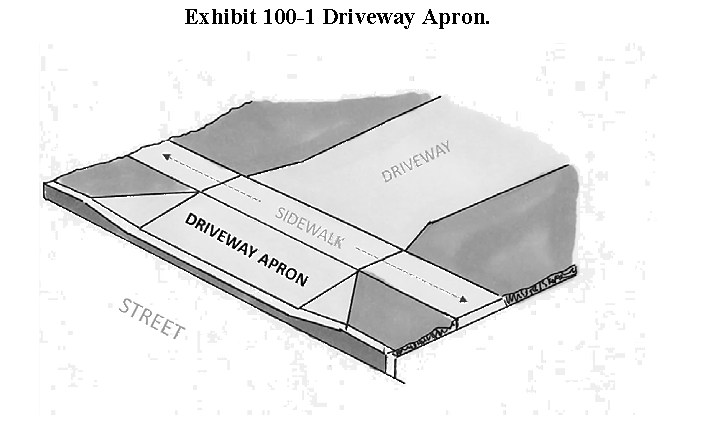
Apron, driveway means that portion of a roadside improved with concrete, or other hard impervious surface, designed for vehicular traffic to travel from a roadway to a driveway.
Arcade. A continuous area at ground level opening to a street or plaza, which is open and unobstructed to a height of no less than 12 feet, and which is always accessible to the public. Any portion of an arcade occupied by building columns, landscaping, statuary, or pools shall be considered a part of an arcade for the purpose of computing a floor area. The term "arcade" shall not include off-street loading areas, driveways, off-street parking areas, or pedestrian ways accessory thereto.
Architectural Detail. Any projection, relief, cornice, column, change of building material, window, or door opening on any building.
Area of Shallow Flooding. A designated AO/AH zone on a community's flood insurance rate map (FIRM) with base flood depths from 1 to 3 feet. This condition occurs where a clearly defined channel does not exist, where the path of flooding is unpredictable and indeterminate, and where velocity flow may be evident.
Area of Special Flood Hazard. The land in the designated flood-plain within a community subject to a 1 percent or greater chance of flooding in any given year (flood zones).
Art Gallery. An establishment for the loan or display of objects of art.
Arts Studio. An establishment for the instruction or study of an art, type of exercise, or activity such as dance, martial arts, photography, music, painting, gymnastics, or yoga, whether or not the artists live at the establishment.
Ash. The incombustible material that remains after a fuel or solid waste is incinerated.
Athletic Club. Any facility that is designed for and provides athletic equipment, a gymnasium, track, basketball, handball and/or volleyball, tennis and racquetball courts, steam rooms, and weightlifting equipment; that provides for the teaching of any of the foregoing, or any martial arts, exercise classes, etc.; that holds itself out to the public for such purpose, or any combination of the foregoing purposes.
Athletic Fields. A site providing recreational areas for activities such as soccer, baseball, softball, and football.
Auditorium. A public or private building or structure designed, or intended for use for, the gathering of people as an audience to hear music, lectures, plays, and other presentations.
Auto Repair and Service. A facility for automobile services or general repairs and reconditioning of engines, motor vehicles, tire services, quick-lubes, batteries, with all work being conducted inside the building and within the same day.
Automobile Sales. The use of any building, land area, and/or other premises not limited to the display and sale of new or used automobiles, panel trucks, vans, trailers, or recreational vehicles including warranty repair work and other repair services conducted as an accessory use.
Auto Racing. A facility consisting of a paved roadway used primarily for the sport of automobile racing. A racetrack may include seating, concession areas, suites, and parking facilities, but does not include accessory offices, residences, or retail facilities.
Automotive Repair. A facility for the maintenance, service, and engine repair of motor vehicles.
Awning. A cloth, plastic, or nonstructural covering that either is permanently attached to a building or can be raised or retracted to a position against the building when not in use.
- B -
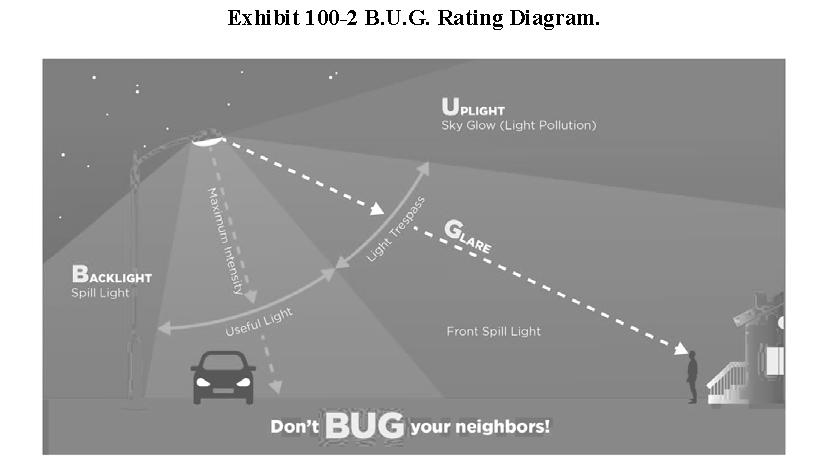
Backlight. The light emanating behind a luminaire.
Bakery. A facility for preparing, cooking, baking, and wholesale of candy, baked goods, or other sweets.
Bank or Financial Institution. A banking establishment open to the public, for the deposit, custody, loan, exchange or issue of money, extension of credit, and facilitating the transmission of funds excluding pawnshops, check cashing businesses, payday advance/loan businesses, car title loan businesses and bail bonds.
Banner. A sign composed of a logo or design on a lightweight material either enclosed or not enclosed in a rigid frame and secured or mounted to allow movement caused by the atmosphere.
Base Flood. The flood having a 1 percent chance of being equaled or exceeded in any given year.
Bar, Lounge, or Nightclub. An establishment in which the primary use is the serving of alcoholic beverages and in which the service of food is only incidental to the consumption of such beverages.
Beacon. A strong or bright light focused or directed in 1 or more directions.
Beam Angle. The angle at which luminous intensity is 50 percent of the maximum intensity.
Bed and Breakfast. An owner-occupied place of lodging in a single-family home, with less than 10 rooms, that is rented for overnight lodging, providing 1 or more meal, where the length of stay is no more than 7 consecutive days, and no more than 15 days per person in any 30-day period.
Behavioral Healthcare Facility. A building or campus that provides a continuum of services for individuals at risk of, or suffering from, mental, behavioral, or addiction disorders. Behavioral health, as a discipline, refers to mental health, psychiatric, marriage and family counseling, addiction treatment, stress-related physical symptoms, ineffective patterns of health care utilization, and counseling/treatment for stress creating circumstances including, but not limited to, chronic unemployment, loss or illness of family members, and homelessness. Services may be provided by social workers, counselors, psychiatrists, psychologists, neurologists, and physicians.
Beneficial Purpose. The use of groundwater for domestic, municipal, industrial, agricultural, recreational, or therapeutic purposes or any other advantageous use. Also referred to as "beneficial use."
Best Practical Techniques (Best Practice). Those methods or techniques which would result in the greatest possible minimization of the adverse impacts, and in specific guidelines applicable to the proposed use. Those methods or techniques shall be the best methods or techniques which are in use in the industry or trade or among practitioners of the use, and which are feasible and practical for utilization.
Beverage Distilling. A facility that produces alcoholic beverages through the process of distillation.
Billboard. See Sign, Billboard.
Block. A division of the subdivision into parcels of land separated by streets, roads, boulevards, or avenues.
Board of Adjustment. The St. Tammany Parish Board of Adjustment, established as per LA R.S. 33:4727 as amended, and per Chapter 100, Sec. 100-2.5 of the UDC.
Boarding House. A structure that is rented to occupants for 30 consecutive days or more and contains more than 5 units with living and sleeping accommodations, but no kitchen.
Boathouse. A single-story structure consisting of posts and a roof, with or without walls, connected to either a dock or ground in a body of water, constructed for boat storage or related marine use only. The term "boat house" includes the anchoring system and any walkways or bridges that connect to the structure.
Boatel. A building or group of buildings that: (a) contains living or sleeping accommodations used primarily for transient occupancy, and (b) is immediately accessible by boat.
Body Shop. Any building, or portion thereof, used for the repair or straightening of a motor vehicle body or frame and/or painting of motor vehicles including automobiles, boats, trucks, trailers, and tractors. Maintenance, service, and engine repair may be performed as an ancillary function to the bodywork.
Boulevard. A major thoroughfare for carrying a large volume of through traffic in the area, normally controlled by traffic signs and signals with relatively few intersections and/or drives.
Breezeway. A covered walkway that is open on at least 2 sides from the eaves of the roof to the ground, connecting a main structure with an accessory structure on the same building site. A breezeway less than 10 feet in width will not be a sufficient connection for 2 distinct spaces to be considered a single structure. The covering must be greater than 10 feet in width, or be connected by a fully enclosed structure with access to both spaces, in order for the 2 spaces to be considered a single structure.
Brewery or distillery. A facility licensed as a "Manufacturer or brewer" as defined in Title 26, Section 241, of the Louisiana Revised Statutes. The facilities may include an on-site tasting room(s) as an accessory use with retail sales of only those alcoholic beverages produced at the facility for consumption on or off the premises.
Brush Disposal Facility. A site used exclusively for disposal of trees and tree parts including stumps, branches, and their attached leaves. Also known as yard waste.
Buffer. Open spaces, landscaped areas, fences, walls, berms, or any combination thereof used to physically and visually separate one use or property from another or the street in order to mitigate the impacts of noise, light, or other nuisance.
B.U.G. Rating. All backlight, up-light, and glare rating which exists on a scale of 0 to 5 and describes the light output of a luminaire.
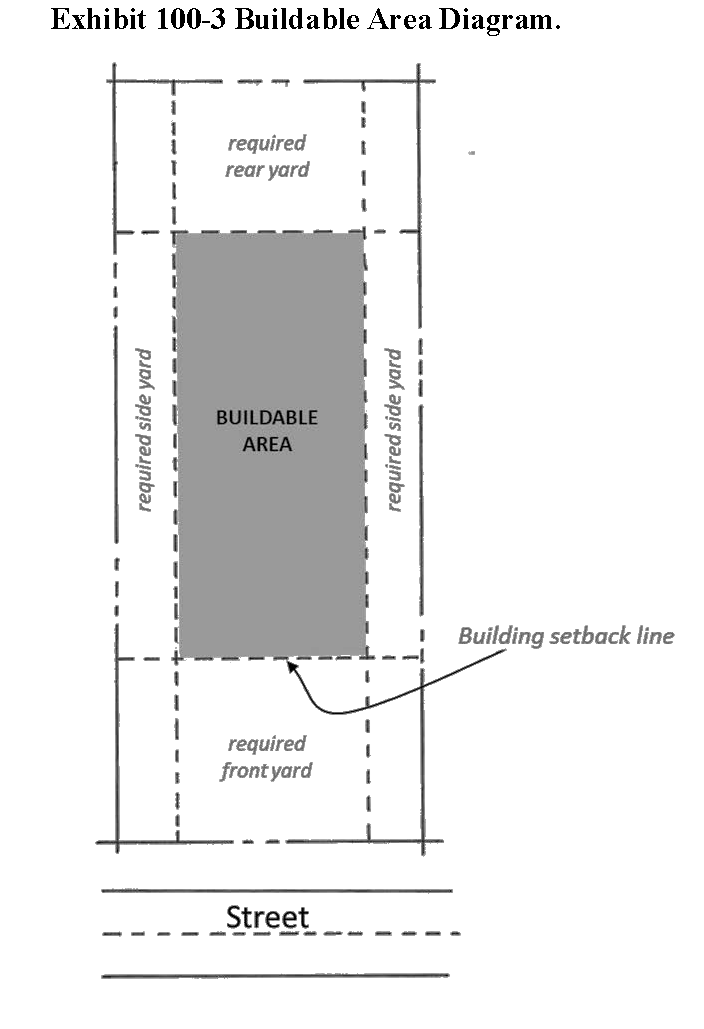
Buildable Area. The area of a lot where a structure may be built once the minimum yard and open space requirements of this UDC have been met.
Builder, Qualified. A person who has obtained an occupational license which is current.
Building. A structure built, maintained, or intended for use as a shelter or enclosure of persons, animals, or property. The term includes any part of the structure. Where independent units with separate entrances are divided by party walls, each unit is a building.
Building Area. A maximum horizontal projected area of a building and its accessory buildings.
Building Code. The Building Code of St. Tammany Parish. St. Tammany Parish shall at all times be subject to the provisions of The Louisiana State Uniform Construction Code, which is provided for in LA R.S. 40:1730.21 through 40:1730.40, and which may be amended from time to time.
Building Inspector. The individual designated by the appointing authority to insure the provisions of the building codes.
Building Line. The line extending parallel to a lot line that is the same distance from the lot line and the closest edge of a structure to the lot line.
Building or Structure, Agricultural. Any building or structure existing or erected on land used principally for agricultural purposes, with the exception of dwelling units.
Building, Completely Enclosed. A building separated on all sides from the adjacent open space, or from other buildings or other structures by a permanent roof and by exterior walls or party walls, pierced only by windows and normal entrance or exit doors.
Building, Detached. A building surrounded by open space, said open space being on the same zoning lot as the building.
Building, Elevated. A non-basement building built, in the case of a building in Zones A1-30, AE, A, A99, AO, AH, B, C, X, and D, to have the top of the elevated floor, or in the case of a building in Zone V1-30, VE, or V, to have the bottom of the lowest horizontal structure member of the elevated floor, elevated above the ground level by means of pilings, columns (posts and piers), or shear walls parallel to the floor of the water and adequately anchored so as not to impair the structural integrity of the building during a flood of up to the magnitude of the base flood. In the case of Zones A1-30, AE, A, A99, AO, AH, B, C, X, D, "elevated building" also includes a building elevated by means of fill or solid foundation perimeter walls with openings sufficient to facilitate the unimpeded movement of flood waters. In the case of Zones V1-30, VE, or V, "elevated building" also includes a building otherwise meeting the definition of "elevated building," even though the lower area is enclosed by means of breakaway walls if the breakaway walls meet the standards of Section 60.3(E)(5) of the National Flood Insurance Program regulations.
Building, Non-Conforming. A building or a structure or portion thereof lawfully existing at the time of adoption of this UDC, which was designed, erected, or structurally altered for a use that does not conform to the use regulations of the district in which it is located.
Building, Principal. A building in which the principal use of the lot on which the building is located is conducted or intended to be conducted.
Building Setback Line. A specified minimum parallel distance between the street line or property line and any building or structure on any lot.
Building, Temporary. A structure without a foundation, having a roof supported by columns or walls, for the enclosure of persons, animals, chattels, or moveable property of any kind.
Bulk. A term used to describe the size of buildings or other structures, and their relationships to each other and to open areas and lot lines. Specifically, the term factors in the size of buildings or other structures, the area of the zoning lot upon which a residential building is located, the number of dwelling units or rooms within such building in relation to the area of the zoning lot, the shape of the buildings or other structures in relation to other walls of the same building, to legally required windows, or to other structures, and all open areas relating to buildings or other structures and their relationship hereto.
Bulk Plant. Any place where flammable liquids are received by tanker, barge, pipeline, tank car, tank vessel, or truck and are stored or blended in bulk for the purpose of distributing such liquids by tank truck, pipeline, tank car, tank vessel, or container.
Bulkhead. A retaining wall created along a body of water behind which fill is placed.
Burning, Open. The combustion of solid waste without control of combustion air to maintain adequate temperature for efficient combustion, containment of the combustion reaction in an enclosed device to provide sufficient residence time and mixing for complete combustion, and control of the emission of the combustion products.
Business or Commerce. The engaging in the purchase, sale, barter, or exchange of goods, wares, or merchandise; or the maintenance or operation of offices or recreational or amusement enterprises.
- C -
Camp. Any structure, floating or foundation-secured, used temporarily or occasionally as a dwelling; not used as a residence.
Campground. Any area or tract of land used to accommodate camping parties including cabins, tents, house trailers, or other camping outfits.
Canneries. A facility for the canning, preserving, and other related processing of fruits, vegetables, and other food products.
Car Wash. A facility for the washing or the steam cleaning of passenger vehicles.
Carnival or Circus. A temporary traveling show or exhibition that has no permanent structure or installation.
Carport. A roofed structure providing the space for the parking or storage of motor vehicles, and which is enclosed on no more than 3 sides.
Catering Service, Commercial. A commercial establishment that serves and supplies food to be consumed off premises.
Cease and Desist Order. An administrative order directing a user to immediately halt illegal or unauthorized discharges.
Cemetery or Mausoleum. Property used for interring the dead in above ground chambers or burying them beneath the ground.
Cemetery, Family. A family burying ground in which no lots are sold to the public and in which interments are restricted to a group of persons related to each other by blood or marriage or other familial bonds.
Chemical Processing Plant. A facility for the manufacturing, blending, mixing, and processing of chemicals from raw materials into finished products such as plastics, rubbers, fibers, resins, paint, coatings, chlorine, and carbonates.
Chief Building Official. The official responsible for the establishment and enforcement of building codes, or his/her designee.
Civic. A use or facility that primarily serves the public interest and general welfare of the Parish. Civic uses include, but are not limited to: government buildings and offices; public schools and educational institutions; libraries; law enforcement and emergency service facilities; community centers; places of worship; museums; and other institutions providing cultural, educational, social, or public services. Civic uses may be operated by public agencies, nonprofit organizations, or faith-based institutions. Civic uses do not include public safety training centers or other specialized facilities that are only permitted in designated zoning districts.
Clean Water Act. The Federal Water Pollution Control Act, also known as the Clean Water Act, as amended, 33 U.S.C. 1251 et seq.
Cleaning and Dyeing Works. A facility where fabrics are cleaned with substantially non-aqueous organic solvents on a commercial or wholesale basis.
Clear Vision Area. An area designed to promote public safety by maintaining clear areas that provide cross-visibility among pedestrians, bicyclists, and motorists.
Clinic, Pain Management. A medical facility where patients receive care relating to the diagnosis and management of chronic pain.
Clinic. An establishment where patients are admitted for outpatient examination and treatment by practicing medical professionals.
Close Proximity (Flood). A distance of 1,000 feet from the waterline or watermark of any herein designated stream, river, or lake at its highest recorded flood stage or tide.
Club,Lodge, or Meeting Hall. Buildings and facilities that are owned and operated by a corporation or association of persons for social or recreational purposes, but not operated primarily for profit or to render a service which is customarily carried on as a business. Such organizations and associations shall be incorporated under the laws of the State of Louisiana as a non-profit corporation or registered with the Secretary of State of Louisiana. Food and alcoholic beverages may be served on the premises for members only if allowed in the zoning district in which the facilities are located and in accordance with LA RS 26:1, the Alcoholic Beverage Control Law.
Country Club. A voluntary or corporate association owned solely by its members, the objectives, pursuits, and purposes of which are social or recreational, operating or formed for the purposes of operating a club on a membership basis and not operated for profit, the principal facilities of which shall be a swimming pool or pools, golf course, and/or tennis court or courts owned by it and maintained on land owned or leased by it, and which may maintain and operate on the same premises such accessory facilities owned by it as are usually provided by a swim, golf, or tennis club.
Coastal High-Hazard Area. An area subject to high velocity waters, including but not limited to hurricane wave wash or tsunamis. The area is designated on FIRM as Zone V1-30, VE and/or V.
College. An educational institution authorized by the state.
Color Rendering Index (CRI). A rating index commonly used to represent how well a light source renders the colors of objects that it illuminates. For a CRI value of 100 (the maximum value) the colors of objects can be expected to be seen as they would appear under an incandescent or daylight spectrum of the same correlated color temperature (CCT). Sources with CRI values less than 50 are generally regarded as rendering colors poorly, that is, colors may appear unnatural.
Commercial. A land use or other activity involving the sale of goods or services for financial gain including, without limitation, Short Term Rentals.
Commission. The St. Tammany Parish Planning and Zoning Commission.
Community Center. A building designed to serve as the social center of a town, district, etc.
Community Home (6 or fewer persons). Residential living options that are certified, licensed, or monitored by the Louisiana Department of Health and Human Resources as required to provide residential services to 6 or fewer persons who are disabled (see Disabled Person). Community homes that provide for 6 or fewer persons who are handicapped or developmentally disabled shall have 24-hour supervision including at least 1 but not more than 2 24-hour attendants. Such a residential facility shall be considered a single-family unit. This definition shall exclude persons, not otherwise disabled, who are currently using illegal drugs or abusing alcohol, and it shall exclude persons, not otherwise disabled, currently under sentence or parole from any criminal violation.
Community Home (10 or fewer persons). Residential living options that are certified, licensed, or monitored by the Louisiana Department of Health and Human Resources to provide residential services to 10 or fewer persons who are disabled (see Disabled Person). Community homes that provide for 10 or fewer persons who are handicapped or developmentally disabled shall have 24-hour supervision including at least 1 but not more than 2 24-hour attendants. Such a residential facility shall be considered a single-family unit, as per LA RS. 28:477. Notwithstanding the foregoing, in accordance with federal law, the definition (including the interpretation and application) of the term "Community Home" in the UDC shall also include the definition of "Shelter Care Home" as per Title 48, Chapter 88, of the State of Louisiana Administrative Code.
Community Sewerage System. Any sewerage system which consists of a collection and/or transport system which serves multiple connections and/or a pumping facility and/or a treatment facility.
Community Sewerage System, Qualified. A community sewerage system which has the actual and/or anticipated capacity which will be required to realize the peak sewage demand of the subject subdivision or development; The operation and maintenance of which is likely to be in accordance and compliance with all regulatory requirements; all as determined by the ESC.
Compost. Solid waste which has undergone biological decomposition of organic matter and has been stabilized using composting or similar technologies, to a degree that is beneficial to plant growth and that is used, or sold for use, as a soil amendment, artificial topsoil, growing-medium amendment, or other similar uses.
Composting. The controlled microbic degradation of organic waste to yield a humus-like product. Generally, the compost itself is a solid waste which has undergone biological decomposition of organic matter and has been stabilized using composting or similar technologies, to a degree that is beneficial to plant growth and that is used, or sold for use, as a soil amendment, artificial topsoil, growing-medium amendment, or other similar uses.
Composting Facility. A site used to compost solid waste including all structures used to control drainage, collect, and treat leachate, storage areas for the incoming waste, and the final product. A composting facility may include various types of compost operations including, but not limited to, windrow, in-vessel, or static pile facilities.
Concrete Batching Plant. A facility for the mixing of concrete or asphalt.
Concrete or Asphalt Batching Plant, Permanent. A facility for the manufacture or mixing of asphalt, concrete, cement, and concrete and cement products, including any apparatus and uses incidental to such manufacturing and mixing.
Concrete or Asphalt Batching Plant, Temporary. A temporary facility that produces or processes concrete or asphalt only for use in a particular construction project and only for the duration of that project.
Conditional Use. Refer to Use, Conditional.
Condominium. A building or group of buildings in which units are owned individually and the structure, common areas and facilities are owned by all owners on a proportional undivided basis.
Condominium Association. The community association which administers and maintains the common property and common elements of a condominium.
Conservation Area, Privately-Owned. An area of land under the management of a privately owned entity or organization for conservation.
Construction Code. The Louisiana State Uniform Construction Code, as provided for in LA R.S. 40:1730.21 through 40:1730.40, which may be amended from time to time.
Construction Debris. Waste, building materials, packaging, and rubble resulting from construction, remodeling, repair, and demolition of buildings and roads.
Construction, New. For floodplain management purposes, structures for which the "start of construction" commenced on or after the effective date of a floodplain management regulation adopted by a community.
Construction/Demolition (C&D) Debris. Nonhazardous waste generally considered not water-soluble that is produced in the process of construction, remodeling, repair, renovation, or demolition of structures, including buildings of all types (both residential and nonresidential). Solid waste that is not C&D debris (even if resulting from the construction, remodeling, repair, renovation, or demolition of structures) includes, but is not limited to, regulated asbestos-containing material (RACM) as defined in LAC 33:III.5151.B, white goods, creosote-treated lumber, and any other item not an integral part of the structure.
Containment. Isolating, controlling, and monitoring waste in a waste facility in order to prevent a release of waste from the facility that would have an adverse impact upon human health and the environment.
Contaminant. An element causing pollution of the environment that would have detrimental effects on air or water quality or on native floral or faunal species.
Contiguous. Next to, abutting, or touching and having a common boundary or portion thereof.
Contractor, Qualified. A contractor who is duly licensed by the LaDOTD in accordance with the Louisiana Water Well rules, regulations, and standards, and whose professional practices and actions are likely to comply with said rules, the rules and regulations of the department, and other applicable law.
Contractor's Yard. An outdoor area where vehicles, equipment, merchandise, raw materials, or other items are accumulated and stored for an indefinite period until needed. Storage yards are often used in conjunction with a warehouse or storage buildings.
Convenience Store. A small retail establishment, usually located within or associated with another use, 3,000 square feet or less that offers for sale convenience goods, such as packaged food items, staple groceries, snacks, tobacco, periodicals, and other household goods and may also sell gasoline and other fuel as an accessory use, when permitted; does not include automobile service stations, or vehicle repair shops.
Convenience Store with Gas Pumps. A retail establishment that offers for sale convenience goods, such as packaged food items, staple groceries, snacks, tobacco, periodicals, other household goods, and gasoline and other fuel as an accessory use; does not include auto repair and service.
Conversion. The changing of use or occupancy of a dwelling by alteration or by other reorganization so as to increase the number of families or dwelling units in a structure.
Conveyance to Work. A vehicle, usually a commercial vehicle, which serves as the primary transportation to work by a resident of a property.
Correlated Color Temperature (CCT). A specification of the color appearance of the light emitted by a lamp, relating its color to the color of light from a reference source when heated to a particular temperature, measured in degrees Kelvin (K). The CCT rating for a lamp is a general "warmth" or "coolness" measure of its appearance. Lamps with a CCT rating below 3,000 K are usually considered "warm" sources, while those with a CCT above 3,000 K are usually considered "cool" in appearance.
Council. The St. Tammany Parish Council.
Court. An open unoccupied space, other than a yard, on the same lot with a building or group of buildings and which is bound on 2 or more sides by such building or buildings.
Cover. Approved material that is used to cover compacted solid waste in a land disposal site. Important general characteristics of good cover material are low permeability, uniform texture, cohesiveness, and compatibility.
Cover, Impervious. Impervious coverage of a site shall include the total horizontal area of all buildings, roofed or covered spaces, paved surface areas, walkways, and driveways. Pools of water including but not limited to swimming pools, reflecting ponds and fountains are excluded from the landscaping calculation.
Coverage, Building. The horizontal area measurement within the outside of the exterior walls of the ground floor of all principal and accessory buildings.
Critical Feature. Any integral and readily identifiable part of a flood protection system, without which the flood protection provided by the entire system, would be compromised.
Cul-de-Sac. A street having 1 open end and being permanently terminated by a circular vehicle turnaround.
Culvert. A device, of whatever shape or contour, designed to be covered with earth, shell, gravel, or any overlay of whatsoever nature or kind, the purpose of which, in size, diameter, and strength is to provide safe traverse there over and to accommodate drainage, natural or dedicated, with the least impedance thereto.
Cut off Angle, of a Luminaire. The angle, measured up from the nadir (i.e. straight down), between the vertical axis and the first line of sight at which the bare source (the bulb or lamp) is not visible.
Cutoff Fixture. A luminaire which has a light distribution where the candlepower does not exceed 2.5% of the lamps' rated initial lumen output at an angle of 90 degrees above nadir, and does not exceed 10% of the lamps' rated initial lumen output at a vertical angle of 80 degrees above nadir. This applies to all lateral angles around the luminaire. Direct light means light emitted directly from the lamp, off of the reflector or reflector diffuser, or through the refractor or diffuser lens of a luminaire.
- D -
Day Care Center, Adult. Any place or facility owned or operated for profit or not for profit, by a person, society, agency, corporation, institution, or any other group wherein are received, for a portion of a 24-hour day, fewer than 10 functionally impaired adults are not related to the owner or operator of the facility for the purposes of supervision or participation in a training program. The day care services should take place on a regular basis for at least 12.5 hours in a continuous 7-day week and no overnight stays are permitted. Facilities caring for fewer than 10 adults are not required to be licensed by the State of Louisiana, however if the facility receives state or federal funding, directly or indirectly, it must be licensed regardless of the number of adults in its care.
Day Care Center, Child. Any place or facility operated by any institution, society, agency, corporation, person(s), or any other group for the primary purpose of providing care, supervision, and guidance of 7 or more children, not including those related to the caregiver, unaccompanied by parent or guardian, on a regular basis for at least 12.5 hours in a continuous 7-day week. Related or relative is defined as the natural or adopted child or grandchild of the caregiver or a child in the legal custody of the caregiver. This term includes nursery schools, preschools, and other similar uses but excludes public or private educational facilities or any facility offering care to individuals for a full 24-hour period.
Day Care Home. A residence which cares for not more than eight children during all or part of the day. Not to be construed as a Day Care Center. The maximum of 8 children includes the natural or adopted children under the age of 16 of the occupants of the residence. The use shall be secondary to the use of the property as a residence. The day care home must only be operated, and the care of the children done by, a person who resides in the residence where the day care home is to be located.
DBH. Refers to the measurement of tree trunks by diameter at breast height.
Decibel. A unit of sound pressure level.
Deed. A legal document conveying ownership of real property.
Density. A measure of the intensity of development. For the purposes of this UDC, residential development density is calculated in terms of units per acre.
Department Store. A retail store that consists of a variety of specialty departments that are interconnected within the same structure and under the same ownership, such as jewelry, clothing, shoes, automotive products, sporting goods, etc.
Detention Pond. See, Pond, Detention.
Developer. An owner, or agent of the owner, in the process of the commercial utilization of any land, or subdivision of property into smaller lots to be subsequently used as commercial or residential sites.
Development. Any man-made change in improved or unimproved real estate. Development activities include: subdivision of land; construction or alteration of structures, roads, utilities, and other facilities; installation of septic systems; grading; paving; mining, dredging; drilling operations; deposit of refuse, debris, or fill materials; and clearing of natural vegetative cover (with the exception of agricultural activities). Routine repair and maintenance activities are exempted.
Development Plan, Approved. Plans reviewed and approved, as evidenced by a properly issued building permit or site work permit, subdivision work order, or existing and proposed grade elevation form approved by the appropriate parish department.
Development, Cluster. A planned development or subdivision of a tract of land into residential lots where only a portion of the property is developed with the remainder being protected from future development on a permanent basis.
Development, Low Impact or LID. Refers to a stormwater management strategy that seeks to mitigate the impacts of increased runoff and stormwater pollution by managing runoff as close to its source as possible. To accomplish this, it uses practices that help to preserve or to restore predevelopment hydrological and ecological functions. For preservation, it uses site design strategies to minimize runoff and to protect natural drainage patterns. For restoration, it uses distributed structural practices that filter, detain, retain, infiltrate, evapotranspire, and harvest stormwater. LID practices can effectively remove sediment, nutrients, pathogens, and metals from runoff, and reduce the volume and intensity of stormwater flows.
Development, Mixed Use. A development that integrates a variety of land uses including, but not limited to, residential, restaurants, retail, and offices.
Developmental Agreement. A binding contractual agreement between an individual, firm or corporation, and the governing authority of St. Tammany Parish.
DFIRM. Digital Flood Insurance Rate Map.
Director of Engineering. The official employed as the Director of the Department of Engineering Services, or his/her designee. Also referred to as the Parish Engineer.
Director of Environmental Services. The official employed as the Director of the Department of Environmental Services, or his/her designee.
Director of Finance. The official employed as the Director of the Department of Finance, or his/her designee.
Director of Permits and Inspections. The official employed as the Director of the Department of Permits & Inspections, or his/her designee.
Director of Planning and Development. The official employed as the Director of the Department of Planning or Development, or his/her designee.
Director of Public Works. The official employed as the Director of the Department of Public Works, or his/her designee.
Director of Utilities. The official employed as the Director of the Department of Utilities, or his/her designee.
Disabled Person. Any person who has a physical, emotional, or mental impairment which substantially limits 1 or more of the following major life activities: self-care, receptive or expressive language, learning, mobility, self-direction, capacity for independent living, and economic self-sufficiency.
Discharge, Direct. Any discharge of effluent from the building site where it originated other than into an approved collection system.
Disposal Facility. A waste facility permitted by the Louisiana Department of Environmental Quality (LDEQ) that is designed or operated for the purpose of disposing of waste in or on the land, together with any appurtenant facilities needed to process waste for disposal or transfer to another waste facility.
Disposal. The discharge, deposit, injection, dumping, spilling, leaking, or placing of a material into or on any land or water so that such material, or any constituent thereof, may enter the environment, be emitted into the air, or discharged into any waters, including groundwaters; or the incineration of any material, so that such material, is emitted into the air.
Distribution or Warehousing Facility. An establishment associated with a specific establishment, or establishments, used for the dispersion of goods and materials to other locations. This use may or may not be associated with warehousing facilities.
District. A part of the parish wherein regulations of this UDC are specifically applied and uniform.
Ditch. Natural or dedicated area that provides for the containment or flow of water from rain or adjacent drainage areas or waterways such as streams, creeks, ponds, lakes, or rivers.
Dormitory. A building used as group living quarters for a student body or religious order, functioning as an accessory use for college, university, boarding school, orphanage, convent, monastery, or other similar institutional use.
Drainage. The removal of surface water or groundwater from land by drains, grading, or other means. Drainage includes the control of runoff to minimize erosion and sedimentation during and after development and includes the means necessary for water supply preservation or the prevention or alleviation of flooding.
Drainage and Grading Plan. A plan provided by a Louisiana licensed engineer that shows proposed drainage and grading for a site.
Drainage Area. Area maintained for channeling or preventing accumulation of water from surrounding land.
Drainage Area Map, Critical. The official critical drainage area map, generated and maintained by the Department of Engineering. The map will be periodically revised, based on information and data available at the time, in an effort to provide reasonably updated information to the public regarding the areas of the parish considered to be critical drainage areas.
Drainage Area of Special Concern. An area that is experiencing development without an approved hydrological plan and, although it may not be located within a critical drainage area, has been determined by the Department of Engineering, after careful consideration of the available data, to be an area that is particularly susceptible to adverse drainage and flooding impacts that are likely to result from continued development and fill, necessitating the application of specific fill and building regulations to address those impacts.
Drainage Area, Critical. An area determined by the Department of Engineering, after careful consideration of the available data, to be of critical importance for its role in the conveyance, moderation, or storage of stormwater. Critical drainage areas within this designation include, but are not limited to, the following:
- Areas anticipated to be inundated by storm events, including areas adjacent to streams, upland areas, and areas of isolated or permanent flooding.
- Areas of concentrated stormwater flow, including, but not limited to, concentrated sheet flow, channelized flow, and natural hydrologic features or channels of all types and sizes.
- Areas included within wetlands as defined by the 1987 U.S. Army Corps of Engineers Wetland Delineation Manual.
- Areas of concentrated stormwater flow including, but not limited to, concentrated sheet flow, channelized flow, and natural hydrologic features or channels of all types and sizes.
- Those areas that are designated as a critical drainage area on the most current critical drainage area map as determined by the Parish Engineer and placed on file in the Department of Planning and Development.
Drainage System, Parish. The drainage systems and structures that have been placed on a roster or list as adopted by the parish by ordinance, signifying that said drainage systems and structures are to be maintained by the Department of Public Works.
Drip Line. The outer edge of the leaves or branches of a tree which is farthest from the trunk that allows rain or dew to fall directly to the ground extending in all directions parallel to the ground.
Drive In or Drive Thru. A restaurant or business that provides car service and/or a drive-through window, either exclusively or in conjunction with walk-in service.
Driveway. Any hard surface parking area that provides access to private property from the right-of-way.
Dry Pond. See Pond, Dry.
Dumping. The illegal placement of any solid waste anywhere other than an approved facility or container.
Duplex. A building designed exclusively for occupancy by 2 families living independently of each other. May be located on a single lot or may have a lot line dividing the building and separating the building's 2 dwelling units onto 2 separate lots. Also known as a Dwelling, Two Family.
Dwelling. A building, or portion thereof, designed or used exclusively for residential occupancy, including one-family dwelling units, two-family dwelling units, and multiple-family dwelling units, but not including hotels, boarding, or lodging houses.
Dwelling Unit. One or more rooms in a structure designed for occupancy by 1 family for living purposes and having its own permanently installed cooking and sanitary facilities.
Dwelling Unit, Accessory. See Accessory Dwelling Unit and Guest Home.
Dwelling, Multiple Family. A structure located on a single lot containing 3 or more dwelling units designed with more than 1 dwelling unit connecting to a common corridor or entranceway, originally constructed for said purpose, as opposed to converted dwellings or attached row dwellings (party wall type) and townhouses located on separate lots of record.
Dwelling, Single Family. A dwelling designed and constructed for occupancy by 1 family and in which 1 dwelling unit is located on a lot characterized by having no more than 1 full indoor kitchen. If a single family dwelling is connected to another structure by a breezeway, and the other structure includes another full indoor kitchen, the dwelling is a duplex or two-family dwelling.
Dwelling, Two Family. A building designed exclusively for occupancy by 2 families living independently of each other. May be located on a single lot or may have a lot line dividing the building and separating the building's 2 dwelling units onto 2 separate lots. Also includes 2 structures connected to each other by a breezeway wherein each structure contains its own full indoor kitchen. Also known as a Duplex.
- E -
Easement. A grant of 1 or more of the property rights by the property owners to, and/or for use by, the public, a corporation, another person or entity, or a specific purpose.
Easement, Aviation. An air rights easement precluding future or additional development of land.
Easement, Drainage. An easement required for the installation of stormwater sewers or drainage ditches, and/or required for the preservation or maintenance of a natural stream or water course or other drainage facility.
Ecological Value. The ability of an area to support vegetation, fish, and wildlife populations. Includes consideration of how water, minerals, biota, and all other factors that make up natural ecosystems provide benefits to support native life forms. Ecosystems contribute their greatest ecological value when they are in the most natural state.
Educational Facility, Adult Secondary. A school that provides secondary curricula primarily for adults.
Educational Facility, Business College or School. A business enterprise providing education beyond the secondary level, offering training in a specific trade sponsored by a for-profit organization.
Educational Facility, Community College. A 2-year institution established for educational purposes offering courses for study beyond the secondary education level.
Educational Facility, Elementary or Middle School. A public or private school that provides elementary and middle school curricula.
Educational Facility, High School. A school that provides secondary curricula.
Educational Facility, Learning Center. An establishment for tutoring or education in addition to primary and secondary learning. Such facilities are not a place to provide primary or secondary education as a primary function.
Educational Facility, Professional Training Campus. A facility dedicated to providing additional training and instruction for professional instructors and teachers.
Educational Facility, Satellite College Campus. An off-site location related to a primary college or university location providing the same or additional classes to the primary campus.
Educational Facility, University and Associated Research Center. A 4-year institution established for educational purposes offering courses for study beyond the secondary education level. Such institutions may also include research.
Educational Facility, Vocational School. A trade school, or commercial school offering training or instruction in a trade, art, or occupation.
Effluent. Treated or untreated wastewater.
Effluent Limitation. A restriction or limitation on discharges of pollutants established by Environmental Protection Agency (EPA) under the Clean Water Act, as amended, and/or any other state regulations or local ordinances.
Emergency. A situation that poses an immediate threat to public safety, life, health, or property, and action in response to the threat cannot await permitting or standard processes. Declaration of an emergency must come from an authorized governmental body and continues for the time that body specifies.
Emergency and Standby Power Systems. Systems in compliance with National Fire Protection Association's standards establishing performance requirements for power systems providing an alternate source of electrical power to loads in buildings and facilities in the event that the normal power source fails.
Encroachment. Any obstruction located in a designated floodway, right-of-way, or adjacent land.
Endangered Species. Any species which is in danger of extinction throughout all, or a significant portion of, its range which includes all state and federal endangered classifications for flora and fauna.
Energy, Electrical Substation. A facility for transforming electricity for distribution to individual customers.
Energy, Natural Gas Gathering Facility. A facility for the gathering of natural gas for transfer to a processing facility.
Energy, Natural Gas Processing Plant. A facility for the processing of natural gas to extract natural gas liquids from dry gas.
Energy, Power Generation Plant (Atomic). A facility that generates electricity from mechanical power produced by nuclear fission.
Energy, Power Generation Plant (Non-Atomic). A facility that generates electricity from mechanical power produced by gas or coal.
Engineer, Licensed. An engineer licensed by the State of Louisiana as a Professional Engineer (P.E.).
Engineer, Parish. The Louisiana licensed engineer designated as the official engineer for the parish or his/her designee.
Enlargement. Refers to an increase in size.
Entertainment Venue. Any property, structure, or location where activities that include, but are not limited to, live performances, virtual performances, sporting events, and exhibitions held indoors or outdoors to which members of the public are invited with or without charge. Live performances include live productions of music or sound by individuals, bands, musicians, dancing, karaoke, and theatric performances. Adult uses, as defined in this UDC, are not permitted.
Entertainment, Indoor. An amusement facility enclosed within a building offering entertainment such as bowling alleys, skating rinks, and movie theaters and which may also include restaurant facilities without a lounge.
Entertainment, Live Performances. A facility where entertainment is provided which typically consists of live or programmed performances.
Entertainment, Outdoor. An amusement facility, wherein any portion of the activity takes place outdoors including, but not limited to, miniature golf course, golf driving range, archery range, batting cages, or go-cart tracks. This does not include riverboat gaming and associated facilities.
Environmental Assessment Data Form. The form for the purpose of obtaining environmental information and data.
Environmental Management Unit or EMU. An area with certain distinguishing physical, hydrological, chemical, biological, or cultural characteristics such as geology, vegetation, drainage patterns, and uses. Each EMU can be considered individually when setting goals, objectives, and policies for planning, management, and regulatory functions.
Environmental Service. Sewerage and/or water and/or solid waste disposal service(s).
EPA. The United States Environmental Protection Agency.
Establishment. A separate place of business having the following characteristics: (1) the ownership and management of all operations conducted within such establishment are separate and distinct from the ownership and management of operations conducted within other establishments of the same or adjacent zoning lot, and (2) direct public access to such "business establishment" is separate and distinct from direct access to any other "business establishment."
Excavation, Commercial. Removal or recovery by any means whatsoever of rock, minerals, mineral substances, or organic substances other than vegetation from water or land on or beneath the land surface, whether exposed or submerged.
Existing Construction. For the purpose of determining flood insurance rates, structures for which the "start of construction" commenced before the effective date of the FIRM or before January 1, 1975, for FIRMs effective before that date. The term "existing construction" may also be referred to as "existing structures."
- F -
Fabrication and assembly. Means the manufacturing from standardized parts of a distinct object differing from the individual components.
Fabrication, Structural. A facility for the manufacturing and assembly of steel or concrete structures by bending, cutting, welding, and other similar methods.
Façade. The exterior wall of a building exposed to public view or that wall viewed by persons not within the building.
Facility, Public. Any building or facility held, used, or controlled exclusively for public purposes by any department or branch of government, state, county, parish, or municipality, without reference as to the ownership of the building or of the realty upon which it is situated.
Facility, Community Sewerage System. Any and all the apparatus and appurtenances which may be associated with the subject element of the community sewerage system and may mean more than 1 facility.
Fair, Festival, or Assembly. An area of land including indoor and outdoor venues for the use of exhibitions, carnivals, and other similar outdoor assembly.
Family. Two or more persons related to each other by blood, marriage, or legal adoption living together as a single housekeeping unit; or a group of not more than six persons who need not be related by blood, marriage, or legal adoption, living together as a single housekeeping unit and occupying a single dwelling unit.
Farm. A parcel of land used for agricultural purposes.
Farm Stand. A booth or stall located on a farm at which produce products and farm products are sold to the general public.
Farm Winery. Any business which produces and sells wines produced from grapes, other fruit, or other suitable agricultural products.
Farmers Market. An occasional or periodic market held in an open area or in a structure where groups of individual sellers offer for sale to the public such items as fresh produce, seasonal fruits, fresh flowers, arts and crafts items, and food and beverages (but not to include second-hand goods) dispensed from booths located on-site.
Farming. The business of cultivating land or employing it for the purposes of husbandry; the cultivation and fertilization of the soil as well as caring for and harvesting the crops.
Fence, Barrier. A structure composed of wood, masonry, stone, wire, metal, or other manufactured material or combination of materials erected to enclose, screen, or separate areas.
Fence, Decorative. Includes fences constructed of wrought iron, picket, and any other similar fence approved by the Department of Planning and Development; provided that:
- Such fences must be able to be seen through (not more than 1/3 opaque); and
- Picket fences cannot be greater than 36 inches high, and posts for picket fences cannot be more than 44 inches in height.
Fence, General. A structure used to delineate a boundary or as a means of confinement or for confinement.
Fence, Solid. A fence having a regular pattern of no more than 10 percent openings throughout the length of the fence.
Fill. Sand, gravel, earth, or other materials of any composition placed or deposited by humans.
Fill Mitigation Plan. Plan that demonstrates actions taken to avoid, minimize, compensate, or diminish impacts to stormwater runoff and/or loss of floodplain storage.
Fill, Net. The placement of any fill material that results in any increase in the surface elevation of property from its natural or pre-development state.
Fitness Center. A facility operated to promote physical fitness or weight control.
Fixture. The assembly used for the purpose of lighting an area that houses the lamp, or lamps, and can include all, or some, of the following parts: a housing, a mounting bracket or pole socket, a lamp holder, a ballast, a reflector, or mirror, and/or a refractor or lens.
Fixture, Full Cut-off Type. A luminaire or light fixture that, by design of the housing, does not allow any light dispersion or direct glare to shine above a 90-degree horizontal plane from the base of the fixture, and that is installed in a vertical position to prevent disability glare.
Fixture, Fully Shielded. A luminaire or fixture constructed in such a manner that an opaque shield extends, on the top and all sides, below the lowest direct-light-emitting part (LDLEP) of the luminaire. The lowest edge of such a shield shall surround the LDLEP and be level with the horizontal plane, regardless of the orientation of the luminaire or fixture.
Flood or Flooding. A general and temporary condition of partial or complete inundation of normally dry land areas from the overflow of inland or tidal waters, or the unusual and rapid accumulation or runoff of surface waters from any source.
Flood Environmental Concern, Area of Special. A flood hazard area or floodplain, wetland, surface, or subsurface drinking water source in the parish. All land below the 10-foot contour line shall be presumed to be a flood hazard area or wetland.
Flood Hazard, Area of Special. The land in the floodplain within a community subject to a 1 percent or greater chance of flooding in any given year. The area may be designated as Zone A on the Flood Hazard Boundary Map (FHBM). After detailed ratemaking has been completed in preparation for publication of the FIRM, Zone A usually is refined into Zones A, AE, AH, AO, A1-99, VO, V1-30, VE, or V.
Flood Insurance Rate Map (FIRM). An official map of a community, on which the Federal Emergency Management Agency has delineated both the areas of special flood hazards and the risk premium zones applicable to the community. See also DFIRM.
Flood Insurance Study. The official report provided by the Federal Emergency Management Agency. The report contains flood profiles, water surface elevation of the base flood, as well as the Flood Boundary-Floodway Map.
Floodlight (or Spotlight). Any light fixture or lamp that incorporates a reflector or a refractor to concentrate the light output into a directed beam in a particular direction.
Flood Risk Reduction System. Those physical structural works for which funds have been authorized, appropriated, and expended and which have been constructed specifically to modify flooding in order to reduce the extent of the areas within a community subject to a "special flood hazard" and the extent of the depths of associated flooding. Such a system typically includes hurricane tidal barriers, dams, reservoirs, levees, or dikes. These specialized flood-modifying works are those constructed in conformance with sound engineering standards.
Flood, Base. The flood having a 1 percent chance of being equaled or exceeded in any given year or a 25 percent chance of a flood occurring at least once during the life of a 30-year mortgage.
Flooding, Area of Shallow. A designated AO, AH, or VO zone on a community's Flood Insurance Rate Map (FIRM) with a 1 percent chance or greater annual chance of flooding to an average depth of 1 to 3 feet where a clearly defined channel does not exist, where the path of flooding is unpredictable, and where velocity flow may be evident. Such flooding is characterized by ponding or sheetflow.
Floodplain or Flood-prone Area. Any land area susceptible to being inundated by water from any source (see definition of Flooding). The areas adjoining a watercourse or water basin that has been or hereafter may be covered by a regional floodplain.
Floor Area. The sum of the gross floor area for each of a building's or structure's stories measured from the exterior limits of the faces of the building or structure. The floor areas of the building include the basement floor area. The floor area includes the attic only if it is habitable floor area.
Floor Area, (for Determining Floor Area Ratio). For the purpose of determining the floor area ratio, the "floor area" of a building is the sum of the gross horizontal area of the several floors of the building measured from the exterior faces of the exterior walls or from the center line of walls separating 2 buildings. The "floor area" of a building shall include elevator shafts and stairwells at each floor, floor space used for mechanical equipment—except equipment, open or enclosed, located on the roof—penthouses, attic space having headroom of 7 feet, 6 inches or more, interior balconies and mezzanines, enclosed porches, and floor area devoted to accessory uses. However, any space devoted to off-street parking or loading shall not be included in "floor area." The "floor area" of structures devoted to bulk storage or materials—including, but not limited to, grain elevators and petroleum storage tanks—shall be determined on the basis of height in feet (i.e., 10 feet in height shall equal 1 floor).
Floor Area, Gross (for Determining Off-Street Parking and Loading Requirements). "Gross Floor Area" is the sum of the gross horizontal areas of all of the floors of a building or structure measured from the interior faces of the interior walls, or from the interior line of walls separating 2 buildings or structures, including the following:
- Penthouses, attics having headroom of 7 feet or more, interior balconies and mezzanines.
- Enclosed porches.
- Space devoted to accessory uses.
- Accessory storage areas located within selling or working spaces such as counters, racks or closets, or storage use in the conduct of business or use and calculated in the gross leasable area for multi-tenant buildings.
- Space devoted to retailing activities, to the production or processing of goods, or to business or professional offices.
It shall not include:
- Elevator shafts and stairwells on each floor.
- Floor space used for mechanical, telephone and electrical equipment.
- Attics having headroom of less than 7 feet.
- Areas used for storage except as required by accessory storage areas.
- Space devoted to off-street parking or loading facilities.
- Entrance lobbies.
- Washrooms, intended for general public use.
Floor Area Ratio or FAR. The floor area of the building or buildings on that zoning lot divided by 1) the area of such zoning lot, or 2) in the case of planned developments, by the net site area.
Floor, Lowest. The lowest floor of the lowest enclosed area, including basement. Clarification: An unfinished or flood-resistant enclosure usable solely for parking or vehicles, building access, or storage in an area other than a basement area is not considered a building's lowest floor, provided that such enclosure is not built so as to render the structure in violation of the applicable non-elevation design requirement of 44 CFR § 60.3 of the National Flood Insurance Program regulations.
Food Processing. A facility for the manufacturing, processing, and packaging of foods for consumption.
Food Service Operation (FSO). Any establishment engaged in the manufacturing, preparation, or distribution of food, whether or not it is the establishment's primary business, including, but not limited to bars, cafes, cafeterias, caterers, delis, grocery stores, hospitals, hotels, institutions providing food service, restaurants, schools, seafood or meat markets, or any other wholesale, retail food outlet, or food services establishment regulated by the State Sanitary Code and required by the parish to have a grease control device. FSOs that share a common grease control device shall be considered to be individual establishments and shall be required to obtain individual discharge permits. An establishment that is classified as a FSO must comply with all applicable regulations regardless of whether or not it owns, rents, or leases the property or premises on which food preparation occurs.
Footcandle. The unit of measure expressing the quantity of light received on a surface. One footcandle is the illuminance produced by a candle on a surface 1-foot square from a distance of 1 foot.
Foundry Casting and Extruding. A facility for the casting and extrusion of lightweight nonferrous metal.
Frontage. That side of a lot abutting a street between the 2 nearest intersecting streets, measured along the line of the street. If the street is a dead-end, then the frontage is that side of a lot abutting the street between an intersecting street and the dead end of the street.
Funeral Home or Crematorium. A dwelling or other structure used and occupied by a professional licensed mortician for burial preparation and funeral services.
- G -
Gaming Activities Establishment. An establishment for the conducting of gaming, gaming operations, or gaming activities, whereby a person risks the loss of anything of value in order to realize a profit, as is further defined by the provision of LA RS 4:501 through 4:462, LA RS 4:601 through 4:686, the Louisiana Economic Development and Gaming Corporation Law.
Gaming Activities, Accessory. Any use that is accessory or incidental to the conducting of the gaming, gaming operation, or gaming activities or to the operation of a gaming establishment, such as, by way of illustration, berthing facilities for a riverboat used in the conducting of gaming activities or parking areas for the employees or patrons of a gaming establishment.
Garage, Private. A building, designed, arranged, used, or intended to be used for the non-commercial storage of passenger automobiles and other movables.
Garage Sale. The occasional, non-business, public sale of secondhand household goods and other secondhand goods incidental to household use. Garage sales shall include any yard sale, home sale, patio sale, or any other sale similarly conducted.
Garbage. Solid waste that includes animal and vegetable matter from the handling, preparation, cooking, and serving of foods (including grease trap waste), but that does not include industrial solid waste.
Gas Station. Includes any site where fuel pumps, or islands containing such fuel pumps, are used or employed to sell or dispense gas, oil, lubricants, liquid or bottled, at wholesale or retail.
Glare. The sensation produced by luminance within the visual field that are sufficiently greater than the luminance to which the eyes are adapted.
Glare, Disability. A type of glare that causes a temporary loss of visibility from stray light being scattered within the eye.
Glare (Discomfort). Glare that produces annoyance or discomfort but does not necessarily diminish visual performance.
Glare (Direct). "Direct glare" is defined as the visual discomfort resulting from insufficiently shielded light sources in the field of view.
Golf Course and Recreational Facilities. A comparatively large unobstructed acreage involving enough room over which to walk or ride, point to point, over a generally prescribed course, and to strive to send a ball long distances with variable accuracy, all without unreasonably endangering other players or intruding upon them. Such facilities may be owned publicly or privately, and may include restaurants, clubhouses, grills, and retail (including sale of alcohol) when accessory to recreational facilities.
Governmental Body. Any public department, agency, bureau, authority, or political subdivision of the government of the United States or the state, and shall include parishes and municipalities and political subdivisions thereof, and those governmental agencies constitutionally established.
Grade. The incline or slant longitudinally or latitudinally, as determined by a transom or other device to allow for ramp purposes and to ensure the flow of water; for the purpose of maintaining ditches or installing culverts, grade shall further include the depth at which the culvert is to be installed.
Grade, Highest Adjacent. The highest natural elevation of the ground surface prior to construction next to the proposed walls of a structure.
Grade, Street. The elevation of the established street in front of the building measured at curb level at the center of such front. Where no street grade has been established, the Parish Engineer shall establish such street grade or its equivalent for the purpose of this ordinance.
Grain Elevator. A building for elevating, storing, discharging, or processing grain.
Grease Control Device. A device for separating and retaining waterborne fats, oil or grease prior to the wastewater exiting the trap and entering the wastewater collection and treatment system. These devices also serve to collect settleable solids, generated by and from food preparation activities. Grease control devices include equipment such as grease traps, grease interceptors, grease removal devices used with interceptors or other equipment approved by the Director of Code Enforcement, the sole purpose of which is to retain, remove, or destroy fats, oil, or grease and settleable solids prior to discharge to the wastewater system.
Grease Trap. A watertight receptacle utilized by commercial or industrial generators of liquid waste to intercept, collect, and restrict the passage of fats, oils, or greases of animal or vegetable origin, into both public and private sanitary sewers.
Greenbelt. A vacant patch or parcel of forested and/or landscaped land, behind or to the side of a home or subdivision.
Greenhouse. A building or structure constructed mainly of glass, glasslike or translucent material where flowers, shrubbery, vegetables, trees, and other horticultural and floricultural products are grown both in the open and enclosed buildings for retail or wholesale purposes.
Ground Cover. Plant material that reaches a maximum height of not more than 12 inches. Includes Decorative and Vegetative Ground Cover.
Ground Cover, Decorative. Any mulch material (vegetative or mineral) that is used to cover the surface of the ground to prevent erosion or retain moisture.
Ground Cover, Vegetative. Plant material that reaches a maximum height of not more than 12 inches at maturity, including turf.
Guest Home. An accessory structure to an existing residence that is to be used as temporary housing.
Gymnasium. A facility with an open space for gathering, playing sports, or exercise. Such facilities may also include spectator seating.
- H -
Habitable Floor. Any floor usable for living purposes, which includes working, sleeping, eating, cooking or recreation, or combination thereof. A floor used for storage purposes only is not a "habitable floor."
Habitat. The natural environment where a plant or animal population lives.
Habitat and Wetland Mitigation Banks. An area of land where wetlands are restored, created, enhanced, or in exceptional circumstances, preserved, expressly for the purpose of providing compensatory mitigation in advance of unavoidable impacts to wetlands or other aquatic resources.
Handicapped Person. See definition of Disabled Person.
Hauler, Commercial. Any person who owns, operates, or leases vehicles for the purpose of contracting to collect or transport solid waste or source separated materials from residential, commercial, or industrial property.
Hazardous, Dangerous and/or Toxic Substances. Those substances, chemicals, compositions, or agents that are identified as one or a combination of the following substances:
- Pesticides including insecticides, herbicides, fungicides, and rodenticide
- Phenolic compounds
- Polynuclear aromatic hydrocarbons (PAH)
- Elements limited to arsenic, cadmium, chromium, lead, mercury, selenium, and thallium.
Any such substance that is identified by a trade name, common name or names used to identify a category of such substances, chemicals or agents shall apply to all such substances that have a substantial likeness or similarity in nature and use.
Height, Building. The average elevation at the corners of a building's foundation, measured at natural grade of the property at the location of the structure as applicable:
- Flat Roof: To the top of the roof, not including the parapet wall.
- Mansard Roof: To the deck line
- Pitched Roof: The vertical distance from grade plane to the average height of the highest roof surface. In order to calculate the mean height of a roof line, the height of the base of the roof line and the height of the peak of the roof should be added and the sum of those heights should be divided by two.
Exhibit 100-4 Building Height Example.
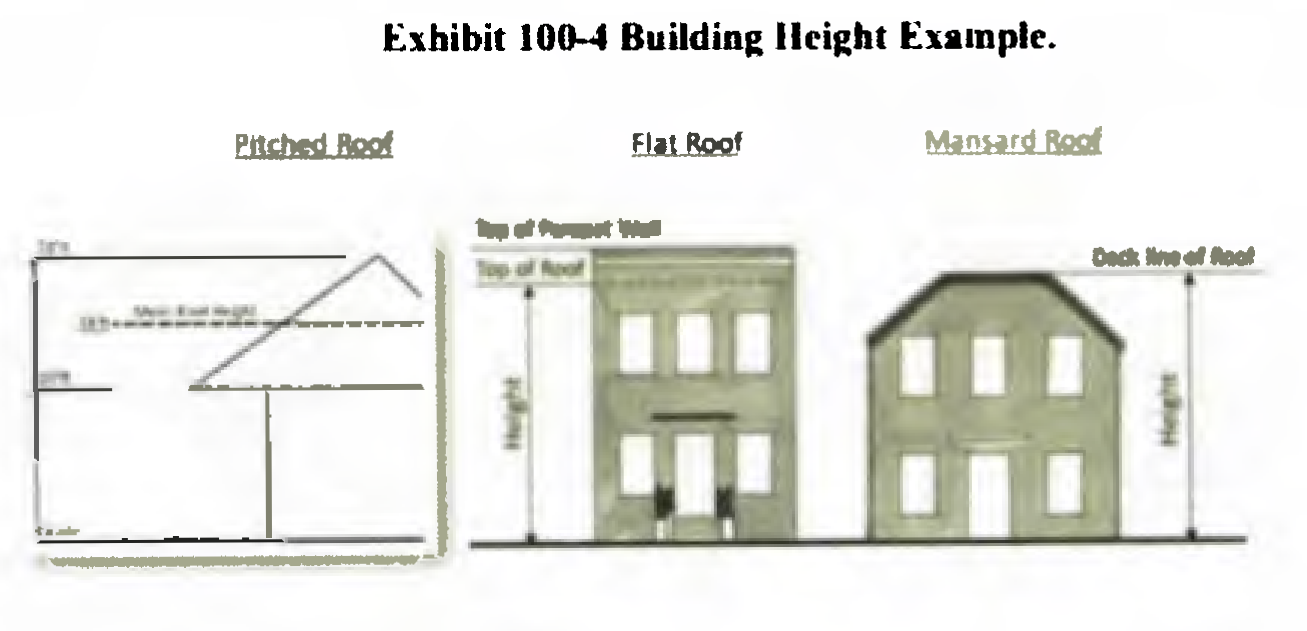
Height, Luminaire. The vertical distance from the normal finished grade directly below the centerline of the luminaire to the lowest direct-light-emitting part of the luminaire.
Helipad. A prepared area designated and used for takeoff and landing of helicopters and powered lift aircraft. Includes touchdown or hover point.
Heliport. An area, either at ground level or elevated on a structure, licensed, or approved for the loading and take-off of helicopters and powered lift aircraft, including auxiliary facilities such as parking, fueling, and maintenance equipment.
Herbicide. Any substance, chemical, toxic, element or composition thereof, commonly, or professionally known, identified as, or used, for the purpose of destroying, eradicating, eliminating, killing, stunting, or preventing weeds or the growth thereof.
Heritage Tree. A hardwood tree which is 18-inch dbh or greater, which is assigned a Grade B or better which does not include pine trees.
Highway. A long-distance, speed-movement thoroughfare designed for vehicle use, traversing open countryside. A highway should be relatively free of intersections, driveways, and adjacent buildings, otherwise it becomes strip development which interferes with traffic flow and human comfort. Variants include freeways, expressways, and parkways.
Home Appliances Collection Facility. Collection facility for discarded domestic and commercial appliances, such as refrigerators, ranges, washers, and water heaters.
Home Professional Office. An activity conducted for financial gain by a member of the household residing therein consisting of an office of a practitioner of a recognized and customary profession, which is clearly incidental and secondary to the use of the property for residential purposes and does not alter the exterior of the property or affect the residential character of the neighborhood.
Home Builders Showroom and Sales Center. Enclosed plumbing, electrical, and home building supply showrooms and sales center with associated assembly processes, including associated offices, showroom, sales center and indoor storage facilities. Size of the office, showroom and sales center shall be a minimum of 25 percent of the total square footage of the building.
Homeowners Association. A community association organized within a larger development site in which individual owners share common interests in open space or facilities. Such associations shall be registered with the Secretary of State of Louisiana.
Horizontal illuminance. The measurement of brightness from a light source, usually measured in footcandles or lumens, which is taken through a light meter sensor at a horizontal position.
Hospice. A facility or service used to care for the terminally ill.
Hospital or Sanitarium. An institution devoted primarily to the maintenance and operation of facilities for the diagnosis, treatment, or care for not less than 24-hours in any week, for 3 or more non-related individuals suffering from illness, disease, injury, deformity, or other abnormal physical conditions. The term "hospital" as used in this ordinance does not apply to institutions operating primarily for treatment of insane persons, drug addicts, liquor addicts or other types of cases necessitating restraint of patients and the term "hospital" shall not include convalescent, nursing, shelter, or boarding homes.
Hotel. One or more buildings containing individual living or sleeping units specially designed as temporary quarters for transient guests, including provisions for meals and personal services. This definition shall include hotels, extended stay hotels, motels, and inns.
House-Side Shield. Opaque material applied to a fixture to block the light from illuminating a residence or other structure being protected from light trespass.
Housing, types. Specific residential uses in accordance with Chapter 400, Sec. 400-2.1, generally referring to the structure and number of units within a residential building. Examples of housing types include single-family dwelling, two-family dwelling, multiple-family dwelling, and townhouse. For the purposes of this UDC, a variety of housing types shall mean two or more housing types.
Hydrologic and Sediment Transport Modifications. Uses and activities intended to change water circulation, direction of flow, velocity, level, or quality or quantity of transported sediment. Examples include locks, water gates, impoundments, jetties, groins, fixed and variable weirs, dams, diversion pipes, siphons, canals, and surface water and groundwater withdrawals.
- I -
Illuminating Engineering Society (IES). The professional society of lighting engineers, including those from manufacturing companies, and others professionally involved in lighting.
Illuminance. The density of luminous flux incident upon a surface. Illuminance is measured in footcandles (lumens/square foot) or lux (lumens/square meter). One footcandle equals 10.76 lux.
Impermeable. Solid and not permitting the passage of water; the opposite of porous.
Improvement, Public. Any improvement, facility, or service, together with customary improvements and appurtenances thereto, necessary to provide for such public needs as vehicular and pedestrian circulation systems, storm sewers, flood control improvements, water supply and distribution facilities, sanitary sewage disposal and treatment, public utility, and energy services.
Improvement, Substantial. Any repair, reconstruction or improvement of a structure, the cost of which equals or exceeds 50 percent of the market value of the structure. Term is applicable for both voluntary improvements to a structure and when a structure has been damaged and is being restored. The term does not include improvements to comply with existing state or local health, sanitary, or safety code specifications which are solely necessary to assure safe living conditions, or any alterations of a structure listed on the National Register of Historic Places or State Inventory of Historic Places.
Incinerator. Any enclosed device using controlled flame combustion that neither meets the criteria for classification as a boiler nor is listed as an industrial furnace and is not a boiler or an industrial furnace as defined in Louisiana Administrative Code, LAC 33:V.109.
Incompatible Use. See Use, Incompatible.
Indirect Light. Direct light that has been reflected or has scattered off of other surfaces.
Industrial User. Any entity/person who discharges or causes or permits to be discharged, any pollutants into a sewage system from any non-domestic source.
Industry. Any individual, partnership or corporation engaged in the manufacture, packaging, processing, or handling of any item of commerce for resale purposes within the parish, or any such establishment outside the limits of the parish, whose discharges flow into the parish. Clarification: hotels, motels, schools, office buildings, apartment houses, and other establishments that discharge only domestic wastes are not considered to be industries.
Infiltration. Water that unintentionally enters the public wastewater system, including water from sanitary building drains and laterals, from the ground through such means as, but not limited to, defective pipes, pipe joints, connections, or manhole walls.
Infrastructure. Those systems that support human social institutions and developments, including transportation systems, public utilities, water and sewerage systems, drainage, communications, educational facilities, health services, law enforcement and emergency preparedness.
Institution. A facility or federal, state, or local government, public or private utility, public or private school or college, church, public agency, or tax-exempt organization that provides a public service.
Interested Person. An applicant, adjoining property owner, council member, or district member impacted by a proposed activity, who self identifies in writing as a party specifically affected by a proposed activity.
Interference. A discharge which, alone or in conjunction with a discharge or dischargers from other sources, both:
- Inhibits or disrupts the sewage system, its treatment processes or operations or its sludge processes, use, or disposal; and
- Therefore is a cause of a violation of a requirement of the sewage system's NPDES permit (including an increase in the magnitude or duration of a violation) or of the prevention of sewage sludge use or disposal in compliance with the following statutory provisions and regulations or permits issued herein (or more stringent State): Section 405 of the Clean Water Act, the Solid Waste Disposal Act (SWDA) (including Title II, more commonly referred to as the Resource Conservation and Recovery Act (RCRA) and including state regulations contained in any state sludge management plan prepared pursuant to Subtitle D of the SWDA), the Clean Air Act, the Toxic Substances Control Act, and the Marine Protection, Research and Sanctuaries Act.
- J -
- K -
Kennel. Any premises, except where accessory to an agricultural use, where household animals are housed, groomed, bred, boarded, or trained for the use of the residents of the premises.
Kennel, Commercial. A facility for the keeping, training, grooming, or boarding of dogs, cats, and household pets.
Kitchen. Any room principally used, intended, or designed to be used for cooking or the preparation of food. The presence of a range or oven, or utility connections suitable for servicing a range or oven, shall normally be considered as establishing a kitchen.
Kitchen, Full Indoor. Any kitchen that is fully enclosed within a dwelling and includes a sink, refrigerator, oven and storage space (cabinets, drawers, etc.) traditionally associated with both preparing and serving food.
- L -
LA R.S. The Louisiana Revised Statutes.
Laboratory, Medical, Biomedical, Dental, Optical, Pharmaceutical. An establishment engaged in research concerning biology, microbiology, biochemistry, other life sciences, and general healthcare such as pharmaceutical research, biotechnical research, and other related life science and healthcare research.
Laboratory, Research, Development, Testing, and Related Production. An establishment which provides research, development, and testing services such as calibration services, soil testing, carbon monoxide testing, water testing, product testing, and other related testing services.
LaDOTD. The Louisiana Department of Transportation and Development, Office of Public Works.
Lake. Any body of water designated or named as a lake on any official maps of the State of Louisiana.
Lamp. A generic term for a source of optical radiation (i.e. "light"), often called a "bulb" or "tube." Examples include incandescent, fluorescent, high-intensity discharge (HID) lamps, and low pressure sodium (LPS) lamps, as well as light-emitting diode (LED) modules and arrays.
Lamp, Lowest Direct-Light Emitting Part (LDLEP). The lowest part of the lamp or lamps, the reflector or mirror, and/or refractor or lens.
Land Clearing. The removal of trees or timber from a tract of land so as to change the land from an agricultural or forestry use to development of any kind.
Land, Undeveloped. Land in its natural state before development.
Landfarm. A facility for the disposal of solid wastes in which wastes are applied to the land and/or incorporated into the soil for biological reduction and soil attenuation.
Landfill or Dump. All property, including negative and positive easements and water and air rights, which have been used by public and private entities for the disposal of solid wastes.
Landing Strip, Private. An airstrip restricted, except for aircraft emergencies, to use by the owner and, on an infrequent and occasional basis, by invited guests and by commercial aviation activities in connection with permitted uses of the land.
Landmark. Any improvement, any part of which is 30 years old or older, that has a special character or special historical aesthetic interest or value as part of the development, heritage, or cultural characteristics of the parish, state, or nation and which has been designated as a landmark.
Landmark Site. An improvement, parcel, or part thereof, on which is situated a landmark and any abutting improvement, parcel, or part thereof, used as and constituting part of the premises on which has been designated as a landmark site.
Landscape Area. The installation and permanent maintenance of an area with trees, shrubs, lawn, or planted ground cover to present an attractive, well-kept appearance. For the purposes of this UDC, there are 3 types of landscape areas, including:
Side and Rear Landscape Area. Areas of land located along the side and rear property lines, common to adjacent properties, designated for the preservation of trees and for the planting of trees, shrubs, and vegetated ground cover.
Street or Interstate Landscape Area. Area of land located along a public right-of-way, interstate, or street(s) of a non-residential property designated for the preservation of trees and for the planting of trees, shrubs, and vegetated ground cover.
Parking Lot Landscape Area. Areas located in the parking lot designated for the planting of trees, shrubs and vegetated ground cover.
Landscape Material. Material including but not limited to, living trees, shrubs, vines, lawn grass, ground cover, landscape water features, and non-living durable materials commonly used in landscaping including, but not limited to, rocks, pebbles, sands, decorative walls and fences, brick pavers, earthen mounds, but excluding paving for vehicular use.
Landscaping, Interior. A landscaped area within the interior of a development site that is planted with trees, shrubs, and ground covering material to provide for infiltration of runoff, shade of parking areas or aesthetic enhancement of the site.
Lane, Rear. A vehicular access way located to the rear of a lot providing access to parking and outbuildings as well as easements for utilities. Rear lanes are paved as lightly as possible to driveway standards or with gravel. Rear lanes should be as rural as possible in character. Buildings facing the rear lane must have windows. Posted speed should equal design speed.
Laser. A device emitting a narrow, very intense beam of light waves that have been amplified and concentrated by stimulated atoms, or the light produced by such device.
LDEQ. See Louisiana Department of Environmental Quality.
LDH. See Louisiana Department of Health, formerly known as DH&H, especially the Office of Public Health Operations, or its successor agency.
LDNR or DNR. The Louisiana Department of Natural Resources.
Lens, Single-Plane. A refractor of lens, mounted in the horizontal plane which allows direct light to be emitted only through the horizontal plane.
Levee. Any use or activity that creates an embankment to control or prevent water movement, to retain water or other material, or to raise a road or other linear use above normal or flood water levels. Examples include levees, dikes, and embankments of any sort. A manmade structure, usually an earthen embankment, designed and constructed in accordance with sound engineering practices to contain, control, or divert the flow of water so as to provide protection from temporary flooding.
Levee System. A flood risk reduction system that consists of a levee, or levees, and associated structures, such as closure and drainage devices, that are constructed and operated in accordance with sound engineering practices.
Levee, Hurricane or Flood Risk Reduction System. Those levees and associated water control structures whose primary purpose is to prevent occasional surges of flood or storm generated high water. Such levee systems do not include those built to permit drainage or development of enclosed wetland areas.
Levees, Development. Those levees and associated water control structures whose purpose is to allow control of water levels within the area enclosed by the levees to facilitate drainage or development within the leveed areas. Such levee systems also commonly serve for hurricane or flood protection but are not so defined for purposes of these guidelines.
Levees, Impoundment. Those levees and associated water control structures whose primary purpose is to contain water within the levee system either for the prevention of the release of pollutants, to create freshwater reservoirs, or for management of fish or wildlife resources.
Library. An establishment for the loan or display of books or objects.
Light Trespass. The shining of light produced by a luminaire beyond the boundaries of the property on which it is located.
Light, Direct. Light emitted directly from the lamp, off of the reflector or reflector diffuser, or through the refractor or diffuser lens, of a luminaire.
Light, Flood or Spot. Any light fixture or lamp that incorporates a reflector or a refractor to concentrate the light output into a directed beam in a particular direction.
Light, Glare. Light emitting from a luminaire with an intensity great enough to reduce a viewer's ability to see, and in extreme cases causing momentary blindness.
Light, Search. A strong or bright light with a reflector in a swivel so that its beam may be sent or directed in various directions.
Lighting Fixture (Cutoff). A luminaire which has a light distribution where the candlepower does not exceed 2.5% of the lamps' rated initial lumen output at an angle of 90 degrees above nadir, and does not exceed 10% of the lamps' rated initial lumen output at a vertical angle of 80 degrees above nadir. This applies to all lateral angles around the luminaire.
Lighting Fixture (Full Cutoff). A luminaire which has a light distribution where the candlepower does not exceed 0% of the lamps' rated initial lumen output at an angle of 90 degrees above nadir, and does not exceed 10% of the lamps' rated initial lumen output at a vertical angle of 80 degrees above nadir. This applies to all lateral angles around the luminaire.
Lighting Fixture (Fully Shielded). Constructed in such a manner that all light emitted by the luminaire, either directly or from the lamp or a diffusing element, or indirectly by reflection or refraction from any part of the luminaire, is projected below the horizontal. Unlike a full-cutoff fixture, a fully shielded fixture is not engineered to limit lumen distribution in the 80° to 90° zone.
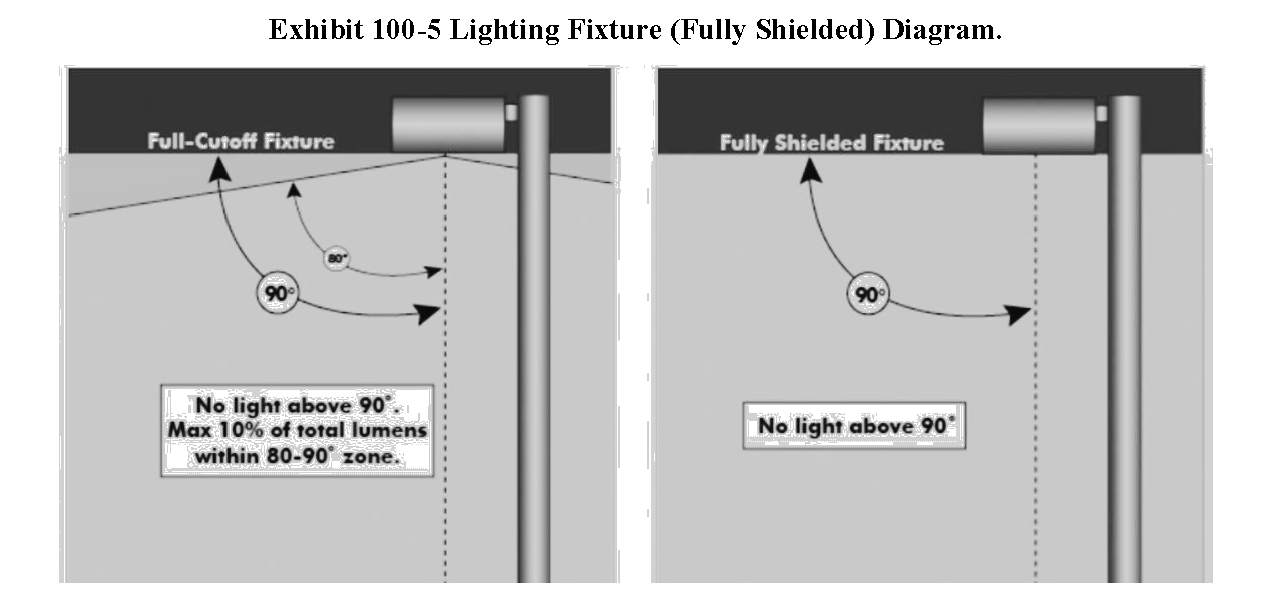
Lighting, Neon. Any tubular lighting of which the primary source of light is gaseous.
Lighting, Outdoor. The night-time illumination of an outside area or object by any man-made device located outdoors that produces light by any means.
Lighting, Temporary Outdoor. The specific illumination of an outside area or object by any man-made device located outdoors that produces light by any means for a period of less than 45 days, with at least 180 days passing before being used again.
Lights, Flashing. Any light or light source or reflection of light source which is intermittent in duration, color, or intensity or which creates or is designed to create an illusion of intermittency in duration, color, or intensity.
Linear facilities. Those uses and activities which result in creation of structures or works which are primarily linear in nature. Examples include pipelines, roads, canals, channels, and powerlines.
Limited Access Highway. A trafficway, including expressways and toll roads for through traffic, in respect to which owners or occupants of abutting property or lands and other persons have no legal right of access to or from the same, except at such points only and in such manner as may be determined by the public authority having jurisdiction over such trafficway.
Lodging, Full-Service Hotel. Distinguished by the abundant provision of food and beverage services for guests and groups. Hotels of this type have the ability to facilitate large meetings and special events, and generally have on-site restaurants, lounges, and meeting spaces. Spas, doormen, valet parking, extended room service, concierge services, and high-end restaurants are other distinguishing features of full-service hotels.
Lot. The smallest portion or parcel of land into which a subdivision or blocks or squares of the subdivision is divided.
Lot, Corner. A lot at the junction of and fronting on 2 or more intersecting streets.
Lot, Interior. A lot other than a corner.
Lot, Through. A lot having its front and rear lot lines on adjacent and substantially parallel streets, otherwise known as a double-frontage lot.
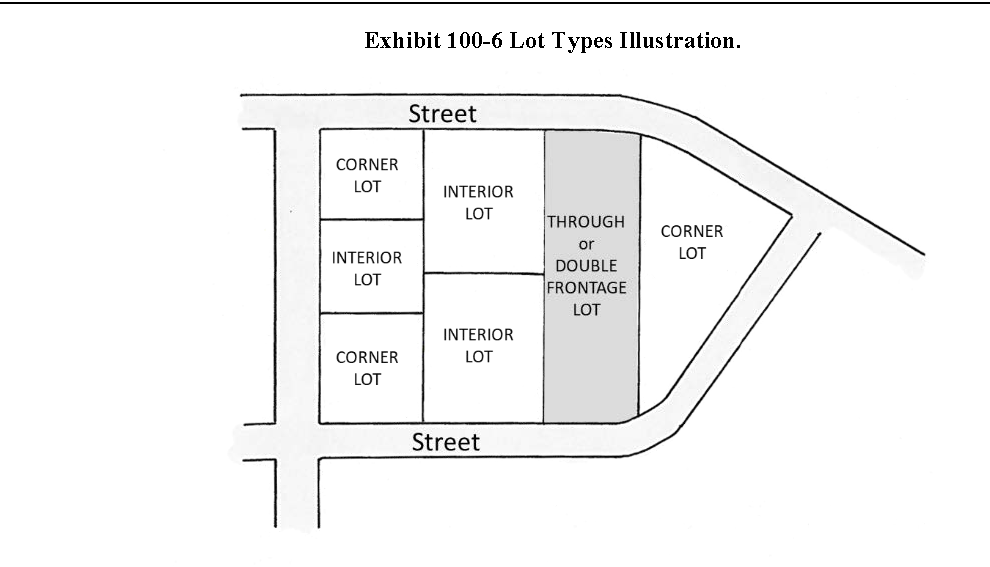
Lot Area. The area contained within the boundary lines of a lot.
Lot Coverage. The area of a lot occupied by the principal building or buildings and accessory buildings.
Lot Depth. The mean horizontal distance between the front and rear lot lines.
Lot Line. A line bounding a lot which divides one lot from another or from a street or any public or private space.
Lot Line, Adjoining a Street. A front lot line or a side lot line of a corner lot that abuts a street, or a rear line of a double frontage lot.
Lot Line, Front. The front property line of a lot. Clarification: For a corner lot, the property line lying exclusively between the Front Yard and the street Right-of-Way.
Lot Line, Interior. A side lot line common with another lot.
Lot Line, Rear. That lot line that is parallel to and most distant from the front lot line. Clarification: In the case of an irregular or triangular lot, a line 20 feet in length, entirely within the lot, parallel to and at the maximum possible distance from the front line, shall be considered to be the rear lot line. In the case of lots which have frontage on more than 1 road or street, the rear lot line shall be opposite the lot line along which the lot takes access to a street.
Lot Line, Side. Any lot line other than a front or rear lot line.
Lot of Record. A lot that is a part of a subdivision, the plat of which has been recorded in the office of the St. Tammany Clerk of Court, pursuant to statute.
Lot Width. The horizontal distance between Side Lot Lines measured at the front setback. Where there is only 1 Side Lot Line, Lot Width shall be measured between such Lot Line and the opposite Lot Line or future Right-of-Way line.
Louisiana Pollutant Discharge Elimination System or LPDES. The state program for issuing, conditioning, and/or denying permits for the discharge of pollutants into the waters of the state pursuant to the Louisiana Environmental Quality Act (LA RS 30:1051 et seq., as amended).
Louisiana Water Well Rules, Regulations, and Standards. The provisions of the Rules, Regulations, and Standards for Water Well Construction adopted by the LaDOTD in accordance with LA RS Title 38.
Lounge. An establishment for the sale and consumption of alcoholic beverages on the premises.
Lowest Direct-Light Emitting Part (LDLEP). The lowest part of either the lamp or lamps, the reflector or mirror, and/or refractor or lens.
Lumen. A unit of luminous flux. One foot-candle is 1 lumen per square foot. For the purposes of this Part, the lumen-output values shall be the initial lumen output ratings of a lamp.
Luminaire. This is a complete lighting system and includes a lamp or lamps and a fixture.
Luminaire Angle. The vertical (altitude) angle used in luminaire photometry to express the direction of the light output being measured. Light coming straight down is at 0° (the nadir).
Luminous Intensity. The luminous flux on a small surface centered on and normal to the direction divided by the solid angle (in steradians) that the surface subtends at the source. Luminous intensity can be expressed in candelas or in lumens per steradian.
Luminaire, Height. The height of a luminaire shall be the vertical distance from the normal finished grade directly below the centerline of the luminaire to the lowest direct-light-emitting part of the luminaire.
Luminance, Foot-Candles. A unit of measure for luminance. A unit of luminance on a surface that is everywhere 1 foot from a uniform point source of light of 1 candle and equal to 1 lumen per square foot.
- M -
Main Street or Thoroughfare. Includes any road, roadbed and road-wearing surface, situated in any subdivision, which constitutes the main roads or traffic arteries situated therein for the purpose of ingress or egress of vehicular traffic into and out of the subdivision and within the subdivision; same shall also automatically include roads which are separated by a median or other separation and also 4-lane roads providing for 2 lanes each for opposing traffic; whether or not so divided by a median or other device situated therein.
Maintenance and Repair, Normal. Activity taken to reasonably preserve the utility of a lawfully existing structure in active use for the year preceding the proposed activity. It does not include expanding an existing structure, dredging, and filling, or altering the magnitude or function of the original structure.
Major Street Plan. The element of the comprehensive plan adopted by the planning commission after public hearing which is designed to guide the future development of the parish
Manufactured Home. Synonymous with mobile home, means a factory-built, residential dwelling unit constructed to standards and codes as promulgated by the United States Department of Housing and Urban Development (HUD), under the National Manufactured Housing Construction and Safety Standards Act of 1974. Further, the terms "mobile home," "manufactured home," and "manufactured housing" can be used interchangeably and apply to structures bearing the permanently affixed seal of the United States Department of Housing and Urban Development or to factory-built, residential dwellings that are mounted on a chassis. Manufactured homes can be characterized by being affixed to a permanent foundation (fill, piers, pilings, or a slab) and once placed on a site and are no longer "road-ready," meaning that all wheels are removed, and the structure does not contain any portion of a self-propelled vehicle. Manufactured homes are also characterized by a red "HUD tag" and a "data plate" showing the wind zone for the structure and manufacturing information. Clarification:
- For floodplain management purposes, the term "manufactured home" also includes park trailers, travel trailers and other similar vehicles placed on a site for greater than 180 consecutive days.
- For insurance purposes, the term "manufactured home" does not include park trailers, travel trailers and other similar vehicles.
Manufactured Home Lot. A designated parcel of land in a Manufactured Home Park (or Mobile Home Park) designed for the accommodation of 1 manufactured home, its accessory buildings or structures, and accessory equipment for the exclusive use of the occupants.
Manufactured Home Park (or Mobile Home Park). A parcel or contiguous parcels of land that has been designated and improved so that it contains 4 or more manufactured home lots available to the general public for lease or rent.
Manufactured Home Skirting. Material that wraps around a manufactured or mobile home to enclose the crawl space beneath, obscure from view the structural elements below the manufactured or mobile home and provide the mobile and manufactured home with a finished appearance. Skirting can be made of brick, stucco, tin (metal), cinder block, plywood, lattice, hardy board, faux rock, and vinyl. When properly installed, skirting can reduce the likelihood of pipes freezing by maintaining an average temperature beneath the home, protect the home from small animals (such as rodents), retain heat and improve the appearance of the structure.
Manufacturing, Advanced. The development and production of high-value-added goods, including but not limited to electronics, medical equipment, technology components, and information technologies.
Manufacturing, Artisan. A manufacturing establishment for artisan-related crafts that are more intensive uses, such as small-scale metalworking, glassblowing, furniture making, pottery, leathercraft, hand-woven articles, and related items.
Manufacturing, Heavy. The manufacturing or compounding of raw materials, which may include the storage of large volumes of finished and raw materials that are highly flammable, toxic or explosive. Heavy manufacturing may involve outdoor operations as part of a manufacturing process. Typical heavy industrial uses include, but are not limited to concrete batch plants; concrete, tile, or brick manufacturing; motor vehicle and tire assembly; chemical processing, metal casting or foundries; gas manufacturing, grain milling or processing; refining, smelting, or alloying; and petroleum or petroleum products. Heavy manufacturing processes ordinarily have greater than average impacts on the environment or significant impacts on the use and enjoyment of adjacent property in terms of noise, smoke, fumes, odors, vibration, glare, or health and safety hazards.
Manufacturing, Light. Light manufacturing often involves the assembly of previously prepared materials of finished products or parts, including processing, fabrication, assembly, treatment and packaging of such products, and incidental storage, sales and distribution of such products, provided all manufacturing activities are contained entirely within a building and noise, odor, smoke, heat, glare, and vibration resulting from the industrial activity are confined entirely within the building.
Manufacturer's Catalog Cuts. A publication or other printed material of a bulb or lighting manufacturer offering visual and technical information about a lighting fixture or bulb.
Marina, Boat Launch Facility. A small-scale facility primarily for private, public, or member use with minimal storage and service functions.
Marina, Commercial. A facility offering a full range of marine services including mooring, launching, storing, sales, construction, and repairing of boats, including the sale of marine supplies and services, rentals, and chartering.
Marine or Boat Sales. The use of any building, land area and/or other premises for the display and sale of new or used boats, and recreational watercraft, including warranty repair work and other repair services conducted as an accessory use.
Marine Repair and Service. A facility for routine marine services and/or repairs, including engine services, hull repair, batteries, boat repair, where all work is conducted inside the building.
Marine Sanitation Device or MSD. Any device designed for the handling, storage and/or disposal of domestic waste (sewage) generated aboard a vessel or camp.
Marine Shipbuilding and Repair. An establishment engaged in the design, construction or repair of ships and other floating vessels.
Marsh. Wetlands subject to frequent inundation in which the dominant vegetation consists of reed, sedges, grasses, cattails, and other low growth.
Material, Supplemental. Any unlisted material deemed appropriate by the local administrator such as a description of the physical, chemical, hydrological, biological, and cultural environment in which the activity is proposed to take place; a complete description of expected consequences to the physical, chemical, hydrological, biological, and cultural environment; evidence to support the proposal's intended results and how the projected results, both positive and negative, may be monitored in the future, etc.
Mechanical Plant, Individual. Any individual sewage system that employs aerobic bacterial action that is maintained by mechanical aeration.
Median or Neutral Ground. The area dividing or separating a roadway and not used for right of passage.
Medical Facility, Accessory Cafeteria. A facility engaged in food preparation as part of a medical facility.
Medical Facility, Accessory Housing. Housing and support facilities for resident staff, as part of a permitted medical research facility.
Medical Facility, Accessory Laboratory. A facility related to an adjacent medical facility for the purpose of conducting laboratory testing.
Medical Facility, Clinic. An establishment where patients who are not lodged overnight are admitted for examination and treatment by a group of physicians practicing medicine together.
Medical Facility, Hospital. An institution devoted primarily to the maintenance and operation of facilities for the diagnosis, treatment, or care for not less than 24 hours in any week, for 3 or more non-related individuals suffering from illness, disease, injury, deformity, or other abnormal physical conditions. The term "hospital" as used in this ordinance does not apply to institutions operating primarily for treatment of insane persons, drug addicts, liquor addicts or other types of cases necessitating restraint of patients and the term "hospital" shall not include convalescent, nursing, shelter, or boarding homes.
Medical Supply, Retail or Wholesale. A facility that engages in the retail sale or wholesale of medical, surgical, and dental production and supply.
Methadone Center or Clinic. A methadone center or clinic sponsored or operated by a non-profit, charitable, or for-profit entity or by a public agency are subject to licensure by the State of Louisiana whose purpose is the dispensing of controlled substances in connection with or related to the rehabilitation of drug abusers.
Microbrewery. Means a retail establishment wherein beer and other malt beverages are brewed in small quantities, not to exceed fifteen thousand barrels of beer a year, and where such beverages are sold at retail for consumption on or off the licensed premises, subject to applicable state and local laws.
Microdistillery. Means a retail establishment wherein alcoholic spirits are distilled in small quantities, not to exceed 10,000 proof gallons per year, and where such spirits may be sold at retail for consumption on or off the licensed premises, subject to applicable state and local laws.
Minerals. Oil, gas sulfur, geothermal, geopressured, salt, or other naturally occurring energy or chemical resources which are produced from below the surface in the coastal zone. Not included are such surface resources as clam or oyster shells, dirt, sand, or gravel.
Minimum Values: Minimum values are standardized values or thresholds based on best practices that create consistency in applying the intents and purposes of this UDC.
Mitigation. All actions taken by an applicant to avoid, minimize, restore, and compensate for loss of an area's ability to support vegetation, fish, and wildlife populations due to a permitted activity.
Mixed Use Development: A land use classification that means a development which allows for the combination of residential, commercial, office and/or recreational land uses, where land uses are physically and functionally integrated and provide pedestrian connections. The form of mixed use can encompass a single building or neighborhood. Mixed use development may be horizontal or vertical in design.
Mobile Home. See Manufactured Home.
Modular Home. Homes that are designed, built, permitted and inspected and must be installed on permanent foundations (e.g., poured footers, stem walls & poured piers or engineered slabs, as with site-built homes) that are designed and built specifically for that home by a contractor licensed by the State.
Moratorium. The delay in the issuance, ceasing, halting, negating, recall or avoidance of building permits for the construction of dwellings, single- or multi-family, townhouses, condominiums, schools, libraries, commercial buildings, industrial construction, or of any private or public buildings of whatsoever nature or kind, and accessory buildings and structures thereto.
Motor Vehicle. Any passenger vehicle, truck, tractor, tractor-trailer, truck-trailer, trailer or semi-trailer propelled or drawn by mechanical power.
Municipal Separate Storm Sewer System (MS4). A collection of structures, including retention basins, ditches, roadside inlets and underground pipes, designed to gather stormwater from built-up areas and discharge it, without treatment, into local streams and rivers.
Mulch. Any material that is used to cover the ground surface to prevent erosion, retain moisture and protect plant material.
Multi-Occupancy Center. A single building or group of buildings situated in close proximity to each other that house more than 1 tenant or owner and whose parking facilities may be in common with other tenants, owner, or buildings, except those businesses that engage in the sale of automobile fuel products and other goods and services including, but not limited to, fast food restaurants and convenience stores.
Murals. A work of art painted or otherwise applied to exterior wall surfaces that does not advertise any specific use by virtue of the use of trademarks, corporate names, or logos.
Museum. A nonprofit, noncommercial establishment operated as a repository or a collection of nature, scientific, or literary curiosities or objects of interest of works of art, not including the regular sale of distribution of the objects collected.
- N -
Nadir. A point on the celestial sphere directly below the observer, diametrically opposite the zenith.
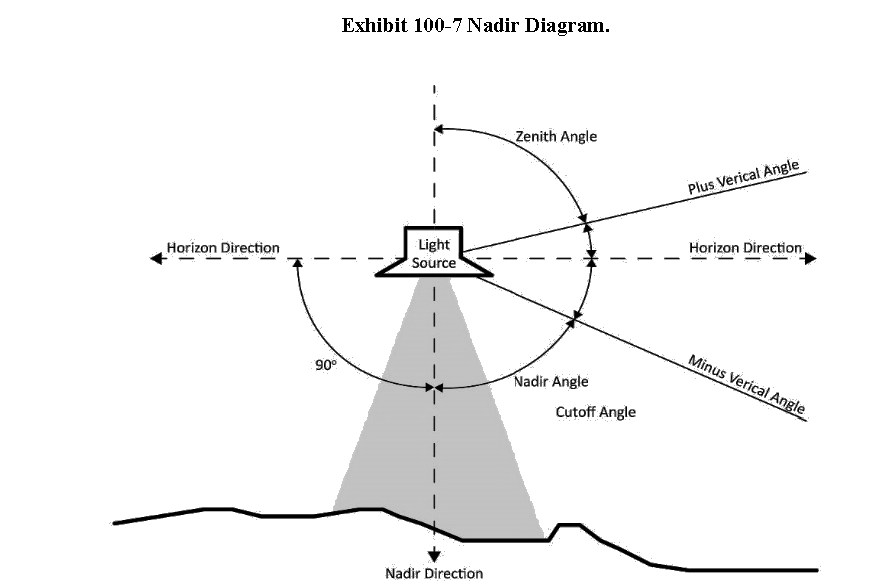
National Pollutant Discharge Elimination System or NPDES. The federal program for issuing, conditioning and/or denying permits for the discharge of pollutants from point sources pursuant to Section 402 National Pollutant Discharge Elimination System of the Clean Water Act.
Natural Area. A vegetated, natural area around the boundaries of a lot, series of lots, or subdivision, the purpose of which is to reduce flooding and erosion, to preserve native screening and habitat (including understory trees), to promote water and air quality, and to maintain the natural aesthetic beauty of the parish.
Natural Ground. The natural or pre-development elevation of the property, prior to any surface alteration work being performed.
Neighborhood. An area of a community with characteristics that distinguish it from other community areas, and which may include distinct ethnic or economic characteristics, schools or social clubs, or boundaries defined by physical barriers such as major highways, railroads, or natural features.
Neon lighting. Any tubular lighting of which the primary source of light is gaseous.
Net Acre. An acre of land excluding street Rights-of-Way and other publicly dedicated improvements such as parks, open space, and stormwater detention and retention facilities.
NFPA 110: Standard for Emergency and Standby Power Systems. National Fire Protection Association's standards establishing performance requirements for power systems providing an alternate source of electrical power to loads in buildings and facilities in the event that the normal power source fails.
Nonconformance. A condition that occurs when, on the effective date of adoption of this code or a previous ordinance or on the effective date of an ordinance text amendment or rezoning, an existing lot, structure, building, sign, development, or use of an existing lot or structure does not conform to 1 or more of the regulations currently applicable to the district in which the lot, structure, building, sign, development, or use is located.
Nonconforming Activity. An activity that, under the zoning regulations, is not itself a permitted activity where it is located or does not conform to the off-street parking or loading requirements, performance standards, or other requirements applying to activities. However, an activity of the character described above shall not be deemed a nonconforming activity to the extent that it has been or is hereafter authorized by a subsisting conditional use permit, variance, or other special zoning approval.
Nonconforming Feature. A characteristic of a building or property, such as signs, parking, loading, landscaping, performance standards, or condition of a special/provisional use that lawfully existed prior to the enactment of the requirements of this UDC but does not comply with the current requirements of this UDC.
Nonconforming Lot. A lot that does not meet the zoning district requirements for area, width, or depth of this Ordinance.
Nonconforming Structure. A structure that fails to meet standards for bulk and dimensional regulations, including, but not limited to, floor area, open space, height, and yard requirements as required by the UDC. A legal nonconforming structure is a structure that legally existed prior to enactment of the current Ordinance and was legally maintained after the effective date of the Ordinance.
Nonconforming Use. A use which was legally established but which is no longer classified as a permitted use or no longer classified as a special use in the zoning district in which it is located.
Noxious Matter or Materials. Matter that is capable of causing injury to living organisms by chemical reaction or is capable of causing detrimental effects upon the physical or economic well-being of individuals.
Nursery. Any land use involving the raising of trees, shrubs, flowers, and other plants for sale for transplanting.
Nursing Home. A use providing bed care and inpatient services for persons requiring regular medical attention but excluding a facility providing surgical or emergency medical services and excluding a facility providing care for alcoholism, drug addiction, mental disease, or communicable disease.
- O -
Occupancy. Pertains to and is the purpose for which a building is used or intended to be used. A change of occupancy is not intended to include a change of tenants or proprietors.
Office. An establishment for the conduct of a variety of businesses in an office setting completely enclosed within a structure designed for or used as the offices of professional, commercial, industrial, religious, public or semi-public persons or organizations.
Office, Temporary Construction/Sales. A structure or other facility temporarily used as a construction office or sales office.
Office, Temporary Real Estate. The temporary use of a dwelling unit within a residential development project as a sales or rental office for the units on the same site, which is converted to residential use at the conclusion of its office use.
Office, Warehousing. A facility that has the combined uses of office and showroom or warehouse for the primary purpose of wholesale trade, display, and distribution of products.
Off-Site. Located outside the lot lines of the lot in question or development location.
Oil, Gas, and Other Mineral Activities. Those uses and activities that are directly involved in the exploration, production, and refining of oil, gas, and other minerals. Examples include geophysical surveying, establishment of drill sites and access to them, drilling, on site storage of supplies, products and waste materials, production, refining, and spill cleanup.
On-Location Television or Film Productions (No Sets). On location television or film productions where no sets/structures are being constructed that would require the issuance of a building permit, specifically structures must be of a temporary nature and not capable of being occupied under the International Building Code/International Residential Code as determined by the Chief Building Official, or their designee.
On-Location Television or Film Productions (Sets). On location television or film productions where sets/structures are permitted when meeting all applicable codes of the relevant zoning district and require the issuance of a building permit as determined by the Chief Building Official or his/her designee.
On-Site. Located on the lot that is the subject of a development location.
Open Space. An unoccupied space open to the sky on the same lot with the building. Bodies of water, including but not limited to pools, lakes, ponds shall not be included in the calculation of open space. For Planned Unit Developments, open space refers to land retained for use as active or passive recreation areas or for resource protection in an essentially undeveloped state.
Open Space, Common. Parcel(s) of land held in some form of common ownership and designated, designed and intended for benefit, use or enjoyment of the occupants of a development. It may contain such complementary structures and improvements as necessary and appropriate for the benefit and enjoyment of the occupants of such development.
Open Space, Public. Any publicly owned open area, including but not limited to parks, playgrounds, school sites, parkways, and streets.
Operator or Operators. Any person who alone or jointly or severally with others conducts, directs, manages, or supervises the operation and/or maintenance of any premises, facilities, or equipment affected by these Rules and Regulations.
Ordinance. A legally adopted law or regulation.
Outdoor Dining, Accessory Use to a Restaurant. Outdoor seating and tables accessory to a restaurant that is allowed within the applicable zoning district and complies with the applicable regulations.
Outdoor Contractor Yard. An outdoor area where vehicles, equipment, merchandise, raw materials, or other items are accumulated and stored for an indefinite period in accordance with minimum requirements of the UDC. Storage yards are often used in conjunction with a warehouse or storage buildings. Outdoor Contractor Yards are not inclusive of wrecking yards or yards used in whole or in part for a scrap or salvage operation.
Outdoor Display Area of Pre-Assembled Accessory Building, Pool, or Playground Equipment. The use of property for the display and sales of products, primarily outside of a building or structure, including but not limited to playground equipment, swimming pools, and portable storage sheds.
Outdoor Lighting. The night-time illumination of an outside area or object by any man-made device located outdoors that produces light by any means.
Outdoor Retail Sales. A facility for the sales of home, lawn, and garden supplies, brick, lumber, and other similar building material, use in conjunction with a home improvement center, a hardware store or a department store.
Overflow of Inland or Tidal Waters. The unusual and rapid accumulation or runoff of surface waters from any source.
Owner or Owners. Any person or persons who alone or jointly or severally with others has legal title to any premises, facilities or equipment affected by this Section; and/or actual physical control of any premises, facilities or equipment affected by this Part pursuant to an agreement, expressed or implied from the circumstances, with the owner or owners.
- P -
Parcel. The area within the boundary lines of a development, including a tract or plot of land of any size that may or may not be subdivided or improved. See also Lot or Lot of Record.
Parish. The unincorporated portion of St. Tammany Parish.
Parish Council. The official elected governing body of St. Tammany Parish.
Park, Local, State, or National. A parcel of ground set apart for recreation for the public, to promote public health, and enjoyment.
Parking Access. The area of a parking lot that allows motor vehicle's ingress and egress from the street.
Parking Lot. An off-street ground-level area usually surfaced and improved, for the temporary storage of motor vehicles.
Parking Structure, Public. An open, off-street, hard-surfaced area, other than a street or alley, used for the storage of passenger automobiles and commercial vehicles under 1 and one-half ton capacity and available to the public, whether for compensation, free or as an accommodation to clients or customers.
Parking, Off-Street. A temporary storage area for motor vehicles directly accessible to an access aisle, and which is not located on a dedicated street or Right-of-Way.
Parking, On-Street. A temporary storage area for motor vehicles that is located on a dedicated Right-of-Way.
Passage. A pedestrian connector passing between buildings. Passages provide shortcuts through long blocks and connect rear parking areas with street frontages. Passages may be roofed over and lined by shopfronts. Variants include courts, a passage that is wide enough to be landscaped, being the frontage for buildings which are otherwise provided with vehicular access only by rear alleys.
Path. A pedestrian way traversing a park or the countryside. Paths should connect directly with the sidewalk network at the urban edge.
Performance Standard. A criterion established to control noise, odor, smoke, toxic or noxious matter, vibration, fire and explosive hazards, or glare or heat generated by, or inherent in, uses of land or buildings.
Permit. A written document issued by a regulatory agency that authorizes the installation, construction and/or operation of a system regulated structure, use or activity.
Permit, After-the-Fact. A permit issued after the commencement of an activity or use. Such a permit may only be issued after all legal issues resulting from the commencement of a use without a permit have been resolved.
Permit, Building. Written permission issued by the Department of Permits and Inspections authorizing construction, repairs, alterations, or changes of use and plan revisions to any structure.
Permit, In-Lieu. Those permits issued in-lieu of coastal use permits pursuant to Section 214.31 of the SLCRMA.
Permit, Site Work. A permit that must be obtained from the Parish prior to engaging in excavation, grading, filling, or stockpiling activities.
Permittee. A person issued a permit under this Part, including any agent, servant, or employee of the permittee.
Personal Service Establishment. An establishment or place of business primarily engaged in the provision of frequent or recurrent services of a personal nature. Typical uses include, but are not limited to beauty shops, barbershops, tanning salons, massage therapy studios, wellness spas, wellness centers, weight loss centers, animal grooming, shoe repair, personal item repair shops, laundromats, dry cleaners, and tailors. Personal services establishments shall not include any adult uses.
Person. Any individual, partnership, co-partnership, firm, company, corporation, association, joint stock company, trust, estate, governmental entity or any other legal entity, or their legal representatives, agents, or assigns. This definition includes all federal, state, or local governmental entities.
Person, Private. Any individual, group of individuals, firm, corporation, association, partnership, private entity or other legal entity, or any agent thereof.
Person, Responsible. The operator or operators of an on-site sewage disposal system, the owners or owners of an on-site sewage disposal system, the owner, or owners of the property on which an on-site sewage disposal system is located, or any or all of them.
Pervious Surface. Surface materials that allow for the infiltration of surface runoff into the earth and not otherwise classified herein as impervious surfaces.
Petroleum Product Storage. A facility for the bulk storage of petroleum products and gases provided that all above and below ground storage tanks comply with applicable standards set forth in the rules and regulations of the State Fire Marshal.
Petroleum Refining and Manufacturing. A facility for the refining, processing, or manufacturing of petroleum and petroleum-based products such as asphalt and tar paving mixtures; asphalt and other saturated felts (including shingles); fuels; lubricating oils and greases; paving blocks made of asphalt, creosoted wood, and other similar products from petroleum.
Place of Worship. A building, together with its accessory buildings and uses, where persons regularly assemble for religious worship, and which building, together with its accessory buildings and uses, is maintained, and controlled by a religious body organized to sustain public worship.
Planned Unit Development. A Planned Unit Development (PUD) is a zoning designation intended to create a built environment superior to that which is accomplished through conventional zoning districts and development standards. A PUD District is authorized by Parish Council Ordinance pursuant to the process outlined in Chapter 200 of the UDC.
Plantable Soil. Topsoil that contains organic material; is prepared with the intent to support vegetative growth and through the removal of rock, gravel, construction debris, and roots (as applicable); and is not primarily composed of inorganic matter (sand, silt and clay).
Plant Material. Any plant including trees, vines, shrubs, Ground Covers and annuals or vegetation of any size, species, or description.
Planting Areas, Side and Rear Yard. An area of land between the property line and any vehicular use areas or building that is intended for the placement or preservation of landscape materials.
Plat or Subdivision Plan. A map representing a tract of land, showing the boundaries and location or individual properties and streets, or a map of a subdivision or a site plan. For the purposes of this UDC, there are 3 types: Concept Plan, Final Plat and Construction Plans, and As Built Plans.
Concept Plan. The Concept Plan is the first plan of the subdivision that determines if a development proposal is feasible and practical, ensuring that the proposed land uses, intensities, and street layouts are consistent with the parish comprehensive plan and this UDC prior to the commencement of detailed studies and plans.
Final Plat and Construction Plans. The Final Plat and Construction Plans are detailed plans demonstrating compliance with the UDC, by which the construction of sewerage and/or water system, streets, drainage structures and channels are executed. Approval of the Final Plat and Construction Plan effectively approves the layout of the subdivision and authorizes construction of proposed sanitary sewer, water system, streets, and drainage systems upon issuance of a parish work order.
As Built Plans. As Built Plans are developed after construction of the subdivision is completed, including installation of the required infrastructure improvements. Approval of As Built Plans effectively confirms the required infrastructure improvements are constructed or installed per the approved Final Plat and Construction plans; authorizes recordation of the final subdivision plat with the Clerk of Court; and authorizes the sale and development of the lots, parcels, or tracts.
Playground. A publicly owned area for active and passive recreational use primarily by children.
Political Entity. Any agency, board, commission, department, or political subdivision of the State of Louisiana, or of the governing authority of the Parish of St. Tammany, or any agent thereof
Pond, Detention. A man-made basin designed to protect against flooding by storing stormwater runoff for a limited period of a time.
Pond, Dry. A detention pond designed to hold water for a short period of time before allowing the water to discharge to a nearby stream.
Pond, Retention. A permanent, natural, or man-made structure that provides for the storage of stormwater runoff by means of a permanent pool of water.
Pond, Wet. A retention pond or constructed basin that has a permanent pool of water throughout the year, or throughout a wet season. Note: The primary pollutant removal mechanisms for wet ponds include sediment settling and pollutant uptake, particularly of nutrients, through biological activity in the pond.
Porch. A roofed-over structure, projecting out from the wall or walls of a main structure and commonly open to the weather in part.
Post Office. A facility for mailing packages and letters, with post office boxes, offices, vehicle storage areas, and sorting and distribution facilities for mail.
Premises. A parcel of land and all buildings and structures thereon.
Private Person. Any individual, group of individuals, firm, corporation, association, partnership, private entity or other legal entity, or any agent thereof.
Processing. A series of operations, usually in a continuous and regular action or succession of action carried on in a definite manner.
Public Hearing. A meeting at a place and time publicly advertised in accordance with open meetings laws, open to the general public, and conducted either by the governing body of the Parish or by a committee of its members appointed and designated by the governing body. Such meeting shall be conducted under the normal and regular rules applicable to such hearings.
Public Safety Training Facilities. Specialized facilities designed for the instruction and simulated practice of emergency response personnel, including but not limited to fire, police, and EMS staff. Uses may include training towers, driving courses, shooting ranges, live fire simulators, and other scenario-based instruction areas.
Pump Station or Lift Station. A structure housing pumps and their appurtenances that conveys wastewater to either a privately owned or publicly owned sanitary sewer or treatment works.
Pumping Station. A facility for the transmission of water.
- Q -
Queuing. The use of 1 travel lane on local streets with parking, usually an intermittent parking pattern, on both sides.
Quorum. A majority of the full authorized membership of a board or agency.
- R -
Radio and Television Studio and Broadcasting Station. A facility for video or audio productions are filmed and broadcasted.
Radio and Television Studio Broadcasting Transmitters. An establishment primarily engaged in the provision of broadcasting and other information relay services accomplished through the use of electronic and telephonic mechanisms.
Railroad Right-of-Way. A strip of land with tracks and auxiliary facilities for track operation, but not including depots, loading platforms, stations, train sheds, warehouses, car shops, car yards, locomotive shops, or water towers.
Rated Light Output. The sum of the initial rated lamp lumens of the lamp(s) that were supplied with the luminaire.
Reception Facility. An establishment that functions as a hosting and rental facility or banquet hall for private events including, but not limited to, wedding receptions, holiday parties, and fundraisers, with food and beverages that are prepared and served on site or by a caterer to invited guests during intermittent dates and hours of operation. Clarification: A reception facility is not operated as any kind of restaurant or bar with regular hours of operation. Live entertainment, excluding adult uses, may be included as an ancillary use of the private event and is not subject to a separate approval. Any business operating as a designated reception facility is not considered casual, temporary, or illegal due to the nature of the business operating intermittently for scheduled events with food and beverage service at the request of clients. Events scheduled by non-owners and/or operators shall be held a minimum of 15 times per year to uphold a legal operating status as a reception facility.
Recreation, "Active." Land uses including and comparable to playgrounds, ball fields, swimming pools, and tennis courts.
Recreation, "Passive." Land uses including and comparable to picnic areas, permeable nature trails, and undisturbed natural habitat.
Recreation, Commercial. Facilities engaged in providing amusement, entertainment or recreation for a fee, admission charge or in association with the sale of products on the premises including, but not limited to such activities as dance halls, dance studios, theatrical productions, bands, orchestras, other musical entertainment, bowling alleys, billiard and pool establishments, commercial sports arenas, racetracks, miniature golf courses, golf courses, game parlors, or axe throwing, escape, or rage rooms.
Recreational Vehicle or RV Park. An area or commercial campground for users of recreational vehicles, travel trailers, and similar vehicles to reside, park, rent, or lease on a temporary basis.
Regional Commercial or Office Center. A coordinated development site that includes office, commercial, or advanced manufacturing land uses; provides a regional economic impact; and may be permitted to meet Code requirements across lot lines in accordance with standards and criteria provided for within the Regional Business Center Overlay in Chapter 400 - Zoning, Sec. 400-7, Overlay Districts.
Regional Planning Commission. The Regional Planning Commission for Jefferson, Orleans, Plaquemines, St. Bernard, St. Tammany, and Tangipahoa Parishes, is a 31-member board of local elected officials and citizen members, appointed to represent each community on regional issues in accordance with Chapter 100, Sec. 100-3.
Reinforcement. Includes mesh, rods and/or a mixture of materials to provide per square-inch strength imposed and required by LaDOTD for the installation and construction of highway traffic arteries.
Research and Development or R&D. An establishment engaged in scientific, engineering, medical, and/or electronic research, development, and manufacturing.
Residence, Temporary. A dwelling for the purpose of providing residence on a limited term basis no more than 6 months.
Residence. Any structure occupied customarily or most of the time as a dwelling; a place of primary residence.
Residential. Activities within land areas used predominantly for housing.
Residential lot. Any lot used for residential purposes.
Residential Care Facility. An adult residential care home/facility licensed as required by the LDH that provides (attached or detached) housing and a coordinated array of supportive personal services; 24-hour supervision and assistance (scheduled and unscheduled), activities, and health-related services that are designed to allow the individual to reside in the least restrictive setting of their choice, to accommodate individual resident's changing needs and preferences, to maximize the resident's dignity, autonomy, privacy and independence, and to encourage family and community involvement. Said facility may include an age restricted adult housing component (attached or detached) for which LDH does not require licensing, but in which the residents are provided assistance with activities of daily living and access to the activities, functions and health related services offered to residents of the associated LDH licensed portion of the facility in order to meet the health care needs of the residents. Furthermore, said residents shall be required by said facility to pay the facility a recurring uniform fee for the costs of said activities, functions, and health related services. The age restrictions must be in accordance with all applicable laws.
Residential Facility, Child. Any place, facility or home operated by any institution, society, agency, corporation, person or persons or any other group licensed by the State to provide 24-hour residential care for 4 or more children under the age of 18 years who are not related to the operators, and whose parents or guardians are not residents of the same facility, with or without transfer of custody.
Residents. Both real persons and entities whose occupancy in St. Tammany Parish is of an on-going, primary nature. These include, but are not limited to, civic, environmental, neighborhood, business, labor, trade, or similar organizations or a legally recognized business entity.
Responsibility for On-site Inspections. The responsibility of the developer to retain a registered civil engineer, to provide for on-site inspections and observation during all construction activities, including those contingent herein and drainage. Said engineer shall provide periodic inspection reports to the engineering department for review and filing.
Responsible Person. The operator or operators of a sewerage or water system, the owner or owners of a sewerage or water system, the owner or owners of the property on which a sewerage or water system is located, or any or all of them.
Restaurant, Delicatessen. An establishment where food is sold for consumption off-premises and no counters or tables for on-premises consumption of food are provided. Clarification: Excludes groceries and supermarkets.
Restaurant, Dine-In with Full-Service Bar. A business establishment whose purpose and primary function is to take orders for and serve food and food items for consumption primarily within the principal building and includes a permanent wet bar equipped with a non-movable sink and a backbar or similar equipment for public display and to inform the public of alcohol brands and flavors for sale so as to qualify for the issuance of a Class A-General retail alcoholic beverage permit where alcoholic beverages are sold for consumption on the premises by paying customers.
Restaurant, Dine-In without Full-Service Bar. A dine-in restaurant without a permanent wet bar with non-movable sink or backbar or similar equipment for public display of alcohol brands and flavors for sale. Such use does not require a Class A-General retail alcoholic beverage permit.
Restaurant, Drive-Thru. An establishment whose principal business is the sale of pre-prepared or rapidly prepared food directly to the customer in a ready-to-eat state for consumption either within the restaurant building or off-premises.
Restaurant, Full Service. An eating and drinking establishment that sells food and alcoholic beverages for consumption on premise.
Restrictive Covenant. A restriction on the use of land in a binding agreement, such as a deed, that runs with the land and is binding upon subsequent owners of the property.
Retail Establishment. A commercial enterprise that provides physical goods, products (including food), or merchandise directly to the consumer, where such goods are typically available for immediate purchase and removal from the premises, not including adult uses or the sale of alcoholic beverages where separate approval may be required for such use in accordance with the UDC. Can include but not limited to convenience, clothing, hobby, toy, print, florist, home décor, and antique shops and stores. A retail establishment that sells food products, such as a delicatessen, bakery, or grocery, may also offer ancillary seating areas for consumption of food on the premises.
Retention Pond. See Pond, Retention.
Revocation. The surrender of any rights, titles, or interests by the parish in any public road, street or alley and the improvements thereunto.
Rezone. To amend the zoning classification of particular lots or parcel of land, including amendment of the official zoning map and/or the future land use map.
Right-of-Way. Any public way, street, road, alley, easement, servitude, or access, which was dedicated to or acquired by the Parish to provide means of access to abutting properties; whether paved, improved, or unimproved, including those areas dedicated for proposed or future uses.
River. Any stream or body of water that has a current flow and is designated as a river or bayou on any official map.
Road. Includes street, highway, boulevard, and any other way, whether public or not.
Road Closings. Indicates that the street, road or alley or portion thereof is no longer needed for public use at that particular time, upon the review and findings of fact by the St. Tammany Parish Planning Commission and St. Tammany Parish Council. Said street, road or alley may be declared private and therefore restricted in use and maintained in common by the private property owners abutting said street, road, or alley. Closings may be declared by ordinance for an indefinite period of time or reviewed on an annual basis for reconsideration.
Road Frontage. The contiguous linear distance of the line separating the lot from a street.
Road Maintenance System, Parish. Those roads, streets and alleys that have been placed on a roster or list as adopted by the Parish Council by ordinance, signifying that said roads, streets and alleys are to be maintained by the Department of Public Works.
Road, Rural. A thoroughfare with open swales drained by runoff percolation and no separate pedestrian path. Trees along rural roads consist of multiple species composed in clusters.
Roadside or Road Shoulder. Natural or dedicated areas that are parallel, contiguous to, abut, adjoin, border, edge, connect or approach any public Right-of-Way, road, street, or highway.
Roadway Abandonment. Any existing and maintained local road, street, or alley that cannot or should not be maintained because the expenses thereof cannot be justified. In such a case, the property shall revert to the current property owners on each side of the abandonment from the centerline of the street as prescribed by statutory law.
Roadway Revocation. The surrender of any rights (with the exception of mineral rights), titles, and interests by the Parish in any publicly or tacitly dedicated road, street, or alley and the improvements thereunto, if any.
Roof. An overhead structure used for protection or shielding from the sun, rain, or other elements of weather.
Roof Shed Area. The area located directly underneath the roof, eaves, or other structural components of a structure or building.
- S -
Sales, Fireworks. An establishment for the retail sale of fireworks and related products.
Salvage Yard. A yard or building where automobiles or machinery are stored, dismantled and/or offered for sale as whole units, as salvaged parts, or as processed metal.
Salvage. The utilization of waste material.
Sanitary Sewerage. Human, domestic or acceptable industrial waste, except refuse, including conveying liquid from residences, buildings, industrial establishments or other places, together with such groundwater, surface water, stormwater and other wastes as may be present.
School. A building or part thereof designed, constructed, or used for educational or instructional purposes.
School, Business. An enterprise offering instruction and training in a service industry or the arts such as secretarial, barber, commercial artist, computer software and similar training.
School, Technical. A business enterprise offering instruction and training in a trade such as welding, bricklaying, machinery operation and other similar trades or crafts.
Screen, Sight Obscuring. A 100 percent opaque, non-living, visual screen with a minimum height of 6 feet; or a minimum 70 percent sight obscuring living screen with a minimum of 4 feet in height immediately after planting and consisting of plants that reach a minimum of 6 feet in height at maturity.
Sea Level, Mean. For purposes of the National Flood Insurance Program or NFIP, the National Geodetic Vertical Datum (NGVD) of 1929, North American Vertical Datum of 1988 (NAVD 88), or other datum, to which base flood elevations shown on a Community's Flood Insurance Rate Map are referenced.
Search Light. A powerful light or lights equipped with a reflector to produce a bright beam or beams.
Sediment Deposition Systems. Controlled diversions of sediment-laden water to initiate land building or sediment nourishment or to minimize undesirable deposition of sediment to navigation channels or habitat areas. Typical activities include diversion channels, jetties, groins, or sediment pumps.
Septage. The contents of a septic tank, cesspool, or other individual sewage-treatment facility that receives domestic-sewage wastes.
Septic Hauler. Any person, partnership, company, or corporation engaged in the cleaning, pumping, or otherwise servicing individual on-site treatment systems that accumulates septage or sludge, and/or handling, transport, and disposal of septage or sludge.
Septic System, Approved. A noncommunity-type sewerage system that provides for the collection, treatment, and disposal of sanitary sewage within the boundaries of the building site upon which the sanitary sewage originated. Such systems shall not allow sewage effluent to flow from or run off the building site and must include a septic tank and absorption field without a surface discharge.
Septic System. An underground system with a septic tank used for the decomposition of domestic wastes.
Septic Tank System. Any individual sewage system that consists of a septic tank followed by an acceptable method of septic tank effluent treatment or disposal. A Conventional Septic Tank System is a septic tank followed by a subsurface absorption field, without a surface discharge.
Septic Tank Waste. Any sewage from holding tanks such as vessels, chemical toilets, campers, trailers, and septic tanks.
Septic Tank. Any watertight tank designed and constructed to:
- Receive sanitary wastewater;
- Separate solids from wastewater;
- Store the separated solids;
- Provide limited biological degradation; and
- Allow the clarified liquid to be discharged for further treatment and disposal.
Servitude or Easement. A strip existing or reserved by the developer for public utilities, drainage and other public purposes, the title to which shall remain with the property owner, subject to the right of use designated in the reservation of servitude; or a strip of ground designated or intended to be used for access to buildings and other portions of property.
Setback. The minimum horizontal distance between the street wall of a building and the street property line.
Setback Line, Building. The distance from the street Right-of-Way line to the closest point of the foundation of a building or projection thereof.
Sewage Disposal System, Individual On-Site. Any or all of the various components, including piping and pumping and treatment facilities, comprising a system designed for the collection and/or treatment and/or disposal of sanitary sewage. An on-site sewage disposal system may be owned, operated, and/or maintained by a political entity or private person.
Sewerage Disposal System, Private. Any privately owned or operated devices, facilities, structures, equipment or works used for the purpose of transmission, storage, treatment, recycling, and reclamation of industrial and domestic waste.
Sewage Effluent. Treated sanitary sewage.
Sewage Facility, Central. Either a publicly or privately owned system, that may consist of a collection system, or a portion thereof, pumping facility or facilities, and a means of final treatment and disposal, as well as any ancillary features which serves more than 1 dwelling unit or business.
Sewage Secondary Treatment Standard. A sewage effluent water quality standard that prescribes a maximum 30-day average concentration of biological oxygen demand (5-day) of 30 milligrams per liter (30 mg/l), a maximum 7-day average concentration of biological oxygen demand (5-day) of 45 milligrams per liter (45 mg/l), and a maximum daily average concentration of biological oxygen demand (5-day) of 60 milligrams per liter (60 mg/l). The daily average concentration shall be based on at least 3 effluent portions collected at time intervals no shorter than 1 hour each and combined in a flow-weighted composite. The 30-day average, 7 day average, and the daily average are the arithmetic means of the values for all effluent samples collected in each period.
Sewage Sludge. Sludge resulting from treatment of wastewater from publicly or privately owned or operated sewage-treatment plants.
Sewage System, Individual. Any system of piping (excluding building plumbing), treatment device or other facility that conveys, stores, treats, or disposes of sewage on the property where it originates, and that utilizes the individual sewage system technology.
Sewage, Sanitary. Human, domestic, or acceptable industrial waste, except refuse, including conveying liquid from residences, buildings, industrial establishments, or other places, together with such ground water, surface water, storm water, and other wastes as may be present.
Sewage. Human or domestic waste, except household consumer refuse, including conveying liquid from residences, buildings, industrial establishments, or other places, together with such groundwater, surface water, storm water, and other wastes as may be present.
Sewer. Any pipe or other conduit outside a building for conveying sewage.
Sewer, Private. A sewer privately owned and not directly controlled by the parish.
Sewer, Public. A sewer in which all owners of abutting properties have equal rights and is controlled by the parish.
Sewer, Sanitary. Any sewer designed to carry sanitary sewage or compatible industrial wastes or a combination of both, and to which storm, surface and groundwater are not intentionally admitted.
Sewage System, Individual. Any system of piping (excluding building plumbing), treatment device or other facility that conveys, stores, treats, or disposes of sewage on the property where it originates, and which utilizes the individual sewage system.
Sewerage System. Any or all of the various components, including piping and pumping and treatment facilities, comprising a system designed for the collection and/or treatment and/or disposal of sanitary sewage. A sewerage system may be owned, operated, and/or maintained by a political entity or private person.
Sheet Metal Products. A facility for the manufacturing, assembly, and fabrication of products from sheet metal.
Shopping Center. A group of commercial establishments planned, constructed, and managed as a planned development with customer and employee parking provided on site, and where the provision of goods delivery is separated from customer access.
Shoreline Modifications. Those uses and activities planned or constructed with the intention or directly or indirectly changing or preventing change of a shoreline. Examples include bulkheading, piers, docks, wharves, slips and short canals, and jetties.
Short Term Rental. A dwelling unit rented by guests for a period of less than 30 days. A short-term rental involves any establishment or person engaged in the commercial business of furnishing one or more sleeping rooms, cottages, cabins, or any other similar lodging to transient guests in a location including but not limited to a house, apartment, condominium, camp, cabin, or other building structure used as a residence. A Short Term Rental is a nonresidential commercial use, not a residential use.
Shrub. A relatively low-growing bushy plant, usually with woody stems. Clarification: Ground cover, trees and annuals are not shrubs.
Sight Triangle. The triangular shaped portion of land established at either side of an access way or public Right-of-Way intersections where nothing is erected, placed, planted, or allowed to grow in such a manner as to limit or obstruct the sight of motorists along the intersection with sides of a specific length each along the public Right-of-Way and/or access way.
Sign. A medium of communication, including its structure and component parts, that is used or intended to be used to attract attention to its subject matter or location usually for advertising purposes, including paint on the surface of a building. Clarification: Each distinctive message painted or placed on a building or other structure is considered an individual sign.
Sign Area. The area of a sign is defined as the square footage enclosed within the perimeter of the sign face with each face contributing to the aggregate area of any sign. With respect to signs that are composed of individual symbols, letters, figures, illustrations, messages, forms, or panels, the sign area is area enclosed by one continuous line connecting the extreme points or edges of the advertising message. In cases where there is no definable simple geometric shape, the simplest geometric shape or rectangle enclosing the outer edges of the advertising message shall determine the sign area. In cases of backlighted awnings with advertising messages, the entire area of the awning shall be considered as the sign area.
Sign Face. The part of the sign that is or can be used to identify, advertise, communicate, inform, or convey a visual representation that attracts the attention of the public for any purpose. Sign face includes any background material, panel, trim, frame, color and direct or self-illumination that differentiates the sign from the building, structure, backdrop surface or object upon or against it is placed. The sign structure shall not be included as a portion of the sign face provided that no message, symbol, or any of the aforementioned sign face criteria are displayed on or designed as part of the sign structure, unless it is outlined in neon.
Sign Height. The vertical distance from the finished grade to the highest point of either the sign or sign structure.
Sign Owner. A person who owns a sign and/or who is responsible for a sign. When a sign owner cannot be determined, the owner of the premises where the sign is located is the owner of the sign.
Sign, "For Sale." A temporary sign advertising the private sale of homes, businesses, or parcels of land.
Sign, Abandoned. A sign that has fallen into disrepair or otherwise deteriorated as a result of a lack of maintenance, repair, or upkeep.
Sign, Address. A sign that only conveys the numeric address of the premises on which it is located.
Sign, Animation. A sign with action, motion, or changing colors which require electrical energy. This does not include signs that indicate only time, temperature, or date.
Sign, Attached. Any sign that is physically connected to and derives structural support from a building or building appurtenance.
Sign, Audible. Any sign that is designed to, or that produces, sound.
Sign, Awning. Any sign that is printed on any of the surfaces of an awning, including under-awning signs attached to and mounted under the awning.
Sign, Banner. A sign composed of a logo or design on a lightweight material either enclosed or not enclosed in a rigid frame and secured or mounted to allow movement caused by the atmosphere.
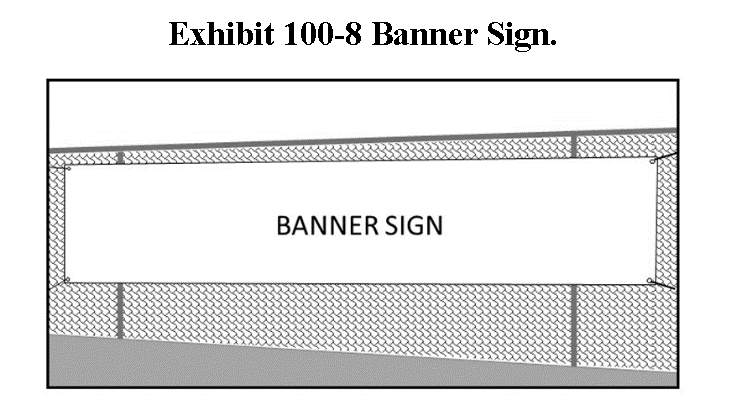
Sign, Bench. An advertising message on any portion of a bench or other non-mobile structure, or device intended for public seating or convenience.
Sign, Billboard. An outdoor advertising sign that directs attention to a business, commodity, service, or entertainment.
Sign, Canopy. A sign attached above, below or to the face of a canopy and which may include an under-canopy sign attached to and mounted under the canopy.
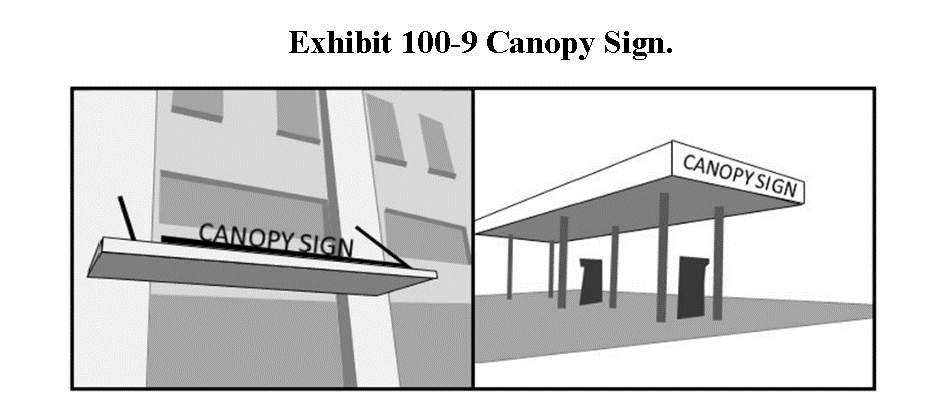
Sign, Changeable Message. A sign on which the copy, message or sign panels may be changed either electronically or manually in the field through the removal, replacement, or rearrangement of letters, symbols, blocks, or panels.
Sign, Construction. A temporary sign erected and maintained by an architect, contractor, developer, financial institution, subcontractor, or materials supplier on the premises for which said person or persons is presently furnishing labor, materials, services, or capital financing.
Sign, Directional. Signs limited to directional messages, principally for pedestrians or vehicular traffic.
Sign, Directory. An outdoor sign listing and identifying the occupants within shopping centers, industrial centers, retail centers, office centers, and other multi-use commercial or industrial sites.
Sign, Flashing. A light source which, in whole or in part, physically changes in light intensity or gives the appearance of such change at intervals of less than 6 seconds.
Sign, Freestanding. A sign supported by a structure secured in the ground that is wholly independent of any guy wire, support wire, building, fence, vehicle, or object other than the sign structure.
Sign, Ground. A monument sign or a pole sign supported by a sign structure secured in the ground that is wholly independent of any guy wire, support wire, building, fence, vehicle, or object other than the sign structure, for support.
Sign, Home Occupation. Any on-premise sign advertising a home occupation.
Sign, Identification. A sign that is limited to the name, address, and/or number of a building or institution, person, or entity that is primary to the identification of the premise and to a general statement of the activity carried on in the building or institution.
Sign, Illuminated. An illuminated sign is any sign which has characters, letters, figures, designs, or outlines illuminated by an interior or exterior light source that is primarily designed to illuminate such sign.
Sign, Inflatable. An inflatable sign is any sign dependent in whole or in part for its structural integrity on the infusion of compressed air or other fluids into the sign structure, including balloons larger than 2 feet in diameter or 2 feet square in area or other gas or liquid filled figures.
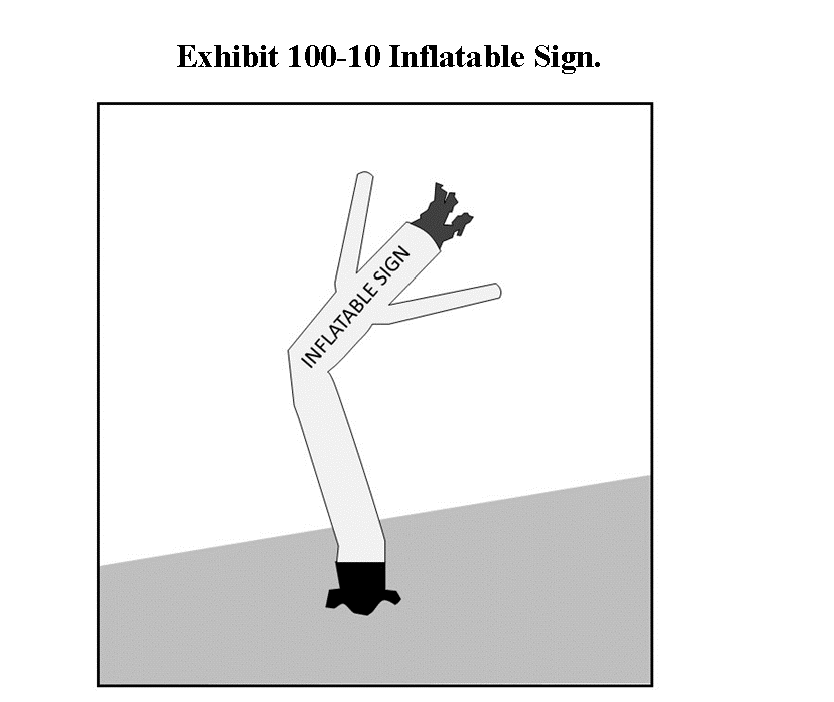
Sign, Marquee. A marquee sign is any sign attached to and made part of a marquee. A marquee is defined as a permanent roof-like structure projecting beyond a building wall at an entrance to a building or extending along and projecting beyond the building's wall and generally designed and constructed to provide protection against the weather. Signs painted or sewn onto awnings or canopies shall be considered marquee signs.
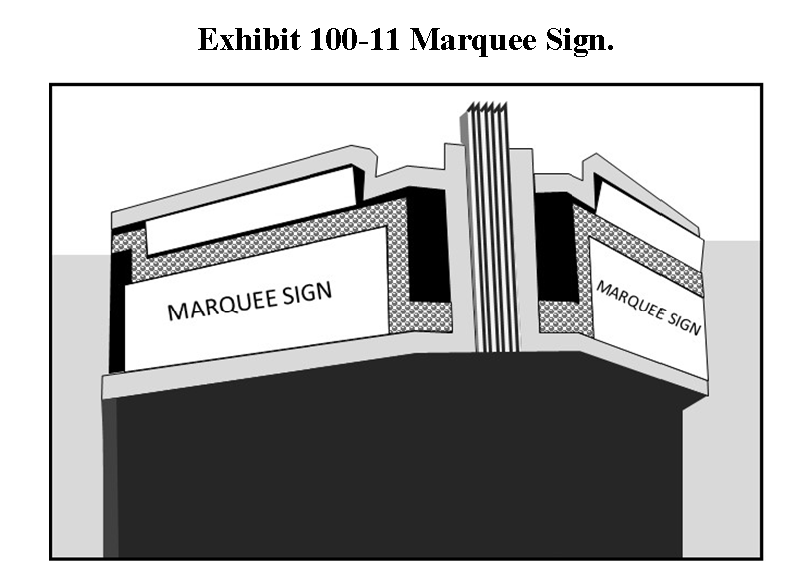
Sign, Menu Board. A sign used to display a menu, typically found at a drive-thru restaurant.
Sign, Message. The words or symbols on a sign face that communicate to onlookers.
Sign, Monument. A freestanding sign supported primarily by an internal structural framework integrated at the base or ground level into landscaping or other solid structural features other than support poles.
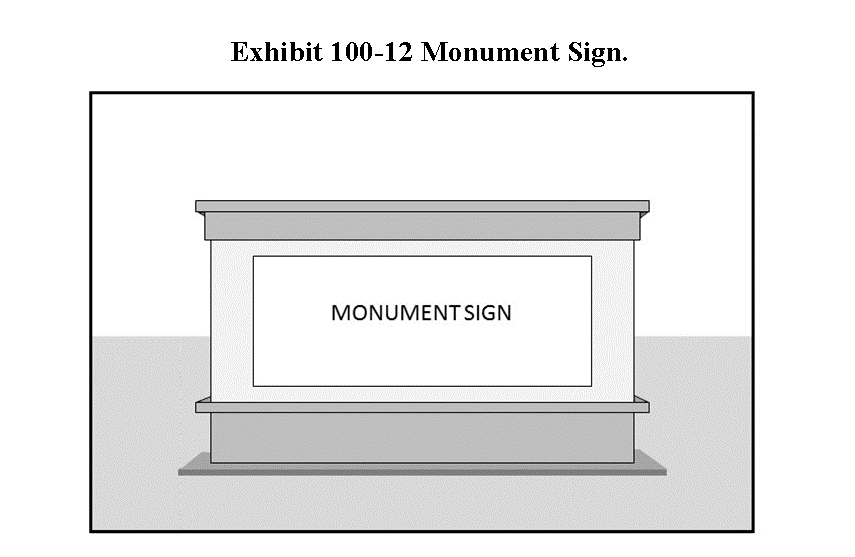
Sign, Moving Message or Changing Image. Any sign, including public service signs, designed to convey sign copy that changes in form or content with greater frequency than once an hour, that includes action or motion, or the illusion of action or motion within its message or sign copy.
Sign, Moving. A sign or part of a sign that changes physical portions by any movement or rotation, or that gives the impression of such movement or rotation.
Sign, Neon. Any white or colored tubular lighting bent or formed into a design or lettering of which the primary source of light is gaseous. Area within the outline of the neon is part of the sign face.
Sign, Off-Premises. Includes signs that direct attention to a person, business, firm or corporation not occupying the premises where the sign is located. Off-premises signs identify advertised goods, products, or services not available on site, convey a non-advertising idea or message not located or relevant on site, and/or is not otherwise defined as an on-premise sign.
Sign, On-Premise. A sign identifying or advertising a business, person, firm, corporation, activity, goal, product, or service located or available on the premises where the sign is installed and maintained, or that is displayed and maintained by the owner or occupant of the premises on which it is located.
Sign, Parapet. A sign extending above a roof line or that serves as a parapet.
Sign, Pole. A type of ground sign, consisting of 1 or more vertical poles that are partially placed in the ground for stability, and that may have a horizontal pole at or near the top of a single vertical pole and which may be joined together by a horizontal pole. The sign face or faces of pole signs can be attached to the vertical pole(s) and/or horizontal pole, or may be chained, cabled, or attached to the vertical pole(s). The sign face(s) of pole signs do not touch the ground, leaving an open space between the bottom of the sign face and the ground. A pole sign cannot be connected to or affixed to a building.
Sign, Political. Any sign promoting the election or defeat of a candidate seeking any political office or the passage or defeat of any ballot measure. Clarification: Not including any billboard owned or maintained by a commercial firm or advertising company when leased or used as a political sign.
Sign, Portable. Any sign not permanently affixed to a building, structure or the ground or a sign designed to be moved from place to place, including but are not limited to A-frame or sandwich board signs, signs attached to wood or metal frames, and signs designed to be self-supporting and moveable. Clarification: Does not include trailer or vehicle signs.
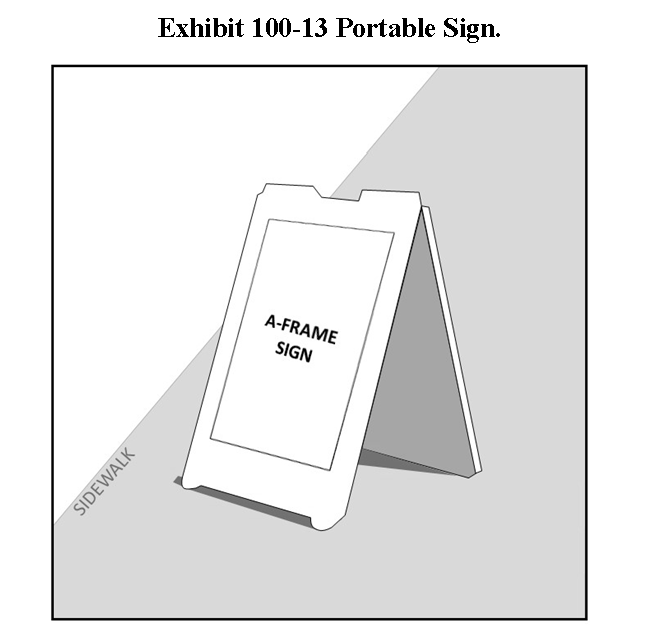
Sign, Private Directional. On-premise signs that direct vehicular or pedestrian traffic into or within a premise and do not exceed four square feet in size.
Sign, Project. A temporary sign announcing a proposed land development or construction project.
Sign, Projecting. Any sign with a leading edge that extends 12 inches or more beyond a building or wall. Two types of projecting signs include:
Fixed. A sign which extends outward 12 inches or more from the facade of any building and is rigidly affixed thereto, and
Swinging. A sign projecting 12 inches or more from the outside wall or walls of any building and is supported by only 1 rigid support affixed thereto. Clarification: Projecting signs are distinctly different and should not be considered a Wall Sign.
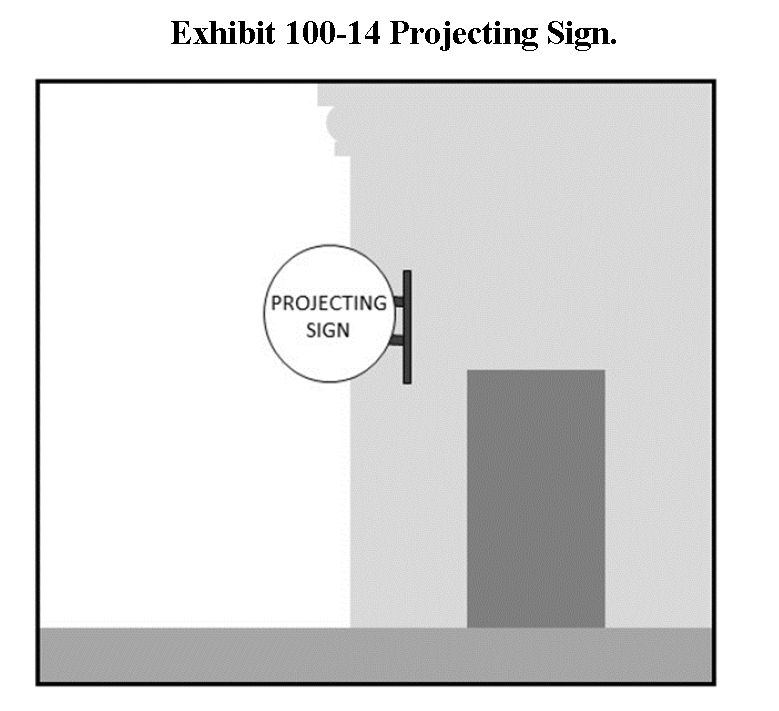
Sign, Public Directional. Includes both signs permanently or temporarily erected in the public Right-of-Way or on public property with the approval of the Parish Council that denote the name or route to any educational institution, public building of facility, historic place, shrine, church, synagogue, hospital, library or similar facility or institution; and signs permanently or temporarily erected identifying a person or entity who has undertaken to plant or maintain landscaping of that portion of the Right-of-Way.
Sign, Public Service. A sign that provides information as a service to the general public such as time, temperature or the promotion or announcement of public events, or other events of a civic, philanthropic, charitable, or religious purpose.
Sign, Pylon. A permanent, freestanding sign with a support structure enclosed with a skin or veneer whose height exceeds its width. Support structure shall not consist of a single pole.
Sign, Real Estate. Any temporary sign pertaining to the sale, lease or rental of land or buildings, that is erected or displayed on the lot or parcel to which it applies.
Sign, Resident Identification. Any on-premise sign limited to the name of the premises, its municipal address and the names of the present occupant or occupants of the premises.
Sign, Revolving or Rotating. Any sign whose sign face is designed to move or turn on any axis.
Sign, Roof. Any sign erected or painted upon, against or directly above a roof or parapet of a building.
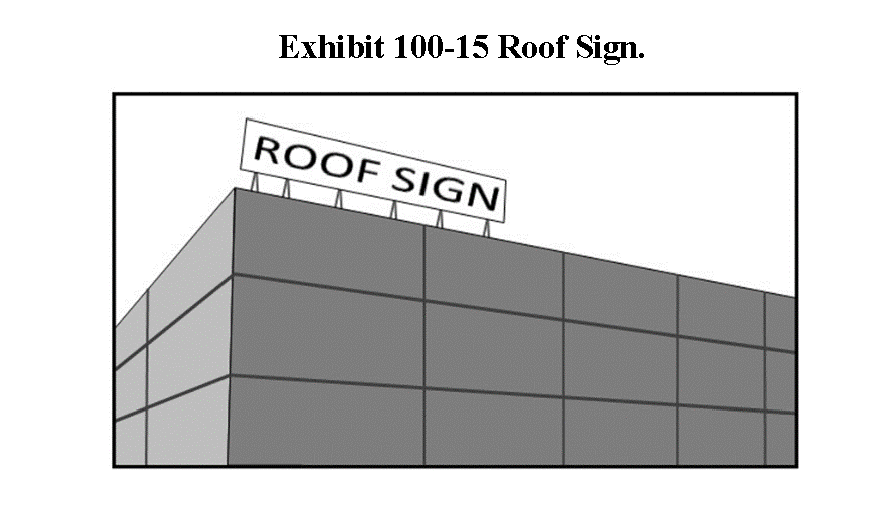
Sign, Snipe. A sign that is tacked, nailed, posted, pasted, glued, or otherwise attached to poles, stakes, or to other like objects.
Sign, Street Banner. Any banner sign that is stretched across and hung over a public Right-of-Way.
Sign Structure. The supporting structure upon which a sign or sign face is fastened, attached or displayed or is intended to be fastened, attached or displayed; provided, however, the term "sign structure" shall not include a building or fence.
Sign, Subdivision. A sign identifying the subdivision and denoting the entrance or exit to the subdivision.
Sign, Temporary. Any sign the display of which is limited by law, ordinance, or regulation and which advertises a situation or event that is designed, intended, or expected to occur and be completed within a reasonably short or definite period after the erection of such sign.
Sign, Trailer. Any sign or sign structure attached to or composed in whole or in part of a trailer frame or chassis or skid or skid frame or body or of any materials that have ever previously constituted in whole or in part such a trailer, skid, frame, chassis, or body.
Sign, Vehicle or Trailer. Any sign displayed on or from any mode of transportation, including but not limited to cars, buses, trucks/trailers, trains, boats, or airplanes.
Sign, Wall. A sign other than a parapet or projecting sign that is painted on or that projects less than 12 inches from the wall of a building, and is painted on, attached to, or erected against any exterior wall or window of a building or structure with the exposed face of the sign being in a plane parallel to the plane of said wall or window and not extending above the building.
Sign, Window. Any sign that is painted on, applied to, attached to, or projected upon the exterior or interior of a building glass area, including doors, or located within 1 foot of the interior of a building glass area, including doors, whose identification, message, symbol, insignia, visual representation, logo type or any other form which communicates information, can be perceived from any off-premises contiguous property or public Right-of-Way.
Signable Area. An area of a building façade that is free of architectural details or part of a building in which an activity is located.
Single-plane lens. A refractor of lens, mounted in the horizontal plane, which by design, allows direct light to be emitted only through the horizontal plane.
Site. The area of ground or physical location, including land area and appurtenances, on which a town, building, monument, or facility is constructed. A site may consist of numerous facilities.
SLCRMA. The Louisiana State and Local Coastal Resources Management Act of 1978 as amended, Act 361 of 1978, as amended, LA R.S. 49:214.21 et seq.
Sludge. Residue produced by or precipitated from a treatment process.
Single Premise. The contiguous land in the same ownership which is not divided by any highway, street, alley, or Right-of-Way. May include more than 1 lot of record when such lots are devoted to a single unity of use; or may consist of a separate structure on the same lot of record when, in the opinion of the Department of Planning and Development, such separate structure appears to be a separate premise.
Small Box Variety Store. A retail store between 5,000 and 15,000 square feet that sells at retail an assortment of physical goods, products, or merchandise directly to the consumer, including food or beverages for off-premption, household products, personal grooming and health products, and other consumer goods. Small box variety stores do not include small retail stores that: contain a prescription pharmacy, sell gasoline or diesel fuel, primarily sell specialty food items (e.g. meat, seafood, cheese, or oils and vinegars), dedicate at least 15 percent of shelf space to fresh or fresh frozen foods, or dedicate less than five percent of shelf space to food sales.
Software Development and Programming. An establishment that conducts research, development, or testing of computer software.
Solar Energy Systems. Any active Solar Energy System that uses mechanical, physical, or chemical means to convert energy collected from sunlight into an alternative form of energy. Solar Energy Systems include, but are not limited to photovoltaic cells, solar hot water heaters, etc.
Solar Energy System, Building-Integrated (BIPV). Any Solar Energy System that consists of photovoltaic cells and/or panels that are fully integrated into the exterior structure of a building.
Solar Energy System, Building Mounted Photovoltaic. Any Solar Energy System that consists of photovoltaic cells and/or panels that are affixed to the exterior of a building such as the façade (see definition of Solar Energy System, Roof-Mounted).
Solar Energy System, Ground-Mounted. Any Solar Energy System that is structurally mounted to the ground and is not attached to a building; may be of any size (small-, medium- or large-scale).
Solar Energy System, Large-Scale. A Solar Energy System that occupies more than 40,000 square feet of surface area; where surface area is measured by the total surface area of the solar collector at maximum tilt to the vertical that occupies a given space or mounting surface, also referred to as the projected area of the array.
Solar Energy System, Medium Scale. A Solar Energy System that occupies more than 1,750 square feet but less than 40,000 square feet of surface area; where surface area is measured by the total surface area of the solar collector at maximum tilt to the vertical that occupies a given space or mounting surface, also referred to as the projected area of the array.
Solar Energy System, Photovoltaic (PV). A Solar Energy System that produces electricity by the use of semiconductor devices, called photovoltaic cells, which generate electricity when exposed to sunlight. A PV system may be roof-mounted, ground-mounted, or pole-mounted.
Solar Energy System, Roof Mounted. Any Solar Energy System that is mounted on the roof of a building or structure; may be of any size (small-, medium- or large-scale).
Solar Energy System, Small Scale. A Solar Energy System which occupies no more than 1,750 square feet or less of surface area; surface area shall be measured by the total surface area of the solar collector at maximum tilt to the vertical that occupies a given space or mounting surface, also referred to as the projected area of the array.
Solar Panel or Collector. A group of photovoltaic cells or thermal collectors that collect and convert sunlight as a source of energy for purposes such as heating or cooling a structure, heating, or pumping water, or generating electricity.
Solid Waste. Any garbage, refuse, or sludge from a waste treatment plant, water-supply treatment plant, or air pollution-control facility, and other discarded material, including solid, liquid, semisolid, or contained gaseous material resulting from industrial, commercial, mining, and agricultural operations, and from community activities. Solid waste does not include solid or dissolved material in domestic sewage; solid or dissolved materials in irrigation return flows or industrial discharges that are point sources as specifically described in the Definitions Section of Louisiana Administrative Code, LAC Title 33 - Environmental Quality.
Solid Waste Closure. Actions to prevent or minimize the threat to public health and the environment posed by a facility that no longer accepts the solid waste for which it operated or was permitted, including the removal of contaminated equipment, the removal of liners, grading, applying final cover, seeding of final cover, installation of monitoring devices, construction of ground and surface water diversion structures, and gas control systems, as necessary.
Solid Waste Collection. The aggregation of waste from the place at which it is generated and includes all activities up to the time the waste is delivered to a waste facility. Collection may include either manual or automated systems.
Solid Waste Collection Facility. A facility, at which 1 or more containers are located, that is used to accumulate solid waste generated by and delivered by more than 1 household or commercial establishment for pickup by a transporter, including, but not limited to, facilities typically located in rural areas where garbage collection does not occur. This definition does not include containers that receive only solid waste generated on property that is contiguous with the property on which the container is located (e.g., containers located at and receiving solid waste only from a multi-unit dwelling or a commercial establishment or an industrial establishment).
Solid Waste Facility. The actual land and associated appurtenances used for storage, processing, and/or disposal of solid wastes, but possibly consisting of 1 or more units. Clarification: Any earthen ditches leading to or from a unit of a facility and that receives solid waste are considered part of the facility to which they connect, except for ditches lined with materials capable of preventing groundwater contamination. The term facility does not necessarily mean an entire industrial manufacturing plant.
Solid Waste Facility, Industrial. A facility for the processing, storage, and/or disposal of industrial solid waste.
Solid Waste Type I Facility (Solid Waste). A facility used for disposing of industrial solid wastes (e.g., a landfill, surface impoundment, or landfarm). If the facility is used for disposing of residential or commercial solid waste, it is also a Type II facility.
Solid Waste Type I-A Facility (Solid Waste). A facility used for processing industrial solid waste (e.g., a transfer station (processing), shredder, baler, etc.). If the facility is used for processing residential or commercial solid waste, it is also a Type II-A facility.
Solid Waste Type II Facility (Solid Waste). A facility used for disposing of residential and/or commercial solid waste (e.g., a landfill, surface impoundment, or landfarm). If the facility is used for disposing of industrial solid waste, it is also a Type I facility.
Solid Waste Type II-A Facility (Solid Waste). A facility used for processing residential, infectious, or commercial solid waste (e.g., a transfer station (processing), composting municipal solid waste facility, refuse-derived fuel facility, shredder, baler, autoclave, etc.). If the facility is used for processing industrial solid waste, it is also a Type I-A facility.
Solid Waste Type III Facility (Solid Waste). A facility used for disposing or processing of construction/demolition debris or woodwaste, composting organic waste to produce a usable material, or separating recyclable wastes (e.g., a construction/demolition-debris or woodwaste landfill, separation facility, or composting facility).
Solid Waste Separation Facility. A Type III solid waste processing facility at which recyclables are separated from a non-putrescible solid waste stream for future use. The non-putrescible waste stream received by the separation facility shall not contain more than a de minimis amount of putrescible waste.
Solid Waste Landfill or MSW Landfill, Municipal. An entire disposal facility in a contiguous geographical space where residential solid waste and/or commercial solid waste is placed in or on land. The term Municipal Solid Waste does not limit the ownership or source of materials to municipalities.
Solid Waste Shredder. A solid waste facility that reduces the particle size of solid waste by grinding, milling, shredding, or rasping.
Solid Waste, Commercial. All types of solid waste generated by stores, offices, restaurants, warehouses, and other non-manufacturing activities, excluding residential and industrial solid wastes.
Solid Waste, Industrial. Solid waste generated by a manufacturing, industrial, or mining process, or that is contaminated by solid waste generated by such a process. Such waste may include, but is not limited to, waste resulting from the following manufacturing processes: electric power generation; fertilizer/ agricultural chemicals; food and related products; byproducts; inorganic chemicals; iron and steel manufacturing; leather and leather products; nonferrous metals manufacturing/foundries; organic chemicals; plastics and resins manufacturing; pulp and paper industry; rubber and miscellaneous plastic products; stone, glass, clay, and concrete products; textile manufacturing; and transportation equipment.
Solid Waste, Residential. Any solid waste (including garbage, trash, yard trash, and sludges from residential septic tanks and wastewater treatment facilities) derived from households (including single and multiple residences, hotels and motels, bunkhouses, ranger stations, crew quarters, campgrounds, picnic grounds, and day-use recreation areas).
Spa, Health. Any facility that provides sauna baths, suntan lamps, exercises and/or exercise equipment, massages, steam baths, diet regimens, and the like for group or individual sessions, and that holds itself out to the public for such uses or any combination of the foregoing.
Spoil deposition. The deposition of any excavated or dredged material.
Stable. A structure that is used for the care of horses and other equines.
Stable, Commercial. A facility for the keeping, training, grooming, or boarding of horses and farm animals.
Stadium. A large open or enclosed place used for games and major events and partly or completely surrounded by tiers of seats for spectators.
Start of Construction. The date a building permit is issued.
Start, Building Construction. The first placement of building forms or the placement of structural supports, i.e., pilings or tiers, or other structural supports on the site such as footings. For mobile homes, the start of building construction shall be considered the placement of the mobile home on the site.
State Enabling Act. The act adopted by the State Legislature identified as LA R.S. 33:101 et seq, which delegated to the Parish Council of St. Tammany Parish the authority to create a Planning Commission.
State Sanitary Code. The rules and regulations that pertain to water supplies and sewage and refuse disposal; including, but not limited to those rules and regulations applicable to the collection, treatment, or disposal of sewage, and the treatment and distribution of potable water; and which have been adopted by the LDH in accordance with LA R.S. § 40 et seq.
Steel Mill. A facility for the manufacturing and processing of steel.
Storage Containers, Portable. A portable, weather-resistant receptacle designed and used for the storage or shipment of household goods, wares, building materials or merchandise.
Storage Facility. Any facility or part of a facility wherein any hazardous, dangerous, or toxic substance as herein described comprises or accounts for a substantial part of the business or use of said facility regardless of whether the substance is marketed individually or incorporated into another product.
Storage, Fleet. Outdoor storage of vehicles used for business purposes.
Storage, Hazardous Waste. Temporarily holding hazardous wastes until they are treated or disposed. Hazardous waste is commonly stored prior to treatment or disposal, and must be stored in containers, tanks, containment buildings, drip pads, waste piles, or surface impoundments that comply with the Resource Conservation and Recovery Act (RCRA) regulations. The regulatory requirements for these types of storage units are found in Title 40 of the Code of Federal Regulations (CFR) in Part 264 for permitted facilities and Part 265 for interim status facilities.
Storage, Retail Sales or Storage Yard. Use of property for the display and sales of products and services, primarily outside of a building or structure.
Store Front. The facade of a space in a building, regardless of the type of use of the space, which must have a direct entrance, by door, from the exterior of the building through the facade, and which facade must face a street or a parking lot for the building.
Store, Convenience with Gas Pumps. A retail establishment that offers for sale convenience goods, such as packaged food items, staple groceries, snacks, tobacco, periodicals, other household goods, and gasoline and other fuel as an accessory use; does not include Auto Repair and Service.
Store, Liquor. An establishment engaged in the sale of alcoholic beverages for off-premises consumption.
Storm Sewer System Permit, Municipal Separate. Federal and state requirement originating from the Clean Water Act for publicly owned storm sewer systems to minimize pollution as urban runoff enters creeks, lakes, and other waterbodies.
Stormwater. The flow of water which results from a rainfall event that runs off streets, lawns, and other sites.
Stormwater Management Program. Comprehensive stormwater management program required by the MS4 Permit, including pollution prevention measures, treatment or removal techniques, monitoring, use of legal authority, and other appropriate measures to control the quality of storm water discharged to the storm drains and thence to waters of the United States.
Story. That portion of a building included between the surface of any floor and the surface of the floor next above it, or if there is not floor above it, then the space between the floor and the ceiling next above it. Any portion of a story exceeding 14 feet in height shall be considered as an additional story for each 14 feet or fraction thereof.
Story, Half. A half-story is that portion of a building under a gable, hip or mansard roof, the wall plates of which, on at least 2 opposite exterior walls, are not more than 4½ feet above the finished floor of such story. In the case of multiple-family dwellings 3 or more stories in height, a half-story shall be counted as a story.
Stream. Any body of water, depression, or bed whether there is a current flow present or water present within its banks, when such stream is identifiable on any official map of the State of Louisiana and the directional course of said stream indicates a discharge of water into any river as defined herein or into tributaries of any river.
Street. A strip of land, including the entire Right-of-Way, publicly or privately owned, serving as a means of slow vehicular travel, and furnishing Access to Abutting properties, which may also be used to provide space for sewers, public utilities, shade trees, and sidewalks.
Street Line or Right-of-Way Line. The dividing line between a lot, its property line or lines, and a public Right-of-Way, a public street, road, or highway; or a private street, road, or highway, over which 2 or more abutting owners have an easement or Right-of-Way.
Street Plan, Major. The comprehensive roadway master plan adopted by the Planning and Zoning Commission after public hearing that is designed to guide the future development of St. Tammany Parish.
Street, Intersecting. Any street or public way or court that joins another at an angle, whether or not it crosses the other.
Street, Limited Access. A major highway to which access is limited to certain safe entrances and exits.
Street, Local Traffic. A street paralleling a major highway to give limited access to said highway for safety.
Street, Private. Any road or street that is not publicly owned and maintained and used for access by the occupants of a development, their guests, and the general public.
Street, Public. A street under the control of and kept by the public, established by regular governmental proceedings for the purpose or dedicated by the owner of the land and accepted by the proper authorities, which are responsible for the maintenance of said street.
Street,Road, or Alley. Any public way set aside for public use and travel that was dedicated to or acquired by the Parish to provide means of access to abutting property. It is not necessary that any formal act of acceptance should have occurred, and it is immaterial whether said street, road, or alley has ever been opened, used, or accepted into the Parish Road Maintenance System. For the purposes of this UDC, the words "street," "road," and "alley" may be used interchangeably.
Service Street. A street upon which no lot fronts
Streets, Complete. Streets designed and operated to enable safe use and support mobility for all users. Those include people of all ages and abilities, regardless of whether they are travelling as drivers, pedestrians, bicyclists, or public transportation riders.
Structure. A walled and roofed building, including a gas or liquid storage tank, that is principally above ground, as well as a manufactured home. Anything constructed or erected, the use of which requires permanent location on the ground or attached to something having a permanent location on the ground, including but without limiting the generality of the foregoing, to advertising signs, billboards, back stops for tennis courts and pergolas.
Studio, Dance or Martial Arts. An establishment engaged in dance or martial arts instruction and rehearsal.
Studio, Fine Arts. A building or a portion of a building used as artisan workshop for the creation or display of works of art in a variety of mediums.
Studio, Music. An establishment used for composing and recording music or music instruction.
Subdivision. The division of a lot, tract, or parcel of land into 2 or more tracts, parcels, or other divisions of land in accordance with LA RS 33:101-120.1, including the readjustment of lot lines, a further division of an existing subdivision, or a portion thereof or combining of 2 or more existing lots of record.
Subdivision Amenities. Private cultural or recreational uses associated with a subdivision.
Subdivision Restrictions. Restrictive covenants to be legally recorded which the developer places upon the use of the lots by future owners for the well-being of all owners, to protect values and to prevent abuses and nuisances that would disturb other occupants in the subdivision.
Surface Alterations. Those uses and activities that change the surface or usability of a land area or water bottom. Examples include fill deposition, land reclamation, beach nourishment, dredging (primarily areal), clearing, draining, surface mining, construction, operation of transportation, mineral, energy and industrial facilities, industrial, commercial, and urban developments.
Surface Elevation, Water. The height, in relation to the National Geodetic Vertical Datum (NGVD) of 1929, the North American Vertical Datum (NAVD) of 1988, or other datum, where specified, of floods of various magnitudes and frequencies in the floodplains of coastal or riverine areas.
Surface, Impervious. Any material that substantially reduces or prevents the infiltration of stormwater into previously undeveloped land. Impervious surfaces shall include concrete or asphalt driveways and parking areas.
Surveyor, Licensed. A professional land surveyor, licensed to perform surveying activities in the State of Louisiana.
Swimming Pool. A residential accessory use or commercial pool for recreational purposes.
- T -
Tammany Utilities. The water and sewer services provided by St. Tammany Parish.
Tank, Holding. Any tank used for temporary storage and onsite containment of sanitary wastewater.
Ten-State Standards. The Recommended Standards for Water Works (2012 edition), or the Recommended Standards for Wastewater Facilities (2004 edition), or both, published by the Great Lakes—Upper Mississippi River Board of State Public Health and Environmental Managers; and any modifications, additions or revised editions to such standards as are established in the state sanitary code, or which are otherwise authorized by the state health officer.
Tentative Plan. A generalized conceptual plan designating the proposed development by showing the lot and street layout and the surrounding land uses.
Testing. The sampling of a roadbed material for composition, compaction, depth, and such other requirements applicable thereto, and of the road surface (all at such intervals as standard testing procedures provide) to determine through state-of-the-art methodology, proper compliance with the specifications imposed.
Theater. A building or part of a building devoted to showing motion pictures or for dramatic, musical, or live performances.
Thoroughfare. A paved vehicular way with moving lanes and parking lanes accompanied by streetscapes at the sides, both within and outside of a public Right-of-Way, and including all of the Thoroughfare Types as set forth and described herein.
Thoroughfare Types. Boulevards, Roads, Rural Roads, Streets, Commercial Streets, Collectors, Driveways, Highways, Passages, Paths, Rear Alleys, and Rear Lanes.
Timber Harvesting. The removal of all or part of merchantable standing timber as part of an ongoing timber producing operation or business that is not part of any development.
Tiny Home. A tiny house is a dwelling that may be built on wheels and is no larger than 400 square feet, including a kitchen, bathroom, and sleeping/living area, and must be built to the Louisiana State Construction Codes and Amendments.
Tire Retreading, Recapping, or Rebuilding. A facility for the retreading, recapping, and rebuilding of tires for commercial, and industrial vehicles or machines.
Tower, Radio, Telecommunications, Television or Microwave. A structure supporting antennae that transmit or receive any portion of the electromagnetic spectrum.
Townhome. A building, or a portion of a building, containing 3 or more dwelling units joined by a party wall or walls, provided those dwellings are not either straight above or below a dwelling intended for use by another separate, independent family. Clarification: Dwelling units permitted above commercial establishments are not townhomes.
Toxic Substances. Those substances that, by their chemical, biological, or radioactive properties, have the potential to endanger human health or other living organisms or ecosystems, by means of acute or chronic adverse effects, including poisoning, mutagenic, tetratrogenic, or carcinogenic effect.
Traffic Impact Analysis or TIA. A study and analysis of how any use, plan, or development will affect traffic in the surrounding area.
Transfer Station, Non-Processing. A solid waste facility where solid waste is transferred from collection vehicles to other vehicles for transportation without processing.
Transfer Station, Processing. A Type I-A or II-A solid waste processing facility where solid waste is transferred from collection vehicles, processed, and placed in other vehicles for transportation (e.g., a facility that separates recyclables from industrial or putrescible waste streams).
Transit Stop. A location where passengers board and alight. Transit Stops can serve 1 or more routes and include various levels of amenities depending on the level of actual or anticipated riders. Amenities can include Transit Stop sign pole, benches, trash receptacles, shelters, and lighting. Transit Stops can be placed within the public Right-of-Way or on private property depending on service needs and passenger comfort.
Transport, Solid Waste. To move industrial solid waste off-site and/or to move solid waste of a commercial establishment or more than 1 household to a transfer station or processing or disposal facility.
Transportation Terminal (Passenger, Taxi, Bus, Ambulance). A commercial facility for loading and unloading of passenger and/or the housing, maintenance, and dispatch of vehicles designed to transport passengers.
Transporter, Solid Waste. Any person who moves industrial solid waste off-site and/or who moves solid waste of a commercial establishment or more than 1 household to a transfer station or processing or disposal facility.
Trash. Non-putrescible refuse including, but not limited to, white goods, furniture, and wood and metal goods.
Treatment. Any method, technique, or process, including neutralization, designed to change the physical, chemical, or biological character or composition of any material to neutralize such material or render it nonhazardous or nontoxic, safer for transport, amenable for recovery or storage, or reduced in volume. The term includes any activity or processing designed to change the physical form or chemical composition of material, to render it nonhazardous or nontoxic.
Tree. Any self-supporting perennial woody plant that is at least 4 inches in diameter, broken down into 2 classes (A and B), of which a list of each Class's native trees can be found in Chapter 600, Sec. 600-3 of the UDC.
Tree, Class A. Any self-supporting woody plant of a species which normally grows to an overall height of a minimum of 50 feet, usually with 1 main stem or trunk although some species may have multiple trunks, and with many branches.
Tree, Class B. Any self-supporting woody plant of a species which normally grows to an overall height of a minimum of 25 feet, with 1 or more main stem(s) or trunk(s) and many branches.
Tree Farming. An active agricultural production land use that involves the harvesting of timber as a crop to be replenished and in which clear cutting is prohibited unless immediate reforestation is implemented in accordance with recognized practices for active tree farm forest management. This provision includes timber thinning and selective harvesting where reforestation may not be required or desirable.
Tree Preservation. The preservation of existing trees on a parcel of property through the development and construction process. For tree preservation the following definitions shall apply:
- Unimproved Land. Where no grading, street surfacing, curbs, gutters, sidewalks, water mains, fire hydrants, sanitary sewers, storm sewers, culverts and/or other improvements to the natural state of the land have not occurred and occupancy permits have not yet been given or public improvements accepted.
- Partially Improved Land. Where grading, street surfacing, curbs, gutters, sidewalks, water mains, fire hydrants, sanitary sewers, storm sewers, culverts and/or other improvements to the natural state of the land have occurred but occupancy permits have not yet been given or public improvements accepted.
- Improved Land. Where grading, street surfacing, curbs, gutters, sidewalks, water mains, fire hydrants, sanitary sewers, storm sewers, culverts and/or other improvements have occurred, and occupancy permits have been given and public improvements accepted.
Tree Protected Root Zone. The circular area of ground surrounding a tree extending a distance of 1 foot per caliper inch of the tree, measured from the tree trunk or stem.
Tree Removal. Any act that causes a tree to die within a period of 2 years, including, but not limited to:
- Damage inflicted upon the root systems by machinery, storage of materials and solid compaction;
- Changing the natural grade above the root system or around the trunk;
- Damage indicated on the tree permitting infection or pest infestation;
- Excessive pruning
- Paving with concrete, asphalt, or other impervious material within the proximity as to be harmful to the tree.
Tree, Caliper. The diameter of a tree trunk.
Tree, Preserved. An existing tree that remains after trees are removed on a site.
Tree Survey. A tree survey reflects the process of locating a tree and its protected root zone in order to protect the tree from anticipated construction impacts. Tree location, species, diameter, and condition are documented on a survey or site plan drawn to scale with an accompanying table. The table details referenced numbers on the survey associated with required information on tree species, diameter, and condition.
Truck Repair, Heavy. Storage, repair, service, staging and point of operation for trucking operations and their accessory equipment.
Truck Stop. Any building or area of land in which or upon which a business, service, or industry involving the maintenance, servicing, storage, or repair of commercial vehicles is conducted or rendered including the dispensing of motor fuel or other petroleum products directly into motor vehicles, the sale of accessories or equipment for trucks and similar commercial vehicles. This use may also include overnight accommodations and restaurant facilities solely for the use of truck crews.
Truck Stop with Video Poker. Same land use characteristics as a truck stop, but may also include video poker.
Truck, Food. A mobile vendor who operates or sells food for human consumption, hot or cold, on a temporary basis from a stationary stand; or cart, trailer or kitchen mounted on chassis, with an engine for propulsion or that remains connected to a vehicle with an engine for propulsion.
Turnaround. The area at the end of a dead-end street that provides an area to turnaround, includes t-type turnarounds and Cul-de-sacs.
- U -
Unit, Live/Work. Single-family dwelling units not exceeding 1 story in height above the first floor in a building designed for business uses.
Unit, Secondary Dwelling. An additional dwelling unit located within the principal dwelling on the lot, in a freestanding building or above a residential garage.
University. An accredited academic institution of higher learning beyond the level of secondary school.
Urban Growth Boundary or UGB. The boundary or line marking the limit between the urban growth areas and other areas such as rural and resource areas where urban growth is not encouraged, as designated by the parish.
Use. The purpose or activity for which land or any building thereon is designed, arranged, or intended, or for which it is occupied or maintained.
Use, Compatible. A use which is capable of existing in harmony with other uses situated in its immediate vicinity.
Use, Conditional. Conditional uses are certain uses that, because of their unique characteristics, cannot be properly classified in certain zoning districts without consideration, in each case, of the impact of those uses upon neighboring land and of the public need for the particular use at the particular location. These uses are classified as conditional uses within the zoning districts and may be permitted in a district through the granting of approval by the Planning and Zoning Commission. Such uses require additional consideration and a public hearing to ascertain the appropriateness of the use within the particular locality. Such uses can be approved with special conditions required by the Planning and Zoning Commission which aim to mitigate potential negative impacts on neighboring land and better ensure compatibility with existing or planned development in the vicinity.
Use, Continuing. Activities which by nature are carried out on an uninterrupted basis; examples include shell dredging and surface mining activities, projects involving maintenance dredging of existing waterways, and maintenance and repair of existing levees.
Use, Exempted. Any use specifically listed as a use not requiring a permit.
Use, Functionally Dependent. A use which cannot perform its intended purpose unless it is located or carried out in close proximity to water. The term includes only docking facilities, port facilities that are necessary for the loading and unloading of cargo or passengers, and ship building and ship repair facilities, but does not include long-term storage or related manufacturing facilities.
Use, Incompatible. A use which is incapable of existing in harmony with other uses situated in its immediate vicinity.
Use, Noncontinuing. Activities which by nature are done on a one-time basis; examples include dredging access canals for oil and gas well drilling, implementing an approved land use alteration plan and constructing new port or marina facilities.
Use, Permitted. A use that may be lawfully established in a particular district or districts, provided it conforms with all requirements, regulations, and performance standards of such district.
Use, Principal. The main use of land or buildings as distinguished from a subordinate or accessory use. A principal use may be either "permitted" or "conditional" within a zoning district.
Use, Religious. A structure or place in which worship, ceremonies and rituals pertaining to a particular system of belief are held.
Use, Seasonal. A temporary use carried on for 6 months or less, such as Christmas tree sales, snowball stands, seafood peddlers, or produce stands.
Use, Temporary. A use established for a fixed period of time with the intent to discontinue such use upon the expiration of the time period.
Utility. Establishments or the structural components engaged in the generation, transmission, and/or distribution of electricity, gas, or steam, including water and irrigation systems, sanitary systems used for the collection and disposal of garbage, sewage and other wastes, or communication systems be they hardwired or wireless, analog, or digital.
Utility Corridor. Rights-of-way or easements for utilities on either publicly or privately owned property.
Utility Line. Any wire, pipe and/or conduit in a system of pipes and/or conduits for conveying utility services, including, but not limited to, water, sanitary sewer, natural gas, electricity, steam, fiber, data/communications.
Utility Structure. A utility cabinet housing the utility equipment.
Utility, Public. Any entity that provides utility services subject to regulation by the Louisiana Public Service Commission, as well as cable television service providers, pipeline entities, gas entities, electrical entities, rural electric cooperatives, telecommunications entities, data entities, technological services entities, water entities, steam entities, heating entities, cooling or refrigerating entity or sewer entities.
- V -
Variance. A grant of relief or departure from the requirements of the UDC, when specific enforcement would result in unnecessary hardship.
Vehicle Impound Lot. An outdoor storage facility for the temporary storage of towed vehicles associated with insurance companies or related offices for wrecked or impounded vehicles.
Vehicle, Service. Any vehicle used by a hauler in the process of cleaning, pumping or otherwise servicing individual on-site treatment systems which accumulates septage or sludge, and/or handling, transport, and disposal of septage or sludge.
Vehicles Sales, Personal. The use of any building, land area and/or other premises for the display and sale of new or used golf carts, motorcycles, ATVs, and/or other personal vehicles including warranty repair work and other repair services conducted as an accessory use.
Vehicular Access Area. Driveways, access ways, parking areas and other areas utilized for vehicular movement.
Veterinary Clinics with Outdoor Kennels. A facility with outdoor kennels for the medical or surgical treatment, grooming, boarding, or shelter services for animals
Veterinary Clinics - No Outdoor Kennels. A facility without outdoor kennels for the medical or surgical treatment, grooming, boarding, or shelter services for animals.
Veterinary Clinic, Small Animal. An establishment used by veterinarians, or practitioners in related specialties, for the purpose of practicing veterinary medicine and where small animals are admitted for examination or treatment, and less than 20 animals are lodged or kept overnight. Limited laboratory and other diagnostic services may be offered on an outpatient basis. Small animals shall include but may not be limited to the following domestic animals: dogs, cats, rabbits, hamsters and birds. Reptiles, lizards, hoofed animals, exotic birds or animals and wild animals shall not be considered as small animals.
Veterinary Hospital. An establishment used by veterinarians, or practitioners in related specialties, for the practice of veterinary medicine where small animals are admitted for examination or treatment and greater than 20 animals are lodged or kept overnight. Limited laboratory and other diagnostic services may be offered on an outpatient basis. Small animals shall include the following domestic animals: dogs, cats, rabbits, hamsters and birds. Reptiles, lizards, hoofed animals, exotic birds or animals and wild animals shall not be considered as small animals.
Violation. The failure of a structure or other development to be fully compliant with the UDC.
- W -
Walls, Breakaway. A wall that is not part of the structural support of a building and is intended through its design and construction to collapse under specific lateral loading forces, without causing damage to the elevated portion of the building or supporting foundation system.
Warehouse. A facility for the storage and distribution of manufactured products, supplies, and equipment.
Warehouse or Distribution Center. A building used primarily for storage of goods and materials and its distribution to other locations. Also includes associated uses such as offices and retail sales with a maximum of combined uses totaling 9,000 square feet or less of the gross floor area.
Warehouse, Self-Storage (or Mini-Warehouse). A structure containing separate storage space of varying sizes leased or rented on an individual basis. Individual Storage units may not exceed 500 square feet. Outdoor storage yards may be an accessory to an existing mini-warehouse.
Waste. Any material for which no use or reuse is intended, and which is to be discarded.
Waste Disposal. Those uses and activities that involve the collections, storage and discarding or disposing of any solid or liquid material. Examples include littering; landfill; open dumping; incineration; industrial waste treatment facilities; sewerage treatment; storage in pits, ponds, or lagoons; ocean dumping and subsurface disposal.
Waste Receiving Stream. Any bayou, canal, stream, river, pond, lake, or estuary into which a liquid waste ultimately flows, irrespective of intervening treatment or conveyance processes.
Waste, Construction and Debris Landfill. A facility for the land disposal of land clearing waste, concrete, brick, concrete block, uncontaminated soil, gravel and rock, untreated and unpainted wood, yard trash and other related acceptable materials.
Waste, Domestic. Liquid wastes and waterborne liquid, gaseous and solid substances discharged from nonindustrial sources, and/or containing human excrement and similar matter from sanitary conveniences, including but not limited to, toilets, sinks, dishwashers, lavatories, and bathtubs. The strength of normal domestic sewerage is: (1) BOD of 200 mg/l or less, (2) TSS of 250 mg/l or less, and (3) COD of 500 mg/l or less.
Waste, Hazardous Waste. Waste identified as hazardous in the current Louisiana hazardous waste regulations (LAC 33:V.Subpart 1) and/or by the Federal Government under the Resource Conservation and Recovery Act and subsequent amendments.
Waste, Industrial. Liquid waste and waterborne liquid, gaseous and solid substances discharged from any industrial, manufacturing, trade, or commercial process, as distinct from domestic wastes.
Waste, Wood (Non-Construction). Tree trunks of any size, large branches and limbs from harvested trees, prunings, branches, plants and brush, grass clippings, leaves and pine needles, untreated wood chips, bark, and sawdust.
Waste, Radioactive. Waste containing source, special nuclear, or by-product material as defined by the Atomic Energy Act of 1954, as amended (68 Stat. 923).
Waste, Recycling Collection Point. A location for the acceptance by donation, redemption, or purchase of recyclable materials from the public.
Waste, Recycling Processing Facility. A facility used for the collection or processing of recyclable material. Clarification: "Processing" shall mean the preparation of material for efficient shipment by such means as baling, compacting, flattening, grinding, crushing, mechanical sorting, or cleaning.
Waste, Recycling Transfer Facility. A facility that receives recyclable materials for the purpose of storing, handling, batching, and baling, or sorting prior to transferring to another facility. Such a facility may be involved with recycling-related collection activities not allowed at small collection facilities.
Waste, Sanitary Landfill. A facility for the disposal of solid waste, other than land farms or surface impoundments, that dispose of solid waste by placing it on or into the land surface and usually also compacting and covering with suitable cover material to a depth and at a frequency sufficient to control disease vectors and odors and in a manner that protects human health and the environment.
Waste, Tire Collection and Processing. A facility for the collection and processing of tires to be recycled into other rubber-based products.
Waste, Wood. Yard trash and types of waste generated by land and Right-of-Way clearing operations, sawmills, plywood mills, and woodyards associated with the lumber and paper industry, such as wood residue, cutoffs, wood chips, sawdust, wood shavings, bark, wood refuse, woodfired boiler ash, wood ash, and plywood or other bonded materials that contain only polyurethane, phenolic-based glues, or other glues that are approved specifically by the administrative authority. Uncontaminated, un-treated or unpainted lumber or wooden pallets are considered woodwaste under this definition.
Waste, Yard Waste and Compost Collection Facility. A facility for the acceptance by donation, redemption, or purchase of plant debris for transfer to an off-site facility for composting.
Waste, Infectious. Waste that contains pathogens of sufficient virulence and quantity that exposure to it could result in an infectious disease in a susceptible host.
Wastewater System, Community. Any sanitary wastewater system, also known as a sanitary wastewater treatment works, which is owned, operated, and/or maintained by a political entity or private person. A community wastewater system serves multiple connections and includes any individual, public, profit, nonprofit, or not-for-profit wastewater system whose effluent discharge is subject to the provisions of the Louisiana Environmental Quality Act, as amended, or any Rules and Regulations effective or promulgated under the authority of the Act.
Wastewater System, Governed. Every wastewater system in the Parish whose discharge of sanitary sewage wastewater is subject to the provisions of the Louisiana Environmental Quality Act, as amended, or any rules and regulations effective or promulgated under the authority of said Act and, when applicable, said wastewater system shall include, but not limited to, any such system owned, operated, or maintained by a private utility company or a wastewater district created by the governing authority of St. Tammany Parish.
Wastewater Treatment Facilities. A Regional Wastewater Treatment Facility or a Limited Wastewater Treatment Facility, either and both of which as defined in this Article.
Wastewater Treatment Facility, Limited. As such relate to a community sewerage system, a sewage treatment facility that is designed, constructed, and authorized to treat not more than 499,999 gallons per day of sewage.
Wastewater Treatment Facility, Regional. As such relates to a community sewerage system, a sewage treatment facility that is designed, constructed, and authorized to treat more than 499,999 gallons per day of sewage.
Water Supply, Community. A public water system which serves at least 15 service connections used by year-round residents or regularly serves at least 25 year-round residents.
Water Supply, Non-Community. A public water system that does not meet the criteria for a community water supply and serves at least 25 individuals (combination of residents and transients) at least 60 days out of each year. A non-community water supply is either a transient non-community water supply or a non-transient non-community water supply.
Water Surface Elevation. The height, in relation to the National Geodetic North American Vertical Datum NAVD 88 (or other datum, where specified), of floods of various magnitudes and frequencies in the floodplains of coastal or riverine areas.
Water System. A source of groundwater, treatment, if necessary, storage, distribution, and/or the appurtenances and related facilities that make it available for use. A water system may be owned, operated, and/or maintained by a political entity or private person.
Water System, Central. Either a public or privately owned system usually consisting of at least one of the following: a source; storage facility; pumping system; treatment process; or distribution system that ensures the safe and adequate supply of potable water to more than 1 dwelling unit or business.
Water System, Governed. Every water system in the Parish that is comprised of a source of groundwater, treatment, if necessary, storage, distribution, and/or the appurtenances and related facilities that make it available for use. When applicable, a governed water system shall include, but not be limited to, any such system owned, operated, or maintained by a private person or political entity that uses groundwater for any beneficial purpose.
Water System, Individual. Any water system, other than a public water supply as defined in Chapter XII of the State Sanitary Code, the principal element of which is a water well.
Watercourse. A channel in which a flow of water occurs, either continuously or intermittently, and in the latter, with some degree of regularity. Such flow must be in definite direction and cover a prescribed area. Watercourses may be either natural or artificial, and both may occur either on the surface or underground.
Waterway. Any body of water, including any bayou, creek, canal, river, lake, lagoon, pond, or bay, or any other body of water, natural or artificial, except a swimming pool or water feature.
Way, Public. Any sidewalk, street, alley, highway, or other public thoroughfare.
Welding Shop. A facility engaged in assembling or joining metal materials by welding.
Well Drilling Services. A business that engages in drilling holes into the ground in order to extract natural resources.
Wet Pond. See Pond, Wet.
Wetland. Land that has a predominance of hydric soil; is inundated or saturated by surface or groundwater at a frequency and duration sufficient to support a prevalence of hydrophytic vegetation typically adapted for life in saturated soil conditions; and under normal circumstances does support a prevalence of that vegetation. See also Marsh.
White Goods. Discarded domestic and commercial appliances, such as refrigerators, ranges, washers, and water heaters.
Wholesale Goods Establishment. A facility or place of business primarily engaged in selling and/or distributing merchandise to retailers, industrial, commercial, institutional, or professional business users, or to other wholesalers, or acting as agents or brokers and buying merchandise for, or selling merchandise to, such individuals or companies.
Wildlife Management Area. An area of land under the protection and management of a state or federal conservation organization for the conservation and preservation of wildlife.
Wind Farm. An arrangement of windmills or wind turbines that generate electricity, or a collection of wind turbines, especially a large-scale array, used to generate electricity.
Wireless Facility, Small. Small wireless facility means a wireless facility that meets all the following qualifications:
- Each antenna is located inside an enclosure of no more than 6 cubic feet in volume or, in the case of an antenna that has exposed elements, the antenna and all of its exposed elements could fit within an imaginary enclosure of no more than 6 cubic feet.
- All other wireless equipment associated with the facility is cumulatively no more than 28 cubic feet in volume. The following types of associated ancillary equipment are not included in the calculation of equipment volume: electric meter, concealment elements, telecommunications demarcation box, ground-based enclosures, grounding equipment, power transfer switch, cut-off switch, and vertical cable runs for the connection of power and other services.
Work Permit. A permit shall be issued by the department of engineering, granting the developer permission to proceed with the construction of proposed improvements after approval of the preliminary plan and upon payment of the prescribed fees. This permit will be valid for 1 year from date of issue. In the event that the work permitted is not completed within this time, the developer will be required to have the work permit extended, and if construction has not commenced within 1 year or has been dormant for same said period, the project must be resubmitted for preliminary approval.
- X -
- Y -
Yard. An open space between lot lines or between a building and the adjoining lot lines, unoccupied and unobstructed by any portion of structure from its lowest point upward except as otherwise provided herein. In measuring a required yard to determine the minimum setback requirements for a yard under a districts area regulations, the horizontal distance between the lot line and the maximum permissible main building shall be the yard dimension.
Yard, Front. A required yard extending across the front of a lot between the side yard lines and being the minimum horizontal distance between the front lot line and the maximum permissible main building. On corner lots the required front yard shall be considered as parallel to the street upon which the lot has its least dimension. On a through lot, both yards that face a street are considered a front yard and subject to the minimum front yard requirements of the applicable zoning district.
Yard, Rear. A required yard extending across the rear of a lot between the side lot lines and being the minimum horizontal distance between a rear lot line and the rear of the maximum permissible main building. On all lots the required rear yard shall be at the opposite end of the lot from the front yard. On both corner lots and interior lots, the rear yard is, in all cases, at the opposite end of the lot from the front yard.
Yard, Side. A required yard between the main building and the side lot lines and extending from the required front yard to the required rear yard, and being the minimum horizontal distance between a side lot line and a side of the maximum permissible main building.
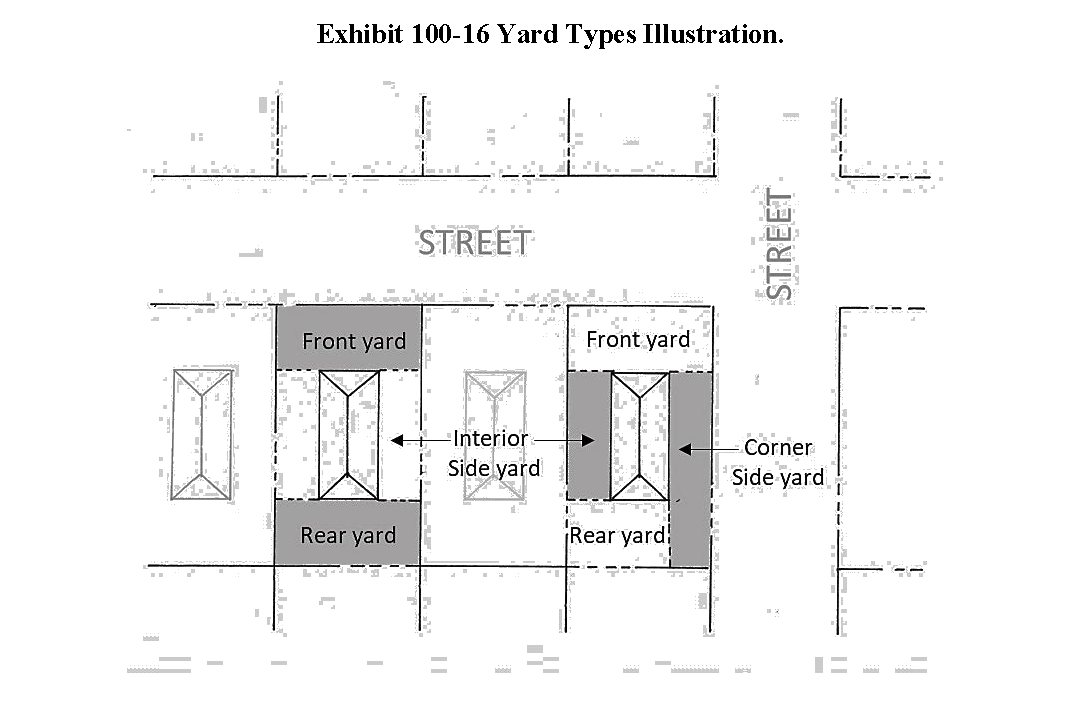
- Z -
Zoning. The process of classifying land into areas and districts, such areas and districts being generally referred to as "zones" and the prescribing and application in each area and district of regulations concerning building and structure designs, building and structure placement, and uses to which land, buildings, and structures within such designated areas and districts may be put.
Zoning Code. The duly approved, enacted, and amended ordinance that regulates land use in the parish.
Zoning District. A section of the parish in which zoning regulations and standards are uniform.
Zoning Map, Official. The legally adopted map that graphically shows all zoning district boundaries and classifications within the Parish, as contained within the zoning code, which is available online on the Parish website.
(Ord. No. 24-5592, Att., §§ 1, 20, 10-3-2024; Ord. No. 25-5700, § Exh. A, 3-6-2025; Ord. No. 25-5781, § Exh. A, 7-10-2025; Ord. No. 25-5796, § Exh. A, 8-7-2025; Ord. No. 26-5906, § Exh. A, 1-8-2026; Ord. No. 26-5946, 4-9-2026)
Sec. 100-1.1 - Generally.
A.
Short Title. The title of this part shall be known as the "Unified Development Code of St. Tammany Parish, Louisiana." This part may also be cited as the "Unified Development Code" or the "UDC."
B.
Authority. The UDC is enacted under the authority of Article VI, Section 17 of the Louisiana Constitution of 1974, LA R.S. 33:101 through 33:119, LA R.S. 33:4780.40 through 33:4780.50, all other constitutional and statutory authority which may be applicable hereto, and the St. Tammany Parish Home Rule Charter.
C.
Purpose. The purpose of the UDC is to establish standards for land use and development in accordance with both the parish's official land use map and St. Tammany Code of Ordinances to more effectively:
1.
Promote the health, safety, and general welfare of the parish.
2.
Protect or enhance property values parish-wide.
3.
Promote safe, orderly development and use of land and natural resources.
4.
Facilitate safe and economical provision of adequate streets, water, wastewater, stormwater, schools, parks, and other public facilities.
D.
Applicability. The UDC shall be applicable to all property, entities, and persons located within unincorporated St. Tammany Parish, except as otherwise limited or exempted within these regulations, including:
1.
All buildings, structures, lands, and uses shall be subject to the procedures and requirements of this UDC.
2.
All divisions or subdivisions of land into 2 or more parcels or lots or the combination of lots shall be subject to the procedures and requirements of this UDC.
E.
Effective Date. This UDC was adopted on December 18, 2023, per Ordinance No. 23-5339, was further amended by Ordinance No. 24-7620, and became effective on August 2, 2024.
Sec. 100-1.2 - Rules of interpretation.
A.
Generally. In interpreting and applying the provisions of this UDC, they shall be held to be the minimum requirements for the promotion of the public's safety, health, convenience, comfort, prosperity, and general welfare. The UDC is not intended to interfere with or abrogate or annul any servitudes, covenants, or other agreements between parties; provided, however, that where the UDC imposes a greater restriction upon development, the provisions of the UDC shall govern. Minimum values in the UDC are thresholds and are not intended to be target values.
B.
Rules of Language. For the purpose of interpretation of the UDC, the following rules of language shall apply:
1.
The specific controls the general.
2.
In cases of difference of meaning or implication between the text of the UDC and the captions for each section, the text shall control.
3.
The word "shall" is always mandatory; the word "may" is permissive and is at the discretion of the Parish Council, the Planning and Zoning Commission, Board of Adjustment, the Director of the Department of Planning and Development, or other decision-maker, as the context may establish.
4.
Words used in the present tense include the future; words in the singular include the plural; and words of one gender include all other genders, unless the context clearly indicates the contrary within the time frame subject to extensions provided herein.
5.
All words, terms and phrases not otherwise defined herein shall be given their usual and customary meaning, unless the context clearly indicates a different meaning was intended.
6.
The use of buildings and land within the parish shall be subject to all other applicable provisions of the St. Tammany Code of Ordinances as well as this UDC, whether or not such other provisions of the code are specifically cross-referenced herein. Cross-references to other provisions of this code and other applicable rules and regulations are for the convenience of the reader; lack of a cross-reference should not be construed as an indication that other provisions do not apply.
C.
Graphics. Illustrations are provided for the convenience of the user and in case of a conflict with the text of this UDC, the text shall control.
D.
Computation of Time. Unless otherwise specifically provided, the timeframes specified for actions shall begin on the business day following the submittal of an application or the preceding action and shall count by business days. Specified timeframes shall not include Saturdays, Sundays, or parish-recognized holidays. All acts must be completed within the time frame subject to extensions.
E.
Time Limits. Applications submitted pursuant to this UDC may be scheduled for a public hearing before the Planning and Zoning Commission or Board of Adjustment provided all information required by the UDC has been submitted, and staff has made a determination regarding conformance with all requirements of the UDC. Except as otherwise provided, no application shall be deemed approved due to the failure of parish staff or officials to act within any timelines established within the UDC, including but not limited to timelines established in Chapter 200 Procedures and Chapter 800 Subdivision Regulations. Extensions requested by the applicant or delays due to applicant's failure to respond to requests for additional information shall not constitute failures to act by parish staff or officials.
Sec. 100-1.3 - Relationship to other regulations.
A.
Conflicts. Whenever any provision of this UDC or any other applicable law, rule, contract, resolution, or regulation of the parish, state, or federal government contains certain standards covering the same subject matter, the more restrictive requirements or higher standards shall govern, unless otherwise provided.
B.
Development Under Prior Regulations. Any development application found to be complete by the applicable reviewer prior to the effective date of this UDC shall be processed under the prior regulations unless, when required, the plat or plan has not been recorded within 6 months of the effective date of this UDC.
C.
Relationship to Prior Agreements. This UDC is not intended to abrogate, annul, or otherwise interfere with any servitude, covenant, or any other private agreement or legal relationship; provided, however, that where the regulations of the UDC are more restrictive or impose higher standards or requirements than such servitude, covenant, or other private agreement, the regulations of this UDC shall govern.
D.
Relationship to other Regulations and Codes. This UDC establishes many, but not all the standards and procedures for development. Other portions of the St. Tammany Parish Code of Ordinances, as well as other standards, shall apply to development, including, but not limited to, fire codes, utility, and street standards.
Sec. 100-1.4 - Fees.
A.
Authority. Reasonable fees to offset the costs of administration of this part shall be set by the Parish Council in accordance with Part I of the St. Tammany Parish Code of Ordinances.
B.
Fee Required. Any application for action pursuant to this UDC shall be subject to the required fee.
C.
Amount of Fee. The amount of fees for development permits and applications is as established by ordinance of the Parish Council and outlined in Part I of the St. Tammany Parish Code of Ordinances. Specific fee amounts are posted on the parish's website or available in hard copy in the offices of the Department of Permits and Inspections and the Department of Planning and Development.
D.
Payment. All fees shall accompany the application, shall be made payable to the parish, and shall be submitted to the applicable official.
E.
Exemptions. Except for notification and recordation costs, no fee shall be required for an application filed for a facility owned by St. Tammany Parish; except for public projects funded by grants.
F.
Fee Refunds. All fees are non-refundable. Some exclusions may apply based on information provided through application forms on a per-department basis.
Sec. 100-1.5 - Severability.
A.
Severability. It hereby is declared to be the intent of St. Tammany Parish that the provisions of this UDC shall be severable. If any provision is declared invalid by a court of competent jurisdiction, it is hereby declared to be the legislative intent that:
1.
Decisions limited. The effect of such decision shall be limited to the provision or provisions that are expressly stated in the decision to be invalid; and
2.
Remainder stays in effect. Such decision shall not affect, impair, or nullify the UDC as a whole or any other part thereof, but the rest of the UDC shall continue in full force and effect.
Sec. 100-1.6 - Enforcement.
A.
Interpretation of UDC. It is the intent of these regulations that all questions of interpretation and enforcement shall first be presented to the Director of Planning and Development charged with the interpretation, administration, and enforcement of these regulations, with the assistance of any relative parish department as necessary, including the Department of Planning and Development. The purpose of this decision-making activity is to facilitate:
1.
The discontinuance of illegal use of land, buildings, or structures.
2.
The removal of illegal buildings or structures, alterations, additions, or structural changes thereto.
3.
The discontinuance of any illegal work being done.
4.
The prevention of any violations of the provisions of the UDC.
B.
Violations. The remedies provided in this section for violations of any provision of the UDC, whether civil or criminal, shall be cumulative and shall be in addition to any other remedy provided by law. Except as otherwise provided in this UDC, any development or use initiated after adoption of this UDC, or maintained in violation of this UDC, which is not in compliance with the provisions of this UDC is prohibited and shall be punishable as such. Any of the following shall be a violation of the UDC and shall be subject to the remedies and penalties provided for in the UDC; including, but not limited to:
1.
Activities inconsistent with the UDC. To engage in development or subdivision of any land in contravention of any regulation of the UDC.
2.
Activities without permit or approval. To engage in any subdividing, development, construction, or other activity of any nature upon land that is subject to the UDC without all the approvals required by the UDC.
3.
Activities inconsistent with permit. To engage in any development, use, construction, or other activity of any nature in any way inconsistent with the terms and conditions of any permit, approval, certificate, or other form of authorization required by the UDC to engage in such activity.
4.
Activities inconsistent with conditions. To violate, by act or omission, any term, condition, or qualification placed by a decision-making body upon any permit or other form of authorization granted pursuant to the UDC.
5.
Removing or defacing required notice. To remove, deface, obscure, or otherwise interfere with any notice required by the UDC.
C.
Separate Offenses May Be Charged. Each day that a violation remains uncorrected shall constitute a separate violation of the UDC, with such violations beginning 10 days after the property owner has been notified in writing of such violation by the parish.
D.
Civil Remedies and Enforcement Powers. If any development activity occurs in violation of the UDC, the parish, in addition to other remedies, may institute any appropriate action or proceedings to prevent such unlawful development activity, to restrain, correct, or abate such violation, to prevent the occupancy of said building, structure, or land, or to prevent any illegal act, conduct, business, or use in or about such premises. The following remedies and enforcement powers may be used to administer and enforce this UDC:
1.
Withhold permit. The parish may deny or withhold all permits, certificates, approvals, or other forms of authorization on any land, structure, or improvements thereon upon which there is an uncorrected violation of a provision of the St. Tammany Code of Ordinances or of a condition or qualification of a permit, certificate, approval, or other authorization previously granted by the parish. This enforcement provision shall apply regardless of whether the current owner or applicant is responsible for the violation in question.
2.
Permits approved with conditions. Instead of withholding or denying a permit or other authorization, the parish may grant such authorization subject to the condition that the violation be corrected.
3.
Revoke permits. Any development permit or other form of authorization required under the UDC may be revoked when the parish determines that:
a.
There is departure from the plans, specifications, or conditions as required under the terms of the permit.
b.
The development permit was procured by false representation or was issued by mistake.
c.
Any of the provisions of the UDC are actively being violated. For example, if an open violation for an unsafe structure is unaddressed within the required timeframes, the parish may revoke an active, approved permit issued to the same applicant until such violation is addressed.
d.
Written notice of such revocation shall be served upon the owner, the owner's agent or contractor, or upon any person employed on the building or structure for which such permit was issued or shall be posted in a prominent location; and, thereafter, no such construction shall proceed.
4.
Stop work. With or without revoking permits, the parish may stop work on any development activity on any land on which there is an uncorrected violation of a provision of the UDC or of a permit or other form of authorization issued hereunder.
5.
Revoke plan or other approval. Where a violation of the UDC involves a failure to comply with approved plans or conditions to which the approval of such plans was made subject, the parish may, upon notice to the applicant and other known parties in interest (including any holders of building permits affected) and after a public hearing, revoke the approval.
6.
Injunction and abatement. The parish, through its authorized agents, may initiate injunction or abatement proceedings or other appropriate action in the district court against any person who fails to comply with any provision of the UDC, or any requirement or condition imposed pursuant to the UDC, to prevent, enjoin, abate, or terminate violations. The parish may seek a court order in the nature of mandamus, abatement, injunction, or other action for proceeding to abate or remove a violation, or to otherwise restore the premises in question to the condition in which they existed prior to the violation.
7.
Enforcement of property transfers.
a.
Whoever, being the owner or agent of the owner of any land located within a subdivision, transfers or sells or agrees to transfer or sell any land by reference to or exhibition of, or by other use of a plat of a subdivision or a plan for the land, before such plat or plan has been approved and recorded, or filed with the St. Tammany Clerk of Court, shall make the instrument of transfer subject to compliance with laws, ordinances, and regulations relative to the development of subdivisions.
b.
Whoever, being the owner or agent of the owner of any land located within a subdivision, transfers or sells or agrees to transfer or sell any land by reference to or exhibition of, or by other use of a plat of a subdivision or a plan for the land, before such plat or plan has been approved and recorded, or filed with the St. Tammany Parish Clerk of Court, without making the instrument of transfer subject to compliance with laws, ordinances, and regulations relative to the development of subdivisions or land, shall be prohibited from obtaining a permit, certificate, approval, or other form of authorization until the instrument of transfer is rectified. The description of such lot or parcel by metes and bounds in the instrument of transfer or other document used in the process of selling or transferring shall not exempt the transaction from such penalties or from the remedies herein provided. The parish may enjoin such transfer or sale or agreement by suit for injunction brought in any court of competent jurisdiction.
E.
Notification Procedures for Violations. Upon finding that any of the provisions of these regulations are being violated, the Director of Planning and Development shall notify, in writing, the persons responsible for such violation, indicating the nature of the violation and ordering the action necessary to correct it in accordance with Part I, Chapter 2 - Administration; Article XIV. Code Violations and Administrative Adjudications.
Sec. 100-2.1 - Generally.
This section outlines the powers and responsibilities as well as the rules of policy and procedure of the different boards, commissions, and officials as they relate to the administration of this UDC.
Sec. 100-2.2 - Planning and zoning commission.
A.
Creation. Under the authority of LA R.S. 33:101 et seq., St. Tammany Parish maintains a parish planning commission, known as the "St. Tammany Parish Planning and Zoning Commission" or "Planning and Zoning Commission" or "the commission."
B.
Powers and Duties. The Planning and Zoning Commission shall have the following powers and duties:
1.
To hear, review, propose, and make recommendations regarding amendments to the UDC in accordance with Chapter 200, Sec. 200-3.2 of the UDC.
2.
To hear, review, and make recommendations on amendments to the official zoning map, including planned unit developments.
3.
To hear, review, and make final decisions regarding conditional use applications and planned corridor developments.
4.
To hear, review, and make final decisions regarding all plats of subdivision, as required in Chapter 800 of this UDC. The Planning and Zoning Commission may grant certain waivers of the subdivision requirements in accordance with Chapters 800 and Chapter 900 of the UDC.
5.
To hear, review, and make final decisions on appeals of minor subdivision application decisions made solely by the Director of Planning and Development.
6.
To hear, review, and make final decisions on appeals on development review application decisions made by the Director of Planning and Development.
7.
To adopt a master or comprehensive plan or elements thereof, including graphics, narrative description, and policies to guide and accomplish the coordinated, adjusted, and harmonious development of the parish.
8.
To make careful and comprehensive surveys and studies of present and future growth of the parish and to make periodic reviews and updates to the master plan or comprehensive plan or portions thereof.
9.
To make careful and comprehensive surveys and studies of present and future land use in the parish and to make recommendations, periodic reviews and propose updates to the official zoning map, or portions thereof.
10.
To review and report on any matter referred to it by the Parish President or the Parish Council (i.e., transportation plan, capital improvement program, or land use study).
11.
To make its special knowledge and expertise as a commission available, upon reasonable written request, to any official, department, or board.
12.
To exercise all of the powers and duties conferred by LA R.S. 33:102 through 33:119 inclusive, where applicable, and as may be amended by the state legislature.
C.
Composition.
1.
The Planning and Zoning Commission shall be composed of 11 members and 2 alternate members.
2.
The Parish President shall have the unilateral and exclusive right to appoint 2 members. These exclusive appointments by the Parish President do not require action by resolution or ordinance.
3.
The Parish Council, by resolution, shall have the unilateral and exclusive right to appoint 9 members and 2 alternates.
4.
Any member who fails to appear at 2 consecutive Planning and Zoning Commission meetings may be removed by their appointing authority. Members may also be removed at any time with or without cause by the appointing authority. A majority vote of the Parish Council membership is required to remove members appointed by the Parish Council.
5.
Any vacancy as specifically to the 9 Parish Council appointments shall be unilaterally and exclusively filled by council resolution within 75 days of notice of the vacancy.
6.
Terms of all Planning and Zoning Commission members shall be concurrent with the terms of office of the Parish President and Parish Council.
7.
Planning and Zoning Commission members shall receive a per diem of $50.00 for each meeting of the commission attended, for a maximum of 24 meetings per year.
8.
No member shall seek, qualify for, or hold an elected public office while seated as a Planning and Zoning Commissioner.
D.
Training.
1.
A person newly appointed and serving on the Planning and Zoning Commission shall receive at least 4 hours of training prior to, or within 1 year of, appointment.
2.
Each year, all commissioners shall attend a mandatory 4 hours of continuing education training provided by the Department of Planning and Development. Should a commissioner be unable to attend the mandatory training session, that commissioner will not take part in commission functions until the training requirement has been met. Should the parish-sponsored training session not be available, an alternative training session approved by the Director of Planning and Development may be substituted. Commissioners newly appointed, and those continuing to serve are required to obtain a combined total of 4 hours of training and annual continuing education, respectively.
E.
Chairperson and Vice Chairperson. At the first regular meeting of each calendar year, the members of the Planning and Zoning Commission shall elect 1 chairperson and 1 vice-chairperson, and the terms shall commence at that meeting.
1.
In the absence of the chairperson, the vice-chairperson shall act as chair and shall have all the powers of the chairperson.
2.
In the absence of both the chairperson and the vice-chairperson, a quorum may select a member to preside over the meeting.
3.
The chairperson may appoint committees comprised of no more than 5 members of the commission, as well as other persons to serve the commission as deemed necessary.
4.
The chairperson may engage in discussion and must vote in the same manner as any other member of the commission.
5.
The chairperson may suggest motions but may neither make nor second motions.
F.
Secretary. The Director of the Department of Planning and Development, or their designee shall serve as the secretary to the Planning and Zoning Commission.
1.
The secretary shall keep the minutes of the proceedings of the commission, and maintain all records of the commission meetings, hearings, and proceedings. The minutes shall show the vote of each member upon each question, or if absent or failing to vote, indicating that fact. A copy of the minutes and actions of the commission shall be filed with the Parish Council.
2.
The secretary shall provide notices of hearings and meetings as may be required by law and shall prepare all agendas.
3.
The secretary shall serve as the point of contact for all applicants, shall collect and compile information, and shall report all departmental recommendations to the commission.
G.
Planning and Zoning Commission Meetings.
1.
The regular Planning and Zoning Commission meetings shall be held on the first Tuesday of each month at the St. Tammany Parish Administrative Complex, except where holidays or other conflicts shall require rescheduling.
2.
The Planning and Zoning Commission may schedule an additional meeting to be held on the second Tuesday of each month, if needed to accommodate larger agendas.
3.
Special meetings may be called by the chairperson, or at the request in writing of any 6 members of the commission, subject to proper legal notice.
4.
All meetings shall be open to the public and shall be conducted in accordance with state open meetings laws.
5.
The agenda for hearings and meetings of the Planning and Zoning Commission shall be prepared by the Director of the Department of Planning and Development with the approval of the chairperson.
6.
Applications requiring consideration or decision by the Planning and Zoning Commission shall not be considered by the commission unless properly and completely filed for placement on the agenda, in accordance with the applicable filing procedures of the Department of Planning and Development and provisions for public notice and the filing deadlines established therein.
7.
The agenda shall constitute the fixed order of business for the public hearing or meeting.
8.
The chairperson, without objection from the commission, may arrange individual items on a particular agenda if necessary for the expeditious conduct of business.
9.
Other items of business (discussion items) not requiring action by the commission may be presented at a meeting and placed on the agenda under "New Business" by the chairperson with a unanimous vote of the commission members present.
10.
Any person wishing to introduce written materials at the public hearing or meeting shall hand the materials to the Director of the Department of Planning and Development for proper recording and distribution to the chairperson and commission. For this information to be introduced and recorded there must be a minimum of 12 copies of each document to be introduced.
11.
The commission shall review the draft minutes of its meetings as prepared by the Director of the Department of Planning and Development and approve or amend said minutes as is necessary to accurately reflect the actions described. Upon adoption, these minutes become part of the public record. When commission meetings are audio and/or video recorded, said recordings shall become a part of the meeting minutes reflecting commission action.
H.
Parliamentary Rules.
1.
The latest edition of Robert's Rules of Order is hereby designated as the official manual of the Planning and Zoning Commission. If the manual conflicts with this chapter, this chapter shall govern.
2.
A parliamentarian shall be appointed by the chairperson.
3.
The chairperson shall be familiar with the contents of the manual and may consult with the parliamentarian of the commission to answer parliamentary inquiries directed to the chairperson.
I.
Quorum and Voting.
1.
No business shall be conducted by the Planning and Zoning Commission without a quorum being present. Unless otherwise specified herein, a quorum shall consist of 8 members, or a two-thirds majority.
2.
To constitute final action on any matter before it, at minimum, a majority vote of the membership of the commission (6 members) is required, unless a larger vote is required by law. Action on a waiver, at minimum, shall be determined by at least 8 members or a two-thirds majority vote. The failure of a motion to receive the minimum number of affirmative votes shall constitute no action either for denial or approval. For development applications where the Planning and Zoning Commission is the final decision-maker, no action shall constitute a de facto denial of the application.
3.
Recusal. In the event of a conflict of interest which does not require a resignation in accordance with the Louisiana Code of Government Ethics, LA R.S. title 42, Ch. 15 (LA R.S. 42:1101 et seq.), as amended, the involved commissioner shall announce the conflict and shall recuse himself from voting on and participating in the discussion of the matter giving rise to the conflict.
4.
Voting by proxy is not allowed.
J.
General Rules of Public Participation. Procedural rules related to public participation at Planning and Zoning Commission meetings are outlined in Chapter 200, Sec. 200-2.H.
K.
Seminars and Retreats.
1.
From time to time, the Planning and Zoning Commission may schedule informal study/work sessions designated as seminars or retreats.
2.
Sessions shall be open to the public and the rules of proper notice of commission meetings shall apply.
3.
The only order of business at a session shall be the presentation, familiarization, and discussion of the particular agenda study topics.
4.
The planning staff and/or guest presenters shall moderate the discussions and observe the following order of presentation:
a.
Presentation of study item.
b.
Discussion and interaction between the commission members.
c.
Public input (if scheduled as part of the seminar).
d.
Concluding remarks.
5.
No official action shall be taken by the commission on items presented at the seminar or retreat.
6.
Public comment at the seminar, if scheduled, shall be limited based upon the topic and agenda. Interested parties are welcome to listen and learn from the presentation and discussion with no participation in the discussion unless scheduled as an agenda item.
L.
Committees.
1.
In fulfilling its various charges, the Planning and Zoning Commission may utilize committees at its discretion.
2.
The commission may appoint committees comprised of no more than 5 commission members and may include other persons as deemed necessary.
3.
Staff personnel will be made available upon reasonable request to provide any assistance required by the committee.
4.
Committees shall not take any action, which may be construed as an official act of the commission, but instead may make recommendations for action by the commission. Committees shall not publicly advocate or promote committee recommendations as an official position of the commission unless the commission has first acted on the matter.
5.
Committees shall conduct business by an agenda and keep minutes of all proceedings as a matter of public record.
6.
All committee meetings shall be open to the public and shall be conducted in accordance with state open meetings laws.
M.
Community Meetings. Following the first hearing on a matter before the commission, a "community meeting" may be called by the chairperson and have up to 5 commissioners in attendance. Community meetings are intended for dissemination of information and for promoting dialogue among applicants and persons interested in matters being brought before the commission only and shall not be considered a committee of the commission. Attendance is optional for all community members, including the applicant of a proposed development project which may be the subject of such meeting.
N.
Executive Session. From time to time, the Planning and Zoning Commission may find it necessary to discuss matters of personnel or litigation pertaining to the business of the commission and shall enter executive session to do so.
O.
Rules of Conduct for Commissioners
1.
Each member of the Planning and Zoning Commission shall abide by the Louisiana Code of Government Ethics, LA R.S. title 42, Ch. 15 (LA R.S. 42:1101 et seq.), as amended. Each member shall certify, in writing, that he has read and understands the "Louisiana Code of Governmental Ethics" located on the Louisiana Board of Governmental Ethics (LBGE) website at http://ethics.la.gov, prior to being seated as a Planning and Zoning Commissioner. Each member is responsible to register and participate in at least one hour of ethics training annually through the LBGE website at http://ethics.la.gov/SeminarRegistration/. Should a commissioner not complete the ethics training in any calendar year, that commissioner will not take part in commission functions until the ethics training requirement has been met.
2.
A commission member shall not meet or communicate in any fashion with any applicant, proponent, and/or opponent, to discuss any matter before the commission prior to a legal public hearing on that matter. Violation of this section may be cause for dismissal of the offending commission member.
3.
Each member may visit a site in question but may not have discussions concerning the site, or any development project, with an interested party prior to the legal public hearing.
4.
Following the initial required public hearing, the commission may form a committee for the express purpose of attempting to better understand the issues raised in the review of the application, in accordance with Chapter 100, Sec. 100-2.2.L.
5.
A commission member shall not in any way pledge himself to any party on a matter before the commission, prior to the legal public hearing.
6.
Any commission member who has knowledge of the fact that he will not be able to attend 1 or more scheduled meetings or hearings shall notify the secretary at the earliest possible opportunity, and in any event before 4:00 p.m. on the day of the first missed meeting.
7.
Once a meeting is called to order by the chairperson, the commission members shall take special care to conduct themselves in a professional and courteous manner and remain attentive to the members of the public testifying before the commission.
8.
Commission members requesting information or clarification relative to an application or business item that is before them for consideration may contact the secretary directly for assistance.
9.
The commission may request information or specific actions from the secretary and such request will be reflected in the minutes.
10.
Each commissioner will sign an acknowledgment of having received and fully read the rules of conduct prior to serving as member of the commission.
P.
Representation.
1.
The chairperson shall serve as the official spokesman and representative of the commission in all matters that have been acted upon by the commission. The chairperson may appoint a member of the commission to serve as spokesperson or representative. Any member who officially represents or speaks for the commission shall report to the commission on any statements made or actions taken while serving in that capacity at its next regularly scheduled meeting.
2.
In the absence of an official spokesman, the Director of the Department of Planning and Development shall act on behalf of the commission before the Parish Council and shall inform the council of all final decisions and recommendations, along with supporting records and documentation, rendered by the commission.
3.
Commission members shall refrain from making statements or taking an action which may be identified as or construed to be an official act or position of the commission.
4.
Commission members shall not publicly advocate or promote individual positions or opinions unless the commission has first acted on the matter.
Q.
Violation of Planning and Zoning Commission Rules of Policy and Procedure. Any violation of this section may be deemed as cause for removal of the offending member by the appointing authority.
R.
Amendments to Planning and Zoning Commission Rules of Policy and Procedure. The Planning and Zoning Commission rules of policy and procedure as outlined in this subsection may be amended in accordance with Chapter 200, Sec. 200-3.2 of this UDC.
(Ord. No. 24-5592, Att., § 2, 10-3-2024; Ord. No. 25-5760, § Exh. A, 6-5-2025)
Sec. 100-2.3 - Director of the Department of Planning and Development.
A.
Designee. The Director of Planning and Development may designate any staff member as their designee in any function assigned by the UDC to the Department of Planning and Development; the Director remains responsible for any action taken by their designee.
B.
Powers and Duties. The Director of the Department of Planning and Development, or the Director's designee, shall have the following powers and duties:
1.
To serve as support staff to the Planning and Zoning Commission and as secretary to the commission as outlined in Chapter 100, Sec. 100-2.2.F of the UDC.
2.
To support the Planning and Zoning Commission in the preparation and maintenance of the parish master plan or comprehensive plan.
3.
To make final decisions regarding requests for interpretation of the Unified Development Code and the official zoning map, with the exception of interpretation from Chapter 300 of the UDC.
4.
To make final decisions on minor subdivisions in accordance with Chapter 800, Sec. 800-2.B of the UDC.
5.
To make final decisions on development plan review applications when required as a condition of development approval, including signage and landscaping plans.
6.
To make final decisions on land clearing applications.
7.
To make final decisions regarding applications for alternative compliance with the tree preservation and landscape regulations in accordance with Sec. 600-3 of the UDC.
8.
To review and make recommendations on the following applications:
a.
Amendments to the comprehensive plan.
b.
Amendments to the text of the Unified Development Code.
c.
Amendments to the official zoning map.
d.
Conditional uses.
e.
Variances.
Sec. 100-2.4 - Director of the Department of Permits and Inspections.
A.
Designee and Employees.
1.
The Director of the Department of Permits and Inspections may designate any staff member as their designee in any function assigned by this UDC to the Department of Permits and Inspections; the Director remains responsible for any action taken by their designee.
2.
The Director shall have the authority to appoint a deputy director, related technical officers, inspectors, plan examiners and other employees. Such employees shall have the powers as delegated by the Director and in accordance with the powers and duties of the Director.
B.
Powers and Duties. The Director of the Department of Permits and Inspections, or the Director's designee, shall have the following powers and duties:
1.
To make final decisions regarding requests for interpretation of Chapter 300 of the UDC.
2.
To adopt policies and procedures to clarify the application of the provisions of Chapter 300 of the UDC. However, such policies and procedures shall not have the effect of waiving requirements specifically provided for in the UDC.
3.
To receive and review development applications and issue permits in conformance with the provisions of the UDC.
4.
To inspect structures or the use of land to determine compliance with the UDC and order corrective action in case of any violation.
5.
To revoke, suspend, or cancel any permit that has been violated or issued in violation of the UDC.
6.
To keep a record of the business of the Department of Permits and Inspections in accordance with the public record law of the state.
Sec. 100-2.5 - Board of Adjustment.
A.
Creation. The Board of Adjustment for St. Tammany Parish is created pursuant to the authority granted in LA R.S. 33:4727, as amended.
B.
Membership and Term.
1.
The Board of Adjustment shall consist of 5 members, and 2 alternate members, all of whom shall be qualified voters.
2.
Members shall be appointed for terms of 5 years each. Vacancies shall be filled for the unexpired term of any member whose term becomes vacant.
3.
Four appointments and 2 alternates shall be made by resolution of the Parish Council.
4.
One appointment shall be made by appointment of the Parish President.
5.
All members shall be removable for cause by the appointment authority upon written charges and after public hearings; provided, however, that any member who shall be absent for 3 consecutive meetings, regardless of cause, shall be deemed to have removed himself from membership on the board and that appointment shall be automatically vacated as a result of such non-attendance.
6.
The board shall elect its own chairperson from its membership. The chairperson shall serve for 1 year.
C.
Powers of the Board. The board shall have the following powers:
1.
To hear and decide appeals where it is alleged there is error in any order, requirement, administrative decision, or determination made by the Department of Planning and Development, the Airport Manager, or the Department of Permits and Inspection.
2.
To permit variations from the regulations of the UDC where there are practical difficulties or unnecessary hardships in the way of carrying out the strict letter of such ordinance, or to modify the application of any of the regulations or provisions imposed by the UDC relating to the construction or alteration of buildings or structures so that the spirit of the ordinance shall be observed, public safety and welfare secured, and substantial justice done. Specific limitations on the board's authority to grant variances from the UDC are outlined in Chapter 200, Sec. 200-3.9 of the UDC.
3.
In exercising the above-mentioned powers, the board may reverse or affirm wholly or partly or may modify the order, requirement, decision, or determination appealed from and may make such order, requirement, decision, or determination as ought to be made, and to that end shall have the powers of the department from whom the appeal is taken.
4.
Resolve district boundaries of the official zoning map where there are discrepancies in the official land use map pursuant to Chapter 400, Sec. 400-1.3.B.3.
D.
Meetings, Rules, and Proceedings.
1.
The Board of Adjustment may adopt additional policies and procedures in accordance with the provisions of the UDC.
2.
Meetings of the Board of Adjustment shall be held on the second Thursday of each month and at such other times as the board may determine. The chairperson, or in their absence the acting chairperson, may administer oaths and compel the attendance of witnesses.
3.
All meetings of the board shall be open to the public.
4.
Board members shall receive a per diem of $50.00 for each meeting of the board attended, for a maximum of 12 meetings per year.
5.
The secretary of the Board of Adjustment shall keep minutes of its proceedings, showing the vote of each member upon each question, or, if absent or failing to vote, indicating that fact and shall keep records of its examinations and other official actions, all of which shall be filed immediately by the Department of Planning and Development, and shall be public record. All testimony, objections thereto and rulings thereon, shall be taken down and reflected on the public record.
E.
Secretary. The Director of the Department of Planning and Development, or their designee, shall serve as the secretary to the Board of Adjustment.
1.
It shall be the duty of the secretary to keep a true and correct record of all proceedings at Board of Adjustment meetings. Certified copies of the minutes of all such proceedings shall be furnished to the chairperson of the Planning and Zoning Commission.
2.
The secretary shall provide notices of hearings and meetings as may be required by law and shall prepare all agendas.
3.
The secretary shall serve as the point of contact for all applicants, shall collect and compile information, and shall report all departmental recommendations to the Board of Adjustment.
F.
Voting. The concurring vote of 4 board members shall be necessary to reverse any order, requirement, decision, or determination of any such administrative official, or to permit any variation of the UDC.
(Ord. No. 24-5592, Att., § 2, 10-3-2024)
Sec. 100-2.6 - Parish council.
A.
Powers. The Parish Council has the following powers regarding the administration of the provisions of the UDC:
1.
To make final decisions regarding the following development applications:
a.
Amendments to the text of the UDC.
b.
Amendments to the official zoning map.
c.
Planned unit developments.
2.
To hear, review and make final decisions on appeals of application decisions made by the Planning and Zoning Commission.
3.
To review and approve the rules of policy and procedure or bylaws for the Board of Adjustment and the Planning and Zoning Commission.
Sec. 100-3.1 - Commission generally.
A.
Regional Planning Area.
1.
The Regional Planning Commission for Jefferson, Orleans, St. Bernard, St. Tammany, Tangipahoa Parishes, and Plaquemines is a board of local elected officials and citizen members appointed to represent each community on regional issues.
2.
The regional planning area is hereby established to be comprised of the total area of Jefferson Parish, Orleans Parish, St. Bernard Parish, St. Tammany Parish, Plaquemines Parish, St. Charles Parish, St. John the Baptist Parish, and Tangipahoa Parish.
B.
Creation and Purpose.
1.
There is hereby established a regional planning commission, defined in Sec. 100-5 Definitions, in accordance with the provisions of Act 239 of the Louisiana Legislature of 1956, as now amended by Acts No. 114 of the Louisiana Legislature of 1966, Nos. 267 Sec. 1 and 288 Sec. 2 of the Louisiana Legislature of 1968, No., 329 Sec. 1 of the Louisiana Legislature of 1970, No. 607 Sec. 1 of the Louisiana Legislature of 1972, No. 112 Sec. 1 of the Louisiana Legislature of 1973, No. 249 Sec. 1 of the Louisiana Legislature of 1974, No. 132 Sec. 1 of the Louisiana Legislature of 1979, No. 377 Sec. 2 of the Louisiana Legislature of 1984 and No. 533 Sec. 1 of the Louisiana Legislature of 1985, for the following purposes:
a.
To prepare, and from time-to-time, revise, amend, extend, or add to a plan or plans for the development of the regional planning area, which plan or plans collectively shall be known as the regional development plan. Such plan shall be based on studies of physical, social, economic, and governmental conditions and trends and shall aim at the coordinated development of the regional planning area in order to promote the general welfare and prosperity of its people. In preparing the regional development plan, the Regional Planning Commission shall take account of and shall seek to harmonize the planning activities of federal, state, parish, municipal or other local agencies within the area. In preparing such plan, or any part thereof, and in preparing, from time to time, revisions, amendments, extensions or additions, the Regional Planning Commission may seek the cooperation and advice of the state, Louisiana State Planning Office, and of other appropriate departments, agencies and instrumentalities of federal, state, and local government, of other regional planning commissions, educational institutions and research organizations, and of civic groups and private persons and organizations. The regional development plan shall embody the policy recommendations of the Regional Planning Commission in regard to the physical development of the regional planning area and shall contain:
i.
A statement of the objectives, standards and principles sought to be expressed in the regional development plan.
ii.
Recommendations for the most desirable pattern of land use within the regional planning area, in the light of the best available information concerning topography, climate, soil and underground conditions, watercourses and bodies of water, and other natural or environmental factors, as well as in the light of the best available information concerning the present and prospective economic bases of the regional planning area, trends of industrial, population or other developments, the habits and standards of life of the people of the regional planning area, and the relocation of land use in adjoining areas. Such recommendations shall, insofar as appropriate, indicate areas for residential uses and maximum recommended densities therein; areas for farming and forestry, mining and other extractive industries; areas for manufacturing and industrial uses, with classification of such areas in accordance with their compatibility with land use in adjoining areas; areas for the concentration of wholesale, retail, business and other commercial uses, areas for recreational uses, and for open spaces and areas for mixed uses.
iii.
The circulation pattern recommended for the regional planning area, including routes and terminals of transit, transportation and communication facilities, whether used for movement within the regional planning area or for movement from adjoining areas.
iv.
Recommendations concerning the need for and the proposed location of public and private works and facilities, such as utilities, flood control works, reservoirs, and pollution control facilities, military or defense installations which works or facilities, by reason of their function, size, extent or for any other causes are of regional or metropolitan as distinguished from purely local concern, or which for any other cause are appropriate subjects for inclusion in the regional development plan.
v.
Such other recommendations of the Regional Planning Commission concerning current and impending problems as may affect the regional planning areas as a whole.
b.
To make or assist in studies and investigations, insofar as may be relevant to regional, metropolitan planning, or the resources of the regional planning area and of existing and emerging problems of agriculture, industry, commerce, transportation, population, housing, public service, local government, and of allied matters affecting the development of the regional planning area, and in making such studies to seek the cooperation and collaboration of the Louisiana State Planning Office and appropriate departments, agencies and instrumentalities of federal, state, and local government, educational institutions and research organizations, whether public or private, and of civic groups and private persons and organizations.
c.
To prepare and from time-to-time revise inventory listings of the region's or metropolitan areas' natural resources, and of major public and private works and facilities of all kinds which are deemed of importance to the development of the regional planning area as a whole.
d.
To cooperate with, and provide planning assistance including, but not limited to, surveys, land use studies, urban renewal plans, technical services, and other planning work, to parish, municipal or other local government, instrumentalities or planning agencies. The Regional Planning Commission shall coordinate its planning activities with the planning activities of the state, and of the parishes, municipalities or other local units within its regional planning area and cooperate with, and assist departments and other agencies or instrumentalities of federal, state, and local government as well as other regional planning commissions in the execution of their planning functions to harmonize planning activities with the regional development plan. The Regional Planning Commission shall also cooperate and confer with, and upon request supply information to, federal agencies, and to local or regional agencies created pursuant to the federal program or which receive federal support, and shall cooperate and confer, as far as possible, with planning agencies of other states or of regional groups of states adjoining its area. Whenever cooperation or assistance under this subdivision includes the rendering of technical services, such services may be rendered free or in accordance with an agreement for reimbursement.
e.
To advise and supply information, as far as available, to civic groups, private persons, and organizations who may request such information or advice, and who study or otherwise concern themselves with the region's problems and development in the fields of agriculture, business and industry, labor, natural resources, urban growth, housing, and public service activities such as public health and education, insofar as such problems and development may be relevant to regional or metropolitan planning.
f.
To provide information to officials of departments, agencies, and instrumentalities of state and local government and to the public at large, in order to foster public awareness and understanding of the objectives of the regional development plan and of the functions of regional or metropolitan and local planning, and in order to stimulate public interest and participation in the orderly, integrated development of the region or metropolitan area.
g.
To accept and receive, in furtherance of its functions, funds, grants, and services from the federal government or its agencies, from departments, agencies, and instrumentalities of state, parish, municipal or local government, or from private and civic sources.
h.
To hold public or private hearings and sponsor public forums in any part of its area whenever it deems it necessary or useful in the execution of its other functions.
i.
To cooperate, in the exercise of its planning functions, with federal and state agencies in planning for civil defense.
j.
Have the power to borrow money from private lenders in order to stabilize its cash flow necessary for the staff's day-to-day operations, provided that such debt is secured by commission receivables or other collateral.
k.
Any 2 or more of the regional planning commissions are authorized to form an association for purpose of coordinating comprehensive planning/development programs for the resolution of economic, social, physical, and governmental problems of the state and its citizens.
l.
The association may exercise any and all powers necessary or appropriate to effectuate this purpose, including, but not limited, to the following powers:
i.
To enter into agreements or other transactions with any federal, state, or local governmental agency and with private sector organizations.
ii.
To apply for and receive state and other funds for distribution to the regional planning commissions belonging to the association based upon allocation formulas developed by these commissions.
iii.
To exercise all or any part or combination of powers granted and to do and perform all acts and things necessary or convenient to carry out the general powers expressly granted to the regional planning commissions when authorized by the several regional planning commissions belonging to the association.
iv.
To exercise all other powers necessary and proper for the discharge of its duties.
C.
Boundaries. The boundaries of the regional planning area hereby established is to be comprised of the total area of Jefferson Parish, Orleans Parish, St. Bernard Parish, St. Tammany Parish, Plaquemines Parish, St. Charles Parish, St. John the Baptist Parish, and Tangipahoa Parish.
D.
Membership.
1.
In order to carry out the purposes contained this section, there is hereby established a regional planning commission which shall consist of legal residents of Jefferson Parish, Orleans Parish, St. Bernard Parish, St. Tammany Parish, Plaquemines Parish, Tangipahoa Parish, St. Charles Parish, St. John the Baptist Parish, and the Secretary of the Louisiana Department of Transportation and Development.
2.
The members of such commission shall serve without compensation.
3.
The membership of such commission shall be composed of a simple majority of appointed or elected public officials holding office in the following municipalities and/or parishes, namely Jefferson Parish, Orleans Parish, St. Bernard Parish, St. Tammany Parish, Plaquemines Parish, St. Charles Parish, St. John the Baptist Parish, and Tangipahoa Parish.
4.
The 5 members from the Parish of Jefferson shall include the following:
a.
The Parish President;
b.
The council chairperson;
c.
A third member selected by the Parish Council and approved by the Parish President from among the mayors of the municipalities located within the Parish of Jefferson, which member shall represent the municipalities therein located; and
d.
Two members who must not otherwise hold elected or appointed office in Jefferson Parish, to be appointed by the council and approved by the Parish President.
5.
The 5 members from Orleans Parish shall include the following:
a.
The Mayor;
b.
Two councilmembers elected from the parish at large; and
c.
Two members who must not otherwise hold elected or appointed office, and shall be appointed by the Mayor, with the approval by the council.
6.
The 5 members from the Parish of St. Bernard shall include the following:
a.
The Parish President;
b.
Two councilmembers in the Parish of St. Bernard, provided same is not otherwise prohibited by law, to be appointed by the Parish Council; and
c.
Two members who must not otherwise hold elected or appointed office in the Parish of St. Bernard, to be appointed by the Parish Council.
7.
The 5 members from the Parish of St. Tammany shall include the following:
a.
The Parish President;
b.
Two members of the St. Tammany Parish Council, provided same is not otherwise prohibited by law, to be appointed by the Parish Council; and
c.
Two members who must not otherwise hold elected or appointed office in the parish, to be appointed by the Parish Council;
8.
The 5 members from the Parish of St. Charles shall include the following:
a.
The Parish President;
b.
The Council Chairperson;
c.
A third member selected by the Parish Council, and approved by the Parish President, from among the mayors of the municipalities located within the parish, which members shall represent the municipalities therein located;
d.
Two members who must not otherwise hold elected or appointed office in the Parish of St. Charles, to be appointed by the Parish Council and approved by the Parish President.
9.
The 5 members from the Parish of St. John the Baptist shall include the following:
a.
The Parish President;
b.
Two councilmembers in the Parish of St. John the Baptist, provided same is not otherwise prohibited by law, to be appointed by the Parish Council;
c.
Two members who must not otherwise hold elected or appointed office in the Parish of St. John the Baptist, to be appointed by the Parish Council and approved by the Parish President.
10.
The 5 members from the Parish of Plaquemines shall include the following:
a.
The Parish President;
b.
The chairperson of the Plaquemines Parish Council;
c.
Member who otherwise holds elected or appointed office in the Parish of Plaquemines, provided same is not otherwise prohibited by law, to be appointed by the Parish Council;
d.
Two members who must not otherwise hold elected or appointed office in the Parish of Plaquemines, to be appointed by the Parish Council.
11.
The 5 members from the Parish of Tangipahoa shall include the following:
a.
The Parish President;
b.
The chairperson of the Tangipahoa Parish Council;
c.
The Mayors of the Cities of Hammond and Ponchatoula shall serve on an annual rotating basis;
d.
Two members who must not otherwise hold elected or appointed office in the Parish of Tangipahoa, provided same is not otherwise prohibited by law, to be appointed annually by the Parish President.
12.
If a vacancy occurs otherwise than by expiration of term, same shall be filled by appointment of the unexpired term. Such appointment shall be made by the original appointing authority.
13.
The governing bodies of Jefferson Parish, St. Bernard Parish, St. Tammany Parish, Plaquemines Parish, St. Charles Parish, St. John the Baptist Parish, or Tangipahoa Parish may remove their respectively appointed members of the commission after public hearing for inefficiency, neglect of duty, or malfeasance in office. The Chief Executive of Orleans Parish may remove any of the members appointed by him after public hearing, for inefficiency, neglect of duty, or malfeasance in office.
14.
The Secretary of the Louisiana Department of Transportation and Development shall serve as a member of the Regional Planning Commission.
15.
Of the members hereof first appointed, those not holding any other elected or appointed public offices shall hold office as follows: One shall hold office for 1 year, one for a term of 2 years, one for a term of 3 years, one for a term of 4 years, one for a term of 5 years, and the sixth member shall hold office for a term of 6 years.
16.
Members of the Regional Planning Commission who may hold other public offices, appointed or elected, including the Secretary of the Louisiana Department of Transportation and Development (or his designee) shall serve terms co-extensive with their terms of other public office.
17.
The successors of the Regional Planning Commission members first appointed who do not hold any other appointed or elected public office shall be appointed for a term of 5 years from and after the expiration of the terms of their predecessors in office.
E.
Miscellaneous Powers and Duties of Commission.
1.
Members of the commission created herein, when duly authorized by the commission, may attend planning conferences, meetings, planning institutes, or hearings upon pending planning legislation. The commission may, by resolution, pay the reasonable traveling expenses incident to such attendance.
2.
When so directed and authorized by the Regional Planning Commission, members thereof who hold no other elected or appointed office may be paid a per diem of $50.00 each for attendance at regular or specifically called meetings of full commission or the executive committee thereof in no event to exceed 2 such meetings per month, i.e., in no event is payment of a total per diem per such member to exceed $100.00 per month, payable out of the funds of the Regional Planning Commission.
3.
The commission may request, within a reasonable time, such available information as it may require for its work.
4.
The commission, its members, officers, and employees, in the performance of their functions, may enter upon any land and make examinations and surveys and place and maintain necessary monuments and marks thereon.
5.
In general, the commission shall have such powers as may be necessary to enable it to fulfill its functions, promote planning and in all respects carry out the purposes of this section.
Sec. 100-3.2 - Organization, meetings, and rule of commission.
A.
Chairperson. The Regional Planning Commission so established shall elect a chairperson from its membership and create and fill such other of its offices as it may determine. The term of chairperson shall be 1 year, with eligibility for re-election.
B.
Meetings and Records. The commission shall hold at least 1 regular meeting in each month. It shall adopt rules for transaction of business and shall keep records of its resolutions, transactions, findings, and determinations, and which records shall be public.
C.
Staff and Finances. In order to carry out its functions and responsibilities the Regional Planning Commission may appoint such employees as it may deem necessary for its work, whose appointment, promotion, demotion, and removal shall be subject to the same general provisions governing other corresponding civil employees of the parishes and municipality cooperating to engage in regional planning. The commission may also contract with planning experts, engineers, architects, and other consultants for such services as it may require. The expenditures of a commission, exclusive of those made from funds received by gift, grants of federal, state, and other such agencies, shall be within the amounts appropriated for the purpose by the cooperating local legislative bodies, which shall provide the funds, equipment, and accommodations necessary for the commission's work.
D.
Regional Development Plan; Filing; Distribution. Upon the preparation of the regional development plan or of any phase or functional part thereof, or upon the preparation of any extension of or addition to the plan, the Regional Planning Commission shall file such plan, part of plan, amendment, revision, extension or addition in the office of the state director of public works, and shall transmit copies of the same to the chief administrative officers, the legislative bodies and to the planning agencies of the parishes, municipalities, or other local governments within its area, as well as to the regional planning commissions established for adjoining areas. The Regional Planning Commission shall make copies of the regional development plan or part of a plan available for general distribution or sale.
E.
Relationship of Commission to Municipal and Parish Planning Commissions.
1.
The Regional Planning Commission created herein shall not be authorized to exercise the functions of any municipal planning commission or parish planning commission, where such are established within a regional planning area, except as hereinafter provided.
2.
In a municipality or parish located in the regional planning area as herein above defined, the legislative body of the municipality or parish may designate the Regional Planning Commission as the municipal planning commission or the parish planning commission, provided all requirements, if any, of the local home rule charters are met. Upon such designation, the Regional Planning Commission shall have all the powers and functions relating to making, adopting, amending, and adding to the master plan of the municipality or parish part thereof, or relating to the planning of the municipality or parish as provided or granted by R.S. 33:101 through 119 inclusive or by other laws to the planning commission of the municipality or parish; and the master plan, its parts, amendments and additions made and adopted by the designated commission for the municipality or parish shall have the same force and effect in the municipality or parish as though made and adopted by the municipal planning commission appointed by the municipality or a parish planning commission appointed by the parish. In acting as the planning commission of the municipality, or the parish, the designated regional planning commission shall follow the procedure specified by the provisions of R.S. 33:101 through 119 inclusive, and other laws relating to municipal or parish planning commissions. Any municipality or parish so designating a regional planning commission as its planning commission shall pay to the designated commission that portion of the expenses of the designated commission which is properly chargeable to the planning service rendered to the municipality or parish plan.
3.
In cases where a municipality or a parish has a municipal or a parish planning commission functioning within a regional planning area, then the Regional Planning Commission shall recommend measures for the coordination of plans, and if appropriate, recommend plans for adoption by said municipal or parish planning commission.
F.
Local Governments and Planning Agencies; Plans and Reports; Proposals.
1.
To facilitate effective and harmonious planning of the region or metropolitan area, all parish and municipal legislative bodies and all parish, municipal, or other local planning agencies shall file with the Regional Planning Commission, for its information, all parish or municipal plans, zoning ordinances, official maps, building codes, subdivision regulations, amendments or revisions of any of them, as well as copies of their regular and special reports dealing with planning matters.
2.
Parish or municipal legislative bodies, or parish, municipal, or other local planning agencies may also submit proposals for such plans, ordinances, maps, codes, regulations, amendments, or revisions prior to their adoption, in order to afford an opportunity to the Regional Planning Commission and/or its staff to study such proposals and to render advice thereon.
G.
Federal, State, and Local Aid to Commission.
The Regional Planning Commission may request and accept grants of funds or services from the federal government or any of its agencies, from the state government or any of its agencies, from parish, municipal or other local governments within their planning area, or from private sources. The parishes and municipalities are hereby authorized to appropriate funds for the purposes of the Regional Planning Commission established for all or part of their area. The books and accounts of the Regional Planning Commission shall be public records, open for public inspection, and shall show the amounts and sources of all receipts and the amount of all disbursements.

