
St Tammany Parish City Zoning Code
CHAPTER 200
PROCEDURES
SEC. 200-1 - GENERALLY.
A.
Purpose. The purpose of this chapter is to consolidate the procedures for filing and processing applications for development approval found within the UDC.
B.
Summary Application Types and Approval Process.
Exhibit 200-1 Summary of Application Types and Approval Process.
*Stand-alone signage plans, not part of a larger development approval, are reviewed and approved by the Department of Permits and Inspections.
SEC. 200-2 - COMMON PROCEDURES.
A.
Applicability. The following requirements are common to many of the procedures contained in the UDC and apply to applications submitted under this chapter. Additional application requirements are included for each specific procedure in Sec. 200-3.
B.
Filing of Applications. All applications shall be filed with the appropriate parish official as described in Exhibit 200-1.
1.
Forms. All applications shall be submitted on forms provided by the parish and in the format and number of copies as required by the instructions. The application shall include all information, plans, and data specified within this chapter.
2.
Preapplication conference. An applicant is encouraged to request an informal conference with the Director of Planning and Development or their designee prior to filing an application for development approval in order to discuss the procedures, standards, and regulations required for approval.
3.
Deadlines. Complete applications shall be submitted in accordance with the parish filing calendar. A calendar indicating submittal dates shall be developed by the parish each year and shall be maintained and updated by the parish.
C.
Application Fees. Every application shall be accompanied by the required filing fee. Failure to pay fees when due is grounds for refusing to process the application. However, applications initiated by the parish may be exempt from fees. All application fee amounts are outlined in Part I of the St. Tammany Parish Code of Ordinances. Specific fee amounts are posted on the parish's website or available in hard copy in the offices of the Department of Permits and Inspections and the Department of Planning and Development.
D.
Completeness Review. Upon receipt of an application for development approval, the applicable administrative director shall determine if the application is complete. Incomplete applications will not be processed and will not be scheduled for public hearing, if applicable, until deficiencies are remedied. The failure to resolve a finding of incomplete or inaccurate information may be grounds for not accepting an application. Complete applications will be reviewed for compliance or scheduled for public hearing according to the provisions and procedures of this UDC.
E.
Withdrawal of Applications. An applicant may withdraw an application as provided below. There will be no refund of fees. Requests for withdrawal shall be in writing by the applicant or legally authorized agent. Applications initiated by the Parish Council are also subject to these withdrawal provisions.
1.
Applications not requiring public hearing may be withdrawn at any time in the review process.
2.
Applications or appeals requiring public hearing of the Planning and Zoning Commission, Parish Council, or Board of Adjustment may be withdrawn prior to the public hearing where a decision or recommendation is rendered. These applications may be resubmitted without limit. Applications withdrawn after a recommendation has been made by the Planning and Zoning Commission, but prior to a decision of the Parish Council, may not be resubmitted for 1 year from the date when the withdrawal notice was submitted.
F.
Resubmission of Denied Applications.
1.
The following application types which have been denied by the Parish Council will not be reviewed or heard within 1 year of the date of denial unless substantial new evidence is available or a significant mistake of law or of fact affected the prior denial: applications for zoning change initiated by individual applicants, applications for conditional use, applications for planned unit development, applications for minor subdivisions, and variance applications.
2.
The Department of Planning and Development shall decide whether the resubmitted application is appropriate for resubmittal before expiration of the 1 year wait requirement. An application resubmitted earlier than 1 year from the date of denial shall include a detailed statement of the grounds justifying its consideration.
a.
Unless substantial new evidence is available or a significant mistake of law or fact affected the prior denial, the Department of Planning and Development shall return the resubmitted application to the applicant, and it shall not be processed.
G.
Public Notice Requirements.
1.
Mailed "abutter" notice.
a.
Mailed notice for public hearings is required for zoning map change applications.
b.
Mailed notice shall contain the date, time, place and purpose of the public hearing, a general description of the proposal, and location of the subject property.
c.
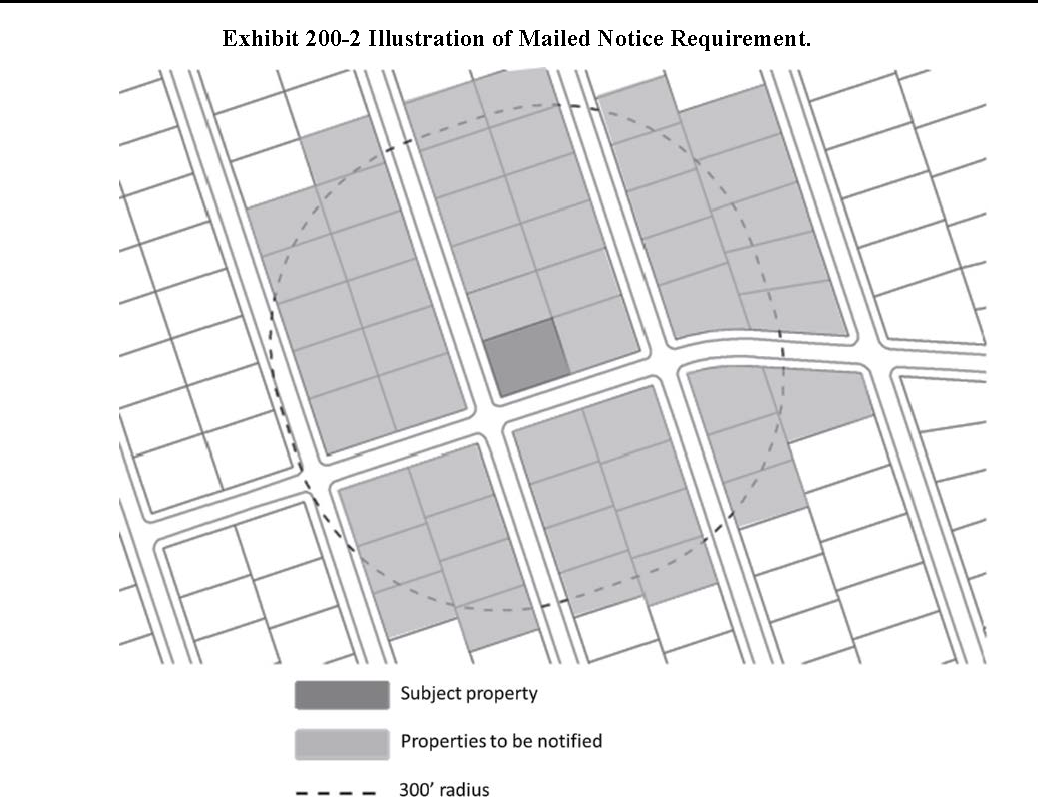
Mailed notice shall be provided by regular mail to all property owners and residents within 300 feet, measured radially from the lot lines of the subject property as depicted in the Exhibit 200-2, and as listed in the online GIS Parcel Viewer records of the Parish Assessor. For developments in rural areas, as determined by the Director of the Department of Planning and Development, mailed notice shall be provided to all property owners and residents within 800 feet, measured radially from the lot lines of the subject property.
d.
Mailed notices shall be sent by the Department of Planning and Development to all applicable addresses at least 20 calendar days before the public hearing.
2.
Door hanger notice.
a.
In addition to a mailed abutter notice, a door hanger notice is also required for zoning map change applications.
b.
A door hanger notice shall contain the date, time, place and purpose of the public hearing, a general description of the proposal, and location of the subject property.
c.
Door hangers shall be placed at least 10 business days prior to the public meeting on all properties located within 100 feet measured radially from the lot lines of the subject property as listed in the online GIS Parcel Viewer records of the Parish Assessor.
3.
Published notice.
a.
Published notice is required for all applications or approvals requiring a public hearing.
b.
Notice setting forth the date, time, place, and purpose of the public hearing, the name of the applicant, and location of the subject property shall be published in the Official Journal of St. Tammany Parish:
i.
For subdivision applications, published notice shall be provided no less than twice during a 10-day period prior to the public hearing date.
ii.
For UDC text changes, zoning map changes, PUD, planned corridor, variance, conditional use applications, and decision appeal applications, published notice shall be provided at least 30 days in advance of the public hearing date and once a week in three different weeks in the official journal of the parish, together with a similar publication in a newspaper of general circulation in the area wherein the property is located, as determined by the Director of Planning and Development.
4.
Posted notice.
a.
Posted notice for public hearings is required for the following applications: conditional uses, variances, PUDs, zoning map changes initiated by individual applicants, property-specific decision appeals, and subdivision applications requiring a public hearing. Comprehensive rezoning proposals initiated by the parish do not require posted notice. The posted sign shall be prepared, furnished, and placed by the Director of Planning and Development or their designee on the property in a prominent location near the public street so that it is visible to passing pedestrians or motorists.
b.
The notice shall be posted for not less than 14 consecutive days prior to the public hearing conducted by the Planning and Zoning Commission or Board of Adjustment on weatherproof signs not less than 1 square foot in area. The posted sign shall contain the case number, the case type, and the time and place of the public hearing. For zoning changes, the posted sign shall include the current zoning district and proposed zoning district.
c.
If it is not feasible to post a sign on the subject property, the sign may be posted along the public right-of-way in a location as determined by the Department of Planning and Development.
d.
For properties with more than 1 street frontage, the Director of Planning and Development or their designee is required to post 1 sign visible from each street frontage.
e.
In the case of multiple parcels, a posting on each individual parcel is not required, but sufficient signage shall be posted to provide notice to interested persons.
5.
Validity of defective notice.
a.
No action on any application submitted in accordance with the UDC shall be declared invalid by reason of any defect in any of the following:
i.
The publication of the notice of the purpose or subject matter and the time and place of the hearing if the published notice gives reasonable notification of its purpose, subject matter, substance, or intent.
ii.
The posting or display of a notification sign if evidence of installation of the sign is presented.
iii.
The mailing of notice or placement of door hangers to the individuals and entities within the vicinity of the site as indicated above.
b.
Any defect in or failure to adhere to any discretionary forms of notification shall not form a basis for declaring invalid any ordinance or Parish Council action on any zoning matter.
c.
No denial by the Parish Council of any application or petition requiring notice shall be declared invalid by reason of any defect in any form of public notice, if the applicant has received notice of the time, date, and place of the hearing.
H.
Public Hearings.
1.
Purpose. The purpose of a public hearing is to allow an applicant and all other interested parties the opportunity to be heard, to present evidence relevant to the application, and to rebut evidence presented by others.
2.
Conduct of hearing. Public hearings shall be conducted in conformance with state and local laws and shall be conducted in accordance with state open meetings laws.
3.
Record of proceedings. The proceedings of all public hearings shall be recorded in conformance with the provisions of state law.
4.
Continuances. The chairperson, with approval of the body conducting the hearing, may vote to continue the public hearing to a future meeting for good cause shown. No new mailed notice is required to reopen the hearing if a hearing is continued to a date specified, provided that a public announcement of the future date, time, and place of the continued hearing is made at the first hearing and placed in the minutes. Publication of the agenda shall satisfy the notice requirements.
5.
Applicant not present. If an applicant is not present at the public hearing or if the applicant makes a request for a deferral of consideration, then the body conducting the public hearing may elect to take no action on the application and place the item on a future agenda.
6.
Agendas.
a.
The agenda shall constitute the fixed order of business for the particular public hearing.
b.
The chairperson, without objection from other members, may arrange individual items on the particular agenda if necessary for the expeditious conduct of business.
c.
Other items of business not requiring action may be presented at a meeting and placed on the agenda under "New Business" by the chairperson with a unanimous vote of the members present.
d.
An individual may submit additional written material at the public hearing pertaining to items on the agenda. Written materials shall be handed to the Director of the Department of Planning and Development for proper recording and distribution and provided to all members of the body conducting the public hearing.
7.
Schedule of public hearings and meetings for the Planning and Zoning Commission. The schedule for public hearings and meetings of the Planning and Zoning Commission is outlined in Chapter 100, Sec. 100-2.2.G
8.
Schedule of public hearings and meetings for the Board of Adjustment. The schedule for public hearings and meetings of the Board of Adjustment is outlined in Chapter 100, Sec. 100-2.5.D.
9.
Rules for public participation.
a.
Each person who appears at the public hearing or who submits written materials shall provide their name, address, and, if applicable, the name of the organization which they represent.
b.
Prior to the introduction of agenda items, the chairperson shall inform the assembly of the order of business at hand and the order of the presentation in consideration of agenda items and shall instruct the assembly on the appropriate procedures for addressing the public body.
c.
The following order of presentation will normally be observed at public hearings after the introduction of an agenda item by the chairman:
i.
Presentation of staff report and recommendations.
ii.
Comments by applicant and proponents (5 minutes).
iii.
Comments by opponents and interested citizens (5 minutes).
iv.
Additional comments by applicant and proponents (3 minutes).
v.
Hearing closed.
vi.
Questions, discussion, consideration, and action, if necessary, by the public body.
d.
The public body may extend the public hearing, by majority vote, to accommodate larger crowds or complex cases. Notwithstanding the expiration of time, any person who desires to be heard and who has not previously been recognized, may have the opportunity to be heard once for a period of no more than 2 minutes at the discretion of the chairperson.
e.
Written comments, documents, photographs, plans, drawings, reports, petitions, letters and written argument and questions are encouraged to be submitted to the public body at or prior to the hearing by delivery to the secretary.
f.
Members of the audience at public hearings and meetings shall observe the following rules of conduct and decorum while the meeting is in progress:
i.
Refrain from talking to other members of the audience in a loud or otherwise disruptive manner.
ii.
Refrain from initiating private conversations with Commission members, staff or legal counsel.
iii.
Refrain from approaching the podium unless invited to do so by the chairman.
iv.
Refrain from engaging in any behavior which is not in keeping with proper and courteous conduct.
v.
Refrain from cheers, jeers, applause, or any expressions of approval or disapproval of comments made by any speakers, or any actions taken by the Commission.
vi.
Refrain from discussing matters not on the published agenda unless the proper procedures have been followed in adding the item to the agenda.
vii.
Refrain from bringing any objects into the building and auditorium where the planning meeting is to be held that are disruptive to the meeting.
g.
The chairperson shall take whatever action is necessary to ensure that these rules are observed and the meeting proceeds in an orderly fashion.
(Ord. No. 25-5700, § Exh. A, 3-6-2025; Ord. No. 25-5728, Exh. A, 4-3-2025)
Sec. 200-3.1 - Comprehensive plan amendments.
A.
Initiation. The Planning and Zoning Commission may initiate an amendment by vote of the members.
B.
Authority. The Planning and Zoning Commission shall consider amendments to the Comprehensive Plan in accordance with their powers as described in Chapter 100, Sec. 100-2.2.B of the UDC.
C.
Action by the Department of Planning and Development. The Department of Planning and Development shall review the request for a Comprehensive Plan Amendment in accordance with the Standards for Review per Sec. 200-3.1.F of this section and shall also provide a report and recommendation to the Planning and Zoning Commission.
D.
Action by the Planning and Zoning Commission. Within 60 days following submission of a request, the Planning and Zoning Commission shall hold a public meeting on the proposed amendment which shall be noticed in accordance with Sec. 200-2.G.
1.
The Planning and Zoning Commission may refer the proposed amendment to one of its committees for additional consideration or the Planning and Zoning Commission may act upon the request.
2.
The Planning and Zoning Commission shall consider the recommendations of the Department of Planning and Development and shall evaluate the proposed amendment against the Standards for Review per Sec. 200-3.1.E of this section. The Commission shall render a decision to adopt, partially adopt, or reject the request for amendment.
E.
Standards for Review. The recommendation of the Department of Planning and Development and the decision of the Planning and Zoning Commission shall consider the following standards for review.
1.
The proposed amendment corrects an error or meets the challenge of some changing condition, trend or fact.
2.
The proposed amendment is in response to changes in state law.
3.
The proposed amendment constitutes a substantial benefit to the parish as a whole and is not solely for the good or benefit of a particular landowner or owners at a particular point in time.
4.
The proposed amendment is compatible with existing land use patterns in the area and considers future land use patterns as well as the desires of the community regarding future development.
5.
The proposed amendment enhances or protects the surrounding natural environment, including air, water, stormwater management, wildlife, and vegetation.
Sec. 200-3.2 - UDC text changes.
The regulations imposed by the UDC may be modified or amended from time to time by the Parish Council to address changing conditions, to implement the comprehensive plan, or to promote the public necessity, convenience, general welfare, or good planning practice.
A.
Initiation.
1.
The Parish Council may initiate a change, or an amendment, to the text of the UDC by adoption of a motion.
2.
The Planning and Zoning Commission may initiate a UDC text change, or text amendment, by vote of the members, after determination by the Director of Planning and Development that the amendment, or supplement or change to the regulations, should be made.
3.
A resident of the unincorporated parish may initiate a UDC text change, or text amendment, by filing an application through the Department of Planning and Development, provided that the petition does not involve a change to the zoning classification of any property, the request of which should be initiated in accordance with Sec. 200-3.3.
B.
Authority. The regulations imposed by the UDC may be modified or amended by the Parish Council in accordance with the provisions of this chapter.
C.
Submittal Requirements.
1.
All applications shall be filed with the Department of Planning and Development in accordance with the requirements of Sec. 200-2.B of this chapter and reviewed for completeness.
2.
Amendments initiated by the Parish Council or the Planning and Zoning Commission require a complete application but may be exempt from fees.
D.
Action by the Department of Planning and Development. Upon submission of a complete application, the Department of Planning and Development shall review the request for a text change of the UDC in accordance with the Standards for Review per Sec. 200-3.1.I and shall also provide a report and recommendation to the Planning and Zoning Commission. The report shall include the technical comments of applicable parish departments as outlined in this section.
E.
Action by the Department of Engineering. The Department of Engineering shall provide technical comments on proposed changes to Chapters 800 and 900 of the UDC. Comments shall be delivered with the report by the Department of Planning and Development to the Planning and Zoning Commission.
F.
Action by the Department of Permits and Inspections. The Department of Permits and Inspections shall provide technical comments on proposed changes to Chapter 300 of the UDC. Comments shall be delivered with the report of the Department of Planning and Development to the Planning and Zoning Commission.
G.
Action by the Planning and Zoning Commission.
1.
The Planning and Zoning Commission shall hear, review, and provide a recommendation on proposed text changes to all chapters of this UDC.
2.
The Planning and Zoning Commission shall conduct a public hearing on a proposed UDC text change in accordance with Sec. 200-2.H within 60 days from the date the application is accepted. Notice of the public hearing is required in accordance with Sec. 200-2.G.
3.
After the close of the public hearing, the Planning and Zoning Commission shall make a recommendation. Based upon the evidence presented at the public hearing, the Planning and Zoning Commission shall evaluate the application against the applicable Standards for Review per Sec. 200-3.2.I.
4.
The Planning and Zoning Commission shall recommend approval, modified approval, or denial of the request. If the Planning and Zoning Commission fails to act by a vote of the majority of the Commission members, the application will be forwarded to the Parish Council without recommendation of no legal majority. The Planning and Zoning Commission's written recommendation, together with the report of the Department of Planning and Development and technical reviews of other departments, if any, shall be filed with the Clerk of the Parish Council.
H.
Action by the Parish Council.
1.
The Parish Council shall hold a public hearing in accordance with its rules and take action by motion of approval, modified approval, or denial within 60 days from receipt of a recommendation from the Planning and Zoning Commissions. The Parish Council may not take official action upon any application requiring a recommendation of the Planning and Zoning Commission until the report of the Commission has been received or, if the Commission has failed to act by a vote of the majority of the Commission members, once the application has been forwarded to the Parish Council without recommendation.
2.
If the Parish Council fails to take action by motion 60 days from receipt of the Planning and Zoning Commission recommendation, the application is denied. If the application is forwarded to the Parish Council without recommendation from the Planning and Zoning Commission and the Parish Council fails to take action by motion 60 days from the date it received the application, the application is denied.
3.
If the Parish Council takes action by motion of approval or modified approval, the Council shall introduce and enact an ordinance in accordance with Council procedures as stipulated in the Home Rule Charter.
I.
Standards for Review.
1.
The proposed amendment is compatible with the Comprehensive Plan.
2.
The proposed amendment promotes the public health, safety, and welfare of the parish.
3.
The proposed amendment corrects an error or meets the challenge of some changing condition, trend, or fact.
4.
The proposed amendment is in response to changes in state law.
5.
The proposed amendment does not create a significant number of nonconformities.
6.
The proposed amendment enhances or protects the surrounding natural environment, including air, water, stormwater management, wildlife, and vegetation.
Sec. 200-3.3 - Zoning map changes.
The districts created and mapped under the authority of the UDC may be modified or amended from time to time by the Parish Council to address changing conditions, implement the Comprehensive Plan, or promote the public necessity, convenience, general welfare, or good planning practice.
A.
Initiation.
1.
The Parish Council may initiate a zoning map change, or map amendment, by adoption of a motion.
2.
The Planning and Zoning Commission may initiate a map amendment by vote of the members, after determination by the Director of the Department of Planning and Development that the amendment to the zoning district or boundaries should be made.
3.
A property owner in the unincorporated parish may initiate a map amendment by filing an application through the Department of Planning and Development, provided that the application is duly signed by the owners or authorized agents of not less than 50 percent of the area of the land for which a change of classification is requested; provided, however, that where any lot located in the aforesaid area is owned in division, all co-owners or their authorized agents must sign and petition for that lot to be included in the 50 percent provision.
B.
Authority. The official zoning map may be modified or amended by the Parish Council in accordance with the provisions of this chapter.
C.
Submittal Requirements.
1.
All applications shall be filed with the Department of Planning and Development in accordance with the requirements of Sec. 200-2.B and reviewed for completeness. In the event a map change is initiated by a property owner, the Department of Planning and Development shall verify ownership in accordance with Sec. 200-3.3.A.3.
2.
Map changes initiated by the Parish Council or Planning and Zoning Commission require a complete application but may be exempt from fees.
D.
Action by the Department of Planning and Development. Upon submission of a complete application, the Department of Planning and Development shall review the request for a zoning map change in accordance with the Standards for Review per Sec. 200-3.3.G and shall also provide a report and recommendation to the Planning and Zoning Commission.
E.
Action by the Planning and Zoning Commission.
1.
The Planning and Zoning Commission shall conduct a public hearing on a proposed map amendment in accordance with Sec. 200-2.H within 60 days from the date the application is accepted. Notice of the public hearing is required in accordance with Sec. 200-2.G.
2.
After the close of the public hearing, the Planning and Zoning Commission shall make a recommendation. Based upon the evidence presented at the public hearing, the Planning and Zoning Commission shall evaluate the application against the applicable Standards for Review per Sec. 200-3.3.G.
3.
The planning and zoning commission shall recommend approval, modified approval, or denial of the request. If the planning and zoning commission fails to act by a vote of the majority of the commission members, the application will be forwarded to the parish council without recommendation of no legal majority. The planning and zoning commission's written recommendation, together with the report of the department of planning and development, shall be filed with the clerk of the parish council. The planning and zoning commission shall make a recommendation to the parish council no later than the third public hearing, or 90 days, whichever is sooner, unless a postponement is requested by the applicant or staff.
4.
An applicant or any member of the public aggrieved with a decision made by the Planning and Zoning Commission may file a formal appeal to the Parish Council. Notice of appeal shall be filed with the Department of Planning and Development within 10 days of the Planning and Zoning Commission's decision.
5.
Any amendment that has failed to receive the approval of the Planning and Zoning Commission shall not be forwarded to the Parish Council without appeal.
F.
Action by the Parish Council.
1.
The Parish Council shall hold a public hearing in accordance with its rules and take action by motion of approval, modified approval, or denial within 60 days from receipt of a recommendation from the Planning and Zoning Commission. The Parish Council may not take official action upon any application requiring a recommendation of the Planning and Zoning Commission until the report of the Commission has been received or, if the Commission has failed to act by a vote of the majority of the Commission members, once the application has been forwarded to the Parish Council without recommendation.
2.
If the Parish Council fails to take action by motion 60 days from receipt of the Planning and Zoning Commission recommendation, the application is denied. If the application is forwarded to the Parish Council without recommendation from the Planning and Zoning Commission and the Parish Council fails to take action by motion 60 days from the date it received the application, the application is denied.
G.
Standards for Review.
1.
The proposed amendment is compatible with the Comprehensive Plan and consistent with the future land use map.
2.
The proposed amendment promotes the public health, safety, and welfare of the Parish.
3.
The proposed amendment corrects an error or meets the challenge of some changing condition, trend or fact.
4.
The proposed amendment is compatible with existing use and zoning of nearby property.
5.
The proposed amendment is a more suitable zoning classification for the property than the current classification.
6.
The proposed amendment enhances or protects the surrounding natural environment, including air, water, stormwater management, wildlife, and vegetation.
(Ord. No. 26-5906, § Exh. A, 1-8-2026)
Sec. 200-3.4 - Conditional uses.
Unlike permitted uses whose impacts are generally uniform and predictable, there are certain uses which cannot be properly classified in certain districts without consideration of the impact of those uses upon neighboring land and of the public need for the particular use and location. There is a need for some flexibility within permitted uses, and such needs are outlined as conditional uses in the UDC. Because the principal objective of the UDC is to promote an orderly arrangement of compatible building and land uses, these conditional uses require special regulation to achieve compatibility with existing or planned development. Often the effect of these uses on the surrounding environment cannot be foreseen and evaluated until a specific site has been proposed. The designation of a use in a zoning district as a conditional use does not constitute an authorization or assurance that such use will be approved. No conditional use may be established, and no building permit may be issued for any use designated as a conditional use within a zoning district until the use is formally approved by vote of the Planning and Zoning Commission. All conditional uses approved by the Planning and Zoning Commission will ensure:
1.
Compatibility with the existing area in form and function.
2.
Public health or safety.
3.
Design that mitigates potential conflicts with adjacent and nearby uses.
A.
Initiation. A property owner in the unincorporated parish may file an application for a conditional use through the Department of Planning and Development. The application shall bear the signature and acknowledgment of the owner(s) or their authorized agents. Where property is jointly owned, all co-owners of the property or their authorized agents shall sign the application.
B.
Authority. The Planning and Zoning Commission shall have the authority to permit the conditional uses listed in each zoning district in accordance with the provisions of this chapter. Conditional use permits shall run with the structure and transfer from one owner to another, so long as the site is maintained, and conditions approved and illustrated on an approved site plan remain upheld.
C.
Submittal Requirements.
1.
All applications shall be filed with the Department of Planning and Development in accordance with the requirements of Sec. 200-3.5(B) and reviewed for completeness.
2.
A transportation impact analysis (TIA) study shall be required for all conditional uses in accordance with the requirements for TIAs as described in Chapter 800, pertaining to subdivisions.
D.
Action by the Department of Planning and Development. Upon submission of a complete application, the Department of Planning and Development shall review the request for a conditional use in accordance with the Standards for Review per Sec. 200-3.4.G and shall also provide a report and recommendation to the Planning and Zoning Commission.
E.
Action by the Planning and Zoning Commission.
1.
The Planning and Zoning Commission shall conduct a public hearing on the conditional use application in accordance with Sec. 200-2.H within 60 days from the date the application is accepted. Notice of the public hearing is required in accordance with Sec. 200-2.G.
2.
After the close of the public hearing, the Planning and Zoning Commission shall make its findings and decision by majority vote of the membership. Based upon the evidence presented at the public hearing, the Planning and Zoning Commission shall evaluate the application against the applicable Standards for Review per Sec. 200-3.4.G.
3.
The decision of the Planning and Zoning Commission shall not become effective until after 10 days of the rendering of the decision, during which time an appeal could be made to the Parish Council through a filing with the Department of Planning and Development.
F.
Conditions.
1.
The Planning and Zoning Commission may impose conditions and restrictions upon the establishment, location, design, construction, maintenance, and operation of a conditional use as deemed necessary for the protection of the public health, safety, and welfare and to minimize adverse effects upon other property in the neighborhood.
2.
Any conditions imposed by the Planning and Zoning Commission shall be noted in the permit approving the conditional use and incorporated into or noted on the final development plans approved by the Department of Permits and Inspections.
3.
The Planning and Zoning Commission may grant a variance from specific zoning standards otherwise applicable to the use by this UDC to secure the general objectives of this section, provided however that any such shall be based on a finding that the case meets the approval standards of Sec. 200-3.9.G.
G.
Standards for Review. The Planning and Zoning Commission shall not grant approval of any conditional use permit unless it makes findings based upon the evidence presented to it that the following standards have been met:
1.
The proposed conditional use meets all applicable use standards as outlined in Chapter 400 of the UDC.
2.
The conditional use, if granted, will tend to preserve and advance the integrity and general welfare of the neighborhood and adjacent development.
3.
The granting of the conditional use permit will not be detrimental to the public safety or welfare or seriously affect or be injurious to other property or improvements in the neighborhood in which the property is located, in that it will not impair an adequate supply of light and air, or increase substantially the congestion in the public streets, create a traffic hazard, or permit inadequate parking, or increase the danger of fire, or substantially affect or overburden existing drainage or sewerage systems, or endanger the public safety, nor cause serious annoyance or injury to occupants of adjoining premises by reason of emissions of odors, fumes, gases, dust, smoke, noise or vibration, light or glare or other nuisances.
4.
The proposed conditional use includes improvements or modifications either on-site or within the right-of-way to mitigate any potential development-related adverse impacts, including but not limited to:
a.
Adequate ingress and egress to property and proposed structures thereon with particular reference to vehicular and pedestrian safety and convenience, and access in case of fire.
b.
Off-street parking and loading areas.
c.
Refuse and service areas.
d.
Utilities with reference to location, availability, and compatibility.
e.
Screening and buffering features to minimize visual impacts and/or setbacks from adjacent uses.
f.
Control of proposed exterior lighting with reference to glare, traffic safety, economic effect, and compatibility and harmony with properties in the district.
g.
Required yards and open space.
h.
Height and bulk of structures.
i.
Hours of operation.
j.
Roadway adjustments, traffic control devices or mechanisms, and access restrictions to control traffic flow or divert traffic as may be needed to reduce or eliminate development-generated traffic on neighborhood streets.
k.
The amount and location of existing impervious surface.
5.
Any variance of zoning standards meets the approval standards of Sec. 200-3.9.G of this chapter.
H.
Appeal to the Parish Council.
1.
An applicant for a conditional use approval may appeal the decision of the Planning and Zoning Commission to the Parish Council.
2.
Notice of appeal shall be filed in writing with the Department of Planning and Development within 10 days of the decision of the Planning and Zoning Commission.
I.
Action by the Parish Council on Appeal.
1.
An appeal of a conditional use decision by the Planning and Zoning Commission may be heard by the Parish Council at its next regularly scheduled meeting following the 10-day appeal period. The Parish Council shall have the exclusive right to overturn the Planning and Zoning Commission decision by a majority vote.
2.
Any person or persons aggrieved by any decision of the Parish Council relative to a conditional use may file a petition to the 22nd Judicial District Court. The petition shall be filed within 30 days after the decision of the Council becomes final, which shall commence on the day following the effective date of the Council's adoption of a resolution or ordinance.
J.
Expiration. The applicant shall have 1 year to obtain the appropriate building permits or occupy the site from the date of approval of the Planning and Zoning Commission or Parish Council.
K.
Changes to an approved Conditional Use. No proposed or existing building, premise, or land use authorized by a conditional use may be enlarged, extended, relocated, or otherwise changed from that approved by the conditional use ordinance, unless an application is made for approval in accordance with the procedures set forth in this section.
1.
Minor changes. The Director of Planning and Development may authorize certain changes to an already approved conditional use. Such adjustments shall be consistent with the intent of the UDC and shall be limited to the following:
a.
An increase in floor area of structures, provided that the floor area is not expand beyond 10 percent and does not exceed the bulk regulations of the underlying zoning district.
b.
Rearrangements of internal streets and driveways, where such is found to be consistent with previous approvals, improves traffic circulation, and/or otherwise improves the development plan.
c.
Changes to the number and/or arrangement of parking and loading spaces that are in compliance with Chapter 600 of the UDC.
d.
Changes, adjustments, or alterations to elements of the development plan, including walks, fencing, signs, lighting, landscape, or other elements, as may be necessary or desirable to improve the quality of the approved development plan or to provide for consistency with such other changes as may be authorized in this section.
2.
Amendments. All other changes not included above in Sec. 200-3.4.K.1 shall be reviewed by the Planning and Zoning Commission as an amendment to the original conditional use. Amendments shall require submission of a new application in accordance with this section. The Planning and Zoning Commission shall review the amendment according to the standards for review per Sec. 200-3.4.G.
L.
Revocation of Conditional Use Permits. In addition to any other penalties and remedies for violation of this UDC, every conditional use approval may be revoked for violation of any condition imposed upon such approval. The permit issued pursuant to the conditional use approval may be revoked only after the Planning and Zoning Commission holds a public hearing and finds that the conditions of the permit have been violated. Any party may appeal a decision by the Commission to revoke a conditional use permit to the Parish Council within 30 days after the decision is rendered.
(Ord. No. 25-5728, Exh. A, 4-3-2025)
Sec. 200-3.5 - Development plan review.
Development plan review is required for certain uses in order to verify compliance with specific site development or use standards including the location, design, and configuration of buildings, parking areas, landscaping, yards, and other features of site development. This review process is intended to promote the orderly development or redevelopment within the parish and is essential in ensuring the continued health, safety, and welfare of the general public.
A.
Applicability. Development plan review is required for the following:
1.
Any proposed use designated for Development Plan Review as indicated within the base zoning district regulations of Chapter 400.
2.
Any new development or substantial redevelopments proposed within a designated overlay district as outlined in Chapter 400, Sec. 400-3, except for Planned Unit Developments or developments within a Planned Corridor District which are subject to separate approval procedures outlined in this chapter.
B.
Submittal Requirements.
1.
All applications shall be filed with the Department of Planning and Development in accordance with the requirements of Sec. 200-2.B of this chapter and reviewed for completeness.
2.
Development Plan Review applications include submittal of a site plan with the following information clearly illustrated:
a.
The project title;
b.
Project planner and developer identified by name;
c.
Boundaries of the property involved;
d.
Plat with scale, date, north arrow, and general vicinity map illustrating existing land uses within 500 feet of the proposed development;
e.
All existing physical site features including streets, buildings, watercourses, easements, parking spaces, service bays and loading areas, sidewalks, and signs.
f.
Parking layout indicating the number of required and proposed parking spaces; the location of ingress, egress and access streets; the location of pedestrian and vehicular ways; and the proposed site circulation patterns indicating the movement of pedestrians, goods and vehicles.
g.
A landscape plan detailing the total square footage of landscaping; the type, size and number of plants proposed; location of existing trees to be preserved; the location and dimensions of proposed planting beds, barrier curbs, sight triangles, fences, buffers and screening; and the elevation of all fences and type of materials to be used.
h.
Table indicating the maximum permitted square footage of each land use and the proposed square footage of each land use within the property involved.
i.
The proposed height and setback of all buildings or structures;
j.
The location, dimensions, area, type of materials and elevations of all proposed signs and support structures;
k.
Location of trash disposal system and details on proposed screening, including type, height and elevation of proposed dumpsters and fencing;
l.
Site lighting illustrating the location, number, type, height and materials of fixtures;
m.
Approved drainage plan by the Department of Engineering;
n.
Utility Plan; and
o.
If the proposed development proposed in phases, the application must indicate the project schedule, including the following minimum details:
i.
The project phasing order;
ii.
The approximate construction start date of each project phase;
iii.
The infrastructure and on-site improvements that will be included in each phase delineated for the development, including but not limited to service areas, access drives, parking, landscaping, buildings, and other structures; and
iv.
If phasing is not proposed at the time a Development Plan Review application is submitted, the project shall be reviewed as a single development review request and future phases involving the same of property must go through a separate development plan review when or if changes are proposed in the future.
C.
Development Review Process.
1.
All complete development plan applications will be reviewed by the Department of Planning and Development according to the approval standards outlined in Sec. 200-3.4.D below. Applications for developments within an airport overlay district shall be referred to the Airport Manager for additional review and approval.
2.
The Director of the Department of Planning and Development or Airport Manager shall approve, approve with conditions, or deny the development plan. The Department of Planning and Development may also issue an advisory opinion which includes specific recommendations regarding design modifications.
3.
The Airport Manager shall be authorized to grant variances of the airport overlay requirements outlined in Chapter 400, Sec. 400-3 where it is duly found that a literal application or enforcement of the overlay regulations would result in practical difficulty or unnecessary hardship and relief granted would not be contrary to the public interest, but will do substantial justice and be in accordance with the spirit of the overlay district, and as permissible by all applicable FAA regulations.
D.
Standards for Review. In reviewing development plan applications, the applicable official shall determine that the following standards have been met:
1.
The proposal conforms to all regulations of the UDC, including the base zoning district standards and use standards of Chapter 400, and is consistent with the Comprehensive Plan.
2.
For applicable developments within overlay districts, the proposal meets all general requirements and standards of the specific overlay district.
3.
Any variances of the UDC necessitated shall have already been granted prior to review and approval of a development plan.
4.
The location, arrangement, size, and design of buildings, lighting, and signs is generally compatible with adjacent properties, and all potential impacts are mitigated.
5.
The arrangement of landscaping is compliant with the requirements of Chapter 600 of the UDC, creates a desirable and functional environment, promotes the protection of natural resources, and utilizes low-impact development practices for flood mitigation.
6.
Circulation and parking areas are designed to provide adequate safe access to the site for both pedestrians and motorists, minimize potentially dangerous traffic movements, minimize adverse impacts on adjacent properties, and clearly define pedestrian access to buildings.
E.
Appeals. The applicant or aggrieved party may file a written appeal of the decision of the Director of the Department of Planning and Development or Airport Manager to the Planning and Zoning Commission within 45 days after the date of the final decision. However, appeals related to a variance decision issued by the Airport Manager shall be appealed to the Board of Adjustment in accordance with Sec. 200-3.10 of this chapter.
F.
Expiration. An approved development plan is valid for 3 years from the date that the Director of the Department of Planning and Development or Airport Manager approves of the plans. After 3 years, if no building permit has been issued and no development taken place on the site, the development plan approval will expire, and no construction or use is permitted until a new plan is approved.
Sec. 200-3.6 - Planned corridor.
Developments within a planned corridor district, including the Highway 21 Planned Corridor, the Tammany Trace Overlay District, and the Central St. Tammany Overlay District require special review by the planning and zoning commission for new development or substantial redevelopment, as indicated within the applicable overlay section 400-7 prior to issuance of a building permit. The review procedures are outlined as follows.
A.
Applicability. A planned corridor application is required for the following types of developments within a designated planned corridor district as outlined in chapter 400, section 400-7:
1.
Any new development.
2.
Any substantial redevelopment or reuse including:
a.
Existing structures where a change of use or change of occupancy would require an increase in the number of parking and loading spaces needed to service the structure.
b.
Any additions to a development or structures, including construction of parking lots, that adds 50 percent or more to the size of the original development shall comply with the planned corridor district regulations.
c.
Any proposed new sign or change to a new sign which would include a change to its structure, support, or area.
B.
Authority. The Planning and Zoning Commission shall have the authority to grant the development review permit with the recommendations of the Department of Planning and Development.
C.
Submittal Requirements. All applications shall be filed with the Department of Planning and Development in accordance with the requirements of Sec. 200-2.B and reviewed for completeness.
D.
Action by the Department of Planning and Development. Upon submission of a complete application, the Department of Planning and Development shall review the plans in accordance with the Standards for Review per Sec. 200-3.6.G and shall also provide a report and recommendation to the Planning and Zoning Commission.
E.
Action by the Planning and Zoning Commission.
1.
The Planning and Zoning Commission shall conduct a public hearing on the planned corridor application in accordance with Sec. 200-3.2.H within 60 days from the date the application is accepted. Notice of the public hearing is required in accordance with Sec. 200-2.G.
2.
After the close of the public hearing, the Planning and Zoning Commission shall make its findings and decision by majority vote of the membership. Based upon the evidence presented at the public hearing, the Planning and Zoning Commission shall evaluate the application against the applicable Standards for Review per Sec. 200-3.6.G.
3.
The decision of the Planning and Zoning Commission shall not become effective until after 10 days of the rendering of the decision, during which time an appeal could be made to the Parish Council through a filing with the Department of Planning and Development.
F.
Conditions.
1.
The Planning and Zoning Commission may impose conditions on the Development Review Permit as are necessary to ensure the continuous conformance to all applicable standards and the integrity of the district.
2.
Any conditions imposed by the Planning and Zoning Commission shall be noted in the permit approving the conditional use and incorporated into or noted on the final development plans approved by the Department of Permits and Inspections.
3.
Failure to observe the conditions of the Commission imposed pursuant to the issuance of the Development Review Permit shall be deemed to be grounds for violation and subject to the revocation of the plan review permit.
G.
Standards for Review.
1.
The proposal conforms to all regulations of the UDC, including the base zoning district standards and use standards of Chapter 400, and is consistent with the Comprehensive Plan.
2.
The proposal meets all general requirements and standards of the planned corridor district per Chapter 400, Sec. 400-7.D.
3.
Any variances of the UDC necessitated shall have already been granted prior to review and approval of a development plan.
4.
The arrangement of landscaping is compliant with the requirements of Chapter 600 of the UDC, creates a desirable and functional environment, promotes the protection of natural resources, and utilizes low-impact development practices for flood mitigation.
5.
Circulation and parking areas are designed to provide adequate safe access to the site for both pedestrians and motorists, minimize potentially dangerous traffic movements, minimize adverse impacts on adjacent properties, and clearly define pedestrian access to buildings.
H.
Appeal to the Parish Council.
1.
An applicant for a planned corridor development may appeal the decision of the Planning and Zoning Commission to the Parish Council.
2.
Notice of appeal shall be filed in writing with the Department of Planning and Development within 10 days of the decision of the Planning and Zoning Commission.
I.
Action by the Parish Council on Appeal.
1.
An appeal of a planned corridor decision by the Planning and Zoning Commission may be heard by the Parish Council at its next regularly scheduled meeting following the 10-day appeal period. The Parish Council shall have the exclusive right to overturn the Planning and Zoning Commission decision by a majority vote.
2.
Any person or persons aggrieved by any decision of the Parish Council relative to a planned corridor decision may file a petition to the 22nd Judicial District Court. The petition shall be filed within 30 days after the decision of the Council becomes final, which shall commence on the day following the effective date of the Council's adoption of a resolution or ordinance.
J.
Expiration. The applicant shall have one year to obtain the appropriate building permits or occupy the site from the date of approval of the Planning and Zoning Commission or Parish Council.
(Ord. No. 26-5946, 4-9-2026)
Sec. 200-3.7 - Landscape plan.
Certain developments are required to submit a landscape plan and receive approval from the Department of Planning and Development prior to the issuance of a building permit.
A.
Applicability. Landscape plan applications are required for certain development types as stipulated in Chapter 600, Sec. 600-3.4.B.
B.
Submittal Requirements. Landscape plan applications shall be filed with the Department of Planning and Development in accordance with the requirements of Chapter 600, Sec. 600-3.4.C and reviewed for completeness.
C.
Review Process.
1.
All complete landscape plan applications will be reviewed for compliance with the standards of Chapter 600, Sec. 600-3.4 by the Department of Planning and Development.
2.
The Director of the Department of Planning and Development shall approve, approve with conditions, or deny the landscape plan. The Department of Planning and Development may also issue an advisory opinion which includes specific recommendations regarding landscape design modifications.
Sec. 200-3.8 - Land clearing applications.
Certain parties engaged in tree removal or land clearing on any site for the sake of preparing that site for future development in the parish must obtain a land clearing permit and receive approval from the Department of Planning and Development prior to the issuance of a building permit or site work permit. Land clearing includes skidding, yarding, and trimming and the loading, storage, and operation of equipment involved in the removal of trees. The parish shall not consider requests for proposed grading, fill, or site work of any kind as part of a land clearing permit.
A.
Applicability. Land clearing applications are required for most non-residential land use developments as well as some residential land uses as stipulated in Chapter 600, Section 600-3.2.B.
B.
Submittal Requirements.
1.
All applications shall be filed with the department of planning and development in accordance with the requirements of Sec. 200-2.B of this chapter and reviewed for completeness.
2.
In addition to the information required on parish-provided application forms, the land clearing application must include the following attachments:
a.
Recorded boundary survey, with legal description.
b.
Tree survey showing all non-invasive trees which are within the required natural areas that are eight inches in caliper or larger excepting existing nonprotected trees within the sides and rear natural areas subject to Sec. 600-3.4(E)(4)(c) and all live oaks and cypress within the property boundaries which are eight inches in caliper or larger for commercial development, including multi-family.
c.
Recorded cash sales.
d.
Site plan, all required buffers as well as required landscape areas applicable to subject property in accordance with Chapter 600, Sec. 600-3.
e.
When applicable, a copy of the final plat and construction plans as approved by the Planning and Zoning Commission.
f.
Applicants with requests involving forestry/agriculture must also submit a timber deed and plan. Should the timber plan include harvesting required stormwater management buffer area timber, then the applicant must have a current certification with one of the following organizations: Sustainability Forestry Initiatives (SFI) and Forest Stewardship Council (FSC).
C.
Application Review Process.
1.
All complete applications will be reviewed by the Department of Planning and Development according to the applicable standards outlined in Chapter 600, Section 600-3.2.
2.
The Department of Planning and Development may solicit comment from relevant parish departments and either approve, approve with conditions, or deny a land clearing application.
3.
Basis for denial. Denial of the land clearing application shall be limited to either the inability of the applicant to obtain physical access to the site, or that the application fails to comply with the requirements of Chapter 600.
4.
Pre-land clearing preparation. After application approval, but prior to obtaining a land clearing permit, the applicant shall stake and flag the property in accordance with insert citation.
5.
Pre-land clearing inspection. Once the site is staked and flagged, the applicant shall schedule a pre-land clearing inspection with the Department of Planning and Development. Only after the Department of Planning and Development passes the pre-land clearing inspection shall a land clearing permit be issued for the site.
D.
Expiration.
1.
Permit validity. Land clearing permits shall be valid for a period of 2 years, wherein all permitted activities and a compliance inspection must be completed.
2.
Permit extension. Applicants may request and receive approval to extend a land clearing permit for up to 1 year upon payment of land clearing permit fees, filing of a Notice of Continuation, and approval from the Department of Planning and Development.
3.
Intensification of zoning district prohibited. From the land clearing permit issuance date, a zoning map amendment to a more intense zoning district shall be prohibited for a period of 3 years.
(Ord. No. 25-5700, § Exh. A, 3-6-2025; Ord. No. 25-5760, § Exh. A, 6-5-2025)
Sec. 200-3.9 - Variances.
The purpose of the variance procedure is to afford an applicant relief from the requirements of the letter of this UDC when unnecessary hardship or practical difficulty exists.
A.
Initiation. Applications for variances may be filed by a property owner in the unincorporated parish or other person expressly authorized in writing by the property owner.
B.
Authority. Variances are authorized by the Board of Adjustment in accordance with Article 2, Section 2.6, LA R.S 33:4780.46 and the powers of the Board of Adjustment pursuant to Chapter 100, Sec. 100-3 of the UDC. The Board of Adjustment may grant a variance from any of the standards or regulations in this UDC, except for those provisions outlined in Sec. 200-3.9.C below.
C.
Limitations on Variances. The Board of Adjustment shall not have the authority to grant variances which would:
1.
Permit the creation of a lot or parcel that cannot be developed in compliance with this UDC and other regulations applicable thereto.
2.
Authorize uses in zoning districts which are not authorized in zoning district regulations per Chapter 400 of the UDC, nor to change the boundaries of zoning districts.
3.
Permit any reduction of the stormwater drainage requirement as required by Chapter 900, Sec. 900-3.
4.
Permit any variance of the requirements of an Airport Overlay District pursuant to Chapter 400, Sec. 400-3, except for those rendered through the process of an appeal of the decision of the Airport Manager.
D.
Submittal Requirements. All applications for variances shall be filed with the Department of Planning and Development in accordance with the requirements of Sec. 200-2.B and reviewed for completeness.
E.
Action by the Department of Planning and Development. The Department of Planning and Development shall review the request in accordance with the Standards for Approval of Variances per Sec. 200-3.9.G and shall also provide a report and recommendation to the Board of Adjustment.
F.
Action by the Board of Adjustment.
1.
The Board of Adjustment shall conduct a public hearing in accordance with Sec. 200-2.H within 45 days from the date the application is deemed complete. Notice for the public hearing is required in accordance with Sec. 200-2.G.
2.
Based upon the evidence presented at the public hearing, the Board of Adjustment shall evaluate the application against the standards in Sec. 200-3.9.G below.
3.
The Board of Adjustment may approve, approve with modifications, or deny the application within 45 days of the close of the public hearing.
4.
The final disposition of an application for a variance or modification shall be in the form of a motion and subsequent hard copy resolution. Within 10 days of the effective date of the decision, written notification of such action shall be mailed to the applicant, stating the action taken and including all conditions imposed and times established. The decision shall also be recorded with the clerk of court.
G.
Standards for Approval of Variances. Before a variance is granted, the Board of Adjustment shall determine that all the following standards for approval are met.
1.
The request for variance is not self-imposed. Variances may not be granted by the Board if the request is considered a "personal preference."
2.
The variance request is not based solely on financial hardship. Variances may not be granted by the Board if the request is considered strictly a financial hardship.
3.
The particular physical surroundings, shape or topographical conditions of the property would result in unnecessary hardship, as distinguished from a mere inconvenience, if the provisions of this UDC were literally enforced.
4.
The variance request is based on ameliorating a practical difficulty or unnecessary hardship. If the applicant can prove through testimony and presentation of factual documentation or evidence to the Board that a practical difficultly or unnecessary hardship would be imposed if a variance was not granted, then the Board may consider granting the variance request.
5.
The variance, if granted, would not impose an adverse effect on the adjacent neighbor's property or surrounding neighborhood. If the variance request adversely effects an adjacent property owner or the surrounding neighborhood in general, and testimony is forthcoming from same that can be proven within reason that an adverse effect would be imposed, the Board may decide not to grant the applicant's variance request.
6.
The granting of the variance would not establish an undesirable precedent. The Board may deny the granting of a variance request which may result in the establishment of a dangerous or unfavorable precedent to the parish.
7.
The variance, if granted, would not result in increased flood heights or additional threats to public safety.
H.
Conditions. Issuance of a variance may be subject to such conditions as are necessary to carry out the purposes of the UDC and to prevent or minimize adverse effects upon other property in the neighborhood, including, but not limited to, limitations on size and location, requirements for landscaping, lighting, and ingress and egress. Approvals, decisions, or authorizations shall be limited by such conditions as the case may require, including the imposition of any or all of the following:
1.
Restriction of permitted outside signs or advertising structures except professional or directional signs.
2.
Limitation of signs as to size, type, color, location and/or illumination.
3.
Limitations of amount, direction, and location of outdoor lighting.
4.
Limitations on the amount and location of off-street parking and loading spaces.
5.
Specifications for cleaning or painting.
6.
Limitations on type of roof (subject to guidance from experts).
7.
Limitations on type of construction materials (subject to guidance from experts).
8.
Limitations on connections or disconnections with other buildings (subject to guidance from experts, including, but not limited to: The LA State Fire Marshall).
9.
Limitations on exits or entrances, doors, and windows.
10.
Specifications on paving, shrubbery, landscaping, or ornamental or screening fences, walls, or hedges.
11.
Limitations on the time of day or night for operating.
12.
Restrictions on store fronts.
13.
Limitations on structural changes (subject to guidance from experts).
14.
Limitations on restrictions for control or elimination of noise or vibration.
15.
Such other conditions that are deemed necessary and appropriate in carrying out the spirit and intent of flood hazard ordinances.
I.
Appeals. An aggrieved party may appeal the Board of Zoning Adjustment decisions on variance applications to the 22nd Judicial District Court. Such petition shall be presented to the court within 30 days after the filing of the decision of the Board of Adjustment.
J.
Expiration.
1.
An approved variance expires 1 year from the date of approval unless a building permit is obtained within such period and substantial construction is started or the use is commenced within such period.
2.
Unless otherwise prohibited, the Director of the Department of Planning and Development may extend the time for expiration of a variance for a period not to exceed 1 year upon a showing of good cause by the applicant. A request for extension shall be made in writing within the original period of validity. An extension for a period more than 1 year may be granted only by the Board of Adjustment in accordance with Sec. 200-3.9.J.3.
3.
The holder of a variance may petition the Board of Zoning Adjustments for a longer extension of time not to exceed 2 additional years. A request for extension shall be made in writing within the original period of validity. The Board shall hold a public hearing and decide whether to extend the time period. Notice for the public hearing is required in accordance with Sec. 200-2.G. Following the public hearing, the Board shall render its decision whether to grant an extension of such period with good cause shown,.
K.
Amendments to an Approved Variance. Applicants who seek amendments to their variance that was approved by the Board of Adjustment must file formal notice with the Department of Planning and Development requesting to be placed back on the Board's agenda under "Old Business" for their consideration. Said formal notice must be submitted within 90 from the date of the filing of the originally approved variance, otherwise a new application for variance must be submitted inclusive of new filing fees.
Sec. 200-3.10 - Administrative decision appeals.
A.
Initiation. Appeals may be initiated by any person aggrieved or by an officer, department, board, or bureau of the parish affected by any decision of the Department of Planning and Development, Airport Manager, the Department of Permits and Inspections, or other administrative official in the enforcement of this UDC. Appeals shall be based in, and provide evidence of, an error in application of the law or a conflict in the law.
B.
Authority.
1.
The Board of Adjustment is authorized to hear and decide administrative decision appeals where it is alleged there is error in any order, requirement, decision, or determination made by an administrative official in the enforcement of the UDC.
2.
Appeals of an administrative decision are heard by the Board of Adjustment, except for appeals of minor subdivision application decisions made solely by the Director of Planning and Development and appeals on development review application decisions made by the Director of Planning and Development, which are decided by the Planning and Zoning Commission.
C.
Submittal Requirements.
1.
Appeals shall be filed with the Department of Planning and Development in accordance with the requirements of Sec. 200-2.B.
2.
All applications for an appeal must be submitted within 30 days from the date of refusal of a permit by the Department of Permits and Inspections, or from the date of order, ruling, decision or determination made by the Director of the Department of Development, Airport Manager, or other administrative official.
3.
The department from whom the appeal is taken shall forthwith transmit to the Board all the papers constituting the record upon which the action appealed from was taken.
D.
Action by the Board of Adjustment.
1.
The Board of Adjustment shall conduct a public hearing in accordance with Sec. 200-2.H within 45 days from the date of the submission of the appeal. Notice for the public hearing is required in accordance with Sec. 200-2.G.
2.
In exercising its powers, the Board may reverse or affirm wholly or partly or may modify the order, requirement, decision, or determination appealed from and may make such order, requirement, decision or determination as ought to be made, and to that end shall have the powers of the department from whom the appeal is taken.
E.
Stay of Proceedings. An appeal stays all proceedings in furtherance of the action appealed from unless the department director from whom the appeal is taken certifies to The Board of Adjustment after the notice of appeal shall have been filed with him, that by reason of facts stated in the certificate a stay would, in his opinion, cause imminent peril of life or property. In such case, the proceeding shall not be stayed otherwise than by a restraining order which may be granted by the Board of Adjustment or by a court of record on application or notice to the officer from whom the appeal is taken and on due cause shown.
F.
Appeals.
1.
Any person jointly or severally aggrieved by any decision of the Board of Adjustment, or any officer, department, board or bureau of the parish, may present to the district court of the parish a petition duly verified, setting forth that such decision is illegal, in whole or part, specifying the grounds of the illegality.
2.
Such petition shall be presented to the court within 30 days after the filing of the decision of the Board. Upon the presentation of such petition, the court may allow a writ of certio rati directed to the Board of Adjustment to review such decision of the Board of Adjustment and shall prescribe therein the time within which a return less than ten days and may be extended by the court. The allowance of the writ shall not stay proceedings upon the decision appealed from, but the court may, on application or notice to the Board and due cause shown, grant a restraining order. The Board of Adjustment shall not be required to return certified or sworn copies thereof or such portions thereof as may be called for by such writ. The return shall concisely set forth such other facts as may be pertinent and material to show the grounds of the decision appealed from and shall be verified. If, upon the hearing, it shall appear to the court that testimony is necessary for the proper disposition of the matter, it may take additional evidence or appoint a referee to take such evidence as it may direct and report the same to the court with his findings of fact and conclusion of law, which shall constitute a part of the proceedings upon which the determination of the court shall be made. The court may reverse or affirm, wholly or in part, or may modify the decision brought up for review. Costs shall not be allowed against the Board unless it shall appear to the court that it acted with gross negligence, or in bad faith, or with malice in making the decision appealed from. All issues in any proceedings under this section shall have preference over all other civil actions and proceedings.
Sec. 200-3.11 - Signage plans.
A.
Applicability. A sign permit is required from the Department of Permits and Inspections for every new sign and every modification, alteration, or repair of an existing sign.
B.
Submittal Requirements.
1.
Signage plan applications shall be filed with the Department of Permits and Inspections in accordance with the requirements of Sec. 200-2.B and reviewed for completeness.
2.
Applications must include:
a.
Detailed information for the proposed sign(s), as applicable, including, but not limited to: elevation drawings that detail dimensions, location, construction, materials, and manner of illumination, securing or fastening.
b.
Site information, as applicable, including, but not limited to: a site plan that details the total number and location of all proposed and existing signs, total square footage of proposed and existing signage on site, dimensions of existing buildings, and the length of lot lines that abut a public street or roadway.
C.
Review Process.
1.
All complete signage plan applications will be reviewed for compliance with the standards of Chapter 600, Sec. 600-2 by the Department of Permits and Inspections. The Department of Permits and Inspections shall approve, approve with conditions, or deny the landscape plan.
2.
Signage plans which are incorporated as part of another development application such as a conditional use or PUD application shall be reviewed for compliance in tandem with the larger development application by the Department of Planning and Development.
D.
Expiration.
1.
Applicants are expected to pick up permit applications within 3 months and complete the first sign inspection within 6 months from the day a sign permit is approved.
2.
After this timeframe, the permit will become null and void and a new permit will be required; however, the Planning and Development Director may grant in writing 1 or more extensions, for a period not to exceed 6 months. The extension must be requested in writing and justifiable cause demonstrated.
Sec. 200-3.12 - Planned unit development.
A planned unit development (PUD) is a special zoning designation that permits a limited deviation from the standards of the Unified Development Code in order to provide flexibility to accommodate mixed-use development and innovative, high-quality site and building design which is otherwise not possible through the application of existing standards prescribed in the Unified Development Code.
A.
Applicability. Except as otherwise provided in Chapter 400, a Planned Unit Development is a zoning district permitted on sites measuring at least 30 acres in area and provided in accordance with the minimum standards and procedures as set forth in Chapter 400, Sec. 400-6.
B.
Initiation. A property owner in the unincorporated parish may file an application for a planned unit development through the Department of Planning and Development. The application shall bear the signature and acknowledgment of the owner(s) or their authorized agents. Where property is jointly owned, all co-owners of the property or their authorized agents shall sign the application.
C.
Authority. Planned Unit Developments may be authorized by the Parish Council in accordance with the provisions of this chapter and the requirements as set forth in Chapter 400, Sec. 400-6.
D.
Required Preapplication Conference. An applicant is required to attend an informal conference with the Director of Planning and Development or their designated staff prior to filing an application for a Planned Unit Development in order to discuss PUD parameters and requirements.
E.
Concept Plan Approval. A concept plan for a PUD is a general plan that indicates details including, but not limited to types of land uses to be developed on the site, general location of buildings, and site and infrastructure configuration. This plan supports the initial review of the PUD concept by the Parish Council and supports the creation of standards and criteria to be applied to the proposed uses but does not include design and engineering details to the level of detail required for building permit issuance.
1.
Submittal requirements. All applications shall be filed with the Department of Planning and Development in accordance with the requirements of Sec. 200-2.B of this chapter and reviewed for completeness.
a.
Concept plan components. In addition to the information required on parish-provided application forms, the concept plan must include the following information:
i.
A plan indicating the boundaries of the properties involved in the proposed PUD and the location and dimensions of all lots.
ii.
A site plan indicating the proposed general location and area to be developed with buildings, for parking areas, for open space, or those areas to be dedicated or conveyed for parks, playgrounds, or school sites. The plan should also note the front, side, and rear yard setback lines; and maximum building heights.
iii.
A circulation plan indicating the proposed principal movement of vehicles, goods and pedestrians.
iv.
The approximate location of ingress and egress to vehicular areas on the site and the location of access streets, if necessary.
v.
The approximate location of vehicular and pedestrian ways throughout the development site.
vi.
The location and/or source of water and sewer facilities.
vii.
A description of all proposed land uses, a tabulation of the maximum square footage of each use, and description of proposed building heights including the maximum height of proposed buildings or structures.
viii.
A description of the total land area of the site and calculation of net density.
ix.
A breakdown by percent of land area devoted to the following:
(A)
Residential uses.
(B)
Commercial uses.
(C)
Institutional uses.
(D)
Open space, including active and passive recreational areas.
(E)
Streets.
(F)
Parking and loading areas.
x.
If the PUD is to be developed in phases, a narrative description of the phases and what development will be entailed in each.
xi.
Environmental assessment data form.
xii.
Initial wetland delineation as determined by a qualified wetlands consultant.
xiii.
Flood zone demarcation lines (indicate FIRM map and panel number).
xiv.
A general description of methods to be used for drainage and stormwater management
b.
The parish may require additional material be submitted as part of the concept plan, such as plans, maps, aerial photographs, studies and reports, including hydrological analysis and traffic impact analysis, which may be needed in order to make the necessary findings and determinations that the applicable parish standards and guidelines have been achieved.
2.
Action by the Department of Planning and Development.
a.
Upon submission of a complete application, the Department of Planning and Development shall review the request for a PUD in accordance with the standards and criteria for PUDs outlined in Chapter 400, Sec. 400-6.
b.
The Department of Planning and Development shall conduct a review of the PUD application submission and note areas of concern to the applicant in writing at least 3 weeks prior to the meeting of the Planning and Zoning Commission. The purpose of this review is to provide constructive feedback to the developer on compliance with the PUD requirements.
c.
The Department of Planning and Development shall also provide a report and recommendation to the Planning and Zoning Commission.
3.
Action by the Planning and Zoning Commission.
a.
The Planning and Zoning Commission shall conduct a public hearing on the concept plan of the proposed PUD request in accordance with Sec. 200-2.H within 60 days from the date the application is accepted. Notice of the public hearing is required in accordance with Sec. 200-2.G.
b.
After the close of the public hearing, the Planning and Zoning Commission shall make a recommendation. Based upon the evidence presented at the public hearing, the Planning and Zoning Commission shall evaluate the application against the applicable Standards for Review per Sec. 200-3.12.G.
c.
The Planning and Zoning Commission shall recommend approval, modified approval, or denial of the request. If the Planning and Zoning Commission fails to act by a vote of the majority of the Commission members, the application will be forwarded to the Parish Council without recommendation of no legal majority. The Planning and Zoning Commission's written recommendation, together with the report of the Department of Planning and Development, shall be filed with the Clerk of the Parish Council.
4.
Action by the Parish Council.
a.
The Parish Council shall hold a public hearing in accordance with its rules and take action by motion of approval, modified approval, or denial within 60 days from receipt of a recommendation from the Planning and Zoning Commissions. The Parish Council may not take official action upon any application requiring a recommendation of the Planning and Zoning Commission until the report of the Commission has been received or, if the Commission has failed to act by a vote of the majority of the Commission members, once the application has been forwarded to the Parish Council without recommendation.
b.
If the Parish Council fails to take action by motion 60 days from receipt of the Planning and Zoning Commission recommendation, the application is denied. If the application is forwarded to the Parish Council without recommendation from the Planning and Zoning Commission and the Parish Council fails to take action by motion 60 days from the date it received the application, the application is denied.
c.
If the Parish Council takes action by motion of approval or modified approval, the Council shall introduce and enact an ordinance, outlining the new PUD zoning district, in accordance with Council procedures as stipulated in the Home Rule Charter.
5.
Conditions. The Planning and Zoning Commission or Parish Council may impose additional conditions and stipulations upon the approval of the concept plan. The additional conditions and stipulations should be incorporated and noted within the submission of the final development plan.
6.
Period of validity. A concept plan shall be valid for 1 year from the date of the Parish Council approval, unless, during that year period, a final development plan for all or a portion of the property is submitted and approved by the Parish Council. During this time no building permits shall be issued for development of the PUD. Construction shall take place only following Parish Council approval of a final PUD development plan.
7.
Expiration of concept plan.
a.
Extension. The period of validity of an approved concept plan can be extended for a single, 1 year extension. If the developer has not submitted a development plan by the end of the year or by the end date of an extension, the concept plan shall expire. To recommence the PUD process after the concept plan has expired, the applicant must submit a new application and pay all attendant fees.
b.
If the applicant fails to timely submit a final development plan for all or a portion of the property, or obtain an extension, the previously approved concept plan shall be determined to be invalid, and the PUD zoning district shall revert to the previous base zoning district and the PUD ordinance shall be revoked.
F.
Final Development Plan. A final development plan for a PUD is a detailed plan or construction document showing the final placement, design, and specifications for the proposed PUD site, infrastructure, and buildings. This plan should be adequately detailed for a building permit to be issued based on this plan.
1.
Submittal requirements. A PUD development plan shall be filed with the Department of Planning and Development in accordance with the requirements of Sec. 200-2.B of this chapter and reviewed for completeness. The development plan must demonstrate compliance with the approved concept plan and PUD zoning district ordinance.
a.
If the PUD includes the division of property into lots, the development plan shall be approved concurrently with a final plat and construction plans. The applicant shall submit all required subdivision documents in accordance with the requirements of the UDC.
2.
Action by the Department of Planning and Development.
a.
Upon submission of a complete application, the Department of Planning and Development shall review the development plan in accordance with the standards and criteria for PUDs outlined in Chapter 400, Sec. 400-6 and for compliance with the approved concept plan and PUD ordinance. The Department of Planning and Development shall provide a report and recommendation to the Planning and Zoning Commission.
3.
Action by the Planning and Zoning Commission.
a.
The Planning and Zoning Commission shall conduct a public hearing on the development plan in accordance with Sec. 200-2.H within 60 days from the date the application is accepted. Notice of the public hearing is required in accordance with Sec. 200-2.G.
b.
After the close of the public hearing, the Planning and Zoning Commission shall make a recommendation. Based upon the evidence presented at the public hearing, the Planning and Zoning Commission shall evaluate the application against the applicable Standards for Review per Sec. 200-3.12.G.
c.
The Planning and Zoning Commission shall recommend approval, modified approval, or denial of the request. If the Planning and Zoning Commission fails to act by a vote of the majority of the Commission members, the application will be forwarded to the Parish Council without recommendation of no legal majority. The Planning and Zoning Commission's written recommendation, together with the report of the Department of Planning and Development, shall be filed with the Clerk of the Parish Council.
4.
Action by the Parish Council.
a.
The Parish Council shall hold a public hearing in accordance with its rules and take action by motion of approval, modified approval, or denial within 60 days from receipt of a recommendation from the Planning and Zoning Commissions. The Parish Council may not take official action upon any application requiring a recommendation of the Planning and Zoning Commission until the report of the Commission has been received or, if the Commission has failed to act by a vote of the majority of the Commission members, once the application has been forwarded to the Parish Council without recommendation.
b.
If the Parish Council fails to take action by motion 60 days from receipt of the Planning and Zoning Commission recommendation, the application is denied. If the application is forwarded to the Parish Council without recommendation from the Planning and Zoning Commission and the Parish Council fails to take action by motion 60 days from the date it received the application, the application is denied.
c.
If the Parish Council takes action by motion of approval or modified approval, the Council shall introduce and enact an ordinance outlining the new final approved PUD zoning district, in accordance with Council procedures as stipulated in the Home Rule Charter.
5.
Conditions. The Planning and Zoning Commission or Parish Council may impose additional conditions and stipulations upon the approval of the final development plan. Any conditions imposed by the Planning and Zoning Commission or Parish Council shall be incorporated into the final PUD ordinance, noted in the permit approving the construction of the PUD, and incorporated into or noted on the final development plans approved by the Department of Permits and Inspections.
6.
Period of validity. Development plans shall expire 24 months from the date of Parish Council approval. During this time, the applicant shall obtain building permits and commence construction. The period of validity of an approved development plan can be extended for an additional 1-year period.
7.
Recording of approved development plan. Any restrictions and/or conditions, required by the Parish Council in their approval of the development plan shall be recorded by the Parish Administration with the Clerk of Court within 15 days of the date of the Parish Council's approval.
8.
Construction. Upon approval and recordation of the development plan, construction may proceed for required public infrastructure and approved private roads, utility installations, common open space, recreational facilities, governmental structures, and similar uses provided that a final plat and construction plans have also been approved.
a.
Along with the building permit application, the developer shall provide a development schedule. The development schedule shall contain the following information:
i.
The order of construction of the proposed stages delineated in the development plan.
ii.
The proposed date for the beginning of construction of each stage.
iii.
The proposed date for the completion of construction of each stage.
iv.
The proposed schedule for the construction and improvement of common areas within each stage including any accessory buildings.
b.
The construction and provision of all common open spaces, public facilities, and infrastructure, which are shown on the development plan, shall proceed at no slower a rate than the construction of dwelling units or nonresidential structures.
c.
The Department of Planning and Development or the Department of Engineering can, at any time, compare the actual development accomplished with the approved development schedule. If either Department finds that the rate of construction of dwelling units or commercial structures is substantially greater than the rate at which common open spaces, public facilities, and infrastructure have been constructed and provided, then either or both of the following actions may be taken:
i.
The Department of Planning and Development can cease to approve any additional final development plans for subsequent phases.
ii.
The Chief Building Official can discontinue issuance of building permits.
iii.
Before releasing a hold on approving new phase final plans or building permits, the Department of Planning and Development or Department of Engineering shall ensure the developer has corrected any discrepancies between the construction of dwellings, commercial structures, and open spaces, public facilities, and infrastructure.
9.
Expiration. If the applicant fails to commence construction during the period of validity, the PUD shall be determined to be invalid, and the PUD zoning district shall revert to the previous base zoning district and the PUD ordinance shall be revoked.
G.
Standards for Approval.
1.
The proposal is consistent with the Comprehensive Plan.
2.
The proposed PUD is compatible with surrounding land uses. The areas surrounding the proposed PUD can continue to be developed in coordination and substantial compatibility with the PUD proposed.
3.
The proposal meets the general standards and criteria for PUDs per Chapter 400, Sec. 400-6.
4.
The location, arrangement, size, and design of buildings, lighting, and signs is generally compatible with adjacent properties, and all potential impacts are mitigated.
5.
The arrangement of landscaping and open spaces creates a desirable and functional environment, promotes the protection of natural resources, and utilizes low-impact development practices for flood mitigation.
6.
The proposal protects all floodplains and wetlands in accordance with parish regulations pertaining to fill, and where applicable, preserves mature woodland areas.
7.
The proposal includes innovative design elements, incorporating a system of relatively narrow, interconnected streets, roads, drives, and other thoroughfare types with sidewalks and bikeways, that offer multiple routes for motorists, pedestrians, and bicyclists and provides for the connections of those thoroughfare types to existing and future developments.
8.
Circulation and parking areas are designed to provide adequate safe access to the site for both pedestrians and motorists, minimize potentially dangerous traffic movements, minimize adverse impacts on adjacent properties, and clearly define pedestrian access to buildings.
H.
Changes to an Approved PUD. Amendments to a PUD shall be classified as either major or minor in character as follows:
1.
Major amendments. Major amendments to a PUD shall require the developer to submit revised plans to the Department of Planning and Development. Upon Department review of the proposed PUD amendment, a public hearing shall be established to facilitate Planning and Zoning Commission review or major changes.
a.
The Planning and Zoning Commission shall have the authority to review and approve all major changes to the PUD. The Planning and Zoning Commission shall conduct a public hearing on the amended application in accordance with Sec. 200-2.H within 60 days from the date the application is accepted. Notice of the public hearing is required in accordance with Sec. 200-2.G.
b.
Major changes to the PUD plan include changes to:
i.
The use of the land.
ii.
The location of significant buildings and structures.
iii.
A cumulative reduction in total open space by more than five percent and/or below the minimum of 25 percent of required open space.
iv.
Any increase in density of an approved PUD plan.
v.
A setback adjustment for an entire phase and/or 10 lots or more of a subdivision.
2.
Minor amendments. Minor amendments to the PUD shall be construed as all other changes not considered major amendments, including requests to amend lot setbacks for less than 10 lots. Minor amendments shall be submitted for review and approval by the Director of The Department of Planning and Development.
I.
Binding Nature of Approval for PUD. All terms, conditions, safeguards, and stipulations made at the time of PUD approval shall be binding upon the applicant or any successors in interest. Deviations from approved plans or failure to comply with any requirements, conditions, or safeguards shall constitute a violation of this UDC and grounds for revocation of the PUD zoning district ordinance.
(Ord. No. 25-5700, § Exh. A, 3-6-2025)
Sec. 200-4.1 - Minor subdivision.
The process for a minor subdivision application request is outlined in Chapter 800, Sec. 800-2.2 of this UDC.
Sec. 200-4.2 - Major subdivision.
The process for a major subdivision application request is outlined in Chapter 800, Sec. 800-3 of this UDC.

