
St Tammany Parish City Zoning Code
CHAPTER 400
ZONING
SEC. 400-6 - PLANNED UNIT DEVELOPMENT.
A.
PUD Planned Unit Development District.
1.
Purpose and applicability. A planned unit development or PUD describes a zoning designation and a process whereby limited deviation from the standards of this UDC is permitted to provide flexibility to accommodate innovative, high-quality site and building design that is otherwise not possible through the application of existing standards prescribed in the UDC. PUD applications shall be reviewed according to the procedures outlined in Chapter 200, Sec. 200-3.12. To be eligible to submit an application for a PUD zoning district map amendment, a proposed development must:
a.
Contain a mix of residential and commercial uses, where uses customarily permitted in residential areas such as golf or community clubs or recreational areas do not qualify as a commercial use meeting this requirement; and
b.
Must include the following approaches in innovative land use planning:
i.
Environmentally sensitive design that includes preservation of existing natural features of a site that is of a higher quality than would be possible under the regulations otherwise applicable to the property that reduces the risk of flood damage to life and property and enhances drainage functions.
ii.
Diversification and variation in the relationship of residential uses, open space, setbacks, and the height of structures compatible with surrounding neighborhoods, which creates a variety of housing types, environments and living units characterized by a cohesive building, sign, and site development program. Minor changes to setbacks or lot width are not considered a "variety of housing types;" see Ch. 100 definition of housing types for more information.
2.
Context. A PUD map amendment can be utilized to comprehensively rezone an area with a series of zoning districts, including specific deviations from the UDC, provided deviations and zoning district standards align with applicable approaches in innovative land use planning and the Parish Comprehensive Plan, as amended.
3.
Standards and criteria for PUDs. In order for the Planning and Zoning Commission and Parish Council to make competent and definitive decisions concerning a Planned Unit Development, the following general standards and criteria shall be applicable:
a.
Physical characteristics of the site. The site shall be 30 or more acres in size and suitable for development in the manner proposed without hazard to persons or property adjacent to the site.
b.
Relation to major transit routes. PUDs shall be properly located with respect to interstate, major highways, and major arterial streets so as not to create major shifts of traffic generation to intermediate collectors and/or minor streets. If a PUD is anticipated to create extensive traffic demand, as determined by the Parish Engineer, the PUD must include transportation system improvements to manage the new demand.
c.
Required green space. Applications for a PUD shall include landscaping treatments that enhance buildings and public spaces, that encourage shading, social comfort, space usability, that provide boundary treatments, express ownership and communicate a space is cared for and protected, all of which support the public's health, safety and welfare. Retention and detention features do not count toward the required green space for a PUD.
i.
A minimum of 25 percent of green space is required for all PUDs, including space for active and passive recreation.
(A)
Active recreation shall include such comparable uses as playgrounds, ball fields, swimming pools, tennis courts, etc.
(B)
Passive recreational uses shall include comparable uses such as picnic areas, permeable nature trails, undisturbed habitat, etc.
d.
Pedestrian-oriented design. PUDs must be designed to enhance the pedestrian experience through the provision of convenient sidewalk access along all streets, interactive building facades with primary orientation at the sidewalk, awnings for shelter, street furniture where appropriate, and parking design that avoids conflicts with the pedestrian network.
e.
Mixed-use development. PUDs must incorporate both residential and nonresidential uses subject to Parish Council approval of the list and distribution of uses.
i.
Nonresidential uses shall comprise a minimum of 7,500 square feet of floor area per 30 acres of development site
ii.
If a proposed PUD only includes residential units and lacks either mixed use or commercial development, such proposal is NOT eligible to be processed as a PUD and must be permitted within an existing zoning district.
f.
Required sewerage and water. PUDs shall provide central sewerage and water systems to all uses. Septic tanks and individual water wells are prohibited.
SEC. 400-7 - OVERLAY DISTRICTS.
A.
SAO Slidell Airport Overlay District.
1.
Purpose.
a.
To provide protection from the hazard created by structures or trees that in effect reduce the size of the area available for the landing, takeoff, and maneuvering of aircraft; and in the interest of the public health, public safety, and general welfare to prevent airport hazards to the extent legally possible, and by the exercise of its police power as the governing authority of the parish, the Parish Council hereby establishes the Slidell Airport Overlay.
b.
It is further declared that both the prevention of the creation or establishment of airport hazards and the elimination, removal, alteration, mitigation, or marking and lighting of existing airport hazards are public purposes for which political subdivisions may raise and expend public funds and acquire land or interest in land.
2.
SAO District location. The Slidell Airport Overlay is established as follows: all property within 14,200 feet from the edge of the runway area designated on the Slidell Airport Hazard Zoning Map consisting of 1 sheet prepared by Hamilton, Meyer, and Associates, and dated June 23, 1980.
3.
Application of SAO District regulations. All projects located within the Slidell Airport Overlay which exceed 150 feet in height from grade shall be reviewed by the Airport Manager for compliance with the provisions of this overlay district.
4.
Airport zones in the SAO.
a.
In order to carry out the provisions of this overlay district, there are hereby created and established certain zones which include all of the land lying within the approach zones, transitional zones, horizontal zones, and conical zones as they apply to a particular airport.
b.
Such zones are shown on Slidell Airport Hazard Zoning Map consisting of 1 sheet prepared by Hamilton, Meyer, and Associates, and dated June 23, 1980, which is attached to Ordinance No. 91-1543, adopted December 19, 1991, and made a part hereof by reference. An area located in more than 1 of the following zones is considered to be only in the zone with the more restrictive height limitation. The various zones are hereby established and defined as follows:
i.
Horizontal zone. The horizontal zone is hereby established by swinging arcs of 10,000 feet radii from the center of each end of the primary surface of each runway, and connecting the adjacent arcs of drawing lines tangent to those arcs. The horizontal zone does not include the approach and transitional zones.
ii.
Conical zone. The conical zone is hereby established as the area that commences at the periphery of the horizontal zone and extends outward there from a horizontal distance of 4,000 feet. The conical zone does not include the precision instrument approach zones and the transitional zones.
iii.
Precision instrument runway approach zone. The inner edge of this approach zone coincides with the width of the primary surface and is 1,000 feet wide. The approach zone expands outward uniformly to a width of 16,000 feet at a horizontal distance of 50,000 feet from the primary surface. Its centerline being the continuation of the centerline of the runway.
iv.
Runway larger than utility with a visibility minimum as greater than ¾ mile non-precision instrument approach zone. The inner edge of this approach zone coincides with the width of the primary surface and is 1,000 feet wide. The approach zone expands outward uniformly to a width of 3,500 feet at a horizontal distance of 10,000 feet from the primary surface. Its centerline is the continuation of the centerline of the runway.
5.
Airport zone height limitations in the SAO. Except as otherwise provided in this section, no structure or tree shall be erected, altered, allowed to grow, or be maintained in any zone created by this division to a height in excess of the applicable height limit herein established for such zone. Such applicable height limitations are hereby established for each of the zones in question as follows:
a.
Transitional zones. The transitional zone slopes upward and outward 7 feet horizontally for each foot vertically beginning at the sides of the same elevation as the primary surface and the approach zones, and extending to a height of 150 feet above the airport elevation which is 27 feet above mean sea level. In addition to the foregoing, there are established height limits sloping upward and outward 7 feet horizontally for each foot vertically beginning at the sides of and at the same elevation as the approach zones and extending to where they intersect the conical surface. Where the precision instrument runway approach zone projects beyond the conical zone, height limits sloping upward and outward 7 feet horizontally for each foot vertically shall be maintained beginning at the sides of and as the same elevation as precision instrument runway approach surface and extending to a horizontal distance of 5,000 feet measured at 90 degree angles to the extended runway centerline.
b.
Horizontal zone. The horizontal zone is 150 feet above the airport elevation or a height of 178 feet above mean sea level.
c.
Conical zone. The conical zone slopes upward and outward 20 feet horizontally for each foot vertically beginning at the periphery of the horizontal zone and at 150 feet above the airport elevation and extending to a height of 350 feet above the airport elevation.
d.
Precision instrument runway approach zone. The precision instrument runway approach zone slopes upward 50 feet vertically beginning at the end of and at the same elevation as the primary surface and extending to a horizontal distance of 10,000 feet along the extended runway centerline; thence slope upward 40 feet horizontally for each foot vertically to an additional horizontal distance of 40,000 feet along the extended runway centerline.
e.
Runway larger than utility with a visibility minimum greater than ¾ mile non-precision instrument approach zone. The runway larger than utility with a visibility minimum greater than ¾ mile non-precision instrument approach zone slopes upward 34 feet horizontally for each foot vertically beginning at the end of and at the same elevation as the primary surface and extending to a horizontal distance of 10,000 feet along the extended runway centerline.
f.
Height limitations. Nothing in this section shall be construed as prohibiting the growth, construction, or maintenance of any tree or structure to a height up to 50 feet above the surface of the land. Where an area is covered by more than one height limitation, the more restrictive limitation shall prevail.
6.
Use restrictions in the SAO. Notwithstanding any other provisions of this section, no use may be made of land or water within any zone established by this section in such a manner as to create electrical interference with navigational signals or radio communication between the airport and aircraft, make it difficult for pilots to distinguish between airport lights and others, result in glare in the eyes of pilots using the airport, impair visibility in the vicinity of the airport, or otherwise in any way create a hazard or endanger the landing, takeoff, or maneuvering of aircraft intending to use the airport.
7.
Nonconforming uses in the SAO.
a.
Regulations not retroactive. The regulations prescribed by this section shall not be construed to require the removal, lowering, or other changes or alterations of any structure or tree not conforming to the regulations as of the effective date of the ordinance from which this section is derived, or otherwise interfere with the continuance of a nonconforming use. Nothing contained herein shall require any change in the construction, alteration, or intended use of any structure, the construction or alteration of which was begun prior to the effective date of the ordinance from which this section is derived and is diligently prosecuted.
b.
Marking and lighting. Notwithstanding the preceding provisions of this section, the owner of any existing nonconforming structure or tree is hereby required to permit the installation, operation, and maintenance thereon of such markers and lights as shall be deemed necessary by the airport manager to indicate to the operators of aircraft in the vicinity of the airport, the presence of such airport hazards. Such markers and lights shall be installed, operated, and maintained at the expense of the local governing authority.
8.
Permits in the SAO.
a.
Future uses. No material change shall be made in the use of land and no structure or tree shall be erected, altered, planted, or otherwise established in any zone hereby created unless a permit therefore shall have been applied for and granted.
i.
However, a permit for a tree or structure of less than 75 feet of vertical height above the ground shall not be required in the horizontal distance of 4,200 feet from each end of the runway except when such tree or structure, because of terrain, land contour, or topographic features, would extend above the height limit prescribed for the respective zone.
ii.
Each application for a permit shall indicate the purpose for which the permit is desired with sufficient particulars to determine whether the resulting use, structure, or tree would conform to the regulations herein prescribed. If such determination is in the affirmative, the permit shall be granted.
b.
Existing uses. No permit shall be granted that would allow the establishment or creation of an airport hazard or permit a conforming use, structure, or tree to become a greater hazard to air navigation than it was on the effective date of the ordinance from which this section is derived or any amendments thereto or than it is when the application for a permit is made. Except as indicated, all applications for such a permit shall be granted.
c.
Nonconforming uses abandoned or destroyed. Whenever the Airport Manager determines that a nonconforming tree or structure, upon approval of Parish Building Inspector, has been abandoned or more than 80 percent torn down, physically deteriorated, or decayed, no permit shall be granted that would allow such structure or tree to exceed the applicable height limit or otherwise deviate from the zoning regulations.
d.
Variances. Any person desiring to erect or increase the height of any structure, or permit the growth of any tree, or use their property not in accordance with the regulations prescribed in this section, may apply to the airport manager for a variance from such regulations. Such variances shall be allowed where it is duly found that a literal application or enforcement of the regulations would result in practical difficulty or unnecessary hardship and relief granted would not be contrary to the public interest but will do substantial justice and be in accordance with the spirit of this section, and as permissible by all applicable FAA regulations.
e.
Hazard marking and lighting. Any permit or variance granted may, if such action is deemed advisable to effectuate the purpose of this section and be reasonable in the circumstances, be so conditioned as to require the owner of the structure or tree in question to permit the local governing authority at its own expense, to install, operate, and maintain thereon such markers and lights as may be necessary to indicate to pilots the presence of an airport hazard.
9.
Enforcement in the SAO.
a.
It shall be the duty of the Director of the Parish Department of Planning and Development to identify the potential conflict between any proposed structure and these regulations and refer them to the Airport Manager for review.
b.
It shall be the duty of the Airport Manager to administer and cause to enforce the regulations prescribed herein through the various enforcement agencies of the local governing authority. Applications for permits and variances shall be made to the Airport Manager upon a form furnished by him. Applications required by this section to be submitted to the Airport Manager shall be promptly considered and granted or denied by him.
10.
Appeals in the SAO.
a.
Any person aggrieved or any taxpayer affected by any decision of the Airport Manager made in his administration of this section, may appeal to Board of Adjustment of the local governing authority.
b.
All appeals hereunder must be taken within a reasonable time as provided by the rules of the Board of Adjustment, by filing with the staff of the Board of Adjustment a notice of appeal specifying the grounds thereof. The staff of the Board of Adjustment shall forthwith transmit to the Board of Adjustment all the papers constituting the record upon which the action appealed from was taken.
c.
An appeal shall stay all proceedings in furtherance of the action appealed from unless the Airport Manager certifies to the Board of Adjustment, after the notice of appeal has been filed with it, that by reason of the facts stated in the certificate a stay would, in his opinion, cause imminent peril to life or property. In such case, proceedings shall not be stayed except by order of the Board of Adjustment on notice to the airport manager and on due cause shown.
d.
The Board of Adjustment shall set a reasonable time for hearing appeals, give public notice and due notice to the parties in interest, and decide the same within a reasonable time. Upon the hearing, any party may appear in person or by agent or by attorney.
e.
The Board of Adjustment may, in conformity with the provisions of this UDC, reverse or affirm, in whole or in part, or modify the order, requirement, decision, or determination appealed from and may make such order, requirement, decision, or determination, as may be appropriate under the circumstances.
B.
Abita Airport Overlay District.
1.
Purpose.
a.
To provide protection from the hazard created by structures or trees that in effect reduce the size of the area available for the landing, takeoff, and maneuvering of aircraft; and in the interest of the public health, public safety, and general welfare to prevent airport hazards to the extent legally possible, and by the exercise of its police power as the governing authority of the parish, the Parish Council hereby establishes the Abita Airport Overlay.
b.
It is further declared that both the prevention of the creation or establishment of airport hazards and the elimination, removal, alteration, mitigation, or marking and lighting of existing airport hazards are public purposes for which political subdivisions may raise and expend public funds and acquire land or interest in land.
2.
Abita Airport Overlay District location. The Abita Airport Overlay is established as follows:
a.
All property within 14,200 feet from the edge of the runway area designated on the St. Tammany Regional Airport.
b.
Airport layout plan update. Airport airspace plan consisting of 1 sheet (being 3 of 8) prepared by Buchart Horn, Inc., and dated June 4, 2008.
3.
Application of Abita Airport overlay district regulations. All projects located within the Abita Airport Overlay which exceed 150 feet in height from grade shall be reviewed by the Airport Manager for compliance with the provisions of this overlay district.
4.
Airport zones in the Abita Airport Overlay.
a.
Created and established. In order to carry out the provisions of this section, there are hereby created and established certain zones which include all of the land lying within the approach zones, transitional zones, horizontal zones, and conical zones as they apply to a particular airport.
b.
St. Tammany Regional Airport; airport layout plan update. Airport airspace plan consisting of 1 sheet (being 3 of 8) prepared by Buchart Horn, Inc., and dated June 4, 2008, and made a part hereof by reference. An area located in more than 1 of the following zones is considered to be only in the zone with the more restrictive height limitation. The various zones are hereby established and defined as follows:
i.
Horizontal zone. The horizontal zone is hereby established by swinging arcs of 10,000 feet radii from the center of each end of the primary surface of each runway, and connecting the adjacent arcs of drawing lines tangent to those arcs. The horizontal zone does not include the approach and transitional zones.
ii.
Conical zone. The conical zone is hereby established as the area that commences at the periphery of the horizontal zone and extends outward there from a horizontal distance of 4,000 feet. The conical zone does not include the precision instrument approach zones and the transitional zones.
iii.
Precision instrument runway approach zone. The inner edge of this approach zone coincides with the width of the primary surface and is 1,000 feet wide. The approach zone expands outward uniformly to a width of 16,000 feet at a horizontal distance of 50,000 feet from the primary surface. Its centerline being the continuation of the centerline of the runway.
iv.
Runway larger than utility with a visibility minimum as greater than ¾ mile non-precision instrument approach zone. The inner edge of this approach zone coincides with the width of the primary surface and is 1,000 feet wide. The approach zone expands outward uniformly to a width of 3,500 feet at a horizontal distance of 10,000 feet from the primary surface. Its centerline is the continuation of the centerline of the runway.
5.
Airport zone height limitations in the Abita Airport Overlay. Except as otherwise provided in this section, no structure or tree shall be erected, altered, allowed to grow, or be maintained in any zone created by this section to a height in excess of the applicable height limit herein established for such zone. Such applicable height limitations are hereby established for each of the zones in question as follows:
a.
Transitional zone. The transitional zone slopes upward and outward 7 feet horizontally for each foot vertically beginning at the sides of the same elevation as the primary surface and the approach zones, and extending to a height of 150 feet above the airport elevation which is 27 feet above mean sea level. In addition to the foregoing, there are established height limits sloping upward and outward 7 feet horizontally for each foot vertically beginning at the sides of and at the same elevation as the approach zones and extending to where they intersect the conical surface. Where the precision instrument runway approach zone projects beyond the conical zone, height limits sloping upward and outward 7 feet horizontally for each foot vertically shall be maintained beginning at the sides of and as the same elevation as precision instrument runway approach surface, and extending to a horizontal distance of 5,000 feet measured at 90 degree angles to the extended runway centerline.
b.
Horizontal zone. The horizontal zone is 150 feet above the airport elevation or a height of 178 feet above mean sea level.
c.
Conical zone. The conical zone slopes upward and outward 20 feet horizontally for each foot vertically beginning at the periphery of the horizontal zone and at 150 feet above the airport elevation and extending to a height of 350 feet above the airport elevation.
d.
Precision instrument runway approach zone. The precision instrument runway approach zone slopes upward 50 feet vertically beginning at the end of and at the same elevation as the primary surface and extending to a horizontal distance of 10,000 feet along the extended runway centerline; thence slope upward 40 feet horizontally for each foot vertically to an additional horizontal distance of 40,000 feet along the extended runway centerline.
e.
Runway larger than utility with a visibility minimum greater than ¾ mile non-precision instrument approach zone. The runway larger than utility with a visibility minimum greater than ¾ mile non-precision instrument approach zone slopes upward 34 feet horizontally for each foot vertically beginning at the end of and at the same elevation as the primary surface and extending to a horizontal distance of 10,000 feet along the extended runway centerline.
f.
Height limitations. Nothing in this section shall be construed as prohibiting the growth, construction, or maintenance of any tree or structure to a height up to 50 feet above the surface of the land. Where an area is covered by more than one height limitation, the more restrictive limitation shall prevail.
6.
Use restrictions in the Abita Airport Overlay. Notwithstanding any other provisions of this UDC, no use may be made of land or water within any zone established by this section in such a manner as to create electrical interference with navigational signals or radio communication between the airport and aircraft, make it difficult for pilots to distinguish between airport lights and others, result in glare in the eyes of pilots using the airport, impair visibility in the vicinity of the airport or otherwise in any way create a hazard or endanger the landing, takeoff, or maneuvering of aircraft intending to use the airport.
7.
Nonconforming uses in the Abita Airport Overlay.
a.
Regulations not retroactive. The regulations prescribed by this section shall not be construed to require the removal, lowering, or other changes or alterations of any structure or tree not conforming to the regulations as of the effective date of the ordinance from which this section is derived, or otherwise interfere with the continuance of a nonconforming use. Nothing contained herein shall require any change in the construction, alteration, or intended use of any structure, the construction or alteration of which was begun prior to the effective date of the ordinance from which this section is derived, and is diligently prosecuted.
b.
Marking and lighting. Notwithstanding the preceding provisions of this section, the owner of any existing nonconforming structure or tree is hereby required to permit the installation, operation, and maintenance thereon of such markers and lights as shall be deemed necessary by the Airport Manager to indicate to the operators of aircraft in the vicinity of the airport, the presence of such airport hazards. Such markers and lights shall be installed, operated, and maintained at the expense of the local governing authority.
8.
Permits in the Abita Airport Overlay.
a.
Future uses. No material change shall be made in the use of land and no structure or tree shall be erected, altered, planted, or otherwise established in any zone hereby created unless a permit therefore shall have been applied for and granted.
i.
However, a permit for a tree or structure of less than 75 feet of vertical height above the ground shall not be required in the horizontal distance of 4,200 feet from each end of the runway except when such tree or structure, because of terrain, land contour, or topographic features, would extend above the height limit prescribed for the respective zone.
ii.
Each application for a permit shall indicate the purpose for which the permit is desired with sufficient particulars to determine whether the resulting use, structure, or tree would conform to the regulations herein prescribed. If such determination is in the affirmative, the permit shall be granted.
b.
Existing uses. No permit shall be granted that would allow the establishment or creation of an airport hazard or permit a conforming use, structure, or tree to become a greater hazard to air navigation than it was on the effective date of the ordinance from which this section is derived or any amendments thereto or than it is when the application for a permit is made. Except as indicated, all applications for such a permit shall be granted.
c.
Nonconforming uses abandoned or destroyed. Whenever the airport manager determines that a nonconforming tree or structure, upon approval of Parish Building Inspector, has been abandoned or more than 80 percent torn down, physically deteriorated, or decayed, no permit shall be granted that would allow such structure or tree to exceed the applicable height limit or otherwise deviate from the zoning regulations.
d.
Variances. Any person desiring to erect or increase the height of any structure, or permit the growth of any tree, or use his property not in accordance with the regulations prescribed in this section, may apply to the Airport Manager for a variance from such regulations. Such variances shall be allowed where it is duly found that a literal application or enforcement of the regulations would result in practical difficulty or unnecessary hardship and relief granted would not be contrary to the public interest but will do substantial justice and be in accordance with the spirit of this section, and as permissible by all applicable FAA regulations.
e.
Hazard marking and lighting. Any permit or variance granted may, if such action is deemed advisable to effectuate the purpose of this section and be reasonable in the circumstances, be so conditioned as to require the owner of the structure or tree in question to permit the local governing authority at its own expense, to install, operate, and maintain thereon such markers and lights as may be necessary to indicate to pilots the presence of an airport hazard.
9.
Enforcement in the Abita Airport Overlay.
a.
It shall be the duty of the director of the Parish Department of Planning and Development to identify the potential conflict between any proposed structure and these regulations and refer them to the Airport Manager for review.
b.
It shall be the duty of the Airport Manager to administer and cause to enforce the regulations prescribed herein through the various enforcement agencies of the local governing authority. Applications for permits and variances shall be made to the Airport Manager upon a form furnished by them. Applications required by this section to be submitted to the Airport Manager shall be promptly considered and granted or denied by them.
10.
Appeals in the Abita Airport Overlay.
a.
Any person aggrieved or any taxpayer affected by any decision of the Airport Manager made in his administration of this section, may appeal to Board of Adjustment of the local governing authority.
b.
All appeals hereunder must be taken within a reasonable time as provided by the rules of the Board of Adjustment, by filing with the staff of the Board of Adjustment a notice of appeal specifying the grounds thereof. The staff of the Board of Adjustment shall forthwith transmit to the Board of Adjustment all the papers constituting the record upon which the action appealed from was taken.
c.
An appeal shall stay all proceedings in furtherance of the action appealed from unless the Airport Manager certifies to the Board of Adjustment, after the notice of appeal has been filed with it, that by reason of the facts stated in the certificate a stay would, in his opinion, cause imminent peril to life or property. In such case, proceedings shall not be stayed except by order of the Board of Adjustment on notice to the Airport Manager and on due cause shown.
d.
The Board of Adjustment shall set a reasonable time for hearing appeals, give public notice and due notice to the parties in interest, and decide the same within a reasonable time. Upon the hearing, any party may appear in person or by agent or by attorney.
e.
The Board of Adjustment may, in conformity with the provisions of this UDC, reverse or affirm, in whole or in part, or modify the order, requirement, decision, or determination appealed from and may make such order, requirement, decision, or determination, as may be appropriate under the circumstances.
C.
MIO Municipal Interface Overlay District.
1.
Purpose. The purpose of this section is to provide the Department of Planning and Development of the City of Mandeville a courtesy right to review and comment with respect to certain specified matters regarding properties which are located near, but outside the city limits of the City of Mandeville.
2.
Applicability of the MIO District. This section shall only be applicable to the properties, outside of the city limits of the City of Mandeville and mapped as MIO as part of the Official Zoning Map of the Parish. Due to annexations, boundaries of the MIO are subject to change and generally include those sites with frontage along on the following portions of the following highways or roads:
a.
North approach, from Florida Street north to Louisiana Highway 22.
b.
U.S. Highway 190 East Service Road from U.S. Highway 190 North to Marquette Street.
c.
U.S. Highway 190 West Service Road from Louisiana Highway 22 north to 7th Street.
d.
Louisiana Highway 22 from Ridgewood Drive east to U.S. Highway 190.
e.
U.S. Highway 190 from Louisiana Highway 22 east to Bayou Castine.
f.
West Causeway Approach from Louisiana Highway 22 east to North Causeway Approach.
g.
Highway 59 from U.S. Highway 190 north to Dupard Street.
3.
Submittals to municipality in the MIO District.
a.
Signs, lighting, and landscape variances. Within 5 business days after application is made to the parish for a variance from sign, lighting or landscape regulations requiring a hearing before the Board of Adjustment, the applicant shall transmit, to the Department of Planning and Development of the City of Mandeville (with a copy of the transmittal letter being directed to the Parish Department of Planning and Development), a complete copy of the documents filed with the Board of Adjustment.
i.
The City of Mandeville shall forward any comments or input on the subject request to the Board of Adjustment of St. Tammany by the date and time of the public hearing for the request.
ii.
The Board of Adjustment shall publicly consider all comments and input from the City of Mandeville received by the time of the public hearing on the request.
b.
New or altered building construction not requiring a variance. In the event an application is made to the parish for the construction of a new building or the alteration of an existing building on properties with frontage along highways or roads described Sec. 400-7.C.2., which do not require a variance from the Board of Adjustment from the signs, lighting, or landscaping regulations, the applicant shall within 2 business days transmit, to the Department of Planning and Development of the City of Mandeville (with a copy of the transmittal letter being directed to the Parish Department of Planning and Development), a complete copy of the documents filed with the Parish Department of Permits
i.
The City of Mandeville shall forward any comments or input on the subject request to the St. Tammany Parish Department of Planning and Development within 5 working days of receipt of the transmittal letter.
ii.
The St. Tammany Parish Department of Planning and Development shall consider all comments and input from the City of Mandeville on all such requests.
4.
Comments of municipality in the MIO District. If the Department of Planning and Development of the City of Mandeville so desires, it may transmit written comments to the Director of the Parish Department of Planning and Development or the Director of the Parish Department of Permits with respect to such submittals; provided that a copy of such written comments shall be simultaneously transmitted to the applicant. The comments of the Department of Planning and Development of the City of Mandeville may be considered by the Department of Planning and Development, the Board of Adjustment and other agencies of the Parish, but shall not be binding on the Department of Planning and Development, the Board of Adjustment or other agencies of the Parish. At no time shall any action of the Parish, such as the granting of a permit or variance, be delayed to await comments from the Department of Planning and Development of the City of Mandeville.
5.
Zoning regulations applicable in the MIO District. Although the Department of Planning and Development of the City of Mandeville is provided a right of review and comment as provided in this section, the zoning and other regulations of the City of Mandeville shall not be applicable to the properties which are the subject of this section, and the applicant shall only be required to meet the zoning and other regulations of the parish with respect to such properties.
a.
Special street planting area rules for U.S. Highway 190 between Louisiana Highway 22 and Bayou Castine in the MIO District.
i.
Applicability; definitions.
(A)
Applicability. This section is applicable to that portion of the MIO District, outside of the city limits of the City of Mandeville, located along U.S. Highway 190 from Louisiana Highway 22 (the centerline of the North Causeway Approach overpass over Louisiana Highway 22/U.S. Highway 190) to Bayou Castine (currently the eastern city limits of the City of Mandeville).
(B)
Definitions. The following words, terms, and phrases, when used in this section, shall have the meanings ascribed to them in this subsection, except where the context clearly indicates a different meaning:
(1)
Present Highway 190 right-of-way line means the right-of-way line of U.S. Highway 190 from La. Highway 22 to Bayou Castine prior to acquisition of right-of-way by the State Department of Transportation and Development (DOTD) for the U.S. Highway 190 widening project.
(2)
Subsequent Highway 190 right-of-way line means the right-of-way line of U.S. Highway 190 from La. Highway 22 to Bayou Castine after the acquisition of right-of-way by the State Department of Transportation and Development for the U.S. Highway 190 widening project.
(3)
U.S. Highway 190 widening project means the highway widening project, by the State Department of Transportation and Development along U.S. Highway 190 from La. Highway 22 (the centerline of the North Causeway Approach overpass over La. Highway 22/U.S. Highway 190) to Bayou Castine (currently the eastern city limits of the City of Mandeville). As of the date of the adoption of the ordinance from which this section is derived, this project currently is described as DOTD State Project No. 700-30-0270, but this definition includes not only that project number, but any other project number that may be used for the widening along U.S. Highway 190 from La. Highway 22 to Bayou Castine.
ii.
Effect, purpose of U.S. Highway 190 widening project
(A)
Effect of U.S. Highway 190 widening project. This section is necessitated because the U.S. Highway 190 widening project will affect many properties with frontage along U.S. Highway 190 which already have buildings and improvements constructed thereon and which, in many instances, are limited in depth. Since under the provisions-of this UDC, street planting areas would extend from the subsequent U.S. Highway 190 right-of-way line into the property thereby resulting in significant problems and/or diminishment of property values for the properties which will be subject to the U.S. Highway 190 widening project.
(B)
Purpose of this section. The purpose of this section is to minimize the effect of the U.S. Highway 190 widening project on property owners with frontage along this highway and to minimize the land acquisition costs to DOTD for the U.S. Highway 190 widening project, while seeking to maintain as much as possible of the intended landscaping effect of the street planting areas as provided for in Chapter 600, Section 600-3.4.E.3.
iii.
The street planting areas along U.S. Highway 190 must follow the Type A Street Landscape Area requirements in Chapter 600, Sec. 600-3.4.E.3. of this UDC to the maximum degree practicable within the boundaries of existing and planned right-of-way depth due to acquisition and highway widening, including the provisions for Utility Planting Conflict Resolution in Chapter 600, Sec. 600-3.4.E.3.e.
D.
Planned Corridor District.
1.
Purpose. The purpose of the Planned Corridor District is to provide for the preservation of certain existing special standards for all development, excepting single-family residential, along the Louisiana Highway 21 corridor and the Tammany Trace. The permitted uses are determined by the underlying zoning classification upon which the overlay rests. Minimum standards such as signs and lighting, landscaping, parking, height, and setbacks shall as set forth in the other provisions of this UDC, except that the special design standards set forth in this section shall be applicable if they are more restrictive than said minimum standards.
2.
History of the Planned Corridor District. The Highway 21 Planned Corridor (1989) and the Tammany Trace Overlay Districts were created for the protection of the scenic benefits of that corridor. With a revision to the General Development Regulations in 2002, a desire was expressed by the residents of these areas to maintain the high development standards in these corridors. A determination was made to consolidate these standards into the Planned Corridor District standards found in this section.
3.
Applicability of the Planned Corridor District Regulations. This section applies to all lots with frontage along Highway 21 between the Tchefuncte River and Highway 1077; and lots with frontage along the Tammany Trace.
4.
Special design standards in the Planned Corridor Overlay. The minimum standards for the Highway 21 Planned Corridor Overlay will be the same as the standards for all commercial development unless otherwise stated below:
a.
Site and structure provisions.
i.
Off-street parking and loading requirements. The parking area shall be located no less than 50 feet from the property line, nor shall it encroach on the required street planting area.
ii.
Landscaping regulations. Landscape regulations shall be the same as for other commercial properties, except that the following additional standards shall apply:
(A)
Planting requirements. The street planting area shall contain a minimum of one Class A tree per every 600 square feet of the street planting area and one Class B tree per every 400 square feet of the street planting area.
(B)
Street planting area requirements shall follow the "Type A Street Landscape Areas" requirements in Chapter 600 of this UDC. For lots greater than 150' in depth, the street planting area shall include 1 additional foot for every additional 10' in depth.
(C)
Buffer planting area requirements. A nonresidential property abutting a residential district shall have a minimum side yard and rear yard requirement of 30 feet but otherwise shall follow the "Side and Rear Landscape Width and Planting requirements" in Chapter 600 of this UDC.
(D)
Parking area requirements.
(1)
The parking area shall be screened from view when the parking area is oriented to the side and/or the front of the structure to reduce visibility of the parking area from the highway using one of the following methods:
(a)
70 percent sight obscuring screen of living material.
(b)
100 percent sight obscuring screen 6 feet in height of non-living material.
(c)
Earth berm with a minimum height of 3 feet.
(d)
Planting areas shall be a minimum of 10 percent of the paved parking area but otherwise shall follow the "Parking Lot Landscape Area" requirements of Chapter 600 of this UDC.
iii.
Sign regulations. Sign regulations shall be the same as for other commercial properties, except that the following additional standards shall apply:
(A)
Area and height provisions for ground signs.
(1)
Single occupancy.
(a)
Area allowed: 25 square feet.
(b)
Height allowed: 6 feet.
(2)
Multiple occupancy.
(a)
Area allowed: 50 square feet.
(b)
Height allowed: 8 feet.
(B)
No internal illumination.
(C)
White light only, no colored lighting.
(D)
Spectrum colors only, no iridescent colors permitted.
iv.
Setback requirements. For lots with frontage along Highway 21 only, the following setback requirements shall be applied:
(A)
Principal buildings: 100 feet from the property line.
(B)
Accessory structures: 100 feet from the property line.
v.
Hours of operation for any commercial establishment abutting residentially zoned property which customarily produces noise at or above 70dB(A) as defined in Sec. 26-112 shall be limited to 7:00 a.m. to 7:00 p.m.
5.
Special design standards for the Tammany Trace Overlay in the Planned Corridor Overlay. The minimum standards for the Tammany Trace Overlay will be the same as the standards for all commercial development unless otherwise stated below:
a.
Site and structure provisions.
i.
Height regulations. No portion of a building for business purposes located 25 feet from the Tammany Trace shall exceed 35 feet in height. Where a building is taller than 35 feet in height, 1 additional foot of setback shall be required for each 1 foot in building height over 35 feet.
ii.
Landscaping regulations. Landscape regulations shall be the same as for other commercial properties, except that the following additional standards shall apply:
(A)
Planting requirements.
(1)
Planting area requirements along the Tammany Trace shall follow the "Type A Street Landscape Areas" requirements in Chapter 600 of this UDC.
(2)
A path or trail can be provided through the required planting area to access the Tammany Trace. The width of the cleared area for the construction of the path shall not exceed 10 feet and the width of the pavement shall not exceed 5 feet.
E.
MHO Manufactured Home Overlay District.
1.
Purpose. The purpose of the MHO Manufactured Home Overlay is to provide for areas where manufactured homes may be placed on individual lots as permitted uses. It is intended to provide various areas and settings for a quality living environment for manufactured home residents.
2.
Standards for Manufactured Homes. Manufactured homes are permitted by right in the MHO Manufactured Home Overlay. Manufactured homes shall be constructed in accordance with the use standards per Section 400-8.U of this chapter.
3.
Permit application in the MHO Manufactured Home Overlay. Any request for a manufactured home within an MHO Manufactured Home Overlay shall be processed in accordance with the same building permit process as any other home with the exception that the request will be reviewed for compliance with the standards and criteria of this UDC by the Department of Planning and Development.
4.
Establishment of the MHO Manufactured Home Overlay District. An MHO Manufactured Home Overlay may be established by the Parish Council after review and approval of the area in question in accordance with the procedures established to consider zoning map changes as outlined in Chapter 200, Section 200-3.3 of the UDC.
F.
RO Rural Overlay District.
1.
Purpose. The RO Rural Overlay is established to permit agriculture uses, to encourage the maintenance of the rural countryside, to preserve forests and other undeveloped lands away from areas of population growth, and to allow residents to retain their traditional ways of life. The preferred land use in the district is agricultural, either active in the form of crops or passive in the form of forest management or pasture lands. Permitted uses include single-family residences and certain accessory structures and uses for the conduct of agriculture support and related business.
2.
Permitted uses in the Rural Overlay. The following permitted uses shall be allowed in the RO Rural Overlay, in addition to those uses permitted in the base zoning district. No structure or land shall be devoted to any use other than a use permitted hereunder with the exception of uses lawfully established prior to the effective date of the ordinance from which this chapter is derived:
a.
Agriculture uses.
i.
Farming and any other agricultural use.
ii.
Agricultural buildings.
iii.
Limited commercial and industrial uses supporting agricultural production limited to buildings no larger than 5,000 square feet.
iv.
Wholesale/retail greenhouses and nurseries.
v.
Roadside farm stands.
vi.
Dirt hauling equipment storage, including operable, licensed bobtail dump trucks, tractor trailers, and excavation equipment is permitted as an accessory to the above listed uses (i. though v.) when stored on an operable, licensed transport vehicle, where the area utilized for storage is not more than 10 percent of the property.
b.
Residential uses.
i.
Single-family dwelling units.
ii.
Private garages and accessory structures.
iii.
One garage apartment or guest house.
iv.
Accessory single- or multi-family farm tenant dwellings on unsubdivided farm land when residents are employed on the property and when gross density does not exceed one family per acre.
v.
Private landing strips or heliports.
c.
Nonresidential uses. The following nonresidential uses are permitted within the RO Rural Overlay District subject to development plan review by the Department of Planning and Development in accordance with the procedures outlined in Chapter 200, Section 200-3.5.
i.
Religious uses including churches, temples, synagogues, camps, convents and monasteries.
ii.
Seasonal seafood peddlers using temporary structures. State inland waters shrimping seasons shall be considered as the seasons during which the regulations shall apply and inspectors may periodically check for conformance; including temperature of seafood storage and waste disposal.
iii.
Seasonal produce stands other than seafood peddlers and Christmas tree sales, provided that the use is temporary and valid for a period not greater than six months. Concurrent permits for a single site may not extend this six-month limit. For occupancy of a site on a permanent basis a conditional use permit is required. Signs are allowed provided they are professionally rendered and approved by the Department of Planning and Development.
iv.
Fireworks sales using temporary structures during periods established by ordinance of the Parish Council except where prohibited by ordinance. Signs are allowed provided all are professionally rendered and approved by the Department of Planning and Development.
v.
Snowball stands between April 1 and September 30.
vi.
Non-profit/family cemeteries.
vii.
Bed and breakfasts.
viii.
Excavations for the purpose of creating a decorative or farm pond of not to exceed one acre in area and when located on a parcel of at least five acres in area.
ix.
Farm winery subject to the use standards outlined in Section 400-8.Q of this chapter.
x.
Short term rentals subject to the requirements in Sec. 400-8KK of this chapter.
d.
Conditional uses. The following uses are deemed conditional uses in the RO Rural Overlay District and may be approved as a conditional use subject to approval of the Planning and Zoning Commission in accordance with Chapter 200, Section 200-3:
3.
Site and structure provisions in the Rural Overlay. When a property is located with a residentially zoned district, the site and structure provisions of the underlying zoning district apply. This section shall apply to residential uses when located in a nonresidential zoning district.
a.
Minimum lot area. The minimum lot area for any use other than agricultural uses shall be one acre in size.
b.
Maximum density. The density shall be established as one dwelling unit per acre unless it is within an established subdivision of record, commonly referred to as older paper subdivision, established prior to the enactment of Subdivision Ordinance No. 499, dated May 21, 1970.
c.
Minimum lot width. The width of each zoning lot shall not be less than 100 feet.
d.
Front yard. Residential structures shall be set back a minimum of 40 feet from the right-of-way of adjoining major or minor arterial and 30 feet from the right-of-way of any public road. Agricultural uses require no front yard.
e.
Side yard. Side yards shall be not less than 30 feet from the right-of-way of any public road and 15 feet in all other instances. This setback shall apply to structures only.
f.
Rear yard. All structures shall have a rear yard of not less than 30 feet; however, agricultural uses require no rear yard.
g.
Maximum lot coverage. The lot coverage of all principal and accessory buildings on a zoning lot shall not exceed 25 percent of the total area of the lot.
h.
Height regulations.
i.
No building or dwelling for residential or business purposes shall exceed 35 feet in height above the natural grade of the property at the location of the structure or base flood elevation as established in Chapter 900, whichever is higher.
ii.
Uses incidental to farming, such as silos, windmills, etc., and any other non-habitable structure (e.g., radio, TV tower) may exceed this height limitation; provided, however, that there be one foot of setback for every one foot over 45 feet from existing dwellings and/or residences or property lines.
G.
RBC Regional Business Center Overlay.
1.
Purpose. To promote well-designed, unified, commercial or office development projects that provide regional economic benefits by allowing land use and development requirements to be met across lot lines.
2.
Applicability. Proposed planned commercial or office developments must be at least 100 acres in area, be located and permitted within the HC-3, PBC-1, PBC-2, or AML districts, and meet the minimum criteria within this section to be eligible for Planning and Zoning Commission review and Council decision-making.
3.
Effect. Approved planned commercial or office developments are indicated on the official zoning map of the Parish with a RBC Overlay District designation, which ties standards to the specific request approved by the Parish Council via Ordinance. The RBC Overlay does not change the underlying zoning classification of a property. All underlying zoning district regulations and standards will continue to apply unless specifically authorized by the property-specific RBC Overlay Ordinance. When an RBC Overlay District application includes a request for a land use activity not permitted in the underlying zoning district, the Planning and Zoning Commission must review and make a recommendation on the request prior to the item being presented for Parish Council decision-making.
4.
Preapplication Conference and Concept Plan Review. To support compliance with the Code and the provisions of this section, applicants requesting a RBC Overlay must complete a pre-application conference and submit a conceptual plan consistent with the requirements of a Planned Unit Development (PUD), as per Chapter 200, Sec. 200-3.12, Planned Unit Development, (D), Required Preapplication Conference, and (E), Concept Plan Approval. The Concept Plan must also include:
a.
The title of the project and the names of the project planner and developer.
b.
A legal description of the property including township, section and range.
c.
Plat indicating scale, date, north arrow, and general vicinity map indicating existing land uses within 500 feet of all boundaries of the proposed RBC, as well as all existing physical features of the site such as streets, buildings, watercourses, easements, soil conditions, vegetative cover and topography.
d.
Proposed boundaries of the RBC Overlay.
e.
Architectural and design guidelines to be imposed as part of the RBC overlay, including but not limited to building site and / or design, landscaping, parking, signage, lighting, driveway, and / or other miscellaneous guidelines.
f.
Loading, storage, and refuse areas.
g.
Utilities.
h.
Walls, fences and screening.
i.
Other equipment and site furniture.
5.
RBC Overlay Map Change Request. Requests for a RBC Overlay is processed as a Zoning Map Change as per Chapter 200, Procedures, Sec. 200-3.3, Zoning Map Changes, with the following deviations:
a.
The proposed RBC Overlay need not demonstrate that it is more suitable than the current zoning classification because the overlay—if approved—will not replace the underlying zoning classification.
b.
A preapplication conference is required.
c.
The concept plan is the approved plan for the development and must be incorporated into the RBC Overlay Ordinance as an exhibit that clearly illustrates all terms, conditions, safeguards, and stipulations in RBC Overlay. These shall be binding upon the applicant or any successors in interest.
6.
Enforcement. Deviations from an approved RBC Overlay or failure to comply with any requirements, conditions, or safeguards included in the approved Ordinance shall constitute a violation of these zoning regulations.
7.
Amendments. Amendments to the RBC overlay shall be processed in the same manner as an amendment to a PUD as per Chapter 200, Procedures, Sec. 3.12, Planned Unit Development, (H), Changes to an Approved PUD.
H.
RES-1 Resilience Overlay District One.
1.
Purpose. To promote resilient building construction in areas prone to significant coastal or riverine flood risk. These standards are intended to preserve residents' investments in their homes and reduce exposure to flood risk and higher flood insurance premiums caused by future development.
2.
Effect. The RES-1 Overlay does not change the underlying zoning classification of a property. All underlying zoning district regulations and standards will continue to apply unless specifically indicated otherwise in this section. Any request for a permit in the RES-1 Overlay shall be processed in accordance with the same building permit process as any other permit with the exception that the request will be reviewed for compliance with the standards and criteria of this UDC by the Department of Engineering, Permits and Inspections Department, and the Department of Planning and Development. The Board of Adjustment shall not issue any variance or waiver to the design standards in this district.
3.
Special design standards in the RES-1 Resilience Overlay. All of the following design standards shall apply to new construction of buildings, including accessory structures, in the RES-1 Overlay:
a.
Fill limitations.
i.
No fill shall be permitted on parcels zoned RES-1 that would raise or increase the surface elevation of any part of the parcel above its natural or pre-development elevation. Fill required for minor grading to level and drain the surface at the proposed site of the primary structure and driveway may be authorized, however this application of fill may not exceed six inches above natural grade.
ii.
Fill may be used in the RES-1 district for land reclamation, provided such fill does not elevate the surface of the lot higher than the existing lot elevation, fill may only be used to reclaim land and make it even with the existing lot.
iii.
Encapsulated fill foundations are not allowed in the RES-1 Overlay for new construction.
b.
3-Foot freeboard. In addition to the standards applicable to construction listed in Section 900-6.7 Flood Hazard Area Requirements, all new construction in the RES-1 Resilience Overlay must be elevated to a minimum of 36 inches or 3 feet above the base flood elevation or the centerline of the street or top of curb fronting the site. Floodproofing or the use of a stem wall system with backfill shall not be permitted in the RES-1 Resilience Overlay.
c.
Open foundation with no obstructions below the finished floor. All new buildings in the RES-1 must comply with all of the following foundation standards:
i.
Building must be constructed on a foundation that is designed and sealed by a registered design professional as complying with the requirements of the International Building Code, the International Residential Code, or ASCE 24-14 Flood Resistant Design and Construction.
ii.
Must not be constructed on fill.
iii.
Must be an open foundation using piers or pilings but must not use a crawlspace or enclosure below the first finished floor. For the purpose of this requirement, breakaway walls are prohibited, but bug screens and open latticework are allowed.
iv.
Accessory structures or garages under 600 square feet in area shall be exempt from the requirement to have an open foundation.
d.
Prohibition of outdoor storage of materials. Outdoor storage of equipment (such as commercial machinery, hazardous materials, construction equipment, outdoor coolers, kitchen equipment, or lumber/construction materials) exceeding an area of 100 square feet on a single site is strictly prohibited in the RES-1. Lawnmowers, air conditioning units, generators, vehicles, and farm vehicles (such as tractors or trailers) shall be exempt from this prohibition. Accessory structures, air conditioning units, and generators must follow the applicable construction standards for accessory buildings or mechanical equipment as applicable.
e.
Exception for small, low-cost accessory structures. Accessory structures 100 square feet or less are exempt from the design standards above and may follow typical construction requirements for all such structures in this UDC and in the applicable building code and floodplain regulations.
I.
RES-2 Resilience Overlay District Two.
1.
Purpose. To promote resilient building construction in areas prone to flooding. These standards are intended to preserve residents' investments in their homes and reduce exposure to flood risk and higher flood insurance premiums caused by future development.
2.
Effect. The RES-2 Overlay does not change the underlying zoning classification of a property. All underlying zoning district regulations and standards will continue to apply unless specifically indicated otherwise in this section. Any request for a permit in the RES-2 Overlay shall be processed in accordance with the same building permit process as any other permit with the exception that the request will be reviewed for compliance with the standards and criteria of this UDC by the Department of Engineering, Permits and Inspections Department, and the Department of Planning and Development. The Board of Adjustment shall not issue any variance or waiver to the design standards in this district.
3.
Special design standards in the RES-2 Resilience Overlay. All of the following design standards shall apply to new construction of buildings in the RES-2 Overlay:
a.
No net fill. All sites in the RES-2 Resilience Overlay shall be subject to the prohibition of net fill. The following shall apply to the RES-2:
i.
The placement of fill material shall be permitted only after a development plan has been submitted and approved by the department of engineering.
ii.
Fill may be used in the RES-2 district for land reclamation, provided such fill does not elevate the surface of the lot higher than the existing lot elevation, fill may only be used to reclaim land and make it even with the existing lot.
iii.
In the event that the Department of Engineering determines that fill work is permitted on the particular parcel, the fill work must comply with the following specific standards:
(A)
In some cases, subject to the discretion of the Department of Engineering, or it's designee, excavation of existing soil and its replacement with fill is permissible at the site provided it can be demonstrated to have no increase in the natural ground elevation and no net impact on the function of the drainage system in the vicinity.
(B)
Fill shall be limited to the roof-shed area of the proposed primary structure and access to the site and shall not exceed that which is necessary to prepare an adequate building footprint. Fill must slope away from the structure and toward natural grade within the buildable areas of the lot, and fill must not be located in required front, side, or rear setbacks.
(C)
Site improvements (roads, structures, fill, etc.) shall not impede natural drainage pathways or parish road or drainage easements, servitudes, or rights-of-way.
(D)
Fill for driveways must not exceed 6 inches above natural ground elevation except where fill is part of the foundation for the main residence, carport, or garage. Fill may also be placed to soften the transition between elevations to a slope not less than 4 horizontal feet to every 1 vertical foot.
(E)
Fill may be authorized by the Department of Engineering, or it's designee, in those cases where, due to the size and location of the parcel of property, on-site or off-site mitigation can be provided and the Department of Engineering, also determines that there will be no loss of flood plain storage, no loss of stream flow capacity and the applicant demonstrates that no adverse impacts will occur to adjacent properties, to other properties within the subject watershed, and to the function of the drainage system in the vicinity.
(F)
Storage capacity required for drainage or retention as listed in Section 900-6.2 Drainage System Requirements, Section 900-6.3 Hydrologic and Hydraulic Analysis and Paving and Drainage Plan, or Section 900-6.4 Retention Ponds shall not be utilized to meet the fill mitigation required in this section.
b.
3-Foot freeboard. In addition to the standards applicable to construction listed in Section 900-6.7 Flood Hazard Area Requirements, all new construction in the RES-2 Resilience Overlay must be elevated to a minimum of 36 inches or 3 feet above the base flood elevation or the centerline of the street or top of curb fronting the site.
c.
Encapsulated fill foundations are allowed in the RES-2 Overlay for new construction or substantial improvements to structures, however encapsulated fill foundations are limited to a height of two feet above existing grade and can only be used on lots with a minimum width of 75 feet to ensure that the property has sufficient drainage around the subject structure.
J.
Central St. Tammany Overlay District.
1.
Purpose. The overlay promotes thoughtful planning and sustainable growth across the multi-corridor area by:
a.
Setting higher standards for development in urbanizing corridors along US 190 and LA 434.
b.
Promoting scenic, natural character along the LA 3241 corridor.
2.
History of the Central St. Tammany Overlay District. The overlay district was established in response to the Louisiana Department of Transportation and Development's (LADOTD) construction of LA 3241, a major new transportation corridor aimed at improving regional connectivity. Recognizing the transformative impact this infrastructure project would have on the surrounding areas, local planners and stakeholders sought to proactively guide growth and development to align with community priorities. By integrating principles of sustainable growth, environmental preservation, and traditional main street design, the overlay sets a framework for managing development in a way that balances progress with the area's unique character and environmental significance.
3.
Applicability.
a.
This section applies to:
i.
lots fronting US 190 between Pugh Rd and Transmitter Rd;
ii.
lots fronting LA 434 between US 190 and LA 3241;
b.
Below are the subareas within the overlay district and the additional requirements imposed.
i.
Corridor enhancement subarea—Section 400-7-7.
4.
Development review procedures. Requests for development or redevelopment in the designated Central St. Tammany Overlay District shall be submitted to the department of planning and development and reviewed by the planning and zoning commission in accordance with section 200-3.6 Planned Corridor.
Standalone single-family residential dwellings and accessory uses shall be exempt from the standards for development within the Central St. Tammany Overlay District and shall not be subject to planning and zoning commission review.
5.
Standards for development in the Central St. Tammany Overlay District. Unless otherwise specified in the following overlay district regulations, the standards and requirements of the underlying zoning districts apply. Where there is conflict between the standards of this overlay district and the standards of the underlying zoning district, the standards of this district shall govern.
a.
Use restrictions and standards.
i.
A small box variety store is prohibited within a two mile radius of any other small box variety store.
1.
A litter can shall be placed directly outside the primary entrance. The operator of the small box variety store shall provide daily litter cleanup of the site and along the public right-of-way abutting the property.
2.
Outside storage is prohibited except for small propane tanks. All business, servicing, processing, and storage operations shall be located within the structure.
3.
Accessory structures are prohibited for small box variety store uses.
b.
Design standards for commercial, industrial, institutional, and mixed-use development.
i.
Building design.
1.
Building materials. Exterior insulation and finish systems (EIFS), stucco, metal, and vinyl are prohibited as predominant surface finish materials on exterior walls visible from the right-of-way.
2.
Entrance orientation. Primary entrances must face the primary street to enhance accessibility and streetscape interaction.
3.
Transparency requirements. The ground floor of new commercial buildings must have at least 50 percent transparent glass along the primary street facade.
4.
Roof design. Plain mansard roofs are not permitted. Decorative mansard roofs may be included on buildings with a minimum facade height equivalent to two stories.
5.
Facade articulation. Architectural features like shutters, balconies, windows, and doors must be designed to operate as intended, preserving their functional and visual purpose.
6.
Loading area placement. Loading areas must be located at the side or rear of the building to minimize visual impact and must be located so as not to hinder the free movement of pedestrians and customer vehicles
7.
Secondary access encouragement. Secondary entrances from rear parking areas are encouraged. Facades adjacent to parking areas with public entrances must include pedestrian pathways a minimum of four feet in width for safe and convenient access.
8.
Access management. Shared access drives and cross-access easements between adjacent properties are encouraged to reduce curb cuts and promote walkability.
c.
Landscaping.
i.
When parking or vehicular use areas are adjacent to a public street, the following screening shall be provided:
1.
A single row of shrubs must be planted, spaced 36 inches apart center-to-center, to create a continuous visual screen; or
2.
As an alternative to the row of shrubs, a low wall may be used, a minimum height of 36 inches to a maximum of 48 to ensure effective screening. Where feasible, landscaping should be placed between the wall and the sidewalk to create a softer and more visually appealing transition.
ii.
Existing trees, other than live oaks and cypress, located within the street buffer area, are not required to be retained. If the owner/developer chooses to retain existing trees located within the required street buffer area, they can qualify for tree credits as set forth in section 600-3.3. If credit is sought, the retained trees must be identified on the tree survey, and the land clearing permit and the retained trees must be protected with fencing throughout construction
d.
Infrastructure requirements. Adequate infrastructure shall be in place prior to a building permit being issued.
i.
Central utilities. All new development shall be connected to a central water and central sewer system approved by the department of eng, engineering, environmental services, and the appropriate utility provider, when required.
ii.
Water and sewer infrastructure shall be installed in a servitude and/or right-of-way in accordance with section 900-7: "Water Systems" and chapter 900-8: "Sanitary Sewerage and Sewerage Treatment Facilities". Water infrastructure shall be installed so that fire hydrant location(s) are readily accessible by the local fire department.
e.
Servitude preservation.
i.
The planning director and/or director of engineering may require servitude preservation in any development within this overlay if an adopted local, Parish, MPO, or state plan provides for a roadway, multi-use path, or sidewalk.
ii.
Any installation of infrastructure improvements which are proposed to be dedicated to the parish, including the dedication of right-of-way or servitudes, shall comply with section 800-3.6.
f.
Billboards. All proposed billboards must meet the minimum standards as provided in section 600-4.3 Sign Standards; and
i.
A billboard sign is not allowed within or nearer than 1,000 feet from the edge of the property line of a residentially zoned district; and
ii.
New billboards shall be a maximum of 300 square feet in area.
iii.
No two billboard signs shall be spaced less than 2,000 feet apart. In determining the physical spacing of billboards, the parish will consider existing billboards and approved billboard locations.
iv.
No billboard shall be located within 1,000 feet of a traffic signal or major intersection.
v.
No intermodal or digital message technology may be utilized as part of any outdoor advertising sign.
vi.
A minimum of 150 square feet of landscaping at the base of each billboard, including a mix of native Class B trees and shrubs is required.
6.
special provisions for the corridor enhancement subarea. The minimum standards for the corridor enhancement subarea will be the same as the standards for the Central St. Tammany Overlay District unless otherwise stated below.
i.
Purpose. The purpose of the corridor enhancement subarea is to elevate quality and character of development by emphasizing high-quality architecture, enhanced landscaping, and create visually appealing and functional spaces that support local economy.
ii.
Applicability. This section applies to lots fronting US 190 between Pugh Rd and Transmitter Rd and lots fronting LA 434 between US 190 and LA 3241.
iii.
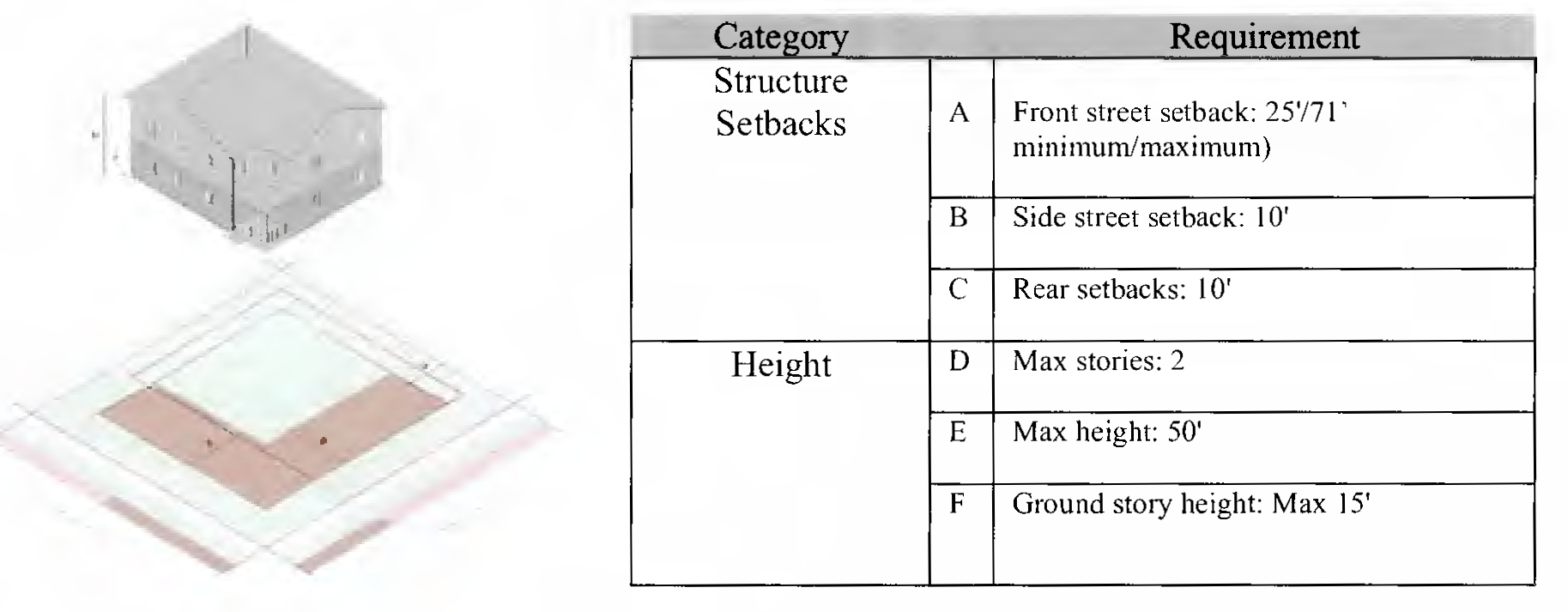
Height, area, bulk requirements. The following table summarizes the development requirements for the subarea.
iv.
Site design.
1.
Parking. No more than two rows of parking with a travel lane shall be permitted between the facade of the main structure and front lot line. Pedestrian access shall be provided from the parking lot to the front entrance.
2.
Sidewalks. A five-foot-wide concrete sidewalk shall be required along the street frontage of all subject parcels. Where sidewalk installation is not immediately feasible, a minimum seven-foot-wide servitude shall be dedicated for future sidewalk construction. Sidewalks shall connect to building entrances and any on-site pedestrian circulation system and shall align with adjacent properties where applicable.
3.
Internal pedestrian circulation. Development sites shall include pedestrian connections from sidewalks to building entries, parking areas, and adjacent lots where feasible. Walkways must be a minimum of five feet wide and clearly delineated using scored concrete, pavers, striping, etc.
4.
Landscaping required to be the same as required per Exhibit 600-3-13; Landscape Area Requirements, except that the following additional standards shall apply:
a.
Plantings within the required street buffer(s) shall contain a minimum of one Class A tree per every 400 square feet of street planting area, one Class B tree per every 300 square feet of street planting area, and 20 shrubs per 100 feet of linear frontage. In the event utilities are an existing condition with an easement or servitude, the buffer and associated plantings shall extend outside of such area.
v.
Building placement. A maximum front build-to line of 71-feet is required for pedestrian-friendly engagement.
vi.
Sign standards.
1.
Ground signs.
a.
Max area and height permitted for single occupancy uses: 25 square feet area and six feet height
b.
Max area and height permitted for multi-occupancy uses: 50 square feet area and eight feet height
c.
Illumination:
i.
No internal illumination.
ii.
White light only, no colored lighting.
iii.
Spectrum colors only, no iridescent colors permitted.
(Ord. No. 24-5592, Att., § 9, 10-3-2024; Ord. No. 25-5729, § Exh. A, 4-3-2025; Ord. No. 25-5744, § II, 6-5-2025; Ord. No. 25-5760, § Exh. A, 6-5-2025; Ord. No. 26-5946, 4-9-2026)
SEC. 400-8 - USE STANDARDS.
A.
Adult Uses.
1.
The distance between any adult use and any residential district or dwelling shall be a minimum of 1,000 feet measured in a straight line, without regard to intervening structures, from the nearest point of the property line of the residential district or dwelling to the nearest point of the property line of the adult use or the property on which it is situated, if it is one of several business establishments on the property, whichever is greater.
2.
The distance between any 2 adult uses shall be a minimum of 1,000 feet measured in a straight line, without regard to intervening structures, from the closest property lines of each adult use.
3.
The distance between any adult use and any existing school, child care center, church or place of worship, park or recreational area, public library, museum, or community center shall be a minimum of 1,000 feet measured in a straight line, without regard to intervening structures, from the nearest point of the property line of the adult use to the nearest point of the property line of the school, child care center, church or place of worship, park or recreational area, public library, museum, or community center.
4.
An adult use shall comply with Chapter 6 of the Code of Ordinances, pertaining to alcoholic beverages, and Chapter 28, pertaining to offenses and miscellaneous provisions, and all necessary state and parish licenses and/or permits as required.
5.
Hours of operation shall conform to established uses in the neighborhood and may be adjusted by the Zoning Commission and/or the Parish Council.
6.
Live entertainment, when expressly authorized and permitted, will only be allowed when it does not adversely affect the surrounding neighborhood because of noise, crowds, and other factors.
7.
The use of neon or other similar lighting technology exposed to the exterior shall be limited to 1 sign unit which conforms to all other signage requirements of this UDC, is directly related to the subject facility, and is not advertisement for products or services provided or sold in the facility.
8.
The premises on which the adult use is located and the public rights-of-way within 100 feet of such facility must be maintained in a clean and orderly manner.
9.
The premises in which an adult theater establishment is located shall operate only as an adult theater and shall not contain or offer any items or services consistent with that of an adult cabaret, adult store, massage parlor, or escort agency. Any of the aforementioned businesses shall constitute a separate adult use and must independently conform with all of the requirements of this section.
B.
Agricultural and Decorative Ponds.
1.
A site work permit application shall be submitted to the Department of Planning and Development. The plan shall indicate, at a minimum:
a.
Purpose and use of the pond.
b.
Location, size, setbacks, and general shape of the pond.
c.
Indicate whether or not dirt will be removed from the site.
d.
Proposed hours and days of operation of heavy equipment.
e.
Indicate timeframe to complete the pond.
f.
Show where the dirt removed from the pond will be deposited on site and how it will be used.
g.
Section through the pond showing depth and slopes of pond and levee. Depth of the pond must show the depth measurements at different intervals around the pond.
h.
Indicate with arrows the general drainage patterns onto and off the site.
2.
The pond shall be set back a minimum of 25 feet from the front, sides, and rear property lines.
3.
The property shall be kept posted with warning signs set no further than 50 feet apart and clearly visible, indicating that the property is an excavation site.
4.
The final depth of the pond shall not exceed 15 feet maximum.
5.
Sloped sides for fishing and swimming at a 2:1 ratio.
6.
The pond shall be inspected and monitored six months after completion.
7.
Road bond must be secured prior to excavation, if required by the Parish Department of Public Works.
8.
Plot plan review and approval required from the Department of Engineering.
C.
Animal-Related Uses. In all residential districts, these standards apply to all animal-related uses including animals raised for household agriculture, stables, and kennels.
1.
A structure may be erected for a private stable, pen, barn, shed, or silo for raising, treating and/or storing products raised on the premises. This structure may not include a dwelling unit.
2.
Standing under roofed stables must be made of a material that provides for proper drainage so as not to create offensive odors, fly breeding, or other nuisances.
3.
Fences for pens or similar enclosures must be built with sufficient height and strength to retain the animals. No pen, fence, or similar enclosure may be closer than 20 feet to an adjacent property line. The widths of alleys, street rights-of-way, or other public rights-of-way may be used to calculate the 10 foot requirement.
4.
The regulations under this use do not apply to government agencies, governmentally supported organizations, or educational agencies that keep and maintain animal's health, research, or similar purposes, nor do these regulations apply to special events such as circuses and livestock exhibitions which are otherwise regulated.
D.
Automobile Sales.
1.
New and Used Car Lots shall be subject to the following regulations:
a.
A site plan of the use must be approved by the department of planning and development. At a minimum, this plan shall include the following information:
1.
Location of all structures on the site.
2.
Location of customer parking and delineation of merchandise storage.
3.
Proposed traffic movements and point of ingress and egress, including parking and sight triangles.
4.
Location and coverage of lighting, signage and fencing; including materials, textures and colors to be used on all surfaces.
5.
Pedestrian access to adjacent sites.
6.
Approved landscape plan.
7.
Approved layout of parking area for vehicles for sale and/or lease.
8.
Any additional information as determined by the department of planning and development.
b.
A minimum of six parking spaces shall be provided in addition to any applicable parking requirements as required per Sec. 600-5.1 Parking Requirements.
c.
A minimum lot area of 20,000 square feet shall be required.
d.
All new and used car lots are required to maintain an office space which meets commercial standards including a restroom for employees and customers.
e.
In no case shall any automobile sales use park vehicles within any right-of-way.
E.
Auto Repair and Service.
1.
The following activities shall not be performed in conjunction with any auto repair service station:
a.
Outdoor repairs, including changing of oil and lubrication of automobiles.
b.
Outdoor painting and body work on automobiles.
c.
Outdoor storage of automotive parts.
d.
The outdoor storage of wrecked or abandoned vehicles.
i.
If an operable or wrecked motor vehicle remains outside on the premises for more than 24 hours, the premises shall be considered an outside salvage or reclamation use.
ii.
However, a premises is not an outside salvage or reclamation use if the premises stores inoperable or wrecked motor vehicles each of which having a valid state registration, current safety inspection certificate, and documentary record of pending repairs or other disposition.
iii.
All vehicles shall be screened from public view by a 100 percent, 6 foot non-living or 70 percent living screen. Objects shall be stored at a minimum of 5 feet from this screen.
2.
Sale of two or more automobiles, trailers, trucks, tractors, boats, or any other similar commodity.
3.
Twenty percent of each site must be landscaped open space.
4.
The use of neon signs exposed to the exterior shall be limited to 2 sign units, both of which are directly related to the subject facility and are not corporate advertisements for products sold in the facility.
F.
Bed and Breakfast.
1.
A site and landscape plan shall be submitted to the Department of Planning and Development. The plan shall indicate, at a minimum:
a.
Location of all structures on site including proposed structures.
b.
Drawing of residence interior and including the number of rooms and areas to be used for the bed and breakfast.
c.
Proposed traffic movements and points of ingress and egress, including parking and sight triangles.
d.
Drawing showing the location of proposed sign, setback from property line and dimensions.
2.
Where a bed and breakfast is allowed, the proposed use shall meet the following criteria:
a.
A bed and breakfast facility must be in a single-family dwelling.
b.
The bed and breakfast facility shall provide a maximum of 10 rooms for rent.
c.
The exterior of the building shall maintain a residential appearance.
d.
The facility shall be the residence of the operator, who is the owner or lease holder of the building.
e.
Rooms may not be rented for more than 7 consecutive days, and no more than 15 days per person in any 30-day period.
f.
A morning meal must be served on the premises and included within the room charge for guests of the facility and shall be the only meal provided.
g.
The facility must meet applicable parish and state health, safety (including but not limited to the Uniform Building Code requirements concerning maximum occupancy) and liability requirements.
h.
One off-street parking space will be required for each rented bedroom, in addition to the number of spaces required for each dwelling unit.
G.
Behavioral Health Centers and Behavioral Health Hospitals.
1.
These uses are not permitted within 1,000 feet of an existing residential use or district.
2.
An additional 100-foot-deep buffer area is required along all perimeters of the lot on which this use is developed.
H.
Body Shop.
1.
Outside body work, detailing, and painting or other repairs are not permitted.
2.
The outdoor storage of junked, wrecked, or abandoned vehicles stored on the premises solely for the purpose of using parts to repair other vehicles shall not be permitted.
3.
All outdoor storage of vehicles awaiting repair shall be screened from public view by a 100 percent opaque six-foot-tall non-living screen or a eight-foot-tall 70 percent opaque living screen. Objects shall be stored a minimum of five feet from this screen.
4.
Any fleet storage of vehicles utilized in connection with this use shall be screened by a six-foot-high screen of either 100 percent opaque non-living material or 70 percent opaque evergreen plants or as determined by the department of planning and development.
5.
If this use abuts any residential district use, a transitional yard shall be provided equal to the side or rear yard requirements of the residential zoning classification.
6.
A site plan shall be submitted to the department of planning and development prior to issuance of a building permit. This plan shall indicate, at a minimum:
a.
Location of all structures on site including proposed structures.
b.
Location of fuel storage tanks.
c.
Proposed traffic movements and points of ingress and egress, including parking and sight triangles.
d.
Additional information shall be submitted as determined by the department of planning and development.
7.
A minimum of six parking spaces shall be provided in addition to any other applicable requirements.
8.
A minimum lot area of 20,000 square feet shall be required for this use.
9.
Storage and disposal of chemicals shall adhere to federal requirements promulgated at 40 CFR 122.26(b)(8) and state requirements promulgated at LAC33: IX: § 2511.B.4 and LAC33: IX: § 2511.B.16.
10.
If an inoperable or wrecked motor vehicle remains outside on the premises for more than 24 hours, the premises shall be considered an outside salvage or reclamation use and subject to violation. However, a premises is not an outside salvage or reclamation use if the premises stores inoperable or wrecked vehicles each having a valid state registration, current safety inspection certificate, and documentary records of pending repairs or other disposition.
I.
Brewery or Distillery and Microbrewery or Microdistillery*.
1.
A site plan shall be submitted to the Department of Planning and Development. The plan shall indicate, at a minimum:
a.
Location of all structures on site including proposed structures.
b.
Proposed traffic movements and point of ingress and egress, including parking and site triangle.
c.
Drawing showing the location of proposed sign, setback from property line, and dimensions.
2.
Where a brewery, distillery, microdistillery, or microbrewery is allowed, the proposed use shall meet the following criteria:
a.
No brewery or distillery shall permit beer or spirit tasting and consumption without proper permitting from the parish and the state.
b.
Beer or spirit-related items. Items that may be used in connection with the serving, storing, or display of beer or spirits, or written material describing beer, spirits, food, or items of apparel displaying the name and/or logo of the specific brewery or distillery can be sold on site; other non-beer or non-spirit related items may not be sold.
c.
Sale, delivery, or shipment of beer or spirits manufactured by the permittee directly to a consumer in the state, licensed wholesalers, and out-of-state purchasers are permitted.
d.
The storage, warehousing, and wholesaling of beer or spirits is allowed on site.
e.
Special events and entertainment which consists of indoor live performances are permitted subject to compliance with requirements set out in Sec. 6-30 of the Code of Ordinances.
f.
On-site tasting rooms shall be subject to the use and parking standards of a bar and any limitations provided for in state law. The facilities may also include other uses such as a standard restaurant, bar, or live entertainment.
g.
Entertainment, Outdoor uses are permitted as an accessory use subject to compliance with the following regulations:
1.
Outdoor entertainment areas including patios, beer gardens, stages, or seating areas with speakers must be located at least 50 feet from any adjacent property line with a residential zoning classification or use.
2.
If a greater distance is not feasible due to existing site constraints, a minimum 8 feet high solid sound barrier wall must be installed. In addition, the planning and Zoning Commission shall have authority to require additional sound barrier measurements through the conditional use process.
3.
Outdoor speakers must be directional and oriented away from residential properties or uses.
J.
Cemeteries and Mausoleums. In addition to all federal and state laws, the following requirements must be met (excluding family-owned cemeteries which are limited to the burial of family members):
1.
Graves shall be considered as structures for the purpose of determining setbacks from property lines and in no case located closer than 50 feet from the property line.
2.
Each lot or group of lots forming a cemetery or mausoleum center shall be fenced to a height of 4 feet or more.
3.
Graves containing in-ground burials must not be located within 850 feet of any water well as verified by the owner, operator, or manager of the cemetery through the use of a survey.
4.
Cemeteries located in designated critical drainage areas are required to maintain the bottom of all caskets a minimum of 1 foot above the base flood elevation. Notwithstanding the foregoing, if the buried casket is enclosed with a nonporous concrete or similar nonporous material vault, this requirement shall not be applicable.
5.
Twenty-five-foot no cut buffer zones must be maintained within the perimeters of cemeteries and comply with all landscape and tree regulations in Chapter 600 of this UDC.
K.
Commercial Excavation.
1.
Site plan. A site plan shall be submitted to the Department of Planning and Development. The plan shall indicate, at a minimum:
a.
Purpose and use of the excavation.
b.
Location, size, setbacks, and general shape of the excavation.
c.
Indicate whether or not dirt will be removed from the site.
d.
Hours and days of operation of heavy equipment must be limited to Monday to Saturday from 7:00 a.m. to 5:00 p.m.
e.
Indicate timeframe to complete the excavation.
f.
Show where the dirt removed from the excavation will be deposited on site and how it will be used.
g.
Section through the excavation showing depth and slopes of excavation and levee. Depth of the excavation must show the depth measurements at different intervals around the excavation.
h.
Indicate with arrows, the general drainage patterns onto and off the site.
2.
Criteria.
a.
All commercial excavations shall provide a natural area (NAT) of 100 feet from the front, sides, and rear property lines of the site.
b.
On sites where any property line abuts federal or state roadways, lands or waterways, or the Tammany Trace, the excavation shall provide a natural area (NAT) of 500 feet from the abutting property line. For purposes of this provision only, federal and state lands shall mean those lands owned by the United States government or the state and actively managed as a park, wildlife preserve, or government facility. A waterway is a body of water such as a river, bayou, stream, or improved canal whether navigable or non-navigable.
c.
On sites which are traversed by a waterway or the Tammany Trace, the excavation shall also provide a natural area (NAT) of 500 feet from the nearest bank of the waterway or the centerline of the Tammany Trace.
d.
The property shall be kept posted at all access points and on road frontage with warning signs set no further than 100 feet apart and clearly visible, indicating that the property is an excavation site.
e.
Sloped sides at a 3:1 ratio.
f.
A road bond must be secured prior to excavation, if required by the Parish Department of Public Works.
g.
A plot plan review and approval is required from the Parish Department of Engineering.
L.
Community Home.
1.
Community homes shall be certified, licensed, or monitored by the State of Louisiana
2.
Community homes shall have 24-hour supervision including at least 1 but not more than two 24-hour attendants.
3.
Community homes are subject to all local and federal regulations and the regulations of the Louisiana Administrative Code.
4.
Community homes shall appear outwardly as a single-family residence.
5.
Community homes shall be grouped in two categories:
a.
Community Home (6 or fewer persons).
b.
Community Home (10 or fewer persons)
M.
Community Sewerage Systems.
1.
Whenever wastewater treatment facilities or public utility facilities are approved within a land use district established in, and subject to the provisions of this UDC, the subject wastewater treatment facility or public utility facility may be approved for expanded use, but only if all of the following conditions are fulfilled:
a.
The wastewater treatment facility exists and is functional at the time the application for a permit is submitted to the Zoning Administrator, but that a public utility facility other than a wastewater treatment facility shall be eligible to receive a permit irrespective if such exists or is proposed.
b.
As such relates to the design, construction, and operation of the wastewater treatment facility or public utility facility, all regulatory approvals and authorizations have been issued by appropriate and applicable state and parish regulatory agencies.
c.
The owner and/or operator of the wastewater treatment facility or public utility facility possesses a valid franchise agreement consistent and/or in conformance with the provisions of R.S. 33:4064.6(B).
d.
The wastewater treatment facility, or public utility facility, and any and all associated or adjunct elements of the subject sewerage system, have the actual and/or anticipated capacity which will be required to realize the peak sewage demand of its actual, anticipated, intended, and/or proposed use, and the operation and maintenance of which are likely to be in accordance and compliance with all regulatory requirements; all as determined and affirmed by the St. Tammany Parish Department of Environmental Services.
e.
Meets minimum requirements of Sec. 400-8(GG) for Public and Private Utility Facilities located in or adjacent to residential and commercial zoning districts.
2.
Public utility facilities may include a limited wastewater treatment facility, but not a regional wastewater treatment facility, whenever public utility facilities are authorized within a zoning district.
3.
A permit shall not be approved whenever the subject wastewater treatment facility is a regional wastewater treatment facility located within a district other than an industrial or institutional district.
4.
Public utility facilities may include a limited wastewater treatment facility or a regional wastewater treatment facility whenever public utility facilities are authorized as a permitted use within the subject district.
5.
Whenever facts and circumstances exist that, in the opinion of the Director of Planning and Development would merit the imposition of other relevant and reasonable terms and conditions, he or she is hereby authorized to impose any such term or condition as a prerequisite to the issuance of the permit.
N.
Composting Facility.
1.
The distance between any composting facility and any residential dwelling shall be a minimum of 1,000 feet measured in a straight line, without regard to intervening structures, from the nearest point of the property line of the residential district or dwelling to the nearest point of the property line of the said use or the property on which it is situated, if it is one of several business establishments on the property, whichever is greater.
2.
Hours of operation shall conform to established uses in the neighborhood and may be adjusted by the Zoning Commission and/or the Parish Council.
3.
Any and all additional conditions, as determined by the Zoning Commission, placed upon the specific operation to mitigate potential negative impacts of the operation.
O.
Dwelling, Multiple-Family
1.
All multi-family uses in the HC Highway Commercial Districts including HC-2 and HC-3 must be serviced by central utility systems including sewer and water.
2.
Multi-family uses in the HC-2 Highway Commercial District shall have a maximum allowable density of 1 unit per 1,250 sq. ft.
3.
Public amenities shall be required for the residents of all multi-family districts which exceed 100 units or more including but not limited to neighborhood parks with playgrounds, dog parks, nature trails, community gardens, and/or indoor and outdoor gyms.
4.
All entrance and exit ways as required within Sec. 900-3.2 General Planning and Layout Requirements for Streets must be adhered to.
5.
Where a multi-family residential use adjoins a residential district, higher setbacks shall be provided in accordance with the following regulations:
a.
Where a building is taller than 25 feet in height, 1 additional foot of setback shall be required. Each façade is measured separately, and the additional depth is required perpendicular to that façade.
P.
Dwelling, Townhouse.
1.
Development election. At the time of site plan review or concept subdivision plat submittal, the applicant shall elect either a fee-simple townhouse lot development or a unified townhouse development. Once elected, all applicable standards for that development type shall apply.
a.
Fee-simple townhouse lot development. A townhouse development in which individual dwelling units are located on separately platted lots intended for individual ownership.
b.
Unified townhouse development. A townhouse development consisting of multiple dwelling units located on a single parcel under common ownership, condominium ownership, or homeowners' association control.
2.
Development standards. Where townhouse dwellings are permitted, development shall comply with the following minimum standards:
a.
Fee-simple townhouse lot development standards:
i.
Minimum lot standards.
1.
Minimum lot area: 2,000 square feet per townhouse lot.
2.
Minimum lot width: 25 feet.
3.
Minimum lot depth: 80 feet.
ii.
Minimum setback requirements:
1.
Front yard setback: 15-20 feet.
2.
Side yard setback: Five feet; ten feet when adjacent to single-family residential zoning or a perimeter lot line of the development. Side yard setbacks shall apply only to perimeter lots or end units not sharing a common wall.
3.
Corner side yard setback: Ten feet.
4.
Rear yard setback: 20 percent of the depth of the lot.
b.
Unified townhouse development standards:
i.
Maximum density: 20 dwelling units per acre. Density shall be calculated on gross area of the lot.
ii.
Minimum setback requirements:
1.
Outer development. All unified townhouse development standards shall be considered commercial development and shall comply with Exhibit 600-3-13 Landscape Area Requirements. In addition, all other regulations typically assessed for commercial development types within the Unified Development Code shall apply.
2.
Interior development.
a.
Minimum Setback from private streets or drive aisles: Ten feet.
b.
Minimum Setbacks from property lines: Ten feet.
ii.
Ownership and maintenance. Unified townhouse developments shall provide recorded covenants establishing responsibility for maintenance of common areas, private streets, stormwater facilities, and shared infrastructure.
c.
Building design standards (both development types).
i.
Façade variation.
1.
No more than two abutting units may share identical front façade designs.
2.
Façade variation shall be achieved through changes in roofline, wall plane offsets, materials, colors, or entry features.
3.
No more than three units within any continuous building façade shall share the same front building setback line.
ii.
Maximum building height: 45 feet above the natural grade of the property at the location of the structure as established in this UDC.
iii.
Maximum number of attached units: Eight
iv.
Fire and property line requirements. All fire resistance requirements of the Louisiana State adopted building codes shall be enforced including fire ratings of exterior walls and overhangs related to property lines. Under no circumstance shall any portion of a structure or its servicing equipment cross property lines.
v.
Open space required. Where townhouse dwellings are proposed, each dwelling unit shall be provided with a porch, patio, or balcony. In lieu of providing such private outdoor space, the development shall provide additional common active greenspace at a rate of 150 square feet per dwelling unit, in addition to any common greenspace otherwise required by the Unified Development Code. Required common active greenspace shall be internal to the development, usable for active recreation, and accessible to all residents. Landscape buffers, stormwater detention areas, easements, and servitudes shall not be counted toward this requirement.
vi.
Parking. A minimum of two (2) off-street parking spaces per townhouse dwelling unit shall be provided. Required parking shall be provided within the buildable area of individual townhouse lots or within a common parking area.
vii.
Utilities. All townhouse uses must be provided with central sewerage and water systems in accordance with minimum standards established within this UDC.
Q.
Convenience Store (with Gas)/Gas Station with Convenience Store. The sale of gas and other fuel shall be an accessory use permitted in the zoning district when the criteria of this section are met:
1.
In the HC-1 and HC-2 Highway Commercial District, a minimum parcel size of 40,000 square feet is required for such use. On parcels that are a minimum of 40,000 square feet but less than 60,000 square feet in size, the number of fuel pumping units shall be limited to a total of four units. For purposes of this provision, a fuel pumping unit, also commonly known as a gas pump, is defined as a unit that is capable of dispensing gas or other fuel to no more than two vehicles at the same time, and only when each vehicle to be fueled is positioned on opposite sides of the pump. On parcels that are a minimum of 60,000 square feet but less than 90,000 square feet in size, the number of fuel pumping units shall be limited to a total of six units.
2.
A site plan shall be submitted to the department of planning and development prior to issuance of a building permit. This plan shall indicate, at a minimum:
a.
The location of each pumping unit. On all parcels, the nearest pumping unit shall be set back a minimum distance of 50 feet, in addition to any street planting area requirement, from any highway, road or street right-of-way.
b.
Location of all structures on site including proposed structures.
c.
Proposed traffic movements and points of ingress and egress, including parking and sight triangles.
d.
Adjacent land uses.
e.
Approved landscape plan.
f.
Location and coverage of lighting, signage, and fencing; including materials, textures, and colors to be used on all surfaces.
g.
Additional information shall be submitted as determined by the department of planning and development.
3.
If this use abuts any residential district or use, a transitional yard shall be provided equal to the side or rear yard requirements of the residential zoning classification.
R.
Dwelling, Two-Family.
1.
Development standards. Where a two-family dwelling is permitted within a commercial zoning district, development shall comply with the following:
a.
Lots one-half acres or greater: For properties equal to or greater than one-half acres in size:
i.
All applicable commercial development standards shall apply, including, but not limited to, tree survey requirements, landscape plans, drainage plans, and all related submittals.
ii.
Buffer determinations set forth within Exhibit 600-3-13 Landscape area requirements, shall be based on the residential nature of the use.
b.
Lots less than one-half acres. For properties less than one-half acres in size, all site and structure provisions applicable to the two family residential district shall apply.
2.
Access and driveways. Where more than one two-family dwelling is developed on a single lot, shared driveways shall be encouraged and given preference to minimize curb cuts and vehicular conflicts.
3.
Fire and property line requirements. All fire resistance requirements of the Louisiana State adopted building codes shall be enforced including fire ratings of exterior walls and overhangs related to property lines. Under no circumstance shall any portion of a structure or its servicing equipment cross property lines.
4.
Height. The maximum height of any two-family residential structure shall not exceed 45 feet above the natural grade of the property at the location of the structure as established in this UDC.
5.
Legal nonconforming lots of record. Notwithstanding other provisions of this UDC, contiguous lot regulations may apply to legal non-conforming lots of record and may allow limited reductions in lot area requirements where necessary to mitigate long-standing site development constraints.
6.
Utilities. All two-family residential uses must be provided with central sewerage and water systems in accordance with minimum standards established within this UDC.
7.
Parking. Off-street parking and loading shall be provided in accordance with minimum standards established in chapter 600 of this UDC. At least one 9' x 18' parking space must be provided outside of the required front yard building setback and must therefore be located within the buildable area of the site.
S.
Outdoor and Contractors' Storage Yards.
1.
This use shall be screened from public view along the front, sides and rear by a 100 percent opaque 8-foot-tall screen consisting of wood, solid masonry, concrete, or other material as approved by the Department of Planning and Development.
2.
If an inoperable or wrecked motor vehicle remains outside on the premises for more than 24 hours, the premises shall be considered an outside salvage or reclamation use and subject to violation. However, a premises is not an outside salvage or reclamation use if the premises stores inoperable or wrecked vehicles each having a valid state registration, current safety inspection certificate and documentary records of pending repairs or other disposition.
3.
Objects shall not be stacked higher than 8 feet high within 40 feet of the visual screen. Objects may be stacked 1 foot above the 8 feet for each additional 5 feet of setback beyond the original 40 feet. However, stacking of portable storage containers is limited to 3 storage containers in height.
4.
Sales and rentals of portable storage containers shall be considered an allowed use only in the I-1, I-2, and I-3 zoning districts.
5.
A site plan shall be submitted to the Department of Planning and Development prior to issuance of a building permit. This plan shall indicate, at a minimum:
a.
Location of all structures on site including proposed structures.
b.
Proposed traffic movements and points of ingress and egress, including parking and sight triangles.
c.
Landscaping.
d.
Signage
e.
Lighting.
f.
Parking/loading.
g.
Additional information shall be submitted as determined by the Department of Planning and Development.
6.
Outdoor and Contractors' Storage Yards located within the HC-2, HC-3, and HC-4 Highway Commercial Districts are only permitted through the Conditional Use Procedure outlined in Sec. 200-3.4 Conditional Uses.
T.
Day Care Centers.
1.
Prior to issuance of a permit, a site plan shall be submitted for approval to the Department of Planning and Development indicating the following:
a.
Location of all structures on site including signage.
b.
Minimum landscape requirements.
c.
Minimum parking requirements.
d.
Ingress and egress to the site.
e.
Adjacent land uses.
2.
In addition to all federal and state laws, the following requirements must be met:
a.
A minimum play area of 50 square feet for each child which is enclosed with an opaque fence of a minimum height of not less than 6 feet.
b.
An off-street loading area shall be provided to accommodate a minimum of 5 automobiles for day care centers. This loading area shall be provided in addition to the minimum parking requirements, or as determined by the Department of Planning and Development.
c.
Where a day care center adjoins any residential zoning district, a buffer yard must be provided which is a minimum of 10 feet in depth and a 6-foot-tall 100 percent opaque screen is installed.
d.
An off-street loading area shall be provided to accommodate a minimum of 3 automobiles for day care homes.
3.
Additional information shall be submitted as determined by the Department of Planning and Development.
U.
Drive-thru Restaurants. In the HC-1 Zoning District, additional standards apply to Restaurants with Drive-Thru facilities, including:
1.
The site must have direct access to a highway functional classification system of minor arterial or greater.
2.
A site plan must be submitted to the Department of Planning and Development prior to issuance of a building permit. This plan shall indicate, at a minimum:
a.
Location of all structures on site including proposed structures.
b.
Proposed traffic movements and points of ingress and egress, including parking and sight triangles.
c.
Approved landscape plan.
d.
Approved lighting plan.
e.
Approved Traffic Impact Study.
3.
Where drive-through windows are used, automobile stacking areas shall be set back a minimum of 10 feet from the property line and 5 feet from on-site automobile parking areas. The stacking area shall be so located so as not to cause patrons parking on site to move through the area to get from their cars to the restaurant entrance unless an accessway is designed in conformance with FHWA MUTCD, ITE Transportation Planning Handbook, LADOTD EDSM, or other reputable publication standards.
4.
If the drive-thru facility abuts any residential district or use, a transitional yard shall be provided equal to the side or rear yard requirements of the residential zoning classification.
5.
Additional information shall be submitted as determined by the Department of Planning and Development.
V.
Farm Winery.
1.
A site plan shall be submitted to the Department of Planning and Development. The plan shall indicate, at a minimum:
a.
Location of all structures on site including proposed structures.
b.
Proposed traffic movements and points of ingress and egress, including parking and sight triangles.
c.
Drawing showing the location of proposed sign, setback from property line, and dimensions.
2.
Where a farm winery is allowed, the proposed use shall meet the following criteria:
a.
The daily time period during which a farm winery may be open to the general public shall be from 10:00 a.m. until 9:00 p.m.
b.
The maximum occupancy at any time shall be determined by the State Fire Marshall.
c.
The farm winery tasting room may have 1 accessory structure for the purpose of wine tasting and sales of wine-related items. The size of the tasting room shall be limited to 800 square feet.
d.
Tour, wine tasting, and consumption are limited to tour of the facility, sampling, by the general public, of wines, and the purchase of wine by the glass or bottle to drink on or off the premises of the farm winery. No farm winery shall permit the wine tasting and consumption without the proper permit from the parish and the state.
e.
Wine-related items. Items that may be used in connection with the serving, storing or display of wine, or written material describing wine or food, or items of apparel displaying the name and/or logo of the specific winery can be sold on the site; other non-wine-related items may not be sold.
f.
Sale, delivery, or shipment of wine manufactured by the permittee directly to a consumer in this state, licensed wholesalers, and out-of-state purchasers are permitted.
g.
The storage, warehousing, and wholesaling of wine is allowed on site.
h.
Special events are permitted subject to compliance with requirements set out in this UDC.
W.
Garage Sales.
1.
Frequency; duration. Not more than 1 garage sale may be conducted by any person or upon any lot or parcel of land during any period of 3 consecutive months. Such garage sales shall not be conducted for longer than 2 consecutive days.
2.
Other sales prohibited. The sale of personal property to the general public by means of a garage sale on any residentially zoned property is prohibited except as permitted by this section.
3.
Exemptions. The provisions of this section shall not apply to the following:
a.
Charitable or religious organizations occasional sales when the proceeds from such sales are used solely for charitable or religious purposes.
b.
Sales conducted pursuant to process or order of any court of competent jurisdiction.
X.
Heliports.
1.
When a heliport is allowed, evidence must be submitted to the Zoning Commission in support of the following criteria:
a.
Location of all structures on site including any proposed structures.
b.
Location of any storage.
c.
Location of all adjacent land uses.
d.
Location of all abutting streets and intersections.
e.
For all commercial heliports, evidence must be presented to the Zoning Commission that there is a public need for the facility based on location of existing facilities and market demand.
f.
Evidence must be presented that the heliport will not present a safety hazard or adversely affect existing or logical future development of adjacent properties and neighborhoods.
g.
Adequate transitional yards shall be provided and maintained to shield non-compatible adjacent uses.
2.
No use, object, or structure may be erected that causes interference with radio communications or transmissions of electronic signals with the aircraft, impairs the visibility of the aircraft in relation to the lights of the runway, endangers landing, takeoff or maneuvering of the aircraft.
3.
Heliports shall be lighted to provide adequate visibility at night or in inclement weather.
4.
Heliports are limited to helicopters with a gross weight of less than 12,500 pounds.
5.
If fueling is provided on site, all storage tanks must be located underground or as approved by the Department of Planning and Development.
6.
Any service uses provided shall be for private use of the property owner or petitioner only.
7.
All heliports must be approved by the Federal Aviation Administration (FAA). A copy of such approval will be kept on file in the Department of Planning and Development and the Department of Permits and Inspections.
8.
Additional information shall be submitted as determined by the Department of Planning and Development.
Y.
Methadone Centers and Clinics.
1.
The distance between any methadone centers and clinics and any residential district or dwelling shall be a minimum of 1,000 feet measured in a straight line, without regard to intervening structures, from the nearest point of the property line of the residential district or dwelling to the nearest point of the property line of the said use or the property on which it is situated, if it is one of several business establishments on the property, whichever is greater.
2.
The distance between any methadone center/clinics and any existing school, child care center, church or place of worship, park or recreational area, public library, museum, or community center shall be a minimum of 1,000 feet measured in a straight line, without regard to intervening structures, from the nearest point of the property line of the methadone center or clinic to the nearest point of the property line of the school, child care center, church or place of worship, park or recreational area, public library, museum, or community center.
3.
The distance between any methadone center or clinic and any other methadone center or clinic shall be a minimum of 1,000 feet measured in a straight line, without regard to intervening structures, from the nearest point of the property line of the methadone center or clinic to the nearest point of the property line of the second methadone center or clinic.
4.
Hours of operation shall conform to established uses in the neighborhood and may be adjusted by the Zoning Commission and/or the Parish Council.
Z.
Manufactured or Mobile Homes.
1.
When permitted by right, all manufactured or mobile homes must comply with the following minimum standards and criteria:
a.
The manufactured home must meet the minimum standards as a HUD manufactured home unit in accordance with the Manufactured Home Construction and Safety Standards (HUD Code) for location within the parish.
b.
The manufactured home must display a red certification label on the exterior of each transportable section.
c.
The manufactured home must comply with the minimum site and building setback requirements of the zoning district where it is located.
d.
The manufactured home must be attached to and installed on a permanent foundation and the provisions of R.S. 9:1149.4 must be complied with and the structure must meet the minimum standards as established in the most recent building codes adopted by the parish.
e.
The minimum floor area of the manufactured home must be 720 square feet.
f.
The wheels, tongue, and traveling lights must be removed within 15 days after the manufactured home is placed upon a lot.
g.
Manufactured home skirting, as defined in Chapter 100 of this UDC, must be appropriately affixed to the manufactured home.
h.
The proposed site must meet all minimum infrastructure requirements of this UDC.
AA.
Massage Establishment.
1.
Applicability. This section applies to massage establishments or any other place of business that offers the practice of massage therapy and where the practice of massage therapy is conducted on the premises of the business. A place of business includes any office, clinic, facility, or other location where a person or persons engage in the practice of massage therapy. The residence of a therapist or an out-call location which is not owned, rented, or leased by a massage therapist or massage establishment shall not be considered a massage establishment, unless the location is advertised as the therapist's or establishment's place of business. The term "massage establishment" shall not include physician offices, physical therapy facilities, chiropractic offices, or athletic training facilities, whether or not they employ, contract with, or rent to massage therapists, or institutions of secondary or higher education when massage therapy is practiced in connection with employment related to athletic teams.
2.
No establishment may offer massage therapy or similar services unless they maintain current and proper licensing under R.S. 37:3551 or R.S. 37:3552 et seq. or perform such work under the direct supervision of a licensed physician.
3.
All massage establishments shall follow all state regulations promulgated between LA Rev Stat § 37:3551 through LA Rev Stat § 37:3568.
BB.
Mobile Food Trucks.
1.
Applicability. This section applies to mobile food trucks. Uses this applies to include, but are not limited to mobile food trucks, ice cream trucks, and snowball trucks.
2.
Limitation in size. Any uses similar to those regulated within this section that exceed 500 square feet must follow the requirements in Sec. 400-8.NN. or must be fully permitted as a commercial building.
3.
A copy of the lease and/or written permission from the property owner or authorized agent shall be kept on site.
4.
This use requires an annual permit. The mobile food truck or temporary food or retail stand must reapply annually for the permit.
5.
No mobile food truck or temporary food or retail stand may remain on a site for more than 12 hours.
6.
The mobile food truck or temporary food or retail stand must be located entirely on private property and shall not be located in any required setback, sight distance triangle, buffer, or public right-of-way.
7.
Trucks may not operate:
a.
Within 20 feet of any intersection, stop sign, flashing beacon, yield sign, or other traffic control signal located on the side of a roadway;
b.
Within 3 feet of any public or private driveway, wheelchair ramp, or bicycle ramp;
c.
In any manner that impedes an exit or entrance of an operating building;
d.
In any manner that impedes traffic flow on a public street, private drive, or parking aisles.
8.
Vendors must obey all applicable parking, traffic and vehicle safety laws, regulations, and restrictions.
9.
The mobile food truck or temporary food or retail stand must meet all applicable state codes.
10.
No vendor may sell alcoholic beverages.
11.
All vendors shall provide a trash receptacle within 3 feet of the front or back of the truck.
12.
All vendors must keep a 50-foot radius around the truck during operation and upon ceasing operation.
13.
No horns, amplification systems, or other sound-producing devices or music systems which can be heard outside of the truck may be used.
14.
A maximum of 1 sign not exceeding 16 square feet per side, off the vehicles or temporary building, will be allowed on the property. No signs shall be located within public rights-of-way or in sight triangles.
CC.
Manufactured Home Parks.
1.
The development of a parcel (or contiguous parcels under single ownership) of land with 4 or more manufactured homes shall constitute a manufactured home park.
2.
A developer of a manufactured home park, whether selling lots, renting, or leasing sites, must follow the prescribed subdivision review process per Chapter 800 of the UDC. Once the prescribed subdivision process has been completed, a subdivision plat must be filed and recorded for public record in the Parish Clerk of Court's office before any lots can be sold, rented, or leased
3.
All manufactured home parks must receive State Fire Marshal approval as per the NFPA Life Safety Code prior to leasing sites or building permit issuance.
4.
Design requirements for manufactured home parks.
a.
A minimum of 10 acres is required for a manufactured home park.
b.
Manufactured home parks have a maximum permitted density of 8 units per acre.
c.
All manufactured homes must be located at least 25 feet from any roadway.
d.
No manufactured home may be situated in a manner so that it obstructs a roadway or walkway.
e.
Roadway design:
i.
Safe and convenient access shall be provided for vehicular traffic and emergency vehicles at all times.
ii.
Each manufactured home lot within a manufactured home park shall have direct access to a park street or public street. The access shall be an unobstructed area not less than ten feet in width which may be pedestrian in character.
iii.
All roadways shall be hard surfaced in accordance with subdivision regulations with the exception that one-way streets shall have a 40-foot minimum right-of-way with a 16-foot compacted sub-base, with 4-foot shoulders and a 12-foot hard-surfaced road. Composition of base material shall be according to subdivision regulations. Said roadways are acceptable in manufactured home parks solely for the purpose of this section. When so installed, they shall not be eligible for nor accepted into the parish road maintenance system.
iv.
Streets and walkways designed for the general use of manufactured home park residents shall be lighted during the hours of darkness. Such lighting shall not be under the control of the manufactured home occupant. Poles shall not exceed 35 feet in height, and longitudinal spacing shall not exceed 200 feet.
f.
Sidewalks. If sidewalks are provided, they shall be located not less than 1 foot from the property line. Sidewalks shall connect individual homes with parking areas. In no case shall sidewalks be less than 4 feet wide.
g.
Vehicle parking.
i.
Two off-street automobile parking spaces shall be required for each manufactured home stand. The minimum dimension of these spaces shall be 9 feet wide by 20 feet deep. In no event shall parking be located over 100 feet from the corresponding manufactured home stand.
ii.
Parking spaces are required to be composed of a minimum of a 4-inch compacted sub-base of clay, sand, and gravel, with a 2-inch surface course of gravel or shell.
h.
Recreation/open space
i.
Twenty-five percent of the total land area shall be open space reserved for the exclusive use of the residents of the park.
ii.
This area shall be maintained in a clean and sanitary condition at all times.
i.
Floodplain provision. Any manufactured home park or portion thereof that is located within the special floodplain hazard area defined by the Federal Insurance Administration shall be required to comply with conditions placed upon the park by the Planning and Zoning Commission and the Department of Engineering, including, but not limited to, the following requirements:
i.
Construction or modification of sewerage, water supply, and drainage facilities to meet appropriate approval by the Department of Environmental Services of the parish and/or Department of Engineering.
ii.
Use of paints, membranes, or mortar to reduce seepage of water through walls; and
iii.
Construction of water supply and waste treatment systems so as to prevent the entrance of floodwaters.
j.
General lot requirements.
i.
Manufactured homes shall be installed on a mobile home stand which must provide a second base for structural support of the manufactured home to secure the structure against uplifting, sliding, overturning, shifting, or uneven settling.
ii.
Anchorage to resist flotation and lateral movement must be provided.
k.
Manufactured home stand. Each manufactured home stand shall have, as a minimum for support, one 16-inch by 16-inch concrete pad 4 inches in thickness for every 50 square feet of floor area.
l.
Maintenance requirements.
i.
The manufactured home park shall be maintained in a clean and sanitary condition at all times.
ii.
The storage of automobiles is prohibited.
iii.
Trash receptacles shall be screened by a 6-foot sight-obscuring fence.
iv.
Grass, weeds, and other vegetation not considered as part of the ornamental landscape shall not exceed 12 inches in height.
m.
Electrical systems.
i.
Underground utilities shall be provided.
ii.
Electric hookups shall be provided to all manufactured home stands and there shall be at least 1 electrical single-phase outlet supplying a minimum of 115/230 volts.
n.
Water system.
i.
Pure potable water shall be supplied to each and every manufactured home occupied in manufactured home parks.
ii.
This system shall be designed, constructed, and protected in accordance with current health, plumbing, electrical, and fire protection standards, codes, and ordinances adopted and administered by the state and/or the parish.
o.
Sewage disposal system. Central sewerage systems are required for all manufactured home parks under inspection of and regulated by the Department of Environmental Services of the parish and any appropriate state agencies.
p.
Fences. If fences are provided, fences for privacy purposes shall be connected to the manufactured home and shall not exceed 6 feet in height and shall not be placed closer than 5 feet to any other mobile home.
q.
Fire protection. Access to a manufactured home for fire protection services shall be such as to permit fire apparatus to approach within 100 feet of each manufactured home.
r.
Responsibilities of owner.
i.
The owner of the manufactured home park shall be responsible for the supervision, operation, and maintenance of the park. The owner or his designer shall be available, or on call, at all times in the event of an emergency.
5.
Licenses. It shall be unlawful for any person to operate or maintain any manufactured home park within the unincorporated areas of the parish unless he holds a valid license issued by the Parish Department of Planning or its successor authorized representative of the Parish Council. Said license shall be issued in the name of the current property owner for the specific manufactured home park.
a.
License fees. For each license issued under the provisions of these regulations, there shall be an annual fee based on the number of manufactured home spaces in the park for which the license is issued paid to the Parish Department of Planning and Development according to the fee schedule.
b.
New licenses. Application for a license required by a new, altered, or extended manufactured home park shall be in writing and on a form provided by the Parish Department of Planning and Development. The license shall be applied for at the same time tentative plans are submitted to the Department of Planning and Development. Said license shall be approved by the Planning Commission prior to tentative approval. New licenses shall be valid for 1 calendar year.
c.
Renewal licenses. A license for a manufactured home park shall be valid for the calendar year in which it is issued by the Department of Planning and Development. Application for such license shall be in writing on a form provided by the Department of Planning and Development and shall be renewed annually upon a satisfactory inspection in which the applicant's manufactured home park is found to be in compliance with these regulations. Prior to issuance of a renewal license by the Department of Planning and Development, the applicant shall possess and present a current title to said property for examination to operate and maintain a manufactured home park.
d.
Transfer of license. Upon the sale, transfer, or donation of a licensed manufactured home park, the vendor (licensee) shall notify the Department of Planning and Development in writing within 5 working days of said sale, transfer, or donation. Such notice shall include the name and address of the vendee of the manufactured home park. No manufactured home park shall be sold or otherwise alienated except as a whole unit during the existence of the park. Upon application in writing for transfer of the license, the parish shall transfer the license which will remain valid until its expiration.
e.
License revocation or suspension. When the Department of Planning and Development determines that any person holding a license under these regulations has, or may have, violated any of the provisions of this section or any health regulations of the state, a written notice shall be served on such licensee in person or by registered mail, specifying the violation and requiring correction within 30 days. If corrections have not been made within 30 days, the parish shall have the right to revoke all licenses pertaining to said park and require that the property owner rid the park of all trailers or manufactured homes.
6.
Nonconforming Manufactured Home Parks.
a.
Purpose. The purpose of this section is to provide a means for nonconforming manufactured home parks (prior to December 18, 1980) to qualify for licensing purposes, by providing minimum quality regulatory standards as established by the parish within this section.
b.
Application requirements. An application containing the following minimum quality standards for nonconforming mobile home parks, shall be submitted to the Department of Planning and Development.
i.
Three copies of a scaled site development plan shall be submitted and drawn to scale indicating the following items:
(A)
Name of development.
(B)
Name of developer/owner.
(C)
Section, township, and range.
(D)
Vicinity map at top left-hand corner of plan.
(E)
North arrow.
(F)
Total number of sites within development (indicate sites by using rectangular boxes).
(G)
Setbacks from all streets.
(H)
Existing streets and type of surfacing.
(I)
Total acreage of development.
(J)
Type of water and sewage disposal.
(K)
Disclosure of any open space or recreational areas.
(L)
A legal description that defines the boundaries of the development.
(M)
A copy of the maintenance and/or operation agreement for the development.
c.
Upon satisfactory completion of the application requirements, the Department of Engineering and/or Planning and Zoning Commission shall issue a manufactured home park license to the developer/owner of the manufactured home park.
d.
Fees.
i.
There shall be a one-time processing fee according to the fee schedule to cover administrative costs for reviewing the application requirements.
ii.
All licensing fees shall conform to the established fees as set forth elsewhere in this code.
e.
Expansion of nonconforming manufactured home parks. Any expansion of nonconforming manufactured home parks shall require rezoning to bring the manufactured home park in compliance with the mobile home park regulations and/or request waivers to the Planning and Zoning Commission.
DD.
Mini-Warehouses (or Warehouse, Self-Storage).
1.
The site must comply with parking lot landscape area requirements of Chapter 600 of this UDC. If this use abuts a residential district, a transitional yard shall be provided equal to the side or rear yard requirements of the residential district classification.
2.
A site plan of the use must be approved by the Department of Planning and Development. At a minimum, this plan shall include the following information:
a.
Location of all structures on the site.
b.
Proposed traffic movements and point of ingress and egress, including parking and sight triangles.
c.
Location and coverage of lighting, signage, and fencing; including materials, textures, and colors to be used on all surfaces.
d.
Pedestrian access to adjacent sites.
e.
Approved landscape plan.
f.
Any additional information as determined by the Department of Planning and Development.
3.
A minimum of 6 parking spaces shall be provided in addition to any other applicable requirements.
4.
A minimum lot area of 20,000 square feet shall be required.
5.
Parking areas shall not block the entrances to storage areas.
6.
No more than 50% of the total square footage of the lot may be used as an accessory outdoor storage yard and shall be screened from public view along the front, sides, and rear by a 100 percent opaque 8-foot high fence consisting of wood, solid masonry, concrete or other material as approved by the Planning Department.
EE.
Motor Vehicle and Boat Sale and Rental.
1.
A site plan of the use must be approved by the Department of Planning and Development. At a minimum, this plan shall include the following information:
a.
Location of all structures on the site.
b.
Proposed traffic movements and point of ingress and egress, including parking and sight triangles.
c.
Location and coverage of lighting, signage, and fencing; including materials, textures, and colors to be used on all surfaces.
d.
Pedestrian access to adjacent sites.
e.
Approved landscape plan.
f.
Approved layout of parking area for vehicles for sale and/or lease.
g.
Any additional information as determined by the Department of Planning and Development.
2.
A minimum of 6 parking spaces shall be provided in addition to any other applicable requirements.
3.
A minimum lot area of 20,000 square feet shall be required.
FF.
On-location Television or Film Productions.
1.
Film productions for television and or movies are allowed within the unincorporated portions of St. Tammany Parish through the Department of Planning and Development.
2.
All respective productions should file with the St. Tammany Tourist Commission to submit a copy of the following documents that will then be transferred to the Department of Planning and Development for review:
a.
Completed application provided by the St. Tammany Tourist Commission that includes the following information:
i.
Name of production company and all respective information including address, phone number, and production representative(s).
ii.
Title of production.
iii.
Production type.
iv.
St. Tammany production budget.
v.
Dates of filming within St. Tammany Parish.
vi.
Production locations.
b.
Certificate of insurance demonstrating liability for any damages to parish persons, property, or any other assets deemed a public resource.
c.
Location agreement between all property owners and production company with filming dates matching what is listed on submitted application.
d.
Drone pilot's permit (if applicable to the production) issued by the FAA (Federal Aviation Administration)
e.
Overhead site plan that demonstrates all production sites including filming areas, parking locations, and any road blocking.
f.
Proof of documentation that all residents within the vicinity have been notified of filming within the area if the production is filming within 500 feet of a residentially-zoned area.
3.
Any production requiring police detail (including, but not limited to, simulated gunfire, explosions, and road closures) must also submit approval from the St. Tammany Parish Sheriff's Office.
4.
Any production requiring road closure must submit all proper documentation to the St. Tammany Parish Department of Public Works.
5.
All filming is strictly prohibited unless otherwise granted approval by the Director of Public Works in the following locations: Camp Salmen Nature Park, Tammany Trace, or any parish-maintained facility.
6.
If a set/structure requires the issuance of a building permit as determined by the Chief Building Official, the production company shall file said permit and comply with all applicable codes of the relevant zoning district. All building permits must be issued before a final film permit may be issued by the Department of Planning and Development.
GG.
Outdoor Retail Sales and Storage Yards.
1.
This use shall be screened from public view along the front, sides and rear by a 100 percent opaque 8-foot-tall screen consisting of wood, solid masonry, concrete or other material as approved by the Department of Planning and Development.
2.
If an inoperable or wrecked motor vehicle remains outside on the premises for more than 24 hours, the premises shall be considered an outside salvage or reclamation use and subject to violation. However, a premises is not an outside salvage or reclamation use if the premises stores inoperable or wrecked vehicles each having a valid state registration, current safety inspection certificate, and documentary records of pending repairs or other disposition.
3.
Objects shall not be stacked higher than 8 feet high within 40 feet of the visual screen. Objects may be stacked 1 foot above the 8 feet for each additional 5 feet of setback beyond the original 40 feet. However, stacking of portable storage containers is limited to 2 storage containers in height.
4.
Shall not exceed 10 percent or less of the area of the developed site.
5.
The outdoor retail sales and storage yard shall be a secondary use to a home improvement center or department store.
6.
The outdoor retail sales and storage yard shall not be located within the required parking area.
7.
A site plan shall be submitted to the Department of Planning and Development prior to issuance of a building permit. This plan shall indicate, at a minimum:
a.
Location of all structures on site including proposed structures.
b.
Proposed traffic movements and points of ingress and egress, including parking and sight triangles.
c.
Landscaping.
d.
Signage.
e.
Lighting.
f.
Parking/loading.
g.
Additional information shall be submitted as determined by the Department of Planning and Development.
HH.
Outdoor Salvage Yards.
1.
This use shall be screened from public view along the front, sides and rear by a 100 percent opaque 8-foot-tall screen consisting of wood, solid masonry, concrete, or other material as approved by the Department of Planning and Development.
2.
The owner of an outside salvage or reclamation use shall not stack objects higher than 8 feet high within 40 feet of the visual screen. The owner of an outside salvage or reclamation use may stack objects 1 foot above the 8 feet for each additional 5 feet of setback beyond the original 40 feet.
3.
If an inoperable or wrecked motor vehicle remains outside on the premises for more than 24 hours, the premises shall be considered an outside salvage or reclamation use and subject to violation. However, a premises is not an outside salvage or reclamation use if the premises stores inoperable or wrecked vehicles each having a valid state registration, current safety inspection certificate, and documentary records of pending repairs or other disposition.
4.
A minimum distance of 200 feet is required between an outside salvage or reclamation use and a residential district subject to landscape requirements for industrial uses abutting residential districts.
5.
A site plan shall be submitted to the Department of Planning and Development prior to issuance of a building permit. This plan shall indicate, at a minimum:
a.
Location of all structures on site including proposed structures.
b.
Proposed traffic movements and points of ingress and egress, including parking and sight triangles.
c.
Landscaping.
d.
Signage.
e.
Lighting.
f.
Parking/loading.
g.
Hours of operation.
h.
Additional information shall be submitted as determined by the Department of Planning and Development.
II.
Outside Display of Pre-Assembled Accessory Building, Pool, and Playground Equipment.
1.
Display or storage of building, pool or playground equipment is prohibited within the required parking area and within the front or side landscaping buffers.
2.
Display of portable storage containers is not allowed on the site.
3.
A site plan shall be submitted to the Department of Planning and Development prior to issuance of a building permit. This plan shall indicate at a minimum:
a.
Location of all structures on site including proposed structures.
b.
Proposed traffic movements and points of ingress and egress, including parking and sight triangles.
c.
Landscaping.
d.
Signage.
e.
Lighting
f.
Parking/loading.
g.
Additional information shall be submitted as determined by the Department of Planning and Development.
JJ.
Portable Storage Containers Used for Storage.
1.
Portable Storage Containers are not permitted in the NC-1 Neighborhood Office District, NC-2 Neighborhood Commercial District, GC-1 General Commercial District, GC-2 Public, Cultural, or any residentially zoned property which is one acre or less in size.
2.
Portable Storage Containers placed on residentially zoned property over three acres in size which are 200 square feet or less do not require a building permit. All other Portable Storage Containers, regardless of size, require a building permit prior to their placement and are not exempt from St. Tammany Parish permitting requirements.
3.
The combined number of containers on any 1 parcel shall be limited to 2 storage containers.
4.
The use of portable storage containers shall be a secondary use, requiring that a primary, permanent structure be located on the same parcel unless the subject residential property has a Rural Overlay and is three acres or greater in size.
5.
The use of the portable storage container must be for the sole benefit of the business or primary, permanent structure located on the same parcel.
6.
A portable storage container shall be used for storage purposes only. No occupancy or other use of the storage container shall be allowed.
7.
Sale or rental of containers. Sales and rentals of portable storage containers shall be considered an allowed use only in the I-1, I-2, and I-3 zoning districts.
8.
A portable storage container on any parcel may not occupy any parking spaces on that parcel that are required as parking.
9.
All portable storage containers must meet all minimum setback requirements and may not be located within any required natural area.
10.
Stacking of portable storage containers is prohibited in all zones except in I-1, I-2, and I-3 zoning districts.
11.
A site plan shall be submitted to the Department of Planning and Development prior to issuance of a building permit. This plan shall indicate, at a minimum:
a.
Location of all structures on site including proposed structures.
b.
Proposed traffic movements and points of ingress and egress, including parking and sight triangles.
c.
Landscaping. All landscaping shall be in compliance with the provisions of this UDC.
d.
Signage. All signage shall be in compliance with this UDC.
e.
Lighting. All site lighting shall be in compliance with this UDC.
f.
Parking/loading. All parking and loading will be in compliance with this UDC.
g.
Additional information shall be submitted as determined by the Department of Planning and Development.
KK.
Private Landing Strips.
1.
Minimum of 5 acres is required for this site.
2.
No use, object, or structure may be erected that causes interference with radio communications or transmissions of electronic signals with the aircraft, impairs the visibly of the aircraft in relation to the lights of the runway, endangers landing, takeoff or maneuvering of the aircraft.
3.
All commercial landing strips shall be lighted to provide adequate visibility at night or in inclement weather.
4.
If fueling is provided on site, all storage tanks must be located underground or located 200 feet from an adjacent runway.
5.
Any service uses provided shall be for private use of the property owner or petitioner only.
6.
All landing strips shall be approved by the Federal Aviation Administration (FAA). Copy of such approval will be kept on file in the Department of Planning and Development and Department of Permits and Inspections.
7.
A site plan shall be submitted to the Department of Planning and Development indicating, at a minimum:
a.
Location of all structures on site including proposed structures.
b.
Location of fuel storage tanks.
c.
Location and coverage of landing strip including lighting.
d.
Location of adjacent land uses in relation to the site and any possible signs and/or utility easements.
e.
Evidence shall be presented that the landing strip will not create a hazard or adversely affect existing or logical future development of adjacent properties.
f.
Additional information shall be submitted as determined by the Department of Planning and Development.
LL.
Public and Private Utility Facilities Located in or adjacent to Residential and Commercial Zoning Districts. To promote a consistent streetscape and retain existing tree canopy, the following public utility requirements shall be applied and reviewed in accordance with Sec. 200-3.5, Plan Development Review, for existing and proposed public utility sites located in or adjacent to Residential and Commercial Zoning Districts prior to any construction activity or issuance of a building permit:
1.
Existing sites not proposing to expand. Existing public utility sites must install a minimum 8-foot tall, opaque fence around the perimeter of the utility site.
2.
Existing sites proposing to expand. Existing public utility sites proposing to expand shall—as much as practicable—meet the following standards:
a.
Prior to clearing any existing tree canopy to facilitate a proposed expansion, the applicant must apply for a Land Clearing Permit and include within such application a Tree Survey and Planting Plan, as applicable, demonstrating compliance with this section.
b.
Natural Areas shall be maintained along all site boundaries at a minimum depth of 25 feet, except for when a public utility site is proposed to expand within an area that aligns with an existing street buffer or Natural Area along a public roadway. In this case, the utility must match the required depth of the street buffer or Natural Area (ex: 50', 75', etc.) to maintain conformity with the streetscape.
c.
Where Natural Areas cannot be preserved due to previous development patterns on site or due to existing space limitations, the following minimum landscaping and screening requirements shall be met: 1 Class B Evergreen Tree, at least 8 feet in height, and a minimum 1.5" caliper shall be planted every 15 feet along the site's perimeter in plantable soil.
d.
Fencing. A minimum 8-foot tall, opaque fence shall be installed around the perimeter of the utility site.
3.
Proposed sites. Proposed public utility sites shall meet the following minimum standards:
a.
Prior to clearing any existing tree canopy, the applicant must apply for a Land Clearing Permit and include within such application a Tree Survey and Planting Plan demonstrating compliance with this section.
b.
Natural Areas shall be maintained along all site boundaries at a minimum depth of 25 feet, except for when a public utility site is proposed to expand within an area that aligns with an existing street buffer or Natural Area along a public roadway. In this case, the utility must match the required depth of the street buffer or Natural Area (ex: 50', 75', etc.) to maintain conformity with the streetscape.
i.
Where a utility site on a new subdivision is adjacent to the protected greenspace for the subdivision plan, the adjacent greenspace can count towards the required buffer.
c.
Where Natural Areas cannot be preserved due to previous development patterns on site or due to existing space limitations, the following minimum landscaping and screening requirements shall be met: 1 Class B Evergreen Tree, at least 8 feet in height, and a minimum 1.5" caliper shall be planted every 15 feet along the site's perimeter in plantable soil and within view of the public right-of-way.
d.
Fencing. A minimum 8-foot tall, opaque fence shall be installed around the perimeter of the utility site.
MM.
Recreational Vehicle Park.
1.
Purpose. The purpose of these requirements is to provide for, on a temporary basis, recreational vehicle campers for recreation, camping, or travel and accessory uses supporting such activities. A recreational vehicle shall be construed within this chapter as any vehicle or temporary dwelling mobile unit whether motorized or not used for occupancy during its stay in the park. The intent of these requirements is to also provide an assured compatibility with surrounding land uses, and to avoid health and safety hazards.
2.
Locational standards.
a.
Campgrounds shall not be located adjacent to developed or developing residential areas in such a way that the traffic or noise generated by campgrounds would interfere with the surrounding neighborhoods.
b.
The design of campground ingress/egress points and the internal road circulation system shall be regulated so as to be compatible with the surrounding road system as well as safe and convenient for vehicular traffic and emergency traffic at all times.
c.
The location of RV campgrounds shall be located in areas where fragile environmental areas such as wetlands and wildlife domains will not be adversely affected. Also, campgrounds shall not be located near hazardous areas where rapid flooding or ground subsidence occur.
3.
Permitted uses.
a.
Recreational vehicles.
b.
Offices (for the conducting of campground business).
c.
Boat houses.
d.
Public restrooms.
e.
Laundry room (to serve only those utilizing the campground facilities).
f.
Convenience stores no larger than 1,500 square feet and providing a limited range of groceries, toiletries, souvenirs, and recreational equipment.
g.
Recreational facilities such as but not limited to swimming pools, tennis courts, golf courses, trails, and bike paths.
h.
Tents for camping purposes.
4.
Prohibited uses.
a.
The occupancy of a recreational vehicle for a period exceeding 3 months in any 12-month period shall be deemed permanent occupancy and is prohibited.
b.
Any uses which are not specifically, provisionally, or by reasonable implication permitted herein.
5.
Height regulations. No building or structures shall exceed 45 feet in height.
6.
Area requirements.
a.
Campsite area. Each RV campsite and incidental site shall be at least 1,200 square feet in size with minimum dimensions of 30 feet by 40 feet. No campsite or structure shall be located closer than 150 feet from any adjacent residences.
b.
Front yard. All structures shall be set back a distance of at least 15 feet from any roadway or front campsite line.
c.
Side yard. All structures shall be set back at least 10 feet from one another. RVs shall not be closer than 5 feet to a side campsite line.
d.
Rear yard. All structures shall be set back a distance of at least 10 feet or 20 percent of the depth of the site, whichever is the less restrictive.
7.
Parking. Each campsite shall have at least one 10-foot by 19-foot off-street parking stall composed of shell, gravel, or other suitable paving material. All other uses that are permitted in an RV park shall meet the off-street parking rules as set forth in this UDC.
8.
Development standards.
a.
Soil and ground cover. Exposed ground surface in all parts of the recreational vehicle park shall be paved, or covered with stone screenings, or other solid materials, or protected with a vegetative growth that is capable of preventing soil erosion and objectionable dust.
b.
Drainage requirements. Surface drainage plans for the entire park shall be submitted and reviewed by the Parish Council and Department of Permits and Inspections which shall determine if the plan is compatible with the existing drainage pattern of the area.
c.
Park size and density. Each RV park shall be at least 5 acres in size with a density no greater than 15 campsites per acre.
d.
Roadways. All internal roadways shall be paved with concrete or asphalt materials in accordance with parish construction standards if the park density exceeds 8 campsites per acre. In all other cases shell or gravel type materials may be used. All roadways shall be at least 20 feet in width for two-way and 12 feet for one-way traffic. All internal roads shall be privately maintained by the developer unless otherwise specified by the Parish Council at the time of subdivision review.
e.
Open space and recreational area. At least 40 percent of the park's total land area shall remain as open space and/or recreational use.
f.
Buffering and landscaping. A minimum buffer area of 30 feet shall be imposed around the perimeter of the RV park and shall be landscaped in such a fashion as to achieve a 70 percent visual screen of living plant material at time of planting. Also, at least 50 percent of all the trees within the perimeter of the RV park shall remain intact.
g.
Water system. All RV parks shall have a potable water supply. A water station for filling RV water storage tanks shall be provided at a rate of 1 station per every 100 campsites.
h.
Sewerage disposal. Where a public sewer system is available within 300 feet, the RV park shall be required to tie into the system. If a public sewer system is not available, a private sewerage collection and disposal facility shall be installed which meets the requirements of the State Department of Public Health and Welfare.
i.
Sanitary facilities. Central toilet and lavatory facilities shall be provided for every 10 campsites. A central bathhouse shall also be provided containing at least 1 shower receptacle for every 15 campsites.
j.
Maintenance requirements.
i.
Storage of vehicles is prohibited.
ii.
No pets shall be allowed to roam free within the RV park. Pets shall be confined in a fenced yard or on a leash.
iii.
Large trash receptacles shall be screened by a 6-foot sight-obscuring fence. Small trash receptacles shall be aesthetically decorated and blend in with the environment of the RV park.
k.
Utilities. Electrical and/or gas utilities shall be provided for each RV park. However, individual hookups are not required for all RV campsites.
l.
Lighting. RV parks shall be lighted during the hours of darkness in a way as to ensure the safety of the occupants. Such lighting shall be the responsibility of the developer of the RV park. All lighting shall be provided in accordance with the requirements of the UDC.
9.
Site plan review. All recreational vehicle parks must submit a site development plan to the Department of Planning and Development consisting of the following information to facilitate approval consistent with the requirements of this UDC:
a.
The title of the project and the names of the project planner and the developer.
b.
Scale, date, north arrow, and general location map which indicates existing land use within 500 feet of the proposed RV park.
c.
Boundaries of the property involved; all existing streets, buildings, watercourses, easements, section lines, and other existing streets, buildings, watercourses, easements, section lines, and other existing important physical features in and adjoining the property.
d.
Master plan locations and the acreage of each component thereof of the different uses proposed (e.g., open space designation; campsites, recreational facilities, other uses incidental to the RV park).
e.
Master plan showing access and traffic flow and how vehicular traffic will be separated from pedestrian and other types of traffic.
f.
Tabulations of total gross acreage in the development, and the percentage thereof proposed to be devoted to each use.
10.
Floodplain provisions. Any recreational park or portion thereof that is located within the special floodplain hazard area defined by the Federal Insurance Administration shall be required to comply with conditions placed upon the park by the Parish Council and the Planning and Zoning Commission including, but not limited to, the following:
a.
Construction or modification of sewerage, water supply, and drainage facilities to meet appropriate approval by the Department of Environmental Services and/or Department of Engineering.
b.
Requirements of protective measures such as dikes or levees.
c.
Use of paints, membranes, or mortar to reduce seepage of water through walls.
d.
Construction of water supply and waste treatment systems so as to prevent the entrance of floodwater.
11.
Responsibilities of the owner/developer.
a.
The owner of the recreational park shall be responsible for the supervision, operation, and maintenance of the park. The owner or his designer shall be available, or on call, at all times in the event of an emergency.
b.
The owner shall be responsible for ensuring that each campsite within his recreational park complies with the provisions of these regulations.
12.
Licenses. It shall be unlawful for any person to operate or maintain any recreational park within the unincorporated areas of the parish unless he holds a valid occupational license.
13.
Fire marshal approval. A certificate attesting to the State Fire Marshal's approval of plans for all construction and improvements as per the state fire code must be provided to the Department of Permits and Inspections prior to the issuance of a building permit.
14.
Application fee. Zoning change application form and fees shall be paid if applicable. Processing Review fee of $500 & advertising fee shall be paid to the Department of Planning and Development.
NN.
Short Term Rentals.
1.
Where a short term rental is allowed, the proposed use shall meet the following criteria:
a.
An annual short term rental permit must be obtained and renewed each year in accordance with the St. Tammany Parish Code of Ordinances Sec. 22-587, et seq.
b.
The operator of a short term rental must carry a valid occupational license, as required per St. Tammany Parish Code of Ordinances Chapter 22, Article II, et seq., throughout the duration of the short term rental permitting term.
c.
The operator of a short term rental must carry current, valid, general liability coverage, that includes coverage for short term or temporary rentals, of $500,000.00 or more, for the subject short term rental, throughout the duration of the short term rental permitting term.
d.
A site plan shall be approved by the Department of Planning and Development prior to issuance of a short term rental permit. At a minimum, this plan shall depict a scaled diagram of the short term rental that includes the number of bedrooms, beds, and bathrooms in each short term rental, and at least 1 required off-street parking space per rented bedroom.
e.
The number of guests who may occupy a short term rental shall not exceed the maximum allowance as determined by the Fire Marshal and Department of Planning and Development.
f.
The operator of a short term rental is not required to be present during the duration of a short term rental guest's visit, but when the operator is off premises, a designated local responsible party, which may be the operator, must be available 24 hours a day during any time a guest is occupying the short term rental to respond to complaints from either guests or neighbors and shall be available to appear physically on the premises within 60 minutes to address any issues. The name and contact information for the designated local responsible party, including phone number(s) with area code and email address, shall be in a conspicuous location within the short term rental so as to be easily accessible for all guests. The operator is responsible for updating both the Department of Planning and Development and guests thereafter if such information regarding the designated local responsible party and/or his or her contact information changes.
g.
Short term rentals shall meet all applicable building, health, fire, and related safety codes at all times. An operable hardwired smoke detector(s) and an operable hardwired carbon monoxide detector(s) are required in either individual guest room(s) or adjacent hallways. An operable fire extinguisher is required to be located inside the premises of short term rental.
h.
An informational brochure shall be required to be located within the short term rental in a conspicuous location at all times so as to be easily accessible for guests. The brochure shall contain the name and contact information of the designated local responsible party, including phone number(s) with area code and email address, the contact information for the Department of Planning and Development in the event that guests wish to file a complaint or note a violation, the location of the fire extinguisher and a fire evacuation route, parking details, the trash collection procedure and schedule, as well as information regarding the neighborhood and surrounding area, including, but not limited to, restrictions on parking, noise, trash, and any other pertinent information of which guests should be aware.
i.
The short term rental permit number, the expiration date of the short term rental permit, and the maximum number of guests allowed in the short term rental as determined by the Fire Marshal and Department of Planning and Development, shall, throughout the duration of the permitting term, be contained in any and all advertisements for the short term rental and displayed within the short term rental in a conspicuous location at all times so as to be easily accessible for guests.
j.
Auctions, weddings, receptions, bingo activities, fund-raising events, banquets, luncheons, seminars, conferences, amplified outdoor music, outdoor karaoke, festivals, commercial functions, and any other similar events are prohibited from occurring at any short term rental.
k.
Short term rental operators shall maintain all registration records to include the name, method of payment, and transaction amount of every person who purchases a room in the short term rental for any period of time, including, without limitation, third party rental services (e.g. Airbnb.com, Expedia.com, vrbo.com, etc.), for a minimum of 3 years from the date of the occupants' departure, and shall be subject to audits by the St. Tammany Parish Sheriff's Office in accordance with applicable laws.
2.
Nothing in this section is intended to apply to or prohibit the long-term rental of a dwelling unit for 30 consecutive days or more and where typically the method of rental involves an extended period of time.
3.
Nothing in this section is intended to apply to or prohibit the lease, rental, occupancy, or use of a property that is under a pending contract for sale, where the lessee(s) and lessor(s) are parties to the pending sale of said property.
OO.
Solar Energy Systems.
1.
Purpose. The purpose of this Section is to regulate the placement, design, construction, operation, and decommissioning of ground mounted Solar Energy Systems exceeding Small-Scale within St. Tammany Parish in a manner that:
a.
Protects public health, safety, and welfare;
b.
Preserves neighborhood character, scenic resources, agricultural lands, and environmental features;
c.
Minimizes adverse impacts related to noise, glare, drainage, and visual appearance
d.
Ensures proper decommissioning and site restoration;
e.
Encourages responsible renewable energy development while maintaining local land use authority pursuant to applicable state law.
2.
Applicability.
a.
Solar energy systems serving on-site energy demand and classified as building-integrated, building-mounted, roof-mounted, or small-scale systems as defined in chapter 100 shall remain regulated primarily through building, electrical, and zoning compliance as provided elsewhere in the Code.
b.
Ground-Mounted solar energy systems exceeding small-scale solar energy systems as defined in chapter 100, including medium-scale and large-scale facilities, shall be subject to additional sitting, design, and operational standards set forth herein.
3.
General development standards.
a.
Height. The height of each solar panel shall be measured from the highest natural grade below each solar panel to the leading upper edge of that panel at full operational tilt. The leading edge of any solar panel at full tilt shall not exceed 15 feet above natural grade. No separate tilt-angle limit is imposed and compliance is determined solely by the leading-edge height standard. Poles, racking structures, wiring, inverters, and other components reasonably necessary to connect the solar energy system to the electrical grid shall not be subject to this requirement.
b.
Setbacks and screening.
i.
All components of a solar energy system shall be setback from all project boundary lines, lease lines, or property lines which make up the site perimeter by a minimum of 100 feet. Within this required setback, a natural area buffer of at least 50 feet shall be provided. The required buffer shall be located within and count toward the required setback and shall not be in addition to the setback. The required buffer shall be exclusive of any servitudes or easements. Additionally, all solar energy system structures shall be located at least 300 feet from all existing residential dwellings, including single-family, duplex, townhouse, and multi-family structures, and from any non-residential structure used for active business operations and maintaining an occupational license.
ii.
A tree survey stamped by a Louisiana licensed Land Surveyor or a Louisiana licensed Landscape Architect identifying all live oaks and cypress within the development site and any non-invasive trees eight inches in caliper or larger within the required natural area buffers is required. Natural area buffers must meet the following planting requirements per 100 feet of linear frontage:
1.
Class A Trees = 5
2.
Class B Trees = 5
3.
Shrubs - 10
4.
Where a natural area buffer does not adhere to the above landscape requirements, a landscape plan stamped by a Louisiana licensed Landscape Architect is required. For existing vegetative buffer locations where gaps are within the visual barrier as seen from the street, shrubs or Class B trees must be added to create an opaque barrier.
iii.
Perimeter fencing shall not be required for solar energy systems, except for substations, battery energy storage systems (BESS), and other equipment areas where a physical security perimeter is required in accordance with NERC CIP-006, or any successor standard. Where fencing is required, such fencing shall be a minimum of seven feet in height and shall be constructed of durable, corrosion-resistant chain link, incorporating anti-climb and anti-cut features and secure access points, consistent with the applicant's approved physical security plan. Solar array fields and all undeveloped portions of the site, including, but not limited to, natural area buffers, conservation areas, wetlands, and drainage features, shall not be required to be enclosed by fencing. Where the applicant elects to install fencing beyond what is required herein, such fencing shall be designed to allow for the passage of wildlife. Acceptable designs may include, but are not limited to, elevated fencing, wildlife gaps, or alternative materials that maintain site security while permitting wildlife movement. All gates and access points shall comply with emergency access requirements set forth in section 14-4 Gate Access System Requirements.
iv.
The applicant shall submit a vegetation management plan, prepared by a Louisiana licensed landscape architect, describing the ground cover management approach within the project boundary. Native low-growing ground cover or managed grasses shall be required and maintained for the life of the project. Panel arrangement and row spacing shall be determined by the applicant's engineering design and are not subject to the prescriptive vegetation-clearance standard; however shall be managed so as not to interfere with system operations, maintenance, or safety. The vegetation management plan shall, at a minimum, address the following:
1.
Measures to prevent the establishment and spread of invasive species, including initial planting specifications and ongoing monitoring and control methods;
2.
Fire risk management practices consistent with applicable parish and state fire codes, including fuel load management and access considerations; and
3.
Provision of adequate maintenance and emergency access throughout the site.
v.
All components of the solar energy system must adhere to the required waterway buffers as identified in section 600-3.5 Waterway Buffers.
vi.
Failure to continuously maintain the foregoing visual buffers will constitute a violation.
c.
Engineering requirements.
i.
Individual photovoltaic panels must be arranged in a fashion that allows the passage of runoff between each module, thereby minimizing the creation of concentrated runoff.
ii.
The overall site design regarding this use must conform with the following criteria:
1.
The site shall be designed such that it does not allow the change in natural elevation by more than two feet. The Department of Engineering may provide allowances for the administrative review of deviations to this requirement where the applicant supplies justification outlining such need for such deviation to accommodate stormwater management, drainage design, or solar facility construction requirements.
2.
The site design and plan submittals required for this use must meet all applicable requirements outlined in UDC section 900-6: Drainage and Flood Prevention.
d.
Noise. Pre-construction ambient noise levels shall be established by a qualified acoustical consultant and submitted with the solar energy system application. Ambient noise measurements shall be conducted in accordance with industry-accepted standards and shall reflect representative conditions. No solar energy system shall produce noise that exceeds the lesser of:
iii.
Sixty dBA measured at the project boundary lines, lease lines, or property lines which make up the site perimeter; or
iv.
Ten dBA above the pre-construction ambient noise level, as measured at the nearest occupied residential dwelling or at the boundary of the nearest residentially-zoned parcel, whichever is closer to the facility.
e.
Lighting. Lighting of solar energy systems and accessory structures must be limited to the minimum necessary. Full cut-off lighting, such as dark sky compliant lighting may be required when determined necessary to mitigate visual impacts. Lights must be shielded and downcast and fully compliant with outdoor lighting regulations within chapter 600.
f.
Battery energy storage system (BESS). Where a battery energy storage system is proposed in conjunction with a solar energy system, the following shall apply:
i.
BESS locations and equipment shall be shown on the required site plan.
ii.
BESS shall meet all required setbacks and buffering applicable to the facility and shall be located to comply with all fire and building code requirements.
iii.
The applicant shall submit an emergency response plan and 24-hour emergency contact information to the parish fire marshal prior to operation.
iv.
An environmental quality and protection plan shall be required to prevent on site pollution.
v.
BESS shall comply with the noise standards of this section.
vi.
Decommissioning financial assurance shall include removal and proper disposal of battery components and related equipment.
g.
Hazards.
i.
Fire protection. All solar energy systems must have a defensible space for fire protection in accordance with state and parish fire code.
ii.
All solar energy systems are required to use the Federal Aviation Administration (FAA)'s notice criteria tool to determine whether a project triggers a filing obligation under 14 C.F.R. Part 77. If a "you do not exceed notice criteria" is achieved, then the applicant meets the requirements set forth herein and no further action is required. If the applicant receives an "exceeds notice criteria" in the notice criteria tool, the applicant shall file an FAA Form 7460-1 (Notice of proposed construction or alteration) and proceed according to the FAA process. In the event the FAA issues a determination of hazard, the applicant shall modify the project accordingly or demonstrate through independent glare analysis how the proposed design mitigates such hazard as follows:
1.
Flight protection. In the event the FAA issues a determination of hazard, the application must be supplemented with a detailed map analysis highlighting all airport operations and designated flight paths within five nautical miles of the outermost proposed development boundaries, and, for all such airport operations or designated flight paths located therein, must additionally include:
a.
A certified letter of a notice of intent to construct a solar energy system containing, at minimum, the types of solar technology devices to be used and the overall size including total acreage and surface areas of all panels or other reflective devices.
b.
A full report of potential aviation glare hazards arising from the proposed solar energy system on all such airport operations and/or designated flight paths using the most recent version of the Department of Energy's Sandia National Laboratories glare hazard assessment tool (or any other assessment tool required or otherwise recommended by the FAA) in accordance with its user manual, and applying the same evaluation standards required and otherwise recommended by the FAA for evaluating any potential aviation glare hazards of off-airport solar projects. It is the intent of this section to require all applicants to utilize the most recent and thorough evaluation techniques of measuring potential aviation glare hazards available and required or otherwise recommended by the FAA, as modified from time to time.
c.
The applicant shall provide evidence that a certified letter and full report has been sent to all the following: the local airport district office or the FAA with oversight of the parish for any airport operated under FAA regulations as part of the National Plan of Integrated Airport Systems (NPIAS); the airport management for all NPIAS and non-NPIAS airports; and the affected military airport or low altitude flight paths in said area.
4.
Submission Requirements.
a.
All applications for ground-mounted solar energy systems exceeding small-scale systems, including medium-scale and large-scale facilities shall provide a scaled site plan stamped by a civil engineer including the location of all existing and proposed structures, points of ingress and egress, including internal circulation and parking and a traffic plan for construction.
b.
The applicant shall comply with all permit requirements as provided for within Chapter 300 - Buildings and Construction.
c.
Permit applications shall adhere to parish fees as listed within Article XVII - Parish Fees and shall also incur the following review fee: $50.00 per acre; maximum acreage fee $10,000.00.
d.
All civil plans required for review must be stamped by a licensed Louisiana State Engineer.
e.
All solar photovoltaic models incorporated into a solar energy system shall be listed and labeled in accordance with UL 1703, IEC 61215, IEC 61730, or an equivalent standard recognized by a nationally recognized testing laboratory (NRTL) as defined under 29 C.F.R. 1910.7. The applicant shall submit manufacturer documentation including the applicable module datasheet and certification listing confirming NRTL listing status for all module models proposed for installation. A Louisiana licensed professional engineer seal shall be required only for the site-specific electrical design drawings, single-line diagrams, and structural racking calculations submitted as part of the permit application, which shall be prepared and sealed in accordance with applicable Louisiana professional licensing requirements.
f.
When accessed from a parish right-of-way, the department of public works shall review and determine if a road bond is required.
g.
Any permit issued pursuant to this section will expire five years from the date of issuance, unless construction has commenced. The permit holder may apply to the director of permits and inspections for one extension of up to two additional years upon written demonstration of good-faith progress toward construction, including evidence of active utility interconnection application or agreement, power purchase agreement execution, or other substantial project development activity. After the expiration of a permit, the applicant may reapply.
5.
As-built plans. Upon completion of site construction, a certified as-built plan stamped by a civil engineer licensed in the State of Louisiana in accordance with section 900-6: Drainage and Flood Prevention must be submitted to the department of engineering for review and approval within 90 days of the commercial operations date of the facility. The as-built plan shall receive approval prior to final drainage and landscape inspections and prior to issuance of a certificate of occupancy.
6.
Decommissioning, abandonment, hazard abatement.
a.
Decommissioning plan required. A decommissioning plan shall be submitted with the building permit application. The plan shall run with the land and be binding on the owner, operator, and any successor in interest. A facility's decommissioning plan shall comply with the following requirements:
i.
Preparation. The plan must be prepared, signed, and sealed by a licensed Louisiana professional engineer.
ii.
Facility description. The plan shall include the following information and any other information reasonably required by the department of planning and development regarding the subject facility:
1.
The location of the facility, the total number of acres within the facility footprint, the expected life of the facility, and the facility's megawatt (MW) capacity for generation and battery storage.
2.
An itemized inventory of all solar devices, equipment, and component parts used or planned to be used in the facility's operations.
3.
A detailed map of the facility footprint that illustrates the anticipated or actual location of all solar devices, equipment, and component parts used or planned to be used in the facility's operations including, but not limited to, all routes of ingress and egress to a public road and all applicable setback plans.
4.
A description of the historical and pre-development use(s) of the land and all site work performed or planned to be performed thereon.
5.
Decommissioning schedule. The plan shall include a statement of the anticipated sequence of removal activities and restoration activities and the anticipated time needed to complete them.
6.
Decommissioning activities. The plan shall include a detailed statement regarding the anticipated labor and equipment needed to complete the required removal activities, including the removal of all non-utility owned equipment, panels, conduits, structures, fencing, foundations, and associated improvements and restoration of the site to its pre-development condition, including regrading and revegetation.
7.
Waste management. The plan shall identify all solar devices, equipment, component parts, and other materials making up the facility that may be considered hazardous waste and provide a summary of how they will be properly disposed of or recycled in accordance with applicable laws and regulations.
8.
Decommissioning cost estimate. The plan shall provide an itemized schedule estimating, to the extent practicable, all costs necessary for or related to decommissioning as required by this chapter. The decommissioning cost estimate shall include the following in an itemized format:
a.
The gross cost of all decommissioning activities, including all related labor, materials, equipment, and site restoration;
b.
The projected salvage value of the solar devices, integrated equipment, and other materials associated with the facility as determined by a qualified cost estimator;
c.
The net decommissioning cost, calculated as the difference between the gross cost and the salvage value of the facility.
b.
Triggering events. The decommissioning plan shall be initiated upon:
i.
Abandonment of the solar energy system;
ii.
Cessation of operations for a continuous period of 12 months after its final day of power generation. A facility shall be presumed to have reached its final day of power generation and considered abandoned if the facility has not generated power for 12 consecutive months. A responsible party, designated operator, or landowner may rebut the presumption by providing written notice to the department of planning and development showing good cause therefore and, if applicable, providing a timeline for recommencement of power generation;
iii.
Revocation or expiration of required permits;
iv.
Occurrence of a condition constituting a public safety or environmental hazard, as determined by the parish or state.
c.
Financial assurance.
i.
The owner or operator shall post a bond or letter of credit acceptable to the parish in the amount equal to 100 percent of the estimated decommissioning cost prior to occupancy.
ii.
The decommissioning cost estimate shall be prepared and certified by a qualified cost estimator or other professional acceptable to the parish and shall be reevaluated every five years.
iii.
An updated financial security reflecting the revised cost estimate and changes in salvage value shall be posted upon each reevaluation period.
iv.
The owner or operator shall submit annual written verification to the parish demonstrating that all required premiums or financial obligations associated with the security instrument remain in effect.
d.
Timeframe. Decommissioning activities shall commence within 60 days of a triggering event and shall be completed within 12 months, unless an extension is granted by the parish council for good cause shown.
e.
Transfer of ownership. In the event the solar energy system, lease, contract, or any interest therein is sold or transferred, the new owner or operator shall assume all obligations of the recorded decommissioning plan and financial security requirements.
f.
Recorded notice; covenant running with the land requirement. Prior to the issuance of a building or site work permit for any medium-scale or large-scale solar energy system, the owner or operator shall record a notice with the St. Tammany Parish Clerk of Court identifying the property as the site of a Solar Energy System subject to the requirements of this section. The recorded notice shall run with the land and be binding upon all current and future owners, operators, lessees, successors, and assigns.
i.
A legal description of the property subject to the solar energy system approval; and
ii.
Reference to the approved decommissioning plan and any associated financial assurance requirements; and
iii.
Notice that the property may contain former or existing solar energy infrastructure, underground facilities, or environmental constraints associated with prior solar energy system operations; and
iv.
Notice that future owners and transferees are responsible for reviewing all approved permits, decommissioning plans, environmental documentation, and recorded obligations associated with the site;
g.
Acknowledgement of responsibility. The decommissioning plan shall include a signed statement from the party responsible for implementation acknowledging financial and operational responsibility for decommissioning.
h.
Enforcement. Upon failure to initiate or complete decommissioning in accordance with this section, the parish may take any action authorized by law, including, but not limited to, calling the financial security, revoking permits, or initiating civil or criminal enforcement proceedings.
7.
Violations.
a.
Notice of violation. Upon finding any inappropriate or illegal activity that violates the provisions of this section, the director of the department of planning and development shall notify in writing the person(s) responsible for such violation. the notice shall include:
i.
The nature of the violation(s);
ii.
The actions necessary to correct the violation(s);
iii.
The date by which corrective action must be completed;
iv.
The actions that may be taken by the parish if corrective action is not completed.
b.
Enforcement actions. If corrective action is not taken within the specified timeframe, or is deemed inadequate, the parish may:
i.
Issue an order to discontinue the use or occupation of any land, building, or structure;
ii.
Revoke or suspend permits or approvals;
iii.
Call any financial security posted pursuant to this section;
iv.
Initiate any other action authorized by law to ensure compliance or prevent continued violation.
e.
Penalties. Any person violating any provision of this section shall be guilty of a misdemeanor and, upon conviction, shall be punished by a fine not to exceed $500.00 or imprisonment not to exceed 30 days, or both. Each day a violation continues shall be deemed a separate offense.
PP.
Solid Waste Management Facility. All solid waste management facilities as defined in this UDC shall comply with all applicable standards of Chapter 38 of the St. Tammany Parish Code of Ordinances, pertaining to solid waste, and all applicable standards of the Louisiana Administrative Code, title 33, Environmental Regulatory Code.
QQ.
Storage Facilities Associated with Insurance Offices and Related Facilities.
1.
A site plan shall be submitted to the Department of Planning and Development prior to issuance of a building permit. This plan shall indicate, at a minimum:
a.
Location of all structures on site including proposed structures.
b.
A minimum of 20 percent of landscaped areas shall be required based on the gross square footage of the first story of all structures on site or as determined by the Department of Planning and Development.
c.
Proposed traffic movements and points of ingress and egress.
d.
Location of adjacent land uses.
e.
Location and coverage of lighting, signage, and parking lots.
f.
Approved landscape plan.
g.
Additional information shall be submitted as determined by the Department of Planning and Development.
2.
The proposed facility shall not create a traffic or safety hazard, or adversely affect the existing or logical future growth of the surrounding neighborhood.
3.
If this use abuts any residential district or use, a transitional yard shall be provided equal to the side or rear yard requirements of the residential zoning classification.
4.
The design of all structures and signage; including materials, textures, and colors; shall be harmonious with the surrounding neighborhood.
5.
A maximum of 15,000 square feet of storage areas shall be permitted.
6.
Outside body work and painting or other repairs are not permitted.
7.
The outdoor storage of junked, wrecked, or abandoned vehicles stored on the premises solely for the purpose of using parts to repair other vehicles shall not be permitted.
8.
All outdoor storage of vehicles awaiting repair shall be screened from public view by a 100 percent opaque 6-foot-tall non-living screen or a 6-foot-tall 70 percent opaque living screen. Objects shall be stored a minimum of 5 feet from this screen.
9.
Sale of 2 or more vehicles or other similar commodities is prohibited.
10.
Any fleet storage of vehicles utilized in connection with this use shall be screened by a 6-foot-high screen of either 100 percent opaque non-living material or 70 percent opaque evergreen plants or as determined by the Department of Planning and Development.
11.
If an inoperable or wrecked motor vehicle remains outside on the premises for more than 24 hours, the premises shall be considered an outside salvage or reclamation use and subject to violation. However, a premises is not an outside salvage or reclamation use if the premises stores inoperable or wrecked vehicles each having a valid state registration, current safety inspection certificate, and documentary records of pending repairs or other disposition.
RR.
Swimming Pools.
1.
Swimming pools which are not located within an appropriate commercial zoning district shall not be operated as a business; however, private swimming lessons are permitted.
2.
All swimming pools shall be completely enclosed within a permanent and solidly constructed fence or wall of not less than 4 feet in height.
3.
All gate or door openings through a fence or wall enclosure shall be equipped with a self-closing and self-latching device for keeping the gates or doors closed and locked at all times when not in actual use.
4.
Above-ground swimming pools can only be located on the property in either a side or rear yard area. The inside edge, lip, or structure of each swimming pool shall be set back at least 5 feet from the side property line and 10 feet from the rear property line. However, in no instance shall a swimming pool be located within any documented servitude or easement.
5.
In-ground swimming pools (less than 12 inches above grade) can only be located on the property in either a side or rear yard area. The structure, including decking and/or coping of each swimming pool shall be set back at least 5 feet from the side property line and 5 feet from the rear property line. However, in no instance shall a swimming pool be located within any documented servitude or easement.
6.
All portable or accessory swimming pools that are less than 18 inches in water depth shall be exempt from any fencing or wall requirements.
7.
No pool may be maintained in such a way that it is attractive to rats, mice, mosquitoes, or other such vermin. No pool may be maintained in such a way as to be hazardous to adjacent property owners.
SS.
Temporary Construction and Sales Office.
1.
A temporary construction and/or sales office must be located on a platted lot within the subdivision or site approved by the Department of Planning and Development.
2.
The Department of Permits and Inspections shall issue a building permit for a period of 1 year for a temporary construction or sale office. Up to 2 extensions of 1 year each to the building permit for a construction office may be granted if the builder maintains active or continuous construction within the subdivision, or for a sales office or model home for display purposes.
3.
A temporary construction or sales office may not be located in another subdivision or used for construction or sale in another subdivision.
TT.
Temporary Residence.
1.
A site plan shall be submitted to the Department of Planning and Development. The plan shall indicate the location and size of the permanent residence, temporary residence, and the setbacks.
2.
A building permit for the permanent residence to be constructed on the property must be applied for at the same time as the temporary residence.
3.
The permit for a temporary residence will be valid for a period of no more than 12 months from the date of issuance. However, the permit may be extended if circumstances warrant.
4.
The sewerage and water facilities shall meet all applicable standards as per the Louisiana Department of Health for both the temporary and permanent residences.
5.
The temporary residence shall be disconnected from all utility services prior to obtaining a final occupancy permit for the permanent residence.
6.
The temporary residence shall be removed from the site no later than 30 days after obtaining a final occupancy permit for the permanent residence.
7.
The temporary residence permit is only valid for the applicant filing for said permit and is not transferable.
UU.
Temporary Seasonal Uses. This section sets forth general performance standards for temporary uses including: Christmas tree sales, snowball stands, seasonal produce or seafood stands & firework sales.
1.
All signs must be professionally rendered and approved by the Department of Planning and Development. Signs located in an MIO must adhere to the regulations of the adjacent municipality.
2.
A maximum of 2 signs may be permitted, not exceeding 32 square feet.
3.
Total sign area including both signs for temporary uses shall not exceed 150 square feet.
4.
Signs shall not be located in the rights-of-way.
5.
A minimum of 5 off-street parking spaces must be provided.
6.
Maximum lot coverage for all uses on the lot shall not exceed 50 percent.
7.
Temporary uses shall be exempt from the requirements of Section 40-99 of the Code of Ordinances. State law mandates restroom facilities must be made available to employees. When an RV is located on the site, the petitioner must provide documentation that restroom facilities shall be provided by either of the following ways:
a.
Port-o-lets located on the site; RV facilities shall not be used.
b.
Contract between petitioner and a waste disposal company.
c.
Letter from adjacent property owners permitting use of restroom facilities and RV.
8.
No alcoholic beverages shall be permitted without prior approval of the Parish Council.
9.
All structures used in connection with the permit shall be removed 10 days after expiration of the permit.
VV.
Towers, Radio, Telecommunications, Television or Microwave.
1.
Generally.
a.
Permitted. Towers may be permitted in the following, subject to the applicable minimum standards.
i.
On property owned by the parish, provided, however, the parish shall authorize the application and use of parish property after the applicant executes a lease agreement acceptable to the parish. The parish shall have no obligation whatsoever to execute such lease even if the applicant can meet the criteria set forth herein.
ii.
Towers may be allowed in the following zoning districts, subject to the applicable minimum standards: GC-1 District, GC-2 District, PBC District, all HC Districts, all I Districts, all MD Districts, all PF Districts, ED Districts, and AT Districts.
b.
Minimum standards. Every tower must meet the following minimum standards.
i.
Prior to the issuance of a building permit, a development plan shall be presented for approval to the Department of Planning and Development in accordance with Chapter 200, Sec. 200-3.5. The Director of Planning and Development may at the time of application waive all or some of these provisions for stealth towers which are designed to emulate existing structures already on the site, including, but not limited to, light standards or power poles; or for co-location sites with 2 or more carriers.
ii.
A statement shall be submitted, prepared by a professional registered engineer licensed to practice in the state, which through rational engineering analysis certifies the tower's compliance with applicable standards as set forth in the building code and any associated regulations; and describes the tower's capacity including an example of the number and type of antennas it can accommodate. No tower shall be permitted to exceed its loading capacity. For all towers attached to existing structures, the statement shall include certification that the structure can support the load superimposed from the tower. All towers shall have the capacity to permit multiple users; at a minimum, monopole towers shall be able to accommodate 2 users and at a minimum, self-support/lattice shall be able to accommodate 3 users.
iii.
Height/setbacks and related location requirements shall be as follows:
(A)
The height of a tower shall not exceed 250 feet. Tower height shall be measured from the crown of the nearest public street.
(B)
Towers, not located on parish-owned property, shall be set back from the property line a distance equal to the height of the tower or shall conform with the setbacks established from the underlying zoning district, whichever is greater.
(C)
Monopole or lattice towers shall not be located within 750 feet of any existing monopole, lattice, or guyed tower.
(D)
All buildings and other structures to be located on the same property as a tower shall conform with the setbacks established for the underlying zoning district.
c.
Buffering.
i.
Where a tower site abuts a residentially zoned parcel, a planting area shall be provided measuring a minimum of 25 feet in depth. The planting area shall contain a minimum of 1 Class B tree for every 10 feet of lot perimeter with a minimum height of 4 feet tall. Additionally, an 8-foot opaque fence with 1 vine per 10 feet offence or a 6-foot fence with 70 percent opaque screen of evergreen shrubs shall be provided.
ii.
Where a tower site abuts a non-residentially zoned parcel, a planting area shall be provided measuring a minimum of 5 feet in depth. The planting area shall contain a minimum of 1 Class B tree for every 30 feet of lot perimeter with a minimum height of 4 feet tall. Additionally, an 8-foot opaque fence or a 6-foot fence with 70 percent opaque screen of evergreen shrubs shall be provided.
d.
Equipment storage. Mobile or immobile equipment not used in direct support of a tower facility shall not be stored or parked on the site of the tower unless repairs to the tower are being made.
e.
Removal of abandoned or unused facilities. All abandoned or unused tower facilities shall be removed by the tower owner/operator within 180 days of the cessation of use. Towers being utilized for other purposes, including, but not limited to, light standards and power poles, may be exempt from this provision. The Director of Planning and Development may extend this time period or waive this requirement if it is shown that the facility has not been abandoned.
f.
Removal by parish action. The parish shall have the right to cause the removal of the facility, including BTS (base transceiver station) and all other items of property related to the tower and its function, in the event of discontinuation of use beyond 180 days. The property owner shall be responsible for and shall reimburse the parish for any and all direct and indirect costs associated with such action including, but not limited to, attorneys' fees, demolition and disposal costs, overhead, and insurance.
g.
Signs and advertising. The use of any portion of a tower for signs or advertising purposes, including company name, banners, streamers, etc., shall be strictly prohibited. This does not apply to an installation where an outdoor advertising sign is used as the base foundation for an antenna installation.
h.
Accessory buildings or structures. All accessory buildings or structures shall meet all building design standards as listed in this UDC, and be in accordance with the provisions of the Southern Building Code. All accessory buildings or structures shall require a building permit issued by the Department of Permits and Inspections.
i.
Colors. Except where superseded by the requirements of other parish, state, or federal regulatory agencies possessing jurisdiction over towers, towers or monopoles shall be constructed of galvanized or painted metal. Painted metal shall be designed to blend in with pale blue sky or surrounding environment.
j.
Application statement. Each application to allow construction of a tower shall include a statement that the construction and placement of the tower:
i.
Is in compliance with Federal Aviation Administration (FAA) regulations;
ii.
Is in compliance with the rules and regulations of other federal or state agencies that may regulate tower siting, design and construction;
iii.
Is in compliance with current radio frequency emissions standards of the Federal Communications Commission (FCC); and
iv.
Will not interfere with any public safety communications and the usual and customary transmission or reception of radio and television service enjoyed by adjacent residential and nonresidential properties.
k.
Obstruction lighting system. A red obstruction lighting system will be utilized on all towers and support structures more than 165 feet AGL and less than 200 feet in height, as follows:
i.
At least 1 red flashing beacon should be installed at the top of the structure in such a manner as to ensure an unobstructed view of one or more lights by a pilot.
ii.
Two or more steady burning white lights should be installed on diagonally or diametrically opposite positions as a height equal to ½ of the total structure height.
iii.
Two or more flashing red lights should also be installed on diagonally or diametrically opposite positions as a height equal to ½ of the total structure height to be utilized at night or in other conditions with low visibility.
iv.
If a rod, antenna, or other appurtenance located on the tower, 20 feet or less in height, is incapable of supporting a red flashing beacon, then the beacon may be placed at the base of the appurtenance. If the mounting location does not allow unobstructed viewing of the beacon by a pilot, then additional beacons should be added.
v.
If a rod, antenna, or other appurtenance is located on the tower, and exceeding 20 feet in height, is incapable of supporting a red flashing beacon, a supporting mast with 1 or more beacons should be installed adjacent to the appurtenance. Adjacent installations shall not exceed the height of the appurtenance and shall be within 40 feet of the tip to allow the pilot an unobstructed view of at least 1 beacon.
l.
Mosquito abatement districts. If a mosquito abatement district is established in an area with a tower that has been granted a waiver, the tower will have to comply with the lighting standards as established according to the parish lighting guidelines within 6 months of inclusion in the district.
m.
Certified letter. The applicant shall provide evidence that a certified letter has been sent to the applicable mosquito abatement district and the fixed base operator (FBO) for the Greater St. Tammany Airport and the Slidell Municipal Airport. The letter shall contain the exact location and height of the tower and shall be sent to be received prior to construction.
n.
Guyed towers. Guyed towers exceeding 50 feet in height are expressly prohibited.
o.
Existing towers.
i.
Notwithstanding the above provisions of this section, antennas shall be permitted uses if placed on existing towers with sufficient loading capacity after approval by the Director of Planning and Development.
ii.
Notwithstanding the above provisions of this section, towers in existence as of January 1, 1997, may be replaced with a tower of equal or less visual impact after approval by the Director of Planning and Development. However, if the proposed new tower would not be consistent with the minimum standards under this section, replacement must be approved by the parish.
2.
Antennas not located on towers.
a.
Permitted uses. Antennas shall be permitted as follows: Stealth rooftop or building-mounted antennas may be permitted as an accessory use in the following zoning districts: all NC districts, PBC districts, HC districts, I districts, MD districts, PF districts, ED districts, AT districts, and the RBG district.
b.
Minimum standards. Building or rooftop antennas shall be subject to the following minimum standards:
i.
No commercial advertising shall be allowed on an antenna, unless such antenna is actually located on an existing, approved sign;
ii.
No signals, lights, or illumination shall be permitted on an antenna, unless required by the Federal Aviation Administration;
iii.
Any related unmanned equipment building shall not contain more than 750 square feet of gross floor area or be more than 14 feet in height;
iv.
If the equipment building is located on the roof of the building, the area of the equipment building shall not occupy more than 25 percent of the roof area; and
v.
Each application shall contain a drawing and description of the antenna including, but not limited to, colors and screening devices. This shall be subject to Development Plan Review for consistency with the definition of stealth facility.
3.
Co-location.
a.
Notwithstanding any other provision of this section, to minimize adverse visual impacts associated with the proliferation and clustering of towers, co-location of facilities on existing or new towers shall be encouraged by:
i.
Issuing permits only to qualified shared facilities at locations where it appears there may be more demand for towers than the property can reasonably accommodate; or
ii.
Giving preference to qualified shared facilities over other facilities in authorizing use at particular locations.
b.
For a facility to become a "qualified shared facility," the facility owner must show that:
i.
The facility is appropriately designed for sharing; and
ii.
The facility owner is prepared to offer adequate space on the facility to others on fair and reasonable, nondiscriminatory terms.
c.
Co-location of communications antennas by more than 1 provider on existing or new towers shall take precedence over the construction of new single-use telecommunications towers.
d.
For any tower approved for shared use, the owner of the tower shall provide notice of the location of the tower to the parish.
e.
When seeking approval of a new tower location, the applicant must provide the following information to the Department of Permits and Inspections:
i.
The location of all towers, buildings, or other structures which could serve as a platform for antennas within a 2-mile radius of the proposed tower site.
ii.
A full explanation outlining the reasons that the proposed antennas cannot be placed on the towers, buildings, or structures listed. This explanation must be given on each structure individually.
iii.
If the inability to secure a suitable lease arrangement prevents an antenna from being placed upon an otherwise suitable tower, building or structure, the points of disagreement, including, but not limited to, proposed lease payments, must be provided to the Planning and Zoning Commission.
iv.
Prior to the issuance of a permit for a new tower or co-location, each carrier must provide intermodulation studies by a licensed engineer analyzing the proposed transmission of the carriers and the existing transmissions of public agencies. This study must demonstrate and certify that the carrier's signals will not interfere with the signals of the public agencies.
f.
Transfer of use. Approved telecommunications towers or antennas may be transferred to successors and assigns of the approved party, subject to all of the conditions which apply to initial approval. Transfer of ownership of towers shall be reported to The Department of Permits and Inspections within 30 days of transfer.
g.
Annual inspections.
i.
All towers shall be inspected for compliance with applicable parish regulations on an annual basis according to a schedule developed by The Department of Planning and Development. An inspection fee will be charged in accordance with St. Tammany Parish Code of Ordinances Chapter 2, Article XVII. The owner/agent shall provide a current structural evaluation of the tower, upon request of the Director of Planning and Development.
ii.
Failure to pay for inspection or the failure of any tower to comply with applicable parish regulations may result in fines of $100.00 per day.
WW.
Walk-Up Only Pick-Up Window.
1.
Use characteristics and attributes. Walk-up Only Pick-Up windows shall be characterized by customers ordering in advance, paying in advance, and walking up to a window to pick up an order. No menu board, driving lanes, queuing lanes, kiosk, intercoms, or series of windows for payment and pickup may be involved.
2.
Where and how permitted. Where restaurants are permitted, so too shall Walk-Up Only Pick-Up windows be permitted, provided:
a.
There is only one Walk-Up Only Pick-Up Window per site; and
b.
The Window and surrounding area is not able to be accessed by a car and does not have the visual and auditory impact of traditional drive-thru kiosk.
3.
Parking and queuing requirements.
a.
Additional parking spaces or queuing lanes are not required for Walk-Up Only Pick-Up Windows.
b.
If the Walk-Up Only Pick-Up window is accessible by a vehicle, the window shall not be considered "walk up only" and all standards for drive-thru windows shall apply.
(Ord. No. 24-5592, Att., §§ 3, 5, 10-3-2024; Ord. No. 25-5700, § Exh. A, 3-6-2025; Ord. No. 25-5728, Exh. A, 4-3-2025; Ord. No. 25-5781, § Exh. A, 7-10-2025; Ord. No. 25-5796, § Exh. A, 8-7-2025; Ord. No. 26-5906, § Exh. A, 1-8-2026; Ord. No. 26-5934, § Exh. A, 3-12-2026; Ord. No. 26-5968, § Exh. A, 5-7-2026; Ord. No. 26-6010, § Exh. A, 7-9-2026)
Sec. 400-1.1 - Introduction.
A.
Purpose.
1.
Pursuant to state law and the parish charter, the regulations of this chapter have the purposes of this UDC and are further designed to:
a.
Lessen congestion in the streets.
b.
Promote safety from fire, flooding, and other dangers.
c.
Provide adequate light and air.
d.
Prevent the overcrowding of land.
e.
Distribute land uses to meet the physical, social, cultural, and economic needs of present and future populations.
f.
Ensure that new development is compatible with surrounding development in use, character, and size.
g.
Provide for land uses that serve important public needs.
h.
Promote mixed-use buildings and mixed-use neighborhoods at appropriate locations.
i.
Promote residential development infill housing while enhancing the quality of residential neighborhoods.
j.
Encourage retail development along major transportation corridors and in regional, community, and neighborhood centers.
k.
Stimulate economic growth and development.
l.
Promote employment generators and the commercial and industrial land uses that comprise their core.
m.
Protect and preserve places and areas of historical, cultural, or architectural importance and significance.
n.
Protect natural resources.
2.
In accordance with the foregoing purposes, this chapter establishes regulations governing the following:
a.
The location and use of buildings, other structures, and land for residential, commercial, industrial, or other purposes.
b.
The height, number of stories, and size of buildings and other structures.
c.
The percentage of a lot that may be occupied.
d.
The size of yards and other open spaces.
e.
Development density.
B.
General Requirements.
1.
Pursuant to this chapter and Chapter 100 Administration of this UDC—except in the case of a legal nonconforming building, sign and/or use—no land shall be used or occupied and no building or structure shall be designed, erected, moved, altered, enlarged, occupied, or used or intended to be used except in conformity with all applicable district regulations, compliance with all standards, and upon performance of all conditions associated with all applicable district provisions included in this chapter.
2.
General district provisions include:
a.
Building height.
b.
Density and permitted use.
c.
Lot area.
d.
Required front, side, and rear yards.
e.
Off-street parking or loading.
f.
Landscaping.
g.
Stormwater.
h.
Traffic and street.
i.
Nonconforming building, sign, or use standards.
Sec. 400-1.2 - Zoning districts established.
A.
Purpose. In order to regulate, classify, and provide a framework for the location and use of land, buildings, and structures; the height and size of buildings; the area of yards and other open spaces; and the density and intensity of land development, this section establishes base zoning districts, overlay zoning districts, and floating zones.
B.
Base Zoning Districts. The unincorporated areas of St. Tammany Parish are divided into the following base zoning districts, which promote a single use or permit a limited variety of use types:
E Estate Residential District.
R-1 Rural Residential District.
R-2 Rural Residential District.
L-1 Large Lot Residential District.
L-2 Large Lot Residential District.
S-1 Suburban Residential District.
S-2 Suburban Residential District.
TF Two-Family Residential District.
M-L Low Multi-Family Residential District.
M-M Medium Multi-Family Residential District.
M-H High Multi-Family Residential District.
NC-1 Neighborhood Office District.
NC-2 Neighborhood Commercial District.
GC-1 General Commercial District.
GC-2 Public, Cultural, and Recreational District.
PBC Planned Business Campus District.
HC-1 Highway Commercial District.
HC-2 Highway Commercial District.
HC-3 Highway Commercial District.
HC-4 Highway Commercial District.
MOCD Medical Office or Clinic District.
MHD Medical Hospital District.
MRD Medical Research District.
PF-1 Public Facilities District.
PF-2 Public Facilities District.
CBF-1 Community-Based Facilities District.
ED-1 Primary Education District.
ED-2 Higher Education District.
AT Animal Training/Housing District.
I-1 Light Industrial and Warehouse District.
I-2 Industrial District.
I-3 Heavy Industrial District.
SWM-1 Solid Waste Management District.
SWM-2 Solid Waste Management District.
AML Advanced Manufacturing and Logistics District.
C.
Overlay and Special Zoning Districts. The following overlay and special zoning districts are established for unincorporated St. Tammany Parish. These districts impose additional requirements on certain properties within 1 or more underlying base zoning districts, or in the case of the PUD District, modify the base zoning district regulations with new district regulations adopted by ordinance of the Parish Council.
PUD or the Planned Unit Development District.
SAO or the Slidell Airport Overlay District.
MIO or the Municipal Interface Overlay District.
AAO or the Abita Airport Overlay District.
MHO or the Mobile Home Overlay District.
RO or the Rural Overlay District.
RBC Regional Business Center Overlay District.
(Ord. No. 25-5700, § Exh. A, 3-6-2025)
Sec. 400-1.3 - Official zoning map established.
A.
Official Zoning Map.
1.
The maps delineating the boundaries of the zoning districts, together with all matters and information shown on these maps, collectively constitute the official zoning map.
2.
The official zoning map, available from electronic records of the Geographic Information System (GIS) of St. Tammany Parish and kept current by the St. Tammany Department of Planning and Development Department, is hereby adopted, approved, and made a part of this chapter, and all of this map including legends, notations, references, and other information set forth thereon shall form a part of this chapter as if all the matter and information set forth on the map were fully described and copied herein.
3.
The official zoning map contained in said electronic records is based on the paper official zoning maps and adopted via Ordinance No. 523, and as amended thereafter.
4.
If, in accordance with the provisions of these regulations and statutes, changes are made in district boundaries or other matters portrayed on the official land use map, such changes shall be made on the official land use map within 90 days after such changes have been approved by the Parish Council and attached to these regulations. Each such change of the map shall be dated, signed, and certified.
5.
No change of any nature shall be made in this official land use map or matter shown thereon except in conformity with the procedure set forth in these regulations. Any unauthorized changes of whatever kind, by any person or persons, shall be considered a violation of the ordinance and punishable under Chapter 100, Sec. 100-1.6.
B.
Interpretation of Boundaries and Classification.
1.
The Department of Planning and Development shall be the final authority as to the current land use status of land, buildings, and other structures in the parish.
2.
When uncertainty exists as to the boundaries shown on the official zoning map, the following rules shall apply:
a.
Boundaries indicated as approximately following the centerlines of streets, highways, or alleys shall be construed to follow such centerlines.
b.
Boundaries indicated as approximately following platted lot lines shall be construed to follow such lot lines.
c.
Boundaries indicated as approximately following town limits shall be construed as following town limits.
d.
Boundaries indicated as following railroad lines shall be construed to be midway between the tracks.
e.
Boundaries indicated as following shorelines shall be construed to follow such shorelines along the mean low water mark and, in the event of change in the shoreline, shall be construed as moving with the actual shoreline.
f.
Boundaries indicated as parallel to, or extensions of features indicated in the above-listed subsections shall be construed. Distances not specifically indicated on the land use map shall be determined by the scale of the map.
g.
Boundaries indicated following other boundary lines, watercourses, and other natural topography features shall be construed to be such commonly recognized features.
3.
Where street or property layout existing on the ground is inconsistent with that shown on the official land use map, or in other circumstances not covered by the above-listed subsections, the Board of Adjustment shall interpret the district boundaries, provided such adjustment does not exceed one acre in area.
4.
Land underwater shall be subject to all the regulations of the district adjacent to the water area. If the water area adjoins two or more districts, the boundaries of each district shall be extended into the water area in a straight line.
5.
If any street, alley, or public way is vacated by an official action of the Parish Council, thereby leaving an undesignated area of land within the official zoning map, the land use district adjoining each side of such street or way shall extend to the center of same, and all area included therein shall then become subject to all appropriate regulations of the extended districts.
Sec. 400-2.1 - Residential zoning districts and uses established.
A.
Districts. The following residential base zoning districts promote and permit resident uses or a limited variety of associated use types in the unincorporated areas of St. Tammany Parish, divided into the following districts:
E Estate Residential District.
R-1 Rural Residential District.
R-2 Rural Residential District.
L-1 Large Lot Residential District.
L-2 Large Lot Residential District.
S-1 Suburban Residential District.
S-2 Suburban Residential District.
TF Two-Family Residential District.
M-L Low Multi-Family Residential District.
M-M Medium Multi-Family Residential District.
M-H High Multi-Family Residential District.
B.
Permitted Use & Site and Structure Standards Tables. Only those uses of land listed under Exhibit 400-1: Permitted Uses: Residential Districts as permitted uses are allowed within the residential zoning districts, where:
1.
"P" indicates that a use is permitted within that zoning district.
2.
"C" indicates that the use is conditional and subject to approval of the Planning and Zoning Commission in accordance with Chapter 200, Section 200-3.4.
3.
"P" with an "*" indicates that a use is permitted subject to development plan review by the Department of Planning and Development in accordance with Chapter 200, Sec. 200-3.5.
4.
No letter (i.e., a blank space) or the absence of the use from the table indicates that the use is not permitted within that zoning district.
Exhibit 400-1 Permitted Uses: Residential Districts.
Exhibit 400-2 Site and Structure Standards: Residential Districts.
* Where a lot must utilize individual sewer systems, a minimum lot size of 12,000 sf and minimum lot width of 60' is required, except where lots of record (i.e. lots created by formal subdivision prior to July 28, 1967) are combined to create a new, larger, single lot.
** Properties with frontage on Lakeview Drive are subject to additional rear yard requirements per Section 400-2.2.G.4.e.
*** Uses incidental to farming, such as silos, windmills, etc., and any other non-habitable structure (e.g., radio, TV tower) may exceed this height limitation; provided one foot of setback is provided for every one foot over 45 feet from existing dwellings or residences and/or property lines. In addition, properties in the M-M and M-H Districts are subject to additional height restrictions per Section 400-2.4.B.4.e.ii and Section 400-2.4.C.4.e.ii.
(Ord. No. 24-5592, Att., § 6, 10-3-2024; Ord. No. 25-5700, § Exh. A, 3-6-2025; Ord. No. 26-5906, § Exh. A, 1-8-2026; Ord. No. 26-5934, § Exh. A, 3-12-2026)
Sec. 400-2.2 - Single family residential districts.
A.
E Estate Residential District.
1.
Purpose. The E Estate District is intended to provide a single-family residential environment on large, multi-acre lots. The E District is located primarily in less populated areas where the character of the area should be preserved through low densities. To protect the intention of the district, permitted activities are limited to single-family dwellings, certain specified agricultural, and utility uses. Commercial uses are prohibited in the E District.
2.
Permitted uses. Only those uses of land listed under Exhibit 400-1: Permitted Uses as permitted uses or the uses detailed in the list below are allowed within the E District, with the exception of uses lawfully established prior to the effective date of this UDC from which this chapter is derived, and accessory building and use standards in this UDC, including but not limited to those prescribed in Sec. 600-6. Uses in the list below with an "*" indicates that a use is permitted subject to development plan review by the Department of Planning and Development in accordance with Chapter 200, Sec. 200-3.5:
a.
Agricultural and decorative ponds*
b.
Agriculture, household stables and kennels
c.
Community central water treatment facilities
d.
Community home*
e.
Day care home*
f.
Dwelling, single-family
g.
Electrical energy substation*
h.
Farm stand*
i.
Farm*
j.
Family-owned cemetery*
k.
Greenhouse*
l.
Nursery*
m.
Small wireless facility*
n.
Solar energy systems*
o.
Stormwater retention or detention facility*
3.
Permitted temporary uses. The following temporary uses are permitted within the E District subject to development plan review by the Department of Planning and Development in accordance with Chapter 200, Sec. 200-3.5:
a.
On-location television or film productions (no sets)
b.
Temporary real estate office
c.
Temporary residence
4.
Site and structure provisions.
a.
Lot area. Minimum lot area is 7 acres, except that public utility facilities may be located on lots of lesser area upon Development Plan Review in accordance with minimum requirements of Sec. 400-8 for Public and Private Utility Facilities.
b.
Lot width. Minimum lot width is 300 feet.
c.
Front yard. Buildings shall be set back a minimum of 50 feet from the front property line.
d.
Side yard. There shall be 2 side yards, one on each side of the building, having a minimum width of 15 feet each.
e.
Rear yard. There shall be a rear yard having a depth of not less than 25 feet.
f.
Legal nonconforming lots of record. For applications meeting all minimum requirements described in Sec. 500-2.1, Legal Nonconforming Lots, contiguous lot regulations may apply and result in a limited decrease in lot area requirements to mitigate long-standing site development constraints.
g.
Maximum lot coverage. The lot coverage of all principal and accessory buildings on a lot shall not exceed 50 percent of the total area of the lot.
h.
Height regulations.
i.
No building or dwelling for residential or business purposes shall exceed 35 feet in height above the natural grade of the property at the location of the structure as established in this UDC or base flood elevation as established in Chapter 900, whichever is higher.
ii.
Uses incidental to farming, such as silos, barns, windmills, etc., and any other non-habitable structure (e.g., radio, TV tower) may exceed this height limitation; provided 1 foot of setback is provided for every one foot over 45 feet from existing dwellings or residences and/or property lines.
i.
Off-street parking and loading requirements. Off-street parking and loading shall be provided in accordance with minimum standards established in Chapter 600 of this UDC.
5.
Additional general standards and provisions of this UDC. All uses of land and structures in the E District are subject to the general standards and regulations of this UDC. In addition, all uses located in the E District shall be subject to the following standards of this UDC:
a.
Flood zones. Construction of any structures or alteration of land which occurs in the 100-year flood zone as established by the Federal Emergency Management Agency shall require approval from the Parish Engineer prior to issuance of a building permit.
b.
Tree preservation, landscaping and screening shall be provided in accordance with minimum standards established in this UDC.
c.
Signs, lighting, and landscaping shall be provided in accordance with minimum standards established in this UDC.
d.
Sewer.
i.
Residential. On lots without central sewerage facilities, an individual sewer system must meet Department of Health and Human Resources standards and be approved by the Parish Health Department in accordance with minimum standards established in this UDC.
ii.
Nonresidential. On lots without central sewerage facilities, an individual sewer system must meet Department of Health and Human Resources standards and be approved by the Parish Health Department in accordance with minimum standards established in this UDC.
e.
Water. On lots without central water facilities, any well must be 50 feet from any sewer disposal unit in accordance with minimum standards established in this UDC.
B.
R-1 Rural Residential District.
1.
Purpose. The R-1 Rural Residential District is intended to provide a single-family residential environment at a low-density level. The R-1 District is located primarily in less populated areas where the character of the area should be preserved through low densities. To protect the intention of the district, permitted activities are limited to single-family dwellings, certain specified agricultural, and utility uses. All commercial uses are prohibited in the R-1 District.
2.
Permitted uses. Only those uses of land listed under Exhibit 400-1: Permitted Uses as permitted uses or the uses detailed in the list below are allowed within the R-1 District, with the exception of uses lawfully established prior to the effective date of this UDC from which this chapter is derived, and accessory building and use standards in this UDC, including but not limited to those prescribed in Sec. 600-6. Uses in the list below with an "*" indicates that a use is permitted subject to development plan review by the Department of Planning and Development in accordance with Chapter 200, Sec. 200-3.5:
a.
Agricultural and decorative ponds*
b.
Agriculture, household stables and kennels
c.
Community central water treatment facilities
d.
Community home*
e.
Day care home*
f.
Dwelling, single-family
g.
Electrical energy substation*
h.
Farm Stand*
i.
Farm*
j.
Family-owned cemetery*
k.
Greenhouse*
l.
Nursery*
m.
Small wireless facility*
n.
Solar energy systems*
o.
Stormwater retention or detention facility*
3.
Permitted temporary uses. The following temporary uses are permitted within the R-1 District subject to development plan review by the Department of Planning and Development in accordance with Chapter 200, Sec. 200-3.5:
a.
On-location television or film productions (no sets)
b.
Temporary real estate office
c.
Temporary residence
4.
Site and structure provisions.
a.
Lot area.
i.
Residential uses. Minimum lot area is 5 acres, except that public utility facilities may be located on lots of lesser area upon Development Plan Review in accordance with minimum requirements of Sec. 400-8 for Public and Private Utility Facilities.
ii.
Nonresidential uses. Minimum lot area is 40,000 square feet, except that public utility facilities may be located on lots of lesser area upon Development Plan Review in accordance with minimum requirements of Sec. 400-8 for Public and Private Utility Facilities.
b.
Minimum area regulations.
i.
Minimum lot width. Minimum lot width is 300 feet.
ii.
Front yard. Buildings shall be set back a minimum of 50 feet from the front property line.
iii.
Side yard. There shall be 2 side yards, one on each side of the building, having a minimum width of 15 feet each.
iv.
Rear yard. There shall be a rear yard having a depth of not less than 25 feet.
v.
Legal nonconforming lots of record. For applications meeting all minimum requirements described in Sec. 500-2.1, Legal Nonconforming Lots, contiguous lot regulations may apply and result in a limited decrease in lot area requirements to mitigate long-standing site development constraints.
c.
Maximum lot coverage.
i.
Residential uses. The lot coverage of all principal and accessory buildings on a lot shall not exceed 50 percent of the total area of the lot.
ii.
Nonresidential uses. The lot coverage of all principal and accessory buildings on a lot shall not exceed 50 percent of the total area of the lot.
d.
Height regulations.
i.
No building or dwelling for residential or business purposes shall exceed 35 feet in height above the natural grade of the property at the location of the structure as established in this UDC.
ii.
Non-habitable structures (e.g., radio, TV tower) may exceed this height limitation; provided one foot of setback is provided for every one foot over 45 feet from existing dwellings or residences and/or property lines.
e.
Off-street parking and loading requirements. Off-street parking and loading shall be provided in accordance with minimum standards established in Chapter 600 this UDC.
5.
Additional general standards and provisions of this UDC. All uses of land and structures in the R-1 District are subject to the general standards and regulations of this UDC. In addition, all uses located in the R-1 District shall be subject to the following standards:
a.
Flood zones. Construction of any structures or alteration of land which occurs in the 100-year flood zone as established by the Federal Emergency Management Agency shall require approval from the Parish Engineer prior to issuance of a building permit.
b.
Tree preservation, landscaping, and screening shall be provided in accordance with minimum standards established in this UDC.
c.
Signs, lighting, and landscaping shall be provided in accordance with minimum standards established in this UDC.
d.
Sewer.
i.
Residential. On lots without central sewerage facilities, an individual sewer system must meet Department of Health and Human Resources standards and be approved by the Parish Health Department in accordance with minimum standards established in this UDC.
ii.
Nonresidential. On lots without central sewerage facilities, an individual sewer system must meet Department of Health and Human Resources standards and be approved by the Parish Health Department in accordance with minimum standards established in this UDC.
iii.
Water. On lots without central water facilities, any well must be 50 feet from any sewer disposal unit in accordance with minimum standards established in this UDC.
C.
R-2 Rural Residential District.
1.
Purpose. The R-2 Rural Residential District is intended to provide a single-family residential environment at a low-density level. The R-2 District is located primarily in less populated areas where the character of the area should be preserved through low densities. To protect the intention of the district, permitted activities are limited to single-family dwellings, certain specified agricultural, and utility uses. All commercial uses are prohibited in the R-2 District.
2.
Permitted uses. Only those uses of land listed under Exhibit 400-1: Permitted Uses as permitted uses or the uses detailed in the list below are allowed within the R-2 District, with the exception of uses lawfully established prior to the effective date of this UDC from which this chapter is derived, and accessory building and use standards in this UDC, including but not limited to those prescribed in Sec. 600-6. Uses in the list below with an "*" indicates that a use is permitted subject to development plan review by the Department of Planning and Development in accordance with Chapter 200, Sec. 200-3.5:
a.
Agricultural and decorative ponds*
b.
Agriculture, household stables and kennels
c.
Community central water treatment facilities
d.
Community home*
e.
Day care home*
f.
Dwelling, single-family
g.
Electrical energy substation*
h.
Farm Stand*
i.
Farm*
j.
Family-owned cemetery*
k.
Greenhouse*
l.
Nursery*
m.
Small wireless facility*
n.
Solar energy systems*
o.
Stormwater retention or detention facility*
3.
Permitted temporary uses. The following temporary uses are permitted within the R-1 District subject to development plan review by the Department of Planning and Development in accordance with Chapter 200, Sec. 200-3.5:
a.
On-location television or film productions (no sets)
b.
Temporary real estate office
c.
Temporary residence
4.
Site and structure provisions.
a.
Lot area.
i.
Residential uses. Minimum lot area is 3 acres, except that public utility facilities may be located on lots of lesser area with upon Development Plan Review in accordance with minimum requirements of Sec. 400-8 for Public and Private Utility Facilities.
ii.
Nonresidential uses. Minimum lot area is 40,000 square feet, except that public utility facilities may be located on lots of lesser area upon Development Plan Review in accordance with minimum requirements of Sec. 400-8 for Public and Private Utility Facilities.
b.
Minimum area regulations.
i.
Minimum Lot width. Minimum lot width is 200 feet.
ii.
Front yard. Buildings shall be set back a minimum of 50 feet from the front property line. In all cases, this front building line shall be set back a minimum of 50 feet from the front property line.
iii.
Side yard. There shall be 2 side yards, one on each side of the building, having a minimum width of 15 feet each.
iv.
Rear yard. There shall be a rear yard having a depth of not less than 25 feet.
v.
Legal nonconforming lots of record. For applications meeting all minimum requirements described in Sec. 500-2.1, Legal Nonconforming Lots, contiguous lot regulations may apply and result in a limited decrease in lot area requirements to mitigate long-standing site development constraints.
vi.
Maximum lot coverage. The lot coverage of all principal and accessory buildings on a lot shall not exceed 50 percent of the total area of the lot.
c.
Height regulations.
i.
No building or dwelling for residential or business purposes shall exceed 35 feet in height above the natural grade of the property at the location of the structure as established in this UDC or base flood elevation as established in Chapter 900, whichever is higher.
ii.
Non-habitable structures (e.g., radio, TV tower) may exceed this height limitation; provided one foot of setback is provided for every one foot over 45 feet from existing dwellings or residences and/or property lines.
d.
Off-street parking and loading requirements. Off-street parking and loading shall be provided in accordance with the minimum standards established in Chapter 600 of this UDC.
5.
Additional general standards and provisions of this UDC. All uses of land and structures in the R-2 District are subject to the general standards and regulations of this UDC. In addition, all uses located in the R-2 District shall be subject to the following standards:
a.
Flood zones. Construction of any structures or alteration of land which occurs in the 100-year flood zone as established by the Federal Emergency Management Agency shall require approval from the Parish Engineer prior to issuance of a building permit.
b.
Tree preservation, landscaping and screening shall be provided in accordance with minimum standards established in this UDC.
c.
Signs, lighting, and landscaping shall be provided in accordance with minimum standards established in this UDC.
d.
Sewer.
i.
Residential. On lots without central sewerage facilities, an individual sewer system must meet Department of Health and Human Resources standards and be approved by the Parish Health Department in accordance with minimum standards established in this UDC.
ii.
Nonresidential. On lots without central sewerage facilities, an individual sewer system must meet Department of Health and Human Resources standards and be approved by the Parish Health Department in accordance with minimum standards established in this UDC.
e.
Water. On lots without central water facilities, any well must be 50 feet from any sewer disposal unit in accordance with minimum standards established in this UDC.
D.
L-1 Large Lot Residential District.
1.
Purpose. The L-1 Large Lot Residential District is intended to provide a single-family residential environment on moderate sized lots which are served by central utility systems and other urban services. The L-1 Large Lot Residential District is located in areas appropriate for urbanized single-family development in areas convenient to commercial and employment centers. To protect the intention of the district, permitted activities are limited to single-family dwellings and utility uses. All commercial uses are prohibited in the L-1 District.
2.
Permitted uses. Only those uses of land listed under Exhibit 400-1: Permitted Uses as permitted uses or the uses detailed in the list below are allowed within the L-1 District, with the exception of uses lawfully established prior to the effective date of this UDC from which this chapter is derived, and accessory building and use standards in this UDC, including but not limited to those prescribed in Sec. 600-6. Uses in the list below with an "*" indicates that a use is permitted subject to development plan review by the Department of Planning and Development in accordance with Chapter 200, Sec. 200-3.5:
a.
Agricultural and decorative ponds*
b.
Agriculture, household stables and kennels
c.
Community central water treatment facilities
d.
Community home*
e.
Day care home*
f.
Dwelling, single-family
g.
Electrical energy substation*
h.
Farm Stand*
i.
Farm*
j.
Greenhouse*
k.
Nursery*
l.
Small wireless facility*
m.
Stormwater retention or detention facility*
3.
Permitted temporary uses. The following temporary uses are permitted within the L-1 District subject to development plan review by the Department of Planning and Development in accordance with Chapter 200, Sec. 200-3.5:
a.
On-location television or film productions (no sets)
b.
Temporary real estate office
4.
Site and structure provisions.
a.
Lot area.
i.
Residential uses. Minimum lot area is 1 acre.
ii.
Nonresidential uses. Minimum lot area is 40,000 square feet, except that public utility facilities may be located on lots of lesser area upon Development Plan Review in accordance with minimum requirements of Sec. 400-8 for Public and Private Utility Facilities.
b.
Minimum lot width. Minimum lot width is 150 feet.
c.
Front yard. Buildings shall be set back a minimum of 50 feet from the front property line.
d.
Side yard. There shall be 2 side yards, one on each side of the building, having a minimum width of 15 feet each.
e.
Rear yard. There shall be a rear yard having a depth of not less than 25 feet.
f.
Legal nonconforming lots of record. For applications meeting all minimum requirements described in Sec. 500-2.1, Legal Nonconforming Lots, contiguous lot regulations may apply and result in a limited decrease in lot area requirements to mitigate long-standing site development constraints.
g.
Maximum lot coverage. The lot coverage of all principal and accessory buildings on a lot shall not exceed 60 percent of the total area of the lot.
h.
Height regulations. No building or dwelling for residential or business purposes shall exceed 35 feet in height above the natural grade of the property at the location of the structure as established in this UDC.
i.
Off-street parking and loading requirements. Off-street parking and loading shall be provided in accordance with minimum standards established in Chapter 600 of this UDC.
5.
Additional general standards and provisions of this UDC. All uses of land and structures in the L-1 Large Lot Residential District area are subject to the general standards and regulations of this UDC. In addition, all uses located in the L-1 Large Lot Residential District shall be subject to the following standards:
a.
Flood zones. Construction of any structures or alteration of land which occurs in the 100-year flood zone as established by the Federal Emergency Management Agency shall require approval from the Parish Engineer prior to issuance of a building permit.
b.
Tree preservation, landscaping and screening shall be provided in accordance with minimum standards established in this UDC.
c.
Signs, lighting, and landscaping shall be provided in accordance with minimum standards established in this UDC.
d.
Sewer.
i.
Residential. On lots without central sewerage facilities, an individual sewer system must meet Department of Health and Human Resources standards and be approved by the Parish Health Department in accordance with minimum standards established in this UDC.
ii.
Nonresidential. On lots without central sewerage facilities, an individual sewer system must meet Department of Health and Human Resources standards and be approved by the Parish Health Department in accordance with minimum standards established in this UDC.
e.
Water. On lots without central water facilities, any well must be 50 feet from any sewer disposal unit in accordance with minimum standards established in this UDC.
E.
L-2 Large Lot Residential District.
1.
Purpose. The L-2 Large Lot Residential District is intended to provide a single-family residential environment on moderate sized lots which are served by central utility systems and other urban services. The L-2 Large Lot Residential District is located in areas appropriate for urbanized single-family development convenient to commercial and employment centers. To protect the intention of the district, permitted activities are limited to single-family dwellings and utility uses. All commercial uses are prohibited in the L-2 District.
2.
Permitted uses. Only those uses of land listed under Exhibit 400-1: Permitted Uses as permitted uses or the uses detailed in the list below are allowed within the L-2 District, with the exception of uses lawfully established prior to the effective date of this UDC from which this chapter is derived, and accessory building and use standards in this UDC, including but not limited to those prescribed in Sec. 600-6. Uses in the list below with an "*" indicates that a use is permitted subject to development plan review by the Department of Planning and Development in accordance with Chapter 200, Sec. 200-3.5:
a.
Agricultural and decorative ponds*
b.
Agriculture, household stables and kennels
c.
Community central water treatment facilities
d.
Community home*
e.
Day care home*
f.
Dwelling, single-family
g.
Electrical energy substation*
h.
Farm Stand*
i.
Farm*
j.
Greenhouse*
k.
Nursery*
l.
Small wireless facility*
m.
Stormwater retention or detention facility*
3.
Permitted temporary uses. The following temporary uses are permitted within the L-2 District subject to development plan review by the Department of Planning and Development in accordance with Chapter 200, Sec. 200-3.5:
a.
On-location television or film productions (no sets).
b.
Temporary real estate office.
4.
Site and structure provisions.
a.
Lot area.
i.
Residential uses. Minimum lot area is 0.5 acres or 21,780 square feet.
ii.
Nonresidential uses. Minimum lot area is 40,000 square feet, except that public utility facilities may be located on lots of lesser area upon Development Plan Review in accordance with minimum requirements of Sec. 400-8 for Public and Private Utility Facilities.
b.
Minimum Lot width. Minimum lot width is 100 feet.
c.
Front yard. Buildings shall be set back a minimum of 30 feet from the front property line.
d.
Side yard. There shall be 2 side yards, one on each side of the building, having a minimum width of 10 feet each.
e.
Rear yard. There shall be a rear yard having a depth of not less than 25 feet.
f.
Legal nonconforming lots of record. For applications meeting all minimum requirements described in Sec. 500-2.1, Legal Nonconforming Lots, contiguous lot regulations may apply and result in a limited decrease in lot area requirements to mitigate long-standing site development constraints.
g.
Maximum lot coverage. The lot coverage of all principal and accessory buildings on a lot shall not exceed 60 percent of the total area of the lot.
h.
Height regulations. No building or dwelling for residential or business purposes shall exceed 35 feet in height above the natural grade of the property at the location of the structure as established in this UDC.
i.
Off-street parking and loading requirements. Off-street parking and loading shall be provided in accordance with minimum standards established in Chapter 600 of this UDC.
5.
Additional general standards and provisions of this UDC. All uses of land and structures in the L-2 Large Lot Residential District area subject to the general standards and regulations of this UDC. In addition, all uses located in the L-2 Large Lot Residential District shall be subject to the following standards:
a.
Flood zones. Construction of any structures or alteration of land which occurs in the 100-year flood zone as established by the Federal Emergency Management Agency shall require approval from the Parish Engineer prior to issuance of a building permit.
b.
Tree preservation, landscaping, and screening shall be provided in accordance with minimum standards established in this UDC.
c.
Signs, lighting, and landscaping shall be provided in accordance with minimum standards established in this UDC.
d.
Sewer.
i.
Residential. On lots without central sewerage facilities, an individual sewer system must meet Department of Health and Human Resources standards and be approved by the Parish Health Department in accordance with minimum standards established in this UDC.
ii.
Nonresidential. On lots without central sewerage facilities, an individual sewer system must meet Department of Health and Human Resources standards and be approved by the Parish Health Department in accordance with minimum standards established in this UDC.
e.
Water. On lots without central water facilities, any well must be 50 feet from any sewer disposal unit in accordance with minimum standards established in this UDC.
F.
S-1 Suburban Residential District.
1.
Purpose. The S-1 Suburban Residential District is intended to provide single-family residential dwellings in a setting of moderate urban density. Central utility systems, convenience to commercial and employment centers and efficient access to major transportation routes are characteristics of this district. To protect the intention of the district, permitted activities are limited to single-family dwellings and certain utility uses. All commercial uses are prohibited in the S-1 District.
2.
Permitted uses. Only those uses of land listed under Exhibit 400-1: Permitted Uses as permitted uses or the uses detailed in the list below are allowed within the S-1 District, with the exception of uses lawfully established prior to the effective date of this UDC from which this chapter is derived, and accessory building and use standards in this UDC, including but not limited to those prescribed in Sec. 600-6. Uses in the list below with an "*" indicates that a use is permitted subject to development plan review by the Department of Planning and Development in accordance with Chapter 200, Sec. 200-3.5:
a.
Agricultural and decorative ponds*
b.
Agriculture, household stables and kennels
c.
Community central water treatment facilities
d.
Community home*
e.
Dwelling, single-family
f.
Electrical energy substation*
g.
Small wireless facility*
[h.]
Stormwater retention or detention facility*
3.
Permitted temporary uses. The following temporary uses are permitted within the S-1 District subject to development plan review by the Department of Planning and Development in accordance with Chapter 200, Sec. 200-3.5:
a.
On-location television or film productions (no sets)
b.
Temporary real estate office
4.
Site and structure provisions.
a.
Lot area.
i.
Residential uses. Minimum lot area is 11,000 square feet.
ii.
Nonresidential uses. Minimum lot area is 40,000 square feet, except that public utility facilities may be located on lots of lesser area upon Development Plan Review in accordance with minimum requirements of Sec. 400-8 for Public and Private Utility Facilities.
b.
Minimum lot width. Minimum lot width is 90 feet, except for when the Natural Area Incentive is applied in accordance with Sec. 600-3.2(D) of this UDC.
c.
Front yard. Buildings shall be set back a minimum of 30 feet from the front property line.
d.
Side yard. There shall be 2 side yards, one on each side of the building, having a minimum width of 10 feet each. On corner lots there shall be a side yard setback from the side street of not less than 20 feet.
e.
Rear yard. There shall be a rear yard having a depth of not less than 25 feet.
f.
Legal nonconforming lots of record. For applications meeting all minimum requirements described in Sec. 500-2.1, Legal Nonconforming Lots, contiguous lot regulations may apply and result in a limited decrease in lot area requirements to mitigate long-standing site development constraints.
g.
Maximum lot coverage. The lot coverage of all principal and accessory buildings on a lot shall not exceed 60 percent of the total area of the lot.
h.
Height regulations. No building or dwelling for residential or business purposes shall exceed 35 feet in height above the natural grade of the property at the location of the structure as established in this UDC.
i.
Off-street parking and loading requirements. Off-street parking and loading shall be provided in accordance with minimum standards established in Chapter 600 of this UDC.
5.
Additional general standards and provisions of this UDC. All uses of land and structures in the S-1 Suburban Residential District area are subject to the general standards and regulations of this UDC. In addition, all uses located in the S-1 District shall be subject to the following standards:
a.
Flood zones. Construction of any structures or alteration of land which occurs in the 100-year flood zone as established by the Federal Emergency Management Agency shall require approval from the Parish Engineer prior to issuance of a building permit.
b.
Tree preservation, landscaping, and screening shall be provided in accordance with minimum standards established in this UDC.
c.
Signs, lighting, and landscaping shall be provided in accordance with minimum standards established in this UDC.
d.
Utilities.
i.
Sewer. All uses, residential and nonresidential, must be provided with central sewerage systems in accordance with minimum standards established in this UDC.
ii.
Water. All uses, residential and nonresidential, must be provided with central water systems in accordance with minimum standards established in this UDC.
G.
S-2 Suburban Residential District.
1.
Purpose. The S-2 Suburban Residential District is intended to provide single-family residential dwellings in a setting of moderate urban density. Central utility systems, convenience to commercial and employment centers and efficient access to major transportation routes are characteristics of this district. To protect the intention of the district, permitted activities are limited to single-family dwellings and certain utility uses. All commercial uses are prohibited in the S-2 District.
2.
Permitted uses. Only those uses of land listed under Exhibit 400-1: Permitted Uses as permitted uses or the uses detailed in the list below are allowed within the S-2 District, with the exception of uses lawfully established prior to the effective date of this UDC from which this chapter is derived, and accessory building and use standards in this UDC, including but not limited to those prescribed in Sec. 600-6. Uses in the list below with an "*" indicates that a use is permitted subject to development plan review by the Department of Planning and Development in accordance with Chapter 200, Sec. 200-3.5:
a.
Agricultural and decorative ponds*
b.
Agriculture, household stables and kennels
c.
Community central water treatment facilities
d.
Community home*
e.
Dwelling, single-family
f.
Electrical energy substation*
g.
Small wireless facility*
h.
Stormwater retention or detention facility*
3.
Permitted temporary uses. The following temporary uses are permitted within the S-2 District subject to development plan review by the Department of Planning and Development in accordance with Chapter 200, Sec. 200-3.5:
a.
On-location television or film productions (no sets)
b.
Temporary real estate office
4.
Site and structure provisions.
a.
Lot area.
i.
Residential uses. Minimum lot area is 7,500 square feet.
ii.
Nonresidential uses. Minimum lot area is 40,000 square feet, except that public utility facilities may be located on lots of lesser area upon Development Plan Review in accordance with minimum requirements of Sec. 400-8 for Public and Private Utility Facilities.
b.
Minimum lot width. Minimum lot width is 75 feet, except for when the Natural Area Incentive is applied in accordance with Sec. 600-3.2(D) of this UDC.
c.
Front yard. Buildings shall be set back a minimum of 25 feet from the front property line.
d.
Side yard.
i.
Standard requirement. There shall be 2 side yards, one on each side of the building, having a minimum width 7½ feet each.
ii.
Exception permitted upon additional review. Side yard setbacks of 5 feet may be authorized when the Department of Engineering has determined that drainage impacts have been adequately addressed, based on review and approval of a drainage plan including proposed installation of subsurface drainage, in lieu of drainage swales.
iii.
Corner lots. There shall be a side yard setback from the side street of not less than 15 feet.
e.
Rear yard.
i.
Standard requirement. There shall be a rear yard having a depth of not less than 25 feet.
ii.
Special requirement.
(A)
Lakeview Drive, Slidell. Except as provided in Sec. 400-2.2.G.4.e.ii.B below, all properties fronting the south side of Lakeview Drive shall adhere to the standard rear yard requirements and, in addition, shall not extend the distance of the primary structure on the property more than 135 feet lakeward of the front property line adjacent to the Lakeview Drive right-of-way.
(B)
All properties with road frontage along Lakeview Drive where any portion of said frontage is within 700 feet of the eastern right-of-way of U.S. Highway 11 may have a primary structure located beyond the setback provided for in Sec. 400-2.2.G.4.e.ii.A above, except that no primary structure shall be located more than 350 feet from the front property line.
f.
Legal nonconforming lots of record. For applications meeting all minimum requirements described in Sec. 500-2.1, Legal Nonconforming Lots, contiguous lot regulations may apply and result in a limited decrease in lot area requirements to mitigate long-standing site development constraints.
g.
Maximum lot coverage. The lot coverage of all principal and accessory buildings on a lot shall not exceed 60 percent of the total area of the lot.
h.
Height regulations. No building or dwelling for residential or business purposes shall exceed 35 feet in height above the natural grade of the property at the location of the structure as established in this UDC.
i.
Off-street parking and loading requirements. Off-street parking and loading shall be provided in accordance with minimum standards established in Chapter 600 of this UDC. At least one 9'x18' parking space must be provided outside of the required front-yard building setback and must therefore be located within the buildable area of the site.
5.
Additional general standards and provisions of this UDC. All uses of land and structures in the S-2 Suburban Residential District area are subject to the general standards and regulations of this UDC. In addition, all uses located in the S-2 District shall be subject to the following standards:
a.
Flood zones. Construction of any structures or alteration of land which occurs in the 100-year flood zone as established by the Federal Emergency Management Agency shall require approval from the Parish Engineer prior to issuance of a building permit.
b.
Tree preservation, landscaping, and screening shall be provided in accordance with minimum standards established in this UDC.
c.
Signs, lighting, and landscaping shall be provided in accordance with minimum standards established in this UDC.
d.
Utilities.
i.
Sewer. All uses, residential and nonresidential, must be provided with central sewerage systems in accordance with minimum standards established in this UDC.
ii.
Water. All uses, residential and nonresidential, must be provided with central water systems in accordance with minimum standards established in this UDC.
(Ord. No. 24-5592, Att., § 6, 10-3-2024; Ord. No. 25-5700, § Exh. A, 3-6-2025)
Sec. 400-2.3 - Two-family residential districts.
A.
TF Two-Family Residential District.
1.
Purpose. The TF Two-Family Residential District is intended to provide a greater density of residential uses by permitting the placement of two-family dwelling units without the more intense uses of general multi-family districts. This district is to primarily be located in a Growth Management Area and be characterized by central utility systems, convenience to commercial and employment centers, and efficient access to major transportation routes. To protect the intention of the district, permitted activities are limited to residential dwellings of one or two units and utility uses. All commercial uses are prohibited in the TF District.
2.
Permitted uses. Only those uses of land listed under Exhibit 400-1: Permitted Uses as permitted uses or the uses detailed in the list below are allowed within the TF District, with the exception of uses lawfully established prior to the effective date of this UDC from which this chapter is derived, and accessory building and use standards in this UDC, including but not limited to those prescribed in Sec. 600-6. Uses in the list below with an "*" indicates that a use is permitted subject to development plan review by the Department of Planning and Development in accordance with Chapter 200, Sec. 200-3.5:
a.
Agricultural and decorative ponds*
b.
Agriculture, household stables and kennels
c.
Community central water treatment facilities
d.
Community home*
e.
Dwelling, single-family
f.
Dwelling, two-family
g.
Electrical energy substation*
h.
Small wireless facility*
i.
Stormwater retention or detention facility*
3.
Permitted temporary uses. The following temporary uses are permitted within the TF District subject to development plan review by the Department of Planning and Development in accordance with Chapter 200, Sec. 200-3.5:
a.
On-location television or film productions (no sets)
b.
Temporary real estate office
4.
Site and structure provisions.
a.
Lot area.
i.
Residential uses. Minimum lot area is:
1.
Single Family Dwellings: 7,500 square feet
2.
Two Family Dwellings and Nonresidential uses: 10,800 square feet, or 5,400 square feet where a lot line divides a two-family dwelling.
3.
Maximum net density permitted shall be one single family dwelling or one two-family dwelling per lot.
b.
Lot width. Minimum lot width is 75 feet, or 37.5' where a lot line divides a two-family dwelling.
c.
Front yard. Buildings shall be set back a minimum of 25 feet from the front property line.
d.
Side yard. There shall be 2 side yards, one on each side of the building, having a minimum width of 10 feet each. On corner lots, the side yard setback from the side street shall also be a minimum of 10 feet wide.
e.
Rear yard. There shall be a rear yard having a depth of not less than 25 feet.
f.
Legal nonconforming lots of record. For applications meeting all minimum requirements described in Sec. 500-2.1, Legal Nonconforming Lots, contiguous lot regulations may apply and result in a limited decrease in lot area requirements to mitigate long-standing site development constraints.
g.
Maximum lot coverage. The lot coverage of all principal and accessory buildings on a lot shall not exceed 50 percent of the total area of the lot.
h.
Height regulations. No building or dwelling for residential or business purposes shall exceed 45 feet in height above the natural grade of the property at the location of the structure as established in this UDC.
i.
Off-street parking and loading requirements. Off-street parking and loading shall be provided in accordance with minimum standards established in Chapter 600 of this UDC. At least one 9'x18' parking space must be provided outside of the required front-yard building setback and must therefore be located within the buildable area of the site.
5.
Additional general standards and provisions of this UDC. All uses of land and structures in the TF Two-Family Residential District are subject to the general standards and regulations of this UDC. In addition, all uses located in the TF District shall be subject to the following standards:
a.
Flood zones. Construction of any structures or alteration of land which occurs in the 100-year flood zone as established by the Federal Emergency Management Agency shall require approval from the Parish Engineer prior to issuance of a building permit.
b.
Tree preservation, landscaping, and screening shall be provided in accordance with minimum standards established in this UDC.
c.
Signs, lighting, and landscaping shall be provided in accordance with minimum standards established in this UDC.
d.
Utilities.
i.
Sewer. All uses, residential and nonresidential must be provided with central sewerage systems in accordance with minimum standards established in this UDC.
ii.
Water. All uses, residential and nonresidential must be provided with central water systems in accordance with minimum standards established in this UDC.
(Ord. No. 24-5592, Att., § 6, 10-3-2024; Ord. No. 25-5700, § Exh. A, 3-6-2025)
Sec. 400-2.4 - Multiple-family residential districts.
A.
M-L Low Multiple-Family District.
1.
Purpose. The M-L Low Multiple-Family Residential District is intended to provide medium density residential development in an urbanized location where it may serve as a transitional district between less intense commercial or industrial environments. This district is to be served by central utility systems, be convenient to commercial and employment centers, and have easy access to thoroughfares and collector streets. To protect the intentions of the district, permitted activities are limited to residential uses, both private and public, and utility uses. All commercial uses are prohibited in the M-L District.
2.
Permitted uses. Only those uses of land listed under Exhibit 400-1: Permitted Uses as permitted uses or the uses detailed in the list below are allowed within the M-L District, with the exception of uses lawfully established prior to the effective date of this UDC from which this chapter is derived, and accessory building and use standards in this UDC, including but not limited to those prescribed in Sec. 600-6. Uses in the list below with an "*" indicates that a use is permitted subject to development plan review by the Department of Planning and Development in accordance with Chapter 200, Sec. 200-3.5:
a.
Agricultural and decorative ponds*
b.
Agriculture, household stables and kennels
c.
Community central water treatment facilities
d.
Community home*
e.
Dwelling, multiple-family
f.
Dwelling, single-family
g.
Dwelling, two-family
h.
Electrical energy substation*
i.
Nursing home
j.
Small wireless facility*
k.
Townhome
k.
Stormwater retention or detention facility*
3.
Permitted temporary uses. The following temporary uses are permitted within the M-L District subject to development plan review by the Department of Planning and Development in accordance with Chapter 200, Sec. 200-3.5:
a.
On-location television or film productions (no sets)
b.
Temporary real estate office
4.
Site and structure provisions.
a.
Lot area.
i.
Multi-family uses. Minimum lot area is 20,000 square feet.
ii.
Nonresidential uses. Minimum lot area is 6,000 square feet, except that public utility facilities may be located on a lot of area upon development plan review in accordance with minimum requirements of section 400-8 for Public and Private Utility Facilities.
iii.
Single-family dwellings: 7,500 square feet.
iv.
Two-family dwellings: 10,800 square feet, or 5,400 square feet where a lot line divides a two-family dwelling.
v.
Townhouses: See minimum standards, section 400-8.
b.
Lot width.
i.
Multi-family uses. No minimum lot width.
ii.
Single-family dwellings: 75 feet.
iii.
Two-family dwellings:75 feet or 37.5 feet where a lot line divides a two-family dwelling.
iv.
Townhouses: See minimum standards, section 400-8
c.
Density. The maximum net density is one unit per 4,000 square feet of property.
d.
Required yards.
i.
Front yard. Buildings line shall be set back a minimum of 25 feet from the front of the property line.
ii.
Side yard. There shall be two side yards, one on each side of the building, having a minimum width of ten feet each. However, for structures located on corner lots, there shall be a side yard setback from the side street of not less than 20 feet.
iii.
Rear yard. There shall be a rear yard having a depth of not less than 25 feet.
e.
Legal nonconforming lots of record. For applications meeting all minimum requirements described in section 500-2.1, Legal Nonconforming Lots, contiguous lot regulations may apply and result in a limited decrease in lot area requirements to mitigate long-standing site development constraints.
f.
Maximum lot coverage. The lot coverage of all principal and accessory buildings on a lot shall not exceed 50 percent of the total area of the lot.
g.
Height regulations. No building or dwelling for residential or business purposes shall exceed 45 feet in height above the natural grade of the property at the location of the structure as established in this UDC.
h.
Off-street parking and loading requirements. Off-street parking and loading areas shall be provided in accordance with minimum standards established in chapter 600 of this UDC.
5.
Additional general standards and provisions of this UDC. All use of land and structures in the M-L Low Multiple-Family Residential District are subject to the general standards and regulations of this UDC. In addition, all uses located in the M-L district shall be subject to the following standards:
a.
Flood zones. Construction of any structures or alteration of land which occurs in the 100-year flood zone as established by the Federal Emergency Management Agency shall require approval from the Parish Engineer prior to issuance of a building permit.
b.
Tree preservation, landscaping, and screening shall be provided in accordance with minimum standards established in this UDC.
c.
Signs, lighting, and landscaping shall be provided in accordance with minimum standards established in this UDC.
d.
Utilities.
i.
Sewer. All structures must be served by central sewerage systems in accordance with minimum standards established in this UDC.
ii.
Water. All structures must be served by central water systems in accordance with minimum standards established in this UDC.
iii.
Street improvements. Any road or street constructed to serve 4 or more residential units or any nonresidential use must meet standards set forth in Chapter 800, pertaining to subdivisions.
B.
M-M Medium Multi-Family Residential District.
1.
Purpose. The M-M Medium Multiple-Family Residential District is intended to provide high density residential development in an urbanized location where it may serve as a transitional district between less intense commercial or industrial environments. This district is to be served by central utility systems, be convenient to commercial and employment centers, and have easy access to thoroughfares and collector streets. To protect the intentions of the district, permitted activities are limited to residential uses, both private and public, and certain utility uses. All commercial uses are prohibited in the M-M District
2.
Permitted uses. Only those uses of land listed under Exhibit 400-1: Permitted Uses as permitted uses or the uses detailed in the list below are allowed within the M-M District, with the exception of uses lawfully established prior to the effective date of this UDC from which this chapter is derived, and accessory building and use standards in this UDC, including but not limited to those prescribed in Sec. 600-6. Uses in the list below with an "*" indicates that a use is permitted subject to development plan review by the Department of Planning and Development in accordance with Chapter 200, Sec. 200-3.5:
a.
Agricultural and decorative ponds*
b.
Agriculture, household stables and kennels
c.
Community central water treatment facilities
d.
Community home*
e.
Dwelling, single-family
f.
Dwelling, multiple-family
g.
Dwelling, two-family*
h.
Electrical energy substation*
i.
Nursing home
j.
Small wireless facility*
k.
Townhome*
l.
Stormwater retention or detention facility*
3.
Permitted temporary uses. The following temporary uses are permitted within the M-M District subject to development plan review by the Department of Planning and Development in accordance with Chapter 200, Sec. 200-3.5:
a.
On-location television or film productions (no sets)
b.
Temporary real estate office
4.
Site and structure provisions.
a.
Lot area.
i.
Multi-family uses. Minimum lot area is 20,000 square feet.
ii.
Nonresidential uses. Minimum lot area is 6,000 square feet, except that public utility facilities may be located on a lot of area upon development plan review in accordance with minimum requirements of section 400-8 for Public and Private Utility Facilities.
iii.
Single-family dwellings: 7,500 square feet.
iv.
Two-family dwellings: 10,800 square feet, or 5,400 square feet where a lot line divides a two-family dwelling.
v.
Townhouses: See minimum standards, section 400-8.
b.
Lot width.
i.
Multi-family uses. No minimum lot width.
ii.
Single-family dwellings: 75 feet.
iii.
Two-family dwellings: 75 feet or 37.5 feet where a lot line divides a two-family dwelling.
iv.
Townhouses: See minimum standards, section 400-8.
c.
Density. The maximum net density is one unit per 2,500 square feet of property.
d.
Required yards.
i.
Front yard. Buildings shall be set back a minimum of 25 feet from the front of the property line.
ii.
Side yard. There shall be two side yards, one on each side of the building, having a minimum width of ten feet each, plus one additional foot for each one foot in building height over 25 feet above base flood elevation. However, for structures located on corner lots, there shall be a side yard setback from the side street of not less than 20 feet.
iii.
Rear yard. There shall be a rear yard having a depth of no less than 25 feet.
e.
Legal nonconforming lots of record. For applications meeting all minimum requirements described in section 500-2.1, Legal Nonconforming Lots, contiguous lot regulations may apply and result in a limited decrease in lot area requirements to mitigate long-standing site development constraints.
f.
Maximum lot coverage. The lot coverage of all principal and accessory buildings on a lot shall not exceed 50 percent of the total area of the lot.
g.
Height regulations.
i.
Except as otherwise provided in section 400-2.4.B.4.e.ii below, no building or dwelling for residential or business purposes shall exceed 60 feet in height above the natural grade of the property at the location of the structure as established in this UDC.
ii.
No portion of a building for residential or business purposes that is located within 100 feet of a single-family residentially zoned property shall exceed 35 feet in height above natural grade of the property at the location of the structure as established in this UDC.
h.
Off-street parking and loading requirements. Off-street parking and loading shall be provided in accordance with minimum standards established in chapter 600 of this UDC.
5.
Additional general standards and provisions of this UDC. All use of land and structures in the M-M Medium Multiple-Family Residential District are subject to the general standards and regulations of this UDC. In addition, all uses located in the M-M District shall be subject to the following standards:
a.
Flood zones. Construction of any structures or alteration of land which occurs in the 100-year flood zone as established by the Federal Emergency Management Agency shall require approval from the Parish Engineer prior to issuance of a building permit.
b.
Tree preservation, landscaping, and screening shall be provided in accordance with minimum standards established in this UDC.
c.
Signs, lighting, and landscaping shall be provided in accordance with minimum standards established in this UDC.
d.
Utilities.
i.
Sewer. All structures must be served by central sewerage systems in accordance with minimum standards established in this UDC.
ii.
Water. All structures must be served by central water systems in accordance with minimum standards established in this UDC.
iii.
Street improvements. Any road or street constructed to serve 4 or more residential units or any nonresidential use must meet standards set forth in Chapter 800, pertaining to subdivisions.
C.
M-H High Multi-Family Residential District.
1.
Purpose. The M-H High Multiple-Family Residential District is intended to provide high density residential development in an urbanized location where it may serve as a transitional district between less intense commercial or industrial environments. This district is to be served by central utility systems, be convenient to commercial and employment centers, and have easy access to thoroughfares and collector streets. To protect the intentions of the district, permitted activities are limited to residential uses, both private and public, and certain utility uses.
2.
Permitted uses. Only those uses of land listed under Exhibit 400-1: Permitted Uses as permitted uses or the uses detailed in the list below are allowed within the M-H District, with the exception of uses lawfully established prior to the effective date of this UDC from which this chapter is derived, and accessory building and use standards in this UDC, including but not limited to those prescribed in Sec. 600-6. Uses in the list below with an "*" indicates that a use is permitted subject to development plan review by the Department of Planning and Development in accordance with Chapter 200, Sec. 200-3.5:
a.
Agricultural and decorative ponds*
b.
Agriculture, household stables and kennels
c.
Community central water treatment facilities
d.
Community home*
e.
Dwelling, single-family
f.
Dwelling, multiple-family
g.
Dwelling, two family*
h.
Electrical energy substation*
i.
Nursing home
j.
Small wireless facility*
k.
Townhome*
l.
Stormwater retention or detention facility*
3.
Permitted temporary uses. The following temporary uses are permitted within the M-H District subject to development plan review by the Department of Planning and Development in accordance with Chapter 200, Sec. 200-3.5:
a.
On-location television or film productions (no sets)
b.
Temporary real estate office
4.
Site and structure provisions.
a.
Lot area.
i.
Multi-family uses. Minimum lot area is 20,000 square feet.
ii.
Nonresidential uses. Minimum lot area is 6,000 square feet, except that public utility facilities may be located on a lot of area upon development plan review in accordance with minimum requirements of section 400-8 for Public and Private Utility Facilities.
iii.
Single family dwellings: 7,500 square feet.
iv.
Two-family dwellings: 10,800 square feet, or 5,400 square feet where a lot line divides a two-family dwelling.
v.
Townhouses: See minimum standards, section 400-8.
b.
Lot width.
i.
Multi-family uses. No minimum lot width.
ii.
Single-family dwellings: 75 feet.
iii.
Two-family dwellings: 75 feet or 37.5 feet where a lot line divides a two-family dwelling.
iv.
Townhouses: See minimum standards, section 400-8.
c.
Density. The maximum net density is 1 unit per 1,500 square feet of property.
d.
Required yards.
i.
Front yard. Buildings shall be set back a minimum of 25 feet from the front of the property line.
ii.
Side yard. There shall be two side yards, one on each side of the building, having a minimum width of ten feet each, plus one additional foot for each one foot in building height over 25 feet above base flood elevation. However, for structures located on corner lots, there shall be a side yard setback from the side street of not less than 20 feet.
iii.
Rear yard. There shall be a rear yard having a depth of not less than 25 feet.
e.
Legal nonconforming lots of record. For applications meeting all minimum requirements described in section 500-2.1, Legal Nonconforming Lots, contiguous lot regulations may apply and result in a limited decrease in lot area requirements to mitigate long-standing site development constraints.
f.
Maximum lot coverage. The lot coverage of all principal and accessory buildings on a lot shall not exceed 50 percent of the total area of the lot.
g.
Height regulations.
i.
Except as otherwise provided in section 400-2.4.C.4.e.ii below, no building or dwelling for residential or business purposes shall exceed 60 feet in height above the natural grade of the property at the location of the structure as established in this UDC.
ii.
No portion of a building for residential or business purposes that is located within 100 feet of a single-family residentially zoned property shall exceed 35 feet in height above natural grade of the property at the location of the structure as established in this UDC.
h.
Off-street parking and loading requirements. Off-street parking and loading shall be provided in accordance with minimum standards established in chapter 600 of this UDC.
5.
Additional general standards and provisions of this UDC. All use of land and structures in the M-H High Multiple-Family Residential District are subject to the general standards and regulations of this UDC. In addition, all uses located in the M-H District shall be subject to the following standards:
a.
Flood zones. Construction of any structures or alteration of land which occurs in the 100-year flood zone as established by the Federal Emergency Management Agency shall require approval from the Parish Engineer prior to issuance of a building permit.
b.
Tree preservation, landscaping, and screening shall be provided in accordance with minimum standards established in this UDC.
c.
Signs, lighting, and landscaping shall be provided in accordance with minimum standards established in this UDC.
d.
Utilities.
i.
Sewer. All structures must be served by central sewerage systems in accordance with minimum standards established in this UDC.
ii.
Water. All structures must be served by central water systems in accordance with minimum standards established in this UDC.
iii.
Street improvements. Any road or street constructed to serve 4 or more residential units or any nonresidential use must meet standards set forth in Chapter 800, pertaining to subdivisions.
(Ord. No. 24-5592, Att., § 6, 10-3-2024; Ord. No. 26-5934, § Exh. A, 3-12-2026)
Sec. 400-3.1 - Commercial zoning districts and uses established.
A.
Districts. The following commercial zoning districts are hereby established in order to promote commercial development that is compatible with adjacent land uses and districts and supports the health, safety, and welfare of the residents of St. Tammany Parish:
NC-1 Neighborhood Office District.
NC-2 Neighborhood Commercial District.
GC-1 General Commercial District.
GC-2 Public, Cultural and Recreational District.
PBC Planned Business Campus District.
HC-1 Highway Commercial District.
HC-2 Highway Commercial District.
HC-3 Highway Commercial District.
HC-4 Highway Commercial District.
B.
Permitted Use & Site and Structure Standards Tables. Only those uses of land listed under Exhibit 400-3 Permitted Uses Commercial Districts as permitted uses are allowed within the commercial zoning districts. Where:
1.
"P" indicates that a use is permitted within that zoning district.
2.
"C" indicates that the use is conditional and subject to approval of the Planning and Zoning Commission in accordance with Chapter 200, Section 200-3.4.
3.
"P" with an "*" indicates that a use is permitted subject to development plan review by the Department of Planning and Development in accordance with Chapter 200, Sec. 200-3.5.
4.
No letter (i.e., a blank space) or the absence of the use from the table indicates that the use is not permitted within that zoning district.
5.
Nonresidential uses are cumulatively permitted within commercial zoning districts, wherein nonresidential uses permitted in less intense commercial districts are also permitted by right in more intense commercial districts.
Exhibit 400-3 Permitted Uses: Commercial Districts.
Exhibit 400-4 Site & Structure Standards: Commercial Districts.
*For properties zoned HC-1, HC-2, HC-3, and HC-4 that are located within 100 feet of a residentially zoned property, the maximum height allowed is 35 feet.
(Ord. No. 24-5592, Att., § 7, 10-3-2024; Ord. No. 25-5700, § Exh. A, 3-6-2025; Ord. No. 25-5728, Exh. A, 4-3-2025; Ord. No. 25-5760, § Exh. A, 6-5-2025; Ord. No. 25-5781, § Exh. A, 7-10-2025; Ord. No. 25-5796, § Exh. A, 8-7-2025; Ord. No. 26-5906, § Exh. A, 1-8-2026; Ord. No. 26-5934, § Exh. A, 3-12-2026; Ord. No. 26-6010, § Exh. A, 7-9-2026)
Sec. 400-3.2 - Neighborhood commercial districts.
A.
NC-1 Neighborhood Office District.
1.
Purpose. The purpose of the NC-1 Neighborhood Office District is to provide for the location of some small professional offices near residential developments in order to provide neighborhood-scale services to residents with minimal impact on residential development in the area.
2.
Permitted uses. Only those uses of land listed under Exhibit 400-3: Permitted Uses as permitted uses or the uses detailed in the list below are allowed within the NC-1 District, with the exception of uses lawfully established prior to the effective date of this UDC from which this chapter is derived, or accessory uses in compliance with the provisions of this UDC. Uses in the list below with an "*" indicates that a use is permitted subject to development plan review by the Department of Planning and Development in accordance with Chapter 200, Sec. 200-3.5:
a.
Animal services
b.
Community home*
c.
Day care home
d.
Dwelling, single-family
e.
Dwelling, two-family
f.
Medical facility, clinic
g.
Office
h.
Short term rental*
i.
Stormwater retention or detention facility
j.
Townhouse
k.
Veterinary clinic, no outdoor kennels
3.
Permitted temporary uses. The following temporary uses are permitted within the NC-1 District subject to development plan review by the Department of Planning and Development in accordance with Chapter 200, Sec. 200-3.5:
a.
Mobile food trucks
b.
On-location television or film productions (no sets)
c.
On-location television or film productions (sets)
4.
Site and Structure Provisions.
a.
Maximum building size. The maximum building size in the NC-1 District shall be 5,000 square feet.
b.
Minimum lot area. No new lot shall be created that is less than 20,000 square feet in area.
c.
Minimum lot width. For each zoning lot provided with central water and sewerage facilities, the minimum lot width shall not be less than 60 feet. For each zoning lot without either central water or sewerage facilities, the minimum lot width shall be 80 feet.
d.
Transitional yard. Where an NC-1 District adjoins a residential district, transitional yards shall be provided in accordance with the following regulations:
i.
Where lots in an NC-1 District front on a street and at least 80 percent of the frontage directly across the street between 2 consecutive intersecting streets is in a residential district, the setback regulations for the residential district shall apply to the said lots in the commercial district.
ii.
In an NC-1 District, where a side lot line coincides with a side or rear lot line of property in an adjacent residential district, a yard shall be provided along such side lot line. Such yard shall be equal in dimension to the minimum side yard which would be required under this chapter for a residential use on the adjacent property in the residential district.
iii.
In an NC-1 District, where a rear lot line coincides with a rear or side lot line of property in an adjacent residential district, a yard shall be provided along such rear lot line. Such yard shall be equal in dimensions to the minimum rear yard which would be required under this chapter for a residential use on the adjacent property in the residential district.
iv.
In an NC-1 District, where the extension of a front or side lot line coincides with the front line of an adjacent lot located in a residential district, a yard equal in depth to the minimum setback required by this chapter on such adjacent lot in the residential district shall be provided along such front or side lot line for a distance of at least 25 feet, including the width of any intervening alley from such lot in the residential district.
e.
Maximum lot coverage. The lot coverage of all principal and accessory buildings on a zoning lot shall not exceed 50 percent of the total area of the lot. However, parking and landscape requirements for the intended use must be met in all instances. Therefore, maximum lot coverage may in some cases be less.
f.
Height regulations. No building or dwelling for residential or business purposes shall exceed 35 feet in height above the natural grade of the property at the location of the structure or base flood elevation as established in Chapter 900, whichever is higher. Where a building is taller than 35 feet in height, one additional foot of setback shall be required in each yard. Each fac¸ade is measured separately, and the additional depth is required perpendicular to that fac¸ade.
g.
Special use restrictions.
i.
Animal services or veterinary clinics use shall only be permitted within a detached, single-tenant building.
ii.
Bar or alcohol service shall be prohibited within a restaurant when food service is limited or closed.
iii.
Only limited bar service is permitted within a restaurant, exclusive to beer and wine, and no liquor.
h.
Design criteria.
i.
Required landscape areas. All developments shall comply with the planting and landscape area requirements per Sec. 600-3.4 of this UDC.
ii.
Signage. All signage shall comply with the standards per Sec. 600-4 of this UDC.
iii.
Lighting. All site lighting shall comply with the standards per Sec. 600-2 of this UDC.
iv.
Parking/loading. All parking and loading shall comply with the standards per Sec. 600-5 of this UDC.
B.
NC-2 Neighborhood Commercial District.
1.
Purpose. The purpose of the NC-2 Neighborhood Commercial District is to provide for the location of small retail and service establishments near residential development in order to provide goods and services to the residents of the neighborhood with minimal impact.
2.
Permitted uses. Only those uses of land listed under Exhibit 400-3: Permitted Uses as permitted uses or the uses detailed in the list below are allowed within the NC-2 District, with the exception of uses lawfully established prior to the effective date of this UDC from which this chapter is derived, or accessory uses in compliance with the provisions of this UDC. Uses in the list below with an "*" indicates that a use is permitted subject to development plan review by the Department of Planning and Development in accordance with Chapter 200, Sec. 200-3.5:
a.
Animal services
b.
Art studio
c.
Bed and breakfast
d.
Club or lodge
e.
Community home*
f.
Day care center, adult
g.
Day care center, child
h.
Day care home
i.
Dwelling, single-family
j.
Dwelling, two-family
k.
Educational facility, adult secondary
l.
Educational facility, learning center
m.
Educational facility, elementary or middle school
n.
Educational facility, high school
o.
Garden supply and greenhouse
p.
Medical facility, clinic
q.
Office
r.
Personal service establishment
s.
Place of worship
t.
Restaurant, delicatessen
u.
Restaurant, dine-in without lounge
v.
Retail establishment
w.
Short term rental*
x.
Stormwater retention or detention facility
y.
Townhouse
z.
Veterinary clinic, no outdoor kennels
3.
Conditional uses. The following uses are deemed conditional uses in the NC-2 District and may be approved as a conditional use subject to approval of the Planning and Zoning Commission in accordance with Chapter 200, Section 200-3:
a.
Restaurant, dine-in with lounge.
4.
Permitted temporary uses. The following temporary uses are permitted within the NC-2 District subject to development plan review by the Department of Planning and Development in accordance with Chapter 200, Sec. 200-3.5:
a.
Mobile food truck.
b.
On-location television or film productions (no sets).
c.
On-location television or film productions (sets).
5.
Site and structure provisions.
a.
Maximum building size. The maximum building size in the NC-2 District shall be 10,000 square feet.
b.
Minimum lot area. No new lot shall be created that is less than 20,000 square feet in area.
c.
Minimum lot width. For each zoning lot provided with central water and sewerage facilities, the minimum lot width shall not be less than 60 feet. For each zoning lot without either central water or sewerage facilities, the minimum lot width shall be 80 feet.
d.
Transitional yard. Where an NC-2 District adjoins a residential district, transitional yards shall be provided in accordance with following regulations:
i.
Where lots in an NC-2 District front on a street and at least 80 percent of the frontage directly across the street between 2 consecutive intersecting streets is in a residential district, the setback regulations for the residential district shall apply to the said lots in the commercial district.
ii.
In an NC-2 District, where a side lot line coincides with a side or rear lot line of property in an adjacent residential district, a yard shall be provided along such side lot line. Such yard shall be equal in dimension to the minimum side yard which would be required under this chapter for a residential use on the adjacent property in the residential district.
iii.
In an NC District-2, where a rear lot line coincides with a rear or side lot line of property in an adjacent residential district, a yard shall be provided along such rear lot line. Such yard shall be equal in dimensions to the minimum rear yard which would be required under this chapter for a residential use on the adjacent property in the residential district.
iv.
In an NC-2 District, where the extension of a front or side lot line coincides with the front line of an adjacent lot located in a residential district, a yard equal in depth to the minimum setback required by this chapter on such adjacent lot in the residential district shall be provided along such front or side lot line for a distance of at least 25 feet, including the width of any intervening alley from such lot in the residential district.
v.
Where a building is taller than 25 feet in height, 1 additional foot of setback shall be required in each yard. Each fac¸ade is measured separately, and the additional depth is required perpendicular to that fac¸ade.
e.
Maximum lot coverage. The lot coverage of all principal and accessory buildings on a zoning lot shall not exceed 50 percent of the total area of the lot. However, parking and landscape requirements for the intended use must be met in all instances. Therefore, maximum lot coverage may in some cases be less.
f.
Height regulations. No building or dwelling for residential or business purposes shall exceed 35 feet in height above the natural grade of the property at the location of the structure or base flood elevation as established in Chapter 900, whichever is higher.
g.
Special use restrictions.
i.
Personal service establishments and restaurants in the NC-2 District are limited to 5,000 square feet in floor area.
ii.
Bed and breakfasts in the NC-2 District shall be limited to 5 guest rooms.
h.
Design criteria.
i.
Required landscape areas. All developments shall comply with the planting and landscape buffer requirements per Sec. 600-3.4 of this UDC.
ii.
Signage. All signage shall comply with the standards per Sec. 600-4 of this UDC.
iii.
Lighting. All site lighting shall comply with the standards per Sec. 600-2 of this UDC.
iv.
Parking/loading. All parking and loading shall comply with the standards per Sec. 600-5 of this UDC.
(Ord. No. 26-5934, § Exh. A, 3-12-2026)
Sec. 400-3.3 - General commercial districts.
A.
GC-1 General Commercial District.
1.
Purpose. The purpose of the General Commercial GC-1 District is to provide for the development of typical commercial development associated with arterial or corridor development and in proximity to residential neighborhoods.
2.
Permitted uses. Only those uses of land listed under Exhibit 400-3 Permitted Uses as permitted uses or the uses detailed in the list below are allowed within the GC-1 District, with the exception of uses lawfully established prior to the effective date of this UDC from which this chapter is derived, or accessory uses in compliance with the provisions of this UDC. Uses in the list below with an "*" indicates that a use is permitted subject to development plan review by the Department of Planning and Development in accordance with Chapter 200, Sec. 200-3.5:
a.
Animal services
b.
Art studio
c.
Bed and breakfast
d.
Civic
e.
Club or lodge
f.
Community home*
g.
Day care center, adult
h.
Day care center, child
i.
Day care home
j.
Dwelling, single-family
k.
Dwelling, two-family
l.
Educational facility, adult secondary
m.
Educational facility, learning center
n.
Educational facility, elementary or middle school
o.
Educational facility, high school
p.
Garden supply and greenhouse
q.
Laboratory
r.
Medical facility, clinic
s.
Office
t.
Personal service establishment
u.
Place of worship
v.
Residential care facility
w.
Restaurant, delicatessen
x.
Restaurant, dine-in without lounge
y.
Retail establishment
z.
Short term rental*
aa.
Stormwater retention or detention facility
bb.
Tower, radio, telecommunications, television or microwave*
cc.
Townhouse
dd.
Veterinary clinic, no outdoor kennels
3.
Conditional uses. The following uses are deemed conditional uses in the GC-1 District and may be approved as a conditional use subject to approval of the Planning and Zoning Commission in accordance with Chapter 200, Section 200-3.4:
a.
Restaurant, dine-in with lounge.
4.
Permitted temporary uses. The following temporary uses are permitted within the GC-1 District subject to development plan review by the Department of Planning and Development in accordance with Chapter 200, Sec. 200-3.5:
a.
Mobile food trucks.
b.
On-location television or film productions (no sets).
c.
On-location television or film productions (sets).
5.
Site and structure provisions.
a.
Maximum building size. The maximum building size in the GC-1 District shall be 15,000 square feet.
b.
Minimum lot area. No new lot shall be created that is less than 20,000 square feet in area.
c.
Minimum lot width. The minimum lot width shall not be less than 60 feet.
d.
Transitional yard. Where an GC-1 District adjoins a residential district, transitional yards shall be provided in accordance the following regulations:
i.
Where lots in an GC-1 District front on a street and at least 80 percent of the frontage directly across the street between 2 consecutive intersecting streets is in a residential district, the setback regulations for the residential district shall apply to the said lots in the commercial district.
ii.
In an GC-1 District, where a side lot line coincides with a side or rear lot line of property in an adjacent residential district, a yard shall be provided along such side lot line. Such yard shall be equal in dimension to the minimum side yard which would be required under this chapter for a residential use on the adjacent property in the residential district.
iii.
In a GC-1 District, where a rear lot line coincides with a rear or side lot line of property in an adjacent residential district, a yard shall be provided along such rear lot line. Such yard shall be equal in dimensions to the minimum rear yard which would be required under this chapter for a residential use on the adjacent property in the residential district.
iv.
In an GC-1 District, where the extension of a front or side lot line coincides with the front line of an adjacent lot located in a residential district, a yard equal in depth to the minimum setback required by this chapter on such adjacent lot in the residential district shall be provided along such front or side lot line for a distance of at least 25 feet, including the width of any intervening alley from such lot in the residential district.
v.
Where a building is taller than 25 feet in height, 1 additional foot of setback shall be required in each yard. Each fac¸ade is measured separately, and the additional depth is required perpendicular to that fac¸ade.
e.
Maximum lot coverage. The lot coverage of all principal and accessory buildings on a zoning lot shall not exceed 50 percent of the total area of the lot. However, parking and landscape requirements for the intended use must be met in all instances. Therefore, maximum lot coverage may in some cases be less.
f.
Height regulations. No building or dwelling for residential or business purposes shall exceed 35 feet in height above the natural grade of the property at the location of the structure or base flood elevation as established in Chapter 900, whichever is higher.
g.
Special use restrictions.
i.
Hotels in the GC-1 District shall be limited to 10 guest rooms.
ii.
Bed and breakfasts in the GC-1 District shall be limited to 10 guest rooms.
iii.
Bar or alcohol service shall be prohibited within a restaurant when food service is limited or closed.
iv.
Only limited bar service is permitted within a restaurant, exclusive to beer and wine, and no liquor.
h.
Design criteria.
i.
Required landscape areas. All developments shall comply with the planting and landscape buffer requirements per Sec. 600-3.4 of this UDC.
ii.
Signage. All signage shall comply with the standards per Sec. 600-4 of this UDC.
iii.
Lighting. All site lighting shall comply with the standards per Sec. 600-2 of this UDC.
iv.
Parking/loading. All parking and loading shall comply with the standards per Sec. 600-5 of this UDC.
B.
GC-2 Public, Cultural, and Recreational District.
1.
Purpose. The purpose of the GC-2 Public, Cultural, and Recreational District is to provide for the location of public, cultural, and recreational facilities in near proximity to residential areas while mitigating the impacts of these facilities, such as traffic and lighting.
2.
Permitted uses. Only those uses of land listed under Exhibit 400-3 Permitted Uses as permitted uses or the uses detailed in the list below are allowed within the GC-2 District, with the exception of uses lawfully established prior to the effective date of this UDC from which this chapter is derived, or accessory uses in compliance with the provisions of this UDC. Uses in the list below with an "*" indicates that a use is permitted subject to development plan review by the Department of Planning and Development in accordance with Chapter 200, Sec. 200-3.5:
a.
Animal services
b.
Art studio
c.
Athletic fields
d.
Bed and breakfast
e.
Civic
f.
Club or lodge
g.
Community center
h.
Community home*
i.
Convention center
j.
Day care center, adult
k.
Day care center, child
l.
Day care home
m.
Dwelling, single-family
n.
Dwelling, two-family
o.
Educational facility, adult secondary
p.
Educational facility, learning center
q.
Educational facility, elementary or middle school
r.
Educational facility, high school
s.
Educational facility, university and associated research center
t.
Educational facility, vocational school
u.
Garden supply and greenhouse
v.
Golf course and recreational facility
w.
Gymnasium
x.
Laboratory
y.
Marina, commercial
z.
Medical facility, clinic
aa.
Office
bb.
Park
cc.
Personal service establishment
dd.
Place of worship
ee.
Playground
ff.
Recreational vehicle park
gg.
Residential care facility
hh.
Restaurant, delicatessen
ii.
Restaurant, dine-in without lounge
jj.
Retail establishment
kk.
Short term rental*
ll.
Stormwater retention or detention facility
mm.
Tower, radio, telecommunications, television or microwave*
nn.
Townhouse
oo.
Veterinary clinic, no outdoor kennels
3.
Conditional uses. The following uses are deemed conditional uses in the GC-2 District and may be approved as a conditional use subject to approval of the Planning and Zoning Commission in accordance with Chapter 200, Section 200-3.4:
a.
Restaurant, dine-in with lounge.
4.
Permitted temporary uses. The following temporary uses are permitted within the GC-2 District subject to development plan review by the Department of Planning and Development in accordance with Chapter 200, Sec. 200-3.5:
a.
Mobile food trucks.
b.
On-location television or film productions (no sets).
c.
On-location television or film productions (sets).
5.
Site and structure provisions.
a.
Maximum building size. The maximum building size in the GC-2 District shall be 20,000 square feet.
b.
Minimum lot area. No new lot shall be created that is less than 20,000 square feet in area.
c.
Minimum lot width. Minimum lot width shall not be less than 60 feet.
d.
Transitional yard. Where an GC-2 District adjoins a residential district, transitional yards shall be provided in accordance the following regulations:
i.
Where lots in an GC-2 District front on a street and at least 80 percent of the frontage directly across the street between 2 consecutive intersecting streets is in a residential district, the setback regulations for the residential district shall apply to the said lots in the commercial district.
ii.
In an GC-2 District, where a side lot line coincides with a side or rear lot line of property in an adjacent residential district, a yard shall be provided along such side lot line. Such yard shall be equal in dimension to the minimum side yard which would be required under this chapter for a residential use on the adjacent property in the residential district.
iii.
In an GC-2 District, where a rear lot line coincides with a rear or side lot line of property in an adjacent residential district, a yard shall be provided along such rear lot line. Such yard shall be equal in dimensions to the minimum rear yard which would be required under this chapter for a residential use on the adjacent property in the residential district.
iv.
In an GC-2 District, where the extension of a front or side lot line coincides with the front line of an adjacent lot located in a residential district, a yard equal in depth to the minimum setback required by this chapter on such adjacent lot in the residential district shall be provided along such front or side lot line for a distance of at least 25 feet, including the width of any intervening alley from such lot in the residential district.
e.
Maximum lot coverage. The lot coverage of all principal and accessory buildings on a zoning lot shall not exceed 50 percent of the total area of the lot. However, parking and landscape requirements for the intended use must be met in all instances. Therefore, maximum lot coverage may in some cases be less.
f.
Height regulations. No building or dwelling for residential or business purposes shall exceed 35 feet in height above the natural grade of the property at the location of the structure or base flood elevation as established in Chapter 900, whichever is higher.
g.
Design criteria.
i.
Required landscape areas. All developments shall comply with the planting and landscape buffer requirements per Sec. 600-3.4 of this UDC.
ii.
Signage. All signage shall comply with the standards per Sec. 600-4 of this UDC.
iii.
Lighting. All site lighting shall comply with the standards per Sec. 600-2 of this UDC.
iv.
Parking/loading. All parking and loading shall comply with the standards per Sec. 600-5 of this UDC.
(Ord. No. 24-5592, Att., § 7, 10-3-2024; Ord. No. 25-5700, § Exh. A, 3-6-2025; Ord. No. 25-5796, § Exh. A, 8-7-2025; Ord. No. 26-5934, § Exh. A, 3-12-2026)
Sec. 400-3.4 - Planned business campus district.
A.
PBC Planned Business Campus District.
1.
Purpose. The purpose of the PBC District is to provide office space with supporting uses in a campus-type setting. This district is located particularly near or along the intersection of major arterials or a major and a minor arterial. The PBC District is intended to provide flexibility in meeting the needs of both the public and private sectors for large-scale office development.
2.
Permitted uses. Only those uses of land listed under Exhibit 400-3: Permitted Uses as permitted uses or the uses detailed in the list below are allowed within the PBC District, with the exception of uses lawfully established prior to the effective date of this UDC from which this chapter is derived, or accessory uses in compliance with the provisions of this UDC. Uses in the list below with an "*" indicates that a use is permitted subject to development plan review by the Department of Planning and Development in accordance with Chapter 200, Sec. 200-3.5:
a.
Animal services
b.
Art studio
c.
Athletic field
d.
Bank or financial institution
e.
Bed and breakfast
f.
Civic
g.
Club or lodge
h.
Community center
i.
Community home*
j.
Convention center
k.
Day care center, adult
l.
Day care center, child
m.
Day care home
n.
Dwelling, multiple-family
o.
Dwelling, single-family
p.
Dwelling, two-family
q.
Educational facility, adult secondary
r.
Educational facility, business college or school
s.
Educational facility, learning center
t.
Educational facility, elementary or middle school
u.
Educational facility, high school
v.
Educational facility, university and associated research center
w.
Educational facility, vocational school
x.
Entertainment, indoor
y.
Garden supply and greenhouse
z.
Golf course and recreational facility
aa.
Gymnasium
bb.
Hotel
cc.
Laboratory
dd.
Marina, commercial
ee.
Medical facility, clinic
ff.
Office
gg.
Park
hh.
Parking lot
ii.
Personal service establishment
jj.
Place of worship
kk.
Playground
ll.
Recreational vehicle park
mm.
Residential care facility
nn.
Restaurant, delicatessen
oo.
Restaurant, dine-in without lounge
pp.
Retail establishment
qq.
Short term rental*
rr.
Stormwater retention or detention facility
ss.
Tower, radio, telecommunications, television or microwave*
tt.
Townhouse
uu.
Utility facility
vv.
Veterinary clinic, no outdoor kennels
3.
Conditional uses. The following uses are deemed conditional uses in the PBC District and may be approved as a conditional use subject to approval of the Planning and Zoning Commission in accordance with Chapter 200, Sec. 200-3.4:
a.
Restaurant, dine-in with lounge.
4.
Permitted temporary uses. The following temporary uses are permitted within the PBC District subject to development plan review by the Department of Planning and Development in accordance with Chapter 200, Sec. 200-3.5:
a.
Mobile food trucks.
b.
On-location television or film productions (no sets).
c.
On-location television or film productions (sets).
5.
Site and Structure Provisions.
a.
Maximum building size. The maximum building size in the PBC District shall be 250,000 square feet.
b.
Minimum lot area. No new lot shall be created that is less than 20,000 square feet in area.
c.
Minimum lot width. There shall be no minimum lot width in this district.
d.
Transitional yard. Where an PBC District adjoins a residential district, transitional yards shall be provided in accordance with the following regulations:
i.
Where lots in a PBC District front on a street and at least 80 percent of the frontage directly across the street between 2 consecutive intersecting streets is in a residential district, the setback regulations for the residential district shall apply to the said lots in the commercial district.
ii.
In a PBC District, where a side lot line coincides with a side or rear lot line of property in an adjacent residential district, a yard shall be provided along such side lot line. Such yard shall be equal in dimension to the minimum side yard which would be required under this chapter for a residential use on the adjacent property in the residential district.
iii.
In a PBC District, where a rear lot line coincides with a rear or side lot line of property in an adjacent residential district, a yard shall be provided along such rear lot line. Such yard shall be equal in dimensions to the minimum rear yard which would be required under this chapter for a residential use on the adjacent property in the residential district.
iv.
In a PBC District, where the extension of a front or side lot line coincides with the front line of an adjacent lot located in a residential district, a yard equal in depth to the minimum setback required by this chapter on such adjacent lot in the residential district shall be provided along such front or side lot line for a distance of at least 25 feet, including the width of any intervening alley from such lot in the residential district.
v.
Where a building is taller than 65 feet in height, 1 additional foot of setback shall be required in each yard. Each fac¸ade is measured separately, and the additional depth is required perpendicular to that fac¸ade.
e.
Maximum lot coverage. The lot coverage of all principal and accessory buildings on a zoning lot shall not exceed 50 percent of the total area of the lot. However, parking and landscape requirements for the intended use must be met in all instances. Therefore, maximum lot coverage may in some cases be less.
f.
Height regulations. No building or dwelling for residential or business purposes shall exceed 150 feet in height above the natural grade of the property at the location of the structure or base flood elevation as established in Chapter 900 of this UDC.
g.
Design criteria.
i.
Required landscape areas. All developments shall comply with the planting and landscape buffer requirements per Sec. 600-3.4 of this UDC.
ii.
Signage. All signage shall comply with the standards per Sec. 600-4 of this UDC.
iii.
Lighting. All site lighting shall comply with the standards per Sec. 600-2 of this UDC.
iv.
Parking/loading. All parking and loading shall comply with the standards per Sec. 600-5 of this UDC.
Ord. No. 25-5760, § Exh. A, 6-5-2025; Ord. No. 25-5796, § Exh. A, 8-7-2025; Ord. No. 26-5934, § Exh. A, 3-12-2026)
Sec. 400-3.5 - Highway commercial districts.
A.
HC-1 Highway Commercial District.
1.
Purpose. The purpose of the HC-1 Highway Commercial District is to provide for the location of commercial uses oriented toward a highway or interstate, designed to provide services to residents of the parish and the region.
2.
Permitted uses. Only those uses of land listed under Exhibit 400-3: Permitted Uses as permitted uses or the uses detailed in the list below are allowed within the HC-1 District, with the exception of uses lawfully established prior to the effective date of this UDC from which this chapter is derived, or accessory uses in compliance with the provisions of this UDC. Uses in the list below with an "*" indicates that a use is permitted subject to development plan review by the Department of Planning and Development in accordance with Chapter 200, Sec. 200-3.5:
a.
Animal services
b.
Art studio
c.
Athletic field
d.
Bank or financial institution
e.
Bed and breakfast
f.
Building supply showroom
g.
Car wash
h.
Catering facility
i.
Civic
j.
Club or lodge
k.
Community center
l.
Community home*
m.
Convention center
n.
Day care center, adult
o.
Day care center, child
p.
Day care home
q.
Dwelling, single-family
r.
Dwelling, two-family
s.
Educational facility, adult secondary
t.
Educational facility, business college or school
u.
Educational facility, learning center
v.
Educational facility, elementary or middle school
w.
Educational facility, high school
x.
Educational facility, university and associated research center
y.
Educational facility, vocational school
z.
Food processing
aa.
Garden supply and greenhouses
bb.
Gas station with convenience store
cc.
Golf course and recreational facility
dd.
Gymnasium
ee.
Laboratory
ff.
Liquor store
gg.
Marina, commercial
hh.
Medical facility, clinic
ii.
Microdistillery*
jj.
Office
kk.
Office, Warehouse
ll.
Park
mm.
Parking lot
nn.
Personal service establishment
oo.
Place of worship
pp.
Playground
qq.
Printing establishment
rr.
Recreational vehicle park
ss.
Residential care facility
tt.
Restaurant, delicatessen
uu.
Restaurant, dine-in with lounge
vv.
Restaurant, dine-in without lounge
ww.
Restaurant, drive-thru*
xx.
Retail establishment
yy.
Short term rental*
zz.
Stormwater retention or detention facility
aaa.
Townhouse
bbb.
Tower, radio, telecommunications, television or microwave*
ccc.
Veterinary clinic, no outdoor kennels
ddd.
Wholesale goods establishment
3.
Conditional uses. The following uses are deemed conditional uses in the HC-1 Highway Commercial District and may be approved as a conditional use subject to approval by the Planning and Zoning Commission in accordance with Chapter 200, Section 200-3:
a.
Gas Station with Convenience Store
b.
Microbrewery or Microdistillery*
4.
Permitted temporary uses. The following temporary uses are permitted within the HC-1 District subject to development plan review by the Department of Planning and Development in accordance with Chapter 200, Sec. 200-3.5:
a.
Christmas tree sales
b.
Firework sales
c.
Mobile food trucks
d.
On-location television or film productions (no sets)
e.
On-location television or film productions (sets)
f.
Seasonal produce or seafood stands
g.
Snowball stands
5.
Site and Structure Provisions.
a.
Maximum building size. The maximum building size in the HC-1 District shall be 20,000 square feet.
b.
Minimum lot area. No new lot shall be created that is less than 20,000 square feet in area.
c.
Minimum lot width. Minimum lot width shall not be less than 80 feet.
d.
Transitional yard. Where an HC-1 District adjoins a residential district, transitional yards shall be provided in accordance the following regulations:
i.
Where lots in an HC-1 District front on a street and at least 80 percent of the frontage directly across the street between 2 consecutive intersecting streets is in a residential district, the setback regulations for the residential district shall apply to the said lots in the commercial district.
ii.
In an HC-1 District, where a side lot line coincides with a side or rear lot line of property in an adjacent residential district, a yard shall be provided along such side lot line. Such yard shall be equal in dimension to the minimum side yard which would be required under this chapter for a residential use on the adjacent property in the residential district.
iii.
In an HC-1 District, where a rear lot line coincides with a rear or side lot line of property in an adjacent residential district, a yard shall be provided along such rear lot line. Such yard shall be equal in dimensions to the minimum rear yard which would be required under this chapter for a residential use on the adjacent property in the residential district.
iv.
In an HC-1 District, where the extension of a front or side lot line coincides with the front line of an adjacent lot located in a residential district, a yard equal in depth to the minimum setback required by this chapter on such adjacent lot in the residential district shall be provided along such front or side lot line for a distance of at least 25 feet, including the width of any intervening alley from such lot in the residential district.
v.
Where a building is taller than 25 feet in height, 1 additional foot of setback shall be required in each yard. Each fac¸ade is measured separately, and the additional depth is required perpendicular to that fac¸ade.
e.
Maximum lot coverage. The lot coverage of all principal and accessory buildings on a zoning lot shall not exceed 50 percent of the total area of the lot. However, parking and landscape requirements for the intended use must be met in all instances. Therefore, maximum lot coverage may in some cases be less.
f.
Height regulations.
i.
No portion of a building or dwelling for residential or business purposes located within 100 feet of a residentially zoned property shall exceed 35 feet in height above the natural grade of the property at the location of the structure or base flood elevation as established in Chapter 900, whichever is higher.
ii.
In no case shall any building or dwelling for residential or business purposes exceed 60 feet in height above the natural grade of the property at the location of the structure or base flood elevation as established in Chapter 900, whichever is higher.
g.
Special use restrictions.
i.
Distribution or warehousing facilities shall not exceed 3,000 square feet in gross floor area. If combined with an office or retail use, the entire development shall not exceed 9,000 square feet in gross floor area.
ii.
A single-family dwelling built within a mixed-use development shall be located above the first floor.
h.
Design criteria.
i.
Required landscape areas. All developments shall comply with the planting and landscape buffer requirements per Sec. 600-3.4 of this UDC.
ii.
Signage. All signage shall comply with the standards per Sec. 600-4 of this UDC.
iii.
Lighting. All site lighting shall comply with the standards per Sec. 600-2 of this UDC.
iv.
Parking/loading. All parking and loading shall comply with the standards per Sec. 600-5 of this UDC.
B.
HC-2 Highway Commercial District.
1.
Purpose. The purpose of the HC-2 Highway Commercial District is to provide for the location of moderately scaled, more intense retail, office and service uses, generally located along major collectors and arterials designed to provide services to a portion of the parish.
2.
Permitted uses. Only those uses of land listed under Exhibit 400-3 Permitted Uses as permitted uses as well as the uses in the list below are allowed within the HC-2 District, with the exception of uses lawfully established prior to the effective date of this UDC from which this chapter is derived, or accessory uses in compliance with the provisions of this UDC. Uses in the list below with an "*" indicates that a use is permitted subject to development plan review by the Department of Planning and Development in accordance with Chapter 200, Sec. 200-3.5:
a.
Animal services
b.
Art studio
c.
Athletic field
d.
Auto repair and service*
e.
Automobile sales
f.
Bank or financial institution
g.
Bed and breakfast
h.
Building supply showroom
i.
Car wash
j.
Catering facility
k.
Civic
l.
Club or lodge
m.
Community center
n.
Community home*
o.
Convention center
p.
Day care center, adult
q.
Day care center, child
r.
Day care home
s.
Dwelling, single-family
t.
Dwelling, two-family
u.
Educational facility, adult secondary
v.
Educational facility, business college or school
w.
Educational facility, learning center
x.
Educational facility, elementary or middle school
y.
Educational facility, high school
z.
Educational facility, university and associated research center
aa.
Educational facility, vocational school
bb.
Food processing
cc.
Garden supply and greenhouses
dd.
Gas station with convenience store
ee.
Golf course and recreational facility
ff.
Gymnasium
gg.
Hotel
hh.
Kennels, commercial
ii.
Laboratory
jj.
Liquor store
kk.
Marina, commercial
ll.
Manufacturing, artisan
mm.
Medical facility, clinic
nn.
Microdistillery*
oo.
Office
pp.
Office, Warehouse
qq.
Outdoor display of building, pool, and playground equipment
rr.
Outdoor retail sales
ss.
Outdoor storage yard
tt.
Park
uu.
Parking lot
vv.
Personal service establishment
ww.
Place of worship
xx.
Playground
yy.
Printing establishment
zz.
Recreational vehicle park
aaa.
Residential care facility
bbb.
Restaurant, delicatessen
ccc.
Restaurant, dine-in with lounge
ddd.
Restaurant, dine-in without lounge
eee.
Restaurant, drive-thru
fff.
Retail establishment
ggg.
Sales center with assembly processes
hhh.
Short term rental*
iii.
Stormwater retention or detention facility
jjj.
Tower, radio, telecommunications, television or microwave*
kkk.
Townhouse
lll.
Veterinary clinic, no outdoor kennels
mmm.
Veterinary clinic, outdoor kennels
nnn.
Warehouse, self-storage
ooo.
Wholesale goods establishment
3.
Conditional uses. The following uses are deemed conditional uses in the HC-2 Highway Commercial District and may be approved as a conditional use subject to approval of the Planning and Zoning Commission in accordance with Chapter 200, Section 200-3:
a.
Body shop*
b.
Dwelling, multiple-family
c.
Outdoor storage yard
d.
Microbrewery* or microdistillery*
4.
Permitted temporary uses. The following temporary uses are permitted within the HC-2 District subject to development plan review by the Department of Planning and Development in accordance with Chapter 200, Sec. 200-3.5:
a.
Christmas tree sales
b.
Firework sales
c.
Mobile food trucks
d.
On-location television or film productions (no sets)
e.
On-location television or film productions (sets)
f.
Seasonal produce or seafood stands
g.
Snowball stands
5.
Site and Structure Provisions.
a.
Maximum building size. The maximum building size in the HC-2 District shall be 75,000 square feet.
b.
Minimum lot area. No new lot shall be created that is less than 20,000 square feet in area.
c.
Minimum lot width. Minimum lot width is 80 feet.
d.
Transitional yard. Where a HC-2 District adjoins a residential district, transitional yards shall be provided in accordance with the following regulations:
i.
Where lots in a HC-2 District front on a street and at least 80 percent of the frontage directly across the street between 2 consecutive intersecting streets is in a residential district, the setback regulations for the residential district shall apply to the said lots in the commercial district.
ii.
In a HC-2 District, where a side lot line coincides with a side or rear lot line of property in an adjacent residential district, a yard shall be provided along such side lot line. Such yard shall be equal in dimension to the minimum side yard which would be required under this chapter for a residential use on the adjacent property in the residential district.
iii.
In a HC-2 District, where a rear lot line coincides with a rear or side lot line of property in an adjacent residential district, a yard shall be provided along such rear lot line. Such yard shall be equal in dimensions to the minimum rear yard which would be required under this chapter for a residential use on the adjacent property in the residential district.
iv.
In a HC-2 District, where the extension of a front or side lot line coincides with the front line of an adjacent lot located in a residential district, a yard equal in depth to the minimum setback required by this chapter on such adjacent lot in the residential district shall be provided along such front or side lot line for a distance of at least 25 feet, including the width of any intervening alley from such lot in the residential district.
v.
Where a building is taller than 25 feet in height, 1 additional foot of setback shall be required in each yard. Each fac¸ade is measured separately, and the additional depth is required perpendicular to that fac¸ade.
e.
Maximum lot coverage. The lot coverage of all principal and accessory buildings on a zoning lot shall not exceed 50 percent of the total area of the lot. However, parking and landscape requirements for the intended use must be met in all instances. Therefore, maximum lot coverage may in some cases be less.
f.
Height regulations.
i.
No portion of a building or dwelling for residential or business purposes located within 100 feet of a residentially zoned property shall exceed 35 feet in height above the natural grade of the property at the location of the structure or base flood elevation as established in Chapter 900, whichever is higher.
ii.
In no case shall any building or dwelling for residential or business purposes exceed 60 feet in height above the natural grade of the property at the location of the structure or base flood elevation as established in Chapter 900, whichever is higher.
g.
Design criteria.
i.
Required landscape areas. All developments shall comply with the planting and landscape buffer requirements per Sec. 600-3.4 of this UDC.
ii.
Signage. All signage shall comply with the standards per Sec. 600-4 of this UDC.
iii.
Lighting. All site lighting shall comply with the standards per Sec. 600-2 of this UDC.
iv.
Parking/loading. All parking and loading shall comply with the standards per Sec. 600-5 of this UDC.
C.
HC-3 Highway Commercial District.
1.
Purpose. The purpose of the HC-3 Highway Commercial District is to provide for the location of large-scale, heavy commercial retail, office and service uses with primary access being collectors constructed for the development or arterial roadways.
2.
Permitted uses. Only those uses of land listed under Exhibit 400-3 Permitted Uses as permitted uses or the uses detailed in the list below are allowed within the HC-3 District, with the exception of uses lawfully established prior to the effective date of this UDC from which this chapter is derived, or accessory uses in compliance with the provisions of this UDC. Uses in the list below with an "*" indicates that a use is permitted subject to development plan review by the Department of Planning and Development in accordance with Chapter 200, Sec. 200-3.5:
a.
Animal services
b.
Art studio
c.
Athletic field
d.
Auto repair and service*
e.
Automobile sales
f.
Bank or financial institution
g.
Bar (without food service)
h.
Bed and breakfast
i.
Body shop*
j.
Building supply showroom
k.
Car wash
l.
Catering facility
m.
Cemetery
n.
Civic
o.
Club or lodge
p.
Community center
q.
Convention center
r.
Day care center, adult
s.
Day care center, child
t.
Dwelling, two-family
u.
Dwelling, multiple family
v.
Educational facility, adult secondary
w.
Educational facility, business college or school
x.
Educational facility, learning center
y.
Educational facility, elementary or middle school
z.
Educational facility, high school
aa.
Educational facility, university and associated research center
bb.
Educational facility, vocational school
cc.
Entertainment, indoor
dd.
Entertainment, live performances
ee.
Food processing
ff.
Funeral home or crematorium
gg.
Garden supply and greenhouses
hh.
Gas station with convenience store
ii.
Golf course and recreational facility
jj.
Hospital
kk.
Hotel
ll.
Kennels, commercial
mm.
Laboratory
nn.
Liquor store
oo.
Manufacturing, artisan
pp.
Marina, commercial
qq.
Medical facility, clinic
rr.
Microbrewery or microdistillery*
ss.
Office
tt.
Office, warehouse
uu.
Outdoor display of building, pool, and playground equipment
vv.
Outdoor retail sales
ww.
Outdoor storage yard
xx.
Park
yy.
Parking lot
zz.
Personal service establishment
aaa.
Place of worship
bbb.
Playground
ccc.
Printing establishment
ddd.
Recreation, commercial
eee.
Recreational vehicle park
fff.
Residential care facility
ggg.
Restaurant, delicatessen
hhh.
Restaurant, dine-in with lounge
iii.
Restaurant, dine-in without lounge
jjj.
Restaurant, drive-thru
kkk.
Retail establishment
lll.
Sales center with assembly processes
mmm.
Short term rental*
nnn.
Stormwater retention or detention facility
ooo.
Tower, radio, telecommunications, television or microwave*
ppp.
Townhouse
qqq.
Transportation terminal
rrr.
Vehicle impound lot
sss.
Veterinary clinic, no outdoor kennels
ttt.
Veterinary clinic, outdoor kennels
uuu.
Warehouse, self-storage
vvv.
Wholesale goods establishment
3.
Conditional uses. The following uses are deemed conditional uses in the HC-3 Highway Commercial District and may be approved as a conditional use subject to approval of the Planning and Zoning Commission in accordance with Chapter 200, Section 200-3:
a.
Outdoor storage yard
4.
Permitted temporary uses. The following temporary uses are permitted within the HC-3 District subject to development plan review by the Department of Planning and Development in accordance with Chapter 200, Sec. 200-3.5:
a.
Christmas tree sales
b.
Firework sales
c.
Mobile food trucks
d.
On-location television or film productions (no sets)
e.
On-location television or film productions (sets)
f.
Seasonal produce or seafood stands
g.
Snowball stands
5.
Site and Structure Provisions.
a.
Maximum building size. The maximum building size in the HC-3 District shall be 250,000 square feet.
b.
Minimum lot area. No new lot shall be created that is less than 20,000 square feet in area.
c.
Minimum lot width. Minimum lot width shall not be less than 80 feet.
d.
Transitional yard. Where an HC-3 District adjoins a residential district, transitional yards shall be provided in accordance with the following regulations:
i.
Where lots in an HC-3 District front on a street and at least 80 percent of the frontage directly across the street between 2 consecutive intersecting streets is in a residential district, the setback regulations for the residential district shall apply to the said lots in the commercial district.
ii.
In an HC-3 District, where a side lot line coincides with a side or rear lot line of property in an adjacent residential district, a yard shall be provided along such side lot line. Such yard shall be equal in dimension to the minimum side yard which would be required under this chapter for a residential use on the adjacent property in the residential district.
iii.
In an HC-3 District, where a rear lot line coincides with a rear or side lot line of property in an adjacent residential district, a yard shall be provided along such rear lot line. Such yard shall be equal in dimensions to the minimum rear yard which would be required under this chapter for a residential use on the adjacent property in the residential district.
iv.
In an HC-3 District, where the extension of a front or side lot line coincides with the front line of an adjacent lot located in a residential district, a yard equal in depth to the minimum setback required by this chapter on such adjacent lot in the residential district shall be provided along such front or side lot line for a distance of at least 25 feet, including the width of any intervening alley from such lot in the residential district.
v.
Where a building is taller than 25 feet in height, 1 additional foot of setback shall be required in each yard. Each fac¸ade is measured separately, and the additional depth is required perpendicular to that fac¸ade.
e.
Maximum lot coverage. The lot coverage of all principal and accessory buildings on a zoning lot shall not exceed 50 percent of the total area of the lot. However, parking and landscape requirements for the intended use must be met in all instances. Therefore, maximum lot coverage may in some cases be less.
f.
Height regulations.
i.
No portion of a building or dwelling for residential or business purposes located within 100 feet of a residentially zoned property shall exceed 35 feet in height above the natural grade of the property at the location of the structure or base flood elevation as established in Chapter 900, whichever is higher.
ii.
In no case shall any building or dwelling for residential or business purposes exceed 60 feet in height above the natural grade of the property at the location of the structure or base flood elevation as established in Chapter 900, whichever is higher.
g.
Special use restrictions.
i.
Commercial recreation uses shall not be permitted outdoor lighting for evening activities.
h.
Design criteria.
i.
Required landscape areas. All developments shall comply with the planting and landscape buffer requirements per Sec. 600-3.4 of this UDC.
ii.
Signage. All signage shall comply with the standards per Sec. 600-4 of this UDC.
iii.
Lighting. All site lighting shall comply with the standards per Sec. 600-2 of this UDC.
iv.
Parking/loading. All parking and loading shall comply with the standards per Sec. 600-5 of this UDC.
D.
HC-4 Highway Commercial District.
1.
Purpose. The purpose of the HC-4 Highway Commercial District is to provide for the location of retail, office and service uses compatible with highway development or heavy commercial development.
2.
Permitted uses. Only those uses of land listed under Exhibit 400-3 Permitted Uses as permitted uses or the uses detailed in the list below are allowed within the HC-4 District, with the exception of uses lawfully established prior to the effective date of this UDC from which this chapter is derived, or accessory uses in compliance with the provisions of this UDC. Uses in the list below with an "*" indicates that a use is permitted subject to development plan review by the Department of Planning and Development in accordance with Chapter 200, Sec. 200-3.5:
a.
Adult use
b.
Animal services
c.
Art studio
d.
Athletic field
e.
Auto racing
f.
Auto repair and service
g.
Automobile sales
h.
Bank or financial institution
i.
Bar (without food service)
j.
Bed and breakfast
k.
Body shop*
l.
Building supply showroom
m.
Car wash
n.
Catering facility
o.
Cemetery
p.
Civic
q.
Club or lodge
r.
Community center
s.
Convention center
t.
Day care center, adult
u.
Day care center, child
v.
Dwelling, multiple-family
w.
Educational facility, adult secondary
x.
Educational facility, business college or school
y.
Educational facility, learning center
z.
Educational facility, elementary or middle school
aa.
Educational facility, high school
bb.
Educational facility, university and associated research center
cc.
Educational facility, vocational school
dd.
Entertainment, indoor
ee.
Entertainment, live performances
ff.
Food processing
gg.
Funeral home or crematorium
hh.
Garden supply and greenhouses
ii.
Gas station with convenience store
jj.
Golf course and recreational facility
kk.
Gymnasium
ll.
Hospital
mm.
Hotel
nn.
Kennels, commercial
oo.
Laboratory
pp.
Liquor store
qq.
Manufacturing, artisan
rr.
Marina, commercial
ss.
Medical facility, clinic
tt.
Microbrewery or microdistillery*
uu.
Office
vv.
Office, warehouse
ww.
Outdoor display of building, pool, and playground equipment
xx.
Outdoor retail sales
yy.
Outdoor storage yard
zz.
Park
aaa.
Parking lot
bbb.
Personal service establishment
ccc.
Place of worship
ddd.
Playground
eee.
Printing establishment
fff.
Recreation, commercial
ggg.
Recreational vehicle park
hhh.
Restaurant, delicatessen
iii.
Restaurant, dine-in with lounge
jjj.
Restaurant, dine-in without lounge
kkk.
Restaurant, drive-thru
lll.
Retail establishment
mmm.
Sales center with assembly processes
nnn.
Short term rental*
ooo.
Stormwater retention or detention facility
ppp.
Tower, radio, telecommunications, television or microwave*
qqq.
Transportation terminal
rrr.
Truck stop
sss.
Vehicle impound lot
ttt.
Veterinary clinic, no outdoor kennels
uuu.
Veterinary clinic, outdoor kennels
vvv.
Warehouse, self-storage
www.
Wholesale goods establishment
3.
Conditional uses. The following uses are deemed conditional uses in the HC-4 Highway Commercial District and may be approved as a conditional use subject to approval of the Planning and Zoning Commission in accordance with Chapter 200, Section 200-3:
a.
Outdoor storage yard
4.
Permitted temporary uses. The following temporary uses are permitted within the HC-4 District subject to development plan review by the Department of Planning and Development in accordance with Chapter 200, Sec. 200-3.5:
a.
Christmas tree sales
b.
Firework sales
c.
Mobile food trucks
d.
On-location television or film productions (no sets)
e.
On-location television or film productions (sets)
f.
Seasonal produce or seafood stands
g.
Snowball stands
5.
Site and Structure Provisions.
a.
Maximum building size. The maximum building size in the HC-4 District shall be 250,000 square feet.
b.
Minimum lot area. No new lot shall be created that is less than 20,000 square feet in area.
c.
Minimum lot width. The minimum lot width shall not be less than 80 feet.
d.
Transitional yard. Where an HC-4 District adjoins a residential district, transitional yards shall be provided in accordance with the following regulations:
i.
Where lots in an HC-4 District front on a street and at least 80 percent of the frontage directly across the street between 2 consecutive intersecting streets is in a residential district, the setback regulations for the residential district shall apply to the said lots in the commercial district.
ii.
In an HC-4 District, where a side lot line coincides with a side or rear lot line of property in an adjacent residential district, a yard shall be provided along such side lot line. Such yard shall be equal in dimension to the minimum side yard which would be required under this chapter for a residential use on the adjacent property in the residential district.
iii.
In an HC-4 District, where a rear lot line coincides with a rear or side lot line of property in an adjacent residential district, a yard shall be provided along such rear lot line. Such yard shall be equal in dimensions to the minimum rear yard which would be required under this chapter for a residential use on the adjacent property in the residential district.
iv.
In an HC-4 District, where the extension of a front or side lot line coincides with the front line of an adjacent lot located in a residential district, a yard equal in depth to the minimum setback required by this chapter on such adjacent lot in the residential district shall be provided along such front or side lot line for a distance of at least 25 feet, including the width of any intervening alley from such lot in the residential district.
v.
Where a building is taller than 25 feet in height, 1 additional foot of setback shall be required in each yard. Each fac¸ade is measured separately, and the additional depth is required perpendicular to that fac¸ade.
e.
Maximum lot coverage. The lot coverage of all principal and accessory buildings on a zoning lot shall not exceed 50 percent of the total area of the lot. However, parking and landscape requirements for the intended use must be met in all instances. Therefore, maximum lot coverage may in some cases be less.
f.
Height regulations.
i.
No portion of a building or dwelling for residential or business purposes located within 100 feet of a residentially zoned property shall exceed 35 feet in height above the natural grade of the property at the location of the structure or base flood elevation as established in Chapter 900, whichever is higher.
ii.
In no case shall any building or dwelling for residential or business purposes exceed 60 feet in height above the natural grade of the property at the location of the structure or base flood elevation as established in Chapter 900, whichever is higher.
g.
Design criteria.
i.
Required landscape areas. All developments shall comply with the planting and landscape buffer requirements per Sec. 600-3.4 of this UDC.
ii.
Signage. All signage shall comply with the standards per Sec. 600-4 of this UDC.
iii.
Lighting. All site lighting shall comply with the standards per Sec. 600-2 of this UDC.
iv.
Parking/loading. All parking and loading shall comply with the standards per Sec. 600-5 of this UDC.
(Ord. No. 24-5592, Att., § 7, 10-3-2024; Ord. No. 25-5700, § Exh. A, 3-6-2025; Ord. No. 25-5728, Exh. A, 4-3-2025; Ord. No. 25-5781, § Exh. A, 7-10-2025; Ord. No. 25-5796, § Exh. A, 8-7-2025; Ord. No. 26-5906, § Exh. A, 1-8-2026; Ord. No. 26-5934, § Exh. A, 3-12-2026)
Sec. 400-4.1 - Specialized zoning districts and uses established.
A.
Districts. The following specialized zoning districts are intended to carve out areas of the parish for highly specialized uses some of which may require campus-type environments or large parcels of land to successfully operate. Some of the specialized districts also contain other uses which due to the nature of their activity and development sizes are compatible with adjacent residential districts:
MOCD Medical Office or Clinic District.
MHD Medical Hospital District.
MRD Medical Research District.
PF-1 Public Facilities District.
PF-2 Public Facilities District.
CBF-1 Community-Based Facilities District.
ED-1 Primary Education District.
ED-2 Higher Education District.
AT Animal Training/Housing District.
B.
Permitted Use & Site and Structure Standards Tables. Only those uses of land listed under Exhibit 400-5: Permitted Uses: Specialized Districts as permitted uses are allowed within the specialized zoning districts. Where:
1.
"P" indicates that a use is permitted within that zoning district.
2.
"C" indicates that the use is conditional and subject to approval of the Planning and Zoning Commission in accordance with Chapter 200, Section 200-3.4.
3.
"P" with an "*" indicates that a use is permitted subject to development plan review by the Department of Planning and Development in accordance with Chapter 200, Sec. 200-3.5.
4.
No letter (i.e., a blank space) or the absence of the use from the table indicates that the use is not permitted within that zoning district.
Exhibit 400-5 Permitted Uses: Specialized Districts.
Exhibit 400-6 Site & Structure Standards: Specialized Districts.
* Structures in the CBF-1 District that are located within 200 feet of a residentially-zoned property are allowed up to a maximum 500 square feet building size.
** For properties zoned MOCD, MHD, and MRD that are located within 100 feet of a residentially zoned property, the maximum height allowed is 30 feet.
(Ord. No. 24-5592, Att., § 6, 10-3-2024; Ord. No. 25-5729, § Exh. A, 4-3-2025; Ord. No. 25-5796, § Exh. A, 8-7-2025)
Sec. 400-4.2 - Medical districts.
A.
MOCD Medical Office or Clinic District.
1.
Purpose. The purpose of the MOCD Medical Office or Clinic District is to provide for the location of medical and veterinarian facilities for localized or regional populations. This district allows development that is compatible with residential or commercial development and may occur in proximity to residential or commercial districts.
2.
Permitted Uses. Only those uses of land listed under Exhibit 400-5 Permitted Uses as permitted uses or the uses detailed in the list below are allowed within the MOCD District, with the exception of uses lawfully established prior to the effective date of this UDC from which this chapter is derived, or accessory uses in compliance with the provisions of this UDC. Uses in the list below with an "*" indicates that a use is permitted subject to development plan review by the Department of Planning and Development in accordance with Chapter 200, Sec. 200-3.5:
a.
Electrical energy substation*
b.
Laboratory
c.
Medical facility, clinic
d.
Residential care facility
e.
Small wireless facility*
f.
Stormwater retention or detention facility*
g.
Tower, radio, telecommunications, television or microwave*
h.
Veterinary clinic, no outdoor kennels
3.
Permitted temporary uses. The following temporary uses are permitted within the MOCD District subject to development plan review by the Department of Planning and Development in accordance with Chapter 200, Sec. 200-3.5:
a.
Mobile food trucks
b.
On-location television or film productions (no sets)
c.
On-location television or film productions (sets)
4.
Site and structure provisions.
a.
Minimum lot area. No new lot shall be created that is less than 20,000 square feet in area.
b.
Minimum lot width.
i.
For each zoning lot provided with central water and sewerage facilities, the minimum lot width shall not be less than 60 feet.
ii.
For each zoning lot without either central water or sewerage facilities, the minimum lot width shall be 80 feet.
c.
Maximum lot coverage. The lot coverage of all principal and accessory buildings on a zoning lot shall not exceed 50 percent of the total area of the lot. However, parking and landscape requirements for the intended use must be met in all instances. Therefore, maximum lot coverage may in some cases be less.
d.
Height regulations.
i.
No portion of a building or dwelling for residential or business purposes located within 100 feet of a residential zoned property shall exceed 30 feet in height above the natural grade of the property at the location of the structure or base flood elevation, whichever is higher.
ii.
In no case shall any building or dwelling for residential or business purposes exceed 50 feet in height above the natural grade of the property at the location of the structure or base flood elevation, whichever is higher.
e.
Special use restrictions. Laboratories, medical clinics, and veterinary clinics are limited to a total building size of 3,000 square feet or less.
f.
Design criteria.
i.
Required landscape areas. All developments shall comply with the planting and landscape buffer requirements per Sec. 600-3.4 of this UDC as are required for commercial uses.
ii.
Signage. All signage shall comply with the standards per Sec. 600-4 of this UDC.
iii.
Lighting. All site lighting shall comply with the standards per Sec. 600-2 of this UDC.
iv.
Parking/loading. All parking and loading shall comply with the standards per Sec. 600-5 of this UDC.
B.
MHD Medical Hospital District.
1.
Purpose. The purpose of the MHD Medical Hospital District is to provide for the location of medical facilities and similar uses serving regional populations.
2.
Permitted Uses. Only those uses of land listed under Exhibit 400-5 Permitted Uses as permitted uses or the uses detailed in the list below are allowed within the MHD District, with the exception of uses lawfully established prior to the effective date of this UDC from which this chapter is derived, or accessory uses in compliance with the provisions of this UDC. Uses in the list below with an "*" indicates that a use is permitted subject to development plan review by the Department of Planning and Development in accordance with Chapter 200, Sec. 200-3.5:
a.
Civic
b.
Electrical energy substation*
c.
Hospital
d.
Laboratory
e.
Medical facility, accessory cafeteria
f.
Medical facility, accessory housing
g.
Medical facility, accessory laboratory
h.
Medical facility, clinic
i.
Office
j.
Residential care facility
k.
Small wireless facility*
l.
Stormwater retention or detention facility*
m.
Tower, radio, telecommunications, television or microwave*
n.
Veterinary clinic, no outdoor kennels
3.
Permitted temporary uses. The following temporary uses are permitted within the MHD District subject to development plan review by the Department of Planning and Development in accordance with Chapter 200, Sec. 200-3.5:
a.
Mobile food truck
b.
On-location television or film productions (no sets)
c.
On-location television or film productions (sets)
4.
Site and structure provisions.
a.
Minimum lot area. No new lot shall be created that is less than 20,000 square feet in area.
b.
Minimum lot width.
i.
For each zoning lot provided with central water and sewerage facilities, the minimum lot width shall not be less than 60 feet.
ii.
For each zoning lot without either central water or sewerage facilities, the minimum lot width shall be 80 feet.
c.
Maximum lot coverage. The lot coverage of all principal and accessory buildings on a zoning lot shall not exceed 50 percent of the total area of the lot. However, parking and landscape requirements for the intended use must be met in all instances. Therefore, maximum lot coverage may in some cases be less.
d.
Height regulations.
i.
No portion of a building or dwelling for residential or business purposes located within 100 feet of a residential zoned property shall exceed 30 feet in height above the natural grade of the property at the location of the structure or base flood elevation, whichever is higher.
ii.
In no case shall any building or dwelling for residential or business purposes exceed 50 feet in height above the natural grade of the property at the location of the structure or base flood elevation, whichever is higher.
e.
Design criteria.
i.
Required landscape areas. All developments shall comply with the planting and landscape buffer requirements per Sec. 600-3.4 of this UDC, as are required for commercial uses.
ii.
Signage. All signage shall comply with the standards per Sec. 600-4 of this UDC.
iii.
Lighting. All site lighting shall comply with the standards per Sec. 600-2 of this UDC.
iv.
Parking/loading. All parking and loading shall comply with the standards per Sec. 600-5 of this UDC.
C.
MRD Medical Research District.
1.
Purpose. The purpose of the MRD Medical Research District is to provide for the location of medical, bio-medical and veterinary facilities and campuses whose primary function is medical research oriented toward education, research and development, offices, medical uses, and high technology activities and uses.
2.
Permitted Uses. Only those uses of land listed under Exhibit 400-5: Permitted Uses as permitted uses or the uses detailed in the list below are allowed within the MRD District, with the exception of uses lawfully established prior to the effective date of this UDC from which this chapter is derived, or accessory uses in compliance with the provisions of this UDC. Uses in the list below with an "*" indicates that a use is permitted subject to development plan review by the Department of Planning and Development in accordance with Chapter 200, Sec. 200-3.5:
a.
Animal services, breeding and care for farm or research animals
b.
Animal services, housing government (indoor/outdoor)
c.
Animal services, training
d.
Auditorium
e.
Civic
f.
Educational facility, university and associated research center
g.
Educational facility, vocational school
h.
Electrical energy substation*
i.
Hospital
j.
Laboratory
k.
Medical facility, accessory cafeteria
l.
Medical facility, accessory housing
m.
Medical facility, accessory laboratory
n.
Medical facility, clinic
o.
Medical supply, retail or wholesale
p.
Office
q.
Post office
r.
Small wireless facility*
s.
Stormwater retention or detention facility*
t.
Tower, radio, telecommunications, television or microwave*
u.
Veterinary clinic, no outdoor kennels
3.
Permitted temporary uses. The following temporary uses are permitted within the MRD District subject to development plan review by the Department of Planning and Development in accordance with Chapter 200, Sec. 200-3.5:
a.
Mobile food trucks
b.
On-location television or film productions (no sets)
c.
On-location television or film productions (sets)
4.
Site and structure provisions.
a.
Minimum lot area. No new lot shall be created that is less than 20,000 square feet in area.
b.
Minimum lot width.
i.
For each zoning lot provided with central water and sewerage facilities, the minimum lot width shall not be less than 60 feet.
ii.
For each zoning lot without either central water or sewerage facilities, the minimum lot width shall be 80 feet.
c.
Yard and setbacks.
i.
Where lots front on a street and at least 80 percent of the frontage directly across the street between 2 consecutive intersecting streets is in a residential district, the setback regulations for the residential district shall apply to the said lots in the MRD District.
ii.
Where a side lot line coincides with a side or rear lot line of property in an adjacent residential district, a yard shall be provided along such side lot line. Such yard shall be equal in dimension to the minimum side yard which would be required under this chapter for a residential use on the adjacent property in the residential district.
iii.
Where a rear lot line coincides with a rear or side lot line of property in an adjacent residential district, a yard shall be provided along such rear lot line. Such yard shall be equal in dimensions to the minimum rear yard which would be required under this chapter for a residential use on the adjacent property in the residential district.
iv.
Where the extension of a front or side lot line coincides with the front line of an adjacent lot located in a residential district, a yard equal in depth to the minimum setback required by this chapter on such adjacent lot in the residential district shall be provided along such front or side lot line for a distance of at least 25 feet, including the width of any intervening alley from such lot in the residential district.
d.
Buffer Requirements.
i.
The first 100 feet from the common property line on the MRD site shall be maintained as a no cut buffer, except that diseased and/or dead trees and vegetation may be removed and new trees and/or new vegetation shall be planted. A path not to exceed 10 feet in width, with a natural ground or soft or hard surface, may be cleared next to the common property line to allow for the installation and/or maintenance of a fence on the common property line, to facilitate surveillance of the perimeter of the MRD zoned property, and installation and/or maintenance of utility lines.
ii.
No building shall be constructed within 100 feet from the common property line.
iii.
Between the distance of 100 feet and 225 feet from the common property line, no portion of any building shall exceed 45 feet in height above the natural grade of the property at the location of the structure or base flood elevation, whichever is higher.
iv.
Between the distances of 225 feet and 500 feet from the common property line, no portion of any building shall exceed 77 feet in height above the natural grade of the property at the location of the structure or base flood elevation, whichever is higher.
v.
At a distance of 500 feet and greater from the common property line, no portion of any building shall exceed 100 feet in height above the natural grade of the property at the location of the structure or base flood elevation, whichever is higher.
vi.
Exterior fenced areas used for animal housing are not permitted within 500 feet of the common property line.
e.
Maximum lot coverage. The lot coverage of all principal and accessory buildings shall not exceed 50 percent of the total area of the lot. However, parking and landscape requirements for the intended use must be met in all instances. Therefore, maximum lot coverage may in some cases be less. For the purpose of this zoning classification, exterior fenced areas used for housing of non-human primates or other purposes would not be considered coverage. These fenced areas would be considered open areas when making lot coverage calculations.
f.
Height regulations.
i.
No portion of a building or dwelling for residential or business purposes located within 100 feet of a residential zoned property shall exceed 30 feet in height above the natural grade of the property at the location of the structure or base flood elevation, whichever is higher.
ii.
In no case shall any building or dwelling for residential or business purposes exceed 50 feet in height above the natural grade of the property at the location of the structure or base flood elevation, whichever is higher.
g.
Design criteria.
i.
Required landscape areas. All developments shall comply with the planting and landscape buffer requirements per Sec. 600-3.4 of this UDC as are required for commercial uses.
ii.
Signage. All signage shall comply with the standards per Sec. 600-4 of this UDC.
iii.
Lighting. All site lighting shall comply with the standards per Sec. 600-2 of this UDC.
iv.
Parking/loading. All parking and loading shall comply with the standards per Sec. 600-5 of this UDC.
(Ord. No. 25-5796, § Exh. A, 8-7-2025)
Sec. 400-4.3 - Public facilities districts.
A.
PF-1 Public Facilities District.
1.
Purpose. The purpose of the PF-1 Public Facilities District is to provide for the location of governmental and other uses providing institutional uses to the public.
2.
Permitted Uses. Only those uses of land listed under Exhibit 400-5 Permitted Uses as permitted uses or the uses detailed in the list below are allowed within the PF-1 District, with the exception of uses lawfully established prior to the effective date of this UDC from which this chapter is derived, or accessory uses in compliance with the provisions of this UDC. Uses in the list below with an "*" indicates that a use is permitted subject to development plan review by the Department of Planning and Development in accordance with Chapter 200, Sec. 200-3.5:
a.
Animal services
b.
Animal services, breeding and care for farm or research animals
c.
Animal services, housing government (indoor/outdoor)
d.
Animal services, training
e.
Civic
f.
Electrical energy substation*
g.
Funeral home or crematorium
h.
Government maintenance facility
i.
Government office
j.
Marina, boat launch facility
k.
Office
l.
Place of worship
m.
Post office
n.
Small wireless facility*
o.
Stormwater retention or detention facility*
p.
Tower, radio, telecommunications, television or microwave*
q.
Transportation terminal
r.
Utility facility*
s.
Veterinary clinic, no outdoor kennels
3.
Permitted temporary uses. The following temporary uses are permitted within the PF-1 District subject to development plan review by the Department of Planning and Development in accordance with Chapter 200, Sec. 200-3.5:
a.
On-location television or film productions (no sets)
b.
On-location television or film productions (sets)
4.
Site and structure provisions.
a.
Minimum lot area. No new lot shall be created that is less than 20,000 square feet in area.
b.
Minimum lot width.
i.
For each zoning lot provided with central water and sewerage facilities, the minimum lot width shall not be less than 60 feet.
ii.
For each zoning lot without either central water or sewerage facilities, the minimum lot width shall be 80 feet.
c.
Maximum lot coverage. The lot coverage of all principal and accessory buildings on a zoning lot shall not exceed 50 percent of the total area of the lot. However, parking and landscape requirements for the intended use must be met in all instances. Therefore, maximum lot coverage may in some cases be less.
d.
Height regulations. No building or dwelling for residential or business purposes shall exceed 45 feet in height above the natural grade of the property at the location of the structure or base flood elevation, whichever is higher.
e.
Design criteria.
i.
Required landscape areas. All developments shall comply with the planting and landscape buffer requirements per Sec. 600-3.4 of this UDC as are required for commercial uses.
ii.
Signage. All signage shall comply with the standards per Sec. 600-4 of this UDC.
iii.
Lighting. All site lighting shall comply with the standards per Sec. 600-2 of this UDC.
iv.
Parking/loading. All parking and loading shall comply with the standards per Sec. 600-5 of this UDC.
B.
PF-2 Public Facilities District.
1.
Purpose. The purpose of the PF-2 Public Facilities District is to provide for the location of public or non-profit owned facilities dedicated to historic, conservation, environmental education, or outdoor activities.
2.
Permitted Uses. Only those uses of land listed under Exhibit 400-5 Permitted Uses as permitted uses or the uses detailed in the list below are allowed within the PF-2 District, with the exception of uses lawfully established prior to the effective date of this UDC from which this chapter is derived, or accessory uses in compliance with the provisions of this UDC. Uses in the list below with an "*" indicates that a use is permitted subject to development plan review by the Department of Planning and Development in accordance with Chapter 200, Sec. 200-3.5:
a.
Animal services
b.
Civic
c.
Conservation areas
d.
Electrical energy substation*
e.
Funeral Home or Crematorium
f.
Government maintenance facility
g.
Government Office
h.
Habitat and wetland mitigation banks
i.
Local, state, or national parks
j.
Marinas/boat launches
k.
Passive recreational facilities
l.
Place of worship
m.
Post office
n.
Small wireless facility*
o.
Stormwater retention or detention facility*
p.
Tower, radio, telecommunications, television, or microwave*
q.
Utility facility*
3.
Conditional uses. The following uses are deemed conditional uses in the PF-2 Public Facilities District and may be approved as a conditional use subject to approval by the Planning and Zoning Commission in accordance with chapter 200, Section 200-3:
4.
Permitted temporary uses. The following temporary uses are permitted within the PF-2 District subject to development plan review by the Department of Planning and Development in accordance with Chapter 200, Sec. 200-3.5:
a.
On-location television or film productions (no sets)
b.
On-location television or film productions (sets)
5.
Site and structure provisions.
a.
Minimum lot area. No new lot shall be created that is less than 20,000 square feet in area.
b.
Minimum lot width.
i.
For each zoning lot provided with central water and sewerage facilities, the minimum lot width shall not be less than 60 feet.
ii.
For each zoning lot without either central water or sewerage facilities, the minimum lot width shall be 80 feet.
c.
Maximum lot coverage. The lot coverage of all principal and accessory buildings on a zoning lot shall not exceed 50 percent of the total area of the lot. However, parking and landscape requirements for the intended use must be met in all instances. Therefore, maximum lot coverage may in some cases be less.
d.
Height regulations. No building or dwelling for residential or business purposes shall exceed 45 feet in height above the natural grade of the property at the location of the structure or base flood elevation, whichever is higher.
e.
Design criteria.
i.
Required landscape areas. All developments shall comply with the planting and landscape buffer requirements per Sec. 600-3.4 of this UDC as are required for commercial uses.
ii.
Signage. All signage shall comply with the standards per Sec. 600-4 of this UDC.
iii.
Lighting. All site lighting shall comply with the standards per Sec. 600-2 of this UDC.
iv.
Parking/loading. All parking and loading shall comply with the standards per Sec. 600-5 of this UDC.
C.
CBF-1 Community-Based Facilities District.
1.
Purpose. The purpose of this district is to provide for the location of public and quasi-public uses that are appropriate within proximity to residential districts.
2.
Permitted Uses. Only those uses of land listed under Exhibit 400-5 Permitted Uses as permitted uses or the uses detailed in the list below are allowed within the CBF-1 District, with the exception of uses lawfully established prior to the effective date of this UDC from which this chapter is derived, or accessory uses in compliance with the provisions of this UDC. Uses in the list below with an "*" indicates that a use is permitted subject to development plan review by the Department of Planning and Development in accordance with Chapter 200, Sec. 200-3.5:
a.
Civic
b.
Club or lodge
c.
Place of worship
d.
Golf course and recreational facility
e.
Habitat and wetland mitigation banks
f.
Marina, boat lunch facility
g.
Electrical energy substation*
h.
Small wireless facility*
i.
Stormwater retention or detention facility*
3.
Permitted temporary uses. The following temporary uses are permitted within the CBF-1 District subject to development plan review by the Department of Planning and Development in accordance with Chapter 200, Sec. 200-3.5:
a.
On-location television or film productions (no sets)
b.
On-location television or film productions (sets)
4.
Site and structure provisions.
a.
Minimum lot area. No new lot shall be created that is less than 20,000 square feet in area.
b.
Minimum lot width.
i.
For each zoning lot provided with central water and sewerage facilities, the minimum lot width shall not be less than 60 feet.
ii.
For each zoning lot without either central water or sewerage facilities, the minimum lot width shall be 80 feet.
c.
Maximum lot coverage. The lot coverage of all principal and accessory buildings on a zoning lot shall not exceed 50 percent of the total area of the lot. However, parking and landscape requirements for the intended use must be met in all instances. Therefore, maximum lot coverage may in some cases be less.
d.
Height regulations. No building shall exceed 45 feet in height above the natural grade of the property at the location of the structure or base flood elevation, whichever is higher.
e.
Design criteria.
i.
Required landscape areas. All developments shall comply with the planting and landscape buffer requirements per Sec. 600-3.4 of this UDC as are required for commercial uses.
ii.
Signage. All signage shall comply with the standards per Sec. 600-4 of this UDC.
iii.
Lighting. All site lighting shall comply with the standards per Sec. 600-2 of this UDC.
iv.
Parking/loading. All parking and loading shall comply with the standards per Sec. 600-5 of this UDC.
(Ord. No. 25-5729, § Exh. A, 4-3-2025; Ord. No. 25-5796, § Exh. A, 8-7-2025)
Sec. 400-4.4 - Education districts.
A.
ED-1 Primary Education District.
1.
Purpose. The purpose of the ED-1 Primary Education District is to provide for the location of public or private schools that are generally served by buses or serve smaller student populations.
2.
Permitted Uses. Only those uses of land listed under Exhibit 400-5 Permitted Uses as permitted uses or the uses detailed in the list below are allowed within the ED-1 District, with the exception of uses lawfully established prior to the effective date of this UDC from which this chapter is derived, or accessory uses in compliance with the provisions of this UDC. Uses in the list below with an "*" indicates that a use is permitted subject to development plan review by the Department of Planning and Development in accordance with Chapter 200, Sec. 200-3.5:
a.
Art studio
b.
Civic
c.
Day care center, adult
d.
Day care center, child
e.
Educational facility, adult secondary
f.
Educational facility, learning center
g.
Educational facility, elementary or middle school
h.
Electrical energy substation*
i.
Small wireless facility*
j.
Stormwater retention or detention facility*
k.
Tower, radio, telecommunications, television or microwave*
3.
Site and structure provisions.
a.
Minimum lot area. No new lot shall be created that is less than 20,000 square feet in area.
b.
Minimum lot width.
i.
For each zoning lot provided with central water and sewerage facilities, the minimum lot width shall not be less than 60 feet.
ii.
For each zoning lot without either central water or sewerage facilities, the minimum lot width shall be 80 feet.
c.
Maximum lot coverage. The lot coverage of all principal and accessory buildings on a zoning lot shall not exceed 50 percent of the total area of the lot. However, parking and landscape requirements for the intended use must be met in all instances. Therefore, maximum lot coverage may in some cases be less.
d.
Height regulations. No building shall exceed 35 feet in height above the natural grade of the property at the location of the structure or base flood elevation, whichever is higher.
e.
Design criteria.
i.
Required landscape areas. All developments shall comply with the planting and landscape buffer requirements per Sec. 600-3.4 of this UDC, as are required for commercial uses.
ii.
Signage. All signage shall comply with the standards per Sec. 600-4 of this UDC.
iii.
Lighting. All site lighting shall comply with the standards per Sec. 600-2 of this UDC.
iv.
Parking/loading. All parking and loading shall comply with the standards per Sec. 600-5 of this UDC.
B.
ED-2 Higher Education District.
1.
Purpose. The purpose of the ED-2 Higher Education District is to provide for the location of public or private schools that serve students of driving age or serve larger student populations.
2.
Permitted Uses. Only those uses of land listed under Exhibit 400-5 Permitted Uses as permitted uses or the uses detailed in the list below are allowed within the ED-2 District, with the exception of uses lawfully established prior to the effective date of this UDC from which this chapter is derived, or accessory uses in compliance with the provisions of this UDC. Uses in the list below with an "*" indicates that a use is permitted subject to development plan review by the Department of Planning and Development in accordance with Chapter 200, Sec. 200-3.5:
a.
Art studio
b.
Civic
c.
Day care center, adult
d.
Day care center, child
e.
Educational facility, adult secondary
f.
Educational facility, elementary or middle school
g.
Educational facility, learning center
h.
Educational facility, high school
i.
Educational facility, university and associated research center
j.
Educational facility, vocational school
k.
Electrical energy substation*
l.
Small wireless facility*
m.
Stormwater retention or detention facility*
n.
Tower, radio, telecommunications, television or microwave*
3.
Site and structure provisions.
a.
Minimum lot area. No new lot shall be created that is less than 20,000 square feet in area.
b.
Minimum lot width.
i.
For each zoning lot provided with central water and sewerage facilities, the minimum lot width shall not be less than 60 feet.
ii.
For each zoning lot without either central water or sewerage facilities, the minimum lot width shall be 80 feet.
c.
Maximum lot coverage. The lot coverage of all principal and accessory buildings on a zoning lot shall not exceed 50 percent of the total area of the lot. However, parking and landscape requirements for the intended use must be met in all instances. Therefore, maximum lot coverage may in some cases be less.
d.
Height regulations. No building shall exceed 35 feet in height above the natural grade of the property at the location of the structure or base flood elevation, whichever is higher.
e.
Design criteria.
i.
Required landscape areas. All developments shall comply with the planting and landscape buffer requirements per Sec. 600-3.4 of this UDC, as are required for commercial uses.
ii.
Signage. All signage shall comply with the standards per Sec. 600-4 of this UDC.
iii.
Lighting. All site lighting shall comply with the standards per Sec. 600-2 of this UDC.
iv.
Parking/loading. All parking and loading shall comply with the standards per Sec. 600-5 of this UDC.
(Ord. No. 25-5796, § Exh. A, 8-7-2025
Sec. 400-4.5 - AT animal training/housing district.
A.
AT Animal Training/Housing District.
1.
Purpose. The purpose of the AT Animal Training/Housing District is to provide for the location of large-scale animal-related functions to minimize the conflict with nearby residential uses.
2.
Permitted Uses. Only those uses of land listed under Exhibit 400-5 Permitted Uses as permitted uses or the uses detailed in the list below are allowed within the AT District, with the exception of uses lawfully established prior to the effective date of this UDC from which this chapter is derived, or accessory uses in compliance with the provisions of this UDC. Uses in the list below with an "*" indicates that a use is permitted subject to development plan review by the Department of Planning and Development in accordance with Chapter 200, Sec. 200-3.5:
a.
Animal services
b.
Civic
c.
Kennels, commercial
d.
Stables, commercial
e.
Animal services, breeding and care for farm or research animals
f.
Electrical energy substation*
g.
Small wireless facility*
h.
Stormwater retention or detention facility*
i.
Tower, radio, telecommunications, television or microwave*
3.
Site and structure provisions.
a.
Maximum structure size. The maximum building size shall be 40,000 square feet.
b.
Minimum lot area. No new lot shall be created that is less than 20,000 square feet in area.
c.
Minimum lot width. The minimum lot width shall be 100 feet.
d.
Maximum lot coverage. The lot coverage of all principal and accessory buildings on a zoning lot shall not exceed 50 percent of the total area of the lot. However, parking and landscape requirements for the intended use must be met in all instances. Therefore, maximum lot coverage may in some cases be less.
e.
Height regulations. No building or dwelling for residential or business purposes shall exceed 35 feet in height above the natural grade of the property at the location of the structure or base flood elevation whichever is higher.
f.
Design criteria.
i.
Required landscape areas. All developments shall comply with the planting and landscape buffer requirements per Sec. 600-3.4 of this UDC as are required for commercial uses.
ii.
Signage. All signage shall comply with the standards per Sec. 600-4 of this UDC.
iii.
Lighting. All site lighting shall comply with the standards per Sec. 600-2 of this UDC.
iv.
Parking/loading. All parking and loading shall comply with the standards per Sec. 600-5 of this UDC.
(Ord. No. 25-5796, § Exh. A, 8-7-2025)
Sec. 400-5.1 - Industrial zoning districts and uses established.
A.
Districts. The following industrial zoning districts are hereby established in order to promote industrial, warehouse, and manufacturing development that is compatible with adjacent land uses and districts and supports the health, safety, and welfare of the residents of St. Tammany Parish:
I-1 Light Industrial and Warehouse District
I-2 Industrial District
I-3 Heavy Industrial District
SWM-1 Solid Waste Management District.
SWM-2 Solid Waste Management District
AML Advanced Manufacturing and Logistics District
B.
Permitted Use Table. Only those uses of land listed under Exhibit 400-7 Permitted Uses: Industrial Districts as permitted uses are allowed within the industrial zoning districts. Where:
1.
"P" indicates that a use is permitted within that zoning district.
2.
"C" indicates that the use is conditional and subject to approval of the Planning and Zoning Commission in accordance with Chapter 200, Section 200-3.4.
3.
"P" with an "*" indicates that a use is permitted subject to development plan review by the Department of Planning and Development in accordance with Chapter 200, Sec. 200-3.5.
4.
No letter (i.e., a blank space) or the absence of the use from the table indicates that the use is not permitted within that zoning district.
Exhibit 400-7 Permitted Uses: Industrial Districts.
C.
I-1 Light Industrial and Warehouse District.
1.
Purpose. The purpose of the I-1 Light Industrial and Warehouse District is to provide for the location of industrial uses of moderate size and light to moderate intensity in such a fashion and location as to minimize the conflict with nearby residential and non-industrial uses.
2.
Permitted uses. Only those uses of land listed under Exhibit 400-7 Permitted Uses as permitted uses or the uses detailed in the list below are allowed within the I-1 District, with the exception of uses lawfully established prior to the effective date of this UDC from which this chapter is derived, or accessory uses in compliance with the provisions of this UDC. Uses in the list below with an "*" indicates that a use is permitted subject to development plan review by the Department of Planning and Development in accordance with Chapter 200, Sec. 200-3.5:
a.
Auto repair and service*
b.
Body shop*
c.
Civic
d.
Entertainment, indoor
e.
Gas station
f.
Microbrewery or microdistillery*
g.
Office
h.
Outdoor display of building, pool, and playground equipment
i.
Recreation, commercial
j.
Restaurant, dine-in with lounge
k.
Restaurant, dine-in without lounge
l.
Brewery or distillery*
m.
Contractor storage yard
n.
Distribution or warehousing facility
o.
Excavation, commercial*
p.
Food processing
q.
Manufacturing, artisan
r.
Manufacturing, light
s.
Outdoor storage yard
t.
Public safety training facilities
u.
Warehouse
v.
Electrical energy substation*
w.
Small wireless facility*
x.
Stormwater retention or detention facility*
y.
Tower, radio, telecommunications, television or microwave*
3.
Prohibited uses:
a.
All temporary uses not specifically permitted in these regulations are expressly prohibited.
b.
Residential uses established after the effective date of this ordinance on August 2, 2024, are prohibited in the I-1 District.
4.
Site and structure provisions.
a.
Maximum building size. The maximum building size in the I-1 District is 40,000 square feet.
b.
Minimum lot area. No new lot shall be created that is less than 20,000 square feet in area.
c.
Minimum lot width. For each zoning lot provided with central water and sewerage facilities, the minimum lots width shall not be less than 80 feet.
d.
Maximum lot coverage. The lot coverage of all principal and accessory buildings on an I-1 lot shall not exceed 50 percent of the total area of the lot. However, parking and landscape requirements for the intended use must be met in all instances. Therefore, maximum lot coverage may in some cases be less.
e.
Height regulations. No building or dwelling for business purposes shall exceed 65 feet in height above the natural grade of the property at the location of the structure or base flood elevation, whichever is higher.
f.
Special use restrictions.
i.
Outdoor storage yards and contractor's storage yards shall be in conjunction with an affiliated office. Wrecking yards or yards used in whole or in part for a scrap or salvage operation shall be prohibited.
g.
Design criteria.
i.
Required landscape areas. All developments shall comply with the planting and landscape buffer requirements per Sec. 600-3.4 of this UDC as are required for commercial uses.
ii.
Signage. All signage shall comply with the standards per Sec. 600-4 of this UDC.
iii.
Lighting. All site lighting shall comply with the standards per Sec. 600-2 of this UDC.
iv.
Parking/loading. All parking and loading shall comply with the standards per Sec. 600-5 of this UDC.
D.
I-2 Industrial District.
1.
Purpose. The purpose of the I-2 Industrial District is to provide for the location of large-scale or high-intensity industrial uses in such a fashion and location as to minimize the conflict with nearby residential or non-industrial uses.
2.
Permitted uses. Only those uses of land listed under Exhibit 400-7: Permitted Uses as permitted uses or the uses detailed in the list below are allowed within the I-2 District, with the exception of uses lawfully established prior to the effective date of this UDC from which this chapter is derived, or accessory uses in compliance with the provisions of this UDC. Uses in the list below with an "*" indicates that a use is permitted subject to development plan review by the Department of Planning and Development in accordance with Chapter 200, Sec. 200-3.5:
a.
Auto repair and service*
b.
Body shop*
c.
Civic
d.
Crematorium
e.
Entertainment, indoor
f.
Gas station
g.
Microbrewery or microdistillery*
h.
Office
i.
Outdoor display of building, pool, and playground equipment
j.
Radio and television studios and broadcasting stations
k.
Recreation, commercial
l.
Restaurant, dine-in with lounge
m.
Restaurant, dine-in without lounge
n.
Beverage distilling
o.
Book bindery
p.
Brewery or distillery*
q.
Cannery, fruit and vegetable
r.
Cleaning and dyeing works
s.
Contractor storage yard
t.
Dairy products manufacturing
u.
Distribution or warehousing facility
v.
Excavation, commercial*
w.
Fabrication, structural
x.
Food processing
y.
Manufacturing, advanced
z.
Manufacturing, artisan
aa.
Manufacturing, heavy
bb.
Manufacturing, light
cc.
Outdoor salvage yard
dd.
Outdoor storage yard
ee.
Petroleum product storage
ff.
Public safety training facilities
gg.
Septage treatment facility*
hh.
Warehouse
ii.
Welding shops
jj.
Well drilling services
kk.
Public utility facility
ll.
Electrical energy substation*
mm.
Small wireless facility*
nn.
Stormwater retention or detention facility*
oo.
Tower, radio, telecommunications, television or microwave*
3.
Site and structure provisions.
a.
Maximum building size. The maximum building size in the I-2 District is 200,000 square feet.
b.
Minimum lot area. No new lot shall be created that is less than 20,000 square feet in area.
c.
Minimum lot width. For each zoning lot provided with central water and sewerage facilities, the minimum lots width shall not be less than 80 feet.
d.
Design criteria.
i.
Required landscape areas. All developments shall comply with the planting and landscape buffer requirements per Sec. 600-3.4 of this UDC as are required for commercial uses.
ii.
Signage. All signage shall comply with the standards per Sec. 600-4 of this UDC.
iii.
Lighting. All site lighting shall comply with the standards per Sec. 600-2 of this UDC.
iv.
Parking/loading. All parking and loading shall comply with the standards per Sec. 600-5 of this UDC.
e.
Maximum lot coverage. The lot coverage of all principal and accessory buildings on a zoning lot shall not exceed 50 percent of the total area of the lot. However, parking and landscape requirements for the intended use must be met in all instances. Therefore, maximum lot coverage may in some cases be less.
f.
Height regulations. No building or dwelling for residential or business purposes shall exceed 65 feet in height above the natural grade of the property at the location of the structure or base flood elevation, whichever is higher.
E.
I-3 Heavy Industrial District.
1.
Purpose. The purpose of the I-3 Heavy Industrial District is to provide for the location of industrial uses of large scale and highly intense industrial uses along major collectors and arterials in such a fashion and location as to minimize the conflict with nearby residential uses.
2.
Permitted uses. Only those uses of land listed under Exhibit 400-7 Permitted Uses as permitted uses or the uses detailed in the list below are allowed within the I-3 District, with the exception of uses lawfully established prior to the effective date of this UDC from which this Chapter is derived, or accessory uses in compliance with the provisions of this UDC. Uses in the list below with an "*" indicates that a use is permitted subject to development plan review by the Department of Planning and Development in accordance with Chapter 200, Sec. 200-3.5:
a.
Auto repair and service*
b.
Body shop*
c.
Civic
d.
Crematorium
e.
Entertainment, indoor
f.
Gas station
g.
Office
h.
Outdoor display of building, pool, and playground equipment
i.
Radio and television studios and broadcasting stations
j.
Recreation, commercial
k.
Restaurant, dine-in with lounge
l.
Restaurant, dine-in without lounge
m.
Beverage distilling
n.
Book bindery
o.
Cannery
p.
Cannery, fruit and vegetable
q.
Cleaning and dyeing works
r.
Contractor storage yard
s.
Dairy products manufacturing
t.
Distribution or warehousing facility
u.
Excavation, commercial*
v.
Fabrication, structural
w.
Food processing
x.
Manufacturing, advanced
y.
Manufacturing, artisan
z.
Manufacturing, heavy
aa.
Manufacturing, light
bb.
Natural gas gathering plant
cc.
Non-atomic electric generating plants
dd.
Manufacturing, light
ee.
Outdoor salvage yard
ff.
Outdoor storage yard
gg.
Petroleum product storage
hh.
Public safety training facilities
ii.
Pleasure boat dry dock hull repair
jj.
Septage treatment facility*
kk.
Steel mill
ll.
Warehouse
mm.
Waste tire collection and processing facility
nn.
Welding shops
oo.
Well drilling services
pp.
Public utility facility
qq.
Electrical energy substation*
rr.
Small wireless facility*
ss.
Stormwater retention or detention facility*
tt.
Tower, radio, telecommunications, television or microwave*
3.
Conditional uses. The following uses are deemed conditional uses in the I-3 District and may be approved as a conditional use subject to approval of the Planning and Zoning Commission in accordance with Chapter 200, Section 200-3.4:
a.
Atomic generating plant
b.
Chemical processing plant
c.
Concrete or asphalt batching plant, permanent
d.
Shipbuilding and repair
4.
Site and structure provisions.
a.
Maximum building size. The maximum building size in the I-3 District is 500,000 square feet.
b.
Minimum lot area. No new lot shall be created that is less than 20,000 square feet in area.
c.
Minimum lot width. For each zoning lot provided with central water and sewerage facilities, the minimum lot width shall not be less than 80 feet.
d.
Maximum lot coverage. The lot coverage of all principal and accessory buildings on an I-3 lot shall not exceed 50 percent of the total area of the lot. However, parking and landscape requirements for the intended use must be met in all instances. Therefore, maximum lot coverage may in some cases be less.
e.
Height regulations. No building or dwelling for residential or business purposes shall exceed 65 feet in height above the natural grade of the property at the location of the structure or base flood elevation, whichever is higher.
f.
Design criteria.
i.
Required landscape areas. All developments shall comply with the planting and landscape buffer requirements per Sec. 600-3.4 of this UDC as are required for commercial uses.
ii.
Signage. All signage shall comply with the standards per Sec. 600-4 of this UDC.
iii.
Lighting. All site lighting shall comply with the standards per Sec. 600-2 of this UDC.
iv.
Parking/loading. All parking and loading shall comply with the standards per Sec. 600-5 of this UDC.
F.
SWM-1 Solid Waste Management District.
1.
Purpose. The purpose of the SWM-1 Solid Waste Management District is to provide for the location of uses including and generally compatible with the collection of solid waste material for transport to processing facilities.
2.
Permitted uses. Only those uses of land listed under Exhibit 400-7 Permitted Uses as permitted uses or the uses detailed in the list below are allowed within the SWM-1 District, with the exception of uses lawfully established prior to the effective date of this UDC from which this chapter is derived, or accessory uses in compliance with the provisions of this UDC. Uses in the list below with an "*" indicates that a use is permitted subject to development plan review by the Department of Planning and Development in accordance with Chapter 200, Sec. 200-3.5:
a.
Auto repair and service*
b.
Gas station
c.
Office
d.
Radio and television studios and broadcasting stations
e.
Air curtain incinerator
f.
Book bindery
g.
Cleaning and dyeing works
h.
Contractor storage yard
i.
Fabrication, structural
j.
Manufacturing, advanced
k.
Manufacturing, artisan
l.
Manufacturing, heavy
m.
Manufacturing, light
n.
Transfer station, non-processing
o.
Warehouse
p.
Wastewater treatment facility, limited*
q.
Welding shops
r.
White goods collection facility
s.
Yard waste and compost collection facility
t.
Public utility facility
u.
Electrical energy substation*
v.
Small wireless facility*
w.
Stormwater retention or detention facility*
x.
Television and radio broadcasting transmitters
y.
Tower, radio, telecommunications, television or microwave*
3.
Prohibited uses.
a.
The processing of any waste materials except for the limited processing permitted by non-processing transfer stations is expressly prohibited.
4.
Site and structure provisions.
a.
Maximum building size. The maximum building size in the SWM-1 District shall be 40,000 square feet.
b.
Minimum lot area. No new lot shall be created that is less than 20,000 square feet in area.
c.
Minimum lot width. For each zoning lot provided with central water and sewerage facilities, the minimum lot width shall not be less than 100 feet.
d.
Maximum lot coverage. The lot coverage of all principal and accessory buildings on a zoning lot shall not exceed 50 percent of the total area of the lot. However, parking and landscape requirements for the intended use must be met in all instances. Therefore, maximum lot coverage may in some cases be less.
e.
Height regulations. No building or dwelling for residential or business purposes shall exceed 45 feet in height above the natural grade of the property at the location of the structure or base flood elevation, whichever is higher.
f.
Design criteria.
i.
Required landscape areas. All developments shall comply with the planting and landscape buffer requirements per Chapter 600, Sec. 600-3.4 as are required for commercial uses.
ii.
Signage. All signage shall comply with the standards per Chapter 600, Sec. 600-4.
iii.
Lighting. All site lighting shall comply with the standards per Chapter 600, Sec. 600-2.
iv.
Parking/loading. All parking and loading shall comply with the standards per Chapter 600, Sec. 600-5.
G.
SWM-2 Solid Waste Management District.
1.
Purpose. The purpose of the SWM-2 Solid Waste Management District is to provide for the location of uses including and generally compatible with the transport, processing, treatment, of solid waste materials.
2.
Permitted uses. Only those uses of land listed under Exhibit 400-7 Permitted Uses as permitted uses or the uses detailed in the list below are allowed within the SWM-2 District, with the exception of uses lawfully established prior to the effective date of this UDC from which this chapter is derived, or accessory uses in compliance with the provisions of this UDC. Uses in the list below with an "*" indicates that a use is permitted subject to development plan review by the Department of Planning and Development in accordance with Chapter 200, Sec. 200-3.5:
a.
Auto repair and service*
b.
Gas station
c.
Office
d.
Air curtain incinerator
e.
Book bindery
f.
Cleaning and dyeing works
g.
Construction and debris landfill
h.
Contractor storage yard
i.
Fabrication, structural
j.
Manufacturing, advanced
k.
Manufacturing, heavy
l.
Manufacturing, light
m.
Sanitary landfill
n.
Recycling facility
o.
Septage treatment facility*
p.
Transfer station, non-processing
q.
Warehouse
r.
Wastewater treatment facility, limited*
s.
Wastewater treatment facility, regional*
t.
Welding shops
u.
White goods collection facility
v.
White goods processing facility
w.
Yard waste and compost collection facility
x.
Public utility facility
y.
Electrical energy substation*
z.
Small wireless facility*
aa.
Stormwater retention or detention facility*
bb.
Tower, radio, telecommunications, television or microwave*
3.
Prohibited uses. The processing of any waste materials except in accordance with permitted uses identified in Exhibit 400-4 Permitted Uses is expressly prohibited.
4.
Site and structure provisions.
a.
Maximum building size. The maximum building size in the SWM-2 District shall be 40,000 square feet.
b.
Minimum lot area. No new lot shall be created that is less than 20,000 square feet in area.
c.
Minimum lot width. For each zoning lot provided with central water and sewerage facilities, the minimum lot width shall not be less than 100 feet.
d.
Maximum lot coverage. The lot coverage of all principal and accessory buildings on a zoning lot shall not exceed 50 percent of the total area of the lot. However, parking and landscape requirements for the intended use must be met in all instances. Therefore, maximum lot coverage may in some cases be less.
e.
Height regulations. No building or dwelling for residential or business purposes shall exceed 45 feet in height above the natural grade of the property at the location of the structure or base flood elevation, whichever is higher.
f.
Design criteria.
i.
Required landscape areas. All developments shall comply with the planting and landscape buffer requirements per Sec. 600-3.4 of this UDC as are required for commercial uses.
ii.
Signage. All signage shall comply with the standards per Sec. 600-4 of this UDC.
iii.
Lighting. All site lighting shall comply with the standards per Sec. 600-2 of this UDC.
iv.
Parking/loading. All parking and loading shall comply with the standards per Sec. 600-5 of this UDC.
H.
AML Advanced Manufacturing and Logistics District.
1.
Purpose. The purpose of the AML Advanced Manufacturing and Logistics District is to provide for the location of very large-scale facilities for the research and development, advanced manufacturing, and transportation/logistics industries. Such facilities should be located in close proximity to major high-capacity transportation routes, with the ideal location allowing for multi-modal opportunities. Advanced manufacturing shall mean manufacturing that uses innovative technologies and does not create air pollution and other harmful environmental impacts.
2.
Permitted uses. Only those uses of land listed under Exhibit 400-7 Permitted Uses as permitted uses or the uses detailed in the list below are allowed within the AML District, with the exception of uses lawfully established prior to the effective date of this UDC from which this chapter is derived, or accessory uses in compliance with the provisions of this UDC. Uses in the list below with an "*" indicates that a use is permitted subject to development plan review by the Department of Planning and Development in accordance with Chapter 200, Sec. 200-3.5:
a.
Data center and data warehousing
b.
Distribution or Warehousing Facility
c.
Electrical Energy Substation*
d.
Food Processing
e.
Manufacturing, advanced
f.
Manufacturing, artisan
g.
Manufacturing, light
h.
Office
i.
Research and development facility
j.
Small wireless facility*
k.
Stormwater retention or detention facility*
l.
Tower, Radio, Telecommunications, Television or Microwave
m.
Warehouse
n.
Wastewater treatment facility, limited*
3.
Site and structure provisions.
a.
Maximum building ground floor area. The maximum building ground floor area is 1,000,000 square feet. Ground floor area calculations shall include the area within exterior walls of the ground floor. It does not include detached structures; covered or uncovered carports, patios, porches, decks, or balconies; cantilevered covers, projections; or ramps and stairways required for access.
b.
Minimum lot area. No new lot shall be created that is less than 20,000 square feet in area.
c.
Minimum lot width. For each zoning lot provided with central water and sewerage facilities, the minimum lot width shall not be less than 80 feet.
d.
Transitional yard. Where an AML District adjoins a residential district, transitional yards shall be provided in accordance with the following regulations:
i.
Where an AML District abuts a residential zoning district, a buffer of 75 feet shall be imposed along the adjoining lot line.
ii.
Where lots in an AML District front on a street and at least 80 percent of the frontage directly across the street between two consecutive intersecting streets is in a residential district, the setback regulations for the residential district shall apply to the said lots in the commercial district.
iii.
Where a building is taller than 25 feet in height, 1 additional foot of setback shall be required in each yard. Each façade is measured separately, and the additional depth is required perpendicular to that fac¸ade.
e.
Maximum lot coverage. The lot coverage of all principal and accessory buildings on a zoning lot shall not exceed 50 percent of the total area of the lot. However, parking and landscape requirements for the intended use must be met in all instances. Therefore, maximum lot coverage may in some cases be less.
f.
Height regulations. No building or dwelling for residential or business purposes shall exceed 100 feet in height above the natural grade of the property at the location of the structure or base flood elevation, whichever is higher.
g.
Design criteria.
i.
Required landscape areas. All developments shall comply with the planting and landscape buffer requirements per Sec. 600-3.4 of this UDC as are required for commercial uses.
ii.
Signage. All signage shall comply with the standards per Sec. 600-4 of this UDC.
iii.
Lighting. All site lighting shall comply with the standards per Sec. 600-2 of this UDC.
iv.
Parking/loading. All parking and loading shall comply with the standards per Sec. 600-5 of this UDC.
v.
Engineering report and low impact development. An engineering report shall be provided to the Department of Planning and Development and the department of Engineering detailing low impact development and green infrastructure feasibility on the site
(Ord. No. 24-5592, Att., § 8, 10-3-2024; Ord. No. 25-5781, § Exh. A, 7-10-2025; Ord. No. 25-5796, § Exh. A, 8-7-2025; Ord. No. 26-5906, § Exh. A, 1-8-2026)

