
St Tammany Parish City Zoning Code
CHAPTER 600
GENERAL DEVELOPMENT STANDARDS
SEC. 600-5 - PARKING AND STORAGE.
A.
Purpose. The purpose of this section is to properly regulate the number of required off-street parking spaces to provide for the needs of occupants, customers, visitors or others involved in use or occupancy of any building, structural improvement or place of assembly plus eliminating undue use of the surface street system for parking purposes; to promote and protect the public health, safety, comfort, convenience and general welfare of the people; to define the powers and duties of the administrative officers responsible for the regulation of this section.
B.
General Requirements.
1.
Off-street parking and loading facilities required by these regulations for residential uses shall be provided on the same lot premises with such structure or land use. Off-street parking and loading spaces required for structures or land uses on 2 or more adjoining lots may be provided in a single common facility on 1 or more of said lots; if said lots are owned in common or are subject to recorded covenants or easement agreements for parking.
2.
For nonresidential uses, all parking spaces required in this chapter may be located on the same lot with the building or use served or within 100 feet of the main building. Where the required parking is not located on the same lot with the building or use served, or where such spaces are collectively or jointly provided and used, such parking space shall be established by a recorded covenant or agreement as parking space to be used in conjunction with the principal use. Parking shall be reserved as such through an encumbrance on the title of the property to be designated as required parking space. This encumbrance is to be valid for the total period the use or uses for which the parking is needed exists. Such agreement or covenant shall be duly recorded in the office of the clerk of court and certificate furnished to the director of planning and development.
3.
Parking and loading facilities as required herein shall be provided for any increase in intensity of use when the intensity or use of any building, structure or premises is increased through an increase in any of the following measures:
a.
Additional dwelling units;
b.
Gross floor area;
c.
Seating capacity; or
d.
Other common units of measurements.
4.
Whenever the existing use of a building or structure is changed to a new use, parking or loading facilities shall be required as provided for such use. However, if the building or structure was erected prior to the effective date of the ordinance from which this chapter is derived, additional parking or loading facilities are mandatory only in the amount by which the requirements of the new use would exceed those for the existing use.
5.
The approval of the department of planning and development is required for all parking lots over 10 spaces to ensure compliance with the parking section of this chapter. The arrangement, character, extent, width, grade and location of all parking areas shall be considered in relation to the following:
a.
Existing and planned streets.
b.
Reasonable circulation for traffic within and adjacent to parking areas.
c.
Topographical conditions.
d.
Runoff of stormwater.
e.
Public convenience and safety in relations to the proposed uses to be served.
f.
Any structures, uses or premises changed, converted or partially altered or enlarged shall conform to all current parking regulations.
6.
In no case shall dedicated public rights-of-way be used to provide facilities required by these regulations.
7.
At least 1 handicapped parking stall shall be provided in all off-street parking areas larger than 15 spaces. Additional handicapped parking shall be provided as required by the state fire marshal's office. If the state fire marshal does not require said handicapped stalls, the parish will require 1 handicapped stall per 100 standard stalls. Handicapped parking stalls shall be at least 12 by 20 feet for 90-degree parking and shall be proportionally larger at other angles. All stalls shall be appropriately marked and signed, be located in close proximity to the principal building and shall offer barrier-free access to the principal building. The designation of handicapped parking stalls shall constitute consent by the property owner to the enforcement of the restriction of such spaces to handicapped motorists by the parish.
8.
When determination of the number of off-street parking spaces required by this chapter results in a requirement of a fractional space, any fraction of ½ or less may be disregarded, while a fraction in excess of ½ shall be counted as 1 parking space.
9.
The use of any required parking space for storage of any motor vehicle for sale, or for any other purpose other than the parking of motor vehicles, is prohibited.
10.
On-street parking shall not be counted toward the off-street parking requirements of any use. - on street parking is not allowed in the Parish.
11.
Recreational vehicles. Recreational Vehicles may be parked or stored on the sites of 1-, 2-, 3-, or 4-family dwellings including manufactured homes and townhouses, subject to the following conditions:
a.
Shall not be occupied or used for living, sleeping, or housekeeping purposes.
b.
Setback Requirements:
i.
Recreational vehicles not parked or stored inside of a fully enclosed garage shall be parked or stored completely behind the front building line of the principal structure or not less than 60 feet from the front lot line, whichever is closest to the front lot line.
ii.
If a variance is granted to the building line or setback requirement for recreational vehicles they shall comply with the screening requirements listed below and shall not be parked in a required front yard.
iii.
Recreational vehicles 7 feet or less in height, measured from grade to their top edge, excluding any minor, incidental projections and including substantial projections considered by the Planning Director, shall be located no less than 3 feet from a side or rear lot line, unless screened from view of the abutting property in accordance with screening requirements below.
iv.
Recreational vehicles over 7 feet in height shall be located no less than 5 feet from a side or rear lot line.
v.
On corner lots, recreational vehicles shall not be parked or stored closer to the abutting side street than the side building line of the principal structure unless screened in accordance with the screening requirements listed below.
c.
Recreational vehicles may be parked anywhere on the premises for loading or unloading purposes no longer than 24 hours and shall not extend into any public right-of-way. In situations such as hurricanes or similar weather phenomenon that necessitates an evacuation, the limitation on hours for loading and unloading in this section are waived.
d.
All recreational vehicles shall be in an operable condition and parked or stored on a surface that is maintained in good condition, free of weeds, dust, trash and debris.
e.
Recreational vehicles may be in a garage or accessory structure constructed in accordance with this code.
12.
Commercial vehicle parking. Commercial vehicles may be parked or stored on the site of a 1-, 2-, 3-, or 4-family dwelling including a manufactured home or a townhouse, subject to the following conditions:
a.
Emergency vehicles parked while said vehicle and its operator are on call for emergency services; or
b.
Vehicles and persons actually engaged in repairing or otherwise improving public utilities or infrastructure or performing other activities authorized by the Parish; or
c.
Vehicles parked for the purpose of delivering, picking up materials or merchandise, or performing services for the actual time necessary to accomplish said delivery, pick up, or service; or
d.
The commercial van or trailer is not actively in use for commercial purposes while parked or stored.
Sec. 600-1.1 - Yards and open space.
A.
General Yards and Open Space Regulations.
1.
Every part of a required yard area shall be open to the sky except as follows:
a.
Where accessory buildings are specifically permitted in a rear or side yard under these regulations.
i.
A roof, gutter, eave, fixed awning, marquee, or canopy, attached to a building but having no other support, may project no more than 5 feet into a required front, side, or rear yard, if a minimum distance of 2 feet remains open to the sky between the farthest projection and the lot lines.
ii.
Notwithstanding the foregoing, a canopy or marquee shall be permitted to extend from the entrance door of any church, school, college, hospital, sanitarium, public building, or educational, religious, or philanthropic institution in any district, or from the entrance door of any main building in multiple-family residential, commercial, or industrial district. Where a sidewalk and curb exist, the canopy or marquee may extend to within 18 inches of the curb line. Such canopies or marquees shall not exceed 15 feet in width or 12 feet in height or be screened or enclosed in any manner and shall provide an unobstructed, clear space between the grade and the bottom of the valance of at least 8 feet.
iii.
Movable awnings may be placed over doors or windows in any required yard, but such awnings shall not project closer than 2 feet to any lot line or be vertically supported.
2.
Where these regulations refer to side streets for corner lots, the side street will normally be the street along which the corner lot has its largest dimensions, but the Director of the department of planning and development may be guided by the pattern of development in the vicinity of the lot in question in determining which of the 2 streets shall be considered the side street.
3.
More than 1 main or primary building may be located upon a zoning lot or tract only in the following instances:
a.
Institutional buildings.
b.
Public or semi-public buildings.
c.
Multiple-family dwellings.
d.
Commercial or industrial buildings.
e.
Homes for the aged, nursing homes, convalescent homes, and orphans' homes.
f.
The provisions of this exception shall not be construed to allow the location or erection of any main building or portion of a main building outside of the buildable area of lot except as otherwise provided.
g.
Residential courts.
i.
In the event that a lot is to be occupied by a group of 2 or more related buildings to be used for residential purposes, there may be more than 1 main building on the lot when such buildings are arranged around a court; provided that said court between buildings is parallel or within 45 degrees of being parallel, shall have a minimum width of 30 feet for 1-story buildings, 40 feet for 2-story buildings, and 50 feet for buildings of 3 stories or more, and in no case, may such buildings be closer to each other than 15 feet.
ii.
Where a court is more than 50 percent surrounded by a building, the minimum width of the court shall be at least 15 feet for 1-story buildings, 40 feet for 2-story buildings, and 50 feet for 3-story buildings. The width of such a court shall be increased by 3 feet for each additional story over 3 stories or each 10 feet of height over 35 feet, whichever requires the greater width of court.
B.
Front Yards.
1.
Where a right-of-way has been purchased by or dedicated to the parish for the future widening or opening of a street upon which a lot abuts, then the depth of a front or side yard shall be measured from such official line to the building line.
2.
Except as otherwise provided in these regulations, on through lots, the required front yard shall be provided on each street.
3.
Where a corner lot is located at the intersection of 2 or more streets the lot's front yard shall be the street on which the lot is addressed and the other street facing yard shall be a side yard. The depth of the front yard facing the street shall be measured from the property line to the building line.
4.
Open, unenclosed porches, raised platforms, or raised paved terraces not covered by a roof or canopy, and which do not extend above the level of the first floor of a building, or a maximum of 5 feet above grade, may extend or project into the front or side yard not more than 6 feet.
C.
Side Yards.
1.
For the purpose of the side yard and lot frontage regulations, a 2-family, 3-family, or 4-family dwelling, a group of townhouses, a multiple-family dwelling, electric substation, telephone exchanges, or telephone repeater structures for public utility purposes are considered 1 building.
2.
Where a corner lot is located at the intersection of 2 or more streets, the lot's front yard shall be the street on which the lot is addressed and all other street facing yards shall be a side yard. The yard that is designated as the street facing side yard shall have a depth of at least 10 feet as measured from the property line to the building line, provided, however, that said street facing side yard need not exceed the average front yard established by other buildings fronting on the same side for the street.
3.
Where a side yard is not required, but is provided, such yard shall not be less than 3 feet in width paralleling the side lot line.
D.
Rear Yards.
1.
Open or lattice-enclosed fire escapes, fireproof outside stairways, and balconies opening upon fire towers, and the ordinary projections of chimneys and flues are permitted to project into the rear yard up to 5 feet.
2.
Where a rear yard is not required, but is provided, such yard shall not be less than 3 feet in width paralleling the rear lot line.
Sec. 600-2.1 - Outdoor lighting.
A.
Statement of Need and Purpose. Good outdoor lighting at night benefits everyone. It increases safety, enhances the parish's nighttime character, and helps provide security. New lighting technologies have produced lights that are extremely powerful, and these types of lights can be improperly installed, creating problems of excessive glare and light trespass. Excessive glare may cause safety problems. Light trespass reduces privacy. Appropriately regulated, and properly installed outdoor lighting contributes to the safety and welfare of the public. This section is intended to eliminate problems of glare and minimize light trespass by establishing regulations which limit the area that certain kinds of outdoor lighting fixtures can illuminate, and by limiting the total allowable illumination of property located in the parish. Luminaires on all properties, in all zoning districts, shall be installed to keep unnecessary direct light from shining onto abutting properties or streets.
B.
Applicability.
1.
General applicability. The installation of site lighting, replacement of site lighting, and changes to existing light fixture wattage, type of fixture, mounting, or fixture location shall be made in strict compliance with this UDC.
2.
Permit required. A permit is required for work involving site lighting. The applicant for any commercial development involving outdoor lighting fixtures shall submit as part of the permit application) evidence that the proposed work complies with this section. The submission shall contain, but shall not necessarily be limited to:
a.
Manufacturer's data demonstrating that the specifications for all proposed lighting fixtures adhere to the parish's outdoor lighting guidelines, including supports, reflectors, and other devices.
b.
Luminaire Schedule that describes the lighting fixtures being proposed, including the following information:
i.
Symbol;
ii.
Label;
iii.
Manufacturer's catalog cuts; and
iv.
Initial lumen output per lamp.
c.
Photometric Plan, if required, shall show the extent of the areas designed and intended for lighting, and within those specific areas, plot the light levels in footcandles on the ground and give the designated mounting heights for the proposed fixtures. Maximum illuminance levels should be expressed in footcandle measurements on a grid of the site showing footcandle readings in every 5-foot or 10-foot sized grid squares The grid square footcandle measurement shall include light contributions from all sources (i.e. pole mounted, wall mounted, sign, and streetlights). The photometric plot shall extend to all lot lines or as far as necessary to indicate where the footcandle measurement decreases to 0.
3.
Lamp or fixture substitution. Should any outdoor light fixture, or the type of light source therein, be changed after the permit has been issued, a change request must be submitted to the building official for his approval, together with adequate information to assure compliance with this section, which must be received prior to substitution.
C.
Design Requirements.
1.
For uses other than single-family or 2-family residential:
a.
Luminaire design. Any luminaire with a lamp or lamps rated at an average of more than 3,000 lumens shall be a full cut-off type fixture.
b.
Luminaire height.
i.
Any luminaire with a lamp rated at an average of less than 3,000 lumens may be mounted at any height.
ii.
Any luminaire with a lamp rated an average of more than 3,000 lumens may be mounted up to a height of 35 feet.
c.
Luminaire footcandles. Total footcandles measured from 3 feet above ground level with the measuring instrument held in the horizontal plane shall be in accordance with the following standards:
2.
Lamps that emit 3,000 lumens. The following rated lamp wattages shall be deemed to emit 3,000 lumens unless the department of planning and development determines, based upon information provided by a lamp manufacturer, that the rated wattage of a lamp emits either more or less than 3,000 lumens:
a.
Incandescent lamp: 200 or more watts.
b.
Quartz halogen lamp: 200 or more watts.
c.
Fluorescent lamp: 50 or more watts.
d.
Metal halide lamp: 40 or more watts.
e.
High pressure sodium lamp: 30 or more watts.
f.
Low pressure sodium lamp: 25 or more watts.
g.
Light-emitting diode: 30 or more watts (preferred method).
3.
Single-family residential lighting.
a.
1,500 lumens or less: Exterior lighting less than 1,500 lumens including spotlights and floodlights shall be set such that the centerline of the beam (or lamp) must be aimed no higher than 35 degrees above straight down when the source is visible from any off-site residential property or public roadway.
b.
1500—3000 lumens: Any luminaires emitting 1500 - 3,000 lumens shall not exceed 3000K Correlated Color Temperature (CCT).
c.
Greater than 3,000 lumens. All luminaires greater than 3,000 lumens shall be fully shielded.
4.
Exceptions to luminaire design requirements.
a.
Luminaire redirection. Any luminaire within a commercially zoned area with a lamp or lamps rated at 3,000 lumens or less may be used without restriction to light distribution or mounting height with the following exception:
i.
No spot or flood luminaire rated 3,000 lumens or less may be aimed, directed, or focused such as to cause direct light from the luminaire to be directed toward residential buildings on adjacent or nearby land, or to create glare perceptible to persons operating motor vehicles on public ways.
b.
Police or fire departments or other emergency services. All temporary emergency lighting needed by the police or fire departments or other emergency services, as well as all vehicular luminaires, shall be exempt from the requirements of this section.
c.
Federal regulatory agencies. All hazard warning luminaires required by federal regulatory agencies are exempt from the requirements of this section.
d.
Flags. Up-lighting for national, state, or foreign nation flags located on poles independent of other structures are exempt from the requirements of this section.
e.
Trees. Up-lighting or down-lighting of trees is exempt from the requirements of this section except that the maximum number of lumens for such lighting shall be 3,000 lumens per fixture.
f.
Sensor security lighting. Security lighting controlled by sensors which provides illumination for 5 minutes or less is exempt from the requirements of this section.
g.
Specialized lighting. Specialized lighting necessary for safety, such as navigation or runway lighting of airports, or temporary lighting associated with emergency operations, road hazard warnings, etc. is exempt from the requirements of this section.
h.
Street lighting. Both public and private streetlights are exempt from the requirements of this section if they were in existence at the time the ordinance from which this section is derived becomes effective or if a permit or other approval has been granted for these lights at the time the ordinance from which this section is derived becomes effective.
i.
Lighting within public right-of-way or easement for the principal purpose of illuminating streets or roads. No exemption shall apply to any lighting within the public right-of-way or easement when the purpose of the luminaire is to illuminate areas outside the public right-of-way or easement.
j.
Church steeples. Up-lighting of church steeples or similar architectural structures is permitted as long as said lighting is fully shielded.
D.
Requirements for Lighting for Outdoor Signs.
1.
Top-mounted fixtures required. Lighting fixtures used to illuminate an outdoor advertising sign shall be mounted on the top of the sign structure. All such fixtures shall comply with the shielding requirements of this section, with the exception of the portion of the luminaire parallel with the sign, provided this portion does not allow any light dispersion or direct glare to shine above a 90-degree horizontal plane.
2.
Translucent outdoor advertising signs. Outdoor advertising signs of the type constructed of translucent materials and wholly illuminated from within do not require shielding. Dark backgrounds with light lettering or symbols are required.
3.
Prohibitions. Electrical illumination of outdoor advertising off-site signs, other than those located adjacent to interstate highways, between the hours of 11:00 p.m. and sunrise is prohibited.
E.
Requirements for Public and Private Recreational Facilities.
1.
All site lighting not directly associated with the athletic playing areas shall conform to the lighting standards described in this section.
2.
Lighting for athletic fields, courts, or tracks shall be exempt from the height requirement of 35 feet and total lumen output provided all of the following conditions are met:
a.
All such lighting shall utilize full cut-off luminaires that are installed in a fashion that maintains the full cut-off characteristics unless certified by a registered engineer that such shielding is impractical.
b.
The maximum light level cannot exceed 0.5 maintained footcandle at the property line of any residential or residentially zoned use.
c.
Every such lighting system design shall be certified by a registered engineer as conforming to all applicable restrictions of this ordinance. Where full cut-off fixtures are not utilized, acceptable luminaires shall include those which:
i.
Are provided with internal and/or external glare control louvers and installed so as to limit direct up-light to less than 5 percent of the total lumens exiting from the installed fixtures and minimize off-site light trespass and;
ii.
Are installed and maintained with minimum aiming angles of 25 degrees downward from the horizontal. Said aiming angle shall be measured from the axis of the luminaire maximum beam candlepower.
3.
Hours of operation for lighting system. Illumination of the athletic fields, court, or track shall not exceed one hour after the end of the event.
F.
Prohibitions.
1.
Laser source light. The use of laser source light or any similar high-intensity light for outdoor advertising or entertainment is prohibited.
2.
Searchlights. The operation of searchlights is prohibited except for those used for governmental or emergency purposes.
3.
Lighting which presents a clear hazard to motorists, cyclists, or pedestrians is prohibited.
4.
Any light fixture which may be confused with or construed as a traffic control device is prohibited.
5.
Billboards. Electrical illumination of billboards, other than those located adjacent to interstate highways, is prohibited between the hours of 11:00 p.m. and sunrise.
6.
Commercial landscape lighting. Commercial landscape lighting may not be directed above the horizontal plane.
7.
Flashing Light. Unless temporarily triggered by a security system and extinguished at the time of security response, flashing lights are prohibited.
8.
Neon lighting. Neon lighting is prohibited.
9.
Strings of lights (nonresidential uses). Strings of lights are prohibited except from October 1 until January 10. Strings of lights shall include, but not be limited to, lights strung around trees and lights that simulate icicles.
G.
Temporary Outdoor Lighting.
1.
Any temporary outdoor lighting that conforms to the requirements of this section shall be allowed. Temporary outdoor lighting may be permitted by the department of planning and development upon consideration of the following:
a.
The public and/or private benefits that will result from the temporary lighting;
b.
Any nuisance or safety problems that may result from the use of the temporary lighting; and
c.
The duration of the proposed temporary lighting.
Sec. 600-2.2 - View obstruction and clear vision areas.
A.
Statement of Need and Purpose.
1.
Purpose. Clear vision area regulations are designed to promote public safety by maintaining clear areas that provide cross-visibility among pedestrians, bicyclists, and motorists.
2.
Applicability. If any clear vision area regulation conflicts with the yard or area requirements of the zoning district, the more restrictive regulation shall apply, unless a variance is granted.
B.
Obstructions Prohibited.
1.
Generally. Except as provided for in this UDC, clear vision areas shall be free from any visual obstruction between a height of 3 and 8 feet as measured from the crown of the street, which includes, but is not limited to:
a.
Any berm, hedge, shrub, pool, sign, fence, or other structure more than 3 feet in height; and
b.
Parking areas; and
c.
Decorative elements, including but not limited to, bird baths, garden statuaries, and trellises.
2.
Fences.
a.
A fence with a portion above 3 feet in height that meets the definition of an open fence is permitted.
b.
Fence columns between 3 and 8 feet in height, as measured from the crown of the street, shall be no more than 18 inches in width and shall be spaced no closer than 5 feet on center.
c.
Screening material, vines, shrubs, other plant life, or similar items that will obstruct visibility shall not be placed nor be permitted to grow on fences located in clear vision areas.
3.
Signs.
a.
Signs, including the support pole or base, with a width, depth, or diameter larger than 18 inches between 3 and 8 feet in height, as measured from the crown of the street, shall not be permitted.
b.
Signs with more than 1 support pole or base shall not be permitted.
C.
Types of Sight Triangles and Requirements.
1.
A street intersection sight triangle shall be required on the area that abuts the intersection of 2 or more streets.
2.
An access way sight triangle shall be required on the area that abuts the intersection of an access way and a street.
3.
The director of the department of planning and development shall determine sight triangles for unique situations including, but not limited to, when property does not form a right triangle where sight triangles are located; when property lines fall within the roadway; when the roadway adjacent to the property where the sight triangle is curved; when the elevation change between the roadway and the property warrants a unique sight triangle, or when a sight triangle does not expand past the backside of an existing sidewalk and pedestrian safety may be compromised.
D.
Measurement and Application of Sight Triangles.
1.
Multi-family residential, commercial, or industrial lots. On sites developed with land uses other than single-family residential dwellings, including a manufactured home or modular home, required sight triangles must be provided in accordance with the following:
a.
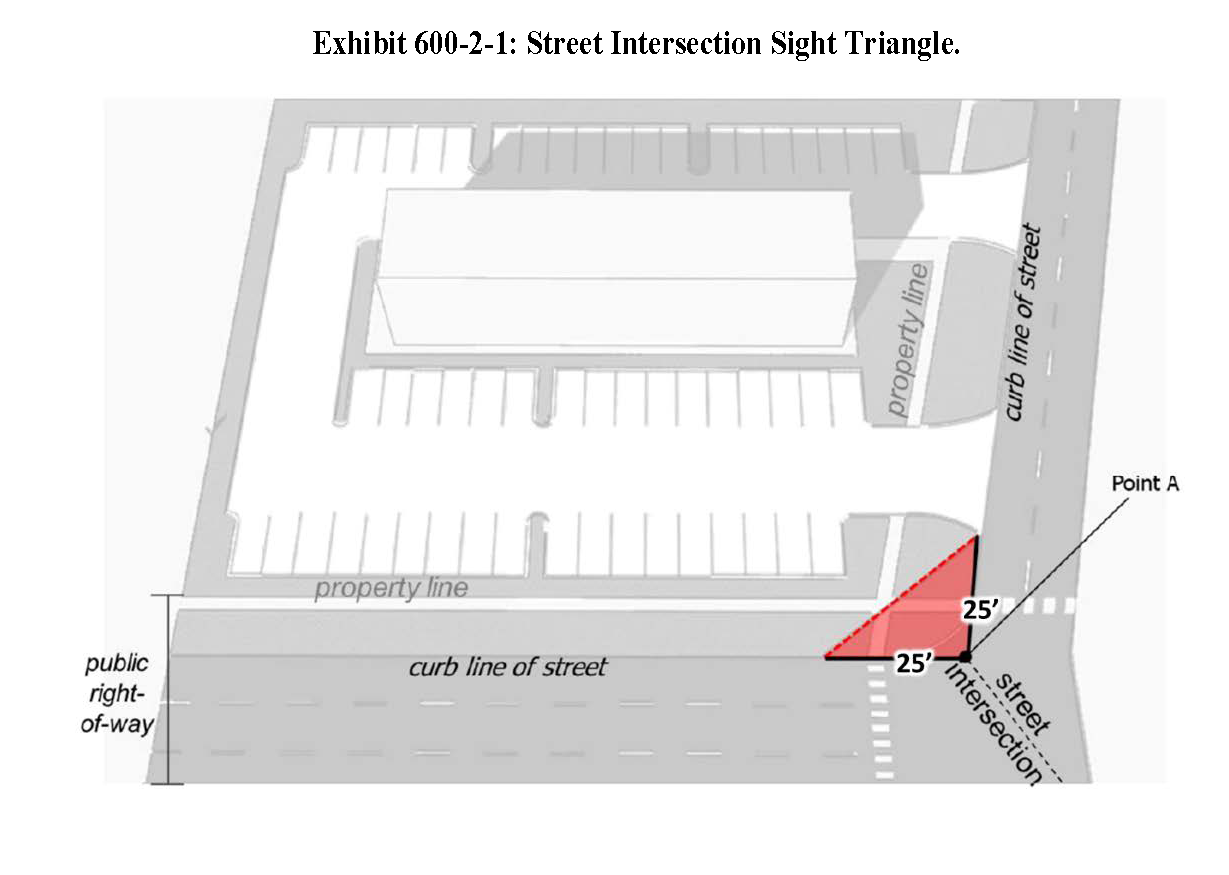
Street intersection sight triangle; size and location. The street intersection sight triangle shall measure 25 feet from vertex Point A and be established in accordance with the following:
i.
The triangle shall begin from the point where the curb lines of the intersecting streets meet, labeled "Point A." If there is a radius, street curb lines shall be projected until they intersect; and
ii.
From "Point A," 1 line shall be drawn along the curb line of the street parallel to the front lot line; and
iii.
From "Point A," a second line shall be drawn along the curb line of the street parallel to the side lot line; and
iv.
The end of each line shall be connected to form the required sight triangle.
b.
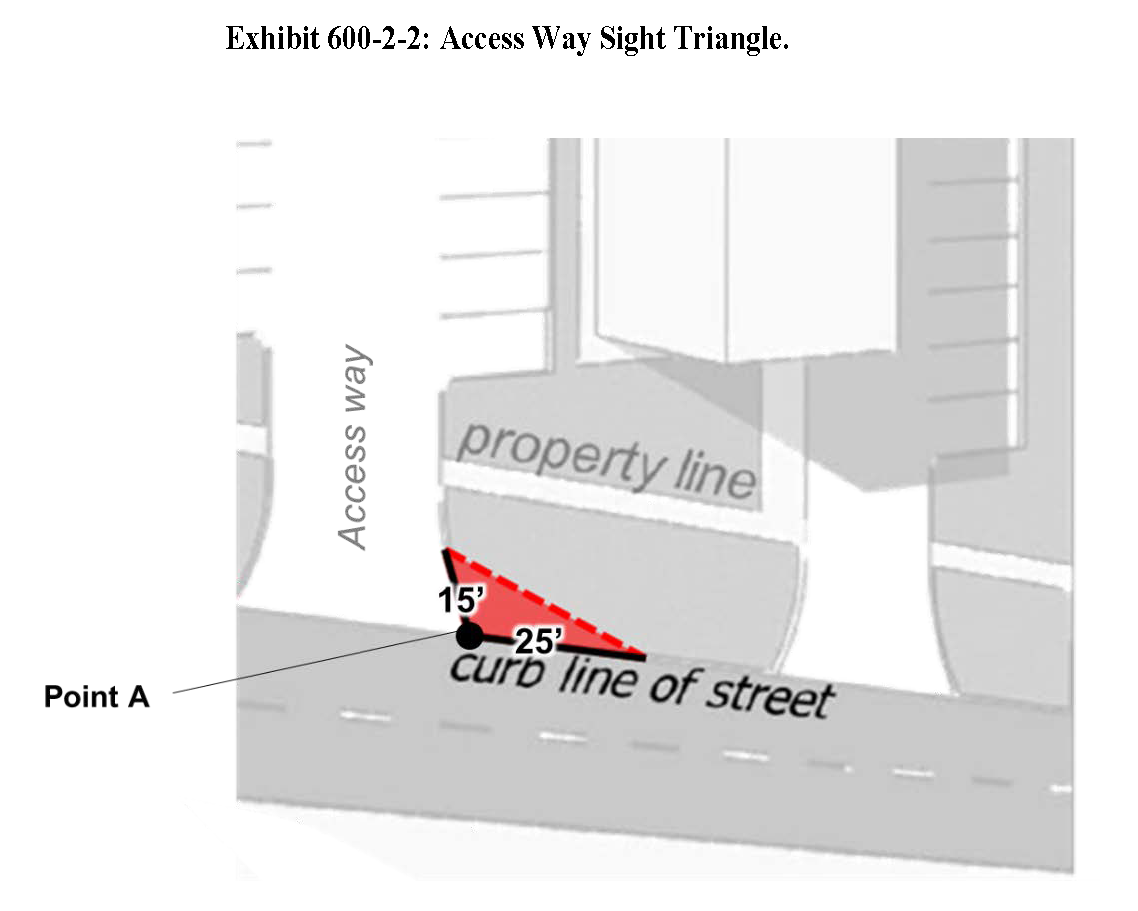
Access way sight triangle located at the intersection of a public street and a private accessway (or driveway). The sight triangle shall measure 15 feet along the accessway and 25 feet along the street, and be established in accordance with the following:
i.
The triangle shall begin from the point where the curb lines of the intersecting street and the accessway meet, labeled "Point A." If there is a radius, street curb lines shall be projected until they intersect; and
ii.
From "Point A," 1 line shall be drawn along the curb line of the street parallel to the front lot line; and
iii.
From "Point A," a second line shall be drawn along the edge of the driveway or accessway parallel to the side lot line; and
iv.
The end of each line shall be connected to form the required sight triangle.
Sec. 600-2.3 - Environmental performance standards.
A.
Reserved.
Sec. 600-2.4. - Building façade area.
A.
Definition. The building façade area occurs when the exterior wall of the building, which contains the primary entrance, faces a vehicular access area. The building façade area is the area between such exterior wall and such vehicular access area.
B.
Area, location, width, length. The building façade area shall be the full length of the building exterior wall facing the vehicular access area. This area shall be no less than four feet in width.
C.
Allowed in building façade areas. Concrete sidewalk not to exceed four feet in width. Trees, shrubs, landscaping, fountains and any other landscape architectural feature, specifically approved by the department of planning and development. Entrances, drainageways, underground utilities, eaves and other building overhangs are allowed in building façade planting areas. Everything not specifically allowed in this subsection is prohibited in building façade planting areas.
(Ord. No. 25-5700, § Exh. A, 3-6-2025)
Sec. 600-3.1 - Generally.
A.
Purpose. The purpose of this section is to provide regulations for land clearing, tree protection and preservation, and landscaping to:
1.
Promote the health, safety, and general welfare of the public;
2.
Facilitate the creation of a convenient, attractive, and harmonious community;
3.
Conserve natural resources, including natural stream systems and wetlands which contribute to adequate air and water quality;
4.
Prevent certain activities from resulting in adverse impacts to the surrounding community;
5.
Conserve properties and their values;
6.
Preserve the character of an area;
7.
Encourage the appropriate use of the land, including well operated silva culture and forestry practices;
8.
Reduce flooding and erosion;
9.
Provide for cleaner air and water, facilitate the recharge of groundwater, and maintain the natural beauty of the parish.
B.
Applicability.
1.
Section 600-3.2 provides predevelopment standards associated with the timing and degree to which land can be cleared for development and establishes the requirement for preservation of natural areas.
2.
Section 600-3.3 regulates the protection and preservation of trees, with a specific focus on live oak, cypress, and heritage trees; provides standards for a tree preservation credit program for retaining existing trees; and establishes a tree bank program for when removing a protected tree is unavoidable.
3.
Section 600-3.4 provides regulations for landscape areas located along street, side, and rear property lines, and within parking lots.
4.
In order to comply with Section 600-3, applicants must submit requests that address requirements summarized in Exhibit 600-3-1-1.
Exhibit 600-3-1-1 Summary of Land Clearing, Buffer, and Landscaping Requirements.
Sec. 600-3.2 - Land clearing standards.
A.
Purpose. This section provides regulations for the clearing of land and the protection and preservation of trees, shrubs, and ground cover plants in advance of site development activities. The purposes of these regulations are to:
1.
Preserve and enhance the parish's physical and aesthetic character by minimizing indiscriminate removal or destruction of trees, shrubs, and ground cover;
2.
Implement and further the goals and policies of the parish's Comprehensive Plan for the environment, open space, wildlife habitat, vegetation, resources, surface drainage, watersheds, and economics;
3.
Promote land development practices that result in minimal adverse disturbance to existing vegetation and soils within the parish while at the same time recognizing that certain factors such as condition of trees (e.g., disease, danger of falling, etc.), proximity to existing and proposed structures and improvements, interference with utility services, protection of scenic views, and the realization of a reasonable enjoyment of property may require the removal of certain trees and ground cover;
4.
Minimize surface water and groundwater runoff, aid in the stabilization of soil, minimize erosion and sedimentation, and minimize the need for additional storm drainage facilities caused by the destabilization of soils;
5.
Retain clusters of trees and tree canopy for the abatement of noise, for wind protection, and to reduce air pollution by producing pure oxygen from carbon dioxide.
6.
Protect trees during construction activities from damage to tree roots, trunks, and branches; and
B.
Applicability.
1.
Permit required. A land clearing permit is required, prior to the issuance of a building permit or site work permit, for any type of tree removal or land clearing work associated the following development types:
a.
Residential, including:
i.
Single-family residential developments on individual lots measuring 5 acres or more, and not a part of a platted subdivision; and
ii.
Two-family residential developments on individual lots measuring 0.5 acre or more; and
iii.
Multi-family residential developments (3 or more dwelling units), and not a part of a platted subdivision; and
iv.
Residential subdivisions involving the creation of between 6 and 24 lots and measuring more than 5 acres in total area; and
v.
Residential subdivisions involving the creation of 25 lots or more.
b.
All nonresidential zoning classifications, including:
i.
Forestry and agricultural developments involving greater than or equal to 5 acres; and
ii.
Commercial, medical, institutional, community-based facilities, public facilities, planned business campuses, educational, advanced manufacturing logistics, animal training district, solid waste districts, or industrial developments; and
iii.
Parks and recreational developments.
2.
Exempted developments. The following proposed developments shall be exempt from the land clearing regulations of this section:
a.
Single-family residential developments on individual lots measuring less than 5 acres and not part of a platted subdivision; and
b.
Two-family residential developments on lots measuring less than 0.5 acres; and
c.
Forestry and agricultural developments involving less than or equal to 5 acres.
3.
Work permitted. Land clearing proposals may include activities such as skidding, yarding, and trimming and the loading, storage, and operation of equipment involved in the removal of trees.
4.
Work not permitted. The parish shall not consider requests for proposed grading, fill, or site work of any kind as part of a land clearing permit.
5.
Application process. Permit application requirements and procedures shall be carried out in accordance with Chapter 200, Procedures, of this UDC.
6.
Permit validity. Land clearing permits shall be valid for a period of 2 years, wherein all permitted activities and a compliance inspection must be completed.
7.
Clearing only. When an application for a land clearing permit of a site that has a zoning classification other than E, R-1, R-2, L-1, L-2, S-1, or S-2 is not accompanied by the required documents to apply for a site work permit and/or a building permit, the proposed clearing plan must show the protection of all Natural Areas required for the site which are outside of any required easement or servitude, as defined in Exhibit 600-3-13: Landscape Area Requirements and Exhibit 600-3-7: Protected Trees and Survey Requirements, and all protected tree species as defined in Exhibit 600-3-7: Protected Trees and Tree Survey Requirements
C.
General Land Clearing Requirements.
1.
When implementing land clearing standards, applicants must consider requirements for landscape areas, natural areas, waterway buffers, wetland areas, tree surveys, flagging of protected trees, and plans for appropriate mitigation, as applicable, when determining which areas to clear and where to retain existing vegetation.
2.
Upon issuance of a land clearing permit and prior to site work beginning, activities associated with tree preservation including flagging and fencing root zones for protected trees and landscape areas must be completed in accordance with Sec. 600-3.3.B, Protected Trees, and Sec. 600-3.3.G, Tree Protection Requirements.
D.
Natural Area Requirements and Incentives.
(A)
Definition. Natural areas are defined in Chapter 100, Sec. 100-5 of this UDC.
(B)
Purpose. Natural areas are intended to:
a.
Preserve native screening and tree canopy characteristic of St. Tammany Parish, including canopy and understory trees and ground covering;
b.
Preserve wildlife habitats;
c.
Promote water quality, air quality and aesthetic beauty; and
d.
Reduce flooding impacts.
3.
Applicability. Natural areas must be provided in accordance with Exhibit 600-3-1-1 to the following developments or areas:
a.
The Tammany Trace;
b.
Single-family residential lots greater than or equal to 5 acres developed outside of a platted subdivision;
c.
Major residential subdivisions over 5 acres including between 6 and 24 lots; and
d.
Major residential developments containing more than 25 lots.
4.
Natural area requirements.
a.
Clearing of vegetation limited. Invasive vines and species (such as tallow) and dead or diseased trees approved by the department of planning and development may be removed within the Natural Area.
b.
Natural area delineation. Natural areas shall be indicated on the plot plan submitted with a land clearing application and on all plats submitted for approval.
c.
Tree Survey. A tree survey is not required for natural areas.
d.
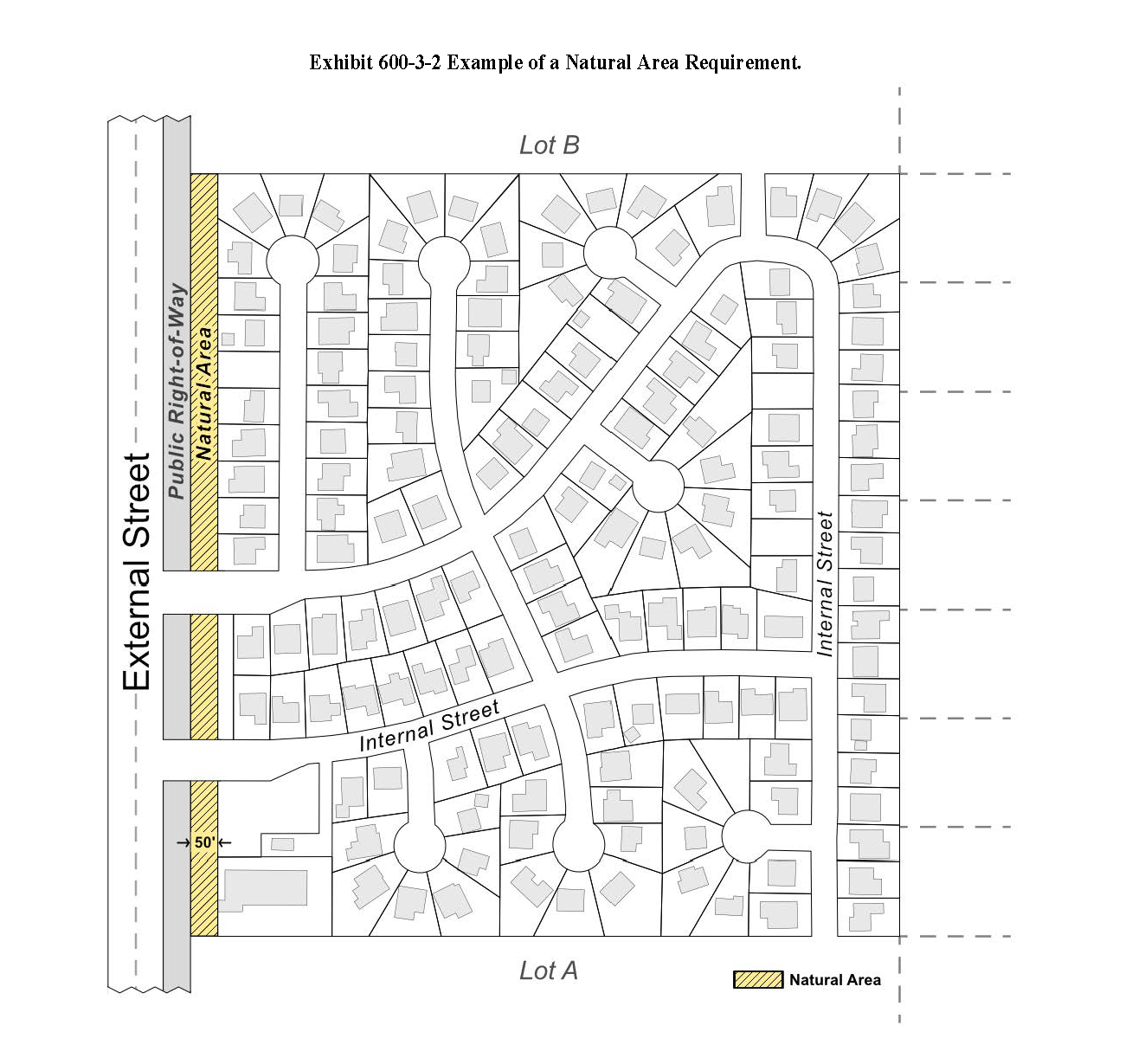
Limited interruption in Natural area permitted. Gaps or breaks of the natural area are permitted for approved roads and streets. These gaps or breaks must be kept to the minimum required to achieve their intended function. Exhibit 600-3-2 illustrates an example applications of the Natural area requirement.
e.
Natural Areas cannot be cleared unless activated for an approved recreational use.
f.
Partial removal of the existing tree canopy within the required 50' natural area along the street may be permitted in accordance with Sec. 600-3.3(E), Exceptions and Replanting.
5.
Natural Area Incentive. For every 5 percent of additional natural area retained beyond the required 50 feet of managed natural area along external roadways, a corresponding 5 percent decrease in minimum lot area or width will be permitted up to a maximum of a 20 percent.
a.
Location and application of additional Natural Areas. To qualify for the natural area incentive, the location of additional natural areas must advance their intended purpose and be appropriately sized, located away from structures, and be at an appropriate elevation to support long-term vegetative health.
b.
Calculation.
i.
Undevelopable areas are not eligible for credit. The calculation for the natural area incentive includes only the retention of natural areas that would otherwise be developable. For example, retaining wetlands that must be retained per other requirements of this UDC will not count towards the natural area incentive calculation.
ii.
Formula. The natural area incentive is equal to the percent change between the natural area required and the natural area provided, illustrated as follows:

c.
The Natural Area incentive will apply equally to all platted lots within the subdivision. For example:
i.
If the Natural Area incentive is 10% in the S-1 Suburban Residential District, the minimum lot size would be reduced by 10% from 11,000 sq ft to 9,900 square feet, where:
11,000 x 0.1 = 1,100
11,000 - 1,100 = 9,900
ii.
If the Natural Area incentive is 20% in the S-2 Suburban Residential District, the minimum lot size would be reduced by 20% from 7,500 square feet to 6,000 square feet, where:
7,500 X 0.2 = 1,500
7,500 - 1,500 = 6,000
6.
Major Subdivision Incentives. For subdivisions having greater than or equal to six lots, the incentives prescribed in Exhibit 600-3-3 are permitted, subject to the following:
a.
Provisions and thresholds described in Exhibit 600-3-1-1: Summary of Land Clearing, Buffer, and Landscape Requirements, section 900-2.2(J): Greenspace Requirements, and section 900-2.2(K): Planting Requirements must be provided and met; and
b.
Lot width or area cannot be reduced by more than 20 percent of the required underlying zoning district standards; and
c.
Where the lot width is reduced by up to 20 percent within a major subdivision, the required side yard setbacks may also be reduced by the corresponding width reduction percentage. Where the lot area is reduced by up to 20 percent within a major subdivision, the required front yard, side yard, corner side yard, and rear yard setbacks may also be reduced by the corresponding area reduction percentage.
d.
Credits (including maximums) for Major Subdivision Incentives may be combined, but - through this combination - cannot reduce lot area or width by more than 20 percent of the required lot area and width minimums; and
e.
Incentives cannot be applied to a property or site that is eligible for or employs the regulatory relief provided by nonconforming lots of record and associated contiguous lot regulations provided for in Chapter 500 of this UDC; and
f.
All approved credits applied to a subdivision must be notated on the approved and recorded plat.
g.
Where an incentive is granted subject to the preservation of natural area and/or planting of any landscape materials, the natural area and/or landscape materials must be kept healthy and maintained. If the natural areas and/or plantings do not survive, they must be replaced in kind subject to the approved planting plan and/or final subdivision plan. If no planting plan or landscape plan exists, the replanting must take place subject to Exhibit 600-3-4: Remediation Planting Requirements for Natural Areas.
Exhibit 600-3-3 Incentives for Major Subdivisions.
7.
Remediation.
a.
Replacement of vegetation located in a Natural Area. Should trees and shrubs be removed from within a required Natural Area as part of land clearing activities, the property owner must replace the remove trees and shrubs by completing mitigation activities in accordance with this section prior to receiving a building permit, site preparation permit, or work order. These mitigated areas shall be referred to as "remediation areas."
b.
Calculation of remediation area. Remediation areas shall be calculated via multiples of 1,250 square feet based on the size of the disturbed area. A fraction of disturbed Natural Area shall be replaced with the full planting required for a 1,250 square foot area.
c.
Required minimum planting. Minimum requirements for remediated vegetation located in a Natural Area must reflect the mix of species cleared from the parcel or located on adjacent parcels, be planted in Plantable Soil as defined in Chapter 100 of this UDC and shall be provided in accordance with Exhibit 600-3-4.
Exhibit 600-3-4 Remediation Planting Requirements for Natural Areas.
Note: Plant height shall be measured from the top of the root ball to the tip of the highest branch at the time of planting.
Note: Approved driveways are excluded from the square footage calculation.
d.
Remediation standards. Standards to remediate vegetation located in a Natural Area include:
i.
ANSI A300, as developed by the Tree Care Industry Association in accordance with the rules of good arboricultural practice as set forth by the latest edition, currently in effect at the time of such work.
ii.
Louisiana Nurserymen's Manual for the Environmental Horticulture Industry, as published by the Louisiana Nursery and Landscape Association.
iii.
American Standards for Nursery Stock, as published by the American Nursery & Landscape Association in accordance with applicable provisions set forth by the latest edition, currently in effect at the time of such work.
e.
Responsibility for remediation plan development, installation, and maintenance.
i.
Remediation plan. The remediation plan must be 'to scale' and prepared/stamped by registered LA Horticulturist or LA registered landscape architect. The remediation plan must:
(A)
Indicate the area to be remediated in square feet; and
(B)
Include the scientific name, variety, and size of plant materials selected; and
(C)
Include a notation describing soil preparation including, at a minimum, 4 inches of pine straw laid on topsoil tilled to a depth of 6 inches.
ii.
Warranty bond. The contractor shall post a 2-year warranty bond for plant material equal to the estimate of the cost of materials and installation. The warranty shall begin upon project completion and receipt of parish certification of installation.
iii.
Letter certifying remediation completion. Upon completion of the remediation activities, a letter by the licensed landscape architect or licensed landscape horticulturist certifying completion in accordance with this section and the approved landscape or plantings plan shall be submitted to the Department of Planning and Development.
iv.
Two-year maintenance provision. The contractor shall make provisions to water and maintain plant materials for 2 years after parish's approval of installation. Dead or unhealthy plants shall be replaced immediately.
v.
Long-term maintenance. The property owner or associated homeowners' association (HOA) shall be responsible for maintaining remediated planting materials indefinitely. Dead or unhealthy plants shall be replaced seasonally. If the property owner or HOA fails to maintain the natural area, they shall be susceptible to the enforcement provisions of this UDC, including associated fines and penalties.
E.
Waterway Buffers.
1.
Purpose. Waterway buffers are intended to protect the water quality of natural waterways and wetland areas abutting a development site.
2.
Waterway buffer delineation. Upon submittal of a land clearing permit application, the applicant must delineate waterway management buffers in accordance with the standards and distance requirements described in this subsection.
3.
Scenic river buffer. Treatment of a site area adjacent to a scenic river shall be in accordance with permits issued by the Louisiana Department of Wildlife and Fisheries (LDWF). Under brushing is not allowed within a waterway buffer without a scenic review permit from the LDWF.
a.
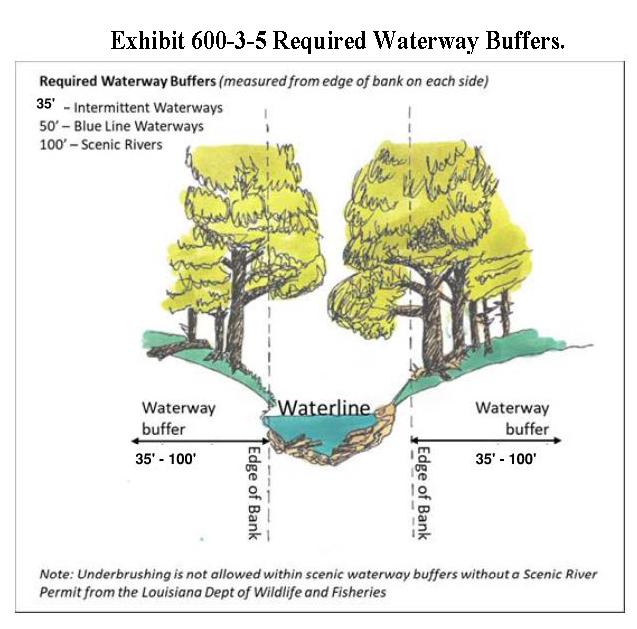
If the LDWF determines a permit is not required, the parish's buffer width requirement shall be between 35' - 50' feet, as measured from the edge of the waterway embankment or bank as illustrated in Exhibit 600-3-5, and as determined by the Department of Engineering.
b.
Boat house exception. To permit construction of the boat house, an applicant must submit—prior to the review and issuance of a building permit—a land clearing permit to the Coastal Management Office for review and approval. Pre-clearing in anticipation of later applying for a building permit is not authorized and shall require submittal of replanting plan to remediate unpermitted activities. If a land clearing permit is submitted in accordance with these standards and approved by the Coastal Manager, a maximum area of 40-foot-wide by 100-foot-deep along a scenic river waterfront may be cleared for the construction of a boat house.
4.
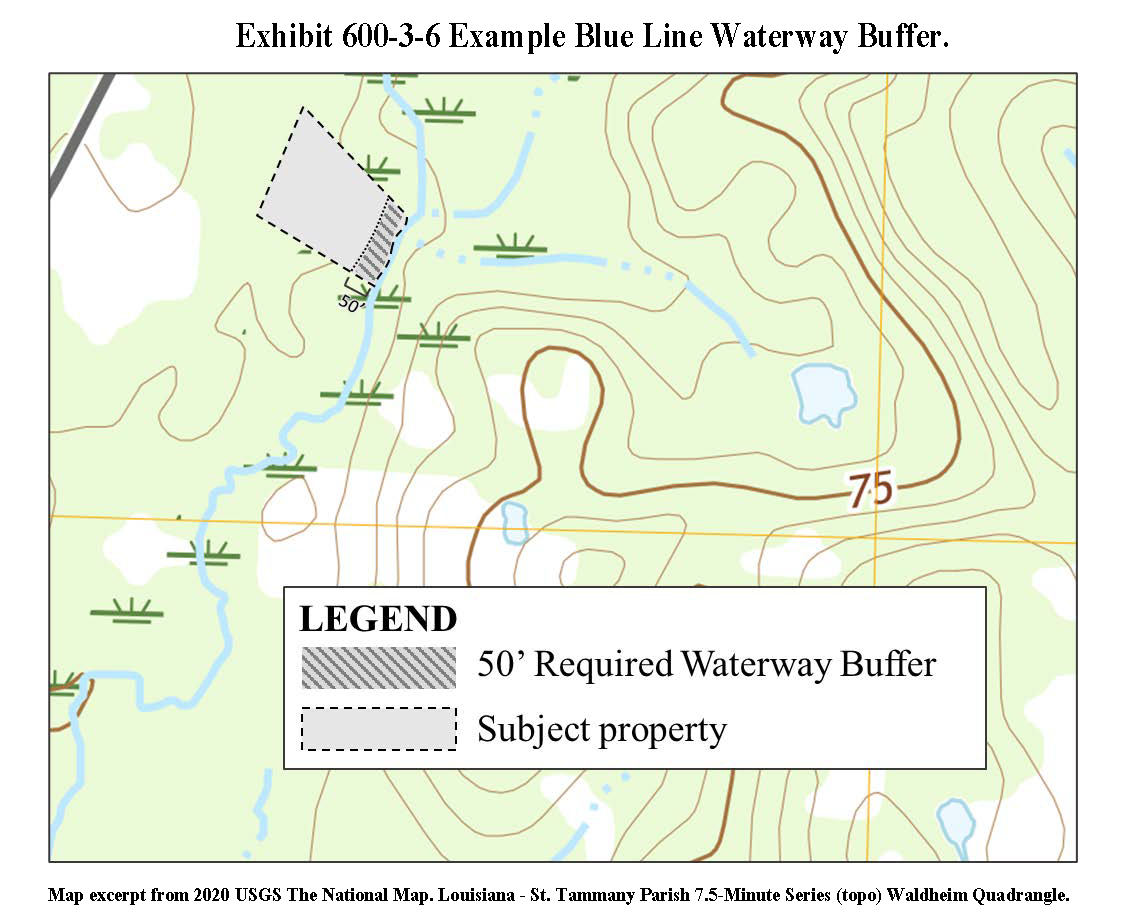
Intermittent Waterway Buffer. Applicants with property adjacent to intermittent waterways, designated by a broken/dashed line on USGS Quadrangle Map, shall provide a minimum 35-foot-wide waterway buffer, as measured from the edge of the bank.
5.
Blue Line Waterway Buffer. Applicants with property adjacent to Blue Line Waterways, as designated by solid blue line on USGS Quadrangle Map, shall provide a minimum 50-foot-wide waterway buffer, as measured from the edge of the bank on either side.
F.
Wetland Areas.
1.
All land clearing permits and activities must comply with Chapter 700 of this UDC and any applicable requirements of the U.S. Army Corps of Engineers.
2.
If a land clearing request includes a wetland, or possible wetland area, for a proposed development of a major subdivision, commercial site within a critical drainage area, or a residential parcel within a critical drainage area that is 5 acres or greater in size, a Clean Water Act 404 permit shall be required before a land clearing permit is reviewed and approved.
3.
If there are designated wetlands on a proposed development site that are not approved by U. S. Army Corps of Engineers for removal and mitigation, the applicant must delineate the wetland area on the site plan and place flags around the wetland area to ensure the areas is clearly delineated and the wetlands are not accidently cleared during land clearing operations or subsequent construction.
G.
Land Clearing Preparation and Operations.
1.
Operations maintained on site. All land clearing operations must be contained on the site as identified in the land clearing application. No operations, other than hauling, shall take place in the parish right-of-way.
2.
Site access requirements.
a.
An entrance roadway shall be constructed to facilitate on-site operation and the safe entrance and exit of vehicles. The roadway shall be constructed of materials that prevent damage to the shoulder or road surface and prevent the depositing of dirt, brush, or other debris on the adjacent public road.
b.
Drainage maintenance. A culvert shall be placed in accordance with parish or state requirements, as applicable, to maintain proper drainage along the public road. Any deviation from this procedure shall require prior approval of the department of public works or the State of Louisiana department of transportation and development (LA DOTD), as applicable.
3.
Limit disturbance to adjacent public areas. Applicants shall ensure persons responsible for land clearing activities exercise due and reasonable caution when traversing public roads, lands, and water bodies to minimize disturbance to adjacent public areas.
4.
Pre-existing drainage restored. Applicants are responsible for the restoration of all public rights-of-way, land, existing and recognized natural and engineered drainage to pre-existing conditions upon completion of the land clearing activity.
5.
Timber harvesting BMPs. All timber harvesting activities shall be carried out in accordance with the Best Management Practices (BMPs) as provided in the current version of "Recommended Forestry Best Management Practices for Louisiana" published by the State of Louisiana department of environmental quality (LDEQ.)
6.
Fire distance requirement for burning of site debris. Open burning of land clearing and timber harvesting site debris shall be prohibited within 1,000 linear feet of an occupied dwelling or within any recorded subdivision.
H.
Monitoring and Enforcement.
1.
Parish responsibility. The department of planning and development shall be responsible for the review and inspection of all sites requiring a land clearing permit.
2.
Monitoring. The department of planning and development may inspect any land clearing operation at any time to ensure compliance with this section.
3.
Enforcement. The parish may take appropriate actions and proceedings by law to prevent or remedy any violation of this section. These remedies shall be in addition to the fines and penalties described herein.
4.
Fines and penalties. Any person, firm, or corporation who fails to comply with, or violates regulations in this section shall be subject to applicable fines pursuant to the provisions of the Revised Statutes of the State of Louisiana.
(Ord. No. 25-5700, § Exh. A, 3-6-2025; Ord. No. 25-5760, § Exh. A, 6-5-2025; Ord. No. 25-5781, § Exh. A, 7-10-2025)
Sec. 600-3.3 - Tree preservation and mitigation.
A.
Purpose. The purpose of tree preservation and mitigation standards is to preserve and protect the tree canopy of St. Tammany Parish and garner the positive aesthetic and biological benefit of trees for the community.
B.
Applicability.
1.
The tree preservation requirements apply to the following developments: multifamily developments with 3 or more dwelling units, and all nonresidential developments including commercial, medical, institutional, parks/recreation, and industrial land uses. Agricultural uses shall be exempt from the tree preservation requirements of this subsection.
2.
Protected trees. All applicable developments shall be required to identify and protect existing, mature, non-invasive trees, as required in Exhibit 600-3-7 outlines the areas on a development site where certain mature trees shall be protected. This exhibit explains which trees must be protected within a required landscape area only or within the entire site.
3.
Required tree survey. A developer or property owner shall submit a tree survey stamped by a Louisiana licensed Land Surveyor or a Louisiana licensed Landscape Architect identifying all protected trees according to Exhibit 600-3-7. The tree survey shall be drawn to scale and indicate the required natural areas, landscape areas, and the location, size by caliper, and species of existing protected trees as required in Exhibit 600-3-7.
Exhibit 600-3-7 Protected Trees and Tree Survey Requirements.
"N/A" = Not applicable
"LA" = Landscape Area as required per Sec. 600-3.4.D
Natural Area per Sec. 600-3.2.D
C.
Removal of Protected Trees, Cypress, and Live Oak. No more than 50 percent of all existing live oak trees and cypress trees on a site shall be removed for non-residential developments as identified in Exhibit 600-3-7. Consideration shall be given to the healthier live oaks on the site as well as the live oaks which contribute to the street canopy of St. Tammany Parish.
D.
Tree Preservation Credit. In order to preserve more mature trees on a site, existing, healthy trees within the required landscape areas not located in a landscape area will count towards the tree planting requirements of Exhibit 600-3-1. Tree credits are only calculated and gran
1.
Calculation. One tree credit shall be provided for every 8 inches of caliper per individual, non-invasive, tree retained within the required landscaped areas. For example:
1 x 16" DBH Tree Retained = 2 tree Credits
1 x 25" DBH Tree Retained = 3 Tree Credits
2.
Location of Credit. Tree credits can only be applied in the same landscape area in which the preserved tree/s are located Credit for preserved trees cannot be interchanged between different required landscape areas.
3.
Death of a Credited Tree. If a credited tree dies, it shall be removed and replaced by the owner so as to bring the site back into compliance. The replacement tree/trees shall be planted within 6 months of the tree's death or within 6 months of receiving a notice from the parish.
Exhibit 600-3-8 Protected Credits for Preserved Trees.
Note: No credit will be given for any invasive species such as tallow, mimosa, or tung oil trees retained.
E.
Exceptions and Replanting.
1.
The department of planning and development may approve exceptions to the tree preservation requirements. To acquire an approved exception, the owner/developer must submit a request with justification for removal, by tree, to the department of planning and development for review and approval. If the removal of a tree would cause the site to fall below the minimum standards set forth in this UDC, the owner/developer shall submit a replanting plan to the department for planning and development showing how they will return the site to compliance. Should the removal request be approved, replanting must be in plantable soil and completed within 6 months of approval. Permitted tree preservation exceptions include:
a.
Less established pine tree clusters near public right-of-way. Clearing of pine trees located in a cluster of 5 or fewer and located within the required street landscape area(s).
b.
Diseased trees. The clearing of trees within the natural area or required landscape areas when the tree is documented by a licensed arborist as unsound, hazardous, diseased, or infested with insects.
c.
Limited access. Removal and replacement of live oak or cypress trees is allowed if the tree's location would preclude the developer/owner from providing access to the property, would preclude reasonable use of the property, or preclude the installation of necessary utilities. Approval is based upon the department of planning and development's review of the following materials:
i.
A complete land-clearing permit application; and
ii.
A survey or scale drawing of the property which shall include the location of the protected tree(s), radius of the protected root zone(s), and a site plan illustrating and explaining how the tree's location would be detrimental to the site, building or the buildable area; and
iii.
A letter describing special circumstances related to the property, including, without limitation, any unusual topography and fill requirements.
iv.
An alternative site placement plan showing an arrangement that could preserve the tree(s) along with analysis on the alternative feasibility.
2.
Alternative planting more suitable to site conditions. The removal and replacement of protected trees with alternative plantings may be approved by the department of planning and development based upon a recommendation from a licensed landscape architect that the alternative mix of trees would be more suitable based on the site's topography and/or soil condition.
3.
Major entry landscape. To achieve an attractive and safe entry to a subdivision, clearing an area measuring 150 feet in width and 75 feet in depth within the natural area on either side of a subdivision entrance may be permitted.
4.
Low likelihood of survival. Removal of protected trees that a licensed landscape architect has determined have an exceptionally low probability of survival due to the site's topography and/or soil may be approved by the department of planning and development provided the developer/landowner participates in the tree bank program.
5.
The department of planning and development shall inspect any protected tree requested for removal and grade it based on its existing condition. The grade will determine the number of caliper inches required to replace the removed tree. Exhibit 600-3-9 identifies the tree grading criteria.
Exhibit 600-3-9 Tree Grade and Required Replacement for Live Oaks and Cypress.
F.
Tree Bank Program.
1.
Purpose. The purpose of the Tree Bank Program is to maintain the overall canopy balance within St. Tammany Parish by providing a fund for urban forestry replanting projects within the parish.
2.
Mitigation. Mitigation, in the form of payment, shall only be used as a last resort. If the removal of a mature protected tree and replacement by planting of new tree(s) is practicable because on-site mitigation is not feasible or site conditions preclude compliance with the landscape ordinance, the property owner or owner's authorized representative shall pay an amount into the parish's Tree Bank Program as determined by the department of planning and development.
3.
Site assessment and fee. The department of planning and development shall conduct an assessment of the affected trees and calculate fees due according to a formula based on industry standards. The formula is provided in Section 2-009.00, Parish Fees and Service Charges, of the St. Tammany Parish Code of Ordinances.
4.
Fee collection. As deemed necessary by the director of department of finance, prior to the issuance of a land clearing permit, an escrow account will be created to manage any fees collected. All fees collected under the Tree Bank Program are to be immediately deposited into the escrow account.
5.
Fee expenditure. The funds collected under the Tree Bank Program shall be utilized to increase the parish's tree canopy by funding urban forestry projects throughout the parish. The director of the department of planning and development will review and approve project scopes and eligibility in accordance with the standards of this section before any Tree Bank Program funds can be utilized.
G.
Tree Protection Requirements.
1.
Upon receipt of a land clearing permit and approval of a tree survey (as applicable)—prior to issuance of a site work or building permit or the installation of commercial landscaping—a developer or owner must make necessary preparations to protect existing trees that must be preserved from the impacts of construction activities that could result in tree death.
2.
Protection includes installing protective measures and placing warning signs around the trees' protected root zone.
3.
Staking and flagging. The applicant shall set stakes extending upward from the ground at least 3 feet delineating:
a.
Landscape areas. All required landscape and natural areas shall be delineated by stakes. Each stake will be marked, with both the landscape area abbreviation and the required depth of the area (ex: 25' street landscape area). Stakes will be spaced no more than 25 feet apart. If vegetation along the lines of the landscape area is too thick to walk or see down, the underbrush shall be cleared sufficiently for walking and sighting. Heavy equipment shall not be used prior to obtaining a land clearing permit.
b.
Protected trees.
i.
Live oaks, cypress, and heritage trees. Live oaks and cypress trees and heritage trees that are to be retained or counted toward a Major Subdivision Incentive shall be flagged. The flagging shall be marked with species and caliper prior to inspection by department of planning and development (ex.: 19-inch CYP).
ii.
All trees 8 inches D.B.H. or larger required to be preserved and located in a landscape area shall be flagged and labeled "KEEP."
iii.
All other trees located on-site that the applicant is seeking credit for must be flagged "KEEP" and be shown on the tree survey.
c.
Driveway cuts. Areas of ingress or egress through a natural area or landscape area shall be clearly defined with stakes marked "DRIVEWAY."
d.
Retention/detention ponds. Areas planned to be developed as a retention/detention pond or stormwater management structure shall be clearly defined with stakes marked "POND."
4.
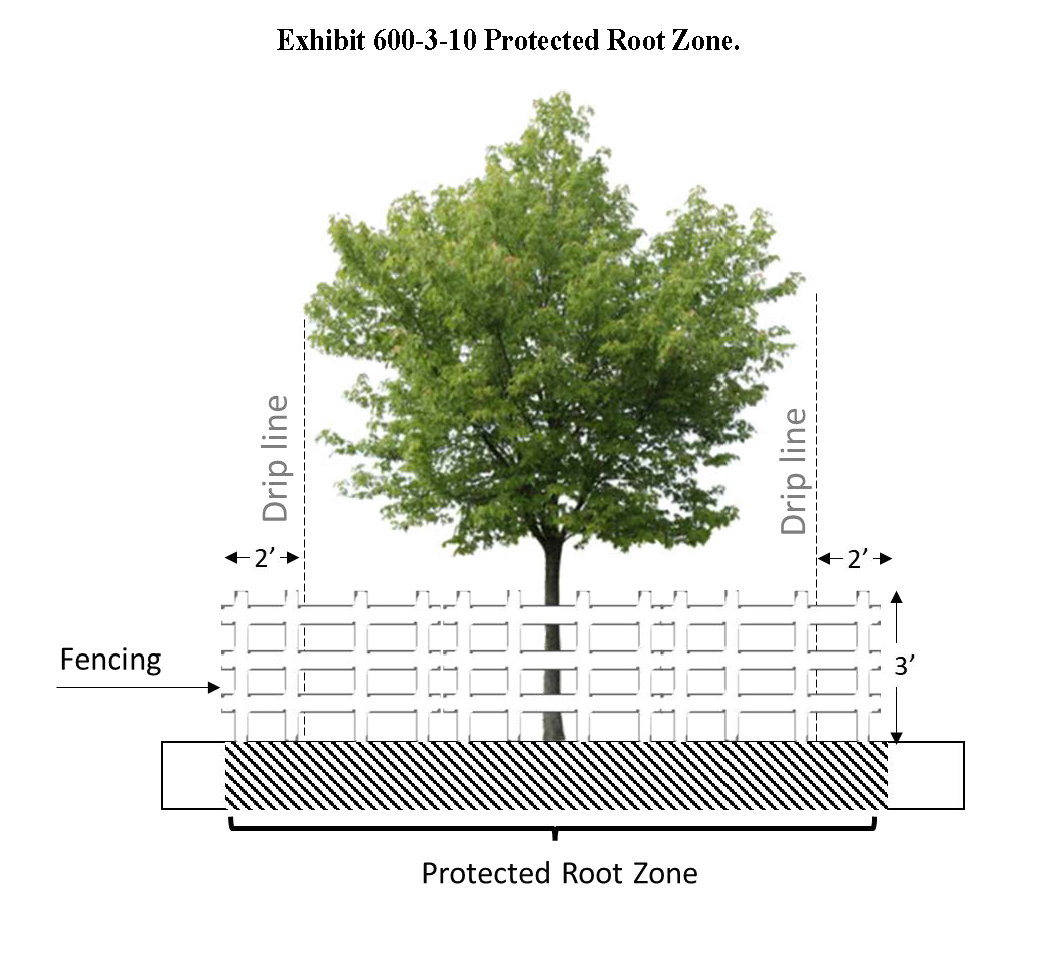
Fencing required. Existing trees and Natural Areas that are retained, including those counted toward a Major Subdivision Incentive, must have their root zone protected with fencing located 2-feet from the drip line to prevent damage from heavy construction vehicles, materials, and other adverse activities.
a.
Minimum requirement. For protective trees, fencing includes chain link, wood, or flexible high visibility style fencing with stakes or posts sufficiently secured to remain in place throughout the entirety of the building process. For additional Natural Areas provided and credited towards a Major Subdivision Incentive, hard fencing is required. All required fencing must be a minimum of 3 feet high and located 2 feet from the dripline to protect the root zone in accordance with Exhibit 600-3-10 Protected Root Zone. Fenced in areas shall be maintained at pre-construction grade; fill in these areas is prohibited.
b.
Location. The location of tree protection fencing must be shown on the demolition and land clearing plan, be submitted as part of the construction drawing package, and address all the following requirements:
i.
Protected trees. Protected cypress, live oak, and heritage trees which are to be retained or counted toward a Major Subdivision Incentive shall be fenced in accordance with Exhibit 600-3-9 Protected Root Zone.
ii.
Street landscape area. The entire protected street landscape area shall be enclosed with fencing.
iii.
Side and rear landscape area. Landscape areas where tree credits are being requested must be fenced.
c.
Limited activity permitted within the protected root zone. No significant soil disturbance or compaction, stockpiling of soil or other construction materials, vehicular traffic, or storage of heavy equipment shall be permitted within the protected root zone.
i.
No more than 1 inch of fill shall be allowed within the protected root zone of a tree that is to be preserved.
ii.
No grading or cutting is allowed within the protected root zone for any purpose (including drainage and utility work) unless an inspection is conducted by the department of planning and development and approval is granted for the desired work.
iii.
Clearing of trees within this area shall be done with hand equipment and not with heavy construction equipment.
d.
Fencing shall not be removed until landscaping activities are complete.
H.
Corrective Procedures for Protected Trees.
1.
Repairable damages. Corrective procedures shall be required when development activities have caused damage to a protected tree, and it is determined by the department of planning and development that the damage is repairable.
2.
Activities to improve survivability. If encroachment into root protection zone is anticipated or has happened, the following practices can be employed, under the supervision of a licensed arborist, to improve survivability.
a.
Canopy pruning. The pruning of a tree in anticipation of construction damage may offset potential root loss and produce an invigorating response. The pruning of specimen trees may be subject to approval by the department of planning and development.
b.
Root pruning. Roots outside of the protected root zone that must be pruned must be cleanly severed and the exposed roots must be covered with a 2-inch layer of mulch throughout development of the site.
c.
Fertilization. Fertilizer applications can enhance the vigor of trees stressed by site disturbances, thereby promoting root development.
d.
Soil remediation. Wherever possible, soil should be brought back to its natural grade. Unnecessary fill, compaction, erosion sedimentation, concrete washout, and construction debris should be removed. When machinery is required for site improvement, it is recommended that a "Bobcat" or similar lightweight, rubber-tired vehicle be used so as to minimize soil compaction. Compacted soil within the root protection zone should be aerated. A compressed air gun should be used to cut narrow trenches in a spoke pattern away from the trunk to a depth of 8 to 12 inches or greater, if the soil grade has been raised. Trenches should begin 4 to 6 feet from the trunk to avoid cutting any major support roots and should extend to the drip line. Trenches should then be backfilled with topsoil or compost. The air exchange, nutrient, and water-holding capacities of soils can be improved with soil amendments. This is best accomplished by backfilling with mineral amendments such as perlite, vermiculite, isolite, and similar products.
3.
Irreparable damage to the roots. When the department of planning and development determines a tree has been irreparably damaged, it must be replaced. The requirement for number and size of replacement tree/trees will be determined by the caliper size and grade of the damaged tree based on the criteria in Exhibit 600-3-8 Tree Grade and Required Replacement. The replacement will be submitted using the land clearing permit application form and will be reviewed by the department of planning and development.
(Ord. No. 25-5700, § Exh. A, 3-6-2025
Sec. 600-3.4 - Landscape regulations.
A.
Purpose. The purpose of these regulations is to protect and promote the general welfare of St. Tammany Parish's citizens by establishing minimum landscape standards that provide for the proper selection and installation of landscape materials.
B.
Applicability.
1.
Applicants shall submit a landscape plan to the department of planning and development for review to ensure conformance with landscape regulations set forth in this chapter for all new development and in the following circumstances:
a.
Conversion of a residential structure to a nonresidential use.
b.
A nonresidential change of use.
c.
Development or expansion of a parking lot.
d.
Cumulative expansion of a building by more than 2,500 square feet or 25 percent of the original building's square footage, whichever is less.
e.
Damage, repairs, or improvements to a building where the costs exceed 50 percent of the subject structure's fair market value.
f.
Loss of legal nonconforming status in accordance with Chapter 500 of this UDC.
2.
Exemptions. All single-family and two-family residences on lots under 0.5 acres are exempt from the landscape requirements of this section.
C.
Landscape Plan and Tree Preservation Plan.
1.
Landscape plans shall be prepared by a licensed Louisiana landscape architect and shall have their seal affixed to the plans.
2.
Landscape plans shall be the same scale as the accompanying site plan and tree survey, when required.
3.
Landscape plans shall indicate the scientific and common name, number, and caliper in inches of all trees, shrubs, or plant materials; the estimated plant height at time of planting; and identify which trees are to remain and which trees are proposed to be removed.
4.
Landscape plans shall identify the location of all trees and landscaping materials to be planted within required landscape areas.
5.
Landscape plans shall identify existing and proposed pervious and impervious surface area and the percentage of each relative to the entire development and to the individual lot of record to show compliance with Section 600-3.4(D)(1).
6.
Upon complete installation of all landscaping, the landscape architect, whose seal is affixed to the approved landscape plan, shall submit a statement verifying inspection of the landscaping and certifying it was installed in conformance with the approved landscape per Sec. 600-3.4(F) below.
D.
Landscape Requirements.
1.
Impervious and pervious areas. No lot or parcel shall have more than 70 percent of its surface area covered with impervious material. The percentage of pervious to impervious ground cover must be shown on the site plan and landscape plan. Impervious areas include, but are not limited to, primary and accessory structures; paved areas, such as sidewalks and driveways; and paved detention and retention ponds.
2.
Selection of plant material. Plant material shall be selected for its form, texture, color, pattern of growth, and suitability for local conditions. All landscape plans shall incorporate at least 60 percent native plant material to provide a habitat for wildlife, reduce irrigation requirements, and promote sustainability and survivability.
3.
Class A trees. All Class A trees, at the time of planting, shall have a minimum caliper of at least 2½ inches, measured 6 inches above the root ball and a minimum height of 10 feet, as per the National Nursery Association Standards.
4.
Class B trees. All Class B trees shall have a minimum caliper at the time of planting of at least 1½ inches, measured 6 inches above the root ball and a minimum height of 8 feet as per the National Nursery Association Standards. Multi-stem trees shall have a minimum of 3 trunks with a minimum of 1½ inch caliper for each trunk.
5.
Native tree size flexibility. The department of planning and development may permit flexibility for native trees that are smaller in size prior to installation when requests do not involve protected trees or other typically available commercial stock (Nuttal Oaks, Shumard Oaks, etc.) and are in conformance with the following formula:
1 Required Class A Tree = 2 Native Trees no smaller than 5 gallons and no less than 5 feet tall.
1 Required Class B Tree = 3 Native Trees no smaller than 3 gallons and no less than 4 feet tall.
6.
Shrubs. All shrubs, at the time of planting, shall have a minimum height of 2 feet and shall meet the National Nursery Association Standards. Shrubs required for parking lot screening shall be evergreen.
7.
Groundcover and perennials. Unless otherwise specified, perennials and groundcover shall be at least 4-inch container stock.
8.
Mulch. Unless otherwise specified, mulch shall be a minimum 3-inch dressing and shall be applied on all exposed soil surfaces of planting areas, except turf, creeping or rooting groundcovers, or direct seeding applications, where mulch is contra-indicated. Mulch shall be kept from direct contact with tree trunks and other organic material. All mulch shall derive from a living, natural source. Gravel or stone is not acceptable.
9.
Irrigation plan. Irrigation systems are required for all new non-residential construction. A request to forego an irrigation system must be submitted to the department of planning and development along with the landscape plan for approval, and must include a stamped plan for a natural system or Low Impact Development enhancements consistent with the St. Tammany Parish Low Impact Development Guidebook. When irrigation is installed, it shall comply with the following standards:
a.
Irrigation systems shall be designed to avoid runoff, low-head drainage, overspray, or other similar conditions where water flows or drifts onto adjacent property, non-irrigated areas, walks, roadways, or structures.
b.
Irrigation equipment shall comply with the following standards.
i.
Low-volume irrigation systems with automatic controllers are required. Low-volume irrigation systems include low-volume sprinkler heads, dry emitters, and bubbler emitters.
ii.
Drip, trickle, or other low-volume irrigation shall be provided on at least 90 percent of the landscaped areas except for those areas devoted to turf and flat groundcover plants. If a licensed landscape architect or landscape contractor verifies that a drip or trickle system is not feasible due to location, the required percentage of drip or trickle irrigation may be reduced by technical decision of staff approving the landscape plan.
iii.
Integral, under-the-head, or in-line anti-drain valves shall be installed, as needed, to prevent low-head drainage.
iv.
Automatic control systems shall be able to accommodate all aspects of the design. Automatic controllers shall be digital, have multiple programs, multiple cycles, and sensor input capabilities.
v.
Soil moisture sensors and rain or moisture-sensing override devices are mandatory.
vi.
Sprinkler heads shall be selected and spaced for proper area coverage, application rate, operating pressure, and adjustment capability. Sprinklers shall have matched precipitation and application rates within each control valve circuit.
vii.
Drip irrigation systems are permitted if commercial or agricultural grade materials are used. Components shall be installed below the soil except for emitters.
viii.
Backflow prevention devices are required.
ix.
Rainwater harvesting and/or dedicated landscape water meters are recommended on all landscape areas to facilitate water management and cost reduction.
10.
Species diversity. Diversity among required plant material for on-site landscape is required to reduce the risk of losing a large population of plants due to disease. Exhibit 600-3-11 indicates the percentage of diversity required based on the total quantity of species utilized on site.
Exhibit 600-3-11 Species Diversity Requirements.
E.
Required Landscape Areas.
1.
Type. Nonresidential sites shall include 4 required landscape areas: the street or interstate landscape area, side yard landscape area, rear yard landscape area, and parking lot landscape area as illustrated in Exhibit 600-3-12 Location and Type of Required Landscape Areas.
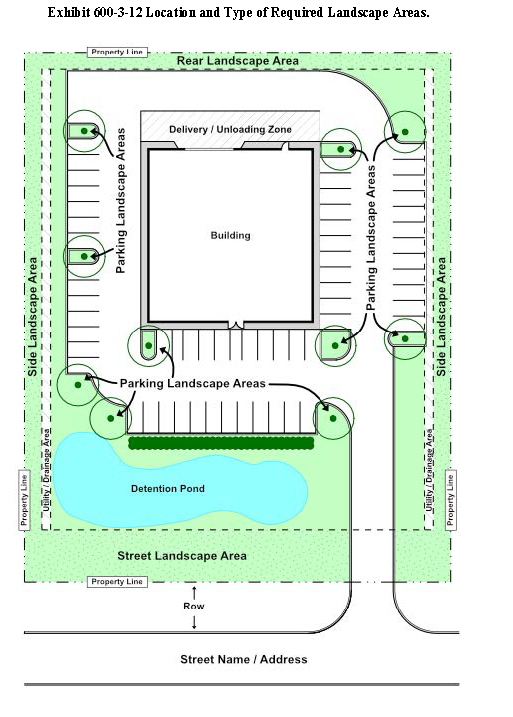
2.
Requirements. Landscape areas shall be provided in plantable soil in accordance with the requirements set forth in Exhibit 600-3-13 Landscape Area Requirements.
Exhibit 600-3-13 Landscape Area Requirements.
3.
Street and interstate landscape areas (Types A, Aa, and B). The street and interstate landscape areas provide landscaping to screen a property's frontage along a public right-of-way, interstate, or street. Landscaping must be installed in accordance with Exhibit 600-3-13 and the requirements of this section. Example street (Type A) and interstate (Type B) landscape areas are illustrated in Exhibit 600-3-14.
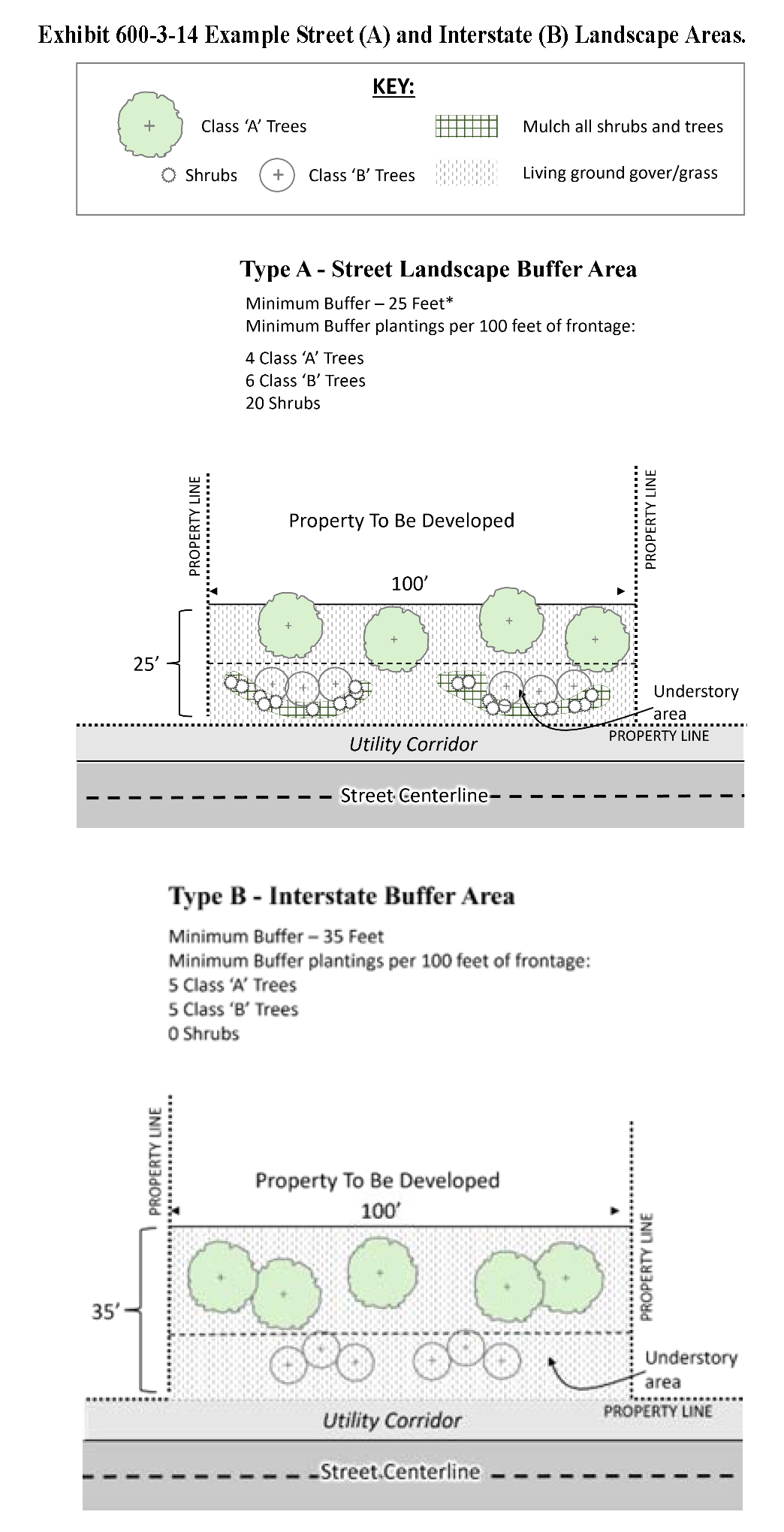
a.
Ground cover required. Living vegetative ground cover material must be planted across the entire open surface of the street and interstate landscape area, excluding driveways, sidewalks, retention/detention ponds, drainageways and facilities, fountains, signs, and other areas that are not able to be planted.
b.
Structures or elements permitted in street and interstate landscape area.
i.
Trees, shrubs, landscaping, fountains, and any other landscape architectural features, shall be permitted upon approval by the department of planning and development.
ii.
Driveways and utility easement/servitudes. Driveways and easements/servitudes must cross the landscape area at a 90-degree angle or perpendicular to the street. Whenever feasible, driveways and utility crossings should be grouped together to minimize the number of breaks in the landscape area.
iii.
Signs, provided that each sign shall adhere to intersection site triangle regulations within this code.
iv.
Fences, subject to the following requirements:
(A)
Fences shall not exceed 3 feet in height; and
(B)
Fences shall adhere to intersection site triangle regulations within this code.
(C)
Storage yard fences shall not be permitted.
c.
Structures or elements prohibited in street and interstate landscape area. Any structure or element that is not specifically permitted in Sec. 600-3.4(E)(3)(b) shall be prohibited, including eaves, building overhangs, parking areas, storage, detention/retention ponds, drainage swales, and utilities unless there is an existing easement or servitude on site.
d.
Driveways through street planting. For a street frontage of less than 200 linear feet, no more than 2 one-way driveways, a minimum of 12 feet in width and a maximum of 15 feet in width, or one two-way driveway, a minimum of 24 feet in width and a maximum of 35 feet in width, shall be permitted through the street planting area. For a street frontage of 200 linear feet but less than 600 linear feet, 1 additional two-way driveway or 2 additional one-way driveways of the minimum and maximum width specified, are permitted. Similarly, 1 additional two-way driveway or 2 additional one-way driveway, of the minimum and maximum width specified, are permitted for each additional 400 linear feet of frontage beginning with and in excess of 600 linear feet.
e.
Street and interstate landscape buffer and utility conflicts.
i.
Public utilities in the public right-of-way. Whenever feasible, applicants and all parish departments involved in permitting the location of utilities shall first consider and prioritize the location of utilities within the public right-of-way.
ii.
Landscaping within a utility easement or servitude. In the event utilities are an existing condition with an easement or servitude on private property or a property owner is limited to constructing utilities within an easement/servitude on private property, the following adjustments to the street or landscape area must be authorized.
(A)
The utility easement/servitude must be limited to the first 15 feet of the street or interstate landscape area measured from the property line.
(B)
Trees should be planted in accordance with the requirements outlined in Exhibit 600-3-15 below.
Exhibit 600-3-15 Planting requirements for Street Landscape Area with Utility Easements.
(C)
Class A trees shall be planted in the canopy planting area as illustrated below, and Class B trees, shrubs and groundcover may be planted within the understory planting area, as illustrated in Exhibit 600-3-16.
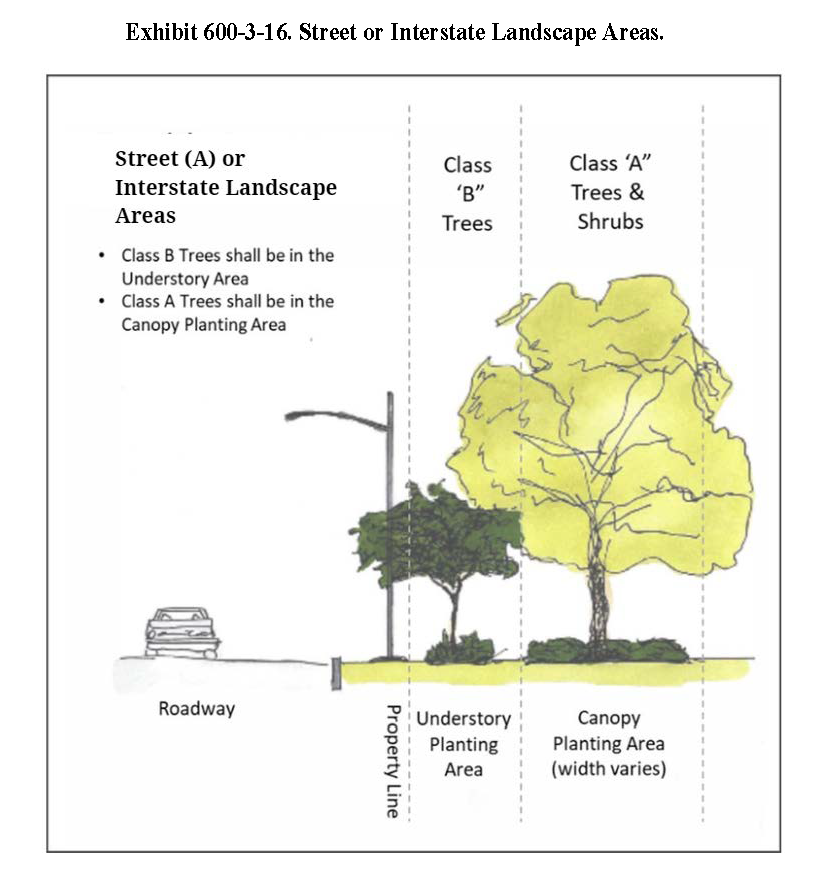
iii.
Dentation ponds and drainage structures. Private detention ponds and drainage structures are not allowed within the street or interstate landscape areas.
iv.
Utilities servicing the property. Utilities servicing a property are permitted to cross the street and interstate landscape area, provided:
(A)
Utilities cross the buffer area at a 90-degree angle; and
(B)
Utilities are grouped to limit the number of crossings; and
(C)
Utilities are coordinated with driveway access breaks in the buffer area.
f.
Flexibility of depth of street planting areas. The required depth of the street planting area may be adjusted. The depth of the street planting area may be reduced to a minimum of 10 feet and up to a maximum of 20 percent of the length of the street planting area, provided that a depth greater than the required depth is added to other parts of the street planting area to maintain the overall required street planting area.
4.
Side and rear landscape areas (Types C, D, E, and F).
a.
Side and rear landscape areas provide a buffer between adjacent properties and uses and are designated for the areas for the preservation of trees. Side and rear landscape areas may abut but do not include parking lot planting areas.
b.
Width and planting requirements. Side and rear yard landscape requirements are dependent upon adjacent land uses. Exhibit 600-3-17 provides the requirement for each type of side and rear landscape area. There are 4 types of side and rear yard planting areas identified as types C, D, E, and F; all 4 types must include soil suitable for planting or plantable soil as defined in Chapter 100 of this UDC.
c.
Existing trees, other than live oaks and cypress located within the side and rear buffer areas, are not required to be retained. If the owner/developer chooses to retain existing trees located within the required side and rear yards landscape areas, they can qualify for tree credits as set forth in Section 600-3.3(D). If credit is sought, the retained trees must be identified on the tree survey, and the land clearing permit and the retained trees must be protected with fencing throughout construction.
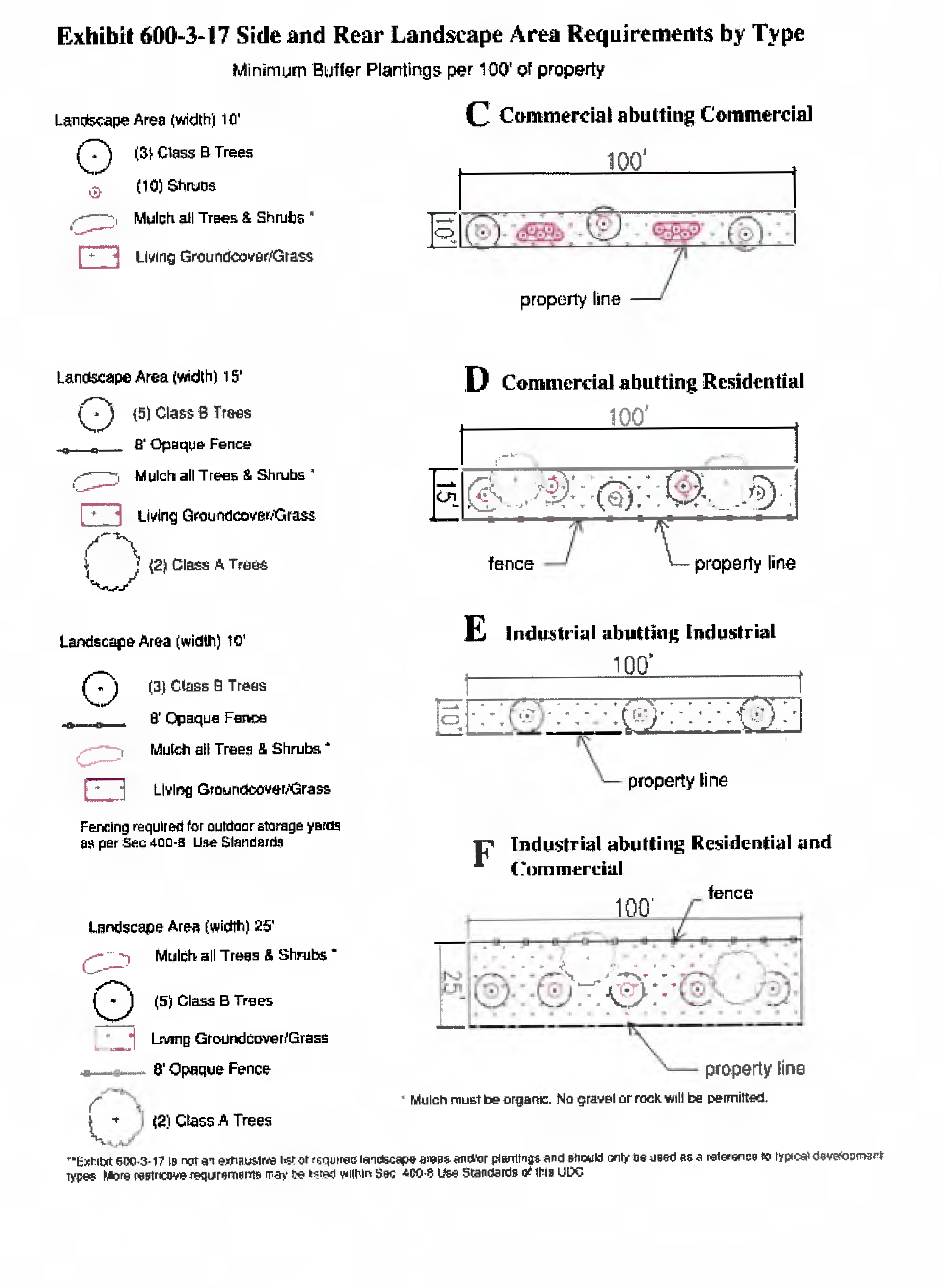
d.
Ground cover required. A living vegetative material shall cover the entire surface of the side and rear landscape areas, except for within the location of driveways, sidewalks, fountains, signs or other approved structures or elements which are not able to be planted with living plant material.
e.
Structures or elements permitted within side and rear landscape areas.
i.
Trees, shrubs, landscaping, fountains, and any other landscape architectural feature, specifically approved by the department of planning and development are allowed in the side and rear landscape areas.
ii.
Eaves and other building overhangs not to exceed 2½feet are allowed, subject to the other rules provided for in this UDC.
iii.
Driveways that connect adjacent properties.
iv.
Fences. When fences are required, as listed in Exhibit 600-3-13 Landscape Area Requirements, they shall be 8 feet in height and 100 percent opaque. Fences may be constructed of wood or other opaque materials approved by the department of planning and development.
f.
Structures or elements prohibited within side and rear landscape areas. Everything not specifically allowed in Sec. 600-3.4(E)(4)(d) is prohibited within the side and rear landscape areas including storage, parking areas, detention or retention ponds, sidewalks, dumpsters, drainage swales, and utilities, unless there is an existing easement or servitude on site.
g.
Side and rear landscape and utility conflicts. If a utility easement or servitude is located in the area designated for the side or rear landscape area, then the required side or rear landscape areas shall commence at the edge of the utility easement and extend inward the required distance.
h.
Parking lot landscape area. Parking lot landscape areas are intended to screen the parking lot from the street, provide shade for parking spaces, retain the parish's tree canopy, reduce flooding, and support recharge of ground water.
i.
Applicability. Interior parking lot landscaping shall be provided in parking lots with more than 8 parking spaces or larger than 2,500 square feet.
j.
Design requirements.
i.
Landscape islands.
(A)
At least 1 parking lot landscape island shall be provided between every 12 contiguous parking spaces.
(B)
All rows of parking spaces shall terminate in a parking lot landscape island or landscaped area.
(C)
The minimum size of a parking lot landscape island is 9 feet wide by 18 feet long for a minimum of 162 square feet, including curbing.
(D)
Parking lot landscape islands shall contain a minimum of 1 Class A tree. The surface of the landscaped islands shall be planted with vegetated ground cover or shrubs.
ii.
Parking lots with 8 or more spaces shall have either a curb or anchored wheel stop at least 6 inches in height for each parking space to keep the vehicle from crossing into the landscape area. Wheel stops may be made of concrete, natural stone, or recycled rubber.
iii.
Utilities may be allowed in parking lot landscape islands after the minimum planting requirements and square footage have been met and provided that the square footage needed for the utility is in addition to the minimum area provide for the required landscape.
iv.
Medians between rows. Every 5th drive aisle shall be separated by a median strip of not less than 9 feet in width (inclusive of curbs) for landscaping. Landscaped medians shall contain a minimum of 1 Class A tree for every 30 linear feet. The surface of the landscaped medians shall be planted in a living vegetative ground cover.
v.
Bioswales. The use of bioswales is encouraged. Interior and/or median islands may be consolidated, curb cuts permitted, and/or intervals may be expanded in order to provide for a better bioswale system, when approved by the department of planning and development.
k.
Screening of parking areas.
i.
When parking or vehicular use areas are located adjacent to a required street, shrubs shall be planted to screen the parking area from view from the street or road.
ii.
Location of shrubs within street landscape area. Shrubs located in the street landscape area adjacent to a parking lot shall be planted in a row (straight or curvilinear) or in clusters to aid in screening the parking lot from the street. Shrubs planted linearly shall be planted no more than 3 feet apart. When shrubs are planted in clusters, the clusters shall be no more than 4 feet apart.
iii.
Parking lot screening shrubs shall be a minimum of 2 feet in height at time of planting and shall be an evergreen species to ensure year-round screening is maintained.
iv.
If existing shrubs are maintained, they must be shown on the landscape plan to qualify for credit towards the required screening.
l.
Trash and garbage screening requirements. All storage areas containing 3 or more refuse, garbage, or rubbish containers or 1 or more dumpsters shall be screened on all sides with the minimum of a 7-foot-high opaque fence constructed of either wood or masonry. All properties which provide prepared foods, and all office and warehouse uses must provide a dumpster and meet the requisite screening requirements.
m.
Retention/detention planting requirements. Required plantings shall:
i.
Be established in a planting strip at least 5-feet wide running alongside the pond; and
ii.
Be oriented to screen the pond from public view; and
iii.
Not interfere with the pond's maintenance; and
iv.
Be planted at grade; and
v.
Not be excavated or made a part of the slope of the retention/detention pond; and
vi.
Not be located within any required buffer; and
vii.
Be acknowledged on the applicable landscape plan as part of the retention/detention pond; and viii. Be planted on retention/detention pond slopes having a maximum side slope of 3:1 in a configuration designed for successful growth and long-term maintenance. Terraces for planting and other low impact development practices are encouraged.
F.
Installation Certification. Upon complete installation of all landscaping, the landscape architect whose seal is affixed to the approved landscape plan shall submit a statement verifying inspection of the landscaping and certifying it was installed in conformance with the approved landscape plan by the parish. Said statement shall be made through signature block attached to approved plan stating that "through periodic site observations, the work has been substantially completed in accordance with the ordinance and that the landscape planting and irrigation installation conform with the criteria and specifications of the approved landscape and irrigation plan."
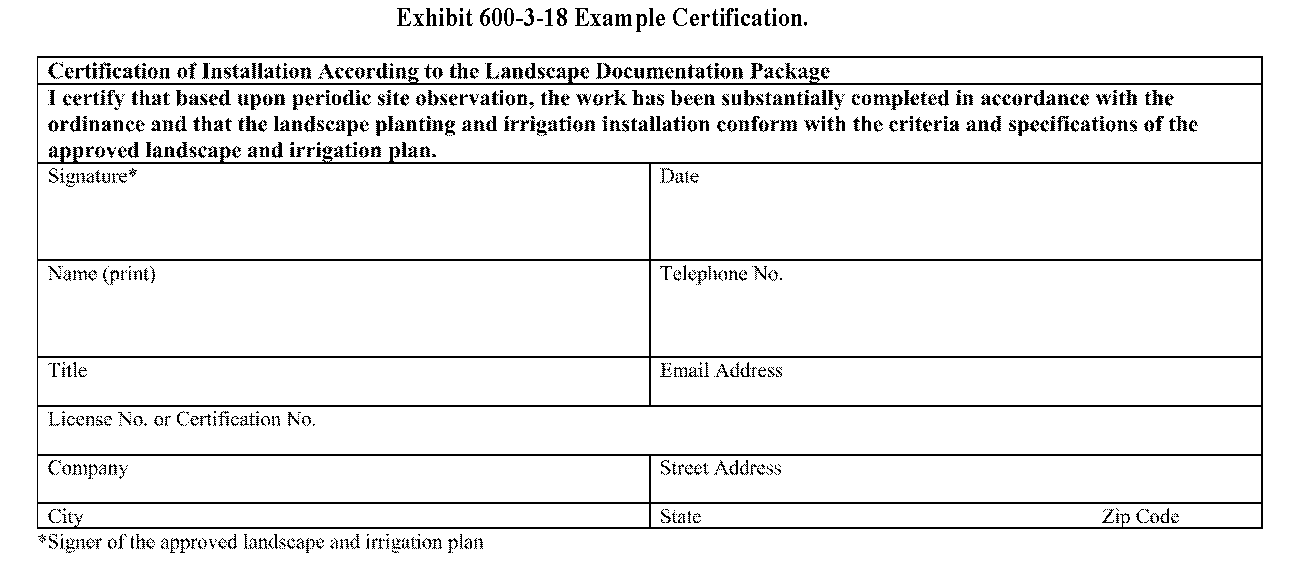
G.
Alternative Compliance for Existing Conditions.
1.
Rationale. The landscaping standards contained in this UDC are intended to encourage development that is environmentally functional, economically viable, and aesthetically pleasing. The standards contained herein are not intended to inhibit creative development or limit the ability to provide landscaping. It is acknowledged that conditions may arise where normal compliance is impractical or impossible and that a design proposal that offers superior results or maximum achievement of parish objectives may only be obtained through alternative compliance.
2.
Applicability. Alternative compliance is available to existing developments where either of the following circumstances can be demonstrated:
a.
The development proposal involves the redevelopment of an existing structure on a site where the current positioning of the structure precludes the placement of the required landscape areas or the installation of the required planting mix according to this section.
b.
An alternative location or planting mix would enhance stormwater management and drainage within the site, and a calculated benefit to flood impacts on neighboring properties could be demonstrated.
3.
Submittal and approval process. Developers must submit their proposed alternative compliance landscape plan to the department of planning and development along with the site plan and any drainage calculations. The Director can approve, approve with modifications to ensure compliance with the intent of these regulations, or deny the alternative compliance plan.
H.
Performance and Warranty Obligations Pertaining to Landscaping, and Security for Same.
1.
Warranty obligation. After installation, it is common for some of the plantings to wither and die. To ensure landscaping has a chance to establish itself and survive adverse weather, the property owner/developer is required to replace dead planting with the same species for 1 year after passing their final landscape inspection. The dead or dying trees, shrubs, plants, or vegetated ground cover must be replaced within thirty days of the plant's death or notification by the department of planning and development that dead plant material requires replacement.
2.
Performance obligation. To increase the probability of landscaping surviving post planting, the developer may seek to plant at specific times of the year that are more suited for planting. Normally, a certificate of occupancy will not be issued without completion of required landscaping. To ensure compliance while also allowing the developer to avoid planting in adverse weather conditions, the Director of the department of planning and development may, at their discretion, enter into an agreement with developer to complete the required plantings after the issuance of the certificate of occupancy. As part of the agreement the developer/owner shall:
a.
Provide an installation schedule.
b.
Provide security in the form of a performance bond.
i.
The monetary amount required to secure the landscaping performance obligation shall be set by the Director of the department of planning and development and shall be based upon the estimated cost of acquisition and installation of landscaping and screening vegetation.
ii.
Landscaping performance obligations shall be for a term of at least 1 year. The Director of the department of planning and development can require landscaping warranty of more than 1 year if, in their estimate, there are unique conditions warranting a longer period or if during the 1 year there are circumstances that required the re-planting or remediation.
iii.
The performance warranty obligations shall be secured by securities acceptable to and on file with the department of finance. The origination and termination date of the security shall be the same as those in the agreement.
iv.
Acceptable security shall be cash or a letter of credit.
v.
Not less than 1 month before the obligation is set to expire, the owner/developer shall notify the parish in writing whether all applicable requirements have been met.
c.
Before any security can be released, the department of planning and development shall inspect the planting to ensure they are in compliance.
3.
If an owner/developer cannot or will not complete the requirements of his/her landscaping performance obligation, the Director of the department of planning and development may call any outstanding security on the project in question and instruct the Director of the department of finance to seize those securities necessary to complete the requirements.
4.
Use of security funds. Once the performance obligation funds have been provided to the parish, the Director of the department of planning and development shall use the funds to pay a landscape contractor to install the required landscaping.
I.
Native Trees and Shrubs.
1.
Requirement. At least 60 percent of all new plantings, including Class A and Class B trees, shall be from the native species identified in Exhibit 600-3-19. None of the required ground cover need be a native species.
Exhibit 600-3-19 Approved Native Trees and Shrubs.
(Ord. No. 24-5592, Att., § 11, 10-3-2024; Ord. No. 25-5700, § Exh. A, 3-6-2025)
Sec. 600-4.1 - Purpose and intent.
A.
Purpose. The purpose of this section is to establish a comprehensive system of sign controls that govern the display, design, construction, location, installation, and maintenance of signs, in order to:
1.
Comply with and implement the goals and objectives of the St. Tammany Parish comprehensive plan.
2.
To promote and protect the health, safety, and welfare of the parish by ensuring the compatibility of signs with surrounding architecture and land uses.
3.
To create a more attractive business and economic climate by enhancing and protecting the orderly and effective display of signs.
4.
To discourage excessive signage.
5.
To protect the public from hazardous conditions that result from the indiscriminate use and placement of signs, structurally unsafe signs, signs that obscure pedestrians' or motorists' visibility, and signs that compete or conflict with traffic signals and warning signs.
6.
To avoid visual clutter that is potentially harmful to traffic and pedestrian safety, property values, business opportunities, and community appearance.
B.
Applicability.
1.
General applicability. This section is applicable to all signs.
2.
Conflicts. Where there is a conflict between a land use regulation and a structural regulation, or other conflict not otherwise addressed by this UDC, the more restrictive will apply.
3.
No standard. Where the UDC is silent or where the rules of this UDC do not provide a basis for concluding that a sign is allowed, the sign in question is prohibited.
4.
Building code. Unless otherwise provided, all signs must be constructed and erected in accordance with the building codes for the parish.
5.
Content or Message. This section is not intended to, and does not restrict speech on the basis of its content, viewpoint, speaker, or message. Any classification of signs in this UDC that permits speech by reason of the type of sign, identity of the sign user, or otherwise, will also be interpreted to allow noncommercial speech on the sign. To the extent that any provision of this UDC is ambiguous, the term will be interpreted not to regulate on the basis of the content or speaker of the message.
6.
Regulation of legally nonconforming signs. The regulation of legal nonconformities as set forth in Chapter 500 are applicable to all structures, including signs.
7.
Definitions. Sign definitions are set forth in Sec. 100-5, Definitions.
C.
Severability. If any article, section, subsection, sentence, clause, or phrase of these regulations is, for any reason, held unconstitutional or invalid, such decision or holding will not affect the validity of the remaining portions hereof. It being the intent of the Parish Council to enact each section and portion thereof, individually, and each such section will stand alone, if necessary, and be in force not with the validity of any other article, division, section, subsection, sentence, clause, or phrase of these regulations.
Sec. 600-4.2 - Administration of sign regulations.
A.
Enforcement and Sign Removal.
1.
Authority. The Department of Planning and Development is authorized to enforce this section. The administration of any violation or nuisance shall be in accordance with procedures outlined in Chapter 2, Administration, Code Violations and Administrative Adjudications.
2.
Requirement of sign permit.Chapter 200 of this UDC outlines the procedures and requirements for sign permits.
3.
Misrepresentation. The Department of Permits and Inspections may revoke any sign permit where there has been a violation of the provisions of this section or misrepresentation of fact on the sign permit application.
4.
Authority to remove signs. The Department of Planning and Development, Division of Code Enforcement is authorized to remove prohibited signs, unsafe signs, abandoned signs, signs constructed without a permit, and signs that have lost their legal nonconforming status per this UDC.
5.
Removal of unlawful signs.
a.
Any unlawful, permanent sign that has not been removed within 1 month after conviction of violation or imposition of penalty may be removed by the parish and the costs charged to the violator. If removal costs have not been paid and the sign reclaimed within 1 month of its removal by the parish, the parish may sell or otherwise dispose of the sign and apply the proceeds toward costs of removal.
b.
Signs upon public streets, sidewalks, right-of-way, or other public property may be immediately removed without prior notice.
c.
Neither the parish, nor any of its agents are liable for any damage to the sign when removed in accordance with this section.
B.
Exempt and Temporary Signs.
1.
Exempt signs. The following signs do not require a permit:
a.
Temporary signs, in all zoning districts, provided they comply with the following:
i.
The sign is located on a development site for no more than 60 days;
ii.
Only 1 temporary sign is allowed per development site, with the exception of development sites with multiple street frontages, which may have 1 temporary sign for each street frontage; and
iii.
The temporary sign does not exceed a maximum permitted area of 32 square feet per sign.
b.
Temporary window signs displayed on the inside of windows pursuant to the following:
i.
Materials. Shall be constructed of such materials as to indicate the temporary nature of the sign; and
ii.
Area covered. Shall not, in the aggregate, cover more than 25 percent of the area of any windows in which such signs are displayed.
2.
Signs affixed to an active construction site.
3.
Bench signs, as defined by Sec. 100-5, Definitions, of this UDC.
C.
Standards Applicable to Nonresidential Uses.
1.
The following standards are applicable to all signs erected or displayed for commercial, industrial, and institutional uses and for all other uses except residential uses:
a.
No sign shall be erected or maintained on a residentially zoned or used property unless there is an active, legally established non-residential use or permitted principal structure on the site. Signs on vacant parcels, or parcels lacking a permitted non-residential building or active use, are prohibited.
b.
All signs constructed, erected, modified, or altered shall comply with the provisions of this section and all requirements of this UDC.
c.
Internal illumination. Internal illumination is allowed when creating a negative contrast (i.e., light lettering against a dark, opaque background).
d.
External illumination. Externally illuminated signs may be illuminated in white light only, not to exceed 3,000 lumens per side per sign or otherwise unreasonably intrude on a residence and such illumination shall not constitute a traffic hazard.
e.
Sign clearance. Sign clearance is calculated as the vertical distance measured from grade, or the base of the building, to the lowest point of the sign.
f.
Colors. Only spectrum colors are allowed. No iridescent colors or reflective lettering are allowed.
g.
Plywood and particle board. Signs (other than temporary signs) may not be constructed of rough or unfinished plywood or particle board.
h.
Neon. Neon will only be allowed if it is considered as an integral part of the sign being regulated. Anything within the boundary of the outline of the neon will be considered a part of the sign face.
i.
Changeable message sign limitations. Changeable message signs shall be incorporated into a sign face, but the changeable component must occupy less than ½ the total area of the sign face.
i.
If changeable copy is used, it shall be located or integrated into the sign face.
ii.
Lettering of changeable message signs shall be of a single style and shall be of uniform color and size.
iii.
Internal illumination, if any, shall be negative contrast.
iv.
Hold time. Changeable message signs must have a minimum hold time of 8 seconds. Messages must not move or have the appearance or optical illusion of movement.
(Ord. No. 26-5906, § Exh. A, 1-8-2026)
Sec. 600-4.3 - Sign standards.
A.
Attached and Wall Signs for Nonresidential Uses.
1.
In addition to allowed detached or monument signs, the following wall signs shall be allowed for each occupant of a single or multi-occupancy premises, for commercial, industrial, and institutional uses and all other uses except residential, as follows:
a.
General regulations.
i.
All signs must be safely and securely attached in accordance with this UDC.
ii.
Signs must not cover windows, doors, or other architectural features.
b.
Signs, location. Shall be measured along the wall of the façade on which the sign will be located.
c.
Area.
i.
Buildings with a single street-facing facade. The total cumulative area of all attached wall and canopy signage must not exceed 1 square foot per linear foot of building or tenant space width, as measured along the side of the building featuring the primary entrance, or 300 square feet, whichever is less.
ii.
For storefronts or gas station canopy of less than 32 linear feet the allowable size sign shall be 32 square feet.
iii.
Corner buildings or buildings with multiple facades facing a public street or route of internal circulation. The total cumulative area of all attached and canopy signage must not exceed 1 square foot per linear foot of building or tenant space width, as measured along the side of the building featuring the primary entrance, or 450 square feet, whichever is less.
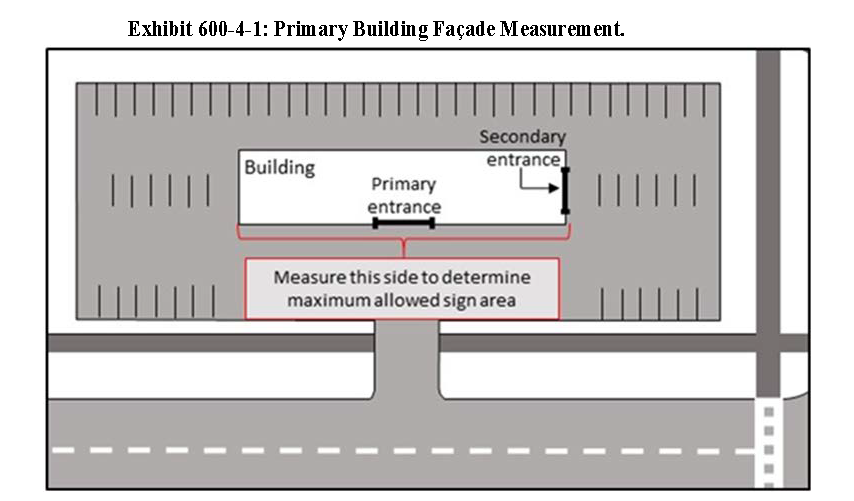
d.
Height.
i.
No attached or canopy sign, including its support structure, is permitted to project beyond the ends of the wall or beyond the top of the roof line of the building or canopy to which it is attached.
ii.
No attached or canopy sign can be attached to an un-reinforced masonry parapet.
e.
Illumination. Attached and canopy signs may be illuminated, but cannot flash, blink, or fluctuate.
f.
Animation. No sign can be animated or change physical position by any movement or rotation.
2.
Awning, marquee, or canopy signs.
a.
In lieu of a wall sign, an occupant, for a commercial, industrial, and institutional use and for any other use other than residential, is allowed either an awning, marquee, or canopy sign.
b.
If the occupant uses an awning, marquee or canopy sign, a wall sign is not allowed on the same facade.
3.
Hanging, under-awning, under-canopy, and under-gallery signs. Hanging, under-awning, under-canopy, and under-gallery signs are permitted additions to awnings, canopies, and galleries for non-residential uses, subject to the following regulations.
a.
Signs shall be attached below or to the underside of an awning, canopy, breezeway, or gallery and cannot project beyond the awning, canopy, breezeway, or gallery.
b.
Signs are mounted perpendicular to the building façade and extend over a pedestrian walkway.
c.
Signs shall maintain a minimum clearance of 7 feet above the ground.
d.
A maximum of 1 under-awning, under-canopy sign, and under-gallery sign is permitted per business establishment with frontage on the street where the awning, canopy, or gallery is installed.
e.
Signs are limited to 6 square feet in area.
f.
Signs shall be securely fixed to the awning, canopy, or gallery with metal supports.
B.
Miscellaneous Signs for Nonresidential Uses. Subject to all provisions and requirements of this section, the following signs may be erected and displayed, for commercial, industrial, and institutional uses and any other use other than residential, without the necessity of a sign permit:
1.
Public directional signs. Must include approval of the Parish Council.
2.
Official notices. Official notices duly issued by any court, public agency, or officer.
3.
Flags. Flags and insignia of any government, except when displayed in connection with a commercial promotion, are allowed.
4.
Integral decorative or architectural features of buildings. Integral decorative or architectural features of buildings, other than neon lights, letters, trademarks, logos, or any feature containing moving parts or moving or flashing lights, are allowed.
5.
A-frame signs. One A-frame sign is permitted, provided each sign is:
a.
No more than 6 square feet in area per sign face;
b.
No more than 4 feet in height;
c.
Displayed outdoors only during the hours of 7:00 a.m. to 10:00 p.m. and stored indoors at all other times;
d.
Limited to 1 sign per use;
e.
Separated by a minimum distance of 20 linear feet from the nearest A-frame sign;
f.
Located within 10 feet of a building entrance and directed towards pedestrian traffic; and
g.
Located so as to not interfere with pedestrian traffic or violate standards of accessibility as required by the ADA or other accessibility codes.
6.
Vehicle and trailer signs.
a.
Vehicle and trailer signs may be displayed on any vehicle or trailer operated in the daily conduct of any business enterprise so long as such signs:
i.
Are not parked in front of or in line with any greenbelt or planting areas when on the premises of the business entity operating or advertising on such vehicle or trailer;
ii.
Are on a vehicle or trailer which is operable and not parked primarily for the purpose of signage.
b.
Billboards may not be erected or displayed on any vehicle or trailer.
7.
Licensed roadside vendor sign. One roadside vendor sign for licensed road vendors will be allowed on signs facing each side not to exceed 16 square feet per side.
8.
Handicapped parking and access signs. Handicapped parking and access signs are allowed and are regulated in accordance with state or federal law.
9.
Rear doors. One rear identification wall sign must be displayed on or at a rear door of each separate business entity for purposes of emergency access and deliveries only.
10.
Construction signs. Non-illuminated construction signs may be allowed on the premises being developed or improved subject to the following conditions and requirements:
a.
Building permit required. A building permit for the project must have been obtained prior to the issuance of the sign permit.
b.
Residential district. In residentially zoned districts such signs shall not exceed four square feet in area and shall be limited to the denoting of the architect, engineer, contractor, subcontractor, owner and/or financing agency providing labor, materials, services or financial capital for the proposed construction. Such sign may be displayed only during construction and for a period of not more than ten days after completion of actual construction identified by the first issuance of a certificate.
c.
Nonresidential or combined use districts. In any nonresidential or combined use district, one such sign shall be allowed not to exceed 32 square feet in area and all other signs shall not exceed four square feet in area. All such signs shall be limited to the name of the project and the denoting of the architect, engineer, contractor, subcontractor, owner and/or financing agency providing labor, materials, services or financial capital for the proposed construction. Such signs may be displayed only during actual construction and for a period of not more than ten days after completion of the construction as identified by the first issuance of a certificate of occupancy for the project or development in question or upon expiration of the building permit for the project or development, whichever is first to occur.
d.
Setback requirements. The location of such signs shall be on the property to which the sign is applicable. Without limiting the other provisions of this section, such signs shall not be placed on trees or in street rights-of-way.
Additionally, the following miscellaneous signs for nonresidential uses require permits:
1.
Flags, streamers, banners, inflatable signs, and pennants. Flags, streamers, banners, pinwheels, spinners, or pennants may be displayed in connection with grand openings or special events no more than twice a year for any 1 business entity or applicant. Such signs may be displayed for a period not to exceed 14 consecutive calendar days upon the issuance of a temporary permit by the Department of Planning and Development. Applications for such a temporary permit must state the name of the person, firm, corporation, or organization sponsoring the event, the locations where such devices are to be installed and the contemplated dates during which such devices shall remain on display. Banners shall not exceed 32 square feet and shall be limited to 1 banner per premises.
2.
Drive-through signs. Signage oriented toward drive-through facilities are subject to the following requirements:
a.
The drive-through sign shall not exceed 48 square feet in sign area;
b.
The drive-through sign cannot be located within the front 20 feet of the development site or be visible from the street upon which the primary access is obtained;
c.
The drive-through sign shall be oriented to ensure noise does not intrude into surrounding development in accordance with the local noise ordinance;
d.
The drive-through sign shall have a maximum height of 8 feet; and;
e.
The drive-through sign shall be located a minimum of 20 feet from any lot line abutting a residential zoning district.
3.
Private Directional Signs, which shall not exceed four square feet in size.
C.
Monument and Bulletin Board Signs.
1.
Monument signs. Means a freestanding ground sign which is of monolithic construction in which the sign's base or support is of uniform composition with the material comprising the sign area of said sign and the base or support of said sign is directly affixed in or to the ground.
2.
Number of monument signs. One monument sign shall be allowed for each 1,000 feet of street frontage or fraction thereof in excess of the 1,000-foot increments. A property with more than one street frontage shall be allowed 1 monument sign for each 1,000 feet of second street frontage or fraction thereof in excess of the 1,000-foot increments.
3.
Location of monument signs. A monument sign must be set back from the street property line at least 5 feet.
4.
Monument signs shall not be located within any clear vision areas as required in this chapter.
5.
Monument signs for designated uses.
a.
Where allowed. Monument signs are allowed to be erected and displayed for commercial, industrial, and institutional uses and for multi-family and residential condominiums and for all other uses except other residential uses.
b.
Area. To reduce sign clutter and avoid conflict with required trees, total cumulative monument sign area shall not exceed the following limits:
i.
A double-faced monument sign shall be made of back-to-back sides unless visibility of such sign is impeded in which case the two sides may form a V shape in which the interior angle does not exceed 45 degrees; and
ii.
The monument sign may have a top, side, and bottom border or column of the same or compatible material in which border or column is not less than 12 inches wide and not more than 24 inches wide, and which border or column compliments and enhances the aesthetic effect of the sign and is not calculated as part of the sign face.
c.
Height. Monument signs cannot exceed a height of nine feet and the base or support of said sign must not exceed 24 inches in height.
d.
Illumination. Monument signs may be internally or externally illuminated.
e.
Electronic display. Electronic displays and/or variable message boards are permitted to occupy a maximum of 50 percent of total monument sign area, except when located at the entrance to a residential or mixed-use subdivision entrance or commercial park.
f.
Monument signs at the entrance to residential or mixed-use subdivision entrances. All of the requirements of this section shall be met, with the following exceptions for monument signs located at the entrance to residential or mixed-use subdivision entrances.
a.
A monument sign may be located on each side or in the center median of a residential or mixed-use subdivision entrance.
b.
When located on either side of the entrance, the signs must be one sided.
c.
When located in the center of a median, the sign must be two sided.
d.
In no case may any sign face exceed 48 square feet per sign face.
5.
Community bulletin board signs permitted near the entrance to residential or mixed-use subdivision entrances and commercial parks.
a.
Maximum number and location. Only one permitted per entrance, located at least 100 feet from any subdivision or park monument entrance sign and in an interior area that is unlikely to create a traffic obstruction as determined by the parish engineering department.
b.
Maximum area. The bulletin board may not exceed 40 square feet in area and must be limited to one side of the structure.
c.
Lighting. Only external illumination is permitted.
d.
Must meet other applicable requirements of this section including clear vision and height.
D.
Pylon Signs Applicable to Regional Commercial/Office Centers.
1.
Where permitted. Pylon signs shall only be permitted in planned developments and regional commercial/office centers.
2.
Number of pylon signs. One pylon sign shall be allowed for each 1,250 feet of frontage along an interstate highway. Frontage roads constructed as part of the development along the interstate highway will be considered interstate frontage regardless of ownership status. On/off ramps that are part of the interstate highway system may be used to calculate this frontage.
3.
Location of pylon signs.
a.
A pylon sign must be located within 100 feet of the highway or frontage road right-of-way.
b.
If a pylon sign is located on the development side of an internal public road it must be set back at least 15 feet from the right-of-way of said public road.
c.
If a pylon sign is located between an internal road and an interstate highway right-of-way, the sign must be at least 5 feet from the internal road right-of-way and may be placed immediately adjacent to the interstate highway right-of-way, if there is no objection to such placement from the state Department of Transportation and Development.
d.
A pylon sign may not be located within a triangular area formed by the street or driveway right-of-way lines and a line connecting them at points 50 feet from the intersection of said rights-of-way.
e.
No pylon sign may be located within 1,000 feet of another pylon sign.
4.
Standards for pylon signs.
a.
Area. The total sign face area (multiple-tenant signs) for each allowed pylon sign shall not exceed 400 square feet per side.
b.
Height of pylon signs. The height of monument signs shall not be greater than 45 feet from grade.
c.
The total structure face shall not exceed 1,500 square feet, inclusive of the total sign face.
E.
Electronic Variable Message Signs and Display.
1.
General standards.
a.
Prohibition. No electronic variable message (EVM) sign can be permitted within a residential district.
b.
Location requirements. Electronic variable message signs may only be permitted when located along a street frontage as part of a pylon or monument sign or as an electronic billboard. Electronic variable message signs are not permitted as attached or hanging signs.
c.
Number. Only 1 electronic variable message sign may be permitted per development site.
d.
Hold time. EVMs must utilize only static messages having a minimum hold time of 8 seconds. Messages must not move or have the appearance or optical illusion of movement.
e.
Nuisance and traffic safety. Illumination cannot cause glare into any residential premises or interfere with the safe movement of motor vehicles on public thoroughfares.
f.
Nonconforming conversion. An existing legal nonconforming sign will not be permitted to convert, in whole to in part, to an electronic variable message board sign.
g.
Audio. Electronic displays cannot contain or utilize audio speakers or audio components.
h.
Default image. Electronic signs must have a default design or image that will freeze in 1 position if a malfunction occurs. If a partial or incomplete message freezes or remains static on the sign due to a technical malfunction or a portion of the display face malfunctions, the sign's illumination must be turned off until the sign is repaired.
2.
Illumination.
a.
Illumination measurement criteria. The illumination of an EVM shall be measured with an illuminance meter set to measure footcandles accurate to at least 2 decimals. Illuminance shall be measured with the EVM off, and again with the EVM displaying a white image for a full color-capable EVM, or a solid message for a single-color EVM. All measurements shall be taken as close as practical to a perpendicular plane of the sign at a distance determined by the following formula:

b.
Illumination limits. The difference between the off and solid-message measurements using the above listed measurement criteria must not exceed 0.3 footcandles at night.
c.
Dimming capabilities. All EVM signs must be equipped with a sensor or other device that automatically determines the ambient illumination and is programmed to automatically dim according to ambient light conditions, or that can be adjusted to comply with the illumination limits listed above.
3.
Spacing.
a.
Pylon and monument signs. Pylon and monument signs that utilize electronic variable message boards must be located at least 100 feet from any existing electronic billboard, measured radially and including both sides of the street.
b.
Measurement. For the purpose of this section, all spacing requirements are measured radially and include both sides of a street.
c.
Setbacks. Electric variable message signs shall be setback at least 300 feet from buildings that contain residential dwelling units and from residential zoning districts, measured in a straight line from the nearest point of the sign to the nearest point of the property line of the residential dwelling unit or district.
d.
Area. For pylon and monument signs, the image component of any electronic message sign cannot exceed 35 percent of the sign's total area.
F.
Billboards. In addition to all federal and state laws, the following standards must be met:
1.
Number and location of billboard signs. The number and location of billboard signs will be limited as established in these regulations. Billboard signs will not be permitted unless in accordance with these and any other applicable regulations.
2.
Prohibited signs and locations thereof. No billboard signs shall be permitted along parish roads, unless said sign is parallel to and within 200 feet of any state or federal highway.
a.
No roof, piggy-back, stack signs, side by side and multiple panel signs shall be permitted.
b.
No billboard sign or structure shall be located or situated in a manner as to obscure or otherwise physically interfere with the effectiveness of any official traffic sign, signal or devise, or obstruct or physically interfere with the driver's view of approaching, merging or interstate traffic.
3.
Location standards for billboard signs.
a.
A billboard sign must be located within 200 feet of the highway right-of-way. A billboard sign must be set back at least 15 feet from the highway right-of-way.
b.
A billboard sign is not allowed within or nearer than 500 feet from the edge of the property line of a residentially zoned district.
c.
A billboard sign may not be located within a triangular area formed by the highway rights-of-way lines and a line connecting them at points 50 feet from the rights-of-way intersection or 500 feet from an interstate entrance/exit ramp.
d.
A billboard sign must be located within the same highway corridor from which a "billboard credit" was issued or within the 8 miles of the original site from which the "billboard credit" was issued.
4.
Size of billboard signs.
a.
Billboard faces and supporting framework shall not exceed the following sign areas:
i.
New billboards shall be a maximum of 378 square feet in area.
ii.
Replacement billboards of existing billboards that were constructed prior to August 2, 2024 that are 400 square feet or larger in face area may be replaced at a size up to 672 square feet; billboards with face areas between 399 square feet and less shall be replaced at a size up to 378 square feet.
b.
When 2 billboard signs are placed back-to-back or V-type on the same structure with an angle between them of not more than 60 degrees, each sign facing shall conform to the maximum size limitations.
c.
The lowest point of any billboard sign shall extend not less than 10 feet and the highest point shall extend not more than 45 feet measured from either the ground level at its supports or the nearest edge of the main traveled way, whichever is higher in elevation.
5.
Spacing of billboard signs.
a.
No 2 billboard signs shall be spaced less than 1,000 feet apart. In determining the physical spacing of billboards, the parish will consider existing billboards and approved billboard locations.
b.
V-type or back-to-back signs on the same structure with an angle between them of not more than 60 degrees shall be considered 1 sign.
6.
Lighting. Signs may be illuminated, subject to the following restrictions:
a.
No revolving or rotating beam or beacon of light that simulates any emergency light or device shall be permitted as part of any sign. Flashing devices shall not be permitted upon a sign.
b.
External lighting, such as floodlights, thin line and goose neck reflectors are permitted provided the light source is directed on the face of the sign and is effectively shielded so as to prevent beams or rays of light from being directed into any portion of the main travel way of the highway system, or into a residential use area.
c.
Digital message technology capable of changing multiple static messages on the sign electronically, i.e., a digital billboard, is permitted for a sign reconstructed pursuant to the subsection; however, message changes must be accomplished within 4 seconds and the message must remain stationary for a minimum of 8 seconds.
7.
Construction.
a.
All structural elements of billboard signs shall be of metal construction.
b.
A freestanding billboard sign having a size or area of 400 square feet shall have no more than 1 support.
c.
Every freestanding billboard sign shall henceforward be so erected or construed in such a manner as to withstand a wind load factor of 30 pounds per square foot.
8.
Vegetation control. No trees or other vegetation may be cleared, cut or removed on a state right-of-way without first obtaining a state vegetation control permit.
9.
Permits and fees. No billboard sign shall be erected, nor shall construction commence thereon, without first obtaining a permit from the department of permits and regulatory.
10.
Billboard credit. Permits to erect new billboards shall only be issued to those persons possessing a "billboard credit."
a.
Billboard credit. Billboard credits shall be issued by the parish to those billboard owners who have removed a previously existing, lawfully erected billboard after the effective date of the ordinance from which this chapter is derived. It will be the responsibility of the permit applicant to show the ownership, location and date of removal of the billboard.
b.
Expiration of billboard credit. Billboard credits shall be utilized within 5 years from the date of removal of the billboard.
c.
Credit basis. Billboard credits shall be issued on a per-face and per-structure basis. One credit shall be issued for each billboard face removed and 1 credit for each structure removed. If a billboard is not located upon a separate supporting structure, the building or other structure to which the billboard is attached shall constitute a single structure for the purpose of receiving 1 credit.
i.
No credit shall be granted for the partial removal of faces.
ii.
No credit shall be granted for the removal of billboard faces which are less than 84 square feet.
d.
Credit utilization. A billboard credit may only be used in a location which meets all standards of this chapter.
e.
Transfer of credits. Credits may be transferred between parties through legal means.
f.
Reconstruction sizes. Credits will allow billboards, including digital billboards, to be reconstructed in accordance with the size and the lighting requirements in this subsection.
g.
Cap on number of billboards.
i.
Restricted corridors. There shall be a cap on the number of billboards within the restricted corridors. No new billboards shall be allowed with these areas except with the removal of an existing billboard from the same corridor/area. Permits for new billboards within the restricted corridors will only be issued to those persons possessing a "billboard credit" indicating they have removed a billboard from the same corridor. All new billboards within restricted corridors shall comply with the design standards as set forth in this Code.
ii.
Parish-wide cap. There shall be a limit of 200 total billboard locations within unincorporated St. Tammany Parish.
iii.
Exemptions. This section shall not pertain to the following types of off-premises signs:
(A)
State approved signs within state highway rights-of-way.
(B)
Temporary signs which comply with the provisions of this chapter.
G.
Pole Signs.
1.
General Requirements.
a.
Pole signs are permitted in the following zoning districts subject to the approval of a Conditional Use Permit, the process of which is outlined in Sec. 200-3.4 Conditional Uses:
i.
Any commercial zoning district defined in Sec. 400-3.1 Commercial Zoning District Regulations except NC-1 Neighborhood Office District, NC-2 Neighborhood Commercial District, GC-1 General Commercial District, and GC-2 Public, Cultural and Recreational District; and
ii.
Any zoning district defined in Sec. 400-4.1 Specialized Zoning District Regulations; and
iii.
Any zoning district defined in Sec. 400-5.1 Industrial Zoning District Regulations.
b.
All requests for pole signs must include the following:
i.
Boundary line survey prepared by a licensed surveyor.
ii.
Site plan. A site plan which is drawn to scale and fully dimensioned showing the location of all structures on site, including the location of the proposed sign. The site plan must also include the location of all existing or proposed above and below ground utilities including servitudes and rights-of-way, all required natural areas, existing trees, and/or required landscaping where the sign is proposed within or adjacent to a natural area. The site plan shall detail the drip line of all trees within the required natural area in which the sign is proposed to be located.
iii.
Sign Elevations and Details. Elevations which are drawn to scale must include proposed dimensions including structural details, foundation, materials, wind load requirements, and all other provisions which show compliance with the sign code.
iv.
Sign Illumination and Message Details. A site plan showing light levels at property lines where the property abuts a residential zoning classification. Documentation demonstrating maximum lumens in foot candles, wattage, type of lighting, and details on shielding to prevent glare onto roadways and adjacent properties. Engineer or manufacturer certification that lighting complies with local standards and a signed statement from the applicant confirming adherence to illumination regulations.
2.
Location Restrictions.
a.
Pole signs shall not be permitted on a lot having less than 100 feet of street frontage.
b.
A pole sign must be located within 100 feet of the highway right-of-way. A pole sign must be set back at least 15 feet from the nearest property line.
c.
A pole sign is not allowed within or nearer than 500 feet from the edge of the property line of a residentially zoned district, or a single family residential structure.
d.
No 2 pole signs shall be spaced less than 200 feet apart on the same side of a street.
e.
No single development site or parcel shall be permitted more than one detached sign, including monument signs and pole signs.
f.
A pole sign may not be located within a triangular area formed by the highway rights-of-way lines and a line connecting them at points 50 feet from the rights-of-way intersection or 500 feet from an interstate entrance/exit ramp.
g.
No portion of a pole sign may protrude into an adjacent right-of-way. No pole sign or structure shall be located or situated in a manner so as to obscure or otherwise physically interfere with the effectiveness of any official traffic sign, signal or device, or obstruct or physically interfere with the driver's view of approaching, merging, or interstate traffic.
h.
The use of a pole sign is only permitted in conjunction with a business which is located on the same property. Off premise advertising through use of a pole sign is strictly prohibited.
3.
Max Height and Size.
a.
No pole sign shall exceed 25 feet in height.
b.
The minimum clearance between the bottom of the sign to the highest adjacent grade shall be 10 feet.
c.
To reduce sign clutter, preserve the visual aesthetics of the community, and enhance traffic safety, the total cumulative pole sign area shall not exceed the following limits:
4.
Pole Design and Materials.
a.
No roof, piggy-back, stack signs, side by side and multiple panel signs shall be permitted.
b.
Bare metal or wooden poles are prohibited. All requests for pole signs shall include aesthetic improvements including cladding with masonry, stone, aluminum sleeves, or alternative materials to skirt or screen the pole.
5.
Illumination Standards & Message and Copy Standards.
a.
No revolving or rotating beam or beacon of light that simulates any emergency light or device shall be permitted as part of any sign. Flashing devices shall not be permitted upon a sign.
b.
External lighting, such as floodlights, thin line and goose neck reflectors are permitted provided the light source is directed on the face of the sign and is effectively shielded so as to prevent beams or rays of light from being directed into any portion of the main travel way of the highway system, or onto any adjacent property.
c.
Electronic display. Electronic displays and/or variable message boards are permitted to occupy a maximum of 50 percent of total pole sign area, except when located at the entrance of a mixed-use subdivision entrance or commercial park where there are residential uses. However, message changes must be accomplished within four seconds and the message must remain stationary for a minimum of eight seconds.
d.
Illumination cannot cause glare into any residential premises or interfere with the safe movement of motor vehicles on public thoroughfares.
e.
Nonconforming conversion. An existing legal nonconforming sign will not be permitted to convert, in whole or in part, to an electronic variable message sign unless it meets all other regulations of the sign code.
6.
Landscaping Requirements.
a.
No pole sign shall be permitted within five feet of the dripline of a protected tree species including any live oak or cypress tree.
b.
The request for a pole sign shall never supersede the landscaping requirements as provided in Sec. 600-3.4—Landscape Regulations.
c.
No trees or other vegetation may be cleared, cut, or removed on the subject site without a land clearing permit. Where the sign is on a state right-of-way a state vegetation control permit may be required.
7.
Construction.
a.
All structural elements of a pole sign shall be of metal construction.
b.
Every pole sign shall be so erected or constructed in such a manner as to withstand a wind load factor of 30 pounds per square foot or 140-160 mph as determined by the wind speed map for Risk Category II structures in coastal Louisiana, whichever is higher.
c.
No pole sign shall be erected, nor shall construction commence thereon, without first obtaining a conditional use permit and subsequent sign permit from the department of permits.
H.
Erection and Maintenance of Signs. The following signs shall not be allowed to remain or to be erected:
1.
Signs or structures which have been erected without a building permit having been issued.
2.
Signs which are illegal under state laws or regulations.
3.
Signs which are not clean and in good repair.
4.
Signs that are not securely fixed on a substantial structure.
5.
Signs which attempt or appear to attempt to regulate, warn or direct the movement of traffic or which interfere with, imitate or resemble any official traffic sign, signal or device.
6.
Signs which are not consistent with the standards in this section.
7.
Signs located on public property, unless placed thereon under lease arrangements or otherwise permitted by legal authority.
I.
Prohibited Signs.
1.
Prohibited signs are subject to removal (except legal nonconforming signs as defined by this UDC) by the parish at the owner's or user's expense.
2.
The following sign types are prohibited:
a.
All signs not expressly permitted or exempted in this UDC.
b.
Abandoned signs.
c.
Animation on electronic changeable message signs.
d.
Audible signs.
e.
Permanent beacons, search lights, or other lights visible from a significant distance.
f.
Flashing signs.
g.
Lasers.
h.
Parapet signs.
i.
Portable or trailer signs.
j.
Projecting signs.
k.
Revolving or rotating signs.
1.
Pole signs unless approved as required in Sec. 600-4.3(G): Pole Signs.
m.
Pylon signs, except as provided as part of regional commercial/office centers.
n.
Roof signs.
o.
Signs that resemble traffic control devices or emergency devices.
p.
Signs that encroach into a public right-of-way.
q.
Snipe signs.
r.
Any sign that prevents free ingress or egress from any door, window, or fire escape.
s.
Any sign attached to a standpipe or fire escape.
t.
Any sign that obstructs free and clear vision at any location where, by reason of position, it may interfere with or obstruct the view of traffic sign lines or traffic control devices.
u.
Any sign attached to any public utility pole, structure or streetlight, tree, fence, fire hydrant, bridge, curb, sidewalk, park bench, statue, memorial, or other location on public property, except those signs constructed, approved, or permitted by the parish. Nothing in this section will be construed to prohibit a person from holding a sign while located on public property, provided the person holding the sign is located on public property determined to be a traditional public forum and does not block ingress and egress from buildings or create a safety hazard by impeding travel on sidewalks, bike and vehicle lanes, and trails.
(Ord. No. 24-5592, Att., §§ 12, 13, 10-3-2024; Ord. No. 25-5700, § Exh. A, 3-6-2025; Ord. No. 25-5729, § Exh. A, 4-3-2025; Ord. No. 25-5760, § Exh. A, 6-5-2025)
Sec. 600-5.1 - Parking requirements.
A.
Design Standard Requirements.
1.
The following minimum design standards shall be observed in laying out off-street parking facilities:
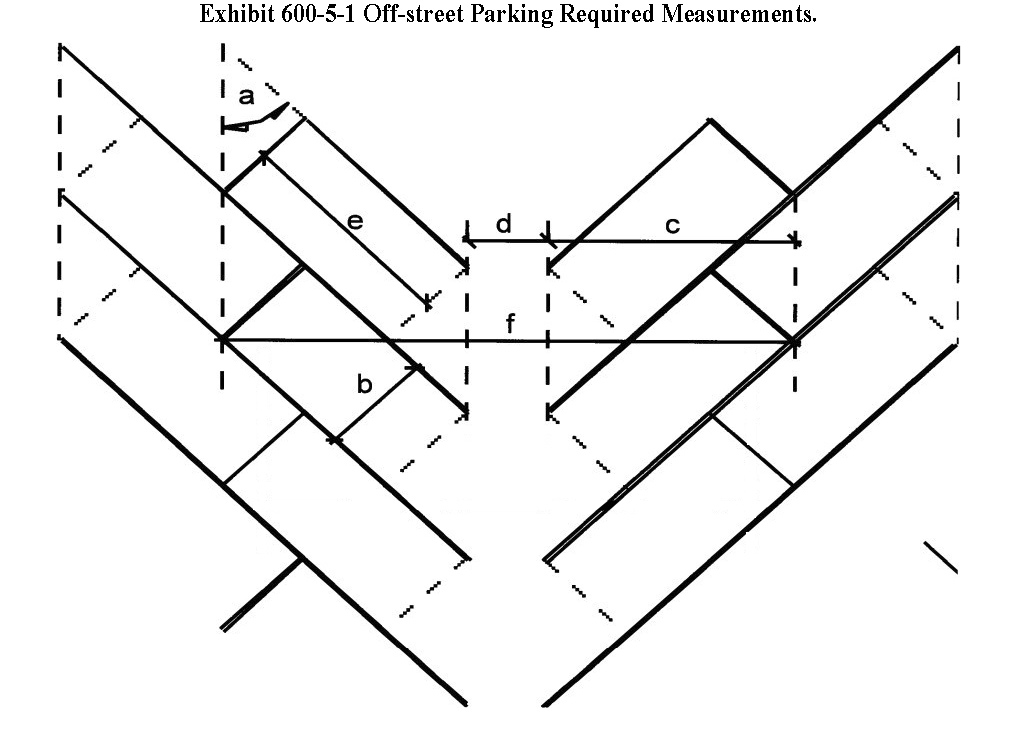
2.
Off-street parking facilities shall be drained to eliminate standing water and prevent damage to abutting property and/or public streets and alleys. Off-street parking areas shall be maintained in a clean, orderly and dust-free condition at the expense of the owner or lessee and not used for the sale, repair, or dismantling or servicing of any vehicles, equipment, materials or supplies.
3.
Off-street parking spaces shall be separated from walkways, sidewalks, streets, or alleys by a wall, fence or curbing or other approved protective device, or by distance so that vehicles cannot protrude over publicly owned areas.
4.
Location and design of entrances and exits shall be in accordance with the requirements of applicable parish traffic regulations and standards. Landscaping, curbing or approved barriers shall be provided along lot boundaries to control the entrance and exit of vehicles or pedestrians.
5.
Interior drives shall be of adequate width to serve a particular design arrangement of parking spaces.
6.
All parking spaces shall be marked by painted lines or curbs or other means to indicate individual spaces. Signs or markers shall be used as necessary to ensure efficient traffic operation of the lot.
7.
Adequate lighting shall be provided for all parking spaces at night. The lighting shall be arranged to eliminate glare on residential property by location of light fixtures or use of fixtures designed to eliminate direct view of luminaries in fixtures from residential property in accordance with this UDC.
8.
Surface off-street parking areas for 10 or more automobiles are located closer than 30 feet to a lot in a residential district, or to any lot upon which there is a dwelling as a permitted use under these regulations, and where such parking areas are not entirely screened visually from such lot by an intervening building or structure, there shall be provided along the lot line a continuous visual screen with a minimum height of 3 feet. Such screen may consist of a hedge or foliage screening or a louvered wall or fence.
9.
Parking space surface. Parking and other vehicular use areas shall be paved with an approved all-weather hard surface, which may be impervious or permeable or any combination thereof, including but not limited to concrete, asphaltic concrete, permeable asphalt, permeable concrete, concrete grid pavers, permeable interlocking pavers, and plastic grid pavers. The type of paving material used shall:
a.
Be manufactured for use as a parking surface;
b.
Comply with standards and specifications established by the Public Works Director, who shall make the final determination of suitability where uncertainty exists; and
c.
The surface material(s), underlying layer(s), and methods of structural and hydrologic design and installation shall be suitable to the soils, water table depth, utility lines, public infrastructure capacities or standards, traffic or fire service loads, trash or debris loads, intended use, or other site-specific factors, as indicated on drawings or in other documents submitted to the parish for approval by Planning Director or Public Works Director, as applicable.
d.
If the permeable paving is an integral part of a stormwater management system, the Maintenance provisions applicable to that type of paving within this code shall apply.
10.
Driveway surfaces.
a.
Details of construction to conform to plan; duty of director and exceptions. Driveways must have a hard surface connection to the public right-of-way. The details of driveway construction shall conform with detail or construction guides issued by the Public Works Department. The director of Public Works shall designate whether the proposed driveway is to be standard or heavy duty, and also, when lip curbs exist, whether the proposed driveway is to be residential or commercial. Where prevailing conditions warrant an exception, the director of Public Works is hereby empowered to grant that exception.
b.
Thickness of driveways; cement specifications; omission of steel reinforcement. All standard driveways shall be 6 inches in thickness and all heavy-duty driveways shall be 8 inches in thickness. Driveways shall be formed of 1 or more of the following:
i.
Portland cement concrete, which shall have a compressive strength of 3,000 per square inch in 28 days and contain a minimum of 5½ bags of cement to a cubic yard. Where reinforced concrete roadway pavement is adjacent to the driveway, the steel reinforcement may be omitted in the driveway.
ii.
On private property, permeable pavement constructed in compliance with the pervious concrete or pavers requirements of this code is permitted. Construction and materials and are subject to biennial recertification as specified in this code.
iii.
Within the public right-of-way, inclusive of the driveway apron, if permeable systems are utilized, only pervious concrete or pervious pavers are permitted and must be constructed in compliance with the standards for such materials in this UDC. Construction and materials and are subject to biennial recertification as specified in this UDC.
c.
Duty of property owners. It shall be the duty of all owners of property abutting streets to maintain the driveway apron in the roadside adjacent to or upon their property. Such duty shall include but not be limited to the following:
i.
Pave, construct, install or otherwise provide a driveway apron for access to their property in accordance with the driveway specifications and standards provided in this code;
ii.
Maintain, pave, reconstruct, repair and keep in repair the driveway apron to their property in accordance with the driveway specifications and standards provided in this code; such duty shall include the removal of all uneven and broken sections, replacing, relaying, patching, filling to grade with approved materials, grading or making level the surface to make it uniform, and to perform any other necessary work required to bring the roadside to a condition satisfactory for public use, except during a federally declared disaster;
iii.
Provide such drainage over or under the driveway apron to prevent the accumulation or standing of water on or near the driveway apron;
iv.
Maintain reconstruct, repair and keep in repair the roadside, including but not limited to the area immediately adjacent to their driveway apron, free from all ruts, depressions, and indentations caused by vehicular traffic gaining access to their property;
v.
Prevent the growth or accumulation of weeds, grass, dirt or other nuisances on the roadside and driveway apron;
d.
For driveways of permeable pavement. It is the responsibility of the property owner to maintain permeable pavement driveways in a clean, orderly, and dust-free condition both on private property and within the public right-of-way, including the driveway apron. The property owner is responsible for drainage and maintenance of all paved or surfaced area on site and shall indemnify and hold harmless the parish from any loss or damage to the site or property that may directly or indirectly result from insufficient drainage of the site. In the instance that any permeable pavement driveway is replaced by the Parish on private property or within the public right-of-way, it may be replaced by a standard surface (paved) driveway, pervious concrete or pervious pavers—whichever system generally performs consistent with the previous driveway system maintained by the owner.
11.
Ingress/Egress/Drive Aisles.
a.
Location and number of driveways are subject to the appropriate governmental authority, St. Tammany Parish or LA DOTD.
b.
Interconnectivity between adjacent parcels must be provided, if possible, considering site constraints, in accordance with the table below:
Exhibit 600-5-2 Driveway Requirements.
12.
Drive-thru queuing lanes shall be provided in accordance with the following:
a.
Restaurants shall provide a minimum 180-foot queuing lane for on-site vehicular storage for at least 10 vehicles lined up 1 after the other. Required lane length shall be measured from forward-most drive thru window.
b.
Coffee shops shall provide a minimum 108-foot queuing lane for on-site vehicular storage for at least 6 vehicles lined up 1 after the other. Required lane length shall be measured from the forward-most drive thru window.
c.
All other uses shall provide a minimum 54-foot queuing lane for on-site vehicular storage for at least 3 vehicles. Required lane length shall be measured from the forward-most drive thru window.
d.
Drive thru lanes shall have a minimum of 10-foot interior radius at curves and a minimum of 12 feet in width.
e.
Each drive thru lane entrance and direction of traffic flow shall be clearly designated by signs and pavement markings.
f.
Each drive thru lane shall be separated from the circulation routes necessary for ingress or egress from the property or access to a parking space.
g.
Where drive thru windows are used, automobile stacking areas shall be set back a minimum of ten feet from the property line and five feet from on-site automobile parking areas. The stacking area shall be so located as not to cause patrons on site to move through the stacking area to get from their cars to the entrance.
13.
Walk-up only pick-up windows. Standards for walk-up only pick-up windows are detailed in Sec. 400-8, Use Standards.
B.
Minimum Parking Requirements.
The following table sets forth minimum off-street parking space requirements:
Exhibit 600-5-3 Off-Street parking Requirements.
C.
Minimum Off-Street Loading Requirements.
1.
All non-residential greater than 5,000 sq. ft. in gross floor area shall have at least 1 permanently maintained off-street loading space so located as not to hinder the free movement of pedestrians and vehicles over sidewalks, streets, and alleys.
2.
Each required off-street loading and/or unloading space shall be designed with direct access via an approved access drive, to a deeded right-of-way which offers satisfactory ingress and egress for trucks. Access drives or aisles shall be laid out with a width of at least 12 feet for one-way circulation and at least 24 feet for two-way circulation.
3.
Off-street loading and/or unloading space shall be so designed and constructed so that all maneuvering for loading and/or unloading can take place entirely within the property lines of the premises. Such off-street loading and/or unloading space shall be so located as not to hinder the free movement of pedestrians and vehicles over sidewalk, street, road, highway or deeded rights-of-way.
4.
The off-street loading and/or unloading requirements, as listed in this chapter, shall apply at any time any building is enlarged or increased in capacity by adding floor area.
5.
Design and maintenance.
a.
Lighting. Any lighting used to illuminate off-street loading and/or unloading areas shall be directed away from property in any residential district as well as public roads in such a way as not to create a nuisance.
b.
Spaces allocated to any off-street loading and/or unloading spaces. These spaces shall not be used to satisfy the space requirements for any off-street parking facilities or portion thereof.
D.
Reduction of required spaces.
1.
Joint use of required parking spaces may be permitted for 2 or more uses provided hours of operation do not substantially overlap, and the total number of parking spaces provided is equal or higher than the following calculation:
a.
Add each use's minimum required parking together and multiply the total cumulative minimum by 0.75. This generates the minimum required parking.
2.
Bicycle parking. Parking requirements may be reduced for retail, office, or professional service uses by up to 5 percent of required spaces. Two bicycle parking spaces can replace up to a single parking space provided spaces are calculated in accordance with Exhibit 600-5-3.
3.
Off-site parking. When off-site parking is utilized to reduce parking requirements on site, all of the following minimum standards and requirements shall apply in addition to the parking requirements of this UDC:
a.
Total required parking spaces may be reduced by up to 15 percent when employee only parking facilities are provided off site within 500 feet of the primary site.
b.
If the offsite parking area is not under sole ownership and management with the primary site, it must be located within 100 feet of the primary site. A recorded covenant or agreement must be established, designating the offsite parking and its relationship to the principal use. This agreement should be secured through an encumbrance on the property title, specifying that the offsite parking fulfills the parking requirements for the primary site.
c.
The recorded covenant or agreement must:
a.
Remain valid for the entire duration of the associated use or uses for which the parking requirements are being met; and
b.
Be duly recorded with the office of the clerk of court; and
c.
Be copied and provided to the director of planning and development.
E.
Sale of Motorized Vehicles, Private Property, and Public Rights-of-Way.
1.
No person shall park any motor vehicle, watercraft or trailer upon any private property owned by another, at any given time, for the purpose of displaying such motor vehicle, watercraft or trailer for sale, hire or rental.
2.
The parking of any motor vehicle, watercraft or trailer upon any state or parish rights-of-way for purposes of advertising same for sale, hire or rental is expressly prohibited.
3.
Nothing in this section shall prohibit the display of vehicles upon the property of any duly zoned and permitted new or used car, trailer, or watercraft dealership.
4.
Nothing in this section shall prohibit the owner of any motor vehicle, watercraft or trailer from displaying said vehicle for sale, hire or rental on his own private property.
5.
Penalties. Violations of this section by the owner of any private property or the owner of any motor vehicle, watercraft or trailer shall subject either or both parties to the penalties described in Sec. 1-9.08.
Sec. 600-6.1 - Accessory building standards.
1.
Definition. Accessory buildings and uses are defined in Sec. 100-5, Definitions, of this UDC.
2.
Construction prior to development of primary structure. In all single-family residential districts, no accessory buildings or structures shall be constructed prior to construction of the primary structure.
3.
Yards and setbacks.
a.
Accessory in required rear yards.
i.
Accessory structures are permitted in required rear yard areas.
ii.
Accessory structures shall be located at a minimum 40 feet from the front lot line, a minimum 10 feet from an interior rear lot line, a minimum 10 feet from an interior side lot line, and a minimum fifteen 15 feet from a side street lot line, and when located on a through lot, shall be located at a minimum 40 feet from the designated rear lot line.
iii.
Accessory structures placed on buildable lots of record, on property zoned S-1 Single-Family Residential District or S-2 Single-Family Residential District, or accessory structures measuring less than 200 square feet in area shall be located at a minimum of 25 feet from the front lot line, a minimum five feet from an interior rear lot line, a minimum five feet from an interior side lot line, and a minimum ten feet from a street lot line, and when located on a through lot, shall be located at a minimum 25 feet from the designated rear lot line.
b.
Accessory structures within the buildable area.
i.
Accessory structures are permitted within the buildable area of a lot.
ii.
Accessory structures within the buildable area shall be located at a minimum of 25 feet from the front lot line.
4.
Maximum height and area.
a.
The height of any accessory structure shall not exceed 20 feet.
b.
Accessory structures shall not exceed 7.5 percent of the area of the lot on which the primary structure is situated, or 2,500 square feet.
c.
The maximum height and area restrictions do not apply to accessory structures located on lots located above the urban growth boundary line and within the Rural Overlay District, or to accessory structures located on lots measuring 1 acre or more below the urban growth boundary line and within the Rural Overlay District.
5.
Prohibited accessory structures in residential, commercial, and medical zoning districts. The following accessory structures are prohibited on residentially zoned property which are one acre or less in size: converted mobile homes, truck vans, trailers, recreational vehicles, bus body vehicles, portable storage containers, cargo containers, railroad cars, and similar prefabricated items and structures.
(Ord. No. 25-5728, Exh. A, 4-3-2025; Ord. No. 26-5906, § Exh. A, 1-8-2026)
Sec. 600-6.2 - Accessory use standards.
1.
Boat houses and boat slips located in residential districts. The following regulations shall apply to accessory boat houses and boat slips located in residential districts:
a.
A boat house shall not be used for habitation.
b.
The height of a boat house shall not exceed 20 feet as measured from the required lot elevation.
c.
No boat house shall exceed 1,600 square feet, except that any boat house constructed on a state-designated scenic river shall not exceed a size of 800 square feet.
d.
Boat houses and boat slips, together with other accessory buildings, may occupy no more than 50 percent of the required rear yard.
e.
Bulkheads, pilings, breakwaters and other similar structures shall not be located beyond the established shoreline and shall conform to all standards established by applicable regulatory agencies. Piers, docks and other similar structures shall be located by and shall conform to all standards established by applicable regulatory agencies.
f.
Prior to issuance of any building permit, all applicants shall file a copy of all permits required by the state, a state agency and the federal government for development of properties affecting natural and scenic rivers.
2.
Garage apartment or guest houses are permitted in all residential districts and shall not exceed 1,000 square feet of habitable floor space. For lots over 1 acre in area, a guest house may be scaled to 7.5 percent of the total lot provided the guest house does not exceed 2,500 square feet of habitable floor space. All guest homes must meet the minimum primary setbacks required within the respective zoning classification for which the property is within. All guest homes must be located behind the main structure. Where a guest home is proposed to be located on a corner lot or through-lot, the guest home must meet the front yard setbacks against the closest adjacent street.
3.
Private garages and accessory structures are permitted in all residential districts.
4.
Home office or home occupation.
a.
Home office or home occupation use is subject to development plan review by the Department of Planning and Development.
b.
The home office must be clearly incidental and secondary to the primary use of the property as a residence by the applicant and shall not exceed 15 percent of the primary residence up to a maximum of 600 square feet.
c.
No person other than a resident of the dwelling may be employed as part of a home occupation.
d.
No more than 3 vehicles associated to the home office are allowed on the site at any 1 time.
e.
A home occupation shall not generate noise, solid waste, vibration, glare, fumes, odors, or electrical interference beyond what normally occurs in a residential use. No outside storage or display of materials, merchandise, inventory, or heavy equipment is permitted. No mechanical equipment is permitted, except that which is normally used for domestic or household purposes.
f.
No stock, merchandise, or products may be displayed on the premises.
g.
Parking of any vehicle associated with the home office must occur along the driveway or in a garage, unless the provided parking spaces are properly screen. Parking of any vehicle associated with the home office in the designated road right-of-way is not allowed, including the residents vehicle when they are parked in the right-of-way to allow for vehicle parking for the home office in the driveway or garage.
h.
Deliveries are not allowed which utilize a vehicle which is larger than a typically parcel service truck (2 axles) in residential areas. The maximum amount of unloading time for deliveries made by a private service is 30 minutes. No more than one vehicle trip (round trip) per day which utilizes a parcel delivery service is allowed.
i.
Additional standards for those business activities which are associated or similar to providing services or products which are primarily a part of hobby-oriented activities for services of music, art or dance instruction (similar types of activities) and/or retail products for arts and craft fairs/exhibitions or consignment purposes:
i.
Only 1 student or family is allowed per session of instruction.
ii.
Instruction to more than 1 individual, who are not related, is prohibited unless approved as a conditional use.
iii.
Student for instruction cannot arrive before 9:00 a.m. or after 7:00 p.m.
j.
Retail sales of products shall not occur on the site.
k.
No bulk storage or manufacturing of products is allowed on the site. Assembly is allowed as long as it is within an enclosed space such as in the residence, accessory structure, or garage.
l.
Prohibited uses:
i.
No home professional office shall permit the bulk storage, assembly, or manufacturing of alcohol, flammable liquids or chemical agents, firearms, fireworks or other similar uses.
ii.
Massage parlors, tattoo parlors, fortunetellers, faith healers and other activities of like character.
iii.
Engine repairs including, but not limited to auto and auto body repairs, boat repairs, equipment repairs.
5.
Agricultural buildings are permitted above the Urban Growth Boundary Line where a property is three acres or greater in size and does not have a Rural Overlay.
(Ord. No. 24-5592, Att., § 14, 10-3-2024)

