
Sterling City Zoning Code
ARTICLE I
- INTRODUCTION AND DEFINITIONS
Sec. 102-101.- Title.
This chapter shall be known, cited and referred to as the "Zoning Regulations of the City of Sterling" except as referred to herein, where it shall be known as "this chapter."
(Ord. No. 2015-10-16, Exh. A, 10-5-15)
Sec. 102-102. - Authority.
This chapter is enacted pursuant to the authority granted by the State of Illinois Statutes. Specific statutory references are provided within the body of this chapter solely as a means of assisting the reader. Such references are not to be considered as all inclusive and shall in no manner be construed so as to limit the application or interpretation of this chapter.
(Ord. No. 2015-10-16, Exh. A, 10-5-15)
State Law reference— Powers of home rule units, Ill. Const. art. VII, § 6.
Sec. 102-103. - Purpose.
The general purpose of this chapter is to promote health, safety, morals and the general welfare of the people of the City of Sterling. The provisions hereof shall be liberally construed in favor of the city and as minimum requirements for the purposes stated. Among other purposes, such provisions are intended, in accordance with the comprehensive plan, to:
A.
Promote and protect the public health, safety, morals, comfort and general welfare of the people.
B.
Promote the development and redevelopment of land and structures in the City of Sterling.
C.
Provide adequate light, air, solar access, privacy and convenience of access to property.
D.
Prevent the overcrowding of land and undue concentration of structures, so far as is possible and appropriate in each district, by regulating the use and bulk of buildings in relation to the land surrounding them.
E.
Protect the character and the stability of the residential, business and manufacturing areas within the city and to promote the orderly and beneficial development of such areas.
F.
Divide the city into zones or districts restricting and regulating therein the location, erection, construction, reconstruction, alteration and use of buildings, structures and land for residence, business, manufacturing and other specified uses.
G.
Regulate the intensity of use of lot areas, and to determine the area of open spaces surrounding buildings, necessary to provide adequate light and air, and to protect the public health.
H.
Fix reasonable standards to which buildings or structures shall conform therein.
I.
Prohibit uses, buildings or structures incompatible with the character of development or intended uses within specified zoning districts.
J.
Prevent additions to or alteration or remodeling of existing buildings or structures in such a way as to avoid the restrictions and limitations imposed under this chapter.
K.
Limit congestion in the public streets and protect the public health, safety, convenience and general welfare by providing for the off-street parking of motor vehicles and the loading and unloading of commercial and manufacturing vehicles.
L.
Protect against fire, explosion, noxious fumes and other hazards in the interest of the public health, safety, comfort and general welfare.
M.
Conserve the taxable value of land and buildings throughout the city.
N.
Provide for the elimination of nonconforming uses of land, buildings and structures which are adversely affecting the character and value of desirable development in each district.
O.
Define and limit the powers and duties of the administrative officers and bodies as provided in this chapter.
(Ord. No. 2015-10-16, Exh. A, 10-5-15)
Sec. 102-104. - Separability and nonliability.
It is hereby declared to be the intention of the Sterling Common Council that the several provisions of this chapter are separable in accordance with the following:
A.
If any court of competent jurisdiction shall adjudge any provision of this chapter to be invalid, such judgment shall not affect any other provisions of this chapter not specifically included in said judgment.
B.
If any court of competent jurisdiction shall adjudge invalid the application of any portion of this chapter to a particular property, water, building, or structure, such judgment shall not affect the application of said provision to any other property, water, building, or structure not specifically included in said judgment.
C.
If any requirement or limitation attached to an authorization given under this chapter is found invalid, it shall be presumed that the authorization would not have been granted without the requirement or limitation and, therefore, said authorization shall also be invalid.
D.
The city does not guarantee, warrant or represent that only those areas designated as floodlands will be subject to periodic inundation and hereby asserts that there is no liability on the part of the city, its officers, employees, agents, or representatives for any flood damages, sanitation problems, or structural damages.
(Ord. No. 2015-10-16, Exh. A, 10-5-15)
Sec. 102-105. - Abrogation.
It is not intended that this chapter abrogate or interfere with any constitutionally protected vested right. It is also not intended that this chapter abrogate, repeal, annul, impair or interfere with any existing easements, covenants, deed restrictions, agreements, rules, regulations or permits previously adopted or issued pursuant to law.
(Ord. No. 2015-10-16, Exh. A, 10-5-15)
Sec. 102-106. - Rules of interpretation.
A.
In their interpretation and application, the provisions of this chapter shall be held to be the minimum requirements for the promotion of the public health, safety, morals and welfare, and shall be liberally construed in favor of the city and shall not be construed to be a limitation or repeal of any other power now possessed by the City of Sterling.
B.
Where property is affected by the regulations imposed by any provision of this chapter and by other governmental regulations, the regulations which are more restrictive or which impose higher standards or requirements shall prevail. Regardless of any other provision of this chapter, no land shall be developed or used, and no structure erected or maintained in violation of any state or federal regulations.
C.
No structure, land, water or air shall hereafter be used and no structure or part thereof shall hereafter be located, erected, moved, reconstructed, extended, enlarged, converted or structurally altered without a zoning permit, except structures not requiring a building or zoning permit (swing set, clothesline, etc.), and without full compliance with the provisions of this chapter and all other applicable local, county and state regulations.
D.
Nothing herein contained shall require any changes in plans, construction, size or designated use of any building or part thereof, for which a zoning or building permit has been issued before the effective date of this chapter and the construction of which shall have been started within six months from the date of such permit.
E.
Except as provided in this chapter, under provisions for section 102-327, substandard lots and section 102-328, nonconforming use and structures, no building, structure, development or premises shall be hereinafter used or occupied and no applicable permit granted, that does not conform to the requirements of this chapter.
(Ord. No. 2015-10-16, Exh. A, 10-5-15)
Sec. 102-107. - Jurisdiction.
This chapter is applicable to all territory located within the corporate limits of the City of Sterling and those properties governed by an executed pre-annexation agreement.
(Ord. No. 2015-10-16, Exh. A, 10-5-15)
Sec. 102-108. - Reenactment and repeal.
This chapter, in part, carries forward by reenactment some of the provisions of the regulations governing zoning and related matters, being previously known collectively as the "zoning code", chapter 102 of the Code of Ordinances for the City of Sterling, adopted prior to the effective date of this chapter. It is not the intention of this chapter to repeal, but rather to reenact and continue in force such existing provisions so that all rights and liabilities that have accrued thereunder are preserved and may be enforced, unless explicitly surrendered by specific provisions of this chapter or altered by the official zoning map.
All provisions of chapter 102 of the City of Sterling Code of Ordinances which are not reenacted herein are hereby repealed.
The adoption of this chapter shall not adversely affect the city's right to prosecute any violation of the predecessor zoning ordinance provided the violation occurred while that chapter was in effect.
(Ord. No. 2015-10-16, Exh. A, 10-5-15)
Sec. 102-109. - Effective date.
All plans approved under previous zoning regulations shall be valid and may be used to obtain permits for a period of not more than six months after the effective date of this chapter, except where subject to developer's agreement provisions. This chapter shall become effective upon passage and posting according to law.
(Ord. No. 2015-10-16, Exh. A, 10-5-15)
Sec. 102-110. - Word usage.
Words used in the present tense include the future; the singular number includes the plural number and the plural number includes the singular number; the word "building" includes the word "structure;" the word "shall" is mandatory and not directory. Any words not herein defined shall be construed as defined in the state and city building codes.
(Ord. No. 2015-10-16, Exh. A, 10-5-15)
Sec. 102-115. - Definitions.
A.
Abbreviations and symbols. The following abbreviations are used in this chapter and are intended to have the following meanings:
B.
Specific words and phrases. Certain words used to explain land use regulations require special usage. Other words and terms must be defined as to the manner in which they relate to zoning and land use. Words not defined in this section shall be construed in the generally acceptable meaning as defined in the most recent edition of Webster's Seventh New Collegiate Dictionary. The following words, terms and phrases, wherever they occur in this chapter, shall have the meanings ascribed to them by this section. Definitions provided by this section include:
Abandonment. An action to give up one's rights or interests in property.
Acre, gross. The total area of a parcel of land. One acre equals 43,560 square feet.
Acre, net. A measure of developable land area after excluding dedicated rights-of-way, waterways, and wetlands.
Acreage. Any tract or parcel of land having an area of one acre or more which has not heretofore been subdivided or plotted.
Adequate public facilities. Utilities, roads and other infrastructure required by the Municipal Code and adopted policies of the city council which are in place, or planned for within 24 months, to serve the most suitable ultimate development of a property as depicted in the adopted comprehensive plan.
Adult arcade. An establishment to which the public or its members are permitted or intended to:
(1)
View or participate in live performances characterized by the exposure of specified anatomical areas or by specified sexual activities; or
(2)
View still or moving images distinguished or characterized by the depicting or describing of specified anatomical areas or by specified sexual activities, all through the use of coin-operated or electronically, electrically, or mechanically controlled devices to display the live performance or the images, to five or fewer persons per machine at any one time.
Adult book or adult video store. An establishment having as a substantial or significant portion of its stock-in-trade for sale, rent, lease, inspection or viewing, books, magazines and periodicals, films, motion pictures, video cassettes, slides or other photographic reproductions, all of which are distinguished or characterized by their emphasis on material depicting, describing or relating to specified sexual activities or specified anatomical areas, unless demonstrated that either:
(1)
Revenue from the sale, lease, inspection, viewing or rental of the matter depicting, describing or relating to specified sexual activities or specified anatomical areas comprises no more than 50 percent of the gross revenue from the sale and/or rental of all goods at the establishment; or
(2)
The matter depicting, describing or relating to specified sexual activities or specified anatomical areas comprises no more than 35 percent of the items displayed in the establishment as stock-in-trade.
Adult cabaret. A public or private nightclub, bar, restaurant, or similar commercial establishment which regularly features either:
(1)
Persons appearing in a state of nudity or partial nudity;
(2)
Live performances distinguished or characterized by their emphasis on material depicting, describing or relating to specified sexual activities or specified sexual [anatomical] areas; or
(3)
Films, motion pictures, video cassettes, slides, or other photographic reproductions which are distinguished or characterized by their emphasis on material depicting, describing or relating to specified sexual activities or specified anatomical areas.
Adult entertainment establishment. A business having as its substantial or significant business purpose the offering to the public or its members of a product or service including, but not limited to, entertainment, intended to provide sexual stimulation or sexual gratification, and which product or service is distinguished or characterized by an emphasis on matter depicting, describing or relating to specified sexual activities or specified anatomical areas, including, but not limited to, the following uses: adult arcade, adult book or adult video store, adult cabaret, adult merchandise retailer, adult mini-motion picture theater, and adult motion picture theater.
The term "adult entertainment establishment" shall not include:
(1)
Any business operated by, or employing, licensed psychologists, licensed physical therapists, licensed athletic trainers, licensed cosmetologists, or licensed barbers performing functions authorized under the licenses held;
(2)
Any business operated by or employing licensed physicians or licensed healing arts, licensed clinical professional counselors, and licensed clinical social workers; or
(3)
Any retail establishments whose primary business is the offering of wearing apparel for sale to its customers.
Adult merchandise retailer. A retail establishment deriving more than 50 percent of its gross revenue from the sale of merchandise designed or marketed for use in conjunction with specified sexual activities.
Adult mini-motion picture theater. An enclosed building, or an area within a building, having a capacity for less than 50 or more persons, and used regularly and routinely for presenting motion picture films, video cassettes, cable television, and/or any such visual media, all of which are distinguished or characterized by their emphasis on material depicting, describing or relating to specified sexual activities or specified anatomical areas to its patrons.
Adult motion picture theater. An enclosed building, or an area within a building, having a capacity of 50 or more persons, and used regularly and routinely for presenting motion picture films, video cassettes, cable television, and/or any such visual media, all of which are distinguished or characterized by their emphasis on material depicting, describing or relating to specified sexual activities or specified anatomical areas to its patrons.
Affordable housing UNIT. The U.S. Department of Housing and Urban Development (HUD) defines "affordable" as housing that costs no more than 30 percent of a household's monthly income. That means rent and utilities in an apartment or the monthly mortgage payment and housing expenses for a homeowner should be less than 30-percent of a household's monthly income to be considered affordable.
Agriculture and related activities. The use of land for agricultural purposes, including farming, dairying, grazing land, animal and poultry husbandry, greenhouses, nurseries, livestock and poultry confinement, and including the necessary accessory uses for packing, treating, storing, and shipping of farm products. The use of the word "farm" shall have the same meaning as the word "agriculture."
Alley. A service way providing a secondary means of public access to abutting property and not for general traffic circulation.
Alley access easement. The public right-of-way or easement for public access, for vehicles and pedestrians within a block that provides access to the rear of buildings, vehicle parking (e.g., garages), utility meters, and recycling and garbage bins. The specific configuration may include shared parking areas and other uses so long as reasonable service access is relatively unimpeded.
Alter. Any act or process that changes one or more of the exterior architectural features of a structure, including but not limited to, the erection, construction, addition, demolition, or removal of any structure or part of a structure. Normal maintenance of existing exterior features or materials, including cleaning and painting, shall not fall under this definition of alter.
Alteration, structural. Any change which would tend to prolong the life of the supporting members of a building or structure, such as bearing walls, columns, beams or girders.
Animation. The rapid display of a sequence of images of 2-D or 3-D artwork or graphics in order to create an illusion of movement.
Apartment. A room or suite of rooms in a multiple-family structure, which is arranged, designed, used or intended to be used as a single housekeeping unit. Complete kitchen facilities, permanently installed, must always be included for each apartment.
Attic story. Habitable space within a building situated within the structure of a pitched roof and above the uppermost regular story. Attic stories may have only dormer windows on their RBL façade. Attic stories are permitted for all sites in the Sterling Riverfront Form-Based Code and are counted as half stories.
Auditorium. A room, hall or building made a part of a church, theater, school, recreation building or other building assigned to the gathering of people as an audience, to hear lectures, plays and other presentations.
Automobile and trailer sales area. An open area, other than a street, used for the display or sale of new or used automobiles or trailers, and where no repair work is done except for minor incidental repair of automobiles or trailers to be displayed and sold on the premises.
Automobile laundry. A building, or portion thereof, where automobiles are washed with the use of a chain conveyor and blower or steam cleaning device.
Automobile repair, major. Engine rebuilding or major reconditioning of worn or damaged motor vehicles or trailers, collision service, including body, frame or fender straightening or repair, and painting of vehicles.
Automobile repair, minor. Incidental repairs, replacement of parts and motor service to automobiles, but not including any operation specified under Automobile repair, major.
Automobile service station. A place where gasoline, stored only in underground tanks, kerosene, lubricating oil or grease, for operation of automobiles is offered for sale directly to the public on the premises, and including minor accessories and the servicing of automobiles, but not including major automobile repairs; and including washing of automobiles where no chain conveyor, blower or steam cleaning device is employed. When the dispensing, sale or offering for sale of motor fuels or oil is incidental to the conduct of a public garage, the premises shall be classified as a public garage. Automobile service stations shall not include sale or storage of automobiles, trucks or trailers (new or used).
Automobile wrecking yard. Any place where two or more motor vehicles, not in running condition, or parts thereof, are stored in the open and are not being restored to operation, or any land, building or structure used for wrecking or storing of such motor vehicles or parts thereof, and including any used farm vehicles or farm machinery or parts thereof, stored in the open and not being restored to operating condition, and including the commercial salvaging of any other goods, articles or merchandise.
Awning. Any structure made of cloth, metal, or other material attached to a building which is constructed so as to permit its being raised or retracted to a position against the building when not in use, or any structure designed to simulate such construction, such as a "back-lit" awning. For purposes of this chapter, an awning containing the name of the business, logo or a combination located on its largest plane, will be considered a wall sign.
Banner. Any non-rigid temporary lightweight fabric or similar material that is mounted to a pole or a building at one or more edges, (typically, although not exclusively rectangular in dimension) onto which characters and/or symbols are applied for the purpose of conveying a message. National flags, state or municipal flags, or the official flag of any institution or business shall not be considered banners.
Banner, pole display. A banner that is mounted on poles, lights (stanchions) etc. within a property, manufactured from a permanent-type material and professionally decorated.
Basement. A story partly or wholly underground, where more than one-half of its height is above the established curb level, or above the average level of the adjoining ground where the curb level has not been established, a basement shall be counted as a story for purposes of height measurement.
Beacon. Any light with one or more beams directed into the atmosphere or directed at one or more points not on the same zoning lot as the light source; also, any light with one or more beams that rotate or move.
Bed and breakfast (homestay). A lodging establishment that provides three or fewer rooms for rent. The B&B Homestay is the owner's personal residence, and is subordinate and incidental to the main residential use of the building. The only meal served to guests is breakfast. Individual guests are prohibited from staying from staying at a particular B&B establishment for more than 14 days in any one-year period.
Bed and breakfast (inn). A private residence that offers sleeping accommodations to lodgers in 14 or fewer rooms for rent, is the innkeepers principal residence while renting rooms, and serves breakfast at no extra cost. A lodger is a person who rents a room in a B&B inn for less than 30 days.
Billboard. See Sign, off-premises.
Block. A tract of land bounded by streets, or, in lieu of streets, by public parks, cemeteries, railroad rights-of-way, bulkhead lines or shorelines of waterways or corporate boundary lines of municipalities.
Block corner. This refers to the outside corner of a block at the intersection of any two streets. Some of the requirements of the building form standards are specific to block corners. Inside corners, where the resulting angle formed by the block face is less than 180 degrees (concave), are not considered block corners for the purposes of this Code.
Boarding house. See Lodging house.
Brownstone. See Rowhouses.
Bufferyard. Any permitted combination of distance, vegetation, fencing and berming which results in a reduction of visual and other interaction with an adjoining property. See section 102-520.
Buildable area. The area of the lot that building(s) may occupy, which includes the entire area of the lot behind the RBL, exclusive of any setbacks and required open space. The buildable area sets the limits of the building footprint. Additions to structures must be within the designated area.
Building. Any structure with substantial walls and roof securely affixed to the land and entirely separated on all sides from any other structure by space or by walls in which there are no communicating doors, windows or openings; and which is designed or intended for the shelter, enclosure or protection of persons, animals or chattels.
Building and zoning superintendent. The person responsible for zoning code compliance, review and approval of zoning and occupancy permits, and is the primary staff liaison to the plan commission. Also referred to at the zoning administrator or the zoning enforcement officer.
Building corner. This refers to the outside corner of a building where the primary building mass is within an angle less than 180 degrees. Some of the proscriptions of the building form standard are specific to building corners. Inside corners, where the exterior space of the building mass forms an angle of more than 180 degrees, are not considered building corners for the purposes of this Code.
Building envelope. A component of a group or large development which conforms to the lot lines of developments which are not group or large developments, in that required minimum setback distances are measured from the building envelope line.
Building form standards (BFS). The part of the SRFBC that establishes basic parameters regulating building form, including the envelope, placement (in three dimensions) and certain permitted/required building elements, such as storefronts, balconies, stoops, porches, and doors. The building form standard establishes both the boundaries within which things may be done and specific things that must be done. The applicable BFS for a site is determined by its designation on the regulating plan. This produces a coherent street-space and allows the building greater latitude behind its street façade.
Building line. The line nearest the front of and across a zoning lot, establishing the minimum open space to be provided between the front line of a building or structure and the street right-of-way line.
Building marker. Any sign indicating only the name of the building, and the date and incidental information about its construction, which sign is cut into a masonry surface or made of bronze or other permanent material.
Building, principal. The building in which is conducted the principal use of the zoning lot on which it is located. Zoning lots with multiple principal uses may have multiple principal buildings, but storage buildings, garages and other clearly accessory uses shall not be considered principal buildings.
Building separation. The narrowest or minimum required distance between structures or buildings.
Building setback line. A line parallel to the street line at a distance from it regulated by the front yard requirements set up in this chapter.
Bulk. Indicates the size and setbacks of buildings or structures and location of buildings or structures with respect to one another, and includes the following:
(1)
Size and height of buildings.
(2)
Location of exterior walls at all levels in relation to lot lines, streets or other buildings.
(3)
Gross floor area of buildings in relation to lot area (floor area ratio).
(4)
All open spaces allocated to the buildings.
(5)
Amount of lot area per dwelling unit.
(6)
Required parking areas.
Cannabis business establishment. A cultivation center, craft grower, processing organization, dispensing organization, or transporting organization.
Canopy. A permanent roof-like structure, other than an awning, of a fire resistive framework with an approved fire resistive covering that projects from the façade of a building and overhangs the right-of-way or open space outside the building, normally used to shelter pedestrians from rain or snow, or as a decorative architectural feature. For purposes of this chapter, an awning containing the name of the business, logo or a combination located on its largest plane, will be considered a wall sign.
Canopy, illuminated. A canopy which is electrically illuminated as a sign. This does not include illumination that cannot be seen through the fabric, plastic or structural protective cover.
Carport. A roofed-over area attached to the principal building for vehicle storage, which may be open on three sides.
Cellar. A story having more than one-half its height below the curb level or below the highest level of the adjoining ground. A cellar shall not be counted as a story for the purposes of height measurement.
Certificate of adequate public facilities (CAPF). Written determination by the city manager, or their designee that the requirements of this chapter pertaining to adequate public facilities are achieved.
Certificate of compliance. A certificate detailing existing signs which is issued by the city within 180 days of adoption of the ordinance from which this article is derived or of an annexation.
Changeable copy. See Sign, changeable copy.
Clinic and medical health center. A medical or dental center or clinic is an establishment where three or more licensed doctors of medicine engage in the practice of medicine, or dentistry, operating on a group or individual basis, with pooled facilities, such as coordinated laboratory, X-ray and allied departments, for the diagnosis and treatment of humans, which need not but may include a drug prescription counter (not a drugstore) for the dispensing of drugs and pharmaceutical products to the patients of the organization.
Club or lodge, private. A nonprofit association of persons, who are bona fide members paying annual dues, which owns, hires or leases a building or portion thereof, the use of such premises being restricted to members and their guests. It shall be permissible to serve food and meals on such premises provided that adequate dining room space and kitchen facilities are available.
Commercial indoor lodging. Commercial indoor lodging facilities include land uses which provide overnight or other short-term housing to transients in individual rooms or suites of rooms in exchange for compensation. Such land uses may provide in-room or in-suite kitchens, private bathrooms, or indoor recreational facilities for the exclusive use of their customers. Such land uses may also be considered tourist rooming houses.
Commercial message. Any sign wording, logo or other representation that, directly or indirectly, names, advertises or calls attention to a business, product, service or other commercial activity.
Common lot lines. Lot lines shared by adjacent private lots (See also Rear lot lines).
Communication antenna. A freestanding structure, 35 feet or less in height, or an apparatus located on an existing structure designed to transmit or receive telephone, personal wireless service, radio or television communications as authorized by the Federal Communications Commission.
Communication tower. A structure greater than 25-feet in height and which does not exceed 200-feet in height (including antenna) which supports communication (transmission or receiving) equipment.
Community residence. A group home or specialized residential care home serving unrelated persons which is licensed, certified or accredited by appropriate local, state or national bodies, further defined as follows:
Community residence, large. A community residence serving seven to ten persons, in a family-like atmosphere, who share a common kitchen. Such persons may be supervised by as many as two on-site professionals at all times.
Community residence, small. A community residence serving six or fewer persons, in a family-like atmosphere, who share a common kitchen. Such persons may be supervised by as many as two on-site professionals at all times.
Condominium. A form of property ownership providing for individual ownership of a unit within a structure where the land, other parts of the structure, and other facilities are held in common with other owners pursuant to Ill. Stats.
Corner lot. See Lot, corner.
Craft grower. A facility operated by an organization or business that is licensed by the department of agriculture to cultivate, dry, cure, and package cannabis and perform other necessary activities to make cannabis available for sale at a dispensing organization or use at a processing organization.
Cultivation center. A facility operated by an organization or business that is licensed by the department of agriculture to cultivate, process, transport, and perform other necessary activities to provide cannabis and cannabis-infused products to cannabis business establishments.
Curb level. The level of the established curb in front of the building measured at the center of such front. Where a building faces on more than one street, the curb level shall be the average of the levels of the curbs at the center of the front of each street. Where no curb elevation has been established, the mean level of the land immediately adjacent to the building shall be considered the curb level.
Damage, substantial. Damage of any origin sustained by a structure, whereby the cost of restoring the structure to its pre-damaged condition would equal or exceed 50 percent of the equalized assessed value of the structure before the damage occurred.
Day care center. Day care center means a licensed facility where a person, other than a relative or guardian, provides, for compensation or consideration or both, care and supervision of four or more children under seven years of age, for less than 24 hours a day.
Day care center, adult. A daytime community-based program for functionally impaired adults that provides a variety of health, social, and related support services in a protective setting.
Day care center, family. Provides care for four through eight children.
Day care center, group. Provides care for nine or more children.
Demolish. Any act or process which destroys or removes in part or whole a landmark or structure within a historic district or any landmark or structure designated as a historic structure or historic site.
Density. A term used to describe the number of dwelling units per acre.
Development. Any manmade change to improved or unimproved real estate, including, but not limited to, the construction of buildings, structures or accessory structures; the construction of additions or substantial alterations to buildings, structures or accessory structures; the placement of buildings or structures; ditching, lagooning, dredging, filling, grading, paving, excavation or drilling operations; and the deposition of extraction of earthen materials.
Diameter at breast height (DBH). DBH refers to the diameter of tree trunk measured at breast level as a convenient way of measurement during which one does not need to bend his waist or climb up a ladder to take the measurement. In the United States, DBH is measured at a height four and one-half feet above ground.
Dispensing organization. A facility operated by an organization or business that is licensed by the department of financial and professional regulation to acquire cannabis from a cultivation center, craft grower, processing organization, or another dispensary for the purpose of selling or dispensing cannabis, cannabis-infused products, cannabis seeds, paraphernalia, or related supplies under the Cannabis Regulation and Tax Act to purchasers or to qualified registered medical cannabis patients and caregivers. A dispensing organization shall include a registered medical cannabis organization as defined in the Compassionate Use of Medical Cannabis Pilot Program Act that has obtained an early approval adult use dispensing organization license.
Display, merchandise. Displayed merchandise on sidewalks.
Display, outdoor. Outdoor display consists of the display of merchandise or equipment offered for sale or rent on the property outside of an approved structure.
Display surface. Display surface is the area made available by the sign structure for the purpose of displaying the advertising message.
Disrepair. Contains one or more of the following traits: excessive peeling paint, eroding message(s), dead landscaping (in season), missing pieces (access doors, excessive masonry decay, etc.), missing panels (message panels), and/or excessive rust.
Dooryard. The area, within the street-space, between the façade of the building (generally the RBL) and the property line. Stoops, balconies, and for appropriate commercial uses, temporary displays, café seating and other encroachments as specified by the city may be placed within the dooryard area.
Figure 1.1 Downtown Business District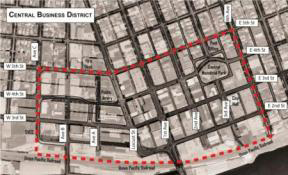
Downtown business district (DBD). This was formerly known as the central business district (CBD). The area is generally defined as: beginning at the centerlines of Fourth Avenue extended and the northerly right-of-way (ROW) of the Union Pacific Railroad; then north along the centerline of Fourth Avenue to East Fifth Street; then west along the centerline of East Fifth Street to the centerline of Avenue C; then south along the centerline of Avenue C to the northerly ROW of the Union Pacific Railroad; then east along the northerly ROW of the Union Pacific Railroad to the place of beginning.
Dwelling. A building or portion thereof, designed or used exclusively for residential occupancy, including single-family dwellings, two-family dwellings and multiple-family dwellings, but not including mobile homes or house trailers, boarding or lodging houses, hotels or motels.
Dwelling, attached. A dwelling that is joined to another dwelling at one or more sides by a shared wall or walls.
Dwelling, detached single-family home. A detached building designed for or occupied by not more than one family and having no roof, wall, or floor in common with any other dwelling unit. This dwelling unit type consists of a fully detached single-family residence which is located on an individual lot or within a group development. The dwelling unit must be a site built, structure built in compliance with the State of Illinois Uniform Dwelling Code (UDC) or may be a manufactured dwelling (modular home) as permitted by the UDC or a manufactured home as permitted by the U.S. Department of Housing and Urban Development (HUD) code. For any of these dwelling units, the use of a permanent, continuous UDC foundation is required. This dwelling unit type may not be split into two or more residences, but includes modular, mobile, and manufactured homes.
Dwelling, duplex. These dwelling unit types consist of a single-family dwelling which is attached on one side to another single-family residence or upper unit and lower unit. The two residences are located on the same lot. These dwelling unit types may not be split into additional residences.
Dwelling, multi-family. A building or portion thereof, designed or altered for occupancy by three or more families, living independently of each other. A condominium containing more than two dwelling units shall be considered a multiple-family dwelling.
Dwelling, one-family. A dwelling designed exclusively for use and occupancy by one family.
Dwelling, one-family attached. A dwelling unit having its own ground floor entrance and joined to one or more one-family attached dwellings by party walls.
Dwelling, townhouse. This dwelling unit type consists of attached, single-family residences, each having a private, individual access. This dwelling unit type is located on its own lot or within a group development and may not be split into additional residences.
Dwelling, twin home. These dwelling unit types consist of a single-family dwelling which is attached on one side to another single-family residence. The two residences are located on separate lots, but connected by a common or party wall, and the separate lots may also be referred to as zero lot line lots. The twin-home is distinguished from the duplex by having each unit located on an individual lot or within a group development. These dwelling unit types may not be split into additional residences.
Dwelling, two-family. A building designed or altered to provide dwelling units for occupancy by two families.
Dwelling unit. One or more rooms in a residential structure which are arranged, designed, used or intended to be used by one family, plus not more than three lodgers, for living or sleeping purposes, and which include complete kitchen facilities permanently installed.
Dwelling unit, upper story. Dwelling units which are located above the ground or lower floor of a building used for an office, commercial or institutional land use.
Eave. The part of a roof that meets or overhangs the walls of a building.
Eave height. Eave height shall be measured from the exposed grade adjacent to the wall and the bottom of the top layer of roofing material at its outermost point from the building wall.
Educational institution. A public, parochial, charitable or nonprofit junior college, college or university, other than trade or business schools, including instructional and recreational uses, with or without living quarters, dining rooms, restaurants, heating plants and other incidental facilities for students, teachers and employees.
Electronic message center. See Sign, electronic message.
Extraterritorial area. The area outside of the city limits in which the City of Sterling may exercise extraterritorial powers of planning, land division, and/or zoning review.
Façade. Building face; the building elevations facing the street-space. (Building walls facing interior courts, common lot lines, and alleys are not façades.)
Family. Either two or more persons, each related to the other by blood, marriage or adoption, together with usual domestic servants and not more than one bona fide guest, all living together as a single housekeeping unit and using common kitchen facilities (that is, a related family); or five or fewer persons, all of whom are not necessarily related to each of the other by blood, marriage or adoption, all living together as a single housekeeping unit and using common kitchen facilities (that is, an unrelated family). However, an unrelated family shall not include persons living together in a nursing home, sorority, fraternity or other similar organizations, or a dormitory.
Fence. A barrier constructed of materials other than living shrubbery or solid masonry erected for the purpose of protection, confinement, enclosure, or privacy.
Fenestration. Openings in the building wall, including windows and doors, allowing light and views between interior and exterior.
First floor. (See Ground story.)
Flag. Flags of the United States, the state, the city, foreign nations having diplomatic relations with the United States, and any other flag adopted or sanctioned by an elected legislative body of competent jurisdiction; provided that such a flag shall not exceed 60 square feet in area and shall not be flown from a pole, the top of which is more than 40 feet in height. These flags must be flown in accordance with protocol established by the Congress of the United States for the Stars and Stripes. Any flag not meeting any one or more of these conditions shall be considered a banner sign and shall be subject to regulations as such.
Floor area, gross (for the purpose of determining floor area ratio). The sum of the gross horizontal areas of the several floors of such building measured from the exterior faces of exterior walls or from the centerline of party walls separating two buildings. In particular, gross floor area shall include:
(1)
Basement space if at least one-half of the basement story height is above the established curb or ground level.
(2)
Elevator shafts and stairwells at each floor.
(3)
Floor space used for mechanical equipment where the structural headroom exceeds seven and one-half feet; except equipment, open or enclosed, located on the roof, i.e., bulkheads, water tanks and cooling towers.
(4)
Attic floor space where the structural headroom exceeds seven and one-half feet.
(5)
Interior balconies and mezzanines.
(6)
Enclosed porches, but not terraces and breezeways.
(7)
Accessory buildings.
Floor area, gross (for the purpose of determining requirements for off-street parking and off-street loading). The sum of the gross horizontal areas of the several floors of the building, or portion thereof, devoted to such use, including accessory storage areas located within selling or working space, such as counters, racks or closets, and any basement floor area devoted to retailing activities, to the production or processing of goods, or to business or professional offices. However, floor area for purposes of measurement for off-street parking spaces shall not include floor area devoted primarily to storage purposes (except as otherwise noted in this subsection); floor area devoted to off-street parking or loading facilities, including aisles, ramps and maneuvering space; or basement floor area other than area devoted to retailing activities or the production or processing of goods or to business or professional offices.
Floor area ratio (FAR). The total floor area of the buildings on the zoning lot divided by the area of such zoning lot or, in the case of a planned development, by the net site area.
Fly. A fly is a piece of fabric, which moves or floats in the air and is supported by cables or ropes attached to buildings or support posts.
Foot-candle. A common unit of measurement used to calculate adequate lighting levels of workspaces in buildings or outdoor spaces. This is the unit of illuminance when the foot is taken as the unit of length. It is the illuminance on a surface one square foot in area on which there is a uniformly distributed flux of one lumen. One foot-candle equals one lumen per square foot, or the equivalent of 10.75 nits.
Foot-candle, horizontal. The foot-candles falling on a horizontal surface. All horizontal foot-candles are in the same plane for the same surface. They can be added together arithmetically when more than one source provides light to the same surface.
Foot-candle ratio. The ratio or uniformity between average foot-candles and minimum foot-candles (such as 3:1) or maximum and minimum foot-candles (such as 6:1). The maximum/minimum ratio generally is preferred. The lower the ratio, the more uniform is the lighting.
Fraternity or sorority house. A building erected or arranged to house a group of either male or female students for living purposes (but not a boardinghouse), who are associated or formally organized, not for profit, for a common purpose or interest.
Freestanding. A self-supporting sign resting on or supported by means of poles, standards, or any other type of base on the ground. This type of sign includes monument signs and pole (pylon) signs.
Frontage. All the property fronting on one side of a street between the nearest intersecting streets or between a street and a right-of-way, waterway or other similar barrier.
Garage, private. Any accessory building or an accessory portion of the principal building which is intended for and used to store the private passenger vehicles of the families resident upon the premises, and in which no business, service or industry connected directly or indirectly with automotive vehicles is carried on; provided that not more than one-half of the space may be rented for the private vehicles of persons not resident on the premises, except that all the space in a garage of one- or two-car capacity may be so rented.
Garage, public. A building, other than a private garage, used for the care, incidental servicing and sale of automobile supplies, or where motor vehicles are parked or stored for remuneration, hire or sale within the structure.
Garden, community. A community garden is a single piece of land gardened collectively by a group of people. Most plots are annual rentals available for the summer season from about May 25 to the third Sunday in October. Plot sizes range from 200 square feet to 10,000 square feet. To help defray the costs of tilling, staking, providing water, and administration, gardeners may pay nominal rental fees.
Garden, solar. A solar garden is a community shared solar array with grid-connected subscribers. Homes and businesses, even if shaded by trees, receive a bill credit as if the panels were on their own roof using "virtual net metering".
Grade, street. The elevation of the established street in front of the building measured at the center of such front. Where no street grade has been established, the director of public works shall establish such street grade or its equivalent for the purpose of this chapter.
Green space ratio (GSR). The percentage of the gross site area which is preserved as permanently protected green space. Green space ratio is calculated by dividing the area of permanently protected green space by the gross site area. See Minimum green space ratio.
Green space ratio, minimum. The minimum amount of permeable surface required on a zoning lot expressed as a percentage of the total lot area.
Gross density. The result of dividing the number of dwelling units located on a site by the gross site area. See Maximum gross density.
Gross floor area. The total floor area on all levels of a building.
Gross site area (GSA). The total area of a site available for inclusion in calculations of the maximum permitted density or intensity of development.
Ground story. The first level of a building at or above grade (see BFS specifications for details). The next story above the ground story is the second floor.
Guest house. A guest house is a second residential structure or a portion of an accessory structure (such as a carriage house) used to house guests on the same zoning lot as the principal residence. The guest house shall not be rented or offered for rent independent of the principal residence. Guest houses shall be subject to the same setbacks as the principal structure.
Hardship, unnecessary. Where special conditions affecting a particular property, which were not self-created, have made strict conformity with restrictions governing areas, setbacks, frontage, height or density unnecessarily burdensome or unreasonable in light of the purposes of the ordinance.
Height, building. The vertical distance measured from the sidewalk level or its equivalent established grade opposite the middle of the front of the building to the highest elevation of the roof in the case of a slant or flat roof; to the deck line of a mansard roof; and to the mean height level between eaves and ridge of a gable, hip or gambrel roof; provided that, where buildings are set back from the street line, the height of the building may be measured from the average elevation of the finished lot grade at the front of the building.
High intensity manufacturing. A use meeting the definition of manufacturing that, in the opinion of the approving authority, could have a substantial negative impact on surrounding residents, businesses, and/or the environment by virtue of any of the following: noise, dust, odor vibration, aesthetics, truck traffic, rail traffic, structure height, environmental contamination, or causing land on neighboring properties to become unstable or unbuildable.
Historic district. An area designated by the city council on recommendation of the commission that contains two or more contiguous historic sites or sites occupied by historic structures.
Historic preservation plan. A comprehensive document that includes a cultural and architectural analysis supporting the historic significance of the area, the specific guidelines for development in the area, and a specific statement of preservation objectives for the area.
Historic site. Any parcel of land of historic significance due to its substantial value in tracing the history or prehistory of humanity, or upon which a historic event has occurred, and which has been designated as a historic site under this section, or an improved parcel, or part thereof, on which is situated a historic structure and any abutting improved parcel, or part thereof, used as and constituting part of the premises on which the historic structure is situated.
Historic structure. Any improvement which has a special character or special historic interest or value as part of the development, heritage or cultural characteristics of the city, state or nation and which has been designated as a historic structure pursuant to the provisions of this chapter.
Home, mobile. This dwelling unit type consists of a fully detached, single-family residence, which has not received a Federal Manufactured Housing Certificate and which is located on an individual lot or within a group development. This dwelling unit type may not be split into two or more residences.
Home occupation. A use customarily carried on in a business establishment that is permitted to be carried on in a residence. Said use is incidental to the primary residential purpose, thus the residential character of the property is not changed
Home, twin. Refer to a side-by-side single-family attached dwelling.
Hospital and sanitarium. An institution devoted primarily to the maintenance and operation of facilities for the diagnosis, treatment or care for not less than 24 hours in any week of three or more nonrelated individuals from illness, disease, injury, deformity or other abnormal physical conditions. The term "hospital" does not apply to institutions operating solely for the treatment of insane persons, drug addicts, liquor addicts or other types of cases necessitating restraint of patients, and the term "hospital" shall not be used for convalescent, shelter or boarding homes.
Hospital, animal. Any building or portion thereof designed or used for the care, observation or treatment of domestic animals.
Hotel and motel. See Commercial indoor lodging.
Impervious surface. Areas designed and installed to prohibit infiltration of stormwater. Homes, buildings, and other structures, as well as concrete, brick, asphalt, gravel, and similar paved surfaces are considered impervious. Areas with "landscaped pavers" and "permeable pavement" which are intended for vehicular traffic are not considered to be impervious so long as they allow the movement of stormwater through the surface.
Improvement. Any building, structure, place, work of art or other object constituting a physical betterment of real property, or any part of such betterment, including but not limited to, streets, alleys, sidewalks, curbs, lighting fixtures, and signs.
Individual channel letter. Channel letters are individual extruded metal structures with plastic faces and typically include internal neon or LED illumination that form a sign.
In-family suite. An area within a dwelling unit that may contain separate kitchen, dining, bathroom, laundry, living, sleeping, and recreation areas, including exterior porches, patios, and decks. In addition to the required internal physical connection, separate outdoor access or separate access to the garage may be provided.
Inflatable advertising. See Sign, inflatable.
Intensity. A term used to describe the amount of gross floor area or landscaped area, on a lot or site, compared to the gross area of the lot or site.
Junk. Any scrap, waste, reclaimable material or debris, whether or not stored or used in conjunction with dismantling, processing, salvage, storage, baling, disposal or other use or disposition. Junk includes vehicles, tires, vehicle parts, equipment, paper, rags, metal, glass, building materials, household appliances, brush, wood and lumber.
Junkyard. Any area, lot, land, parcel, building or structure or part thereof used for the storage, collection, processing, purchase, sale or abandonment of wastepaper, rags, scrap metal or other scrap or discarded goods, materials, machinery or two or more unregistered, inoperable motor vehicles or other types of junk.
Kennel, commercial. Any lot or premises or portion thereof on which more than four dogs, cats and other household domestic animals over four months of age are kept or on which more than two such animals are boarded for compensation or kept for sale.
Kiosk. A bulletin board located on a property or building for posting temporary information or posters, notices, and announcements.
Laboratory, commercial. A place devoted to experimental study such as testing and analyzing. Manufacturing, assembly or packaging of products is not included within this definition.
Lakeshore. Those lands lying within the following distances from the ordinary high water mark of navigable waters. 1,000 feet from a lake, pond, or flowage; and 300 feet from a river or stream; or to a landward side of the floodplain, whichever distance is the greater. Lakeshores shall not include those lands adjacent to farm drainage ditches where (a) such lands are not adjacent to a navigable stream or river; (b) those parts of such drainage ditches adjacent to such lands were not navigable streams before ditching or had no previous stream history; and (c) such lands are maintained in non-structural agricultural use.
Land disturbing construction activity. Any manmade change of the land surface including removing vegetation cover, excavating, filling and grading but not including agricultural land uses such as planting, growing, cultivating and harvesting of crops; growing and tending of gardens, harvesting of trees; and landscaping modifications.
Land owner. Any person holding title to land.
Land use. The type of development and/or activity occurring on a piece of property.
Land use, commercial. Use of land for the retail or wholesale sale of goods or services.
Land use, industrial. Use of land for manufacturing or assembly of raw materials into products.
Land use, institutional. Use of land for public or quasi-public uses, including schools, churches, civic, park, and utility operations or activities.
Landscape surface area ratio (LSR). The percentage of the gross site area or lot area which is preserved as permanently protected landscaped area.
Landscaped area. The area of a site which is planted and continually maintained in vegetation, including grasses, flowers, herbs, garden plants, native or introduced groundcovers, shrubs, bushes, and trees. Landscaped area includes the area located within planted and continually maintained landscaped planters.
Landscaping materials. For purposes of this section, landscaping shall be defined as living plant material or nonliving durable materials such as earth berms, fences, timbers or rocks, purposely installed or preserved for functional or aesthetic reasons.
Light industrial. Uses that produce consumer goods directly for the end user and include indoor industrial, cultivation, manufacturing, assembly, and processing uses.
Loading and unloading space or berth, off-street. An open, hard-surfaced area of land, other than a street or a public way, the principal use of which is for the standing, loading or unloading of motor vehicles, tractors and trailers, to avoid undue interference with public streets and alleys.
Lodging house or rooming house. A building with guestrooms where lodging is provided for compensation pursuant to previous arrangements, but not open on a daily, overnight or per meal basis to transient guests.
Lot. Any piece or parcel of land or a portion of a subdivision, the boundaries of which have been established by some legal instrument of record that is recognized and intended as a unit for the purpose of transfer of ownership. See Figure 1.8, Lot and Yard Types for illustration of differing lot types.
Lot area. The area of a horizontal plane bounded by vertical planes containing the front, side and rear lot lines.
Lot, corner. A lot situated at the junction of and abutting on two or more intersecting streets or right-of-ways; or a lot at the point of deflection in alignment of a single street, the interior angle of which is 135 degrees or less. If the angle is greater than 135 degrees, the lot shall be considered an interior lot. See Figure 1.8, Lot and Yard Types for illustration.
Lot coverage. The area of a zoning lot occupied by the principal buildings and accessory buildings.
Lot depth. The mean horizontal distance between the front and rear lot lines of a lot measured within the lot boundaries.
Lot frontage. The front of a lot shall be that boundary of a lot along a public street. For a corner lot the owner may elect either street line as the front lot line.
Lot, interior. A lot other than a corner or reversed corner lot. See Figure 1.8, Lot and Yard Types for illustration.
Lot line. A property boundary line of any lot held in single or separate ownership, except that, where any portion of the lot extends to the abutting street or alley, the lot line shall be deemed to be the street or alley line.
Lot line, front. The front property line of a zoning lot.
Lot line, interior. A side lot line common with another lot.
Lot line, rear. The lot line or lot lines most nearly parallel to and remote from the front lot lines. In the SRFBC, the rear lot line is generally a common lot line parallel with the RBL and possibly along alleys.
Lot line, side. Lot lines other than front or rear lot lines are side lot lines.
Lot, nonconforming. See Lot, substandard.
Lot of record. A platted lot or lot described in a certified survey map or in a metes and bounds description which has been approved by the city or by Whiteside County; and has been recorded in the office of the register of deeds.
Lot, reversed corner. A corner lot in which the street side lot line is substantially a continuation of the front lot line of the nearest lot to its rear and in which the rear lot line is the side lot line of the nearest lot to its rear. See Figure 1.8, Lot and Yard Types for illustration.
Lot, substandard. A lot of record which lawfully existed prior to this chapter, which would not conform to the applicable regulations if the lot were to be created under the current provisions of this chapter.
Lot, through. A lot having frontage on two parallel or approximately parallel streets, and which is not a corner lot. On a through lot both street lines shall be deemed front lot lines. See Figure 1.8, Lot and Yard Types for illustration
Lot width. The mean horizontal distance between the side lot boundaries, or the minimum distance between the side lot lines within the buildable area.
Low intensity manufacturing. Manufacturing uses that meet the definition of manufacturing, but not high intensity manufacturing.
Lumen. A lumen (LM) is the basic unit of measurement for light; also referred to as light flux. If a uniform point source of one candela is at the center of a sphere of one-foot radius (one foot-candle) which has an opening of one square foot at its surface, the quantity of light that passes through is called a lumen. The sphere has a total surface area of 12.57 square feet. Since, by definition, a lumen flows to each square foot of a surface area, a uniform point of one candela produces 12.57 lumens.
Luminaire. A complete lighting unit consisting of a lamp or lamps, together with the parts designed to distribute the light, to position and protect the lamps, and to connect the lamps to the power supply.
Luminaire, cutoff. Any luminary that does not emit light at an angle greater than 90 degrees from vertical and has less than ten percent of maximum candlepower above 75 degrees.
Manufacture. The making of anything by any agency or process.
Manufacturing. The mechanical or chemical transformation of materials or substances into new products, including the assembling of component parts, the manufacturing of products, and the blending of materials.
Marquee. Any permanent roof-like structure projecting beyond a building or extending along and projecting beyond the wall of the building, generally designed and constructed to provide protection from the weather.
Memorial plaque. A sign designating names of buildings and/or date of erection, and other items such as architect, contractor or others involved in the building's creation cut into or attached to a building surface.
Menu board. A freestanding sign permanently affixed to the ground in connection with placing an order from a vehicle at a drive-thru restaurant.
Mixed use. Some combination of residential, commercial, industrial, office, institutional, or other land uses within a district or development.
Modification. Any rehabilitation or reconstruction of any sign amounting to 50 percent or more of the estimated value of the sign.
Motel. See Commercial indoor lodging.
Multiple-tenant commercial center. See Shopping center.
Murals. Artwork or other pictorial display on a building or structure. Murals approved by the City of Sterling Mural Commission shall not be considered signage.
Nameplate. A sign indicating the name, address or profession of the person or persons occupying the lot or a part of the building.
Nit. A unit of illuminative brightness equal to one candle per square meter, measured perpendicular to the rays of the source. This unit of measurement is commonplace in the lighting industry for electronic message signs. Approximately 10.75 nits is the equivalent of one foot-candle.
Noxious matter. Material which is capable of causing injury to living organisms by chemical reaction or is capable of causing detrimental effects upon the psychological, social or economic well-being of human beings.
Octave band. Dividing the range of sound frequencies into octaves in order to classify sound according to pitch.
Open area. The area within the buildable area and behind the parking setback line accessible to occupants of the particular building or site as private open space and (primarily) open to the sky. Additional specifications for the open area may be included in each building form standard. Open area shall not be built upon, parked or driven upon (except for emergency access.)
Open space, public. Any publicly-owned open area, including but not limited to the following: parks, playgrounds, forest preserves, beaches, waterways, parkways and streets.
Open space, private. Open space which is usually privately owned and is not usually accessible by members of the general public.
Owner. The owner of record of fee simple title to any lot that is a part of properties, including contract sellers and vendees, but excluding those having such interest merely as security for the performance of an obligation, and excluding those who have a lien upon the property by provision or operation of law.
Parapet height. Where used to limit building height in the SRFBC, parapet height shall be measured at the top of the parapet, including any coping.
Parking area, private. An open, hard-surfaced area, other than a street or public way, designed, arranged and made available for the storage of private passenger automobiles only of occupants of the buildings for which the parking area is developed and is accessory.
Parking area, public. An open, hard-surfaced area, other than a street or public way, intended to be used for the storage of passenger automobiles and commercial vehicles under one and one-half tons in capacity, and available to the public, whether for compensation, free or as an accommodation to clients or customers.
Parking, shared. Parking available to the public on an unreserved basis for free or at the same fee for all users. Time limits may be imposed to ensure turn-over. Hours of public availability may also be restricted.
Parking setback line. Where indicated in the BFS, a line/plane indicated on the regulating plan which generally extends vertically and parallel with the RBL. All parking shall be behind this line, excepting where it is below grade, within a building, or is otherwise indicated on the regulating plan. The parking setback line is a permissive minimum distance from the RBL and parking may be placed anywhere within the lot behind this line, except where otherwise specified in this Code.
Particulate matter. Material which is suspended in or discharged into the atmosphere in finely divided form as a liquid or solid at atmospheric pressure and temperature.
Pedestrian pathway. Interconnecting paved ways that provide pedestrian and bicycle passage through blocks running from a street-space to another street-space, an alley or a block interior parking area. The area within a pedestrian pathway shall be a public access easement or public right-of-way, and shall provide an unobstructed view straight through their entire length.
Pedestrian spines. Paved pathways that provide clearly distinguished pedestrian and bicycle passage from a public sidewalk or right-of-way to a non-residential building entrance.
Pennant. Any lightweight plastic, fabric or other material, whether or not containing a message of any kind, suspended from a rope, wire or string, usually in series, designed to move in the wind. A pennant shall be considered a temporary sign.
Performance standard. A criterion to control noise, odor, smoke, toxic or noxious matter, vibration, fire and explosive hazards or glare or heat generated by or inherent in uses of land or buildings.
Permeable surface. The land areas on a parcel or zoning lot that allows the movement of stormwater through the surface. Does not include parking areas, patios, sidewalks, and driveways the surfaces consist of a variety of pavement, pavers, or other devices that provide stormwater infiltration while serving as a structural surface.
Person. Any association, company, corporation, firm organization or partnership, singular or plural, of any kind.
Planned unit development. A parcel of land, or contiguous parcels of land, of a size sufficient to create its own environment, controlled by a single landowner, or by a group of landowners, in common agreement as to control, to be developed as a single entity, the environment of which is compatible with adjacent parcels and the intent of the zoning district or districts in which it is located; the developer or developers may be granted relief from specific land use regulations and design standards and may be awarded certain premiums in return for assurances of any overall quality of development, including any specific features which will be of exceptional benefit to the community as a whole.
Porch. The ground floor platform attached to the front or street-space side of the main building. A roofed-over structure, projecting out from the wall of a main structure and commonly open to the weather in part. Required porches, as defined in the building form standards for the SRFBC must be roofed and, where required by building codes, enclosed by balustrades (railings) and posts that extend up to the roof.
Privacy fence. An opaque fence made of wood or masonry (not chain link or any other type of rolled fence) along alleys and common lot lines (where more than ten feet away from the RBL). It may be as high as six feet above the adjacent ground.
Processing organization. A facility operated by an organization or business that is licensed by the department of agriculture to either extract constituent chemicals or compounds to produce cannabis concentrate or incorporate cannabis or cannabis concentrate into a product formulation to produce a cannabis product.
Projecting. A type of on-building sign, other than a wall sign which is attached to and projects more than one foot, generally perpendicular from a structure or building face.
Public art. Art that is visually or physically accessible to the public (within the public realm e.g., a street-space) and that is acquired by city funds, donated to the city, or provided by a private entity as a community benefit, including monuments and statues, building ornament, and visible public infrastructure such as bridges, etc.
Public utility. Any person or municipal department, duly authorized to furnish under public regulation to the public, electricity, gas, steam, telephone, transportation or water.
Reader board. See Sign, changeable copy.
Recreational purpose. That a temporary structure is intended for the relaxation and enjoyment of the owner and not used for any commercial purpose.
Recreational vehicle (RV). The term "motor home" is often used interchangeably with "RV." A motor home, however, is an informal phrase, used to describe a variety of recreational vehicles (RVs), while recreational vehicle (or RV) is a technical and legal term. The U.S. Department of Transportation categorizes RVs by class. For the purposes of this Code, the term recreational vehicle or RV will include the following vehicle-types and units:
Class A RVs. Class A RVs are motor homes, regardless of the type of chassis beneath them and whether or not the vehicle contains "slide-outs" (additional living spaces that slide out when the vehicle is stopped for camping). Class A also includes commercial passenger and school buses that are converted into RVs (these are often the largest mobile homes available). Class A RVs are generally luxurious mobile homes with a solid body, a panoramic front window, berths that convert from living room or dinette areas, and bathroom facilities.
Class B RVs. Class B RVs are campervans or conventional vans with raised roofs (either "pop up" or "fixed"). They often have small kitchens with refrigerators and gas grills. Larger models may have a water heater, heat and air conditioning, a portable toilet, or an internal shower. Smaller models usually have a portable toilet and an external shower, which can be used with an awning to ensure privacy.
Class C RVs. Unlike a Class A mobile home, which is built on a single chassis, a Class C vehicle is attached to a truck and hauled behind. Class C RVs are characterized by a distinctive alcove which fits over the truck cab, providing either a double berth for sleeping or, sometimes, an "entertainment" section, with a TV and video games.
Other RV types. Other types of RVs or motorhomes include:
• Truck campers. Similar to the C-class vehicles described above, these are smaller RVs, carried in the beds of pickup truck.
• Pop-up campers. Collapsible campers with pull-out berths and tent walls, towed in a compact unit behind a vehicle.
• Travel trailers (or caravans). Non-collapsible, light-weight trailers with simple amenities, towed behind a vehicle.
Regulating plan. Part of the Sterling Riverfront Form-Based Code that is the coding key for the regulations that apply to each parcel. The regulating plan also shows how each parcel relates to adjacent street-space, the overall form district, and the surrounding neighborhoods.
Required building line (RBL). Is one of two lines or planes indicated in each sub-district building form standard and site layout. Each RBL is measured from the right-of-way line or property line to the nearest foundation or building wall of the building or structure. The two RBL lines define a required building zone (RBZ) within which the building façade shall be placed. The RBZ is a requirement, not a permissive minimum as is a setback. The minimum length of building that is required to be built within the RBZ is shown on the appropriate building form standard.
Required building zone (RBZ). Two RBL lines as specified in the building form standard define a required building zone (RBZ) within which the building façade shall be placed. The RBZ is a requirement, not a permissive minimum as is a setback. The minimum length of building that is required to be built within the RBZ is shown on the appropriate building form standard.
Restaurant. Any land, building or part thereof, other than a boardinghouse, where meals are provided for compensation, including a cafe, cafeteria, coffeeshop, lunchroom, drive-in stand, tearoom and dining room.
Retail. Establishments providing goods or services to the general public.
Retail, service. Establishments providing services, as opposed to products, to the general public, including restaurants, hotels and motels, finance, real estate and insurance, travel agencies, health and educational services, galleries, and temporary storage of recreational equipment, provided that the temporary storage is ancillary to the primary retail service.
Retail, specialty. Include, but are not limited to the sale of gifts, antiques, flowers, books, jewelry, wearing apparel or craft shops making articles exclusively for sale at retail on the premises.
Retail, trade. Establishments engaged in selling new goods or merchandise to the general public for personal or household consumption and rendering services incidental to the sale of such goods.
Road, access (private). A private thoroughfare permanently reserved or otherwise intended to provide access to more than one zoning lot or to more than one principal building on a zoning lot.
Roof, mansard. An architectural designation of a roof/wall design which exhibits a vertical or nearly vertical face. For the purposes of this article, the vertical or nearly vertical face shall be considered a wall.
Rowhouses. A group of three or more attached, two-story, single-family residences, each having a private, individual access and common or party wall on one or both sides. They may be located on their own lots or within a group or large development and may not be split into additional residences.
Scale. The relationship between the mass of a building and its surroundings, including the width of street, open space, and mass of surrounding buildings. Mass is determined by the three-dimensional bulk of a structure: height, width, and depth.
Setback. The minimum horizontal distance property line to the nearest part of the applicable building, structure or sign, or any projection thereof, measured perpendicularly to the property line.
Setback, front. The required horizontal distance between a building or structure and any front lot line abutting a right-of-way, measured perpendicular to such lot line at the point where the building is closest to such lot line.
Setback, side. The required horizontal distance between a building or structure and any side lot line, measured perpendicular to such lot line at the point where the building is closest to such lot line.
Setback, rear. The required horizontal distance between a building or structure and any rear lot line, measured perpendicular to such lot line at the point where the building is closest to such lot line.
Setback, corner side. The required horizontal distance between a building or structure and any side lot line abutting a right-of-way, measured perpendicular to such lot line at the point where the building is closest to such lot line.
Shopping center. A commercial, industrial or office research development in which there exists a number of separate activities, in which there are appurtenant shared facilities (such as parking, trash, or pedestrian areas), and which is designed to provide a single area in which the public can obtain varied products and/or services. Distinguishing characteristics of a multiple tenant/multiple storefront commercial, industrial, or office research development may, but need not, include common ownership of the real property upon which the center is located, common-wall construction, and multiple-occupant commercial or industrial use of single structure.
Sign. Any object, device, display, structure, or part thereof either independently or in conjunction, situated outdoors and in view of the general public, which is used to advertise, identify, display, direct or attract attention to an object, person, institution, organization, business, product, service, event, or location by any means, including words, letters, figures, logos, symbols, fixtures, projected images, or in-window signs. Signs do not include the flag or emblem of any nation, organization of nations, state, city, religious, fraternal, or civic organization; also merchandise and pictures or models of products or services incorporated in a window display, works of art which in no way identify a product, or scoreboards located on athletic fields. Building colors and outline lighting which do not convey a logo or message specific to the use are not considered signs. Traffic control and other public agency signs located within a right-of-way are not included within this definition and are not regulated by the provisions of this chapter.
Sign, A-frame. A portable sign typically located on a sidewalk advertising information—menu, sales, etc.—for the adjacent commercial establishment.
Sign, abandoned. A sign structure that remains on the premises (with or without the identification sign) after the previously advertised activity, business, product or service on the premises has been discontinued. See section 102-715, closed business signs and abandoned signs.
Sign, advertising (billboard). A sign which directs attention to a business, commodity, service or entertainment conducted, sold or offered elsewhere than upon the premises where such sign is located or to which it is affixed.
Sign, animated. Any sign that uses movement to depict action or create a special effect or scene. A revolving sign, or any advertising device which attracts attention by moving parts operated by mechanical equipment or movement caused by natural sources, whether illuminated, indirectly illuminated or not illuminated, shall be considered an animated sign.
Sign, area. Area of copy enclosed by one continuous line, connecting the extreme points or edges of a sign. The area shall be determined using the largest sign area or silhouette visible at any one time from any point.
Sign, awning. A sign that is mounted or painted on, or attached to the largest plane of an awning, and that does not project beyond the physical dimensions of the awning.
Sign, box type. A translucent, back-lit, panel sign that is typically inserted or attached to a square or rectangular structure constructed for the primary purpose of displaying the sign. When there is a change in use or user, the sign panel is replaced and the sign structure is unaltered.
Sign, building. See Sign, wall.
Sign, billboard. Any structure or portion thereof upon which are signs or advertisements used as an outdoor display. This definition does not include bulletin boards used to announce church services or to display court or other public office notices, or signs offering the sale or lease of the premises on which the sign is located.
Sign, building marker. Any sign indicating only the name of the building, and the date and incidental information about its construction, which sign is cut into a masonry surface or made of bronze or other permanent material.
Sign, business. A sign which directs attention to a business or profession conducted or to a commodity, service or entertainment sold or offered upon the premises on which such sign is located or to which it is affixed.
Sign, canopy. Any sign that is a part of or attached to an awning, canopy or other fabric, plastic or structural protective cover over a door, entrance, window or outdoor service area. A marquee is not a canopy.
Sign, certificate of compliance. A certificate detailing existing signs which is issued by the city within 180 days of adoption of the ordinance from which this article is derived or of an annexation.
Sign, changeable copy. A sign or portion thereof with characters, letters or illustrations that can be changed or rearranged manually without altering the face or the surface of the sign. The message may be changed manually or electronically. Flashing, animated, and mechanical signs shall not be considered changeable copy signs. Also referred to as "reader boards."
Sign, channel-letter type. Letters or figures individually fashioned from metal or other approved materials and attached to the wall of a building, but not including a sign painted on a wall or other surface.
Sign, church bulletin board. A sign attached to the exterior of a church or located elsewhere on the church premises, used to indicate the service or activities of the church and including its name, if desired.
Sign, commercial message. Any sign wording, logo or other representation that, directly or indirectly, names, advertises or calls attention to a business, product, service or other commercial activity.
Sign, directional. A sign which indicates only the name, direction, address, logo and/or distance of a business or activity intended solely for the purpose of directing patrons or customers to an establishment off the main traveled road and not including promotional advertising unnecessary to such directional purpose. Only those directional signs erected by a government agency may be located in a public right-of-way.
Sign, display surface. That part of the sign that is, or can be, used to identify, to advertise, to communicate information, or for visual representation, which attracts the attention of the public for any purpose. The term display surface includes any background or surrounding material, panel, trim or ornamentation, color, and direct or self-illumination that differentiates the sign from the building, structure, backdrop surface or object upon or against which it is placed. The term display surface does not include any portion of the support structure for the sign, provided that no message, symbol or any of the previously described elements of a display surface is placed on or designated as part of the support structure.
Sign, electric. Sign containing electrical wiring, but not including sign illuminated by an exterior light source.
Sign, electronic message. Signs who alphabetic, pictographic, or symbolic informational content can be changed or altered on a fixed display screen composed of electrically illuminated segments. Includes LED displays, electronic signs, LED video displays, and electronic variable message signs.
Sign, exempt. A sign that does not require a permit application or fee.
Sign, flashing. A sign that contains the same image or message is repeated in conjunction with a sequential light source where the period of time of illumination is generally equal to the period of non-illumination and is used to attract attention. Flashing can include "strobe effect."
Sign, freestanding. A self-supporting sign resting on or supported by means of poles, standards, or any other type of base on the ground, independent of any building or other structure and is anchored in the ground. This type of sign includes ground signs, monument signs, and pole (pylon) signs.
Sign, gross surface area. Gross surface area of a sign shall be the entire area within a single continuous perimeter enclosing the extreme limits of such sign and in no case passing through or between any adjacent elements of the sign. However, such perimeter shall not include any structural or framing elements lying outside the limits of such sign and not forming an integral part of the display.
Figure 1.2 Ground Sign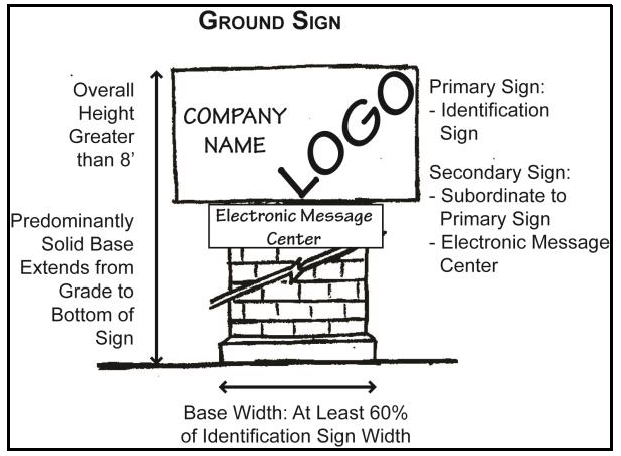
Sign, ground. A type of freestanding sign with a solid or continuous base, pedestal, or foundation that measures at least 60 percent of the greatest width of the identification sign and extends from grade to the bottom edge of the sign, and where the total sign height exceeds eight feet.
Sign, group. A sign displaying the collective name of a group of uses such as the title of a shopping center, office park, or industrial park and its tenants. No sales or price information shall be permitted. Portions of the sign containing names of individual tenants shall be considered as part of the area of a group sign. Each use shall be considered a separate sign.
Sign, illuminated. A sign lighted by or exposed to artificial lighting either by lights on or in the sign or directed toward the sign.
Sign, identification. A sign indicating the name of the occupant of the property, building, or leasable space. An identification sign does not list particular goods or services available, and does not include changeable copy signs or electronic message centers.
Sign, incidental. A sign, generally informational, that has a purpose secondary to the use of the zoning lot on which it is located, such as "no parking," "entrance," "loading only," "telephone" and other similar directives. No commercial message is allowed on an incidental sign except to the extent that a business name or logo is necessary for informational purposes.
Sign, inflatable. Any hollow item or character expanded or enlarged by the use of air or gas for the purposes of advertisement, including tethered balloons. For purposes of this chapter, an inflatable sign shall be considered a temporary sign.
Sign, in-window. A sign located within a building that is located attached to the inside face of an exterior window and visible from the exterior of the building.
Figure 1.3 Marquee Sign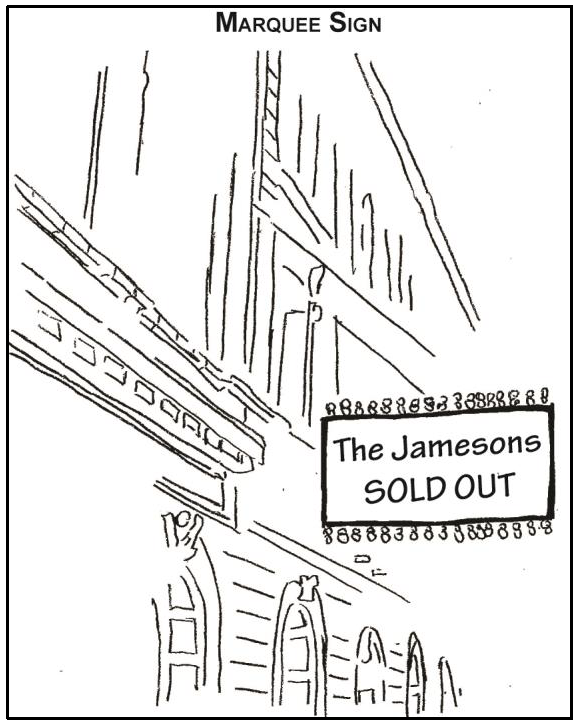
Sign, integral building. A sign bearing the name of a building, dates of construction, commemorative tablets and the like, which is an integral part of the building or structure.
Sign, marquee. A type of projecting, on-building sign sheltering the entrance and/or entrance approaches of a theater, auditorium, fairground, museum or other use, generally designed and constructed to provide protection from the weather which advertises present and scheduled events. A marquee shall not be considered a canopy or awning.
Sign modification. Any rehabilitation or reconstruction of any sign amounting to 50 percent or more of the estimated value of the sign.
Sign, mobile. See Sign, vehicle or trailer.
Sign, mobile or portable. A sign mounted on a frame or chassis designed to be easily relocated, including vehicles and/or trailers whose principal commercial use is for signage.
Figure 1.4 Monument Sign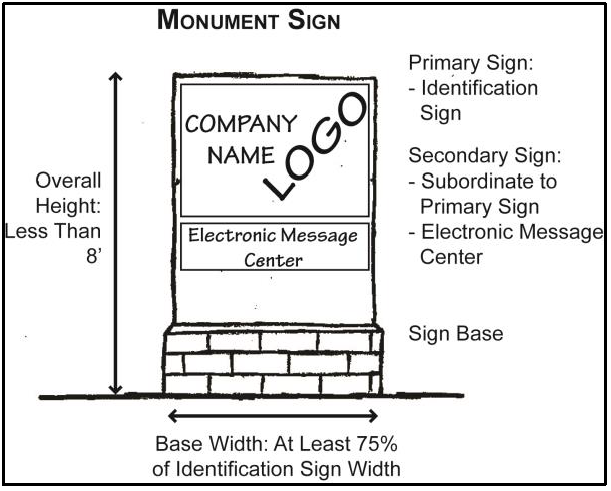
Sign, monument. A type of freestanding sign with a solid or continuous base, pedestal, or foundation that measures at least three-fourths of the greatest width of the identification sign and extends from grade to the bottom edge of the sign, and where the total sign height does not exceed eight feet.
Sign, moving. A sign that, through the use of moving structural elements, results in movement or the physical change of the sign.
Sign, nonconforming. Any sign that does not conform to the requirements of the article, except portable signs.
Sign, off-premises. Any sign advertising a product, service, business or activity sold, located or conducted elsewhere than on the premises on which the sign is located, or which said product, service, business or activity is sold, located or conducted on such premises only incidentally, if at all. Commonly called a billboard.
Sign, off-site commercial. A sign that directs attention to a business, commodity, service, entertainment or attraction sold, offered, or existing elsewhere than upon the same lot or parcel where such sign is displayed. Signs of this type are typically referred to as a "billboard" or "outdoor advertising display."
Sign, on-site informational. A sign commonly associated with, but not limited to, information and directions necessary or convenient for visitors coming on the property, including sign marking entrances and exits, parking areas, circulation direction, rest rooms, and pick-up and delivery areas.
Figure 1.5 Pole or Pylon Sign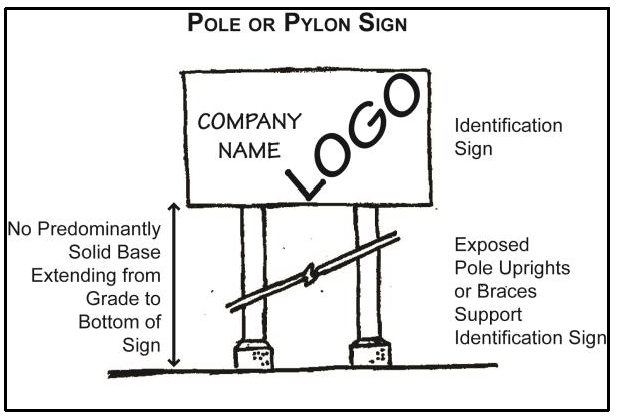
Sign, pole. A type of freestanding sign which does not have a predominantly solid or continuous base, pedestal, or foundation and is supported by one or more exposed uprights or braces that extend from grade to the identification sign. Also referred to as a "pylon sign."
Sign, portable. Any sign not designed to be permanently attached to a building or anchored to the ground; any sign that is not permanently affixed to a building, structure or the ground; a sign designed to be moved from place to place. These signs include but are not limited to signs attached to wood or metal frames designed to be self-supporting and movable; paper, cardboard or canvas signs wrapped around supporting poles.
Sign, political. A temporary sign announcing or supporting political candidates or issues in connection with any current national, state, or local election. Political signs shall be regulated by 65 ILCS 5/11-13-1.
Sign, primary. The main sign identifying the owner or business (See Sign, identification) and can be located on a building wall or freestanding sign.
Figure 1.6 Projecting Sign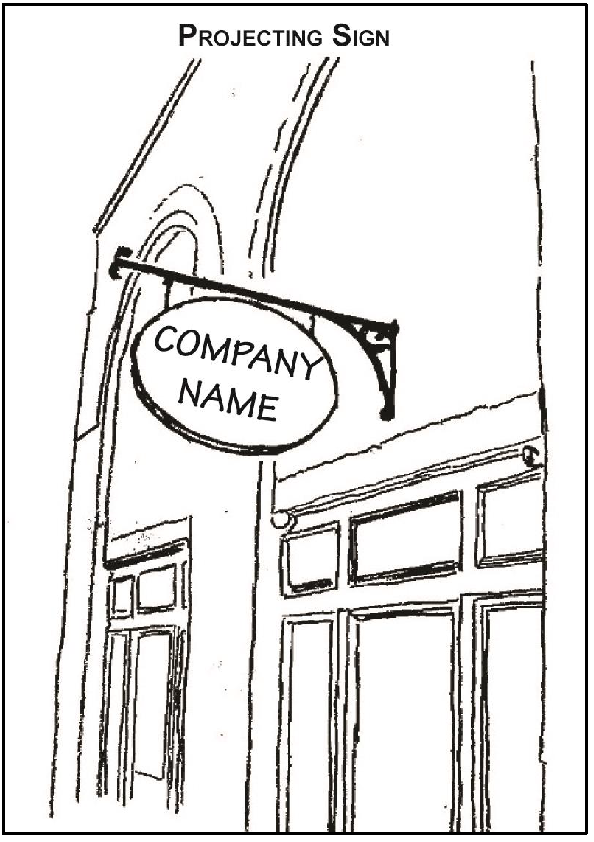
Sign, projecting. A sign other than a wall sign, which projects from and is supported by a wall of a building or structure, extending out beyond 12 inches from the point of attachment, typically having two or more viewable sides, but for the purpose of this chapter, only one side need be counted as a side for measuring its allowable area and sign count. A sign shall not project more than two-thirds of the distance of the sidewalk width, and the leading edge of the sign shall be located a minimum of two feet from the curb line.
Sign, pylon. See Sign, pole.
Sign, quasi-public informational. Non-commercial signs of a general informational nature such as community welcome, safety warning, or other similar nature.
Sign, real estate. A sign relating to the sale or lease of the premises, or a portion of the premises, on which the sign is located.
Sign, residential. Any sign located in a district zoned for residential uses that contains no commercial messages except advertising for goods or services legally offered on the premises where the sign is located, if offering such service at such location conforms with all requirements of this chapter.
Sign, roof. A sign that is mounted on the roof of a building or that is wholly dependent upon a building for support and that projects above the top wall or edge of a building with a flat roof, the eave line of a building with a gambrel, gable, or hip roof, or the deck line of a building with a mansard roof.
Sign, sandwich board. See Sign, A-frame.
Sign, secondary. A sign subordinate to the primary sign in size and appearance and typically list goods or services available. Secondary signs cannot be used as an identification sign. Secondary signs may be located either on a building wall or freestanding sign. Secondary signs may be a channel-letters sign, changeable copy sign, or electronic message center.
Sign, sidewalk. See Sign, A-frame.
Sign, suspended. A sign that is suspended from the underside of a horizontal plane surface and is supported by such surface.
Sign, temporary. A sign, banner, pennant, valance, or advertising display designed and intended for a temporary period of display; typically constructed from nondurable materials such as paper, cardboard, cloth, plastic and/or wallboard; not permanently mounted to the ground or building; and does not constitute a structure subject to the city's building or zoning codes.
Sign, theatre. See Sign, marquee.
Sign, vehicle or trailer. Signs attached to or painted on vehicles or trailers parked and visible from the public right-of-way for the purpose of identification or advertising a business, public or quasi-public institution, unless the vehicle or trailer is in use in the normal day-to-day operation of the business.
Figure 1.7 Wall Sign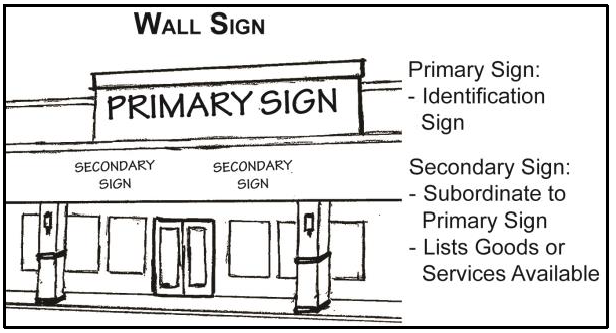
Sign, wall. A sign painted on a building façade and all other signs connected to or erected against the façade of a building or structure, with the exposed face of the sign in a plane parallel to the plane of said wall where no part of the sign structure extends more than 12 inches out from the facade as measured near the points of attachment or contact to the building. Wall signs are permitted only on walls with street facings with a maximum of two building sides per building. For purposes of this chapter, stores/businesses in shopping centers shall count the wall facing the main customer parking area as a street facing. For the purpose of this chapter, canopy coloration and/or striping shall not be considered wall signage and shall be permitted but regulated to the extent allowed by section 102-705.C.
Sign, window. Any sign, pictures, symbol or combination thereof, designed to communicate information about an activity, business, commodity, event, sale or service, that is placed inside a window or upon the window panes or glass and is visible from the exterior of the window.
Sign sight distance. The sign sight distance is the measurement from two specific locations: 1) the sign itself; and 2) the spot from which the sign is first visible and recognizable.
Sign structure supports or materials capable of supporting any sign as defined in this chapter. A sign structure may be a single pole or may or may not be an integral part of the building.
Signage plan. An accurate plot plan of the zoning lot displaying the location of existing and proposed signs, buildings, parking lots, driveways and landscaped areas; and a computation of the maximum total sign area, the maximum area for individual signs, the height of the signs and the number of freestanding signs allowed on the zoning lot, included in the plan required under this article per section 102-704, sign plans, approvals, and permits. A plan for signage designed to show the relationship or uniformity of signs for any cluster of buildings, a planned unit development, or any single building housing a number of users, or in any arrangement of buildings or shops which constitute a visual entity as a whole.
Specified anatomical area. Less than completely and opaquely covered human genitals, pubic region, buttocks, and female breast below a point immediately above the top of the areola; human male genitals in a discernible turgid state, even if opaquely covered.
Specified sexual activities. Simulated or actual:
(1)
Showing of human genitals in a state of sexual stimulation or arousal;
(2)
Acts of masturbation, sexual intercourse, sodomy, bestiality, necrophilia, sadomasochistic abuse, fellatio or cunnilingus;
(3)
Fondling or erotic touching of human genitals, pubic region, buttocks, or female breasts.
Stacking requirements (queuing). The number of cars that must be accommodated in a reserve space while awaiting ingress or egress to specified business or service establishments.
Steep slope. Steep slopes are areas which contain a gradient of 12 percent or greater, (equivalent to a ten-foot elevation change in a distance of 83 feet or less), as shown on environmental corridor map or from more accurate on-site survey.
Stoop. An entry platform on the front façade of a building. Stoops may be roofed, but they shall not be enclosed or have walls.
Story/story height. That space within a building, and above grade, that is situated between one floor level and the floor level next above, or if there is no floor above, the ceiling or roof above. Story height parameters are as specified by the appropriate building form standard.
Story. Portion of a building included between the upper surface of the floor and the upper surface of the floor or roof next to it.
Story, half. That portion of a building under a gable, hip or mansard roof, the wall plates of which on at least two opposite exterior walls are not more than four and one-half feet above the finished floor of each story. In the case of one-family dwellings, two-family dwellings and multiple-family dwellings less than three stories in height, a half-story in a sloping room shall not be counted as a story.
Street. A public strip of land or way more than 30 feet in width subject to vehicular traffic, as well as pedestrian traffic, that provides direct or indirect access to property, including but not limited to avenues, boulevards, courts, drives, highways, lanes, places, roads, terraces, trails or other thoroughfares.
Street, hierarchy. The conceptual arrangement of streets based upon function. A hierarchal approach to street design classifies streets according to function, from high-traffic arterial roads down to streets whose function is residential access. Systematizing street design into a road hierarchy promotes safety, efficient land use, and residential quality.
Street, arterial. A street which provides primary access to and through an area; in Sterling, Route 2, Route 40, Others.
Street, collector. A street which disperses traffic throughout an area; in Sterling, Lynn Boulevard, Freeport Road, LeFevre Road, 6th Avenue, 16th Avenue, 23rd Street, 15th Street, 15th Street, McHugh Road, Science Ridge Road.
Street, local. A street which provides access to individual properties.
Street frontage. The distance for which a lot line of a zoning lot adjoins a public street, from one lot line intersecting the street to the furthest distant lot line intersecting the same street.
Street frontage. That portion of the lot or building that is coincident with the RBL as required by the Code.
Street line. A line separating a lot, piece or parcel of land from a street.
Street-space. Includes all space between fronting RBLs (travel-lanes, sidewalks, squares, pedestrian pathways, pedestrian spines, civic greens, sidewalks, parks)—including any transit service operator passenger platform—but not garage entries or alleys.
Street tree. A required tree listed in the form district street tree list, located in section 102-520. Street trees shall be planted at an average no greater than 30 feet on center (measured per block face). Where necessary, spacing allowances may be made to accommodate curb cuts, fire hydrants and other infrastructure elements, however, at no location shall spacing exceed 45 feet on center.
Structural alteration. Any change other than incidental repairs which would prolong the life of the supporting members of a building or structure, such as bearing walls, columns, beams or girders.
Structure. Anything constructed or erected six inches or more above the surface of the ground, which requires location on the ground or is attached to something having location on the ground, including a deck, fence, freestanding wall. A sign, billboard or other advertising medium, detached or projecting, shall be construed to be a structure.
Structure, accessory. A detached subordinate structure or a use which is clearly incidental to, and customarily found in connection with, the principle structure or use to which it is related and which is located on the same lot as that of the principle structure or use.
Structure, habitable. Any structure or portion thereof used or designed for human habitation.
Structure, nonconforming. Any building, or other structure, which was lawfully existing under ordinances or regulations preceding this chapter, but which would not conform to this chapter if the building or structure were to be erected under the current provisions of this chapter.
Structure, principal. A building in which is conducted, or in which is intended to be conducted, the main or primary use of the lot on which it is located.
Structure, temporary. Any building, shed, fence, tent or other membrane structure erected for a period of less than 180 days.
Subdivision. The division of a lot, parcel, or tract of land by the owner thereof or the owner's agent for the purpose of sale or of building development.
Tavern or bar. A saloon, bar, pub, tavern, cocktail lounge, or similar place used primarily for consuming alcohol and designed for social interaction and/or entertainment.
Tent. Any membrane structure, enclosure or shelter which is constructed of canvas or any other pliable material supported in any manor except by air or the contents it protects and used only for recreational purposes.
Tower story. An allowable additional story above the maximum building story height.
Townhouse. See Rowhouses.
Toxic material. A substance (liquid, solid or gaseous) which, by reason of an inherent deleterious property, tends to destroy life or impair health.
Traditional neighborhood development (TND). A development that exhibits several of the following characteristics: alleys, streets laid out in a grid system, buildings oriented to the street, front porches on houses, pedestrian-orientation, mixed land uses, and village squares or greens.
Trailer. Every vehicle without motive power in operation, designed for carrying persons or property and for being drawn by a motor vehicle.
Trailer park. Any premises occupied or designed to accommodate one or more families living in an automobile house trailer or mobile home, or the parking of one or more trailers for business purposes.
Transient person. Any visitor or person who owns, rents, or uses a lodging or dwelling unit, or portion thereof, for less than 30 days and whose permanent address for legal purposes is not the lodging or dwelling unit being occupied.
Transporting organization. An organization or business that is licensed by the department of agriculture to transport cannabis on behalf of a cannabis business establishment or a community college licensed under the Community College Cannabis Vocational Training Pilot Program.
Use. The purpose for which land or a building thereon is designed, arranged or intended or for which it is occupied or maintained, let or leased.
Use, accessory. A use subordinate to and customarily incident to the permitted principal use. An accessory use includes but is not limited to the following:
(1)
A children's playhouse, garden house and private greenhouse.
(2)
A shed, garage or building or domestic storage.
(3)
Incinerators incidental to residential use.
(4)
Storage of merchandise normally carried in stock on the same lot with any retail service or business use, unless such storage is excluded by the district regulations.
(5)
Storage of goods used in or produced by manufacturing activities on the same lot or parcel of ground with such activities, unless such storage is excluded by the district regulations.
(6)
Swimming pool, private, for use by the occupant and his guest.
(7)
Off-street motorcar parking areas, and loading and unloading facilities.
(8)
Signs, other than advertising signs, as permitted and regulated in each district incorporated in this chapter.
(9)
Carports.
(10)
Public utility facilities, including telephone, electric, gas, water and sewer lines, their supports and incidental equipment.
Use, civic. Community uses open to the public, including meeting halls; libraries; schools; police and fire stations; governmental offices; places of worship; rooming houses; museums; cultural, visual and performing art centers; transit centers; public buildings; recreational facilities; and government functions open to the public.
Use, conditional. See Use, special.
Use, conforming. A use or activity on a property that conforms to the present requirements of the zoning district in which it is located.
Use, nonconforming. Any building, structure or land lawfully occupied by a use or lawfully established at the time of the adoption of the ordinance from which this chapter was derived, or amendments thereto, which does not conform after the passage of the ordinance or amendments thereto with the use regulations of the ordinance.
Use, principal. Any and all of the primary uses of a property, treated as a use permitted by right or as a special use (rather than as an accessory use or a temporary use).
Use, retail. Retail uses shall be considered to encompass all of the following:
Use, special. A use which is permitted by this section provided that certain conditions specified in the ordinance are met and that a permit is granted by the zoning board of appeals or, where appropriate, the planning agency designated by the city council. For the purpose of the Sterling Redevelopment Form District, special uses may be considered for placement in the residential use classification after review by the plan commission in accordance with section 102-819.
Variance. Permission by the zoning board of appeals to depart from the literal requirements of this chapter granted pursuant to section 102-905.
Vision setback area. An unoccupied triangular space, at the street corner of a corner lot, as established by section 102-231. Also referred to as the vision corner.
Wall. A solid barrier constructed of masonry materials erected for the purpose of protection, confinement, enclosure, or privacy.
"Where clearly visible from the street-space". Many requirements of the Sterling Riverfront Form-Based Code apply only where the subject is "clearly visible from the street-space." Note that the definition of street-space includes squares, civic greens, parks, and all public spaces except alleys. A building element more than 40 feet from the RBL /street-space (such as elements facing a common lot line more than 40 feet away from a RBL and/or street) is by definition not clearly visible from the street-space. Also common and/or party walls are by definition not clearly visible from the street-space. This does not exempt vehicle parking spaces/lots from any building form standard (BFS) requirements.
Figure 1.8 Lot and Yard Types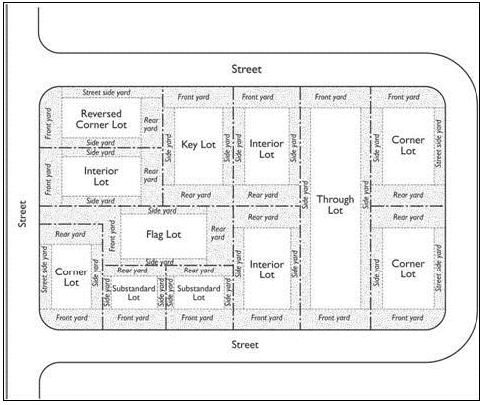
Yard. An open space on the same zoning lot with a principal building or group of buildings, which is unoccupied and unobstructed from its lowest level upward, except as otherwise permitted in this chapter, and which extends along a lot line and at right angles thereto to a depth or width specified in the yard regulations for the district in which the zoning lot is located.
Yard, corner. Corner yard means a yard extending along the full length of the side lot line along the public right-of-way on the junction of and abutting two or more intersecting streets.
Yard, front. A yard extending along the full length of the front lot line along the public right-of-way, between the side lot lines.
Yard, rear. A yard extending along the full length of the rear lot line between the side lot lines.
Yard, side. A yard extending along a side lot line from the front yard to the rear yard.
Yard, street. The yard on a corner lot abutting a street or right-of-way that would typically be defined as the side yard for an interior lot.
Yard, transitional. An area, if any, along a roadway located between the existing required setback line and the future required setback line. The future setback line is measured form the proposed right-of-way. This is no transitional yard when the existing street right-of-way width exceeds the proposed right-of-way width.
Zero-lot line structure. A structure that is built on the property line such as a twin house or townhouse.
Zoning administrator. The building and zoning superintendent, zoning administrator, or their designee. See Building and zoning superintendent.
Zoning district, overlay. A zoning district which imposes uniform restrictions on all properties within its area which are in addition to the restrictions specific to the standard zoning districts.
Zoning district, standard. Zoning districts which primarily regulate the use of land and intensity or density of such use.
Zoning enforcement officer. The building and zoning superintendent, zoning administrator, or their designee. See Building and zoning superintendent.
Zoning lot. A parcel of land in single ownership that is of sufficient size to meet minimum zoning requirements for area, coverage and use, and that can provide such yards and other open spaces as required by this chapter.
Zoning map. The maps incorporated in this chapter as a part of this chapter, designating zoning districts.
(Ord. No. 2015-10-16, Exh. A, 10-5-15; Ord. No. 2019-11-32, § 2, 11-4-19; Ord. No. 2022-03-11, § 3, 3-7-22)

