
Sterling City Zoning Code
ARTICLE V
- DESIGN GUIDELINES AND REGULATIONS
Sec. 102-501.- Nonresidential design guidelines and regulations.
A.
General provisions.
(1)
Purpose.
(a)
To improve the overall quality of nonresidential development in Sterling;
(b)
Ensure compatibility of nonresidential development with surrounding land uses;
(c)
Enhance site design of nonresidential development in the city, enhance pedestrian safety and walkability, and improve user-friendliness of the document and review process.
(2)
Applicability. The provisions of this section shall apply to the following types of developments:
(a)
Development of all projects in which the principal use is commercial, industrial, or institutional.
(b)
Any accessory use to one of the principal uses listed in [subsection] (a), including but not limited to lighting, accessory buildings over 300 square feet in floor area, telecommunications facilities, and exterior building alterations.
(c)
Any addition to an existing use listed in subsection (1) which existed as of October 5, 2015, that results in a total cumulative square foot expansion of 25 percent or more over the life of the development for any of the following:
(i)
Building floor area;
(ii)
Outdoor storage area; or
(iii)
Parking lot area.
(d)
Where developments under subsection (3) are proposed, the project, building, and site shall comply with the provisions of this section to the extent practical, given existing site and building conditions.
(3)
Exemptions. The following shall be exempted from the provisions of this section:
(a)
All single-family detached and two-family residences on individual lots or zero-lot line.
(b)
All multiple-family residences shall comply with the provisions of section 102-510.
(c)
All development in the DB, downtown business district shall comply with the provisions of section 102-505.
(4)
Process. All projects shall be reviewed and approved as a part of the building site and operation plan procedures contained in section 102-924.
B.
Site planning.
(1)
Purpose. These guidelines and standards are intended to encourage an orderly and logical pattern of commercial development that is easily recognized by local residents, and that enhances the convenience and livability of Sterling. It is also the intent that these guidelines and standards encourage forethought and consideration of both a development's external relationships as well as its internal organization.
(2)
Preservation of natural features.
(a)
Purpose. Enhance local character; protect natural features' important functions, such as stormwater management, air purification, and provision of shade; preserve and integrate natural features, including mature trees into new development.
(b)
Tree and vegetation preservation.
(i)
Tree survey/plan requirement. Developers shall submit an existing tree survey and preservation plan to show compliance with these guidelines and standards.
(ii)
General guideline. Existing quality/specimen trees and vegetation should be preserved whenever possible to act as buffers between adjoining developments and as site amenities within the development.
(iii)
Desirable trees. For purposes of this section, "significant" trees include the following:
A.
Deciduous trees with 12-inch minimum DBH.
B.
Evergreen trees 12 feet or more in height.
C.
Groups or stands of ten or more trees with a minimum DBH of six inches.
(iv)
Significant tree preservation and replacement standards.
A.
At least 50 percent of desirable trees shall be preserved or transplanted on site, to the maximum extent practicable.
B.
Desirable trees in appropriate locations, such as along drainages and along the perimeter of the site should be used to fulfill landscaping or buffering requirements outlined in section 102-520.
C.
Tree replacement. If a significant tree designated to be preserved is removed or substantially damaged during clearing, grading, or construction, the developer shall replace the removed or damaged tree with new trees. Replacement trees shall be the same or similar species to the trees removed or damaged, or alternately a species native to Whiteside County (as listed in section 102-520) and a minimum planting size of two and one-half inches DBH. Trees removed or damaged shall be preplaced by the developer on a diameter inches for diameter inches basis.
D.
Desirable trees shall be protected during construction with the erection of barrier fencing.
E.
Grading shall be avoided within the root area or drip line of any existing preserved trees.
(3)
Land disturbance.
(a)
Intent. The natural rolling and vegetated topography is a key element in distinguishing Sterling and defining its character. Development should maintain natural site topography and minimize land disturbance. Extensive grading or unusual site improvements (e.g., large retaining walls) to force a design onto a property is strongly discouraged. Modifying the design of a commercial development to fit the site generally results in a reduced potential for environmental problems and an improved level of visual interest and variety.
(b)
Guidelines and standards.
(i)
Prior approval of land disturbance. Where significant topographical issues are identified at a pre-application conference (for example, substantial differences in grade on site), the city may require the applicant to submit a preliminary grading plan. As applicable, no grading, excavation, or tree/vegetation removal shall occur on a site, whether to provide for a building site, for on-site utilities or services, or for any roads or driveways, before the city's approval of such preliminary grading plan.
(ii)
Natural topography. To the maximum extent feasible, the layout of commercial developments shall maintain natural site topography. Berms, channels, swales, and similar manmade changes to the landscape shall be designed and graded to be an integral part of the natural landscape and to provide a smooth transition in changes of slope.
(iii)
Maximum slope on graded or filled manmade slopes. The maximum slope of any manmade slope shall be 3:1, unless otherwise approved by the city.
(iv)
Site drainage patterns. Site drainage patterns shall be designed to prevent concentrated surface drainage from collecting on, and flowing across pedestrian paths, walks, and sidewalks. All site drainage shall comply with chapter 80, stormwater management and erosion control ordinance in [the] Municipal Code.
C.
Site layout/development pattern.
(1)
Intent. Site layout and building orientation often define the focus of activity that occurs at the front door or along the street. These standards are intended to use site planning and building orientation in order to:
(a)
Create a sense of place for users and passers-by.
(b)
Ensure that buildings relate appropriately to surrounding developments and streets and create a cohesive visual identity and attractive street scene.
(c)
Ensure that site circulation promotes contiguous pedestrian and vehicle circulation patterns.
(d)
Ensure that parking areas provide safe and efficient access to buildings.
(e)
Create a unique and identifiable image for development in Sterling.
(2)
Location of parking.
(a)
In order to reduce the scale of the paved surfaces and to shorten the walking distance between the parked car and the building, off-street parking for all non-residential developments shall be located according to one of the following options:
(i)
A minimum of 30 percent of the off-street surface parking spaces provided for all uses contained in the development's primary building shall be located other than between the front façade of the primary building and the primary abutting street (e.g., to the rear or side of the primary building); or
(ii)
More than 70 percent of the off-street surface parking spaces provided for all uses contained in the development's primary building may be located between the front façade of the primary building(s) and the primary abutting street, provided the amount of interior and perimeter parking lot landscaping required by section 102-520.B(2)(e) is increased by 50 percent.
(3)
Multiple-building developments.
(a)
Applicability. When there is more than one building in a commercial development, the development shall comply with the following standards, except that multiple-building developments located at the intersection of two thoroughfare streets shall comply instead with the standards stated in subsection (5) site layout and building orientation at two intersecting thoroughfare streets.
(b)
Site layout and building orientation. All primary and pad site buildings shall be arranged and grouped so that their primary orientation complements adjacent development and:
(i)
Avoids linear, "strip commercial" development patterns.
(ii)
Frames the corner of an adjacent street intersection.
(iii)
Frames and encloses a "main street" pedestrian and/or vehicle access corridor within the development site.
(iv)
Frames and encloses parking areas, public spaces, or other site amenities.
(v)
Alternatives. An applicant may submit an alternative development pattern, provided such pattern achieves the intent of the above standards and this section. Strictly linear or "strip commercial" development patterns shall be avoided.
(4)
Single-building developments.
(a)
Applicability. Unless part of a larger planned development or commercial center, when there is only one building in a proposed commercial development, the development shall comply with the following standards, except that single-building developments located at the intersection of two thoroughfare streets shall comply instead with the standards stated in section 102-501.C(5) site layout and building orientation at two intersecting thoroughfare streets.
(b)
Single-tenant building. Unless part of a larger planned development or commercial center, when there is only one building in a proposed commercial development that will be occupied by a single tenant, such building shall be oriented toward the primary abutting street and shall otherwise comply with section 102-501.C(2) location of parking. Deep setbacks behind large expanses of parking areas or vacant land shall be avoided.
(c)
Multi-tenant building. Unless part of a larger planned development or commercial center, when there is only one building in a proposed commercial development that will be occupied by multiple tenants, at least 50 percent of the building's "active" wall shall be oriented toward the primary abutting street and shall otherwise comply with section 102-501.C(2) location of parking. Deep setbacks behind large expanses of parking areas or vacant land should be avoided.
(5)
Site layout and building orientation at two intersecting thoroughfare streets.
(a)
Intent. Major intersections of commercial activity in Sterling need special attention so that all four corners are linked and function as a whole, and so that a sense of place and "arrival" unique to Sterling is created. Development at key intersections shall comply with the recommendations outlined in the comprehensive plan.
(b)
Applicability. All new office, and commercial developments located at the intersection of two thoroughfare (arterial) streets shall comply with this subsection's site layout and building orientation standards.
(c)
Site layout and building orientation. To the maximum extent practicable, within each intersection quadrant, primary buildings and/or pad site buildings shall be arranged to orient to the thoroughfare streets and to frame the corner at the intersection of the two thoroughfares. Deep building setbacks behind large expanses of parking areas or vacant land shall be avoided.
(d)
Focal point required. On each of the four corners of a thoroughfare/ thoroughfare street intersection, developments shall provide a "focal point" within a 200-foot radius from the intersection of the centerlines of the two thoroughfare streets. A "focal point" shall be visible from the intersecting thoroughfare streets and may be either:
(i)
A distinctively-designed building, which may include a pad site building, preferably with a vertical element, but shall not include drive-through facilities and automobile service stations.
(ii)
An architectural feature that is a minimum of 15 feet tall and a maximum 25 feet tall (e.g., a clock tower, spire, or interesting roof form).
(iii)
Public art or sculpture.
(iv)
Fountains or other water feature.
(v)
Public plazas or other open space.
(vi)
Landscape feature.
(6)
Pad/outlot sites.
(a)
Intent. The siting and design of smaller retail stores, commonly referred to as "pads" or "outlots," can create a more inviting appearance in a larger development by visibly reducing the project's scale and by expanding the range of activities and businesses found within a single development. The location, orientation of the entry, and architecture of pad site buildings also provide opportunities to frame entries into larger developments and contribute to the development's visual interest by placing storefront spaces closer to the street and creating a street scene. Accordingly, pad site structures shall be compatible with the main buildings on a commercial site. The layout of pad site buildings shall relate coherently to the public street and surroundings (outward) as well as to the main center (inward), and specific siting decisions shall further the general intent of creating a "sense of place," focal points, site amenities, and arrival into the commercial center.
(b)
Design guidelines and standards.
(i)
General guideline. The number, location, and design of independent pad sites shall reinforce, rather than obscure, the identity and function of a commercial development.
(ii)
Clustering of pad sites. To the maximum extent practicable, pad sites shall be clustered together to define street edges and entry points or to enclose and create interesting places between buildings. Even dispersal of pad sites in a widely-spaced pattern within the development, even if along the street edge(s), is discouraged. Placement of pad sites shall be consistent with the requirements for overall development pattern and site layout set forth in section 102-501.C, site layout/development pattern.
(iii)
Spaces between adjacent pad sites. Wherever practicable, spaces between adjacent pad site buildings should be improved to provide small pockets (preferably heavily-landscaped) of customer parking, pedestrian connections, small-scale project amenities, or focal points. Examples include, without limitation:
A.
A landscaped pedestrian walkway linking customer entrances between two or more pad site buildings.
B.
A public seating or outdoor eating area.
C.
An area landscaped with a variety of living materials emphasizing four-season colors, textures, and varieties.
D.
Sculptures or fountains.
(iv)
Building orientation on pad sites. The primary façade of a building located on a pad site, typically the façade containing the primary customer entrance, may be oriented in a variety of ways, including, without limitation, toward the primary access street, toward an internal street, framing a primary entrance to the development, toward the side (especially when that side faces another pad site building), or toward the interior of the development.
(v)
Pedestrian connections. See section 102-501.F, pedestrian access and circulation.
(vi)
Pad site building design.
A.
Pad site buildings shall incorporate the same materials and colors as those on the primary commercial building(s) in the development or center.
B.
Pad site entrances are appropriate locations to express individual building character or identity. Customer entrances shall be emphasized through incorporation of a building recess, projection, canopy, or similar design element.
C.
The design of any pad site shall comply with section 102-501.G, building design.
(7)
Site amenities.
(a)
Intent. Site amenities and pedestrian-scale features (e.g., outdoor plazas, street furniture, playgrounds, statuary, sidewalk cafes) in commercial developments offer attractive spaces for customer and visitor interaction and create an inviting image for both customers and employees. The use of site amenities can also provide pedestrian spaces at the entry to buildings, can break up expanses of parking, enhance the overall development quality, and contribute to the character of an area.
(b)
Design guidelines and standards.
(i)
General guideline. Site amenities and gathering places can vary widely in size, in type, and in degree of amenity. Buildings, trees, walls, topography, and other site features within a commercial development should be oriented and arranged to enclose such gathering places and lend a human scale.
(ii)
Permitted site amenities.
A.
Patio or plaza with seating area.
B.
Mini-parks, squares, or greens.
C.
Customer walkways or pass-throughs containing window displays.
D.
Water feature.
E.
Clock tower.
F.
Public art.
G.
Any other similar, deliberately shaped area and/or focal feature that, in the city's judgment, adequately enhances such development and serves as a gathering place.
(iii)
Site amenities as focal points. A site amenity may qualify as a focal point required under subsection C(5), site layout and building orientation at two intersecting thoroughfare streets, provided the site amenity meets all applicable requirements for focal points stated in subsection C(5)(d).
(8)
Lighting. All lighting shall comply with the regulations outlined in section 102-606.
(9)
Signage. All signage shall comply with the regulations outlined in article VII.
D.
Relationship to surrounding development.
(1)
Intent. To ensure convenient pedestrian and vehicle access and connections to adjacent uses whenever practicable; encourage architectural, land use, and open space transitions, such as reduced building mass next to residential uses, reduced intensity between commercial and residential uses, front-to-front building orientations, green spaces, and preserved natural features.
(2)
Connectivity between land uses. See section 102-501.E and F. for applicable guidelines and standards.
(3)
Transitions between land uses.
(a)
Transitions shall be required in the following situations:
(i)
Changes in use between adjoining properties, especially from commercial to residential.
(ii)
Changes in intensity of use between adjoining properties, such as from commercial centers to multi-family residential.
(iii)
Views, uses, or activities on the commercial development site that could be a nuisance for neighbors, such as commercial loading and service areas.
(b)
Preferred techniques. When a transition is required, an applicant shall incorporate, to the maximum extent practicable, the architectural and green/open space transition techniques tools outlined below:
(i)
Architectural transitions. To the maximum extent practicable, commercial development incorporate the following techniques to ensure compatibility with surrounding development, including adjacent residential development:
A.
Use similar building setback.
B.
Use similar building height.
C.
Use similar roof form.
D.
Mitigate the larger mass of commercial buildings with façade articulation as outlined in section 102-501.G(2), building massing and façade treatment.
E.
Use front-to-front building orientations, especially with commercial uses that are pedestrian-intensive (e.g., restaurants, banks). Other building-to-building orientations may be utilized except that a back-to-front building orientation is not an acceptable transition tool.
(ii)
Green/open space transitions. Commercial development may employ the following technique to provide transitions and ensure compatibility between the commercial development and surrounding development:
A.
Use small green spaces, courts, squares, parks, plazas, and similar spaces that can also function as community gathering places.
B.
Use existing natural features as transitions, including natural differences in topography (not retaining walls), streams, existing stands of trees, and similar features. When existing natural features are used as transitions, the city may still require that adequate pedestrian connections to adjacent land uses be accommodated.
(iii)
Landscaping and screening transitions. Where other transitions tools are not possible, or where the city determines other transition tools by themselves do not create an adequate transition to, or buffer for, less intensive land uses, the landscaping and screening requirements outlined in section 102-520.B. shall apply.
E.
Vehicle connections with adjacent properties.
(1)
Adjacent non-residential uses.
(a)
To the maximum extent feasible, connections between adjacent nonresidential development parcels shall be provided by constructing a logical array of access points continuous to the adjacent development.
(b)
To the maximum extent feasible, common or shared service and delivery access shall be provided between adjacent parcels and/or buildings.
(c)
The city may require access easements to ensure that pad sites or adjacent parcels have adequate access if ownership patterns change.
(2)
Adjacent residential uses. Commercial drives or on-site streets shall not align with access to adjacent residential developments. Exceptions may be made in cases where physical constraints dictate that no other option is possible.
(3)
Emergency access. All commercial developments shall comply with the currently-adopted building code provisions regarding emergency vehicle access and fire lanes.
F.
Pedestrian access and circulation. Applicants shall submit a detailed pedestrian circulation plan with all development applications that shows compliance with the following guidelines and standards:
(1)
Required pedestrian connections. An on-site system of pedestrian walkways shall be designed to provide direct access and connections to and between the following:
(a)
The primary entrance or entrances to each commercial building, including pad site buildings.
(b)
Any sidewalks or walkways on adjacent properties that extend to the boundaries shared with the commercial development.
(c)
Any public sidewalk system along the perimeter streets adjacent to the commercial development (see subsection (3), pedestrian connections to perimeter public sidewalks.
(d)
Where practicable and appropriate, adjacent land uses and developments, including but not limited to adjacent residential developments, retail shopping centers, office buildings, or restaurants.
(e)
Where practicable and appropriate, any adjacent public park, greenway, or other public or civic use including but not limited to schools, places of worship, public recreational facilities, or government offices.
(2)
Pedestrian connections from buildings to parking areas, pad sites, and site amenities. In addition to the connections required in subsection (1), required pedestrian connections, on-site pedestrian walkways shall connect each primary entrance of a commercial building to a pedestrian network serving:
(a)
All parking areas or parking structures that serve such primary building.
(b)
Site amenities or gathering places provided pursuant to section 102-501.C(8).
(3)
Pedestrian connections to perimeter public sidewalks. Connections between the on-site (internal) pedestrian walkway network and any public sidewalk system located along adjacent perimeter streets shall be provided at regular intervals along the perimeter street as appropriate to provide easy access from the public sidewalk to the interior walkway network. Where public sidewalk does not exist adjacent to the development, the developer or property owner shall be responsible for the installation/construction of public sidewalk to serve the development.
(4)
Walkways along buildings. Continuous pedestrian walkways shall be provided along the full length of a primary building along any façade featuring a customer entrance and along any façade abutting customer parking areas. Such walkways shall be located away from the façade of the building to provide planting beds for foundation landscaping, except where features such as arcades or entryways are part of the façade.
(5)
Walkways through vehicle areas. At each point that the on-site pedestrian walkway system crosses a parking lot or internal street or driveway, the walkway or crosswalk shall be clearly marked through the use of a change in paving materials distinguished by their color, texture, or height, and have a minimum width of seven feet.
G.
Building design.
(1)
Intent. Create commercial/retail/office developments with a recognizable image as a distinct place; vary massing to provide visual interest; as applicable, ensure compatibility with surrounding developments; and use building height and massing to emphasize important corners, designate points of entry, and create a visible skyline to differentiate Sterling's new commercial areas from other activity nodes.
(2)
Building massing and façade treatment except where noted, all new commercial development shall comply with the following standards:
(a)
Variation in massing. A single, large, dominant building mass shall be avoided.
(b)
Building façade treatment standards.
(i)
Architectural style. Style is not restricted; evaluation of the appearance of a project shall be based on professional quality of its design, architectural interest and variety, relationship to surroundings and the community, and relationship to human scale.
(ii)
Four-sided architecture. Continuing an architectural theme on all exposed exterior surfaces through the use of the same building materials shall be required.
(iii)
Minimum wall articulation. There shall be no blank, unarticulated building walls exceeding 75 feet in length. Long walls shall include at least one change in wall plane, such as projections or recesses, having a depth of at least one foot, or a change in building materials to provide visual interest. All building walls shall include materials and design characteristics consistent with those on the front.
(c)
Building walls facing public areas. In addition to subsection (2)(b)(iv) above, building walls that face public streets, connecting walkways, or adjacent development shall be subdivided and proportioned using features such as windows, entrances, arcades, arbors, awnings, trellises with vines, or alternate architectural detail that defines human scale.
(i)
Customer entrances. See subsection G(4), customer entrances.
(ii)
Awnings.
A.
Fabric awnings are encouraged; canvas awnings with a matte finish are preferred.
B.
Rigid frame awnings are allowed, but shall stop at the top section and shall not be included in the valance.
C.
Awning colors shall be compatible with the overall color scheme of the façade from which it projects.
(iii)
Downspouts. To the maximum extent practical, downspouts should be concealed or integrated into the design of the building.
(3)
Building materials/colors. All commercial/retail/office development shall comply with the following design guidelines and standards.
(a)
Intent. Achieve unity of design through compatible materials and colors throughout commercial developments; select building materials that are durable, attractive, and have low maintenance requirements; and utilize colors that reflect natural tones found in the environment of Sterling.
(b)
Submittal requirement. Applicants shall submit a color palette and building materials board or graphic as part of their BSO plan application.
(c)
Building materials.
(i)
Parcels zoned NB, CB, RB, and BP.
A.
Materials shall have good architectural character (i.e., strength, durability and quality) and shall be selected for harmony of the building with adjacent buildings and the surrounding community. Buildings shall have the same materials, or materials that are architecturally harmonious, used for all building walls and other exterior building components wholly or partly visible from public streets.
B.
Clay brick, architecturally pre-cast textured concrete panels, natural or engineered wood, architectural composite wall panel systems, or decorative (architectural) concrete masonry, stone, or similar natural appearing material shall be utilized for at least 75 percent of the exterior treatment of all buildings, exclusive of fenestration.
C.
Natural materials (i.e., cedar siding, brick, stone) are preferred materials for the exterior treatment of structures.
D.
Metal or steel external siding shall not be permitted as a primary construction material for building elevations. The use of metal/steel for roofing material is permissible and may be approved by the building and zoning superintendent based upon context and overall site design.
E.
Exterior insulation and finish system (E.I.F.S.) or dry-vit are permitted building materials and may be approved not less than four feet above grade by the city as an accent material based upon context and overall site design. Where permitted, EIFS installations shall be required to provide a manufacturer's inspection certification to the owner and the city.
(ii)
Parcels zoned LM, GM, and HM.
A.
Materials shall have good durability and quality and shall be selected for compatibility with adjacent buildings and the surrounding developments.
B.
The façade of any building facing a public right-of-way shall be faced with clay brick, brick veneer, architectural pre-cast concrete panels, natural or engineered wood, architectural composite wall panel systems, or decorative (architectural) concrete masonry, stone, glass, or similar materials.
C.
Metal siding shall not be utilized for any building elevation abutting a public right-of-way and may only be utilized for other elevations in conjunction with a clay brick, stone, natural or engineered wood, architectural composite wall panel systems, or decorative (architectural) concrete masonry. The use of metal/steel for roofing material is permissible and shall be approved by the building and zoning superintendent based upon context and overall site design.
D.
Building elevations along a public right-of-way shall wrap around a minimum of 20 feet or to a natural dividing point. Elevations facing side or rear yards shall be finished with materials complementary to the street elevations. Side and rear elevations that do not incorporate a significant proportion of the building material outlined above shall incorporate enhanced landscape and screening measures. Appropriateness and effectiveness shall be subject to building and zoning superintendent approval.
E.
Building elevations abutting a residential land use shall be enhanced with clay brick, brick veneer, architecturally pre-cast textured concrete panels, decorative (architectural) concrete masonry, stone, glass, or similar materials. Landscape and screening measures shall comply with the regulations outlined in section 102-520, landscape regulations. Appropriateness and effectiveness shall be subject to building and zoning superintendent approval.
(d)
Building color.
(i)
Color schemes shall tie building elements together, relate separate (freestanding) buildings within the same development to each other, and shall be used to enhance the architectural form of a building.
(ii)
Color schemes should utilize earth and other natural tones as found in the soil types and/or plant material found in Sterling and, more specifically, that area immediately adjacent to the development site.
(iii)
All building projections, including, but not limited to, chimneys, flues, vents, and gutters, shall match or complement the color of the surface from which they project.
(iv)
Intense, bright, black, or fluorescent colors shall be used sparingly and only as accents; such colors shall not be used as the predominant color on any wall or roof of any building. Permitted sign areas shall be excluded from this standard.
(4)
Customer entrances. All commercial development shall comply with the following design guidelines and standards:
(a)
Number of entrances required.
(i)
Each principal commercial building greater than 75,000 square feet (gross floor area) shall provide at least two customer entrances. Entrances shall be sufficiently separated or located on separate building façades.
(ii)
Principal commercial buildings smaller than 75,000 square feet (gross floor area) are encouraged to provide multiple customer entrances on sides of the building that face an abutting public street or parking area.
(iii)
Where additional stores will be located in the primary building, each such store may have an exterior customer entrance, which shall comply with the prominent entrance requirement below.
(b)
Prominent entrances required. Each primary building on a site, regardless of size, shall have clearly-defined, highly-visible customer entrances incorporating some of the following design features:
(i)
Canopies or porticos.
(ii)
Overhangs.
(iii)
Recesses/projections.
(iv)
Arcades.
(v)
Raised corniced parapets over the door.
(vi)
Peaked roof forms.
(vii)
Arches.
(viii)
Outdoor patios.
(ix)
Display windows.
(x)
Architectural detail such as tile work and moldings integrated into the building structure and design.
(xi)
Integral planters or wing walls that incorporate landscaped areas and/or places for sitting.
(5)
Multiple buildings in commercial centers. Commercial centers that contain multiple buildings, including pad sites, shall comply with the following design guidelines and standards:
(a)
Use of similar building materials in a commercial center. In order to achieve unity between all buildings in a commercial center, all buildings in the center, including pad site buildings, shall be constructed of building materials from the color and materials palette approved for the center.
(b)
Use of similar architectural styles or theme in a commercial center. A consistent architectural style or theme should be used throughout a commercial center, and in particular to tie outlying pad site buildings to the primary building. Building entrances are appropriate locations to express individual building character or identity.
H.
Service, loading, outdoor storage and mechanical areas.
(1)
Purpose. Landscaping or other forms of screening shall be provided around outdoor service, storage, loading and mechanical areas to provide sensory (visual, olfactory, auditory) screening from adjacent properties, streets, affected pedestrian circulation routes, and affected pedestrian-oriented spaces.
(2)
General. Integrate outdoor storage areas and loading facilities into the site design to minimize their size, reduce visual impact, and where appropriate allow for pedestrian and vehicular movement between sites.
(3)
Outdoor storage areas. All outdoor storage and/or merchandise display areas shall comply with the regulations outlined in section 102-405.
(4)
Loading areas. All loading areas shall comply with the regulations outlined in section 102-228.
(5)
Mechanical/utility equipment. Mechanical and utility equipment can detract from the quality of a development and the character of an area. These standards mitigate the negative visual and acoustic impacts of mechanical and utility equipment systems located in a commercial development.
(a)
Locate and screen mechanical equipment so that the equipment is not visible when viewed from ground level of adjacent properties. Low-profile mechanical units on rooftops that are not visible from public ways should be used. Mechanical units shall be set back from the building edge and located in areas that are not visible or obtrusive. Screen or match the color of roof mounted equipment with the exposed color of the roof to minimize visual impacts when roof mounted equipment is visible from nearby buildings and higher elevations.
(b)
Locate and screen utility meters, electrical conduit, and other service and utilities apparatus so as not to be visible from adjoining and nearby streets.
(6)
Outside refuse/trash areas.
(a)
Trash enclosures shall be located in convenient but not prominent areas, such as inside parking courts, or at the end of parking bays. They should be well screened with landscaping and designed to protect adjacent uses from noise and odors. A clear and safe pedestrian route shall be established to each trash area.
(b)
Trash enclosures shall be constructed from solid materials and adequately screened from adjacent units with landscaping. Architectural screening elements should be constructed of the same materials and finishes as adjacent buildings, and the color should be compatible with the adjacent buildings. Gates should be of a solid material and painted to match the architectural screening elements on nearby fences and walls. Chain-link fencing is not permissible.
(c)
Trash receptacles should be accessible for trash collection but should not block circulation drives near loading areas or conflict with parking. For security reasons, trash enclosure locations should not create blind spots or hiding areas.
(Ord. No. 2015-10-16, Exh. A, 10-5-15)
Sec. 102-505. - Downtown design guidelines.
A.
General provisions.
(1)
Purpose. These standards are intended to direct the design of buildings and sites within the downtown business district, in compliance with the city's comprehensive plan. The standards will promote quality development and reinforce the city's identity in the downtown area—a vision of an attractive, pedestrian-oriented, small-town downtown in scale and atmosphere. Buildings and sites should convey a sense of permanence, attention to detail, quality and investment. The standards are not intended to slow or restrict development, but rather to add consistency and predictability to the development process.
(2)
Applicability.
(a)
Geographic area. The provisions of this section shall apply to properties within the DB, downtown business district.
(b)
Development type. The following development within the geographic area shall comply with the provisions of this section:
(i)
New construction, addition, or reconstruction of a principal building.
(ii)
Principal building floor area expansion.
A.
Expansion less than 25 percent. The building will be exempt from the standards for this section. Upon the initial expansion of the building a sum floor area will be totaled for that parcel.
B.
Expansion more than 25 percent and less than 50 percent. The front façade shall comply with the standards for this section.
C.
Expansion by 50 percent or greater (whether over a series of expansions or from an initial expansion) the entire building will be subject to meet all standards and requirements of this section.
(iii)
Primary building façade exterior alteration or renovation of a primary building façade is subject to all requirements of this section.
(iv)
Use of available city economic incentives will require conformance with the standards of this section.
(3)
Exemptions. The following shall be exempted from the provisions of this section:
(a)
All single-family detached and two-family residences on individual lots or zero-lot line.
(b)
All multiple-family residences shall comply with the provisions of section 102-510.
(c)
The standards and requirements may be waived for buildings officially designated as historic if they would result in an unacceptable modification of the original, historic appearance of the building as determined by the plan commission.
(d)
Routine maintenance (i.e., painting, patching, etc.) is exempt from the standards and requirements of this section.
(e)
Existing building and site improvements may remain in their current condition as long as no additions are added to the existing building.
(4)
Process. All projects shall be reviewed and approved as a part of the building site and operation plan procedures contained in section 102-924.
B.
Relationship to adjacent properties.
(1)
Purpose. To promote functional and visual compatibility between adjacent properties while avoiding negative impacts in a historic downtown setting.
(2)
Design standards.
(a)
Proposed development shall coordinate with surrounding site planning and development efforts on adjacent properties.
(b)
Development shall consider the following design features to create visual continuity between the proposed development and adjacent neighborhoods and the community:
(i)
Site design features: building setbacks, placement of structures, location of pedestrian and vehicular facilities; and spacing from adjoining buildings.
(ii)
Planting design features: composition of plant materials; type and quantity of plant materials; and street trees.
(iii)
Building design features: scale; massing, proportion; spacing and location of windows, doorways and other features; roof silhouette; façade proportions and orientation; location of entries; surface material, finish, color and texture of surrounding development; and style of architecture.
(c)
Properly link proposed development to existing and planned pedestrian, vehicular, drainage and utility systems, and assure efficient continuation of such systems.
(d)
Building mass, color, lighting, and design shall be compatible with existing and planned adjacent public and private open spaces, parks and recreation areas.
C.
Relationship to streetfront.
(1)
Purpose. To create an active, safe pedestrian environment; to upgrade facades and streetscape to establish visual identity for downtown Sterling; to unify streetscapes; to create visual interest and increased activity and public points at street corners.
(2)
Design standards.
(a)
The street edge shall be defined by the building, landscaping, or other pedestrian-oriented features.
(b)
All buildings shall comply with the bulk regulations outlined in section 102-321.
(c)
Along downtown streets:
(i)
Principal pedestrian building entries must have direct access to the public sidewalk (entries may be on the side of buildings but they must be visible from the street and connected by a pedestrian pathway).
(ii)
Outdoor displays shall comply with the regulations outlined in section 102-405.
(iii)
No vending machines are permitted to be visible from the street.
D.
Building design character.
(1)
Purpose. To reflect a traditional "Main Street" character—a collection of structures designed and built in the early 1900s when structures were composed of simple forms expressed through commonly available materials such as brick, masonry, stone and ornamental trim.
(2)
Design standards.
(a)
The general form of structures is to be simple, three-dimensional forms characteristic of early 1900s main streets that orient to and participate in the activities of the street.
(b)
Structures with multiple component forms are to be integrated for visual unity.
(c)
Visually expose components that support and/or stabilize structures when compatible with design.
(d)
Avoid excessively themed architecture, corporate or franchise architecture that is not compatible with traditional main street character.
(e)
Adapt building access to site conditions for level, convenient, obvious entry.
E.
Building scale and mass.
(1)
Purpose. To encourage the use of building components that are human scale and appropriate in an historic downtown setting.
(2)
Design standards.
(a)
Scale and character. Buildings should provide rhythm and façade scaling elements, and encourage an architectural scale of development that is compatible with desired existing adjacent development, especially as mid- and late-20th Century development transitions from the historic "core" of the central business district. See Figure 5.1.
Figure 5.1: Appropriate Downtown Building Rhythm and Massing for Vacant Areas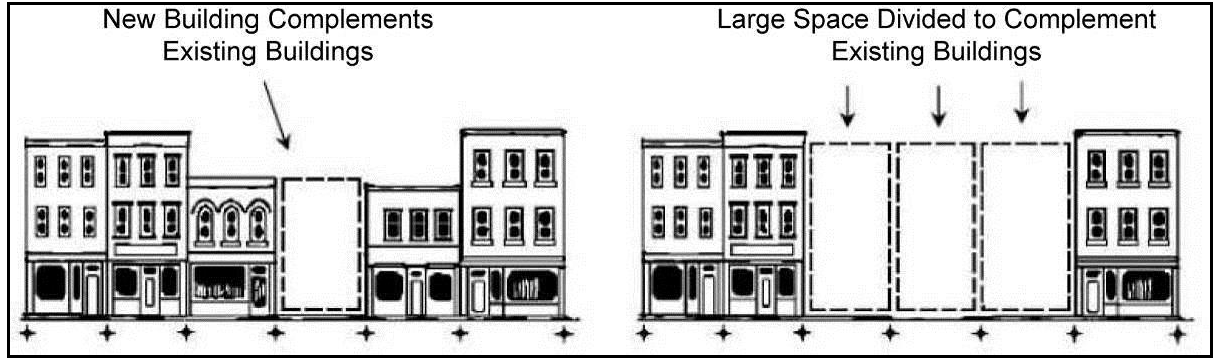
(b)
Horizontal elements. Buildings should maintain the alignment of key horizontal elements along the block or street edge. Long, uninterrupted horizontal elements should be avoided and interrupted with windowsills, moldings and mid-belt cornices. Building articulation should be accomplished with design elements and regular articulation intervals.
Where appropriate, the applicant should coordinate the horizontal elements (i.e., cornices, window lines, arcades, etc.) in a pattern and height to reflect similar elements on neighboring buildings that exhibit the city's desired scale and character for the area.
(i)
Repeating distinctive window patterns at intervals less than the articulation interval.
(ii)
Providing a porch, patio, deck, or covered entry for each articulation interval.
(iii)
Providing a balcony or bay window for each articulation interval.
(iv)
Changing the roofline by alternating parapet heights.
(v)
Changing materials with a change in building plane.
(vi)
Providing lighting fixtures, trellis, tree, or other landscape feature within each interval.
(b)
Vertical "articulation." To moderate the vertical scale of buildings, the design shall include techniques to clearly define the building's cornice, middle and bottom. See Figure 5.2. The following techniques are suggested methods of achieving vertical articulation:
(i)
Top. Strong eave lines, cornice treatments, horizontal architectural detailing. This treatment should return into alleyways and the full length of any facades clearly visible to the public.
(ii)
Middle. Windows with thoughtful solid-to-void ratios that exhibit window patterns of adjacent traditional buildings, balconies, material changes, railings and similar treatments that unify the building design.
(iii)
Bottom. Pedestrian-oriented storefronts, large windows, pedestrian scale building detail, kick plates below windows, sign band awnings, and arcades.
Figure 5.2: Appropriate Architectural Elements for Downtown
Buildings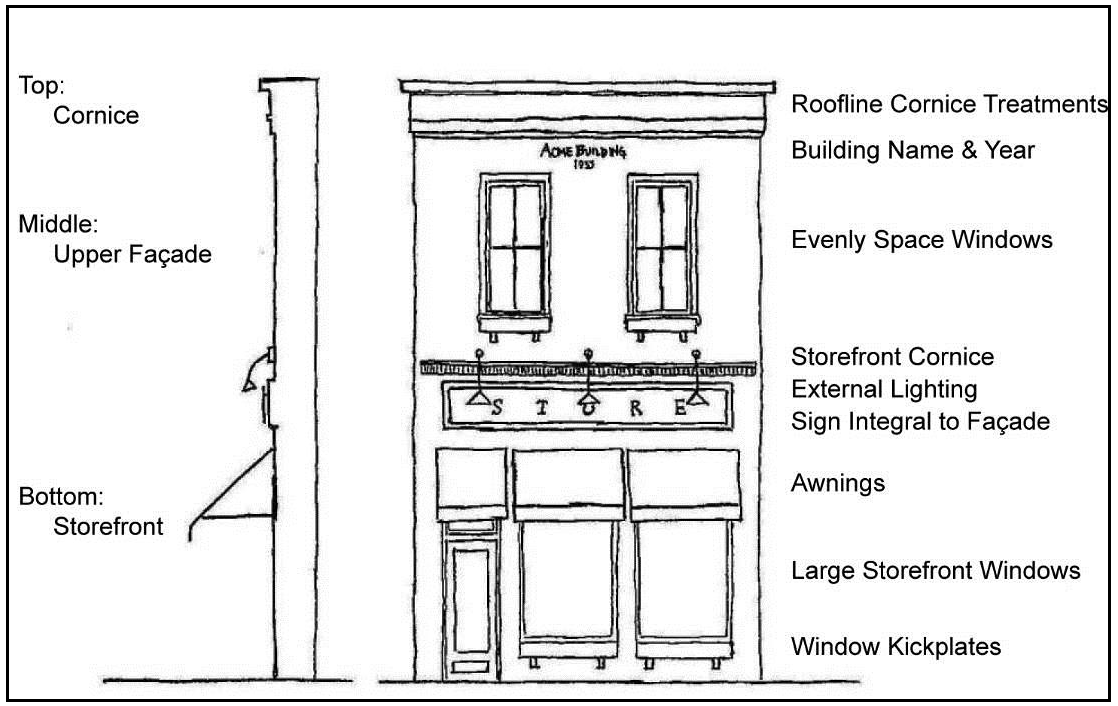
B.
Building exteriors.
(1)
Purpose. To ensure that buildings have design integrity at all observable distances; to ensure that exterior finishes are compatible with traditional main street character; to enhance buildings with appropriate design details; to encourage pedestrian-friendly street facades along streets and public parks or open spaces; to architecturally accentuate building corners at street intersections; to encourage the use of high-quality, permanent, compatible materials that will upgrade the visual image of downtown Sterling; to reduce the visual impact of large, undifferentiated walls.
(2)
Design standards.
(a)
Vernacular. Material finishes shall reflect the early 1900s "Main Street" vernacular for building materials for new building construction and buildings constructed before 1930. A new design that draws upon the fundamental similarities among older buildings in the area without copying them is preferred. This will allow the new project to be construed as a product of its own time, yet be compatible with its historic neighbors.
(b)
Façades.
(i)
Existing buildings. Retain facades that reflect the heritage of the city. Facades of vintage buildings may be adapted to contemporary use with compatible materials. Use of metal or plywood siding, metal screening, plastic, plywood, sheet wood products, or fiberglass to cover over existing facades is prohibited. Wood should not be used to cover over existing brick or stone masonry.
(ii)
New buildings. Building facades located adjacent to a sidewalk along downtown streets shall include transparent window area or window displays along the majority of the ground floor façade between two feet and eight feet above ground level and the following elements:
A.
Storefront with recessed entrance(s).
B.
Sign band (horizontal) or projecting sign.
C.
Prominent building address.
D.
Seasonal planters/landscaping.
(c)
Building entrances and fenestration. Building entrances should appear similar to those used historically. Clearly define the primary entrance with traditional architectural detailing, landscape features such as ornamental paving, tile work, planters and/or planting beds, or canopies. A contemporary interpretation of a traditional building entry, which is similar in scale and overall character to those seen historically, is encouraged in new buildings. The arrangement, proportion and design of windows and doors shall conform to the following:
(i)
The height to width ratio of single openings and group openings are to be proportionately scaled to the wall and adjacent buildings.
(ii)
Door and window details and trim suitably scaled to the wall and adjacent buildings.
(iii)
For ground floor retail uses and ground floor areas without retail use (such as customer lobbies, waiting rooms, offices, and employee lounges), devote at least 60 percent of the street wall area to windows in order to enhance the pedestrian character of the primary street.
(iv)
At upper level floors, devote at least 30 percent of the street wall area to windows.
Figure 5.3: Appropriate Period Window Treatments for Downtown Buildings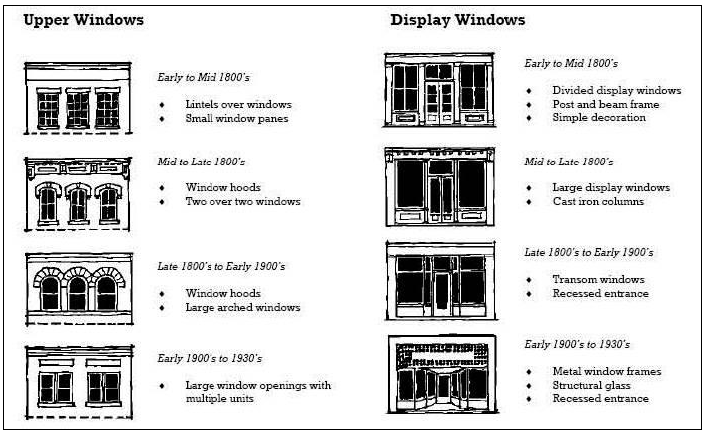
(d)
Ornamentation. New buildings should incorporate the following measures compatible with early 1900s "Main Street" buildings:
(i)
Decorative rooflines. An ornamental molding, entablature, frieze or other roofline device visible from the ground level.
(ii)
Decorative treatment of windows and doors. Decorative molding/framing details around all ground floor windows and doors, decorative glazing, or door designs located on facades facing streets or public parks or open spaces.
(iii)
Decorative light fixtures. Decorative light fixtures with a diffuse visible light source such as a globe or "acorn" that is non-glaring or a decorative shade or mounting.
(iv)
Decorative materials. Natural building materials, including masonry, brick, tone, wood clapboard, or other materials with similar decorative or textural qualities.
(e)
Building materials. Building exteriors shall be constructed from high quality, durable materials.
(i)
Preferred exterior building materials that reflect the city's desired traditional main street character and convey a sense of permanence:
A.
Brick and clapboard siding as the two primary façade materials on all building sides.
B.
Brick as the primary exterior finish material in most commercial and street-oriented projects. Detail and trim with brick, limestone, or pre-cast elements.
C.
Wood, fiber cement, or "hardboard" horizontal clapboard siding for historic-type structures and for neighborhood-scaled residential projects.
D.
Other materials subject to approval by the city.
(ii)
The following materials are prohibited in visible locations:
A.
Corrugated or beveled metal siding.
B.
Vinyl or plywood siding.
C.
Tinted or mirrored glass (except stained glass) as a major building element.
D.
Corrugated fiberglass.
E.
Chain link fencing.
F.
Crushed rock/crushed tumbled glass.
G.
Exterior insulation finish systems (EIFS) when used for the dominant façade material.
(f)
Colors. Exterior finish colors are to express the integral color of building materials (i.e. brick, cast stone). Colors should be neutral shades of natural colors found in nature in the local region, and include limited compatible accent colors. The color of neighboring buildings that comply with this section should be considered when selecting colors for repainting or remodeling of existing structures and for new structures.
(g)
Corner buildings. Buildings located at the intersection of streets should include design elements or treatments to the building corner facing the intersection.
(i)
Provide a corner entrance to a store, courtyard, building lobby, atrium, pedestrian pathway, or pedestrian-oriented space.
(ii)
Include corner architectural elements.
(iii)
Special treatment of pedestrian weather protection canopy at the corner of the building.
(iv)
Other similar treatment or element approved by the city.
(h)
Blank walls. Blank walls shall not be visible from a street, public park or open space. Treatment of blank walls is to be proportional to the front façade. The applicant must submit architectural plans and elevations showing proposed treatments for approval.
(i)
Franchise/corporate architecture. Prototype design for franchises should use customized components that are consistent with the desired traditional main street character and that reinforce visual consistency with other adjacent buildings. No franchise architecture will be allowed unless it can be shown that it is harmonious with the elements of typical early 1900s architectural detail.
(j)
Awnings.
(i)
Materials. Awnings shall be constructed of high-quality materials such as matte finish canvas or vinyl-coated canvas, and shall be of simple, historically compatible design to typical early 1900s downtown Sterling buildings. Awnings shall not be installed so as to obscure significant architectural details of a building. Bubble, box, or shiny plastic awnings shall be prohibited. Mansard awnings shall be prohibited in the DB district. Architectural metal awnings may be permitted with approval of the building and zoning superintendent.
(ii)
Colors. Solid color or striped awnings are permitted. Overly iridescent or fluorescent colors shall be prohibited.
(iii)
Signage. Signage on awnings shall comply with the regulations outlined in article VII, signage.
(iv)
Length. Awnings shall not exceed the width of a single building or building module. Awnings shall not be installed so as to extend across more than one storefront.
C.
Service, loading, outdoor storage and mechanical areas.
(1)
Purpose. Landscaping or other forms of screening shall be provided around outdoor service, storage, loading and mechanical areas to provide sensory (visual, olfactory, auditory) screening from adjacent properties, streets, affected pedestrian circulation routes, and affected pedestrian-oriented spaces.
(2)
General. Integrate outdoor storage areas and loading facilities into the site design to minimize their size, reduce visual impact, and where appropriate allow for pedestrian and vehicular movement between sites.
(3)
Outdoor storage areas. All outdoor storage and/or merchandise display areas shall comply with the regulations outlined in section 102-405.
(4)
Loading areas. All loading areas shall comply with the regulations outlined in section 102-228.
(5)
Mechanical/utility equipment. Mechanical and utility equipment can detract from the quality of a development and the character of an area. These standards mitigate the negative visual and acoustic impacts of mechanical and utility equipment systems located in a commercial development.
(a)
For new projects all utilities to serve buildings shall be run underground to reduce visual clutter.
(b)
Window air conditioning units shall not be installed on any building façade that faces a street.
(c)
Locate and screen mechanical equipment so that the equipment is not visible when viewed from ground level of adjacent properties. Mechanical units shall be set back from the building edge and located in areas that are not visible or obtrusive, such as low-profile mechanical units on rooftops that are not visible from public ways. Screen or match the color of roof mounted equipment with the exposed color of the roof to minimize visual impacts when roof mounted equipment is visible from nearby buildings and higher elevations.
(d)
Locate and screen utility meters, electrical conduit, and other service and utilities apparatus so as not to be visible from adjoining and nearby streets.
(6)
Outside refuse/trash areas.
(a)
Trash enclosures shall be located in convenient but not prominent areas, such as inside parking courts, or at the end of parking bays. They should be well screened with landscaping and designed to protect adjacent uses from noise and odors. A clear and safe pedestrian route shall be established to each trash area.
(b)
Trash enclosures shall be constructed from solid materials and adequately screened from adjacent units with landscaping as outlined in section 102-520. Architectural screening elements should be constructed of the same materials and finishes as adjacent buildings, and the color should be compatible with the adjacent buildings. Gates should be of a solid material and painted to match the architectural screening elements on nearby fences and walls.
(c)
Trash receptacles should be accessible for trash collection but should not block circulation drives near loading areas or conflict with parking. For security reasons, trash enclosure locations should not create blind spots or hiding areas.
(Ord. No. 2015-10-16, Exh. A, 10-5-15)
Sec. 102-510. - Multi-family residential design guidelines and standards.
A.
General provisions.
(1)
Purpose. The intent is to improve the overall quality of multi-family development in Sterling, ensure the compatibility of multi-family development with surrounding land uses, and improve the user-friendliness of the document and review process.
(2)
Applicability. Multi-family residential design guidelines and standards shall apply to the following:
(a)
New multi-family development of three units or more.
(b)
Major rehabilitation, renovation, restoration, modification, addition, or retrofit of a structure or site that exceeds 50 percent of the current value of any structure or site as established by Whiteside County. Major rehabilitation shall not include routine maintenance and repair of a structure or other feature on the surrounding site, such as roof replacement or general repairs to a parking area or other site feature.
(3)
Process. All projects shall be reviewed and approved as a part of the building site and operation plan procedures contained in section 102-924.
B.
Site planning.
(1)
Purpose. Enhance the image of the city, reflect unique site characteristics, and provide strong neighborhood environments; maintain local character by preserving and incorporating natural site features, significant natural areas, open space, and historic structures; preserve and integrate healthy and mature existing trees for the benefits of natural shading, air quality, stormwater management, and aesthetic value.
(2)
Common open space. Common open space areas are to have easy access by residents provides focal points for community recreation and interaction and adds to the overall quality of life for residents. Common open space should be integrated purposefully into the overall design of a development and not merely be residual areas left over after buildings and parking lots are sited.
(a)
Minimum area required. The minimum area of common open space shall be 15 percent of the total site.
(b)
Location. The common open space shall be integrated as meaningful spaces. Clustering of buildings is encouraged to minimize small, narrow, unassigned strips in front of and between buildings. Open space areas shall be clearly identified on the development plan. Such designated common open space shall be in a natural, undisturbed state, or may be landscaped for more formal courtyards or plazas, or may be developed for active or passive recreation.
(c)
Areas not allowed for common open space. The following shall not count toward common open space set-aside requirements:
(i)
Private lots, yards, balconies and patios dedicated for use by a specific unit.
(ii)
Public right-of-way or private streets and drives.
(iii)
Open parking areas and driveways for dwellings.
(iv)
Land covered by structures except for ancillary structures associated with the use of the open space such as gazebos and picnic shelters.
(v)
Designated outdoor storage areas.
(vi)
Land areas between buildings and parking lots or driveways of less than 40 feet.
(vii)
Required perimeter setbacks.
(3)
Preservation of natural features. Preserving significant natural features enhances local character while benefitting stormwater management, air quality, and provision of natural shade.
(a)
General guideline. Integrate existing natural features, required open space, and existing on-site historic structures or cultural resources into the overall development.
(b)
Preservation of existing trees and vegetation.
(i)
Tree survey and plan for tree preservation. An existing tree survey and plan for tree preservation and replacement shall be submitted with a required site plan to show compliance with the guidelines and standards.
(ii)
General guideline. Existing trees and vegetation should be preserved whenever possible to act as buffers between adjoining developments and as community amenities within the multi-family development.
(iii)
Desirable trees. Desirable trees shall be preserved or transplanted on-site to the maximum extent practicable. For purposes of this section, "significant" trees include the following:
A.
Deciduous trees with 12-inch minimum DBH;
B.
Evergreen trees 12 feet or more in height; or
C.
Groups or stands of ten or more trees with a minimum DBH of six inches.
Desirable trees in appropriate locations, such as along drainages and along the perimeter of the site should be used to fulfill landscaping or buffering requirements as outlined in section 102-520.
(iv)
Tree replacement. If a significant tree is removed or substantially damaged during clearing, grading, or construction, the applicant or developer shall replace the removed or damaged tree with new trees. Replacement trees shall be the same or similar species to the trees removed or damaged, or alternately a species appropriate for Whiteside County and approved by the building and zoning superintendent. For every one inch of tree DBH removed or damaged, the applicant or developer shall install the equivalent diameter inches of replacement tree DBH.
(v)
Tree protection during construction. Desirable trees shall be protected during construction barrier fencing. Grading shall be avoided within the root area or drip line of any existing preserved trees.
C.
Site layout and development pattern.
(1)
Purpose. Site layout and building orientation often define the focus of activity that occurs at the front door or along the street. The layout of the site also establishes the sense of community for a neighborhood by providing opportunities for people to gather. These standards are intended to use site planning and building orientation to:
(a)
Ensure that buildings relate appropriately to surrounding developments and streets and create a cohesive visual identity for the neighborhood and attractive street scene;
(b)
Promote efficient site layout in terms of vehicular and pedestrian circulation patterns;
(c)
Create a unique and identifiable image for new multi-family development in Sterling;
(d)
Ensure occupants' privacy through careful siting of buildings within a multi-family development (e.g., address sightline of window-to-window in adjacent buildings, limit buildings' primary orientation to parking lots).
(2)
Site layout guidelines and standards for multi-family developments.
(a)
Building organization. Individual buildings within a multi-family development shall be:
(i)
Clustered or grouped to form neighborhoods.
(ii)
Organized around a common open space, public open space (e.g., a greenway), natural features located on the site (e.g., stream corridor, stormwater management facility), or community amenities such as swimming pools or other recreational facilities.
(iii)
Oriented or arranged in a manner to enclose required common open spaces to the maximum extent practicable.
(iv)
Oriented to primary perimeter streets, including thoroughfares, or boundaries; or through-access drives.
(b)
Building orientation to street edges. To the maximum extent practicable, buildings along a public street should be oriented to avoid multiple parallel orientations to a public street. Instead, a variety of building orientations, including perpendicular and canted, or intervening open spaces should be provided to lessen the mass of buildings along the street. Multiple buildings may line up parallel to a public street if:
(i)
A building entrance faces the perimeter street.
(ii)
Common open space is centrally located in the interior of the site and accessible by all units.
(iii)
Privacy assurance. If any portion of a multi-family development is located adjacent to single-family residential uses, accessory structures including garages, then shall be set back a minimum of 25 feet from the adjacent single-family residential property line. The developer shall provide a buffer between the structure and adjacent property. The buffer may be a fence, wall, heavy landscaping, or combination thereof. Fences and walls used for buffer purposes shall comply with the regulations outlined in section 102-211, section 102-212, and section 102-520.
D.
Vehicular and pedestrian circulation and access.
(1)
Purpose. These guidelines and standards are intended to:
(a)
Create a hierarchy of streets and drives for new multi-family development.
(b)
Design streets and drives to create identifiable, safe neighborhood environments.
(c)
Provide safe and efficient vehicular circulation patterns within and between developments. Residential and collector drive design within a multi-family development should be designed to encourage building clusters that define identifiable neighborhoods within the multi-family development. So that a multi-family development should not become an isolated island in the surrounding community, the internal drive system should also offer connectivity between adjacent residential neighborhoods.
(d)
Use internal drives to define and protect important views.
(e)
Provide safe, identifiable pedestrian circulation patterns within and between developments.
(2)
Vehicle access and circulation.
(a)
Internal drive hierarchy. The organization of the internal drive system in a multi-family development should provide a hierarchy of three types of drives:
(i)
Low-volume, residential drives that serve individual building clusters.
(ii)
Collector drives that distribute traffic within the development and connect separate building clusters.
(iii)
Through-access drives that typically connect to the development's perimeter and to the public street system.
(b)
Internal drive design. The internal drive network should respond to topography, intended traffic speed, pedestrian usage and safety, and views. Excessively straight and wide drives encourage high traffic speed and do not have a residential scale. Accordingly, internal drive design within a multi-family development's boundaries shall comply with the following guidelines and standards:
(i)
The internal drive system shall connect to the perimeter public street system to provide multiple direct connections to and between local destinations such as parks, schools, and shopping.
(ii)
Interconnectivity. The internal drive system shall connect to the perimeter public street system to provide for both intra- and inter-neighborhood connections to knit separate developments together, rather than forming barriers between them. Accordingly, the internal drive system shall provide vehicle connections, other than primary vehicle access, to each adjoining residential or collector street.
(iii)
Multi-family developments greater than five acres shall include a minimum of one "through-access drive," which typically will be a private drive but may be a dedicated street, with detached sidewalks and landscaped terrace between the sidewalk and curb. The through-access drive shall be continuous through the site, and connect to a perimeter public street on either end.
(iv)
The design of all through-access drives shall be consistent with, and aligned with, residential drives or through-access drives on adjacent properties.
(v)
The internal drive system should be arranged to utilize both parallel and perpendicular streets in identifiable blocks or clusters, as well as occasional curvilinear or diagonal streets, except where sensitive natural areas would be unduly disturbed by such a pattern. "T" intersections are also encouraged in locations where views of important public spaces or natural or open areas can be highlighted.
(vi)
To the maximum extent practicable, drives should follow the natural contours of the site.
(c)
Vehicle access and circulation. Primary vehicle access to a multi-family development shall be from thoroughfare or collector streets. To the maximum extent practicable, unless required for emergency access, a multi-family development shall not have primary vehicle access from a local street that also serves single-family residences. Large multi-family developments shall have multiple primary access points from thoroughfare streets as required to ensure public safety.
(3)
Pedestrian access and circulation.
(a)
Minimum width. All on-site pedestrian walkways and sidewalks shall be a minimum of four feet wide, except walkways adjacent to a parking area, where cars may overhang the walkway, shall be a minimum of six feet wide.
(b)
Pedestrian connections. An on-site system of pedestrian walkways shall be designed to provide direct access and connections to and between the following:
(i)
The primary entrance or entrances to each principal multi-family building;
(ii)
To any sidewalks or walkways on adjacent properties that extend to the boundaries shared with the multi-family development.
(iii)
Any sidewalk system along the perimeter streets adjacent to the multi-family development as outlined in subsection (d) below.
(iv)
Any adjacent commercial land uses, including but not limited to retail shopping centers, office buildings, restaurants, or personal service establishments; and
(v)
Any adjacent public park, greenway, or other public or civic use including but not limited to schools, places of worship, public recreational facilities, or government offices.
(c)
Connections to primary entrances. In addition to the connections required in subsection (b) above, on-site pedestrian walkways shall connect each primary entrance of each principal multi-family building to the following:
(i)
Parking areas or parking structures that serve the principal multi-family building;
(ii)
Community amenities, such as swimming pools, community centers, other recreational facilities, or common open space; and
(iii)
Sub-community facilities intended to serve the particular multi-family building, such as mail centers.
(d)
Connections to perimeter street. Connections between the on-site (internal) pedestrian walkway network and any public sidewalk system shall be provided.
(e)
Connection markings. Each point at which the on-site pedestrian walkway system must cross a parking lot or internal street or driveway to make a required connection shall be clearly marked through the use of change in paving materials, height, or distinctive colors.
E.
Building design.
(1)
Purpose.
(a)
Create and add to the visual interest of Sterling streets;
(b)
Ensure distinctive quality and consistency in building architectural character and style;
(c)
Ensure building design and architectural compatibility within a multi-family development;
(d)
Promote compatibility with adjacent development, considering the context of adjacent residential neighborhoods, including the height, scale, mass, form, and character of surrounding development;
(e)
Provide building design details to avoid featureless building massing and reduce the visual scale of large multi-family buildings;
(f)
Achieve unity of design through the use of similar materials and colors;
(g)
Ensure use of durable and attractive building materials;
(h)
Encourage the provision of private open spaces for residents' enjoyment; and
(i)
Ensure accessory structures are compatible in design with the primary buildings they serve.
(2)
Building height/massing/form. These standards are intended to achieve the following purposes:
(a)
Building height. All structures shall comply with the building height standards outlined in section 102-321, bulk regulations.
(b)
Building massing and form.
(i)
Building length/number of units.
A.
No more than 12 dwelling units shall allowed in a multi-family structure.
B.
No more than six townhouse dwelling units shall be attached in any single row.
(ii)
Building design shall provide complex massing configurations with a variety of different wall planes and roof planes. Wall planes shall contain offsets or setbacks with a horizontal plane differential at least every 50 linear feet. Plain, monolithic structures with long, monotonous, unbroken wall surfaces of 50 feet or more are prohibited.
(iii)
The façades of single-family attached townhouses should be articulated to differentiate individual units.
(iv)
Multi-family building design should incorporate visually heavier and more massive elements at the building base, and lighter elements above the base. A second story, for example, should not appear heavier or demonstrate greater mass than that portion of the building it supports.
(3)
Architectural detail: Style, roof form, building façades, and fenestration.
(a)
Purpose. Provide a distinctive, quality, architectural character in new multi-family developments, incorporating architectural details to reduce the visual scale of large multi-family buildings and development.
(b)
Consistency in architectural style. Each building in a multi-family development should have a definitive, consistent style. Mixing of various architectural styles on the same building is discouraged.
(c)
Four-sided design required. All sides of a multi-family building shall display a similar level of quality and architectural interest. The majority of a building's architectural features and treatments shall not be restricted to a single façade.
(d)
Pedestrian-scale entrance required. All building entries adjacent to a collector or residential (local) public street or to a public street or private drive with on-street parking shall be pedestrian-scaled. Pedestrian-scaled entries are those that provide an expression of human activity or use in relation to building size. Doors, windows, entranceways, and other features such as corners, setbacks, and offsets can be used to create pedestrian scale.
(e)
Articulated building fronts. Fronts of buildings should be articulated through the use of bays, insets, balconies, porches, or stoops related to entrances and windows. All buildings shall be designed to provide complex massing configurations with a variety of different wall planes. At least every 75 linear feet, wall planes shall contain offsets or setbacks with a differential in horizontal plane.
(f)
Windows. All multi-family building elevations shall contain windows, except when necessary to assure privacy for adjacent property owners. Windows should be located to maximize the possibility of occupant surveillance of entryways, recreation areas, and laundry areas.
(g)
Garage doors. Garage doors of attached garages shall not comprise more than 50 percent of the total length of a multi-family building's front façade, and every two single-bay garage doors or every double garage door shall be offset by at least three feet from the plane of an adjacent garage door(s).
(h)
Roofs.
(i)
All multi-family buildings with pitched roofs shall have a pitched roof with a minimum slope ratio of 6:12, unless otherwise approved by the plan commission.
(ii)
On buildings where sloping roofs are the predominant roof type, each building shall have a variety of roof forms. For instance, a gable or hip configuration should be used with complimentary sheds, dormers, and other minor elements. Other roof forms will be considered on a case-by-case basis.
(iii)
All buildings shall incorporate varied roof planes. At least every 75 linear feet, roof planes shall contain offsets or setbacks with a differential in horizontal plane.
(iv)
Roof forms shall be designed to correspond and denote building elements and functions such as entrances and arcades.
(4)
Mechanical/utility equipment screening.
(a)
Intent. Mechanical and utility equipment can detracts from the quality of a development and the character of an area. These standards mitigate the negative visual and acoustic impacts of mechanical and utility equipment systems located in a multifamily residential development.
(b)
Design guidelines and standards. Mechanical/utility screening shall be an integral part of the building structure and architecture and not give the appearance of being "tacked on" to the exterior surfaces. Screening shall be provided through the use of fencing, landscape materials, or other materials compatible with the primary structure.
(5)
Mailboxes.
(a)
Mailboxes shall be located in highly visible, heavy use areas for convenience.
(b)
Incorporation of design features, such as a built frame consistent with the development's architectural style, is encouraged.
(6)
Trash/refuse enclosures.
(a)
Trash enclosures shall be located in convenient but not prominently visible areas. Trash receptacles should be accessible for trash collection but should not block circulation drives near loading areas or conflict with parking.
(b)
Clear and safe pedestrian routes shall be established to trash enclosures. For security reasons, trash enclosure locations should not create blind spots or hiding areas.
(c)
Trash enclosures shall be constructed from solid materials and adequately screened from adjacent units with landscaping. Architectural screening elements should be constructed of the same materials and finishes as adjacent buildings, and the color should also be compatible with the adjacent buildings. Gates should be of a solid material and painted to match the architectural screening elements on nearby fences and walls.
F.
Building materials.
(1)
Exterior building materials. High-quality building materials that are durable, attractive, and have low maintenance requirements shall be utilized.
(a)
Natural materials (i.e., cedar siding, brick, stone) are preferred materials for the exterior treatment of structures.
(b)
Brick, pre-cast textures concrete, architectural wood, architectural composites, or decorative (architectural) masonry block shall be utilized for at least 75 percent of the exterior treatment of all buildings, exclusive of fenestration.
(c)
Exterior building materials shall not include rough sawn or board and batten wood, smooth-faced or gray concrete block, painted concrete block, or tilt-up concrete panels. Metal or steel external siding shall not be permitted as a construction material for building elevations.
(2)
Roof materials. Predominant roof materials shall be high quality, durable material such as, but not limited to: wood shake shingles, clay or concrete tiles, composition shingles, and asphalt shingles. The use of metal/steel for roofing material is permissible and may be approved by the plan commission based upon context and overall site design.
(Ord. No. 2015-10-16, Exh. A, 10-5-15)
Sec. 102-520. - Landscape and buffer regulations.
A.
General provisions.
(1)
Purpose. Uniform landscape, screening, and tree preservation standards for development of property in the city and the review of plans to ensure that the city remains attractive, safe and comfortable.
(2)
Applicability. This chapter shall apply all developments except detached single-family detached, single-family attached, and two-family residential land uses. Every development shall provide sufficient landscaping so that neighboring properties are shielded from detracting visual aspects, and the appearance and desirability of development contributes to the overall attractiveness and economic health of the city.
(3)
Plan requirements.
(a)
Landscape plan required. A landscape plan following the standards set forth in this section shall be required for all projects requiring BSO plan review. The landscape plan shall be prepared by a landscape architect, certified nursery professional, a reputable nursery or person with demonstrated experience. Landscaping on any existing or proposed street right-of-way shall comply with the requirements as set forth by the City of Sterling Building and Zoning Superintendent. Landscape plans shall be reviewed and approved as a part of the building site and operation plan procedures contained in section 102-924.
(b)
Content of landscape plan. All landscape plans shall include or have attached thereto the following information:
(i)
North arrow, scale, date of plan and any subsequent revisions.
(ii)
The location and dimensions of all existing and proposed buildings, structures, parking lots and driveways, roadways and rights-of-way, sidewalks, bicycle paths, signs, refuse disposal areas, fences, free standing electrical equipment, light fixtures, other surface utility structures, and other free standing structural features, recreational facilities, setbacks and easements. The landscape plan shall be drawn at a legible scale.
(iii)
The location, quantity, size at planting, and both scientific and common names of all proposed plant materials.
(iv)
Existing and proposed contours, including the location of all proposed berming, at a one foot contour interval. Also included shall be the location, extent and general elevations of all detention and retention areas and drainage ways.
(v)
Specification of the type and boundaries of all proposed ground cover, including both scientific and common names of all proposed plant materials.
(vi)
The designation, location, type, and size of all existing trees four inches and larger in diameter measured one foot above natural grade. Any trees to be removed should be clearly identified. Trees which will be used to meet landscape requirements shall also be indicated. If required for reasons of clarity, this information may be placed on an additional illustration.
Where existing trees are grouped in a dense cluster, an overall tree mass may be used without a specific delineation of individual trees. If this technique is used, protected trees used to meet site landscape requirements must be tagged on-site and identified on the plan in tabular form.
(vii)
Details of all fences and walls proposed to be constructed on the site.
(viii)
Elevations, cross-sections and other site or construction details determined to be necessary by the building and zoning superintendent.
(ix)
The following notes shall be included on the face of all plans:
A.
The landscape installer must receive approval from the building and zoning superintendent for any substitutions or alterations to the plan.
B.
It is the responsibility of the landscape installer to have underground utilities located by JULIE prior to installation.
(x)
Name and contact information of the property owner.
(xi)
Name and contact information of the person/company who prepared the plan.
(4)
Timing of landscape improvements.
(a)
All required landscaping shall be installed prior to the issuance of a certificate of occupancy, unless otherwise approved by the building and zoning superintendent.
(b)
If weather conditions or other circumstances beyond the developer's control prevent installation of all or portions of the landscape materials and all other requirements for the issuance of a certificate of occupancy have been meet, a letter of credit or a performance guarantee approved by the city attorney to insure completion of approved landscaping shall be filed with the city treasurer. The amount of the performance guarantee and the required completion date shall be based on a cost estimate submitted to the building and zoning superintendent. If such a letter of credit or performance guarantee has already been submitted for the proposed landscape improvements, the city council may permit the developer to extend the performance guarantee for an additional specified period of time.
(5)
Guarantee. All plantings shall be guaranteed to be in a healthy and flourishing condition for a period of 18 months.
B.
Landscape requirements. The following shall establish standards for the landscape improvements required to be installed as part of the development of new buildings, structures and uses of land governed by this section:
(1)
Types of landscaped areas. This article regulates landscaping of four distinct areas of a parcel as follows:
(a)
Interior parkway;
(b)
Perimeter landscape area;
(c)
Foundation area;
(d)
Parking lots.
Figure 5.4: Landscaping Areas on a Typical Non-Residential Lot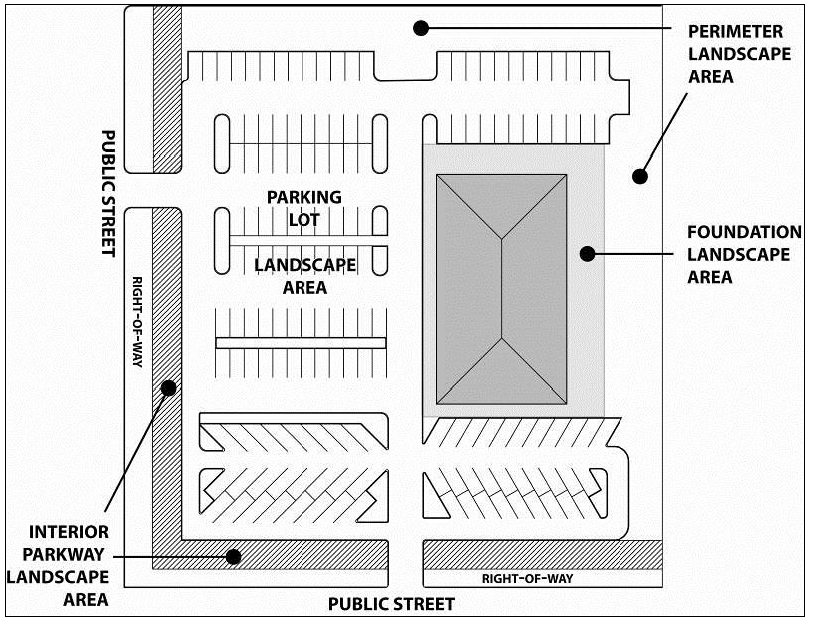
(2)
Landscaped criteria.
(a)
Interior parkway landscaping. An interior parkway shall be provided as identified in the Table 5.1. For corner lots, interior parkways shall be provided along both streets.
Table 5.1: Interior Parkway Depth
Except for access drives, interior parkways shall be landscaped as follows:
(i)
Parking along street yard. One tree per 40 feet of street frontage shall be provided. At least 50 percent of the required trees shall be appropriately sized or evergreen trees as identified in the recommended trees, shrubs, evergreen, and ground cover list outlined in section 102-520.D(3). Species may vary depending on design intent.
Shrub planting shall be a minimum of three feet in height and be located within the interior parkway to screen the parking area from the roadway. At intersections of access drives and streets, vision clearance triangles shall be maintained to allow unobstructed visibility between two and one-half feet and eight feet above grade, as shown in section 10-225, Figure 2.3. A maximum of 25 percent (measured at maturity) of the parking lot frontage may be left unscreened to permit design flexibility. The remainder of the interior parkway shall be planted with approved ground cover, flowers, or grass.
Figure 5.5: Interior Parkway Landscaping with Parking along a Street Yard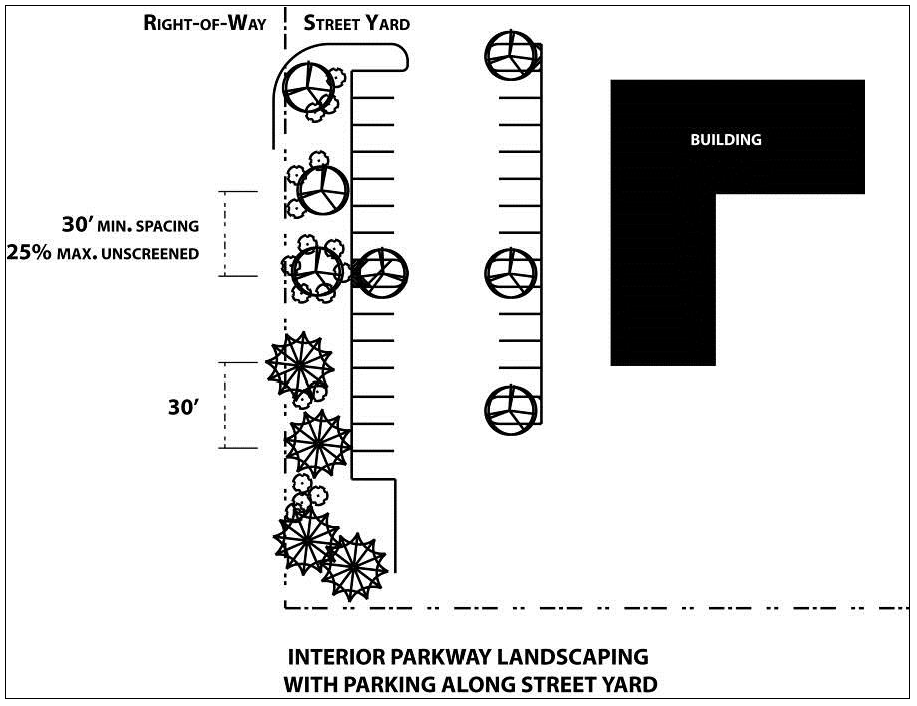
(ii)
No parking located along street yard. One tree per 50 feet of street frontage shall be provided. At least 50 percent of the required trees shall be appropriately sized or evergreen trees as identified in the recommended trees, shrubs, evergreen, and ground cover list. Tree type may vary depending on design intent. The remainder of the interior parkway shall be planted with shrubs, ground cover, flowers, or grass.
Figure 5.6: Interior Parkway Landscaping with No Parking along Street Yard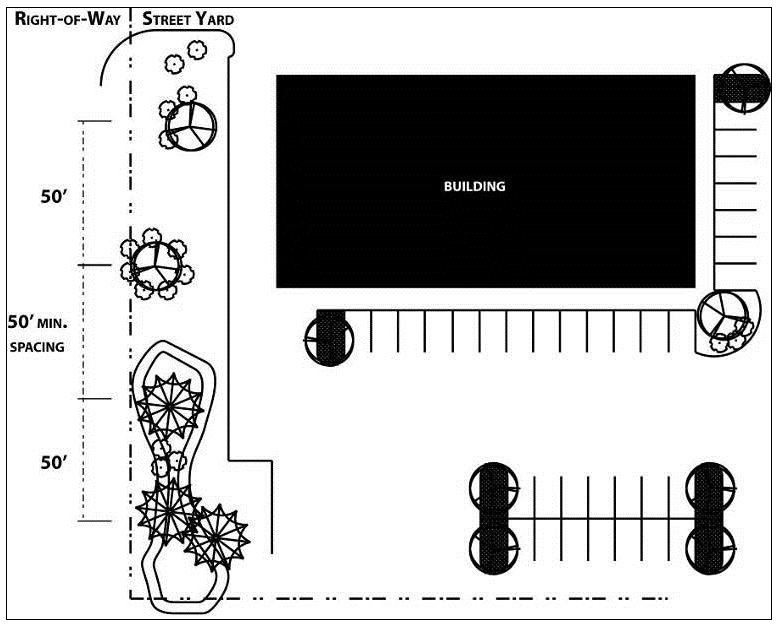
(iii)
For corner lots, interior parkways shall be provided along both streets.
(b)
Perimeter landscape area.
(i)
The perimeter area shall be equal to the required zoning district side and rear yard setbacks for the property as outlined in section 102-321, bulk regulations.
(ii)
Within the perimeter areas, berming, trees, and shrubs shall be provided to create a visual separation between properties. Appropriate berm height will depend on the width of the landscape area, with no berm having a slope greater than 3:1. A minimum of 40 percent of the length of the perimeter shall be planted with shrubs that will reach a height of at least four feet. Trees shall be provided in a quantity equal to one tree per 75 feet of perimeter length. Tree spacing shall be determined by tree species and design considerations. Up to 50 percent of the required trees in this screening alternative may be small deciduous trees.
(c)
Bufferyard screening.
(i)
Screening between adjacent residential and non-residential uses. To provide a substantial buffer between residential and non-residential uses, one of the following three buffering alternatives shall be required. The property owner may select the buffering alternative which best meets the configuration of the site and the proposed development. All fences, walls and hedges shall comply with section 102-211 and section 102-212.
A.
Alternative A. The buffering area shall be a minimum of eight feet in width for this alternative. An opaque brick or other approved decorative masonry wall six feet high shall be constructed along the entire perimeter, excluding area within the required front yard setback. The wall may be continued within the front yard provided the height is reduced to four feet. Appropriately sized trees in a quantity equal to one tree per 75 feet of perimeter length shall be provided. Tree spacing shall be determined by tree species and design considerations, and are not required to be evenly spaced.
Figure 5.7: Alternative "A" Screening between Adjacent Residential and Non-Residential
Uses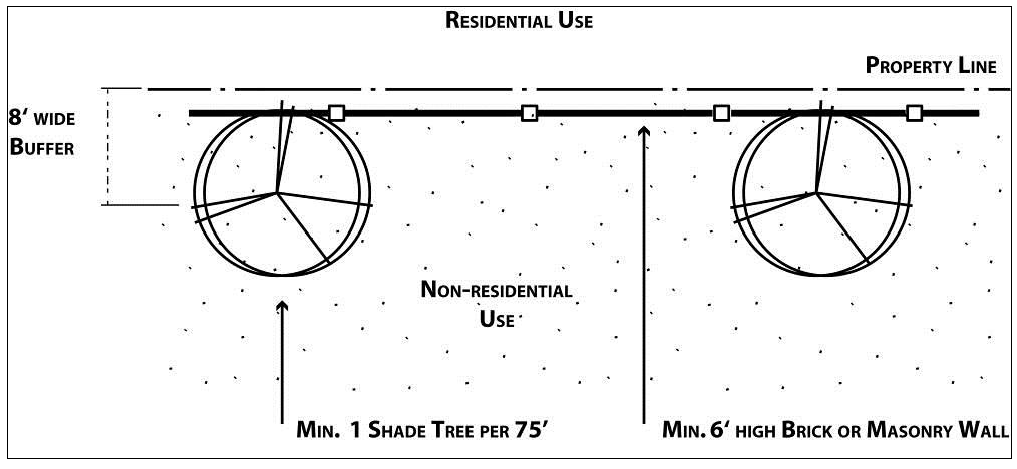
B.
Alternative B. A minimum 12-foot average buffer area shall be required for this alternative. A fence of wood or other approved material six feet high and at least 75 percent opaque shall be constructed along the entire perimeter, excluding area within the required front yard setback. The fence may be continued within the front yard provided the height is reduced to four feet. Shrubs shall be planted within the buffer area at a minimum rate of ten per 100 feet, massed appropriately in clusters. Appropriately sized trees shall be provided in a quantity equal to one tree per 60 feet of perimeter length. Tree location shall be determined by tree species and design considerations.
Figure 5.8: Alternative "B" Screening between Adjacent Residential and Non-Residential
Uses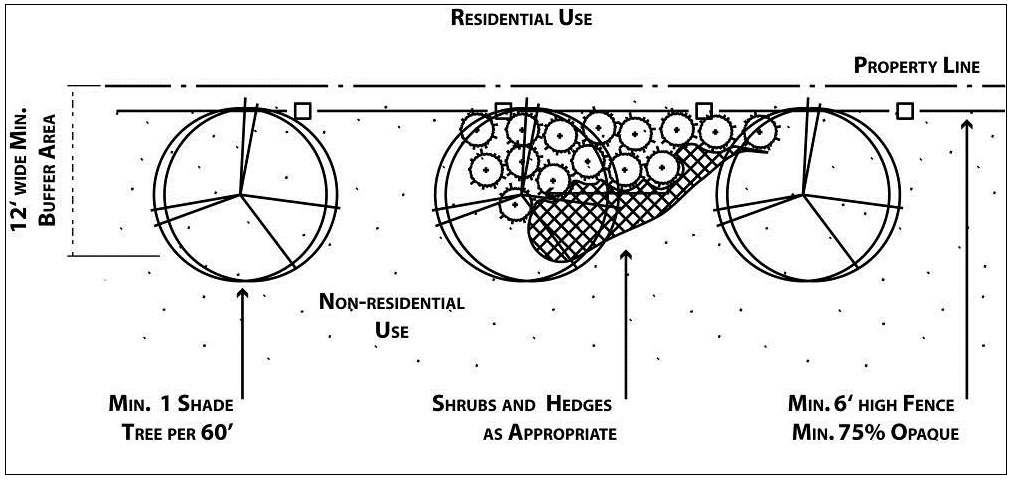
C.
Alternative C. A minimum 25-foot buffer area shall be required for this alternative. A berm at least three feet in height with a maximum 3:1 slope shall be constructed along the entire perimeter. Breaks in the berm may be provided as appropriate to accommodate drainage. The berm shall be planted with shrubs four feet or greater in height to provide screening along at least 75 percent of the perimeter length. Trees shall be provided in a quantity equal to one tree per 60 feet of perimeter length. Tree spacing shall be determined by tree species and design considerations. Up to 25 percent of the required trees in this screening alternative may be small deciduous trees.
Figure 5.9: Alternative "C" Screening between Adjacent Residential and Non-Residential
Uses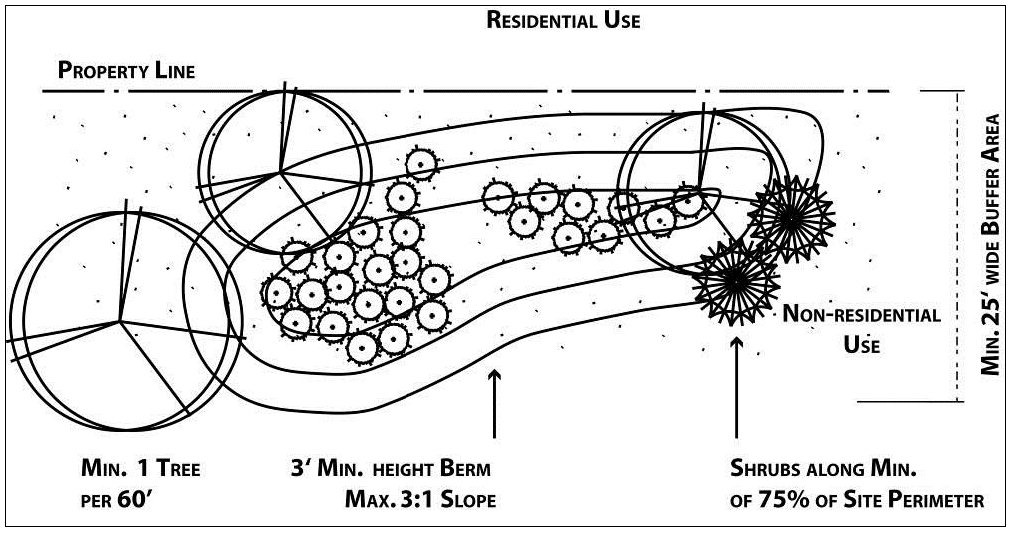
(ii)
Screening of parking areas. Where a non-residential parking lot will be located adjacent to a residential use, the screening regulations outlined in subsection (i) above apply. A parking lot will be placed along a perimeter such that parked cars will face the abutting non-residential property, shrubs and trees shall be required. Shrubs shall be provided along at least 50 percent of the length of the parking area. Shrubs shall be a minimum of three feet in height at maturity when screening a parking lot. Trees shall be provided in a quantity equal to one appropriately sized tree per 60 feet of parking lot length. Tree spacing shall be determined by tree species and design considerations. Up to 25 percent of the required trees in this screening alternative may be small deciduous trees.
Figure 5.10: Screening between Adjacent Non-Residential Uses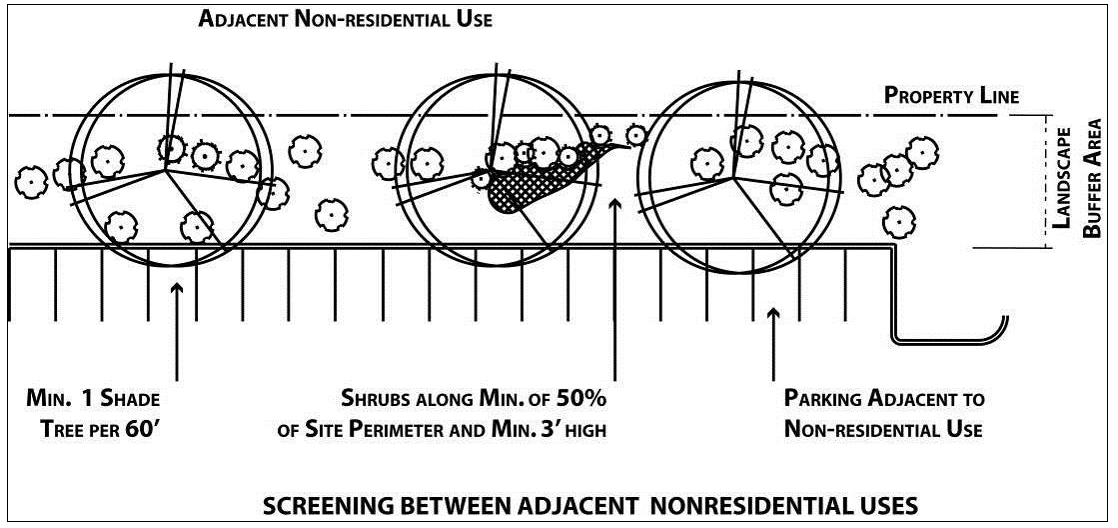
(iii)
Screening between single- and multi-family residential uses. This landscape screening is generally required between single- and multi-family residential areas. Berming, trees, and shrubs shall be provided to create a visual separation between properties. Appropriate berm height will depend on the width of the landscape area, with no berm having a slope greater than 3:1. A minimum of 60 percent of the length of the perimeter shall be planted with shrubs that will reach a height of at least six feet. Trees shall be provided in a quantity equal to one tree per 60 feet of perimeter length. Tree spacing shall be determined by tree species and design considerations. Up to 25 percent of the required trees in this screening alternative may be small deciduous trees.
Figure 5.11: Screening between Single- and Multi-Family Residential Uses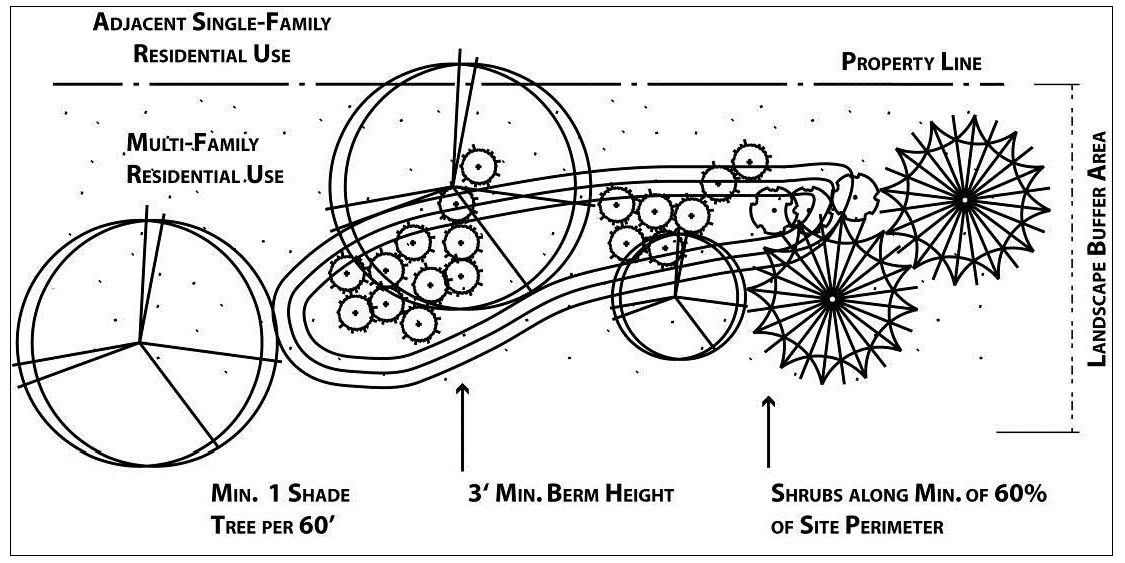
(d)
Foundation area landscaping.
(i)
Purpose. To soften large expanses of building walls, accent building entrances and architectural features, and screen mechanical equipment. Where extended roofs or canopies are used to provide a covered walkway adjacent to a building, foundation plantings are not required. Landscaping is required to separate vehicular areas from buildings.
(ii)
Location. Foundation landscaping areas shall be located along or adjacent to each applicable front, side or rear of a building, provided, however, where a portion of the front, side or rear of a building is devoted to pedestrian ingress/egress, vehicular ingress/egress, loading or drop-off zones, foundation landscaping areas may be aggregated into one or more locations along or abutting such front, side or rear of a building.
(iii)
Relationship to buildings. Foundation landscaping areas shall be located adjacent to the building or begin within 12 feet of the building (in the case of a walkway which runs adjacent to the building).
(iv)
Area. Foundation landscaping areas shall have a total area in square feet of not less than two feet times the length of the wall (2' × length of wall = area in square feet for foundation landscaping) to which the foundation landscaping is oriented, exclusive of building entries.
(v)
Plantings. Foundation landscaping areas shall be landscaped with trees, or shrubs/hedge plants, or in combination with other suitable ground cover materials and maintained.
(vi)
Minimum dimension. Foundation landscaping areas shall maintain a minimum depth in the smallest dimension of six feet, provided, however, the building and zoning superintendent may approve up to 25 percent of a foundation landscaping area to be included in above-ground planters having a minimum dimension of three feet.
(e)
Parking lot landscaping. For parking lots with more than ten parking spaces, the following standards shall apply:
(i)
There shall be a minimum seven-foot-wide planting island at both ends of parking rows and driveway entrances. The seven-foot dimension may be reduced to accommodate the triangular shape resulting from angled parking. The depth of the planting island shall be equal to the depth of the parking stalls.
Figure 5.12: Parking Lot Landscape Islands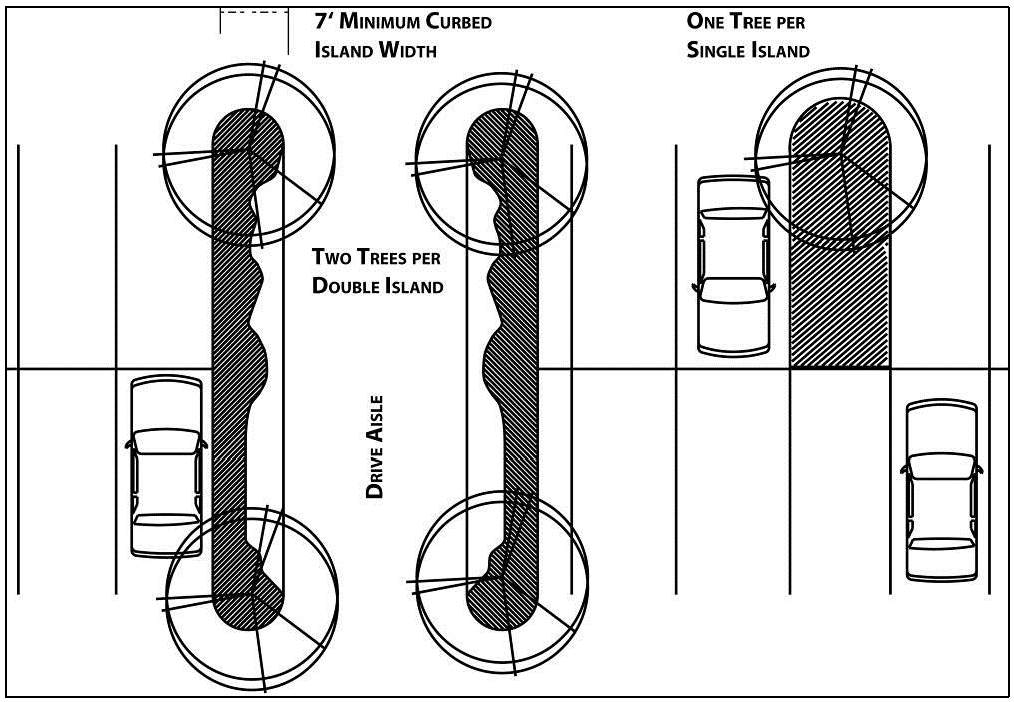
Figure 5.13: Parking Lot Landscape Islands Options and Dimensions
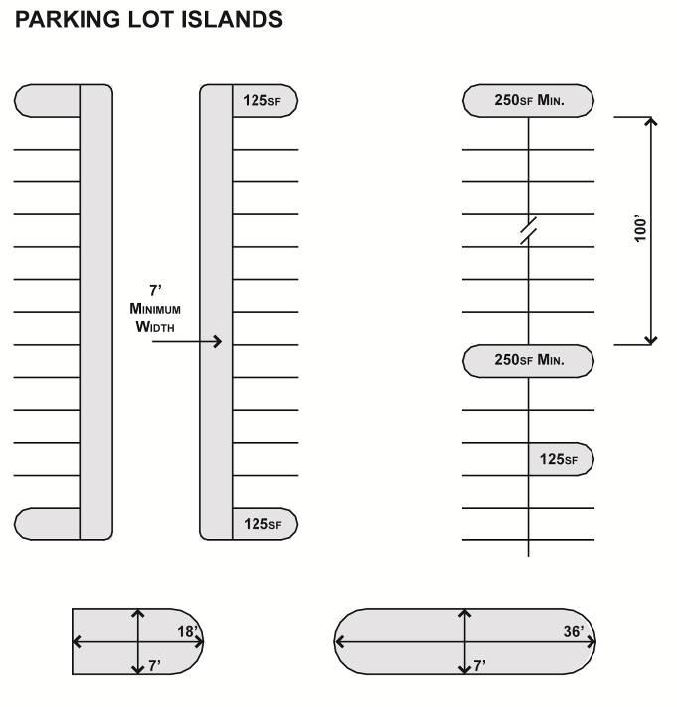 | 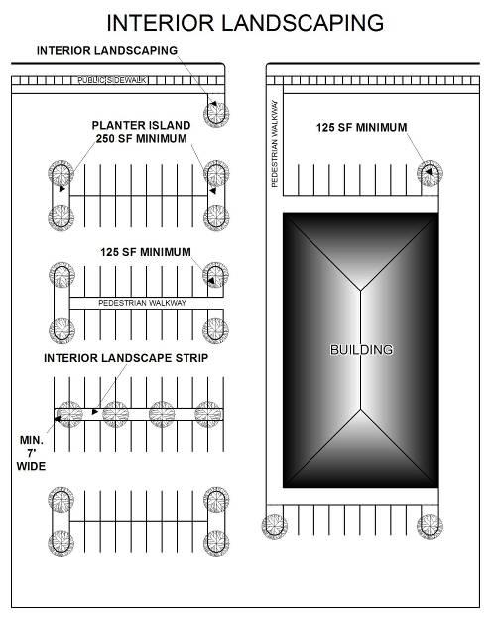 |
(ii)
All trees within a landscape island shall be pruned to have branching starting no less than six feet above the pavement.
(iii)
To break up long expanses of parking rows, landscape islands are required. One of the following alternatives shall be used to divide rows of parking spaces.
A.
Alternative A. A continuous curbed landscape island between rows may be provided in lieu of full stall planting islands between parking bays. Where such a continuous island is provided, it shall be a minimum of seven feet in width and shall contain a minimum of one tree per ten lineal parking spaces.
B.
Alternative B. One landscape island shall be constructed for every ten parking stalls. A curbed island at least seven feet wide and as deep as the parking stalls shall be provided to divide the bay length.
(iv)
As an alternative to standards (i) through (iii) above, a parking landscaping plan may be submitted, with or without curbing, consistent with other provisions contained in section 102-520.B(2)(e). Such plan shall provide landscaping for at least ten percent of the interior parking lot area.
C.
In addition to required trees, an appropriate planting of shrubs, ground cover plants, flowers, sod lawn and mulch shall be provided within all landscape islands. To insure vehicular visibility, shrubs shall not exceed a mature height of 30 inches above pavement on landscape islands at the end of parking rows.
(1)
Landscape design requirements. Functional activities within and adjoining the development site must be considered in the design of landscape improvements, including consideration of the following:
(a)
Service area screening. All service areas shall be screened from view through the use of evergreen plant materials, a fence, or masonry screen wall compatible with the proposed building design.
(i)
Trash dumpsters and other waste receptacles or equipment shall be screened with a fence or three-sided brick or other approved masonry walls at least six feet in height, with a solid, attractive single or double access gate on one side only.
(ii)
All utility equipment (air conditioners, transformers, etc.) shall be provided with appropriate planting screens. All dish antennas greater than 36 inches in diameter shall be adequately screened from adjoining properties by an opaque wall, fence, hedge or berm.
(iii)
All loading areas shall be fully screened so as not to be visible from adjoining rights-of-way and property zoned for any residential use.
(iv)
All outdoor storage facilities for fuel, raw materials and products within 500 feet of a residential district shall be effectively screened and enclosed by a solid wall or fence eight feet in height. If materials to be stored outdoors are in excess of eight feet in height, then landscape screening shall be provided in addition to the fence or wall installed along the outside perimeter of the fence or wall, equal or exceeding the height of the materials to be stored outdoors.
(b)
Intersection visibility. Landscaping must be designed and installed to minimize potential obstruction of critical sight lines. Landscape planting shall be so designed as to avoid obstruction of a motorist's vision at the intersections of outlot access drives and ring roads, access roads, alleys or municipal streets. Unobstructed visibility between two and one-half feet and eight feet above the height of the paved surface of the access road must be maintained at all intersections. To maintain this visibility, shrubs, trees, or other landscape material shall comply with the regulations outlined for sight triangles in section 102-224.
(c)
Berming shall not exceed a maximum slope of 3:1 except in parking islands, where the maximum slope shall not exceed 2:1.
(d)
Mulch materials shall be shredded bark or other organic material best suited for the City of Sterling. Gravel and stone mulches are not permitted, unless specifically approved in writing by the building and zoning superintendent.
(e)
All fences proposed to be used to meet landscape requirements shall be comply with section 102-211 of this chapter.
D.
Landscape plan and design review. The following guidelines shall be considered in reviewing the design and implementation of landscape plans in conjunction with review of site plans and special use permits.
(1)
Standards for plant materials. Materials planted in any development shall comply with the following requirements:
(a)
The quality and size of plant material selected shall comply with the latest edition of the "American Standard of Nursery Stock" published by the American Horticulture Industry Association unless otherwise indicated.
(b)
No artificial plants of any type shall be used to meet the requirements of this chapter in any landscape area within the parcel.
(c)
Minimum sizes for plant materials at time of installation for all landscape areas shall be as follows:
(i)
Deciduous trees shall be a minimum size of two and one-half-inch DBH when installed. Evergreen trees shall be a minimum six feet in height when installed.
(ii)
Deciduous shrubs (other than dwarf varieties) shall be a minimum of 24 inches in height at time of installation if used as a perimeter screen planting, and 18 inches in height for all other installations. Dwarf varieties and plants normally measured by spread shall be a minimum of 12 inches in spread.
(iii)
Ground cover shall be so planted and spaced that complete coverage can be obtained within two years after date of installation.
(iv)
Flower beds and the use of ornamental grasses is encouraged and shall be mass planted in acceptable areas to create color, texture and interest.
(d)
Property owners shall be responsible for maintaining all landscaping shown on the approved landscape plan throughout the life of the development. All dead plants shall be replaced with plants which meet original requirements. Annual flower beds shall be replanted each year with flowers adapted to the City of Sterling. No changes shall be permitted without the approval of the building and zoning superintendent or their designee.
(2)
Guide for landscape planting. The plant materials recommended in subsection (3) below have minimal maintenance requirements. However, all landscape material must receive a certain degree of care, especially during and immediately after planting. To protect an investment in new landscaping, proper horticultural techniques should be followed. The following recommendations are provided as a guide for planting based on current horticultural practice.
(a)
The best times for planting are early spring and early fall. Plants planted in the summer run the risk of dehydration.
(b)
Plant trees and shrubs at least three feet from the back of curb along head-in parking spaces to prevent damage from car overhangs. Mulch, lawn or planted ground cover shall further help avoid damage.
(c)
Dig tree pits at least one foot wider than the root ball.
(d)
Especially in areas where construction activity has compacted the soil, the bottom of the pit should be scarified or loosened with a pick ax or shovel.
(e)
After a pit is dug, observe subsurface drainage conditions. Where poor drainage exists, special provisions should be made to ensure proper drainage around the tree.
(f)
Backfill should include a proper mix of soil and nutrients. All roots must be completely covered. Backfill should be thoroughly watered as it is placed around the roots.
(g)
Plants should remain plumb and level. Newly planted trees may be supported with stakes and ties to hold it firmly in place. Remove stakes and ties after one year.
(h)
Spread at least two inches of mulch over plant beds in order to retain moisture and keep down weeds. A three-inch-deep saucer should be provided to form a basin around the trunk of the tree. This saucer helps catch and retain moisture.
(i)
The lower trunks of new trees may be wrapped with burlap or paper to prevent evaporation and sun scald. The wrapping should remain on the tree for at least one year.
(3)
Lists of recommended trees, shrubs, evergreen, and ground cover. Table 5.2 indicates plantings which will meet the landscape requirements of this chapter. The lists are by no means comprehensive and are intended merely to suggest the types of flora which would be appropriate for these purposes. Plants were selected for inclusion on these lists according to four principal criteria: general suitability for the climate and soil conditions of this area; ease of maintenance; tolerance to city conditions; and availability from area nurseries. All plantings shall be approved by the building and zoning superintendent.
Table 5.2: Plantings Meeting Landscape Requirements of this chapter
(Ord. No. 2015-10-16, Exh. A, 10-5-15; Ord. No. 2022-03-11, § 8, 3-7-22)

