
Sterling City Zoning Code
ARTICLE VII
SIGNS
Sec. 102-701.- Purpose of this article.
Purpose of article. The purposes of this article are to encourage the effective use of signs as a means of communication in the city, to maintain and enhance the aesthetic environment and the city's ability to attract sources of economic development and growth, to improve pedestrian and traffic safety, to minimize the possible adverse effect of signs on nearby public and private property, and to enable the fair and consistent enforcement of this article. This article is adopted under the zoning authority of the city in furtherance of the more general purposes set forth in this chapter.
(Ord. No. 2015-10-16, Exh. A, 10-5-15)
Sec. 102-702. - General.
A.
Applicability and effect of article.
(1)
A sign may be erected, placed, established, painted, created or maintained in the city only in conformance with the standards, procedures, exemptions and other requirements of this article.
(2)
The effect of this article, as more specifically set forth in this article, is to:
(a)
Establish a permit system to allow signs in residential, commercial and industrial zones subject to the standards and the permit procedures of this article;
(b)
Allow certain signs that are small, unobtrusive and incidental to the principal use of the respective lots on which they are located, subject to the substantive requirements of this article, but without a requirement for permits;
(c)
Provide for signs in limited circumstances in the public right-of-way;
(d)
Prohibit all signs not expressly permitted by this article; and
(e)
Provide for the enforcement of the provisions of this article.
B.
Sign purposes.
(1)
Advertising.
(2)
Auxiliary.
(3)
Community/public information.
(4)
Directional.
(5)
Group.
(6)
Identification.
(7)
Temporary.
C.
Sign types.
(1)
Awning.
(2)
Animated or moving.
(3)
Changeable copy. Also referred to as "reader boards."
(4)
Electronic message.
(5)
Freestanding.
(6)
Ground.
(7)
Individual channel letter.
(8)
Kiosk.
(9)
Marquee.
(10)
Menu board.
(11)
Mobile.
(12)
Monument.
(13)
Pole. Also referred to as a "pylon" sign type.
(14)
Portable.
(15)
Projecting.
(16)
Pylon. Also referred to as a "pole" sign type.
(17)
Reader board. See Changeable copy sign type.
(18)
Sandwich board.
(19)
Wall or façade.
(20)
In-window.
D.
Computation of area and height. The following principles shall control the computation of sign area and sign height:
(1)
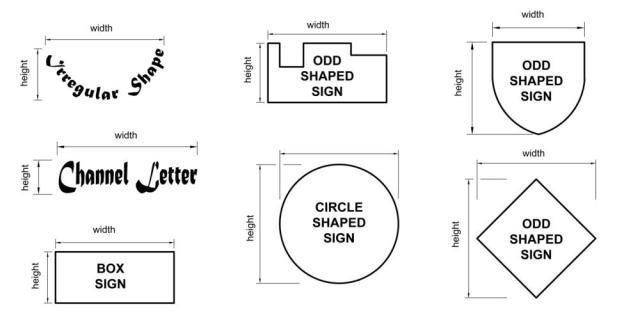
Area of individual signs. The area of a sign face (which is also the sign area of a wall sign or other sign with only one face) shall be computed by means of the smallest square, circle, rectangle, triangle or combination thereof that will encompass the extreme limits of the writing, representation, emblem or other display, together with any material or color forming an integral part of the background of the display or used to differentiate the sign from the backdrop or structure against which it is placed, but not including any supporting framework, bracing or decorative fence or wall when such fence or wall otherwise meets the regulations of this chapter and is clearly incidental to the display itself.
Figures 7.1 and 7.2: Area of Individual Signs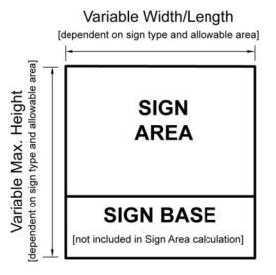
(2)
Area of multi-faced signs. The sign area for a sign with more than one face shall be computed by adding together the area of all of the sign faces visible from any one point. When two identical sign faces are placed back to back, so that both faces cannot be viewed from any point at the same time, and when such sign faces are part of the same sign structure and are not more than three inches apart, the sign area shall be computed by the measurement of one of the faces.
Figure 7.3: Area of Multi-faceted Signs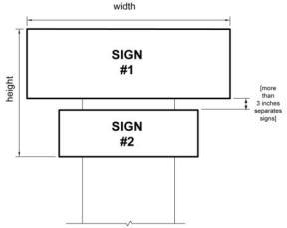
(3)
Height. The height of a sign shall be computed as the distance from the base of the sign at normal grade to the top of the highest attached component of the sign. Normal grade shall be construed to be the elevation of the established street in front of the building measured at the center of such front. Where no street grade has been established, the building and zoning superintendent shall establish such street grade or its equivalent for the purpose of this article.
(4)
Total area. The permitted sum of the area of all individual signs on a zoning lot shall be determined by the values outlined in Table B for the zoning district in which the lot is located. Lots fronting on two or more streets are allowed the permitted wall sign area for each street frontage. However, the total sign area that is oriented toward a particular street may not exceed the portion of the lot's total sign area allocation that is derived from the lot, building or wall area frontage on that street.
(Ord. No. 2015-10-16, Exh. A, 10-5-15)
Sec. 102-703. - Signage definitions.
A.
Rules of construction. The following words, terms and phrases, when used in this article, shall have the meanings ascribed to them in this section, except where the context clearly indicates a different meaning. Words and phrases not defined in this section but otherwise defined in this chapter shall be given the meanings set forth in this chapter. Principles for computing sign area and sign height are contained in section 102-702, general. All other words and phrases shall be given their common, ordinary meaning, unless the context clearly requires otherwise. Section headings or captions are for reference purposes only and shall not be used in the interpretation of this article.
B.
Definitions. Definitions for this article are found in section 102-115.
(Ord. No. 2015-10-16, Exh. A, 10-5-15)
Sec. 102-704. - Sign plans, approvals, and permits.
A.
Permit requirements.
(1)
If a sign requiring a permit under the provisions of this article is to be placed, constructed, erected or modified on a zoning lot, the owner of the lot shall secure a sign permit prior to the construction, placement, erection or modification of such a sign in accordance with the requirements of section 102-704.D.
(2)
No signs shall be erected in the public right-of-way except in accordance with section 102-271 and the special use requirements of section 102-818.
(3)
No sign permit of any kind shall be issued for a proposed sign unless such sign is consistent with the requirements of this article, including those protecting existing signs, in every respect, and with the signage plan in effect for the property.
B.
Submission of signage plan; contents; effect. No permit shall be issued for an individual sign requiring a permit unless and until a signage plan for the zoning lot on which the sign will be erected has been submitted to the building and zoning superintendent and approved by the building and zoning superintendent as conforming with this article.
(1)
Required information. For any zoning lot on which the owner proposes to erect one or more signs requiring a permit, the owner shall submit to the building and zoning superintendent a signage plan containing the following:
(a)
An accurate plot plan of the zoning lot, at such scale as the building and zoning superintendent may reasonably require;
(b)
Location of buildings, parking lots, driveways and landscaped areas on such zoning lot;
(c)
Computation of the maximum total sign area, the maximum area for individual signs, the height of the signs and the number of freestanding signs allowed on the zoning lot included in the plan under this article; and
(d)
An accurate indication on the plot plan of the proposed location of each present and future sign of any type, whether requiring a permit or not.
(2)
Window signs. A signage plan including window signs may simply indicate the areas of the windows to be covered by window signs and the general type of the window signs (e.g., paper affixed to window, painted, etched on glass, or some other material hung inside window), and need not specify the exact dimensions or nature of every window sign.
(3)
Other restrictions. The signage plan may contain such other restrictions as the owners of the zoning lots may reasonably determine.
(4)
Consent of owners. The signage plan shall be signed by all owners or their authorized agents in such form as the building and zoning superintendent shall require.
(5)
Submission and processing. A signage plan shall be included in any development plan, site plan, planned unit development plan or other official plan required by the city for the proposed development and shall be processed simultaneously with such other plan.
(6)
Amendments. A signage plan may be amended by filing a new signage plan that conforms with all requirements of this chapter then in effect.
(7)
Binding effect. After approval of a signage plan, no sign shall be erected, placed, painted or maintained except in conformance with such plan, and such plan may be enforced in the same way as any provision of this article. In case of any conflict between the provisions of such a plan and any other provision of this article, this article shall control.
(8)
Assignment of sign permits. A current and valid sign permit shall be freely assignable to a successor as owner of the property or holder of a business license for the same premises, subject only to filing such application as the building and zoning superintendent may require and paying any applicable fee. This assignment shall be accomplished by filing and shall not require approval.
C.
Approval of sign permits and signage plans. The following procedures shall govern the application for and issuance of all sign permits under this article, and the submission and review of signage plans:
(1)
Application. All applications for sign permits of any kind and for approval of a signage plan shall be submitted to the building and zoning superintendent on an application form or in accordance with application specifications published by the building and zoning superintendent. Applications for display advertising signs shall include the name and address of the owner of the display advertising sign if different from the owner or tenant of the property.
(2)
Fees. Each application for a sign permit or for approval of a signage plan shall be accompanied by the applicable fees, which shall be established by the council from time to time by resolution.
(3)
Determination of completeness. Within five working days of receiving an application for a sign permit or for a signage plan, the building and zoning superintendent shall review it for completeness. If the building and zoning superintendent finds that it is complete, the application shall then be processed. If the building and zoning superintendent finds that it is incomplete, the building and zoning superintendent shall, within such five-working-day period, send to the applicant a notice of the specific ways in which the application is deficient, with appropriate references to the applicable sections of this article.
(4)
Issuance or denial of permit. Within five working days of the submission of a complete application for a sign permit, the building and zoning superintendent shall either:
(a)
Issue the sign permit, if the signs that are the subject of the application conform in every respect with the requirements of this article and of the applicable signage plan; or
(b)
Reject the sign permit, if the signs that are the subject of the application fail in any way to conform with the requirements of this article and of the applicable signage plan. In case of a rejection, the building and zoning superintendent shall specify in the rejection the sections of this article or applicable plan with which the signs are inconsistent.
(5)
Action on signage plan. On any application for approval of a signage plan, the building and zoning superintendent shall take action as follows: not more than ten working days after the submission of a complete application if the application is for signs for existing buildings; or on the date of final action on any related application for a building permit, site plan or development plan for signs involving new construction. On or before such applicable date, the building and zoning superintendent shall either:
(a)
Approve the proposed plan if the signs as shown on the plan and the plan itself conforms in every respect with the requirements of this article; or
(b)
Reject the proposed plan if the signs as shown on the plan or the plan itself fails in any way to conform with the requirements of this article. In case of a rejection, the building and zoning superintendent shall specify in the rejection the sections of this article with which the plan is inconsistent.
D.
Permit for construction or modification; inspection. Signs identified as "P" on Table A shall be erected, installed or created only in accordance with a duly issued and valid sign construction permit from the building and zoning superintendent. Such permits shall be issued only in accordance with the following requirements and procedures:
(1)
Signs outside of public right-of-way. An application for construction, creation or installation of a new sign or for modification of an existing sign shall be accompanied by detailed drawings to show the dimensions, design, structure and location of each particular sign, to the extent that such details are not contained on a signage plan then in effect for the zoning lot. One application and permit may include multiple signs on the same zoning lot.
(2)
Signs within public right-of-way. An application for construction, creation or installation of a new sign or for modification of an existing sign within the public right-of-way shall be accompanied by detailed drawings to show the dimensions, design, structure and location of each particular sign, to the extent that such details are not contained on a signage plan then in effect for the zoning lot. Prior to the issuance of a permit for a sign within the public right-of-way, the applicant shall comply with the requirements of chapter 102, article VII.
(3)
Inspection. The building and zoning superintendent shall cause an inspection of the zoning lot for which each permit for a new sign or for modification of existing sign is issued during the sixth month after the issuance of such permit or at such earlier date as the owner may request. If the construction is not substantially complete at the time of inspection, the permit shall lapse and become void. If the construction is substantially complete but not in full compliance with this article and applicable codes, the building and zoning superintendent shall give the owner or applicant notice of the deficiencies and shall allow an additional 30 days from the date of inspection for the deficiencies to be corrected.
E.
Certificate of compliance for existing signs. The owner of a zoning lot containing signs present at the date of adoption of this chapter or annexation to the city and requiring a permit under this chapter shall be provided a certificate of compliance for such property.
(1)
Signs existing at adoption of chapter. A preliminary certificate of compliance for all zoning lots with existing signs shall be issued by the building and zoning superintendent within 180 days of adoption of this chapter. The building and zoning superintendent may cause an inspection of the zoning lot for which the certificate is to be issued.
(2)
Signs existing at time of annexation. For any sign on property annexed after the date of adoption of this chapter, a preliminary certificate of compliance shall be issued within 180 days of the effective date of the annexation or within such period as may be established in an annexation agreement between the city and the landowner.
(3)
Objection to accuracy of preliminary certificate of compliance. Upon receipt of the preliminary certificate of compliance, the owner of the zoning lot or a designee shall be allowed 30 days to object in writing to the accuracy of the certificate. Upon objection, the building and zoning superintendent shall cause an inspection of the zoning lot for which the certificate is to be issued. A final certificate of compliance shall be issued within 60 days of receipt of the objection. If no objection is filed within 30 days, a final certificate of compliance shall be issued by the building and zoning superintendent.
(4)
Assignment. A current and valid certificate of compliance shall be freely assignable to a successor as owner of the property or holder of a business license for the same premises, subject only to filing such application as the building and zoning superintendent may require and paying any applicable fee. The assignment shall be accomplished by filing and shall not require approval.
(5)
Permit fees. The building and zoning superintendent shall collect fees in advance for sign permits. Fees for permits shall be established in resolution form by the city council.
(Ord. No. 2015-10-16, Exh. A, 10-5-15)
Sec. 102-705. - General signage regulations.
A.
Sign prohibitions and limitations.
(1)
No sign shall use any word, phrase, symbol, shape, form, or character in such manner as to interfere with moving traffic, including signs that incorporate typical street-type and/or traffic control-type signage designs and colors.
(2)
Portable signs shall be prohibited.
(3)
Roof signs shall be prohibited.
(4)
Signs imitating or resembling official signs shall be prohibited.
(5)
Strings of lights not permanently mounted to a rigid background, except those exempt under the section 102-705.B.
(6)
No undulating, swinging, rotating, or otherwise moving signs or other decorations shall be permitted.
(7)
No illuminated flashing signs shall be permitted. Electronic message signs are permitted as outlined in section 102-709, changeable copy signs and electronic message signs. Chasing lights shall not be allowed.
(8)
No illuminated sign shall be permitted unless the illumination of the sign is so designed that the lighting element is not visible from any property within a residential zoning district. All illuminated signs shall comply with the section 102-606, exterior lighting and the National Electrical Code.
(9)
Sign panels, other than font and graphics, if translucent and illuminated, shall not emit light and shall emit a darker color than that used for illuminated font and graphics. This shall not apply to channel letter or changeable copy signs.
(10)
No mobile signs shall be permitted;
(11)
Off-premises directional signs shall be permitted only for governmental and institutional uses.
(12)
No inflatable signs shall be permitted, except as temporary signs.
(13)
No sign shall be placed so as to obstruct or interfere with traffic visibility.
(14)
No off-premises advertising signs shall be permitted except for the small blue highway information signs as provided within the right-of-way per applicable State of Illinois Statutes. Existing, legally permitted off-premises advertising signs shall made nonconforming by this article and shall be permitted to continue as legal, nonconforming structures.
(15)
Window obstruction by interior signs shall comply with the regulations outlined in Table B.
(16)
Abandoned signs. See section 102-715, closed business signs and abandoned signs.
(17)
Floodlighted signs. Floodlighted signs or reflection-illuminated signs whose light source is positioned so that its light source is visible from a public right-of-way by vehicular traffic or whose light source is visible from adjoining property and signs shall be prohibited.
(18)
Unclassified signs.
(a)
Which bear or contain statements, words or pictures of obscene, pornographic or immoral subjects.
(b)
Which is a hazard or dangerous distraction to vehicular traffic or a nuisance to adjoining residential property.
(c)
Which are an imitation of, or resemble in shape, size, copy or color an official traffic sign or signal.
(19)
Painted wall signs. Painted wall signs which are painted directly on the surface of the building.
(20)
Illegal placement. Signs, which are attached or otherwise affixed to rocks, trees or other living vegetation.
(21)
Strobes and lasers. Strobes and lasers are not allowed.
(22)
Flags. Flags that advertise any product are not allowed.
(23)
Beacons. The use of beacons is not allowed.
(24)
Balloons. Balloons exceeding a diameter of two feet may not be used on a permanent basis. A permit for such an advertising device may be issued for up to three days and may not exceed a total of 15 days or five permits per year.
B.
Exempt signs. The following signs shall be exempt from regulation under this article:
(1)
Public signs. Any public notice or warning required by a valid and applicable federal, state or local law, regulation or ordinance;
(2)
Signs inside buildings. Any sign inside a building, not attached to a window or door, that is not legible from a distance of more than three feet beyond the lot line of the zoning lot or parcel on which such sign is located;
(3)
Art. Works of art that do not include a commercial message;
(4)
Memorial signs and plaques. Memorial signs and tablets, names of buildings and date of erection, which are cut into masonry surface or inlaid so as to be part of a building or when constructed of bronze or other noncombustible material not more than four square feet in area.
(5)
[Historic markers or identification signs.] Historic markers or identification signs which are externally illuminated and do not exceed eight square feet in area and six feet in total height.
(6)
Professional and business name plate signs. Professional and business name plate signs shall be located on the premises being served and shall be limited to one such sign per business. One professional name plate sign shall not exceed two square feet.
(7)
Flags. Governmental entity flags which are the official flags of the United States, State of Illinois, or City of Sterling, or related agencies and which are properly displayed shall be exempt from the provisions of this chapter. Flags not exceeding 15 square feet displaying the logo or name of a non-governmental entity shall be exempt.
(8)
Patriotic buntings. Red, white and blue patriotic buntings shall be allowed to be tastefully displayed without time limitation.
(9)
Murals. Artwork or other pictorial display on a building or structure, judged by the mural commission and building and zoning superintendent not to be signage, shall be exempt from this chapter.
(10)
Holiday related. Holiday lights and decorations with no commercial message, but only between November 1 and January 15.
(11)
Traffic control on private property. Traffic control signs on private property, such as stop, yield, and similar signs, the face of which meets state department of transportation standards and which contain no commercial message of any sort.
(12)
Safety signs. Signage as required by the Occupational Safety and Health Administration (OSHA).
C.
Sign location requirements.
(1)
No sign shall be erected or maintained at any location where by reason of its position, wording, illumination, size, shape, or color it may obstruct, impair, obscure, interfere with the view of, or be confused with, any authorized traffic control sign, signal or device. Freestanding signs may not locate within vision triangles nor otherwise impede traffic or pedestrian visibility.
(2)
No sign shall be located within a required bufferyard or within a permanently protected green space area.
(3)
No sign shall be mounted or displayed on the roof of a structure.
(4)
Private signs shall not be allowed within road right-of-way lines, except as outlined in section 102-711, signage in the public right-of-way.
(5)
Awnings shall be free of backlighting and only contain a lettering band with a single line of copy less than eight inches tall located on the vertical face of the awning and shall be located a minimum of seven and one-half feet for the fabric, and eight feet for the frame, over pedestrian ways. Awnings shall not project more than two-thirds of the distance of the sidewalk width, and the leading edge of the awning shall be located a minimum of two feet from the curb line.
(6)
No person shall erect, construct, or maintain any sign upon any property or building without the express consent of the owner or person entitled to possession of the property or building or their authorized representative.
D.
Directional signs.
(1)
A sign not to exceed five square feet in area indicating direction to a church, hospital, school or other public service building may be permitted in any district upon approval by the plan commission. Not more than four such signs may be erected within the city for any organization.
(2)
Directional signs located in the public right-of-way shall conform to the regulations outlined in section 102-711, signage in the public right-of-way.
E.
Sign configuration requirements.
(1)
Freestanding sign configuration. A freestanding sign shall not be erected so that it impedes visibility for safe pedestrian and/or vehicular circulation. The footing and related supporting structure of a freestanding sign including bolts, flanges, brackets, etc., shall be concealed by the sign exterior, masonry covering, earth and permanent groundcover, or through the use of evergreen shrubs.
(2)
Projecting sign configuration. The bottom edge of a projecting sign shall be located a minimum of ten feet from the ground level directly under the sign. Such sign shall be mounted directly to a building. In no instance shall such sign project more than four feet into or two-thirds of the distance of the sidewalk width over a public right-of-way or private walk, street, drive, or parking area. The leading edge of the sign shall be located a minimum of two feet from a curb line.
(3)
Wall sign configuration. A wall sign shall not extend beyond the edge of any wall or other surface to which it is mounted, nor shall it project more than 12 inches from its surface. The height of a wall sign shall be measured from the base of the building below the sign to the top of the sign face. The top of the sign shall be no higher than the nearest portion of the building to which it is mounted without a special use permit. Signs painted directly on a wall or other portion of a building are not permitted.
(4)
Advertising vehicle sign configuration. No persons shall park any vehicle or trailer on a public right-of-way or on private properties so as to be seen from a public right-of-way, that has attached thereto or located thereon any sign or advertising device for the basic purpose of providing advertisement of products or directing people to a business activity located on the same or nearby property or any other premise. Licensed business vehicles containing typical business signage and that are actively used on a daily basis for business purposes, are exempt from this prohibition.
(5)
Incidental signs. Signs that are small, unobtrusive and incidental to the principal use of the respective lots on which they are located, subject to the substantive requirements of this article, but without a requirement for permits shall be allowed. Such a sign may include a building marker indicating only the name of the building, and the date and incidental information about its construction which is cut into a masonry surface or made of bronze or other permanent material. Incidental signs shall not exceed four square feet in area.
(6)
Menu boards. Menu board signage for restaurants present unique communication needs and concerns. One menu board not to exceed 36 square feet in sign area and not to exceed six feet in height is allowed per order station up to a maximum of two menu boards. Menu boards are allowed in addition to other permitted freestanding and directional signs on site. No additional signage may be attached to menu boards that exceed the permitted area or height for the respective menu board. When a site directly abuts a residentially zoned and used site, a menu board must be set back at least 75 feet from the residential property line. Illumination is permitted.
(7)
Subdivision identification signs. Subdivision entrance signs shall be allowed at the main entrance(s) to a subdivision with a maximum area of 32 square feet, shall be monument-type signs that state the name of the subdivision or development only, and shall not be located in the right-of-way. The maximum height shall be six feet as measured from the surrounding grade.
(8)
Industrial park, business park, or commercial park identification signs. Development entrance signs shall be allowed at the main entrance(s) to an industrial park, business park, or commercial park. Signs shall be a maximum area of 48 square feet, shall be monument-type signs that state the name of the development only, and shall be located a minimum of five feet from a property line or the public right-of-way. The maximum height shall be eight feet as measured from the surrounding grade.
(Ord. No. 2015-10-16, Exh. A, 10-5-15)
Sec. 102-706. - Permitted signs by zoning district; sign location, number and dimensions; signs requiring permit.
A.
Signs shall be allowed on private property in the city in accordance with, and only in accordance with, Table 7.1. If the letter "Y" appears for a sign type in a column, such sign is allowed without prior permit approval in the zoning districts represented by that column. If the letter "P" appears for a sign type in a column, such sign is allowed only with prior permit approval in the zoning districts represented by that column. Special conditions may apply in some cases. If the letter "N" appears for a sign type in a column, such a sign is not allowed in the zoning districts represented by that column under any circumstances.
B.
Although permitted under subsection (a) of this section, a sign designated by an "Y" or "P" in Table 7.1 shall be allowed only if:
(1)
The sum of the area of all building and freestanding signs on the zoning lot conforms with the maximum permitted sign area as determined by the formula for the zoning district in which the lot is located as specified in Table 7.1.
(2)
The size, location, and number of signs on the lot conform with the requirements of Table 7.1 and Table 7.2, which establish permitted sign dimensions and characteristics by sign type, and with any additional limitations listed in Table 7.1.
C.
Key to Table 7.1 and Table 7.2. On the tables in this article which are organized by zoning district, the headings have the following meanings:
Table 7.1: Permitted Signs by Type and Zoning District
Table 7.2: Permitted Sign Characteristics and Locations by Zoning District
(Ord. No. 2015-10-16, Exh. A, 10-5-15)
Sec. 102-707. - Sign regulations applicable to residential districts.
Signs permitted in residential districts. All signs are prohibited in all residential and agricultural districts, except the following signs, which are permitted subject to the following regulations:
A.
Signs over show windows or doors of a nonconforming business establishment announcing without display or elaboration only the name and occupation of the proprietor, and not to exceed two feet in height and ten feet in length;
B.
Real estate signs.
1.
Real estate signs which advertise the sale, rental or lease of premises upon which they are temporarily located only, may be placed in any district. A real estate sign shall not exceed eight (8) square feet in area.
2.
Real estate signs shall be limited to one sign for each lot except corner lots where two signs, one facing each street, shall be permitted. Real estate signs shall be removed within seven days of the sale or lease of the subject property.
3.
Temporary real estate open house directional signs may be located on private property only with owner permission. Directional signs may also be posted in the right-of-way between the curb and sidewalk or in the absence of curb or sidewalk, within three feet of the edge of the road.
4.
All temporary real estate directional signs must be removed the same day posted, immediately after closing of the open house.
5.
Confiscated signs will be available for owner pick-up at the code enforcement office.
6.
Temporary flags or banners may be displayed to promote the sale or rental of model homes or apartments for the duration of their use as models only after authorization by the building and zoning superintendent.
C.
Name, occupation and warning signs not to exceed two square feet located on the premises;
D.
Bulletin boards for public, charitable or religious institutions not to exceed sixteen square feet in area located on the premises;
E.
Memorial signs, tablets, names of buildings and date of erection when cut into any masonry surface or when constructed of metal and affixed flat against a structure;
F.
Historic markers or identification signs as outlined in section 102-705.B.
G.
Official signs, such as traffic-control signs, parking restrictions, information, notices and directional signs not to exceed six square feet in area;
H.
Temporary signs or banners for promotion of events sponsored by civic clubs, churches, schools or other non-profit organizations shall comply with the regulations outlined in section 102-712;
I.
Temporary rummage sale signs may be located only on the lot or parcel on which the rummage sale is occurring, or may be placed on other private property, provided the property owner's permission is given. Rummage sale signs shall not exceed eight square feet in area and shall be in place only during the daily hours of operation of the rummage sale. Signage for a group or neighborhood event shall comply with the regulations outlined in section 102-712;
J.
Election campaign signs may be located only on private property in any district; provided the property owner's permission is given in accordance with 65 ILCS 5/11-13-1(12). Election campaign signs may not be located on public property or within public rights-of-way;
K.
Changeable copy signs and electronic message signs shall not be permitted in residential districts, except for institutional uses;
L.
Home occupation signs not to exceed two square feet.
(Ord. No. 2015-10-16, Exh. A, 10-5-15)
Sec. 102-708. - Sign regulations applicable to the central business district.
All signs in the DBD and other downtown districts. All signs in the DBD district within the area defined by the Sterling Zoning Code shall meet those requirements set forth in this section:
A.
Approval required. Any new, replacement, or relocated sign intended for installation for a period exceeding 30 days shall be permitted only after the specific size, design, appearance, and location have been approved by the code enforcement office and has been issued a permit by the inspection department, following submittal of a complete application with required application materials specified by the building and zoning superintendent.
B.
Minimum standards. All new and replacement signs, including temporary signs, shall, at a minimum, meet the requirements of Table A and Table B applicable to signs permitted in business and industrial districts and all other applicable sections of this article.
C.
Downtown sign design guidelines. Historic downtown Sterling contains a significant number of structures that are important to the original fabric of the community. Special consideration should be given to preserve the appearance and character of these buildings and the role of downtown. Signage should be selected and installed done carefully so not to visually impact the significant nature of the original building and to complement the turn-of-the century character of the area.
D.
Sign lighting. All sign lighting shall be in conformance with section 102-606, exterior lighting.
E.
Permitted signs. The following standards are requirements for permanent signs:
1.
On-building signs. On-building signs include signs mounted flat onto an exterior wall, awning mounted or integrated signs, and projecting signs, but do not include window signs.
a.
Only building facades facing the front yard and/or street side yard may be used for on-building signage.
b.
In cases where more than one business occupies a single building, the assignment of on-building sign area to the various businesses shall be at the discretion of the property owner. This allocation shall be specified in the application to the code enforcement office.
c.
Only one side of any projecting sign shall be counted in the calculation of total permitted on-building sign area. There shall not be more than one projecting sign per occupant along each facade.
d.
Box-type signs shall be prohibited in the central business district.
2.
Freestanding signs.
a.
Pylon type signs shall be prohibited in the central business district.
b.
In cases where more than one business occupies a single lot, the assignment of the freestanding sign area to a business shall be at the discretion of the property owner and shall be specified in the application to the city.
c.
The maximum height of any ground sign shall comply with Table B. Monument signs that do not comply with Table B shall be considered legal nonconforming.
d.
The minimum setbacks for ground signs shall be as specified in Table B.
3.
Window signs. The gross surface area of all permanent and temporary window signs visible from public rights-of-way, including directional and informational signs, shall not exceed 30 percent of the area of the window within which the sign(s) are placed or displayed.
4.
Directional and informational signs. Directional and informational signs, which include such signs as parking lot signs, entrance signs, memo boards, "open" and "closed" signs, and hours of operation signs, have a primary function of providing essential information as opposed to business identification or advertising. No directional or informational sign shall exceed four square feet. All requested directional and informational signs shall be specified within an application to the city, and shall be compatible with other signage for the business.
5.
Banners signage of decorative parking lot light poles. Banner type signage attached to architectural styled light poles in private parking lots and brackets may be permitted in the downtown based upon the review and determination by the code enforcement office that the signage fits in with the intent of the downtown master plan. The code enforcement office may deny such signage based upon its design, size, amount, placement, or any other issue pertinent as determined by the staff.
6.
A-frame signs. A-frame or sandwich board type signs are only allowable in the DBD district and NBD district subject to approval of code enforcement office based on design, size, placement, submittal of a certificate of insurance and a letter indemnifying the City of Sterling or adjacent right-of-way designee of any liability associated with the sign, and compliance with all other requirements and issuance of a permit by the code enforcement office.
a.
One A-frame sign is allowed by permit per business standing no more than four feet in height with each sign surface not exceeding eight square feet.
b.
A-frame signs can only be placed within the linear building frontage of the business or entity it represents and can only advertise that business.
c.
A-frame signs can only be displayed during the business hours of the entity it represents.
d.
A-frame signs must be professionally built of durable materials such as wood or plastic composites that mimic wood and must be framed around the edges.
e.
A-frame signs must be placed so as not to block building entrances, exits, sidewalks, or other traveled right-of-way areas, and on private property when available. If there is no private location for an A-frame sign, only then will public right-of-way be considered for placement.
f.
A-frame signs must be adequately weighted or anchored to prevent movement by wind or other elements.
g.
A-frame signs must have identifiable information including the name, address and telephone number of the business advertised permanently inscribed on the inside of the sign.
F.
Prohibited signs. Specifically prohibited signs in the DBD district include:
1.
Billboards and other off-premises advertising signs.
2.
New or replacement signs projecting above the roof line of a building.
3.
New or replacement on-building signs located on a building façade that faces a rear yard or interior side yard, except for facades that have a rear parking lot or façades that have a side or rear business entry.
4.
New on-building signs painted directly on a building wall, except for painted signs installed prior to the adoption of this chapter, preserved or restored as a historic building feature and for murals without elements of business or product advertising.
5.
New signs that are both internally illuminated and surfaced with plastic, vinyl, or other translucent material, not in keeping with the turn-of-the-century/historic character of the downtown.
6.
Neon signs, except for "open" and "closed" signs and product advertising signs not exceeding two and one-half square feet in area. The building and zoning superintendent shall review all proposed signage for compliance with this requirement.
7.
Trailer or vehicle signs.
8.
Inflatable signs and advertising devices.
9.
Pennant strips.
10.
More than one temporary sign or banner on one lot at any one time.
11.
Electronic message signs as defined by this chapter. Electronic signs depicting the static display of gasoline and diesel fuel prices or for institutional uses shall be permitted in the DBD.
G.
Nonconforming signs in DBD district and other downtown districts. Any sign constructed in accordance with ordinances and other applicable laws in effect on the date of its construction, but which by reason of its type, size, height, location, design, materials, method of illumination, number of signs, or construction is not in conformance with this article shall be considered a legal nonconforming sign. Any legal nonconforming sign shall either be eliminated or made to conform with the requirements of this chapter upon the occurrence of one or more of the following events:
1.
When any proposed change, repair, or maintenance would constitute an expense of more than 50 percent of the lesser of the original value or replacement value of the sign; or
2.
When the design, logo, or message on the face of the sign is considered or proposed that accompanies a change in the ownership, name, or type of use; or
3.
When the sign is considered or proposed for relocation; or
4.
When any new sign is proposed on the lot where the nonconforming sign is located.
(Ord. No. 2015-10-16, Exh. A, 10-5-15)
Sec. 102-709. - Changeable copy signs and electronic message signs.
A.
Approval. All changeable copy signs and electronic message signs shall require a permit as outlined in section 102-704.
B.
Number. Only one changeable copy sign or electronic message sign shall be permitted on a parcel, unless otherwise approved with a planned unit development or by section 102-710, shopping center and multiple-tenant building sign regulations regulating shopping center and multiple-tenant commercial buildings. Changeable copy signs and electronic message signs shall only be permitted on ground and monument signs as defined in this article. Video displays for electronic message menu signs that apply to ordering systems for drive-thru restaurants that do not exceed three square feet in size shall not be included. Electronic message menu signs shall be limited to one in number for each occupant. Signs depicting the daily price of gasoline and diesel fuel shall not be included.
C.
Sign size. All changeable copy signs and electronic message signs shall comply with the requirements outlined in Table 7.3. Said signs shall be architecturally integrated into the ground sign, including the exterior casing or frame.
Table 7.3: Sign Size Requirements for Changeable Copy Signs and Electronic Message Signs
D.
Copy size height requirements. The height of the letters installed or used on all changeable copy signs and electronic message signs shall conform to the minimum values outlined in Table 7.4.
Table 7.4: Copy Size Height Requirements for Changeable Copy Signs and Electronic Message Signs
E.
Illumination.
1.
Color. Multi-colored message or multi-colored video displays shall be permitted. Flashing or video messages shall not be permitted.
2.
Intensity or brightness. The lighting intensity of all changeable copy signs or electronic message signs shall automatically adjust as ambient light levels changes. In no case shall the light produced by an electronic message sign exceed 0.3 foot-candles (approximately 3.2 nits) above the level of the ambient light conditions. The lighting intensity for all electronic message signs shall be uniform and avoid excessive glare. The lighting level shall be subject to the approval of the building and zoning superintendent and police chief upon construction. All electronic message signs shall comply with section 102-606, lighting standards of the Municipal Code.
F.
Minimum message display duration. All messages shall be displayed for a length of time according to the following formula:

G.
Message change interval or "twirl time" between successive displays. The maximum message change interval shall be one-half second.
H.
Portable/temporary signs. Portable changeable copy signs or electronic message signs shall be permitted on a commercial property in accordance with section 102-712, temporary signs.
I.
Exemptions. Signs that do not exceed ten square feet and display only current time, temperature, and/or stock market report (no ticker) may be exempted from the regulations of this section subject to the approval of the building and zoning superintendent.
(Ord. No. 2015-10-16, Exh. A, 10-5-15)
Sec. 102-710. - Shopping center and multiple-tenant commercial building sign regulations.
A shopping center or multiple tenant commercial building may provide the following signage:
A.
Master identification signage. Master identification signage may be provided which displays the name of the shopping center, and may also include information such as, but not limited to: names or lists of anchor stores, hours of operation and/or special sales information.
(1)
One master identification sign may be permitted along each arterial street abutting a shopping center.
(2)
Each master identification sign shall be permitted 100 square feet of sign area for the name of the shopping center, and this shall be exempt from the maximum freestanding sign area permitted for the site.
(3)
The master identification signage for tenants shall comply with the regulations outlined in Table B.
(4)
The location shall be approved by the code enforcement office prior to the issuance of a sign permit.
B.
Supermarket signage. In the case of multiple-tenant shopping centers where a supermarket food store is a tenant, the supermarket shall be permitted a separate freestanding sign. The sign for the supermarket shall comply with the regulations outlined in Table B.
If a supermarket food store has a sign which is part of a master identification sign as described in subsection A. above, a separate freestanding ground sign shall not be allowed.
C.
Directional signage. A shopping center may provide directional signage located on-site which provide instructions or directions and do not in any way advertise a business. This includes, but is not limited to, signs such as those identifying entrances, exits, parking areas, telephones and restrooms. Each such sign shall not exceed eight square feet in area and their number and location(s) shall be subject to approval by the building and zoning superintendent.
D.
Interior site signage. Signs located within the interior of a shopping center which are not visible from any public right-of-way shall be regulated by the shopping center landlord or management entity regarding size and placement of signs. However, such interior signage is not exempt from structural, electrical or material code regulations in other applicable building codes. A sign permit shall be obtained prior to the erection of an interior sign.
E.
Interior window signs. In shopping center tenant spaces with windows on exterior walls, the interior window area may be used for temporary window signs installed only on the interior of the window. The total area of such window signage visible from the exterior comply with the regulations outlined in Table B. Such window signage shall not be placed on door windows or other windows needed to be clear for pedestrian safety. Such interior window signs shall not require a sign permit.
F.
Changeable copy signs and electronic message signs. Changeable copy signs and electronic message signs shall be permitted in accordance with section 102-709 of this article. In reviewing the permit request the building and zoning superintendent may approve or deny any application subject to, but not limited to, architectural design, size, interference with surrounding development, area, size, shape, height, lighting, traffic and location, any adverse impact, and compliance with all standards for message reader boards.
(Ord. No. 2015-10-16, Exh. A, 10-5-15)
Sec. 102-711. - Signage in the public right-of-way.
A.
No signs shall be allowed in the public right-of-way, except for the following:
(1)
Permanent signs. Permanent signs, including:
(a)
Public signs erected by or on behalf of a governmental body to post legal notices, identify public property, convey public information, and direct or regulate pedestrian or vehicular traffic;
(b)
Bus stop signs erected by a public transit company;
(c)
Informational signs of a public utility regarding its poles, lines, pipes or facilities;
(d)
Awning and suspended signs projecting over a public right-of-way in conformity with the conditions of Table A and Table B of this article; and
(2)
Emergency signs. Emergency warning signs erected by a governmental agency, a public utility company or a contractor doing authorized or permitted work within the public right-of-way.
(3)
Any sign installed or placed on public property, except in conformance with the requirements of this article, shall be forfeited to the public and subject to confiscation. In addition to other remedies under this article, the city shall have the right to recover from the owner or person placing such a sign the full costs of removal and disposal of such sign.
B.
Special use permit for private signs in right-of-way. Permits for private signs in the public right-of-way shall be issued in accordance with the following conditions:
(1)
Procedure for issuance. Prior to the construction, creation or installation of any freestanding sign in the public right-of-way, the owner requesting the installation of the sign shall petition the city council for permission to install a sign in the public right-of-way. The process of securing this permit shall be identical to the process of obtaining a special use permit under article VII of this chapter.
(2)
Term and number of permits. The term of permits for freestanding signs in the public right-of-way is subject to the discretion of the city and the requirements of subsection (4) of this section. The city shall provide the owner of the sign with 30 days' notice prior to the required removal of any sign erected under this section.
(3)
Number of signs. The number of signs shall be subject to the regulations established elsewhere in this Code.
(4)
Other conditions. The issuance and continuation of a sign permit shall be conditioned on the sign owner agreeing to hold the city harmless, and obtaining and maintaining in force liability insurance for such a sign in such form and such amount as the city may reasonably from time to time determine; provided that the amount of such liability insurance shall be at least $500,000.00 per occurrence per sign. The lowest point of all banners, canopies, marquees, projecting signs and flags shall measure at least eight feet from the normal grade as determined by the building and zoning superintendent.
(Ord. No. 2015-10-16, Exh. A, 10-5-15)
Sec. 102-712. - Temporary signs.
A.
Permit required. For all temporary signs larger than ten square feet, the owner or tenant must contact the building and zoning superintendent and provide the name and address of the applicant, and the description and location of the sign to be erected prior to actual installation.
B.
Number. Only one temporary sign may be displayed on a property at any one time.
C.
Term of use. Except as provided by [subsections] (1) through (5) below, any one lot is permitted to display a temporary sign for a maximum of 90 days within any 12-month period. Signs may be displayed for a maximum of 15 consecutive days, and must be removed for a minimum of 15 consecutive days. Temporary signs in use for more than 90 days of any 12-month period will no longer be defined as temporary under this article and will be required to conform to the regulations for signs other than temporary in this article.
(1)
For each lot: one "For Sale," "For Rent," or "Garage Sale" sign, not more than eight square feet in area, up to 32 square feet for vacant commercial and industrial properties.
(2)
For construction on or development of a lot, one sign not more than 32 square feet in area, indicating the name of the contractors, engineers or architect, or products being used in the construction of a building but only during the time that construction or development is actively under way.
(3)
For a temporary event of public interest such as a neighborhood garage sale or church fair, one sign, not over 32 square feet in area located upon the site of the event. Such sign shall not be erected more than 30 days before the event and shall be removed immediately after the event.
(4)
Political signs are permitted subject to the regulations outlined in 65 ILCS 5/11-13-1.
(5)
For each real estate subdivision that has been approved in accordance with the City of Sterling Subdivision Regulations, two temporary development project identification signs are permitted to be located on some portion of the subject subdivision. Each such sign shall be not more than 32 square feet in area. These signs shall comply with the visibility standards of section 102-7(g) [102-211.E(3)]. These signs shall be permitted to remain within the subject subdivision until a time at which building permits have been issued for 80 percent or more of the lots in the subdivision.
(6)
One personal greeting/congratulatory sign per premises shall be permitted, that is limited to eight feet in height and 32 square feet in dimension and that is not intended for commercial purposes.
(7)
Inflatable signs.
D.
Other conditions. Temporary signs shall be allowed subject to all of the requirements for temporary signs as noted in Table B.
(Ord. No. 2015-10-16, Exh. A, 10-5-15)
Sec. 102-713. - Appearance, construction and maintenance of signage.
General standards for all signs. All signs shall be designed, constructed and maintained in accordance with the following standards:
A.
All signage within the jurisdiction of this article shall remain in a state of proper maintenance. Proper maintenance shall be the absence of loose materials (including peeling paint, paper or other material), the lack of excessive rust, the lack of excessive vibration or shaking, and the presence of the original structural integrity of the sign, its frame and other supports, its mounting, and all components thereof.
B.
All signs shall comply with applicable provisions of the IBC, International Building Code and the NEC, National Electrical Code.
C.
Except for banners, flags, temporary signs and window signs conforming in all respects with the requirements of this article, all signs shall be constructed of permanent materials and shall be permanently attached to the ground, a building or another structure by direct attachment to a rigid wall, frame or structure.
D.
All signs shall be maintained in good structural condition, in compliance with all building and electrical codes, and in conformance with this Code, at all times.
E.
Signs shall not resemble, imitate or approximate the shape, size, form or color of railroad or traffic signs, signals or devices. Signs shall not obstruct or interfere with the effectiveness of railroad or traffic signs, signals or devices. No sign shall be erected, relocated or maintained so as to prevent free ingress to or egress from any door, window or fire escape, and no sign shall be attached to a standpipe or fire escape. No sign shall be placed so as to obstruct or interfere with traffic visibility.
F.
The repainting, changing of parts, and preventive maintenance of signs that completely conform to the requirements of this article, and result in absolutely no change in the appearance of the sign from that originally approved, shall not be deemed alterations requiring a sign permit.
G.
The owner, lessee, or manager of a sign, and the owner of the land on which the same is located, shall keep grass or weeds and other growth cut and debris and rubbish cleaned up and removed from the lot on which the sign is located.
H.
Any signs that may be, or may hereafter become rotted, unsafe, or in a state that is not properly maintained shall be repaired or removed by the licensee or owner of the sign, or owner of the property upon which the sign stands upon notice of the building and zoning superintendent.
I.
The base of signs shall be landscaped so as to conceal footings, mountings, brackets, and related structural elements.
J.
All signs shall in no instance impair traffic visibility or create other safety hazards.
K.
Signage found to be in violation of the provisions of this article shall be subject to the provisions of the International Building Code.
(Ord. No. 2015-10-16, Exh. A, 10-5-15)
Sec. 102-714. - Nonconforming signs.
Signs legally existing as of the effective date of this chapter that do not conform to the provisions of this article, shall be nonconforming signs and shall be subject to the following provisions. No nonconforming on-premises sign shall be altered or moved to a new location without being brought into compliance with the requirements of this article.
A.
Continuance of use. A sign which was in existence on December 15, 1991, or on a later date when the property is annexed to the city, and which was constructed in accordance with the ordinances and other applicable laws in effect on the date of its construction shall be included in the certificate of compliance as a nonconforming sign. Such certificate shall allow the sign subject to such certificate, which was made nonconforming by the adoption of this article, to remain in place and be maintained; provided that no action is taken which increases the degree or extent of the nonconformity.
B.
Removal of nonconforming signs. Any business maintaining or possessing a non-conforming sign, that becomes vacant or is closing operations, must remove the non-conforming sign(s) and sign structure(s) within 30 days of closing or becoming vacant.
C.
Change of owner. Whenever there is a change in the sign user (excluding off-premises signs), sign owner, or property owner on which the sign is located, the new sign user, sign owner, or property owner shall forthwith notify the building and zoning superintendent of the change.
D.
Alteration of nonconforming signs.
(1)
For the purpose of this article, alteration of a sign is considered to be any change to the exterior appearance of any part of the sign, its frame, its supporting structure, or its lighting, including: changing the identification sign (except for box-type signs), symbols, material, height, location, or any other alterations as determined by the building and zoning superintendent.
(2)
Altering a sign does not include maintaining the existing appearance of the signor changing the message of a marquee sign or changeable copy sign.
(3)
Any nonconforming sign shall either be eliminated or made to conform with the requirements of this article when any proposed change, repair or maintenance would constitute an expense of more than 50 percent of the lesser of the original value or replacement value of the sign.
(Ord. No. 2015-10-16, Exh. A, 10-5-15)
Sec. 102-715. - Closed business signs or abandoned signs.
A.
Signs for closed or vacant businesses. Signs for businesses that have closed or for vacant tenant spaces shall comply with the following standards:
(1)
Identification signs for a business or use that is no longer in operation shall be removed by the property owner within 30 days of the closing or vacancy. Box-type signs shall be required to be replaced with a blank identification sign. No inner workings or lighting of signs shall be allowed to be exposed. Sign structures which comply with the provisions of this Code may remain in place.
(2)
Nonconforming signs and sign structures shall comply with section 102-714: nonconforming signs.
B.
Abandoned signs. A sign that was constructed, painted, installed or maintained in conformance with a permit under this article, but which is abandoned or in disrepair, may be removed by the city. The property owner and the sign owner shall be provided with notice of intent to remove the sign at least 20 days prior to its removal. The owner may file a written objection to removal of the sign during this 20-day period. The city will delay removal of the sign until 30 days from receipt of the written objection to allow the repair of the sign, if such repair does not conflict with section 102-714, nonconforming signs.
(Ord. No. 2015-10-16, Exh. A, 10-5-15)
Sec. 102-716. - Enforcement.
A.
Violations. Any of the following shall be a violation of this article and shall be subject to the enforcement remedies and penalties provided by this article and otherwise provided by this chapter, and by state law:
(1)
To install, create, erect or maintain any sign in a way that is inconsistent with any plan or permit governing such sign or the zoning lot on which the sign is located;
(2)
To install, create, erect or maintain any sign requiring a permit without such a permit;
(3)
To fail to remove any sign that is installed, created, erected or maintained in violation of this article; or
(4)
To continue any such violation. Each such day of a continued violation shall be considered a separate violation when applying the penalty portions of this article.
(5)
Each sign installed, created, erected or maintained in violation of this article shall be considered a separate violation when applying the penalty portions of this article.
(6)
Enforcement of article; remedies.
(7)
Any violation or attempted violation of this article or of any condition or requirement adopted pursuant to this article may be restrained, corrected or abated, as the case may be, by injunction or other appropriate proceedings pursuant to state law. A violation of this article shall be considered a violation of this chapter. The remedies of the city shall include the following:
(a)
Issuing a stop work order for any and all work on any signs on the same zoning lot.
(b)
Seeking an injunction or other order of restraint or abatement that requires the removal of the sign or the correction of the nonconformity.
(c)
Imposing any penalties that can be imposed directly by the city under this chapter.
(d)
Seeking in court the imposing of any penalties that can be imposed directly by the city under this chapter.
(e)
In the case of a sign that poses an immediate danger to the public health or safety, taking such measures as are available to the city under the applicable provisions of this chapter and the building code for such circumstances.
(8)
Removal of defective or dangerous signs by the city. The building and zoning superintendent shall cause to be removed any sign that endangers the public safety or health and extends or projects into any public thoroughfare or right-of-way within the city such as abandoned, dangerous, or materially defective signs or signs for which no permit has been issued. Said removal shall only be accomplished after at least a five-day written notice has been given stating the reasons for said emergency violation or removal. Said notice shall state that if the sign is not removed or the violation is not corrected within said emergency five-day time period that the sign shall be removed in accordance with the provisions of this subsection. All notices mailed by the building and zoning superintendent shall be mailed to the owner of the property on which the sign is located, to the owner of the sign, and to the occupant of the property, if the identity and whereabouts of such persons can be determined. Otherwise, notice should be mailed to such at their last known address and posted on the sign.
(9)
The city shall have such other remedies as are and as may from time to time be provided for or allowed by state law for the violation of this chapter.
(10)
All such remedies provided in this section shall be cumulative. To the extent that state law may limit the availability of a particular remedy set forth in this section for a certain violation or a part thereof, such remedy shall remain available for other violations or other parts of the same violation.
(Ord. No. 2015-10-16, Exh. A, 10-5-15)
Sec. 102-717. - Appeals.
Any person feeling himself aggrieved by any order or ruling of the code enforcement office may appeal such ruling, conditioned on the case's ripeness, to the board of appeals within 30 days after written notice of such ruling shall have been delivered to him. Such appeal is to be filed in accordance with procedures as outlined in chapter 102, article II of the zoning ordinance, in writing, setting forth the order appealed from, and the respects in which said person feeling himself aggrieved claims that said order or filing is erroneous or illegal. Said notice of appeals shall be filed with the code enforcement office, and the appeal shall be heard at the next available meeting upon submittal of a completed application. The board of appeals, after consideration thereof, shall affirm, reverse or modify said ruling as is just.
(Ord. No. 2015-10-16, Exh. A, 10-5-15)

