
Sterling City Zoning Code
ARTICLE II
GENERAL REGULATIONS
Sec. 102-201.- Private residential swimming pools.
Every private residential swimming pool constructed, installed and maintained hereafter shall comply with all applicable provisions of this Code.
A.
Permit required. It shall be unlawful to proceed with the construction, installation, enlargement or alteration of any private residential swimming pool and appurtenances within the city unless building and zoning permits have first been obtained from the building official, except those pools specifically exempt.
B.
Exempt pools. Storable children's swimming or wading pools, with a maximum wall height of 12 inches are exempt from the provisions of this section.
C.
Location. All swimming pools shall be located at least eight feet from any lot line or structure. In no case shall a swimming pool be located between the public right-of-way and the principal structure. In no case shall a swimming pool be erected or constructed in a required yard adjacent to a street right-of-way.
D.
Operation and maintenance.
(1)
Equipment. All pumps and filter equipment shall be adequately housed and muffled. Pumps, filters and pool water disinfection equipment installations shall be located at a distance not less than eight feet from any side property line. Pools and appurtenant equipment shall not be permitted in the side yard between dwellings.
(2)
Recirculation of water required. All private residential swimming pools shall be of the recirculation type in which circulation of the water is maintained through the pool by pumps, the water drawn from the pool being clarified and disinfected before being returned to the pool.
(3)
Inlets.
(a)
Private residential swimming pool water recirculation system inlets shall be located so as to produce so far as possible uniform circulation of water throughout the pool.
(b)
Pools shall be equipped with suitable facilities for adding makeup water as needed. There shall be no physical connection between the water supply line and the pool system.
(c)
The systems supplying recirculated water and makeup water to the pool shall be constructed in conformance with the city plumbing code.
(4)
Outlets.
(a)
Pools shall be equipped with facilities for completely emptying the pool, and the discharge of the pool water to the sewer shall be at a rate not exceeding 250 gallons per minute. No direct connection shall be made to the sewer.
(b)
Water drained from the pool shall not be discharged to the sewer system during periods of rain or storms. At no time shall the rate of drain water discharge exceed a flow of 250 gallons per minute.
(5)
Recirculation system and appurtenances.
(a)
The recirculating system for a private residential swimming pool and all backwash water and effluents shall be discharged to the sewer through an indirect connection.
(b)
Equipment for the disinfection of the pool water shall be connected through an indirect connection to the sewer and water supply, and the disinfection equipment shall be of the system that does not allow gases to discharge into the air in the event of defects of connection.
E.
Electrical requirements.
(1)
All electrical installations provided for, installed and used in conjunction with private residential swimming pools shall be in conformance with the city electrical code.
(2)
No current-carrying electrical conductors shall cross private residential swimming pools, either overhead or underground or within an area so as to endanger occupants.
(3)
All metal fence enclosures or railings near or adjacent to private residential swimming pools which might become electrically alive as a result of contact with broken overhead conductors or from any other cause shall be effectively grounded.
F.
Elevated decks and platforms. All elevated decks and platforms or other walking surfaces more than 30 inches above the existing yard grade level and located adjacent to any private residential swimming pool, shall be equipped with guardrails along the outer perimeter of all walking surfaces. Guardrails shall be no less than 36 inches nor more than 42 inches in height, measured from the floor of the elevated deck or platform. Any guardrail or combination of fence and guardrail that, under this section, exceeds six feet in height above the existing yard level, will provide 50 percent of its surface area to be open when viewed at an angle from two directions for that area exceeding six feet above the existing yard grade level. At no time shall any guardrail or combination of fence and guardrail exceed eight feet in height above the existing yard grade level.
G.
Patios. Patios at grade shall be permitted no closer than three feet to a lot line where accessory to a private residential pool.
H.
Attractive nuisance. Reasonable precautions shall be taken to insure the safety of the pool area and to prevent it from becoming an "attractive nuisance." Pools other than those classified as "private residential" shall be completely fenced so as to prevent the unregulated entrance of young children to the pool area.
I.
Exposed or partially-exposed pools. Permanent pools constructed to be exposed or partially-exposed above the surface of the ground shall have the pool construction completely and adequately screened from the view of the abutting properties by means of combined fence and landscape screen approved by the building and zoning superintendent.
J.
Fences. All private residential swimming pools shall be completely enclosed by a fence in accordance with section 102-211. All fence openings or points of entry into the yard area enclosure shall be equipped with gates, equipped with self-closing and self-latching devices placed at the top of the gate and made inaccessible to small children. The fence and the gates shall be constructed of a minimum #9 gauge woven wire mesh corrosion-resistant material, wood, vinyl or other material approved by the building official.
(Ord. No. 2015-10-16, Exh. A, 10-5-15)
Sec. 102-202. - Home occupations.
A.
When permitted. Home occupations shall be permitted as an accessory use when incident to the principal residential use, situated in the same building, and carried on by the residential occupant, subject to the provisions of this section.
B.
Regulations applicable to home occupations:
(1)
The occupation shall be conducted wholly within the principal building.
(2)
Such uses shall not occupy more than 25 percent of the assessed floor area of the principal structure in which it is located.
(3)
No alteration of any kind shall be made to the dwelling which changes its residential character.
(4)
Only persons residing on the premises shall be employed in the occupation.
(5)
No equipment shall be used in the occupation other than that which is customarily incidental to domestic use.
(6)
No such use shall be permitted which generates pedestrian or vehicular traffic incompatible with the residential character of the neighborhood.
(7)
Any off street parking area provided shall be maintained dustless, and adequately screened from adjoining residential properties as outlined in section 102-227.B.
(8)
Such use shall not include the conduct of any retail or wholesale business on the premises, nor the removal of sand, gravel, stone, topsoil, or peat moss for commercial purposes.
(9)
Such use shall not include the operation of any machinery, tools or other appliances, or the outside storage of materials, or other operational activity, which would create a nuisance or be otherwise incompatible to the surrounding residential area.
(10)
No exterior display or exterior sign shall be permitted except as allowed by the sign regulations for residence districts (see article VI of this chapter).
(Ord. No. 2015-10-16, Exh. A, 10-5-15)
Sec. 102-203. - Satellite dishes and communication antennae.
A.
Satellite dishes. All satellite dishes shall conform to the following regulations contained herein:
(1)
Size. Satellite dishes or antennae shall not exceed a diameter of 18 inches unless approved by the plan commission.
(2)
Location. All satellite dishes and antennae shall be located at least ten feet from a side or rear property line. Satellite dishes and antennae shall not be located in a required front or street yard setback.
(3)
Screening. All ground mounted satellite dishes or antennas shall be screened from public view from an adjacent street.
B.
Communication antenna. Communication antenna which does not require support by a new communicator tower, freestanding or attached to an existing commercial, industrial, professional, institutional or residential structure, or to an existing communication tower shall be permitted, provided:
(1)
Communication antennas located on an existing structure shall not extend more than 15 feet above the top of said structure if located in a nonresidential zoning district and not more than ten feet above said structure if located in a residential zoning district;
(2)
The communication antenna complies with all applicable FCC and FAA regulations;
(3)
The communication antenna complies with all applicable building codes;
(4)
The communication antenna complies with all other requirements of this chapter.
(Ord. No. 2015-10-16, Exh. A, 10-5-15)
Sec. 102-210. - Accessory structures.
A.
General.
(1)
Time of construction. No accessory building or structure shall be constructed on any lot prior to the start of construction of the principal building to which it is accessory.
(2)
Construction materials. Accessory structures shall reflect or compliment the character or materials of the primary structure.
(3)
Use of accessory buildings or structures. No accessory building or structure may be used for living quarters.
(4)
Size. All accessory buildings shall comply with the following:
(a)
The maximum size and number of accessory building permitted on parcels in single-family and two-family zoning uses shall vary depending on parcel size, as follows:
(b)
An accessory building, or combination of accessory buildings, for multi-family uses, which shall not exceed 450 square feet of floor area per residential unit.
(c)
For purposes of determining floor area, all stories with structural headroom measuring seven feet six inches or more will be included.
(5)
Percentage of rear yard occupied. No accessory building, or combination of accessory buildings, shall occupy more than 40 percent of the area of a required rear yard.
(6)
Height. All accessory buildings shall comply with the following:
(a)
Shall not exceed one story or 20 feet in height if constructed as a Type 5-B construction in accordance with Section 606 of the BOCA National Building Code 1999, or shall not exceed two stories or 30 feet in height, if constructed as a Type 5-A construction.
(b)
The height of an accessory building shall not exceed the height of the principal structure except where the principal structure is less than 20 feet in height, in which case an accessory building may be up to 20 feet in height.
(7)
Footings and flooring. All accessory buildings shall comply with the following:
(a)
Any accessory building greater than 14 feet in height shall have a frost footing of sufficient design to safely support the loads imposed. Such buildings shall have an impervious surface floor.
(b)
All heated accessory buildings shall have frost footings.
(8)
Location.
(a)
Setbacks. All accessory structures shall comply with the setback requirements outlined in section 102-321.J for the zoning district in which it is located.
(b)
Distance from other buildings. In a residential district, no detached accessory building shall be closer than ten feet to any other building.
B.
Residential districts. Detached accessory structures located on parcels in a residence district where the principal use is present, except boat houses, shall be permitted subject to the following:
(1)
Number. The total number of accessory structures permitted on a lot shall not be limited, except that the aggregate square footage of the accessory structures shall not exceed the regulations outlined in this section.
(2)
Use restricted. No private garage in a residence district shall be used for operation of any metalworking, woodworking, masonry, carpentry, contracting, or repair business except as a permitted accessory use or home occupation.
(3)
Placement of accessory buildings or structures. Accessory buildings or structures shall be situated in the rear or side yard, and they may not have a setback from the front lot line that is less than the required front or corner yard setback. In no case shall an accessory structure be located directly in front of a single-family or two-family residence as illustrated in Figure 2.1.
Figure 2.1: Placement of Accessory Buildings or Structures on a Residential Parcel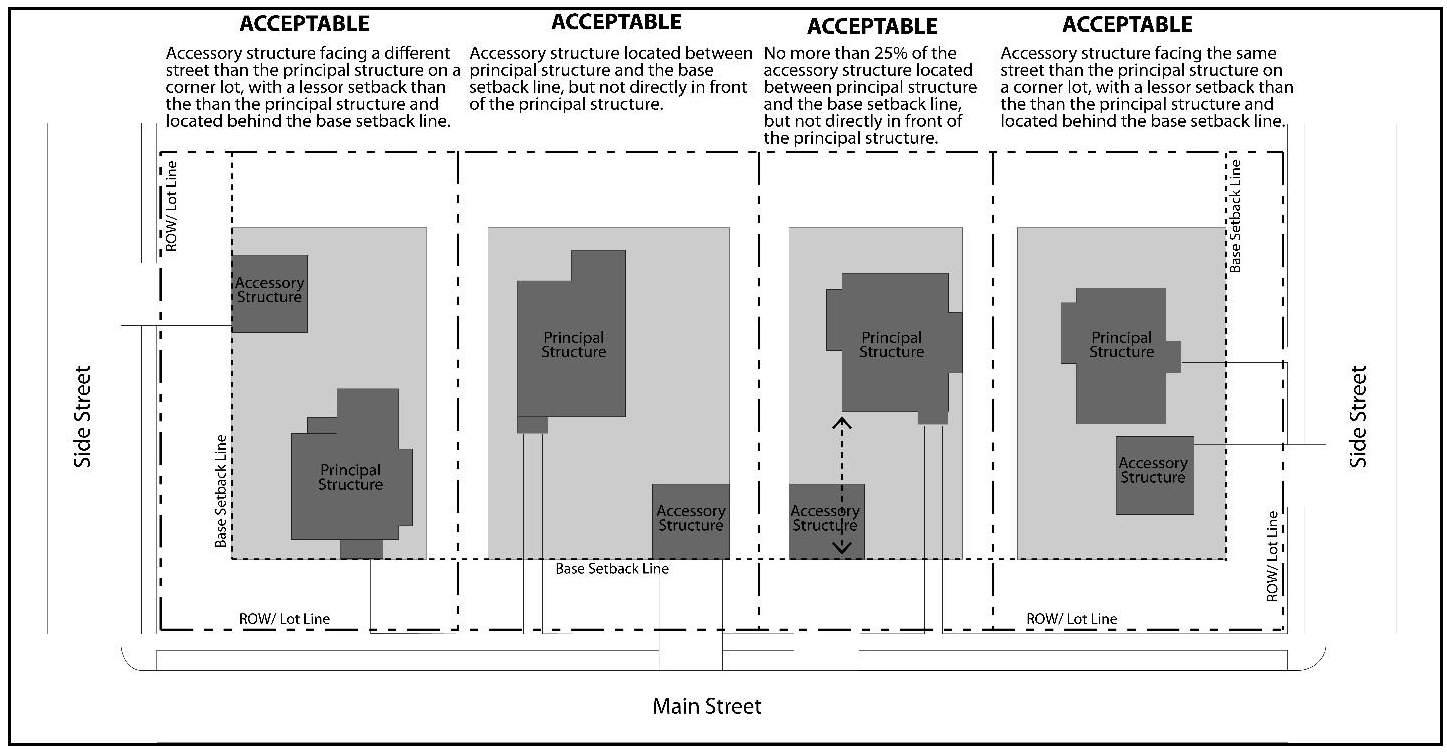
C.
Boathouses. The following regulations shall apply only to properties with riparian rights:
(1)
Use. The boathouse must be designed and used principally for the storage of boats and accessory marine equipment normally used in the daily activities of waterfront property and which typically includes a large overhead door for primary access on the side of the structure facing the water. Boathouses shall not be permitted to be connected to public utilities other than electricity.
(2)
Number. Only one boathouse shall be permitted on a riparian parcel.
(3)
Plat of survey. Submission of a plat of survey shall be required depicting the location and dimensions of all existing structures located on the premises, the distances between such structures and all lot lines, the height of any such structures, the ordinary high-water mark, the meander lines, structures on adjacent properties within 100 feet, and other information as required by the plan commission.
(4)
Timing of construction. A boathouse shall be considered an accessory building to a primary structure and shall not be constructed prior to construction of the principal building on a lot.
(5)
Location. The construction or placing of a boathouse below the ordinary high-water mark (OHWM) of any navigable waters is strictly prohibited. Boathouses shall be located a minimum of three feet from the OHWM, and a minimum distance from the side lot line that is equivalent to the side yard setback requirements for a principal structure within the zoning district. Boathouses shall be placed within the vision and access corridor outlined in [subsection] (8) below if they are to be located within the shoreland buffer outlined in [subsection] (9).
(6)
Height. The highest point of the roof elevation shall not be more than the vertical measurement of 12 feet above the lowest elevation of the boathouse structure. Any railing on the roof may not exceed three and one-half feet and such railing may not be solid in appearance.
(7)
Size. Boathouses shall not exceed 400 square feet in area.
(8)
Vision and access corridor. There shall be a vision and access corridor in which boathouses shall be located and in which vegetation may be removed and trees and shrubs trimmed. This vision and access corridor shall be an area that does not exceed 30 feet of the lot as measured at the OHWM exceeds 100 feet in width. If the lot as measured at the OHWM is less than 100 feet in width, then the vision and access corridor shall be no more than 30 percent of the lot width.
(9)
Shoreland buffer. A strip of vegetative cover shall be maintained that extends 35 feet inland from the OHWM and the entire width of the lot; except within the vision and access corridor. Boathouses shall be placed within the vision and access corridor if they are to be located within the shoreland buffer.
(10)
Vegetation removal. Vegetation may be removed and trees and shrubs may be trimmed within the vision and access corridor, but such tree removal or trimming or other vegetative removal shall not occur within the shoreland buffer described in subsection (9), unless such removal or trimming is performed on diseased or dying vegetation. If vegetation has already been removed or tree and shrubbery cutting has already occurred within the shoreland buffer, and that vegetation removal or cutting has already occurred outside the vision and access corridor, then mitigation may be required as a condition of approval of the special use permit to restore a portion of the vegetation within the shoreland buffer.
(11)
Stairways and pathways. Stairways or pathways used for access to the water and to the boathouse shall be located within the vision and access corridor. If stairways or pathways already exist within the shoreland buffer, relocation of those stairways or pathways to the vision and access corridor may be required under the special use permit.
(12)
Other structures. If other structures already exist within the shoreland buffer, removal or relocation of those structures may be required under the special use permit.
(13)
Habitation. A boathouse may not be habitable as defined in this code. Final decision as to whether any boathouse, would be considered habitable, will be determined by the building and zoning superintendent.
(14)
Design. The architectural design of the boathouse, and any associated stairs or paths, shall be harmonious with the surrounding landscape and shall have a minimal visual impact when viewed from the water.
(15)
Existing boathouses. All existing boathouses that were lawfully constructed prior to the enactment of this chapter shall remain legal, nonconforming uses, and such boathouses may be maintained, but they may not be enlarged without obtaining a new special use permit and without coming into compliance with the terms of that new special use permit.
D.
Agricultural uses. Detached accessory structures located on parcels in the RH district, where said parcels are larger than five acres in area, are subject to the regulations of the district pursuant to section 102-321. Accessory buildings used wholly for agricultural purposed shall not require a permit.
E.
Business and industrial districts. Detached accessory structures located on parcels in any business or industrial zoning district where the principal use is present shall conform to the bulk requirements of the zoning district as outlined in section 102-321.
F.
Shipping containers. Storage containers intended to be used primarily for shipping purposes on highways or rail lines, or truck compartments or trailers, shall not be deemed accessory structures or buildings and shall not be permitted in any zoning district as such, except:
(1)
Shipping containers temporarily used for loading and unloading merchandise or equipment associated with the principal use of the premises on which they are located;
(2)
Shipping containers used for the storage of construction equipment in conjunction with a construction project and located on the construction site.
(3)
Shipping and storage containers used for the storage of household effects on residential property shall not be located within a required yard, shall be located on a hard surface, and shall be limited to 21 consecutive days on the property in accordance with section 102-407.
(Ord. No. 2015-10-16, Exh. A, 10-5-15; Ord. No. 2023-05-09, § 3, 5-15-23)
Sec. 102-211. - Fences.
A.
Purpose. The purpose of this section is to regulate the materials, location, height, and maintenance of fencing, walls and decorative posts (such as entry pillars, bollards, or columns) in order to prevent the creation of nuisances and to promote the general welfare of the public.
B.
Permit. An approved zoning permit from the building and zoning superintendent shall be required for all fences regulated by this chapter.
C.
Applicability. The requirements of this section apply to all fencing 30 inches or more in height, for all land uses and activities.
D.
Construction, appearance, and maintenance.
(1)
Appearance.
(a)
Orientation. The finished side of all fences shall face the front, rear, side and street lot lines. Visible supports and other structural components shall face toward the subject property.
(b)
Opacity. Any fence within a street yard, including along property lines that intersect a right-of-way, shall be a maximum of 50 percent opaque; however, fences abutting a railroad right-of-way may be solid. Open fences may be installed for any public, public utility and recreational uses.
(2)
Materials.
(a)
Residential districts. Acceptable materials for constructing fencing, walls, and decorative posts include wood, stone, brick, wrought iron, chain link, wire mesh, and chain link. Wire mesh and chain link fencing is not permitted within required front yard or street yard areas. Wire mesh and chain link fencing must have a metal or wood frame n the top. Any fence within a street yard, including along property lines that intersect a right-of-way, shall be a maximum of 50 percent opaque. Farm, field, or plastic type fencing is not permitted except for temporary fencing as outlined in subsection (c).
(b)
Nonresidential districts. Acceptable materials for constructing fencing, and decorative posts include wood, stone, brick, wrought iron, chain link, and wire mesh. Barbed wire fencing is permitted only in the nonresidential districts and at heights greater than ten feet. The height of the barbed wire is not to exceed two feet above the top of the fence to which it is attached. All barbs and prongs shall be faced toward the ground. The installation of barbed wire fencing is prohibited along any property line abutting a residentially zoned property unless set back from the property line adjacent to the residential property by no less than 15 feet. Any fence within a street yard, including along property lines that intersect a right-of-way, shall be a maximum of 50 percent opaque. Farm, field, or plastic type fencing is not permitted except for temporary fencing as outlined in subsection (c).
(c)
Temporary fencing. Temporary fencing, including the use of wood or plastic snow fences for the purposes of limiting snow drifting between November 1 and April 1, the protection of excavation and construction sites, and the protection of plants during grading and construction, and for security fencing of permitted temporary use or temporary outdoor entertainment areas is permitted. Fencing for excavation sites shall be a minimum of 48 inches in height.
(d)
Dangerous or hazardous fences. Fences constructed of any material deemed to be dangerous or hazardous to the public's welfare and safety by the building official, such as and including electrified, barbed wire and spike-topped fences shall be prohibited except as allow permitted in subsection (c).
(3)
Opacity. Any fence located between the residence and an abutting roadway including comer lots, shall be a maximum of 50 percent opaque.
(4)
Maintenance. All fences, or decorative posts shall be maintained in a structurally sound and attractive manner.
E.
Location.
(1)
Yards. Fences or decorative posts may be located in any required yard.
(2)
Setbacks.
(a)
Right-of-way. No fence, wall, or decorative post shall be located closer than one foot to the right-of-way line.
(b)
Property line. Fences may be located on any property line abutting a side or rear yard.
(c)
Twin-home or zero lot line. No fence may be built on the interior common lot line lying within the front setback area.
(d)
Non-residential abutting non-residential. On all business and manufacturing properties adjacent to another non-residentially zoned property, fences may be located on any property line abutting a side or rear yard, but shall be located no closer than five feet to the front yard or street yard property line.
(e)
Non-residential abutting residential. On all business, institutional, or manufacturing properties adjacent to a residentially zoned property or property used for residential purposes, fences may be located on any property line abutting a rear or side yard, but shall be located no closer than 15 feet to the front yard or street yard property line.
(f)
Public utilities. Public utility uses such as transformer substations, or other hazardous uses, shall be fenced. When the lot line of such utility use coincides with a lot line in a residential district, the fencing installed shall provide adequate screening. The screening may be an open or semi-open fence, or an open fence with shrubbery to a height of not less than five feet. The plan for such screening shall be approved by the plan commission. When a public utility use fronts on a public street, similar fencing and landscaping shall be required.
(g)
Near structures on adjacent property. No fence shall be located in such a manner that it prohibits the normal maintenance of structures located on adjacent property, and in no circumstances shall a fence be within five feet of such structures.
(3)
Vision clearance on corner lots. In any required front, side, rear or transitional yard of a corner lot, no structure, planting or other obstruction to vision of drivers of motor vehicles, located within 20 feet of the intersecting right-of-way lines bordering such corner lot, shall exceed a height of three feet above the adjoining street grade.
(4)
Easements. Fences installed on public easements shall be of a removable nature. Any fence of a permanent nature on an easement shall be removed at the owner's expense at the request of any public utility or the city.
F.
Height.
(1)
Maximum. The maximum height of any fence or decorative post shall be the following:
(a)
Four feet when located within a required front yard or between the home and an abutting roadway on any property.
(b)
Six feet when:
(i)
located on any residential property, but not within a required front yard or between the home and an abutting roadway except as allowed along a railroad right-of-way in subsection (2)(b).
(ii)
Located on any nonresidential property abutting a residential property and set back less than 15 feet.
(c)
Eight feet when:
(i)
Located on any nonresidential-zoned property, but not within a required front yard or a required street yard or set back at least 15 feet except that security fences may exceed this height.
(ii)
Located on any non-residential property abutting a residential property and set back more than 15 feet.
(iii)
Located on any public, institutional, public utility, and recreational property.
(2)
Exceptions.
(a)
Non-residential uses. The maximum heights may be exceeded with the approval of a special use permit per section 102-919. At a minimum, the following conditions shall be established for such requests:
(i)
The increase in height shall in no way further obstruct vision for intersecting streets, driveways, sidewalks or other traffic areas;
(ii)
The fence shall be screened on its external side with adequate plants to maintain an attractive appearance to said side;
(iii)
The fence shall be setback from the property line beyond the requirement of subsection E(2), above, such distance as appropriate to contain adequate landscaping per section 102-520, and to maintain an attractive relationship to fences external side.
(b)
Along railroad. A fence which is constructed on that portion of property that abuts a railroad right-of-way may be permitted a height of not more than eight feet and may be of a solid nature.
(c)
Public recreation use areas. Public recreation use areas, courts, fields, and diamonds may be enclosed along their boundaries with an open type fence to a height not to exceed eight feet.
(d)
Swimming pools. Fencing for all swimming pools shall comply with the regulations outlined in section 102-201 of this article.
(Ord. No. 2015-10-16, Exh. A, 10-5-15; Ord. No. 2023-05-09, § 4, 5-15-23)
Sec. 102-212. - Retaining and landscape walls.
A.
Retaining walls.
(1)
Location on a lot. Retaining walls may be permitted anywhere on the lot, provided that along a street or right-of-way frontage no such wall shall be closer than three feet to the right-of-way without approval of the building and zoning coordinator.
(2)
Height. No individual retaining wall shall exceed six feet in height, and a terrace of at least three feet in width shall be provided between any series of such walls.
B.
Landscape walls.
(1)
Location on a lot. Landscape walls may be permitted anywhere on the lot, provided that along a street or right-of-way frontage no such wall shall be closer than three feet to the right-of-way without approval of the building and zoning coordinator.
(2)
Height. Walls shall not exceed eight feet in height, expect when located in a front yard or street yard where walls shall not exceed a height of four feet.
(Ord. No. 2015-10-16, Exh. A, 10-5-15)
Sec. 102-213. - Outdoor storage of construction materials, junk, refuse, and disabled or damaged motor vehicles.
A.
No open storage of construction materials, junk, refuse, scrap, or disabled or damaged motor vehicles shall occur in any zoning district. This limitation shall not apply to the open storage of materials actively being used for the construction or repair of a building or structure on the same property, provided that no such storage shall continue after completion of the construction or repairs. Nor shall this limitation apply to disabled or damaged motor vehicles awaiting repair at an automobile service station or vehicle sales, rental, or servicing establishment.
B.
Notwithstanding [subsection] A. above, open storage of construction materials is permitted in the regional business (RB), light manufacturing (LM), general manufacturing (GM), and heavy manufacturing (HM) districts as an accessory use when approved as a special use in accordance with the procedures and standards set forth in section 102-919 of this chapter. Any such materials in open storage shall be screened from the view of the street and abutting properties to a height of at least six feet by a solid fence and/or evergreen vegetation.
C.
The keeping of inoperable motor vehicles in open storage shall be subject to forfeitures and removal by the Sterling Police Department in accordance with the Municipal Code.
(Ord. No. 2015-10-16, Exh. A, 10-5-15)
Sec. 102-215. - Temporary structures.
A.
Intent. The purpose of this section is to establish minimum requirements for the construction and placement of structures built without a permanent building foundation that is in direct contact with the soil. The purpose of this section is also to safeguard the public health, safety, comfort and general welfare of the residents by ensuring that a temporary structure does not create an undesirable impact to nearby properties.
B.
Use.
(1)
Temporary structures shall not be used for vehicular storage, RV or trailer storage, marine equipment or for general storage purposes.
(2)
Temporary structures shall not occupy any on-site parking spaces so as to reduce the number of parking spaces required by section 102-227 of this chapter, nor shall such structures interfere with drive aisles, site ingress/egress, vision triangles, required setbacks, or required buffer yards.
(3)
Temporary structures used for purposes of outdoor display and sales of merchandise shall only be permitted in the DB, CB, RB, and MU districts.
C.
Number. Only one temporary structure may be erected on a property at any one time unless additional structures are approved for special events by the city, except if approved as part of a retail incubator per the regulations of section 102-431.
D.
Time limits.
(1)
No temporary structure may be erected for more than 72 hours without first obtaining a permit.
(2)
No temporary structure may remain in place for more than 180 days in any 12-month period, except if approved as part of a retail incubator per the regulations of section 102-431.
(3)
Temporary structures shall be limited to not more than three permits for a property in any calendar year.
E.
Other conditions.
(1)
Temporary structures must be affixed to the ground (i.e. staked or weighted) or a structure to prevent the wind from relocating the structure.
(2)
Temporary structures greater than 400 square feet in floor area and erected for more than 180 days are regulated by the International Building Code, require a building permit and must comply with all zoning code regulations.
F.
Permit. A permit shall be required for all temporary structures. The owner or tenant must contact the building and zoning superintendent and provide the name and address of the applicant, and the description and location of the structure to be erected prior to installation.
G.
Exceptions. Tents or flys of less than 400 square feet in floor area, erected for recreational purposes and in place for less than 72 hours do not require a permit.
H.
Fees. No permit fee shall be required for a temporary structures erected for recreational purposes when located on property used for residential purposes. The fee for all other temporary structures shall be $25.00.
I.
Application requirements. Prior to the issuance of a permit to erect any temporary structure, the code enforcement department shall approve all applications for the proposed temporary structure. The application shall contain the following:
(1)
Application must be made on the forms provided by the code enforcement department requesting approval and the term of said use.
(2)
A site map of the subject property showing all lands for which the temporary structure is proposed as well as all other lands within 200 feet of the boundaries of the subject property.
(3)
The site map shall clearly indicate the existing structures on the subject property and its environs including all utilities, all lot dimensions, setbacks for the temporary structure, a graphic scale, and a north arrow.
(4)
A written description of the proposed temporary use describing the type of activities and the type of structures proposed for the subject property.
J.
Approval. The code enforcement department must review the completed application in accordance with subsection I. of this section. A permit will be issued for any temporary structure that meets the requirements of this section.
K.
Penalties. $50.00 minimum and $750.00 maximum.
(Ord. No. 2015-10-16, Exh. A, 10-5-15; Ord. No. 2022-03-11, § 4, 3-7-22)
Sec. 102-216. - Structures other than buildings.
A.
Structures six inches or more in height. Structures not classified as buildings and six inches or more in height from the surface of the ground shall be subject to the setback, offset, height, open space, and architectural requirements of this chapter except as may be specifically otherwise provided.
B.
Children's play houses and structures. Play structures, play houses, swing sets, and other similar structures shall not require a permit for construction. Such structure shall not be located in a required front yard or street yard.
C.
Underground buildings and structures. Any structure classified as a building and not extending more than six inches above the surface of the ground shall not be subject to the setback, offset, building size, or open space requirements of this chapter.
(Ord. No. 2015-10-16, Exh. A, 10-5-15)
Sec. 102-217. - Outdoor storage and parking of recreational vehicles (RVs), trailers, and boats.
A.
RVs, personal trailers, commercial or industrial trailers, or boats not meeting the standards set forth in this section shall not be stored in any residential district, except that a trailer may be used, in accordance with section 102-215 of this chapter, as a temporary office or storage space incidental to construction.
B.
RVs shall not be permitted in any district as accessory buildings. An RV shall not be used as a dwelling, storage, or accessory building, except that an RV may be parked or occupied for lodging purposes on a vacant lot or on the same lot as a dwelling for not more than 72 hours in any consecutive 30-day period.
C.
An RV or boat shall not be stored in connection with a business conducted at the location.
D.
A stored RV or boat shall be maintained in mobile condition. No major construction or repair of a stored RV or boat shall be performed on a lot used for residential purposes.
E.
The state license plates and display title shall be current and properly displayed. The lot owner shall have, and display upon request to authorized city officials, proof of ownership of any stored RV or boat.
F.
A boat, boat trailer, or RV shall not park or store such boat, boat trailer, or travel trailer so as to create a dangerous or unsafe condition on the lot where parked or stored. Parking or storage in such fashion that the unit, whether loaded or not, may readily tip or roll shall be considered a dangerous and unsafe condition. The owner shall not park the unit with flammable liquids aboard in portable containers.
G.
No personal trailers, boats, or RV stored in a residential district shall exceed: ten feet in height as parked, including trailer cradle or mount, but excluding mast; 20 feet in body length, excluding trailer hitch, tongue, and bumper; and eight feet in body width, excluding hardware.
H.
Personal trailers, boats, or RV stored in a residential district shall be located only behind the front setback lot line, no less than six feet from any principal structure, and within ten feet of the front property line of residentially zoned property. The unit shall be stored on a hard surface or concrete, asphalt.
I.
No RV shall be parked parallel, or substantially parallel, to the front building line within the front yard area.
J.
Tarpaulins used to cover RVs, personal trailers, boats, or recreational vehicles, parked or stored in front yard areas, are prohibited. This does not include specifically designed covers.
K.
No animal transport trailer shall be stored in any residential district.
(Ord. No. 2015-10-16, Exh. A, 10-5-15)
Sec. 102-218. - Outdoor storage of firewood.
A.
Intent. The purpose of this section is to establish minimum requirements for the placement of firewood on residential lands.
B.
Use. The storage or stacking of firewood shall be permitted in all zoning districts only as an accessory use.
C.
Location on a lot.
(1)
Firewood shall not be stored in the required front or street yard on residential property.
(2)
Firewood shall not be located closer than three feet to any lot other line.
D.
Stacking.
(1)
Firewood shall be neatly stacked. Neatly stowed shall be construed to mean pieces of wood placed in a line or row with individual pieces touching and parallel or perpendicular to each other, and in a compact manner.
(2)
Firewood may not be stacked higher than five feet from grade, except adjacent to a fence where firewood can be stacked against the fence as high as the fence. Fences as used in this section shall not include hedges and other vegetation.
(3)
The firewood shall be stored on a hard-surface, or on a well-supported, non-rotting base.
E.
Length. A single log or piece of split wood shall not exceed four feet in length.
F.
Nuisance. Woodpiles that contain diseased wood that is capable of transmitting disease to healthy trees and woodpiles that harbor or are infested or inhabited by rats or other vermin are public nuisances and may be abated pursuant to the provisions of the Municipal Code.
(Ord. No. 2015-10-16, Exh. A, 10-5-15)
Sec. 102-219. - Permanently installed stand-by generators.
A.
Operation. A permanently installed stand-by generator installation shall be allowed for the purpose of providing temporary power during incidental power outages and emergency power outages only due to storms and other natural and/or manmade disasters.
B.
Noise level. The noise from permanently installed stand-by generators installed in all zoning districts, when operated during power outages, shall not exceed 70 dBA at the lot line under normal load.
C.
Testing. Permanently installed stand-by generators in all zoning districts may be operated for testing purposes one time for a period not to exceed 30 minutes in any seven-day period. Testing periods of stand-by generators in all residential districts shall be restricted to between 9:00 a.m. and 7:00 p.m. Monday through Saturday.
D.
Location. No permanently installed stand-by generator shall be installed in a required front or street yard, and not within 15 feet of any side or rear lot line. All such units shall be installed at ground level only.
E.
Installation. Permanently installed stand-by generators shall be installed in accordance with the requirements of chapter 18, buildings and building regulations of the Municipal Code.
F.
Screening. The equipment will be screened to its full height from the view of the street and abutting properties by a solid fence and/or evergreen shrubbery in accordance with section 102-520.
G.
Performance standards. All stand-by generator installations shall comply with the regulations outlined in article VI of this chapter.
(Ord. No. 2015-10-16, Exh. A, 10-5-15)
Sec. 102-223. - Sewage disposal.
Individual sewage disposal systems are expressly prohibited unless specifically approved by the board of appeals after public hearing.
(Ord. No. 2015-10-16, Exh. A, 10-5-15)
Sec. 102-224. - Roadway visibility standards.
A.
Purpose. The purpose of this section is to alleviate or prevent congestion of public rights-of-way so as to promote the safety and general welfare of the public by establishing minimum requirements for the provision of vehicular visibility. The requirements of this section shall not be imposed in the downtown area.
B.
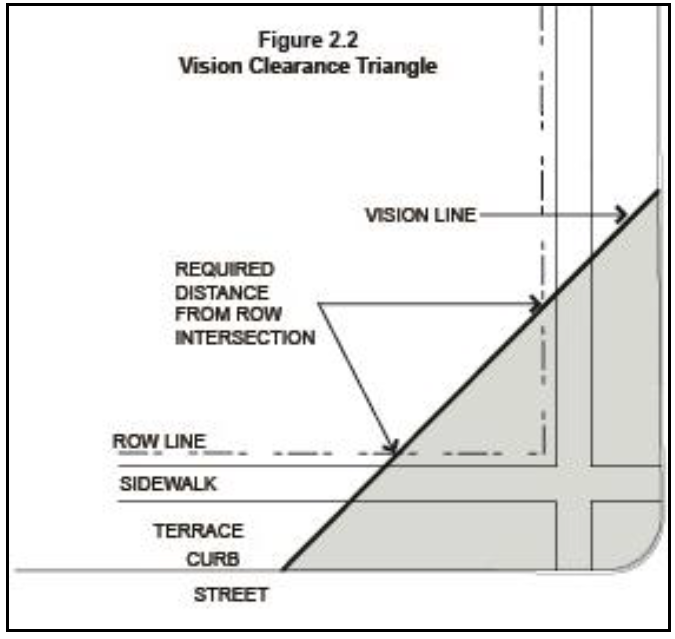
Vision clearance triangle. In each quadrant of every street intersection in every district except the B1, Downtown Business District, there shall be designed a vision clearance triangle, formed by the two intersecting rights-of-way and a vision line connecting the rights-of-way and extending to the street edge (See Figure 2.2), as determined by the building and zoning superintendent. The standards in Table 2.1 shall apply.
C.
Within the vision clearance triangle, no signs, parking spaces, structures, or earthwork in excess of 30 inches, and no vegetation, fencing, nor other such obstructions between 24 inches and eight feet in height shall be permitted which exceeds 30 inches in height above either of the centerline elevations of said two streets. This provision shall not apply to tree trunks or posts.
D.
Depiction on required site plan. Except in the downtown where no requirement is imposed, any and all visibility triangles located on the subject property shall be depicted as to their location and configuration on the site plan as outlined in section 102-924 required for the development of the subject property.
(Ord. No. 2015-10-16, Exh. A, 10-5-15)
Sec. 102-225. - Driveway regulations and standards.
A.
Single and two-family residential properties.
(1)
Number of driveways. Single-family uses are limited to one driveway per lot unless otherwise regulated in this Code. Two-family uses are permitted two driveways per lot unless otherwise approved by the public works superintendent.
(2)
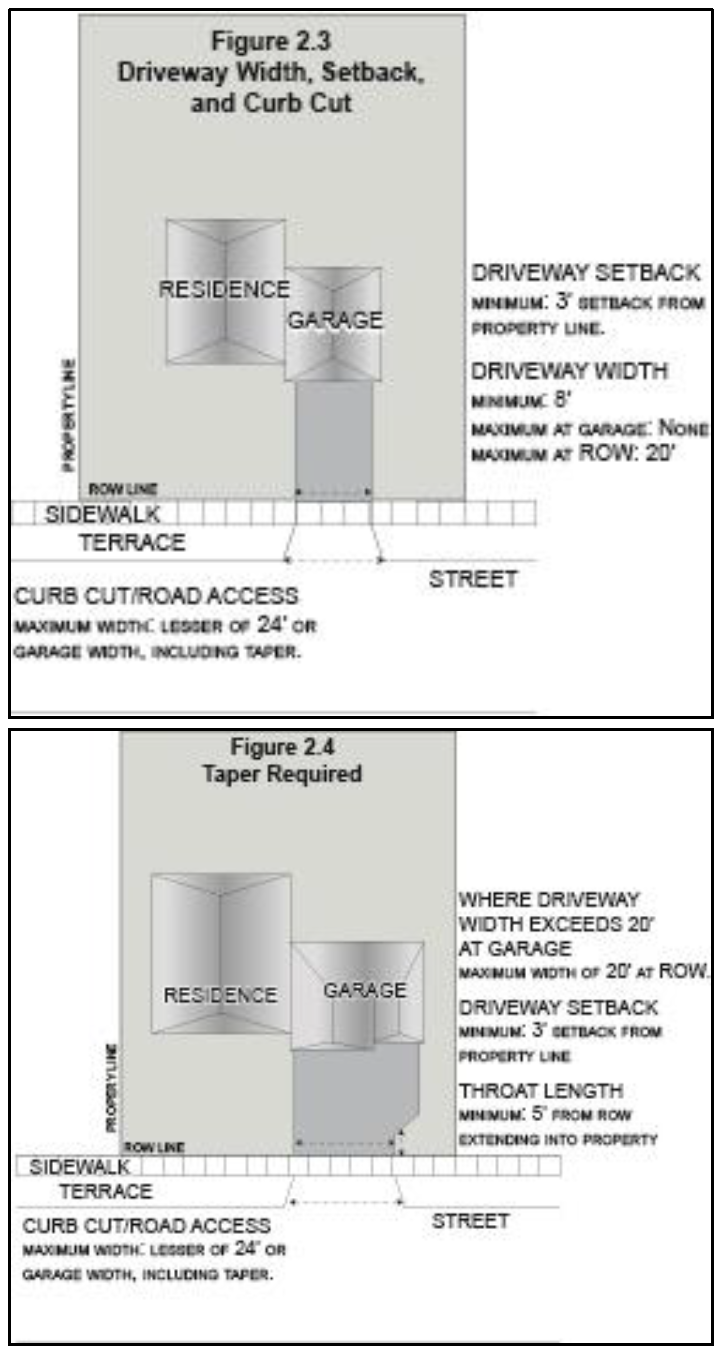
Setback. Driveways shall have a minimum setback of three feet from the side lot line on all parcels. (See Figure 2.3)
(3)
Width. (See Figures 2.3—2.6)
(a)
Minimum. The minimum width of driveways shall be eight feet.
(b)
Maximum.
(i)
At the garage. There shall be no maximum width limitation at the garage structure.
(ii)
At the right-of-way line. The maximum width of driveways as measured at the right-of-way line shall be the lesser of 20 feet or the width of the garage.
(iii)
Where no garage exists. The maximum driveway width shall be 12 feet and shall be situated as not to create parking located in the required front yard.
(iv)
Taper required. Where the width of the driveway at the garage exceeds the maximum width of the driveway at the right-of-way line, the driveway shall be tapered. (See Figure 2.4)
(v)
Throat length. All driveways shall have a minimum throat length of five feet extending from the right-of-way line into the property to the beginning of the taper. (See Figure 2.4)
(c)
Shared driveways.
(i)
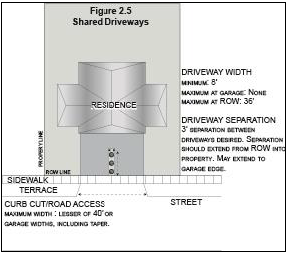
For same property. Shared driveways for two-family uses with adjacent garages are limited to 36 feet maximum width at the curb line. To achieve this, each individual driveway may be separated by a minimum of a three-foot-wide green area extending from the right-of-way line into the property. (See Figure 2.5).
(ii)
For separate property. The purpose of this regulation is to provide for the possibility of a shared driveway to serve up to two lots. The shared driveway may be permitted by the building and zoning coordinator provided deeds for any lots which utilize a shared driveway shall include all appropriate easements to pass; to install utilities as necessary; to grade, drain, and maintain; and provide easements where required by the city. A driveway maintenance requirement shall be stipulated in the deeds of both lots. Such deeds shall also contain a provision that the driveway shall not be used for access to any other property.
(d)
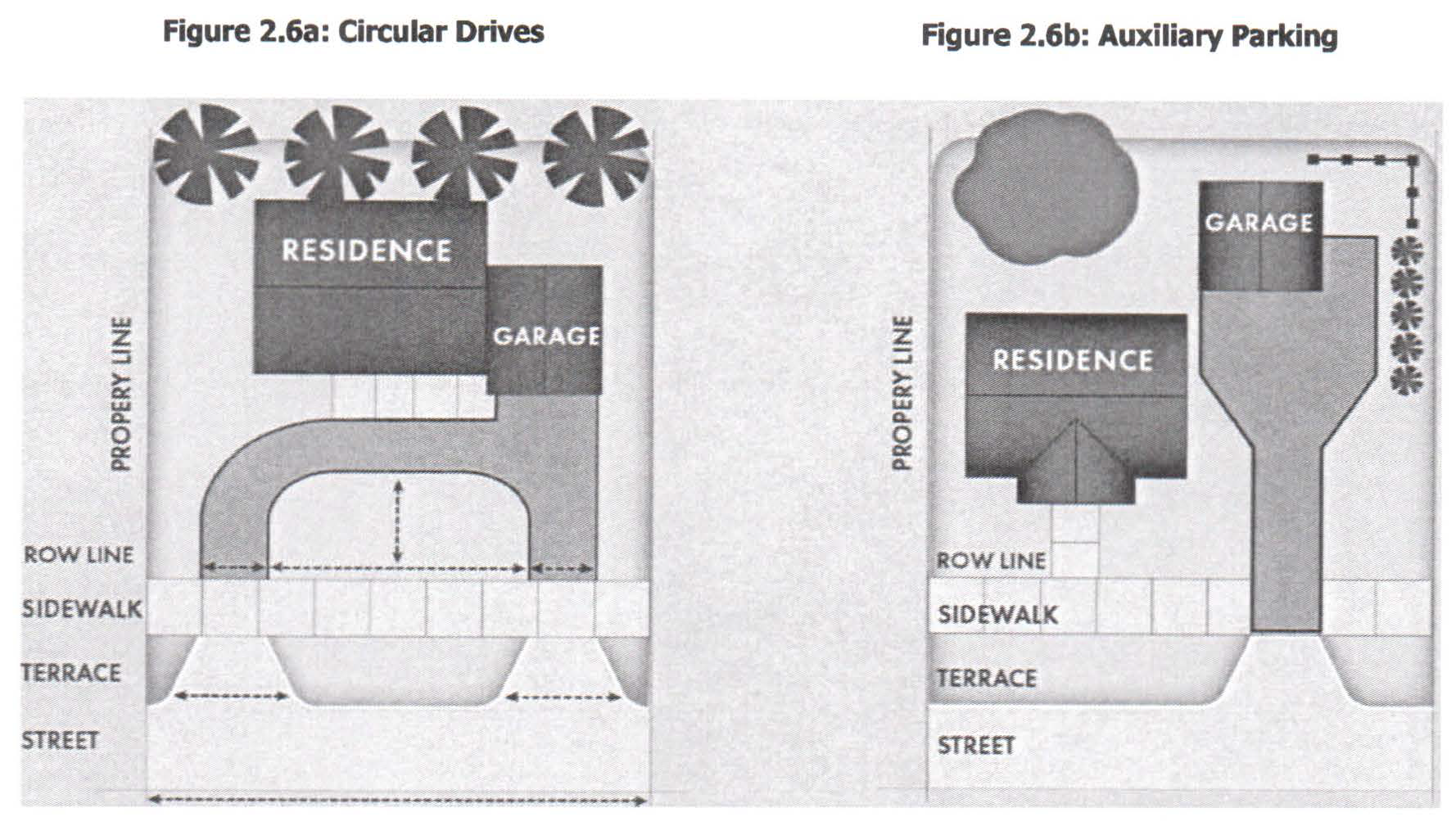
Circular drives. Circular, horseshoe, and similar type driveways shall be permitted where the minimum lot width is at least 150 feet and were approved by the public works superintendent. The maximum width of such a driveway shall not exceed 12 feet, except for the area of allowable paving in front of the garage, and the inside edge of the arc of the driveway shall be at least 25 feet from the lot line. For driveways with two curb openings, the spacing shall provide a minimum dimension of 50 feet between the inside driveway edges, measured at the lot line. (See Figure 2.6a)
(e)
Additional parking spaces. Additional parking spaces are permitted on a single- or two-family residential property when said space is not located in a required front or rear yard. The space shall be no closer that three feet from a side lot line. Said space must be screened from view per section 102-520 of this chapter. (See Figure 2.6b)
(4)
Curb openings. The maximum curb opening shall be the lessor of 24 feet or the garage width including taper, except for shared drives. Shared drives may have an opening of 40 feet including taper.
(5)
Surfacing. Driveways and parking spaces shall be paved with a minimum thickness of three inches of asphaltic concrete, concrete, or bituminous surfacing over a minimum thickness of four inches of an aggregate base material. Brick pavers may also be used for surfacing, installed to recognized industry standards that achieve the same or better structural integrity as other materials specified in this section. Brick pavers may also be used for surfacing, installed to recognized industry standards that achieve the same or better structural integrity as other materials specified in this section.
(6)
Maintenance. All driveways shall be kept in good repair and working order. A legal agreement shall be required for all shared drives outlining maintenance responsibilities for adjacent property owners. Said agreement shall be recorded against the properties with the Whiteside County Register of Deeds.
B.
Multi-family residential, commercial, and manufacturing use drives.
(1)
Number of driveways. The maximum number of driveways shall be established by the public works superintendent.
(2)
Location. All drives shall be located a minimum of 100 feet, as measured from the nearest point, from all other driveways.
(3)
Setback. Driveways or access aisles shall have a minimum setback of ten feet from the side lot line on all parcels.
(4)
Width. The maximum width of a driveway for all multi-family residential, commercial, and manufacturing uses shall not exceed 30 feet with flares.
(5)
Curb openings. The maximum curb opening shall be determined by adding ten feet to the approved driveway width.
C.
Shared driveways.
(1)
Statement of purpose. The purpose of this regulation is to provide for the possibility of a shared driveway to serve up to two lots. The shared driveway may be permitted by the public works superintendent provided the shared driveway will meet the standards and criteria listed below.
(2)
Standards and criteria for a shared driveway:
a.
The shared driveway shall meet all of the criteria set forth in the regulations for driveways in this section.
b.
The deeds for any lots which utilize a shared driveway shall include all appropriate easements to pass; to install utilities as necessary; to grade, drain, and maintain; and provide easements where required by the city. A driveway maintenance requirement shall be stipulated in the deeds of both lots. Such deeds shall also contain a provision that the driveway shall not be used for access to any other property.
(3)
Access. The shared driveway shall intersect with an existing or proposed public street.
(Ord. No. 2015-10-16, Exh. A, 10-5-15; Ord. No. 2023-05-09, § 6, 5-15-23)
Sec. 102-226. - Traffic circulation.
A.
Traffic circulation and traffic control. Site circulation shall be designed to provide for the safe and efficient movement of all traffic entering, exiting, and on the site. Circulation shall be provided to meet the individual needs of the site with specific mixing of access and through movements, and shall be depicted on any required design plan. Circulation patterns shall conform to the general rules of the road and all traffic control measures shall meet the requirements of the Manual of Uniform Traffic Control Devices.
B.
Maintenance of off-street parking and traffic circulation areas. All off-street parking and traffic circulation areas shall be maintained in a dust-free condition at all times. In no instance or manner shall any off-street parking or traffic circulation area be used as a storage area.
C.
Traffic circulation design standards.
(1)
Marking. All off-street parking and traffic circulation areas shall be paved with a hard, all-weather surface, to the satisfaction of the building and zoning superintendent. Said surfaces intended for four or more parking stalls shall be marked in a manner that clearly indicates required parking spaces.
(2)
Lighting. All off-street parking and traffic circulation areas serving six or more cars shall be lit to ensure the safe and efficient use of said areas during the hours of use. Lighting shall meet the standards of section 102-606 of this chapter.
(3)
Fire lanes. A fire lane shall be required to provide access to any portion of any structure equal to or less than 40 feet tall that is more than 150 feet from the nearest street right-of-way, and to any portion of any structure greater than 40 feet tall that is more than 50 feet from the nearest street right-of-way. The building and zoning superintendent may also require the provision of a fire lane or lanes to any part of any structure upon a determination that the distance of the structure from the nearest hydrant, the configuration of development on the site, or other special characteristics of the site otherwise inhibit effective fire extinguishment. All fire lanes shall provide clear, unobstructed access for vehicles and apparatus at all times through a combination of pavement marking and signage; shall be a minimum of 18 feet wide; and shall be surfaced as an all-weather roadway.
(4)
Signage. All signage located within, or related to, required off-street parking or traffic circulation shall comply with the requirements of article VII of this chapter.
(Ord. No. 2015-10-16, Exh. A, 10-5-15)
Sec. 102-227. - Off-street parking standards.
A.
General provisions. This article regulates the minimum/maximum number, the use, the design and the maintenance of parking spaces, parking lots, drives/driveways, aisles, loading and drive-through facilities within the City of Sterling.
(1)
When required.
(a)
For all buildings and structures erected and all uses of land established after the effective date hereof, accessory parking and loading facilities shall be provided as required in this section. However, where a building permit has been issued prior to the effective date hereof, and provided that construction is begun within one year of such effective date and diligently prosecuted to completion, parking and loading facilities in the amounts required for the issuance of said building permits may be provided in lieu of any different amounts required by this chapter.
(b)
When the intensity of use of any building, structure, or premises shall be increased through the addition of dwelling units, gross floor area, seating capacity, employment, or other units of measurement specified herein for required parking or loading facilities, parking and loading facilities as required herein shall be provided for such increase in intensity of use.
(c)
Parking is not required for non-residential uses in the DB, downtown business district. However when off-street parking facilities are provided, such facilities shall be provided in accordance with the provisions of this chapter, except in respect to the required number of spaces. Mixed use/upper floor residential uses need only provide evidence of the availability of off-street public or private parking within 1,000 feet of the unit.
(d)
Existing parking facilities. Accessory off-street parking facilities in existence on the effective date of this chapter and located on the same lot as the building or use served shall not hereafter be reduced below, or if already less than shall not be further reduced below, the requirements for a similar new building or use under the provisions of this chapter.
(e)
Use changes. Whenever the existing use of a building or structure shall hereafter be changed to a new use, parking or loading facilities shall be provided as required for such new use. However, if the said building or structure was erected prior to the effective date of this chapter, additional parking or loading facilities are mandatory only in the amount by which the requirements for the new use would exceed those for the existing use, of the latter were subject to the parking and loading provisions of this chapter.
(f)
Damage or destruction: for any conforming or legally nonconforming building or use which is in existence on the effective date of this chapter, which subsequently thereto is damaged or destroyed by fire, collapse, explosion, or other cause, and which is reconstructed, reestablished, or repaired, off-street parking or loading facilities need not be provided, except that parking or loading facilities equivalent to any maintained at the time of such damage or destruction shall be restored or continued in operation. However, in no case shall it be necessary to restore or maintain parking or loading facilities in excess of those required by this chapter for equivalent new uses or construction.
(2)
Location.
(a)
On lots. All parking spaces shall be located on the same lot as the structure or use that they are intended to serve, except where shared parking is made by agreement between property owners.
(i)
On all properties. The parking of vehicles on grass or lawns shall be prohibited.
(ii)
Residential districts. Parking spaces accessory to the dwelling shall be located on the same zoning lot as the use served. Spaces accessory to uses other than dwellings may be located on a lot adjacent to or directly across a street or alley from the lot occupied by the use served, but in no case at a distance in excess of 300 feet from such use. In all residential districts, off-street parking shall not be located closer than three feet to a side lot line or closer than five feet to a rear lot line.
(iii)
Business and manufacturing districts. All required parking spaces shall be within 400 feet of the use served, except for spaces accessory to dwelling units (except those located in a transient hotel), which shall be within 300 feet of the use served. However, no parking spaces accessory to a use in the business or manufacturing district shall be located in a residence district. Private, free, off-street parking accessory to such uses and municipal parking lots may be allowed by a special use permit in accordance with this article, within 200 feet of and adjacent to any business or manufacturing district.
(iv)
Shared parking. In cases where parking facilities are permitted on land other than the zoning lot on which the building or use served is located, an agreement allowing shared parking facilities shall be required between the property owners.
(b)
Transitional or bufferyards as regulated in section 102-520 of this chapter take precedent over zoning district setback requirements.
(c)
Locational prohibitions for off-street parking areas. No private parking shall occur on street terraces, driveways, lawns, or any other areas that are located within a public right-of-way.
(d)
Location in yards. Open off-street parking spaces in a required yard are subject to the following provisions:
(i)
Parking in a required side yard is permitted in any business district not closer than 12 feet to a lot line.
(ii)
Parking in a required front or rear yard is permitted for a single- or two-family use on an approved hard-surface driveways. Parking on a lawn or gravel area is not permitted.
(iii)
In the light manufacturing (LM) district or the general manufacturing (GM) district, where a 100-foot front yard is required, the inner 50 feet may be used for open off-street parking spaces.
(iv)
Open off-street parking spaces in a business or manufacturing district shall not be located closer than 12 feet to a lot line in a residential district.
(v)
Open off-street parking spaces in a required rear yard in an MR-6 or MR-10 district shall not be closer than five feet to a side lot line adjacent to a required rear yard or closer than five feet to a rear yard line.
(vi)
Open off-street parking spaces serving residential buildings containing three or more dwelling units shall not be located closer than ten feet to any principal building.
(3)
Calculation of requirements. Calculating the number of spaces required shall be in accordance with the following:
(a)
Net floor area. Net floor area shall be used for the purpose of calculating the number of off-street parking spaces required.
(b)
Assembly. In places of public assembly in which patrons or spectators occupy benches, pews or other similar seating facilities, each 30 inches of such seating shall be counted as one seat for the purpose of this chapter.
(c)
Capacity. In cases where parking requirements are based on "capacity" of persons, capacity shall be based on the maximum number of persons that may occupy a place, as determined by the building code.
(d)
Fractions. When determination of the number of off-street parking spaces required by this chapter results in a requirement of a fractional space, any fraction of one-half or less may be disregarded while a fraction in excess of one-half shall be counted as one parking space.
(e)
Shopping centers/joint parking. Except in shopping centers or where joint parking has been approved, if a structure or site contains two or more principal uses, each use shall be calculated separately in determining the total off-street parking spaces required. Off-street parking facilities for different buildings, structures or uses, or for mixed uses, may be provided collectively in any zoning district in which separate parking facilities for each constituent use would be permitted, provided that the total number of spaces so located together shall not be less than the sum of the separate requirements for each use.
(f)
Unspecified uses. The building and zoning superintendent shall interpret parking space requirements for any use not specifically listed in section 102-317 of this chapter and shall determine the required parking from comparable uses listed or may consult the following sources: Institute of Traffic Engineers; Urban Land Institute; International Conference of Shopping Centers; and the American Planning Association.
(4)
Limitations on parking facility uses. In residential districts and on residentially used lots, accessory off-street parking facilities shall be solely for parking of passenger vehicles, which shall be regulated as follows:
(a)
All vehicles shall be in condition for safe and legal performance on public rights-of-way and shall be registered, displaying current license plates.
(b)
Vehicles and/or equipment not normally associated with a residential use specifically prohibited from being parked or stored outdoors on residential property include, but are not limited to:
(i)
Vehicles with a manufacturer's gross vehicle weight rating exceeding 10,000 pounds and/or are more than 21 feet in length.
(ii)
Construction equipment, such as bulldozers, backhoes, skid steers, and forklifts.
(iii)
Dump and stake body style trucks.
(iv)
Cube- or panel-type vans and trucks.
(v)
Landscaping business equipment such as tractors, tree spades, graders and scrapers.
(vi)
Semi-trailers and tractors.
(vii)
Concession, vending and catering trailers.
(viii)
Commercial/industrial equipment trailers and lifts.
B.
Parking space design.
(1)
Single and two-family uses.
(a)
Legal parking spaces.
(i)
Parking spaces may be provided either within a garage or as uncovered spaces on a paved surface as outlined in this section. Parking on the grass or a gravel surface is expressly prohibited.
(ii)
Parking on driveways may not encroach into the public right-of-way.
(iii)
One uncovered parking space is permitted alongside a garage when said space is not located between the building and the street or the building and the rear lot line and is no closer than five feet from a side lot line. Said space must be screened from view.
(iv)
Impervious surface associated with rear yard parking shall be no greater than 20 percent of the total rear yard area.
(b)
Surfacing. All driveways and parking areas shall have a dust-free surface with a minimum thickness of three inches of asphaltic concrete, concrete, or bituminous surfacing over a minimum thickness of four inches of an aggregate base material. Brick pavers may also be used for surfacing, installed to recognized industry standards that achieve the same or better structural integrity as other materials specified in this section.
(2)
Multi-family, commercial and industrial uses.
(a)
Parking plan required. Creation of new or reconstruction/alteration of an existing parking/loading area requires a parking plan. Parking plans shall following the requirements outlined for a building site and operations (BSO) plan per section 102-924 and include the following information:
(i)
Show all lot dimensions and lot lines.
(ii)
Paved areas shown and dimensioned.
(iii)
The traffic pattern and parking space layout shall be indicated, including required handicapped spaces.
(iv)
The dimension of individual parking spaces and aisle width shall be identified.
(v)
The size and location of ingress and egress openings.
(vi)
The location, size at planting, and species of all landscape plantings.
(vii)
The location of all lighting systems.
(viii)
Drainage and/or stormwater management plan subject to approval by the department of public works.
(ix)
The site plan shall be drawn to scale.
(b)
Access to parking areas/stalls.
(i)
Parking spaces and access drives shall be arranged so as to require ingress and egress from the parking lot to a street only by forward motion of a vehicle.
(ii)
Angled spaces (those other than zero or 90 degrees) shall be accessed via one-way aisles.
(c)
Size of parking space. One off-street parking space shall be at least 180 square feet in area, and at least 18 feet in length, exclusive of adequate ingress or egress driveways to connect with a public thoroughfare. A single stall in any garage may replace any required parking space.
(d)
Surfacing. All driveways, access drives, parking lot aisles, parking spaces, service areas, and all off-street parking facilities shall be graded and surfaced so as to be dust-free and properly drained.
(i)
Dust-free surface. All driveways and open off-street parking areas shall be surfaced with a dustless all-weather material capable of carrying a wheel load of 4,000 pounds typified by a machine-laid two-inch black top on a four-inch base or five inches of Portland cement.
(ii)
Drainage. Parking areas shall be designed in such a manner so as to not have a negative surface water drainage impact on adjacent properties and to provide functional relief from said area. Storm sewers which serve parking lots shall be designed to accommodate a ten-year storm event without surcharging out of the rim.
(e)
Curbs. A minimum six-inch high curb shall be installed around all parking areas and internal landscape islands, and endcaps except as follows:
(i)
At designated driveways and cross access areas.
(ii)
Where bio-retention methods of stormwater management are utilized as part of an approved grading and drainage plan, alternative methods to the installation of curbing may be considered by the building and zoning superintendent provided that measures are taken to protect landscaping from vehicular circulation damage.
(iii)
For industrial uses within industrial zoning districts, curbing is only required adjacent to buildings, planting islands, required front yards and so that no part of a vehicle extends over or beyond any pedestrian paths or public right-of-way.
(f)
Striping. All parking spaces and drive aisles shall be striped and maintained in a clear and visible manner.
(g)
Maintenance of parking areas. Parking facilities and required screening and landscaping shall be continuously maintained in good condition and appearance. Whenever necessary, surfacing, lighting, barriers, markings, and planting materials shall be repaired or replaced with new materials in compliance with the provisions of this chapter.
(h)
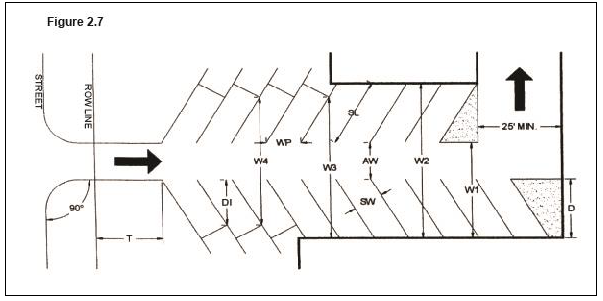
Parking layout dimensions. Parking stalls and drive aisles shall be installed in conformance with Table 2.2 and Figure 2.7. Parking stall dimensions are based on the angle of the stall and the function of the drive aisle.
(i)
Parking for physically disabled persons. Parking spaces for use by physically disabled persons shall be provided according to the following standards:
(i)
At least one accessible space is required for each 25 spaces that are available for the first 100 spaces in the parking area.
(ii)
After that, one accessible space is required for each 50 spaces that are available from 100 spaces up to 500 spaces.
(iii)
If a parking area has more than 500 spaces, two percent of the additional spaces over 500 should be accessible.
(iv)
Parking spaces reserved for physically disabled persons shall be at least 16 feet wide. Such spaces shall be located as close as possible to an entrance of the parking facility and to the building entrance.
(v)
Accessible parking spaces shall be designated as reserved for environmentally limited persons by providing an R7-8 (U.S. Department of Transportation standard) sign which contains the international symbol of accessibility.
(j)
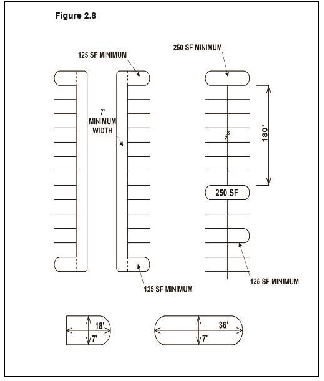
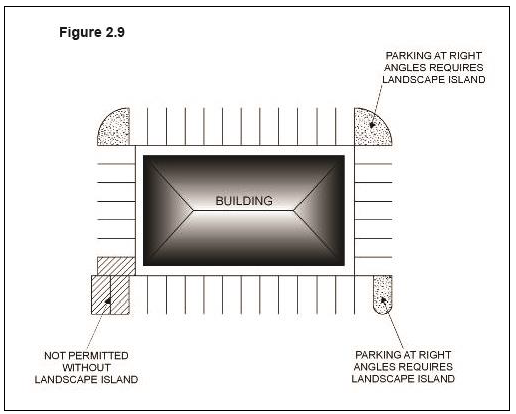
Parking lot islands and endcaps. (See Figures 2.8 through Figure 2.10):
(i)
When required. Interior parking lot islands and endcaps shall be required for any parking lot with more than ten parking spaces.
(ii)
Islands and endcaps.
1.
Location. Islands are required at the ends of parking rows, driveway entrances, and at intermediate locations such that there is a maximum of 90 feet between islands.
2.
Single parking rows. Islands shall contain a minimum of 125 square feet in area, and be at least seven feet in width measured from the edge of pavement or the back of curb.
3.
Double parking rows. A minimum 250 square-foot island shall be required. The seven-foot dimension may be reduced to accommodate the triangular shape resulting from angled parking. A continuous seven-foot wide landscape or walkway strip may be provided between double parking rows in place of landscape planter islands.
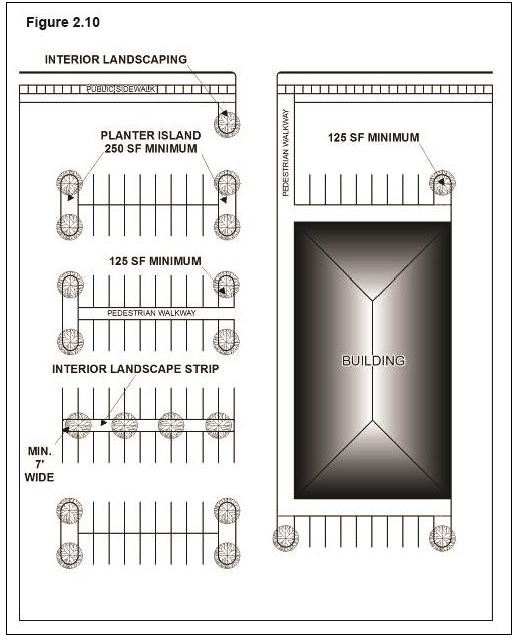
4.
As an alternative to standards (1) through (3) above, a parking landscaping plan may be submitted, consistent with provisions contained in section 102-234.B(2). Such plan shall provide for at least ten percent of the parking lot area landscaped and include interior landscaped areas or features which provide at least 250 square feet of interior landscaped area per each 100 linear feet of parking spaces.
(k)
Walkways and pedestrian access. Walkways shall provide pedestrian access through parking lots from street sidewalks to building entries. Walkways shall be located and aligned to directly and continuously connect areas or points of pedestrian origin and destination, and shall not be located and aligned solely based on the outline of a parking lot configuration unless such configuration allows for direct pedestrian access. (See Figure 2.10)
(i)
Number. One pedestrian access is required per street frontage.
(ii)
Design requirements.
1.
Walkways shall have an acceptable dust free surface not less than five feet in width and shall be grade separated from the parking lot or otherwise delineated with pavement markers, planters, or alternate paving materials.
2.
The entirety of the on-site pedestrian walkway system shall be marked and defined using pavement treatments, signs, lighting, median refuge areas, and landscaping as appropriate and approved by the building and zoning superintendent.
3.
Where the primary pedestrian access to the site crosses drive aisles or internal roadways, the pedestrian crossing shall emphasize and place priority on pedestrian access and safety.
4.
The material and layout shall be continuous as the pedestrian access crosses the driveway with a break in continuity of the driveway paving and not in the pedestrian access way.
(l)
Parking lot lighting. See section 102-606.
(m)
Shared parking. The plan commission may approve the use of up to 70 percent of the required parking spaces to meet off-street parking regulations for two separate lots on one lot if the following conditions are present:
(i)
Lots are adjacent or opposite (directly across the street) from each other, fronting on the same street.
1.
One lot is an evening or Sunday use and the other lot contains a daytime use, such as:
a.
Sunday uses. Auditoriums incidental to public or parochial schools; churches/places of worship; theatres; bowling alleys; Bars or nightclubs; or similar uses as determined by the building and zoning superintendent.
b.
Daytime uses. For the purpose of this section, the following uses are considered as primarily daytime uses: schools, public or parochial; banks and professional offices; personal service establishments; service and repair shops; manufacturing without 2nd or 3rd shift; wholesale businesses; and similar uses, as determined by the building and zoning superintendent.
2.
The use for which application is being made for joint parking shall be located within 1,000 feet of the use providing parking facilities.
3.
The applicant shall show that there is no substantial conflict in the principal operating hours of the buildings or uses for which joint parking is proposed.
4.
A legally binding instrument, executed by the parties concerned, for joint off-street parking facilities shall be approved by the city and recorded at the register of deeds.
(n)
Phasing. Required off-street parking areas may be constructed in phases with a phasing plan to be approved by the building and zoning superintendent.
(i)
Areas required for parking, but not immediately improved, shall be reserved for future parking.
(ii)
Undeveloped future parking areas shall be seeded with grass mix, acceptable to the building and zoning superintendent, until said area is fully developed into a parking surface.
(o)
Oversized parking lots/maximum number of spaces. Parking lots may exceed up to ten percent of the maximum allowed per the parking requirements outlined in the off-street parking requirements table through an administrative approval, for which review consideration shall be given to the following factors. Parking lots in excess of ten percent shall be allowed only through special use permit for which review consideration shall be given to the following factors in granting the permit:
(i)
The proposed development has unique or unusual characteristics (such as high sales volume or low parking turnover) which creates a parking demand that exceeds the maximum ratio and does not typically apply to comparable uses.
(ii)
The lot is designed to allow for more intensive future site development.
(iii)
Pedestrian connectivity through the lot.
(iv)
The need for additional parking cannot be reasonably met through provision of on-street or shared parking with adjacent or nearby uses.
(v)
The proposed development demonstrates that its design and intended use will support high levels of existing or planned transit and pedestrian activity.
(p)
Temporary use parking. As part of a temporary use permit, temporary outdoor entertainment permit, or combination thereof, temporary use parking shall be designated on the temporary use/event site and may also be designated on other properties. Temporary use parking adequacy shall be determined by the building and zoning superintendent based on planned temporary use/event capacity.
(q)
Snow storage requirements for off-street parking and loading areas.
(i)
Snow storage plan required. In conjunction with the approval of a BSO plan for off-street parking areas, a snow storage and/or removal plan shall be submitted to the building and zoning superintendent for review and approval.
(ii)
Said snow storage plan shall adequately address, either graphically and/or in writing, the on-site storage of snow removed from said off-street parking or loading area or the removal from the site of such snow.
(iii)
If the snow is to be physically removed from the site, the snow storage plan shall specify the location of the proposed snow repository site.
(iv)
The petitioner shall provide an affirmative statement that there is a snow removal plan. The statement shall be furnished the building and zoning superintendent with the snow storage or removal plan.
(v)
Snow storage standards for parking and loading areas. Adequate snow storage shall be provided using the following standards:
1.
A maximum of ten percent of the total required off-street parking spaces may be used as the snow storage area.
2.
The required snow storage area may be paved or not paved. In either case, adequate drainage of the snow storage area shall be provided to accommodate snowmelt, and no snowmelt shall drain on abutting properties.
3.
Required setbacks, yards, and bufferyards may be used to accommodate the required snow storage area. However, areas landscaped with shrubs and/or trees shall not be used as snow storage areas.
C.
Bicycle parking. A minimum of four bicycle parking spaces may be provided in lieu of not more than one required automobile parking space in a nonresidential parking lot with a maximum reduction of up to five parking spaces.
(1)
Location. Bicycle parking spaces and racks shall be located in a convenient and visible area no farther from the principal entrance to the building served than the closest automobile parking space.
(2)
Design. Bicycle parking shall consist of a bike rack designed so that the bicycle frame can be locked to the rack.
(3)
Maximum reduction. The number of required parking spaces shall not be reduced more than 20 percent of those required due to the reduction granted by the provision of bicycle parking.
D.
Off-street parking and queuing requirements. Accessory, off-street parking shall be provided as specified in Table 2.3 for specific off-street parking requirements, except in the DB, downtown business district, or as otherwise specified in this chapter.
(Ord. No. 2015-10-16, Exh. A, 10-5-15)
Sec. 102-228. - Off-street loading facilities.
Loading and/or unloading facilities shall be provided for all commercial and industrial structures unless an equivalent number of spaces is provided in conformity with these regulations.
A.
Requirement. Off-street loading berths shall be provided in conjunction with the construction of, addition to, or expansion of any business use. The loading space requirements set forth in Table 2.4 shall apply to each establishment or business tenant space within a shopping center, rather than to the shopping center as a whole.
B.
Location.
(1)
All required loading spaces shall be located on the same lot as the use served.
(2)
All required off-street loading spaces shall not be located in a required side yard.
(3)
All required off-street loading spaces shall not directly face a public or private street.
(4)
All required off-street loading spaces shall be located at least 50 feet from a residential district as measured to the nearest point of the load area, unless completely enclosed by building walls.
(5)
All required off-street loading spaces shall be located so that a public street or sidewalk will not be occupied during the loading or unloading process. No permitted or required loading berth shall be located within 25 feet of the nearest point of intersection of any two streets.
C.
Drainage. All open loading spaces shall have a stormwater drainage system connected to a public storm sewer if available, as approved by the building and zoning superintendent. No surface runoff should be allowed to flow across any lot line.
D.
Screening. All loading spaces shall be screened from the view of abutting lots to a height of at least six feet by a solid fence and/or evergreen vegetation in compliance with section 102-520.
E.
Loading spaces do not count as parking spaces. Space required and allocated for off-street loading shall not be allocated or used to satisfy the space requirements for off-street parking.
F.
Surfacing. All open off-street loading spaces shall be provided with surface improvements as required for parking areas. All required surfacing of loading berths shall be completed prior to the issuance of any occupancy permit for the use to be served by such loading berths.
G.
Access. Each required off-street loading space shall be designed for direct access to a street or alley in a manner which will least interfere with traffic movements on the street.
H.
Service and repair. Repairing or servicing of motor vehicles shall not be permitted in an off-street loading space.
(Ord. No. 2015-10-16, Exh. A, 10-5-15)
Sec. 102-230. - Hydronic heaters (outdoor boilers).
A.
Prohibited. Outdoor hydronic heaters as defined in this chapter shall be prohibited.
B.
Inside structure. The operation of a hydronic heater fully enclosed within an accessory structure shall be permitted.
C.
Burning. Burning of any and all materials on property in the City of Sterling shall be governed by the regulations outlined in chapter 42 the Municipal Code pertaining to fire prevention and protection.
(Ord. No. 2015-10-16, Exh. A, 10-5-15)

