
Sunrise City Zoning Code
ARTICLE XIV
SIGNS3
Editor's note— Ord. No. 402-01-K, § 1, adopted Dec. 11, 2001, amended §§ 16-247—16-264 in their entirety. Formerly said sections pertained to similar subject matter. See the Code Comparative Table.
Sec. 16-247.- Purpose, definitions, substitution, and severability.
(a)
Intent. The purpose of this article is to create a comprehensive system of street graphic controls, through the promotion of quality business identification and indexing; to facilitate clear communication of signs; to reduce traffic and structural hazards; and to enhance the visual appearance of the city.
(b)
Scope.
(1)
The provisions of this article shall govern the number, size, location, and character of all signs which may be permitted either as a principal or accessory use under the terms of this article. No signs shall be permitted on a parcel either as a principal or accessory use except in accordance with the provisions of this article.
(2)
This article does not regulate City signs on property owned by the City, Broward County, or the State of Florida, and does not regulate traffic control devices. Private signs on public property and rights-of-way are unauthorized, and subject to removal and disposal.
(3)
In the event of any conflict between this Code and any declaration of covenants, bylaws, or other restrictions applying to any property within the City, the language affording the more restrictive interpretation shall apply.
(4)
The City specifically finds that these sign regulations are narrowly tailored to achieve the compelling and substantial governmental interests of traffic safety and aesthetics, and that there is no other way for the City to further these interests.
(c)
Purpose.
(1)
Florida Constitution. Article II, Section 7 of the Florida Constitution provides that "[i]t shall be the policy of the state to conserve and protect its natural resources and scenic beauty. . . ." A beautiful environment preserves and enhances the desirability of the City as a place to live and to do business. Implementing the Florida Constitution is a compelling governmental interest.
(2)
Florida Statutes. Florida law require cities to adopt comprehensive plans and implement them through land development regulations (also known as zoning regulations) and approval of development orders that are consistent with the comprehensive plan. See Part II of F.S. chapter 163. Florida law specifically requires that the City adopt sign regulations. See F.S. section 163.3202(2)(f). Complying with state law is a compelling governmental interest.
(3)
City Comprehensive Plan. The City is a diverse community with a wide range of land uses. Some areas are suburban in character, while the western edges of the City have been developed with a more urban character and contain regionally significant commercial and institutional uses. Several goals, objectives and policies of the City's comprehensive plan require the City to maintain its scenic beauty and traffic safety through its land development regulations and actions. The Future Land Use and Transportation Elements of the City's Comprehensive Plan calls for sign regulation and prioritizes aesthetics and traffic safety as follows:
a.
Future Land Use Objective 1.3 - Protection of Residential Areas: Develop and implement land use controls which promote residential areas that are attractive, well maintained and protect the health, safety, and welfare of residential areas.
b.
Future Land Use Policy 1.3.6 - Regulate signs in order to promote community aesthetics and scenic beauty in the City and protect the health, safety and welfare of the City residents.
c.
Future Land Use Goal 2 - Commercial: Provide for a varied and diverse mix of commercial opportunities to serve the residents of the City of Sunrise and the South Florida Region.
d.
Future Land Use Policy 2.2.5 - Regulate signs in order to promote community aesthetics and scenic beauty in the City and protect the health, safety and welfare of the City residents.
e.
Future Land Use Policy 3.4.1 - Regulate signs in order to promote community aesthetics and scenic beauty in the City and protect the health, safety and welfare of the City residents.
f.
Future Land Use Policy 4.4.1 - Regulate signs in order to promote community aesthetics and scenic beauty in the City and protect the health, safety and welfare of the City residents.
g.
Future Land Use Policy 5.2.5 - Regulate signs in order to promote community aesthetics and scenic beauty in the City and protect the health, safety and welfare of the City residents.
h.
Transportation Goal 1 - The City will actively promote the provision of a safe, convenient, and efficient transportation system for all modes of travel.
i.
Transportation Goal 3 - The City will encourage a transportation system which minimizes environmental impact and conserves energy.
j.
Transportation Goal 7 - Protect, maintain, and where feasible improve the City of Sunrise's transportation system in a manner that provides for safety and security, convenience and energy efficiency; that coordinates and balances the transportation system, with the state, regional and countywide multi-modal plans, programs and systems; that is considerate of sensitive environmental issues and areas; and that addresses the transportation needs of present and future populations including the transportation disadvantaged.
Implementing the City Comprehensive Plan is a compelling governmental interest.
(d)
Caselaw. In accordance with the U.S. Supreme Court's cases on sign regulation, the regulations in this article are not intended to regulate or censor speech based on its content or viewpoint, but rather to regulate the secondary effects of speech that may adversely affect the City's substantial and compelling governmental interests in preserving scenic beauty and community aesthetics, and in vehicular and pedestrian safety in conformance with the First Amendment. These cases and their holdings include, but are not limited to:
(1)
Reed v. Town of Gilbert, 576 U.S. 576, U.S.155, 135 S. Ct. 2218, 192 L. Ed. 2d 236 (2015) on the topic on noncommercial temporary signs;
(2)
Metromedia, Inc. v. City of San Diego, 453 U.S. 490 (1981) on the topic of commercial signs and off-premises signs;
(3)
City of Ladue v. Gilleo, 512 U.S. 43 (1994) on the topic of political protest signs in residential areas;
(4)
Linmark Assocs., Inc. v. Township of Willingboro, 431 U.S. 85 (1977) on the topic of real estate signs in residential areas;
(5)
Burson v. Freeman, 504 U.S. 191 (1992) on the topic of election signs near polling places;
(6)
Central Hudson Gas & Electric Corp. v. Public Service Commission, 447 U.S. 557 (1980) on the topic of commercial speech; and
(7)
City Council v. Taxpayers for Vincent, 466 U.S. 789 (1984) on the topic of signs on public property.
(8)
City of Austin, Texas v. Reagan Nat'l Advert. of Austin, LLC, 142 S. Ct. 1464 (2022) on the topic of off-premises sign regulation.
(9)
Shurtleff v. City of Boston, Massachusetts, 142 S. Ct. 1583, 1584 (2022) on the topic of commercial flags and government speech.
(e)
Impact of sign clutter. Excessive signage and sign clutter impair the legibility of the environment, and undermines the effectiveness of governmental signs, traffic control devices and other required signs (such as address, directional, directory, and identification signs) that are essential to identifying locations for the delivery of emergency services and other compelling governmental purposes. The intent of these sign regulations is to enhance the visual environment of the City, ensure that City residents, visitors and emergency responders can safely navigate through the City to their intended destinations, and promote the continued well-being of the City. It is therefore the purpose of this article to promote aesthetics and the public health, safety and general welfare, and assure the adequate provision of light and air within the City through reasonable, consistent and nondiscriminatory standards for the posting, displaying, erection, use, and maintenance of signs and sign structures that are no more restrictive than necessary to achieve these governmental interests.
(f)
Specific Legislative Intent. More specifically, the sign regulations are intended to:
(1)
Encourage the effective use of signs as a means of communication in the City;
(2)
Maintain and enhance the scenic beauty of the aesthetic environment and the City's ability to attract sources of economic development and growth;
(3)
Ensure all modes of pedestrian safety and traffic safety;
(4)
Minimize the possible adverse effect of signs on nearby public property, public rights-of-way and private property;
(5)
Foster the integration of signs with architectural and landscape designs;
(6)
Lessen the visual clutter that may otherwise be caused by the proliferation, improper placement, illumination, animation, excessive sign height, and excessive sign area which compete for the attention of pedestrian and vehicular traffic and are not necessary to aid in wayfinding;
(7)
Allow signs that are compatible with their surroundings and aid orientation, while precluding the placement of signs that contribute to sign clutter or that conceal or obstruct adjacent land uses or signs;
(8)
Encourage and allow signs that are appropriate to the zoning district in which they are located and consistent with the land uses, activities and functions to which they pertain;
(9)
Curtail the size and number of signs to the minimum reasonably necessary to identify the location and the nature of a land use, and to allow smooth navigation to these locations;
(10)
Establish dimensional limits and placement criteria for signs that are legible and proportional to the size of the parcel and structure on which the sign is to be placed, or to which it pertains;
(11)
Regulate signs so that they are effective in performing the function of identifying and safely directing pedestrian and vehicular traffic to a destination;
(12)
Preclude signs from conflicting with the principal use of the parcel and adjoining parcels;
(13)
Regulate signs in a manner so as to not interfere with, obstruct the vision of, or distract motorists, bicyclists or pedestrians;
(14)
Except to the extent expressly preempted by state, Broward County or federal law, ensure that signs are constructed, installed and maintained in a safe and satisfactory manner, and protect the public from unsafe signs;
(15)
Preserve, conserve, protect, and enhance the aesthetic quality and scenic beauty of all zoning districts of the City;
(16)
Allow traffic control devices consistent with national standards without regulation in this article, because they promote highway safety and efficiency by providing for the orderly movement of road users on streets and highways, and by notifying road users of regulations and providing nationally consistent warnings and guidance needed for the safe, uniform and efficient operation of all modes of travel, while regulating private signs to ensure that their size, location and other attributes do not impair the effectiveness of such traffic control devices;
(17)
Protect property values by precluding, to the maximum extent possible, signs that create a nuisance to the occupancy or use of other properties as a result of their size, height, illumination, brightness, or movement;
(18)
Protect property values by ensuring that the size, number and appearance of signs are in harmony with buildings, neighborhoods, structures, and conforming signs in the area;
(19)
Regulate the appearance and design of signs in a manner that promotes and enhances the beautification of the City and that complements the natural surroundings in recognition of the City's reliance on its natural surroundings and beautification efforts as a source of economic advantage as an attractive place to live and work;
(20)
Classify and categorize signs by type and zoning district;
(21)
Not regulate signs more than necessary to accomplish the compelling and important governmental objectives described herein;
(22)
Enable the fair and consistent enforcement of these sign regulations;
(23)
Permit, regulate and encourage the use of signs with a scale, graphic character, and type of lighting compatible with buildings and uses in the area, so as to support and complement the goals, objectives and policies set forth in the City's Comprehensive Plan;
(24)
Establish regulations for the design, erection and maintenance of signs for the purpose of ensuring equitable access to graphic communication, while maintaining a harmonious and aesthetically pleasing visual environment within the City, recognizing that signs form an integral part of architectural building and site design and require equal attention in their design, placement and construction; and
(25)
Provide for the unique signage needs of multi-tenant properties through the uniform signage plans that assure a consistent and cohesive appearance and enhance legibility of sign messages through their common design; and
(26)
Provide an effective method to deter individuals and businesses from attaching unsightly and distracting signs to public structures within or adjacent to public rights-of-way; and
(27)
Be considered the maximum standards allowed for signage, and regulate signs in a permissive manner so that any sign is not allowed unless expressly permitted and not expressly prohibited.
(g)
Definitions (see also Article XVII).
Advertise or Advertising shall mean to convey or conveying a commercial message.
Animated sign means a sign which uses motion of any part of by any means, or displays flashing, oscillating, sequentially or intermittent lights. Excludes changeable copy sign, automatic.
Architectural projection means any projection not intended for occupancy, which extends beyond the property line, not including signs, canopies or marquees.
Awning sign means a sign placed on an awning, which is supported entirely from the exterior wall of a building and composed of a no rigid material except for the supporting framework.
Banner sign means a sign having the characters, letters or illustrations applied to cloth, paper or fabric of any kind with only such material for backing.
Billboard. See "off-premises sign."
Bunting means any kind of pennant, streamer or other similar fabric decoration.
Cabinet sign means a sign that contains all the text and/or logo symbols within a single enclosed box and may or may not be illuminated.
Canopy sign means a sign hung underneath a pedestrian shelter canopy in a multitenant non-residential structure.
Changeable copy sign, manual means signs displaying messages, which can be, or are intended to be, changed by use of removable letters and numerals.
Changeable copy sign, automatic means a sign permitted by a uniform sign plan in the Western Sunrise Area on which copy is changed through an automatic or remotely controlled process, no more frequently than every eight (8) seconds. Shall not be operated as an animated sign.
Cold air balloon sign means any sign of fabric type material, inflated by cold air to a point of semi-rigidity for the purpose of floating above the ground.
Commercial, Commercial message, Commercial copy or Commercial sign shall mean any sign wording, logo, or other representation or image that directly or indirectly names, advertises, or calls attention to an entity, product, commodity, service, sale or sales event or other commercial activity.
Contractor sign means a sign displayed while a building permit is active on the property on which it is located whether non-residential or residential.
Copy area. See "sign area."
Corner lot means a lot or outlot abutting two (2) public rights-of-way at their intersection.
Development or neighborhood identification sign means a sign that is placed around the perimeter of a development or neighborhood and used to identify the development or neighborhood.
Directional sign means:
(1)
A noncommercial on-premises sign, providing information to all modes of pedestrian and vehicular traffic, such as, but not limited to, "entrance," "exit," "caution" "parking," and "no trespassing."
(2)
A sign within a development, or at the entrances thereto, used to identify the locations of the subdivisions comprising the development, or a particular building within the development or subdivision.
Directory sign means an index used to identify tenants of an office building, shopping center or other multitenant business complex.
Double-faced sign means a freestanding sign with copy on both sides, the sign area of which shall be measured by one (1) face.
Façade means the face of a building from the ground to the roof line.
Ground or monument sign means any freestanding solid monument structure containing a sign face which is supported solely by its own ground-mounted base and which is not attached or affixed in any way to a building or other structure. The ground mounted base shall be equal to or greater than the length of the sign face including the cabinet or any structure within which the sign is located.
Illuminated sign means any sign having characters, letters/designs, logos or outlines illuminated by electric lights or luminous tubes designed for that purpose, whether or not said lights or tubes are physically attached to the sign.
Logo means a distinctive on-premises graphic symbol, wholly separated and individual from the alphabetical and/or numerical lettering, identifying a tenant in a nonresidential property.
Model sign means a sign displayed when a dwelling unit is exhibited to depict other units of a similar design that are for sale.
Multitenant center means any shopping center, office center or business center in which two (2) or more occupancies abut each other or share common parking facilities or driveways or are otherwise related.
Noncommercial sign means a sign containing only noncommercial copy. Regardless of the content of the copy, a noncommercial sign shall not be construed to be an off-premises sign.
Nonconforming sign, (legal) means an existing sign, which legally received a city sign permit or other city approval but which does not meet the requirements of the current code.
Off-premises sign means any sign advertising a commercial establishment, activity, product, service or entertainment, which is sold, produced, manufactured, available or furnished at a place other than on the property on which the sign is located. An off-premises sign is a principal use of the property on which it is located.
Parcel means any quantity of land capable of being described with such definiteness that its location and boundaries may be established, which is designated by its owner or developer as land to be used or developed as a unit or that has been used or developed as a unit.
Pole sign means any sign erected upon a pole, poles or a pylon, and which is wholly independent of any building and/or other structure for support.
Portable sign means any sign not permanently attached to the ground or other permanent structure or a sign designed to be transported, including, but not limited to, signs designed to be transported by means of wheels; skid-mounted signs; signs converted to A- or T-frames; and signs attached to or painted on vehicles parking to clearly provide advertising close to the public right-of-way, unless said vehicle is used in the normal day-to-day operations of the business, the sign area is less than two (2) square feet per side and there is no reasonable alternative storage space. This definition shall not be construed to include a sandwich sign.
Project sign means a sign displayed when a project is under construction or in the City permitting process.
Projecting sign means a sign directly attached to and extending from a building or other structure by more than fifteen (15) inches. This definition shall not be construed to include a canopy sign or awning sign.
Real estate sign means a sign erected on-site by the owner or his agent, indicating property which is for rent, lease or sale, open for inspection, shown by appointment only or any similar announcement.
Roof sign means a sign erected over, across or on the roof of any building, which is dependent on the roof, parapet or upper walls of a building for support.
Sandwich sign means a temporary, moveable, freestanding sign, single or double faced, not secured or attached to the ground that can be folded and carried by an individual, including A-frame.
Searchlight means a device designed to project a beam of light for the purpose of attracting attention rather than for illumination during hours of darkness.
Sign means any commercial or noncommercial wording, illustration, logo, insignia or symbol and all parts composing the same, together with the actual sign face, frame, background, structure or support therefore, which is used for advertising or display purposes. Any sculpture molding, casting or other objects used for advertising or display purposes, or any flags, lighting, bunting or material used for display or advertising purposes of a commercial or noncommercial nature, or for the purpose of attracting the attention of the public shall also be considered a sign. A sign that is located on private property so that it is not visible or legible from any vehicular right-of-way or public property does not impact traffic safety or aesthetics of the public realm and is therefore not regulated by this article. However, such signs are not exempt from the structural, electrical or material specifications as set forth in this Code and the applicable building codes.
Sign area means the square foot area enclosed by the perimeter of the sign structure. A sign is composed of individual letters, symbols, logos illustrations or designs only, and the sign area is the area enclosed by a perimeter line (forming a single rectangle or square) enclosing all letters, symbols, logos illustrations or designs. When a sign is a ground sign, the square foot area from the ground to the maximum height times width is the sign area.
Sign height. For ground and monument signs, if the area around the sign is bermed, then the height of the sign is determined from the crown of the fronting street, unless such berm is required by section 16-169, in which case, the height of the sign is measured from the top of the grade of the required berm or from two (2) feet above the crown of the fronting street, whichever is lower.
Snipe sign means a sign which is tacked, nailed, posted, pasted, glued or otherwise attached to trees, poles, stakes, walls, trash receptacles, bus shelters, benches, utility boxes, other public structures, or fences, or to other objects which are not intended or designed to serve as supports for signs.
Temporary sign means any sign to be displayed for a limited period as specified in Table 3 of subsection 16-253(a) shall be deemed a temporary sign.
Traffic control device means any sign located within the right-of-way that is used as a traffic control device and that is described and identified in the Manual on Uniform Traffic Control Devices (MUTCD) and approved by the Federal Highway Administrator as the National Standard and as may be revised from time to time. A traffic control device sign includes those signs that are classified and defined by their function as regulatory signs (that give notice of traffic laws or regulations), warning signs (that give notice of a situation that might not be readily apparent), and guide signs (that show route destinations, directions, distances, services, points of interest, and other geographical, recreational, or cultural information). These devices are not regulated as signs under this article.
Unified property means two (2) or more plots or parcels of land, within a common property boundary, used to identify a single project or development, regardless of the number of buildings on the site or the individual ownerships of lots or outlots. The parcels shall be legally bound together by unity of title, covenant, site plan, declaration or other legally enforceable agreement.
V-shaped sign means two (2) or more signs attached by the same frame, designed to display from two (2) or more directions, the sign area of which shall be measured by all faces that display.
Wall sign means a sign which is affixed to and flat against an exterior wall, fascia, cantilever, marquee, mansard, door or window of any building which is parallel thereto and supported by said wall, fascia, cantilever, marquee, awning, mansard or building. No wall sign shall project higher than the top of said wall, fascia, mansard or building.
Window sign means a sign attached inside a store front window or door used to identify the occupant.
(h)
Substitution Clause. It is not the intent of this article to afford greater protection to commercial speech than to noncommercial speech. Any sign, display or device allowed under this article may contain, in lieu of any other copy, any otherwise lawful noncommercial message that complies with all other requirements of this article. The noncommercial message may occupy the entire sign area or any portion thereof, and may substitute for or be combined with the commercial message. The sign message may be changed from commercial to noncommercial, or from one noncommercial message to another, as frequently as desired by the sign's owner, provided that the sign is not prohibited and the sign continues to comply with all requirements of this article.
(i)
Severability.
(1)
The sections, paragraphs, sentences, clauses and phrases of this article are severable, and if any phrase, clause, sentence, paragraph or section of this article shall be declared unconstitutional or void or unenforceable by the valid judgment or decree of a court of competent jurisdiction, such unconstitutionality or invalidity shall not affect any of the remaining phrases, clauses, sentences, paragraphs and sections of this article.
(2)
This subsection shall not be interpreted to limit the effect of subsection (1) above, or any other applicable severability provision in this Code or any adopting ordinance. The city commission specifically intends that severability shall be applied to sign regulations even if the result would be to allow less speech in the city, whether by subjecting currently exempt signs to permitting or by some other means.
(3)
This subsection shall not be interpreted to limit the effect of subsections (1) or (2) above, or any other applicable severability provision in this Code or any adopting ordinance. The city commission specifically intends that severability shall be applied to prohibited signs so that each of the prohibited sign types listed in the city Code in section 16-248 shall continue to be prohibited irrespective of whether another or any other sign prohibition is declared unconstitutional or invalid.
(4)
This subsection shall not be interpreted to limit the effect of subsections (1), (2) or (3) above, or any other applicable severability provision in this Code or any adopting ordinance. The city commission specifically intends that severability shall be applied to section 16-248 of the sign regulations so that if all or any of such provisions are declared unconstitutional or invalid by the final and valid judgment of any court of competent jurisdiction, the city commission intends that such declaration shall not affect any other prohibition on animated, flashing or off-premises signs in the aforesaid section.
(Ord. No. 402-97-E, § 1, 8-26-97; Ord. No. 402-97-F, § 1, 10-14-97; Ord. No. 402-98-D, § 2, 8-11-98; Ord. No. 402-01-K, § 1, 12-11-01; Ord. No. 402-03-A, § 1, 1-28-03; Ord. No. 402-10-A, § 2, 1-12-10; Ord. No. 402-11-B, § 5, 3-8-11; Ord. No. 402-12-J, § 2, 9-25-12; Ord. No. 402-13-G, § 10, 11-12-13; Ord. No. 402-14-A, § 4, 1-14-14; Ord. No. 402-16-A, § 14, 1-12-16; Ord. No. 402-24-A, § 2, 3-12-24)
Sec. 16-248. - Prohibited signs.
(a)
The following signs are prohibited anywhere in the city:
(1)
Abandoned signs, pursuant to section 16-258.
(2)
Animated signs.
(3)
Any sign not prescribed as a permitted sign by this article.
(4)
Any sign that could be confused with a traffic control device.
(5)
Buntings.
(6)
Cabinet signs.
(7)
Off-premises signs.
(8)
Painted signs.
(9)
Pole signs.
(10)
Portable signs.
(11)
Projecting signs.
(12)
Roof signs.
(13)
Snipe signs.
(14)
Strip lighting used to outline roofs or any part of a building or window.
(15)
Exposed neon or bare bulb signs.
(16)
Any signs that are placed within a site visibility triangle.
(17)
Private signs attached to public structures or placed on public property or rights-of-way, attached to public structures, or placed on public property or rights-of-way.
(b)
Prohibited signs shall be removed as required in Section 16-259.
(Ord. No. 402-97-E, § 1, 8-26-97; Ord. No. 402-97-F, § 2, 10-14-97; Ord. No. 402-98-D, § 2, 8-11-98; Ord. No. 402-99-K, § 2, 8-24-99; Ord. No. 402-00-G, § 1, 10-10-00; Ord. No. 402-01-K, § 1, 12-11-01; Ord. No. 402-05-E, § 3, 12-13-05; Ord. No. 402-11-B, § 6, 3-8-11; Ord. No. 402-12-J, § 3, 9-25-12; Ord. No. 402-14-A, § 5, 1-14-14; Ord. No. 402-24-A, § 3, 3-12-24)
Sec. 16-249. - Required signs.
(a)
The following signs must be placed where relevant, and are not regulated by this Code:
(1)
Warning signs at gasoline stations, as prescribed by fire marshal.
(2)
Fire lane markings, no smoking, locked/blocked doors, blocked, apartment identification, not an exit, and other similar signs, as may be prescribed by the fire marshal. Seating capacity or occupant load signs, as determined by the building division or fire department.
(3)
Building identification:
a.
Residential building with four (4) dwelling units or less—Address numerals at least four (4) inches high but not greater than ten (10) inches.
b.
Residential building with more than four (4) dwelling units—Address numerals at least ten (10) inches high.
c.
Nonresidential buildings - address numerals at least ten (10) inches high.
(4)
Handicapped parking signs in accordance with state requirements.
(5)
Street signs, traffic signs and legally required public notice signs when required by this code, or County, state or federal law.
(Ord. No. 402-97-E, § 1, 8-26-97; Ord. No. 402-01-K, § 1, 12-11-01; Ord. No. 402-11-B, § 7, 3-8-11; Ord. No. 402-24-A, § 4, 3-12-24)
Sec. 16-250. - Reserved.
Editor's note— Ord. No. 402-01-K, § 1, adopted Dec. 11, 2001, repealed § 16-250 in its entirety. Formerly said section pertained to public interest signs. See the Code Comparative Table.
Sec. 16-251. - Residential district permanent signs.
The following signs are authorized in all residential districts, including RS-3, RS-5, RS-7, RM-10, RM-16 and RM-25, and residential buildings within PUD and PDD districts:
TABLE 1
(1) A multifamily building which is not part of a larger development may have one such sign not to exceed 6 square feet.
(Ord. No. 402-97-E, § 1, 8-26-97; Ord. No. 402-01-K, § 1, 12-11-01; Ord. No. 402-11-B, § 8, 3-8-11)
Sec. 16-252. - Nonresidential district permanent signs.
Table 2 authorizes the following signs in CR, CF, B-1, B-2, B-3, B3-A, B-4, B-5, B-6, B-7, and I-1 districts.
TABLE 2
(1)
If a sign is to be located behind an existing required hedge or if visibility of an existing sign is blocked by an existing required hedge and the hedge has a minimum required height of thirty (30) inches or more, then the ground sign may have a maximum height of eight and one-half (8½) feet. In such an instance the sign area shall not exceed fifty-one (51) square feet for frontage less than two hundred (200) feet, or eighty-five (85) square feet for frontage two hundred (200) feet or greater. In no case shall a sign base be higher than the shrub line in front of the sign.
(2)
See subsection 16-254(b) and (c) for gas station signs.
Typical Advertising Sign Placement - Figure XIV - 1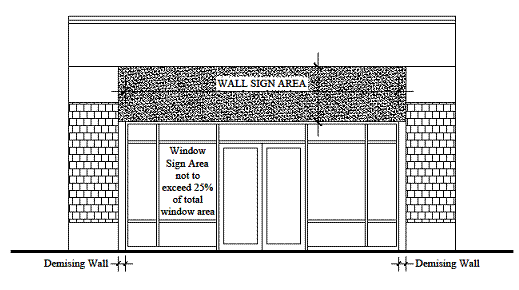
(Ord. No. 402-97-E, § 1, 8-26-97; Ord. No. 402-98-D, § 4, 8-11-98; Ord. No. 402-99-K, § 2, 8-24-99; Ord. No. 402-01-K, § 1, 12-11-01; Ord. No. 402-11-B, §§ 9, 10(Exh. A), 3-8-11; Ord. No. 402-12-J, § 4, 9-25-12; Ord. No. 402-24-A, § 5, 3-12-24)
Sec. 16-253. - Temporary and relief signs.
(a)
Only the following temporary signs shall be permitted:
TABLE 3
(b)
Temporary signs not removed by the end of the specified time shall constitute a public nuisance, which may be abated in accordance with Chapter 9 of the City Code.
(Ord. No. 402-97-E, § 1, 8-26-97; Ord. No. 402-97-F, § 3, 10-14-97; Ord. No. 402-00-G, § 3, 10-10-00; Ord. No. 402-01-K, § 1, 12-11-01; Ord. No. 402-03-A, § 2, 1-28-03; Ord. No. 402-10-A, § 3, 1-12-10; Ord. No. 402-11-B, § 11, 3-8-11; Ord. No. 402-12-J, § 5, 9-25-12; Ord. No. 402-13-G, § 11, 11-12-13; Ord. No. 402-24-A, § 6, 3-12-24)
Sec. 16-254. - Supplemental sign regulations.
(a)
Sign criteria for multitenant centers.
(1)
A sign application for any portion of a multitenant building shall provide a written statement of uniform criteria established for a multitenant center or complex regarding the uniform color of all signs, type of signs, type of illumination, style of mounting, size of letters (maximum and minimum), and overall size of signs, including a sketch thereof, must be attached to the sign and site plan applications. Canopy signs must only be uniform with respect to material and to color of background and border of the sign. The written criteria shall be approved by the director of community development or his/her designee if they meet the requirements of this Code.
(2)
Nationally or state registered trademark lettering is exempt from the uniform criteria, with the exception of lettering color. Logos, as defined in this article, are exempt from the established criteria of the multitenant center but must meet other requirements of this article.
(3)
Once the criteria have been established for a multitenant center or complex, the criteria shall apply to the entire center, as well as each individual occupant, and shall remain as long as the center exists, regardless of change of ownership or management. The criteria may only be changed if all signs in the center are changed to conform to the new approved criteria. New criteria and an amortization period of not more than five (5) years for on-premises signs, with replacement of no less than twenty (20) percent of total on-premises signs per year, shall be approved by the director of community development or his/her designee.
(4)
Written consent to the plans and criteria must be provided by the owner of the building, structure or land to which or on which the sign structure is to be erected, relocated, maintained or altered.
(b)
Changeable copy signs. Permitted to be used only for theaters, playhouses, other entertainment businesses, schools, drive-thru establishments, car washes, and gasoline service stations, subject to the following restrictions and section 16-252:
(1)
Manual changeable copy signs.
a.
Drive-through establishments shall be permitted to have a movable letter sign showing featured items provided it has a transparent protective locked cover.
b.
The sign must be located adjacent to the drive-in service window or the drive-in lane area.
c.
If freestanding, the top of the sign shall not exceed six (6) feet in height.
(2)
Automatic changeable copy signs. Allowed in the Western Sunrise Area if approved as part of a uniform sign plan.
(e)
Gasoline stations. In calculating linear feet of building frontage for purposes of determining wall sign size, gasoline station canopies shall not be included. A logo not to exceed four (4) square feet shall be permitted on each side of a canopy but no wall sign shall be permitted thereon. In addition to the gasoline service building wall sign and the company logo wall sign, one (1) additional wall sign, not to exceed twenty (20) square feet, shall be permitted on a detached car wash building which is an accessory use to the gasoline service station building. The wall sign shall be consistent with the color and style of other signage on the site.
(f)
Maintenance.
(1)
All signs must be kept in good conditions, neat appearance and good state of repair.
(2)
Weeds shall be kept out within a radius of fifty (50) feet of any sign and no rubbish or debris shall be permitted so near thereto, that the same shall constitute a fire hazard.
(3)
Upon removal of any wall sign, the building exterior wall surface must be restored to meet subsection 16-12(6) of the City Code.
(g)
Rear of signs. Where the rear or side of any sign is visible from any street or from any adjoining residential district, said side of rear shall be finished in such a way as to conceal the structural member of the sign.
(h)
Nuisance.
(1)
Illumination. No illuminated signs shall impact a residential district in such a way that the illumination increases the footcandle at the property line of the residential district or creates a nuisance to residents as determined by the director of community development or his/her designee. Nuisance shall not include the text of the sign.
(2)
Signs on or extending over public property or public right-of-way. No sign of any kind shall be permitted to be erected upon public property or public right-of-way, or upon private property and extend into or above, or be anchored or placed, in public property or any portion of the right-of-way of a city street or public sidewalk.
(3)
No sign shall be within a sight triangle, pursuant to section 16-168.
(i)
[Reserved.]
(j)
Flags.
(1)
Three (3) noncommercial flags may be displayed on poles not to exceed twenty-five (25) feet in height, and limited to no more than three (3) poles each per principal building,
(2)
Commercial flags that are incorporated into a substantial pedestrian amenity or park at least one thousand (1,000) square feet in size, and including street furniture, extensive landscaping, a fountain with a water feature, hardscape features, and other similar pedestrian amenities as may be approved by staff, are permitted in non-residential zoning districts.
(3)
Flags may be displayed at model units, pursuant to section 16-253.
(k)
Attention attracting devices.
(1)
Balloons, pennants, streamers, spinners, tinsel, signs or other similar devices shall not be applied to any building or structure, or strung on wires, or otherwise used on any site.
(2)
Balloons, flags, pennants, streamers, spinners, tinsel, signs or other similar devices shall only be applied to any outdoor vehicle, boat, equipment, machinery or other stock-in-trade merchandise as follows:
a.
One (1) or more signs may be attached per item of merchandise,
b.
On any one (1) item of merchandise, the total sign area may not total more than two hundred (200) square inches, and
c.
No type or logos more than one (1) inch in height.
(Ord. No. 402-97-E, § 1, 8-26-97; Ord. No. 402-00-D, § 4, 8-22-00; Ord. No. 402-01-K, § 1, 12-11-01; Ord. No. 402-11-B, § 12, 3-8-11; Ord. No. 402-12-J, § 6, 9-25-12; Ord. No. 402-24-A, § 7, 3-12-24)
Sec. 16-255. - Landscaping of ground sign.
If any ground sign is not placed in an area of required landscaping as contained in Article VIII, then a planting bed at least two (2) feet in depth shall surround the sign on all sides. This bed shall contain shrubs and supplemental ground cover. The area must be irrigated and shall be shown on the site plan, landscape plan and irrigation plan. If the base of the sign is less than thirty (30) inches, the landscaping must be equal to the height of the base, subject to approval by the community development department. In no case shall the planting be less than eighteen (18) inches in height, unless department approval has been obtained. It is the intent of this section that, at maturity, the height of the plant material shall not exceed the height of the base of the sign.
(Ord. No. 402-97-E, § 1, 8-26-97; Ord. No. 402-00-F, § 3, 9-26-00; Ord. No. 402-01-K, § 1, 12-11-01; Ord. No. 402-09-G, § 11, 11-24-09; Ord. No. 402-11-B, § 13, 3-8-11)
Sec. 16-256. - Legal nonconforming signs.
(a)
Loss of legal nonconforming status. A legal nonconforming sign shall immediately lose its legal nonconforming designation if:
(1)
The sign is altered in any way (except for the normal use of changeable copy signs and normal maintenance) which tends to or makes the sign less in compliance with the requirements of this Code than it was before the alteration, including updating the technology used in a sign; or
(2)
The sign is relocated to a position making it less in compliance with the requirements of this Code; or
(3)
The sign is replaced or abandoned, as defined in section 16-258.
In the event that the director of community development determines that any one (1) of the events listed in this subsection have occurred, then the sign shall be immediately brought into compliance with this Code by securing a new permit or by removal of the sign.
(b)
Legal nonconforming cabinet sign. A legal nonconforming cabinet sign may be replaced providing there are no changes which tend to or make the sign less in compliance with the requirements of this Code than it was before the replacement.
(c)
Legal nonconforming sign maintenance and repair. Nothing in this section shall relieve the owner or user of a legal nonconforming sign or owner of the property on which the legal nonconforming sign is located from the provisions of this Code, regarding safety, maintenance and repair of signs, contained in this Code; provided, however, that any repainting, cleaning and other normal maintenance or repair of the sign or sign structure or copy in any way which makes it more nonconforming whereby the sign shall lose its legal nonconforming status. All final determinations shall be made by the director of community development.
(Ord. No. 402-97-E, § 1, 8-26-97; Ord. No. 402-01-K, § 1, 12-11-01; Ord. No. 402-11-B, § 14, 3-8-11; Ord. No. 402-24-A, § 8, 3-12-24)
Sec. 16-257. - Construction specifications.
(a)
Compliance with building code. All signs shall comply with the appropriate detailed provisions of the applicable building code relating to design, structural members and connections. Signs shall also comply with the provisions of the applicable electrical code and the additional construction standards hereinafter set forth in this section.
(b)
Permit tags for signs.
(1)
Permit tag. Each permanent sign hereafter erected or remodeled shall bear, in a permanent position thereon a clearly legible permit tag stating the name and address of the owner of the sign, and the person, firm or corporation responsible for its construction, erection and the date of erection. Electrical signs shall be marked with input amperages at the full load input similar to the UL(48) or its equivalent.
(2)
Permit sticker. Each permanent sign shall have a sticker placed on one (1) of the faces of the sign that identifies the permit number that was originally issued by the department.
(c)
Obstruction.
(1)
Obstruction to exits. No sign shall be erected, constructed or maintained so as to obstruct any fire escape, required exit, window or door opening used as a means of egress.
(2)
Obstruction to ventilation. No sign shall be attached in any form, shape or manner which will interfere with any opening required for ventilation.
(d)
Construction and material standards.
(1)
General. The supports for all signs or sign structures shall be placed in or upon private property and shall be securely built, constructed and erected in conformance with the requirements of this Code.
(2)
All double-faced signs shall be fully enclosed.
(Ord. No. 402-97-E, § 1, 8-26-97; Ord. No. 402-01-K, § 1, 12-11-01; Ord. No. 402-24-A, § 9, 3-12-24)
Sec. 16-258. - Improper signs.
(a)
Maintenance. Within ten (10) days of receiving notice, all signs shall be maintained in a safe presentable and good structural condition, including the replacement of defective parts, repainting, cleaning and other acts required for the maintenance of said sign. If the sign is not made to comply with the above standards, the department shall require its removal in accordance with section 16-259.
(b)
Abandoned signs. Except as otherwise provided in this Code, any on-premise sign which is located on property which becomes vacant and unoccupied for a period of three (3) weeks or more, or any sign which pertains to a time, event or purpose which no longer applies, shall be deemed to have been abandoned. An abandoned sign is prohibited and shall be removed by the owner of the premises, or as otherwise provided for in this article.
(c)
Dangerous or defective signs. No person shall maintain or permit to be maintained on any premises owned or controlled by him any sign which is in a dangerous or defective condition. Any such sign shall be removed or repaired by the owner of the sign or the owner of the premises, or as otherwise provided for in this article.
(d)
Unlawful signs. No person shall erect on any premises owned or controlled by him any sign which does not comply with the provisions of this Code. (Refer to section 16-259 for removal of same.)
(Ord. No. 402-97-E, § 1, 8-26-97; Ord. No. 402-01-K, § 1, 12-11-01)
Sec. 16-259. - Removal of improper signs.
(a)
Types of violations. The code enforcement division shall cause to be removed any sign that endangers the public safety such as an abandoned, dangerous or defective sign or an unlawful sign, i.e., a sign for which no permit has been issued, a prohibited sign or a sign which does not comply with the requirements set forth in this Code.
(b)
Private signs attached to public structures or placed on public property or rights-of-way. These signs are prohibited, and are subject to removal by code enforcement without compliance with the following notice and appeal procedures, and without a showing of an emergency or danger. For those signs with only negligible value, the signs are subject to immediate destruction by code enforcement. For those signs with more than negligible value, actual notice will be provided to whoever is identified on the sign that they can reclaim their sign and the sign will be stored for no more than fifteen (15) days. Action under this subsection is not subject to appeal to the city commission pursuant to subsection (e) below.
(c)
Notice. For sign violations other than those addressed in (b), the code enforcement division shall prepare a notice which shall describe the sign and specify the violation involved and which shall state that if the sign is not removed or the violation is not corrected within fifteen (15) days, the sign may be removed by the city in accordance with the provisions of this section. All notice mailed by the code enforcement division shall be sent by certified mail, return receipt requested. Any time periods provided in the section shall be deemed to commence on the date of the receipt of the certified mail.
(d)
Recipient. The notice shall be mailed to the owner of the property on which the sign is located as shown on the last equalized assessment roll. If known, or with reasonable care shown be known, the notice shall be mailed to or delivered to the owner of the sign and the occupant of the property.
(e)
Appeal. Any person having an interest in the sign or the property may appeal the determination of the code enforcement division ordering removal or compliance by filing a written notice of appeal with the city commission of the City of Sunrise within fifteen (15) days after the date of receiving said notice. The city commission shall hear the appeal and render a decision within thirty (30) days after the date of receiving the written notice of appeal. If the city commission does not grant the appeal, then the appellant may seek relief in the Circuit Court for Broward County, as provided by law.
(f)
Emergency. Notwithstanding the above, the code enforcement division may cause the immediate removal of any dangerous, defective, or unlawful sign without notice being served, in accordance with section 16-260 below.
(Ord. No. 402-97-E, § 1, 8-26-97; Ord. No. 402-01-K, § 1, 12-11-01; Ord. No. 402-11-B, § 15, 3-8-11; Ord. No. 402-24-A, § 10, 3-12-24)
Sec. 16-260. - Emergency removal of signs by city.
When it is determined by the code enforcement division that a sign would cause an imminent danger to the public safety, and contact cannot be made with a sign owner or building owner, no written notice shall have to be served. In this emergency situation, the code enforcement division may correct the danger by repair or removal, all costs being assessed as contained in the following subsections (1)—(7):
(1)
The notice given by the code enforcement division shall state not only the remedial action required to be taken, but shall also state that if such action is not taken within the time limits set forth in this article, the cost of correcting the unlawful feature of the sign or removing the sign may be assessed against the property on which the sign is located, together with the additional five (5) percent for inspection and incidental costs, and an additional ten (10) percent penalty for the cost of collection, and collected in the same manner as real estate taxes against the property. The owner of the premises or sign shall also be prosecuted for violating this Code.
(2)
If it shall be necessary for the code enforcement division to remove a sign pursuant to the provisions hereof, bids shall be taken when the estimated costs of demolition exceed two thousand dollars ($2,000.00). When completed, the code enforcement division shall certify to the clerk the legal description of the property upon which the work, was done, together with the name of the owner thereof, as shown by the tax rolls of the City of Sunrise, together with a statement of work performed, the date of performance, and the cost thereof.
(3)
Upon receipt of such statement, the clerk shall mail a notice to the owner of said premises as shown by the tax rolls, at the address shown upon the tax rolls, by certified mail, return receipt requested, postage prepaid, notifying such owner that the work has been performed pursuant to this Code, stating the date of performance of the work, the nature of the work, and demanding payments of the costs thereof (as certified by the code enforcement division), together with five (5) percent for the inspection and the other incidental costs in connection therewith. Such notice shall state that if said amount is not paid within thirty (30) days of mailing the notice, it shall become an assessment upon a lien against the property of said owner, describing the same, and will be certified as an assessment against the property, together with a ten (10) percent penalty, for collection in the same manner as the real estate taxes upon the property.
(4)
If the clerk shall not receive payment with a period of thirty (30) days following the receipt of each notice, the city commission may enact a resolution assessing the whole cost of such work, including the five (5) percent for inspection and other incidental costs in connection therewith upon the lots and tracts of land from which the sign has been removed, together with a ten (10) percent penalty for the cost of collection.
(5)
Following passage of such resolution, the clerk shall certify the same to the finance department, who shall collect the assessment.
(6)
Each such assessment shall be a lien against such lot or tract of land assessed, until paid.
(7)
Any sign removed by the code enforcement division pursuant to the provisions of this section shall become the property of the city and may be disposed of in any manner deemed appropriate by the city. The cost of removal of the sign by the city shall be considered a debt owed to the city by the owner of the property, and may be recovered in an appropriate court action by the city or by assessment against the property as hereinafter provided. The cost of removal shall include any and all incidental expense incurred by the city in connection with the sign's removal.
(Ord. No. 402-97-E, § 1, 8-26-97; Ord. No. 402-01-K, § 1, 12-11-01; Ord. No. 402-11-B, § 16, 3-8-11)
Sec. 16-261. - Approval process.
(a)
New development and site plans. Any project requiring site plan or master development plan (entrance feature only) approval shall include the details (excluding content) of all signage for review in accordance with Article III. At the time of detailed sign design (prior to installation), (b) below shall also be required. Locations of such entrance feature signage shall be reviewed for easement preservation.
(b)
Permits.
(1)
Required. Except as otherwise provided in this article, it shall be unlawful for any person to erect, construct, enlarge, post, paint, alter, maintain, move or convert any sign in the city, or cause the same to be done, without first obtaining a sign permit for each such sign from the department as required by this Code. These directives shall not be construed to require any permit for the repainting, cleaning and other normal maintenance or repair of a sign structure for which a permit has previously been issued, so long as the sign or sign structure is not modified in any way.
(2)
Application procedure. Before any permit is issued, a written application, in the form provided by the city, shall be filed, together with such drawings and specifications as may be necessary to fully advise the city with the location, construction, materials, manner of illuminating, method of securing or fastening, the number of signs applied for, the consent of the property owner, and the wording of the sign. The application shall include a copy of a business tax receipt for the applicable business. Upon the submission of an application, the City shall have ten (10) days to determine whether it is complete. If the City finds that the application is not complete, the City shall provide the applicant with written notice of the deficiencies within the ten-day period. Upon resubmission of the application, the City shall have five additional days to determine whether the applicant's revisions are sufficient to complete the application. If they are not, the City will again inform the applicant of any remaining deficiencies in writing. This process shall continue until the applicant has submitted a complete application, or demands that the application be reviewed "as is."
(3)
Application review. The department shall approve or deny the sign permit based on whether it complies with the requirements of this article within thirty (30) days after receipt of the complete application. If the permit is denied, the department shall prepare a written notice of its decision, describing the applicant's appeal rights, and send it by certified mail, return receipt requested, to the applicant.
(4)
Appeal or waiver. The applicant may file a written notice of appeal to the city commission within thirty (30) days after the date of receipt of the city's written notice. The city commission shall hold a public hearing at the next available commission meeting that is at least twenty-five (25) days after the date of receiving the written notice of appeal, at which the city commission shall determine whether the application satisfies all Code requirements. If the city commission does not approve the application, then the applicant may seek relief in the Circuit Court for Broward County, as provided by law. Alternatively, upon denial, the applicant may apply for a sign waiver pursuant to section 16-262.
(5)
Code requirements. All signs shall be constructed in accordance with the Building Code, including obtaining all required permits. No sign shall be approved for use unless it has been inspected and found to be in compliance with all the requirements of this Article and applicable codes.
(c)
Exemptions. A separate sign permit shall not be required for:
(1)
Changing of interchangeable letters or panels on signs designed for use of interchangeable letters or panels provided the owner thereof does not change.
(2)
Real estate signs.
(3)
Signs used to identify uses when such signs do not exceed two (2) square feet, are not illuminated, and do not project over a public right-of-way.
(4)
Temporary signs.
(5)
Tablets, such as, but not limited to, memorials, cornerstones, date of erection, when built into the walls of a building.
(6)
Traffic control devices.
(7)
Signage required by law.
To the extent that this subsection allows a sign displaying commercial or noncommercial copy to be exempt from permitting, it shall allow a sign with the same size, length of display, appearance, location, display area, and other physical characteristics to be exempt from permitting if it displays different noncommercial copy.
(d)
Permit application. Application for a permit shall be made in writing upon forms provided by the city and shall state the following information:
(1)
Name, address and telephone number of the applicant.
(2)
Name, address and telephone number of the sign owner, and property owner.
(3)
Location by street number and legal description (tract, block, lot) of the building, structure or lot to which or upon which the sign is to be installed or affixed.
(4)
A drawing to scale showing the design of the sign, including dimensions, sign size, method of attachment, source of illumination and showing the relationship to any building or structure to which it is, or is proposed to be installed or affixed, or to which it relates, signed and sealed by a professional architect or engineer registered in the State of Florida.
(5)
A fully dimensioned plot plan (or site plan), to scale, indicating the location of the sign relative to property lines, rights-of-way, streets, easements, sidewalks and other buildings or structures on the premises.
(6)
Number, size and location of all existing signs on the same building, lot or premises.
(7)
Sign copy.
(e)
Permission to install. No person shall erect, construct or maintain any sign upon any property or building without the consent of the owner or person entitled to possession of the property or building if any, or their authorized representatives.
(f)
Notice of change of sign owner or user. Whenever there is a change in the sign user, owner or owner of the property on which the sign is located, the new sign user, owner or new property owner shall forthwith notify the department in writing of the change.
(g)
Revocation. The department may, in writing, suspend or revoke a permit issued under provisions of this section whenever the permit is issued on the basis of a misstatement of fact or fraud. The written revocation shall describe the appeal process. The department shall send the revocation by certified mail, return receipt requested, to the sign owner. Any person having an interest in the sign or property may appeal the revocation by filing a written notice of revocation. The city commission shall hear the appeal within thirty (30) days after the date of receiving the written notice of appeal. If the city commission does not grant the appeal, then the appellant may seek relief in the Circuit Court for Broward County, as provided by law.
(h)
Permit fees. Sign permit fees shall be charged in accordance with the development code fee schedule and paid to the city for each sign installation for which a sign permit is required by this Code and must be paid before any such sign permit is issued.
(Ord. No. 402-97-E, § 1, 8-26-97; Ord. No. 402-01-K, § 1, 12-11-01; Ord. No. 402-10-A, § 4, 1-12-10; Ord. No. 402-11-B, § 17, 3-8-11; Ord. No. 402-13-G, § 12, 11-12-13; Ord. No. 402-24-A, § 11, 3-12-24)
Sec. 16-262. - Sign waivers.
(a)
No sign shall be permitted to be erected contrary to the size, location and appearance provisions of this article unless a waiver is approved by the planning and zoning board in conformance with the following criteria:
(1)
There is something unique about the building or site configuration that would cause the signage permitted by this article to be ineffective in identifying a use or structure that would otherwise be entitled to a sign.
(2)
The waiver shall not be based on or relate to the sign copy.
(3)
Sign waivers shall not be granted to allow prohibited signs.
(b)
The decision of the planning and zoning board may be appealed to city commission within fifteen (15) days after the date of receipt of the board's written notice of denial. The city commission shall hear the appeal and render a decision within thirty (30) days after the date of receiving the written notice of appeal. If the city commission grants an appeal and, subsequently, the property owner desires to apply for an amendment to the sign waiver, the review procedures shall be in accordance with this subsection and section 16-49. If the city commission does not grant the appeal, then the appellant may seek relief in the Circuit Court for Broward County, as provided by law.
(Ord. No. 402-97-E, § 1, 8-26-97; Ord. No. 402-01-K, § 1, 12-11-01; Ord. No. 402-11-B, § 18, 3-8-11; Ord. No. 402-11-G, § 2, 10-11-11; Ord. No. 402-24-A, § 12, 3-12-24)
Sec. 16-263. - Inspections.
Except as provided in F.S. section 553.79(22)(a), the department is hereby empowered to enter or inspect any building, structure or premises in the city upon which, or in connection with which a sign, as defined by this Code, is located, for the purpose of inspection of the sign, its structural and electrical connections, and to ensure compliance with the provisions of this Code. Such inspections shall be carried out during business hours, unless an emergency exists.
(Ord. No. 402-97-E, § 1, 8-26-97; Ord. No. 402-01-K, § 1, 12-11-01; Ord. No. 402-24-A, § 13, 3-12-24)
Sec. 16-264. - Uniform signage plans.
(a)
The city commission may, by ordinance, approve uniform signage plans for certain developments and geographic areas in the city, which due to their nature, make it desirable to create a uniform signage plan governing special features, design characteristics, size, location and number of signs. In the event the city commission creates a uniform signage plan, the provisions of the uniform signage plan shall supersede any other sign requirements contained in the Code. The city commission may also provide for the removal of existing signs that do not conform with the uniform signage plan. An amortization period of not more than five (5) years, with replacement of no less than twenty (20) percent of total signs per year, shall be used to govern removal of any such on-premises signs.
(b)
In determining whether to establish a uniform signage plan for a development or geographic area, the city commission shall consider the following factors:
(1)
Whether the development or geographic area is included in a master development or redevelopment plan;
(2)
Intensity of non-residential development;
(3)
Any unique characteristics of the development existing or proposed;
(4)
Number and age of existing signs;
(5)
Extent to which a uniform signage plan would enhance the appearance of the area.
(c)
Section 16-262 of the City Code shall not be applicable to uniform signage plans. Changes in a plan may only be made through approval of a City Ordinance.
(Ord. No. 402-97-E, § 1, 8-26-97; Ord. No. 402-01-K, § 1, 12-11-01; Ord. No. 402-11-B, § 19, 3-8-11; Ord. No. 402-24-A, § 14, 3-12-24)

