
Sunrise City Zoning Code
ARTICLE VI
SUPPLEMENTAL REGULATIONS
Sec. 16-110.- Schools (K through 12th grade).
This section shall apply to all schools that do not intend to comply with the state requirements for educational facilities of the Florida Building Code.
(a)
Building type. Provide freestanding single use structure(s) unless the school is accessory to a place of public assembly.
(b)
Parking. Provide off-street parking as specified in section 16-144. Specific visitor parking shall be designated on site with a sidewalk providing a safe route from visitor parking to entrance of school.
(c)
Bus drop off area and parking.
(1)
Provide a student drop off area for buses that is physically separated from the parking area and the motorist drop off area. The bus drop off area shall include a covered area for students.
(2)
Designate additional oversized parking spaces for bus parking, as determined to be necessary by the director of community development, or his/her designee.
(d)
Motorist drop off area. Provide a student drop off area for motorists that is physically separated from the parking area. The applicant shall provide a traffic study to identify the appropriate length and dimensions of the drop off area. The methodology for this traffic study shall be subject to pre-approval by the director of community development, or his/her designee. Student drop off area for motorists shall include a covered-area for students.
(e)
Play area. An outdoor designated play area shall be provided and located in an area not requiring students to cross any travel lanes (drive aisles, roadways, etc.).
(f)
Fencing. All play areas included in the development, shall be protected from the drive/parking area (if appropriate) by a guard rail that meets FDOT standards and a non-climbable chain link fence, shadow box wood fence or a masonry wall with openings for ventilation. Any such fence or wall shall be at least five (5) feet in height.
(g)
Bike/pedestrian access.
(1)
Provide a designated area with bicycle racks, separated from bus drop off area and the motorist drop off area, for students to secure bicycles.
(2)
Provide safe routes for cyclists and pedestrians in accordance with subsection 16-110(g)(1).
(h)
Traffic.
(1)
The applicant shall provide a traffic study extending a two-mile radius from the proposed site and include an analysis of items listed in subsection 16-110(h)(1)a through c. The methodology and study area shall be subject to pre-approval by the director of community development, or his/her designee.
a.
Identify the current and projected impact on effected roadways, intersections, and turn lanes.
b.
Identify bicycle and pedestrian travel to and from the school.
c.
Identify hazardous walking conditions per F.S. § 1006.23, as amended from time to time.
(Ord. No. 402-12-D, § 4, 4-10-12; Ord. No. 402-16-A, § 11, 1-12-16)
Sec. 16-111. - Swimming pool regulations.
(a)
Safety barrier required.
(1)
All swimming pools must have a safety barrier as hereinafter provided. The safety barrier shall take the form of a screened-in patio, a fence, a wall, or other similar material that completely surrounds the pool perimeter or property perimeter. In the case of a waterfront lot, no safety barrier shall be required within the rear lot line where approved side lot line safety barriers extend to the waterline. All safety barriers shall meet the requirements of this chapter and the residential safety barrier requirements of the Florida Building Code.
(2)
Effective January 25, 2011, the minimum height of the safety barrier shall be not less than four (4) feet in height for all swimming pools located on single-family lots. On other residential and nonresidential properties, all pool safety barriers for swimming pools shall be not less than six (6) feet in height. The height shall be measured on the side of the safety barrier which faces away from the swimming pool.
(3)
All excavations for pool construction and all unfilled pools shall be protected against personal hazard by the erection and maintenance of a temporary safety fence or barrier not less than six (6) feet in height, that completely surrounds the excavation, construction or unfilled pool, and the temporary safety fence or barrier shall remain in place during time periods when construction work is not in progress, when pools are unfilled, and until the permanent safety fence or screen enclosure is installed and passes an inspection by the city's building division. The responsibility for installation and maintenance of the temporary safety fence or barrier shall rest with the general contractor and the property owner.
(b)
Location. See section 16-118.
(c)
Permit required; prerequisites. Before any work is commenced, permits shall be secured for all swimming pools and for the safety barriers. Plans shall contain all details necessary to show compliance with the terms and conditions of these regulations. No swimming pool permit shall be issued unless a permit is secured simultaneously for the erection of the required safety barrier. If the premises are already enclosed, by an existing approved barrier that meets the requirements of this chapter, a permit for the safety barrier shall not be required.
(d)
Grounds for disapproval of barriers. The community development department will not approve any barrier that does not meet the safety requirements of this chapter, i.e., that it is high enough and so constructed, to keep children of preschool age or senile persons from getting over or through it.
(Ord. No. 402-11-A, § 3, 1-25-11)
Sec. 16-112. - Outdoor restaurant seating areas.
(a)
Intent and purpose. To protect public health, safety and welfare, and enhance the urban environment, by regulating outdoor restaurant seating. The ability to have such seating and the conditions and requirements for such seating shall be determined by the location of the outdoor restaurant seating area in relation to the building as well as the other criteria set forth herein.
(b)
Regulations for specific outdoor restaurant types.
(1)
Stand alone restaurant. Any restaurant that is located in a free standing building shall be subject to the following:
a.
Outdoor live entertainment, music, radio and television are permitted, in compliance with section 9-16, noise regulations. All outdoor uses shall end at the close of food service. Live entertainment shall only be permitted where it does not cause the restaurant establishment to meet the definition of a nightclub as defined in section 16-277.
b.
Designated areas for outdoor entertainment shall be identified and approved in the outdoor restaurant permit, pursuant to subsection 16-112(f).
c.
Outdoor restaurant seating areas within five-hundred (500) feet of any single-family property are prohibited from operating after 9:00 p.m. The distance shall be measured from the perimeter of the outdoor restaurant seating area to the nearest single-family property line.
d.
The director of community development may determine that outdoor restaurant seating areas within five-hundred (500) feet of any multi-family residential property be restricted or prohibited from operating after 9:00 p.m. Such determination shall be based on the noise, light and visual impacts of the outdoor restaurant seating area on the multi-family property.
(2)
Restaurant adjacent to an internal pedestrian circulation area (as defined in section 16-277), including those within a pedestrian mall, courtyard or similar space. Any restaurant that is adjacent to an internal pedestrian circulation shall be subject to the following:
a.
All areas of an outdoor restaurant seating area must be enclosed from any pedestrian area by a decorative fence, railing, continuous row of planters or decorative barrier rope not less than three (3) feet in height.
b.
All tableware shall be non-disposable and composed of materials that are sturdy and substantial. Cloth napkins (cocktail napkins excepted) shall be used on all tables.
c.
Service shall be at tables only through waiters and waitresses. No pass-through windows shall be permitted.
d.
Live entertainment, music, radio and television are permitted, in compliance with section 9-16, noise regulations. All outdoor uses shall end at the close of food service. Live entertainment shall only be permitted where it does not cause the restaurant establishment to meet the definition of a nightclub as defined in section 16-277.
e.
Designated areas for entertainment shall be identified and approved in the outdoor restaurant permit, pursuant to subsection 16-112(f).
(3)
Restaurant adjacent to an external pedestrian circulation area, (as defined in section 16-277), including those within commercial centers. Any restaurant that is adjacent to an external pedestrian circulation shall be subject to the following:
a.
Unobstructed pedestrian access must be available through the site and to the restaurant entrance, at a minimum of three (3) feet at all times, in order to provide safe public access and comply with the Americans with Disabilities Act (ADA). The required three (3) foot clearance shall be located closest to the edge of pavement and measured to the nearest table or chair, when occupied.
b.
Additional furnishings, as defined in section 16-277, may be added to the site provided they are safe and do not block pedestrian access through the site. Additional lighting shall not increase the existing footcandle at the property line, in compliance with section 16-150.
c.
Television, radio, recorded music and live entertainment shall be prohibited at all times in outdoor areas.
(c)
Additional regulations. The following additional regulations are applicable to all restaurant types:
(1)
Where any part of an outdoor restaurant seating area is located within five (5) feet or less of a parking lot or roadway, a permanent barrier, such as a decorative fence or wall not less than three (3) feet in height, shall be required to separate the seating area from the parking lot or roadway. The distance between the parking lot or roadway and the outdoor seating area shall be measured using the position of tables and chairs when they are occupied. Concrete and clay planters may be used as a barrier, provided that they form a continuous barrier and are permanent furnishings. Rope is not acceptable as a permanent barrier.
(2)
When a restaurant serves alcoholic beverages, the limits of the outdoor restaurant seating area shall be clearly identified by a decorative fence, wall, planters, decorative rope, or other similar barrier. Such barriers shall be not less than three (3) feet in height. In addition, a sign shall be posted at all exit points citing section 3-2, regarding consumption of alcoholic beverages in public places.
(3)
Any restaurant that proposes to create an outdoor seating area, or expand an existing outdoor seating area, must comply with section 16-32, site plan adjustments and revisions, and obtain necessary permits under the Florida Building Code and the City Code of Ordinances. In the event that more than two hundred (200) square feet of additional seating area is provided, the entire outdoor seating area shall comply with increased requirements for parking as set forth in section 16-144.
(d)
Furnishings. All outdoor restaurants shall comply with the following standards:
(1)
Outdoor furnishings, as defined in section 16-277, must be decorative and have a quality design to enhance the visual and aesthetic appearance for the outdoor area. Furnishings shall be compatible with the building and the outdoor area in design, color, materials and overall architectural theme. All furnishings shall be reviewed in the permitting process for the outdoor restaurant permit. All furnishings, except planters, must either receive a building permit to be affixed to the ground or they must be brought in on a nightly basis.
(2)
All furnishings not permanently affixed, other than planters, must be removed from the outdoor restaurant seating area when the restaurant is closed.
(3)
Trash cans and service areas are prohibited in any outdoor restaurant seating area.
(4)
Umbrellas used with outdoor furniture shall be designed to be safely incorporated within a table, removed on a nightly basis, and compatible with the colors of the building. Advertising of products on umbrellas shall be prohibited.
(5)
White PVC furnishings shall be prohibited.
(6)
Planter furnishings shall not be made of plastic, and shall match or compliment the color of any other planters on the property.
(7)
Once an outdoor restaurant permit has been issued, pursuant to this section, any additions or subtractions to outdoor furnishings must be reviewed and approved by the director of community development. No additional review fees will be charged to amend an outdoor restaurant permit for change of furnishings only.
(e)
Prohibited uses.
(1)
Take out restaurants are prohibited from obtaining an outdoor restaurant permit, except in B-3A general business overlay district. Any establishment that is located in the B-3A general business overlay district is and maintained and operated as a place where food is prepared within the premises, either for takeout service or for consumption within the premises, may apply for an outdoor restaurant permit.
(2)
Bars, as defined in section 3-8, are prohibited from obtaining an outdoor restaurant permit unless such use is located within the Western Sunrise Entertainment District.
(3)
Nightclubs, as defined in section 16-277, are prohibited from obtaining an outdoor restaurant permit.
(f)
Application and permitting procedures. All restaurants which propose to operate an outdoor restaurant seating area must obtain an outdoor restaurant permit. An application shall be submitted, on a form furnished by the city, to the director of community development and/or his/her designee, along with a nonrefundable application fee. The amount of the application fee shall be established in the community development department fee schedule, as adopted by the city commission. At time of application, the applicant must provide the following information:
(1)
A valid business tax receipt.
(2)
A valid alcoholic beverage license (if applicable).
(3)
Proof of liability insurance.
(4)
Proof of payment of additional plant connection fees for any additional or larger water and/or sewer connections which are created by the outdoor restaurant seating area (as may be required by the city engineer).
(5)
Written approval from the owner must be submitted, allowing outdoor restaurant seating, if applicant is not the property owner.
(6)
Hold harmless agreement, executed by the applicant, which holds the City of Sunrise harmless from liabilities arising out of, or in connection with, the outdoor restaurant permit.
(7)
Site plan or copy of survey showing the exact location of the outdoor restaurant seating area, live entertainment area, the number and location of all furnishings, accessible pathways, required barriers, and restaurant entrances and exits. Addition of permanent features may require site plan revision, pursuant to section 16-32, and building permits.
(g)
Permit issuance. The director of community development shall review applications for outdoor restaurant permits and may approve, or recommend denial, based on the requirements of subsections 16-112(b), (c), (d), (f), and the following additional criteria:
(1)
Proposed hours of operation for outdoor seating and the impact on neighboring establishments or communities.
(2)
The code compliance record for the property.
(3)
Police enforcement activities directly related to the operations of the establishment in conformance with the Code of Ordinances.
(4)
Whether the outdoor seating, subject to appropriate conditions, would be consistent with the protection of the public health, safety, and welfare.
An outdoor restaurant permit issued hereunder shall be valid for a period of one (1) year.
(h)
Permit denial. The director of community development may recommend denial of an outdoor restaurant permit that does not meet the requirements of this section. Such recommendation shall be made to the city commission, which shall hold a quasi-judicial public hearing to consider whether the permit shall be issued or denied based on the criteria set forth herein. The city shall notify all property owners, within five hundred (500) feet of the restaurant, not less than fifteen (15) days prior to the public hearing date at which the application will be heard before the city commission. Staff is authorized to charge the applicant a reasonable fee for the city's cost of preparing and mailing such notices. Upon denial of an outdoor restaurant permit, the applicant may not resubmit for one (1) year from the effective date of the revocation.
(i)
Permit renewal and annual inspections. All restaurants which receive an outdoor restaurant permit shall be subject to an annual inspection to ensure that the regulations of this section are met. The director of community development is authorized to approve permit renewals that meet the following requirements for annual service inspection:
(1)
A valid business tax receipt.
(2)
A valid alcoholic beverage license (if applicable).
(3)
Proof of liability insurance.
(4)
Hold harmless agreement.
(5)
Compliance with conditions of the outdoor restaurant permit.
(6)
Compliance with the criteria and requirements of this section.
(7)
Consideration of code violations for the property, including noise, light and property maintenances.
(8)
Consideration of police enforcement activities directly related to the operations of the establishment in conformance with the provisions of the Code of Ordinances.
(9)
Payment of an annual inspection fee.
Upon satisfactory annual inspection and review by the director of community development and/or his/her designee, the director may renew the approved outdoor restaurant permit for a period of one (1) year.
(j)
Change of ownership. An outdoor restaurant permit is not transferrable. Prior to issuance of a business tax receipt, a business may apply for conditional approval of a new outdoor restaurant permit.
(k)
Revocation of outdoor restaurant permit. In the event that the director of community development and/or his/her designee determines that the annual inspection is unsatisfactory, or that the requirements of subsection 16-112(i) have not been met, the director may recommend to the city commission that the outdoor restaurant permit be revoked or not renewed. Furthermore, any person who violates the requirements set forth in this section may have their outdoor restaurant permit revoked at any time by the city. The city commission shall hold a quasi-judicial public hearing to consider whether the permit shall be revoked or not renewed. The quasi-judicial public hearing shall be noticed as set forth in subsection 16-112(h). In making its determination to revoke the permit the city commission shall consider the recommendation of the director of community development and all underlying facts.
Upon revocation or denial of the outdoor restaurant permit, the applicant may not resubmit for one (1) year from the effective date of the revocation or denial.
(l)
Appeal procedure. Appeal of any city commission decision regarding an outdoor restaurant permit shall be to the circuit court in and for Broward County, in a manner provided by state law. In accordance with state law, failure to appeal within thirty (30) days of the rendition of the decision shall result in the applicant waiving his/her rights to appeal.
(m)
Exemption. Existing restaurants which have an outdoor restaurant seating area shown on a site plan approved by the city commission prior to October 12, 2010, shall be exempted from the requirements of this section, unless such restaurant intends to increase the size of the outdoor restaurant seating area or the use is discontinued for a period of more than sixty (60) days. In such event, a new application, for additional outdoor seating or to reinstate a discontinued permit, shall be required to comply fully with the provisions of this section for all outdoor seating, existing or newly proposed. Any outdoor restaurant seating areas not previously approved or issued a permit by the City of Sunrise, prior to October 12, 2010, shall comply with the provisions of this section within ninety (90) days of the effective date of this section.
(Ord. No. 402-10-F, § 5, 10-12-10; Ord. No. 402-12-E, § 8, 4-10-12)
Sec. 16-113. - Large shopping centers and retail stores located outside of the western sunrise area.
(a)
Purpose. These standards are intended to ensure that each large shopping center and large retail store building development is compatible with its surrounding land uses and contributes to the unique community character of the city.
(b)
Applicability. The following development standards shall apply to all large shopping centers (of fifty thousand (50,000) gross square feet or more) except for those located within the Western Sunrise Area, as defined in section 16-82 of the Code.
(c)
Development standards.
(1)
Aesthetic character.
a.
Facades and other exterior walls:
1.
Facades longer than one hundred (100) feet in length, measured horizontally, shall incorporate wall plane projections or recesses having a depth of at least three (3) percent of the length of the facade and extending at least twenty (20) percent of the length of the facade. No uninterrupted length of any facade shall exceed one hundred (100) horizontal linear feet.
2.
Ground floor facades that face public streets shall have arcades, display windows, entry areas, awnings or other such features along no less than sixty (60) percent of their horizontal length; however, a retail store exceeding twenty-five thousand (25,000) square feet in size may not utilize display windows to meet the requirements of this subsection. (See Figure 1.)
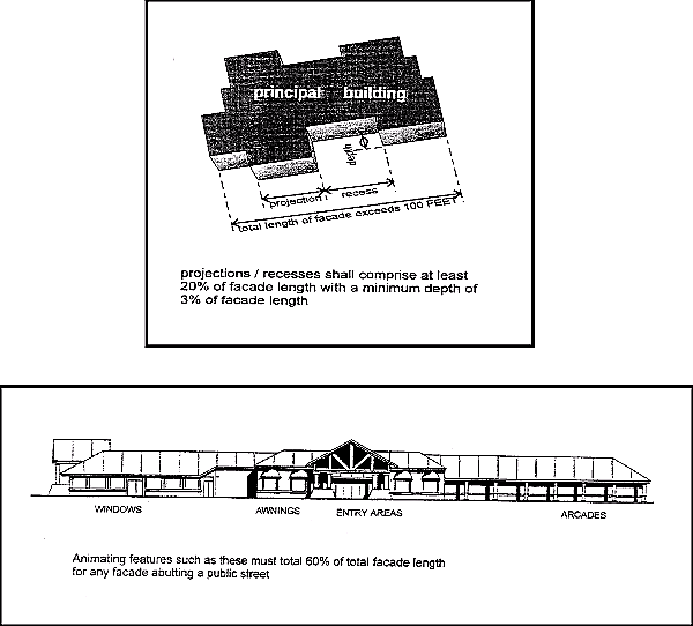
Figure 1. Building Facades
b.
Linkage of large retail stores and other retail, commercial, personal service, restaurant, or office uses. A large retail store (exceeding one hundred thousand (100,000) square feet in size and operated by a single entity) shall be located within the same building as or adjacent to at least four (4) additional retail stores, restaurant, office, or personal service uses, each of which shall be between one thousand (1,000) and twenty-five thousand (25,000) square feet in size.
1.
The four (4) or more additional uses may be connected internally to the large retail store, and each use must have a separate, exterior customer entrance. If there is an internal connection, then the additional use shall be designed so that the interior of the large retail store is not visible from the exterior of the additional use.
2.
The street level facade of such stores or uses must be transparent between the height of three (3) feet and eight (8) feet above the walkway grade for no less than sixty (60) percent of the horizontal length of the building facade of such additional stores.
c.
Detail features. Building facades must include:
1.
A repeating pattern that includes all the following elements:
i.
Color change;
ii.
Texture change;
iii.
Material module change; and
iv.
An expression of architectural or structural bays through a change in plane no less than twelve (12) inches in width, such as an offset, reveal or projecting rib. (See Figure 2.)
Note: At least one (1) of elements i., ii., or iii. shall repeat horizontally. All elements shall repeat at intervals of no more than thirty (30) feet, either horizontally or vertically.
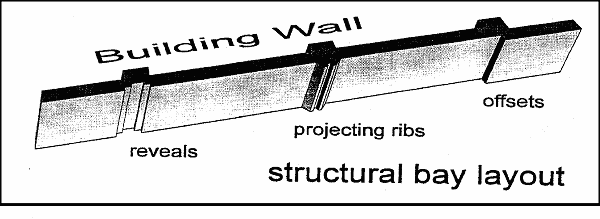
Figure 2. Expression of Architectural or Structural Bay
d.
Roofs. Roofs shall have the following features:
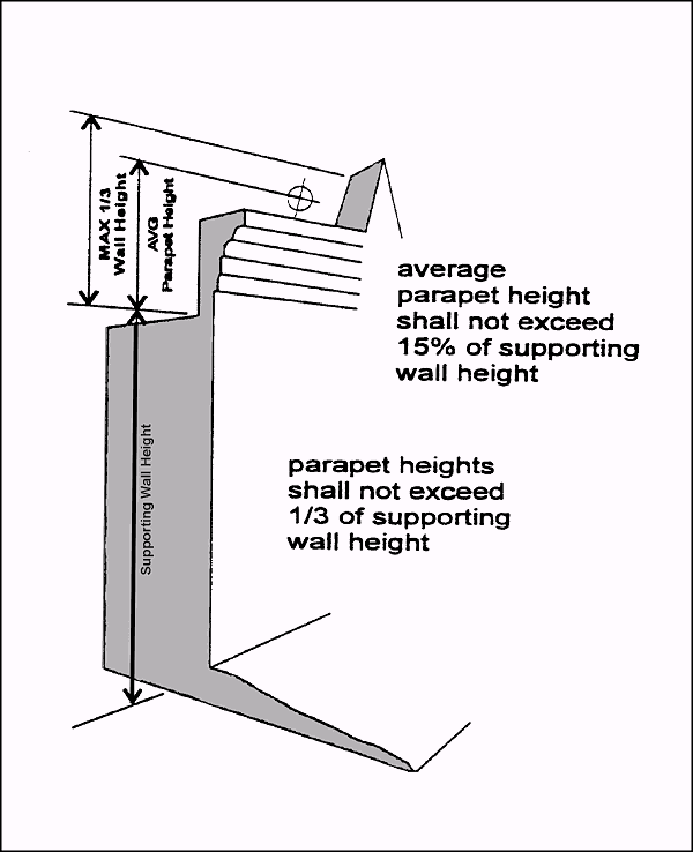
Figure 3. Parapet Standards
1.
Overhanging eaves, extending no less than three (3) feet past the supporting walls;
2.
Sloping roofs that do not exceed the average height of the supporting walls, with an average slope greater than or equal to one (1) foot of vertical rise for every three (3) feet of horizontal run and less than or equal to one (1) foot of vertical rise for every one (1) foot of horizontal run; and
3.
Three (3) or more roof slope planes.
e.
Materials and colors.
1.
Predominant exterior building materials shall be high quality materials including, but not limited to, brick, sandstone, other native stone and tinted/textured concrete masonry units.
2.
Exterior building materials may include smooth-faced concrete block, tilt-up concrete panels, prefabricated steel panels or similar materials only if the construction meets the requirements of (1) of this subsection.
3.
The exterior colors of buildings, trim and other site features shall be subject to the approval of the department of community development. They shall be selected to ensure compatibility among the various colors and a visually tranquil environment and they shall conform to the requirements of section 16-138.
(2)
Entryways.
a.
Each large shopping center shall have clearly defined, highly visible customer entrances featuring no less than six (6) of the following:
1.
Canopies or porticos;
2.
Overhangs;
3.
Recesses/projections;
4.
Arcades;
5.
Raised corniced parapets over the door;
6.
Peaked roof forms;
7.
Arches;
8.
Outdoor patios with hardscape;
9.
Architectural details such as tile work and moldings which are integrated into the building structure and design; or
10.
Integral planters or wing walls that incorporate landscaped areas and/or places for sitting.
b.
All building facades which are visible from contiguous properties or public streets shall comply with all of the following requirements:
1.
Minimum wall articulation. Building bays shall be a maximum of thirty (30) feet in width. Individual bays shall be visually established by architectural features such as columns, ribs or pilasters, piers and fenestration pattern. In order to add architectural interest and variety, and avoid the effect of a single, long or massive wall with no relation to human scale, all of the following additional standards shall apply:
i.
No wall that faces a street or connecting walkway shall have a blank, uninterrupted length exceeding thirty (30) feet without including at least two (2) of the following: change in plane, change in texture or masonry pattern, windows, trellis or lattice work with landscaping vines, or an equivalent element that subdivides the wall into human scale proportions.
ii.
Side or rear walls that face walkways may include false windows and door openings defined by frames, sills, and lintels, or similarly proportioned modulations of the wall, only when actual doors and windows are not feasible because of the nature of the use of the building.
iii.
All sides of the building shall include materials and design characteristics consistent with those on the front. Use of inferior or lesser quality materials for side or rear facades shall be prohibited.
2.
Facades. Facades that face streets or connecting pedestrian frontage shall be subdivided and proportioned using features such as windows, entrances, arcades, arbors, awnings, trellis with landscaping vines, along no less than fifty (50) percent of the facade.
3.
Entrances. Primary building entrances shall be clearly defined and recessed or framed by a sheltering element such as an awning, arcade or portico in order to provide shelter from the elements.
4.
Awnings. Awnings shall be no longer than a single storefront.
5.
Base and top treatments. All facades shall have:
i.
A recognizable "base" consisting of (but not limited to):
(a)
Thicker walls, ledges or sills;
(b)
Integrally textured materials such as stone or other masonry;
(c)
Integrally colored and patterned materials such as smooth-finished stone or tile;
(d)
Lighter or darker colored materials, mullions or panels; or
(e)
Planters.
ii.
A recognizable "top" consisting of (but not limited to):
(a)
Cornice treatments, other than just colored "stripes" or "bands," with integrally textured materials such as stone or other masonry or differently colored materials;
(b)
Sloping roof with overhangs and brackets; or
(c)
Stepped parapets.
(3)
Site design and relationship to surrounding community.
a.
Entrances. All sides of a large shopping center that directly face an abutting public street shall feature at least one (1) customer entrance. All entrances shall be architecturally prominent and clearly visible from the abutting public street. Where a large shopping center directly faces more than one (1) abutting public streets, this requirement shall apply only to two (2) sides of the building, including the side of the building facing the primary street, and another side of the building facing a second street. Movie theaters are exempt from this requirement.
b.
Parking lot. Parking lots are transitional spaces where users change modes of travel, from car, bus or bicycle to pedestrian. The design of all lots shall safely and attractively serve all modes of travel, especially pedestrian travel.
1.
Maximum size of parking area. No single surface parking area shall exceed one hundred fifty (150) spaces unless divided into two (2) or more sub-areas by a building, an internal landscaped pedestrian way, or an internal landscaped street with a defined landscape feature. The landscaped strip associated with the internal pedestrian way or internal street shall be a minimum of eight (8) feet, and an average of twelve (12) feet, in width, exclusive of paved area. This landscaped strip shall include specimen trees planted twenty-five (25) feet on center.
2.
Maximum number of spaces. The maximum number of parking spaces for a large shopping center and related establishments shall not exceed the minimum required by Article VII of Chapter 16 by more than ten (10) percent.
3.
Public transit. If a large shopping center is located adjacent to an arterial street which is (or is designated to be) used as a public transit route, it shall provide on-site facilities for public transit access, such as a bus pullout bay and shelter, with a design and location to be approved by the city and county.
c.
Back sides. The minimum setback for any building facade shall be thirty-five (35) feet from the nearest property line. Where the facade faces adjacent residential uses, a landscape buffer no less than thirty (30) feet wide shall be provided, designed to screen the commercial use from the residential uses. The buffer shall be comprised of a meandering earthen berm with specimen trees that are planted at intervals of twenty (20) feet on center. The combined height of the berm and specimen trees shall be a minimum of twenty-two (22) feet. Walls required by this chapter shall be placed on the side of the berm closest to the residential use.
d.
Pedestrian connectivity. The site design must provide direct pedestrian access and safe street crossings to adjacent land uses, and meet the minimum standards of the Americans with Disabilities Act.
e.
Bicycle racks. Bicycle racks capable of accommodating a cumulative minimum of twenty (20) bicycles shall be provided.
(4)
Pedestrian circulation. A safe and landscaped pedestrian circulation system shall be provided onsite, which provides access to public streets and neighborhoods.
a.
Sidewalks at least eight (8) feet in width shall be provided along all sides of the building(s) that abut a public street.
b.
Continuous internal pedestrian walkways, no less than eight (8) feet in width, shall be provided from the public sidewalk or right-of-way to the principal customer entrance of all large shopping centers on the site. At a minimum, walkways shall connect focal points of pedestrian activity such as, but not limited to, transit stops, street crossings, building and store customer entry points, and shall feature adjoining landscaped areas that include trees, shrubs, benches, flower beds, ground covers, or other such materials for no less than fifty (50) percent of the length of the walkway. Such walkways shall include weather protection features such as awnings or arcades where the walkway is located adjacent to a building facade and a parking area or customer entrance.
c.
Sidewalks shall comply with pedestrian zone requirements for landscaping, except where features such as arcades or entryways are part of the facade. See subsection 16-169(d).
d.
All internal pedestrian walkways shall be distinguished from driving surfaces through the use of durable, low-maintenance surface materials, such as decorative pavers, bricks or scored, colored, stamped, and decorative concrete to enhance pedestrian safety and comfort, as well as the attractiveness of the walkways.
(5)
Central features and community space. Each large shopping center subject to these standards shall contribute to the establishment or enhancement of community and public spaces by providing at least four (4) of the following, enhanced with pavers or stamped concrete:
a.
Landscaped patio/seating area;
b.
Landscaped pedestrian plaza with benches;
c.
Transportation center;
d.
Outdoor playground area;
e.
Water feature; or
f.
Clock tower or other such deliberately shaped area and/or a focal feature, or amenity.
These features must, in the judgment of the department, adequately enhance such community and public spaces. Such areas may be combined into one (1) or more locations, in order to create a larger amenity. Any such areas shall have direct access to the public sidewalk network and such feature shall not be constructed of materials that are inferior to the materials of the principal building or landscape treatments. (See Figure 4.)
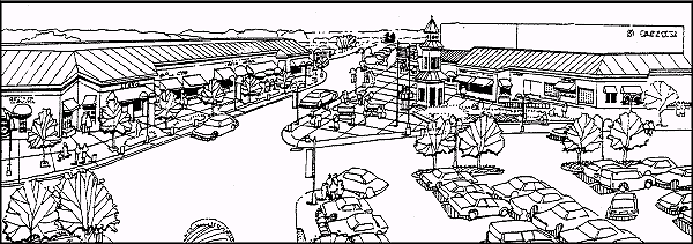
Figure 4. Center With Community Features
(6)
Time and location for delivery/loading operations.
i.
No delivery, loading, trash removal or compaction, or other such operations shall be permitted within two hundred (200) feet of a residential parcel or park or developed recreation area. Such areas shall be acoustically and visually screened. If a large shopping center or retail store cannot meet this requirement, a waiver of this provision may be sought by application to the director of the community development department. A waiver may be granted upon assurance of alternative measures to protect the adjacent parcel, such as restrictions on hours for these activities.
ii.
No delivery, loading, trash removal or compaction, or other such operations shall be permitted between the hours of 10:00 p.m. and 6:00 a.m. from more than two hundred (200) feet to three hundred (300) feet of a residential parcel or park or developed recreation area.
(d)
Maximum size of retail stores. No single retail store shall exceed two hundred thousand (200,000) gross square feet in size. Separate retail stores which are located contiguous to one another but are not internally connected shall not be included in the size calculation of a single retail store. This maximum size requirement shall apply to expansions of existing shopping centers; no single retail store may be expanded to exceed two hundred thousand (200,000) square feet.
(e)
Expansions or remodeling of large shopping centers or retail stores. Notwithstanding any provision of Article XIII, "Nonconforming Uses and Structures" of this chapter to the contrary, existing large retail stores and large shopping centers shall be required to comply with the requirements of this section only if an addition to the retail store or large shopping center results in an increase of the gross square footage of the store or center by fifty (50) percent or more.
(f)
Existing nonconforming features of a large shopping center or retail store may be redesigned and rebuilt even though the alteration continues the nonconforming status of that or other aspects of the large shopping center, provided that the nonconforming feature is due to the unique nature of the center's existing building(s); existing parking configuration; existing traffic circulation; lot size or other characteristics, which make it impractical to meet current criteria and which would discourage the upgrading or expansion of the large shopping center if current criteria were applied, and the department determines that the redesign or expansion results in an enhancement of the large shopping center from its existing condition. Notwithstanding the foregoing, no existing nonconforming condition shall be continued if the same adversely affects the health, safety and welfare of the general public.
(g)
Site traffic study required for large shopping center. An application for site plan approval for a large shopping center shall be accompanied by a site traffic circulation study specifically addressing traffic circulation on and off-site, including the proposed hours and schedules for delivery vehicles. Consideration will be given to the volume and type of vehicular customer traffic associated with such use, particularly its impact on local residential streets.
(h)
Studies required for large shopping centers near residential zoning districts. An application for site plan approval for a large shopping center proposed to be located within one thousand (1,000) linear feet of a residential district shall be accompanied by the following studies:
(1)
Noise: A site plan application for a large shopping center proposed to be located within one thousand (1,000) linear feet of a residential zoning district must provide a noise study for review by the department. The study must address noise levels generated by the use along any property lines abutting a residential zoning district. The use of buffering, including, but not limited to, walls and functional landscaping, may be required by the department to keep noise at such property lines below the decibel levels established by the Broward County Code, Chapter 27, Pollution Control, Article VII, Noise. The maximum level established for any use abutting a residential zoning district is fifty-five (55) dBA, as measured at the residential property line abutting the source of the noise.
(2)
Security: Large retail stores shall provide a security plan for review by the director of community development.
(Ord. No. 402-06-B, § 3, 7-25-06; Ord. No. 402-09-G, § 11, 11-24-09; Ord. No. 402-10-C, § 30, 6-22-10)
Sec. 16-114. - Home and common-area based assembly uses.
(a)
The standards set forth in this section shall apply to any proposed or existing assembly use within the following residential zoning districts: RS-3 and RS-5 Low Density Single-Family Residential District, RS-7 Single-Family Planned Development District, RM-10 Low Medium Multifamily Residential District, RM-16 Medium Density Multiple-Family Residential District, and RM-25 Higher Density Multiple-Family Residential District. These standards shall also apply to residential uses within a planned unit development (P.U.D.) district and Planned Development District (PDD).
(b)
Home-based and common-area based assemblies are permitted, whether for social, religious, or other reasons, as an incidental accessory use to the principal residential use.
(c)
Frequency of home-based and common-area based assembly uses. Assemblies that occur more than four (4) times per month for two (2) consecutive months will be deemed to be beyond the scope of the accessory use and shall not be permitted.
(d)
Parking standard.
(1)
Home-based assembly uses. A home-based assembly use which results in an additional eleven (11) vehicles being parked near the dwelling unit at each assembly will be deemed to be beyond the scope of the accessory use and shall not be permitted. Vehicles parked legally on the site of the home-based assembly shall not be counted toward the eleven (11) vehicles.
(2)
Common-area based assembly use. A common- area based assembly use which results in an additional five (5) vehicles being parked near the common-area based assembly use will be deemed to be beyond the scope of the accessory use and shall not be permitted. Additionally, the parking demand created by such assemblies shall not exceed the supply of parking spaces legally available within the shared guest or visitor parking areas allocated to common-area functions.
(Ord. No. 402-07-D, § 9, 12-11-07; Ord. No. 402-10-C, § 2, 6-22-10)
Sec. 16-115. - Regulated uses.
(a)
Intent and purpose. It is the intent and purpose of this section to regulate the location and separation of adult entertainment uses, referred to herein as "regulated uses," which, because of their very nature, are recognized as having serious objectionable operational characteristics, particularly when they are located near properties zoned, planned or developed with incompatible uses, thereby having a deleterious effect upon the adjacent areas. Further, it is recognized that the location of even one (1) regulated use near an incompatible use causes such deleterious effects on that area. Special regulation of these uses is necessary to ensure that these adverse effects will not contribute to the blighting or downgrading of the surrounding area.
The regulations seek to prevent a concentration of regulated uses in any one (1) area (i.e., not more than one (1) such use within eight hundred (800) feet of each other which would create such adverse effects) and prevent their location within eight hundred (800) feet of incompatible uses as provided below. Regulated uses may have accessory uses that are incidentally and customarily associated with the principal adult regulated use. Adult mini motion theaters are hereby prohibited. It is not the intent of the city to legislate with respect to matters of obscenity. These matters are regulated and preempted by state law. Furthermore, this section has neither the purpose nor the effect of limiting or restricting access by adults to sexually oriented, non-obscene materials protected by the First Amendment, or denying access by the distributors and exhibitors of sexually oriented entertainment to their intended market.
(b)
Exemptions. This section shall not apply to accredited universities, colleges or other schools; libraries, art galleries, museums, art exhibits and galleries open to the public; arts and cultural performance theaters and playhouses; or commercial professional photography and portrait studios which may use nude subjects for their photographs or portraits. Such uses shall not be considered regulated uses.
(c)
Limitations. Regulated uses shall be permitted only within the Light Industrial District (I-1), subject to the following restrictions:
(1)
No regulated use shall be allowed within eight hundred (800) feet of the property line of another existing regulated use.
(2)
No regulated use shall be allowed within eight hundred (800) feet of the property line of any existing residentially zoned or planned property, an existing church or other place of worship, or an existing school (K through 12th grade), instructional school, day care center or nursery for children (referred to collectively herein as "incompatible uses").
(3)
No regulated use shall be allowed within three hundred (300) feet of any arterial, as shown on the Broward County Trafficways Map.
(4)
The distance provided for in this section shall be calculated by airline measurement from property line to property line, using the closest property lines of the parcels of land involved. For purposes of this subsection, the term "parcel of land" means any quantity of land capable of being described with such definiteness that its location and boundaries may be established, which is designated by its owner or developer as land to be used or developed as a unit or which has been used or developed as a unit. If the property is one (1) of multiple, separate but attached bays designed for separate businesses, the property line of the parcel that contains the multiple-bay structure shall be considered the property line for purposes of this measurement. Therefore, no more than one (1) regulated use may be located in any one (1) structure and a regulated use may not be located in the same structure as an incompatible use, even if that structure contains multiple, separate but attached bays designed for separate businesses.
(d)
Certified survey. For purposes of establishing the distance between regulated uses, other regulated uses and incompatible uses, as set forth above, the applicant for any regulated use shall furnish a certified survey from a registered surveyor. Such survey shall indicate the distance from the regulated use, any other regulated use and any incompatible use as set forth above. In case of any dispute, the measurement scaled by the director of the community development department shall govern.
(e)
Code compliance. Compliance with all other applicable regulations of regulated uses in this Code, including, but not limited to, those in Chapters 3, 7 and 16, is also required.
(f)
Existing establishments. Any adult entertainment establishment that was legally established and operating in the city prior to October 1, 2005, is not required to conform to the I-1 zoning category or the revised spacing requirements required by (c) above. Such establishment shall be treated as a nonconforming use, and governed by Article XIII of this chapter.
(Ord. No. 402-05-D, § 3, 10-11-05; Ord. No. 402-09-G, § 11, 11-24-09; Ord. No. 402-16-A, § 12, 1-12-16)
Sec. 16-116. - Reserve units.
(a)
Purpose. The purpose of this section is to provide a procedure whereby the number of dwelling units permitted on a plot or parcel of land may be increased in certain specific situations and subject to certain conditions in accordance with the applicable provisions of this Code, and the implementation section of the Sunrise Comprehensive Plan Future Land Use Element. Reserve units have been established to allow the city to provide an incentive for quality development and for the dedication of land or the payment of fees in lieu of dedication of land for municipal purposes, when such dedications and payments are in excess of those ordinarily required pursuant to the applicable provisions of city and county law. For the purposes of this section and other relevant sections of the code, the term "reserve units" shall mean dwelling units held in reserve in accordance with the provisions of the Sunrise Future Land Use Plan, which units may be used in certain specific situations at the discretion of the city commission to increase the density permitted on a parcel over and above the density indicated on the Sunrise Land Use Plan Map.
(b)
Criteria for evaluating application for reserve units. In evaluating the application for reserve units, the city shall consider the proposal's consistency with the goals and objectives of the Sunrise Future Land Use Plan; the purpose of the reserve unit concept as stated in said plan; the characteristics of the surrounding area; the characteristics of the proposed development; the community need for the type of development proposed; the ability of the city and county to provide service for the additional dwelling units and the type and extent of the dedication for municipal purposes proposed by the application.
(c)
Processing of application for reserve units.
(1)
An application for reserve units shall be filed with the community development department, in the form specified by that department. An application for reserve units may be filed for an existing development provided that any changes to the previously approved site plan constitute minor adjustments pursuant to section 16-32, which may be approved by staff, without reconsideration of the site plan by the city commission. The application for reserve units in this case shall be reviewed by the city commission. Any application shall include the number of dwelling units permitted by the current zoning and land use, and the number of reserve units requested.
(2)
For new developments, the application for reserve units shall be reviewed by and may be approved by the city commission. If reviewed in conjunction with a site plan, an approval of the site plan application shall also be an approval of the application for reserve units. A denial of the final site plan shall also be a denial of the application for reserve units. If reviewed in conjunction with a land use plan amendment, adoption of the land use plan amendment shall also be an approval of the application for reserve units.
(3)
An application for reserve units may be approved by the city commission with conditions and stipulations. Said conditions and stipulations shall be evidenced by an agreement which shall be signed by the city and applicant, and such agreement may, at the option of the applicant, be recorded in the public records.
(4)
Upon approval of the application for reserve units, the city shall reduce the number of reserve units available for use elsewhere by the number of reserve units approved in connection with the relevant application, and the city planner shall inform the Broward County Planning Council of such action.
(Ord. No. 402-97-E, § 1, 8-26-97; Ord. No. 402-02-G, § 4, 10-22-02; Ord. No. 402-09-G, § 11, 11-24-09; Ord. No. 402-16-A, § 12, 1-12-16)
Sec. 16-117. - Areas between buildings.
(a)
No reduction or double-counting of required area. No plot, yard, setback, clearance, parking area, or other space shall be reduced in area or dimension so as to make said area or dimension less than the minimum required by this article or be included as part of a yard, setback, clearance, parking area or other space required under this article for another building, structure or use, unless specifically permitted by the terms of this article.
(b)
Yard encroachments. Every part of every required yard shall be open and unobstructed from the ground to the sky, except as hereinafter provided or as otherwise permitted in this chapter:
(1)
Sills may project not over twelve (12) inches into a required yard and cornices; eaves and gutters may project not over two (2) feet into a required yard or zero lot line.
(2)
Chimneys, fireplaces or pilasters may project not over two (2) feet into a required yard.
(3)
Movable awnings may be placed over doors and windows in any required yard, but no awning shall be vertically supported.
(4)
[Reserved].
(5)
Open trellises may be constructed within a required side or rear yard setback provided that: The area of the horizontal projection of all materials of the trellis frame and structure is not more than thirty-three (33) percent of the total area covered by the trellis. No portion of the trellis is closer than five (5) feet from a property line. No portion of the trellis encroaches into any public or utility easement.
(6)
In the case of zero lot line dwellings, an easement shall be granted for any eaves or other overhang over the adjacent lot for purposes of maintenance.
(Ord. No. 402-97-E, § 1, 8-26-97; Ord. No. 402-98-B, § 6, 6-9-98; Ord. No. 402-10-C, § 3, 6-22-10)
Sec. 16-118. - Accessory uses and structures.
(a)
Accessory structures.
(1)
Location: In all districts, accessory building such as garages, servants' quarters, cabanas, sheds, or similar structures, where permitted as accessory to the main structure, shall comply with the setback and other restrictions for the district in which they are located except:
a.
A storage shed not more than nine (9) feet in height and not more than one hundred (100) square feet in floor area. The shed may be located in a side or rear yard provided that the adjacent property line does not abut a public or private right-of-way, and the shed is set back a minimum of five (5) feet.
b.
Satellite receiving antenna as specified in subsection (c) below.
(2)
Height: No accessory structures shall exceed two (2) stories or twenty-four (24) feet in height, and no accessory building shall be erected previous to the erection of the principal building.
(3)
No conversion of an existing garage in a residential district to a habitable room (as defined in section 17-2 of the Minimum Housing Code) is permitted. Existing garage conversions into habitable space shall be permitted if the current owner provides substantial competent evidence to the city that the existing conversion was in existence prior to 1995, and that the conversion was already completed at the time of purchase by the current owner.
(b)
Swimming pools, hot tubs, and screen enclosures. In residential districts, the location of accessory swimming pools, hot tubs, and screen enclosures shall be subject to section 16-111 and to the following regulations:
(1)
Swimming pools and hot tubs: Pools and hot tubs shall not be placed in a required front or street side yard setback. The water's edge of a pool or hot tub shall not be within five (5) feet of any side or rear plot line and at no point shall the patio slab be less than three (3) feet from the side or rear plot line.
(2)
Enclosed pools and hot tubs: Any part of a pool or hot tub which is covered by a roof or enclosed by side walls (other than mesh screen) over four (4) feet in height shall be subject to the limitations on location of a building and shall not be placed in any required yard.
(3)
Screen enclosure:
a.
Screen roof in single-family district: Within a single-family district, any screen enclosure of a pool or patio, with a screen roof, shall not exceed fourteen (14) feet in height, shall not encroach on any utility or drainage easement, and shall be set back at least five (5) feet from any rear or side plot line, except in the case of a corner lot or a zero lot line dwelling as provided in (e) and (f).
b.
Opaque roof in single-family district: Within a single-family district, any screen enclosure with an opaque roof shall comply with the building setback and other restrictions for the district in which it is located.
c.
Screen roof in multifamily district: Within a multifamily district, any screen enclosure of a pool or patio, with a screen roof, shall not exceed fourteen (14) feet in height, shall not encroach on any utility or drainage easement, and shall be set back at least five (5) feet from the rear property line or from the common line between two (2) buildings. The side setback may abut the side building line provided a party wall or a six-foot high shadowbox wood fence separation exists between any adjoining units. Enclosures within common areas shall require homeowners association approval.
d.
Opaque roof in multifamily district: Within a multifamily district, any screen enclosure with an opaque roof shall comply with the setback and other restrictions in which it is located.
e.
Corner lot: In no case shall a screen enclosure encroach on the corner side street setback except as permitted under the nonconforming setback provisions of subsection 16-235(b).
f.
Zero lot line dwelling: A screen enclosure may abut the side plot line on the zero lot side, provided that either a six-foot high wall extending out from the building by at least ten (10) feet along the plot line, or a three-foot setback from the plot line is provided.
(4)
Easements: No pool, hot tub, screen enclosure or deck shall be placed within a utility or drainage easement. However, a deck of brick pavers set in sand is allowed subject to written waivers of objection from all utility companies having jurisdiction within said easement. The property owner will be responsible for replacing brick pavers removed by utility companies.
(5)
Measurement: In regulating location, the minimum distance requirement from a plot line shall be measured from the exterior of the screen enclosure and from the inner edge or water line of the pool or hot tub.
(c)
Satellite receiving antenna.
(1)
Permit required: A building permit may be required pursuant to Florida Building Code.
(2)
Single-family residential standards: Such antenna shall be considered an accessory structure and meet subsection (a) above, except satellite receiving antennas shall be permitted within the rear yard setback area of RS-3, RS-5, RS-7 or P.U.D. zoning districts. Provided however, satellite dishes shall not be permitted in either street yard of any through lot. No ground-mounted satellite receiving antenna in a RS-3, RS-5, RS-7 or P.U.D. district shall exceed fifteen (15) feet in height and no dish attached to a structure in these districts shall exceed twelve (12) feet in diameter. Ground-mounted dishes shall be landscaped with mid- and upper-level shrubs, as defined in section 16-165, although not so as to interfere with reception.
(3)
Commercial and multifamily: All dishes shall be ground-mounted and located in the rear setback so as not to be visible from the public street. Roof mounted dishes shall only be allowed if a line of sight study indicates it will not be visible from a public street.
(d)
Reserved.
(e)
Amateur radio antenna on a single-family lot.
(1)
Permit required. A building permit shall be required for construction, installation or replacement of any antenna support structure. Building and/or electrical permits for antennas shall be submitted as required by the Florida Building Code. Applications shall include a site plan and construction drawing indicating the dimensions, location, construction criteria and specifications in sufficient detail to demonstrate that the antenna will be installed in accordance with all requirements of the City Code and Florida Building Code.
(2)
Height, area and setback requirements:
a.
A maximum of one (1) antenna support structure shall be permitted in any single-family lot.
b.
The antenna support structure shall not exceed fifty (50) feet in height above the ground. The combined height of the antenna and the antenna support structure shall not exceed fifty-five (55) feet in height above the ground.
c.
Maximum width of the antenna support structure at ground level, not including the support base (which support base shall not project more than four (4) inches above ground level), shall not extend beyond the perimeter of a square having a maximum side dimension of three (3) feet.
d.
No antenna or antenna support structure shall be permitted anywhere within the front yard or within a rear yard adjacent to a street on a through or double frontage lot.
e.
The antenna support structure shall be permitted to encroach three (3) feet into a required side yard or rear yard.
f.
Guy wires shall be permitted in a rear or interior side yard provided said guy wires do not exceed six (6) feet in height within a required rear or required interior side yard. Guy wires shall not be permitted within any front yard and may encroach no more than three (3) feet into a required street side yard, provided the height of said guy wires shall not exceed six (6) feet within said three-foot encroachment area.
g.
Antennas supported only by an antenna support structure may be permitted in a side or rear yard provided no antenna is located closer than three (3) feet to any side or rear property line. Antennas may be attached to an accessory structure anchored in the ground provided said antennas are at least seven and one-half (7½) feet above the ground, do not encroach into any required side or rear yard, and comply with the Florida Building Code.
h.
Roof-mounted antenna support structures are prohibited, however, antennas may be attached directly to the single-family residence a minimum of seven and one-half (7½) feet above the ground.
(3)
Safety barrier and gate:
a.
No antenna or antenna support structure shall be approved unless there has been erected a safety barrier as provided below.
b.
The safety barrier shall be a minimum five-foot high wooden fence, wire fence or poured concrete wall constructed pursuant to the Florida Building Code and landscaped with mid- and upper-level landscaping as defined in section 16-165.
c.
The safety barrier shall be erected around the entire antenna assembly, including antenna support structure, guy wires, wire antenna and any other antenna transmission or receiving equipment. Exterior access through the safety barrier to the antenna assembly shall be permitted only through self-closing and self-latching gate. Provided however, for a single antenna support structure without guy wires, or antenna attached to an accessory structure anchored in the ground the safety barrier may consist of metal panels attached to the support structure in accordance with the Florida Building Code a minimum of seven and one-half (7½) feet above the ground and designed to prevent persons from climbing the support structure or coming into physical contact with the antenna or any other electrically charged component of the support structure; however, a pole anchored in the ground supporting one (1) or more antennas, with no guy wires need not need not have a safety barrier.
(f)
Accessory fuel sales.
(1)
Accessory fuel pumps. Accessory fuel pumps shall be permitted, provided they are located only in areas which conform to the standards established for outdoor storage areas in section 16-128. Accessory fuel pumps shall not be used to dispense fuel to the general public. Accessory fuel pumps must be located to the rear of the principal structure and must be fully screened from public view.
(2)
Retail sale of propane. The sale and exchange of propane in portable pre-filled containers is permitted as an accessory use to a stand-alone retail store, gasoline station or gas station/convenience store only, provided that the following criteria are met:
a.
All containers, not to exceed thirty-six (36) individual twenty (20) pound cylinders, shall be stored in a purpose built metal storage cage approved for propane storage by the city's fire rescue department.
b.
Where the principal use includes an outdoor enclosed area, such as a garden center, propane storage shall be located within the outdoor enclosed area. Where no such enclosure exists, propane storage shall be located on an exterior rear or side facing wall of a principal building in a location that does not impact pedestrian circulation, complies with ADA requirements, state and federal requirements, and is not visible from a public right-of-way. In the event that there is no feasible location on a side or rear facing wall, the director of community development may approve an alternative location, and may, as necessary, require additional screening to reduce visibility for any locations not in compliance with this section.
c.
The storage cage shall be painted in a neutral color. No advertising shall be placed on the storage cage. One (1) sign of up to four (4) square feet specifically related to the sale of propane may be attached to the storage case. Said sign shall be exempt from the permitting requirements of Article XIV, "Signs," of the City of Sunrise Code of Ordinances. No other advertising shall be placed on the storage cage.
d.
Sale of propane fuel directly from a freestanding or in-ground storage tank or in any method other than in portable pre-filled containers or pre-filled exchange tanks, shall be prohibited, except in the case of a principal retail store where the sale of propane-fueled equipment is permitted, in which case, the sale of propane for propane-fueled equipment is permitted only as a service to customers who purchase propane-fueled equipment from the principal business, and not to the general public.
(g)
Accessory motor vehicle repair and body work. Repairs to mechanical, electrical and related components and equipment shall comply with section 16-128.
(h)
Outdoor lighting. Outdoor lights shall conform with requirements of section 16-150.
(i)
Flags. See Article XIV, Signs, for regulations of flags.
(j)
Outdoor speakers, loud speakers, etc. Outdoor speakers, loud speakers and other forms of sound amplification equipment shall be prohibited.
(Ord. No. 402-97-E, § 1, 8-26-97; Ord. No. 402-00-C, § 6, 8-22-00; Ord. No. 402-05-A, § 2, 4-12-05; Ord. No. 402-05-E, § 4, 12-13-05; Ord. No. 402-10-B, § 2, 2-9-10; Ord. No. 402-10-C, § 4, 6-22-10; Ord. No. 402-11-A, § 4, 1-25-11)
Sec. 16-119. - Exclusions from height limits.
Stairs, equipment towers, cupolas, steeples and domes, the maximum gross area of the horizontal section of which does not exceed twenty-five (25) percent of the roof area, airplane beacons, chimneys, stacks, tanks and roof structures used only for ornamental and/or mechanical purposes may exceed the permissible height limit in any district, to a maximum of twenty-five (25) percent of the maximum allowable height. Architectural features may exceed the permissible height limit in any district, to a maximum of fifty (50) percent of the maximum allowable height.
(Ord. No. 402-97-E, § 1, 8-26-97; Ord. No. 402-03-D, § 3, 8-26-03)
Sec. 16-120. - Setback waiver.
The director of community development, or his/her designee, may waive any setback distance by up to ten (10) percent up to one (1) foot in recognition of unique constraints and specific development conditions that may apply to a site.
(Ord. No. 402-97-E, § 1, 8-26-97; Ord. No. 402-10-C, § 5, 6-22-10)
Sec. 16-121. - Use of residentially zoned property for access.
No residentially zoned land shall be used for driveway or vehicular access purposes to any nonresidentially zoned land, unless the land used for access purposes is one (1) of those listed below:
(a)
A use permitted in the applicable residential district;
(b)
A use permitted within a planned development district; or
(c)
A use otherwise approved pursuant to the terms of this chapter.
(Ord. No. 402-97-E, § 1, 8-26-97; Ord. No. 402-07-C, § 4, 6-27-07)
Sec. 16-122. - Public utilities.
Utilities necessary to the public health and convenience such as gas, electric, and telephone lines, minor equipment and appurtenances (for example, transformer boxes and switch gear) and mains may be located in any district subject to landscaping and building requirements of the district and other landscaping and building requirements as deemed necessary by the city commission to protect the public health, safety and welfare. In any case, a hedge shall be planted along three (3) sides of any transformer box or other similar ground-mounted equipment. The height of plant material, measured at time of installation, shall be no less than seventy-five (75) percent (75) of the height of the structure. See also section 16-129. City utilities are permitted in any zoning district as a matter or right without limitation.
(Ord. No. 402-97-E, § 1, 8-26-97; Ord. No. 402-10-C, § 6, 6-22-10)
Sec. 16-123. - Waterways.
(a)
Permits.
(1)
No waterway, except those waterways controlled and maintained by South Florida Water Management District, shall be created unless approval has been granted by the city.
(2)
No approval shall be granted, unless the department finds such proposed waterway to be in conformity with all of the requirements of this chapter and in conformity with all city ordinances and regulations.
(b)
Application for permit approval. Application for approval shall be made to the department by letter, or upon such form as shall be prescribed, stating the reason for alteration or construction of the waterway. This letter shall be accompanied by four (4) sets of sealed plans prepared by an engineer, registered and licensed to practice as such by the State of Florida, showing the location, proposed cross sections, structures in or across the waterway, and other details as may be required by the department. Such application may be part of the normal site plan application.
(c)
Inspection. The department shall inspect waterways and all structures in or across any waterway during their construction period. Sealed as-built drawings shall be submitted to the department upon completion of all work in or across the waterway with as-built cross sections of the waterway every one hundred (100) feet, or as often as may be necessary to determine the change in cross-section profile.
(Ord. No. 402-97-E, § 1, 8-26-97)
Sec. 16-124. - Docks and wharves.
(a)
Dockage space and facilities for mooring pleasure boats, yachts and noncommercial watercraft shall be permitted in any residential district on any lake as an accessory use to the residential occupancy of a plot.
(b)
No dock shall project more than five (5) feet into any waterway beyond the waterline or established bulkhead line, or extend closer than ten (10) feet to the plot line of any other residentially-zoned property.
(c)
Docks shall be further subject to all the requirements of section 16-205.
(Ord. No. 402-97-E, § 1, 8-26-97)
Sec. 16-125. - Open storage, garbage and refuse.
(a)
The storage of all equipment, materials and supplies shall be entirely within an enclosed building unless explicitly authorized to the contrary by this Code. This requirement shall not apply to special event permits and temporary outdoor sales permits.
(b)
In RM-16, RM-25, PUD and PDD zoning districts, and in all nonresidential zoning districts, garbage or refuse shall be stored in containers and be stored only within an enclosed building or within an architectural enclosure sufficient in height and design to screen such containers from the public view, except as provided in subsection 16-125(c). Developments in RM-16, RM-25, PUD and PDD zoning districts and developments in nonresidential zoning districts shall have screened enclosures sufficient in size to screen a garbage or refuse container and a second container, which shall be used solely for the disposal of recyclable materials. Recyclable materials are those materials that are capable of being recycled and that would otherwise be processed or disposed of as solid waste. The container for recyclable materials shall be clearly marked to show its intended purpose.
(c)
Up to two (2) city-issued recycling containers may be stored to the side or rear of a residential unit located in an RM-16 or RM-25 zoning district where no enclosure exists, and where a certificate of occupancy was issued for the residential unit prior to July 1, 2011. Such individual recycle containers shall be screened by fences, walls or landscaping to the extent practical. No recycle container shall be stored in any location that is visible from any public right-of-way. Outdoor storage of garbage containers is prohibited.
(Ord. No. 402-97-E, § 1, 8-26-97; Ord. No. 402-10-C, § 7, 6-22-10; Ord. No. 402-11-F, § 2, 9-12-11; Ord. No. 402-13-G, § 8, 11-12-13)
Sec. 16-126. - Temporary buildings.
(a)
No temporary building shall be permitted within the city, except that a temporary building or a maximum of five (5) construction trailers, not for occupancy, to be used for office purposes only, in conjunction with the construction of a project may be constructed. More than five (5) temporary construction trailers with adequate buffering from public view by a temporary fence with screen material may be permitted, subject to administrative approval by the department. Any such temporary building shall be torn down and removed upon completion of the project or, in the alternative, may be brought into compliance with the building code, this Code, and all other applicable regulations and requirements.
(b)
Before approving a permit for such a construction trailer, temporary building, or temporary structure, the department shall approve a sketch plan showing the location on the construction site. The applicable setbacks of the district or a minimum of fifteen (15) feet, whichever is less, shall be met.
(c)
Any temporary real estate sales trailer shall require administrative site plan approval in accordance with section 16-32. Any such temporary trailer shall be removed upon completion of the construction project.
(Ord. No. 402-97-E, § 1, 8-26-97; Ord. No. 402-01-G, § 3, 9-10-01; Ord. No. 402-10-C, § 8, 6-22-10; Ord. No. 402-11-D, § 5, 5-10-11; Ord. No. 402-13-G, § 9, 11-12-13; Ord. No. 402-13-H, § 2, 12-10-13)
Sec. 16-127. - Animals.
(a)
No animals, livestock or poultry of any kind shall be raised, bred, or kept on any lot less than five (5) acres in size, except that dogs, cats and other common household pets may be kept as long as they are not bred or maintained for commercial purposes, and do not exceed three (3) in number over the age of four (4) months.
(b)
The provisions of this section shall not apply to pony rides or other places of amusement employing animals or to veterinarians, animal clinics, or similar uses where such activities are permitted by the district regulation and comply with all other regulations of the city and county.
(Ord. No. 402-97-E, § 1, 8-26-97)
Sec. 16-128. - Outdoor storage and display of stock-in-trade merchandise.
(a)
Outdoor storage of discarded or salvaged material prohibited. No outdoor storage of discarded or salvaged vehicles, campers, trailers, boats, equipment, machinery or other material shall be permitted.
(b)
No merchandise in public right-of-way. No vehicle, camper, trailer, boat, equipment, machinery or other stock-in-trade merchandise shall be parked or displayed in any swale or other portion of a public right-of-way.
(c)
No merchandise in parking, on-site circulation, landscaping or buffer areas or any other outdoor area except as specifically authorized. Except as expressly authorized in this section, no motor vehicle, camper, trailer, boat, equipment, machinery or other stock-in-trade merchandise shall be parked or displayed in any area specified on an approved site plan for on-site traffic circulation, landscaping or buffering, nor in any other outdoor area. Except as expressly authorized by this section, all stock-in-trade merchandise shall be parked, stored or displayed in a fully enclosed building.
(d)
Storage and display of merchandise permitted in parking structures. Any motor vehicle, camper, boat, equipment, machinery or other stock-in-trade merchandise may be parked, stored or displayed in or on the roof of an accessory parking garage or structure in an I-1 district, which conforms to the standards of section 16-139.
(e)
Outdoor parking, storage or display of stock-in-trade motor vehicles permitted in the 1-1 District subject to restrictions. Outdoor parking, storage or display of stock-in-trade motor vehicles shall be permitted in the I-1 District provided such parking, storage and/or display fully conforms to the provisions of (f) through (n) below.
(f)
No stock-in-trade motor vehicle in required parking spaces. No stock-in-trade vehicle may be parked, stored or displayed in any parking space required to meet the minimum parking requirements of this section.
(g)
No stock-in-trade motor vehicles in certain not required parking spaces. No stock-in-trade motor vehicle may be parked or displayed in any not required parking space, except pursuant to (h) below.
(h)
Stock-in-trade motor vehicles permitted in surplus parking spaces in the 1-1 District. Stock-in-trade motor vehicles may be parked or displayed in any surplus parking space in the I-1 District provided such vehicles are stock-in-trade merchandise for a permitted use which is lawfully established for the property where the parking spaces are located. For the purpose of this section, a surplus parking space is a parking space that conforms to all of the following:
(1)
It is not needed or counted toward meeting the minimum number of parking spaces on the site where located as provided for in subsection 16-148(a)(26) of the City Code;
(2)
It is not located in a required front yard;
(3)
It meets the minimum size requirements applicable to required parking spaces according to the provisions of Article VII;
(4)
It is served by access and circulation lanes designed according to the provisions of Article VII; and
(5)
It is part of a parking area that fully conforms with the landscaping standards of Article VIII.
(i)
Storage of motor vehicles permitted in designated outdoor storage areas in the 1-1 District. Stock-in-trade motor vehicles may be stored outdoors in the I-1 District, provided that such stock-in-trade motor vehicles shall only be stored in an area which is designated as an "outdoor motor vehicle storage area" on an approved site plan, and provided further that such outdoor storage area is located and screened according to the provisions of paragraph (1) below.
(j)
Hoods, trunk lids and doors shut. No stock-in-trade vehicle in a parking area, parking space, circulation drive or any other similar outdoor location shall be left unattended with its hood up, trunk lid up or doors open. Stock-in-trade motor vehicles may be stored or displayed with their hoods up, trunk lids up or doors open provided they are located in a parking structure or an outdoor storage area which meets the specifications of paragraph (1) below.
(k)
Elevated platforms prohibited. No vehicle, camper, trailer, boat, equipment, machinery or other stock-in-trade merchandise shall be parked, stored or displayed on any elevated platform.
(l)
Outdoor motor vehicle storage area standards. outdoor storage areas for stock-in-trade motor vehicles may be permitted as an accessory use in the I-1 District subject to site plan approval. This accessory use shall only be approved upon a finding by the city commission that the stock-in-trade merchandise will be effectively screened from adjacent properties and public rights-of-way. City commission shall not make such a finding unless the outdoor storage area conforms to all of the following:
(1)
It shall not be located closer to any street, side or rear property line than would be permitted for a one (1) story building on the same site;
(2)
It shall be screened from traffic on front and side streets to the maximum extent possible by being located behind and/or to the side of buildings on the site;
(3)
It shall otherwise be completely screened by a six-foot high masonry wall finished in stucco or other material of equal or higher quality which is the same as or compatible with the material used in the principal building or buildings on the site or by a landscape buffer consisting of a berm and hedge no less than six (6) feet high on installation and which achieves the same degree of opacity as a wall. A wall shall be screened by landscaping of the same quantity and quality as is required by this land development code for buildings. A wall or landscape buffer shall only have openings of the minimum size necessary to permit reasonable pedestrian and vehicular ingress and egress. Such openings shall be provided with opaque gates. Outdoor motor vehicle storage areas shall be paved to the same standards as required for parking lots but need not be provided with marked parking stalls, circulation aisles, bumper stops, landscaping or other features required of parking lots.
(m)
Display patios. Display patios for stock-in-trade vehicles are permitted in the I-1 District provided the following requirements are met:
(1)
The display patio shall be connected to and be designed as an integral part of the building housing the main showroom;
(2)
The display patio shall not be located in a required front yard;
(3)
The display patio shall not exceed one (1) square foot per one hundred (100) square feet of site area or fifty (50) percent of the showroom area, whichever is less;
(4)
The display patio shall be made of decorative brick pavers or other decorative material used for parking surfaces of similar or better quality;
(5)
The display patio perimeter shall be landscaped with a twenty-four-inch high hedge with ornamental trees or palms spaced at thirty (30) feet on center. This provision shall not affect the applicability of the foundation plantings requirement contained in other provisions of the Code.
(n)
Accessory motor vehicle repair and body work. Repairs to mechanical, electrical and related components and equipment may be performed as an accessory to motor vehicle sales. Body work may be performed as an accessory to motor vehicle sales. All such body work shall be performed in a completely enclosed building. All painting shall be conducted inside a self-contained paint booth which is environmentally controlled, air tight, and which provides filters that ensure that no paint fumes escape to the outside air.
(o)
Notwithstanding any other Code requirements, the regulations in this section relating to the outdoor storage and display of stock-in-trade merchandise in I-1 districts shall be applicable to property located within a B-3 district within the Western Sunrise Automobile Node. If all storage and display of stock-in-trade merchandise within a B-3 district is located in a parking structure, then only the requirements of subsection (d) of this section shall apply.
(Ord. No. 402-97-E, § 1, 8-26-97; Ord. No. 402-00-C, § 7, 8-22-00; Ord. No. 402-01-B, § 1, 4-24-01; Ord. No. 402-10-C, § 9, 6-22-10; Ord. No. 402-13-B, § 4, 4-9-13)
Sec. 16-129. - Special regulations for transformer substations.
(a)
The plot shall be provided with a yard not less than fifty (50) feet in depth or width adjacent to all street lines and not less than thirty (30) feet adjacent to all other plot lines. The yards required under this paragraph shall be fully landscaped as specified below, and shall not be used for any fence, wall, building or structure. Minimum driveways or walkways necessary for access may cross required yards. Overhead lines shall not encroach into required yards abutting external streets, except that if overhead lines run perpendicular to external streets and abut the interior side plot lines, they may encroach into not more than ten (10) percent of the area of required yards abutting external streets.
(b)
A decorative wall, a minimum of eight (8) feet in height, shall screen all exposed equipment areas abutting external streets. Walls shall be masonry or solid concrete block and stucco (CBS) steel-reinforced walls, with continuous footings. A precast concrete wall may be approved by the department when such wall is equal or better in appearance than concrete block and stucco walls.
(c)
See Article VIII, section 16-169 for additional requirements for landscaping.
(Ord. No. 402-97-E, § 1, 8-26-97; Ord. No. 402-97-I, § 2, 10-28-97)
Sec. 16-130. - Screening of other mechanical equipment.
All mechanical, electrical or air conditioning equipment shall be screened from view on all sides by an architectural, structural or landscaping barrier consistent in design and construction with the other structures within the project. Air conditioning equipment for single-family attached and detached homes, two-family dwelling, villas and townhouses need not be screened from view when located on the ground.
(a)
Generators. Generators (other than on single-family lots) shall be screened by a wall or fence of a height equal to or greater than the generator and, where practicable as determined by the director of community development, landscaped by mid-level landscaping not less than twenty-four (24) inches in height and upper-level landscaping not less than thirty (30) inches on height at time of installation:
(1)
Walls shall have architectural details and colors that are consistent with other structures within the project.
(2)
Fencing shall be shadow box or vinyl-clad chain link with slats of a color that is consistent with other structures within the project.
(b)
Rooftop photovoltaic solar systems. The provisions contained herein are intended to promote the health, safety, and general welfare of the citizens by removing barriers to the installation of alternative energy systems and encourage the installation of rooftop photovoltaic solar systems on buildings within the city as an accessory use to provide energy to the building in which it is installed.
(1)
Rooftop-mounted photovoltaic solar panel installation type.
a.
Direct mounted. Rooftop-mounted photovoltaic solar panels installed on the surface of a roof, flush-mounted parallel to a sloped roof, or surface or rack-mounted on a flat roof.
b.
Vertical mounted. Rooftop-mounted photovoltaic solar panels that are mounted on a vertical structure above a roof deck are permitted as an accessory use only if the system is integrated into the architecture and design of the building and is designed in a manner as to not create undue reflective glare on surrounding properties.
(2)
Screening. Permitted rooftop photovoltaic solar systems do not need to be screened from view on residential or nonresidential buildings.
(3)
Permitted accessory equipment. Rooftop photovoltaic solar systems shall be deemed permitted accessory equipment to residential and nonresidential conforming and nonconforming buildings and structures in all zoning categories. Nothing contained in this chapter, including design standards or guidelines included or referenced herein, shall be deemed to prohibit the installation of rooftop photovoltaic solar systems as accessory equipment to conforming and nonconforming buildings, including buildings containing nonconforming uses.
(4)
Height.
a.
Direct mounted. In order to be deemed permitted accessory equipment, the height of direct-mounted rooftop photovoltaic solar systems shall not exceed the roof line, as defined in section 16-277. For flat roofs, with or without a parapet, in order to be deemed accessory equipment, the direct-mounted rooftop photovoltaic solar system shall not be greater than five (5) feet above the roof.
b.
Vertical mounted. Vertical-mounted rooftop photovoltaic solar systems shall not be greater than eighteen (18) feet in height.
(5)
Permits. Prior to the issuance of a permit, the property owner(s) must acknowledge, as part of the permit application, that: (a) If the property is located in a homeowners' association, condominium association, or otherwise subject to restrictive covenants, the property may be subject to additional regulations or requirements despite the issuance of a permit by the city; and, (b) The issuing of said permit for a rooftop photovoltaic solar system does not create in the property owner(s), its, his, her, or their successors and assigns in title, or create in the property itself a right to remain free of shadows and/or obstructions to solar energy caused by development adjoining on other property or the growth of any trees or vegetation on other property or the right to prohibit the development on or growth of any trees or vegetation on another property.
(6)
Tree maintenance and removal. To the extent that the city has discretion regarding the removal or relocation of trees, solar access shall be a factor taken into consideration when determining whether and where trees may be removed or relocated.
(7)
Maintenance. The rooftop photovoltaic solar system shall be properly maintained and be kept free from hazards, including, but not limited to, faulty wiring, loose fastenings, being in an unsafe condition or detrimental to public health, safety, or general welfare.
(Ord. No. 402-97-E, § 1, 8-26-97; Ord. No. 402-10-C, § 10, 6-22-10; Ord. No. 402-12-H, § 2, 6-26-12; Ord. No. 402-14-D, § 3, 2-11-14; Ord. No. 402-24-E, § 2, 6-25-24; Ord. No. 402-24-E, § 2, 6-25-24)
Sec. 16-131. - Automatic amusement centers (as defined in Article XVII). (See Chapter VII, Article III, Division 2 for approval of automatic amusement games in uses other than automatic amusement centers.)
(a)
Automatic amusement centers shall only be permitted if one (1) of the following two (2) sets of criteria are met:
(1)
Location in the B-3 zoning district. Automatic amusement centers may be permitted as a special exception use pursuant to section 16-36 in the B-3 zoning district under the following conditions:
a.
The property line of the parcel containing the automatic amusement center shall be at least two thousand five hundred (2,500) feet from the property line of:
• A residential zoning district, residential land use designation or existing residence;
• A public or private K—12 school, day care center or family day care home;
• A public library;
• A public park or recreation facility;
• A house of worship; and
• Another automatic amusement center.
b.
No more than one (1) automatic amusement center shall be located in any shopping center or on any one (1) parcel, under any circumstances.
(2)
Location as part of an entertainment complex. Automatic amusement centers may be permitted as part of an entertainment complex under the following conditions:
a.
The entertainment complex is at least four hundred thousand (400,000) square feet, contains other kinds of entertainment uses such as movie theaters or clubs with live music, and is served by valet parking.
b.
The automatic amusement center has a full-service restaurant, with at least two hundred fifty (250) seats and contains twenty-five (25) percent of floor area devoted to food service.
(Ord. No. 402-97-E, § 1, 8-26-97; Ord. No. 76-04-B, § 8, 6-22-04)
Sec. 16-132. - Heliports.
As defined in Article XVI, section 16-177, of the City Code, heliports are permitted in I-1 Industrial, B-3 Business and CF Community Facility zoning districts subject to the following standards and limitations:
(1)
Ancillary uses. Heliports shall be permitted as ancillary uses to the following uses provided the other provisions of this section and any other requirements of federal, state and county law are met:
• Civic arenas
• Commercial/retail centers of more than five hundred thousand (500,000) square feet
• Office buildings at least five (5) stories in height
• Hospitals
• Regional parks
The heliport shall be sited with due consideration given to any existing or proposed structures or other improvements, and in conformance with the siting, distance, and safety requirements of the Federal Aviation Administration and the Florida Department of Transportation.
(2)
Spacing. The outside edge of the heliport's final approach and takeoff area shall not be less than one thousand five hundred (1,500) feet from a residentially zoned district, and shall not be less than one hundred (100) feet from any property line.
(3)
Approach and departure routes. The heliport permit holder shall require, to the maximum extent feasible, that approach and departure routes through the city follow major designated transportation corridors, such as Interstate 595 and the Sawgrass Expressway, in order to minimize the impacts of the heliport use on residential areas.
(4)
Landings per day. A maximum of eight (8) landings per day are permitted, excluding emergency landings. No helicopter shall be permitted to remain overnight at any heliport permitted under this section, excluding emergencies. Emergencies must involve an imminent threat to human life, health or safety, or a helicopter equipment failure.
(5)
Landing area. This area shall be at least one and one-half (1.5) times the length and width of the helicopter to be landed. This area shall be finished with a hard, dust free surface, and shall be marked with Federal Aviation Administration approved symbols, appropriate to the heliport use, readable from the air and oriented to the preferred direction of approach. This area may be located on the ground or on top of a structure. If located on the ground, it shall be, at a minimum, buffered with a continuous hedge pursuant to Article VIII or other attractive opaque buffering material. The buffer must be placed in compliance with obstruction clearance requirements of Chapter 14-60, Florida Administrative Code, and any Federal Aviation requirements. A fence, or other barrier may also be used in conjunction with the said landscape buffer.
(6)
Heliport permits.
a.
Application procedure. Each application for a heliport permit shall be reviewed by the community development department in accordance with the requirements of this section. Copies of all required federal, state or county licenses and approvals for the heliport, or applications for such licenses and approvals, shall be submitted to the city with the applications. The department may issue a permit conditioned upon the applicant obtaining all required federal, state or county licenses and approvals prior to the commencement of operations.
(7)
Permit fees. Review fees shall be charged in accordance with the community development department's fee schedule and paid to the city for each application for a heliport permit, any must be paid before such permit is processed.
(8)
Revocation of heliport permits. The city may, after providing notice and an opportunity for a hearing before the city commission, revoke any heliport permit issued under this section if it finds a violation of any provision of this section or any provisions of federal, state and county law pertaining to the establishment or operation of a heliport.
(9)
Operation and maintenance of heliports.
a.
Safety generally. It shall be unlawful for any person to do any of the following:
1.
Operate, or maintain a heliport in an unsafe condition;
2.
Permit reckless and unsafe aeronautical activities;
3.
Permit any aeronautical activities to be conducted other than those specified in the permit issued for that heliport; and
4.
Operate or maintain a heliport in violation of this Code, or state or federal laws pertaining to heliports.
b.
Fire safety.
1.
It shall be unlawful for any person controlling or operating a heliport to allow the heliport to be used for fueling, defueling, repair or maintenance of helicopters excluding emergency repairs. Emergency repairs must involve an imminent threat to human life, health or safety arising out of a helicopter equipment failure.
2.
Each heliport shall be operated by personnel trained and instructed in the use of fire extinguishing equipment.
3.
Smoking shall be prohibited on all roof areas on which an elevated heliport is located, and within one hundred (100) feet of the designated final approach and takeoff area of any ground level heliport.
4.
Each heliport shall be equipped with approved fire alarm signaling devices and fire extinguishing equipment as required by law.
c.
Primary surface area, cleanliness. No water, dust, sand, fuel, or debris shall be permitted to stand on the primary landing surface of any heliport.
d.
Other requirements. All requirements of the Federal Aviation Administration and Florida Department of Transportation relating to the operation, maintenance and use of heliports shall be fully complied with by the operators and users of every heliport.
e.
Inspection. City personnel shall have the authority to make periodic inspections of heliports during operating hours to see that all requirements of this section are being complied with.
(Ord. No. 402-97-G, § 1, 10-14-97; Ord. No. 402-09-G, § 11, 11-24-09)
Sec. 16-133. - Day care centers.
In the review of a special exception application for day care centers, the following standards shall be met:
(1)
Trees. Shade structures or shade trees, or a combination thereof, shall be provided in the play area to ensure that at least fifty (50) percent of the play area is shaded at the time of installation. The shade of a tree shall be measured by the diameter of the canopy at installation.
(2)
Fence. The play area shall be protected from the drive/parking area (if appropriate) by a guard rail that meets FDOT standards and a non-climbable chain link fence, shadow box wood fence or a masonry wall with openings for ventilation. Any such fence or wall shall be at least five (5) feet in height.
(3)
Covered entrance. A covered front door area shall be provided for inclement weather. A pickup and dropoff area shall not be permitted unless:
a.
Sufficient stacking spaces are provided adjacent to the dropoff area; and
b.
The director of community development or his/her designee determines that the proposed dropoff area is functionally segregated from all drive aisles and meets minimum safety criteria.
(4)
Parking. Provide off-street parking as specified in section 16-144.
(Ord. No. 402-97-E, § 1, 8-26-97; Ord. No. 402-07-C, § 5, 6-27-07; Ord. No. 402-09-G, § 11, 11-24-09; Ord. No. 402-10-C, § 11, 6-22-10)
Sec. 16-134. - Streets and sidewalks.
See Chapter 18 of the 1972 City Code of Ordinances for provisions pertaining to sidewalk construction and maintenance, street excavation and irrigation times adjacent to public rights-of-way.
(Ord. No. 402-97-E, § 1, 8-26-97)
Sec. 16-135. - Community residential and group homes.
(a)
Community residential homes. This use, as defined in Article XVII, shall be separated from another such use by at least one thousand two hundred (1,200) feet and from a single-family residential district by at least five hundred (500) feet. An applicant shall meet all of the municipal notification and review requirements of state statute.
(b)
Group homes. This use, as defined in Article XVII, shall be separated from another such use by at least one thousand (1,000) feet. An applicant shall meet the notification requirements of state statute.
(Ord. No. 402-97-E, § 1, 8-26-97; Ord. No. 402-10-C, § 12, 6-22-10)
Sec. 16-136. - Gasoline stations.
This section shall apply to all gasoline stations, regardless of the designated zoning district in which it is located.
(a)
Dispensers. A gasoline station site shall comply with the following.
(1)
Minimum: A gasoline station site shall provide a minimum of four (4) dispensers onsite, and provide a minimum of eight (8) fueling positions.
(2)
Maximum: A gasoline station site, located adjacent or contiguous to a local roadway on any portion of the property, shall have a maximum of six (6) dispensers, and provide a maximum of twelve (12) fueling positions. A gasoline station site not located adjacent or contiguous to a local roadway on any portion of the property, shall have a maximum of eight (8) dispensers, and provide a maximum of sixteen (16) fueling positions.
(3)
Each dispenser shall include two (2) fueling positions.
(4)
Setback: All dispensers shall be setback a minimum of two hundred (200) feet from any residentially used or zoned property.
(b)
Canopy. A canopy shall be provided as a roof for all fueling positions and be designed to complement and appear as an extension of the roof covering the principal structure.
(1)
Setback: All canopies shall be setback a minimum of sixty (60) feet from the property line.
(2)
Clearance: Canopies shall have a maximum clearance height of sixteen (16) feet above grade, except where state or federal law requires a greater clearance. A pitched roof canopy may exceed sixteen (16) feet above grade, provided the maximum height of the canopy does not exceed the height of the principal structure or twenty-five (25) feet, whichever is less.
(3)
Design standard: The design of the canopy, including any columns, shall complement and be compatible with the design and exterior building materials of the principal structure.
(4)
Lighting: All canopy lighting shall be fully recessed and directed downward and comply with section 16-150.
(c)
Site. A gasoline station site shall be designed to ensure safe and adequate vehicle stacking, circulation, and turning movements.
(1)
Size: The minimum lot size for a gasoline station shall be one (1) acre.
(2)
Access: A gasoline station shall have no more than two (2) access points providing ingress/egress from rights-of-way. Access points shall be determined by the traffic study required under subsection 16-136(n), and shall be located a minimum of one hundred (100) feet from any intersecting street rights-of-way. Access points shall be a maximum of forty (40) feet in width.
(3)
Separation: A gasoline station shall be located a minimum of two hundred and fifty (250) feet from another gasoline station as measured from property line to property line.
(4)
Automobile maintenance: No automobile maintenance or repairs are permitted on site unless the gasoline station is ancillary to an automobile dealership.
(d)
Parking. A gasoline station site shall meet the parking requirements of section 16-144. Fueling positions shall not be counted toward the minimum required number of parking spaces.
(1)
Material: All impervious area, not used as building foundation, shall be concrete. Asphalt shall not be permitted.
(2)
Location: Parking spaces and access to parking spaces shall not conflict with underground tank pad/truck fueling area.
(3)
Overnight parking is prohibited.
(e)
Convenience store.
(1)
Minimum: A gasoline station shall have a convenience store located in a stand alone building with a minimum size of three thousand five hundred (3,500) square feet of gross floor area.
(f)
Outdoor display: No outdoor stacking of any product other than propane is permitted pursuant to subsection 16-118(f)(2).
(g)
Underground fuel tanks and vent stacks.
(1)
All underground fuel tanks shall meet chapter 6 of the City Code of Ordinances and be located a minimum of two hundred (200) feet from any residentially used or zoned property.
(2)
Gasoline vent stacks shall be located a minimum of two hundred (200) feet from any residentially used or zoned property.
(3)
Gasoline vent stacks shall be screened.
(h)
Vacuum. If provided, a vacuum shall be located a minimum of two hundred (200) feet from any residentially used or zoned property. A dedicated area, separate from the required drive aisle and parking areas, shall be provided solely for vehicles utilizing the vacuum.
(i)
Compressed air. If provided, compressed air shall be located a minimum of two hundred (200) feet from any residentially used or zoned property. A dedicated area, separate from the required drive aisle and parking areas, shall be provided solely for vehicles utilizing the compressed air.
(j)
Decorative bollards. Where bollards are used to separate parking areas from a convenience store, bollards must be decorative and subject to approval of the director of community development or his/her designee.
(k)
Landscaping. See article VIII, for additional landscaping requirements for gasoline stations.
(l)
Visual and sound buffers. See section 16-192.
(m)
Car wash. If a car wash is provided at a gasoline station, the car wash shall conform to the following:
(1)
The car wash shall be enclosed within an entire building.
(2)
Hours. A car wash shall not operate between 10:00 p.m. and 6:00 a.m. seven (7) days a week.
(3)
Setback. A car wash shall be located a minimum of two hundred (200) feet from any residentially used or zoned property.
(n)
Traffic study. The applicant shall provide a traffic study to include an analysis of the impact on affected external roadways, intersections, and turn lanes, as well as internal traffic circulation patterns, access points, parking configurations, turning movements, and any other areas as determined by the director of community development or his/her designee to review and provide for safe and efficient movement of traffic on and off site. The methodology and study area shall be subject to pre-approval by the director of community development or his/her designee.
(o)
Noise study. The applicant shall provide a noise study pursuant to subsection 16-31(b)(14). The methodology shall be subject to pre-approval by the director of community development or his/her designee.
(p)
Financial responsibility. The owner or operator of a gasoline station with an underground storage tank system shall provide a copy of the required financial responsibility as required by Rule 62-761, F.A.C., in which financial responsibility is the ability to pay for cleanup of a discharge and third-party liability resulting from a discharge of petroleum product at a facility as defined in Rule 62-761.420, F.A.C.
(Ord. No. 402-97-E, § 1, 8-26-97; Ord. No. 402-97-I, § 3, 10-28-97; Ord. No. 402-08-C, § 2, 12-9-08; Ord. No. 402-10-B, § 3, 2-9-10; Ord. No. 402-10-C, § 13, 6-22-10; Ord. No. 402-17-A, § 5, 2-28-17)
Sec. 16-137. - Municipal and other governmental projects and facilities.
The provisions of the Land Development Code are hereby waived and shall not be applied to the City of Sunrise municipal projects or facilities whether the projects or facilities are owned or financed in whole or in part by the city. The city commission may waive, in whole or in part, the requirements of this Land Development Code for the projects and facilities of any governmental entity whether the projects or facilities are owned or financed in whole or in part by the governmental entity.
(Ord. No. 402-97-E, § 1, 8-26-97)
Sec. 16-138. - Exterior building color.
(a)
Standards. The exterior of all new buildings or any building, including parking garages or structures, which are to be repainted shall have colors that meet the following standards:
(1)
Building colors shall be traditional to Florida coastal areas, with earth tones primarily as the base colors.
(2)
Building trim (e.g. window and door frames, facia, recesses etc.) shall be painted colors that are complimentary to the color of the building.
(3)
Building accents (e.g. awnings, columns, entrance features, wing walls, banding etc.) shall be painted colors that are complimentary to the color of the building.
(4)
Signs and awnings shall also be complimentary colors to the principal facade color and trim.
(5)
Colors shall not contrast between each other so as to create a gaudy or garish appearance. Bright colors shall be used only for accent or limited trim as specified in the list below. However, building facades may use a bright color as a principal color, if they meet the following criteria:
a.
The building faces a roadway, and the portion of the roadway that is adjacent to the building is elevated; and
b.
The building is located in the B-3 zone, and the parcel containing the building is at least twenty (20) acres; and
c.
The facade using the bright color is screened by the elevated roadway facility, landscaping, a parking structure, or some other structure such that no more than twenty-five (25) percent of the bright color is visible (visible from surrounding at-grade rights-of-way and properties). Visibility shall be established by a line of sight study to be submitted by the applicant, and reviewed and approved by the planning and development director or designee.
(b)
Exemptions. All single-family dwellings and multifamily dwellings less, than ten (10) units total (entire development), are exempt from these provisions, unless building elevations were approved by the city commission with a specific color pallet.
(c)
Procedures.
(1)
The department shall maintain a color listing to assist in the review process as shown below.
(2)
All applicable new buildings shall have their colors reviewed as part of the site plan review process.
(3)
All changes of color to existing buildings shall be approved by the community development department.
APPROVED COLORS
White—All shades.
Grey—All shades.
Beige or tan—All shades.
Terracotta—Roofs, accents, and trim.
Brown—All shades.
Blue, light shades, with medium to dark shades used for accents and trim.
Green, light shades, with medium to dark shades used for accents and trim.
Black—Accent and trim only.
Gold—Accent and trim only.
Red—Accent and trim only.
Yellow—Light or medium shades, with bright shades used only for trim.
Mauve—Accent and trim only.
Peach—All shades.
Pink—Light shades.
Any color may be used if intended to match existing buildings on a particular site, subject to review by the department. The use of bright or dark accent and trim colors shall be limited to a maximum of ten (10) percent of the total façade area.
(Ord. No. 402-97-E, § 1, 8-26-97; Ord. No. 402-05-A, § 3, 4-12-05; Ord. No. 402-05-E, § 1, 12-13-05; Ord. No. 402-09-G, § 11, 11-24-09; Ord. No. 402-10-C, § 14, 6-22-10)
Sec. 16-139. - Design standards for parking garages or structures.
(a)
Architecture. Exterior surface materials shall be compatible with the principal building. Exterior elevations shall minimize the use of blank concrete facades. Rooftop parking shall be screened by walls, which are compatible with the exterior elevation, and which shall be of sufficient height so that no parked vehicle is visible from ground-level. Garages and structures shall be compatible in appearance and scale with adjacent properties and land uses.
(b)
Height. A parking garage or structure shall not exceed the height of the principal building that it serves, unless the principal building is a regional shopping center or unless the following criteria are met:
(1)
The garage is attached to the principal building, and
(2)
The garage is architecturally compatible with primary building and includes appropriate screening, and
(3)
The entrance to garage is not fronting the primary street, and
(4)
Automobiles within the garage shall be screened from public view, and
(5)
To the extent feasible, the garage structure is wrapped by usable floor space.
Freestanding one (1) story garages are prohibited on single-family plots. However, a one (1) story parking garage may be used to mitigate the mass of the principal structure(s) it serves, by creating a stepped back effect, if:
(1)
The garage is physically connected to the principal structure, in a manner that shields patrons from the elements as they enter and exit the principal structure,
(2)
Parking is provided on the roof of the garage,
(3)
All of the other requirements of this section are met, and
(4)
The total square footage of the principal structure exceeds two hundred seventy thousand (270,000) square feet.
(c)
Yard setbacks.
(1)
Trafficway setbacks: Must meet the minimum building setback of the zoning district.
(2)
Street (excluding trafficways) yard setbacks: Fifty (50) feet.
(3)
Interior side yard or rear yard setbacks abutting a nonresidential district: Twenty-five (25) feet plus five (5) feet for each floor above the second floor of the garage structure.
(4)
Interior side yard or rear yard setbacks abutting a residential district: Fifty (50) feet.
(d)
Landscaping.
(1)
Landscape planters (minimum size): Twelve (12) inches wide by eighteen (18) inches deep) shall be constructed as a continuous element of each level of the parking garage or structure. Acceptable planter landscaping shall be limited to vining, woody stemmed ground cover, or small shrubs intended to fill in and drape over the sides of the planter.
(2)
Rooftop parking area landscaping: A minimum of one (1) tree or an equivalent shall be required for each eight (8) rooftop parking spaces. To the extent feasible, such trees should be planted on the rooftop, otherwise such trees shall be planted on the ground as close to the structure as possible, in order to buffer the structure.
(3)
Foundation landscaping: In addition to the requirements of Article VIII, Functional Landscaping, nonpedestrian zones of parking garages shall have one (1) large evergreen shade tree installed per each thirty (30) linear feet of nonpedestrian zone. The dimensions of trees shall conform to the requirements for pedestrian zones found in Article VIII.
(4)
Landscaping alternative: If, due to practical considerations, the requirements of subsection 16-139(d)(1) and (2) cannot be met, an equivalent amount of landscaping may be placed around the perimeter of the parking structure, as determined by the department.
(e)
Functional standards. Entrances and exits shall be located so as to minimize vehicular conflicts with adjacent streets and maximize pedestrian safety and accessibility between the parking structure and principle building.
(f)
Parking structures shall conform to the requirements of Article VII, with the exception of the requirements for wheel stops, landscape islands and curbing. Parking garages without wheel stops must provide alternative means of protection from vehicles for pedestrians and structures.
(Ord. No. 402-97-E, § 1, 8-26-97; Ord. No. 402-98-B, § 7, 6-9-98; Ord. No. 402-00-A, § 3, 3-28-00; Ord. No. 402-01-B, § 2, 4-24-01; Ord. No. 402-01-F, § 2, 8-14-01; Ord. No. 402-01-G, § 4, 9-10-01; Ord. No. 402-05-E, § 2, 12-13-05; Ord. No. 402-10-C, § 15, 6-22-10; Ord. No. 402-13-B, § 5, 4-9-13)
Sec. 16-140. - Building design.
All buildings subject to site plan review shall incorporate the following design standards:
(1)
Roof style and material. Gable, hip and mansard roofs which have their pitched portions finished with barrel tile or an equivalent material shall be permitted. Flat roofs and the flat portion of mansard roofs shall not be permitted if the flat roof surface is visible from a public right-of-way. Other flat roofs may be permitted subject to a site plan approval if the roof is adorned with cornices, parapets or other architectural features which the city commission finds to be of comparable quality in design and materials to roofs permitted by right; however, no flat roofs shall be permitted on residential buildings less than forty-eight (48) feet high, except for screen enclosures. The minimum roof pitch shall be 5:12. For the purpose of this section, a mansard roof shall be defined as a roof that conforms to both of the following standards:
a.
Has a slope with a vertical rise of at least six (6) feet; and
b.
Does not project more than one (1) foot from any facade.
(2)
Building façades. Exterior elevations shall be designed such that all building facades:
a.
Include substantial wall articulation (such as projecting ribs, columns, reveals and offsets) to avoid the effect of a single long or massive wall;
b.
Have actual or faux window or door openings (to avoid blank walls);
c.
Incorporate a minimum of three (3) complementary colors (see section 16-138) and two (2) varied textures (such as brick, sandstone, textured concrete, etc); and,
d.
Include architectural features (such as columns, reveals, decorative banding, canopies, parapet molding etc.).
(3)
Service doors. Service doors, garage doors, delivery doors or similar doors which are over sixty-four (64) square feet in area shall not directly face any public right-of-way or otherwise be located where they are prominently visible from a public right-of-way. This provision shall be considered to be fulfilled if both of the following conditions are met:
a.
No such doors are located on an exterior wall which is parallel to or approximately parallel to a public right-of-way; and
b.
No such doors are located on an exterior wall which is at a ninety-degree or smaller angle to a public right-of-way, unless said doors are located behind a six-foot high masonry screen wall.
(4)
Building façade lighting. Exterior building lighting shall be in accordance with the following requirements:
a.
Floodlights, spotlights, or any other similar lighting shall not be used to illuminate buildings, structures, or other site features unless approved as an integral architectural element on the site plan. On-site lighting may be used to accent architectural elements but not used to illuminate an entire façade of a building. Temporary lighting such as strip lighting is prohibited unless in accordance with subsection (b) below. Where accent lighting is used, the maximum illumination on any vertical surface or angular roof surface shall not exceed 5.0 average maintained footcandles. Building façade and accent lighting will not be approved unless the light fixtures are compatible in design, and located, aimed, and shielded so that light is directed only onto the building facade and spillover light is minimized.
b.
Holiday lights and decorations are prohibited except between November 15 and January 5 provided they do not cause excessive glare that creates a public safety hazard.
(5)
Exceptions. All residential buildings are exempt from the provisions of subsections (2) and (3) and all single-family residential and townhome buildings are exempt from (4).
(Ord. No. 402-97-E, § 1, 8-26-97; Ord. No. 402-98-B, § 8, 6-9-98; Ord. No. 402-00-A, § 4, 3-28-00; Ord. No. 402-10-C, § 16, 6-22-10; Ord. No. 402-14-A, § 2, 1-14-14)

