
Tallahassee City Zoning Code
ARTICLE VI
OFF-STREET PARKING, LOADING AND VEHICULAR INTERCONNECTION REQUIREMENTS
DIVISION 4. - RESERVED[7]
Editor's note— Ord. No. 10-O-14AA, § 10, adopted February 23, 2011, repealed the former division 4, § 10-389 in its entirety, which pertained to parking and off-street loading regulations applicable to design review districts, and derived from Ord. No. 04-O-43AA, § 16, adopted June 23, 2004; Ord. No. 05-O-16AA, § 21, adopted March 30, 2005, and Ord. No. 06-O-04AA, § 6, adopted February 22, 2006.
Sec. 10-331. - Purpose and intent.
The purpose and intent of this article is to encourage the appropriate location of off-street parking, loading and vehicular interconnections between adjacent commercial uses. In addition, it is the purpose and intent to provide the needed levels of service to the city to avoid undue congestion on the streets, to protect the capacity of the street system to move traffic, to avoid unnecessary conflicts between vehicles and pedestrians, to encourage the use of mass transportation, to facilitate transportation management systems, to preserve and enhance the designated pedestrian activity areas and to facilitate the access from the street into off-street parking lots, structures and off-street loading spaces.
(Code 1984, ch. 27, § 14.1; Ord. No. 95-O-0025AA, 9-13-1995; Ord. No. 99-O-0049AA, § 3, 1-26-2000)
Sec. 10-332. - Parking standards review.
Requests and applications for revisions to parking standards provided in this Code shall be submitted to and approved by the director after review and recommendation from the land use administrator, the public works director and the planning director or their designees. The director may approve, approve with conditions, or deny requests and applications for changes to the parking standards provided in this Code.
(Code 1984, ch. 27, § 14.4; Ord. No. 95-O-0025AA, 9-13-1995; Ord. No. 99-O-0049AA, § 4, 1-26-2000; Ord. No. 13-O-29, § 3, 9-25-2013)
Editor's note— Ord. No. 13-O-29, § 3, adopted September 25, 2013, changed the title of section 10-332 from "Parking standards committee" to "Parking standards review." The historical notation has been preserved for reference purposes.
Sec. 10-333. - Historic preservation exemption.
The preservation of any property that has been placed on the local register of historic places, or that is located in a historic district and contributes to the historic character of the district, is hereby exempt from the parking and loading requirements in this article.
(Code 1984, ch. 27, § 14.16; Ord. No. 95-O-0025AA, 9-13-1995)
Sec. 10-334. - Alteration of conforming development; decreased demand for parking or loading.
The number of off-street parking or loading spaces may be reduced if the director finds that a diminution in floor area, seating capacity, or other factor controlling the number of parking or loading spaces would permit the site to remain in conformity with this Code after the reduction.
(Code 1984, ch. 27, § 14.18; Ord. No. 95-O-0025AA, 9-13-1995; Ord. No. 13-O-29, § 3, 9-25-2013)
Sec. 10-335. - Increased demand for parking or loading.
The number of off-street parking or loading spaces must be increased to meet the requirements of this Code if the director finds that an increase in floor area, seating capacity, or other factor controlling the number of parking or loading spaces required by this Code causes the site not to conform with this Code.
(Code 1984, ch. 27, § 14.19; Ord. No. 95-O-0025AA, 9-13-1995; Ord. No. 13-O-29, § 3, 9-25-2013)
Sec. 10-336. - Modification of parking and interconnection requirements.
The director may modify parking, loading, and interconnection requirements where necessary and shall consider the following factors: environmental protection, heritage conservation, aesthetics, tree protection, drainage and physical limitations such as topographical changes and slopes. The director shall notify the applicant in writing of the decision of the parking standards committee.
(Code 1984, ch. 27, § 14.20; Ord. No. 95-O-0025AA, 9-13-1995; Ord. No. 99-O-0049AA, § 5, 1-26-2000; Ord. No. 13-O-29, § 3, 9-25-2013)
Sec. 10-337. - Layout.
(a)
Pedestrian circulation facilities, roadways, driveways, and off-street parking and loading areas shall be designed to be safe and convenient.
(b)
Parking and loading areas, aisles, pedestrian walks, landscaping, and open space shall be designed as integral parts of an overall development plan and shall be properly related to existing and proposed buildings.
(c)
Buildings, parking and loading areas, landscaping and open spaces shall be designed so that pedestrians moving from parking areas to buildings and between buildings are not unreasonably exposed to vehicular traffic.
(d)
Landscaped, paved, and gradually inclined or flat pedestrian walks shall be provided along the lines of the most intense use, particularly from building entrances to streets, parking areas, and adjacent buildings. Pedestrian walks should be designed to discourage incursions into landscaped areas except at designated crossings.
(e)
Each off-street parking space shall open directly onto an aisle or driveway that, except for single- and two-family residences, is not a public street.
(f)
Aisles and driveways shall not be used for parking vehicles, except that the driveway of a single- or two-family residence shall be counted as a parking space for the dwelling unit, or as a number of parking spaces as determined by the land use administrator based on the size and accessibility of the driveway.
(g)
The design shall be based on a definite and logical system of drive lanes to serve the parking and loading spaces. A physical separation or barrier, such as vertical curbs, may be required to separate parking spaces from travel lanes.
(h)
Parking spaces for all uses, except single- and two-family residences, shall be designed to permit entry and exit without moving any other motor vehicle.
(i)
No parking space shall be located so as to block access by emergency vehicles.
(j)
Compact car spaces should be located no more and no less conveniently than full size car spaces, and shall be grouped in identifiable clusters.
(Code 1984, ch. 27, § 14.21; Ord. No. 95-O-0025AA, 9-13-1995)
Sec. 10-338. - Vehicular interconnection.
(a)
Purpose and intent. The purpose of requiring cross-access in certain situations is to reduce the necessity to use the existing public street system in order to move between adjacent and complementary land uses where such interchange of vehicular or pedestrian trips are likely to occur.
(b)
Requirements. For uses requiring approval of site plans pursuant to chapter 9, article III, the following shall apply:
(1)
Traffic circulation and control patterns within the site shall be adequate to provide vehicular and pedestrian access to adjoining properties and streets;
(2)
Walkways, bike lanes, and paths shall be located so that users may move from store to store or building to building on the site and on adjacent properties, with the minimum possible conflicts with vehicular traffic and the maximum possible efficiency of pedestrian/bicycle circulation;
(3)
Walkways, travel lanes, and driveways shall be connected with related facilities in adjacent properties;
(4)
All commercial, office, multi-family, recreation, and community facility uses shall be designed to require vehicular and pedestrian cross access to adjacent commercial, office, multi-family, recreation, and community facility uses. Shared access points on public or private streets shall be required where determined to be necessary by the public works director or designee to protect capacity on adjoining roadways or in the interest of public safety.
a.
If the adjacent site is developed and cross access is feasible, the developer shall design and build the appropriate cross-access to the property line of the adjacent parcel.
b.
If the adjacent site is developed but cross-access is not feasible at this time, as determined by the public works director or designee, the developer shall design and build the appropriate cross-access to the property line of the adjacent parcel in anticipation of connection by that adjacent parcel when redeveloped.
c.
If the adjacent site is undeveloped, the developer shall design and build the cross-access to the property line of the adjacent parcel in anticipation of future connection when that site is developed.
d.
The minimum pavement width of a vehicular and pedestrian cross-access shall conform to the city Public Works Design Standards Manual.
(Ord. No. 06-O-29AA, § 4, 7-12-2006)
Sec. 10-356. - Required parking.
(a)
In all districts except UP-1 and UP-2, SCD special character and ASN-A infill/low intensity district, in connection with every residential, commercial, industrial, institutional or any other use, there shall be provided, at the time any new structure is erected, any use of a structure or land is enlarged or increased in density or intensity or any other use established, parking spaces for automobiles in accordance with requirements contained in this article. Conformance with the parking requirements herein shall be for the new use or portion of enlarged use or structure only and not the existing use or structure. Off-street parking facilities shall be provided for all development within the city pursuant to the requirements of this Code. The facilities shall be maintained as long as the use exists that the facilities were designed to serve.
(b)
Off-street parking facilities shall be provided for all development within the city pursuant to the requirements of this Code. The facilities shall be maintained as long as the use exists that the facilities were designed to serve.
(1)
Joint use facilities and shared parking.
a.
Nothing in this article shall be construed to prevent the joint use of off-street parking or off-street loading space for two or more structures or uses. An agreement for joint use of parking facilities, in the form of a reciprocal easement acceptable to the office of the city attorney shall be filed with the land use administrator and recorded with the clerk of the circuit court.
b.
No part of an off-street parking area or off-street loading area required for any structure or use for the purpose of complying with the provisions of this chapter shall be included as part of an off-street parking area or off-street loading area similarly required for another building or use, unless the land use administrator determines that the period of peak usage of such buildings or uses will not be simultaneous with each other. An agreement with the city as one of the parties with a right of enforcement for such joint use, in the form of a reciprocal easement acceptable to the city attorney, shall be filed with the land use administrator and recorded with the clerk of the circuit court. The land use compliance certificate covering such approval shall include the requirements that the permit is valid only so long as the conditions described in the application for the permit exist.
(2)
Compliance with regulations. The requirements for off-street parking space and loading space applicable to newly erected or substantially altered structures shall be a continuing obligation of the owner of the real estate upon which any such structure is located, so long as the structure is in existence and its use requiring parking or loading, or both, continues. It shall be unlawful for an owner of any structures affected by this article to discontinue, change or dispense with, or cause the discontinuance of such structure, without establishing alternative parking and loading space which meets the requirements of and is in compliance with this article.
(3)
Methods of providing required parking and loading. All required parking shall be located on the same lot as the principal use it serves, except as provided in this subsection or Division 4 design review districts of article IV of this chapter. A public parking garage may provide the required off-street parking space required by this chapter. The required parking for a use on a lot may be located on another lot, either by itself or combined as shared parking with other uses, subject to certification by the building official that the following requirements have been met:
a.
The use being served by the off-street parking lot shall be a permitted principal use in the zoning districts within which the lot containing the parking lot is located;
b.
The off-street parking spaces shall be located within 600 feet walking distance of a public entrance to the structure or land area containing the use for which such spaces are required;
c.
The continued availability of the off-site parking spaces necessary to meet the requirements of this provision shall be ensured by appropriate easement;
d.
The land area of the off-site parking lot shall be added to the area of the lot containing the land use being served for purposes of determining applicable permitted land use intensities;
e.
The provision of required off-street parking in an off-site location shall only occur in commercial, office, and industrial districts; and
f.
Remote off-street parking shall not be separated from the use it serves by an arterial or collector street, or by other similar physical barriers to convenient access between the parking and the use.
(4)
Historic preservation overlay requirements. Off-street parking and loading requirements shall not be applicable to the historic preservation overlay area.
(Code 1984, ch. 27, § 14.2; Ord. No. 95-O-0025AA, 9-13-1995; Ord. No. 97-O-0027AA, § 47, 7-8-1997; Ord. No.04-O-43AA, § 14, 6-23-2004; Ord. No. 05-O-16AA, § 18, 3-30-2005; Ord. No. 13-O-03, § 16, 8-28-2013)
Sec. 10-357. - Number of required off-street parking spaces.
(a)
The off-street parking spaces required for specific land uses shall be as set forth in section 358. Redevelopment projects, with the exception of those located on sites in the design review districts, may provide required parking within a range of 25 percent of these standards. Redevelopment projects may utilize on-street parking spaces to meet the requirements set forth in section 10-358. For all zoning districts other than those implementing the design review districts, the on-street parking spaces are required to be located within 600 feet walking distance of a public entrance to the structure or land area containing the use for which such spaces are required and the city traffic engineer determines on-street parking spaces are available on the subject street.
(b)
Parking spaces not to the established standard or within the range of required parking spaces for redevelopment projects must be approved by the director. Surface parking areas in excess of the article requirements shall be of an approved pervious material unless determined that pervious material would be more damaging to the environment.
(Code 1984, ch. 27, § 14.3; Ord. No. 95-O-0025AA, 9-13-1995; Ord. No. 99-O-0058AA, § 6, 1-26-2000; Ord. No.04-O-43AA, § 14, 6-23-2004; Ord. No. 05-O-16AA, § 19, 3-30-2005; Ord. No. 13-O-29, § 4, 9-25-2013)
Sec. 10-358. - Schedules of required parking spaces.
SCHEDULE A OF REQUIRED PARKING SPACES
APPLICABLE TO LAND USES IN ALL ZONING
DISTRICTS EXCEPT DESIGN REVIEW DISTRICTS
(Code 1984, ch. 27, § 14.4(sch. 14-2); Ord. No. 95-O-0025AA, 9-13-1995; Ord. No. 01-O-28AA, § 32, 10-24-2001; Ord. No. 04-O-43AA, § 14, 6-23-2004; Ord. No. 05-O-16AA, § 20, 3-30-2005; Ord. No. 10-O-14AA, § 9, 2-23-2011; Ord. No. 13-O-29, § 4, 9-25-2013)
Sec. 10-359. - Off-street parking space standards.
(a)
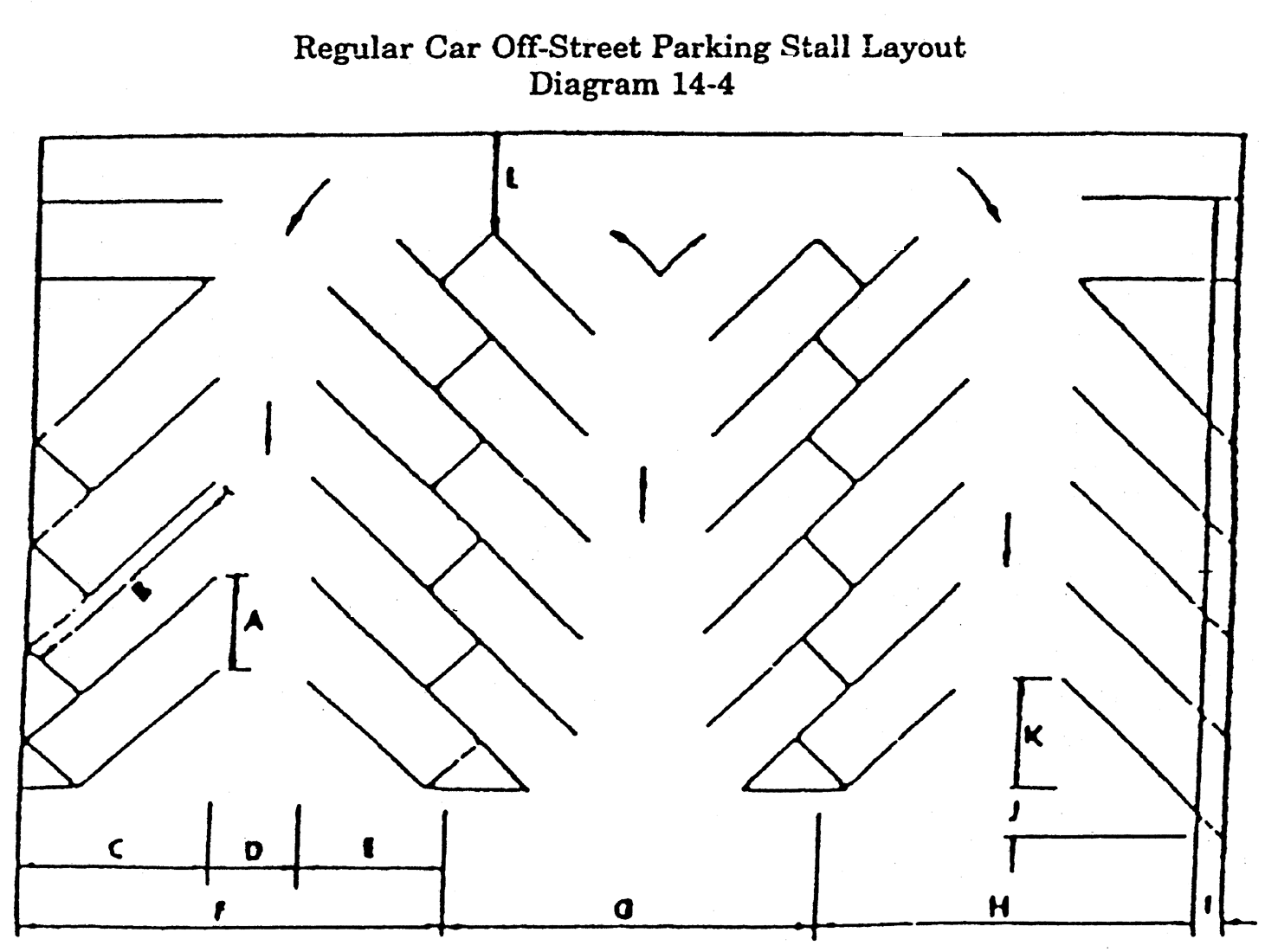
Regular car parking. The minimum dimensions for required off-street spaces shall be as depicted in the schedule for regular car parking and the diagram of regular car off-street parking stall layout in this section, except that redevelopment projects are exempt from complying with these requiremetns provided the city traffic engineer determines the proposed dimensions meet minimum safety standards based on accepted traffic engineering principles for the subject site:
SCHEDULE OF REGULAR CAR PARKING
(b)
Compact car parking. The minimum dimensions for required compact off-street spaces shall be as depicted in the following schedule of compact car parking, except that redevelopment projects are exempt from complying with these requirements provided the city traffic engineer determines the proposed dimensions meet minimum safety standards based on accepted traffic engineering principles for the subject site. Parking for compact cars may be provided for up to twenty-five percent of the required parking, according to section 10-358 and the following conditions:
(1)
Compact car parking may be provided only for parking areas that have ten or more spaces.
(2)
For 90-degree compact parking, the minimum stall width shall be eight feet and the minimum stall length shall be 16 feet. There need be no provision for bumper overhang for compact parking.
(3)
Compact car parking spaces must be designated as being for the exclusive use of compact cars through the use of signs or pavement marking.
(4)
The overall design of a parking lot incorporating spaces for compact cars must be reviewed and approved by the land use administrator.
(5)
The parking layout dimensions (in feet) for eight-foot compact parking stalls at various angles are shown below in the following schedule of compact car parking:
SCHEDULE OF COMPACT CAR PARKING
_____
(c)
Parking for handicapped persons. Any parking area to be used by the general public shall provide suitable, marked parking spaces for handicapped persons. The number, design, and location of these spaces shall be consistent with the requirements of F.S. § 316.1955 or succeeding provisions. No parking space required for the handicapped shall be counted as a parking space in determining compliance with this article, but optional spaces for the handicapped shall be counted. All spaces for the handicapped shall be paved.
(d)
Parking surfaces. Except for single- and two-family dwellings and agricultural uses, every off-street parking area shall be surfaced with a material that provides a durable and dust-free surface, as approved by the land use administrator, upon consultation with appropriate representatives of the public works department. However, parking for seasonal uses and portions of off-street parking lots not used on a regular basis may be exempted from the paving requirements of this subsection. Determination of the granting of such exemptions shall be made by the director.
(e)
Fractional spaces. When determination of the number of off-street spaces required by this Code results in a fractional space, the fraction of one-half or less may be disregarded, and a function in excess of one-half shall be counted as one parking space.
(f)
Places of open assembly. In stadiums, sports arenas, churches and other places of assembly in which those in attendance occupy benches, pews or other similar seating facilities, and/or which contains an open assembly area, the occupancy shall be based on the maximum occupancy rating given the building by the fire marshal.
(g)
Determination of gross floor area. Gross floor area shall be the sum of the gross horizontal area of all floors of a building measured from the exterior faces of the exterior walls.
(Code 1984, ch. 27, § 14.5; Ord. No. 95-O-0025AA, 9-13-1995; Ord. No. 99-O-0058AA, §§ 7, 8, 1-26-2000; Ord. No. 13-O-29, § 4, 9-25-2013)
Sec. 10-360. - Parking study.
A parking study, when required by this Code, shall include, but not be limited to:
(1)
Estimates of parking requirements based on recommendations in studies such as those from Urban Land Institute, Institution of Traffic Engineering, or the Traffic Institute, and based on data collected from uses or combinations of uses which are the same or comparable to the proposed use. Comparability shall be determined by density, scale, bulk, area, type of activity, and location. The study shall document the source of data used to develop recommendations.
(2)
An analysis of the extent to which a transportation system management program and/or use of alternative forms of transportation lessen the parking requirement.
(3)
For several uses listed in the matrix the parking requirement is to be determined by the Director. These uses have a large variability in parking demand, making it impossible to specify a single parking requirement. A developer proposing to develop or expand one of these uses must submit, to the department, four copies of a parking study, as described in this article that provides justification for the requirement proposed. The director will review this study along with any traffic engineering and planning data that are appropriate to the establishment of a parking requirement for the use proposed.
(Code 1984, ch. 27, § 14.9; Ord. No. 95-O-0025AA, 9-13-1995; Ord. No. 13-O-29, § 4, 9-25-2013)
Sec. 10-361. - Motorcycle parking.
(a)
A portion of the parking spaces required by this Code may be designated exclusively for motorcycle parking if the following conditions are met:
(1)
The land use administrator recommends that the spaces be so designated, based upon projected demand for them and lessened demand for automobile spaces.
(2)
The director approves the recommendation and the designated spaces are shown on the final development plan.
(3)
The designated spaces are suitably marked and striped.
(4)
The designation does not reduce the overall area devoted to parking so that if the motorcycle spaces are converted to automobile spaces the minimum requirements for automobile spaces will be met.
(b)
The approval may later be withdrawn, and the spaces returned to car spaces, if the land use administrator finds that the purposes of this Code would be better served thereby, based upon actual demand for motorcycle and automobile parking.
(Code 1984, ch. 27, § 14.10; Ord. No. 95-O-0025AA, 9-13-1995; Ord. No. 13-O-29, § 4, 9-25-2013)
Sec. 10-362. - Bicycle parking.
The following applies to bicycle parking:
(1)
The department shall maintain a list of approved bicycle parking facilities. Other bicycle parking devices may be used if it is established to the satisfaction of the department that the standards below are met.
(2)
The rack or other facility shall:
a.
Be designed to allow each bicycle to be supported by its frame.
b.
Be designed to allow the frame and wheels of each bicycle to be secured against theft.
c.
Be designed to avoid damage to the bicycles.
d.
Be anchored to resist removal and solidly constructed to resist damage by rust, corrosion, and vandalism.
e.
Accommodate a range of bicycle shapes and sizes and to facilitate ease of locking without interfering with adjacent bicycles.
f.
Be located to prevent damage to bicycles by cars.
g.
Be compatible with the surroundings in color and design and be incorporated whenever possible into building or street furniture design.
h.
Be located in convenient, highly-visible, active, well-lighted areas.
i.
Be located so as not be interfere with pedestrian movements.
j.
Be located in near proximity to the principal entrance of the building as practical.
k.
Provide safe access from the spaces to the right-of-way or bicycle lane.
(Code 1984, ch. 27, § 14.11; Ord. No. 95-O-0025AA, 9-13-1995)
Sec. 10-363. - Parking deferral.
(a)
To avoid requiring more parking spaces than actually needed to serve a development, the director may defer the provision of some portion of the off-street parking spaces required by this Code if the conditions and requirements of this section are satisfied.
(b)
As a condition precedent to obtaining a partial deferral by the director, one or more of the following shall be met:
(1)
A parking study as described in this article indicates that there is not a present need for the deferred parking.
(2)
Public transportation satisfies transportation demands for a portion of the users of the facility that corresponds to the amount of parking sought to be deferred.
(3)
The developer has established or will establish an alternative means of access to the use that will justify deferring the number of parking spaces sought to be deferred. Alternative programs that may be considered by the director include, but are not limited to:
a.
Private and public car pools and van pools;
b.
Charging for parking;
c.
Subscription bus services;
d.
Flexible work-hour scheduling;
e.
Capital improvement for transit services;
f.
Ride sharing; or
g.
Establishment of a transportation coordinator position to implement car pool, van pool, and transit programs.
(4)
The percentage of parking spaces sought to be deferred corresponds to the percentage of residents, employees, and customers who regularly walk, use bicycles and other nonmotorized forms of transportation, or use mass transportation to come to the facility.
(c)
If the developer satisfies one or more of the criteria in subsection (b) of this section, the director may approve a deferred parking plan submitted by the developer. The number of parking spaces deferred shall correspond to the estimated number of parking spaces that will not be needed because of the condition or conditions established.
(d)
A deferred parking plan shall:
(1)
Be designed to contain sufficient space to meet the full parking requirements of this Code, shall illustrate the layout for the full number of parking spaces, and shall designate which are to be deferred.
(2)
Not assign deferred spaces to areas required for landscaping, buffer zones, setbacks, or areas that would otherwise be unsuitable for parking spaces because of the physical characteristics of the land or other requirements of this Code.
(3)
Include a landscaping plan for the deferred parking area.
(4)
Include a written agreement with the city that, one year from the date of issuance of the certificate of occupancy, the deferred spaces will be converted to parking spaces that conform to this Code at the developer's expense should the director determine from experience that the additional parking spaces are needed.
(5)
Include a written agreement that the developer will cover the expense of a traffic study to be undertaken by the city transportation engineer to determine the advisability of providing the full parking requirement.
(6)
Be a restriction which shall run with the land.
(e)
When authorized by the director upon a preliminary finding that the parking is inadequate, but not sooner than one year after the date of issuance of the certificate of occupancy for the development, the department shall undertake a study to determine the need of providing the full parking requirement to satisfy the proven demand for parking.
(f)
Based upon the study and the recommendations of the transportation engineer the director shall determine if the deferred spaces shall be converted to operable parking spaces by the developer or retained as deferred parking area.
(g)
The developer may at any time request that the director approve a revised development plan to allow converting the deferred spaces to operable parking spaces.
(Code 1984, ch. 27, § 14.12; Ord. No. 95-O-0025AA, 9-13-1995; Ord. No. 13-O-29, § 4, 9-25-2013)
Sec. 10-364. - Reduction for mixed or joint use of parking spaces.
The director shall authorize a reduction in the total number of required parking spaces for two or more uses jointly providing off-street parking when their respective hours of need of maximum parking do not normally overlap. Reduction of parking requirements because of joint use shall be approved if the following conditions are met:
(1)
The developer submits sufficient data to demonstrate that hours of maximum demand for parking at the respective uses do not normally overlap.
(2)
The developer submits a legal agreement approved by the city attorney as applicable, guaranteeing the joint uses of the off-street parking spaces as long as the uses requiring parking are in existence or until the required parking is provided elsewhere in accordance with the provisions of this Code.
(Code 1984, ch. 27, § 14.13; Ord. No. 95-O-0025AA, 9-13-1995; Ord. No. 13-O-29, § 4, 9-25-2013)
Sec. 10-365. - Reduction for low percentage of leasable space.
The requirements of this article assume an average percentage of gross leasable building to total gross building area (approximately 85 percent). If a use has a much lower percentage of leasable space because of cafeterias, athletic facilities or covered patios; multiple stairways and elevator shafts; atriums; conversion of historic residential structures to commercial use; or for other reasons; the Director may reduce the parking requirements if the following conditions are met:
(1)
The developer submits a detailed floor plan describing how all of the floor area in the building will be used.
(2)
The developer agrees in writing that the usage of the square footage identified as not leasable shall remain as identified, unless and until additional parking is provided to conform fully with this Code.
(Code 1984, ch. 27, § 14.14; Ord. No. 95-O-0025AA, 9-13-1995; Ord. No. 13-O-29, § 4, 9-25-2013)
Sec. 10-366. - Special parking districts.
The city commission may designate special parking districts where parking or transit facilities may be provided by the city, thus lessening the demand for on-site parking. For development proposed in these districts, the director may allow the developer to pay a fee in lieu of providing some or all of the spaces required by this Code. The fee shall be a one-time, nonrefundable fee per parking space avoided, paid to the city prior to the issuance of a certificate of occupancy. The amount of the fee shall be determined by the city commission and shall be equal to the land acquisition, construction and maintenance costs of parking spaces that are deferred by this provision. These fees shall be used by the city solely for the purchase, construction, operation and maintenance of parking or transit facilities serving the area of the development. The city commission may, at the time of accepting the fee, enter into an agreement with the developer to construct or provide parking or transit facilities.
(Code 1984, ch. 27, § 14.15; Ord. No. 95-O-0025AA, 9-13-1995; Ord. No. 13-O-29, § 4, 9-25-2013)
Sec. 10-367. - Increase in requirements.
The number of required parking spaces may be increased by the director if a parking study demonstrates that the proposed use would have a parking demand in excess of the requirements in this article. The director may require the developer to provide a parking study, as described in this article, when the transportation engineer presents preliminary data including that an increase in the number of parking spaces may be warranted.
(Code 1984, ch. 27, § 14.17; Ord. No. 95-O-0025AA, 9-13-1995; Ord. No. 13-O-29, § 4, 9-25-2013)
Sec. 10-386. - Required off-street loading space.
(a)
Every use requiring receipt or distribution of materials or merchandise by motor vehicles, except those uses located in design review districts, shall have one or more loading berths or other space for standing, loading and unloading on the same or adjoining premises in accordance with the schedule of off-street loading requirements in this section. Loading space shall be sufficient to allow normal loading and unloading operations appropriate to the property served, and they shall not be used for storage of vehicles or materials, or to meet off-street parking requirements.
SCHEDULE OF OFF-STREET
LOADING REQUIREMENTS
(b)
These off-street loading requirements shall apply to new structures or additions to structures, and shall not be considered to make any existing structure nonconforming for lack of such off-street loading berths.
(c)
Based on the adopted fire prevention code, adequate fire lanes may be required.
(d)
Uses in the design review district shall direct off-street loading to parking areas and permit off-street loading on frontages only by deviation.
(Code 1984, ch. 27, § 14.6; Ord. No. 95-O-0025AA, 9-13-1995; Ord. No. 04-O-43AA, § 15, 6-23-2004; Ord. No. 13-O-03, § 17, 8-28-2013)
Sec. 10-387. - Determination of unlisted uses.
For any use not listed in the schedule of required parking spaces in section 10-358, the land use administrator, upon review of the proposed use, and upon consent of the engineer and building and zoning official shall specify the required number of loading spaces to be provided, using generally accepted traffic engineering practices and standards.
(Code 1984, ch. 27, § 14.7; Ord. No. 95-O-0025AA, 9-13-1995)
Sec. 10-388. - Off-street loading space standards.
All off-street loading spaces, with the exception of those in the design review districts, shall meet the following standards:
(1)
Off-street loading spaces shall be located and arranged so that a semi-trailer truck shall be able to gain access to and use such spaces by means of one continuous parking maneuver.
(2)
Loading spaces shall observe the minimum street and interior setback established for structures.
(3)
All loading space and maneuvering space shall be surfaced with an all-weather material.
(4)
No loading space shall be located in such a manner that a vehicle using it will intrude onto or hinder the use of travel lanes, walkways, public or private streets, of adjacent properties.
(5)
Each required off-street loading space shall have a minimum width of 12 feet and a minimum vertical clearance of 16 feet above finished grade of the space. The length shall be a minimum of 30 feet for local delivery vehicles and 60 feet for semi-trailers. A maximum of two-thirds of the required loading spaces can be used for local delivery vehicles.
(Code 1984, ch. 27, § 14.8; Ord. No. 95-O-0025AA, 9-13-1995; Ord. No. 13-O-03, § 18, 8-28-2013)

