
Tarpon Springs City Zoning Code
ARTICLE X
- SUBDIVISION REGULATIONS
§ 161.00 - GENERAL REQUIREMENTS.
(A)
No person shall subdivide land regardless of zoning after the effective date of this Code without first following the development procedure and complying with the design standards established by this Code.
(B)
No person shall sell or transfer any land subdivided after the effective date of this Code without the prior authorization by the Board of Commissioners and the recording of a Final Subdivision Plat which meets all the requirements of this Code and F.S. Ch. 177.
(C)
No Building Permit or Certificate of Occupancy shall be issued for any lot, parcel, or structure which was created in violation of the provisions of this Code.
(Ord. 90-10, passed 5-1-90; Am. Ord. 93-33, passed 10-19-93)
§ 162.00 - SUBDIVISION DEFINED.
(A)
The term "subdivision" is hereby defined as:
(1)
The division of land into 3 or more lots or parcels; or
(2)
The creation of new access to a parcel by a street, alley, easement, or other primary means of access, whether private or public, regardless of the number of parcels involved; or
(3)
The resubdivision of a portion of an approved recorded subdivision plat if such resubdivision affects any street plan, dedicated area, or public easement, and if any increase in residential density or number of lots is caused thereby.
(B)
The subdivision requirements of this Code shall not apply to the granting of public rights-of-way.
(C)
Minor subdivisions.
(1)
The Technical Review Committee may approve a "minor subdivision" of an existing or proposed 2 lot subdivision, under the following standards:
(a)
Each lot must be affordable in conformance with the requirements of this Code and all other applicable regulations.
(b)
Each lot shall abut a public or private right-of-way for the required minimum lot frontage in the applicable zoning district.
(c)
If any lot abuts a right-of-way which does not conform to the provisions of this Code, the owner shall be required to dedicate ½ the right-of-way width necessary to meet minimum design requirements.
(2)
Further subdivision of the property shall be prohibited unless a plat or development plan is then submitted in accordance with the general subdivision requirements hereof.
(3)
Such further subdivision shall not cause any portion thereof to be in nonconformity with lot size requirements, setback requirements, or any other development standards of this Code.
(4)
Applications to the Technical Review Committee for minor subdivision approval shall include the location of the nearest public utilities, land descriptions, and areas of the original and proposed lots, and a scale drawing, showing the intended divisions, prepared by a licensed surveyor, including any principal or accessory structures thereon.
(5)
Review procedure.
(a)
The Planning Director shall transmit a copy of the proposed Minor Subdivision to the Technical Review Committee for review and comment.
(b)
If the proposed Minor Subdivision meets the conditions of this section and otherwise complies with all applicable laws and ordinances, the Planning Director shall approve the Minor Subdivision, note such approval on the official zoning atlas of the City, and record such approval upon the official records of Pinellas County. If such is not approved by the Technical Review Committee, denial thereof may be appealed to the Board of Commissioners.
(Ord. 90-10, passed 5-1-90; Am. Ord. 93-33, passed 10-19-93; Am. Ord. 94-11, passed 4-19-94)
§ 163.01 - General.
(A)
In addition to the requirements of this Article, all subdivisions shall comply with the following regulations:
(1)
The development standards of Article IX, and all other applicable provisions of this Code.
(2)
The Comprehensive Plan.
(3)
All applicable building codes of the City.
(4)
All other applicable Federal, State, and local laws which govern the development of property or the transfer of land.
(B)
No subdivision of land shall be permitted where the site is unsuitable for the intended development due to flooding, poor drainage, unstable soil, or other such conditions which may constitute a danger to the public welfare unless adequate measures to mitigate such conditions can be, and are, undertaken in the development of the property.
(C)
The provision of adequate public facilities in accordance with adopted level of service standards shall be required.
(D)
The preservation of significant cultural and environmental features, including but not limited to, historic sites, scenic vistas, wetlands, and trees shall be required.
(E)
Every subdivision shall be provided with a name. Such name shall not be the same as, or similar to any other recorded plat located in the City which will in any way confuse the public; except that when an existing subdivision is expanded or resubdivided as an additional unit or section.
(Ord. 90-10, passed 5-1-90; Am. Ord. 93-33, passed 10-19-93)
§ 163.02 - Lots.
(A)
All lots shall be designed to meet the minimum zoning dimensional regulations applicable to the property as designated by this Code. Those dimensional regulations shall include, but not be limited to lot width, lot depth, lot area, and density.
(B)
The depth and width of property subdivided for nonresidential use shall be of adequate size to permit off street parking and other improvements required by this Code and required by the type of use and development anticipated.
(C)
Side lot lines shall be as close as practical to right angles at street lines or radial to curving street lines.
(D)
Each lot shall have access to a public or private street.
(E)
Double frontage and reverse frontage lots shall be avoided except that reverse frontage lots shall be provided along thoroughfare streets. Where reverse frontage streets or 1 tiered blocks are utilized the following may be required by the Planning Director:
(1)
A non-ingress/egress easement along the thoroughfare street.
(2)
A lot depth 15% percent greater than the minimum required by this Code.
(3)
The installation of a buffer strip in accordance with the screening requirements of this Code. The continued maintenance of such buffer strips shall be provided in accordance with the requirements of this Code.
(Ord. 90-10, passed 5-1-90; Am. Ord. 93-33, passed 10-19-93)
§ 163.03 - Blocks.
(A)
Block width, depth, shape, and orientation shall consider the need for access, circulation, traffic control and the safety of vehicular and pedestrian movement.
(B)
Block width shall be sufficient to provide for 2 tiers of lots with the minimum depths required by the zoning district regulations applied to the property. Exceptions to the 2 tiered block width shall be permitted along thoroughfare streets, railroad rights-of-way, waterways, or exterior property lines of the development.
(C)
Block lengths shall not exceed 1,350 feet, or be less than 500 feet in length, except where necessary to intersect an existing street.
(D)
Blocks along thoroughfare streets shall not be less than 1,000 feet in length except where necessitated due to the size and shape or other characteristic of the property.
(Ord. 90-10, passed 5-1-90; Am. Ord. 93-33, passed 10-19-93)
§ 163.04 - Streets.
(A)
All streets shall be properly integrated with the existing and proposed system of thoroughfare and local streets.
(B)
Subdivision streets shall be arranged in a manner which discourages their use by through traffic.
(C)
Subdivision streets shall be extended to the property limits of the subdivision to allow for logical future extension of the streets into adjoining undeveloped land.
(D)
Streets shall be designed to intersect at right angles. The approach to an intersection shall be at right angles for a distance of 50 feet on local streets and 150 feet on thoroughfare streets.
(E)
"T" intersections shall be preferable to four-way intersections, and no intersection shall have more than 4 street approaches.
(F)
New intersections along one side of an existing street shall coincide with existing intersections on the opposite side of the street. Intersection jogs on local streets shall not be less than 125 feet apart measured from centerline to centerline of the jogging streets. Intersection jogs on thoroughfare streets shall not be less than 400 feet apart measured from centerline to centerline of the jogging streets.
(G)
Curve radii on all subdivision streets shall be adequate for the design speed of the street.
(H)
The minimum curb return radius for intersections shall be as follows:
Local street with a local street—25 feet
Local street with a thoroughfare—35 feet
Thoroughfare with a thoroughfare—50 feet
(I)
All subdivision streets shall be integrated with the adjoining topography to provide adequate sight distance.
(Ord. 90-10, passed 5-1-90; Am. Ord. 93-33, passed 10-19-93)
§ 163.05 - Rights-of-Way.
(A)
The minimum street right-of-way shall be as indicated by the right-of-way needs plan of the Traffic Circulation Element of the Comprehensive Plan for thoroughfare streets.
(B)
The minimum street right-of-way for local streets shall be 50 feet wide when constructed with curb and gutter and 64 feet wide when constructed with swale drainage.
(C)
The creation of reserve strips which deny access from adjoining property to a public street shall be prohibited except where dedicated as a controlled limited access strip.
(D)
Half streets shall be prohibited.
(E)
Subdivision streets shall be dedicated along with the required right-of-way. Where the use of private streets is authorized by the Board of Commissioners, continued maintenance shall be provided in accordance with the requirements of Article IX for common improvements.
(F)
The right-of-way access easement widths for private streets shall comply with the requirements of this section for public streets.
(Ord. 90-10, passed 5-1-90; Am. Ord. 93-33, passed 10-19-93)
§ 163.06 - Dead End Streets.
(A)
A temporary dead end street shall be allowed when such street is to ultimately provide for the continuation of streets between adjoining properties. A temporary turn around shall be constructed to the requirements of the City Engineer when a temporary dead end street exceeds 300 feet in length.
(B)
Where a road is not intended to extend beyond the limits of the subdivision a cul-de-sac shall be provided. Dead end cul-de-sac streets shall not exceed 800 feet in length.
(C)
The cul-de-sac design shall be a minimum of 70 feet of pavement with a 90 foot diameter.
(Ord. 90-10, passed 5-1-90; Am. Ord. 93-33, passed 10-19-93)
§ 163.07 - Drainage and Utility Easements.
(A)
Easements, a minimum of 5 feet in width, for the purpose of accommodating overhead, surface and underground utilities and drainage, shall be required along all side and rear lot lines. This provision shall not apply in districts having zero setbacks. The easements along interior side lines shall be considered "floating" in those cases where building sites are assembled by combining one or more platted lots.
(B)
A drainage and utility easement is required along the front lot line of each lot in a subdivision and shall be a minimum of 10 feet in width.
(C)
There shall be no water or sewer distribution or collection lines located in the rear yard of any residential lot created after May 18, 1999.
(D)
Additional easements within commercial subdivisions shall be dedicated as necessary to accommodate drainage and utility improvements as shown on the approved final construction plans for the subdivision. Such easements shall be sized in accordance with Article IX of this Code.
(Ord. 90-10, passed 5-1-90; Am. Ord. 93-33, passed 10-19-93; Am. Ord. 99-12, passed 5-18-99)
§ 163.08 - Common Private Improvements.
The continued maintenance of common private improvements shall be established in accordance with the requirements of this Code.
(Ord. 90-10, passed 5-1-90; Am. Ord. 93-33, passed 10-19-93)
§ 163.09 - Permanent Reference Monuments (P.R.M.'s) and Permanent Control Points (P.C.P.'s).
(A)
P.R.M.'s and P.C.P.'s shall be constructed and installed in accordance with the requirements of F.S. Ch. 177.
(B)
P.R.M.'s shall be set before the recording of the final subdivision plat and will be so stated in the surveyor's certificate on the face of the plat.
(C)
P.C.P.'s shall be set prior to expiration of the performance security where required improvements are installed after recording or prior to recording of the final subdivision plat where improvements are in place.
(Ord. 90-10, passed 5-1-90; Am. Ord. 93-33, passed 10-19-93)
§ 163.10 - Street Signs and Names.
(A)
Traffic control signs shall be installed to the specifications of the City Engineer.
(B)
All streets shall be provided with street signs at each intersection. One hundred percent of the initial installation cost shall be paid by the developer. Street signs shall be in accordance with standard FDOT construction details. Acceptable abbreviations for the words that will appear on signs shall be as follows:
(1)
Drive—DR
(2)
Avenue—AVE
(3)
Court—CT
(4)
Place—PL
(5)
Street—ST
(6)
Boulevard—BLVD
(7)
Parkway—PKWY
(8)
Circle—CIR
(9)
Lane—LN
(10)
Road—RD
(11)
Terrace—TERR
(12)
Way—WAY
(C)
Street names shall be approved by the City. There shall be no duplication or similarity of street names with any other street located in the City service area for fire protection, potable water, and sanitary sewer.
(D)
The design for traffic control signage shall be as shown in Figure 1 below and shall meet the following standards:
(1)
Sign posts shall be black or dark green in color.
(2)
Sign posts shall be round or fluted in shape.
(3)
Sign posts shall be at least three inches in diameter.
(4)
Sign posts shall have a round or fluted decorative base.
(5)
Signs shall have a black or dark green boarder of at least one inch in width. Signs identifying individual parking spaces are exempt from this requirement.
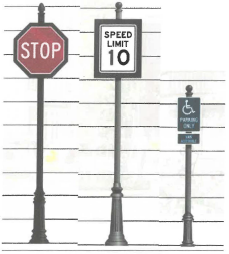
Figure 1
(E)
Subdivisions for predominately industrial uses, excluding those located within any SAP (Special Area Plan) zoning district, shall be exempt from the design requirements of Section 163.10(D).
(Ord. 90-10, passed 5-1-90; Am. Ord. 93-33, passed 10-19-93; Am. Ord. 2020-40, passed 3-9-21)
§ 163.11 - Street Lights.
(A)
Street lighting shall be installed by the developer at the developer's cost in all subdivisions.
(B)
The design for street lighting shall be substantially similar to those shown in Figure 2 below or shall meet the following standards:
(1)
Light posts shall be black or dark green in color.
(2)
Light posts shall be either round or fluted in shape.
(3)
Light posts shall have a round or fluted decorative base.
(4)
Light fixtures shall be directed downward.
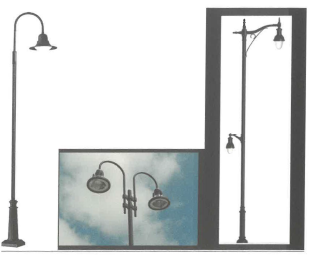
Figure 2
(C)
Street lighting shall be installed to the specifications of the City Engineer, or designee.
(D)
Subdivisions for predominately industrial uses, excluding those located with any SAP (Special Area Plan) zoning district, shall be exempt from the design requirements of Section 163.11(B).
(E)
All parking lot traffic control signage and lighting located within the City's historic district shall additionally undergo review as required in Article VII, Heritage Preservation, of this code.
(Ord. 90-10, passed 5-1-90; Am. Ord. 93-33, passed 10-19-93; Am. Ord. 2020-40, passed, 3-9-21)
§ 164.00 - ADMINISTRATION.
(A)
The review, approval, and acceptance procedure for all subdivisions shall be divided into the following phases:
(1)
Site Plan Review
(2)
Construction Drawing Review
(3)
Installation of Required Improvements
(4)
Final Subdivision Plat Review
(B)
Phased development and the associated timing shall be indicated on and approved by the site plan. For phased developments, an overall master plan is required at the time of site plan review.
(C)
All construction phases of a subdivision shall be capable of operating independently with respect to the required improvements.
(Ord. 90-10, passed 5-1-90; Am. Ord. 93-33, passed 10-19-93)
§ 164.01 - Site Plan Review.
(A)
A site plan shall be prepared, submitted and reviewed in accordance with the requirements of this Code for site plans (§§ 210.00 through 210.05).
(B)
Approval of a site plan shall not authorize recording of the final subdivision plat, nor effect the acceptance of any land or improvements proposed to be dedicated to the City.
(C)
Site plan approval shall expire 1 year from the date of approval unless the submission of construction drawings or final subdivision plat has been made. Site plan expirations, extensions and revisions shall be in accordance with § 210.05 of this Code.
§ 164.02 - Construction Drawing Review.
(A)
Within 1 year of the approval of a site plan the required construction drawings for the installation of all required improvements shall be submitted to the City Engineer.
(B)
Construction drawings shall be prepared and certified for all required improvements by a Florida Registered Professional Engineer in a format and manner as required by the City Engineer.
(C)
Construction standards shall conform to the requirements of this Code, the City's Standards and Procedures Manual, standard engineering practice, and all other applicable building codes.
(D)
Construction drawings shall conform to the approved site plan, including any conditions of approval required by the Board of Commissioners or Technical Review Committee.
(E)
The fee for construction drawing review shall be established by this Code.
(F)
The review of construction drawings shall be an administrative process coordinated by the Engineering Department.
(G)
Upon approval of the construction drawings by the City Engineer, permits for site development and installation of required improvements may be requested.
(H)
Construction drawings shall be valid for a period of 6 months from the date of approval by the City Engineer.
(Ord. 90-10, passed 5-1-90; Am. Ord. 93-33, passed 10-19-93)
§ 164.03 - Installation of Required Improvements.
(A)
No clearing, grading, drainage, or other site preparation with the exception of brush removal for the purpose of surveying shall commence until all required construction drawings have been approved by the City Engineer and all required City, State, and County permits have been obtained.
(B)
Prior to approval of the final subdivision plat, the developer shall install all the improvements required under this Code in accordance with the specifications of the approved construction drawings.
(C)
During construction the City shall inspect all the required improvements for compliance with the specifications of the approved construction drawings.
(D)
Upon the completion of all required improvements, as-built drawings, prepared and certified by the engineer of record, showing the actual installation of all required improvements shall be submitted to the City Engineer. The as-built drawings shall have a sealed certification from the engineer of record stating that all the required improvements have been installed and are completed in substantial compliance with the approved construction drawings.
(E)
Upon receipt of the required as-built drawings and certification from the engineer of record, the City Engineer shall certify that all required improvements and inspections comply with the approved construction drawings.
(Ord. 90-10, passed 5-1-90; Am. Ord. 93-33, passed 10-19-93)
§ 164.04 - Performance Security.
(A)
Subject to the approval of the City Manager, the City Engineer may in unusual circumstances, permit the posting of performance security for the installation of required improvements in lieu of actual installation prior to final subdivision plat approval.
(B)
Performance security shall comply with all statutory requirements and shall be in the form of a letter of credit from a bank licensed to do business in the State of Florida, or a performance bond where the company is duly organized and licensed to issue bonds in the State of Florida.
(C)
The amount of performance security shall be based upon an estimate of completion cost by the engineer of record, shall be subject to verification by the City Engineer, and shall total 110% of the estimate of completion.
(D)
The effective period of performance security shall not exceed 1 year from the date of approval of the final subdivision plat.
(E)
Performance security provided under this section shall be subject to the approval of the Board of Commissioners at the time of final subdivision plat approval.
(F)
The City shall receive payment in full in accordance with the procedure established by law for all required improvements not completed at the term of the performance security.
(Ord. 90-10, passed 5-1-90; Am. Ord. 93-33, passed 10-19-93)
§ 164.05 - Final Subdivision Plat Review.
(A)
Upon satisfactory completion and certification of all required improvements a final subdivision plat shall be submitted to the Planning Department.
(B)
The final subdivision plat shall be reviewed by the Technical Review Committee (TRC) for conformance with the approved site plan and compliance with F.S. Ch. 177.
(C)
Prior to approval by the Board of Commissioners, all required improvements and as-built drawings shall have been completed and certified in accordance with the requirements of this Article.
(D)
Upon determination by the Technical Review Committee (TRC) that the final subdivision plat and required improvements are complete in conformance with the requirements of this Code, the final subdivision plat shall be sent to the Board of Commissioners for approval.
(E)
Upon approval of the final subdivision plat by the Board of Commissioners, the plat shall be forwarded along with any other related legal documents to the Pinellas County Clerk of the Circuit Court for recording.
(F)
Approval of a final subdivision plat shall constitute dedication and acceptance of all improvements, easements, and rights specified on the plat as public.
(G)
A final subdivision plat application shall conform to the following minimum specifications:
(1)
The plat shall comply with the requirements of F.S. Ch. 177 and shall be made under the direction of a registered land surveyor.
(2)
The sheet size shall be 22" by 28" with a 3 inch margin on the left side and 1 inch margins on each remaining sides.
(3)
Location, width, and name of all streets, water bodies, or other rights-of-way shall be provided. The mean high water line, seasonal high water line and wetland jurisdictional line shall be indicated as applicable.
(4)
Location, width and purpose of all easements shall be provided.
(5)
Park, open space, or other public parcels (with dimensions) shall be identified and referenced in the dedication block.
(6)
Location, purpose, and width of all dedications shall be shown graphically and referenced in the dedication block or dedicated by separate instrument in a form acceptable to the City.
(7)
Building setback lines if greater than that required by normal zoning shall be shown.
(8)
The survey closure data for the lands to be subdivided shall be provided.
(9)
Submission of the final plat shall include the linen, seven check prints and a computer DXF file.
(10)
Where applicable, submission of the final plat shall be accompanied by a declaration of covenants, conditions and restrictions which provide, inter alia, for the continued maintenance of common improvements and open spaces.
(11)
An ownership and encumbrance report including all recorded easements from an attorney licensed in Florida or title company.
(12)
Affidavit of no liens by the owner and a final lien waiver from the contractor(s) of record.
(13)
Code enforcement, utility and special assessment liens search by the City Clerk and Collector.
(H)
All final subdivision plat applications shall include the following dedication and approval blocks:
(1)
Approval by a professional land surveyor under contract to the City.
(2)
Certificate of ownership and dedication executed by all persons or companies having a record interest in the land to be subdivided in accordance with the title certification. All mortgagees having a record interest shall either sign the certificate of dedication or submit a separate instrument joining in and ratifying the plat and dedications. No private improvements or open space shall be dedicated to the City;
(3)
Surveyor's Certification;
(4)
Certificate of approval of the Board of Commissioners;
(5)
Certificate of Approval of the Clerk of the Circuit Court;
(6)
Notice of supremacy of record plat and possible additional restrictions in the Public Records.
(Ord. 90-10, passed 5-1-90; Am. Ord. 93-33, passed 10-19-93; Am. Ord. 2000-28, passed 8-15-00)
§ 165.00 - WAIVERS.
(A)
In connection with the approval of a site plan for the purpose of subdivision approval, the Board of Commissioners may waive or modify any design requirement of this Article. However, the Board of Commissioners may not waive the development standards contained in Article IX of this Code or the zoning district dimensional regulations of this Code.
(B)
No waiver or modification may be granted unless one or more of the following circumstances exist and where subsection (C) of this section is met:
(1)
Where the waiver or modification is necessary to preserve or enhance significant existing environmental or cultural features, such as trees, scenic areas, historic sites or public facilities, related to the development site.
(2)
Where the strict application of the requirement would effectively deprive the owner of all reasonable use of the land, due to its unusual size, shape, topography, natural conditions, or location, provided:
(a)
Such effect upon the owner is not outweighed by a valid public purpose in imposing the requirement in this case; and
(b)
The unusual conditions involved are not personal to, nor the result of actions of the developer, property owner or their predecessors in interest.
(3)
Where strict application of the requirement would be technically impractical in terms of engineering, design, or construction practices, due to the unusual size, shape, topography, natural conditions, or location, of the land or due to improved efficiency, performance, safety, or construction practices which will be realized, provided:
(a)
The development will provide an alternative adequate to achieve the purposes of the requirement; and
(b)
Any unusual conditions creating the impracticality are not personal to, nor the result of the actions of the developer or property owner.
(4)
Where all or any part of the requirement has no relationship to the development, or to the impact of the development on the public facilities, land use, traffic, or environment of the neighborhood and the general community, due to the location, scale, or type of development involved.
(C)
Where the development will provide an alternative which will achieve the purposes of the requirement through clearly superior design, efficiency, or performance.
(D)
In its legislative discretion, the Board of Commissioners may waive the minimum lot width, depth and area requirements for individual lots with existing commercial uses and zoning under the following circumstances:
(1)
The original lot must be a conforming lot under the Code.
(2)
No more than two lots must be created from the original lot.
(3)
The owners of the original lot must execute and record a restrictive covenant with respect to the newly created lots, in a form approved by the City Attorney, which provides, at a minimum, (a) that the lots may only be developed as one conjoined parcel; (b) that the city must treat the lots as one conjoined parcel for all purposes under the Code of Ordinances; (c) that neither lot may be conveyed independently of the other without the prior written consent of the city; (d) that the city shall be deemed a third party beneficiary of the restrictive covenant and shall be entitled to enforce its terms; and (e) that the covenant may not be amended, modified or negated without the express written consent of the city. The Board of Commissioners may, in its discretion, include other terms and provisions in the restrictive covenant as it deems necessary to protect the interest of the city.
(Ord. 90-10, passed 5-1-90; Am. Ord. 93-33, passed 10-19-93; Am. Ord. 2007-52, passed 2-19-08)

