
Tarpon Springs City Zoning Code
ARTICLE XI
SIGN REGULATIONS
§ 176.00 - PURPOSE AND INTENT.
(A)
It is the purpose and intent of this article to establish a set of fair and comprehensive standards for the erection, use, installation, maintenance, alteration, and placement of all signs, symbols, markings, or advertising devices within the City of Tarpon Springs. These standards are designed to protect and promote the health, safety, welfare, and general well-being of the community's citizens in a manner consistent with the following objectives:
(1)
The city has an economic base which relies heavily on tourism, and enhancing the visual attractiveness of the environment is important to making the city a desirable place to visit.
(2)
To foster a good visual environment and enhance the economic well-being of the community as a place in which to live, visit, and conduct business.
(3)
To preserve the aesthetic, natural, and historical qualities of the community.
(4)
To contribute to the safe movement of traffic by controlling the excessive height, area, and bulk of signs, as well as certain types and lighting of signs which can distract the attention of pedestrians and motorists so as to constitute hazards to traffic safety.
(5)
To encourage creativity and allow the sufficient conveyance of a message in a manner which promotes traffic safety and avoids visual blight.
(6)
To control the use of signs determined to be detrimental to the aesthetic sense and welfare of the community.
(7)
To regulate signs in a manner so as not to interfere with, obstruct the vision of or distract motorists, bicyclists, or pedestrians.
(8)
To encourage sign sizes and forms appropriate to the zoning district in which they are located and consistent with the category of use to which they pertain.
(Ord. 90-10, passed 5-1-90; Am. Ord. 93-33, passed 10-19-93; Am. Ord. 2020-06, passed 6-9-20; Am. Ord. 2020-39, passed 3-9-21)
§ 177.00 - APPLICABILITY.
(A)
All signs erected, altered, or displayed on or after the effective date of this article shall be subject to its provisions, and unless specifically exempted from the permitting requirement, shall require the prior issuance of a sign permit from the city.
(B)
Signs shall be constructed and maintained in strict conformity with the city's building codes and all other applicable regulations.
(C)
All signs shall comply with other applicable federal, state, and county laws, ordinances, and regulations, including the applicable provisions of the city's comprehensive plan.
(D)
This article does not pertain to a sign located entirely inside the premises of a building or enclosed space and that is not visible from the right-of-way or public parking lots.
(E)
This article does not apply to any government sign placed by or at the direction of or through permission of the city in, on or over city property or right-of-way.
(Ord. 90-10, passed 5-1-90; Am. Ord. 93-33, passed 10-19-93; Am. Ord. 2020-06, passed 6-9-20; Am. Ord. 2020-39, passed 3-9-21))
§ 178.00 - DEFINITIONS.
For the purpose of this article, the following definitions shall apply unless the context clearly indicates or requires a different meaning:
ABANDONED or DISCONTINUED SIGN or SIGN STRUCTURE. A sign or sign structure is considered abandoned or discontinued when its owner fails to operate or maintain a sign for a period of at least sixty (60) days. The following conditions shall be considered as the failure to operate or maintain a sign:
(1)
A sign displaying advertising for a product or service which is no longer available or displaying advertising for a business which is no longer licensed, or
(2)
A sign which is blank. This definition includes signs on which is advertised a business that is no longer licensed, no longer has a certificate of occupancy, or is no longer doing business at that location or any other sign for any purpose for which the purpose has lapsed. If the sign is a conforming sign in compliance with building codes and all other applicable city ordinances, then only the sign face will be considered abandoned.
ADVERTISING means any commercial sign copy intended to aid, directly or indirectly, in the sale, use or promotion of a product, commodity, service, sales event, activity, entertainment, or real or personal property.
A-FRAME or SANDWICH BOARD SIGN means a portable, freestanding, movable and double-faced sign not exceeding thirty-two (32) inches wide and forty-eight (48) inches high.
ANIMATED SIGN means a sign which includes action, motion, or color changes, or the optical illusion of action, motion, or color changes, including signs using electronic ink, signs set in motion by movement of the atmosphere, or made up of a series of sections that turn, including any type of screen using animated or scrolling displays, such as an LED (light emitting diode) screen or any other type of video display. Animated sign shall include electronic reader boards.
ARCHITECTURAL DETAIL or EMBELLISHMENT means any projection, relief, change of material, window or door opening, exterior lighting, inlay, or other exterior building features not specifically classified as a sign. The term includes, but is not limited to, relief or inlay features or patterns that distinguish window or door openings, exterior lighting that frames building features, and changes in facade materials to create an architectural effect.
AREA OF SIGN means the square foot area within a continuous perimeter enclosing the extreme limits of the sign display, including any frame or border. Curved, spherical, or any other shaped sign face shall be computed on the basis of the actual surface area. In the case of painted wall signs composed of letters, shapes, or figures, or skeleton letters mounted without a border, the sign area shall be the area of the smallest rectangle or other geometric figure that would enclose all of the letters, shapes and figures. The calculation for a double-faced sign shall be the area of one face only. Double-faced signs shall be so constructed that the perimeter of both faces coincide and are parallel and not more than twenty-four (24) inches apart.
ARTWORK means a two- or three-dimensional representation of a creative idea that is expressed in an art form but does not convey the name of the business or a commercial message. All outdoor artwork shall conform to the maximum height restrictions of signs within the district. All outdoor artwork shall also conform to any applicable building code and safety standards.
ATTACHED SIGN means any sign attached to, on, or supported by any part of a building (e.g., walls, awning, windows, or canopy), which encloses or covers useable space.
AWNING means any secondary covering attached to the exterior wall of a building. It is typically composed of canvas woven of acrylic, cotton or polyester yarn, or vinyl laminated to polyester fabric that is stretched tightly over a light structure of aluminum, iron or steel, or wood.
AWNING SIGN or CANOPY SIGN means any sign that is a part of or printed, stamped, stitched or otherwise applied onto a protective awning, canopy, or other fabric, plastic, or structural protective cover over a door, entrance, window, or outdoor service area. A marquee is not a canopy.
BANNER means a temporary sign made of wind and weather resistant cloth or other lightweight material, intended to hang either with or without frames or in some other manner as not to be wind activated, and possessing characters, letters, illustrations, or ornamentations applied to paper, plastic or fabric of any kind. Flags shall not be considered banners for the purpose of this definition.
BANNER, VERTICAL STREETLIGHT means a temporary government sign made of wind and weather resistant cloth or other lightweight material, displaying government speech and hung in the public right-of-way from rods and brackets attached to a government-owned streetlight pole.
BEACON SIGN means a stationary or revolving light which flashes or projects illumination, single color or multicolored, in any manner which has the effect of attracting or diverting attention, except, however, this term does not include any kind of lighting device which is required or necessary under the safety regulations of the Federal Aviation Administration or other similar governmental agency. This definition does not apply to any similar type of lighting device contained entirely within a structure and which does not project light to the exterior of the structure.
BENCH/BUS SHELTER SIGN means a bench or bus shelter upon which a sign is drawn, painted, printed, or otherwise affixed thereto.
BILLBOARD means an advertising sign or other commercial sign which directs attention to a business, commodity, service, entertainment, or attraction sold, produced, offered or furnished at a place other than upon the same lot where such sign is displayed and which measures at least 72 square feet in sign area.
BUILDING means a structure having a roof supported by columns or walls, that is designed or built for support, enclosure, shelter or protection of any kind.
BUILDING FRONTAGE means the linear length of a building facing the street right-of-way.
BUILDING OFFICIAL means the city official responsible for the administration, interpretation and enforcement of the building codes of the city.
BUSINESS ESTABLISHMENT means any individual person, nonprofit organization, partnership, corporation, other organization or legal entity holding a valid city occupational license and/or occupying distinct and separate physical space and located in a business activity zoning district.
BUS STOP INFORMATIONAL SIGN means a freestanding or attached noncommercial government sign erected by a public transit agency, which is located at an official bus stop and providing information as to the route, hours or times of service.
CABINET SIGN means a sign that contains all the text and/or logo symbols within a single enclosed cabinet and may or may not be illuminated.
CANOPY means an overhead roof or structure that is able to provide shade or shelter.
CANOPY SIGN means a permanent sign which is suspended from, attached to, supported from, printed on, or forms a part of a canopy.
CHANGEABLE COPY/MESSAGE SIGN means a sign with the capability of content change by means of manual or remote input, including the following types:
(1)
Manually activated. Changeable sign whose message copy can be changed manually on a display surface.
(2)
Electronically activated. Changeable sign whose message copy or content can be changed by means of remote electrically energized on-off switching combinations of alphabetic or pictographic components arranged on a display surface. Illumination may be integral to the components, such as characterized by lamps or other light-emitting devices, or may be from an external light source designed to reflect off of the changeable component display. See also Electronic message sign.
CHARACTER means any symbol, mark, logo, or inscription.
COLOR means any distinct tint, hue or shade including white, black or gray.
COMMERCIAL MASCOT means humans or animals used as advertising devices for commercial establishments, typically by the holding of a separate sign or wearing of insignia, masks or costumes associated with the commercial establishment. This definition includes sign twirlers, sign clowns, etc.
COMMERCIAL MESSAGE means any sign wording, logo, or other representation or image that directly or indirectly names, advertises, or calls attention to a product, service, sale or sales event or other commercial activity.
COPY means the linguistic or graphic content of a sign.
DECORATION means any decoration visible from a public area that does not include lettering or text and is not displayed for commercial advertising.
DOUBLE-FACED SIGN means a sign which has two display surfaces backed against the same background, one face of which is designed to be seen from one direction and the other from the opposite direction, every point on which face being either in contact with the other face or in contact with the same background.
DRIVE-IN ESTABLISHMENT means a business establishment wherein patrons are usually served while seated in parked vehicles on the same lot. This definition shall be deemed to include "drive-in restaurants," which are more completely described in this section, as well as drive-in service establishments, including banks and dry cleaners that provide this service, and automobile service stations.
DRIVE-IN RESTAURANT or REFRESHMENT STAND means any place or premises where provision is made on the premises for the selling, dispensing, or serving of food, refreshments, or beverages in automobiles and/or in other than a completely enclosed building on the premises, including those establishments where customers may serve themselves and may eat or drink the food, refreshments, or beverages in automobiles on the premises and/or in other than a completely enclosed building on the premises. A restaurant which provides drive-in facilities of any kind in connection with regular restaurant activities shall be deemed a drive-in restaurant for purposes of these zoning regulations. A barbecue stand or pit having the characteristics noted in this definition shall be deemed a drive-in restaurant.
DRIVE-THROUGH LANE SIGN means a sign oriented to vehicles utilizing a drive-through lane at an establishment.
DWELL TIME means the length of time that elapses between text, images, or graphics on an electronic sign.
ELECTRONIC MESSAGE/READER BOARD SIGN means an electronically activated changeable copy sign whose variable message capability can be electronically programmed.
ERECT means to construct, build, raise, assemble, place, affix, attach, create, paint, draw, or in any way bring into being or establish: but it does not include any of the foregoing activities when performed as an incident to the change of advertising message or customary maintenance or repair of a sign.
FACADE means the exterior wall of a building exposed to public view or that wall viewed by persons not within the building.
FEATHER SIGN or FLUTTER SIGN means a sign extending in a sleeve-like fashion down a telescoping or fixed pole that is mounted in the ground or on a building or stand. A feather sign or flutter sign is usually shaped like a sail or feather, and attached to the pole support on one vertical side.
FENCE means an artificially constructed barrier of any material or combination of materials erected to enclose or screen areas of land.
FIXED AERIAL ADVERTISING SIGN means any aerial advertising medium that is tethered to, or controlled from the ground.
FLAG means a sign consisting of a piece of cloth, fabric or other non-rigid material.
FLAGPOLE means a pole on which to raise a flag. A flag pole is not a pole sign.
FLASHING SIGN means any illuminated sign on which the artificial source of light is not maintained stationary or constant in intensity and color at all times when such sign is illuminated. For the purposes of this definition, any moving illuminated sign affected by intermittent lighting shall be deemed a flashing sign.
FOOT-CANDLE means a unit of measure of luminosity of a surface that is everywhere one foot from a uniform point source of light of one candle and equal to one lumen per square foot.
FOOT LAMBERT means the centimeter gram second unit of brightness equal to the brightness of a perfectly diffused surface that radiates or reflects one lumen per square centimeter.
FREE-STANDING (GROUND) SIGN means a detached sign which shall include any signs supported by uprights or braces placed upon or in or supported by the ground and not attached to any building. A free-standing (ground) sign may be a pole sign or a monument sign.
FRONTAGE means that allowable sign area shall be measured according to the following standards:
(1)
For single or two business establishment buildings fronting one public right-of-way, measurement shall be taken parallel to that property line abutting the right-of-way with perpendicular witness lines extending to the farthest distant corners of the structure when measuring building frontage or similarly to the farthest distant property corners when measuring lot frontage. Lot frontage shall not be used for the purposes of calculating sign area where two business establishments occupy one structure.
(2)
For single and two business establishment buildings fronting on more than one public right-of-way, measurement shall be taken as per subsection (1) of this definition using that right-of-way for which the primary and foremost portion of each business establishment faces. Lot frontage shall not be used for the purposes of calculating sign area where two business establishments occupy one structure.
(3)
For business establishments located within a shopping or business center other than a business establishment having its primary entrance that is interior to a building containing multiple businesses, measurement shall be taken parallel to and equal in length to a line connecting the farthest distant corners of the business establishment's primary and foremost direction of public access. Generally, the primary and foremost direction of public access shall face the center's common parking facility or a public right-of-way.
GOVERNMENT SIGN shall mean any temporary or permanent sign erected by or on the order of a public official or quasi-public entity at the federal, state or local government level in the performance of any duty including, but not limited to, noncommercial signs identifying a government building, program or service (including bus or other public transit services), traffic control signs, street name signs, street address signs, warning signs, safety signs, informational signs, traffic or other directional signs, public notices of government events or actions, proposed changes of land use, any proposed rezoning, or any other government speech. This term includes signs erected on government property pursuant to lease, license, concession or similar agreements requiring or authorizing such signs.
GROUND LEVEL means the average grade within a 25-foot radius of the sign base on a parcel of land, exclusive of any filling, berming, mounding or excavating solely for the purpose of locating a sign. Ground level on marine docks or floating structures shall be the average grade of the landward portion of the adjoining parcel.
GROUND MOUNTED SIGN means a sign, other than a pole sign, which is entirely supported by a structure in or upon the ground.
HEIGHT means the vertical distance measured from the ground level base of a sign to the highest point of a sign.
HOLOGRAPHIC DISPLAY SIGN means an advertising display that creates a three-dimensional image through projection, OLED (organic light emitting diode), or any similar technology.
HOSPITAL means an establishment licensed as a hospital under F.S. ch. 395.
ILLUMINATED SIGN means any sign or portion thereof which is illuminated by artificial light, either from an interior or exterior source, including outline, reflective or phosphorescent light (including but not limited to plasma or laser), whether or not the source of light is directly affixed as part of the sign, and shall also include signs with reflectors that depend upon sunlight or automobile headlights for an image.
INDIRECTLY ILLUMINATED SIGN means any sign, the facing of which reflects light from a source intentionally directed upon it.
INFLATABLE or BALLOON SIGN means a sign consisting of a flexible envelope of nonporous materials that gains its shape from inserted air or other gas.
INGRESS and EGRESS SIGN shall mean a sign at the entrance to or exit from a parcel necessary to provide directions for vehicular traffic and provide a warning for pedestrian and/or vehicular traffic safety.
LAND means "land" including "water", "marsh" or "swamp."
LED SIGN means any sign or portion thereof that uses light emitting diode technology or other similar semiconductor technology to produce an illuminated image, picture, or message of any kind whether the image, picture, or message is moving or stationary. This type of sign includes any sign that uses LED technology of any kind whether conventional (using discrete LEDs), surface mounted (otherwise known as individually mounted LEDs), transmissive, organic light emitting diodes (OLED), light emitting polymer (LEP), organic electro luminescence (OEL), or any similar technology.
LOCATION means a lot, premises, building, wall or any place whatsoever upon which a sign is located.
LOLLIPOP SIGN means a sign which is attached to any pole(s) or stake(s) that is designed to be driven into the ground and which is not stabilized into the ground or affixed in place by any device other than the stake to which the sign is attached.
MACHINERY AND EQUIPMENT SIGN means any sign that is integral to the machinery or equipment and that identifies the manufacturer of the machinery or equipment that is placed on the machinery or equipment at the factory at the time of manufacture.
MAINTAIN or MAINTENANCE, in the context of this article, means the repairing or repainting of a portion of a sign or sign structure, periodically changing changeable copy, or renewing copy, which has been made unusable by ordinary wear.
MARQUEE means any permanent wall or roof-like structure projecting beyond a building or extending along and projecting beyond the wall of the building, generally designed and constructed to provide protection from the weather. A Marquee is not an awning or canopy.
MARQUEE SIGN means any sign painted or printed onto or otherwise attached to a marquee.
MONOPOLE means a vertical self-supporting structure, not guyed, made of spin-cast concrete, concrete, steel or similar material, presenting a solid appearance.
MONUMENT SIGN means a type of freestanding sign that is not supported by a pole structure and is placed upon the ground independent of support from the face of a building and that is constructed of a solid material such as wood, masonry or high-density urethane.
MULTIPLE OCCUPANCY PARCEL means any parcel which is occupied by more than 1 establishment, business, or use.
MULTI-PRISM or TRI-VISION SIGN means a sign made with a series of triangular sections that rotate and stop, or index, to show multiple images or messages in the same area at different times.
MOBILE BILLBOARD ADVERTISING means any vehicle, or wheeled conveyance which carries, conveys, pulls, or transports any sign or billboard for the primary purpose of advertising.
NONCONFORMING SIGN means any sign that was validly installed under laws or ordinances in effect prior to the effective date of the LDC or subsequent amendments, but which is in conflict with the provisions of the LDC.
NONCONFORMING USE means any use of a building or structure which, at the time of the commencement of the use, was a permitted use in the zoning district until the effective date of the LDC, but which does not, on the effective date of the LDC or amendment thereto, conform to any one of the current permitted uses of the zoning district in which it is located. Such nonconforming use may be referred to as a nonconformity.
OFFSITE/OFF-PREMISES COMMERCIAL ADVERTISING means a nonaccessory billboard or sign which directs attention to a business, commodity, service, entertainment, or attraction that is sold, offered or existing elsewhere than upon the same lot where such sign is displayed.
OFFSITE/OFF-PREMISES COMMERCIAL SIGN means a nonaccessory billboard or sign that displays offsite commercial advertising.
ON-SITE SIGN means any commercial sign which directs attention to a commercial or industrial occupancy, establishment, commodity, good, product, service or other commercial or industrial activity conducted, sold or offered upon the site where the sign is maintained. The on-site/off-site distinction applies only to commercial message signs. For purposes of this article, all signs with noncommercial speech messages shall be deemed to be "on-site," regardless of location.
OWNER means any part or joint owner, tenant in common, tenant in partnership, joint tenant or tenant by the entirety with legal or beneficial title to whole or part of a building or land.
PARCEL means an area of land with its appurtenances and buildings which, because of its unity of use or commonality of ownership, may be regarded as the smallest conveyable unit of real estate.
PENNANT means any pieces or series of pieces of cloth, plastic, paper or other material attached in a row at only one or more edges, or by one or more corners (the remainder hanging loosely) to any wire, cord, string, rope, or similar device. The term includes, but is not limited to, string pennants, streamers, spinners, ribbons and tinsel.
PERMANENT INTERIOR SIGN means that if located on a window or within a distance equal to the greatest dimension of the window and if able to view from the exterior, it shall be considered an exterior sign for purposes of this chapter, excluding window sign allowance.
PERMANENT SIGN means any sign which is intended to be and is so constructed as to be of lasting and enduring condition, remaining unchanged in character, condition (beyond normal wear and tear) and position and in a permanent manner affixed to the ground, wall or building. Unless otherwise provided for herein, a sign other than a temporary sign shall be deemed a permanent sign unless otherwise indicated elsewhere in this Land Development Code.
PERSON means any person, individual, public or private corporation, firm, association, joint venture, partnership, municipality, governmental agency, political subdivision, public officer or any other entity whatsoever or any combination of such, jointly or severally.
POLE SIGN means a permanent ground sign that is supported by one or more poles more than four feet in height and otherwise separated from the ground by air.
PORTABLE SIGN means any sign, banner, or poster that is not permanently attached to the ground or to a structure that is attached to the ground or a sign capable of being transported, including, but not limited to, signs designed to be transported by means of wheels or carried by a person, and signs converted to an A-Frame sign or a T-frame sign. For purposes of this chapter, a cold air inflatable sign shall be considered to be a portable sign.
PRIMARY STREET means the street with the highest functional classification according to the traffic circulation element of the comprehensive plan and/or the street to which the establishment of use is primarily oriented.
PROJECTING SIGN means any sign affixed perpendicular, or at any angle to a building or wall in such a manner that its leading edge extends more than twelve (12) inches beyond the surface of such building or wall. Standard channel set letters on signs do not render a sign a projecting sign.
PROPERTY means the overall area represented by the outside boundaries of a parcel of land or development containing one or more business establishments and/or residential units.
RIGHT-OF-WAY means the area of a highway, road, street, way, parkway, electric transmission line, gas pipeline, water main, storm or sanitary sewer main, or other such strip of land reserved for public use, whether established by prescription, easement, dedication, gift, purchase, eminent domain or any other legal means.
ROOFLINE means either the edge of the roof or the top of the parapet, whichever forms the top line of the building silhouette and, where a building has several roof levels, this roof or parapet shall be the one belonging to that portion of the building on whose wall the sign is located.
ROOF SIGN means any sign which is mounted on the roof of a building or which extends above the top edge of the wall of a flat roofed building, the eave line of a building with a hip, gambrel, or gable roof.
ROTATING SIGN (OR REVOLVING SIGN) means an animated sign that revolves or turns or has external sign elements that revolve or turn. Such sign may be power-driven or propelled by the force of wind or air.
SANDWICH BOARD SIGN means a portable, freestanding, movable and double-faced sign not exceeding thirty-two (32) inches wide and forty-eight (48) inches high.
SERVICE ISLAND SIGN means a sign mounted permanently on, under, or otherwise mounted on a service island canopy.
SERVICE STATION means any building, structure or land used for the dispensing, sale or offering for sale at retail, and any automobile fuel, oils, or accessories in connection with which is performed general automotive servicing, such as tire servicing and repair, and including engine and transmission repair, but excluding body work, straightening of frames, painting, or welding. All work must be done inside of an enclosed building.
SHOPPING CENTER AND BUSINESS CENTER means a group of three or more business establishments within a single architectural plan, with common ownership of property, or cooperative or condominium ownership.
SIGN means any device, fixture, placard or structure, including its component parts, which draws attention to an object, product, place, activity, opinion, person, institution, organization, or place of business, or which identifies or promotes the interests of any person and which is to be viewed from any public street, road, highway, right-of-way or parking area. For the purposes of this article, the term "Sign" shall include all structural members. A sign shall be construed to be a display surface or device containing organized and related elements composed to form a single unit. In cases where matter is displayed in a random or unconnected manner without organized relationship of the components, each such component shall be considered to be a single sign. The term "Sign" for purposes of this article shall not include the following objects:
1.
Decorative or structural architectural features of buildings (not including lettering, trademarks or moving parts);
2.
Symbols of noncommercial organizations or concepts including, but not limited to, religious or political symbols, when such are permanently embedded or integrated into the structure of a permanent building which is otherwise legal;
3.
Items or devices of personal apparel, decoration or appearance, including tattoos, makeup, costumes (but not including commercial mascots);
4.
Manufacturers' or seller's marks on machinery or equipment visible from a public area;
5.
The display or use of fire, fireworks or candles;
6.
Motor vehicle or vessel license plates or registration insignia;
7.
Grave stones and cemetery markers visible from a public area;
8.
Newsracks and newsstands;
9.
Artwork that does not constitute advertising visible from a public area;
10.
Decorations that do not constitute advertising visible from a public area;
11.
Vending machines or express mail drop-off boxes visible from a public area.
SIGN FACE means the part of the sign that is or can be used to identify, display, advertise, communicate information or for visual representation which attracts the attention of the public for any purpose.
SIGN HEIGHT means the vertical distance from the average finished grade of the ground below the sign excluding any filling, berming, mounding or excavating solely for the purposes of increasing the height of the sign, to the top edge of the highest portion of the sign. The base or structure erected to support or adorn a monument, pole or other freestanding sign is measured as part of the sign height.
SIGN STRUCTURE means any structure which is designed specifically for the purpose of supporting a sign. This definition shall include any decorative covers, braces, wires, supports, or components attached to or placed around the sign structure.
SINGLE OCCUPANCY PARCEL means any parcel which is occupied by a single establishment.
SNIPE SIGN means a sign made of any material when such sign is tacked, nailed, posted, pasted, glued or otherwise attached to or placed on public property such as but not limited to a public utility pole, a public street sign, a public utility box, a public fire hydrant, a public right-of way, public street furniture, or other public property; except for A-frame and T-frame signs that are temporarily placed on public property under such limitations and constraints as may be set forth in the land development code.
STATUTORY SIGN means a sign the city is required to erect by any federal or state statute for safety, directional, or traffic control purposes.
STREET means a right-of-way for vehicular traffic, designated as an alley, avenue, boulevard, court, drive, expressway, highway, lane, road, street, or thoroughfare (also referred to as roadway). A street may be dedicated to the public or maintained in private ownership, but open to the public.
STREET ADDRESS SIGN means any sign denoting the street address of the premises on which it is attached or located.
STRUCTURE means anything constructed, installed or portable, the use of which requires location on land. It includes a movable building which can be used for housing, business, commercial, agricultural or office purposes, either temporarily or permanently. It also includes roads, walkways, paths, fences, swimming pools, tennis courts, poles, tracks, pipelines, transmission lines, signs, cisterns, sheds, docks, sewage treatment plants and other accessory construction.
TEMPORARY SIGN means a sign intended for a use not permanent in nature. Unless otherwise provided for in this article, a sign with an intended use for a period of time related to an event shall be deemed a temporary sign.
TRAFFIC CONTROL DEVICE SIGN means any government sign located within the right-of-way that is used as a traffic control device and that is described and identified in the Manual on Uniform Traffic Control Devices (MUTCD) and approved by the Federal Highway Administrator as the National Standard. A traffic control device sign includes those government signs that are classified and defined by their function as regulatory signs (that give notice of traffic laws or regulations), warning signs (that give notice of a situation that might not readily be apparent), and guide signs (that show route designations, directions, distances, services, points of interest, and other geographical, recreational, or cultural information).
TRAILER SIGN means any sign that is affixed or placed on a trailer or other portable device that may be pulled by a vehicle.
UMBRELLA SIGN means a sign printed on umbrellas used for legal outdoor eating and drinking establishments, push-carts, sidewalk cafes and which is made of a lightweight fabric or similar material.
UNSAFE SIGN means a sign posing an immediate peril or reasonably foreseeable threat of injury or damage to persons or property.
VEHICLE SIGN means a sign which covers more than ten (10) square feet of the vehicle, which identifies a business, products, or services, and which is attached to, mounted, pasted, painted, or drawn on a motorized or drawn vehicle, and is parked and visible from the public right-of-way; unless said vehicle is used for transporting people or materials in the normal day to day operation of the business.
VESTED RIGHT means that a right is vested when it has become absolute and fixed and cannot be defeated or denied by subsequent conditions or change in regulations, unless it is taken and paid for. There is no vested right to an existing zoning classification or to have zoning remain the same forever. However, once development has been started or has been completed, there is a right to maintain that particular use regardless of the classification given the property. There can be no vested right in a sign permit if a sign permit is applied for under a sign ordinance that is later partially or wholly adjudicated to be unconstitutional by a court of competent jurisdiction.
WALL SIGN means any sign attached parallel to, but within twelve (12) inches of a wall; painted on the wall surface of, or erected and confined within the limits of an outside wall of any building or structure, which is supported by such wall or building, and which displays only one sign surface.
WALL WRAP SIGN means a sign composed of fabric, plastic, vinyl, mylar or a similar material that drapes or hangs over the side of a building or wall.
WARNING SIGN or SAFETY SIGN means a sign which provides warning of a dangerous condition or situation that might not be readily apparent or that poses a threat of serious injury (e.g., gas line, high voltage, condemned building, etc.) or that provides warning of a violation of law (e.g., no trespassing, no hunting allowed, etc.).
WAYFINDING/DIRECTIONAL SIGN means a non-commercial government sign that shows route designations, destinations, directions, distances, services, points of interest, or other geographical, recreational, or cultural information for the aid of the traveling public, for facilitating a safe and orderly traffic flow and preventing sudden stops.
WIND SIGN means a sign which uses objects or material fastened in such a manner as to move upon being subjected to pressure by wind, and shall include, pennants, ribbons, spinners, streamers or captive balloons, however, the term wind sign shall not include flags.
WINDOW means a panel of transparent material surrounded by a framing structure and placed into the construction material comprising a building facade.
WINDOW or DOOR SIGN means any sign visible from the exterior of a building or structure which is painted, attached, glued, or otherwise affixed to a window or door.
(Ord. 90-10, passed 5-1-90; Am. Ord. 91-26, passed 7-16-91; Am. Ord. 93-33, passed 10-19-93; Am. Ord. 97-19, passed 7-15-97; Am. Ord. 2003-16, passed 6-24-03; Am. Ord. 2011-15, passed 1-24-12; Am. Ord. 2020-06, passed 6-9-20; Am. Ord. 2020-39, passed 3-9-21)
§ 179.01 - Permit Required.
(A)
No person shall paint, erect, demolish, alter, rebuild, enlarge, extend, relocate, repair, do any work upon, attach to, or suspend from a building or structure, any sign unless a sign permit has been approved by the Planning Director and a Building Permit has been issued by the building official unless such sign is specifically exempted from permit requirements.
(B)
It shall be unlawful to change, modify, alter, or otherwise deviate from the terms or conditions of a sign permit without the prior written approval of the Planning Director. A written record of such approval shall be issued and maintained in accordance with official public records laws.
(C)
Applications for sign permits required by this article shall be in writing upon forms to be furnished by the City of Tarpon Springs. Such forms shall be a unified application for sign permit review and building permit review.
(D)
The requirement of a building permit under the Florida Building Code is separate and independent of the requirement for a sign permit under this article. To the extent the erection, modification, repair or relocation of a sign is regulated by that code, the granting of a sign permit under this article shall not constitute the granting of a building permit under that code.
(Ord. 90-10, passed 5-1-90; Am. Ord. 93-33, passed 10-19-93; Am. Ord. 2003-16, 6-24-03; Am. Ord. 2020-06, passed 6-9-20; Am. Ord. 2020-39, passed 3-9-21)
§ 179.02 - Form of Permit Application.
In order to obtain a sign permit under the provisions of this article, an applicant shall submit to the designated permitting office a sign permit application which shall set forth in writing a complete description of the proposed sign including the following minimum information:
(A)
The name, address and telephone number of the owner and the lessee of the sign, and the sign contractor or erector of the sign.
(B)
The legal description and the street address of the property upon which the sign is to be erected.
(C)
Other information as required in the permit application forms, including a site plan, elevation drawings of the proposed sign, and identification of the type, height, area, and location of all existing signs on the subject parcel.
(D)
Two blueprints or ink drawings, certified by a Florida Registered Engineer where required by the Florida Building Code or other applicable building codes of the city, of the plans and specifications and method of construction and attachment to the building or the ground. Plans on file with the building official may be used to satisfy the engineering requirements of this section.
(E)
A copy of stress diagrams and calculations certified by a Florida Registered Engineer, showing that the structure is designed for deadload and wind pressure in any direction in the amount required by this article or the city's building codes.
(F)
All the required information for an electrical permit for illuminated signs.
(G)
An affidavit by the applicant that the owner or lessee of the building, structure, or land on which the sign is to be erected has consented to its erection.
(H)
Approval of the Federal Aviation Authority, or any other governmental entity where required by law.
(Ord. 90-10, passed 5-1-90); Am. Ord. 93-33, passed 10-19-93; Am. Ord. 2003-16, 6-24-03; Am. Ord. 2020-06, passed 6-9-20; Am. Ord. 2020-39, passed 3-9-21)
§ 179.03 - Sign permit application review.
(A)
An applicant shall deliver a sign permit application to the City's designated permitting office. The Planning Director or designated staff will review the permit for a determination of whether the proposed sign meets the applicable requirements of this article and any applicable zoning law. The review of the sign permit application (excluding building permit review and issuance) shall be completed within 15 days following receipt of a completed application, and any applicable fees, not counting the day of receipt and not counting any Saturday, Sunday, or legal holiday which falls upon the first or the 15 th day after the date of receipt. A sign permit shall either be approved, approved with conditions (meaning legal conditions existing in the code such as dimensional requirements), or disapproved, and the decision shall be reduced to writing. A disapproval shall include or be accompanied by a statement of the reason(s) for the disapproval. In the event that no decision is rendered by the Planning Director or designee within 15 calendar days following submission of a complete application, the application shall be deemed granted.
(B)
An approval, an approval with conditions, or disapproval by the Planning Director, or designee shall be deemed the final decision of the city upon the sign permit application unless that decision is appealed.
(C)
Upon approval by the Planning Director or designee, the Building Official, or designee shall review and issue a subsequent building permit in accordance with the Florida Building Code for an approved sign permit within 10 days.
(D)
In the case of an approval with conditions or disapproval, an applicant may ask for reconsideration of the decision on the grounds that the Planning Director may have overlooked or failed to consider any fact(s) that would support a different decision. A written request for reconsideration accompanied by such additional fact(s) as the applicant may wish the Planning Director to consider must be filed with the designated permitting office within ten calendar days after receipt of the initial decision or expiration of the 15-day review period. No fee shall be required for a request for reconsideration. Upon the timely filing of a request for reconsideration, the decision of the Planning Director shall be deemed stayed and not a final decision, until the request for reconsideration is decided. The request for reconsideration shall be decided within seven days of receipt by the city, not counting any intervening Saturday, Sunday, or legal city holiday. Such decision shall be in writing and shall include a statement of the reason(s) for the decision.
(E)
All decisions shall be mailed, transmitted electronically, or hand delivered to the applicant. A record shall be kept of the date of mailing, electronic transmittal, or hand delivery. For the purposes of calculating compliance with the 15-day deadline for a decision upon an application or the seven-day deadline for a decision upon request for reconsideration, the decision shall be deemed made when deposited in the mail, transmitted electronically, or hand delivered to the applicant.
(F)
As exceptions to the foregoing, the 15-day deadline for approval and the seven-day deadline for a decision upon receipt of a request for a reconsideration shall not apply (that is, the time shall be suspended):
1.
In any case in which the application requires a variance from any provision of the city Code of Ordinances other than the provisions of this article, a rezoning of the property, or an amendment to the comprehensive plan of the city. In such cases, the time shall be suspended until a final decision is made upon the application for the variance, rezoning, or comprehensive plan amendment.
2.
If the applicant is required to make any change to the application in order to obtain an unconditional approval, the time shall be suspended while the applicant makes such change.
3.
If an applicant is required to obtain an approval of the sign or its placement from the historical preservation board or any other governmental agency, the time shall be suspended until such approval is obtained.
4.
In any of the foregoing cases, the applicant may elect to seek the rezoning, variance or amendment, make no change to the application, or obtain no approval that may be required by another governmental agency, and may instead demand a decision upon the sign permit application as filed. In such event, the Planning Director shall make a decision on the application as appropriate within five business days after receiving such demand. If a decision is not made in such a time, the application shall be deemed denied and the verification shall be provided that any applicable fee was refunded to the person who paid the fee.
5.
An application which is materially incomplete or which is not accompanied by the required fee shall not be deemed accepted and the time for review of the application shall not commence until a complete application accompanied by the required fee is filed with the permitting office. However, the permitting office shall keep the record of incomplete application or any application not accompanied by the correct fee, as required by applicable public record laws. In addition, the Planning Director or designee shall, within 20 days of receipt of such an application, send the applicant a written explanation of the deficiencies in the application and ask that the deficiencies be remedied, explaining that the application cannot proceed forward otherwise and the review will be suspended pending receipt of the required information or documentation. The applicant must then submit a new or revised application with the deficiencies corrected in order for it to be considered by the Planning Director.
(Ord. 90-10, passed 5-1-90; Am. Ord. 93-33, passed 10-19-93; Am. Ord. 2003-16, 6-24-03; Am. Ord. 2020-06, passed 6-9-20; Am. Ord. 2020-39, passed 3-9-21)
Editor's note— Am. Ord. 2020-06, passed June 9, 2020, amended § 179.03 as herein set out. Formerly, such section pertained to permit limitations.
§ 179.04 - Appeal of denial of a sign permit.
(A)
An unsuccessful applicant may file a written notice of appeal to the city manager or Board of Adjustment containing the specific grounds for appeal. Grounds not raised in the written appeal will be deemed to have been waived. The appeal must be filed with the city manager's office (if appealing to the City Manager) or Planning Director (if appealing to the Board of Adjustment) within fifteen (15) calendar days after the date of receipt of the Planning Director's written notice. The commission shall, by separate resolution or vote, establish an application fee for such appeals in an amount reasonably calculated to cover the costs associated with processing the appeal.
1.
If appealing to the city manager, he or she shall hear the appeal, receive any testimony or evidence as the applicant and director wish to present, and render a decision within thirty (30) days after the date the written notice of appeal was received. If the city manager does not hear the appeal him/herself, the city manager shall appoint a designee to hear the appeal on his/her behalf. If the city manager or designee does not grant the relief sought by the applicant, the applicant may seek relief in the appellate division of the Circuit Court for Pinellas County, as provided by law. If the applicant's appeal is successful, the appeal fee shall be refunded to the applicant.
2.
If appealing to the Board of Adjustment the procedure set out in Section 215.00-Variances and appeals.
(B)
Any appeals related to the application of creative sign provisions for increased height or area shall be made to the Board of Commissioners, unless said signage is located within a designated Historic District whereby such appeal shall be heard by the Historic Preservation Board.
(Ord. 2020-06, passed 6-9-20; Am. Ord. 2020-39, passed 3-9-21)
Editor's note— Ord. No. 2003-16, passed 6-24-03, repealed the former § 179.04 in its entirety. Formerly, such section pertained to identification tag required and derived from Ord. No. 90-10, passed 5-1-90 and Ord. No. 93-99, passed 10-19-93.
§ 179.05 - Inspections Required.
(A)
All signs for which a building permit is required by this article are subject to inspection by the building official. If an electrical inspection is required, it shall be the duty of the sign permit holder to first obtain an electrical permit and pay the appropriate electrical permit fee.
(B)
To the extent F.S. § 933.20 et seq. requires it, the director shall ensure a proper inspection warrant is obtained.
(Ord. 90-10, passed 5-1-90; Am. Ord. 93-33, passed 10-19-93; Am. Ord. 2003-16, 6-24-03; Am. Ord. 2020-06, passed 6-9-20; Am. Ord. 2020-39, passed 3-9-21)
§ 179.06 - Permit fees.
(A)
Before any permit is issued under the provisions of this article, the applicant shall pay a fee as provided by a schedule of fees adopted by the Board of Commissioners.
(B)
Fees based upon sign area shall be calculated per each sign face.
(C)
Should any person, firm, or corporation begin work without taking out a valid permit in violation of this article, the building official shall ensure that the proper permitting procedure is henceforth followed, charging 2 times the regular fee required for the first violation for any particular party responsible for the procurement of the applicable permit. In the event of subsequent violations within two years, all fees shall be ten (10) times the normal permit fee for any party required to procure each permit.
(Ord. 90-10, passed 5-1-90; Am. Ord. 93-33, passed 10-19-93; Am. Ord. 2003-16, passed 6-24-03; Am. Ord. 2020-06, passed 6-9-20; Am. Ord. 2020-39, passed 3-9-21)
§ 179.07 - Revocation of sign permit.
If the work under any sign permit is proceeding in violation of this article or any other ordinance of the city, or should it be found that there has been any false statement or misrepresentation of a material fact in the application or plans on which the permit was based, the permit holder shall be notified of the violation. If the permit holder fails or refuses to make corrections within ten days, such permit shall be revoked and notice served upon such permit holder. Such notice shall be in writing and signed by the Planning Director and/or building official as appropriate. It shall be unlawful for any person to proceed with any part of work after such notice is issued.
(Ord. 2020-06, passed 6-9-20; Am. Ord. 2020-39, passed 3-9-21)
§ 180.00 - SIGN PERMIT EXEMPTIONS.
The following types of signs or sign-related actions, while they may be covered by the general provisions of this article, shall be exempt from all sign permit requirements of this article:
(A)
Government signs.
(B)
Allowed sign types described in section 181.01 and temporary signs described in section 192.04 as exempt from permitting.
(C)
Reasonable repair and maintenance, including changing the advertising message.
(D)
Replacement of removable sign panels where no other modifications are made.
(E)
National Flags flown in accordance with the standards of the Adjutant General
(F)
Any other sign specifically exempted in this article.
(Ord. 90-10, passed 5-1-90; Am. Ord. 93-33, passed 10-19-93; Am. Ord. 94-20, passed 5-17-94; Am. Ord. 97-19, passed 7-15-97; Am. Ord. 99-15, passed 6-15-99; Am. Ord. 2003-16, passed 6-24-03; Am. Ord. 2020-06, passed 6-9-20; Am. Ord. 2020-39, passed 3-9-21)
§ 181.01 - Allowed signs, all districts.
The following sign types shall be allowed in all districts and no permit shall be required:
(A)
Street address signs. For each parcel within the city, one attached wall street address sign may be displayed. For parcels in residential use, the street address sign shall not exceed two square feet in sign area. For each parcel in non-residential use, the street address sign shall not exceed four square feet in sign area.
(B)
Parking space signs, non-residential. Onsite parking space number or identification signs, not exceeding one two (2) square foot of sign face per sign, shall be allowed on each parcel in non-residential use having multiple parking spaces onsite. One such sign shall be allowed for each parking space. The maximum height for a freestanding or attached wall sign shall be six feet unless otherwise required by applicable law.
(D)
Wayfinding/directional signs. Non-commercial wayfinding signs when erected as part of a city approved wayfinding system.
(E)
Flags.
1.
For each detached dwelling unit in a residential district, two flags not greater than fifteen (15) square feet each in sign area and attached to the facade of the primary structure may be displayed. One (1) flagpole is allowed for each parcel in the City zoned for single family residential use not to exceed 25 feet in height. Each flagpole may display two flags, each not exceeding 15 square feet in area.
2.
For each parcel in a multi-family residential or non-residential districts three flags not greater than twenty-four (24) square feet in sign area (each), attached to the facade of primary structure may be displayed. Two (2) flagpoles are allowed for each parcel in the City that is zoned for multi-family residential or non-residential use not to exceed 35 feet in height. Each flagpole may display two flags, each not exceeding 24 square feet in area.
(F)
Warning signs and safety signs. Warning signs and safety signs, not exceeding four square feet in sign area, shall be allowed in all districts. The maximum height for these signs shall be six feet unless otherwise required by applicable law.
(I)
Government signs.
(Ord. 2020-06, passed 6-9-20; Am. Ord. 2020-39, passed 3-9-21)
§ 181.02 - Allowed Signs, All Districts, Permit Required.
Pole Banners. Temporary banners for display on light poles which are located outside of public rights-of-way shall not exceed twelve (12) square feet in area or twenty (20) feet in height. A non-commercial ornamental or decorative vertical pole banner may be displayed when the pole is not being used for a permitted vertical pole banner
(Ord. 2020-06, passed 6-9-20; Am. Ord. 2020-39, passed 3-9-21)
§ 181.03 - Prohibited signs, all districts.
The following types of signs are expressly prohibited except as otherwise provided by this Article:
(A)
Abandoned signs.
(B)
Animated signs.
(C)
Beacon/searchlights.
(D)
Bench/bus shelter advertising signs.
(E)
Billboards.
(F)
Electronic changeable copy message signs.
(G)
Electronic signs other than traffic control devices.
(H)
Feather or flutter signs.
(I)
Flashing signs.
(J)
Mobile Billboard Advertising.
(K)
Offsite/off-premises commercial signs.
(L)
Off-site portable signs.
(M)
On-site portable signs (not including A-frame/sandwhich signs).
(N)
Pennant signs.
(O)
Portable signs (not including A-frame/sandwhich signs).
(P)
Revolving or rotating signs.
(Q)
Roof signs, except sloping roof mount (see Section 188.03).
(R)
Snipe signs.
(T)
Vehicle signs or trailers when such are used exclusively for the purpose of displaying a sign.
(U)
Wall wrap signs.
(V)
Wind signs.
(W)
Signs which move, twirl or swing, including multi-prism and tri-vision signs.
(X)
Signs which imitate or resemble official traffic or government signs and signals.
(Y)
Any sign which obstructs any firefighting equipment or presents a fire hazard.
(Z)
Any sign prohibited by state or federal law.
(AA)
Any sign which obstructs any window, door, or opening used as a means of ingress and egress required for fire escape purposes.
(BB)
Any sign which obstructs an opening required for proper light and ventilation purposes.
(CC)
Any sign which emits audible sound, vapor, smoke, odor, particles, or gaseous matter, with the exception that signs emitting audible sound erected and operated to accomplish compliance with the Americans with Disabilities Act shall be authorized.
(DD)
Any sign nailed, fastened, affixed to, hanging from, or painted on any tree or other vegetation, or part thereof (living or dead).
(EE)
Projecting signs, other than projecting signs as allowed within commercial or industrial zoning districts pursuant to this article.
(FF)
Pavement markings, except official traffic control-markings and street addresses applied by government agencies or pursuant to government laws or regulations.
(GG)
Any sign which obstructs, conceals, hides, or otherwise obscures from view any official traffic or government sign, signal, or device.
(HH)
Signs that are not effectively shielded as to prevent beams or rays of light from being directed at any portion of the traveled public rights-of-way thereby creating a potential traffic or pedestrian hazard or a nuisance to inhabitants of an adjacent neighborhood. No sign shall be so illuminated that it interferes with the effectiveness of, or obscures an official traffic sign, device, or signal.
(II)
Signs that contain any food or other substance that attracts large numbers of birds or other animals and causes them to congregate on or near the sign.
(JJ)
Commercial Mascots and Commercial Message signs that are carried, waved or otherwise displayed by persons either on public rights-of-way or in a manner visible from public rights-of-way. This provision is directed toward such displays intended to draw attention for a commercial purpose, and is not intended to limit the display of placards, banners, flags or other signage by persons participating in demonstrations, political rallies, or otherwise exercising their valid First Amendment rights.
(KK)
Signs attached to piers, docks, tie poles or seawalls, other than government signs, warning or safety signs, except for signs not exceeding eight (8) square feet, or signs otherwise required by local, state or federal law.
(LL)
Signs in or upon any river, bay, lake, or other body of water within the limits of the city, other than government signs, warning or safety signs or signs otherwise required by local, state or federal law. Unless otherwise provided by law, it shall be unlawful to erect, relocate, maintain, display, or use any sign in or upon any river, bay, or other body of water within the limits of the city. Nothing herein shall be intended to prohibit any commercial business situated along a waterfront within the city from placing signage along the water-facing frontage of their property which faces boaters, so long as said signage is not placed within or upon the water, and so long as such signage is not illuminated.
(MM)
Any sign which is designed to approximate, mimic or emulate an official government sign, including unofficial "stop" signs posted on or above any street or right-of-way, or within fifty feet thereof.
(NN)
Signs which are erected upon or project over public rights-of-way, including sidewalks, except government signs or warning signs.
(OO)
Vehicle signs visible from a street or right-of-way within one hundred (100) feet of the vehicle and where the vehicle is parked for more than two (2) consecutive hours in any twenty-four (24) hour period within one hundred (100) feet of said street or right-of-way.
(PP)
Any sign located on real property without the permission of the property its owner.
(QQ)
Obscene signs that meet the definition of obscenity under F.S. § 847.001 et seq., as amended.
(RR)
Any other sign as may specifically prohibited in this article.
(Ord. 2020-06, passed 6-9-20; Am. Ord. 2020-39, passed 3-9-21)
§ 182.00 - ABANDONED SIGNS.
(A)
When a business use of a parcel of land or a service is discontinued, or an off-site advertising sign ceases to display advertising matter, all signs or sign structures relating to the business use, service, or off-site advertising sign shall be removed by the sign owner, sign contractor, or landowner within 180 days of the date of discontinuance.
(B)
An abandoned sign is one which advertises an activity or purpose which is no longer conducted or that which has not been in use, or that which bears obsolete or no advertising copy for a period of at least 180 days.
(C)
When any sign is relocated, made inoperative, becomes obsolete, or removed for any reason, except for maintenance, all structural components, including the sign face and sign structure, shall be removed or relocated with the sign. All structural components of freestanding signs shall be removed to ground level. The structural components of all other signs, including painted wall signs, shall be removed back to the original building configuration.
(D)
An abandoned sign is prohibited by this article and shall be removed by the advertiser, sign owner, sign contractor, or landowner within 30 days after written notice has been provided by the city. If the advertiser, sign owner, lessee, sign contractor, or landowner fails to comply with said procedure, the city manager shall cause to be removed such signs at the expense of the property owner, and may place a lien against the property for the cost of removing the sign.
(E)
The Board of Commissioners may by resolution, authorize an extension of the time frames set forth in this Section 182.00 and in the definition of abandoned or discontinued sign structure in Section 178.00 after having received evidence as to the economic hardship of the property owner. The resolution of the Board of Commissioners must find that an economic hardship exists. Such finding shall be a legislative act of the Board of Commissioners. In such resolution the Board of Commissioners shall determine the time period in which such extension shall apply. Such extension shall not exceed 180 days. It is the obligation of property owner to remove the abandoned sign upon the conclusion of the specific time of the extension.
(Ord. 90-10, passed 5-1-90; Am. Ord. 93-33, passed 10-19-93; Am. Ord. 2020-06, passed 6-9-20; Am. Ord. 2020-39, passed 3-9-21)
§ 183.00 - MAINTENANCE OF SIGNS.
(A)
All signs, supports, braces, guys, and anchors thereof shall be kept in good repair, refurbished and repaired from time to time, as necessary, and perpetually maintained in safe condition, free from deterioration, defective or missing parts, or peeling or faded paint, and able to withstand the wind pressure for which it was originally designed. Any sign not in compliance with this provision is hereby declared to be a nuisance.
(B)
Weeds and grass shall be kept cut in front of, behind, underneath and around the base of signs for a distance of ten feet, and no rubbish or debris shall be permitted under or near such signs.
(C)
The building official may order the repair of signs declared a nuisance.
(D)
The building official through the city manager, without notice, may cause any unsafe or insecure sign to be immediately removed if, in his opinion, the sign presents an immediate peril to the public health or safety.
(Ord. 90-10, passed 5-1-90; Am. Ord. 93-33, passed 10-19-93; Am. Ord. 2020-06, passed 6-9-20; Am. Ord. 2020-39, passed 3-9-21)
§ 184.00 - CERTAIN SIGNS TO BE REMOVED.
(A)
With the exception of grandfathered non-conforming signs addressed in sections 185 and 193, all prohibited signs listed in section 181.03 shall be removed or made to conform to this article within 60 days from the effective date of this article.
(B)
In the event owners of such signs, or the owners or tenants of properties on which such signs exist, fail to comply with subsection (A) above, the building official is hereby given the authority to remove, or cause to be removed said signs in accordance with the following procedure:
(1)
Forty-eight hours verbal notice to the property owner or sign owner, or representative of the property or sign owner;
(2)
Written notice of the removal to the property owner or sign owner within 14 days of removal of the sign and notice shall advise where the sign can be retrieved, and that if the sign is not retrieved within 30 days, that it will be disposed of by the city; and
(3)
If the sign is on public property, and no party is identified as the owner of said sign, then no notice is required.
(C)
The procedures set forth in this section shall not apply to a sign made of temporary material including but not limited to paper, cardboard, plastic, or wood. Any such sign may be removed and disposed of without notice.
(Ord. 90-10, passed 5-1-90; Am. Ord. 93-33, passed 10-19-93; Am. Ord. 97-19, passed 7-15-97; Am. Ord. 2020-06, passed 6-9-20; Am. Ord. 2020-39, passed 3-9-21)
§ 185.00 - NONCONFORMING SIGNS.
It is the intent of this article to achieve the eventual elimination of nonconforming signs.
(Ord. 90-10, passed 5-1-90; Am. Ord. 93-33, passed 10-19-93; Am. Ord. 2020-06, passed 6-9-20; Am. Ord. 2020-39, passed 3-9-21)
§ 185.01 - Provisions—Nonconforming signs.
(A)
Nonconforming signs, except as otherwise provided by this article, may be continued in operation, provided that no nonconforming sign shall be:
(1)
Changed to or replaced with another nonconforming sign;
(2)
Structurally altered to extend their useful life, except that normal maintenance may be permitted;
(3)
Expanded in any manner;
(4)
Increased in height;
(5)
Relocated; or
(6)
Modified in any way that would increase the degree of nonconformity.
(B)
No additional signage shall be erected for the same business, or on the same property where off-site advertising occurs which has an existing nonconforming sign until the nonconforming sign is removed or made conforming.
(C)
Any nonconforming sign which is destroyed or damaged to the extent of 51 percent or more of its replacement value shall not be repaired or rebuilt except in conformity with the provisions of this article.
(D)
Existing signs which have been installed, constructed, placed, or maintained in violation of any city, state, or federal law, statute, or ordinance shall not qualify as a nonconforming sign.
(F)
Existing signs to be removed as provided by § 184.00 shall not be deemed nonconforming.
(Ord. 90-10, passed 5-1-90; Am. Ord. 93-33, passed 10-19-93; Am. Ord. 2003-16, passed 6-24-03; Am. Ord. 2020-06, passed 6-9-20; Am. Ord. 2020-39, passed 3-9-21)
§ 185.02 - Termination of Nonconforming Rights.
The following are examples of modifications which would terminate any existing nonconforming rights:
(A)
Modification that changes the type of structure of the sign, such as conversion of a wooden sign structure to a metal structure;
(B)
Modification that enlarges the area of the sign facing;
(C)
Modification that raises the height of the sign;
(D)
Modification that adds automatic changeable faces;
(E)
Modification that relocates the sign on the same property.
(Ord. 2020-06, passed 6-9-20; Am. Ord. 2020-39, passed 3-9-21)
§ 185.03 - Amortization of Bus Bench Advertising Signs.
(A)
In light of the changing nature of public transportation since the historical deployment of privately-owned bus benches in the city, including the deployment and maintenance of the county transit authority's facilities, the expansion of roadways which reduced available right-of-way, and the advent of ride-sharing services, and in light of the unique impact privately-owned bus bench advertising signs have on the aesthetic nature of the public transportation corridors of the city, such signs warrant unique treatment as non-conforming signs.
(B)
Therefore, privately-owned bus bench advertising signs existing as of the effective date of this section shall be entitled (subject to the provisions of §§ 185.01 and 185.02) to remain in existence as non-conforming signs until January 1 st 2026. Thereafter, all such signs shall be removed.
(C)
In order to be eligible for the amortization period set forth in paragraph (B) above, the owner of any privately-owned bus bench advertising sign must, by August 1 st 2020, provide to the city's planning director an inventory of each bench bearing an advertising sign it owns within the city. The inventory must, at a minimum, include the location of the bench as described by the street it faces, the cross-streets it is situated between, its length, width and height, a measurement as to the distance between its front and the edge of the roadway it faces, and a description of the bench to include whether it is mounted on a concrete pad, what materials it is made from, and the dates it was installed and last replaced. Any privately-owned bus bench advertising sign which has not complied with this subsection shall thereafter be immediately removed.
(D)
Notwithstanding the foregoing, the city commission may, by litigation settlement agreement or contract with an owner of bus bench advertising signs, provide for a different amortization period. In the event any such agreement or contract contains maintenance, repair, removal or other terms and conditions different from those set forth in the city's sign regulations, the terms of the agreement or contract shall prevail.
(Ord. 2020-06, passed 6-9-20; Am. Ord. 2020-39, passed 3-9-21)
§ 185.04 - Landmark Signs
(A)
It is recognized that certain non-conforming signs may be historically or culturally significant to a neighborhood or community and that such signs should be preserved as community assets. Such signs may be designated as Landmark Signs. Upon classification, the landmark sign shall be recognized as a conforming sign and may be maintained and preserved in perpetuity.
(B)
A request for designation as a landmark sign shall be made through the Planning Department. The Historic Preservation Board shall review and make a recommendation to the Board of Commissioners on all landmark sign requests. The Board of Commissioners shall approve or deny all requests for landmark sign designation.
(C)
The following factors shall be considered when reviewing a request for landmark sign status.
(1)
The sign and the use to which it pertains have been in continuous existence at the present location for not less than 30 years.
(2)
The sign is of exemplary technology, craftsmanship or design of the period in which it was constructed; uses historic sign materials (wood, metal or paint directly applied to buildings) and means of illumination (neon or incandescent fixtures); and is not significantly altered from its historic period. If the sign has been altered, it must be restorable to its historic function and appearance.
(3)
The sign is unique and enhances the cultural, historical, or aesthetic quality of the community.
(4)
The sign is structurally safe or is capable of being made so without substantially altering its significance.
(Ord. 2020-39, passed 3-9-21)
§ 186.00 - GENERAL SIGN REGULATIONS.
(A)
The changeable copy part of an on-site sign shall not occupy greater than one-third of the total sign face and shall be limited to manually changed copy only.
(B)
Pole or ground mounted on site advertising signs shall be located in a landscaped area of at least five feet wide and containing no fewer than 100 square feet. Landscaped areas should contain at least three shrubs with the remaining area surfaced with grass, ground covers, or with at least two inches of wood chips or bark. The landscaped area shall be curbed if located internal to the parking lot.
(Ord. 90-10, passed 5-1-90; Am. Ord. 93-33, passed 10-19-93; Am. Ord. 2020-06, passed 6-9-20; Am. Ord. 2020-39, passed 3-9-21)
§ 186.01 - Illumination and construction.
(A)
Sign illumination may not create a nuisance to residential areas or for wildlife and shall be compatible with the surrounding neighborhood. No flood lights shall be utilized as a part of a sign illumination system which shine or cause to shine light directly upon adjacent property.
(B)
No sign shall reflect or emit a glaring light so as to impair the vision of others using a public right-of-way.
(C)
Illuminated signs, including neon signs, shall not produce more than one foot-candle of illumination four feet from the sign, when measured from the base of such sign.
(D)
All signs shall be constructed of durable materials and designed to meet all applicable requirements of the City's building codes.
(E)
General Rule for All Nonresidential Uses. Other than signs on residential uses, all other signs may be non-illuminated, or illuminated by internal, internal indirect (halo) illumination, or lit by external indirect illumination, unless otherwise specified. Signs may not be illuminated in a manner which leaves the illumination device exposed to public view except with the use of neon tubing as provided in subsection (J) below.
(F)
Internal Illumination. Outdoor, internally illuminated signs, including but not limited to awning/canopy signs, cabinet signs (whether freestanding or building mounted), changeable copy panels or service island signs, shall be constructed with an opaque background and translucent letters or other graphical elements, or with a colored background and lighter letters or graphics.
(G)
External Indirect Illumination. Externally lit signs are permitted to be illuminated only with steady, stationary, down directed and shielded light sources directed solely onto the sign. Light bulbs or tubes (excluding neon) used for illuminating a sign shall not be visible from the adjacent public rights-of-way or residential zoned or used properties.
(H)
Illumination of Signs Adjacent to Single-Family Uses. No sign located within 50 feet of a property with a single-family use or zoned for a single-family use shall be internally or externally illuminated.
(I)
Any portion of the sign face or sign structure that is illuminated shall count against the total square footage of allowable sign area.
(J)
Exposed Neon. Exposed neon tube illumination is not permitted in residential zones, or on residential uses in any zone. It is allowed in all other places, unless otherwise specified.
(Ord. 90-10, passed 5-1-90; Am. Ord. 93-33, passed 10-19-93; Am. Ord. 2020-06, passed 6-9-20; Am. Ord. 2020-39, passed 3-9-21)
§ 186.02 - Visibility Obstructions.
(A)
There shall be no sign or obstruction to vision between the height of three feet and eight feet above grade in the required visibility triangle, except that poles not in excess of eight inches in diameter may be permitted.
(B)
Required visibility triangle shall be defined as follows:
(1)
Driveways—At the intersection of a drive aisle and a public or private street, the triangle formed by the street and drive aisle lines measured 15 feet from the intersection shall meet vertical clearance requirements for visibility.
(2)
Streets—At the intersection of two public and/or private streets, the triangle formed by the street lines measured 30 feet from the intersection shall meet the vertical clearance requirements for visibility.
(Ord. 90-10, passed 5-1-90; Am. Ord. 93-33, passed 10-19-93; Am. Ord. 2020-06, passed 6-9-20; Am. Ord. 2020-39, passed 3-9-21)
§ 186.03 - Protection of Trees, Utility Facilities.
(A)
No signs, except permitted seasonal, commemorative, or special event decorations, or government and grand opening signs shall be erected or displayed on any shrub, rock formation, utility pole, fire hydrant, light standard, bridge, or other signs or sign supports.
(B)
All signs, to the extent feasible, shall be located so as to avoid the removal, destruction, or mutilation of trees.
(C)
No signs shall be erected, displayed, or attached on any tree by any means whatsoever. It shall be presumed that each person, or owner or occupant of each property which is identified or advertised on any such sign has caused, suffered, or permitted such sign to be so erected, displayed, or attached.
(Ord. 90-10, passed 5-1-90; Am. Ord. 93-33, passed 10-19-93; Am. Ord. 95-33, passed 12-19-95; Am. Ord. 2020-06, passed 6-9-20; Am. Ord. 2020-39, passed 3-9-21)
§ 186.04 - Signs Within the Historic Preservation District.
(A)
The historic preservation board has the authority within the Historic Preservation District to permit up to a maximum of twice the amount of:
(1)
Sign area or height as allowed in § 187.02-Nonconforming Uses in Residential Zones.
(2)
§ 189.00-On-Site Signs in Nonresidential Areas.
(B)
Such review will utilize the Certificate of Approval process as detailed in Article VII. In addition, the Historic Preservation Board must review all signs which are illuminated from the interior through such process.
(Ord. 94-20, passed 5-17-94; Am. Ord. 2020-06, passed 6-9-20; Am. Ord. 2020-39, passed 3-9-21)
§ 186.05 - Substitution of Non-Commercial Speech for Commercial Speech.
Notwithstanding anything contained in this article to the contrary, any sign erected pursuant to the provisions of this article may, at the option of the owner, contain a non-commercial message in lieu of a commercial message and the non-commercial copy may be substituted at any time in place of the commercial copy. The non-commercial message (copy) may occupy the entire sign face or any portion thereof. The sign face may be changed from commercial to non-commercial messages, or from one non-commercial message to another non-commercial message, as frequently as desired by the owner of the sign, provided that the size, height, setback and other dimensional criteria contained in this article have been satisfied.
(Ord. 2020-06, passed 6-9-20; Am. Ord. 2020-39, passed 3-9-21)
§ 186.06 - Content Neutrality as to Sign Message (Viewpoint).
Notwithstanding anything in this article to the contrary, other than the lawful distinctions between commercial and non-commercial content, no sign or sign structure shall be subject to any limitation based upon the content (viewpoint) of the message contained on such sign or displayed on such sign structure.
(Ord. 2020-06, passed 6-9-20; Am. Ord. 2020-39, passed 3-9-21)
§ 186.07 - Illegal Signs on Public Property.
Any sign installed or placed on public property, except in conformance with the requirements of this article or applicable concession or other agreement, shall be deemed illegal and shall be forfeited to the public and subject to confiscation. In addition to other remedies hereunder, the city shall have the right to recover from the owner or person placing such sign the cost of removal and disposal of such sign. This section applies to all property, including roads and rights-of-way, owned or controlled by a public entity, situated within the city limits.
(Ord. 2020-06, passed 6-9-20; Am. Ord. 2020-39, passed 3-9-21)
§ 186.08 - Miscellaneous Safety Requirements.
In addition to any requirement of the land development code or other law or regulatory provision, signs shall be erected and maintained to conform to the following safety requirements:
(A)
No sign shall be erected so as to obstruct any fire escape, required exit, window, or door opening intended as a means of egress.
(B)
No sign shall be erected which interferes with any opening required for ventilation.
(C)
Signs shall maintain a minimum of six feet horizontal and 12 feet vertical clearance from electrical conductors and from all communications equipment or lines located within the city.
(D)
Signs and their supporting structures shall maintain clearance and noninterference with all surface and underground facilities and conduits for water, sewage, electricity, or communications equipment or lines. Furthermore, placement shall not interfere with natural or artificial drainage or surface or underground water.
(E)
No sign shall be attached to a standpipe, gutter, drain, or fire escape, nor shall any sign be installed so as to impair access to a roof.
(Ord. 2020-06, passed 6-9-20; Am. Ord. 2020-39, passed 3-9-21)
§186.09 Additional Requirements.
All signs except temporary signs shall be subject to the requirements below:
(A)
All freestanding monument signs shall be landscaped around the base of the sign structure. Landscaping (e.g. ornamental trees, shrubs, and ornamental plants) shall meet the requirements for landscaping as prescribed in this article.
(B)
Wall signs shall not be installed in a manner that detracts from the architectural design of a building and shall not be installed in a manner that obstructs windows, doors, or other types of fenestration.
(C)
In the event the city commission adopts by resolution or ordinance either city-wide or district-specific design requirements for pole and monument signs, permit applications for such signs must demonstrate compliance with such requirements, and such signs must be constructed and maintained in compliance with such standards.
(Ord. 2020-06, passed 6-9-20; Am. Ord. 2020-39, passed 3-9-21)
§ 186.10 - Rights Not Transferrable Off Property.
The rights contained in this chapter, including but not limited to those associated with sign sizes, numbers, types and allowances, as well as rights associated with nonconforming signs and appeal rights may not be transferred in any manner to any other person, nor aggregated with the sign rights of any other person, so as to apply to a property, sign, structure or building other than the property, sign, structure or building associated with the right in question.
(Ord. 2020-06, passed 6-9-20; Am. Ord. 2020-39, passed 3-9-21)
§ 187.00 - ON-SITE SIGNS PERMITTED IN RESIDENTIAL ZONES.[1]
Editor's note— Ord. 2020-39, adopted 3-9-21, repealed the former App. A, § 187.00, and enacted a new § 187.00 as set out herein. The former § 187.00 pertained to institutional signs in residential zones and derived from Ord. 90-10, passed 5-1-90; Am. Ord. 93-33, passed 10-19-93; Am. Ord. 94-20, passed 5-17-94.
§ 187.01 - Residential Development Signs, Permit Required.
A sign may be located at each entrance to a platted subdivision, mobile home park, multi-family project, or residential planned development. The sign may consist of a single sign with two single faced structures equal in size located on each side of the entranceway or one double faced sign located in an entrance median, subject to the following restrictions:
(A)
An individual firm, partnership, association, corporation, or other legal entity shall be responsible for perpetual maintenance of the subdivision sign and associated landscaped area.
(B)
The maximum sign area shall be 32 square feet per sign face excluding the area of fences or walls on which such sign is displayed.
(C)
The maximum height shall be ten feet when measured from the grade of the street nearest the base of the sign to the top of the sign.
(D)
The minimum setback shall be:
(1)
Located outside the required visibility triangle.
(2)
Fifteen feet from the perpendicular right-of-way line, when located in the median entrance of a street.
(3)
Ten feet from the side property line.
(Ord. 2020-39, passed 3-9-21)
§ 187.02 - Nonconforming Uses in Residential Zones, Permit Required.
One wall or ground mounted, non-illuminated sign, not exceeding 12 square feet in total sign area in the Historic Preservation District, and 12 square feet in all other residential zones, shall be allowed on parcels within such zones which contain lawful nonconforming uses as of the effective date of this article.
(Ord. 2020-39, passed 3-9-21)
§ 187.03 - Allowed Signs, Residential Districts, Permit Required.
(A)
On a parcel with an apartment building or condominium complex, one permanent wall, window or monument sign is allowed for each such building or complex not exceeding twenty-four (24) square feet in size (area); however, such a monument sign shall not exceed six (6) feet in height.
(B)
For permitted land uses other than residential uses in the city's residential zones, one permanent monument sign shall be allowed on each parcel or lot. This sign shall not exceed sixteen (16) square feet in area and shall not exceed four (4) feet in height.
(C)
Onsite directional signs not exceeding four (4) square feet in area.
(Ord. 2020-39, passed 3-9-21)
§ 188.00 - ALLOWABLE SIGN TYPES, PERMANENT.[2]
Graphic depictions of signs are provided as illustrative examples only.
(Ord. 2020-39, passed 3-9-21)
Editor's note— Ord. 2020-39, adopted 3-9-21, repealed the former App. A, §§ 188.00—188.03, and enacted new §§ 188.00—188.04 as set out herein. The former 188.00 pertained to on-site signs permitted in residential zones and derived from Ord. 90-10, passed 5-1-90; Am. Ord. 93-33, passed 10-19-93; Am. Ord. 94-20, passed 5-17-94; Am. Ord. 2020-06, passed 6-9-20;
§ 188.01 - Free Standing Sign Types.
A.
The following permanent free-standing sign types are permitted within the City of Tarpon Springs, subject to other applicable regulations of this Article
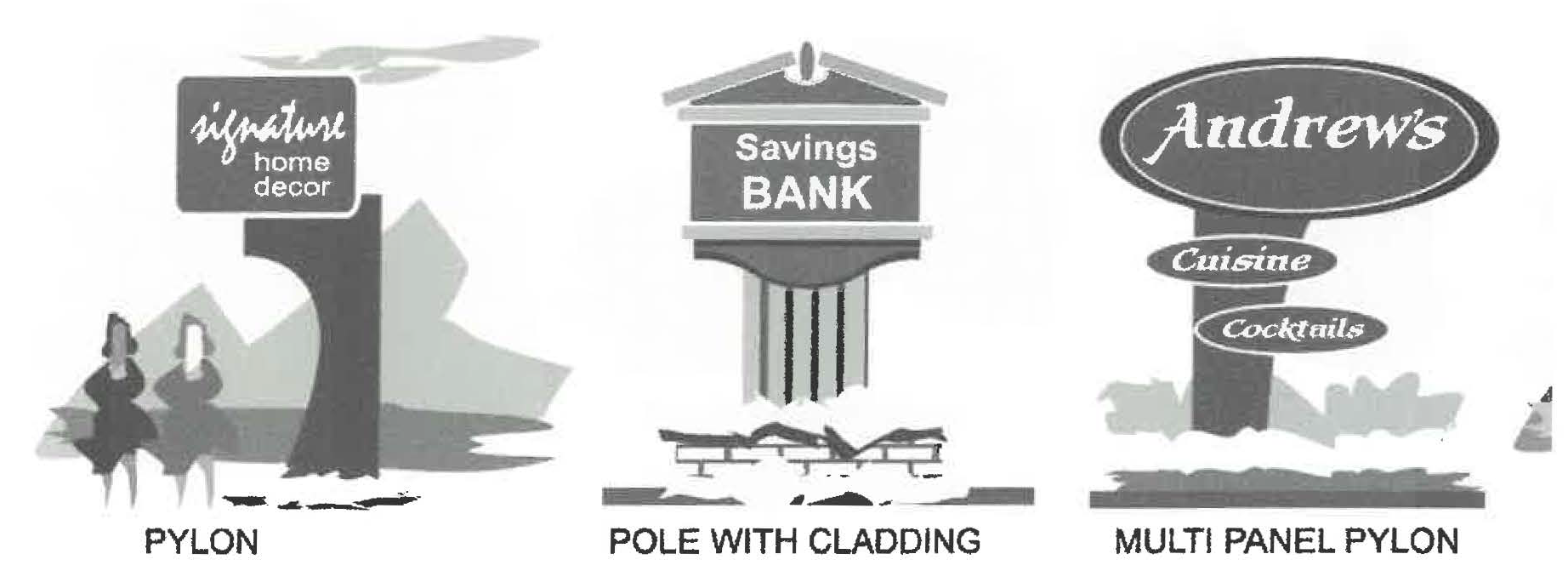
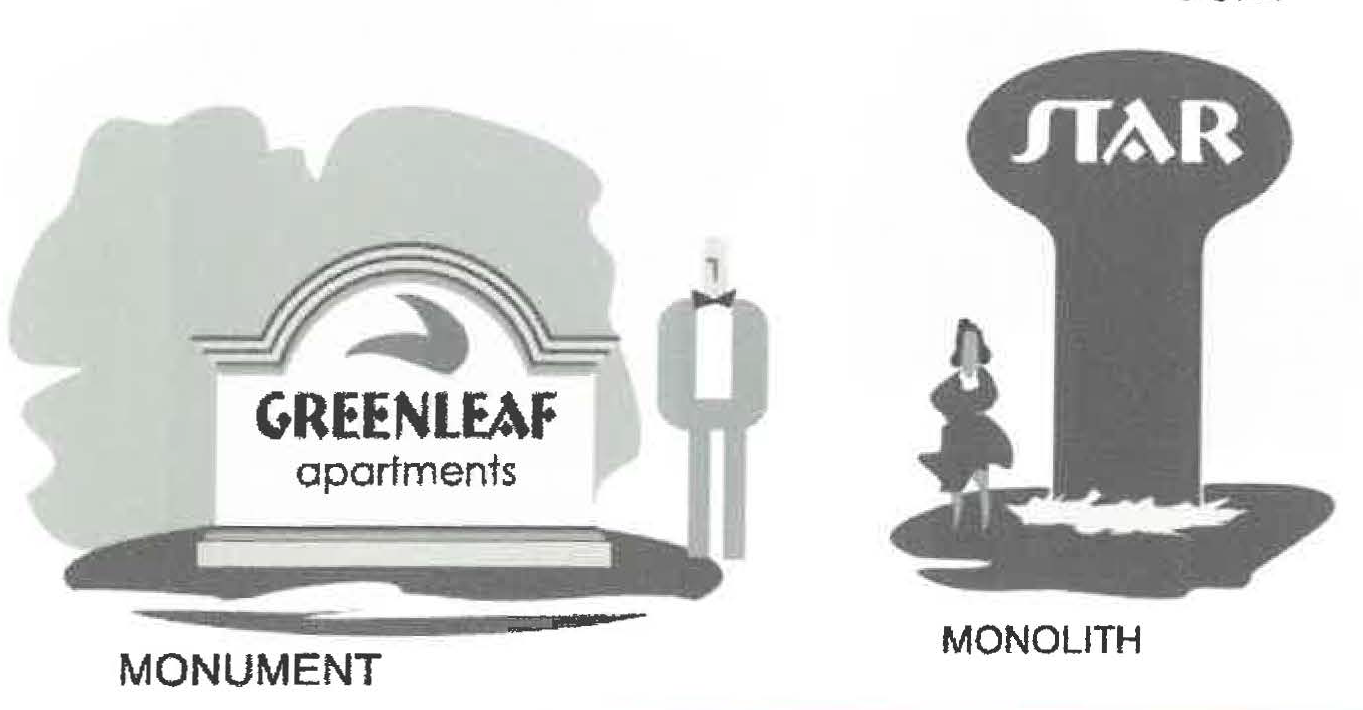
B.
Unclad pole signs are highly discouraged
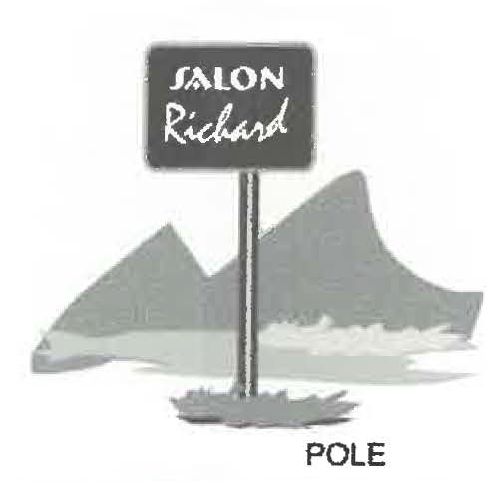
(Ord. 2020-39, passed 3-9-21)
§ 188.02 - Building, Awning and Canopy Signs.
The following Building, Awning and Canopy signs are permitted within the City of Tarpon Springs, subject to other applicable regulations of this Article.
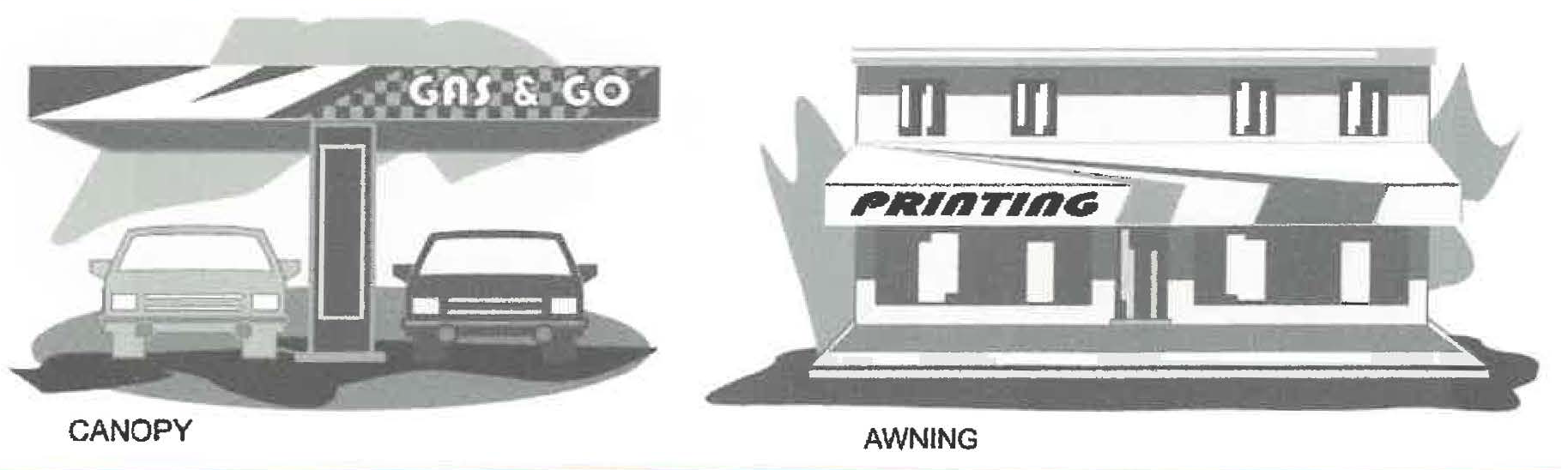
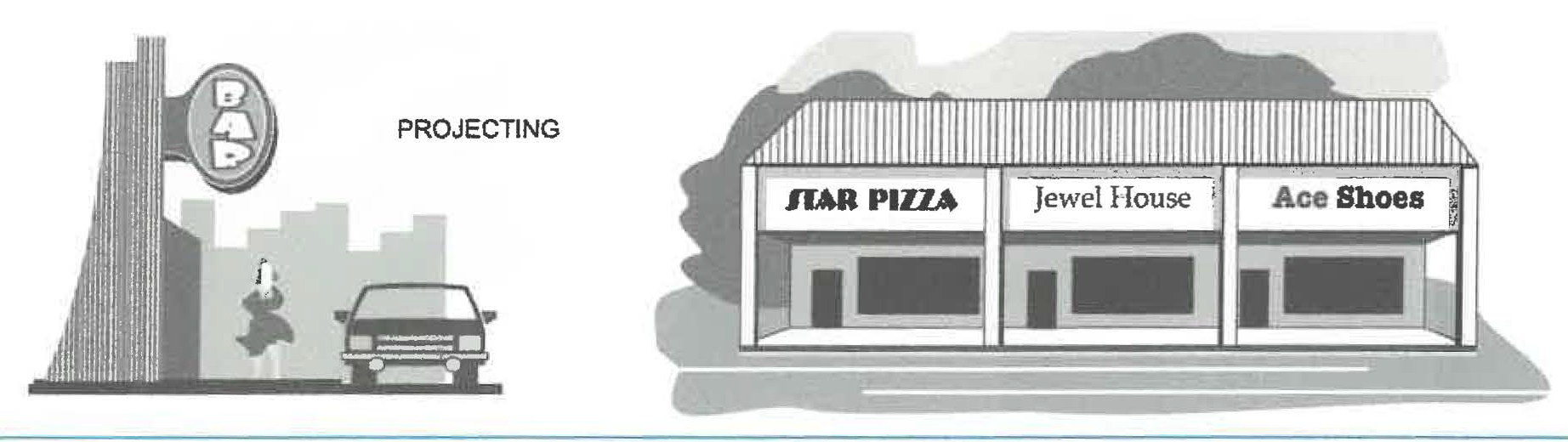
(Ord. 2020-39, passed 3-9-21)
§ 188.03 - Roof and Fascia Signs Types
The following roof and fascia sign types are permitted within the City of Tarpon Springs, subject to other applicable regulations of this Article.
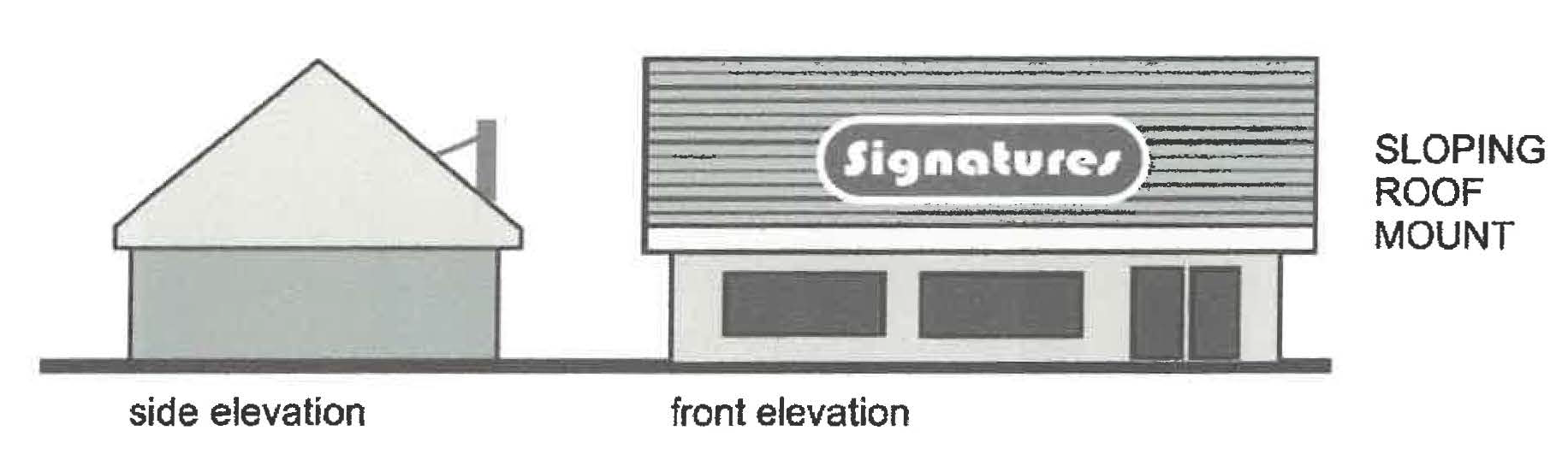
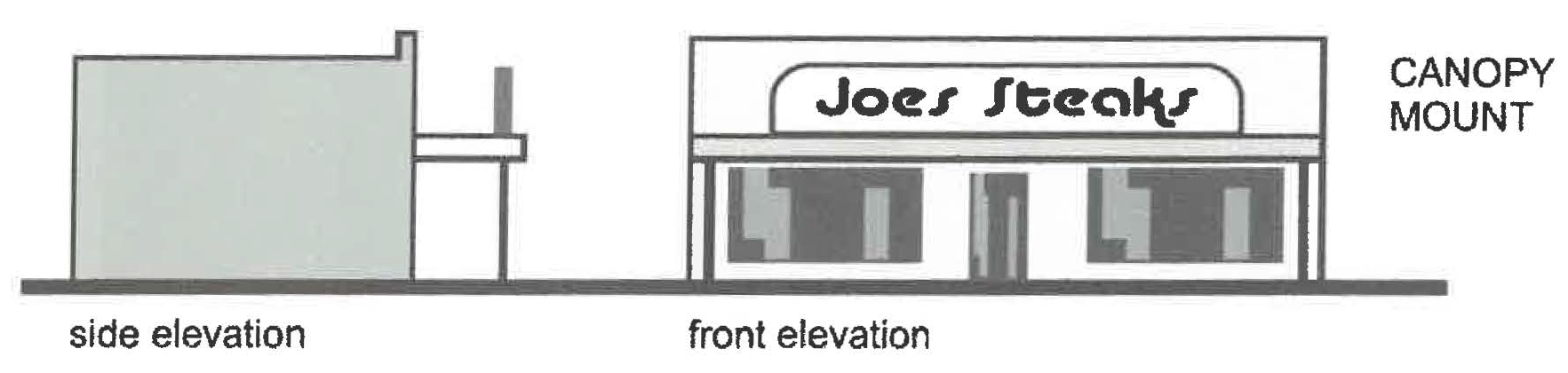
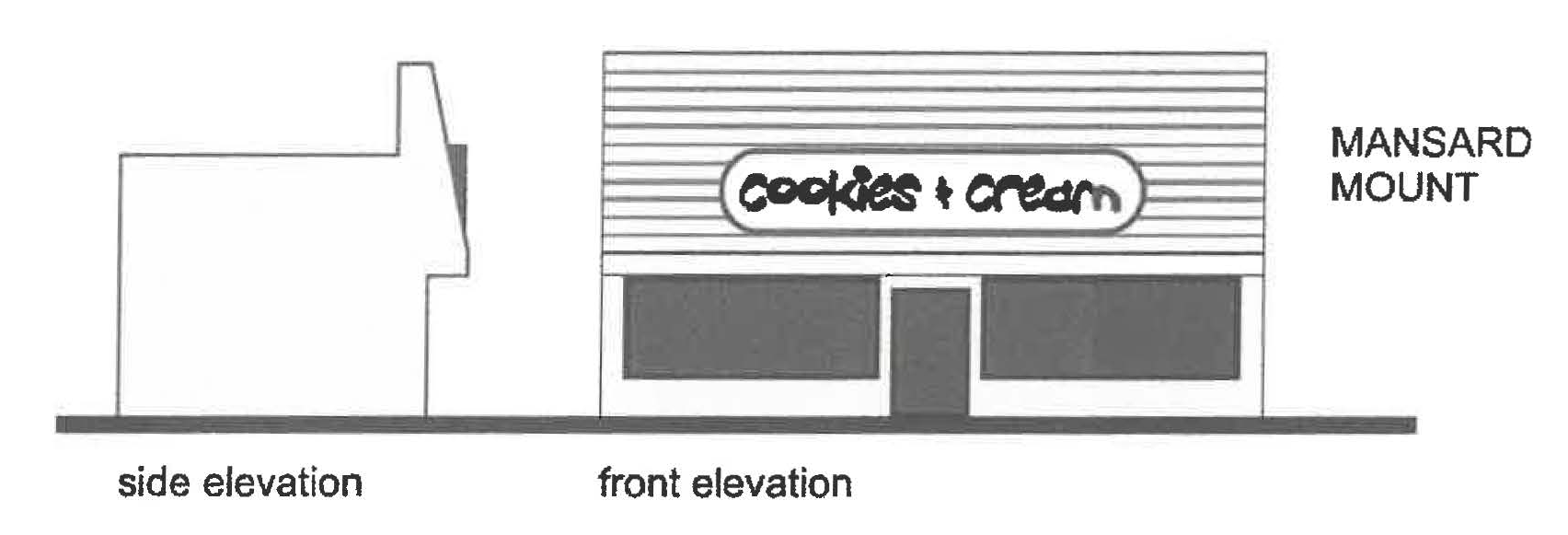
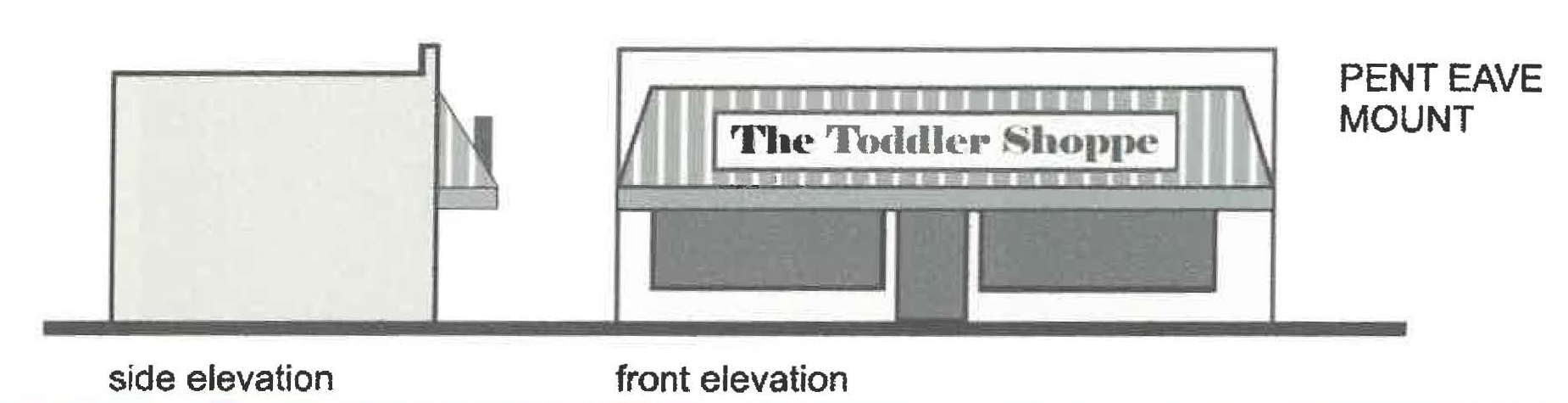
(Ord. 2020-39, passed 3-9-21)
§ 188.04 - Permanent Sign Types Prohibited.
The following types of permanent signs are prohibited within the City of Tarpon Springs.
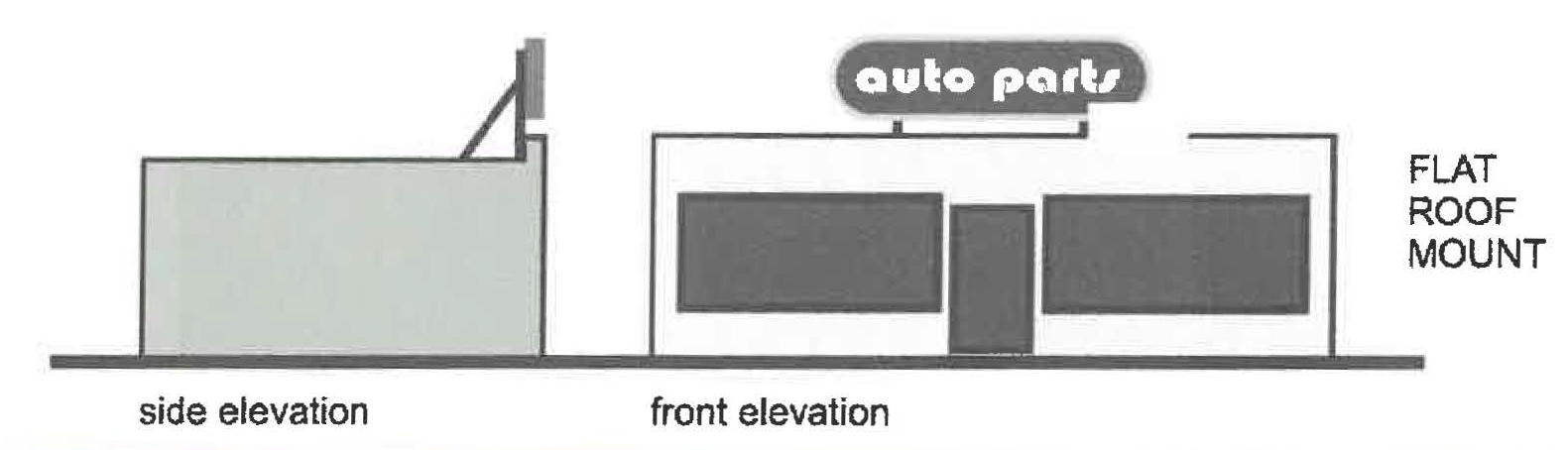
(Ord. 2020-39, passed 3-9-21)
§ 189.01 - Freestanding Signs, Permit Required.
(A)
All pole mounted signs shall have a minimum vertical clearance of four feet measured from grade. Pole mounted signs which do not have a minimum vertical clearance of eight feet shall be considered a ground mounted/monument sign for the purposes of calculating setbacks.
(B)
Projection over or into a right-of-way shall be prohibited for all freestanding signs.
(C)
One freestanding on-site advertising sign shall be permitted per parcel.
(D)
The maximum sign height shall be ten feet within the Historic Preservation District and 20 feet in all other nonresidential zones.
(E)
For pylon signs, multi-pylon signs, monument signs, monolith signs and pole signs with cladding an increase in height of up to 25% may be authorized by use of the following creative sign provisions.
(1)
The sign is a substantial aesthetic improvement to the site and has a positive visual impact on the surrounding area.
(2)
The sign is of unique design and exhibits a high degree of thoughtfulness, imagination, and inventiveness.
(3)
The sign provides strong graphic character through the imaginative use of graphics, color, texture, unique or quality materials, scale, and proportion.
(F)
The maximum allowable sign height for all other free-standing sign types shall be 20 feet.
(G)
The minimum required setback for an unclad pole mounted sign shall be five feet from the adjoining street right-of-way line and ten feet from the side property line.
(H)
The minimum required setback for a pylon sign, multi-pylon sign, monument sign, monolith sign and pole sign with cladding shall be as follows:
(1)
Outside the required visibility triangle;
(2)
Ten feet from the adjoining street right-of-way line; and
(3)
Fifteen feet from the side property line.
(I)
The minimum clearance from primary power lines as required by the National Electric Safety Code shall be maintained.
(Ord. 90-10, passed 5-1-90; Am. Ord. 93-33, passed 10-19-93; Am. Ord. 94-20, passed 5-17-94; Am. Ord. 2020-06, passed 6-9-20; Am. Ord. 2020-39, passed 3-9-21)
§ 189.02 - Freestanding Sign Area.
(A)
Allowable square feet.
(B)
The maximum allowable sign area for a freestanding sign shall be as follows:
(1)
One hundred square feet per sign face for a single occupancy parcel.
(2)
One hundred fifty square feet per sign face for a multiple occupancy parcel.
(C)
The maximum free-standing sign area may be increased by 25% through the use of creative sign provisions in Section 189.01 (E). This increase may not be applied to an unclad pole sign type.
(D)
For parcels with in excess of 50,000 square feet of gross floor area a ground mounted sign not exceeding 24 square feet of area per sign face which only includes the identification of the use or complex shall be permitted on the side street for parcels located on a corner. Additional sign area may not be combined with §189.06 (A) 1.
(Ord. 90-10, passed 5-1-90; Am. Ord. 93-33, passed 10-19-93; Am. Ord. 94-20, passed 5-17-94; Am. Ord. 2020-06, passed 6-9-20; Am. Ord. 2020-39, passed 3-9-21)
§ 189.03 - Wall Mounted Signs in Addition to Freestanding Signs, Permit Required.
(A)
Wall signs shall be permitted for each single occupancy parcel having frontage on a public street.
(B)
Establishments located on more than one street frontage shall be allowed wall signs for each side of the establishment facing a street, but shall not combine such signs for the purpose of placing the combined area on any one wall.
(C)
Establishments located on only one street frontage shall be allowed one wall sign facing a non-residential zone, but shall not combine such signs for the purpose of placing the combined area on any one wall.
(D)
Wall signs shall be permitted for each establishment in a multiple occupancy parcel.
(E)
Allowable Area.
1 Nonresidential zones within the Historic Preservation District
2 Sign area (in square feet) per lineal foot of building frontage facing a street up to a maximum of 150 square feet of aggregate sign surface area
(F)
For establishments with more than one street frontage, the maximum sign surface area for building frontage on streets other than the street the establishment is oriented toward shall not exceed the area allowed in § 189.03(E) above nor 50 square feet of aggregate area, whichever is more restrictive.
(G)
For establishments with no side street frontage, the maximum sign surface area for the side of the building shall not exceed either .5 square feet per lineal frontage of building or ten square feet in the Historic Preservation District, whichever is more restrictive. In all other nonresidential districts, the maximum sign surface area for the side of the building shall not exceed either .5 square feet per lineal frontage of building or 50 square feet, whichever is more restrictive.
(H)
Wall signs may not project beyond the roofline or sidewalls of the establishment to which the sign is attached.
(I)
Wall signs may not project more than 12 inches from the wall to which it is attached.
(J)
Wall signs may project over a street right-of-way in those zoning districts where a minimum setback of zero is permitted, provided the extension is over a pedestrian sidewalk and the projection is at least eight feet above grade.
(Ord. 90-10, passed 5-1-90; Am. Ord. 93-33, passed 10-19-93; Am. Ord. 94-20, passed 5-17-94; Am. Ord. 94-31, passed 9-20-94; Am. Ord. 2020-06, passed 6-9-20; Am. Ord. 2020-39, passed 3-9-21)
§ 189.04 - Projecting Signs as a Substitute for Wall Signs, Permit Required.
(A)
Projecting signs may be substituted for, but not used in conjunction with, the permitted wall mounted signs provided that the aggregate display area is no greater than that permitted for a wall sign.
(B)
Projecting signs shall not project more than four feet from the building wall to which it is attached.
(C)
Projecting signs shall not be located above the roofline of the building nor more than 15 feet above the grade of the street.
(D)
Projecting signs which project over any pedestrian way shall be elevated to a minimum vertical clearance of eight feet above the grade of the pedestrian way.
(E)
Projecting signs may project over a street right-of-way in those zoning districts where a minimum setback of zero is permitted, provided the extension is over a pedestrian sidewalk and the vertical clearance is at least eight feet above grade.
(Ord. 90-10, passed 5-1-90; Am. Ord. 93-33, passed 10-19-93; Am. Ord. 2020-06, passed 6-9-20; Am. Ord. 2020-39, passed 3-9-21)
§ 189.05 - Additional Allowed Signs, Commercial and Industrial Zones, Permit Required.
The following additional sign-types shall be allowed for each lot or parcel with a commercial or industrial use:
(A)
Each restaurant shall be allowed one attached display sign of no more than nine (9) square feet of sign face area located at the entrance or service window of a restaurant.
(B)
Each restaurant shall be allowed one drive-through lane sign for each drive-through lane constructed on the property. Drive-through lane signs shall be placed so as to be viewed from the drive-through lane and may provide a mechanism for ordering products while viewing the drive-through lane sign. The drive-through lane sign shall have a surface area not exceeding forty (40) square feet. The top of the sign and its surrounding or supporting framing/structure shall not exceed eight (8) feet above ground level. If more than one drive-through lane sign is installed, the total square footage for all such signs shall not exceed sixty (60) square feet, with no single sign exceeding forty (40) square feet.
(D)
Wayfinding/directional signs on commercial property provided such signs do not exceed four (4) square feet in area. The directional sign may be displayed as an attached sign, window sign, or as a monument sign; if displayed as a monument sign, the monument sign shall not exceed four (4) feet in height.
(E)
Sandwich board signs shall be allowed, pursuant to the regulations of § 191.09.
(Ord. 2020-06, passed 6-9-20; Am. Ord. 2020-39, passed 3-9-21)
§ 189.06 - Additional Signage for Shopping Center or Business Center Multi-Tenant Development-Permit Required.
(A)
In a shopping center or business center, the following additional signage shall be permitted:
1.
For each street frontage abutting a state, county, or City collector roadway, one monument sign shall be permitted. Size shall not exceed thirty-two (32) square feet base sign plus eight (8) square feet multiplied by the total number of businesses in the center per sign face for either a single-faced or double-faced sign. Signage may be apportioned to each tenant business as determined by the landlord; however, each tenant's portion of the monument sign must be clearly visible from the street. The monument sign shall not exceed ten (10) feet in height and must not be a traffic visibility hazard as determined by the city's traffic engineer based upon adopted city standards. Multiple monument signs may replace a single monument sign as long as the total square footage does not exceed the maximum allowable monument signage for the shopping center or business center. Additional signage not be combined with additional signage allowed in §189.04 (D)
2.
The shopping center or business center shall be permitted up to one additional sign for each separate building housing multiple tenants which could be used for a directory of each tenant in each building. Such signs shall be wall-mounted or a monument sign with the top of the sign and its surrounding or supporting framing/structure not exceeding four (4) feet above ground level. The size of such signs shall be a maximum of sixteen (16) square feet per sign face for either a single-faced or double-faced sign.
(Ord. 2020-06, passed 6-9-20; Am. Ord. 2020-39, passed 3-9-21)
§ 190.00 - MARQUEE AND AWNING SIGNS, PERMIT REQUIRED.
(A)
Marquee and awning signs shall be allowed for each establishment in nonresidential zoning districts subject to the following provisions:
(1)
One sign located on a marquee or awning shall be affixed flat to the surface and shall not rise in vertical dimension, above the marquee or awning.
(2)
One sign may extend vertically below a marquee or awning facing a street and must be oriented perpendicular to the street or building frontage, but may not exceed two feet by six feet, nor may not exceed the depth of the marquee or awning, whichever is less, and must maintain a clearance of at least eight feet.
(3)
Awning signs consisting of one line of letters not exceeding 12 inches in height may be placed upon the hanging border of any awning. An identification emblem, insignia, or other feature not exceeding six square feet may be placed anywhere on the awning.
(4)
Marquee and awning signs shall be allowed in addition to any other sign permitted by this article.
(5)
Marquees and awnings may project over a street right-of-way in those zoning districts where a minimum setback of zero is permitted, provided the extension is over a pedestrian sidewalk.
(6)
The vertical clearance for marquee and awning signs shall be at least eight feet above grade.
(Ord. 90-10, passed 5-1-90; Am. Ord. 93-33, passed 10-19-93; Am. Ord. 94-20, passed 5-17-94; Am. Ord. 2020-06, passed 6-9-20; Am. Ord. 2020-39, passed 3-9-21)
§ 191.01 - Signs Accessory to the Sale of Gasoline, Permit Required.
(A)
A separate freestanding sign advertising the price of gasoline shall be permitted at gasoline service stations. One sign shall be permitted per street frontage located not closer than five feet to the abutting street right-of-way. Signs shall be subject to the area provisions for freestanding signs set forth in Section 189.02.
(B)
Signs which are placed on the top of gasoline pumps in order to provide required information to the public regarding price per gallon, type of fuel and octane rating are permitted, provided that such signs may not exceed one and one-half square feet per sign face.
(C)
A gasoline service station with frontage on two or more streets shall be allowed an additional 25 square feet of freestanding sign area in addition to the signage allowed in Section 189.02.
(D)
A gasoline service station may allocate its total allowance of freestanding sign area, as determined in Sections 189.02 and 191.01(C), between the freestanding signs allowed on the parcel.
(E)
The sign(s) advertising the price of gasoline may be constructed to utilize an electronic reader board to identify the current price of fuel being sold.
(F)
Pursuant to F.S. § 553.779(20)(a), all signage advertising the retail price of gasoline shall be clearly visible and legible to drivers of approaching motor vehicles from a vantage point on any lane of traffic in either direction on a roadway abutting the station premises and shall meet the height, width, and spacing standards for Series C, D, or E signs, as applicable, published in the latest edition of Standard Alphabets for Highway Signs published by the United States Department of Commerce, Bureau of Public Roads, Office of Highway Safety. To the extent any provision of this article directly conflicts with the statutory standard, the statutory standard shall prevail.
(Ord. 90-10, passed 5-1-90; Am. Ord. 93-33, passed 10-19-93; Am. Ord. 2015-12, passed 5-19-15; Am. Ord. 2020-06, passed 6-9-20; Am. Ord. 2020-39, passed 3-9-21)
§ 191.02 - City Recreational Field Signs.
Signs affixed to the interior of municipal, enclosed recreational fields or facilities, so long as such signs are located within and face inward toward the enclosed recreation area.
(Ord. 90-10, passed 5-1-90; Am. Ord. 93-33, passed 10-19-93; Am. Ord. 2020-06, passed 6-9-20; Am. Ord. 2020-39, passed 3-9-21)
§ 191.03 - Home Occupations.
Any resident presently operating a lawful home occupation at the resident's residence shall be allowed a maximum of one non-illuminated on-site wall sign not exceeding one square foot in area on the exterior of the residence not more than two feet from an entrance. The operation of more than one home occupation at the same residence shall not entitle the resident to any additional signage.
(Ord. 90-10, passed 5-1-90; Am. Ord. 93-33, passed 10-19-93; Am. Ord. 2020-06, passed 6-9-20; Am. Ord. 2020-39, passed 3-9-21)
§ 191.04 - Additional Non-Commercial and Non-Residential Signs, Permit Required.
Each building currently being used for non-commercial and non-residential uses shall be entitled to one sign, not to exceed nine square feet in area, at each principle entrance. Such signs shall be on premise and are in addition to the allowable sign area otherwise provided for in this article.
(Ord. 90-10, passed 5-1-90; Am. Ord. 93-33, passed 10-19-93; Am. Ord. 2020-06, passed 6-9-20; Am. Ord. 2020-39, passed 3-9-21)
Editor's note— Am. Ord. 2020-06, passed June 9, 2020, amended § 191.04 as herein set out. Formerly, such section pertained to notice bulletin boards.
(§ 191.05 - Reserved)
Editor's note— Ord. 2020-06, passed June 9, 2020, repealed § 191.05, which pertained to menu signs and derived from Ord. 90-10, passed 5-1-90; Am. Ord. 91-39, passed 10-15-91; Am. Ord. 93-33, passed 10-19-93.
§ 191.06 - Cinema Signs, Permit Required.
An additional 40 square feet of changeable copy sign area per sign face may be permitted upon the pole or ground mounted sign for multiple occupancy parcels where a cinema or other theater is located.
(Ord. 90-10, passed 5-1-90; Am. Ord. 93-33, passed 10-19-93; Am. Ord. 2020-06, passed 6-9-20; Am. Ord. 2020-39, passed 3-9-21)
§ 191.07 - Multiple Complex Wayfinding/Directional Signs, Permit Required.
Wayfinding/directional signs for the purpose of guiding pedestrians or motorists throughout the site shall be permitted on properties developed with three or more buildings containing an overall gross leasable floor area in excess of 50,000 square feet or 200 residential units. The surface area shall not exceed 20 square feet. Such signs shall be located a minimum of 50 feet from all property lines.
(Ord. 90-10, passed 5-1-90; Am. Ord. 93-33, passed 10-19-93; Am. Ord. 2020-06, passed 6-9-20; Am. Ord. 2020-39, passed 3-9-21)
§ 191.08 - Electronic Reader Board Signs, Permit Required.
(A)
One electronic reader board sign may be permitted in addition to the allowable sign area for civic centers, convention centers, and hospitals provided the allowable sign area shall not exceed 24 square feet per sign face.
(B)
Such sign shall not flash, strobe, blink or include images that could be confused with traffic control devices or signs. Such signs shall also comply with the following provisions:
1.
The electronic reader board must default to a black screen if there is a system malfunction.
2.
The message dwell time must be at least 10 seconds.
3.
The electronic reader board shall display only static images or text.
4.
Transition from one message to another message shall appear instantaneous as perceived by the human eye.
5.
Each sign message shall be complete in itself and shall not continue on a subsequent sign message. The change of message shall occur simultaneously for the entire sign face.
6.
Signs shall utilize automatic dimming technology to adjust the brightness of the sign relative to ambient light so that at no time shall a sign exceed a brightness level of three tenths (0.3) foot candles above ambient light, as measured using a foot candle (Lux) meter.
7.
Night time illumination of the electronic reader board may not cause glare onto the roadway or across adjacent property lines.
8.
The electronic reader board must be equipped with an automatic dimmer control or other mechanism that automatically controls the signs brightness and dwell time.
9.
The surface brightness of the sign shall not be greater than thirty (30) foot lamberts measured along the radius of a one hundred eighty (180) degree arc in front of a face of the sign.
10.
Prior to the approval of any permit to operate an electronic reader board sign, the applicant shall certify that the sign has been tested and complies with the dwell time, illumination, and other requirements herein.
(Ord. 90-10, passed 5-1-90; Am. Ord. 93-33, passed 10-19-93; Am. Ord. 2011-15, passed 1-24-12; Am. Ord. 2020-06, passed 6-9-20; Am. Ord. 2020-39, passed 3-9-21)
§ 191.09 - A-Frame/Sandwich Board Signs.
(A)
The placement of sandwich board signs by the owners or lessees of properties may be allowed without a permit on any commercial property in commercially zoned districts along the frontage of any street with a posted speed limit of 40 miles per hour or less subject to the requirements of this section.
(B)
One sandwich board sign shall be allowed on each street frontage per retail or restaurant use.
(C)
Sandwich board signs shall be freestanding and moveable. They may be single-sided or double-sided. They shall be removed during inclement weather and high winds. They shall be taken inside at the end of each business day.
(D)
Sandwich board signs shall not exceed an overall height of 48 inches above ground level or an overall width of 32 inches.
(E)
Sandwich board sign frames shall be manufactured of a wood or metal frame material. Sign faces allowing for changeable copy shall be limited to chalk boards, dry-erase boards or changeable face inserts that are integrated into the original design/construction of the sign. Paper, poster-board, cardboard, cloth, plastic, string, or any other material(s) may not be fastened, taped, glued, or otherwise affixed to any part of the A-Frame sign structure. All A-frame signs shall comply with the standards of this paragraph by January 1, 2021.
(F)
All sandwich board signs placed upon public sidewalks shall be located directly in front of the business(es) for which it advertises and will provide for at least 44 inches of unobstructed travel area on the sidewalk but not less than the requirement under the Americans with Disabilities Act (ADA) and other federal and state statutes mandating certain free space for path of travel for disabled persons traveling on public sidewalks. Such signs shall not otherwise block ramps or curb access. The local government having jurisdiction over the public right-of-way may require removal of an A-Frame sign from the public right-of-way at any time without compensation and such sign shall not be considered a property right.
(G)
All such signs shall conform with required visibility triangles, as provided in Section 186.02
(H)
No sandwich board sign may be lit either internally or externally.
(I)
Any sandwich board sign which encroaches upon pedestrian or vehicular movement or safety or interferes with the lawful use of the public right-of-way or violates the Florida Building Code or any state or local fire or security code shall be prohibited and removed or relocated.
(J)
Sandwich board signs shall be readable, properly maintained, and kept in good working condition.
(Ord. 90-10, passed 5-1-90; Am. Ord. 93-33, passed 10-19-93; Am. Ord. 97-19, passed 7-15-97; Am. Ord. 97-44, passed 12-16-97; Am. Ord. 2020-06, passed 6-9-20; Am. Ord. 2020-39, passed 3-9-21)
§ 191.10 - City Recreational Baseball Field Signs.
Signs affixed to the interior of municipal, enclosed recreational baseball facilities, so long as such signs are located within and face inward toward the enclosed recreation area.
(Ord. 93-37, passed 12-7-93)
§ 192.01 - Signs at Active Construction Sites.
Any licensed contractor, architect or engineer is authorized, with the consent of the land owner, to install one sign at an active construction site, as that term is defined in F.S. § 810.011(13), on land upon which a building or other structure is being designed, engineered or constructed by such contractor, architect or engineer. Such signs shall be subject to the following conditions:
(A)
The sign is located on a construction site which has a valid building permit displayed on site.
(B)
The sign area shall not exceed 32 square feet aggregate per street frontage per site.
(C)
All signs shall be set back a minimum of ten feet from all property lines.
(D)
All signs shall be removed by no later than the date upon which a temporary or final certificate of occupancy is issued by the permitting authority.
(Ord. 90-10, passed 5-1-90; Am. Ord. 93-33, passed 10-19-93; Am. Ord. 2020-06, passed 6-9-20; Am. Ord. 2020-39, passed 3-9-21)
§ 192.02 - Temporary Banners, Feather and Flutter Signs.
(A)
In commercial and industrial zoning districts temporary banner signs not exceeding thirty-five (35) square feet in area and eight (8) feet in height may be displayed on privately-owned property no more than four times per year and up to a maximum of fourteen days per occurrence, with a minimum of forty-five days between each occurrence.
(B)
In commercial and industrial zoning districts a newly established business may display "feather or flutter" signs for a period of 45 days in support of a grand opening in accordance with the following requirements:
1.
The business must be a lawfully established business that has applied for a local business tax receipt.
2.
Feather or flutter signs may not exceed 10' in height and must be set back at least 5 feet from the property/right of way line and may not be placed in any public right of way.
3.
The signs may not obstruct visibility for vehicles. cyclists or pedestrians. The Tarpon Springs Police Department shall have sole authority over establishing visibility.
4.
The number of signs shall be limited to 1 per 10 feet of property frontage along the public right of way, not to exceed 5 signs per parcel.
5.
In lieu of Feather and/or flutter signs, one banner not exceeding 35 square feet.
(C)
In residential zoning districts temporary banner signs not exceeding 15 square feet may be displayed on privately owned property no more than four times per year and up to a maximum of 14 days per occurrence, with a minimum of forty-five days between each occurrence.
(D)
One temporary sign shall be allowed on each privately-owned parcel within the city. Temporary signs shall not exceed four (4) square feet in sign area, and four (4) feet in height for residential properties. The sign shall be constructed of metal, plastic, wood or pressed wood and shall be fastened to a support not exceeding four (4) inches by four (4) inches. Such signs shall not be located within the public right-of-way.
(Ord. 2020-06, passed 6-9-20; Am. Ord. 2020-39, passed 3-9-21; Ord. No. 2025-03, § 2, 5-13-25)
Editor's note— Ord. 2020-06, passed June 9, 2020, repealed the former § 192.02, and enacted a new § 192.02 as set out herein. The former § 192.02 pertained to special events and derived from Ord. 90-10, passed 5-1-90; Am. Ord. 93-33, passed 10-19-93.
§ 192.03 - Temporary New Subdivision Wayfinding/Directional Signs.
Residential subdivisions under development and not having frontage along a thoroughfare street shall be permitted one off-site directional sign, provided:
(A)
The sign shall be freestanding, located on private property, outside of the required visibility triangle and at least five feet from property lines;
(B)
The sign shall be non-illuminated and shall not exceed 32 square feet in aggregate sign area;
(C)
The property owner shall provide written authorization for the sign's placement and a Building Permit is required prior to installation;
(D)
The sign shall not be erected until after the first permit for the construction of a model home within the subdivision has been issued;
(E)
The sign shall be removed at the issuance of two-thirds of the certificates of occupancy, therein.
(Ord. 2020-06, passed 6-9-20; Am. Ord. 2020-39, passed 3-9-21)
Editor's note— Ord. 2020-06, passed June 9, 2020, repealed the former § 192.03, and enacted a new § 192.03 as set out herein. The former § 192.03 pertained to grand openings or new business and derived from Ord. 90-10, passed 5-1-90; Am. Ord. 93-33, passed 10-19-93.
§ 192.04 - General Temporary Sign Rules.
(A)
The sign shall not be located upon public property including public right-of-way.
(B)
The sign shall not be attached to or displayed upon any shrub, rock formation, tree, utility pole, fire hydrant, light standard, bridge, or another sign or support for another sign.
(C)
The sign shall not be erected more than 60 days prior to the event and shall be removed within 14 days of the event's conclusion.
(D)
The sign shall not exceed 24 square feet in aggregate and six feet in height.
(E)
A minimum setback of ten feet from all property lines is required.
(Ord. 2020-06, passed 6-9-20; Am. Ord. 2020-39, passed 3-9-21)
Editor's note— Ord. 2020-06, passed June 9, 2020, repealed the former § 192.04, and enacted a new § 192.04 as set out herein. The former § 192.04 pertained to on-site subdivision construction signs and derived from Ord. 90-10, passed 5-1-90; Am. Ord. 93-33, passed 10-19-93; Am. Ord. 99-15, passed 6-15-99.
§ 192.05 - Usage and Removal of Political Campaign Advertisements.
(A)
Pursuant to F.S. § 106.1435, each candidate, whether for a federal, state, county, municipal or district office, shall make a good faith effort to remove all of his or her political campaign advertisements within 14 days after:
i.
Withdrawal of his or her candidacy;
ii.
Having been eliminated as a candidate; or
iii.
Being elected to office.
(B)
However, a candidate is not expected to remove those political campaign advertisements which are in the form of signs used by an outdoor advertising business as provided in F.S. ch. 479. The provisions herein do not apply to political campaign advertisements placed on motor vehicles or to campaign messages designed to be worn by persons.
(C)
If political campaign advertisements are not removed within the specified period, the city shall have the authority to remove such advertisements and may charge the candidate the actual cost for such removal. Funds collected for removing such advertisements shall be deposited to the general revenue of the city.
(Ord. 2020-06, passed 6-9-20; Am. Ord. 2020-39, passed 3-9-21)
Editor's note— Ord. 2020-06, passed June 9, 2020, repealed the former § 192.05, and enacted a new § 192.05 as set out herein. The former § 192.05 pertained to on-site subdivision construction signs and derived from Ord. 99-15, passed 6-15-99.
§ 192.06 - On Site Temporary Event Signs.
Signs announcing a temporary event located on the property upon or in which the event will take place shall be allowed one non-illuminated, temporary ground or wall sign without permit subject to the following conditions:
(A)
The sign shall not exceed 24 square feet in aggregate and six feet in height.
(B)
A minimum setback often feet from all property lines is required.
(C)
The sign shall not be erected more than 60 days prior to the event and shall be removed within 14 days of the event's conclusion.
(Ord. 2020-06, passed 6-9-20; Am. Ord. 2020-39, passed 3-9-21)
Editor's note— Ord. 2020-06, passed June 9, 2020, repealed the former § 192.06, and enacted a new § 192.06 as set out herein. The former § 192.06 pertained to temporary noncommercial signs and derived from Ord. 90-10, passed 5-1-90; Am. Ord. 91-26, passed 7-16-91; Am. Ord. 93-33, passed 10-19-93; Am. Ord. 99-15, passed 6-15-99. Said ordinance set out provisions intended for use as § 192.04. For purposes of classification, and at the editor's discretion, these provisions have been included as § 192.06.
§ 193.00 - BILLBOARDS TO BE REMOVED AT THE TIME OF SITE IMPROVEMENT.
(A)
Billboards are deemed to constitute a primary use of the site on which they are located and are not authorized under the terms of this article. They are deemed to be nonconforming signs subject to the terms of § 185.00 of this article to the extent they may have lawfully been installed prior to May 1, 1990.
(B)
Billboard signs, located on sites proposed for development, or redevelopment not located on a federal aid primary highway to an extent which requires site plan approval under the land development code, shall be removed at the time development or redevelopment commences.
(C)
Billboard signs shall comply with the provisions for abandonment established by § 182.00 of this article.
(Ord. 90-10, passed 5-1-90; Am. Ord. 93-33, passed 10-19-93; Am. Ord. 2020-06, passed 6-9-20; Am. Ord. 2020-39, passed 3-9-21)
§ 194.00 - VARIANCES.
The board of adjustment is authorized to grant variances from the strict application of the requirements of this article, in accordance with the standards and provisions established in the land development code associated with variance applications.
(Ord. 90-10, passed 5-1-90; Am. Ord. 93-33, passed 10-19-93; Am. Ord. 2020-06, passed 6-9-20; Am. Ord. 2020-39, passed 3-9-21)
Editor's note— Am. Ord. 2020-06, passed June 9, 2020, amended § 194.00 as herein set out. Formerly, such section pertained to appeals.
§ 194.01 - Limitations on Variances.
(A)
Variances may only be granted from the following restrictions:
(1)
The amount of a sign which can be devoted to changeable copy, provided the total allowable sign area is not increased.
(2)
The required sign setbacks or location, provided no change to the required visibility triangle is involved.
(3)
The required sign height, provided a finding is made that the variance is necessary to clear an obstruction or interference by excessive grades, buildings, bridges, trees, or other related obstacles. However, an existing sign shall not be considered an obstruction.
(B)
Under no circumstances may an applicant be granted a variance to any other term or condition of this article with respect to signs, including but not limited to the following variance requests:
(1)
Variances in any way related to nonconforming, obsolete, or abandoned signs.
(2)
Variances which would permit the use of signs prohibited by this article.
(3)
Variances which purport to modify any definition of this article.
(4)
Variances which would increase the number of allowable signs or change the permitted types of signs.
(5)
Variances for sign location which would require the removal of trees.
(6)
Variances which increase the allowable sign area.
(Ord. 90-10, passed 5-1-90; Am. Ord. 93-33, passed 10-19-93; Am. Ord. 2020-06, passed 6-9-20; Am. Ord. 2020-39, passed 3-9-21)
Editor's note— Am. Ord. 2020-06, passed June 9, 2020, amended § 194.01 as herein set out. Formerly, such section pertained to authorized variances.
§ 194.02 - Unauthorized Variances.
In no event shall variances be granted for the following:
(A)
Variances in any way related to nonconforming, obsolete, or abandoned signs.
(B)
Variances which would permit the use of signs prohibited by this Article.
(C)
Variances which purport to modify any definition of this Article.
(D)
Variances which would increase the number of allowable signs or change the permitted types of signs.
(E)
Variances for sign location which would require the removal of trees.
(F)
Variances which increase the allowable sign area.
(Ord. 90-10, passed 5-1-90; Am. Ord. 93-33, passed 10-19-93)

