
Tarpon Springs City Zoning Code
ARTICLE XII
ADMINISTRATION AND ENFORCEMENT
§ 205.00 - GENERAL PROVISIONS.
(A)
No development activity shall be undertaken unless it conforms to the provisions of this Code.
(B)
The administration and enforcement of this Code shall be the responsibility of the Director of Planning and Zoning for the City.
(C)
The duties of the Director of Planning and Zoning shall include, but not be limited to the following:
(1)
To determine compliance with the relevant provisions of this Code.
(2)
To coordinate the required requests for development order approval contained in this Code.
(3)
To report to the City Manager, City Attorney, and Board of Commissioners regarding the administration of this Code.
(4)
To notify persons responsible for violations of any of the provisions of this Code.
(5)
To maintain written records of all official actions related to the administration of this Code.
(6)
To receive applications for, forward to the appropriate bodies, and review for compliance with all the applicable provisions of this Code for development order approval related to, but not limited to, the following requests:
(a)
Amendments to the Official Zoning Atlas.
(b)
Annexations.
(c)
Certificates of Occupancy.
(d)
Conditional Uses.
(e)
Site Plans.
(f)
Subdivisions.
(g)
Variances and Appeals.
(h)
The vacation of streets, plats, or other property.
(7)
Prepare and submit to the Board of Commissioners for its consideration a schedule of fees.
(8)
Periodically review the provisions of this Code to evaluate the need for updating the provisions of this Code.
(9)
To provide administrative, technical, and consultative assistance to the Board of Adjustment, Planning and Zoning Commission, and Historic Preservation Board.
(10)
To perform such other duties and functions required to administer the provisions of this Code.
(D)
Every application required under the provisions of this Code, unless otherwise specified, shall be filed with the Planning and Zoning Department of the City. No application shall be deemed complete unless all the information and materials required by this Code and the City have been submitted.
(E)
Where more than one application type is required for a development project the City Manager, or designee. may specify the order and timing in which applications are scheduled for public hearings before the Planning and Zoning Board and Board of Commissioners, including, but not limited to the following:
(1)
Future Land Use Map amendments may be required to be reviewed and approved prior to an associated amendment to the Official Zoning Atlas and/or may not appear on the same agenda.
(2)
Preliminary Planned Development must be approved prior to Final Planned Development and may not appear on the same agenda.
(3)
A Site Plan which requires a variance shall obtain variance approval prior to Site Plan Approval.
(4)
A project which requires a Certificate of Approval shall obtain Heritage Preservation Board Approval prior to Site Plan approval.
(5)
Development projects requiring both quasi-judicial and legislative applications may require separate public hearings and may not appear on the same agenda.
(F)
The Building Official shall administer the building, construction, and sign codes of the City and determine that conditions attached to all development orders are met prior to the issuance of a Certificate of Occupancy.
(Ord. 90-10, passed 5-1-90; Am. Ord. 93-33, passed 10-19-93; Am. Ord. No. 2022-23, passed 12-13-22)
§ 206.00 - PUBLIC NOTICE REQUIREMENTS.
(A)
No public hearing shall be held unless the required notice has been satisfied and an affidavit documenting such is in the applicable file.
(B)
All hearings shall be open to the public. Any person may appear and testify, either in person, or in writing, or by an authorized agent or attorney.
(C)
The hearing body may prescribe the exact procedures for the conduct of hearings; however, the order of public hearings shall be generally as follows:
(1)
Statement of subject matter;
(2)
Comments by staff;
(3)
Applicant presentation;
(4)
Public comment for;
(5)
Public comment against;
(6)
Rebuttal;
(7)
Closure of public comment;
(8)
Questions by the Board; and
(9)
Vote.
(D)
A hearing may adjourn to a date certain within 60 days without the necessity of additional notice.
(E)
A hearing adjourned to a date uncertain or to a date not within 60 days shall require additional notice.
(F)
An official record shall be kept of all public hearings. Copies may be made available to the public upon request.
(G)
All legal notice, whether by publication or mail, shall contain substantially the following information:
(1)
Date, time, and place of all scheduled hearings;
(2)
The subject matter to be discussed;
(3)
Where the application or subject matter may be inspected by the public;
(4)
That interested parties may appear and be heard;
(5)
That written comments will become part of the record;
(6)
That the hearing may be continued as necessary; and
(7)
That transcripts of the proceedings are required to appeal.
(H)
Where required by this Code, the posting of property shall occur at least 15 days prior to the hearing date(s).
(I)
Written legal notice shall be constituted by the following:
(1)
Mailed notice to each property owner or authorized agent whose real property is the subject of a request.
(2)
Mailed notice to each property owner within 500 feet of the entire contiguous property which is owned by the person or persons whose property is to be affected by the request, regardless of what portion of such land is involved in the request.
(3)
Written legal notice shall be by first class mail.
(4)
Determination of property ownership shall be by reference to the latest available tax records of the Pinellas County Property Appraiser's Office.
(5)
Written legal notice shall occur a minimum of 15 days prior to the first scheduled hearing on the request, and shall include the dates of any subsequent scheduled hearings.
(J)
Where required by this Code, legal notice publication shall occur as follows:
(1)
In a newspaper of general circulation as defined by F.S. Ch. 50.
(2)
Ordinance publication shall occur in accordance with the requirements of F.S. Ch. 166.
(3)
Land use plan amendments to the Comprehensive Plan shall be noticed in accordance with the requirements of F.S. Ch. 163 as outlined by the Plan Administrative Element of the Comprehensive Plan.
(4)
Amendments initiated by the City to the Official Zoning Atlas or the text of this Code shall be noticed a minimum of 14 days prior to the Planning and Zoning Board hearing, shall include the dates of any subsequent scheduled hearings, and shall be noticed in accordance with the requirements of F.S. § 166.041.
(K)
Absence of the applicant or the applicant's authorized agent at any hearing may constitute grounds for a continuance or deferral at the discretion of the acting Board.
(Ord. 90-10, passed 5-1-90; Am. Ord. 93-33, passed 10-19-93; Am. Ord. 94-32, passed 9-20-94; Am. Ord. 2019-08, passed 5-14-19)
§ 207.00 - AMENDMENTS.
(A)
Amendments to this Code or the Comprehensive Plan shall follow the procedures established by this section, which supplement the mandatory requirements of State law.
(B)
An amendment to the Zoning Map, this Land Development Code and/or the Comprehensive Plan may be initiated as follows:
(1)
Amendments to the Zoning Map and Future Land Use Map Series may be initiated by the property owner of record.
(2)
The Board of Commissioners may initiate an atlas or text amendment to this Code, the Zoning Map and /or the Comprehensive Plan by motion at a public meeting.
(3)
The Planning and Zoning Board may initiate an atlas or text amendment to this code and/or the Comprehensive Plan by adopting a motion at a public meeting.
(4)
The City may initiate a text amendment to this Code, the Zoning Map and/or the Comprehensive Plan when necessary.
(5)
The property owners of an area may request an atlas amendment by filing a petition by the owners of 50 percent or more of the area involved with the City Manager. The Board of Commissioners shall consider the merits of said petition at a public meeting and initiate or not initiate the request by motion.
(Ord. 90-10, passed 5-1-90; Am. Ord. 93-33, passed 10-19-93; Am. Ord. 97-01, passed 3-4-97)
§ 207.01 - Procedure for Amendments.
(A)
Applications for map and text amendments shall be filed with the Planning and Zoning Department on forms provided by the Director and shall include the required fee established by this Code.
(B)
The Director shall forward all applications to the City's Technical Review Committee (TRC) for an administrative and completeness review to determine compliance with the provisions of this Code, the Comprehensive Plan and all applicable codes.
(C)
Upon receiving a determination from the Technical Review Committee (TRC) that the application is complete and ready for processing the Director shall notice the application for public hearing before the Planning and Zoning Board and Board of Commissioners.
(D)
Notice for public hearing shall be as elsewhere provided in this Code or the Florida Statutes.
(E)
The Planning and Zoning Board shall hold a public hearing on the application for the purpose of submitting a recommendation to the Board of Commissioners.
(F)
The recommendation from the Planning and Zoning Board shall be for approval, approval with modifications, or denial; and shall include its reasons for denial.
(G)
The Board of Commissioners shall review the application and recommendation of the Planning and Zoning Board and render a decision regarding same. Approval shall be in the form of an ordinance.
(H)
Any application may be withdrawn at any time. A request for withdrawal shall be made in writing to the Planning and Zoning Director.
(I)
Any final action for denial shall not have another substantially similar application filed on any part of the subject property for a period of six months from the date of such final action.
(Ord. 90-10, passed 5-1-90; Am. Ord. 93-33, passed 10-19-93; Am Ord. 97-01, passed 3-4-97)
§ 207.02 - Procedure for Amendments to the Comprehensive Plan.
(A)
Any application for amendment of the Comprehensive Plan, or any element or portion thereof, shall follow the procedures set forth by § 207.01(A) through (F), thence continue the process of this section as outlined below.
(B)
Upon review and recommendation by the Local Planning Agency, the Board of Commissioners shall hold a transmittal public hearing for the purpose of making a recommendation to the Pinellas Planning Council (PPC), if applicable, and State Department of Community Affairs (DCA). The Director will transmit copies of the proposed amendment as required by law.
(C)
Upon receipt of objections, recommendations, and comments by the State Department of Community Affairs (DCA) the Director shall submit same application to the Board of Commissioners with an updated summary of all action for final adoption.
(D)
Notice for public hearings shall be in accordance with the requirements of F.S. Ch. 163.
(Ord. 90-10, passed 5-1-90; Am. Ord. 93-33, passed 10-19-93; Am. Ord 97-01, passed 3-4-97)
§ 207.03 - Standards for Review of Amendments.
(A)
Zoning Map Amendments. All requested amendments shall meet the following standards:
(1)
The amendment is consistent with the goals, objectives and policies of the Tarpon Springs Comprehensive Plan.
(2)
The available uses to which the property may be put are appropriate to the property in question and are compatible with the existing and planned uses in the area.
(3)
The amendment shall provide for efficient and orderly development considering the impact upon growth patterns and the cost to the City to provide public facilities.
(4)
The amendment will not adversely impact nor exceed the capacity or the fiscal ability of the City to provide available public facilities, including transportation, water and sewer, solid waste, drainage, recreation, education, fire protection, library service and other similar public facilities. Compliance with the adopted Levels of Service standards can be demonstrated if necessary.
(B)
Land Development Code Text Amendments. All requested amendments shall meet the following standards:
(1)
The amendment is consistent with the goals, objectives and policies of the Comprehensive Plan.
(C)
Comprehensive Plan Amendments.
(1)
The amendment meets the standards of F.S. Ch. 163, Part II, and Florida Administrative Code Rule 9J-5.
(Ord. 90-10, passed 5-1-90; Am. Ord. 93-33, passed 10-19-93; Am. Ord. 97-01, passed 3-4-97)
§ 208.00 - ANNEXATIONS.
(A)
This section is intended to supplement the requirements of F.S. Ch. 171.
(B)
Voluntary applications to annex shall be filed by the property owner of record and shall be filed with the Planning and Zoning Department on forms provided by the Director and shall include the required fee established by this Code.
(C)
The Director shall forward all applications to the City's Technical Review Committee (TRC) for an administrative and completeness review.
(D)
Upon receiving a determination from the Technical Review Committee (TRC) that the application is complete and ready for processing the Director shall notice the application for public hearing before the Planning and Zoning Board and Board of Commissioners.
(E)
Notice for public hearing shall constitute written legal notice in accordance with the requirements of this Article.
(F)
The Planning and Zoning Board shall hold a public hearing on the application for the purpose of submitting a written recommendation to the Board of Commissioners.
(G)
The Board of Commissioners shall review the application and recommendation of the Planning and Zoning Board and render a decision based upon the following factors and approval shall be in the form of an ordinance:
(1)
Whether the property in question would create a municipal or County enclave upon annexation.
(2)
Whether the property in question would reduce a "Type A" enclave as identified in the City's lnterlocal Service Boundary Agreement with Pinellas County.
(3)
The impact of the property in question upon public facilities and the ability of the City to serve the property in question with public facilities upon annexation.
(4)
The history or status of any Pinellas County code enforcement actions or violations that may cause an undue burden on the City. Such actions include, but are not limited to unpermitted construction, FEMA violations, nonconforming uses and illegal or prohibited uses.
(5)
Whether the property in question is consistent with the City's Comprehensive Plan.
(H)
Upon annexation the area annexed shall be subject to all laws, ordinances, and regulations in force in the City and shall be entitled to the same privileges and benefits of other parts of the City.
(I)
The area annexed shall be subject to the regulations of the Pinellas County land use plan and zoning code until the area is zoned and designated with a land use district by the City to comply with its Comprehensive Plan.
(Ord. 90-10, passed 5-1-90; Am. Ord. 93-33, passed 10-19-93; Am. Ord. No. 2022-22, passed 6-13-23)
§ 208.01 - DESIGNATION OF ZONING AND FUTURE LAND USE UPON ANNEXATION.
(A)
The property subject to an annexation may be zoned and designated with a land use district at the time of annexation provided the district shown in the City's Future Land Use Map Series and proposed zoning is equal to or less intensive than the restrictions of the current County designations for same property.
(B)
Existing or proposed designations more intensive than the restrictions of the current County designations shall require the processing of a zoning and land use plan amendment in accordance with the procedures contained in this Article.
(Ord. 90-10, passed 5-1-90; Am. Ord. 93-33, passed 10-19-93; Am. Ord. No. 2022-22, passed 6-13-23)
§ 209.00 - CONDITIONAL USES.
(A)
Conditional uses shall be established by the use restrictions of the various zoning districts in this Code and shall be subject to the approval procedures of this section.
(B)
All conditional uses shall be subject to the following requirements:
(1)
Compliance with the provisions of this Code.
(2)
Site plan approval, if required, in accordance with the provisions of this Section 210.00 of this Code.
(3)
Compliance with the use, dimensional, and other restrictions of the zoning district in which it is located.
(4)
Compliance with the provisions of the City Comprehensive Plan.
(5)
Protecting public health, safety and welfare.
(C)
In connection with the approval of any Conditional Use the Board of Commissioners may make the granting conditional upon such restrictions, stipulations, and safeguards it deems necessary to ensure compliance with the provisions of this Code and the Comprehensive Plan. Violation of such conditions shall be deemed a violation of this Code to be enforced as such.
(D)
Applications for conditional use approval shall be filed with the Planning and Zoning Department on forms provided by the Director and shall include the required fee established by this Code.
(E)
The Director shall forward all applications to the City's Technical Review Committee (TRC) for administrative and completeness review to determine compliance with the provisions of this Code, the Comprehensive Plan and all applicable building codes.
(F)
Upon receiving a determination from the TRC that the application is complete and ready for processing the Director shall notice the application for public hearing before the Planning and Zoning Board and Board of Commissioners.
(G)
Notice of public hearing shall constitute written legal notice in accordance with the requirements of this Article.
(H)
The Planning and Zoning Board shall hold a public hearing on the application for the purpose of submitting a written recommendation to the Board of Commissioners. The written recommendation shall contain any provisions of this Code pertaining to the request and determine compliance with those provisions, state the policy considerations of the Comprehensive Plan pertaining to the request and determine compliance with those provisions, and shall include written comments filed pertaining to the application and oral comments entered at the public hearing pertaining to the application.
(I)
The written recommendation from the Planning and Zoning Board shall be for approval, approval with stipulations, or denial; and shall indicate reasons for denial.
(J)
The Board of Commissioners shall review the application and recommendation of the Planning and Zoning Board. Approval by the Board of Commissioners shall be in the form of a Resolution which contains all stipulations of approval.
(K)
Approval of a conditional use shall be by a majority of those Board members voting on the application.
(L)
Any application may be withdrawn at any time. A request for withdrawal shall be made in writing to the Planning and Zoning Director.
(M)
Any final action for denial shall not have another identical application filed on any part of the subject property for a period of six months from the date of such final action.
(N)
If an approved and established/operating conditional use ceases operation for any reason, except where governmental action impedes access to the site, re-approval in accordance with the following schedule is required:
(1)
If a conditional use ceases for less than six months, its approval shall not be considered to have lapsed and re-issuance of a Local Business Tax Receipt to maintain such use may be approved by the City Manager or designee.
(2)
If the conditional use ceases for a period greater than six months but less than one year, the required conditional use review shall be abbreviated and shall not require review by the Planning and Zoning Board pursuant to § 209.00(F). Public notice pursuant to § 209.00(G) and an application fee pursuant to § 246.00 shall be required.
(3)
If the conditional use ceases for any length of time exceeding one year a new conditional use application shall be required.
(4)
An approved conditional use, which is not yet established/operational will be considered expired and must be re-approved as a new application under the following conditions:
(a)
Failure to obtain a business tax receipt within 12 months, when a building permit is not required to establish the use.
(b)
Where a building permit for site construction and/or vertical construction is required, failure to obtain a permit within 12 months and to maintain the permit in an active status in accordance with Chapter One of the Florida Building Code through issuance of a Certificate of Occupancy or a final inspection.
(5)
The Board of Commissioners may waive the one year expiration date of a conditional use and approve an alternate expiration date/schedule when a conditional use is approved in conjunction with a development agreement. The alternate schedule may not exceed the maximum duration of the approved development agreement in accordance with § 96.00(D).
(Ord. 90-10, passed 5-1-90; Am. Ord. 93-33, passed 10-19-93; Am. Ord. 95-10, passed 5-2-95; Am. Ord. 2006-48, passed 2-6-07; Am. Ord. 2019-03, passed 3-14-19; Am. Ord. No. 2022-25, passed 12-13-22)
§ 209.01 - Standards for review of conditional uses.
No conditional use other than a conditional use granted in connection with a nonconforming lot application as herein provided shall be recommended for approval or receive a final action of approval unless a positive finding, based upon substantial competent evidence presented at a public hearing held by the Board is made on each of the following standards:
(A)
Conformance with the requirements of this Code.
(B)
The use to which the property may be put is appropriate to the property in question and is compatible with existing and planned uses in the area.
(C)
The conditional use is consistent with the goals, objectives, and policies of all Elements of the City Comprehensive Plan.
(D)
The conditional use will not result in significant adverse impacts to the environment or historical resources.
(E)
The conditional use will not adversely affect adjoining property values.
(F)
The conditional use will not adversely impact nor exceed the capacity or the fiscal ability of the City to provide available public facilities, including transportation, water and sewer, solid waste, drainage, recreation, education, fire protection and emergency services, police protection, library service, and other similar public facilities. Compliance with the adopted Levels of Service standards can be demonstrated if necessary.
(G)
The conditional use shall provide for efficient and orderly development considering the impact upon growth patterns and the cost to the City to provide public facilities.
(H)
The public health, safety and welfare shall be observed with any reasonable conditions necessary.
(Ord. 90-10, passed 5-1-90; Am. Ord. 93-33, passed 10-19-93; Am. Ord. 2006-48, passed 2-6-07; Am. Ord. No. 2022-25, passed 12-13-22)
§ 209.02 - Reserved.
Editor's note— Ord. No. 2012-09, passed May 15, 2012, repealed § 209.02 which pertained to conditional uses for nonconforming lots and derived from Ord. No. 2006-48, passed February 6, 2007.
§ 209.03 - Standards for review of conditional uses for nonconforming lots.
No Conditional Use Permit granted in connection with a nonconforming lot application as herein provided shall be recommended for approval or receive a final action of approval unless a positive finding is made that is based upon substantial competent evidence presented at a public hearing held by the Board of Commissioners on each of the following standards:
(A)
The use to which the property may be put is appropriate to the property in question and must be found to be (1) compatible with existing and planned uses in the area and (2) compatible with development patterns in the neighborhood in terms of lot size, frontage, and setbacks and (3) aesthetically compatible with the surrounding neighborhood.
(B)
The Conditional Use is consistent with the goals, objectives, and policies of all elements of the City Comprehensive Plan.
(C)
The Conditional Use will not result in significant adverse impacts to the environment or historical resources.
(D)
The Conditional Use will not adversely affect adjoining property values.
(Ord. 2006-48, passed 2-6-07)
§ 209.04 - Formula based uses.
(A)
Findings and Purpose.
(1)
The City of Tarpon Springs is a City of distinct neighborhoods with a character unique to its heritage as a working waterfront community. Its character is also defined by its location on the Anclote River and its proximity to the Gulf. The City has a defined and unique Historic District and a small-town feel that it desires to preserve for aesthetic, historic, and economic reasons. Its economy is dependant on tourism and it is a bedroom community for much of North Pinellas County. It is identified in large part by the character of its commercial areas.
(2)
The City of Tarpon Springs needs to protect its vibrant small business sector and create a supportive environment for new small business innovations. Goal 5, Objective 5.2 of the City's Comprehensive Plan states "Ensure that small, locally owned independent businesses, unique to Tarpon Springs are able to compete with large retail chains"
(3)
Retail uses are the land uses most critical to the success of the City's commercial districts.
(4)
Formula Businesses are increasing in number in The City of Tarpon Springs and in Pinellas County, as they are in cities and towns across the country.
(5)
Money earned by independent businesses is more likely to circulate within the local neighborhood and City economy than the money earned by Formula Businesses which often have corporate offices and vendors located outside of The City of Tarpon Springs either within or without the state of Florida.
(6)
Formula Businesses can have a competitive advantage over independent operators because they are typically better capitalized and can absorb larger startup costs, pay more for lease space, and commit to longer lease contracts. This can put pressure on existing businesses and potentially price out new startup independent businesses.
(7)
Notwithstanding the marketability of a retailer's goods or services or the visual attractiveness of the storefront, the standardized architecture, color schemes, decor and signage of many Formula Businesses can detract from the distinctive character of certain Neighborhoods and Commercial Districts.
(8)
The City of Tarpon Springs has adopted a Multi Modal Transportation District and adopted Goals. Objectives, and Policies within the Future Land Use Element of the Comprehensive Plan which encourages housing, shops, work places, schools, parks and civic facilities intimately co-existing to create and maintain strong identifiable neighborhoods that invite walking and bicycling and the City's mix of architecture contributes to a strong sense of community.
(9)
The increase of Formula Business Uses in the City, if not monitored and regulated, will hamper the City's goal of a diverse retail base, design criteria for commercial buildings, and aesthetically pleasing commercial areas with distinct neighborhood retailing personalities comprised of a mix of businesses. Specifically, the unregulated and unmonitored establishment of additional Formula Business Uses may unduly limit or eliminate business establishment opportunities for smaller or medium-sized businesses, many of which tend to be non-traditional or unique, thereby decreasing the diversity of merchandise available to residents and visitors and the diversity of purveyors of merchandise.
(B)
Definitions.
(1)
"Formula Business Use" is hereby defined as a type of retail sales activity or retail sales establishment which, along with fifteen (15) or more other retail sales establishments located in the United States, maintains two or more of the following features: a standardized array of merchandise, a standardized facade, a standardized decor and color scheme, a uniform apparel, standardized signage, a trademark or a servicemark.
(2)
"Formula Restaurant Use" is hereby defined in the same way as a Formula Business Use except that in the case of a restaurant one of the features referenced in (1) above is that the restaurant maintains a prescribed menu that is substantially the same as fifteen (15) or more restaurants.
(3)
"Standardized array of merchandise" shall be defined as 50% or more of in-stock merchandise from distributers bearing uniform markings.
(4)
"Trademark" shall be defined as a word, phrase, symbol or design, or a combination of words, phrases, symbols or designs that identifies and distinguishes the source of the goods from one party from those of others.
(5)
"Servicemark" shall be defined as word, phrase, symbol or design, or a combination of words, phrases, symbols or designs that identifies and distinguishes the source of a service from one party from those of others.
(6)
"Decor" shall be defined as the style of interior finishings, which may include but is not limited to, style of furniture, wallcoverings or permanent fixtures.
(7)
"Color Scheme" shall be defined as selection of colors used throughout, such as on the furnishings, permanent fixtures, and wallcoverings, or as used on the facade.
(8)
"Facade" shall be defined as the face or front of a building, including awnings, looking onto a street or an open space.
(9)
"Uniform Apparel" shall be defined as standardized items of clothing including but not limited to standardized aprons, pants, shirts, smocks or dresses, hat, and pins (other than name tags) as well as standardized colors of clothing.
(10)
"Signage" shall be defined as within the Sign Code.
(C)
Regulations For Formula Based Uses (meaning Formula Business and Formula Restaurant Uses as defined above).
(1)
Formula Based Uses located or to be located along the US Highway 19 corridor bounded by Live Oak Street to the north, Klosterman Road to the south, the north-south alignment of Huey Avenue to the west and the north-south alignment of Japonica Avenue to the east shall be permitted and reviewed in accordance with the applicable zoning district regulations found elsewhere in this code (see Figure 1 below).
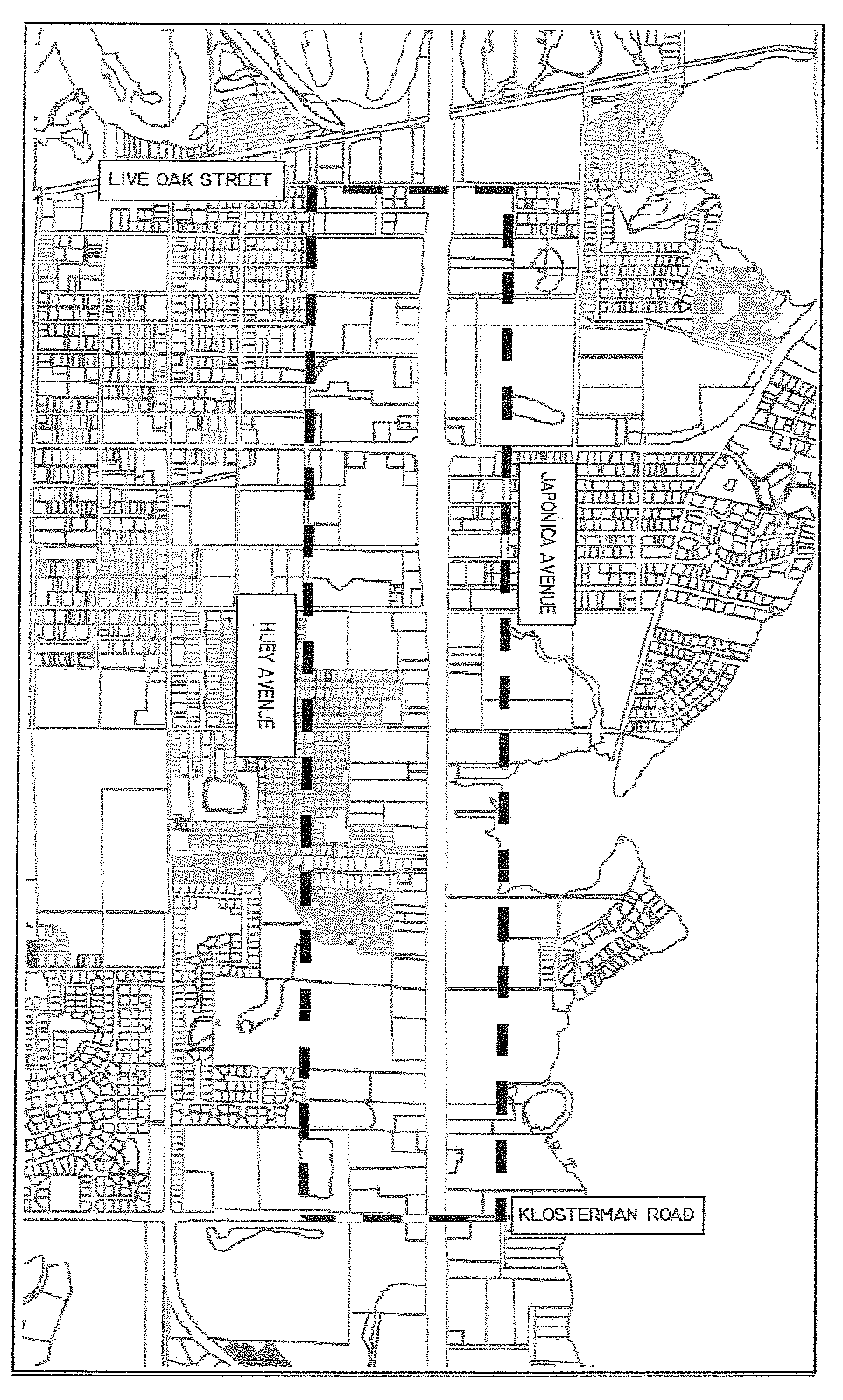
Figure 1
(2)
All new Formula Based Uses and expansions of such uses by 500 or more square feet of floor area that are not within the boundaries described in Figure (1) above shall require a conditional use review in accordance with Section 209.00 and the following review criteria set out in (D) below.
(3)
Change of ownership of an existing Formula Based Use shall not, by itself, require obtaining a conditional use permit.
(4)
The Formula Based Use shall be compatible with existing surrounding uses, and shall be designed and shall be operated in a non-obtrusive manner to preserve the community's character and ambiance. All Formula Based Uses shall be evaluated for compatibility with surrounding uses and furthering the intent of the District it is located in as it relates to promoting the City's tourist oriented economy. When uses under this Code Section are evaluated for compatibility such factors as scale, mass, intensity, location, size, height, style and aesthetics shall be taken into account. This list of factors to be considered is not exclusive and the reviewing body may consider other relevant factors in making a compatibility determination. The use in order to be compatible shall be found to preserve the character of the adjacent neighborhoods and the overall character of the City.
(5)
Approval of the Formula Based Use will be consistent with the policies and standards of the City's Comprehensive Plan.
(6)
The Board of Commissioners shall make a finding before approval of the Use that the proposed intensity of use on the site proposed is appropriate given any other uses permitted on the site and on adjoining sites.
(7)
The Board of Commissioners shall further make a finding before approval of the Use that approval of the Formula Based Use will contribute to an appropriate balance of small, medium and large-sized businesses in the community.
(D)
Review Criteria for Formula Based Uses (meaning Formula Business and Formula Restaurant Uses as defined above).
(1)
In determining compatibility with the surrounding neighborhood the following factors shall be evaluated:
a.
Form and mass of all structures.
b.
Placement of all structures on the site and integration (or buffering where appropriate) with adjoining neighborhood.
c.
Internal circulation and interaction of pedestrians, bicycles, and vehicles.
d.
Ability to accommodate mixed uses, either horizontally or vertically, on the site.
e.
Architecture and site design shall compliment or improve upon the surrounding area.
f.
Storefronts greater than 50' in width shall be detailed to appear as multiple storefronts.
g.
Buildings shall be oriented to the street with interior/rear parking and streetscapes shall included pedestrian friendly amenities such as wider sidewalks, enhanced landscaping, pedestrian scale lighting, and street furnishings. Where these requirements may conflict with other regulations of this code the requirements herein shall apply.
h.
Buildings oriented toward the street with interior parking shall be allowed a wall sign for the road frontage elevation in accordance with sign regulations elsewhere and an equal size or smaller wall sign for the parking frontage elevation. Such building elevations along the street, regardless of store front width, shall provide architectural detail to break up expanses of single-plane blank walls. This detail shall included variation in facade setbacks to create the appearance of multiple buildings elevations.
i.
Parking lots shall be screened from street frontages in accordance with Figure 2 below or similar screening methods as approved during the site plan review process Adjustments to the dimensions of Figure 2 may be altered during the site plan review process to accommodate specific site conditions.
(2)
Formula Based Uses that are part of a unified or planned development that exceeds 40 acres or are located on parcels of land that exceed 40 acres shall also adhere to the requirements of Policy 1.1.11 of the Future Land Use Element of the Comprehensive Plan.
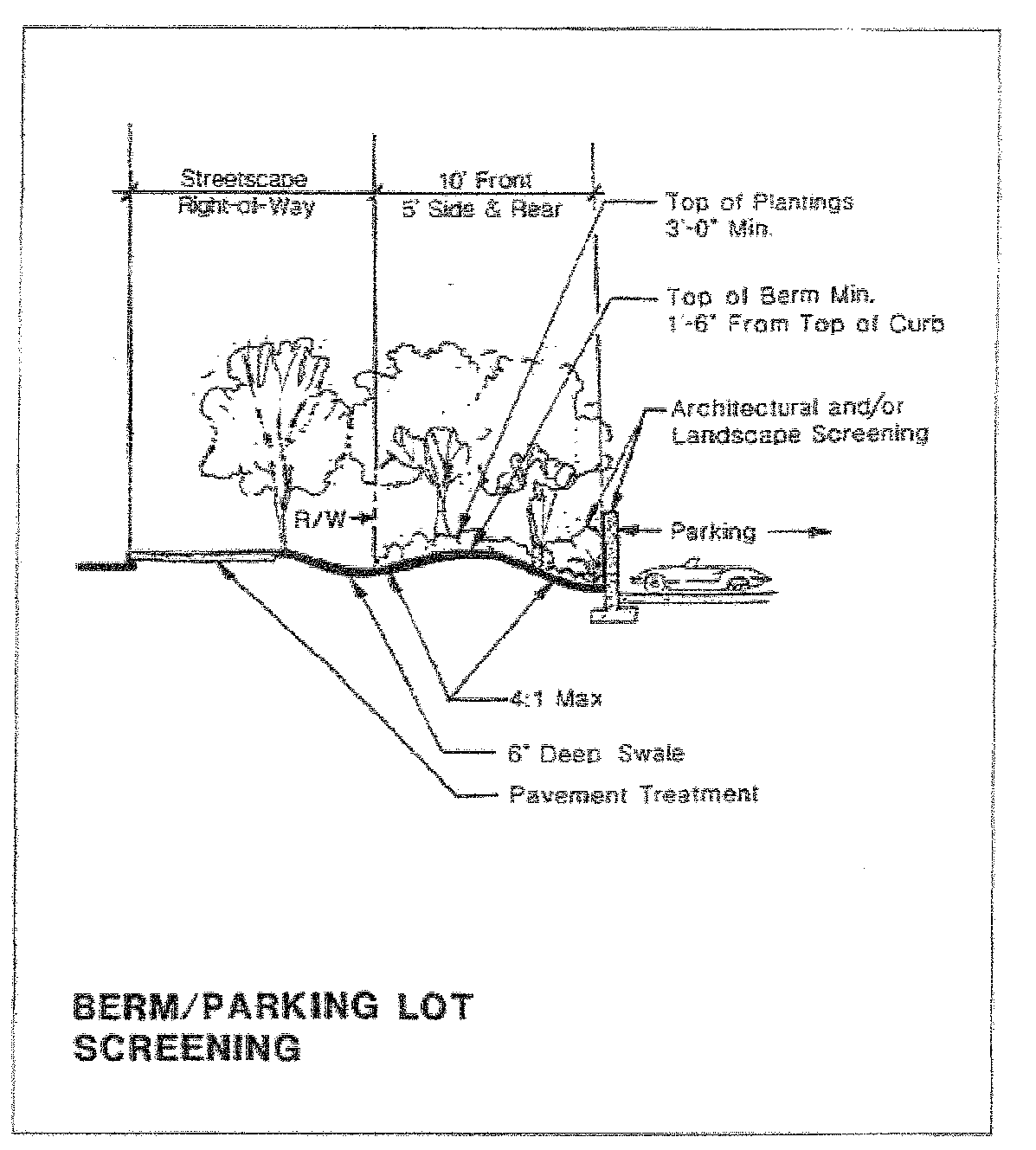
Figure 2
(E)
Burden of Proof. If the City determines that a building permit application or building permit subject to this Section of the Code is for a Formula Business Use or a Formula Restaurant Use, the building permit applicant or holder bears the burden of proving to the City that the proposed or existing use is not a Formula Business Use or a Formula Restaurant Use.
(F)
All Formula Business Uses including Formula Restaurant Uses shall file a Site Plan and obtain Site Plan Approval as may be required elsewhere in this code.
(G)
Formula Business Uses which are located within the City's designated historic district boundary shall also comply with the requirements of Article VII (Heritage Preservation) of this code.
(Ord. 2009-12, passed 10-6-09)
§ 210.00 - SITE PLANS.
(A)
Site plan approval shall be required prior to the issuance of any building permit, construction permit, Certificate of Occupancy or Occupational License, in accordance with the following:
(1)
The approval of a Subdivision in accordance with the requirements of Article X of this Code.
(2)
The establishment or expansion of any conditional use.
(3)
The establishment, expansion, or change of any use, activity or structure pursuant to the provisions of §§ 210.00 through 210.05.
(B)
Prior to application for site plan approval a pre-application conference with the Planning and Zoning Department Staff is recommended.
(Ord. 90-10, passed 5-1-90; Am. Ord. 93-33, passed 10-19-93)
§ 210.01 - Site plan exemptions.
The activities and improvements listed below shall be specifically exempt from the requirement to obtain site plan approval in accordance with the provisions of §§ 210.00 through 210.05:
(A)
The installation of mobile homes and recreational vehicles in mobile home and recreational vehicle parks where the infrastructure is installed and site plan approval has been previously granted and has not expired.
(B)
Where Final Development Plan approval has been granted in accordance with the provisions of Article V of this Code.
(C)
One and two family dwellings on a lot of record or in an approved and constructed subdivision.
(D)
Any change of use to existing structures when such change requires no additional parking pursuant to the provisions of this Code.
(E)
Temporary uses established pursuant to the requirements of this Code.
(F)
Additions, improvements, or alterations to existing uses and structures when such changes result in a one time only increase in gross floor area of 500 square feet or less and do not require Board of Commissioners approval under § 210.03.
(G)
Any request for Sign Permit in accordance with the provisions of Article XI of this Code.
(Ord. 90-10, passed 5-1-90; Am. Ord. 90-52, passed 12-18-90; Am. Ord. 93-33, passed 10-19-93)
§ 210.02 - Site plan contents.
(A)
All site plans shall be prepared under the direction of a Florida Registered Engineer and sealed by same.
(B)
All submittals for site plan approval shall include a completed application form with proof of ownership and designation of agent, if applicable, and provide the following information unless otherwise determined by the Director that the context of the application clearly requires less:
(1)
All required information shall be submitted on standard sheets (24" × 36"). Site Plan submissions requiring more than one sheet shall include match lines and consecutive numbering.
(2)
An accurate boundary survey sealed by a Registered Surveyor containing the complete legal description, plus easements, encroachments, existing structures, and rights-of-way affecting the property shall accompany the site plan. The survey shall also include the name, location and width of existing or platted streets and street rights-of-way within or contiguous to the site. Total site area is required (upland and submerged) with the limits of any jurisdictional wetlands and MHW levels clearly identified.
(3)
Site plans shall be prepared at a scale of one inch equals 60 feet or larger. As necessary, a smaller scale may be used for large projects. All drawings shall show the scale at which they are drawn, north arrow, vicinity map, the date they were drawn, and the date of all revisions.
(4)
In addition to all proposed buildings and parking areas, the site plan must show all proposed utilities including sanitary sewer service, and potable water supply, including the location of proposed fire hydrants.
(5)
The location, size, and type of all storm water management facilities with calculations signed and sealed by an engineer.
(6)
The location, description, and terms of any proposed easements, reservations, or dedications, together with any necessary legal instruments.
(7)
A tree survey with overlay of proposed development indicating size, type, location of trees to remain.
(8)
Existing contours and proposed grades at one foot intervals.
(9)
Flood zone and required first floor elevation(s).
(10)
Complete screening details, including fences or walls and landscaping provided by size, type, spacing, location with the method of irrigation.
(11)
A table of land use showing total area plus a breakdown of all open space (permeable surface) areas, pavement, building, etc.
(12)
Lot dimensions including curve data.
(13)
Proposed setback dimensions.
(14)
Gross floor area by type for non-residential uses.
(15)
Gross density for residential uses and number and types of units.
(16)
The proposed architectural elevations and floor plans with accurate dimensions.
(17)
Proposed private and public streets with right-of-way dimensions.
(18)
Proposed phasing plan by anticipated commencement and completion date.
(19)
Dumpster location and screening.
(20)
Required parking calculations (parking provided and required).
(21)
Size and location of required loading zones.
(22)
Required (proposed) sidewalks and internal walkways.
(23)
Driveways and access improvements.
(24)
Location and type of site lighting including pole height and fixture type.
(25)
Description of the maintenance of common facilities for residential projects.
(26)
The location, type, height, and size of proposed signs.
(C)
Construction drawings shall be submitted to the Engineering Department within one year following site plan approval.
(Ord. 90-10, passed 5-1-90; Am. Ord. 93-33, passed 10-19-93; Am. Ord. 2000-22, passed 6-20-00)
§ 210.03 - Site plan procedure.
(A)
The expansion of an activity or use which exceeds the thresholds of the following schedule shall be approved by the Board of Commissioners:
(B)
The expansion of an activity or use which does not exceed the thresholds of the above schedule or otherwise requires the approval of a site plan may be approved by the Technical Review Committee (TRC).
(C)
Applications for Site Plan approval shall be filed with the Planning and Zoning Department on forms provided by the Director, shall include the required fee established by this Code, and shall be processed as follows:
(1)
The Director shall forward all applications to the City's Technical Review Committee (TRC) for an administrative and completeness review to determine compliance with the provisions of this Code, the Comprehensive Plan, and all applicable building codes. Approval may be granted by the TRC where authorized by this Code.
(2)
Where approval by the TRC is not authorized by this Code, the Director shall, upon receiving a determination from the TRC that the application is complete and ready for processing, forward the application to the Planning and Zoning Board.
(3)
The Planning and Zoning Board shall review the application for compliance with the provisions of this Code, the Comprehensive Plan, and the City's building codes and shall make a written recommendation to the Board of Commissioners. The written recommendation shall be for approval, approval with stipulations, or denial; and shall cite the Code, Plan, or building code provisions which are violated where denial is recommended.
(4)
The Board of Commissioners shall review the application and recommendation of the Planning and Zoning Board. The Board of Commissioners shall approve, approve with stipulations, or deny the application; and shall cite the Code, Plan, or building code provisions which are violated where the application is denied.
(5)
All Board actions shall carry by a majority vote of those members voting on the application.
(Ord. 90-10, passed 5-1-90; Am. Ord. 93-33, passed 10-19-93)
§ 210.04 - Standards for site plan review.
No site plan shall be recommended for approval or receive a final action of approval unless said application has been found to comply with all of the following:
(A)
All the applicable provisions of this Code.
(B)
The Comprehensive Plan.
(C)
The City's concurrency management system.
(D)
All other applicable City building codes.
(Ord. 90-10, passed 5-1-90; Am. Ord. 93-33, passed 10-19-93)
§ 210.05 - Site plan expirations, extensions, and revisions.
(A)
Approval of a site plan shall expire in six months from the date of original approval unless a Construction Permit or Building Permit is obtained and kept active, except that the Board of Commissioners may approve an alternate phasing plan at the time of site plan approval. If the Building Permit or Construction Permit does not remain in an active status the Site Plan shall expire and must be re-approved in accordance with Section 210.03.
(B)
Where an application for a Construction Permit or Building Permit has been applied for, which application is active and under review, one six-month extension to obtain a permit may be granted by the City Manager for good cause. The review of extension requests shall include an evaluation of the effect of new or current regulations on the project. Requests for a time extension shall be submitted a minimum of 30 days prior to the expiration date in writing.
(C)
Minor revisions to an approved site plan may be authorized by the Technical Review Committee (TRC) upon the review of a revised site plan submitted by the original applicant. Major revisions shall only be authorized in the same manner as originally approved. The following criteria shall identify a major modification:
(1)
Any increase in density.
(2)
Any increase in floor area exceeding 500 square feet or the threshold for Board of Commissioners approval under § 210.03.
(3)
Any change in land use.
(4)
Any change in project phasing.
(5)
Any change which would require an amendment to approval conditions.
(6)
Structural alterations significantly affecting the basic size and form of the building(s).
(7)
Any reduction in the amount of open space of more than five percent or any substantial change in the location or characteristics of open space.
(8)
Any increase in traffic generation by more than ten percent.
(9)
Any change in structure height.
(10)
Any change in the number of vehicular access points.
(Ord. 90-10, passed 5-1-90; Am. Ord. 93-33, passed 10-19-93; Am. Ord. No. 2023-09, passed 9-19-23)
§ 211.00 - CONSTRUCTION DRAWINGS.
(A)
Where construction drawings are required by this Code or any applicable building code the drawings shall be submitted to, reviewed by, and approved by the City Engineer in a form and procedure required by the City Engineer.
(B)
Construction drawings shall comply with the provisions of this Code, the applicable building code and the conditions of any previous approvals granted by the City.
(Ord. 90-10, passed 5-1-90; Am. Ord. 93-33, passed 10-19-93)
§ 212.00 - BUILDING PERMITS.
(A)
Valid building and construction permits are required prior to the commencement of any development activity.
(B)
Applications for building and construction permit shall be made through the Building Official. Construction permits shall only be issued after authorization by the City Engineer.
(C)
No application for building or construction permit shall be approved by the Building Official unless it is accompanied by, and complies with the following minimum information:
(1)
An approved site plan or subdivision where such are required.
(2)
The application for building permit complies with all previous stipulations of approval.
(3)
The proposed development complies with the provisions of this Code, the City's concurrency management system, the Official Zoning Atlas designation, and the Future Land Use Map Series designations.
(4)
A valid tree removal permit or notarized affidavit of no tree removal or no tree verification where required, and the conditions of said permit.
(5)
The City's Flood Damage Prevention Ordinance, the requirements of FEMA, and the latest FIRM maps.
(6)
A copy of approved SWFWMD permits.
(7)
A copy of all applicable approvals from the Pinellas County Health Department.
(8)
All necessary variances have been obtained and a copy of the approval letter is submitted.
(9)
A copy of a nonconforming lot of record opinion where one is required.
(10)
Compliance with all other applicable federal, state, and local building codes is demonstrated.
(Ord. 90-10, passed 5-1-90; Am. Ord. 93-33, passed 10-19-93)
§ 213.00 - CERTIFICATES OF OCCUPANCY.
(A)
A certificate of occupancy shall be issued by the Building Official prior to the occupancy and use of any site which has undergone development, renovation, or redevelopment.
(B)
No certificate of occupancy shall be issued by the Building Official until the following has been submitted to the City's satisfaction:
(1)
As-built drawings where required by this Code or the City Engineer.
(2)
A certificate of completion in substantial compliance with all approved plans and specifications for required improvements by the engineer of record where one is required.
(3)
A signoff from the Pinellas County Health Department where applicable.
(4)
A signoff from the Fire Marshal.
(5)
A signoff by the Building Official regarding satisfaction of the final inspection.
(6)
A signoff from the Utilities Director where applicable.
(7)
A signoff from the City Engineer and Planning and Zoning Director where site plan approval has been required.
(8)
Compliance with the provisions of this Code and all applicable building codes has been demonstrated.
(9)
All required inspections have been made and satisfied.
(Ord. 90-10, passed 5-1-90; Am. Ord. 93-33, passed 10-19-93)
§ 214.00 - OCCUPATIONAL LICENSES.
All applications for occupational license approval shall comply with the provisions of this Code, all other applicable building codes, and federal, state, or local laws.
(Ord. 90-10, passed 5-1-90; Am. Ord. 93-33, passed 10-19-93)
§ 215.00 - VARIANCES AND APPEALS.
The Board of Adjustment is authorized to:
(A)
Hear and decide appeals of administrative decisions where it is alleged that there is an error in any order, requirement, decision, or determination made by an administrative official in the interpretation or enforcement of this Code.
(B)
Grant variances to the zoning dimensional regulations when special conditions exist and all standards for the granting of a variance, as set forth in § 215.02(B), have been proven by competent substantial evidence; grant variances to the development regulations of this Code only where specifically authorized and when special conditions exist and all standards for the granting of a variance as set forth in § 215.02(B) have been proven by competent substantial evidence.
The legislative purpose in providing for variances to be granted is to provide for a procedure to give relief from the literal terms of this Code in certain limited circumstances and upon a specific standard set forth in § 215.02(B) having been met where literal enforcement of the requirements of this Code would have the effect of denying the applicant reasonable use of the property, buildings, or other structures. It is the legislative intent of this provision that variances shall be granted only when:
(1)
The standards for variances are all specifically met; and
(2)
The standards are proven by competent substantial evidence; and
(3)
The conditions surrounding the request for the variance are so unusual or particular to the property that the literal enforcement of the standards otherwise applicable to other property owners in the city would result in the denial of substantial and important property rights, and
(4)
A structure or use was constructed or commenced lawfully and with the proper permits; and
(5)
Such a variance would not be contrary to the public interest or give a special benefit to the property owner requesting such a variance.
(C)
Grant adjustments from the FAR and ISR standards of this Code. An adjustment under this subsection shall only be allowed or granted when substantial competent evidence in the official record of the hearing supports the following findings:
(1)
A literal interpretation of the provisions of the FAR and ISR standards of these Rules will deprive the applicant of rights commonly enjoyed by other properties in the same future land use category and will work unnecessary and undue hardship on the applicant.
(2)
The alleged hardship is unique and singular with regard to the property for which the variance is sought and is not that suffered in common with other property similarly located.
(3)
The alleged hardship is not self-imposed by the applicant, and the situation sought to be relieved by the adjustment does not result from an illegal act or result from the actions of the applicant, resulting in self-imposed hardship.
(4)
The adjustment, if allowed, will not substantially interfere with or injure the rights of others' whole property would be affected by allowance of adjustment.
(5)
The adjustment, if allowed, will be in harmony with, serves the general intent and purpose of, and is consistent with the Countywide Future Land Use Plan and Rules, the City's Comprehensive Plan, and these regulations.
(6)
The adjustment, if allowed, will be the minimum adjustment that will make possible the reasonable use of the land, building, or structure.
(7)
The adjustment, if allowed, will not confer on the applicant any special privilege that is denied by the Countywide Future Land Use Plan and Rules, the City's Comprehensive Plan, or these regulations, to other lands, buildings, or structures in the same land use classification.
(8)
The adjustment, if allowed, shall not constitute an amendment to the City's Comprehensive Plan, land development regulations, or to the Countywide Comprehensive Plan.
(9)
An amendment to another land use category under the City and Countywide Future Land Use Plan has been considered by the applicant and the city and it has been determined that such an amendment would not meet the objective of the adjustment and would not be appropriate.
(Ord. 90-10, passed 5-1-90; Am. Ord. 93-31, passed 11-16-93; Am. Ord. 93-33, passed 10-19-93; Am. Ord. 2004-08, passed 5-18-04; Am. Ord. 2006-32, passed 9-19-06)
§ 215.01 - Appeals.
(A)
In exercising its powers to hear and decide appeals, the Board may reverse or affirm, wholly or partly or may modify the order, requirement, decision, or determination made by the administrative official.
(B)
A request for an appeal must be initiated by the aggrieved person within 60 days of the decision rendered by an administrative official that is being appealed. If the aggrieved person fails to file an appeal within such period, the Board has no authority to hear the appeal.
(C)
The Board, in determining whether the administrative official's decision was correct, can only consider the specific code provision considered by the administrative official, and the papers, documents, and maps provided to the administrative official before making his decision. The Board shall not consider the fairness of the application of the specific Code provision in deciding the appeal.
(Ord. 90-10, passed 5-1-90; Am. Ord. 93-33, passed 10-19-93)
§ 215.02 - Variances.
(A)
The City shall not accept an application for, and neither the Board, nor the City acting under subsection (N) of this section, has the authority to consider or grant, the following variances:
(1)
Variances which permit the establishment of a use in a zone or district in which such use is not permitted by the regulations of the zoning district involved;
(2)
Variances which permit the establishment of a lot or parcel which must be combined under the terms of the City of Tarpon Springs Code of Ordinances or which is part of a larger parcel which when established does not meet the area or width requirements of the applicable zoning district except as provided for in Section 215.02.5.
(3)
Variances which permit an increase in density above that allowed by the applicable zoning district or Comprehensive Plan designation, or that purport to modify any definition set forth in the Tarpon Springs Code ("Code") or Comprehensive Zoning and Land Use Code ("LDC"), or that do not conform to the general intent and spirit of the Code and the policies of the LDC, or conflict with any other applicable law.
(4)
Variances which increase or modify in any way a nonconforming use.
(5)
Variances that arise from a request for after-the-fact relief from the provisions of the Code where a building or other structure has been built in violation of the Code and no building permit was issued for such construction, except as provided in § 215.02(E) herein.
(B)
The Board of Adjustment shall grant no variance unless all of the following standards are met and are proven by competent substantial evidence:
(1)
The need for the requested variance arises out of the physical surroundings, shape, topographical conditions, or other physical or environmental conditions that are unique to the specific property involved, and which do not apply generally to property located in the same zoning district.
(a)
Preservation of a Protected Tree(s) or Native Tree(s), but not an Invasive tree(s), as defined in Sections 133, Tree Protection and Preservation, and 134, Landscaping and Screening, of the LDC, may be considered as a relevant environmental condition under this subsection.
(b)
Location of the property in the Historic District within the City may also be considered as a unique physical condition. However, any variance applied for within the Historic District shall be found to be compatible with the character of the properties within that District before any variance may be granted;
(2)
The conditions or special circumstances peculiar to the property have not been self-created or have resulted from an action by the applicant or with prior knowledge or approval of the applicant. Specifically, no variance may be granted arising from illegal construction of a structure or an illegal use of the premises which would have otherwise required a building permit or other specific permit to be issued and which construction or which use was commenced unlawfully. Under such conditions, the property owner shall have no legal right to apply for a variance and the Board will have no legal right to grant such a variance;
(3)
Literal enforcement of the requirements of the City of Tarpon Springs' Comprehensive Land Development Code would have the effect of denying the applicant reasonable use of the property, or legally conforming buildings or other structures, and the requested variance is the minimum variance that will make possible the reasonable use of the property; and
(4)
Granting the variance will not confer any special privilege that is not allowed for other lands, buildings or structures in the same zoning district; no variance will be granted that extends to the applicant a use of property that is not commonly enjoyed by other persons in similar circumstances.
(5)
Granting the variance will not substantially diminish property values in the surrounding area, substantially interfere with, or injure the rights of others whose property would be affected by approval of the variance, alter the essential character of the neighborhood, or create a nuisance.
(C)
In determining whether to grant a variance the Board shall not consider any evidence:
(1)
That is based upon conditions, including financial or health conditions, which are personal to the applicant or any other member of the applicant's family or household;
(2)
That is otherwise irrelevant to meeting the standards set forth herein;
(3)
Regarding the presence of a nonconforming use (legal or otherwise) of neighboring lands, structures, or buildings in the same zoning district, or evidence of the permitted use of lands, structures, or buildings in zoning districts other than the zoning district in which the applicant's property at issue is located.
(D)
The Board of Adjustment shall make findings, regarding variances to FAR and ISR standards, that all of the requirements of § 215.00(C) shall have been met.
(E)
In the highly unusual circumstance where:
(1)
The property owner or contractor has made a mistake in the construction of a structure, and it would be economically impracticable to correct the mistake at the time it was discovered;
(2)
The appropriate building permit or other use permit had been issued;
(3)
Such mistake could not have been avoided by the application of normal construction or business practices; and
(4)
Such case is proven before the Board by competent substantial evidence.
Then and only then, may the Board grant the minimum variance that will achieve a result that is fair to the applicant and the public alike.
(F)
In circumstances where it can be demonstrated to the Board by competent and substantial evidence that a violation of the Code has occurred during the time of ownership of a previous property owner without the actual or constructive knowledge of the current property owner who could not have known of such violation by reasonable inquiry prior to the purchase or other acquisition of the property, the Board of Adjustment may grant the following relief to the applicant:
(1)
The minimum relief necessary to preserve the enjoyment of a legally recognized property right;
(2)
Only for such time as is necessary to appropriately amortize any unlawfully built and nonconforming structure for such limited time as is necessary to amortize its useful life; and
(G)
Under no circumstances may the Board grant a property owner the right to intrude into a public right-of-way, easement, or other dedication to the public without the concurrence of the Board of Commissioners through the Board of Commissioners granting such limited right through the mechanism of a revocable license agreement.
(H)
At the conclusion of the hearing, the Board will issue a written order including findings of law, findings of fact, and a Board decision. Such order will be in a form as approved by the City Attorney.
(I)
In granting a variance, the Board may prescribe conditions deemed necessary to protect public interest and to ensure compliance with applicable codes and the Comprehensive Plan of the City.
(J)
The variance granted under the provision of this section shall expire within two (2) years from the date the Board heard the application and granted the variance unless a building permit for construction has been issued in accordance with the plans and conditions upon which the variance was granted. The variance shall not expire after two (2) years from the date of issuance if a building permit issued in accordance with the plans and conditions upon which the variance was granted is active or is renewed pursuant to the applicable provisions regarding renewal of building permits.
(K)
Upon receiving a request in writing at least 30 days prior to the scheduled expiration date, the Board of Adjustment may grant one six-month extension provided proper public notification by mail has been given.
(L)
The Board may reconsider a decision or a variance application only if a request for rehearing is made within 30 days of the date of the original action taken by the Board, and shall be advertised for the next available Board of Adjustment meeting. Before reconsidering one of its decisions, the Board of Adjustment, after hearing testimony, must make a finding that evidence not previously considered by the Board exists and will be presented. The action to rehear shall be authorized only upon a motion of a Board member who voted on the prevailing side in the original Board action, and upon an affirmative vote by a majority of the Board members present and voting upon the original Board action. Upon an affirmative vote to rehear the decision or variance application the Board must reconsider the request in accordance with the terms of this section. The rehearing shall be scheduled upon receipt of a new application fee and due public notice.
(M)
The violation of the terms of an order granting a variance, including conditions and safeguards which may be made a part thereof, shall be deemed a violation of the Tarpon Springs Comprehensive Zoning and Land Use Code and punishable as provided in that Code.
(N)
For de minimus variance applications of five percent or less of normal zoning requirements, and for which no letters of objection are received from all adjacent property owners after due notification, then such application shall be promptly considered by the City Manager or his or her designee without review by the Board of Adjustment. In such cases, the application fee shall be $50.00. If the City Manager or his or her designee denies such an application then the applicant may proceed to hearing before the Board of Adjustment as provided in this Section, and without needing to pay an additional application fee. De minimus variances shall only be granted if:
(1)
A structure or use at issue was constructed or commenced lawfully and with the proper permits; and
(2)
Such a variance would not be contrary to the public interest or give a special benefit to the property owner requesting such a variance; and
(3)
The variance if granted would not be in violation of the City's Comprehensive Plan.
(O)
Not withstanding the other provisions of this Ordinance to the contrary, the Board of Adjustment may grant the minimum variance necessary in order to avoid a clear violation of the Americans with Disabilities Act, Public Law 336 of the 101st Congress, enacted July 26, 1990.
(Ord. 90-10, passed 5-1-90; Am. Ord. 93-31, passed 11-16-93; Am. Ord. 93-32, passed 12-7-93; Am. Ord. 93-33, passed 10-19-93; Am. Ord. 2004-08, passed 5-18-04; Am. Ord. 2006-32, passed 9-19-06; Am. Ord. 2012-09, passed 5-15-12)
§ 215.02.5 - Variances for nonconforming lots of record.
(A)
Notwithstanding the requirements of Section 24.02, the Board of Adjustments may grant a variance to allow a nonconforming lot of record to built upon if the following standards are met and proven by competent substantial evidence:
(1)
The lot consists of at least one entire lot of record on the effective date of this Code.
(2)
The lot was not created in violation of a previous zoning ordinance.
(3)
The lot was not combined with a neighboring lot under common ownership in order to allow the existing improvements on the neighboring developed lot to meet applicable setbacks.
(B)
The Board of Adjustment may not grant a variance under this section if it will reduce the area or width of a nonconforming lot of record.
(C)
The purchase of a non-conforming lot of record shall not constitute a self-created hardship.
(Ord. 2012-09, passed 5-15-12)
§ 215.03 - Public notification.
Notice of public hearing shall be given at least 15 days in advance thereof, by posting the property, by first class mail to the applicant and to each property owner within 500 feet of the subject property, and advertisement in the Tampa Bay Times, or other appropriate publication of general circulation.
(Ord. 90-10, passed 5-1-90; Am. Ord. 93-32, passed 12-7-93; Am. Ord. 93-33, passed 10-19-93; Am. Ord. 2006-32, passed 9-19-06; Am. Ord. 2019-08, passed 5-14-19)
§ 215.04 - Authorization of variance or appeal.
No action shall be valid unless authorized by a majority of the full membership.
(Ord. 90-10, passed 5-1-90; Am. Ord. 93-33, passed 10-19-93)
§ 215.05 - Judicial review of decisions.
Any person or persons, firm, or corporation, or any officer, department, board, or bureau of a governing body aggrieved by any decision of the Board of Adjustment, may seek judicial review in the Circuit Court for Pinellas County, Florida of a Board decision by filing a petition for certiorari within 45 days after the decision of the Board.
(Ord. 90-10, passed 5-1-90; Am. Ord. 93-33, passed 10-19-93)
§ 216.00 - VACATION OF STREETS, PLATS OR OTHER PROPERTY.
(A)
An application to vacate any street rights-of-way, plats, or other property shall be filed with the Planning and Zoning Department on forms provided by the Director and shall include the required fee established by this Code.
(B)
The Director shall forward all applications to the City's Technical Review Committee (TRC) for an administrative and completeness review to determine compliance with the provisions of this Code, the Comprehensive Plan, and all applicable building codes.
(C)
Upon receiving a determination from the Technical Review Committee that the application is complete and ready for processing the Director shall notice the application for public hearing before the Board of Commissioners.
(D)
Notice for public hearing shall constitute written legal notice in accordance with the requirements of this Article.
(E)
The Board of Commissioners shall review the application and render a decision regarding same. Approval shall be in the form of an ordinance.
(F)
Prior to the vacation of any right-of-way, the applicant shall tender an application fee equal to 50 percent of the appraised value of the right-of-way proposed to be vacated, less the fair market value of any property or interest therein conveyed to or reserved by the City. All such values shall be determined by the Pinellas County Property Appraiser. If such application is denied, the entire application fee, less the sum of $200.00 to defray costs for the processing of such application, shall be refunded to the applicant. All such application fees, less the $200.00 to be deposited in the General Fund, shall be placed in a segregated account, the proceeds of which shall be utilized solely for the purpose of acquisition of future rights-of-way, or easements by the City.
(Ord. 90-10, passed 5-1-90; Am. Ord. 93-26, passed 9-7-93; Am. Ord. 93-33, passed 10-19-93; Am. Ord. 2019-06, passed 4-16-19; Am. Ord. No. 2023-02, passed 1-24-23)
§ 216.01 - Standards for review of vacations.
(A)
No vacation shall be approved unless a positive finding, based upon substantial competent evidence, either presented at a public hearing held by the Board or reviewed personally by the Board members is made on each of the following standards:
(1)
That the subject property is not needed for the distribution, expansion, or maintenance of existing or future utility services is obtained from the following agencies:
(a)
General Telephone and Electric (GTE).
(b)
Florida Power.
(c)
The cable franchise holder.
(d)
Clearwater Gas.
(e)
The City water and sewer provider.
(f)
The City Engineer for drainage service.
(2)
The property does not provide the sole means of access to an adjoining property.
(3)
The property is not needed to implement the future circulation plans of the Traffic Circulation Element of the Comprehensive Plan.
(4)
The property does not provide the adjoining neighborhood with a viable usable access or vista to the City's shoreline.
(B)
Any easement documents necessary from the applicant for the satisfactory completion of a vacation shall be executed and submitted to the Clerk prior to any final action by the Board of Commissioners on the application.
(Ord. 90-10, passed 5-1-90; Am. Ord. 93-33, passed 10-19-93)
§ 217.00 - ENFORCEMENT OF CODE PROVISIONS.
(A)
The provisions of this Code shall be enforced by the City Manager or his designee(s).
(B)
Personnel of the City, in the performance of their duties or functions to enforce this Code, may enter upon any property during normal work hours of the City and make examinations to determine Code compliance that do not occasion damage or injury to private property.
(C)
The violation of any stipulations attached to any permit, variance, conditions, use or other approval granted by the City shall constitute a violation of this Code.
(D)
The procedure for enforcement of this Code shall be in accordance with the requirements established by Chapter 2, Article VIII of the Code of Ordinances for the City of Tarpon Springs, or any other applicable legal means.
(Ord. 90-10, passed 5-1-90; Am. Ord. 93-33, passed 10-19-93)
§ 218.00 - PROCEDURE FOR REHEARINGS.
(A)
The Board of Commissioners may reconsider an application required under this Code only if a request for rehearing is made within 30 days of the date of the original action taken by the Board of Commissioners.
(B)
Before reconsidering one of its decisions, the Board of Commissioners, after considering additional evidence or argument presented by the person making the request, must make a finding that evidence not previously considered, or a factual mistake related to the evidence considered exists.
(C)
The request to rehear shall be authorized only upon a motion of a member of the Board of Commissioners who voted on the prevailing side in the original Board of Commissioners action, and upon an affirmative vote of a majority of those present and voting.
(D)
Upon an affirmative vote granting the request to rehear, application shall be scheduled upon due public notice in accordance with the requirements for said application.
(Ord. 90-33, passed 9-5-90; Am. Ord. 93-33, passed 10-19-93)

