
Tarpon Springs City Zoning Code
ARTICLE IX
DEVELOPMENT STANDARDS
§ 126.00 - PURPOSE AND APPLICABILITY.
(A)
The purpose of this Article is to ensure that new development and redevelopment comply with certain minimum criteria which is required to implement the Comprehensive Plan.
(B)
The development standards contained in this Article are provided to also protect the public health, safety, and welfare to ensure the benefits of growth and protect the general public from any potential adverse impacts related to growth.
(C)
The development standards contained in this Article serve to provide a clear division of public (City) and private responsibility related to infrastructure ownership, maintenance, construction, and repair.
(D)
The development standards contained in this Article shall apply to all requests for development order approval and shall be considered as the minimum acceptable design criteria.
(E)
No development order shall be approved unless assurance is provided that the required improvements will be installed.
(F)
All development standard requirements shall be installed at the expense of the developer.
(G)
The development standards contained in this Article do not invalidate deed restrictions or restrictive covenants, nor does the City enforce such private contractual agreements.
(H)
All existing developments shall continue to comply with the development standards in effect at the time the development received approval from the City. Any expansions or modifications shall conform to the requirements of this Code.
(Ord. 90-10, passed 5-1-90; Am. Ord. 93-33, passed 10-19-93; Am. Ord. 2007-16, passed 5-15-07)
§ 127.00 - PARKING REQUIREMENTS.
§ 127.01 - Permit and plans required.
(A)
Prior to application for Building Permit, construction plans showing the location, type of construction, drainage, landscaping, ingress and egress, parking design and dimensions, and parking calculations in accordance with this Article must be approved in accordance with the Site Plan Review process required by this Code.
(B)
A building permit which includes a copy of the approved construction plans showing location, type of construction, drainage, landscaping, ingress and egress, parking design and dimensions, and parking calculations in accordance with this Code is required for:
(1)
Any proposed new parking lot.
(2)
Any existing parking lot which is proposed to be expanded or reduced.
(3)
Any existing parking lot which is proposed to be resurfaced, resealed or restriped in a manner different than previously approved.
(4)
Any existing lot which is proposed to be paved.
(Ord. 90-10, passed 5-1-90; Am. Ord. 93-33, passed 10-19-93)
§ 127.02 - Applicability.
(A)
All parking lots or spaces required or provided after the effective date of this Code shall be constructed in accordance with the requirements established herein and the procedures established pursuant to Section 210.
(B)
Every building, use or structure shall provide off-street parking facilities in accordance with the provisions herein. Where a building enjoys a legal non-conforming status, such building may be altered or repaired, provided there is no capacity and there is no change of use, without being required to meet the standards of this section.
(C)
When an existing structure and/or use is changed or expanded, additional off-street parking will be provided to the extent that the parking required by this article for the new use or building area exceeds the off-street parking which would have been required for the previous condition had the regulations of this Article been applicable thereto. For the purposes of this Article, a change of use shall mean a change from one classification of parking requirements to another per § 127.03.
(D)
When an existing structure or use is expanded to an extent which requires off street parking in excess of 10 spaces or 10% of the total number of existing parking spaces, whichever is greater, the pre-existing structure shall be provided with parking in accordance with the design, drainage, construction, and landscaping regulations of this Code.
(E)
Required off-street parking shall not be used for permanent sales, dead storage, repair, dismantling or servicing of any type or kind, display, or for any use other than off street parking, nor shall areas devoted to such activities count as meeting off-street parking requirements. Off street parking facilities shall be maintained and continued as an accessory use as long as the main use is continued. No owner or operator of any building, structure or use requiring off street parking under the terms of this article shall cause or allow the discontinuance or reduction of the required parking facilities apart from the abandonment of such structure or use.
(F)
The Board of Adjustment may grant a variance to the provisions of §§ 127.00 through 127.05 within the following parameters:
(1)
The number of parking spaces required by this Section for the premises, prior to the application of credits and/or flexible allocations, may be reduced:
(a)
By up to 100% for new or expanded uses which require fewer than 10 spaces; or
(b)
by up to 33% for new or expanded uses which require 10 or more spaces, and
(2)
Parking spaces for disabled persons must meet all applicable standards of the Florida ADA; and
(3)
The variance meets the criteria for granting of a variance, § 215.02(B).
(Ord. 90-10, passed 5-1-90; Am. Ord. 93-33, passed 10-19-93; Am. Ord. 98-04, passed 4-21-98)
§ 127.03 - Design standards.
(A)
All parking lots shall be designed to meet the standards established herein.
(B)
All required parking shall be located as follows:
(1)
Within 660 feet, measured along the most direct pedestrian route, of the main entrance of the use which it is designed to serve; and
(2)
On land in the same ownership as the use the parking is intended to serve; and
(3)
On land which has the same zoning classification, or a zoning classification which allows the use as Permitted or Conditional, as the use the parking is intended to serve.
(4)
Off-street parking may be provided as an ancillary non-residential use only in the RM (Residential Multi-family) district. Such parking, regardless of the number of spaces provided may be counted toward no more than 25% of total required parking, after the application of parking credits, for the use it is intended to serve and must be located within 500 feet of the primary use it serves. Such use shall require Conditional Use Review.
(C)
As an alternative to the above, off-street parking may be approved as a part of the site plan review process provided the parking provided at alternative locations does not constitute an excess of 25% of the total required off-street parking, and the alternative location is within 750 feet of the use to be served, measured along the most direct pedestrian route.
(D)
Parking lots shall be improved with a permanent all-weather paving material which is graded to drain stormwater in accordance with the stormwater management requirements of this Code. Turf blocks may be used as required by the landscaping requirements of this Code. Crushed shell, mulch, grass or other material as approved by the City of Tarpon Springs Engineering Department may be utilized as provided in Section 127.03(L) below.
(E)
All paved parking spaces which serve any use other than single family or two family dwellings located in driveways shall be marked by durable painted lines.
(F)
Directional signs and surface markings shall be provided as required for safe and effective vehicular and pedestrian traffic flow and shall be installed in accordance with the Manual of Uniform Traffic Control Devices, latest edition.
(G)
With the exception of driveways serving single family and two-family dwellings, no off-street parking space shall be designed in a manner where a vehicle is required to back into a public right-of-way to gain egress. As an exception to this rule, uses requiring 10 or fewer spaces may back directly into a functional public alley.
(H)
Fire lanes shall be provided in accordance with the requirements of the NFPA 1141 and Section 135.00 of this Code.
(I)
Parking lots which serve public parks may be provided with up to 100% of the required parking in turf block, grass, or mulch. Access aisles serving such spaces must be paved, and the grass spaces must be adequately drained, marked, and maintained.
(J)
All required off-street parking spaces shall have concrete curbs or anchored wheel stops as necessary to prevent vehicles from encroaching upon adjoining property, landscaped areas, or public rights-of-way.
(K)
The front of a vehicle may encroach upon any interior or perimeter landscaped area when said area is at least 7 feet in width and where continuous concrete curbing is provided. Two feet of said landscaped area may be calculated as part of the required depth of abutting parking spaces.
(L)
Onsite parking which is provided in excess of that amount required by the parking schedule of this Code, offsite parking lots for required or overflow parking, parking provided as an ancillary non-residential use, and parking which is provided for any temporary use permitted by Article IV of this Code may utilize grass, mulch, crushed shell, or other acceptable material as approved by the Technical Review Committee. Permanent parking lots constructed under this criteria must meet all other applicable requirements of the Land Development Code.
(M)
No parking space may block pedestrian travel, fire hydrants and/or standpipes, meter rooms, doorways or overhead doors (except for the garage of a private dwelling).
(N)
The minimum dimensions for all parking shall be as follows:
Note: Driveways serving one or two-family dwellings or townhouses on fee simple lots shall be a minimum of 8 feet in width (16 feet for a double drive) and 20 feet in depth.
(O)
Parking spaces for disabled persons shall be provided in accordance with Chap. 553.501 et seq., "Florida Americans with Disabilities Accessibility Implementation Act."
(P)
Up to twenty percent (20%) of the required parking spaces may be designated for compact cars and measure 8′ × 16′ provided that:
(1)
The compact parking spaces are for the exclusive utilization of a use which exhibits low turnover and is typically occupied all day or overnight, e.g. office buildings or mid-rise condominiums.
(2)
The compact spaces are assigned to individual employees or residents and is subject to enforcement.
(3)
Compact car spaces are grouped within the lot and are appropriately designated by signage and pavement markings.
(Ord. 90-10, passed 5-1-90; Am. Ord. 93-33, passed 10-19-93; Am. Ord. 94-42, passed 12-20-94; Am. Ord. 96-13, passed 10-1-96; Am. Ord. 97-22, passed 8-19-97; Am. Ord. 2003-26, passed 7-15-03; Am. Ord. 2006-05, passed 3-21-06)
§ 127.04 - Parking schedule.
(A)
Parking spaces required on any employee/person basis in this Code shall be based on the maximum number of employees/persons on duty, residing on the premises at any one time, or both.
(B)
Where a given use or building contains a combination of uses, parking shall be provided on the basis of the sum of the required spaces for each use.
(C)
Where the required number of parking spaces is not set forth for a particular use, a determination shall be made based upon the requirements for a similar use, and may consider available traffic engineering and planning data from other sources accepted by the profession.
(D)
When units or measurements determining numbers of required off-street parking spaces result in requirement of a fractional space, then such fraction equal or greater than ½ shall require a full off-street parking space.
(E)
The required number of parking spaces for disabled persons shall be as set forth in Chap. 553.501, F.S.
(F)
Benches, pews, or other similar seating arrangements shall count each 18 lineal inches as 1 seat.
(G)
Parking ratios shall be provided in accordance with the following:
(1)
Residential Uses
(a)
Detached Single Family Dwellings; Attached Single Family Dwellings; and Two Family Dwellings
2 spaces per dwelling unit.
(b)
Multifamily Dwellings
1.75 spaces per dwelling unit plus additional spaces as required for clubhouse and recreation facilities.
(c)
Mobile Home Parks
1 space per mobile home lot plus additional spaces as required for clubhouse and recreation facilities.
(2)
Institutional Uses
(a)
Day Care Centers
1 space per employee plus
1 space per school vehicle plus
1 space per 10 children
(b)
Churches
1 space per 3 seats in the principle place of assembly or if there is no fixed seating arrangement, 1 space per 35 square feet of gross floor area in the principle place of assembly; provided up to 50% of the spaces may be provided as grass parking if approved as part of the site plan process and the drive aisles are paved
(c)
Boarding Houses and Lodging Facilities
1 space per 2 beds
(d)
Nursing Homes
1 space per 2 beds
(e)
Private, Civic, Fraternal Clubs or Lodges
1 space per 4 members
(f)
Community Residential Homes
1 space per 4 residents plus
1 space per 2 non-resident staff
(g)
Congregate Care Facilities
1 space per 2 dwelling units plus
1 space per 2 employees
(h)
Emergency Shelters, Residential Treatment Facilities, Recovery Homes
1 space per 4 residents plus
1 space per each resident staff
1 space per 3 non-resident staff
(3)
Recreational Uses
(a)
Club Houses
1 space per 250 square feet of gross floor area
(b)
Golf Courses
5 spaces per hole plus additional spaces as required for clubhouses and eating establishments
(c)
Golf Driving Range
1 space per tee plus
1 space per 200 square feet of gross floor area
(d)
Miniature Golf
3 spaces per hole plus parking as required for other uses on site
(e)
Other Outdoor Commercial Recreation
1 space per 300 square feet of area
(f)
Arcades, Game Rooms
1 space per 200 square feet of gross floor area
(g)
Health Clubs
1 space per 150 square feet of gross floor area
(h)
Billiard Halls
2 spaces per billiard table
(i)
Skating Rinks
1 space per 100 square feet of gross floor area
(j)
Swimming Pools, Community or Private Club
1 space per 50 square feet of pool area
(k)
Swimming Pools, Commercial
1 space per 40 square feet of pool area plus
1 space per employee
(l)
Tennis or Racquet Clubs
2 spaces per court plus additional spaces as required for clubhouses and eating establishments
(m)
Yacht Clubs
1 space per slip plus additional spaces as required for clubhouse and eating establishments
(4)
Community Service Uses
(a)
Hospitals
1 space per 2 patient beds plus
1 space per staff doctor plus
1 space per 2 employees on the peak shift plus
1 space per emergency vehicle
(b)
Libraries, Museums, Galleries, Cultural Centers, and similar uses
1 space per 250 square feet of gross floor area
(c)
Assembly Halls, Convention Centers, Stadiums
2 spaces per 5 seats
(d)
Colleges
1 space per employee plus
7 spaces per classroom plus additional spaces as required for museums, libraries,
assembly halls, and theaters or stadiums
(e)
Elementary or Middle Schools, Public or Private
1 space per employee plus
2 spaces per classroom
(f)
High Schools, Public or Private
1 space per employee plus
5 spaces per classroom
(g)
Emergency Service Facilities
1 space per 200 square feet of gross floor area plus
1 space per vehicle
(h)
Schools of Special Education
1 space per 200 square feet of gross floor area
(i)
Post Office
1 space per 200 square feet of gross floor area
(5)
Commercial Uses
(a)
Medical Clinic
1 space per 200 square feet of gross floor area
(b)
Offices
4.5 spaces per 1,000 square feet of gross floor area
(c)
Retail Sales Establishments and Retail Food Establishments
1 space per 250 square feet of gross floor area
(d)
Repair Service Establishments
1 space per 250 square feet of gross floor area
(e)
Personal Service Establishments
1 space per 200 square feet of gross floor area
(f)
Shopping Centers
Up to 75,000 sq. ft.-1 space/250 sq. ft. g.f.a.
75,000 sq. ft. and over-1 space/300 sq. ft. g.f.a.
plus additional spaces as required for eating establishments, theaters, and bowling
alleys
(g)
Theaters, Indoor
1 space per 3 seats
(h)
Bowling Alleys
4 spaces per alley plus additional spaces as required for eating establishments
(i)
Funeral Homes
1 space per 3 seats in the main chapel or auditorium
(j)
Eating Establishments, Sit Down and Taverns
1 space per 3 seats (including outdoor seating)
(k)
Eating Establishments, Fast Food
1 space per 80 square feet of gross floor area (including outdoor seating)
(l)
Vehicle Service Establishments (includes service stations)
2 spaces per service bay plus
1 space per employee
(m)
Vehicle Sales and Rental Establishments
1 space per 500 square feet of enclosed floor area plus
1 space per 4,500 square feet of open display area plus additional spaces as required
for vehicle service
(n)
Veterinary Clinics, Kennels
1 space per 400 square feet of gross floor area
(o)
Furniture, Appliance, or Carpet Stores
1 space per 500 square feet of gross floor area
(p)
Financial Institutions
1 space per 200 square feet of gross floor area
(q)
Car Wash Automated
1.5 spaces per bay plus
1 space per employee
(r)
Garden Supplies
1 space per 250 square feet of enclosed floor area plus
1 space per 1,000 square feet of outdoor display/sales area
(s)
Hotels/Motels
1 space per unit plus additional spaces as required for eating establishments and meeting halls
(t)
Miniwarehouses
1 space per 10 units plus
2 spaces for the office
(u)
Self-Serve Gasoline Stations and Associated Convenience Stores
1 space per 200 square feet of gross floor area
(v)
Commercial Marinas
1 space per 2 wet slips plus
1 space per 4 dry slips plus additional spaces as required for eating establishments
For commercial marinas that include a quality restaurant, the Planning Director may require the marking and reservation of 15% of the slips for restaurant usage only.
(w)
Laundromat
1 space per 200 square feet of gross floor area
(x)
Testing Laboratory
1 space per employee plus
1 space per company vehicle
(y)
Construction Material Establishments
3 spaces per each 2 employees plus
3 spaces per 500 square feet of floor area devoted to retail sales
(z)
Mortuary
1 space per 200 square feet of gross floor area
(6)
Industrial Uses
(a)
Construction Service Establishments
1 space per 1.5 employees plus 1 space per company vehicle or
1 space per 500 square feet of gross floor area whichever is greater
(b)
Warehouses and Distribution Facilities
1 space per 1,500 square feet of gross floor area
(c)
Wholesale Trade
1 space per 1.5 employees plus
1 space per 2,000 square feet of gross floor area
(d)
Manufacturing
1 space per 500 square feet of gross floor area or
1 space per 1.5 employees at peak shift, whichever is greater
(e)
Multiple tenant warehouse-office buildings
1 space per 650 square feet of gross floor area
(f)
Research and Development
1 space per each 500 square feet of gross floor area; plus
1 space per company vehicle
(7)
Miscellaneous Uses
(a)
Model Home
3 spaces per home plus
1 space per employee/salesperson
(b)
Utility Service
1 space per 1.5 employees plus
1 space per company vehicle
(c)
Commercial Watercraft
1.
Charter vessels (1-8 passengers and crew)
3 spaces per vessel. The number of passengers and crew will be determined by the maximum number indicated on the Coast Guard Certificate of Inspection.
2.
Party vessels (9 or more passengers and crew)
1 space per 3.0 passengers and crew. The number of passengers and crew will be determined by the maximum number indicated on the Coast Guard Certificate of Inspection.
3.
Personal Watercraft (F.S. 327.02) Rental
1 per 1.5 watercraft offered for rent
4.
Vessels engaged in commercial sponging or fishing, licensed pursuant to Chap. 370.06, F.S., are exempt from the provisions of this section.
(H)
Drive-Through Service lanes shall be provided as follows:
(1)
Generally
(a)
One-way drive aisles which serve automobile-oriented uses may be reduced to 10 feet in width when adequate access for emergency vehicles is provided to the building by other drives.
(b)
Stacking for drive-through facilities shall be designed to accommodate all vehicles on-site without obstructing any aisles, parking spaces, or public rights-of-way.
(2)
Eating Establishments, Fast Food
Stacking space to accommodate 8 vehicles.
(3)
Financial Institutions, Drive-Up
(4)
Car Wash, Automated
10 spaces per stall
(5)
Car Wash, in Conjunction with Gasoline Sales
Stacking space to accommodate 3 vehicles.
(Ord. 90-10, passed 5-1-90; Am. Ord. 93-33, passed 10-19-93; Am. Ord. 94-42, passed 12-20-94; Am. Ord. 96-13, passed 10-1-96; Am. Ord. 96-31, passed 1-7-97)
§ 127.05 - Parking Credits and Flexible Parking Allocations.
(A)
The Planning Director may allow the use of any combination of parking credits or allocations permitted by § 127.05 during the site plan review process.
(B)
Tree Protection
(1)
The required parking may be reduced by not greater than 10% where necessary to protect existing trees as defined by the tree protection section of this Code (§ 133.00).
(C)
Bicycle, Motorcycle Space
(1)
The required parking may be reduced by not greater than 10% where replaced by an area designated for bicycles and/or motorcycles.
(2)
The bicycle or motorcycle spaces shall be diagonally striped on the pavement and marked by appropriate signage.
(D)
Proximity to the Pinellas Trail
(1)
The required parking shall be reduced by 10% for uses which abut the Pinellas Trail.
(E)
Historic Preservation
(1)
The adaptive re-use of a structure listed on the Florida Master Site File Inventory of historic structures which requires an increase in the amount of parking under the terms of this Code shall only be required to provide parking which can be reasonably designed to fit on the site and still preserve the site's historic character.
(2)
Additions in excess of 25% of the existing gross floor area of structures which qualify as historic under subsection (1) above shall require the provision of parking in accordance with the regulations of this Code.
(F)
Proximity to Municipal or Parking for Pay Lots
(1)
The required parking may be reduced by not greater than 30% where necessary for uses within 600 feet of a municipal or parking for pay lot.
(G)
Special Districts
Any change of use or expansion in the following districts shall be required to meet the requirements of this Article only where the additional parking required by § 127.04, after § 127.05 (Parking Credits and Flexible Parking Allocations) and § 127.03(C) are applied, is in excess of 20% of the total pre-existing requirement.
(1)
The Central Business District (See Figure 1)
(2)
The Sponge Docks (See Figure 2)
(Ord. 90-10, passed 5-1-90; Am. Ord. 93-30, passed 11-16-93; Am. Ord. 93-33, passed 10-19-93)
(Maps of Central Business District (Figure 1) and the Sponge Docks (Figure 2) are reproduced on the following page.)
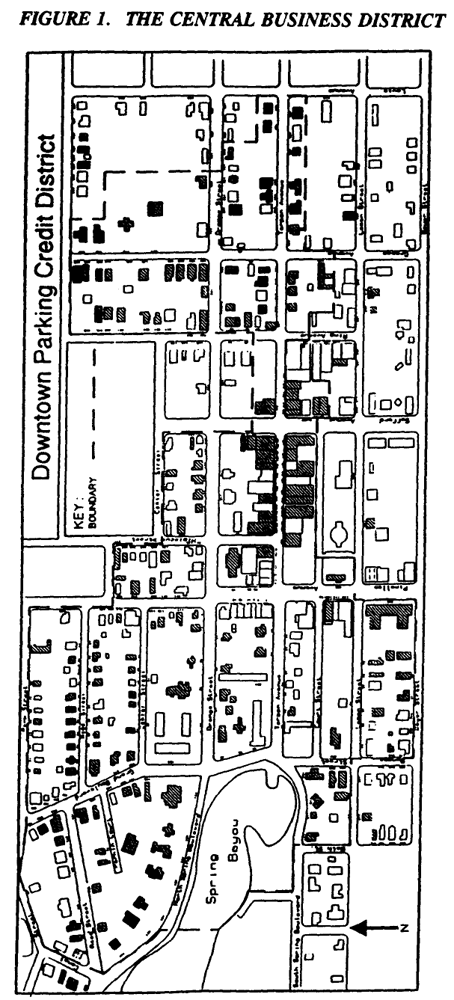
FIGURE 1. THE CENTRAL BUSINESS DISTRICT
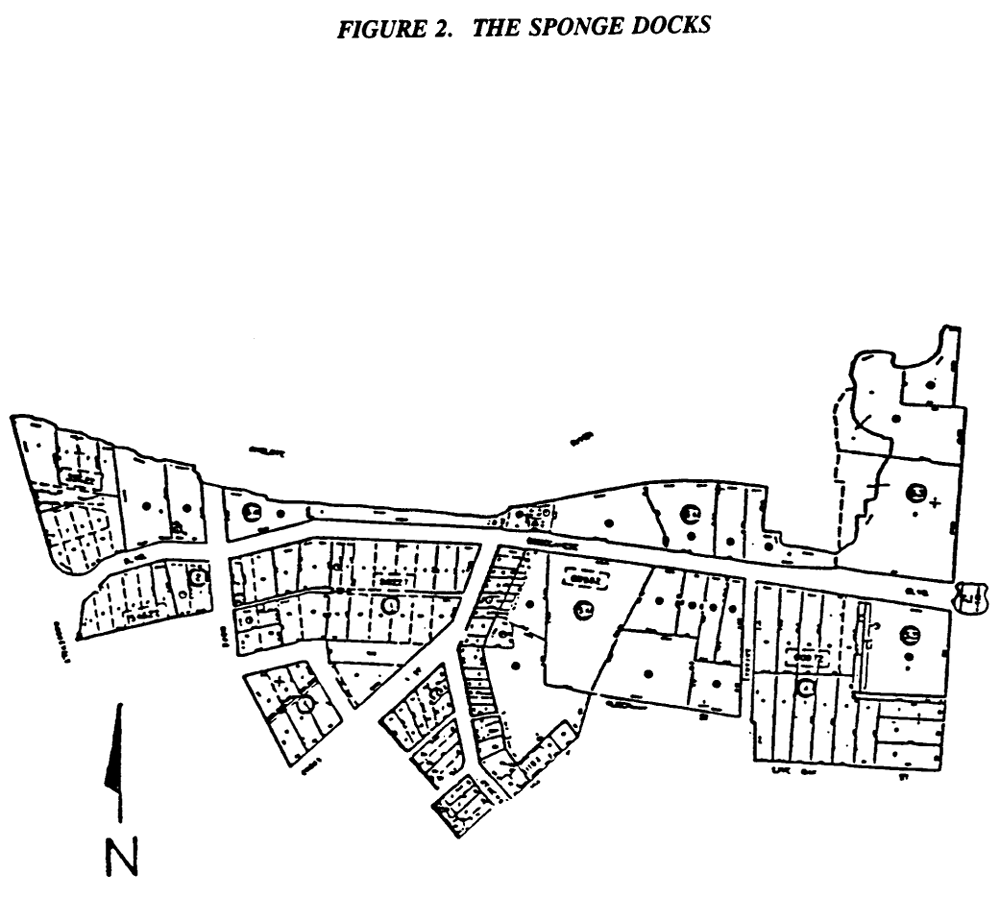
FIGURE 2. THE SPONGE DOCKS
§ 127.06 - Parking Lot Traffic Control Signage and Lighting Design Standards.
(A)
The design for parking lot traffic control signage shall be as shown in Figure 1 below and shall meet the following standards:
(1)
Sign posts shall be black or dark green in color.
(2)
Sign posts shall be round or fluted in shape.
(3)
Sign posts shall be at least three inches in diameter.
(4)
Sign posts shall have a round or fluted decorative base.
(5)
Signs shall have a black or dark green boarder of at least one inch in width. Signs identifying individual parking spaces are exempt from this requirement.
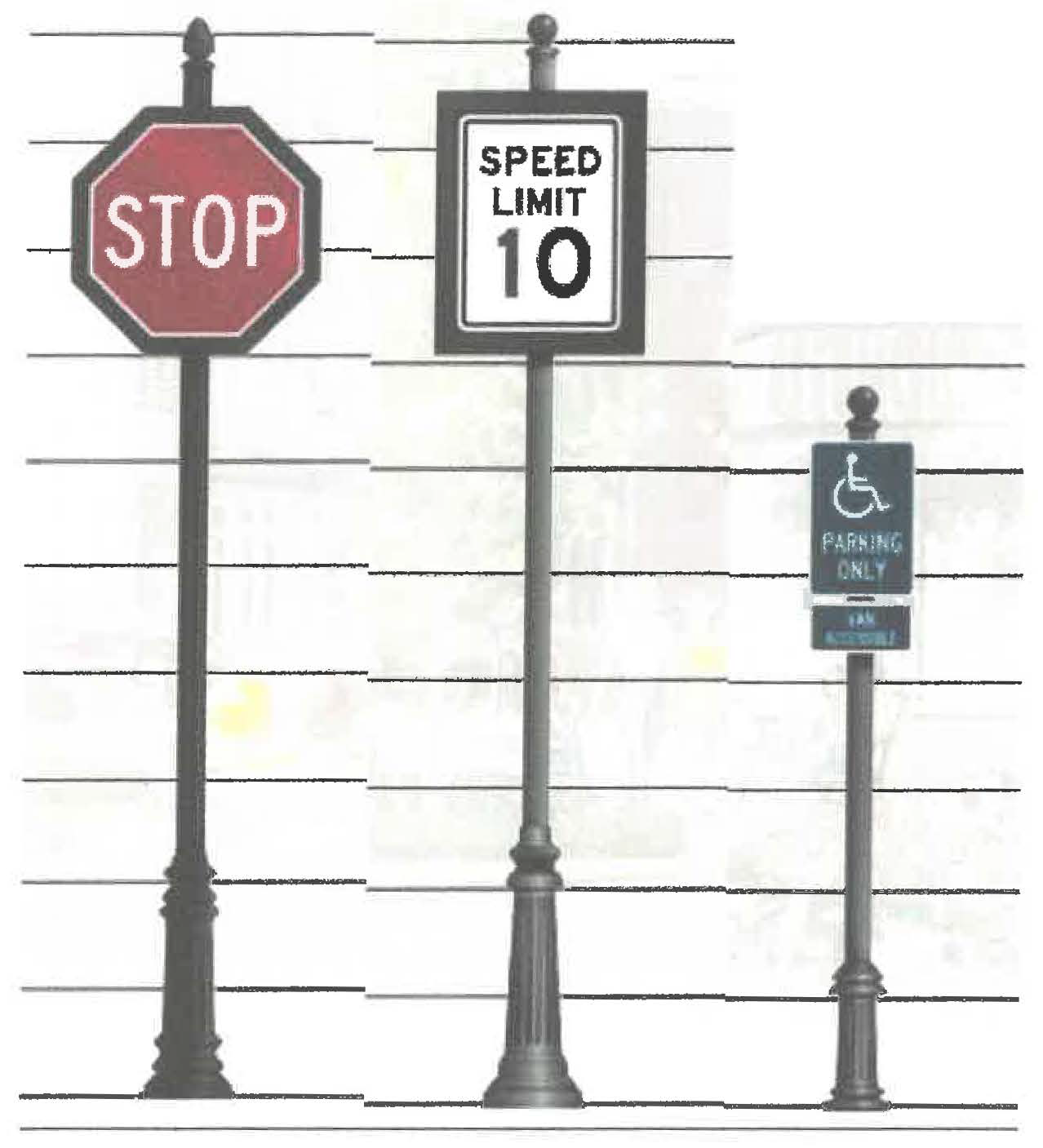
Figure 1
(B)
The design for parking lot lighting shall be substantially similar to those shown in Figure 2 below or shall meet the following design standards:
(1)
Light posts shall be black or dark green in color.
(2)
Light posts shall be either round or fluted in shape.
(3)
Light posts shall have a round or fluted decorative base.
(4)
Light fixtures shall be directed downward.
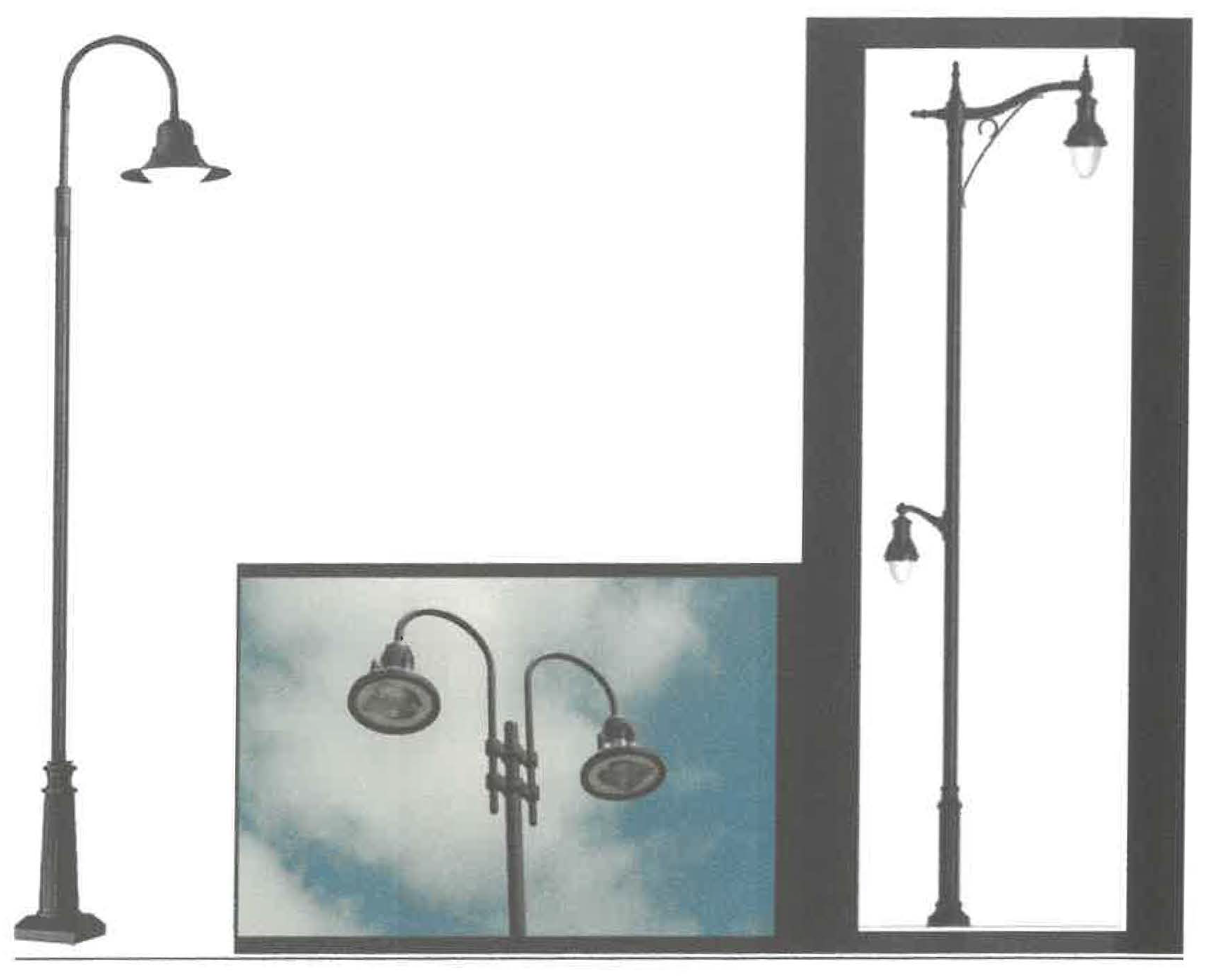
Figure 2
(C)
Parking lot traffic control signage and lighting shall meet the Manual on Uniform Traffic Control Devices (MUTCD) standards and shall be installed to the specifications of the City Engineer, or designee.
(D)
Parking lot traffic control signage and lighting serving industrial uses, excluding those located within any SAP (Special Area Plan) zoning district, shall be exempt from the design requirements of Section 127.06(A) and Section 127.06(B).
(E)
All parking lot traffic control signage and lighting located within the City's historic district shall additionally undergo review as required in Article VII, Heritage Preservation, of this code.
(Ord. 2020-40, passed 3-9-21)
§ 128.00 - OFF-STREET LOADING.
(A)
All structures built or expanded after the effective date of this Code shall provide off-street loading in accordance with the requirements established herein.
(B)
All required off-street loading spaces shall be located on the same lot as the use served.
(C)
Minimum Size
Minimum Width: 15 feet
Minimum Length: 35 feet
Minimum Vertical Clearance: 14 feet
The minimum size requirements shall be exclusive of aisle and maneuvering space.
(D)
All required loading shall be marked on the pavement by diagonal striping.
(Ord. 90-10, passed 5-1-90; Am. Ord. 93-33, passed 10-19-93)
§ 128.01 - Loading Schedule.
(A)
Commercial or Industrial Uses
(B)
Hotel or Motel
1 space per 200 units
(C)
Community Service Uses
1 space for the first 10,000 square feet plus 1 space for each 100,000 square feet or major fraction thereof.
(D)
The following minimum turning paths shall be provided:
(1)
A minimum turning radius of 26 feet for vans and passenger vehicles.
(2)
A minimum turning radius of 43 feet for a 30 foot single unit truck, step van, or bus.
(3)
A minimum turning radius of 40 feet for a 43 to 50 foot semitrailer combination.
(4)
A minimum turning radius of 46 feet for a 55 foot semitrailer combination.
(Ord. 90-10, passed 5-1-90; Am. Ord. 93-33, passed 10-19-93)
§ 129.00 - DRIVEWAY AND ACCESS MANAGEMENT.
(A)
No driveway shall be constructed, improved, or modified without a permit issued by the City Engineer, Pinellas County, or FDOT; whichever agency has jurisdiction.
(B)
All driveways shall be designed and constructed in accordance with the requirements of the City Engineer, this Code, and any other agency with jurisdiction.
(C)
Each development shall be permitted 1 driveway per street frontage provided the following additional requirements shall also apply:
(1)
One and two family dwellings, residential living facilities, and day care centers may have circular drives or a second driveway. The total width shall be calculated as a percentage of the lot width. One and two family residences with lot widths of greater than 50 feet, measured at the edge of the right-of-way, shall not exceed the lesser of 33% of lot width or 28 feet. One and two family residences with lot widths of 50 feet or less, measured at the edge of the right-of-way, shall be allowed a minimum of 18 feet.
(2)
A maximum of 1 additional driveway per street frontage may be permitted for residential development in excess of 50 units and nonresidential development with an excess of 200 linear feet of street frontage.
(3)
Each residential development in excess of 50 units shall provide a secondary means of access where feasible.
(D)
The allowable driveway width for two-way traffic measured at the edge of the intersecting right-of-way line shall be as follows:
The City Manager is authorized to reduce a proposed driveway width based upon existing or proposed utilities, trees, or other site conditions.
(E)
The construction of all driveways within public right-of-way shall comply with the following minimum criteria:
(1)
Subgrades shall be compacted to 95%;
(2)
3000 p.s.i. concrete shall be required; and
(3)
The concrete shall be 6 inches thick and reinforced by 6 inch by 6 inch by 10 gauge wire mesh.
(F)
The minimum curb return radius for multifamily and nonresidential uses shall be 15 feet on local streets and 25 feet on collector or arterial streets.
(G)
Driveways shall align with driveways on the opposite side of the street or be separated by a minimum distance of 20 feet, measured at the right-of-way line.
(H)
The minimum separation for driveways on the same side of the street, measured at the right-of-way line, shall be as follows:
(1)
From the property line:
One and two family residential except that the radii of driveways shall not encroach beyond the extended property line—3 feet
Local streets (all other uses)—15 feet
Collector/arterial streets (all other uses)—30 feet
(2)
From other on-site driveways:
One and two family dwellings, residential living facilities, and day care centers—10 feet
Local streets (all other uses)—30 feet
Collector/arterial streets (all other uses)—60 feet
(I)
Driveways shall be located as far as possible from intersections on either side of the street. The minimum separation, measured from the extended right-of-way line of the intersection to the edge of the driveway along the right-of-way line of the intersecting side street shall be as follows:
One and two family residential—20 feet
Local streets (all other uses)—40 feet
Collector/arterial streets (all other uses)—75 feet
(J)
Where sufficient frontage and geometrics exist the City Engineer may require the installation of the following access improvements:
(1)
Right turn deceleration lanes where the posted speed limit is 35 mph or greater and 40 or more entering right turns occur during the peak hour.
(2)
Right turn acceleration lanes where the posted speed limit is 35 mph or greater and 75 or more existing right turns occur during the peak hour.
(3)
Left turn storage where the driveway left turning movements exceed 1,000 trips per day.
(4)
All access improvements shall meet or exceed Pinellas County standards.
(K)
Left hand turning movements from driveways can be prohibited by the City Engineer through the use of channelization or signage where one or more of the following conditions exist:
(1)
Inadequate intersection separation.
(2)
Inadequate sight distance.
(3)
Alternative access to a signal is present.
(4)
Inadequate driveway spacing.
(5)
Other capacity, delay or safety conditions make left turns dangerous.
(L)
Provisions for joint access and circulation may be required by the City Engineer where necessary to minimize potential traffic congestion and safety hazards. A non ingress/egress easement may be required for new shopping centers to restrict direct driveway access from development outparcels where joint circulation is required. The development of outparcels at existing shopping centers shall not be permitted direct drive access, and shall utilize cross access and the use of existing shopping center drives for access.
(M)
A minimum cross access easement of 24 feet in width may be required by the City Engineer to adjoining property where necessary to provide for the free flow of traffic between uses without having to enter a street.
(N)
The driveway and access management requirements of this Code may be modified by the City Engineer to meet the needs of a specific situation where strict application of the requirement would be technically impractical due to existing conditions, property size, natural conditions, safety constraints, engineering/design/construction practices, or similar conditions.
(O)
Notwithstanding the driveway and access management requirements of this Code, all driveways onto a State or County maintained roadway must comply with FDOT or Pinellas County specifications. In all instances, the most restrictive governing requirement shall apply. Copies of approved utility permits from the agency with jurisdiction shall also be required.
(Ord. 90-10, passed 5-1-90; Am. Ord. 93-29, passed 11-16-93; Am. Ord. 93-33, passed 10-19-93)
§ 130.00 - RIGHT-OF-WAY RESERVATION AND DEDICATION.
(A)
All development orders which require site plan or subdivision plat approval shall reserve right-of-way in compliance with the right-of-way needs plan of the Traffic Circulation Element of the Comprehensive Plan.
(B)
The right-of-way needs required by the Traffic Circulation Element of the Comprehensive Plan may be modified for State and County roadways in accordance with the right-of-way plans, specific design requirements, construction plans, or recommendations of the Pinellas County Metropolitan Planning Organization, the Pinellas County Engineering Department, or the Florida Department of Transportation.
(C)
Generally, right-of-way shall be reserved for ½ the required right-of-way, to be measured from the right-of-way centerline, unless property on both sides of the affected right-of-way is the subject of a development order request.
(D)
The right-of-way to be reserved shall be reserved for future purchase for roadway use, and shall be kept free and clear of all associated private development improvements; including but not limited to parking, landscaping, drainage, signage, and structures.
(E)
Setbacks shall be measured from the edge of the right-of-way requirement.
(F)
Ownership of the reserved area shall be retained by the property owner.
(Ord. 90-10, passed 5-1-90; Am. Ord. 93-33, passed 10-19-93)
§ 130.01 - Dedications Required.
(A)
The City may, as a condition to the vacation of right-of-way, require the dedication by deed of additional right-of-way where necessary to implement the right-of-way needs plan of the Traffic Circulation Element or enhance ingress/egress in that specific situation.
(B)
The City may, as a condition to the approval of a site plan or subdivision plat require the dedication by deed of the additional right-of-way necessary to implement the right-of-way needs plan of the Traffic Circulation Element where a finding is made that the following rational nexus criteria is present:
(1)
The affected roadway is functioning below the acceptable level of service as defined by the Comprehensive Plan, and the increased traffic impacts related to the proposed development will further degrade the operating condition of the affected roadway, or the increased traffic impacts related to the proposed development reduce the level of service at which the affected roadway is currently operating; and
(2)
The improvement of the affected roadway or intersection is scheduled by the 5-year capital improvements plan of the responsible jurisdiction.
(Ord. 90-10, passed 5-1-90; Am. Ord. 93-33, passed 10-19-93)
§ 130.02 - Transportation Corridor Reservation Maps.
(A)
The Board of Commissioners may adopt maps of right-of-way reservation for any transportation corridor within the City's jurisdiction.
(B)
Any such maps shall delineate the limit of the transportation corridor and the proposed rights-of-way for the eventual widening or improvement of the facility within the proposed corridor.
(C)
Transportation Corridor Reservation Maps shall be recorded with the Clerk of the Court of Pinellas County.
(D)
Prior to adopting Transportation Corridor Reservation Maps the City shall advertise and hold a public hearing. All property owners of record within the limits of the proposed transportation corridor shall be notified by first class mail a minimum of 20 days prior to the date set for the public hearing. Ownership shall be determined from the latest available tax records of the Pinellas County Property Appraiser's Office. Minor amendments to an adopted Transportation Corridor Map which affect less than 5% of the total area within the transportation corridor may be made within 30 days after notifying by first class mail only the property owners directly affected by the change.
(E)
Upon recording of a Transportation Corridor Reservation Map, all required setbacks and construction shall be measured from the edge of the right-of-way shown by the Transportation Corridor Reservation Maps.
(F)
Upon recording of a Transportation Corridor Reservation Map, existing nonresidential structures which fall within the limits of the proposed right-of-way as shown by the Transportation Corridor Reservation Map may be renovated provided the cost of the renovation does not exceed 20% of the appraised value of the nonresidential structure according to the latest available tax records of the Pinellas County Property Appraiser's Office. The cost of the renovation shall be certified by a licensed contractor hired by the property owner.
(G)
Upon recording of a Transportation Corridor Reservation Map, no restriction shall be placed upon the renovation of an existing residential structure which falls within the limits of the proposed right-of-way as shown by a Transportation Corridor Reservation Map.
(H)
If the approval of any renovation or development is prohibited under this section, the City shall make an offer to purchase the reserved right-of-way for a particular parcel of land as shown by the Transportation Corridor Reservation Map within 90 days of receiving an application for development order approval. If no offer is made in 90 days or if the offer is not accepted within another 30 days, the City shall amend the map, withdraw the map, issue the development order if the application meets all other regulations, or file condemnation proceedings.
(I)
After recording, any property owner of record located within the limits of the proposed right-of-way as shown by the Transportation Corridor Reservation Map alleging that such property regulation is unreasonable or arbitrary and that its effect is to deny a substantial portion of the beneficial use of such property can petition for a hearing. Any petition for a hearing must submit a written statement as to the beneficial use of such property. Upon receiving a petition for hearing the City shall schedule a hearing before a Hearing Officer from and assigned by the Florida Department of Administrative Hearings. Upon issuance of an order from the Hearing Officer the City shall have 180 days from the date of the finding to acquire the property involved in the petition, to amend the map, withdraw the map, or file other appropriate proceedings. Should the City prevail in the order, the petitioner shall pay ½ the cost of the hearing.
(J)
A Transportation Corridor Reservation Map shall be effective for a period of 5 years from the date of recording. If the City has not acquired all of the right-of-way within the limits of the transportation corridor the City shall invalidate the maps for said corridor. However, the City shall have the right to extend the effective period of a Transportation Reservation Map for 1 additional 5 year period after holding a public hearing in accordance with the requirements of this section.
(Ord. 91-07, passed 3-20-91; Am. Ord. 93-33, passed 10-19-93)
§ 131.00 - STREETS.
(A)
Street right-of-way requirements shall conform to the Right-of-Way Reservation and Dedication Section and Subdivision Design Section of this Code, and the Traffic Circulation Element of the Comprehensive Plan.
(B)
The construction of all collector streets shall comply with Pinellas County Standards, and the construction of all arterial streets shall comply with Florida Department of Transportation Standards.
(C)
The construction of all local streets shall comply with the following minimum criteria:
(1)
All streets shall be of curb and gutter construction, except that the City Engineer may approve the use of swale drainage for subdivisions which serve residential lots of ½ acre or more.
(2)
The minimum pavement width, including curb and gutter, shall be 24 feet.
(3)
All streets shall be compacted with a stabilized subgrade, 9 inches compacted thickness with a minimum 75 pounds per square inch Florida Bearing Value. A compacted thickness of 12 inches is required for industrial streets.
(4)
All streets shall have a base of acceptable compacted and fully primed limerock. Soil cement or other equivalent base course material shall be approved by the City Engineer. Thickness shall be 6 inches for residential streets and 8 inches for industrial streets.
(5)
Stabilization shall extend 6 inches beyond the curb or 1 foot beyond all pavement edges where swale drainage is allowed.
(6)
Surface thickness shall be 1 and ½ inches for residential streets and 2 inches for industrial streets.
(7)
Pavement crown shall be ¼ inch per foot for two lane streets. Inverted crowns shall not be permitted.
(8)
Finish pavement shall be ¼ to ½ inch higher than the lip of the curb gutter.
(9)
Minimum pavement radius returns shall be 25 feet.
(10)
That area from the curb to the required right-of-way line shall be sodded or seeded to FDOT specifications.
(11)
All dead-end streets shall be provided with a minimum 70 foot diameter radius turn-around.
(12)
Minimum pavement elevation shall be 5.0 feet above mean sea level.
(D)
Private streets shall comply with the same minimum criteria as public streets.
(E)
Accommodations for bikeways shall be provided in accordance with the requirements of the City of Tarpon Springs Bicycle Plan.
(F)
Except as required in Section 131.00(C) hereof temporary streets shall be permitted if all of the following conditions are met:
(1)
Less than 4 dwelling units are simultaneously constructed on contiguous property.
(2)
The right-of-way is defined as a local street.
(3)
Such construction is not part of a larger or major operation in which a division of the operation is made for the purpose of evading Section 131.00(C) or otherwise.
(4)
The construction of all temporary streets shall comply with the following minimum criteria:
(i)
The pavement width shall be 20 feet.
(ii)
All temporary streets shall have a base of compacted lime rock, crushed concrete or other suitable material. Thickness shall be 6 inches.
(iii)
All temporary streets shall have a surface treatment of asphalt. Thickness shall be 1.5 inches.
(iv)
Drainage swales shall be constructed on both sides of the temporary street unless an alternate plan is approved by city staff.
(v)
The temporary street shall be constructed the entire length of the property and extend to the nearest paved right-of-way.
(5)
No building permit shall be issued for such dwelling units unless a temporary street is constructed by the permittee within the abutting public right-of-way. Such construction shall be at the permittee's expense, prior to the issuance of a certificate of occupancy therefor being issued, and no credit or reimbursement shall be given to the permittee, regardless of the benefits derived by other owners of property abutting such right-of-way.
(6)
Such minimum width shall be widened in the event that a vehicular turnaround is required for municipal vehicles and all other such similar service vehicles.
(7)
In no event shall the City maintain any temporary street not built in full compliance with the street construction requirements of Section 131.00(C) hereof.
(Ord. 90-10, passed 5-1-90; Am. Ord. 93-01, passed 2-2-93; Am. Ord. 93-33, passed 10-19-93; Am. Ord. 2006-05, passed 3-21-06)
§ 132.00 - SIDEWALKS.
(A)
As a condition of the issuance of a Certificate of Occupancy a sidewalk shall be constructed for the length of the site frontage along all abutting improved streets in accordance with the standards of this Section.
(B)
If a sidewalk pre-existed the development, the City Engineer shall require that it be repaired or replaced if it was damaged before or during construction, or if it does not comply with the requirements of this Code.
(C)
The construction of all sidewalks, shall comply with the following minimum criteria:
(1)
Subgrades shall be compacted to 95%;
(2)
3000 p.s.i. concrete shall be required;
(3)
The concrete shall be 4 inches thick, except that sidewalks which cross driveways shall be 6 inches thick and reinforced by 6 inch by 6 inch by 10 gauge wire mesh;
(4)
Sidewalks on corner lots or designated crosswalks shall extend to the curb or pavement edge and be ramped for handicap access;
(5)
Sidewalks shall be located 1 foot from the outside edge of the required right-of-way line;
(6)
Sidewalks shall be 4 feet wide on local streets and at least 5 feet wide on all collector or arterial streets.
(D)
Pedestrian easements shall be required where necessary to provide access to schools, parks, shopping centers, transportation and other community facilities. Pedestrian ways shall have a minimum easement width of 15 feet where an easement is required, and a paved walkway of 6 feet in width.
(Ord. 90-10, passed 5-1-90; Am. Ord. 93-33, passed 10-19-93; Am. Ord. 2000-03, passed 3-7-00)
§ 132.01 - Sidewalk Waiver.
(A)
The Development Services Director or his or her designate shall permit the waiver of sidewalk construction where the development order is for repair or remodeling which constitutes an improvement valued at less than 20% of the current appraised value of the property.
(B)
The Board of Adjustment, after consideration of all pertinent conditions, shall waive the requirement of sidewalk construction if:
(1)
The need for the requested variance arises out of the physical surroundings, shape, topographical conditions, or other physical or environmental conditions that are unique to the specific property involved, and which do not apply generally to property located in the same zoning district; and
(2)
The conditions or special circumstances peculiar to the property have not been self-created or have resulted from an action by the applicant or with prior knowledge or approval of the applicant.
(C)
The Board of Adjustment shall permit the waiver of sidewalk construction where one or more of the following conditions exist:
(1)
The existing right-of-way is of insufficient width to allow the installation of a sidewalk, and additional right-of-way is not required under this Code;
(2)
The existing right-of-way is unimproved or not paved, and construction of the street is not included in the responsible jurisdictions 5 year capital improvements plan;
(3)
Where strict application of the requirement would be technically impractical in terms of engineering design due to existing natural conditions related to topography or the environment;
(4)
The Board of Adjustment shall not consider the non-presence of other sidewalks in the neighborhood as justification to grant the waiver.
(D)
The Planning Director may waive the requirement for sidewalk construction where the approval of a Planned Development project by the Board of Commissioners includes the construction of an alternative pedestrian system.
(Ord. 90-10, passed 5-1-90; Am. Ord. 93-32, passed 12-7-93; Am. Ord. 93-33, passed 10-19-93; Am. Ord. 2013-19, passed 9-17-13)
§ 132.02 - Contributions to the "Sidewalk Trust Fund" in Lieu of Constructing a Sidewalk.
(A)
If a sidewalk is required under subsection 132.00 of this Code, but the construction of the sidewalk is determined to be not practical (i.e., lack of adjoining sidewalks, no plans for the City to construct sidewalks within the next 5 years, etc.), then the property owner or applicant shall make a contribution to the "sidewalk trust fund" in lieu of constructing the required sidewalk. The amount of the contribution shall be determined by multiplying the linear feet of that parcel's street frontage(s) (minus the width of any paved driveway and/or driveway apron) times the per linear foot contribution fee established pursuant to section 132.03 of this Code.
(B)
The decision of whether the construction of a sidewalk on a parcel is "not practical" shall be made by the Development Services Director or his/her designee. In making such a decision, the Development Services Director or his/her designee shall consider the following factor(s):
(1)
Whether there is no existing sidewalk to which the proposed sidewalk can connect and it is unlikely that there will be additional development nearby which will require the construction of additional sidewalk(s) (if the parcel terminates at a street intersection and a sidewalk is located across the street, then a sidewalk will be required to connect with the sidewalk located across the street).
(C)
In the event the property owner or applicant does not want to pay the fee or believe they have a hardship that meets the criteria contained in subsection 132.01(C), they may apply to the Board of Adjustment for a sidewalk waiver. If the sidewalk waiver is granted by the Board of Adjustment, no payment to the Sidewalk Trust Fund or sidewalk construction is necessary.
(D)
Contributions to the sidewalk trust fund in lieu of construction shall be limited in application to the simultaneous construction of 3 or fewer lots.
(Ord. 2013-19, passed 9-17-13)
§ 132.03 - Sidewalk Trust Funds.
(A)
There is hereby established a sidewalk trust fund for the City of Tarpon Springs. The sidewalk trust funds shall be used for the deposit, maintenance and distribution of all monetary contributions made in lieu of constructing a sidewalk pursuant to subsection 132.02 of this Code. All contributions made pursuant to subsection 132.02 of this Code shall be monetary payments into the sidewalk trust fund. All contributions made to and interest derived from the sidewalk trust fund shall be used solely for the purpose of constructing and replacing sidewalks along or on public streets in the City of Tarpon Springs.
(B)
The sidewalk trust fund fee shall be established on a biennial basis by Board of Commissioners resolution. The fee shall be set on per linear foot of street frontage basis and shall be calculated as 1.25 times the average of the city's sidewalk construction costs, including labor costs, on a per linear foot of street frontage basis.
(Ord. 2013-19, passed 9-17-13)
§ 133.00 - TREE PROTECTION AND PRESERVATION.
(A)
The purpose of §§ 133.00 through 133.10 is to establish regulations in the City of Tarpon Springs that will have the effect of protecting, promoting and maintaining a healthy, diverse and mature canopy of native and naturalized hardwood and evergreen tree species. Trees preserve the ecological balance of the environment, control erosion, sedimentation and stormwater runoff, provide shade, reduce heat and glare, reduce flooding, enhance property values and aesthetics, abate noise pollution, and buffer incompatible land uses. To that end, it shall be unlawful to cut down, damage, poison, or in any other manner, destroy or cause to be destroyed any trees, except in accordance with the provisions of the tree protection requirements of the Tarpon Springs Code. Sections 133.00 through 133.10 establish regulations applicable to the development and redevelopment of property and the maintenance of existing vegetation.
(B)
The intent of §§ 133.00 through 134.09 is to protect the general health, safety, and welfare of the citizens of Tarpon Springs by establishing minimum standards for the protection and preservation of trees, ensure the adequacy of tree numbers, preserve the canopy, encourage the planting of new trees, the protection of natural plant communities, and the installation and continued maintenance of landscaping within the City of Tarpon Springs in order to:
(1)
Improve the aesthetic appearance of commercial, governmental, industrial, and residential areas through the incorporation of landscaping into development in ways that harmonize and enhance the natural and manmade environment;
(2)
Improve environmental quality by recognizing the numerous beneficial effects of tree protection and preservation, and landscaping upon the environment, including:
(a)
Improving air and water quality through such natural processes as photosynthesis and mineral uptake;
(b)
Maintaining permeable land areas essential to surface water management and aquifer recharge, including reduction in stormwater runoff;
(c)
Reducing and reversing air, noise, heat and chemical pollution, including the removal of atmospheric carbon dioxide, through the biological filtering capacities of trees and other vegetation;
(d)
Promoting energy conservation through the creation of shade, thereby reducing heat gain in or on buildings or paved areas;
(e)
Reducing the temperature of the microclimate through the process of evapotranspiration; and
(f)
Encouraging the conservation of water through the use of site specific plants, various planting and maintenance techniques, and efficient watering systems.
(3)
Provide direct and important physical and psychological benefits to human beings through the use of landscaping to reduce noise and glare, and to break up the monotony and soften the harsher aspects of urban development;
(4)
Establish procedures and standards for the administration and enforcement of these sections;
(5)
Promote the creative site development concepts in order to promote water and energy conservation;
(7)
Preserve existing natural trees and vegetation and incorporate native plants, plant communities and ecosystems into landscape design where possible; and
(8)
Promote landscaping methods that provide for the preservation of existing plant communities, re-establishment of native plant communities, use of site specific plant materials, use of pervious paving materials and other xeriscape concepts in order to promote water conservation.
(Ord. 90-10, passed 5-1-90; Am. Ord. 93-33, passed 10-19-93; Am. Ord. 2006-17, passed 7-18-06)
§ 133.01 - Definitions.
[For the purpose of §§ 133.00 through 133.10 the following definitions shall apply, unless the context clearly indicates a different meaning:]
(A)
City Staff means those persons designated by the City Manager.
(B)
Crown means the main mass of branching or foliage of a tree.
(C)
Development means any development or redevelopment that involves a proposed material change in the use or character of the land, including, but not limited to, land clearing associated with new construction, the placement of any structure or site improvement on the land, or expansion of existing buildings.
(D)
Development Permit means any building permit or site plan approval authorizing the construction of any new parking space, the expansion of the gross floor area of a building, the alteration or enlargement of a building envelope, or the alteration of a site configuration through site redesign (right-of-way clearing, easement clearing, mining, borrow pit or lake construction, etc.) or other changes (including grubbing).
(E)
Diameter Breast Height ("DBH") means the diameter, in inches, of a tree measured at 4.5 feet above the existing grade. If the tree forks between four and one-half and two feet above ground level, DBH is measured below the swell resulting from the fork. Trunks that fork below two feet, shall be considered multi-trunk trees. DBH for multi-trunk trees shall be determined by measuring each trunk immediately above the fork and adding the total diameters of the four largest trunks.
(F)
Drip Line means an imaginary, perpendicular line that extends downward from the outermost tips of the tree branches to the ground.
(G)
Ecosystem means a characteristic assemblage of plant and animal life with a specific physical environment, and all interactions among species and between species and their environment.
(H)
Grubbing means the removal of any type of rooted vegetation from land by digging, raking, dragging or otherwise disturbing the roots of such vegetation and the soil in which such roots are located.
(I)
Mangrove means any or all of the following species of aquatic woody plants:
Red mangrove—Rhizophora mangle;
Black mangrove—Auicennia nitida or auicennia germinans;
White mangrove—Laguncularis racemosa; and
Buttonwood or button mangrove—Conocarpus erecta.
(J)
No Tree Verification means a signed notarized statement by the owner of a piece of property, or his agent, stating that no trees exist upon the site.
(K)
No Tree Removal Verification means a signed notarized statement by the owner of a piece of property, or his agent, upon application for a development permit certifying that although protected trees exist on the site for which building permit is sought, their removal is not required for construction purposes.
(L)
Plant Community means a natural association of plants that are dominated by one or more prominent species, or a characteristic physical attribute.
(M)
Protective Barrier means a physical structure limiting access to a protected area, composed of wooden and/or other suitable materials which assures compliance with the intent of the tree protection requirements of this Code.
(N)
Protected Tree means any tree having a DBH of 4 inches or greater that is not specifically excluded from protection herein. For the purpose of §§ 133.00 through 133.10, all mangroves Sabal Palms, and Cabbage Palms shall be classified as a protected tree.
(O)
Shade Tree means a hardwood tree that reaches a minimum height of twenty-five (25) feet at maturity, provides relief from direct sunlight for at least six (6) months each year and is included in the tree list recommended by staff.
(P)
Single-Family Residential Lot means a lot in single ownership designed for not more than one family, and is not a part of a series of 3 or more vacant lots or parcels sharing continuous street frontage under unified ownership.
(Q)
Top or Topping means the removal of any portion of one or more major vertical tree branches or the removal of more that one third (⅓) of the tree's leaf canopy.
(R)
Tree means any erect standing woody plant together with its root system of a species which normally attains a minimum overall height at maturity of at least 15 feet in the Tarpon Springs service area, including all mangroves Sabal Palms, and Cabbage Palms.
(S)
Tree Removal means any act which causes a tree to die within a period of 2 years; such acts include, but are not limited to, cutting, inflicting damage upon a root system by machinery, storage of materials, or soil compaction, changing of the natural grade above or below a root system or around the trunk, inflicting damage on a tree, permitting infection of pest infestation, excessive pruning, or paving with concrete, asphalt or other impervious material within such proximity as to be harmful to a tree.
(T)
Tree Survey means an aerial photograph or drawing to scale (one inch equals 100 feet or smaller ratio) which must be easily legible and provides the following information plotted by accurate techniques:
(1)
Location of all trees protected under the provisions of §§ 133.00 through 133.10;
(2)
Common names of all trees; and
(3)
DBH of each tree.
(Ord. 90-10, passed 5-1-90); Am. Ord. 93-33, passed 10-19-93; Am. Ord. 2006-17, passed 7-18-06)
§ 133.02 - Applicability and Maintenance of Trees for all Properties within the City.
(A)
The terms and provisions of this section shall apply to real property within the limits of the City.
(B)
Owners of private property are responsible for the maintenance of trees on private property and in abutting rights-of-way unless otherwise provided in 133.00 through 133.10 of this Code. Where support staking and guying of vegetation is provided at the time of installation, the stakes and guys shall be removed no later than one year after installation to prevent damage to the vegetation. Owners of private property who are responsible for the maintenance of trees on private property and in abutting rights-of-way shall not be required to pay to remove and replant any tree that they can prove by substantial competent evidence was fatally damaged by any public utility company or as is otherwise provided in §§ 133.00 through 133.10 of this Code.
(C)
Trees shall be maintained by the owner, tenant or their agent in good condition so as to present a healthy, neat and orderly appearance. All plant materials shall be maintained free from physical damage or injury arising from lack of water, chemical exposure, insects, disease, blight or other cause. Exceptions regarding damage due to lack of water shall be made when water consumption is limited by emergency orders or declarations by state or local agencies.
(D)
Except for those tree species listed as exempt, or following a declared state of emergency in which trees become damaged in such a way that topping or excessive pruning by or at the direction of a governmental agency becomes necessary, it shall be unlawful for any person to cut down, damage, top, poison or in any manner destroy or cause to be destroyed any tree regardless of condition with a DBH of 4 inches or more without a permit. Not more than one-third of the tree canopy shall be trimmed or pruned in any year unless it is dead. There shall be no "topping" of any trees. Topped trees and trees destroyed by improper trimming shall be replaced with the same species minimum one-inch DBH and with a number of trees equivalent to the total inches DBH of the topped or destroyed trees.
(E)
The City finds that mangroves, including Red Mangroves, Black Mangroves and White Mangroves, are an essential component of the estuarine food chain, supporting the commercial and recreational fisheries located around Tarpon Springs. The City is bound by any preemptive State legislation regarding mangroves. However, in so far as the City can regulate mangroves then the trimming, cutting or Removal of mangroves is hereby prohibited.
(F)
It is unlawful for any person to permit to remain on any property, owned or occupied by such person, including the abutting rights-of-way, any tree or tree branch that is in such diseased or dead condition so as to be in danger of falling upon any right-of-way or the property of another.
(G)
It shall be unlawful to dispose of tree trimmings in the right-of-way or on the property of another or upon any street or alley or into waters within the City or directly or indirectly into the municipal storm sewer system. This Subsection shall not be construed to prohibit the placement of tree trimmings in the right-of-way as a temporary measure awaiting collection as otherwise provided in the City Code or Regulations. This subsection shall not be construed to prohibit the use of mulching lawn equipment.
(Ord. 90-10, passed 5-1-90; Am. Ord. 93-33, passed 10-19-93; Am. Ord. 95-34, passed 11-21-95; Am. Ord. 2006-17, passed 7-18-06; Am. Ord. 2015-11, passed 5-5-15)
§ 133.03 - Exemptions.
(A)
The provisions of §§ 133.00 through 133.10 shall not apply to the transplant of a tree on platted lots or tracts of land less than 1 acre in size where a valid Certificate of Occupancy is in effect.
(B)
The provisions of §§ 133.00 through 133.10 shall not apply to a tree under 4 inches DBH.
(C)
The provisions of §§ 133.00 through 133.10 shall not apply to the trimming of trees as normal maintenance, provided such trimming does not result in mutilation, death, or removal of the tree or otherwise violates § 133.02(D) herein.
(D)
The provisions of §§ 133.00 through 133.10 shall not apply to the following exempt trees under §§ 133.00 through 133.10:
Due to their status as exotic species or invasive species, the following tree species may be removed from private property without a permit and shall not be used to meet the trees required by §§ 133.00 through 133.10:
Acacia, Acacia spp.
Australian pine, Casuarina equisetifolia (Australia).
Avocado, Persea americana (American tropics).
Brazilian pepper, Schnius terebinthifolius (Brazil).
Cherry Laurel, Prunus caroliniana.
Chinaberry, Melia azedarach (SW Asia).
Chinese Tallow, Sapium sebiferum. (Asia).
Citrus, Rue family: orange, lemon, lime, kumquat, grapefruit (East Asia).
Ear, Enterolobium cyclocarpum (Central America).
Eucalyptus, Eucalyptus spp. except silver dollar variety (Australia).
Ficus, Ficus spp. except banyan (South America).
Italian cypress, Cupressus bempervirens (South Europe).
Jacaranda, Jacaranda Acutifolia (Brazil).
Jerusalem thorn, Parkinsonia aculeata (Central America).
Loquat, Eriobotrya japonica (China).
Mango, Mangifera indica (India).
Monkey Puzzle tree, Araucaria spp. (Australia).
Norfolk Island pine, Araucaria excelsa (Norfolk Island).
Orchid, Bauhinia spp. (India).
Palms, except Cabbage Palm, Sabal Palm, Palmetto, and Royal Palm.
Palm, Roystonea spp.
Poinciana, Poinciana spp. (Madagascar).
Punk, Melaleuca quinquenervia (Australia).
Silk Oak, Grevillia robusta (Australia).
Toog, Bischofia javanica (Africa).
Woman's Tongue, Albizia spp. (Asia)
(E)
It shall be unlawful to plant or cause to be planted within the City limits the following exotic and nuisance plant species: Brazilian Pepper tree (Schinus terebinthifolius), Punk tree (Melaleuca quinquenervia), Australian pine tree (Casuarina equisetifolia), Chinese Tallow (Sapium sebiferum).
(F)
All Brazilian Pepper trees (Schinus terebinthifolius) shall be removed during the site construction process. A site inspection will be conducted to ensure that all Brazilian Pepper trees (Schinus terebinthifolius) have been removed. After the issuance of the certificate of occupancy, re-growth of Brazilian Pepper trees (Schinus terebinthifolius) shall be controlled in perpetuity by the property owner.
(Ord. 90-10, passed 5-1-90; am. Ord. 91-30, passed 7-16-91; Am. Ord. 93-33, passed 10-19-93; Am. Ord. 2006-17, passed 7-18-06)
§ 133.04 - Permit Required.
(A)
Except for those tree species listed as exempt or following a declared state of emergency in which trees become damaged in such a way that topping or excessive pruning by or at the direction of a governmental agency becomes necessary, it shall be unlawful for any person, without first obtaining a permit as provided herein, to cut down, damage, top, poison replace, replant, or effectively remove through excessive injury, or in any manner destroy or cause to be destroyed ("Remove") any Protected Tree with one or more stems (trunks), four (4) inches or more in diameter at DBH, or to Remove any mangrove variety, Cabbage Palm, or Sabal Palm no matter what size.
(B)
Any person wishing to obtain a permit to Remove a tree as required under the provisions of §§ 133.00 through 133.10 shall make application to the City by filing a written application and paying the fee established by this Code necessary to cover the cost of processing such applications.
(C)
Where no Development Permit is required the tree permit application shall contain the following minimum information:
(1)
A drawing showing the following:
(a)
The shape and dimensions of the lot or parcel;
(b)
The location of existing structures and improvements;
(c)
The location of all trees to be removed, identified by botanical or common name;
(d)
Any proposed tree replacement program;
(e)
Any additional information deemed necessary by the City Engineer, or his designee; and
(f)
DBH of each tree to be removed.
(2)
A statement as to why the tree(s) are to be removed.
(D)
Where a Development Permit is required the tree permit application shall contain the following minimum information:
(1)
A topographic survey signed and sealed by a registered Engineer, Architect, or Surveyor and Tree Survey signed by an ISA certified arborist showing the following:
(a)
Location of all trees protected under the provisions of §§ 133.00 through 133.10, common names of all trees, and DBH of each tree;
(b)
The location of all proposed structures, driveways, parking areas, and other improvements;
(c)
The designation of all trees to remain, and all trees to be removed or replaced;
(d)
Proposed grade changes which might adversely effect or endanger only trees, with specifications on how to maintain trees;
(e)
The size of all tree canopies.
(2)
A copy of the approved site plan;
(3)
A statement as to why the tree(s) is(are) to be removed;
(4)
A statement showing how trees not proposed for removal or relocation are to be protected during land clearing and construction; and
(5)
A statement of intent to physically replace required trees on the site or submit a written request for optional participation to the City Tree Bank, as further outlined in § 133.06 hereof.
(E)
The City Staff shall have the authority to not process an application for tree removal where a development permit is necessary until site plan approval has been granted.
(F)
Prior to the issuance of a tree removal permit, the City Staff shall conduct an on site inspection.
(G)
Prior to the removal of any tree(s) the City Staff shall inspect the site for the execution and placement of proper protective barriers in accordance with the requirements of § 133.07.
(Ord. 90-10, passed 5-1-90; Am. Ord. 93-33, passed 10-19-93; Am. Ord. 2006-17, passed 7-18-06)
§ 133.05 - Permit Criteria.
(A)
In reviewing an application for tree removal the City Staff shall base the decision to grant or deny said permit upon the following criteria:
(1)
Necessity to remove trees which pose a safety hazard to pedestrians or vehicular traffic, threaten to cause disruption of public services, or which pose a safety hazard to persons or buildings;
(2)
Necessity to remove diseased trees or trees weakened by age, storm, fire or other injury;
(3)
Necessity to observe good forestry practices;
(4)
Necessity to remove trees in order to construct proposed improvements as a result of:
(a)
Need for access immediately around the proposed structure for construction equipment;
(b)
Need for access to the building site for construction equipment;
(c)
Essential grade changes;
(d)
Surface water drainage and utility installations; or
(e)
Location of driveways, buildings or other permanent improvements;
(5)
The extent to which the area would be subject to increased water runoff and other environmental degradation due to removal of the trees;
(6)
The need for visual screening in transitional areas, or relief from glare, blight, commercial or industrial ugliness or any other aesthetic affront in the area;
(7)
The desirability of preserving any tree by reason of its size, age, or some other outstanding quality, such as uniqueness, rarity or status as a landmark species or the fact that it is a Champion or Specimen tree;
(8)
Whether the removal of tree(s) will significantly reduce available habitat for wildlife existence and reproduction or result in the emigration of wildlife from adjacent or associated ecosystems; or
(9)
It is in the welfare of the general public that the tree(s) be removed for a reason(s) other than set forth above.
(B)
The City Staff, upon a determination that an application is to be denied, shall state the basis for such denial specifically and shall notify the applicant in writing of the criteria upon which said denial is predicated.
(Ord. 90-10, passed 5-1-90; Am. Ord. 93-33, passed 10-19-93; Am. Ord. 2006-17, passed 7-18-06)
§ 133.06 - Permit Conditions.
(A)
As a condition of granting the permit, the City Staff shall require the replacement of the tree(s) to be removed as outlined below.
(B)
The replacement tree(s) shall be a minimum of 1 and ½ inch in diameter measured 12 inches above ground with a minimum crown of 2 feet and a minimum height of 6 feet upon planting, being grade Florida #1 or better, and shall come from the list of species authorized under the landscaping requirements of this Code.
(C)
The City Staff shall also have the authority to attach additional conditions to said permit, or require replacement trees in excess of the minimum criteria, where the removal characteristics or site conditions warrant, to further the intent of this Code. City Staff may also prescribe which plants of the permitted plant choices would be appropriate to the conditions of the site.
(D)
Any and all tree removal permits issued by the City of Tarpon Springs shall expire within six (6) months of the permit approval date. Any tree removal after the expiration of a permit requires a new application under the terms of §§ 133.00 through 133.10.
(E)
Trees removed under the provision of this Code shall be replaced as follows: One DBH inch for each DBH inch removed or a fee in lieu thereof shall be paid. Replacement trees shall be of a size as outlined in Section 133.06 (B). If replacement trees are installed on commercial properties, the applicant shall guarantee the survival of the replacement trees and a follow-up, on site inspection by City Staff at yearly intervals for five (5) years after planting may be conducted to ensure compliance. Failure to comply with these provisions will subject the applicant to penalties under this Code and all applicable civil penalties. Fees collected in lieu of replacement shall be placed in a fund established as the City Tree Bank. Such fees are established as follows:
(1)
Individual single-family residential lots presently occupied by the owner:
(a)
4 inch to less than 10 inch DBH, $10.00 per inch removed.
(b)
10 inch to less than 20 inch DBH, $20.00 per inch removed.
(c)
20 inch to less than 30 inch DBH, $40.00 per inch removed.
(d)
30 inch and greater DBH, $50.00 per inch removed.
(2)
All other developments or properties:
(a)
4 inch to less than 8 inch DBH, $25.00 per inch removed.
(b)
8 inch to less than 15 inch DBH, $50.00 per inch removed.
(c)
15 inch to less than 25 inch DBH, $75.00 per inch removed.
(d)
25 inch and greater DBH, $100.00 per inch removed.
(3)
Where the tree is a Sabal Palmetto (Cabbage Palm or Sabal Palm), it shall be replaced by one DBH inch of like palm species for each DBH inch removed, or by one DBH inch of shade/canopy tree for the three or fraction thereof DBH inches removed, or, in lieu of replacement, a fee of $10.00 per DBH inch removed shall be collected.
(F)
The City Manager, or his/her designee, shall waive the requirements for replacement described in this section if one or more of the following conditions is found by the City Manager or designee to exist:
(1)
The tree is diseased or injured to the point it will ultimately expire and no reasonable remedy exists;
(2)
The tree is in immediate danger of falling and no economically practicable remedy exists;
(3)
The tree is significantly endangering existing structures so that its continued presence will ultimately cause damage and no economically practicable remedy exists;
(4)
In the City's professional opinion the tree is substantially endangering existing pavement or utility services in a manner that threatens to damage property or life;
(5)
The tree creates unsafe visibility which pruning will not rectify; or
(6)
It is found by the City to be in the interest of the general public's health, safety and welfare that the trees be removed.
(7)
The tree or tree cluster is less than 19 inches DBH, is located within the primary building pad, primary foundation line, swimming pool and swimming pool patio pad, or that portion of the driveway within 15 feet of the garage or carport entrance, and these structures cannot be relocated.
(G)
Tree Bank—When a tree or trees are to be removed in accordance with the permitting process outlined in this Code, the City may accept, as a donation, such trees for replanting on City property or for temporary planting at a tree farm for future City use. If such donation is accepted by the City, the property owner will pay a fee to cover the cost of relocation and care of said trees. The property owner will be credited DBH inch for DBH inch against the replacement requirements prescribed in Section 133.06. This provision shall not apply to trees that are being replanted or relocated on the owner's premises. Fees collected in lieu of tree replacement, as prescribed in Section 134.06 (E) will be used by the City to purchase or install trees for use on city property, for the use in a City sponsored reforestation program, for the payment of fees by the City to a landscape architect, for educating City Staff or the Public with regard to tree protection and preservation, for the removal of trees located within City rights-of-way when, upon application to and approval by the City Manager demonstrating same, such tree(s) are dead, diseased, or weakened by age, storm, fire or other injury and poses a safety hazard to persons, buildings, or vehicular traffic or threatens to cause a disruption in public services, or for such other services or programs as are appropriate for the administration of the City's Tree Protection and Preservation Ordinance. These trees may be for immediate use or they may be temporarily planted at a tree farm for future City use. No more than 50% of fees collected in lieu of tree replacement shall be used for anything other than the purchase or installation of trees for use on city property, or for the use in a City sponsored reforestation program.
(Ord. 90-10, passed 5-1-90; Am. Ord. 93-33, passed 10-19-93; Am. Ord. 2006-17, passed 7-18-06; Am. Ord. 2015-08, passed 5-5-15)
§ 133.07 - Tree Protection During Construction.
Development and redevelopment on parcels shall comply with the following tree protection requirements:
(A)
It shall be unlawful for any person in the construction of any structures or other improvements to place solvents, material, construction machinery, or temporary soil deposits within 6 feet or ⅔ of the drip line, as defined herein, whichever is greater, of any protected tree.
(B)
Before development, land clearing, filling or any land alteration, a permit shall be required and suitable protective barriers shall be erected by the developer. The Protective barricades shall be placed around all Protected Trees, and all other protected vegetation including wetlands during site clearing to create a protective radius and shall remain in place until land alteration, site clearing and construction activities are complete. Barricades for the protective radius shall be erected at a minimum distance of twenty (20) feet from the edge of the trunk of protected trees. These protective structures shall remain until such time as they are authorized to be removed by the City Staff or until the issuance of a final Certificate of Occupancy. Also, during construction, no attachments or wires shall be attached to any tree so protected. Wood or metal shall be utilized in the construction of barriers except in the following cases:
(1)
Road right-of-way or utility easements may be ribboned by placing stakes a maximum of 30 feet apart and tying ribbon, plastic tape, or rope from stake to stake along the outside perimeters of such areas to be cleared.
(2)
Large property areas separate from the construction or land clearing area into which no equipment will venture may also be barricaded as described in part (1) above.
(3)
Wetlands must include silt screens placed landward of the jurisdictional line in addition to other required barricades.
(C)
Installation of artificial barriers such as protective barricades, fences, posts or walls shall not destroy or irreversibly harm the root system of Protected Trees. Footers for walls shall end at the point where larger roots are encountered, and the roots shall be bridged. Post holes and trenches located close to Protected Trees shall be adjusted to avoid damage to major roots.
(D)
All roots to be removed during the site clearing phase shall be severed clean at the perimeter of the designated protective radius.
(E)
A two-inch layer of mulch shall be applied over the surface of exposed roots of Protected Trees during the site clearing phase.
(F)
A protective dry well and drainage/aeration system shall be provided where Protected Trees will be adversely affected by raising the grade.
(G)
A protective retaining wall shall be constructed at the perimeter of the protective radius around a Protected Tree where the Protected Tree will be adversely affected by lowering the grade.
(H)
All trimming of Protected Trees during development shall be done by an ISA certified Arborist.
(Ord. 90-10, passed 5-1-90; Am. Ord. 93-33, passed 10-19-93; Am. Ord. 93-36, passed 12-7-93; Am. Ord. 2006-17, passed 7-18-06)
§ 133.08 - Relationship to Building Permit.
(A)
No Building permit shall be issued without an approved Tree Removal Permit.
(B)
If there are no protected trees on site, an applicant for Building Permit shall submit a notarized statement of No Tree Verification.
(C)
If all protected trees that exist on a site proposed for development will not be removed, an applicant for Building Permit shall submit a notarized statement of No Tree Removal Verification.
(Ord. 90-10, passed 5-1-90; Am. Ord. 93-33, passed 10-19-93; Am. Ord. 2006-17, passed 7-18-06)
§ 133.09 - Enforcement.
(A)
The City Staff has the authority to withhold the final Certificate of Occupancy if the provisions set forth in §§ 133.00 through 133.10, including conditions of any permits issued, have not been complied with.
(B)
Whenever the City Staff determines that a violation of §§ 133.00 through 133.10 has occurred, the City Staff shall cause such violations to be corrected by complying with the following procedure:
(1)
Written Notice: Immediately issue written notice by personal delivery or certified mail to the alleged violator of the nature and location of the violation, specifying what remedial steps are necessary to bring the project into compliance. Such person shall immediately, conditions permitting, commence the recommended remedial action and shall have 2 working days after receipt of said notice, or such longer time as may be allowed by the City Staff, to complete the remedial action set forth in said notice.
(2)
Remedial Work and Stop Work Orders: If a subsequent violation occurs during the 2 working days, or if remedial work specified in the notice of violation is not completed within the time allowed, or if clearing, development of land, or any site alteration is occurring without a required permit, the City Staff shall issue a Stop Work Order immediately. Said Stop Work Order shall contain the grounds for its issuance, and shall set forth the nature of the violation. The Stop Work Order shall be directed not only to the person owning the land upon which the violation is occurring, but also shall be directed to the person or firm actually performing the physical labors of the development activity, directing him forthwith to cease and desist all or any portion of the work upon all or any geographical portion of the project, whichever is greater, except such remedial work as is deemed necessary to bring the violation into compliance.
(C)
Subsection (B) above shall not prohibit the City from enforcing §§ 133.00 through 133.10 by any other legal procedure including but not limited to the procedure provided by Chapter 2, Article VIII, §§ 2-160 through 2-170 of the Code of Ordinances for the City of Tarpon Springs.
(D)
For the willful removal of any tree in violation of this Code, the City Staff shall ensure that the proper permitting procedure is henceforth followed, charging 4 times the permit and replacement fees specified by this Code.
(E)
In any prosecution under §§ 133.00 through 133.10 for the removal of a tree without a permit, each tree so removed will constitute a separate offense, and mitigation shall be required.
(F)
In addition to the quadruple permit fee for trees removed without a permit, the City Staff may require the following mitigation measures in conjunction with the removal of Mangroves in violation of §§ 133.00 through 133.10:
(1)
Mitigation measures shall be developed to provide water quality benefits and plant and animal habitat equivalent to the wetland destroyed or altered. Newly created wetland should include at least 1:1 mitigation using the same type or more productive vegetation with at least an 80—85% natural cover rate, over a 2 to 5 year period.
(G)
In addition to other remedies and notwithstanding the existence of an adequate remedy at law, the City of Tarpon Springs may seek injunctive relief in the Circuit Court to enforce the provisions of this section. The City shall be entitled to reasonable attorney's fees and costs, including appellate fees and costs in an action where the City is successful in obtaining affirmative relief.
(Ord. 90-10, passed 5-1-90; Am. Ord. 93-33, passed 10-19-93; Am. Ord. 93-36, passed 12-7-93; Am. Ord. 2006-17, passed 7-18-06)
§ 133.10 - Appeals.
Any applicant for a permit required by §§ 133.00 through 133.10 adversely affected by a decision of the City Staff in the application or interpretation of any of the provisions of §§ 133.00 through 133.10 with the exception of § 133.09 may appeal the decision to the Board of Adjustment. The appeal provided herein shall be taken by filing written application thereof with the Planning and Zoning Division within 10 days from the announcement of the decision. The application provided for herein shall recite the reasons why the appeal is being taken.
(Certificates for "No Tree Verification" and "No Tree Removal Verification" reproduced on following pages.)
CERTIFICATE OF NO TREE VERIFICATION
I (we) the undersigned certify that I (we) am (are) the duly designated agent for
the owner: ___________, and that in conjunction with Building Permit number: _______,
located at:
_____
_____
,
I (we) certify that there are no protected trees as defined by §§ 133.00 through 133.10 of the City's Land Development Code on the site described herein. (Attach Legal Description)
Date:________ Agent or Title Holder: _____
Date:________ Agent or Title Holder: _____
STATE OF FLORIDA:
COUNTY OF PINELLAS:
Before me this day personally appeared ___________ who, being first duly sworn, deposes and states that the above is a true and correct certification.
Sworn to and subscribed to me this _____ day of ________, A.D., 19/20___.
_____
Notary Public
My Commission Expires:
___________
CERTIFICATE OF NO TREE VERIFICATION
I (we) the undersigned certify that I (we) am (are) the duly designated agent for
the owner: ___________, and that in conjunction with Building Permit number: _______,
located at:
_____
_____
,
I (we) certify that there are no protected trees as defined by §§ 133.00 through 133.10 of the City's Land Development Code on the site described herein. (Attach Legal Description)
Date:________ Agent or Title Holder: _____
Date:________ Agent or Title Holder: _____
STATE OF FLORIDA:
COUNTY OF PINELLAS:
Before me this day personally appeared ___________ who, being first duly sworn, deposes and states that the above is a true and correct certification.
Sworn to and subscribed to me this _____ day of ________, A.D., 19/20___.
_____
Notary Public
My Commission Expires:
___________
(Ord. 90-10, passed 5-1-90; Am. Ord. 93-33, passed 10-19-93; Am. Ord. 2006-17, passed 7-18-06)
§ 134.00 - LANDSCAPING AND SCREENING.
(Ord. 90-10, passed 5-1-90; Am. Ord. 93-33, passed 10-19-93; Am. Ord. 94-42, passed 12-20-94; Am. Ord. 2006-16, passed 7-18-06)
§ 134.01 - Purpose and Intent.
(A)
The purpose of §§ 134.00 through 134.09 is to is to establish regulations in the City of Tarpon Springs that will have the effect of improving the appearance, environment, character and value of the total urban area within the City by protecting, promoting and maintaining a healthy and diverse ecosystem by planting and maintaining desirable vegetation, and the installation and maintenance of vegetation on private property in a manner which conserves water. Implementation of the policies set forth herein reduces water consumption, reduces stormwater runoff, reduces impervious surface area, and enhances the aesthetic appearance and value of the City, thereby promoting the public health and general welfare.
(B)
Water conservation shall be achieved by the selection of appropriate plant materials, the removal of nuisance and invasive vegetation, the use of water efficient landscaping and irrigation systems, and appropriate maintenance. Sections 134.00 through 134.09 establish regulations applicable to the development and redevelopment of property and the maintenance of existing vegetation.
(C)
No site plan approval shall be issued unless a landscape plan has been approved in accordance with the requirements of §§ 134.00 through 134.09.
(D)
Landscape plans shall be prepared by landscape architects registered in accordance with the requirements of F.S., Ch. 481, Part II, or persons otherwise exempt thereunder, and shall include the following minimum information:
(1)
The necessary drainage information required by the City Staff;
(2)
The existing and proposed parking spaces, access aisles, driveways, and other vehicular use areas, including their surface construction material;
(3)
The location, height, use and gross floor area of all buildings to be serviced;
(4)
The location of water sources and type of irrigation proposed; and
(5)
The size, type, spacing, location, and open space calculations of all proposed and existing landscaping.
(E)
All required landscaping shall be maintained by an automatic irrigation system, drip or low volume that provides 100% coverage of the landscaped areas. Hose bibs may be approved as an alternative by the City Staff where deemed appropriate, if located within 25 feet of all required landscaping.
(Ord. 90-10, passed 5-1-90; Am. Ord. 93-33, passed 10-19-93; Am. Ord. 2006-16, passed 7-18-06)
§ 134.02 - Definitions.
(Unless specifically defined herein the definitions found in § 133.01 of the City Tree Protection and Preservation Ordinance shall apply to §§ 134.00 through 134.09 herein).
(A)
City Staff means those persons designated by the City Manager.
(B)
Crown means the main mass of branching or foliage of a tree.
(C)
Drip Line means an imaginary, perpendicular line that extends downward from the outermost tips of the tree branches to the ground.
(D)
Hedge means a landscape barrier consisting of a continuous, dense planting of shrubs.
(E)
New Parking Lot means the construction of 3 or more parking stalls for uses other than single family or duplex dwellings after the effective date of this Code. Existing parking lots shall be defined as a new parking lot if expanded by a number in excess of 10 spaces or 10% of the total pre-existing spaces, whichever is greater.
(F)
Screening means a visual buffer erected between potentially incompatible uses utilized to shield or obscure for the purpose of reducing the impact of noise, dust, glare and visual pollution. The screen may consist of walls, fences, and berms or densely planted vegetation.
(G)
Shade tree means a hardwood tree that reaches a minimum height of twenty-five (25) feet at maturity, provides relief from direct sunlight for at least six (6) months each year and is included in the recommended tree list in § 134.02.
(H)
Shrub means a woody plant that usually remains low and produces shoots or trunks from the base; it is not usually tree-like nor single-stemmed.
(I)
Tree means any erect standing woody plant together with its root system of a species which normally attains a minimum overall height at maturity of at least 15 feet.
(J)
Understory means assemblages of natural low-level woody, herbaceous, and ground cover species which exist in the area below the canopy of the trees.
(K)
Xeriscape (zer-eh-skape) means a landscaping method that maximizes the conservation of water by the use of site-appropriate plants and an efficient watering system. The principles of Xeriscape include planning and design, appropriate choice of plants, soil analysis which may include the use of solid waste compost, practical use of turf, efficient irrigation, appropriate use of mulches, and proper maintenance.
(Ord. 90-10, passed 5-1-90; Am. Ord. 93-33, passed 10-19-93; Am. Ord. 2006-16, passed 7-18-06)
§ 134.03 - Plant Material.
(A)
All trees shall be grade Florida #1 or better, in a 15 gallon pot, and have a minimum 1 and ½ inch diameter measured 12 inches above ground, with a minimum crown of 2 feet and minimum height of 6 feet upon planting. The species shall come from the following list unless alternative planting material is authorized by the City Staff:
(1)
Native:
Blackgum (Nyssa sylvatica v. biflora)
Cypress, Bald (Taxodium distichum)
Cypress, Pond (Taxodium ascendens)
Florida Elm (Ulmus americana v. floridana)
Florida Maple (Acer sacharum)
Holly, American (Ilex x attenuata)
Holly, Dahoon (Ilex cassine)
Holly, Deciduous (Ilex decidua)
Holly, East Palatka (Ilex opaca)
Magnolia (Magnolia grandflora)
Oak, Laurel (Quercus laurifolia)
Oak, Live (Quercus virginiana)
Oak, Shumard (Quercus shumardii)
Pine, Longleaf (Pinus palustris)
Pine, Slash (Pinus elliottii engelm)
Red Maple (Acer rubrum)
Redbay (Persea Bobornia)
Redbud (Cercis canadensis)
Southern Red Cedar (Tuniperns silicicola)
Sweetbay (Magnolia virginiana)
Sweetgum (Liquidambar styraciflua)
Sycamore (Platanus occidentalis)
(2)
Cultivated:
Camphor (Cinnamomum camphora)
Golden Rain (Koelrenteria formosanon)
Pecan (Carvla illinoinensis)
Rosewood (Dalbergia sissoo)
(B)
All shrubs shall have a minimum height of 24 inches and minimum 12 inch spread with a 3 gallon pot size upon planting, being grade Florida #1 or better. Hedges, where required, shall form a continuous, unbroken, solid visual screen within 1 year of planting, being maintained thereafter to specification. The species shall come from the following list unless alternative planting material is authorized by the City Staff:
Azalea (Rhododendron Sp.)
Boxwood (Buxus microphylla japonic)
Hibiscus (Hibiscus rosa-sinensis)
India Hawthorn (Raphiolepis indica)
Juniper (Juniperus chinensis)
Ligustrum (Ligustrum japonicum)
Pampas Grass (Cordateria selloana)
Pittosporum (Pittosporum tobira)
Schillings Holly (Ilex vomitoria Schillings)
Sweet Viburnum (Viburnum odoratissimum)
Texas Sage (Leucophyllum frutescens)
(C)
Vines, when used in conjunction with fences, screens, or walls, shall be a minimum of 30 inches high upon planting.
(D)
Palm trees, when used, shall be planted in groups of not less than 3 individual plants, and shall not constitute more than 25% of the required trees.
(E)
All screening material shall have a minimum height of 4 and ½ feet with a 5 gallon pot size upon planting, being grade Florida #1 or better. The material shall form a continuous, unbroken, solid visual screen within 1 year of planting, being maintained thereafter to specification. The species shall come from the following list unless alternative planting material is authorized by the City Staff:
Anise (Illicium floridanum)
Bottlebrush, Weeping (Callistemon viminalis)
Bottlebrush, Upright (Callistemon rigidus)
Chineese Holly (Ilex cornuta)
Gallberry (Ilex glabra)
Myrtle, Crepe (Lagerstoemia indica)
Myrtle, Wax (Myrica cerifera)
Oleander (Nerium oleander)
Pampas Grass (Cordateria selloana)
Philodendron (Philodendron selloum)
Podocarpus (Podocarpus macropylla)
Powderpuff (Calliandra haemotocephala)
Schefflera (Schefflera aboricola)
Silverbell (Halesia diptera)
Silverthorn (Elaegnus pungens)
(Ord. 90-10, passed 5-1-90; Am. Ord. 93-33, passed 10-19-93; Am. Ord. 2006-16, passed 7-18-06)
§ 134.04 - Minimum Tree Planting.
(A)
In residential, commercial or industrial areas, the standards in this section shall be required to be met prior to the issuance of a Certificate of Occupancy for new construction and prior to the approval of a final inspection for any property that requires a site plan amendment in excess of 50 percent of the property's value as shown on the records of the property appraiser.
(B)
If any protected trees are removed from a site governed by this section those trees shall be replaced using the following minimum tree planting requirements:
* (One for each 2,000 square feet, or portion thereof, in excess of 15,000 square feet.)
(A[C])
Unless otherwise specifically stated elsewhere in this Code any healthy trees left in good growing condition on the site may be counted toward these minimum numbers.
(B[D])
On a lot or property which contains an approved retention/detention pond, the requirements of this section shall be lessened by the area of such pond to be measured from the top of the bank, as prescribed in § 134.06.
(C[E])
Unless City Staff recommends otherwise based on proximity of a proposed tree to overhead power lines or other obstructions, all required trees will be of the shade/canopy type and will be in accordance with the standards and specifications of § 134.02 (A). The species shall be grade Florida #1 or better, in a 15 gallon pot, and have a minimum 1 and ½ inch diameter measured 12 inches above ground, with a minimum crown of 2 feet and minimum height of 6 feet upon planting.
(D[F])
Any trees abutting a vehicular use area will be of the shade/canopy type and shall be located to maximize the shading of vehicular use areas.
(E[G])
The minimum set forth in this section shall, under appropriate circumstances, be integrated with the requirements of §§ 134.04 through 134.09.
(F[H])
The requirements of this section shall be lessened by such integration where landscaping requirements will be credited against the total coverage required and against replacement trees required.
(G[I])
The requirements of this section shall be further lessened at the direction of City staff where public easements are incorporated into a private parcel of land.
(Ord. 90-10, passed 5-1-90; Am. Ord. 93-33, passed 10-19-93; Am. Ord. 2006-16, passed 7-18-06)
§ 134.05 - Parking Lot Landscaping.
(A)
The provisions of this section shall apply to all new parking lots.
(B)
Perimeter landscaping shall be provided as follows:
(1)
Where a new parking lot abuts a public right-of-way or private street a minimum buffer strip 8 feet wide is required. This buffer strip shall be planted with 1 tree every 30 linear feet and a continuous hedge maintained at a maximum height of 3 feet above grade. The required shrubbery shall be spaced at 30 inches on center. The remaining areas shall be surfaced with grass, ground covers, or with at least 2 inches of wood chip or bark.
(2)
Where a new parking lot abuts land zoned or used for residential or institutional purposes a minimum buffer strip 8 feet wide is required. This buffer strip shall be planted with 1 tree every 25 feet and a continuous screen in accordance with the requirements of § 134.04.
(3)
Where a new parking lot abuts land zoned or used for commercial or industrial purposes, a minimum 8 foot wide buffer strip with 1 tree every 30 linear feet is required. The remaining areas shall be surfaced with grass, ground covers, or with at least 2 inches of wood chips or bark.
(C)
Interior landscaping shall be provided as follows:
(1)
New parking lots shall have at least 100 square feet of interior landscaping, exclusive of required perimeter amounts, for each 5 parking spaces. This amount may be reduced by as much as 50% for industrial uses. Interior landscaped areas shall be no less than 8 feet wide and contain at least 1 tree.
(2)
Interior landscaping shall be located in order to break the expanse of paving as follows:
(a)
Rows of parking spaces located adjacent to the perimeter of all new parking lots shall contain no more than 10 parking spaces uninterrupted by a required landscape area.
(b)
All other rows of parking spaces shall contain no more than 15 parking spaces uninterrupted by a required landscape area.
(c)
Through site plan review, the City may allow the reduction or relocation of such landscape areas to preserve existing trees.
(d)
Planters or landscape islands inside parking lots shall contain organic soil and not lime rock.
(3)
All internal landscaped areas shall contain at least 1 tree. The remaining areas shall be surfaced with grass, ground covers, shrubs or with at least 2 inches of wood chips or bark.
(4)
All required landscape areas shall be protected by the use of curbing or wheel stops. Curbing or wheel stops shall be located a minimum of 2 feet from a tree, shrub, or vine.
(5)
The City Staff may require the installation of turf blocks at existing grade where necessary to protect the root system and viability of an existing tree.
(Ord. 90-10, passed 5-1-90; Am. Ord. 93-33, passed 10-19-93; Am. Ord. 94-42, passed 12-20-94; Am. Ord. 2006-16, passed 7-18-06)
§ 134.06 - Screening.
(A)
All uses established after the effective date of this Code shall provide screening between potentially incompatible uses in accordance with the requirements of this section.
(B)
Screening for the length of the development area along the perimeter property lines shall be provided under the following circumstances:
(1)
Commercial and Community Service uses shall screen against the following zoned or used land:
(a)
Residential.
(b)
Office.
(c)
Institutional.
(2)
Institutional, Multifamily, and Mobile Home Park uses shall screen against land zoned or used as Residential except multifamily, mobile home, and recreational vehicle.
(3)
Industrial uses shall screen against the following zoned or used land:
(a)
Residential.
(b)
Office.
(c)
Institutional.
(d)
Commercial.
(e)
Community Service.
(C)
Screening shall consist of one or a combination of the following:
(1)
A minimum 8 foot wide buffer strip planted with 1 tree every 25 feet and a continuous screen maintained at a minimum height of between 4 and ½ and 6 feet above grade. The required screen shall be spaced at 5 feet on center. The remaining areas shall be surfaced with grass, ground covers, or with at least 2 inches of wood chips or bark.
(2)
A minimum 4 foot high berm with a slope not exceeding 30 degrees planted with trees, shrubs and ground cover.
(3)
A minimum 15 foot wide natural area left completely undisturbed. The existing natural vegetation shall be sufficient to provide at least 80% opaqueness between 2 and 6 feet above grade.
(4)
A hardwood wetland which straddles property lines may be utilized to satisfy the screening requirement provided it is left completely undisturbed.
(D)
Screening shall not be required which conflicts with fence height limitations or required visibility triangles.
(Ord. 90-10, passed 5-1-90; Am. Ord. 93-33, passed 10-19-93; Am. Ord. 2006-16, passed 7-18-06)
§ 134.07 - Retention/Detention Ponds.
The perimeter of the banks of retention/detention ponds shall be planted at the coverage rate of 20%. The number of required trees shall be determined by calculating 20% of the area of the retention/detention pond at the top of bank then dividing by 300 square feet per tree. In cases where perimeter planting is infeasible, the Technical Review Committee (TRC) may determine alternative planting locations. The planting selections shall be made from the plant material as outlined in § 134.02 herein.
(Ord. 90-10, passed 5-1-90; Am. Ord. 93-33, passed 10-19-93; Am. Ord. 2006-16, passed 7-18-06)
§ 134.08 - Open Spaces and Preservation of Native Vegetation.
(A)
All open spaces and drainage areas shall be covered with grass sod in order to prevent erosion, sand infiltration into the public drainage system, and to permit water to permeate into the ground.
(B)
Large open spaces shall be left in a natural state, including ground cover and Understory, where feasible. The following upland communities, even when small in terms of area, are significant in terms of wildlife habitat and shall be preserved in an internal state when encroachment by developed areas can be avoided:
(1)
Longleaf Pine/Xeric Oak.
(2)
Sand Pine.
(3)
Pine/Mesic Oak.
(4)
Xeric Oak.
(5)
Oak/Pine/Hickory.
(6)
Temperate Hardwood.
(C)
The following techniques can be required in the preservation of trees and other native vegetation:
(1)
The installation of drain tiles;
(2)
Dry well construction;
(3)
Terracing;
(4)
Retaining walls;
(5)
A reduction in grade change;
(6)
Shallow excavation and fill; and
(7)
Tunneling as opposed to trenching.
(8)
Installation of structured soils and root bridges;
(9)
Root pruning;
(10)
Trunk injection of nutrients and inoculations;
(11)
Installation of W.A.N.E. tree feeding systems;
(12)
Installation of overhead, spray, ground or mist irrigation;
(13)
Mulching under drip line; and
(14)
Installation of a six foot construction fence (chain link no top rail).
(Ord. 90-10, passed 5-1-90; Am. Ord. 93-33, passed 10-19-93; Am. Ord. 2006-16, passed 7-18-06)
§ 134.09 - Xeriscape Requirements.
(A)
The purpose of this Section is to address water conservation which is becoming an increasingly important issue. A water conserving landscape will help to save water, energy, and maintenance as well as preserve fresh water resources.
(B)
The following Xeriscape techniques shall be utilized in the implementation of the landscape requirements of §§ 134.00 through 134.09 in order to conserve water:
(1)
Plants with similar water usage needs shall be grouped together;
(2)
Accent landscaping shall be shaded to reduce water consumption;
(3)
Areas of native vegetation shall be preserved;
(4)
The irrigation system shall be designed to only provide the amount of water necessary based upon the water consumption characteristics of the plant groupings;
(5)
Native and drought tolerant plants shall be utilized most frequently;
(6)
Mulching shall be utilized to minimize evaporation;
(7)
The irrigation system shall be maintained to ensure proper and effective operation;
(8)
Shrubs shall be pruned to the intended height;
(9)
Grassed areas shall be consolidated for ease of maintenance and watering;
(10)
Landscaping shall be watered and fertilized only as needed, and excessive watering shall be avoided;
(11)
Irrigation shall occur between 5:00 a.m. and 9:00 a.m. to minimize evaporation and in accordance with all applicable water restrictions;
(12)
Trees and shrubs require less water and shall be irrigated separately from grassed areas; and
(13)
Generally, grassed areas shall be irrigated to utilize 1 inch of water per week after establishment.
(Ord. 2006-16, passed 7-18-06)
§ 134.10 - Maintenance and Enforcement.
(A)
The property owner shall be solely responsible for the continued maintenance of all landscape areas in accordance with the approved site plan so as to present a healthy, neat, and orderly appearance, and all landscaped areas are to be kept free from refuse and debris. For required landscape areas which die from lack of maintenance, disease, or other natural occurrence, the City Staff shall require re-landscaping. This shall be applicable to all required landscaping, whether installed under the terms of this Code or a previous ordinance.
(B)
No Final Certificate of Occupancy shall be issued until all required landscaping is installed in accordance with the approved plan.
(Ord. 2006-16, passed 7-18-06)
§ 135.00 - FIRE PROTECTION.
(A)
Fire protection shall be provided in accordance with the requirements of the Standard Building Code, Standard Fire Prevention Code, National Fire Code, Life Safety Code, the standards contained in this Code, and all other applicable City building codes.
(B)
The Fire Chief, or his designee, shall have the primary authority to administer and interpret fire protection requirements, and shall have the authority to modify said requirements where there are practical difficulties related to specific circumstances when carrying out the strict letter of the requirement.
(Ord. 90-10, passed 5-1-90; Am. Ord. 93-33, passed 10-19-93)
§ 135.01 - Fire hydrants.
(A)
The Fire Chief, or his designee, shall determine the precise location of all fire hydrants.
(B)
The installation of fire hydrants shall comply with the following standards:
(1)
All hydrant threads shall be national standard threads (NST).
(2)
All hydrants shall have right-hand turn stems with 2½ inch hose connections and one 4½ inch hose connection. The 2½ inch connections shall be located a minimum of 18 inches above grade.
(3)
The 4½ inch connection shall face the street that the hydrant is located on and shall be located a minimum of 18 inches above grade.
(4)
Fire hydrants shall be located a minimum of 6 feet behind the curb and shall have no obstructions within 5 feet.
(5)
Parking shall not be permitted within 20 feet of a hydrant, sprinkler, or standpipe connection. "No Parking—Tow Away Zone" signs shall be provided in such instances and posted no less than 7 feet above grade to the bottom of the sign.
(6)
No hydrant shall be located below street grade.
(7)
The minimum line size for hydrant placing shall be a 6 inch looped line. Dead end lines shall be a minimum of 8 inches in size and shall not exceed 600 feet in length. Dead end lines shall be avoided unless impractical.
(8)
For one and two family residences hydrants shall be installed every 500 feet beginning at the subdivision entrance.
(9)
Hydrants in all other situations shall be installed every 300 feet beginning at the project entrance.
(10)
All hydrants shall produce a minimum flow of 1,000 gallons per minute, and shall be pressure tested in a manner determined by the Fire Chief or City Engineer prior to the issuance of a Certificate of Occupancy.
(11)
All hydrants located on public streets shall be dedicated. In all other situations the hydrants shall be privately maintained.
(12)
All hydrants shall be marked with blue delineators located in the center of the driving lane of the side that the hydrant is located on.
(13)
All submissions for construction drawing, site plan, or subdivision plat approval shall include a hydrant assembly detail.
(14)
Tie rods shall not be connected at an angle from the perpendicular installation of the hydrant to the gate valve.
(Ord. 90-10, passed 5-1-90; Am. Ord. 93-33, passed 10-19-93)
§ 135.02 - Fire safety lanes and access.
(A)
All fire safety lanes shall be diagonally striped or appropriately labeled on the pavement and posted with "No Parking—Fire Safety Lane" signs no less than 7 feet above grade to the bottom of the sign and a minimum of 50 feet apart.
(B)
Any bowling alley, theater, retail store, shopping center grouping of connected retail stores, other commercial use or place of public assembly that has a combined gross floor area greater than 20,000 square feet but less than 30,000 square feet shall provide a fire safety lane as follows:
(1)
An area lying 10 feet either side of the curb and perpendicular to any entrance or exit for a width of 10 feet either side of the centerline of said entrance or exit.
(C)
Any bowling alley, theater, retail store, shopping center grouping of connected retail stores, other commercial use or place of public assembly that has a combined gross floor area of greater than 30,000 square feet shall provide a fire safety lane for the entire length of the building side with primary public access as follows:
(1)
Eighteen feet wide if the fire safety lane is restricted to emergency vehicular use.
(2)
Twenty-four feet wide if the fire safety lane is restricted to one-way traffic only.
(3)
Thirty feet wide if the fire safety lane is restricted to two-way traffic.
(D)
Every dead end traffic lane, drive aisle, or street greater than 300 feet in length shall have at the closed end a suitable turnaround in accordance with the requirements of the Fire Department or other standards set forth under this Code.
(Ord. 90-10, passed 5-1-90; Am. Ord. 93-33, passed 10-19-93)
§ 136.00 - POTABLE WATER AND SANITARY SEWER.
(A)
All potable water and sanitary sewer facilities, whether public or private, shall be constructed to the specifications of the City, with applicable references to design and construction standards required of jurisdictional agencies including but not limited to the SWFWMD, the FDEP, and Pinellas County. In addition such facilities shall be constructed to the specifications of all applicable building codes of the City.
(B)
The installation of oversize facilities by the development to serve a logical distribution or collection area may be required by the Utilities Director or the City Engineer. An oversizing credit for materials only may be provided for where the oversizing is designed to serve property other than that owned by the developer.
(C)
Compliance with the required levels of service standards shall be demonstrated.
(Ord. 90-10, passed 5-1-90; Am. Ord. 93-33, passed 10-19-93; Am. Ord. 2007-16, passed 5-15-07)
§ 136.01 - Potable water.
(A)
The issuance of all development orders where the site is within ¼ mile of an adequately sized potable water distribution line shall require connection to the public water supply.
(B)
Individual water supply systems shall only be allowed where approved by the Pinellas County Health Department.
(C)
Dead end distribution lines shall not be allowed. Water line looping shall be required for water quality and quantity.
(D)
Flushing connections shall be installed in accordance with the requirements of the City Engineer.
(E)
Privately maintained potable water facilities shall be master metered.
(F)
Unmetered connections shall not be allowed.
(G)
Utility Ownership of Water Facilities.
(1)
The City of Tarpon Springs owns all water facilities in public right-of-way and in easements dedicated to and accepted by the City, up to and including the meter, except to the extent that private ownership is otherwise indicated as a matter of record. Unless otherwise specified, the City does not accept ownership or responsibility of infrastructure located within private property or private and/or gated communities with private roads, and is not responsible for repair, maintenance or replacement of such infrastructure. Such City owned facilities typically include:
(a)
Meters and all facilities connecting meters with public water mains;
(b)
Water mains;
(c)
Fire hydrant assemblies;
(d)
Reservoirs, backflow prevention devices, pumping stations, inlet meters, pressure reducing valve stations and other appurtenances intended to serve the general public;
(e)
The valve separating the public water system from a private fire sprinkler system.
(2)
The City may acquire existing private facilities, provided that all of the following are met:
(a)
Ownership of the facility would provide a public benefit; and
(b)
Necessary and appropriate property rights for system construction, operation, and maintenance are offered by the property owner at no cost to the City; and
(c)
Any restoration requirements associated with construction, operation, maintenance, and repair are mutually agreed upon by the property owner and the City; and
(d)
The facility substantially meets current engineering standards, as determined by the City, or is brought up to current engineering standards by the owner unless otherwise approved by the City; and
(e)
The City has adequate resources to maintain the facility; and
(f)
The facility is transferred to the City by bill of sale at no cost to the City; or
(g)
The City is otherwise mandated to accept the system as a public system.
(H)
Water/Fire Service Connection Policy.
(1)
The City's Water Department reserves the right to approve or change proposed service connection plans. Changes may be made to the following components to meet Water Department standards:
•
Pipe configuration, alignment, position or size
•
Meter type, location and size
•
Valve type, location and size
•
Backflow prevention device type, location and size, according to the Water Department's requirements
Each fire protection system shall be constructed in a manner that will allow for isolation of the potable water system while allowing the fire protection system to remain in service. Each meter assembly shall be protected from vehicular damage while also being protected from freezing. Signed and sealed drawings for the fire protection system(s) shall be prepared by a licensed Professional Engineer and submitted to the City indicating conformance to this Code. All construction documents shall be approved prior to the start of system installation.
(Ord. 90-10, passed 5-1-90; Am. Ord. 93-33, passed 10-19-93; Am. Ord. 2007-16, passed 5-15-07; Am. Ord. 2012-18, passed 12-18-12)
§ 136.02 - Sanitary sewer.
(A)
All existing structures and uses fronting or abutting a public gravity sewer line shall connect to the public sanitary sewer system within 90 days after notification by the City Engineer that service is available. Existing individual septic systems shall be abandoned in accordance with the requirements of the Pinellas County Health Department, and any other applicable regulations. "Fronting" or "abutting" shall mean where the property in question shares all or part of a common lot line with a right-of-way or easement that contains a public gravity sewer line.
(B)
The issuance of all development orders where the site is within 300 feet of a public sewer line shall require connection to the public sanitary sewer system. The distance shall be measured by following the most direct route along an easement or public right-of-way from the closest point of the property to the point of connection to the public sewer line.
(C)
The minimum line size shall be 8 inches. The sanitary sewer pipeline shall be designed so that the minimum velocity under full or partial flow conditions will not be less than 2 feet per second, and the maximum velocity will not be greater than 10 feet per second.
(D)
A manhole shall be provided at the end of any sewer line, and a manhole shall be provided at all changes in direction of a sewer line.
(E)
If the sanitary sewer connection can not be made by gravity flow the City Engineer may require connection to a force main or require that the sewage shall be lifted by an approved means under the following circumstances:
(1)
The use does not comply with the requirements of the Pinellas County Health Department for an individual septic system;
(2)
The use is an isolated occurrence and has no other means of connecting to the public sewer;
(3)
The area is not in the City's Capital Improvement Program for eventual connection to the public sanitary sewer system; or
(4)
The public sanitary sewer system has adequate hydraulic capacity to accept the quantity of sewage to be generated by the proposed development.
(F)
The Technical Review Committee (TRC) shall evaluate the feasibility of providing sanitary sewer for requests for site plan or subdivision plat approval where the site is greater than 300 feet but less than ¼ mile from the public sanitary sewer system with accessibility via public right-of-way. In determining feasibility the TRC shall consider the following factors:
(1)
The calculated sewage flow of the proposed development.
(2)
The improvements necessary to connect to the public sanitary sewer system in relation to the size and scope of the proposed development.
(3)
Soil conditions and water table elevation.
(4)
The potential for ground or surface water degradation.
(5)
The potential use of the site in relation to the storage, use, or disposal of toxic, hazardous, or industrial wastes.
(G)
Flow calculations shall be provided by a Florida Registered Engineer demonstrating that the capacity of the sanitary sewer collection lines will not be exceeded by the proposed development.
(H)
The minimum slope for a sanitary sewer gravity collection line shall be .004 per foot.
(I)
Utility Ownership of Sanitary Sewer Facilities.
(1)
The City of Tarpon Springs owns all sewer facilities in public right-of-way and in easements dedicated to and accepted by the City, except to the extent that private ownership is otherwise indicated as a matter of record. Unless otherwise specified, the City does not accept ownership or responsibility of infrastructure within private property or private and/or gated communities with private roads, and is not responsible for repair, maintenance or replacement of such infrastructure. Such City owned facilities typically include:
(a)
Sewer mains,
(b)
Sewer manholes and other structures;
(c)
Sewage pump stations,
(d)
And sanitary sewer service lateral within the right-of-way.
(2)
The City may acquire existing private sewer facilities, provided that all of the following are met:
(a)
City ownership of the facility would provide a public benefit; and
(b)
Necessary and appropriate property rights for system construction, operation, and maintenance are offered by the property owner at no cost to the City; and
(c)
Any restoration requirements associated with construction, operation, maintenance, and repair are mutually agreed upon by the property owner and the city; and
(d)
The facility substantially meets current standards, as determined by the City, or is brought up to current standards by the owner unless otherwise approved by the City; and
(e)
The City has adequate resources to maintain the facility; and
(f)
The system serves more than 30 homes; and
(g)
The facility is transferred to the City by bill of sale at no cost to the City; or
(h)
The City is otherwise mandated to accept the system as a public system.
(Ord. 90-10, passed 5-1-90; Am. Ord. 91-22, passed 6-4-91; Am. Ord. 93-33, passed 10-19-93; Am. Ord. 2007-16, passed 5-15-07)
§ 136.03 - Individual septic systems.
(A)
The use of individual septic systems shall comply with the requirements of F.S. Ch. 381.272, the Pinellas County Health Department, the provisions for wellfield protection, and all other provisions of this Code.
(B)
No site plan or subdivision plat approval shall be granted for any development located within ¼ mile of the public sanitary sewer system which utilizes an individual septic system in any area zoned or used for industrial or manufacturing purposes, or where toxic, hazardous, or industrial wastes as defined by this Code are generated or used.
(C)
All applications for development orders not governed by subsection (B) above must obtain written authorization from the Pinellas County Health Department for use of an individual septic system and such notification must be provided prior to the issuance of any development order approval. The City reserves the right for final denial of the use of septic systems.
(D)
In permitting the use of any individual septic system, all necessary utility easements shall be provided to assure the eventual construction and extension of the public sanitary sewer system.
(E)
(1)
Definitions. As used in this section, the terms "available publicly-owned sewerage system" and "on-site sewage treatment and disposal system" shall be defined as set forth in F.S. § 381.0065(2), and "repair" shall be defined to be the modification or addition to a failing on-site sewage treatment and disposal system which is necessary to allow the system to function or must be made to eliminate a public health or pollution hazard. However, servicing or replacing with the like kind mechanical or electrical parts of an approved on-site sewage disposal system, pumping of septage from a system, or making minor structural corrections to a tank, distribution box, or building sewer shall not constitute "repair" for purposes hereof.
(2)
Repair. No repair or modification may be made to any privately-owned on-site sewage treatment and disposal system if publicly-owned sewerage service is available to the property to be served by such private disposal system.
(3)
Violations hereof shall be punished according to the provisions of § 10.99 of the Code of Ordinances.
(Ord. 90-10, passed 5-1-90; Am. Ord. 93-33, passed 10-19-93; Am. Ord. 94-06, passed 3-1-94)
§ 137.00 - RECLAIMED WATER USAGE.
(A)
All development orders shall comply with the City reclaimed water usage program.
(B)
All development shall connect to the City's reclaimed water re-use system for landscape irrigation when and where determined available by the Utilities Director. Terms of connection shall be determined by separate agreement with the City or other sections of the City's Code of Ordinances.
(C)
Utility Ownership of Reclaimed Water Facilities.
(1)
The City of Tarpon Springs owns all reclaimed water facilities in public right-of-way and in easements dedicated to and accepted by the City, up to and including the meter, except to the extent that private ownership is otherwise indicated as a matter of record. Unless otherwise specified, the City does not accept ownership or responsibility of infrastructure located within private property or private and/or gated communities with private roads, and is not responsible for repair, maintenance or replacement of such infrastructure. Such City owned facilities typically include:
(a)
Reclaimed meters and all facilities connecting meters with public water mains;
(b)
Reclaimed water mains;
(c)
Backflow prevention devices, inlet meters, pressure reducing valve stations and other appurtenances intended to serve the general public;
(d)
The valve separating the public reclaimed water system from a private fire sprinkler system.
(2)
The City may acquire existing private facilities, provided that all of the following are met:
(a)
Ownership of the facility would provide a public benefit; and
(b)
Necessary and appropriate property rights for system construction, operation, and maintenance are offered by the property owner at no cost to the City; and
(c)
Any restoration requirements associated with construction, operation, maintenance, and repair are mutually agreed upon by the property owner and the City; and
(d)
The facility substantially meets current engineering standards, as determined by the City, or is brought up to current engineering standards by the owner unless otherwise approved by the City; and
(e)
The City has adequate resources to maintain the facility; and
(f)
The facility is transferred to the City by bill of sale at no cost to the City; or
(g)
The City is otherwise mandated to accept the system as a public system.
(Ord. 90-10, passed 5-1-90; Am. Ord. 93-33, passed 10-19-93; Am. Ord. 2007-16, passed 5-15-07)
§ 138.00 - UTILITY EASEMENTS.
(A)
Unless otherwise provided for by this Code, utility easements shall be a minimum of 15 feet in width and shall be provided where necessary to accommodate all required potable water and sanitary sewer facilities.
(B)
Unless otherwise provided for by this Code, drainage easements shall be a minimum of 20 feet in width.
(C)
Additional utility easements may be required when determined by the City Engineer or Public Utilities Director to be necessary for the continuity of utility service or maintenance.
(D)
Separation between potable water lines, non-potable water lines, and sanitary sewer lines shall be maintained as required by State and local building codes.
(Ord. 90-10, passed 5-1-90; Am. Ord. 93-33, passed 10-19-93)
§ 139.00 - DUMPSTER ENCLOSURES.
Every dumpster or garbage container having a capacity of one and one-half (1½) cubic yards or greater shall be screened in accordance with the requirements of this Section.
(Ord. 90-10, passed 5-1-90; Am. Ord. 93-33, passed 10-19-93; Am. Ord. 2000-27, passed 8-15-00)
§ 139.01 - Dumpster and screening requirements.
(A)
Solid waste collection shall be provided by a dumpster for commercial, industrial, and multifamily development in excess of 6 units.
(B)
All dumpsters shall be located on the site they are intended to serve. All dumpsters shall be completely screened from view by a 6 foot high wood, concrete block, brick or stuccoed fence. The use of chain link fencing with slats for screening shall only be allowed in industrial districts.
(C)
All dumpster enclosures and their enclosures shall be setback a minimum of 5 feet from any residential property line.
(D)
Dumpster enclosures shall be located to allow ease of access and pickup by the collection vehicle. No parking, stacking lanes, or other obstructions shall be permitted to inhibit the access area for disposal pickup. A vertical clearance of 14 feet shall be provided.
(E)
Restaurants shall also comply with any requirements of the Division of Hotels and Restaurants.
(F)
The property owner, manager and tenant(s) shall be jointly and severally responsible to repair and maintain dumpster and trash enclosures free of garbage, trash, weeds and debris and in good repair.
(G)
In the case of multiple tenants or users, central storage facilities shall be conveniently located, and shall be of sufficient number and capacity based upon the number of users and the frequency of collection.
(H)
All central storage facilities shall be located on a hard paved surface.
(I)
Bollards or bumper posts shall be installed at the rear of the container to prevent the container from hitting the enclosure.
(J)
The dumpster enclosure must be 12 feet in width and deep enough to accommodate the dumpster and bollards as required herein.
(K)
Enclosures serving residential property or, if non-residential, where the opening faces a right-of-way or other property, shall have gates across the full width of the opening. The gates must have drop pins to secure them in the open and closed position.
(L)
The design of the enclosure shall be compatible with the architectural design of the development.
(Ord. 90-10, passed 5-1-90; Am. Ord. 93-33, passed 10-19-93; Am. Ord. 2000-27, passed 8-15-00)
§§ 139.02, 139.03 - Reserved.
Editor's note— Ord. No. 2000-27, passed 8-15-00, repealed §§ 139.02 and 139.03 in their entirety. Formerly, such sections pertained to standards for central storage facilities and construction, respectively, and derived from Ord. No. 90-10, passed 5-1-90 and Ord. No. 93-99, passed 10-19-93.
§ 139.04 - Waivers.
(A)
The Planning Director in consultation with the Public Works Department and the franchised hauler may allow the use of cans or toter in lieu of a dumpster or the placement of an unscreened dumpster for the storage of solid waste under the following conditions:
(1)
Lack of space for the placement of a containerized unit;
(2)
Lack of accessibility to the dumpster where a redevelopment project is involved; or
(3)
The project generates less than 108 cubic feet (4 cubic yards) of loose garbage per week based upon the following assumptions:
(a)
Offices generate 1 cubic foot of solid waste per day per 700 square feet of gross floor area.
(b)
Retail uses generate 1 cubic foot of solid waste per day per 100 square feet of gross floor area.
(c)
The amount of solid waste generated by unspecified uses shall be determined by the Planning Director and Public Works Department.
(Ord. 90-10, passed 5-1-90; Am. Ord. 93-33, passed 10-19-93; Am. Ord. 2000-27, passed 8-15-00)
§ 140.00 - ELECTRIC AND COMMUNICATION LINES.
All utility lines including but not limited to those required for electrical services, communications services, video services, wireless services, and street lighting, shall be installed underground.
(Ord. 90-10, passed 5-1-90; Am. Ord. 93-33, passed 10-19-93; Am. Ord. 2020-12, passed 6-9-20)
§ 141.00 - STORMWATER MANAGEMENT.
(A)
Uncontrolled stormwater runoff causes erosion, sedimentation, flooding, pollution and prevents recharge of the aquifer. Therefore, it is necessary to impose minimum standards to control stormwater runoff and conserve the ground and surface water resources of the City.
(B)
The intent of §§ 141.00 through 141.08 is to allow landowners reasonable use of their property while promoting the following objectives:
(1)
To protect the quality and quantity of all ground and surface waters, thereby limiting or reducing the pollution of water sources.
(2)
To prevent the lowering of existing ground water table elevations to the detriment of these or other stated objectives of this Code.
(3)
To perpetuate recharge into the ground water system.
(4)
To prevent and reduce salt water intrusion.
(5)
To reduce erosion, the loss of top soil and sedimentation of surface water bodies.
(6)
To alleviate the potential for flooding.
(C)
The following development activities may potentially alter or disrupt the existing stormwater runoff and will require the approval of a stormwater management plan by the City Engineer prior to the issuance of development permits for:
(1)
The clearing and/or draining of land.
(2)
The subdividing of land.
(3)
The replatting of recorded subdivisions and the development of recorded or unrecorded subdivisions.
(4)
The construction of a structure, change in the size of one or more structures, or the addition of impervious surface to a parcel of land.
(5)
The altering of the shoreline or bank of any surface water body.
(6)
The filling of depressed areas or excavation of land.
(7)
The lowering of the water table.
(Ord. 90-10, passed 5-1-90; Am. Ord. 93-33, passed 10-19-93)
§ 141.01 - Exemptions.
The following development activities shall be exempt from the approval of a stormwater management plan by the City Engineer:
(A)
The construction of single family and duplex residences and accessory structures on a lot of record.
(B)
Any development within a subdivision provided the following conditions have been met:
(1)
Stormwater management plans for the subdivision were previously approved as a part of an overall master plan approving the subdivision and related outparcels, remain in effect and have not been altered, and have been completed during construction of the overall infrastructure improvements;
(2)
The development is constructed in accordance with the master stormwater management provisions previously approved by the City; and
(3)
The development and related outparcels are constructed in accordance with the site plan approval authorizing the subdivision at the time of approval of the overall master plan.
(C)
A residential development which has been exempted from stormwater management permitting by the SWFWMD;
(D)
Any maintenance activity which does not change or affect the quality, rate, volume or location of stormwater flows on the site or of stormwater runoff from the site.
(E)
Publicly owned landfills operated under state permit.
(F)
The one-time construction of any structure addition not otherwise exempt by §§ 141.00 through 141.08 not exceeding 1,000 square feet of gross floor area on or parallel to the ground, provided that a written approval from the Water Management District (SWFWMD) can be obtained and submitted to the City Engineer prior to the issuance of any development permits.
(Ord. 90-10, passed 5-1-90; Am. Ord. 93-33, passed 10-19-93; Am. Ord. 97-16, passed 6-17-97)
§ 141.02 - Definitions.
For the purpose of §§ 141.00 through 141.08 the following definitions shall apply unless the context clearly indicates or requires a different meaning.
(A)
BEST MANAGEMENT PRACTICE—A practice, or a combination of practices, determined by the City Engineer to be the most effective, practical means of preventing or reducing the amount of pollution generated by a project to a level compatible with Florida water quality standards as found in the Florida Administrative Code.
(B)
DESIGN STORM—The storm frequency as outlined by the design criteria of this Code. The "design storm" shall be considered the minimum recurrence interval storm, using rainfall data and other local information applicable to the affected area, for which a stormwater management plan shall be designed.
(C)
DETENTION—The temporary collection and storage of surface water for subsequent evapo-transpiration, percolation, and release at a rate of discharge which is less than the rate of inflow.
(D)
DISCHARGE (STORMWATER)—The stormwater runoff which leaves a site and subsequently directly enters natural or artificial surface drainage systems, artificial subsurface drainage systems, or other property. For water quality purposes, this term shall also include all stormwater runoff which directly or indirectly enters surface waters of the State, including surface waters wholly within the site boundaries.
(E)
DISCHARGE RATE—The amount of discharge over time.
(F)
DRAINAGE OUTFALL—Any artificial structure used for the conveyance, storage or control of stormwater runoff.
(G)
IMPERVIOUS SURFACE—A surface which has been compacted or covered with a layer of material so that it is highly resistant to infiltration by water.
(H)
RETENTION—The storage of surface water for subsequent disposal by evapo-transpiration or percolation.
(I)
RUNOFF (STORMWATER)—That portion of precipitation which is not passed into the soil by infiltration, evaporated into the atmosphere, or entrapped by small surface depressions and vegetation, and which flows over the land surface during, and for a short duration following any rainfall.
(Ord. 90-10, passed 5-1-90; Am. Ord. 93-33, passed 10-19-93)
§ 141.03 - Stormwater retrofit.
If the additional development, redevelopment, or alteration of a site involves in excess of 30% of the existing gross floor area of a previously developed site, more than ½ acre, regardless of the gross floor area percentage, or involves the subdivision of an existing developed site to increase the number of development parcels, the entire pre-existing site conditions shall be made to conform to the requirements of §§ 141.00 through 141.08.
(A)
When a site is modified or altered and additional gross floor area is constructed upon existing impervious surfaces, retrofitting of the stormwater infrastructure is not necessary provided that:
1.
The existing stormwater management system is functioning as designed and capable of serving the additional gross floor area without degrading the existing level of service:
2.
The stormwater management system is inspected and certified by a Florida registered professional engineer; and
3.
The stormwater management system is in compliance with all state agency permits. (A letter from the regulating state agency may be required at the time of site plan review attesting to permit compliance.)
(Ord. 90-10, passed 5-1-90; Am. Ord. 93-33, passed 10-19-93; Am. Ord. 2018-12, passed 6-12-18)
§ 141.05 - Design criteria.
(A)
The stormwater management plan shall be designed to accommodate the attenuation of the 25 year frequency storm, 24 hour duration.
(B)
The discharge rate for the post-developed or redeveloped site shall not exceed, in terms of peak flow and total volume, that which would occur from the predeveloped site under existing conditions for the required design storm. Runoff rates and volume resulting from the project in excess of the existing amounts shall be accommodated on site.
(C)
The treatment volume shall be equivalent to 1 inch of depth over the entire project area for wet detention and one-half (½) inch for dry retention.
(D)
Discharges of stormwater shall comply with the ambient water quality standards of SWFWMD, FDEP, Chapter 17-25 and other applicable chapters of the Florida Administrative Code. Best management practices shall be utilized to achieve such discharge standards.
(E)
No site alteration or stormwater management plan shall cause the siltation of wetlands, pollution of downstream wetlands, or reduce the natural retention, or filtering capabilities of wetlands. Wetlands shall only be used as an outfall after the stormwater management plan demonstrates pre-treatment measures in accordance with FDER and SWFWMD standards.
(F)
Positive drainage outfall shall be provided. Where retention areas are designed with no positive drainage outfall, the City Engineer may require an analysis of, and design for the 100 year frequency storm. Sheetflow shall not constitute positive outfall.
(G)
Runoff from adjacent lands which passes through the site shall be included in the stormwater management plan design.
(H)
Where possible, natural vegetation shall be used as a component of the stormwater management plan.
(I)
The water table shall not be manipulated so as to endanger natural vegetation beneficial to water quality.
(J)
Six inches of freeboard shall be provided for all retention/detention areas.
(K)
Detention areas shall be designed, where possible, to be completely dry within 3 days.
(L)
Detention and retention areas shall be at least 5 feet from the property line and shall have grass sodded slopes which are graded to a slope no greater than four horizontal to one vertical (4:1). Vertical headwalls shall be completely fenced to restrict access. Lakes, ponds and similar facilities shall be of sufficient permanent depth and design to maintain beneficial flora and fauna for mosquito control, and to preclude extensive growth of cattails or similar bottom-rooted emergent vegetation over the central area of the lake.
(M)
Roof drains and/or interceptor swales are required when the potential exists for sheetflow to occur from the roofs or other impervious areas onto adjoining properties.
(N)
The proposed stormwater management system shall be designed to function properly for a minimum 20 year life.
(O)
Off-site stormwater management facilities may be permitted for use by the City Engineer only when the design criteria of §§ 141.00 through 141.08 can be met and adequate ownership and maintenance methods can be shown to provide for their continued functioning.
(P)
All stormwater management facilities shall meet the construction standards of SWFWMD.
(Ord. 90-10, passed 5-1-90; Am. Ord. 93-33, passed 10-19-93; Am. Ord. 97-16, passed 6-17-97; Am. Ord. 99-40, 11-16-99)
§ 141.06 - The Stormwater Management Plan.
(A)
The stormwater management plan shall be prepared under the direction of a Florida registered professional engineer and all drawings shall be so certified.
(B)
The stormwater management plan shall contain the following minimum information unless the City Engineer deems that the context of the application clearly requires less:
(1)
Identification of the predevelopment rate of discharge from the site by field review and computation.
(2)
The location and nature of all existing water courses, water bodies, and wetlands on or adjacent to the site.
(3)
Grading plans and final site topography at 1 foot contours. The existing site predevelopment contours at 1 foot intervals shall also be provided.
(4)
The location, elevations, slope, design including cross sections, and capacity of all proposed stormwater retention or detention facilities, control structures, culverts, lakes, canals, ditches, swales, vegetative buffers, and any other necessary facilities.
(5)
A soils map or survey of the site. The City Engineer may require the submission of test soil sample borings and a report for the site.
(6)
Seasonal high water table elevations.
(7)
Percolation tests representative of design conditions shall be performed if the stormwater management system will use swales, percolation (retention), or exfiltration (detention with filtration) designs.
(8)
An erosion and sedimentation control plan that describes the type and location of control measures, the stage of development at which they will be put into place or used, and maintenance provisions.
(9)
Drainage basin or watershed boundaries.
(10)
Flow paths, volumes and rates, including those for potential failures of retention/detention facilities shall be indicated throughout the proposed system, together with storage volumes, surface areas, depths, and duration, and identification of final outfall locations and rates.
(11)
Computations, hydrographs, and hydraulic analyses, including total project size in acres, acreage by general type of land use, tabulations of the area and percent of impermeable surface by projected type of land use and identification of the frequency and duration of the design storm. Runoff computations shall be based on the most critical situation and conform to acceptable engineering practices.
(12)
Areas of the site to be used or reserved for percolation, including an assessment of the impact on groundwater quality where the proposed development is near waterwells.
(13)
A description of the ownership and maintenance measures to be utilized.
(14)
Any other information required by the City Engineer to demonstrate compliance with the requirements of §§ 141.00 through 141.08.
(Ord. 90-10, passed 5-1-90; Am. Ord. 93-33, passed 10-19-93; Am. Ord. 97-16, passed 6-17-97)
§ 141.07 - Construction.
(A)
A copy of approved permits from the SWFWMD shall be submitted prior to the issuance of development permits.
(B)
One finalized and approved set of the stormwater management plan and design calculations sealed by the Engineer of Record shall be submitted to the City Engineer prior to the issuance of development permits.
(C)
The development shall include sedimentation facilities and other control measures to protect against sediment discharges during clearing and construction and to protect against erosion and sedimentation of drainage facilities during the life of the development. No grading, clearing, except brush removal for surveying, or filling shall be commenced until erosion and sedimentation measures have been applied between the disturbed area and any waterbodies, watercourses, and wetlands.
(D)
Before the issuance of a Certificate of Occupancy, the Engineer of Record shall certify that the stormwater management facilities were constructed in substantial compliance with the approved plan.
(Ord. 90-10, passed 5-1-90; Am. Ord. 93-33, passed 10-19-93)
§ 141.08 - Ownership and maintenance.
(A)
When lakes and ponds are incorporated within a subdivision as part of the stormwater management system, ownership and maintenance responsibility shall be divided among the abutting lot owners by extension of lot lines so as to include all of the area of the lake or pond; provided that a flowage easement for such lakes or pond shall be provided as necessary.
(B)
Stormwater management systems in developments with private facilities or common areas shall be installed and maintained in accordance with the requirements of §§ 147.00 through 147.02 of this Code.
(C)
Swales and other drainage facilities not in common areas shall be maintained in private ownership, with appropriate drainage or flowage easements provided as necessary.
(D)
Continuing maintenance includes, but shall not be limited to, any scarifying or sediment removal in percolation areas which is necessary to continue the specified volumes and infiltration rates.
(E)
Should the owner fail to properly maintain the system, the City shall give such owner written notice of the nature of the corrective action necessary. Failure to take such corrective action constitutes a violation of this Code and may be enforced by any legal means available.
(F)
Utility Ownership of Stormwater Facilities.
(1)
Stormwater treatment facilities, including swales, ditches, ponds, lakes, and retention/detention ponds shall be maintained under private responsibility. Any such City responsibility is not implied and exceptions would require prior City approval and express consent of the City through an executed plat or other legal instrument.
(2)
The City does not accept ownership or responsibility for any stormwater infrastructure located on private property.
(3)
The City of Tarpon Springs owns all stormwater facilities in the public right-of-way and in easements dedicated to and accepted by the City, with exception to the treatment facilities identified in part (1) above. This City ownership is in exception to the extent that private ownership is otherwise indicated as a matter of record. Unless otherwise specified, the City does not accept ownership or responsibility of infrastructure within private property or private and/or gated communities with private roads, and is not responsible for repair, maintenance or replacement of such infrastructure. Stormwater facilities owned and maintained by the City within City rights-of-way or other City controlled property typically include:
(a)
Pipes;
(b)
Catch basins;
(c)
Curbs;
(d)
Inlets; and
(e)
Roadside swale.
(Ord. 90-10, passed 5-1-90; Am. Ord. 93-33, passed 10-19-93; Am. Ord. 2007-16, passed 5-15-07)
§ 142.00 - WELLFIELD PROTECTION.
(A)
The purpose of §§ 142.00 through 142.01 is to establish certain regulations for the development and use of property designated as within the "Cone of Influence" of the City potable water wellfields by the Future Land Use Map Series and to protect the existing potable water supply from the potential of contamination through the groundwater.
(Ord. 90-10, passed 5-1-90; Am. Ord. 93-33, passed 10-19-93)
§ 142.01 - Development regulations.
(A)
Commercial or industrial individual septic tank disposal systems shall be prohibited.
(B)
New single family or duplex residence individual septic tank disposal systems shall be permitted provided the site is a lot of record as of the effective date of this Code, and the system complies with all other provisions of this Code.
(C)
The expansion of any existing industrial land use district shall be prohibited.
(D)
Heavy manufacturing shall be prohibited.
(E)
New underground storage facilities shall comply with the following requirements:
(1)
The installation of a double-walled tank and piping with a continuous leak detection system in between the walls.
(2)
An impervious secondary containment having a monitoring well(s) or detector.
(3)
A groundwater monitoring program approved by FDEP.
(F)
The development of a new commercial use or change in commercial use that involves the usage or generation of a toxic, hazardous or industrial waste as defined by this Code may be required to comply with any or all of the following depending upon the volume of material stored and how the material is utilized:
(1)
A list of the substances to be stored, handled, used, disposed, or produced on site and their unit quantities shall be filed with the Fire Department.
(2)
An emergency plan which is to be followed in the event of a spill shall be filed with the Fire Department.
(3)
Leak proof trays under containers, floor curbing or other containment systems designed to handle no less than 150% of the container volume may be required by the City. This applies to all areas of use, production, handling, storage, loading, and off-loading. Installation of the system shall be certified by a Florida Registered Engineer.
(4)
A monitoring well(s) and program installed at the owner's expense and approved by FDER may be required by the City.
(G)
Detention facilities as opposed to retention ponds shall be utilized for stormwater management.
(Ord. 90-10, passed 5-1-90; Am. Ord. 93-33, passed 10-19-93)
§ 143.00 - HAZARDOUS WASTES.
(A)
All users or generators of toxic, hazardous, or industrial wastes as defined by this Code shall register with the Fire Department. This registration shall include an inventory of the compounds to be used, generated, or stored on site, the volumes of these compounds on an average monthly basis, and the method of storage and disposal of these compounds.
(B)
Based upon the volume of toxic, hazardous, or industrial wastes generated, used, or stored on site the Fire Department may require the registration of an emergency plan to be followed in the case of a spill.
(C)
The use, generation, or storage of toxic, hazardous, or industrial wastes shall comply with the requirements of EPA, FDEP, HRS, Pinellas County, and any other applicable codes or regulations.
(Ord. 90-10, passed 5-1-90; Am. Ord. 93-33, passed 10-19-93)
§ 144.00 - ENDANGERED/THREATENED SPECIES PROTECTION.
(A)
The Development Services Director or the Planning Director shall require the provision of a professionally prepared study by the developer where a request for a building permit, site plan, subdivision, conditional use, or zoning approval involves, requires or proposes activity on the property that could adversely impact any endangered and threatened species and species of special concern under current protection by the Florida Fish and Wildlife Conservation Commission (FWC) and U.S. Fish and Wildlife Service (USFWS). In making such determination, the Development Services Director or the Planning Director may consider the following factors:
(1)
Whether the property is developed or undeveloped;
(2)
The size of the property;
(3)
The nature of the development surrounding the property;
(4)
Whether the proposed development or redevelopment activity involves land clearing or substantial construction, reconstruction or demolition;
(5)
Whether the proposed development or redevelopment activity involves potential impacts to conservation or preservation areas designated by Figure 19 of the Coastal and Conservation Element and the Conservation Goals, Objectives and Policies of the Comprehensive Plan;
(6)
Whether the property is located within one quarter of a mile of the Gulf of Mexico or a lake, bayou, river, or watercourse or a conservation or protection area;
(7)
Whether the property has vegetation, tree cover, soil, geography, terrain or any other natural or manmade features, such as a cellular tower, which may make the property attractive or suitable as habitat or nesting areas for endangered and threatened species and species of special concern; and
(8)
The known presence of endangered and threatened species and species of special concern on or near the property.
(B)
In all instances where there is a request for a building permit, site plan, subdivision, conditional use, or zoning approval, the Development Services Director or the Planning Director shall consult available reliable resources to determine whether any proposed activity or development is located within 660 feet of known eagle nests before issuing any approval and, if it is determined that the proposed activity or development is located within 660 feet of a known eagle nest, shall advise the applicant of the regulations of the Florida Fish and Wildlife Conservation Commission (FWC) and the penalties for disturbing or taking an eagle nest and, upon issuance of approval, shall notify the FWC of the development or building activity.
(C)
The study shall inventory the wildlife habitat, identify the presence of any endangered and threatened species and species of special concern under current protection by the FWC and the USFWS, assess the impacts of the proposed development on the identified species and habitat, and propose appropriate habitat or wildlife management, mitigation, or relocation plans.
(D)
When proposed development or building activity is delayed for any reason after a professionally prepared study has been submitted by an applicant and a new eagle nesting season has begun, the Development Services Director or the Planning Director shall require an additional professionally prepared eagle nest survey before the applicant begins the proposed development or building activity when, in the opinion of the Development Services Director or the Planning Director, there is a reasonable risk, based upon the factors set forth in section (A) of this ordinance, that new eagle nesting activity has occurred within 660 feet of the proposed development or building activity. In lieu of a professionally prepared eagle nest survey, the applicant may satisfy this requirement by obtaining a certification from a person who has been certified as a Florida Master Naturalist and who has successfully completed the wildlife monitoring and habitat evaluation courses of the Florida Master Naturalist Program or a person who has successfully completed and is a member in good standing of the Audubon Eagle Watch Program, that he or she has inspected the property and determined that no new eagle nests were detected within 660 feet of the proposed development or building activity. Such person must be acceptable to the Development Services Director or the Planning Director. In the event that an eagle nest is found to have been located within 660 feet of the proposed development or building activity, the Development Services Director or the Planning Director shall advise the applicant of the regulations of the FWC and the penalties for disturbing or taking an eagle nest and shall notify the FWC of the development or building activity.
(E)
Land proposed or required for preservation shall be adjacent to existing viable habitat and shall be of such quantity and quality so as to provide a viable remaining habitat.
(F)
All habitat or wildlife management, mitigation, or relocation plans shall be in accordance with the rules, regulations, and requirements of the FWC and USFWS and applicable Florida Statutes.
(Ord. 90-10, passed 5-1-90; Am. Ord. 93-33, passed 10-19-93; Am. Ord. 94-42, passed 12-20-94; Am. Ord. 2010-29, passed 12-14-10)
§ 145.00 - SOILS AND EROSION.
(A)
Soil characteristics, including but not limited to slope, density, depth, stoniness, drainage, and permeability shall be suitable for the intended use.
(B)
The City Engineer may require the submission of a soils map, a soils survey, or soil test borings to demonstrate that the site soils are suitable for the development proposed, including building foundations, site and facility construction, and septic tank usage.
(C)
All development activity shall be designed and constructed to prevent and control soil erosion and sedimentation.
(Ord. 90-10, passed 5-1-90; Am. Ord. 93-33, passed 10-19-93)
§ 146.00 - FLOODPLAIN MANAGEMENT.
All development activity within areas designated as of a special flood hazard according to the Federal Emergency Management Agency (FEMA) in its latest Flood Insurance Rate Map (FIRM) shall comply with the City of Tarpon Springs Flood Damage prevention ordinance, the requirements of the FIRM maps, and the requirements and regulation of FEMA.
(Ord. 90-10, passed 5-1-90; Am. Ord. 93-33, passed 10-19-93)
§ 147.00 - THE MAINTENANCE OF COMMON PRIVATE IMPROVEMENTS AND OPEN SPACE.
Prior to final development plan or final subdivision plat approval documents or other assurances to the satisfaction of the City Attorney shall be submitted which establish a means of common ownership, management and maintenance of all common private open space and common private improvements.
(Ord. 90-10, passed 5-1-90; Am. Ord. 93-33, passed 10-19-93)
§ 147.01 - Definitions.
For the purpose of §§ 147.00 through 147.02 the following definitions shall apply unless the context clearly indicates or requires a different meaning.
(A)
COMMON IMPROVEMENTS (PRIVATE)—All streets, driveways, drainage, signage, utilities, parking or storage areas, structures and other private improvements designed and provided for the common use, benefit and enjoyment of all residents, owners, or occupants of a specific private development or neighborhood.
(B)
COMMON OPEN SPACE (PRIVATE)—All open areas, including landscaping and buffering, designed and provided for the common use, benefit and enjoyment of all residents, owners, or occupants of a specific private development or neighborhood, or as required by this Code.
(C)
COMMON OWNERSHIP—Ownership of common private open space or common private improvements which grants common rights of use of specific lands or improvements to the residents, owners, or occupants of a development or neighborhood.
(Ord. 90-10, passed 5-1-90; Am. Ord. 93-33, passed 10-19-93)
§ 147.02 - Requirements.
All documents required to assure the continued maintenance of common improvements and open space shall contain the following minimum information:
(A)
Establishment of a non-profit organization or other legal entity under the laws of the State of Florida for the ownership, care, and maintenance of all common open space and improvements.
(B)
A description of all common open space and improvements to be maintained.
(C)
A method of assessment and payment of dues.
(D)
All covenants shall be in full force and effect for a period of not less than 25 years, and shall be automatically extended for successive periods of 25 years.
(E)
The organization shall not dissolve nor dispose of any common open space or improvements except to an organization concerned and designed for the continued maintenance in accordance with the requirements of the original development approval.
(F)
The required documents shall be recorded and become part of the final subdivision plat or final development approval.
(G)
The required documents shall grant the right of entry upon such private property to City and County personnel, including but not limited to law enforcement officers, emergency service providers, meter readers, and inspection officers.
(H)
Any other information determined necessary by the City.
(Ord. 90-10, passed 5-1-90; Am. Ord. 93-33, passed 10-19-93)
§ 148.00 - TRANSFER OF DEVELOPMENT RIGHTS.
The transfer of development rights is established as a mechanism to implement the preservation and conservation designations of Schedule A of the Comprehensive Plan while recognizing the property rights associated with those parcels and the unique physical circumstances associated with their designation.
(Ord. 90-10, passed 5-1-90; Am. Ord. 93-33, passed 10-19-93)
§ 148.01 - Definitions.
For the purpose of §§ 148.00 through 148.03 the following definitions shall apply unless the context clearly indicates or requires a different meaning.
(A)
COASTAL SUBMERGED LANDS—Land encompassed, submerged either seasonally or year round and affected by the waters of the state where either tidal influences exist or where saline water occurs, the landward limit of which is delineated by the dominant vegetative communities subject to the jurisdiction of the FDER.
(B)
CONSERVATION AREA—Land which exhibits environmental sensitivity but is developable as long as the natural vegetation, character, and environmental sensitivity are considered through the use of clustering and reservation of open space implemented through flexible zoning techniques such as planned unit developments, transfer of development rights, tree protection and other regulations.
(C)
DEVELOPMENT RIGHTS—Equal to each dwelling unit or total gross square footage of commercial/industrial floor area capable of being developed or transferred in accordance with the requirements of this Code and the Comprehensive Plan.
(D)
PRESERVATION AREA—Land which due to the unique characteristics of its habitat or size, shape or location are not developable without significant adverse environmental alteration and impacts detrimental to the public interest. These areas will be preserved in their natural state through the use of the transfer of development rights.
(E)
UPLAND HABITAT—Well drained areas elevated above land classified as wetlands which are significant in terms of rarity, water recharge, or native plant and animal wildlife habitat value.
(F)
WETLAND HABITAT—Areas characterized by flooding, standing water, and a high water table which are subject to the jurisdiction of the FDEP, USACOE, SWFWMD, and designated as conservation or preservation wetland by Schedule A of the Comprehensive Plan.
(G)
SUBMERGED LANDS-The land area situated below the mean high water line of a standing body of water, including ocean, estuary, lake, pond, river, or stream. For the purposes of this definition retention areas that are a function of development and wetlands shall not be considered submerged land.
(Ord. 90-10, passed 5-1-90; Am. Ord. 93-31, passed 11-16-93; Am. Ord. 93-33, passed 10-19-93)
§ 148.02 - Development Rights.
(A)
The environmental and jurisdictional nature of coastal submerged lands is such that they have no development potential in and of themselves. Therefore, there shall be no transfer of any development rights from coastal submerged lands.
(B)
The unified development of a parcel or parcels of land which contain areas designated by Schedule A of the Comprehensive Plan for conservation or preservation along with other property not so designated by the Comprehensive Plan may develop at the intensity of the applicable land use designation(s) allowed for the entire site by the Comprehensive Plan by concentrating the development rights on those non-environmentally sensitive portions of the site.
(C)
In the event that entire parcels of land are designated by Schedule A of the Comprehensive Plan for preservation, and are not to be combined with adjoining parcels of land for the purpose of unified development, development rights may be transferred off site in accordance with the following requirements:
(1)
Wetland habitat may be transferred at the rate of 1 unit per acre for residential land use designations and a floor area ratio of .05 for commercial/industrial land use designations;
(2)
Upland habitat, either as designated by Schedule A of the Comprehensive Plan or so determined by a field-surveyed boundary line sealed by a Florida Registered Surveyor and approved by FDEP, SWFWMD, and USACOE, may be transferred at the rate designated by the Future Land Use Map Series of the Comprehensive Plan.
(3)
The maximum permitted density/intensity of any parcel of land to which density/intensity is transferred (receiving parcel) shall not exceed the density/intensity standards for said parcel as set forth in the Future Land Use Plan Category for the receiving parcel except as specifically provided in subsection (C)(1) and (2) above.
(Ord. 90-10, passed 5-1-90; Am. Ord. 93-31, passed 11-16-93; Am. Ord. 93-33, passed 10-19-93)
§ 148.03 - Requirements for Off-Site Transfer.
(A)
The off-site transfer of development rights may be authorized by the Board of Commissioners only at the time of site plan, subdivision, or planned development approval.
(B)
The property sending the transferred development right and the property receiving the transferred development right shall be clearly defined by legal description.
(C)
The development right to be transferred shall be clearly established and may only be transferred for a particular property once, even if the entire right allowable is not requested.
(D)
The sale and transfer of development rights shall be recorded in the same manner as the sale and transfer of real property.
(E)
Authorized transfers shall be clearly defined by a recorded instrument in a form approved by the City Attorney.
(F)
A conservation easement limiting the use of the transferring property to open space shall be recorded.
(G)
The maximum permitted density/intensity of any parcel of land to which density/intensity is transferred (receiving parcel) shall not exceed the density/intensity standards for said parcel as set forth in the Future Land Use Plan Category for the receiving parcel.
(Ord. 90-10, passed 5-1-90; Am. Ord. 93-31, passed 11-16-93; Am. Ord. 93-33, passed 10-19-93)
§ 149.00 - COASTAL HIGH HAZARD AREA DEVELOPMENT REGULATIONS.
A.
The Coastal High Hazard Area (CHHA) is the area below the elevation of the Category 1 storm surge line as established by the sea, lake and overland surges from hurricanes (SLOSH) computerized storm surge model. The CHHA is generally shown on the map in the Coastal Management Element of the Comprehensive Plan. Development within these areas shall be consistent with the goals, objectives and policies of the Comprehensive Plan.
B.
Solid waste and commercial hazardous waste management facilities including regional storage, treatment or transfer sites are prohibited in the CHHA.
C.
New construction of residential dwelling units shall require a hurricane shelter impact study and mitigation as required by Section 122.12.
D.
Construction, expansion or substantial renovations of hotel uses shall provide a mandatory hurricane evacuation and closure plan that complies with all Pinellas County hurricane evacuation plans and procedures to ensure orderly evacuation of guests and visitors pursuant to the Pinellas County Code, Chapter 34, Article 111, "Hurricane Evacuation Plan for Recreational Vehicle Parks and Transient Accommodations."
E.
New construction of multi-family residential dwelling units shall provide a hurricane evacuation and re-entry plan requiring mandatory evacuation in accordance with emergency management directives. The plan shall include operating procedures for how the project will handle loss of off-site or grid power, transition to a backup source of power (if available), and transition back to normal operation. Such requirements shall be incorporated into a legally binding document such as lease documents, condominium rules, homeowner rules, or other such method approved during the applicable plan review and approval process.
(Ord. No. 2022-24, passed 9-19-23)
Editor's note— Formerly, Ord. No. 2007-46, § 1, passed 2-19-08, repealed § 149.00 in its entirety. Formerly, such section pertained to density bonuses and derived from Ord. 90-10, passed 5-1-90; Ord. 93-31, passed 11-16-93; and Ord. 93-33, passed 10-19-93.
§ 149.01 - COASTAL HIGH HAZARD AREA DESIGN STANDARDS.
(A)
The City of Tarpon Springs is committed to improving the capacity to endure and quickly recover from coastal hazards. This section is intended to ensure that developments are more resilient to storm surge and sea level rise, mitigate for service and infrastructure needs during and immediately following major storm events, and enable safe re-occupation following an evacuation or weather event.
(B)
All new construction of multi-family residential dwelling units and single family attached residential dwelling units in the CHHA shall require the higher of three feet above the minimum Federal Emergency Management Agency (FEMA) base flood elevation (BFE) or the FEMA 500-year flood elevation, and the next higher wind zone risk category of the building code. If these requirements conflict with any other regulations, the more restrictive shall apply. In addition, projects containing up to 50 units shall provide one of the following items. Projects containing over 50 units shall provide two of the following items. Projects containing over 100 dwelling units shall provide one additional item for every 30 additional units.
(1)
On-site battery storage of solar generated power to keep critical functions working in the event of power failure;
(2)
Install a cool/high-reflectance roof (coating that is white or has special reflective pigments that reflect sunlight) on at least 75 percent of the total roof area of the development, with a minimum SRI (solar reflectance index value) of 39;
(3)
Install a geothermal energy heating and cooling system that serves as least 75 percent of the project's residential units;
(4)
Pre-wire all units to accept power provided by on-site solar panels;
(5)
Install a 16-20+ SEER HVAC system in each dwelling unit;
(6)
Install efficient, zone-controlled heating and cooling systems in each residential unit (mini-splits, or smart thermostats, etc.);
(7)
Install a solar or tank-less water heating system in each residential unit;
(8)
Install no fewer than two operable windows on no fewer than two exterior walls in each unit;
(9)
Install a generator for power generation to keep critical functions working in the event of power failure;
(10)
Install highly reflective blinds/shades, low-E window film/tint, external/structural shade to reduce solar gain;
(11)
Provide for a resilient common area with back-up power source to provide air-conditioning and power, food, water and emergency supplies to support residents after a storm event;
(12)
Provide for a neighborhood resilience hub to provide on-site and neighborhood residents point of distribution of services before and after storm events;
(13)
Utilize mold-resistant building materials in all kitchens and baths, such as fiberglass-faced drywall, mold-resistant drywall tape, tile, ceramic, terrazzo, or stained concrete, rated "resistant" or "highly resistant" according to UL 2824 and in compliance with ASTM D 3273 standard;
(14)
Protect coastal property with a living shoreline (LSL) per the US Army Corps of Engineers (USACE) Living Shoreline Permit Standard. (LSLs use natural materials to stabilize the shoreline and maintain valuable fish and wildlife habitat; LSLs utilize a variety of materials such as wetland plants, oyster shell, coir fiber logs, sand, wood, and native rock.)
(C)
Alternative methods of compliance. In lieu of compliance with subsection (B) above, for large tract planned development projects and projects which are subject to site plan review, an applicant may propose an alternative method of compliance for review and approval. The applicant will need to demonstrate that the site-specific analysis and wholistic resilient design methods meet or exceed the requirements of the CHHA Design Standards through such methods as follows:
(1)
Provision of a site-specific risk assessment analysis;
(2)
Addressing infrastructure improvements such as-wet/dry flood-proofing, raising streets and flood gates;
(3)
Provision of park/green space which allows for standoff buffer during flood events and can be designed in tiers to provide flood capacity; and,
(4)
Inclusion of an operations/maintenance component where the development/users actively prepare for an event (e.g., down draining ponds/basins, closing flood gates, etc.).
(Ord. No. 2022-24, passed 9-19-23)
§ 150.00 - ADDRESSING.
(A)
Addresses shall be assigned by the City.
(B)
The display of address numbers and figure size shall comply with the requirements of Pinellas County.
(Ord. 90-10, passed 5-1-90; Am. Ord. 93-33, passed 10-19-93)

