
Tarpon Springs City Zoning Code
ARTICLE IV
SPECIAL REGULATIONS
§ 51.00 - HOME OCCUPATIONS.
(A)
Home occupations in residential districts shall either be permitted by right as an address of convenience or require conditional use review and approval.
(B)
Any person who engages in a home occupation shall be required to have a current occupational license from the City.
(C)
All persons engaging in home occupations shall sign an affidavit at the time of occupational license application agreeing to comply with all standards contained herein.
(D)
A "home occupation" shall mean the conditional use of a dwelling unit for gainful employment, provided the occupational use is incidental to the primary purpose of the dwelling unit as a residence and does not change its character.
(E)
An "address of convenience" shall mean the accessory use of a dwelling unit primarily for telephone and mailing purposes related to the residence owner's business, provided no business activity, excluding phone calls and receipt or sending of mail, or transactions occur on the premises.
(Ord. 90-10, passed 5-1-90; Am. Ord. 93-33, passed 10-15-93)
§ 51.01 - Prohibited Home Occupations.
The following occupations are prohibited as home occupations:
(A)
Barber Shops
(B)
Beauty Salons
(C)
Catering Services
(D)
Medical/Dental Offices and Laboratories
(E)
Professional Offices and Photographic Studios
(F)
Repair Service or Upholstering
(G)
Retail Sales
(H)
Vehicle Repair (Minor or Major)
(Ord. 90-10, passed 5-1-90; Am. Ord. 93-33, passed 10-15-93)
§ 51.02 - Home Occupations Permitted As An Address of Convenience.
(A)
The following home occupations that obtain a valid City occupational license and are in compliance with the standards of this Section are permitted by right as an address of convenience accessory to a residence as follows:
(1)
A business office used primarily for telephone and mailing purposes where no customer traffic is permitted.
(2)
School of special education for tutoring limited to 1 pupil at any given time.
(3)
Home crafts or artists studios.
(B)
Not more than 10% of the floor area of the residence shall be utilized in the conduct of the address of convenience.
(C)
No on-premise advertising signs shall be permitted.
(D)
No sale of goods at the residence shall be permitted.
(E)
No home deliveries shall be permitted.
(F)
No storage of business related materials (except for those needed for artists and home crafts), commercial vehicles or equipment shall be permitted.
(G)
Only residents of the dwelling unit may be engaged in the home occupation.
(Ord. 90-10, passed 5-1-90; Am. Ord. 93-33, passed 10-15-93)
§ 51.03 - Conditional Home Occupations.
(A)
The following home occupations in compliance with the standards of this Section only may be permitted by the Board of Commissioners in any residential district as follows:
(1)
A business office or home craft or artist studio where customer traffic, sales, deliveries, a sign, or in excess of 10% of the floor area of the residence is required to conduct the occupation.
(2)
A use is proposed at a location where an address of convenience has already been permitted.
(3)
Day care limited to no more than 2 persons at any given time.
(4)
School of special education limited to not more than 4 pupils at any given time.
(5)
Dressmakers, seamstresses, and tailors.
(B)
Not more than 25% of the floor area of the residence shall be utilized in the conduct of the home occupation.
(C)
The home occupation shall be conducted entirely within the residence and not within an accessory structure.
(D)
There shall be no exterior evidence of the conduct of a home occupation, except for allowable signage.
(E)
Only residents of the dwelling unit may be engaged in the home occupation.
(F)
Retail transactions shall be limited to articles produced on the premises.
(G)
No outdoor display of goods or outdoor storage of materials, commercial vehicles or equipment shall be permitted.
(H)
The home occupation shall not change the principal character of the site as a residence.
(I)
The home occupation shall not generate traffic above that which would normally occur in a residential neighborhood or create a parking problem.
(J)
No more than 2 deliveries per week shall be permitted.
(K)
A maximum of 1 non-illuminated on-site wall sign not exceeding 1 square foot in area on the principal residential building not more than 2 feet from an entrance shall be permitted.
(Ord. 90-10, passed 5-1-90; Am. Ord. 93-33, passed 10-15-93)
§ 52.00 - ALCOHOLIC BEVERAGES.
(A)
The package sale, consumption on-premise, manufacture or wholesale distribution of alcoholic beverages shall require conditional use approval, including standards set forth in paragraph (L) hereunder, from the Planning Director and City Manager prior to the Administration's endorsement of the Division of Alcoholic Beverages and Tobacco permit application. The sale of beer and wine for on-premise consumption in conjunction with a City authorized special event shall not require conditional use approval.
(B)
If a conditional use permitting the package sale, consumption on-premise, manufacture or wholesale distribution of alcoholic beverages, ceases for any reason, except where governmental action impedes access to the site, for a period of more than 6 months, re-approval in accordance with this section and the Conditional Use requirements of this code shall be required.
(C)
The sale of beer, wine and liquor for consumption on-premise (Series 4COP) shall not be permitted within 500 feet of any pre-existing church or school of general education. A restaurant serving beer, wine and liquor with a special restaurant license (Series 4COP-SRX) pursuant to F.S. § 561.20, shall not be permitted within 200 feet of a pre-existing church or school of general education.
(D)
The sale of beer and wine (Series 2COP) for on-premise consumption shall not be located within 200 feet of any pre-existing church or school of general education.
(E)
The package sale of alcoholic beverages (Series 3PS) for off premise consumption shall not be located within 200 feet of any pre-existing church or school of general education. Series 1APS (beer for off-premise consumption) and Series 2APS (beer and wine for off-premise consumption) do not require conditional use approval. Such establishments must be located within an appropriate zoning district for retail sales and are not subject to any distance or separation requirements.
(F)
Establishments serving beer, wine or liquor for on-premise consumption that additionally provide live entertainment shall not be permitted within 150 feet of a residential district measured from the closest exterior wall of the establishment to the nearest district boundary line of a residential district as depicted on the Official Zoning Atlas. This provision shall not apply to special restaurants pursuant to F.S. § 561.20, (Series 4COP-SRX).
(G)
Other than from live entertainment to a residential zoning district, distance shall be measured by following the shortest route of ordinary pedestrian travel along the public thoroughfare from the principal entrance of the business to the principal entrance of the church, to the nearest property line or play area of the school, whichever is more restrictive.
(H)
For purposes of this Section, on-premise consumption shall include establishments dispensing alcoholic beverages such as bottle clubs, restaurants or other commercial establishments wherein patrons consume alcoholic beverages that are brought onto the premises and that were not sold or supplied to them by the establishment, whether the patrons bring in and maintain custody of their own alcoholic beverages or surrender custody to the establishment for dispensing for consumption on-premises.
(I)
A special restaurant shall mean one which has a minimum of 150 seats, 2,500 square feet of gross floor area, and derives at least 51% of its gross revenue from the sale of food and non-alcoholic beverages.
(J)
Live entertainment shall be defined as any performance or show wherein one or more persons engage in activity(ies) other than eating or drinking for the purpose of entertaining and/or attracting patrons to the establishment. By way of illustration and not limitation, live entertainment includes disc jockeys, bands, singers, dancers, models, MC's, auctions, pageants, comedy acts, sporting events, etc.
(K)
The Board of Adjustment shall not have the authority to grant a variance to the locational provisions.
(L)
Compliance with the distance measurement standards set forth in paragraphs (C) (D) (E) and (F) is not determinative of the issue of compatibility with existing and planned uses in the area standard as set forth in Section 209.01(B) setting forth the standards for review of conditional uses. The City Manager and Planning Director shall consider the following factors relevant in the determination of compatibility:
1.
The functional proximity of the alcoholic beverage use to surrounding or abutting properties and the interaction between the sale or consumption of alcoholic beverages and the existing and planned uses in the area.
2.
The primary entrance of the business selling alcoholic beverages and the primary entrances of existing uses in the area.
3.
The secondary entrance of the business selling alcoholic beverages and the secondary entrance of existing uses in the area.
4.
The presence of minors at existing uses in the area during the business hours of the alcoholic beverage establishment.
5.
The proposed method of business operation of the alcoholic beverage establishment regarding: hours of operation, food service with the service of alcoholic beverages and similar factors having a potential impact on existing and planned uses in the area.
6.
Traffic flow and pedestrian travel patterns in the area.
7.
The physical proximity of the alcoholic business establishment to other properties within the area regardless of the distance measurement or criteria (i.e. an abutting or adjacent property that is not protected from adverse impacts by the distance separation measurement methodology because of unique physical conditions).
(M)
An application for a conditional use permit to conduct such business at a definite location shall contain at a minimum the following information:
1.
The name and address of the applicant.
2.
If the applicant is the lessee or tenant, a notarized statement by the owner consenting to the application.
3.
The legal description of the property where the business is located, including a survey which clearly sets out the location of the building.
4.
The street address of the property.
5.
The alcoholic beverage classification requested.
6.
A statement that the building where the establishment will be located exists or that the building plans for such building have been filed and a building permit obtained.
(N)
Alcoholic beverage use designations are approved for a specific property location and a specific applicant. Any change in ownership of the establishment will require the filing of a new application and approval by the City Manager and Planning Director. A change in ownership shall include the purchase or acquisition of 50 percent plus one share or more of stock and/or assets of the corporate entity, partnership or similar ownership entity.
(Ord. 90-10, passed 5-1-90; Am. Ord. 91-13, passed 7-2-91; Am. Ord. 94-19, passed 5-17-94; Am. Ord. 95-10, passed 5-2-95; Am. Ord. 99-01, passed 3-30-99; Am. Ord. 2003-25, passed July 15, 2003; Am. Ord. 2015-14, passed 7-7-15)
§ 53.00 - RESIDENTIAL LIVING FACILITIES.
(A)
A "family care home" shall mean a dwelling unit licensed to serve clients of the Department of Health and Rehabilitative Services, which provides a group living environment for up to 6 unrelated residents who operate as the functional equivalent of a family, including such supervision and care by supportive staff as may be necessary to meet the physical, emotional, and social needs of the residents.
(B)
A "community residential home" shall mean a dwelling unit for 7 to 14 residents which otherwise meets the definition of a family care home.
(C)
A "congregate care facility" shall mean a dwelling unit for 15 or more residents which otherwise meets the definition of a family care home.
(D)
"Residential living facilities" shall not include nursing homes, emergency shelters, residential treatment facilities, or recovery homes.
(E)
Family care home, community residential home and congregate care home "resident" shall mean any of the following:
(1)
"Aged person" as defined in F.S. § 400.618(3);
(2)
A "physically disabled or handicapped person" as defined in F.S. § 760.22(5)(a);
(3)
A "developmentally disabled person" as defined in F.S. § 393.063(6);
(4)
A "nondangerously mentally ill person" as defined in F.S. § 394.455(3);
(5)
A "child" as defined in F.S. § 39.01(8) and (10); or
(6)
Persons who would not constitute a direct threat to the health and safety of other persons or whose residency would not result in the substantial physical damage to the property of others.
(F)
All locational standards shall be measured from the nearest property line of the existing home to the nearest point of the proposed home.
(G)
When notified of the siting of a residential living facility by the Department of Health and Rehabilitative Services, the Planning Department shall respond within 60 days regarding the local community's zoning procedures and any necessary scheduling requirements and, in the case of a family care home, the approval status.
(H)
To avoid unsafe or unhealthy conditions, residential living facilities shall be provided according to the following standards:
(1)
A minimum of 200 square feet of net floor area per resident.
(2)
A minimum of 80 square feet in each sleeping space for single occupancy and 60 square feet per bed in multiple occupancy sleeping space.
(3)
A minimum of 1 full bathroom for each 5 residents, and an additional toilet and sink for each additional group of 4 persons or less.
(4)
Net floor area shall mean the total of all useable areas of the interior of a building measured from the interior faces of the exterior walls, excluding stairwells, elevator shafts, equipment rooms, interior vehicular parking or loading, screened porches, and accessory structures.
(I)
If the structure utilized is a dwelling unit in a residential district, the residential character of the area shall be maintained.
(Ord. 90-10, passed 5-1-90; Am. Ord. 93-33, passed 10-15-93)
§ 53.01 - Emergency Shelters, Residential Treatment Facilities and Recovery Homes.
Emergency shelters, residential treatment facilities, and recovery homes shall also be required to comply with items § 53.00(H) and (I). Emergency shelters, residential treatment facilities, and recovery homes in excess of 15 residents shall also be required to comply with § 53.04(C).
(Ord. 90-10, passed 5-1-90; Am. Ord. 93-33, passed 10-15-93)
§ 53.02 - Standards for Family Care Homes.
(A)
Family care homes shall be permitted by right in all residential districts provided that the proposed home shall not be located within 1,000 feet of a pre-existing family care home.
(B)
Family care homes which do not comply with the locational standards may be permitted as a conditional use by the Board of Commissioners.
(Ord. 90-10, passed 5-1-90; Am. Ord. 93-33, passed 10-15-93)
§ 53.03 - Standards for Community Residential Homes.
(A)
Site plan review shall be required. The site plan shall show compliance with all applicable development regulations.
(B)
All applications for community residential homes shall include a floor plan of the structure locating all bedrooms with the number of proposed residents in each bedroom indicated, all bathrooms indicating whether a full or half bathroom, all other rooms labeled, and indicating whether the facilities are existing or proposed.
(C)
All applications for community residential homes shall be accompanied by the results of an inspection by the Fire Marshal.
(D)
The minimum lot area requirements for a community residential home shall be 10,000 square feet.
(E)
All community residential homes shall comply with the required parking and landscaping regulations.
(F)
The use of paver blocks to meet the parking requirements shall be preferred, and shall result in a parking credit of 1 space for every 4 spaces required.
(G)
Community residential homes shall not be located within 1,200 feet of a pre-existing community residential home.
(H)
The Board of Adjustment may grant a variance to the locational standard provided a finding is made by the Board that the site is suitable in terms of compatibility, size, Comprehensive Plan policies, and such that the nature and character of the area would not be substantially altered.
(Ord. 90-10, passed 5-1-90; Am. Ord. 93-33, passed 10-15-93)
§ 53.04 - Standards for Congregate Care Facilities.
(A)
The maximum intensity of a congregate care facility shall be calculated on the basis of 2.5 beds per allowable unit of residential density.
(B)
Site plan review shall be required. The site plan shall show compliance with all applicable development regulations.
(C)
Congregate care facilities shall be prohibited from locating in hurricane evacuation levels A and B.
(Ord. 90-10, passed 5-1-90; Am. Ord. 93-33, passed 10-15-93)
§ 53.05 - Facilities Established Prior to the Effective Date of This Code.
Nothing in this Section shall be deemed to affect the authority of any Residential Living Facility lawfully established prior to the effective date of this Section to continue to operate. However, any Residential Living Facility that changes its classification to another type of Residential Living Facility or increases its number of residents shall be required to meet all regulations in effect at that time.
(Ord. 90-10, passed 5-1-90; Am. Ord. 93-33, passed 10-15-93)
§ 54.01 - Title.
This Section shall be known and may be cited as the "Comprehensive Adult Use Regulations" or "Regulations".
(Ord. 90-10, passed 5-1-90; Am. Ord. 93-24, passed 11-2-93)
§ 54.02 - Construction.
Unless otherwise indicated, all provisions of these regulations shall apply equally to all persons, regardless of sex. Masculine pronouns, such as "he," "his," or "him," shall also be construed to apply to feminine pronouns and neutral pronouns, unless the context suggests otherwise. Words used in the singular number shall include the plural number, unless the context suggests otherwise.
(Ord. 90-10, passed 5-1-90; Am. Ord. 93-24, passed 11-2-93)
§ 54.03 - Intent.
These regulations are intended to establish reasonable and uniform procedures which will protect the health, safety, morals, and general welfare of the City. The provisions of these regulations, acting alone, or together with other applicable ordinances of the City and Pinellas County, have neither the purpose nor effect of imposing a limitation or restriction on the content of any constitutionally-protected communicative materials, including adult material. Similarly, it is neither the intent nor effect of these regulations to restrict or deny access by adults to adult materials or expression protected by the First Amendment, or to deny access by distributors and exhibitors of adult uses to their intended market.
(Ord. 90-10, passed 5-1-90; Am. Ord. 93-24, passed 11-2-93)
§ 54.04 - Definitions.
For the purpose of §§ 54.01 through 54.13, the following definitions shall apply unless the context clearly indicates or requires a different meaning.
(A)
ADULT ARCADE—A place at which the adult public is permitted or invited, wherein coin-operated, slug-operated, or electronically, electrically, or mechanically controlled still or motion picture machines, projectors, or other image-producing devices are maintained to show images to five or fewer adults per machine at any one time, and where the images so displayed are distinguished or characterized by the depicting or describing of "specified sexual activities" or "specified anatomical areas."
(B)
ADULT BOOKSTORE—An establishment which sells or rents adult material (unless the adult material is accessible only by the employees of such establishment), and either the gross income from both the sale and rental of adult material comprises more than 10% of the gross income from the sale and rental of goods and services at such establishment, or the area of such establishment set aside for the display of adult materials comprises more than 15% of the gross floor area leased or owned by such establishment as stock in trade in any of the following categories: books, magazines, periodicals, and other printed matter; photographs, films, motion pictures, video cassettes, slides, and other visual representations; and recordings and other audio matter. Any adult use, as defined herein, other than the sale or rental of adult material shall preclude the establishment qualifying solely as an adult bookstore and shall mandate its classification as other than an adult bookstore.
(C)
ADULT BOOTH—A separate enclosure inside an adult use accessible to any person, regardless of whether a fee is charged for access, including, but not limited to, a "peep show" booth, or other booth used to view adult material, but does not include a foyer through which any person can enter or exit the establishment, or a restroom within an adult use. All such booths shall be constructed to allow no more than one person to occupy each such booth, and shall further provide an unobstructed view into such booth, so that the entire interior thereof may be seen from the exterior of such booth, without the requirements for opening the entrance door thereof.
(D)
ADULT MATERIAL—Any of the following, regardless of whether such is new or used:
(1)
Books, magazines, periodicals, or other printed matter, paintings, drawings, or other publications or graphic media, photographs, films, motion pictures, video cassettes or disks, slides, or other visual representations, or recordings, or other audio matter, which have as their primary or dominant theme matter depicting, illustrations, describing, or relating to "specified sexual activities;" or "specified anatomical areas" as defined in these regulations; or
(2)
Instruments, novelties, goods (whether organic or inorganic), devices, or paraphernalia which are designed for use in connection with specified sexual activities.
(E)
ADULT PHOTOGRAPHIC AND MODELING STUDIO—Any business establishment which offers or advertises as its primary business, the use of its premises for the purpose of photographing or exhibiting specified sexual activities or specified anatomical areas, or modeling of apparel that exhibits specified anatomical areas.
(F)
ADULT THEATER—An enclosed building, an enclosed space within a building, including an adult booth, or an open-air area used for presenting either filmed or live plays, dances, or other performances, either by individuals or groups, distinguished or characterized by an emphasis on material depicting, describing, or relating to specified sexual activities or specified anatomical areas for observation by its patrons.
(G)
ADULT USE—An adult arcade, adult bookstore, adult booth, adult theater, special cabaret, physical culture establishment, or adult photographic and modeling studio, as defined in these regulations, which as one of its principal business purposes offers for sale or rental, for any form of consideration, any of the activities relating to "specified sexual activities" or "specified anatomical areas" as defined herein.
(H)
APPLICANT—Any person who has applied for an adult use permit.
(I)
CERTIFICATION OF COMPLIANCE/NONCOMPLIANCE—A notice issued by the Planning Director indicating to an applicant that the location proposed for an adult use either complies, or does not comply, respectively, with these regulations.
(J)
CHILD CARE FACILITY—Any children's center, day nursery, nursery school, kindergarten, or family day care home as defined in this Code, and which has an occupational license therefor issued by the City.
(K)
CHURCH—A structure or use, or that portion of a larger structure or use, utilized primarily for religious worship and related activities.
(L)
CODE—The Comprehensive Zoning and Land Development Code of the City of Tarpon Springs.
(M)
ESTABLISHMENT OF COMMENCEMENT OF BUSINESS—The opening or commencement of any adult use business as a new business, the conversion of an existing business, whether or not an adult use business, to any adult use business, the addition of any adult use business to any other existing adult use business, the relocation of any adult use business, or the continuation of an existing adult use business, regardless whether such complies with these regulations.
(N)
MIXED USE LAND USE CATEGORY—Any parcel located in the City, the land use designation of which allows residential uses in any combination of office or commercial land uses.
(O)
NATES—The prominence formed by the muscles running from the back of the hip to the back of the leg.
(P)
PERSON—Any and all persons, natural or artificial, including any individual, firm, corporation, or association.
(Q)
PHYSICAL CULTURE ESTABLISHMENT—Any business establishment within the City or within Pinellas County which offers or advertises massage, body rubs or physical contact with specified anatomical areas, whether or not licensed. However, business establishments which routinely provide medical services by state licensed medical practitioners, electrolysis treatment by licensed operators of electrolysis equipment shall not be deemed to be physical culture establishments.
(R)
PUBLIC RECREATION AREA—An indoor or outdoor facility owned or operated by a governmental agency for the provision of game courts, fishing, swimming, nature study, or other pursuit of leisure, play, or physical exercise.
(S)
RESIDENTIAL LAND USE PROPERTY—Any parcel located within the City, the land use designation of which allows residential use, or which is used residentially, in accordance with the Code.
(T)
SCHOOL—Any parcel containing a nursery school, kindergarten, elementary school, junior high school, middle school, senior high school, exceptional learning center, or an institution devoted solely to vocational or professional education or training or an institution of higher education, including, but not limited to, a community college, junior college, or university.
(U)
SPECIAL CABARET—Any bar, restaurant, or other place of business which features dancers, strippers, male or female impersonators, or waiters or waitresses who engage in "specified sexual activities" or display, "specified anatomical areas", or which advertises such activities or areas by use of such terms as, but not limited to, "adult", "topless", "bottomless", or "nude".
(V)
SPECIFIED ANATOMICAL AREAS
(1)
Less than completely or opaquely covered:
(a)
Human genitals or pubic region;
(b)
Cleavage of the nates of the human buttocks; or
(c)
That portion of the human female breast below a point immediately above the top of the areola, including the entire lower portion of the human female breast, but shall not include any portion of the cleavage of the human female breast exhibited by a dress, blouse, shirt, leotard, bathing suit, or other wearing apparel; provided the areola is not so exposed.
(2)
Human male genitals in a turgid state, even if completely and opaquely covered.
(W)
SPECIFIED SEXUAL ACTIVITIES
(1)
Human genitals in a state of sexual stimulation of arousal or tumescence;
(2)
Acts of anilingus, bestiality, buggery, cunnilingus, coprophagy, coprophilia, fellation, flagellation, masochism, masturbation, necrophilia, pederasty, pedophilia, sadism, sadomasochism, sapphism, sexual intercourse, sodomy, or urolagnia;
(3)
Fondling or other erotic touching of human genitals, pubic region, buttocks, anus, or female breast; or
(4)
Excretory functions as part of, or in connection with, any of the activities set forth in subsections (1) through (3) hereof.
(Ord. 90-10, passed 5-1-90; Am. Ord. 93-24, passed 11-2-93)
§ 54.10 - Location of adult uses.
(A)
No adult use business establishment may be located in any zoning classification other than the Highway Business zoning classification. No adult use business establishment may be located within 500 feet of any pre-existing residential land use property, or any portion of a pre-existing mixed use land use category utilized as residential, nor within 1,000 feet of any pre-existing church, school, cemetery, child care facility, or public recreation area.
(B)
No adult use business establishment may be located within 1,500 feet of any other pre-existing adult use, unless such is an expansion of an existing adult use, regardless of whether or not such other adult use is located within the City or within an adjacent jurisdiction.
(C)
The distance requirements hereunder shall be measured along a straight line, from the nearest property line of the church, school, child care facility, public recreation area, or the main entrance of the pre-existing adult use, to the main entrance of the new adult use, disregarding intervening structures. However, in a multi-tenant or multi-user building, such as a shopping center or office building, such distance requirement shall be measured from the nearest portion of the building or structure utilized by the pre-existing church, school, child care facility, public recreation area, or adult use, to the main entrance of the new adult use, disregarding intervening structures.
(D)
No adult use sign, film, or live performance which depicts or describes specified anatomical areas of specified sexual activities shall be visible from any location outside of the boundaries of the specific premises owned or leased by any adult use establishment.
(E)
Any adult use which does not conform to these regulations on October 1, 1993 shall be governed by § 24.00 of the Code. An adult use, as defined herein, lawfully operating as a conforming use is not rendered a nonconforming use by the location, subsequent to the grant or renewal of the adult use license or permit, of a church, school, cemetery, public recreation area, day care center, or residential use. This provision applies only to the renewal of a valid license, and shall not apply in instances in which an application for a permit or license is submitted after such has expired or has been revoked.
(F)
Nothing in these regulations shall be construed to permit the operation of any business or the performance of any activity prohibited under any provision of law. Also, nothing in these Regulations shall be construed to authorize, allow, or permit the establishment of any business, the performance of any activity, or the possession of any item, which is obscene under the judicially established definition of obscenity.
(Ord. 90-10, passed 5-1-90; Am. Ord. 93-24, passed 11-2-93)
§ 54.11 - Adult use permits.
(A)
No new adult use business shall be allowed to commence or continue to operate without first obtaining a valid adult use permit. Any person desiring to locate, operate, or expand any adult use, shall be required to obtain an adult use permit from the Planning and Zoning Department before the establishment of commencement or expansion of business as an adult use.
(B)
In order to obtain an adult use permit, the applicant shall provide, in addition to a fee determined by the City to be reasonably calculated to cover the costs of administrating this permitting requirement, the following information:
(1)
Name, mailing address, telephone number, and date of birth of the applicant;
(2)
Street address of the proposed or existing adult use;
(3)
Legal description of the property occupied by the proposed or existing adult use, including the property boundaries;
(4)
Locations of any churches, residences, schools, or child care facilities within 1,000 feet, or other existing or proposed adult uses, regardless of jurisdiction, within 1,500 feet, of the proposed or existing adult use location for which the adult use permit is sought. Such locations and distances shall be depicted on a special use survey, sealed by a registered surveyor;
(5)
If the applicant's proposed location is an already established adult use, the date of commencement of operations as an adult use, including documentation of commencement, if available;
(6)
If the applicant is not the record owner of the subject parcel, the application must include a letter bearing the express authorization of the record owner, stating that the applicant is authorized to seek an adult use permit for the premises;
(7)
Allegations of vested rights, equitable estoppel, or other legal arguments with respect to the application;
(8)
If a corporation, a copy of the articles of incorporation, together with all amendments thereto. If a foreign corporation, a certificate of authority that such corporation is authorized to do business in the State of Florida. If doing business under a fictitious name, the applicant shall submit proof of registration of a fictitious name under F.S. § 865.09;
(9)
A sworn statement as to whether any person having an ownership, employment, or agency interest in the licensee has ever been disqualified from operating as an adult use establishment at any location within the City, State of Florida, or within the United States. In addition, such statement shall include whether there is any criminal record of any such person, and, if so, such applicant shall state the name of the police department at which such records may be located; and
(10)
If the licensee is to be located at the same location at which an adult use license has previously been issued, a statement as to the relationship, if any, of any owner, employee, or agent of the applicant to the prior licensee.
(C)
Upon receipt of a completed application, the Planning and Zoning Department shall inspect the proposed location of the adult use to determine compliance with these regulations and, shall, within ten working days, issue a Certificate of Compliance or a Certificate of Noncompliance for that application. However, the Planning and Zoning Department may extend that period of time for purposes of clarification of issues raised by the review, but in no event shall such extension exceed 20 additional days.
(1)
Certification of Noncompliance. If the Planning and Zoning Department determines that the location proposed in the application does not comply with these regulations, the applicant shall be issued a certification of noncompliance therefor.
(2)
Certification of Compliance.
(a)
If that Department determines that the location proposed in the application complies with these regulations, the applicant shall be issued a certification of compliance therefor.
(b)
Upon notification, the applicant shall have 20 days to obtain the adult use permit. Failure to obtain that permit within such 20-day period shall invalidate the certification of compliance, and the applicant must reapply for a new permit.
(3)
Conflicting applications.
(a)
The City Manager shall cause all adult use applications to be filed by date and time of application and date of establishment of commencement of business. Between two applications being processed simultaneously, and which would otherwise individually qualify, but would violate these regulations if both applicants were to receive permits, the application which was submitted at the earlier date shall be notified that the proposed location has been certified in compliance with these regulations.
The later applicant shall be notified of the application's certification of noncompliance pursuant to the provisions of these regulations, with a notation that the noncompliance was due to the earlier submittal of a conflicting application.
(b)
The first applicant who has received the certification of compliance shall have 20 days to secure the adult use permit. If not obtained within such period, such permit shall expire, and such applicant must re-apply for a new adult use permit.
(D)
Continuing validity of the adult use permit.
(1)
The adult use permit shall be valid for a period of 180 days after issuance, during which time the applicant's adult use shall either commence business operations, or the necessary building permits to establish the adult use business must be requested. The validity of such permit may be extended by the Planning Department for one 90-day period for cause.
(2)
Once established, the adult use permit shall remain valid unless revoked pursuant to these regulations, or terminated sooner for any reason, or voluntarily discontinued for a period of no less than 30 days.
(Ord. 90-10, passed 5-1-90; Am. Ord. 93-24, passed 11-2-93)
§ 54.12 - Hardship relief.
(A)
The Board of Adjustment shall have the power to review adult use permits as set forth herein. The Board of Adjustment shall not be authorized to grant adult use permits in any zoning classification other than Highway Business. All other administrative decisions, such as certifications of noncompliance, may be appealed to the Board of Adjustment.
(B)
The Board of Adjustment may, in its discretion, grant relief from undue hardship, with reasonable conditions, if such Board makes the following findings:
(1)
That a sufficient physical barrier separates the adult use establishment, for which a variance is being sought, from the land use(s), which has caused the adult use to be in 539 noncompliance with the distance requirements of these regulations, so as to substantially fulfill the intent of separation requirements. Such physical barriers include, but are not limited to, limited access streets or highways, walls, or waterways;
(2)
That the strict application of the provisions of these regulations will cause undue hardship unique to the applicant; and
(3)
That all other applicable provisions of these regulations will be observed.
(Ord. 90-10, passed 5-1-90; Am. Ord. 93-24, passed 11-2-93)
§ 54.13 - Penalties.
Violations hereof shall be subject to the penalties imposed by § 10.99 of the Code of Ordinances, and shall be further subject to the penalties authorized by F.S. Ch. 162 and Ch. 847. Each day of any violation shall be deemed a separate offense.
(Ord. 90-10, passed 5-1-90; Am. Ord. 93-24, passed 11-2-93)
§ 55.00 - WETLANDS PROTECTION.
(A)
"Wetlands" shall be defined as follows:
(1)
Areas within the dredge and fill jurisdiction of the Florida Department of Environmental Protection as authorized by Florida Statutes.
(2)
Areas within the jurisdiction of the U.S. Army Corps of Engineers as authorized by the Clean Water and River and Harbor Acts.
(3)
Areas within the jurisdiction of the Southwest Florida Water Management District pursuant to Florida Administrative Code.
(4)
Areas waterward of the mean high tide of the Gulf of Mexico, Anclote River and tributary bayous, subject to the jurisdiction of the Florida Department of Environmental Protection.
(5)
Areas identified as preservation or conservation wetland by Schedule A of the Coastal Management and Conservation Element of the adopted Comprehensive Plan of the City.
(B)
The exact limits of wetlands shall be determined by a field-surveyed boundary line sealed by a Florida Registered Surveyor and approved by the Florida Department of Environmental Protection (FDEP), Southwest Florida Water Management District (SWFWMD), and the U.S. Army Corps of Engineers (USACOE).
(C)
For review purposes the applicant may utilize a qualified consultant to determine wetland boundaries in accordance with the identification requirements of the regulatory agencies. Each survey shall be sealed by a Florida Registered Surveyor and indicate the name of the consultant and date of the field survey. However, any wetlands boundary delineation intended for permitting purposes must have the prior approval of the applicable regulatory agencies as well as indicate the name of the individual and agency signing off on the boundary, and date the field survey was conducted or the signoff made.
(D)
No development activity shall be undertaken in a wetland area unless specifically authorized by the provisions of this Code.
(E)
Wetlands may be utilized as follows:
(1)
Scenic, historic, wildlife, or scientific preserves.
(2)
Timber catwalks and walking trails.
(3)
Commercial or recreational fishing.
(4)
Constructing fences where no fill activity is required.
(5)
Stormwater discharge or treatment in accordance with all applicable federal, state and local regulations.
(6)
Dockage or marinas.
(7)
New riprap or similar structures where all required state and county permits have been issued. A combination of riprap and vegetation shall be the preferred shoreline stabilization design.
(8)
Maintenance dredging, and maintenance or replacement of stormwater facilities.
(9)
Construction, replacement, or widening of bridges.
(10)
Installation of subaqueous transmission and distribution lines for water, wastewater, electricity, communication cables, oil, or gas.
(11)
The upland transfer of development rights where permitted by this Code.
(12)
Recreational activities.
(F)
The encroachment upon wetlands by structures or other development activity shall only be permitted under the following circumstances:
(1)
The public benefits of the activity substantially outweigh the adverse environmental effects, as determined by the appropriate federal, state or local agencies.
(2)
The appropriate federal, state or local agency examines the alternatives and determines that strict denial would effectively deprive the owner of all reasonable use of the land due to its unusual size, shape, topography, natural conditions, and location, or that an alternative would be technically impractical in terms of engineering, design and construction practices.
(3)
A compensatory wetland mitigation plan is approved by the appropriate federal, state, or local agency.
(G)
"Compensatory wetland mitigation" shall entail the following:
(1)
The compensatory wetland shall be of the same wetland type as that destroyed or degraded.
(2)
The replacement ratio shall be a minimum of 1.5 to 1.
(3)
The compensatory mitigation plan shall include the granting of a conservation easement over the newly created wetland.
(H)
Other protective measures may be instituted or required as follows:
(1)
Maintaining natural drainage patterns.
(2)
Limiting the removal of vegetation to the minimum necessary to carry out the development activity.
(3)
Stabilizing banks and other unvegetated areas.
(4)
Minimizing the amount of fill and requiring the use of pilings.
(5)
Disposing of dredged soil at specified locations.
(6)
Prohibiting the use of septic tanks in areas with a high groundwater table.
(7)
Using deed restrictions and conservation easements to protect and maintain the wetland.
(8)
The use of silt screens.
(9)
Restoration of wetlands damaged during construction.
(Ord. 90-10, passed 5-1-90; Am. Ord. 93-33, passed 10-15-93)
§ 55.01 - Wetland and Shoreline Buffers.
(A)
The following buffers shall be provided:
(1)
A shoreline buffer of 30 feet along the Gulf of Mexico, Anclote River, and tributary bayou shorelines. The buffer shall be measured from the mean high tide.
(2)
A wetland buffer of 15 feet along all jurisdictional wetlands. The buffer shall be measured from the wetland jurisdictional line.
(3)
A shoreline of 15 feet along the Lake Tarpon shoreline. The buffer shall be measured from the mean high water mark.
(B)
In cases where both buffers occur simultaneously, the buffer that is most restrictive will apply.
(C)
A "buffer" shall be defined as an area reserved as open space, free of structures, impervious surface, roadways, storage, and other enclosures or appurtenances.
(D)
The use of native vegetation as a buffer shall be used where such vegetation exists.
(E)
Pools and pool screen enclosures shall comply with the buffers listed above except where adequate seawalls exist, the setback requirement shall be 15 feet from the center of the seawall cap. Pools and pool screened enclosures may be constructed within the required buffer provided a minimum setback of 8 feet is maintained from the seawall and provided that certification from an engineer registered in the State of Florida is submitted prior to issuance of a permit stating that the proposed structure will not effect the integrity or functioning of the seawall or its deadmen.
(F)
The following shall be exempt from the wetland and shoreline buffer requirement:
(1)
Water dependent uses or activities.
(2)
Catwalks, boardwalks, and walkways.
(3)
Properties adjoining the sponge dock area defined as being the north side of Dodecanese Boulevard from Pinellas Avenue to Island Avenue.
(4)
Other uses as approved through use of the Planned Development Districts.
(G)
The provisions of this Article for wetland buffers only shall not be applied to any of the following lawfully issued and effective development orders:
(1)
The development activity is authorized by an effective building permit where construction has commenced prior to October 10, 1989 or application for a building permit has been made prior to October 10, 1989, said permit is granted and does not expire, and the development activity continues without interruption until the development is complete. Extensions to said permit shall not be granted if there is a conflict with any of the provisions of this Article or any other provision of this Code.
(2)
The development activity is authorized by an effective site plan approval which has been granted prior to October 10, 1989, and the development activity commences prior to the expiration date of the original site plan approval and continues without interruption until the development is complete. In the event that a site plan approval involves a phased project, the succeeding phases of that site plan shall retain vested status provided that the approval of the original phase does not expire and each subsequent phase continues without interruption until the development is complete. Unless an alternate phasing plan was approved by the City prior to October 10, 1989, the vested status of each subsequent phase shall expire one year per phase after the initial approval date.
(3)
The development activity is authorized as a lawfully approved or constructed subdivision for one and two family dwellings. The subdivision shall be considered lawfully approved or constructed if one or more of the following conditions are met:
(a)
The subdivision plat has been legally recorded and the on-site improvements required by the initial approval are either completed or bonded by October 10, 1989.
(b)
The site plan or construction drawings have been approved prior to October 10, 1989, and their status remains vested pursuant to the site plan provisions of Subsection (2) of this Section.
(4)
The development activity is authorized by an effective development order relating to a Development of Regional Impact approval prior to October 10, 1989. In the event that a modification is made to a Development of Regional Impact which results in an increase in the number of dwelling units or nonresidential gross floor area, then the project shall no longer be considered vested.
(H)
For the purposes of this Section, "interruption" shall be defined as a cessation in construction activity for a period greater than one year, or a cessation of construction activity not in accordance with an approved Phasing Plan.
(I)
Any development activity that is excepted from the provisions of this Code pursuant to the provisions of this Section shall remain consistent with the previously approved development order. In the event that a major revision to the development order as defined by § 210.05 of this Code is requested, the development must comply with the provisions of this Article.
(J)
Any development activity that is excepted from the provisions of this Code pursuant to this Section must meet the requirements of the regulations in effect at the time the development order was approved. If the development order expires for any reason, any further development activity shall occur only in conformance with the requirements of this Article along with all other provisions of this Code.
(K)
The Board of Adjustment may grant a variance to allow swimming pools or single family residences to encroach upon this buffer in accordance with the adopted variance review standards.
(Ord. 90-10, passed 5-1-90; Am. Ord. 93-33, passed 10-15-93; Am. Ord. 94-29, passed 9-20-94; Am. Ord. 97-03, passed 3-4-97)
§ 56.00 - TEMPORARY USES.
(A)
All requests for temporary use permits shall require approval from the Technical Review Committee (TRC) prior to the issuance of a building permit.
(B)
All temporary structures shall comply with the requirements of the applicable building codes.
(C)
Temporary structures are not required to comply with the district setback requirements.
(D)
All requests for temporary use permits shall be accompanied by a plot plan or survey showing the nature of the activity and temporary improvements involved, and a time period for which the permit is requested.
(E)
Adequate utility, drainage, refuse management, emergency services and access, parking, and similar necessary facilities and services shall be available for the use. Sanitary facilities shall be approved by the Pinellas County Health Department in writing.
(F)
Special Events on public property or right-of-way shall be processed in accordance with the requirements of Chapter 12.5 Article II of the City of Tarpon Springs Code of Ordinances.
(G)
Unless specified otherwise by this Code, no temporary use permit shall be issued for more than a 90-day period.
(H)
Upon a showing of unusual circumstances, the City Manager or his/her designee may grant one extension of the original approval period. No further extensions will be permitted.
(Ord. 90-10, passed 5-1-90; Am. Ord. 93-33, passed 10-15-93; Am. Ord. No. 2022-26, passed 12-13-22)
§ 56.01 - Construction Trailers.
(A)
The use shall be located on the lot or within the subdivision of an active construction project.
(B)
The area shall be maintained so as to prevent dust and debris from impacting adjoining property.
(C)
The applicant shall obtain a Building Permit prior to the issuance of a temporary permit.
(D)
The temporary use may be permitted for a maximum period of 12 months.
(Ord. 90-10, passed 5-1-90; Am. Ord. 93-33, passed 10-15-93)
§ 56.02 - Model Homes, Temporary Real Estate Offices.
(A)
The use shall be located only in districts where the structures may be erected and occupied for residential purposes.
(B)
The use shall be located on the same site as the units or project with which it is connected. Construction on the project shall be kept active and the sales office shall not be used to market off-site developments.
(C)
At least 5 off-street parking spaces shall be provided on the same lot or a contiguous lot. The parking area shall be landscaped and mulched; wheel stops shall be utilized to delineate individual parking spaces.
(D)
No more than 10% of all units or a maximum of 10 units, whichever is less, may be permitted as model homes.
(E)
The temporary use may be permitted for a maximum period of 36 months, or upon the sale or lease of all the dwelling units in the project, whichever occurs first.
(Ord. 90-10, passed 5-1-90; Am. Ord. 93-33, passed 10-15-93)
§ 56.03 - Retail Promotional Activities.
(A)
Tents to be utilized for the temporary sales or display of retail items may be permitted in any commercial district provided the area is immediately adjacent to the place where such goods are usually sold.
(B)
Sufficient area shall be provided for off-street parking and loading.
(C)
Illuminating fixtures shall not emit glare or light which impacts adjoining residential properties.
(D)
Ingress and egress from the use shall be provided in a manner which ensures sufficient vehicle maneuverability, and vehicle and pedestrian safety.
(E)
All electrical connections shall meet the requirements of the applicable building codes.
(F)
The temporary use may be permitted for a maximum consecutive period of 14 days, but shall be limited to 3 consecutive periods per year.
(Ord. 90-10, passed 5-1-90; Am. Ord. 93-33, passed 10-15-93)
§ 56.05 - MOBILE FOOD DISPENSING VEHICLES, TEMPORARY.
Mobile food dispensing vehicles as defined in F.S. 509.102, may operate as accessory uses to legally established "brick and Mortar" primary uses (a business that has a physical presence in a building or structure) in the following zoning districts: RO Residential Office, NB Neighborhood Business, GB General Business, HB Highway Business, IB Intensive Business, CPD Commercial Planned Development (non-residential property only), IPD Industrial Planned Development, IR Industrial Restricted, and IH Industrial Heavy, WD I Waterfront Development, WD I-A Waterfront Commercial Fishing, WDI-B Waterfront Commercial Fishing and Tourism Redevelopment and WD II Waterfront and Marine Industry, and in the following Character Districts/Transect Zones:
The following additional operating criteria shall apply to all mobile food dispensing vehicles operating under Section 56.05:
(A)
Mobile food dispensing vehicles shall only operate within the City limits between the hours of 7:00 a.m. and 10:00 p.m. unless operating in conjunction with an authorized special event. The primary business must be open while mobile food dispensing vehicles are in operation. Mobile food dispensing vehicles must be operated with battery or dedicated electric service from the host business/property.
(B)
The mobile food dispensing vehicle shall not operate in or from any public right-of-way or City-owned property, unless operating in conjunction with an authorized special event.
(C)
Mobile food dispensing vehicles may not operate in a manner which obstructs the flow of traffic, impedes pedestrians, or otherwise adversely affects public safety.
(D)
Mobile food dispensing vehicles may not dispense alcoholic beverages.
(E)
The mobile food dispensing vehicle must obtain and maintain all necessary licenses as required by F.S. 509.102, as amended.
(F)
Mobile food dispensing shall only be authorized on a parcel of land consistent with this section and the following additional regulations:
(1)
No more than two mobile food dispensing vehicle are allowed to occupy and operate on a parcel of land at any given time.
(2)
The primary business owner shall obtain a business tax receipt license prior to allowing the operation of a mobile food dispensing vehicle.
(3)
Mobile food dispensing vehicles shall not operate without permanent, onsite bathroom facilities available to patrons.
(G)
Mobile food dispensing vehicles, when not in active operation, may only be parked/stored on a parcel of land in accordance with an approved site plan and in a location where onsite storage of vehicles is a permitted use.
(H)
Mobile Food dispensing vehicles shall dispose of all waste products generated by the mobile food vehicle in accordance with all local, state, and federal requirements.
(I)
The mobile food dispensing vehicle must display on the vehicle the results of any DBR inspections for cleanliness and sanitation.
(J)
The standards of this section shall not be applied to the establishment of mobile food dispensing vehicles as regulated in Section 56.06.
(K)
Notwithstanding the limitations and requirements of Section 56.05 (A—J), a mobile food dispensing vehicle may be operated as a Temporary Use in conjunction with an event on private property in accordance with the requirements of Section 56.00 and the following additional requirements:
(1)
A Temporary Use permit is required.
a.
Each non-residential (zoned or utilized) property/parcel of land may host events with mobile food dispensing vehicle. Each event may last up to three days. The Technical Review Committee may place any restrictions deemed necessary to prevent adverse effects on surrounding property owners, publicly owned lands and public rights-of-way.
b.
Residential property (zoned or utilized) may host one mobile food dispensing vehicle twice per calendar year. Each event is limited to one day. Events must be separated by at least 30 days. The Technical Review Committee may place any restrictions deemed necessary to prevent adverse effects on surrounding property owners, publicly owned lands and public rights of way. Homeowner Association approval (if applicable) shall be required. The following additional requirements shall apply:
i.
The fee shall be 25% of the Temporary Use fee as established in Section 246.00 Fees.
ii.
The Technical Review Committee may conduct an expedited review and approve the permit without a formal meeting.
(2)
Generators may only be operated between the hours of 10:00 a.m. and 9:00 p.m. unless otherwise specifically authorized by the Technical Review Committee.
Ordinance 2025-01, specifically Section 56.05 of this Article, shall remain in effect until October 22, 2025. Unless a later enacted ordinance extends or deletes that date, Ordinance 2025-01 is hereby repealed.
(Ord. No. 2020-22, § 1, passed 9-22-20; Am. Ord. No. 2022-26, passed 12-13-22; Ord. No. 2025-01, § 1(Exh. A), 4-22-25)
§ 56.06 - MOBILE FOOD DISPENSING VEHICLES; AS ACCESSORY TO FOOD AND DRINK ESTABLISHMENTS.
A mobile food dispensing vehicle may be located as an accessory use (as defined in Section 36.00 (B)) to a legally established food or drink establishment, which is solely operated as a food or drink establishment, subject to the following criteria:
(A)
Review and approval of a development application by the Technical Review Committee containing the following minimum information and demonstration of compliance with the following standards:
(1)
Site layout indicating location of the mobile dispensing vehicle (may not locate in required off-street parking areas, or in such a manner as to block any accessways, walkways, driveways, loading zones or other site circulation ways for vehicles or pedestrians);
(2)
The mobile food dispensing vehicle must be maintained as an operable vehicle and may not be permanently affixed or attached to a building or structure in a manner that would prevent the vehicle from being moved in the event of an emergency.
(3)
Indicate operating hours (limited to those of the primary business);
(4)
City services requested (water, sewer, solid waste pick up);
(5)
Demonstration of compliance with the City's Fats, Oils and Grease (FOG) Management Program;
(6)
Evacuation or mitigation plan in the event of a hurricane, wind-storm, or flooding event;
(7)
Show method of connection to permanent power with 30 or 50 amp recreational vehicle/marine type plug and cord. When operating in close proximity to residential uses or existing outdoor seating areas the mobile food dispensing vehicle shall be required to operate from battery or appropriate permanent power source to eliminate noise and fumes associated with generators.
(8)
The primary business owner shall obtain a separate business tax receipt license for the mobile food dispensing use;
(9)
A mobile food dispensing vehicle may only be operated by the primary business owner as an extension of the primary business.
(10)
The mobile food dispensing vehicle must display on the vehicle the results of any DPBR inspections for cleanliness and sanitation.
(Ord. No. 2020-22, § 1, passed 9-22-20; Am. Ord. 2022-02, passed 2-22-22)
§ 57.00 - OUTDOOR STORAGE.
No outdoor storage, sales, service, or display of merchandise, equipment, or materials shall be permitted except as shown on an approved site plan and provided below:
(A)
Sales or display necessary to a vehicle sales, service, or rental establishment.
(B)
Sales, display, and storage of plant material at a plant nursery or garden center.
(C)
Any outdoor storage area is approved by site plan and is completely enclosed by opaque screening no less than 6 feet in height consisting of a fence and appropriate landscaping.
(D)
The storage of inflammable and explosive liquids shall not be located within 200 feet of a residence or residential district, and shall be approved by the Fire Marshal.
(E)
The outdoor display of merchandise may be permitted in the sponge dock area defined as property adjoining Dodecanese Boulevard from Pinellas Avenue to Island Avenue and Athens Street from Dodecanese Avenue to Acacia Street.
(F)
Outdoor storage within the CG, Commercial General Future Land Use Map category shall comply with outdoor storage limitations for various uses as prescribed in the Pinellas County County-Wide Plan Rules.
(Ord. 90-10, passed 5-1-90; Am. Ord. 93-33, passed 10-15-93; Am. Ord. 2011-08, passed 9-6-11)
§ 58.00 - JUNKYARDS OR SALVAGE YARDS.
(A)
No junk or salvage vehicle, or other junk or scrap shall be stored or salvaged within 200 feet of any residence or district other than industrial.
(B)
The entire area occupied by a junkyard shall be completely surrounded by an opaque fence or wall of 8 feet in height.
(Ord. 90-10, passed 5-1-90; Am. Ord. 93-33, passed 10-15-93)
§ 59.00 - DOCKS, PIERS, AND SHORELINE STABILIZATION STRUCTURES.
(A)
The definitions, procedures, and design criteria of the Pinellas County Water and Navigation Control Authority, Pinellas County Code 166.241, et. seq., are adopted by reference as if set out at length in this section.
(B)
In addition to the design criteria for all private docks regulated by the Pinellas County Water and Navigation Control Authority, the following additional design criteria shall apply to those private docks lying within City boundaries:
(1)
Private docks to be constructed within the Waters of the County shall be constructed so that the length of the dock shall not extend from the mean high water line or seawall of the property further than one-half(½} the width of the property at waterfront. This requirement may be waived by the City Manager or his designee, provided that signed statements of no objection from the owners of both adjacent waterfront properties have been submitted.
(2)
Private docks and boat lifts must be constructed within the center one-third of the applicant's waterfront property or fifty feet (SO') from the adjacent property, whichever is less restrictive. This requirement may be waived by the City Manager or his designee, provided that signed statements of no objection from the property owner(s) encroached upon have been submitted.
(C)
The following additional design criteria shall apply to those commercial and multi-use private docks lying within City boundaries:
(1)
Docking facilities constructed in the Waters of the County shall be constructed so that the width of such facilities shall not exceed seventy five percent (75%) of the width of the property at the waterfront and shall be further constructed so that the length of the facility shall not extend from the mean high water line or seawall of the property further than seventy-five percent (75%) of the width of the property at the waterfront. All docking facilities must be located so that no portion of the proposed facility is closer to either adjacent extended property line than ten percent (10%) of the property width at the waterfront. Multi-use private and commercial docks abutting adjacent waterfront residential property must be setback a minimum of one-third (1/3) of the applicant's waterfront property width from the adjacent waterfront residential property. This requirement may be waived by the City Manager or his designee, provided that signed statements of no objection from the owners both adjacent waterfront properties have been submitted.
(2)
Commercial and multi-use docks and piers may also be subject to Chapter 253, F.S. and Rule 18-21, F.A.C., as determined by the State of Florida Department of Environmental Protection.
(D)
No building permit shall be issued without the approval of the Pinellas County Water and Navigation Control Authority, Florida Department of Environmental Protection (FDEP), U.S. Army Corps of Engineers (USACOE), or other affected agency which has jurisdiction.
(E)
Review and approval by the City Engineer is required prior to the issuance of a building permit.
(F)
Where deemed applicable by the City Engineer, each application for building permit shall be accompanied by a jurisdictional survey in accordance with the requirements for wetlands protection.
(G)
A dock may be allowed on a vacant single family residential lot subject to the following restrictions:
(1}
The dock shall be limited to a single slip;
(2)
The dock shall only be for the enjoyment of the property owner of the subject lot;
(3)
The slip shall not be rented or leased to others;
(4)
Water, and services shall not be permitted;
(5)
Live-aboards shall not be permitted;
(6)
The dock shall be secured by a gate or similar device until the primary use is constructed; and
(7)
The upland portion of a vacant lot shall not be used for a bathhouse, outdoor storage, parking uses, recreational vehicles, fuel storage, or other accessory structures or uses until the primary use is constructed.
(8)
A recorded restrictive covenant shall be required acknowledging the requirements of 1—7 above.
(Ord. 90-10, passed 5-1-90; Am. Ord. 91-43, passed 11-19-91; Am. Ord. 93-33, passed 10-15-93; Am. Ord. 97-45, passed 2-3-98; Ord. No. 2025-02, § 2, 5-13-25)
§ 60.00 - DAY CARE CENTERS.
(A)
A minimum lot size of 10,000 square feet is required.
(B)
Direct access to a public street is required.
(C)
An on-site circular drive shall be required for the pick-up and delivery of children.
(D)
One hundred square feet of usable outdoor recreation area shall be provided for each child that may use the recreation area at any one time.
(E)
The recreation area shall not be located in the front yard.
(F)
The recreation area shall be fenced and screened from adjoining residences by a continuous hedge and trees, or an opaque fence with a tree spaced each 25 linear feet.
(Ord. 90-10, passed 5-1-90; Am. Ord. 93-33, passed 10-15-93)
§ 61.00 - BOARDING HOMES.
(A)
A minimum of 200 square feet of gross floor area per resident is required.
(B)
Centralized facilities to provide meals is required. Individual kitchen facilities shall not be permitted.
(Ord. 90-10, passed 5-1-90; Am. Ord. 93-33, passed 10-15-93)
§ 62.00 - NURSING HOMES AND HOSPITALS.
(A)
A certificate of need from the State Department of Health and Rehabilitative Services shall be required.
(B)
A minimum lot depth and lot width of 200 feet is required.
(C)
Minimum setbacks of 30 feet to any street line and 50 feet to any remaining lot line are required.
(D)
Screening consisting of a continuous hedge and trees is required adjoining any residential district or use.
(E)
Nursing homes and hospitals shall be prohibited from locating in hurricane evacuation levels A and B.
(Ord. 90-10, passed 5-1-90; Am. Ord. 93-33, passed 10-15-93)
§ 63.00 - RETAIL GASOLINE PUMPS.
(A)
A minimum street frontage of 150 feet on all adjoining streets is required.
(B)
A minimum lot size of 15,000 square feet is required.
(C)
No pump island or pump island canopy shall be located within 25 feet of any street line or any residentially zoned or used property.
(Ord. 90-10, passed 5-1-90; Am. Ord. 93-33, passed 10-15-93)
§ 64.00 - EXCAVATION AND FILL.
(A)
The fill, excavation, or alteration of the natural grade of land shall require a permit issued through the Building Department after review and approval by the City Engineer.
(B)
Excavation as the primary use of the site for the sole purpose of selling excavated material shall require conditional use approval from the Board of Commissioners and shall conform to the following requirements:
(1)
No excavation shall occur within 100 feet of any road right-of-way or private street, and 50 feet of any remaining perimeter property line.
(2)
Submission of a program for controlling fugitive dust originating from any areas disturbed by excavation.
(3)
Submission of a haul route and the estimated number of trips per day. Prior to the shipment of excavated material on County roads the City Engineer shall request a review and sign off from the Pinellas County Public Works Department. Prior to the shipment of excavated material on City roads the City Engineer shall consider the impact on roadway stability resulting from such shipments. As a condition of approval, the City Engineer may require a roadway maintenance agreement or bonding to ensure repairs resulting from damage to such roads based upon the pre-existing roadway conditions are the responsibility of the excavator. Such agreement shall require the City Engineer to videotape the condition of the haul route prior to excavation and at the excavation's completion.
(4)
Submission of a master reclamation and drainage plan.
(5)
Revegetation of all disturbed areas.
(6)
A minimum excavation slope of 3:1.
(7)
Fencing of the site at a minimum height of 4 feet to restrain public access to the site during excavation.
(8)
Submission of a site plan sealed by a Florida Licensed Professional Engineer which demonstrates compliance with these requirements.
(C)
No permit for the fill, excavation, or alteration of land shall be issued unless those applicable to the circumstance of the following have been obtained:
(1)
Site plan approval.
(2)
Building permit approval.
(3)
Approval of a drainage plan by the City Engineer.
(4)
Permits from other affected agencies or jurisdictions.
(D)
In the review and granting of administrative approval of an excavation permit, the City Engineer may request compliance with any of the items under (B) above.
(E)
The encroachment upon any associated wetlands shall require compliance with the wetlands protection provisions of this Code.
(Ord. 90-10, passed 5-1-90; Am. Ord. 93-33, passed 10-15-93)
(§§ 65.00 through 65.04 - reserved)
Editor's note— Ord. No. 2020-12, § 1, adopted June 9, 2020, repealed §§ 65.00—65.03, which pertained to antennas, antenna towers, dish antennas and communication towers and derived from Ord. 90-10, passed 5-1-90; Am. Ord. 93-33, passed 10-15-93; Am. Ord. 96-01, passed 2-20-96. Ord. No. 2004-04, § 1, adopted March 16, 2004, repealed § 65.04 in its entirety. Formerly, such section pertained to communication towers and derived from Ord. No. 90-10, passed 5-1-90; Am. Ord. 93-33, passed 10-15-93; and Am. Ord. 96-01, passed 2-20-96.
§ 66.00 - SIDEWALK CAFE USES.
(A)
Sidewalk cafe uses shall be permitted only as accessory to eating establishments where such uses are allowed by zoning in the Central Business District as designated by the Future Land Use Map Series of the Comprehensive Plan.
(B)
All sidewalk cafe uses shall comply with the following regulations:
(1)
An eating establishment wanting to establish a sidewalk cafe use shall make application for approval to the Technical Review Committee (TRC) on a form provided by the Planning and Zoning Department. The Technical Review Committee shall review all applications to ensure compliance with the requirements of this Section and all other applicable provisions of this Code.
(2)
The applicant shall enter into a separate agreement with the city in a form provided by the city, agreeing to the requirements of this section and any additional requirements made by the Technical Review Committee.
(3)
The eating establishment and sidewalk cafe use shall comply with all the City's building codes. In reviewing any application, the Technical Review Committee may make additional requirements other than those provided in this Section or may deny an application based on public safety, health, and welfare issues related to the configuration of the sidewalk and adjoining roadways, the topography of the area, obstructions causing pedestrian or other safety hazards, or other unique conditions of the property causing potential safety or health hazards.
(4)
The eating establishment conducting the sidewalk cafe use shall be solely responsible for the maintenance of the sidewalk along the entire site frontage of the eating establishment where the sidewalk cafe use exists. The eating establishment shall also be responsible for keeping the remaining right-of-way area clean of debris from its patrons, employees, and agents.
(5)
The eating establishment conducting the sidewalk cafe use shall indemnify, hold harmless, and defend the City, its officers, employees and agents from and against all liability and expense, including reasonable attorney's fees, in connection with any and all claims whatsoever for personal injuries or property damage, including loss of use, resulting from the existence or operation of the sidewalk cafe use and the condition and maintenance of the right-of-way upon which it is located. This includes claims made by the establishment's employees against the City, its officers, employees or agents and the establishment shall waive its entitlement, if any, to immunity under F.S. § 440.11. Nothing contained in the agreement shall be construed as a waiver of any immunity from liability or limitation of liability the City, its officers, employees, and agents may enjoy under the doctrine of sovereign immunity or F.S. § 768.28.
(6)
The eating establishment conducting the sidewalk cafe use shall provide evidence of general liability insurance in the amount of $100,000 per person and $200,000 per occurrence.
(7)
The sidewalk cafe use shall maintain a minimum setback of 5 feet from the curb of the adjoining street and from any fire hydrant, planter, or other improvement in the right-of-way.
(8)
No obstruction of the visibility triangle required by § 37.00 of this Code shall be allowed.
(9)
Every sidewalk cafe use shall be enclosed by a fence or like structure of at least 3 feet in height measured from sidewalk level, except for an entrance/exit of customary width. Such enclosure may consist of screens, bollards, planters, fencing, or other material which provides a suitable enclosure, as approved by the Technical Review Committee. The enclosure may be permanently affixed to the sidewalk provided the Technical Review Committee believes it does not create a safety hazard, and it is removed and the sidewalk is repaired to its original condition upon termination of the sidewalk cafe use. The enclosure must also be removed immediately upon the City's notification that the removal of the enclosure is necessary for the City to perform work in the right-of-way.
(10)
No heating or cooking of food or open flames shall be permitted in the sidewalk cafe area.
(11)
The agreement shall include such other provisions as deemed advisable by the Technical Review Committee or the City Attorney.
(C)
All applicants shall agree that the City may terminate an agreement for a sidewalk cafe use without cause with 30 days notice. Furthermore, the City shall reserve the right to terminate any agreement where the eating establishment maintains a nuisance as defined in § 11-13 of the Code of Ordinances for the City, or violates this Section or the agreement between the applicant and the City. If the City, State or other governmental agency ever determines that the sidewalk is needed for use by the City, State or other governmental agency, then the applicant shall waive any right to compensation it may have related to its use of the right-of-way.
(Ord. 90-22, passed 7-17-90; Am. Ord. 93-33, passed 10-15-93)
§ 67.00 - OFF-SHORE TOUR VESSELS.
(A)
Defined. An off-shore tour vessel shall mean any type of watercraft which has a Coast Guard rated capacity of 125 or more persons and which also regularly engages in tours of two hours or longer and/or has an endorsement as an ocean-going vessel on their Certificate of Inspection.
(B)
Generally. Where marinas are specifically permitted, an off-shore tour vessel may be approved subject to the standards and procedures generally applied to conditional use review and the following supplemental provisions of this section:
(1)
A distance separation of 1,500 feet between off-shore tour vessels measured from the center of the submerged mooring area of such vessels; and
(2)
Adequate mean low water depth to accommodate the subject vessel.
(Ord. 97-40, passed 12-16-97)
§ 68.00 - RESERVED.
Editor's note— Ord. No. 2007-14, § 1, adopted April 17, 2007, repealed App. A, § 68.00, which pertained to hotels and derived from Ord. 2001-33, passed 12-4-01.
§ 68.01 - Hotel and motel condominiums; standards for new construction and conversions.
(A)
A condo-hotel or motel may be located in any zoning district where hotels and motels are identified as permitted or conditional uses.
(B)
A hotel or motel may not be converted to a residential use if doing so would create a nonconformity or exceed the density requirements for residential uses in the zoning district where the hotel or motel is located. Nothing herein shall prevent a hotel or model from converting to a condo-hotel/motel, as that term is defined below and in Section 241.00 of this Code, subject to the conditions and limitations of this ordinance.
(C)
A condo-hotel/motel is a hotel or motel, as defined in Section 241.00 of this Code, owned by an individual, corporation, or any other legal entity having membership into an association comprised of all owners within the same development. No unit in a condo-hotel shall be used as a timeshare or fractional ownership unit or be converted to a permanent, non-tourist dwelling unit. Each unit in the structure shall be no larger than 850 square feet. A unit, which is larger than 850 square feet, shall be considered more than one unit, utilizing the criteria of size as in this definition.
(D)
Each condo-hotel/motel shall:
1.
Contain a front desk, lobby, internally oriented and easily accessible to members of the public;
2.
Have the appropriate license for a hotel or motel and all such licenses must be kept up-to-date annually;
3.
Have sufficient signage viewable by the general public advertising such structure as a hotel or motel, with units available for daily, weekly or monthly rentals;
4.
Provide a central reservation system or agency for rental of all units; and
5.
Upon request of the city, provide access to all rental records, tax receipts or any other documents necessary to verify conformance with the provisions established herein.
(E)
Each unit in a condo-hotel/motel shall:
1.
Have the appropriate license for a hotel or motel unit and all such licenses must be kept up-to-date annually;
2.
Be required to obtain an occupational license for each unit from the city;
3.
Be subject to all applicable tourist tax collection requirements;
4.
Utilize the central reservation system or agency;
5.
Not be used for homesteading purposes;
6.
Not be issued a home occupational license;
7.
Not be utilized as an address for the purposes of establishing residency or registering to vote; and
8.
Be available to the owner for use no more than 60 days within a calendar year, providing however, that any owner's stay can be no longer than 30 consecutive days and separated by not less than 60 days. The unit shall be available for lease to parties other than the owner in intervals of 30 days or less for the remainder of the calendar year.
(F)
Only one unit in a condo-hotel/motel structure may be used for the year-round occupancy by a person or family serving as the on-site manager(s). The manager unit may be used as an address for the purposes of establishing residency or registering to vote by the person or family serving as the on-site manager(s). If the manager unit is owner-occupied it may be used for homestead purposes. The manager unit shall be exempt from the requirement of leasing 30 days or less in the calendar year and, if owner-occupied, from the requirement that the owner may use it for only 60 days a year.
(G)
Any person, business or entity converting a hotel or motel to a condo-hotel shall file copies of the condominium documents with the city demonstrating that they contain restrictions consistent with the requirements of this ordinance prior to such conversion.
(Ord. 2005-26, passed 12-20-05)
§ 69.00 - DRY SLIP MARINAS.
(A)
The purpose of this section is to recognize the unique nature of dry slip marinas and provide a mechanism to allow a uniform height limit for all dry slip marinas subject to certain design criteria and compatibility review. The requirements of this section shall be in addition to any requirements of the applicable zoning district.
(B)
Dry slip marinas, where permitted as determined in Article II of this Code, shall conform to the prescribed height limit of the applicable zoning district except as provide for in paragraph (C) below.
(C)
Dry slip marinas (not including accessory buildings for restaurants, owner's club, ships stores, etc.) may exceed the prescribed height limit of the applied zoning district up to a maximum height of 45 feet subject to the following standards of review.
1.
Compatibility Review.
a.
The marina shall be evaluated for compatibility with surrounding uses and furthering the intent of the zoning district in which it is located.
b.
Compatibility factors such as scale, mass, intensity, locations, size, and aesthetics shall be taken into account. This list of factors is not exclusive and reviewing body may consider other relevant factors in making a compatibility determination. The use in order to be compatible shall be found to preserve the character of the adjacent neighborhoods.
2.
Design Requirements
a.
All dry slip marina buildings shall have roofs. Boats may not be stored on the roof of any building.
b.
Outside storage of boats shall be limited to temporary storage in cradles necessary to clean and flush the boat prior to storage in a dry-slip rack.
c.
Building facades shall be detailed to appear as residential or hotel structures with three floors.
d.
Facade colors shall be of low reflectance, subtle, neutral, and compatible with natural or built surroundings. The use of high intensity or metallic colors shall be prohibited.
e.
The use of balconets, shutters, windows, awnings, cupolas, corbels, columns, pillars, dormers, towers, molding and other similar architectural features which add dimensional characteristics to facades and rooflines and create visual interest is required.
(D)
The height allowance prescribed in this section shall require conditional use review in accordance with Section 209.00.
(E)
Definitions
a.
Balconet shall mean a false or pseudo-balcony outside a window or door.
b.
Corbel shall mean a projecting bracket of stone, brick, etc.,
c.
Cupola shall mean a small dome, a rounded roof on a circular or polygonal base crowning a roof or turret. Also, a small, often squarish tower on a roof.
d.
Dormer shall mean a window that projects from a sloping roof. Dry Slip Marina shall mean the storage of boats in racks within a structure or building.
e.
Molding shall mean a decorative strip used for ornamentation or finishing.
f.
Tower shall mean a building or part of a building that is exceptionally high in proportion to its width and length.
(Ord. 2007-42, passed 11-20-07)
§ 70.00 - SPECIAL AREA PLANS.
The purpose of this Section is to establish an alternative to traditional zoning districts found elsewhere in this code in order to allow for a more comprehensive approach for development and redevelopment to occur in a planned and cohesive manner on large assemblies of land. The application of the Special Area Plan designation shall also require a land use amendment to a plan category that is recognized in the Countywide Plan Rules of Pinellas County and which supports the use of Special Area Plans as defined in that document. This alternative zoning designation is specifically created to facilitate the use of Special Area Plans as identified in the Countywide Plan Rules.
(A)
Special Area Plan Requirements:
1.
The Special Area Plan shall comply with the minimum standards of the requirements of the Countywide Plan Rules.
a.
Minimum land area for each submission is 10 contiguous acres. The Board of Commissioners may consider a waiver to the minimum acreage requirements for special circumstances.
b.
Each plan shall include a set of regulating documents that may include conceptual site plans, reference to other zoning dimensional criteria within this code, or creation of new regulations to guide future development. Smaller plans may be able to utilize a specific site plan, whereas larger areas may require new regulations specific to the area, such a form-based code.
c.
Each Special Area Plan shall be found to be in compliance with the Comprehensive Plan.
d.
Each plan shall be reviewed for compatibility with surrounding planned and existing uses.
2.
The Special Area Plan shall be adopted by Ordinance and shall be approved as a legislative document. The associated land use amendment shall be adopted concurrently with the Special Area Plan through 1 st reading of the transmittal ordinance to the appropriate reviewing agencies. Construction may not begin until the associated land use amendment is approved at 2 nd reading.
3.
Prior to any construction a site plan shall be submitted that substantially complies with the Special Area Plan. Submissions shall be approved in accordance with Section 210.00.
4.
The applicant may request during the review and approval process for each Special Area Plan that follow on site plans required in paragraph 3 above to proceed directly from TRC to the Board of Commissioners without review by the Planning and Zoning Board. Only those Special Area Plans which are of significant detail shall be considered for this review option. The Planning and Zoning Board shall vote to recommend or deny this option. A super-majority vote of the Board of Commissioners shall be required to overturn the recommendation of the Planning and Zoning Board. An exclusion for Planning and Zoning Board review, if approved, shall be specifically cited in the ordinance approving the Special Area Plan. The purpose of this exclusion is to recognize the comprehensive nature of the Special Area Plan, minimize delays in site plan approvals, and provide an incentive to the applicant to provide clear, concise, detailed Special Area Plans.
5.
Site Plans which significantly deviate from the Special Area Plan shall require an amendment to the Special Area Plan and shall be adopted in the same manner as the original approval. Minor deviations may be approved through the site plan review procedures in paragraph (3) above. Significant deviations shall be categorized as follows:
a.
Any increase in density;
b.
Any change in land use;
c.
Any change which would require an amendment to approval conditions;
d.
Structural alterations significantly affecting the basic size and form of the building(s) if not specifically allowed by the Special Area Plan
e.
Any reduction in the amount of open space of more than 5% or any substantial change in the location or characteristics of open space;
f.
Any increase in traffic generation by more than 10%;
g.
Any change in structure height;
h.
Expansion or contraction of the geographic area of the plan
i.
Any change which would affect the approval conditions of the Special Area Plan.
6.
Special Area Plans shall be maintained in the Planning and Zoning Department.
(Ord. 2007-43, passed 12-4-07)
§ 71.01 - Definitions.
Accessory dwelling unit means a dwelling unit which is either detached or is a portion of space within a single-family dwelling which is intended to provide increased affordable housing opportunities through out the City of Tarpon Springs. It is intended that these be clearly accessory and incidental to the primary use of the property (single-family house) and toward that end the following conditions shall apply:
(1)
The unit shall not exceed 600 sq. ft. or 20 percent of the floor area of the primary structure, whichever is greater.
(2)
There shall be only one such unit per parcel of ownership.
(3)
The primary dwelling shall be owner-occupied.
(4)
All setbacks and lot coverage provisions shall be met.
(5)
No separate metered utility connection for the accessory dwelling unit shall be permitted.
(6)
A recorded restricted covenant outlining the above requirements.
Affordable housing means housing whereby very low to moderate income households, adjusted for family size, pay no more than 30 percent of income for mortgages or rental, taxes, insurance and utilities. However, it is not the intent to limit an individual's ability to devote more than 30 percent of income for housing.
Affordable housing development means, for the purposes of determining whether or not a residential development would qualify to receive certain incentives as noted below, an affordable housing development (AHD) is defined as an owner occupied housing development in which at least 20 percent of the units are affordable to households at 80 percent of median family income, or a rental housing development in which at least 20 percent of the units are affordable to households at 60 percent of median family income.
(Ord. 2007-46, passed 2-19-08)
§ 71.02 - Affordable housing development criteria.
(a)
Purpose and intent. The purpose and intent of this section is to provide a permitting procedure for the construction of affordable housing in keeping with the Housing Element of the City of Tarpon Springs Comprehensive Plan. This section will describe procedures and criteria for the certification of affordable housing developments (AHD's), describe the package of incentives which may be made available to developers of AHD's and provide a review process for the approval of AHD's. This section may also provide reference to other ordinances and regulations effecting the development of AHD's.
(b)
Incentives. The following incentives may be made available to encourage the provision of affordable housing:
(1)
A density bonus of up to 50 percent above the normal density (for residential only projects) and intensity (for residential mixed use projects) permitted by the existing zoning and future land use may be provided as a conditional use. Such bonus shall be subject to compatibility with the surrounding natural and physical environment, site constrains, concurrency management requirements and shall be in keeping with the purpose and intent of this chapter.
(2)
Parking requirements may be reduced where it can be shown that such reduction will be compatible with the surrounding neighborhood and not cause an adverse impact to the neighborhood. Such reduction may be granted by the Board of Commissioners during the site plan review approval process.
(3)
Setback requirements may be reduced up to 25 percent provided such reductions are not permitted for structures along the periphery of the AHD. Reductions along the periphery or in excess of the 25 percent limitation may be considered by the Board of Commissioners during the site plan review process.
(4)
Zero lot line development (see diagram below) will be permitted in all single-family residential districts subject to the following:
a.
For zero lot line development, a dwelling unit may be placed on one interior side property line, giving it one zero side/interior setback. If it is an interior lot line, the setback standard from the other side property line shall be double the normal requirement. The side yard setback for the street side of a corner lot shall be at least 5 feet. A site plan demonstrating lot and building layouts shall be required.
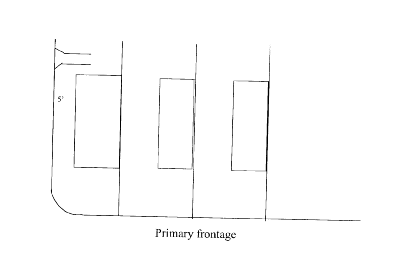
(5)
Street design. Modifications in street layout and design may be permitted subject to site constrains, type and intensity of development, and compatibility with surrounding development. The Technical Review Committee may recommend such modifications as deemed appropriate to achieve the intent of this section. However, such recommendation will be in keeping with standard, safe engineering practice and construction standards generally shall not be modified.
(6)
Accessory units shall be permitted in all areas permitting single-family homes, except planned developments, subject to size limits, design guidelines, parking, etc. Existing planned developments must adopt an amendment to the planned development in accordance with Section 85.00. New planned development projects must expressly identify accessory units in the adopting ordinance as permitted uses.
(Ord. 2007-46, passed 2-19-08)
§ 71.03 - Qualification for and verification of affordable housing developments.
(1)
In order to be considered an affordable housing development under this article one of the following must be met:
a.
All projects initiated by, through, or in coordination with the City of Tarpon Springs Housing Authority shall be deemed an affordable housing project.
b.
In the case of an owner occupied housing development, at least 20 percent of the units must be affordable to households at 80 percent of median family income in accordance with Pinellas County Community Development Department standards
c.
In the case of a rental housing development, at least 20 percent of the units must be affordable to households at 60 percent of median family income in accordance with Pinellas County Community Development Department standards.
(2)
In order for an affordable housing development described in paragraphs (1) a and b above to be considered an affordable housing development under this article, the developer must execute a recordable agreement in a form acceptable to the city binding upon the developer and subsequent purchasers, successors, and assigns of the developer that:
a.
Requires that the development continue to comply with the affordable housing criteria set forth in this article for a period of thirty (30) years;
b.
Provides for penalties to be imposed on the developer and subsequent purchasers, successors, and assigns of the developer if the development fails to comply with the affordable housing criteria set forth in this article for a period of thirty (30) years;
c.
Provides for legal recourse by the city against the developer and subsequent purchasers, successors, and assigns of the developer if the development fails to comply with the affordable housing criteria set forth in this article for a period of thirty (30) years;
d.
Provides that the city may audit or review the books and records of the developer, subsequent purchasers, successors, and assigns of the developer and any person or legal entity operating the development on behalf of the developer or subsequent purchasers, successors, and assigns of the developer in order to determine whether the development is in compliance with the affordable housing criteria set forth in this article;
e.
In the case of a rental housing development, provides criteria for screening renters based upon their rental, credit, and employment history, their income, and the possession of a valid, verifiable social security number or valid, verifiable work visa, alien registration receipt card, temporary resident card, employment authorization card number or other identification verifying eligibility to reside in the United States.
(Ord. 2007-46, passed 2-19-08)
§ 72.00 - OVERNIGHT BOARDING OF ANIMALS.
(A)
Definitions:
1.
Exercise Area: An area utilized to allow animals to exercise for defined periods of time, but not utilized for permanent/overnight occupation by an animal.
2.
Outdoor run: An outdoor kennel occupied by an animal, unsupervised for extended periods of time. Outdoor runs shall also include any outdoor area directly connected to individual indoor kennels such that animals may freely roam between the two.
(B)
The following standards of review shall be required where overnight boarding is allowed as a conditional or permitted use.
1.
Overnight boarding shall be limited to domestic pets only. Farm animals, livestock and wild animals are prohibited.
2.
The minimum setback from any residentially zoned or utilized property for buildings shall be 100 feet.
3.
The minimum setback from any residentially zoned or utilized property for outdoor runs shall be 500 feet.
4.
Outdoor runs shall only be allowed in the IR and IH zoning districts.
5.
Outdoor runs shall have drains connected to an approved sanitary facility. Odor and pest control shall be required. Outdoor runs shall only be utilized during daylight hours. Brief outdoor periods of 15 minutes or less may be allowed during non-daylight hours in early morning and late evening.
6.
The minimum setback from residentially zoned or utilized property for outdoor exercise areas shall be 100 feet.
7.
Outdoor exercise areas must be supervised and shall only be utilized during daylight hours.
8.
Buildings shall be designed such that they are consistent with buildings in the same area.
9.
Soundproofing shall be required for all boarding facilities such that the sounds of any animals confined in the area cannot be heard outside of the property line.
10.
Boarding facilities must contain waste control systems that are connected to an approved sanitary facility.
11.
Boarding facilities shall contain an air-handling system for disinfection and odor control.
12.
Boarding facilities shall be required to have a designated veterinarian on call.
13.
The minimum floor area per animal shall be 125 square feet.
14.
An overnight staffing plan or other acceptable overnight monitoring system must be provided.
(C)
Buffering Requirements:
1.
In addition to the buffering requirements found elsewhere in this code, a minimum 4 foot berm with landscaping shall be required where a boarding facility with outdoor runs or exercise areas directly abuts residentially zoned or utilized land. In lieu of, or in addition to the berm and landscaping, the Board of Commissioners may consider sound buffering fencing/walls. The term "directly abut" shall include those properties separated by a platted public or private right-of-way or easement. Landscaping species shall be utilized that will provide a dense buffer after two years.
(Ord. 2008-31, passed 1-27-09)
§ 73.00 - FORMULA BASED USES.
All formula based retail and restaurant uses as further defined in Section 209.04(B) shall be processed in accordance with the rules and procedures set out in Article XII, Section 209.04 Formula Based Uses.
(Ord. 2009-12, passed 10-6-09)
§ 74.00 - DOGS IN PUBLIC FOOD SERVICE ESTABLISHMENTS.
(a)
Authority. The Dixie Cup Clary Local Control Act, F.S. § 509.233, grants the city the authority to provide exceptions from section 6-501.115, 2001 FDA Food Code, as adopted and incorporated by the Division of Hotels and Restaurants ("Division" in Chapter 61C-4.010 (6), Florida Administrative Code (2006)). In the event that F.S. § 509.233 is sunseted or is amended to eliminate the exception necessary for this section to allow dogs in the outdoor portion of public food service establishments, then the exception herein provided shall conform to the then statutory standards or, alternatively, this section shall be void.
(b)
Purpose. The purpose of this section is to allow dogs in public food service establishments in a manner consistent with the three-year pilot program approved by state statute. The procedure adopted pursuant to this section provides an exception, for those public food service establishments which have received a permit, to those sections of the Food and Drug Administration Food Code that prohibit live animals in public food service establishments.
(1)
No dogs shall be in a public food service establishment unless allowed by state law and the public food service establishment has received and maintains an unexpired permit pursuant to this section allowing dogs in designated outdoor areas of the establishment.
(2)
As used in this section, a public food service establishment shall mean eating and drinking establishments and sidewalk cafes. The term "employee" or "employees" shall include, but is not limited to, the owner or owners of the public food service establishment.
(c)
Application requirements. Public food service establishments must apply for and receive a permit from the Development Services Department before dogs are allowed on the premises. The city may establish a fee to cover the cost of processing the initial application and renewals. The application for a permit shall require such information from the applicant as is deemed reasonably necessary to enforce the provisions of this section, but shall require, at a minimum, the following information:
(1)
Name, location, mailing address and division of hotel and restaurants issued license number of the public food service establishment.
(2)
Name, mailing address, and telephone contact information of the permit applicant. The name, mailing address, and telephone contact information of the owner of the public food service establishment shall be provided if the owner is not the permit applicant.
(3)
A diagram and description of the outdoor dining area which is requested to be designated as available to patrons with dogs, including dimensions of the designated area; a depiction of the number and placement of tables, chairs, and restaurant equipment, if any; the entryways and exits to the designated outdoor area; the boundaries of the designated area and of the other outdoor dining areas not available for patrons with dogs; any fences or including sidewalks, common pathways and alleyways; and such other information as is deemed necessary by the city. Sidewalk cafés on public sidewalks shall not be available to patrons with dogs.
(4)
The diagram shall be accurate and to scale but need not be prepared by a licensed design professional. A copy of the approved diagram shall be attached to the permit.
(5)
A description of the days of the week and hours of operation that the patrons with dogs will be permitted in the designated outdoor area.
(d)
Regulations. Public food service establishments that receive a permit for a designated outdoor area pursuant to this section which shall require that:
(1)
Employees shall wash their hands promptly after touching, petting, or otherwise handling any dog(s) and shall wash or sanitize their hands before entering other parts of the public food service establishment from the designated outdoor area. Waterless hand sanitizing stations shall be provided at entrances and exits to the dog-dining area if other hand washing facilities are not available.
(2)
Employees are prohibited from touching, petting or otherwise handling any dog while serving or carrying food or beverages or while handling or carrying tableware.
(3)
Patrons in a designated outdoor area shall be advised by appropriate signage, at conspicuous locations, that they should wash their hands before eating. Waterless hand sanitizer shall be provided at all tables in the designated outdoor areas.
(4)
Patrons shall keep their dogs on a leash at all times and shall keep their dogs under reasonable control.
(5)
Employees and patrons shall not allow dogs to come into contact with serving dishes, utensils, tableware, linens, paper products, or any other items involved with food service operation.
(6)
Employees and patrons shall not allow any part of a dog to be on chairs, tables, or other furnishings.
(7)
Employees shall clean and sanitize all table and chair surfaces with an approved product between seating of patrons.
(8)
Employees shall remove all dropped food and spilled drink from the floor or ground as soon as possible but in no event less frequently than between seating of patrons at the nearest table.
(9)
Employees and patrons shall remove all dog waste immediately and the floor or ground shall be immediately cleaned and sanitized with an approved product. Employees shall keep a kit with the appropriate materials for this purpose near the designated outdoor area.
(10)
Employees and patrons shall not permit dogs to be in, or to travel through, indoor or non-designated outdoor portions of the public food service establishment.
(11)
A sign or signs notifying the public that the designated outdoor area is available for the use of patrons and patrons with dogs shall be posted in a conspicuous manner that places the public on notice.
(12)
A sign or signs informing patrons of these laws shall be posted on premises in a conspicuous manner and place as determined by the city.
(13)
A sign or signs informing employees of these laws shall be posted on the premises in a conspicuous manner and place as determined by the city.
(14)
Ingress and egress to the designated outdoor area shall not require entrance into or passage through any indoor area or non-designated outdoor portions of the public food service establishment.
(15)
The public food service establishment and designated outdoor area shall comply with all permit conditions and the approved diagram.
(16)
Employees and patrons shall not allow any dog to be in the designated outdoor area of the public food service establishment if the public food service establishment is in violation of any of the requirements of this section.
(17)
Permits shall be conspicuously displayed in the designated outdoor area.
(18)
It shall be unlawful to fail to comply with any of the requirements of this section. Each instance of a dog on the premises of a public food service establishment without a permit is a separate violation.
(19)
Dogs in the public food service establishment which bark or otherwise create a disturbance or a nuisance condition for patrons of the establishment or the public shall be required by the employees to be immediately removed from the establishment.
(e)
Expiration and revocation. A permit issued pursuant to this section shall expire automatically upon the sale or transfer of a lease to a new lessee, including sale of the stock of a corporate entity or other transfer of control of the public food service establishment and cannot be transferred to a subsequent owner. The subsequent owner may apply for a permit pursuant to this section if the subsequent owner wishes to continue to allow dogs in a designated outdoor area of the public food service establishment.
(1)
Permits expire on September 30 of each year.
(2)
A permit may be revoked by the city if, after notice and reasonable time in which the grounds for revocation may be corrected, the public food service establishment fails to comply with any condition of approval, fails to comply with the approved diagram, fails to maintain any required state or local license, or is found to be in violation of any provision of this section. If the grounds for revocation are a failure to maintain any required state or local license, the revocation may take effect immediately upon giving notice of revocation to the permit holder.
(3)
If a public food service establishment permit is revoked, no new permit may be approved for the establishment until expiration of 180 days following the date of revocation.
(f)
Complaints and reporting.
(1)
Complaints may be made in writing to the city. Complaints will be forwarded to the Code Enforcement Division which shall accept, document, and respond to all written complaints and shall report to the division of hotels and restaurants all complaints and the response to such complaints.
(2)
The Development Services Department shall provide the division of hotels and restaurants with a copy of all approved applications and permits issued.
(Ord. 2013-23, passed 10-15-13)
§ 75.01 - Alternative Densities/Intensities.
Development projects may utilize the standard temporary lodging densities and intensities specified within each Countywide Plan Map category that provides for such use; or may, in the alternative, utilize all, or any part of, the higher temporary lodging densities and associated intensities included in Table 75.01, subject to the following:
(A)
A Development Agreement proposing to utilize the higher densities and intensities identified in Table 75.01 and authorized by this Section shall address, at a minimum, the following:
1.
The ability of the local government, or the applicable service provider, to meet the concurrency management standards for sanitary sewer, solid waste, drainage, and potable water, as required pursuant to Section 163.3180, F.S., and the applicable local government or service provider plan and regulations.
2.
Provision for all temporary lodging uses to comply with all county and local hurricane evacuation plans and procedures to ensure orderly evacuation of guests and visitors pursuant to the Pinellas County Code, Chapter 34, Article III. In particular, all temporary lodging uses which are located in Hurricane Evacuation Level A, as identified by the Pinellas County Emergency Management Agency, shall prepare a legally enforceable mandatory evacuation/closure covenant, stating that the temporary lodging use will be closed as soon as practicable after a hurricane watch is posted for Pinellas County by the National Hurricane Center. Further, a plan implementing the closure and evacuation procedures shall be prepared and submitted to the county or municipal emergency management coordinator, whichever is applicable, within 90 days of the issuance of a certificate of occupancy. This plan will be updated and sent for review when there is a change of ownership or substantive change to the plan or as required by the county or municipal emergency management coordinator, whichever is applicable.
3.
Design considerations in Countywide Rules Section 5.2.1.3.2, the mobility management provisions in Countywide Rules Section 5.2.1.3.3 and the restrictions on temporary lodging use in Countywide Rules Section. 5.2.1.3.4 set forth following.
(B)
A Development Agreement prepared pursuant to this Section shall be approved by the city governing body, recorded with the Clerk of the Circuit Court pursuant to Section 163.3239, F.S., a copy filed with the Property Appraiser's Office, and a copy submitted to the PPC and CPA for receipt and filing within fourteen (14) days after recording. The development limitations set forth in the Development Agreement shall be memorialized in a deed restriction, which shall be recorded in the Official Records of Pinellas County prior to the issuance of a building permit for the temporary lodging use.
(C)
The alternative densities and intensities set forth in Table 75.01 are maximums. The City may choose to utilize a density and intensity standard equal to or less than the alternative density and intensity standard.
(D)
For development that includes a combination of temporary lodging and residential dwelling use, each use shall be allowed in proportion to the size of the property and the permitted density and intensity of the respective use.
Table 75.01
TEMPORARY LODGING DENSITY AND INTENSITY STANDARDS
§ 75.02 - Design considerations.
The purpose of the design considerations is to enable the City to authorize the increased density and intensity provided for in Table 75.01, subject to a determination that the project is compatible with the size, location, configuration and character of the site, its relationship to the Countywide Plan Map category in which it is located, and to adjoining uses; and that the overall principles of quality urban design as set forth in Pinellas By Design: An Economic Development and Redevelopment Plan for Pinellas County are furthered.
In particular, design considerations applicable to the proposed use shall address the following in the Development Agreement so as to ensure compatibility in terms of context-sensitive design, and the scale and placement of the proposed use so as to achieve a harmonious relationship and fit relative to its location and surroundings:
(A)
Building scale, including height, width, location, alignment, and spacing.
(B)
Building design, including elevations, facade treatment, entrance and porch or balcony projections, window patterns and roof forms.
(C)
Site improvements, including building and site coverage, accessory structures, service and amenity features, walkway and parking areas, open space, and view corridors.
(D)
Adjoining property use, including density/intensity, and building location, setbacks, and height.
(Ord. No. 2017-04, passed 5-2-17)
§ 75.03 - Mobility management.
The applicant shall ensure that a project authorized to use the increased density and intensity provided for in Table 75.01 adequately addresses its impacts on the surrounding road network through the implementation of mobility improvements or strategies consistent with the Pinellas County Mobility Plan, as implemented by the countywide Multimodal Impact Fee Ordinance.
(Ord. No. 2017-04, passed 5-2-17)
§ 75.04 - Operating Characteristics and Restrictions.
The purpose of this provision is to ensure that a project authorized to use any portion of the increased density and intensity provided for in Table 75.01 is built, functions, operates, and is occupied exclusively as temporary lodging.
In particular, temporary lodging uses at the densities/intensities in Table 75.01, or any density higher than the standard density provided for such use in each applicable Countywide Plan Map category, shall comply with the following restrictions:
(A)
No temporary lodging unit shall be occupied as a residential dwelling unit, and a locally-determined maximum length of stay for any consecutive period of time shall be established by the City to ensure that any temporary lodging use does not function as a residential use.
(B)
Temporary lodging units shall not qualify or be used for homestead or home occupation purposes.
(C)
All temporary lodging units must be included in the inventory of units that are available within a temporary lodging use.
(D)
No conversion of temporary lodging units to residential dwelling units shall be permitted unless the conversion is in compliance with the Countywide Rules with respect to the permitted residential density and, where applicable, the intensity for associated nonresidential uses.
(E)
A temporary lodging use may include accessory uses, such as recreational facilities, restaurants, bars, personal service uses, retail uses, meeting space, fitness centers, spa facilities, parking structures and other uses commonly associated with temporary lodging uses. All such uses shall be included in the calculation of allowable floor area ratio.
(F)
Any license required of a temporary lodging use by the city, county, or state agency shall be obtained and kept current.
(G)
Temporary lodging uses shall be subject to all applicable tourist development tax collections.
(H)
A reservation system shall be required as an integral part of the temporary lodging use, and there shall be a lobby/front desk area that must be operated as a typical lobby/front desk area for temporary lodging would be operated.
(I)
Temporary lodging uses must have sufficient signage that complies with local codes and is viewable by the public designating the use as a temporary lodging use.
(J)
The books and records pertaining to use of each temporary lodging unit shall be open for inspection by authorized representatives of the applicable the city, upon reasonable notice, in order to confirm compliance with these regulations as allowed by general law.
(K)
If applicable, the city may require affidavits of compliance with this Section from each temporary lodging use and/or unit owner.
(Ord. No. 2017-04, passed 5-2-17)

