
Tavares City Zoning Code
CHAPTER 16
SUBDIVISIONS REGULATIONS13
Editor's note— Ord. No. 2022-14, § 1(Exh. A), adopted September 21, 2022, amended Chapter 16 in its entirety to read as herein set out. Former Chapter 16, §§ 16-1—16-31, pertained to similar subject matter.
Section 16-1.- Definitions.
For the purpose of this chapter, the following terms and words, whenever used or referred to, shall have the following meanings:
(A)
Drainage right-of-way: The lands required for the installation of stormwater sewers or drainage ditches, or required along a natural stream or watercourse for preserving the channel and providing for the flow of water therein to safeguard the public against flood damage.
(B)
Engineer: A qualified person registered and currently licensed to practice civil engineering in the state.
(C)
Frontage: The length of the front property line of the lot, lots, or tract of land abutting a public street, road, highway, or rural right-of-way.
(D)
Final Plat: Those submittals as required by, and following the procedures of these regulations, showing all building lots, easements, rights-of-way, and other information necessary for providing the detailed description of the subdivision of a parcel of land.
(E)
Improvement:
(1)
Any building, structure, fence, gate, wall, walkway, parking facility, light fixture, bench, foundation, sign, work of art, earthworks, sidewalk, or other man-made objects constituting a physical change or betterment of real property, or any part or portion of said change or betterment.
(2)
Physical changes made to raw land, and structures placed on or under the land surface, in order to make the land more usable. Typical improvements in these regulations would be grading, street, pavement, curbs, gutters, drainage ditches, storm and sanitary sewers, utility lines of all types, street name signs, etc.
(F)
Land Surveyor: A land surveyor registered under Chapter 472 who is in good standing with the Florida State Board of Professional Engineers and Land Surveyors.
(G)
Mobile home space: A plot of ground within a mobile home park designed for the accommodation of one (1) mobile home.
(H)
Performance guarantee: Any security which may be accepted in lieu of a requirement that certain improvements be made before the City Council approves a plat, which may only include performance bonds or escrow agreements funded by cash or certified funds.
(I)
Plat:
(1)
The map of a subdivision or, if the subdivision is a condominium or cooperative, it shall mean those declarations required by F.S. Chapters 718 and 719.
(2)
A map or delineated representative of the subdivision of lands, being a complete, exact representation of the subdivision and other information in compliance with the requirement of all applicable statutes and of local ordinances, and may include the terms "replat," "amended," or "revised plat."
(J)
Preliminary development plan: The preliminary map indicating the proposed layout of the subdivision which is submitted for the City Administrator's consideration and tentative approval and meeting the requirements of the section relating to preliminary development plans.
(K)
Private street or roadway: Any thoroughfare used commonly for vehicular traffic which is not included in the definition of street in this chapter and which is not subject to maintenance by the City; such definition to include but not be limited to roadways in apartment, condominium or office complexes.
(L)
Subdivider: Any individual, firm, association, syndicate, co-partnership, corporation, trust or any other legal entity commencing proceedings under this chapter to effect a subdivision of land hereunder for himself or for another.
(M)
Subdivision: The division of a parcel of land, whether improved or unimproved into three (3) or more lots or parcels of land for the purpose of sale or building development (whether immediate or future) and including all division of land involving the dedication of a new street or a change in existing streets.
Section 16-2. - Purpose of Chapter.
The purpose of this Chapter is to further the health, safety and general welfare of the public through the adoption of Local Subdivision Regulations which are consistent with Florida Statutes, Chapter 177, to implement the goals, objectives and policies of the City of Tavares Comprehensive Plan in such a way as to be consistent with the other chapters of the City of Tavares Land Development Code and to implement the orderly, efficient and economical development of land, consistent with the comprehensive plan, to establish minimum standards for subdivision design, to provide for the uniform review of subdivision plat applications, and to create an adoption and recording process, and to provide for the installation of the necessary public infrastructure to service new development. This shall include, but not be limited to storm drainage, sanitary sewer, open space and recreation, school sites, the preservation of environmentally sensitive lands, vehicular and pedestrian traffic improvements, potable water, landscape improvements and fire control.
Section 16-3 - Enforcement.
(A)
Compliance. No plat of any subdivision shall be approved by the City Council so as to entitle the same to record in the office of the clerk of the circuit court of the county or have any validity until it shall have been acted upon in the manner prescribed herein. However, when so approved and recorded, any such plat shall be valid and may be relied upon by the public as notice that the requirements of this chapter have been complied with.
(B)
Approval. The City Council shall not permit any public improvements over which it has any control to be made or any money expended for improvements in any area that has been subdivided, or upon any street that has been platted after the date of the adoption of the ordinance from which this chapter was derived, unless such subdivision or street has been approved in accordance with the provisions contained herein.
Section 16-4 - No Subdivision without Plat Approval.
(A)
Unlawful to subdivide. It shall be unlawful for any person, being the owner, agent, or person having control of any land within the City, to subdivide or lay out such land in lots, unless by a plat, in accordance with the regulations contained herein, and the provisions of F.S.CH. 177. In particular, no person may subdivide his land unless and until a final plat of the subdivision has been approved in accordance with the provisions of Chapter 4 and recorded by Lake County.
Exceptions. The following, however, shall not be subject to the regulations of this Chapter applicable strictly to subdivision:
(1)
The combination or recombination of portions of previously plated lots where the total number of lots is not increased and the resultant lots are equal to or exceed the minimum standards set forth in this Chapter.
(2)
Subject to the approval of City Council, parcels of record as of the effective date of this Chapter may be subdivided one time, without platting, into two (2) parcels, provided that both parcels conform without the necessity of a variance, to all requirements of the appropriate zoning category, and that both parcels have frontage on a public road. Said subdivision shall be recorded in the Public Records of Lake County.
(B)
Recordation of plat. Lake County may not record a plat of any subdivision within the City's jurisdiction unless the plat has been approved by the City in accordance with the provisions of this chapter.
Section 16-5 - Variance.
Whenever the tract to be subdivided is of such unusual size or shape, or is one (1) acre or less in size, or is surrounded by such development or unusual conditions that the strict application of the requirements contained in these regulations would result in unusual difficulties or substantial hardship or injustice, the applicant may request a variance to these regulations. Administrative procedures for a variance are set forth Chapter 4.
Section 16-6 - Procedures for Subdivision.
(A)
General.
(1)
Subdivisions are subject to a three-step approval process. 1) Preliminary subdivision plan depicting the layout and physical improvements to the land to be subdivided; 2) Subdivision construction plans detailing the engineering specifications of the improvements for the development; and 3) Final Plat.
(2)
The design and layout of all subdivisions shall conform with the requirements of Division II and all applicable requirements of the Land Development Regulations and the City of Tavares Construction Specifications Manual.
(3)
Following approval of the preliminary subdivision plan, the subdivider shall, as required by Division II, install the minimum improvements or furnish a performance guarantee as outlined in Section 16-7 prior to approval of the final plat.
(4)
If the subdivision is a condominium or cooperative, the term plat shall mean those declarations required by Florida Statutes, Chapters 718 and 719.
(B)
Preliminary subdivision plan.
(1)
Purpose. The purpose of the preliminary subdivision plan is to permit complete and accurate presentation of technical data and preliminary engineering drawings in such a manner as to allow complete review and evaluation of the proposed development and its impact upon both the site and surrounding areas.
(2)
The developer shall have a state-registered professional engineer, prepare the preliminary subdivision plan in conformance with the format, design and improvement requirements of these regulations.
(3)
Administrative procedures for approval of a preliminary subdivision plan are set forth in Chapter 4.
(4)
Authority granted by approval. Approval of the preliminary plan shall be construed as authority for submitting subdivision construction plans and final plat. Approval of the preliminary plan shall not be construed as authority for the transfer of title of lots in reference to said preliminary plan, nor as authority for obtaining building permits, nor for the recording of a plat.
(5)
Time limit of approval. Preliminary subdivision plan approval shall be automatically voided if subdivision construction plans or final plat for all or a phased portion are not submitted within twenty-four (24) months. An extension of 12 months may be approved subject to written request by the developer and approval by the City Council. Each subsequent phase of the preliminary plan approval shall be automatically voided if final subdivision plans for the next phased portion are not submitted within the next twenty- four (24) month period.
(C)
Subdivision construction plans and required improvements.
(1)
The purpose of the subdivision construction plans to establish the review and approval of final technical submittals and engineering drawings of the subdivision or a portion thereof. The subdivision construction plans shall conform substantially to the preliminary plan as approved, and may constitute only that phase of the approved preliminary plan and other necessary improvements which the applicant proposes to record and develop. The plans shall also conform to all requirements of the comprehensive plan and the Land Development Regulations.
(2)
The developer shall have a state-registered professional engineer, prepare the subdivision construction plans in conformance with the format, design and improvement requirements of these regulations.
(3)
Receipt of the signed copy of the approved preliminary subdivision plan is authorization for the subdivider to proceed with the preparation of subdivision construction plans for minimum improvements and with the preparation of the final plat. Improvements as required in Division II shall be designed in accordance with the City of Tavares Land Development Regulations and Construction Specifications Manual.
(4)
The administrative procedures for approval of subdivision construction plans are set forth Chapter 4.
(5)
No developer shall proceed with any construction work on the proposed subdivision, until the following has occurred:
(a)
preliminary subdivision plan approval; and
(b)
subdivision construction plan approval; and
(c)
submittal of a performance guarentee as provided in section 16-7; and
(d)
issuance of a subdivision construction permit; and
(e)
a preconstruction meeting has occured with City Staff.
(D)
Final Plat.
(1)
The purpose of the final plat review is to assure the preparation and completion of a final plat map and its accompanying legal documentation.
(2)
The final plat shall be prepared by a registered surveyor in accordance with applicable state statutes.
(3)
Conformity to the approved preliminary subdivision plans. The final plat shall incorporate all stipulations, changes and modifications required to make the approved preliminary subdivision plans conform to these regulations. A plat may include only that portion of the approved plans which the subdivider proposes to record and develop at the time.
(4)
The administrative procedures for approval of a final plat are set forth in Chapter 4.
(5)
Deed restrictions or covenants running with the land may be required to provide for the creation of a property owners association or board of trustees for the proper protection and maintenance of the development in the future.
(6)
No final or official plat of any subdivision shall be approved unless the improvements as required in Division II have been installed and approved by the City Administrator or designee prior to such approval; or unless a performance guarantee has been submitted and accepted as provided in section 16-7.
(7)
No developer shall sell or agree to sell any lot until after his final plat has been approved and recorded.
(8)
No Certificate of Occupancy may be issued until the improvements outlined in this Chapter are in place and have been accepted by the City and the final plat has been approved and recorded.
(9)
Final Plat approval is not obligation to construct or maintain. An acceptance by the City Council of the final plat and initial offer of dedication of any streets, sidewalks, parks, or other facilities shown on the plat shall not constitute an obligation upon the City to perform any act of construction or maintenance within such dedicated areas.
Section 16-7 - Protection Against Non-Performance.
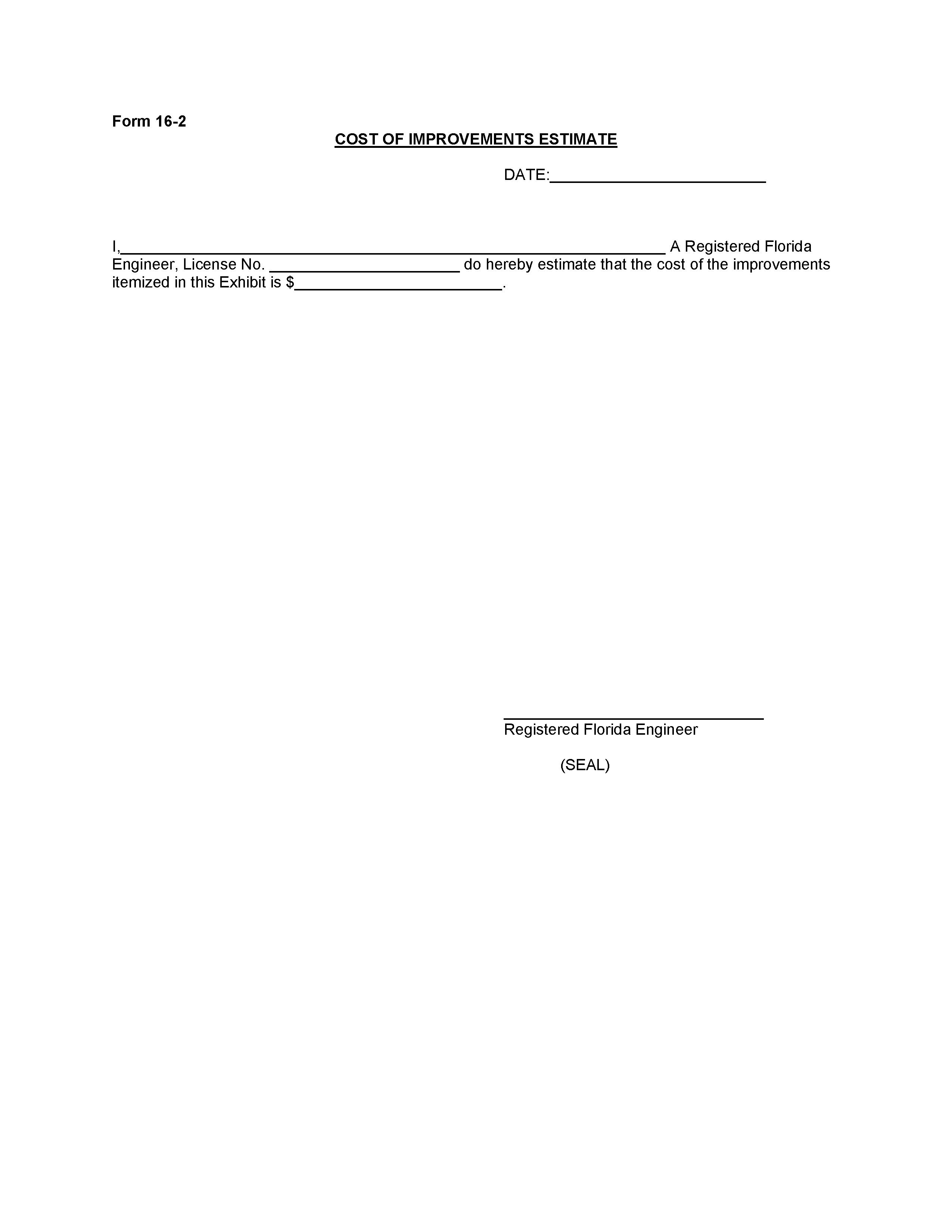
Prior to the recordation or any final plat, the subdivider shall file with the City Council an adequate performance guarantee such as a performance bond or escrow agreement funded by cash, cashier's check or a certified check upon a local bank, conditioned to secure the construction of the required improvements in a satisfactory manner and within a time period specified by the City Council, such period not to exceed two (2) years. No such performance guarantee shall be accepted unless it is enforceable by or payable to the City in a sum at least equal to one hundred ten percent (110%) of the cost of all improvements required to be installed by the subdivider and approved by the City Attorney. The amount of the performance guarantee shall be based on the project engineer of record's certified estimate of the cost of improvements or upon actual contract costs for installing the improvements as may be adjusted by the City Engineer.
Section 16-8 - Maintenance of Dedicated Areas Until Final Acceptance.
As provided below, all facilities and improvements with respect to which the owner makes an offer of dedication to public use, shall be maintained by the owner until such offer of dedication is formally accepted by action of the City Council.
Section 16-9 - Acceptance of public infrastructure.
Acceptance of the dedicated public improvements shall occur after the required improvements have been installed, and the design engineer has certified to the City that all such improvements have been constructed according to the approved plans and specifications.
(A)
Testing. The City Administrator or designee, in his discretion, may require the developer to have testing or laboratory services performed prior to acceptance of said infrastructure. The expense of such testing or laboratory services shall be the responsibility of the developer.
(B)
As built drawings. The subdivider shall be required to submit "as built" drawings signed and sealed by the design engineer for all such required improvements in PDF and CAD format.
(C)
Maintenance bond.
(1)
The subdivider shall submit a maintenance bond equal to twenty percent (20%) of the cost of all subdivision improvements, regardless of Public or Private dedication on the Final Plat, in a form acceptable to the City Attorney, guaranteeing all required improvements for a period of two (2) years from the date of their acceptance.
(2)
Prior to the end of the maintenance bond period, the improvements shall be inspected by the City Engineer or his designee. If the improvements after this time are still in conformance with the City's regulations, the bond may be released and final acceptance by the City will occur. If the improvements contain any defects, the bond will guarantee that any defects shall be corrected by the developer prior to final acceptance.
(3)
During the maintenance period, the developer will be expected to provide any maintenance required, at no cost to the City. This includes, but is not limited to:
(a)
Repair and replacement of any utility system component, or failed section of paving.
(b)
Control of erosion, replacement of sod, removal of soil washed onto the pavement or into the drainage system.
(4)
Upon correction of all deficiencies and at the end of the required warranty period, the maintenance bond will expire.
(D)
Abandonment of Subdivision. If the subdivider abandons or loses control of the subdivision, for any reason, prior to the end of the two year warranty period and prior to putting in use any publically or privately dedicated improvements, subsequent successors in interest or owners or the Subdivision must comply with the requirements of this Section by requesting a reinspection of the dedicated improvements, by repairing or replacing any deficient improvements before any new building permits are issued.
Section 16-10 - Minor Subdivision
(A)
Criteria for a minor subdivision. The minor subdivision process is intended to provide a vehicle for subdivision and resubdivision of pieces of property for which the impacts of the action are so insignificant as not to require the rigorous steps of platting. The formal steps, while minimal in nature, are to provide documentation that the newly subdivided or resubdivided lots comply with the comprehensive plan and the land development code and are recorded in the public records. In order to qualify as a minor subdivision all the following criteria must be met.
(1)
The parcel is to be divided into 10 or less lots; and
(2)
Each lot shall have access to a paved public right-of-way constructed in accordance with City standards; and
(3)
Public utilities, including potable water and sanitary sewer, are available to each lot prior to subdivision or the Director of Utilities has determined that public utilities are not available to any portion of the parcel to be subdivided; and
(4)
No other public infrastructure improvements are required.
(B)
Final plat required. A minor subdivision shall not be required to submit a preliminary subdivision plan or subdivision construction plans, but rather may proceed directly to submittal of a final plat,
(C)
Administrative procedures for approval of a minor subdivision are set forth in Chapter 4.
Section 16-11 - Lot Split
(A)
Criteria for a lot split. A lot split is permitted without formal platting provided the property to be subdivided is a parcel of record as of the effective date of these Land Development Regulations and provided the subdivision of said parcel results in no more than two (2) parcels, and provided that both parcels conform without the necessity of a variance, to all requirements of the appropriate zoning category, and that both parcels have a means of ingress / egress to a public or private road.
(B)
Administrative procedures. Administrative procedures for approval of a lot split are set forth in Chapter 4.
Section 16-12 - Vacate of plats, easements and rights-of-way
(A)
Criteria for approval. A plat, easement or right-of-way may be vacated subject to City Council approval based on the following criteria:
(1)
The proposed vacate conforms to the comprehensive plan and land development regulations.
(2)
Owners of adjacent property shall not be negatively impacted by the vacation.
(3)
The City or other governmental body or service provider does not have necessity to maintain the plat, easement or right-of-way for continuance of a public benefit.
(B)
Administrative procedures. Administrative procedures for approval of a vacate are set forth in Chapter 4.
Section 16-13 - General Requirements
All subdivisions within the City of Tavares shall be designed and improved in accordance with the standards provided in this division. The design of a subdivision and the improvements thereof are required to be addressed as part of the submittal of a subdivision construction plan. All required improvements must be designed in accordance with the City of Tavares Land Development Regulations and Construction Specifications Manual in order to achieve approval for said construction plans.
Section 16-14 - Easements.
Easements of at least five feet (5') in width shall be required on each side of all rear lot lines and along side lot lines, where necessary, for poles, wires, conduits, storm and sanitary sewers, gas, water, or other mains, and construction easements shall be provided where necessary. Easements of greater width may be required along or across lots where necessary for the extension of main sewers of other utilities or where both water and sewer lines are located in the same easement, at the discretion of the Director of Utilities.
Section 16-15 - Blocks.
(A)
Block length. Blocks, except waterfront blocks, shall not exceed one thousand two hundred feet (1,200') in length in residential districts. Blocks in commercial districts shall not exceed eight hundred feet (800') in length, except that planned shopping centers may be approved by the City Administrator or designee with blocks exceeding eight hundred feet (800') in length.
(B)
Planned shopping centers. Plats with reference to planned shopping centers should be accompanied by a schematic layout, indicating the proposed provision for off-street parking areas, service areas, service alleys and entrances to public thoroughfares, in order that the planning board may properly evaluate the proposed plat.
(C)
Courts and cul-de-sacs. Where a tract of land is of such size or location as to prevent a lot arrangement directly related to a normal street design, there may be established one (1) or more courts, dead-end streets, or other arrangements; provided, however, that proper access shall be given to all lots from a dedicated street or court. A dead-end street (cul-de-sac) shall terminate in an open space (preferably circular) having a minimum radius of sixty (60') feet. A dead-end street (cul-de-sac) shall not exceed eight-hundred (800') feet in length except where no other practical alternative is available.
Section 16-16 - Lots.
(A)
Conformance with zoning regulations. The lot arrangement and design shall be such that all lots will provide satisfactory and desirable building sites, properly related to topography and the character of surrounding development. No lot shall have an area or width less than that required by any zoning ordinance.
(B)
Access. Each lot, except as identified below shall have a minimum distance of thirty-five (35) feet abutting a dedicated maintained road right-of-way.
(C)
Lot lines. All sidelines of lots shall be at right angles to straight street lines and radial to curved street lines except where a variation to this rule will provide a better street and lot layout.
(D)
Double frontage or through lots. Double frontage or through lots shall be avoided except where essential to provide separation of residential development from traffic arteries or to overcome specific disadvantages of topography or orientation. Along the rear of all double frontage lots there shall be a ten-foot planting easement across which there shall be no vehicular access.
(E)
Corner lots. In residential districts only, corner lots shall be at least fifteen (15%) percent greater in width than the minimum required for each zoning district established in the Zoning Regulations. However, where the minimum width established in the Zoning Regulations exceeds one hundred (100') feet, no additional width shall be required.
(F)
Flag lots. Due to access and safety concerns, the use of flag type lots will be discouraged. No more than two flag lot extensions shall be located adjacent to each other. The minimum width for the flag extension of the lot to the right-of-way shall be twenty (20) feet. The extension is for access only. The body of the flag lot shall be a minimum of one-third (⅓) acre in size, not including the flag extension, and meet all zoning requirements as to setbacks, lot area and lot width.
Section 16-17 - Building Lines.
Building lines shall be in accordance with the zoning ordinance of the City and the requirements of the classification under which the property is located.
Section 16-18 - Parks, School Sites, etc.
(A)
Consideration. The subdivider shall confer with the City Administrator or designee in order that consideration may be given to suitable sites for schools, parks, playgrounds, and other common areas for public use as shown on the adopted comprehensive plan of the City.
(B)
Indication on preliminary plan. Any provisions for schools, parks, playgrounds shall be indicated on the preliminary plat in order that it may be determined when and in what manner such areas as will be provided or acquired by the appropriate taxing agency. Recreation areas shall be provided in accordance with the following:
(1)
When land is developed or subdivided for residential, single family or multi-family development, at least five percent (5%) of the gross area of such land shall be dedicated for parks or recreation purposes. The location of the parks or recreation areas shall be clearly shown on the plat. Where the subdivided property abuts a lake, the City may require that the park or recreation dedication include five percent (5%) of the total lake frontage in the subdivision.
(2)
If the property being subdivided is less than twenty (20) acres in size, the owner may pay to the City a sum of money equal to five percent (5%) of the fair market value of the property being subdivided, which payment shall be in the lieu of the park or recreation dedication required by this Section.
(a)
For purposes of this sub-section, "fair market value of the property being subdivided" shall be determined using an appraisal of the entire undeveloped property that is being subdivided, in a form acceptable to the City, to be furnished and paid for by the owner.
(b)
All payments received by the City pursuant to this sub-section shall be held in a separate fund and shall be used by the City exclusively for acquiring and developing parks and recreation areas in the City.
(3)
In lieu of all or part of the park or recreation area dedication required by this Section, the owner of property being subdivided may create within the subdivided property private recreational facilities available to the residents of the subdivision.
(a)
The City Council shall review any proposed private recreational facilities at a public hearing and determine, based on evidence presented by the owner, to what extent the proposed private recreational facilities satisfy the park or recreation area dedication required by this Section. It is the intent of the City Council that any proposed private recreational facilities offered in lieu of the entire required park or recreation area dedication must meet or exceed the anticipated recreational needs of the residents of the proposed subdivision.
(b)
In reviewing any proposed private recreational facilities, the City Council shall consider the type of facilities proposed; the size of the proposed facilities; the size of the proposed subdivision; the anticipated demographics of the residents of the proposed subdivision; and any other evidence relevant to the proposed private recreational facilities.
(4)
The City Council may require as a condition of subdivision approval that the owner create a property owners association charged with the obligation of maintaining any private recreational facilities or park or recreation area dedicated within the subdivision. Any such provision shall be noted on the final plat.
Section 16-19 - Streets and sidewalks.
(A)
Design requirements. Streets and sidewalks shall be designed in accordance with Chapter 19. The minimum specifications for the preparation and construction of streets and street rights-of- way shall be in accordance with the City of Tavares Construction Specifications Manual.
(B)
Private streets. Where private streets are utilized it must be recorded on the plat, and in the deed restrictions that streets shall be maintained by the property owners and are not the responsibility of, nor will they become the responsibility of the City until or unless the streets meet all of the requirements, standards and specifications of the City's subdivision regulations.
(C)
Arrangement of streets. The arrangement of streets in new subdivisions shall make provision for the continuation of the principal existing streets in adjoining areas, or their proper projection where adjoining land is not subdivided, insofar as they may be deemed necessary by the City Administrator or designee for public requirements.
(D)
Sidewalks. The developer shall be required to install sidewalks along both sides of all arterial and collector streets, as defined by Chapter 19, and along all other streets provided for in Chapter 19. If any damage from installation, defects, or heavy equipment occurs during development and manifests itself within two (2) years from the date of acceptance by the City, the defects shall be remedied by the developer at the developer's expense.
Section 16-20 - Waterlines.
(A)
Requirements. Each lot within the subdivision area shall be provided with a connection to an approved public water supply. The developer shall install a water distribution system that provides a connection to each lot at his own expense which shall become the property of the City upon the acceptance of the final plat. The water supply system shall meet or exceed the requirements set forth in Chapter 17 and the City of Tavares Construction Specifications Manual. If any defects shall occur in the public water supply system or facilities within two (2) years from the date of acceptance by the City, such defects shall be remedied and corrected at the developer's expense.
(B)
Main line specifications. All water installations, mains, fireplugs and connections shall be installed according to the specifications of the City. Water mains that serve any area must be of size designated by the City to ensure adequate pressures and quantities. No main shall be installed that has an inside diameter less than eight (8) inches unless approved by the City Administrator or designee.
(C)
Inspection and approval. Before facilities are finally accepted by the City, they must be inspected and approval given by the City as to construction, and any deviation or improper construction must be corrected or replaced before facilities can be used or final approval granted. Inspections must be made before any trench may be completely filled. The improvements must also comply with all requirements and regulations of the State Board of Health and the Department of Environmental Protection, and the developer shall, at his own expense, obtain approval from these agencies prior to final approval of the City.
Section 16-21 - Sanitary Sewers.
(A)
Requirements. Each lot within the subdivision area shall be provided with a connection to an adequate public sanitary sewer. All connections and the subdivision sewer system shall comply with the regulations of the State Board of Health and the Chapter 17 and the City of Tavares Construction Specifications Manual and shall be installed under the direction and supervision of and subject to the inspection and approval of the City Administrator or designee. If any defects shall occur in the sanitary sewer system or facilities within two (2) years from the date of acceptance by the City, such defects shall be remedied and corrected at the developer's expense.
(B)
Septic tanks. No septic tanks will be allowed in subdivisions subject to approval of this chapter.
Section 16-22 - Drainage.
All necessary facilities, either underground pipe, drainage wells, canals or drainage ditches, shall be installed in accordance with Chapter 15 and the City of Tavares Construction Specifications Manual and subject to approval of the City Administrator or his designee so as to provide adequate disposal of surface water and to maintain any natural watercourses. Development including structures, roads and other permanent additions or changes to the landscape shall not adversely affect the natural surface flow of water or substantially reduce the recharge capabilities of the groundwater system. When required a St. Johns River Water Management Stormwater Permit shall be required prior to construction or installation.
Section 16-23 - Underground Utilities.
(A)
Underground installation. All Utilities, including but not limited to, those of franchised utilities, electric power, telephone, cable television, water, wastewater, and gas, shall be constructed and installed below ground. The Director of Utilities will consider specific proposals for aboveground service. It shall be the developer's responsibility to make the necessary arrangements with each utility in accordance with the utility's established policies. The underground installation of incidental appurtenances such as transformer boxes, pedestal mounted terminal boxes for electric, or similar service hardware necessary for the provision of electric and communication utilities shall not be required.
(B)
Individual electric service. In all cases, property being subdivided shall have permanent electrical service available to each lot within the subdivision. A letter of availability from the utility company shall be submitted.
(C)
Central water and sewer service. For those subdivisions which are within the utility service area, central water and sewer service (or dry lines if not available) will be required for each lot in the subdivision.
(D)
Reclaimed water. For those subdivisions which are within the designated reclaimed water service area, reclaimed water lines (or dry lines if not available) will be required for each lot in the subdivision.
Section 16-24 - Fire Protection
A.
Fireplug location specifications. In both residential areas and commercial areas, every lot shall have a fireplug within five hundred (500) feet. To assist in locating the fireplug, a blue raised reflector shall be placed in the center of the street at a right angle to the plug.
B.
Gated Community Access. Every electronic roadway entrance gate shall be equipped with an approved public safety access emergency gate opening system ("Public Safety Access System"). The Public Safety Access System shall be permitted, inspected, and approved by the City of Tavares prior to installation and operation. In the event an existing Public Safety Access System is found to be malfunctioning or inoperative, the City of Tavares or any other authorized governmental emergency services may order that the entrance gate remain in the locked-open position until such time as the system is repaired, replaced and inspected. Any electronic gate opening system being installed, that is either new or replacing an existing Public Safety Gate Opening System shall be permitted and approved utilizing a specific and exclusive radio frequency channel for all public safety agencies utilizing the "Click-2-Enter®" public safety access technology.
(Ord. No. 2025-06, § 1, 8-20-25)
Section 16-25 - Streetlights.
The City Administrator or designee, may require the developer, at his own expense, to install street lighting consistent with City standards and specifications.
Section 16-26 - Conservation Easements.
All conservation areas shall be shown on the plat as a separate tract or as an easement which extends over affected portions of a lot and shall be noted as a "Conservation Easement" or "Conservation Tract". Provisions are to be noted on the plat delineating ownership of the conservation areas.
Section 16-27 - Buffers and Landscaping
All subdivisions shall provide buffers and landscaping adjacent to abutting roads and adjacent land uses in accordance with Chapter 11.
Section 16-28 - Inspections and Tests
(A)
Notification. Inspections during construction shall be as specified by the City and it shall be the responsibility of the developer or his contractor to notify the Director of Utilities and arrange for these inspections.
(B)
Certification. Required tests specified in this Chapter shall be performed by a competent engineering testing laboratory acceptable to the City Public Works Director and/or Director of Utilities. This testing laboratory shall have a Florida registered engineer on staff in order to certify the correctness of all work submitted. The developer shall provide and pay for the necessary certificate.
(C)
Construction inspection. At the outset of construction, and upon completion of the following construction stages, the contractor shall notify the City Public Works Director and/or Director of Utilities. An inspector will make a physical inspection at each of the stages of construction listed below:
(1)
Clearing and grubbing
(2)
Utility systems
(3)
Storm drainage
(4)
Removal of unsuitable material
(5)
Stabilization of subgrade
(6)
Underdrains
(7)
Curb and gutter and backfill
(8)
Inlets, box culverts, and all other concrete structures, when steel is in place prior to pouring
(9)
Base course, during construction or mixing
(10)
Finishing base course, prior to paving
(11)
Wearing surface, during application
(12)
Cleanup and dressing of right-of-way limits
(13)
Sodding and/or seeding
(14)
Street name signs, and traffic control signs
(16)
Pavement marking
(17)
Final inspection
A report, listing deficiencies, will be given to the contractor, who shall make the necessary corrections prior to approval and recommendation for initial acceptance by the City. Nothing herein shall be construed to limit the City's inspection activities.
(D)
Notice. The developer or his contractor shall provide notice of the completion of each stage. The City Public Works Director and Director of Utilities shall furnish an inspector at the site, within a reasonable length of time, during normal work days. The developer or his contractor may proceed at risk, from stage to stage, prior to inspection by the City. However, nothing herein shall be construed to limit the developer's or his contractor's responsibility to undertake corrective action if any work is determined not to be in compliance with requirements of this Code.
(E)
Compliance and responsibility. The purpose of these inspections is to ensure compliance with the approved plat or site plan and to determine whether or not the roads, storm drainage, utilities, and other required improvements being constructed, qualify for acceptance by the City. By virtue of these inspections, the City of Tavares accepts no responsibility or liability for the work, or for any contractual conditions involving acceptance, payment, or guarantees between the various contractors and the developer. The City assumes no responsibility or commitment guaranteeing acceptance of the work, or for subsequent failure, by virtue of these stage inspections. However, if any aspect of the work being performed does not comply with acceptable standards, corrections will be required by the as a condition for City acceptance. All required improvements shall be installed, and have the approval of the City Public Works Director and/or Director of Utilities prior to acceptance.
(F)
Private facilities. Inspections and verifications of private streets and drainage facilities shall be conducted in the same fashion as facilities in public subdivision. The results shall be submitted to the City Public Works Director and/or Director of Utilities for review and verification.
(G)
Completion of installation of required improvements. Upon completion of the above inspections and prior to final inspection, the following must be provided to the City Public Works Director and/or Director of Utilities:
(1)
Test results as required;
(2)
Maintenance bond for facilities to be conveyed to the City;
(3)
As-built survey drawings in PDF and CAD form shall be submitted to the City Public Works Director and/or Director of Utilities, after final inspections and prior to acceptance for water, wastewater and drainage systems, both on and off site. These drawings shall be based upon field surveys, and will show all boundary, rights-of-way, easement and lot lines, and shall be certified by a registered professional surveyor as may be permitted by Florida State Statute, and shall include the following information listed below:
(a)
Location and top and invert elevations of all lift stations and location of all valves, and point at which the force main crosses any wastewater or drainage lines.
(b)
Location, size and invert elevation of all stormwater structures.
(c)
Location and elevation of all control structures.
(d)
Spot elevations, at one-hundred foot intervals and low points, along the top of the berm and sufficient bottom elevations to show conformance to design, of all retention/detention ponds.
(e)
Spot elevation at all point of vertical intersections (PVI) of center lane of roadway.
(4)
Certifications of Completion from all applicable agencies (SJRWMD, FDEP, FDOT, FEMA, etc.)
Upon satisfactory completion of the installation of required improvements, a certificate of completion shall be signed by the project engineer.
(H)
Final inspection. Approximately sixty (60) days prior to the expiration of the maintenance period, the City Public Works Director and/or Director of Utilities shall conduct a final inspection. Prior to release of the maintenance bond, the developer will be required to correct any maintenance problems and repair deficiencies which may have manifested themselves during the maintenance period. Any maintenance problems and repair deficiencies which may have manifested themselves during the maintenance period shall be corrected by the owner.
Section 16-29 - Monuments.
(A)
Permanent Reference Monuments. Permanent reference monuments (PRM's) shall be placed as required by Chapter 177, Florida Statutes, as amended. Monuments shall be set in the ground so that the top is flush or no more than one (1) foot below the finish grade.
(B)
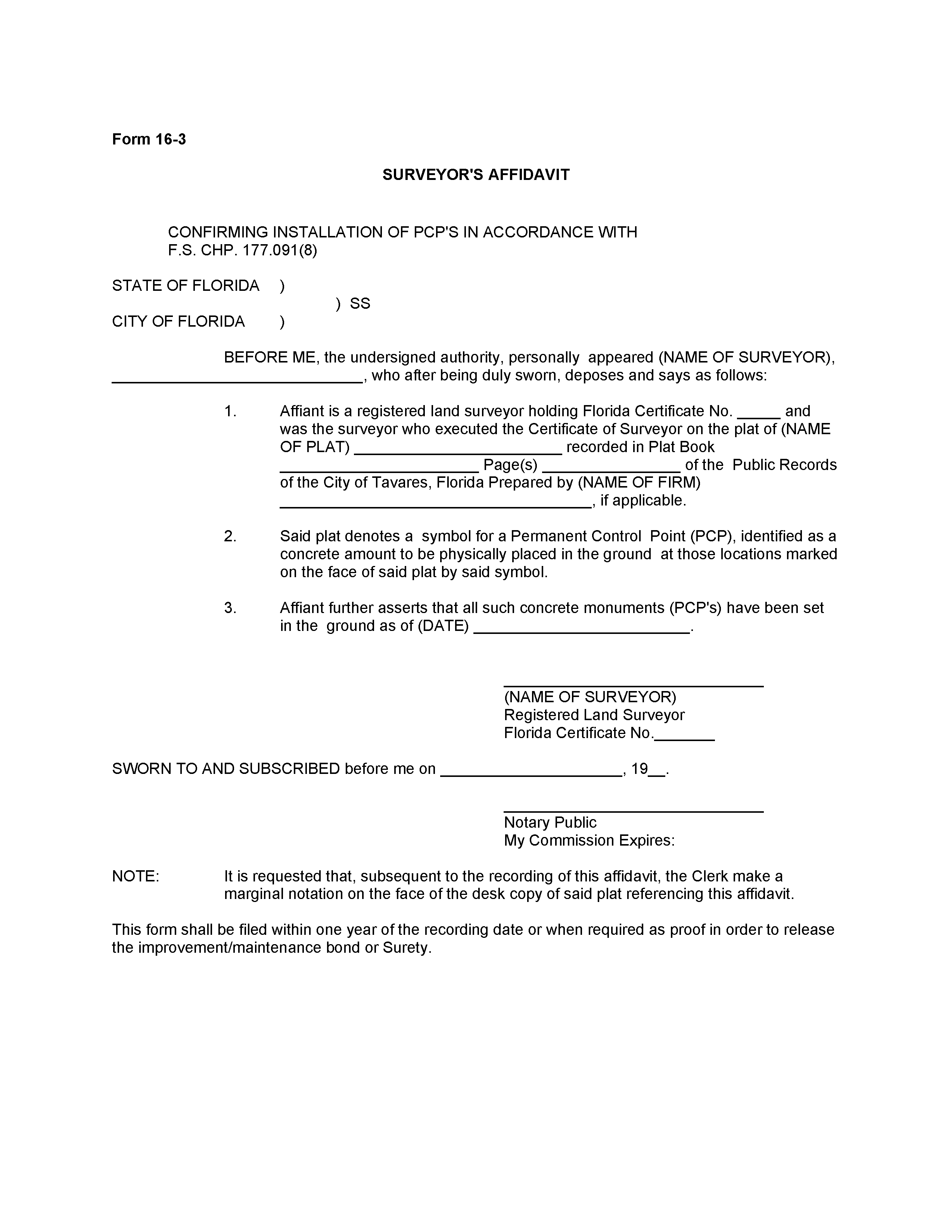
Permanent Control Points. Permanent control points shall be set at point of curvature (PC), point of tangency (PT), point of reverse curve (PRC), point of compound curve (PCC), permanent reference monument (PRM), and other changes in direction, excluding those points located by "PRM's". Permanent control points may be set prior to plat recordation, and shall be set within one year after the plat is recorded, and prior to the performance bond expiration date.
(C)
Permanent Bench Marks. Permanent benchmarks, to establish a National Geodetic Vertical Datum (NGVD) control, shall be installed within the subdivision at locations to be approved by the County Engineer.
(D)
Lot Corners. Lot corners, consisting of steel or wrought iron, not less than five eights (5/8) inch in diameter, and at least eighteen (18) inches in length, shall be placed at each lot corner. This shall be done after all grading within the right-of-way has been completed but prior to the initial acceptance of improvement.
(E)
Guard Stakes. A guard stake monument, consisting of at least 1" x 2" x 12" in size, with the lot number and number of adjoining lot plainly lettered on the flat face on the stake, shall be placed next to the front corner.
(F)
Reserved.
(G)
Surveyor Certificates. At the time of the final inspection of the required improvements, a surveyor's certificate indicating that permanent reference monuments, permanent control points and lot corners are in place shall be provided.
Section 16-30 - Fees
The fees for the submission, inspection and review of the requirements of this Chapter are set forth in Chapter 24.
Section 16-31 - Forms.
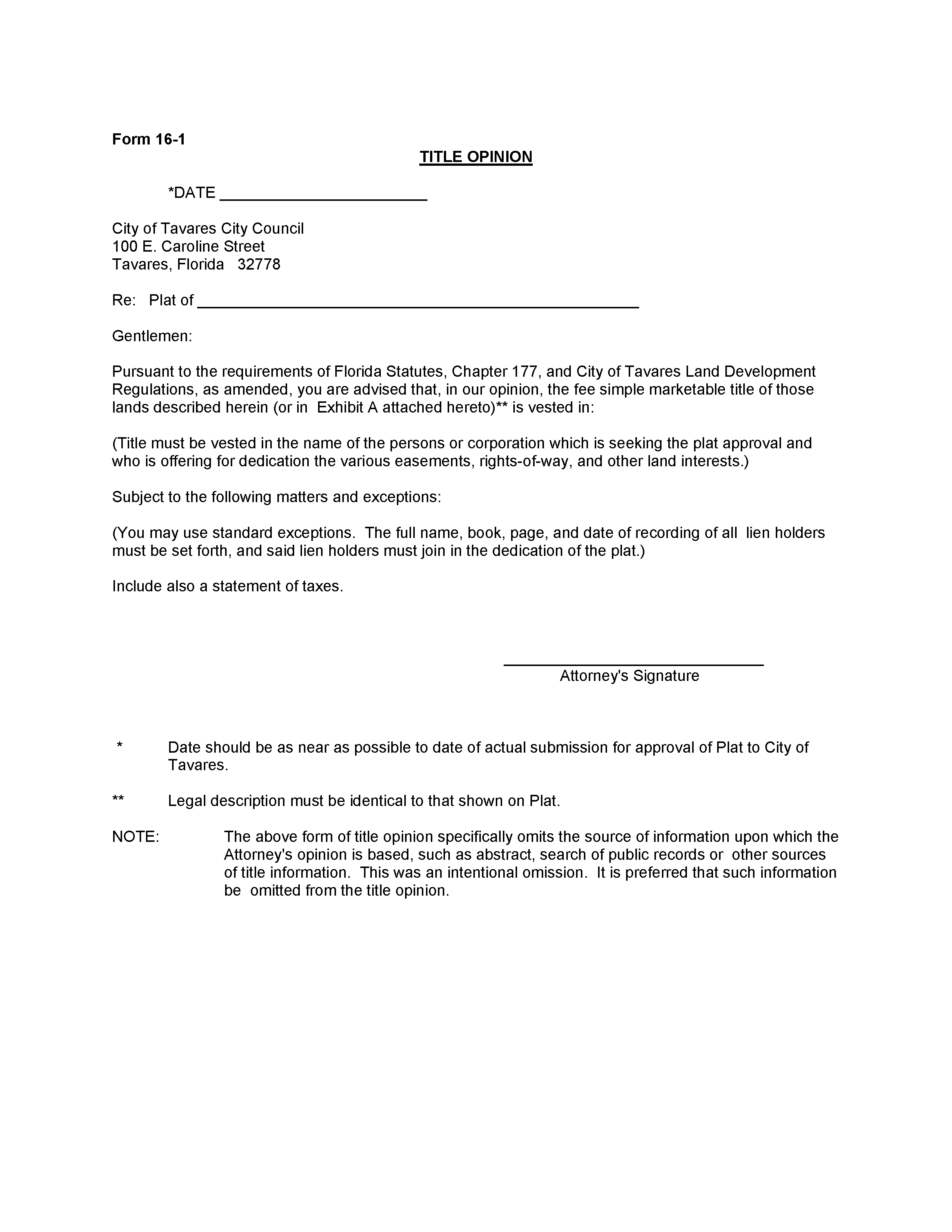
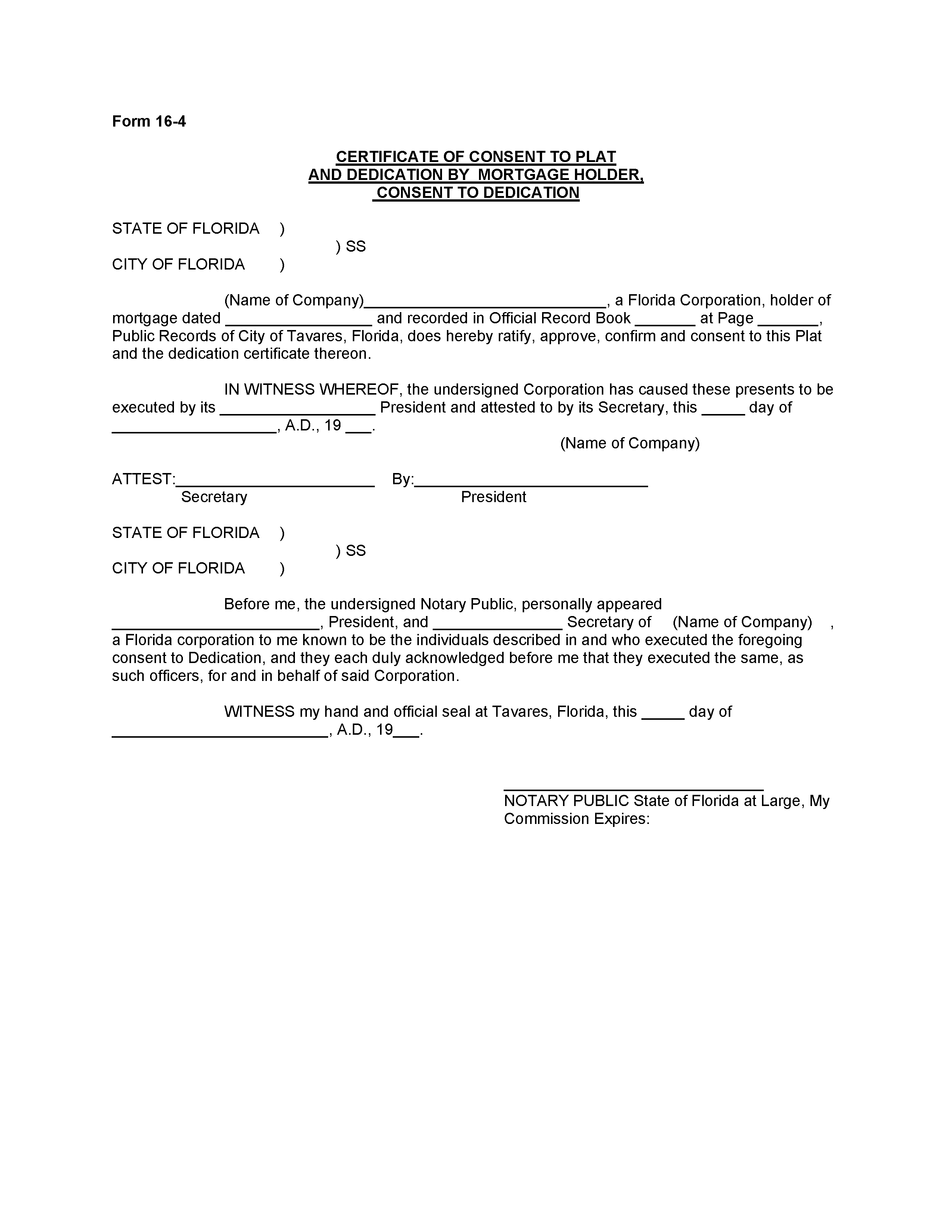
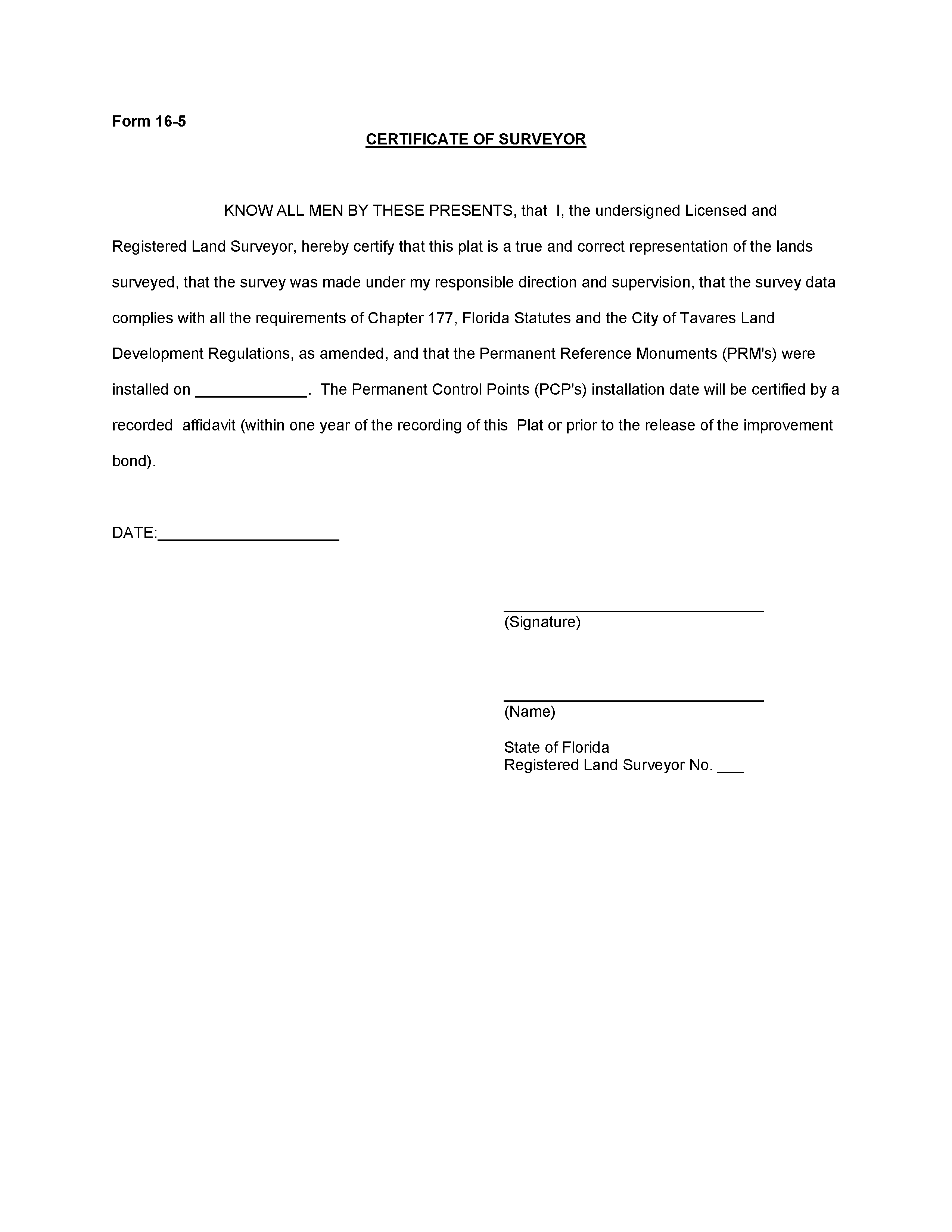
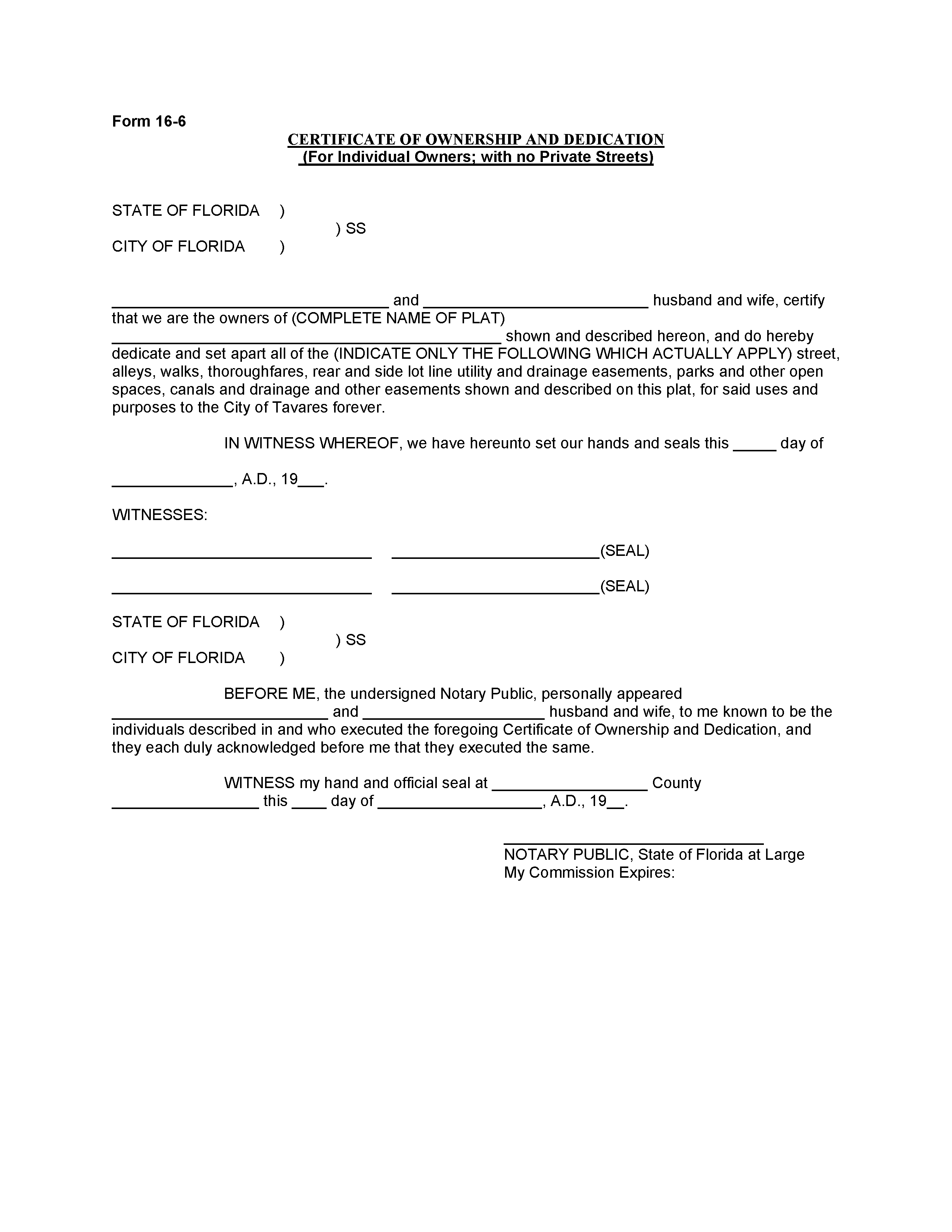
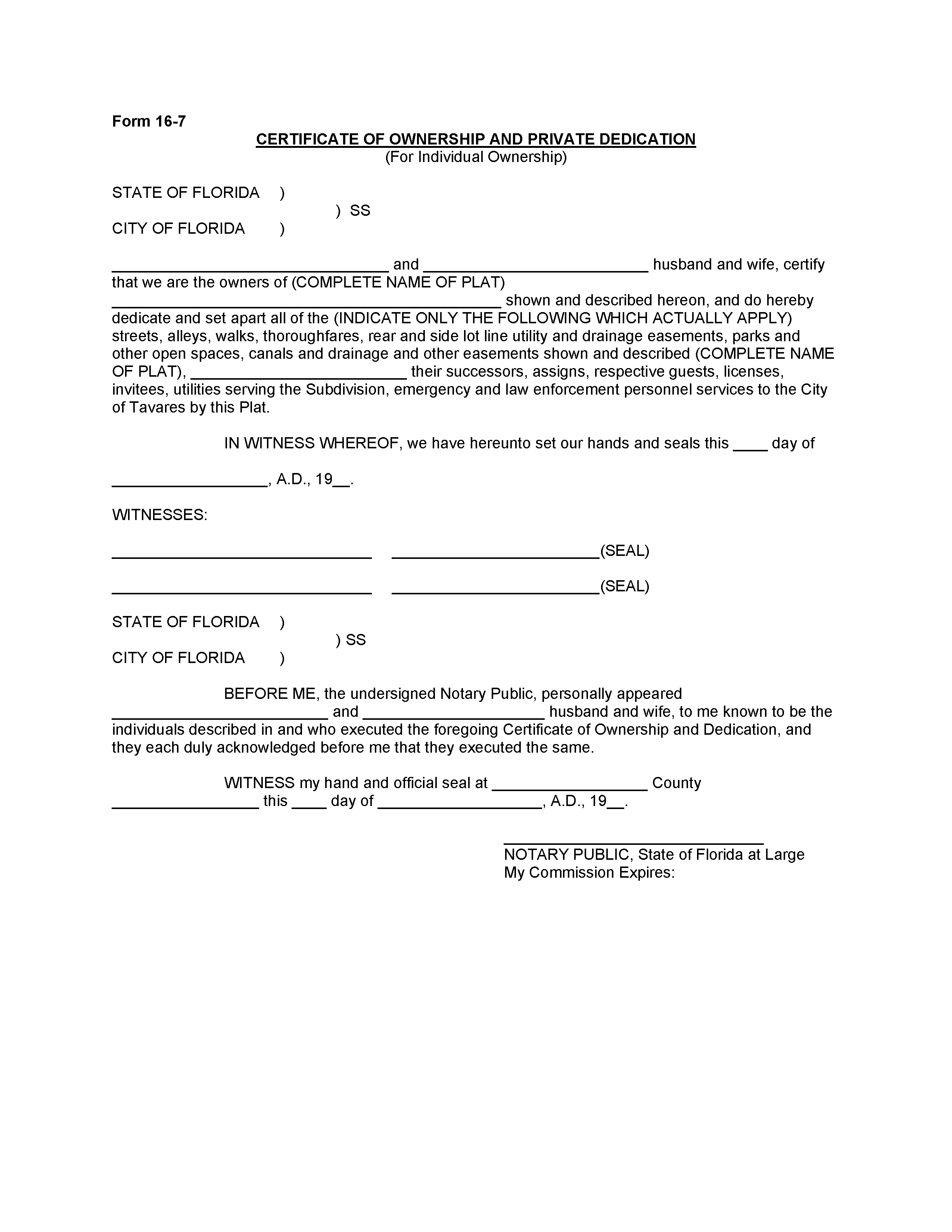
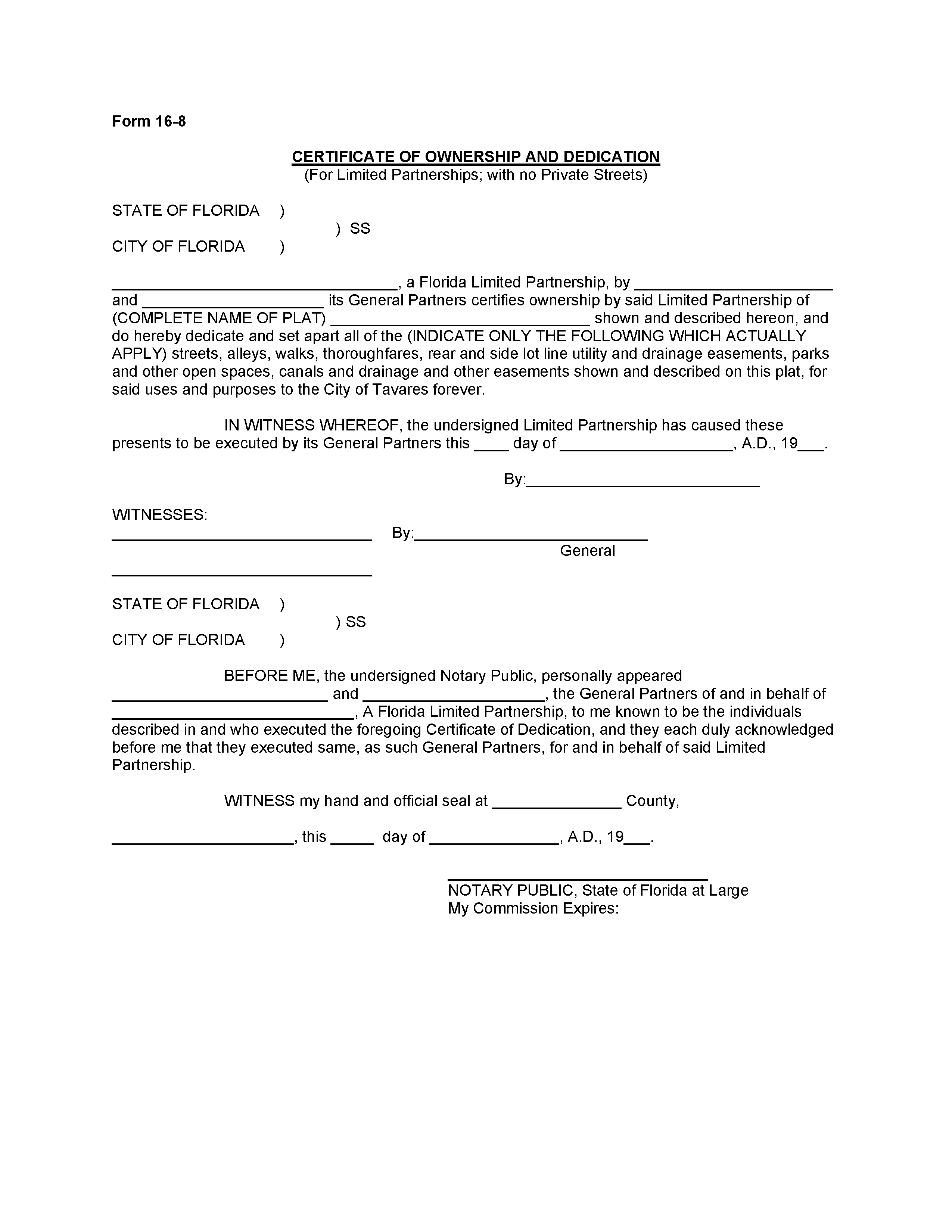
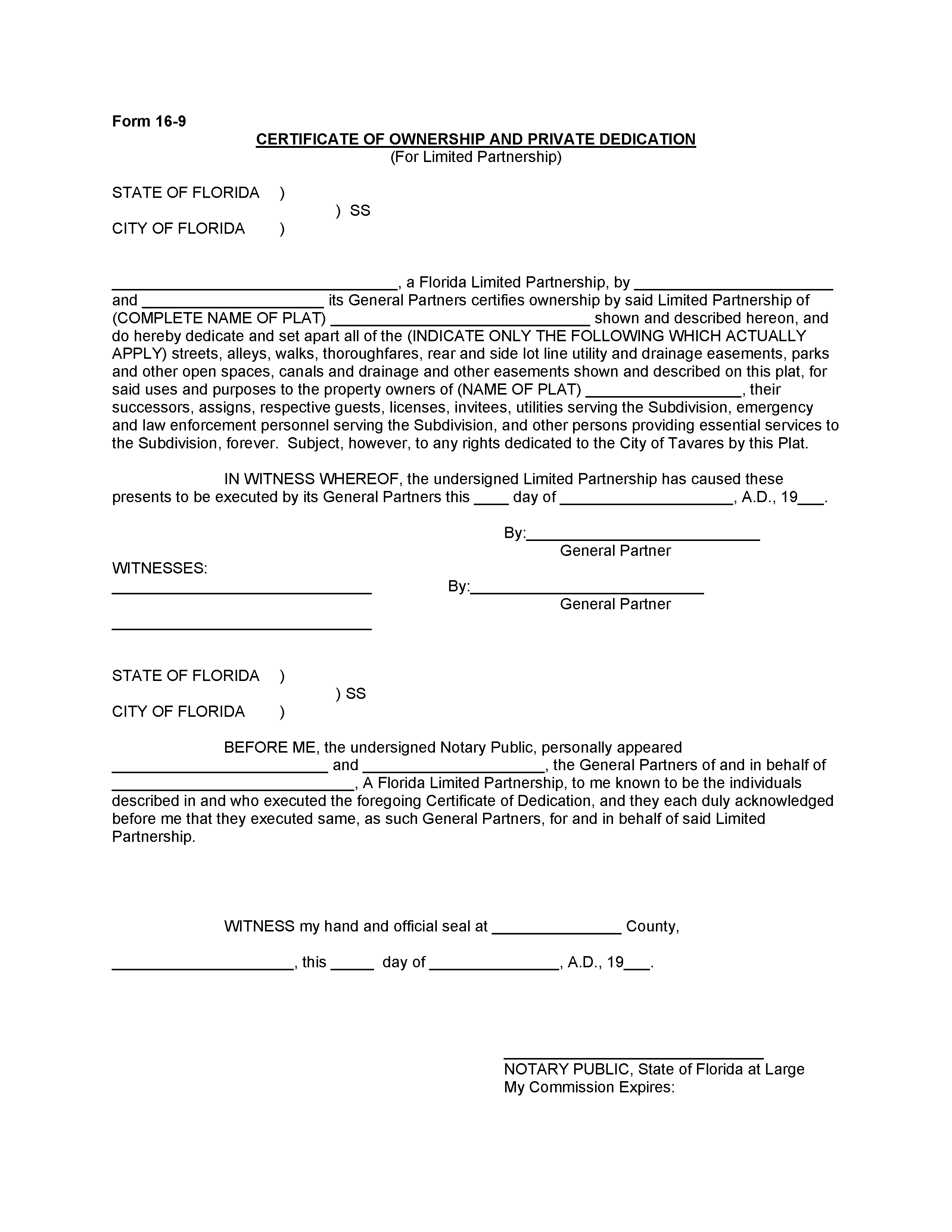
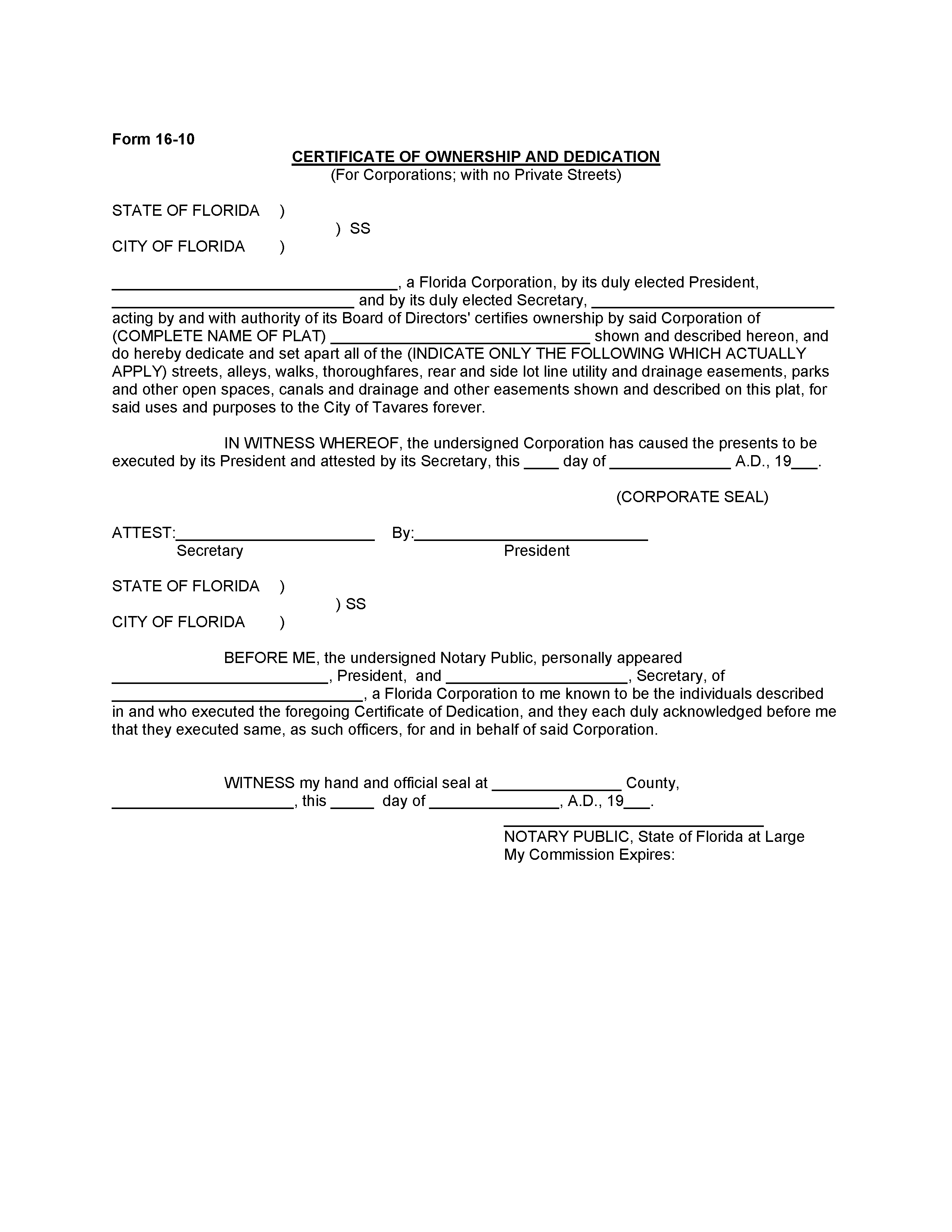
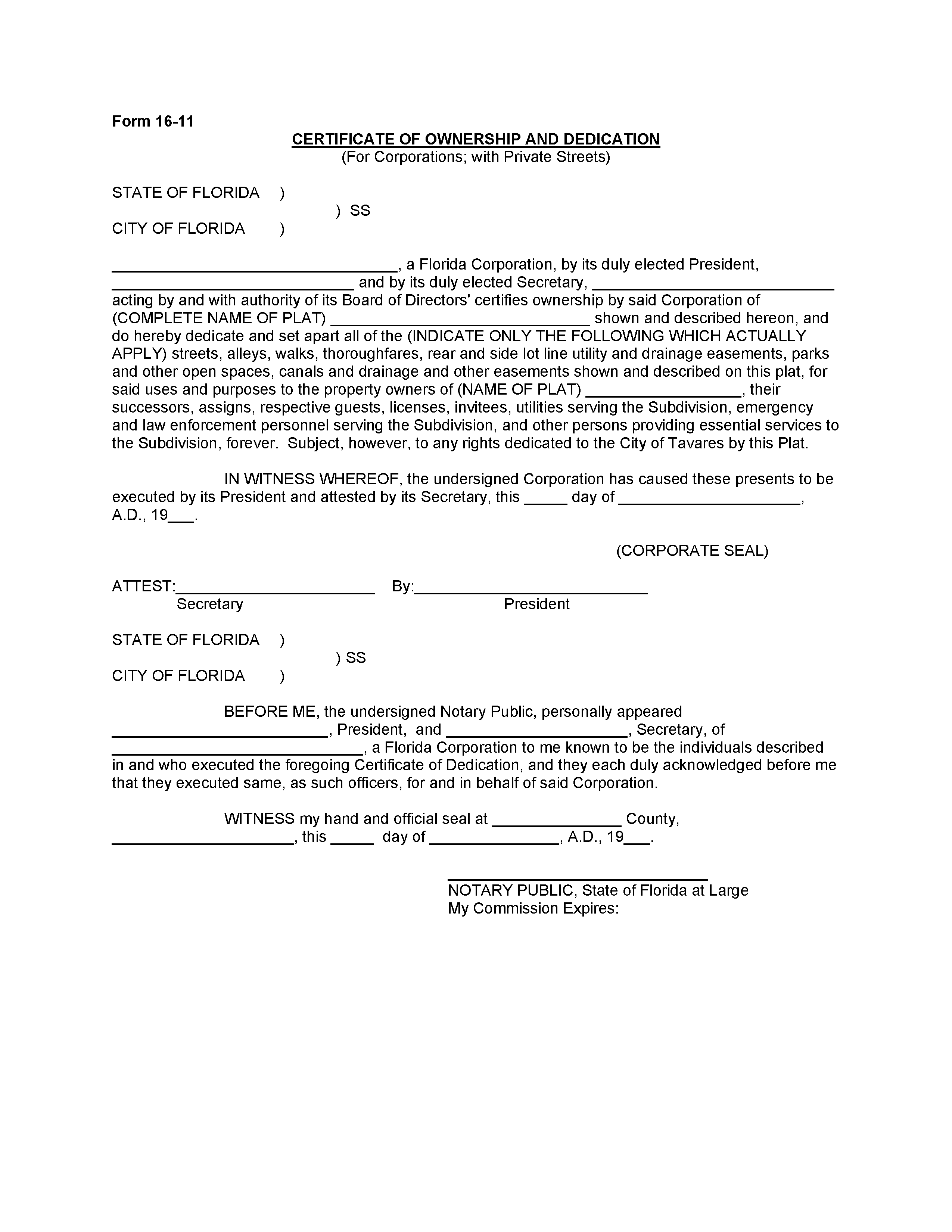
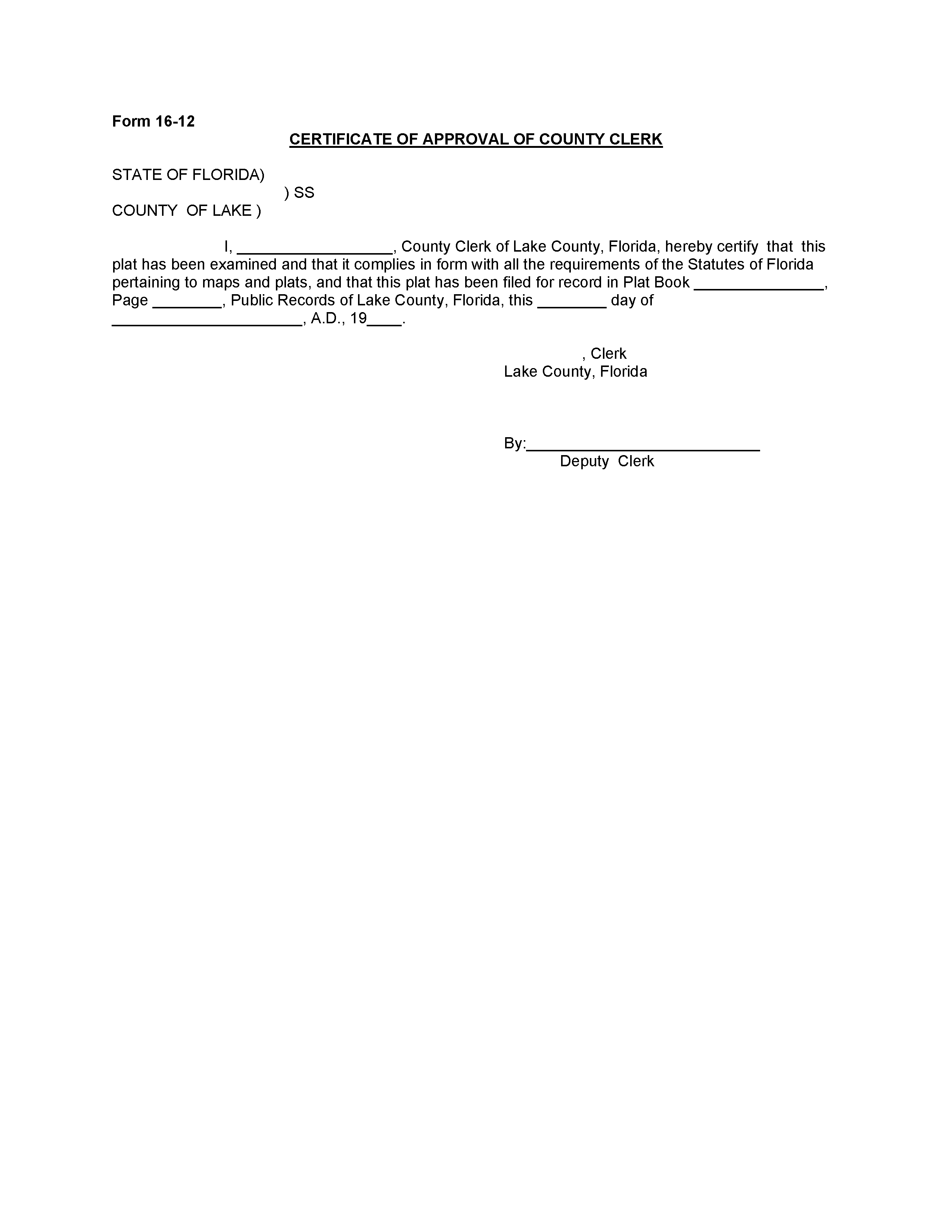
Requirements of the subdivision process may necessitate the use of one or more of the following forms. Use of these forms will facilitate review. Other similar forms may be submitted, however all forms shall be subject to review and approval of the City Attorney.
(Ord. No. 2025-08, § 1, 9-17-25)

