
Tavares City Zoning Code
CHAPTER 11
LANDSCAPING AND BUFFERING REGULATIONS PROTECTION AND REMOVAL OF TREES9
Editor's note— Ord. No. 2022-14, § 1(Exh. A), adopted September 21, 2022, amended Chapter 11 in its entirety to read as herein set out. Former Chapter 11, §§ 11-1—11-16, pertained to similar subject matter and derived from Ord. No. 2015-17, § 1, 9-16-15; Ord. No. 2018-14, § 1, 5-16-18; Ord. No. 2020-11, § 1, 10-21-20.
Section 11-1 - Purpose
The purpose of this chapter is to establish minimum standards for landscape and buffering, and tree protection requirements within the City in order to:
(A)
Improve the appearance of the community and enhance the value of property;
(B)
Eliminate or minimize potential nuisances such as noise, lights, signs, dirt, litter, unsightly buildings, or parking areas;
(C)
Encourage the proliferation, preservation, and protection of trees and vegetation;
(D)
Provide shade for the ground surfaces;
(E)
Buffer adjacent land uses;
(F)
Screen vehicular movement from pedestrian and public view; and
(G)
To provide wildlife habitat and other valuable ecological goals.
Section 11-2 - Definitions
For the purpose of this chapter, the terms, phrases, and definitions contained in Chapter 3 shall apply. Words used in the singular shall include the plural, and the plural, the singular. Words used in the present tense shall include the future tense. The word "shall" is mandatory and not discretionary. The word "may" is permissive. Words not defined herein shall be construed to have the meaning given by common and ordinary use as defined by the latest edition of Webster's Dictionary.
Section 11-3 - Applicability
The following development activity requires conformance to this section.
(A)
Non-residential Developments.
(1)
New Development on Undeveloped Property. The provision of any new impervious surfaces, buildings or parking lots, on undeveloped property or undeveloped project sites requires conformance with all standard requirements of this chapter set forth in Section 11-4.
(2)
Change in use or expansion of use of existing developments proposing additional impervious surface area. Proposed additions to impervious surfaces on existing developments shall provide, at a minimum, landscaping and buffers in accordance with the following:
(a)
The addition of fifty percent (50%) or greater of the existing impervious surface area or the addition of four-thousand square feet (4000'), whichever is less, shall provide one-hundred percent (100%) of the required site landscaping and buffer landscaping required by this chapter.
(b)
The addition of forty-nine percent (49%) or less of the existing impervious surface area or the addition of less than four-thousand square feet (4000'), shall provide seventy-five percent (75%) of the required site landscaping and buffer landscaping required by this chapter.
(3)
Change in use or expansion in use of existing developments proposing no additional impervious surface area. A change or expansion in use of an existing development which proposes no additional impervious surface area shall be required to provide, at a minimum seventy-five percent (75%) of the standard site landscaping and buffer landscaping required by this Chapter.
(B)
Residential Developments.
(1)
New residential development. All new single family residential subdivisions, duplex family residential subdivisions and multifamily residential developments must comply with the standard landscape and buffering requirements of this chapter set forth in Section 11-4.
(2)
Single Family and Duplex family lots within existing and new developments.
(a)
New residential development on vacant single family and duplex family residential lots within a platted subdivision or on a parcel of record shall maintain a minimum of one (1) canopy tree for every two-thousand square feet (2,000') of gross lot area, up to a maximum of five (5) trees, prior to issuance of a certificate of occupancy. At least, one canopy shall be on the front yard. The front canopy tree(s) shall be installed within a minimum of ten (10) feet and a maximum of twenty (20) feet of the right-of-way line and a minimum of eight (8) feet from r-o-w sidewalk and curb. All such lots shall also maintain a minimum of 5 shrubs for every two-thousand square feet (2000') of gross lot area, up to a maximum of 25 shrubs.
(b)
Existing residential development containing non-conforming landscaping shall be required to comply with this section only if expanding the residential unit by five-hundred square feet (500') or more.
(c)
Minimum plant material standards shall be in accordance with Section 11-5.
(d)
Existing vegetation may satisfy the requirements of this section subject to staff approval.
(3)
Expansion of existing multifamily development proposing additional impervious surface area. Proposed additions to impervious surfaces on existing multifamily developments shall provide, at a minimum, landscaping and buffers in accordance with the percentage requirements as set forth in section 11-3(A)(2) above.
Section 11-4 - Standard Landscaping Requirements
(A)
General Requirements.
(1)
Submittal of a landscape plan. A landscape plan shall be submitted at the time of application for a site plan, minor site plan or subdivision construction plan approval. The plans shall be certified by a professional landscape architect registered or licensed to practice that profession in the state of Florida. The plan shall include, but not be limited to:
(a)
The location, size (6 inches dbh or greater) and type of all existing trees and vegetation to be preserved;
(b)
the location, size (6 inches dbh or greater) and type of all existing trees to be removed;
(c)
The location, size and type of all trees and landscaping materials to be installed;
(d)
The persons, corporation or agent responsible for the design of the landscape plan; and
(e)
The persons, corporation or agent responsible for the continued maintenance of the landscaped areas.
After installation of site plan, minor site plan or construction plan landscaping, the property owner shall submit to the City written certification from a licensed landscape architect that the landscaping and irrigation system on the property were installed per the approved landscape plan.
Landscaping for single family and duplex lots as provided in Section 11-3(B)(2) are exempt from this requirement. The location of existing trees, or trees to be installed, may be shown on a plot plan indicating size, species and location.
(2)
Existing vegetation. The maintenance of existing vegetation is encouraged and may be counted toward meeting the minimum requirements of this section subject to staff approval.
(3)
Tree Preservation.
(a)
Under no circumstances shall any tree, regardless of size or species, be removed from any designated wetland or conservation easement.
(b)
A minimum of one-half of the existing trees measured 6 inches in diameter breast height or greater shall be preserved on site. Should preservation of these trees interfere with reasonable development of the site, replacement trees may be planted at the following ratio:
1.
Existing trees 6 to 20 inches dbh may be replaced with 2 trees at a minimum of 2.5 inches dbh.
2.
Existing trees 21 to 39 inches dbh may be replaced with 3 trees at a minimum of 2.5 inches dbh.
Landscaping required for buffers and off-street parking may be used to meet the replacement trees requirement. Replacement trees shall be considered canopy or understory trees per the approved species list (see Table 11-E).
(c)
All trees forty (40") inches in diameter or greater shall be preserved and site design and/or lot configuration shall accommodate said preservation.
1.
The City Administrator has the authority to grant an administrative variance to this section subject to the following conditions:
a.
The tree materially interferes with the proposed location, servicing or function of the utility lines or services, right-of-ways, or stormwater retention areas and said tree cannot be preserved through redesign of the infrastructure, and
b.
The tree is diseased or weakened by age, abuse, storm or fire and is likely to cause injury or damage to people buildings or other improvements.
2.
Replacement requirements. Trees required to be preserved under subsection [(A)(3)](c) and which have been approved for removal subject to subsection [(A)(3)](c)1. shall be replaced in accordance with the following:
a.
For each inch of tree removed an inch of tree shall be replaced, said tree being measured at diameter breast height. Replacement trees shall be a minimum of six inches in diameter breast height.
b.
Replacement trees shall be considered canopy trees per the approved species list (see table 11-E)
(3)
Placement of Landscape Material.
(a)
No landscaping shall be located in an area that may interfere with proper visibility of on- coming vehicles.
(b)
No canopy tree shall be planted with twenty feet (20') of overhead utility lines.
(c)
The development of a canopy-lined street is encouraged. Canopy trees required to comply with the perimeter buffer requirements may be planted in the City right-of-way provided they are a minimum of ten feet (10') from the roadway and located so as not to interfere with stormwater conveyance or pose damage to sidewalks. The placement and location of trees within the right-of-way shall be subject to staff approval. The survival and maintenance of such trees planted in the right-of-way shall not become the responsibility of the City, but shall remain the responsibility of the property owner.
(d)
Landscaping is encouraged in stormwater areas provided the type of landscaping chosen will thrive in a wet/dry environment typical of stormwater retention ponds. Selected landscaping shall also not cause a maintenance problem or interfere with the function of the stormwater facility.
(4)
Grass/Turf requirements. Turf areas shall be separated from non-turfed areas so as to facilitate low water use irrigation zones. The grass area of front, side, and rear yards must be sodded on lots less than 13,000 square feet. The grass/turf area of side and rear yards may be sodded or sprigged or seeded on lots over 13,000 square feet. Fifty percent (50%) of the front, rear and side yards of lots, on lots over 13,000 square feet, shall contain grass or turf.
Stormwater retention areas shall be sodded as originally designed and permitted by the City and other appropriate governmental agencies as set forth in the approved plan. Non-turf areas may be located around the retention area provided they are designed and planted with materials appropriate to the growing conditions of the retention area.
(5)
Landscape Bank.
(a)
A landscape bank fund is established by the City to provide an opportunity to make a cash payment to the City in lieu of providing the required landscape stock on site. The landscape bank may be utilized for up to a maximum of twenty-five percent (25%) of the required landscaping per this Chapter. A minimum of seventy-five percent (75%) of the required landscaping must be planted on site. Payment into this fund shall be considered only as a final remedy and must be approved by the City Council through the variance process.
(b)
Monies from the landscape bank fund are to be used by the City for the purchase, installation, or replacement of trees, landscaping, and irrigation systems in City parks, rights-of-way, and public open spaces, as well as for gateway treatments (landscaping or non-landscaping). It may not be used for maintenance purposes.
(c)
Calculations for payment into the landscape bank fund shall be equivalent to the cost of the landscape material that would otherwise have been required to be planted on site. The average of three (3) cost estimates provided by professional nurseries shall be used to determine the cost of the landscape material.
(d)
Under no circumstances will the City be required to refund money for any project that, at a subsequent date, finds that the landscape material could have been purchased for less or that additional plant material can be planted on site.
(B)
Perimeter Buffer Requirements.
(1)
Location and design. Buffers shall be provided on the outer perimeter of a lot or parcel, in accordance with the requirements and standards contained herein. Buffers shall not be located on any portion of any existing, dedicated, or reserved public or private street or right-of-way. The buffer is normally calculated as parallel to the property line. Design variations are allowed, however, if the average width of the buffer conforms to the standards listed in Table 11-A of this section. Where a required drainage, utility, or other easement is partially or wholly within a required buffer, the developer shall design the buffer to eliminate or minimize plantings within the required easement.
(2)
Use of buffers. A perimeter buffer may be used for other purposes provided that no plant material is eliminated and the total width of the buffer is maintained. The uses permitted within the landscaping buffer area are as follows:
(a)
Passive Recreation (i.e., pedestrian walkways, benches, open space, etc.)
(b)
Sidewalks
(c)
Signs
(d)
Utilities (if approved by the City Engineer)
(e)
Stormwater retention
(f)
Driveway cuts
(g)
Docks and boardwalks
Uses specifically prohibited in the buffer area are parking or loading facilities, buildings, accessory structures, accessory equipment, refuse areas, and active recreation.
(3)
Stormwater facilities in buffers. The design high water elevation of a stormwater retention/detention facility shall be no closer than five feet (5') to a property line unless the facility is shared by the adjoining property. At no such time shall retention in the buffers relieve the applicant of meeting the minimum landscaping requirements. If a retention/detention facility encroaches in a perimeter buffer, the required landscaping must be maintained around the perimeter of the pond with the majority of the plantings placed near the property line. See Chapter 9, Division 2, Commercial Architectural and Site Design Standards for additional requirements.
(4)
Description of buffer types. Table 11-A provides the standard perimeter buffer types and required landscape and screening materials. Refer to Table 11-B and 11-C for buffer types required on each perimeter boundary.
(C)
Off-street parking landscaping requirements.
(1)
Wherever, in any zoning district, off-street parking or loading facilities are provided which are in excess of fifteen-hundred square feet (1,500') or five (5) spaces, whichever is greater, such off- street facilities shall conform to the minimum landscaping requirements set forth in these regulations.
(2)
All required landscaped areas shall be protected from vehicular encroachment by curbs, wheel stops or other similar devices. The front of a vehicle shall not encroach within any parking lot or perimeter landscaped area required by these regulations.
(3)
Landscaped areas shall be located to divide and break up the expanse of paving and at strategic points to guide traffic flow and direction.
(4)
Landscaping shall be provided as follows:
(a)
Each single-sided row of parking must end in a landscaped island.
(b)
All rows of parking spaces shall contain no more than fifteen (15) parking spaces uninterrupted by a required landscape area, and no parking space in any such row shall be separated from a required landscape area by more than seven (7) parking spaces.
(c)
The minimum size of each landscaped island shall be two-hundred square feet (200').
(d)
The landscape island shall be planted with one (1) approved species tree, and sod or approved ground cover.
(5)
When an access way intersects a public right-of-way, all landscaping shall provide unobstructed cross visibility at a level between two and one-half feet (2?') and six feet (6') from the ground. The unobstructed area shall be measured by forming a triangle. The triangle shall be formed from the point of intersection of the access way and the rights-of-way. Two sides of the triangle shall measure ten feet (10') (See diagram below).
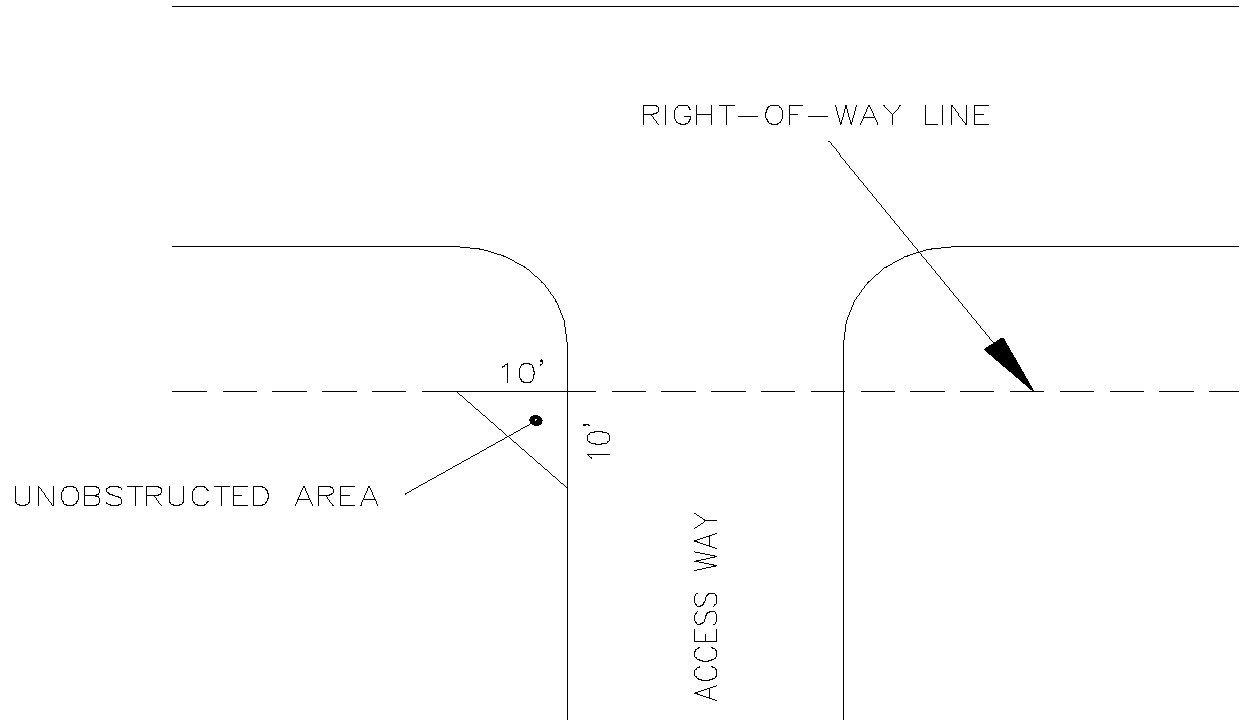
Trees having limbs and foliage trimmed in such a manner that no limbs or foliage extend into the cross visibility area shall be allowed provided they do not create a traffic hazard. Landscaping, except required grass or ground cover, shall not be located closer than three feet (3') from the edge of any access way pavement.
(6)
Parking garage landscape requirements. All parking garages shall be required to provide the following:
(a)
Landscape hanging baskets, flower boxes, and/or landscape planters around the exterior of all levels of the garage structure where the facade of said structure is visible from a public right-of-way. The amount of landscape coverage of each facade shall be equivalent to ten percent (10%) of the total square footage of each facade. Placement of landscape treatments shall be dispersed across the expanse of each facade with the intent of moderating the visual impact of the structure.
(b)
Perimeter landscaping of canopy trees, sub-canopy trees and shrubs equivalent to the amount required per the number of parking spaces for the first three (3) floors. A minimum of ten feet (10') of landscape buffer shall be provided around the perimeter of the garage structure and contain said plant material. The intent of this landscape buffer is to provide aesthetic appeal and a dense visual buffer to the structure. Varying heights of plant material shall be provided so as to effect vertical landscape coverage of at least the first floor of the structure. Plantings shall be dispersed within the buffer so as to effect visual depth of plant material. In order to achieve this landscaping scheme additional planting beyond minimum requirements may be required.
(D)
Site landscaping requirements.
(1)
All proposed development shall provide additional site landscaping as identified in Table 11-D based on the total amount of impervious surface area of the site following development.
(a)
Landscaping required for off-street parking and site buffers may be used to meet the Site Landscaping requirements.
(b)
In Table 11-D, the total development amount of impervious surface area (ISR) shall not include any public or private facilities such as: sidewalks, streets, roadways, travel aisle or off-street parking areas.
(c)
In Table 11-D, the total development amount of impervious surface area (ISR) shall include any development ISR such as: buildings, structures, accessory/associated structures, paved areas, or any ISR not included in the exempted development ISR listed above (Section 11-4, D, 1, b).
(2)
While there are no strict requirements as to the exact location of landscaping. In general, the site landscaping shall be disbursed evenly on site. Each exposure (north, south, east, and west) shall have a proportion of the landscaping approximately equal to the amount of open area available to plant the vegetation. Typically, landscaping is encouraged to hide and/or enhance parking lots, blank walls, dumpster areas, and stormwater areas.
(3)
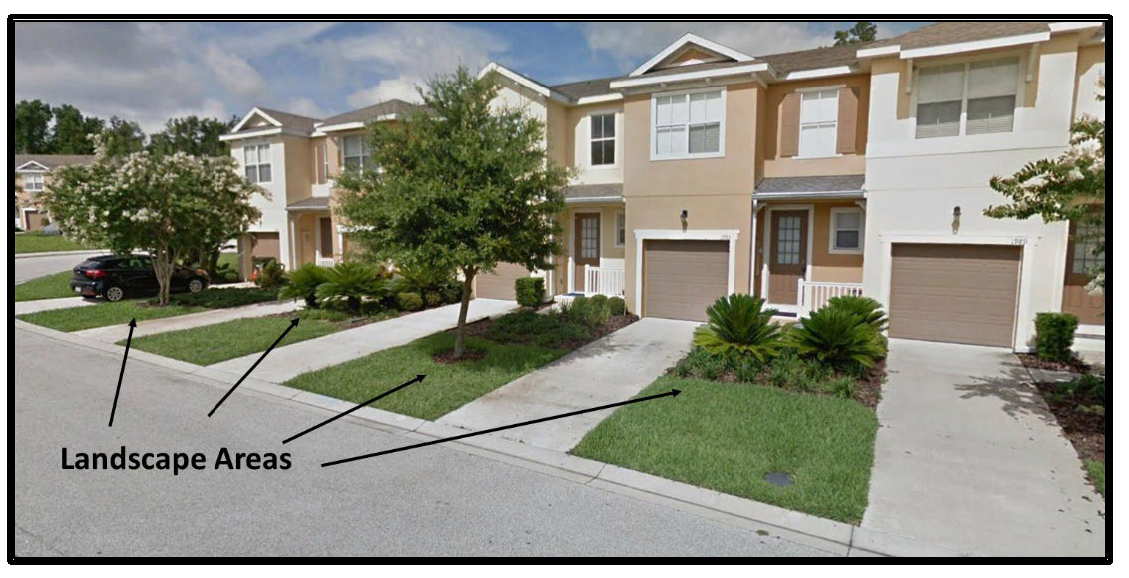
Multifamily developments shall provide a landscape area consisting of shrubs and a minimum of one (1) approved tree at the entryway of each private exterior ground floor unit.
The following is an example of an acceptable design:
(4)
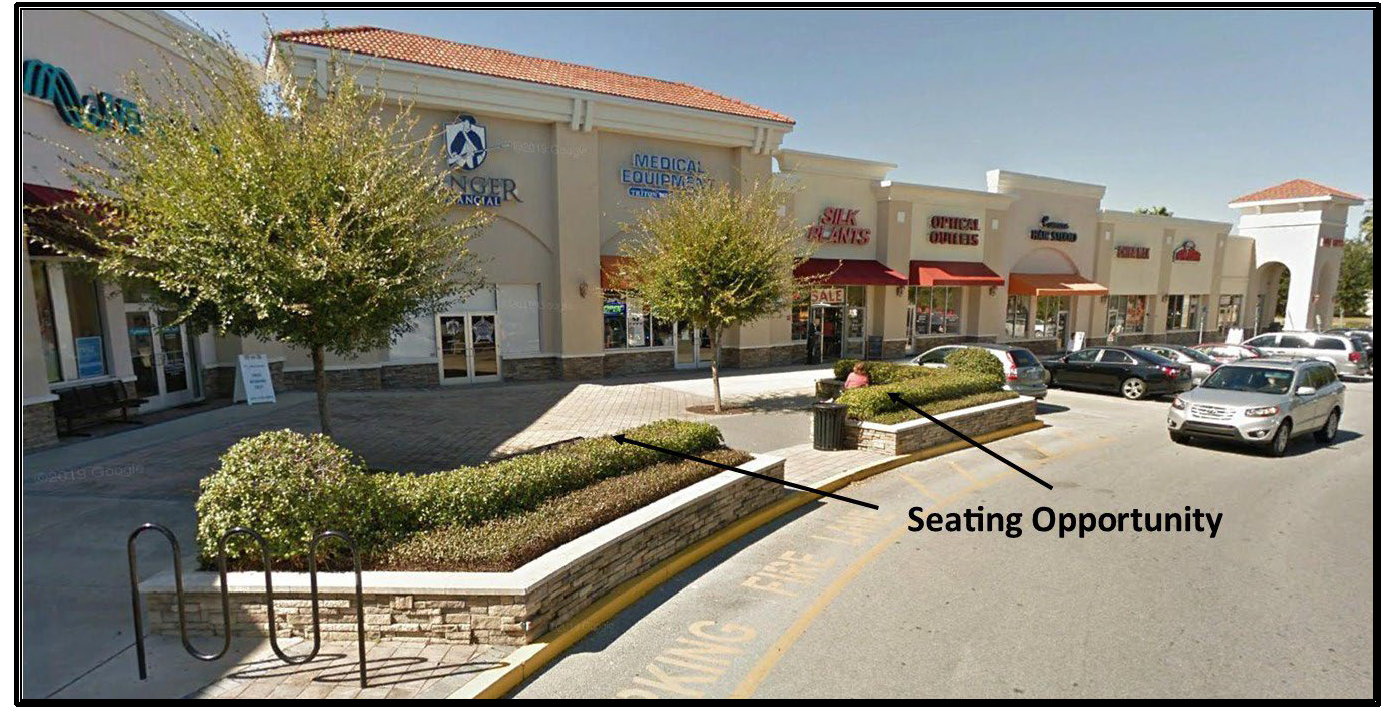
Large scale commercial sites, consisting of 2 acres or more in area, shall provide a small urban garden/pedestrian comfort area. This garden/area shall be shown to consist of a minimum of 1% of the total site area. Depending on design, the area may be counted toward the overall required site landscaping and impervious surface area. This area may be incorporated into the on-site retention area, building entryway or other highly visible area.
a.
The area must be visible from the public right-of-way, have pedestrian access (including a handicapped access) into the site from the street, or non-vehicular courtyard; it must have a stabilized walking surface of an approved material; on-site or building mounted lighting (fixtures no taller than 15 feet and solar power encouraged); the space must be positioned in an area of significant pedestrian traffic to provide interest and security. The area must include an opportunity for leaning on a secure structure or sitting on a form of bench or ledge of at least 48 inches in width and 16 inches in depth. Landscaping components must add visual interest and must not act as a visual barrier or security risk. This could include planting beds, potted plants or both. The space is encouraged but not required to have artwork, water features, drinking fountains, etc.
The following is an example of an acceptable design.
Section 11-5 - Planting Standards
(A)
Quality. All plant material used to meet the provisions of this section shall be equal or exceed the grade of Florida #1 as given in "Grades and Standards for Nursery plants," State of Florida.
(B)
Plant specifications. Plant materials shall be installed in conformance with the following size guidelines:
(1)
Canopy trees shall have a single straight trunk to a minimum of four feet (4'), a minimum caliper of two-and-one-half inch (2½") DBH, and a minimum height of fifteen feet (15') at the time of planting.
(2)
Understory trees may be single stemmed or multi-stemmed and shall have a minimum caliper of one and one-half inch (1½") DBH and a minimum height of eight feet (8') at the time of planting. The caliper of multi-trunk trees will be calculated using a total DBH of all trunks.
(3)
Shrubs and hedges shall have a minimum height of thirty six inches (36") at the time of planting. When a continuous hedge is required, the plants shall be planted at a spacing of thirty-six inches (36") on center.
(C)
Approved species. The landscaping requirements of this chapter may be achieved by using any of the approved species listed in Table 11 F. Other species, as listed in the St. Johns River Water Management District's "Xeriscape Plant Guide", "Waterwise Plant Database", "Florida Water Star SM Program" or the Florida-Friendly Landscaping™ publications, as appropriate to the area, may also be used if approved in advance by the Community Development Director as being equivalent in function and quality.
(D)
Waterwise/Xeriscape. Landscaping to promote water conservation using the principles of waterwise/xeriscape shall be required. Turf areas shall be separated from non-turf areas so as to facilitate low water use irrigation zones. Non-turf areas shall contain appropriate plant species so little or no irrigation will be necessary for plant survival after the initial plant establishment. A minimum of sixty percent (60%) of required landscape material, including grass/turf, shrubs and trees, shall be of the Waterwise/Xeriscape variety (high drought tolerance). Waterwise/Xeriscape plants are marked with an asterisk (*) in Table 11-E.
(E)
Nuisance and exotic plant species. All nuisance and invasive exotic vegetation shall be removed where feasible and replaced with approved plant species. Table 11-F lists the plants that are considered nuisance and will not be permitted as meeting the landscaping requirements set forth in this chapter. Additional nuisance species may be identified by other sources and shall also not be permitted.
Section 11-6 - Irrigation
Any property owner electing to install an irrigation system is to comply with the following regulations and obtain a permit from the City of Tavares Community Development Department.
(A)
All irrigation permits shall be reviewed by Utilities Department authorized personnel.
(B)
Irrigation plans for single family uses shall be submitted prior to construction of the irrigation system. The plans shall be clearly readable, drawn to a reasonable scale, show the entire site to be irrigated and must include all improvements.
(C)
Irrigation plans for multi-family, commercial, industrial and governmental uses shall be submitted along with the landscape plan in conjunction with the site development plans and application. The plans shall be clearly readable, drawn to a reasonable scale, show the entire site to be irrigated, including all improvements, and shall include but not be limited to: date, scale, revisions, legend, specifications which list all aspects of the equipment and assembly thereof, water source, water meter and/or point of connection, backflow prevention devices, pump station size, pump station location, design operation pressure and flow rate per zone, locations of pipe, controllers, valves, sprinklers, sleeves, gate valves, etc. The plans and specifications shall be prepared by, and each sheet shall bear the impress seal of a Professional Engineer or Landscape Architect, registered in the State of Florida, or other recognized certified design professional, who is competent in this field of expertise.
(D)
Irrigation systems shall comply with the following requirements:
1.
Irrigation systems shall be water efficient irrigation systems designed to provide no more than the minimum amount of water required by any specific landscape material to ensure survival of that material. Irrigation system piping shall be underground. Such systems shall utilize a combination of sprinkler mechanisms and zones to accommodate the individual irrigation requirements of each type of landscape material, including trees, shrubs, ornamentals and turf areas.
2.
Irrigation systems shall be designed to provide 100 percent coverage and to prevent overspray, runoff, low land drainage and other conditions where water flows onto or over adjacent property, non-irrigation areas, water features and impervious areas.
3.
Irrigation systems shall be operated by an automatic irrigation controller or timer which has sufficient programming flexibility to respond to the needs of the irrigation devices being used and is capable of irrigating high requirement areas on a different schedule from low water requirement areas (provided that separate zones exist), has program flexibility (to allow repeat cycles and multiple program capability) and battery backup (to retain programs).
4.
The design of the irrigation system shall include sprinkler heads and devices appropriate for the landscape material to be irrigated. Sprays and rotors shall not be on the same control value circuit and shall have matching application rates within each zone. Sprinkler spacing shall not exceed 55 percent of the sprinkling diameter of coverage.
5.
Irrigation systems shall be designed with low trajectory heads, micro irrigation or low-volume water distributing devices in order to prevent overspray onto impervious areas. Micro irrigation systems shall not be used to irrigate turf areas. Sprinkler heads in and adjacent to lawn areas shall be designed to be flush with the ground surface when not in use.
6.
Irrigation systems shall be designed to place high water demand areas, such as lawns, on separate zones from those areas with reduced water requirements.
7.
A rain sensor device or switch shall be installed to regulate the controller's operation that will override the irrigation cycle of the sprinkler system when one-half to three-quarter inch of rainfall has occurred on any day.
8.
Irrigation rates for each zone shall be calculated and noted on the irrigation plans.
(E)
Water conservation. The Utilities Director or his/her designee or other authorized person shall ensure the following tasks are complete:
(1)
The irrigation contractor has provided the property owner an irrigation plan and maintenance checklist, and;
(2)
The property owner possesses a St. John's River Water Management District's seasonal watering guideline.
(F)
Enforcement. Any owner with irrigation as required under these regulations not being maintained in an orderly manner consistent with this regulation shall be notified of a violation and will be referred to the Code Enforcement Officer.
Section 11-7 - Installation and Maintenance
Proper installation and maintenance of landscape areas is required in order to ensure their proper function and reduce or eliminate nuisances and/or conflicts.
(A)
Professional installation. All landscaping is to be installed in a professional manner following good nursery practices as set by the Florida Nurserymen's Association and/or the Florida Irrigation Society.
(B)
Irrigation maintained. All irrigation systems are to be maintained in an operable manner and managed to ensure water efficiency and prevent wasteful practices.
(C)
Owner responsible for maintenance. The responsibility for maintenance of required landscaping shall remain with the owner of the property, his successors, heirs, assignees or any consenting grantee to include banks and/or mortgage holders.
(1)
All plantings within the site and in grassed rights-of-way adjoining the landscaped areas shall be maintained in an attractive and healthy condition. Maintenance shall include, but not be limited to, watering, tilling, fertilizing and spraying, mowing, weeding, removal of litter and dead plant material, and necessary pruning and trimming
(2)
Replacement plantings shall be provided for any required plants which die or are removed due to disease or destruction and shall meet all minimum standards and conform to these regulations.
(3)
Natural watercourses within a buffer shall be maintained in a natural condition consistent with the Comprehensive Plan and other applicable regulations.
(4)
Landscape structural features such as walls, fences, berms or water features shall be maintained in a structurally safe and attractive condition.
(5)
Where other uses including pedestrian, bike or other trails are allowed within a buffer, these uses shall be maintained for their safe use.
(D)
Inspections. The City may conduct periodic inspections to assure compliance with the maintenance requirements of this section.
(E)
Penalty. Any owner with landscaping as required under these regulations not being maintained in a neat and healthy appearance shall be notified of a violation and re-inspected in thirty (30) days. Continued violation after the thirty (30) days will be referred to the Code Enforcement Authority.
Section 11-8 - Voluntary Planting
These regulations shall not be interpreted to restrict, regulate, or limit the voluntary planting of any tree in the City of Tavares. The provisions of these regulations govern only the planting of the trees that are required to be planted or retained under these regulations.
Section 11-9 - Variances
(A)
Variance criteria. The City Council may authorize payment into the landscape bank, waive or reduce a portion of the required landscaping and/or buffering requirements under the following conditions:
(1)
The strict application of one or several of these requirements would create a non-conforming use.
(2)
When, because of the particular physical surroundings, shape or topographical condition of a property, strict compliance would cause an unreasonable hardship on the property owner.
(B)
Administrative variances. If, in the determination of the City Administrator, preservation of certain trees would be the sole basis for a request for a variance to site design standards, the City Administrator may grant an administrative variance for the preservation of any tree on the approved species that is equal to or greater than forty inches (40?) DBH subject to the following criteria.
(1)
Variance to setback requirements: A maximum of ten percent (10%) reduction for principal and accessory buildings and structures.
(2)
Variance to number of parking spaces required: A maximum reduction of five percent (5%) or two (2) spaces, whichever is greater.
(3)
Variance to the minimum size of parking spaces: A maximum reduction of two feet (2') in length or width for those spaces effected by the saved tree.
(4)
Variance to the maximum number of spaces in a parking row: An increase of two (2) spaces.
Section 11-10 - Removal of Trees Requires Permit
It shall be unlawful and a violation of these regulations to clear or remove a tree by any method without first securing a permit from the City of Tavares as provided by these regulations unless exempt from these regulations as set forth in Chapter 163 Florida Statutes.
Section 11-11 - Application for Permit
(A)
Submittal of application form required. An application for tree removal shall be filed on official forms provided by the City of Tavares. Completed applications shall be submitted to the City of Tavares Planning, Zoning and Development Department for approval prior to removal of any tree.
(B)
Submittal requirements per development type. Application for a tree permit shall be submitted as follows:
(1)
All new subdivisions shall be required to address tree removal and preservation during the preliminary plan and construction plan process so that due consideration may be given to protection of trees during the site design process. Approval of the subdivision construction plan shall constitute approval of the tree removal permit.
(2)
Any commercial, industrial, multi-family, or other use, requiring site plan approval under the City of Tavares Land Development Regulations, shall be required to address tree removal and preservation during the site plan approval process so that due consideration may be given to protection of trees during the site design process. Approval of the site plan shall constitute approval of the tree removal permit.
(3)
All new single family and duplex dwelling units shall be required to submit an application for a tree removal permit at the time of application for a building permit.
(4)
Existing development shall be required to submit an application for tree removal prior to removal of said tree.
(C)
Additional information required. Upon request, the Community Development Director may require additional information to evaluate the tree removal permit application. Such additional information may include but not be limited to:
(1)
A site plan or plot plan indicating the following:
(a)
Property boundaries and all structures contained therein.
(b)
A tree inventory consisting of all trees which are six inches (6") DBH or greater, measured four feet (4') above grade, including species and estimated DBH. All trees proposed for removal shall be so indicated.
(2)
The reason for the proposed removal of the tree(s).
(3)
Appropriate permit fee as set by resolution of the City Council, except that no fee shall be charged for the removal of trees existing on lots upon which one single family or duplex dwelling exists.
Section 11-12 - Issuance of a Tree Removal Permit for Existing Development
(A)
Identification of trees to be removed. The tree removal permit, when issued, shall specifically identify which trees shall be permitted to be removed.
(B)
Expiration. A tree removal permit shall automatically expire six (6) months after issuance but may, upon request by the owner, be extended for one (1) additional six (6) month period. Trees not removed during the life of the permit may not be removed without the issuance of a new permit based upon a new application.
(C)
Authorization of voluntary removal only. Tree removal permits merely authorize the removal of the trees specified therein. Nothing in this chapter shall be construed to require the removal of such trees by the permittee.
(D)
Exemption. Existing single family development shall not be required to obtain a tree removal permit if an emergency situation exists and the tree constitutes a hazard to life or property. An example of such an emergency situation may be the removal of trees due to hurricane damage. In such cases, documentation of tree damage may be required after removal of the tree.
Section 11-13 - Criteria for Issuance of Tree Removal Permit for Existing Development
(A)
Approval subject to minimum tree requirements. The issuance of a tree removal permit is subject to the minimum tree requirements as set forth in section 11-3 being maintained on the property for which the tree permit is applicable. If the removal of trees causes these minimum standards not to be met, replacement trees shall be required in accordance with the planting standards set forth in Section 11-5.
(B)
Required circumstances. One or more of the following circumstances must exist in relation to any particular tree proposed for removal in order for the Community Development Director to grant approval to remove the tree.
(1)
The tree is less than six inches (6") in DBH.
(2)
The tree is within fifteen feet (15') of a structure, not including fences, walls, or accessory structures such as utility sheds.
(3)
The tree is considered a nuisance or exotic invasive species as listed in Table 11-F.
(4)
The tree is located on land zoned, taxed, and used for bonafide agricultural pursuits, such as field crops, citrus, nurseries, forest crops, animal husbandry, or greenhouses. This provision does not include trees removed in contemplation of improvements not reasonably related to bonafide agricultural pursuits.
(5)
The tree constitutes a hazard to life or property which cannot be mitigated without removing the tree.
(6)
The tree is dying, diseased or dead so that its restoration to sound condition is not practical, or it has a disease which can be expected to be transmitted to other trees and to endanger their health.
(7)
In order to increase light and air circulation, the selective removal of up to twenty-five percent (25%) of existing trees is permitted, however the removal of historic oak trees or trees over forty (40") inches DBH are not permitted under this criteria.
Section 11-14 - Tree Protection During Development and Construction
(A)
Development prohibited within the drip line of the tree protection area. It shall be unlawful for any person, during the construction of any structures or other improvements, to place solvents, material, construction machinery or temporary soil deposits within the tree protection area considered to be the drip-line of any tree for which a tree removal permit is required but has not been obtained. This provision includes soil that is placed in the drip-line permanently for the purpose of a grade change, unless the grade is changed according to the guidelines described in the Florida Division of Forestry, Department of Agriculture and Consumer Services Publication: Tree Protection Manual for Builders and Developers.
(B)
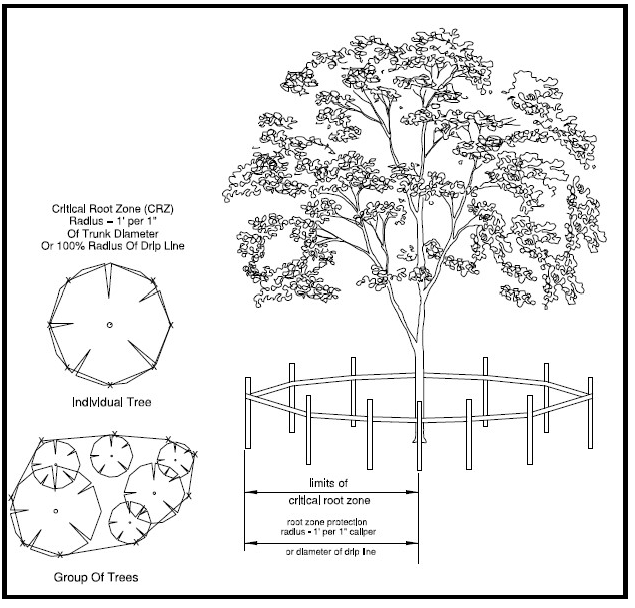
Protective barriers. Posts shall be used as protective barriers to the roots and trunk of every tree on the parcel being developed. The posts shall be placed at the diameter of the entire drip-line of the protected tree. Each section of the barrier shall be clearly visible (flagged with brightly colored plastic tape or other markers). No attachments or wires other than those with protective or non-damaging nature shall be attached to any tree.
(C)
Developer's responsibility. It shall be the responsibility of a developer or applicant to ensure that any tree shown on the tree inventory for which a tree removal permit has not been obtained be protected. The property owner shall guarantee survival of retained trees for three (3) years from completion of permitted construction.
(D)
Inspections. The City of Tavares Planning, Zoning & Development Department may conduct periodic inspections of the site. It is the responsibility of the applicant to ensure that all provisions of these regulations are met.
Section 11-15 - Violations
Where violations of these regulations have occurred, remedial action shall be taken to restore the property consistent with a restoration plan approved by the Planning, Zoning and Development Department. The restoration plan shall require tree replacement in accordance with section 11-4(A)(3) of this Chapter and may require mitigation of any other damage to the property, as well as tree replacements.
(A)
No Certificate of Occupancy or Certificate of Completion shall be issued. No Certificate of Occupancy or Certificate of Completion shall be issued for any development until all applicable permit or restoration plan conditions have been accomplished.
(B)
Guarantee of survival. The property owner shall guarantee the survival of the trees required to be replaced above for a period of three (3) years from the date the Certificate of Occupancy is issued.
(C)
Penalty. Failure to comply with the required remedial action shall be referred to the Code Enforcement Authority.
Section 11-16 - Appeals
Any person adversely affected by a decision of any city official or employee in the enforcement or interpretation of this chapter, may appeal such decision to the City Council who, by a majority vote of those present may affirm, reverse, or modify the decision. Any decision of the City Council is subject to review by the Circuit Court by certiorari.
Table 11-A
Buffer Types
Table notes:
(1)
Where a continuous hedge is required, the hedge shall consist of shrubs spaced three feet (3') on center, a minimum of thirty six inches (36") high at the time of planting. Where a second row of meandering ground cover is required it must be planted at twelve inches (12") to eighteen inches (18") inches apart and accomplish the goal of producing a winding pattern.
(2)
Fences or walls used in perimeter buffers. Where a fence or wall is required or desired to be placed in a perimeter buffer, said fence is required to be constructed of a durable material. In no case shall chain link fencing, wire fencing, wood fencing, or vinyl fencing be permitted in the buffer area. If adjacent to a public or private right-of-way, or residential zoning district such fence or wall shall be constructed of brick, stuccoed block, split face or textured block, wrought iron, aluminum, or precast/stamped concrete. If the fence or wall is less than seventy-five percent (75%) opaque, a continuous hedge shall be required to be planted adjacent to the wall or fence. Fences or walls shall not be more than six feet (6') in height (not including column caps) except in such cases where a Residential District abuts Industrial (I) and/or Public Facilities District (PFD) zoning, in which case the maximum height shall not exceed eight feet (8'); otherwise all other height restrictions shall apply. See Chapter 8, Section 8-12 Supplemental Regulations for additional requirements. See Chapter 9, Division II - Commercial Architectural and Site Design Standards for additional requirements.
(3)
Where trees are required to be planted within the perimeter buffer a minimum of seventy-five percent (75%) of the minimum required number of trees shall be a canopy tree.
Table 11-B
Required Buffer Type Abutting A Right-Of-Way
Table Notes:
(1)
Unless otherwise specified in the applicable zoning ordinance or development agreement, buffers and landscaping shall comply with the standard zoning district in which the proposed use would be considered a permitted or special use. If the use is permitted in more than one zoning district and the buffer requirements vary in intensity, the more intensive buffer shall apply.
Table 11-C
Required Buffer Type Abutting Contiguous Zoning District
Table Notes:
(1)
In the Mixed Use Zoning District, there will be no required perimeter buffer except that, between properties designed and authorized for commercial uses and those designed and authorized for single family uses (whether active or vacant), a Type "A" buffer shall be planted. In instances where residential structures are converted to commercial uses, the existing landscaping and fencing may be acceptable if the Director of Community Development deems that it provides an equivalent degree of buffering.
For Planned Developments, the buffering requirements shall be as specified in the applicable zoning ordinance or development agreement. If not specified, the buffering and landscaping shall comply with the standard zoning district in which the proposed use would be considered a permitted use or special use. If the use is permitted in more than one zoning district and the buffer requirements vary in intensity, the more intensive buffer shall apply.
(2)
Buffers and landscaping adjacent to property containing other than a City zoning designation shall be equivalent to buffers required to the comparable City zoning district. If the Future Land Use designation of the property would permit a compatible zoning district which would require a less intense buffer, the less intense buffer may apply.
(3)
If the abutting development exists prior to the adoption of this code and does not meet the applicable landscaping requirements with regards to walls, fences, or hedges, it shall be the responsibility of the new development to install the applicable landscape treatments as if the first to develop. Where any such conflicts in landscape buffers arise, the City Administrator or designee shall determine the optimal landscape plan that most closely meet these adopted requirements.
Table 11-D
Site Landscaping Requirements
Table 11-E
Approved Species List
(* indicates waterwise/xeriscape plant material)
Table 11-F
Nuisance and Invasive Exotic Plant Species
(1)
Parasitic Weeds.
(a)
Aeginetia spp. (Aeginetia).
(b)
Alectra spp. (Alectra).
(c)
Cuscuta spp. Only the native Florida species are excluded from this list. These include:
1.
C. americana.
2.
C. compacta.
3.
C. exaltata.
4.
C. gronovii.
5.
C. indecora.
6.
C. obtusiflora.
7.
C. pentagona.
8.
C. umbellate.
(d)
Orobanche spp. (broomrapes), with the exception of:
1.
O. uniflora (oneflowered broomrape).
(2)
Terrestrial Weeds.
(a)
Ageratina adenophora (crofoton weed).
(b)
Alternanthera sessilis (sessile joyweed).
(c)
Asphodelus fistulosus Ionionweed).
(d)
Avena sterilis (including Avena budoviciana) (animated oat, wild oat).
(e)
Borreria alata (broadleaf buttonweed).
(f)
Carthamus oxyacantha (wild safflower).
(g)
Chrysopogon aciculatuw (pilipiliula).
(h)
Commelina benghalensis (Benghal dayflower).
(i)
Crupina vulgaris (common crupina).
(j)
Cupaniopisis anacardioides (carrotwood). Propagation prohibited effective 7/1/99, sale or distribution prohibited 1/1/2001.
(k)
Digitaria scalarum (African couchgrass, fingergrass).
(l)
Digitaria velutina (velvet fingergrass, annual conchgrass).
(m)
Dioscorea alata (white yam).
(n)
Dioscorea bulbifera (air potato).
(o)
Drymaria arenarioides (lightning weed).
(p)
Emex australis (three-cornered jack).
(q)
Emex spinosa (devil's thorn).
(r)
Euphorbia prunifolia (painted euphorbia).
(s)
Galega officinalis (goat's rue).
(t)
Heracleum mantegazzianum (giant hogweed).
(u)
Imperata brasiliensis (Brazilian satintail).
(v)
Imperata cylindrical (congongrass).
(w)
Ipomoea triloba (little bell, Aiea morning glory).
(x)
Ischaemum rugosum (murainograss).
(y)
Leptochola chinensis (Asian sprangletop)>
(z)
Lycium ferocissimum (African boxthorn).
(aa)
Lygodium japonicum (Japanese climbing fern).
(bb)
Lygodium microphyllum (small-leaved climbing fern).
(cc)
Melaleuca quinquenervia (melaleuca).
(dd)
Melastoma malabathricum (Indian rhododendron).
(ee)
Mikania cordata (mile-a-minute).
(ff)
Mikania micrantha (climbing hempweed).
(gg)
Mimosa invisa (giant sensitive plant).
(hh)
Mimosa pigra (catclaw mimosa).
(ii)
Nassella trichotoma (serrated tussock).
(jj)
Neyraudia reynaudiana (Burma reed).
(kk)
Opuntia aurantiaca (jointed prickly pear).
(ll)
Oryza longistaminata (red rice).
(mm)
Oryza punctata (red rice).
(nn)
Oeyza rufipogon (wild red rice).
(oo)
Paederia cruddasiana (sewer-vine).
(pp)
Paederia foetida (skunk-vine).
(qq)
Paspalum scrobiculatum (Kodomillet).
(rr)
Pennisetum clandestinum (Kikuyu grass).
(ss)
Pennisetum macrourum (African feathergrass).
(tt)
Pennisetum pedicellatum (Kyasuma grass).
(uu)
Pennisetum polystachyon (missiongrass, thin napiergrass).
(vv)
Prosopis spp.
(ww)
Pueraria Montana (dudzu).
(xx)
Rhodomyrtus tomentosa (downy myrtle).
(yy)
Rottboellia cochinchinensis (itchgrass).
(zz)
Rubus fruticosus (bramble blackberry).
(aaa)
Rubus moluccanus (wild raspberry).
(bbb)
Saccharum spontaneum (wild sugarcane).
(ccc)
Salsola vermiculata (wormleaf salsola).
(ddd)
Sapium sebiferum (Chinese tallow tree).
(eee)
Schinus terebinthifolius (Brazilian pepper-tree).
(fff)
Setaria pallidefusca (cattail grass).
(ggg)
Solanum tampicense (wetland nightshade).
(hhh)
Solanum torvum (turkeyberry).
(iii)
Solanum viarum (tropical soda apple).
(jjj)
Tridax procumbens (coat buttons).
(kkk)
Urochloa panicoides (liverseed grass).

