
Texarkana City Zoning Code
ARTICLE VI
- SUPPLEMENTARY PROVISIONS
Sec. 50-146. - Accessory building, structure, or use.
(a)
Distance between buildings. Except as herein provided, no accessory building shall be located closer than ten feet to a principal building or to any other accessory building.
(b)
Attachment of accessory buildings to principal buildings. When an accessory building is attached to the principal building by a breezeway, passageway, or similar means, it shall comply with the yard requirements of the principal building to which it is attached.
(c)
Accessory building height. No accessory building shall exceed the height of the main structure other than those buildings and structures clearly incidental to a farm, ranch, orchard, truck garden or nursery tanks, granaries, silos, stables, and such buildings necessary to conduct an approved business in an A-1 zone.
(d)
Accessory buildings/structures not to occupy front yards except in the A-1 Limited Mixed Use Rural Zone. No accessory building/structure shall be closer than five feet to any side or rear property line or closer than ten feet to any other structure. There shall be no setback requirement for accessory buildings/structures abutting a dedicated alley.
(e)
Accessory building construction may not commence before construction of the main building except in an A-1 Limited Mixed Use Rural District. No accessory building shall be constructed upon a lot until the construction of the principal building has actually been commenced, and no accessory building shall be used unless a certificate of occupancy has been issued for the main building, excluding the A-1 zone at such times when a principal building is not required.
(f)
Swimming pools. Swimming pools shall not be located in any required front yard.
(g)
Accessory buildings.
(1)
Accessory buildings shall maintain at least a five-foot setback from any side or rear yard property line except where said rear yard abuts on a dedicated alley. No setback shall be required for any accessory building upon a dedicated alley. However, detached accessory buildings located within the rear portion of the lot shall not be located closer than ten feet to a principal building or other accessory building except where a fire wall has been provided which meets the requirements of the building and fire codes of the city.
(2)
Where a garage or carport is designed and constructed to be entered from a side street, such garage or carport shall be set back from the side street right-of-way line a minimum distance of 15 feet to facilitate access without interference with the use of the street by other vehicles or persons.
(h)
Industrial lot. Where an industrial lot abuts on a railroad and is served by a spur track, no rear yard shall be required for any nonresidential accessory building.
(i)
Commercial accessory buildings. Except in the C-2 Central Business District that are without setbacks, not to include A-1 Limited Mixed Use Rural Districts, accessory buildings may be permitted in the O-1 Office and Quiet Business, C-1 General Commercial, and C-3 Open Display Commercial Districts which are used exclusively as product or equipment storage and shall not be located closer than 45 feet to the front property line or the side street property line. A rear yard is not required for commercial accessory buildings except a rear yard of not less than ten feet is required when such business zoning district abuts a residential zoning district. Accessory buildings shall not occupy more than 30 percent of the required rear yard setback, nor shall they be located closer than five feet to a side property line. In no instance shall the accessory building floor area exceed that of the principal.
(j)
Donation collection dropoff bins. The following regulations relate to donation dropoff bins:
(1)
Shall require written permission by the property owner and the city for placement of donation bins through the building permit process;
(2)
Allow no more than one bin per address;
(3)
The location shall be on the property of an existing primary structure that is not a residence;
(4)
All accessory building setbacks apply;
(5)
Access shall be from a paved surface;
(6)
It must be of a durable type material and enclosed by use of a receiving door and locked so that the contents of the bin may not be accessed by anyone but the person responsible for retrieval of the contents;
(7)
It may not exceed six feet by six inches in height or width;
(8)
Identification of the owner of the bin and contact telephone number shall be located on at least two sides of the bin in three-inch lettering and an address in two-inch lettering.
(9)
All donation collection drop-off bins shall require a conditional use permit by the planning commission.
(k)
Pet crematoriums.
(1)
Pet crematoriums may be approved where allowed only when associated with a dedicated animal crematory service.
(2)
Pet crematorium emissions and all operations shall be subject to Arkansas Department of Environmental Quality (ADEQ) regulations and a permit must be obtained through the air division of that agency. When operations begin a copy of the inspection of that facility is to be filed with public works code enforcement department.
(3)
All activity of a pet crematorium shall be handled discreetly and screened from public view to the maximum extent possible, including delivery and storage of the remains.
(4)
A pet crematorium shall not be used for non-animal disposal purposes such as medical waste or industrial waste.
(5)
Animal disposal in pet crematoriums for non-domestic animal types, whether tame or wild will require prior notification of the state fish and game department and the city animal control officer.
(6)
Daily records are to be kept of all animal disposals and must be available for review by the city animal control officer.
(l)
Regarding micro-businesses.
(1)
Required frontage for all micro-businesses shall be no less than 100 feet;
(2)
No more than three parking spaces are allowed;
(3)
Businesses shall have a staff limit of no more than two personnel;
(4)
Unmanned businesses are allowed;
(5)
Driveway density shall conform to C-1 requirements;
(6)
Minimum square footage is 10,000 feet;
(7)
A minimum of 60 feet is required for stacking vehicles;
(8)
Micro-businesses may be located in all commercial zones as a conditional use.
(Code 1983, § 28-51; Ord. No. K-286, § 1(art. VI, § 1), 11-21-1988; Ord. No. K-670, § 1, 5-4-1998; Ord. No. M-131, § II, 2-1-2016; Ord. No. M-137, § III, 4-4-2016; Ord. No. M-138, 4-4-2016; Ord. No. 27-2021, § 3, 9-7-2021; Ord. No. 22-2025, § 1, 10-20-25; Ord. No. 12-2026, § 1, 4-6-26)
Sec. 50-147. - Animals on premises.
(a)
The keeping of animals on the premises shall be subject to the following regulations:
(1)
Animal husbandry, dairying, pasturage shall have a minimum of not less than one acre of lot area for each head of livestock kept on the premises to be located in R-1 Rural Residential or A-1 Limited Mixed Use zoning only and must have a conditional use permit approved by the planning commission (the planning commission at the time of request for rezoning to A-1 may approve the conditional use permit with an approved site plan as part of the rezoning request and recommendation to the board of directors).
(2)
Animal hospital, pound or shelter; commercial kennel; livestock sales; riding academy; public stable; veterinarian's office, etc., (not to include grazing land in the A-1 Limited Mixed Use zone), where animals are kept outside on the premises or housed in a structure other than the primary commercial structure used for business; shall be located no closer than 200 feet to a residential district, and no closer to a zoning lot line than 100 feet.
(3)
Pet stores, pet grooming businesses, small animal clinics/hospitals, and domesticated animals' (dogs and cats) welfare services conducted entirely indoors shall require a conditional use permit to determine the distance from a residential zone to be assigned by the planning commission on a case-by-case basis and also shall require a kennel license from the animal control director. A fee of $100.00 for cost recovery shall be charged every year thereafter upon passing a required annual inspection for renewal. Violations of standards for health and safety are cause to revoke the conditional use permit and kennel license at any time. Controlled areas for supervised exercise must have opaque fencing not less than six feet in height and be well maintained for odor and pest control. Limits to the number and kind of small animals shall be set by the animal control director or corresponding authority for the conditional use permit or renewal of the kennel license.
(b)
Proponents of such uses shall show that adequate measures will be taken to prevent odor, dust, noise, or drainage from becoming a nuisance to uses on other properties. No incineration of animal refuse shall be permitted on the premises.
(Code 1983, § 28-52; Ord. No. K-286, § 1(art. VI, § 2), 11-21-1988; Ord. No. M-119, 5-18-2015; Ord. No. 27-2021, § 4, 9-7-2021)
Sec. 50-148. - Automobile wrecker service.
A wrecker service is a stand-alone business enterprise from which wrecker vehicles are dispatched and may or may not include the temporary storage of inoperable or wrecked vehicles. All temporary storage of said wrecked automobiles shall be screened entirely within enclosed opaque fence or wall, except driveway areas, from seven to ten feet in height. Any temporary storage between the street and such fence is expressly prohibited.
(Code 1983, § 28-53; Ord. No. K-286, § 1(art. VI, § 3), 11-21-1988; Ord. No. 7-2019, § 1, 3-4-2019)
Sec. 50-149. - Automobile wrecking, salvage, and junkyards.
(a)
General. Because of the nature and character of their operations, automobile wrecking and salvage yards, junkyards, and similar uses of land can have a serious detrimental effect upon surrounding properties. Salvage and wrecking yards tend to create problems of noise, dust, traffic, and health hazards, and may adversely affect property values by their general appearance. For the purpose of evaluating whether the proposed utilization of land for an automobile wrecking or junkyard properly minimizes its objectionable characteristics, the standards established in subsections (b), (c), (d), and (e) of this section shall be used.
(b)
Location. Because of the tendency of salvage yards to promote the breeding of vermin, no such operation shall be permitted closer than 500 feet to any residential district.
(c)
Screening. All outdoor storage of salvage and wrecking operations shall be enclosed on its perimeter with a solid, nontransparent wall or fence of a minimum height of seven feet measured from ground level excepting the entrances and exits. Storage between the street and such fence is expressly prohibited. Any fence or wall erected for screening purposes shall be properly painted or otherwise maintained in good condition, without any advertising thereon.
(d)
Off-street parking. Off-street parking requirements are provided in article VII of this chapter.
(e)
Ingress and egress. The number of vehicular access driveways for junkyards and automobile wrecking yards having frontage on a state or federal highway shall be regulated by the state highway and transportation department.
(Code 1983, § 28-54; Ord. No. K-286, § 1(art. VI, § 4), 11-21-1988)
Sec. 50-150. - Carnival, exhibition or similar temporary enterprise.
(a)
A carnival, exhibition, tent revival, or similar temporary enterprise shall be permitted only in a commercial zoning district and shall meet the following locational requirements:
(1)
All such circuses, carnivals, fairs and other amusement type shows shall be located not less than 300 feet from developed residential districts.
(2)
Vehicles associated with any circus, carnival, fair or other amusement show not in operation or use during any such show shall not be parked within 150 feet of developed residential districts.
(3)
Droppings from animals used in any such shows shall be removed periodically from the grounds. In the event animals are kept within the city limits at night, they shall be kept not less than 500 feet from any developed residential or commercial districts.
The applicant for the required certificate of occupancy shall show that adequate measures will be taken to prevent odor, dust, noise, lights, and traffic from becoming a nuisance to uses on other adjacent properties. Each certificate of occupancy for such an enterprise shall be valid for a period of not more than ten days and shall not be granted for more than three such periods for the same location within any 90-day period.
(b)
A tent revival shall be permitted in various residential zoning districts upon approval of a conditional use permit (see sections 50-85 through 50-89) by the planning commission.
(1)
Tent revivals located in residential zoning districts shall not be required to meet any spacing requirements from any other zoning district.
(2)
Tent revivals, which involve assemblages of people and automobiles, shall satisfy the following conditions prior to issuance of a certificate of occupancy:
a.
Shall be approved for a period not to exceed five days, unless otherwise specified in other regulations;
b.
Tent revivals may not be conducted more than four times per calendar year on the same site regardless of tent revival operator;
c.
The location is such that there will be no serious interference with the delivery of public services (i.e. police and fire);
d.
Provision for adequate off-street parking and reasonable and safe means of ingress and egress must be shown (one off-street parking space per every six attendees based on a maximum seating capacity);
e.
Noise generated by the tent revival shall not constitute a nuisance to neighboring residents or violate adopted standards (refer to chapter 28, article IV);
f.
Signs to be posted, circulars to be dispersed, and any other means of advertising shall be removed and the site returned to its original condition or better within three days after termination of the tent revival. Placing any advertising materials on utility poles of any type whatsoever is a violation of section 14-51;
g.
That adequate provisions are shown that dust and litter shall not constitute a nuisance to adjacent properties;
h.
Shall be subject to any fees and bonds as required by this Code;
i.
The conditional use permit application shall be reviewed by the public works department, police department, and fire department, and any other public agency as necessary as part of the review by the planning commission (refer to sections 50-85 through 50-90);
j.
The owner of the property upon which the tent revival is located shall be responsible for seeing that the noise and litter requirements of these regulations are complied with;
k.
The name, address, and mobile telephone numbers of the owner of the property as well as the person in charge of the tent revival, shall be readily available during the tent revival; and
l.
Temporary electrical facilities shall be inspected and approved by the city electrical inspector.
(Code 1983, § 28-55; Ord. No. K-286, § 1(art. VI, § 5), 11-21-1988; Ord. No. M-30, § 1(att.), 9-6-2011)
Sec. 50-151. - Child care centers.
Child care centers, when authorized under a conditional use permit or as a permitted use in residential zones, shall meet the following conditions:
(1)
Architectural features. No structural or decorative alteration that will alter the residential character of an existing residential structure used for a child care family home (CCFH), either resident-occupied or nonresident, is permitted. Any new or remodeled structure must be designed to be compatible with the residential character of the surrounding neighborhood.
(2)
Certificate of occupancy. Upon approval of a conditional use permit for a child care center, a certificate of occupancy must be obtained from the code enforcement division of the city. Prior to issuance of the certificate of occupancy, the applicant must demonstrate that the structure complies with all building codes and fire codes for a child care center. It is advised that the applicant address these issues with the code enforcement division and the fire department prior to the initiation of the conditional use permit to ensure that the structure complies with the building and fire codes. Because of the important safety issues associated with child care centers, the building and fire codes may require significant improvements to the structure.
(3)
Front yard restrictions. Child care center operations shall be specifically prohibited in any required front yards or exterior side yard (corner lots) except for off-street parking, drop-off/pick-up areas, and maneuvering space.
(4)
Hours of operation. Child care center operations shall be restricted to 7:00 a.m. to 7:00 p.m.
(5)
Loading and unloading. Loading and unloading of children from vehicles shall only be permitted on the driveway, approved parking area, or directly in front of the facility. Either an on-site vehicle turnaround or separate one-way circular driveway and passenger loading area shall be provided. Said circular driveway shall be labeled/signed "one way" and shall provide 20 linear feet for each eight children.
(6)
Location along certain streets. In a residential zone, no child care center shall be located along any dead-end or cul-de-sac street on which a child care center is currently operating.
(7)
Minimum lot area. Child care centers shall have a minimum lot area of 10,000 square feet to ensure sufficient lot area to accommodate outdoor play areas, off-street parking, and drop-off/pick-up areas.
(8)
Safety of children. The planning commission shall consider the necessity for additional appropriate conditions and safeguards to protect the health, safety, and welfare of the children using the facility, including the necessity for additional fences, barriers, other safety devices and buffers or increased off-street parking facilities.
(9)
Screening and fencing. Outdoor play areas shall be fenced on the side and rear property lines adjacent to residential development with a six-foot opaque screening fence that reaches the ground to prevent children from crawling underneath onto other parcels.
(10)
Site plan required for child care family home (CCFH); resident and nonresident (CCFH). Applicants seeking a conditional use permit for a child care family home (CCFH) in a residential zone, shall comply with sections 50-85 through 50-90 and shall submit a site plan drawn to scale, and showing clearly the following:
a.
The dimensions and size (acreage) of the site and its relation to surrounding properties.
b.
The layout of the entire project, including the proposed use and location of all buildings, accessory buildings, outdoors play areas, screening fences, and signs.
c.
The location and dimensions of existing streets, private driveways, and sidewalks.
d.
The location of points of ingress and egress for motor vehicles and the internal vehicular circulation pattern.
e.
The location and layout of all off-street parking and loading spaces, including the number of spaces shown and required for each use.
f.
The location of existing and proposed landscaped areas.
g.
The location and size of existing and proposed utility lines, watercourses, and drainage lines and easements.
h.
Title, north arrow, scale, names of owner, developer, surveyor, and the date of preparation of the plan.
(11)
Signs. A child care family home (CCFH), either resident occupied or nonresident in the R-1, R-3, R-4, RMH zones, may erect one nameplate or address sign not over four square feet in area (section 34-10).
(12)
Water and sewer availability letter.
a.
The owner and/or operator shall submit a statement from city water utilities that the property is adequately served by municipal water and sanitary sewer service. For property not served by TWUs municipal water and sanitary sewer service (i.e., private wells and/or septic tank systems), the owner and/or operator shall submit a letter from the county sanitarian stating the property is adequately served by these systems.
b.
Commercial, licensed child care centers, when located in the approved zones as a permitted use, shall comply with the following provisions:
1.
Building code/permit requirements.
(i)
A commercial, licensed child care center shall comply with the state fire prevention code (Volumes I, II, and III) governing, but not limited to, the following:
A.
Electrical distribution;
B.
Occupancy group and occupancy separation requirements;
C.
Exiting requirements;
D.
Structural requirements;
E.
Roof covering fire classification requirements;
F.
Fire detection and sprinkler requirements;
G.
Life safety/rescue access;
H.
Water supply/sewage disposal; etc.
(ii)
Additional permits that may be required:
A.
Mechanical permit;
B.
Sign permit;
C.
Electrical permit;
D.
Plumbing permit;
E.
Installation or renovation of a sprinkler system;
2.
Circular driveways. Commercial, licensed child care centers in commercial and industrial zones shall provide a one-way circular driveway (12-foot minimum width) with one driveway opening for ingress and one driveway opening for egress. Said circular driveway shall be labeled/signed "one-way" and shall provide 20 linear feet for each eight children.
3.
Dumpsters. Dumpsters serving commercial, licensed child care centers shall be a screened by a six-foot opaque screening fence on all sides except for that area that must remain unobstructed to allow garbage pickup.
4.
Front yard restrictions. Child care center operations shall be specifically prohibited in any required front yards or exterior side yard (corner lots) except for off-street parking, drop-off/pick-up areas, and maneuvering space.
5.
Hours of operation. Shall be restricted to 6:00 a.m. to 9:00 p.m.
6.
Loading and unloading. Loading and unloading of children from vehicles shall only be permitted on the driveway, approved parking area, or directly in front of the facility.
7.
Location along certain streets. Large, commercial, licensed child care centers shall be located on a collector street or a major arterial street as classified by the MPO (metropolitan planning organization), or on a street with direct access to an arterial street. And further, shall be located in an area which is free from conditions dangerous to the physical and moral welfare of the children.
8.
Minimum lot area. The child care center shall comply with the minimum lot area required for the commercial or industrial zone in which the child care center is located.
9.
Signs. For commercial, licensed child care centers in the O-1 Office and Quiet Business and C-1 General Commercial zones, commercial on-premises advertising signs shall be limited to a maximum of 50 square feet; for the C-3 Open Display Commercial zone, W-1 Warehousing and Wholesaling, M-1 Limited Manufacturing, and M-2 General Manufacturing zones, commercial on-premises advertising signs shall be limited to a maximum of 300 square feet (section 34-10).
10.
Safety of children. The planning commission shall consider the necessity for additional appropriate conditions and safeguards to protect the health, safety, and welfare of the children using the facility, including the necessity for additional fences, barriers, other safety devices and buffers or increased off-street parking facilities.
11.
Water and sewer availability letter. The owner and/or operator shall submit a statement from city water utilities that the property is adequately served by municipal water and sanitary sewer service. For property not served by TWUs municipal water and sanitary sewer service, i.e. private wells and/or septic tank systems, the owner and/or operator shall submit a letter from the county sanitarian stating the property is adequately served by these systems.
(Code 1983, § 28-56; Ord. No. K-286, § 1(art. VI, § 6), 11-21-1988; Ord. No. L-216, §§ 7, 8, 6-6-2005)
Sec. 50-152. - Churches.
Churches or other places of worship shall comply with all of the following area and yard requirements:
(1)
Churches and their accessory buildings shall set back from all exterior and interior lot lines a distance of not less than 25 feet.
(2)
The lot area for a church and any accessory buildings shall be adequate to provide the yard area required by this section and the off-street parking areas required under article VII of this chapter.
(3)
When located in any residential zoning district, no parking areas are permitted within the required front yard. Except for driveways to permit ingress and egress, the front yard shall be landscaped with grass, hardy shrubs and trees, and/or evergreen ground cover and maintained in good condition.
(Code 1983, § 28-57; Ord. No. K-286, § 1(art. VI, § 7), 11-21-1988)
Sec. 50-153. - Construction within floodplain area.
(a)
The designated floodplain area is inclusive of all land within the city subject to inundation by floodwaters. The source of this delineation shall be the flood insurance study for the city.
(b)
The uses of and/or construction upon land within the designated floodplain area shall be only those uses and structures permitted in article III of this chapter for the zoning district in which the proposed use and/or structure is to be located, except as otherwise provided for the floodway area in the floodplain ordinance. For the purposes of administration and review of applications for the use and/or construction upon land within the designated floodplain area, the floodplain ordinance is deemed the governing ordinance.
(Code 1983, § 28-58; Ord. No. K-286, § 1(art. VI, § 8), 11-21-1988)
Sec. 50-154. - Fences.
For all residential uses located within any zoning district, an ornamental fence, hedge, or wall not more than four feet in height may project into or enclose any required front of side yard, provided that visibility at intersections is maintained in accordance with the provisions of section 50-166. Ornamental fences, hedges, or walls may project into the side yard from the front building line of the structure to the rear lot line, and into the rear yard, provided such fences or walls do not exceed a height of eight feet.
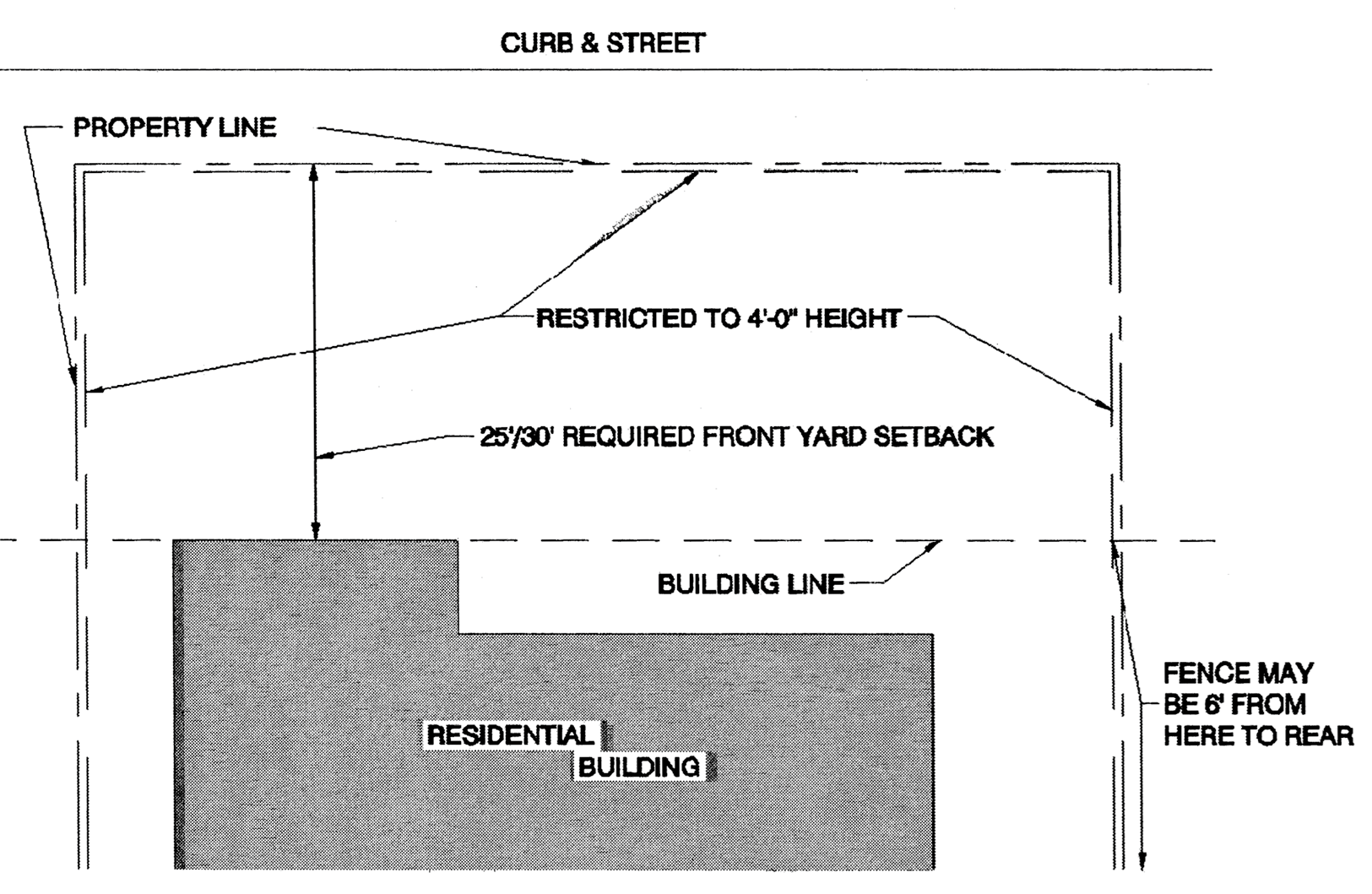
Fences: Curbs and Streets
(Code 1983, § 28-59; Ord. No. K-286, § 1(art. VI, § 9), 11-21-1988; Ord. No. K-650, § 1, 12-15-1997; Ord. No. 5-2024, § 1, 4-1-2024)
Sec. 50-155. - Flammable liquids and gases.
The storage of flammable liquids and gases shall comply with the state fire prevention code.
(Code 1983, § 28-60; Ord. No. K-286, § 1(art. VI, § 10), 11-21-1988)
Sec. 50-156. - Height requirements.
(a)
Chimneys, cooling or water towers, elevators, bulkheads, fire towers, monuments, stacks, storage towers, tanks, spires, church steeples, flagpoles, radio towers or necessary mechanical apparatus may be erected to any height not in conflict with any other ordinance of the city.
(b)
Public, semi-public, or public service buildings, hospitals, institutions, churches and schools, when permitted in a district, may be erected to exceed height limits specified for the district, provided all required yards are increased by one foot for each foot of building height above the specified height limit.
(Code 1983, § 28-61; Ord. No. K-286, § 1(art. VI, § 11), 11-21-1988)
Sec. 50-157. - Home occupations.
An occupation may be carried on in a residential structure in a residential zone only if the following are complied with:
(1)
It does not involve the use of commercial vehicles operating from the residence.
(2)
It does not require more than 20 percent of the floor space of the residence.
(3)
It does not require the use of an accessory building or of yard space or an activity outside the main structure not normally associated with residential uses.
(4)
It does not require a sign over four square feet in area to denote the business, occupation, or profession of any authorized home occupation.
(5)
It does not involve the external display of goods and services, and no commodity is sold upon the premises.
(6)
The occupation must be carried on only by the occupant family of said residence.
(7)
The term "home occupation," provided all of the previous conditions are complied with, shall generally be interpreted to include custom dressmaking, tailoring, fine arts studio in which is created only individual works of art, laundering or pressing, professional office of an accountant, architect, attorney, author, engineer, or similar professional person (but not including medical, dental, or chiropractic offices); and teaching or tutoring, including music, dancing, speech, or other arts, with instruction limited to not more than four pupils at a time.
(8)
The term "home occupation" shall not be interpreted to include a barber or beauty shop, commercial stable or kennel, any business involving sales of merchandise to consumers on the premises, commercial repairing of automobiles, appliances, equipment, or similar items, nor any food handling occupation.
(Code 1983, § 28-62; Ord. No. K-286, § 1(art. VI, § 12), 11-21-1988)
Sec. 50-158. - Mining, excavation, and material storage.
(a)
Mining, including extraction of clay, gravel or sand; quarrying of rock or stone; gas or oil wells, earth moving and excavation; depositing of construction material, clay, earth, gravel, minerals, rocks, sand or stone on the ground shall not be construed to be a permitted use in any district unless and until a conditional use permit is issued, except for the following defined extractions and deposits:
(1)
Excavations for the foundation or basement of any building or for a swimming pool for which a building permit has been issued, or deposits on the ground of any building or construction materials to be used in a structure for which a building permit has been issued.
(2)
Grading of any parcel of land for a permitted use where no bank is left standing and exposed of more than ten feet in vertical height.
(3)
Grading in a subdivision which has been approved by the city in accordance with the city subdivision regulations.
(4)
An extractive operation existing and operating as such on the effective date of the ordinance from which this chapter is derived.
(b)
The planning commission may grant special use permits, revocable and valid for specified periods of time to permit mining or extraction from, or deposits on the ground of rock, stone, gravel, sand, earth, minerals or building or construction materials.
(Code 1983, § 28-63; Ord. No. K-286, § 1(art. VI, § 3), 11-21-1988)
Sec. 50-159. - Mobile home parks.
(a)
All new mobile home parks that are established or existing mobile home parks which are expanded after the effective date of the ordinance from which this section is derived shall only be located in the RM manufactured home residential zone, and no parcel of land containing less than five acres shall be used for a mobile home park. All licenses and permits as required by chapter 26, article II, must be obtained before the mobile home park is open to tenants.
(b)
All licenses and permits as required by chapter 26 must be obtained before the mobile home park is open to tenants.
(Code 1983, § 28-65; Ord. No. K-286, § 1(art. VI, § 15), 11-21-1988; Ord. No. L-61, § 5, 8-6-2001; Ord. No. L-200, § 22, 1-3-2005)
Sec. 50-160. - Mobile home subdivisions.
(a)
Mobile home subdivisions, which shall be established in the RM residential zone only, provide an opportunity for mobile home ownership of structure and lot for those mobile homes approved by the Department of Housing and Urban Development under Title VI of Public Law 93-383, USC 5401 et seq. All mobile homes so located within an approved subdivision must have the date plate attached to the unit specifying: "This mobile home is designed to comply with federal mobile home construction and safety standards in force at the time of manufacture." Mobile home subdivisions shall fully comply with the regulations of this chapter and further be governed by the subdivision regulations of the city. Furthermore, individual mobile homes located within a mobile home subdivision must be converted to permanent structures as defined in article XI of this chapter.
(b)
Manufactured home subdivisions, which shall be established in the RM residential zone only, provide an opportunity for manufactured home ownership of structure and lot for those manufactured homes approved by the U. S. Department of Housing and Urban Development under title VI of Public Law 93-383, USC 5401 et seq. All manufactured homes so located within an approved subdivision must have the date plate attached to the unit specifying: "This manufactured home is designed to comply with federal manufactured home construction and safety standards in force at the time of manufacture." Manufactured home subdivisions shall fully comply with the regulations of this article and individual manufactured homes located within a manufactured home subdivision must be converted to permanent structures as defined in article XI of this chapter.
(Code 1983, § 28-66; Ord. No. K-286, § 1(art. VI, § 16), 11-21-1988; Ord. No. L-61, § 6, 8-6-2001)
Sec. 50-161. - Radio, TV, and other towers.
Radio, television, microwave, and other electronic transmission or receiving towers in excess of height limits may be allowed in any zone upon a finding by the city and issuance of a conditional use permit, that the proposed tower will not be unduly detrimental to surrounding property, except that towers used by private residences for the reception of television signals or for supporting amateur radio transmitting antennas may be permitted to a maximum height of 100 feet without obtaining a conditional use permit. Heights in excess of 100 feet shall be subject to the issuance of a conditional use permit. Exceptions to standard height restrictions shall not be granted in cases where they would violate height restrictions of an aircraft approach and turning zone.
(Code 1983, § 28-67; Ord. No. K-286, § 1(art. VI, § 17), 11-21-1988)
Sec. 50-162. - Service station pumps.
Service station pumps, pump islands, and canopies may occupy the required yards; provided, however, that they are not less than 15 feet from all property lines.
(Code 1983, § 28-68; Ord. No. K-286, § 1(art. VI, § 18), 11-21-1988)
Sec. 50-163. - Signs.
All signs of any type whatsoever, when located outside the confines of an enclosed building, shall fully comply with all requirements of the city sign ordinance.
(Code 1983, § 28-69; Ord. No. K-286, § 1(art. VI, § 19), 11-21-1988)
Sec. 50-164. - Storage and parking of trailers and commercial vehicles.
Commercial vehicles and trailers of all types, including travel, camping and hauling and mobile homes shall not be parked or stored on any lot occupied by a dwelling or on any lot in any residential district except in accordance with the following provisions:
(1)
Not more than one commercial vehicle, which does not exceed 1½ tons rated capacity, per family living on the premises, shall be permitted and in no case shall a commercial vehicle used for hauling explosives, gasoline, or liquefied petroleum products be permitted.
(2)
No trailer (either camping, hauling, travel, or other type) shall be parked or stored unless said trailer is located behind the front yard building line. A camping or travel trailer shall not be occupied either temporarily or permanently while it is parked or stored in any area (other than an authorized travel trailer park) within the incorporated limits.
(Code 1983, § 28-70; Ord. No. K-286, § 1(art. VI, § 20), 11-21-1988)
Sec. 50-165. - Recreational vehicle (RV) parks.
(a)
A recreational vehicle park, as defined in this chapter, may be established as a commercial enterprise for short-term transient occupants as a use by right in the C-3 Open Display Commercial zone only. There is no minimum area that may be developed or used for the purpose of a recreational vehicle part, but the site should be well drained and properly graded in order to ensure rapid drainage and freedom from stagnant pools of water. Because the variety of different sizes and lengths of individual units, there is no maximum density requirement for recreational vehicle parks. However, all recreational vehicles shall be separated from each other and from other structures by a distance of at least ten feet. Any accessory structures such as attached awnings and carports shall, for purposes of the separation requirement, be considered to part of the recreational vehicle.
(b)
Plans for a commercial recreational vehicle park shall be submitted to the administrative official for approval and issuance of a building permit and certificate of occupancy. The site plan and construction plans submitted shall include and clearly indicate, at a minimum, the following:
(1)
Adequate space dimensions to accommodate the different sizes of expected vehicles;
(2)
Street and access roads located within the recreational vehicle park.
(3)
Set of plans for the service building/office which shall house an approved number of restrooms, lavatories, showers, and other sanitary facilities as the state board of health may require for the number of spaces available in the RV park.
(4)
Municipal water and sanitary sewer service to accommodate each recreational vehicle space;
(5)
Electrical master fuse or breaker panel and receptacles in compliance with the National Electrical Code.
(6)
Sanitation containers deployed at intervals to accommodate not more than two spaces.
(7)
Letter of approval from state board of health.
(c)
Upon determination that the submitted plans and information complies with all the standards described above, and with all other applicable ordinances that are in effect in the city the administrative official shall issue a building permit and certificate of occupancy.
(Code 1983, § 28-71; Ord. No. K-286, § 1(art. VI, § 21), 11-21-1988; Ord. No. L-200, § 24, 1-3-2005)
Sec. 50-166. - Visibility at intersections.
On a corner lot on which a front yard is required, nothing shall be erected, placed, planted, or allowed to grow in such manner as materially to impede vision between a height of two feet and ten feet above the centerline grade of the intersecting street in the area bounded by the street right-of-way lines (not curb lines but the rights-of-way lines which are also the property lines) of such corner lot and line joining points along said streets rights-of-way lines 25 feet from the point of intersection. Graphic illustration of this requirement is provided by the following:
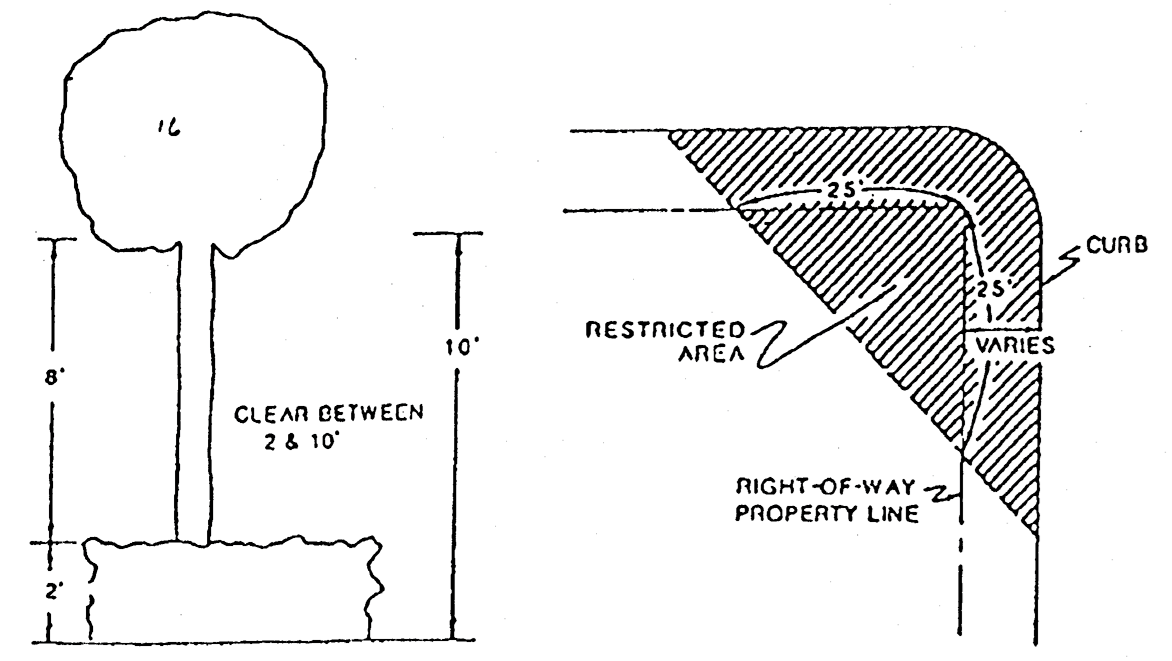
Visibility at Intersections
(Code 1983, § 28-72; Ord. No. K-286, § 1(art. VI, § 22), 11-21-1988)
Sec. 50-167. - Architectural feature projects.
Certain architectural features may project into required yards as follows:
(1)
Cornices, canopies, eaves, or other architectural features, may project a distance not exceeding two feet.
(2)
Fire escapes may project a distance not exceeding 4½ feet.
(3)
An uncovered stair and necessary landings may project a distance not to exceed three feet, provided such stair and landing shall not extend above the entrance floor of the building except for a railing not exceeding three feet in height.
(4)
Bay windows, balconies, and chimneys may project a distance not exceeding two feet, provided that such features do not occupy, in the aggregate, more than one-third of the length of the building wall on which they are located.
(Code 1983, § 28-73; Ord. No. K-286, § 1(art. VI, § 23), 11-21-1988; Ord. No. K-669, § 1, 5-4-1998)
Sec. 50-168. - Wireless telecommunication facilities.
(a)
Definitions. The following words, terms and phrases, when used in this section, shall have the meanings ascribed to them in this subsection, except where the context clearly indicates a different meaning:
Alternative tower structure means clock towers, bell steeples, light poles and similar alternative design mounting structures that camouflage or conceal the presence of antennas or towers.
Antenna means any panel, whip, dish, or other exterior apparatus designed for communications through the sending and/or receiving of electromagnetic waves, excluding any support structure other than brackets.
Co-location means the use of a wireless telecommunications facility or pre-existing antenna or tower deemed suitable by appropriate technical analysis by more than one wireless telecommunications provider.
FAA means the Federal Aviation Administration and any legally appointed, designated or elected agent or successor.
FCC means the Federal Communications Commission and any legally appointed, designated or elected agent or successor.
Height of tower means, when referring to a tower or other structure, the distance measured from ground level of the base of the structure to the highest point on the tower or other structure, even if said highest point is an antenna.
Monopole means a support structure constructed to a single, self-supporting hollow metal tube securely anchored to a foundation.
Preexisting towers and antennas means any tower or antenna for which a permit has been properly issued prior to the effective date of the ordinance from which this section is derived.
Residential setback means the distance from the property line of any residential use to the base of the tower of a wireless facility.
Telecommunications means the transmission, between or among points specified by the user, of information for the user's choosing, without change in the form or content of the information as sent and received.
Tower means any ground or roof mounted pole, spire, antenna, structure or combination thereof that is designed and constructed primarily for the purpose of supporting one or more antennas, including self-supporting lattice towers, guy towers, or monopole towers. The term "tower" includes radio and television transmission towers, microwave towers, common-carrier towers, cellular telephone towers, alternative tower structures, and the like. The term "tower" shall not include amateur radio operator's equipment, as licensed by the FCC.
Wireless telecommunication facility means any tower, cables, wires, lines, wave guides, antennas, relay equipment, perimeter fences, and any other equipment or facilities associated with the transmission or reception of communications as authorized by the FCC which a person seeks to locate or have installed upon a tower antenna support structure. However, the term "wireless telecommunications facilities" shall not include:
(1)
Any satellite earth station antenna two meters in diameter or less which is located in an area zoned industrial or commercial.
(2)
Any satellite earth station antenna one meter or less in diameter, regardless of zoning category.
(3)
Antennas used by amateur radio operators.
Wireless communication site includes the property or land owned or leased for use by a telecommunications carrier for the purpose of operating a wireless facility, and all other improvements thereon, including parking and ingress and egress and any other related easements.
Wireless site plan includes any documentation required supporting an application for location of a wireless communication site, set forth in this chapter.
(b)
Applicability.
(1)
District height limitations. The requirements set forth in this section shall govern the location of towers that exceed, and antennas that are installed at a height in excess of, the height limitations specified for each zoning district. The height limitations applicable to building and structures shall not apply to towers and antennas.
(2)
Amateur radio, receive-only antennas. This section shall not govern any tower, or the installation of any antenna that is under 100 feet in height and is owned and operated by a federally licensed amateur radio station operator or is used exclusively for receive only antennas.
(3)
Preexisting towers and antennas. Any tower or antennas for which a permit has been properly issued prior to the effective date of the ordinance from which this section is derived shall not be required to meet the requirements of this section, other than the requirements of this section. Any such towers or antennas shall be referred to in this section as "preexisting tower" or "preexisting antennas."
(c)
General guidelines and requirements.
(1)
Purpose goals. The purpose of this section is to establish general guidelines for the siting of towers and antennas. The goals of this section are to:
a.
Encourage the location of towers in nonresidential areas and minimize the total number of towers throughout the city.
b.
Strongly encourage the joint use (co-location) of new and existing tower sites.
c.
Encourage users of towers and antennas to locate them to the extent possible, in areas where the adverse impact on the community is minimal.
d.
Enhance the ability of the providers of wireless telecommunications services to provide such services to the community quickly, effectively, and efficiently.
(2)
Principal use. A different existing use or an existing structure on the same lot shall not preclude the installation of an antenna or tower on such lot. For purposes of determining whether the installation of a tower or antenna complies with district development regulations, including, but not limited to, setback requirements, lot-coverage requirements, and other such requirements, the dimensions of the entire lot shall control, even though the antennas or towers may be located on leased parcels within such lots. Towers that are constructed, and antennas that are installed, in accordance with the provisions of this section shall not be deemed to constitute the expansion of a nonconforming use or structure.
(3)
Inventory of existing sites. Each applicant for an antenna and/or tower building permit or conditional use permit approval shall provide to the planning division/public works staff, at the time of application, an inventory of its existing towers and antenna locations that are either within the jurisdiction of the city or within one-quarter mile of the border thereof, including specific information about location, height, and design of each tower. The city planner and/or public works director may share such information with other applicants applying for administrative approvals or conditional use permit approvals under this ordinance or other organizations seeking to locate antennas within the jurisdiction of the planning commission, however that the city planner and/or public works director are not, by sharing such information, in any way representing or warranting that such sites area available or suitable. Each tower owner or tower use permit holder shall provide to the city planner and/or public works director annually a listing of all telecommunication towers and antennas located within the city.
(4)
Setbacks and separation. The following setbacks and separation requirements shall apply to all wireless telecommunication towers and antennas; provided, however, that the planning commission may reduce the standard setbacks in rural areas if the goals of this section would be better served thereby. However, to encourage co-location on existing telecommunication towers, the placement of antennae on existing structures other than towers (buildings, water towers, signs, etc.), and the use of alternative tower structures (man-made trees, clock towers, bell steeples, light poles, and similar alternative design mounting structures), these setback and separation regulations are not required.
a.
Wireless telecommunication towers must be set back a distance equal to the height of the tower from any off-site residential structure.
b.
Wireless telecommunication towers, guys, and accessory facilities (equipment buildings, equipment vaults, etc.) must satisfy the minimum zoning district setback requirements.
(5)
Aesthetics lighting. The guidelines set forth in this section shall govern the location and the installation of all antennas and towers erected after the effective date of the ordinance from which this section is derived.
a.
Towers shall either maintain a galvanized shell finish, or subject to any applicable standards of the FAA be painted a neutral color, so as to reduce visual obtrusiveness.
b.
At a tower site, the design of the buildings and related structures shall, to the extent possible, use materials, colors, textures, screening, and landscaping that will blend the tower facilities to the natural setting and built environment.
c.
If an antenna is installed on a structure other than a tower, the antenna and supporting electrical and mechanical equipment must be of a neutral color that is identical to, or closely compatible with, the color of the supporting structure so as to make the antenna and related equipment as visually unobtrusive as possible.
d.
Towers shall not be artificially lighted, unless required by the FAA, the FCC, or other applicable authority.
(6)
Federal requirements. All towers must meet or exceed current standards and regulations of the FAA, the FCC, and any other agency of the federal government with the authority to regulate towers and antennas.
(7)
Building code safety standards. To ensure the structural integrity of towers, the owner of a tower shall ensure that it is maintained in compliance with standards contained in applicable local building codes.
(8)
Limitations on tower approvals. All tower approvals shall be limited to the specific request, as applied for. Any approvals, which are not exercised within six months of such approval, shall become null and void. The city planner and/or public works director may approve a six-month extension provided the applicant provides satisfactory proof of extenuating circumstances to the city planner and/or public works director prior to the expiration of the current approval period. The maximum number of extensions that may be granted for nondevelopment of any tower use approval shall not exceed two six-month extensions.
(d)
Co-location requirements.
(1)
City study of potential public sites. In order to encourage the location of a wireless telecommunications facility on publicly owned property or privately-owned property with a pre-existing tower, building or structures deemed suitable by appropriate technical analysis, the city shall undertake an identification of such properties, other than property used for park and recreation purposes, that the city determines are suitable. The city shall regularly update such identification and make the results available to the public upon request.
(2)
Co-location design required. No new tower shall be constructed in the city unless such tower is capable of accommodating at least one additional wireless telecommunication facility owned by another person.
(3)
Technically suitable space. Authorization for a new antenna and/or tower shall be issued only if there is not technically suitable space reasonably available on an existing tower or structure within the geographic area to be served.
(4)
Application requirements. With the application for a certificate of occupancy for location or co-location on an existing structure, the applicant shall list the location of every tower, building or structure within a reasonable proximity that could support the proposed antenna. The applicant must demonstrate that a technically suitable location is not reasonably available on an existing tower, building or structure within such area. If another communication tower owned by another party within such area is technically suitable, the applicant must show that due diligence was made to negotiate an offer and that a favorable offer was made to the owner of such tower to co-locate an antenna on the tower and the offer was not accepted. If the applicant owns a tower within the city, the applicant must, in addition show that an offer was made to the owner of such tower to co-locate an antenna on a tower owned by the applicant on reciprocal terms and the offer was not accepted. If such co-location offer has not been attempted by the applicant, then such other tower is presumed to be reasonably available.
(e)
Permitted uses.
(1)
General. The uses listed in subsection (e)(2) are deemed to be permitted uses and shall not require administrative review or a conditional use permit. Nevertheless, all such cases shall comply with subsections (c)(5), (6), and (7) of this section and all other applicable ordinances.
(2)
Specific permitted uses. The following uses are specifically permitted:
a.
Locating a tower or antenna, including the placement of additional equipment buildings or other supporting equipment used in connection with said tower or antenna, in any C-2, C-3, W-1, M-1, and M-2 zoning district; provided, however, that such tower shall provide a residential setback from any existing off-site dwelling unit a distance equal to the height of the tower.
b.
Installing an antenna on existing structures other than a tower (such as a building, sign, light pole, water tower, or other free standing nonresidential structure) that is 50 feet in height or greater, so long as the addition of said antenna adds no more than 20 feet to the height of said existing structure; and
c.
Installing an antenna on any existing tower of any height, so long as the addition of said antenna adds no more than 20 feet to the height of said existing tower.
(f)
Administrative approvals.
(1)
Generally.
a.
The city planner and/or public works director may administratively approve the uses listed in subsection (f)(2) of this section.
b.
Each applicant for administrative approval shall apply to the planning division/public works department, providing the information set forth in subsections (g)(3) and (6) of this section.
c.
The city planner and/or public works director shall respond to each such application within 30 days after receiving it by either approving or denying the application. If the city planner and/or public works director fails to respond to the applicant with said 30 days, then the application shall be deemed to be approved.
d.
If an administrative approval is denied, the applicant, may appeal said denial in accordance with the provisions of the zoning ordinance concerning appeals of administrative decisions.
(2)
Specific administratively approved uses. The following uses may be approved by the city planner and/or public works director after conducting an administrative review:
a.
Installing an antenna on an existing structure other than a tower (such as a building, sign, light pole, water tower, or other free standing nonresidential structure) that is less than 50 feet in height, so long as such addition of said antenna does not add more than 20 feet in height to the existing structure.
b.
Installing an antenna on an existing tower of any height (co-location), including a pre-existing tower and further including the placement of additional equipment buildings or other supporting equipment used in connection with antenna, so long as the addition of said antenna adds no more than 20 feet to the height of said existing tower.
c.
Locating any alternative tower structure (man-made trees, clock towers, bell steeples, light poles, and similar alternative design mounting structures) in O-1, C-1, R-1, R-2, R-3, R-4, and RM districts that, in the judgment of the city planner and/or public works director, is in conformity with the goals set forth in subsection (c)(1) of this section.
(g)
Conditional use permits.
(1)
General. The following provisions shall govern the issuance of conditional use permits in the O-1, C-1, R-1, R-2, R-3, R-4, and RM zoning districts:
a.
If the tower or antenna is not a permitted use under subsection (e)(2) of this section or permitted to be approved administratively pursuant to subsection (f)(2) of this section, then a conditional use permit shall be required for the construction of a tower or the placement of an antenna in O-1, C-1, R-1, R-2, R-3, R-4, and RM zoning districts.
b.
In granting a conditional use permit, the planning commission may impose conditions to the extent it concludes such conditions are necessary to minimize any adverse effect of the proposed tower on adjoining properties.
c.
Any information of an engineering nature that the applicant submits, whether civil, mechanical, or electrical shall be certified by a licensed professional engineer.
(2)
Application requirements. The applicant for a conditional use permit will file an application with the planning division/public works department. Applicants for a new wireless telecommunication facility must show that all conditions in this subsection (g)(2) are met.
a.
The proposed telecommunication tower, antenna or accessory structure will be placed in a location which will minimize the visual impact on the surrounding area and allow the facility to function in accordance with minimum standards imposed by applicable communication regulations and applicant's technical design requirements. Priority shall be given to applications which desire location on existing structures, property zoned for industrial use and property dedicated for public use.
b.
Prior to consideration of a permit for location on private property, applicant must show that available sites dedicated for public use and available privately owned sites occupied by towers or existing structures, within the search area that the new site would serve, are unsuitable for operation of the facility under applicable communication regulations and applicant's technical design requirements.
c.
The applicant must show that a proposed communications tower to be located in O-1, C-1, R-1, R-2, R-3, R-4, and RM zoning districts is designed to accommodate additional antennas and wireless transmission and relay equipment for similar telecommunication services of another provider, and must make space on the proposed tower when technically feasible. The applicant must cooperate and negotiate fairly with other telecommunications providers regarding co-location lease agreements, and must offer available space to other telecommunications providers at a reasonable rate.
d.
A permit for a proposed wireless telecommunications tower within 1,000 feet of an existing tower or a permitted communication tower site shall not be issued unless the applicant certifies that the existing tower does not meet the applicant's structural specifications and/or the applicant's technical design requirements, that there are other limiting factors that render existing towers and structures unsuitable, or that a co-location agreement could not be obtained.
e.
All wireless communication facilities must adhere to regulations contained in this Code, including, but not limited to, site development regulations, visibility, fencing, screening, landscaping, parking access, lot size, exterior illumination, sign, and storage. In addition, the applicant must verify that a sign will be posted on the wireless facility in a reasonable visible location no larger in size than that which is necessary to list the name, address, local telephone number and an emergency response number of the applicant or subsequent owner of the facility. In no circumstances shall any advertising signs or displays be allowed on any wireless facility. No lighting shall be allowed except for aesthetic purposes or as required by FAA regulations or other applicable authorities.
f.
Existing on-site vegetation shall be preserved to the maximum extent practicable.
g.
The entire facility must be aesthetically and architecturally compatible with its environment.
h.
Walls or fences constructed of wood, brick, or masonry at least six feet in height shall be used to secure the site and provide an opaque barrier. Such walls or fences shall be used in combination with landscaping to provide security or increase the buffer to other land uses. Other types of fences shall be allowed only if used in conjunction with evergreen shrubs or hedges when upon maturity are equal to or greater than the height of the fence and are a minimum of four feet in height at planting, for the purposes of providing an opaque barrier. The planning commission may reduce the landscaping requirement in rural areas where the visual impact of the telecommunication tower would be minimal.
(3)
Information required. The following documents must be included in all applications submitted, to the extent applicable:
a.
One copy of typical specification for proposed structures and antennas, including description of design characteristics and material.
b.
A location, tower height, guy wires and anchors, existing structures, photographs or elevation drawings depicting typical design of proposed structures, required parking, fences, and landscape plan. A survey from a state-licensed land surveyor or civil engineer should indicate the distance from any existing residential land uses on adjacent property to the wireless facility.
c.
A current map, or update of an existing map on file with the city, showing locations of the applicant's antennas, facilities, and existing towers serving any property within the city.
d.
A certificate from a licensed structural engineer of tower capacity by type and number of the communication tower, and a certification that the tower is designed to withstand winds in accordance with ANSI/EIA/TIA 222, latest revision, standards.
e.
Identification of the owners of all antenna and equipment to be located on the site.
f.
Written authorization from the site owner, or authorized agent, allowing applicant to submit the application.
g.
If required, certification by the applicant that the proposed activity is in compliance with Federal Aviation Administration (FAA) requirements.
(4)
Notification. The planning division/public works department will notify by regular mail all property owners within 300 feet of the site for any proposed new facility or application for structural additions to any existing facility, and will notify all other telecommunications providers which have registered with the planning division/public works department. The planning commission must advertise the public hearing in the newspaper as required in zoning cases.
(5)
Factors considered in granting conditional use permits. The planning commission shall consider the following factors in determining whether to issue a conditional use permit:
a.
Height of the proposed tower;
b.
Proximity of the tower to residential dwelling units and residential district boundaries;
c.
Nature of uses on adjacent and nearby properties;
d.
Surrounding topography;
e.
Surrounding tree coverage and foliage;
f.
Design of the tower, with particular reference to design characteristics that have the effect of reducing or eliminating visual obtrusiveness;
g.
Proposed ingress and egress; and
h.
Availability of suitable existing towers and other structures as discussed in subsection (g)(6) of this section.
(6)
Availability of suitable existing towers or other structures. No new tower shall be permitted unless the applicant demonstrates to the reasonable satisfaction of the planning commission that no existing tower or structure can accommodate the applicant's proposed antenna. Evidence submitted to demonstrate that no existing tower or structure can accommodate the applicant's proposed antenna may consist of any of the following:
a.
No existing towers or structures are located within the geographic area required to meet the applicant's engineering requirements.
b.
Existing towers or structures are not of sufficient height to meet the applicant's engineering requirements.
c.
Existing tower or structures do not have sufficient structural strength to support the applicant's proposed antenna and related equipment.
d.
The applicant's proposed antenna would cause electromagnetic interference with the antenna on the existing towers or structures, or the antenna on the existing towers or structures, would cause interference with the applicant proposed antenna.
(h)
Removal of abandoned antennas and towers. Within 90 days of ceasing use of any tower, the owner of such tower shall notify the city planner and/or public works director of the city, in writing, of such cessation. Any antenna or tower that is not operated for a continuous period of 12 months shall be considered abandoned, and the owner of such an antenna or tower shall remove the same within 180 days of receipt of notice from the public works director notifying the owner of such abandonment. If such antenna or tower is not removed within said 180 days, the public works director may have such antenna or tower removed at the owner's expense. If there are two or more users of a single tower, then this subsection shall not become effective until all users cease using the tower.
(i)
Penalty for violations. All violations of this section shall be punishable in accordance with the provisions of this Code.
(Code 1983, § 28-74; Ord. No. K-744, §§ 1—9, 10-4-1999)
Sec. 50-169. - Temporary secondary dwelling units.
Temporary secondary dwelling units may be located on the site of an existing permanent dwelling unit in the R-1 Rural Residential zone upon issuance of a certificate of occupancy by the building official or his designee. The owner of 1½ acres of land or more having only one permanent residence on the entire property, which he uses for his own personal residence may apply for a certificate of occupancy to locate up to two temporary secondary dwelling units beneficial to the owner but not for rental for money to the general public. Recreational vehicles and single-wide manufactured homes (constructed after June 15, 1976) shall be deemed temporary secondary dwelling units in the R-1 Rural Residential zone. The site containing the temporary secondary dwelling units shall have adequate land area to permit all dwelling units to meet the required setbacks, lot area, and lot coverage requirements for the R-1 Rural Residential zone. Municipal water and sanitary sewer service are important considerations governing secondary dwelling units as well as neighborhood compatibility; provided, however, that the issuance shall be subject to the following conditions:
(1)
The applicant (property owner) shall sign a statement recognizing that:
a.
The permit is temporary based on the issuance of the certificate of occupancy from the building official and granted to the specific occupants designated by the owner (restricted to family members only);
b.
The permit is an exception under the manufactured home ordinance; and
c.
The property owner will abide by the conditions contained in this article.
(2)
The temporary secondary dwelling units may not be sold as a part of the conveyance of the property on which they are located.
(3)
Permits are not transferable.
(4)
If, by action of the owner, the property is rezoned the temporary permit is automatically revoked and the temporary secondary dwelling unit shall be removed.
(5)
If the property is reduced in size to less than 1½ acres, the temporary certificate of occupancy is automatically revoked and the temporary secondary dwelling units shall be removed.
(6)
Should the property owner choose to construct another permanent residence on the property where temporary certificates of occupancy have been issued for secondary dwelling units, the temporary certificates of occupancy are automatically revoked and the temporary secondary dwellings shall be removed. Furthermore, the property owner shall comply with all city codes regarding lot size, setbacks, access, and subdivision regulations for tracts of land less than five acres.
(7)
The manufactured homes and/or recreational vehicles shall meet all setbacks, lot coverage, and height requirements. Note: Refer to section 40-126(d)(4)d.
(Code 1983, § 28-75; Ord. No. L-61, § 12, 8-6-2001; Ord. No. L-144, § 5, 10-6-2003)
Sec. 50-170. - Driveway easement required for secondary dwelling units.
Secondary dwelling units shall not be required to comply with section 50-275. Tracts of 1½ acres or larger shall provide an access easement at least 30 feet in width to provide driveway access to rear tracts for temporary secondary dwelling units. Said access easement shall be recorded with the county circuit clerk. A maximum of three dwellings (permanent residence plus two temporary secondary dwellings) sharing a single driveway shall be allowed. Homeowners are responsible for all maintenance of driveways and driveway easements. Note: Refer to section 40-126(d)(4)d.
(Code 1983, § 28-76; Ord. No. L-61, § 13, 8-6-2001; Ord. No. L-144, § 4, 10-6-2003)
Sec. 50-171. - Posting of address assignments for all secondary dwelling units.
For efficient responses from E 911, property owners utilizing shared driveways for temporary secondary dwelling units shall be required to post the city-style address on a single marker at the street or road and singularly on a marker at each location where the driveway leads to each temporary secondary dwelling unit. The numerals shall be reflective and clearly visible from the street or road. It shall be the responsibility of the property owners to install the signs and keep in good repair. Each temporary secondary dwelling unit shall comply with section 12-1, requiring address assignment to be posted on the front of each dwelling unit.
(Code 1983, § 28-77; Ord. No. L-61, § 14, 8-6-2001)
Sec. 50-172. - Exemption from subdivision plat requirement.
Preregulation single-wide mobile homes and recreational vehicles in existence prior to adoption of the ordinance from which these regulations are derived shall not be required to comply with the standard single-lot subdivision platting requirements even though the tract of land is less than five acres.
(Code 1983, § 28-78; Ord. No. L-61, § 15, 8-6-2001)
Sec. 50-173. - Existing nonconforming (preregulation) single-wide manufactured homes (mobile home) and recreational vehicles.
Any existing single-wide mobile homes or recreational vehicles not meeting these requirements may remain as a legal nonconforming use until such time that a single-wide mobile home (preregulation) or recreational vehicle is removed from the property then a regulation manufactured home or recreational vehicle may be substituted. The substituted manufactured home (single-wide or multisection) or recreational vehicle shall meet the development standards (setbacks, open space, maximum lot coverage, etc.) provided for each zone; however, these substituted manufactured homes and recreational vehicles need not comply with the standard single-lot platting requirement and may maintain the existing form of access at the time of annexation into the city.
(Code 1983, § 28-79; Ord. No. L-61, § 16, 8-6-2001)
Sec. 50-174. - Bed and breakfast inns.
(a)
Number of rooms. Maximum number of guest rooms for each bed and breakfast inn shall be established at the time of the conditional use permit review process, in accordance with subsections (d) and (k) of this section. In no case shall the number of rooms exceed 20.
(b)
Residency requirement of owner/proprietor. Bed and breakfast inns may be owner occupied or may contain an innkeeper's apartment.
(c)
Length of stay.
(1)
Twenty-one consecutive days maximum to families and individuals so as to avoid becoming multifamily rental dwelling;
(2)
The owner of an approved bed and breakfast inn shall maintain a reservation book or a registration log that is subject to inspection/audit by the city to determine compliance with these regulations.
(d)
Parking requirement.
(1)
Guest rooms—Two spaces for owner/proprietor and one space for each guest room;
(2)
Restaurant (if applicable)—One space for each three attendees;
(3)
Social activities (if applicable)—The required off-street parking for social activities shall be analyzed by the public works director and established during the conditional use permit review process based on the types of social activities approved for the property. Said off-street parking for cars, vans, and buses shall be estimated at one space for every two to three guests attending the events;
(4)
Required off-street parking may not occupy required minimum front yard or be placed between the structure and the ROW (right-of-way) line;
(5)
Required off-street parking placed in the side or rear yards shall be analyzed during the conditional use permit review to determine whether screening (seven-foot opaque screening wood or masonry fence or landscaping) from adjacent property is required;
(6)
Designated municipal parking spaces adjacent to the curb abutting the property may be permitted to satisfy the off-street parking requirement (to avoid paved parking lots in residential neighborhoods);
(7)
Parking areas for a bed and breakfast inn in the R-1 Rural Residential District must be surfaced with four inches of crushed rock and must have timber or railroad tie boundaries;
(8)
Off-street parking shall comply with the adopted pavement requirements (concrete, asphalt, double bituminous seal) specified in section 50-208(e)(2): and
(9)
Off-site satellite parking lots are permitted if not more than 300 feet from the bed and breakfast inn as specified in section 50-208(e)(1).
(e)
Signage.
(1)
One externally illuminated identification sign shall be permitted (internal illumination prohibited) that is architecturally reflective of the style of the bed and breakfast inn;
(2)
The identification sign shall be attached to and parallel with the front wall of the building, attached to a front yard fence, or may be ground mounted and not over 3½ feet in height; and
(3)
Identification sign shall not exceed six square feet with the dimensions of two feet by three feet;
(4)
In the R-1 Rural Residential zone, one stationary identification sign shall be permitted not to exceed eight square feet in area and six feet in height.
(f)
Preparation of food.
(1)
A continental breakfast that does not require a state or county food service or restaurant license may be served in any bed and breakfast inn. Continental breakfast is more precisely described as pastries, fruit, cold cereal, tea, coffee, and juice (that only requiring heating and serving) that are available to paying lodgers;
(2)
No food preparation or cooking for guests shall be conducted within any guest room made available for rent;
(3)
Individual guest rooms that are rented shall not contain any cooking facilities.
(4)
Where applicable, and in accordance with subsection (d) of this section, a bed and breakfast inn may have a full-service restaurant open to the public subject to all applicable health, building, fire, and occupancy codes. Inclusion of a restaurant and commercial kitchen shall be established during the conditional use permit review process;
(5)
If applicable, kitchens shall comply with all commercial standards (vent hoods, fire suppression equipment, health/sanitation requirements, etc.) specified in the building code;
(6)
Commercial kitchens within a bed and breakfast inn shall maintain an operating grease trap in compliance with city water utilities specifications and the building code; and
(7)
Commercial kitchens within a bed and breakfast inn shall maintain commercial wiring in conduit in compliance with the National Electrical Code.
(g)
Social activities.
(1)
Social activities. Conducting indoors or outdoors luncheons, fundraisers, wedding and graduation receptions, birthday parties, tours and all other social activities for compensation to the owner are permitted within bed and breakfast inns, subject to subsection (d) of this section. Limitations on types of events or maximum numbers of guests may be established during the conditional use permit review process;
(2)
Noise. Any social activities conducted outdoors at a bed and breakfast inn shall be conducted in compliance with chapter 28, article IV;
(3)
Lighting. Any lighting shall be placed so as to reflect away from adjacent properties. No excessive or unusual noise, odor or vibration shall be emitted so that it constitutes a nuisance that substantially exceeds the general level of noise, odor, or vibration emitted by uses adjacent to or immediately surrounding the site. Such comparison shall be made at the boundary of the site;
(4)
Trash receptacles. All trash receptacles and emptying operations shall be oriented away from the street side of the property and adequately screened by a sightproof fence;
(5)
Parking. The required off-street parking for social activities at a bed and breakfast inn shall be analyzed and determined during the conditional use permit review process based on the requested occupancy (types of social events). Said off-street parking for cars, vans, and buses shall be estimated at one space for every two to three guests attending the social event(s) with no more than 25 percent of the required off-street parking being off-site (see section 50-208(e)(1)); and
(6)
Parking lots. All of the lot used for the parking of vehicles and all driveways used for vehicle ingress and egress shall be paved (concrete, asphaltic concrete hot mix (ACHM), or double bituminous seal) in accordance with the requirements of section 50-208(e)(2).
(h)
Building inspections.
(1)
All necessary city, state, and county permits, certifications, or requirements shall be obtained as a condition of approval of a bed and breakfast inn conditional use permit;
(2)
The fire department shall inspect all bed and breakfast inns prior to issuance of a conditional use permit to determine compliance with emergency exits;
(3)
Each bed and breakfast inn shall have at least one battery-operated or regular hard-wire smoke detector in each guest room; and
(4)
Between one and 20 rooms, one ADA-accessible guestroom shall be provided. Plus all accessory spaces available for the use by residents of ADA guestrooms shall be accessible and shall include the following: toilet and bathing rooms, kitchen, living and dining areas, and any exterior spaces, including patios, terraces and balconies.
(i)
Sale and/or display of merchandise.
(1)
The sale of commercial merchandise to lodgers consisting of postcards/stamps, prepared food products, works of art, antiques, self-promotional items (i.e., coffee mugs, T-shirts, cookbooks, etc.) is encouraged in bed and breakfast inns. Sale of said merchandise shall be in compliance with the state department of finance and administration sales tax collection regulations; and
(2)
An accessory gift shop may be allowed within the bed and breakfast inn and shall be operated in compliance with the state department of finance and administration sales tax collection regulations. The accessory gift shop shall remain subordinate in size to the bed and breakfast inn at all times.
(j)
Historic designation. Bed and breakfast inns shall be allowed only in older single-family residential structures that are locally recognized as architecturally, historically, or culturally significant and that, through renovation and use as a bed and breakfast inn, will contribute significantly to the ambience, character, or economic revitalization of the neighborhood.
(k)
Alterations.
(1)
Interior. Guest rooms used for sleeping shall be part of the primary residential structure and shall not have been specifically constructed for rental purposes. Furthermore, the architectural integrity and arrangement of the existing interior spaces must be maintained, and the number of guest rooms shall not be increased except as may be required to meet health, safety, and sanitation requirements; and
(2)
Exterior. Minimal outward modification of the structure or grounds may be made only if such changes are compatible with the character of the area or neighborhood and the intent of the zoning district in which the bed and breakfast inn is located; a certificate of appropriateness as specified in section 32-66 is required if the single-family residence is located within a local ordinance historic district.
(l)
Annual renewal.
(1)
Bed and breakfast inns shall be subject to an annual inspection by the public works director or his designee to verify continued conformance with the conditional use permit and the zoning regulations;
(2)
Should the ownership of an approved bed and breakfast inn change during the year, the new owner shall apply to the planning commission for a new conditional use permit and to the public works department for a new certificate of occupancy prior to commencing operation;
(3)
A conditional use permit for an approved bed and breakfast inn is not transferable to other properties since they are issued on a site specific basis;
(4)
Bed and breakfast inns shall be subject to an annual inspection by the fire department; and
(5)
Bed and breakfast inns shall be assessed an annual fee to be established by the city board of directors.
(Code 1983, § 28-80; Ord. No. L-133, 6-2-2003)
Sec. 50-175. - Medical marijuana cultivation centers and medical marijuana dispensaries.
(a)
Subject to conditions set by the MMC. Medical marijuana cultivation centers and medical marijuana dispensaries shall be subject to conditions set by the medical marijuana commission (MMC) as to the:
(1)
Hours of operation;
(2)
Distance from schools, churches and licensed childcare facilities;
(3)
Size of on-premises signage;
(4)
Location and content of on-premises and off-premises signage;
(5)
Security and surveillance requirements; and are otherwise governed by applicable zoning regulations.
(b)
Signage.
(1)
Building signage for medical marijuana dispensaries and/or cultivation centers shall have no more than three signs visible to the general public from the public right-of-way that identify the facility by its business name. Each sign shall not exceed 36 square feet. Signs shall be placed inside the licensed facility's window or attached to the outside of the building and shall comply with visibility requirements for window signage.
(2)
May not be located within 1,000 feet of the perimeter of a public or private school or daycare.
(3)
May not be located on or in a public transit vehicle, or any publicly owned or operated property.
(4)
Signage shall not display:
a.
Any content that can reasonably be considered to target children, such as cartoon characters, toys, animals, or similar images and items typically marketed towards children.
b.
Any content or symbol commonly associated with the practice of medicine, the practice of pharmacy, or healthcare in general.
(Code 1983, § 28-81; Ord. No. 23-2017, 7-17-2017)
Sec. 50-176. - Entertainment district.
An entertainment district may be established to allow open container consumption of alcohol subject to the following conditions:
(1)
The area of an entertainment district must have established entertainment venues and operating restaurants that serve alcohol. Set boundaries and hours are to be enumerated for any district established and signage posted with hours allowed for open consumption. Nothing in these regulations shall in any way conflict with or exceed the limits of state statutes governing alcohol regulations including but not limited to: no open containers may be carried out from liquor stores; no open containers are allowed in any motorized vehicles; no consumption of alcohol bought outside the entertainment district and underage drinking shall not be permitted. No glass containers for any liquid shall be allowed in the Entertainment District during entertainment hours. Hours of operation shall be Sunday 11:00 a.m. to midnight; and Monday through Saturday 11:00 a.m. to 12:00 a.m. A licensee may allow alcoholic beverages to be removed from a licensed premises to persons 21 years of age or older to carry within the entertainment district. No open containers containing alcohol may be carried into any business establishment. The city is to provide trash cans and daily pick-up from those trash cans, or as needed. A review of the entertainment district is to be provided to the board of directors from the planning commission during the month of June 2020, January 2021, and therewith annually, or as needed, based on input from the public works department, fire department and the police department with any recommendations for amendments. The city planner shall be responsible for initiating the required reviews of the entertainment district.
(2)
At the city manager's discretion, or his assignee, typically the public works director, part, or all of the entertainment district may be closed to through traffic for street dances, music acts, art exhibits or other cultural events or promotions.
(Code 1983, § 28-82; Ord. No. 20-2019, 9-16-2019; Ord. No. 3-2026, § 2, 1-5-26)
Sec. 50-177. - Storage facilities.
Anywhere within the city limits, it shall be prohibited from living, either permanently or temporarily, in any structure designed primarily for the storage of personal property, to include, but not limited to, personal belongings, vehicles, equipment or goods for sale. The term "structure," as used in this context, includes, but is not limited to, ministorage warehouses, storage units, storage buildings or storage sheds that do not meet the requirements for a residence as stated in the International Residential Code and be in compliance with all zoning and residential requirements of this Code.
(Ord. No. 21-2024, § 1(28-83), 9-16-2024)
Sec. 50-178. - Accessory dwelling units.
(a)
Definitions.
(1)
Accessory dwelling unit means a self-contained and independently accessed living unit on the same parcel as a single-family dwelling of greater square footage that includes its own cooking, sleeping, and sanitation facilities and complies with or is otherwise exempt from any applicable regulatory requirements. The definition of an accessory dwelling unit shall not include any detached structure such as a storage unit, detached garage, workshop, etc. These shall be defined as "accessory buildings/structures" as regulated by section 50-146. - Accessory building, structure, or use.
(2)
Gross floor space means the interior habitable area of a single-family dwelling or an accessory dwelling unit.
(3)
By right means the ability to be approved without requiring a) a public hearing, b) a variance, conditional use permit, special permit or special exception or c) other discretionary zoning action other than a determination that a site plan conforms with applicable regulatory requirements.
(4)
Single-family dwelling means a building with one or more rooms designed for residential living purposes by one household that is detached from any other dwelling unit.
(5)
Regulatory requirements include 1) the Arkansas Fire Prevention Code as adopted by the State Fire Marshall, 2) any locally adopted ordinances and amendments to the ordinances, 3) applicable zoning ordinances and conditions, 4) design standards and 5) other state and local laws, rules, and ordinances applicable to the plan, permit, or application in questions.
(b)
Location.
(1)
One accessory dwelling unit shall be a use by right on any parcel containing a single-family home.
(2)
Accessory dwelling units may be attached, detached, or internal to the single-family dwelling on the lot or parcel.
(3)
Except as herein provided, no detached accessory dwelling shall be located closer than ten feet to a principal building or to any other accessory building/structure/dwelling and must meet the property line setbacks for the zone in which it is located.
(4)
When an accessory dwelling unit is attached to the principal building by a breezeway, passageway, or similar means, it shall comply with the yard setback requirements of the principal building to which it is attached.
(5)
In no district shall an accessory dwelling unit occupy any part of a front yard except in an A-1 Limited Mixed Use Rural Zone. Accessory dwellings must meet the setback requirements for the given zone.
(c)
Design.
(1)
If the accessory dwelling unit is detached from or attached to the single-family dwelling, it shall not be more than 75 percent of the gross floor area of the single-family dwelling or 1,000 square feet, whichever is less.
(2)
There shall be no more than one accessory dwelling unit allowed by right on any lot or parcel containing a single-family home. Additional accessory dwelling units shall require approval of the planning commission and issuance of a conditional use permit when applicable.
(3)
No accessory dwelling shall be constructed upon a lot until the construction of the principal building has been completed, excluding the A-1 zone at such times when a principal building is not required.
(4)
In instances where public property, including but not limited to streets, sidewalks, curbs, are damaged during the construction of the accessory dwelling unit, it shall be the responsibility of the property owner to repair such to city standards at the property owner's expense.
(5)
This ordinance does not prohibit restrictive covenants regulating accessory dwelling structures entered into between private parties.
(6)
RV's and single wide trailers may not be used as accessory dwelling units.
(Ord. No. 11-2026, § 1, 4-6-26)
Sec. 50-179. - Truck stops.
(a)
Definitions.
(1)
Truck stop (also known as a travel center/plaza): A commercial facility, structure, land used or intended to be used for the sale of fuel for trucks and, more specifically, long-haul trucks or tractor trailers. Site may include long-term truck parking, incidental service or lite repairs of trucks, overnight accommodations, showers or restaurant facilities open to serve the general public or a group of facilities consisting of such a use. As used in this definition, the term "trucks" does not include any vehicle whose maximum gross weight is 10,000 pounds or less, as rated by the state motor vehicle administration.
(2)
Tractor trailer. A combined unit consisting of a tractor, which is the front part of the vehicle, and a trailer, which is the rear part. The tractor, also known as the cab or the power unit, houses the engine, driver's compartment, and all the necessary controls. The trailer is the cargo-holding component, where the goods being transported are loaded and secured.
(3)
Lite vehicle repair. Engine tune-ups; servicing of brakes, air conditioning, exhaust systems; oil change or lubrication; wheel alignment or balancing; or similar servicing or repair activities that do not require any significant disassembly or any storing of vehicles on the premises overnight.
(b)
Location. Truck stops and accessory or companion uses shall be located only in the Mixed-Use Highway (MUH) Zone as defined in Section 50-64 Mixed Use Highway.
(c)
Parking.
(1)
Truck stops shall be required to have one automobile parking space for each 200 square feet of floor space of the building used for retail activities or use by the public, whichever is greater.
(2)
All of the lot used for the parking of vehicles (automobiles, tractor trailers, daily or overnight) or for the storage or display of merchandise and all driveways used for vehicle ingress and egress shall be paved in accordance with the requirements of article VII, section 50-209.
(3)
No inoperable vehicles shall remain on the property for a time greater than two weeks.
(d)
Lighting. Any lighting shall be placed so as to reflect away from adjacent residential districts.
(e)
Administrative requirements.
(1)
All requests for a truck stop shall be accompanied by the following items:
a.
A site plan to include but not be limited to utilities, parking, fencing, drainage, ingress/egress, etc.
b.
A traffic impact study conducted by a professional engineer.
c.
Water runoff/drainage study conducted by a professional engineer.
d.
A lighting plan.
e.
A security camera plan.
(2)
Upon approval of a rezoning request and during the permit process, the following must be accomplished:
a.
An approved driveway permit from the appropriate regulatory office/department.
b.
Compliance with all state and federal regulations
c.
Applicants must demonstrate cooperation with all state and federal agencies regulating the highway or interstate which the truck stop is located upon.
d.
Approved Certificate of Occupancy
(3)
Any truck stop/travel plaza in existence at the time of this ordinance or annexed into the city limits at a later date shall be allowed to remain and shall be considered legally non-conforming and shall comply with article VIII. - Nonconforming Structures and Uses of Land and Structures.
(f)
Signage. All signage shall comply with the City of Texarkana Arkansas Code of Ordinances,chapter 34 - signs.
(g)
Landscaping. All applicants are encouraged to develop a landscaping plan which will reflect a pleasing aesthetic and contribute to the overall desirability of the surrounding areas.
(h)
Considerations for approval.
(1)
Location. As truck stops mainly serve the needs of the motoring public and more specifically the long-haul trucking industry, location shall be considered in order to meet these needs.
(2)
Similar facilities. Consideration shall be given to the location of similar facilities in the area.
(3)
Adjacent zoning. The current and potential zoning of surrounding properties shall be considered.
(Ord. No. 5-2026, § 1, 1-20-26)

