
Texarkana City Zoning Code
ARTICLE VII
- OFF-STREET PARKING AND LOADING REQUIREMENTS
Sec. 50-208. - Off-street parking requirements.
(a)
Requirement. In all zoning districts except the C-2 Central Business District, in connection with every commercial, industrial, institutional, recreational, residential, or any other use, there shall be provided at the time any building or structure is erected, enlarged or increased in capacity, off-street parking spaces for automobiles in accordance with the requirements of this section.
(1)
Parking spaces used in connection with an existing and continuing use or building on the effective date of the ordinance from which this chapter is derived, up to the number required by this chapter, shall be continued and may not be counted as serving a new structure or addition; nor may a parking space be substituted for a loading space or a loading space substituted for a parking space.
(2)
Any conveyance of such parking or loading space, or transfer of interest therein, by the owner of the property served thereby without a simultaneous conveyance or transfer of the property served thereby to the same grantee or transferee or without suitable provisions being made in another location for the maintenance of an equivalent number of required spaces in conformance with the provisions hereof shall be unlawful.
(b)
Application of standards. In applying the standards of this section, the following shall apply:
(1)
In the case of mixed or joint uses, the parking spaces required shall equal the sum of the requirements of the various uses computed separately, except in the case of church sanctuary as specified in subsection (c) of this section.
(2)
Where a fractional space results, any fraction more than one-half shall be counted as one parking space.
(3)
These standards shall apply fully to all uses and buildings established after the effective date of the ordinance from which this chapter is derived.
(4)
No portion of any public street right-of-way shall be considered as fulfilling or partially fulfilling the off-street parking requirements of this section. No parking "bays" shall be allowed, except for residential service on residential streets. All commercial off-street parking areas and all residential off-street parking lots abutting collector and arterial streets shall be arranged so that ingress and egress is by forward motion of the vehicle (not applicable to single-family residences). For the purpose of parking in the rear yard, any public dedicated alley may be used in computing the maneuvering area.
(5)
Where parking is to be provided in the front yard of a multiple-family dwelling, there shall be established a setback line of 15 feet. The area between the setback line and the front lot line shall be prepared and planted with grass, shrubs, trees, or ground cover.
(6)
Off-street parking in the C-4 business district shall conform to the schedule in this section:
a.
Parking lots. All vehicular use areas shall comply with section 50-208(e)(1) and (2).
b.
Raised planters. Raised planters are hereby required at the end of all double-aisle parking rows as reflected on the site plan;
c.
Trees. A minimum of one parking lot tree shall be planted in the raised/curbed parking islands at the end of each double-row of parking. A raised/curbed parking island shall have a minimum of 130 square feet per tree and a minimum width of eight feet measured from back of curb to back of curb. Property owners are encouraged to exceed these minimum requirements and consider deciduous or evergreen trees around the perimeter of large parking lots also. Islands with curb cuts designed to be used as bio-retention areas (for treating stormwater runoff) should be used, where possible.
(c)
Number of off-street parking spaces required. In all districts, there shall be provided at such time any building or structure is erected, enlarged, or increased in capacity, off-street parking spaces for automobiles in accordance with the following requirements:
(1)
Dwelling. 1½ parking spaces for each separate dwelling unit within the structure.
(2)
Boardinghouse or roominghouse or hotel or motel. One parking space for each guest room.
(3)
Medical/dental clinics or offices, and hospitals. Seven spaces per doctor or dentist. For hospitals there shall be one space per bed and one space per employee, based on maximum employment of largest shift.
(4)
Sanitariums, convalescent or nursing homes. One space for each six patient beds plus one space for each staff or visiting doctor plus one space for each four employees including nurses.
(5)
Community center, theatre, auditorium. One parking space for each three seats based on maximum seating capacity.
(6)
Convention hall, lodge, club, library, museum, place of amusement or recreation. One parking space for each 100 square feet of floor area used for assembly or recreation in the building.
(7)
Office building. One parking space for each 300 square feet of gross floor area in the building, exclusive of the area used for storage, utilities, and building service area.
(8)
Retail commercial establishments. One parking space for each 200 square feet of floor space in the building used for retail trade, or used by the public, whichever is greater.
(9)
Industrial establishments. Adequate area to park all employees' and customers' vehicles at all times and adequate space for loading, unloading, and storing all vehicles used incidental to or as a part of the primary operation of the establishment.
(10)
Church sanctuary. One parking space for each four seats based on maximum seating capacity; provided, however, that churches may establish joint parking facilities for an amount not to exceed 50 percent of the required spaces, with public institutions and agencies that do not have a time conflict in parking demand. The joint parking facility shall be so located as not to exceed 400 feet from the church sanctuary.
(11)
Unlisted uses. The number of parking spaces required for a use not listed herein shall be the same as for a similar use which is listed. Where the required number of spaces cannot be ascertained by this method, or the applicant and the city staff cannot agree, the matter shall be submitted to the board of adjustment for determination.
(12)
Manufactured homes, mobile homes, and recreational vehicles. Two off-street parking spaces shall be provided for each mobile home, manufactured home, recreational vehicle, and temporary secondary dwelling units. The two required off-street parking spaces shall be located behind the front yard setback line. Garages, carports, and parking pads shall be utilized in complying with the off-street parking requirement.
(13)
Child care centers. Drives and parking shall not exceed that required by ordinance for a single-family residence.
a.
Residential. One off-street parking space for each owner (including required parking space for the single-family dwelling), employee, and volunteer plus two spaces for each ten children; and
b.
Commercial. Two off-street parking spaces per every three staff (owners, employees, and volunteers) plus one off-street parking space for every eight children.
(d)
Parking design.
(1)
The following four parking angles are allowed with their respective width and depth dimensions for stalls and maneuvering areas:
(2)
For parking areas which require greater than 100 parking spaces, ten percent of said requirement may be utilized for compact auto parking. The following diagram illustrates the parking space and maneuvering space used for the various parking designs:
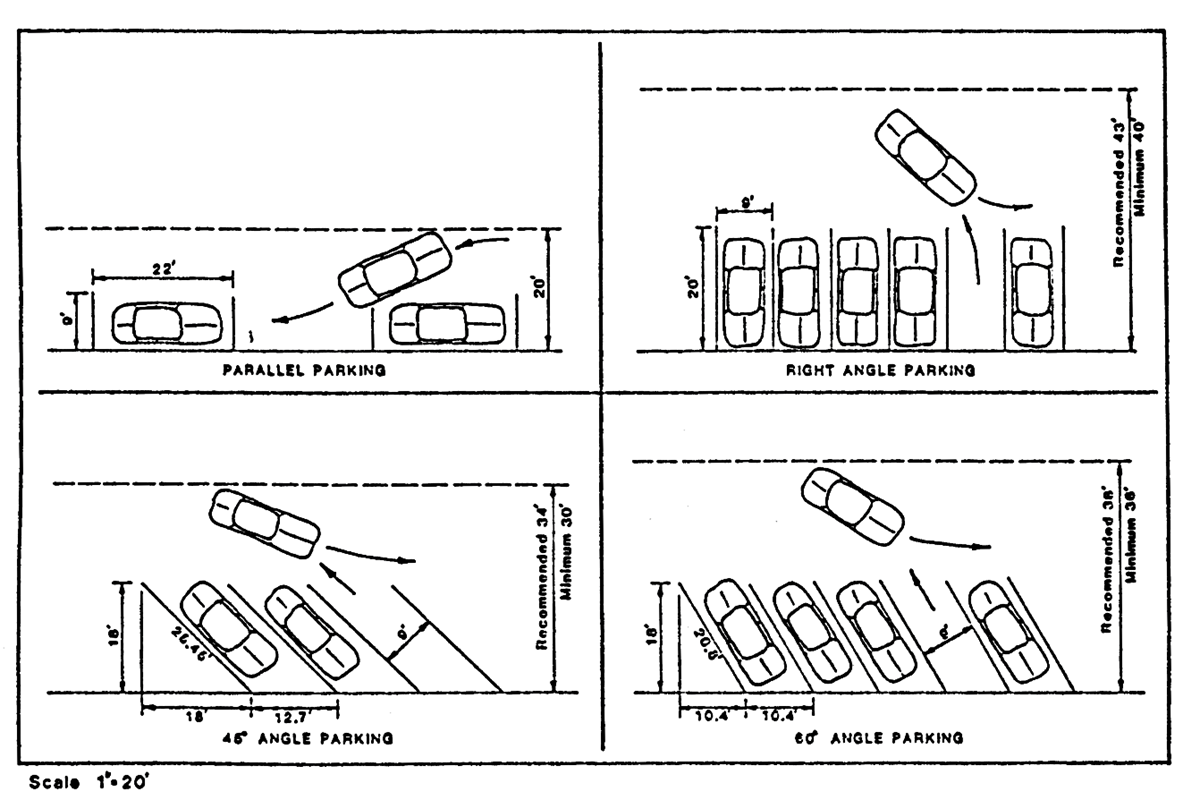
Parking Space and Maneuvering Space Used for Various Parking Areas
(e)
Development and maintenance of parking areas. When required to provide off-street parking in accordance with subsection (a) of this section, every parcel of land hereafter used as public or private parking area, including a commercial parking lot, shall be developed and maintained in accordance with the following requirements:
(1)
Location. All parking spaces provided pursuant to this section shall be on the same lot with the building or within 300 feet thereof. The distance to any parking area as herein required shall be measured between the nearest point of the building said parking area or facility is to serve. In no case shall off-site parking comprise more than 25 percent of the total number of spaces required in this section. When detached parking facilities or satellite parking lots are provided, they shall be located on property which is zoned to allow the principal use to which this parking will serve or they must be approved by the board of adjustment.
(2)
Pavement requirement. Every parcel of land which, after the effective date of the ordinance from which this chapter is derived, is used as a parking area, automobile, other vehicle or trailer sales or storage area, or automobile or motor vehicle service station, garage or other vehicular use area shall be paved. The minimum pavement requirements shall be designed for intense traffic use with asphaltic concrete hot mix surface, or a double bituminous surface treatment, or concrete surface. Any off-street parking area shall be paved as specified above and shall be so graded and drained as to dispose of all surface water accumulated within the area, and shall be so arranged and marked as to provide for orderly and safe loading or unloading and parking and storage of vehicles. The foregoing requirements with respect to surfacing shall not apply to a temporary parking area. Note: Refer to section 40-126(d)(4)d.
(3)
Screening and landscaping. Off-street parking areas for more than five vehicles shall be effectively screened on each interior side or rear yard area which adjoins any residential district, or institutional premises, by a masonry wall or solid board fence of acceptable design. Such wall or fence shall be six feet in height and shall be maintained in good condition without any advertising thereon. The space between such wall or fence and the side lot line adjoining said premises, or the front lot line facing said premises, in any residential district shall be landscaped with grass, hardy shrubs, or evergreen ground cover and maintained in good condition.
(4)
Signs. No signs of any kind shall be erected except information signs used to guide traffic and to state the conditions and terms of the use of the lot. Only nonintermittent white lighting of signs shall be permitted.
(5)
Lighting. Any lighting used to illuminate any off-street parking area shall be so arranged as to direct the light away from the adjoining premises in any residential district.
(f)
Off-street parking in historic districts. In all historic districts, in connection with every commercial, industrial, institutional, recreational, residential, or any other use, the following guidelines shall apply regarding off street parking of all motor vehicles, trailers, campers or recreational vehicles.
(1)
Definitions. The following words, terms and phrases, when used in this subsection (f), shall have the meanings ascribed to them in this subsection (f)(1), except where the context clearly indicates a different meaning:
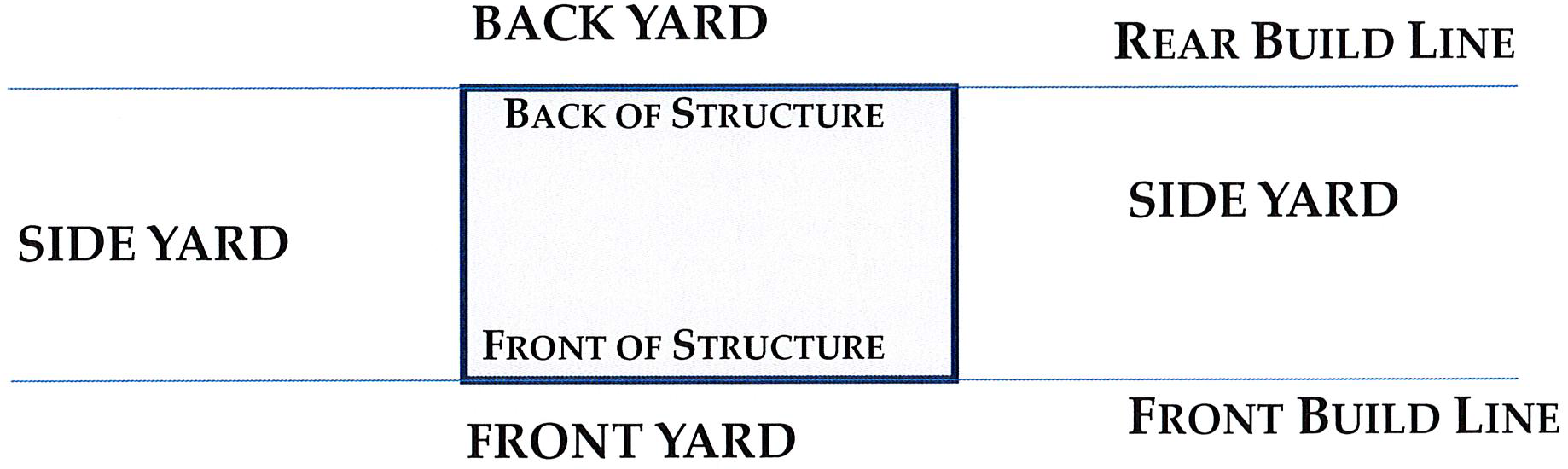
Back yard means the area behind an imaginary line (rear build line) that runs across the rear face of a structure and extends from the rear corners to the property line on either side.
Front yard means the area in front of an imaginary line (front build line) that runs across the front face of a structure and extends from the front corners of the structure to the property line on either side.
Motor vehicle means a self-propelled vehicle having two or more wheels whose primary purpose is the transportation of persons, including, but not limited to, all-terrain vehicles, automobiles, trucks, motorcycles, motor-driven cycles, motor scooters, etc.
Recreational vehicle means a structure built on a chassis, designed to be used as a temporary dwelling for travel, recreation and vacation uses and either self-propelled or designed to be towed behind a motor vehicle. The term "recreational vehicle" includes, but is not limited to, folding or collapsible structures, fifth wheel campers, tow behind campers, self propelled motor homes, etc.
Side yard means the area beside the structure that falls between the front and rear build line and the property line.
Trailer means a device without motive power, designed for carrying property or animals and for being drawn by a motor vehicle, to include, but not limited to, flatbed trailers, car haulers, fifth wheel trailers, horse trailers, etc.
(2)
Parking guidelines. No motor vehicle, trailer or recreational vehicle shall be parked in the front yard of any property located in a historic district, with the following exceptions:
a.
Loading and unloading. Motor vehicles, trailers and recreational vehicles are allowed to be parked in the front yard for a time not to exceed 30 minutes for the purpose of loading or unloading persons or property.
b.
Paved areas or driveways. In cases where a driveway or a paved area begins at the street or curb and extends thru the front yard into the side yard or back yard, motor vehicles shall be allowed to remain parked in the driveway or on the paved area. In no instance shall trailers or recreational vehicles be allowed to park in the front yard or front of the front build line with the exception provided in subsection (f)(2)a of this section.
c.
Side yards and back yards. Motor vehicles, trailers and recreational vehicles may be parked in a side yard or back yard provided it does not extend forward of the front build line into the front yard except in the cases noted in subsection (f)(2)b of this section.
d.
Special circumstances. In instances where there may be a need to park a motor vehicle, trailer, or recreational vehicle in the front yard in excess of 30 minutes, a letter may be obtained from the planning and zoning department of public works allowing such.
(3)
Prohibited acts.
a.
Alleys. No motor vehicle, camper, trailer, or recreational vehicle shall be parked in a public right of way to include alleys and streets in a manner that blocks or impedes traffic in any manner.
b.
Driveways and private right of ways. No motor vehicle, trailer or recreational vehicle shall be parked in a manner in which it blocks access to any surrounding property owners and prevents normal use of private access and property by such.
c.
Overnight parking. In no case should a motor vehicle, trailer or recreational vehicle be parked in the front yard overnight.
(4)
Penalty. Any person who violates any provision of this subsection (f) shall be punished by a fine of $50.00 per day as imposed by the municipal court.
(Code 1983, § 28-91; Ord. No. K-286, § 1(art. VII, § 1), 11-21-1988; Ord. No. L-61, § 1, 8-6-2001; Ord. No. L-144, § 2, 10-6-2003; Ord. No. L-216, § 9, 6-6-2005; Ord. No. L-309, § 1, 1-22-2008; Ord. No. 11-2024, § 1, 5-6-2024)
Sec. 50-209. - Off-street loading.
(a)
Requirement. Every building or structure hereafter constructed in any district for nonresidential purposes, requiring the receipt or distribution by vehicles of material or merchandise shall provide and maintain on the same lot with such building at least one off-street loading space for the first 5,000 square feet, or fraction thereof, of gross floor area, and one additional such loading space for each 10,000 square feet, or major fraction thereof, of gross floor area in excess of 5,000 square feet.
(b)
Size. Each loading space shall be not less than ten feet in width, 35 feet in length, and 14 feet in height. Where the off-street loading space does not abut on a street, alley, or easement of access, there shall be provided an access drive of at least ten feet in width leading from the street to loading area.
(c)
Location. Such space may occupy all or any part of any required yard or court space, but no such space may be located closer than 25 feet to any residential district unless wholly within a completely enclosed building or unless enclosed on all sides abutting the residential district by a wall of solid fence at least eight feet in height.
(Code 1983, § 28-92; Ord. No. K-286, § 1(art. VII, § 2), 11-21-1988)

